Copyright © 2015, 2011, 2007 Pearson Education, Inc. Chapter 1-1
Presented by
Professional Aided Supplemental Instruction
(PASI)
Ivy Tech Community College
Indianapolis
Basic Mathematics
Addition
Subtraction
Multiplication
Division
Real
Numbers
Chapter 1
Copyright © 2015, 2011, 2007 Pearson Education, Inc. Chapter 1-2
Copyright © 2015, 2011, 2007 Pearson Education, Inc. Chapter 1-3
Addition of Real
Numbers
Copyright © 2015, 2011, 2007 Pearson Education, Inc. Chapter 1-4
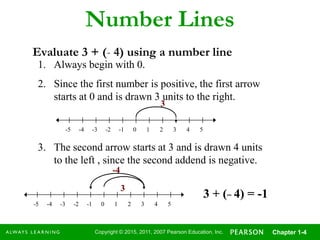
Number Lines
Evaluate 3 + (- 4) using a number line
1. Always begin with 0.
2. Since the first number is positive, the first arrow
starts at 0 and is drawn 3 units to the right.
3. The second arrow starts at 3 and is drawn 4 units
to the left , since the second addend is negative.
3 + (– 4) = -1
-5 -4 -3 -2 -1 0 1 2 3 4 5
3
-5 -4 -3 -2 -1 0 1 2 3 4 5
-4
3
Copyright © 2015, 2011, 2007 Pearson Education, Inc. Chapter 1-5
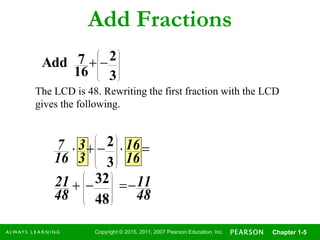
Add Fractions
The LCD is 48. Rewriting the first fraction with the LCD
gives the following.















3
2
16
7Add
48
11
48
21
16
16
3
3
16
7






























48
32
3
2
Copyright © 2015, 2011, 2007 Pearson Education, Inc. Chapter 1-6
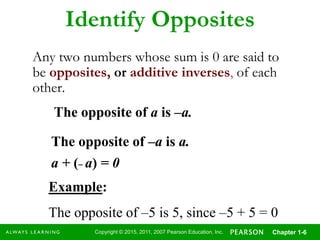
Identify Opposites
Any two numbers whose sum is 0 are said to
be opposites, or additive inverses, of each
other.
a + (– a) = 0
The opposite of a is –a.
The opposite of –a is a.
Example:
The opposite of –5 is 5, since –5 + 5 = 0
Copyright © 2015, 2011, 2007 Pearson Education, Inc. Chapter 1-7
Add Using Absolute Values
To add real numbers with the same sign,
add their absolute values. The sum has the
same sign as the numbers being added.
Example:
–6 + (–9) = –15 4 + 8 = 12
The sum of two positive numbers will
always be positive and the sum of two
negative numbers will always be negative.
Copyright © 2015, 2011, 2007 Pearson Education, Inc. Chapter 1-8
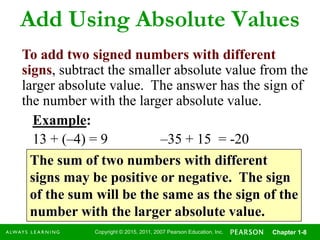
Add Using Absolute Values
To add two signed numbers with different
signs, subtract the smaller absolute value from the
larger absolute value. The answer has the sign of
the number with the larger absolute value.
Example:
13 + (–4) = 9 –35 + 15 = -20
The sum of two numbers with different
signs may be positive or negative. The sign
of the sum will be the same as the sign of the
number with the larger absolute value.
Copyright © 2015, 2011, 2007 Pearson Education, Inc. Chapter 1-9
Subtraction of
Real Numbers
Copyright © 2015, 2011, 2007 Pearson Education, Inc. Chapter 1-10
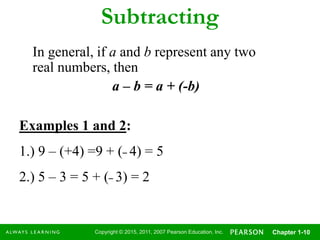
Subtracting
In general, if a and b represent any two
real numbers, then
a – b = a + (-b)
Examples 1 and 2:
1.) 9 – (+4) =9 + (– 4) = 5
2.) 5 – 3 = 5 + (– 3) = 2
Copyright © 2015, 2011, 2007 Pearson Education, Inc. Chapter 1-11
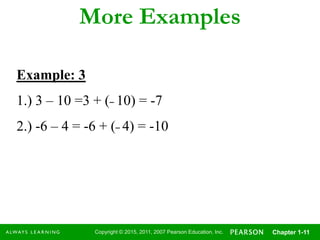
More Examples
Example: 3
1.) 3 – 10 =3 + (– 10) = -7
2.) -6 – 4 = -6 + (– 4) = -10
Copyright © 2015, 2011, 2007 Pearson Education, Inc. Chapter 1-12
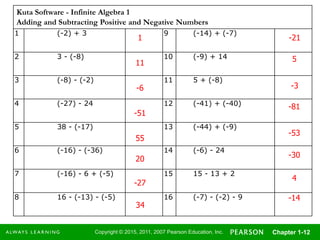
Kuta Software - Infinite Algebra 1
Adding and Subtracting Positive and Negative Numbers
1 (-2) + 3 9 (-14) + (-7)
2 3 - (-8) 10 (-9) + 14
3 (-8) - (-2) 11 5 + (-8)
4 (-27) - 24 12 (-41) + (-40)
5 38 - (-17) 13 (-44) + (-9)
6 (-16) - (-36) 14 (-6) - 24
7 (-16) - 6 + (-5) 15 15 - 13 + 2
8 16 - (-13) - (-5) 16 (-7) - (-2) - 9
1
11
-6
-51
55
20
-27
34
-21
5
-3
-81
-53
-30
4
-14
Copyright © 2015, 2011, 2007 Pearson Education, Inc. Chapter 1-13
Multiplication and
Division of Real
Numbers
Copyright © 2015, 2011, 2007 Pearson Education, Inc. Chapter 1-14
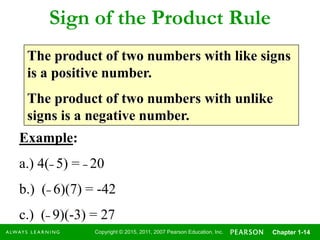
Sign of the Product Rule
The product of two numbers with like signs
is a positive number.
The product of two numbers with unlike
signs is a negative number.
Example:
a.) 4(– 5) = – 20
b.) (– 6)(7) = -42
c.) (– 9)(-3) = 27
Copyright © 2015, 2011, 2007 Pearson Education, Inc. Chapter 1-15
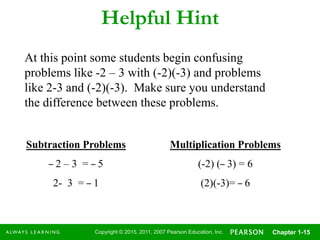
Helpful Hint
At this point some students begin confusing
problems like -2 – 3 with (-2)(-3) and problems
like 2-3 and (-2)(-3). Make sure you understand
the difference between these problems.
Subtraction Problems
– 2 – 3 = – 5
2- 3 = – 1
Multiplication Problems
(-2) (– 3) = 6
(2)(-3)= – 6
Copyright © 2015, 2011, 2007 Pearson Education, Inc. Chapter 1-16
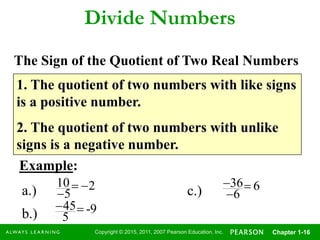
Divide Numbers
1. The quotient of two numbers with like signs
is a positive number.
2. The quotient of two numbers with unlike
signs is a negative number.
Example:
2
5
10 
a.)
9-
5
45
b.)
6
6
36


c.)
The Sign of the Quotient of Two Real Numbers
Copyright © 2015, 2011, 2007 Pearson Education, Inc. Chapter 1-17
Helpful Hint
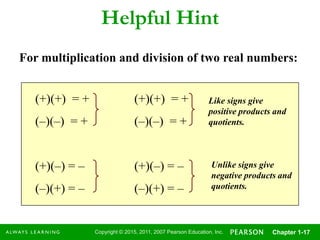
(+)(+) = + (+)(+) = +
(–)(–) = + (–)(–) = +
(+)(–) = – (+)(–) = –
(–)(+) = – (–)(+) = –
Like signs give
positive products and
quotients.
Unlike signs give
negative products and
quotients.
For multiplication and division of two real numbers:
Copyright © 2015, 2011, 2007 Pearson Education, Inc. Chapter 1-18
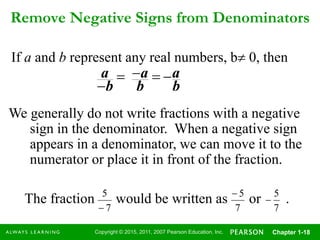
Remove Negative Signs from Denominators
If a and b represent any real numbers, b 0, then
b
a
b
a
b
a 

We generally do not write fractions with a negative
sign in the denominator. When a negative sign
appears in a denominator, we can move it to the
numerator or place it in front of the fraction.
The fraction would be written as or .
7
5
 7
5

7
5
Copyright © 2015, 2011, 2007 Pearson Education, Inc. Chapter 1-19
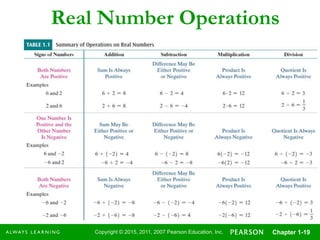
Real Number Operations
Copyright © 2015, 2011, 2007 Pearson Education, Inc. Chapter 1-20
Evaluate Divisions Involving Zero
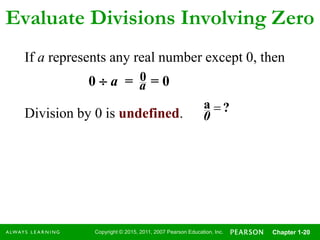
If a represents any real number except 0, then
0  a = = 0a
0
Division by 0 is undefined. ?a 
0
Copyright © 2015, 2011, 2007 Pearson Education, Inc. Chapter 1-21
Worksheet by Kuta Software LLC Kuta Software - Infinite Pre-Algebra
1 6 × −4 13 4 × 2
2 3 × −4 14 −6 × 4
3 5 × −4 15 −3 × 4
4 −5 × 6 16 −2 × −1
5 −8 ÷ −2 17 11 × 12
6 35 ÷ -5 18 9 ÷ −3
7 10 ÷ 5 19 16 ÷ 2
8 −49 ÷ 7 20 8 × −12
9 9 × 10 × 6 21 −6 × −10 × −8
10 7 × 9 × 7 22 6 × 6 × −2
11 −5 × −4 × −10 23 9 × 9 × −5
12 8 × 3 × 8 24 7 × 5 × −5
−24
−12
−20
−30
4
−7
2
−7
540
441
−200
192
8
−24
−12
2
132
−3
8
−96
− 480
− 72
− 405
− 175
Copyright © 2015, 2011, 2007 Pearson Education, Inc. Chapter 1-22
Exponents,
Parentheses and
Order of Operations
Copyright © 2015, 2011, 2007 Pearson Education, Inc. Chapter 1-23
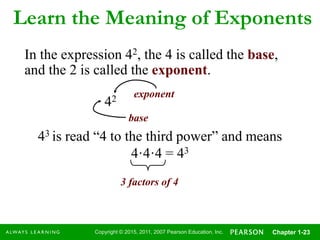
Learn the Meaning of Exponents
In the expression 42, the 4 is called the base,
and the 2 is called the exponent.
exponent
42
base
43 is read “4 to the third power” and means
4·4·4 = 43
3 factors of 4
Copyright © 2015, 2011, 2007 Pearson Education, Inc. Chapter 1-24
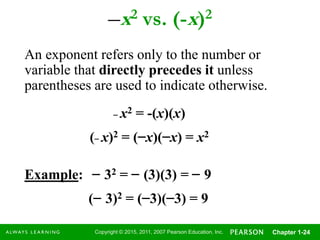
–x2 vs. (-x)2
An exponent refers only to the number or
variable that directly precedes it unless
parentheses are used to indicate otherwise.
– x2 = -(x)(x)
(– x)2 = (–x)(–x) = x2
Example: – 32 = – (3)(3) = – 9
(– 3)2 = (–3)(–3) = 9
Copyright © 2015, 2011, 2007 Pearson Education, Inc. Chapter 1-25
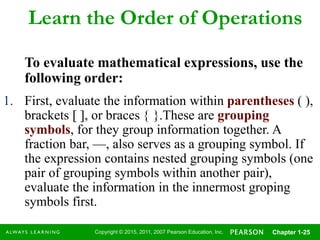
Learn the Order of Operations
To evaluate mathematical expressions, use the
following order:
1. First, evaluate the information within parentheses ( ),
brackets  , or braces  .These are grouping
symbols, for they group information together. A
fraction bar, —, also serves as a grouping symbol. If
the expression contains nested grouping symbols (one
pair of grouping symbols within another pair),
evaluate the information in the innermost groping
symbols first.
Copyright © 2015, 2011, 2007 Pearson Education, Inc. Chapter 1-26
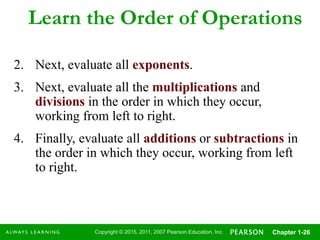
Learn the Order of Operations
2. Next, evaluate all exponents.
3. Next, evaluate all the multiplications and
divisions in the order in which they occur,
working from left to right.
4. Finally, evaluate all additions or subtractions in
the order in which they occur, working from left
to right.
Copyright © 2015, 2011, 2007 Pearson Education, Inc. Chapter 1-27
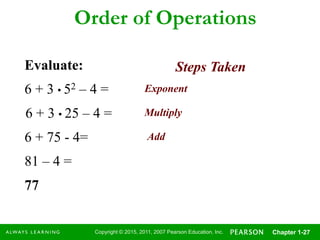
Order of Operations
Evaluate:
6 + 3 • 52 – 4 = Exponent
Multiply
Add
6 + 3 • 25 – 4 =
6 + 75 - 4=
81 – 4 =
77
Steps Taken
Copyright © 2015, 2011, 2007 Pearson Education, Inc. Chapter 1-28
Order of Operations
Evaluate:
-7 + 2 [-6 + (36 / 32 )] = Exponent
Divide
Add
-7 + 2 [-6 + (36 / 9 )] =
-7 + 2 [-6 + 4] =
-7 + 2 [-2] =
-11
Steps Taken
-7 - 4 =
Multiply
Copyright © 2015, 2011, 2007 Pearson Education, Inc. Chapter 1-29
Properties of the
Real Number System
Copyright © 2015, 2011, 2007 Pearson Education, Inc. Chapter 1-30
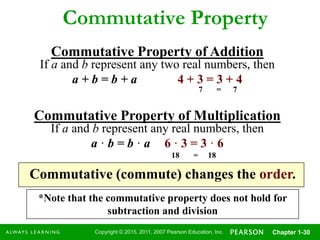
Commutative Property
Commutative Property of Addition
If a and b represent any two real numbers, then
a + b = b + a 4 + 3 = 3 + 4
Commutative Property of Multiplication
If a and b represent any real numbers, then
a · b = b · a 6 · 3 = 3 · 6
Commutative (commute) changes the order.
*Note that the commutative property does not hold for
subtraction and division
7 = 7
18 = 18
Copyright © 2015, 2011, 2007 Pearson Education, Inc. Chapter 1-31
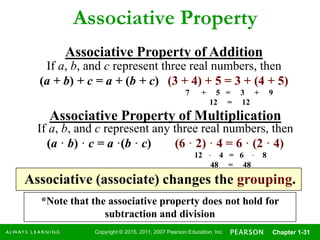
Associative Property
Associative Property of Addition
If a, b, and c represent three real numbers, then
(a + b) + c = a + (b + c) (3 + 4) + 5 = 3 + (4 + 5)
Associative Property of Multiplication
If a, b, and c represent any three real numbers, then
(a · b) · c = a ·(b · c) (6 · 2) · 4 = 6 · (2 · 4)
Associative (associate) changes the grouping.
*Note that the associative property does not hold for
subtraction and division
7 + 5 = 3 + 9
12 = 12
12 · 4 = 6 · 8
48 = 48
Copyright © 2015, 2011, 2007 Pearson Education, Inc. Chapter 1-32
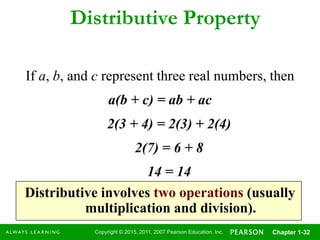
Distributive Property
If a, b, and c represent three real numbers, then
a(b + c) = ab + ac
Distributive involves two operations (usually
multiplication and division).
2(3 + 4) = 2(3) + 2(4)
2(7) = 6 + 8
14 = 14
Copyright © 2015, 2011, 2007 Pearson Education, Inc. Chapter 1-33
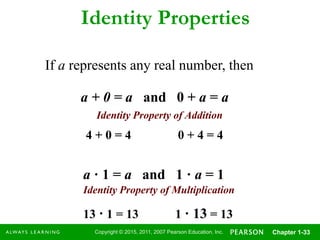
Identity Properties
If a represents any real number, then
a + 0 = a and 0 + a = a
a · 1 = a and 1 · a = 1
Identity Property of Addition
Identity Property of Multiplication
4 + 0 = 4 0 + 4 = 4
13 · 1 = 13 1 · 13 = 13
Copyright © 2015, 2011, 2007 Pearson Education, Inc. Chapter 1-34
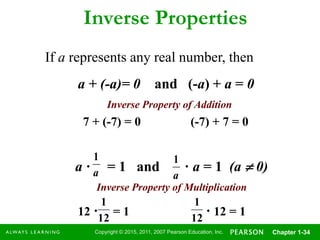
Inverse Properties
If a represents any real number, then
a + (-a)= 0 and (-a) + a = 0
Inverse Property of Addition
Inverse Property of Multiplication
a · = 1 and · a = 1 (a  0)a
1
a
1
7 + (-7) = 0 (-7) + 7 = 0
12 · = 1 · 12 = 112
1
12
1
Copyright © 2015, 2011, 2007 Pearson Education, Inc. Chapter 1-35
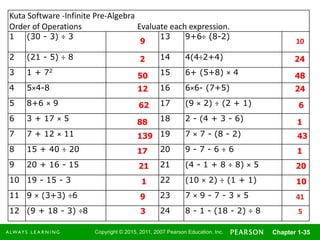
Kuta Software -Infinite Pre-Algebra
Order of Operations Evaluate each expression.
1 (30 - 3) ÷ 3 13 9+6÷ (8-2)
2 (21 - 5) ÷ 8 14 4(4÷2+4)
3 1 + 72 15 6+ (5+8) × 4
4 5×4-8 16 6×6- (7+5)
5 8+6 × 9 17 (9 × 2) ÷ (2 + 1)
6 3 + 17 × 5 18 2 - (4 + 3 - 6)
7 7 + 12 × 11 19 7 × 7 - (8 - 2)
8 15 + 40 ÷ 20 20 9 - 7 - 6 ÷ 6
9 20 + 16 - 15 21 (4 - 1 + 8 ÷ 8) × 5
10 19 - 15 - 3 22 (10 × 2) ÷ (1 + 1)
11 9 × (3+3) ÷6 23 7 × 9 - 7 - 3 × 5
12 (9 + 18 - 3) ÷8 24 8 - 1 - (18 - 2) ÷ 8
9
2
50
12
62
88
139
17
21
1
9
3
10
24
48
24
6
1
43
1
20
10
41
5

Addition subtraction-multi-divison(6)

  • 1.
    Copyright © 2015,2011, 2007 Pearson Education, Inc. Chapter 1-1 Presented by Professional Aided Supplemental Instruction (PASI) Ivy Tech Community College Indianapolis Basic Mathematics Addition Subtraction Multiplication Division
  • 2.
    Real Numbers Chapter 1 Copyright ©2015, 2011, 2007 Pearson Education, Inc. Chapter 1-2
  • 3.
    Copyright © 2015,2011, 2007 Pearson Education, Inc. Chapter 1-3 Addition of Real Numbers
  • 4.
    Copyright © 2015,2011, 2007 Pearson Education, Inc. Chapter 1-4 Number Lines Evaluate 3 + (- 4) using a number line 1. Always begin with 0. 2. Since the first number is positive, the first arrow starts at 0 and is drawn 3 units to the right. 3. The second arrow starts at 3 and is drawn 4 units to the left , since the second addend is negative. 3 + (– 4) = -1 -5 -4 -3 -2 -1 0 1 2 3 4 5 3 -5 -4 -3 -2 -1 0 1 2 3 4 5 -4 3
  • 5.
    Copyright © 2015,2011, 2007 Pearson Education, Inc. Chapter 1-5 Add Fractions The LCD is 48. Rewriting the first fraction with the LCD gives the following.                3 2 16 7Add 48 11 48 21 16 16 3 3 16 7                               48 32 3 2
  • 6.
    Copyright © 2015,2011, 2007 Pearson Education, Inc. Chapter 1-6 Identify Opposites Any two numbers whose sum is 0 are said to be opposites, or additive inverses, of each other. a + (– a) = 0 The opposite of a is –a. The opposite of –a is a. Example: The opposite of –5 is 5, since –5 + 5 = 0
  • 7.
    Copyright © 2015,2011, 2007 Pearson Education, Inc. Chapter 1-7 Add Using Absolute Values To add real numbers with the same sign, add their absolute values. The sum has the same sign as the numbers being added. Example: –6 + (–9) = –15 4 + 8 = 12 The sum of two positive numbers will always be positive and the sum of two negative numbers will always be negative.
  • 8.
    Copyright © 2015,2011, 2007 Pearson Education, Inc. Chapter 1-8 Add Using Absolute Values To add two signed numbers with different signs, subtract the smaller absolute value from the larger absolute value. The answer has the sign of the number with the larger absolute value. Example: 13 + (–4) = 9 –35 + 15 = -20 The sum of two numbers with different signs may be positive or negative. The sign of the sum will be the same as the sign of the number with the larger absolute value.
  • 9.
    Copyright © 2015,2011, 2007 Pearson Education, Inc. Chapter 1-9 Subtraction of Real Numbers
  • 10.
    Copyright © 2015,2011, 2007 Pearson Education, Inc. Chapter 1-10 Subtracting In general, if a and b represent any two real numbers, then a – b = a + (-b) Examples 1 and 2: 1.) 9 – (+4) =9 + (– 4) = 5 2.) 5 – 3 = 5 + (– 3) = 2
  • 11.
    Copyright © 2015,2011, 2007 Pearson Education, Inc. Chapter 1-11 More Examples Example: 3 1.) 3 – 10 =3 + (– 10) = -7 2.) -6 – 4 = -6 + (– 4) = -10
  • 12.
    Copyright © 2015,2011, 2007 Pearson Education, Inc. Chapter 1-12 Kuta Software - Infinite Algebra 1 Adding and Subtracting Positive and Negative Numbers 1 (-2) + 3 9 (-14) + (-7) 2 3 - (-8) 10 (-9) + 14 3 (-8) - (-2) 11 5 + (-8) 4 (-27) - 24 12 (-41) + (-40) 5 38 - (-17) 13 (-44) + (-9) 6 (-16) - (-36) 14 (-6) - 24 7 (-16) - 6 + (-5) 15 15 - 13 + 2 8 16 - (-13) - (-5) 16 (-7) - (-2) - 9 1 11 -6 -51 55 20 -27 34 -21 5 -3 -81 -53 -30 4 -14
  • 13.
    Copyright © 2015,2011, 2007 Pearson Education, Inc. Chapter 1-13 Multiplication and Division of Real Numbers
  • 14.
    Copyright © 2015,2011, 2007 Pearson Education, Inc. Chapter 1-14 Sign of the Product Rule The product of two numbers with like signs is a positive number. The product of two numbers with unlike signs is a negative number. Example: a.) 4(– 5) = – 20 b.) (– 6)(7) = -42 c.) (– 9)(-3) = 27
  • 15.
    Copyright © 2015,2011, 2007 Pearson Education, Inc. Chapter 1-15 Helpful Hint At this point some students begin confusing problems like -2 – 3 with (-2)(-3) and problems like 2-3 and (-2)(-3). Make sure you understand the difference between these problems. Subtraction Problems – 2 – 3 = – 5 2- 3 = – 1 Multiplication Problems (-2) (– 3) = 6 (2)(-3)= – 6
  • 16.
    Copyright © 2015,2011, 2007 Pearson Education, Inc. Chapter 1-16 Divide Numbers 1. The quotient of two numbers with like signs is a positive number. 2. The quotient of two numbers with unlike signs is a negative number. Example: 2 5 10  a.) 9- 5 45 b.) 6 6 36   c.) The Sign of the Quotient of Two Real Numbers
  • 17.
    Copyright © 2015,2011, 2007 Pearson Education, Inc. Chapter 1-17 Helpful Hint (+)(+) = + (+)(+) = + (–)(–) = + (–)(–) = + (+)(–) = – (+)(–) = – (–)(+) = – (–)(+) = – Like signs give positive products and quotients. Unlike signs give negative products and quotients. For multiplication and division of two real numbers:
  • 18.
    Copyright © 2015,2011, 2007 Pearson Education, Inc. Chapter 1-18 Remove Negative Signs from Denominators If a and b represent any real numbers, b 0, then b a b a b a   We generally do not write fractions with a negative sign in the denominator. When a negative sign appears in a denominator, we can move it to the numerator or place it in front of the fraction. The fraction would be written as or . 7 5  7 5  7 5
  • 19.
    Copyright © 2015,2011, 2007 Pearson Education, Inc. Chapter 1-19 Real Number Operations
  • 20.
    Copyright © 2015,2011, 2007 Pearson Education, Inc. Chapter 1-20 Evaluate Divisions Involving Zero If a represents any real number except 0, then 0  a = = 0a 0 Division by 0 is undefined. ?a  0
  • 21.
    Copyright © 2015,2011, 2007 Pearson Education, Inc. Chapter 1-21 Worksheet by Kuta Software LLC Kuta Software - Infinite Pre-Algebra 1 6 × −4 13 4 × 2 2 3 × −4 14 −6 × 4 3 5 × −4 15 −3 × 4 4 −5 × 6 16 −2 × −1 5 −8 ÷ −2 17 11 × 12 6 35 ÷ -5 18 9 ÷ −3 7 10 ÷ 5 19 16 ÷ 2 8 −49 ÷ 7 20 8 × −12 9 9 × 10 × 6 21 −6 × −10 × −8 10 7 × 9 × 7 22 6 × 6 × −2 11 −5 × −4 × −10 23 9 × 9 × −5 12 8 × 3 × 8 24 7 × 5 × −5 −24 −12 −20 −30 4 −7 2 −7 540 441 −200 192 8 −24 −12 2 132 −3 8 −96 − 480 − 72 − 405 − 175
  • 22.
    Copyright © 2015,2011, 2007 Pearson Education, Inc. Chapter 1-22 Exponents, Parentheses and Order of Operations
  • 23.
    Copyright © 2015,2011, 2007 Pearson Education, Inc. Chapter 1-23 Learn the Meaning of Exponents In the expression 42, the 4 is called the base, and the 2 is called the exponent. exponent 42 base 43 is read “4 to the third power” and means 4·4·4 = 43 3 factors of 4
  • 24.
    Copyright © 2015,2011, 2007 Pearson Education, Inc. Chapter 1-24 –x2 vs. (-x)2 An exponent refers only to the number or variable that directly precedes it unless parentheses are used to indicate otherwise. – x2 = -(x)(x) (– x)2 = (–x)(–x) = x2 Example: – 32 = – (3)(3) = – 9 (– 3)2 = (–3)(–3) = 9
  • 25.
    Copyright © 2015,2011, 2007 Pearson Education, Inc. Chapter 1-25 Learn the Order of Operations To evaluate mathematical expressions, use the following order: 1. First, evaluate the information within parentheses ( ), brackets  , or braces  .These are grouping symbols, for they group information together. A fraction bar, —, also serves as a grouping symbol. If the expression contains nested grouping symbols (one pair of grouping symbols within another pair), evaluate the information in the innermost groping symbols first.
  • 26.
    Copyright © 2015,2011, 2007 Pearson Education, Inc. Chapter 1-26 Learn the Order of Operations 2. Next, evaluate all exponents. 3. Next, evaluate all the multiplications and divisions in the order in which they occur, working from left to right. 4. Finally, evaluate all additions or subtractions in the order in which they occur, working from left to right.
  • 27.
    Copyright © 2015,2011, 2007 Pearson Education, Inc. Chapter 1-27 Order of Operations Evaluate: 6 + 3 • 52 – 4 = Exponent Multiply Add 6 + 3 • 25 – 4 = 6 + 75 - 4= 81 – 4 = 77 Steps Taken
  • 28.
    Copyright © 2015,2011, 2007 Pearson Education, Inc. Chapter 1-28 Order of Operations Evaluate: -7 + 2 [-6 + (36 / 32 )] = Exponent Divide Add -7 + 2 [-6 + (36 / 9 )] = -7 + 2 [-6 + 4] = -7 + 2 [-2] = -11 Steps Taken -7 - 4 = Multiply
  • 29.
    Copyright © 2015,2011, 2007 Pearson Education, Inc. Chapter 1-29 Properties of the Real Number System
  • 30.
    Copyright © 2015,2011, 2007 Pearson Education, Inc. Chapter 1-30 Commutative Property Commutative Property of Addition If a and b represent any two real numbers, then a + b = b + a 4 + 3 = 3 + 4 Commutative Property of Multiplication If a and b represent any real numbers, then a · b = b · a 6 · 3 = 3 · 6 Commutative (commute) changes the order. *Note that the commutative property does not hold for subtraction and division 7 = 7 18 = 18
  • 31.
    Copyright © 2015,2011, 2007 Pearson Education, Inc. Chapter 1-31 Associative Property Associative Property of Addition If a, b, and c represent three real numbers, then (a + b) + c = a + (b + c) (3 + 4) + 5 = 3 + (4 + 5) Associative Property of Multiplication If a, b, and c represent any three real numbers, then (a · b) · c = a ·(b · c) (6 · 2) · 4 = 6 · (2 · 4) Associative (associate) changes the grouping. *Note that the associative property does not hold for subtraction and division 7 + 5 = 3 + 9 12 = 12 12 · 4 = 6 · 8 48 = 48
  • 32.
    Copyright © 2015,2011, 2007 Pearson Education, Inc. Chapter 1-32 Distributive Property If a, b, and c represent three real numbers, then a(b + c) = ab + ac Distributive involves two operations (usually multiplication and division). 2(3 + 4) = 2(3) + 2(4) 2(7) = 6 + 8 14 = 14
  • 33.
    Copyright © 2015,2011, 2007 Pearson Education, Inc. Chapter 1-33 Identity Properties If a represents any real number, then a + 0 = a and 0 + a = a a · 1 = a and 1 · a = 1 Identity Property of Addition Identity Property of Multiplication 4 + 0 = 4 0 + 4 = 4 13 · 1 = 13 1 · 13 = 13
  • 34.
    Copyright © 2015,2011, 2007 Pearson Education, Inc. Chapter 1-34 Inverse Properties If a represents any real number, then a + (-a)= 0 and (-a) + a = 0 Inverse Property of Addition Inverse Property of Multiplication a · = 1 and · a = 1 (a  0)a 1 a 1 7 + (-7) = 0 (-7) + 7 = 0 12 · = 1 · 12 = 112 1 12 1
  • 35.
    Copyright © 2015,2011, 2007 Pearson Education, Inc. Chapter 1-35 Kuta Software -Infinite Pre-Algebra Order of Operations Evaluate each expression. 1 (30 - 3) ÷ 3 13 9+6÷ (8-2) 2 (21 - 5) ÷ 8 14 4(4÷2+4) 3 1 + 72 15 6+ (5+8) × 4 4 5×4-8 16 6×6- (7+5) 5 8+6 × 9 17 (9 × 2) ÷ (2 + 1) 6 3 + 17 × 5 18 2 - (4 + 3 - 6) 7 7 + 12 × 11 19 7 × 7 - (8 - 2) 8 15 + 40 ÷ 20 20 9 - 7 - 6 ÷ 6 9 20 + 16 - 15 21 (4 - 1 + 8 ÷ 8) × 5 10 19 - 15 - 3 22 (10 × 2) ÷ (1 + 1) 11 9 × (3+3) ÷6 23 7 × 9 - 7 - 3 × 5 12 (9 + 18 - 3) ÷8 24 8 - 1 - (18 - 2) ÷ 8 9 2 50 12 62 88 139 17 21 1 9 3 10 24 48 24 6 1 43 1 20 10 41 5