Chapter 11 Excretion
Learning Objectives:
(a) define excretion and explain the importance of removing
nitrogenous and other compounds from the body
(b) outline the function of kidney tubules with reference to ultra-
filtration and selective reabsorption in the production of
urine
(c) outline the role of anti-diuretic hormone (ADH) in the
regulation of osmotic concentration
(d) outline the mechanism of dialysis in the case of kidney
failure
Excretion is the removal of toxic
materials and the waste products of
metabolism from the body.
Egestion is the removal of
undigested food matter which have
never been involved in the metabolic
activities of cells, from the alimentary
canal.
Faeces is NOT a product of metabolism!
skin lungs liver kidneys
Waste products excreted by:
• urea
• excess water
• excess salts
• carbon dioxide
• excess water
• bile
pigments
• urea
• excess water
• excess salts
in sweat
in expired air in faeces
through the
intestines
in urine
Metabolic Waste Products:
Excretory product Organ Mode of excretion
Carbon dioxide Lungs Exhalation
Urea and excess
mineral salts
Kidneys
Skin
Urine
Sweat
Excess water Kidneys
Skin
Lungs
Urine
Sweat
Expired Air
Bile pigments
(from breakdown of
haemoglobin)
Liver Faeces
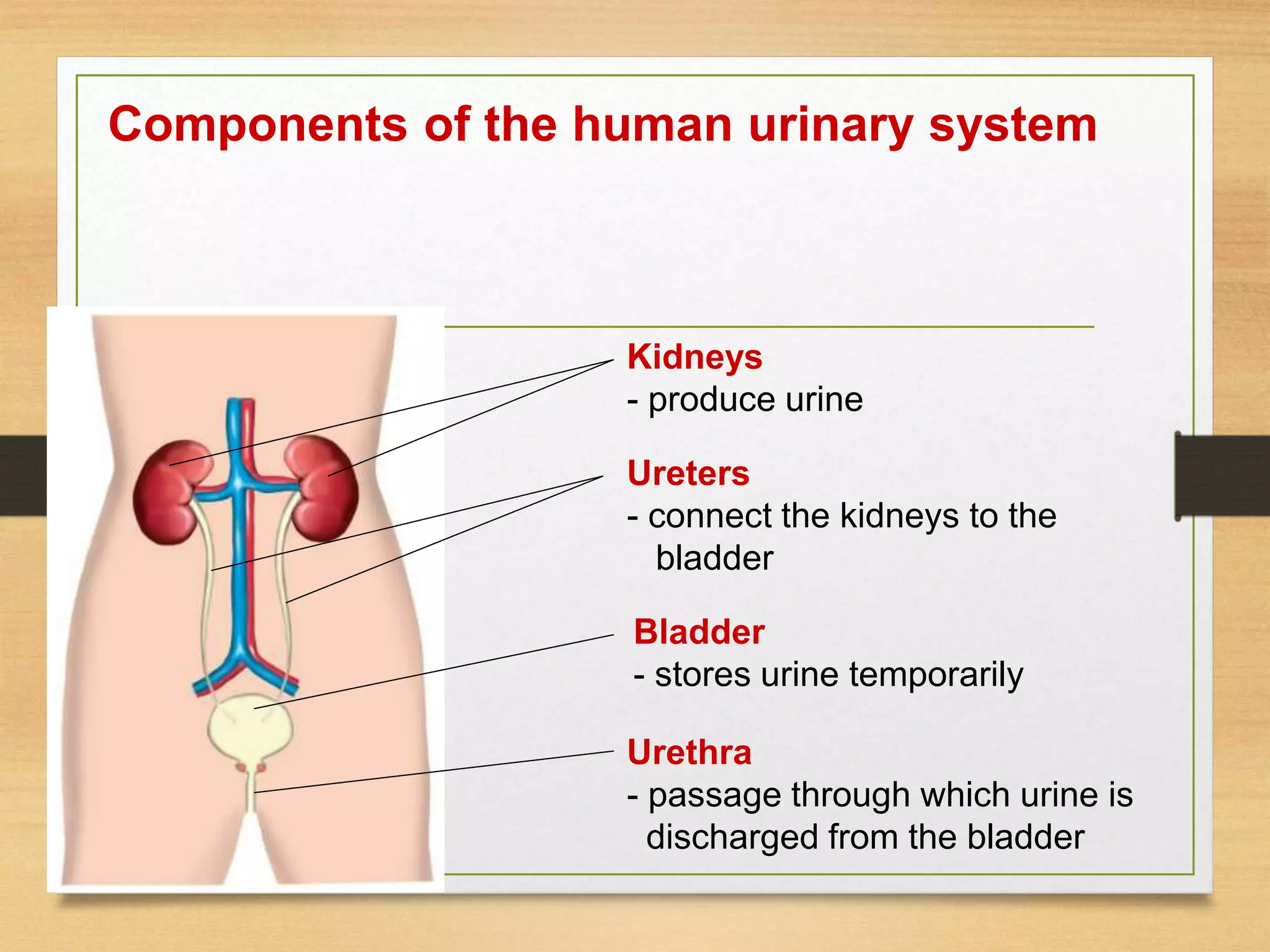
Kidneys
- produce urine
Ureters
- connect the kidneys to the
bladder
Bladder
- stores urine temporarily
Urethra
- passage through which urine is
discharged from the bladder
Components of the human urinary system
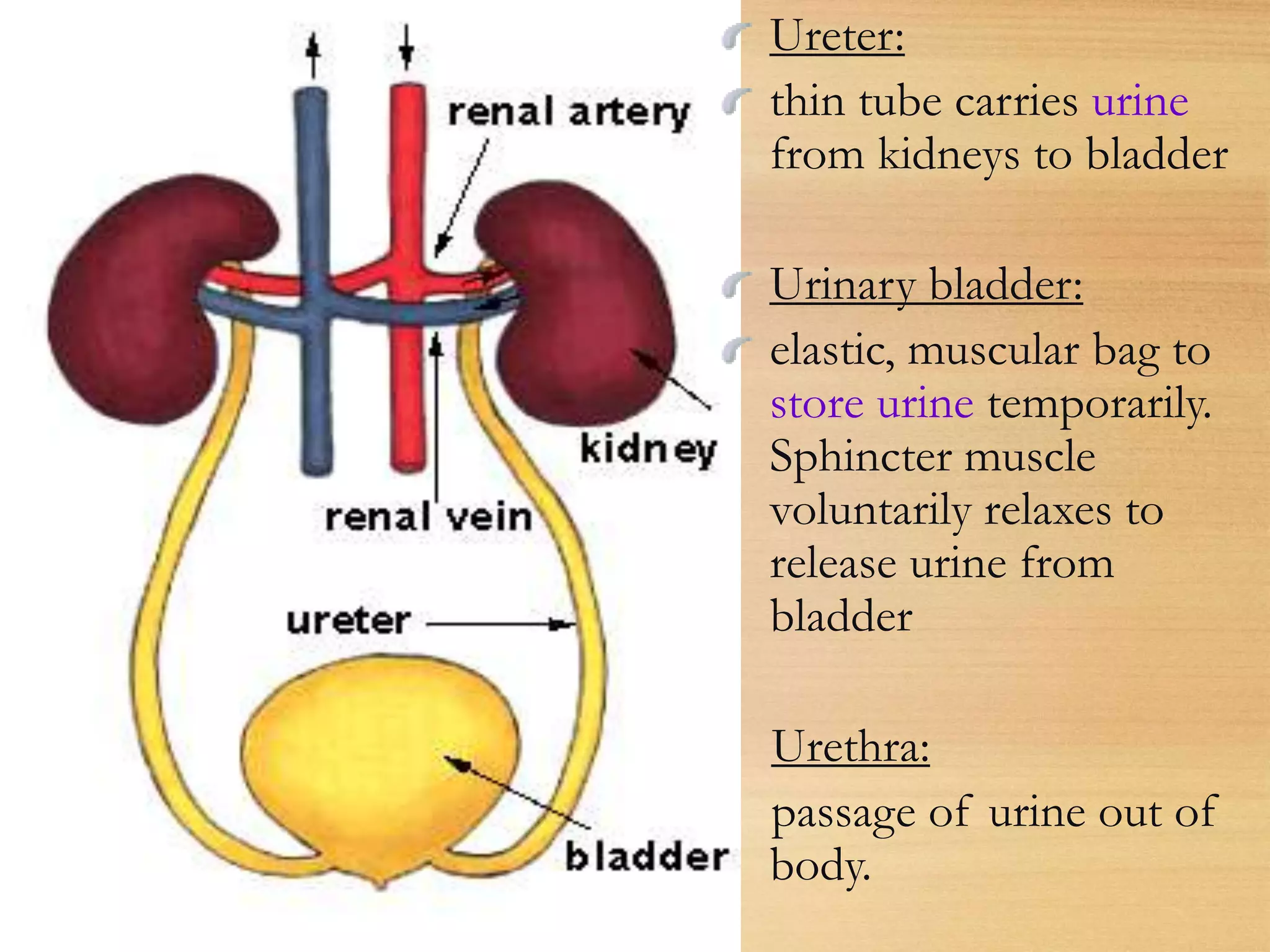
Ureter:
thin tube carries urine
from kidneys to bladder
Urinary bladder:
elastic, muscular bag to
store urine temporarily.
Sphincter muscle
voluntarily relaxes to
release urine from
bladder
Urethra:
passage of urine out of
body.
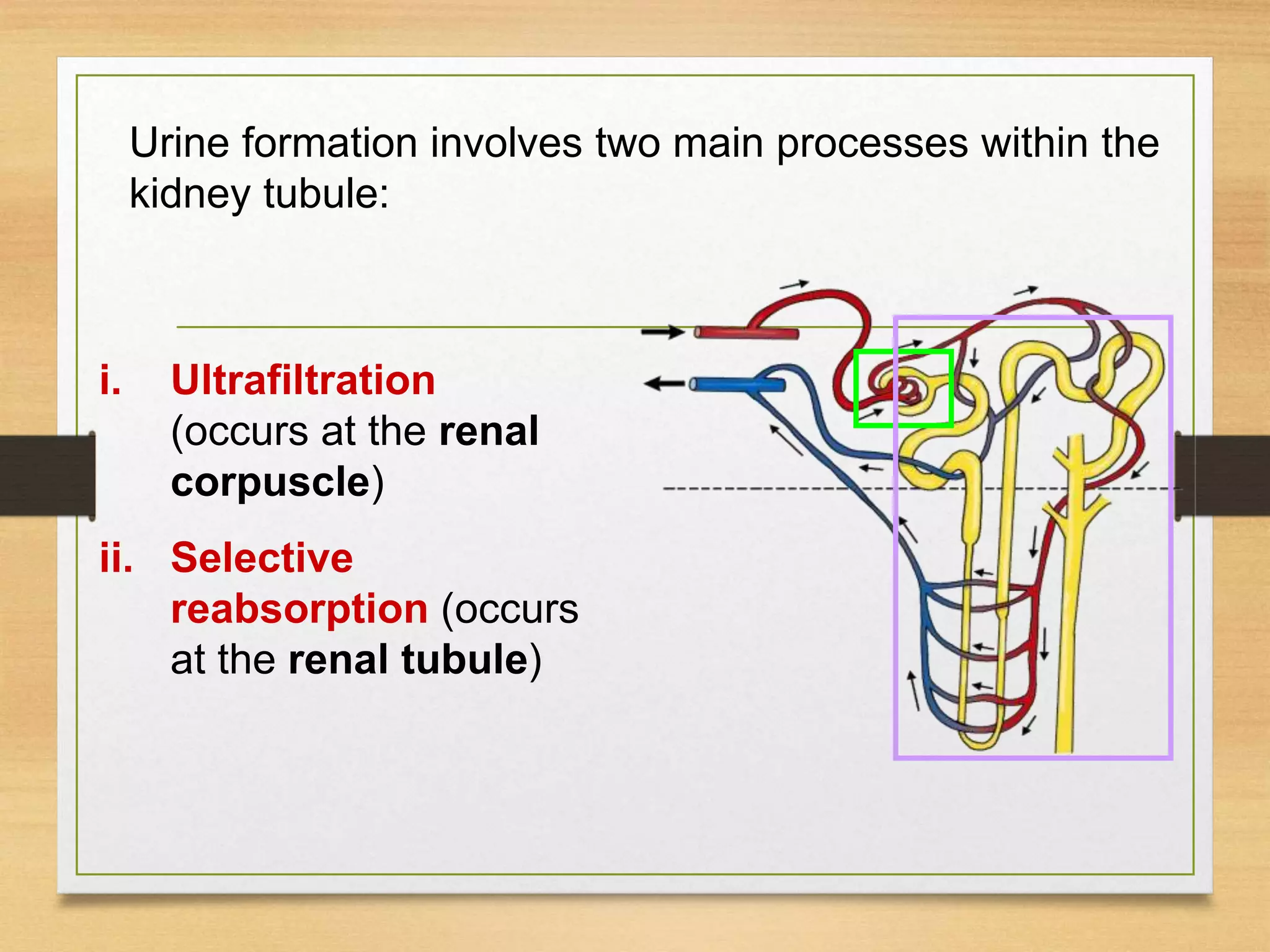
Blood reaches
the kidney via
the renal
artery, which
branches into
arterioles
Blood from
each arteriole
flows into a
network of
capillaries
(glomerulus) in
the Bowman's
capsule
Blood leaving
the glomerulus
flows through
the capillaries
that run along
the kidney
tubules
Blood from the
capillaries enter
the venules,
which lead to
the renal vein
Blood vessels
Renal artery
Renal vein
Ureter
11.3
Learning Outcome
After this section, you should be able to:
• outline the function of the kidney tubules in urine
formation with reference to ultrafiltration and
selective reabsorption.
Urine Formation
Nephron- smallest unit of kidney
i. Ultrafiltration
(occurs at the renal
corpuscle)
ii. Selective
reabsorption (occurs
at the renal tubule)
Urine formation involves two main processes within the
kidney tubule:
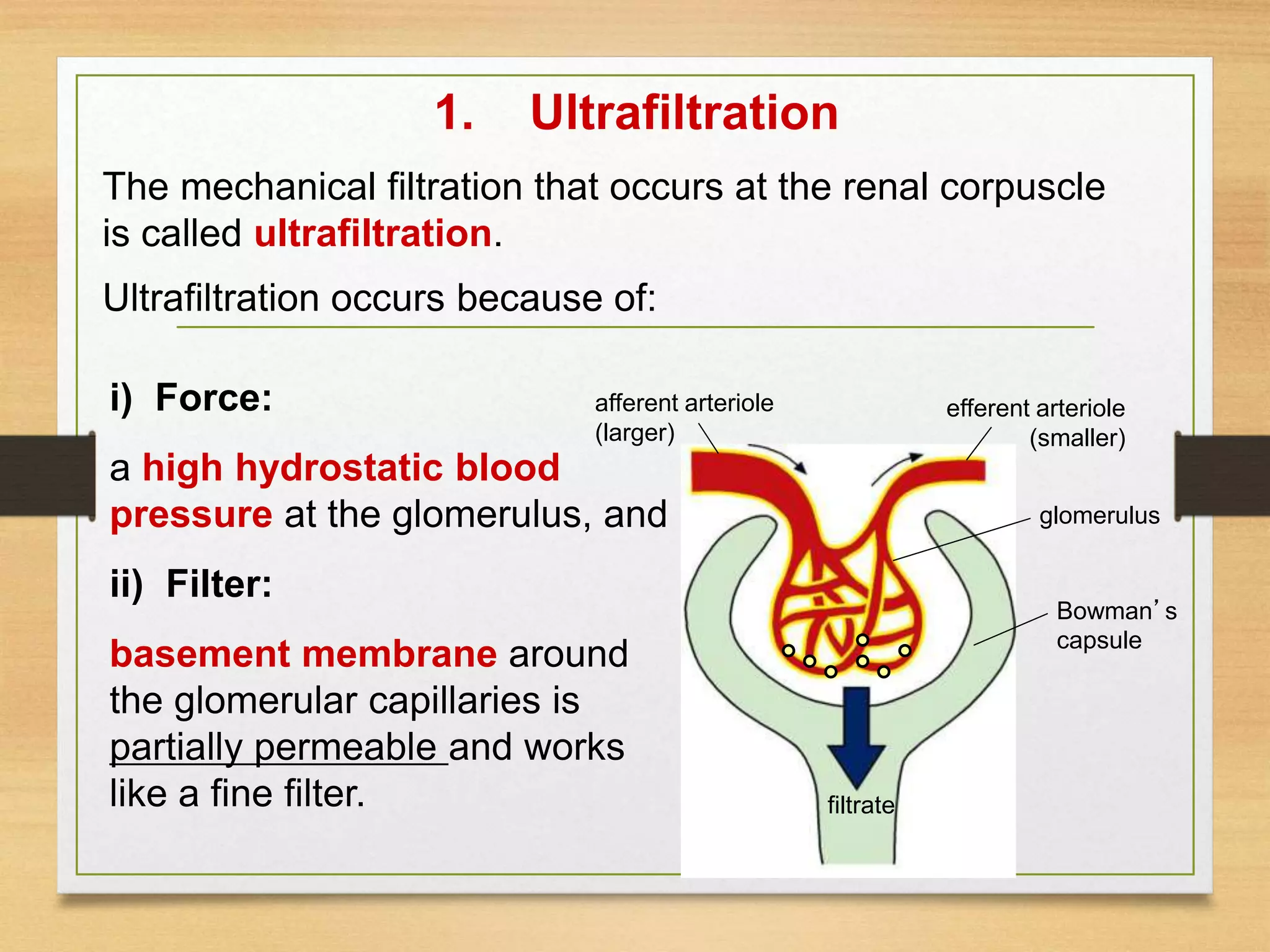
1. Ultrafiltration
i) Force:
a high hydrostatic blood
pressure at the glomerulus, and
ii) Filter:
basement membrane around
the glomerular capillaries is
partially permeable and works
like a fine filter.
afferent arteriole
(larger)
Bowman’s
capsule
glomerulus
efferent arteriole
(smaller)
filtrate
The mechanical filtration that occurs at the renal corpuscle
is called ultrafiltration.
Ultrafiltration occurs because of:
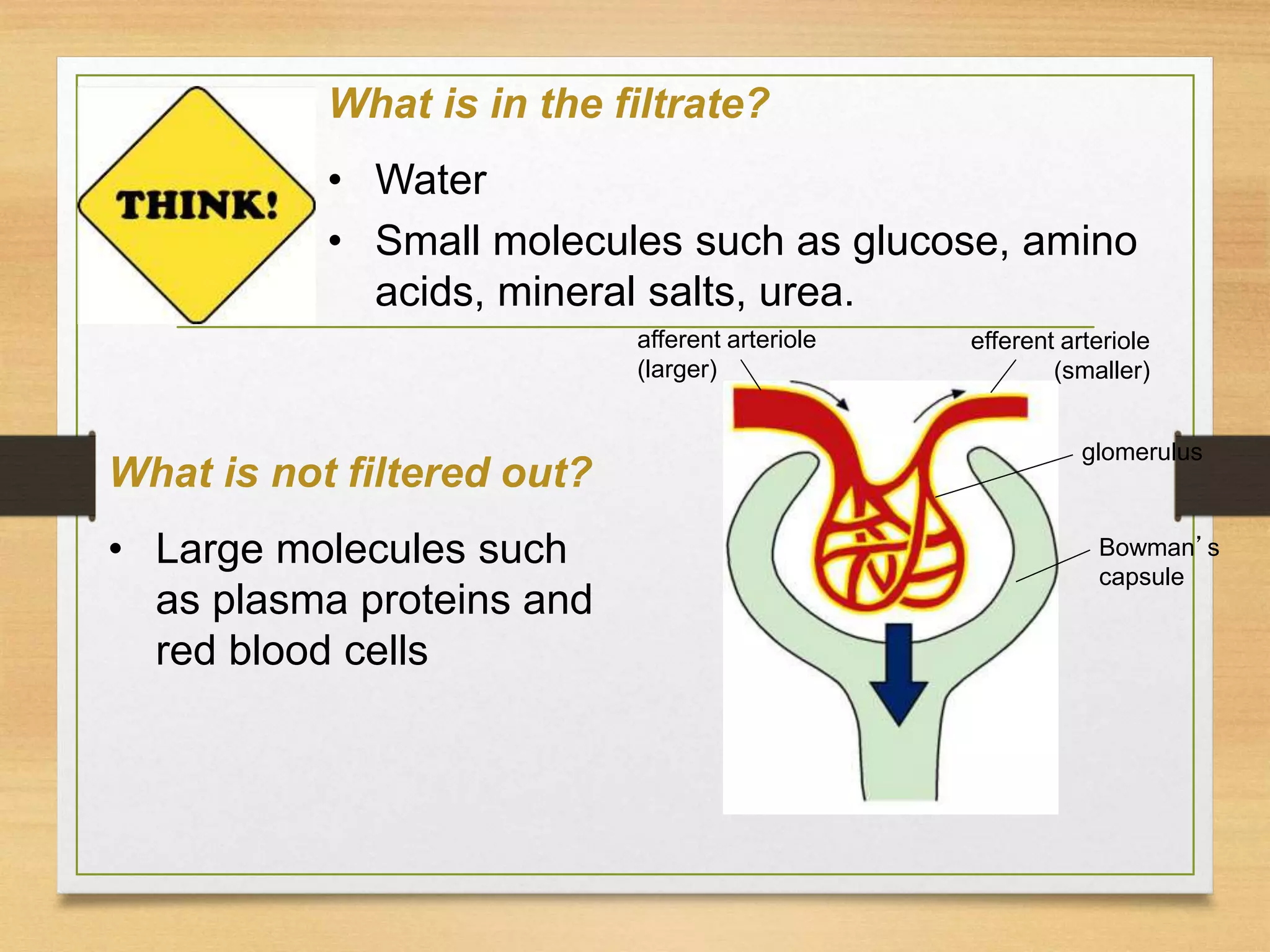
What is in the filtrate?
• Water
• Small molecules such as glucose, amino
acids, mineral salts, urea.
afferent arteriole
(larger)
Bowman’s
capsule
glomerulus
efferent arteriole
(smaller)
What is not filtered out?
• Large molecules such
as plasma proteins and
red blood cells
• Starts at the proximal convoluted tubule.
• This is the longest and widest part of the nephron. Over
80% of the filtrate is reabsorbed into the blood.
• Filtrate flows down the nephron, all useful materials are
reabsorbed back into network of capillaries.
• Examples such as glucose, amino acids, salts, water are
reabsorbed.
• Excess water and salts, and metabolic waste products
pass from the tubules into the collecting ducts and then
into the renal pelvis as urine.
2. Selective Reabsorption
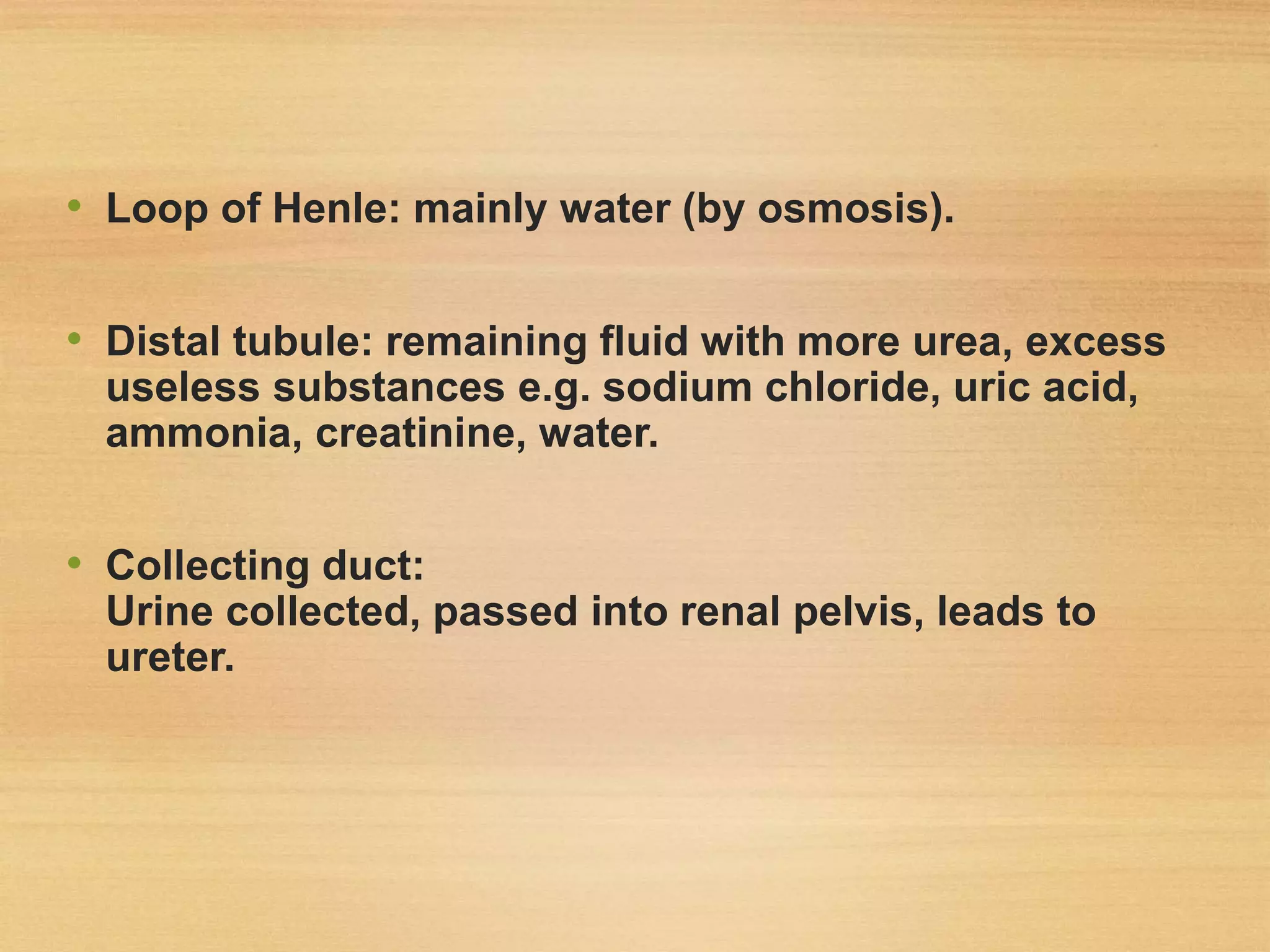
• Loop of Henle: mainly water (by osmosis).
• Distal tubule: remaining fluid with more urea, excess
useless substances e.g. sodium chloride, uric acid,
ammonia, creatinine, water.
• Collecting duct:
Urine collected, passed into renal pelvis, leads to
ureter.
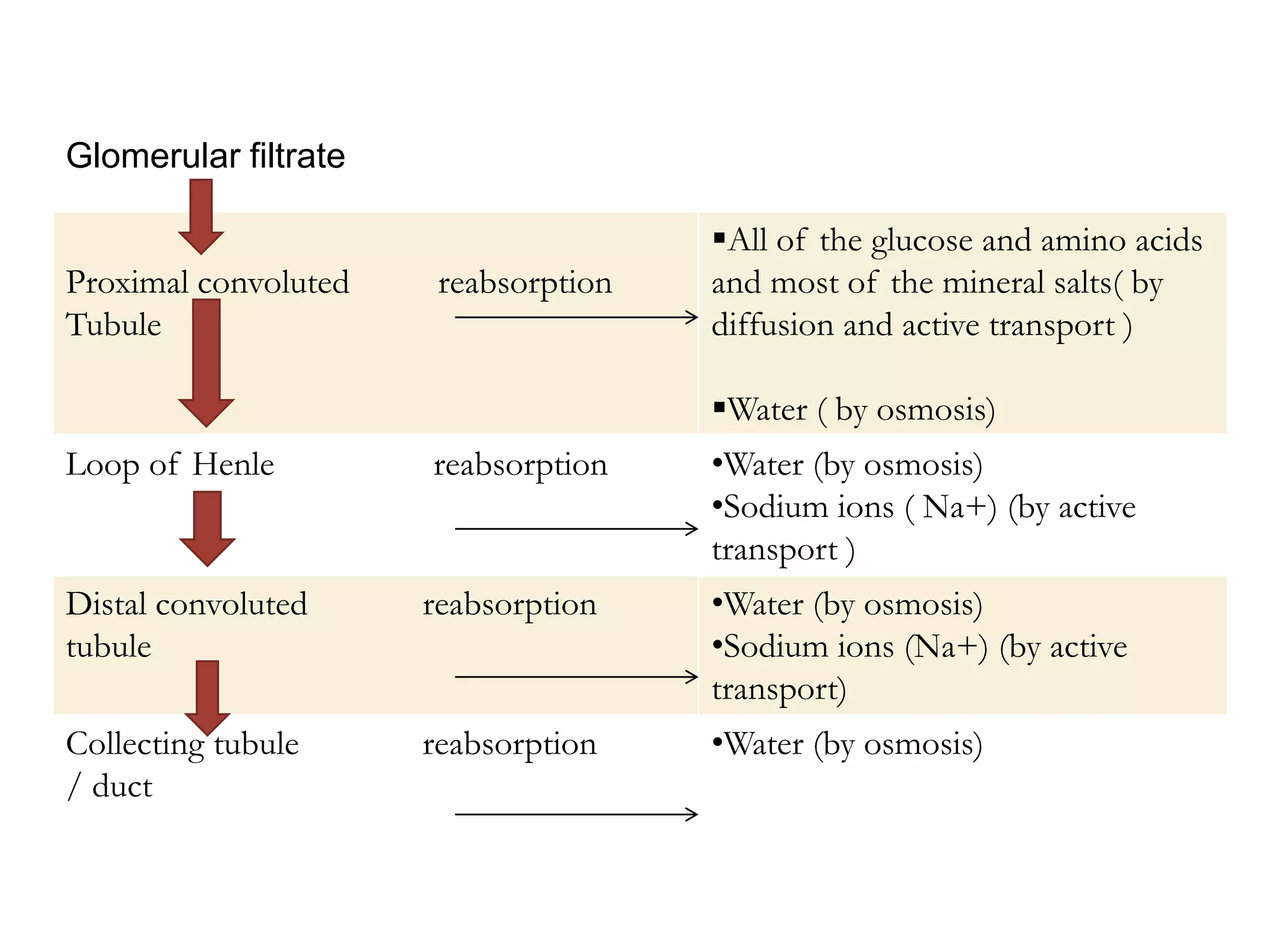
Proximal convoluted reabsorption
Tubule
All of the glucose and amino acids
and most of the mineral salts( by
diffusion and active transport )
Water ( by osmosis)
Loop of Henle reabsorption •Water (by osmosis)
•Sodium ions ( Na+) (by active
transport )
Distal convoluted reabsorption
tubule
•Water (by osmosis)
•Sodium ions (Na+) (by active
transport)
Collecting tubule reabsorption
/ duct
•Water (by osmosis)
Glomerular filtrate
Blood containing
metabolic waste
products from
renal artery
Renal
capsule
(i) Ultrafiltration
(ii) Selective
Reabsorption
filtrate
Blood
capillaries
• amino acids
• glucose
• salts
• water
• amino acids
• glucose
• salts
• water
• urea
Excess water, excess mineral salts and urea
removed through urine
Purified blood to
renal vein
What are the
substances
carried by
renal artery
and renal vein?
11.4
Learning Outcome
After this section, you should be able to:
• outline the role of anti-diuretic hormone in the
regulation of osmotic concentration.
Osmoregulation
(Imagine if you are stranded in an island for weeks and have no
supply of water and food like the young Indian boy in the story of
Pi...)
• Why are you not recommended to drink the sea
water?
• What are the consequences of drinking sea water?
Spark Interest
Osmoregulation
• The water potential of blood plasma
needs to be kept relatively constant.
red blood
cell
dilute
plasma
concentrated
plasma
burst red
blood cell
crenated red
blood cell
• If there are large fluctuations in
the water potential, numerous
problems can occur.
• For example, if the blood plasma
is too concentrated, the red blood
cells (rbcs) would dehydrate and
undergo crenation.
• If the blood plasma is too dilute, the
RBCs would absorb water, expand
and burst.
• The water potential of blood plasma is
controlled by anti-diuretic hormone
(ADH).
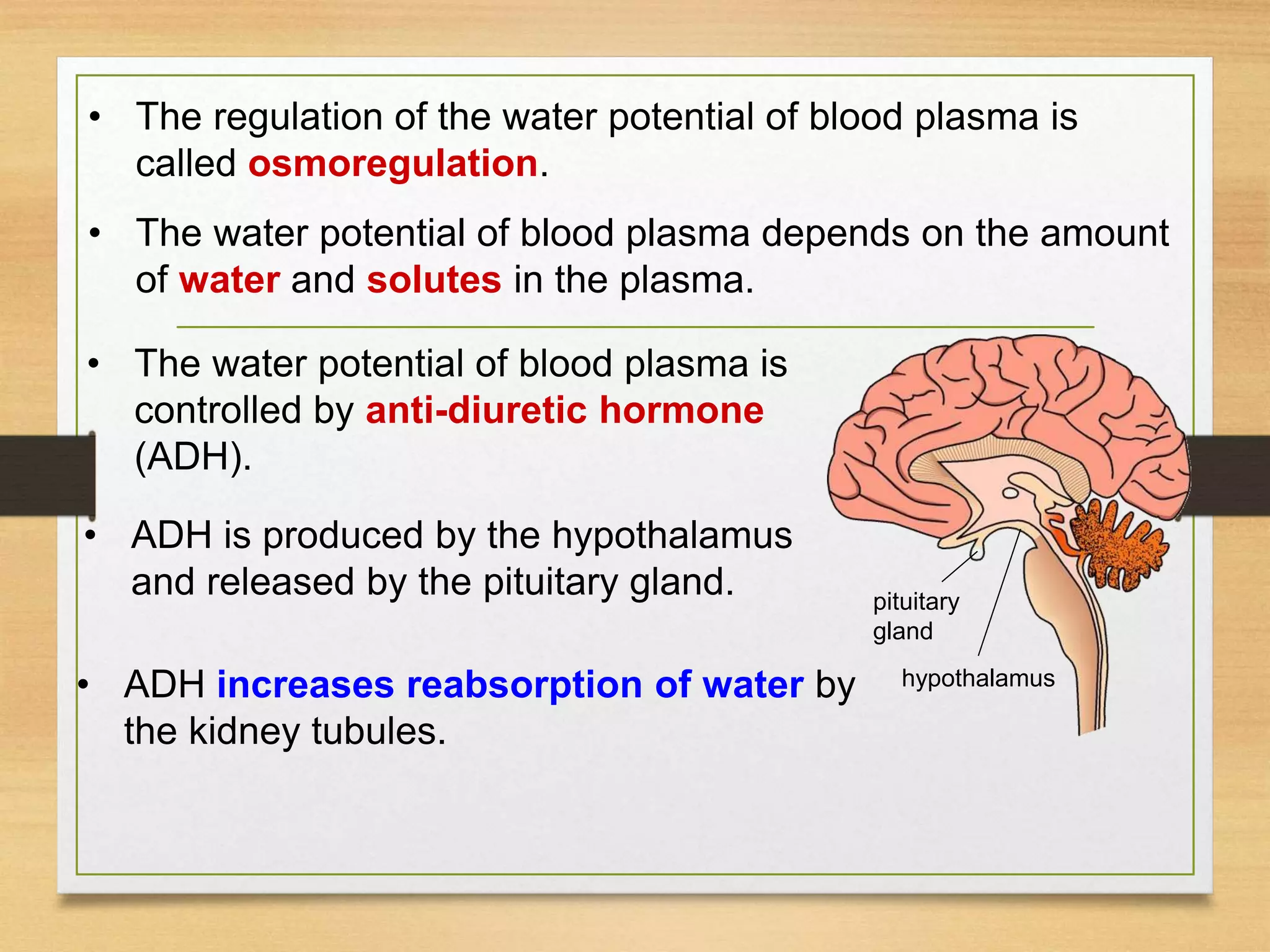
hypothalamus
pituitary
gland
• ADH increases reabsorption of water by
the kidney tubules.
• The regulation of the water potential of blood plasma is
called osmoregulation.
• The water potential of blood plasma depends on the amount
of water and solutes in the plasma.
• ADH is produced by the hypothalamus
and released by the pituitary gland.
• Since kidneys help to regulate the concentration of water
and salts in blood, they are called osmoregulators.
• Osmoregulation maintains the concentration of water and
salts within an organism. It is a type of ‘homeostasis’.
• As blood volume is controlled by removing excess salts
and water, blood pressure is also indirectly regulated by
osmoregulation. High blood pressure can cause blood
vessels in the brain to burst, and this would result in a
stroke.
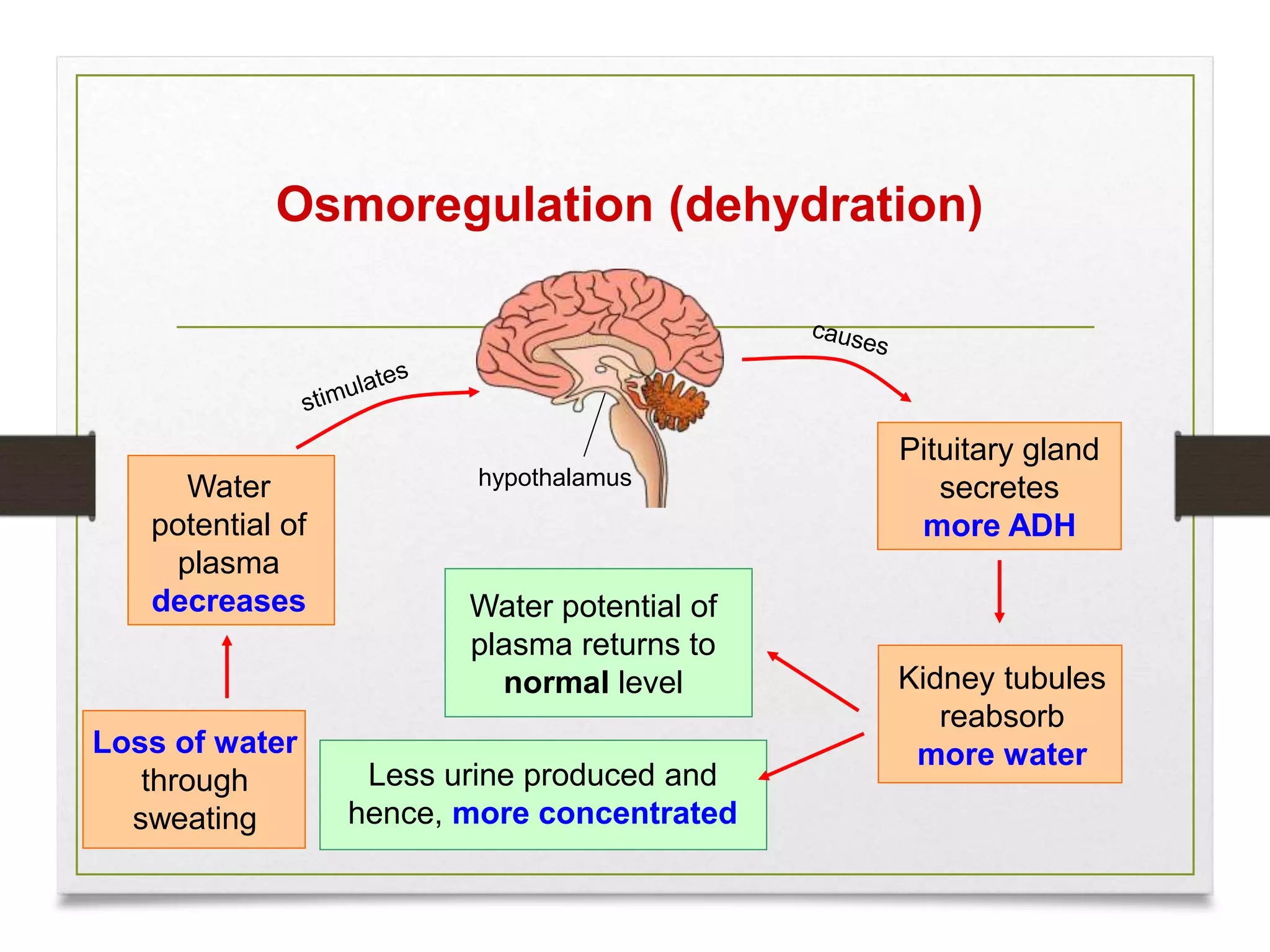
Loss of water
through
sweating
Pituitary gland
secretes
more ADH
Water
potential of
plasma
decreases
Kidney tubules
reabsorb
more water
Water potential of
plasma returns to
normal level
Osmoregulation (dehydration)
hypothalamus
Less urine produced and
hence, more concentrated
Kidney tubules
reabsorb
less water
Pituitary gland
secretes
less ADH
Water potential
of plasma
increases
Large intake
of water
(e.g. drinking)
Water potential of
plasma returns to
normal level
hypothalamus
Osmoregulation (excess water)
More urine produced and
hence, more diluted
Concentration of fluid in different regions of a nephron,
with and without presence of ADH
Kidney Failure & Dialysis
• Kidney failure refers to the inability of the kidney to function properly,
causing accumulation of nitrogenous waste in the blood.
• Kidney failure may be caused of the following:
a) Diabetes
b) Hypertension
c) Excessive alcohol intake
d) Severe injury or bacterial infection
When both kidneys fail to function, the person will need to get a kidney
transplant, or undergo kidney dialysis to get rid of wastes from
patient’s blood.
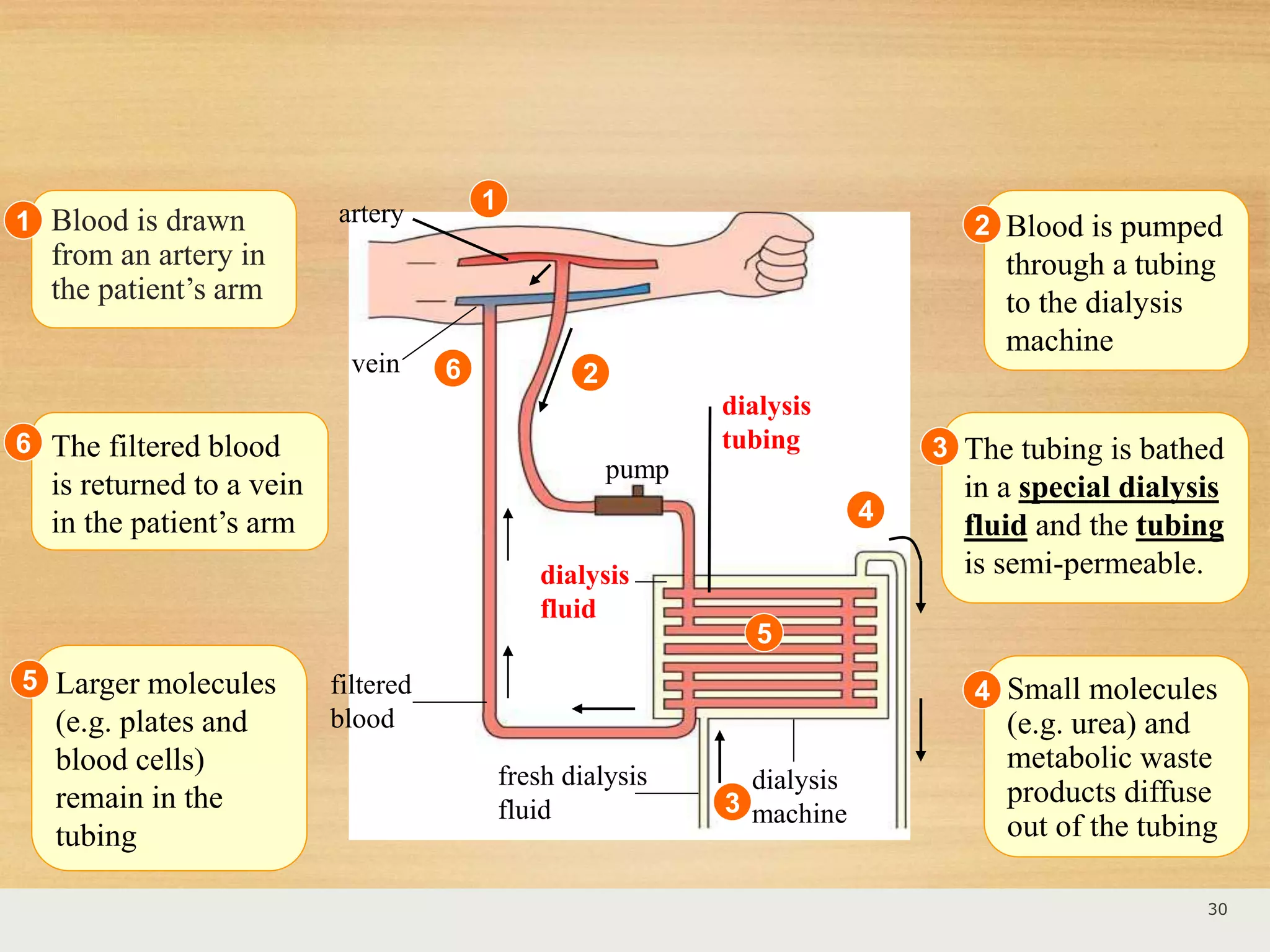
Kidney Dialysis Machine
Larger molecules
(e.g. plates and
blood cells)
remain in the
tubing
The filtered blood
is returned to a vein
in the patient’s arm
artery
dialysis
tubing
pump
filtered
blood
fresh dialysis
fluid
dialysis
machine
dialysis
fluid
vein
1
2
3
6
4
5
30
Blood is drawn
from an artery in
the patient’s arm
1 Blood is pumped
through a tubing
to the dialysis
machine
2
The tubing is bathed
in a special dialysis
fluid and the tubing
is semi-permeable.
3
Small molecules
(e.g. urea) and
metabolic waste
products diffuse
out of the tubing
45
6
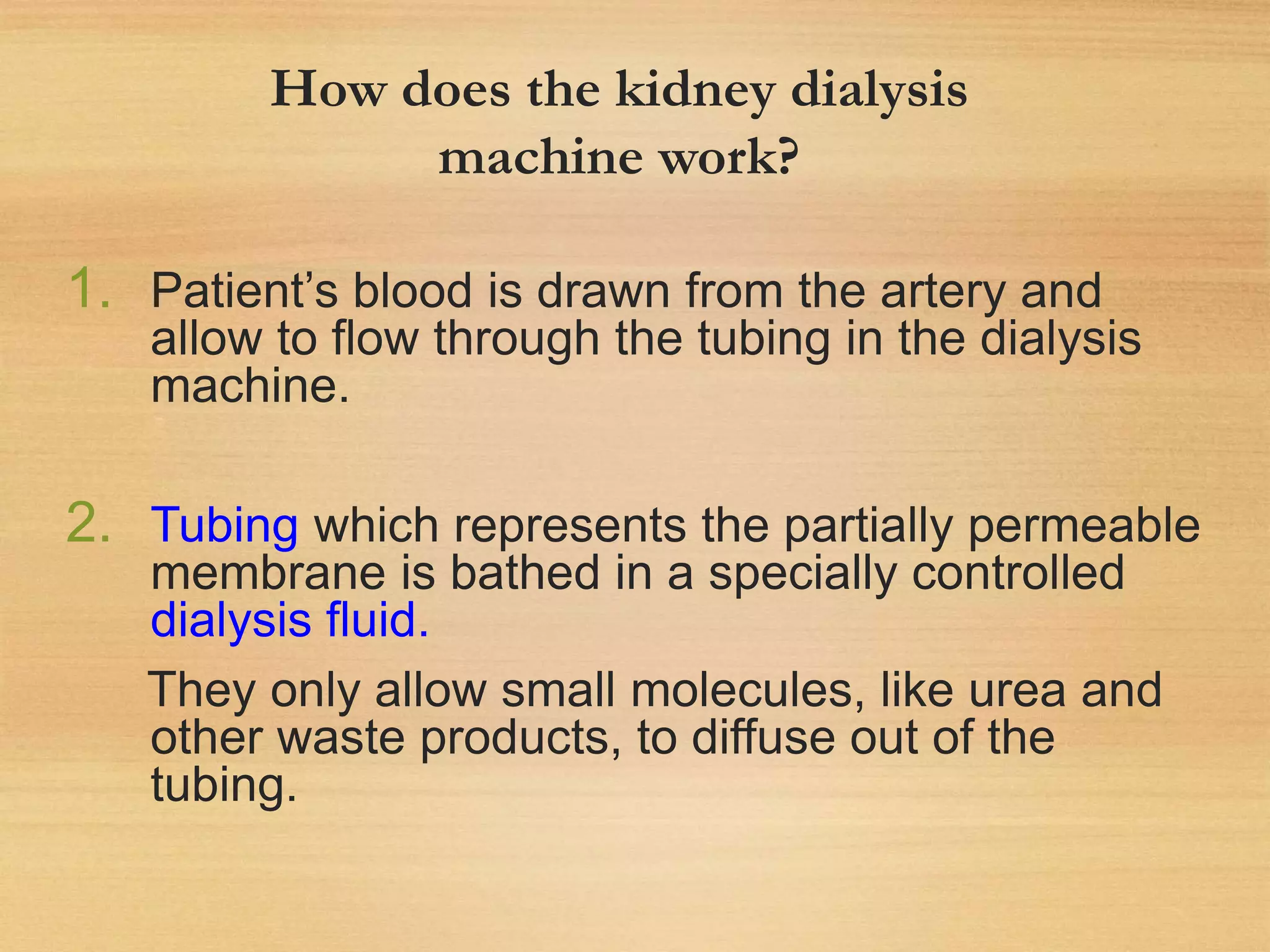
How does the kidney dialysis
machine work?
1. Patient’s blood is drawn from the artery and
allow to flow through the tubing in the dialysis
machine.
2. Tubing which represents the partially permeable
membrane is bathed in a specially controlled
dialysis fluid.
They only allow small molecules, like urea and
other waste products, to diffuse out of the
tubing.
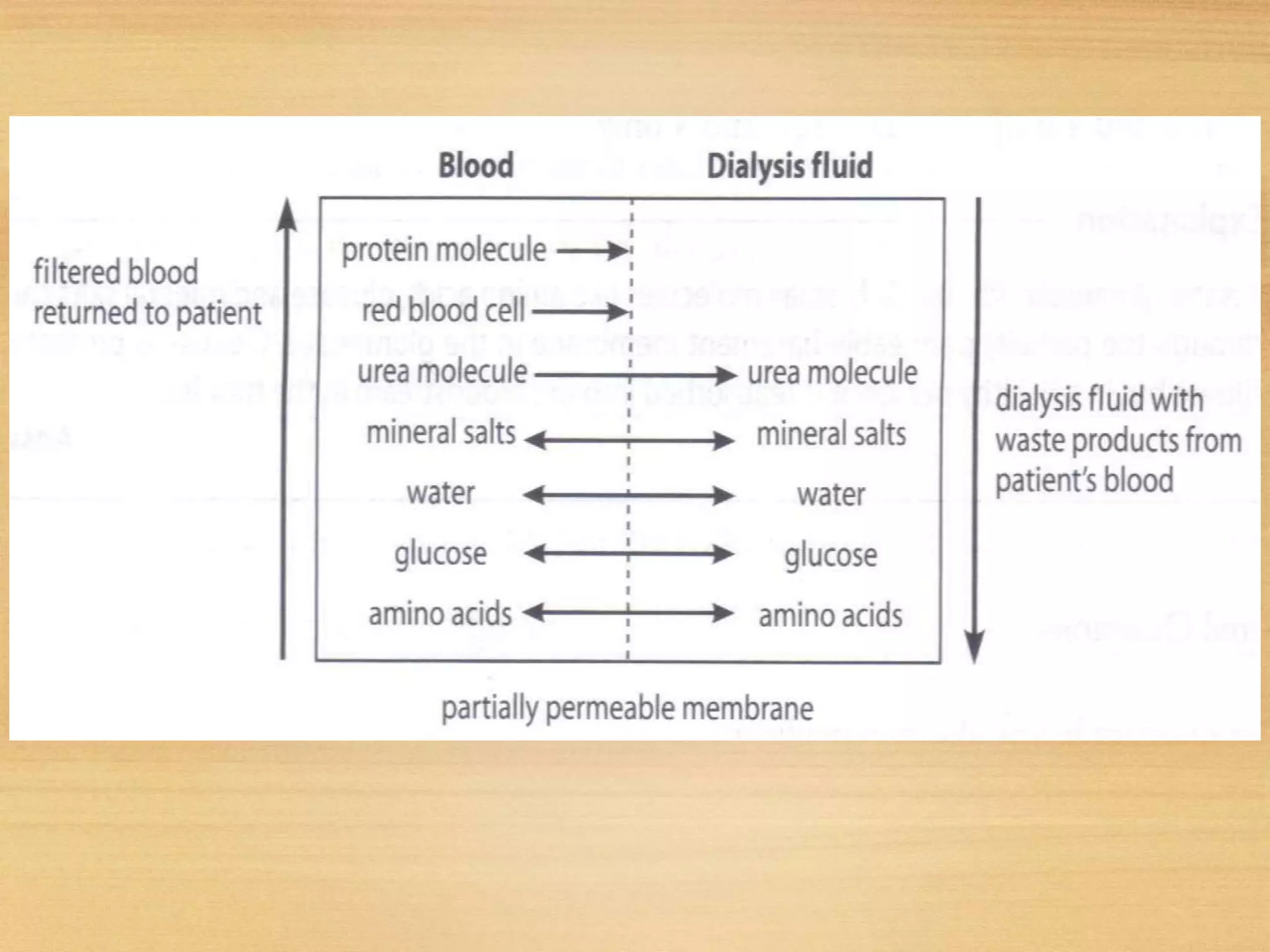
3. The direction of blood flow is opposite to the
flow of the dialysis fluid.
4. A concentration gradient is set up to allow
diffusion of waste products from patient’s blood
to the dialysis fluid.
5. The filtered blood is then returned to the
patient’s arm vein.
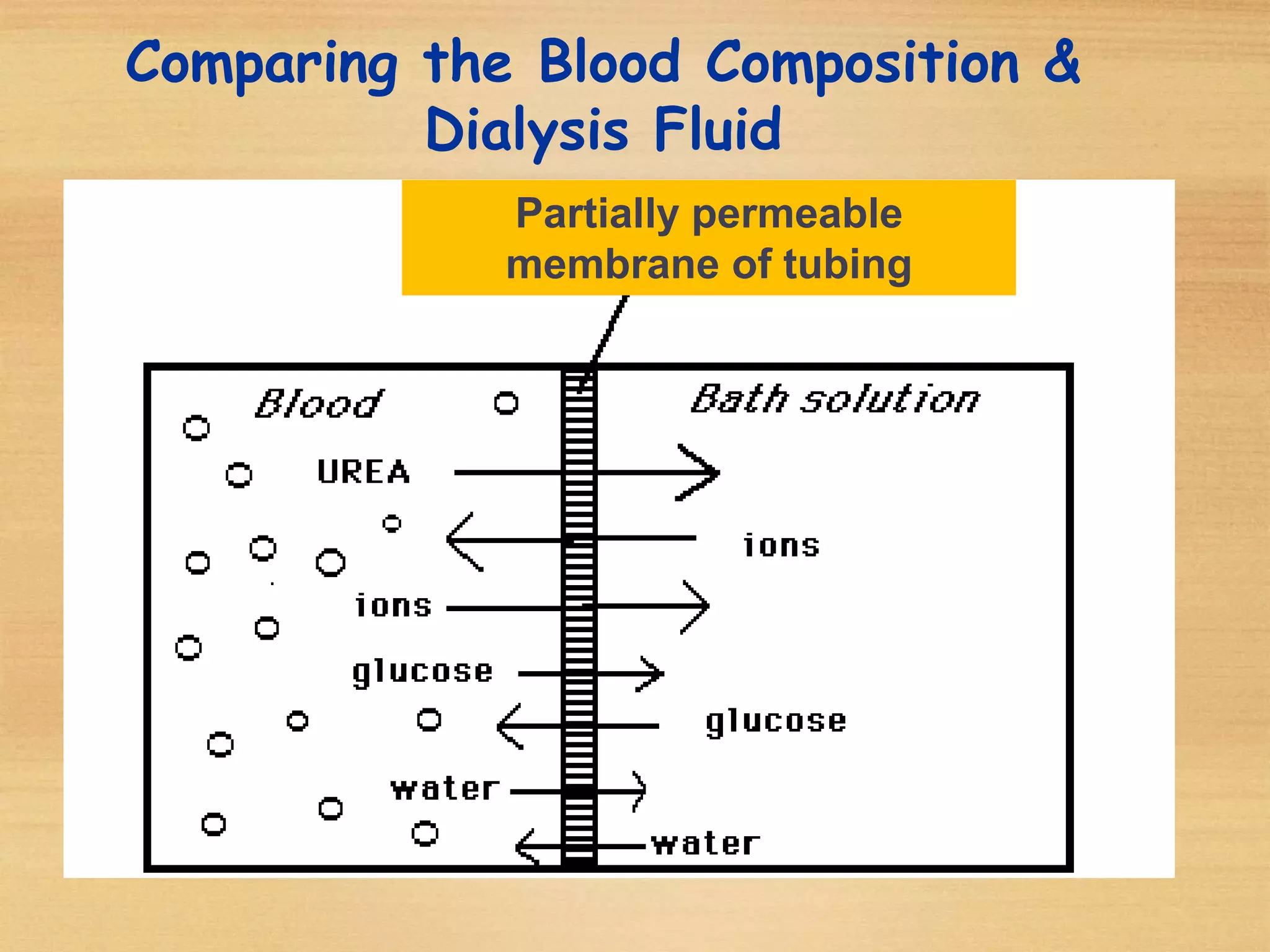
Comparing the Blood Composition &
Dialysis Fluid
Partially permeable
membrane of tubing
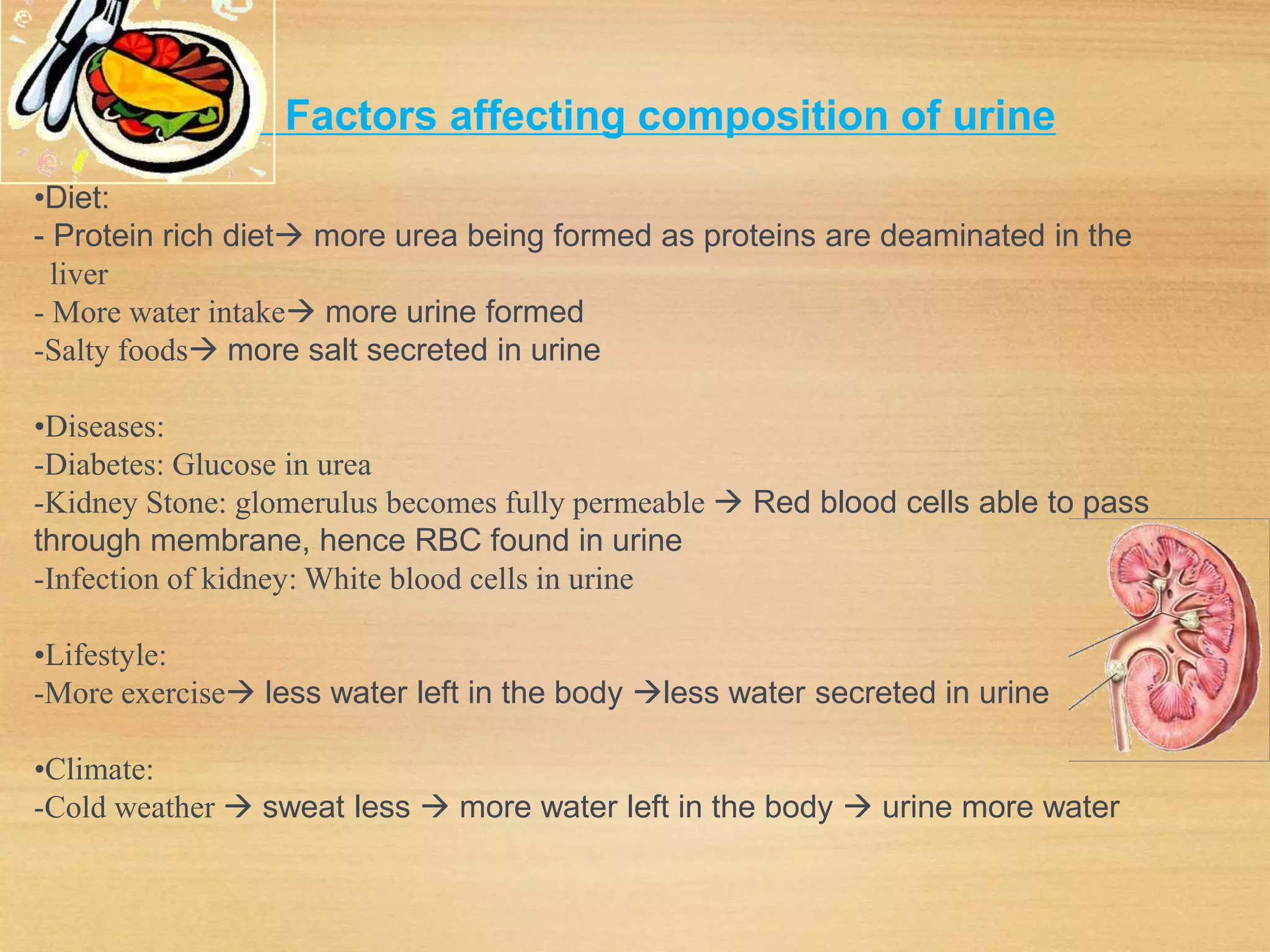
• Factors affecting composition of urine
•Diet:
- Protein rich diet more urea being formed as proteins are deaminated in the
liver
- More water intake more urine formed
-Salty foods more salt secreted in urine
•Diseases:
-Diabetes: Glucose in urea
-Kidney Stone: glomerulus becomes fully permeable  Red blood cells able to pass
through membrane, hence RBC found in urine
-Infection of kidney: White blood cells in urine
•Lifestyle:
-More exercise less water left in the body less water secreted in urine
•Climate:
-Cold weather  sweat less  more water left in the body  urine more water
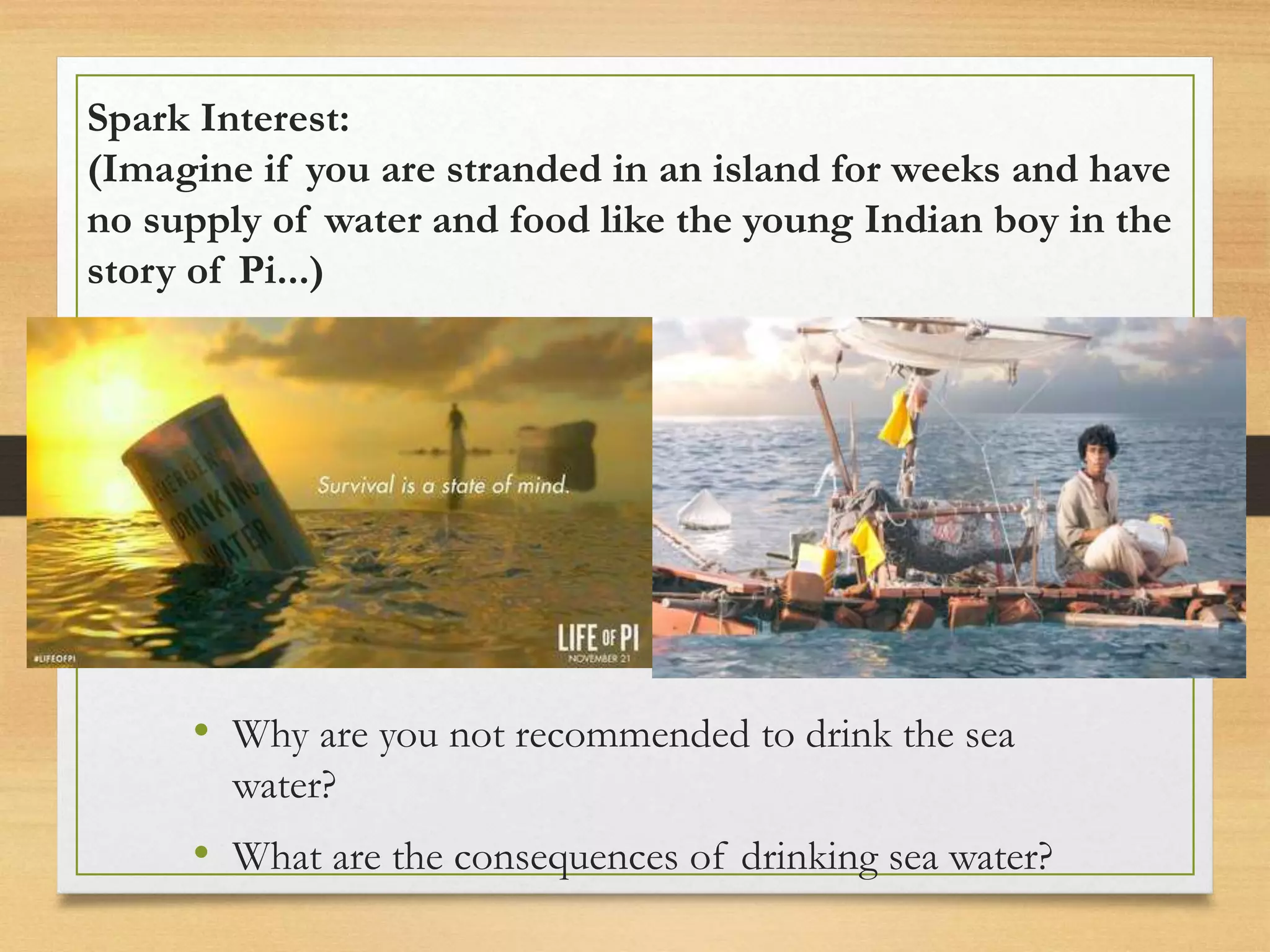
Spark Interest:
(Imagine if you are stranded in an island for weeks and have
no supply of water and food like the young Indian boy in the
story of Pi...)
• Why are you not recommended to drink the sea
water?
• What are the consequences of drinking sea water?
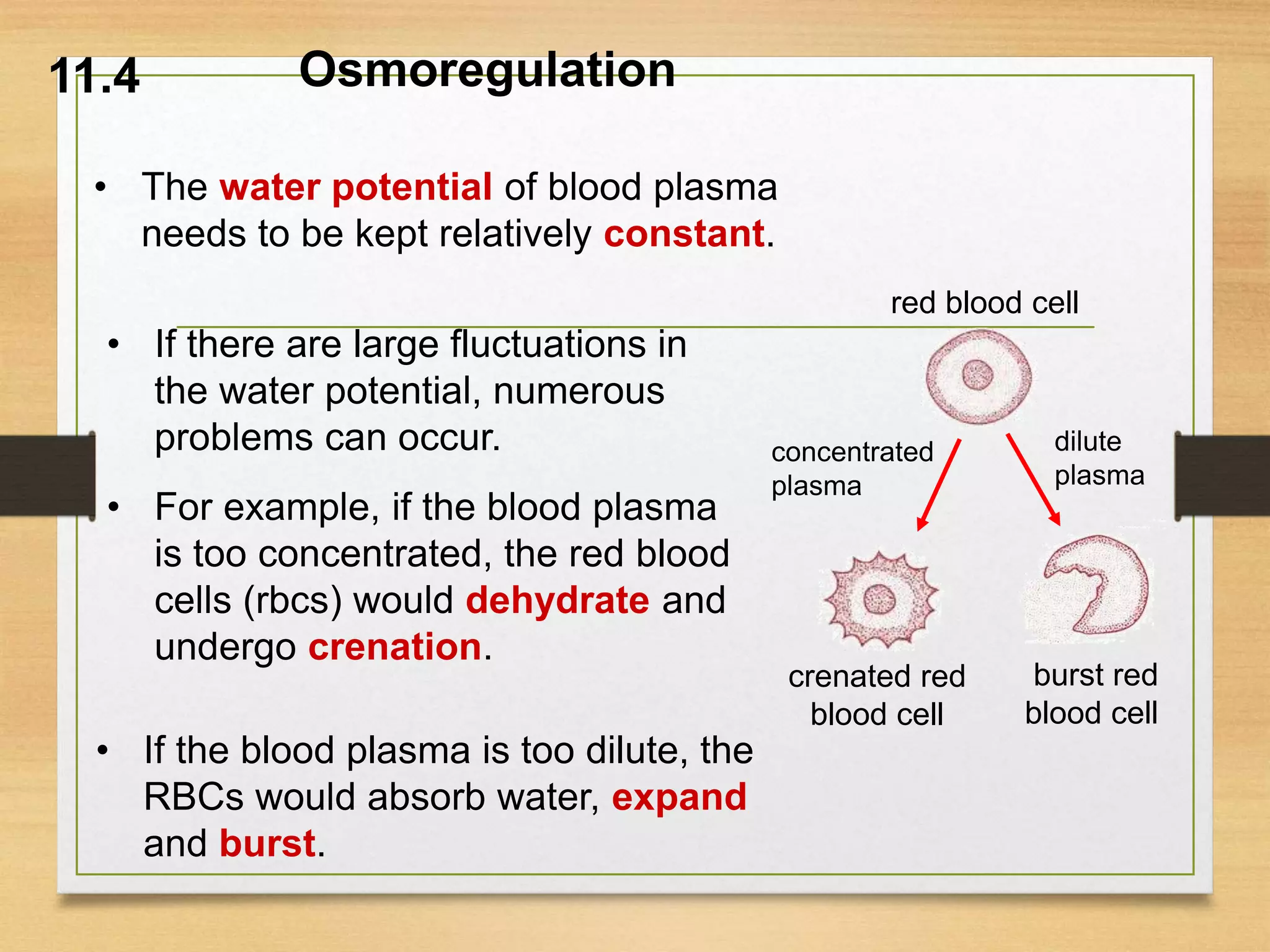
11.4
• The water potential of blood plasma
needs to be kept relatively constant.
red blood cell
dilute
plasma
concentrated
plasma
burst red
blood cell
crenated red
blood cell
• If there are large fluctuations in
the water potential, numerous
problems can occur.
• For example, if the blood plasma
is too concentrated, the red blood
cells (rbcs) would dehydrate and
undergo crenation.
• If the blood plasma is too dilute, the
RBCs would absorb water, expand
and burst.
Osmoregulation
Resources Online:
• The Urinary System:
• http://www.youtube.com/watch?v=aQZaNXNroVY&featur
e=related
• Kidney Dialysis:
• http://www.kidneypatientguide.org.uk/

Excretion 2015

  • 1.
  • 2.
    Learning Objectives: (a) defineexcretion and explain the importance of removing nitrogenous and other compounds from the body (b) outline the function of kidney tubules with reference to ultra- filtration and selective reabsorption in the production of urine (c) outline the role of anti-diuretic hormone (ADH) in the regulation of osmotic concentration (d) outline the mechanism of dialysis in the case of kidney failure
  • 3.
    Excretion is theremoval of toxic materials and the waste products of metabolism from the body. Egestion is the removal of undigested food matter which have never been involved in the metabolic activities of cells, from the alimentary canal. Faeces is NOT a product of metabolism!
  • 4.
    skin lungs liverkidneys Waste products excreted by: • urea • excess water • excess salts • carbon dioxide • excess water • bile pigments • urea • excess water • excess salts in sweat in expired air in faeces through the intestines in urine
  • 5.
    Metabolic Waste Products: Excretoryproduct Organ Mode of excretion Carbon dioxide Lungs Exhalation Urea and excess mineral salts Kidneys Skin Urine Sweat Excess water Kidneys Skin Lungs Urine Sweat Expired Air Bile pigments (from breakdown of haemoglobin) Liver Faeces
  • 6.
    Kidneys - produce urine Ureters -connect the kidneys to the bladder Bladder - stores urine temporarily Urethra - passage through which urine is discharged from the bladder Components of the human urinary system
  • 7.
    Ureter: thin tube carriesurine from kidneys to bladder Urinary bladder: elastic, muscular bag to store urine temporarily. Sphincter muscle voluntarily relaxes to release urine from bladder Urethra: passage of urine out of body.
  • 9.
    Blood reaches the kidneyvia the renal artery, which branches into arterioles Blood from each arteriole flows into a network of capillaries (glomerulus) in the Bowman's capsule Blood leaving the glomerulus flows through the capillaries that run along the kidney tubules Blood from the capillaries enter the venules, which lead to the renal vein
  • 10.
  • 11.
    11.3 Learning Outcome After thissection, you should be able to: • outline the function of the kidney tubules in urine formation with reference to ultrafiltration and selective reabsorption. Urine Formation
  • 12.
  • 13.
    i. Ultrafiltration (occurs atthe renal corpuscle) ii. Selective reabsorption (occurs at the renal tubule) Urine formation involves two main processes within the kidney tubule:
  • 14.
    1. Ultrafiltration i) Force: ahigh hydrostatic blood pressure at the glomerulus, and ii) Filter: basement membrane around the glomerular capillaries is partially permeable and works like a fine filter. afferent arteriole (larger) Bowman’s capsule glomerulus efferent arteriole (smaller) filtrate The mechanical filtration that occurs at the renal corpuscle is called ultrafiltration. Ultrafiltration occurs because of:
  • 15.
    What is inthe filtrate? • Water • Small molecules such as glucose, amino acids, mineral salts, urea. afferent arteriole (larger) Bowman’s capsule glomerulus efferent arteriole (smaller) What is not filtered out? • Large molecules such as plasma proteins and red blood cells
  • 16.
    • Starts atthe proximal convoluted tubule. • This is the longest and widest part of the nephron. Over 80% of the filtrate is reabsorbed into the blood. • Filtrate flows down the nephron, all useful materials are reabsorbed back into network of capillaries. • Examples such as glucose, amino acids, salts, water are reabsorbed. • Excess water and salts, and metabolic waste products pass from the tubules into the collecting ducts and then into the renal pelvis as urine. 2. Selective Reabsorption
  • 17.
    • Loop ofHenle: mainly water (by osmosis). • Distal tubule: remaining fluid with more urea, excess useless substances e.g. sodium chloride, uric acid, ammonia, creatinine, water. • Collecting duct: Urine collected, passed into renal pelvis, leads to ureter.
  • 18.
    Proximal convoluted reabsorption Tubule Allof the glucose and amino acids and most of the mineral salts( by diffusion and active transport ) Water ( by osmosis) Loop of Henle reabsorption •Water (by osmosis) •Sodium ions ( Na+) (by active transport ) Distal convoluted reabsorption tubule •Water (by osmosis) •Sodium ions (Na+) (by active transport) Collecting tubule reabsorption / duct •Water (by osmosis) Glomerular filtrate
  • 19.
    Blood containing metabolic waste productsfrom renal artery Renal capsule (i) Ultrafiltration (ii) Selective Reabsorption filtrate Blood capillaries • amino acids • glucose • salts • water • amino acids • glucose • salts • water • urea Excess water, excess mineral salts and urea removed through urine Purified blood to renal vein What are the substances carried by renal artery and renal vein?
  • 20.
    11.4 Learning Outcome After thissection, you should be able to: • outline the role of anti-diuretic hormone in the regulation of osmotic concentration. Osmoregulation
  • 21.
    (Imagine if youare stranded in an island for weeks and have no supply of water and food like the young Indian boy in the story of Pi...) • Why are you not recommended to drink the sea water? • What are the consequences of drinking sea water? Spark Interest
  • 22.
    Osmoregulation • The waterpotential of blood plasma needs to be kept relatively constant. red blood cell dilute plasma concentrated plasma burst red blood cell crenated red blood cell • If there are large fluctuations in the water potential, numerous problems can occur. • For example, if the blood plasma is too concentrated, the red blood cells (rbcs) would dehydrate and undergo crenation. • If the blood plasma is too dilute, the RBCs would absorb water, expand and burst.
  • 23.
    • The waterpotential of blood plasma is controlled by anti-diuretic hormone (ADH). hypothalamus pituitary gland • ADH increases reabsorption of water by the kidney tubules. • The regulation of the water potential of blood plasma is called osmoregulation. • The water potential of blood plasma depends on the amount of water and solutes in the plasma. • ADH is produced by the hypothalamus and released by the pituitary gland.
  • 24.
    • Since kidneyshelp to regulate the concentration of water and salts in blood, they are called osmoregulators. • Osmoregulation maintains the concentration of water and salts within an organism. It is a type of ‘homeostasis’. • As blood volume is controlled by removing excess salts and water, blood pressure is also indirectly regulated by osmoregulation. High blood pressure can cause blood vessels in the brain to burst, and this would result in a stroke.
  • 25.
    Loss of water through sweating Pituitarygland secretes more ADH Water potential of plasma decreases Kidney tubules reabsorb more water Water potential of plasma returns to normal level Osmoregulation (dehydration) hypothalamus Less urine produced and hence, more concentrated
  • 26.
    Kidney tubules reabsorb less water Pituitarygland secretes less ADH Water potential of plasma increases Large intake of water (e.g. drinking) Water potential of plasma returns to normal level hypothalamus Osmoregulation (excess water) More urine produced and hence, more diluted
  • 27.
    Concentration of fluidin different regions of a nephron, with and without presence of ADH
  • 28.
    Kidney Failure &Dialysis • Kidney failure refers to the inability of the kidney to function properly, causing accumulation of nitrogenous waste in the blood. • Kidney failure may be caused of the following: a) Diabetes b) Hypertension c) Excessive alcohol intake d) Severe injury or bacterial infection When both kidneys fail to function, the person will need to get a kidney transplant, or undergo kidney dialysis to get rid of wastes from patient’s blood.
  • 29.
  • 30.
    Larger molecules (e.g. platesand blood cells) remain in the tubing The filtered blood is returned to a vein in the patient’s arm artery dialysis tubing pump filtered blood fresh dialysis fluid dialysis machine dialysis fluid vein 1 2 3 6 4 5 30 Blood is drawn from an artery in the patient’s arm 1 Blood is pumped through a tubing to the dialysis machine 2 The tubing is bathed in a special dialysis fluid and the tubing is semi-permeable. 3 Small molecules (e.g. urea) and metabolic waste products diffuse out of the tubing 45 6
  • 32.
    How does thekidney dialysis machine work? 1. Patient’s blood is drawn from the artery and allow to flow through the tubing in the dialysis machine. 2. Tubing which represents the partially permeable membrane is bathed in a specially controlled dialysis fluid. They only allow small molecules, like urea and other waste products, to diffuse out of the tubing.
  • 33.
    3. The directionof blood flow is opposite to the flow of the dialysis fluid. 4. A concentration gradient is set up to allow diffusion of waste products from patient’s blood to the dialysis fluid. 5. The filtered blood is then returned to the patient’s arm vein.
  • 34.
    Comparing the BloodComposition & Dialysis Fluid Partially permeable membrane of tubing
  • 35.
    • Factors affectingcomposition of urine •Diet: - Protein rich diet more urea being formed as proteins are deaminated in the liver - More water intake more urine formed -Salty foods more salt secreted in urine •Diseases: -Diabetes: Glucose in urea -Kidney Stone: glomerulus becomes fully permeable  Red blood cells able to pass through membrane, hence RBC found in urine -Infection of kidney: White blood cells in urine •Lifestyle: -More exercise less water left in the body less water secreted in urine •Climate: -Cold weather  sweat less  more water left in the body  urine more water
  • 36.
    Spark Interest: (Imagine ifyou are stranded in an island for weeks and have no supply of water and food like the young Indian boy in the story of Pi...) • Why are you not recommended to drink the sea water? • What are the consequences of drinking sea water?
  • 37.
    11.4 • The waterpotential of blood plasma needs to be kept relatively constant. red blood cell dilute plasma concentrated plasma burst red blood cell crenated red blood cell • If there are large fluctuations in the water potential, numerous problems can occur. • For example, if the blood plasma is too concentrated, the red blood cells (rbcs) would dehydrate and undergo crenation. • If the blood plasma is too dilute, the RBCs would absorb water, expand and burst. Osmoregulation
  • 38.
    Resources Online: • TheUrinary System: • http://www.youtube.com/watch?v=aQZaNXNroVY&featur e=related • Kidney Dialysis: • http://www.kidneypatientguide.org.uk/