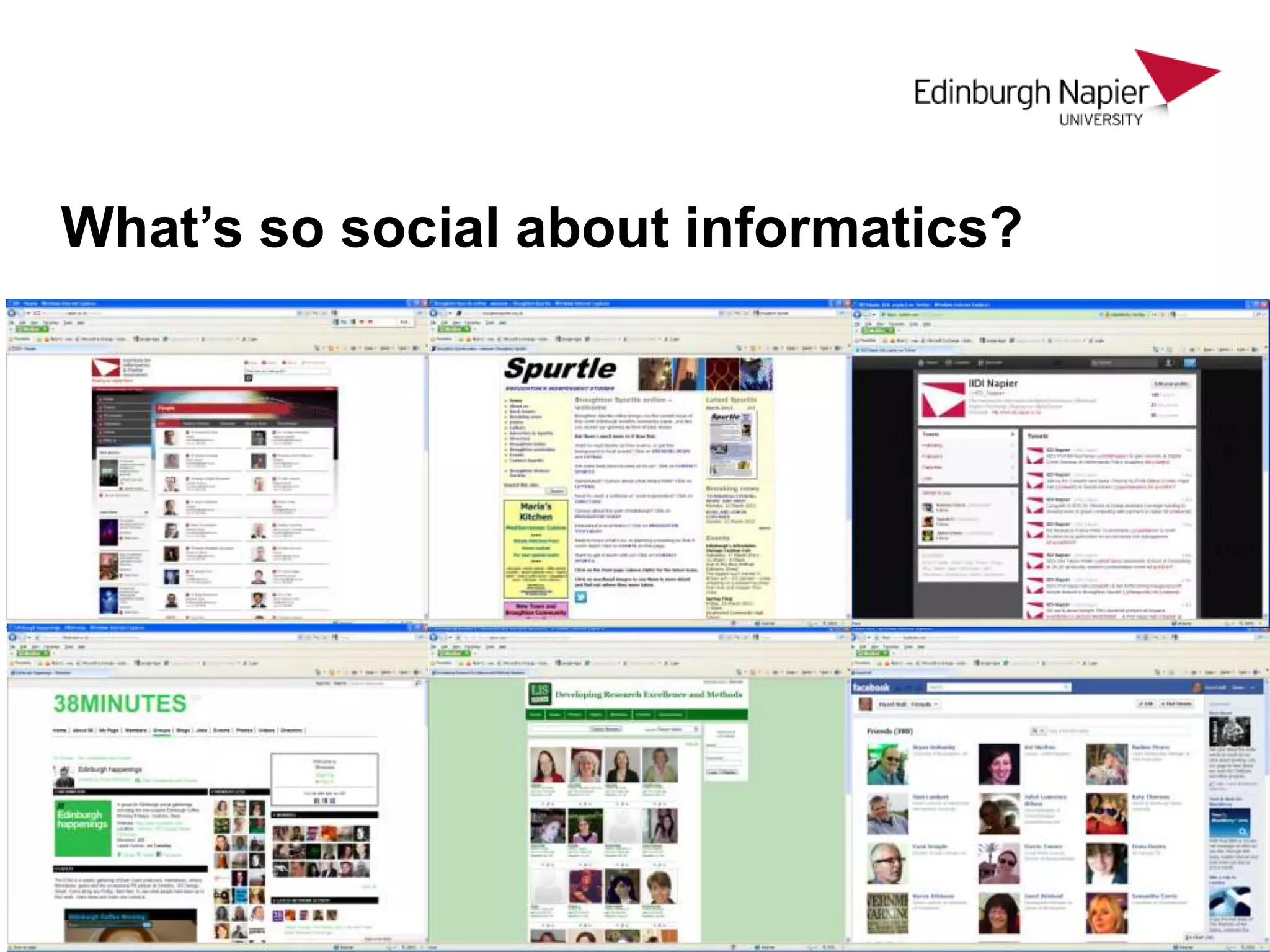

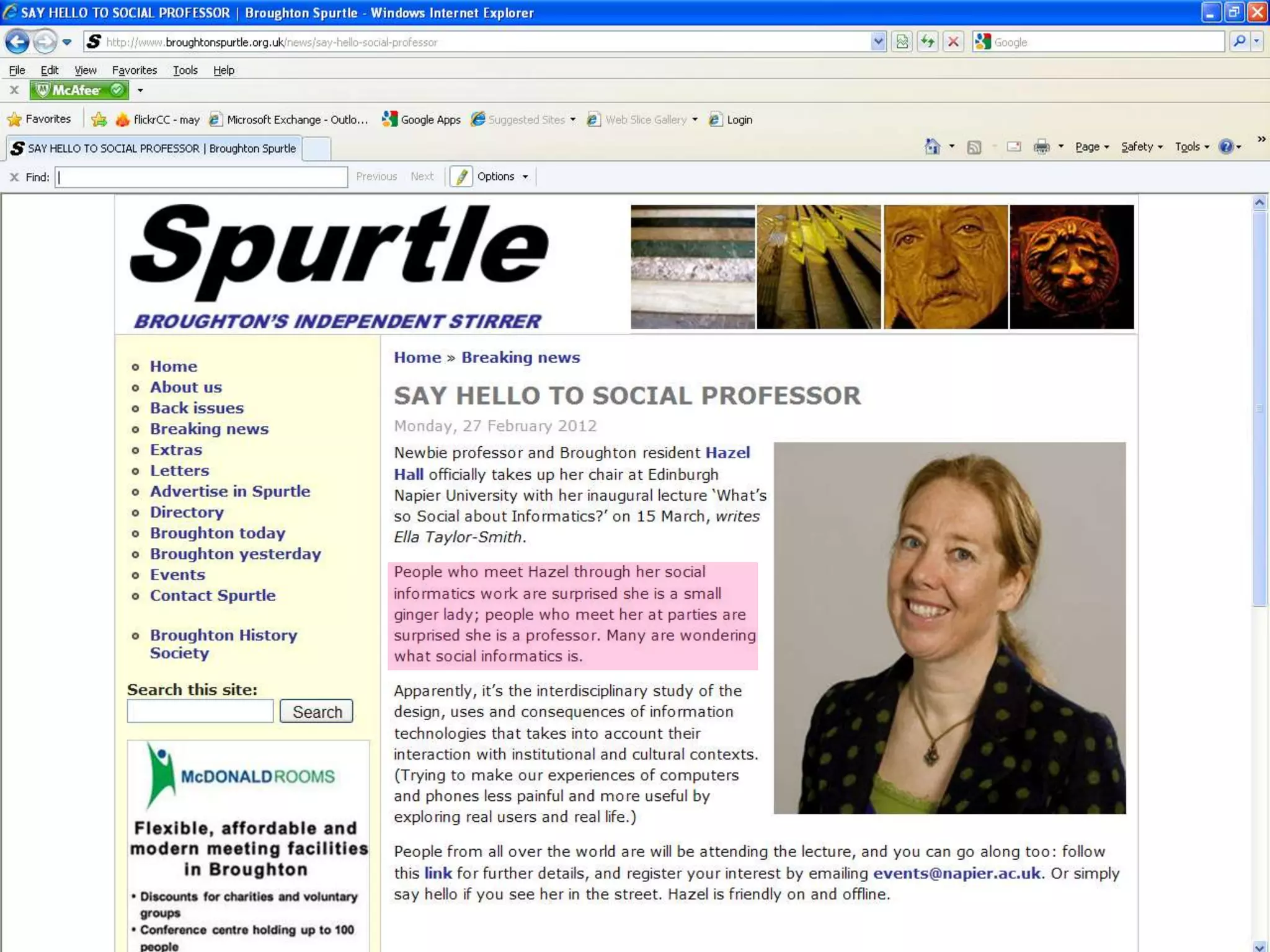
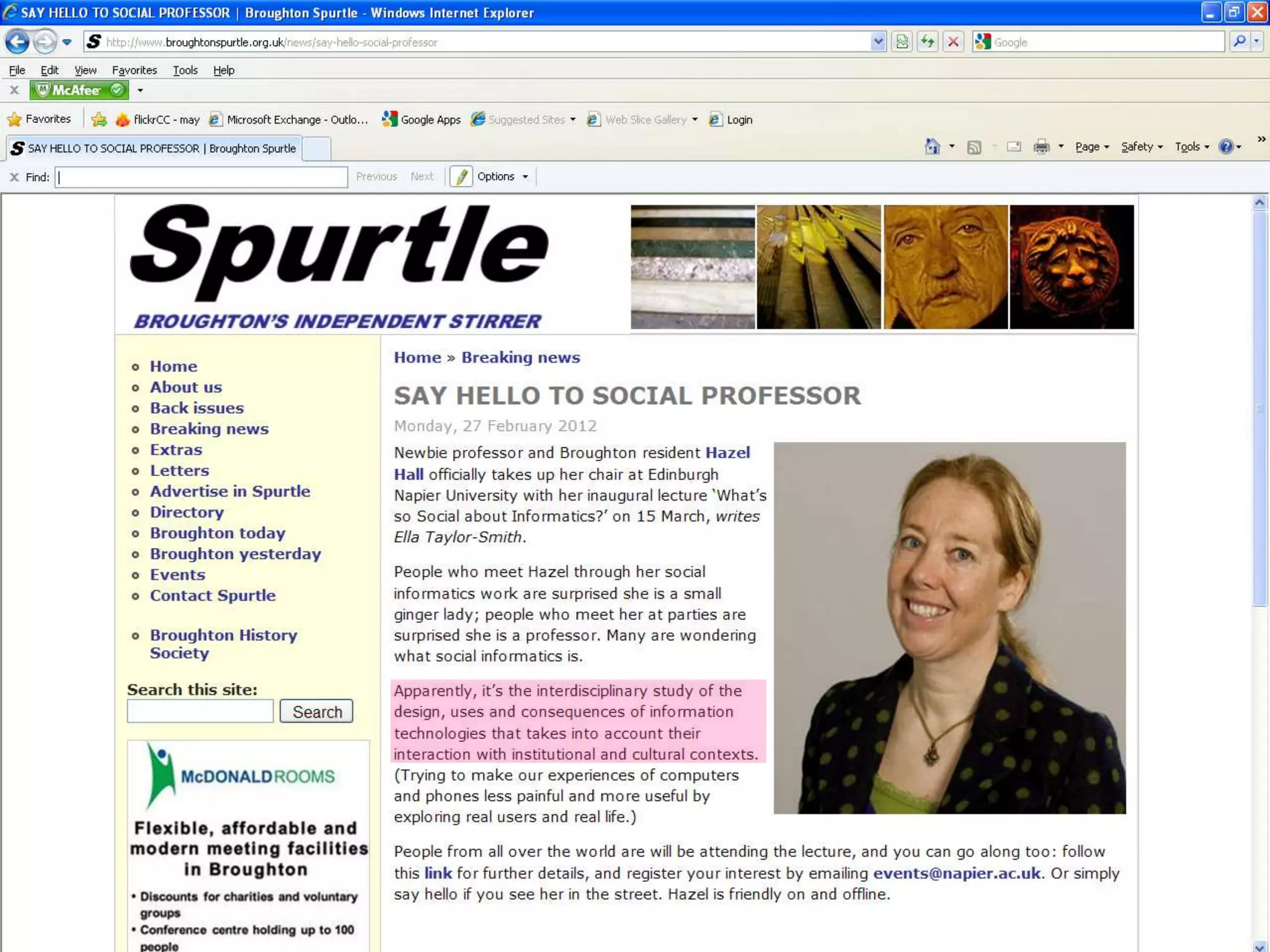
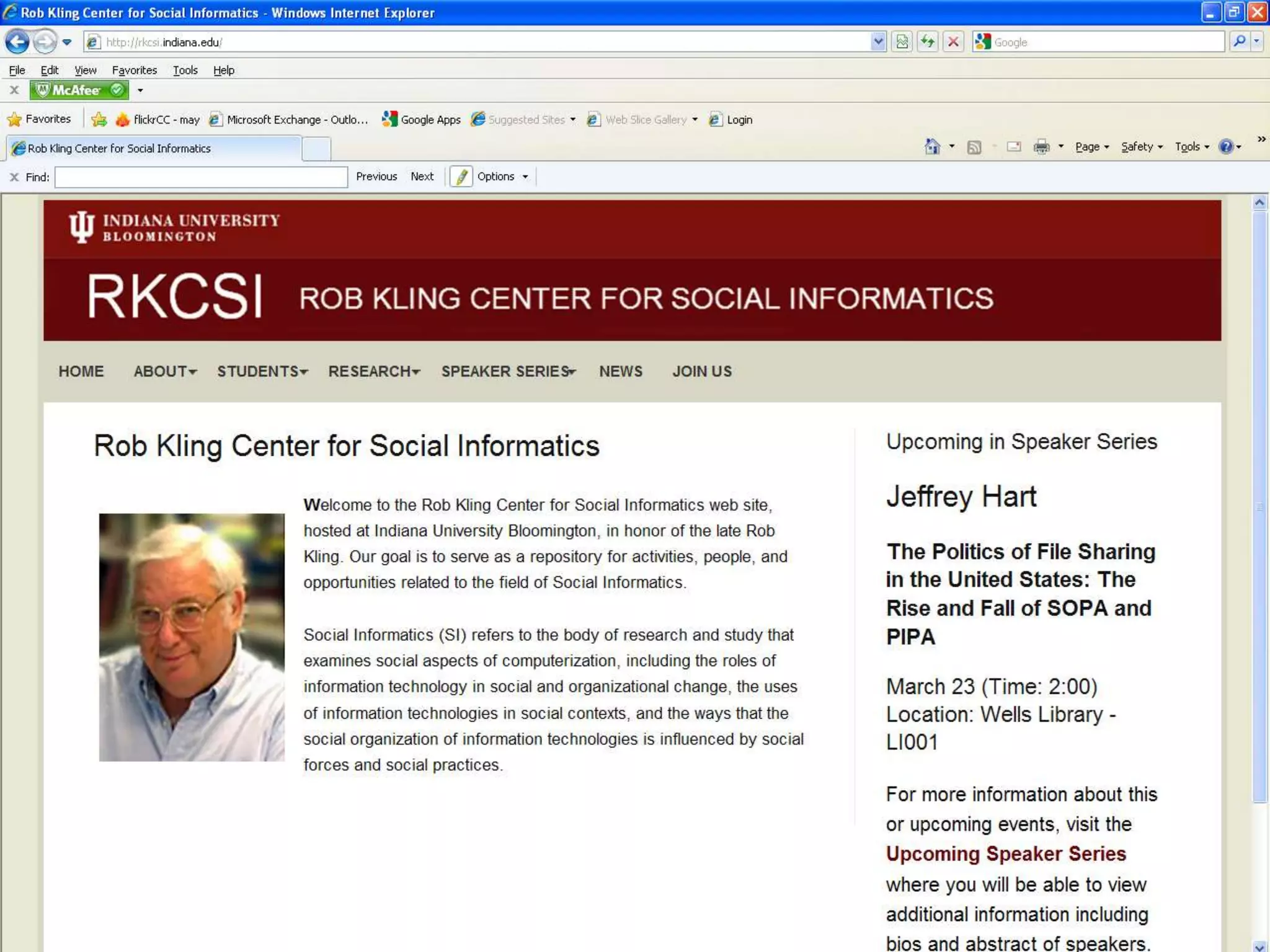

What’s so social about informatics?


    Professor Hazel Hall

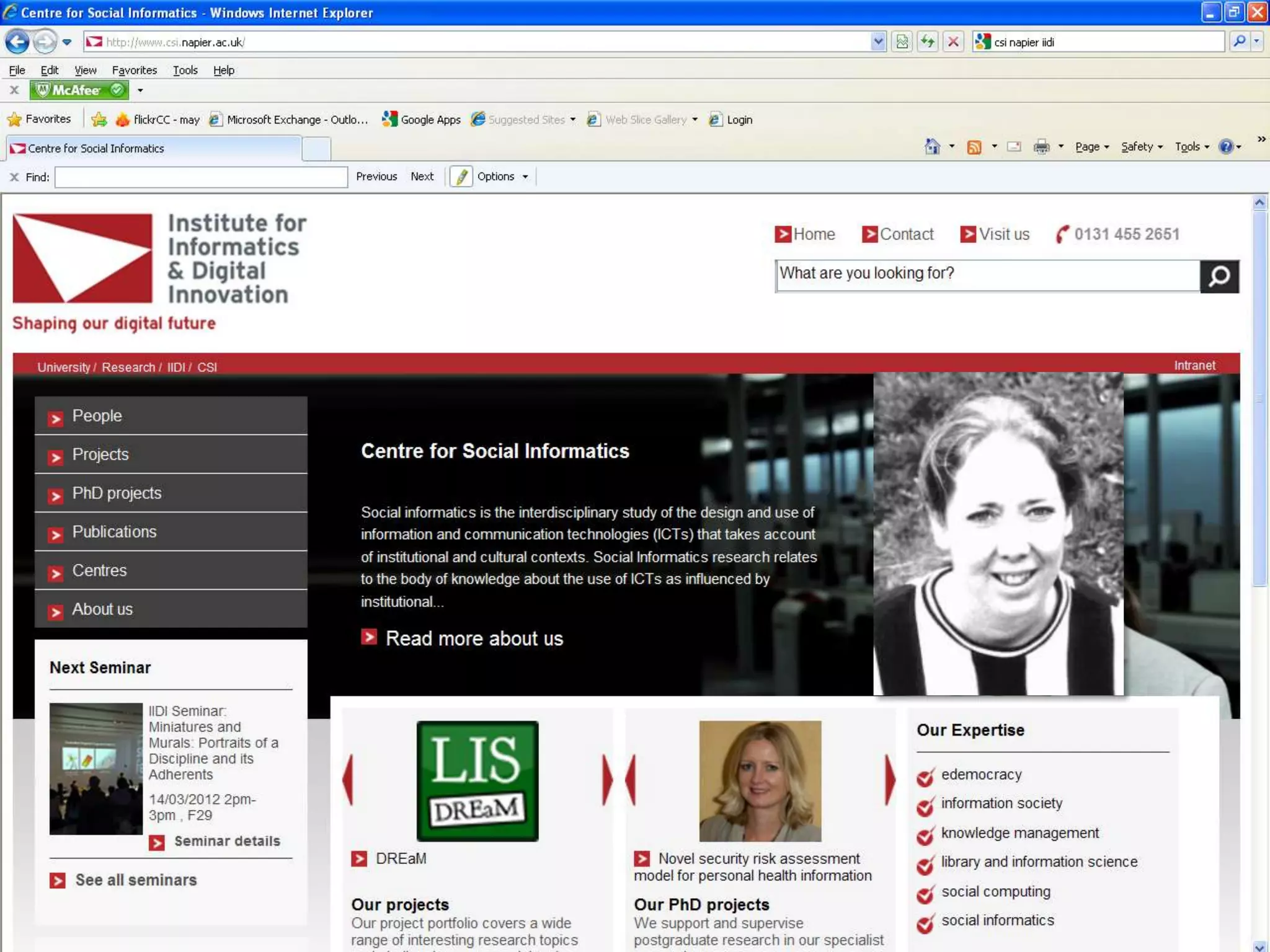
    Centre for Social Informatics
    Institute for Informatics and Digital Innovation/School
    of Computing
Hazel Hall
@hazelh

Event hashtag
#profhazel
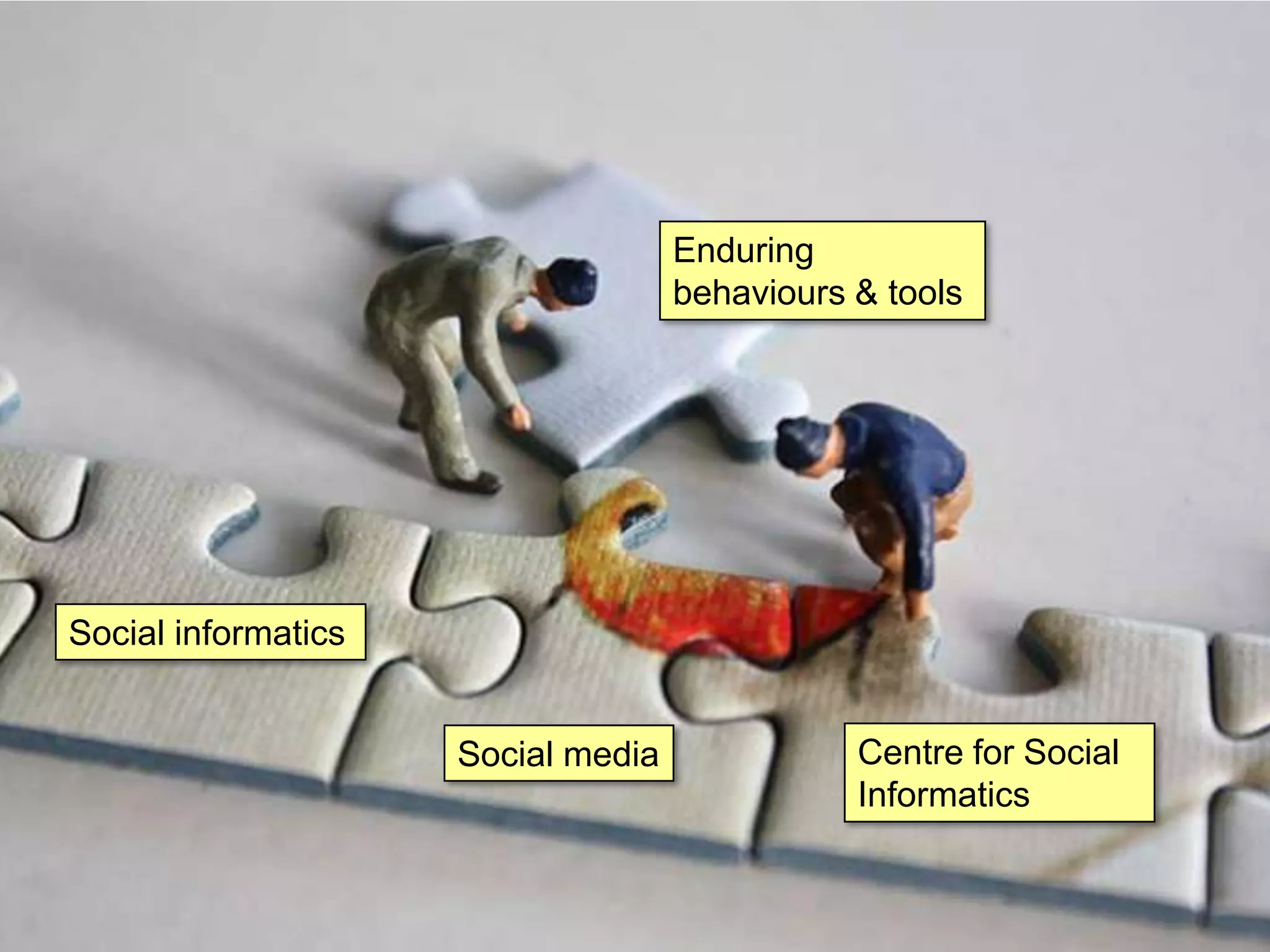
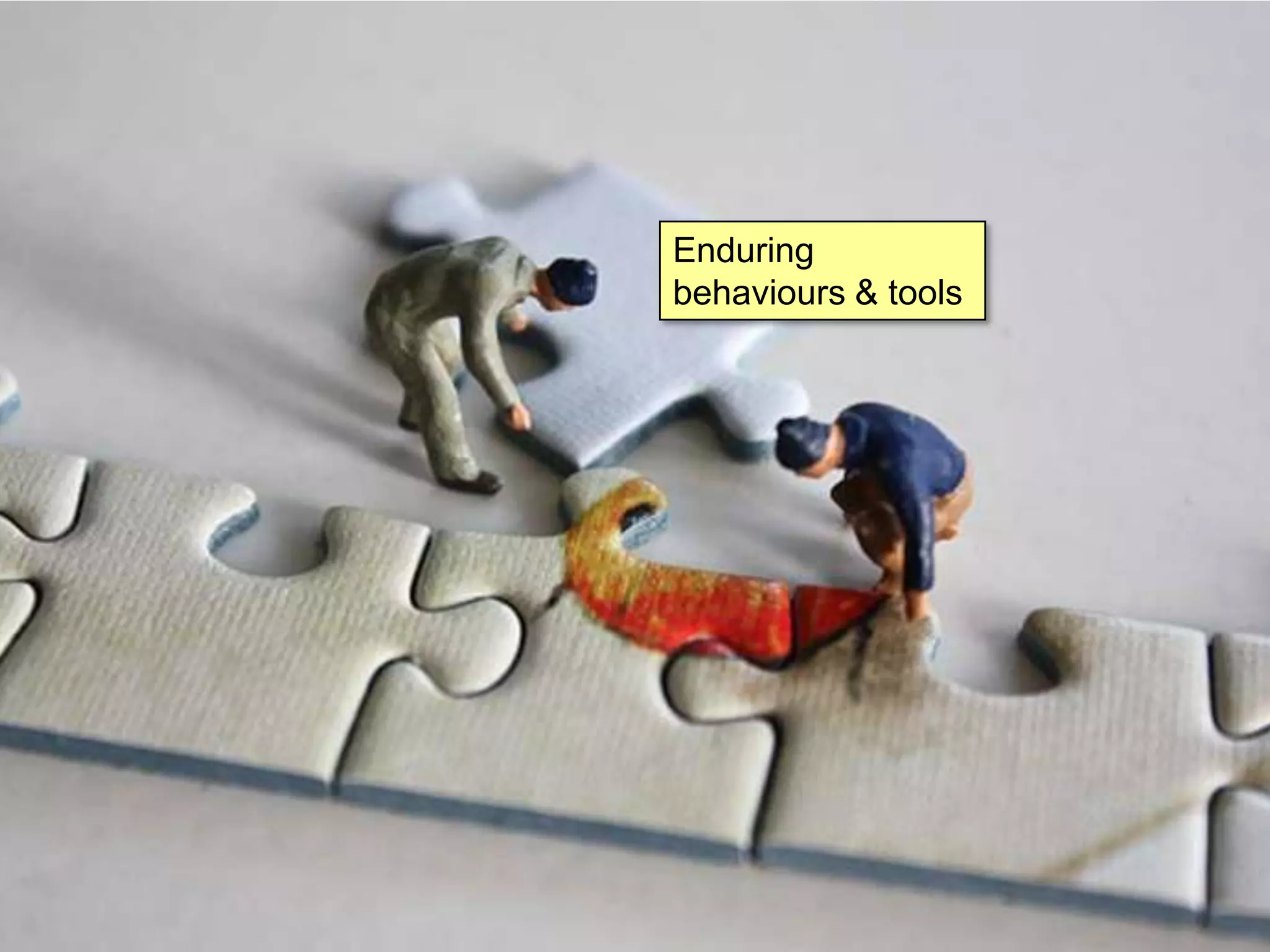
Enduring
                                    behaviours & tools


Social informatics


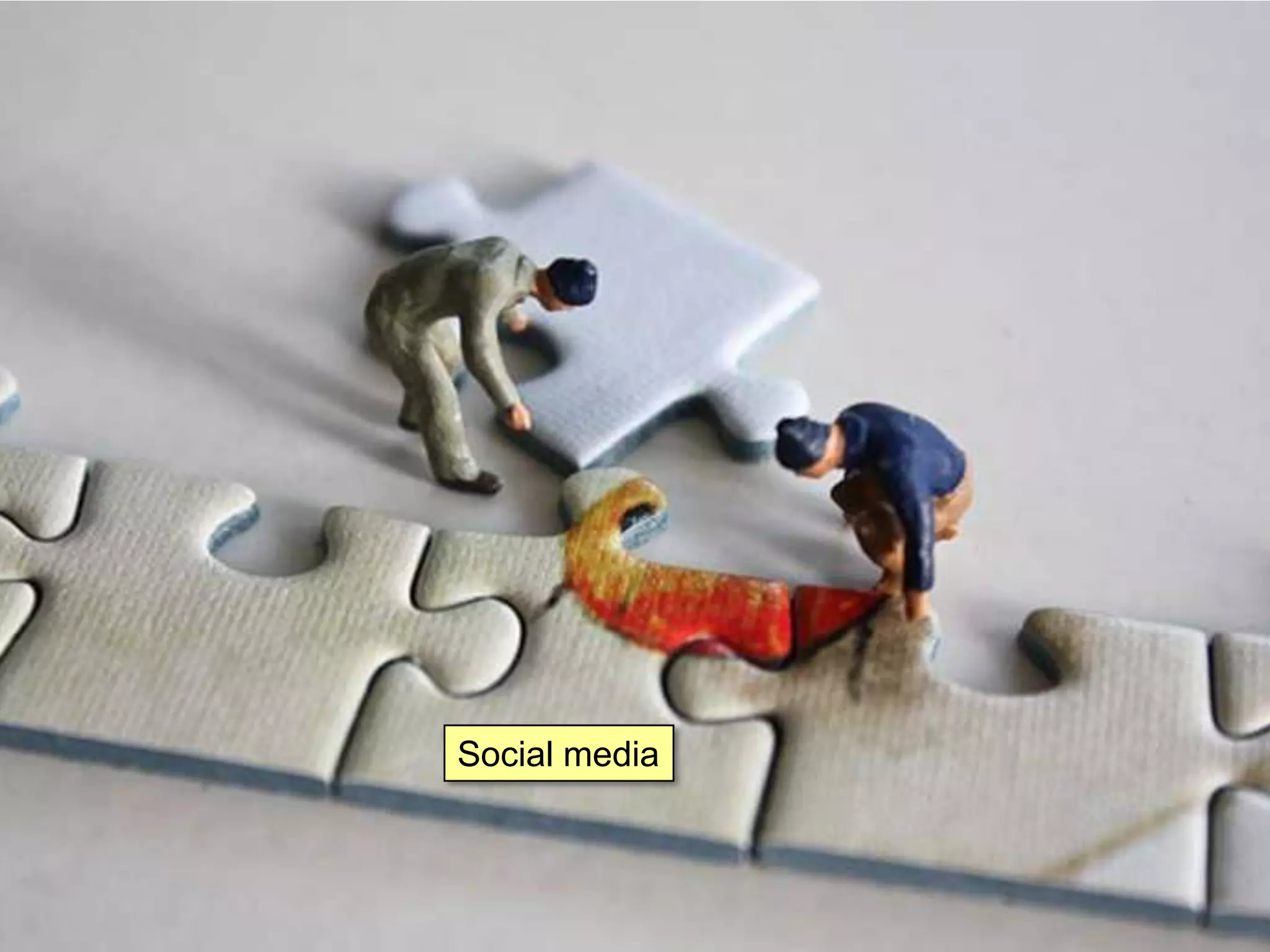
                     Social media              Centre for Social
                                               Informatics
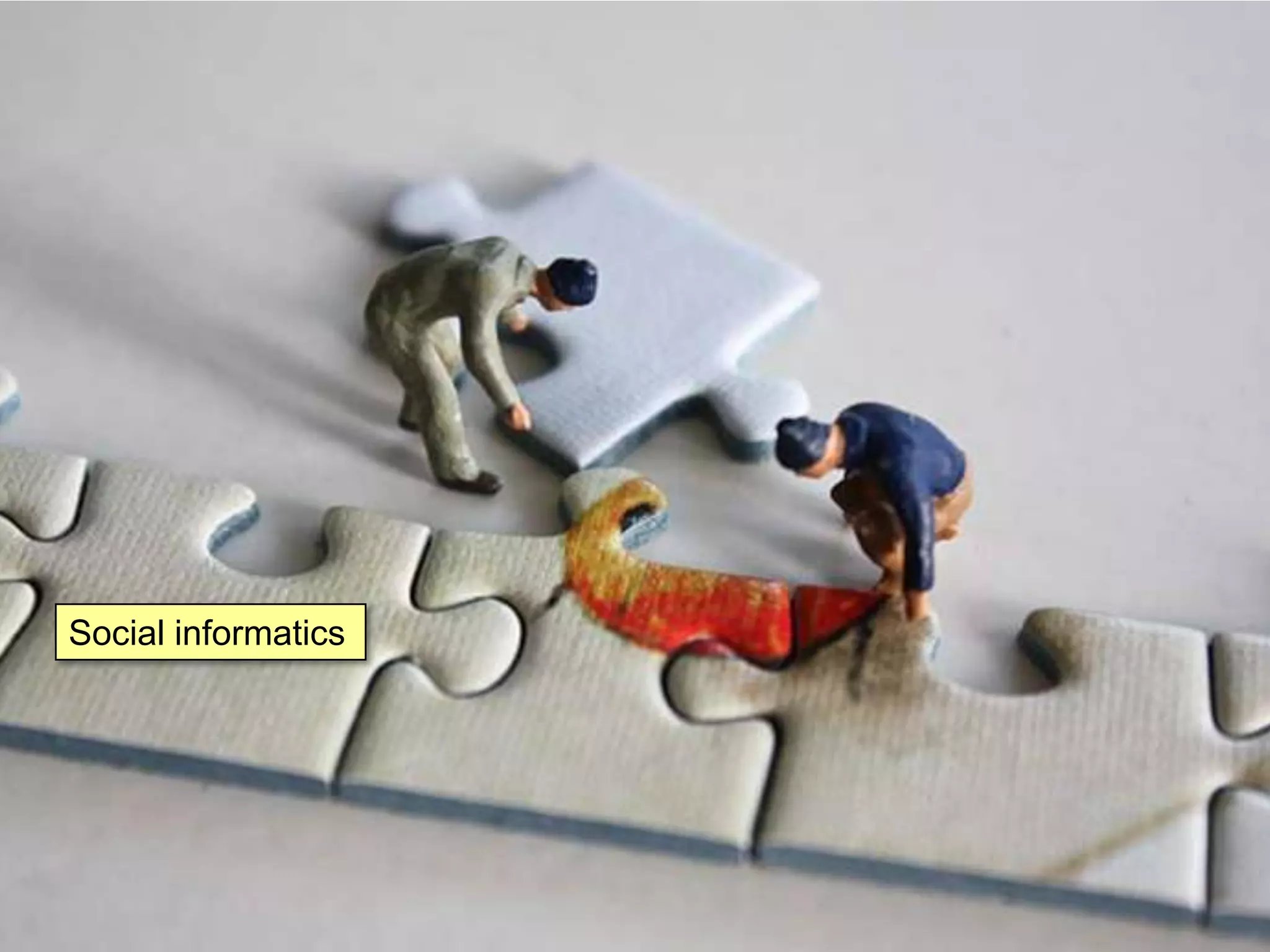
Social informatics
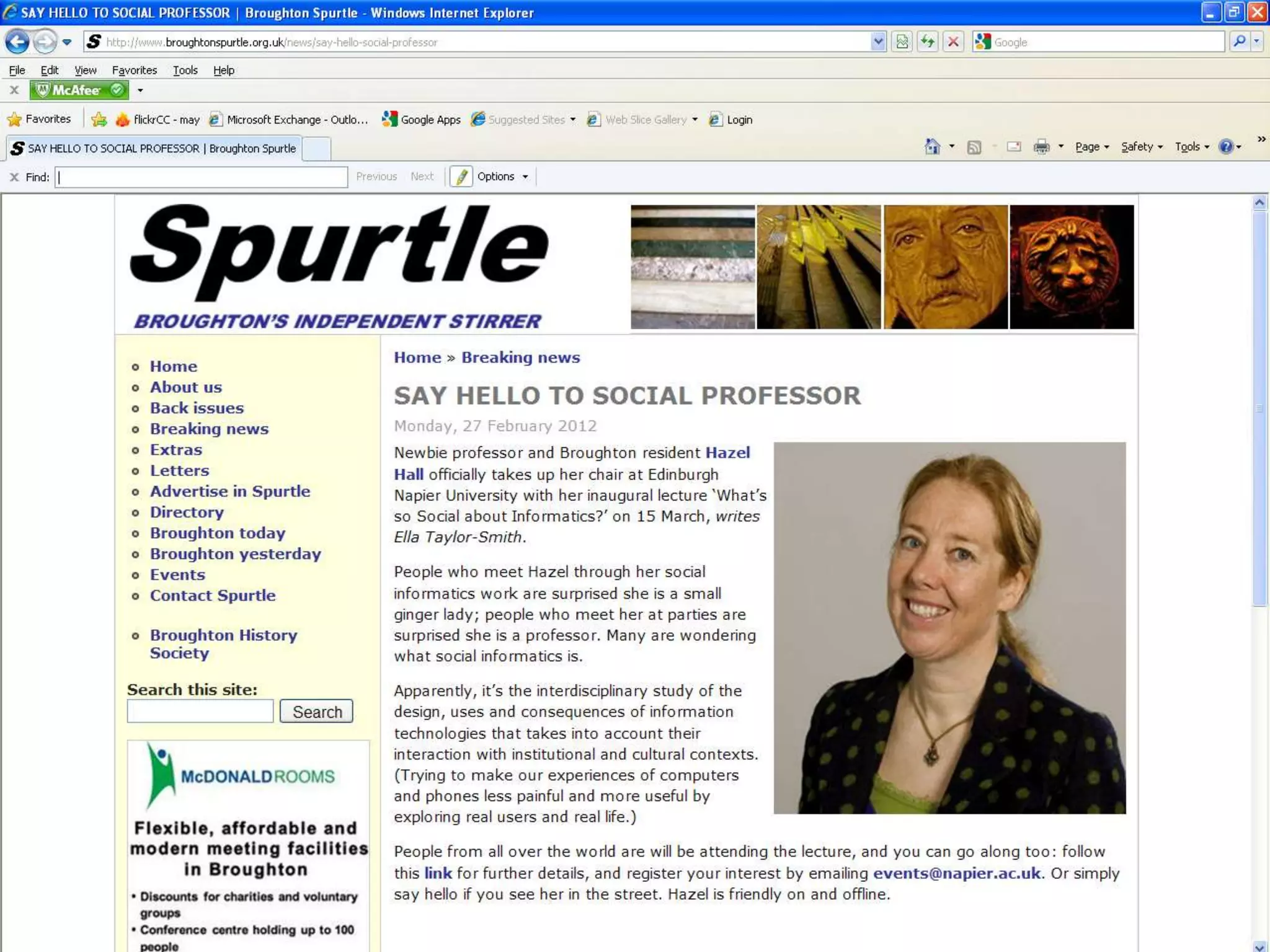
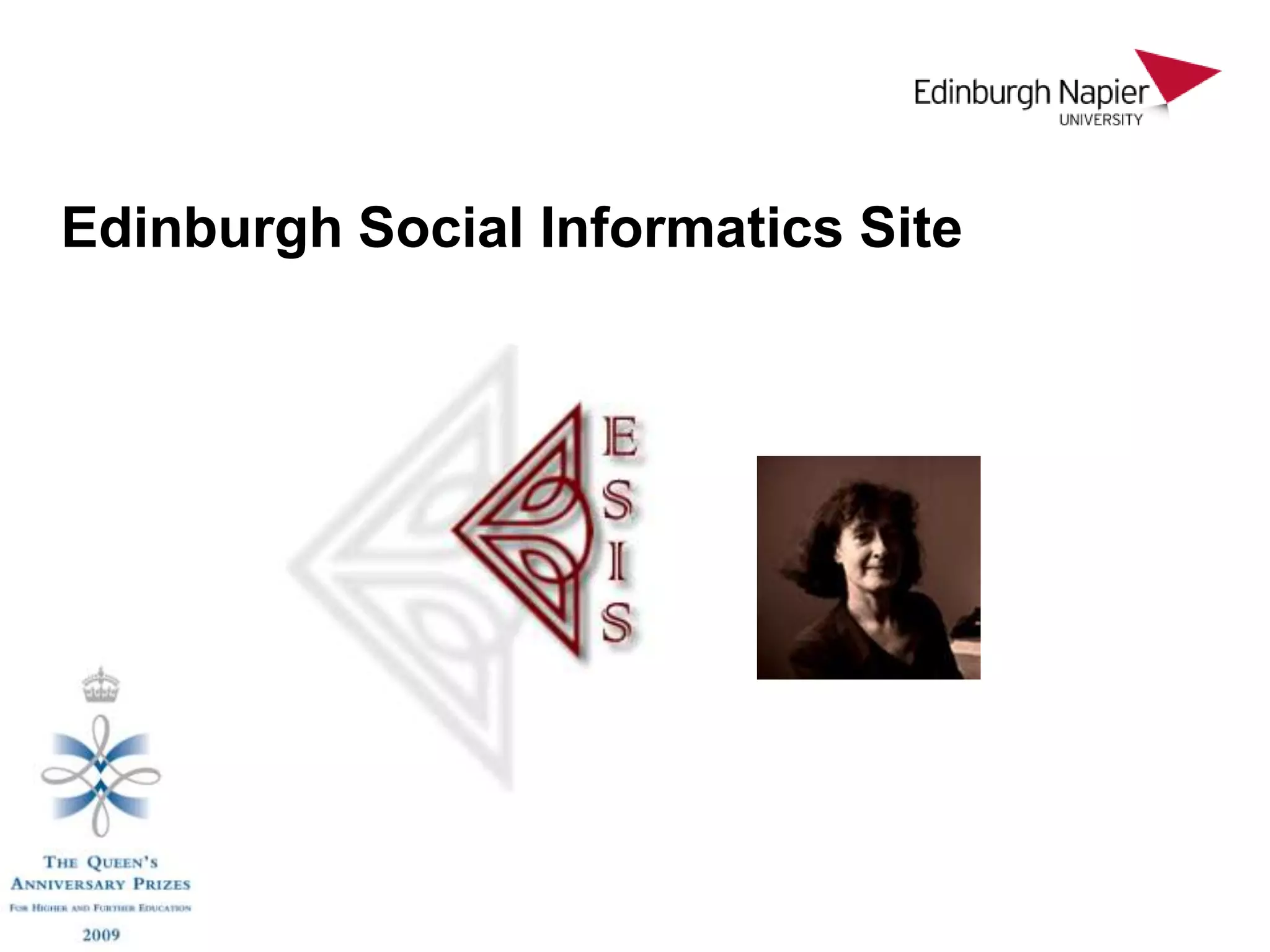
Edinburgh Social Informatics Site
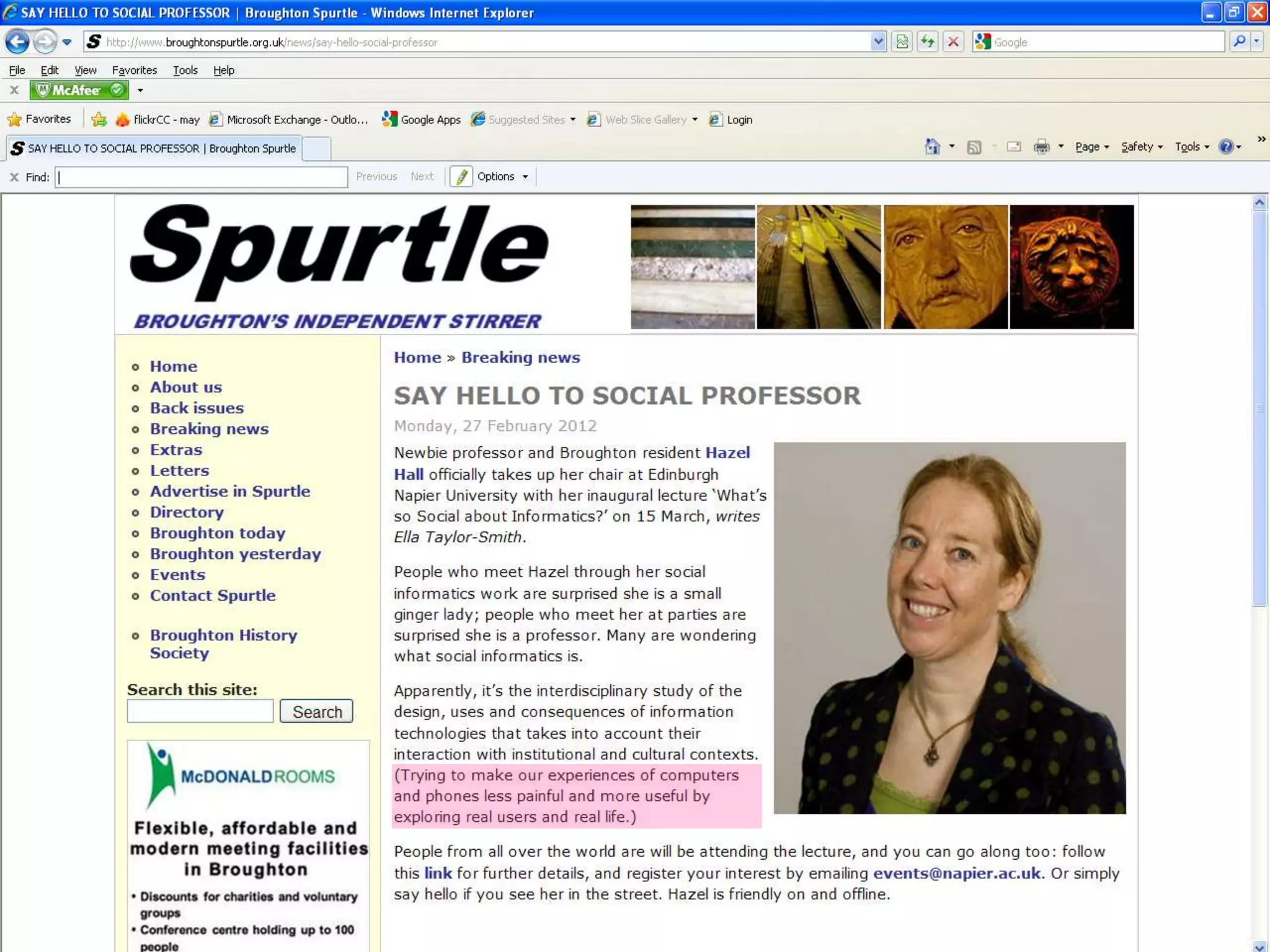
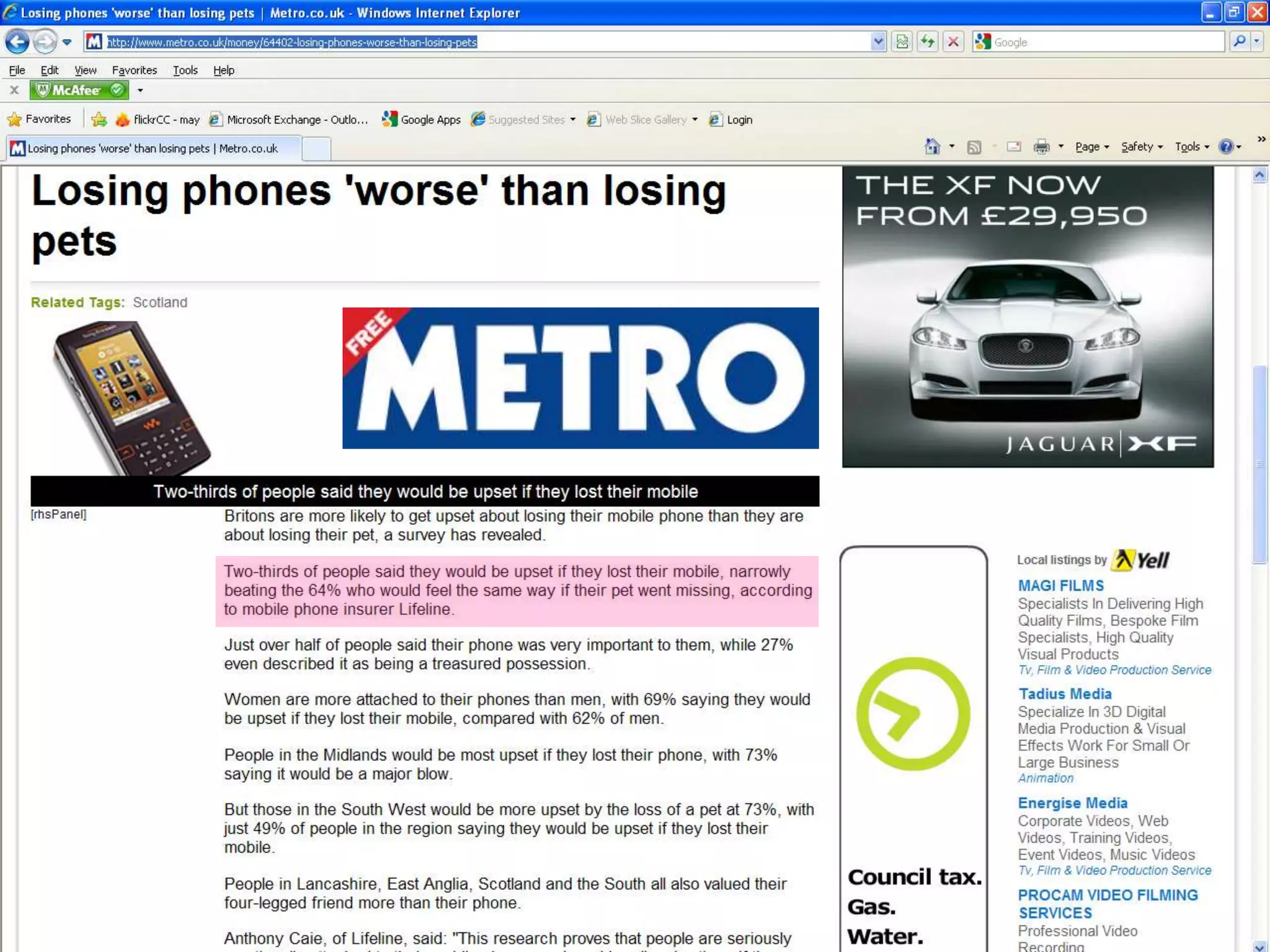
“Exploring real users and real life”
       “Real users”
          Humans and information technologies create socio-
           technical interaction networks
             Humans are “actors”
             … and so are technologies
“Exploring real users and real life”
       “Real users”
          Humans and information technologies create socio-
           technical interaction networks
              Humans are “actors”
              … and so are technologies


       “Real life”
          The context in which the technologies are situated is
           important, e.g.
              the users of the technology
              policies that relate to the use of the technology
              resources to support the use of the technology
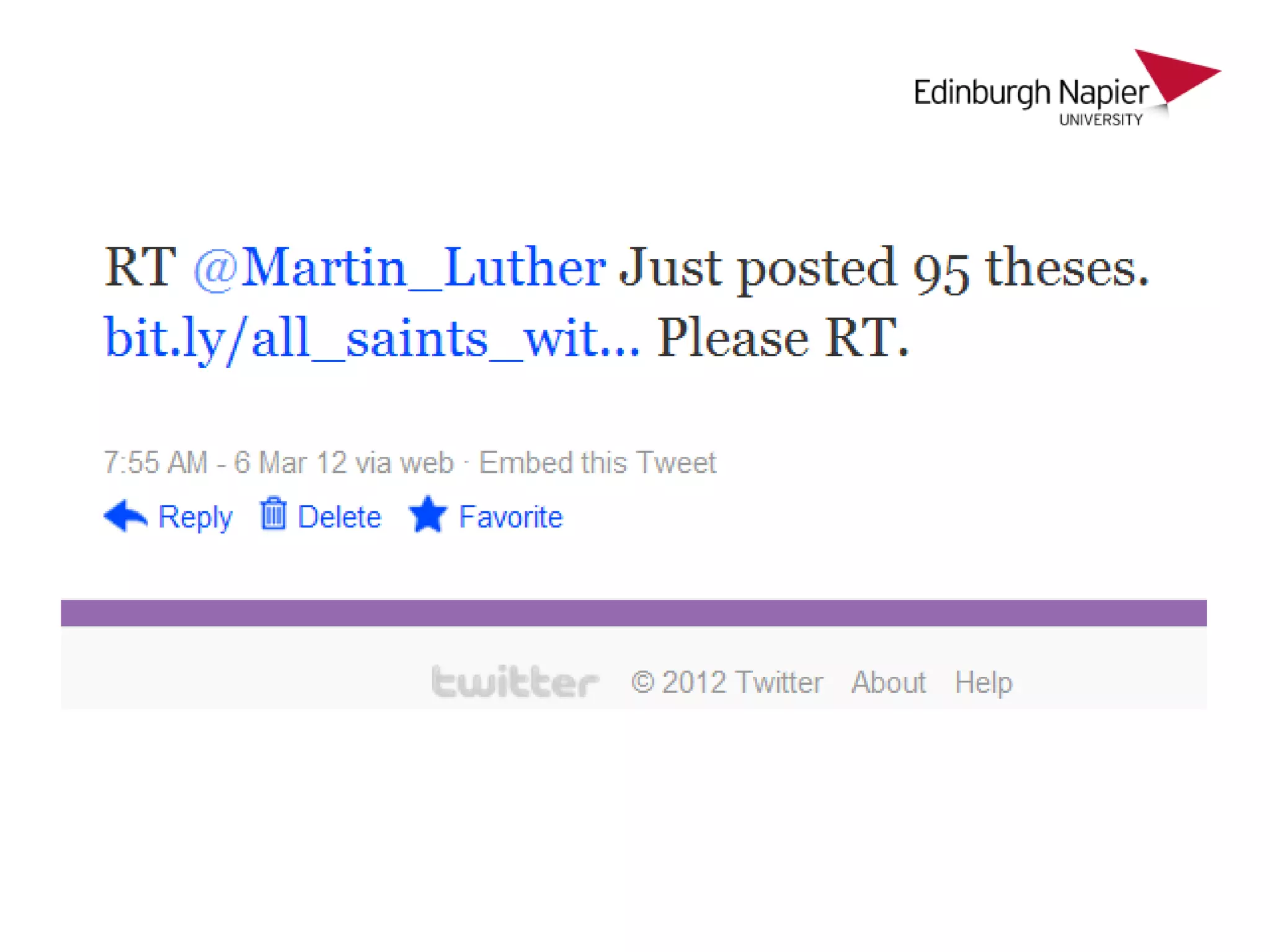
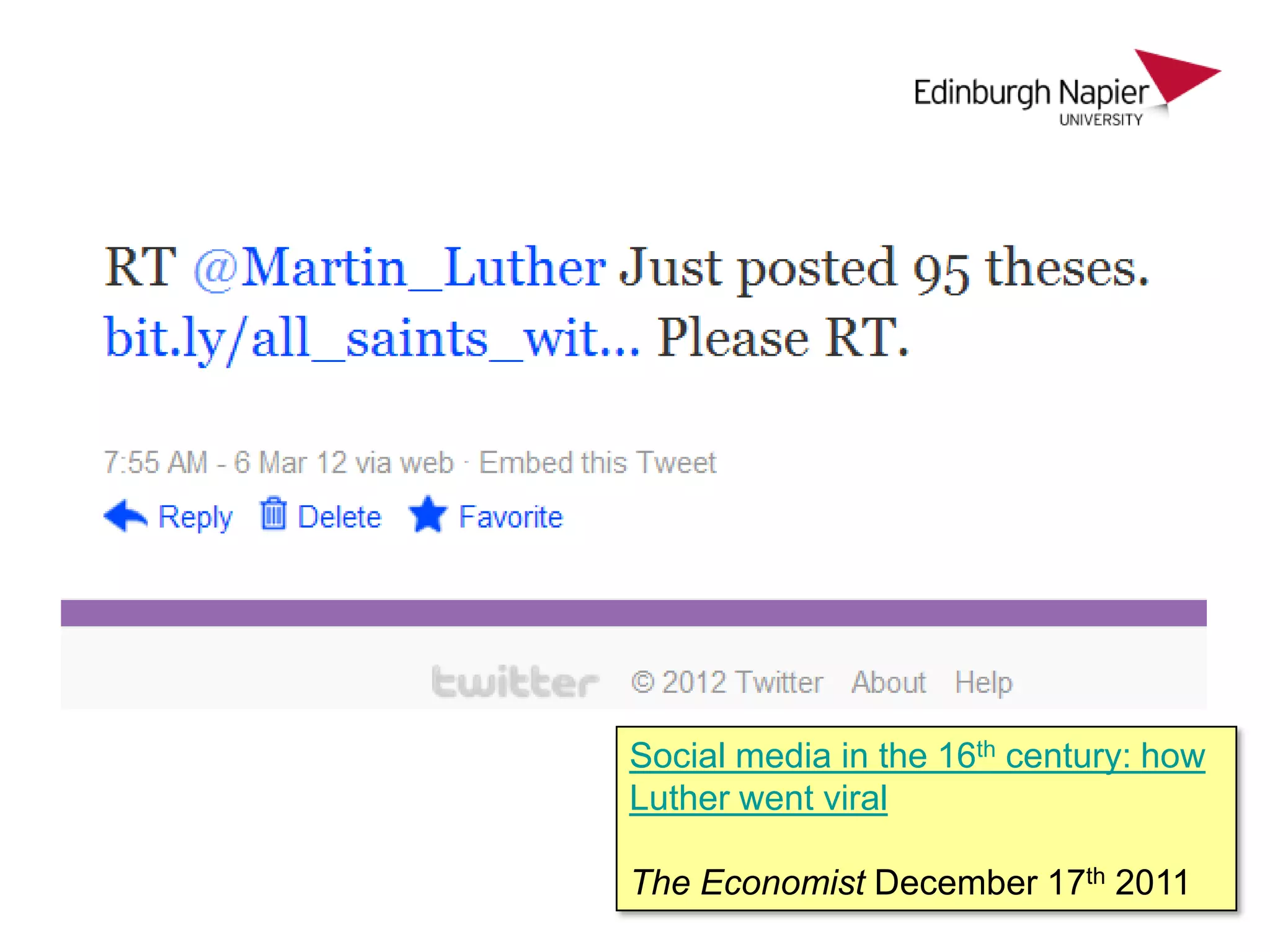
Social media in the 16th century: how
Luther went viral

The Economist December 17th 2011
In short, social informatics researchers
study
       Relationships between humans and information
        technologies
       … taking into account the context in which they
        interact
In short, social informatics researchers
study
       Relationships between humans and information
        technologies
       … taking into account the context in which they
        interact

       To understand the impact of information
        technologies on organisations and
        communities, e.g.
          How information technologies are used (differently) in
           particular contexts
          How information technologies bring about change
Social media
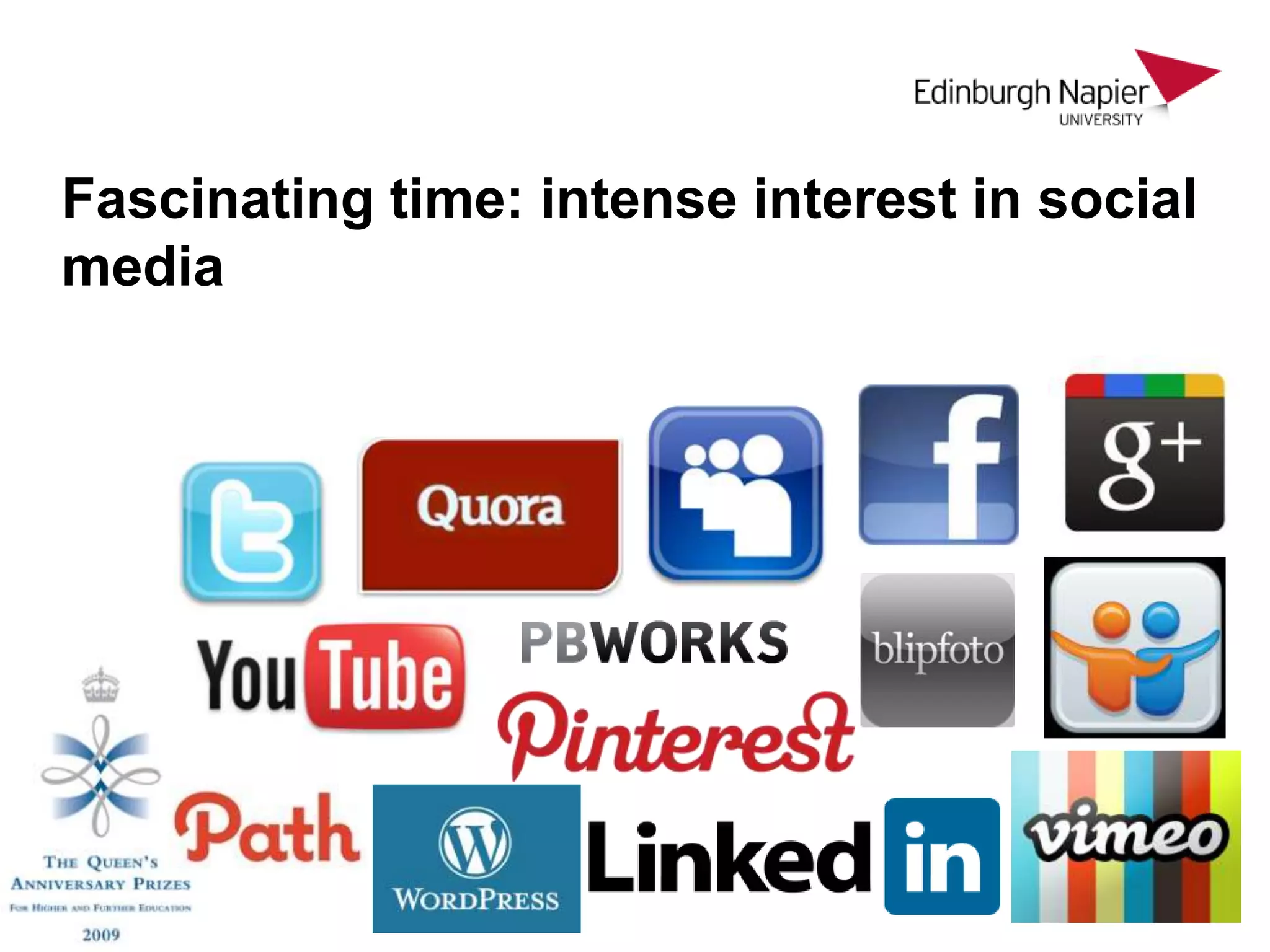
Fascinating time: intense interest in social
media
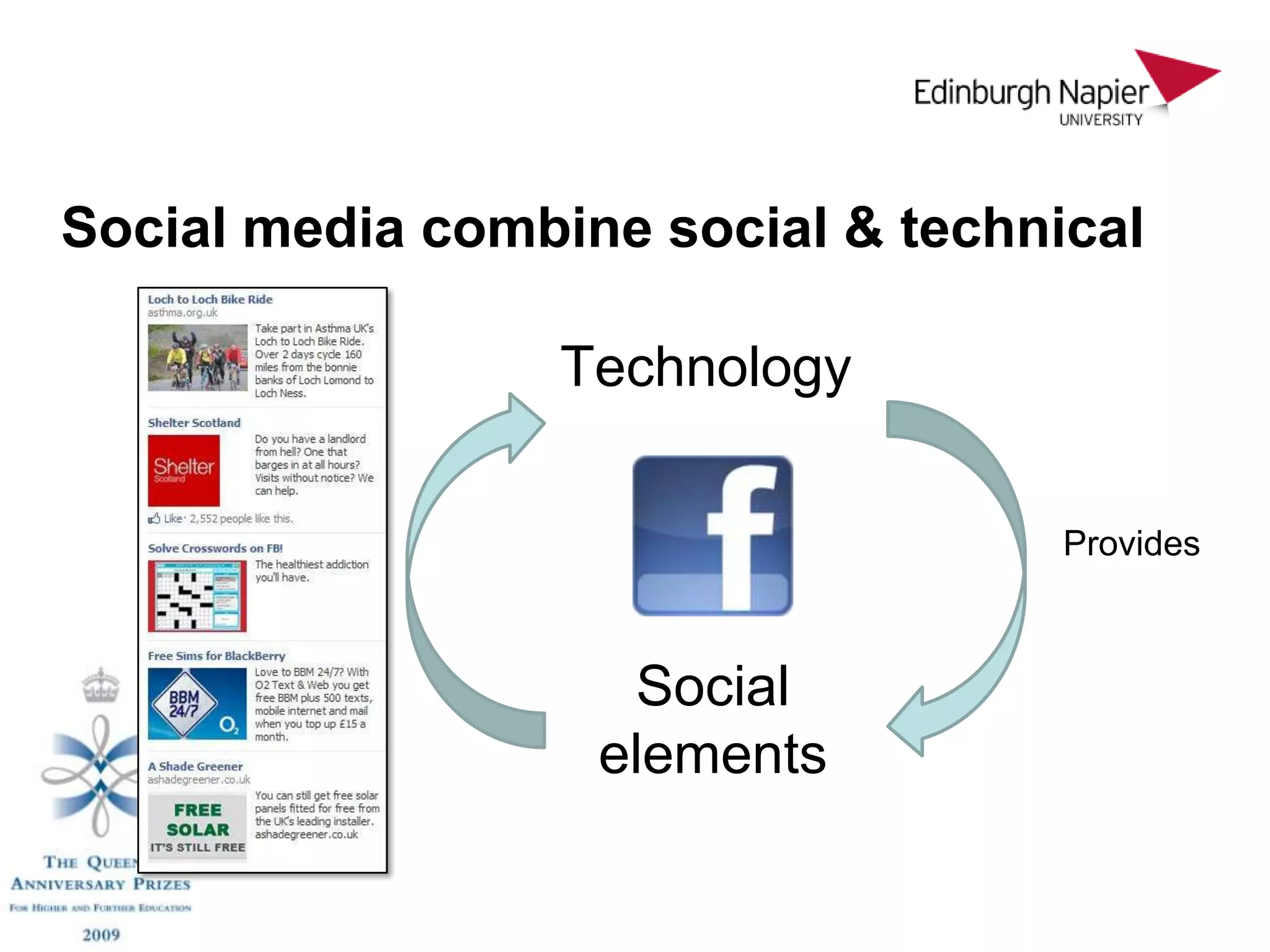
Social media combine social & technical

                  Technology

      Add value                     Provides


                    Social
                   elements
C21st reiving
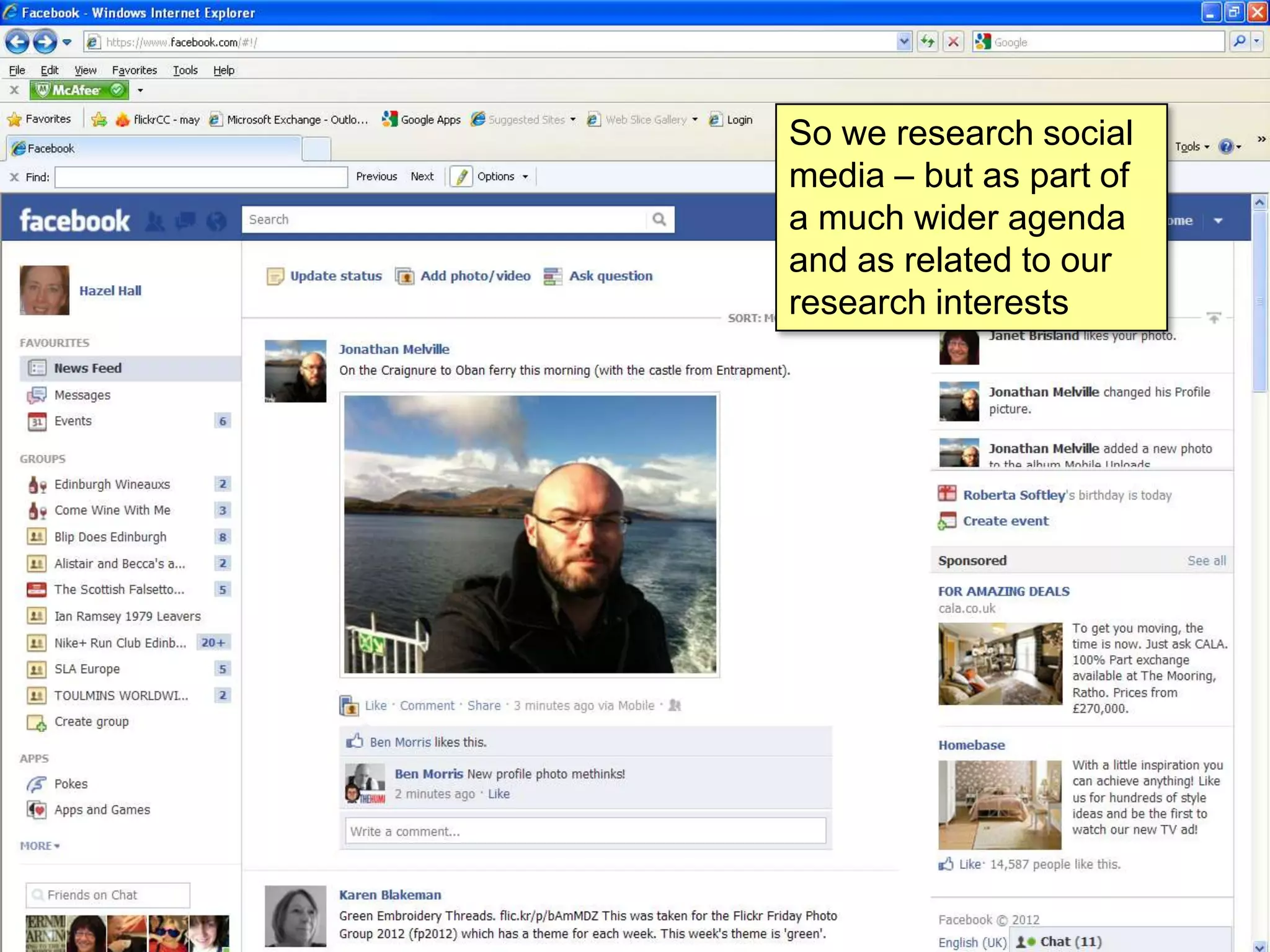
So we research social
media – but as part of
a much wider agenda
and as related to our
research interests
Centre for Social
Informatics
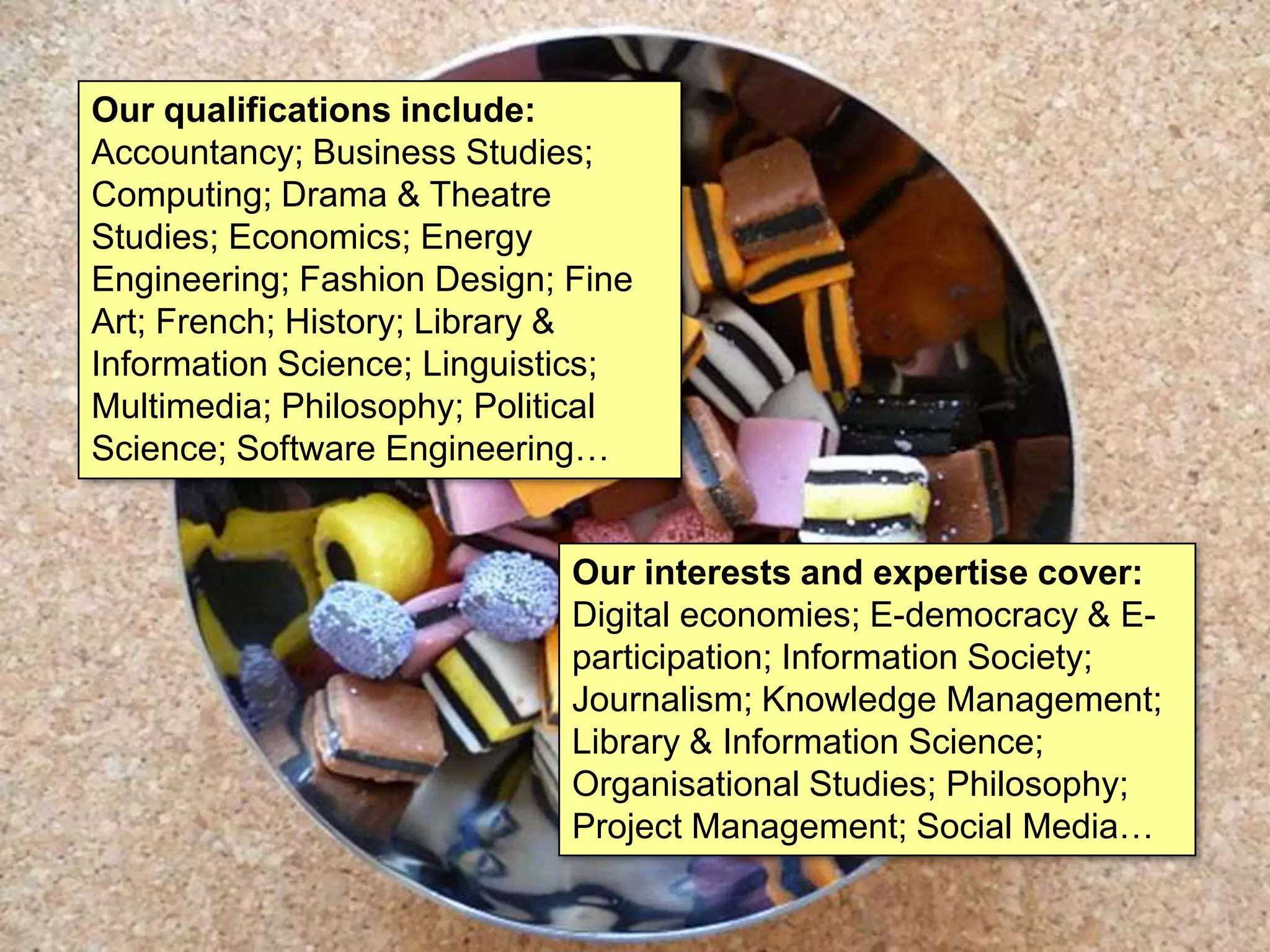
Our qualifications include:
Accountancy; Business Studies;
Computing; Drama & Theatre
Studies; Economics; Energy
Engineering; Fashion Design; Fine
Art; French; History; Library &
Information Science; Linguistics;
Multimedia; Philosophy; Political
Science; Software Engineering…


                             Our interests and expertise cover:
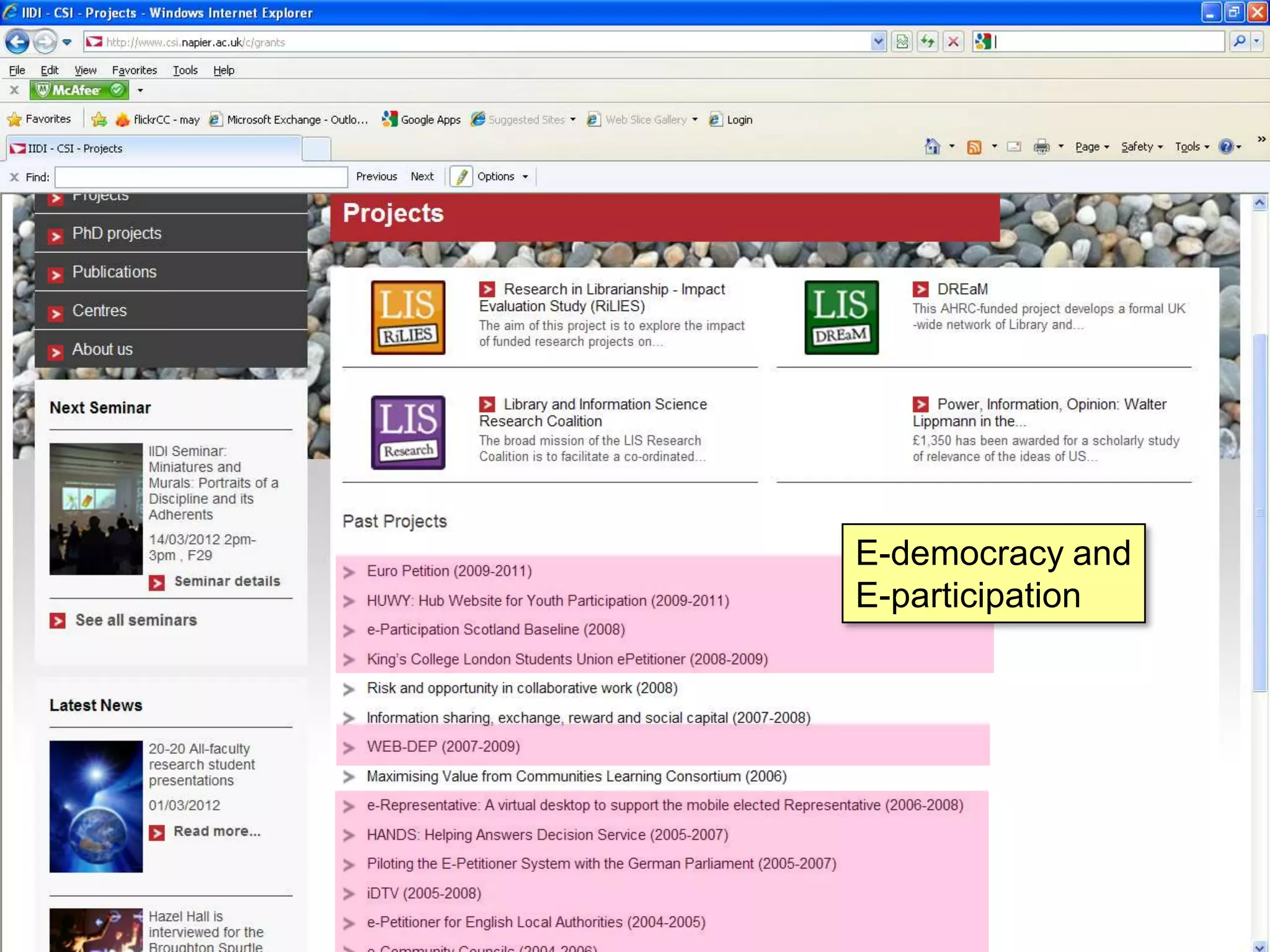
                             Digital economies; E-democracy & E-
                             participation; Information Society;
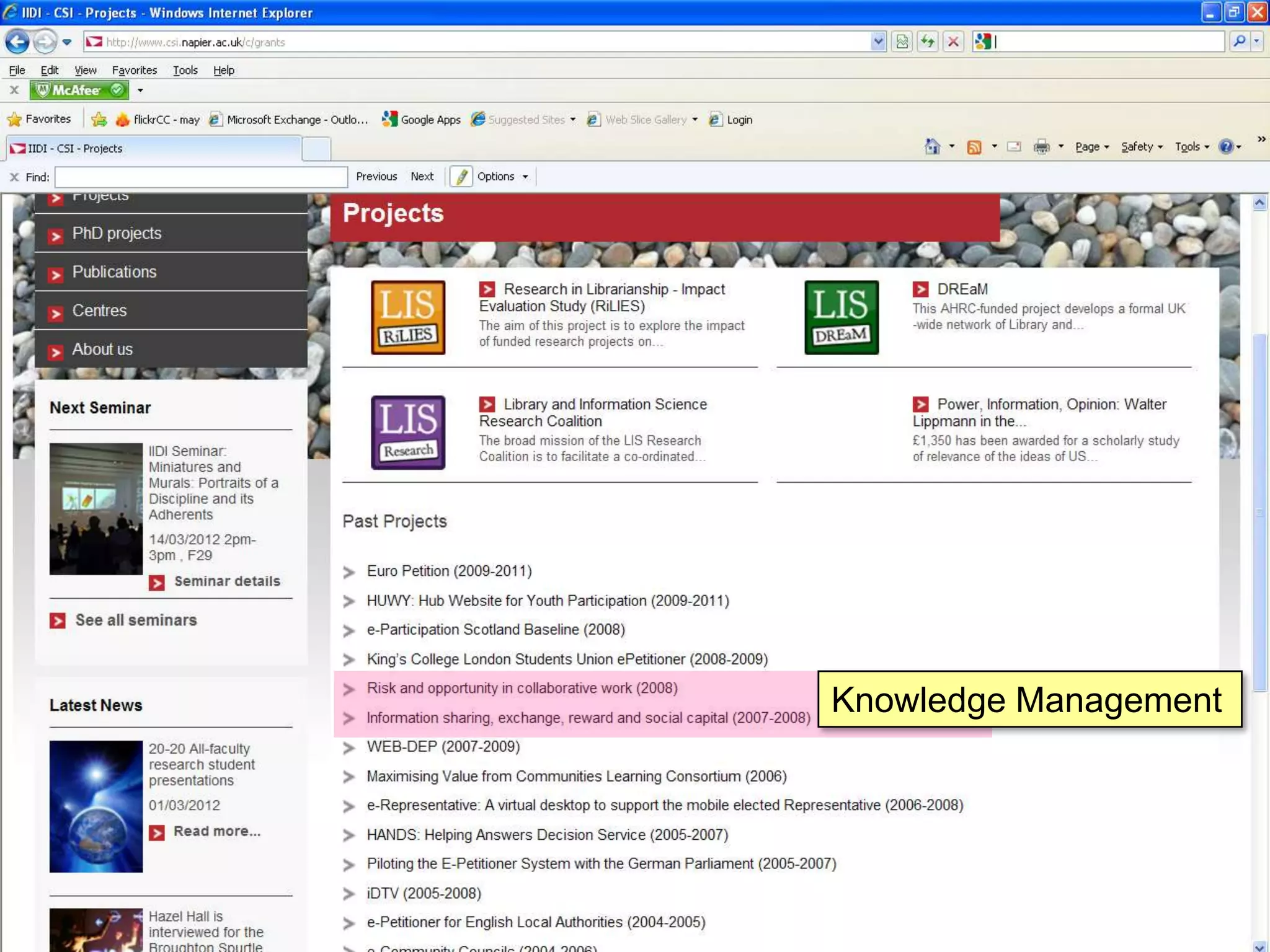
                             Journalism; Knowledge Management;
                             Library & Information Science;
                             Organisational Studies; Philosophy;
                             Project Management; Social Media…
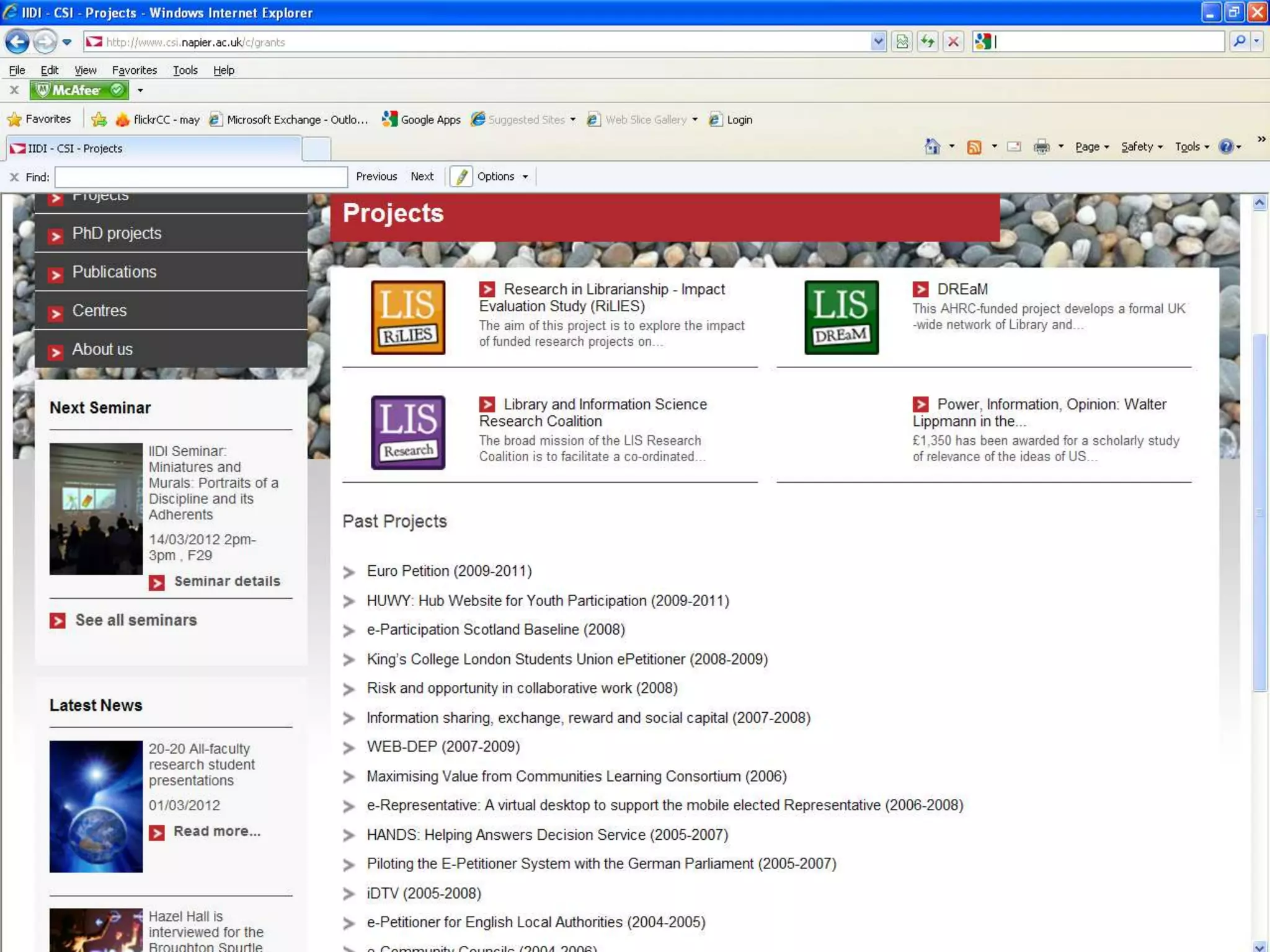
Library &
Information
Science
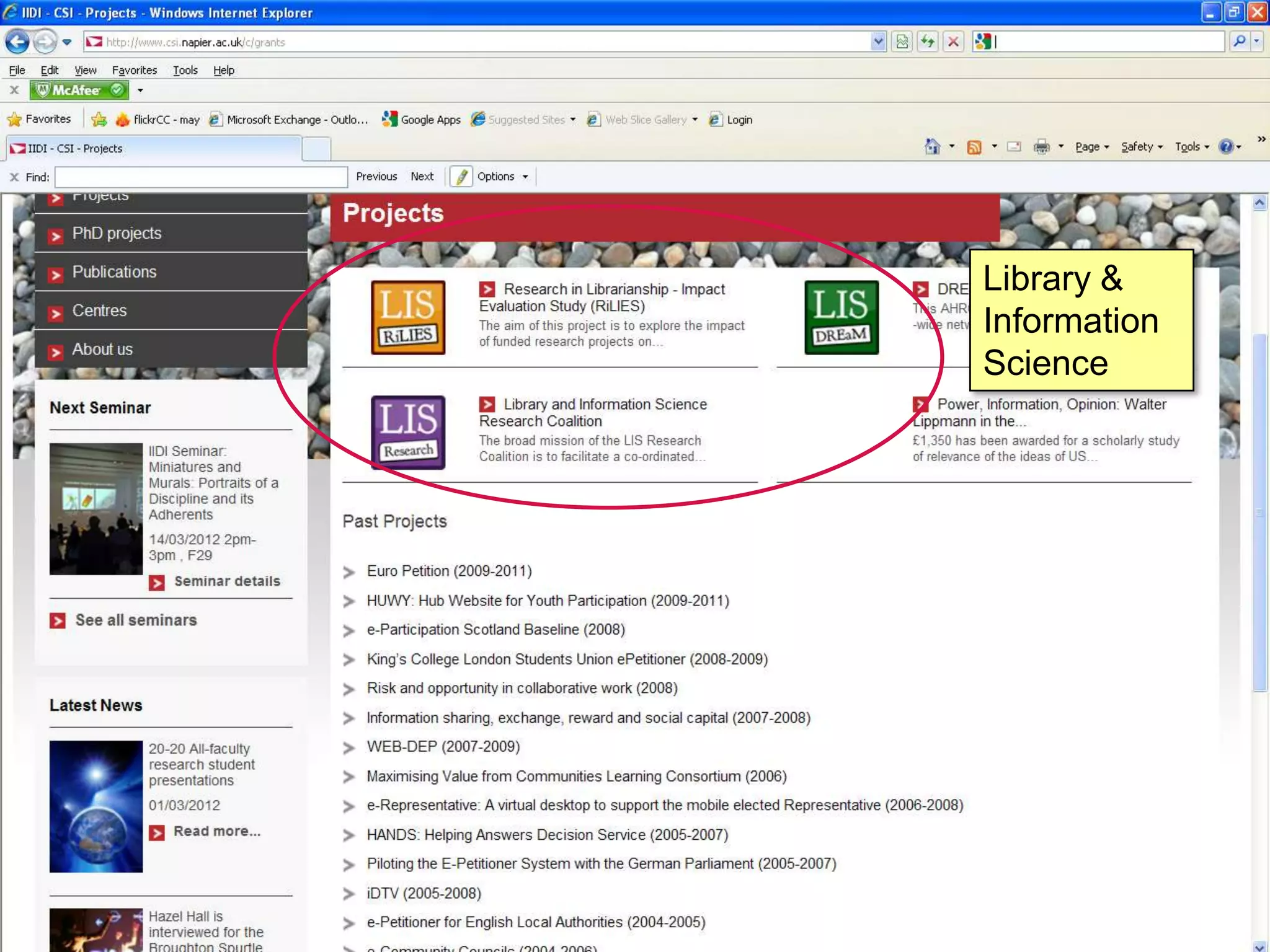
Intersection of Information
Science, Journalism, and
Philosophy
E-democracy and
E-participation
Knowledge Management
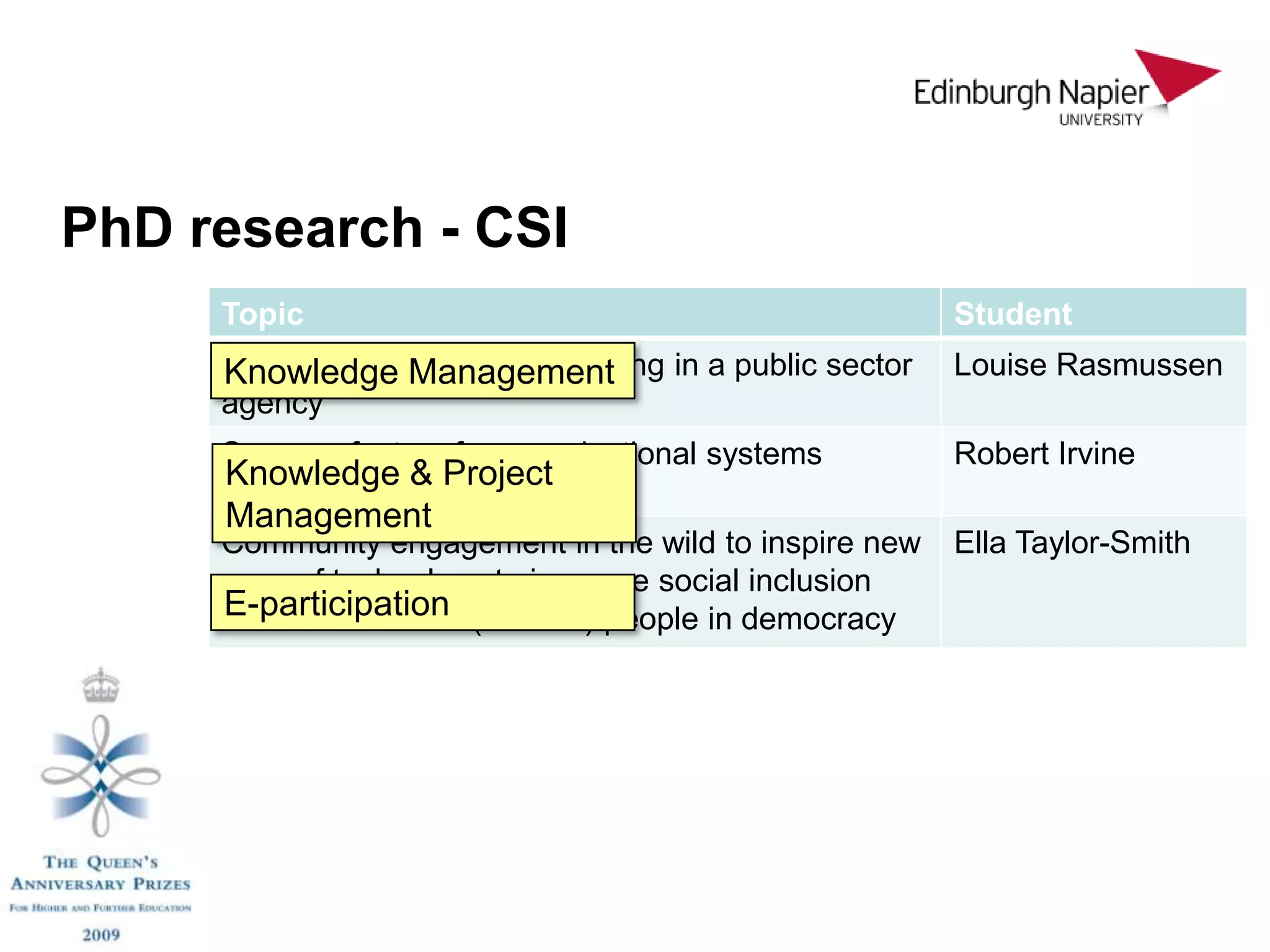
PhD research - CSI
     Topic                                               Student
     Evolution of knowledge working in a public sector
     Knowledge Management                                Louise Rasmussen
     agency
     Success factors for organisational systems          Robert Irvine
     Knowledge & Project
     development
     Management
     Community engagement in the wild to inspire new     Ella Taylor-Smith
     uses of technology to increase social inclusion
     E-participation
     and involve more (diverse) people in democracy
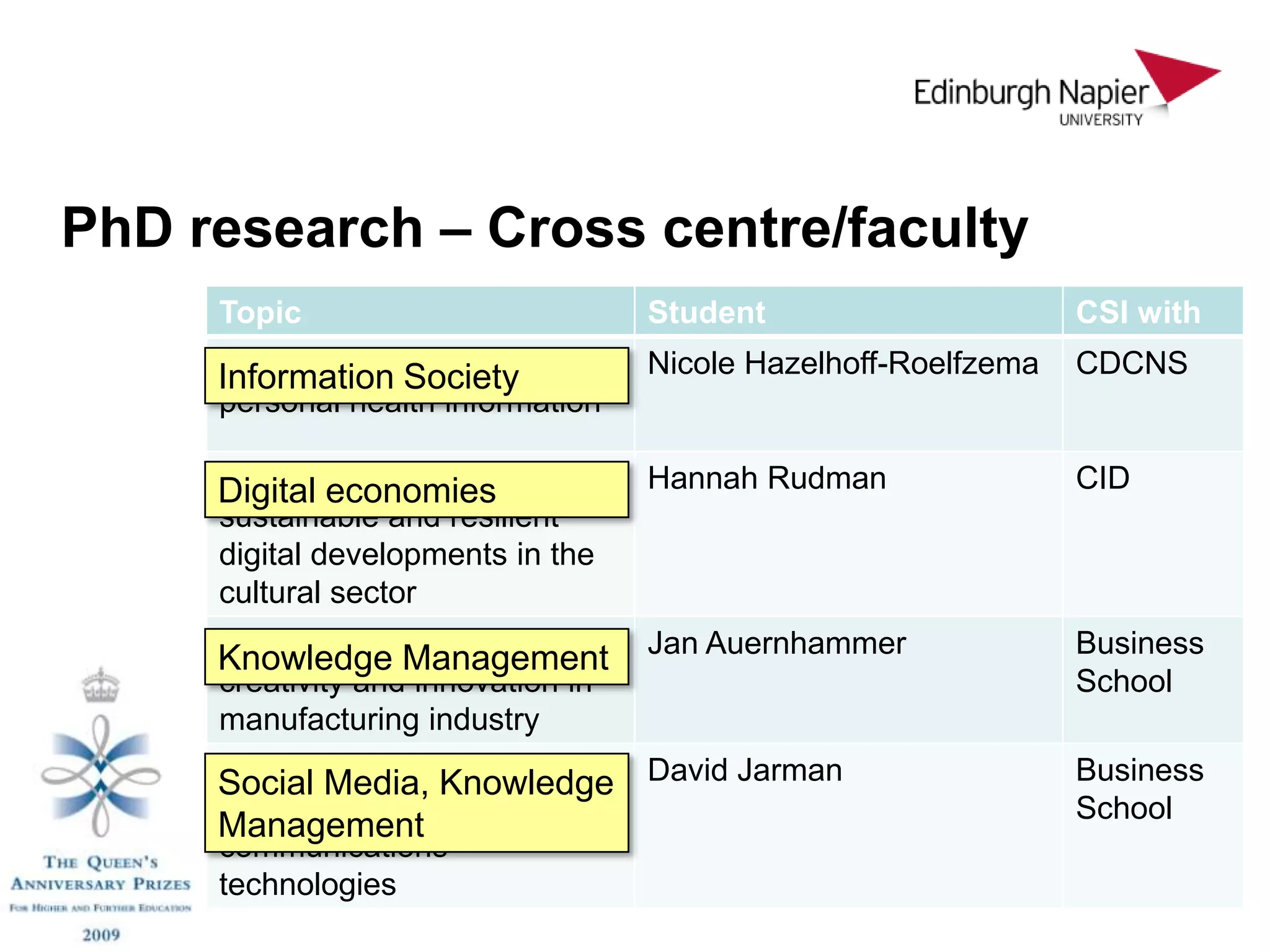
PhD research – Cross centre/faculty
     Topic                          Student                  CSI with

     Information assessment for Nicole Hazelhoff-Roelfzema
     Security risk Society                                   CDCNS
     personal health information

     Creating transformational,
     Digital economies              Hannah Rudman            CID
     sustainable and resilient
     digital developments in the
     cultural sector
     Organisational learning,       Jan Auernhammer          Business
     Knowledge Management
     creativity and innovation in                            School
     manufacturing industry

     Social Media, Knowledge David Jarman
     Relationships between                                   Business
     festivals, live events and                              School
     Management
     communications
     technologies
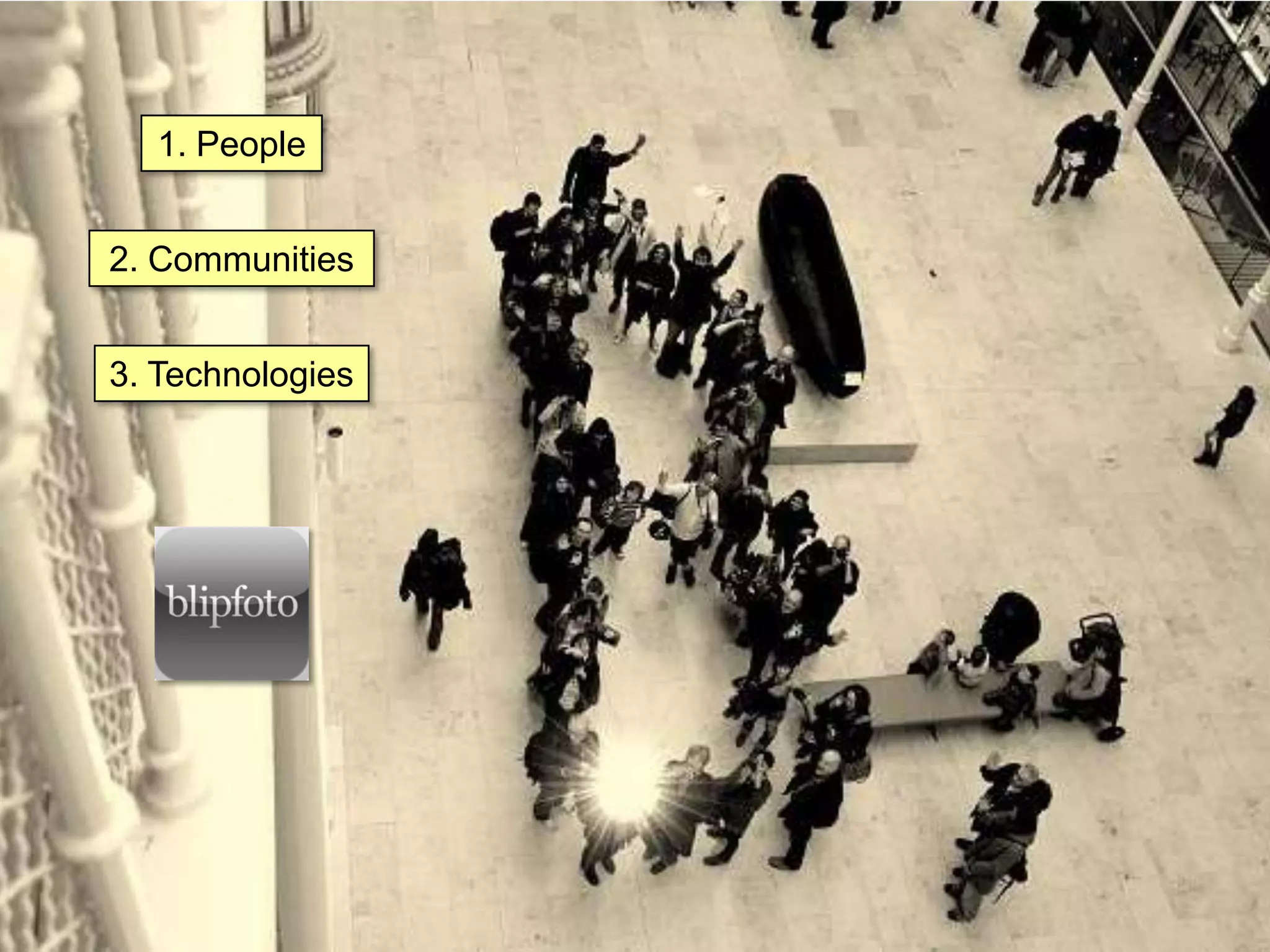
1. People


2. Communities


3. Technologies
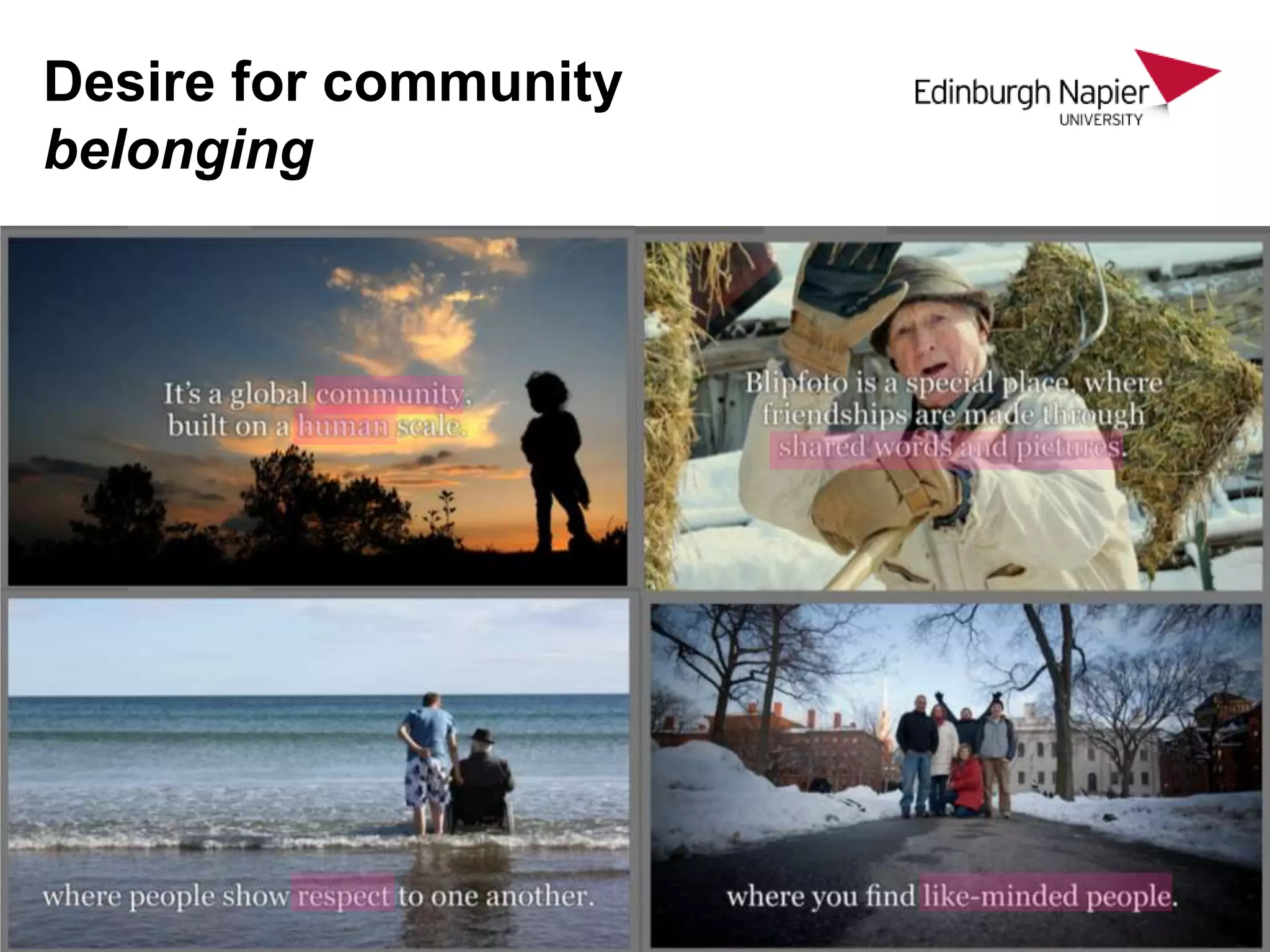
Desire for community
belonging
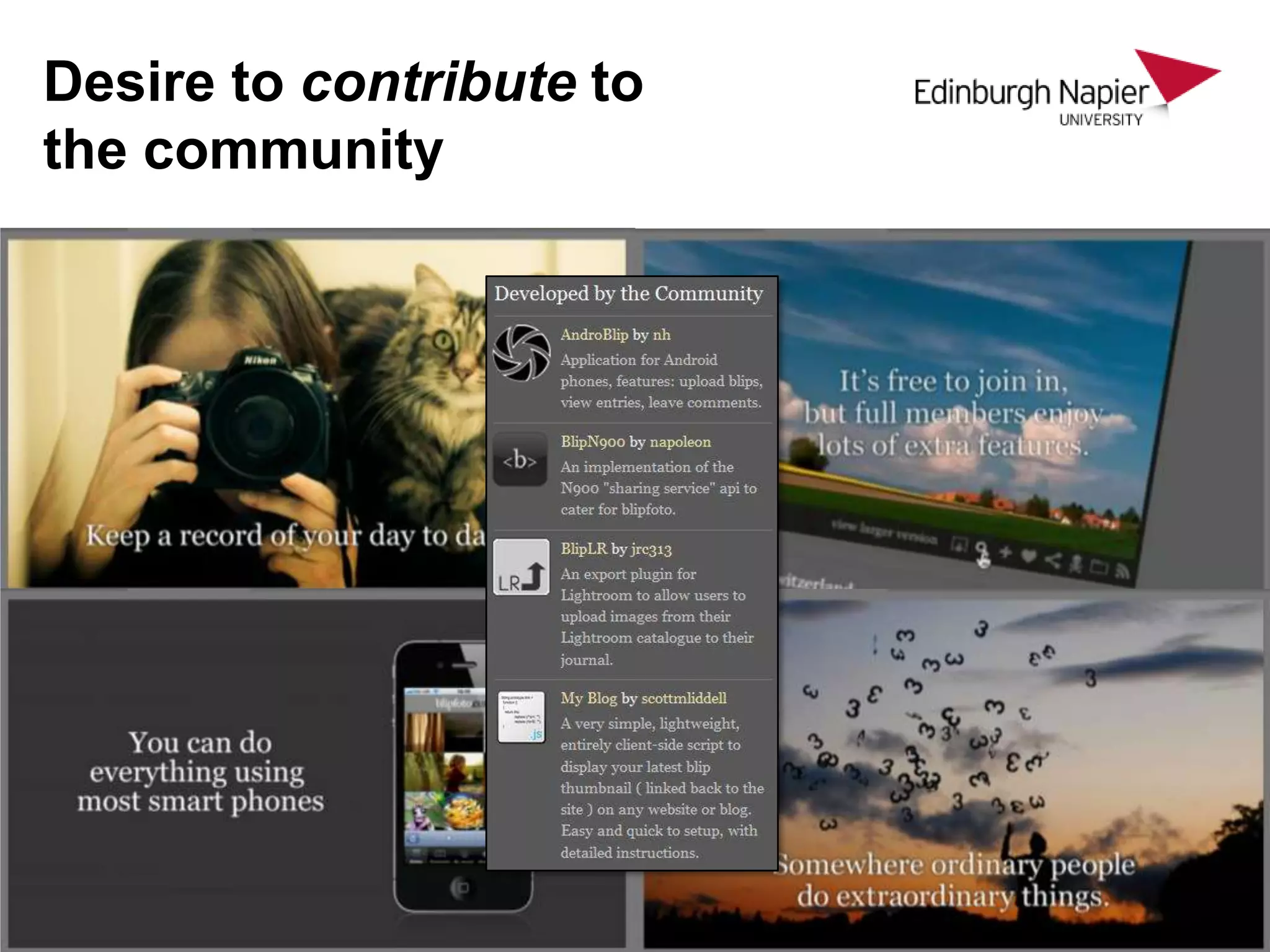
Desire to contribute to
the community
Enduring
behaviours & tools
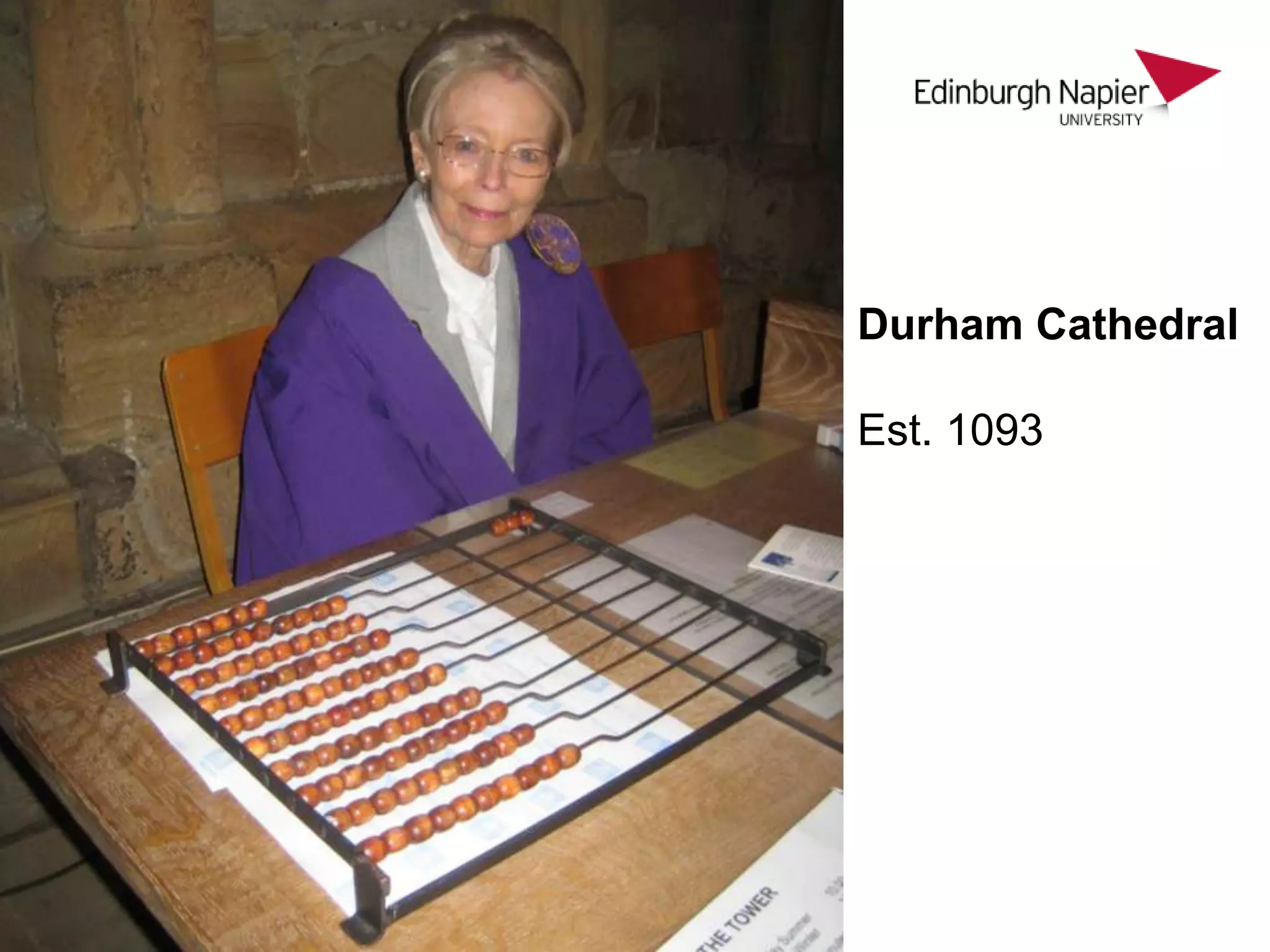
Durham Cathedral

Est. 1093
“We’re going forward to
the past…[The] new
world is in some ways an
old world. It is the world
from before print.”
              (Pettitt, 2011)
What’s so social about informatics?


    Professor Hazel Hall

    Centre for Social Informatics
    Institute for Informatics and Digital Innovation/School
    of Computing
Introduction to organisational
research and case studies

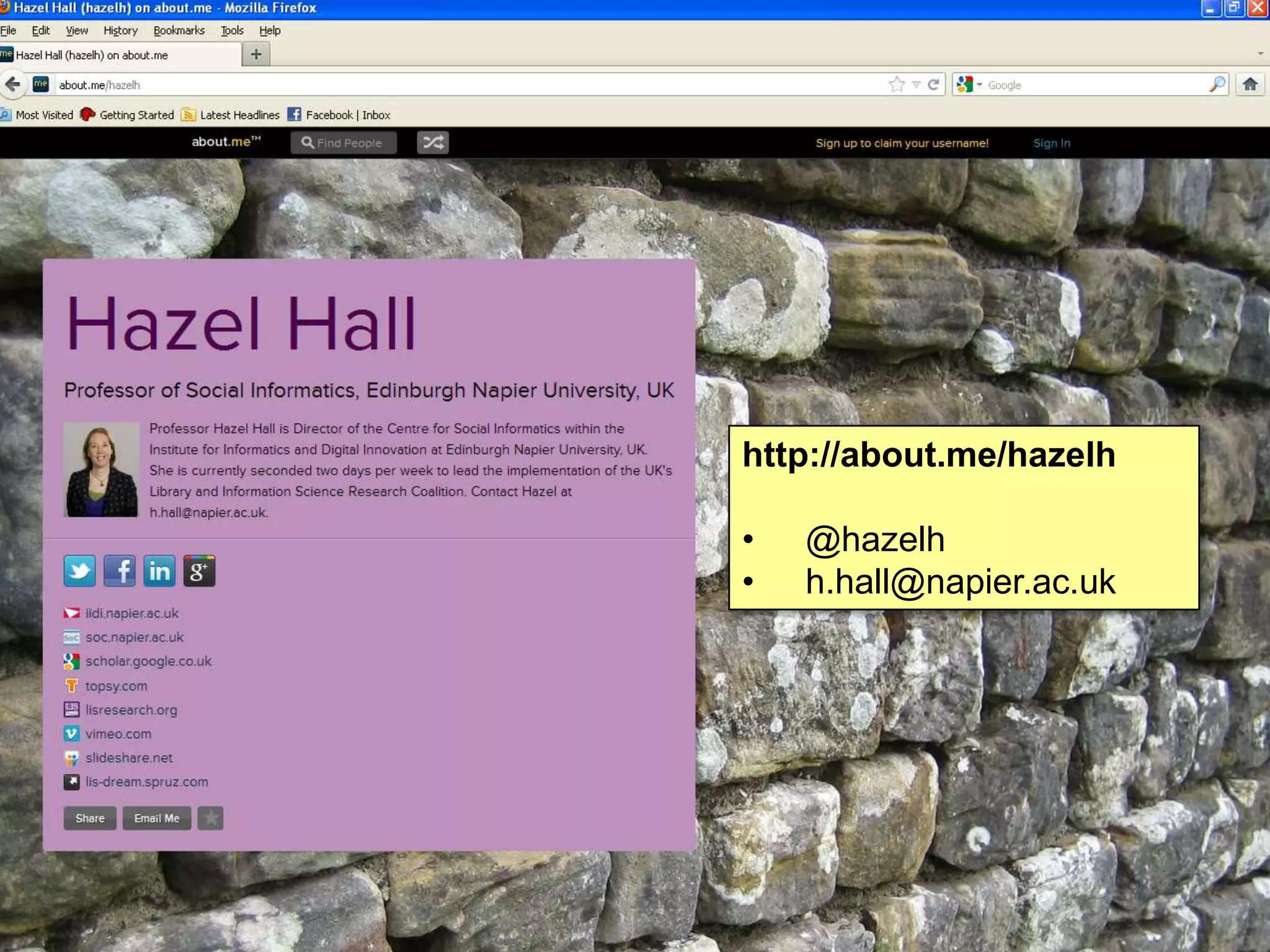
                                  http://about.me/hazelh
Professor Hazel Hall              •   @hazelh
                                  •   h.hall@napier.ac.uk
Institute for Informatics and Digital Innovation/School
of Computing
Blipfoto journal photo credits
      182/365 jigsaw job (18 May 2010) by fomu (Fokko Muller). Available from fomu’s
           daily photo: http://www.blipfoto.com/entry/573568, accessed 5 March 2012. [Slide
           4]
      All thing bright and twittery (9 July 2011) by SimonJordan. Available from My world
           in photos: http://www.blipfoto.com/entry/1266216, accessed 4 March 2012. [Slide
           3]
      Allsorts (9 February 2011) by alanpeacock. Available from Alan’s Album:
           http://www.blipfoto.com/entry/961902, accessed 5 March 2012. [Slide 29]
      Blip Meta (wtf?) Meet… (10 March 2012) by LeeAnne. Available from Daily
           Wanderings: http://www.blipfoto.com/entry/1815401, accessed 11 March 2012.
           [Slide 37]
      Below average (29 December 2011) by mooncoin. Available from The fool on the
           hill: http://www.blipfoto.com/entry/1621763, accessed 4 March 2012. [Slide 14]
      Christmas Cheviot (27 December 2011) by JennyWrenny . Available from My 35th
           year: http://www.blipfoto.com/entry/1617632, accessed 5 March 2012. [Slide 25]
      Clock watching (14 April 2011) by iamchrisphoto. Available from iamchris:
           http://www.blipfoto.com/entry/1092326, accessed 4 March 2012. [Slide 5]
Web sites
     AboutMe: http://about.me
     Blipfoto: http://blipfoto.com
     Broughton Spurtle: http://www.broughtonspurtle.org.uk
     Centre for Social Informatics: http://www.csi.napier.ac.uk/
     Facebook: http://facebook.com
     Gutenberg parenthesis – print, book and cognition:
          http://www.sdu.dk/en/om_sdu/institutter_centre/ilkm/forskning/forskningsprojekter/g
          utenberg_projekt
     Metro: http://www.metro.co.uk
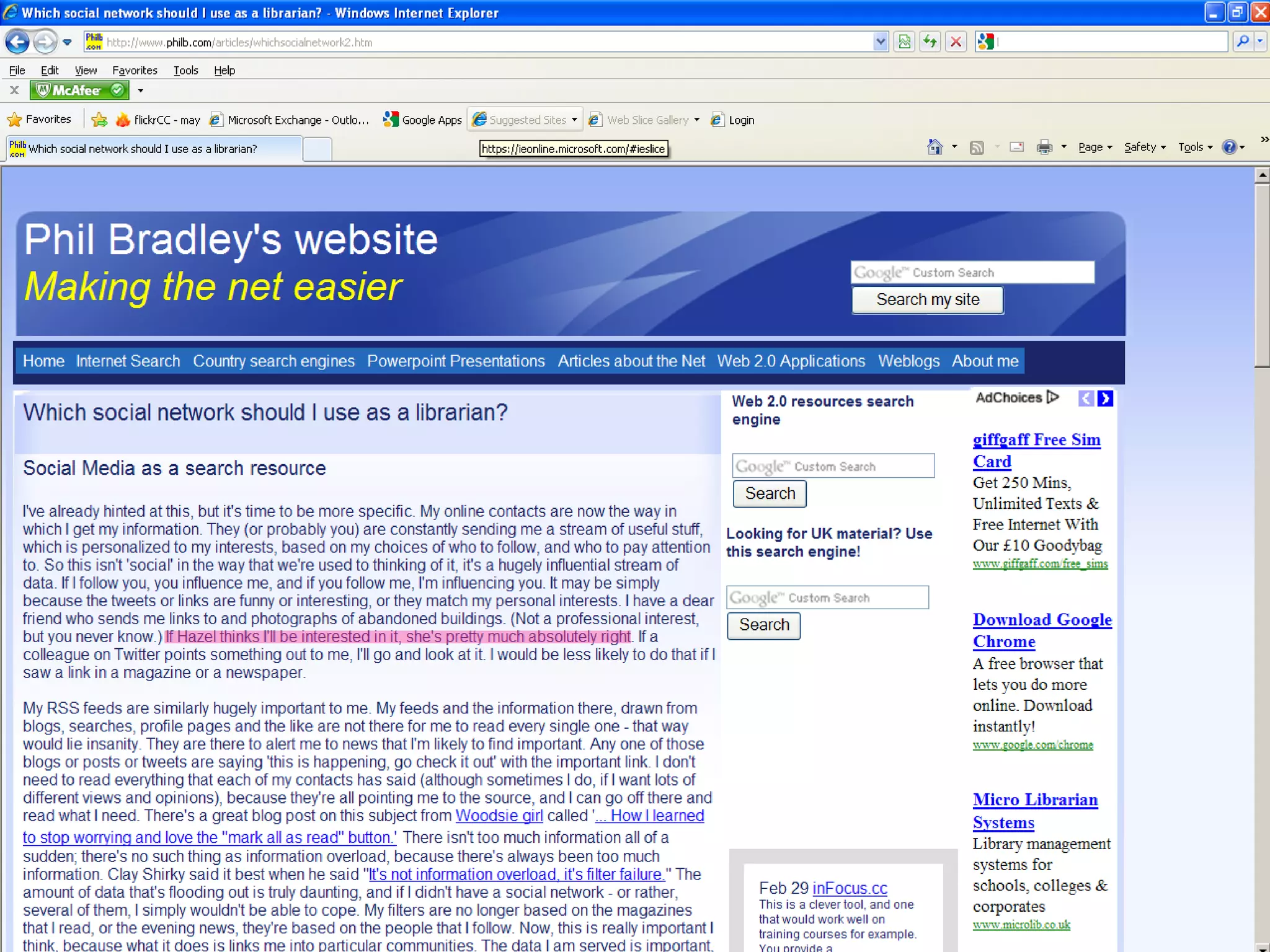
     Phil Bradley’s web site: http://philb.com
     Professor Hazel Hall’s publication page:
          http://www.soc.napier.ac.uk/~hazelh/esis/hazel_publications.html
     Rob Kling Center for Social Informatics: http://rkcsi.indiana.edu/
     Thomas Pettitt on the Gutenberg parenthesis: http://vimeo.com/10705406
     Socialnomics: http://www.socialnomics.net/ (4’26” video The social media revolution
          2012: http://www.youtube.com/watch?v=0eUeL3n7fDs)

What's so social about informatics?

  • 1.
    What’s so socialabout informatics? Professor Hazel Hall Centre for Social Informatics Institute for Informatics and Digital Innovation/School of Computing
  • 2.
  • 3.
    Enduring behaviours & tools Social informatics Social media Centre for Social Informatics
  • 5.
  • 10.
  • 12.
    “Exploring real usersand real life”  “Real users”  Humans and information technologies create socio- technical interaction networks  Humans are “actors”  … and so are technologies
  • 15.
    “Exploring real usersand real life”  “Real users”  Humans and information technologies create socio- technical interaction networks  Humans are “actors”  … and so are technologies  “Real life”  The context in which the technologies are situated is important, e.g.  the users of the technology  policies that relate to the use of the technology  resources to support the use of the technology
  • 17.
    Social media inthe 16th century: how Luther went viral The Economist December 17th 2011
  • 18.
    In short, socialinformatics researchers study  Relationships between humans and information technologies  … taking into account the context in which they interact
  • 19.
    In short, socialinformatics researchers study  Relationships between humans and information technologies  … taking into account the context in which they interact  To understand the impact of information technologies on organisations and communities, e.g.  How information technologies are used (differently) in particular contexts  How information technologies bring about change
  • 20.
  • 21.
    Fascinating time: intenseinterest in social media
  • 22.
    Social media combinesocial & technical Technology Add value Provides Social elements
  • 24.
  • 25.
    So we researchsocial media – but as part of a much wider agenda and as related to our research interests
  • 26.
  • 28.
    Our qualifications include: Accountancy;Business Studies; Computing; Drama & Theatre Studies; Economics; Energy Engineering; Fashion Design; Fine Art; French; History; Library & Information Science; Linguistics; Multimedia; Philosophy; Political Science; Software Engineering… Our interests and expertise cover: Digital economies; E-democracy & E- participation; Information Society; Journalism; Knowledge Management; Library & Information Science; Organisational Studies; Philosophy; Project Management; Social Media…
  • 30.
  • 31.
    Intersection of Information Science,Journalism, and Philosophy
  • 32.
  • 33.
  • 34.
    PhD research -CSI Topic Student Evolution of knowledge working in a public sector Knowledge Management Louise Rasmussen agency Success factors for organisational systems Robert Irvine Knowledge & Project development Management Community engagement in the wild to inspire new Ella Taylor-Smith uses of technology to increase social inclusion E-participation and involve more (diverse) people in democracy
  • 35.
    PhD research –Cross centre/faculty Topic Student CSI with Information assessment for Nicole Hazelhoff-Roelfzema Security risk Society CDCNS personal health information Creating transformational, Digital economies Hannah Rudman CID sustainable and resilient digital developments in the cultural sector Organisational learning, Jan Auernhammer Business Knowledge Management creativity and innovation in School manufacturing industry Social Media, Knowledge David Jarman Relationships between Business festivals, live events and School Management communications technologies
  • 36.
  • 37.
  • 38.
    Desire to contributeto the community
  • 39.
  • 41.
  • 42.
    “We’re going forwardto the past…[The] new world is in some ways an old world. It is the world from before print.” (Pettitt, 2011)
  • 43.
    What’s so socialabout informatics? Professor Hazel Hall Centre for Social Informatics Institute for Informatics and Digital Innovation/School of Computing
  • 44.
    Introduction to organisational researchand case studies http://about.me/hazelh Professor Hazel Hall • @hazelh • h.hall@napier.ac.uk Institute for Informatics and Digital Innovation/School of Computing
  • 45.
    Blipfoto journal photocredits 182/365 jigsaw job (18 May 2010) by fomu (Fokko Muller). Available from fomu’s daily photo: http://www.blipfoto.com/entry/573568, accessed 5 March 2012. [Slide 4] All thing bright and twittery (9 July 2011) by SimonJordan. Available from My world in photos: http://www.blipfoto.com/entry/1266216, accessed 4 March 2012. [Slide 3] Allsorts (9 February 2011) by alanpeacock. Available from Alan’s Album: http://www.blipfoto.com/entry/961902, accessed 5 March 2012. [Slide 29] Blip Meta (wtf?) Meet… (10 March 2012) by LeeAnne. Available from Daily Wanderings: http://www.blipfoto.com/entry/1815401, accessed 11 March 2012. [Slide 37] Below average (29 December 2011) by mooncoin. Available from The fool on the hill: http://www.blipfoto.com/entry/1621763, accessed 4 March 2012. [Slide 14] Christmas Cheviot (27 December 2011) by JennyWrenny . Available from My 35th year: http://www.blipfoto.com/entry/1617632, accessed 5 March 2012. [Slide 25] Clock watching (14 April 2011) by iamchrisphoto. Available from iamchris: http://www.blipfoto.com/entry/1092326, accessed 4 March 2012. [Slide 5]
  • 46.
    Web sites AboutMe: http://about.me Blipfoto: http://blipfoto.com Broughton Spurtle: http://www.broughtonspurtle.org.uk Centre for Social Informatics: http://www.csi.napier.ac.uk/ Facebook: http://facebook.com Gutenberg parenthesis – print, book and cognition: http://www.sdu.dk/en/om_sdu/institutter_centre/ilkm/forskning/forskningsprojekter/g utenberg_projekt Metro: http://www.metro.co.uk Phil Bradley’s web site: http://philb.com Professor Hazel Hall’s publication page: http://www.soc.napier.ac.uk/~hazelh/esis/hazel_publications.html Rob Kling Center for Social Informatics: http://rkcsi.indiana.edu/ Thomas Pettitt on the Gutenberg parenthesis: http://vimeo.com/10705406 Socialnomics: http://www.socialnomics.net/ (4’26” video The social media revolution 2012: http://www.youtube.com/watch?v=0eUeL3n7fDs)