THE URGE TO MERGE
THEORETICAL FRAMING
FOR INTEGRATED
INFORMATION WORKERS

Dr Susan Myburgh
University of South Australia
Visiting Professor, University of Parma
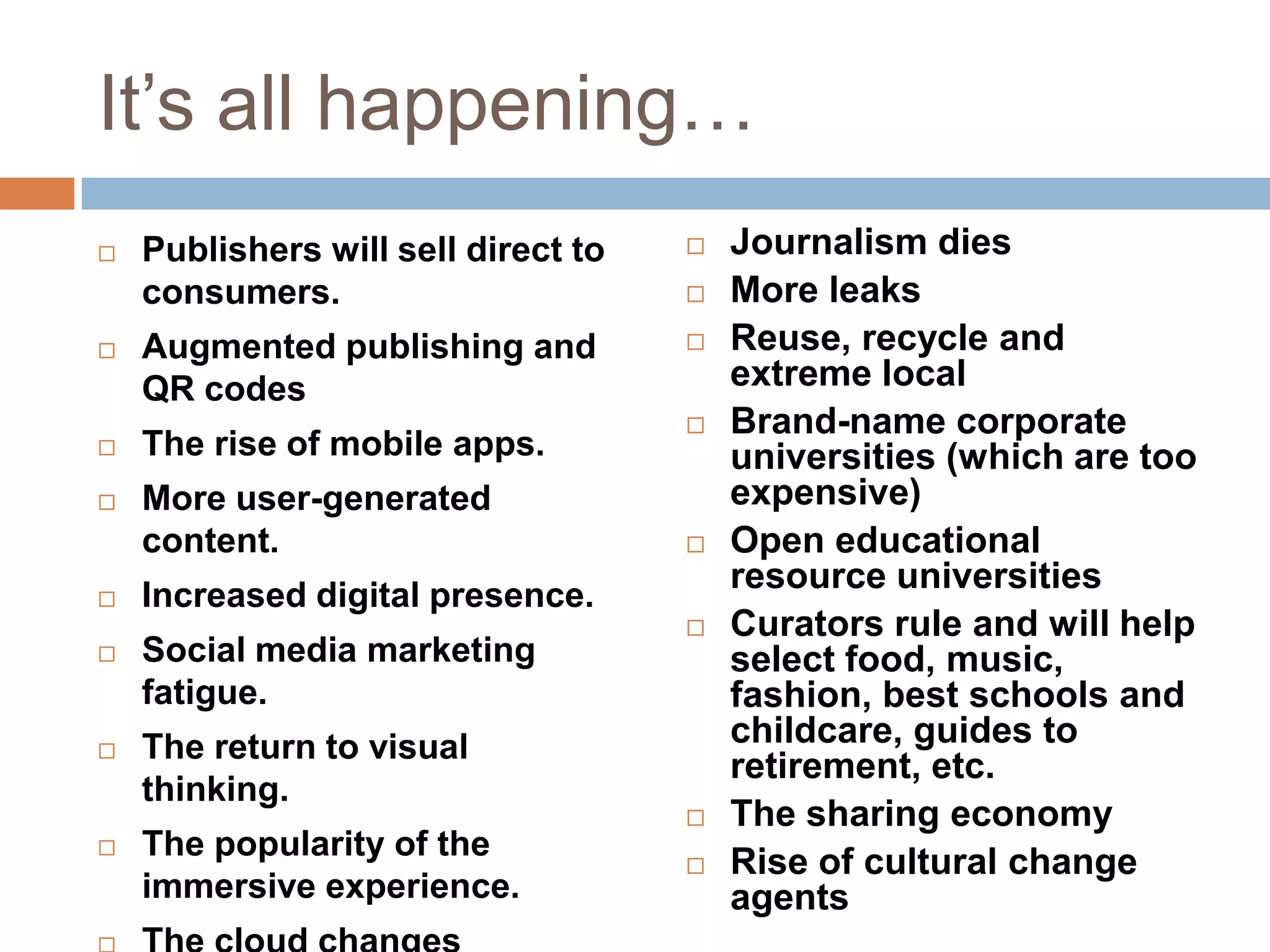
It‟s all happening…
   Publishers will sell direct to      Journalism dies
    consumers.                          More leaks
   Augmented publishing and            Reuse, recycle and
    QR codes                             extreme local
                                        Brand-name corporate
   The rise of mobile apps.             universities (which are too
   More user-generated                  expensive)
    content.                            Open educational
                                         resource universities
   Increased digital presence.
                                        Curators rule and will help
   Social media marketing               select food, music,
    fatigue.                             fashion, best schools and
   The return to visual                 childcare, guides to
                                         retirement, etc.
    thinking.
                                        The sharing economy
   The popularity of the
                                        Rise of cultural change
    immersive experience.                agents
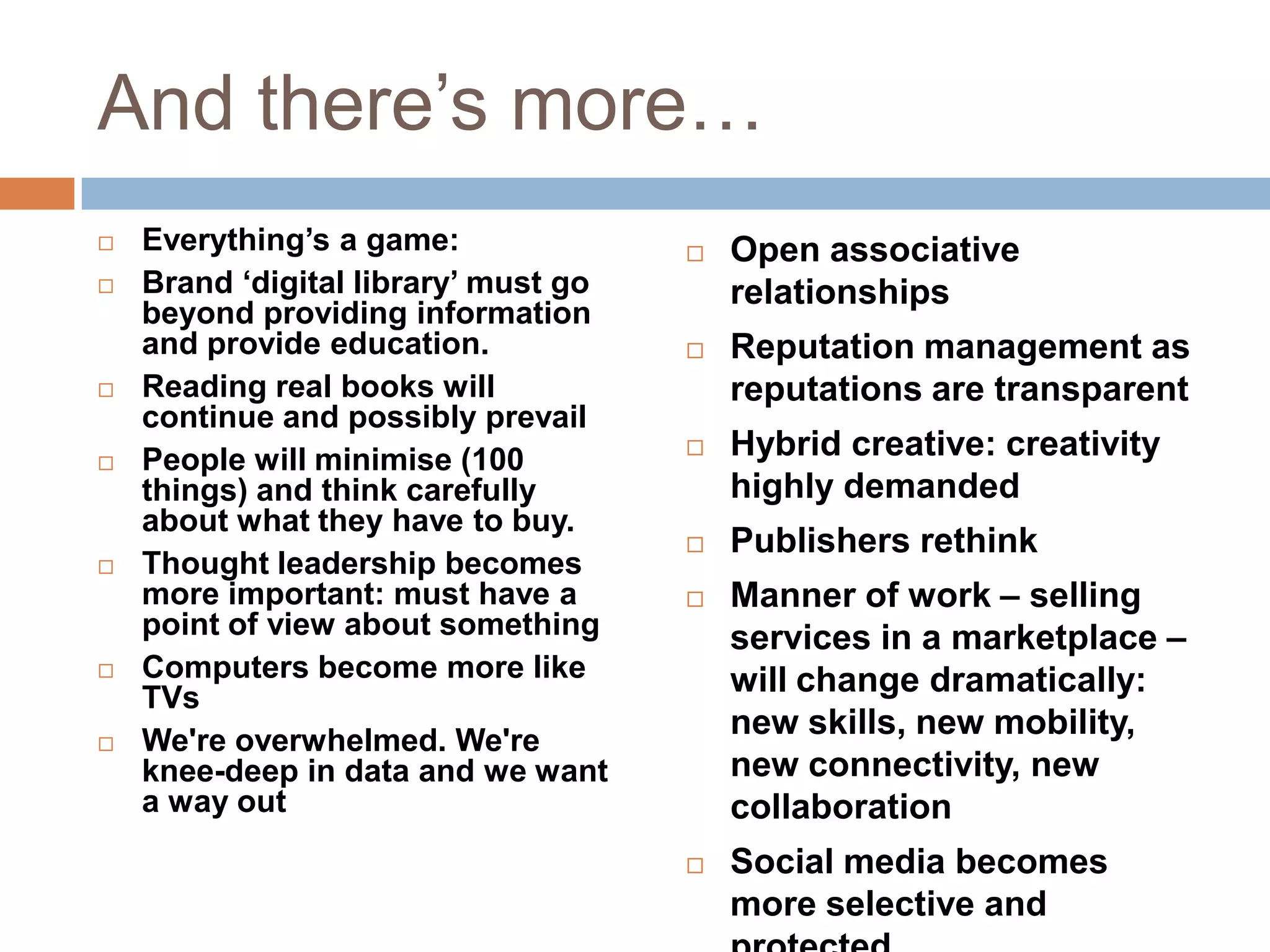
And there‟s more…
   Everything‟s a game:                 Open associative
   Brand „digital library‟ must go       relationships
    beyond providing information
    and provide education.               Reputation management as
   Reading real books will               reputations are transparent
    continue and possibly prevail
   People will minimise (100            Hybrid creative: creativity
    things) and think carefully           highly demanded
    about what they have to buy.
                                         Publishers rethink
   Thought leadership becomes
    more important: must have a          Manner of work – selling
    point of view about something         services in a marketplace –
   Computers become more like            will change dramatically:
    TVs
   We're overwhelmed. We're
                                          new skills, new mobility,
    knee-deep in data and we want         new connectivity, new
    a way out                             collaboration
                                         Social media becomes
                                          more selective and
The Information Society

   The expression “information
    society” has become the
    hegemonic term to describe
    contemporary times: not because
    it expresses a theoretical
    clarity, but rather due to its
    “baptism” by the official policies
    of the more developed countries
Creating the information society

   It seems as if the information
    society is built from the
    incorporation of technologies
    and not from the existing
    structural realities and
    contradictions
European Union (EU 1994,
1999, 2000, 2002, 2003, 2005) –
In the so-called
„information society‟ or
„knowledge economy‟,
every person and his/her
dog is called an
information professional.
How does the information
society affect the information
professions?
 What  do we do?
 Are there commonalities
  between the information
  professions?
 Why do we do what we
  do?
IS THIS A REAL QUESTION?

Which is more important:
the technological
 infrastructure or
the communication of ideas
 across space and time that
 it facilitates?
DISCIPLINE/PROFESSION
   Information work, like other areas such
    as medicine, architecture and law, have
    both a body of knowledge structured
    around their subject domain, and a
    practice which draws on this
    knowledge to solve the problems that
    fall within the ambit of the subject.


          = THEORY + PRAXIS
THEORY

   Theory is the core of an
    academic discipline (as
    opposed to its practical
    expression as a
    profession), and concepts are
    the core of a theory.
PRAXIS

Praxis (practice) is the
 execution of the theoretical
 principles embodied in the
 knowledge domain of a
 discipline/profession.
Discipline/Profession
Knowledge/Power (Foucault)
A profession can be defined by
 the role it plays in society, but
 it nonetheless needs a
 disciplinary or theoretical base
 to inform its praxis: it requires
 a supporting discipline which
 exhibits epistemological
 commitments and develops
DEFINITION OF
„PROFESSION‟
Parsons, 1968, his italics.
 Several core criteria which distinguish
  professional work, namely
 a “requirement of formal technical
  training... giving prominence to an
  intellectual component”;
 the development of “skills in some form
  of its use”; and
 the “socially responsible uses” of the
  profession
   A discipline can
    be characterised,
    according to Klein,
    as “[T]he tools,
    methods,
    procedures,
    exempla, concepts
    and theories that
    account
    coherently for a
    set of objects or
   Disciplines comprise an object of study,
    theories, and epistemological
    commitments, as disciplines are a
    means for, in Foucauldian terms,
    constructing and controlling knowledge
    production.

   A discipline therefore includes a
    disciplinary culture, which provides an
    identity, credentials and values for its
    practitioners.
Disciplinary cultures
   A discipline imparts, in addition, a particular
    view of the object of its study and this is
    what commonly differentiates disciplines:
    the objects, and the way in which they are
    studied, which Kuhn (1962/1970) called a
    paradigm or world view. The knowledge
    domain depends, in turn, on identified
    objects of study, and established methods
    and procedures for examination of these
    objects within the discipline.
INFORMATION
METACOMMUNITY
 Librarians, archivists, record
  managers, museologists, gallery
  curators
 Computer scientists, database
  administrators, information
  systems managers, and game
  designers
 Linguists, semioticians, ontologis
  ts, sociologists, anthropologists...
DI
Metatheory should incorporate the
following areas. Heckhausen
(1972),


   1. Material field – agreement on the set of objects
    with which the discipline is concerned;
   2. Subject matter – the point of view or
    epistemology from which the metadiscipline looks
    upon the set of objects that it studies
   3. Level of theoretical integration –
    reconstruction of the reality of its subject matter.
    Most disciplines have many different theories,
    some unrelated, some contradictory.
   4. Methods - the methods used to observe,
    describe and interpret the entities and phenomena
    that comprise the objects of study in the
Heckhausen (1972) continued.
   5. Analytical tools – the tools a discipline uses,
    although Heckhausen indicates that these are not
    specific to disciplines.
   6. Applications of a discipline in fields of
    practice – the degree of applicability of the theory
    to established practical applications. Heckhausen
    notes that disciplines with obligations to
    professional practice tend to be multi-disciplinary
    and lag behind in research.
   7. Historical contingencies – a discipline is
    always in a transitional state and is a product of
    historical developments.
   8. Social purpose of the profession/discipline.
    The purpose of the profession/discipline must be
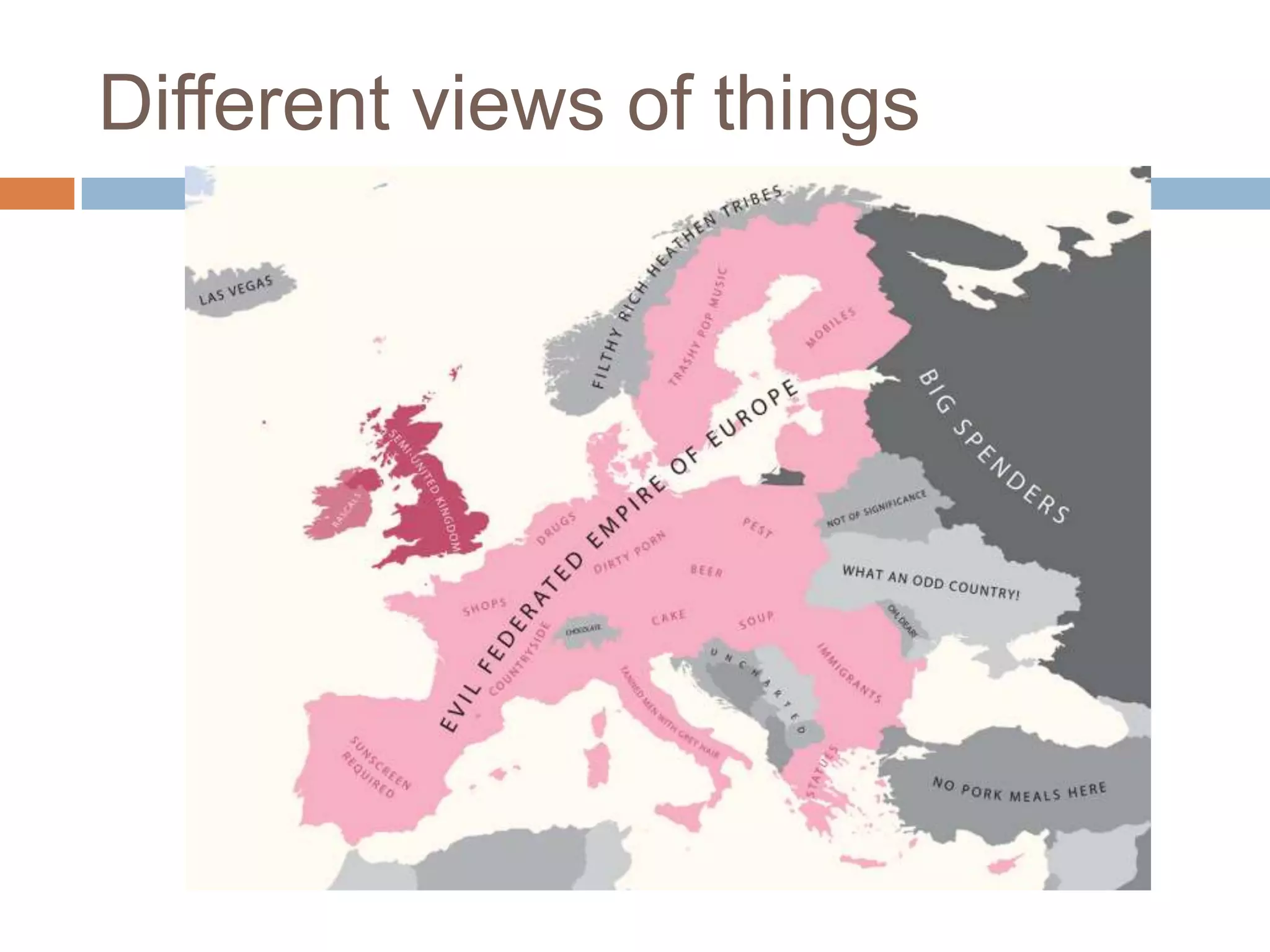
Different views of things
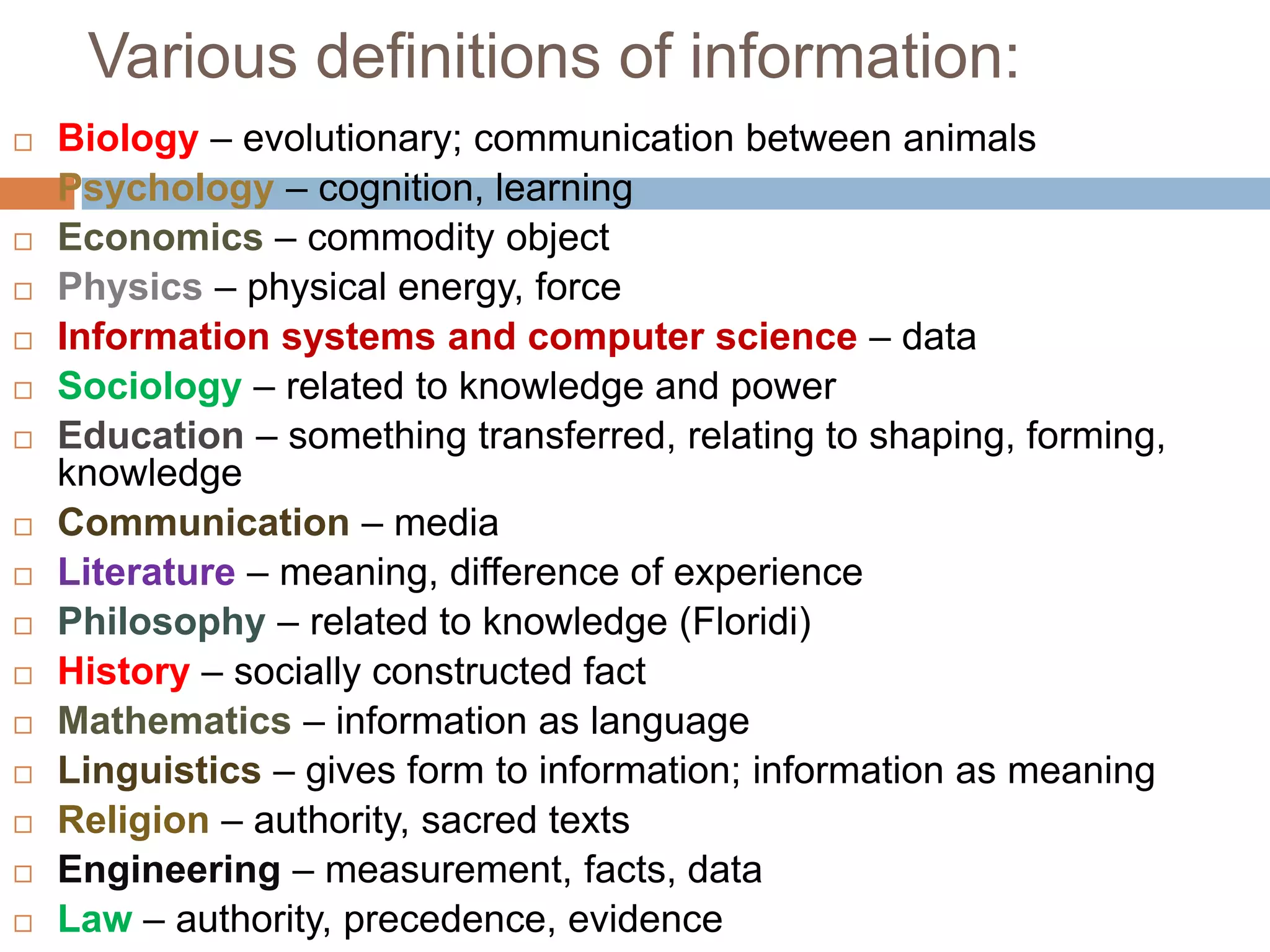
Various definitions of information:
   Biology – evolutionary; communication between animals
   Psychology – cognition, learning
   Economics – commodity object
   Physics – physical energy, force
   Information systems and computer science – data
   Sociology – related to knowledge and power
   Education – something transferred, relating to shaping, forming,
    knowledge
   Communication – media
   Literature – meaning, difference of experience
   Philosophy – related to knowledge (Floridi)
   History – socially constructed fact
   Mathematics – information as language
   Linguistics – gives form to information; information as meaning
   Religion – authority, sacred texts
   Engineering – measurement, facts, data
   Law – authority, precedence, evidence
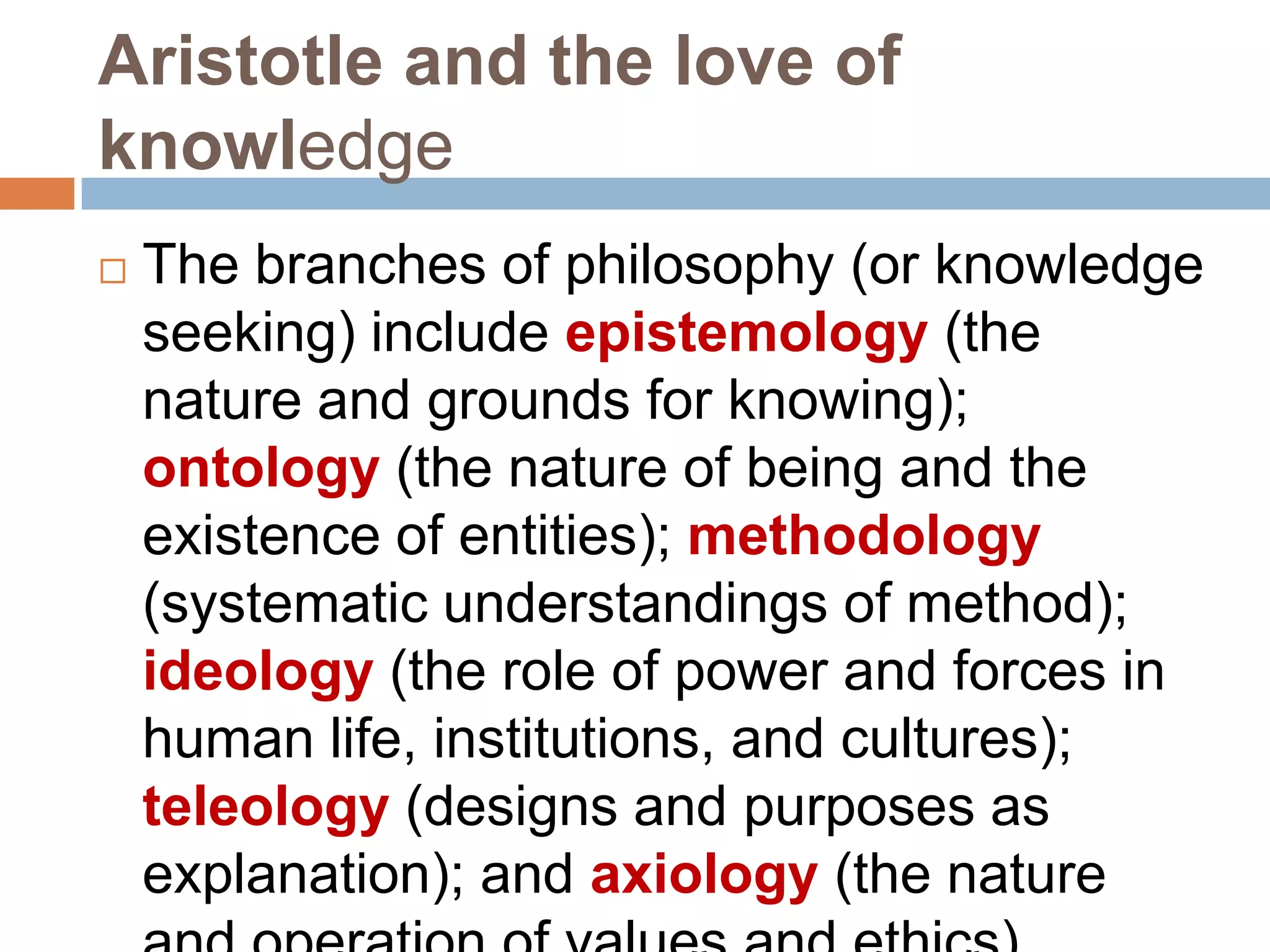
Aristotle and the love of
knowledge
   The branches of philosophy (or knowledge
    seeking) include epistemology (the
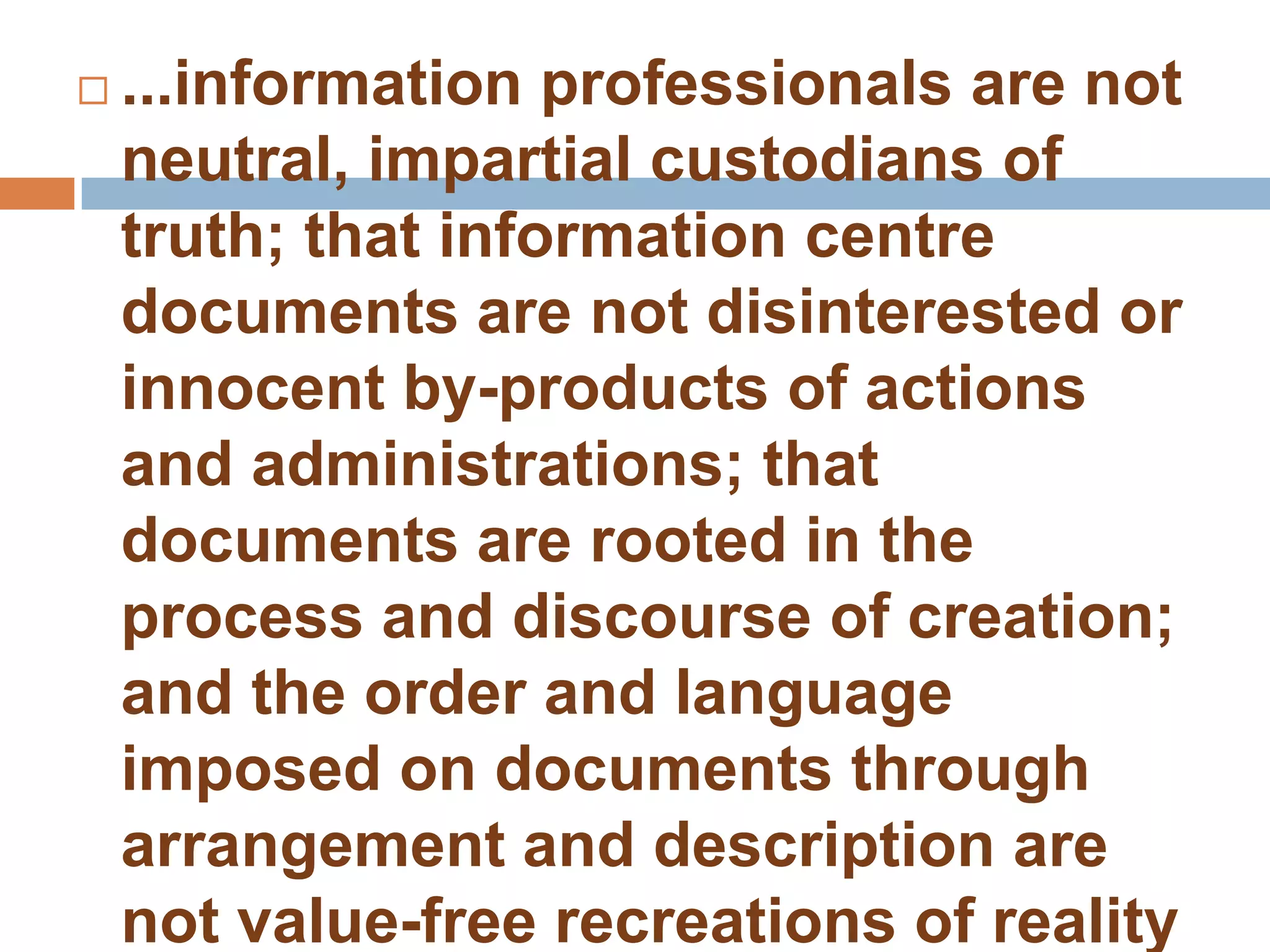
    nature and grounds for knowing);
    ontology (the nature of being and the
    existence of entities); methodology
    (systematic understandings of method);
    ideology (the role of power and forces in
    human life, institutions, and cultures);
    teleology (designs and purposes as
    explanation); and axiology (the nature
Need for a theoretical
framework
   Developing a theoretical
    framework which provides a kind
    of „lingua franca‟ for the
    disciplines/professions involved in
    information work would be a high
    priority if further collaboration and
    integration is desired.
   A theoretical framework comprises a set of
    concepts (ontology), the relationships
    between the concepts or phenomena which
    are called propositions or principles, and
    these relations are captured in a taxonomy.
    The ontology and taxonomy are accompanied
    by a statement of teleology, or
    purpose, which is qualified by axiological
    beliefs or obligations. „Nomos‟, or the present
    situation and customs, can be contrasted with
    „telos‟, which refers to a purpose or goal.
    Epistemologically speaking, an axiom is a
    self-evident truth.
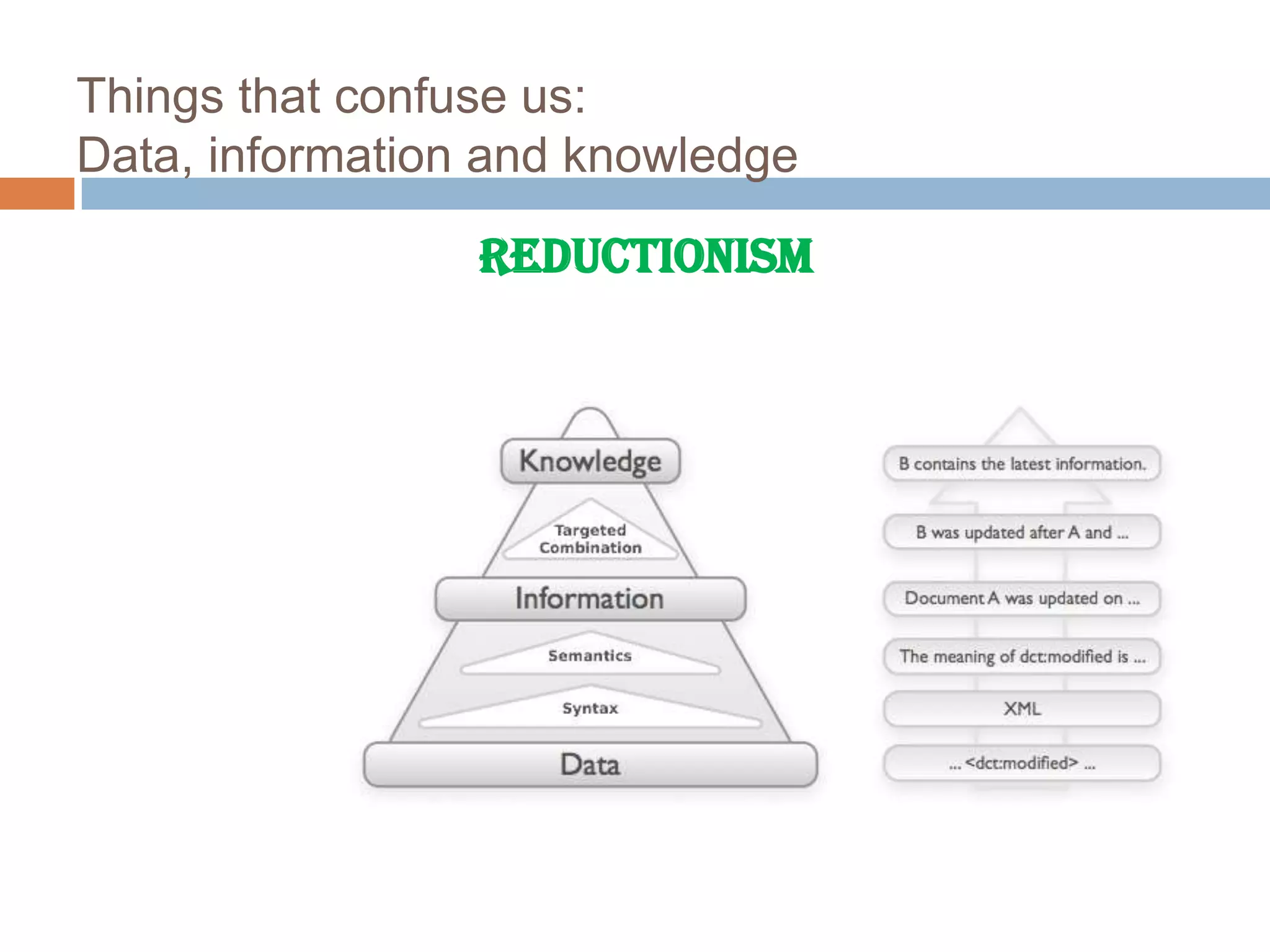
Things that confuse us:
Data, information and knowledge

                 Reductionism
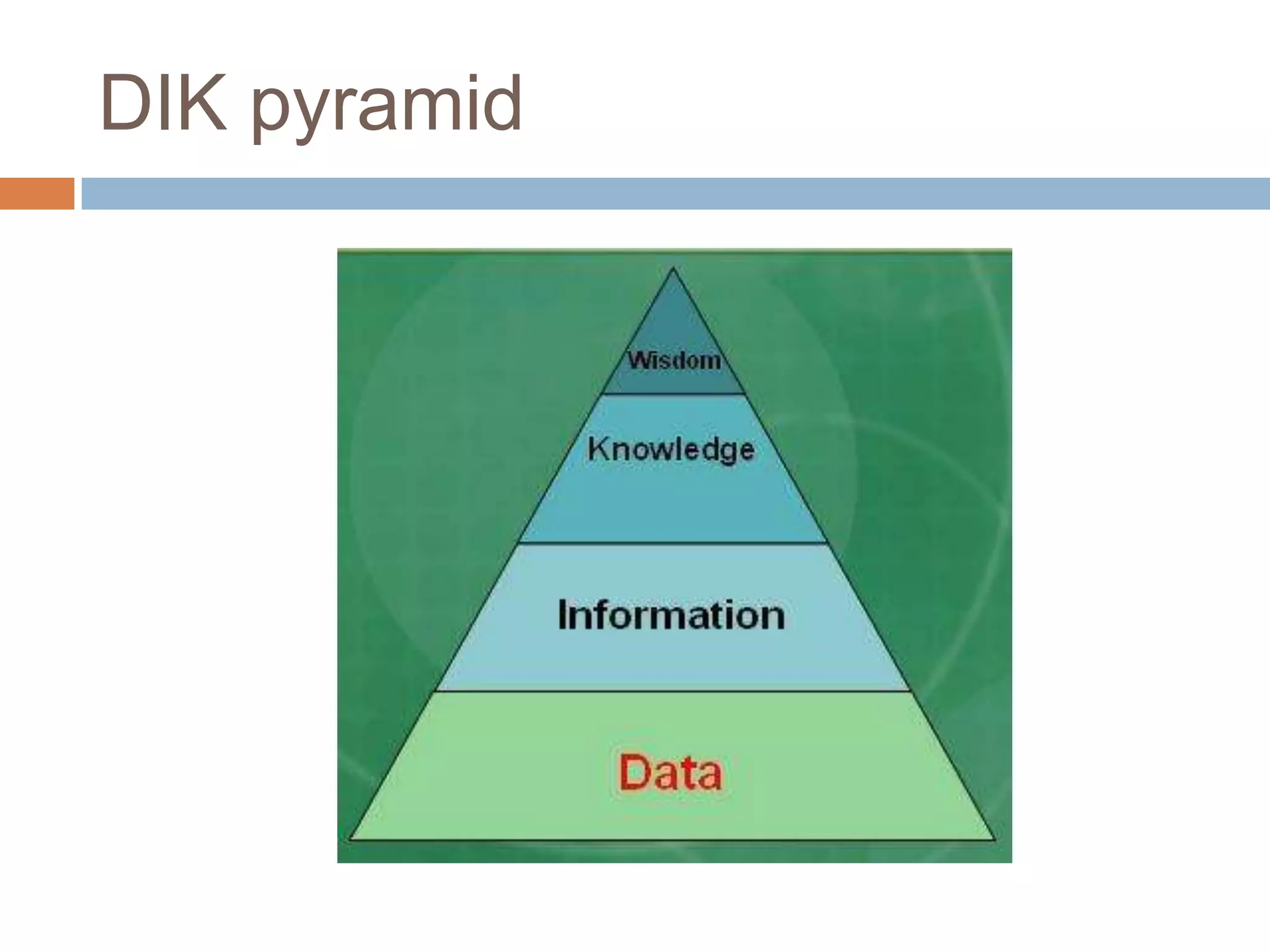
DIK pyramid
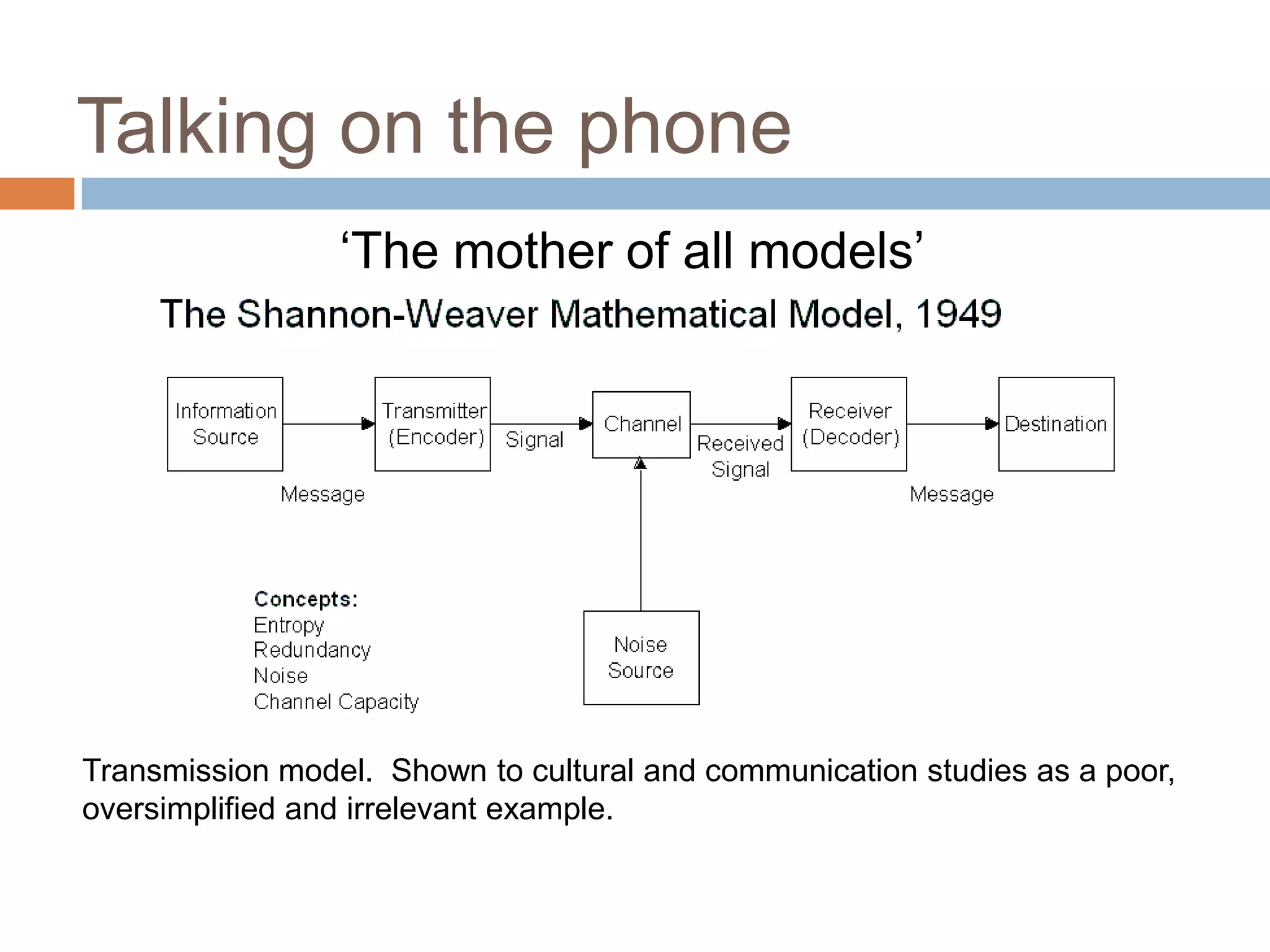
Talking on the phone
                 „The mother of all models‟


Transmission model. Shown to cultural and communication studies as a poor,
oversimplified and irrelevant example.
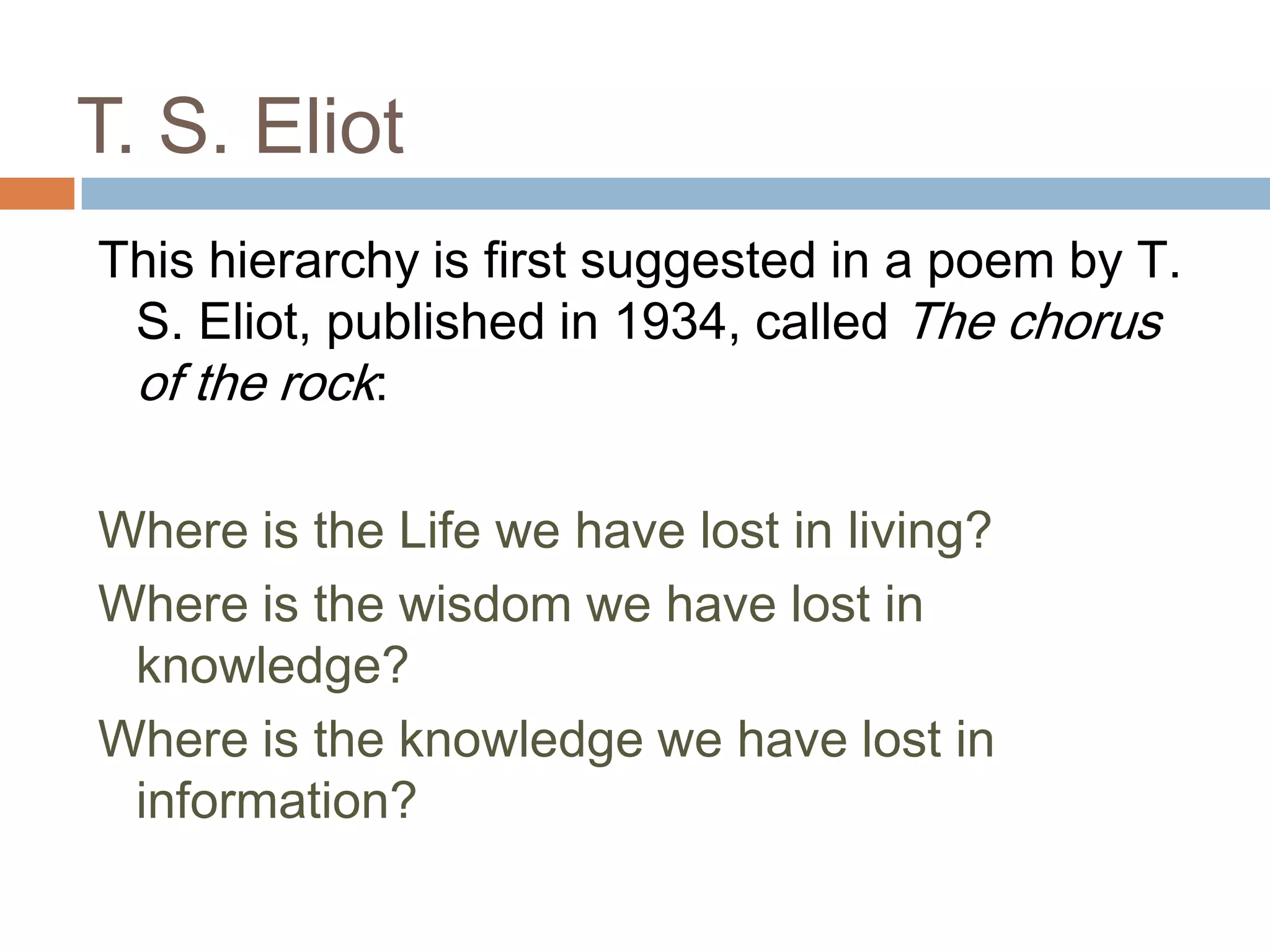
T. S. Eliot
This hierarchy is first suggested in a poem by T.
 S. Eliot, published in 1934, called The chorus
 of the rock:

Where is the Life we have lost in living?
Where is the wisdom we have lost in
 knowledge?
Where is the knowledge we have lost in
 information?
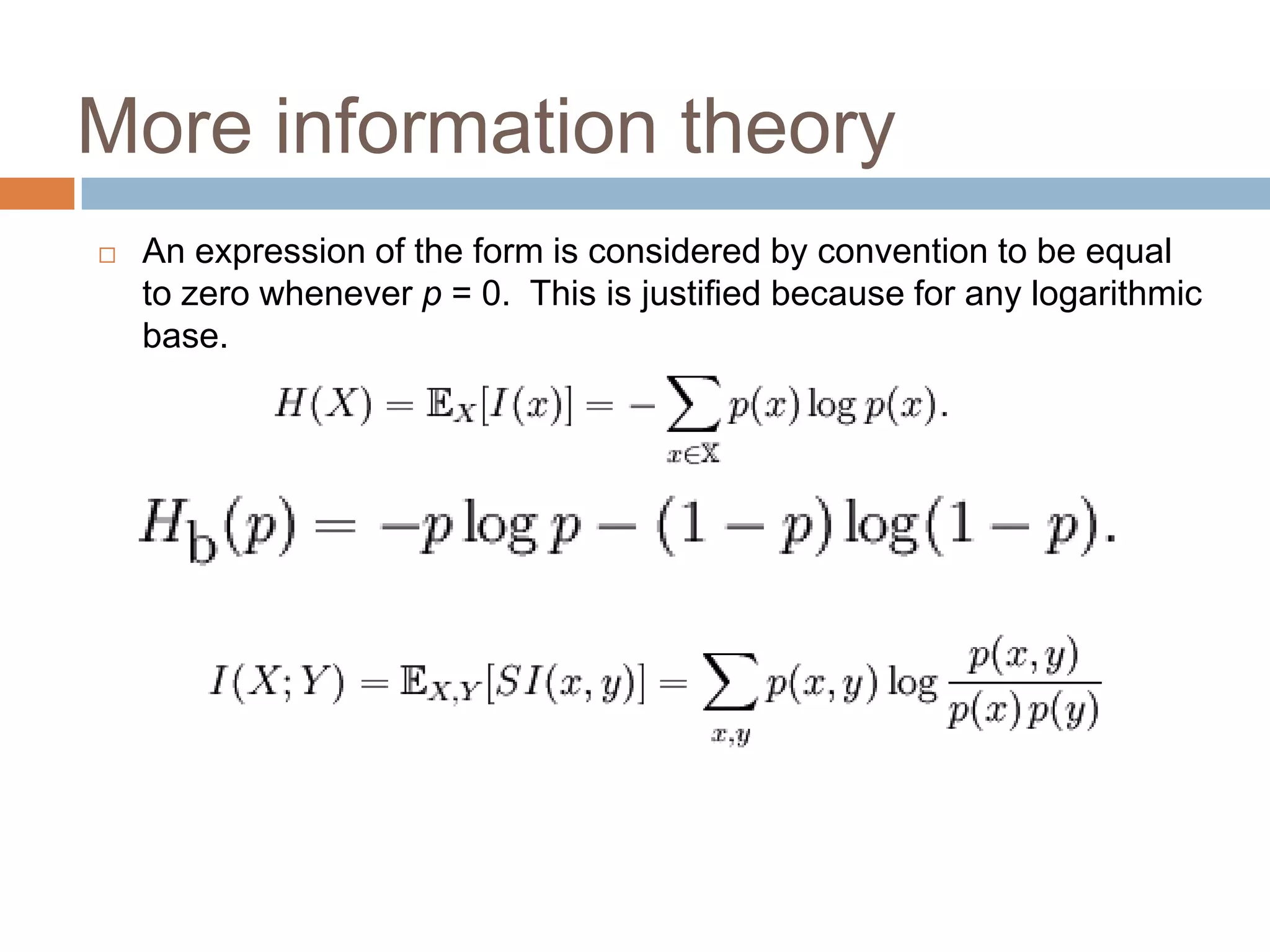
More information theory
   An expression of the form is considered by convention to be equal
    to zero whenever p = 0. This is justified because for any logarithmic
    base.
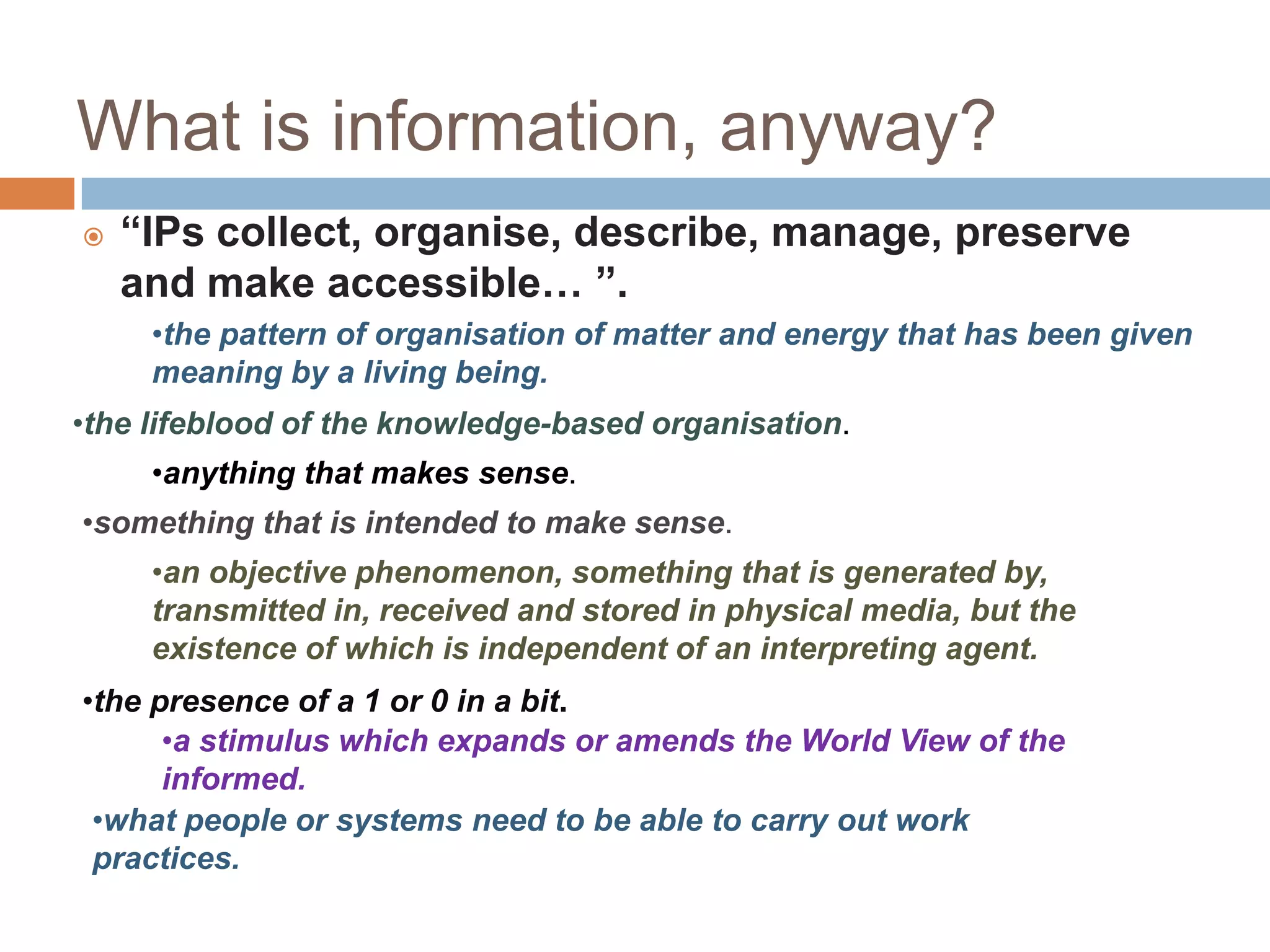
What is information, anyway?
   “IPs collect, organise, describe, manage, preserve
    and make accessible… ”.
     •the pattern of organisation of matter and energy that has been given
     meaning by a living being.
•the lifeblood of the knowledge-based organisation.
     •anything that makes sense.
•something that is intended to make sense.
     •an objective phenomenon, something that is generated by,
     transmitted in, received and stored in physical media, but the
     existence of which is independent of an interpreting agent.
•the presence of a 1 or 0 in a bit.
      •a stimulus which expands or amends the World View of the
      informed.
 •what people or systems need to be able to carry out work
 practices.
Caught between a rock and a hard
place
Characteristics of
data, information and knowledge

   Creation
   Representation
   Communication (or transmission or
    exchange)
   Recording
   Management
   Evaluation
   Use
Creation, Communication, Co
mprehension
   Information is that part of knowledge that is
    selected to be communicated
   It is communicated by being represented in
    symbols (sound and image) – language
   Knowledge of language (sound and image)
    must exist before communication can take
    place (i.e. mutual understanding of cultural
    symbols) (Myburgh, 2007)
Information is

 That part of knowledge that an
  individual selects for communication to
  selected others, representing it in
  language (including music,
  mathematics, images, sounds, shapes,
  movement…)
 Evaluated in terms of who, what, how,
  when, why?
Data are a kind of information

                 EITHER
 Facts and figures (usually figures) that are
  obtained through the scientific method of
        observation, experimentation,
      categorisation and measurement
                    OR
               Bits and bytes
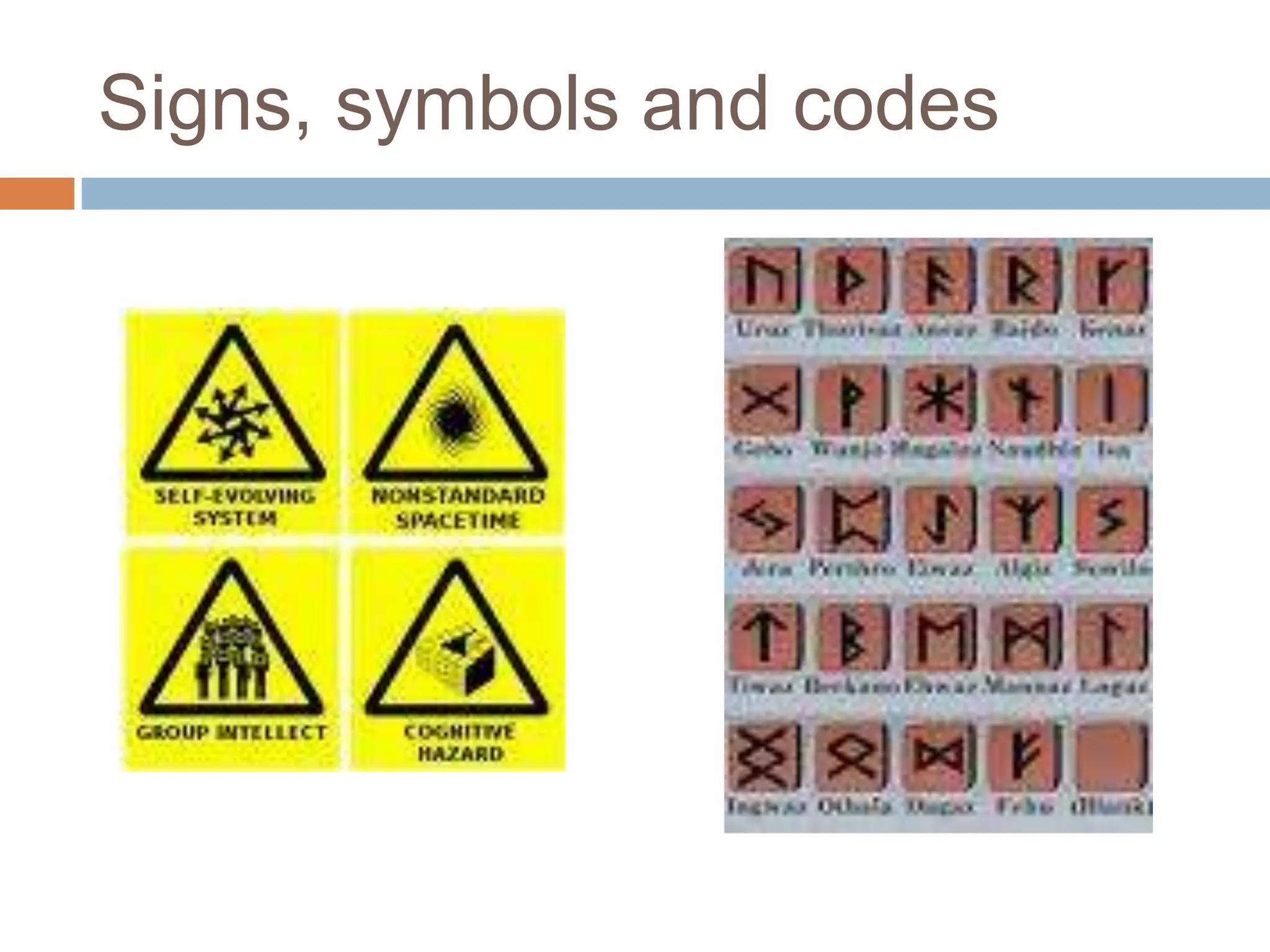
Signs, symbols and codes
Culture: not just a pretty
picture
“… an historically transmitted pattern of
meanings embodied in symbols, a system
of inherited conceptions expressed in
symbolic forms by means of which men
communicate, perpetuate, and develop
their knowledge about and attitudes toward
life (Geertz, 1973, p. 89).
But what about the information that
ICTs communicate?

That information
 possesses transformative
 abilities is an article of
 faith for librarians
PURPOSE
   … we emphasise that the argument for
    jurisdiction must be based on
    demonstrated ability to solve
    information problems. Many
    professions are at work building new
    information tools in the form of
    computer-based systems. Many are
    concerned with methods of managing
    and delivering information, and not just
    traditional information containers (Van
    House and Sutton, 1998, online).
Information and power
   For Castells, it is the interaction between
    knowledge creation, making meaning, learning
    and application that is a key aspect of the
    Information Society.

   Power then is central to information – for
    information, as Castells in particular has so
    forcefully argued, is an element which must
    flow. Where it flows from, and to whom, is the
    province of power.
Discourse of information
   The discourse of information is a discourse of
    power ... Information ... looks chaotic, i.e.
    individual oriented, but it is based on power as
    much as on its outward sign, money. The
    discourse of the information economy
    displaces and discourages the idea of
    information as a social good by giving the
    impression of a non-hierarchical and powerless
    structure, where everybody has a chance to
    find the message one is looking for. But indeed
    this means that finally the messengers are the
    main point, the medium is indeed the
    message (Capurro, 1996, online).
Politics
 Libraries are political sites;
  information professionals have a
  political role: this is clear
  because of the relationship
  between information (ideas) and
  power.
 All knowledge structures,
  epistemologies and communication
  of information are, as Foucault tells
  us, highly political and hegemonic.
Organic intellectuals and
teleology
 Information professionals can be
  viewed as “organic intellectuals”
  (Gramsci)
 they play an ideological and
  organizational role in maintaining an
  historic bloc‟s hegemony over the
  relations of economic production and
  civil society. From this perspective, the
  apparently neutral discourse of LIS
  regarding access to information can be
  examined as a discourse that privileges
  particular rather than universal
  interests (Raber, 2003, p. 35).
ICTs can even do the Millenium
Development Goals…
   1. Eradicate extreme poverty and hunger.
   2. Achieve universal primary education.
   3. Promote gender equality and empower
    women.
   4. Reduce child mortality.
   5. Improve maternal health.
   6. Combat HIV/AIDS, malaria and other
    diseases.
    7. Ensure environmental sustainability.
   8. Develop a global partnership for
    development.
   ...information professionals are not
    neutral, impartial custodians of
    truth; that information centre
    documents are not disinterested or
    innocent by-products of actions
    and administrations; that
    documents are rooted in the
    process and discourse of creation;
    and the order and language
    imposed on documents through
    arrangement and description are
    not value-free recreations of reality
Basically, the lack of

   Shared standards and conventions

           AND THEREFORE

   A common information sharing
    protocol
Metadisciplines and
         metacommunities
 Information work has been described
  as a „metadiscipline‟ which is
  concerned with the content of
  conventional disciplines‟, and it is
  orthogonally situated in relation to
  other disciplines. (Bates, 1999, p.
  1044).
 Herold quotes an earlier writer who
  suggested that there are similarities
  between philosophy and librarianship
The Information
Metacommunity
 has a mutual interest in cultural,
  historical, economic, political, social
  and technological contexts and
  issues. If the information professions
  are concerned with the curation and
  preservation of cultural expressions, it
  would seem to follow that an
  understanding of the semiotic,
  semantic and cultural dimensions of
  documents and other cultural
Questions for discussion
What are data, information and
knowledge?
Is it „exchange‟, „transmission‟ or
„communication‟?
What is culture?
What are the disciplinary cultural
barriers?
How can these be overcome?
Theoretical framing for integrated information workers

Theoretical framing for integrated information workers

  • 1.
    THE URGE TOMERGE THEORETICAL FRAMING FOR INTEGRATED INFORMATION WORKERS Dr Susan Myburgh University of South Australia Visiting Professor, University of Parma
  • 2.
    It‟s all happening…  Publishers will sell direct to  Journalism dies consumers.  More leaks  Augmented publishing and  Reuse, recycle and QR codes extreme local  Brand-name corporate  The rise of mobile apps. universities (which are too  More user-generated expensive) content.  Open educational resource universities  Increased digital presence.  Curators rule and will help  Social media marketing select food, music, fatigue. fashion, best schools and  The return to visual childcare, guides to retirement, etc. thinking.  The sharing economy  The popularity of the  Rise of cultural change immersive experience. agents
  • 3.
    And there‟s more…  Everything‟s a game:  Open associative  Brand „digital library‟ must go relationships beyond providing information and provide education.  Reputation management as  Reading real books will reputations are transparent continue and possibly prevail  People will minimise (100  Hybrid creative: creativity things) and think carefully highly demanded about what they have to buy.  Publishers rethink  Thought leadership becomes more important: must have a  Manner of work – selling point of view about something services in a marketplace –  Computers become more like will change dramatically: TVs  We're overwhelmed. We're new skills, new mobility, knee-deep in data and we want new connectivity, new a way out collaboration  Social media becomes more selective and
  • 4.
    The Information Society  The expression “information society” has become the hegemonic term to describe contemporary times: not because it expresses a theoretical clarity, but rather due to its “baptism” by the official policies of the more developed countries
  • 5.
    Creating the informationsociety  It seems as if the information society is built from the incorporation of technologies and not from the existing structural realities and contradictions
  • 6.
    European Union (EU1994, 1999, 2000, 2002, 2003, 2005) – In the so-called „information society‟ or „knowledge economy‟, every person and his/her dog is called an information professional.
  • 7.
    How does theinformation society affect the information professions? What do we do? Are there commonalities between the information professions? Why do we do what we do?
  • 8.
    IS THIS AREAL QUESTION? Which is more important: the technological infrastructure or the communication of ideas across space and time that it facilitates?
  • 10.
    DISCIPLINE/PROFESSION  Information work, like other areas such as medicine, architecture and law, have both a body of knowledge structured around their subject domain, and a practice which draws on this knowledge to solve the problems that fall within the ambit of the subject.  = THEORY + PRAXIS
  • 11.
    THEORY  Theory is the core of an academic discipline (as opposed to its practical expression as a profession), and concepts are the core of a theory.
  • 12.
    PRAXIS Praxis (practice) isthe execution of the theoretical principles embodied in the knowledge domain of a discipline/profession.
  • 13.
    Discipline/Profession Knowledge/Power (Foucault) A professioncan be defined by the role it plays in society, but it nonetheless needs a disciplinary or theoretical base to inform its praxis: it requires a supporting discipline which exhibits epistemological commitments and develops
  • 14.
    DEFINITION OF „PROFESSION‟ Parsons, 1968,his italics.  Several core criteria which distinguish professional work, namely  a “requirement of formal technical training... giving prominence to an intellectual component”;  the development of “skills in some form of its use”; and  the “socially responsible uses” of the profession
  • 15.
    A discipline can be characterised, according to Klein, as “[T]he tools, methods, procedures, exempla, concepts and theories that account coherently for a set of objects or
  • 16.
    Disciplines comprise an object of study, theories, and epistemological commitments, as disciplines are a means for, in Foucauldian terms, constructing and controlling knowledge production.  A discipline therefore includes a disciplinary culture, which provides an identity, credentials and values for its practitioners.
  • 17.
    Disciplinary cultures  A discipline imparts, in addition, a particular view of the object of its study and this is what commonly differentiates disciplines: the objects, and the way in which they are studied, which Kuhn (1962/1970) called a paradigm or world view. The knowledge domain depends, in turn, on identified objects of study, and established methods and procedures for examination of these objects within the discipline.
  • 21.
    INFORMATION METACOMMUNITY  Librarians, archivists,record managers, museologists, gallery curators  Computer scientists, database administrators, information systems managers, and game designers  Linguists, semioticians, ontologis ts, sociologists, anthropologists...
  • 22.
  • 23.
    Metatheory should incorporatethe following areas. Heckhausen (1972),   1. Material field – agreement on the set of objects with which the discipline is concerned;  2. Subject matter – the point of view or epistemology from which the metadiscipline looks upon the set of objects that it studies  3. Level of theoretical integration – reconstruction of the reality of its subject matter. Most disciplines have many different theories, some unrelated, some contradictory.  4. Methods - the methods used to observe, describe and interpret the entities and phenomena that comprise the objects of study in the
  • 24.
    Heckhausen (1972) continued.  5. Analytical tools – the tools a discipline uses, although Heckhausen indicates that these are not specific to disciplines.  6. Applications of a discipline in fields of practice – the degree of applicability of the theory to established practical applications. Heckhausen notes that disciplines with obligations to professional practice tend to be multi-disciplinary and lag behind in research.  7. Historical contingencies – a discipline is always in a transitional state and is a product of historical developments.  8. Social purpose of the profession/discipline. The purpose of the profession/discipline must be
  • 27.
  • 28.
    Various definitions ofinformation:  Biology – evolutionary; communication between animals  Psychology – cognition, learning  Economics – commodity object  Physics – physical energy, force  Information systems and computer science – data  Sociology – related to knowledge and power  Education – something transferred, relating to shaping, forming, knowledge  Communication – media  Literature – meaning, difference of experience  Philosophy – related to knowledge (Floridi)  History – socially constructed fact  Mathematics – information as language  Linguistics – gives form to information; information as meaning  Religion – authority, sacred texts  Engineering – measurement, facts, data  Law – authority, precedence, evidence
  • 29.
    Aristotle and thelove of knowledge  The branches of philosophy (or knowledge seeking) include epistemology (the nature and grounds for knowing); ontology (the nature of being and the existence of entities); methodology (systematic understandings of method); ideology (the role of power and forces in human life, institutions, and cultures); teleology (designs and purposes as explanation); and axiology (the nature
  • 30.
    Need for atheoretical framework  Developing a theoretical framework which provides a kind of „lingua franca‟ for the disciplines/professions involved in information work would be a high priority if further collaboration and integration is desired.
  • 31.
    A theoretical framework comprises a set of concepts (ontology), the relationships between the concepts or phenomena which are called propositions or principles, and these relations are captured in a taxonomy. The ontology and taxonomy are accompanied by a statement of teleology, or purpose, which is qualified by axiological beliefs or obligations. „Nomos‟, or the present situation and customs, can be contrasted with „telos‟, which refers to a purpose or goal. Epistemologically speaking, an axiom is a self-evident truth.
  • 32.
    Things that confuseus: Data, information and knowledge Reductionism
  • 33.
  • 34.
    Talking on thephone „The mother of all models‟ Transmission model. Shown to cultural and communication studies as a poor, oversimplified and irrelevant example.
  • 35.
    T. S. Eliot Thishierarchy is first suggested in a poem by T. S. Eliot, published in 1934, called The chorus of the rock: Where is the Life we have lost in living? Where is the wisdom we have lost in knowledge? Where is the knowledge we have lost in information?
  • 36.
    More information theory  An expression of the form is considered by convention to be equal to zero whenever p = 0. This is justified because for any logarithmic base.
  • 37.
    What is information,anyway?  “IPs collect, organise, describe, manage, preserve and make accessible… ”. •the pattern of organisation of matter and energy that has been given meaning by a living being. •the lifeblood of the knowledge-based organisation. •anything that makes sense. •something that is intended to make sense. •an objective phenomenon, something that is generated by, transmitted in, received and stored in physical media, but the existence of which is independent of an interpreting agent. •the presence of a 1 or 0 in a bit. •a stimulus which expands or amends the World View of the informed. •what people or systems need to be able to carry out work practices.
  • 38.
    Caught between arock and a hard place
  • 40.
    Characteristics of data, informationand knowledge  Creation  Representation  Communication (or transmission or exchange)  Recording  Management  Evaluation  Use
  • 41.
    Creation, Communication, Co mprehension  Information is that part of knowledge that is selected to be communicated  It is communicated by being represented in symbols (sound and image) – language  Knowledge of language (sound and image) must exist before communication can take place (i.e. mutual understanding of cultural symbols) (Myburgh, 2007)
  • 42.
    Information is  Thatpart of knowledge that an individual selects for communication to selected others, representing it in language (including music, mathematics, images, sounds, shapes, movement…)  Evaluated in terms of who, what, how, when, why?
  • 43.
    Data are akind of information EITHER Facts and figures (usually figures) that are obtained through the scientific method of observation, experimentation, categorisation and measurement OR Bits and bytes
  • 44.
  • 45.
    Culture: not justa pretty picture “… an historically transmitted pattern of meanings embodied in symbols, a system of inherited conceptions expressed in symbolic forms by means of which men communicate, perpetuate, and develop their knowledge about and attitudes toward life (Geertz, 1973, p. 89).
  • 46.
    But what aboutthe information that ICTs communicate? That information possesses transformative abilities is an article of faith for librarians
  • 47.
    PURPOSE  … we emphasise that the argument for jurisdiction must be based on demonstrated ability to solve information problems. Many professions are at work building new information tools in the form of computer-based systems. Many are concerned with methods of managing and delivering information, and not just traditional information containers (Van House and Sutton, 1998, online).
  • 48.
    Information and power  For Castells, it is the interaction between knowledge creation, making meaning, learning and application that is a key aspect of the Information Society.  Power then is central to information – for information, as Castells in particular has so forcefully argued, is an element which must flow. Where it flows from, and to whom, is the province of power.
  • 49.
    Discourse of information  The discourse of information is a discourse of power ... Information ... looks chaotic, i.e. individual oriented, but it is based on power as much as on its outward sign, money. The discourse of the information economy displaces and discourages the idea of information as a social good by giving the impression of a non-hierarchical and powerless structure, where everybody has a chance to find the message one is looking for. But indeed this means that finally the messengers are the main point, the medium is indeed the message (Capurro, 1996, online).
  • 50.
    Politics  Libraries arepolitical sites; information professionals have a political role: this is clear because of the relationship between information (ideas) and power.  All knowledge structures, epistemologies and communication of information are, as Foucault tells us, highly political and hegemonic.
  • 51.
    Organic intellectuals and teleology Information professionals can be viewed as “organic intellectuals” (Gramsci)  they play an ideological and organizational role in maintaining an historic bloc‟s hegemony over the relations of economic production and civil society. From this perspective, the apparently neutral discourse of LIS regarding access to information can be examined as a discourse that privileges particular rather than universal interests (Raber, 2003, p. 35).
  • 52.
    ICTs can evendo the Millenium Development Goals…  1. Eradicate extreme poverty and hunger.  2. Achieve universal primary education.  3. Promote gender equality and empower women.  4. Reduce child mortality.  5. Improve maternal health.  6. Combat HIV/AIDS, malaria and other diseases.  7. Ensure environmental sustainability.  8. Develop a global partnership for development.
  • 53.
    ...information professionals are not neutral, impartial custodians of truth; that information centre documents are not disinterested or innocent by-products of actions and administrations; that documents are rooted in the process and discourse of creation; and the order and language imposed on documents through arrangement and description are not value-free recreations of reality
  • 54.
    Basically, the lackof  Shared standards and conventions AND THEREFORE  A common information sharing protocol
  • 55.
    Metadisciplines and metacommunities  Information work has been described as a „metadiscipline‟ which is concerned with the content of conventional disciplines‟, and it is orthogonally situated in relation to other disciplines. (Bates, 1999, p. 1044).  Herold quotes an earlier writer who suggested that there are similarities between philosophy and librarianship
  • 56.
    The Information Metacommunity hasa mutual interest in cultural, historical, economic, political, social and technological contexts and issues. If the information professions are concerned with the curation and preservation of cultural expressions, it would seem to follow that an understanding of the semiotic, semantic and cultural dimensions of documents and other cultural
  • 57.
    Questions for discussion Whatare data, information and knowledge? Is it „exchange‟, „transmission‟ or „communication‟? What is culture? What are the disciplinary cultural barriers? How can these be overcome?

Editor's Notes

  • #33 Data, information and knowledge are thus collocated at the heart of a collection of complex interrelationships which are ideologically instituted, through selectivity within discourse. This study has shown from within the core of IP literature that they are articulated within ideologies which already pose a challenge to their putative role in society. Within the literature, these concepts have been reduced to such an extent that they do not appear to be complex or robust enough undertake the tasks with which they have been charged: can simple data be processed sufficiently to bring economic prosperity and freedom from disease? This reductionism and simplification is evident in the research done in the field, as well as in the definitions. Furthermore, there appears to be no recognition of the bias that this simplification implies, particularly when it is uncritically attached to technologies, which are then seen as the transforming agents, rather than the information itself.A computer cannot create knowledge