Conference Programme, Day 1
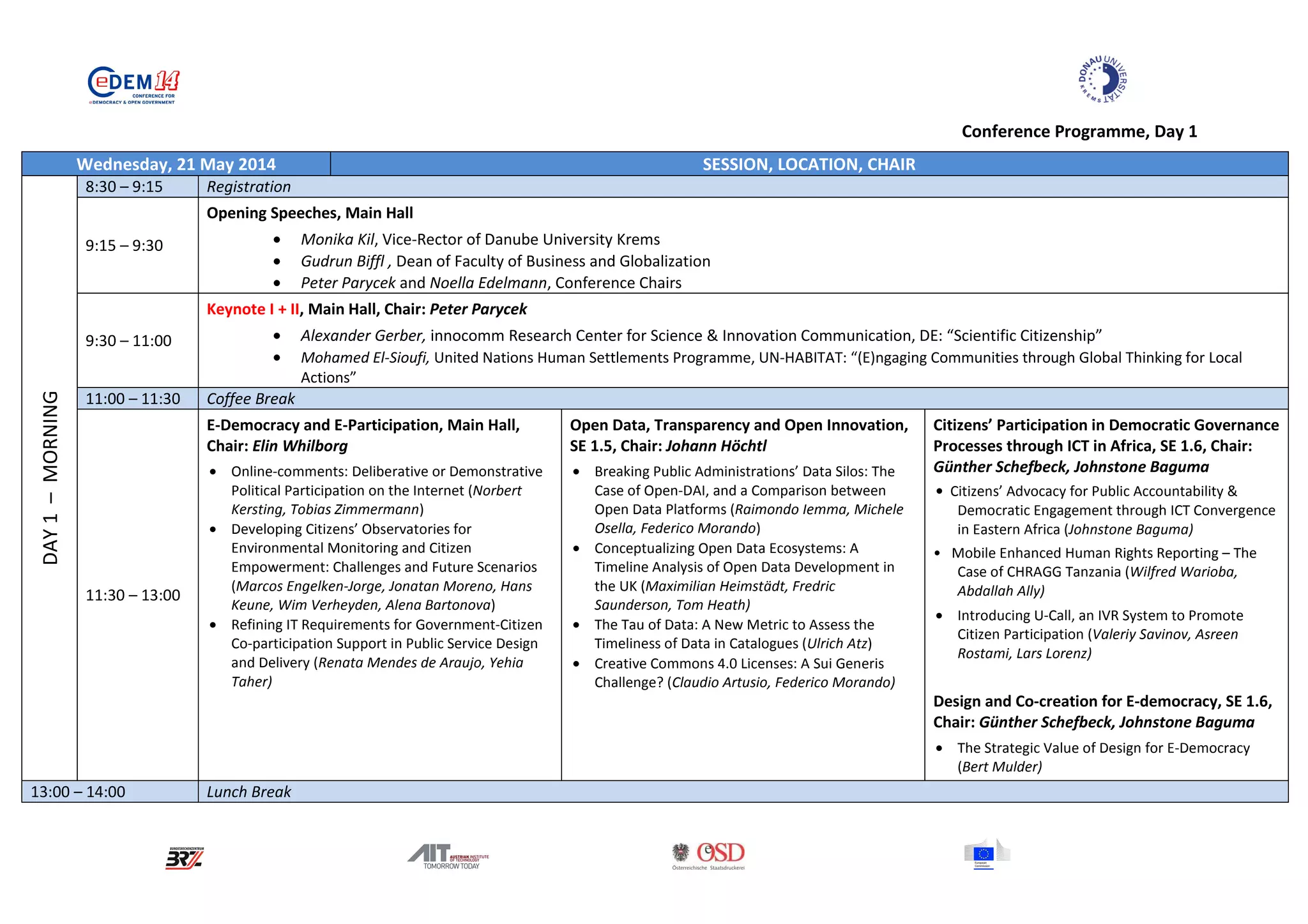
Wednesday, 21 May 2014 SESSION, LOCATION, CHAIR
DAY1–MORNING
8:30 – 9:15 Registration
9:15 – 9:30
Opening Speeches, Main Hall
• Monika Kil, Vice-Rector of Danube University Krems
• Gudrun Biffl , Dean of Faculty of Business and Globalization
• Peter Parycek and Noella Edelmann, Conference Chairs
9:30 – 11:00
Keynote I + II, Main Hall, Chair: Peter Parycek
• Alexander Gerber, innocomm Research Center for Science & Innovation Communication, DE: “Scientific Citizenship”
• Mohamed El-Sioufi, United Nations Human Settlements Programme, UN-HABITAT: “(E)ngaging Communities through Global Thinking for Local
Actions”
11:00 – 11:30 Coffee Break
11:30 – 13:00
E-Democracy and E-Participation, Main Hall,
Chair: Elin Whilborg
• Online-comments: Deliberative or Demonstrative
Political Participation on the Internet (Norbert
Kersting, Tobias Zimmermann)
• Developing Citizens’ Observatories for
Environmental Monitoring and Citizen
Empowerment: Challenges and Future Scenarios
(Marcos Engelken-Jorge, Jonatan Moreno, Hans
Keune, Wim Verheyden, Alena Bartonova)
• Refining IT Requirements for Government-Citizen
Co-participation Support in Public Service Design
and Delivery (Renata Mendes de Araujo, Yehia
Taher)
Open Data, Transparency and Open Innovation,
SE 1.5, Chair: Johann Höchtl
• Breaking Public Administrations’ Data Silos: The
Case of Open-DAI, and a Comparison between
Open Data Platforms (Raimondo Iemma, Michele
Osella, Federico Morando)
• Conceptualizing Open Data Ecosystems: A
Timeline Analysis of Open Data Development in
the UK (Maximilian Heimstädt, Fredric
Saunderson, Tom Heath)
• The Tau of Data: A New Metric to Assess the
Timeliness of Data in Catalogues (Ulrich Atz)
• Creative Commons 4.0 Licenses: A Sui Generis
Challenge? (Claudio Artusio, Federico Morando)
Citizens’ Participation in Democratic Governance
Processes through ICT in Africa, SE 1.6, Chair:
Günther Schefbeck, Johnstone Baguma
• Citizens’ Advocacy for Public Accountability &
Democratic Engagement through ICT Convergence
in Eastern Africa (Johnstone Baguma)
• Mobile Enhanced Human Rights Reporting – The
Case of CHRAGG Tanzania (Wilfred Warioba,
Abdallah Ally)
• Introducing U-Call, an IVR System to Promote
Citizen Participation (Valeriy Savinov, Asreen
Rostami, Lars Lorenz)
Design and Co-creation for E-democracy, SE 1.6,
Chair: Günther Schefbeck, Johnstone Baguma
• The Strategic Value of Design for E-Democracy
(Bert Mulder)
13:00 – 14:00 Lunch Break
(page 1 of 5)
Conference Programme, Day 1
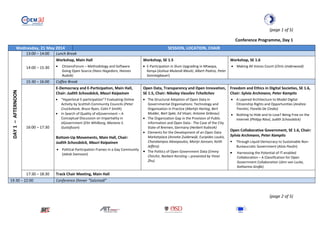
Wednesday, 21 May 2014 SESSION, LOCATION, CHAIR
DAY1–AFTERNOON
13:00 – 14:00 Lunch Break
14:00 – 15:30
Workshop, Main Hall
• CitizensForum – Methodology and Software
Going Open Source (Hans Hagedorn, Hannes
Rudzik)
Workshop, SE 1.5
• E-Participation in Slum Upgrading in Mtwapa,
Kenya (Joshua Mulandi Maviti, Albert Padros, Peter
Sonntagbauer)
Workshop, SE 1.6
• Making All Voices Count (Chris Underwood)
15:30 – 16:00 Coffee Break
16:00 – 17:30
E-Democracy and E-Participation, Main Hall,
Chair: Judith Schossböck, Mauri Kaipainen
• “Hyperlocal E-participation”? Evaluating Online
Activity by Scottish Community Councils (Peter
Cruickshank, Bruce Ryan, Colin F Smith)
• In Search of Quality of eGovernment – A
Conceptual Discussion on Impartiality in
eGovernment (Elin Whilborg, Mariana S.
Gustafsson)
Bottom-Up Movements, Main Hall, Chair:
Judith Schossböck, Mauri Kaipainen
• Political Participation Frames in a Gay Community
(Jakob Svensson)
Open Data, Transparency and Open Innovation,
SE 1.5, Chair: Nikolay Vassilev Tcholtchev
• The Structural Adoption of Open Data in
Governmental Organisations: Technology and
Organisation in Practice (Martijn Hartog, Bert
Mulder, Bart Spée, Ed Visser, Antoine Gribnau)
• The Organization Gap in the Provision of Public
Information and Open Data - The Case of the City
State of Bremen, Germany (Herbert Kubicek)
• Elements for the Development of an Open Data
Marketplace (Anneke Zuiderwijk, Euripides Loukis,
Charalampos Alexopoulos, Marijn Janssen, Keith
Jeffery)
• The Politics of Open Government Data (Emmy
Chirchir, Norbert Kersting – presented by Yimei
Zhu)
Freedom and Ethics in Digital Societies, SE 1.6,
Chair: Sylvia Archmann, Peter Kampits
• A Layered Architecture to Model Digital
Citizenship Rights and Opportunities (Andrea
Trentini, Fiorella De Cindio)
• Nothing to Hide and to Lose? Being Free on the
Internet (Philipp Rössl, Judith Schossböck)
Open Collaborative Government, SE 1.6, Chair:
Sylvia Archmann, Peter Kampits
• Through Liquid Democracy to Sustainable Non-
Bureaucratic Government (Alois Paulin)
• Harnessing the Potential of IT-enabled
Collaboration – A Classification for Open
Government Collaboration (Jörn von Lucke,
Katharina Große)
17:30 – 18:30 Track Chair Meeting, Main Hall
19:30 – 22:00 Conference Dinner “Salzstadl”
(page 2 of 5)
Conference Programme, Day 2
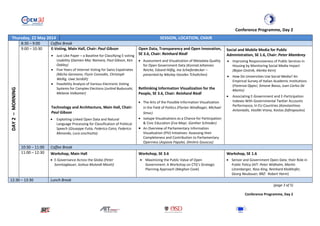
Thursday, 22 May 2014 SESSION, LOCATION, CHAIR
DAY2–MORNING
8:30 – 9:00 Coffee Break
9:00 – 10:30 E-Voting, Main Hall, Chair: Paul Gibson
• Just Like Paper – a Baseline for Classifying E-voting
Usability (Damien Mac Namara, Paul Gibson, Ken
Oakley)
• Five Years of Internet Voting for Swiss Expatriates
(Micha Germann, Flurin Conradin, Christoph
Wellig, Uwe Serdült)
• Feasibility Analysis of Various Electronic Voting
Systems for Complex Elections (Jurlind Budurushi,
Melanie Volkamer)
Technology and Architecture, Main Hall, Chair:
Paul Gibson
• Exploiting Linked Open Data and Natural
Language Processing for Classification of Political
Speech (Giuseppe Futia, Federico Cairo, Federico
Morando, Luca Leschiutta)
Open Data, Transparency and Open Innovation,
SE 3.6, Chair: Reinhard Riedl
• Assessment and Visualization of Metadata Quality
for Open Government Data (Konrad Johannes
Reiche, Edzard Höfig, Ina Schieferdecker –
presented by Nikolay Vassilev Tcholtchev)
Rethinking Information Visualization for the
People, SE 3.6, Chair: Reinhard Riedl
• The Arts of the Possible Information Visualization
in the Field of Politics (Florian Windhager, Michael
Smuc)
• Isotype Visualizations as a Chance for Participation
& Civic Education (Eva Mayr, Günther Schreder)
• An Overview of Parliamentary Information
Visualization (PIV) Initiatives: Assessing their
Completeness and Contribution to Parliamentary
Openness (Aspasia Papaloi, Dimitris Gouscos)
Social and Mobile Media for Public
Administration, SE 1.6, Chair: Peter Mambrey
• Improving Responsiveness of Public Services in
Housing by Monitoring Social Media Impact
(Bojan Cestnik, Alenka Kern)
• How Do Universities Use Social Media? An
Empirical Survey of Italian Academic Institutions
(Fiorenza Oppici, Simone Basso, Juan Carlos De
Martin)
• Associating E-Government and E-Participation
Indexes With Governmental Twitter Accounts
Performance, In EU Countries (Konstantinos
Antoniadis, Vasiliki Vrana, Kostas Zafiropoulos)
10:30 – 11:00 Coffee Break
11:00 – 12:30 Workshop, Main Hall
• E-Governance Across the Globe (Peter
Sonntagbauer, Joshua Mulandi Maviti)
Workshop, SE 3.6
• Maximizing the Public Value of Open
Government: A Workshop on CTG’s Strategic
Planning Approach (Meghan Cook)
Workshop, SE 1.6
• Sensor and Government Open Data: their Role in
Public Policy (AIT: Peter Widhalm, Martin
Litzenberger, Ross King, Reinhard Kloibhofer,
Georg Neubauer; BRZ: Robert Harm)
12:30 – 13:30 Lunch Break
(page 3 of 5)
Conference Programme, Day 2
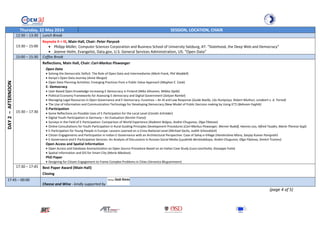
Thursday, 22 May 2014 SESSION, LOCATION, CHAIR
DAY2–AFTERNOON
12:30 – 13:30 Lunch Break
13:30 – 15:00
Keynote II + III, Main Hall, Chair: Peter Parycek
• Philipp Müller, Computer Sciences Corporation and Business School of University Salzburg, AT: “Statehood, the Deep Web and Democracy”
• Jeanne Holm, Evangelist, Data.gov, U.S. General Services Administration, US: “Open Data”
15:00 – 15:30 Coffee Break
15:30 – 17:30
Reflections, Main Hall, Chair: Carl-Markus Piswanger
Open Data
• Solving the Democratic Deficit: The Role of Open Data and Intermediaries (Mark Frank, Phil Waddell)
• Kenya’s Open Data Journey (Anne Muigai)
• Open Data Planning Activities: Emerging Practices from a Public Value Approach (Meghan E. Cook)
E- Democracy
• User-Based Open Knowledge Increasing E-Democracy in Finland (Mika Sihvonen, Miikka Sipilä)
• Political Economy Frameworks for Assessing E-democracy and Digital Government (Satyan Ramlal)
• Managing Legal Resources in Open Governance and E-Democracy: Eunomos – An Al and Law Response (Guide Boella, Llio Humpreys, Robert Muthuri, Lendeert v. d. Torred)
• The Use of Information and Communication Technology for Developing Democracy (New Model of Public Decision making by Using ICT) (Behnam Faghih)
E-Participation
• Some Reflections on Possible Uses of E-Participation for the Local Level (Carolin Schröder)
• Digital Youth Participation in Germany – An Evaluation (Kerstin Franzl)
• Surveys in the Field of E-Participation: Comparison of World Experience (Radomir Bolgov, Andrei Chugunov, Olga Filatova)
• Online Consultations for Youth Participation in Rural Guiding Principles Development Procedures (Carl-Markus Piswanger, Werner Rudolf, Hannes Leo, Alfred Taudes, Marie-Therese Sagl)
• E-Participation for Young People in Europe: Lessons Learned on a Cross-National Level (Michael Sachs, Judith Schossböck)
• Citizen Engagements and Participation in Indian E-Governance with an Architectural Perspective: Case of Sahaj e-Village (Harekrishna Misra, Sanjay Kumar Panigrahi)
• E-Governance and E-Participation Services: An Analysis of Discussions in Russian Social Media (Lyudmila Bershadskaya, Andrei Chugunov, Olga Filatova, Dmitrii Trutnev)
Open Access and Spatial Information
• Open Access and Database Anonymization an Open Source Procedure Based on an Italian Case Study (Luca Leschiutta, Giuseppe Futia)
• Spatial Information and GIS for Smart City (Maria Nikolova)
PhD Paper
• Designing for Citizen Engagement to Frame Complex Problems in Cities (Veronica Bluguermann)
17:30 – 17:45 Best Paper Award (Main Hall)
Closing
17:45 – 00:00
Cheese and Wine - kindly supported by
(page 4 of 5)
Conference Programme (additional Day 3)
Friday, 23 May 2014 SESSION, LOCATION, CHAIR
9:00 – 9:15 Arrival & coffee
9:15 – 12:30 Film "Blueberry Soup” & Discussion with Eileen Jerrett,
Wilma's Wish Productions, US,
SE 1.6, Chair: Ralph Schöllhammer
Open Space: Michael Sachs
The CeDEM Open Space is an opportunity for participants to organise their
own presentations, sessions, events, workshops, birds of a feather,
networking, etc. If you are interested in attending and/or presenting at the
Open Space, get in touch with Michael Sachs (michael.sachs@donau-
uni.ac.at).
DAY3–MORNING
Blueberry Soup, a feature length documentary, sits in the epicenter of one of the
most exciting movements to happen in our lifetime, the Icelandic "people's
movement." Jaws dropped around the world on October 9, 2008 as a small
collective of bankers brought an entire nation to its knees. The policies and
structures that were previously in place are no longer working and the time has
come to reflect and redesign.
Film maker Eileen Jerrett from Seattle will join a discussion via Skype following the
film.
Open Space, SE C 2.08 (Lounge
Room)
9:00-9:20
Arrival and coffee
9:20-9:30
Organisation of the sessions
9:35-12:15
Sessions, networking, chatting,
coffee & pastries
12:20-12:30
Closing
Open Space, SE 2.01 and SE D2.16
(parallel)
9:35-10:25
Focus session I
10:30-11:20
Focus session II
11:25-12:15
Focus session III
(page 5 of 5)

Cedem14 program final

  • 1.
    Conference Programme, Day1 Wednesday, 21 May 2014 SESSION, LOCATION, CHAIR DAY1–MORNING 8:30 – 9:15 Registration 9:15 – 9:30 Opening Speeches, Main Hall • Monika Kil, Vice-Rector of Danube University Krems • Gudrun Biffl , Dean of Faculty of Business and Globalization • Peter Parycek and Noella Edelmann, Conference Chairs 9:30 – 11:00 Keynote I + II, Main Hall, Chair: Peter Parycek • Alexander Gerber, innocomm Research Center for Science & Innovation Communication, DE: “Scientific Citizenship” • Mohamed El-Sioufi, United Nations Human Settlements Programme, UN-HABITAT: “(E)ngaging Communities through Global Thinking for Local Actions” 11:00 – 11:30 Coffee Break 11:30 – 13:00 E-Democracy and E-Participation, Main Hall, Chair: Elin Whilborg • Online-comments: Deliberative or Demonstrative Political Participation on the Internet (Norbert Kersting, Tobias Zimmermann) • Developing Citizens’ Observatories for Environmental Monitoring and Citizen Empowerment: Challenges and Future Scenarios (Marcos Engelken-Jorge, Jonatan Moreno, Hans Keune, Wim Verheyden, Alena Bartonova) • Refining IT Requirements for Government-Citizen Co-participation Support in Public Service Design and Delivery (Renata Mendes de Araujo, Yehia Taher) Open Data, Transparency and Open Innovation, SE 1.5, Chair: Johann Höchtl • Breaking Public Administrations’ Data Silos: The Case of Open-DAI, and a Comparison between Open Data Platforms (Raimondo Iemma, Michele Osella, Federico Morando) • Conceptualizing Open Data Ecosystems: A Timeline Analysis of Open Data Development in the UK (Maximilian Heimstädt, Fredric Saunderson, Tom Heath) • The Tau of Data: A New Metric to Assess the Timeliness of Data in Catalogues (Ulrich Atz) • Creative Commons 4.0 Licenses: A Sui Generis Challenge? (Claudio Artusio, Federico Morando) Citizens’ Participation in Democratic Governance Processes through ICT in Africa, SE 1.6, Chair: Günther Schefbeck, Johnstone Baguma • Citizens’ Advocacy for Public Accountability & Democratic Engagement through ICT Convergence in Eastern Africa (Johnstone Baguma) • Mobile Enhanced Human Rights Reporting – The Case of CHRAGG Tanzania (Wilfred Warioba, Abdallah Ally) • Introducing U-Call, an IVR System to Promote Citizen Participation (Valeriy Savinov, Asreen Rostami, Lars Lorenz) Design and Co-creation for E-democracy, SE 1.6, Chair: Günther Schefbeck, Johnstone Baguma • The Strategic Value of Design for E-Democracy (Bert Mulder) 13:00 – 14:00 Lunch Break
  • 2.
    (page 1 of5) Conference Programme, Day 1 Wednesday, 21 May 2014 SESSION, LOCATION, CHAIR DAY1–AFTERNOON 13:00 – 14:00 Lunch Break 14:00 – 15:30 Workshop, Main Hall • CitizensForum – Methodology and Software Going Open Source (Hans Hagedorn, Hannes Rudzik) Workshop, SE 1.5 • E-Participation in Slum Upgrading in Mtwapa, Kenya (Joshua Mulandi Maviti, Albert Padros, Peter Sonntagbauer) Workshop, SE 1.6 • Making All Voices Count (Chris Underwood) 15:30 – 16:00 Coffee Break 16:00 – 17:30 E-Democracy and E-Participation, Main Hall, Chair: Judith Schossböck, Mauri Kaipainen • “Hyperlocal E-participation”? Evaluating Online Activity by Scottish Community Councils (Peter Cruickshank, Bruce Ryan, Colin F Smith) • In Search of Quality of eGovernment – A Conceptual Discussion on Impartiality in eGovernment (Elin Whilborg, Mariana S. Gustafsson) Bottom-Up Movements, Main Hall, Chair: Judith Schossböck, Mauri Kaipainen • Political Participation Frames in a Gay Community (Jakob Svensson) Open Data, Transparency and Open Innovation, SE 1.5, Chair: Nikolay Vassilev Tcholtchev • The Structural Adoption of Open Data in Governmental Organisations: Technology and Organisation in Practice (Martijn Hartog, Bert Mulder, Bart Spée, Ed Visser, Antoine Gribnau) • The Organization Gap in the Provision of Public Information and Open Data - The Case of the City State of Bremen, Germany (Herbert Kubicek) • Elements for the Development of an Open Data Marketplace (Anneke Zuiderwijk, Euripides Loukis, Charalampos Alexopoulos, Marijn Janssen, Keith Jeffery) • The Politics of Open Government Data (Emmy Chirchir, Norbert Kersting – presented by Yimei Zhu) Freedom and Ethics in Digital Societies, SE 1.6, Chair: Sylvia Archmann, Peter Kampits • A Layered Architecture to Model Digital Citizenship Rights and Opportunities (Andrea Trentini, Fiorella De Cindio) • Nothing to Hide and to Lose? Being Free on the Internet (Philipp Rössl, Judith Schossböck) Open Collaborative Government, SE 1.6, Chair: Sylvia Archmann, Peter Kampits • Through Liquid Democracy to Sustainable Non- Bureaucratic Government (Alois Paulin) • Harnessing the Potential of IT-enabled Collaboration – A Classification for Open Government Collaboration (Jörn von Lucke, Katharina Große) 17:30 – 18:30 Track Chair Meeting, Main Hall 19:30 – 22:00 Conference Dinner “Salzstadl” (page 2 of 5)
  • 3.
    Conference Programme, Day2 Thursday, 22 May 2014 SESSION, LOCATION, CHAIR DAY2–MORNING 8:30 – 9:00 Coffee Break 9:00 – 10:30 E-Voting, Main Hall, Chair: Paul Gibson • Just Like Paper – a Baseline for Classifying E-voting Usability (Damien Mac Namara, Paul Gibson, Ken Oakley) • Five Years of Internet Voting for Swiss Expatriates (Micha Germann, Flurin Conradin, Christoph Wellig, Uwe Serdült) • Feasibility Analysis of Various Electronic Voting Systems for Complex Elections (Jurlind Budurushi, Melanie Volkamer) Technology and Architecture, Main Hall, Chair: Paul Gibson • Exploiting Linked Open Data and Natural Language Processing for Classification of Political Speech (Giuseppe Futia, Federico Cairo, Federico Morando, Luca Leschiutta) Open Data, Transparency and Open Innovation, SE 3.6, Chair: Reinhard Riedl • Assessment and Visualization of Metadata Quality for Open Government Data (Konrad Johannes Reiche, Edzard Höfig, Ina Schieferdecker – presented by Nikolay Vassilev Tcholtchev) Rethinking Information Visualization for the People, SE 3.6, Chair: Reinhard Riedl • The Arts of the Possible Information Visualization in the Field of Politics (Florian Windhager, Michael Smuc) • Isotype Visualizations as a Chance for Participation & Civic Education (Eva Mayr, Günther Schreder) • An Overview of Parliamentary Information Visualization (PIV) Initiatives: Assessing their Completeness and Contribution to Parliamentary Openness (Aspasia Papaloi, Dimitris Gouscos) Social and Mobile Media for Public Administration, SE 1.6, Chair: Peter Mambrey • Improving Responsiveness of Public Services in Housing by Monitoring Social Media Impact (Bojan Cestnik, Alenka Kern) • How Do Universities Use Social Media? An Empirical Survey of Italian Academic Institutions (Fiorenza Oppici, Simone Basso, Juan Carlos De Martin) • Associating E-Government and E-Participation Indexes With Governmental Twitter Accounts Performance, In EU Countries (Konstantinos Antoniadis, Vasiliki Vrana, Kostas Zafiropoulos) 10:30 – 11:00 Coffee Break 11:00 – 12:30 Workshop, Main Hall • E-Governance Across the Globe (Peter Sonntagbauer, Joshua Mulandi Maviti) Workshop, SE 3.6 • Maximizing the Public Value of Open Government: A Workshop on CTG’s Strategic Planning Approach (Meghan Cook) Workshop, SE 1.6 • Sensor and Government Open Data: their Role in Public Policy (AIT: Peter Widhalm, Martin Litzenberger, Ross King, Reinhard Kloibhofer, Georg Neubauer; BRZ: Robert Harm) 12:30 – 13:30 Lunch Break (page 3 of 5) Conference Programme, Day 2
  • 4.
    Thursday, 22 May2014 SESSION, LOCATION, CHAIR DAY2–AFTERNOON 12:30 – 13:30 Lunch Break 13:30 – 15:00 Keynote II + III, Main Hall, Chair: Peter Parycek • Philipp Müller, Computer Sciences Corporation and Business School of University Salzburg, AT: “Statehood, the Deep Web and Democracy” • Jeanne Holm, Evangelist, Data.gov, U.S. General Services Administration, US: “Open Data” 15:00 – 15:30 Coffee Break 15:30 – 17:30 Reflections, Main Hall, Chair: Carl-Markus Piswanger Open Data • Solving the Democratic Deficit: The Role of Open Data and Intermediaries (Mark Frank, Phil Waddell) • Kenya’s Open Data Journey (Anne Muigai) • Open Data Planning Activities: Emerging Practices from a Public Value Approach (Meghan E. Cook) E- Democracy • User-Based Open Knowledge Increasing E-Democracy in Finland (Mika Sihvonen, Miikka Sipilä) • Political Economy Frameworks for Assessing E-democracy and Digital Government (Satyan Ramlal) • Managing Legal Resources in Open Governance and E-Democracy: Eunomos – An Al and Law Response (Guide Boella, Llio Humpreys, Robert Muthuri, Lendeert v. d. Torred) • The Use of Information and Communication Technology for Developing Democracy (New Model of Public Decision making by Using ICT) (Behnam Faghih) E-Participation • Some Reflections on Possible Uses of E-Participation for the Local Level (Carolin Schröder) • Digital Youth Participation in Germany – An Evaluation (Kerstin Franzl) • Surveys in the Field of E-Participation: Comparison of World Experience (Radomir Bolgov, Andrei Chugunov, Olga Filatova) • Online Consultations for Youth Participation in Rural Guiding Principles Development Procedures (Carl-Markus Piswanger, Werner Rudolf, Hannes Leo, Alfred Taudes, Marie-Therese Sagl) • E-Participation for Young People in Europe: Lessons Learned on a Cross-National Level (Michael Sachs, Judith Schossböck) • Citizen Engagements and Participation in Indian E-Governance with an Architectural Perspective: Case of Sahaj e-Village (Harekrishna Misra, Sanjay Kumar Panigrahi) • E-Governance and E-Participation Services: An Analysis of Discussions in Russian Social Media (Lyudmila Bershadskaya, Andrei Chugunov, Olga Filatova, Dmitrii Trutnev) Open Access and Spatial Information • Open Access and Database Anonymization an Open Source Procedure Based on an Italian Case Study (Luca Leschiutta, Giuseppe Futia) • Spatial Information and GIS for Smart City (Maria Nikolova) PhD Paper • Designing for Citizen Engagement to Frame Complex Problems in Cities (Veronica Bluguermann) 17:30 – 17:45 Best Paper Award (Main Hall) Closing 17:45 – 00:00 Cheese and Wine - kindly supported by (page 4 of 5)
  • 5.
    Conference Programme (additionalDay 3) Friday, 23 May 2014 SESSION, LOCATION, CHAIR 9:00 – 9:15 Arrival & coffee 9:15 – 12:30 Film "Blueberry Soup” & Discussion with Eileen Jerrett, Wilma's Wish Productions, US, SE 1.6, Chair: Ralph Schöllhammer Open Space: Michael Sachs The CeDEM Open Space is an opportunity for participants to organise their own presentations, sessions, events, workshops, birds of a feather, networking, etc. If you are interested in attending and/or presenting at the Open Space, get in touch with Michael Sachs (michael.sachs@donau- uni.ac.at). DAY3–MORNING Blueberry Soup, a feature length documentary, sits in the epicenter of one of the most exciting movements to happen in our lifetime, the Icelandic "people's movement." Jaws dropped around the world on October 9, 2008 as a small collective of bankers brought an entire nation to its knees. The policies and structures that were previously in place are no longer working and the time has come to reflect and redesign. Film maker Eileen Jerrett from Seattle will join a discussion via Skype following the film. Open Space, SE C 2.08 (Lounge Room) 9:00-9:20 Arrival and coffee 9:20-9:30 Organisation of the sessions 9:35-12:15 Sessions, networking, chatting, coffee & pastries 12:20-12:30 Closing Open Space, SE 2.01 and SE D2.16 (parallel) 9:35-10:25 Focus session I 10:30-11:20 Focus session II 11:25-12:15 Focus session III (page 5 of 5)