Last Lecture
• We studied behavior of multiple events.
• Any Question??
Lecture 3
1.4 Conditional Probability
1.5 Probabilities of Event Intersections
1.6 Posterior Probabilities
1.4 Conditional Probability
1.4.1 Definition of Conditional Probability(1/2)
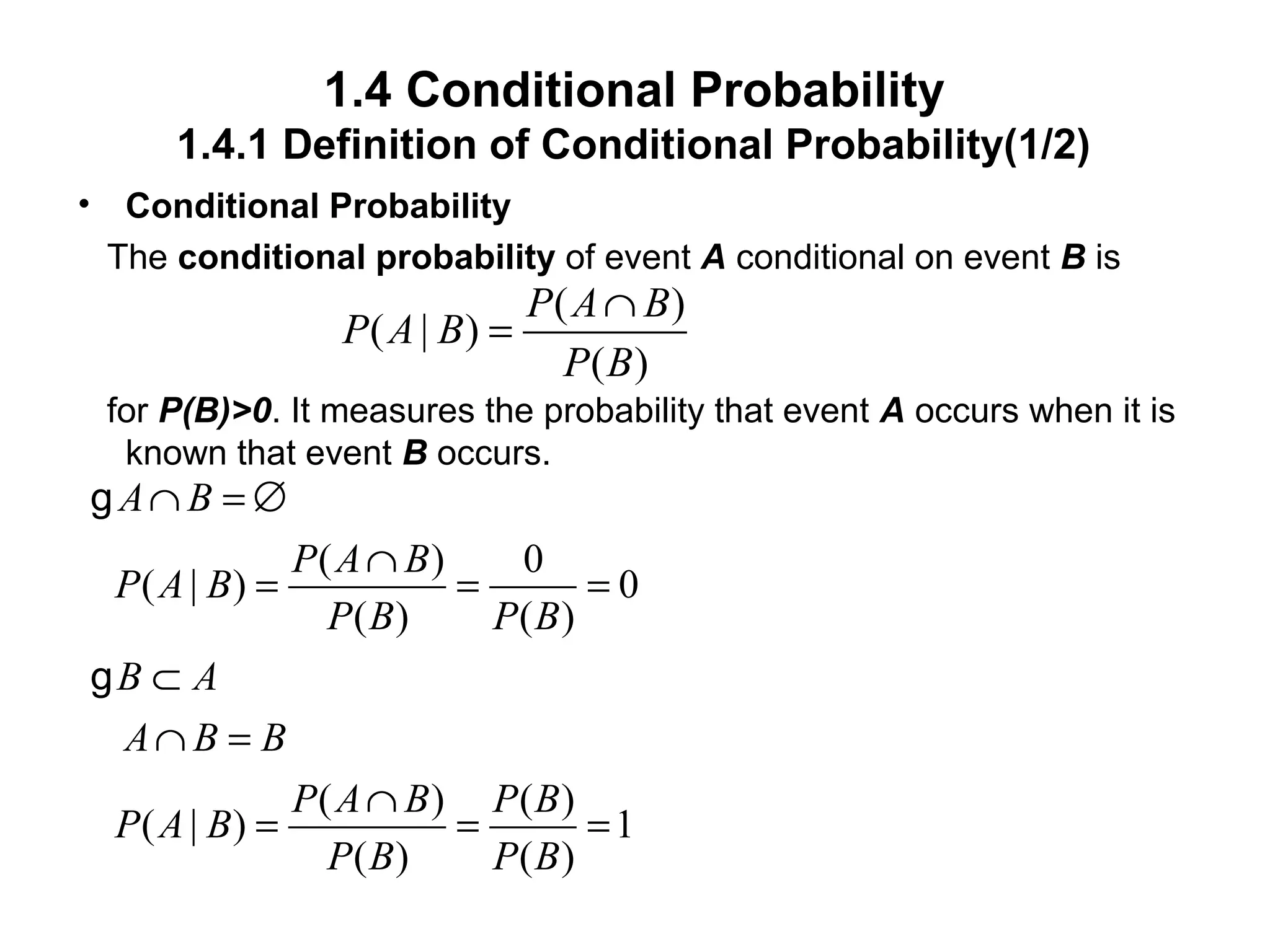
• Conditional Probability
The conditional probability of event A conditional on event B is
for P(B)>0. It measures the probability that event A occurs when it is
known that event B occurs.
( )
( | )
( )
P A B
P A B
P B
∩
=
( ) 0
( | ) 0
( ) ( )
( ) ( )
( | ) 1
( ) ( )
A B
P A B
P A B
P B P B
B A
A B B
P A B P B
P A B
P B P B
∩ = āˆ…
∩
= = =
āŠ‚
∩ =
∩
= = =
g
g
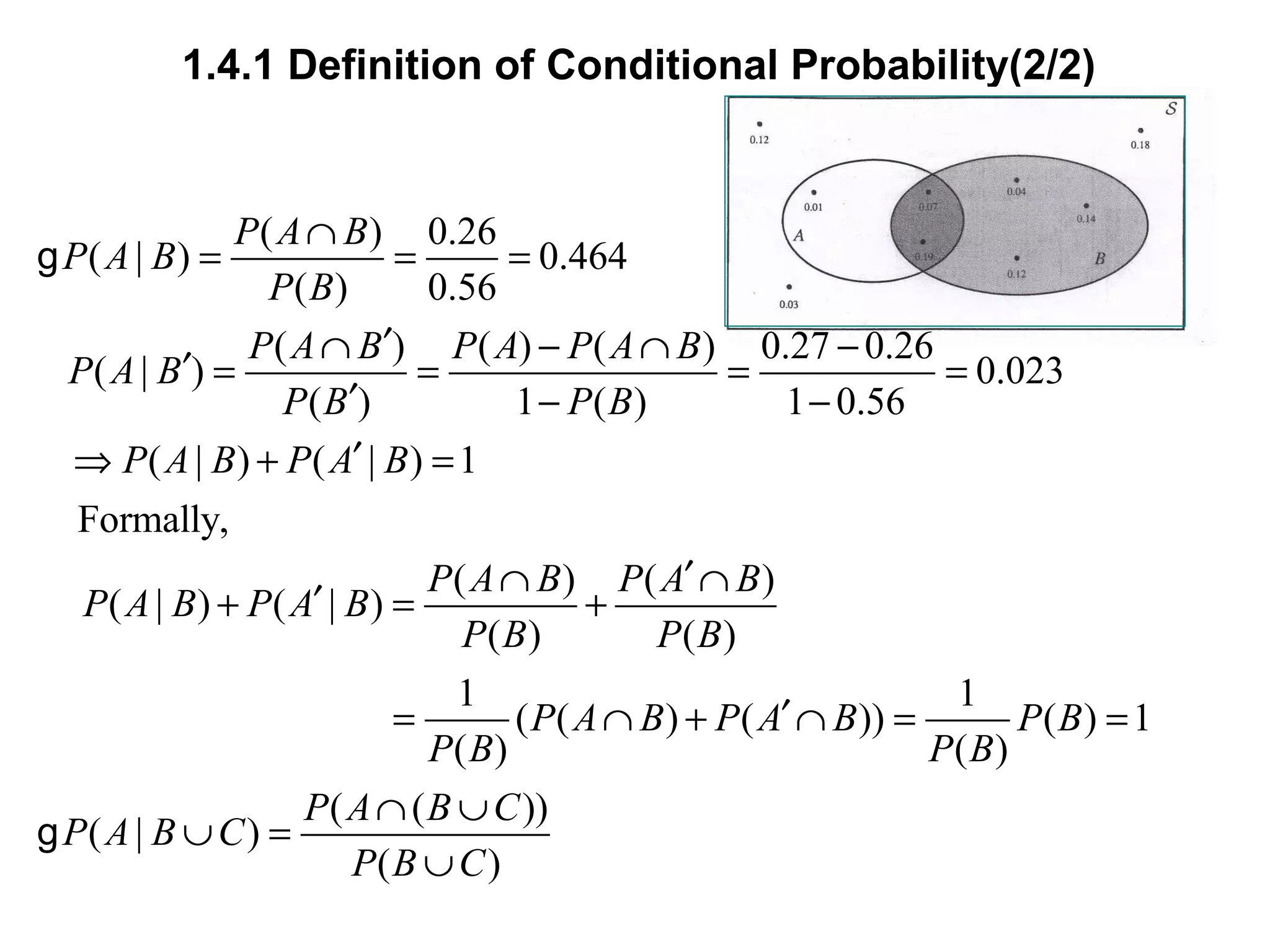
1.4.1 Definition of Conditional Probability(2/2)
( ) 0.26
( | ) 0.464
( ) 0.56
( ) ( ) ( ) 0.27 0.26
( | ) 0.023
( ) 1 ( ) 1 0.56
( | ) ( | ) 1
Formally,
( ) ( )
( | ) ( | )
( ) ( )
1 1
( ( ) ( )) ( ) 1
( ) ( )
( |
P A B
P A B
P B
P A B P A P A B
P A B
P B P B
P A B P A B
P A B P A B
P A B P A B
P B P B
P A B P A B P B
P B P B
P A
∩
= = =
ā€²āˆ© āˆ’ ∩ āˆ’
′ = = = =
′ āˆ’ āˆ’
′⇒ + =
ā€²āˆ© ∩
′+ = +
′= ∩ + ∩ = =
g
g
( ( ))
)
( )
P A B C
B C
P B C
∩ ∪
∪ =
∪
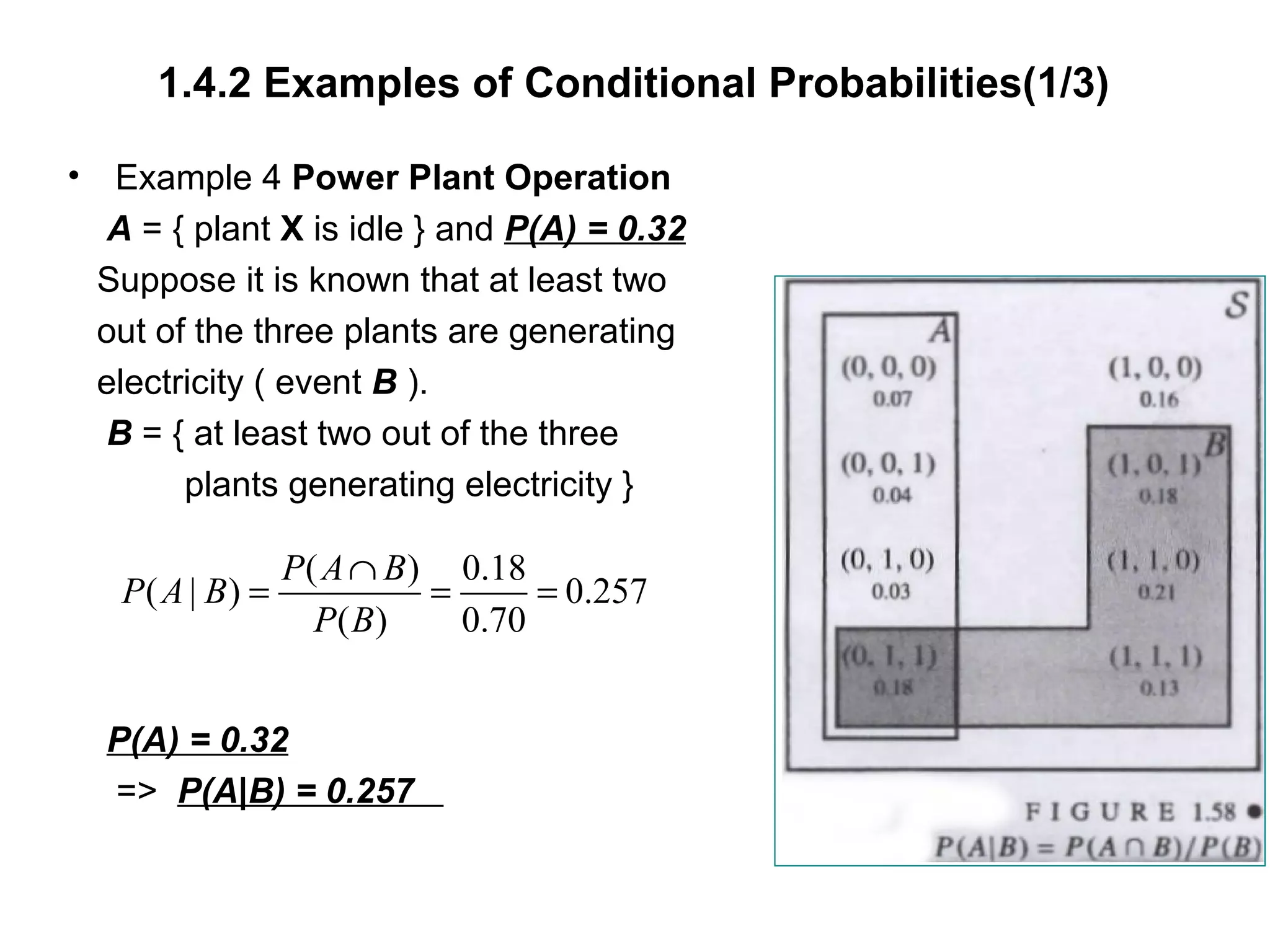
1.4.2 Examples of Conditional Probabilities(1/3)
• Example 4 Power Plant Operation
A = { plant X is idle } and P(A) = 0.32
Suppose it is known that at least two
out of the three plants are generating
electricity ( event B ).
B = { at least two out of the three
plants generating electricity }
P(A) = 0.32
=> P(A|B) = 0.257
( ) 0.18
( | ) 0.257
( ) 0.70
P A B
P A B
P B
∩
= = =
1.4.2 Examples of Conditional Probabilities(2/3)
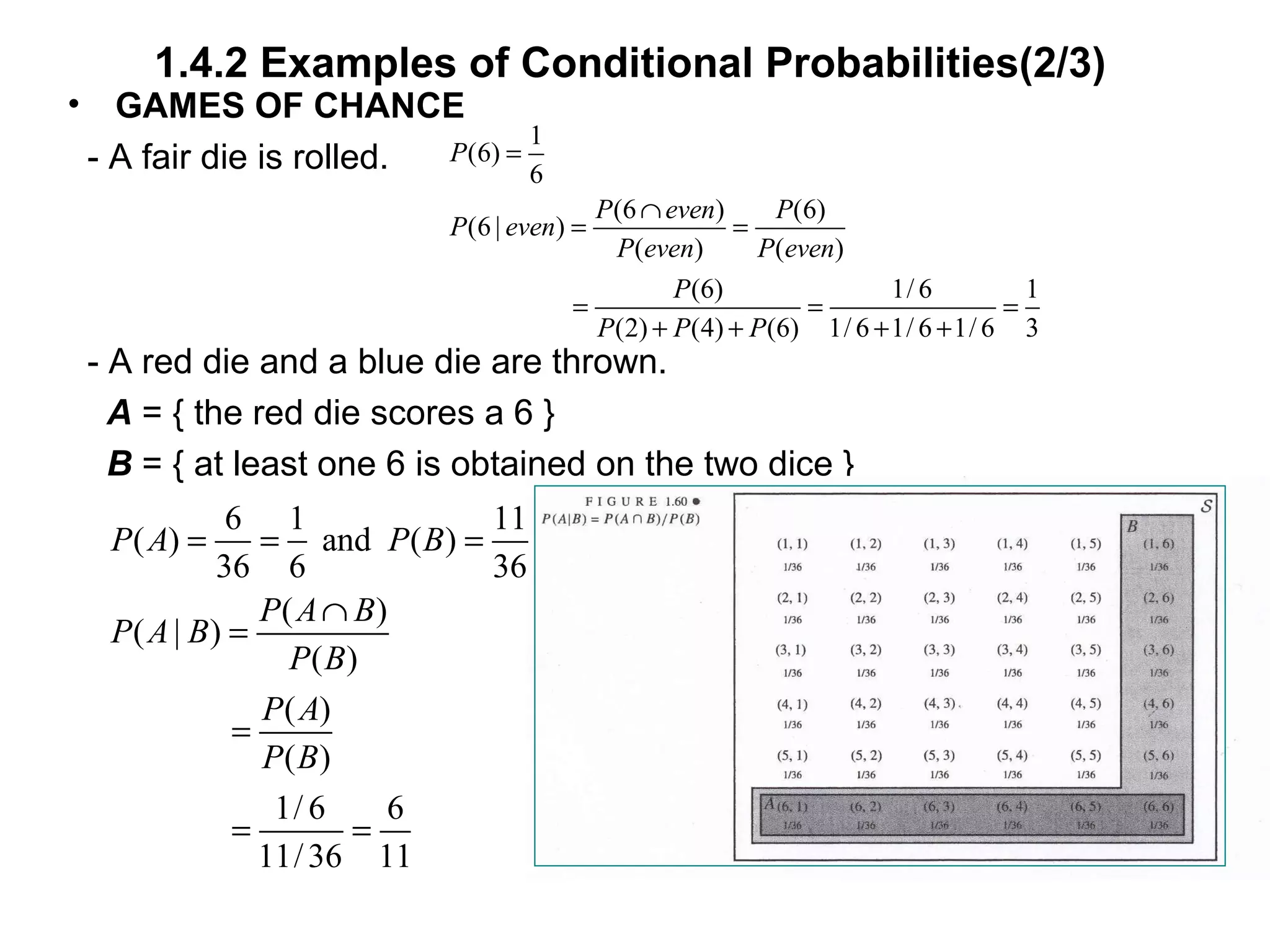
• GAMES OF CHANCE
- A fair die is rolled.
- A red die and a blue die are thrown.
A = { the red die scores a 6 }
B = { at least one 6 is obtained on the two dice }
1
(6)
6
(6 ) (6)
(6 | )
( ) ( )
(6) 1/ 6 1
(2) (4) (6) 1/ 6 1/ 6 1/ 6 3
P
P even P
P even
P even P even
P
P P P
=
∩
= =
= = =
+ + + +
6 1 11
( ) and ( )
36 6 36
( )
( | )
( )
( )
( )
1/ 6 6
11/36 11
P A P B
P A B
P A B
P B
P A
P B
= = =
∩
=
=
= =
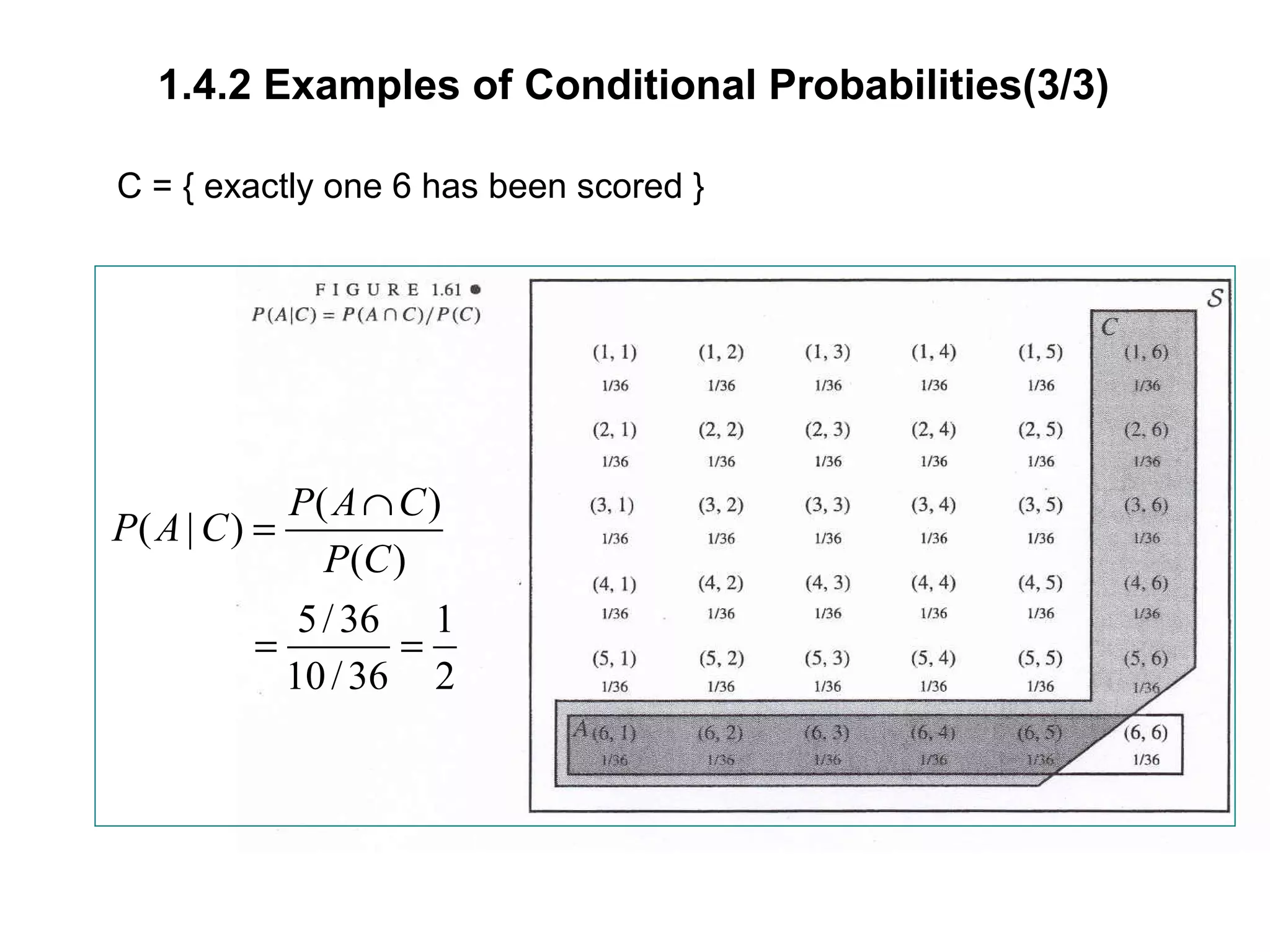
1.4.2 Examples of Conditional Probabilities(3/3)
C = { exactly one 6 has been scored }
( )
( | )
( )
5/36 1
10/36 2
P A C
P A C
P C
∩
=
= =
1.5 Probabilities of Event Intersections
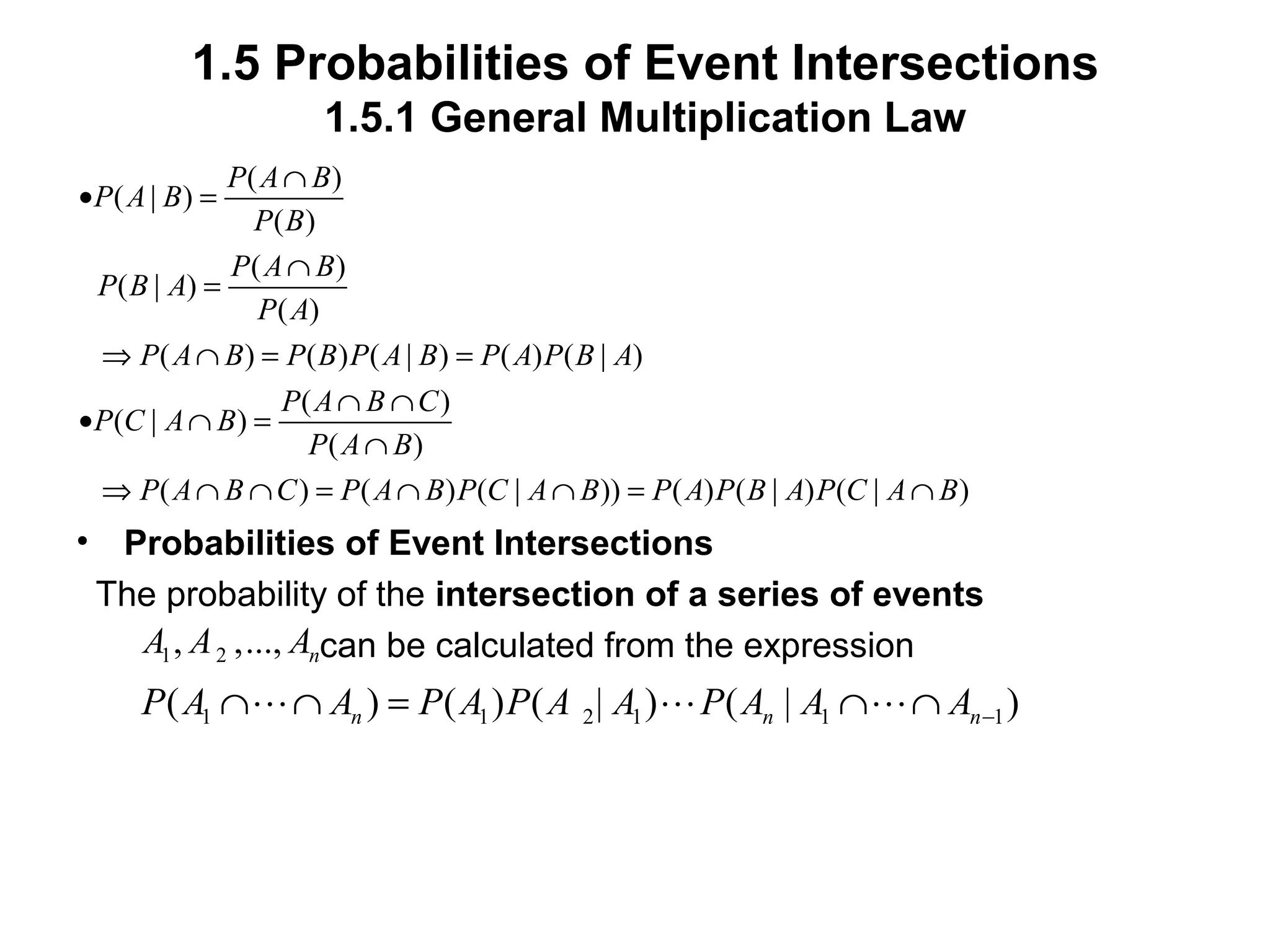
1.5.1 General Multiplication Law
• Probabilities of Event Intersections
The probability of the intersection of a series of events
can be calculated from the expression
( )
( | )
( )
( )
( | )
( )
( ) ( ) ( | ) ( ) ( | )
( )
( | )
( )
( ) ( ) ( | )) ( ) ( | ) ( | )
P A B
P A B
P B
P A B
P B A
P A
P A B P B P A B P A P B A
P A B C
P C A B
P A B
P A B C P A B P C A B P A P B A P C A B
∩
• =
∩
=
⇒ ∩ = =
∩ ∩
• ∩ =
∩
⇒ ∩ ∩ = ∩ ∩ = ∩
1 2, ,..., nA A A
1 1 2 1 1 1( ) ( ) ( | ) ( | )n n nP A A P A P A A P A A A āˆ’āˆ© ∩ = ∩ ∩L L L
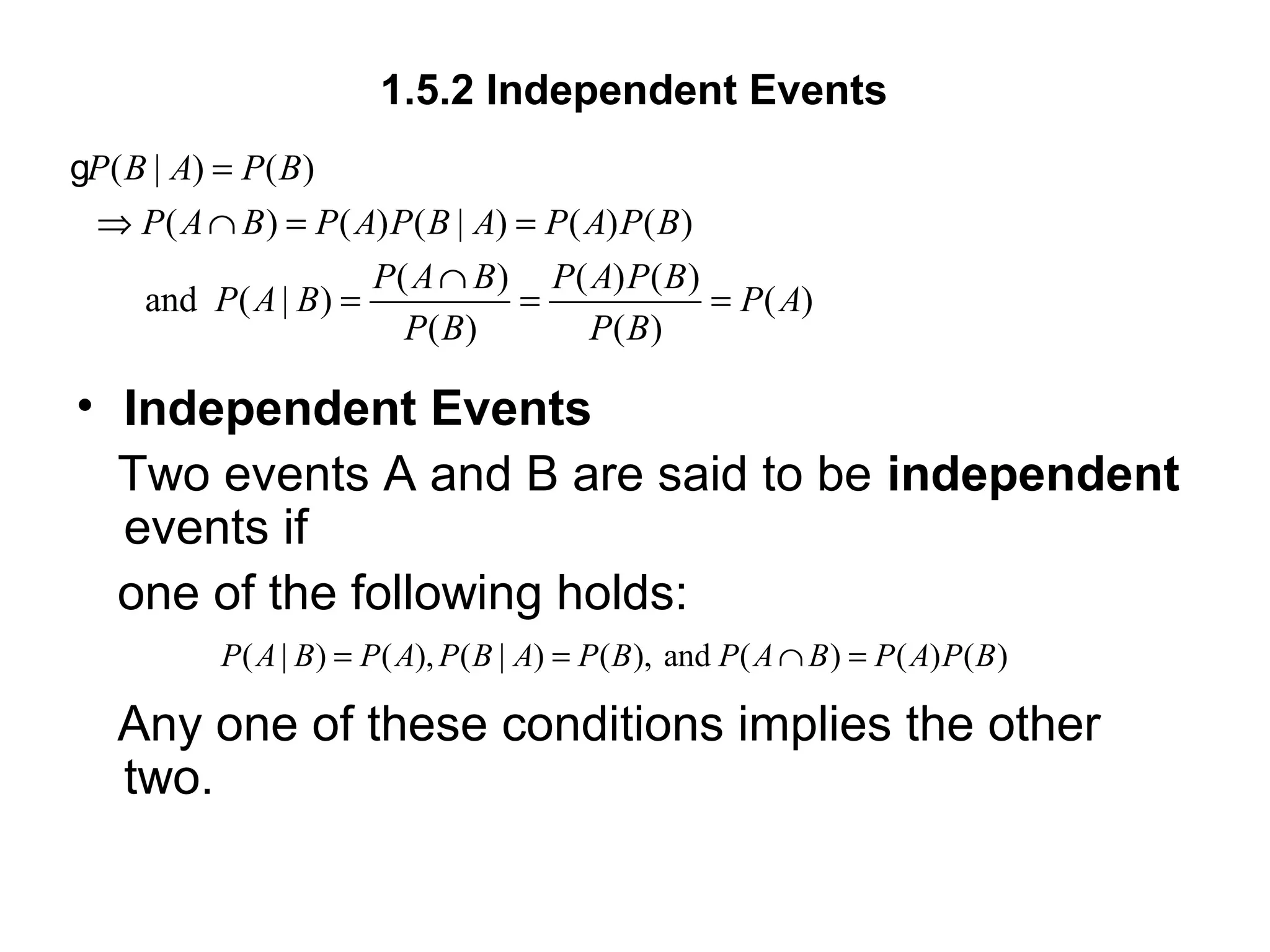
1.5.2 Independent Events
• Independent Events
Two events A and B are said to be independent
events if
one of the following holds:
Any one of these conditions implies the other
two.
( | ) ( )
( ) ( ) ( | ) ( ) ( )
( ) ( ) ( )
and ( | ) ( )
( ) ( )
P B A P B
P A B P A P B A P A P B
P A B P A P B
P A B P A
P B P B
=
⇒ ∩ = =
∩
= = =
g
( | ) ( ), ( | ) ( ), and ( ) ( ) ( )P A B P A P B A P B P A B P A P B= = ∩ =
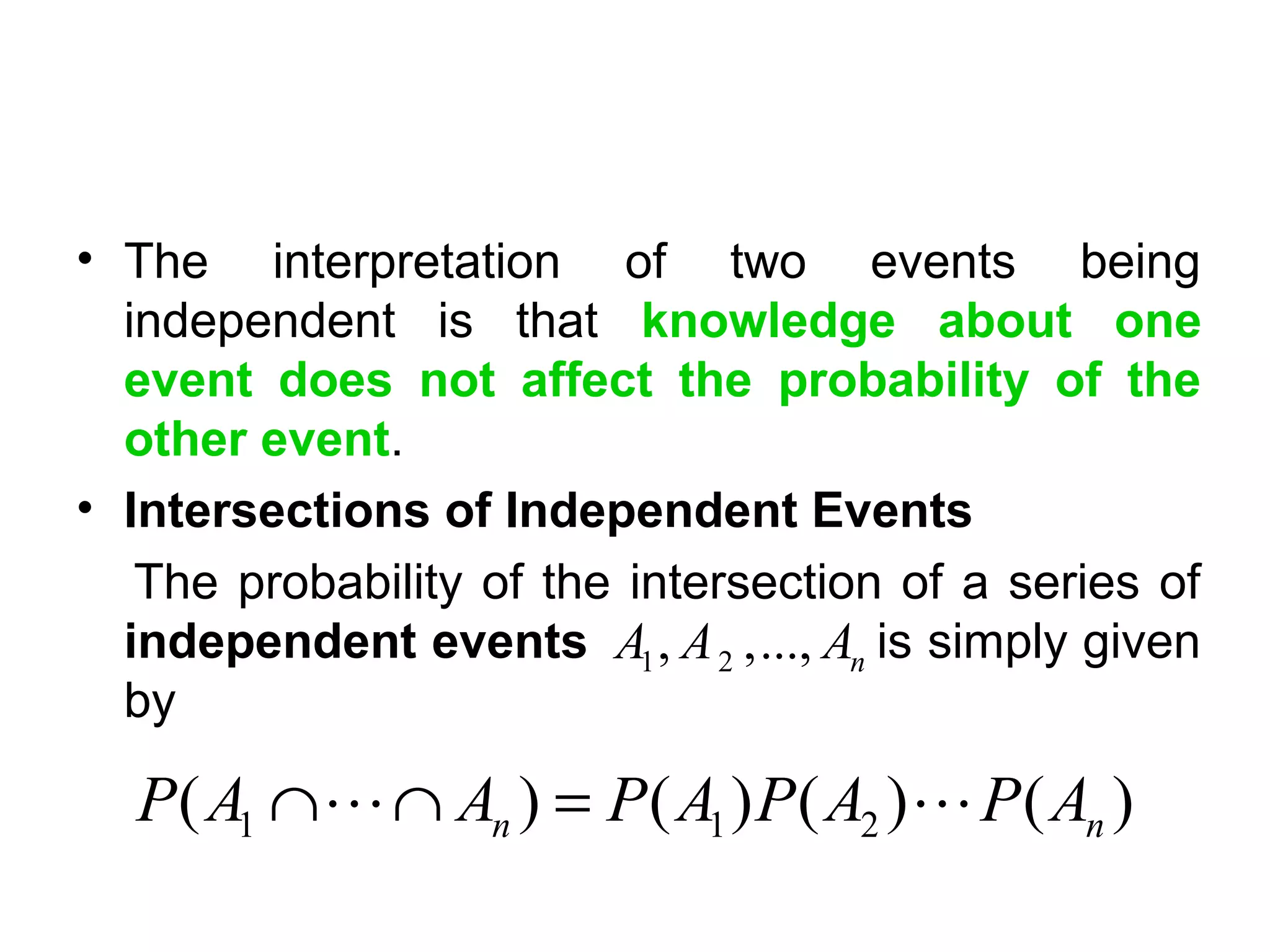
• The interpretation of two events being
independent is that knowledge about one
event does not affect the probability of the
other event.
• Intersections of Independent Events
The probability of the intersection of a series of
independent events is simply given
by
1 2, ,..., nA A A
1 1 2( ) ( ) ( ) ( )n nP A A P A P A P A∩ ∩ =L L
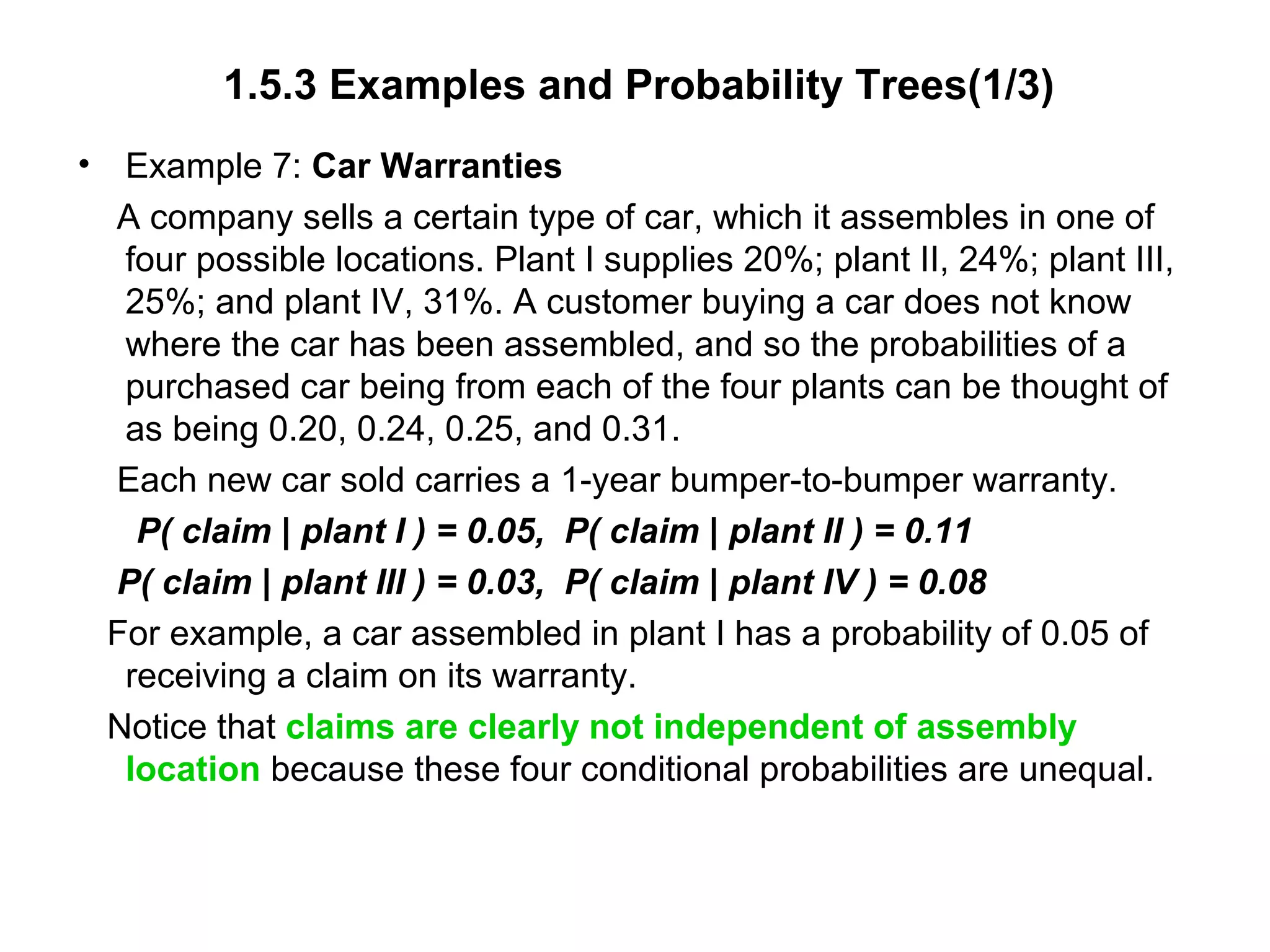
1.5.3 Examples and Probability Trees(1/3)
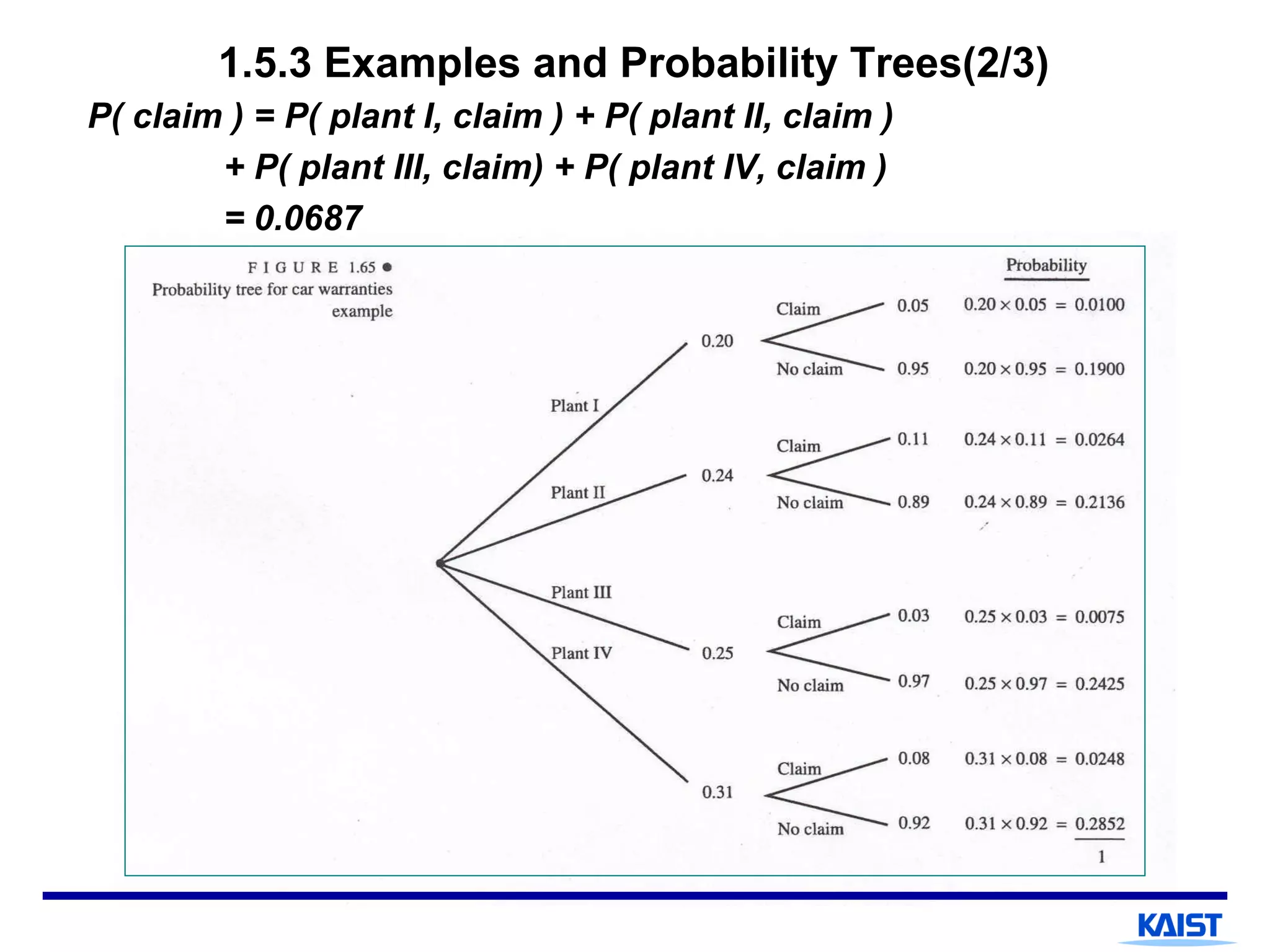
• Example 7: Car Warranties
A company sells a certain type of car, which it assembles in one of
four possible locations. Plant I supplies 20%; plant II, 24%; plant III,
25%; and plant IV, 31%. A customer buying a car does not know
where the car has been assembled, and so the probabilities of a
purchased car being from each of the four plants can be thought of
as being 0.20, 0.24, 0.25, and 0.31.
Each new car sold carries a 1-year bumper-to-bumper warranty.
P( claim | plant I ) = 0.05, P( claim | plant II ) = 0.11
P( claim | plant III ) = 0.03, P( claim | plant IV ) = 0.08
For example, a car assembled in plant I has a probability of 0.05 of
receiving a claim on its warranty.
Notice that claims are clearly not independent of assembly
location because these four conditional probabilities are unequal.
1.5.3 Examples and Probability Trees(2/3)
P( claim ) = P( plant I, claim ) + P( plant II, claim )
+ P( plant III, claim) + P( plant IV, claim )
= 0.0687
1.5.3 Examples and Probability Trees(3/3)
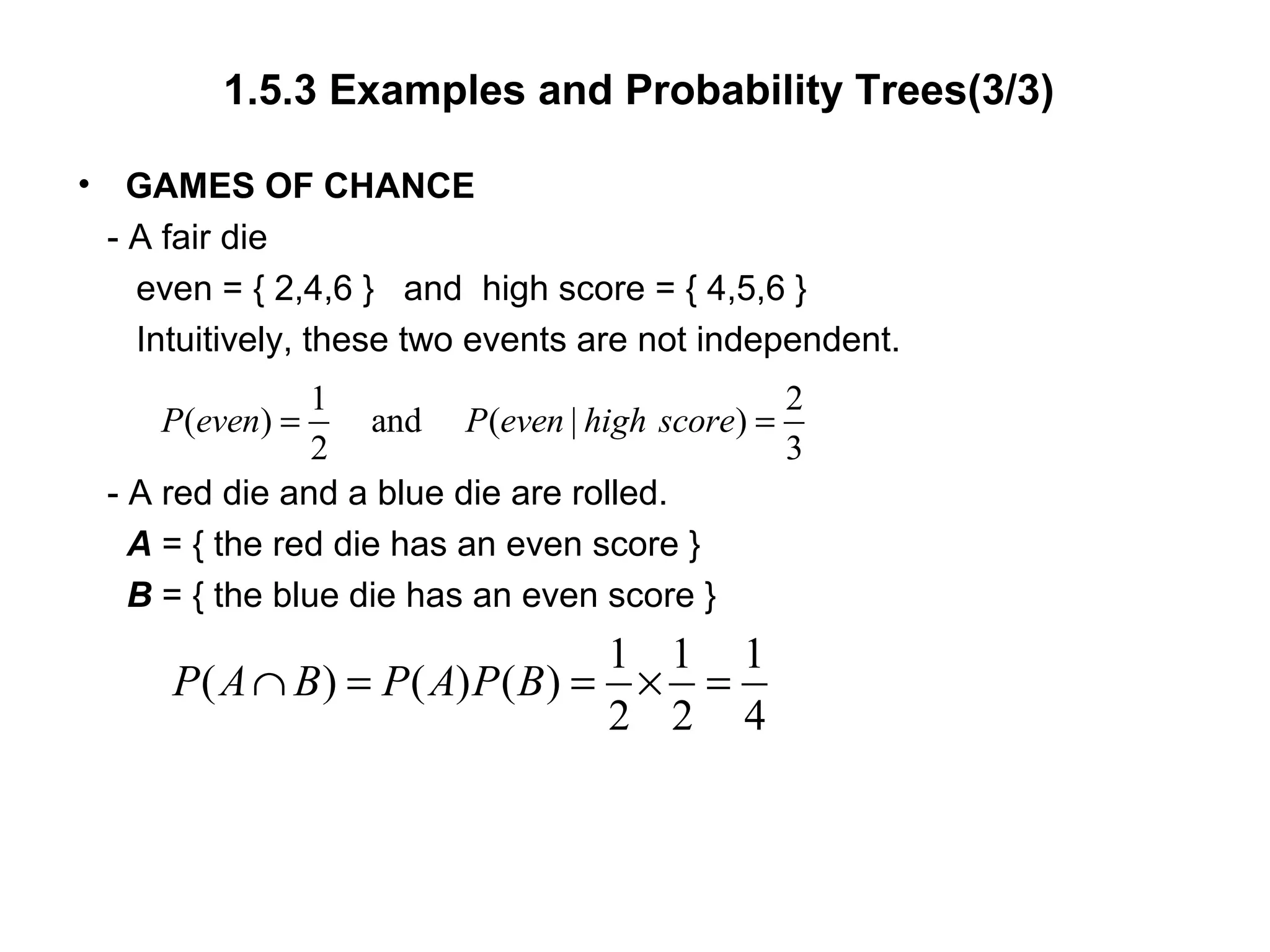
• GAMES OF CHANCE
- A fair die
even = { 2,4,6 } and high score = { 4,5,6 }
Intuitively, these two events are not independent.
- A red die and a blue die are rolled.
A = { the red die has an even score }
B = { the blue die has an even score }
1 2
( ) and ( | )
2 3
P even P even high score= =
1 1 1
( ) ( ) ( )
2 2 4
P A B P A P B∩ = = Ɨ =
1.6 Posterior Probabilities
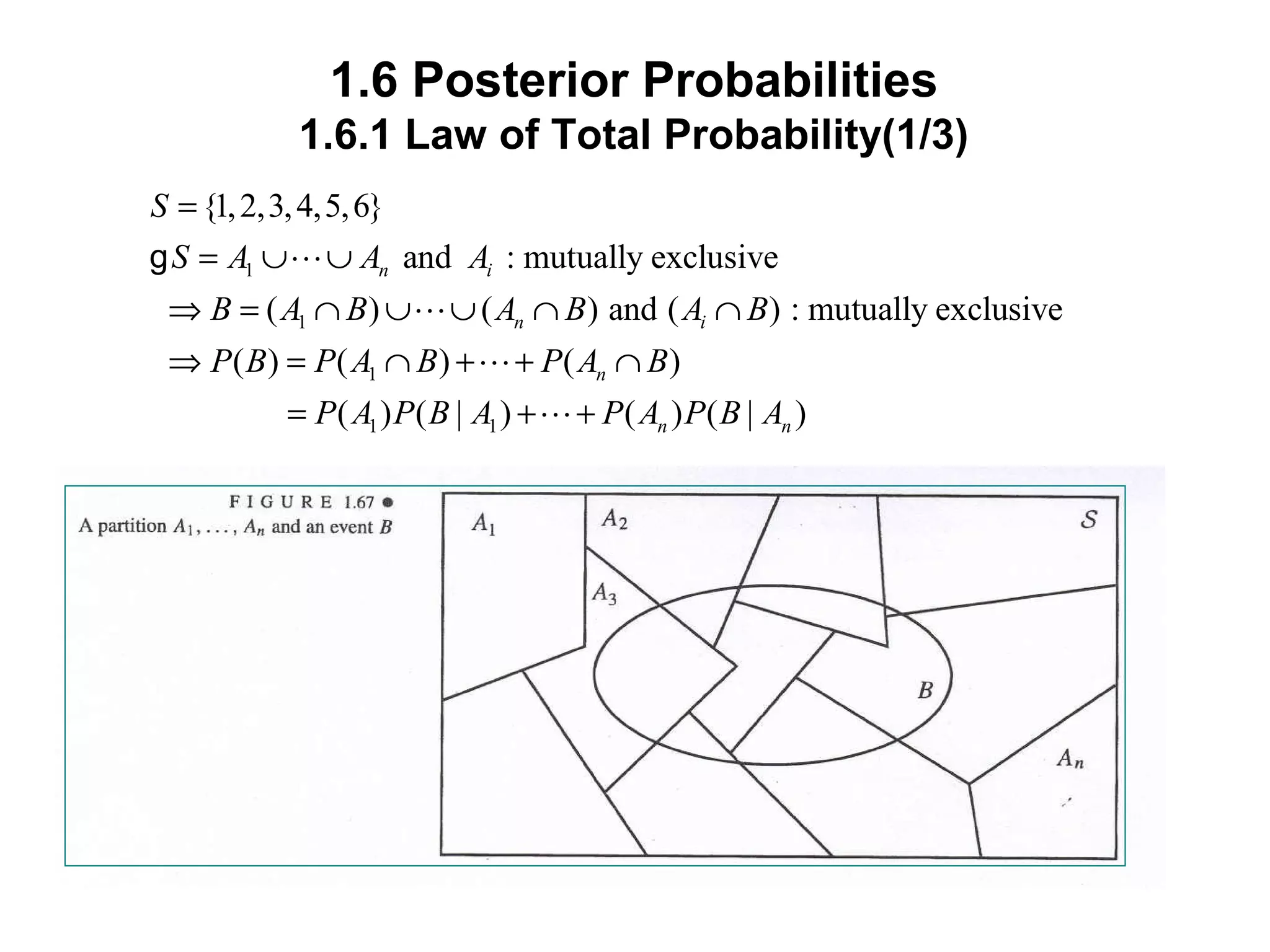
1.6.1 Law of Total Probability(1/3)
1
1
1
1 1
{1,2,3,4,5,6}
and : mutually exclusive
( ) ( ) and ( ) : mutually exclusive
( ) ( ) ( )
( ) ( | ) ( ) ( | )
n i
n i
n
n n
S
S A A A
B A B A B A B
P B P A B P A B
P A P B A P A P B A
=
= ∪ ∪
⇒ = ∩ ∪ ∪ ∩ ∩
⇒ = ∩ + + ∩
= + +
Lg
L
L
L
1.6.1 Law of Total Probability(2/3)
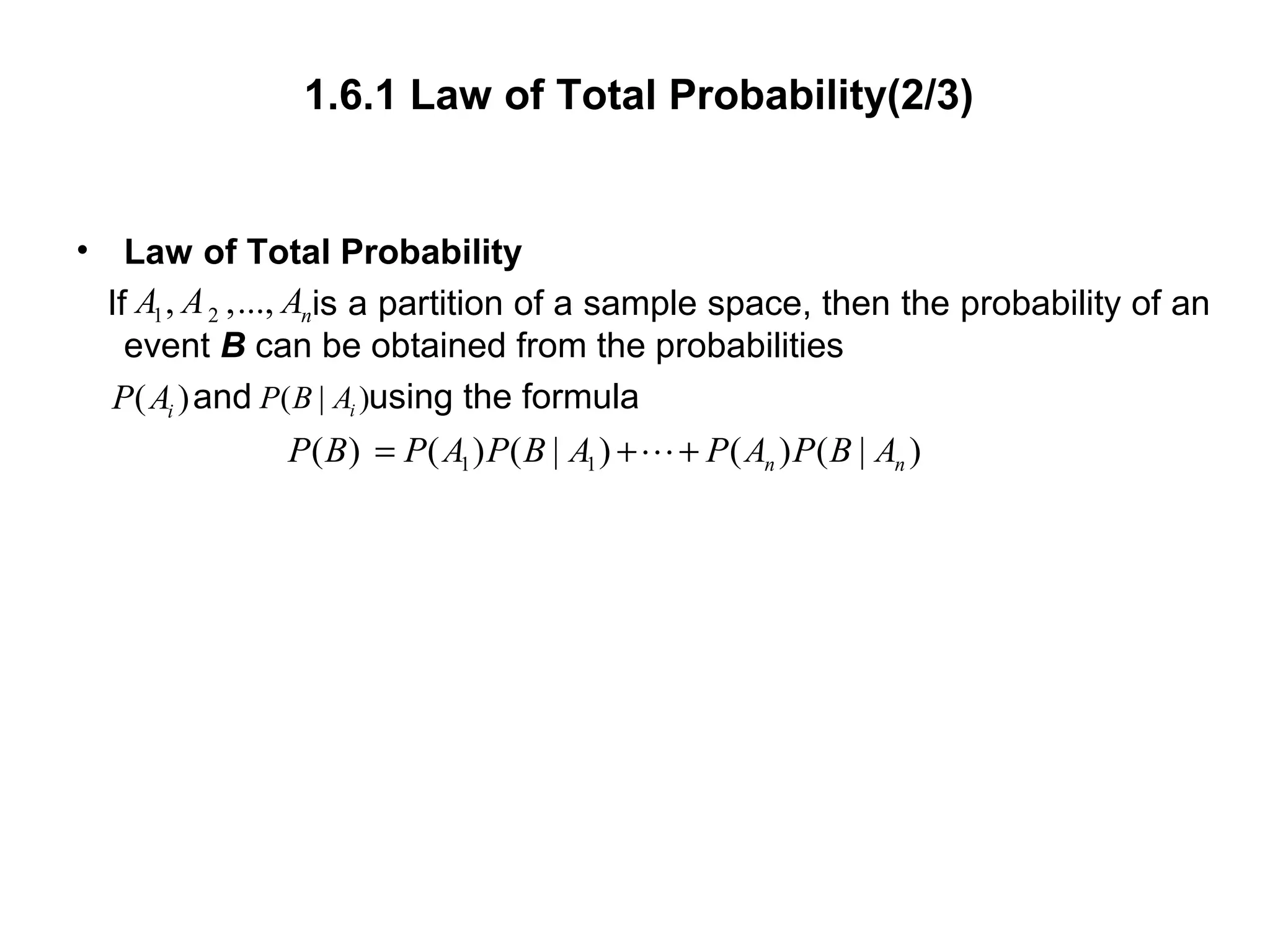
• Law of Total Probability
If is a partition of a sample space, then the probability of an
event B can be obtained from the probabilities
and using the formula
1 1( ) ( ) ( | ) ( ) ( | )n nP B P A P B A P A P B A= + +L
1 2, ,..., nA A A
( )iP A ( | )iP B A
1.6.1 Law of Total Probability(3/3)
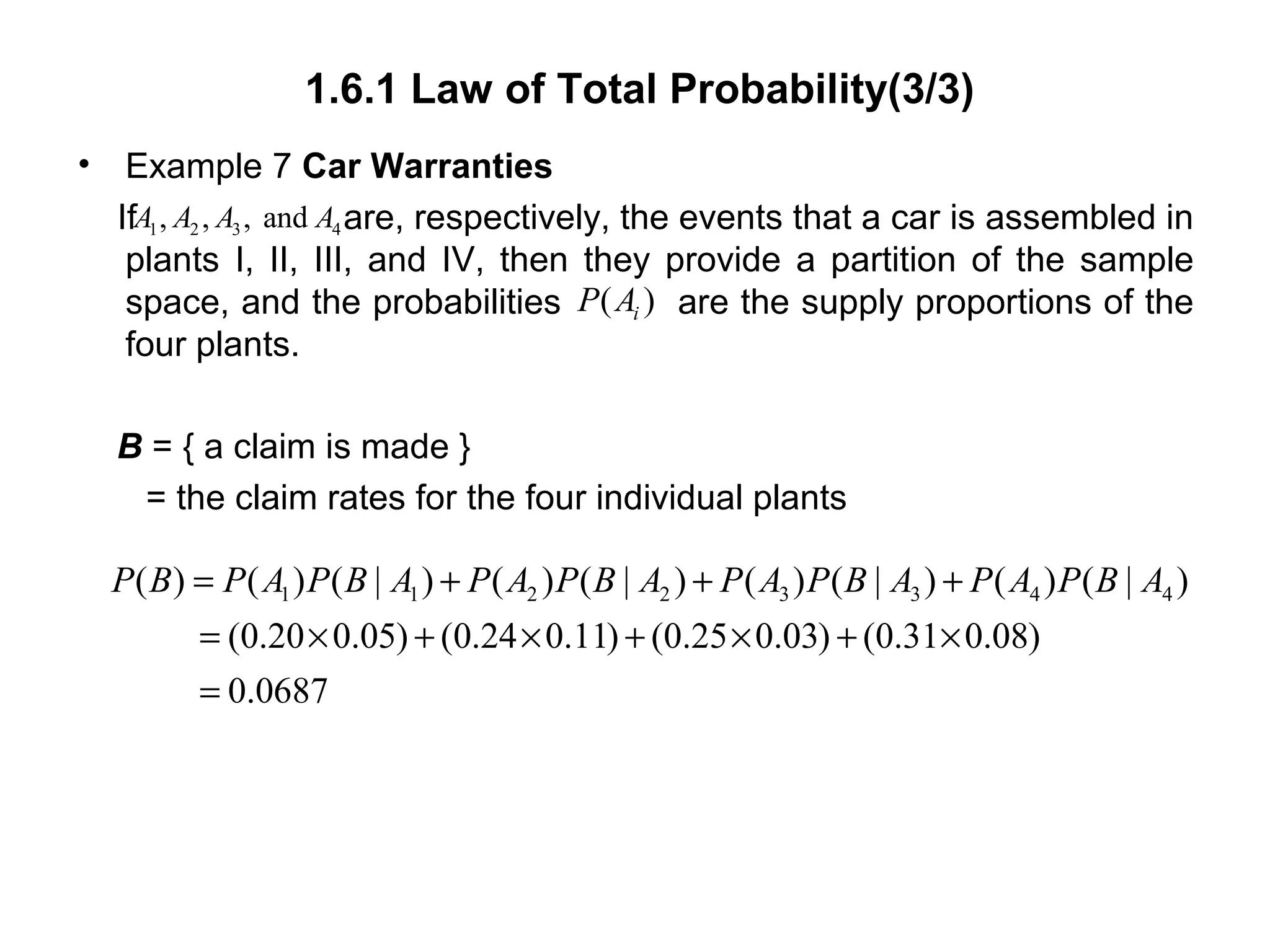
• Example 7 Car Warranties
If are, respectively, the events that a car is assembled in
plants I, II, III, and IV, then they provide a partition of the sample
space, and the probabilities are the supply proportions of the
four plants.
B = { a claim is made }
= the claim rates for the four individual plants
1 2 3 4, , , andA A A A
( )iP A
1 1 2 2 3 3 4 4( ) ( ) ( | ) ( ) ( | ) ( ) ( | ) ( ) ( | )
(0.20 0.05) (0.24 0.11) (0.25 0.03) (0.31 0.08)
0.0687
P B P A P B A P A P B A P A P B A P A P B A= + + +
= Ɨ + Ɨ + Ɨ + Ɨ
=
1.6.2 Calculation of Posterior Probabilities
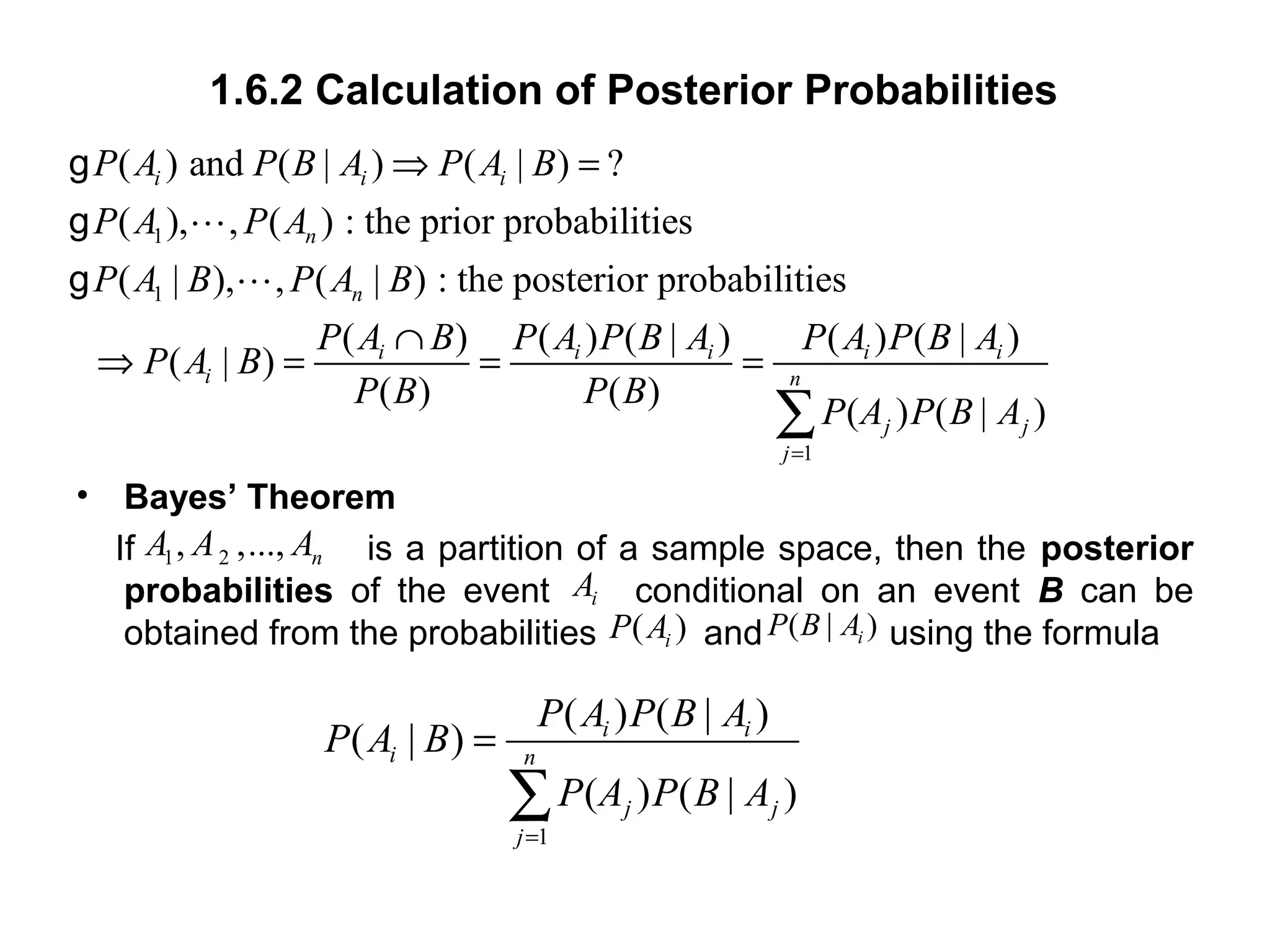
• Bayes’ Theorem
If is a partition of a sample space, then the posterior
probabilities of the event conditional on an event B can be
obtained from the probabilities and using the formula
1
1
1
( ) and ( | ) ( | ) ?
( ), , ( ) : the prior probabilities
( | ), , ( | ) : the posterior probabilities
( ) ( ) ( | ) ( ) ( | )
( | )
( ) ( )
( ) ( | )
i i i
n
n
i i i i i
i n
j j
j
P A P B A P A B
P A P A
P A B P A B
P A B P A P B A P A P B A
P A B
P B P B
P A P B A
=
⇒ =
∩
⇒ = = =
āˆ‘
g
Lg
Lg
1 2, ,..., nA A A
( )iP A ( | )iP B A
1
( ) ( | )
( | )
( ) ( | )
i i
i n
j j
j
P A P B A
P A B
P A P B A
=
=
āˆ‘
iA
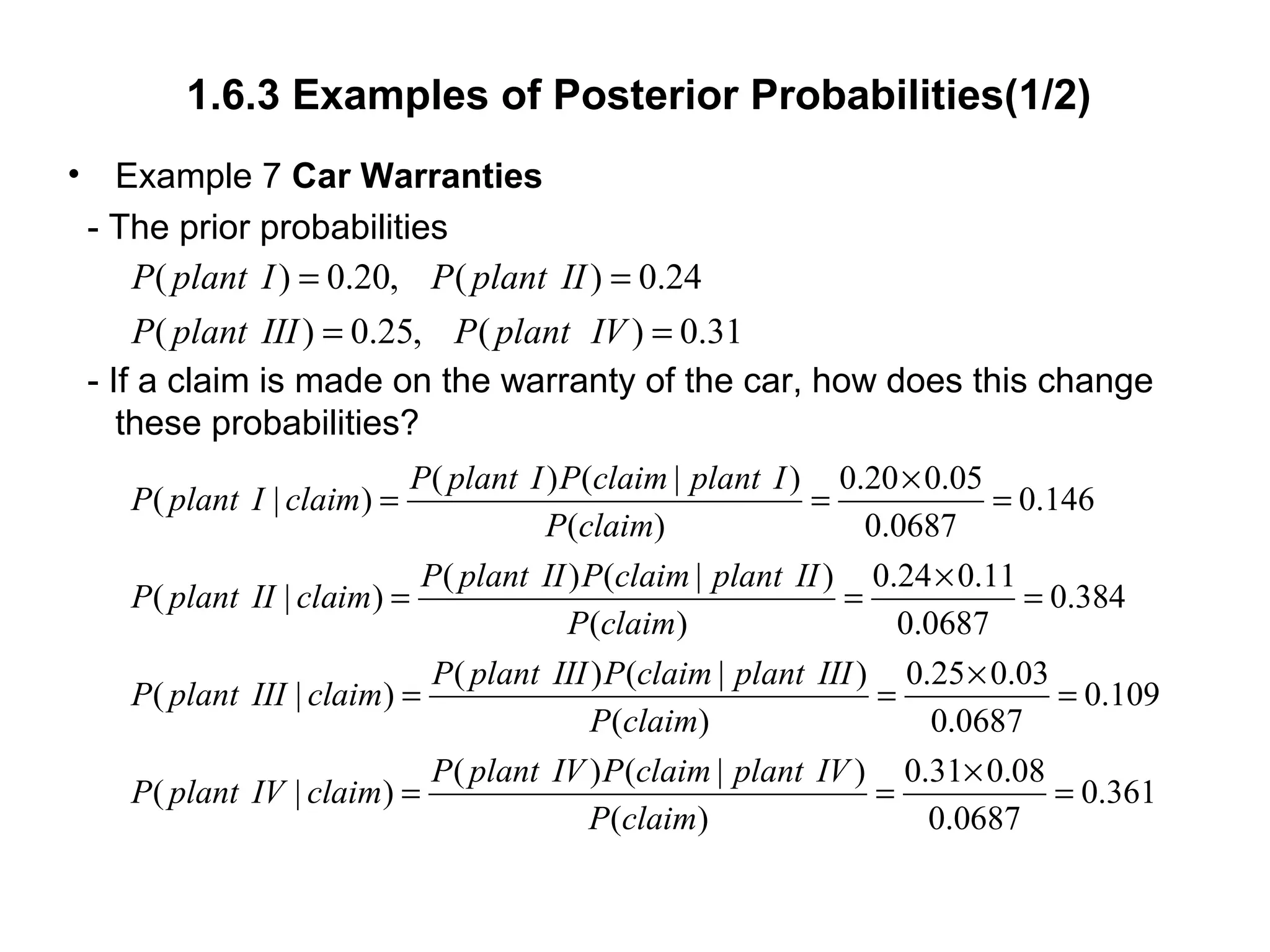
1.6.3 Examples of Posterior Probabilities(1/2)
• Example 7 Car Warranties
- The prior probabilities
- If a claim is made on the warranty of the car, how does this change
these probabilities?
( ) 0.20, ( ) 0.24
( ) 0.25, ( ) 0.31
P plant I P plant II
P plant III P plant IV
= =
= =
( ) ( | ) 0.20 0.05
( | ) 0.146
( ) 0.0687
( ) ( | ) 0.24 0.11
( | ) 0.384
( ) 0.0687
( ) ( | ) 0.
( | )
( )
P plant I P claim plant I
P plant I claim
P claim
P plant II P claim plant II
P plant II claim
P claim
P plant III P claim plant III
P plant III claim
P claim
Ɨ
= = =
Ɨ
= = =
= =
25 0.03
0.109
0.0687
( ) ( | ) 0.31 0.08
( | ) 0.361
( ) 0.0687
P plant IV P claim plant IV
P plant IV claim
P claim
Ɨ
=
Ɨ
= = =
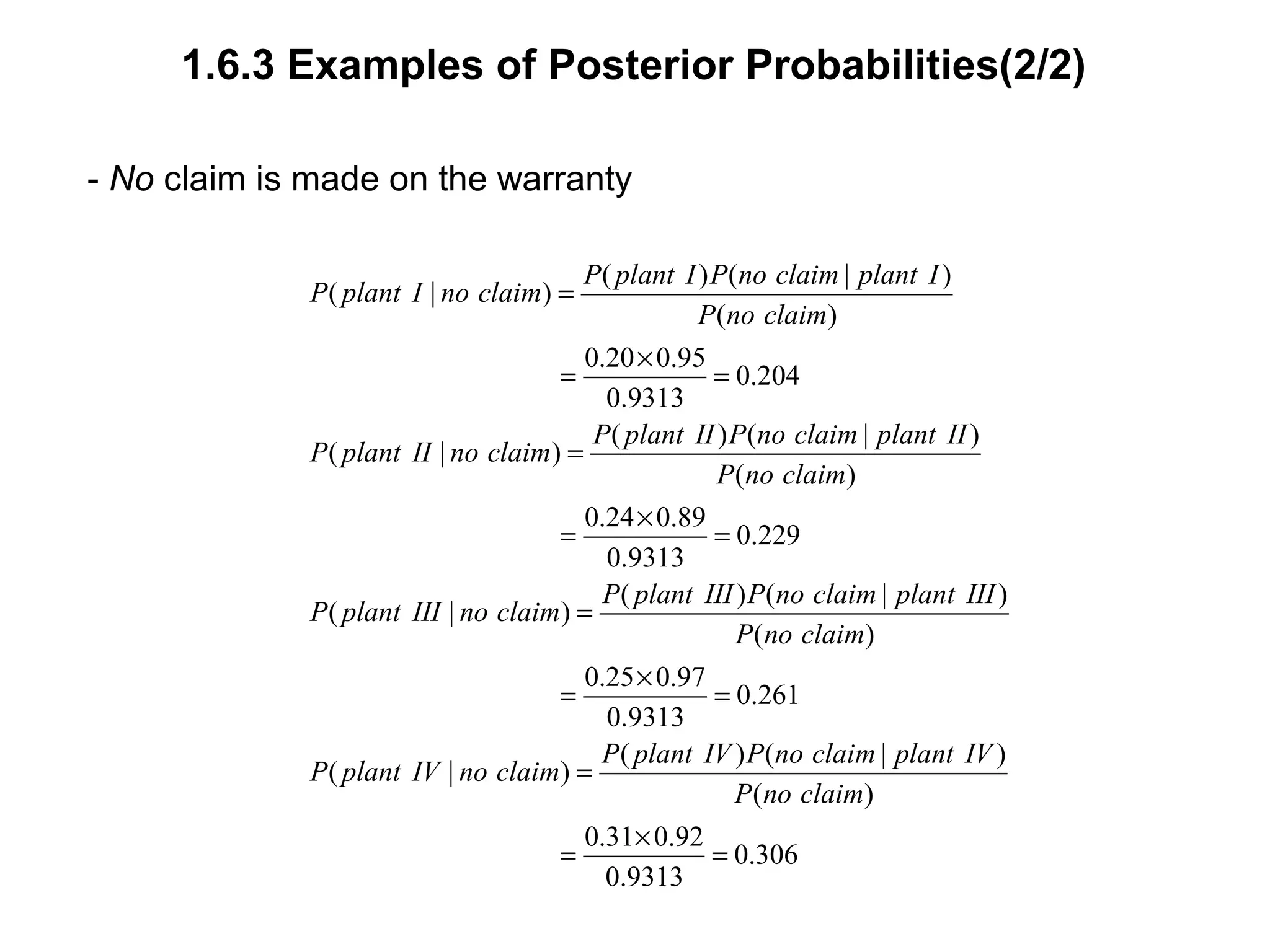
1.6.3 Examples of Posterior Probabilities(2/2)
- No claim is made on the warranty
( ) ( | )
( | )
( )
0.20 0.95
0.204
0.9313
( ) ( | )
( | )
( )
0.24 0.89
0.229
0.9313
( ) ( |
( | )
P plant I P no claim plant I
P plant I no claim
P no claim
P plant II P no claim plant II
P plant II no claim
P no claim
P plant III P no claim plan
P plant III no claim
=
Ɨ
= =
=
Ɨ
= =
=
)
( )
0.25 0.97
0.261
0.9313
( ) ( | )
( | )
( )
0.31 0.92
0.306
0.9313
t III
P no claim
P plant IV P no claim plant IV
P plant IV no claim
P no claim
Ɨ
= =
=
Ɨ
= =
Home take assignment
• Solve the relevant examples and end
exercise questions of text book.
Study before next lecture
• Permutations
• Combinations
Assignment #1
• Will be e-mailed
• Due date same day same class.
Assignments will be accepted only in
class.

Probability And Random Variable Lecture(3)

  • 1.
    Last Lecture • Westudied behavior of multiple events. • Any Question??
  • 2.
    Lecture 3 1.4 ConditionalProbability 1.5 Probabilities of Event Intersections 1.6 Posterior Probabilities
  • 3.
    1.4 Conditional Probability 1.4.1Definition of Conditional Probability(1/2) • Conditional Probability The conditional probability of event A conditional on event B is for P(B)>0. It measures the probability that event A occurs when it is known that event B occurs. ( ) ( | ) ( ) P A B P A B P B ∩ = ( ) 0 ( | ) 0 ( ) ( ) ( ) ( ) ( | ) 1 ( ) ( ) A B P A B P A B P B P B B A A B B P A B P B P A B P B P B ∩ = āˆ… ∩ = = = āŠ‚ ∩ = ∩ = = = g g
  • 4.
    1.4.1 Definition ofConditional Probability(2/2) ( ) 0.26 ( | ) 0.464 ( ) 0.56 ( ) ( ) ( ) 0.27 0.26 ( | ) 0.023 ( ) 1 ( ) 1 0.56 ( | ) ( | ) 1 Formally, ( ) ( ) ( | ) ( | ) ( ) ( ) 1 1 ( ( ) ( )) ( ) 1 ( ) ( ) ( | P A B P A B P B P A B P A P A B P A B P B P B P A B P A B P A B P A B P A B P A B P B P B P A B P A B P B P B P B P A ∩ = = = ā€²āˆ© āˆ’ ∩ āˆ’ ′ = = = = ′ āˆ’ āˆ’ ′⇒ + = ā€²āˆ© ∩ ′+ = + ′= ∩ + ∩ = = g g ( ( )) ) ( ) P A B C B C P B C ∩ ∪ ∪ = ∪
  • 5.
    1.4.2 Examples ofConditional Probabilities(1/3) • Example 4 Power Plant Operation A = { plant X is idle } and P(A) = 0.32 Suppose it is known that at least two out of the three plants are generating electricity ( event B ). B = { at least two out of the three plants generating electricity } P(A) = 0.32 => P(A|B) = 0.257 ( ) 0.18 ( | ) 0.257 ( ) 0.70 P A B P A B P B ∩ = = =
  • 6.
    1.4.2 Examples ofConditional Probabilities(2/3) • GAMES OF CHANCE - A fair die is rolled. - A red die and a blue die are thrown. A = { the red die scores a 6 } B = { at least one 6 is obtained on the two dice } 1 (6) 6 (6 ) (6) (6 | ) ( ) ( ) (6) 1/ 6 1 (2) (4) (6) 1/ 6 1/ 6 1/ 6 3 P P even P P even P even P even P P P P = ∩ = = = = = + + + + 6 1 11 ( ) and ( ) 36 6 36 ( ) ( | ) ( ) ( ) ( ) 1/ 6 6 11/36 11 P A P B P A B P A B P B P A P B = = = ∩ = = = =
  • 7.
    1.4.2 Examples ofConditional Probabilities(3/3) C = { exactly one 6 has been scored } ( ) ( | ) ( ) 5/36 1 10/36 2 P A C P A C P C ∩ = = =
  • 8.
    1.5 Probabilities ofEvent Intersections 1.5.1 General Multiplication Law • Probabilities of Event Intersections The probability of the intersection of a series of events can be calculated from the expression ( ) ( | ) ( ) ( ) ( | ) ( ) ( ) ( ) ( | ) ( ) ( | ) ( ) ( | ) ( ) ( ) ( ) ( | )) ( ) ( | ) ( | ) P A B P A B P B P A B P B A P A P A B P B P A B P A P B A P A B C P C A B P A B P A B C P A B P C A B P A P B A P C A B ∩ • = ∩ = ⇒ ∩ = = ∩ ∩ • ∩ = ∩ ⇒ ∩ ∩ = ∩ ∩ = ∩ 1 2, ,..., nA A A 1 1 2 1 1 1( ) ( ) ( | ) ( | )n n nP A A P A P A A P A A A āˆ’āˆ© ∩ = ∩ ∩L L L
  • 9.
    1.5.2 Independent Events •Independent Events Two events A and B are said to be independent events if one of the following holds: Any one of these conditions implies the other two. ( | ) ( ) ( ) ( ) ( | ) ( ) ( ) ( ) ( ) ( ) and ( | ) ( ) ( ) ( ) P B A P B P A B P A P B A P A P B P A B P A P B P A B P A P B P B = ⇒ ∩ = = ∩ = = = g ( | ) ( ), ( | ) ( ), and ( ) ( ) ( )P A B P A P B A P B P A B P A P B= = ∩ =
  • 10.
    • The interpretationof two events being independent is that knowledge about one event does not affect the probability of the other event. • Intersections of Independent Events The probability of the intersection of a series of independent events is simply given by 1 2, ,..., nA A A 1 1 2( ) ( ) ( ) ( )n nP A A P A P A P A∩ ∩ =L L
  • 12.
    1.5.3 Examples andProbability Trees(1/3) • Example 7: Car Warranties A company sells a certain type of car, which it assembles in one of four possible locations. Plant I supplies 20%; plant II, 24%; plant III, 25%; and plant IV, 31%. A customer buying a car does not know where the car has been assembled, and so the probabilities of a purchased car being from each of the four plants can be thought of as being 0.20, 0.24, 0.25, and 0.31. Each new car sold carries a 1-year bumper-to-bumper warranty. P( claim | plant I ) = 0.05, P( claim | plant II ) = 0.11 P( claim | plant III ) = 0.03, P( claim | plant IV ) = 0.08 For example, a car assembled in plant I has a probability of 0.05 of receiving a claim on its warranty. Notice that claims are clearly not independent of assembly location because these four conditional probabilities are unequal.
  • 13.
    1.5.3 Examples andProbability Trees(2/3) P( claim ) = P( plant I, claim ) + P( plant II, claim ) + P( plant III, claim) + P( plant IV, claim ) = 0.0687
  • 14.
    1.5.3 Examples andProbability Trees(3/3) • GAMES OF CHANCE - A fair die even = { 2,4,6 } and high score = { 4,5,6 } Intuitively, these two events are not independent. - A red die and a blue die are rolled. A = { the red die has an even score } B = { the blue die has an even score } 1 2 ( ) and ( | ) 2 3 P even P even high score= = 1 1 1 ( ) ( ) ( ) 2 2 4 P A B P A P B∩ = = Ɨ =
  • 15.
    1.6 Posterior Probabilities 1.6.1Law of Total Probability(1/3) 1 1 1 1 1 {1,2,3,4,5,6} and : mutually exclusive ( ) ( ) and ( ) : mutually exclusive ( ) ( ) ( ) ( ) ( | ) ( ) ( | ) n i n i n n n S S A A A B A B A B A B P B P A B P A B P A P B A P A P B A = = ∪ ∪ ⇒ = ∩ ∪ ∪ ∩ ∩ ⇒ = ∩ + + ∩ = + + Lg L L L
  • 16.
    1.6.1 Law ofTotal Probability(2/3) • Law of Total Probability If is a partition of a sample space, then the probability of an event B can be obtained from the probabilities and using the formula 1 1( ) ( ) ( | ) ( ) ( | )n nP B P A P B A P A P B A= + +L 1 2, ,..., nA A A ( )iP A ( | )iP B A
  • 17.
    1.6.1 Law ofTotal Probability(3/3) • Example 7 Car Warranties If are, respectively, the events that a car is assembled in plants I, II, III, and IV, then they provide a partition of the sample space, and the probabilities are the supply proportions of the four plants. B = { a claim is made } = the claim rates for the four individual plants 1 2 3 4, , , andA A A A ( )iP A 1 1 2 2 3 3 4 4( ) ( ) ( | ) ( ) ( | ) ( ) ( | ) ( ) ( | ) (0.20 0.05) (0.24 0.11) (0.25 0.03) (0.31 0.08) 0.0687 P B P A P B A P A P B A P A P B A P A P B A= + + + = Ɨ + Ɨ + Ɨ + Ɨ =
  • 18.
    1.6.2 Calculation ofPosterior Probabilities • Bayes’ Theorem If is a partition of a sample space, then the posterior probabilities of the event conditional on an event B can be obtained from the probabilities and using the formula 1 1 1 ( ) and ( | ) ( | ) ? ( ), , ( ) : the prior probabilities ( | ), , ( | ) : the posterior probabilities ( ) ( ) ( | ) ( ) ( | ) ( | ) ( ) ( ) ( ) ( | ) i i i n n i i i i i i n j j j P A P B A P A B P A P A P A B P A B P A B P A P B A P A P B A P A B P B P B P A P B A = ⇒ = ∩ ⇒ = = = āˆ‘ g Lg Lg 1 2, ,..., nA A A ( )iP A ( | )iP B A 1 ( ) ( | ) ( | ) ( ) ( | ) i i i n j j j P A P B A P A B P A P B A = = āˆ‘ iA
  • 19.
    1.6.3 Examples ofPosterior Probabilities(1/2) • Example 7 Car Warranties - The prior probabilities - If a claim is made on the warranty of the car, how does this change these probabilities? ( ) 0.20, ( ) 0.24 ( ) 0.25, ( ) 0.31 P plant I P plant II P plant III P plant IV = = = = ( ) ( | ) 0.20 0.05 ( | ) 0.146 ( ) 0.0687 ( ) ( | ) 0.24 0.11 ( | ) 0.384 ( ) 0.0687 ( ) ( | ) 0. ( | ) ( ) P plant I P claim plant I P plant I claim P claim P plant II P claim plant II P plant II claim P claim P plant III P claim plant III P plant III claim P claim Ɨ = = = Ɨ = = = = = 25 0.03 0.109 0.0687 ( ) ( | ) 0.31 0.08 ( | ) 0.361 ( ) 0.0687 P plant IV P claim plant IV P plant IV claim P claim Ɨ = Ɨ = = =
  • 20.
    1.6.3 Examples ofPosterior Probabilities(2/2) - No claim is made on the warranty ( ) ( | ) ( | ) ( ) 0.20 0.95 0.204 0.9313 ( ) ( | ) ( | ) ( ) 0.24 0.89 0.229 0.9313 ( ) ( | ( | ) P plant I P no claim plant I P plant I no claim P no claim P plant II P no claim plant II P plant II no claim P no claim P plant III P no claim plan P plant III no claim = Ɨ = = = Ɨ = = = ) ( ) 0.25 0.97 0.261 0.9313 ( ) ( | ) ( | ) ( ) 0.31 0.92 0.306 0.9313 t III P no claim P plant IV P no claim plant IV P plant IV no claim P no claim Ɨ = = = Ɨ = =
  • 25.
    Home take assignment •Solve the relevant examples and end exercise questions of text book. Study before next lecture • Permutations • Combinations
  • 26.
    Assignment #1 • Willbe e-mailed • Due date same day same class. Assignments will be accepted only in class.