REPRESENTATION
Free-body diagrams
WHAT IS REPRESENTATION?
Definitions Formulas
Diagrams Graphs
Language of
Physics
LEARNING OUTCOMES
 Identify forces acting on an object and
draw free-body diagrams
 Solve problems for a static-point mass
 Recall and apply the equation F = ma to
new situation or to solve related problems
FREE-BODY DIAGRAMS
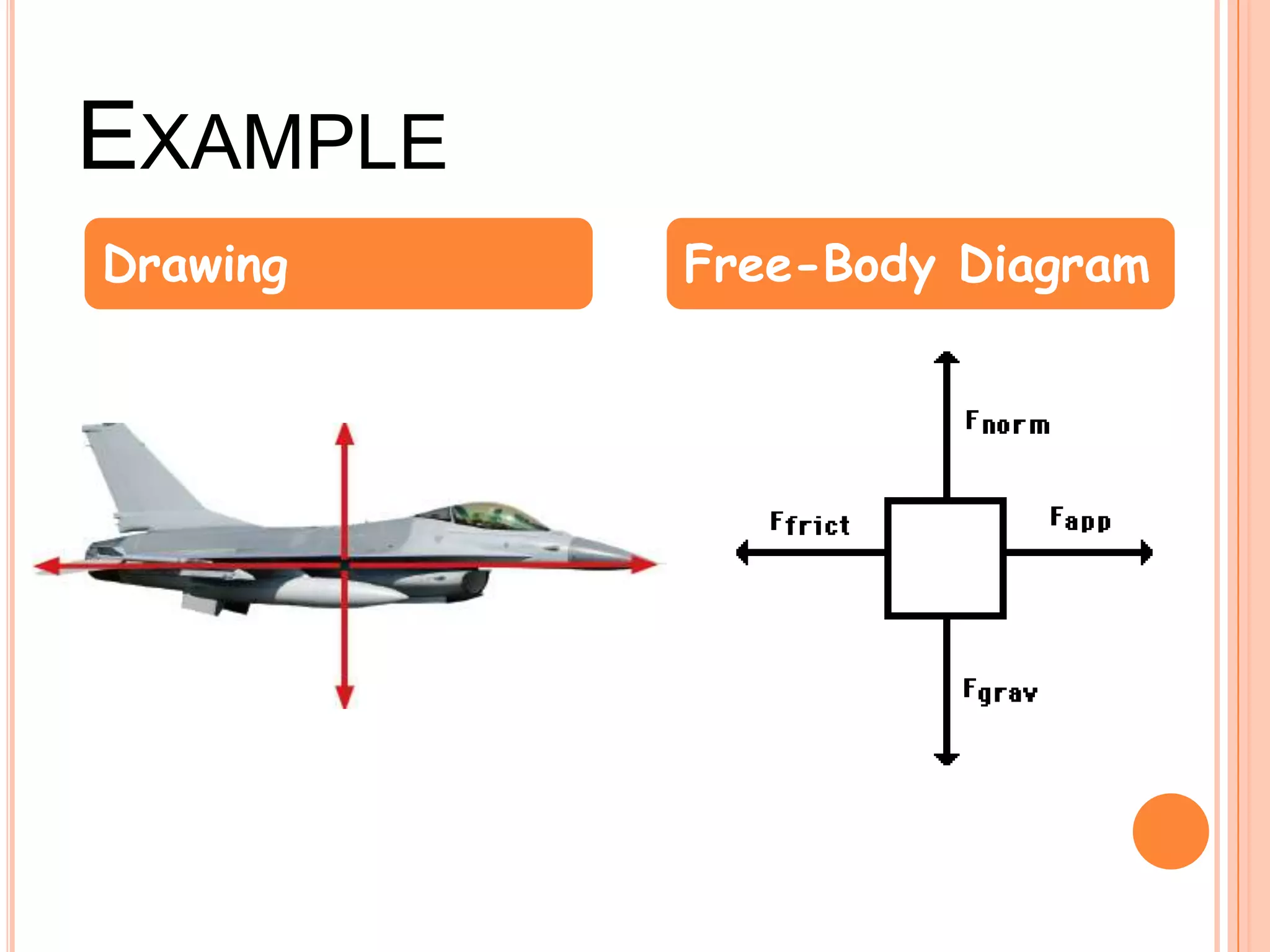
 A diagram which shows all the forces
acting on a body
 Consists primarily of a sketch of a body
and arrows representing the forces
acting on it
 Weight
 Contact force
 Tension
EXAMPLE
Drawing Free-Body Diagram
WEIGHT
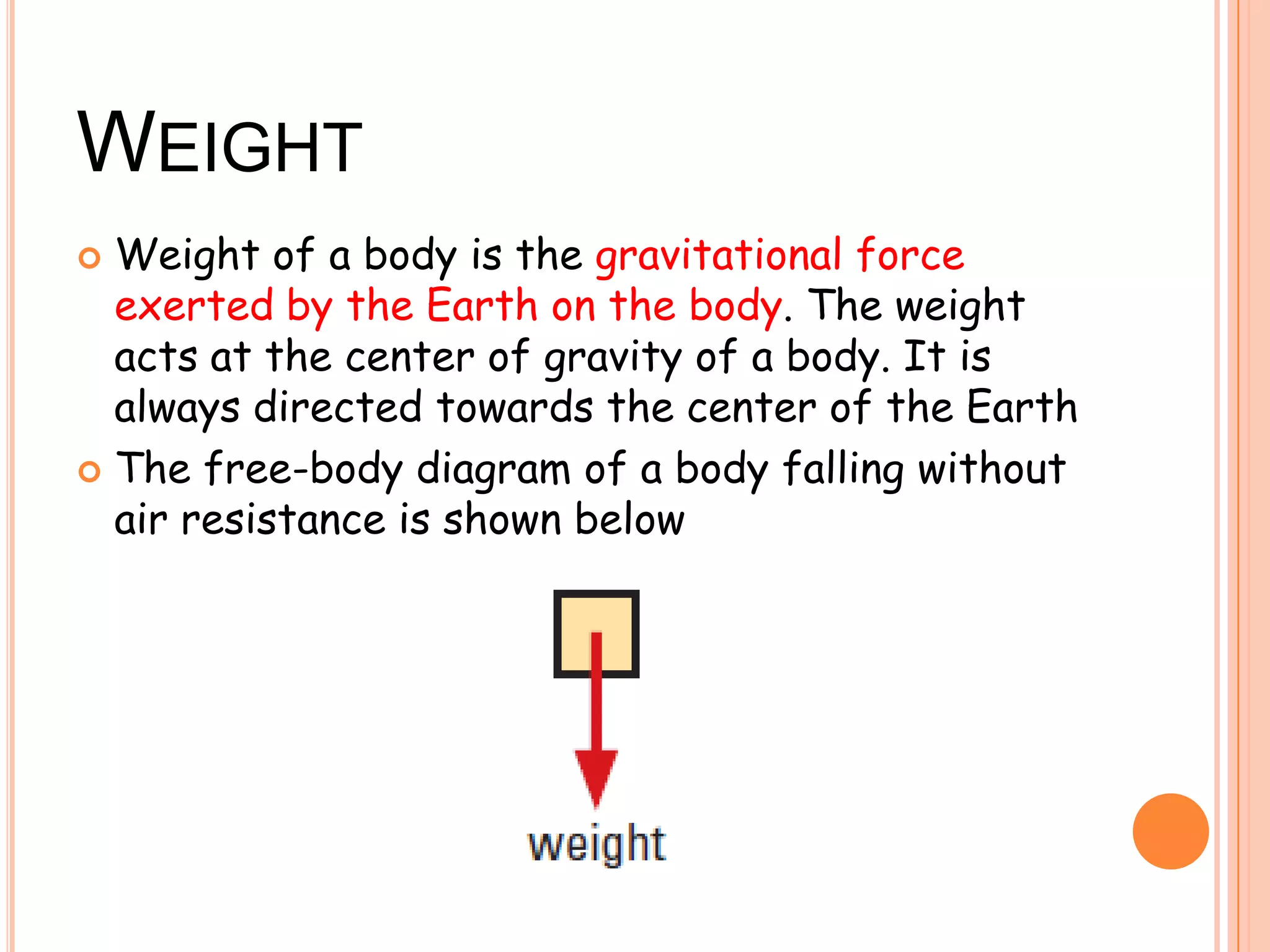
 Weight of a body is the gravitational force
exerted by the Earth on the body. The weight
acts at the center of gravity of a body. It is
always directed towards the center of the Earth
 The free-body diagram of a body falling without
air resistance is shown below
CONTACT FORCE
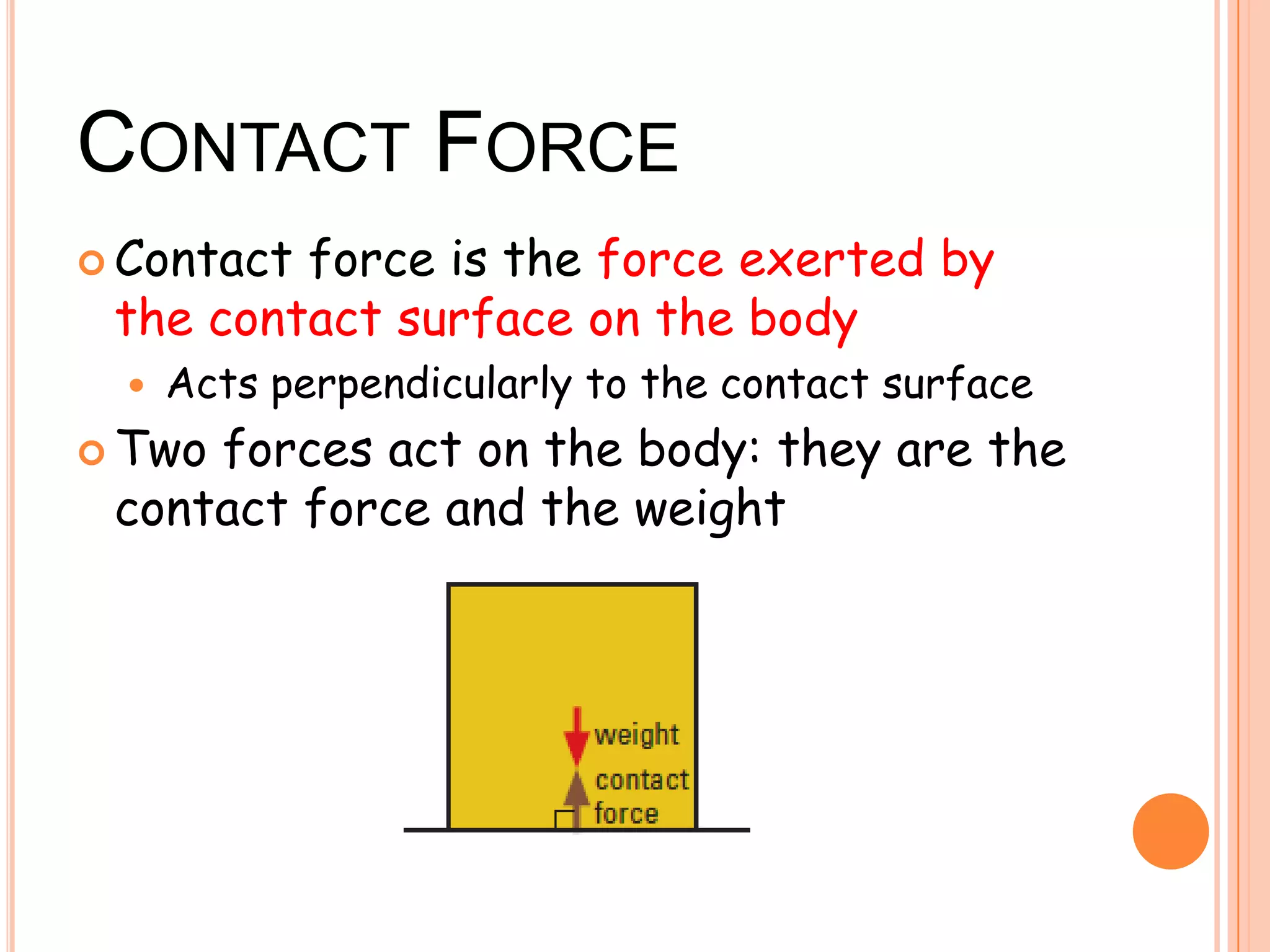
 Contact force is the force exerted by
the contact surface on the body
 Acts perpendicularly to the contact surface
 Two forces act on the body: they are the
contact force and the weight
RECALL: WEIGHT VS.
CONTACT FORCE
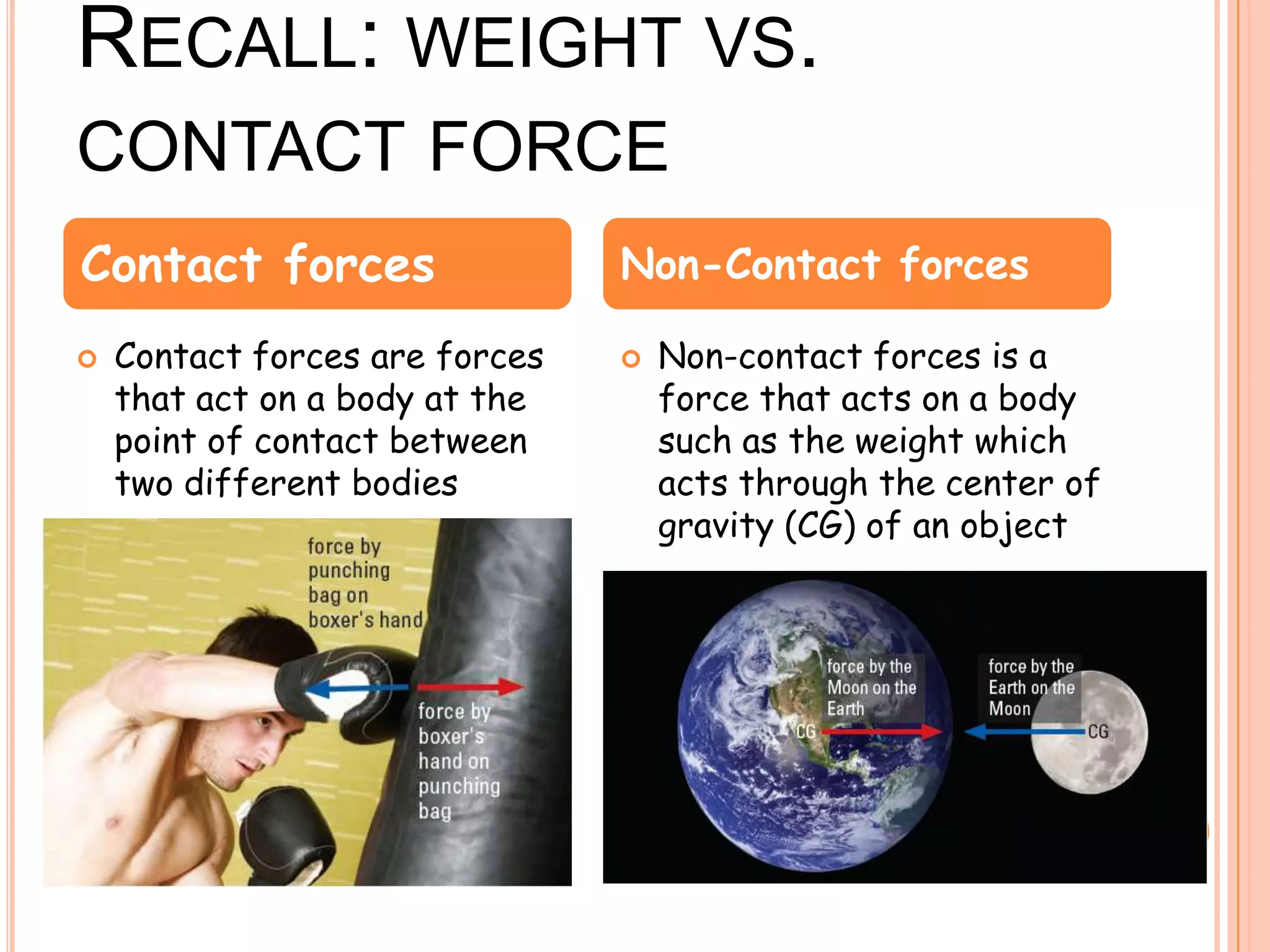
 Contact forces are forces
that act on a body at the
point of contact between
two different bodies
 Non-contact forces is a
force that acts on a body
such as the weight which
acts through the center of
gravity (CG) of an object
Contact forces Non-Contact forces
WHAT ARE THE FORCES ACTING
ON THE BODIES?
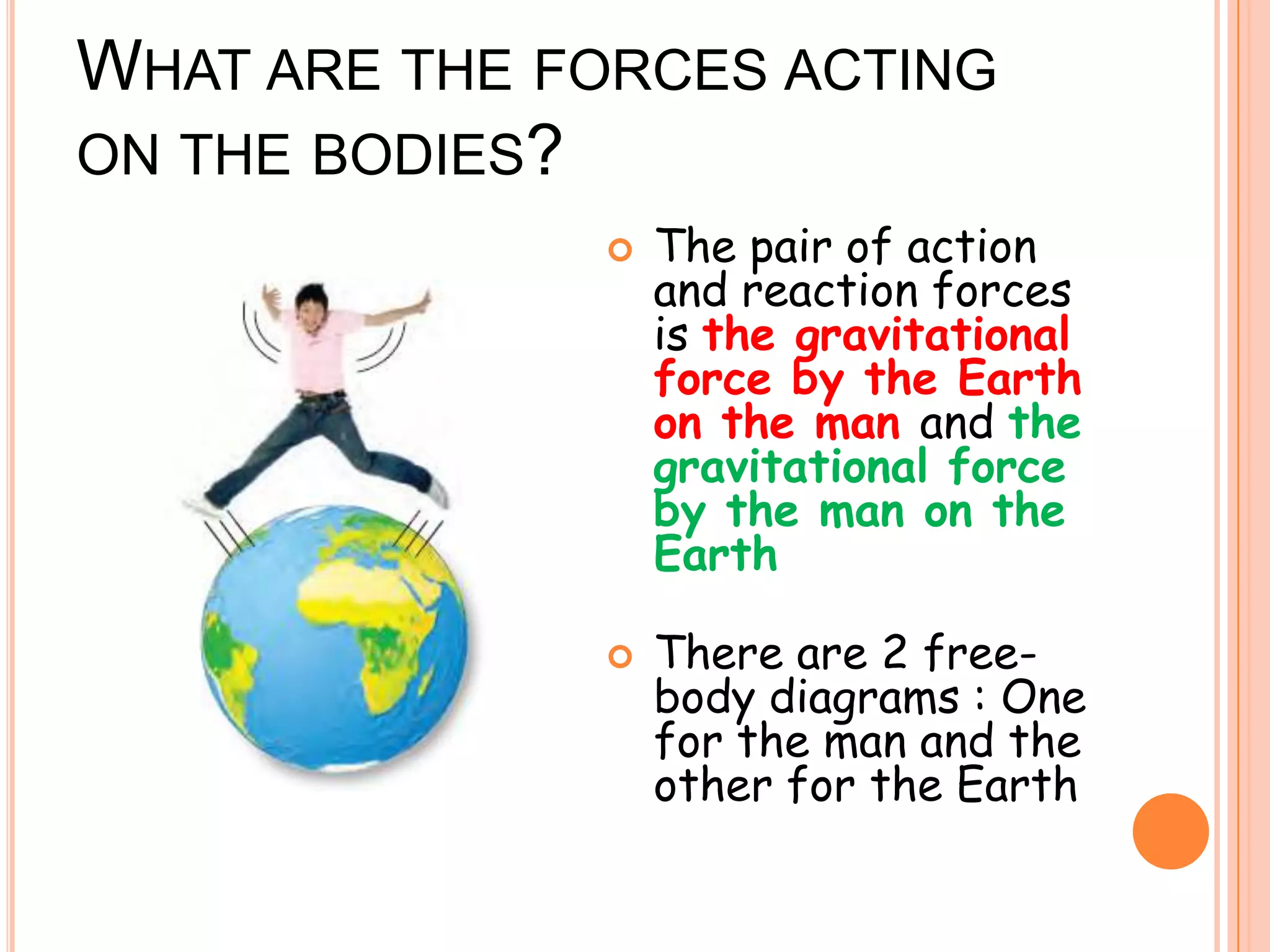
 The pair of action
and reaction forces
is the gravitational
force by the Earth
on the man and the
gravitational force
by the man on the
Earth
 There are 2 free-
body diagrams : One
for the man and the
other for the Earth
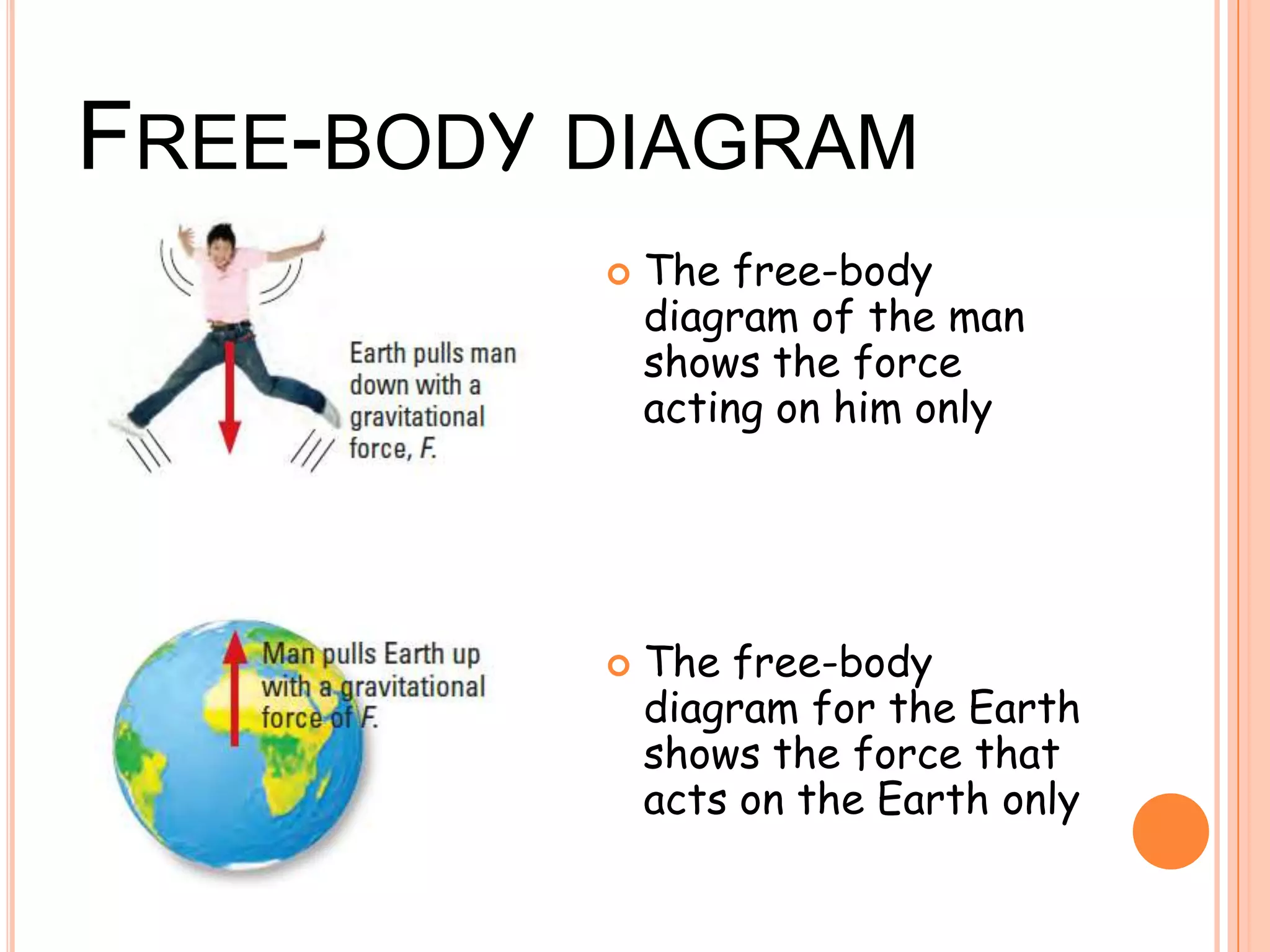
FREE-BODY DIAGRAM
 The free-body
diagram of the man
shows the force
acting on him only
 The free-body
diagram for the Earth
shows the force that
acts on the Earth only
WHAT ARE THE FORCES ACTING
ON THE BODIES?
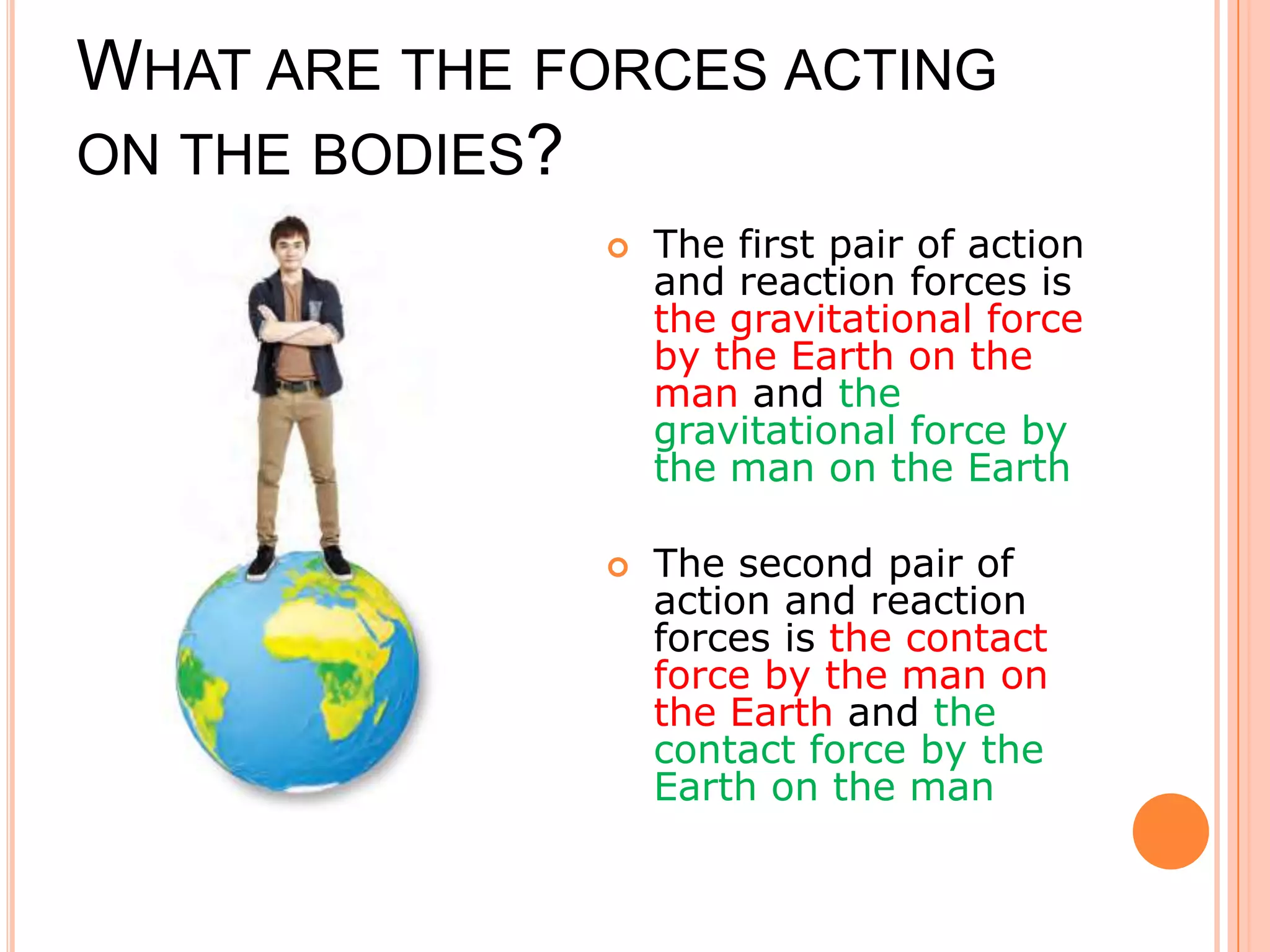
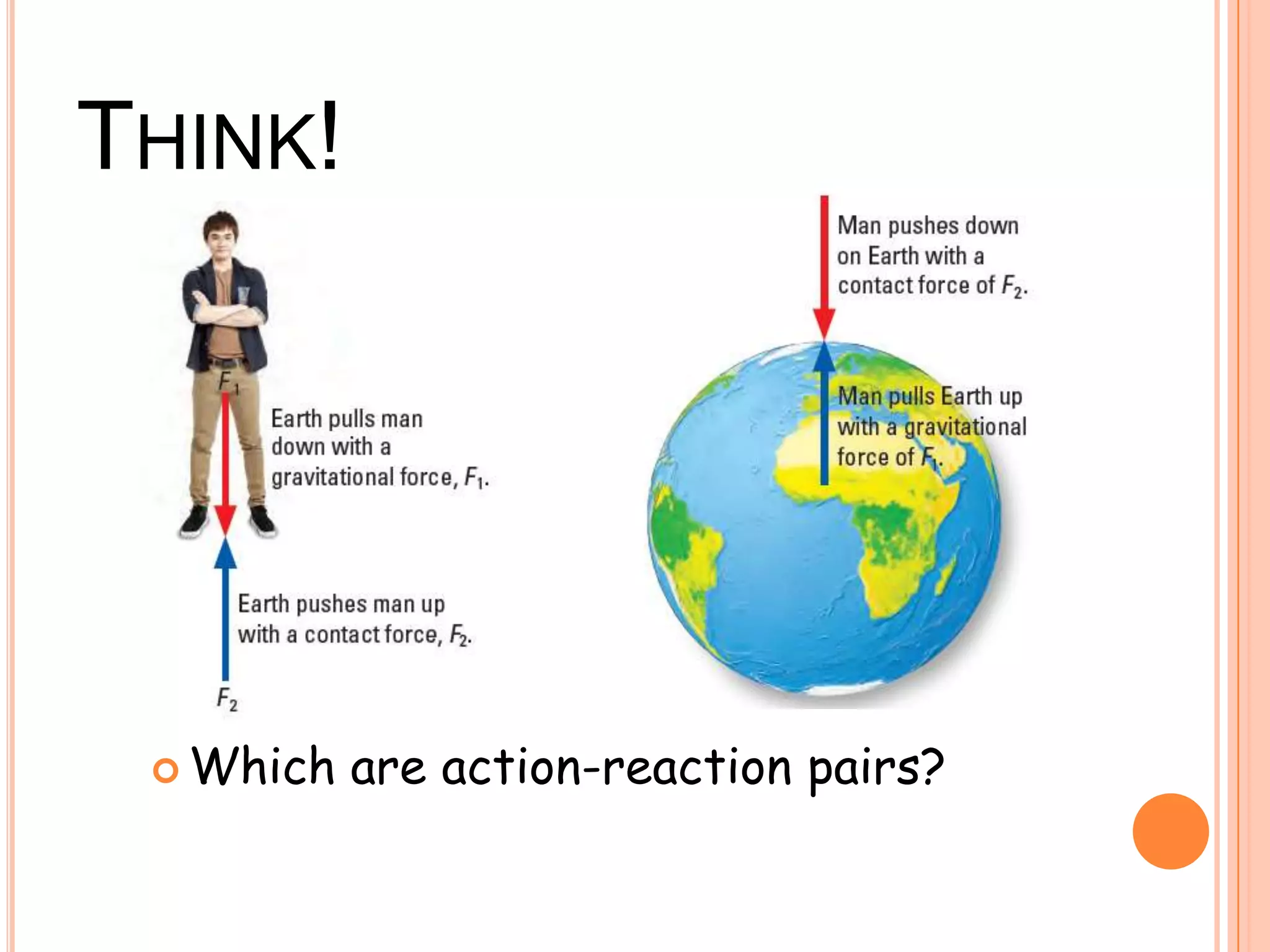
 The first pair of action
and reaction forces is
the gravitational force
by the Earth on the
man and the
gravitational force by
the man on the Earth
 The second pair of
action and reaction
forces is the contact
force by the man on
the Earth and the
contact force by the
Earth on the man
FREE-BODY DIAGRAM
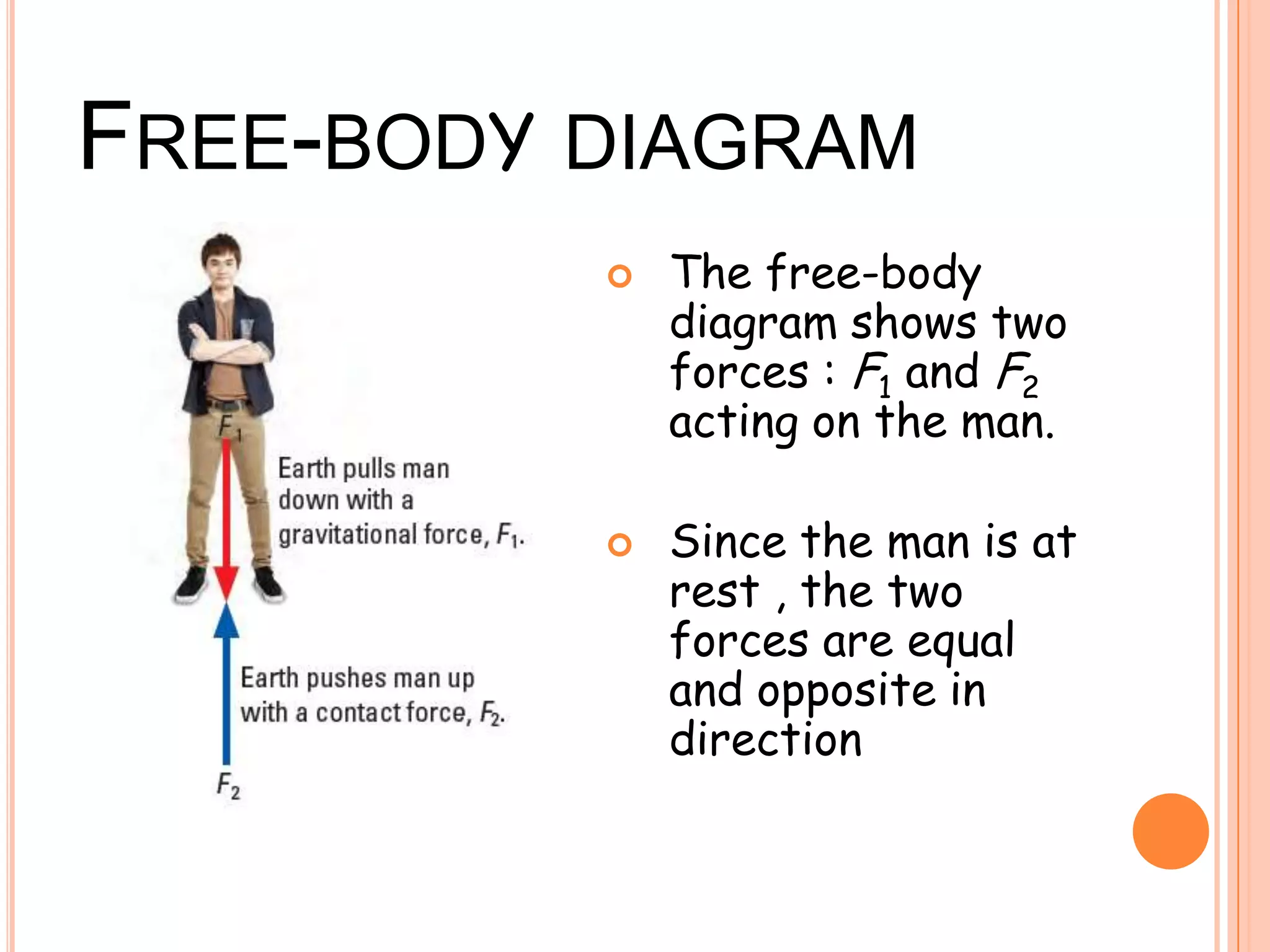
 The free-body
diagram shows two
forces : F1 and F2
acting on the man.
 Since the man is at
rest , the two
forces are equal
and opposite in
direction
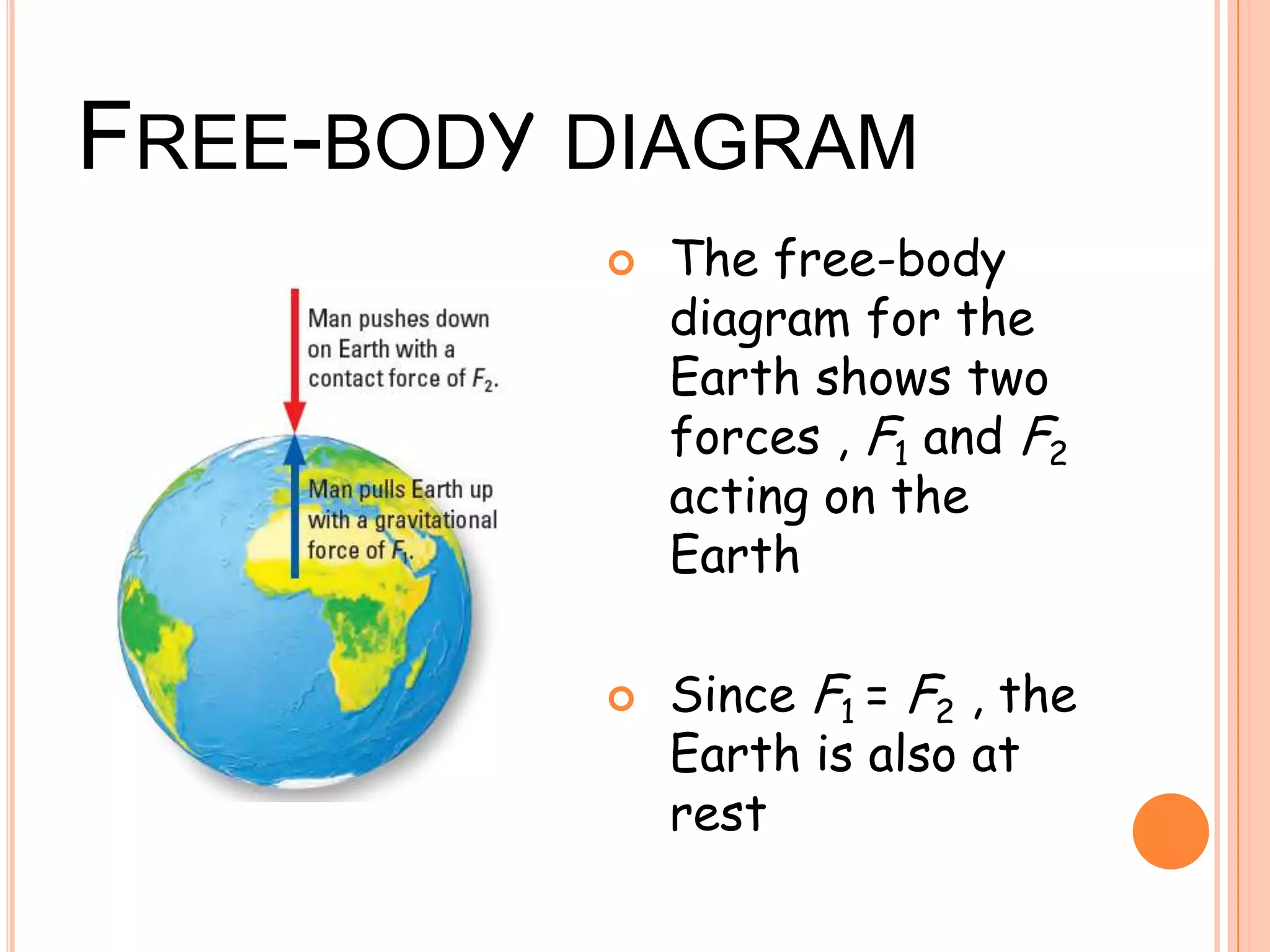
FREE-BODY DIAGRAM
 The free-body
diagram for the
Earth shows two
forces , F1 and F2
acting on the
Earth
 Since F1 = F2 , the
Earth is also at
rest
THINK!
 Which are action-reaction pairs?
WORKED EXAMPLES
 Gymnast
 2 boxes
 Lift
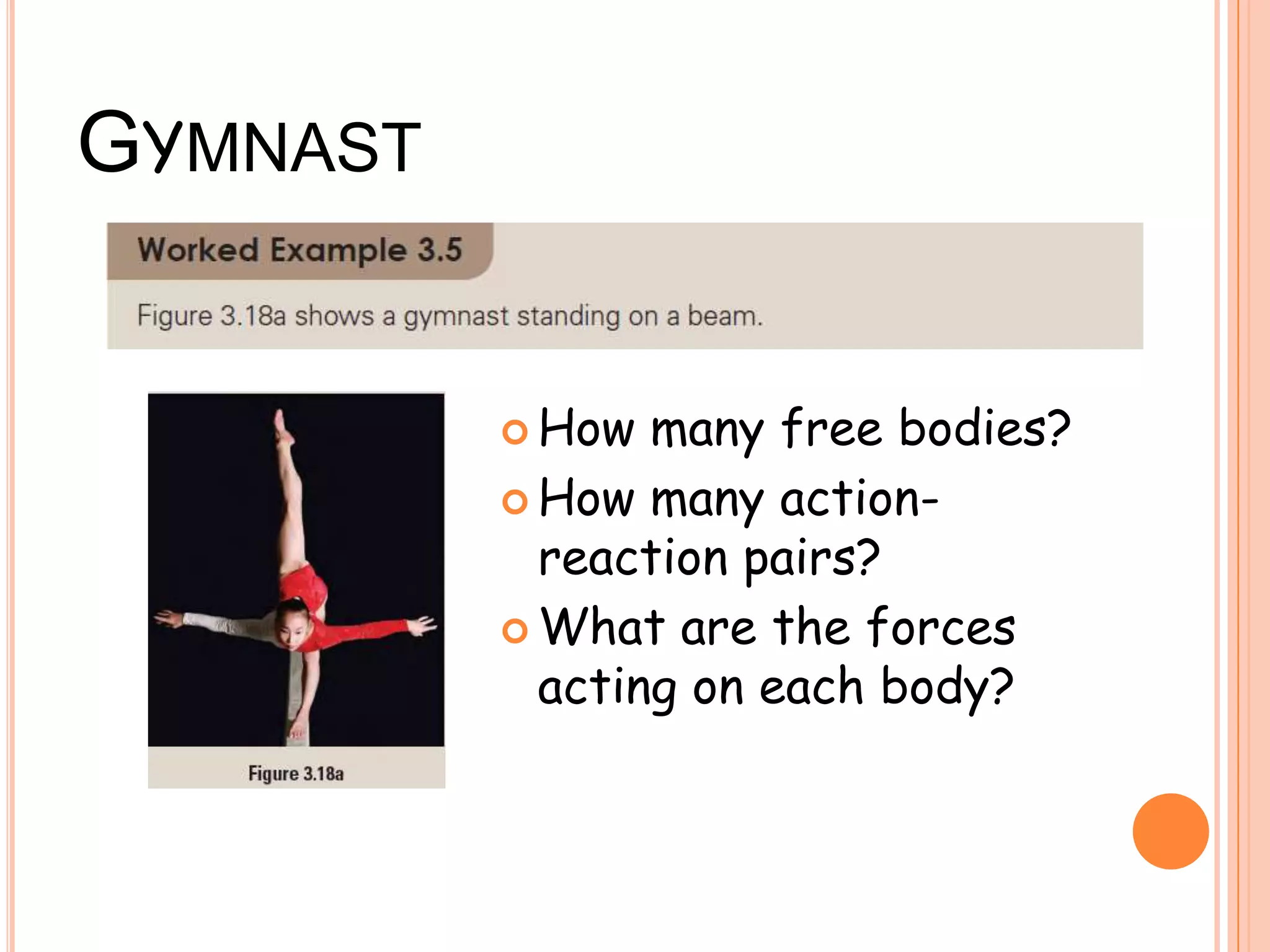
GYMNAST
 How many free bodies?
 How many action-
reaction pairs?
 What are the forces
acting on each body?
FREE BODY DIAGRAMS
Gymnast Beam
FREE BODY DIAGRAMS
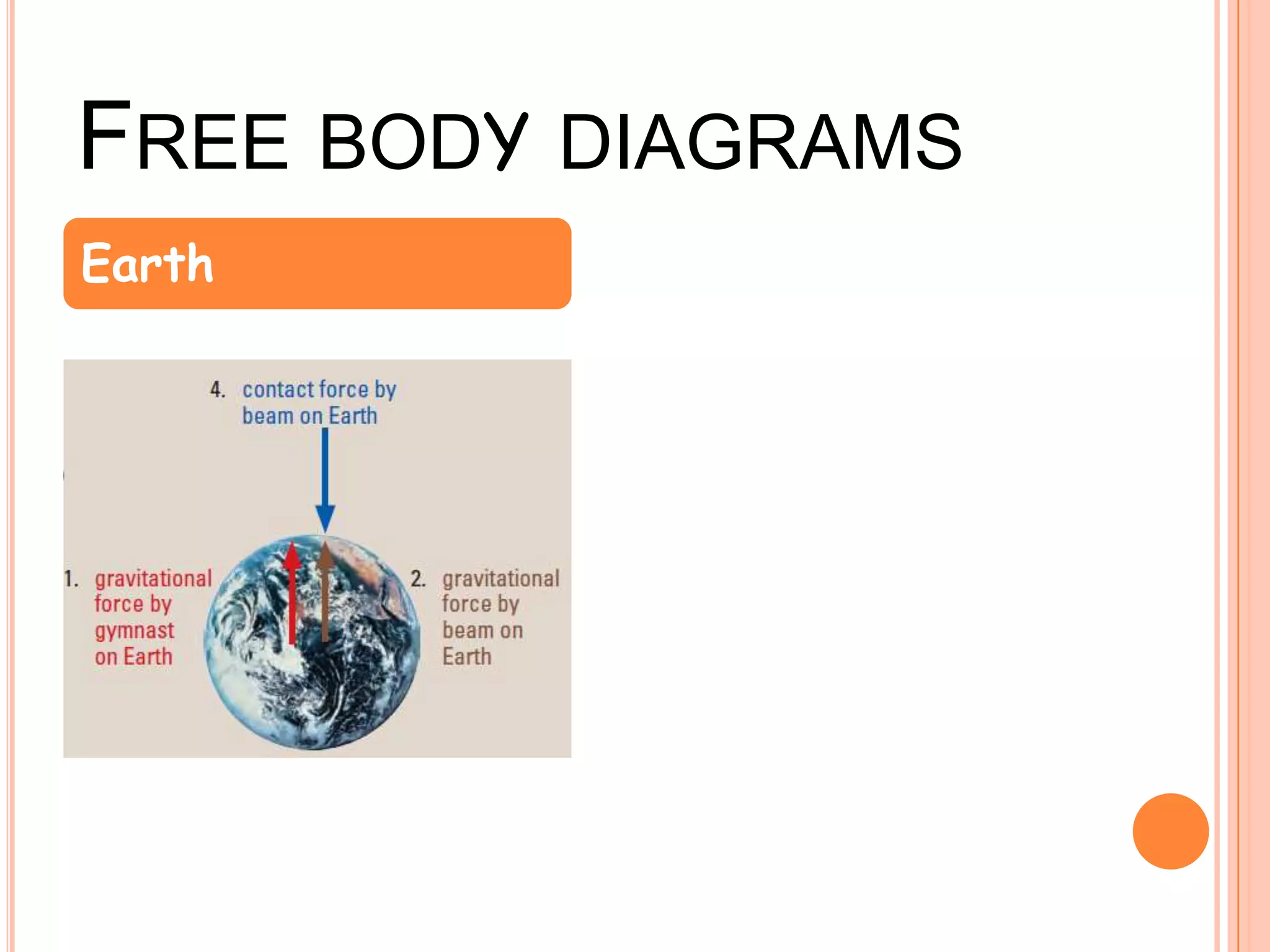
Earth
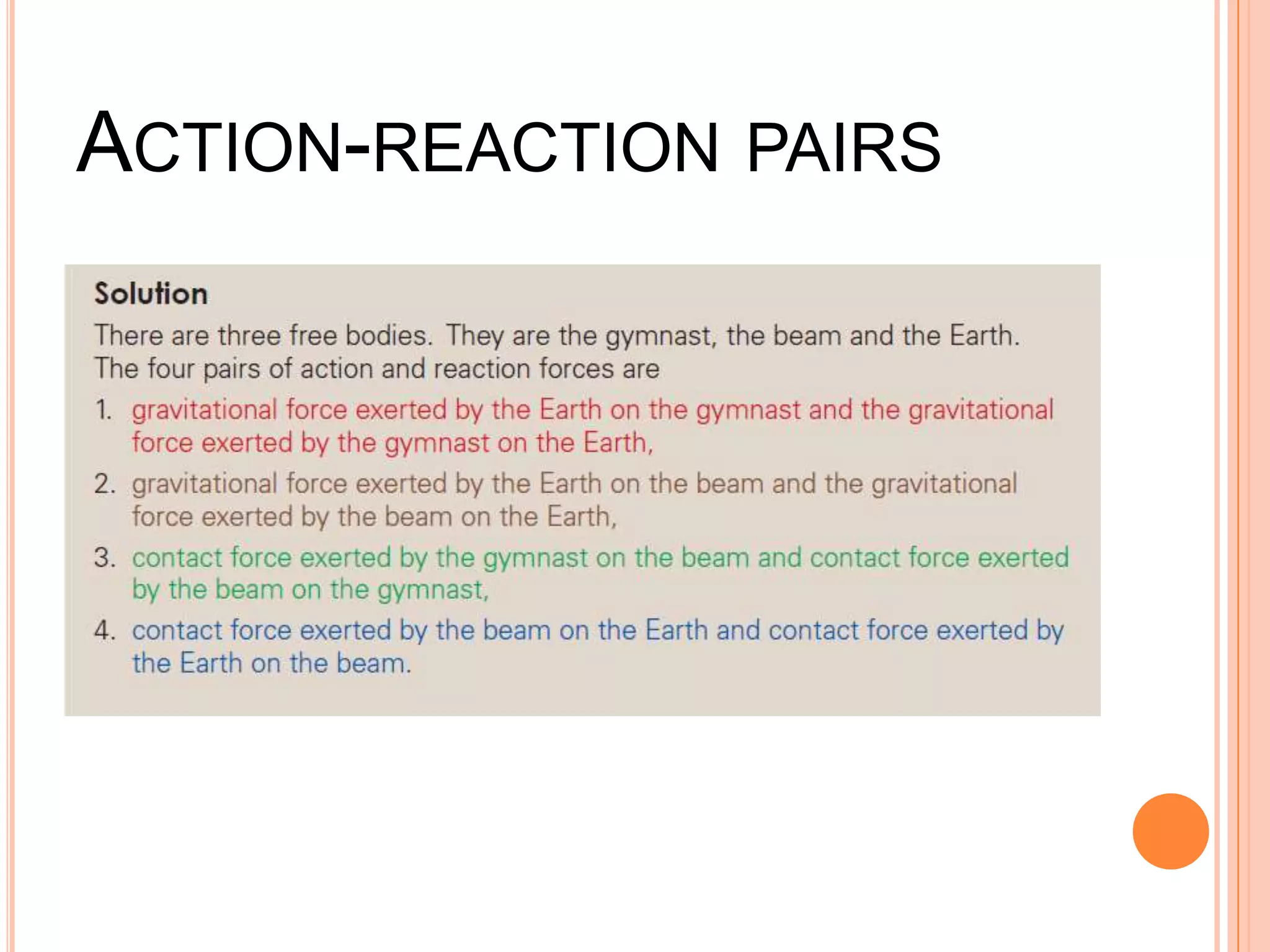
ACTION-REACTION PAIRS
TENSION
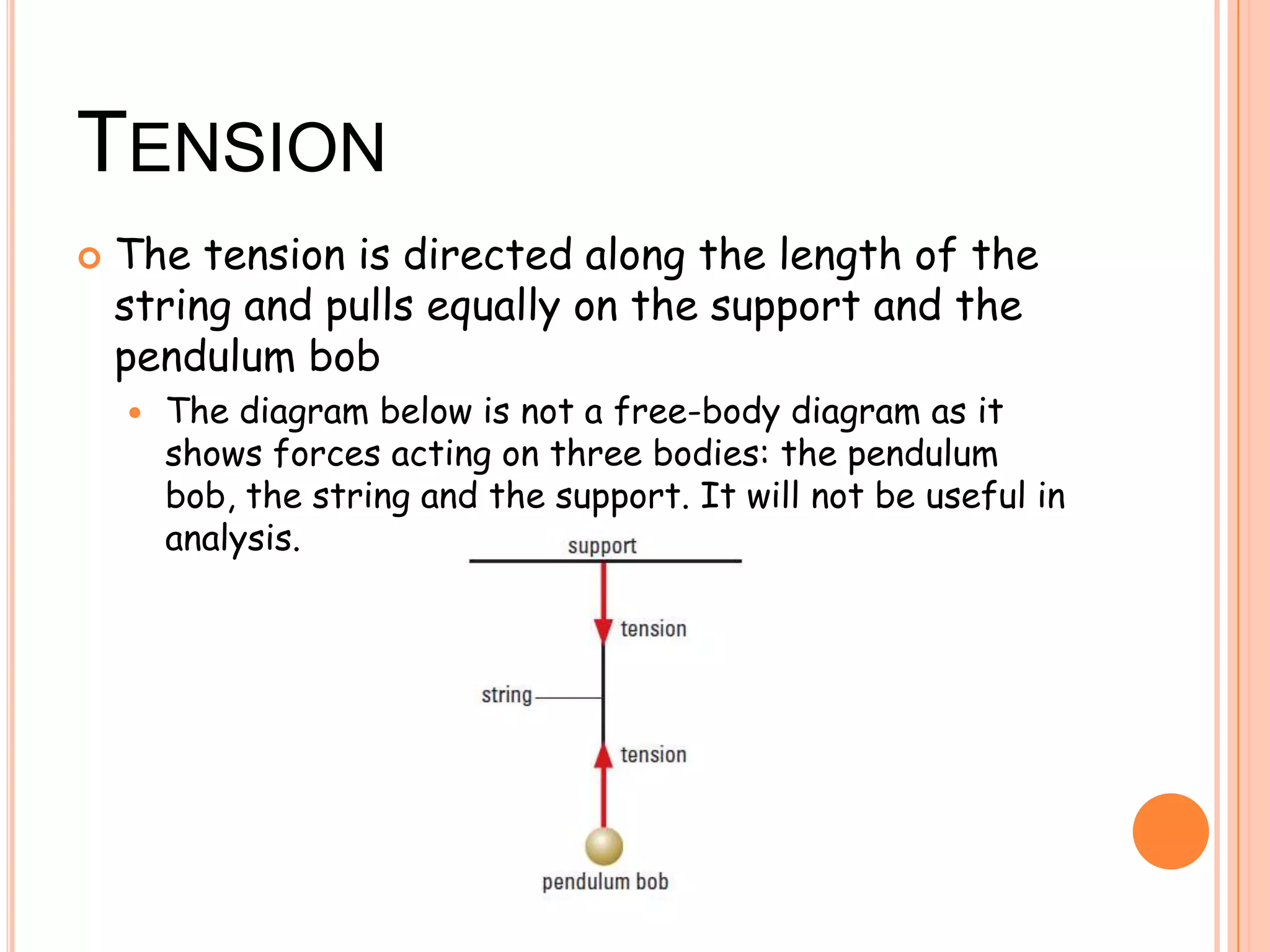
 The tension is directed along the length of the
string and pulls equally on the support and the
pendulum bob
 The diagram below is not a free-body diagram as it
shows forces acting on three bodies: the pendulum
bob, the string and the support. It will not be useful in
analysis.
TENSION
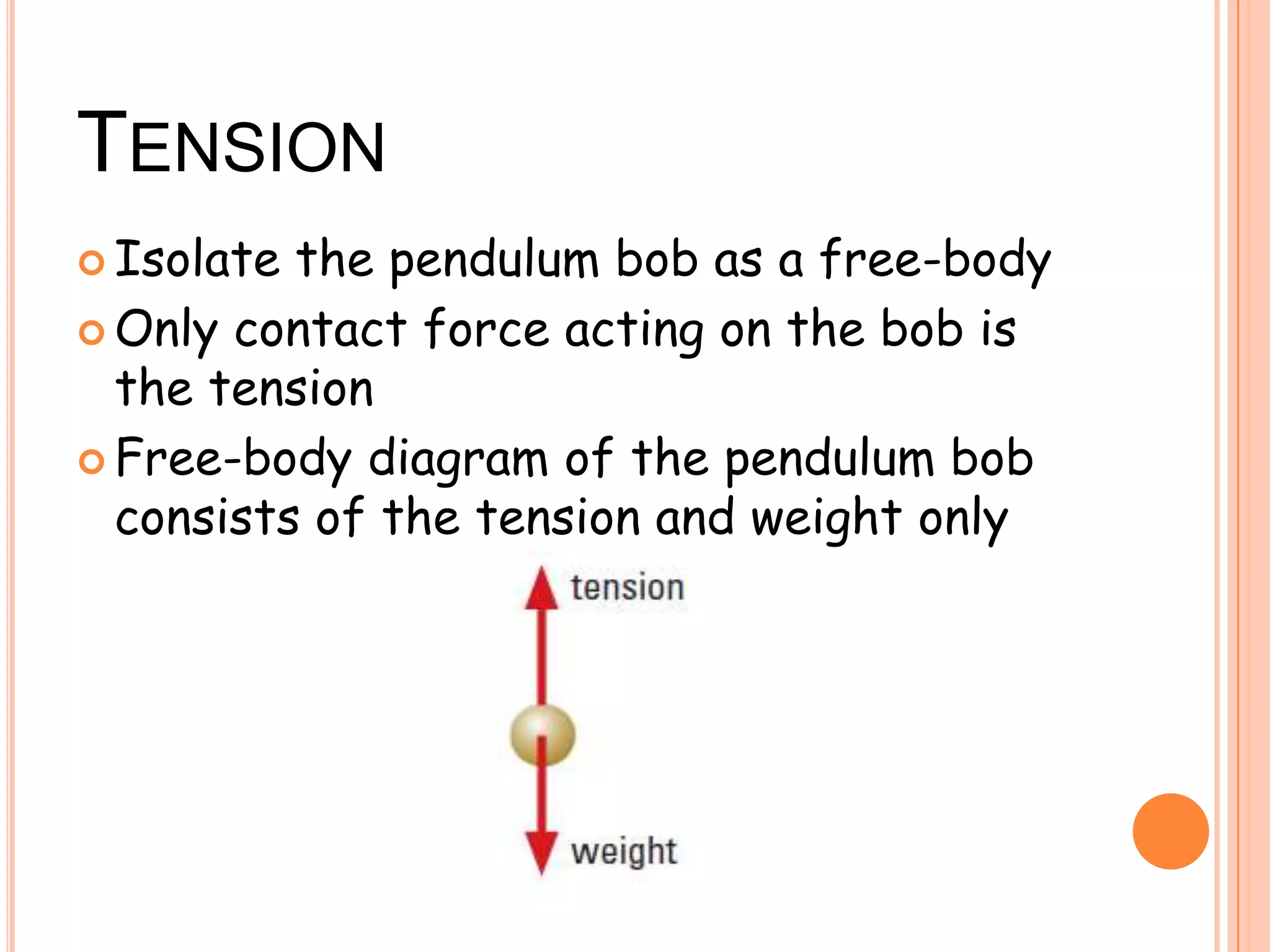
 Isolate the pendulum bob as a free-body
 Only contact force acting on the bob is
the tension
 Free-body diagram of the pendulum bob
consists of the tension and weight only
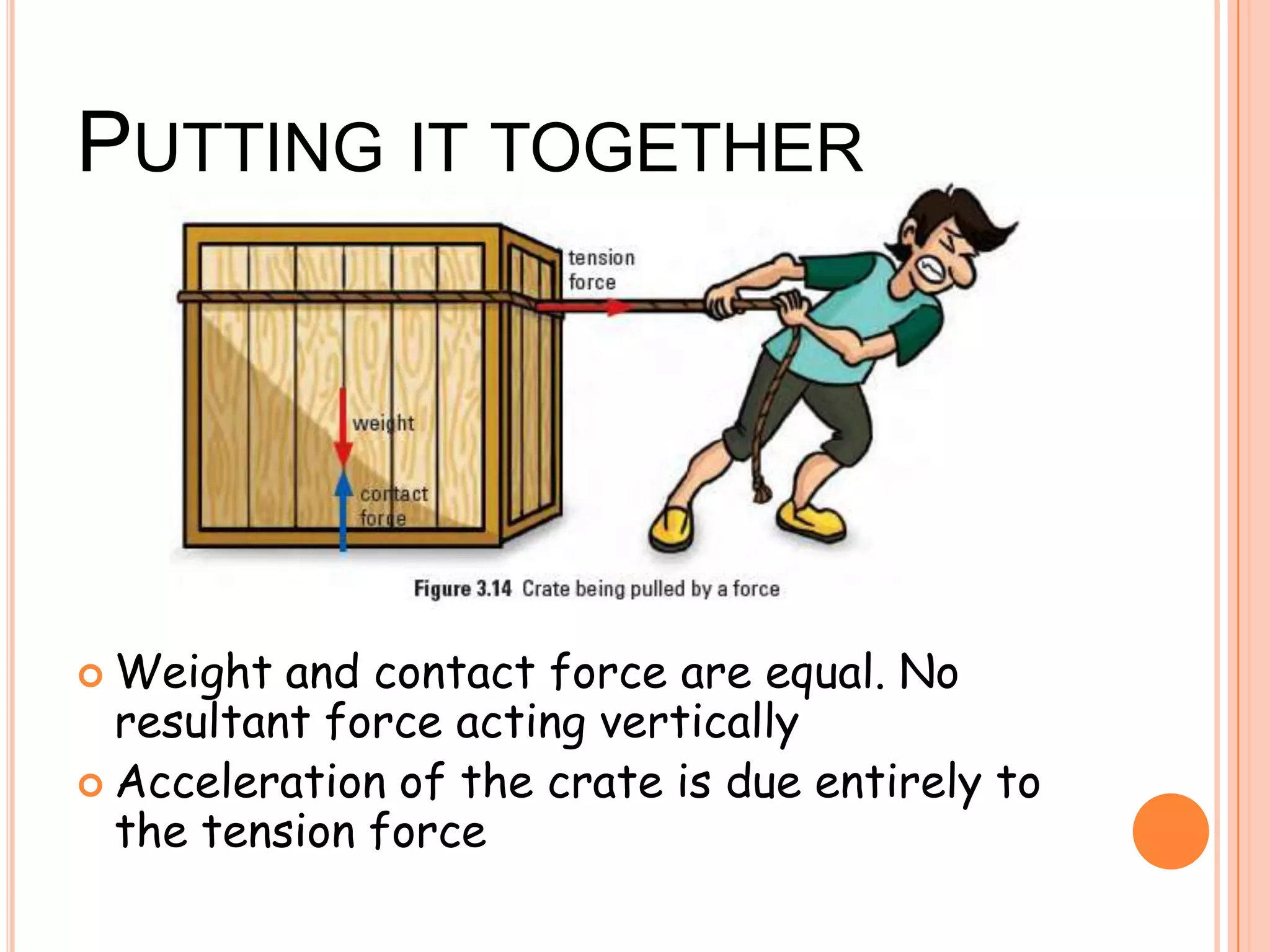
PUTTING IT TOGETHER
 Weight and contact force are equal. No
resultant force acting vertically
 Acceleration of the crate is due entirely to
the tension force
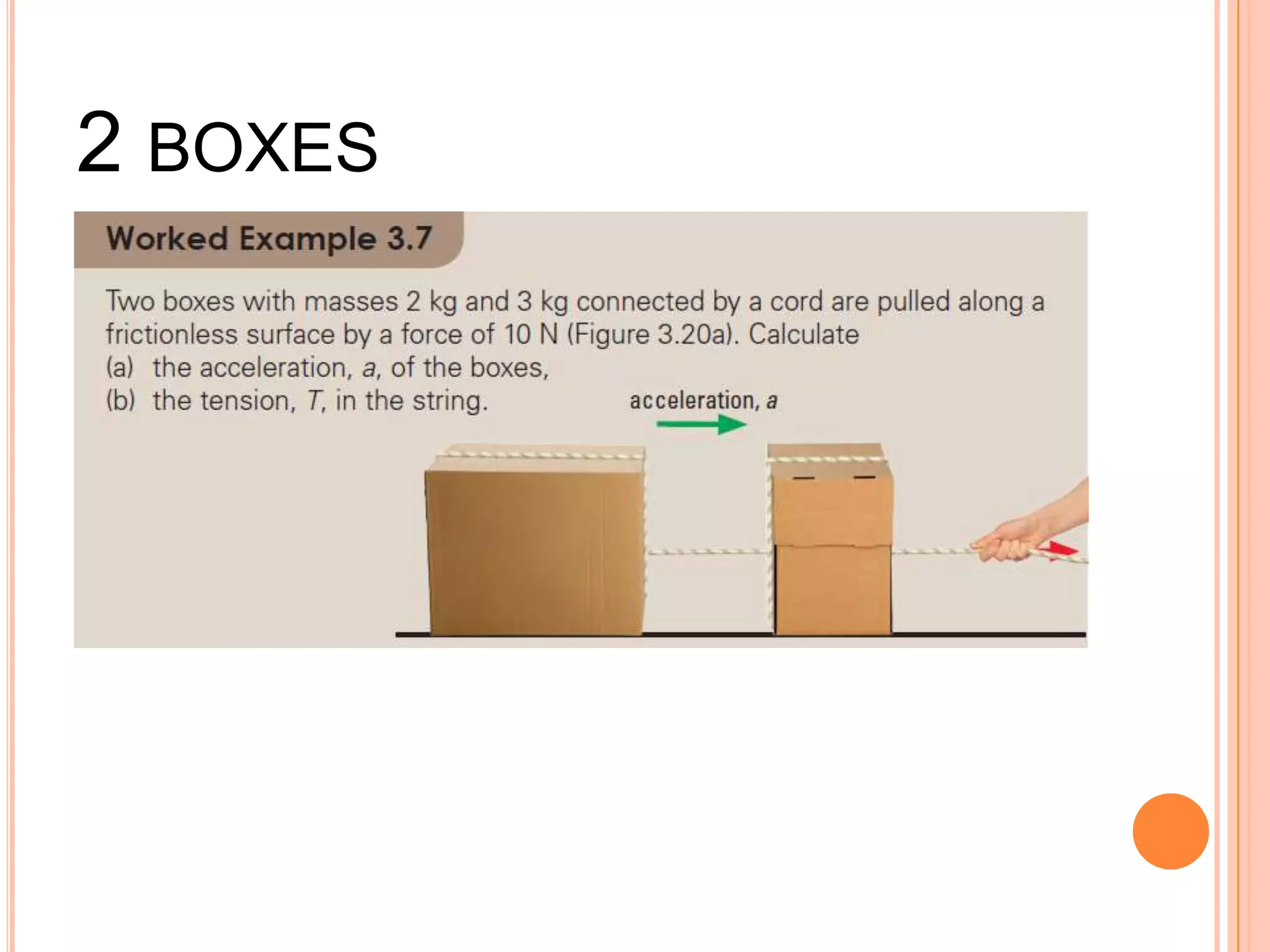
2 BOXES
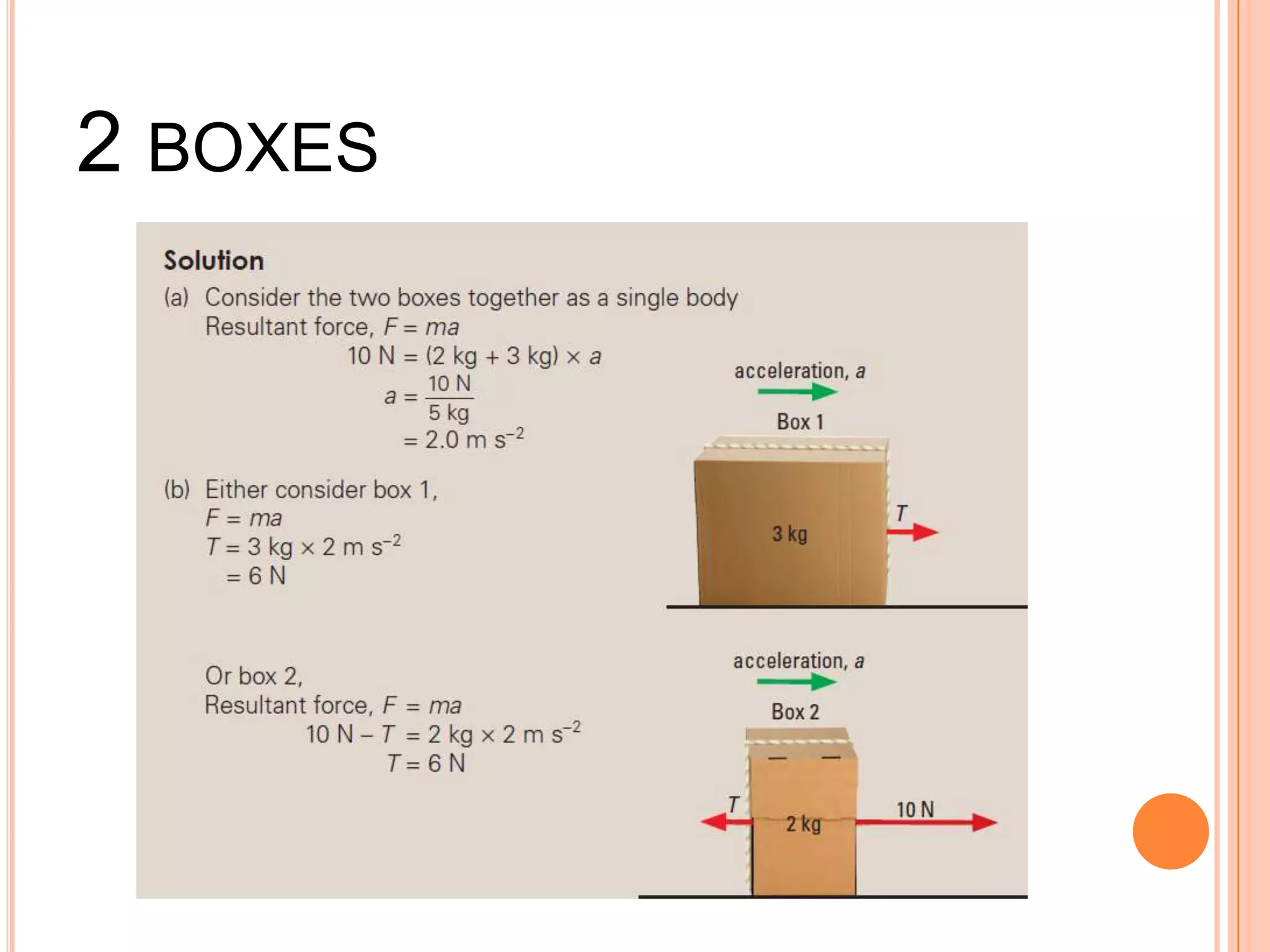
2 BOXES
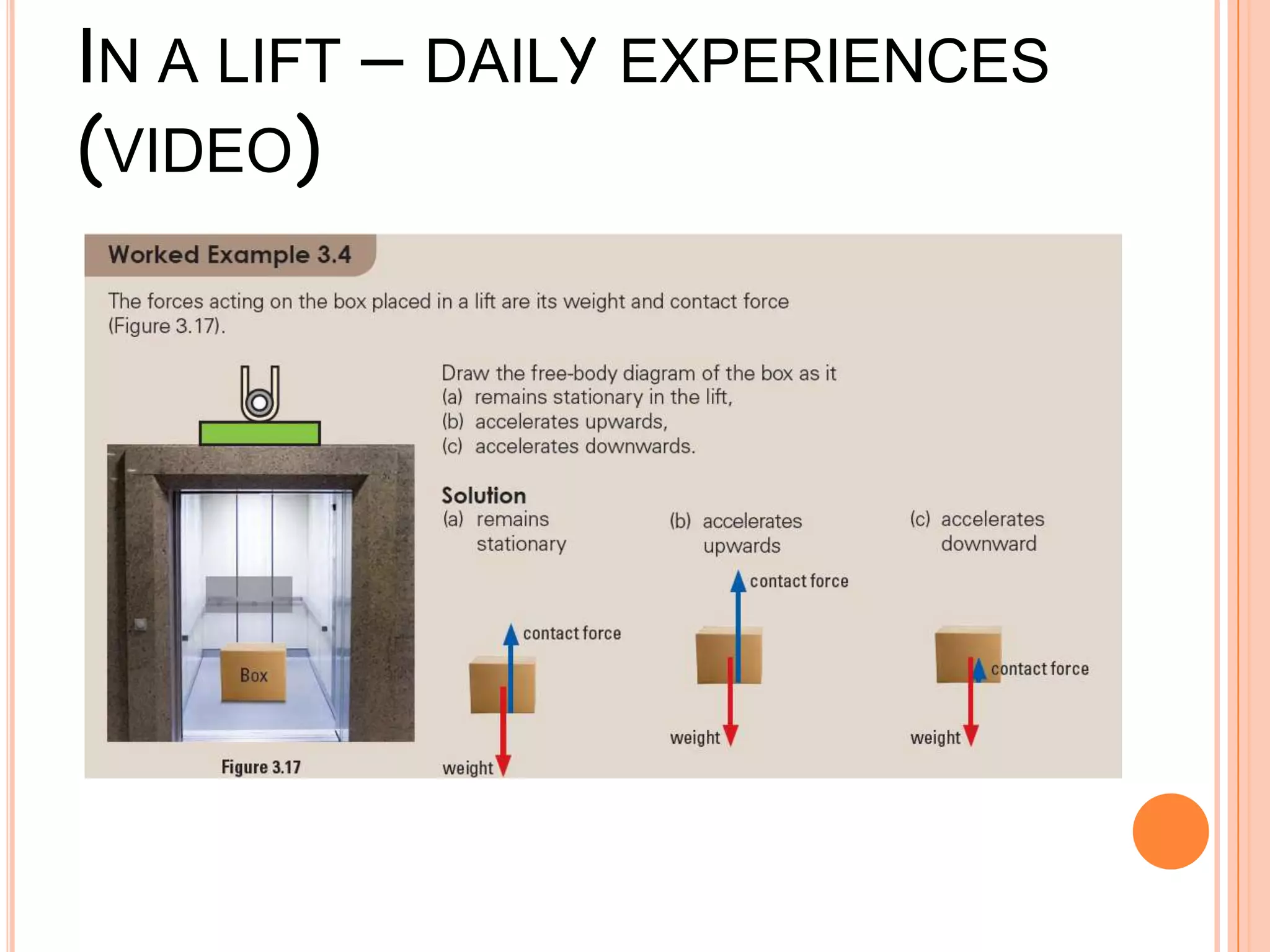
IN A LIFT – DAILY EXPERIENCES
(VIDEO)
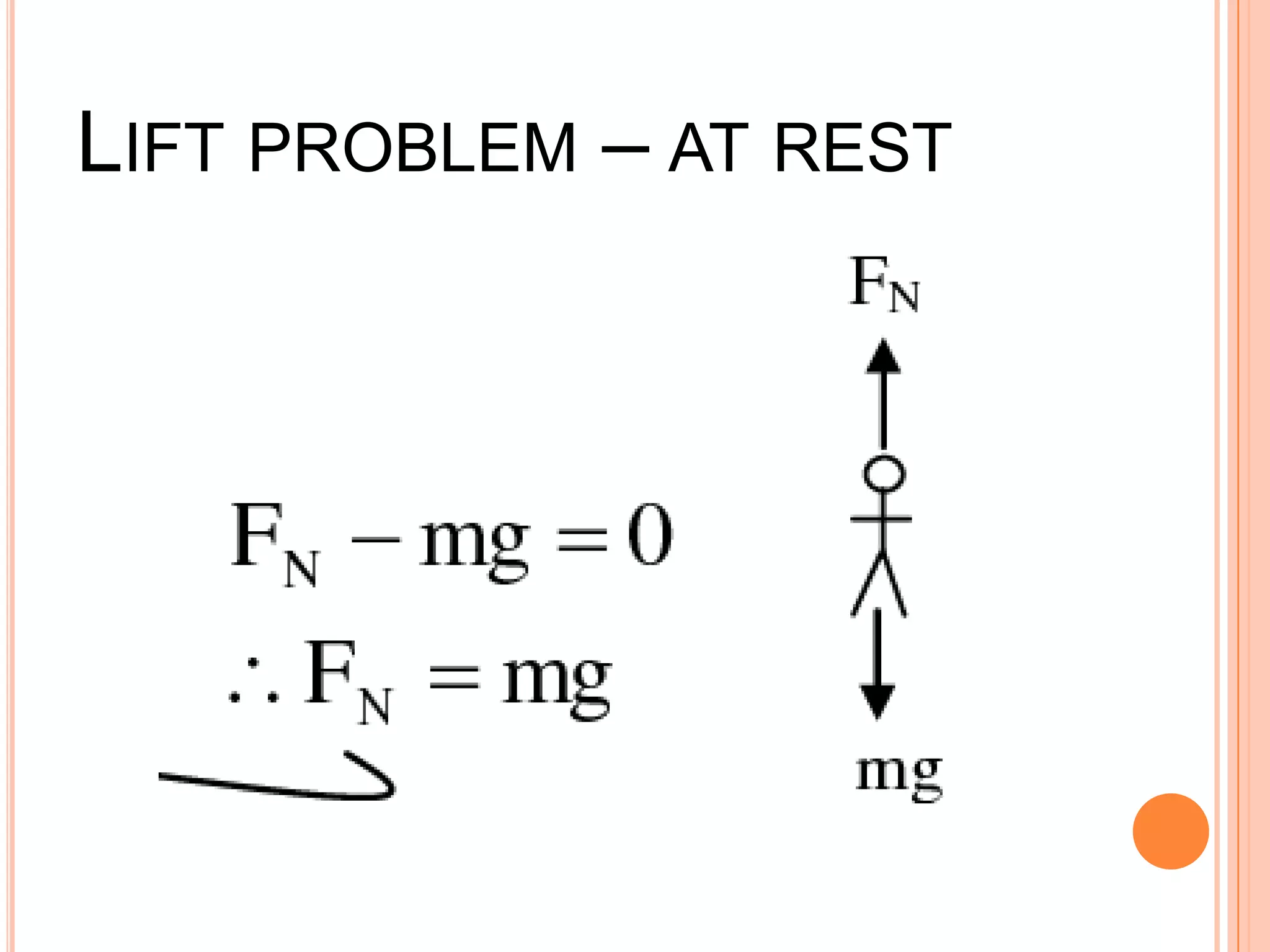
LIFT PROBLEM – AT REST
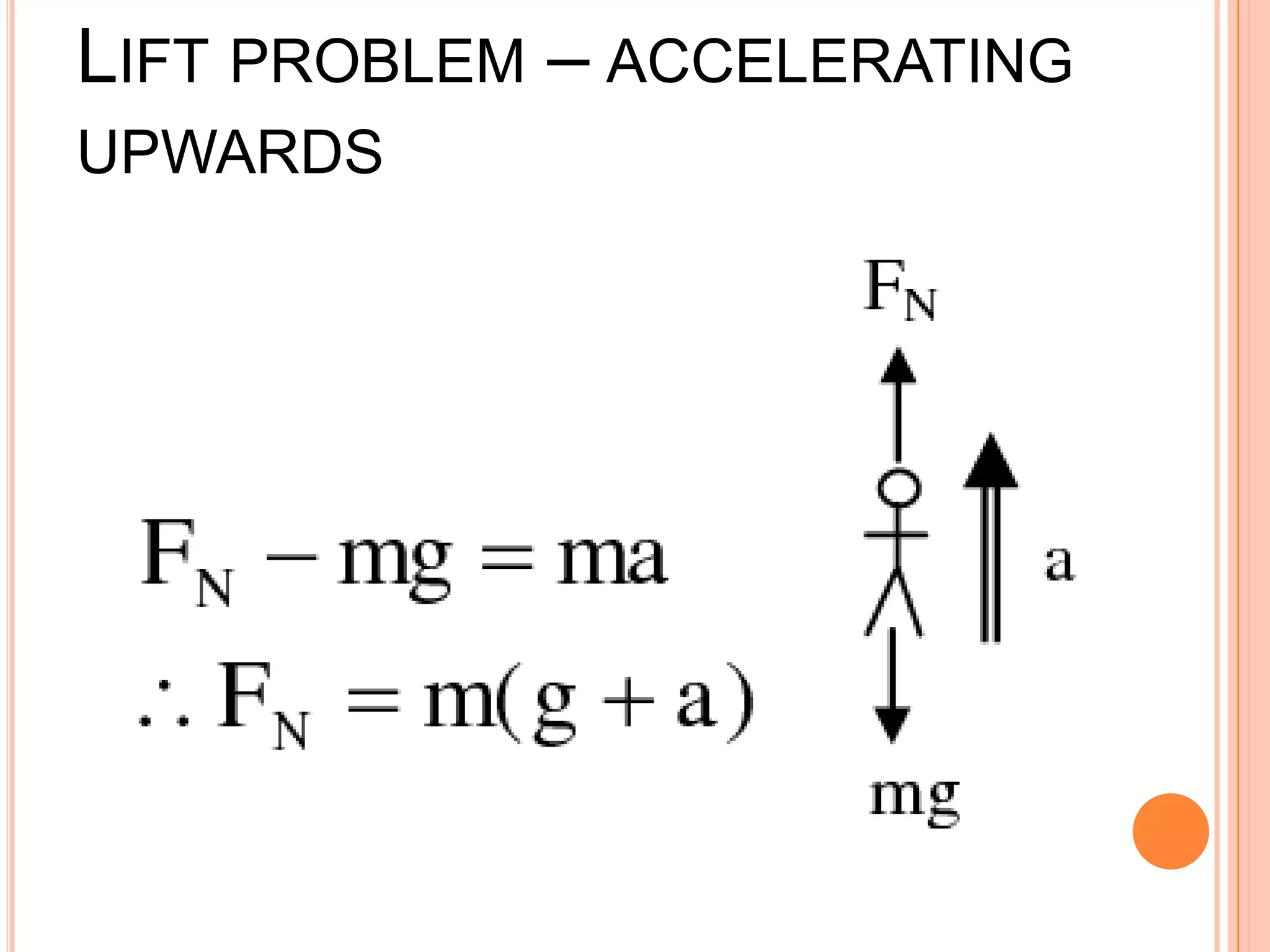
LIFT PROBLEM – ACCELERATING
UPWARDS
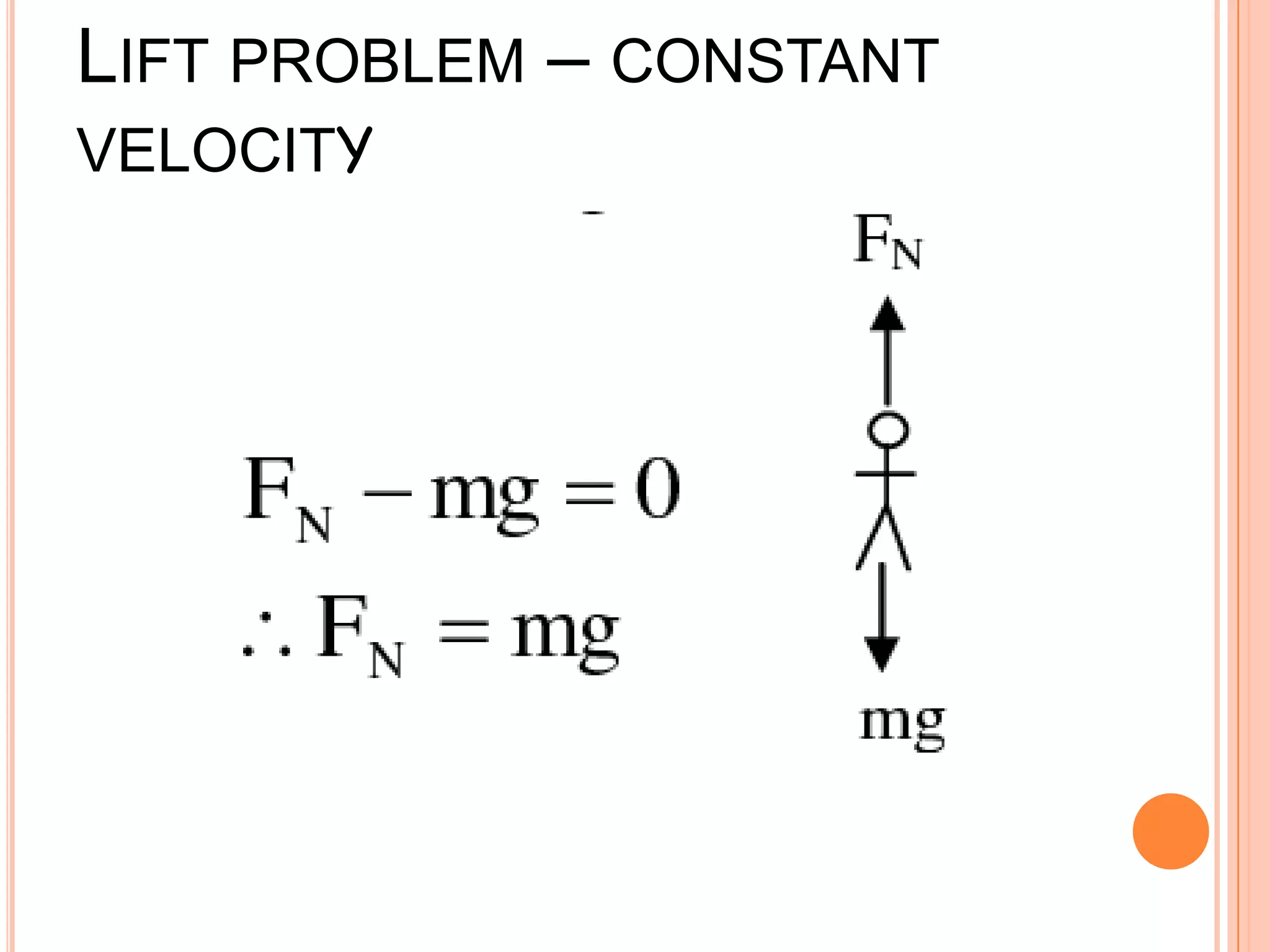
LIFT PROBLEM – CONSTANT
VELOCITY
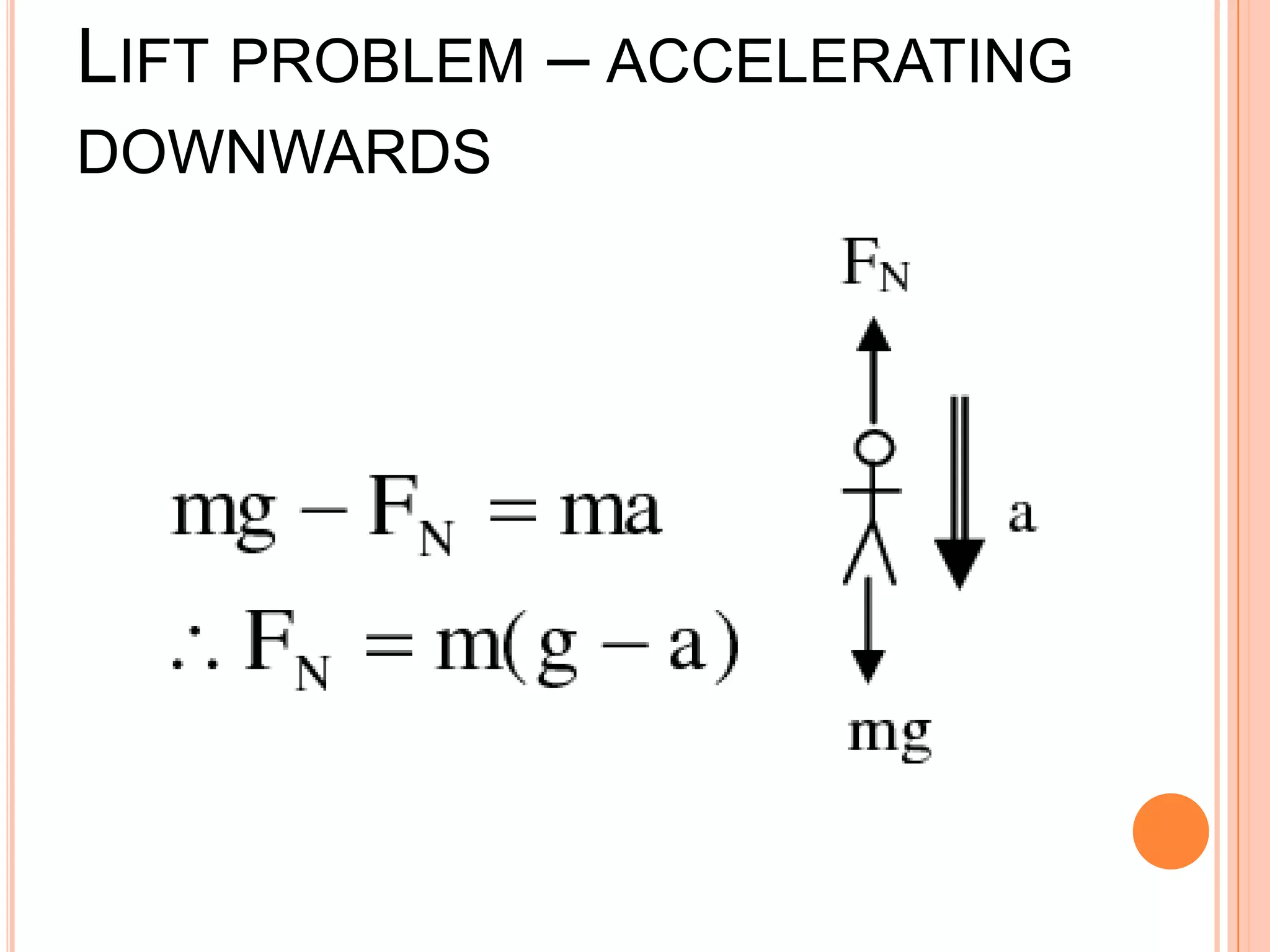
LIFT PROBLEM – ACCELERATING
DOWNWARDS
VECTOR DIAGRAMS
Recap
VECTOR DIAGRAMS
 2 scenarios
 Unbalanced
forces
 Balanced
forces
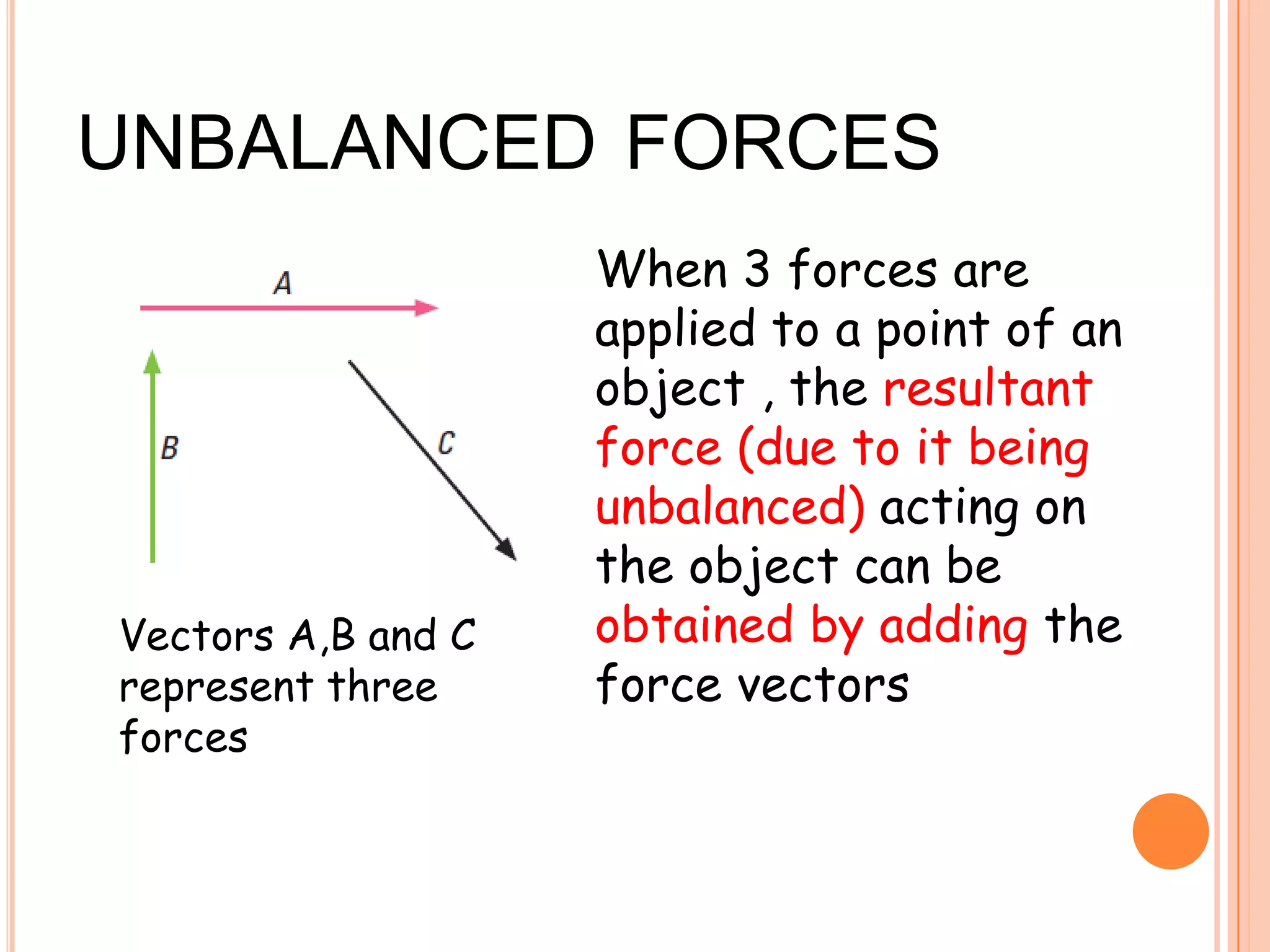
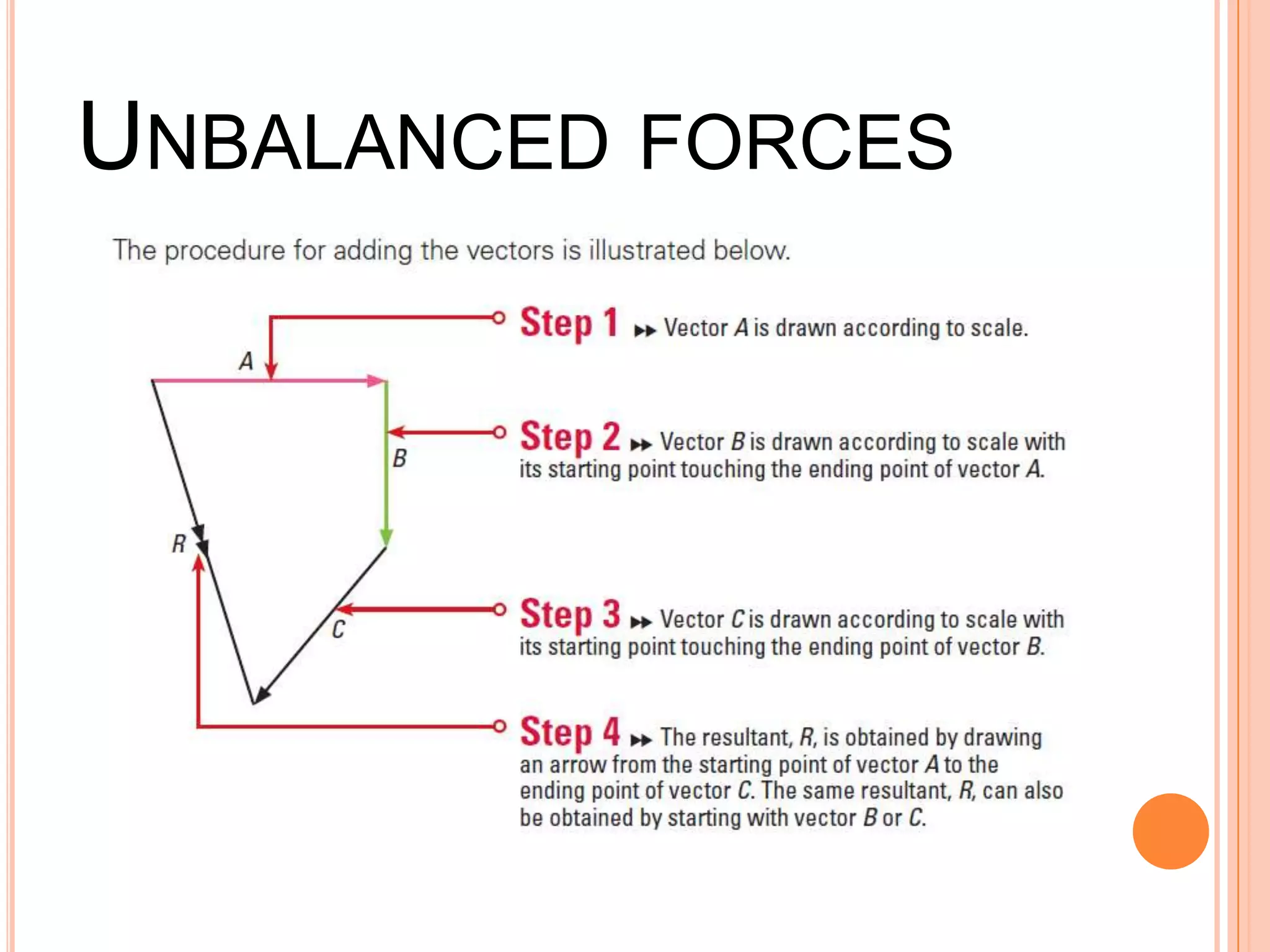
UNBALANCED FORCES
When 3 forces are
applied to a point of an
object , the resultant
force (due to it being
unbalanced) acting on
the object can be
obtained by adding the
force vectors
Vectors A,B and C
represent three
forces
UNBALANCED FORCES
BALANCED FORCES
• When 3 forces acting on an object is
balanced , resultant force is ________.
• There is no _________.
• An object will either ________ or
____________.
BALANCED FORCES
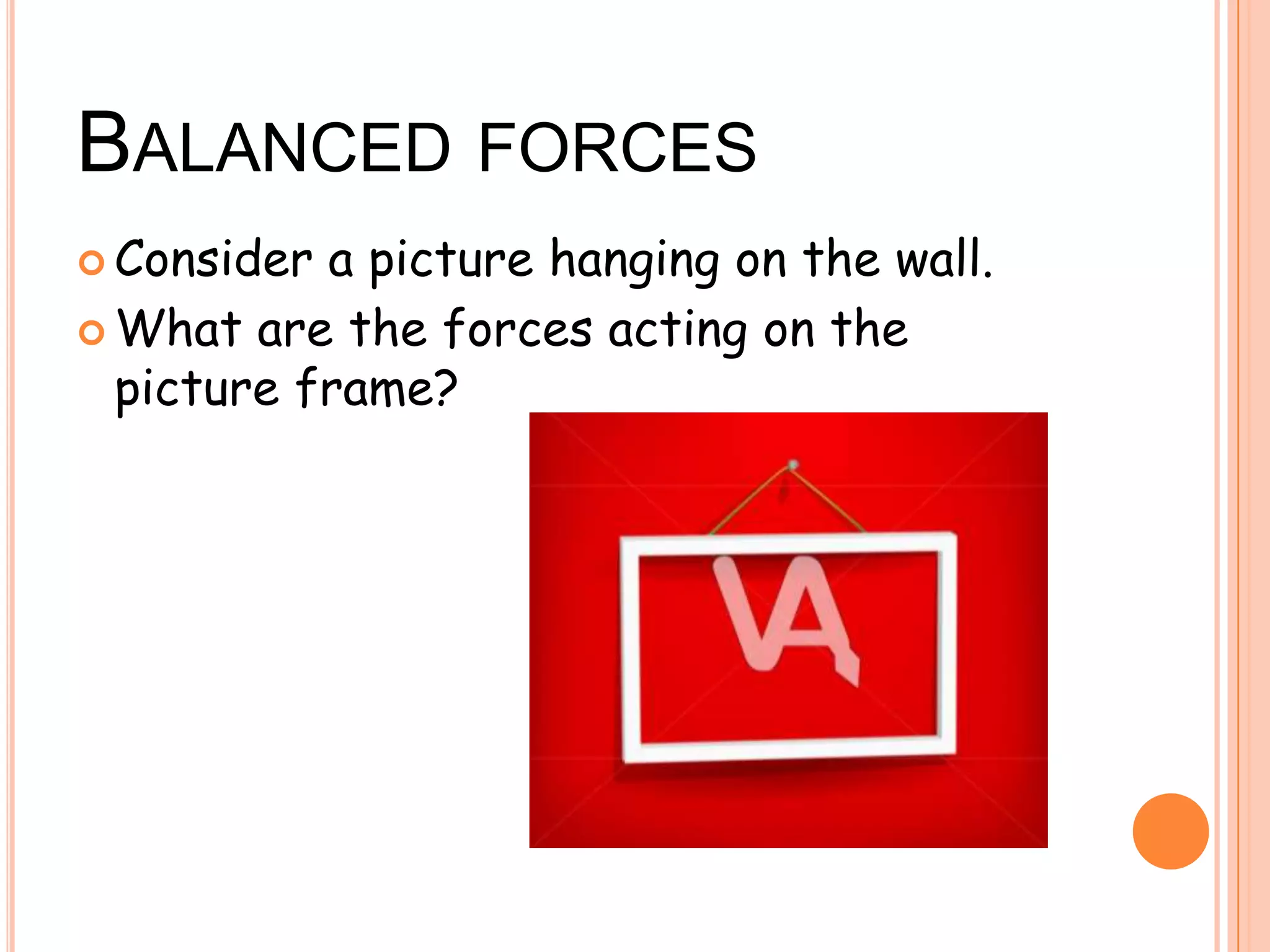
 Consider a picture hanging on the wall.
 What are the forces acting on the
picture frame?
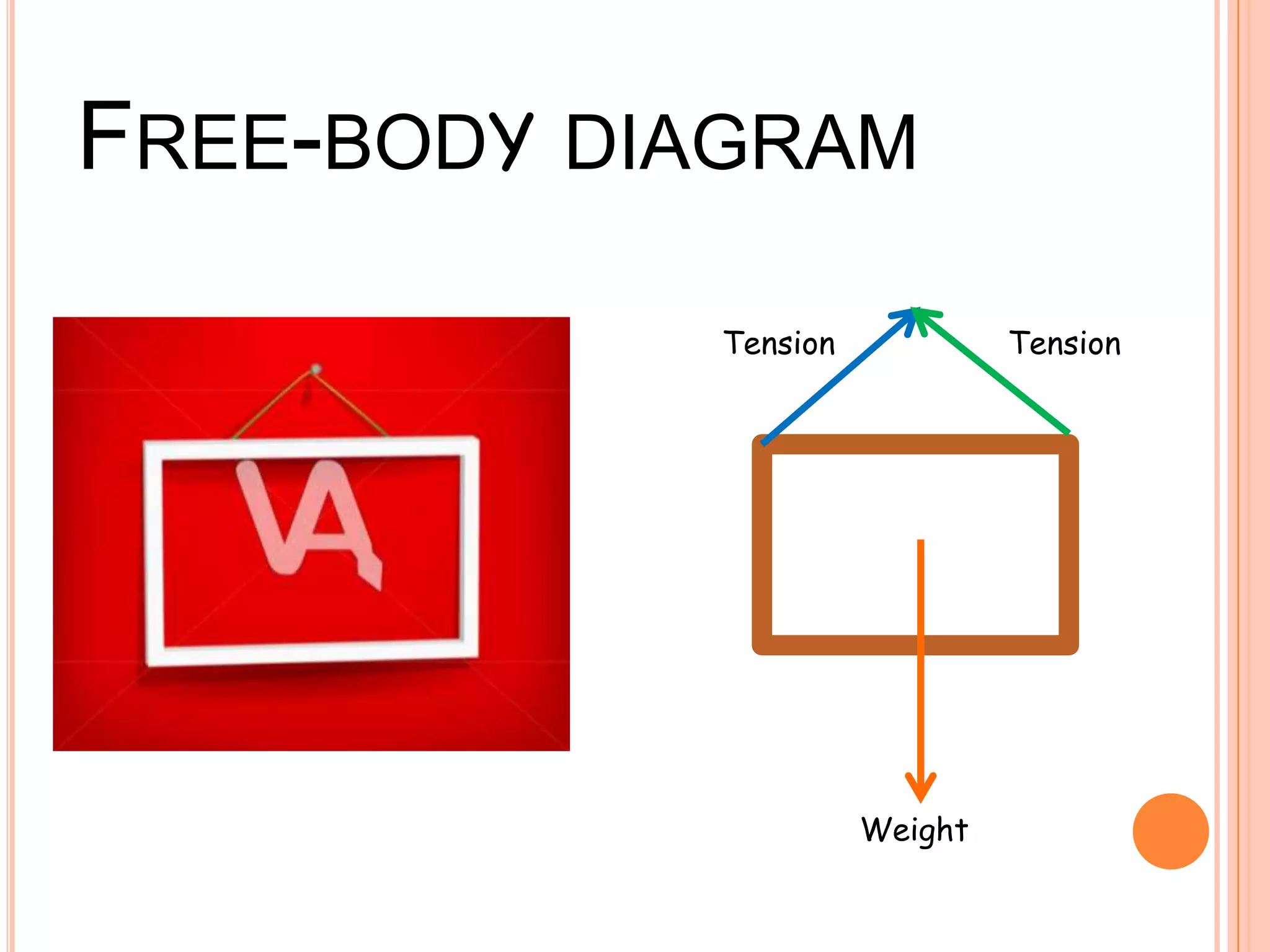
FREE-BODY DIAGRAM
Weight
Tension Tension
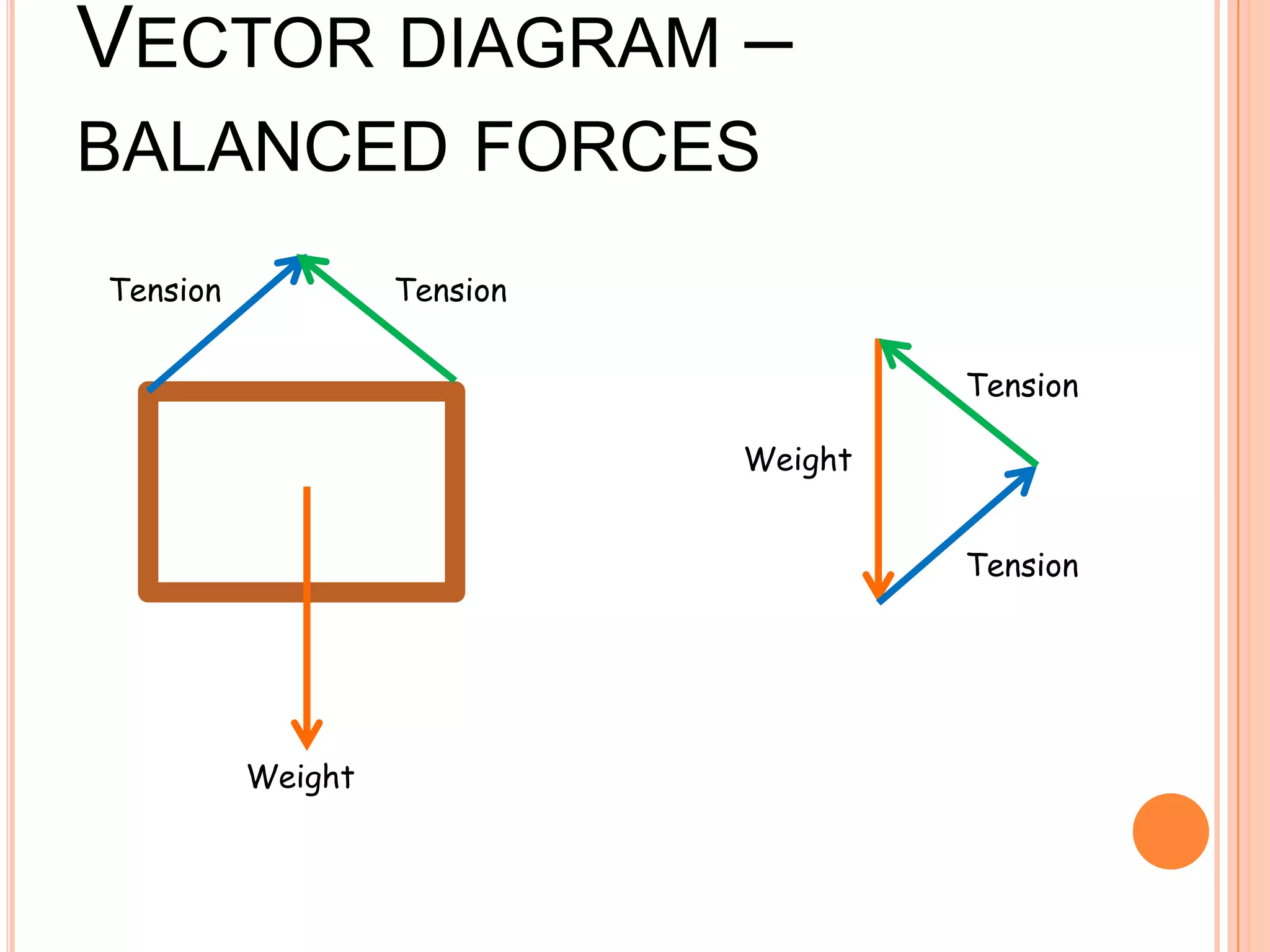
VECTOR DIAGRAM –
BALANCED FORCES
Weight
Tension Tension
Tension
Tension
Weight
UNBALANCED FORCES
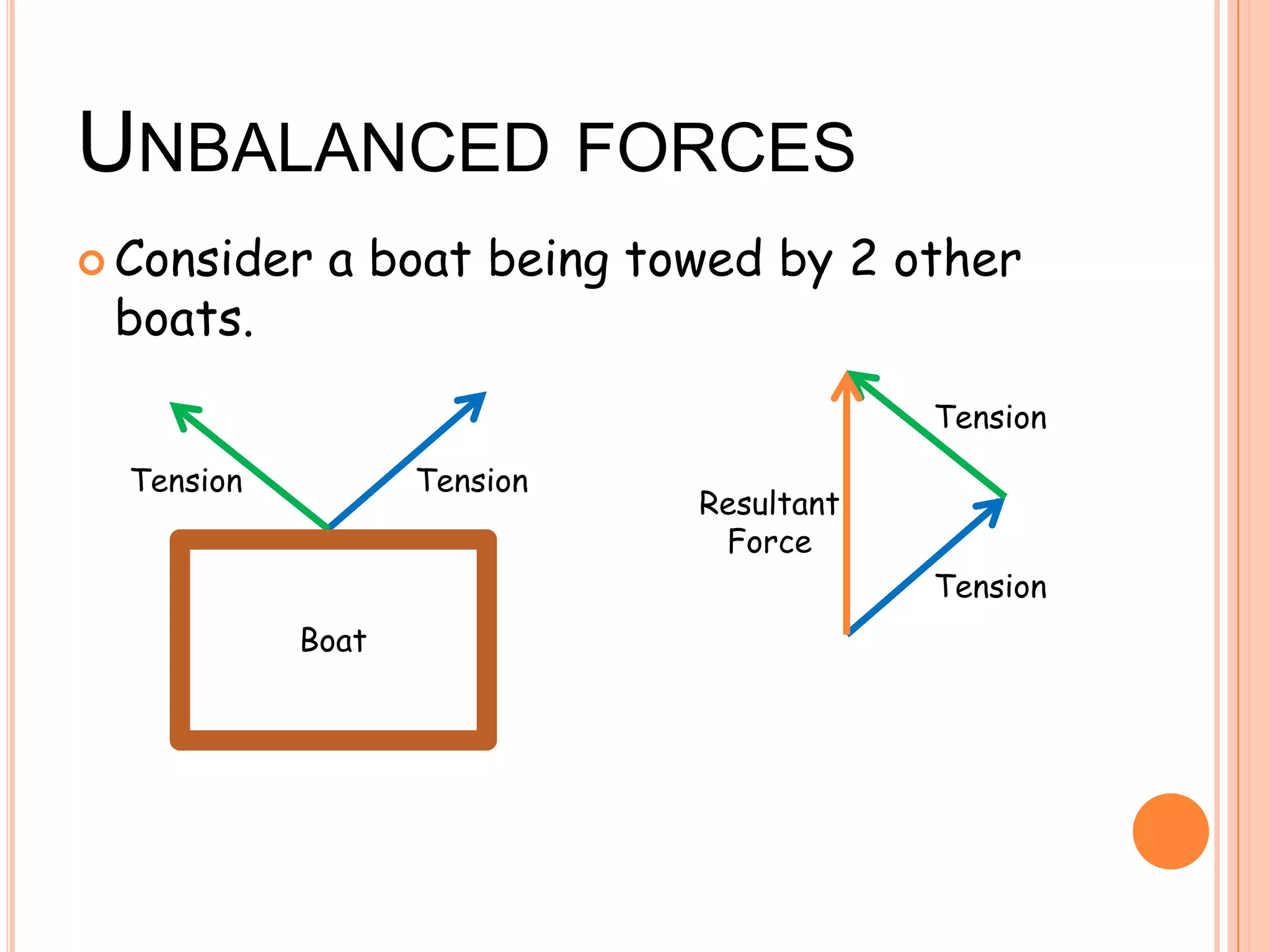
 Consider a boat being towed by 2 other
boats.
TensionTension
Boat
Tension
Tension
Resultant
Force
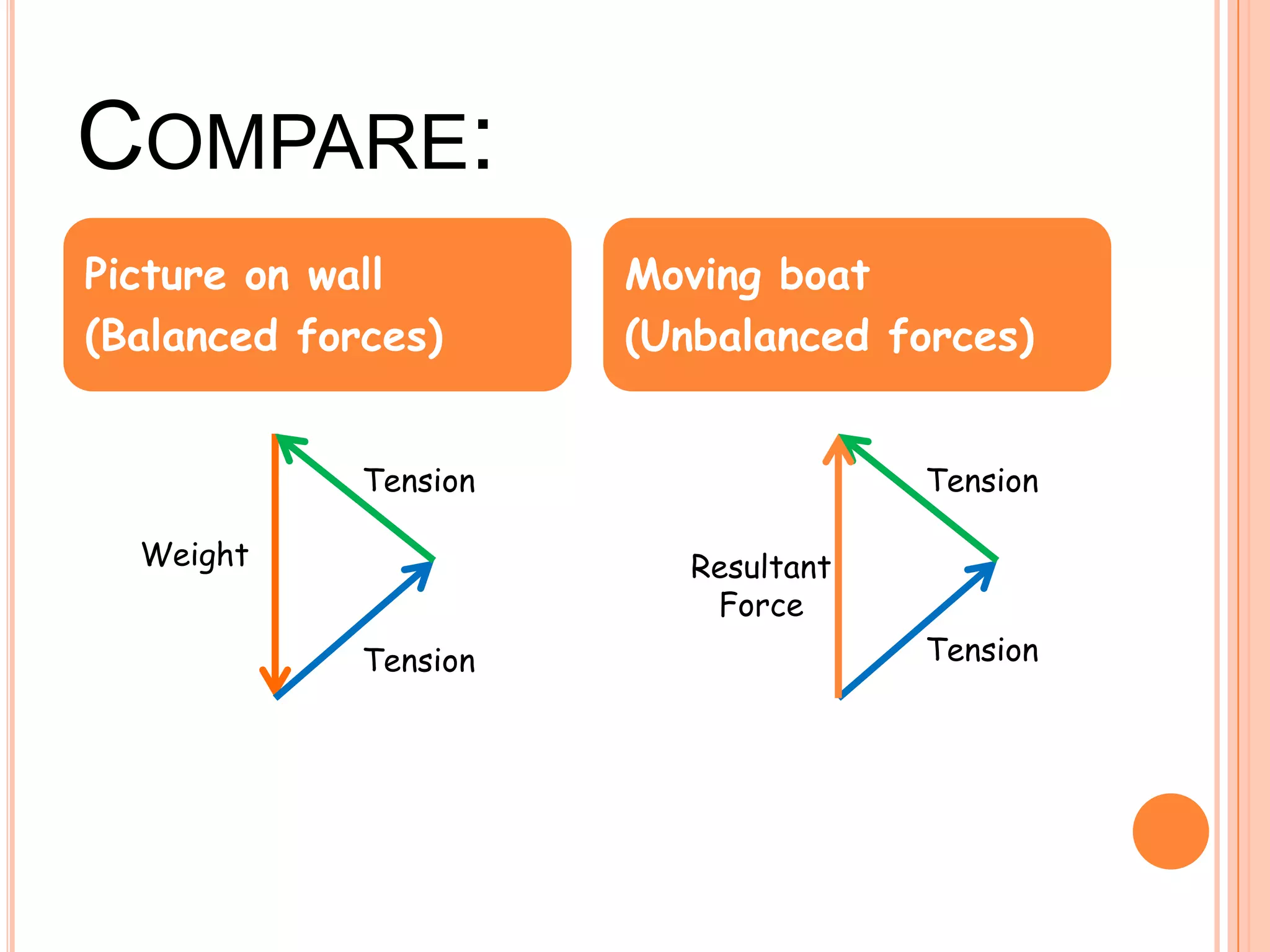
COMPARE:
Picture on wall
(Balanced forces)
Moving boat
(Unbalanced forces)
Tension
Tension
Weight
Tension
Tension
Resultant
Force
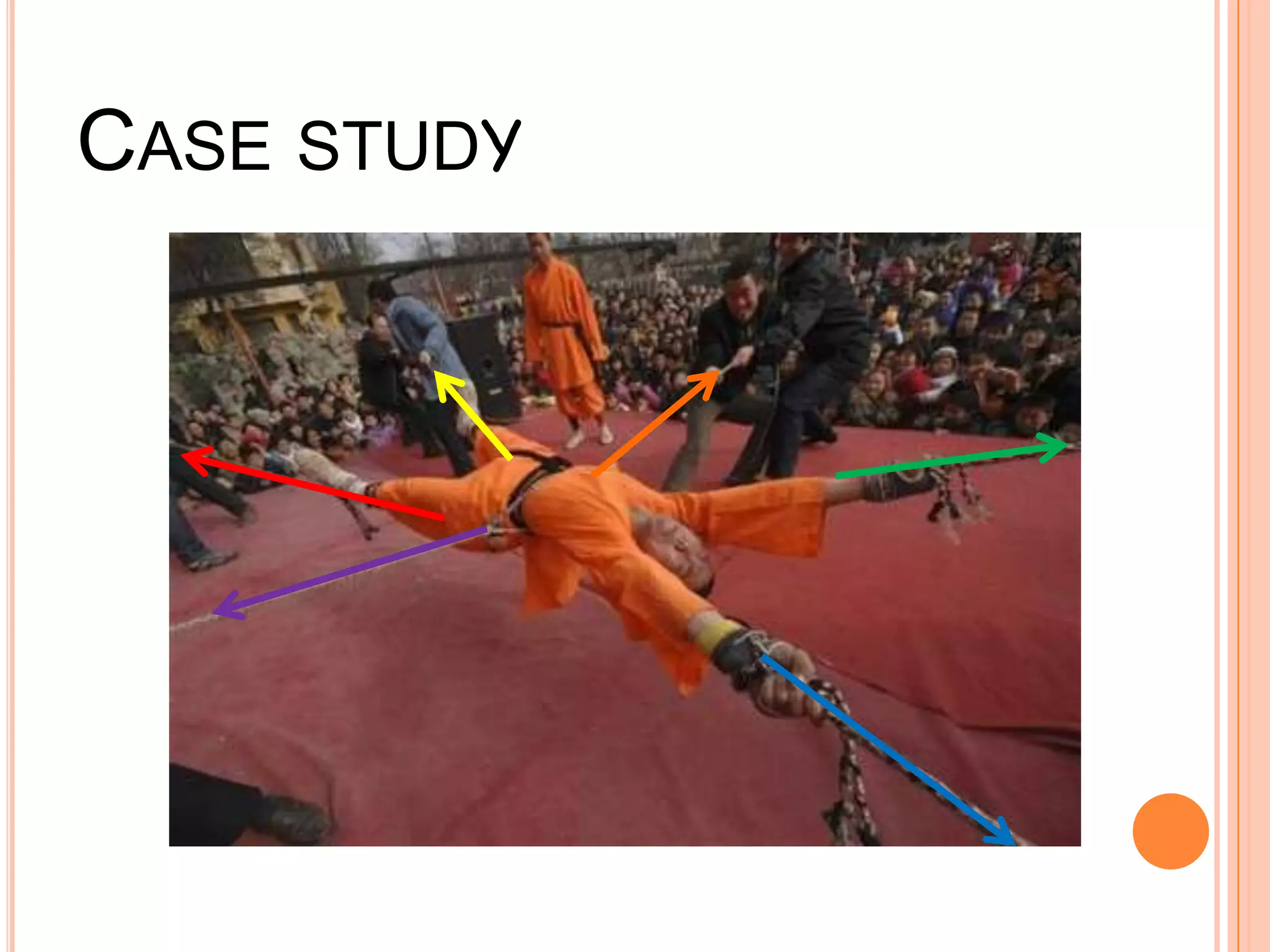
CASE STUDY
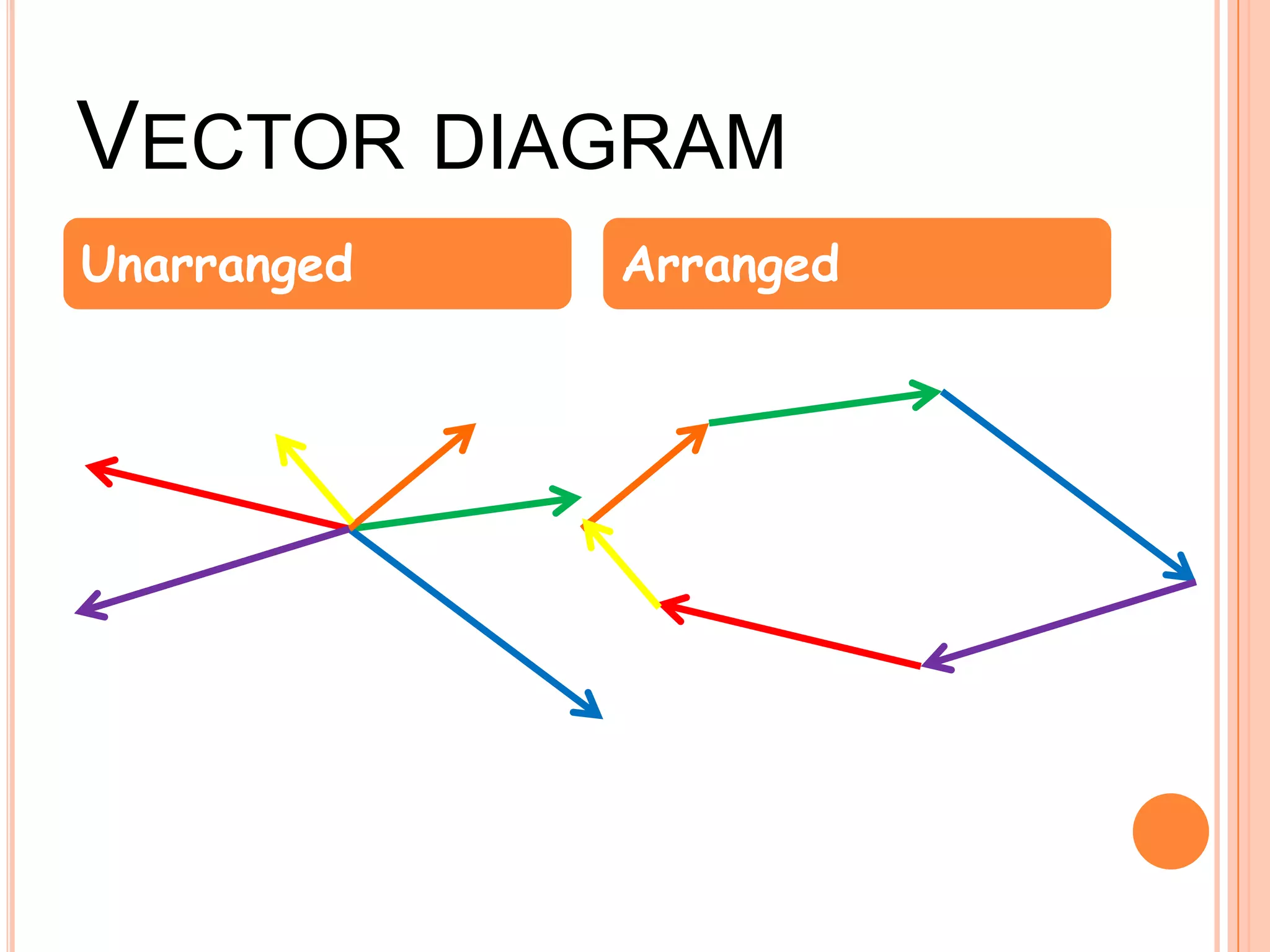
VECTOR DIAGRAM
Unarranged Arranged
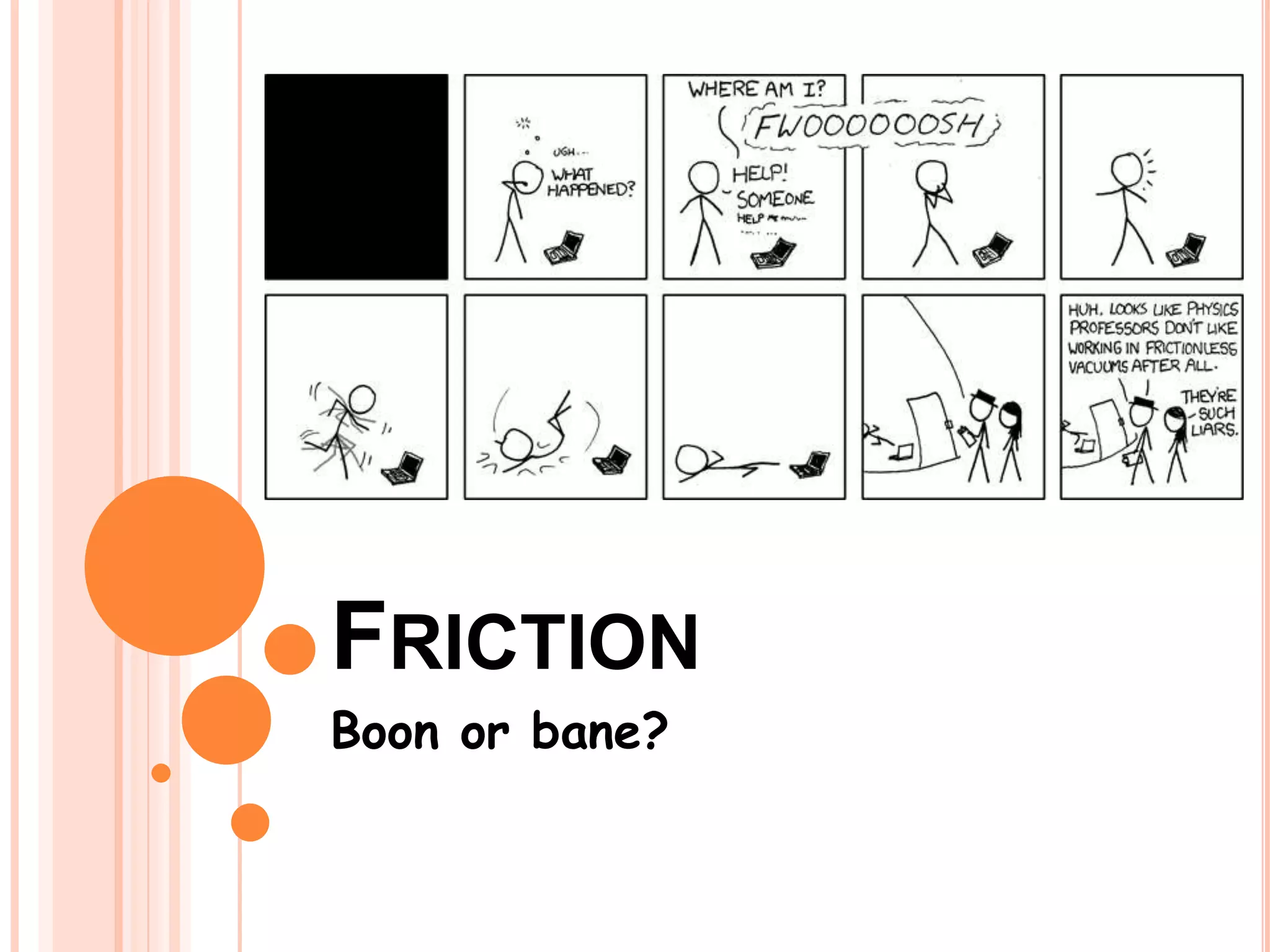
FRICTION
Boon or bane?
LEARNING OUTCOMES
 Explain the effects of friction on the
motion of a body
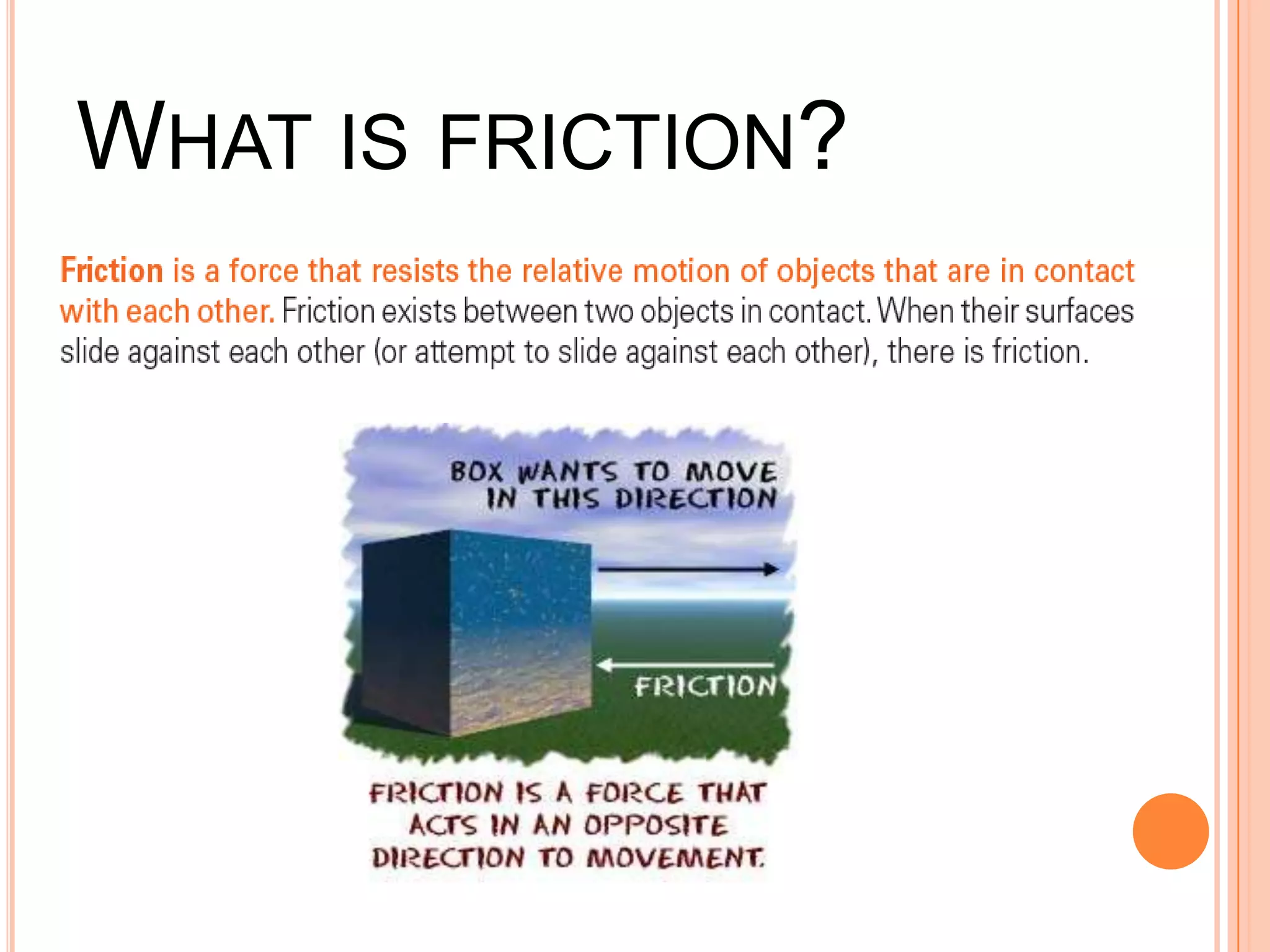
WHAT IS FRICTION?
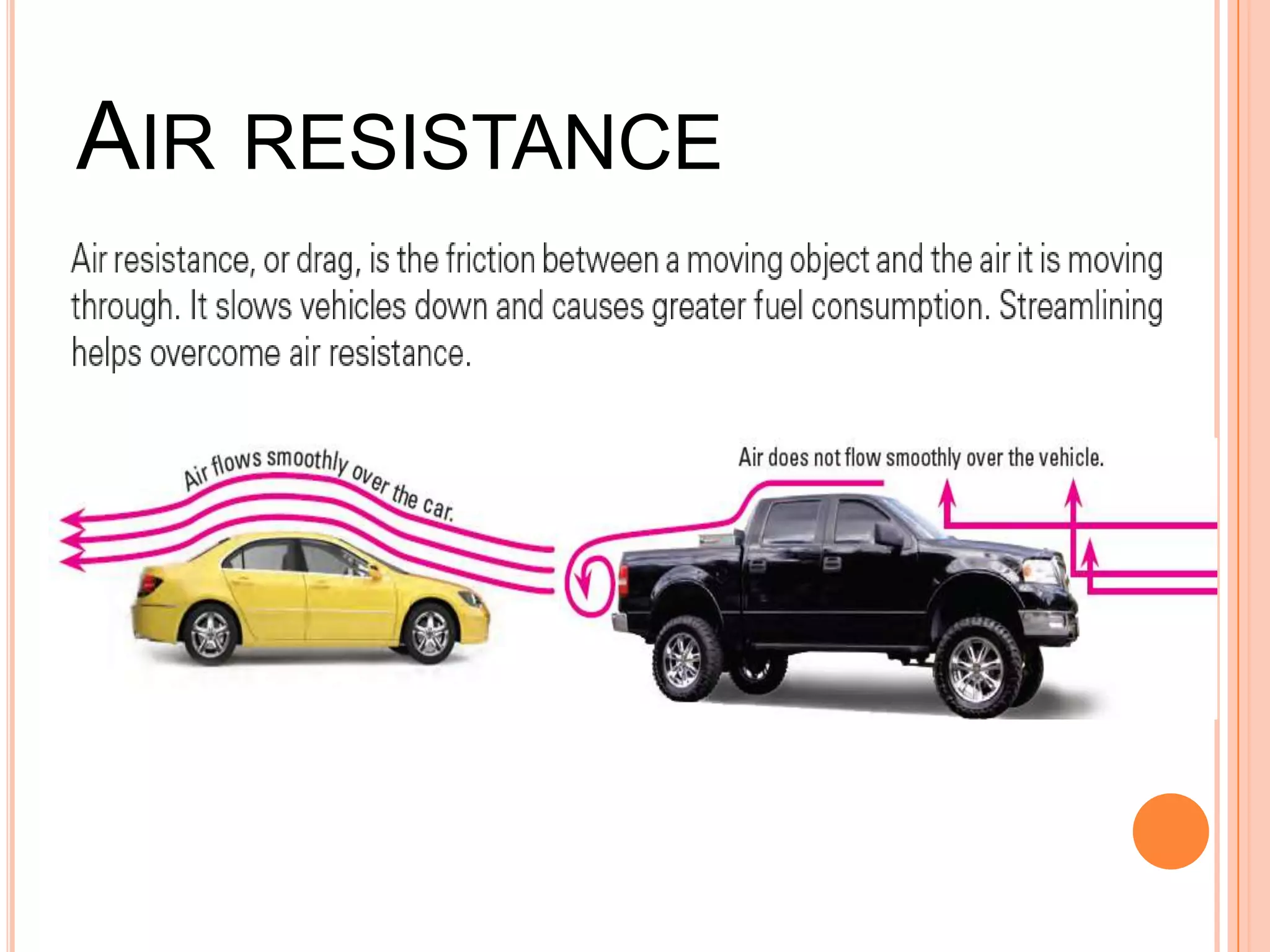
AIR RESISTANCE
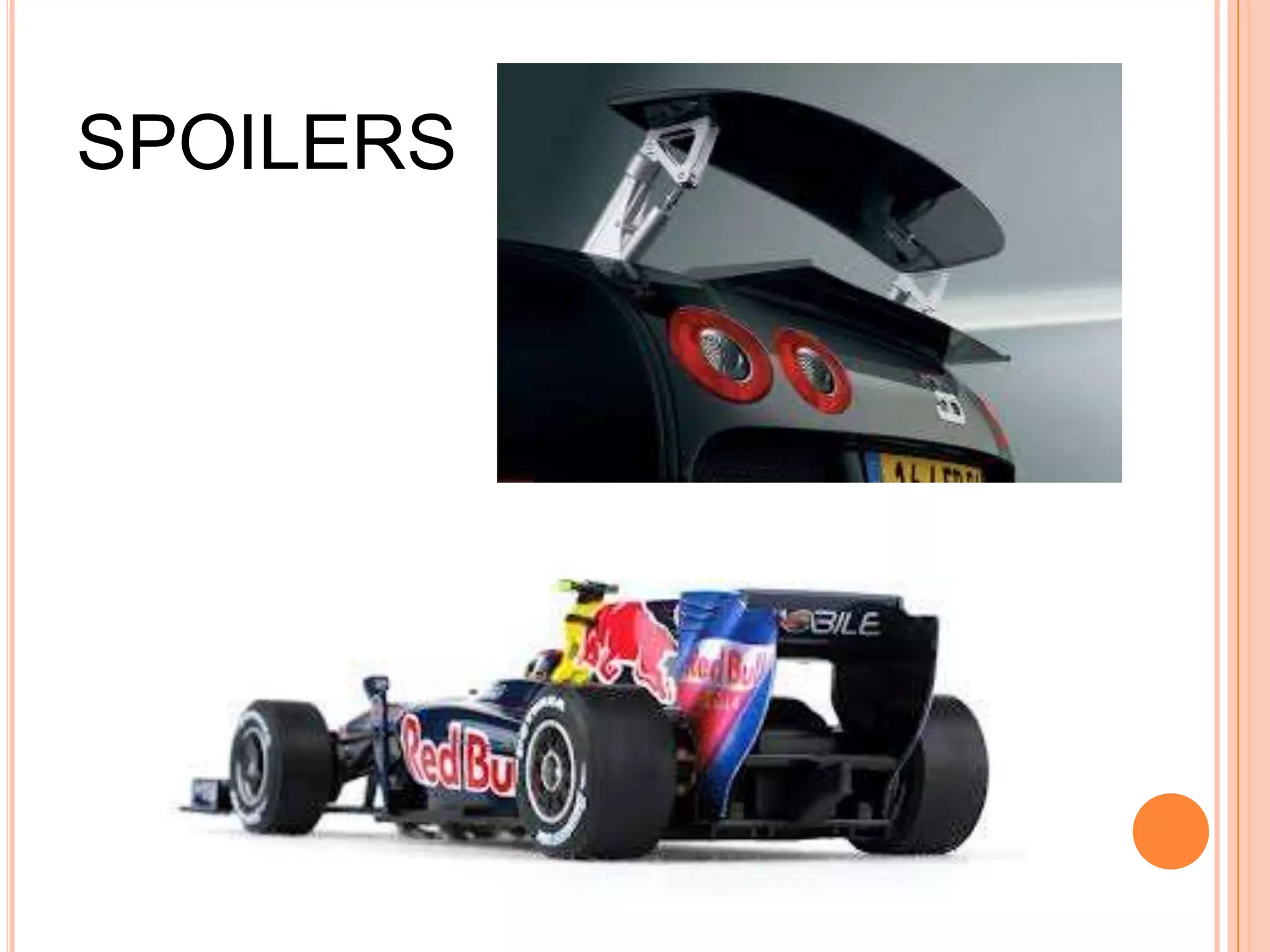
SPOILERS
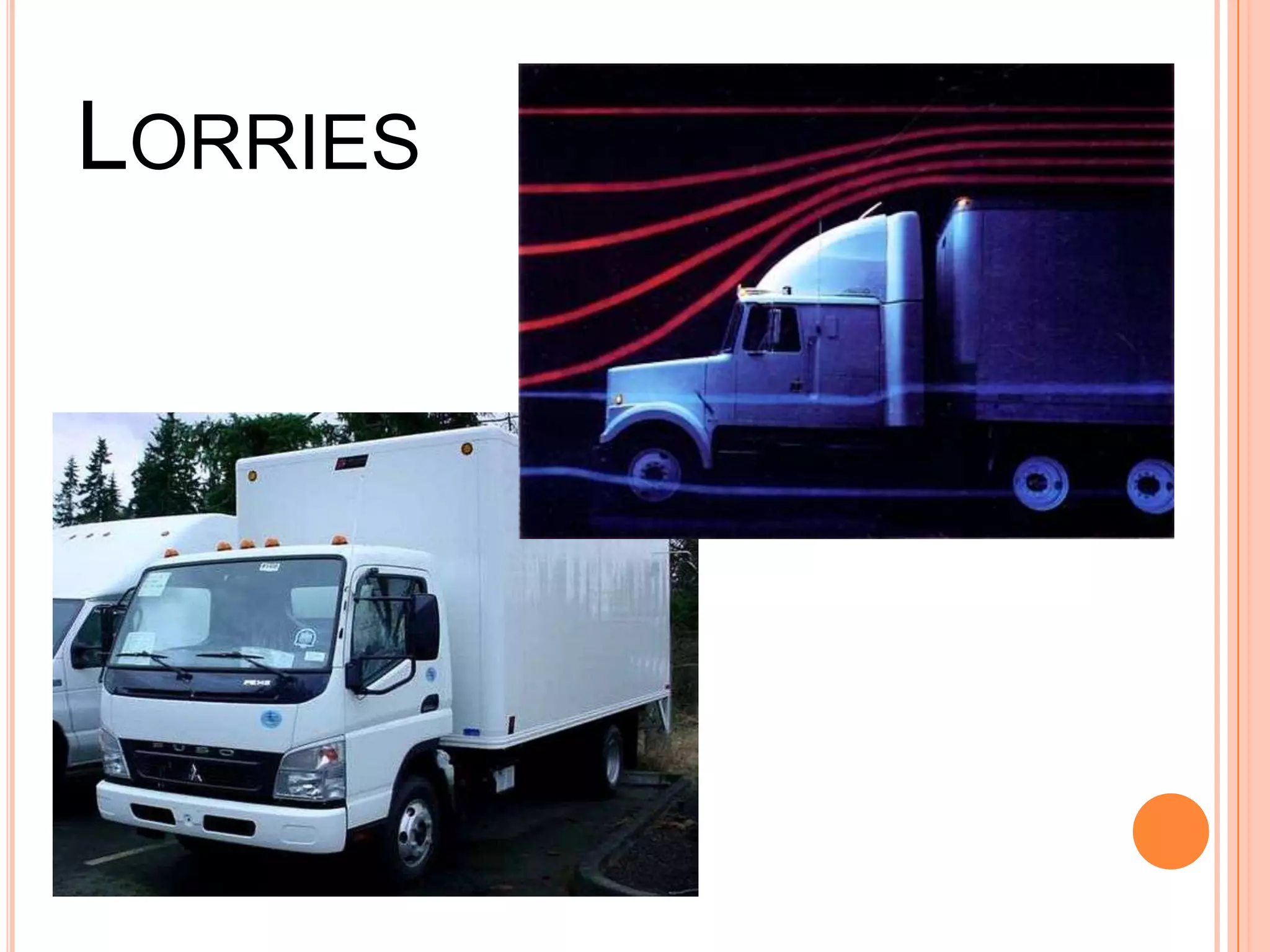
LORRIES
EFFECTS OF FRICTION ON
MOTION
 As a useful force
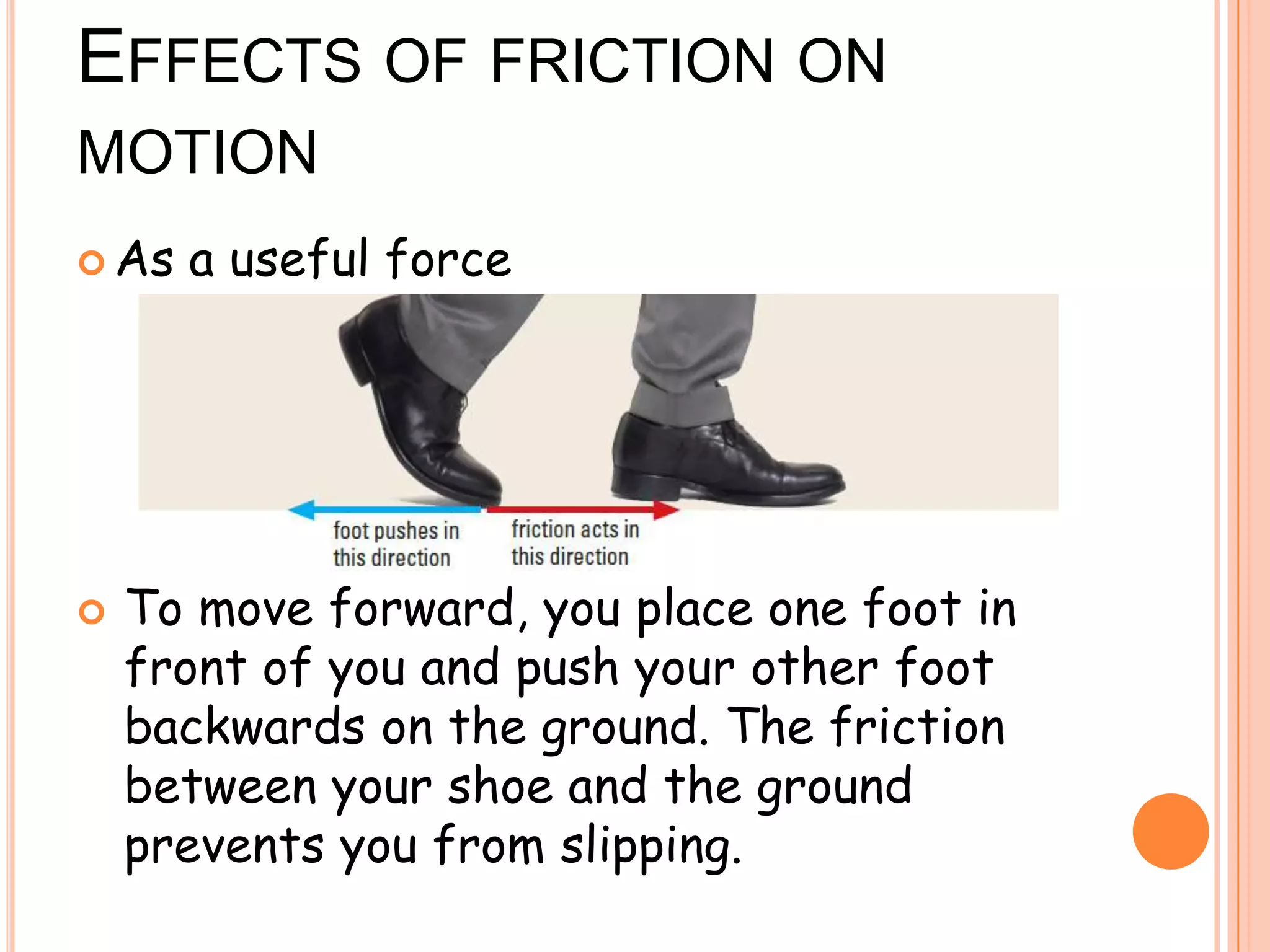
 To move forward, you place one foot in
front of you and push your other foot
backwards on the ground. The friction
between your shoe and the ground
prevents you from slipping.
EFFECTS OF FRICTION ON
MOTION
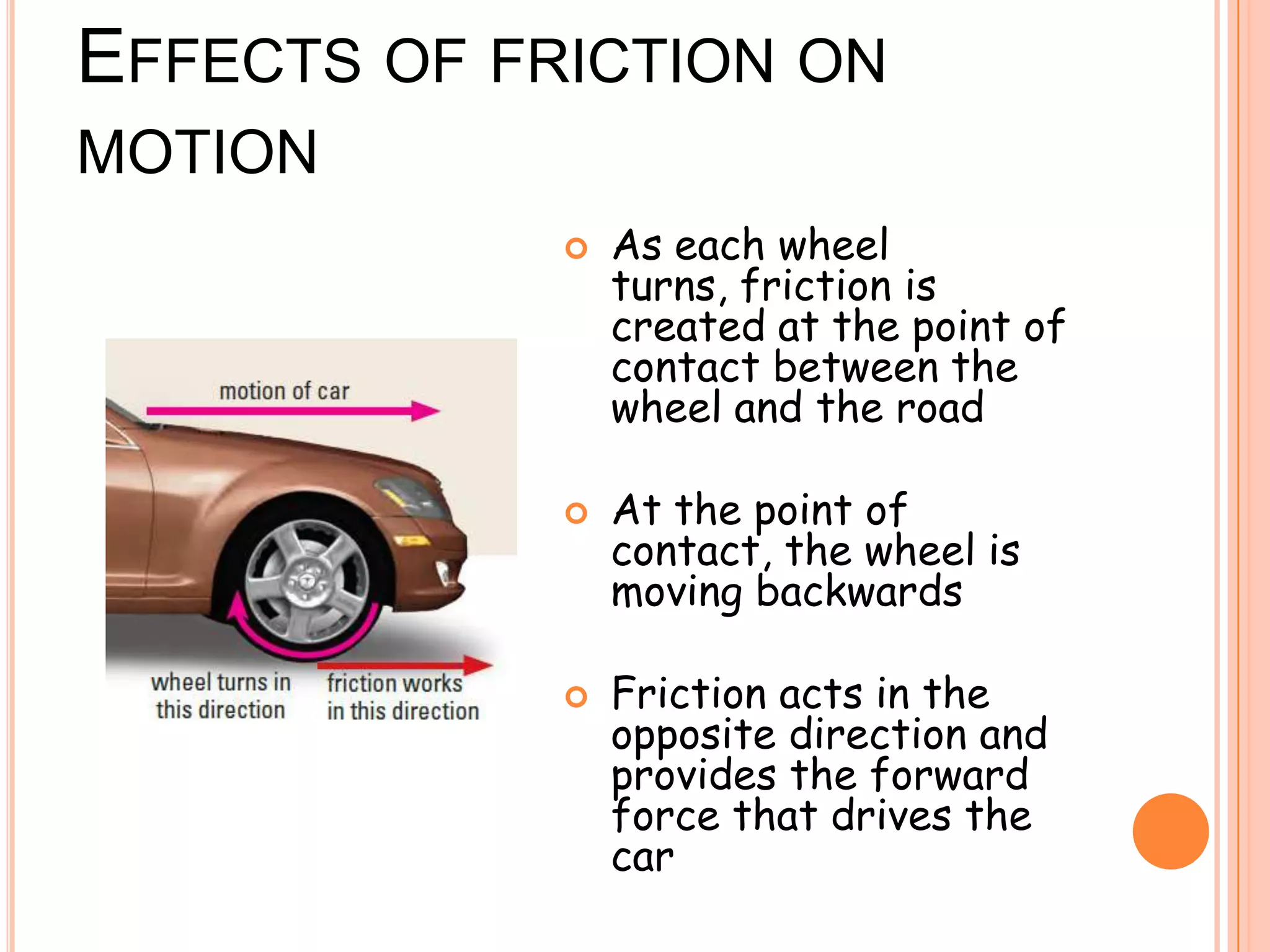
 As each wheel
turns, friction is
created at the point of
contact between the
wheel and the road
 At the point of
contact, the wheel is
moving backwards
 Friction acts in the
opposite direction and
provides the forward
force that drives the
car
WHEN THERE IS NO FRICTION
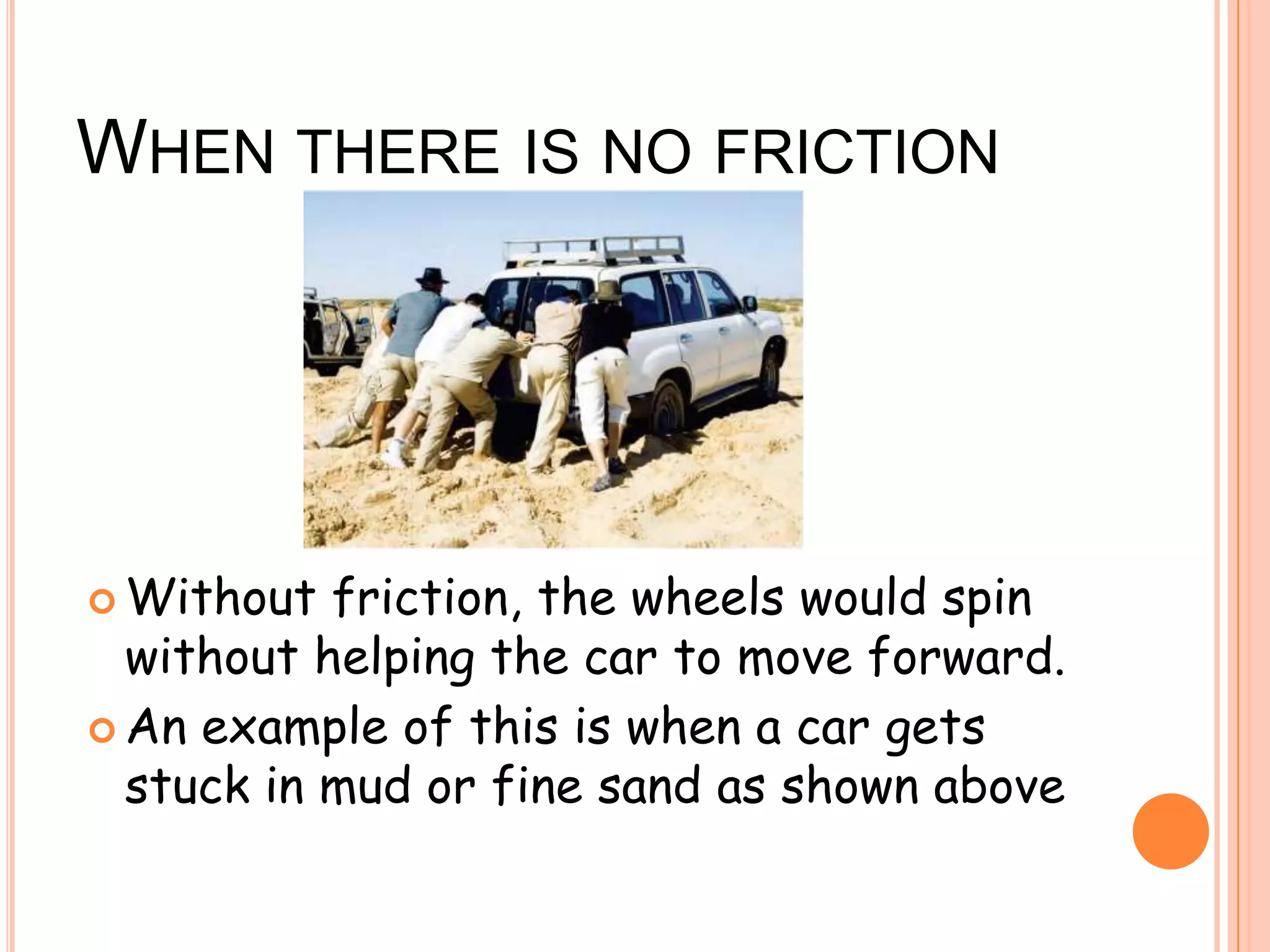
 Without friction, the wheels would spin
without helping the car to move forward.
 An example of this is when a car gets
stuck in mud or fine sand as shown above
FACTORS THAT AFFECT
FRICTION
 Depends on the nature of the surfaces in
contact
 The rougher the surface the greater is the
friction
 Is proportional to the force pressing the
surfaces together (in the case of
horizontal movement, the pressing force
is the weight).
 Pushing heavy vs. light objects
• Is independent of the area of contact
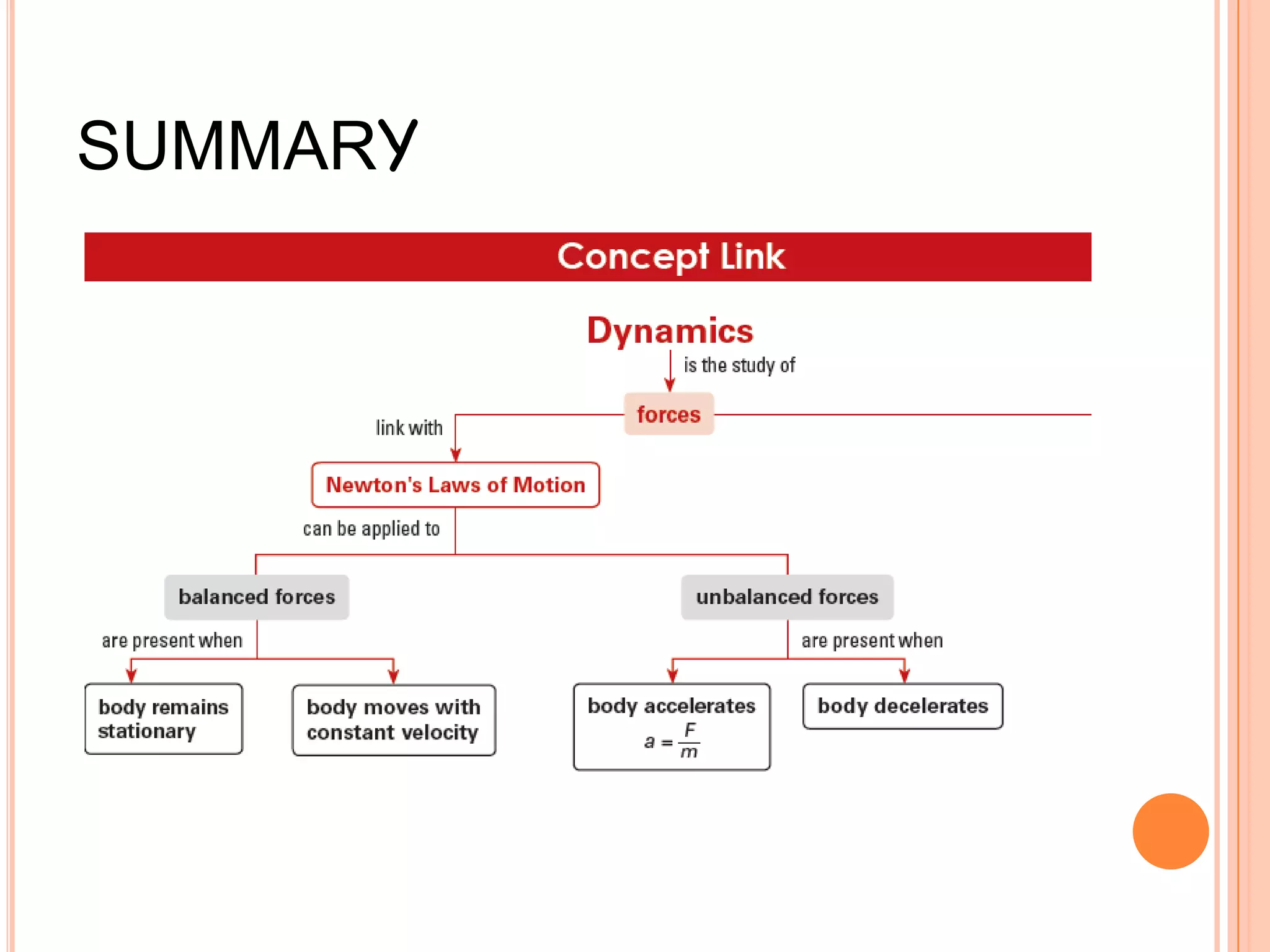
SUMMARY

Diagrams and Friction

  • 1.
  • 2.
    WHAT IS REPRESENTATION? DefinitionsFormulas Diagrams Graphs Language of Physics
  • 3.
    LEARNING OUTCOMES  Identifyforces acting on an object and draw free-body diagrams  Solve problems for a static-point mass  Recall and apply the equation F = ma to new situation or to solve related problems
  • 4.
    FREE-BODY DIAGRAMS  Adiagram which shows all the forces acting on a body  Consists primarily of a sketch of a body and arrows representing the forces acting on it  Weight  Contact force  Tension
  • 5.
  • 6.
    WEIGHT  Weight ofa body is the gravitational force exerted by the Earth on the body. The weight acts at the center of gravity of a body. It is always directed towards the center of the Earth  The free-body diagram of a body falling without air resistance is shown below
  • 7.
    CONTACT FORCE  Contactforce is the force exerted by the contact surface on the body  Acts perpendicularly to the contact surface  Two forces act on the body: they are the contact force and the weight
  • 8.
    RECALL: WEIGHT VS. CONTACTFORCE  Contact forces are forces that act on a body at the point of contact between two different bodies  Non-contact forces is a force that acts on a body such as the weight which acts through the center of gravity (CG) of an object Contact forces Non-Contact forces
  • 9.
    WHAT ARE THEFORCES ACTING ON THE BODIES?  The pair of action and reaction forces is the gravitational force by the Earth on the man and the gravitational force by the man on the Earth  There are 2 free- body diagrams : One for the man and the other for the Earth
  • 10.
    FREE-BODY DIAGRAM  Thefree-body diagram of the man shows the force acting on him only  The free-body diagram for the Earth shows the force that acts on the Earth only
  • 11.
    WHAT ARE THEFORCES ACTING ON THE BODIES?  The first pair of action and reaction forces is the gravitational force by the Earth on the man and the gravitational force by the man on the Earth  The second pair of action and reaction forces is the contact force by the man on the Earth and the contact force by the Earth on the man
  • 12.
    FREE-BODY DIAGRAM  Thefree-body diagram shows two forces : F1 and F2 acting on the man.  Since the man is at rest , the two forces are equal and opposite in direction
  • 13.
    FREE-BODY DIAGRAM  Thefree-body diagram for the Earth shows two forces , F1 and F2 acting on the Earth  Since F1 = F2 , the Earth is also at rest
  • 14.
    THINK!  Which areaction-reaction pairs?
  • 15.
  • 16.
    GYMNAST  How manyfree bodies?  How many action- reaction pairs?  What are the forces acting on each body?
  • 17.
  • 18.
  • 19.
  • 20.
    TENSION  The tensionis directed along the length of the string and pulls equally on the support and the pendulum bob  The diagram below is not a free-body diagram as it shows forces acting on three bodies: the pendulum bob, the string and the support. It will not be useful in analysis.
  • 21.
    TENSION  Isolate thependulum bob as a free-body  Only contact force acting on the bob is the tension  Free-body diagram of the pendulum bob consists of the tension and weight only
  • 22.
    PUTTING IT TOGETHER Weight and contact force are equal. No resultant force acting vertically  Acceleration of the crate is due entirely to the tension force
  • 23.
  • 24.
  • 25.
    IN A LIFT– DAILY EXPERIENCES (VIDEO)
  • 26.
  • 27.
    LIFT PROBLEM –ACCELERATING UPWARDS
  • 28.
    LIFT PROBLEM –CONSTANT VELOCITY
  • 29.
    LIFT PROBLEM –ACCELERATING DOWNWARDS
  • 30.
  • 31.
    VECTOR DIAGRAMS  2scenarios  Unbalanced forces  Balanced forces
  • 32.
    UNBALANCED FORCES When 3forces are applied to a point of an object , the resultant force (due to it being unbalanced) acting on the object can be obtained by adding the force vectors Vectors A,B and C represent three forces
  • 33.
  • 34.
    BALANCED FORCES • When3 forces acting on an object is balanced , resultant force is ________. • There is no _________. • An object will either ________ or ____________.
  • 35.
    BALANCED FORCES  Considera picture hanging on the wall.  What are the forces acting on the picture frame?
  • 36.
  • 37.
    VECTOR DIAGRAM – BALANCEDFORCES Weight Tension Tension Tension Tension Weight
  • 38.
    UNBALANCED FORCES  Considera boat being towed by 2 other boats. TensionTension Boat Tension Tension Resultant Force
  • 39.
    COMPARE: Picture on wall (Balancedforces) Moving boat (Unbalanced forces) Tension Tension Weight Tension Tension Resultant Force
  • 40.
  • 41.
  • 42.
  • 43.
    LEARNING OUTCOMES  Explainthe effects of friction on the motion of a body
  • 44.
  • 45.
  • 46.
  • 47.
  • 48.
    EFFECTS OF FRICTIONON MOTION  As a useful force  To move forward, you place one foot in front of you and push your other foot backwards on the ground. The friction between your shoe and the ground prevents you from slipping.
  • 49.
    EFFECTS OF FRICTIONON MOTION  As each wheel turns, friction is created at the point of contact between the wheel and the road  At the point of contact, the wheel is moving backwards  Friction acts in the opposite direction and provides the forward force that drives the car
  • 50.
    WHEN THERE ISNO FRICTION  Without friction, the wheels would spin without helping the car to move forward.  An example of this is when a car gets stuck in mud or fine sand as shown above
  • 51.
    FACTORS THAT AFFECT FRICTION Depends on the nature of the surfaces in contact  The rougher the surface the greater is the friction  Is proportional to the force pressing the surfaces together (in the case of horizontal movement, the pressing force is the weight).  Pushing heavy vs. light objects • Is independent of the area of contact
  • 52.