Dynamics
     The study of forces and energies
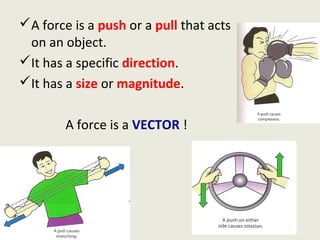
A force is a push or a pull that acts
 on an object.
It has a specific direction.
It has a size or magnitude.


        A force is a VECTOR !
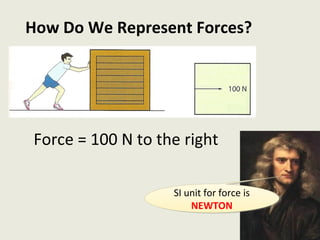
How Do We Represent Forces?


Force = 100 N to the right

                   SI unit for force is
                    SI unit for force is
                        NEWTON
                        NEWTON
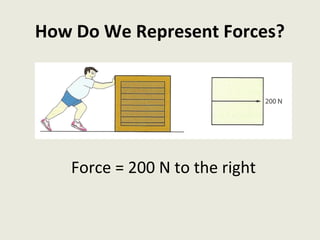
How Do We Represent Forces?


   Force = 200 N to the right
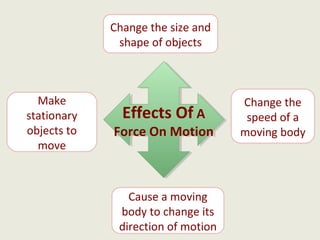
Change the size and
              shape of objects


  Make                              Change the
stationary     Effects Of A
               Effects Of A          speed of a
objects to   Force On Motion
             Force On Motion        moving body
  move


                Cause a moving
              body to change its
              direction of motion
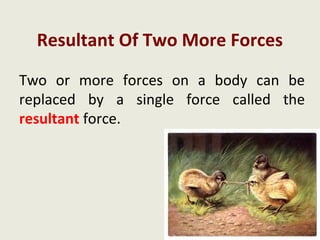
Resultant Of Two More Forces

Two or more forces on a body can be
replaced by a single force called the
resultant force.
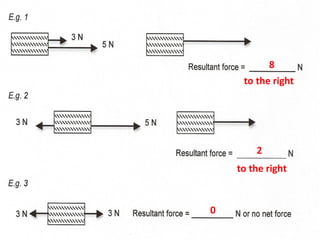
8
     to the right


        2
    to the right


0
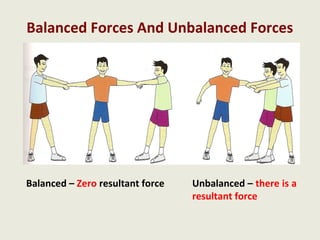
Balanced Forces And Unbalanced Forces


Balanced – Zero resultant force   Unbalanced – there is a
                                  resultant force
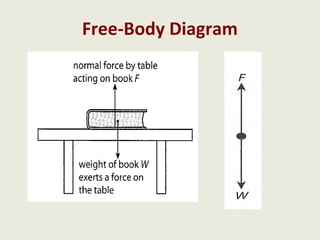
Free-Body Diagram
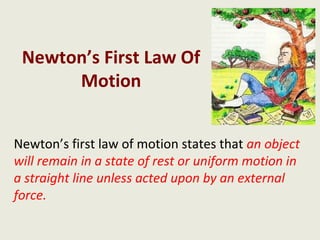
Newton’s First Law Of
      Motion


Newton’s first law of motion states that an object
will remain in a state of rest or uniform motion in
a straight line unless acted upon by an external
force.
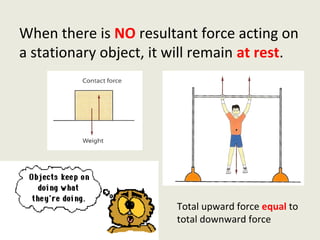
When there is NO resultant force acting on
a stationary object, it will remain at rest.


                        Total upward force equal to
                        total downward force
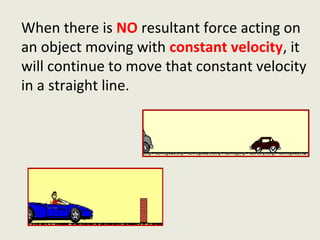
When there is NO resultant force acting on
an object moving with constant velocity, it
will continue to move that constant velocity
in a straight line.
Newton’s Second Law Of
           Motion
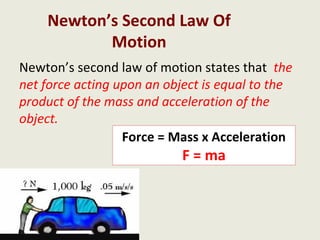
Newton’s second law of motion states that the
net force acting upon an object is equal to the
product of the mass and acceleration of the
object.
                  Force = Mass x Acceleration
                            F = ma
Friction

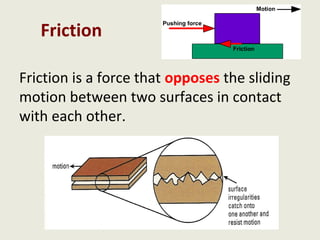
Friction is a force that opposes the sliding
motion between two surfaces in contact
with each other.
Frictional Force
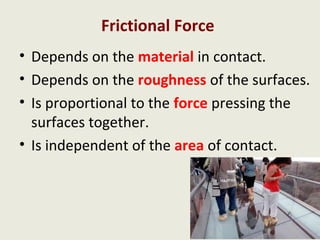
• Depends on the material in contact.
• Depends on the roughness of the surfaces.
• Is proportional to the force pressing the
  surfaces together.
• Is independent of the area of contact.
Positive Effects Of Friction
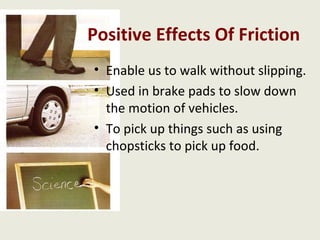
• Enable us to walk without slipping.
• Used in brake pads to slow down
  the motion of vehicles.
• To pick up things such as using
  chopsticks to pick up food.
Negative Effects Of Friction
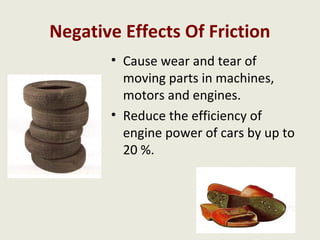
       • Cause wear and tear of
         moving parts in machines,
         motors and engines.
       • Reduce the efficiency of
         engine power of cars by up to
         20 %.
Ways To Reduce Friction
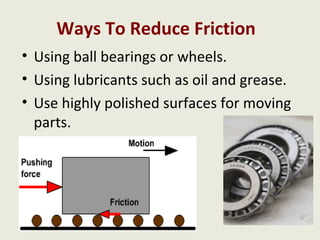
• Using ball bearings or wheels.
• Using lubricants such as oil and grease.
• Use highly polished surfaces for moving
  parts.
Ways To Reduce Friction
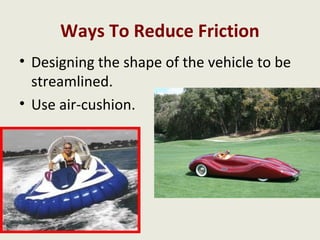
• Designing the shape of the vehicle to be
  streamlined.
• Use air-cushion.

Dynamics

  • 1.
    Dynamics The study of forces and energies
  • 2.
    A force isa push or a pull that acts on an object. It has a specific direction. It has a size or magnitude. A force is a VECTOR !
  • 3.
    How Do WeRepresent Forces? Force = 100 N to the right SI unit for force is SI unit for force is NEWTON NEWTON
  • 4.
    How Do WeRepresent Forces? Force = 200 N to the right
  • 5.
    Change the sizeand shape of objects Make Change the stationary Effects Of A Effects Of A speed of a objects to Force On Motion Force On Motion moving body move Cause a moving body to change its direction of motion
  • 6.
    Resultant Of TwoMore Forces Two or more forces on a body can be replaced by a single force called the resultant force.
  • 7.
    8 to the right 2 to the right 0
  • 8.
    Balanced Forces AndUnbalanced Forces Balanced – Zero resultant force Unbalanced – there is a resultant force
  • 9.
  • 10.
    Newton’s First LawOf Motion Newton’s first law of motion states that an object will remain in a state of rest or uniform motion in a straight line unless acted upon by an external force.
  • 11.
    When there isNO resultant force acting on a stationary object, it will remain at rest. Total upward force equal to total downward force
  • 12.
    When there isNO resultant force acting on an object moving with constant velocity, it will continue to move that constant velocity in a straight line.
  • 13.
    Newton’s Second LawOf Motion Newton’s second law of motion states that the net force acting upon an object is equal to the product of the mass and acceleration of the object. Force = Mass x Acceleration F = ma
  • 14.
    Friction Friction is aforce that opposes the sliding motion between two surfaces in contact with each other.
  • 15.
    Frictional Force • Dependson the material in contact. • Depends on the roughness of the surfaces. • Is proportional to the force pressing the surfaces together. • Is independent of the area of contact.
  • 16.
    Positive Effects OfFriction • Enable us to walk without slipping. • Used in brake pads to slow down the motion of vehicles. • To pick up things such as using chopsticks to pick up food.
  • 17.
    Negative Effects OfFriction • Cause wear and tear of moving parts in machines, motors and engines. • Reduce the efficiency of engine power of cars by up to 20 %.
  • 18.
    Ways To ReduceFriction • Using ball bearings or wheels. • Using lubricants such as oil and grease. • Use highly polished surfaces for moving parts.
  • 19.
    Ways To ReduceFriction • Designing the shape of the vehicle to be streamlined. • Use air-cushion.