Submitted to:
Dr. V.T. kamble
Professor and Chairman
By
Gurjeet kaur
Research scholar
Department of PG studies and Research in library
and information science
Gulbarga university kalaburgi
APA Style Manual
Introduction:
A style guide or style manual is a set of standards for the
writing and design of documents, either for general use or for
a specific publication, organization or field. The
implementation of a style guide provides uniformity in style
and formatting within a document and across multiple
documents.
Types of Style Manuals:
Research and Documentation describes four commonly
used style guide of documentation:
•MLA(Modern Language Association) used in English and the
humanities
•APA(American Psychological Association) used in psychology
and the social sciences
•Chicago, used in history and some humanities
•CSE(Council of Science Editors) used in biology and other
sciences.
APA STYLE MANUAL:
APA Style originated in 1929, when a group of
psychologists, anthropologists, and business managers
convened and sought to establish a simple set of procedures,
or style rules, that would codify the many components of
scientific writing to increase the ease of reading
comprehension.
APA Style consists of rules or guidelines that a publisher
observes to ensure clear and consistent presentation of written
material. These rules are:
 selection of headings, tone, and length;
 punctuation and abbreviations;
 presentation of numbers and statistics;
 construction of tables and figures,
 citation of references; and
 many other elements that are a part of a manuscript
APA FORMAT
Basics
List of works cited should begin at the end of the paper on a new page with the
centered title, References. Alphabetize the entries in list by the author's last name,
using the letter-by-letter system (ignore spaces and other punctuation.) Only the
initials of the first and middle names are given. If the author's name is unknown,
alphabetize by the title, ignoring any A, An, or The.
For dates, spell out the names of months in the text of paper, but abbreviate
them in the list of works cited, except for May, June, and July. Use either the day-
month-year style (22 July 1999) or the month-day-year style (July 22, 1999) and be
consistent. With the month-day-year style, be sure to add a comma after the year
unless another punctuation mark goes there.
Hanging Indentation
All APA citations should use hanging indents, that is, the
first line of an entry should be flush left, and the second and
subsequent lines should be indented 1/2".
Hyphenation
• For compound words not in the dictionary, use hyphens for clarity rather than
omit them.
• Hyphenate compound adjectives that precede the noun they modify:
 role-playing technique
 two-way analysis
 middle-class families
• Do not hyphenate a compound adjective if its meaning is established or it cannot
be misread:
grade point average
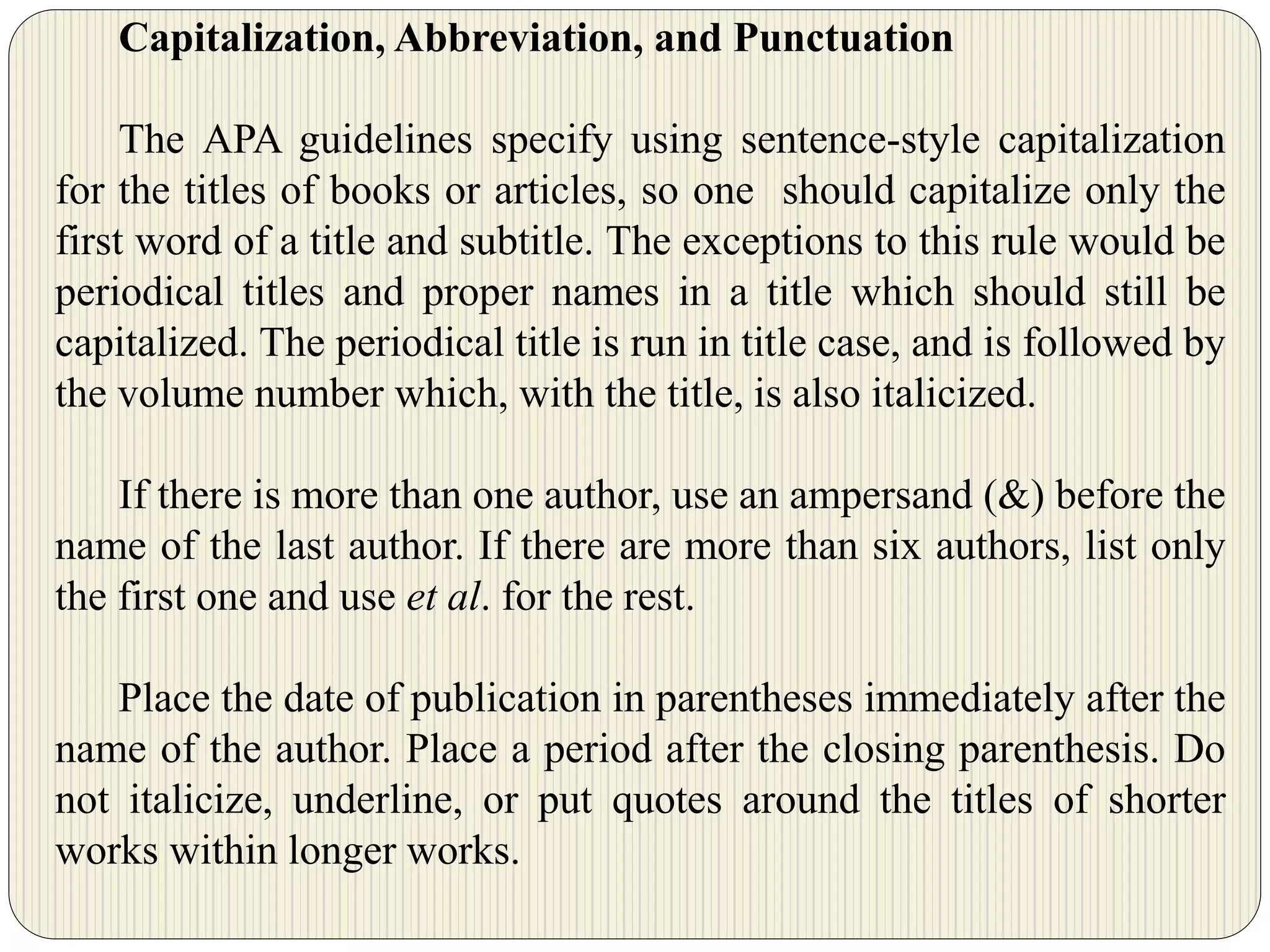
Capitalization, Abbreviation, and Punctuation
The APA guidelines specify using sentence-style capitalization
for the titles of books or articles, so one should capitalize only the
first word of a title and subtitle. The exceptions to this rule would be
periodical titles and proper names in a title which should still be
capitalized. The periodical title is run in title case, and is followed by
the volume number which, with the title, is also italicized.
If there is more than one author, use an ampersand (&) before the
name of the last author. If there are more than six authors, list only
the first one and use et al. for the rest.
Place the date of publication in parentheses immediately after the
name of the author. Place a period after the closing parenthesis. Do
not italicize, underline, or put quotes around the titles of shorter
works within longer works.
 Preferred typeface: Times New Roman
 Use a 12-point font size
 Use two spaces after a period at the end of a sentence
 Double-space entire manuscript
 Set uniform margins of at least 1 inch on all pages
 Use a flush left style and leave right margin uneven; do not justify
 Use the tab key to create a uniform indent for the first line of every
paragraph
 In general - focus on uniformity and readability
General Manuscript Guidelines
 Title page
 Abstract
 Text
 References
 Tables
 Figures
 Appendices
Order of a Manuscript
Title page
Manuscript title:
• should summarize the main idea of the manuscript simply and with style
• should be typed in uppercase and lowercase letters, centered between left and right margins,
positioned in upper half of page
Author:
appears on next line after title
preferred format: first name, middle initial(s), last name
Institutional affiliation:
-appears on next line after author
-where the author was when research was conducted
Running head:
-abbreviated form of title printed at top of all pages , flush left, following the words
“Running head:”
-50 characters or less, all capital letters
Author’s note:
-can include additional information about affiliation, acknowledgements, disclaimers.
Abstract
Abstract is a short passage that appear just before the introduction along
with the recommended keywords. It should be typically range from 150 to 200
words
Text
 Starts on a separate page after the abstract page, numbered page 3
 Type manuscript title in upper and lowercase letters, centered on the top line
 Begin typing introduction on the next line – do not label this section as
“introduction”
 Use headings to organize contents of text
Heading
centered, Boldface, Uppercase and Lowercase Heading (Level 1)
Flush Left, Boldface, Uppercase and Lowercase Heading (Level 2)
Indented, boldface, lowercase paragraph heading ending with a period.
Reference page
 Start on a new page after the end of the text
 Type the word “References” in uppercase and lowercase letters on the top line,
centered
 Double-space the entire reference page and all entries
 Go on to additional pages as necessary
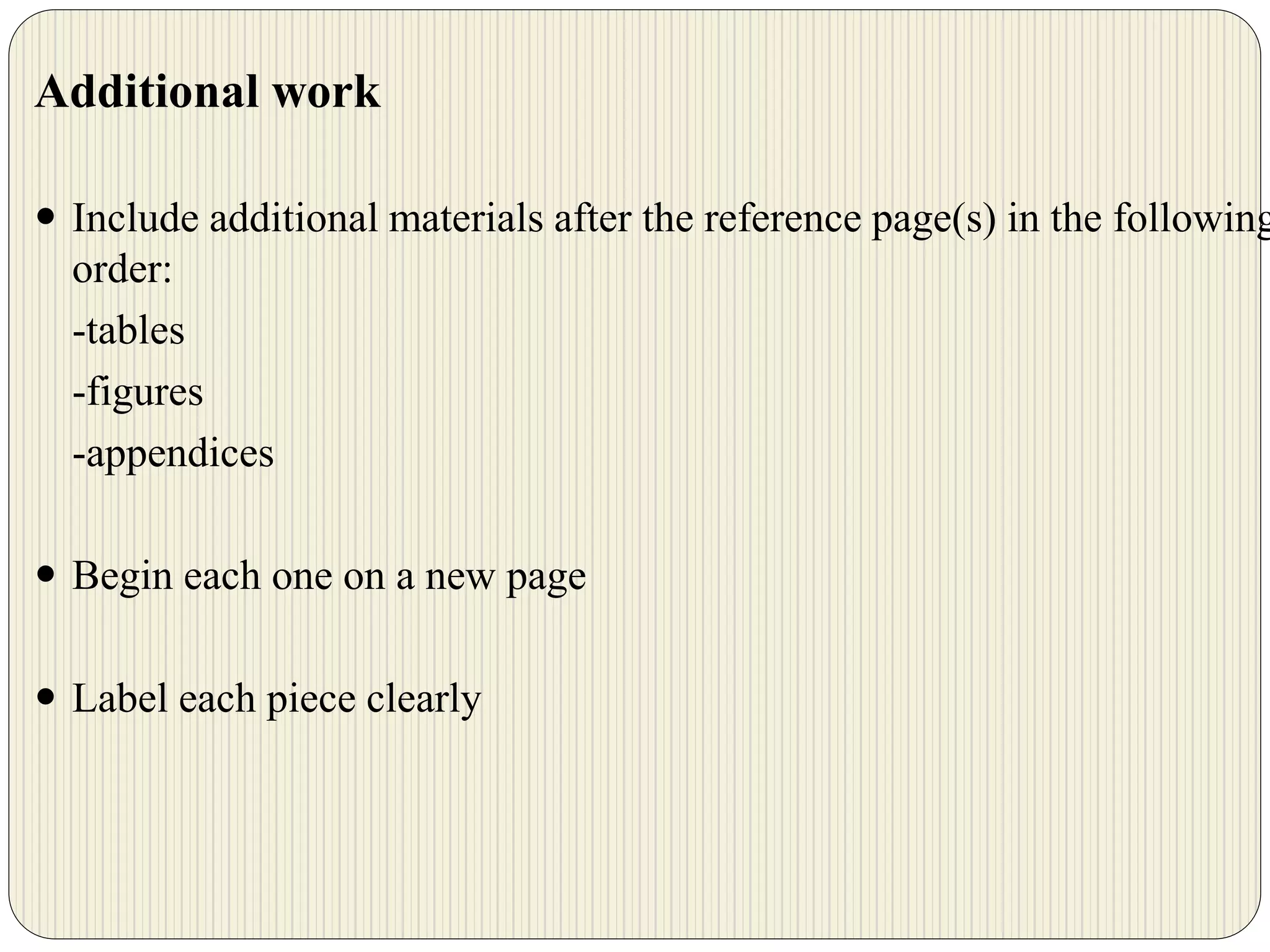
Additional work
 Include additional materials after the reference page(s) in the following
order:
-tables
-figures
-appendices
 Begin each one on a new page
 Label each piece clearly
Citations overview
• Place citations in sentences and paragraphs so that it is clear which
material has come from which sources.
• Use pronouns and transitions to indicate whether several sentences
contain material
from the same source or from different sources.
Example :
Symthe (1990) found that positioning influences ventilation. In his
study of 20 ICU patients, he used two methods to. . . . However, his
findings did not support the work of Karcher (1987) and Atley (1989),
who used much larger samples to demonstrate that ...
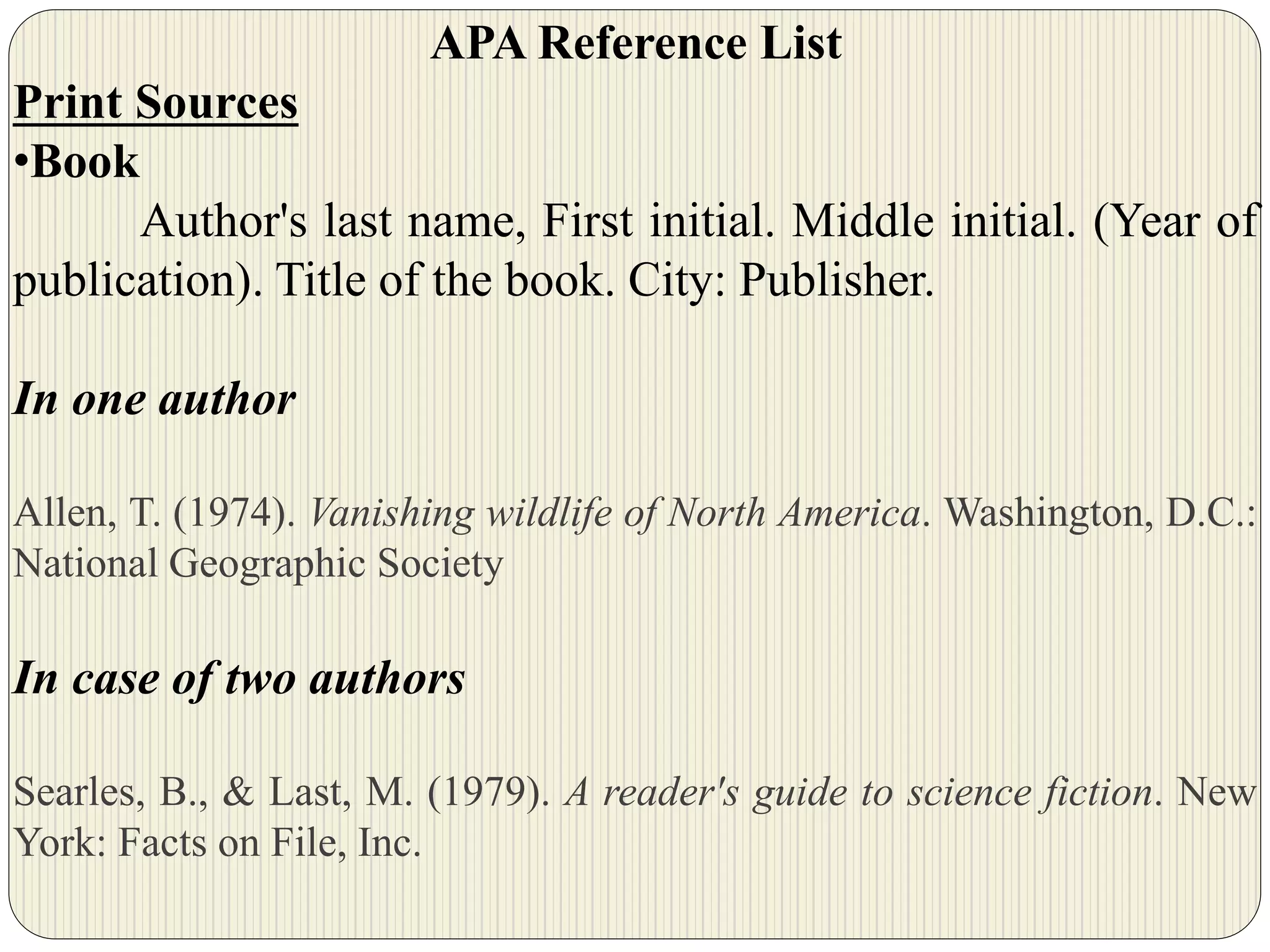
APA Reference List
Print Sources
•Book
Author's last name, First initial. Middle initial. (Year of
publication). Title of the book. City: Publisher.
In one author
Allen, T. (1974). Vanishing wildlife of North America. Washington, D.C.:
National Geographic Society
In case of two authors
Searles, B., & Last, M. (1979). A reader's guide to science fiction. New
York: Facts on File, Inc.
Edited Book
Author's last name, First initial. Middle initial.
(Year of publication). Title of the article. In editor's name
(Ed.), Title of the book (pages of the article). City:
Publisher.
Example:
Flower, L., Hayes, J. R., Carey, L., Schriver, K., & Stratman, J.
(1986). Detection, diagnosis. In L. Ede (Ed.), The Braddock essays
(pp. 191-228). Boston:Bedford St. Martin's.
Periodical—Journal Paginated by Issue
Author's last name, First initial. Middle initial. (Year of
publication). Title of the article. Title of Periodical,
Volume(Issue), pages of the article.
.Example:
Szasz, T. (2004). Protecting patients against psychiatric intervention.
Social Science and ModernSociety, 41(3), 7-9
Periodical—Journal Paginated by Volume
Author's last name, First initial. Middle initial. (Year of
publication). Title of the article. Title of Periodical, Volume,
pages of the article.
Example:
Weber, E. U., Shafir, S., & Blais, A. (2004). Predicting risk sensitivity
in humans and lower animals. Psychological Review, 111, 430-445.
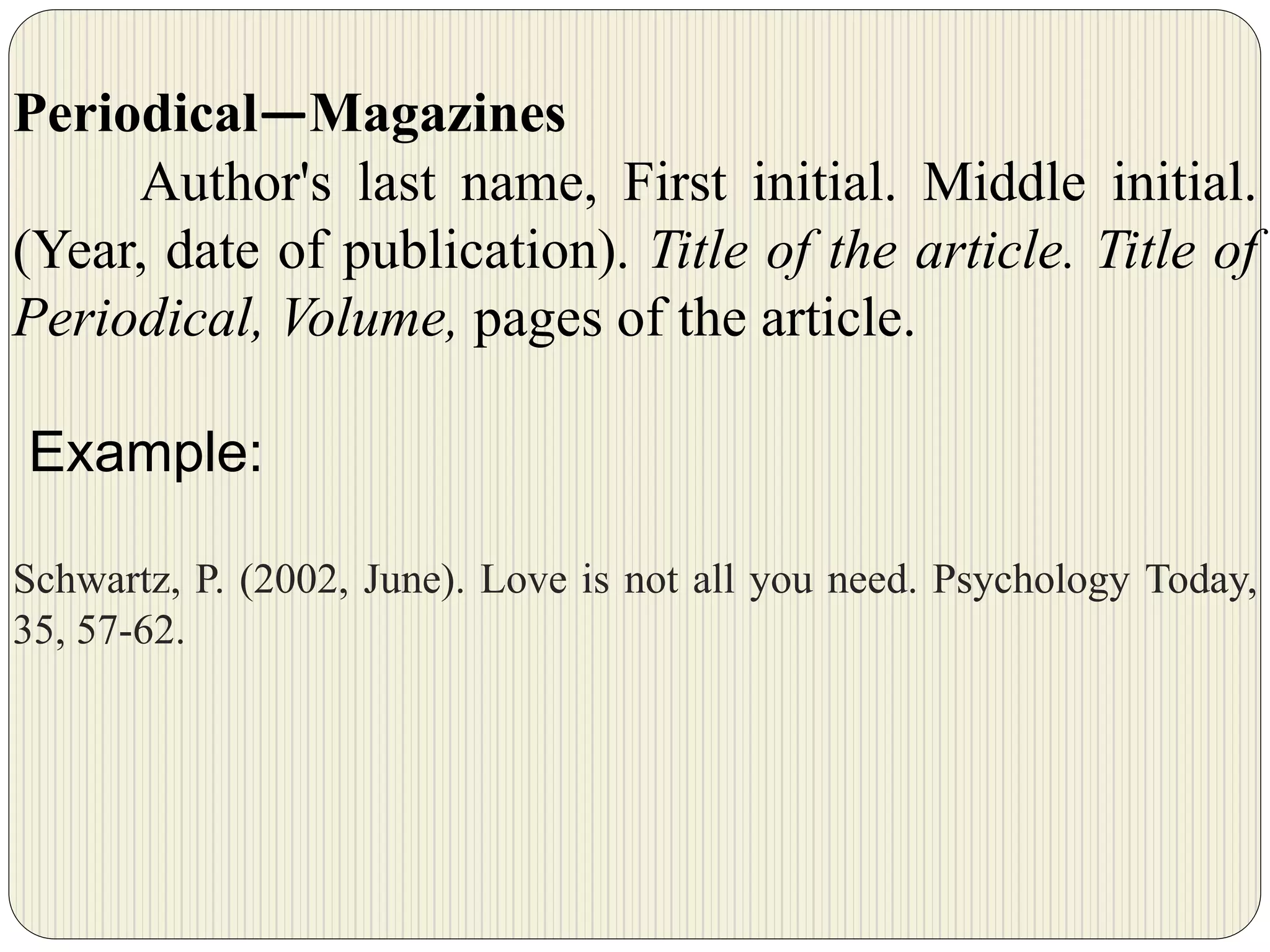
Periodical—Magazines
Author's last name, First initial. Middle initial.
(Year, date of publication). Title of the article. Title of
Periodical, Volume, pages of the article.
Example:
Schwartz, P. (2002, June). Love is not all you need. Psychology Today,
35, 57-62.
Periodical—Newspapers
Author's last name, First initial. Middle initial.
(Year, date of publication). Title of the article. Title of
Periodical, pages of the article.
Example:
Martinez, A. (2004, May 5). Questions arise about liability. The Sun, pp.
A1, A6.
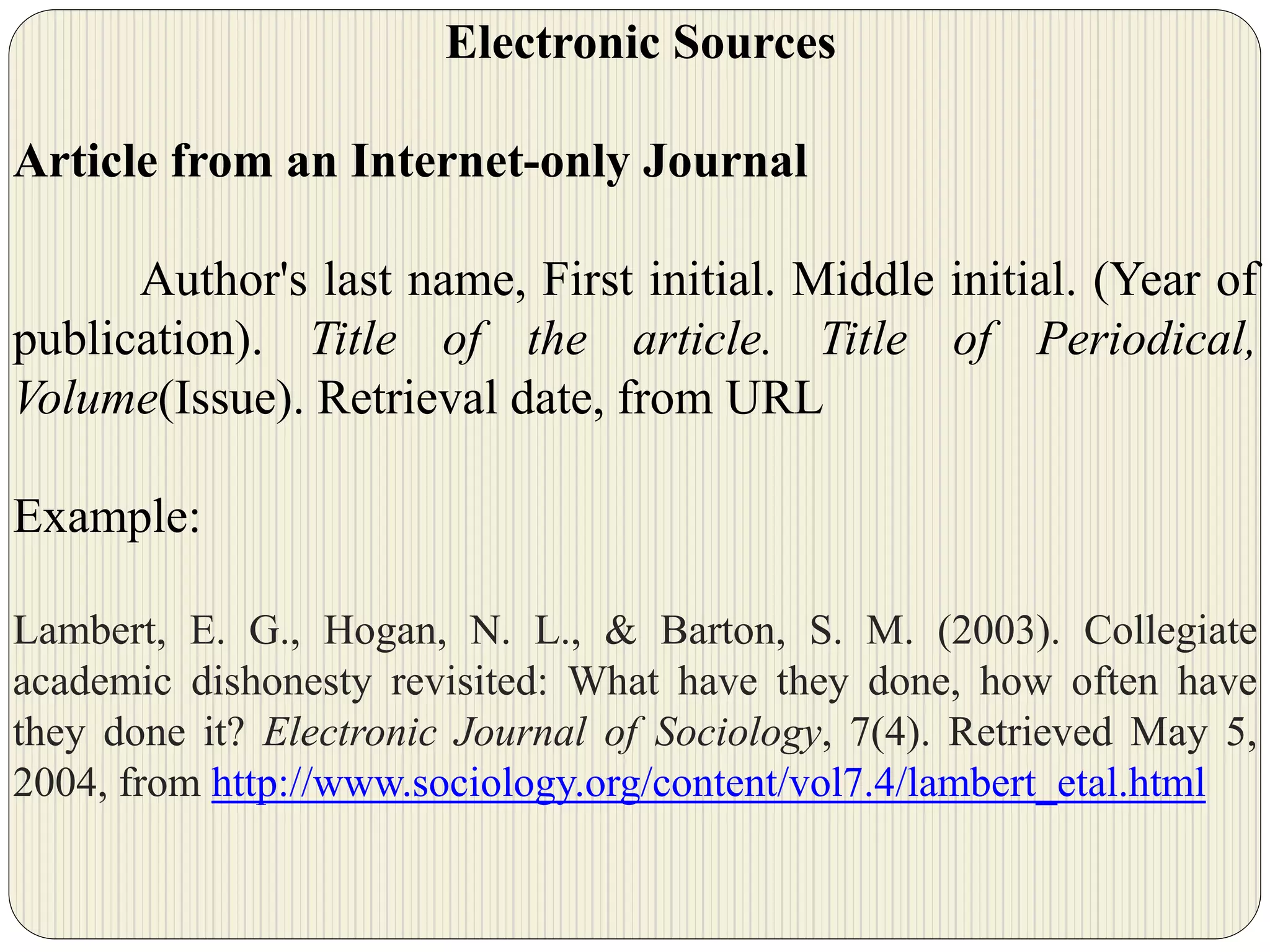
Electronic Sources
Article from an Internet-only Journal
Author's last name, First initial. Middle initial. (Year of
publication). Title of the article. Title of Periodical,
Volume(Issue). Retrieval date, from URL
Example:
Lambert, E. G., Hogan, N. L., & Barton, S. M. (2003). Collegiate
academic dishonesty revisited: What have they done, how often have
they done it? Electronic Journal of Sociology, 7(4). Retrieved May 5,
2004, from http://www.sociology.org/content/vol7.4/lambert_etal.html
journal Article from a Database
Author's last name, First initial. Middle initial. (Year of
publication). Title of the article. Title of Periodical, Volume,
pages of the article. Retrieval date, from database (document
number).
Example:
Troyer, L., & Younts, C. W. (1997). Whose expectations matter? The
relative power of expectations in determining social influence. The
American Journal of Sociology, 103, 692-743. Retrieved May 5, 2004,
from Expanded Academic ASAP database (A20317868).
APA In-Text in print sources
APA uses an author-date system of in-text citation. Each of the samples
below is followed by the entry that would appear on the reference list page.
In-Text Citation for a Quotation
Include the author's last name, the year of publication, and the page
number.
Example:
Szasz (2004) commented, "We are hypocrites if we ignore who the parties are that
support the enactment of mental health laws and deny patients the option of rejecting
psychiatric services"(p. 8).
Or
"We are hypocrites if we ignore who the parties are that support the enactment of
mental health laws and deny patients the option of rejecting psychiatric services"
(Szasz, 2004, p. 8).
Reference List Entry
Szasz, T. (2004). Protecting patients against psychiatric intervention. Social Science
and Modern Society, 41(3), 7-9.
In-Text Citation for a Paraphrase or Summary
Include the author's last name and the year of publication. The page
number is not required; however, it is recommended especially when citing a
section from a long work.
Example:
According to Meyer and Smith (1987), a beginning writer may use academic jargon
incorrectly in an attempt to sound sophisticated. Part of a tutor's job, then, is to help that
student develop his or her unique voice (p. 162).
Or
A beginning writer may use academic jargon incorrectly in an attempt to sound
sophisticated. Part of a tutor's job, then, is to help that student develop his or her unique
voice (Meyer & Smith, 1987, p. 162).
Reference List Entry
Meyer, E., & Smith, L. Z. (1987). The practical tutor. New York: Oxford University
Press.
APA In-Text Electronic Publications
Include the author's last name, the year of publication, and the page
number or paragraph number. For sites lacking page numbers or paragraph
numbers, give the heading and paragraph number. If that information is
unavailable, simply provide the author's last name and the year of
publication.
Example:
Psychologists Seff, Gecas, and Frey (1993) argued that "research on birth order effects
has been remarkably inconsistent and inconclusive with regard to various personality
and behavioral outcomes" (Introduction section, 4).
Reference List Entry
Seff, M. A., Gecas, V., & Frey, J. H. (1993). Birth order, self concept, and participation
in dangerous sports. The Journal of Psychology, 127. Retrieved May 23, 2004, from
Expanded Academic ASAP database (Article A14110698).
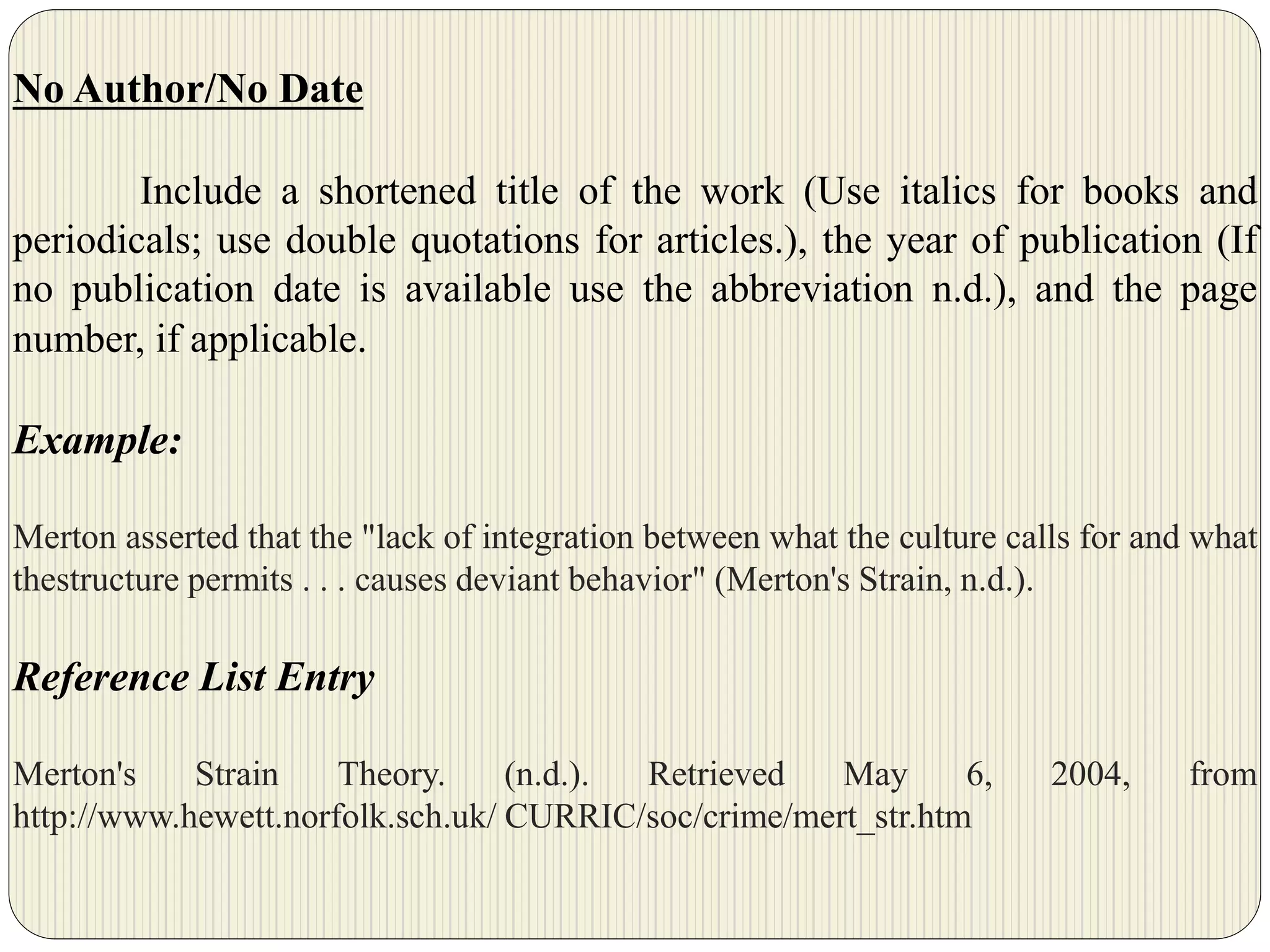
No Author/No Date
Include a shortened title of the work (Use italics for books and
periodicals; use double quotations for articles.), the year of publication (If
no publication date is available use the abbreviation n.d.), and the page
number, if applicable.
Example:
Merton asserted that the "lack of integration between what the culture calls for and what
thestructure permits . . . causes deviant behavior" (Merton's Strain, n.d.).
Reference List Entry
Merton's Strain Theory. (n.d.). Retrieved May 6, 2004, from
http://www.hewett.norfolk.sch.uk/ CURRIC/soc/crime/mert_str.htm
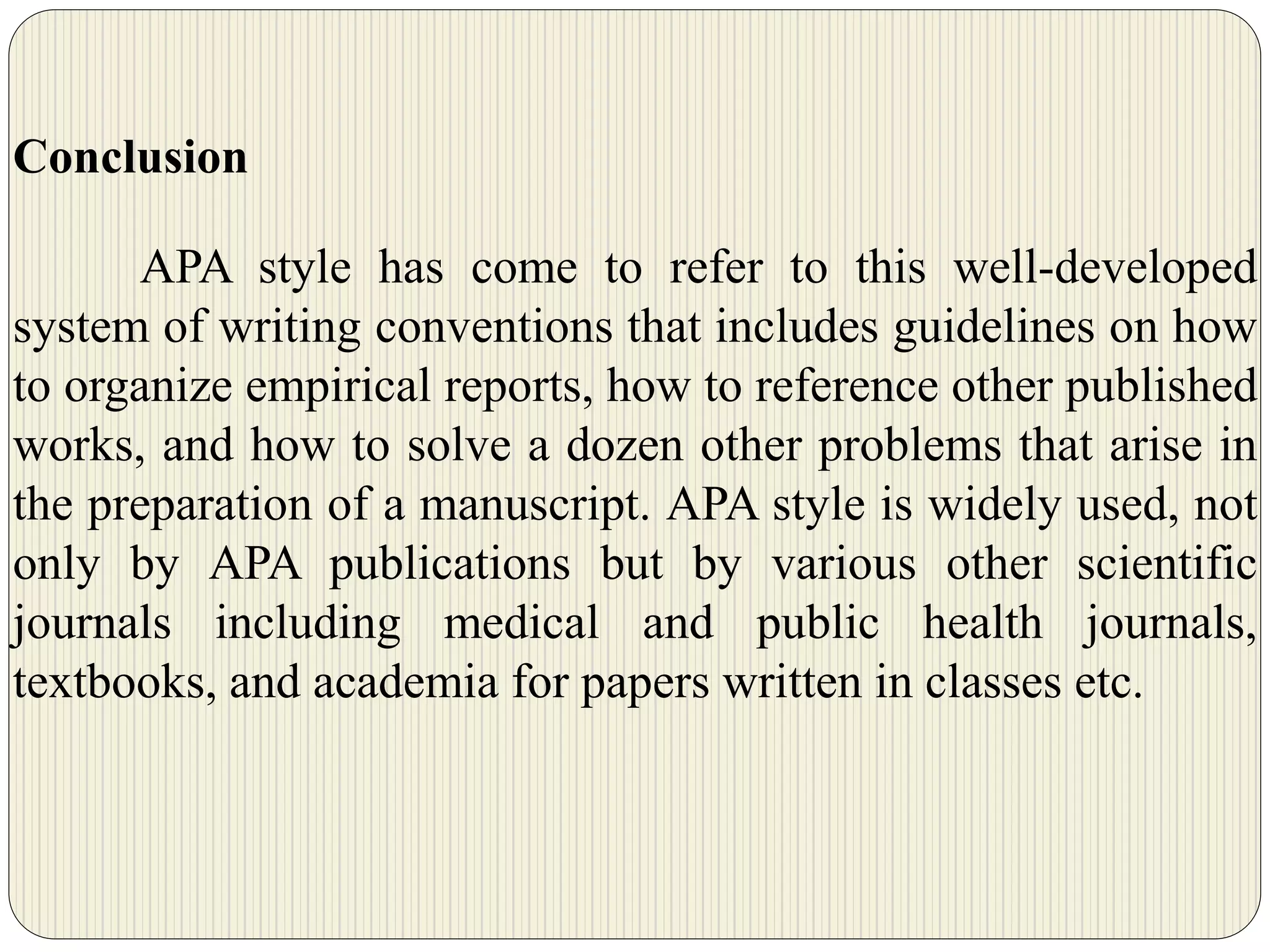
Conclusion
APA style has come to refer to this well-developed
system of writing conventions that includes guidelines on how
to organize empirical reports, how to reference other published
works, and how to solve a dozen other problems that arise in
the preparation of a manuscript. APA style is widely used, not
only by APA publications but by various other scientific
journals including medical and public health journals,
textbooks, and academia for papers written in classes etc.
Thank
You

Ppt apa

  • 1.
    Submitted to: Dr. V.T.kamble Professor and Chairman By Gurjeet kaur Research scholar Department of PG studies and Research in library and information science Gulbarga university kalaburgi APA Style Manual
  • 2.
    Introduction: A style guideor style manual is a set of standards for the writing and design of documents, either for general use or for a specific publication, organization or field. The implementation of a style guide provides uniformity in style and formatting within a document and across multiple documents.
  • 3.
    Types of StyleManuals: Research and Documentation describes four commonly used style guide of documentation: •MLA(Modern Language Association) used in English and the humanities •APA(American Psychological Association) used in psychology and the social sciences •Chicago, used in history and some humanities •CSE(Council of Science Editors) used in biology and other sciences.
  • 4.
    APA STYLE MANUAL: APAStyle originated in 1929, when a group of psychologists, anthropologists, and business managers convened and sought to establish a simple set of procedures, or style rules, that would codify the many components of scientific writing to increase the ease of reading comprehension.
  • 5.
    APA Style consistsof rules or guidelines that a publisher observes to ensure clear and consistent presentation of written material. These rules are:  selection of headings, tone, and length;  punctuation and abbreviations;  presentation of numbers and statistics;  construction of tables and figures,  citation of references; and  many other elements that are a part of a manuscript
  • 6.
    APA FORMAT Basics List ofworks cited should begin at the end of the paper on a new page with the centered title, References. Alphabetize the entries in list by the author's last name, using the letter-by-letter system (ignore spaces and other punctuation.) Only the initials of the first and middle names are given. If the author's name is unknown, alphabetize by the title, ignoring any A, An, or The. For dates, spell out the names of months in the text of paper, but abbreviate them in the list of works cited, except for May, June, and July. Use either the day- month-year style (22 July 1999) or the month-day-year style (July 22, 1999) and be consistent. With the month-day-year style, be sure to add a comma after the year unless another punctuation mark goes there.
  • 7.
    Hanging Indentation All APAcitations should use hanging indents, that is, the first line of an entry should be flush left, and the second and subsequent lines should be indented 1/2". Hyphenation • For compound words not in the dictionary, use hyphens for clarity rather than omit them. • Hyphenate compound adjectives that precede the noun they modify:  role-playing technique  two-way analysis  middle-class families • Do not hyphenate a compound adjective if its meaning is established or it cannot be misread: grade point average
  • 8.
    Capitalization, Abbreviation, andPunctuation The APA guidelines specify using sentence-style capitalization for the titles of books or articles, so one should capitalize only the first word of a title and subtitle. The exceptions to this rule would be periodical titles and proper names in a title which should still be capitalized. The periodical title is run in title case, and is followed by the volume number which, with the title, is also italicized. If there is more than one author, use an ampersand (&) before the name of the last author. If there are more than six authors, list only the first one and use et al. for the rest. Place the date of publication in parentheses immediately after the name of the author. Place a period after the closing parenthesis. Do not italicize, underline, or put quotes around the titles of shorter works within longer works.
  • 9.
     Preferred typeface:Times New Roman  Use a 12-point font size  Use two spaces after a period at the end of a sentence  Double-space entire manuscript  Set uniform margins of at least 1 inch on all pages  Use a flush left style and leave right margin uneven; do not justify  Use the tab key to create a uniform indent for the first line of every paragraph  In general - focus on uniformity and readability General Manuscript Guidelines
  • 10.
     Title page Abstract  Text  References  Tables  Figures  Appendices Order of a Manuscript
  • 11.
    Title page Manuscript title: •should summarize the main idea of the manuscript simply and with style • should be typed in uppercase and lowercase letters, centered between left and right margins, positioned in upper half of page Author: appears on next line after title preferred format: first name, middle initial(s), last name Institutional affiliation: -appears on next line after author -where the author was when research was conducted Running head: -abbreviated form of title printed at top of all pages , flush left, following the words “Running head:” -50 characters or less, all capital letters Author’s note: -can include additional information about affiliation, acknowledgements, disclaimers.
  • 12.
    Abstract Abstract is ashort passage that appear just before the introduction along with the recommended keywords. It should be typically range from 150 to 200 words Text  Starts on a separate page after the abstract page, numbered page 3  Type manuscript title in upper and lowercase letters, centered on the top line  Begin typing introduction on the next line – do not label this section as “introduction”  Use headings to organize contents of text
  • 13.
    Heading centered, Boldface, Uppercaseand Lowercase Heading (Level 1) Flush Left, Boldface, Uppercase and Lowercase Heading (Level 2) Indented, boldface, lowercase paragraph heading ending with a period. Reference page  Start on a new page after the end of the text  Type the word “References” in uppercase and lowercase letters on the top line, centered  Double-space the entire reference page and all entries  Go on to additional pages as necessary
  • 14.
    Additional work  Includeadditional materials after the reference page(s) in the following order: -tables -figures -appendices  Begin each one on a new page  Label each piece clearly
  • 15.
    Citations overview • Placecitations in sentences and paragraphs so that it is clear which material has come from which sources. • Use pronouns and transitions to indicate whether several sentences contain material from the same source or from different sources. Example : Symthe (1990) found that positioning influences ventilation. In his study of 20 ICU patients, he used two methods to. . . . However, his findings did not support the work of Karcher (1987) and Atley (1989), who used much larger samples to demonstrate that ...
  • 16.
    APA Reference List PrintSources •Book Author's last name, First initial. Middle initial. (Year of publication). Title of the book. City: Publisher. In one author Allen, T. (1974). Vanishing wildlife of North America. Washington, D.C.: National Geographic Society In case of two authors Searles, B., & Last, M. (1979). A reader's guide to science fiction. New York: Facts on File, Inc.
  • 17.
    Edited Book Author's lastname, First initial. Middle initial. (Year of publication). Title of the article. In editor's name (Ed.), Title of the book (pages of the article). City: Publisher. Example: Flower, L., Hayes, J. R., Carey, L., Schriver, K., & Stratman, J. (1986). Detection, diagnosis. In L. Ede (Ed.), The Braddock essays (pp. 191-228). Boston:Bedford St. Martin's.
  • 18.
    Periodical—Journal Paginated byIssue Author's last name, First initial. Middle initial. (Year of publication). Title of the article. Title of Periodical, Volume(Issue), pages of the article. .Example: Szasz, T. (2004). Protecting patients against psychiatric intervention. Social Science and ModernSociety, 41(3), 7-9
  • 19.
    Periodical—Journal Paginated byVolume Author's last name, First initial. Middle initial. (Year of publication). Title of the article. Title of Periodical, Volume, pages of the article. Example: Weber, E. U., Shafir, S., & Blais, A. (2004). Predicting risk sensitivity in humans and lower animals. Psychological Review, 111, 430-445.
  • 20.
    Periodical—Magazines Author's last name,First initial. Middle initial. (Year, date of publication). Title of the article. Title of Periodical, Volume, pages of the article. Example: Schwartz, P. (2002, June). Love is not all you need. Psychology Today, 35, 57-62.
  • 21.
    Periodical—Newspapers Author's last name,First initial. Middle initial. (Year, date of publication). Title of the article. Title of Periodical, pages of the article. Example: Martinez, A. (2004, May 5). Questions arise about liability. The Sun, pp. A1, A6.
  • 22.
    Electronic Sources Article froman Internet-only Journal Author's last name, First initial. Middle initial. (Year of publication). Title of the article. Title of Periodical, Volume(Issue). Retrieval date, from URL Example: Lambert, E. G., Hogan, N. L., & Barton, S. M. (2003). Collegiate academic dishonesty revisited: What have they done, how often have they done it? Electronic Journal of Sociology, 7(4). Retrieved May 5, 2004, from http://www.sociology.org/content/vol7.4/lambert_etal.html
  • 23.
    journal Article froma Database Author's last name, First initial. Middle initial. (Year of publication). Title of the article. Title of Periodical, Volume, pages of the article. Retrieval date, from database (document number). Example: Troyer, L., & Younts, C. W. (1997). Whose expectations matter? The relative power of expectations in determining social influence. The American Journal of Sociology, 103, 692-743. Retrieved May 5, 2004, from Expanded Academic ASAP database (A20317868).
  • 24.
    APA In-Text inprint sources APA uses an author-date system of in-text citation. Each of the samples below is followed by the entry that would appear on the reference list page. In-Text Citation for a Quotation Include the author's last name, the year of publication, and the page number. Example: Szasz (2004) commented, "We are hypocrites if we ignore who the parties are that support the enactment of mental health laws and deny patients the option of rejecting psychiatric services"(p. 8). Or "We are hypocrites if we ignore who the parties are that support the enactment of mental health laws and deny patients the option of rejecting psychiatric services" (Szasz, 2004, p. 8). Reference List Entry Szasz, T. (2004). Protecting patients against psychiatric intervention. Social Science and Modern Society, 41(3), 7-9.
  • 25.
    In-Text Citation fora Paraphrase or Summary Include the author's last name and the year of publication. The page number is not required; however, it is recommended especially when citing a section from a long work. Example: According to Meyer and Smith (1987), a beginning writer may use academic jargon incorrectly in an attempt to sound sophisticated. Part of a tutor's job, then, is to help that student develop his or her unique voice (p. 162). Or A beginning writer may use academic jargon incorrectly in an attempt to sound sophisticated. Part of a tutor's job, then, is to help that student develop his or her unique voice (Meyer & Smith, 1987, p. 162). Reference List Entry Meyer, E., & Smith, L. Z. (1987). The practical tutor. New York: Oxford University Press.
  • 26.
    APA In-Text ElectronicPublications Include the author's last name, the year of publication, and the page number or paragraph number. For sites lacking page numbers or paragraph numbers, give the heading and paragraph number. If that information is unavailable, simply provide the author's last name and the year of publication. Example: Psychologists Seff, Gecas, and Frey (1993) argued that "research on birth order effects has been remarkably inconsistent and inconclusive with regard to various personality and behavioral outcomes" (Introduction section, 4). Reference List Entry Seff, M. A., Gecas, V., & Frey, J. H. (1993). Birth order, self concept, and participation in dangerous sports. The Journal of Psychology, 127. Retrieved May 23, 2004, from Expanded Academic ASAP database (Article A14110698).
  • 27.
    No Author/No Date Includea shortened title of the work (Use italics for books and periodicals; use double quotations for articles.), the year of publication (If no publication date is available use the abbreviation n.d.), and the page number, if applicable. Example: Merton asserted that the "lack of integration between what the culture calls for and what thestructure permits . . . causes deviant behavior" (Merton's Strain, n.d.). Reference List Entry Merton's Strain Theory. (n.d.). Retrieved May 6, 2004, from http://www.hewett.norfolk.sch.uk/ CURRIC/soc/crime/mert_str.htm
  • 28.
    Conclusion APA style hascome to refer to this well-developed system of writing conventions that includes guidelines on how to organize empirical reports, how to reference other published works, and how to solve a dozen other problems that arise in the preparation of a manuscript. APA style is widely used, not only by APA publications but by various other scientific journals including medical and public health journals, textbooks, and academia for papers written in classes etc.
  • 29.

Editor's Notes