Case Studies v2
GEOGRAPHY CIE IGCSE
By Theo Dick
Aided by Alex Haji and Nick Gwynne
Edited by Ethan Sarif-Kattan
Namibia – Sparse and Dense Population
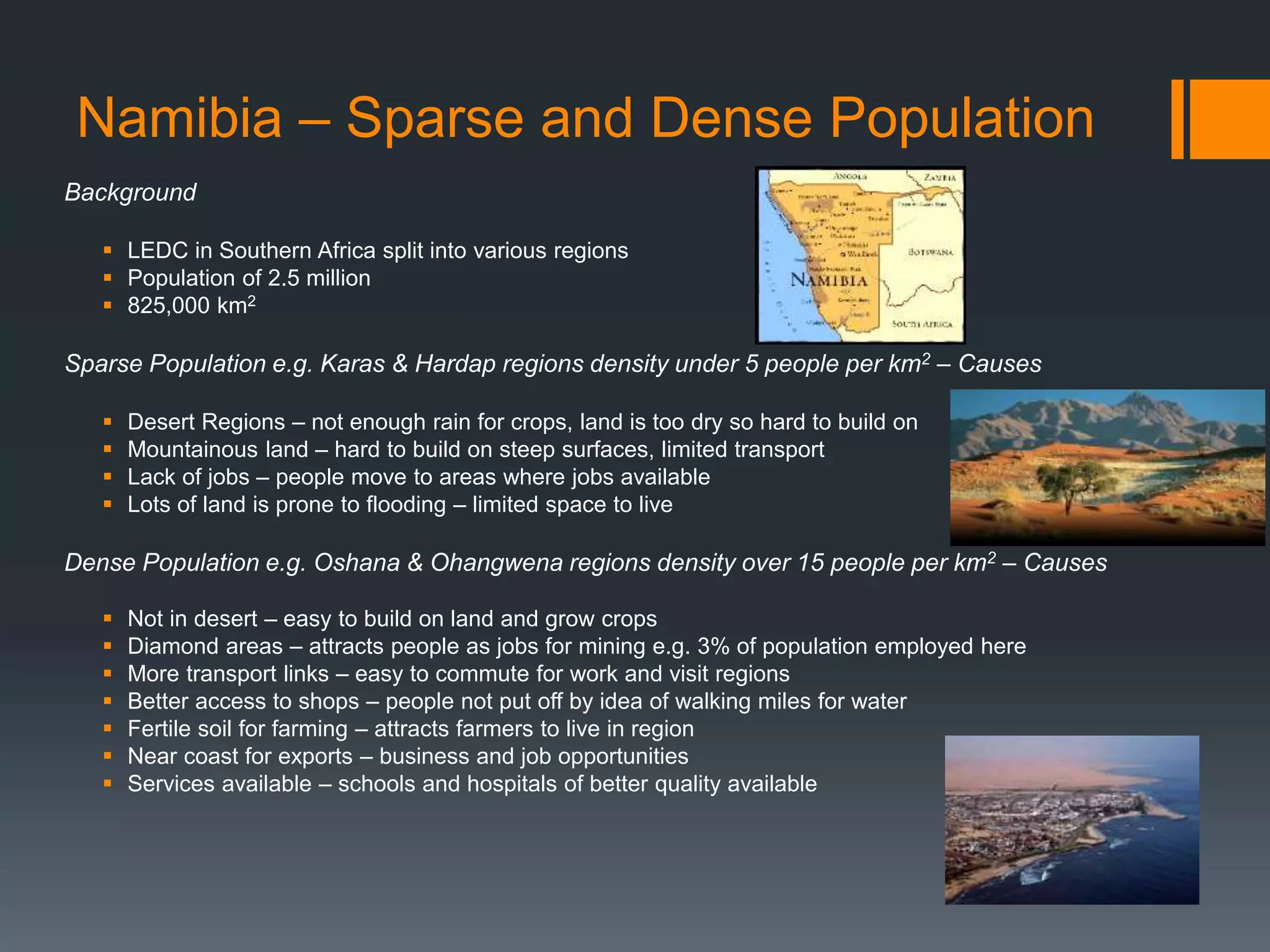
Background
 LEDC in Southern Africa split into various regions
 Population of 2.5 million
 825,000 km2
Sparse Population e.g. Karas & Hardap regions density under 5 people per km2 – Causes
 Desert Regions – not enough rain for crops, land is too dry so hard to build on
 Mountainous land – hard to build on steep surfaces, limited transport
 Lack of jobs – people move to areas where jobs available
 Lots of land is prone to flooding – limited space to live
Dense Population e.g. Oshana & Ohangwena regions density over 15 people per km2 – Causes
 Not in desert – easy to build on land and grow crops
 Diamond areas – attracts people as jobs for mining e.g. 3% of population employed here
 More transport links – easy to commute for work and visit regions
 Better access to shops – people not put off by idea of walking miles for water
 Fertile soil for farming – attracts farmers to live in region
 Near coast for exports – business and job opportunities
 Services available – schools and hospitals of better quality available
Niger – Population explosion
Background
 Landlocked LEDC in West Africa
 One of world’s poorest countries
 Hot and dry climate
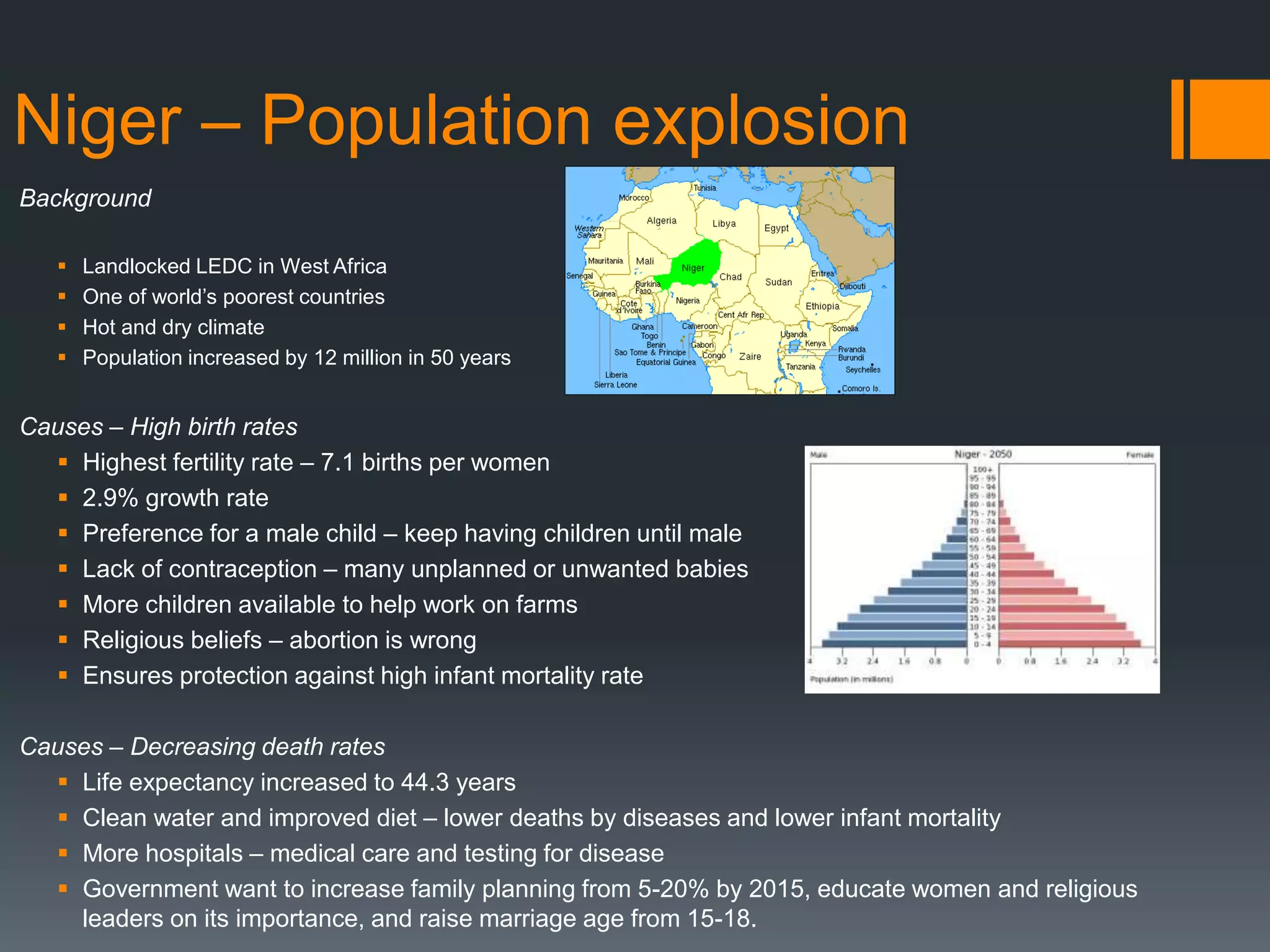
 Population increased by 12 million in 50 years
Causes – High birth rates
 Highest fertility rate – 7.1 births per women
 2.9% growth rate
 Preference for a male child – keep having children until male
 Lack of contraception – many unplanned or unwanted babies
 More children available to help work on farms
 Religious beliefs – abortion is wrong
 Ensures protection against high infant mortality rate
Causes – Decreasing death rates
 Life expectancy increased to 44.3 years
 Clean water and improved diet – lower deaths by diseases and lower infant mortality
 More hospitals – medical care and testing for disease
 Government want to increase family planning from 5-20% by 2015, educate women and religious
leaders on its importance, and raise marriage age from 15-18.
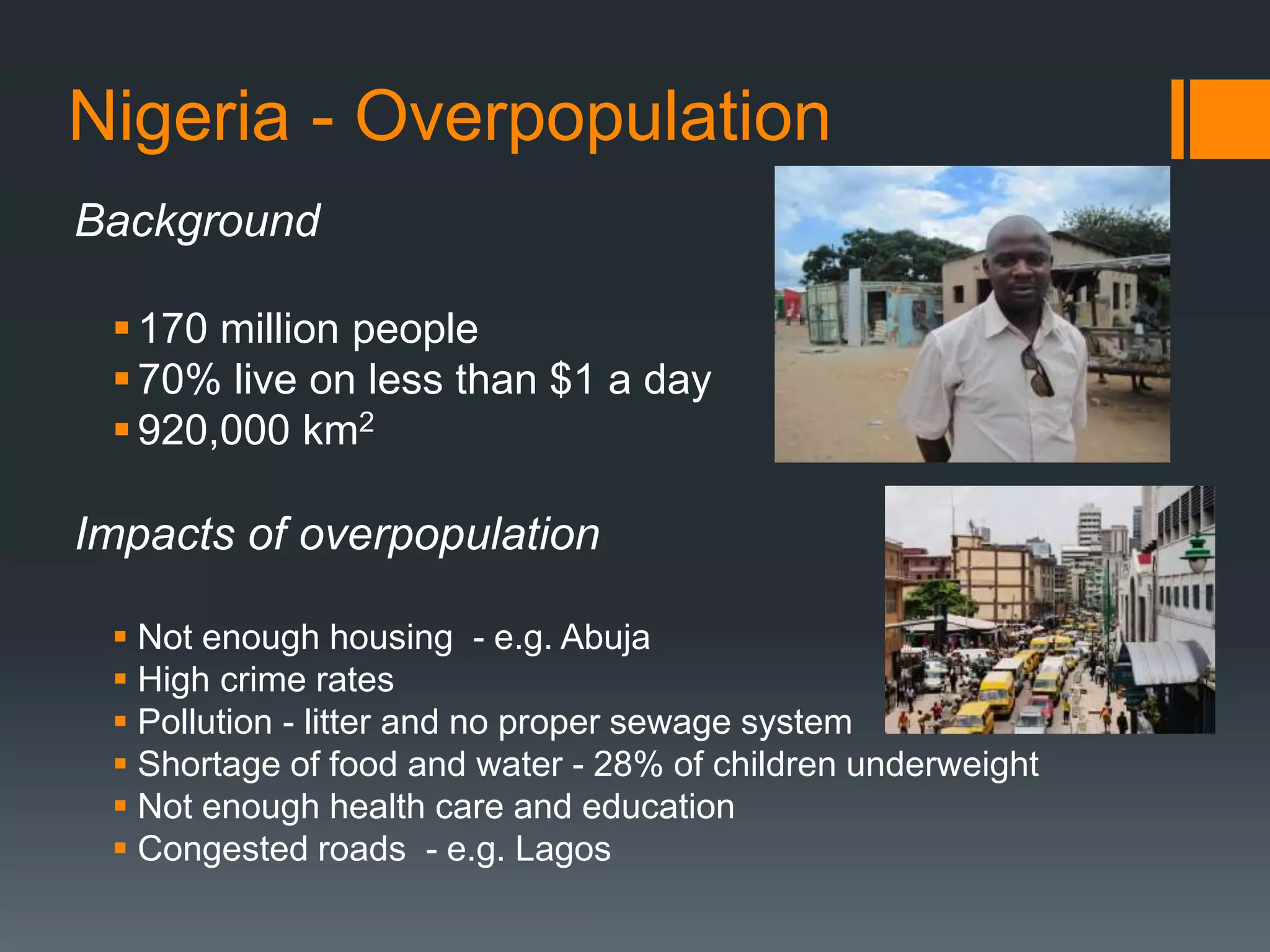
Nigeria - Overpopulation
Background
170 million people
70% live on less than $1 a day
920,000 km2
Impacts of overpopulation
 Not enough housing - e.g. Abuja
 High crime rates
 Pollution - litter and no proper sewage system
 Shortage of food and water - 28% of children underweight
 Not enough health care and education
 Congested roads - e.g. Lagos
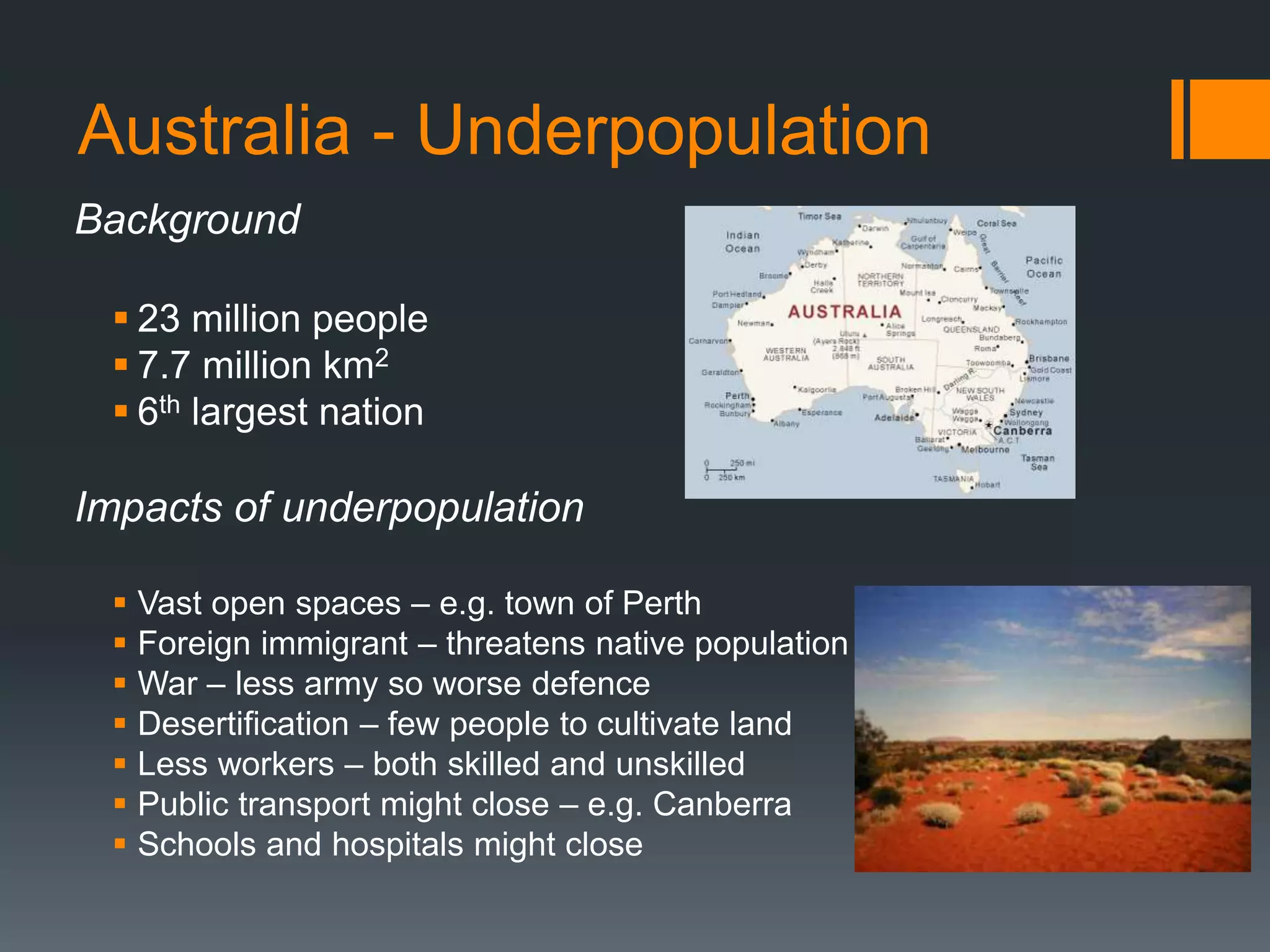
Australia - Underpopulation
Background
 23 million people
 7.7 million km2
 6th largest nation
Impacts of underpopulation
 Vast open spaces – e.g. town of Perth
 Foreign immigrant – threatens native population
 War – less army so worse defence
 Desertification – few people to cultivate land
 Less workers – both skilled and unskilled
 Public transport might close – e.g. Canberra
 Schools and hospitals might close
China – Anti-Natalist Government policy
Background
 1.4 billion people – worlds highest population
 Population was 830 million in 1980
Causes
 1960’s – 1970’s, Chairman Mao of the communist government condemned birth control and banned
imports of contraceptives
 He wanted to strengthen China and its army
 He then realised he could not provide food and jobs to entire population
Consequences
 The one child policy was introduced in 1979, forcing abortions and sterilisation and fining families
thousands of dollars, this prevented 250 million births
 Originally the officials pushed the slogan ‘later, longer, fewer’; the population growth dropped by half
from 1970-76 but then levelled off, officials wanted more drastic measures
 Massive gender imbalance – 32 million more boys than girls
 In 2007, there were six working age adults to every retiree, but in 2040, it is predicted to reach 2:1 (too
few children to care for them, elderlies will suffer neglect)
 Contraception was made more available
 Increase in health care meant that abortions were used more
 1.7 children now per women
 Population growth dropped from 2.4% to 1%
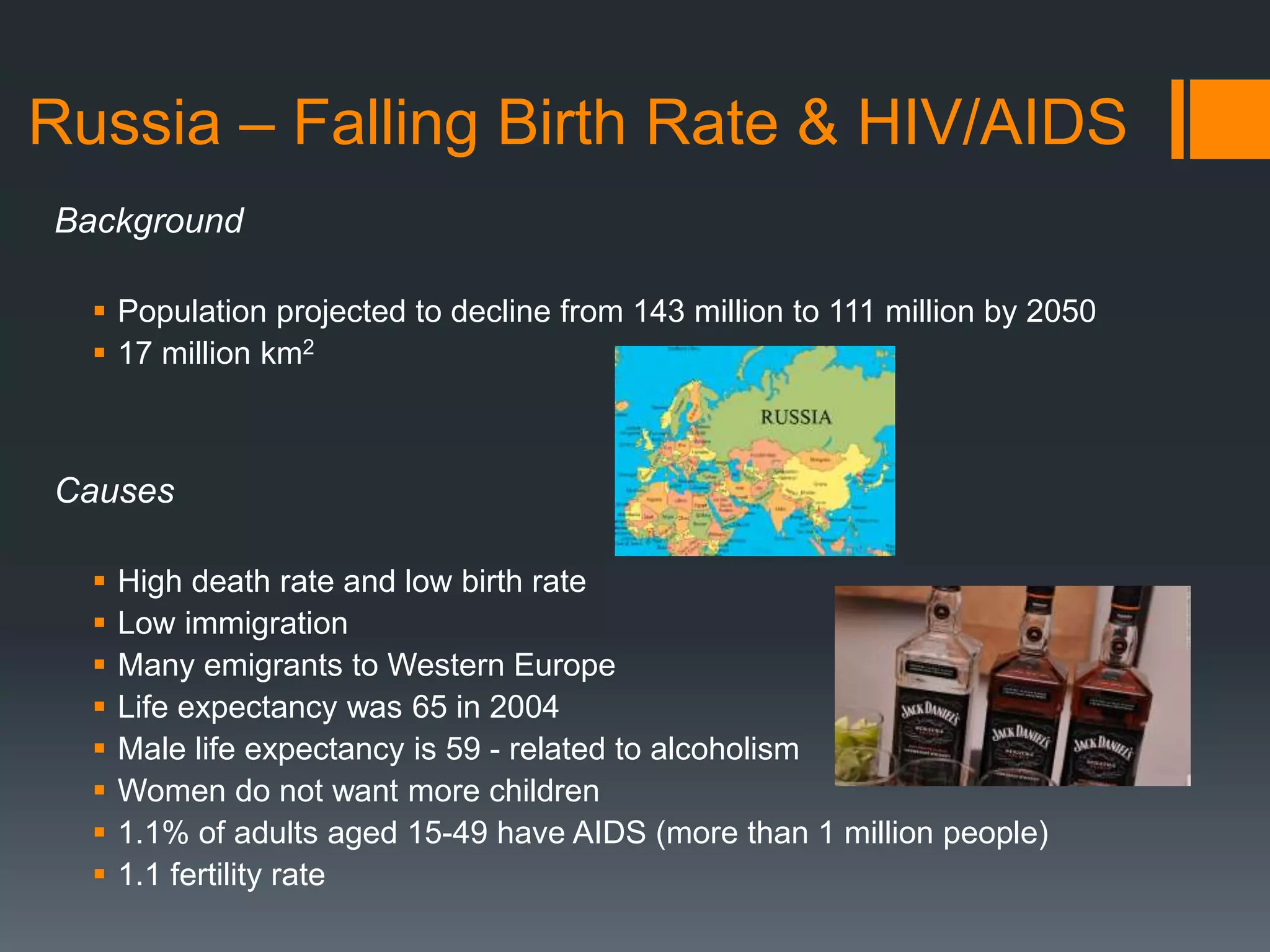
Russia – Falling Birth Rate & HIV/AIDS
Background
 Population projected to decline from 143 million to 111 million by 2050
 17 million km2
Causes
 High death rate and low birth rate
 Low immigration
 Many emigrants to Western Europe
 Life expectancy was 65 in 2004
 Male life expectancy is 59 - related to alcoholism
 Women do not want more children
 1.1% of adults aged 15-49 have AIDS (more than 1 million people)
 1.1 fertility rate
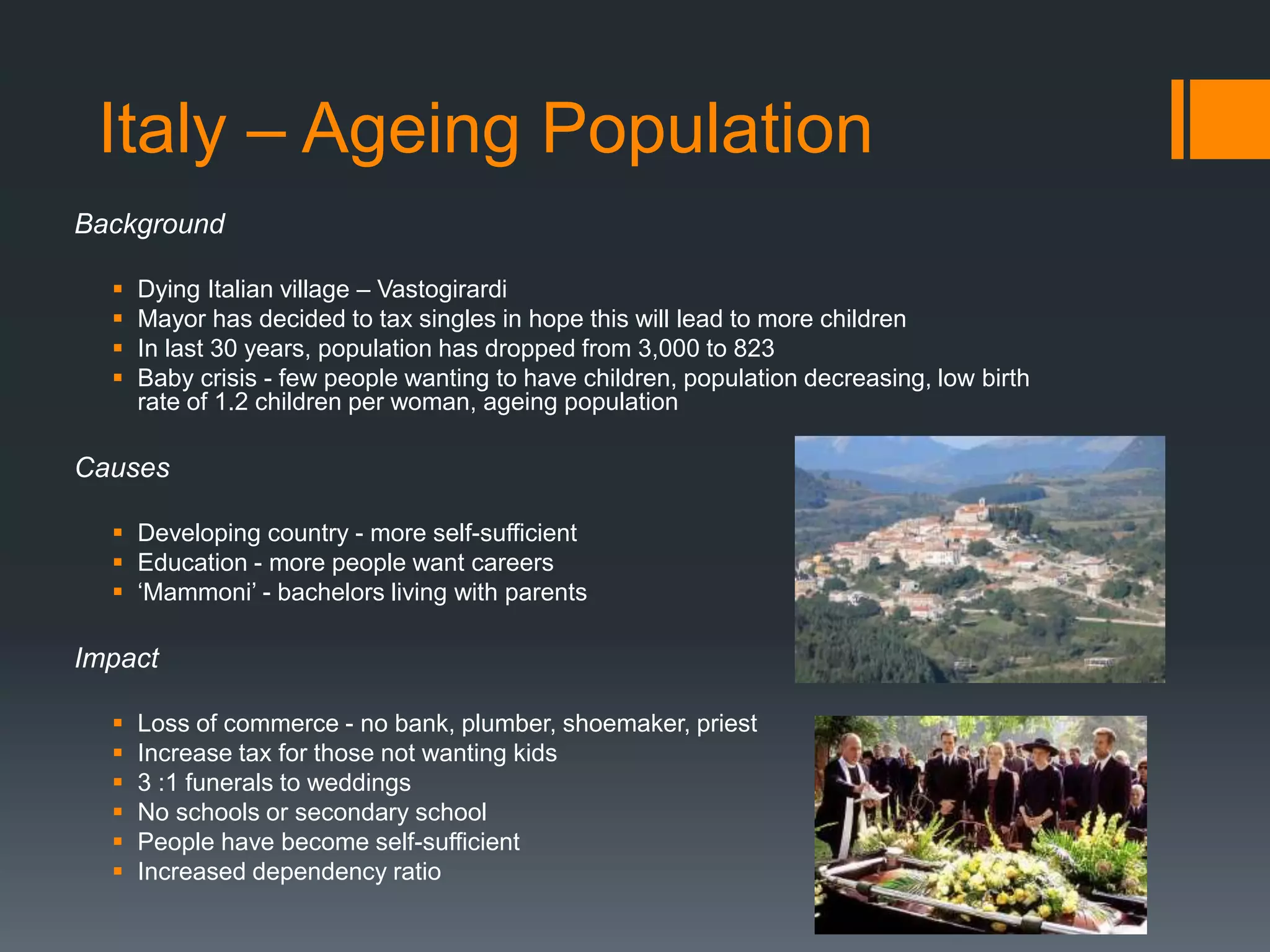
Italy – Ageing Population
Background
 Dying Italian village – Vastogirardi
 Mayor has decided to tax singles in hope this will lead to more children
 In last 30 years, population has dropped from 3,000 to 823
 Baby crisis - few people wanting to have children, population decreasing, low birth
rate of 1.2 children per woman, ageing population
Causes
 Developing country - more self-sufficient
 Education - more people want careers
 ‘Mammoni’ - bachelors living with parents
Impact
 Loss of commerce - no bank, plumber, shoemaker, priest
 Increase tax for those not wanting kids
 3 :1 funerals to weddings
 No schools or secondary school
 People have become self-sufficient
 Increased dependency ratio
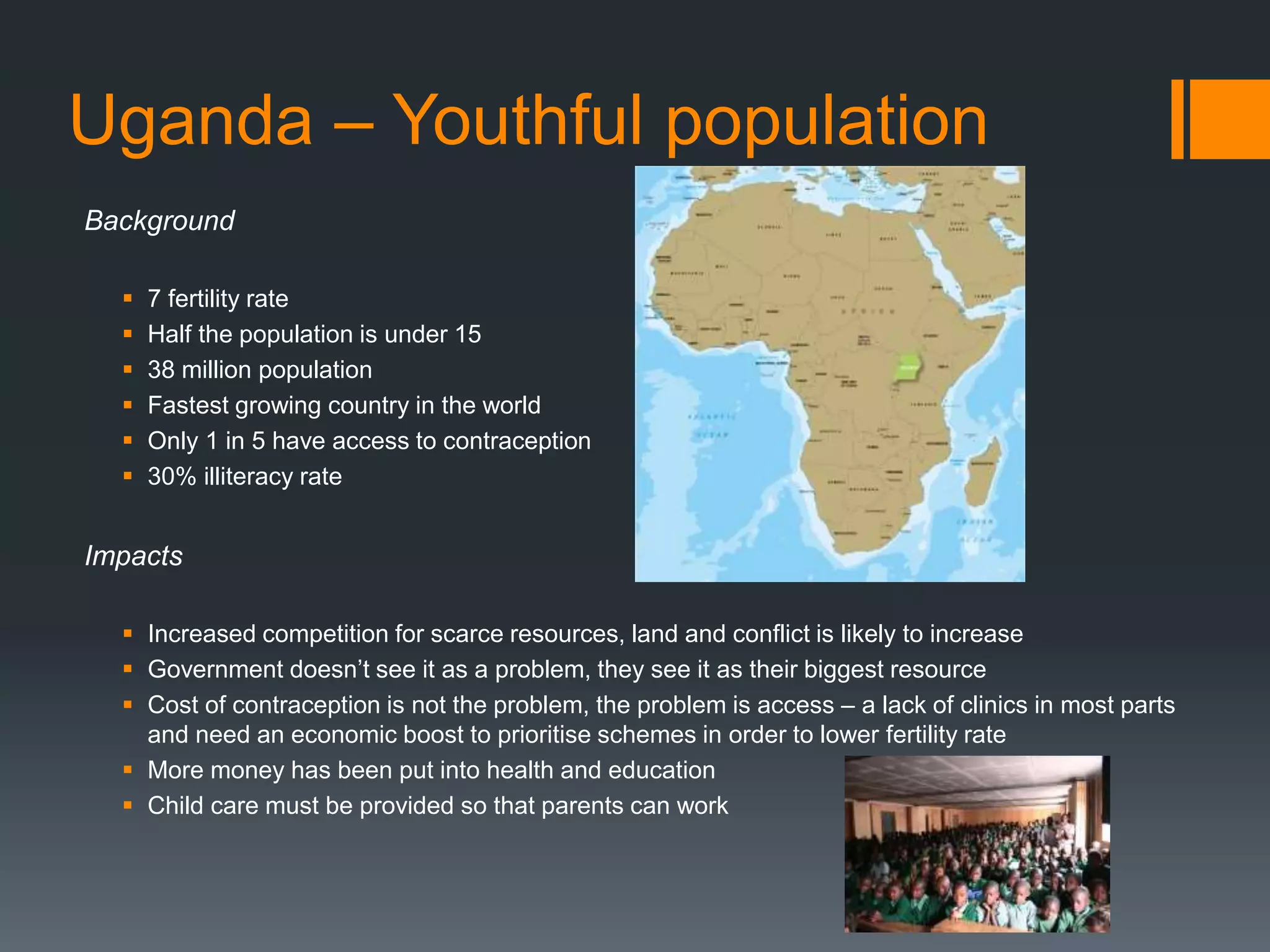
Uganda – Youthful population
Background
 7 fertility rate
 Half the population is under 15
 38 million population
 Fastest growing country in the world
 Only 1 in 5 have access to contraception
 30% illiteracy rate
Impacts
 Increased competition for scarce resources, land and conflict is likely to increase
 Government doesn’t see it as a problem, they see it as their biggest resource
 Cost of contraception is not the problem, the problem is access – a lack of clinics in most parts
and need an economic boost to prioritise schemes in order to lower fertility rate
 More money has been put into health and education
 Child care must be provided so that parents can work
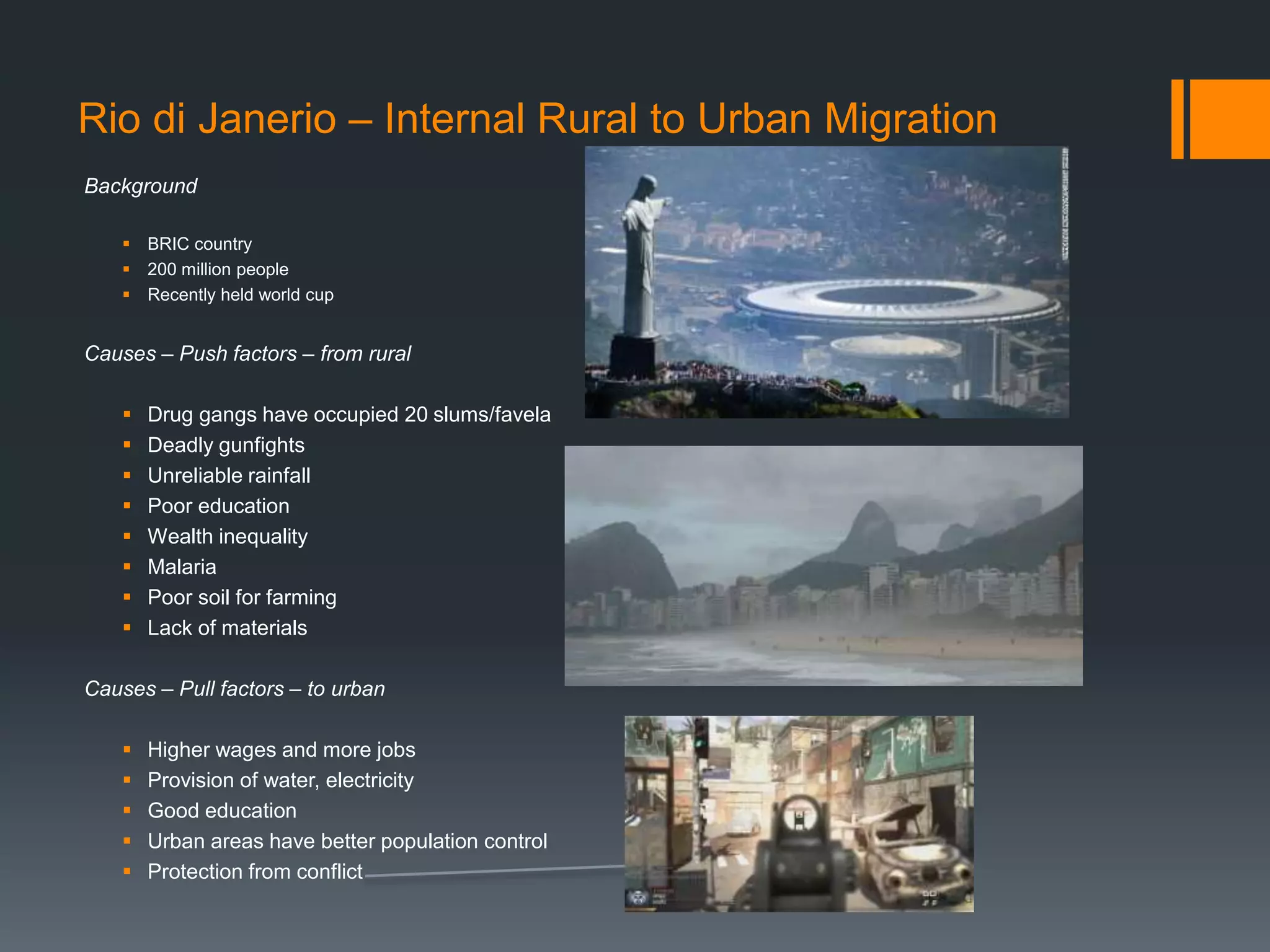
Rio di Janerio – Internal Rural to Urban Migration
Background
 BRIC country
 200 million people
 Recently held world cup
Causes – Push factors – from rural
 Drug gangs have occupied 20 slums/favela
 Deadly gunfights
 Unreliable rainfall
 Poor education
 Wealth inequality
 Malaria
 Poor soil for farming
 Lack of materials
Causes – Pull factors – to urban
 Higher wages and more jobs
 Provision of water, electricity
 Good education
 Urban areas have better population control
 Protection from conflict
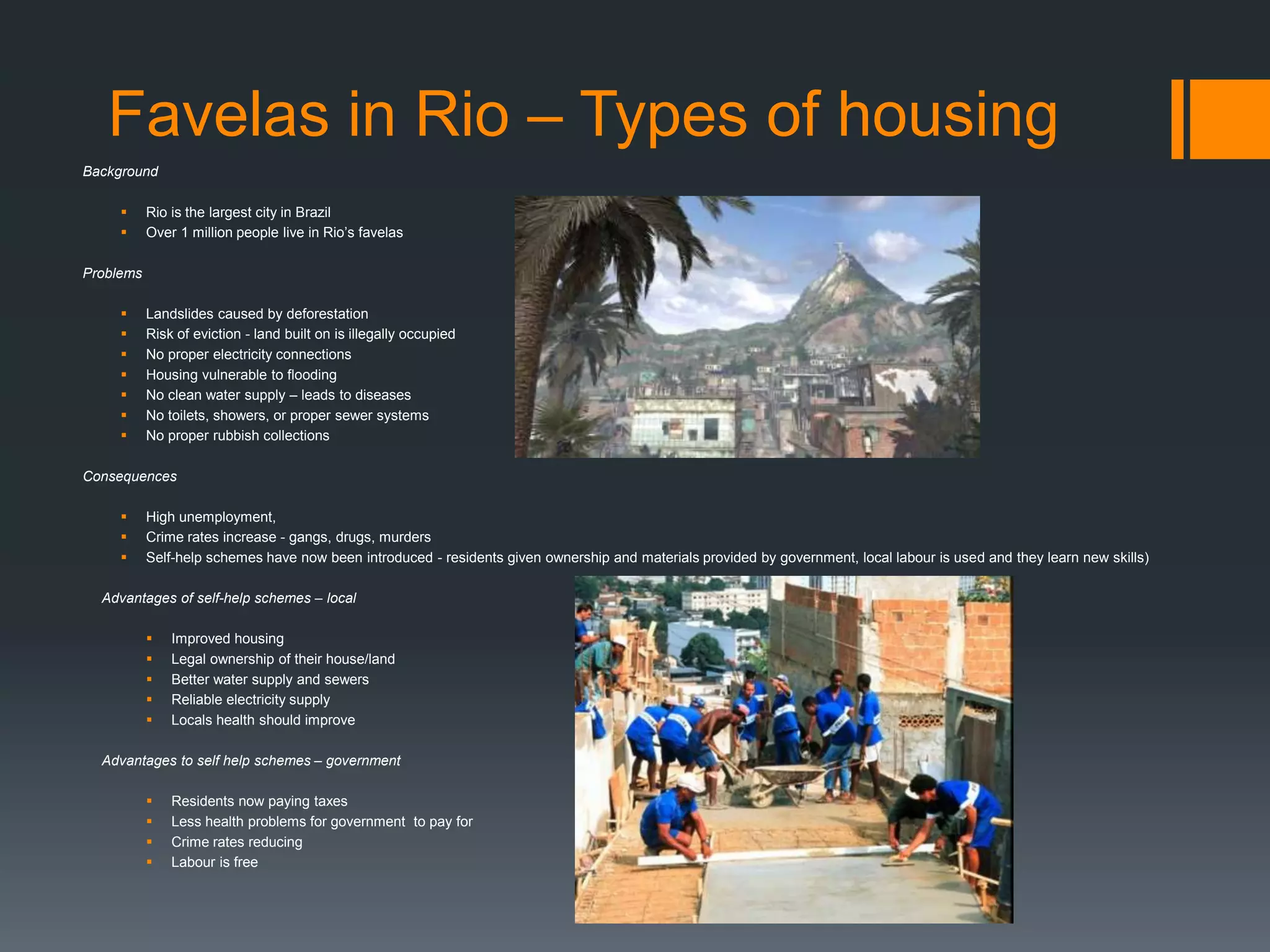
Favelas in Rio – Types of housing
Background
 Rio is the largest city in Brazil
 Over 1 million people live in Rio’s favelas
Problems
 Landslides caused by deforestation
 Risk of eviction - land built on is illegally occupied
 No proper electricity connections
 Housing vulnerable to flooding
 No clean water supply – leads to diseases
 No toilets, showers, or proper sewer systems
 No proper rubbish collections
Consequences
 High unemployment,
 Crime rates increase - gangs, drugs, murders
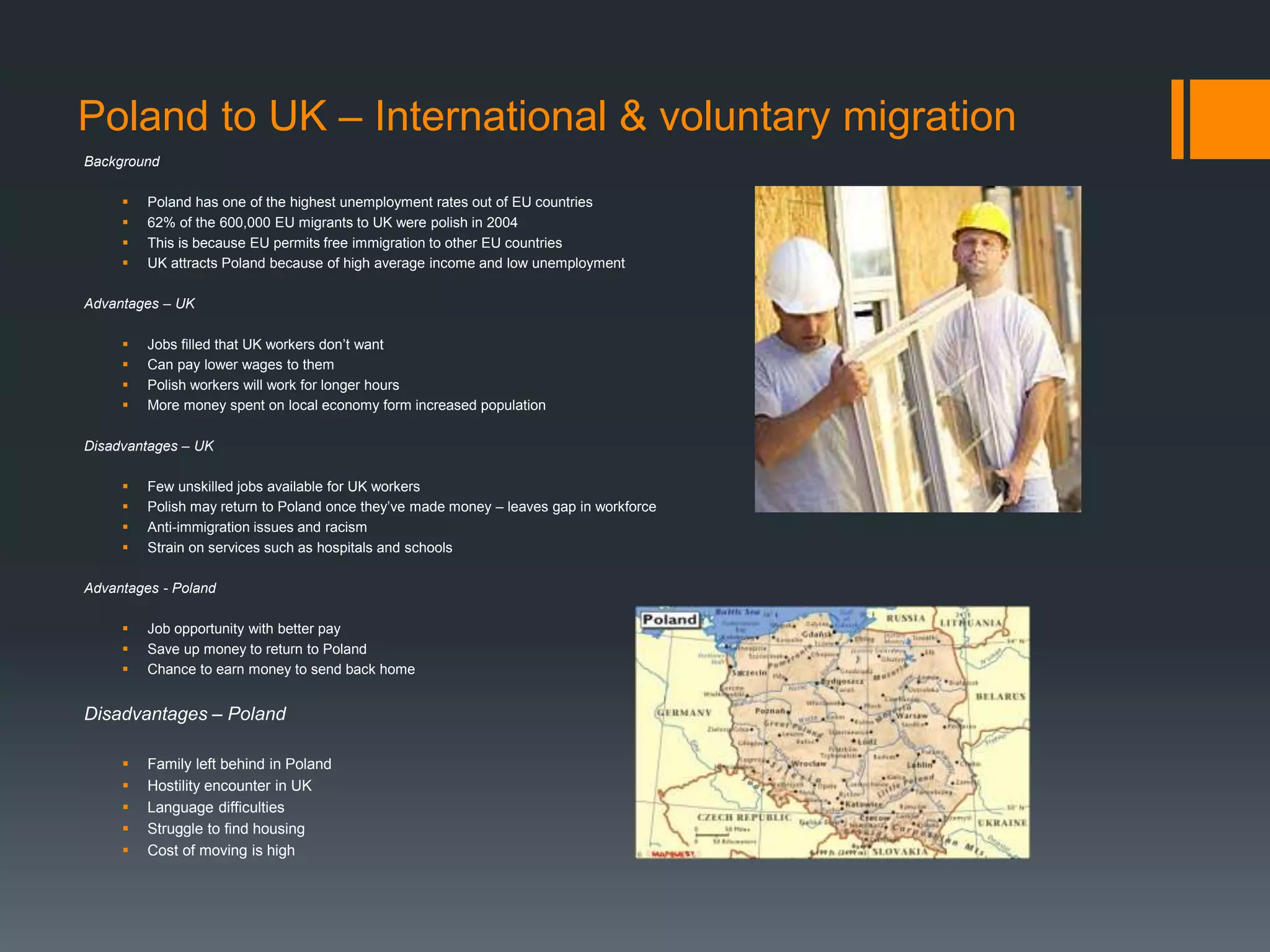
 Self-help schemes have now been introduced - residents given ownership and materials provided by government, local labour is used and they learn new skills)
Advantages of self-help schemes – local
 Improved housing
 Legal ownership of their house/land
 Better water supply and sewers
 Reliable electricity supply
 Locals health should improve
Advantages to self help schemes – government
 Residents now paying taxes
 Less health problems for government to pay for
 Crime rates reducing
 Labour is free
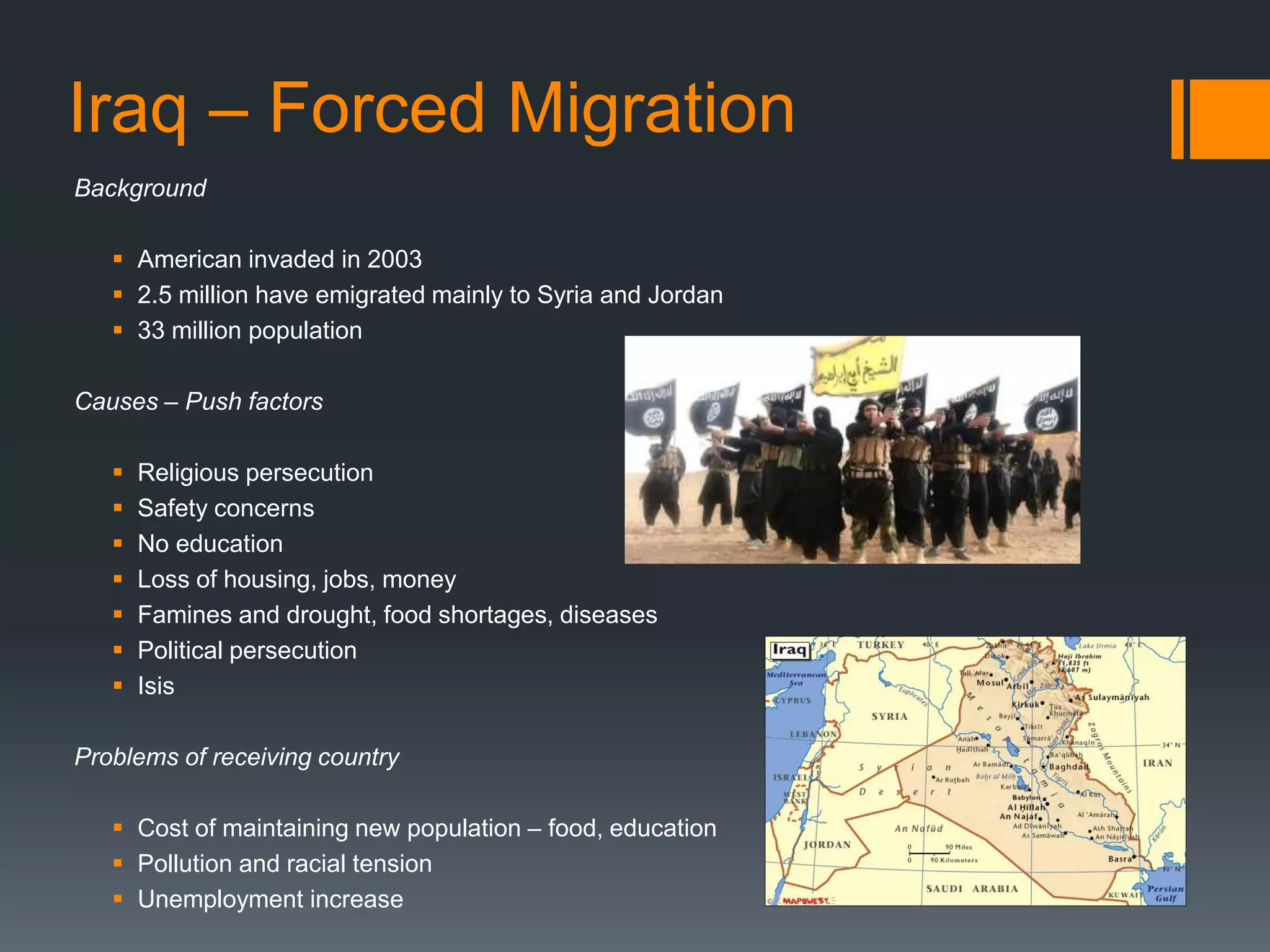
Poland to UK – International & voluntary migration
Background
 Poland has one of the highest unemployment rates out of EU countries
 62% of the 600,000 EU migrants to UK were polish in 2004
 This is because EU permits free immigration to other EU countries
 UK attracts Poland because of high average income and low unemployment
Advantages – UK
 Jobs filled that UK workers don’t want
 Can pay lower wages to them
 Polish workers will work for longer hours
 More money spent on local economy form increased population
Disadvantages – UK
 Few unskilled jobs available for UK workers
 Polish may return to Poland once they’ve made money – leaves gap in workforce
 Anti-immigration issues and racism
 Strain on services such as hospitals and schools
Advantages - Poland
 Job opportunity with better pay
 Save up money to return to Poland
 Chance to earn money to send back home
Disadvantages – Poland
 Family left behind in Poland
 Hostility encounter in UK
 Language difficulties
 Struggle to find housing
 Cost of moving is high
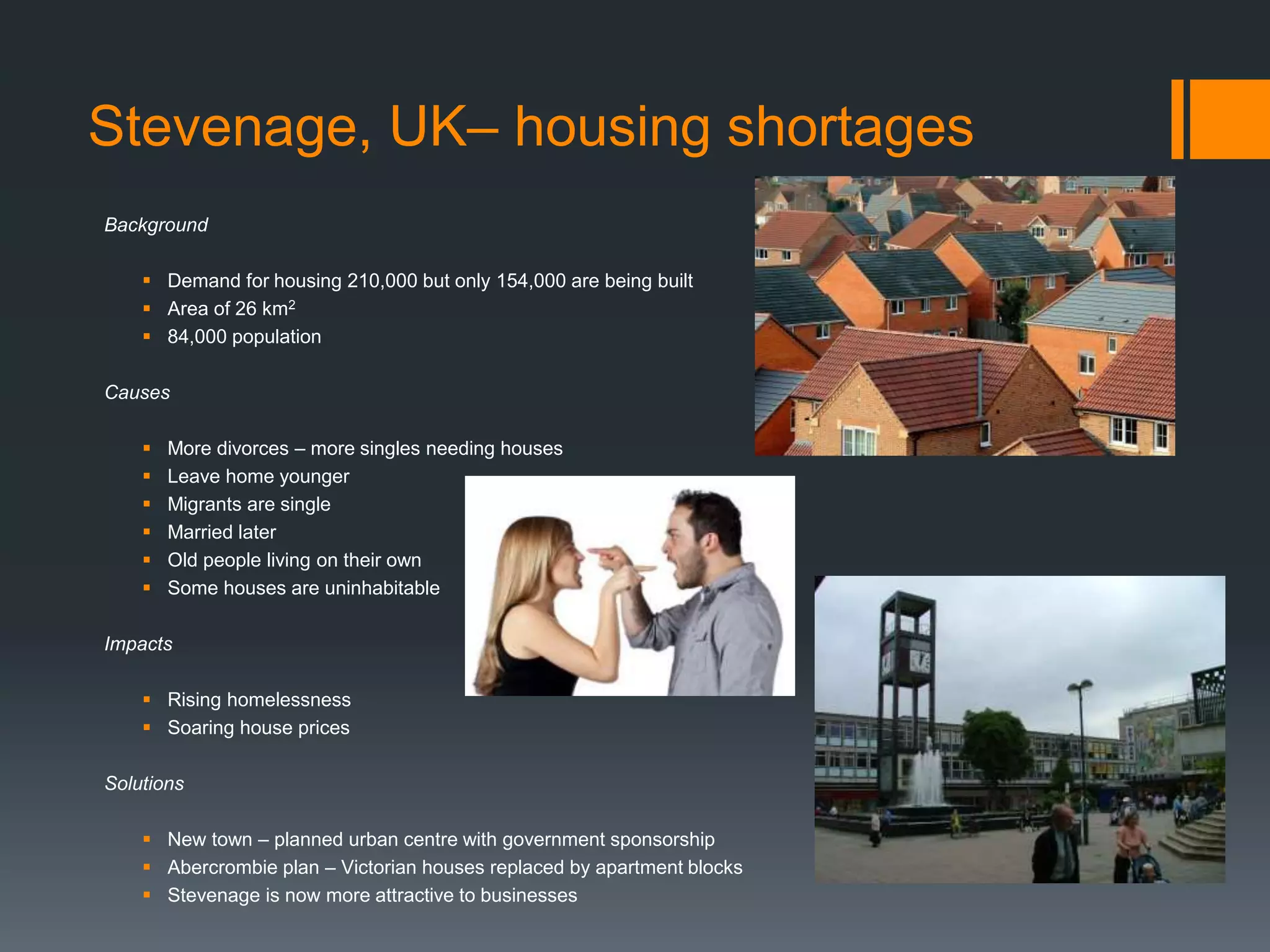
Iraq – Forced Migration
Background
 American invaded in 2003
 2.5 million have emigrated mainly to Syria and Jordan
 33 million population
Causes – Push factors
 Religious persecution
 Safety concerns
 No education
 Loss of housing, jobs, money
 Famines and drought, food shortages, diseases
 Political persecution
 Isis
Problems of receiving country
 Cost of maintaining new population – food, education
 Pollution and racial tension
 Unemployment increase
Stevenage, UK– housing shortages
Background
 Demand for housing 210,000 but only 154,000 are being built
 Area of 26 km2
 84,000 population
Causes
 More divorces – more singles needing houses
 Leave home younger
 Migrants are single
 Married later
 Old people living on their own
 Some houses are uninhabitable
Impacts
 Rising homelessness
 Soaring house prices
Solutions
 New town – planned urban centre with government sponsorship
 Abercrombie plan – Victorian houses replaced by apartment blocks
 Stevenage is now more attractive to businesses
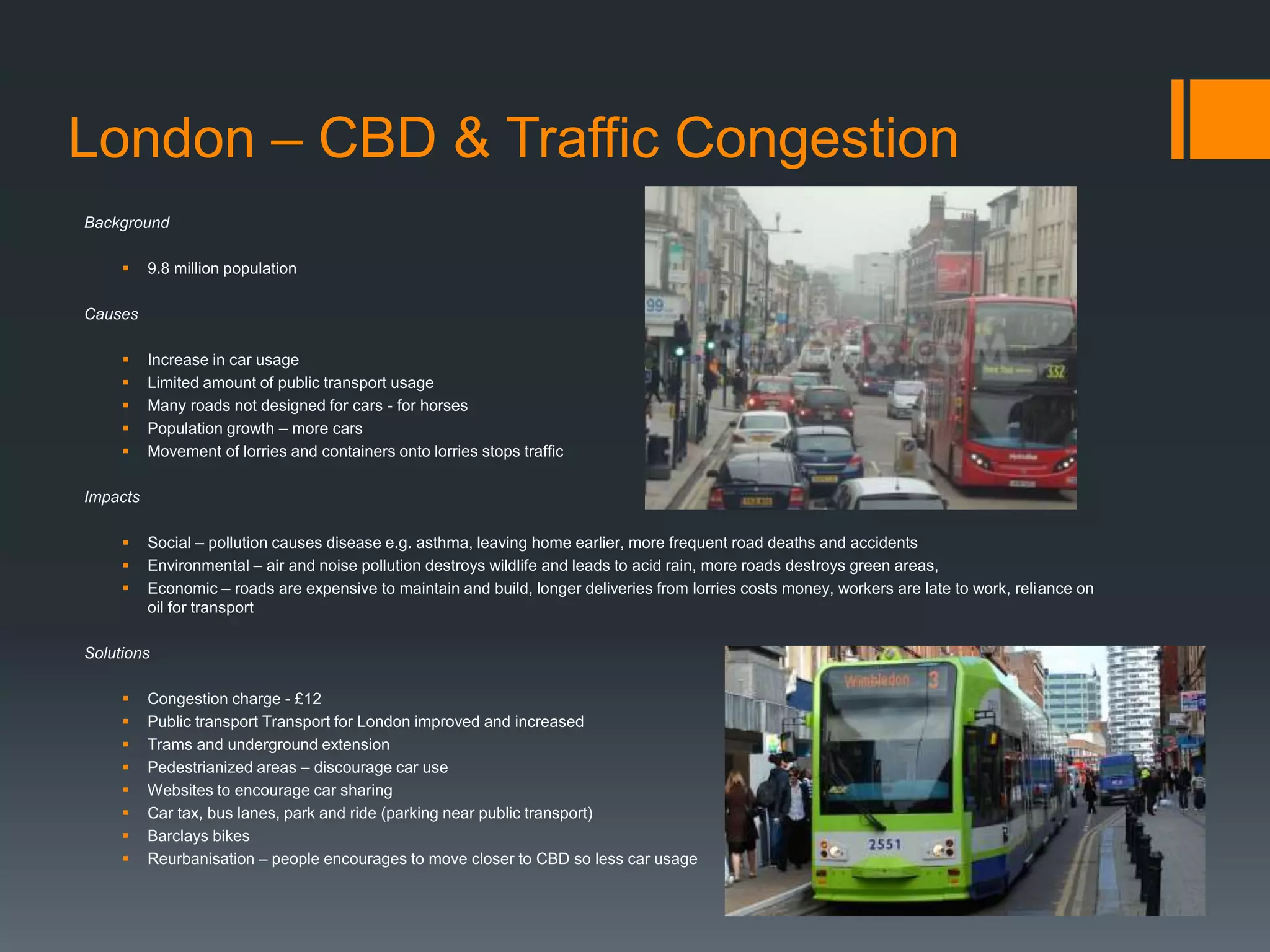
London – CBD & Traffic Congestion
Background
 9.8 million population
Causes
 Increase in car usage
 Limited amount of public transport usage
 Many roads not designed for cars - for horses
 Population growth – more cars
 Movement of lorries and containers onto lorries stops traffic
Impacts
 Social – pollution causes disease e.g. asthma, leaving home earlier, more frequent road deaths and accidents
 Environmental – air and noise pollution destroys wildlife and leads to acid rain, more roads destroys green areas,
 Economic – roads are expensive to maintain and build, longer deliveries from lorries costs money, workers are late to work, reliance on
oil for transport
Solutions
 Congestion charge - £12
 Public transport Transport for London improved and increased
 Trams and underground extension
 Pedestrianized areas – discourage car use
 Websites to encourage car sharing
 Car tax, bus lanes, park and ride (parking near public transport)
 Barclays bikes
 Reurbanisation – people encourages to move closer to CBD so less car usage
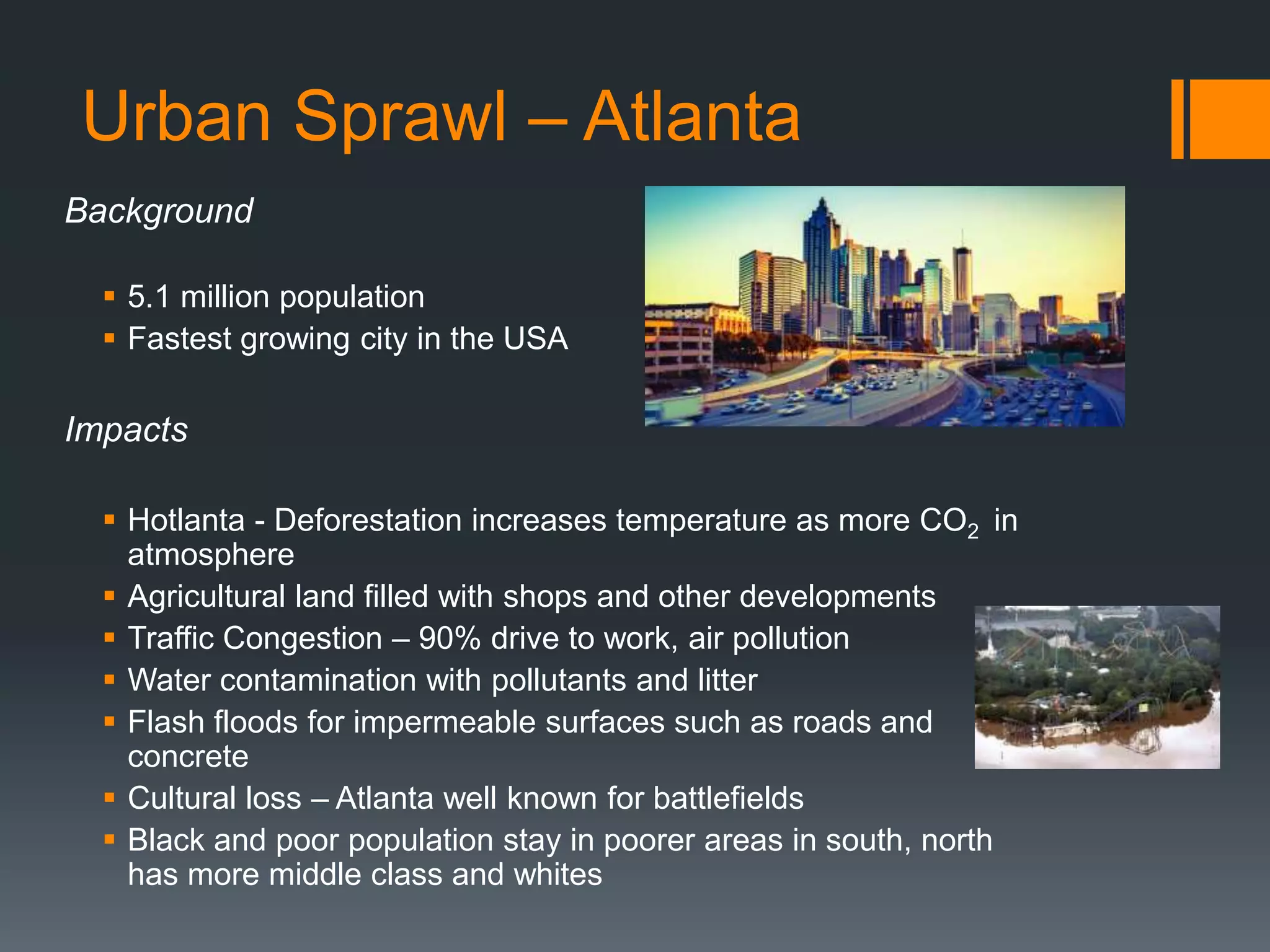
Urban Sprawl – Atlanta
Background
 5.1 million population
 Fastest growing city in the USA
Impacts
 Hotlanta - Deforestation increases temperature as more CO2 in
atmosphere
 Agricultural land filled with shops and other developments
 Traffic Congestion – 90% drive to work, air pollution
 Water contamination with pollutants and litter
 Flash floods for impermeable surfaces such as roads and
concrete
 Cultural loss – Atlanta well known for battlefields
 Black and poor population stay in poorer areas in south, north
has more middle class and whites
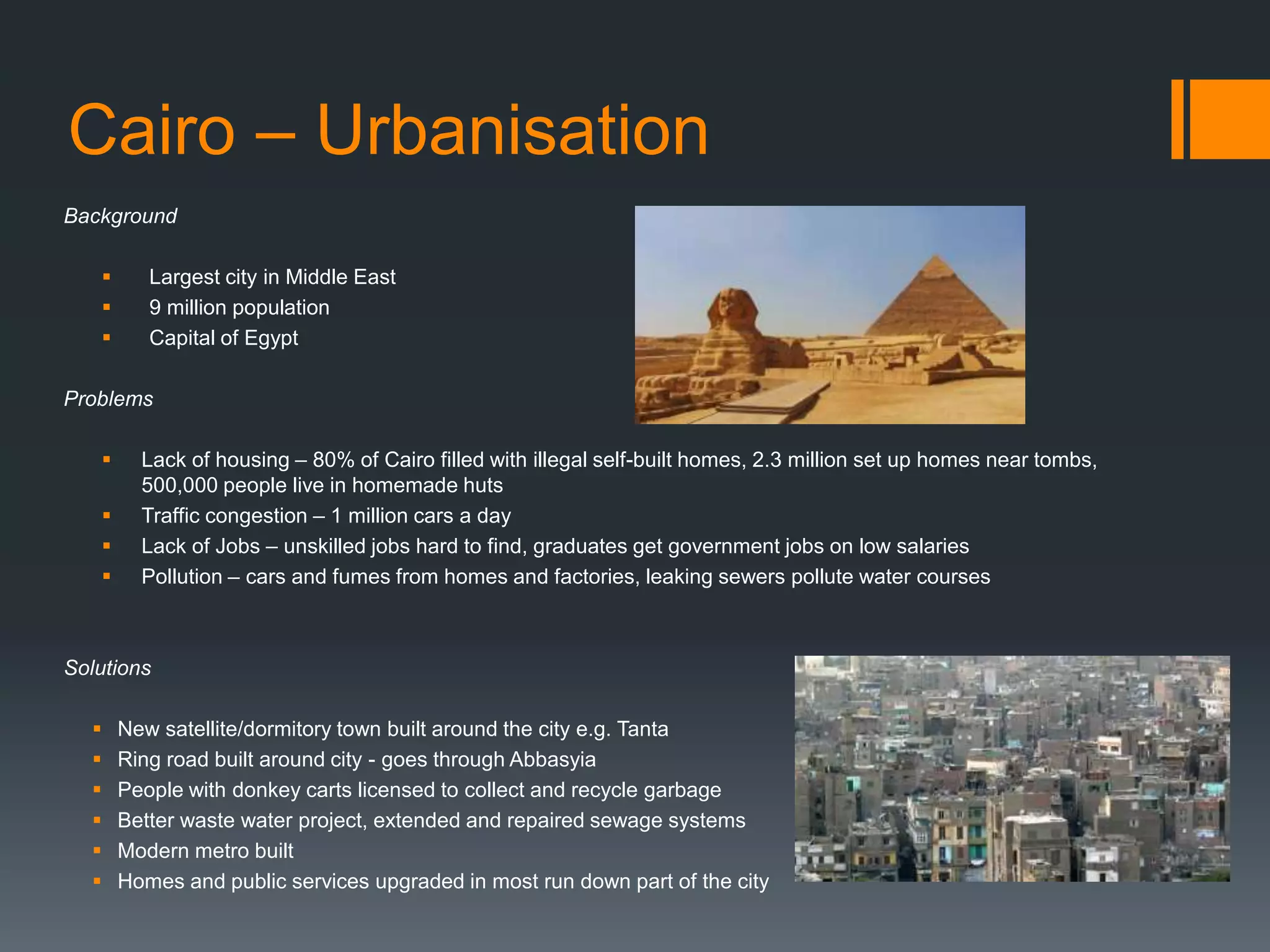
Cairo – Urbanisation
Background
 Largest city in Middle East
 9 million population
 Capital of Egypt
Problems
 Lack of housing – 80% of Cairo filled with illegal self-built homes, 2.3 million set up homes near tombs,
500,000 people live in homemade huts
 Traffic congestion – 1 million cars a day
 Lack of Jobs – unskilled jobs hard to find, graduates get government jobs on low salaries
 Pollution – cars and fumes from homes and factories, leaking sewers pollute water courses
Solutions
 New satellite/dormitory town built around the city e.g. Tanta
 Ring road built around city - goes through Abbasyia
 People with donkey carts licensed to collect and recycle garbage
 Better waste water project, extended and repaired sewage systems
 Modern metro built
 Homes and public services upgraded in most run down part of the city
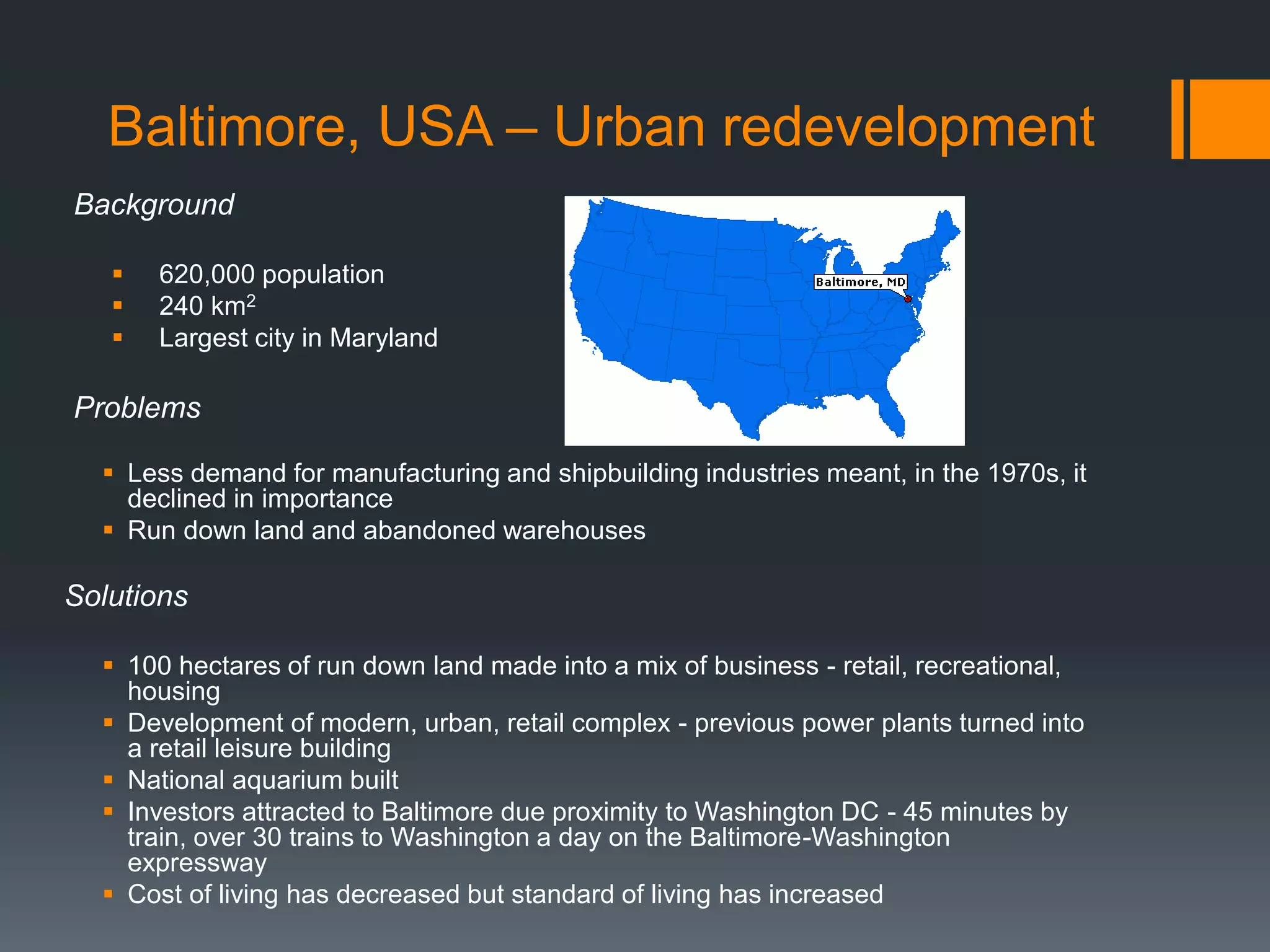
Baltimore, USA – Urban redevelopment
Background
 620,000 population
 240 km2
 Largest city in Maryland
Problems
 Less demand for manufacturing and shipbuilding industries meant, in the 1970s, it
declined in importance
 Run down land and abandoned warehouses
Solutions
 100 hectares of run down land made into a mix of business - retail, recreational,
housing
 Development of modern, urban, retail complex - previous power plants turned into
a retail leisure building
 National aquarium built
 Investors attracted to Baltimore due proximity to Washington DC - 45 minutes by
train, over 30 trains to Washington a day on the Baltimore-Washington
expressway
 Cost of living has decreased but standard of living has increased
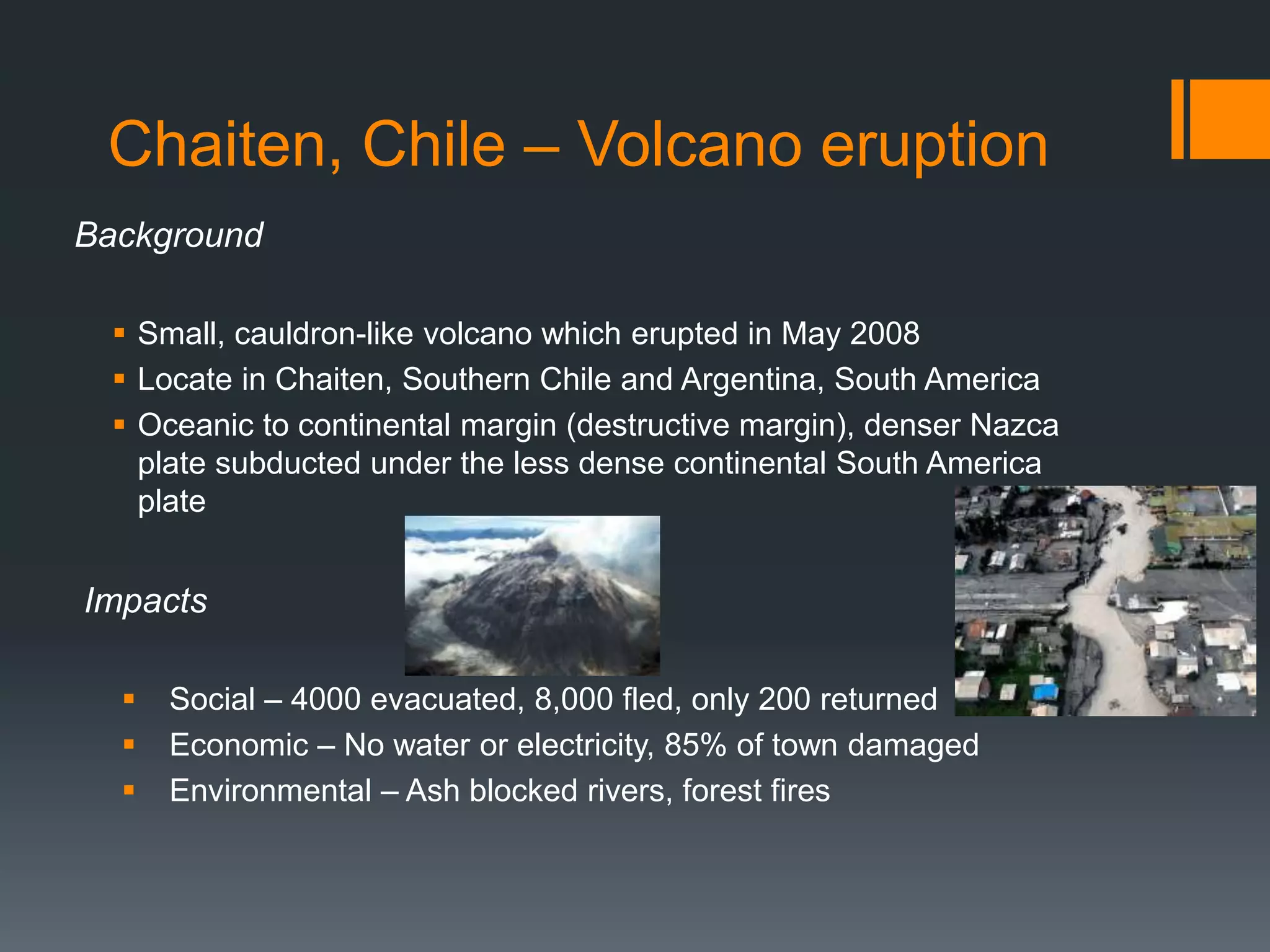
Chaiten, Chile – Volcano eruption
Background
 Small, cauldron-like volcano which erupted in May 2008
 Locate in Chaiten, Southern Chile and Argentina, South America
 Oceanic to continental margin (destructive margin), denser Nazca
plate subducted under the less dense continental South America
plate
Impacts
 Social – 4000 evacuated, 8,000 fled, only 200 returned
 Economic – No water or electricity, 85% of town damaged
 Environmental – Ash blocked rivers, forest fires
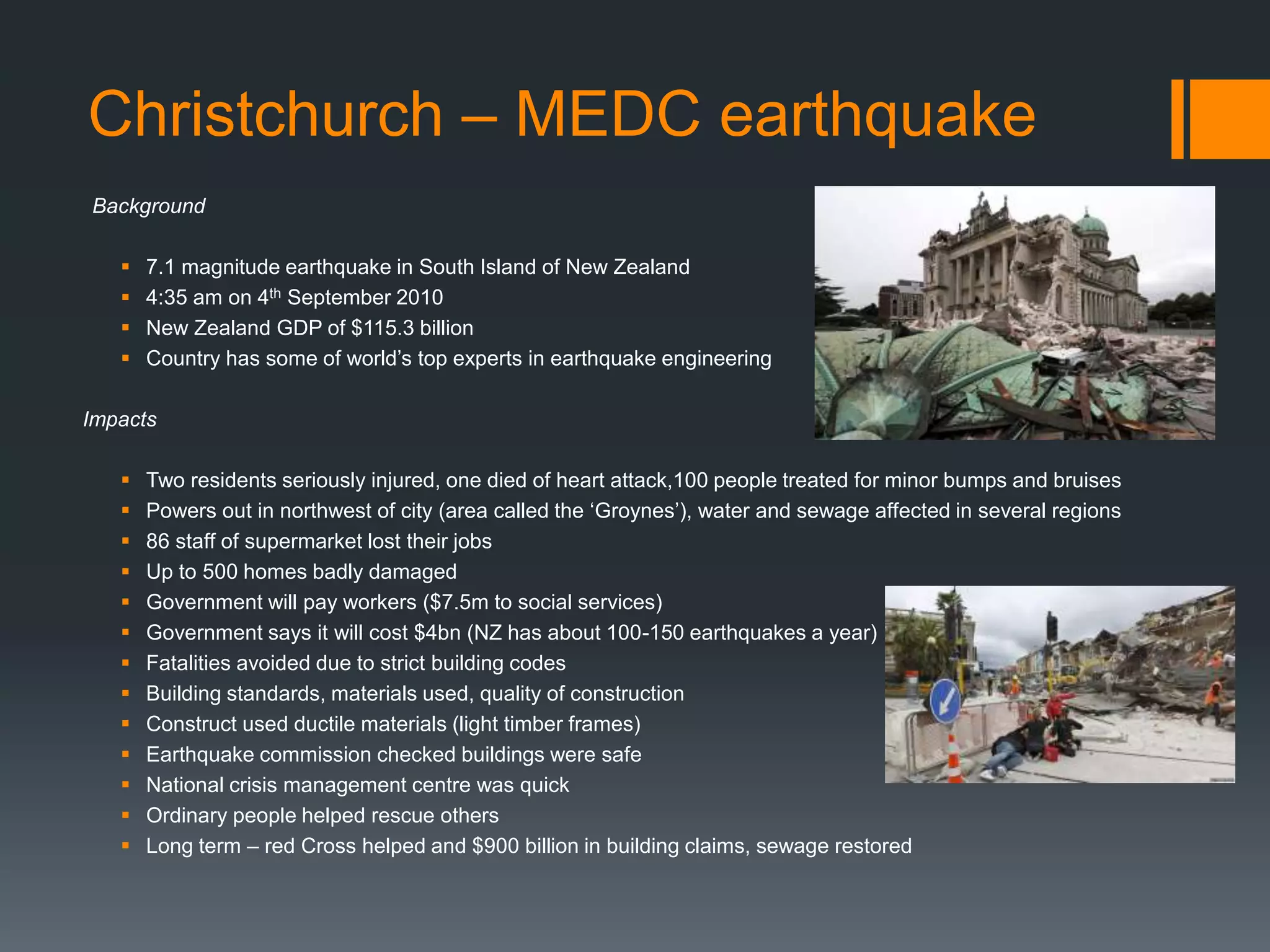
Christchurch – MEDC earthquake
Background
 7.1 magnitude earthquake in South Island of New Zealand
 4:35 am on 4th September 2010
 New Zealand GDP of $115.3 billion
 Country has some of world’s top experts in earthquake engineering
Impacts
 Two residents seriously injured, one died of heart attack,100 people treated for minor bumps and bruises
 Powers out in northwest of city (area called the ‘Groynes’), water and sewage affected in several regions
 86 staff of supermarket lost their jobs
 Up to 500 homes badly damaged
 Government will pay workers ($7.5m to social services)
 Government says it will cost $4bn (NZ has about 100-150 earthquakes a year)
 Fatalities avoided due to strict building codes
 Building standards, materials used, quality of construction
 Construct used ductile materials (light timber frames)
 Earthquake commission checked buildings were safe
 National crisis management centre was quick
 Ordinary people helped rescue others
 Long term – red Cross helped and $900 billion in building claims, sewage restored
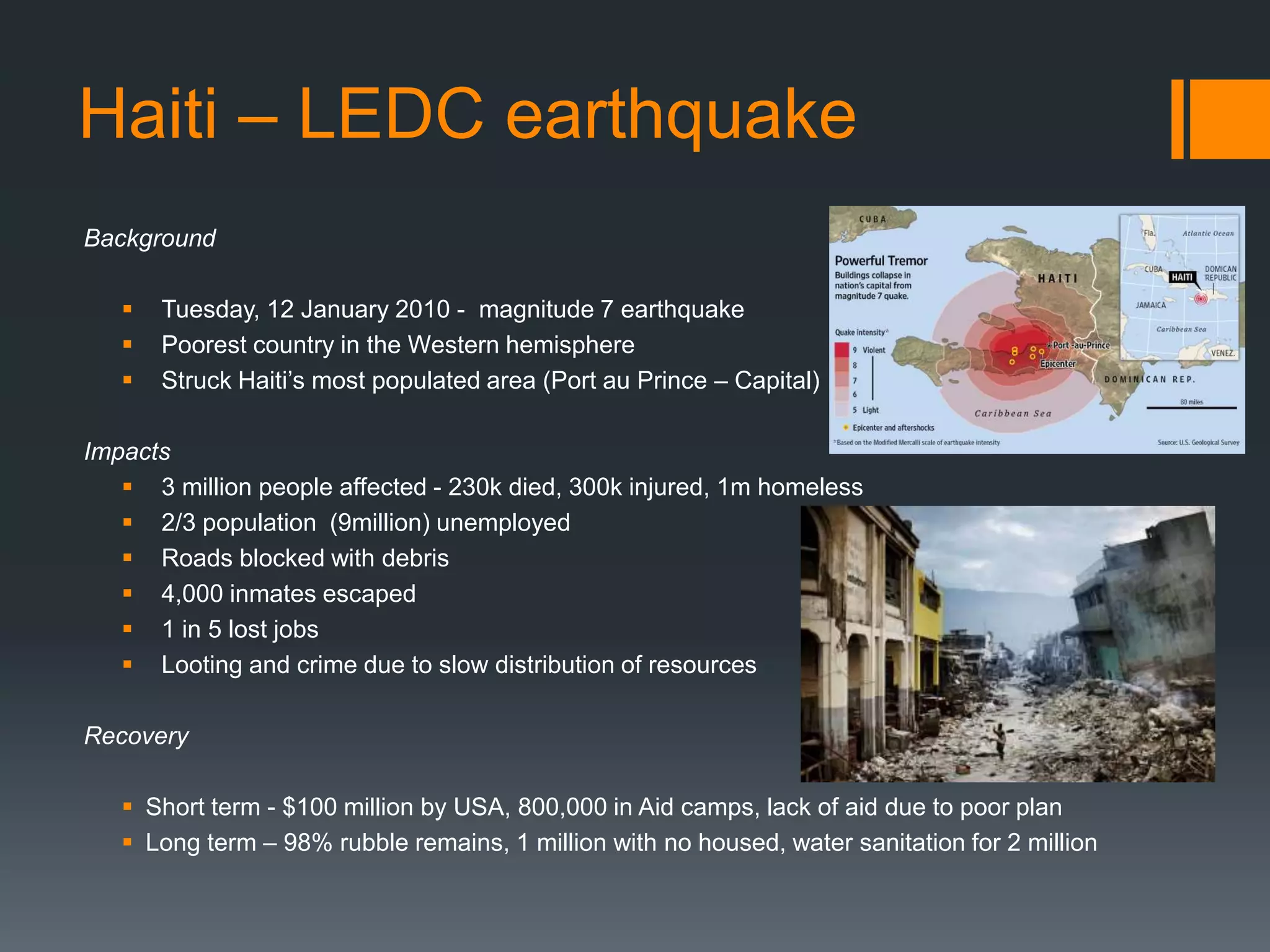
Haiti – LEDC earthquake
Background
 Tuesday, 12 January 2010 - magnitude 7 earthquake
 Poorest country in the Western hemisphere
 Struck Haiti’s most populated area (Port au Prince – Capital)
Impacts
 3 million people affected - 230k died, 300k injured, 1m homeless
 2/3 population (9million) unemployed
 Roads blocked with debris
 4,000 inmates escaped
 1 in 5 lost jobs
 Looting and crime due to slow distribution of resources
Recovery
 Short term - $100 million by USA, 800,000 in Aid camps, lack of aid due to poor plan
 Long term – 98% rubble remains, 1 million with no housed, water sanitation for 2 million
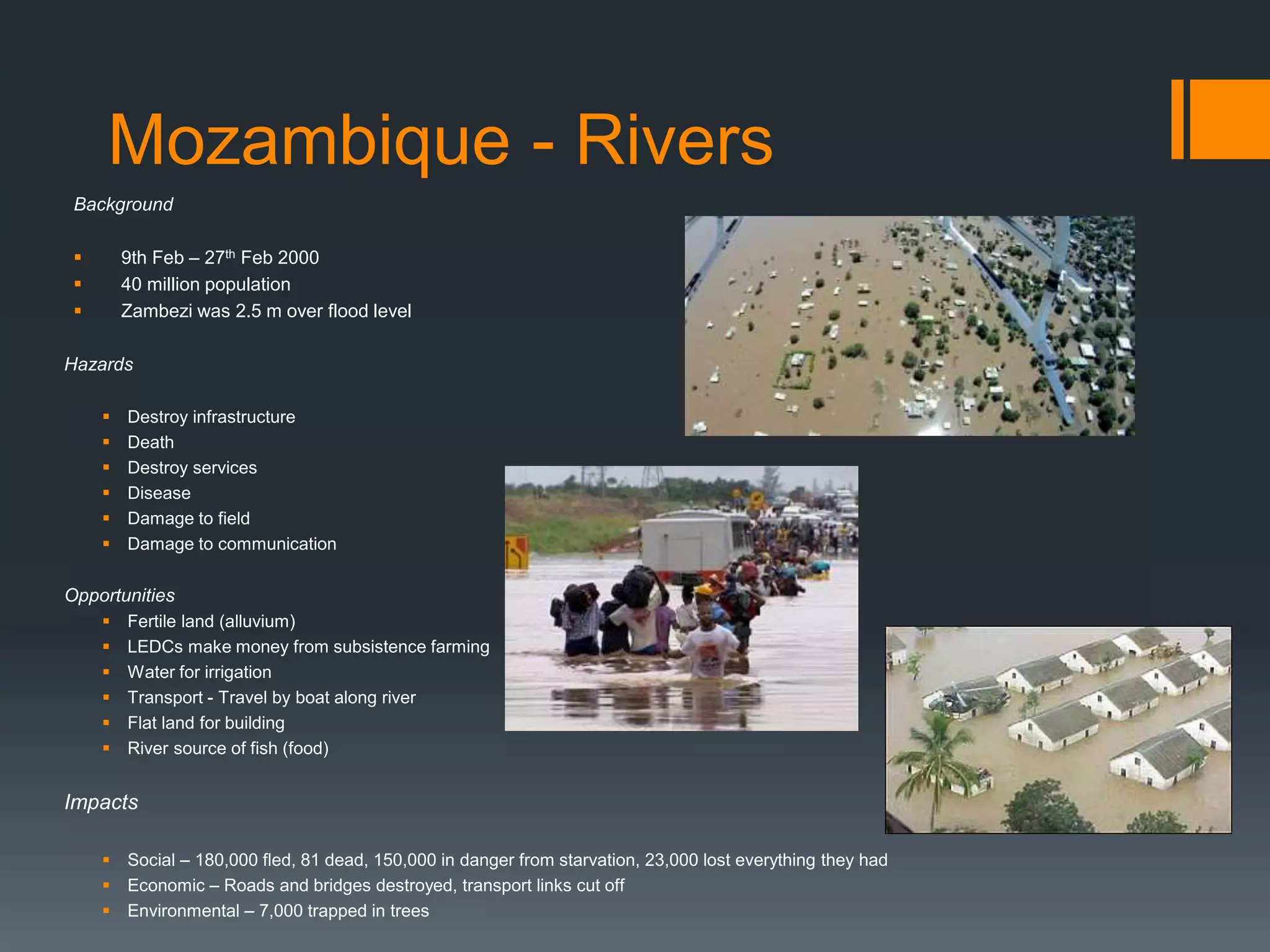
Mozambique - Rivers
Background
 9th Feb – 27th Feb 2000
 40 million population
 Zambezi was 2.5 m over flood level
Hazards
 Destroy infrastructure
 Death
 Destroy services
 Disease
 Damage to field
 Damage to communication
Opportunities
 Fertile land (alluvium)
 LEDCs make money from subsistence farming
 Water for irrigation
 Transport - Travel by boat along river
 Flat land for building
 River source of fish (food)
Impacts
 Social – 180,000 fled, 81 dead, 150,000 in danger from starvation, 23,000 lost everything they had
 Economic – Roads and bridges destroyed, transport links cut off
 Environmental – 7,000 trapped in trees
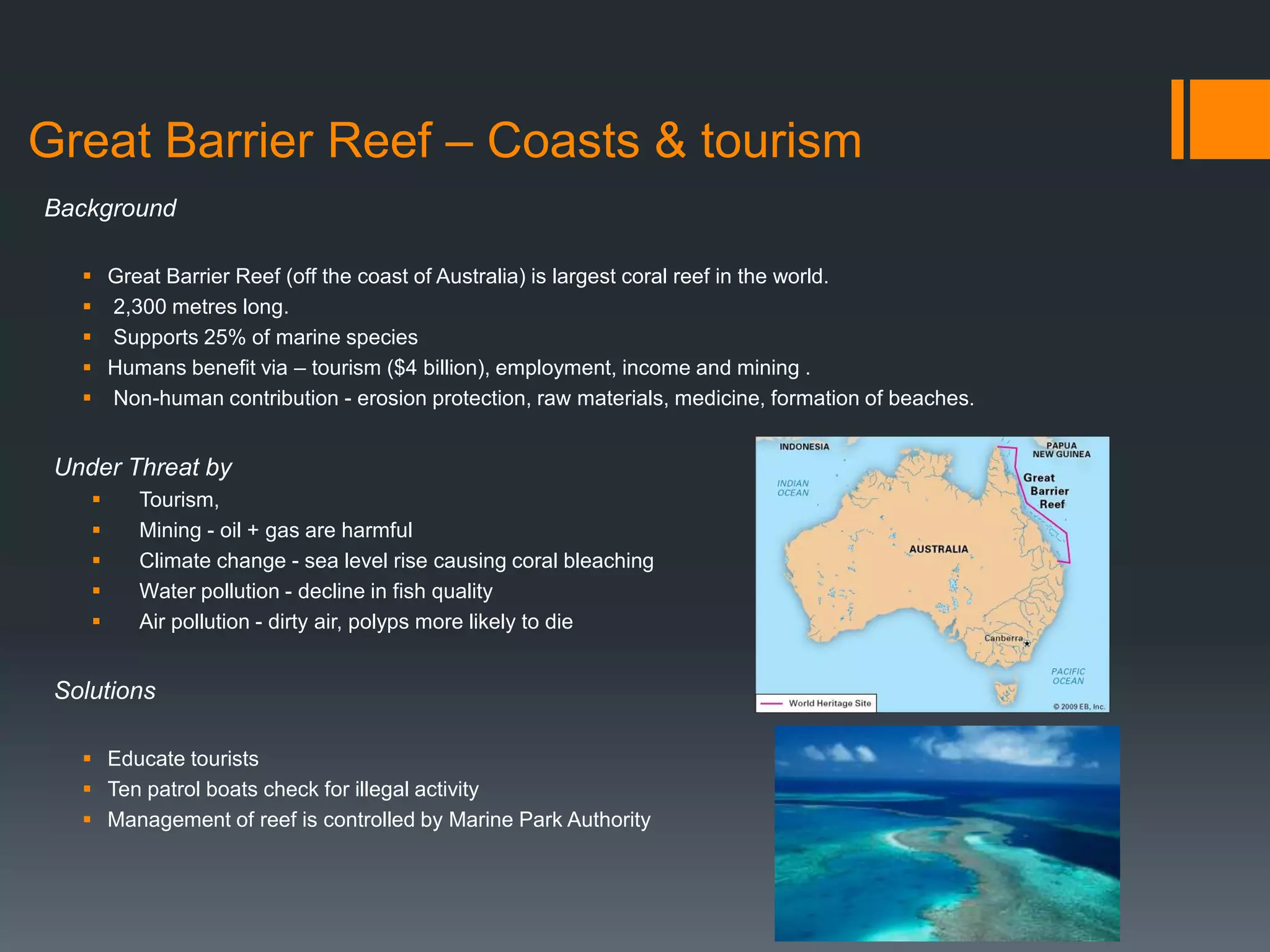
Great Barrier Reef – Coasts & tourism
Background
 Great Barrier Reef (off the coast of Australia) is largest coral reef in the world.
 2,300 metres long.
 Supports 25% of marine species
 Humans benefit via – tourism ($4 billion), employment, income and mining .
 Non-human contribution - erosion protection, raw materials, medicine, formation of beaches.
Under Threat by
 Tourism,
 Mining - oil + gas are harmful
 Climate change - sea level rise causing coral bleaching
 Water pollution - decline in fish quality
 Air pollution - dirty air, polyps more likely to die
Solutions
 Educate tourists
 Ten patrol boats check for illegal activity
 Management of reef is controlled by Marine Park Authority
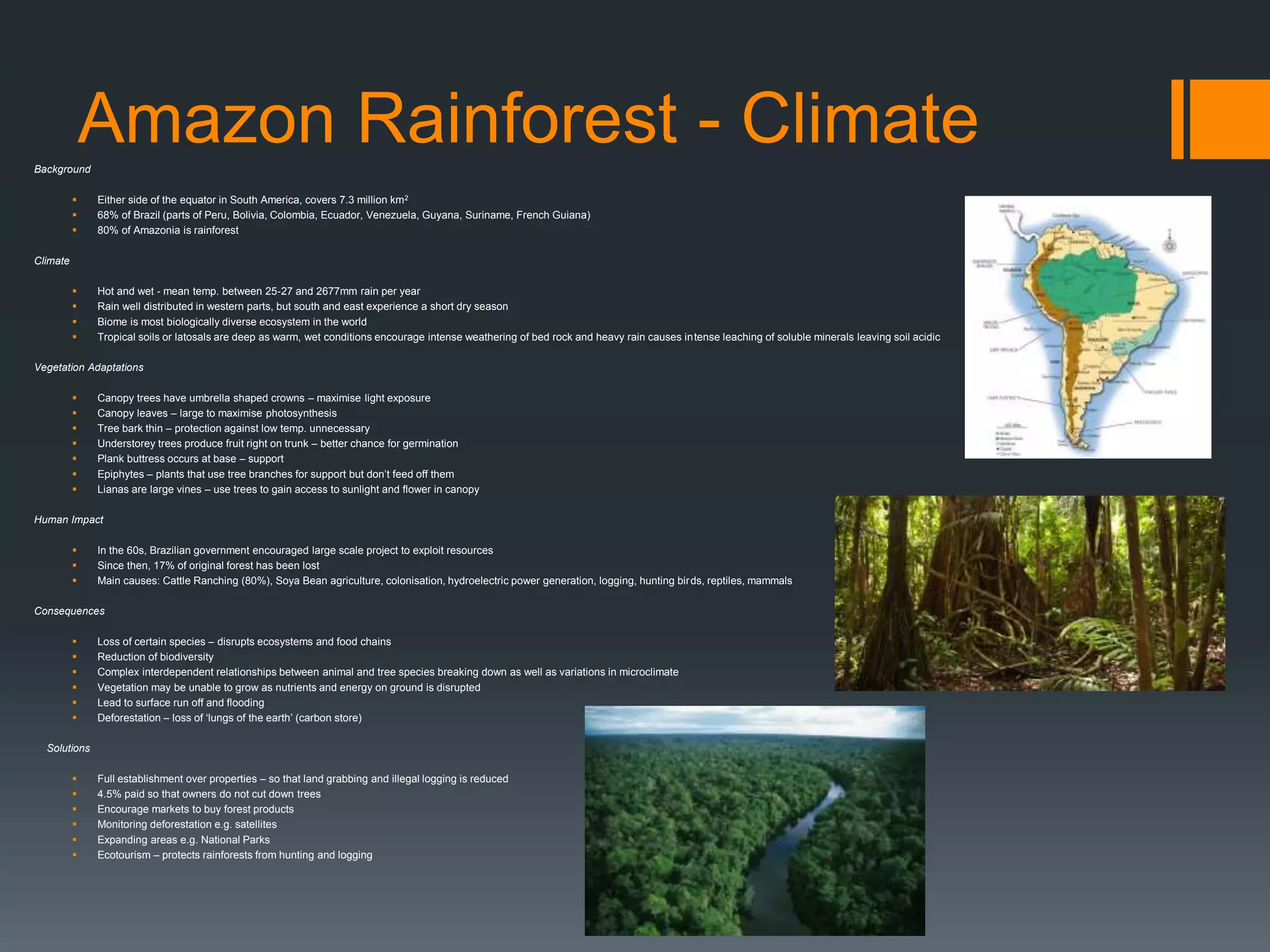
Amazon Rainforest - ClimateBackground
 Either side of the equator in South America, covers 7.3 million km2
 68% of Brazil (parts of Peru, Bolivia, Colombia, Ecuador, Venezuela, Guyana, Suriname, French Guiana)
 80% of Amazonia is rainforest
Climate
 Hot and wet - mean temp. between 25-27 and 2677mm rain per year
 Rain well distributed in western parts, but south and east experience a short dry season
 Biome is most biologically diverse ecosystem in the world
 Tropical soils or latosals are deep as warm, wet conditions encourage intense weathering of bed rock and heavy rain causes intense leaching of soluble minerals leaving soil acidic
Vegetation Adaptations
 Canopy trees have umbrella shaped crowns – maximise light exposure
 Canopy leaves – large to maximise photosynthesis
 Tree bark thin – protection against low temp. unnecessary
 Understorey trees produce fruit right on trunk – better chance for germination
 Plank buttress occurs at base – support
 Epiphytes – plants that use tree branches for support but don’t feed off them
 Lianas are large vines – use trees to gain access to sunlight and flower in canopy
Human Impact
 In the 60s, Brazilian government encouraged large scale project to exploit resources
 Since then, 17% of original forest has been lost
 Main causes: Cattle Ranching (80%), Soya Bean agriculture, colonisation, hydroelectric power generation, logging, hunting birds, reptiles, mammals
Consequences
 Loss of certain species – disrupts ecosystems and food chains
 Reduction of biodiversity
 Complex interdependent relationships between animal and tree species breaking down as well as variations in microclimate
 Vegetation may be unable to grow as nutrients and energy on ground is disrupted
 Lead to surface run off and flooding
 Deforestation – loss of ‘lungs of the earth’ (carbon store)
Solutions
 Full establishment over properties – so that land grabbing and illegal logging is reduced
 4.5% paid so that owners do not cut down trees
 Encourage markets to buy forest products
 Monitoring deforestation e.g. satellites
 Expanding areas e.g. National Parks
 Ecotourism – protects rainforests from hunting and logging
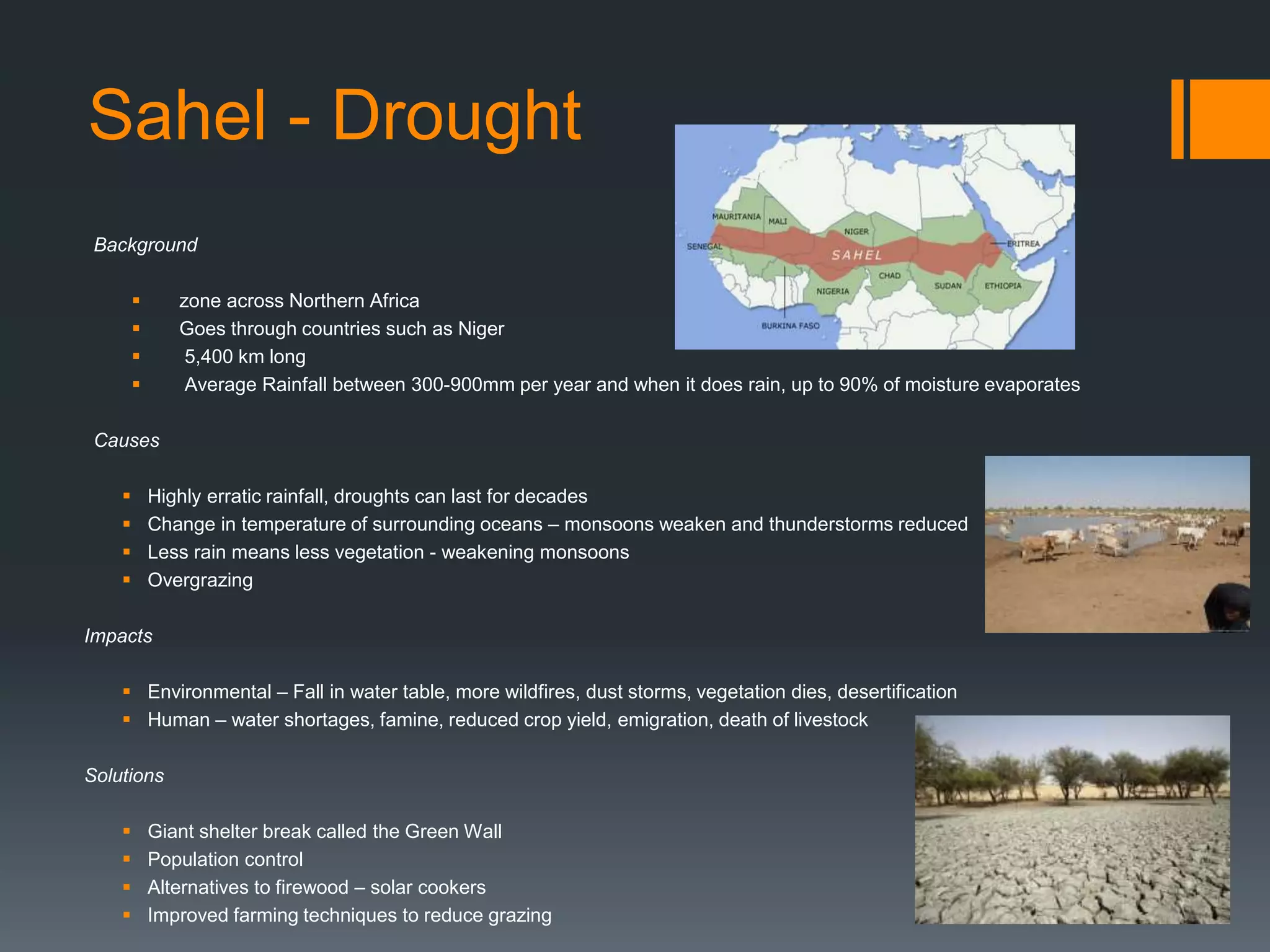
Sahel - Drought
Background
 zone across Northern Africa
 Goes through countries such as Niger
 5,400 km long
 Average Rainfall between 300-900mm per year and when it does rain, up to 90% of moisture evaporates
Causes
 Highly erratic rainfall, droughts can last for decades
 Change in temperature of surrounding oceans – monsoons weaken and thunderstorms reduced
 Less rain means less vegetation - weakening monsoons
 Overgrazing
Impacts
 Environmental – Fall in water table, more wildfires, dust storms, vegetation dies, desertification
 Human – water shortages, famine, reduced crop yield, emigration, death of livestock
Solutions
 Giant shelter break called the Green Wall
 Population control
 Alternatives to firewood – solar cookers
 Improved farming techniques to reduce grazing
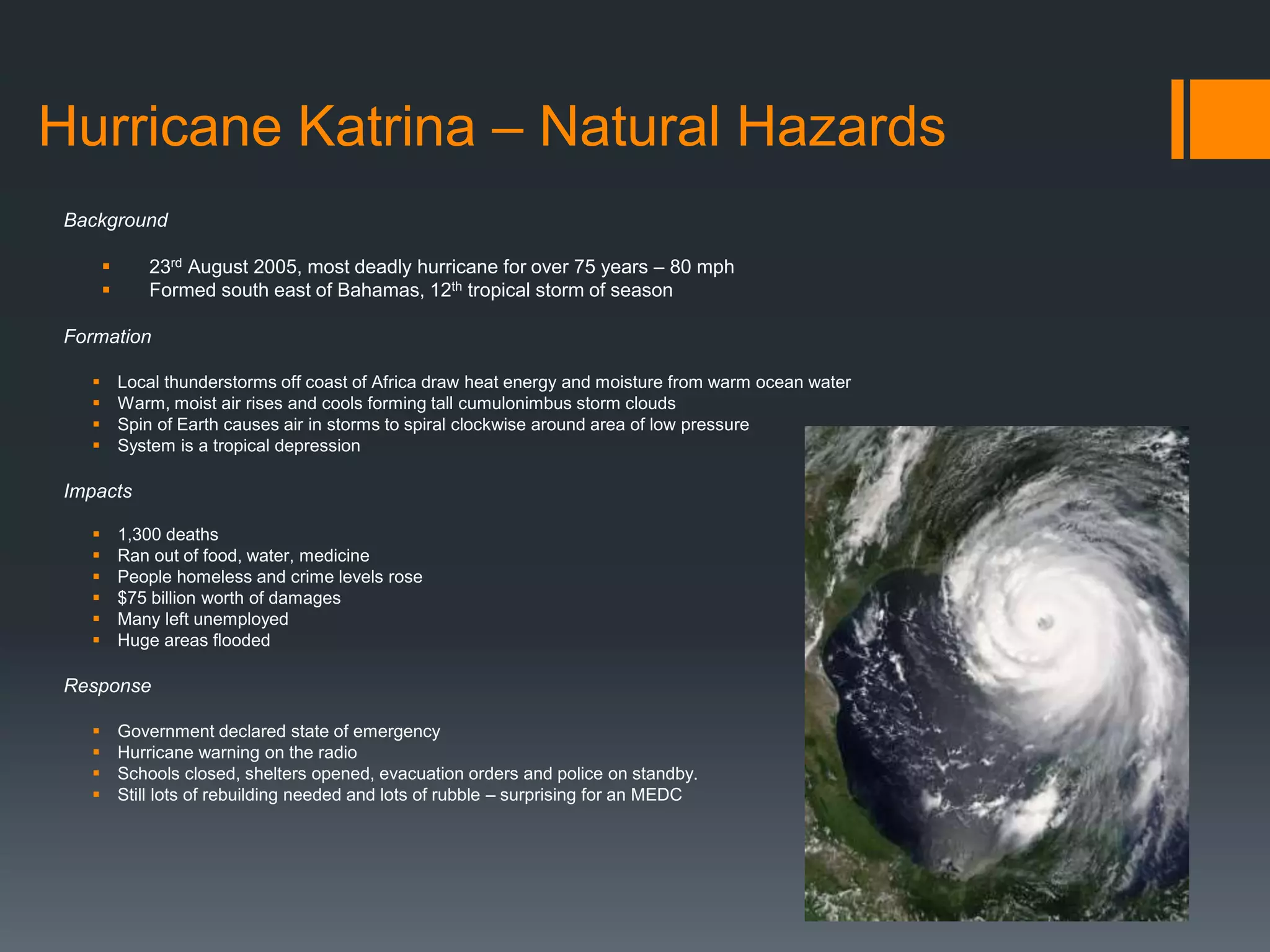
Hurricane Katrina – Natural Hazards
Background
 23rd August 2005, most deadly hurricane for over 75 years – 80 mph
 Formed south east of Bahamas, 12th tropical storm of season
Formation
 Local thunderstorms off coast of Africa draw heat energy and moisture from warm ocean water
 Warm, moist air rises and cools forming tall cumulonimbus storm clouds
 Spin of Earth causes air in storms to spiral clockwise around area of low pressure
 System is a tropical depression
Impacts
 1,300 deaths
 Ran out of food, water, medicine
 People homeless and crime levels rose
 $75 billion worth of damages
 Many left unemployed
 Huge areas flooded
Response
 Government declared state of emergency
 Hurricane warning on the radio
 Schools closed, shelters opened, evacuation orders and police on standby.
 Still lots of rebuilding needed and lots of rubble – surprising for an MEDC
Brazil – Subsistence farming
Background
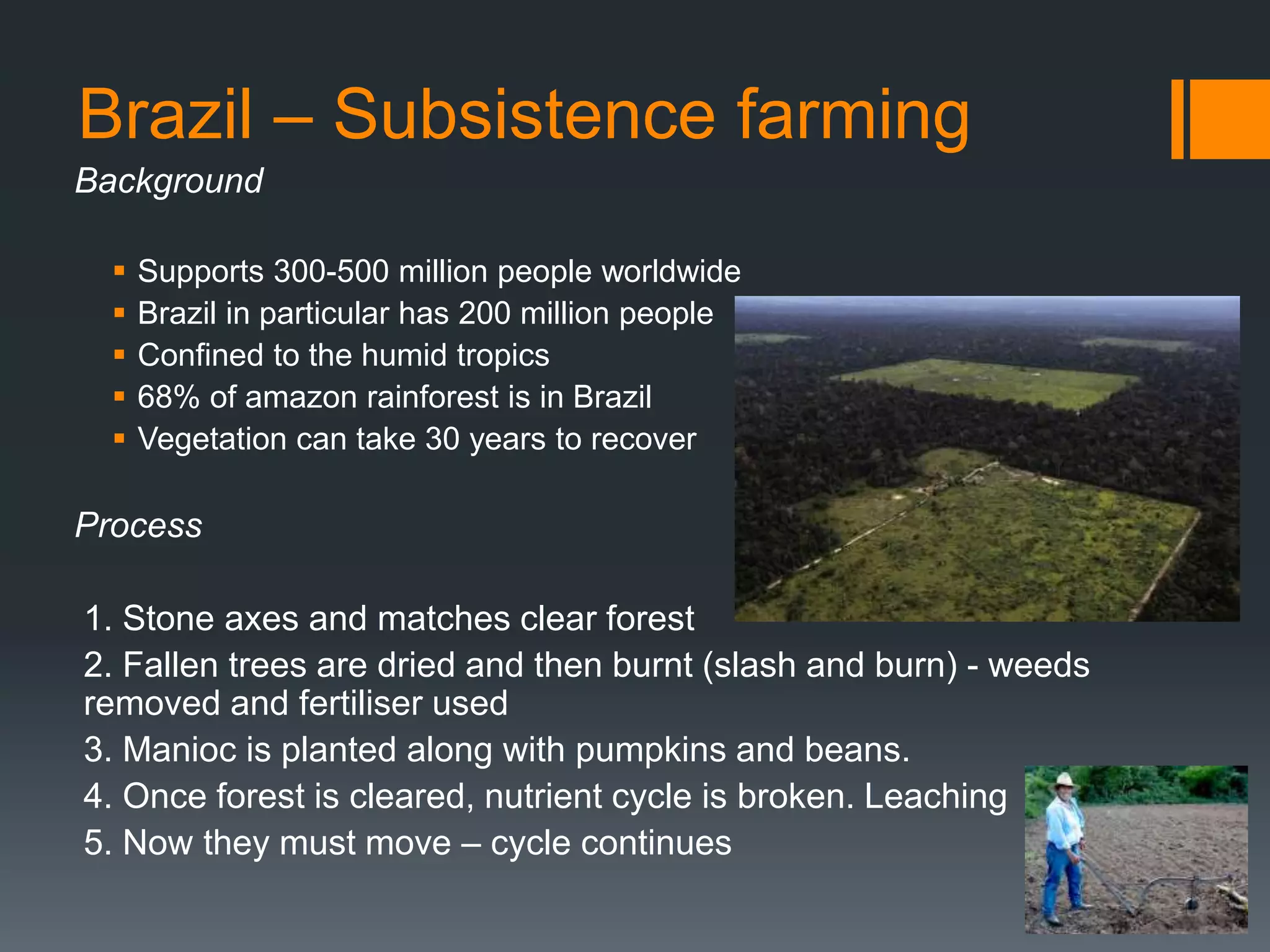
 Supports 300-500 million people worldwide
 Brazil in particular has 200 million people
 Confined to the humid tropics
 68% of amazon rainforest is in Brazil
 Vegetation can take 30 years to recover
Process
1. Stone axes and matches clear forest
2. Fallen trees are dried and then burnt (slash and burn) - weeds
removed and fertiliser used
3. Manioc is planted along with pumpkins and beans.
4. Once forest is cleared, nutrient cycle is broken. Leaching
5. Now they must move – cycle continues
Sri Lanka – commercial farming
Background
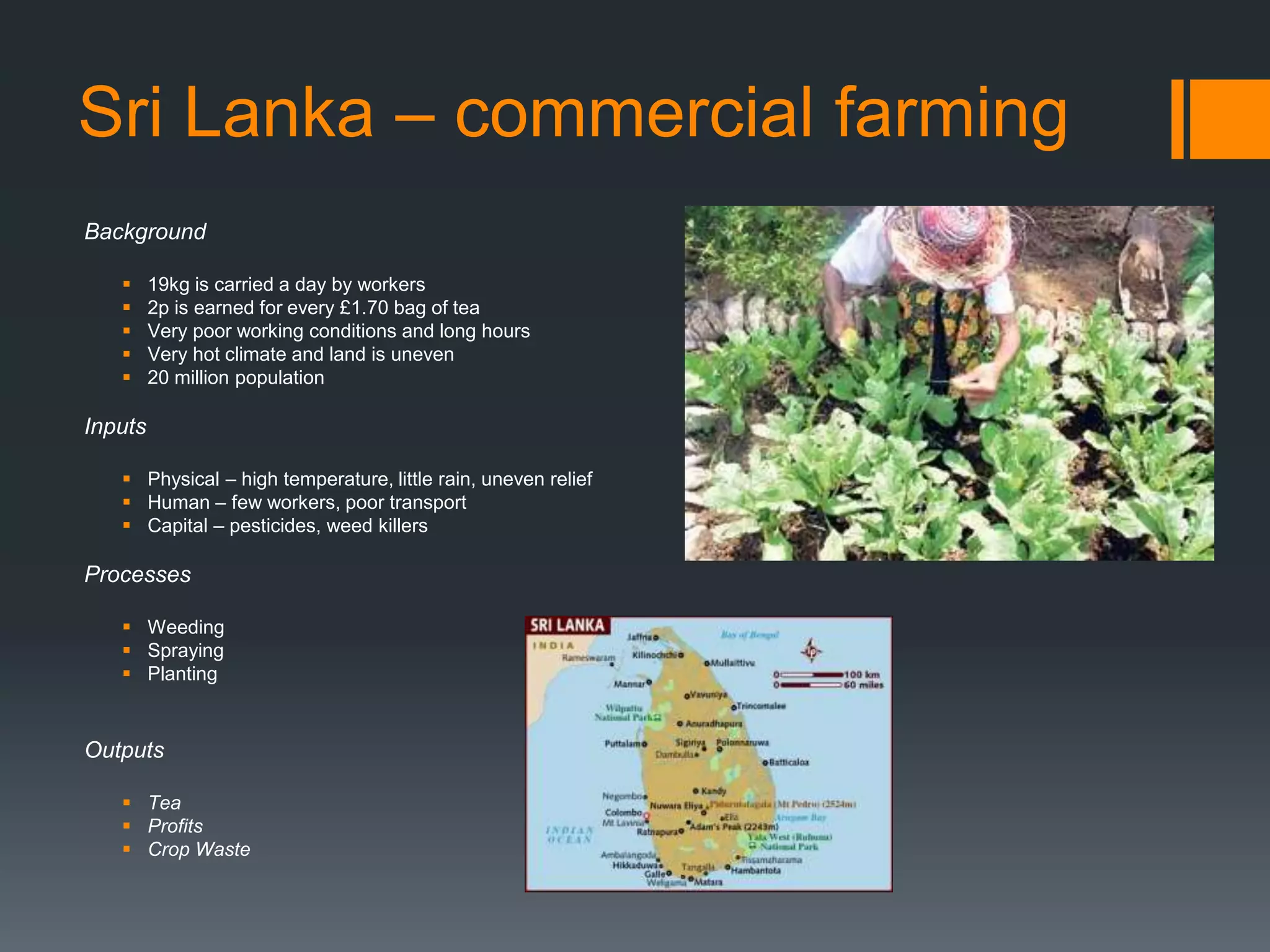
 19kg is carried a day by workers
 2p is earned for every £1.70 bag of tea
 Very poor working conditions and long hours
 Very hot climate and land is uneven
 20 million population
Inputs
 Physical – high temperature, little rain, uneven relief
 Human – few workers, poor transport
 Capital – pesticides, weed killers
Processes
 Weeding
 Spraying
 Planting
Outputs
 Tea
 Profits
 Crop Waste
Dafur – Food shortages
Background
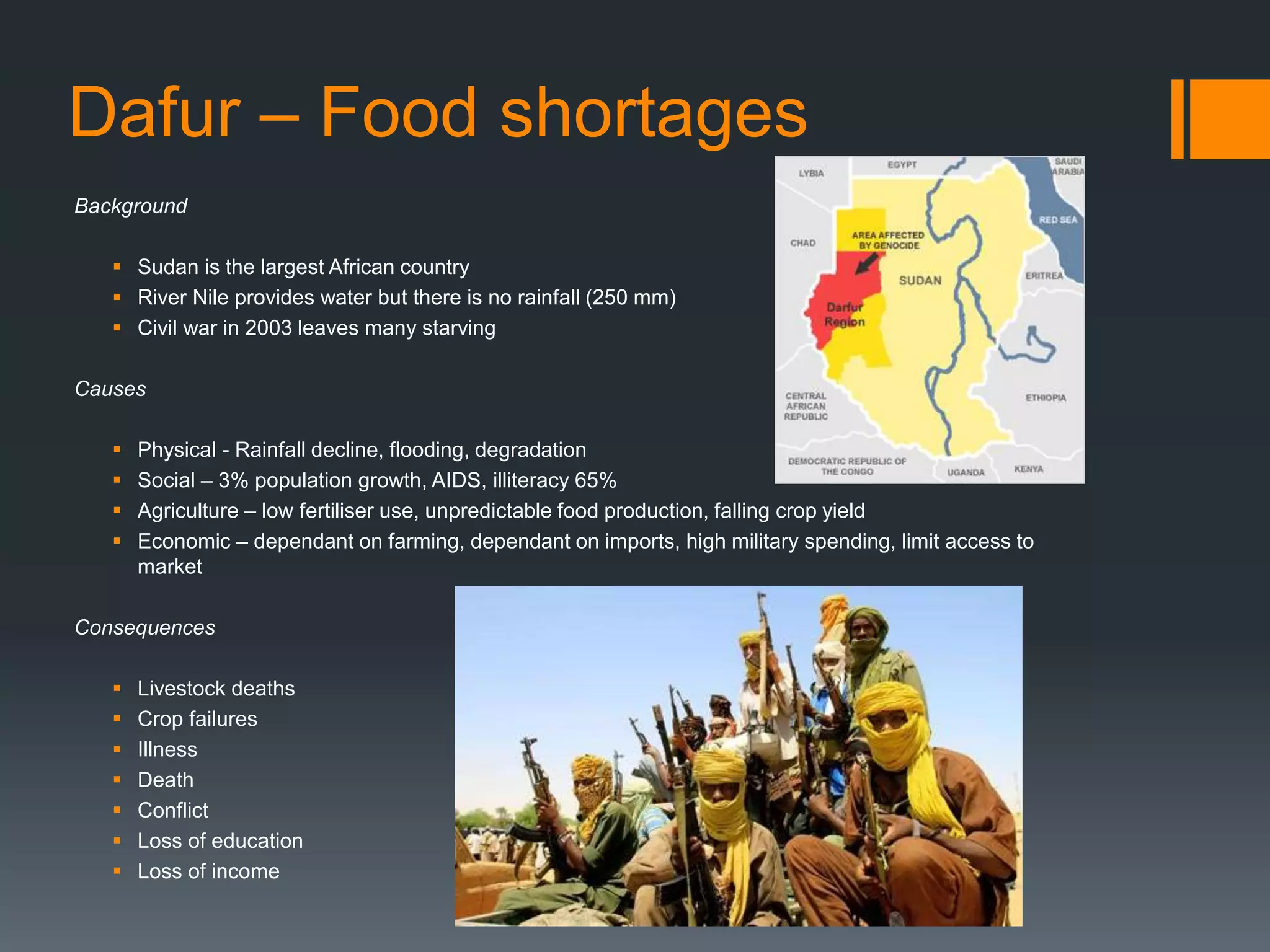
 Sudan is the largest African country
 River Nile provides water but there is no rainfall (250 mm)
 Civil war in 2003 leaves many starving
Causes
 Physical - Rainfall decline, flooding, degradation
 Social – 3% population growth, AIDS, illiteracy 65%
 Agriculture – low fertiliser use, unpredictable food production, falling crop yield
 Economic – dependant on farming, dependant on imports, high military spending, limit access to
market
Consequences
 Livestock deaths
 Crop failures
 Illness
 Death
 Conflict
 Loss of education
 Loss of income
Plumpy Nut in Niger – Food Aid
Background
 LEDC, landlocked country in West Africa
 One of the world’s poorest countries
 Hot and dry climate
 Increased population by 12 million in 50 years
 Highest fertility rate – 7.1 births per women
 2.9% growth rate
Plumpy nut advantages
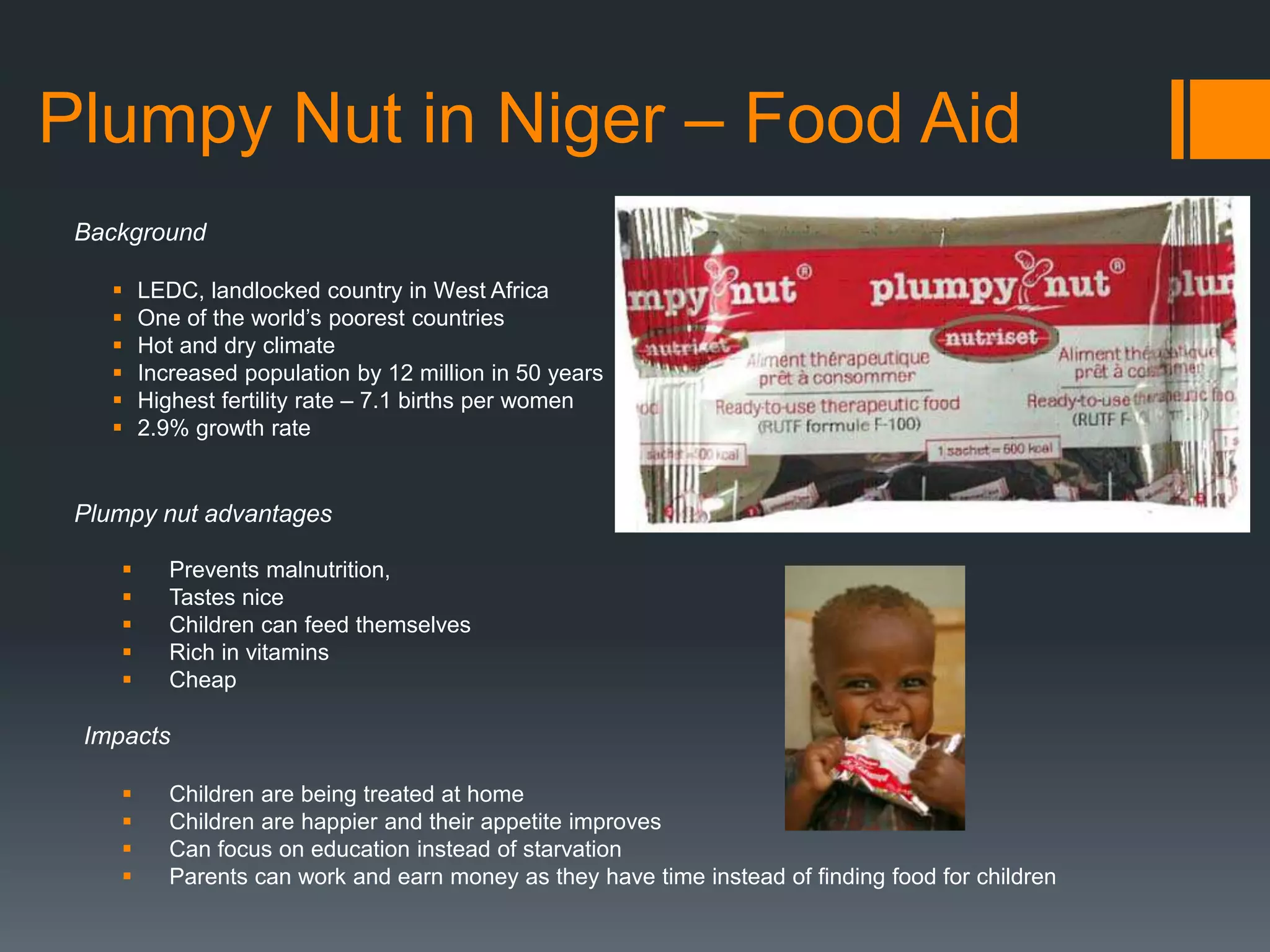
 Prevents malnutrition,
 Tastes nice
 Children can feed themselves
 Rich in vitamins
 Cheap
Impacts
 Children are being treated at home
 Children are happier and their appetite improves
 Can focus on education instead of starvation
 Parents can work and earn money as they have time instead of finding food for children
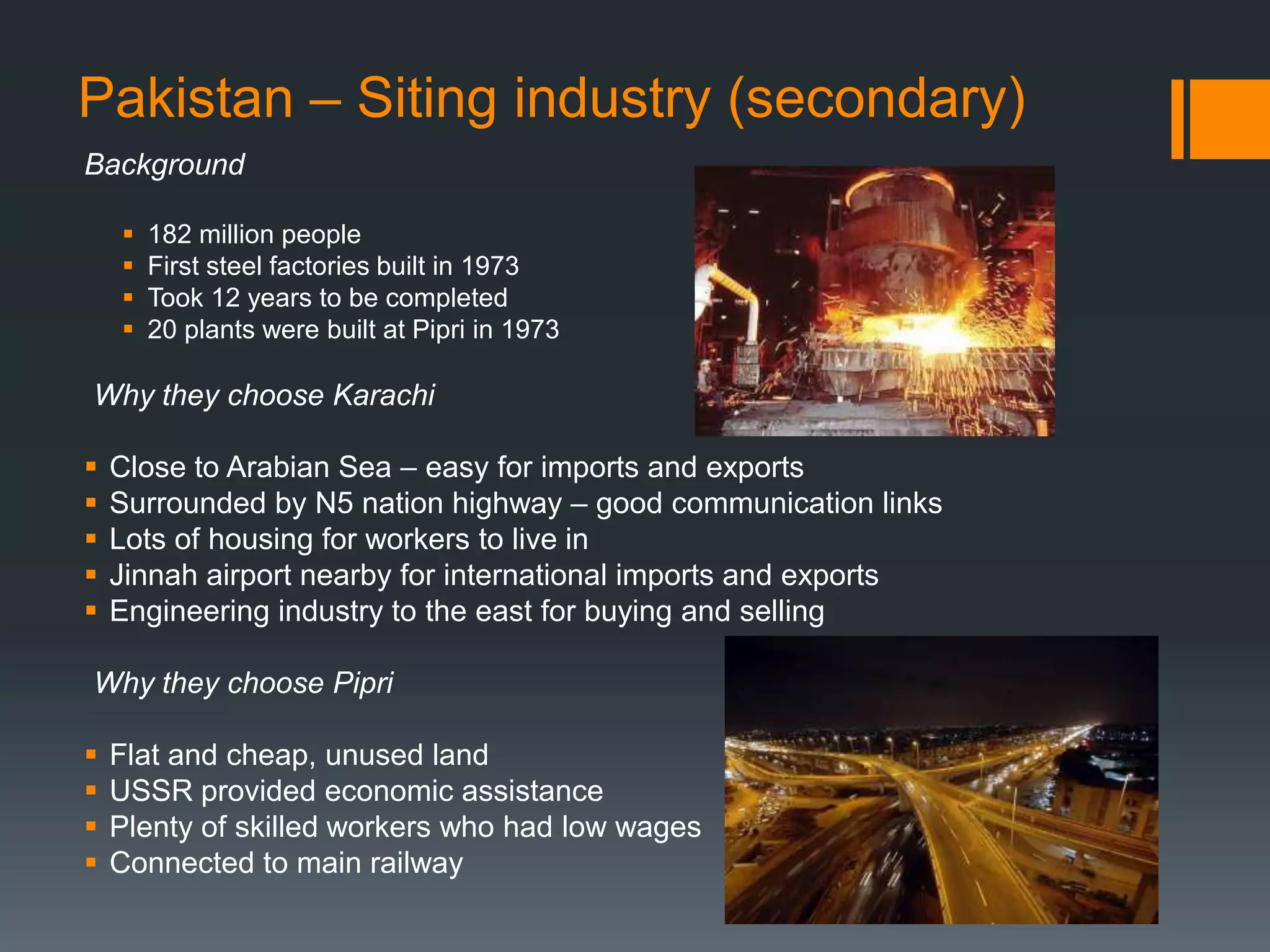
Pakistan – Siting industry (secondary)
Background
 182 million people
 First steel factories built in 1973
 Took 12 years to be completed
 20 plants were built at Pipri in 1973
Why they choose Karachi
 Close to Arabian Sea – easy for imports and exports
 Surrounded by N5 nation highway – good communication links
 Lots of housing for workers to live in
 Jinnah airport nearby for international imports and exports
 Engineering industry to the east for buying and selling
Why they choose Pipri
 Flat and cheap, unused land
 USSR provided economic assistance
 Plenty of skilled workers who had low wages
 Connected to main railway
Cambridge Science Park – High tech industry
Background
 1.6 million square ft of buildings
 Home to roughly 66 companies
 Established by Trinity College in 1970
Choice of location
 Companies – 66 on site e.g Worldpay, provides multi-currency
internet 1 card payment systems
 Amenities – Landscaped and has facilities e.g health and fitness
centre
 Infrastructure – used to be farmland, space for car parks and
expansion
 Location – on rural-urban fringe, easily accessible on M11, not far
from Stanstead Airport
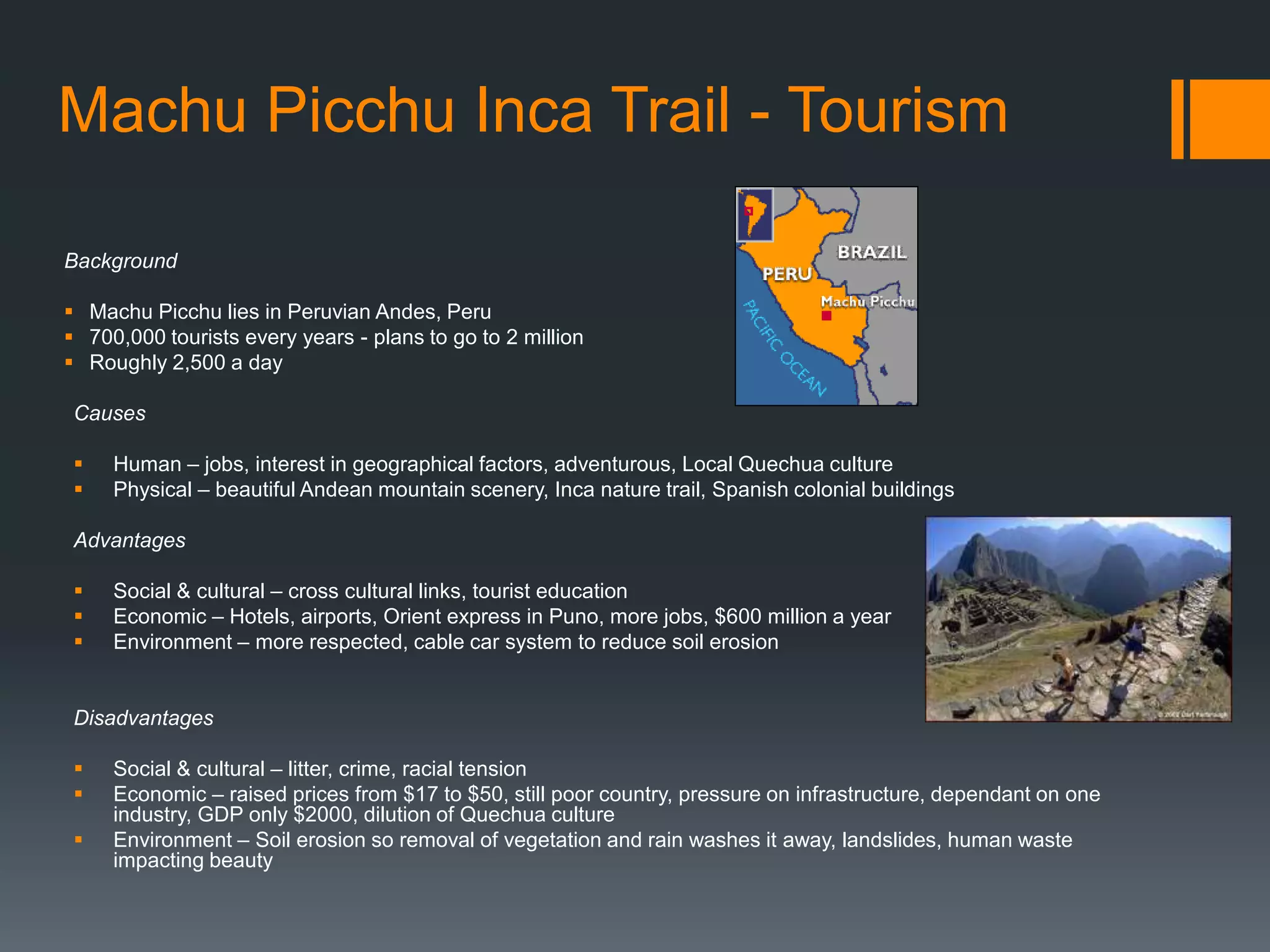
Machu Picchu Inca Trail - Tourism
Background
 Machu Picchu lies in Peruvian Andes, Peru
 700,000 tourists every years - plans to go to 2 million
 Roughly 2,500 a day
Causes
 Human – jobs, interest in geographical factors, adventurous, Local Quechua culture
 Physical – beautiful Andean mountain scenery, Inca nature trail, Spanish colonial buildings
Advantages
 Social & cultural – cross cultural links, tourist education
 Economic – Hotels, airports, Orient express in Puno, more jobs, $600 million a year
 Environment – more respected, cable car system to reduce soil erosion
Disadvantages
 Social & cultural – litter, crime, racial tension
 Economic – raised prices from $17 to $50, still poor country, pressure on infrastructure, dependant on one
industry, GDP only $2000, dilution of Quechua culture
 Environment – Soil erosion so removal of vegetation and rain washes it away, landslides, human waste
impacting beauty
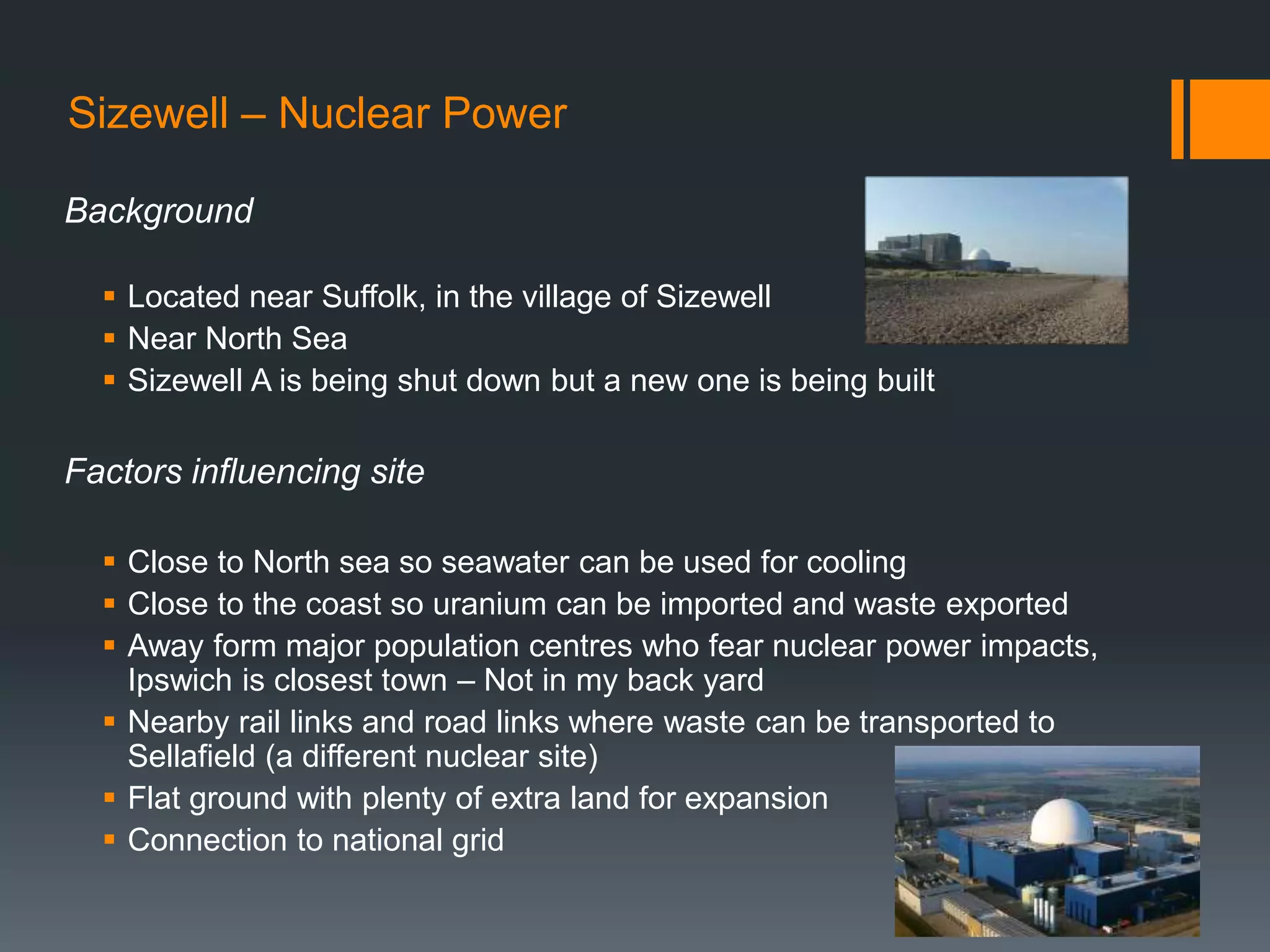
Sizewell – Nuclear Power
Background
 Located near Suffolk, in the village of Sizewell
 Near North Sea
 Sizewell A is being shut down but a new one is being built
Factors influencing site
 Close to North sea so seawater can be used for cooling
 Close to the coast so uranium can be imported and waste exported
 Away form major population centres who fear nuclear power impacts,
Ipswich is closest town – Not in my back yard
 Nearby rail links and road links where waste can be transported to
Sellafield (a different nuclear site)
 Flat ground with plenty of extra land for expansion
 Connection to national grid
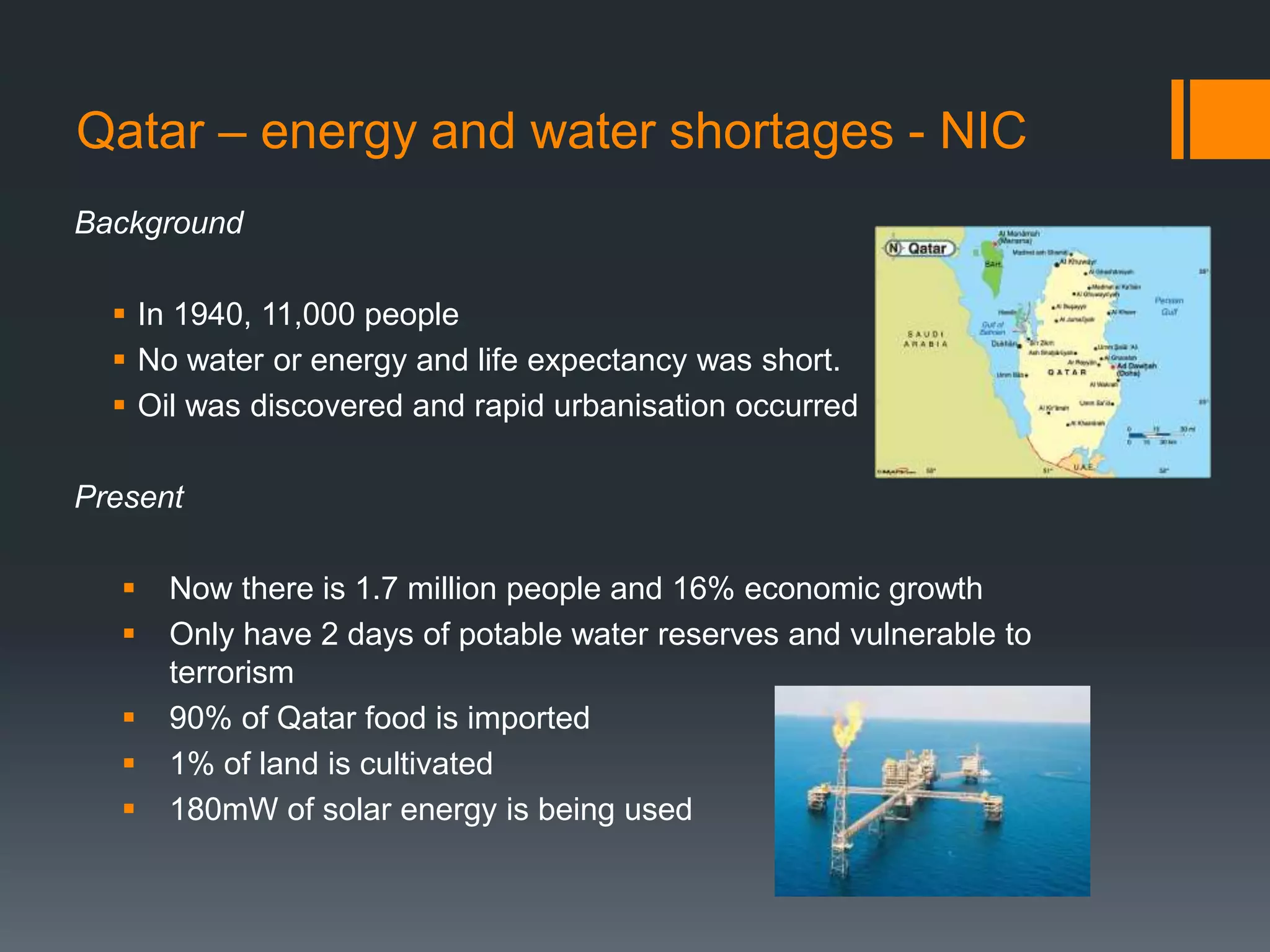
Qatar – energy and water shortages - NIC
Background
 In 1940, 11,000 people
 No water or energy and life expectancy was short.
 Oil was discovered and rapid urbanisation occurred
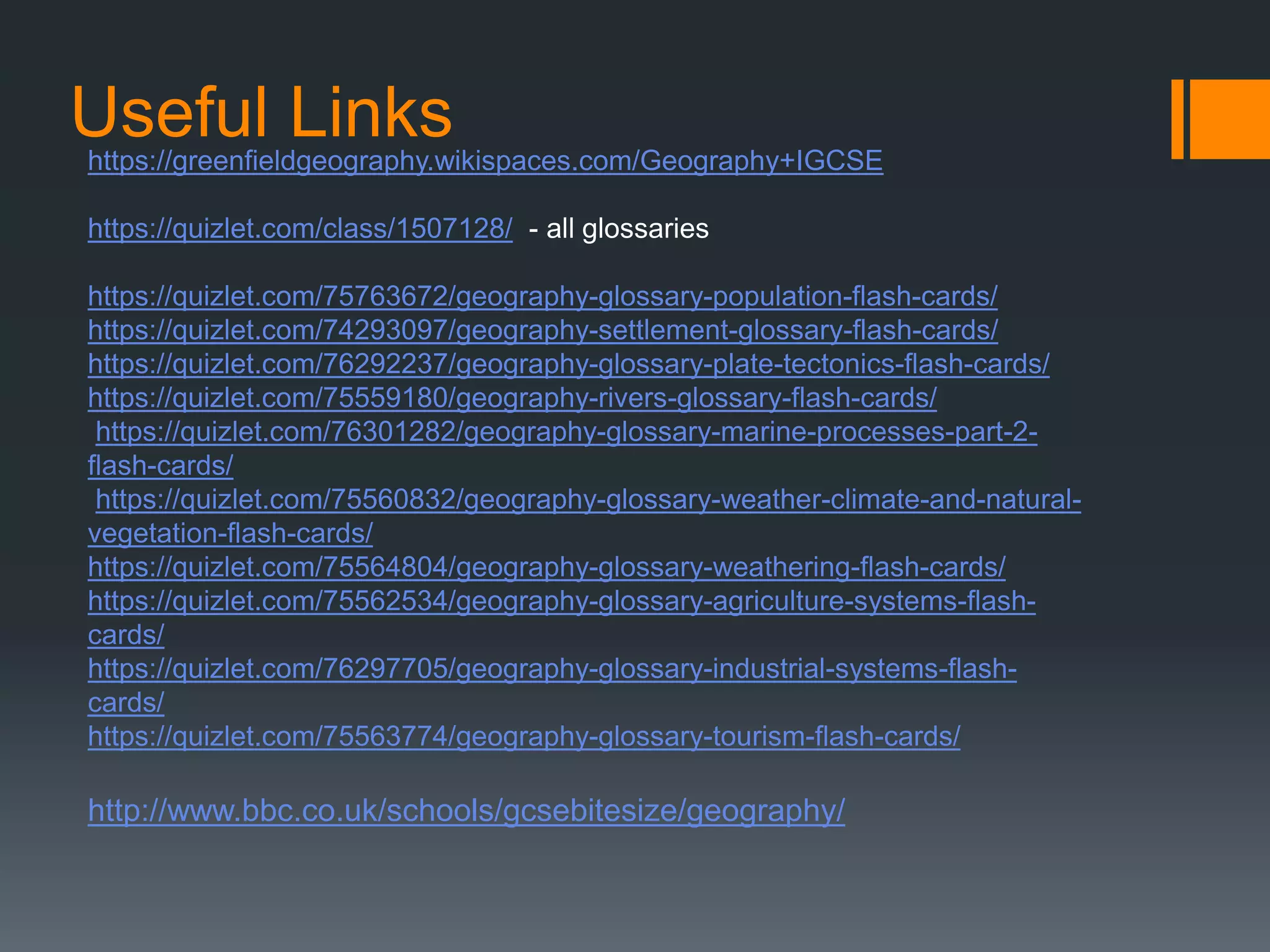
Present
 Now there is 1.7 million people and 16% economic growth
 Only have 2 days of potable water reserves and vulnerable to
terrorism
 90% of Qatar food is imported
 1% of land is cultivated
 180mW of solar energy is being used
Useful Linkshttps://greenfieldgeography.wikispaces.com/Geography+IGCSE
https://quizlet.com/class/1507128/ - all glossaries
https://quizlet.com/75763672/geography-glossary-population-flash-cards/
https://quizlet.com/74293097/geography-settlement-glossary-flash-cards/
https://quizlet.com/76292237/geography-glossary-plate-tectonics-flash-cards/
https://quizlet.com/75559180/geography-rivers-glossary-flash-cards/
https://quizlet.com/76301282/geography-glossary-marine-processes-part-2-
flash-cards/
https://quizlet.com/75560832/geography-glossary-weather-climate-and-natural-
vegetation-flash-cards/
https://quizlet.com/75564804/geography-glossary-weathering-flash-cards/
https://quizlet.com/75562534/geography-glossary-agriculture-systems-flash-
cards/
https://quizlet.com/76297705/geography-glossary-industrial-systems-flash-
cards/
https://quizlet.com/75563774/geography-glossary-tourism-flash-cards/
http://www.bbc.co.uk/schools/gcsebitesize/geography/

Geography Case Studies IGCSE/GCSE

  • 1.
    Case Studies v2 GEOGRAPHYCIE IGCSE By Theo Dick Aided by Alex Haji and Nick Gwynne Edited by Ethan Sarif-Kattan
  • 2.
    Namibia – Sparseand Dense Population Background  LEDC in Southern Africa split into various regions  Population of 2.5 million  825,000 km2 Sparse Population e.g. Karas & Hardap regions density under 5 people per km2 – Causes  Desert Regions – not enough rain for crops, land is too dry so hard to build on  Mountainous land – hard to build on steep surfaces, limited transport  Lack of jobs – people move to areas where jobs available  Lots of land is prone to flooding – limited space to live Dense Population e.g. Oshana & Ohangwena regions density over 15 people per km2 – Causes  Not in desert – easy to build on land and grow crops  Diamond areas – attracts people as jobs for mining e.g. 3% of population employed here  More transport links – easy to commute for work and visit regions  Better access to shops – people not put off by idea of walking miles for water  Fertile soil for farming – attracts farmers to live in region  Near coast for exports – business and job opportunities  Services available – schools and hospitals of better quality available
  • 3.
    Niger – Populationexplosion Background  Landlocked LEDC in West Africa  One of world’s poorest countries  Hot and dry climate  Population increased by 12 million in 50 years Causes – High birth rates  Highest fertility rate – 7.1 births per women  2.9% growth rate  Preference for a male child – keep having children until male  Lack of contraception – many unplanned or unwanted babies  More children available to help work on farms  Religious beliefs – abortion is wrong  Ensures protection against high infant mortality rate Causes – Decreasing death rates  Life expectancy increased to 44.3 years  Clean water and improved diet – lower deaths by diseases and lower infant mortality  More hospitals – medical care and testing for disease  Government want to increase family planning from 5-20% by 2015, educate women and religious leaders on its importance, and raise marriage age from 15-18.
  • 4.
    Nigeria - Overpopulation Background 170million people 70% live on less than $1 a day 920,000 km2 Impacts of overpopulation  Not enough housing - e.g. Abuja  High crime rates  Pollution - litter and no proper sewage system  Shortage of food and water - 28% of children underweight  Not enough health care and education  Congested roads - e.g. Lagos
  • 5.
    Australia - Underpopulation Background 23 million people  7.7 million km2  6th largest nation Impacts of underpopulation  Vast open spaces – e.g. town of Perth  Foreign immigrant – threatens native population  War – less army so worse defence  Desertification – few people to cultivate land  Less workers – both skilled and unskilled  Public transport might close – e.g. Canberra  Schools and hospitals might close
  • 6.
    China – Anti-NatalistGovernment policy Background  1.4 billion people – worlds highest population  Population was 830 million in 1980 Causes  1960’s – 1970’s, Chairman Mao of the communist government condemned birth control and banned imports of contraceptives  He wanted to strengthen China and its army  He then realised he could not provide food and jobs to entire population Consequences  The one child policy was introduced in 1979, forcing abortions and sterilisation and fining families thousands of dollars, this prevented 250 million births  Originally the officials pushed the slogan ‘later, longer, fewer’; the population growth dropped by half from 1970-76 but then levelled off, officials wanted more drastic measures  Massive gender imbalance – 32 million more boys than girls  In 2007, there were six working age adults to every retiree, but in 2040, it is predicted to reach 2:1 (too few children to care for them, elderlies will suffer neglect)  Contraception was made more available  Increase in health care meant that abortions were used more  1.7 children now per women  Population growth dropped from 2.4% to 1%
  • 7.
    Russia – FallingBirth Rate & HIV/AIDS Background  Population projected to decline from 143 million to 111 million by 2050  17 million km2 Causes  High death rate and low birth rate  Low immigration  Many emigrants to Western Europe  Life expectancy was 65 in 2004  Male life expectancy is 59 - related to alcoholism  Women do not want more children  1.1% of adults aged 15-49 have AIDS (more than 1 million people)  1.1 fertility rate
  • 8.
    Italy – AgeingPopulation Background  Dying Italian village – Vastogirardi  Mayor has decided to tax singles in hope this will lead to more children  In last 30 years, population has dropped from 3,000 to 823  Baby crisis - few people wanting to have children, population decreasing, low birth rate of 1.2 children per woman, ageing population Causes  Developing country - more self-sufficient  Education - more people want careers  ‘Mammoni’ - bachelors living with parents Impact  Loss of commerce - no bank, plumber, shoemaker, priest  Increase tax for those not wanting kids  3 :1 funerals to weddings  No schools or secondary school  People have become self-sufficient  Increased dependency ratio
  • 9.
    Uganda – Youthfulpopulation Background  7 fertility rate  Half the population is under 15  38 million population  Fastest growing country in the world  Only 1 in 5 have access to contraception  30% illiteracy rate Impacts  Increased competition for scarce resources, land and conflict is likely to increase  Government doesn’t see it as a problem, they see it as their biggest resource  Cost of contraception is not the problem, the problem is access – a lack of clinics in most parts and need an economic boost to prioritise schemes in order to lower fertility rate  More money has been put into health and education  Child care must be provided so that parents can work
  • 10.
    Rio di Janerio– Internal Rural to Urban Migration Background  BRIC country  200 million people  Recently held world cup Causes – Push factors – from rural  Drug gangs have occupied 20 slums/favela  Deadly gunfights  Unreliable rainfall  Poor education  Wealth inequality  Malaria  Poor soil for farming  Lack of materials Causes – Pull factors – to urban  Higher wages and more jobs  Provision of water, electricity  Good education  Urban areas have better population control  Protection from conflict
  • 11.
    Favelas in Rio– Types of housing Background  Rio is the largest city in Brazil  Over 1 million people live in Rio’s favelas Problems  Landslides caused by deforestation  Risk of eviction - land built on is illegally occupied  No proper electricity connections  Housing vulnerable to flooding  No clean water supply – leads to diseases  No toilets, showers, or proper sewer systems  No proper rubbish collections Consequences  High unemployment,  Crime rates increase - gangs, drugs, murders  Self-help schemes have now been introduced - residents given ownership and materials provided by government, local labour is used and they learn new skills) Advantages of self-help schemes – local  Improved housing  Legal ownership of their house/land  Better water supply and sewers  Reliable electricity supply  Locals health should improve Advantages to self help schemes – government  Residents now paying taxes  Less health problems for government to pay for  Crime rates reducing  Labour is free
  • 12.
    Poland to UK– International & voluntary migration Background  Poland has one of the highest unemployment rates out of EU countries  62% of the 600,000 EU migrants to UK were polish in 2004  This is because EU permits free immigration to other EU countries  UK attracts Poland because of high average income and low unemployment Advantages – UK  Jobs filled that UK workers don’t want  Can pay lower wages to them  Polish workers will work for longer hours  More money spent on local economy form increased population Disadvantages – UK  Few unskilled jobs available for UK workers  Polish may return to Poland once they’ve made money – leaves gap in workforce  Anti-immigration issues and racism  Strain on services such as hospitals and schools Advantages - Poland  Job opportunity with better pay  Save up money to return to Poland  Chance to earn money to send back home Disadvantages – Poland  Family left behind in Poland  Hostility encounter in UK  Language difficulties  Struggle to find housing  Cost of moving is high
  • 13.
    Iraq – ForcedMigration Background  American invaded in 2003  2.5 million have emigrated mainly to Syria and Jordan  33 million population Causes – Push factors  Religious persecution  Safety concerns  No education  Loss of housing, jobs, money  Famines and drought, food shortages, diseases  Political persecution  Isis Problems of receiving country  Cost of maintaining new population – food, education  Pollution and racial tension  Unemployment increase
  • 14.
    Stevenage, UK– housingshortages Background  Demand for housing 210,000 but only 154,000 are being built  Area of 26 km2  84,000 population Causes  More divorces – more singles needing houses  Leave home younger  Migrants are single  Married later  Old people living on their own  Some houses are uninhabitable Impacts  Rising homelessness  Soaring house prices Solutions  New town – planned urban centre with government sponsorship  Abercrombie plan – Victorian houses replaced by apartment blocks  Stevenage is now more attractive to businesses
  • 15.
    London – CBD& Traffic Congestion Background  9.8 million population Causes  Increase in car usage  Limited amount of public transport usage  Many roads not designed for cars - for horses  Population growth – more cars  Movement of lorries and containers onto lorries stops traffic Impacts  Social – pollution causes disease e.g. asthma, leaving home earlier, more frequent road deaths and accidents  Environmental – air and noise pollution destroys wildlife and leads to acid rain, more roads destroys green areas,  Economic – roads are expensive to maintain and build, longer deliveries from lorries costs money, workers are late to work, reliance on oil for transport Solutions  Congestion charge - £12  Public transport Transport for London improved and increased  Trams and underground extension  Pedestrianized areas – discourage car use  Websites to encourage car sharing  Car tax, bus lanes, park and ride (parking near public transport)  Barclays bikes  Reurbanisation – people encourages to move closer to CBD so less car usage
  • 16.
    Urban Sprawl –Atlanta Background  5.1 million population  Fastest growing city in the USA Impacts  Hotlanta - Deforestation increases temperature as more CO2 in atmosphere  Agricultural land filled with shops and other developments  Traffic Congestion – 90% drive to work, air pollution  Water contamination with pollutants and litter  Flash floods for impermeable surfaces such as roads and concrete  Cultural loss – Atlanta well known for battlefields  Black and poor population stay in poorer areas in south, north has more middle class and whites
  • 17.
    Cairo – Urbanisation Background Largest city in Middle East  9 million population  Capital of Egypt Problems  Lack of housing – 80% of Cairo filled with illegal self-built homes, 2.3 million set up homes near tombs, 500,000 people live in homemade huts  Traffic congestion – 1 million cars a day  Lack of Jobs – unskilled jobs hard to find, graduates get government jobs on low salaries  Pollution – cars and fumes from homes and factories, leaking sewers pollute water courses Solutions  New satellite/dormitory town built around the city e.g. Tanta  Ring road built around city - goes through Abbasyia  People with donkey carts licensed to collect and recycle garbage  Better waste water project, extended and repaired sewage systems  Modern metro built  Homes and public services upgraded in most run down part of the city
  • 18.
    Baltimore, USA –Urban redevelopment Background  620,000 population  240 km2  Largest city in Maryland Problems  Less demand for manufacturing and shipbuilding industries meant, in the 1970s, it declined in importance  Run down land and abandoned warehouses Solutions  100 hectares of run down land made into a mix of business - retail, recreational, housing  Development of modern, urban, retail complex - previous power plants turned into a retail leisure building  National aquarium built  Investors attracted to Baltimore due proximity to Washington DC - 45 minutes by train, over 30 trains to Washington a day on the Baltimore-Washington expressway  Cost of living has decreased but standard of living has increased
  • 19.
    Chaiten, Chile –Volcano eruption Background  Small, cauldron-like volcano which erupted in May 2008  Locate in Chaiten, Southern Chile and Argentina, South America  Oceanic to continental margin (destructive margin), denser Nazca plate subducted under the less dense continental South America plate Impacts  Social – 4000 evacuated, 8,000 fled, only 200 returned  Economic – No water or electricity, 85% of town damaged  Environmental – Ash blocked rivers, forest fires
  • 20.
    Christchurch – MEDCearthquake Background  7.1 magnitude earthquake in South Island of New Zealand  4:35 am on 4th September 2010  New Zealand GDP of $115.3 billion  Country has some of world’s top experts in earthquake engineering Impacts  Two residents seriously injured, one died of heart attack,100 people treated for minor bumps and bruises  Powers out in northwest of city (area called the ‘Groynes’), water and sewage affected in several regions  86 staff of supermarket lost their jobs  Up to 500 homes badly damaged  Government will pay workers ($7.5m to social services)  Government says it will cost $4bn (NZ has about 100-150 earthquakes a year)  Fatalities avoided due to strict building codes  Building standards, materials used, quality of construction  Construct used ductile materials (light timber frames)  Earthquake commission checked buildings were safe  National crisis management centre was quick  Ordinary people helped rescue others  Long term – red Cross helped and $900 billion in building claims, sewage restored
  • 21.
    Haiti – LEDCearthquake Background  Tuesday, 12 January 2010 - magnitude 7 earthquake  Poorest country in the Western hemisphere  Struck Haiti’s most populated area (Port au Prince – Capital) Impacts  3 million people affected - 230k died, 300k injured, 1m homeless  2/3 population (9million) unemployed  Roads blocked with debris  4,000 inmates escaped  1 in 5 lost jobs  Looting and crime due to slow distribution of resources Recovery  Short term - $100 million by USA, 800,000 in Aid camps, lack of aid due to poor plan  Long term – 98% rubble remains, 1 million with no housed, water sanitation for 2 million
  • 22.
    Mozambique - Rivers Background 9th Feb – 27th Feb 2000  40 million population  Zambezi was 2.5 m over flood level Hazards  Destroy infrastructure  Death  Destroy services  Disease  Damage to field  Damage to communication Opportunities  Fertile land (alluvium)  LEDCs make money from subsistence farming  Water for irrigation  Transport - Travel by boat along river  Flat land for building  River source of fish (food) Impacts  Social – 180,000 fled, 81 dead, 150,000 in danger from starvation, 23,000 lost everything they had  Economic – Roads and bridges destroyed, transport links cut off  Environmental – 7,000 trapped in trees
  • 23.
    Great Barrier Reef– Coasts & tourism Background  Great Barrier Reef (off the coast of Australia) is largest coral reef in the world.  2,300 metres long.  Supports 25% of marine species  Humans benefit via – tourism ($4 billion), employment, income and mining .  Non-human contribution - erosion protection, raw materials, medicine, formation of beaches. Under Threat by  Tourism,  Mining - oil + gas are harmful  Climate change - sea level rise causing coral bleaching  Water pollution - decline in fish quality  Air pollution - dirty air, polyps more likely to die Solutions  Educate tourists  Ten patrol boats check for illegal activity  Management of reef is controlled by Marine Park Authority
  • 24.
    Amazon Rainforest -ClimateBackground  Either side of the equator in South America, covers 7.3 million km2  68% of Brazil (parts of Peru, Bolivia, Colombia, Ecuador, Venezuela, Guyana, Suriname, French Guiana)  80% of Amazonia is rainforest Climate  Hot and wet - mean temp. between 25-27 and 2677mm rain per year  Rain well distributed in western parts, but south and east experience a short dry season  Biome is most biologically diverse ecosystem in the world  Tropical soils or latosals are deep as warm, wet conditions encourage intense weathering of bed rock and heavy rain causes intense leaching of soluble minerals leaving soil acidic Vegetation Adaptations  Canopy trees have umbrella shaped crowns – maximise light exposure  Canopy leaves – large to maximise photosynthesis  Tree bark thin – protection against low temp. unnecessary  Understorey trees produce fruit right on trunk – better chance for germination  Plank buttress occurs at base – support  Epiphytes – plants that use tree branches for support but don’t feed off them  Lianas are large vines – use trees to gain access to sunlight and flower in canopy Human Impact  In the 60s, Brazilian government encouraged large scale project to exploit resources  Since then, 17% of original forest has been lost  Main causes: Cattle Ranching (80%), Soya Bean agriculture, colonisation, hydroelectric power generation, logging, hunting birds, reptiles, mammals Consequences  Loss of certain species – disrupts ecosystems and food chains  Reduction of biodiversity  Complex interdependent relationships between animal and tree species breaking down as well as variations in microclimate  Vegetation may be unable to grow as nutrients and energy on ground is disrupted  Lead to surface run off and flooding  Deforestation – loss of ‘lungs of the earth’ (carbon store) Solutions  Full establishment over properties – so that land grabbing and illegal logging is reduced  4.5% paid so that owners do not cut down trees  Encourage markets to buy forest products  Monitoring deforestation e.g. satellites  Expanding areas e.g. National Parks  Ecotourism – protects rainforests from hunting and logging
  • 25.
    Sahel - Drought Background zone across Northern Africa  Goes through countries such as Niger  5,400 km long  Average Rainfall between 300-900mm per year and when it does rain, up to 90% of moisture evaporates Causes  Highly erratic rainfall, droughts can last for decades  Change in temperature of surrounding oceans – monsoons weaken and thunderstorms reduced  Less rain means less vegetation - weakening monsoons  Overgrazing Impacts  Environmental – Fall in water table, more wildfires, dust storms, vegetation dies, desertification  Human – water shortages, famine, reduced crop yield, emigration, death of livestock Solutions  Giant shelter break called the Green Wall  Population control  Alternatives to firewood – solar cookers  Improved farming techniques to reduce grazing
  • 26.
    Hurricane Katrina –Natural Hazards Background  23rd August 2005, most deadly hurricane for over 75 years – 80 mph  Formed south east of Bahamas, 12th tropical storm of season Formation  Local thunderstorms off coast of Africa draw heat energy and moisture from warm ocean water  Warm, moist air rises and cools forming tall cumulonimbus storm clouds  Spin of Earth causes air in storms to spiral clockwise around area of low pressure  System is a tropical depression Impacts  1,300 deaths  Ran out of food, water, medicine  People homeless and crime levels rose  $75 billion worth of damages  Many left unemployed  Huge areas flooded Response  Government declared state of emergency  Hurricane warning on the radio  Schools closed, shelters opened, evacuation orders and police on standby.  Still lots of rebuilding needed and lots of rubble – surprising for an MEDC
  • 27.
    Brazil – Subsistencefarming Background  Supports 300-500 million people worldwide  Brazil in particular has 200 million people  Confined to the humid tropics  68% of amazon rainforest is in Brazil  Vegetation can take 30 years to recover Process 1. Stone axes and matches clear forest 2. Fallen trees are dried and then burnt (slash and burn) - weeds removed and fertiliser used 3. Manioc is planted along with pumpkins and beans. 4. Once forest is cleared, nutrient cycle is broken. Leaching 5. Now they must move – cycle continues
  • 28.
    Sri Lanka –commercial farming Background  19kg is carried a day by workers  2p is earned for every £1.70 bag of tea  Very poor working conditions and long hours  Very hot climate and land is uneven  20 million population Inputs  Physical – high temperature, little rain, uneven relief  Human – few workers, poor transport  Capital – pesticides, weed killers Processes  Weeding  Spraying  Planting Outputs  Tea  Profits  Crop Waste
  • 29.
    Dafur – Foodshortages Background  Sudan is the largest African country  River Nile provides water but there is no rainfall (250 mm)  Civil war in 2003 leaves many starving Causes  Physical - Rainfall decline, flooding, degradation  Social – 3% population growth, AIDS, illiteracy 65%  Agriculture – low fertiliser use, unpredictable food production, falling crop yield  Economic – dependant on farming, dependant on imports, high military spending, limit access to market Consequences  Livestock deaths  Crop failures  Illness  Death  Conflict  Loss of education  Loss of income
  • 30.
    Plumpy Nut inNiger – Food Aid Background  LEDC, landlocked country in West Africa  One of the world’s poorest countries  Hot and dry climate  Increased population by 12 million in 50 years  Highest fertility rate – 7.1 births per women  2.9% growth rate Plumpy nut advantages  Prevents malnutrition,  Tastes nice  Children can feed themselves  Rich in vitamins  Cheap Impacts  Children are being treated at home  Children are happier and their appetite improves  Can focus on education instead of starvation  Parents can work and earn money as they have time instead of finding food for children
  • 31.
    Pakistan – Sitingindustry (secondary) Background  182 million people  First steel factories built in 1973  Took 12 years to be completed  20 plants were built at Pipri in 1973 Why they choose Karachi  Close to Arabian Sea – easy for imports and exports  Surrounded by N5 nation highway – good communication links  Lots of housing for workers to live in  Jinnah airport nearby for international imports and exports  Engineering industry to the east for buying and selling Why they choose Pipri  Flat and cheap, unused land  USSR provided economic assistance  Plenty of skilled workers who had low wages  Connected to main railway
  • 32.
    Cambridge Science Park– High tech industry Background  1.6 million square ft of buildings  Home to roughly 66 companies  Established by Trinity College in 1970 Choice of location  Companies – 66 on site e.g Worldpay, provides multi-currency internet 1 card payment systems  Amenities – Landscaped and has facilities e.g health and fitness centre  Infrastructure – used to be farmland, space for car parks and expansion  Location – on rural-urban fringe, easily accessible on M11, not far from Stanstead Airport
  • 33.
    Machu Picchu IncaTrail - Tourism Background  Machu Picchu lies in Peruvian Andes, Peru  700,000 tourists every years - plans to go to 2 million  Roughly 2,500 a day Causes  Human – jobs, interest in geographical factors, adventurous, Local Quechua culture  Physical – beautiful Andean mountain scenery, Inca nature trail, Spanish colonial buildings Advantages  Social & cultural – cross cultural links, tourist education  Economic – Hotels, airports, Orient express in Puno, more jobs, $600 million a year  Environment – more respected, cable car system to reduce soil erosion Disadvantages  Social & cultural – litter, crime, racial tension  Economic – raised prices from $17 to $50, still poor country, pressure on infrastructure, dependant on one industry, GDP only $2000, dilution of Quechua culture  Environment – Soil erosion so removal of vegetation and rain washes it away, landslides, human waste impacting beauty
  • 34.
    Sizewell – NuclearPower Background  Located near Suffolk, in the village of Sizewell  Near North Sea  Sizewell A is being shut down but a new one is being built Factors influencing site  Close to North sea so seawater can be used for cooling  Close to the coast so uranium can be imported and waste exported  Away form major population centres who fear nuclear power impacts, Ipswich is closest town – Not in my back yard  Nearby rail links and road links where waste can be transported to Sellafield (a different nuclear site)  Flat ground with plenty of extra land for expansion  Connection to national grid
  • 35.
    Qatar – energyand water shortages - NIC Background  In 1940, 11,000 people  No water or energy and life expectancy was short.  Oil was discovered and rapid urbanisation occurred Present  Now there is 1.7 million people and 16% economic growth  Only have 2 days of potable water reserves and vulnerable to terrorism  90% of Qatar food is imported  1% of land is cultivated  180mW of solar energy is being used
  • 36.
    Useful Linkshttps://greenfieldgeography.wikispaces.com/Geography+IGCSE https://quizlet.com/class/1507128/ -all glossaries https://quizlet.com/75763672/geography-glossary-population-flash-cards/ https://quizlet.com/74293097/geography-settlement-glossary-flash-cards/ https://quizlet.com/76292237/geography-glossary-plate-tectonics-flash-cards/ https://quizlet.com/75559180/geography-rivers-glossary-flash-cards/ https://quizlet.com/76301282/geography-glossary-marine-processes-part-2- flash-cards/ https://quizlet.com/75560832/geography-glossary-weather-climate-and-natural- vegetation-flash-cards/ https://quizlet.com/75564804/geography-glossary-weathering-flash-cards/ https://quizlet.com/75562534/geography-glossary-agriculture-systems-flash- cards/ https://quizlet.com/76297705/geography-glossary-industrial-systems-flash- cards/ https://quizlet.com/75563774/geography-glossary-tourism-flash-cards/ http://www.bbc.co.uk/schools/gcsebitesize/geography/