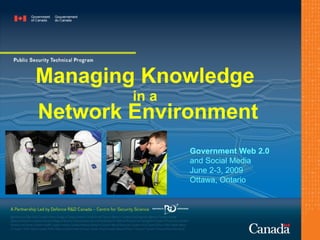
Managing Knowledge in a Network Environment

Loading...

Flash Player 9 (or above) is needed to view presentations.
We have detected that you do not have it on your computer. To install it, go here.

1 comments

Comments 1 - 1 of 1 previous next Post a comment

Post a comment
Embed Video
Edit your comment Cancel

Notes on slide 1

Today, I’d like to talk about managing knowledge in a network environment. Although I’ll discuss a number of departments, I’ll focus on the Public Security Technical program run by the Defence Research & Development, Centre for Security Science.

1 Group

Managing Knowledge in a Network Environment - Presentation Transcript

  1. Managing Knowledge in a Network Environment Government Web 2.0 and Social Media June 2-3, 2009 Ottawa, Ontario
  2. Knowledge Economy
    • Success based on what you know
    • Knowledge is the primary asset
    • Value of goods based on knowledge content
    • Creating and using knowledge are key to sustained relevance
    Recognized in four Throne Speeches
  3. Knowledge Management Evolution Overview Connectivity Web 2.0 Collaborate Synergy Community Network Emergent 3rd Distribution World-Wide Web Share Integrate Use Individual Team Tacit 2nd Systems Internet Create Acquire Preserve Artefacts Objects (Documents) Explicit 1st Technology Knowledge Process Knowledge Carrier Type of Knowledge KM Generation
  4. Outline
    • 1 st . Organization
      • Mandate, one source, knowledge assets
    • 2 nd . Collaboration
      • Agreements, few sources, knowledge flow
    • 3 rd . Networks
      • Interests, many sources, knowledge ecosystems
  5. Why Manage Knowledge ?
    • The Government spends billions every year to create knowledge; we should capture what we know.
    • Reusing knowledge can double or triple its value; we should preserve what we know.
    • Workers spend a third of their time searching for knowledge; we should share what we know.
    • Running a government involves many departments; we should integrate what we know.
    Organization
  6. Knowledge Organization Knowledge management connects creation and use Organization External Knowledge Share Internal Knowledge Manage Use Integrate Preserve Lost Knowledge Create Nature, Society Content
  7. What is Content ?
    • Collections – objects & artifacts: books, documents, minerals, insects, plant materials
    • Data – facts & observations: elements, files, records, datasets, databases, statistics
    • Information – meaning & context: records, documents, reports, photos, maps, presentations
    • Knowledge – understanding & predictability: equations, models, learning, experience, know-how
    • Wisdom – experience & judgment: enables the correct application of knowledge
    Organization
  8. Content Value Chain “ Flow of content through sequential stages, each of which changes its form and increases its usefulness and value.” (NRCan, 2006) Organization Objects Data Information Knowledge Wisdom Domain Department Admin. Data Records Know how Experience
  9. Organizational Infrastructure Organization People
      • learning, motivation, rewards, incentives, staffing, skills
    Governance roles, responsibilities, authorities, resources Processes work routines lessons learned, best practices, Content, Services data, risk analysis, reports, monitoring, operations, policies Tools systems to capture, store, share, and process content
  10. Knowledge Management Organization Governance
  11. Capturing Content Canadian Forest Service Organization
  12. Preserving Content
    • Organize
    • Store
    • Search
    • Retrieve
    • Maintain
    • Migrate
    Organization
  13. Migrating Content
    • Paper
    • Punch cards
    • Paper tape
    • Magnetic tape
    • Computer disks
    • Floppy disks
    • Tape cassettes
    • Diskettes
    • CD-ROMS
    • Flash Drives
    Organization More information is being lost than at any time in history
  14. Sharing Knowledge Public Security Technical Program
    • InfoPort / Share Point for communities
    • Workshops, symposia, meetings
    • Technology demonstrations
    • Communications products, media releases
    • Annual reports, fact sheets, documents
    • Quarterly newsletter
    • Website
    Organization
  15. Centre for Security Science
  16. Knowledge Services Organization Natural Resources Canada Use Internally Use Professionally Use Personally Generate Transform Add Value Transfer Evaluate Manage Extract Advance Embed Legend Department Sector / Society
  17. Outline
    • 1 st . Organization
      • Mandate, one source, knowledge assets
    • 2 nd . Collaboration
      • Agreements, few sources, knowledge flow
    • 3 rd . Networks
      • Interests, many sources, knowledge ecosystems
  18. Parallel Collaboration Partner A Partner B Collaboration Joint Content Generate Generate Joint Products & Services Transform Transform Joint Inventory Manage Manage Joint Solutions Use Internally Use Internally Joint Outputs Transfer Transfer
  19. Sequential Collaboration Agriculture Canada Collaboration Idea scientists AAFC Innovation IC company Commercialized CFIA farmers Adopted Food product HC producers retailers CFIA Market consumers HC Consumption Waste EC municipalities
  20. Formal Partnerships
    • Charter - Legal agreement to jointly achieve common objectives, within a management framework , with duplicate records and accountability and joint rights and responsibilities.
    • Nature: Clearly specified roles, rights, responsibilities, authorities, accountabilities, and reporting. (structured, bureaucratic, minimizes risk).
    Collaboration
  21. Types of Partnerships
    • Contractors: One-on-one; superior/ subordinate; single ownership of IP
    • Mutual: Two or more; among equals; joint ownership of IP
    • Consortiums: Multiple members; apportioned membership; common ownership of IP
    Collaboration A B A B A B C
  22. Informal Cooperation
    • Charter - Mutual agreement to participate in achieving common objectives, within a network structure , with participant records and accountability and common rights and responsibilities.
    • Nature: Flexible, dynamic, opportunistic, synergistic, unpredictable. (unstructured, self-organized, maximizes reward)
    Collaboration
  23. Types of Cooperation
    • Individuals: 2-3 participants; exchange knowledge (conversations, questions & answers)
    • Groups: 10 participants; elicit knowledge; unstructured; (task or working group)
    • Communities: 30 participants; share knowledge; self-directed; common interest (departmental IM community)
    Collaboration
  24. Canadian Food Inspection Agency
  25. Centre for Security Science
  26. Share Point Functions
    • Libraries – documents, images, forms, spread sheets*
    • Lists – announcements, links, members, contacts
    • Searching - tags and full text within and across sites
    • Tracking – calendars, events, tasks, work flow
    • Collaboration – surveys, dialogue, blogs, wikis
    • Site management – creation, functions, layout, views, members, permissions, integration
    *Microsoft compatible only Collaboration
  27. Share Point Uses
    • Content Management capture, organize, and store information. (architecture, taxonomy)
    • Document Management manage documents and records. (version control, access privileges)
    • Project Management support projects. (plans, schedules, tasks, progress, budgets, reports)
    • Portal provides “single-window” access to content. (members, permissions)
    • Sharing enables internal and external participants to exchange content.
    • Collaboration facilitates joint production of content across a dispersed group.
    Collaboration
  28. Centre for Security Science
  29. Outline
    • 1 st . Organization
      • Mandate, one source, knowledge assets
    • 2 nd . Collaboration
      • Agreements, few sources, knowledge flow
    • 3 rd . Networks
      • Interests, many sources, knowledge ecosystem
  30. Network Structure Networks
  31. Infrastructure
    • Mandate, authority, resources, decisions
    • Employees, roles, responsible, accountable,
    • Policies, manuals, rules, guides
    • Mandatory organizational systems
    • Interests, trust, self-sustaining, conventions
    • Participants, values, volunteer, autonomous
    • Self-organized, informal, ad hoc
    • Convenient, user-friendly, useful
    Networks Organization Network (Collaboration)
  32. Culture and Behavior
    • Discussion
    • Winners & losers
    • Authority counts
    • Domination wins
    • Represent agenda
    • Existing processes
    • Structured thinking
    • Dialogue
    • Everyone wins
    • Equal participants
    • Meritocracy of ideas
    • Support the group
    • Emergent ideas
    • Group synergy
    Networks Organization Network
  33. Knowledge Network Networks Synergy Emergence External Knowledge Share Preserve Lost Knowledge Knowledge Management Use Integrate Issue Create Nature, Society Capture Content
  34. Content Providers
    • Increased visibility and influence
    • Feedback on content needs and use
    • Seen as active and knowledgeable
    • Encourage partnerships, and leveraging
    • Altruism, personal values fun
    • Little tangible reward
    • Incurs cost
    • Uses resources
    • Takes time
    • Unfriendly technology
    • Trust others
    • Limited control
    • Voluntary
    • Self-motivation
    Incentives Disincentives Networks
  35. Public Security Technical Program Network The value of a network is proportional to the number of users squared . Networks
  36. Global Knowledge Map Network
  37. Social Network Sites
    • Wikipedia – 75,000 contributors, 10 million articles in 260 languages, 684 million annual visits.
    • You Tube – Enables easy publishing and viewing of video clips on the Web.
    • Innocentive – Global “Ideagora” in which those with problems can meet those with solutions.
    • Slide Share – Enables easy publishing and sharing of PowerPoint presentations on the Web.
    Networks
  38.  
  39.  
  40. Natural Resources Canada
  41. Social Network Principles
    • Openness – collaboration based on candor, transparency, freedom, flexibility, and accessibility.
    • Peering – horizontal voluntary meritocracy, based on fun, altruism, or personal values.
    • Sharing – increased value of common products benefits all participants.
    • Acting Globally – value is created through network knowledge ecosystems.
    Networks
  42. Social Network Successes
    • Linux – open-source operating system developed by thousands of programmers around the world
    • GoldCorp – released geological data in an open contest to find gold; increased reserves by factor of 4.
    • Procter & Gamble – uses network of 90,000 external scientists to leverage internal research capacity.
    • Leggo – uses imagination and creativity of worldwide toy owners to create new products.
    Networks
  43. Capturing Value Bring it inside the organization Stabilize it; make it work Networks
  44. SWOT Analysis
    • Strengths – rapid development, creative solutions, emergent properties, creative synergies, vibrant collaboration, openness
    • Weaknesses – constant change, unknown quality, less used by mature individuals, need to motivate participants, cannot be forced
    • Opportunities – leverage internal capacity, provides new solutions, easy to implement, low cost, can monitor emerging trends
    • Threats – undesirable leaks, free expression poses risk, documents subject to ATIP, compatibility with mandate
    Networks
  45. Challenges
    • Legislative
    • Policy
    • Regulatory
    • Financial
    • Infrastructure
    • Human resources
    • Cultural factors
    • Intellectual Property
    (Neish, 2007) Networks
  46. Road to Success
    • Support from senior management
    • Clear understandable statement of what you want to do and why
    • Good working relationships with corporate and legal enablers
    • Willingness to compromise on issues that are not mission critical
    • Perseverance and persistence
    (Neish, 2007) Networks
  47. A Knowledge Network
    • Helps communities work together
    • Works the way that’s best for each group
    • Captures and shares ideas and knowledge
    • Promotes creation and synergy of many minds
    http://www.slideshare.net/Al.Simard/slideshows

+ Albert SimardAlbert Simard, 5 months ago

custom

615 views, 0 favs, 0 embeds more stats

Describes knowledge management from an organization more

More info about this document

© All Rights Reserved

Go to text version

  • Total Views 615
    • 615 on SlideShare
    • 0 from embeds
  • Comments 1
  • Favorites 0
  • Downloads 48
Most viewed embeds

more

All embeds

less

Flagged as inappropriate Flag as inappropriate
Flag as inappropriate

Select your reason for flagging this presentation as inappropriate. If needed, use the feedback form to let us know more details.

Cancel
File a copyright complaint
Having problems? Go to our helpdesk?

Categories

Groups / Events