
Presented by: Shannon Magistad Building the  ROI for
Building the ROI for ITIL® Defining ITIL® and Best Practice  IT Strategy and ITIL ® Defining ROI, VOI and TCO ROI: Qualitative vs. Quantitative  Benefits of ITIL®  Where To Start? Discussion on how to begin your ITIL® Journey Wrap-Up & Close
IT Service Management & ITIL Defined ITIL is the “de-facto industry best practice” for IT Service Management Non-proprietary and based upon proven practitioner experiences International user support (IT Service Management Forum - itSMF) ITIL was developed by the UK Office of Government Commerce (OGC) Developed in the late 1980s and continuously updated since ISO 20000 – Formal, international standard for IT Service Management certification, based upon ITIL best practices (formerly BS 15000) ITIL is a comprehensive and consistent set of industry “best practices” for IT Service Management organized in an integrated, process-based framework in order to add VALUE to customers
ITIL Overview   ITIL and ITAM are being leveraged by 1,000s of organizations across the globe; even highlighted in a front page article in CIO Magazine entitled “IT Governance: The Power of ITIL” (November 2006) Formal ITIL certification program through EXIN or ISEB Foundation, Practitioner, and Manager’s Certificates ITIL Version 3 (V3) was releases in June, 2007 and focuses on a “full lifecycle” approach to the processes
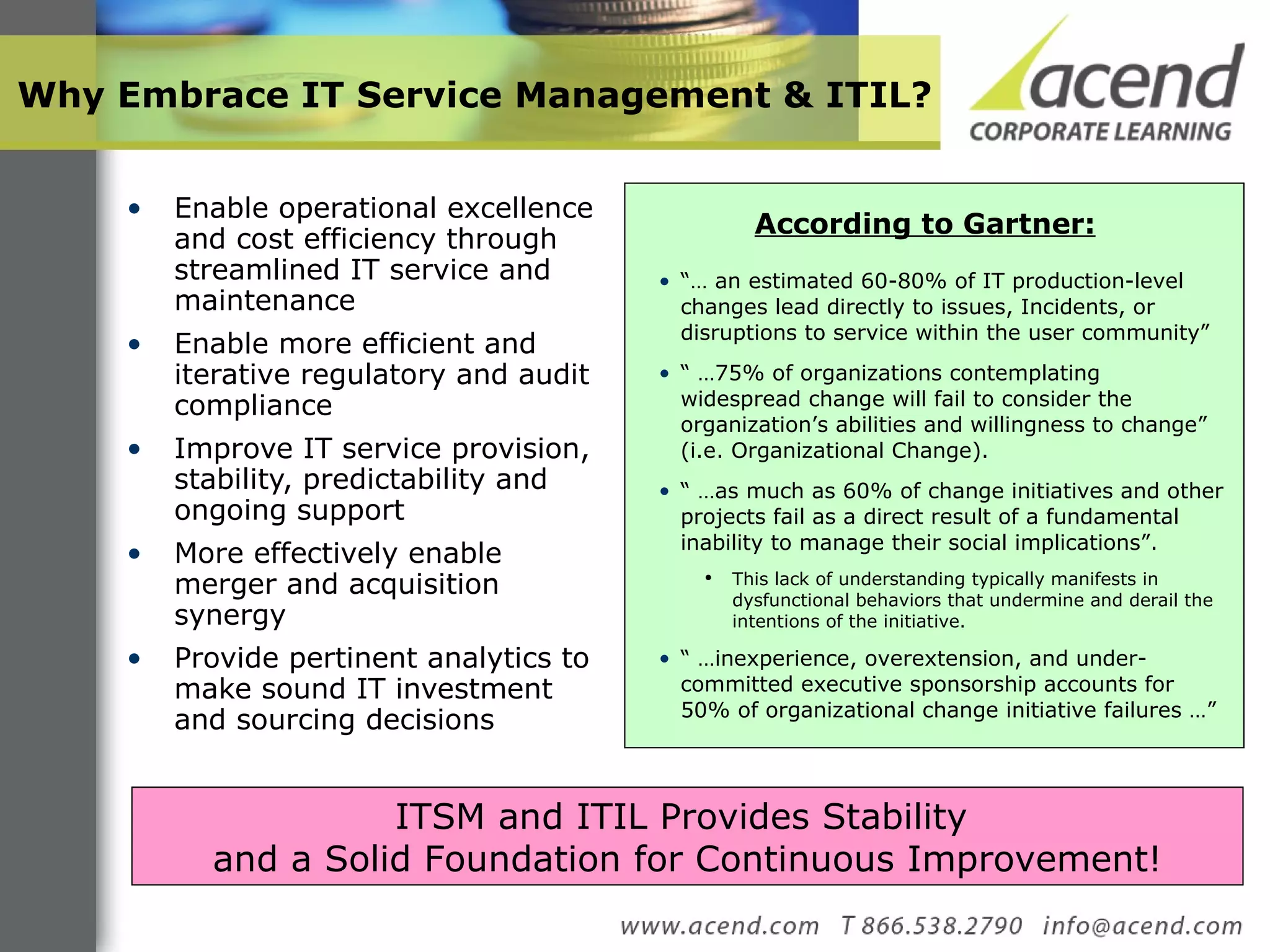
Why Embrace IT Service Management & ITIL? Enable operational excellence and cost efficiency through streamlined IT service and maintenance  Enable more efficient and iterative regulatory and audit compliance  Improve IT service provision, stability, predictability and ongoing support More effectively enable merger and acquisition synergy Provide pertinent analytics to make sound IT investment and sourcing decisions “…  an estimated 60-80% of IT production-level changes lead directly to issues, Incidents, or disruptions to service within the user community”  “ … 75% of organizations contemplating widespread change will fail to consider the organization’s abilities and willingness to change” (i.e. Organizational Change). “ … as much as 60% of change initiatives and other projects fail as a direct result of a fundamental inability to manage their social implications”.  This lack of understanding typically manifests in dysfunctional behaviors that undermine and derail the intentions of the initiative. “ … inexperience, overextension, and under-committed executive sponsorship accounts for 50% of organizational change initiative failures …” According to Gartner: ITSM and ITIL Provides Stability  and a Solid Foundation for Continuous Improvement!
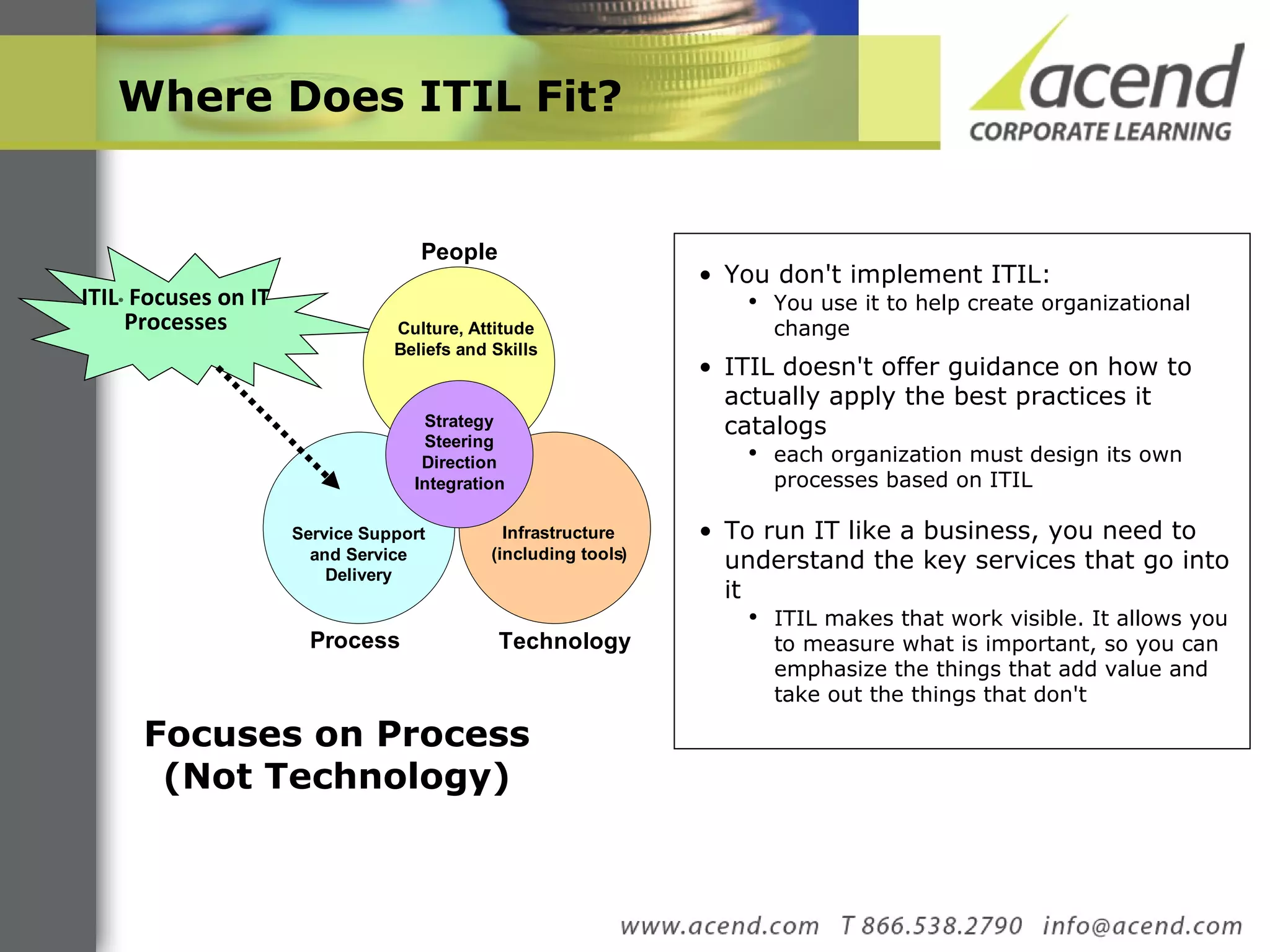
Where Does ITIL Fit? Focuses on Process (Not Technology) You don't implement ITIL: You use it to help create organizational change ITIL doesn't offer guidance on how to actually apply the best practices it catalogs each organization must design its own processes based on ITIL To run IT like a business, you need to understand the key services that go into it  ITIL makes that work visible. It allows you to measure what is important, so you can emphasize the things that add value and take out the things that don't
TCO: Definition  TCO = Total Cost of Ownership  A methodology used to help make investment decisions TCO assesses the full Lifecycle Cost of owning an IT Asset or Configuration Item (CI), not just the initial Cost or purchase price
ROI: Definition  ROI = Return on Investment  A measurement of the expected benefit of an investment In the simplest sense it is the net profit of an investment divided by the net worth of the assets invested
VOI: Definition  VOI = Value on Investment  A measurement of the expected benefit of an investment. VOI considers both financial and intangible benefits
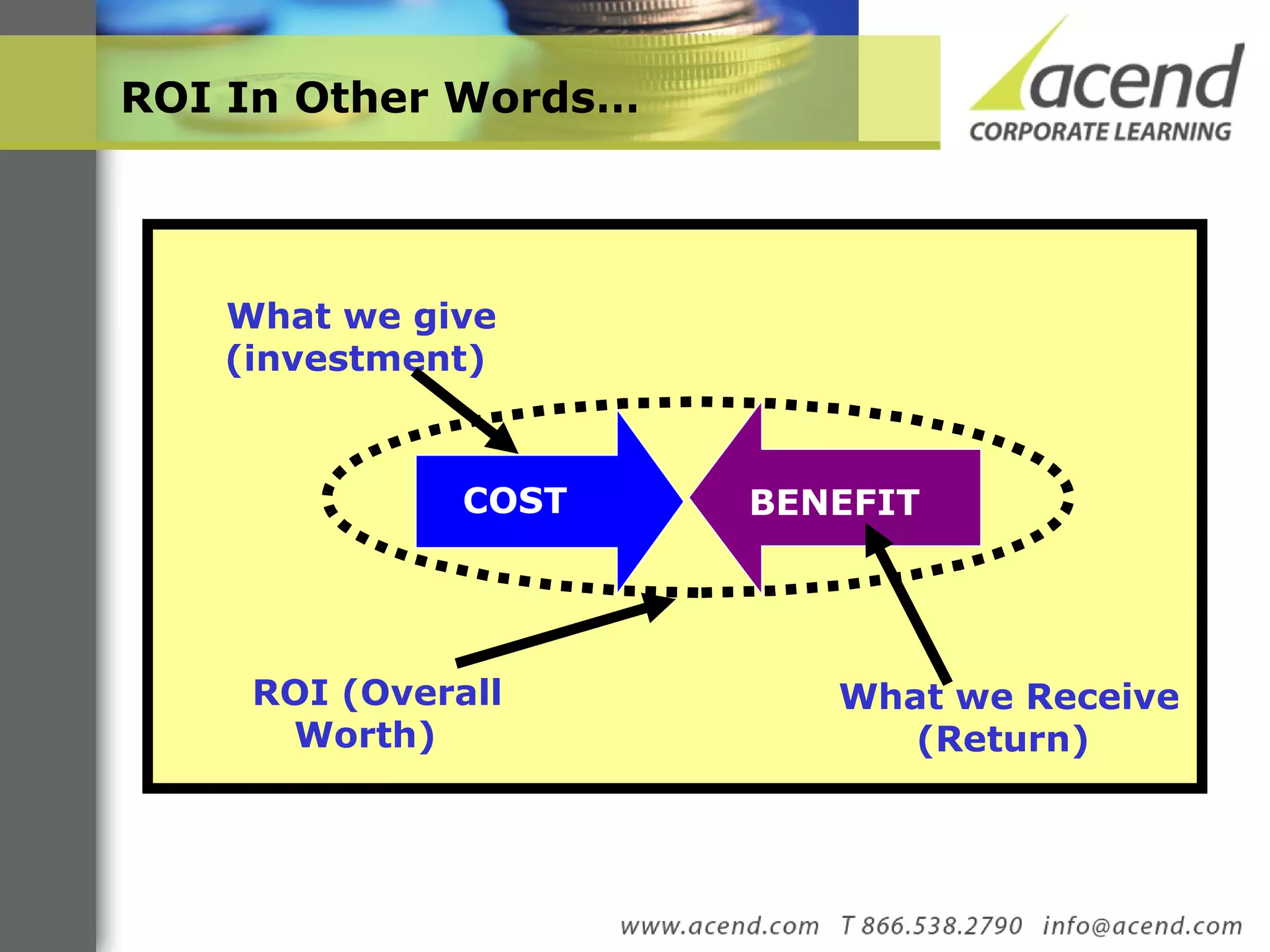
ROI In Other Words…  What we give (investment)  What we Receive (Return)  ROI (Overall Worth)  COST BENEFIT
ROI: Recap  ROI = Return on Investment   A measurement of the expected benefit of an investment When someone asks about an “ROI” what they are asking is: “ What do I get back (“return”) for the money that I’m being asked to spend (a.k.a. “Investment”)?”  “ What is it really worth (a.k.a. “ROI”)
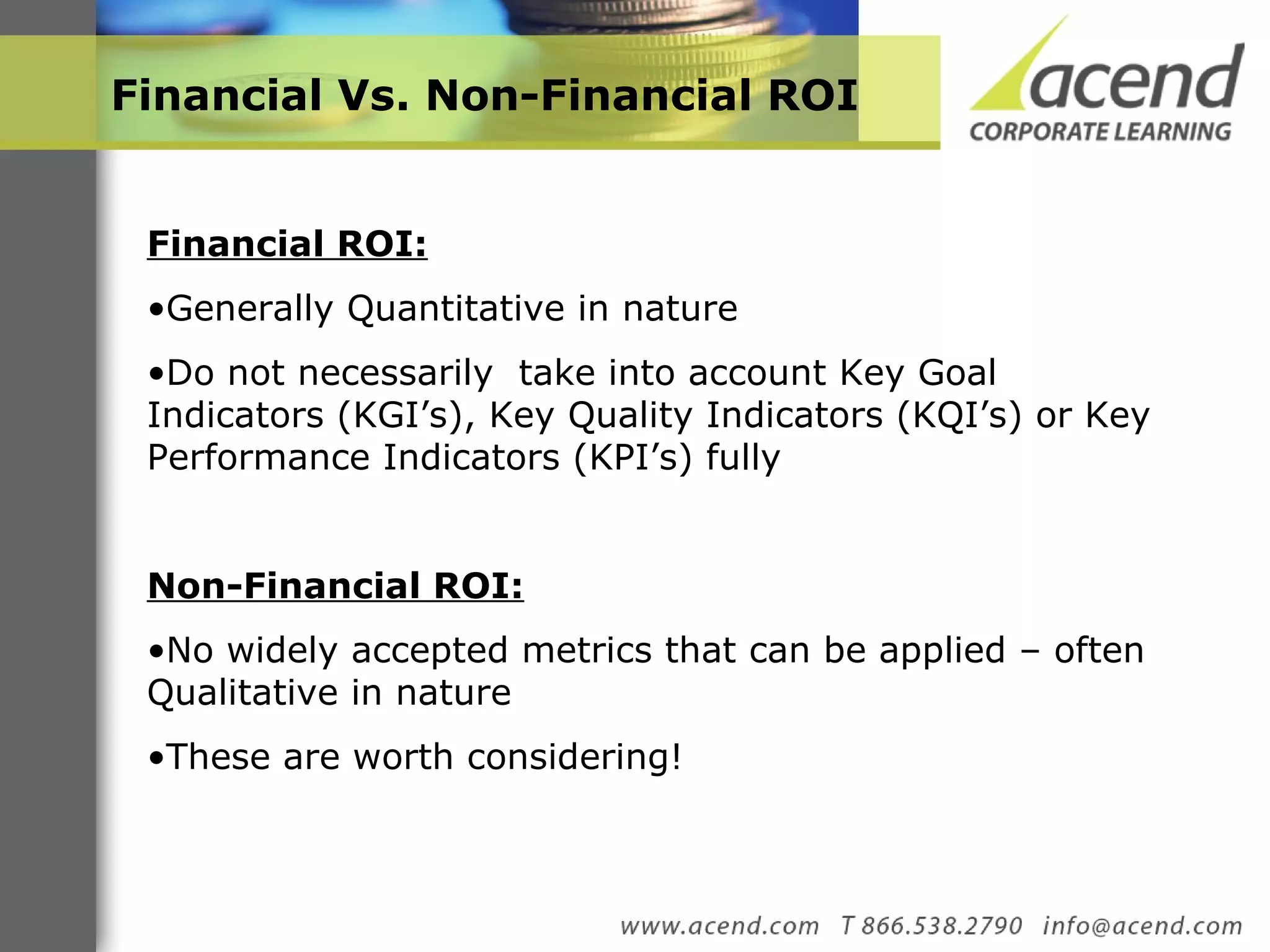
Financial Vs. Non-Financial ROI  Financial ROI: Generally Quantitative in nature  Do not necessarily  take into account Key Goal Indicators (KGI’s), Key Quality Indicators (KQI’s) or Key Performance Indicators (KPI’s) fully  Non-Financial ROI:   No widely accepted metrics that can be applied – often Qualitative in nature These are worth considering!
ITIL & ROI  Different organizations = Different ROI equations  Tie ROI concepts to overall IT Strategy  Increase in productivity, capability to measure and quantify IT activities is an output of good Service Design and Leveraging ITIL  often including ITSM Technologies   For a COMPLETE picture of ROI, you can place Non-Financial Benefits and Financial Benefits together to evaluate the Return on Investment* *Very helpful for Best-Practice Projects
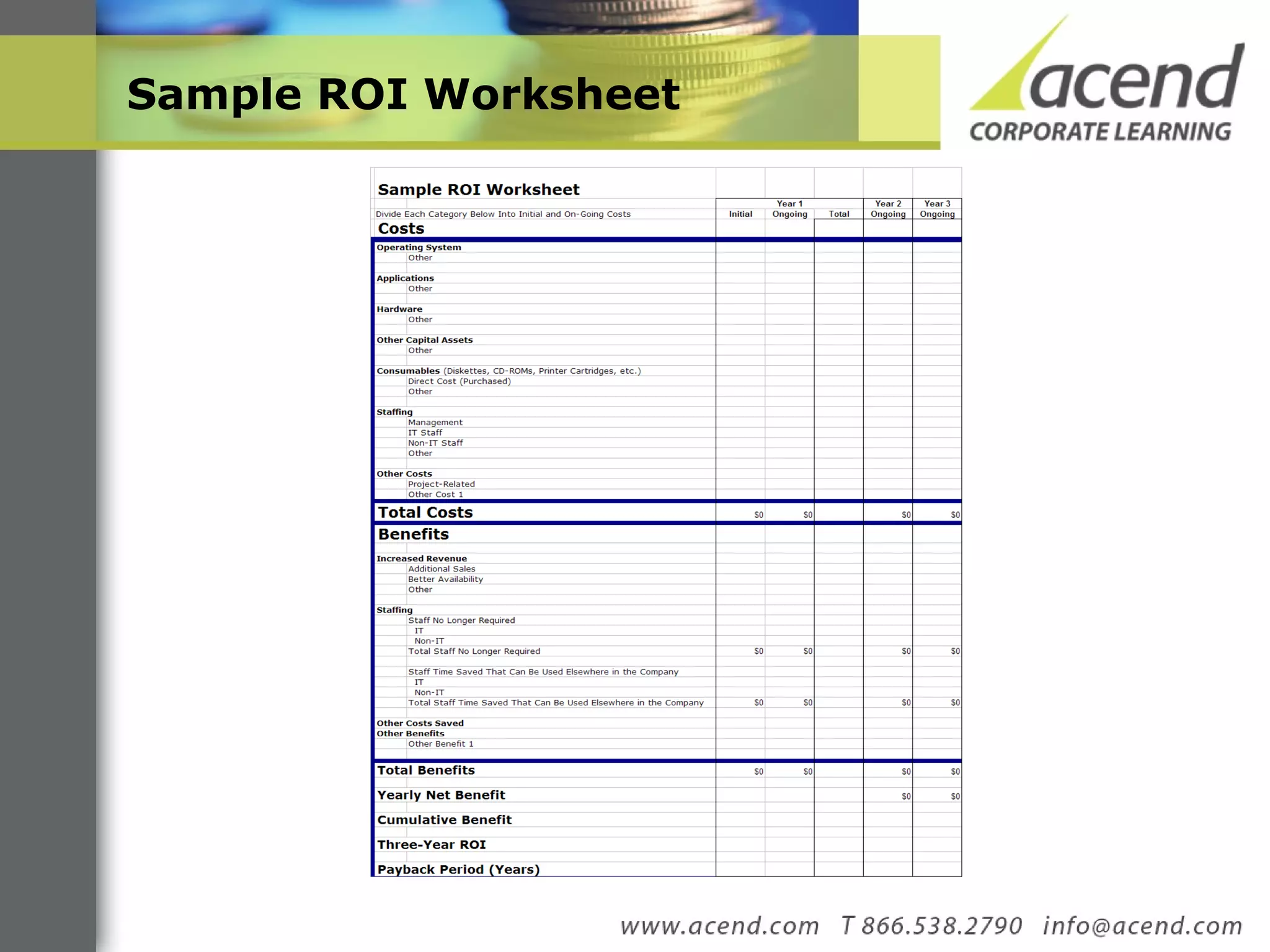
Sample ROI Worksheet
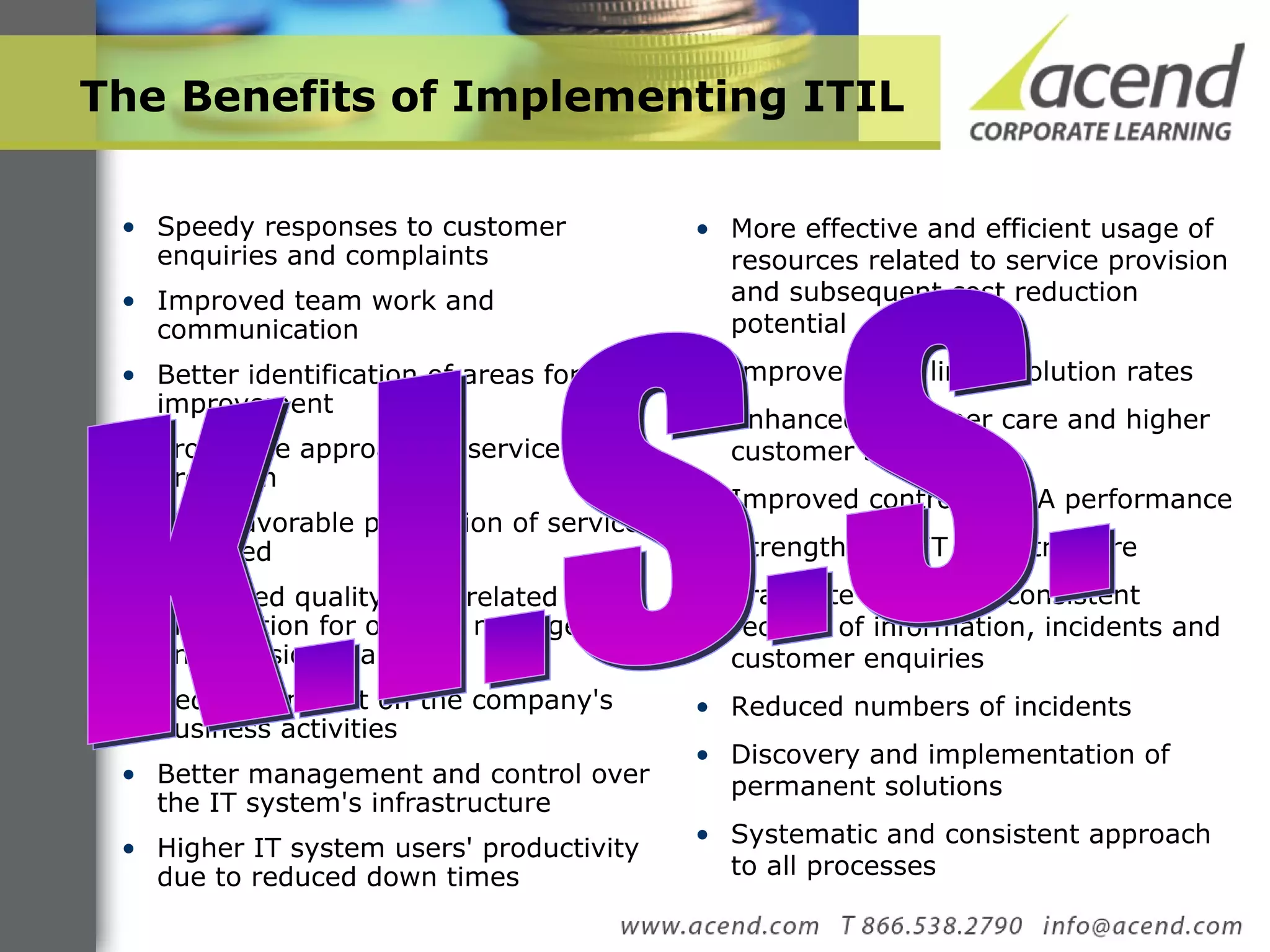
The Benefits of Implementing ITIL Speedy responses to customer enquiries and complaints Improved team work and communication Better identification of areas for improvement Pro-active approach to service provision More favorable perception of services provided Improved quality of IT-related information for optimal management and decision-making Reduced impact on the company's business activities Better management and control over the IT system's infrastructure Higher IT system users' productivity due to reduced down times More effective and efficient usage of resources related to service provision and subsequent cost reduction potential Improved first line resolution rates Enhanced customer care and higher customer satisfaction Improved control of SLA performance Strengthened IT infrastructure Eradicate loss and inconsistent records of information, incidents and customer enquiries Reduced numbers of incidents Discovery and implementation of permanent solutions Systematic and consistent approach to all processes K.I.S.S.
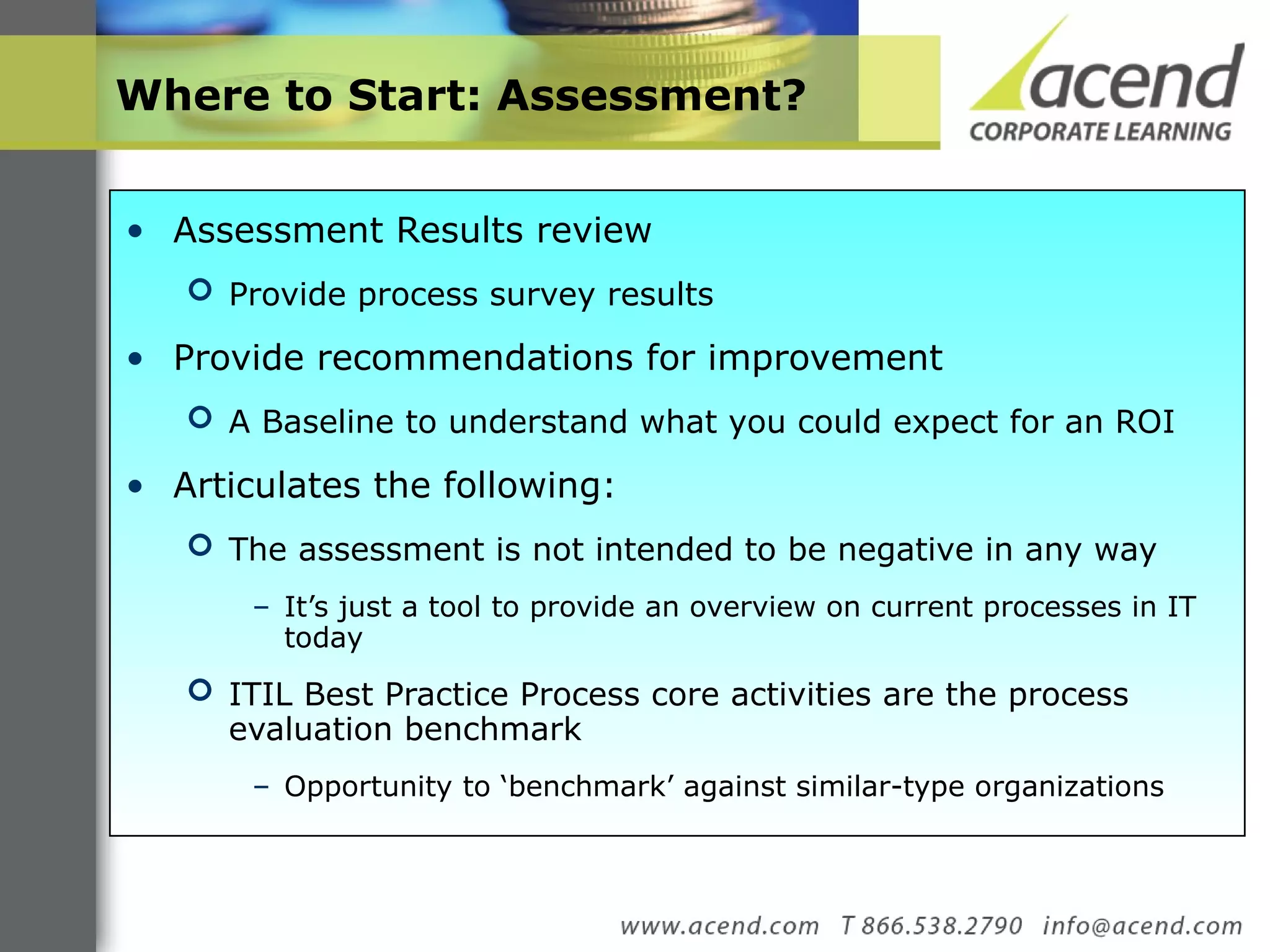
Where to Start: Assessment? Assessment Results review  Provide process survey results Provide recommendations for improvement A Baseline to understand what you could expect for an ROI Articulates the following: The assessment is not intended to be negative in any way It’s just a tool to provide an overview on current processes in IT today  ITIL Best Practice Process core activities are the process evaluation benchmark  Opportunity to ‘benchmark’ against similar-type organizations
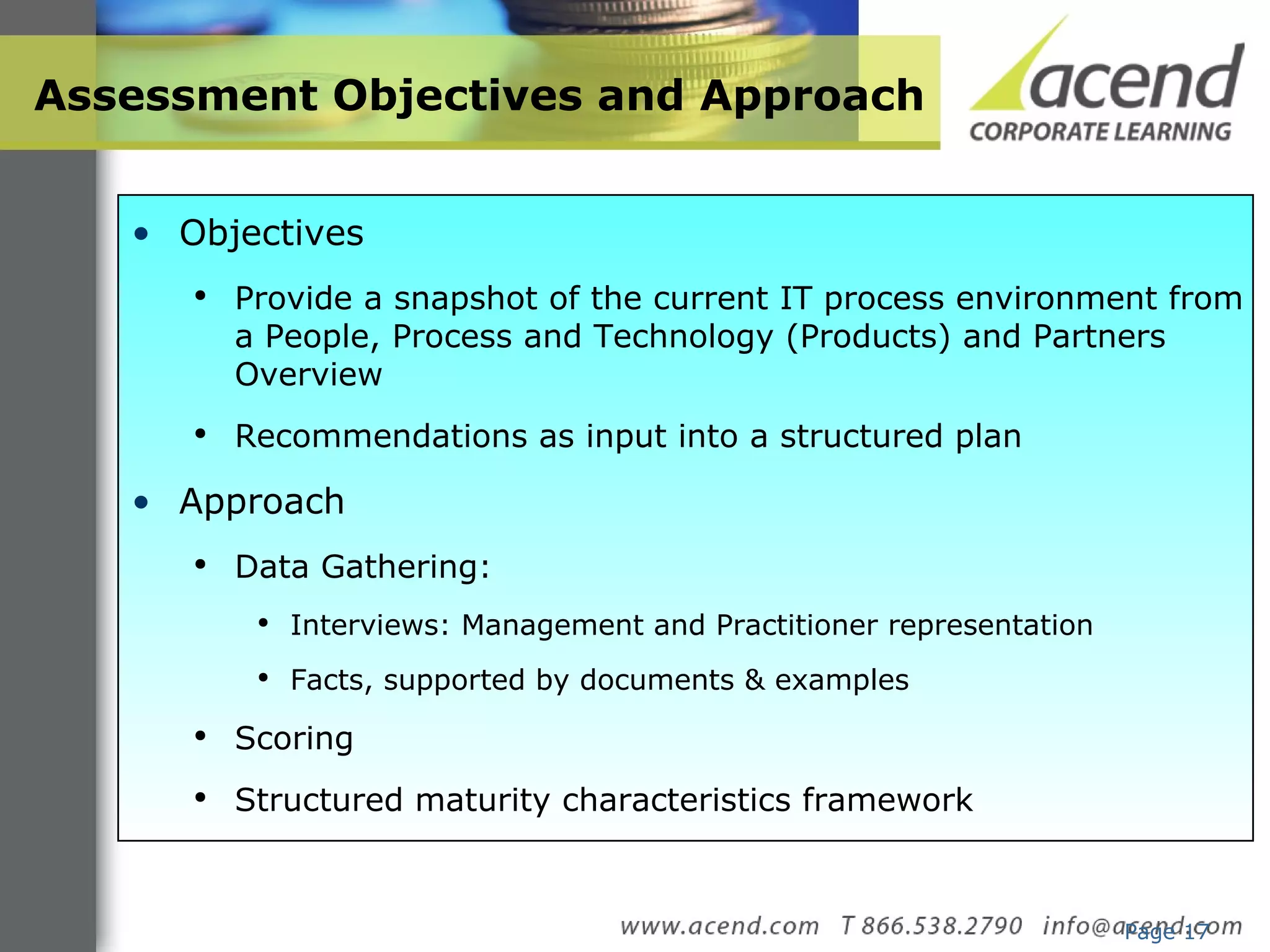
Assessment Objectives and Approach Page  Objectives Provide a snapshot of the current IT process environment from a People, Process and Technology (Products) and Partners Overview  Recommendations as input into a structured plan Approach Data Gathering: Interviews: Management and Practitioner representation Facts, supported by documents & examples Scoring Structured maturity characteristics framework
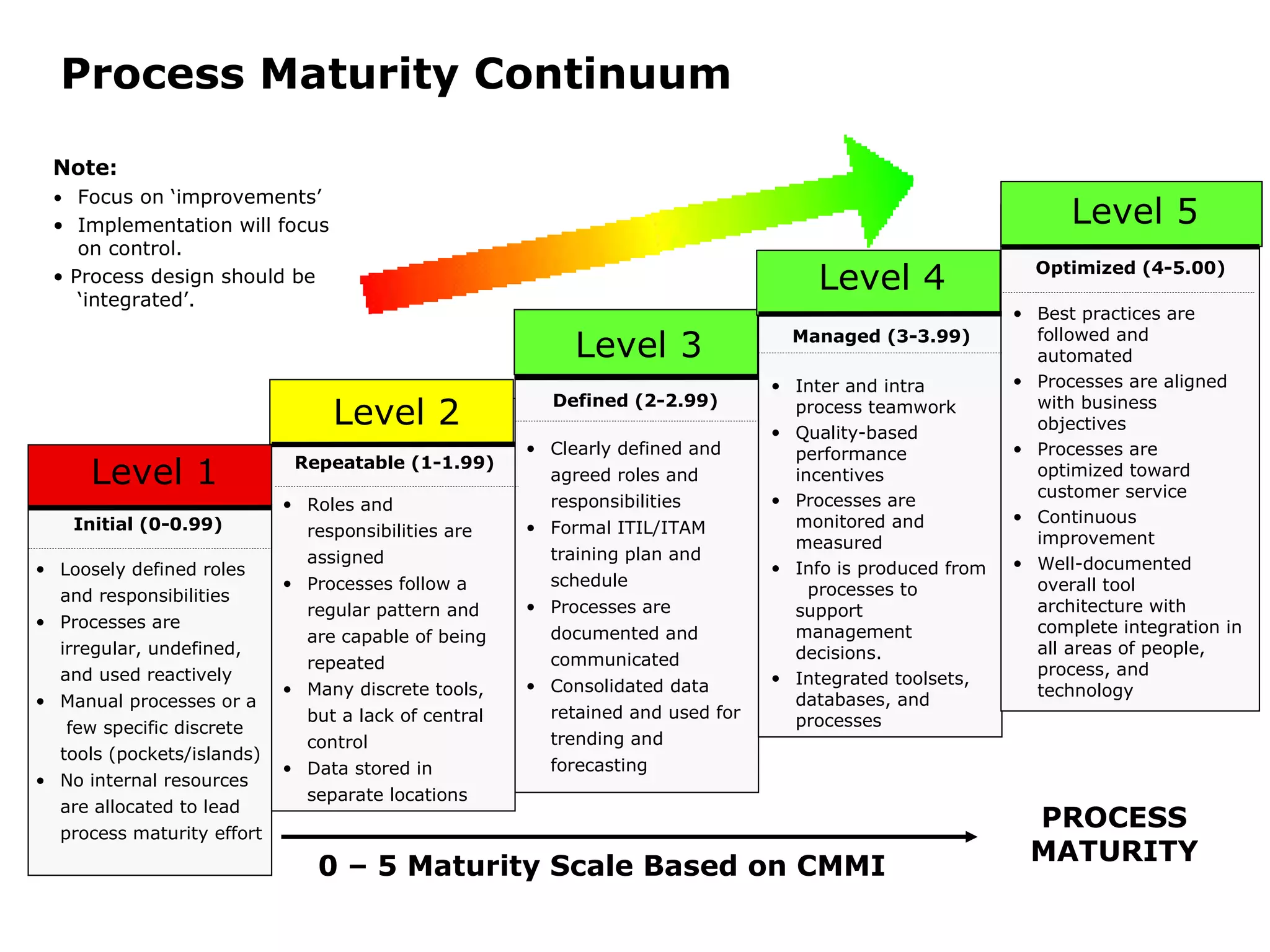
Process Maturity Continuum   PROCESS MATURITY Initial (0-0.99) Defined (2-2.99) Managed (3-3.99) Optimized (4-5.00) Repeatable (1-1.99) Best practices are  followed and  automated Processes are aligned  with business objectives Processes are optimized toward customer service Continuous  improvement Well-documented  overall tool architecture with complete integration in all areas of people, process, and  technology Loosely defined roles  and responsibilities Processes are irregular, undefined, and used reactively Manual processes or a  few specific discrete  tools (pockets/islands) • No internal resources  are allocated to lead  process maturity effort Roles and  responsibilities are  assigned Processes follow a  regular pattern and are capable of being  repeated Many discrete tools, but a lack of central control Data stored in separate locations Clearly defined and  agreed roles and  responsibilities Formal ITIL/ITAM  training plan and  schedule Processes are  documented and  communicated Consolidated data  retained and used for  trending and  forecasting Inter and intra process teamwork Quality-based  performance incentives Processes are  monitored and  measured Info is produced from  processes to support  management  decisions. Integrated toolsets,  databases, and  processes Level 2 Level 1 Level 3 Level 4 Level 5 0 – 5 Maturity Scale Based on CMMI Note: •  Focus on ‘improvements’ •  Implementation will focus on control. •  Process design should be  ‘integrated’.
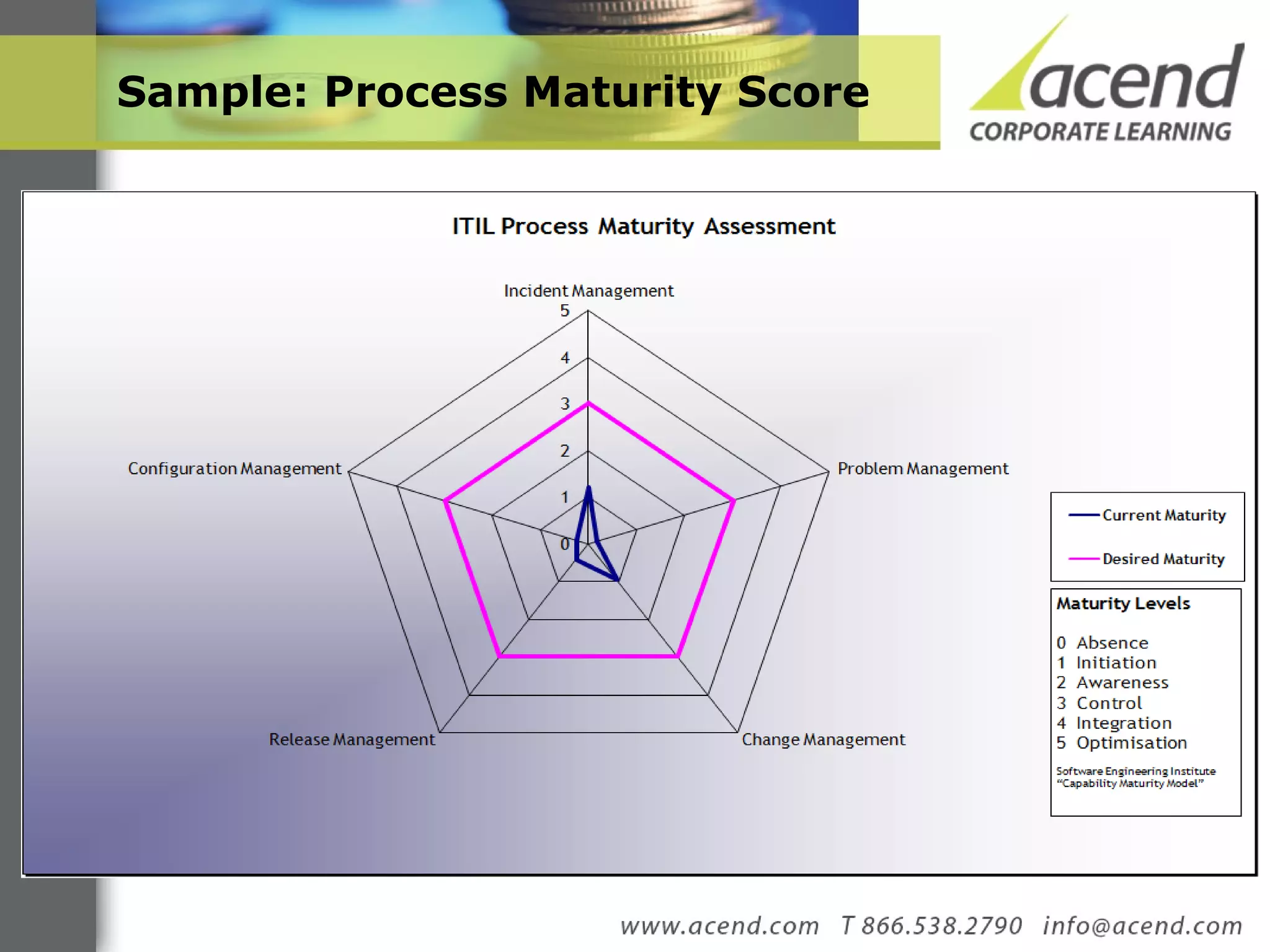
Sample: Process Maturity Score
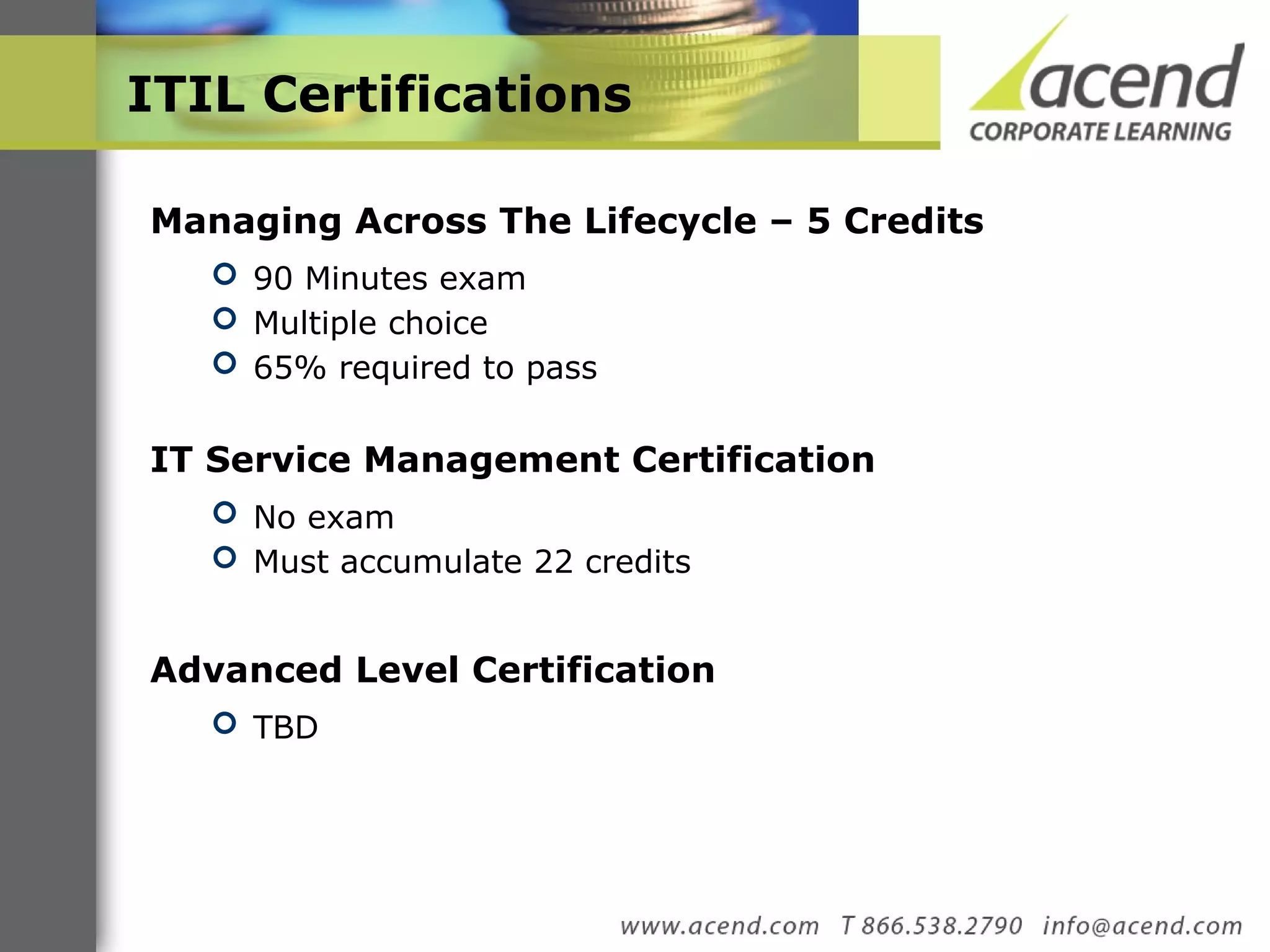
ITIL Certifications Managing Across The Lifecycle – 5 Credits 90 Minutes exam Multiple choice 65% required to pass IT Service Management Certification  No exam Must accumulate 22 credits  Advanced Level Certification TBD
Why Acend Corporate Learning? 98% Pass Rate Certified Course Material and Instructors Our private classes are delivered by a highly trained and author-approved ITIL Experts trainer. We use PowerPoint during lectures, but we don't do "death by slide" - our students are digging into the product, deeper every day.  Our classes are "instructor led, student driven." If we need to spend more time on a particular subject, we will.  Your Company will Save Big on group on-sites of 6 or more students.
We Can Help! Thank You!

Justifying ITIL - Building the ROI

  • 1.
    Presented by: ShannonMagistad Building the ROI for
  • 2.
    Building the ROIfor ITIL® Defining ITIL® and Best Practice IT Strategy and ITIL ® Defining ROI, VOI and TCO ROI: Qualitative vs. Quantitative Benefits of ITIL® Where To Start? Discussion on how to begin your ITIL® Journey Wrap-Up & Close
  • 3.
    IT Service Management& ITIL Defined ITIL is the “de-facto industry best practice” for IT Service Management Non-proprietary and based upon proven practitioner experiences International user support (IT Service Management Forum - itSMF) ITIL was developed by the UK Office of Government Commerce (OGC) Developed in the late 1980s and continuously updated since ISO 20000 – Formal, international standard for IT Service Management certification, based upon ITIL best practices (formerly BS 15000) ITIL is a comprehensive and consistent set of industry “best practices” for IT Service Management organized in an integrated, process-based framework in order to add VALUE to customers
  • 4.
    ITIL Overview ITIL and ITAM are being leveraged by 1,000s of organizations across the globe; even highlighted in a front page article in CIO Magazine entitled “IT Governance: The Power of ITIL” (November 2006) Formal ITIL certification program through EXIN or ISEB Foundation, Practitioner, and Manager’s Certificates ITIL Version 3 (V3) was releases in June, 2007 and focuses on a “full lifecycle” approach to the processes
  • 5.
    Why Embrace ITService Management & ITIL? Enable operational excellence and cost efficiency through streamlined IT service and maintenance Enable more efficient and iterative regulatory and audit compliance Improve IT service provision, stability, predictability and ongoing support More effectively enable merger and acquisition synergy Provide pertinent analytics to make sound IT investment and sourcing decisions “… an estimated 60-80% of IT production-level changes lead directly to issues, Incidents, or disruptions to service within the user community” “ … 75% of organizations contemplating widespread change will fail to consider the organization’s abilities and willingness to change” (i.e. Organizational Change). “ … as much as 60% of change initiatives and other projects fail as a direct result of a fundamental inability to manage their social implications”. This lack of understanding typically manifests in dysfunctional behaviors that undermine and derail the intentions of the initiative. “ … inexperience, overextension, and under-committed executive sponsorship accounts for 50% of organizational change initiative failures …” According to Gartner: ITSM and ITIL Provides Stability and a Solid Foundation for Continuous Improvement!
  • 6.
    Where Does ITILFit? Focuses on Process (Not Technology) You don't implement ITIL: You use it to help create organizational change ITIL doesn't offer guidance on how to actually apply the best practices it catalogs each organization must design its own processes based on ITIL To run IT like a business, you need to understand the key services that go into it ITIL makes that work visible. It allows you to measure what is important, so you can emphasize the things that add value and take out the things that don't
  • 7.
    TCO: Definition TCO = Total Cost of Ownership A methodology used to help make investment decisions TCO assesses the full Lifecycle Cost of owning an IT Asset or Configuration Item (CI), not just the initial Cost or purchase price
  • 8.
    ROI: Definition ROI = Return on Investment A measurement of the expected benefit of an investment In the simplest sense it is the net profit of an investment divided by the net worth of the assets invested
  • 9.
    VOI: Definition VOI = Value on Investment A measurement of the expected benefit of an investment. VOI considers both financial and intangible benefits
  • 10.
    ROI In OtherWords… What we give (investment) What we Receive (Return) ROI (Overall Worth) COST BENEFIT
  • 11.
    ROI: Recap ROI = Return on Investment A measurement of the expected benefit of an investment When someone asks about an “ROI” what they are asking is: “ What do I get back (“return”) for the money that I’m being asked to spend (a.k.a. “Investment”)?” “ What is it really worth (a.k.a. “ROI”)
  • 12.
    Financial Vs. Non-FinancialROI Financial ROI: Generally Quantitative in nature Do not necessarily take into account Key Goal Indicators (KGI’s), Key Quality Indicators (KQI’s) or Key Performance Indicators (KPI’s) fully Non-Financial ROI: No widely accepted metrics that can be applied – often Qualitative in nature These are worth considering!
  • 13.
    ITIL & ROI Different organizations = Different ROI equations Tie ROI concepts to overall IT Strategy Increase in productivity, capability to measure and quantify IT activities is an output of good Service Design and Leveraging ITIL often including ITSM Technologies For a COMPLETE picture of ROI, you can place Non-Financial Benefits and Financial Benefits together to evaluate the Return on Investment* *Very helpful for Best-Practice Projects
  • 14.
  • 15.
    The Benefits ofImplementing ITIL Speedy responses to customer enquiries and complaints Improved team work and communication Better identification of areas for improvement Pro-active approach to service provision More favorable perception of services provided Improved quality of IT-related information for optimal management and decision-making Reduced impact on the company's business activities Better management and control over the IT system's infrastructure Higher IT system users' productivity due to reduced down times More effective and efficient usage of resources related to service provision and subsequent cost reduction potential Improved first line resolution rates Enhanced customer care and higher customer satisfaction Improved control of SLA performance Strengthened IT infrastructure Eradicate loss and inconsistent records of information, incidents and customer enquiries Reduced numbers of incidents Discovery and implementation of permanent solutions Systematic and consistent approach to all processes K.I.S.S.
  • 16.
    Where to Start:Assessment? Assessment Results review Provide process survey results Provide recommendations for improvement A Baseline to understand what you could expect for an ROI Articulates the following: The assessment is not intended to be negative in any way It’s just a tool to provide an overview on current processes in IT today ITIL Best Practice Process core activities are the process evaluation benchmark Opportunity to ‘benchmark’ against similar-type organizations
  • 17.
    Assessment Objectives andApproach Page Objectives Provide a snapshot of the current IT process environment from a People, Process and Technology (Products) and Partners Overview Recommendations as input into a structured plan Approach Data Gathering: Interviews: Management and Practitioner representation Facts, supported by documents & examples Scoring Structured maturity characteristics framework
  • 18.
    Process Maturity Continuum PROCESS MATURITY Initial (0-0.99) Defined (2-2.99) Managed (3-3.99) Optimized (4-5.00) Repeatable (1-1.99) Best practices are followed and automated Processes are aligned with business objectives Processes are optimized toward customer service Continuous improvement Well-documented overall tool architecture with complete integration in all areas of people, process, and technology Loosely defined roles and responsibilities Processes are irregular, undefined, and used reactively Manual processes or a few specific discrete tools (pockets/islands) • No internal resources are allocated to lead process maturity effort Roles and responsibilities are assigned Processes follow a regular pattern and are capable of being repeated Many discrete tools, but a lack of central control Data stored in separate locations Clearly defined and agreed roles and responsibilities Formal ITIL/ITAM training plan and schedule Processes are documented and communicated Consolidated data retained and used for trending and forecasting Inter and intra process teamwork Quality-based performance incentives Processes are monitored and measured Info is produced from processes to support management decisions. Integrated toolsets, databases, and processes Level 2 Level 1 Level 3 Level 4 Level 5 0 – 5 Maturity Scale Based on CMMI Note: • Focus on ‘improvements’ • Implementation will focus on control. • Process design should be ‘integrated’.
  • 19.
  • 20.
    ITIL Certifications ManagingAcross The Lifecycle – 5 Credits 90 Minutes exam Multiple choice 65% required to pass IT Service Management Certification No exam Must accumulate 22 credits Advanced Level Certification TBD
  • 21.
    Why Acend CorporateLearning? 98% Pass Rate Certified Course Material and Instructors Our private classes are delivered by a highly trained and author-approved ITIL Experts trainer. We use PowerPoint during lectures, but we don't do "death by slide" - our students are digging into the product, deeper every day. Our classes are "instructor led, student driven." If we need to spend more time on a particular subject, we will. Your Company will Save Big on group on-sites of 6 or more students.
  • 22.
    We Can Help!Thank You!

Editor's Notes