Titration study in OSA & COPD / OSA
overlap
Dr. Zia Hashim
MD Internal Medicine (PGI Chandigarh)
DM Pulmonary & Critical Care (PGI Chandigarh)
FCCP (USA)
Associate Professor
Consultant in charge Sleep Lab
Department of Pulmonary Medicine
SGPGIMS Lucknow
Indications for starting PAP
AHI or RDI 15 events/hour
AHI or RDI 5 but <15 events/hour with any one of the
following symptoms:
– Excessive daytime sleepiness
– Neurocognitive impairment
– Hypertension
– Coronary artery disease
– Cardiac arrhythmias
– Pulmonary hypertension
– History of stroke
Pilots and drivers: AHI 5 - 14 even if no symptoms.
RERA > 10 with excessive daytime sleepiness even if AHI < 5
Before starting treatment
• Which device to use ?
• At what pressure ?
• Is oxygen also required ?
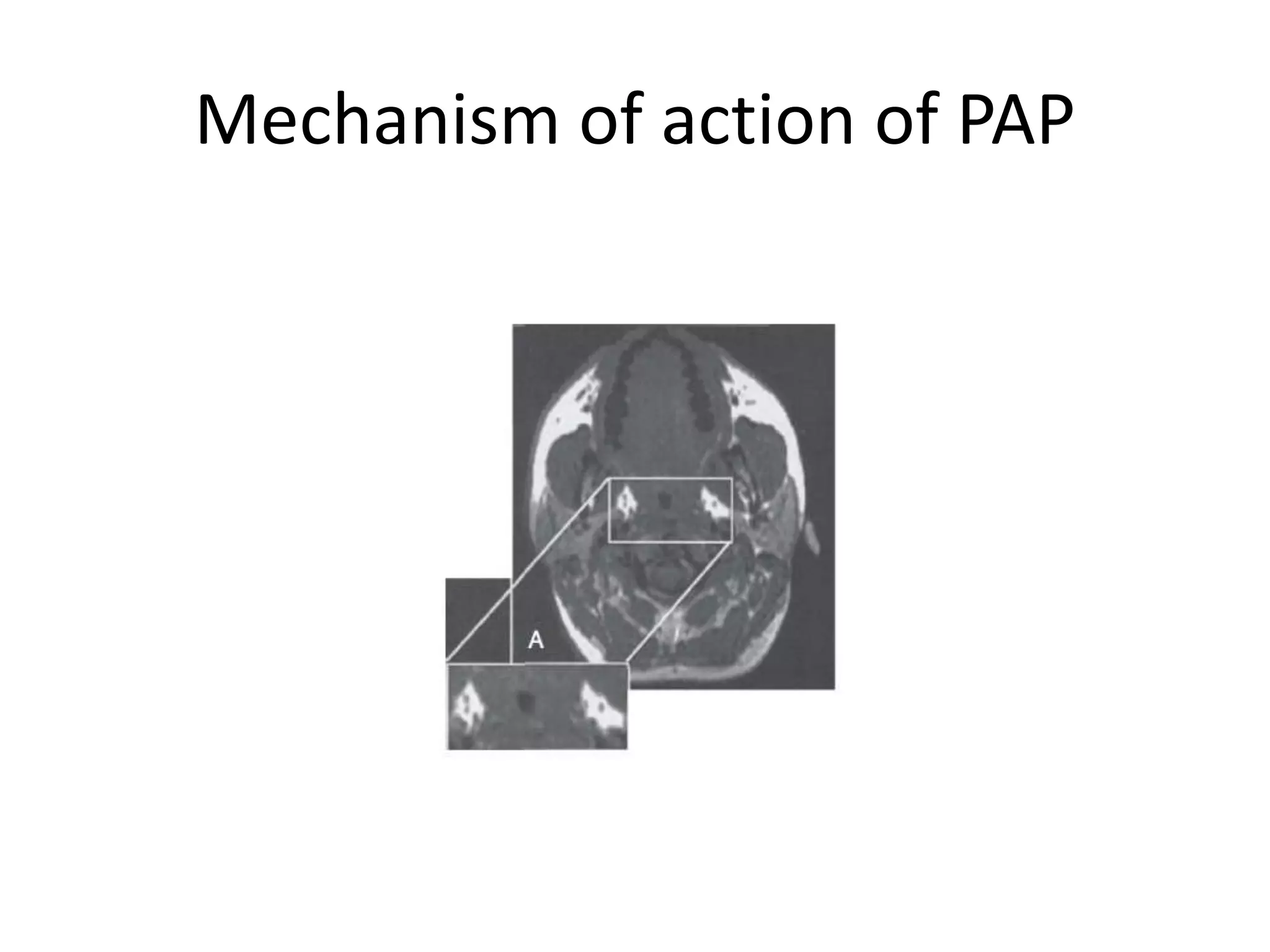
• Pneumatic splint
• Increase in lung volume
• Increase in upper airway size
Mechanism of action of PAP
After starting CPAP
Before doing titration complete
diagnosis is very important
• OSA
• OHS
• CHF
• COPD
• Central apnea
syndromes
• Cheyne stokes
respiration
• Neuromuscular disease
• BMI
• Clinical examination
– History
– Wheeze
– Pedal edema
• Morning awake ABG
• PFT
• Complete In Lab PSG
• ECHO
TYPES OF DEVICES
Basic devices
• CPAP
• BPAP (S mode)
• Flexible PAP, expiratory
pressure relief
• AutoCPAP
Advanced devises
• Auto BPAP
• BPAP S/T
• Adaptive Servoventilation
CPAP
CPAP with pressure relief
BPAP
BPAP in OSA
• EPAP eliminates obstructive apnea
• IPAP eliminates
– Hypopnea
– RERA
– Snoring
• IPAP-EPAP provides Tv
BPAP
– Patients requiring a CPAP pressure more than 15
cm
– Patients who have barotrauma complications like
ear infections and bloating with high pressure
CPAP
– Patients with hypoventilation
No additional advantage
Compliance similar
Autotitrating PAP
• APAP: titrated between maximum and minimum pressure limits to prevent
apnea hypopnea, airflow flattening and snoring
Exemple1 REMstar auto
Sleep Therapy Daily Details
Legend: NR - Non-Responsive Apnea/Hypopnea, OA - Obstructive Apnea, H- Hypopnea, FL- Flow Limitation, VS - Vibratory Snore
09/01/2007 10:08 - 10/01/2007 6:56
Large Leak
0,0 Mins.
0,0% of Night
Average Leak
36,42
Indices
9
90% AutoCPAP
AHI:5,1
7,1
Avg AutoCPAP
Daily Events Per Hour
APAP vs CPAP: Evidence
• APAP associated with improved sleep
architecture and continuity compared to fixed
CPAP
Small randomized trials and observational studies:
 Scharf MB, Brannen DE, McDannold MD, Berkowitz DV. Computerized
adjustable versus fixed NCPAP treatment of obstructive sleep apnea.
Sleep 1996;19:491-6.
 Meurice JC, Marc I, Series F. Efficacy of auto-CPAP in the treatment of
obstructive sleep apnea/hypopnea syndrome. American journal of
respiratory and critical care medicine 1996;153:794-8.
Metaanalysis
• Four metanalysis (largest incorporating 30
studies totalling 1136 participants)
• Equal improvement of AHI
• Better with APAP
– Adherence
– EDS
– Patient preference
APAP vs CPAP
• Randomized crossover trial
• 200 patients with APAP vs CPAP 6 weeks.
• Mean AHI: 33
• No difference in patient preference for a device
• APAP
– Marginally longer duration of use (4.2 versus 4.0 hours per
night)
– Less subjective daytime sleepiness (Epworth Sleepiness
Scale score of 9.5 versus 10.0
• There was also no difference in the QOL, objective
measures of sleepiness, or psychomotor vigilance
testing
APAP indications
Factors that have variable pressure requirement
– Use of alcohol
– Episodes of nasal obstruction
– Wide variations in body weight
To improve compliance
ADVANCED MODES
• Auto BPAP: Titrates IPAP and EPAP between
EPAPmin and IPAPmax with Psmin =3 PSmax
set by clinician
• BPAP with backup rate: BPAP S/T
• Adaptive servoventilation
Airflow
Thor.
Effort
Abd.
Effort
SAO2
ECG
Central Apnea: Patient forgets to take
breath
BPAP S/T mode indications
Treatment emergent central sleep apnea
OHS
OSA with
Neuromuscular disorder
Thoracic cage disorder
AutoBPAP: IPAPmax 25 EPAP min 6
CHF: Cheyne Stokes Respiration
SpO2
HR
Flow
Effort
Position
CSR continues because of
Persistent Instability
CSR continues because of
Persistent Instability
ASV in Cheyne Stokes Breathing
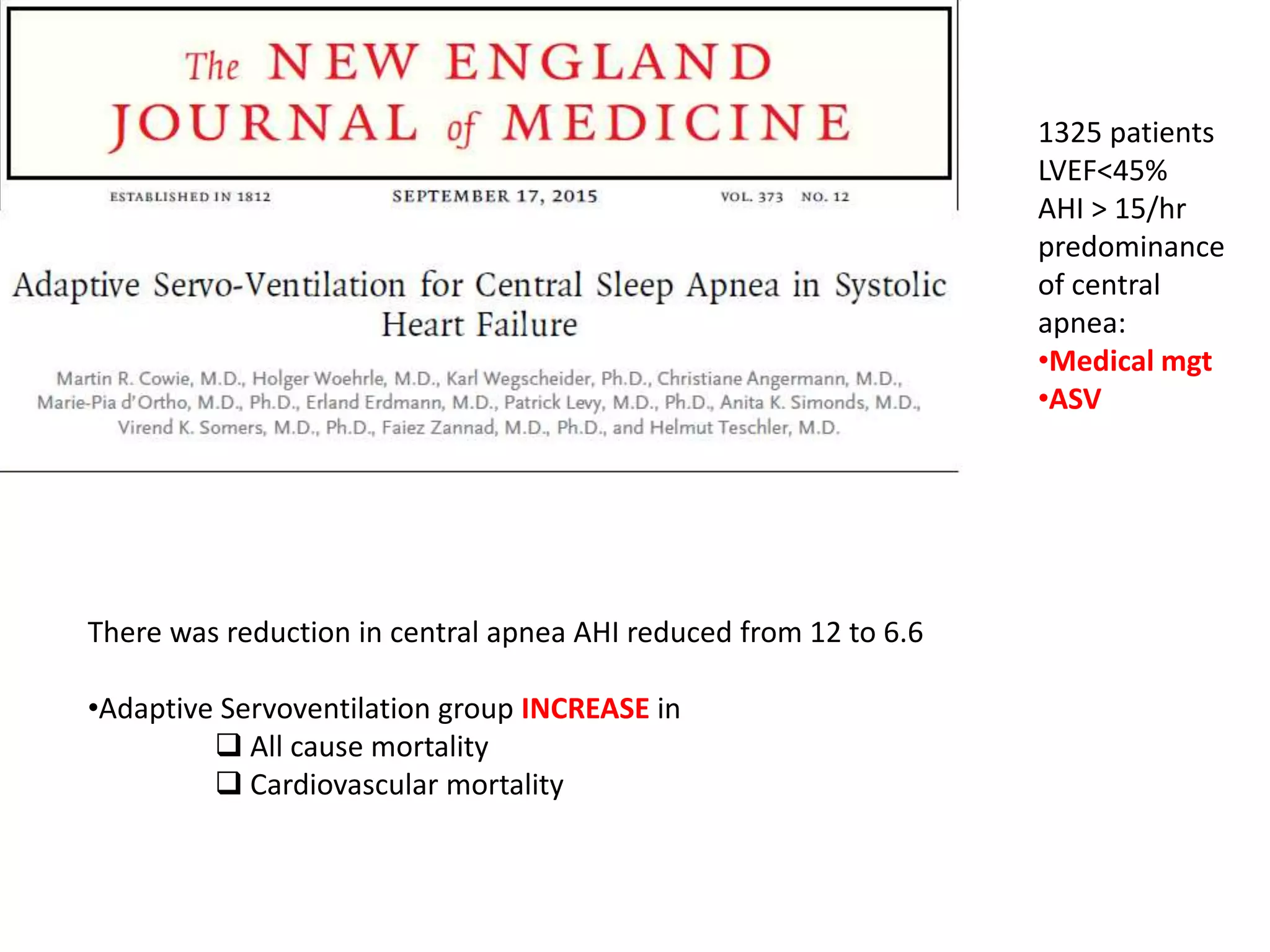
1325 patients
LVEF<45%
AHI > 15/hr
predominance
of central
apnea:
•Medical mgt
•ASV
There was reduction in central apnea AHI reduced from 12 to 6.6
•Adaptive Servoventilation group INCREASE in
 All cause mortality
 Cardiovascular mortality
TITRATION PROTOCOLS
Options available
• In lab full night titration
• Split night study
• Home AutoCPAP titration
BASIC RULES OF CPAP AND BIPAP
TITRATION
Before titration
• Education about the disease
• Show his PSG report
• Explain the procedure
• About benefits of treatment
• Proper interface selection
• Proper mask fit
General titration rule
• The patient must be able to sleep in order for
PAP titration to be successful
• If the patient awakens and complains the
pressure is too high, the pressure should be
reduced to a level at which the patient is able
to return to sleep
• Leaks should be properly addressed
• Pressure relief technology
Choosing correct interface
• Full face masks: significant nasal obstruction
• Nasal masks: lighter fit
• Nasal pillow masks: more lightweight offering
a high level of openness and visibility
– Larger masks fit better and minimize leak
– Smaller masks are preferred for those with
claustrophobia and those with lower pressure
Manual CPAP titration
Age > 12 years Age < 12 years
Minimum CPAP 4 cm 4 cm
Maximum CPAP 20 cm 15 cm
CPAP titration
• Increase pressure by 1 cm
• Maintain for at least 5 minutes
Age > 12 Age < 12
Obstructive apnea 2 1
Hypopnea 3 1
RERA 5 3
Loud unambiguous
snoring (minutes)
3 1
CPAP titration
• If all events are abolished then increase
pressure further by 1-2cm increment upto 4
cm
• If treatment emergent central apneas appear
then reduce the pressure further till central
apneas disappear
• If central apneas appear then decrease
pressure till they disappear
Example
• 45 year/M
• Non smoker
• EDS Not able to drive, sleeps in meetings
• BMI 29.1 kg/m2
• History of HTN on Amlodipine 5 mg OD
• No history of dyspnea, chest pain
• PFT Normal
Overnight in Lab PSG
• AHI: 45.6/hr
• RDI: 51.8/hr
• Diagnosis: Severe OSA
• Patient is called next day for InLab titration
• You show him his report and tell him that his
sleep breaks about 45 times per hour which is the
cause of his EDS
• You give him oronasal mask and explain the
procedure
CPAP titration
Causes of failure of CPAP titration
• Intolerance: Pressure relief technology
• Air leaks:
– Proper mask fit
– Chin strap
– Change mask
• Treatment emergent complex sleep apnea:
– Decrease pressure
– Shift to BPAP S/T
When to switch to BPAP
• Patient is uncomfortable or intolerant of high
CPAP
• When CPAP is > 15 cm and respiratory
disturbance continue
• Hypoxia
• Hypercarbia
• OSA with OHS
• OSA with COPD overlap syndrome
• OSA with chronic lung disease
BPAP
• Beginning EPAP:
– At 4 cm or
– The CPAP where obstructive apnea was
obliterated
• Beginning IPAP: 4 cm higher
BPAP titration
Age > 12 Age < 12
Minimum IPAP 8 8
Minimum EPAP 4 4
Maximum IPAP 30 20
Minimum IPAP EPAP difference 4 4
Maximum IPAP EPAP difference 10 10
BPAP titration
• Increase pressure by 1 cm
• NOT LESS THAN 5 MINUTES
Age > 12 Age < 12 Intervention
Obstructive apnea 2 1 Increase both IPAP
and EPAP
Hypopnea 3 1 Increase IPAP
RERA 5 3 Increase IPAP
Loud unambiguous
snoring (minutes)
3 1 Increase IPAP
ADDITION OF OXYGEN
SpO2 ≤88% for ≥5 minutes in the absence
of obstructive respiratory events
Requirement of oxygen
• Increase in CPAP can be tried to eliminate
unrecognized high upper airway resistance
• CPAP can be changed to BPAP
• If patient is already on BPAP PS (IPAP-EPAP)
may be increased
Oxygen
• Should be introduced into the PAP device at the
device tubing connection using a T connector,
not at the PAP mask
Rate: 1 L/min
Titrate O2 in 1 L/min increments
Interval = 15 minutes
Target SpO2: 88% and 94%(Preferably 92-94%)
Complex sleep apnea
> 50% of the residual respiratory events on PAP
are central apneas or central hypopneas
Central AHI ≥ 5/hr
Total AHI ≥ 5/hr
• To increase CPAP only until the obstructive
apneas and hypopneas are eliminated
End of titration
• Patient should be given enough time to sleep
with device comfortably
• Patient’s experience after the device should
be recorded
Types of titration
• OPTIMAL
• GOOD
• ACCEPTABLE
• UNACCEPTABLE
Optimal Titration
• RDI < 5/h for a period of at least 15 minutes
at the selected pressure
• SpO2 > 90% at the selected pressure
• Supine REM sleep at the selected pressure is
not continually interrupted by spontaneous
arousals or awakenings
Good titration
At selected pressure for a period of at least 15
minutes
– RDI < 10/h
OR
– RDI reduced by 50% if the baseline RDI was <15
• SpO2 > 90%
• Supine REM sleep is not continually
interrupted by spontaneous arousals or
awakenings
Adequate titration
• Which does not reduces overnight RDI<10 per
hour but reduces RDI >75% of baseline in
severe OSA patients
OR
• Criteria of optimal or good titration are
achieved with exception that supine REM does
not occur at selected pressure
Mask Issues
Problem Occurrence Recommended Remedy
Discomfort 30-50% Check fit, adjust straps, change interface
Excessive air leaks 80-100% Realign interface, check strap tension, change to
full face mask
Nasal bridge redness or
ulceration
5-10% Use artificial skin, minimize strap tension, use
spacer, alternate interface
Rashes 5-10% Use skin barrier lotion and/or topical
corticosteroids, change to interface made from a
different material
Claustrophobic reactions 5-10% Reassure, try nasal interface or mouth piece
Pressure/Flow Issues
Problem Occurrence Recommended Remedy
Discomfort – too much
pressure
Sinus and ear pain
20-50%
10-20%
Reduce IPAP
Gastric insufflation 30-40% Reduce pressure
Nasal/oral congestion 50% Humidification, topical steroids, decongestants
Nasal/oral dryness 30-50-% Reassure, try nasal interface or mouth piece
Eye irritation 33% Reduce air leakage, adjusting strap tension,
change masks
Obesity hypoventilation syndrome
(OHS)
• Obese individual BMI >30kg/m2
• Awake alveolar hypoventilation PaCO2>45
mmHg
• Which cannot be attributed to
– pulmonary disease
– skeletal restriction
– neuromuscular weakness
– untreated hypothyroidism
– pleural pathology
Treatment of OHS
• OHS alone: BPAP
• OHS and coexisting OSA: CPAP and then
changed to BPAP if the CPAP is insufficient
• Nocturnal CPAP may improve alveolar
ventilation during sleep while also treating the
OSA
Patients who benefit from nocturnal
CPAP
• Higher baseline AHI
• Less restrictive physiology on spirometry
• Less severe oxyhemoglobin desaturation
during baseline polysomnography
Overlap syndrome (OSA + COPD)
• Prevalence of OSA in COPD is the same as the
general population
• Predisposes OSA patients to more severe
arterial oxygen desaturation
• Hypercapnia may occur in OLS at FEV1 values
greater than typically associated with
hypercapnia in patients with COPD without
OSA
Treatment of overlap syndrome
• PAP (CPAP or BPAP), BPAP may be better
tolerated
• Supplemental oxygen if needed (low awake or
baseline sleeping SaO2)
• Bronchodilator treatment and smoking
cessation
• May be associated with significant
hypercapnia during sleep and worse outcomes
Prognosis of overlap syndrome
• OLS patients who adhere to CPAP (in addition to
oxygen if needed) have a better outcome
Machado MCL, Vollmer WM, Togeiro SM, et al: CPAP and survival in moderate to severe obstructive sleep apnea
syndrome and hypoxemic COPD. Eur Respir J 2010;35:132–137
• OLS patients have an increased risk of death and
hospitalization due to severe COPD exacerbations
Treatment with CPAP may improve survival of OLS
patients and decrease hospitalizations
Marin JM, Soriano JB, Carrizo SJ, et al: Outcomes in patients with chronic obstructive pulmonary
disease and obstructive sleep apnea. Am J Respir Crit Care Med 2010;182:325–331
Full night vs split night
• A full-night attended PSG performed in the
laboratory is the preferred approach for
titration
• Split-night diagnostic-titration studies are
sometimes adequate
– Less costly
– Reduces the delay in prescribing treatment
– More convenient
Split night study
• Diagnostic portion if the AHI is greater than
40/hr and 2 hours of monitoring have
occurred
• Titration: 3 hours of PAP titration is the
minimum acceptable duration
• Increase pressure by 2 cm
Disadvantage of split night study
• LOWER CPAP level derived as compared to full-
night studies
• May not allow enough time for an optimal CPAP
titration or for transitioning to BPAP if that
becomes necessary
• Likelihood of observing the patient when the risk
of OSA is highest ie, during REM sleep in the
supine position is reduced
• There are fewer opportunities for patient
education
• Higher degree of technologist skill is required
In home AutoCPAP titration
• Patient should have simple OSA
• In patients with known or anticipated variable
pressure requirement
– OSA exacerbated in supine or REM sleep
– Variation in weight
– Use of alcohol
– Intermittent nasal obstruction
• No dates in sleep lab
In home AutoCPAP titration
• Residual AHI < 10
• Clinical response
• Favourable adherence
• Outcome:
– Fix pressure to 90-95th percentile derived from
AutoCPAP
– Use auto-CPAP

Titration study in sleep lab

  • 1.
    Titration study inOSA & COPD / OSA overlap Dr. Zia Hashim MD Internal Medicine (PGI Chandigarh) DM Pulmonary & Critical Care (PGI Chandigarh) FCCP (USA) Associate Professor Consultant in charge Sleep Lab Department of Pulmonary Medicine SGPGIMS Lucknow
  • 2.
    Indications for startingPAP AHI or RDI 15 events/hour AHI or RDI 5 but <15 events/hour with any one of the following symptoms: – Excessive daytime sleepiness – Neurocognitive impairment – Hypertension – Coronary artery disease – Cardiac arrhythmias – Pulmonary hypertension – History of stroke Pilots and drivers: AHI 5 - 14 even if no symptoms. RERA > 10 with excessive daytime sleepiness even if AHI < 5
  • 3.
    Before starting treatment •Which device to use ? • At what pressure ? • Is oxygen also required ?
  • 4.
    • Pneumatic splint •Increase in lung volume • Increase in upper airway size
  • 5.
  • 6.
  • 7.
    Before doing titrationcomplete diagnosis is very important • OSA • OHS • CHF • COPD • Central apnea syndromes • Cheyne stokes respiration • Neuromuscular disease • BMI • Clinical examination – History – Wheeze – Pedal edema • Morning awake ABG • PFT • Complete In Lab PSG • ECHO
  • 8.
  • 9.
    Basic devices • CPAP •BPAP (S mode) • Flexible PAP, expiratory pressure relief • AutoCPAP Advanced devises • Auto BPAP • BPAP S/T • Adaptive Servoventilation
  • 10.
  • 11.
    BPAP in OSA •EPAP eliminates obstructive apnea • IPAP eliminates – Hypopnea – RERA – Snoring • IPAP-EPAP provides Tv
  • 12.
    BPAP – Patients requiringa CPAP pressure more than 15 cm – Patients who have barotrauma complications like ear infections and bloating with high pressure CPAP – Patients with hypoventilation No additional advantage Compliance similar
  • 13.
    Autotitrating PAP • APAP:titrated between maximum and minimum pressure limits to prevent apnea hypopnea, airflow flattening and snoring Exemple1 REMstar auto Sleep Therapy Daily Details Legend: NR - Non-Responsive Apnea/Hypopnea, OA - Obstructive Apnea, H- Hypopnea, FL- Flow Limitation, VS - Vibratory Snore 09/01/2007 10:08 - 10/01/2007 6:56 Large Leak 0,0 Mins. 0,0% of Night Average Leak 36,42 Indices 9 90% AutoCPAP AHI:5,1 7,1 Avg AutoCPAP Daily Events Per Hour
  • 14.
    APAP vs CPAP:Evidence • APAP associated with improved sleep architecture and continuity compared to fixed CPAP Small randomized trials and observational studies:  Scharf MB, Brannen DE, McDannold MD, Berkowitz DV. Computerized adjustable versus fixed NCPAP treatment of obstructive sleep apnea. Sleep 1996;19:491-6.  Meurice JC, Marc I, Series F. Efficacy of auto-CPAP in the treatment of obstructive sleep apnea/hypopnea syndrome. American journal of respiratory and critical care medicine 1996;153:794-8.
  • 15.
    Metaanalysis • Four metanalysis(largest incorporating 30 studies totalling 1136 participants) • Equal improvement of AHI • Better with APAP – Adherence – EDS – Patient preference
  • 16.
    APAP vs CPAP •Randomized crossover trial • 200 patients with APAP vs CPAP 6 weeks. • Mean AHI: 33 • No difference in patient preference for a device • APAP – Marginally longer duration of use (4.2 versus 4.0 hours per night) – Less subjective daytime sleepiness (Epworth Sleepiness Scale score of 9.5 versus 10.0 • There was also no difference in the QOL, objective measures of sleepiness, or psychomotor vigilance testing
  • 17.
    APAP indications Factors thathave variable pressure requirement – Use of alcohol – Episodes of nasal obstruction – Wide variations in body weight To improve compliance
  • 18.
    ADVANCED MODES • AutoBPAP: Titrates IPAP and EPAP between EPAPmin and IPAPmax with Psmin =3 PSmax set by clinician • BPAP with backup rate: BPAP S/T • Adaptive servoventilation
  • 19.
  • 22.
    BPAP S/T modeindications Treatment emergent central sleep apnea OHS OSA with Neuromuscular disorder Thoracic cage disorder
  • 23.
  • 24.
    CHF: Cheyne StokesRespiration SpO2 HR Flow Effort Position CSR continues because of Persistent Instability CSR continues because of Persistent Instability
  • 25.
    ASV in CheyneStokes Breathing
  • 26.
    ASV in CheyneStokes Breathing
  • 27.
    ASV in CheyneStokes Breathing
  • 28.
    ASV in CheyneStokes Breathing
  • 29.
    1325 patients LVEF<45% AHI >15/hr predominance of central apnea: •Medical mgt •ASV There was reduction in central apnea AHI reduced from 12 to 6.6 •Adaptive Servoventilation group INCREASE in  All cause mortality  Cardiovascular mortality
  • 30.
  • 31.
    Options available • Inlab full night titration • Split night study • Home AutoCPAP titration
  • 32.
    BASIC RULES OFCPAP AND BIPAP TITRATION
  • 33.
    Before titration • Educationabout the disease • Show his PSG report • Explain the procedure • About benefits of treatment • Proper interface selection • Proper mask fit
  • 34.
    General titration rule •The patient must be able to sleep in order for PAP titration to be successful • If the patient awakens and complains the pressure is too high, the pressure should be reduced to a level at which the patient is able to return to sleep • Leaks should be properly addressed • Pressure relief technology
  • 35.
    Choosing correct interface •Full face masks: significant nasal obstruction • Nasal masks: lighter fit • Nasal pillow masks: more lightweight offering a high level of openness and visibility – Larger masks fit better and minimize leak – Smaller masks are preferred for those with claustrophobia and those with lower pressure
  • 36.
    Manual CPAP titration Age> 12 years Age < 12 years Minimum CPAP 4 cm 4 cm Maximum CPAP 20 cm 15 cm
  • 37.
    CPAP titration • Increasepressure by 1 cm • Maintain for at least 5 minutes Age > 12 Age < 12 Obstructive apnea 2 1 Hypopnea 3 1 RERA 5 3 Loud unambiguous snoring (minutes) 3 1
  • 38.
    CPAP titration • Ifall events are abolished then increase pressure further by 1-2cm increment upto 4 cm • If treatment emergent central apneas appear then reduce the pressure further till central apneas disappear • If central apneas appear then decrease pressure till they disappear
  • 39.
    Example • 45 year/M •Non smoker • EDS Not able to drive, sleeps in meetings • BMI 29.1 kg/m2 • History of HTN on Amlodipine 5 mg OD • No history of dyspnea, chest pain • PFT Normal
  • 40.
  • 41.
    • AHI: 45.6/hr •RDI: 51.8/hr • Diagnosis: Severe OSA • Patient is called next day for InLab titration • You show him his report and tell him that his sleep breaks about 45 times per hour which is the cause of his EDS • You give him oronasal mask and explain the procedure
  • 42.
  • 44.
    Causes of failureof CPAP titration • Intolerance: Pressure relief technology • Air leaks: – Proper mask fit – Chin strap – Change mask • Treatment emergent complex sleep apnea: – Decrease pressure – Shift to BPAP S/T
  • 45.
    When to switchto BPAP • Patient is uncomfortable or intolerant of high CPAP • When CPAP is > 15 cm and respiratory disturbance continue • Hypoxia • Hypercarbia • OSA with OHS • OSA with COPD overlap syndrome • OSA with chronic lung disease
  • 46.
    BPAP • Beginning EPAP: –At 4 cm or – The CPAP where obstructive apnea was obliterated • Beginning IPAP: 4 cm higher
  • 47.
    BPAP titration Age >12 Age < 12 Minimum IPAP 8 8 Minimum EPAP 4 4 Maximum IPAP 30 20 Minimum IPAP EPAP difference 4 4 Maximum IPAP EPAP difference 10 10
  • 48.
    BPAP titration • Increasepressure by 1 cm • NOT LESS THAN 5 MINUTES Age > 12 Age < 12 Intervention Obstructive apnea 2 1 Increase both IPAP and EPAP Hypopnea 3 1 Increase IPAP RERA 5 3 Increase IPAP Loud unambiguous snoring (minutes) 3 1 Increase IPAP
  • 49.
  • 50.
    SpO2 ≤88% for≥5 minutes in the absence of obstructive respiratory events
  • 51.
    Requirement of oxygen •Increase in CPAP can be tried to eliminate unrecognized high upper airway resistance • CPAP can be changed to BPAP • If patient is already on BPAP PS (IPAP-EPAP) may be increased
  • 52.
    Oxygen • Should beintroduced into the PAP device at the device tubing connection using a T connector, not at the PAP mask Rate: 1 L/min Titrate O2 in 1 L/min increments Interval = 15 minutes Target SpO2: 88% and 94%(Preferably 92-94%)
  • 53.
    Complex sleep apnea >50% of the residual respiratory events on PAP are central apneas or central hypopneas Central AHI ≥ 5/hr Total AHI ≥ 5/hr • To increase CPAP only until the obstructive apneas and hypopneas are eliminated
  • 54.
    End of titration •Patient should be given enough time to sleep with device comfortably • Patient’s experience after the device should be recorded
  • 55.
    Types of titration •OPTIMAL • GOOD • ACCEPTABLE • UNACCEPTABLE
  • 56.
    Optimal Titration • RDI< 5/h for a period of at least 15 minutes at the selected pressure • SpO2 > 90% at the selected pressure • Supine REM sleep at the selected pressure is not continually interrupted by spontaneous arousals or awakenings
  • 57.
    Good titration At selectedpressure for a period of at least 15 minutes – RDI < 10/h OR – RDI reduced by 50% if the baseline RDI was <15 • SpO2 > 90% • Supine REM sleep is not continually interrupted by spontaneous arousals or awakenings
  • 58.
    Adequate titration • Whichdoes not reduces overnight RDI<10 per hour but reduces RDI >75% of baseline in severe OSA patients OR • Criteria of optimal or good titration are achieved with exception that supine REM does not occur at selected pressure
  • 59.
    Mask Issues Problem OccurrenceRecommended Remedy Discomfort 30-50% Check fit, adjust straps, change interface Excessive air leaks 80-100% Realign interface, check strap tension, change to full face mask Nasal bridge redness or ulceration 5-10% Use artificial skin, minimize strap tension, use spacer, alternate interface Rashes 5-10% Use skin barrier lotion and/or topical corticosteroids, change to interface made from a different material Claustrophobic reactions 5-10% Reassure, try nasal interface or mouth piece
  • 60.
    Pressure/Flow Issues Problem OccurrenceRecommended Remedy Discomfort – too much pressure Sinus and ear pain 20-50% 10-20% Reduce IPAP Gastric insufflation 30-40% Reduce pressure Nasal/oral congestion 50% Humidification, topical steroids, decongestants Nasal/oral dryness 30-50-% Reassure, try nasal interface or mouth piece Eye irritation 33% Reduce air leakage, adjusting strap tension, change masks
  • 61.
    Obesity hypoventilation syndrome (OHS) •Obese individual BMI >30kg/m2 • Awake alveolar hypoventilation PaCO2>45 mmHg • Which cannot be attributed to – pulmonary disease – skeletal restriction – neuromuscular weakness – untreated hypothyroidism – pleural pathology
  • 62.
    Treatment of OHS •OHS alone: BPAP • OHS and coexisting OSA: CPAP and then changed to BPAP if the CPAP is insufficient • Nocturnal CPAP may improve alveolar ventilation during sleep while also treating the OSA
  • 63.
    Patients who benefitfrom nocturnal CPAP • Higher baseline AHI • Less restrictive physiology on spirometry • Less severe oxyhemoglobin desaturation during baseline polysomnography
  • 64.
    Overlap syndrome (OSA+ COPD) • Prevalence of OSA in COPD is the same as the general population • Predisposes OSA patients to more severe arterial oxygen desaturation • Hypercapnia may occur in OLS at FEV1 values greater than typically associated with hypercapnia in patients with COPD without OSA
  • 65.
    Treatment of overlapsyndrome • PAP (CPAP or BPAP), BPAP may be better tolerated • Supplemental oxygen if needed (low awake or baseline sleeping SaO2) • Bronchodilator treatment and smoking cessation • May be associated with significant hypercapnia during sleep and worse outcomes
  • 66.
    Prognosis of overlapsyndrome • OLS patients who adhere to CPAP (in addition to oxygen if needed) have a better outcome Machado MCL, Vollmer WM, Togeiro SM, et al: CPAP and survival in moderate to severe obstructive sleep apnea syndrome and hypoxemic COPD. Eur Respir J 2010;35:132–137 • OLS patients have an increased risk of death and hospitalization due to severe COPD exacerbations Treatment with CPAP may improve survival of OLS patients and decrease hospitalizations Marin JM, Soriano JB, Carrizo SJ, et al: Outcomes in patients with chronic obstructive pulmonary disease and obstructive sleep apnea. Am J Respir Crit Care Med 2010;182:325–331
  • 67.
    Full night vssplit night • A full-night attended PSG performed in the laboratory is the preferred approach for titration • Split-night diagnostic-titration studies are sometimes adequate – Less costly – Reduces the delay in prescribing treatment – More convenient
  • 68.
    Split night study •Diagnostic portion if the AHI is greater than 40/hr and 2 hours of monitoring have occurred • Titration: 3 hours of PAP titration is the minimum acceptable duration • Increase pressure by 2 cm
  • 69.
    Disadvantage of splitnight study • LOWER CPAP level derived as compared to full- night studies • May not allow enough time for an optimal CPAP titration or for transitioning to BPAP if that becomes necessary • Likelihood of observing the patient when the risk of OSA is highest ie, during REM sleep in the supine position is reduced • There are fewer opportunities for patient education • Higher degree of technologist skill is required
  • 70.
    In home AutoCPAPtitration • Patient should have simple OSA • In patients with known or anticipated variable pressure requirement – OSA exacerbated in supine or REM sleep – Variation in weight – Use of alcohol – Intermittent nasal obstruction • No dates in sleep lab
  • 71.
    In home AutoCPAPtitration • Residual AHI < 10 • Clinical response • Favourable adherence • Outcome: – Fix pressure to 90-95th percentile derived from AutoCPAP – Use auto-CPAP

Editor's Notes

  • #60 The most common problem encountered for patients using noninvasive ventilation is interface or mask related. Although masks are well tolerated, general discomfort is experienced especially early on in the therapy. Adaptation takes time and patience. Adjustments to the mask and headgear strap tension will help to find the most comfortable fit for the patient. A common problem is over- tightening of the straps to alleviate air leakage, causing redness or pressure sores. With the numerous interface options available, changing the patient to an alternative mask maybe the best option to attain a good fit. Nasal bridge redness and rashes are also discomforts reported by some patients. Minimizing the strap tension and utilizing spacers, artificial skin barrier lotions or alternative interface can help with these problems.
  • #61 When using noninvasive ventilation, air pressure discomfort is a frequent complaint during the initial phases of therapy. Air pressure in the nose and sinuses can cause pain and discomfort for some patients. Low initial inspiratory pressures should be used. Pressures can be increased as the patient tolerates. Gastric insufflation which is usually not severe is another problem that patients report. Reduction of inspiratory pressures may help. Nasal dryness and congestion are also common complaints. The use of heated humidification has been shown to decrease nasal resistance, thus alleviating the symptoms. Nasal congestion usually responds to antihistamines or decongestants. Leakage of air from the mask around the eyes can cause irritation. Proper size and fit of the mask needs to be addressed to correct this problem.