Sleep disorders – overview and pitfalls
Dr. Aditya Jindal
Interventional Pulmonologist & Intensivist, sleep specialist
Jindal Clinics
SCO 21, Sec 20D, Chandigarh
DM Pulmonary and Critical Care Medicine (PGI Chandigarh),
FCCP
Sleep disorders
1. Sleep related breathing disorders
2. Sleep related movement disorders
3. Insomnias
4. Parasomnias
5. Hypersomnias
6. Circadium rhythm sleep-wake disorders
Sleep related breathing disorder
• Central sleep apnea due to drug or substance
• Primary sleep apnea of infancy
• Obstructive sleep apnea
• Sleep-related nonobstructive alveolar
hypoventilation, idiopathic
• Primary central sleep apnea
• Central sleep apnea due to Cheyne Stokes
breathing pattern
• Central sleep apnea due to medical condition
not Cheyne Stokes
Spectrum of sleep disorder breathing
• Obesity-hypoventilation syndrome
• Severe obstructive sleep apnea
• Moderate obstructive sleep apnea
• Mild obstructive sleep apnea
• Upper airways resistance syndrome
• Chronic, heavy snoring
• Intermittent snoring
• Quiet breathing
What is OSA?
OSA is a syndrome characterized by frequent
episodes of upper airway obstruction during
sleep, associated with recurrent arousals,
oxygen desaturation, and daytime symptoms
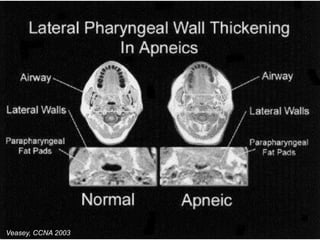
Pathophysiology of OSA
Interplay between three important factors
• Anatomic Structural narrowing of
airway
• Neurologic Inadequate upper airway
dilator muscle function
• Mechanical Altered upper airway
collapsibility
Veasey, CCNA 2003
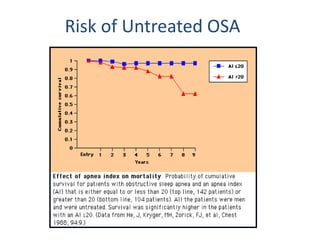
Risk of Untreated OSA
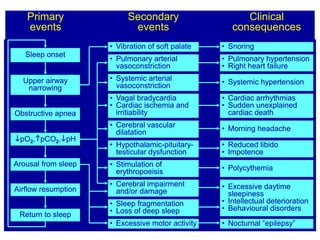
Primary
events
Secondary
events
Clinical
consequences
• Vibration of soft palate • Snoring
• Pulmonary arterial
vasoconstriction
• Pulmonary hypertension
• Right heart failure
• Systemic arterial
vasoconstriction • Systemic hypertension
• Vagal bradycardia
• Cardiac ischemia and
irritiability
• Cardiac arrhythmias
• Sudden unexplained
cardiac death
• Cerebral vascular
dilatation • Morning headache
• Hypothalamic-pituitary-
testicular dysfunction
• Reduced libido
• Impotence
• Stimulation of
erythropoeisis • Polycythemia
• Cerebral impairment
and/or damage
• Excessive daytime
sleepiness
• Intellectual deterioration
• Behavioural disorders
• Sleep fragmentation
• Loss of deep sleep
• Excessive motor activity • Nocturnal “epilepsy”
Sleep onset
Upper airway
narrowing
Obstructive apnea
ipO2,hpCO2,ipH
Arousal from sleep
Airflow resumption
Return to sleep
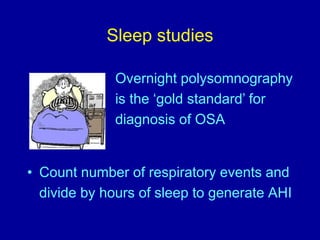
Sleep studies
• Count number of respiratory events and
divide by hours of sleep to generate AHI
Overnight polysomnography
is the ‘gold standard’ for
diagnosis of OSA
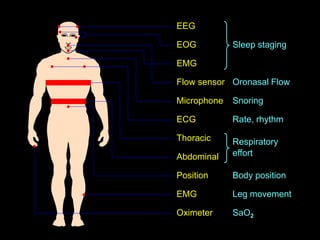
Sleep staging
Oronasal Flow
Snoring
Rate, rhythm
Respiratory
effort
Body position
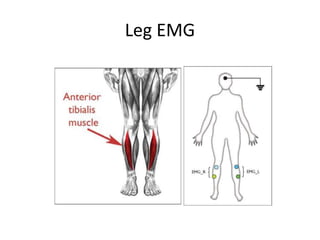
Leg movement
SaO2
EEG
EOG
Flow sensor
EMG
Microphone
ECG
Thoracic
Abdominal
Position
EMG
Oximeter
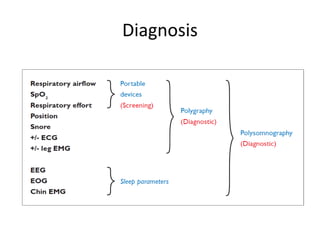
Diagnosis
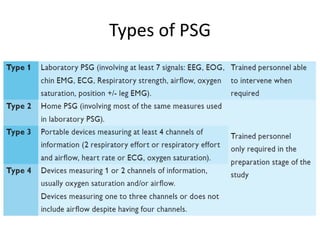
Types of PSG
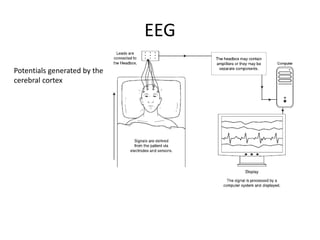
EEG
Potentials generated by the
cerebral cortex
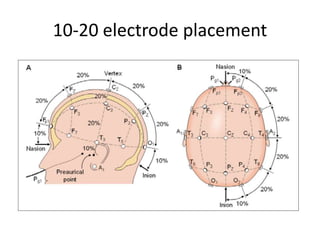
10-20 electrode placement
Sleep staging
• Rechtschaffen and Kales (R and K) 1967
stage W,N1-4 & R
• AASM 2007stage W,N1-3 & R
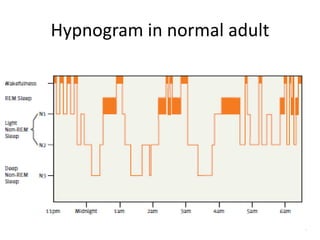
Hypnogram in normal adult
Hypnogram in OSA pt
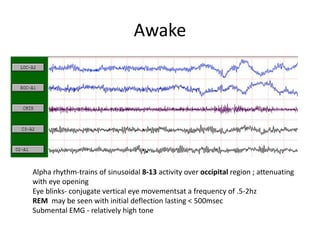
Awake
Alpha rhythm-trains of sinusoidal 8-13 activity over occipital region ; attenuating
with eye opening
Eye blinks- conjugate vertical eye movementsat a frequency of .5-2hz
REM may be seen with initial deflection lasting < 500msec
Submental EMG - relatively high tone
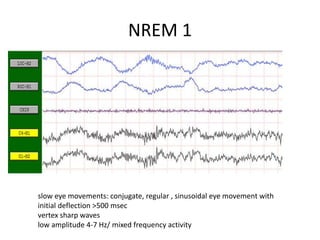
NREM 1
slow eye movements: conjugate, regular , sinusoidal eye movement with
initial deflection >500 msec
vertex sharp waves
low amplitude 4-7 Hz/ mixed frequency activity
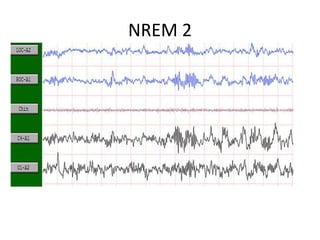
NREM 2
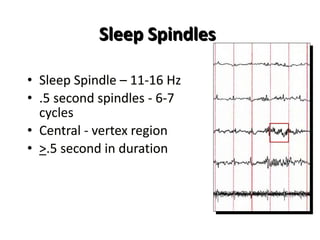
Sleep Spindles
• Sleep Spindle – 11-16 Hz
• .5 second spindles - 6-7
cycles
• Central - vertex region
• >.5 second in duration
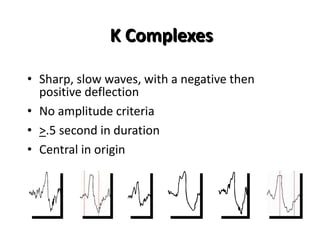
K Complexes
• Sharp, slow waves, with a negative then
positive deflection
• No amplitude criteria
• >.5 second in duration
• Central in origin
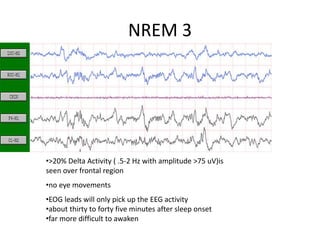
NREM 3
•>20% Delta Activity ( .5-2 Hz with amplitude >75 uV)is
seen over frontal region
•no eye movements
•EOG leads will only pick up the EEG activity
•about thirty to forty five minutes after sleep onset
•far more difficult to awaken
Stage R
•Brain suddenly becomes much more active.
•REM-conjugate, irregular, sharply peaked eye movements with initial
deflection< 500 msec
•Low chin EMG activity
•Sawtooth waves- low amplitide sharply contoured or triangular (2-
6hz); over central head regions
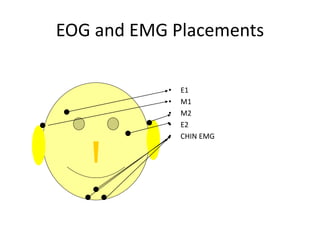
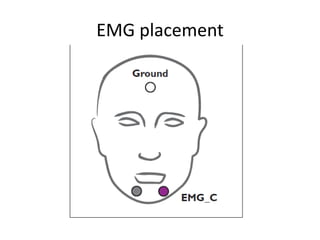
EOG and EMG Placements
• E1
• M1
• M2
• E2
• CHIN EMG
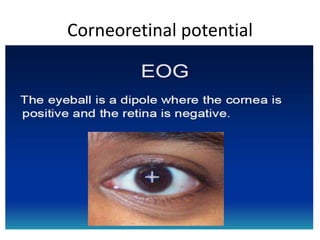
Corneoretinal potential
EMG placement
Leg EMG
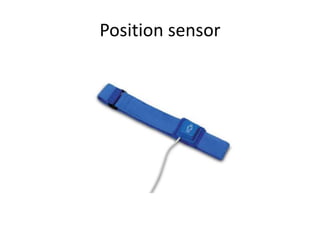
Position sensor
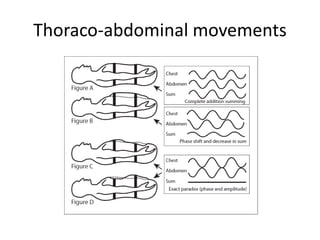
Thoraco-abdominal movements
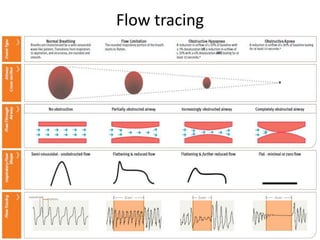
Flow tracing
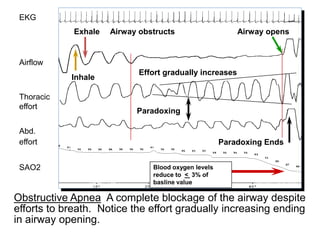
Obstructive Apnea A complete blockage of the airway despite
efforts to breath. Notice the effort gradually increasing ending
in airway opening.
Blood oxygen levels
reduce to < 3% of
basline value
Inhale
Exhale Airway obstructs Airway opens
Paradoxing
Paradoxing Ends
EKG
Airflow
Thoracic
effort
Abd.
effort
SAO2
Effort gradually increases
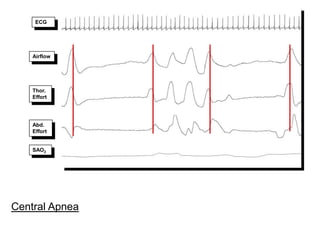
Central Apnea
Airflow
Thor.
Effort
Abd.
Effort
SAO2
ECG
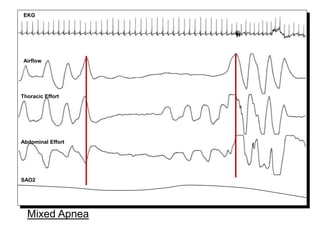
Mixed Apnea
EKG
Airflow
Thoracic Effort
Abdominal Effort
SAO2
Hypopnea This is an 18 second hypopneic event. The airflow
signal is reduced by approximately 50% during this event.
Airflow reduction
SAO2 desaturation
> effort with paradox Paradox ends
Inhale
Exhale
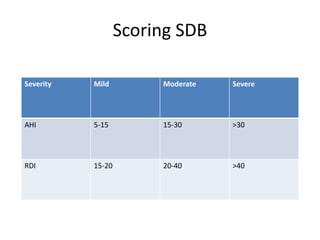
Scoring SDB
Severity Mild Moderate Severe
AHI 5-15 15-30 >30
RDI 15-20 20-40 >40
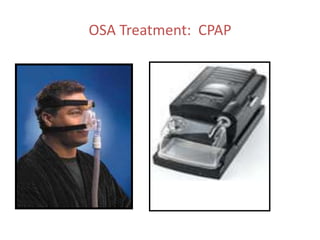
OSA Treatment: CPAP
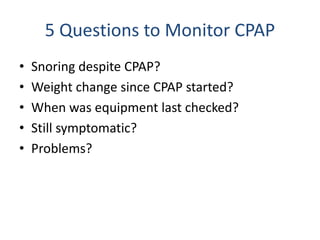
5 Questions to Monitor CPAP
• Snoring despite CPAP?
• Weight change since CPAP started?
• When was equipment last checked?
• Still symptomatic?
• Problems?
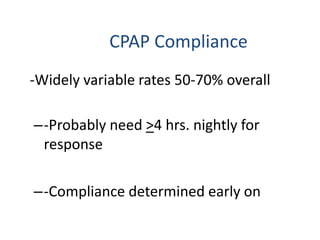
CPAP Compliance
-Widely variable rates 50-70% overall
–-Probably need >4 hrs. nightly for
response
–-Compliance determined early on
CPAP Compliance
• Man or Machine?
– Man
• -Monitoring- Compliance feedback
• -Education/Reassurance/Reevaluation
• -Partner involvement
– Machine
• -Humidification- Warm Vs. Cold
• -Mask- Nasal Pillows, Full Face, Other
• -Blower- Bi-level, Auto-titration
• Berry RB. Sleep Med (1): 175; 2000
Practice points: Auto-Adjusting CPAP
• Auto-CPAP offers no benefit over fixed CPAP in terms of
efficacy on the AHI
• It has not been established that unattended auto-CPAP
titration is safe without a previous diagnostic PSG
• Some, but not all, studies indicate auto-CPAP results in a
lower cumulative CPAP level. However, the importance of the
amount of applied pressure on CPAP adherence is not
consistently demonstrated
• Auto-CPAP has variable effects on adherence
OSA Treatment: Surgery
• Laser-assisted uvulopalatoplasty (LAUP)
– AASM: not advised for OSA
• Uvulopalatopharyngoplasty (UPPP)
– 40% patients achieve AHI < 5
• Somnoplasty or Radiofrequency volumetric tissue
reduction (RFVTR)
– Role has yet to be fully defined
• Maxillofacial surgery
– Infrequently performed, but can be very effective
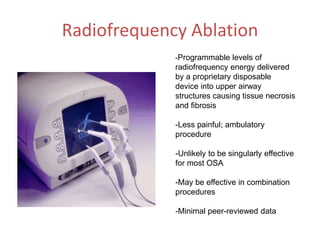
Radiofrequency Ablation
-Programmable levels of
radiofrequency energy delivered
by a proprietary disposable
device into upper airway
structures causing tissue necrosis
and fibrosis
-Less painful; ambulatory
procedure
-Unlikely to be singularly effective
for most OSA
-May be effective in combination
procedures
-Minimal peer-reviewed data
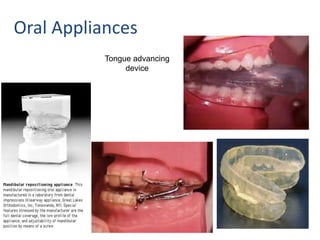
Oral Appliances
Tongue advancing
device
Sleep related disorders in other
specialities
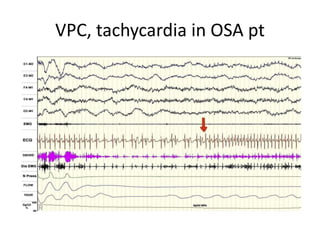
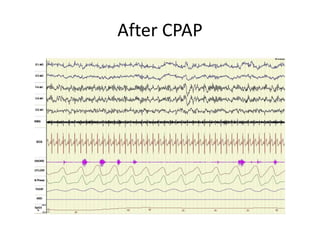
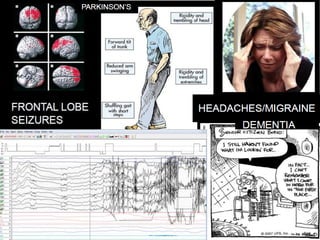
VPC, tachycardia in OSA pt
After CPAP
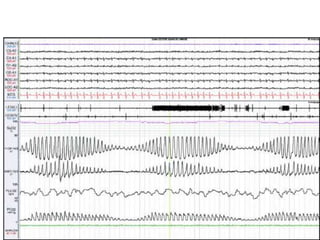
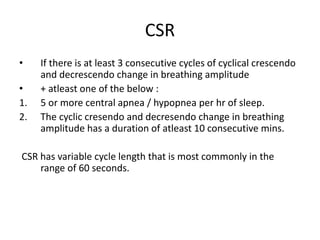
CSR
• If there is at least 3 consecutive cycles of cyclical crescendo
and decrescendo change in breathing amplitude
• + atleast one of the below :
1. 5 or more central apnea / hypopnea per hr of sleep.
2. The cyclic cresendo and decresendo change in breathing
amplitude has a duration of atleast 10 consecutive mins.
CSR has variable cycle length that is most commonly in the
range of 60 seconds.
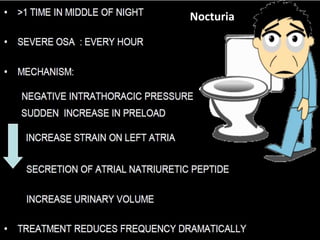
Nocturia
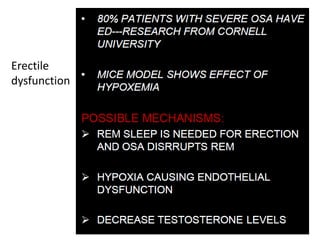
Erectile
dysfunction
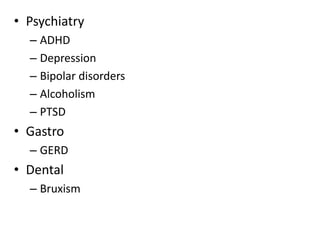
• Psychiatry
– ADHD
– Depression
– Bipolar disorders
– Alcoholism
– PTSD
• Gastro
– GERD
• Dental
– Bruxism
Pitfalls
1. Artifacts
2. Misdiagnosis
3. Superadded apnoea
4. Inadequate relief
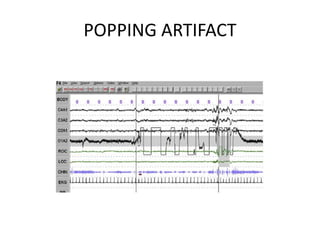
POPPING ARTIFACT
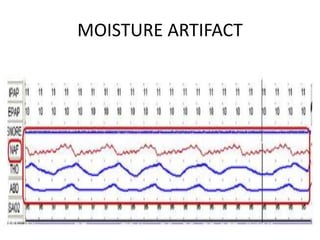
MOISTURE ARTIFACT
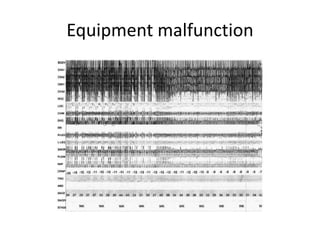
Equipment malfunction
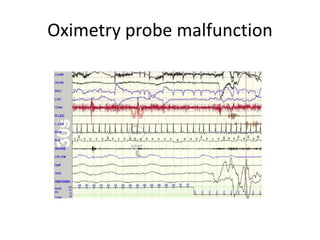
Oximetry probe malfunction
ECG artifact
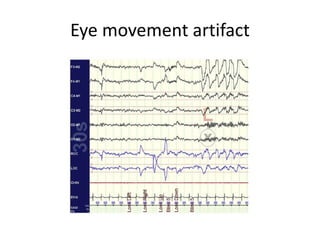
Eye movement artifact
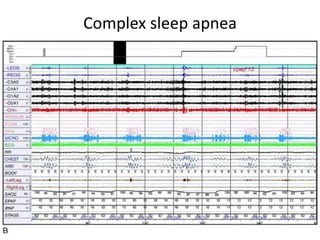
Complex sleep apnea
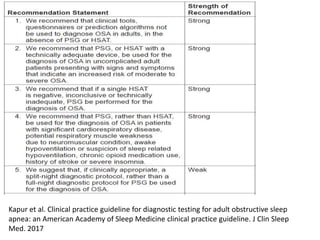
Kapur et al. Clinical practice guideline for diagnostic testing for adult obstructive sleep
apnea: an American Academy of Sleep Medicine clinical practice guideline. J Clin Sleep
Med. 2017
Take home message
1. Have a high index of suspicion
2. In hospital/ clinic study (both diagnostic & titration)
is recommended
3. Use home sleep testing only if parameters are met
4. Be aware of sleep related non-respiratory disorders
5. Be ready to tackle problems!
Sleep Disorders – Overview and Pitfalls.pptx

Sleep Disorders – Overview and Pitfalls.pptx

  • 1.
    Sleep disorders –overview and pitfalls Dr. Aditya Jindal Interventional Pulmonologist & Intensivist, sleep specialist Jindal Clinics SCO 21, Sec 20D, Chandigarh DM Pulmonary and Critical Care Medicine (PGI Chandigarh), FCCP
  • 8.
    Sleep disorders 1. Sleeprelated breathing disorders 2. Sleep related movement disorders 3. Insomnias 4. Parasomnias 5. Hypersomnias 6. Circadium rhythm sleep-wake disorders
  • 9.
    Sleep related breathingdisorder • Central sleep apnea due to drug or substance • Primary sleep apnea of infancy • Obstructive sleep apnea • Sleep-related nonobstructive alveolar hypoventilation, idiopathic • Primary central sleep apnea • Central sleep apnea due to Cheyne Stokes breathing pattern • Central sleep apnea due to medical condition not Cheyne Stokes
  • 10.
    Spectrum of sleepdisorder breathing • Obesity-hypoventilation syndrome • Severe obstructive sleep apnea • Moderate obstructive sleep apnea • Mild obstructive sleep apnea • Upper airways resistance syndrome • Chronic, heavy snoring • Intermittent snoring • Quiet breathing
  • 11.
    What is OSA? OSAis a syndrome characterized by frequent episodes of upper airway obstruction during sleep, associated with recurrent arousals, oxygen desaturation, and daytime symptoms
  • 12.
    Pathophysiology of OSA Interplaybetween three important factors • Anatomic Structural narrowing of airway • Neurologic Inadequate upper airway dilator muscle function • Mechanical Altered upper airway collapsibility
  • 13.
  • 17.
  • 18.
    Primary events Secondary events Clinical consequences • Vibration ofsoft palate • Snoring • Pulmonary arterial vasoconstriction • Pulmonary hypertension • Right heart failure • Systemic arterial vasoconstriction • Systemic hypertension • Vagal bradycardia • Cardiac ischemia and irritiability • Cardiac arrhythmias • Sudden unexplained cardiac death • Cerebral vascular dilatation • Morning headache • Hypothalamic-pituitary- testicular dysfunction • Reduced libido • Impotence • Stimulation of erythropoeisis • Polycythemia • Cerebral impairment and/or damage • Excessive daytime sleepiness • Intellectual deterioration • Behavioural disorders • Sleep fragmentation • Loss of deep sleep • Excessive motor activity • Nocturnal “epilepsy” Sleep onset Upper airway narrowing Obstructive apnea ipO2,hpCO2,ipH Arousal from sleep Airflow resumption Return to sleep
  • 19.
    Sleep studies • Countnumber of respiratory events and divide by hours of sleep to generate AHI Overnight polysomnography is the ‘gold standard’ for diagnosis of OSA
  • 20.
    Sleep staging Oronasal Flow Snoring Rate,rhythm Respiratory effort Body position Leg movement SaO2 EEG EOG Flow sensor EMG Microphone ECG Thoracic Abdominal Position EMG Oximeter
  • 21.
  • 22.
  • 23.
    EEG Potentials generated bythe cerebral cortex
  • 24.
  • 25.
    Sleep staging • Rechtschaffenand Kales (R and K) 1967 stage W,N1-4 & R • AASM 2007stage W,N1-3 & R
  • 27.
  • 28.
  • 29.
    Awake Alpha rhythm-trains ofsinusoidal 8-13 activity over occipital region ; attenuating with eye opening Eye blinks- conjugate vertical eye movementsat a frequency of .5-2hz REM may be seen with initial deflection lasting < 500msec Submental EMG - relatively high tone
  • 30.
    NREM 1 slow eyemovements: conjugate, regular , sinusoidal eye movement with initial deflection >500 msec vertex sharp waves low amplitude 4-7 Hz/ mixed frequency activity
  • 31.
  • 32.
    Sleep Spindles • SleepSpindle – 11-16 Hz • .5 second spindles - 6-7 cycles • Central - vertex region • >.5 second in duration
  • 33.
    K Complexes • Sharp,slow waves, with a negative then positive deflection • No amplitude criteria • >.5 second in duration • Central in origin
  • 34.
    NREM 3 •>20% DeltaActivity ( .5-2 Hz with amplitude >75 uV)is seen over frontal region •no eye movements •EOG leads will only pick up the EEG activity •about thirty to forty five minutes after sleep onset •far more difficult to awaken
  • 35.
    Stage R •Brain suddenlybecomes much more active. •REM-conjugate, irregular, sharply peaked eye movements with initial deflection< 500 msec •Low chin EMG activity •Sawtooth waves- low amplitide sharply contoured or triangular (2- 6hz); over central head regions
  • 36.
    EOG and EMGPlacements • E1 • M1 • M2 • E2 • CHIN EMG
  • 37.
  • 38.
  • 39.
  • 40.
  • 41.
  • 42.
  • 43.
    Obstructive Apnea Acomplete blockage of the airway despite efforts to breath. Notice the effort gradually increasing ending in airway opening. Blood oxygen levels reduce to < 3% of basline value Inhale Exhale Airway obstructs Airway opens Paradoxing Paradoxing Ends EKG Airflow Thoracic effort Abd. effort SAO2 Effort gradually increases
  • 44.
  • 45.
  • 46.
    Hypopnea This isan 18 second hypopneic event. The airflow signal is reduced by approximately 50% during this event. Airflow reduction SAO2 desaturation > effort with paradox Paradox ends Inhale Exhale
  • 47.
    Scoring SDB Severity MildModerate Severe AHI 5-15 15-30 >30 RDI 15-20 20-40 >40
  • 48.
  • 49.
    5 Questions toMonitor CPAP • Snoring despite CPAP? • Weight change since CPAP started? • When was equipment last checked? • Still symptomatic? • Problems?
  • 50.
    CPAP Compliance -Widely variablerates 50-70% overall –-Probably need >4 hrs. nightly for response –-Compliance determined early on
  • 51.
    CPAP Compliance • Manor Machine? – Man • -Monitoring- Compliance feedback • -Education/Reassurance/Reevaluation • -Partner involvement – Machine • -Humidification- Warm Vs. Cold • -Mask- Nasal Pillows, Full Face, Other • -Blower- Bi-level, Auto-titration • Berry RB. Sleep Med (1): 175; 2000
  • 52.
    Practice points: Auto-AdjustingCPAP • Auto-CPAP offers no benefit over fixed CPAP in terms of efficacy on the AHI • It has not been established that unattended auto-CPAP titration is safe without a previous diagnostic PSG • Some, but not all, studies indicate auto-CPAP results in a lower cumulative CPAP level. However, the importance of the amount of applied pressure on CPAP adherence is not consistently demonstrated • Auto-CPAP has variable effects on adherence
  • 53.
    OSA Treatment: Surgery •Laser-assisted uvulopalatoplasty (LAUP) – AASM: not advised for OSA • Uvulopalatopharyngoplasty (UPPP) – 40% patients achieve AHI < 5 • Somnoplasty or Radiofrequency volumetric tissue reduction (RFVTR) – Role has yet to be fully defined • Maxillofacial surgery – Infrequently performed, but can be very effective
  • 54.
    Radiofrequency Ablation -Programmable levelsof radiofrequency energy delivered by a proprietary disposable device into upper airway structures causing tissue necrosis and fibrosis -Less painful; ambulatory procedure -Unlikely to be singularly effective for most OSA -May be effective in combination procedures -Minimal peer-reviewed data
  • 55.
  • 56.
    Sleep related disordersin other specialities
  • 58.
  • 59.
  • 61.
    CSR • If thereis at least 3 consecutive cycles of cyclical crescendo and decrescendo change in breathing amplitude • + atleast one of the below : 1. 5 or more central apnea / hypopnea per hr of sleep. 2. The cyclic cresendo and decresendo change in breathing amplitude has a duration of atleast 10 consecutive mins. CSR has variable cycle length that is most commonly in the range of 60 seconds.
  • 62.
  • 63.
  • 65.
    • Psychiatry – ADHD –Depression – Bipolar disorders – Alcoholism – PTSD • Gastro – GERD • Dental – Bruxism
  • 66.
    Pitfalls 1. Artifacts 2. Misdiagnosis 3.Superadded apnoea 4. Inadequate relief
  • 67.
  • 68.
  • 69.
  • 70.
  • 71.
  • 72.
  • 73.
  • 74.
    Kapur et al.Clinical practice guideline for diagnostic testing for adult obstructive sleep apnea: an American Academy of Sleep Medicine clinical practice guideline. J Clin Sleep Med. 2017
  • 76.
    Take home message 1.Have a high index of suspicion 2. In hospital/ clinic study (both diagnostic & titration) is recommended 3. Use home sleep testing only if parameters are met 4. Be aware of sleep related non-respiratory disorders 5. Be ready to tackle problems!