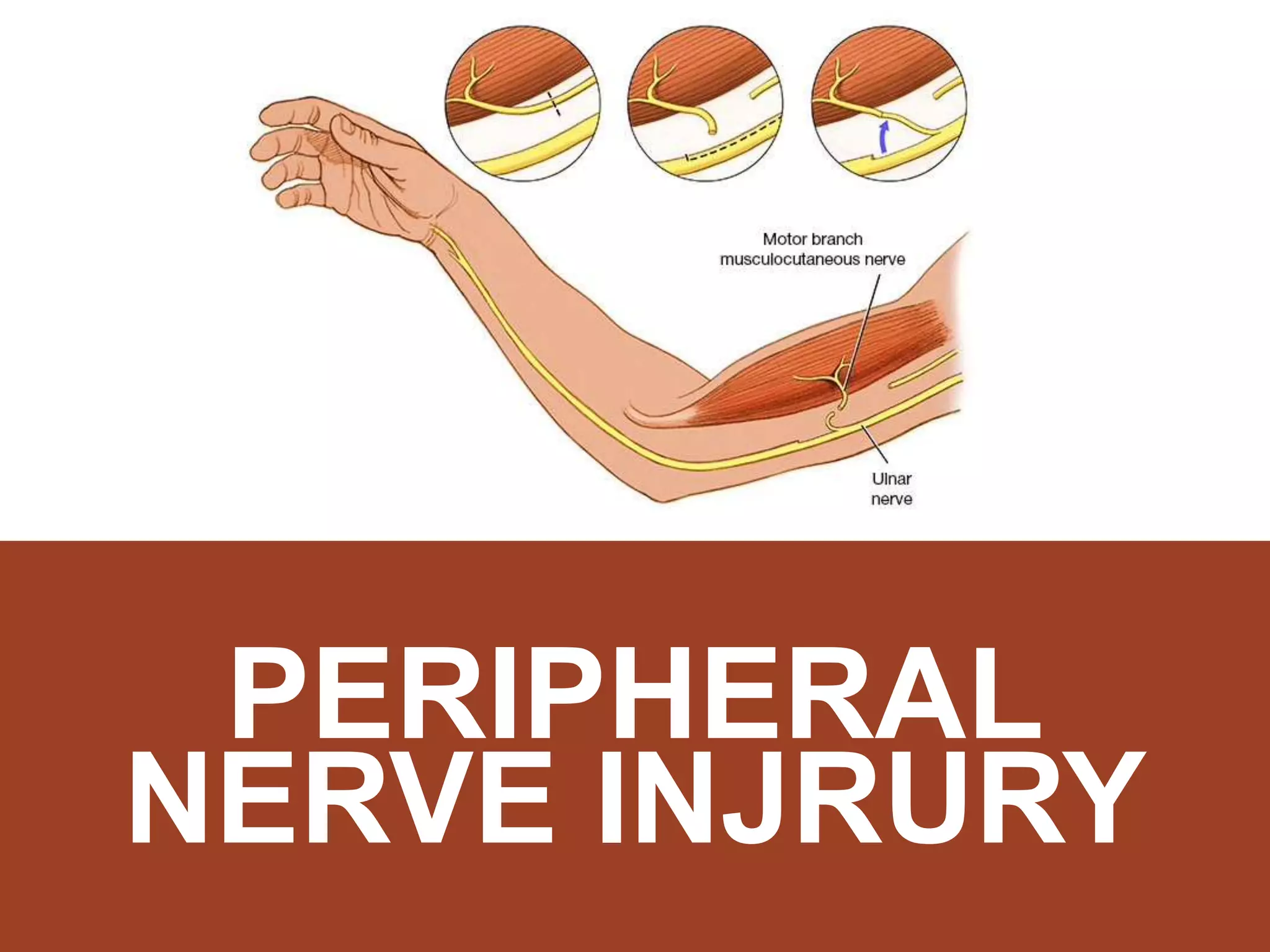
PERIPHERAL
NERVE INJRURY
ULNAR NERVE
INJRURY
CLASSIFICATION
ULNAR NERVE INJURIES
1. High ulnar nerve lesion
2. Low ulnar nerve lesion
3. Guyon’s tunnel syndrome
4. Cubital tunnel syndrome
ANATOMY
ANATOMY OF ULNAR NERVE
 Type: Mixed Never (motor & sensory)
 Root Value: C7, C8 & T1
 Origin: Arises in the axilla as the largest branch of
median cord of the brachial plexus, at the lower
border of pectoralis minor.
ANATOMY
ANATOMY OF ULNAR NERVE
Enters the forearm between 2 heads of Flexor Carpi Ulnaris
In the upper half, it rest on Flexor Digitorum Profundus &
covered by Flexor Carpi Ulnaris
In lower half, it runs lateral to Flexor Carpi Ulnaris tendon
accompanied by ulnar artery laterally
Enters palm on lateral side of pisiform bone above the flexor
retinaculum
Divides into Superficial & Deep Terminal Branches
ANATOMY
ULNAR NERVE IN THE HAND
ANATOMY
ULNAR NERVE IN THE HAND
ULNAR NERVE
ULNAR INERVATED MUSCLES
ULNAR NERVE
SUMMARY OF BRANCHES OF ULNAR NERVE
MOTOR BRANCHES:
To 1 muscles only:
 Flexor carpi ulnaris
 Medial half of flexor digiti profundus
Superficial Terminal Branches supplies one muscle only: palmaris brevis
Deep Terminal Branch supplies:
 8 interossei + medial 2 lumbricals
 3 hypothenar muscle
 Adductor Pollicis & may be FPB
FEMORAL
HAND
ULNAR NERVE
SUMMARY OF BRANCHES OF ULNAR NERVE
SENSORY BRANCHES:
 Palmar cutaneous branch: Medial 1/3 of palm
 Dorsal cutaneous branches: Medial 1/3 of dorsum of hand &
dorsum of medial 1
Superficial terminal branches gives 3 palmar digital nerves to the
palmar surfaces of the medial 1fingers
FEMORAL
HAND
1. ABOVE ELBOW (HIGH ULNAR LESION)
ULNAR NERVE INJURY
Injuries lead to complete loss of all the functions of nerve. The
injury may be caused by:
A. Penetrating wounds
B. Gun Shots
C. Fracture of medial epicondyle
D. Cubitus Valgus (a deformity of elbow joint causing stretch of
ulnar nerve)
1. ABOVE ELBOW (HIGH ULNAR LESION)
ULNAR NERVE INJURY
1. Paralysis of all muscles supplied:
 1 muscles in the forearm
 15 muscles in the hand
2. Weak flexion of the wrist, with radial deviation of the hand – due to
paralysis of FCU
3. Inability to flex the terminal phalanges of the medial 2 fingers – due to
paralysis of medial ½ of the FDP
4. Inability to put the hand in the writing position – due to paralysis of
interossei & medial 2 lumbricals
5. Loss of adduction of the thumb – paralysis of adductor pollicis
MOTOR AFFECTION
MANIFESTATIONS: ABOVE ELBOW
ULNAR NERVE INJURY
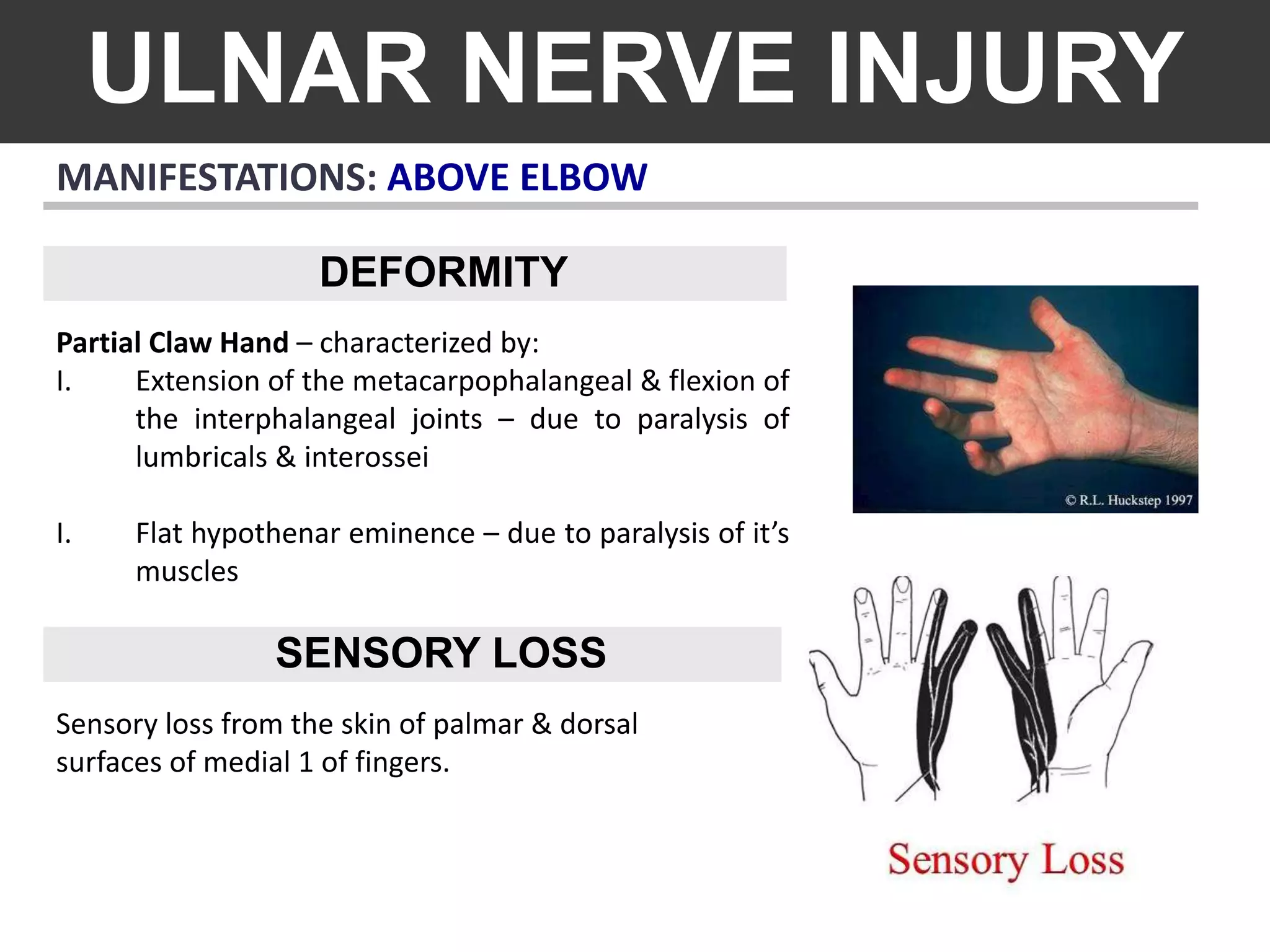
Partial Claw Hand – characterized by:
I. Extension of the metacarpophalangeal & flexion of
the interphalangeal joints – due to paralysis of
lumbricals & interossei
I. Flat hypothenar eminence – due to paralysis of it’s
muscles
Sensory loss from the skin of palmar & dorsal
surfaces of medial 1 of fingers.
DEFORMITY
SENSORY LOSS
2. AT OR ABOVE THE WRIST (LOW ULNAR LESION)
ULNAR NERVE INJURY
 Wrist laceration
 Fracture of the carpal bones
 Malunion of Colles fracture
 Handcuffs
Motor:
Limited to hand muscles only. The forearm muscles are intact because they
receive supply very close to the elbow.
CAUSED BY
MANIFESTATIONS
2. AT OR ABOVE THE WRIST (LOW ULNAR LESION)
ULNAR NERVE INJURY
Complete Claw Hand (in combined with median nerve injury)
More severe than in injury above the wrist, this is called the ulnar
paradox.
Sensory Loss:
Loss of sensation from the palmar surfaces of the medial 1 fingers
only – because the palmar & dorsal cutaneous branches are
intact.
DEFORMITY
SIGNS OF LOW LESION
ULNAR NERVE INJURY
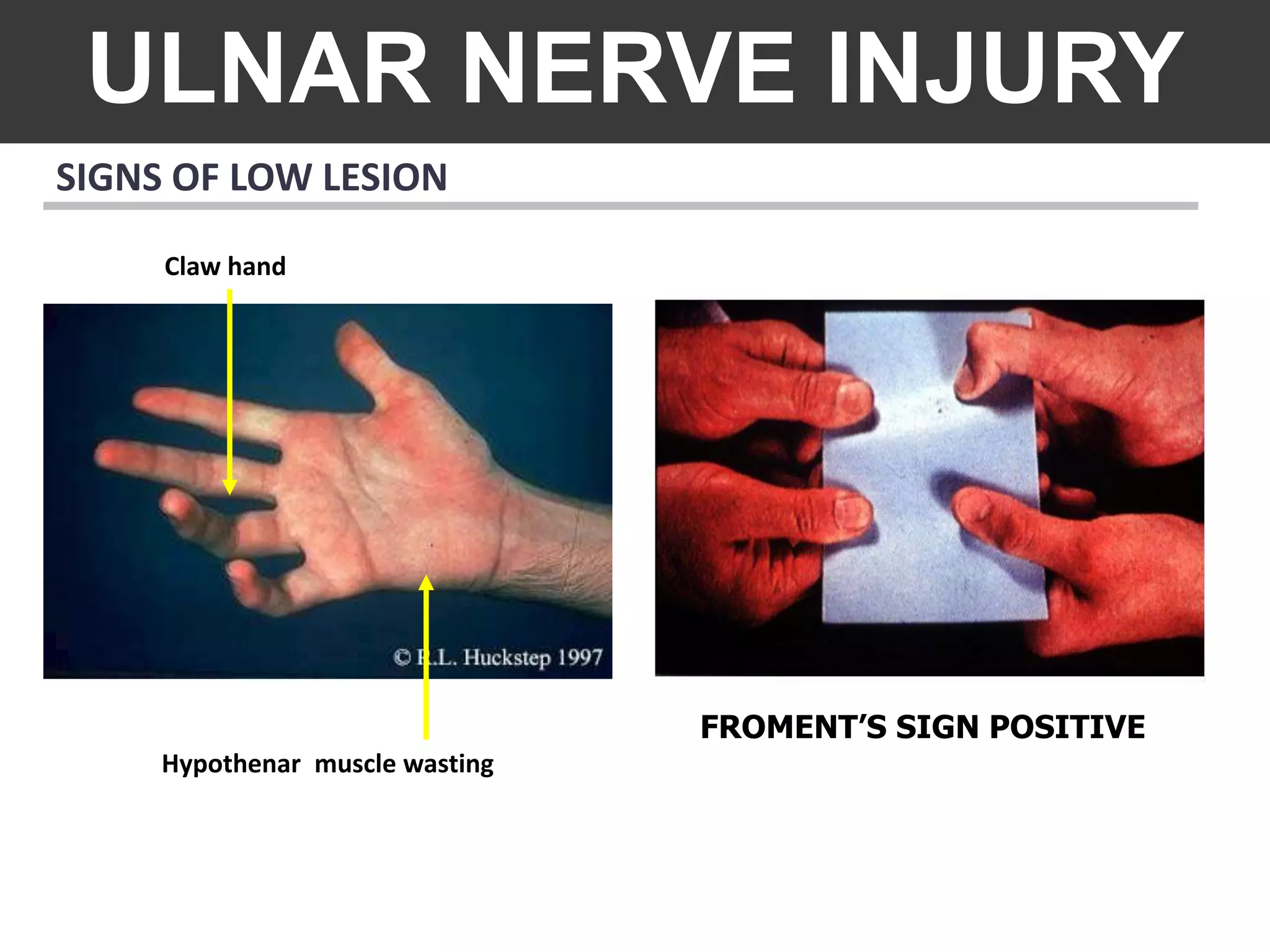
Hypothenar muscle wasting
Claw hand
FROMENT’S SIGN POSITIVE
WEAKNESS OF FINGERS ABDUCTION AND ADDUCTION
ULNAR NERVE INJURY
SIGNS OF LOW LESION
ULNAR NERVE INJURY
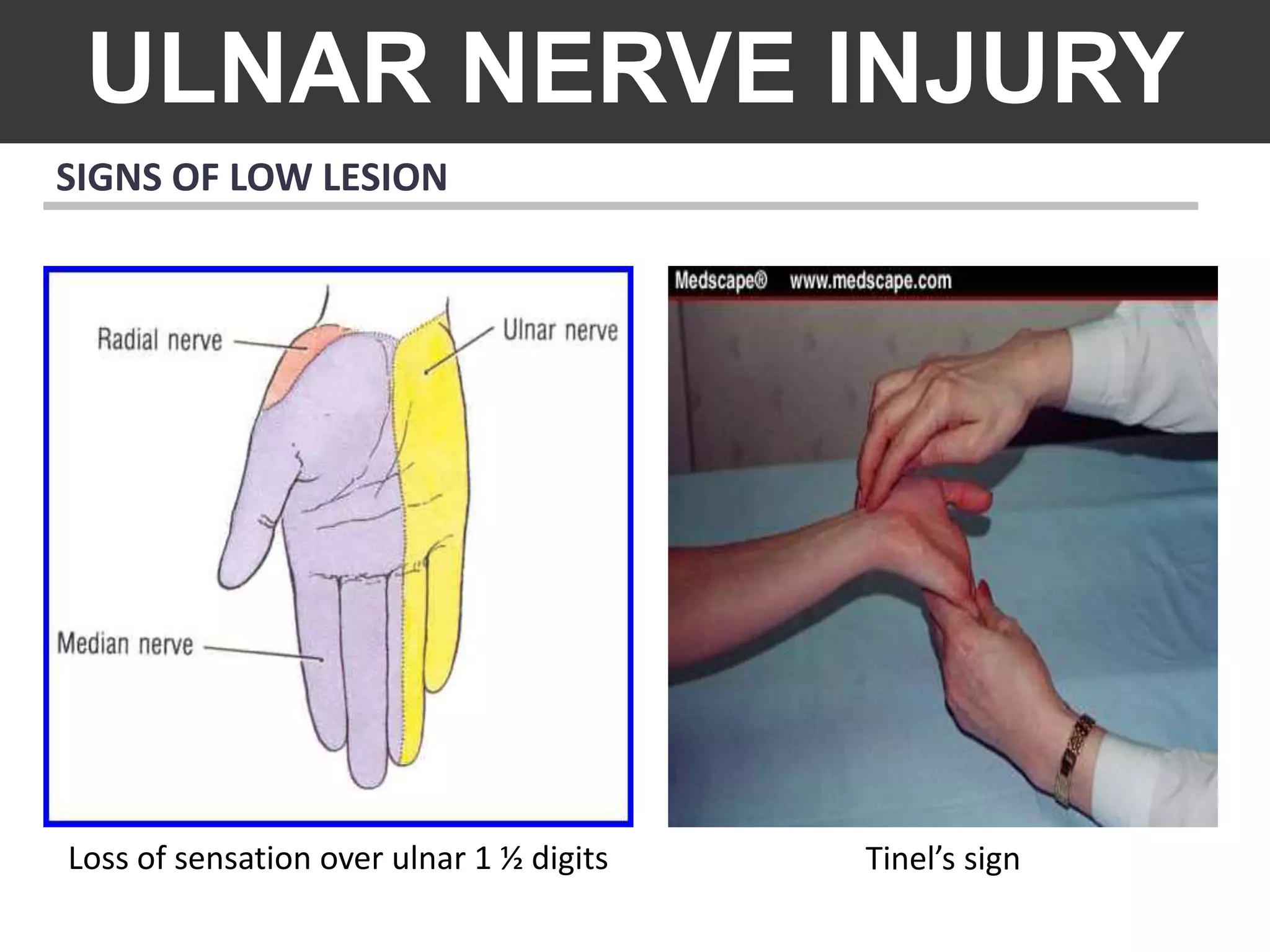
Loss of sensation over ulnar 1 ½ digits Tinel’s sign
COMPRESSION AT GUYON’S CANAL
ULNAR NERVE INJURY
Anatomy of Guyon’s canal :
 Floor = transverse carpal ligament to
pisiform
 Ulnar wall = pisiform
 Radial distal wall = hook of hamate
 Roof = volar carpal ligament
 Contains only ulnar nerve and artery
ULNAR TUNNEL SYNDROME
COMPRESSION AT GUYON’S CANAL
ULNAR NERVE INJURY
 Repetitive indirect trauma most common
 Tumours- ganglion, lipoma
 Pisiform instability
 Pisotriquetral arthritis
 Fractured hook of hamate / pisiform
 Ulnar artery thrombosis
CAUSES
COMPRESSION AT GUYON’S CANAL
ULNAR NERVE INJURY
Symptoms could be:
1. Pure motor
2. Pure sensory
3. Mixed
(depending on exact site of entrapment)
CLINICAL FEATURES
COMPRESSION AT CUBITAL TUNNEL
ULNAR NERVE INJURY
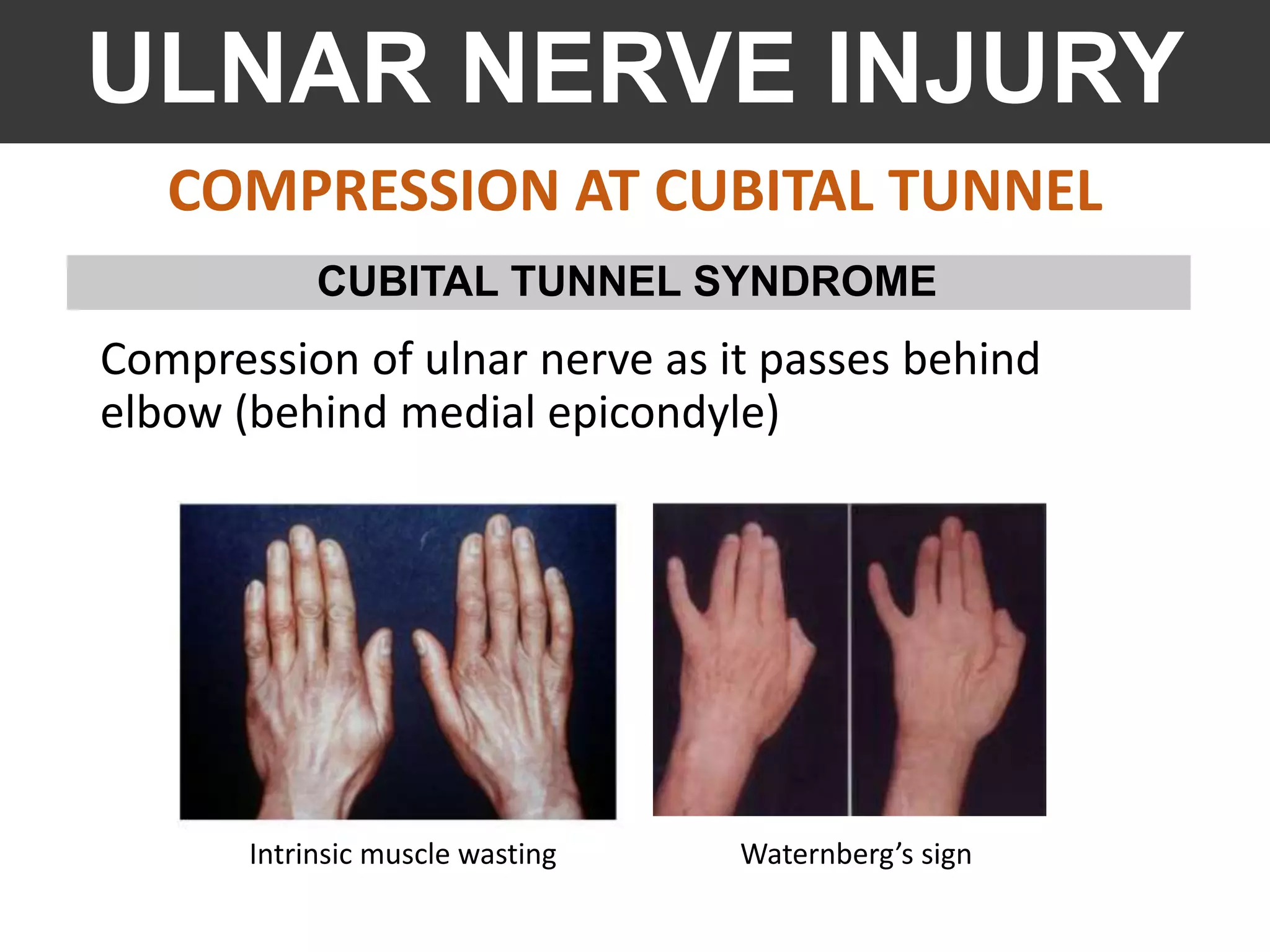
Compression of ulnar nerve as it passes behind
elbow (behind medial epicondyle)
Intrinsic muscle wasting Waternberg’s sign
CUBITAL TUNNEL SYNDROME
COMPRESSION AT CUBITAL TUNNEL
ULNAR NERVE INJURY
Conservative
 Modification of posture and avoidance of repetitive
trauma
 Splint
Surgical
 Operative decompression if symptoms persist
 Tendon transfer to recover hand function
TREATMENT
MEDIAN NERVE
INJRURY
CLASSIFICATION
MEDIAN NERVE INJURIES
1. High median nerve lesion
2. Low median nerve lesion
3. Carpal tunnel syndrome
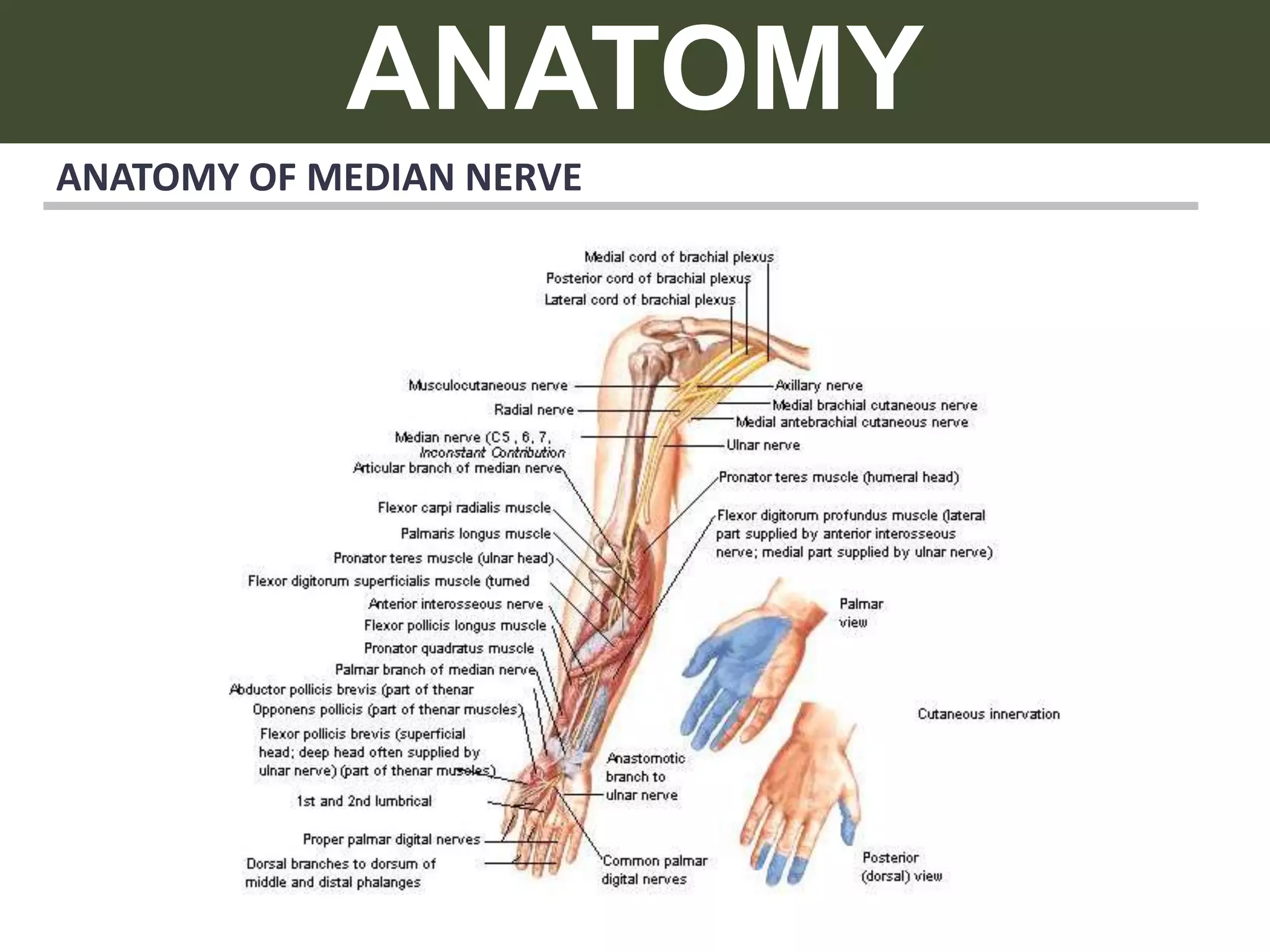
ANATOMY
ANATOMY OF MEDIAN NERVE
Type: Mixed nerve (contains motor & sensory fibres)
Root Values: C5, 6, 7, 8 & T1
Origin: Arises in the axilla by 2 roots
Lateral root – lateral cord of the brachial plexus
Medial root – medial cord of the brachial plexus
The medial root crosses in front of the 3rd part of
axillary artery to join the lateral root.
ANATOMY
ANATOMY OF MEDIAN NERVE
ANATOMY
ANATOMY OF MEDIAN NERVE
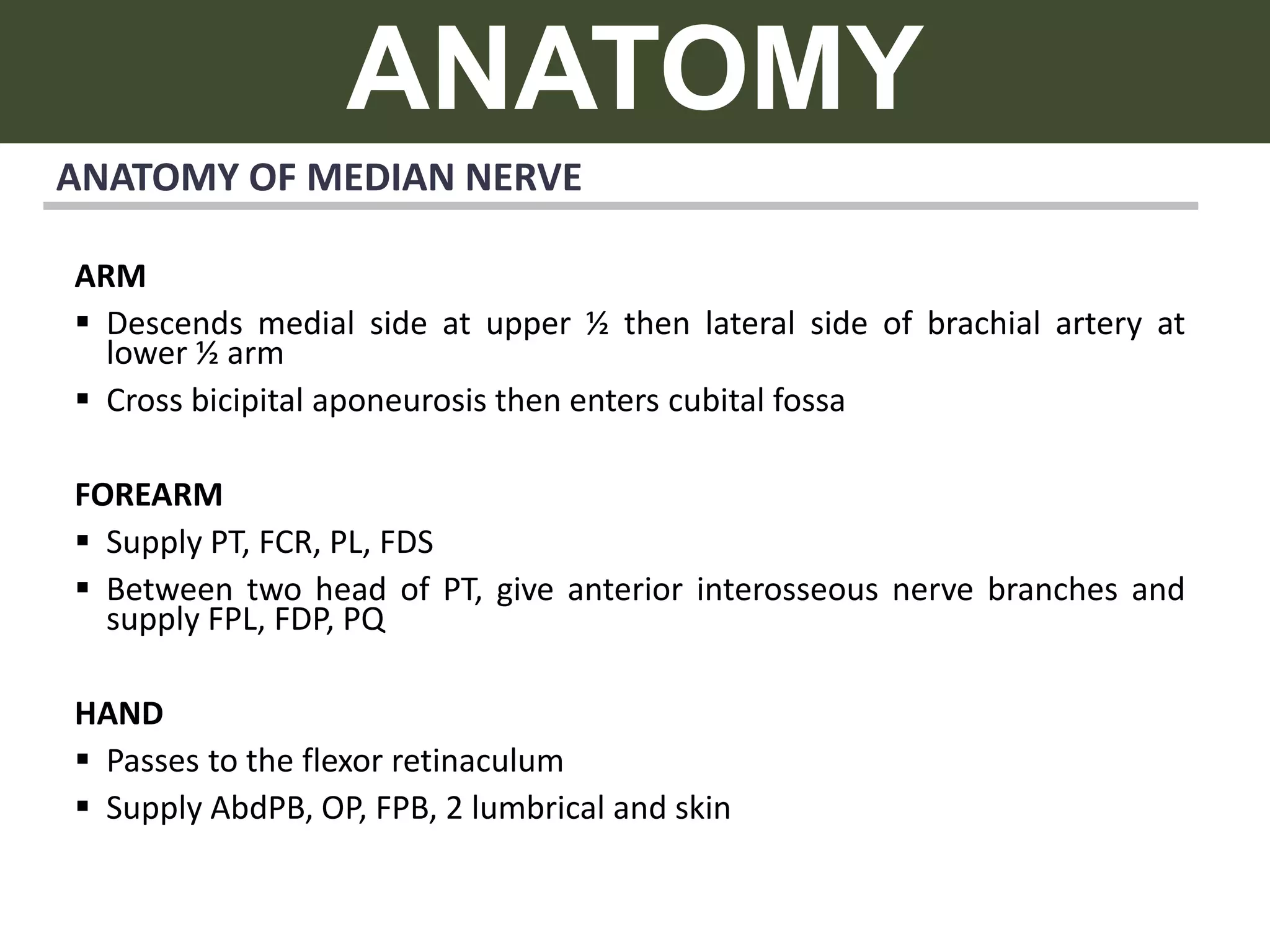
ARM
 Descends medial side at upper ½ then lateral side of brachial artery at
lower ½ arm
 Cross bicipital aponeurosis then enters cubital fossa
FOREARM
 Supply PT, FCR, PL, FDS
 Between two head of PT, give anterior interosseous nerve branches and
supply FPL, FDP, PQ
HAND
 Passes to the flexor retinaculum
 Supply AbdPB, OP, FPB, 2 lumbrical and skin
ANATOMY
BRANCHES OF MEDIAN NERVE
HIGH MEDIAN NERVE LESION
MEDIAN NERVE INJURY
AXILLA
 Crutch compression
 Anterior shoulder dislocation
 Stabs wound
 Fracture of humerus shaft
 Fracture humerus supracondylar in children
 Fracture medial epicondylar
 Elbow dislocation
UPPER ARM
ELBOW
EVERYTHING IS AFFECTED!!
MEDIAN NERVE INJURY
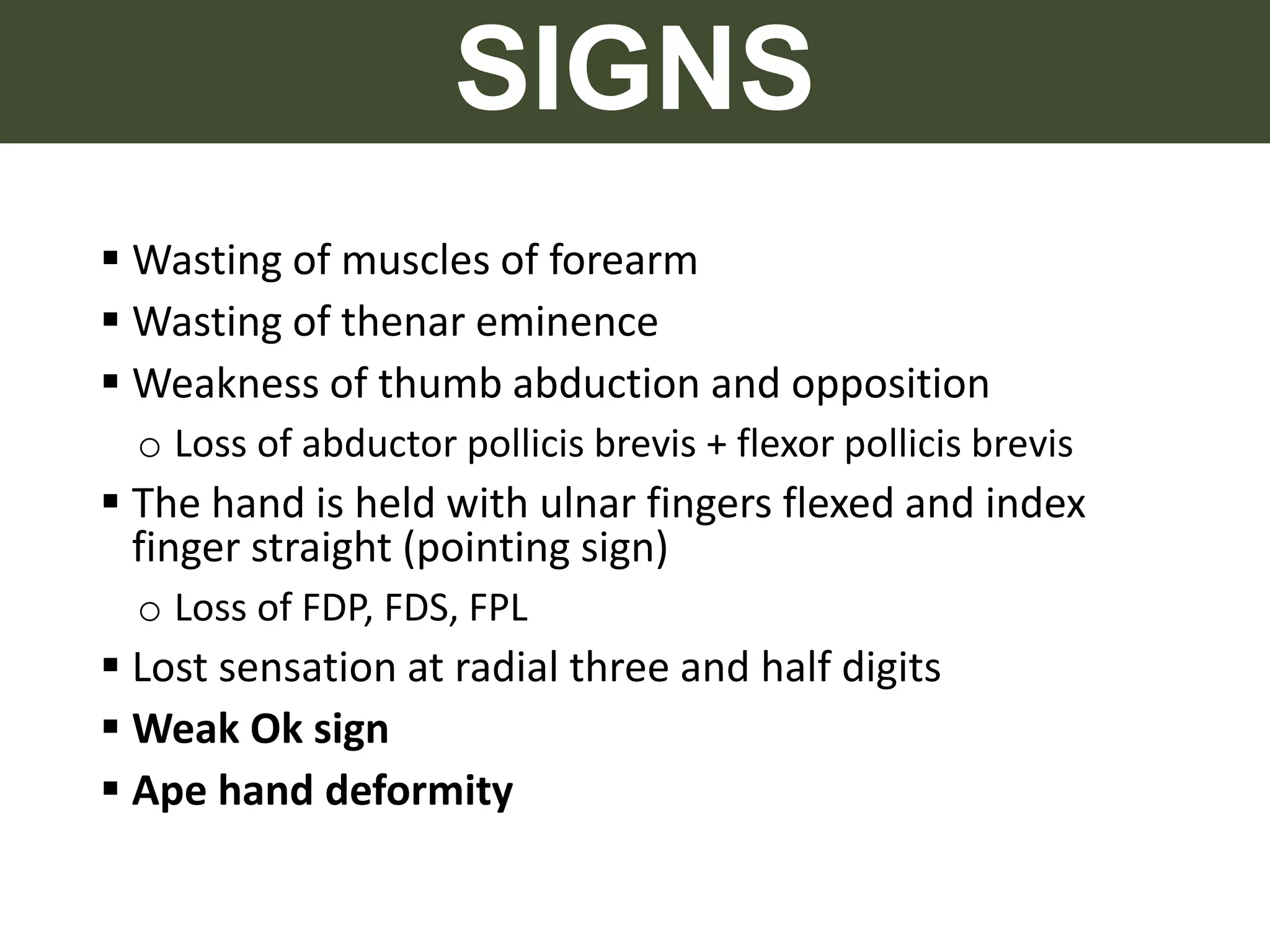
SIGNS
 Wasting of muscles of forearm
 Wasting of thenar eminence
 Weakness of thumb abduction and opposition
o Loss of abductor pollicis brevis + flexor pollicis brevis
 The hand is held with ulnar fingers flexed and index
finger straight (pointing sign)
o Loss of FDP, FDS, FPL
 Lost sensation at radial three and half digits
 Weak Ok sign
 Ape hand deformity
SIGNS
LOW MEDIAN NERVE LESION
MEDIAN NERVE INJURY
INJURY TO DISTAL THIRD OF THE FOREARM
I. Cuts in front of the wrist
II. Carpal dislocation
I. Wasting of thenar muscle
II. forearm muscle spared
III. Paralyzed muscle of the hand
IV. Weakness of thumb abduction and opposition
V. Loss of abductor pollicis brevis + flexor pollicis brevis
VI. Lost sensation at radial three and half digits
SIGNS
COMPARISON
MEDIAN NERVE INJURY
Low lesion High lesion
Wasting of thenar eminence
Weak thumb abduction
Weak thumb opposition
Loss of sensation over
lateral 3 and half digits
All the signs of low lesion
Wasting of lateral forearm
Weakened OK sign (AIN – FPL & FDP)
Pointing finger (2nd and 3rd finger remains
partially extended in an attempt to make a fist)
PHYSICAL EXAMINATION
MEDIAN NERVE PE
a. Thenar wasting
b. Atrophy of pulp of index, cracking of nails and other
trophic changes
c. Cigarette burns or other loss of sensory deprivation
d. Pointing finger in high nerve lesion
Flexor carpi radialis and palmaris longus. Patients hand
is placed on a flat surface, palm upwards. Ask patient
to attempt to flex the wrist with examiners hand
putting pressure on top. The (pl) and (fcr) tendon will
be prominent
INSPECTION
PHYSICAL EXAMINATION
MEDIAN NERVE PE
Pronator teres. Extend the patients elbow and give
resistance as patient attempt to pronate
PE OF MEDIAN NERVE MUSCLE DISTRIBUTION
MEDIAN NERVE PE
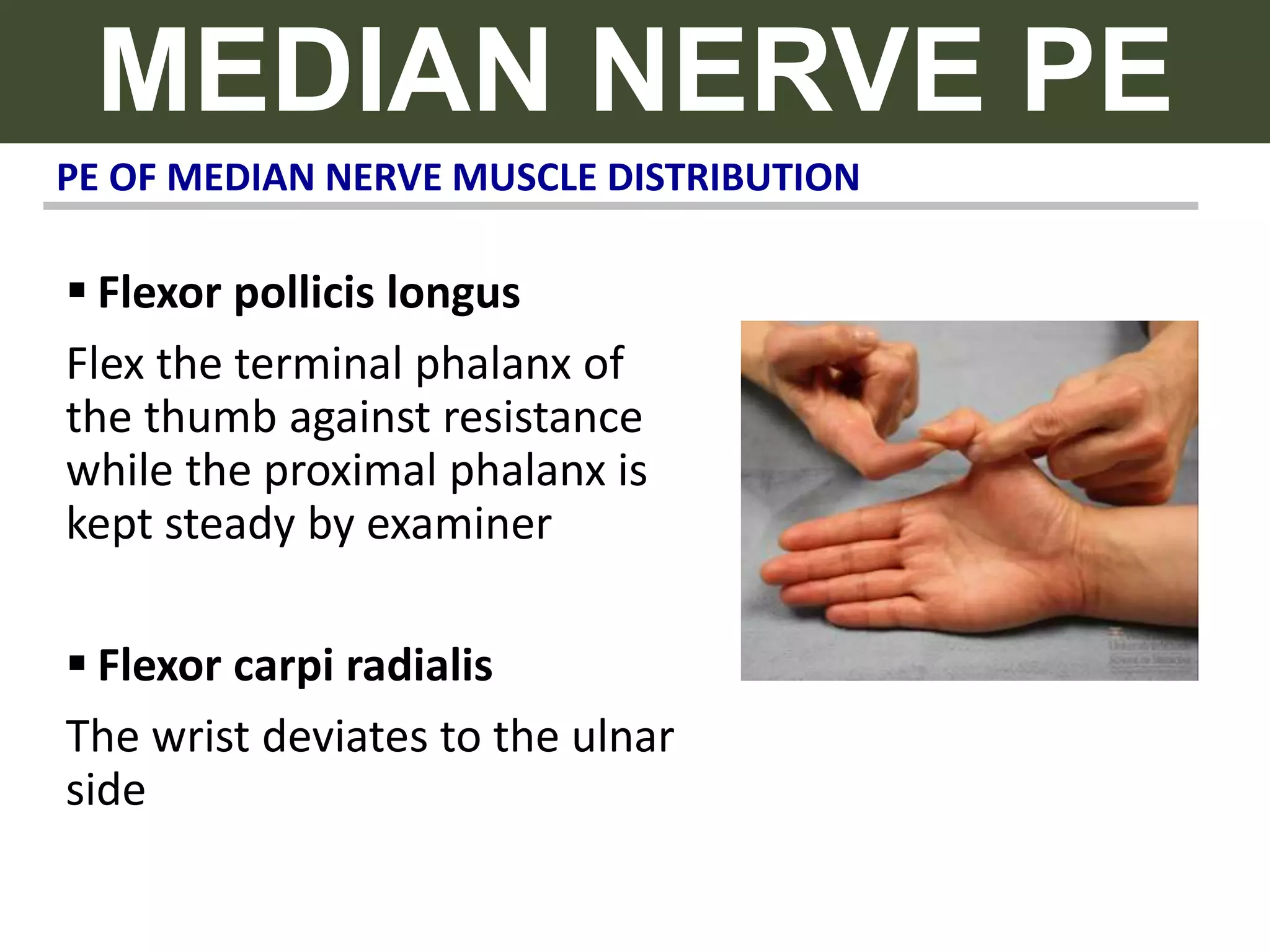
 Flexor pollicis longus
Flex the terminal phalanx of
the thumb against resistance
while the proximal phalanx is
kept steady by examiner
 Flexor carpi radialis
The wrist deviates to the ulnar
side
PE OF MEDIAN NERVE MUSCLE DISTRIBUTION
MEDIAN NERVE PE
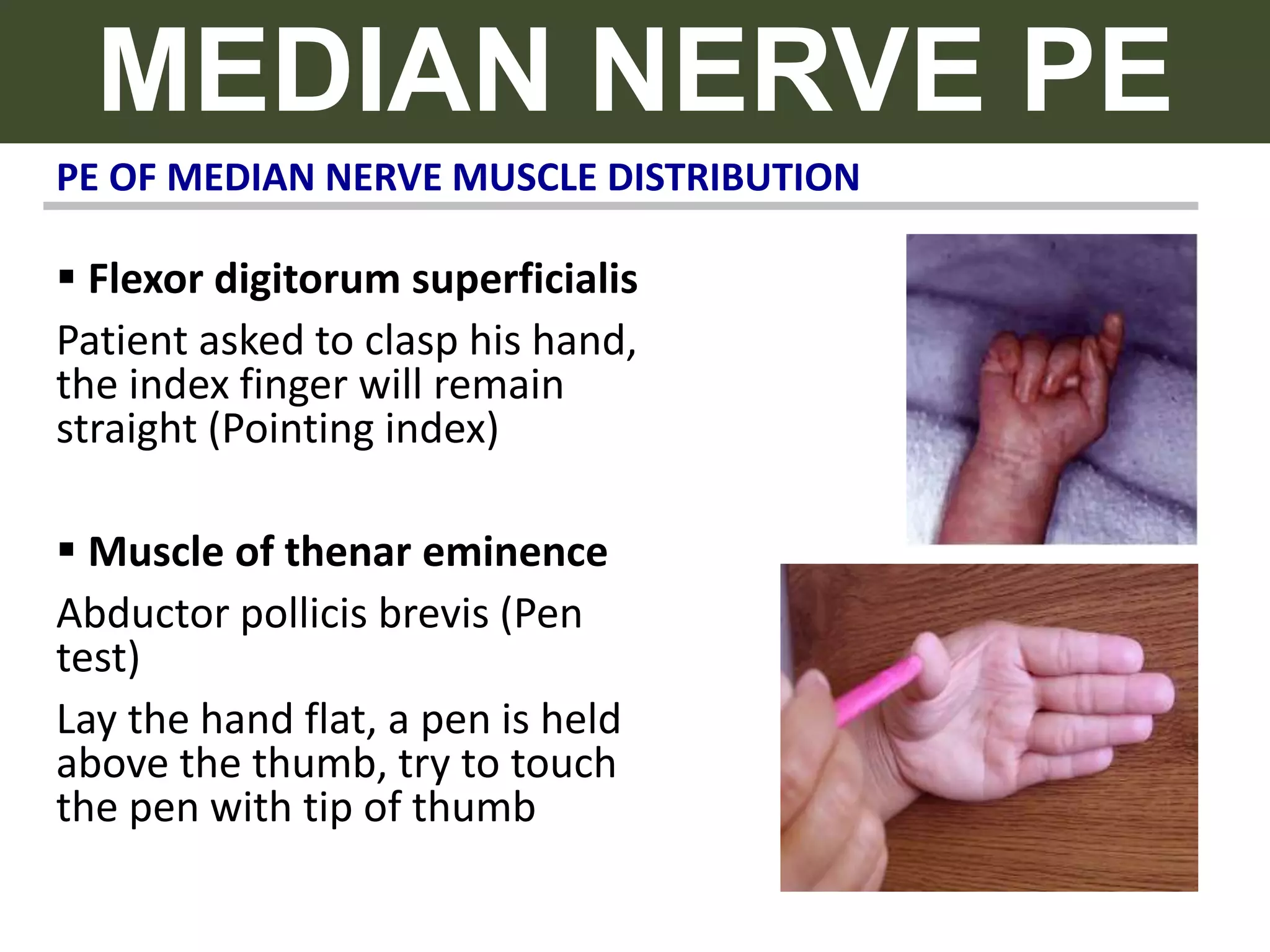
 Flexor digitorum superficialis
Patient asked to clasp his hand,
the index finger will remain
straight (Pointing index)
 Muscle of thenar eminence
Abductor pollicis brevis (Pen
test)
Lay the hand flat, a pen is held
above the thumb, try to touch
the pen with tip of thumb
PE OF MEDIAN NERVE MUSCLE DISTRIBUTION
MEDIAN NERVE PE
 Opponence pollicis
Appose the tip of thumb to
other finger
SCREENING
MEDIAN NERVE
REMEMBER LOAF!
Lumbricals
Opposition Abduction
Flexion
CARPAL TUNNEL SYNDROME
MEDIAN NERVE INJURY
ANATOMY OF CARPAL TUNNEL
CARPAL TUNNEL SYNDROME
MEDIAN NERVE INJURY
ROOF
 Flexor retinaculum
 Ulnar artery, ulnar nerve, palmaris longus
 Carpal bone (hamate, capitat, trapezoid, trapezium)
 Lateral- tendon FCR
 Medial- tendon FPL, FDS,FDP, median nerve
FLOOR
CONTENTS
CARPAL TUNNEL SYNDROME
MEDIAN NERVE INJURY
 Common in middle age group 40-50 years
 More common in female
 Causes:
i. Inflammatory - RA, wrist OA,
ii. Post traumatic – Dislocation of one of the carpal
bones inside the carpal tunnel
iii. Endocrine – Myxoedema, Cushing, Acromegaly
(thickening of the tendons passing)
iv. Tumour inside the carpal tunnel pressing on the
median nerve
v. Idiopathic
CARPAL TUNNEL SYNDROME
MEDIAN NERVE INJURY
HISTORY
Pain and paresthesia at distribution of
median nerve in the hand
Wake up at night due to burning pain,
tingling and numbness
Relieve by shaking the arm
Dropping object
CARPAL TUNNEL SYNDROME
MEDIAN NERVE INJURY
PHYSICAL EXAMINATION
 Hands may look normal/ wasting in
severe cases
TINEL SIGN
Percussing over the median nerve
causing sensation of current/
hyperesthesia at median nerve
distribution
PHALEN SIGN
Flexed the wrist fully for one or two
minutes causing paresthesia
CARPAL TUNNEL SYNDROME
MEDIAN NERVE INJURY
CARPAL TUNNEL SYNDROME
MEDIAN NERVE INJURY
INVESTIGATIONS
ELECTRODIAGNOSTIC TEST
I. Nerve conduction studies
 Measure Median motor and sensory latencies and
conduction velocities across the wrist
 Sensory latency of greater than 3.5 millisecond or a motor
latency of greater than 4.5 millisecond is considered an
abnormal finding
 Distal compound muscle action potential (CMAP) and
sensory nerve action potential (SNAP) amplitudes may be
decreased
CARPAL TUNNEL SYNDROME
MEDIAN NERVE INJURY
NERVE CONDUCTION STUDY
CARPAL TUNNEL SYNDROME
MEDIAN NERVE INJURY
INVESTIGATIONS
ELECTRODIAGNOSTIC TEST
II. Electromyography
 To determine completeness of a nerve injury
 Technique:
I. Very small needle is inserted into various muscle
II. Then, the signal is magnified by high gain amplifier
III. Finally, the reading are monitored via oscilloscope and
recorded on the magnetic tape or paper recording
IV. Should performed 3-7 days after peripheral nerve injury
V. It may show low amplitude evoked compound muscle
potential (CMAP)
CARPAL TUNNEL SYNDROME
MEDIAN NERVE INJURY
TREATMENT
Conservatives
 Painkiller - PCM,NSAIDS
 Corticosteroid injection - to reduce edema
 Splint - prevent wrist flexion
 Physiotherapy
 Modifying activities - avoid repetitive or strenuous work
Surgical
Open surgical division of transverse carpal ligament
RADIAL NERVE
INJRURY
ANATOMY
ANATOMY OF RADIAL NERVE
ANATOMY
ANATOMY OF RADIAL NERVE
ANATOMY
ANATOMY OF RADIAL NERVE
ANATOMY
ANATOMY OF RADIAL NERVE
ANATOMY
ANATOMY OF RADIAL NERVE
ANATOMY
ANATOMY OF RADIAL NERVE
ANATOMY
ANATOMY OF RADIAL NERVE
ANATOMY
ANATOMY OF RADIAL NERVE
ANATOMY
ANATOMY OF RADIAL NERVE
ANATOMY
ANATOMY OF RADIAL NERVE
ANATOMY
ANATOMY OF RADIAL NERVE
ANATOMY
ANATOMY OF RADIAL NERVE
RADIAL NERVE LESION
1. Very high lesion (in the axilla)
2. High lesion (humeral shaft level)
3. Low lesion(around the elbow )
4. Wartenberg’s Syndrome (at the
wrist)
RADIAL NERVE LESIONS
VERY HIGH LESION (IN THE AXILLA)
1. Pressure from badly fitting crutch
(‘crutch palsy’)
2. Saturday night’s palsy
3. Honeymoon palsy
CAUSES
RADIAL NERVE LESIONS
VERY HIGH LESION (IN THE AXILLA)
SATURDAY NIGHT’S PALSY
RADIAL NERVE LESIONS
VERY HIGH LESION (IN THE AXILLA)
CRUTCH’S PALSY
RADIAL NERVE LESIONS
VERY HIGH LESION (IN THE AXILLA)
HONEYMOON PALSY
RADIAL NERVE LESIONS
VERY HIGH LESION (IN THE AXILLA)
1. Weakness of wrist, fingers and thumb
extension – wrist, fingers and thumb drop
2. Weakness of elbow extension – due to
paralysis of the triceps
3. Absent of triceps reflex
4. Sensory loss in the distribution of the more
proximal cutaneous branches
CLINICAL FEATURES
RADIAL NERVE LESIONS
VERY HIGH LESION (IN THE AXILLA)
CLINICAL FEATURES
RADIAL NERVE LESIONS
HIGH LESION (HUMERAL SHAFT)
CAUSES
1. Fracture of shaft of humerus
2. Pressure on the back of the arm on the edge of
table in an unconscious patient
3. Prolong application of tourniquet to the arm
4. Drunken man who fall asleep with the arm
dangling over the back of a chair ( Saturday night
palsy)
RADIAL NERVE LESIONS
HIGH LESION (HUMERAL SHAFT)
CLINICAL FEATURES
1. Wrist drop / weakness of wrist extension – due to paralysis
of the Extensor Carpi Radialis Longus and Brevis
1. Finger drop / weakness of fingers extension at the MCPJ –
due to paralysis of the Extensor Digitorum
1. Thumb drop / weakness of the whole thumb extension –
due to paralysis of the Extensor Pollicis longus and brevis)
RADIAL NERVE LESIONS
HIGH LESION (HUMERAL SHAFT)
CLINICAL FEATURES
4. Paralysis of the brachioradialis muscle.
The patients is asked to hold his forearm in 90 degree flexion
and midprone position. Ask him to flex the elbow
against resistance applied at the wrist. The brachio radialis
does not stand out prominently as it is paralysed.
Sensory signs: Sensory loss is minimal and is confined to a
small area in the dorsum of the hand over the metacarpal
bones of the thumb and index fingers (the distribution of the
s/f radial nerve)
RADIAL NERVE LESIONS
HIGH LESION (HUMERAL SHAFT)
1 = ulnar nerve
2 = median nerve
3 = radial nerve
RADIAL NERVE LESIONS
LOW LESION (AROUND THE ELBOW)
CAUSES
 The posterior interosseous branch of the
radial nerve is injured in :-
o Dislocation of the head of radius
o Accidently injured during surgical excision of the
head of the radius
RADIAL NERVE LESIONS
LOW LESION (AROUND THE ELBOW)
CAUSES
 The wrist extension is preserved
 No wrist drop because branch to ECRL
arise proximal to the elbow.
 Weakness of the fingers and thumb
extension at the MCPJ
 No sensory loss
RADIAL NERVE LESIONS
WARTENBERG’S SYNDROME
 Wartenberg syndrome, described in 1932, is
essentially entrapment of the superficial sensory
branch of the radial nerve.
 Many factors may contribute to the development of
Wartenberg syndrome. In patients with de Quervain
tenosynovitis, secondary irritation of the RSN is
frequent. Other common causes include postoperative
injury, external compression, and trauma.
TREATMENT
CONSERVSTIVE TREATMENT
The wrist and fingers are splinted in a position of
extension at the wrist and M.P. Joints by ‘cock
up’ splint
 To prevent overstretching of the paralysed
muscles.
 Disadvantage : prevent activity of unparalysed
flexor muscles of the wrist and m.P.Joints.
TREATMENT
CONSERVSTIVE TREATMENT
The modern splint : Dynamic or Lively splint
 Applied on the dorsal aspect
 Keeps the wrist and fingers extended by elastic
bands or springs attached to it
 Allows active flexion of the fingers and wrist.
TREATMENT
CONSERVSTIVE TREATMENT
 Passive movements to the wrist and finger
joints.
 Electrical stimulation is given to the
paralyzed muscles to prevent wasting of
muscles.
 Progressive active exercises are given to the
muscles showing recovery. As most of the
lesions are neuoparaxia or axonotmesis,
recovery occurs in about 4 to 6 weeks.
TREATMENT
SURGICAL TREATMENT
 When there is evidence of Neuronotmesis,
exploration and repair of the nerve gives
good results as it is mostly a motor nerve.
 When the radial nerve is irreparably
damaged, tendon transfer operations are
done to restore the extensor functions at the
wrist, fingers and thumb.
TIBIAL
NERVE
INJRURY
ANATOMY
ANATOMY OF TIBIAL NERVE
ANATOMY
ANATOMY OF TIBIAL NERVE
ANATOMY
ANATOMY OF TIBIAL NERVE
 The tibial nerve is derived from the L4 – S3 nerve roots as part of the
sciatica nerve.
 The tibial nerve runs through the popliteal fossa to pass below the arch of
soleus.
 In the popliteal fossa the nerve gives off branches to gastrocnemius,
popliteus, soleus and plantaris muscles, an articular branch to the knee
joint, and a cutaneous branch that will become the sural nerve.
 After passing deep to the soleus, it continues in the posterior
compartment between the tibialis posterior and the soleus muscles.
 At the medial ankle, the nerve becomes superficial, before passing into
the foot through the tarsal tunnel.
 Within the tunnel it splits into the medial and lateral plantar nerves.
 The medial plantar nerve divides into muscular and cutaneous branches.
 The lateral plantar nerve passes between the quadrates plantae and flexor
digitorum brevis.
1. TRAUMATIC
Can be direct or indirect trauma, (commonly to distal tibia, ankle ) such as
open fractures, deep laceration in the popliteal fossa, dislocation of the knee
and injuries to the ankle as well
MECHANISM OF INJURY
Can be caused by any mass, abscess, bleeding into the knee, unreleased
compartment syndrome.
2. COMPRESSION
Such as rheumatoid arthritis, diabetes or vascular disease.
Thus, any trauma or pressure will destroy the myelin sheath that protects and
insulates the nerve, or part of the nerve cell (the axon). This damage reduces
or prevents the movement of impulses through the nerve.
3. SYSTEMIC DISEASE
 Sensation changes in the bottom of the foot and
toes, including burning sensation, numbness,
tingling, or other abnormal sensation, or pain.
 Weakness of foot muscles.
 Weakness of the toes or ankle.
 Ankle that rolls inwards.
 Muscle atrophy
SIGNS AND SYMPYTOMS
1. Walking and running, ( active in sports )
2. High impact sports, ( rugby, football )
3. Hiking
4. Climbing stairs
5. Obesity
6. Diabetes and hypertension
RISK FACTORS
INSPECTION
PHYSICAL EXAMINATION
 Look for signs of injury, wound, scars
 Look for any ulcers or pressure points ( commonly in toes and medial malleolus )
 Clawing of toes ( posterior tibial nerve affected )
 Muscle atrophy ( calf and foot )
PALPATION
 Swelling or dryness
 Sensory test
 Motor function test ( plantar flex and toe flex )
INVESTIGATIONS
 Electromyography
 Nerve conduction test
 Nerve biopsy
MANAGEMENT
The treatment of tibial nerve injury is undertaken based on the severity of
the condition and assessment of the signs and symptoms. The condition is
often treatable without surgery.
 Applying ice to the sore area. ( Cold therapy )
 Taking non-steroidal anti-inflammatory medications.
 Resting; avoiding running or playing high impact sports until the affected
leg heels.
If Tibial nerve injury is severe and does not resolve using the above non-
surgical treatment methods, then the following invasive surgical procedures
may be necessary:
a. Lengthening of the calf muscle.
b. Removing damaged tendon areas.
c. Osteotomy
 Physiotherapy
 Electric Stimulation
PERONEAL
NERVE
INJRURY
ANATOMY
 The common peroneal nerve, about one-half the size of the tibial
nerve, arises from the dorsal branches of L4,L5 and S1,S2
 It descends obliquely along the lateral side of the popliteal fossa to
the head of the fibula, close to the medial margin of the biceps
femoris muscle. Where the common peroneal nerve winds round
the head of the fibula, it is palpable.
 Between the peroneus longus and the bone, it divides beneath the
muscle into the superficial peroneal nerve and deep peroneal
nerve.
 A peroneal nerve injury (also called foot drop), is a peripheral
nerve injury that affects a patient’s ability to lift the foot at the
ankle. While foot drop injury is a neuromuscular disorder, it can
also be a symptom of a more serious injury, such as a nerve
compression or herniated disc.
ANATOMY
1. TRAUMATIC
Caused by any fractures around the knee, specifically to the head of fibula,
supracondylar even knee dislocation.
MECHANISM OF INJURY
Caused by any plaster usage or cast, swelling, mass, or abscess. Certain cases
habitual leg crossing as well.
2. COMPRESSION
Such as rheumatoid arthritis, diabetes or hypertension
3. SYSTEMIC DISEASE
 Decreased sensation and numbness on the outer half
of the leg or dosum of the foot.
 Weakness of the ankles or feet,
 Foot drop
 Toes drag while walking
 High stepping gait
SIGNS AND SYMPYTOMS
INSPECTION
PHYSICAL EXAMINATION
1. High stepping gait and foot drop
2. Look for any injuries or previous scars
3. Muscle atrophy
PALPATION
1. Sensory test
2. Motor function test
INVESTIGATIONS
1. EMG
2. Nerve conduction test
3. Nerve biopsy
MANAGEMENT
 Resting from any activities that cause the symptoms to get worse.
 Applying ice to the sore area.
 Use of ankle or foot braces to support the foot
 Analgesics and NSAIDS
 If severe, surgery is done to reduce decompression or to fix the
underlying cause. ( peroneal nerve repair

Peripheral Nerve Injuries

  • 1.
  • 2.
  • 3.
    CLASSIFICATION ULNAR NERVE INJURIES 1.High ulnar nerve lesion 2. Low ulnar nerve lesion 3. Guyon’s tunnel syndrome 4. Cubital tunnel syndrome
  • 4.
    ANATOMY ANATOMY OF ULNARNERVE  Type: Mixed Never (motor & sensory)  Root Value: C7, C8 & T1  Origin: Arises in the axilla as the largest branch of median cord of the brachial plexus, at the lower border of pectoralis minor.
  • 5.
    ANATOMY ANATOMY OF ULNARNERVE Enters the forearm between 2 heads of Flexor Carpi Ulnaris In the upper half, it rest on Flexor Digitorum Profundus & covered by Flexor Carpi Ulnaris In lower half, it runs lateral to Flexor Carpi Ulnaris tendon accompanied by ulnar artery laterally Enters palm on lateral side of pisiform bone above the flexor retinaculum Divides into Superficial & Deep Terminal Branches
  • 6.
  • 7.
  • 8.
  • 9.
    ULNAR NERVE SUMMARY OFBRANCHES OF ULNAR NERVE MOTOR BRANCHES: To 1 muscles only:  Flexor carpi ulnaris  Medial half of flexor digiti profundus Superficial Terminal Branches supplies one muscle only: palmaris brevis Deep Terminal Branch supplies:  8 interossei + medial 2 lumbricals  3 hypothenar muscle  Adductor Pollicis & may be FPB FEMORAL HAND
  • 10.
    ULNAR NERVE SUMMARY OFBRANCHES OF ULNAR NERVE SENSORY BRANCHES:  Palmar cutaneous branch: Medial 1/3 of palm  Dorsal cutaneous branches: Medial 1/3 of dorsum of hand & dorsum of medial 1 Superficial terminal branches gives 3 palmar digital nerves to the palmar surfaces of the medial 1fingers FEMORAL HAND
  • 11.
    1. ABOVE ELBOW(HIGH ULNAR LESION) ULNAR NERVE INJURY Injuries lead to complete loss of all the functions of nerve. The injury may be caused by: A. Penetrating wounds B. Gun Shots C. Fracture of medial epicondyle D. Cubitus Valgus (a deformity of elbow joint causing stretch of ulnar nerve)
  • 12.
    1. ABOVE ELBOW(HIGH ULNAR LESION) ULNAR NERVE INJURY 1. Paralysis of all muscles supplied:  1 muscles in the forearm  15 muscles in the hand 2. Weak flexion of the wrist, with radial deviation of the hand – due to paralysis of FCU 3. Inability to flex the terminal phalanges of the medial 2 fingers – due to paralysis of medial ½ of the FDP 4. Inability to put the hand in the writing position – due to paralysis of interossei & medial 2 lumbricals 5. Loss of adduction of the thumb – paralysis of adductor pollicis MOTOR AFFECTION
  • 13.
    MANIFESTATIONS: ABOVE ELBOW ULNARNERVE INJURY Partial Claw Hand – characterized by: I. Extension of the metacarpophalangeal & flexion of the interphalangeal joints – due to paralysis of lumbricals & interossei I. Flat hypothenar eminence – due to paralysis of it’s muscles Sensory loss from the skin of palmar & dorsal surfaces of medial 1 of fingers. DEFORMITY SENSORY LOSS
  • 14.
    2. AT ORABOVE THE WRIST (LOW ULNAR LESION) ULNAR NERVE INJURY  Wrist laceration  Fracture of the carpal bones  Malunion of Colles fracture  Handcuffs Motor: Limited to hand muscles only. The forearm muscles are intact because they receive supply very close to the elbow. CAUSED BY MANIFESTATIONS
  • 15.
    2. AT ORABOVE THE WRIST (LOW ULNAR LESION) ULNAR NERVE INJURY Complete Claw Hand (in combined with median nerve injury) More severe than in injury above the wrist, this is called the ulnar paradox. Sensory Loss: Loss of sensation from the palmar surfaces of the medial 1 fingers only – because the palmar & dorsal cutaneous branches are intact. DEFORMITY
  • 16.
    SIGNS OF LOWLESION ULNAR NERVE INJURY Hypothenar muscle wasting Claw hand FROMENT’S SIGN POSITIVE
  • 17.
    WEAKNESS OF FINGERSABDUCTION AND ADDUCTION ULNAR NERVE INJURY
  • 18.
    SIGNS OF LOWLESION ULNAR NERVE INJURY Loss of sensation over ulnar 1 ½ digits Tinel’s sign
  • 19.
    COMPRESSION AT GUYON’SCANAL ULNAR NERVE INJURY Anatomy of Guyon’s canal :  Floor = transverse carpal ligament to pisiform  Ulnar wall = pisiform  Radial distal wall = hook of hamate  Roof = volar carpal ligament  Contains only ulnar nerve and artery ULNAR TUNNEL SYNDROME
  • 20.
    COMPRESSION AT GUYON’SCANAL ULNAR NERVE INJURY  Repetitive indirect trauma most common  Tumours- ganglion, lipoma  Pisiform instability  Pisotriquetral arthritis  Fractured hook of hamate / pisiform  Ulnar artery thrombosis CAUSES
  • 21.
    COMPRESSION AT GUYON’SCANAL ULNAR NERVE INJURY Symptoms could be: 1. Pure motor 2. Pure sensory 3. Mixed (depending on exact site of entrapment) CLINICAL FEATURES
  • 22.
    COMPRESSION AT CUBITALTUNNEL ULNAR NERVE INJURY Compression of ulnar nerve as it passes behind elbow (behind medial epicondyle) Intrinsic muscle wasting Waternberg’s sign CUBITAL TUNNEL SYNDROME
  • 23.
    COMPRESSION AT CUBITALTUNNEL ULNAR NERVE INJURY Conservative  Modification of posture and avoidance of repetitive trauma  Splint Surgical  Operative decompression if symptoms persist  Tendon transfer to recover hand function TREATMENT
  • 24.
  • 25.
    CLASSIFICATION MEDIAN NERVE INJURIES 1.High median nerve lesion 2. Low median nerve lesion 3. Carpal tunnel syndrome
  • 26.
    ANATOMY ANATOMY OF MEDIANNERVE Type: Mixed nerve (contains motor & sensory fibres) Root Values: C5, 6, 7, 8 & T1 Origin: Arises in the axilla by 2 roots Lateral root – lateral cord of the brachial plexus Medial root – medial cord of the brachial plexus The medial root crosses in front of the 3rd part of axillary artery to join the lateral root.
  • 27.
  • 28.
    ANATOMY ANATOMY OF MEDIANNERVE ARM  Descends medial side at upper ½ then lateral side of brachial artery at lower ½ arm  Cross bicipital aponeurosis then enters cubital fossa FOREARM  Supply PT, FCR, PL, FDS  Between two head of PT, give anterior interosseous nerve branches and supply FPL, FDP, PQ HAND  Passes to the flexor retinaculum  Supply AbdPB, OP, FPB, 2 lumbrical and skin
  • 29.
  • 30.
    HIGH MEDIAN NERVELESION MEDIAN NERVE INJURY AXILLA  Crutch compression  Anterior shoulder dislocation  Stabs wound  Fracture of humerus shaft  Fracture humerus supracondylar in children  Fracture medial epicondylar  Elbow dislocation UPPER ARM ELBOW
  • 31.
  • 32.
    SIGNS  Wasting ofmuscles of forearm  Wasting of thenar eminence  Weakness of thumb abduction and opposition o Loss of abductor pollicis brevis + flexor pollicis brevis  The hand is held with ulnar fingers flexed and index finger straight (pointing sign) o Loss of FDP, FDS, FPL  Lost sensation at radial three and half digits  Weak Ok sign  Ape hand deformity
  • 33.
  • 34.
    LOW MEDIAN NERVELESION MEDIAN NERVE INJURY INJURY TO DISTAL THIRD OF THE FOREARM I. Cuts in front of the wrist II. Carpal dislocation I. Wasting of thenar muscle II. forearm muscle spared III. Paralyzed muscle of the hand IV. Weakness of thumb abduction and opposition V. Loss of abductor pollicis brevis + flexor pollicis brevis VI. Lost sensation at radial three and half digits SIGNS
  • 35.
    COMPARISON MEDIAN NERVE INJURY Lowlesion High lesion Wasting of thenar eminence Weak thumb abduction Weak thumb opposition Loss of sensation over lateral 3 and half digits All the signs of low lesion Wasting of lateral forearm Weakened OK sign (AIN – FPL & FDP) Pointing finger (2nd and 3rd finger remains partially extended in an attempt to make a fist)
  • 36.
    PHYSICAL EXAMINATION MEDIAN NERVEPE a. Thenar wasting b. Atrophy of pulp of index, cracking of nails and other trophic changes c. Cigarette burns or other loss of sensory deprivation d. Pointing finger in high nerve lesion Flexor carpi radialis and palmaris longus. Patients hand is placed on a flat surface, palm upwards. Ask patient to attempt to flex the wrist with examiners hand putting pressure on top. The (pl) and (fcr) tendon will be prominent INSPECTION
  • 37.
    PHYSICAL EXAMINATION MEDIAN NERVEPE Pronator teres. Extend the patients elbow and give resistance as patient attempt to pronate
  • 38.
    PE OF MEDIANNERVE MUSCLE DISTRIBUTION MEDIAN NERVE PE  Flexor pollicis longus Flex the terminal phalanx of the thumb against resistance while the proximal phalanx is kept steady by examiner  Flexor carpi radialis The wrist deviates to the ulnar side
  • 39.
    PE OF MEDIANNERVE MUSCLE DISTRIBUTION MEDIAN NERVE PE  Flexor digitorum superficialis Patient asked to clasp his hand, the index finger will remain straight (Pointing index)  Muscle of thenar eminence Abductor pollicis brevis (Pen test) Lay the hand flat, a pen is held above the thumb, try to touch the pen with tip of thumb
  • 40.
    PE OF MEDIANNERVE MUSCLE DISTRIBUTION MEDIAN NERVE PE  Opponence pollicis Appose the tip of thumb to other finger
  • 41.
  • 42.
    CARPAL TUNNEL SYNDROME MEDIANNERVE INJURY ANATOMY OF CARPAL TUNNEL
  • 43.
    CARPAL TUNNEL SYNDROME MEDIANNERVE INJURY ROOF  Flexor retinaculum  Ulnar artery, ulnar nerve, palmaris longus  Carpal bone (hamate, capitat, trapezoid, trapezium)  Lateral- tendon FCR  Medial- tendon FPL, FDS,FDP, median nerve FLOOR CONTENTS
  • 44.
    CARPAL TUNNEL SYNDROME MEDIANNERVE INJURY  Common in middle age group 40-50 years  More common in female  Causes: i. Inflammatory - RA, wrist OA, ii. Post traumatic – Dislocation of one of the carpal bones inside the carpal tunnel iii. Endocrine – Myxoedema, Cushing, Acromegaly (thickening of the tendons passing) iv. Tumour inside the carpal tunnel pressing on the median nerve v. Idiopathic
  • 45.
    CARPAL TUNNEL SYNDROME MEDIANNERVE INJURY HISTORY Pain and paresthesia at distribution of median nerve in the hand Wake up at night due to burning pain, tingling and numbness Relieve by shaking the arm Dropping object
  • 46.
    CARPAL TUNNEL SYNDROME MEDIANNERVE INJURY PHYSICAL EXAMINATION  Hands may look normal/ wasting in severe cases TINEL SIGN Percussing over the median nerve causing sensation of current/ hyperesthesia at median nerve distribution PHALEN SIGN Flexed the wrist fully for one or two minutes causing paresthesia
  • 47.
  • 48.
    CARPAL TUNNEL SYNDROME MEDIANNERVE INJURY INVESTIGATIONS ELECTRODIAGNOSTIC TEST I. Nerve conduction studies  Measure Median motor and sensory latencies and conduction velocities across the wrist  Sensory latency of greater than 3.5 millisecond or a motor latency of greater than 4.5 millisecond is considered an abnormal finding  Distal compound muscle action potential (CMAP) and sensory nerve action potential (SNAP) amplitudes may be decreased
  • 49.
    CARPAL TUNNEL SYNDROME MEDIANNERVE INJURY NERVE CONDUCTION STUDY
  • 50.
    CARPAL TUNNEL SYNDROME MEDIANNERVE INJURY INVESTIGATIONS ELECTRODIAGNOSTIC TEST II. Electromyography  To determine completeness of a nerve injury  Technique: I. Very small needle is inserted into various muscle II. Then, the signal is magnified by high gain amplifier III. Finally, the reading are monitored via oscilloscope and recorded on the magnetic tape or paper recording IV. Should performed 3-7 days after peripheral nerve injury V. It may show low amplitude evoked compound muscle potential (CMAP)
  • 51.
    CARPAL TUNNEL SYNDROME MEDIANNERVE INJURY TREATMENT Conservatives  Painkiller - PCM,NSAIDS  Corticosteroid injection - to reduce edema  Splint - prevent wrist flexion  Physiotherapy  Modifying activities - avoid repetitive or strenuous work Surgical Open surgical division of transverse carpal ligament
  • 52.
  • 53.
  • 54.
  • 55.
  • 56.
  • 57.
  • 58.
  • 59.
  • 60.
  • 61.
  • 62.
  • 63.
  • 64.
  • 65.
    RADIAL NERVE LESION 1.Very high lesion (in the axilla) 2. High lesion (humeral shaft level) 3. Low lesion(around the elbow ) 4. Wartenberg’s Syndrome (at the wrist)
  • 66.
    RADIAL NERVE LESIONS VERYHIGH LESION (IN THE AXILLA) 1. Pressure from badly fitting crutch (‘crutch palsy’) 2. Saturday night’s palsy 3. Honeymoon palsy CAUSES
  • 67.
    RADIAL NERVE LESIONS VERYHIGH LESION (IN THE AXILLA) SATURDAY NIGHT’S PALSY
  • 68.
    RADIAL NERVE LESIONS VERYHIGH LESION (IN THE AXILLA) CRUTCH’S PALSY
  • 69.
    RADIAL NERVE LESIONS VERYHIGH LESION (IN THE AXILLA) HONEYMOON PALSY
  • 70.
    RADIAL NERVE LESIONS VERYHIGH LESION (IN THE AXILLA) 1. Weakness of wrist, fingers and thumb extension – wrist, fingers and thumb drop 2. Weakness of elbow extension – due to paralysis of the triceps 3. Absent of triceps reflex 4. Sensory loss in the distribution of the more proximal cutaneous branches CLINICAL FEATURES
  • 71.
    RADIAL NERVE LESIONS VERYHIGH LESION (IN THE AXILLA) CLINICAL FEATURES
  • 72.
    RADIAL NERVE LESIONS HIGHLESION (HUMERAL SHAFT) CAUSES 1. Fracture of shaft of humerus 2. Pressure on the back of the arm on the edge of table in an unconscious patient 3. Prolong application of tourniquet to the arm 4. Drunken man who fall asleep with the arm dangling over the back of a chair ( Saturday night palsy)
  • 73.
    RADIAL NERVE LESIONS HIGHLESION (HUMERAL SHAFT) CLINICAL FEATURES 1. Wrist drop / weakness of wrist extension – due to paralysis of the Extensor Carpi Radialis Longus and Brevis 1. Finger drop / weakness of fingers extension at the MCPJ – due to paralysis of the Extensor Digitorum 1. Thumb drop / weakness of the whole thumb extension – due to paralysis of the Extensor Pollicis longus and brevis)
  • 74.
    RADIAL NERVE LESIONS HIGHLESION (HUMERAL SHAFT) CLINICAL FEATURES 4. Paralysis of the brachioradialis muscle. The patients is asked to hold his forearm in 90 degree flexion and midprone position. Ask him to flex the elbow against resistance applied at the wrist. The brachio radialis does not stand out prominently as it is paralysed. Sensory signs: Sensory loss is minimal and is confined to a small area in the dorsum of the hand over the metacarpal bones of the thumb and index fingers (the distribution of the s/f radial nerve)
  • 75.
    RADIAL NERVE LESIONS HIGHLESION (HUMERAL SHAFT) 1 = ulnar nerve 2 = median nerve 3 = radial nerve
  • 76.
    RADIAL NERVE LESIONS LOWLESION (AROUND THE ELBOW) CAUSES  The posterior interosseous branch of the radial nerve is injured in :- o Dislocation of the head of radius o Accidently injured during surgical excision of the head of the radius
  • 77.
    RADIAL NERVE LESIONS LOWLESION (AROUND THE ELBOW) CAUSES  The wrist extension is preserved  No wrist drop because branch to ECRL arise proximal to the elbow.  Weakness of the fingers and thumb extension at the MCPJ  No sensory loss
  • 78.
    RADIAL NERVE LESIONS WARTENBERG’SSYNDROME  Wartenberg syndrome, described in 1932, is essentially entrapment of the superficial sensory branch of the radial nerve.  Many factors may contribute to the development of Wartenberg syndrome. In patients with de Quervain tenosynovitis, secondary irritation of the RSN is frequent. Other common causes include postoperative injury, external compression, and trauma.
  • 79.
    TREATMENT CONSERVSTIVE TREATMENT The wristand fingers are splinted in a position of extension at the wrist and M.P. Joints by ‘cock up’ splint  To prevent overstretching of the paralysed muscles.  Disadvantage : prevent activity of unparalysed flexor muscles of the wrist and m.P.Joints.
  • 80.
    TREATMENT CONSERVSTIVE TREATMENT The modernsplint : Dynamic or Lively splint  Applied on the dorsal aspect  Keeps the wrist and fingers extended by elastic bands or springs attached to it  Allows active flexion of the fingers and wrist.
  • 81.
    TREATMENT CONSERVSTIVE TREATMENT  Passivemovements to the wrist and finger joints.  Electrical stimulation is given to the paralyzed muscles to prevent wasting of muscles.  Progressive active exercises are given to the muscles showing recovery. As most of the lesions are neuoparaxia or axonotmesis, recovery occurs in about 4 to 6 weeks.
  • 82.
    TREATMENT SURGICAL TREATMENT  Whenthere is evidence of Neuronotmesis, exploration and repair of the nerve gives good results as it is mostly a motor nerve.  When the radial nerve is irreparably damaged, tendon transfer operations are done to restore the extensor functions at the wrist, fingers and thumb.
  • 83.
  • 84.
  • 85.
  • 86.
    ANATOMY ANATOMY OF TIBIALNERVE  The tibial nerve is derived from the L4 – S3 nerve roots as part of the sciatica nerve.  The tibial nerve runs through the popliteal fossa to pass below the arch of soleus.  In the popliteal fossa the nerve gives off branches to gastrocnemius, popliteus, soleus and plantaris muscles, an articular branch to the knee joint, and a cutaneous branch that will become the sural nerve.  After passing deep to the soleus, it continues in the posterior compartment between the tibialis posterior and the soleus muscles.  At the medial ankle, the nerve becomes superficial, before passing into the foot through the tarsal tunnel.  Within the tunnel it splits into the medial and lateral plantar nerves.  The medial plantar nerve divides into muscular and cutaneous branches.  The lateral plantar nerve passes between the quadrates plantae and flexor digitorum brevis.
  • 87.
    1. TRAUMATIC Can bedirect or indirect trauma, (commonly to distal tibia, ankle ) such as open fractures, deep laceration in the popliteal fossa, dislocation of the knee and injuries to the ankle as well MECHANISM OF INJURY Can be caused by any mass, abscess, bleeding into the knee, unreleased compartment syndrome. 2. COMPRESSION Such as rheumatoid arthritis, diabetes or vascular disease. Thus, any trauma or pressure will destroy the myelin sheath that protects and insulates the nerve, or part of the nerve cell (the axon). This damage reduces or prevents the movement of impulses through the nerve. 3. SYSTEMIC DISEASE
  • 88.
     Sensation changesin the bottom of the foot and toes, including burning sensation, numbness, tingling, or other abnormal sensation, or pain.  Weakness of foot muscles.  Weakness of the toes or ankle.  Ankle that rolls inwards.  Muscle atrophy SIGNS AND SYMPYTOMS
  • 89.
    1. Walking andrunning, ( active in sports ) 2. High impact sports, ( rugby, football ) 3. Hiking 4. Climbing stairs 5. Obesity 6. Diabetes and hypertension RISK FACTORS
  • 90.
    INSPECTION PHYSICAL EXAMINATION  Lookfor signs of injury, wound, scars  Look for any ulcers or pressure points ( commonly in toes and medial malleolus )  Clawing of toes ( posterior tibial nerve affected )  Muscle atrophy ( calf and foot ) PALPATION  Swelling or dryness  Sensory test  Motor function test ( plantar flex and toe flex ) INVESTIGATIONS  Electromyography  Nerve conduction test  Nerve biopsy
  • 91.
    MANAGEMENT The treatment oftibial nerve injury is undertaken based on the severity of the condition and assessment of the signs and symptoms. The condition is often treatable without surgery.  Applying ice to the sore area. ( Cold therapy )  Taking non-steroidal anti-inflammatory medications.  Resting; avoiding running or playing high impact sports until the affected leg heels. If Tibial nerve injury is severe and does not resolve using the above non- surgical treatment methods, then the following invasive surgical procedures may be necessary: a. Lengthening of the calf muscle. b. Removing damaged tendon areas. c. Osteotomy  Physiotherapy  Electric Stimulation
  • 92.
  • 93.
    ANATOMY  The commonperoneal nerve, about one-half the size of the tibial nerve, arises from the dorsal branches of L4,L5 and S1,S2  It descends obliquely along the lateral side of the popliteal fossa to the head of the fibula, close to the medial margin of the biceps femoris muscle. Where the common peroneal nerve winds round the head of the fibula, it is palpable.  Between the peroneus longus and the bone, it divides beneath the muscle into the superficial peroneal nerve and deep peroneal nerve.  A peroneal nerve injury (also called foot drop), is a peripheral nerve injury that affects a patient’s ability to lift the foot at the ankle. While foot drop injury is a neuromuscular disorder, it can also be a symptom of a more serious injury, such as a nerve compression or herniated disc.
  • 94.
  • 95.
    1. TRAUMATIC Caused byany fractures around the knee, specifically to the head of fibula, supracondylar even knee dislocation. MECHANISM OF INJURY Caused by any plaster usage or cast, swelling, mass, or abscess. Certain cases habitual leg crossing as well. 2. COMPRESSION Such as rheumatoid arthritis, diabetes or hypertension 3. SYSTEMIC DISEASE
  • 96.
     Decreased sensationand numbness on the outer half of the leg or dosum of the foot.  Weakness of the ankles or feet,  Foot drop  Toes drag while walking  High stepping gait SIGNS AND SYMPYTOMS
  • 97.
    INSPECTION PHYSICAL EXAMINATION 1. Highstepping gait and foot drop 2. Look for any injuries or previous scars 3. Muscle atrophy PALPATION 1. Sensory test 2. Motor function test INVESTIGATIONS 1. EMG 2. Nerve conduction test 3. Nerve biopsy
  • 98.
    MANAGEMENT  Resting fromany activities that cause the symptoms to get worse.  Applying ice to the sore area.  Use of ankle or foot braces to support the foot  Analgesics and NSAIDS  If severe, surgery is done to reduce decompression or to fix the underlying cause. ( peroneal nerve repair