英語科教育法Ⅱ
May 28th, 2013
WATARI Yoichi
eywatar@ipc.shizuoka.ac.jp
Opening small talk
Feedback
• (略)
第6回 外国語教育実践史(3)
• Feedback
• CLT (continued) & Task
• Theories and Issues of Second Language
Acquisition
• Task-based Instruction/Language Teaching
• Content-based Instruction (CBI)
• Assignment
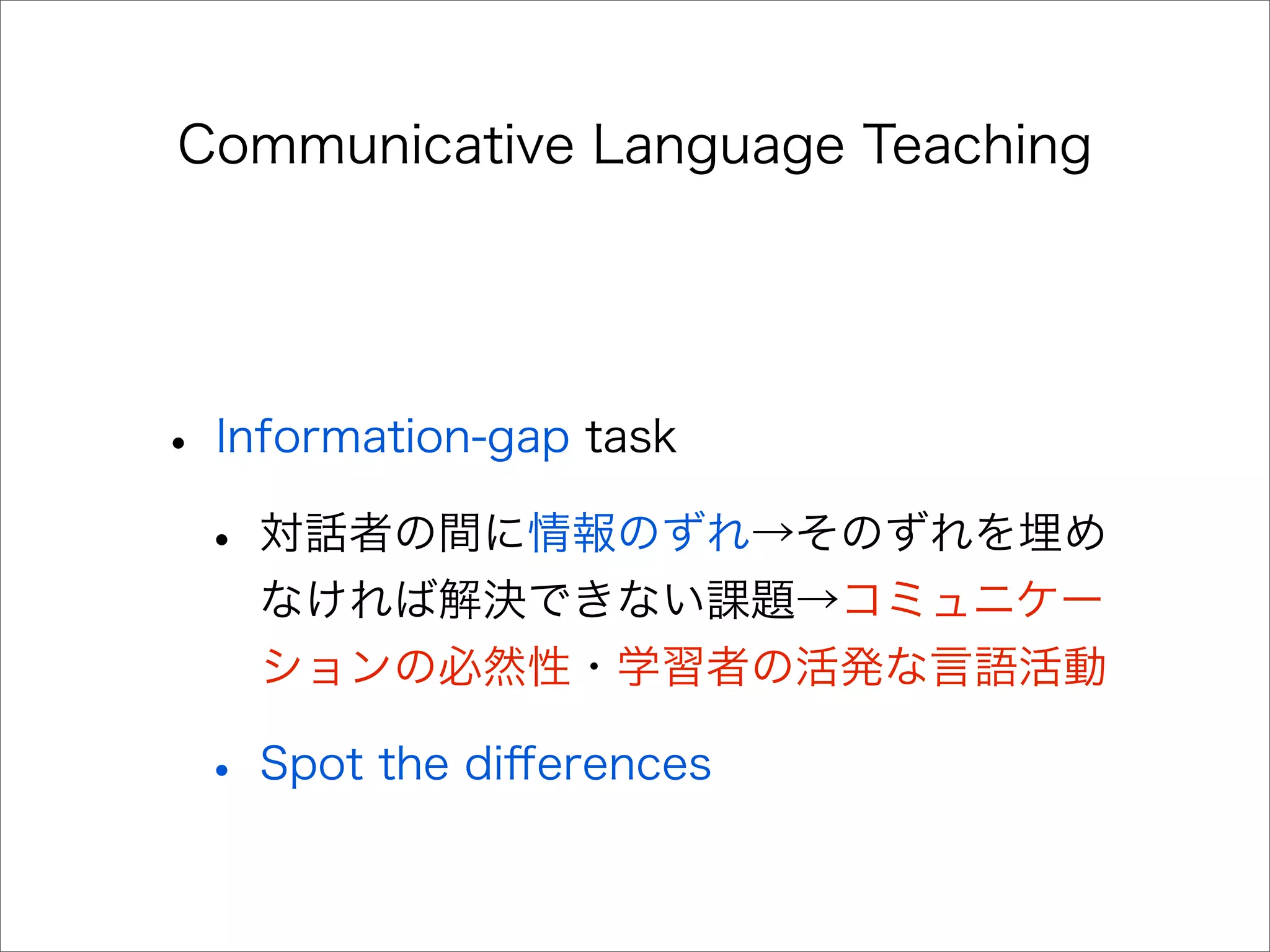
Communicative Language Teaching
• Information-gap task
• 対話者の間に情報のずれ→そのずれを埋め
なければ解決できない課題→コミュニケー
ションの必然性・学習者の活発な言語活動
• Spot the differences
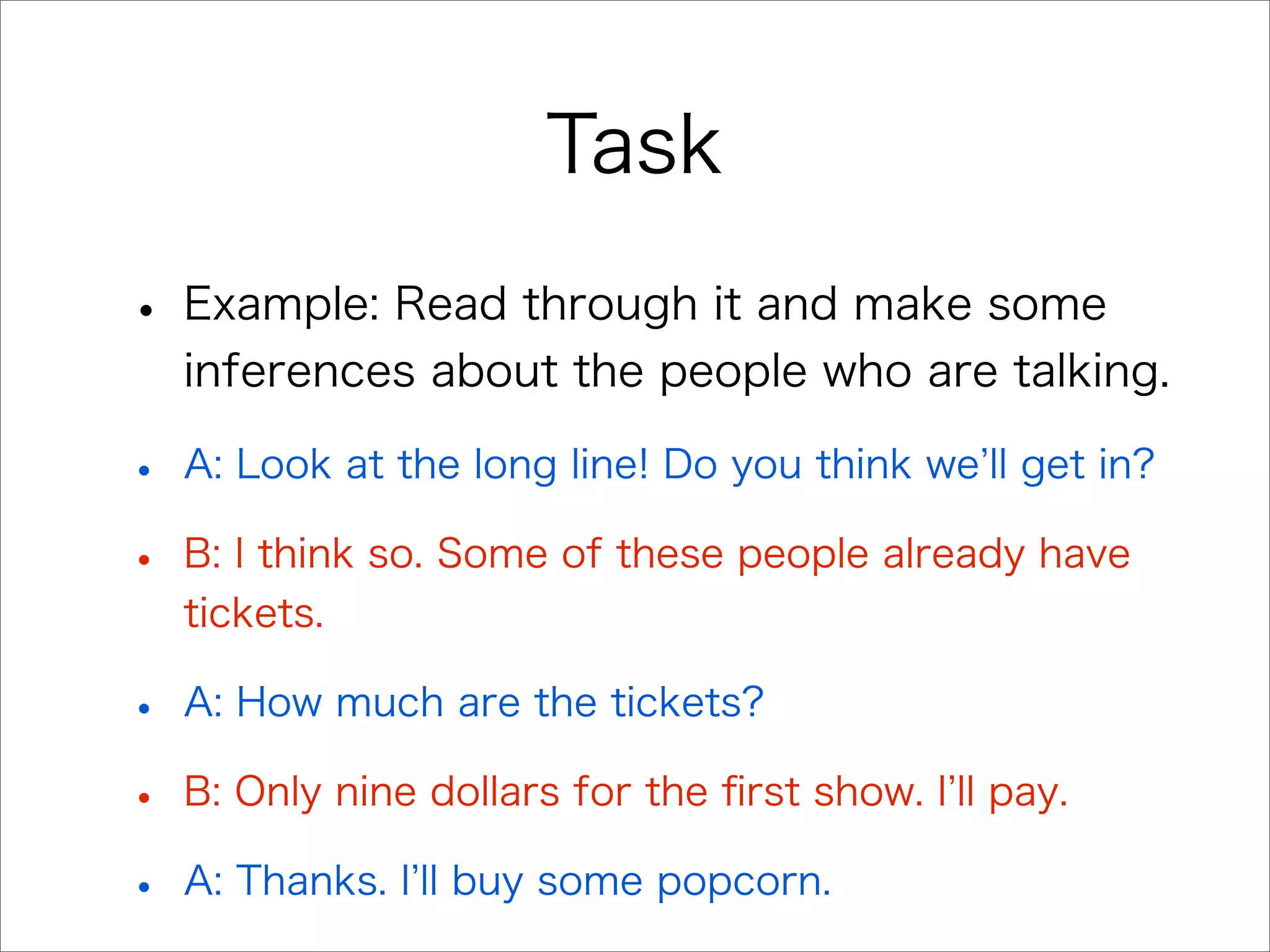
Task
Task
• Example: Read through it and make some
inferences about the people who are talking.
• A: Look at the long line! Do you think we ll get in?
• B: I think so. Some of these people already have
tickets.
• A: How much are the tickets?
• B: Only nine dollars for the first show. I ll pay.
• A: Thanks. I ll buy some popcorn.
Task
• Where are these people?
• In front of a movie theater.
• What are they talking about?
• Going to a movie.
• Which words helped you guess the
topic?
• Line, get in, tickets, show, popcorn
Task
• Work in pairs. Sit down face to face. You can t
show your handout each other.
• Take turns at reading aloud your lines twice.
• You re engaging in a live conversation with
your partner. Do not read in a monotone.
• You can ask your partner to repeat her/his
line, like Sorry, can you say that again?
• Answer the questions on your handout in
collaboration with your partner.
Theories and Issues of SLA
第二言語(習得)観
• 行動主義(behaviorist)的:
• 言語習得は,刺激と反応の結合に基づく習
慣形成
• 行動主義心理学, tabula rasa
• L1とL2の対照分析
• …→The Audio-lingual Method
Theories and Issues of SLA
第二言語(習得)観
• 生得主義(nativist)的 from 生成文法理論
• 習得は普遍文法(UG)+言語経験の相互作用
• 心内の体系としての文法
• 昔々、あるところにおじいさんとおばあさんはいまし
た。おじいさんが山へしば刈りに、おばあさんが…
• 言語獲得に否定的フィードバックは不要
• とうもころし, Nobody don t like me.

Theories and Issues of SLA
第二言語(習得)観
• 認知主義(cognitivist)的:
• 言語習得・発達は,学習者を取り巻く言語
環境と,生得的な認知能力と言語能力の相
互作用(Cf. 認知言語学)
• 言語の本質はコミュニケーション
• 言語の意味・機能
Theories and Issues of SLA
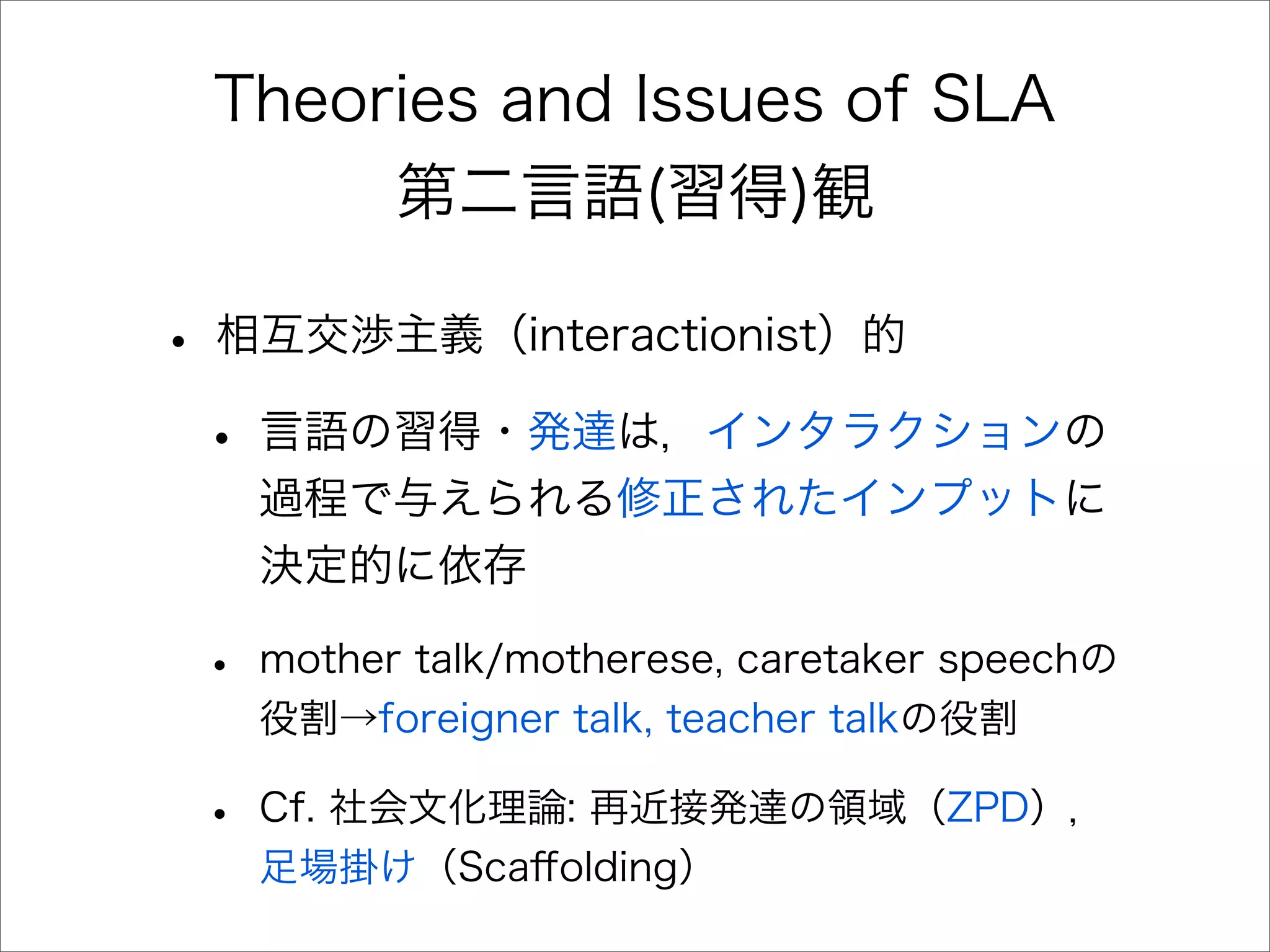
第二言語(習得)観
• 相互交渉主義(interactionist)的
• 言語の習得・発達は,インタラクションの
過程で与えられる修正されたインプットに
決定的に依存
• mother talk/motherese, caretaker speechの
役割→foreigner talk, teacher talkの役割
• Cf. 社会文化理論: 再近接発達の領域(ZPD),
足場掛け(Scaffolding)
第二言語習得研究
誤り分析
• 「誤り」(errors mistakes): 言語習得上不可欠で
避けられないステップで,学習者が目標言語に関す
る仮説を立てていることを証明するもの
• 研究対象としての学習者言語の体系
• 言語内の誤り(目標言語自体の困難点によるも
の)vs. 言語間の誤り(母語の干渉)
• 全体的誤り(global) vs. 局所的(local)誤り
• 誘発された誤り,見える誤り vs. 見えない誤り
(Cf. 回避(avoidance))
第二言語習得研究
中間言語の研究
• 母語とも目標言語とも異なるが,言語としての独自
の完全な体系を持ち,徐々に目標言語の体系に近づ
きつつある言語
• 言語転移: 母語が第二言語に及ぼす影響
• 中SVO→英SVO,日SOV→英SVO
• 眠っている be sleeping/ 持っている be having ???
図(テキスト, p.95,略)
第二言語習得研究
習得順序の研究
• 「学習者の母語の違いや年齢に関わらず,文法形態
素の習得順序は類似する」
• Cf. ①格・語順,②be動詞・進行形,③不規則過
去・所有格・複数,④完了形・過去分詞 (Dulay
& Burt, 1974)
教室内第二言語習得の研究
• 「訂正フィードバック」
noticing
form/meaning
mapping
図(テキスト, p.99, 略)
Assignment
• 担当部分の概要を自分の
経験・意見と絡めて5分程
度で報告できるよう準備
• グローバル時代の英語教育
• 英語検定教科書1-2節
• 英語検定教科書3-4節
• 新しい学びを拓く英語科
Closing small talk

Tefl20130528 6key