CLAIRE: A High-Level
Programming Language
for Complex Algorithms
Yves Caseau & al.
Bouygues - Direction des Technologies Nouvelles
Ecole Normale Supérieure
Y. Caseau

02/09/14

1
Outline
Motivations
CLAIRE (short overview)
Rule-based Programming
Set-based Programming
Conclusions

Y. Caseau

02/09/14

2
Background
Combinatorial Optimization and Constraints
• Competitive advantages and reciprocal benefits of CO and CP
techniques
• How to combine them: Hybrid Algorithms

Systematic Approach
•
•
•
•

Resource Allocation, Matching
Scheduling (job-shop, cumulative)
Routing (TSP, VRP, VRPXX)
Time-Tabling

Produce a Library of Hybrid Algorithm
• Building Blocks for Optimization Applications
• Research & Teaching

Y. Caseau

02/09/14

3
CLAIRE: Specifications
Simple and Readable
• executable pseudo-code (teaching CO algorithms)
• few simple (well-understood) concepts

Multi-paradigm
• Objets , Functions
• Rules
• Versions (search tree exploration)

C++ compatibility, Freeware
•
•
•
•
Y. Caseau

generate C++ objets
efficiency similar to hand-written C++
sources and binaries available
Next release will generate Java
02/09/14

4
CLAIRE at a glance
Object-Oriented functional language with parametric
polymorphism
• mixes compiled and interpreted code, static and dynamic typing

Modeling language (sets, relations, ...)
• high level of abstraction, ease of use

Inference engine for object-based rules
• first-order logic (propagation)

Tools for tree search
• choice points and backtracks

Y. Caseau

02/09/14

5
CLAIRE: Industrial Motivations
Better Productivity
• C++ code generator, DLL production (Windows NT)
• Reduction factor approximately 5

Simplify Maintenance
• more readable means easier to maintain
• high level of abstraction, “concise and elegant” programming

Support Reuse
• Black-box component approach is poorly suited to
combinatorial optimization.
• We build source-code libraries

Y. Caseau

02/09/14

6
Objects
Single inheritance class hierarchy
point <: object(x:integer, y:integer)

Parametric Classes
stack[of] <: thing(of:type, contents:list)

Class hierarchy embedded in a multiple inheritance data
type lattice
(1 .. 10) ⊆ (20 .. 30) ⊆ (1 .. 30) ⊆ integer
stack[of = integer] ⊆ stack[of:subtype[integer]] ⊆ stack ⊆ object
tuple(integer,integer) ⊆ list[integer] ⊆ list[integer ∪ float] ⊆ list

Y. Caseau

02/09/14

7
Polymorphism
Free Overloading (attach method to complex types)
f(x:{0},y:(1 .. 12)) → 1
f(x:(0 .. 10), y:integer) → (x + y)
f(x:integer,y:({1,2} U (7 .. 10)) → (x - y)

optimization through code generation
sum(s:subtype[integer]) : integer
→ let d := 0 in (for x in s d :+ x, d)
sum(1 .. 10) ...
let d := 0, m := 10, x := 1 in
(while (x <= m) (d :+ x, x :+ 1), d)

composition polymorphism
• Takes advantage of rules of type f(g(x)) = h(x)
• Example : det(A * B) = det(A) * det(B)
Y. Caseau

02/09/14

8
Sets and Relations
Set-based Programming
• data types are sets (e.g., extensions)
• easy syntax for set expressions
{x in person | x.age ∈ (0 .. 17)}
{x.father | x in person}
list{salary(x) | x in {x in person | x.department = sales}}

Efficient Parametrization (operation/representation)
Relations are first-class citizens (inverses…)
dist[x:(0 .. 100),y:(0 .. 100)] : integer := 0
comment[c:class] : string := ""

Modeling Abilities
meet[s:set[person]] : date := unknown
course[tuple(person,set[person])] : room := unknown
Y. Caseau

02/09/14

9
Hypothetical Reasoning
Worlds
• world+() creates a choice point
• world-() makes a backtrack
• other derived operations

tree search
• Trailing stack, optimized for depth-first search
solve() : boolean ->
when q := pick() in
exists( c in possible(q) |
branch( (column[q] := c, solve())))
else true
branch(e) :: (

world+(),
( (try e catch contradiction

false) |
Y. Caseau

02/09/14

(world-(), false) ))

10
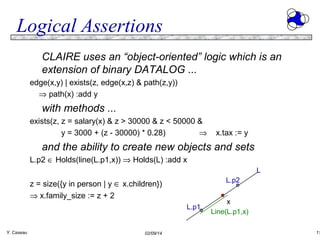
Logical Assertions
CLAIRE uses an “object-oriented” logic which is an
extension of binary DATALOG ...
edge(x,y) | exists(z, edge(x,z) & path(z,y))
⇒ path(x) :add y

with methods ...
exists(z, z = salary(x) & z > 30000 & z < 50000 &
y = 3000 + (z - 30000) * 0.28)
⇒

x.tax := y

and the ability to create new objects and sets
L.p2 ∈ Holds(line(L.p1,x)) ⇒ Holds(L) :add x
L
L.p2

z = size({y in person | y ∈ x.children})
⇒ x.family_size := z + 2
L.p1

Y. Caseau

02/09/14

x
Line(L.p1,x)

11
Rules
Production Rules
rule1(x:person[age:(18 .. 40)]) :: rule(
x.salary < average({y in person | x.department = y.department}
⇒ increase_salary(x) )

Control
•
•
•
•

Rules are triggered by events (updates on slots & arrays)
priorities, inheritance
trigger: once/ exact / many
rule sets and finer control are easy to implement

Queries
• A query is a relation defined by a logical assertion
• naive top-down resolution (no recursion)

Y. Caseau

02/09/14

12
Goodies
Modules
(Fast) Exceptions
Memory Management
Second-Order Types

Y. Caseau

02/09/14

13
Why Compile Rules ?
Performance
• much faster than best RETE-based compiler
• no comparison with RETE-base interpreter

Autonomous objects
• The generated code is purely procedural
• no need for additional engine or data structures
• Ideally suited for Java Beans concept

Dynamic Rules
• Dynamic Libraries
• Consistency-checking at compile-time
• through interpreter (50 times slower)

Y. Caseau

02/09/14

14
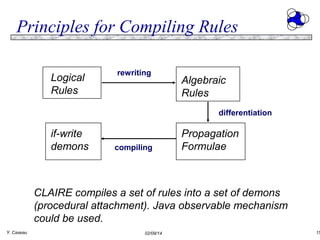
Principles for Compiling Rules
Logical
Rules

rewriting

Algebraic
Rules
differentiation

if-write
demons

compiling

Propagation
Formulae

CLAIRE compiles a set of rules into a set of demons
(procedural attachment). Java observable mechanism
could be used.
Y. Caseau

02/09/14

15
Rules Compilation
Complete compilation
• totally procedural C++ code (no auxiliary data structures)
• Sets/Lists/Vectors handling is thoroughly optimized

Benchmarks
• Standard benchmarks are easy to translate (inverse is not true)
• State-of-the-art results (600K to 3Mips on a P166)
• but no inter-rule optimization is performed

Empirical Results
• 10 to 50% penalty compared with hand-optimized procedural
code
• source code reduction factor from 4 to 30.

Y. Caseau

02/09/14

16
Code Example
The Airline scheduler:
city <: thing(
time_zone:integer = 0,
previous_request:set[request],
starting:set[flight],
arriving:set[flight],
starting_plan:set[travel_plan],
arriving_plan:set[travel_plan] )

7 == (9:(AF401):13, 8:(AF301, LU401):12)
8 == (9:(AF401):13, 8:(AF301, LU401):12)
9 == (9:(AF401):13)
10 == (12:(AF011, BA401):19,
10:(AF311, LU511, LU411):16)
11 == (12:(AF011, BA401):19)
12 == (12:(AF011, BA401):19)

complex_plan(r:request, f:flight) :: rule(
(f.fromc = r.start & f.to != r.arrive &
f.depart >= r.depart & (f.depart + f.time) <= r.end_at )
⇒ let r2 := request!(f.to, r.arrive ,(f.depart + f.time), r.end_at) in
(if not(r2 ∈ f.to.previous_request)
(f.to.previous_request :add r2,
r2.start := f.to,
r2.arrive := r.arrive)) )
Y. Caseau

02/09/14

17
Rules Applications
Crane scheduling application
• Propagation of resource constraint
• Complex propagation patterns
– 1 week to implement 3 rules with methods
• minimal performance degradation

Television Advertising Optimization
• very large bin packing with constraints
• Ad-hoc limited tree search with heuristics
• Rules are used for defining heuristic control parameters
(x.satisfaction < minsat & x.productline = … & y ∈ x.products
& y.satisfaction < (minsat / 2) …) => priority(y) :* 2

Y. Caseau

02/09/14

18
Set-Based Programming
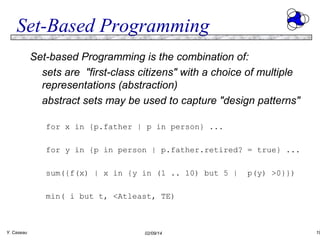
Set-based Programming is the combination of:
sets are "first-class citizens" with a choice of multiple
representations (abstraction)
abstract sets may be used to capture "design patterns"
for x in {p.father | p in person} ...
for y in {p in person | p.father.retired? = true} ...
sum({f(x) | x in {y in (1 .. 10) but 5 |

p(y) >0}})

min( i but t, <Atleast, TE)

Y. Caseau

02/09/14

19
Concrete and Abstract Sets
Concrete Sets
• classes for x in person print(x), size(person)
• sets, lists set(1,2,3,4),
list(Peter, Paul, Mary)
• data structure library (Bitvectors, Hset, ...)

Data Types
• Intervals 1 .. n, "abc" ..
• Union, Intersection array U
• Parameterized Types

"abd"
property, list ^ subytpe[char]

for x in person[age:(15 .. 18)] print(x)

Set Expressions
• image
{age(x) | x in person}, list{i + 1 | i in (1 .. 10)}

• selection
{x in person | x.age > 0}, list{i in (1 .. n) | f(i) > 0}
Y. Caseau

02/09/14

20
Extensibility
Classes
• extending the data structure library
Hset[of] <: set_class(of:type,content:list,index:integer)
add(s:Hset[X], y:X) : void
-> let i := hash(s.content,y) in ....
set!(s:Hset) -> {x in s.content | known?(x)}

Patterns
• a pattern is a function call that is dealt with lazily
but(x:abstract_set,y:any) : set -> {z in x | z != y}
%(x:any, y:but[tuple(abstract_set,any)])
=> (x % y.args[1] & x != y.args(2))
Y. Caseau

02/09/14

21
Explicit Iteration
Lazy evaluation directed by set type
for x in person print(x)
for y in (1 .. n) f(y)

Optimization through source code generation
for c in person.descendent
for x in c.instances print(x)
let y := 1 in
(while (y <= n) (f(y), y :+ 1))

Iteration mechanism is extensible
iterate(x:Hset,v:Variable,e:any)
=> for v in x.content (if known?(v) e)
iterate(x:but[tuple(abstract_set,any)],v:Variable,e:any)
=> for v in x.args[1] (if (v != x.args[2]) e)

Y. Caseau

02/09/14

22
Implicit Iteration
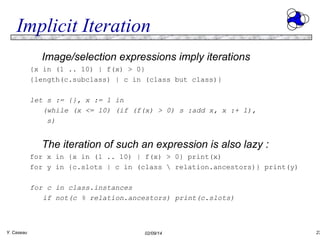
Image/selection expressions imply iterations
{x in (1 .. 10) | f(x) > 0}
{length(c.subclass) | c in (class but class)}
let s := {}, x := 1 in
(while (x <= 10) (if (f(x) > 0) s :add x, x :+ 1),
s)

The iteration of such an expression is also lazy :
for x in {x in (1 .. 10) | f(x) > 0} print(x)
for y in {c.slots | c in (class  relation.ancestors)} print(y)
for c in class.instances
if not(c % relation.ancestors) print(c.slots)

Y. Caseau

02/09/14

23
Abstraction: A Tradeoff
CLAIRE supports true abstraction:
• One may substitute a representation by another and not have to
change a line of code
• On the other hand, re-compiling is necessary

CLAIRE supports efficient generic methods
sum(s:subtype[integer]) : integer
=> let d := 0 in (for x in s d :+ x, d)
count(s:subtype[integer]) : integer
=> let d := 0 in (for x in s d :+ 1, d)
min(s:abstract_set,p:property,default:any) ....
Y. Caseau

02/09/14

24
Application: Embedded Linked List
Embedding (using slots) is more efficient
Task <: object( ....
next:Task, prev:Task, ....)

Patterns may represent « virtual linked lists »
chain(x:Task) : list[Task]
-> let l := list(x), in
(while known?(next,x) (x := x.next, l :add x),
l)
insert(x:Task,y:list[Task]) => ...
iterate(x:chain[tuple(Task)],v:Variable,e:any) => …

These lists may be used as usual :
count(chain(t1)), sum({x.weight | x in chain(t0)}), ...
Y. Caseau

02/09/14

25
Feature Combination
iterate(s:Interval, v:Variable, e:any)
=> for v in s.use.users (if SET(v)[v.index] e)
<atleast(x:Task, y:Task) => (x.atleast <= y.atleast)
min(s:any, f:property, default:any) : any
=> let x := default in
(for y in s (if f(x,y) x := y),

// the task with the smallest earliest start
min(i but t, <atleast, TEnd)

x)

date in i, different from t

let x := TEnd in
(for y in i.use.users
(if SET(i)[y.index]

Y. Caseau

(if (y != t)
x)

(if (y.atleast <= x.atleast) x := y))),
02/09/14

26
Structure Iterators
Combining iterators and patterns is useful to iterate
more complex data structures such as trees :
Tree <: object(value:any,right:Tree,left:Tree)
TreeIterator <: object(tosee:list, status:boolean)
iterate(x:by[tuple(Tree,TreeIterator)], v:Variable, e:any)
=> let v := start(x.args[2], x.args[1]) in
while (v != unknown)
(e, v := next(x.args[2], x.args[1])
TreeIteratorDFS <: TreeIterator()
start(x:TreeIteratorDFS, y:Tree) -> ...
next(x:TreeIteratorDFS, y:Tree) -> ...
DFS :: TreeIteratorDFS()
TreeIteratorBFS <: TreeIterator() ...
for x in (myTree by DFS) print(x)
{y.weight | y in (myTree by BFS)}
Y. Caseau

02/09/14

27
A Real-Life Example (I)
// builds a maximum weight complete matching

match()
-> (...,
// initialization
while (HN != N) (if not(grow()) dual_change()))
// a step repeats until the forest is hungarian (return value is false)
// or the matching is improved (return value is true)
// explore is the stack of even nodes that have net been explored yet

grow() : boolean
-> let i := pop(explore) in
( exists( j in {j in GpiSet(i,LastExplored[i] + 1,LastValid[i]) | not(odd?[j])} |
(if (sol-[j] != 0)
(//[SPEAK] grow: add (~S,~S) to forest// i,j,
odd?[j] := true, pushEven+(sol-[j]), tree[j] := i, false)
else (augment(i,j), true))) |
(if (explore[0] != 0) grow()) )

Y. Caseau

02/09/14

28
Hungarian Algorithm (II)
// change the dual feasible solution, throw a contradiction if there are no perfect matching

dual_change() : integer
-> let e := Min( list{vclose[i] | i in {j in Dom | not(odd?[j])}}) in
(//[SPEAK] DUAL CHANGE: we pick epsilon = ~S // e,
if (e = NMAX) contradiction!(),
for k in stack(even) (pi+[k] :+ e, LastExplored[k] := LastValid[k]),
for j in {j in Dom | odd?[j]} (pi-[j] :- e, vclose[j] := NMAX)),
clear(explore),
for i in stack(even)
let l := Gpi[i], k := size(l), toExplore := false in
(while (LastValid[i] < k) (k, toExplore) := reduceStep(i,j,l,k,toexplore),
if toExplore push(explore,i)))
// look at edges outside the valid set one at a time

reduceStep(i:Dom,j:Dom,l:list,k:integer,toExplore:boolean) : tuple(integer,boolean)
-> let j := l[k], c := Cpi(i,j) in
(if (c = 0) (//[SPEAK] dual_change: Add edge ~S,~S // i,j,
Gpiadd(l,i,j,k), toexplore := true)
else (vclose[j] :min c, k :- 1)),
list(k,toexplore))
Y. Caseau

02/09/14

29
CLAIRE Strategy
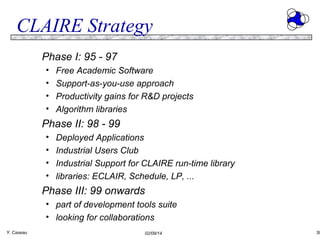
Phase I: 95 - 97
•
•
•
•

Free Academic Software
Support-as-you-use approach
Productivity gains for R&D projects
Algorithm libraries

Phase II: 98 - 99
•
•
•
•

Deployed Applications
Industrial Users Club
Industrial Support for CLAIRE run-time library
libraries: ECLAIR, Schedule, LP, ...

Phase III: 99 onwards
• part of development tools suite
• looking for collaborations
Y. Caseau

02/09/14

30
Conclusion
CLAIRE is a powerful tool for processing business rules:
• State-of-the-art inference engine
• Expressive Power

CLAIRE is a good tool to implement complex algorithms
for decision aid
• multi-paradigm
• high level of abstraction
• readability

CLAIRE is available
• compiler, interpreter, tools for tracing and debugging
• UNIX and Windows NT: http://www.ens.fr/~laburthe/claire.html
• complete system: (20000 lines), compiler (executable ) 1.5 Mb
– run-time: 5000 lines of code (100K) [Java: 1000 lines]
Y. Caseau

02/09/14

31
Industrial Applications
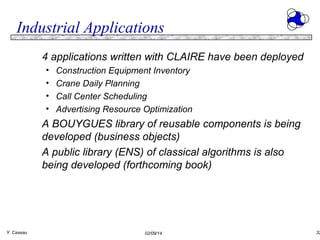
4 applications written with CLAIRE have been deployed
•
•
•
•

Construction Equipment Inventory
Crane Daily Planning
Call Center Scheduling
Advertising Resource Optimization

A BOUYGUES library of reusable components is being
developed (business objects)
A public library (ENS) of classical algorithms is also
being developed (forthcoming book)

Y. Caseau

02/09/14

32
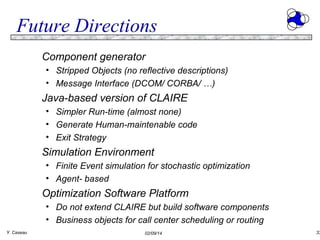
Future Directions
Component generator
• Stripped Objects (no reflective descriptions)
• Message Interface (DCOM/ CORBA/ …)

Java-based version of CLAIRE
• Simpler Run-time (almost none)
• Generate Human-maintenable code
• Exit Strategy

Simulation Environment
• Finite Event simulation for stochastic optimization
• Agent- based

Optimization Software Platform
• Do not extend CLAIRE but build software components
• Business objects for call center scheduling or routing
Y. Caseau

02/09/14

33
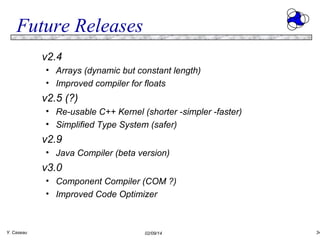
Future Releases
v2.4
• Arrays (dynamic but constant length)
• Improved compiler for floats

v2.5 (?)
• Re-usable C++ Kernel (shorter -simpler -faster)
• Simplified Type System (safer)

v2.9
• Java Compiler (beta version)

v3.0
• Component Compiler (COM ?)
• Improved Code Optimizer

Y. Caseau

02/09/14

34
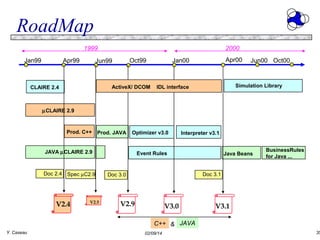
RoadMap
1999
Jan99

Apr99

2000
Oct99

Jun99

ActiveX/ DCOM

CLAIRE 2.4

Apr00

Jan00

Jun00 Oct00

Simulation Library

IDL interface

µCLAIRE 2.9

Prod. C++ Prod. JAVA

Optimizer v3.0

JAVA µCLAIRE 2.9

Doc 2.4 Spec µC2.9

V2.4

V2.5

Interpreter v3.1

Event Rules

Java Beans

BusinessRules
for Java ...

Doc 3.1

Doc 3.0

V2.9

V3.0

V3.1

C++ & JAVA
Y. Caseau

02/09/14

35
µCLAIRE: what’s up ?
C++ Kernel
– C++ Namespaces
– C++ class components
– Separated Reflective Description

Type System
• Integer Intervals Only
• list[t] replaced by list (LISP) and list<t> (C++, C<t> = C[of = t])
– lists as objects vs. lists as values
– safer (uniform for lists, sets and arrays)

Optimization
• Native Floats
• Uniform C++ Object implementation (but integers)
– simpler debugging
– faster generic methods
– easier maintenance (takes more from C++: e.g., streams)
Y. Caseau

02/09/14

36

Claire98

  • 1.
    CLAIRE: A High-Level ProgrammingLanguage for Complex Algorithms Yves Caseau & al. Bouygues - Direction des Technologies Nouvelles Ecole Normale Supérieure Y. Caseau 02/09/14 1
  • 2.
    Outline Motivations CLAIRE (short overview) Rule-basedProgramming Set-based Programming Conclusions Y. Caseau 02/09/14 2
  • 3.
    Background Combinatorial Optimization andConstraints • Competitive advantages and reciprocal benefits of CO and CP techniques • How to combine them: Hybrid Algorithms Systematic Approach • • • • Resource Allocation, Matching Scheduling (job-shop, cumulative) Routing (TSP, VRP, VRPXX) Time-Tabling Produce a Library of Hybrid Algorithm • Building Blocks for Optimization Applications • Research & Teaching Y. Caseau 02/09/14 3
  • 4.
    CLAIRE: Specifications Simple andReadable • executable pseudo-code (teaching CO algorithms) • few simple (well-understood) concepts Multi-paradigm • Objets , Functions • Rules • Versions (search tree exploration) C++ compatibility, Freeware • • • • Y. Caseau generate C++ objets efficiency similar to hand-written C++ sources and binaries available Next release will generate Java 02/09/14 4
  • 5.
    CLAIRE at aglance Object-Oriented functional language with parametric polymorphism • mixes compiled and interpreted code, static and dynamic typing Modeling language (sets, relations, ...) • high level of abstraction, ease of use Inference engine for object-based rules • first-order logic (propagation) Tools for tree search • choice points and backtracks Y. Caseau 02/09/14 5
  • 6.
    CLAIRE: Industrial Motivations BetterProductivity • C++ code generator, DLL production (Windows NT) • Reduction factor approximately 5 Simplify Maintenance • more readable means easier to maintain • high level of abstraction, “concise and elegant” programming Support Reuse • Black-box component approach is poorly suited to combinatorial optimization. • We build source-code libraries Y. Caseau 02/09/14 6
  • 7.
    Objects Single inheritance classhierarchy point <: object(x:integer, y:integer) Parametric Classes stack[of] <: thing(of:type, contents:list) Class hierarchy embedded in a multiple inheritance data type lattice (1 .. 10) ⊆ (20 .. 30) ⊆ (1 .. 30) ⊆ integer stack[of = integer] ⊆ stack[of:subtype[integer]] ⊆ stack ⊆ object tuple(integer,integer) ⊆ list[integer] ⊆ list[integer ∪ float] ⊆ list Y. Caseau 02/09/14 7
  • 8.
    Polymorphism Free Overloading (attachmethod to complex types) f(x:{0},y:(1 .. 12)) → 1 f(x:(0 .. 10), y:integer) → (x + y) f(x:integer,y:({1,2} U (7 .. 10)) → (x - y) optimization through code generation sum(s:subtype[integer]) : integer → let d := 0 in (for x in s d :+ x, d) sum(1 .. 10) ... let d := 0, m := 10, x := 1 in (while (x <= m) (d :+ x, x :+ 1), d) composition polymorphism • Takes advantage of rules of type f(g(x)) = h(x) • Example : det(A * B) = det(A) * det(B) Y. Caseau 02/09/14 8
  • 9.
    Sets and Relations Set-basedProgramming • data types are sets (e.g., extensions) • easy syntax for set expressions {x in person | x.age ∈ (0 .. 17)} {x.father | x in person} list{salary(x) | x in {x in person | x.department = sales}} Efficient Parametrization (operation/representation) Relations are first-class citizens (inverses…) dist[x:(0 .. 100),y:(0 .. 100)] : integer := 0 comment[c:class] : string := "" Modeling Abilities meet[s:set[person]] : date := unknown course[tuple(person,set[person])] : room := unknown Y. Caseau 02/09/14 9
  • 10.
    Hypothetical Reasoning Worlds • world+()creates a choice point • world-() makes a backtrack • other derived operations tree search • Trailing stack, optimized for depth-first search solve() : boolean -> when q := pick() in exists( c in possible(q) | branch( (column[q] := c, solve()))) else true branch(e) :: ( world+(), ( (try e catch contradiction false) | Y. Caseau 02/09/14 (world-(), false) )) 10
  • 11.
    Logical Assertions CLAIRE usesan “object-oriented” logic which is an extension of binary DATALOG ... edge(x,y) | exists(z, edge(x,z) & path(z,y)) ⇒ path(x) :add y with methods ... exists(z, z = salary(x) & z > 30000 & z < 50000 & y = 3000 + (z - 30000) * 0.28) ⇒ x.tax := y and the ability to create new objects and sets L.p2 ∈ Holds(line(L.p1,x)) ⇒ Holds(L) :add x L L.p2 z = size({y in person | y ∈ x.children}) ⇒ x.family_size := z + 2 L.p1 Y. Caseau 02/09/14 x Line(L.p1,x) 11
  • 12.
    Rules Production Rules rule1(x:person[age:(18 ..40)]) :: rule( x.salary < average({y in person | x.department = y.department} ⇒ increase_salary(x) ) Control • • • • Rules are triggered by events (updates on slots & arrays) priorities, inheritance trigger: once/ exact / many rule sets and finer control are easy to implement Queries • A query is a relation defined by a logical assertion • naive top-down resolution (no recursion) Y. Caseau 02/09/14 12
  • 13.
  • 14.
    Why Compile Rules? Performance • much faster than best RETE-based compiler • no comparison with RETE-base interpreter Autonomous objects • The generated code is purely procedural • no need for additional engine or data structures • Ideally suited for Java Beans concept Dynamic Rules • Dynamic Libraries • Consistency-checking at compile-time • through interpreter (50 times slower) Y. Caseau 02/09/14 14
  • 15.
    Principles for CompilingRules Logical Rules rewriting Algebraic Rules differentiation if-write demons compiling Propagation Formulae CLAIRE compiles a set of rules into a set of demons (procedural attachment). Java observable mechanism could be used. Y. Caseau 02/09/14 15
  • 16.
    Rules Compilation Complete compilation •totally procedural C++ code (no auxiliary data structures) • Sets/Lists/Vectors handling is thoroughly optimized Benchmarks • Standard benchmarks are easy to translate (inverse is not true) • State-of-the-art results (600K to 3Mips on a P166) • but no inter-rule optimization is performed Empirical Results • 10 to 50% penalty compared with hand-optimized procedural code • source code reduction factor from 4 to 30. Y. Caseau 02/09/14 16
  • 17.
    Code Example The Airlinescheduler: city <: thing( time_zone:integer = 0, previous_request:set[request], starting:set[flight], arriving:set[flight], starting_plan:set[travel_plan], arriving_plan:set[travel_plan] ) 7 == (9:(AF401):13, 8:(AF301, LU401):12) 8 == (9:(AF401):13, 8:(AF301, LU401):12) 9 == (9:(AF401):13) 10 == (12:(AF011, BA401):19, 10:(AF311, LU511, LU411):16) 11 == (12:(AF011, BA401):19) 12 == (12:(AF011, BA401):19) complex_plan(r:request, f:flight) :: rule( (f.fromc = r.start & f.to != r.arrive & f.depart >= r.depart & (f.depart + f.time) <= r.end_at ) ⇒ let r2 := request!(f.to, r.arrive ,(f.depart + f.time), r.end_at) in (if not(r2 ∈ f.to.previous_request) (f.to.previous_request :add r2, r2.start := f.to, r2.arrive := r.arrive)) ) Y. Caseau 02/09/14 17
  • 18.
    Rules Applications Crane schedulingapplication • Propagation of resource constraint • Complex propagation patterns – 1 week to implement 3 rules with methods • minimal performance degradation Television Advertising Optimization • very large bin packing with constraints • Ad-hoc limited tree search with heuristics • Rules are used for defining heuristic control parameters (x.satisfaction < minsat & x.productline = … & y ∈ x.products & y.satisfaction < (minsat / 2) …) => priority(y) :* 2 Y. Caseau 02/09/14 18
  • 19.
    Set-Based Programming Set-based Programmingis the combination of: sets are "first-class citizens" with a choice of multiple representations (abstraction) abstract sets may be used to capture "design patterns" for x in {p.father | p in person} ... for y in {p in person | p.father.retired? = true} ... sum({f(x) | x in {y in (1 .. 10) but 5 | p(y) >0}}) min( i but t, <Atleast, TE) Y. Caseau 02/09/14 19
  • 20.
    Concrete and AbstractSets Concrete Sets • classes for x in person print(x), size(person) • sets, lists set(1,2,3,4), list(Peter, Paul, Mary) • data structure library (Bitvectors, Hset, ...) Data Types • Intervals 1 .. n, "abc" .. • Union, Intersection array U • Parameterized Types "abd" property, list ^ subytpe[char] for x in person[age:(15 .. 18)] print(x) Set Expressions • image {age(x) | x in person}, list{i + 1 | i in (1 .. 10)} • selection {x in person | x.age > 0}, list{i in (1 .. n) | f(i) > 0} Y. Caseau 02/09/14 20
  • 21.
    Extensibility Classes • extending thedata structure library Hset[of] <: set_class(of:type,content:list,index:integer) add(s:Hset[X], y:X) : void -> let i := hash(s.content,y) in .... set!(s:Hset) -> {x in s.content | known?(x)} Patterns • a pattern is a function call that is dealt with lazily but(x:abstract_set,y:any) : set -> {z in x | z != y} %(x:any, y:but[tuple(abstract_set,any)]) => (x % y.args[1] & x != y.args(2)) Y. Caseau 02/09/14 21
  • 22.
    Explicit Iteration Lazy evaluationdirected by set type for x in person print(x) for y in (1 .. n) f(y) Optimization through source code generation for c in person.descendent for x in c.instances print(x) let y := 1 in (while (y <= n) (f(y), y :+ 1)) Iteration mechanism is extensible iterate(x:Hset,v:Variable,e:any) => for v in x.content (if known?(v) e) iterate(x:but[tuple(abstract_set,any)],v:Variable,e:any) => for v in x.args[1] (if (v != x.args[2]) e) Y. Caseau 02/09/14 22
  • 23.
    Implicit Iteration Image/selection expressionsimply iterations {x in (1 .. 10) | f(x) > 0} {length(c.subclass) | c in (class but class)} let s := {}, x := 1 in (while (x <= 10) (if (f(x) > 0) s :add x, x :+ 1), s) The iteration of such an expression is also lazy : for x in {x in (1 .. 10) | f(x) > 0} print(x) for y in {c.slots | c in (class relation.ancestors)} print(y) for c in class.instances if not(c % relation.ancestors) print(c.slots) Y. Caseau 02/09/14 23
  • 24.
    Abstraction: A Tradeoff CLAIREsupports true abstraction: • One may substitute a representation by another and not have to change a line of code • On the other hand, re-compiling is necessary CLAIRE supports efficient generic methods sum(s:subtype[integer]) : integer => let d := 0 in (for x in s d :+ x, d) count(s:subtype[integer]) : integer => let d := 0 in (for x in s d :+ 1, d) min(s:abstract_set,p:property,default:any) .... Y. Caseau 02/09/14 24
  • 25.
    Application: Embedded LinkedList Embedding (using slots) is more efficient Task <: object( .... next:Task, prev:Task, ....) Patterns may represent « virtual linked lists » chain(x:Task) : list[Task] -> let l := list(x), in (while known?(next,x) (x := x.next, l :add x), l) insert(x:Task,y:list[Task]) => ... iterate(x:chain[tuple(Task)],v:Variable,e:any) => … These lists may be used as usual : count(chain(t1)), sum({x.weight | x in chain(t0)}), ... Y. Caseau 02/09/14 25
  • 26.
    Feature Combination iterate(s:Interval, v:Variable,e:any) => for v in s.use.users (if SET(v)[v.index] e) <atleast(x:Task, y:Task) => (x.atleast <= y.atleast) min(s:any, f:property, default:any) : any => let x := default in (for y in s (if f(x,y) x := y), // the task with the smallest earliest start min(i but t, <atleast, TEnd) x) date in i, different from t let x := TEnd in (for y in i.use.users (if SET(i)[y.index] Y. Caseau (if (y != t) x) (if (y.atleast <= x.atleast) x := y))), 02/09/14 26
  • 27.
    Structure Iterators Combining iteratorsand patterns is useful to iterate more complex data structures such as trees : Tree <: object(value:any,right:Tree,left:Tree) TreeIterator <: object(tosee:list, status:boolean) iterate(x:by[tuple(Tree,TreeIterator)], v:Variable, e:any) => let v := start(x.args[2], x.args[1]) in while (v != unknown) (e, v := next(x.args[2], x.args[1]) TreeIteratorDFS <: TreeIterator() start(x:TreeIteratorDFS, y:Tree) -> ... next(x:TreeIteratorDFS, y:Tree) -> ... DFS :: TreeIteratorDFS() TreeIteratorBFS <: TreeIterator() ... for x in (myTree by DFS) print(x) {y.weight | y in (myTree by BFS)} Y. Caseau 02/09/14 27
  • 28.
    A Real-Life Example(I) // builds a maximum weight complete matching match() -> (..., // initialization while (HN != N) (if not(grow()) dual_change())) // a step repeats until the forest is hungarian (return value is false) // or the matching is improved (return value is true) // explore is the stack of even nodes that have net been explored yet grow() : boolean -> let i := pop(explore) in ( exists( j in {j in GpiSet(i,LastExplored[i] + 1,LastValid[i]) | not(odd?[j])} | (if (sol-[j] != 0) (//[SPEAK] grow: add (~S,~S) to forest// i,j, odd?[j] := true, pushEven+(sol-[j]), tree[j] := i, false) else (augment(i,j), true))) | (if (explore[0] != 0) grow()) ) Y. Caseau 02/09/14 28
  • 29.
    Hungarian Algorithm (II) //change the dual feasible solution, throw a contradiction if there are no perfect matching dual_change() : integer -> let e := Min( list{vclose[i] | i in {j in Dom | not(odd?[j])}}) in (//[SPEAK] DUAL CHANGE: we pick epsilon = ~S // e, if (e = NMAX) contradiction!(), for k in stack(even) (pi+[k] :+ e, LastExplored[k] := LastValid[k]), for j in {j in Dom | odd?[j]} (pi-[j] :- e, vclose[j] := NMAX)), clear(explore), for i in stack(even) let l := Gpi[i], k := size(l), toExplore := false in (while (LastValid[i] < k) (k, toExplore) := reduceStep(i,j,l,k,toexplore), if toExplore push(explore,i))) // look at edges outside the valid set one at a time reduceStep(i:Dom,j:Dom,l:list,k:integer,toExplore:boolean) : tuple(integer,boolean) -> let j := l[k], c := Cpi(i,j) in (if (c = 0) (//[SPEAK] dual_change: Add edge ~S,~S // i,j, Gpiadd(l,i,j,k), toexplore := true) else (vclose[j] :min c, k :- 1)), list(k,toexplore)) Y. Caseau 02/09/14 29
  • 30.
    CLAIRE Strategy Phase I:95 - 97 • • • • Free Academic Software Support-as-you-use approach Productivity gains for R&D projects Algorithm libraries Phase II: 98 - 99 • • • • Deployed Applications Industrial Users Club Industrial Support for CLAIRE run-time library libraries: ECLAIR, Schedule, LP, ... Phase III: 99 onwards • part of development tools suite • looking for collaborations Y. Caseau 02/09/14 30
  • 31.
    Conclusion CLAIRE is apowerful tool for processing business rules: • State-of-the-art inference engine • Expressive Power CLAIRE is a good tool to implement complex algorithms for decision aid • multi-paradigm • high level of abstraction • readability CLAIRE is available • compiler, interpreter, tools for tracing and debugging • UNIX and Windows NT: http://www.ens.fr/~laburthe/claire.html • complete system: (20000 lines), compiler (executable ) 1.5 Mb – run-time: 5000 lines of code (100K) [Java: 1000 lines] Y. Caseau 02/09/14 31
  • 32.
    Industrial Applications 4 applicationswritten with CLAIRE have been deployed • • • • Construction Equipment Inventory Crane Daily Planning Call Center Scheduling Advertising Resource Optimization A BOUYGUES library of reusable components is being developed (business objects) A public library (ENS) of classical algorithms is also being developed (forthcoming book) Y. Caseau 02/09/14 32
  • 33.
    Future Directions Component generator •Stripped Objects (no reflective descriptions) • Message Interface (DCOM/ CORBA/ …) Java-based version of CLAIRE • Simpler Run-time (almost none) • Generate Human-maintenable code • Exit Strategy Simulation Environment • Finite Event simulation for stochastic optimization • Agent- based Optimization Software Platform • Do not extend CLAIRE but build software components • Business objects for call center scheduling or routing Y. Caseau 02/09/14 33
  • 34.
    Future Releases v2.4 • Arrays(dynamic but constant length) • Improved compiler for floats v2.5 (?) • Re-usable C++ Kernel (shorter -simpler -faster) • Simplified Type System (safer) v2.9 • Java Compiler (beta version) v3.0 • Component Compiler (COM ?) • Improved Code Optimizer Y. Caseau 02/09/14 34
  • 35.
    RoadMap 1999 Jan99 Apr99 2000 Oct99 Jun99 ActiveX/ DCOM CLAIRE 2.4 Apr00 Jan00 Jun00Oct00 Simulation Library IDL interface µCLAIRE 2.9 Prod. C++ Prod. JAVA Optimizer v3.0 JAVA µCLAIRE 2.9 Doc 2.4 Spec µC2.9 V2.4 V2.5 Interpreter v3.1 Event Rules Java Beans BusinessRules for Java ... Doc 3.1 Doc 3.0 V2.9 V3.0 V3.1 C++ & JAVA Y. Caseau 02/09/14 35
  • 36.
    µCLAIRE: what’s up? C++ Kernel – C++ Namespaces – C++ class components – Separated Reflective Description Type System • Integer Intervals Only • list[t] replaced by list (LISP) and list<t> (C++, C<t> = C[of = t]) – lists as objects vs. lists as values – safer (uniform for lists, sets and arrays) Optimization • Native Floats • Uniform C++ Object implementation (but integers) – simpler debugging – faster generic methods – easier maintenance (takes more from C++: e.g., streams) Y. Caseau 02/09/14 36