Ben-Gurion University of the Negev 
Faculty of Natural Science 
Department of Computer Science 
Principles of Programming Languages 
Mira Balaban 
Lecture Notes 
June 11, 2014 
Many thanks to Tamar Pinhas, Azzam Maraee, Ami Hauptman, Eran Tomer, Barak 
Bar-Orion, Yaron Gonen, Ehud Barnea, Rotem Mairon and Igal Khitron for their 
great help in preparing these notes and the associated code.
Contents 
Introduction 1 
1 Functional Programming I – The Elements of Programming 4 
1.1 The Elements of Programming . . . . . . . . . . . . . . . . . . . . . . . . . . 5 
1.1.1 Expressions (SICP 1.1.1 ) . . . . . . . . . . . . . . . . . . . . . . . . . 5 
1.1.2 Abstraction and Reference: Variables and Values (SICP 1.1.2 ) . . . . 7 
1.1.3 Evaluation of Scheme Forms (SICP 1.1.3) . . . . . . . . . . . . . . . . 8 
1.1.4 User Defined Procedures (compound procedures) . . . . . . . . . . . . 10 
1.1.5 Conditional Expressions (SICP 1.1.6) . . . . . . . . . . . . . . . . . . . 14 
1.2 Types in Scheme . . . . . . . . . . . . . . . . . . . . . . . . . . . . . . . . . . 16 
1.2.1 Atomic Types . . . . . . . . . . . . . . . . . . . . . . . . . . . . . . . . 17 
1.2.2 Composite Types . . . . . . . . . . . . . . . . . . . . . . . . . . . . . . 20 
1.3 Program Design Using Contracts . . . . . . . . . . . . . . . . . . . . . . . . . 24 
1.3.1 The Design by Contract (DBC) approach: . . . . . . . . . . . . . . . . 25 
1.4 Procedures and the Processes they Generate (SICP 1.2) . . . . . . . . . . . . 27 
1.4.1 Linear Recursion and Iteration (SICP 1.2.1 ) . . . . . . . . . . . . . . 28 
1.4.2 Tree Recursion (SICP 1.2.2) . . . . . . . . . . . . . . . . . . . . . . . . 34 
1.4.3 Orders of Growth (SICP 1.2.3) . . . . . . . . . . . . . . . . . . . . . . 36 
1.5 High Order Procedures . . . . . . . . . . . . . . . . . . . . . . . . . . . . . . . 41 
1.5.1 Procedures as Parameters (SICP 1.3.1) . . . . . . . . . . . . . . . . . . 41 
1.5.2 Constructing procedure arguments at run-time . . . . . . . . . . . . . 46 
1.5.3 Defining Local Variables – Using the let Abbreviation . . . . . . . . . 47 
1.5.4 Procedures as Returned Values (SICP 1.3.4) . . . . . . . . . . . . . . . 51 
1.5.5 Procedures that Store Delayed (Future) Computations . . . . . . . . . 56 
2 Functional Programming II – Syntax, Semantics and Types 61 
2.1 Syntax: Concrete and Abstract . . . . . . . . . . . . . . . . . . . . . . . . . . 61 
2.1.1 Concrete Syntax: . . . . . . . . . . . . . . . . . . . . . . . . . . . . . . 62 
2.1.2 Abstract Syntax . . . . . . . . . . . . . . . . . . . . . . . . . . . . . . 64 
2.2 Operational Semantics: The Substitution Model . . . . . . . . . . . . . . . . . 66 
II
Contents Principles of Programming Languages 
2.2.1 The Substitution Model – Applicative Order Evaluation: . . . . . . . . 70 
2.2.2 The Substitution Model – Normal Order Evaluation: . . . . . . . . . . 76 
2.2.3 Comparison: The applicative order and the normal order of evaluations: 78 
2.2.4 High Order Functions Revisited . . . . . . . . . . . . . . . . . . . . . . 79 
2.2.5 Function Currying . . . . . . . . . . . . . . . . . . . . . . . . . . . . . 86 
2.2.6 Revisiting: Primitive procedures, User-defined procedures, Derived 
expressions (Syntactic sugar), Special operators . . . . . . . . . . . . . 90 
2.2.7 Formalizing tail recursion – analysis of expressions that create iterative 
processes . . . . . . . . . . . . . . . . . . . . . . . . . . . . . . . . . . 94 
2.3 Type Correctness . . . . . . . . . . . . . . . . . . . . . . . . . . . . . . . . . 95 
2.3.1 What is Type Checking/Inference? . . . . . . . . . . . . . . . . . . . . 96 
2.3.2 The Type Language of Scheme . . . . . . . . . . . . . . . . . . . . . . 98 
2.3.3 Static Type Inference for Scheme . . . . . . . . . . . . . . . . . . . . . 102 
3 Functional Programming III - Abstraction on Data and on Control 129 
3.1 Compound Data: The Pair and List Types . . . . . . . . . . . . . . . . . . . . 130 
3.1.1 The Pair Type . . . . . . . . . . . . . . . . . . . . . . . . . . . . . . . 130 
3.1.2 The List Type (SICP 2.2.1) . . . . . . . . . . . . . . . . . . . . . . . . 135 
3.1.3 Type Correctness with the Pair and List Types . . . . . . . . . . . . . 144 
3.2 Data Abstraction: Abstract Data Types . . . . . . . . . . . . . . . . . . . . . 147 
3.2.1 Example: Binary Trees – Management of Hierarchical Information . . 148 
3.2.2 Example: Rational Number Arithmetic (SICP 2.1.1) . . . . . . . . . . 158 
3.2.3 What is Meant by Data? (SICP 2.1.3) . . . . . . . . . . . . . . . . . . 167 
3.2.4 The Sequence Interface (includes examples from SICP 2.2.3) . . . . . . 173 
3.3 Lazy Lists (ML Sequences, Scheme Streams) . . . . . . . . . . . . . . . . . . . 185 
3.3.1 The Lazy List (ML Sequence, Scheme Stream) Abstract Data Type . . 188 
3.3.2 Integer lazy lists . . . . . . . . . . . . . . . . . . . . . . . . . . . . . . 191 
3.3.3 Elementary Lazy List Processing . . . . . . . . . . . . . . . . . . . . . 192 
3.3.4 High Order Lazy-List Functions . . . . . . . . . . . . . . . . . . . . . . 194 
3.4 Continuation Passing Style (CPS) Programming . . . . . . . . . . . . . . . . 197 
3.4.1 Recursive to Iterative CPS Transformations . . . . . . . . . . . . . . . 199 
3.4.2 Controlling Multiple Alternative Future Computations: Errors (Ex-ceptions), 
Search and Backtracking . . . . . . . . . . . . . . . . . . . . 205 
4 Evaluators for Functional Programming 211 
4.1 Abstract Syntax Parser (ASP) (SICP 4.1.2) . . . . . . . . . . . . . . . . . . . 214 
4.1.1 The parser procedures: . . . . . . . . . . . . . . . . . . . . . . . . . . . 216 
4.1.2 Derived expressions . . . . . . . . . . . . . . . . . . . . . . . . . . . . 222 
4.2 A Meta-Circular Evaluator for the Substitution Model – Applicative-Eval 
Operational Semantics . . . . . . . . . . . . . . . . . . . . . . . . . . . . . . . 227 
4.2.1 Data Structures package . . . . . . . . . . . . . . . . . . . . . . . . . . 228 
III
Contents Principles of Programming Languages 
4.2.2 Core Package: Evaluation Rules . . . . . . . . . . . . . . . . . . . . . . 235 
4.3 The Environment Based Operational Semantics . . . . . . . . . . . . . . . . . 242 
4.3.1 Data Structures . . . . . . . . . . . . . . . . . . . . . . . . . . . . . . . 244 
4.3.2 The Environment Model Evaluation Algorithm . . . . . . . . . . . . . 247 
4.3.3 Static (Lexical) and Dynamic Scoping Evaluation Policies . . . . . . . 256 
4.4 A Meta-Circular Evaluator for the Environment Based Operational Semantics 262 
4.4.1 Core Package: Evaluation Rules . . . . . . . . . . . . . . . . . . . . . . 262 
4.4.2 Data Structures Package . . . . . . . . . . . . . . . . . . . . . . . . . . 266 
4.5 A Meta-Circular Compiler for Functional Programming (SICP 4.1.7) . . . . . 273 
4.5.1 The Analyzer . . . . . . . . . . . . . . . . . . . . . . . . . . . . . . . . 281 
5 Logic Programming - in a Nutshell 293 
5.1 Relational Logic Programming . . . . . . . . . . . . . . . . . . . . . . . . . . 295 
5.1.1 Syntax Basics . . . . . . . . . . . . . . . . . . . . . . . . . . . . . . . . 295 
5.1.2 Facts . . . . . . . . . . . . . . . . . . . . . . . . . . . . . . . . . . . . 296 
5.1.3 Rules . . . . . . . . . . . . . . . . . . . . . . . . . . . . . . . . . . . . 300 
5.1.4 Syntax . . . . . . . . . . . . . . . . . . . . . . . . . . . . . . . . . . . . 306 
5.1.5 Operational Semantics . . . . . . . . . . . . . . . . . . . . . . . . . . . 307 
5.1.6 Relational logic programs and SQL operations . . . . . . . . . . . . . . 318 
5.2 Logic Programming . . . . . . . . . . . . . . . . . . . . . . . . . . . . . . . . . 319 
5.2.1 Syntax . . . . . . . . . . . . . . . . . . . . . . . . . . . . . . . . . . . . 319 
5.2.2 Operational semantics . . . . . . . . . . . . . . . . . . . . . . . . . . . 321 
5.2.3 Data Structures . . . . . . . . . . . . . . . . . . . . . . . . . . . . . . . 324 
5.3 Meta-tools: Backtracking optimization (cuts); Unify; Meta-circular interpreters330 
5.3.1 Backtracking optimization – The cut operator . . . . . . . . . . . . . 330 
5.3.2 Unify . . . . . . . . . . . . . . . . . . . . . . . . . . . . . . . . . . . . 334 
5.3.3 Meta-circular interpreters for Logic Programming . . . . . . . . . . . . 338 
5.4 Prolog . . . . . . . . . . . . . . . . . . . . . . . . . . . . . . . . . . . . . . . . 345 
5.4.1 Arithmetics . . . . . . . . . . . . . . . . . . . . . . . . . . . . . . . . . 345 
5.4.2 Negation in Logic Programming . . . . . . . . . . . . . . . . . . . . . . 348 
6 Imperative Programming 350 
6.1 State Based Modeling . . . . . . . . . . . . . . . . . . . . . . . . . . . . . . . 355 
6.1.1 Object modeling . . . . . . . . . . . . . . . . . . . . . . . . . . . . . . 355 
6.1.2 Procedural implementation of mutable data structures . . . . . . . . . 360 
6.1.3 Sameness and sharing – value and identity equality . . . . . . . . . . . 364 
6.2 Operational Semantics: Extending the Environment Model with Local State 
Management . . . . . . . . . . . . . . . . . . . . . . . . . . . . . . . . . . . . 367 
6.3 Extending the Environment Model Interpreter and Compiler . . . . . . . . . . 370 
6.3.1 Imperative evaluator . . . . . . . . . . . . . . . . . . . . . . . . . . . . 370 
6.3.2 Imperative compiler . . . . . . . . . . . . . . . . . . . . . . . . . . . . 372 
IV
Contents Principles of Programming Languages 
6.4 Type checking/Inference with assignments: . . . . . . . . . . . . . . . . . . . . 373 
6.5 Costs of Introducing Mutation . . . . . . . . . . . . . . . . . . . . . . . . . . . 375 
6.5.1 Losing Referential Transparency . . . . . . . . . . . . . . . . . . . . . 375 
6.5.2 Dependency on Mutation Ordering . . . . . . . . . . . . . . . . . . . . 376 
7 Conclusion: Techniques, Principles and Language Comparison 378 
V
Introduction 
This course is about building computational processes. We need computational processes 
for computing functions, and for performing computational tasks. The means for performing 
computational processes are programs. The power and weakness of a computational 
process, realized within a program depends on: 
1. modeling: 
 How good is the description/understanding of the computational process; 
 How it is split and combined from simpler processes; 
 How clear are the structures used; 
 How natural is the organization of the process; 
 and more. 
2. language: How powerful is the language used to write the program: 
 Does it support the needed structures; 
 Does it enable high level thinking, i.e., abstraction, ignoring irrelevant details; 
 Does it enable modular construction; 
 and more. 
This course deals with both aspects, with a greater emphasis on programming languages 
and their properties. The course emphasizes the value of modularity and abstraction in 
modeling, and insists on writing contracts for programs. 
What is this course about? 
It is about the building, implementation and usage of programming languages in a way that 
enables construction of manageable, useful and reusable products. The secret word for all 
this is ABSTRACTION! 
The course introduces the following subjects, in various contexts: 
1. Elements of programming languages: 
1
Introduction Principles of Programming Languages 
(a) Language building blocks: Atomic elements; composition means; abstraction 
means. 
(b) Language syntax: Concrete syntax, abstract syntax. 
2. Meaning of a programming language: 
(a) Operational semantics: Applicative (eager), normal (lazy); lexical scoping, 
dynamic scoping. 
(b) Types: Type inference, type checking; dynamic typing, static typing techniques; 
polymorphic types; type specification language. 
3. Using programming languages for problem solving: 
(a) Procedure abstraction: As a parameter/argument, returned value, data struc-ture 
component. 
(b) Abstract data types (ADT): Abstraction – separation between application 
to implementation; invariants, operation contracts, ADT embedding, Design by 
Contract; hierarchical data types; lazy lists. 
4. Meta-programming tools Interpreter, compiler; static (compile) time evaluation, 
run-time evaluation. 
5. Programming styles: 
(a) Iteration vs. recursion. 
(b) Continuation Passing Style. 
(c) Lazy lists. 
6. Imperative programming: State, mutation and change in programming. 
The following programming languages techniques are used: 
1. Substitution operation: Used in the operational semantics algorithms and in type 
inference algorithms. 
2. Renaming operation: Used in the operational semantics algorithms and in type 
inference algorithms. 
3. Pattern matching, unification operations: Used in the operational semantics 
algorithms and in type inference algorithms. 
4. Lazy/eager approaches: Used in various contexts – semantics, ADT implementa-tion, 
partial evaluation. 
2
Introduction Principles of Programming Languages 
5. Delayed evaluation. 
6. Partial evaluation: Currying. 
Programming paradigms: 
1. Functional programming (Scheme, Lisp, ML): Its origins are in the lambda 
calculus. 
2. Logic programming (Prolog): Its origins are in mathematical logic. 
3. Imperative programming (ALGOL-60, Pascal, C): Its origins are in the Von- 
Neumann computer architecture. 
For each computational paradigm we define its syntax and operational semantics and imple-ment 
a meta tool for its evaluation. We use it to solve typical problems,and study essential 
properties. 
Most subjects and techniques are taught using the scheme language: A small and 
powerful language, designed for educational purposes. 
 small – It has a very simple syntax, with few details. Can be taught in half an hour. 
 powerful – It combines, in an elegant way, the ideas of functional and imperative 
programming. It can be easily used to demonstrate all programming approaches. 
3
Chapter 1 
Functional Programming I – The 
Elements of Programming 
Functional Programming is a paradigm of programming that is most similar to evalua-tion 
of expressions in mathematics. In functional programming a program is viewed as an 
expression, which is evaluated by successive applications of functions to their arguments, and 
substitution of the result for the functional expression. Its origin is in the lambda calculus 
of Church. 
The most characteristic feature of functional programming is the lack of state during a 
computation. That is, a computation is not a sequence of states, created by triggers that 
modify the states. Rather, a computation is a sequence of expressions, that result from 
the successive evaluation of sub-expressions. Computation in functional programming has 
no side-effects, because there are no variables to be assigned. That is, the only result of a 
functional computation is the computed value, and there are no additional changes that can 
take place during computation. Variables in functional programming denote values, rather 
than locations, as in other kinds of programming (imperative programming). Functional 
programming does not include a notion of variable assignment. 
We concentrate on functional programming because it is a small and powerful paradigm 
for introducing fundamental subjects and techniques in teaching programming languages. 
Sources: SICP [1] 1.1, 1.2, 1.3 (online version http://deptinfo.unice.fr/~roy/sicp.pdf); 
HTDP [2] 2.5. (online version http://htdp.org/2003-09-26/Book/) 
Topics: 
1. The elements of programming. SICP 1.1.1-3, 1.1.6. 
2. Types in Scheme. 
3. Program design: Writing contracts. HTDP 2.5. 
4
Chapter 1 Principles of Programming Languages 
4. Procedures and the processes they generate. SICP 1.2. 
5. High order procedures. SICP 1.3. 
1.1 The Elements of Programming 
A language for expressing computational processes needs: 
1. Primitive expressions: Expressions whose evaluation process and hence their 
values are built into the language tools. 
2. Combination means: Create compound expressions from simpler ones. 
3. Abstraction: Manipulate compound objects as stand alone units. 
4. Reference: Reference abstracted units by their names. 
Scheme possesses these four features in an extremely clean and elegant way: 
 Common syntax for all composite objects: Procedure definitions, procedure 
applications, collection objects: lists. There is a SINGLE simple syntax for all objects 
that can be combined, abstracted, named, and referenced. 
 Common semantic status for all composite objects, including procedures. 
This elegance is based on a uniform approach to data and procedures: All composite 
expressions can be viewed both as data and as procedures. It all depends on how objects 
are used. Procedures can be data to be combined, abstracted into other procedures, named, 
and applied. 
1.1.1 Expressions (SICP 1.1.1 ) 
Scheme programs are expressions. There are atomic expressions and composite expres-sions. 
Expressions are evaluated by the Scheme interpreter. The evaluation process returns 
a Scheme value, which is an element in a Scheme type. The Scheme interpreter operates in 
a read-eval-print loop: It reads an expression, evaluates it, and prints the resulting value. 
Atomic expressions: 
Some atomic expressions are primitive: Their evaluation process and the returned values 
are already built into Scheme semantics, and all Scheme tools can evaluate them. 
Numbers are primitive atomic expressions in Scheme. 
5
Chapter 1 Principles of Programming Languages 
 467 
467 
;;; This is a primitive expression. 
Booleans are primitive atomic expressions in Scheme. 
 #t 
#t 
Primitive procedures are primitive atomic expressions in Scheme. 
 + 
#procedure:+ 
Composite expressions: 
 (+ 45 78) 
123 
 (- 56 9) 
47 
 (* 6 50) 
300 
 (/ 25 5) 
5 
Sole punctuation marks: “(“, “)”, “ “. 
Composite expressions are called forms or combinations. When evaluated, the left-most 
expression is taken as the operator, the rest are the operands. The value of the 
combination is obtained by applying the procedure specified by the operator to the argu-ments, 
which are the values of the operands. Scheme composite expressions are written 
in Prefix notation. 
More examples of combinations: 
(5 9), (*5 9), (5 * 9), (* (5 9)). 
Which forms can be evaluated? 
Nesting forms: 
 (/ 25. 6) 
4.16666666666667 
 (+ 1.5 3) 
4.5 
6
Chapter 1 Principles of Programming Languages 
 (+ 2 10 75.7) 
87.7 
 (+ (* 3 15) (- 9 2)) 
52 
 (+ (* 3 (+ (* 2 4) (+ 13 5))) (+ (- 10 5) 3)) 
86 
Pretty printing: 
 (+ (* 3 
(+ (* 2 4) 
(+ 13 5))) 
(+ (- 10 5) 
3)) 
86 
1.1.2 Abstraction and Reference: Variables and Values (SICP 1.1.2 ) 
Naming computational objects is an essential feature of any programming language. When-ever 
we use naming we have a Variable that identifies a value. Values turn into named 
objects. define is the Scheme’s special operator for naming. It declares a variable, binds 
it to a value, and adds the binding to the global environment. 
 (define size 6) 
 
The variable size denotes the value 6. 
The value of a define combination is void – the single value in type Void. 
A form with a special operator is called a special form. 
 size 
6 
 (* 2 size) 
12 
 (define a 3) 
 (+ a (* size 1.5)) 
12 
 (define result (+ a (* size 1.5)) ) 
 result 
12 
Note: size is an atomic expression but is not a primitive. define provides the sim-plest 
means of abstraction: It allows for using names for the results of complex operations. 
7
Chapter 1 Principles of Programming Languages 
The global environment: The global environment is a function from a finite set of 
variables to values, that keeps track of the name-value bindings. The bindings defined by 
define are added to the global environment function. A variable-value pair is called a 
binding. The global environment mapping can be viewed as (and implemented by) a data 
structure that stores bindings. 
Characters in variable names: Any character, except space, parentheses, “,”, “ ‘ “, and 
no “ ’ ” in the beginning. Numbers cannot function as variables. 
Note: Most Scheme applications allow redefinition of primitives. But then we get 
“disastrous” results: 
 (define + (* 2 3)) 
 + 
6 
 (+ 2 3) 
ERROR: Wrong type to apply: 6 
; in expression: (... + 2 3) 
; in top level environment. 
 (* 2 +) 
12 
and even: 
 (define define 5) 
 define 
5 
 (+ 1 define) 
6 
 (define a 3) 
. . reference to undefined identifier: a 
 
Note: Redefinition of primitives is a bad practice, and is forbidden by most language appli-cations. 
Evaluation rule for define special forms (define hvariablei hexpressioni): 
1. Evaluate the 2nd operand, yielding the value value. 
2. Add the binding: hhvariablei valuei to the global environment mapping. 
1.1.3 Evaluation of Scheme Forms (SICP 1.1.3) 
Evaluation of atomic expressions: 
1. Special operator symbols are not evaluated. 
8
Chapter 1 Principles of Programming Languages 
2. Variables evaluate the values they are mapped to by the global environment map-ping 
(via define forms). 
3. Primitive expressions evaluate to their denoted values: 
 Numbers evaluate to their number values; 
 The Booleans atomic expressions #t, #f evaluate to the boolean values #t, 
#f , respectively; 
 Primitive procedures evaluate to the machine instruction sequences that per-form 
the denoted operation. We say that primitives evaluate to themselves. 
Note the status of the global environment mapping in determining the meaning of atomic 
symbols. The global environment is consulted first. Apart from primitive and special sym-bols, 
all evaluations are global environment dependent. 
Evaluation of special forms – forms whose first expression is a special operator: 
Special forms are evaluated by the special evaluation rules of their special operators. For 
example: in define forms the second expression is not evaluated. 
Evaluation of non-special forms: (expr0 : : : exprn): 
1. Evaluate all subexpressions expri; i  0 in the form. The value of expr0 must be of 
type Procedure, otherwise the evaluation fail s (run-time error). 
2. Apply the procedure which is the value of expr0, to the values of the other subex-pressions. 
The evaluation rule is recursive: 
 (* (+ 4 (+ 5 7)) 
(* 6 1 9)) 
864 
Note that (5* 9), (5 * 9) and (not a b) are syntactically correct Scheme forms, but 
their evaluation fails. 
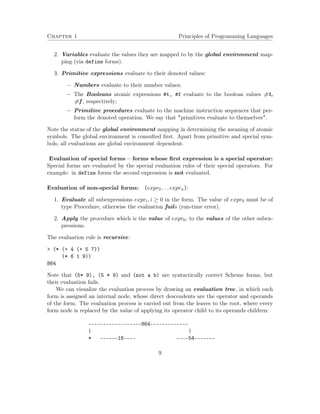
We can visualize the evaluation process by drawing an evaluation tree, in which each 
form is assigned an internal node, whose direct descendents are the operator and operands 
of the form. The evaluation process is carried out from the leaves to the root, where every 
form node is replaced by the value of applying its operator child to its operands children: 
------------------864------------- 
| | 
* ------16---- ----54------- 
9
Chapter 1 Principles of Programming Languages 
| | | | | | | 
+ 4 ---12---- * 6 1 9 
| | | 
+ 5 7 
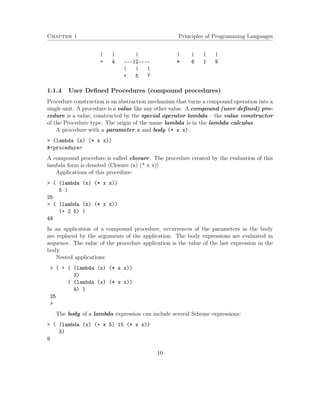
1.1.4 User Defined Procedures (compound procedures) 
Procedure construction is an abstraction mechanism that turns a compound operation into a 
single unit. A procedure is a value like any other value. A compound (user defined) pro-cedure 
is a value, constructed by the special operator lambda – the value constructor 
of the Procedure type. The origin of the name lambda is in the lambda calculus. 
A procedure with a parameter x and body (* x x): 
 (lambda (x) (* x x)) 
#procedure 
A compound procedure is called closure. The procedure created by the evaluation of this 
lambda form is denoted hClosure (x) (* x x)i 
Applications of this procedure: 
 ( (lambda (x) (* x x)) 
5 ) 
25 
 ( (lambda (x) (* x x)) 
(+ 2 5) ) 
49 
In an application of a compound procedure, occurrences of the parameters in the body 
are replaced by the arguments of the application. The body expressions are evaluated in 
sequence. The value of the procedure application is the value of the last expression in the 
body. 
Nested applications: 
 ( + ( (lambda (x) (* x x)) 
3) 
( (lambda (x) (* x x)) 
4) ) 
25 
 
The body of a lambda expression can include several Scheme expressions: 
 ( (lambda (x) (+ x 5) 15 (* x x)) 
3) 
9 
10
Chapter 1 Principles of Programming Languages 
But – no point in including several expressions in the body, since the value of the procedure 
application is that of the last one. Several expressions in a body are useful when their 
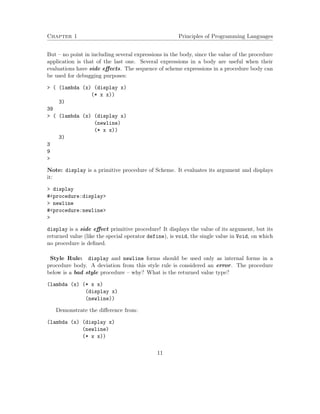
evaluations have side effects. The sequence of scheme expressions in a procedure body can 
be used for debugging purposes: 
 ( (lambda (x) (display x) 
(* x x)) 
3) 
39 
 ( (lambda (x) (display x) 
(newline) 
(* x x)) 
3) 
3 
9 
 
Note: display is a primitive procedure of Scheme. It evaluates its argument and displays 
it: 
 display 
#procedure:display 
 newline 
#procedure:newline 
 
display is a side effect primitive procedure! It displays the value of its argument, but its 
returned value (like the special operator define), is void, the single value in Void, on which 
no procedure is defined. 
Style Rule: display and newline forms should be used only as internal forms in a 
procedure body. A deviation from this style rule is considered an error. The procedure 
below is a bad style procedure – why? What is the returned value type? 
(lambda (x) (* x x) 
(display x) 
(newline)) 
Demonstrate the difference from: 
(lambda (x) (display x) 
(newline) 
(* x x)) 
11
Chapter 1 Principles of Programming Languages 
 ( (lambda (x) (* x x) 
(display x) 
(newline)) 
3) 
3 
 (+ ( (lambda (x) (* x x) 
(display x) 
(newline)) 
3) 
4) 
3 
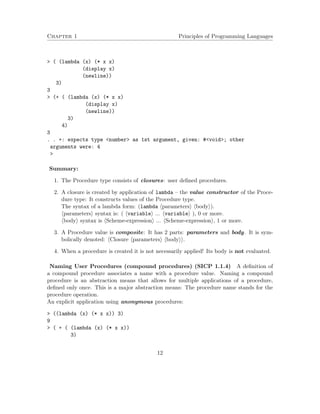
. . +: expects type number as 1st argument, given: #void; other 
arguments were: 4 
 
Summary: 
1. The Procedure type consists of closures: user defined procedures. 
2. A closure is created by application of lambda – the value constructor of the Proce-dure 
type: It constructs values of the Procedure type. 
The syntax of a lambda form: (lambda hparametersi hbodyi). 
hparametersi syntax is: ( hvariablei ... hvariablei ), 0 or more. 
hbodyi syntax is hScheme-expressioni ... hScheme-expressioni, 1 or more. 
3. A Procedure value is composite: It has 2 parts: parameters and body. It is sym-bolically 
denoted: hClosure hparametersi hbodyii. 
4. When a procedure is created it is not necessarily applied! Its body is not evaluated. 
Naming User Procedures (compound procedures) (SICP 1.1.4) A definition of 
a compound procedure associates a name with a procedure value. Naming a compound 
procedure is an abstraction means that allows for multiple applications of a procedure, 
defined only once. This is a major abstraction means: The procedure name stands for the 
procedure operation. 
An explicit application using anonymous procedures: 
 ((lambda (x) (* x x)) 3) 
9 
 ( + ( (lambda (x) (* x x)) 
3) 
12
Chapter 1 Principles of Programming Languages 
( (lambda (x) (* x x)) 
4) ) 
25 
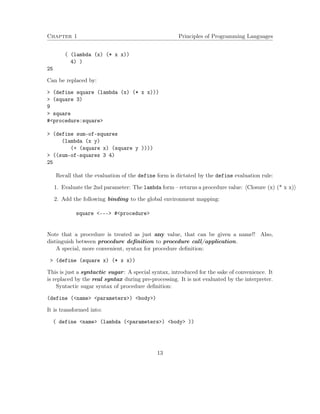
Can be replaced by: 
 (define square (lambda (x) (* x x))) 
 (square 3) 
9 
 square 
#procedure:square 
 (define sum-of-squares 
(lambda (x y) 
(+ (square x) (square y )))) 
 ((sum-of-squares 3 4) 
25 
Recall that the evaluation of the define form is dictated by the define evaluation rule: 
1. Evaluate the 2nd parameter: The lambda form – returns a procedure value: hClosure (x) (* x x)i 
2. Add the following binding to the global environment mapping: 
square --- #procedure 
Note that a procedure is treated as just any value, that can be given a name!! Also, 
distinguish between procedure definition to procedure call/application. 
A special, more convenient, syntax for procedure definition: 
 (define (square x) (* x x)) 
This is just a syntactic sugar: A special syntax, introduced for the sake of convenience. It 
is replaced by the real syntax during pre-processing. It is not evaluated by the interpreter. 
Syntactic sugar syntax of procedure definition: 
(define (name parameters) body) 
It is transformed into: 
( define name (lambda (parameters) body )) 
13
Chapter 1 Principles of Programming Languages 
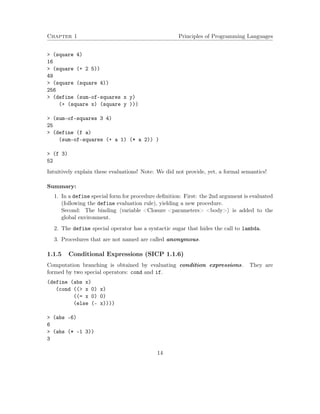
 (square 4) 
16 
 (square (+ 2 5)) 
49 
 (square (square 4)) 
256 
 (define (sum-of-squares x y) 
(+ (square x) (square y ))) 
 (sum-of-squares 3 4) 
25 
 (define (f a) 
(sum-of-squares (+ a 1) (* a 2)) ) 
 (f 3) 
52 
Intuitively explain these evaluations! Note: We did not provide, yet, a formal semantics! 
Summary: 
1. In a define special form for procedure definition: First: the 2nd argument is evaluated 
(following the define evaluation rule), yielding a new procedure. 
Second: The binding hvariable Closure parameters bodyi is added to the 
global environment. 
2. The define special operator has a syntactic sugar that hides the call to lambda. 
3. Procedures that are not named are called anonymous. 
1.1.5 Conditional Expressions (SICP 1.1.6) 
Computation branching is obtained by evaluating condition expressions. They are 
formed by two special operators: cond and if. 
(define (abs x) 
(cond (( x 0) x) 
((= x 0) 0) 
(else (- x)))) 
 (abs -6) 
6 
 (abs (* -1 3)) 
3 
14
Chapter 1 Principles of Programming Languages 
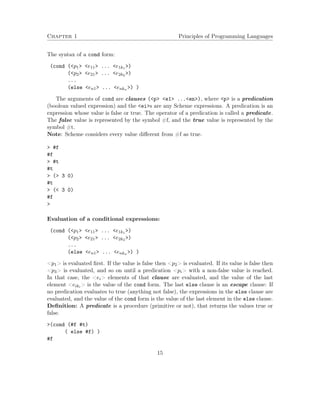
The syntax of a cond form: 
(cond (p1 e11 ... e1k1) 
(p2 e21 ... e2k2) 
... 
(else en1 ... enkn) ) 
The arguments of cond are clauses (p e1 ...en), where p is a predication 
(boolean valued expression) and the eis are any Scheme expressions. A predication is an 
expression whose value is false or true. The operator of a predication is called a predicate. 
The false value is represented by the symbol #f, and the true value is represented by the 
symbol #t. 
Note: Scheme considers every value different from #f as true. 
 #f 
#f 
 #t 
#t 
 ( 3 0) 
#t 
 ( 3 0) 
#f 
 
Evaluation of a conditional expressions: 
(cond (p1 e11 ... e1k1) 
(p2 e21 ... e2k2) 
... 
(else en1 ... enkn) ) 
p1 is evaluated first. If the value is false then p2 is evaluated. If its value is false then 
p3 is evaluated, and so on until a predication pi with a non-false value is reached. 
In that case, the ei elements of that clause are evaluated, and the value of the last 
element eiki is the value of the cond form. The last else clause is an escape clause: If 
no predication evaluates to true (anything not false), the expressions in the else clause are 
evaluated, and the value of the cond form is the value of the last element in the else clause. 
Definition: A predicate is a procedure (primitive or not), that returns the values true or 
false. 
(cond (#f #t) 
( else #f) ) 
#f 
15
Chapter 1 Principles of Programming Languages 
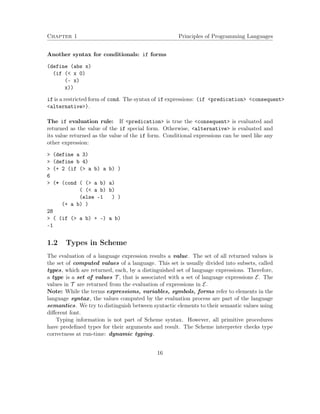
Another syntax for conditionals: if forms 
(define (abs x) 
(if ( x 0) 
(- x) 
x)) 
if is a restricted form of cond. The syntax of if expressions: (if predication consequent 
alternative). 
The if evaluation rule: If predication is true the consequent is evaluated and 
returned as the value of the if special form. Otherwise, alternative is evaluated and 
its value returned as the value of the if form. Conditional expressions can be used like any 
other expression: 
 (define a 3) 
 (define b 4) 
 (+ 2 (if ( a b) a b) ) 
6 
 (* (cond ( ( a b) a) 
( ( a b) b) 
(else -1 ) ) 
(+ a b) ) 
28 
 ( (if ( a b) + -) a b) 
-1 
1.2 Types in Scheme 
The evaluation of a language expression results a value. The set of all returned values is 
the set of computed values of a language. This set is usually divided into subsets, called 
types, which are returned, each, by a distinguished set of language expressions. Therefore, 
a type is a set of values T , that is associated with a set of language expressions E. The 
values in T are returned from the evaluation of expressions in E. 
Note: While the terms expressions, variables, symbols, forms refer to elements in the 
language syntax, the values computed by the evaluation process are part of the language 
semantics. We try to distinguish between syntactic elements to their semantic values using 
different font. 
Typing information is not part of Scheme syntax. However, all primitive procedures 
have predefined types for their arguments and result. The Scheme interpreter checks type 
correctness at run-time: dynamic typing. 
16
Chapter 1 Principles of Programming Languages 
Primitive types are types already built in the language. That is, the language can 
compute their values and provides operations for operating on them. All types in the 
Scheme subset that we study are primitive, i.e., the user cannot add new types (unlike in 
ML or Java). The types are classified into atomic types, whose values are atomic (i.e., not 
decomposable) and composite types, whose values are decomposable. 
The standard specification of a type includes information about its values, language 
expressions that return these values, its identification and management: 
1. Values: The set of values of the type 
2. Constructors: Value constructor and type constructor 
3. Identifying predicate: Identifies the values of the type 
4. Equality predicate: Compares values of the type 
5. Operations: Operate on values of the type 
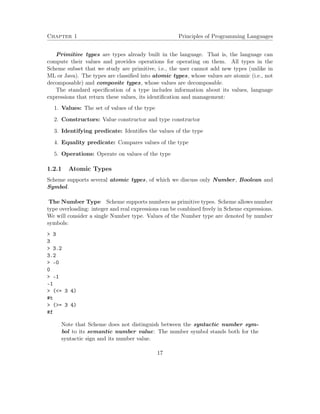
1.2.1 Atomic Types 
Scheme supports several atomic types, of which we discuss only Number, Boolean and 
Symbol. 
The Number Type Scheme supports numbers as primitive types. Scheme allows number 
type overloading: integer and real expressions can be combined freely in Scheme expressions. 
We will consider a single Number type. Values of the Number type are denoted by number 
symbols: 
 3 
3 
 3.2 
3.2 
 -0 
0 
 -1 
-1 
 (= 3 4) 
#t 
 (= 3 4) 
#f 
Note that Scheme does not distinguish between the syntactic number sym-bol 
to its semantic number value: The number symbol stands both for the 
syntactic sign and its number value. 
17
Chapter 1 Principles of Programming Languages 
The identifying predicate of the Number type is number?, the equality predicate is the 
primitive procedure =, and the operations are the regular arithmetic primitive operations 
and relations. Each number symbol is evaluated to the number it stands for, i,e., each 
number symbol is a value constructor for a single Number value (there is infinity of value 
constructors). 
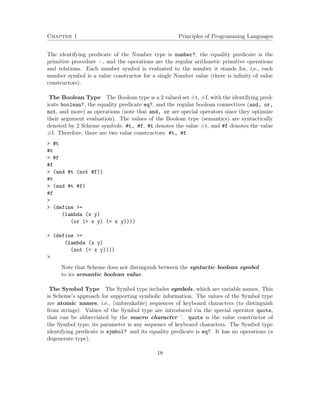
The Boolean Type The Boolean type is a 2 valued set #t, #f, with the identifying pred-icate 
boolean?, the equality predicate eq?, and the regular boolean connectives (and, or, 
not, and more) as operations (note that and, or are special operators since they optimize 
their argument evaluation). The values of the Boolean type (semantics) are syntactically 
denoted by 2 Scheme symbols: #t, #f. #t denotes the value #t, and #f denotes the value 
#f. Therefore, there are two value constructors: #t, #f. 
 #t 
#t 
 #f 
#f 
 (and #t (not #f)) 
#t 
 (and #t #f) 
#f 
 
 (define = 
(lambda (x y) 
(or ( x y) (= x y)))) 
 (define = 
(lambda (x y) 
(not ( x y)))) 
 
Note that Scheme does not distinguish between the syntactic boolean symbol 
to its semantic boolean value. 
The Symbol Type The Symbol type includes symbols, which are variable names. This 
is Scheme’s approach for supporting symbolic information. The values of the Symbol type 
are atomic names, i.e., (unbreakable) sequences of keyboard characters (to distinguish 
from strings). Values of the Symbol type are introduced via the special operator quote, 
that can be abbreviated by the macro character ’. quote is the value constructor of 
the Symbol type; its parameter is any sequence of keyboard characters. The Symbol type 
identifying predicate is symbol? and its equality predicate is eq?. It has no operations (a 
degenerate type). 
18
Chapter 1 Principles of Programming Languages 
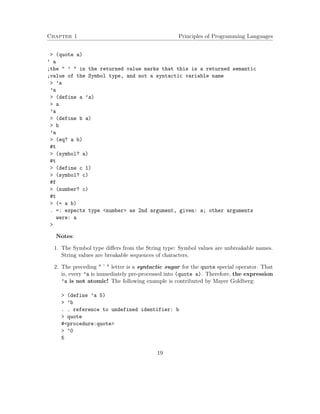
 (quote a) 
’ a 
;the  ’  in the returned value marks that this is a returned semantic 
;value of the Symbol type, and not a syntactic variable name 
 ’a 
’a 
 (define a ’a) 
 a 
’a 
 (define b a) 
 b 
’a 
 (eq? a b) 
#t 
 (symbol? a) 
#t 
 (define c 1) 
 (symbol? c) 
#f 
 (number? c) 
#t 
 (= a b) 
. =: expects type number as 2nd argument, given: a; other arguments 
were: a 
 
Notes: 
1. The Symbol type differs from the String type: Symbol values are unbreakable names. 
String values are breakable sequences of characters. 
2. The preceding  ’  letter is a syntactic sugar for the quote special operator. That 
is, every ’a is immediately pre-processed into (quote a). Therefore, the expression 
’a is not atomic! The following example is contributed by Mayer Goldberg: 
 (define ’a 5) 
 ’b 
. . reference to undefined identifier: b 
 quote 
#procedure:quote 
 ’0 
5 
19
Chapter 1 Principles of Programming Languages 
 ’5 
5 
Explain! 
3. quote is a special operator. Its parameter is any sequence of characters (apart of 
few punctuation symbols). It has a special evaluation rule: It returns its argument 
as is – no evaluation. This differs from the evaluation rule for primitive procedures 
(like symbol? and eq?) and the evaluation rule for compound procedures, which first 
evaluate their operands, and then apply. 
Question: What would have been the result if the operand of quote was evaluated 
as for primitive procedures? 
1.2.2 Composite Types 
A composite type is a type whose values are composed from values of other types (including 
self values, in the case of a recursive type). The values of a composite type can be decomposed 
into values of other (or self) types. For example, the rational numbers can be viewed as the 
composite Rational-number type, whose values are constructed, each, from two integer 
values (and therefore, can be decomposed into their nominator and denominator integer 
components). In the Scheme subset used in this course, the composite types are Procedure, 
Pair and List. The latter two are introduced in chapter 3. 
In order to describe a composite type we need to describe how values of the compo-nent 
types are composed. This is achieved by using a type constructor which describes 
type composition. Tuple composite types are described using the type constructor *, and 
Procedure composite types are described using the type constructor -. 
Example 1.1. 
 The type expression Number*Number*Boolean describes the set (type) of all triplets 
of 2 numbers and a boolean, e.g., h2; 7:4;#ti; h0;63;#fi. 
 The type expression [Number – Number] describes the set of all single variable pro-cedures 
(closures and primitive) from numbers to numbers. For example, the primitive 
procedure abs (absolute value) and the closure hclosure (x) (+ x 1)i belong to this 
type. 
 The type expression [Number*Boolean – Number] describes the set of all 2-variable 
procedures from a number and a boolean to numbers. 
 The type expression Symbol*[Number – Number] describes the set of all pairs of a 
symbol and a single variable procedure from numbers to numbers. For example, the 
pairs h’abs  primitive_abs_codei and h’square  hclosure (x) (* x x)ii belong 
to this type. 
20
Chapter 1 Principles of Programming Languages 
The Procedure Type 
The Procedure type is the set of all Scheme closures and primitive procedures. The type 
is described using the type constructor -, and its closure values are created by the value 
constructor lambda forms. 
In order to assign a type to Scheme expressions that denote closures (lambda expressions) 
we observe the types of their parameters and returned results. These can be inferred by 
observing the expressions in the body of the lambda expressions. 
Example 1.2. 
 The type of (lambda (x) (+ (* x x) 3)) is [Number – Number]. This is deter-mined 
from the known types of the primitive procedures +, *. 
 The type of (lambda (x y) (not (and x y))) is [T1*T2 – Boolean]. This is de-termined 
from the known types of the primitive procedure not and the special operator 
and1. 
But, what is the type of the lambda expressions (lambda (x) x) (which creates the 
identity procedure) and (lambda (f x) (f (f x)))? Evaluation of these expressions cre-ates 
the closures hclosure (x) xi (the identity procedure) and hclosure (f x) (f (f x))i. 
But to which types these closures belong? There are no primitive procedures or special oper-ators 
to give us a hint. Observing their application we see that they apply well to arguments 
of multiple types: 
 ((lambda (x) x) 3) 
3 
 ((lambda (x) x) #t) 
#t 
 ((lambda (x) x) (lambda (x) (- x 1))) 
#procedure:x 
 ((lambda (x) x) (lambda (x) x)) 
#procedure:x 
 ( (lambda (f x) (f (f x))) 
abs -3) 
3 
 ( (lambda (f x) (f (f x))) 
(lambda (x) (* x x)) 
3) 
81 
1The T1, T2 type parameters are due to the lack of real Boolean type in Scehme. In other languages the 
type of this procedure would be [Boolean*Boolean – Boolean]. 
21
Chapter 1 Principles of Programming Languages 
Therefore, these closures can actually belong to multiple Procedure types, based on their 
argument types. For example, the closure hclosure (x) xi can belong to the types 
[Number – Number], 
[Boolean – Boolean], 
[[Number – Number] – [Number – Number]]. 
We say that procedures (primitive and closures) that can accept arguments of varying types 
are polymorphic, i.e., have multiple types and the expressions that create these procedures 
are polymorphic expressions. 
In order to assign a single type expression to polymorphic language expressions (and 
procedures) we introduce type variables, denoted T1, T2, .... Type variables in type 
expressions range over all types. Type expressions that include type variables are called 
polymorphic type expressions since they denote multiple types. 
 The type of the identity lambda expression and procedure is [T – T]. 
 The type of the expression (lambda (f x) (f x)) is [[T1 – T2]*T1 – T2]. 
 The type of the expression (lambda (f x) (f (f x))) is [[T – T]*T – T]. 
In sum, the type constructor of the Procedure type is -, the value constructor for the 
closures is lambda, and the identifying predicate is procedure?. 
 (procedure? (lambda (x) x)) 
#t 
 (procedure? abs) 
#t 
 (procedure? display) 
#t 
 (procedure? 5) 
#f 
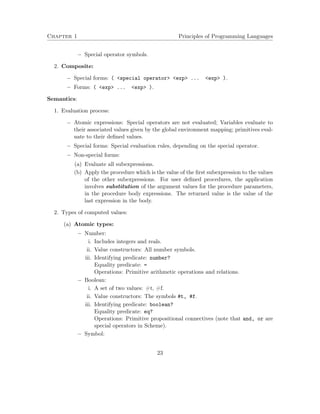
Summary: Informal Syntax and Semantics: 
Syntax: There are 2 kinds of Scheme language expressions: 
1. Atomic: 
(a) Primitives: 
 Number symbols. 
 Boolean symbols: #t, #f. 
 Primitive procedure symbols. 
(b) Non-primitives: 
 Variable symbols. 
22
Chapter 1 Principles of Programming Languages 
 Special operator symbols. 
2. Composite: 
 Special forms: ( special operator exp ... exp ). 
 Forms: ( exp ... exp ). 
Semantics: 
1. Evaluation process: 
 Atomic expressions: Special operators are not evaluated; Variables evaluate to 
their associated values given by the global environment mapping; primitives eval-uate 
to their defined values. 
 Special forms: Special evaluation rules, depending on the special operator. 
 Non-special forms: 
(a) Evaluate all subexpressions. 
(b) Apply the procedure which is the value of the first subexpression to the values 
of the other subexpressions. For user defined procedures, the application 
involves substitution of the argument values for the procedure parameters, 
in the procedure body expressions. The returned value is the value of the 
last expression in the body. 
2. Types of computed values: 
(a) Atomic types: 
 Number: 
i. Includes integers and reals. 
ii. Value constructors: All number symbols. 
iii. Identifying predicate: number? 
Equality predicate: = 
Operations: Primitive arithmetic operations and relations. 
 Boolean: 
i. A set of two values: #t, #f. 
ii. Value constructors: The symbols #t, #f. 
iii. Identifying predicate: boolean? 
Equality predicate: eq? 
Operations: Primitive propositional connectives (note that and, or are 
special operators in Scheme). 
 Symbol: 
23
Chapter 1 Principles of Programming Languages 
i. The set of all unbreakable keyboard character sequences. Includes vari-able 
names. 
ii. Value constructor: quote 
iii. Identifying predicate: symbol? 
Equality predicate: eq? 
Operations: None (a degenerated type). 
(b) Composite types: 
 Procedure: 
i. A polymorphic type: The collection of all procedure (function) types. 
Each concrete procedure type includes all procedures with the same 
argument and result types. 
ii. Type constructor: – written in infix notation. A Procedure type expres-sion 
has the syntax: [ Type-expression-tuple – Type-expression]. 
Type expressions can be polymorphic, i.e., include type variables. 
iii. Value constructor: For primitive procedures, their symbolic name is their 
constructor. For user defined procedures (closures), lambda is the value 
constructor. 
iv. Identifying predicates: 
For primitive procedures: primitive? For User defined procedures (clo-sures): 
procedure? 
Equality predicate: none.(why?) 
Operations: All high order procedures (primitive and user defined). 
1.3 Program Design Using Contracts 
Following Felleison, Findler, Flatt and Krishnamurthi: How to Design Programs 
http://www.htdp.org/2003-09-26/Book/ 
A procedure design starts with a contract that includes: 
1. Signature 
2. Purpose 
3. Type 
4. Example 
5. Pre-conditions 
6. Post-conditions 
7. Tests 
24
Chapter 1 Principles of Programming Languages 
8. Invariants 
Signature, purpose and type are mandatory to all procedures. Examples are desirable. 
Tests are mandatory for complex procedures. Pre/post-conditions and invariants are rel-evant 
only if non-trivial (not vacuous). 
Contract: 
Signature: area-of-ring(outer,inner) 
Purpose: To compute the area of a ring whose radius is 
’outer’ and whose hole has a radius of ’inner’ 
Type: [Number * Number - Number] 
Example: (area-of-ring 5 3) should produce 50.24 
Pre-conditions: outer = 0, inner = 0, outer = inner 
Post-condition: result = PI * outer^2 - PI * inner^2 
Tests: (area-of-ring 5 3) == 50.24 
Definition: [refines the header] 
(define area-of-ring 
(lambda (outer inner) 
(- (area-of-disk outer) 
(area-of-disk inner)))) 
In this implementation area-of-ring is a caller of area-of-disk. 
The specification of Types, Pre-conditions and Post-conditions requires special 
specification languages. The keyword result belongs to the specification language for 
post-conditions. 
1.3.1 The Design by Contract (DBC) approach: 
DbC is an approach for designing computer software. It prescribes that software designers 
should define precise verifiable interface specifications for software components based upon 
the theory of abstract data types and the conceptual metaphor of business contracts. The 
approach was introduced by Bertrand Meyer in connection with his design of the Eiffel object 
oriented programming language and is described in his book Object-Oriented Software 
Construction (1988, 1997). 
The central idea of DbC is a metaphor on how elements of a software system collaborate 
with each other, on the basis of mutual obligations and benefits. The metaphor comes 
from business life, where a client and a supplier agree on a contract. The contract defines 
obligations and benefits. If a routine provides a certain functionality, it may: 
 Impose a certain obligation to be guaranteed on entry by any client module that calls 
it: The routine’s precondition – an obligation for the client, and a benefit for the 
supplier. 
25
Chapter 1 Principles of Programming Languages 
 Guarantee a certain property on exit: The routine’s postcondition is an obligation 
for the supplier, and a benefit for the client. 
 Maintain a certain property, assumed on entry and guaranteed on exit: An invari-ant. 
The contract is the formalization of these obligations and benefits. 
-------------------------------------------------------------------- 
| Client Supplier 
------------|------------------------------------------------------- 
Obligation: | Guarantee precondition Guarantee postcondition 
Benefit: | Guaranteed postcondition Guaranteed precondition 
-------------------------------------------------------------------- 
DbC is an approach that emphasizes the value of developing program specification to-gether 
with programming activity. The result is more reliable, testable, documented soft-ware. 
DbC is crucial for software correctness. 
Many languages have now tools for writing and enforcing contracts: Java, C#, C++, C, 
Python, Lisp, Scheme: 
http://www.ccs.neu.edu/scheme/pubs/tr01-372-contract-challenge.pdf 
http://www.ccs.neu.edu/scheme/pubs/tr00-366.pdf 
The contract language is a language for specifying constraints. Usually, it is based in 
Logic. There is no standard, overall accepted contract language: Different languages have 
different contract languages. In Eiffel, the contracts are an integral part of the language. In 
most other languages, contract are run by additional tools. 
Policy of the PPL course: 
1. All assignment papers must be submitted with contracts for procedures. 
2. Contract mandatory parts: The Signature, Purpose, Type, Tests are mandatory 
for every procedure! 
3. The Examples part is always recommended as a good documentation. 
4. Pre-conditions should be written when the type does not prevent input for which 
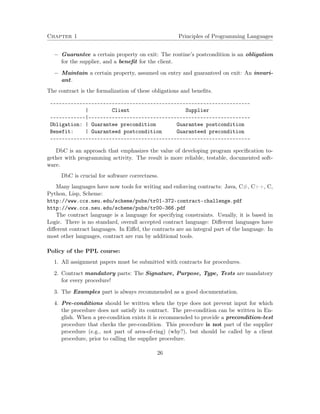
the procedure does not satisfy its contract. The pre-condition can be written in En-glish. 
When a pre-condition exists it is recommended to provide a precondition-test 
procedure that checks the pre-condition. This procedure is not part of the supplier 
procedure (e.g., not part of area-of-ring) (why?), but should be called by a client 
procedure, prior to calling the supplier procedure. 
26
Chapter 1 Principles of Programming Languages 
5. Post-conditions are recommended whenever possible. They clarify what the proce-dure 
guarantee to supply. Post-conditions provide the basis for tests. 
Continue the area-of-ring example: The area-of-ring is a client (a caller ) of the area-of-disk 
procedure. Therefore, it must consider its contract, to verify that it fulfills the necessary 
pre-condition. Here is a contract for the area-of-disk procedure: 
Signature: area-of-disk(radius) 
Purpose: To compute the area of a disk whose radius is the 
’radius’ parameter. 
Type: [Number - Number] 
Example: (area-of-disk 2) should produce 12.56 
Pre-conditions: radius = 0 
Post-condition: result = PI * radius^2 
Tests: (area-of-disk 2) == 12.56 
Definition: [refines the header] 
(define area-of-disk 
(lambda (radius) 
(* 3.14 (* radius radius)))) 
Area-of-ring must fulfill area-of-disk precondition when calling it. Indeed, this can 
be proved as correct, since both parameters of area-of-disk are not negative. The post 
condition of area-of-ring is correct because the post-condition of area-of-disk guaran-tees 
that the results of the 2 calls are indeed, PI outer2 and PI inner2, and the definition 
of area-of-ring subtracts the results of these calls. 
We expect that whenever a client routine calls a supplier routine the client routine 
will either explicitly call a pre-condition test procedure, or provide an argument 
for the correctness of the call! 
We do not encourage a defensive programming style, where each procedure first tests 
its pre-condition. This is the responsibility of the clients. 
1.4 Procedures and the Processes they Generate (SICP 1.2) 
Iteration in computing refers to a process of repetitive computations, following a single 
pattern. In imperative programming languages (e.g., Java, C++, C) iteration is speci-fied 
by loop constructs like while, for, begin-until. Iterative computations (loops) are 
managed by loop variables whose changing values determine loop exit. Loop constructs 
27
Chapter 1 Principles of Programming Languages 
provide abstraction of the looping computation pattern. Iteration is a central computing 
feature. 
Functional languages like the Scheme part introduced in this chapter do not posses 
looping constructs like while. The only provision for computation repetition is repeated 
function application. The question asked in this section is whether iteration by function call 
obtains the advantages of iteration using loop constructs, as in other languages. We show 
that recursive function call mechanism can simulate iteration. Moreover, the conditions 
under which function call simulates iteration can be syntactically identified: A computing 
agent (interpreter, compiler) can determine, based on syntax analysis of a procedure body, 
whether its application can simulate iteration. 
For that purpose, we discuss the computational processes generated by procedures. 
We distinguish between procedure expression – a syntactical notion, to process – a 
semantical notion. Recursive procedure expressions can create iterative processes. Such 
procedures are called tail recursive. 
1.4.1 Linear Recursion and Iteration (SICP 1.2.1 ) 
Consider the computation of the factorial function. In an imperative language, it is 
natural to use a looping construct like while, that increments a factorial computation until 
the requested number is reached. In Scheme, factorial can be computed by the following 
two procedure definitions: 
Recursive factorial: 
Signature: factorial(n) 
Purpose: to compute the factorial of a number ’n’. 
This procedure follows the rule: 1! = 1, n! = n * (n-1)! 
Type: [Number - Number] 
Pre-conditions: n  0, an integer 
Post-condition: result = n! 
Example: (factorial 4) should produce 24 
Tests: (factorial 1) == 1 
(factorial 4) == 24 
(define factorial 
(lambda (n) 
(if (= n 1) 
1 
(* n (factorial (- n 1)))) 
)) 
Alternative: Iterative factorial 
28
Chapter 1 Principles of Programming Languages 
(define factorial 
(lambda (n) 
(fact-iter 1 1 n) )) 
fact-iter: 
Signature: fact-iter(product,counter,max-count) 
Purpose: to compute the factorial of a number ’max-count’. 
This procedure follows the rule: 
counter = 1; product = 1; 
repeat the simultaneous transformations: 
product -- counter * product, counter -- counter + 1. 
stop when counter  n. 
Type: [Number*Number*Number - Number] 
Pre-conditions: 
product, counter, max-count  0 
product * counter * (counter + 1) * ... * max-count = max-count! 
Post-conditions: result = max-count! 
Example: (fact-iter 2 3 4) should produce 24 
Tests: (fact-iter 1 1 1) == 1 
(fact-iter 1 1 4) == 24 
(define fact-iter 
(lambda (product counter max-count) 
(if ( counter max-count) 
product 
(fact-iter (* counter product) 
(+ counter 1) 
max-count)))) 
Recursion vs. iteration: 
Recursive factorial: The evaluation of the form (factorial 6) yields the following se-quence 
of evaluations: 
(factorial 6) 
(* 6 (factorial 5)) 
... 
(* 6 (* 5 (...(* 2 factorial 1 )...) 
(* 6 (* 5 (...(* 2 1)...) 
... 
(* 6 120) 
720 
29
Chapter 1 Principles of Programming Languages 
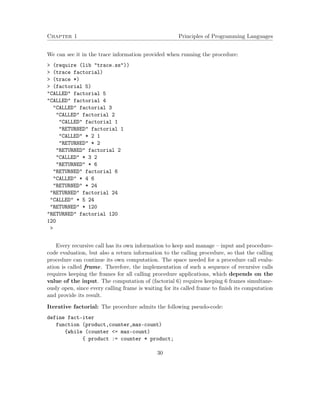
We can see it in the trace information provided when running the procedure: 
 (require (lib trace.ss)) 
 (trace factorial) 
 (trace *) 
 (factorial 5) 
CALLED factorial 5 
CALLED factorial 4 
CALLED factorial 3 
CALLED factorial 2 
CALLED factorial 1 
RETURNED factorial 1 
CALLED * 2 1 
RETURNED * 2 
RETURNED factorial 2 
CALLED * 3 2 
RETURNED * 6 
RETURNED factorial 6 
CALLED * 4 6 
RETURNED * 24 
RETURNED factorial 24 
CALLED * 5 24 
RETURNED * 120 
RETURNED factorial 120 
120 
 
Every recursive call has its own information to keep and manage – input and procedure-code 
evaluation, but also a return information to the calling procedure, so that the calling 
procedure can continue its own computation. The space needed for a procedure call evalu-ation 
is called frame. Therefore, the implementation of such a sequence of recursive calls 
requires keeping the frames for all calling procedure applications, which depends on the 
value of the input. The computation of (factorial 6) requires keeping 6 frames simultane-ously 
open, since every calling frame is waiting for its called frame to finish its computation 
and provide its result. 
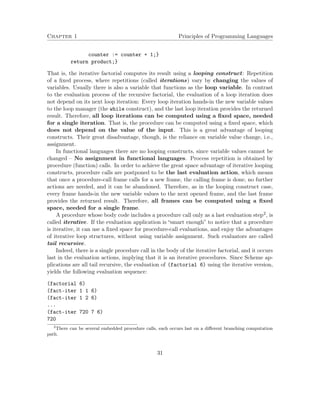
Iterative factorial: The procedure admits the following pseudo-code: 
define fact-iter 
function (product,counter,max-count) 
{while (counter = max-count) 
{ product := counter * product; 
30
Chapter 1 Principles of Programming Languages 
counter := counter + 1;} 
return product;} 
That is, the iterative factorial computes its result using a looping construct: Repetition 
of a fixed process, where repetitions (called iterations) vary by changing the values of 
variables. Usually there is also a variable that functions as the loop variable. In contrast 
to the evaluation process of the recursive factorial, the evaluation of a loop iteration does 
not depend on its next loop iteration: Every loop iteration hands-in the new variable values 
to the loop manager (the while construct), and the last loop iteration provides the returned 
result. Therefore, all loop iterations can be computed using a fixed space, needed 
for a single iteration. That is, the procedure can be computed using a fixed space, which 
does not depend on the value of the input. This is a great advantage of looping 
constructs. Their great disadvantage, though, is the reliance on variable value change, i.e., 
assignment. 
In functional languages there are no looping constructs, since variable values cannot be 
changed – No assignment in functional languages. Process repetition is obtained by 
procedure (function) calls. In order to achieve the great space advantage of iterative looping 
constructs, procedure calls are postponed to be the last evaluation action, which means 
that once a procedure-call frame calls for a new frame, the calling frame is done, no further 
actions are needed, and it can be abandoned. Therefore, as in the looping construct case, 
every frame hands-in the new variable values to the next opened frame, and the last frame 
provides the returned result. Therefore, all frames can be computed using a fixed 
space, needed for a single frame. 
A procedure whose body code includes a procedure call only as a last evaluation step2, is 
called iterative. If the evaluation application is “smart enough” to notice that a procedure 
is iterative, it can use a fixed space for procedure-call evaluations, and enjoy the advantages 
of iterative loop structures, without using variable assignment. Such evaluators are called 
tail recursive. 
Indeed, there is a single procedure call in the body of the iterative factorial, and it occurs 
last in the evaluation actions, implying that it is an iterative procedures. Since Scheme ap-plications 
are all tail recursive, the evaluation of (factorial 6) using the iterative version, 
yields the following evaluation sequence: 
(factorial 6) 
(fact-iter 1 1 6) 
(fact-iter 1 2 6) 
... 
(fact-iter 720 7 6) 
720 
2There can be several embedded procedure calls, each occurs last on a different branching computation 
path. 
31
Chapter 1 Principles of Programming Languages 
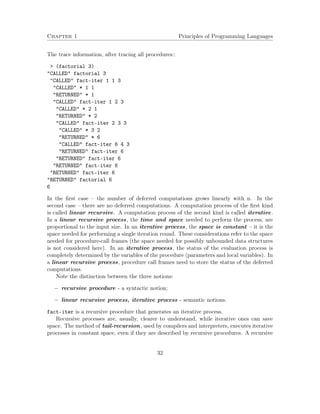
The trace information, after tracing all procedures:: 
 (factorial 3) 
CALLED factorial 3 
CALLED fact-iter 1 1 3 
CALLED * 1 1 
RETURNED * 1 
CALLED fact-iter 1 2 3 
CALLED * 2 1 
RETURNED * 2 
CALLED fact-iter 2 3 3 
CALLED * 3 2 
RETURNED * 6 
CALLED fact-iter 6 4 3 
RETURNED fact-iter 6 
RETURNED factorial 6 
6 
In the first case – the number of deferred computations grows linearly with n. In the 
second case – there are no deferred computations. A computation process of the first kind 
is called linear recursive. A computation process of the second kind is called iterative. 
In a linear recursive process, the time and space needed to perform the process, are 
proportional to the input size. In an iterative process, the space is constant – it is the 
space needed for performing a single iteration round. These considerations refer to the space 
needed for procedure-call frames (the space needed for possibly unbounded data structures 
is not considered here). In an iterative process, the status of the evaluation process is 
completely determined by the variables of the procedure (parameters and local variables). In 
a linear recursive process, procedure call frames need to store the status of the deferred 
computations. 
Note the distinction between the three notions: 
 recursive procedure - a syntactic notion; 
 linear recursive process, iterative process - semantic notions. 
fact-iter is a recursive procedure that generates an iterative process. 
Recursive processes are, usually, clearer to understand, while iterative ones can save 
space. The method of tail-recursion, used by compilers and interpreters, executes iterative 
processes in constant space, even if they are described by recursive procedures. A recursive 
32
Chapter 1 Principles of Programming Languages 
procedure whose application does not create deferred computations can be performed as an 
iterative process. 
Typical form of iterative processes: Additional parameters for a counter and an 
accumulator, where the partial result is stored. When the counter reaches some bound, 
the accumulator gives the result. 
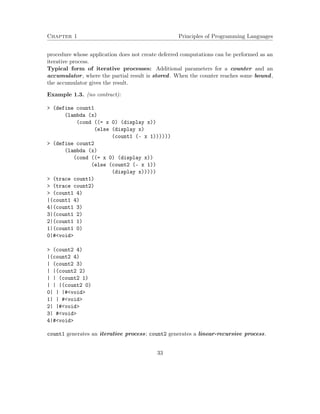
Example 1.3. (no contract): 
 (define count1 
(lambda (x) 
(cond ((= x 0) (display x)) 
(else (display x) 
(count1 (- x 1)))))) 
 (define count2 
(lambda (x) 
(cond ((= x 0) (display x)) 
(else (count2 (- x 1)) 
(display x))))) 
 (trace count1) 
 (trace count2) 
 (count1 4) 
|(count1 4) 
4|(count1 3) 
3|(count1 2) 
2|(count1 1) 
1|(count1 0) 
0|#void 
 (count2 4) 
|(count2 4) 
| (count2 3) 
| |(count2 2) 
| | (count2 1) 
| | |(count2 0) 
0| | |#void 
1| | #void 
2| |#void 
3| #void 
4|#void 
count1 generates an iterative process; count2 generates a linear-recursive process. 
33
Chapter 1 Principles of Programming Languages 
1.4.2 Tree Recursion (SICP 1.2.2) 
Consider the following procedure definition for computing the n-th element in the sequence 
of Fibonacci numbers: 
Recursive FIB 
Signature: (fib n) 
Purpose: to compute the nth Fibonacci number. 
This procedure follows the rule: 
fib(0) = 0, fib(1) = 1, fib(n) = fib(n-1) + fib(n-2). 
Type: [Number - Number] 
Example: (fib 5) should produce 5 
Pre-conditions: n = 0 
Post-conditions: result = nth Fibonacci number. 
Tests: (fib 3) == 2 
(fib 1) == 1 
(define fib 
(lambda (n) 
(cond ((= n 0) 0) 
((= n 1) 1) 
(else (+ (fib (- n 1)) 
(fib (- n 2))))) 
)) 
The evaluation process generated by this procedure has a tree structure, where nested 
forms lie on the same branch: 
+-----------------(fib 5)----------------+ 
| | 
+-----(fib 4)---------+ +-----(fib 3)---------+ 
| | | | 
+--(fib 3)--+ +--(fib 2)-+ +-(fib 2)-+ (fib 1) 
| | | | | | | 
+-(fib 2)-+ (fib 1) (fib 1) (fib 0) (fib 1) (fib 0) 1 
| | | | | | | 
(fib 1) (fib 0) 1 1 0 1 0 
1 0 
The time required is proportional to the size of the tree, since the evaluation of (fib 5) 
requires the evaluation of all fib forms. Hence, the time required is exponential in the 
input of fib. The space required is proportional to the depth of the tree, i.e., linear in 
34
Chapter 1 Principles of Programming Languages 
the input. 
Note: The exponential growth order applies to balanced (or almost balanced) trees. Highly 
pruned computation trees can yield a smaller growth order. 
Iterative FIB 
(define fib 
(lambda (n) (fib-iter 0 1 n))) 
fib-iter: 
Signature: fib-iter(current,next,count) 
Purpose: to compute the nth Fibonacci number. 
We start with current = 0, next = 1, and count as the Fibonacci goal, 
and repeat the simultaneous transformation ’count’ times: 
next -- next + current, current -- next, 
in order to compute fib(count). 
Type: [Number*Number*Number - Number] 
Example: (fib-iter 0 1 5) should produce 5 
Pre-conditions: next = (n+1)th Fibonacci number, for some n = 0; 
current = nth Fibonacci number; 
Post-conditions: result = (n+count)th Fibonacci number. 
Tests: (fib-iter 1 2 3) == 5 
(fib-iter 0 1 1) == 1 
(define fib-iter 
(lambda (current next count) 
(if (= count 0) 
current 
(fib-iter next (+ current next) (- count 1))) 
)) 
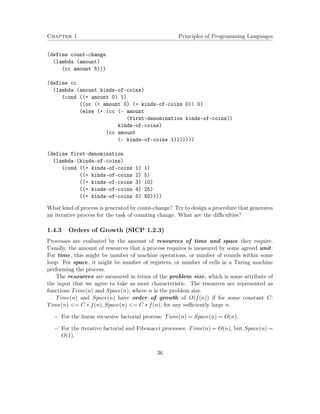
Example 1.4. – Counting Change (without contract) 
Given an amount A of money, and types of coins (5 agorot, 10 agorot, etc), ordered in 
some fixed way. Compute the number of ways to change the amount A. Here is a rule: 
The number of ways to change A using n kinds of coins (ordered) = 
number of ways to change A using the last n-1 coin kinds + 
number of ways to change A - D using all n coin kinds, where D is the denomi-nation 
of the first kind. 
Try it! 
35
Chapter 1 Principles of Programming Languages 
(define count-change 
(lambda (amount) 
(cc amount 5))) 
(define cc 
(lambda (amount kinds-of-coins) 
(cond ((= amount 0) 1) 
((or ( amount 0) (= kinds-of-coins 0)) 0) 
(else (+ (cc (- amount 
(first-denomination kinds-of-coins)) 
kinds-of-coins) 
(cc amount 
(- kinds-of-coins 1))))))) 
(define first-denomination 
(lambda (kinds-of-coins) 
(cond ((= kinds-of-coins 1) 1) 
((= kinds-of-coins 2) 5) 
((= kinds-of-coins 3) 10) 
((= kinds-of-coins 4) 25) 
((= kinds-of-coins 5) 50)))) 
What kind of process is generated by count-change? Try to design a procedure that generates 
an iterative process for the task of counting change. What are the difficulties? 
1.4.3 Orders of Growth (SICP 1.2.3) 
Processes are evaluated by the amount of resources of time and space they require. 
Usually, the amount of resources that a process requires is measured by some agreed unit. 
For time, this might be number of machine operations, or number of rounds within some 
loop. For space, it might be number of registers, or number of cells in a Turing machine 
performing the process. 
The resources are measured in terms of the problem size, which is some attribute of 
the input that we agree to take as most characteristic. The resources are represented as 
functions Time(n) and Space(n), where n is the problem size. 
Time(n) and Space(n) have order of growth of O(f(n)) if for some constant C: 
Time(n) = C  f(n); Space(n) = C  f(n), for any sufficiently large n. 
 For the linear recursive factorial process: Time(n) = Space(n) = O(n). 
 For the iterative factorial and Fibonacci processes: Time(n) = O(n), but Space(n) = 
O(1). 
36
Chapter 1 Principles of Programming Languages 
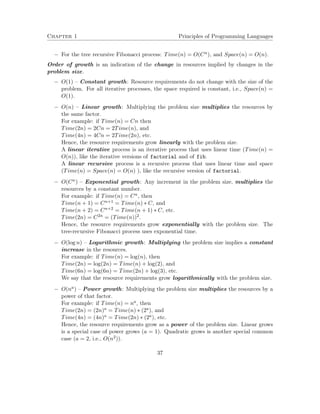
 For the tree recursive Fibonacci process: Time(n) = O(Cn), and Space(n) = O(n). 
Order of growth is an indication of the change in resources implied by changes in the 
problem size. 
 O(1) – Constant growth: Resource requirements do not change with the size of the 
problem. For all iterative processes, the space required is constant, i.e., Space(n) = 
O(1). 
 O(n) – Linear growth: Multiplying the problem size multiplies the resources by 
the same factor. 
For example: if Time(n) = Cn then 
Time(2n) = 2Cn = 2Time(n), and 
Time(4n) = 4Cn = 2Time(2n), etc. 
Hence, the resource requirements grow linearly with the problem size. 
A linear iterative process is an iterative process that uses linear time (Time(n) = 
O(n)), like the iterative versions of factorial and of fib. 
A linear recursive process is a recursive process that uses linear time and space 
(Time(n) = Space(n) = O(n) ), like the recursive version of factorial. 
 O(Cn) – Exponential growth: Any increment in the problem size, multiplies the 
resources by a constant number. 
For example: if Time(n) = Cn, then 
Time(n + 1) = Cn+1 = Time(n)  C, and 
Time(n + 2) = Cn+2 = Time(n + 1)  C, etc. 
Time(2n) = C2n = (Time(n))2. 
Hence, the resource requirements grow exponentially with the problem size. The 
tree-recursive Fibonacci process uses exponential time. 
 O(log n) – Logarithmic growth: Multiplying the problem size implies a constant 
increase in the resources. 
For example: if Time(n) = log(n), then 
Time(2n) = log(2n) = Time(n) + log(2), and 
Time(6n) = log(6n) = Time(2n) + log(3), etc. 
We say that the resource requirements grow logarithmically with the problem size. 
 O(na) – Power growth: Multiplying the problem size multiplies the resources by a 
power of that factor. 
For example: if Time(n) = na, then 
Time(2n) = (2n)a = Time(n)  (2a), and 
Time(4n) = (4n)a = Time(2n)  (2a), etc. 
Hence, the resource requirements grow as a power of the problem size. Linear grows 
is a special case of power grows (a = 1). Quadratic grows is another special common 
case (a = 2, i.e., O(n2)). 
37
Chapter 1 Principles of Programming Languages 
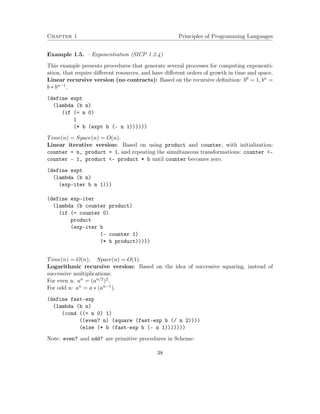
Example 1.5. – Exponentiation (SICP 1.2.4) 
This example presents procedures that generate several processes for computing exponenti-ation, 
that require different resources, and have different orders of growth in time and space. 
Linear recursive version (no contracts): Based on the recursive definition: b0 = 1; bn = 
b  bn1, 
(define expt 
(lambda (b n) 
(if (= n 0) 
1 
(* b (expt b (- n 1)))))) 
Time(n) = Space(n) = O(n). 
Linear iterative version: Based on using product and counter, with initialization: 
counter = n, product = 1, and repeating the simultaneous transformations: counter – 
counter - 1, product – product * b until counter becomes zero. 
(define expt 
(lambda (b n) 
(exp-iter b n 1))) 
(define exp-iter 
(lambda (b counter product) 
(if (= counter 0) 
product 
(exp-iter b 
(- counter 1) 
(* b product))))) 
Time(n) = O(n); Space(n) = O(1). 
Logarithmic recursive version: Based on the idea of successive squaring, instead of 
successive multiplications: 
For even n: an = (an=2)2. 
For odd n: an = a  (an1). 
(define fast-exp 
(lambda (b n) 
(cond ((= n 0) 1) 
((even? n) (square (fast-exp b (/ n 2)))) 
(else (* b (fast-exp b (- n 1))))))) 
Note: even? and odd? are primitive procedures in Scheme: 
38
Chapter 1 Principles of Programming Languages 
 even? 
#primitive:even? 
They can be defined via another primitive procedure, remainder (or modulo), as follows: 
(define even? 
(lambda (n) 
(= (remainder n 2) 0))) 
The complementary procedure to remainder is quotient, which returns the integer value 
of the division: (quotient n1 n2) == n1/n2. 
Time(n) = Space(n) = O(log n), since fast-exp(b, 2n) adds a single additional multipli-cation 
to fast-expr(b, n) (in the even case). In this approximate complexity analysis, the 
application of primitive procedures is assumed to take constant time. 
Example 1.6. – Greatest Common Divisors (GCD) (no contracts) (SICP 1.2.5) 
The GCD of 2 integers is the greatest integer that divides both. The Euclid’s algorithm 
is based on the observation: 
Lemma 1.4.1. If r is the remainder of a=b, then: GCD(a; b) = GCD(b; r). Successive 
applications of this observation yield a pair with 0 as the second number. Then, the first 
number is the answer. 
Proof. Assume a  b. Then a = qb + r where q is the quotient. Then r = a  qb. Any 
common divisor of a and b is also a divisor of r, because if d is a common divisor of a and b, 
then a = sd and b = td, implying r = (sqt)d. Since all numbers are integers, r is divisible 
by d. Therefore, d is also a common divisor of b and r. Since d is an arbitrary common 
divisor of a and b, this conclusion holds for the greatest common divisor of a and b. 
(define gcd 
(lambda (a b) 
(if (= b 0) 
a 
(gcd b (remainder a b))))) 
Iterative process: 
Space(a; b) = O(1). 
Time(a; b) = O(log(n)), where n = min(a; b). 
The Time order of growth results from the theorem: n  Fib(Time(a; b)) = ((CTime(a;b))= 
p 
5) 
which implies: Time(a; b)  log(n 
p 
5) = log(n)+log( 
p 
5) Hence: Time(a; b) = O(log(n)), 
where n = min(a; b). 
Example 1.7. – Primality Test (no contracts) (SICP 1.2.6) 
39
Chapter 1 Principles of Programming Languages 
Straightforward search: 
(define smallest-divisor 
(lambda (n) 
(find-divisor n 2))) 
(define find-divisor 
(lambda (n test-divisor) 
(cond (( (square test-divisor) n) n) 
((divides? test-divisor n) test-divisor) 
(else (find-divisor n (+ test-divisor 1)))))) 
(define divides? 
(lambda (a b) 
(= (remainder b a) 0))) 
(define prime? 
(lambda (n) 
(= n (smallest-divisor n)))) 
Based on the observation that if n is not a prime, then it must have a divisor less than or 
equal than its square root. 
p 
Iterative process. Time(n) = O( 
n); Space(n) = O(1). 
Another algorithm, based on Fermat’s Little Theorem: 
Theorem 1.4.2. If n is a prime, then for every positive integer a, (an) mod n = a mod n. 
The following algorithm picks randomly positive integers, less than n, and applies Fer-mat’s 
test for a given number of times: expmod computes be mod n. It is based on the 
observation: 
(x y) mod n = ((x mod n)  (y mod n)) mod n, a useful technique, as the numbers involved 
stay small. 
(define expmod 
(lambda (b e n) 
(cond ((= e 0) 1) 
((even? e) 
(remainder (square (expmod b (/ e 2) n)) 
n)) 
(else 
(remainder (* b (expmod b (- e 1) n)) 
n))))) 
40
Chapter 1 Principles of Programming Languages 
The created process is recursive. The rate of time grows for expmod is Time(e) = O(log(e)), 
i.e., logarithmic grow in the size of the exponent, since: Time(2  e) = Time(e) + 2. 
(define fermat-test 
(lambda (n a) 
(= (expmod a n n) a)))) 
(define fast-prime? 
(lambda (n times) 
(cond ((= times 0) t) 
((fermat-test n (+ 2 (random (- n 2)))) 
(fast-prime? n (- times 1))) 
(else #f)))) 
random is a Scheme primitive procedure. (random n) returns an integer between 0 to n-1. 
1.5 High Order Procedures 
Source: (SICP 1.3.1, 1.3.2, 1.3.3, 1.3.4) 
Variables provide abstraction of values. Procedures provide abstraction of compound 
operations on values. In this section we introduce: 
Higher order procedures: Procedures that manipulate procedures. 
This is a common notion in mathematics, where we discuss notions like f(x), without 
specifying the exact function f.  is an example of a higher order procedure. It introduces 
the concept of summation, independently of the particular function whose values are being 
summed. It allows for discussion of general properties of sums. 
In functional programming (hence, in Scheme) procedures have a first class status: 
1. Can be named by variables. 
2. Can be passed as arguments to procedures. 
3. Can be returned as procedure values. 
4. Can be included in data structures. 
1.5.1 Procedures as Parameters (SICP 1.3.1) 
Summation Consider the following 3 procedures: 
1. sum-integers: 
41
Chapter 1 Principles of Programming Languages 
Signature: sum-integers(a,b) 
Purpose: to compute the sum of integers in the interval [a,b]. 
Type: [Number*Number - Number] 
Post-conditions: result = a + (a+1) + ... + b. 
Example: (sum-integers 1 5) should produce 15 
Tests: (sum-integers 2 2) == 2 
(sum-integers 3 1) == 0 
(define sum-integers 
(lambda (a b) 
(if ( a b) 
0 
(+ a (sum-integers (+ a 1) b))))) 
2. sum-cubes: 
Signature: sum-cubes(a,b) 
Purpose: to compute the sum of cubic powers of 
integers in the interval [a,b]. 
Type: [Number*Number - Number] 
Post-conditions: result = a^3 + (a+1)^3 + ... + b^3. 
Example: (sum-cubes 1 3) should produce 36 
Tests: (sum-cubes 2 2) == 8 
(sum-cubes 3 1) == 0 
(define sum-cubes 
(lambda (a b) 
(if ( a b) 
0 
(+ (cube a) (sum-cubes (+ a 1) b))))) 
where cube is defined by: (define cube (lambda (x) (* x x x))). 
3. pi-sum: 
Signature: pi-sum(a,b) 
Purpose: to compute the sum 
1/(a*(a+2)) + 1/((a+4)*(a+6)) + 1/((a+8)*(a+10)) + ... 
(which converges to PI/8, when started from a=1). 
Type: [Number*Number - Number] 
Pre-conditions: if a  b, a != 0. 
Post-conditions: 
42
Chapter 1 Principles of Programming Languages 
result = 1/a*(a+2) + 1/(a+4)*(a+6) + ... + 1/(a+4n)*(a+4n+2), 
a+4n = b, a+4(n+1)  b 
Example: (pi-sum 1 3) should produce 1/3. 
Tests: (pi-sum 2 2) == 1/8 
(pi-sum 3 1) == 0 
(define pi-sum 
(lambda (a b) 
(if ( a b) 
0 
(+ (/ 1 (* a (+ a 2))) (pi-sum (+ a 4) b))))) 
The procedures have the same pattern: 
(define name 
(lambda (a b) 
(if ( a b) 
0 
(+ (term a) 
(name (next a) b))))) 
The 3 procedures can be abstracted by a single procedure, where the empty slots term 
and next are captured by formal parameters that specify the term and the next 
functions, and name is taken as the defined function sum: 
sum: 
Signature: sum(term,a,next,b) 
Purpose: to compute the sum of terms, defined by term 
in predefined gaps, defined by next, in the interval [a,b]. 
Type: [[Number - Number]*Number*[Number - Number]*Number - Number] 
Post-conditions: result = (term a) + (term (next a)) + ... (term n), 
where n = (next (next ...(next a))) = b, 
(next n)  b. 
Example: (sum identity 1 add1 3) should produce 6, 
where ’identity’ is (lambda (x) x) 
Tests: (sum square 2 add1 2) == 4 
(sum square 3 add1 1) == 0 
(define sum 
(lambda (term a next b) 
(if ( a b) 
0 
43
Chapter 1 Principles of Programming Languages 
(+ (term a) 
(sum term (next a) next b))))) 
Using the sum procedure, the 3 procedures above have different implementations (same 
contracts): 
(define sum-integers 
(lambda (a b) 
(sum identity a add1 b))) 
(define sum-cubes 
(lambda (a b) 
(sum cube a add1 b))) 
(define pi-sum 
(lambda (a b) 
(sum pi-term a pi-next b))) 
(define pi-term 
(lambda (x) 
(/ 1 (* x (+ x 2))))) 
(define pi-next 
(lambda (x) 
(+ x 4))) 
Discussion: What is the advantage of defining the sum procedure, and defining the three 
procedures as concrete applications of sum? 
1. First, the sum procedure prevents duplications of the computation pattern of sum-ming 
a sequence elements between given boundaries. Duplication in software is bad 
for many reasons, that can be summarized by management difficulties, and lack of 
abstraction – which leads to the second point. 
2. Second, and more important, the sum procedure expresses the mathematical notion of 
sequence summation. Having this notion, further abstractions can be formulated, on 
top of it. This is similar to the role of interface in object-oriented languages. 
Definite integral – Definition based on sum: Integral of f from a to b is approximated 
by: [f(a + dx=2) + f(a + dx + dx=2) + f(a + 2dx + dx=2) + :::]  dx for small values of dx. 
The definite integral can be computed (approximated) by the procedure: 
(define dx 0.005) 
44
Chapter 1 Principles of Programming Languages 
(define integral 
(lambda (f a b) 
(* (sum f (+ a (/ dx 2)) add-dx b) 
dx))) 
(define add-dx 
(lambda (x) (+ x dx))) 
For example: 
 (integral cube 0 1 0.01) 
0.2499875 
 (integral cube 0 1 0.001) 
0.249999875 
True value: 1/4. 
Sequence-operation – Definition based on sum: 
Signature: sequence-operation(operation,start,a,b) 
Purpose: to compute the repeated application of an operation on 
all integers in the interval [a,b], where start is 
the neutral element of the operation. 
Type: [[Number*Number - Number]*Number*Number*Number - Number] 
Pre-conditions: start is a neutral element of operation: 
(operation x start) = x 
Post-conditions: 
result = if a = b: a operation (a+1) operation ... b. 
if a  b: start 
Example: (sequence-operation * 1 3 5) is 60 
Tests: (sequence-operation + 0 2 2) == 2 
(sequence-operation * 1 3 1) == 1 
(define sequence-operation 
(lambda (operation start a b) 
(if ( a b) 
start 
(operation a (sequence-operation operation start (+ a 1) b))))) 
where operation stands for any binary procedure, such as +, *, -, and start stands for the 
neutral (unit) element of operation, i.e., 0 for +, and 1 for *. For example: 
 (sequence-operation * 1 3 5) 
45
Chapter 1 Principles of Programming Languages 
60 
 (sequence-operation + 0 2 7) 
27 
 (sequence-operation - 0 3 5) 
4 
 (sequence-operation expt 1 2 4) 
2417851639229258349412352 
 (expt 2 (expt 3 4)) 
2417851639229258349412352 
1.5.2 Constructing procedure arguments at run-time 
Procedures are constructed by the value constructor of the Procedure type: lambda. The 
evaluation of a lambda form creates a closure. For example, the evaluation of 
(lambda (x) (+ x 4)) 
creates the closure: 
Closure (x)(+ x 4) 
lambda forms can be evaluated during computation. Such closures are termed anony-mous 
procedures, since they are not named. Anonymous procedures are useful whenever 
a procedural abstraction does not justify being named and added to the global environment 
mapping. 
For example, in defining the pi-sum procedure, the procedure (lambda (x) (/ 1 (* x 
(+ x 2)))) that defines the general form of a term in the sequence is useful only for this 
computation. It can be passed directly to the pi-sum procedure: 
(define pi-sum 
(lambda (a b) 
(sum (lambda (x) (/ 1 (* x (+ x 2)))) 
a 
(lambda (x) (+ x 4)) 
b))) 
The body of the pi-sum procedure includes two anonymous procedures that are created at 
runtime, and passed as arguments to the sum procedure. The price of this elegance is that 
the anonymous procedures are redefined in every application of pi-sum. 
The integral procedure using an anonymous procedure: 
(define integral 
(lambda (f a b dx) 
(* (sum f 
46
Chapter 1 Principles of Programming Languages 
(+ a (/ dx 2.0)) 
(lambda (x) (+ x dx)) 
b) 
dx))) 
Note that once the next procedure is created anonymously within the integral procedure, 
the dx variable can become a parameter rather than a globally defined variable. 
1.5.3 Defining Local Variables – Using the let Abbreviation 
Local variables are an essential programming technique, that enables the declaration of 
variables with a restricted scope. Such variables are used for saving repeated computations. 
In a restricted scope, a local variable can be initialized with the value of some computation, 
and then substituted where ever this computation is needed. In imperative programming 
local variables are also used for storing changing values, like values needed for loop manage-ment. 
Local variables are characterized by: 
1. Declaration combined with a restricted scope, where the variable is recognized – a 
restricted program region, where occurrences of the variable are bound to the variable 
declaration. 
2. A one-time initialization: A local variable is initialized by a value that is computed 
only once. 
3. Substitution of the initialization value for variable occurrences in the scope. 
In Scheme, variables are declared only in lambda forms and in define forms. Therefore, 
the core language presented so far has no provision for local variable. Below, we show how 
local variable behavior can be obtained by plain generation and immediate application of a 
run time generated closure to initialization values. We then present the Scheme syntactic 
sugar for local values – the let special form. This special operator does not need a special 
evaluation rule (unlike define, lambda, if, cond, quote) since it is just a syntactic sugar 
for a plain Scheme form. 
Parameters, scope, bound and free variable occurrences: A lambda form includes 
parameters and body. The parameters act as variable declarations in most program-ming 
languages. They bind their occurrences in the body of the form, unless, there is a 
nested lambda form with the same parameters. The body of the lambda form is the scope 
of the parameters of the lambda form. The occurrences that are bound by the parameters 
are bound occurrences, and the ones that are not bound are free. For example, in the 
integral definition above, in the lambda form: 
(lambda (f a b dx) 
47
Chapter 1 Principles of Programming Languages 
(* (sum f 
(+ a (/ dx 2.0)) 
(lambda (x) (+ x dx)) 
b) 
dx)) 
The parameters, or declared variables, are f, a, b, dx. Their scope is the entire lambda 
form. Within the body of the lambda form, they bind all of their occurrences. But the 
occurrences of +, *, sum are free . Within the inner lambda form (lambda (x) (+ x 
dx)), the occurrence of x is bound, while the occurrence of dx is free. 
A define form also acts as a variable declaration. The defined variable binds all of its free 
occurrences in the rest of the code. We say that a defined variable has a universal scope. 
Example 1.8. Local variables in computing the value of a polynomial function: 
Consider the following function: 
f(x; y) = x(1 + xy)2 + y(1  y) + (1 + xy)(1  y) 
In order to compute the value of the function for given arguments, it is useful to define two 
local variables: 
a = 1+xy 
b = 1-y 
then: 
f(x; y) = xa2 + yb + ab 
The local variables save repeated computations of the 1 + xy and 1  y expressions. The 
body of f(x; y) can be viewed as a function in a and b (since within the scope of f, the 
occurrences of x and y are already bound). That is, the body of f(x; y) can be viewed as 
the function application 
f(x; y) = f_helper(1 + xy; 1  y) 
where for given x; y: 
f_helper(a; b) = xa2 + yb + ab 
The Scheme implementation for the f_helper function: 
(lambda (a b) 
(+ (* x (square a)) 
(* y b) 
(* a b))) 
f(x; y) can be implemented by applying the helper function to the values of a and b, i.e., 
1 + xy and 1  y: 
48
Chapter 1 Principles of Programming Languages 
(define f 
(lambda (x y) 
((lambda (a b) 
(+ (* x (square a)) 
(* y b) 
(* a b))) 
(+ 1 (* x y)) 
(- 1 y)) 
)) 
The important point is that this definition of the polynomial function f provides the behavior 
of local variables: The initialization values of the parameters a, b are computed only once, 
and substituted in multiple places in the body of the f_helper procedure. 
Note: The helper function cannot be defined in the global environment, since it has x 
and y as free variables, and during the evaluation process, while the occurrences of a and b 
are replaced by the argument values, x and y stay unbound: 
 (define f_helper 
(lambda (a b) 
(+ (* x (square a)) 
(* y b) 
(* a b)))) 
 (f_helper (+ 1 (* x y)) (- 1 y)) 
reference to undefined identifier: x 
The let abbreviation: A conventional abbreviation for this construct, which internally 
turns into a nested lambda form application, is provided by the let special operator. That 
is, a let form is just a syntactic sugar for application of a lambda form. The evaluation 
of a let form creates an anonymous closure and applies it. 
(define f 
(lambda ( x y) 
(let ((a (+ 1 (* x y))) 
(b (- 1 y))) 
(+ (* x (square a)) 
(* y b) 
(* a b))))) 
The general syntax of a let form is: 
49
Chapter 1 Principles of Programming Languages 
(let ( (var1 exp1) 
(var2 exp2) 
... 
(varn expn) ) 
body ) 
The evaluation of a let form has the following steps: 
1. Each expi is evaluated (simultaneous binding). 
2. The values of the expis are replaced for all free occurrences of their corresponding 
varis, in the let body. 
3. The body is evaluated. 
These rules result from the internal translation to the lambda form application: 
( (lambda ( var1 ... varn ) 
body ) 
exp1 
... 
expn ) 
Therefore, the evaluation of a let form does not have any special evaluation rule (unlike 
the evaluation of define and lambda forms, which are true special operators). 
Notes about let evaluation: 
1. let provides variable declaration and an embedded scope. 
2. Each vari is associated (bound) to the value of expi (simultaneous binding). 
Evaluation is done only once. 
3. The expis reside in the outer scope, where the let resides. Therefore, variable 
occurrences in the expis are not bound by the let variables, but by binding oc-currences 
in the outer scope. 
4. The body is the let scope. All variable occurrences in it are bound by the let 
variables (substituted by their values). 
5. The evaluation of a let form consists of creation of an anonymous procedure, 
and its immediate application to the initialization values of the local variables. 
 (define x 5) 
 (+ (let ( (x 3) ) 
(+ x (* x 10))) 
50
Chapter 1 Principles of Programming Languages 
x) 
== 
 (+ ( (lambda (x) (+ x (* x 10))) 
3) 
x) 
38 
Question: How many times the let construct is computed in: 
 (define x 5) 
 (define y (+ (let ( (x 3) ) 
(+ x (* x 10))) 
x)) 
 y 
38 
 (+ y y) 
76 
In evaluating a let form, variables are bound simultaneously. The initial values are 
evaluated before all let local variables are substituted. 
 (define x 5) 
 (let ( (x 3) (y (+ x 2))) 
(* x y)) 
21 
1.5.4 Procedures as Returned Values (SICP 1.3.4) 
The ability to have procedures that create procedures provides a great expressiveness. Many 
applications provide skeletal procedures that employ changing functions (algorithms). For 
example, Excel enables filter creation with a changing filtering function. General procedure 
handling methods can be implemented using procedures that create procedures. 
A function definition whose body evaluates to the value of a lambda form is a 
high order procedure that returns a procedure as its value. 
First, let us see how repeated lambda abstractions create procedures (closures) that create 
procedures. 
 A form: (+ x y y), evaluates to a number. 
 A lambda abstraction: (lambda (x) (+ x y y)), evaluates to a procedure definition. 
51
Chapter 1 Principles of Programming Languages 
 A further lambda abstraction of the lambda form: (lambda (y) (lambda (x) (+ x 
y y))), evaluates to a procedure with formal parameter y, whose application (e.g., 
((lambda (y) (lambda (x) (+ x y y))) 3) evaluates to a procedure in which y is 
already substituted, e.g., Closure (x) (+ x 3 3). 
 (define y 0) 
 (define x 3) 
 (+ x y y) 
3 
 (lambda (x) (+ x y y)) 
#procedure 
 ((lambda (x) (+ x y y)) 5) 
5 
 (lambda (y) (lambda (x) (+ x y y))) 
#procedure 
 ((lambda (y) (lambda (x) (+ x y y))) 2) 
#procedure 
 (((lambda (y) (lambda (x) (+ x y y))) 2) 5) 
9 
 (define f (lambda (y) (lambda (x) (+ x y y)) ) ) 
 ((f 2) 5) 
9 
 (define f (lambda (y) (lambda (x) (+ x y y)))) 
 ((f 2) 5) 
9 
 ((lambda (y) ((lambda (x) (+ x y y)) 5)) 2) 
9 
 ((lambda (x) (+ x y y)) 5) 
5 
 
The following examples demonstrate high order procedures that return procedures (closures) 
as their returned value. 
Example 1.9. Average damp: 
Average damping is average taken between a value val and the value of a given 
function f on val. Therefore, every function defines a different average. This function-specific 
average can be created by a procedure generator procedure: 
average-damp: 
Signature: average-damp(f) 
52
Chapter 1 Principles of Programming Languages 
Purpose: to construct a procedure that computes the average damp 
of a function average-damp(f)(x) = (f(x) + x )/ 2 
Type: [[Number - Number] - [Number - Number]] 
Post-condition: result = closure r, 
such that (r x) = (average (f x) x) 
Tests: ((average-damp square) 10) == 55 
((average-damp cube) 6) == 111 
(define average-damp 
(lambda (f) 
(lambda (x) (average x (f x))))) 
For example: 
 ((average-damp (lambda (x) (* x x))) 10) 
55 
 (average 10 ((lambda (x) (* x x)) 10)) 
55 
((average-damp cube) 6) 
111 
 (average 6 (cube 6)) 
111 
 (define av-damped-cube (average-damp cube)) 
 (av-damped-cube 6) 
111 
Example 1.10. The derivative function: 
For every number function, its derivative is also a function. The derivative of a function 
can be created by a procedure generating procedure: 
deriv: 
Signature: deriv(f dx) 
Purpose: to construct a procedure that computes the derivative 
dx approximation of a function: 
deriv(f dx)(x) = (f(x+dx) - f(x) )/ dx 
Type: [[Number - Number]*Number - [Number - Number]] 
Pre-conditions: 0  dx  1 
Post-condition: result = closure r, such that 
(r y) = (/ (- (f (+ x dx)) (f x)) 
dx) 
Example: for f(x)=x^3, the derivative is the function 3x^2, 
53
Chapter 1 Principles of Programming Languages 
whose value at x=5 is 75. 
Tests: ((deriv cube 0.001) 5) == ~75 
(define deriv 
(lambda (f dx) 
(lambda (x) 
(/ (- (f (+ x dx)) (f x)) 
dx)))) 
The value of (deriv f dx) is a procedure! 
 (define cube (lambda (x) (* x x x))) 
 ((deriv cube .001) 5) 
75.0150010000254 
 ((deriv cube .0001) 5) 
75.0015000099324 
 
Closure creation time – Compile time vs runtime Creation of a closure takes time 
and space. In general, it is preferred that expensive operations are done before a program is 
run, i.e., in static compile time. When a closure (i.e., a procedure created at runetime) 
depends on other closures, it is preferred that these auxiliary closures are created at compile 
time. The following example, presents four procedures that differ in the timing of the 
creation of the auxiliary procedures. 
Example 1.11 (Compile time vs runtime creation of auxiliary closures). 
Given a definition of a procedure that approximates the derivative of a function of one 
argument, f: x: 
(define dx 0.00001) 
(define deriv 
(lambda (f) 
(lambda(x) 
(/ (- (f (+ x dx)) 
(f x)) 
dx)))) 
The following four procedures approximate the nth derivative of a given function of one 
argument, f: 
54
Chapter 1 Principles of Programming Languages 
(define nth-deriv 
(lambda (f n) 
(lambda (x) 
(if (= n 0) 
(f x) 
( (nth-deriv (deriv f) (- n 1)) x))) 
)) 
(define nth-deriv 
(lambda (f n) 
(if (= n 0) 
f 
(lambda (x) 
( (nth-deriv (deriv f) (- n 1)) x))) 
)) 
(define nth-deriv 
(lambda (f n) 
(if (= n 0) 
f 
(nth-deriv (deriv f) (- n 1)) ) 
)) 
(define nth-deriv 
(lambda (f n) 
(if (= n 0) 
f 
(deriv (nth-deriv f (- n 1)) )) 
)) 
The four procedures are equivalent in the sense that they evaluate to the same function. 
However, there is a crucial difference in terms of the creation time of the auxiliary closures, 
i.e., the closures used by the final n-th derivative procedure. Consider for example: 
(define five-exp (lambda (x) (* x x x x x))) 
(define fourth-deriv-of-five-exp (nth-deriv five-exp 4)) 
1. The first and second versions create no closure at compile time. Every application 
of fourth-deriv-of-five-exp to an argument number, repeatedly computes all the 
lower derivative closures prior to the application. In the first version a closure is 
created even for the 0-derivative, and a test for whether the derivative rank is zero 
is performed as part of the application to an argument number, while in the second 
55
Chapter 1 Principles of Programming Languages 
version this test is performed prior to the closure creation, and no extra closure is 
created for the 0 case. 
2. The third and forth versions create four closures – the first, second, third and fourth 
derivatives of five-exp at compile time. No closure is created when fourth-deriv-of-five-exp 
is applied to an argument number. They differ in terms of the process recursive-iterative 
properties: The third version is iterative, while the fourth is recursive. 
As a conclusion we see that closures can be compared on the iterative-recursive dimension 
and on the compile-run time dimension. Clearly, an iterative version that maximizes the 
compile time creation is the preferred one, i.e., the third version, in the above example. 
1.5.5 Procedures that Store Delayed (Future) Computations 
An important usage of lambda abstraction is delaying a computation, since when a pro-cedure 
returns a closure, the computation embedded in a returned closure is not applied. 
We say that the computation is delayed. We present two cases where delayed computation 
using lambda abstraction solves a hard problem in an elegant (simple) way. 
Delayed computation for distinguishing ambiguous values: 
Example 1.12. 
The task in this example is to write Scheme implication (if forms) in terms of Scheme 
or and and. Recall that Scheme or and and are optimized to save redundant evaluation 
(they are special operators, not primitive procedures). 
First try: 
(if condition consequence alternative) == 
(or (and condition consequence) alternative) 
For example, 
 (define x 0) 
 (define y 6) 
 (if (zero? x) 100000 (/ y x)) 
100000 
 (or (and (zero? x) 100000) (/ y x)) 
100000 
But what about 
 (if (zero? x) #f #t) 
#f 
 (or (and (zero? x) #f) #t) 
#t 
56
Chapter 1 Principles of Programming Languages 
The problem is, of course, that once the condition does not evaluate to #f, the value of the 
overall expression is the value of the consequence, even if the consequence value is #f. But 
in this case the or operator evaluates the alternative. The or form can be corrected by 
delaying the computation of the consequence and the alternative, using lambda abstraction: 
(if condition consequence alternative) == 
((or (and condition (lambda () consequence)) (lambda () alternative))) 
 (if (zero? x) #f #t) 
#f 
 ((or (and (zero? x) (lambda () #f)) (lambda () #t))) 
#f 
Delayed computation for obtaining iterative processes Recall the distinction be-tween 
recursive to iterative processes. A procedure whose computations are recursive is 
characterized by a storage (frames in the Procedure-call stack) that stores the future com-putations, 
once the recursion basis is computed. In Section 1.4 we provided iterative versions 
for some recursive procedures. But they were based on new algorithms that compute the 
same functions. In many cases this is not possible. 
A recursive procedure can be turned iterative by using high order procedures that store 
the delayed computations. These delayed computation procedures are created at run-time 
and passed as arguments. Each delayed computation procedure corresponds to a frame in 
the Procedure-call stack. The resulting iterative procedure performs the recursion base, and 
calls itself with an additional delayed computation argument procedure. 
Example 1.13. Turning the factorial recursive procedure iterative by using procedures that 
store the delayed computations: 
Consider the recursive factorial procedure: 
Signature: factorial(n) 
Purpose: to compute the factorial of a number ’n’. 
This procedure follows the rule: 1! = 1, n! = n * (n-1)! 
Type: [Number - Number] 
Pre-conditions: n  0, an integer 
Post-condition: result = n! 
Example: (factorial 4) should produce 24 
Tests: (factorial 1) == 1 
(factorial 4) == 24 
(define factorial 
(lambda (n) 
57
Chapter 1 Principles of Programming Languages 
(if (= n 1) 
1 
(* n (factorial (- n 1)))) 
)) 
We turn it into a procedure fact$ that accepts an additional parameter for the delayed 
(future) computation. This procedure will be applied once the factorial procedure apply, 
i.e., in the base case. Otherwise, it will be kept in a run-time created closure that waits for 
the result of factorial on n  1: 
(define fact$ 
(lambda (n cont) 
(if (= n 0) 
(cont 1) 
(fact$ (- n 1) (lambda (res) (cont (* n res))))) 
)) 
The cont parameter stands for the delayed computation (cont stands for continuation). 
If the given argument is the base case, the continuation is immediately applied. Overawes, 
a closure is created that “stores” the cont procedure and waits until the result on n  1 is 
obtained, and then applies. The created continuations are always procedures that just apply 
the delayed computation and a later continuation to the result of a recursive call: 
(fact$ 3 (lambda (x) x)) 
== 
(fact$ 2 (lambda (res) 
( (lambda (x) x) 
(* 3 res)))) 
== 
(fact$ 1 (lambda (res) 
( (lambda (res) 
( (lambda (x) x) (* 3 res))) 
(* 2 res)))) 
== 
(fact$ 0 (lambda (res) 
( (lambda (res) 
( (lambda (res) 
( (lambda (x) x) (* 3 res))) 
(* 2 res))) 
(* 1 res)))) 
== 
( (lambda (res) 
58
Chapter 1 Principles of Programming Languages 
( (lambda (res) 
( (lambda (res) 
( (lambda (x) x) (* 3 res))) 
(* 2 res))) 
(* 1 res))) 
1) 
== 
( (lambda (res) 
( (lambda (res) 
( (lambda (x) x) (* 3 res))) 
(* 2 res))) 
1) 
== 
( (lambda (res) 
( (lambda (x) x) (* 3 res))) 
2) 
== 
( (lambda (x) x) 6) 
== 
6 
The continuations are built one on top of the other, in analogy to the frames in the 
Procedure-call stack. In Section 3.4 we present this idea as the Continuation Passing Style 
(CPS) approach. 
Summary of the demonstrated computing features: 
In this chapter we have shown how Scheme handles several essential computing features: 
1. Performing iteration computation, without losing the advantages of iteration. 
2. Procedures as arguments to procedures. This feature enables the formulation of essen-tial 
abstract notions, like sequence summation, that can further support more abstract 
notions. 
3. Run time created procedures (anonymous procedures) that save the population of a 
name space with one-time needed procedures. 
4. Local variables. 
5. Procedures that create procedures as their returned value. 
59
Chapter 1 Principles of Programming Languages 
Glossary: Language expressions – atomic, composite; Primitive elements; Semantics; 
Types – atomic, composite; Type specification language; Value constructors; Type con-structors; 
Design by contract; Preconditions; Postconditions; Procedure signature; High 
order procedures; Process, Linear recursive process, Iterative process, space/time resources, 
recursive procedure, tail recursion, iterative procedures; Side-effect. 
60
Chapter 2 
Functional Programming II – Syntax, 
Semantics and Types 
Sources: 
SICP [1] 1.1.5, 1.1.7, 1.3; 
Krishnamurthi [8] 3, 24-26 (online version http://cs.brown.edu/~sk/Publications/Books/ 
ProgLangs/2007-04-26/plai-2007-04-26.pdf); 
Friedman and Wand [3] 7 (online version: http://dl.taq.ir/computer/essentials_of_ 
programming_languages_friedman.pdf). 
Topics: 
1. Syntax: Concrete and Abstract. 
2. Operational semantics: Applicative and Normal substitution models. SICP 1.1.5, 
Krishnamurthi 3, SICP 1.1.7. 
3. High order procedures revisited. SICP 1.3. 
4. Type correctness: The type language; type correctness; type inference. Krishnamurthi 
24-26, Friedman and Wand 7. 
2.1 Syntax: Concrete and Abstract 
Syntax of languages can be specified by a concrete syntax or by an abstract syntax. 
The concrete syntax includes all syntactic information needed for parsing a language element 
(program), e.g., punctuation marks. The abstract syntax include only the essential infor-mation 
needed for language processing, e.g., for executing a program. The abstract syntax 
is an abstraction of the concrete syntax: There can be many forms of concrete syntax for a 
single abstract syntax. The abstract syntax provides a layer of abstraction that protects 
against modifications of the concrete syntax. 
61
Chapter 2 Principles of Programming Languages 
2.1.1 Concrete Syntax: 
The concrete syntax of a language defines the actual language. The concrete syntax of 
Scheme is a small and simple context free grammar (Scheme is a context free language, 
unlike most programming languages). 
We use the BNF notation for specifying the syntax of Scheme. Quote from Wikipedia: 
In computer science, Backus-Naur Form (BNF) is a metasyntax used to ex-press 
context-free grammars: that is, a formal way to describe formal languages. 
John Backus and Peter Naur developed a context free grammar to define the 
syntax of a programming language by using two sets of rules: i.e., lexical rules 
and syntactic rules. 
BNF is widely used as a notation for the grammars of computer programming languages, 
instruction sets and communication protocols, as well as a notation for representing parts 
of natural language grammars. 
1. Syntactic categories (non-terminals) are denoted as category. 
2. Terminal symbols (tokens) are surrounded with ’. 
3. Optional items are enclosed in square brackets, e.g. [item-x]. 
4. Items repeating 0 or more times are enclosed in curly brackets or suffixed with an 
asterisk, e.g. word – letter letter*. 
5. Items repeating 1 or more times are followed by a +. 
6. Alternative choices in a production are separated by the | symbol, e.g., 
alternative-A j alternative-B. 
7. Grouped items are enclosed in simple parentheses. 
Concrete syntax of the subset of Scheme introduced so far: 
scheme-exp - exp | ’(’ define ’)’ 
exp - atomic | ’(’ composite ’)’ 
atomic - number | boolean | variable 
composite - special | form 
number - Numbers 
boolean - ’#t’ | ’#f’ 
variable - Restricted sequences of letters, digits, punctuation marks 
special - lambda | quote | cond | if | let 
form - exp+ 
define - ’define’ variable exp 
62
Chapter 2 Principles of Programming Languages 
lambda - ’lambda’ ’(’ variable* ’)’ exp+ 
quote - ’quote’ variable 
cond - ’cond’ condition-clause* else-clause 
condition-clause - ’(’ exp exp+ ’)’ 
else-clause - ’(’ ’else’ exp+ ’)’ 
if - ’if’ exp exp exp 
let - ’let’ ’(’ var-initialization* ’)’ exp+ 
var-initialization - ’(’ variable exp ’)’ 
Note that the define expression cannot be nested in other combined expressions. 
Therefore, a define expression can appear only at the top level of Scheme expressions. 
The expressions of the Scheme language are obtained from the concrete syntax by ter-minal 
derivations from the start symbol Scheme-EXP. For example, the expression (if 
#f (/ 1 0) 2) is syntactically correct in Scheme because it can be derived in the above 
syntax. Here is a derivation which produces it: 
scheme-exp - 
exp - 
( composite ) - 
( special ) - 
( if ) - 
( if exp exp exp )- 
( if atomic exp exp )- 
( if boolean exp exp ) - 
( if #f exp exp ) - 
( if #f exp atomic ) - 
( if #f exp number) - 
( if #f exp 2) - 
( if #f ( composite ) 2) - 
( if #f ( form ) 2) - 
( if #f ( exp exp exp ) 2) - 
( if #f ( atomic exp exp ) 2) - 
( if #f ( variable exp exp ) 2) - 
( if #f ( / exp exp ) 2) - 
( if #f ( / atomic exp ) 2) - 
( if #f ( / number exp ) 2) - 
( if #f ( / 1 exp ) 2) - 
( if #f ( / 1 atomic ) 2) - 
( if #f ( / 1 number ) 2) - 
( if #f ( / 1 0 ) 2). 
Write a derivation tree for ( if #f ( / 1 0 ) 2). 
63
Chapter 2 Principles of Programming Languages 
2.1.2 Abstract Syntax 
The abstract syntax of a language emphasizes the content parts of the language, and ig-nores 
syntactical parts that are irrelevant for the semantics. For example, the exact ordering 
of the arguments in a define special form, or the exact parentheses or phrasing symbols, are 
irrelevant. In Scheme, we could have replaced the “(“ and “)” by “” and “”, respectively; 
or replace the white space by commas, without changing the denotation of the expressions. 
A single abstract syntax can be an abstraction of multiple concrete syntax grammars. 
Abstract syntax singles out alternative kinds of a category, and the components of 
a composite element. For each component, the abstract syntax emphasizes its role in the 
composite sentence, its category, its amount in the composite sentence, and whether its 
instances are ordered. For example, for a lambda form, the concrete syntax rule: 
lambda - ’(’ ’lambda’ ’(’ variable* ’)’ exp+ ’)’ 
turns into a component role specification: 
lambda: 
Components: Parameter: variable. Amount: = 0. Ordered. 
Body-exp: exp. Amount: = 1 . Ordered. 
Compilers and interpreters use an Abstract Syntax Parser (ASP) which defines an 
interface to the syntax, to be used by all clients of the parser. The separation of abstract 
syntax from the concrete syntax provides an additional degree of freedom to compilers and 
interpreters. In most compilers/interpreters, the ASP creates for a given language expression 
e an Abstract Syntax Tree (AST) for e. AST(e) is a tree whose internal nodes are labeled 
by language categories or operators, and its leaves belong to the expression. For example, 
the AST of the expression (lambda (x y) (+ x y)) might be the tree in Figure 2.1. The 
UML Class Diagram is a good language for specifying abstract syntax: It can describe the 
grammar categories and their inter-relationships, while ignoring the concrete syntax details. 
Symbolic description of the scheme abstract syntax: We specify, for each category, 
its kinds or its components (parts). 
scheme-exp: 
Kinds: exp, define 
exp: 
Kinds: atomic, composite 
atomic: 
Kinds: number, boolean, variable 
composite: 
Kinds: special, form 
number: 
64
Chapter 2 Principles of Programming Languages 
Figure 2.1: A possible AST for (lambda (x y) (+ x y)) 
Kinds: numbers. 
boolean: 
Kinds: #t, #f 
variable: 
Kinds: Restricted sequences of letters, digits, punctuation marks 
special: 
Kinds: lambda, quote, cond, if, let 
form: 
Components: Expression: exp. Amount: = 1. Ordered. 
define: 
Components: Variable: variable 
Expression: exp 
lambda: 
Components: Parameter: variable. Amount: = 0. Ordered. 
Body: exp. Amount: = 1 . Ordered. 
quote: 
Components: Quoted-name: variable 
cond: 
Components: Clause: condition-clause. Amount = 0. Ordered. 
Else-clause: else-clause 
condition-clause: 
Components: Predicate: exp 
Action: exp. Amount: = 1. Ordered. 
else-clause: 
Components: Action: exp. Amount: = 1. Ordered. 
if: 
65
Chapter 2 Principles of Programming Languages 
Components: Predicate: exp 
Consequence: exp 
Alternative: exp 
let: 
Components: Var: variable-initialization. Amount: = 0. 
Body: exp. Amount: = 1 . Ordered. 
variable-initialization: 
Components: Variable: variable 
Expression: exp 
The Scheme interpreters and compilers in chapter 4 use an abstract syntax based parser 
for analyzing Scheme expressions. Figure 2.2 presents a UML class diagram [12, 9] for the 
Scheme concrete syntax above. 
Figure 2.2: Scheme Abstract Syntax formulated in UML class diagram 
1. Categories are represented as classes. 
2. Kinds are represented by class hierarchy relationships. 
3. Components are represented as composition relationships between the classes. 
2.2 Operational Semantics: The Substitution Model 
The operational semantics is specified by a set of formal evaluation rules that can be 
summarized as an algorithm eval(exp) for evaluation of Scheme expressions. 
66
Chapter 2 Principles of Programming Languages 
In order to formally define eval(exp) we first introduce several concepts: 
1. Binding instance or declaration: A binding instance (declaration) of a variable 
is a variable occurrence to which other occurrences refer. 
In Scheme: 
(a) Variables occurring as lambda parameters are binding instances (declarations). 
(b) Top level (non-nested) defined variables (in a define form) are binding in-stances 
(declarations). 
(c) Variables occurring as let local variables are binding instances (declarations). 
2. Scope: The scope of a binding instance x is the region of the program text in which 
occurrences of x refer to (are bound by) the declaration of x (where the variable 
declaration is recognized). 
In Scheme: 
(a) The scope of lambda parameters is the entire lambda expression. 
(b) The scope of define variables is the entire program, from the define expression 
and on: Universal scope. 
(c) The scope of let local variables is the entire let body (not including the initial-ization 
expressions). 
3. Bound occurrence: Occurrences of a variable x (not as binding instances (decla-rations)) 
within the scope of a binding instance x are called bound. The binding 
instance (declaration) that binds an occurrence of x is the most nested declaration 
of x that includes the x occurrence in its scope. 
4. Free occurrence: Occurrences of a variable x (not as binding instances) that are not 
bound are free. 
(lambda (x) (+ x 5)) 
;x is bound by its declaration in the parameter list. 
(define y 3) ;A binding y instance. 
(+ x y) ;x is free, y is bound (considering the above evaluations). 
(+ x ( (lambda (x) (+ x 3)) 4)) 
;the 1st x occurrence is free, 
;the 2nd is a binding instance, 
;the 3rd is bound by the declaration in the lambda parameters. 
67
Chapter 2 Principles of Programming Languages 
(lambda (y) ;a binding instance 
(+ x y 
;the x occurrence is free 
;the y occurrence is bound by the outer declaration 
((lambda (x y) (+ x y)) 
;the x and y occurrences are bound by the internal declarations. 
3 4) 
)) 
An equivalent form: 
(lambda (y) 
(+ x y 
(let ((x 3) 
(y 4)) ;declarations of x and y 
(+ x y)) 
;the x and y occurrences are bound by the let declarations. 
)) 
Note: A variable is bound or free with respect to an expression in which it occurs. A 
variable can be free in one expression but bound in an enclosing expression. 
5. Renaming: Bound variables (in expressions and in closures) can be consistently 
renamed by new variables (not occurring in the expression) without changing the 
intended meaning of the expression. That is, expressions that differ only by consistent 
renaming of bound variables are considered equivalent. For example, the following 
are equivalent pairs: 
(lambda (x) x) (lambda (z) z) 
((+ x ( (lambda (x) (+ x y)) 4))) ((+ x ( (lambda (z) (+ z y)) 4))) 
Incorrect renaming: 
((+ x ( (lambda (y) (+ y y)) 4))) ((+ z ( (lambda (z) (+ z y)) 4))) 
6. Substitution: Involves an operation of replacement of free occurrences of vari-ables 
in an expression by given values. 
Definition: A substitution s is a mapping from a finite set of variables to a finite set 
of values. A pair hx; s(x)i is called binding, and written x = s(x). 
Substitutions are written using set notions. For example: 
68
Chapter 2 Principles of Programming Languages 
 {x = 3, y = a, z = #t, w = Closure(x) (+ x 1)} is a substitutions, while 
 {x = 3, x = a, z = #t, w = Closure(x) (+ x 1)} is not a substitution. 
Definition: The application of a substitution s to an expression E, denoted E  s (or 
just Es if no confusion arises), involves replacement of free variable occurrences by 
values: 
(a) Consistent renaming of the expression E and the values in s. 
(b) Simultaneous replacement of all free occurrences of the variables of s in (the 
renamed) E by (the renamed) corresponding values. 
Example 2.1 (Substitution applications E  s). 
(a) 10{x = 5} = 10: No renaming; no replacement. 
(b) (+ x y){x = 5} = (+ 5 y): No renaming; just replacement. 
(c) (+ x y){x = 5, y = ’x} = (+ 5 ’x): No renaming; just replacement. 
Note the difference between the variable x to the Symbol value ’x. 
(d) ((+ x ((lambda (x) (+ x 3)) 4))){x = 5} = 
i. Renaming: E turns into ((+ x ((lambda (x1) (+ x1 3)) 4))) 
ii. Substitute: E turns into ((+ 5 ((lambda (x1) (+ x1 3)) 4))) 
(e) (lambda (y) ( ((lambda (x) x) y) x)) 
{x = Closure (x) (y x)} = 
i. Renaming: s(x) turns into (lambda (x1) (y x1)); 
E turns into (lambda (y2) (((lambda (x3) x3) y2) x)); 
ii. Substitute: E turns into 
(lambda (y2) ( ((lambda (x3) x3) y2) 
Closure (x1) (y x1)) 
) 
What would be the result without renaming? Note the difference in the binding status 
of the variable y. 
Applying a substitution to multiple expressions: The notion is extended into 
E1;E2; : : :En  s. It will be useful for lambda expressions and closures with multiple 
expressions in their bodies. 
Writing agreement: In manual descriptions of substitutions, if there is no variable 
overlapping between the substitution values and the substituted expression, we save 
the explicit writing of the renaming step. 
69
Chapter 2 Principles of Programming Languages 
2.2.1 The Substitution Model – Applicative Order Evaluation: 
The substitution model uses applicative order evaluation, which is an eager approach 
for evaluation. The rules formalize the informally stated rules in Chapter 1: 
1. Eval: Evaluate the elements of the compound expression; 
2. Apply: Apply the procedure which is the value of the operator of the expression, 
to the arguments, which are the values of the operands of the expression. For user 
defined procedures (closures) this step is broken into 2 steps: substitute and reduce. 
Therefore, the model is also called eval-substitute-reduce. The algorithm that defines the 
operational semantics is called applicative-eval. It is a function: 
applicative-eval: scheme-exp [ Scheme_type ! Scheme_type. 
So far, Scheme_type = Number [ Boolean [ Symbol [ Procedure [ V oid [ Empty. 
We use the predicates atom?, composite? number?, boolean?, and variable?, for 
identifying atomic, composite, number, boolean, and variable expressions, respectively. The 
predicates primitive-procedure?, and procedure? are used for identifying primitive pro-cedures 
and user defined procedures, respectively. The predicate value? identifies Scheme 
values, i.e., values in Scheme_type, that are created by evaluation of Scheme expressions. 
The global environment value of a variable e is denoted GE(e). A variable-value pair 
mapped by the global environment is called a binding, and denoted  x; val . Addition 
of a binding to the global environment, i.e., extending the GE mapping for a new variable x, 
is denoted GE*x; val. 
Signature: applicative-eval(e) 
Purpose: Evaluate a Scheme expression 
Type: [(scheme-exp union Scheme-type) - Scheme-type] 
Definition: 
applicative-eval[e] = 
I. atom?(e): 
1. number?(e) or boolean?( e): 
applicative-eval[e] = e 
2. variable?(e): 
a. If GE(e) is defined: 
applicative-eval[e] = GE(e) 
b. Otherwise: e must be a variable denoting a Primitive procedure: 
applicative-eval[e] = built-in code of e. 
II. composite?(e): e = (e0 e1 ... en)(n = 0): 
1. e0 is a Special Operator: 
applicative-eval[e] is defined by the special evaluation rules 
of e0 (see below). 
70
Chapter 2 Principles of Programming Languages 
2. a. Evaluate: compute applicative-eval[ei] = ei’ for i=0..n. 
b. primitive-procedure?(e0’): 
applicative-eval[e] = system application e0’(e1’, ..., en’). 
c. procedure?(e0’): 
e0’ is a closure: Closure (x1 ... xn) b1 ... bm 
i. Substitute (preceded by renaming): 
b1, ..., bm {x1 = e1’, ..., xn = en’} = b1’, ..., bm’ 
ii. Reduce: applicative-eval[b1’], ..., applicative-eval[b(m-1)’]. 
applicative-eval[e] = applicative-eval[bm’]. 
III. value?(e): applicative-eval[e] = e 
Special operators evaluation rules: 
1. e = (define x e1): 
GE = GE*x, applicative-eval[e1] 
2. e = (lambda (x1 x2 ... xn) b1 ... bm) at least one bi is required: 
applicative-eval[e] = Closure (x1 ...xn) b1 ... bm 
3. e = (quote e1): 
applicative-eval[e] = e1 
4. e = (cond (p1 e11 ...) ... (else en1 ...)): 
If not(false?(applicative-eval[p1])): 
applicative-eval[e11], applicative-eval[e12], ... 
applicative-eval[e] = applicative-eval[last e1i] 
Otherwise, continue with p2 in the same way. 
If for all pi-s applicative-eval[pi] = #f: 
applicative-eval[en1], applicative-eval[en2], ... 
applicative-eval[e] = applicative-eval[last eni] 
5. e = (if p con alt): 
If true?(applicative-eval[p]): 
then applicative-eval[e] = applicative-eval[con] 
else applicative-eval[e] = applicative-eval[alt] 
Note: value?(e) holds for all values computed by applicative-eval, i.e., for numbers, 
boolean values (#t, #f), symbols (computed by the Symbol value constructor quote), and 
closures (computed by the Procedure value constructor lambda). 
Example 2.2. Recall the definitions from Chapter 1: 
(define square (lambda (x) (* x x))) 
(define sum-of-squares (lambda (x y) 
71
Chapter 2 Principles of Programming Languages 
(+ (square x) (square y)) 
)) 
(define f (lambda (a) 
(sum-of-squares (+ a 1) (* a 2) ) 
)) 
Apply applicative-eval to the expression (f 5), assuming that these definitions are al-ready 
evaluated. 
 (f 5) 
136 
applicative-eval[ (f 5) ] == 
applicative-eval[ f ] == 
Closure (a) (sum-of-squares (+ a 1) (* a 2) ) 
applicative-eval[ 5 ] == 5 
== 
applicative-eval[ (sum-of-squares (+ 5 1) (* 5 2)) ] == 
applicative-eval[sum-of-squares] == 
Closure (x y) (+ (square x) (square y)) 
applicative-eval[ (+ 5 1) ] == 
applicative-eval[ + ] == primitive-procedure + 
applicative-eval[ 5 ] == 5 
applicative-eval[ 1 ] == 1 
== 6 
applicative-eval[ (* 5 2) ] == 
applicative-eval[ * ] == primitive-procedure * 
applicative-eval[ 5 ] == 5 
applicative-eval[ 2 ] == 2 
== 10 
== 
applicative-eval[ (+ (square 6) (square 10)) ] == 
applicative-eval[ + ] == primitive-procedure + 
applicative-eval[ (square 6) ] == 
applicative-eval[ square ] == Closure (x) (* x x) 
applicative-eval[ 6 ] == 6 
== 
applicative-eval[ (* 6 6) ] == 
applicative-eval[ * ] == primitive-procedure * 
applicative-eval[ 6 ] == 6 
72
Chapter 2 Principles of Programming Languages 
== 36 
applicative-eval[ (square 10) ] 
applicative-eval[ square ] == Closure (x) (* x x)) 
applicative-eval[ 10 ] == 10 
== 
applicative-eval[ (* 10 10) ] == 
applicative-eval[ * ] == primitive-procedure * 
applicative-eval[ 10 ] == 10 
== 100 
== 136 
Example 2.3. A procedure with no formal parameters, and with a primitive expression as 
its body: 
 (define five (lambda () 5)) 
 five 
Closure () 5 
 (five) 
5 
applicative-eval[ (five) ] == 
applicative-eval[ five ] == Closure () 5) 
== 
applicative-eval[ 5 ] == 
5 
Example 2.4. 
 (define four 4) 
 four 
4 
 (four) 
ERROR: Wrong type to apply: 4 
; in expression: (... four) 
; in top level environment. 
applicative-eval[ (four) ] == 
applicative-eval[ four ] == 4 
the Evaluate step yields a wrong type. 
73
Chapter 2 Principles of Programming Languages 
Example 2.5. 
 (define y 4) 
 (define f (lambda (g) 
(lambda (y) (+ y (g y))))) 
 (define h (lambda (x) (+ x y))) 
 (f h) 
Closure (y1) (+ y1 ((lambda (x) (+ x y)) 
y1)) 
 ( (f h) 3) 
10 
applicative-eval[ (f h) ] == 
applicative-eval[ f ] == 
Closure (g) (lambda (y) (+ y (g y))) 
applicative-eval[ h ] == 
Closure (x) (+ x y) 
== 
Substitute – rename both expressions and replace: 
(lambda (y2) (+ y2 (g y2))){g = Closure (x1) (+ x1 y)} 
== 
applicative-eval[ (lambda (y2) (+ y2 
(Closure (x1) (+ x1 y) y2 ) )) ] 
== 
Closure (y2) (+ y2 (Closure (x1) (+ x1 y) y2) )  
Note the essential role of renaming here. Without it, the application ((f h) 3) would 
replace all free occurrences of y by 3, yielding 9 as the result. 
Example 2.6. Why is applicative-eval defined on Scheme-values, and not only on 
Scheme expressions? 
The values managed by applicative-eval are Numbers, booleans, symbols, and pro-cedures 
– primitive or user defined. Number and Boolean values (semantics) are also 
Number and Boolean expressions (syntax). Therefore, they do not need a separate seman-tic 
formulation handling. In particular, as syntactic expressions they can be repeatedly 
evaluated. 
Values of the rest of the types are distinguished from their syntactic forms, and therefore, 
cannot be repeatedly evaluated. Consider, for example, the following two evaluations: 
74
Chapter 2 Principles of Programming Languages 
applicative-eval[((lambda (x)(display x) x) (quote a))] == 
Eval: 
applicative-eval[(lambda (x)(display x) x)] == Closure (x)(display x) x 
applicative-eval[(quote a)] == the symbol ’a’ 
Substitute: 
(display x), x {x = ’a’} = (display ’a’), ’a’ 
Reduce: 
applicative-eval[ (display ’a’) ] == 
Eval: 
applicative-eval[display] == Code of display. 
applicative-eval[’a’] == ’a’ , since ’a’ is a value of the symbol (*) 
type (and not a variable!). 
applicative-eval[’a’] == ’a’ 
and also 
 ((lambda (f x)(f x)) (lambda (x) x) 3) 
3 
applicative-eval[ ((lambda (f x)(f x)) (lambda (x) x) 3) ] == 
Eval: 
applicative-eval[(lambda (f x)(f x))] == Closure (f x)(f x) 
applicative-eval[(lambda (x) x) ] == Closure (x) x) 
applicative-eval[3] == 3 
Substitute following renaming: 
(f1 x1){f1 = Closure (x2) x2, x1 = 3} = (Closure (x2) x2 3) 
Reduce: 
applicative-eval[(Closure (x2) x2 3)] == 
Eval: 
applicative-eval[Closure (x2) x2] == Closure (x2) x2 (*) 
applicative-eval[3] == 3 
Substitute x2 by 3 in x2 == 3 
Reduce: 
applicative-eval[3]= 3 
In both evaluations, values created by computation of applicative-eval (the symbol a 
and the closure Closure (x2) x2, are repeatedly evaluated. The evaluation completes 
correctly because applicative-eval avoids repetitive evaluations (the lines marked by (*). 
Otherwise, the first evaluation would have failed with an “unbound variable” error, and the 
second with “unknown type of argument”. 
75
Chapter 2 Principles of Programming Languages 
The substitution model – applicative order uses the call-by-value method 
for parameter passing. 
Parameter passing method: In procedure application, the values of the ac-tual 
arguments are substituted for the formal parameters. This is the standard 
evaluation model in Scheme (LISP), and the most frequent method in other 
languages (Pascal, C, C++, Java). 
2.2.2 The Substitution Model – Normal Order Evaluation: 
applicative-eval implements the eager approach in evaluation. The eagerness is 
expressed by immediate evaluation of arguments, prior to closure application. An alternative 
algorithm, that implements the lazy approach in evaluation avoids argument evaluation 
until essential: 
1. Needed for deciding a computation branch. 
2. Needed for application of a primitive procedure. 
The normal-eval algorithm is similar to applicative-eval. The only difference, which 
realizes the lazy approach, is moving the argument evaluation from step II.2.a. into step 
II.2.b., just before a primitive procedure is applied. Otherwise, the algorithm is unchanged, 
and the computation rules for the special operators are the same: 
Signature: normal-eval(e) 
Purpose: Evaluate a Scheme expression 
Type: [scheme-exp - Scheme-type] 
Definition: 
normal-eval[e] = 
I. atom?(e): 
1. number?(e) or boolean?( e): 
applicative-eval[e] = e 
2. variable?(e): 
a. If GE(e) is defined: 
applicative-eval[e] = GE(e) 
b. Otherwise: e must be a variable denoting a Primitive procedure: 
applicative-eval[e] = built-in code of e. 
II. (composite? e): e = (e0 e1 ... en)(n = 0): 
1. e0 is a Special Operator: 
normal-eval[e] is defined by the special evaluation rules of e0. 
2. a. Evaluate: compute normal-eval[e0] = e0’. 
b. (primitive-procedure? e0’): 
Evaluate: compute normal-eval[ei] = ei’ for all ei. 
normal-eval[e] = system application e0’(e1’, ..., en’). 
76
Chapter 2 Principles of Programming Languages 
c. (procedure? e0’): 
e0’ is a closure: Closure (x1 ... xn) b1 ... bm : 
i. Substitute (preceded by renaming): 
b1, ..., bm {x1 = e1, ..., xn = en} = b1’, ..., bm’ 
ii. Reduce: normal-eval[b1’], ..., normal-eval[bm’] 
iii. Return: normal-eval[e] = normal-eval[bm’] 
Note that normal-eval is defined only on Scheme expressions (as expected from an inter-preter). 
Why? 
Example 2.7. The Expansions step – In this step there are no evaluations, just replace-ments. 
normal-eval[ (f 5) ] == 
normal-eval[f] == Closure (a) (sum-of-squares (+ a 1) (* a 2)) 
== 
normal-eval[ (sum-of-squares (+ 5 1) (* 5 2)) ] == 
normal-eval[ sum-of-squares ] == 
Closure (x y) (+ (square x) (square y)) 
== 
normal-eval[ (+ (square (+ 5 1)) (square (* 5 2))) ] == 
normal-eval[ + ] == primitive-procedure + 
normal-eval[ (square (+ 5 1)) ] == 
normal-eval[ square ] == Closure (x) (* x x) 
== 
normal-eval[ (* (+ 5 1) (+ 5 1)) ] == 
normal-eval[ * ] == primitiv-procedure * 
normal-eval[ (+ 5 1) ] == 
normal-eval[ + ] == primitive-procedure + 
normal-eval[ 5 ] == 5 
normal-eval[ 1 ] == 1 
== 6 
normal-eval[ (+ 5 1) ] == 
normal-eval[ + ] == primitive-procedure + 
normal-eval[ 5 ] == 5 
normal-eval[ 1 ] == 1 
== 6 
== 36 
normal-eval[ (square (* 5 2)) ] == 
normal-eval[ square ] == Closure (x) (* x x) 
== 
77
Chapter 2 Principles of Programming Languages 
normal-eval[ (* (* 5 2) (* 5 2)) ] == 
normal-eval[ * ] == primitiv-procedure * 
normal-eval[ (* 5 2) ] == 
normal-eval[ * ] == primitive-procedure * 
normal-eval[ 5 ] == 5 
normal-eval[ 2 ] == 2 
== 10 
normal-eval[ (* 5 2) ] == 
normal-eval[ * ] == primitive-procedure * 
normal-eval[ 5 ] == 5 
normal-eval[ 2 ] == 2 
== 10 
== 100 
== 136 
2.2.3 Comparison: The applicative order and the normal order of evalu-ations: 
1. If both orders terminate (no infinite loop): They compute the same value. 
2. Normal order evaluation repeats many computations. 
3. Whenever applicative order evaluation terminates, normal order terminates as well. 
4. There are expressions where normal order evaluation terminates, while applicative 
order does not: 
(define f (lambda (x) (f x))) 
(define g (lambda (x) 5)) 
(g (f 0)) 
In normal order, the application (f 0) is not reached. In applicative order: Better, 
do not try! Most interpreters use application-order evaluation. 
5. Side effects (like printing – the display primitive in Scheme) can be used to detect 
the evaluation order. Consider, for example, 
 (define f (lambda (x) (display x) (newline) (+ x 1))) 
 (define g (lambda (x) 5)) 
 (g (f 0)) 
0 
5 
78
Chapter 2 Principles of Programming Languages 
 What evaluation order was used? 
 What are the side effect and the result in the other evaluation order? 
Explain the results by applying both evaluation orders of the eval algorithm. 
The normal-order evaluation model uses the call-by-name method for param-eter 
passing: In procedure application, the actual arguments themselves are 
substituted for the formal parameters. This evaluation model is used in Scheme 
(LISP) for special forms. The call be name method was first introduced in 
Algol-60. 
2.2.4 High Order Functions Revisited 
Recall the special operator let, which is a syntactic sugar for application of an anonymous 
lambda, i.e., runtime creation of a closure and its immediate application. For example, the 
procedure 
(define f 
(lambda ( x y) 
(let ((a (+ 1 (* x y))) 
(b (- 1 y))) 
(+ (* x (square a)) 
(* y b) 
(* a b))))) 
is actually the procedure: 
(define f 
(lambda (x y) 
((lambda (a b) 
(+ (* x (square a)) 
(* y b) 
(* a b))) 
(+ 1 (* x y)) 
(- 1 y)) 
)) 
Therefore: 
applicative-eval[ (f 3 1) ] ==* 
Substitute: body of f{x = 3, y = 1} == 
79
Chapter 2 Principles of Programming Languages 
applicative-eval[ ((lambda (a b) (+ (* 3 (square a)) 
(* 1 b) 
(* a b))) 
(+ 1 (* 3 1)) 
(- 1 1)) ] ==* 
applicative-eval[ (+ (* 3 16) (* 1 0) (* 4 0)) ] == 
48 
The symbol ==* is used to denote application of several applicative-eval steps. 
2.2.4.1 Defining local procedures 
Can we use let for defining local variables whose value is a procedure? 
(define f 
(lambda (x y) 
(let ( (f-helper (lambda (a b) 
(+ (* x (square a)) 
(* y b) 
(* a b))) 
) ) 
(f-helper (+ 1 (* x y)) 
(- 1 y))) 
)) 
applicative-eval[ (f 3 1) ] == 
applicative-eval[ f ] == Closure (x y) (let ...) 
applicative-eval[ 3 ] == 3 
applicative-eval[ 1 ] == 1 
Substitute: body of f{x = 3, y = 1} == 
applicative-eval[ ( (lambda (f-helper) (f-helper (+ 1 (* 3 1)) 
(- 1 1))) 
(lambda (a b)(+ (* 3 (square a)) 
(* 1 b) 
(* a b))) ) ] ==* 
applicative-eval[ ( Closure (a b)(+ (* 3 (square a)) 
(* 1 b) 
(* a b))  
(+ 1 (* 3 1)) 
(- 1 1)) ] ==* 
applicative-eval[ (+ (* 3 16) (* 1 0) (* 4 0)) ] ==* 
48 
80
Chapter 2 Principles of Programming Languages 
Local recursive procedures, and the letrec special operator: 
Consider: 
(define factorial 
(lambda (n) 
(let ( (iter (lambda (product counter) 
(if ( counter n) 
product 
(iter (* counter product) 
(+ counter 1)))) 
) ) 
(iter 1 1)))) 
In order to clarify the binding relationships between declarations and variable occurrences 
we add numbering, that unifies a declaration with its bound variable occurrences: 
(define factorial 
(lambda (n1) 
(let ( (iter2 (lambda (product3 counter3) 
(if ( counter3 n1) 
product3 
(iter4 (* counter3 product3) 
(+ counter3 1)))) 
) ) 
(iter2 1 1)))) 
This analysis of declaration scopes and variable occurrences in these scopes clarifies the 
problem: 
 The binding instance n1 has the whole lambda body as its scope. 
 The binding instance iter2 has the let body as its scope. 
 The binding instances product3 and counter3 have the body of the iter lambda as 
their scope. 
 In the body of the iter2 lambda form: 
– The variable occurrences n1, counter3, product3 are bound by the correspond-ing 
binding instances. 
– The variable occurrences , *, + denote primitive procedures. 
– 1 is a number. 
– if denotes a special operator. 
81
Chapter 2 Principles of Programming Languages 
– iter4 is a free variable!!!!! Causes a runtime error in evaluation: 
applicative-eval[ (factorial 3) ] ==* 
Substitute: body of factorial{n = 3} == 
applicative-eval[ ( (lambda (iter) (iter 1 1)) 
(lambda (product counter) 
(if ( counter 3) 
product 
(iter (* counter product) 
(+ counter 1)))) 
) ] ==* 
applicative-eval[ ( Closure (product counter) 
(if ( counter 3) 
product 
(iter (* counter product) 
(+ counter 1)))  
1 1) ] ==* 
applicative-eval[ (if ( 1 3) 1 (iter (* 1 1) (+ 1 1))) ] ==* 
applicative-eval[ (iter (* 1 1) (+ 1 1)) ] == 
*** RUN-TIME-ERROR: variable iter undefined *** 
The problem is that iter is a recursive procedure: It applies the procedure iter which 
is not globally defined. iter is just a parameter that was substituted by another procedure. 
Once iter is substituted, its occurrence turns into a free variable, that must be already 
bound when it is evaluated. But, unfortunately, it is not! This can be seen clearly, if we 
replace the let abbreviation by its meaning expression: 
1. (define factorial 
2. (lambda (n) 
3. ( (lambda (iter) (iter 1 1)) 
4. (lambda (product counter) 
5. (if ( counter n) 
6. product 
7. (iter (* counter product) 
8. (+ counter 1)))) 
9. ))) 
 (factorial 3) 
reference to undefined identifier: iter 
82
Chapter 2 Principles of Programming Languages 
We see that the occurrence of iter in line 3 is indeed bound by the lambda parameter, 
which is a declaration. Therefore, this occurrence of iter is replaced at the substitute step 
in the evaluation. But the occurrence of iter on line 7 is not within the scope of any iter 
declaration, and therefore is free, and is not replaced! 
Indeed, the substitution model cannot simply compute recursive functions. For globally 
defined procedures like factorial it works well because we have strengthened the lambda 
calculus substitution model with the global environment mapping. But, that does not 
exist for local procedures. 
Therefore: 
For local recursive functions there is a special operator letrec, similar to let, 
and used only for local procedure (function) definitions. It’s syntax is the same 
as that of let. But, the scope of the local procedure declarations includes all 
of the initialization procedures! 
(define factorial 
(lambda (n) 
(letrec ( (iter (lambda (product counter) 
(if ( counter n) 
product 
(iter (* counter product) 
(+ counter 1)))) 
) ) 
(iter 1 1)) 
)) 
Usage agreement: The special operator let is used for introducing non Procedure 
local variables, while the special operator letrec is used for introducing Procedure local 
variables. Note that the substitution model presented above does not account for local 
recursive procedures. 
In lambda calculus, which is the basis for functional programming, recursive functions 
are computed with the help of fixed point operators. A recursive procedure is rewritten, 
using a fixed point operator, in a way that defines it as a recursive procedures. 
2.2.4.2 Side comment: Fixed point operators 
Based on excerpt from Wikipedia: 
A fixed point combinator (or fixed-point operator) is a higher-order function which com-putes 
fixed points of functions. This operation is relevant in programming language theory 
because it allows the implementation of recursion in the form of a rewrite rule, without 
explicit support from the language’s runtime engine. A fixed point of a function f is a value 
83
Chapter 2 Principles of Programming Languages 
x such that f(x) = x. For example, 0 and 1 are fixed points of the function f(x) = x2, 
because 02 = 0 and 12 = 1. 
Recursive functions can be viewed as high order functions, that take a function parameter 
as well as other arguments. Viewed this way, the intended semantics is to find a function 
argument, which is equal to the original definition, so that recursive calls use the same 
function. This is achieved by replacing the definition of f (its lambda expression) by an 
application of a fixed point operator to the lambda expression that defines f. 
What is a fixed-point of a high order function? 
Whereas a fixed-point of a first-order function (a function on simple values such as integers) 
is a first-order value, a fixed point of a higher-order function F is another function f-fix 
such that 
F(F-fix) = F-fix. 
A fixed point operator is a function FIX which produces such a fixed point f-fix for any 
function F: 
FIX(F) = F-fix. 
Therefore: F( FIX(F) ) = FIX(F). 
Fixed point combinators allow the definition of anonymous recursive functions (see the 
example below). Somewhat surprisingly, they can be defined with non-recursive lambda 
abstractions. 
Example 2.8. Consider the factorial function: 
factorial(n) = (lambda (n)(if (= n 0) 1 (* n (factorial (- n 1))))) 
Function abstraction: 
F = (lambda (f) 
(lambda (n)(if (= n 0) 1 (* n (f (- n 1)))))) 
Note that F is a high-order procedure, which accepts an integer procedure argument, and 
returns an integer procedure. That is, F creates integer procedures, based on its integer pro-cedure 
argument. For example, F( +1 ), F( square ), F( cube ) are three procedures, 
created by F. 
The question is: Which argument procedure to F obtains the intended meaning of recur-sion? 
We show that FIX(F) has the property that it is equal to the body of F, with recursive 
calls to FIX(F). That is: 
FIX(F) = (lambda (n)(if (= n 0) 1 (* n (FIX(F) (- n 1))))) 
which is the intended meaning of recursion. 
We know that: FIX(F) = F(FIX(F)). Therefore: 
84
Chapter 2 Principles of Programming Languages 
FIX(F) == 
F( FIX(F) ) == 
( (lambda (f) 
(lambda (n)(if (= n 0) 1 (* n (f (- n 1)))))) 
FIX(F) ) == 
(lambda (n)(if (= n 0) 1 (* n (FIX(F) (- n 1))))) 
That is, FIX(F) performs the recursive step. Hence, in order to obtain the recursive factorial 
procedure we can replace all occurrences of factorial by FIX(F), where FIX is a fixed point 
operator, and F is the above expression. 
An example of an application: 
FIX(F) (1) == 
F( FIX(F) ) (1) == 
( ( (lambda (f) 
(lambda (n)(if (= n 0) 1 (* n (f (- n 1)))))) 
FIX(F) ) 
1) == 
( (lambda (n)(if (= n 0) 1 (* n (FIX(F) (- n 1))))) 
1) == 
(if (= 1 0) 1 (* 1 (FIX(F) (- 1 1)))) == 
(* 1 (FIX(F) (- 1 1))) == 
(* 1 (FIX(F) 0)) ==* (skipping steps) 
(* 1 (if (= 0 0) 1 (* 0 (FIX(F) (- 0 1))))) == 
(* 1 1) == 1 
We see that FIX(F) functions exactly like the intended factorial function. Therefore, 
factorial can be viewed as an abbreviation for FIX(F): 
(define factorial (FIX F)) 
where F is the high-order procedure above. 
Scheme applications saves us the need to explicitly use fixed point operators in order to 
define local recursive procedures. The letrec special operator is used instead. 
Summary: 
 Local procedures are defined with letrec. 
 Local non-procedure variables are defined with let. 
 The substitution model (without using fixed-point operators) cannot compute local 
(internal) recursive procedures. The meaning of the letrec special operator can be 
defined within an imperative operational semantics (accounts for changing variable 
states). Within the substitution model, we have only an intuitive understanding of 
the semantics of local recursive procedures (letrec works by magic). 
85
Chapter 2 Principles of Programming Languages 
2.2.5 Function Currying 
Currying is a technique for turning a function (procedure) of n parameters into a chain of n 
single parameter procedures. It is called after Haskell Curry. It is used when parameters are 
not all available, and fixing part of them enables partial evaluation of a procedure code. 
Currying turns a procedure (lambda (x1 x2 ... xn) body) into a chain of high order 
procedures (lambda (x1) (lambda (x2) ... (lambda (xn) body)...)). The Currying 
technique is used in every language that supports closures, i.e., run-time created procedures: 
All functional languages, Javascript, C#. 
Example 2.9. 
Signature: add(x,y) 
Type: [Number*Number - Number] 
(define add 
(lambda (x y) (+ x y))) 
Can be Curried into: 
Signature: c-add(x) 
Type: [Number - [Number - Number]] 
(define c-add 
(lambda (x) 
(lambda (y) (add x y)))) 
(define add3 (c-add 3)) 
 (add3 4) 
7 
Example 2.10. Recall the sum procedure for summing finite sequences: 
Signature: sum(term a next b) 
Type: [[Number - Number]*Number*[Number - number]*Number -Number] 
(define sum 
(lambda (term a next b) 
(if ( a b) 
0 
(+ (term a) 
(sum term (next a) next b))))) 
For a given mathematical sequence, the procedures term, next are fixed and maybe fre-quently 
used for varying intervals. In that case, sum can be Curried into c-sum and reused 
for multiple interval boundaries: 
86
Chapter 2 Principles of Programming Languages 
Signature: c-sum(term) 
Type: [[Number - Number] - [[Number - number] - [Number*Number -Number]]] 
(define c-sum 
(lambda (term) 
(lambda (next) 
(lambda (a b) 
(sum term a next b))))) 
For the sequence of squares with skips of 2: 
ha2; (a + 2)2; :::i : 
(define sum-sqrts-skip2 ((c-sum (lambda (x)(* x x))) 
(lambda (x) (+ x 2)) )) 
 (sum-sqrts-skip2 2 6) 
56 
Further generalization can involve general Currying procedures: 
Signature: curry2(f) 
Type: [[T1*T2 - T3] - [T1 - [T2 - T3]]] 
(define curry2 
(lambda (f) 
(lambda (x) 
(lambda (y) (f x y))))) 
 (((curry2 add) 3) 4) 
7 
(define add3 ((curry2 add) 3)) 
 (add3 4) 
7 
 (add3 7) 
10 
Example 2.11 (Naive Currying). 
Consider a more complex version of the add procedure, where a complex computation, 
say the recursive fib procedure, is applied to the available (non-delayed) parameter: 
Signature: add-fib(x,y) 
Type: [Number*Number - Number] 
(define add-fib 
(lambda (x y) 
(+ (fib x) y))) 
 (add-fib 4 5) 
87
Chapter 2 Principles of Programming Languages 
10 
Naive Currying: 
Signature: c-add-fib(x) 
Type: [Number - [Number - Number]] 
(define c-add-fib 
(lambda (x) 
(lambda (y) 
(+ (fib x) y)))) 
(define add-fib4 (c-add-fib 4)) 
 (add-fib4 5) 
10 
 (add-fib4 3) 
8 
 (add-fib4 5) 
10 
This Currying is naive because it does not meet the expectations of partial evaluation: In 
every application of add-fib4, (fib 4) is re-computed, although we could have computed 
it once at the time of Currying, i.e., before the definition of add-fib4. 
The following version demonstrates the full idea of Currying: Delaying computations 
in unknown variables, while applying computations in known variables. 
(define c-add-fib 
(lambda (x) 
(let ((fib-x (fib x))) ;Applying known computation 
(lambda (y) ;delaying unknown computations 
(+ fib-x y))) 
)) 
Using the new version, (fib 4) is computed once, while add-fib-4 is defined. 
Example 2.12. Consider the recursive procedure expt: 
Signature: expt(x,y) 
Type: [Number*Number - Number] 
(define expt 
(lambda (b n) 
(if (= n 0) 
1 
(* b (expt b (- n 1)))))) 
88
Chapter 2 Principles of Programming Languages 
Naive Currying: 
Signature: c-expt(x,y) 
Type: [Number - [Number - Number]] 
(define c-expt 
(lambda (b) 
(lambda (n) 
(expt b n)))) 
 ((c-expt 3) 4) 
81 
Another naive Currying: 
(define c-expt 
(lambda (b) 
(lambda (n) 
(if (= n 0) 
1 
(* b ((c-expt b) (- n 1)) ))) 
)) 
Both Curried versions are naive since the Curried procedures still need to apply computations 
or to handle substitutions of the known variable b. In order to cope with the recursion, 
we define a local recursive procedure that resides in the scope of the known variable and 
therefore does not need it as a parameter: 
(define c-expt 
(lambda (b) 
(letrec ((helper (lambda (n) 
(if (= n 0) 
1 
(* b (helper (- n 1))))) 
)) 
helper 
))) 
(define expt3 (c_expt 3) ) 
 (expt3 4) 
81 
expt3 is a procedure in the single delayed variable n, in which all occurrences of the known 
variable b are already substituted. 
Example 2.13. 
89
Chapter 2 Principles of Programming Languages 
If expt would have included some complex computation in the known variable b, it would 
have been computed prior to the definition of the internal recursive procedure helper: 
 (define expt’ 
(lambda (b n) 
(if (even? (fib b)) 
(if (= n 0) 
1 
(* b (expt b (- n 1)))) 
0) 
)) 
Currying: 
 (define c-expt’ 
(lambda (b) 
(let ((fib-b (fib b))) 
(letrec ((helper (lambda (n) 
(if (even? fib-b) 
(if (= n 0) 
1 
(* b (helper (- n 1)))) 
0) 
))) 
helper 
)) 
)) 
2.2.6 Revisiting: Primitive procedures, User-defined procedures, Derived 
expressions (Syntactic sugar), Special operators 
With the operational semantics formally defined, and the experience gained so far, it is time 
to revisit the four different ways to implement functions using procedures. We demonstrate 
it via an example, and emphasize the requirements and advantages/disadvantages of each. 
The example involves the or logic operator which is implemented in most programming 
languages (including Scheme). The syntax of or expressions in Scheme is: 
(or expression*) zero or more expressions. 
 (or) 
#f 
 (or (= 1 2) #f #t (= y 4)) 
#t 
90
Chapter 2 Principles of Programming Languages 
In order to optimize the performance, most implementations use an optimized opera-tional 
semantics that evaluates just as much as needed for determining the resulting value. 
The Scheme optimized evaluation rule for or: 
1. Evaluate the arguments from left to right. 
2. If an argument evaluates to a non #f value, stop. The value of this argument is the 
value of the or expression. 
3. Otherwise, the value of the or expression is #f. 
The four alternatives for implementing or: 
1. Primitive procedure: But following the substitution model (applicative or normal), 
all sub-expressions are evaluated before the the whole or expression is evaluated (as 
in +, map expressions). Therefore, this option is not appropriate for implementing the 
or operator using the optimized evaluation rule. 
2. User-defined procedure: For a binary or, the implementation can be: 
 (define user-or 
(lambda (first second) 
(if (eq? first #f) 
second 
first))) 
 user-or 
#procedure: user-or 
 (user-or #f ( 2 3) 
#f 
 (user-or 1 2) 
1 
 (user-or #t (fib 250)) 
#t 
Does this user-defined procedure provides the desired operational semantics? 
The answer depends on the version of the Substitution model we use: 
(a) Applicative order: The optimized evaluation rule is not implemented, since all 
arguments are evaluated before the whole or expression is evaluated. 
(b) Normal order: The optimized evaluation rule is implemented, since the if 
operator does not evaluate the alternative, if the consequence is not false. 
91
Chapter 2 Principles of Programming Languages 
3. Derived expression (syntactic sugar): The or operator is translated in pre-processing 
time, before evaluation starts (like the macro character) into an alternative 
Scheme code. We consider three options for a binary or, showing how name clash can 
be prevented by creating separate lexical scopes (using lambda abstraction). 
(a) Try 1: Translate an or expression into a conditional expression: 
(or exp1 exp2) == 
(if exp1 exp1 exp2) 
For example, 
(or ( (fib 250) 300) ( y 1)) == 
(if ( (fib 250) 300) 
( (fib 250) 300) 
( y 1)) 
Problem: Repeated evaluation of the first expression. In addition to ineffi-ciency, 
if there are side effects (e.g., printouts), or in the context of imperative 
programming, repetition might change the results and effects of evaluation. 
(b) Try 2: Evaluate the first expression just once, and use a local variable to refer 
to the returned value: 
(or exp1 exp2) == 
(let ((test1 exp1)) 
(if test11 test11 exp2)) 
For example, 
(or ( (fib 250) 300) ( y 1)) == 
(let ((test1 ( (fib 250) 300))) 
(if test1 
test1 
( y 1))) 
Problem: The let operator defines a lexical scope for the body. In this scope, 
all references to the newly defined local variable test1 refer to the let variable. 
But what if the arguments of the or expression also include the variable test1 as 
a free variable? Then their evaluation is modified to refer to the local variable 
instead. For example: 
92
Chapter 2 Principles of Programming Languages 
 (define test1 #t) 
 (or (= 1 2) test1) 
#t 
while 
 (let ((test1 (= 1 2))) 
(if test1 
test1 
test1)) 
#f 
The local test1 variable overrides the declaration in the surrounding scope. 
(c) Try 3: Insert a separate lexical scope to prevent name clashes. In this case, 
the local variable might have a clash with free variables in the second argument. 
Therefore, a new lexical scope is inserted for the second expression – using lambda 
abstraction: 
(or exp1 exp2) == 
(let ((test1 exp1) 
(thunk (lambda () exp2))) 
(if test1 test11 (thunk))) 
For the last example, 
 (define test1 #t) 
 (or (= 1 2) test1) 
#t 
and indeed 
 (let ((test1 (= 1 2)) 
(thunk (lambda () test1))) 
(if test1 
test1 
(thunk))) 
#f 
and another example, 
 (define test1 #t) 
 (define thunk (lambda () #t)) 
 (or (= 1 2) (thunk)) 
#t 
and indeed 
93
Chapter 2 Principles of Programming Languages 
 (let ((test1 (= 1 2)) 
(thunk (lambda() (thunk)))) 
(if test1 
test1 
(thunk))) 
#t 
There is no clash between the local thunk variable to the free occurrence of this 
variable in the second argument, which refers to the global declaration. The clash 
is prevented due to the scope separation. 
Recall that we have already used lambda abstraction for delaying computation. 
Here we see another use of lambda abstraction: for separating lexical scopes. 
4. Special operator: The or operator is inserted to the language as a special operator. 
That is, the concrete and abstract syntax is extended to include or expressions, and 
the operational semantics is extended with the special evaluation rule. This option is 
inferior to the derived expression one. 
2.2.7 Formalizing tail recursion – analysis of expressions that create it-erative 
processes 
Based on the operational semantics, language expressions can be analyzed so to identify 
whether they create recursive or iterative processes. This analysis can be formalized (and 
automated), so that an expression can be proved to create iterative processes. Having an 
iterative process automated identifier, a compiler (interpreter) can be tail recursive, i.e., 
can identify iterative expressions and evaluate them using bounded space. 
Head and tail positions: The tail recursion analysis starts with the concepts of head 
and tail positions, which characterize positions in expressions where user procedures can 
be called without affecting the iterative nature of the processes that the expression creates. 
Tail positions are positions whose evaluations is the last to occur. Head positions are all 
other positions. Head positions are marked H and tail positions are marked T: 
1. (PRIMITIVE H ... H) 
2. (define var H) 
3. (if H T T) 
4. (lambda (var1 ... varn) H ... T) 
5. (let ( (var1 H) ...) H ...T) 
6. Application: (H ... H) 
Example 2.14. (define x (let ((a (+ 2 3)) (b 5)) (f a b))) 
94
Chapter 2 Principles of Programming Languages 
 The let sub-expression is in head position. 
 The (+ 2 3) and 5 sub-expressions of the let expressions are in head positions. 
 The (f a b) sub-expression of the let expression is in tail position. 
 The 2 and 3 sub-expressions of (+ 2 3) are in head positions. 
 The f, a, b sub-expressions of (f a b) are in head positions. 
An expression is in tail form if its head positions do not include calls to user procedures, 
and its sub-expressions are in tail form. By default, atomic expressions are in tail form. 
Example 2.15. 
 (+ 1 x) is in tail form. 
 (if p x (+ 1 (+ 1 x))) is in tail form. 
 (f (+ x y)) is in tail form. 
 (+ 1 (f x)) is not in tail form (but (f x) is in tail form). 
 (if p x (f (- x 1))) is in tail form. 
 (if (f x) x (f (- x 1))) is not in tail form. 
 (lambda (x) (f x)) is in tail form. 
 (lambda (x) (+ 1 (f x))) is not in tail form. 
 (lambda (x) (g (f 5))) is not in tail form. 
Proposition 2.2.1. Expressions in tail form create iterative processes. 
2.3 Type Correctness 
Based on Krishnamurthi [8] chapters 24-26, Friedman and Wand [3] chapter 7. 
Contracts of programs provide specification for their most important properties: Sig-nature, 
type, preconditions and postconditions. It says nothing about the implementation 
(such as performance). 
Program correctness deals with proving that a program implementation satisfies its 
contract: 
1. Type correctness: Check well-typing of all expressions, and possibly infer missing 
types. 
95
Chapter 2 Principles of Programming Languages 
2. Program verification: Show that if preconditions hold, then the program termi-nates, 
and the postconditions hold (the Design by Contract philosophy). 
Program correctness can be checked either statically or dynamically. In static program 
correctness the program text is analyzed without running it. It is intended to reveal prob-lems 
that characterize the program independently of specific data. Static type checking 
verifies that the program will not encounter run time errors due to type mismatch problems. 
In dynamic program correctness, problems are detected by running the program on spe-cific 
data. Static correctness methods are considered strong since they analyze the program 
as a whole, and do not require program application. Dynamic correctness methods, like unit 
testing, are complementary to the static ones. 
2.3.1 What is Type Checking/Inference? 
A typed language is a language whose semantics associates types with computed values 
and structures of values. All practical programming languages are typed. Once a language 
uses computations in known domains like Arithmetics or Boolean logic, its semantics admits 
types. Most programming languages admit fully typed semantics, i.e., every language value 
has a type. Some languages, though, have semi-typed semantics, i.e., they allow typeless 
structures of values. Such are, for example, languages of web applications that manage semi-structured 
data bases. Only theoretical computation languages, like Lambda Calculus and 
Pure Logic Programming have untyped semantics. These languages do not include built-in 
domains. 
The type semantics in typed languages assumes well typing rules, that dictate correct 
combinations of types. The basic well typing rule involves correct function application: A 
function is defined only on values in its domain and returns values only in its range. If types 
are inter-related, then well typing includes additional rules. For example, if type Integer is 
a subtype of (included in) type Real which is a subtype of type Complex, then a function 
from Real to Integer can apply also to Integer values, and its result values can be the 
input to a function defined on type Real. 
Type checking/inference involves association of program expressions with types. The 
intention is to associate an expression e with type t, such that evaluation of e yields values 
in t. This way the evaluator that runs the program can check the well typing conditions 
before actually performing bad applications. 
The purpose of type checking/inference is to guarantee type safety, i.e., predict 
well typing problems and prevent computation when well typing is violated. 
Specification of type information about language constructs: Type checking/in-ference 
requires that the language syntax includes type information. Many programming 
languages have fully typed syntax, i.e., the language syntax requires full specification of 
types for all language constructs. In such languages, all constants and variables (including 
96
Chapter 2 Principles of Programming Languages 
procedure and function variables) must be provided with full typing information. Such are, 
for example, the languages Java, C, C++, Pascal1. 
Some languages have a partially typed syntax, i.e., programs do not necessarily asso-ciate 
their constructs with types. The Scheme and Prolog languages do not include any typ-ing 
information. The ML language allows for partial type specification. In such languages, 
typing information might arise from built-in types of language primitives. For example, 
in Scheme, number constants have the built-in Number type, and the arithmetic primitive 
procedures “-” has the built-in Procedure type [Number*Number – Number]. 
If a language syntax does not include types, and there are no built-in primitives with 
built-in types, then the language has an untyped semantics. Pure Logic Programming is 
an untyped language. 
Static/dynamic type checking/inference: Type checking/inference is performed by 
an algorithm that uses type information within the program code for checking well typing 
conditions. If the type checking algorithm is based only on the program code, then it can be 
applied off-line, without actually running the program. This is static type checking/in-ference. 
Such an algorithm uses the known semantics of language constructs for statically 
checking well typing conditions. A weaker version of a type checking algorithm requires 
concrete data for checking well typing, usually based on type tagging of values. There-fore, 
they require an actual program run, and the type checking is done at runtime. This 
is dynamic type checking. Clearly, static type checking is preferable over dynamic type 
checking. 
The programming languages Pascal, C, C++, Java that have a fully typed syntax, have 
static type checking algorithms. The ML language, that allows for partial type specification, 
has static type inference algorithms. That is, based on partial type information provided 
for primitives and in the code, the algorithm statically infers type information, and checks 
for well typing. The Scheme and Prolog languages, that have no type information in their 
syntax, have only dynamic typing. 
Properties of type checking/inference algorithms: The goal of a type checking/in-ference 
algorithm is to detect all violations of well typing. A type checking algorithm that 
detects all such violations is termed strong. Otherwise, it is weak. The difficulty is, of 
course, to design efficient, static, strong type checking algorithms. Static type checkers need 
to follow the operational semantics of the language, in order to determine types of expres-sions 
in a program, and check for well typing. The type checker of the C language is known 
to be weak, due to pointer arithmetics. 
How types are specified? Specification of typing information in the program and within 
type checking algorithms requires a language for writing types. A type specification language 
1Java generics and C++ templates provide a restricted form of type variables. 
97
Chapter 2 Principles of Programming Languages 
has to specify atomic types and composite types. Some languages allow for User defined 
types, i.e., allow the user to define new type constructors, in addition to the types that are 
built-in (like primitives) in the language. This is possible in all object-oriented languages, 
where every class defines a new type. ML also allows for user defined types. It is not possible 
in Scheme (without structs). 
Specification of types involves providing value constructors and type constructors. 
Value constructors create values of the type, while type constructors construct types. In 
object-oriented languages, where every class has an associated type, class constructors act 
as value constructors for the class type – create objects (instances) of the class, while class 
declarations act as type constructors. 
Some languages support polymorphic type expressions, i.e., type expressions that 
denote multiple types. In object-oriented languages, type polymorphism arises due to Class-hierarchy, 
that implies subtyping relationships between class types. The well typing rules 
in such languages assign multiple types to attributes and methods within a class hierarchy. 
Functional languages (like Scheme and ML), support polymorphic procedures, i.e., proce-dures 
having multiple types. The types of such procedures are specified by polymorphic 
type expressions. 
Summary of terms: 
1. Programming language properties: Typed language semantics; Semi-typed lan-guage 
semantics; Well typing rules; Fully/partially typed syntax. 
2. Type language properties: Atomic/composite types; User defined types; Poly-morphic 
type-expressions. 
3. Type correctness mechanisms: Static/dynamic type checking; Type infer-ence; 
Strong/weak type mechanism; Type safety. 
2.3.2 The Type Language of Scheme 
The Scheme language has a fully typed semantics with a fully untyped syntax. Therefore, 
evaluated expressions are checked for well typing: In the evaluation of a composite expres-sion, 
the types of the arguments must conform to the type of the procedure (the type 
conformance recognizes the hierarchy of number types). Type checking is performed at 
runtime. 
The Scheme types introduced so far include the atomic types Number, Boolean, Symbol, 
Void. 
The Union type: The Union type is introduced in order to enable static typing of condi-tionals 
with cases that have different types. For example, the procedure: 
98
Chapter 2 Principles of Programming Languages 
(lambda (x y) 
(if (= y 0) 
’unspecified 
(/ x y))) 
returns either a symbol or a number. Its type is [Number*Number - Symbol union Number]. 
The set of values of a Union type is the union of the value sets of the argument types. 
Union types are composite. They have no value constructors since their values are obtained 
from their argument types. The type constructor for Union types is union. Simplification 
of union type expressions: 
1. The self union property: Since self union of sets has the property S [ S = S, we 
introduce the simplification rule: 
For every type expression TexpS: 
Texp union TexpS is equal to TexpS, denoted TexpS union TexpS = TexpS. 
The self union property enables the simplification of Number union Number into Number. 
2. The commutativity property: Since set union is commutative, we introduce the 
simplification rule: 
For every type expressions TexpS1, TexpS2: 
Texp1 union Texp2 is equal to Texp2 union Texp1, denoted Texp1 union Texp2 = 
Texp2 union Texp1. 
The commutativity and the self union properties enable the simplification of (Number 
union Symbol) union (Symbol union Number) into Number union Symbol. 
The Void type: What is the type of the procedure: 
(lambda (x) (display x))) ; Bad style. Why? 
Indeed this is a bad style programming since the returned value is that of a side effect 
procedure display, i.e., unspecified in the semantics. Therefore, this procedure cannot 
be embedded in composite expressions! However, it must be typed. The Void type that 
denotes the singleton set fvoidg, is inserted for typing such expressions. The type of the 
above procedure is: [T – Void]. 
The Tuple type: This type is introduced in order to account for procedures with any 
number of parameters. This type describes n-tuple values. It includes the Empty type, that 
describes 0-tuples, i.e., the empty set, and all tuple types T1 * ... * Tn, that stand for 
n-tuple values. For every n, and every set of type expressions T1, ..., Tn, the expression 
T1 * ... * Tn describes a tuple type. For example, Number * Boolean describes all 2- 
tuples of a number and a boolean values. The symbol * is the type constructor of n-tuple 
types, for n0. 
99
Chapter 2 Principles of Programming Languages 
The parameter type of all procedures is Tuple. The parameter type of parameter-less 
procedures is Empty. For example, the type of the procedure: (lambda () 5) is [Empty – 
Number]. Procedures with n parameters have an n-tuple type as their parameter type. For 
example, the parameter type of the procedure (lambda (x y) 5) is T1 * T2. 
The Scheme subset introduced so far does not include tuple values. That is, no value 
constructors for tuples have been introduced. In Chapter 3, we will introduce the Pair 
type, with its value constructor cons. 
Type polymorphism in Scheme: Scheme expressions that do not include primitives do 
not have a specified type. Such expressions can yield, at runtime, values of different types, 
based on the types of their variables. For example, the procedure: 
(lambda (x) x) 
can be applied to values of any type and returns a value of the input type: 
 ( (lambda (x) x) 3) 
3 
 ( (lambda (x) x) #t) 
#t 
 ( (lambda (x) x) (lambda (x) (+ x 1))) 
#procedure:x 
Therefore, the identity procedure has multiple types in these applications: 
In the first: [Number – Number] 
In the 2nd: [Boolean – Boolean] 
In the 3rd: [[Number – Number] – [Number – Number]] 
We see that a single procedure expression has multiple types – based on its application. In 
order to describe its type by a single expression, we introduce type variables to the type 
specification language – denoted as T, T1, T2, ...: 
1. The type expression that describes the types of the identity procedure is [T – T]. 
2. The type expression that describes the type of (lambda (f x) (f x)) is [[T1 - 
T2]*T1 - T2]. 
3. The type expression that describes the type of (lambda (f x) ( (f x) x)) is [[T1 
- [T1 - T2]]*T1 - T2]. 
Terminology: 
 Polymorphic type expressions: Type expressions that include type variables are 
called polymorphic type expressions. They describe multiple concrete types. 
100
Chapter 2 Principles of Programming Languages 
 Instantiation (substitution) of type variables: Type variables within a type ex-pression 
have a bound status, and therefore, can be consistently substituted. The 
substitution yields instances of the original type expression. For example, the Pro-cedure 
types: 
[Number - Number] 
[Symbol - Symbol] 
[[Number - Number] - [Number - Number]] 
[[Number - T1] - [Number - T1]] 
are instances of the polymorphic type expression: 
[T - T] 
A polymorphic type expression describes (is an abstraction of) its instance type ex-pressions. 
 Polymorphic type constructors: A type constructor that can create polymorphic 
type expressions is termed polymorphic type constructor. The type constructors 
– and union are polymorphic. 
 Polymorphic expressions: Expressions whose type is polymorphic are called poly-morphic 
expressions. Such expressions have multiple types – all instances of their 
polymorphic type. 
 Renaming of type variables: Type variables within a type expressions can be 
consistently renamed by other type variables, without changing the type expression. 
That is, the following type expressions are equal: 
[[T1 - T2]*T1 - T2] = [[S1 - T2]*S1 - T2] 
[[T1 - T2]*T1 - T2] = [[S1 - S2]*S1 - S2] 
The variables in the substituting expressions should be new (fresh). For example, the 
following renaming or substitutions of [[T1 - T2]*T1 - T2] are illegal: 
[[T1 - T2]*S2 - T2] 
[[T2 - T2]*T2 - T2] 
[[ [T1 - T2] - T2]*[T1 - T2] - T2] 
101
Chapter 2 Principles of Programming Languages 
The type specification language: The following BNF grammar defines the type lan-guage 
for the Scheme subset introduced so far: 
Type - ’Void’ | Non-void 
Non-Void - Atomic | Composite | Type-variable 
Atomic - ’Number’ | ’Boolean’ | ’Symbol’ 
Composite - Procedure | Tuple | Union 
Procedure - ’[’ Tuple ’-’ Type ’]’ 
Tuple - (Non-void ’*’ )* Non-void | ’Empty’ 
Union - Type ’union’ Type 
Type-variable - A symbol starting with an upper case letter 
Note that no procedure type expression has Void for its parameter types, or Empty as its 
return type. More types are introduced in Chapter 3. 
2.3.3 Static Type Inference for Scheme 
The typing system is introduced gradually. First, we introduce a typing system for a re-stricted 
language that includes atomic expressions with numbers, booleans, primitive pro-cedures, 
and variables, and composite expressions with quote forms, lambda forms and 
application forms. Then we extend the basic system for typing conditionals and for typing 
in presence of definitions, including definitions of recursive procedures. 
Terminology: A type checking/inference algorithm checks/infers correctness of types of 
program expressions. It requires notation for specifying assertions about the types of vari-ables 
and the types of expressions. The algorithm proves that the type of a given expression 
e is T, under assumptions about types of variables in e. For example, type inference for the 
expression (+ x 5) needs to state that provided that the type of x is Number, the type of 
the expression is also Number. 
 Type environment: A type environment is a substitution of variables by type ex-pressions, 
i.e., a mapping of a finite set of variables to type expressions. It is denoted 
as a set of variable type assumptions. For example, 
{x:Number, y:[Number – T]} 
is a type environment, in which the variable x is assumed to have the Number type, 
and the variable y is assumed to have the polymorphic procedure type [Number – 
T]. 
The type of a variable v with respect to a type environment Tenv is denoted Tenv(v). 
The empty type environment, denoted f g, stands for no assumptions about types 
of variables. 
Extending a type environment: Assume that we wish to extend the above type 
environment with a type assumption about the type of variable z: {z:Boolean}. This 
102
Chapter 2 Principles of Programming Languages 
is denoted: 
{x:Number, y:[Number – T]}{z:Boolean}, 
which is equal to 
{x:Number, y:[Number – T], z:Boolean}. 
For an arbitrary type environment Tenv, its extension with additional variable as-sumptions 
is denoted: Tenv{v1:T1, ..., vn:Tn}, which is the type environment 
that includes all variable assumptions in Tenv and the additional variable assump-tions. 
Extension precondition: The variables in the extension are different from the vari-ables 
in Tenv. 
For any type environment: { }{x1:T1, ..., xn:Tn} = {x1:T1, ..., xn:Tn}. 
 Typing statement: A typing statement is a true/false formula that states a 
judgment about the type of an expression, given a type environment. 
Notation: Tenv |- e:T 
It states: Under the type assumptions in Tenv, e has type T. For example, the typing 
statement 
{x:Number} |- (+ x 5):Number 
states that under the assumption that the type of x is Number, the type of (+ x 5) 
is Number. 
The typing statement 
{f:[T1 – T2], g:T2} |- (f g):T2 
states that under the assumption that the type of x is [T1 – T2], the type of (x e) 
is T2. 
 Instantiation of typing statements: An instance of a typing statement S is 
a typing statement S0 that result from consistent substitution of type expressions for 
type variables in S. It is denoted instantiate(S, sub), where sub is a substitution. 
Conditions: 
1. The variables in the substituting expressions are new! 
2. Circular substitution as in T := [T  T1] are illegal. 
A typing statement implies all of its instances. For example, the typing statement 
{x:[T1 – T2]} |- (x e):T2 
implies 
{x:[T1 – Boolean]} |- (x e):Boolean and 
{x:[Number – [Number – Boolean]]} |- (x e):[Number – Boolean] 
2.3.3.1 Static type inference for a restricted Scheme language 
The Scheme subset that we start with has no conditionals, no definitions and no recursive 
procedures. It has the following restricted grammar: 
103
Chapter 2 Principles of Programming Languages 
scheme-exp - exp 
exp - atomic | composite 
atomic - number | boolean | variable 
composite - special | form 
number - Numbers 
boolean - ’#t’ | ’#f’ 
variable - Restricted sequences of letters, digits, punctuation marks 
special - lambda | quote 
form - ’(’ exp+ ’)’ 
lambda - ’(’ ’lambda’ ’(’ variable* ’)’ exp+ ’)’ 
quote - ’(’ ’quote’ variable ’)’ 
In order to provide a type checking/inference system, we need to formulate the well typing 
rules for the language. These rules depend on the operational semantics. They consist of 
typing axioms, which are, mainly, typing statements about the language primitives, and 
typing rules, which reflect the operational semantics of composite expressions. 
Well typing rules for the restricted language: 
Typing axiom Number : 
For every type environment _Tenv and number _n: 
_Tenv |- _n:Number 
Typing axiom Boolean : 
For every type environment _Tenv and boolean _b: 
_Tenv |- _b:Boolean 
Typing axiom Variable : 
For every type environment _Tenv and variable _v: 
_Tenv |- _v:Tenv(v) 
i.e., the type statement for _v is the type that _Tenv assigns to it. 
Typing axioms Primitive procedure : 
Every primitive procedure has its own function type. 
Examples: 
The + procedure has the typing axiom: 
For every type environment _Tenv: 
_Tenv |- +:[Number* ... *Number - Number] 
The not procedure has the typing axiom: 
For every type environment _Tenv: 
_Tenv |- not:[_S - Boolean] 
_S is a type variable. That is, not is a polymorphic 
104
Chapter 2 Principles of Programming Languages 
primitive procedure. 
The display procedure has the typing axiom: 
For every type environment _Tenv: 
_Tenv |- display:[_S - Void] 
_S is a type variable. That is, display is a polymorphic 
primitive procedure. 
Typing axiom Symbol : 
For every type environment _Tenv and a syntactically legal sequence of 
characters _s: 
_Tenv |- (quote _s):Symbol 
Typing rule Procedure : 
For every: type environment _Tenv, 
variables _x1, ..., _xn, n  0 
expressions _e1, ..., _em, m  1, and 
type expressions _S1, ...,_Sn, _U1, ...,_Um : 
Procedure with parameters (n  0): 
If _Tenv{_x1:_S1, ..., _xn:_Sn } |- _ei:_Ui for 
all i = 1::m , 
Then _Tenv |- (lambda (_x1 ... _xn ) _e1 ... _em) : [_S1*...*_Sn - _Um] 
Parameter-less Procedure (n = 0): 
If _Tenv |- _ei:_Ui for all i=1..m, 
Then _Tenv |- (lambda ( ) _e1 ... _em):[Empty - _Um] 
Typing rule Application : 
For every: type environment _Tenv, 
expressions _f, _e1, ..., _en, n  0 , and 
type expressions _S1, ..., _Sn, _S: 
Procedure with parameters (n  0): 
If _Tenv |- _f:[_S1*...*_Sn - _S], 
_Tenv |- _e1:_S1, ..., _Tenv |- _en:_Sn 
Then _Tenv |- (_f _e1 ... _en):_S 
Parameter-less Procedure (n = 0): 
If _Tenv |- _f:[Empty - _S] 
Then _Tenv |- (_f):_S 
Notes: 
1. Meta-variables: The typing axioms and rules include meta-variables for language 
105
Chapter 2 Principles of Programming Languages 
expressions, type expressions and type environments. When axioms are instantiated 
or rules are applied, the meta-variables are replaced by real expressions of the same 
kind. The meta-variables should not be confused with language or type variables. 
Therefore, they deliberately are preceded with “_”, so to distinguish them from non-meta 
variables. 
2. Axiom and rule independence: Each typing axiom and typing rule specifies an in-dependent 
(stand alone), universally quantified typing statement. The meta-variables 
used in different rules are not related, and can be consistently renamed. 
3. Apart from the Application rule, each typing axiom and typing rule has an identi-fying 
typing statement pattern. That is, each axiom or rule is characterized by a 
different typing statement pattern. 
For example, the identifying pattern of the Number rule is _Tenv |- _n:Number; 
the identifying pattern of the Procedure rule is _Tenv |- (lambda (_x1 ... _xn) 
_e1 ... _em):[_S1*...*_Sn - _S]. The Application rule is the only rule which 
is applied when all other rules/axioms do not apply. 
4. Exhaustive sub-expression typing: Every typing rule requires typing statements 
for all sub-expressions of the expression for which a typing statement is derived. This 
property guarantees that a typing algorithm must assign types to every sub-expression 
of a typed expression. 
The type inference algorithm: 
Type inference is performed by considering language expressions as expression trees. For 
example, the expression (+ 2 (+ 5 7)) is viewed as the expression tree in Figure 2.3. The 
Figure 2.3 
106
Chapter 2 Principles of Programming Languages 
tree has the given expression as its root, leaves 7, 5, +, 2, + and the internal node (+ 
5 7). The algorithm assigns a type to every sub-expression, in a bottom-up manner. The 
algorithm starts with derived typing statements for the leaves. These typing statements 
result from instantiation of typing axioms. Next, the algorithm derives a typing state-ment 
for the sub-expression (+ 5 7), by application of a typing rule to already derived 
typing statements. The algorithm terminates with a derived typing statement for the given 
expression. The operations of instantiation of a typing axiom and application of a 
typing rule are described below. 
Example 2.16. Derive a typing statement for (+ 2 (+ 5 7)). 
The leaves of the tree are numbers and the primitive variable +. Typing statements for 
them can be obtained by instantiating typing axiom Number for the number leaves, and 
the typing axiom Primitive procedure for the + leaves: 
1. { } |- 5:Number 
2. { } |- 7:Number 
3. { } |- 2:Number 
4. { } |- +:[Number*Number - Number] 
Application of typing rule Application to typing statements 4,1,2, with type substitution 
{_S1=Number, _S2=Number, _S=Number}: 
5. { } |- (+ 5 7):Number 
Applying typing rule Application to typing statements 4,3,5, with type substitution {_S1=Number, 
_S2=Number, _S=Number}: 
6. { } |- (+ 2 (+ 5 7)):Number 
The final typing statement states that under no type assumption for variables, the type of 
(+ 2 (+ 5 7)) is Number. When such a statement is derived, we say that (+ 2 (+ 5 7)) 
is well typed, and its type is Number. 
Algorithm Type-derivation below infers types of Scheme expressions, based on the well 
typing rules. It uses the procedure instantiate for instantiating a typing statement, the 
procedure apply-rule, for instantiating a typing rule, and a local variable derived-ts-pool 
for collecting the intermediate derived typing statements. 
Algorithm Type-derivation: 
Input: A language expression e 
Output: A pair of a typing statement for e (Tenv |- e:t) and its derivation (a sequence 
of typing statements), or FAIL 
Method: 
107
Chapter 2 Principles of Programming Languages 
1. Consistently rename all bound variables in e with new fresh variables. 
2. Let derived-ts-pool be a local variable, initialized to the empty sequence. 
3. For every leaf sub-expression l of e, apart from procedure parameters: 
Find a typing axiom A with typing statement ts, and a substitution sub such that 
instantiate(ts; sub) is a typing statement ts0 for l. 
Rename ts0. 
Number ts0 (new serial number) and add it to derived-ts-pool. 
4. For every non-leaf sub-expression e’ of e (bottom-up order, including e): 
Find a typing rule R and a substitution sub such that apply-rule(R; sub; derived-ts-pool) 
is a typing statement ts for e’. 
Rename ts. 
Number ts (new serial number) and add it to derived-ts-pool. 
5. If derived-ts-pool includes a typing statement ts for e, i.e., Tenv |- e:t, 
Output = hts; derived-ts-pooli. 
Otherwise, Output = FAIL. 
Definition: (Well typing, type of well typed expression) 
e is well typed, and its type is t if Type-derivation(e)=h{ } |- e:t,derivationi, where 
derivation is the set of typing statements obtained during the type inference for e. 
Heuristic guidelines: Algorithm Type-derivation has points of non-determinism at ap-plications 
of typing axioms and rules, since there is a need to select substitutions for the 
meta-variables. But, since well typing requires an empty type environment, our heuristic rule 
is to always pick a minimal type environment. Note however that the type environment 
must include type assumptions for all free variables in the typed expression! 
1. Applications of the number, Boolean, Symbol and Primitive-procedure axioms 
always use an empty type environment. 
2. Applications of the Variable axiom use type environments with an assumption to the 
typed variable. 
3. Applications of the Procedure rule use type environments that includes type assump-tions 
only to the free variables of the lambda expressions (which are extended in the 
rule condition by type assumptions to the parameters). 
4. Applications of the Application rule use type environments according to already 
derived typing statements (in derived-ts-pool). 
Example 2.17. 
108
Chapter 2 Principles of Programming Languages 
Find a type for the variable x, i.e., apply Type-derivation(x): The only axiom that has 
instances for x is Variable. 
The axiom: For every type environment _Tenv and variable _v: _Tenv |- _v:_Tenv(_v). 
A minimal substitution for _Tenv: 
variable expression 
_Tenv {x:Number} 
_v x 
The output typing statement: {x:Number} |- x:Number. That is, the substitution 
f_Tenv := {x:Number};_v := xg yields the typing statement {x:Number} |- x:Number, 
which prevents well typing of x. Since this is the minimal type environment for the expression 
x, x is not well typed. 
Procedure apply-rule: A typing rule is an If condition Then conclusion rule, 
where the condition includes typing statements, and the conclusion is a single typing state-ment. 
A rule application tries to instantiate the typing statements in the rule condition and 
then yields the typing statement in the conclusion: 
Input: A typing rule R, a substitution sub, and a sequence of typing statements ts-pool 
Output: A typing statement ts0 which is an instance of the typing statement in conclusion(R), 
or FAIL 
Method: 
If for every typing statement ts in condition(R), instantiate(ts; sub) is an instance of a 
typing statement in ts-pool 
Then Output = instantiate(conclusion(R); sub). 
Otherwise, Output = FAIL. 
Example 2.18. Use apply-rule(Procedure; sub; ts-pool), where ts-pool includes 
{x1:[Number - T], x2:Number} |- (x1 x2):T 
for deriving a typing statement for (lambda(x2)(x1 x2)). 
The Procedure rule: 
Typing rule Procedure : 
For every: type environment _Tenv, 
variables _x1, ..., _xn, n=0 
expressions _e1, ..., _em, m=1, and 
type expressions _S1,...,_Sn, _U1,...,_Um: 
Procedure with parameters: 
If _Tenv{_x1:_S1, ..., _xn:_Sn} |- _bi:_Ui for all i=1..m, 
Then _Tenv |- (lambda (_x1 ... _xn) _e1 ... _em):[_S1*...*_Sn - _Um] 
109
Chapter 2 Principles of Programming Languages 
Parameter-less Procedure: 
If _Tenv |- _ei:_Ui for all i=1..m, 
Then _Tenv |- (lambda ( ) _e1 ... _em):[Empty - _Um] 
The sub substitution: Applying the substitution (for n=m=1) 
variable expression 
_Tenv {x1:[Number - T]} 
_x1 x2 
_e1 (x1 x2) 
_S1 Number 
_U1 T 
to the condition typing statement yields the typing statement in ts-pool. Note that 
{x1:[Number - T]}{x2:Number} = {x1:[Number - T], x2:Number} 
The derived typing statement: 
{x1:[Number - T]} |- (lambda(x2)(x1 x2)):[Number - T]. 
Example 2.19. Further use apply-rule(Procedure; sub; ts-pool), where ts-pool includes 
the typing statement derived in the last example, for deriving a typing statement for (lambda(x1)(lambda(x2)(x1 
x2))). 
Again, it is the Procedure rule that applies, with n=m=1. 
The sub substitution: 
variable expression 
_Tenv { } 
_x1 x1 
_e1 (lambda (x2)(x1 x2)) 
_S1 [Number - T] 
_U1 [Number - T] 
Note that { }{x1:[Number - T]} = {x1:[Number - T]} 
The derived typing statement: 
{ } |- (lambda (x1)(lambda (x2) (x1 x2))):[[Number - T] – [Number – T]]. 
The examples below demonstrate using type-derivation for deriving types for given 
expressions, or demonstrate cases where Type-derivation fails. In order to shorten the 
writing we adopt the following conventions: In every rule application we note: 
1. The support typing statements from the ones already derived (belong to derived-ts-pool. 
2. The involved type substitution. We omit the rest of the variable substitution as usually 
it is straightforward. 
110
Chapter 2 Principles of Programming Languages 
Figure 2.4 
Example 2.20. Derive the type for ((lambda(x)(+ x 3)) 5). The tree structure is de-scribed 
in Figure 2.4: 
The leaves of this expression are numbers, the primitive variable + and the variable x. 
Typing statements for the number and + are obtained by instantiating the Number and 
the primitive procedure axioms: 
1. { } |- 5:Number 
2. { } |- 3:Number 
3. { } |- +:[Number*Number - Number] 
A typing statement for the variable x leaf can be obtained only by instantiating the Variable 
axiom. Since no type is declared for x, its type is just a type variable: 
4. {x:T} |- x:T 
The next sub-expression for typing is (+ x 3). This is an application, and is an instan-tiation 
of the identifying pattern of the Application rule. But, we need to get different 
instantiations of the Number and the Primitive procedure axioms, so that the type envi-ronments 
for all statements can produce a consistent replacement for the type environment 
meta-variable _Tenv in the Application rule: 
111
Chapter 2 Principles of Programming Languages 
5. {x:T1} |- 3:Number 
6. {x:T2} |- +:[Number*Number - Number] 
Note that we pick new type variables, so to avoid the need for renaming in future rule 
applications. Applying typing rule Application to typing statements 6, 4, 5, with type 
substitution {_S1=T1=T2=T=number, _S2=Number, _S=Number }: 
7. {x:Number} |- (+ x 3):Number 
The next expression corresponds to the pattern if the Procedure rule. It is applied to 
statement 7, with the type substitution {_S1=Number, _U1=Number}: 
8. { } |- (lambda (x) (+ x 3)):[Number - Number] 
The overall expression corresponds to the pattern of the Application typing rule. Applying 
this rule to statements 8, 1, with type substitution {_S1=Number, _S=Number}: 
9. { } |- ((lambda (x) (+ x 3)) 5):Number 
Therefore, the expression ((lambda(x)(+ x 3)) 5) is well typed, and its type is Number. 
The above sequence of typing statements is its type derivation. 
Simplifying properties of the type derivations: 
1. Monotonicity: Type environments in typing statements in derivations can be ex-tended. 
That is, addition of type environments to a type environment does not inval-idate 
an already derived typing statement for that type environment: 
If a type derivation includes Tenv |- e:T, then it can include also Tenv{v : S} |- 
e:T for every variable v not in Tenv, and every type expression S. 
This property is very useful in simplifying type derivations. For example, in the type 
derivation in Example 2.20 above, typing statements no. 5, 6 are redundant since they 
are implied from typing statements no. 2, 3 by the monotonicity property. 
2. Instantiation: Every instance of a derived typing statement in a derivation is also a 
derived typing statement (an instance typing statement). 
Example 2.21 (A failing type derivation). Derive the type for (+ x (lambda(x) x)). 
Renaming: The expression includes two leaves labeled x that reside in two different lexical 
scopes, and therefore can have different types. Therefore, renaming is essential, resulting (+ 
x (lambda(x1) x1)). The tree structure is described in Figure 2.5. 
The leaves of this expression are x1,x,+. Instantiating the Variable and the primitive 
procedure axioms: 
112
Chapter 2 Principles of Programming Languages 
Figure 2.5 
1. {x1:T1} |- x1:T1 
2. { } |- +:[Number*Number - Number] 
3. {x:T2} |- x:T2 
Applying typing rule Procedure to statement 1, with the type substitution {_S1=T1, 
_U1=T1}: 
4. { } |- (lambda (x1) x1):[T1 - T1] 
The only rule identifying pattern that can unify with the given expression (+ x (lambda 
(x1) x1)) is that of the Application rule. But the rule cannot apply to the already 
derived statements since there is no type substitution that turns the statements in the 
rule condition to be instances of the derived statements: For the procedure type we need 
the type substitution {_S1=Number, _S2=Number, _S=Number}; the type T2 of the first 
argument can be substituted by Number. For the second argument (lambda(x1) x1), we 
need _Tenv |- (lambda(x1) x1):Number, which is not an instance of derived statement no. 
4 (no variable substitution can turn statement no. 4 into the necessary typing statement: 
In statement 4 the type is [T1 – T1], while the necessary type is Number). Therefore, 
Type-derivation((+ x (lambda (x1) x1)))=FAIL. 
Example 2.22 (A failing type derivation). Derive the type for (lambda(x) (x x)). The 
tree structure is described in Figure 2.6. 
Note that atomic components with the same label are listed as a single leaf. This is 
correct since type checking is preceded by renaming, implying that multiple occurrences of 
a variable have the same binding (declaration), and therefore must have the same type. 
Instantiating the Variable rule: 
113
Chapter 2 Principles of Programming Languages 
Figure 2.6 
1. {x:T1} |- x:T1 (the x procedure) 
Now we want to get a typing statement for (x x). This expression unifies only with the 
identifying pattern of the Application typing rule. In order to apply this rule with typing 
statements no. 1, 2 as its support, we have to find a variable substitution that turns the 
statements in the condition of the Application rule into instances of 1 and 2: 
variable expression 
_Tenv {x:T1} 
_f x 
_e1 x 
_S1 T1 
_S T2 
The rule requires that if for some _Tenv, _Tenv |- _e1:_S1 and also _Tenv |- _f:[_S1 
– _S], then _Tenv |- (_f _e1):_S. But in this case, the condition on _e1 means {x:T1} 
|- x:T1 while the condition on _f means {x:T1} |- x:[T1 – T2], implying T1 = [T1 
– T2] which is a circular type substitution: T1 = [T1 – T2] = [[T1 – T2] – T2] = 
[[[T1 – T2] – T2] – T2] = .... A circular substitution is not legal since it cannot 
be finitely applied. Therefore, no rule can be applied, and the expression is not well-typed. 
Discussion: The last two examples show failed type derivations. The derivation in Example 
2.21 fails because the given expression is not well typed. The derivation in Example 2.22 
fails because the expression cannot be typed by a finite derivation based on the given system 
of typing rules. In general, there can be 3 reasons for a failing type derivation: 
1. The given system is weak, i.e., some rules are missing. 
2. The given expression is erroneous. 
114
Chapter 2 Principles of Programming Languages 
3. The given expression cannot be finitely typed. 
Example 2.23. Typing a high order procedure – The derivative procedure: Derive the 
type for 
(lambda (g dx) 
(lambda (x) 
(/ (- (g (+ x dx)) (g x)) 
dx))) 
The derivation below uses the monotonicity and the instantiation properties, and we omit 
mentioning that. The leaves of this expression are dx; then g, x from sub-expression (g 
x); g, +, x, dx from sub-expression (g (+ x dx)); and -, /. We note that all repeated 
occurrences of variables reside in the same lexical scope, and therefore must have a single type 
(cannot be distinguished by renaming). Therefore, we can have a single typing statement 
for every variable. 
Instantiations of the Variable axiom: 
1. {dx:T1} |- dx:T1 
2. {x:T2} |- x:T2 
3. {g:T3} |- g:T3 
Instantiations of the Primitive procedure axiom: 
4. { } |- +:[Number*Number - Number] 
5. { } |- -:[Number*Number - Number] 
6. { } |- /:[Number*Number - Number] 
Typing (g x) – apply typing rule Application to typing statements 2,3, with type substi-tution 
{_S1=T2, _S=T4, T3=[T2 – T4]}: 
7. {x:T2, g:[T2 - T4]} |- (g x):T4 
Typing (+ x dx) – apply typing rule Application to typing statements 4,2,1, with type 
substitution {_S1=T2=Number, _S2=T1=Number, _S=Number}: 
8. {x:Number, dx:Number} |- (+ x dx):Number 
Typing (g (+ x dx)) – apply typing rule Application to typing statements 3,8, with type 
substitution {_S1=Number, _S=T5, T3=[Number – T5]}: 
9. {x:Number, dx:Number, g:[Number - T5]} |- (g (+ x dx)):T5 
Typing (- (g (+ x dx)) (g x)) – apply typing rule Application to typing statements 
5,9,7, with type substitution {_S1=T5=Number, _S2=T4=Number, _S=Number}: 
115
Chapter 2 Principles of Programming Languages 
10. {x:Number, dx:Number, g:[Number - Number]} |- 
(- (g (+ x dx)) (g x)):Number 
Typing (/ (- (g (+ x dx)) (g x)) dx) – apply typing rule Application to typing state-ments 
6,10,1, with type substitution {_S1=Number, _S2=T1=Number, _S=Number}: 
11. {x:Number, dx:Number, g:[Number - Number]} |- 
(/ (- (g (+ x dx)) (g x)) 
dx):Number 
Typing (lambda (x) (/ (- (g (+ x dx)) (g x)) dx)) – apply typing rule Procedure 
to typing statement 11, with type substitution {_S1=Number, _U1=Number}: 
12. {dx:Number, g:[Number - Number]} |- 
(lambda (x) 
(/ (- (g (+ x dx)) (g x)) 
dx)):[Number - Number] 
Typing the full expression – apply typing rule Procedure to typing statement 12, with type 
substitution {_S1=[Number – Number], _S2=Number, _U1=[Number – Number]}: 
13. { } |- (lambda (g dx) 
(lambda (x) 
(/ (- (g (+ x dx)) (g x)) 
dx))): 
[[Number - Number]*Number - [Number - Number]] 
Which steps use the monotonicity or the instantiation properties? 
2.3.3.2 Adding definitions: 
Consider the sequence of expressions: 
 (define x 1) 
 (define y (+ x 1)) 
 (+ x y) 
What is the type of x? 
What is the type of y? 
What is the type of (+ x y)? 
The basic typing system cannot support a proof that concludes: 
{ } |- (+ x y):Number 
116
Chapter 2 Principles of Programming Languages 
because there is no support for deriving { } |- x:Number and { } |- y:Number. We need 
a way to consider definitions in type derivations. The idea is that if x is defined to denote 
a value of type S, then a type derivation can end with a typing statement {x:S} |- e:T. 
In other words, definitions have impact on the type environments for variables.They do not 
impose new typing rules, but modify the definition of well typing. 
Definition: 
1. A definition expression (define x e) is well typed if e is well typed. 
2. An expression e, that follows (occurs after) well typed definitions (define xi ei) i = 
1::n, in which ei has type Ti, is well typed and has type S, if Type-derivation(e) 
outputs a typing statement Tenv |- e:S, where Tenv may include only the type as-sumptions 
xi:Ti’ for Ti’, an instance of Ti. 
3. No repeated definition for a variable are allowed. 
Example 2.24. Given the definitions: 
 (define x 1) 
 (define y (+ x 1)) 
derive a type for (+ x y). 
1. The definition of x is well typed since 1 is well typed: 
{ } |- 1:Number 
2. The definition of y is well typed since (+ x 1) is well typed. This is so because there 
exists a derivation with a derived statement: 
{x:Number} |- (+ x 1):Number 
3. Type derivation for (+ x y): 
Instantiating the Variable and Primitive procedure axioms: 
1. {x:T1} |- x:T1 
2. {y:T2} |- y:T2 
3. { } |- +:Number*Number - Number 
Applying the Application typing rule to statements no. 1, 2, 3, with type substitution 
{_S1=T1=Number, _S2=T2=Number, _S=Number}: 
117
Chapter 2 Principles of Programming Languages 
4. {x:Number, y:Number} |- (+ x y):Number 
Example 2.25. Given the definition: 
 (define deriv 
(lambda (g dx) 
(lambda (x) 
(/ (- (g (+ x dx)) (g x)) 
dx)))) 
derive a type for (deriv (lambda (x) x) 0.05). 
1. The definition of deriv is well typed since Example 2.23 presents a type derivation 
to the lambda expression. The inferred type is: [[Number - Number]*Number - 
[Number - Number]]. 
2. Type derivation for (deriv (lambda (x) x) 0.05): 
By instantiating the Number and the Variable axioms: 
1. { } |- 0.05:Number 
2. {x:T1} |- x:T1 
3. {deriv:T2} |- deriv:T2 
Applying the Procedure rule to statement 2, with type substitution {_S1=T1, _U1=T1}: 
4. { } |- (lambda (x) x):[T1 - T1] 
Applying the Application rule to statements no. 3, 4, 1, with the type substitution 
{_S1=[T1 – T1], _S2=Number, _S=T3, T2=[[T1 – T1]*Number – T3]}: 
5. {deriv:[[T1 - T1]*Number - T3]} |- (deriv (lambda (x) x) 0.05):T3 
Instantiating derived statement no. 5 by applying the type substitution T1=Number, 
T3=[Number – Number]: 
6. {deriv:[[Number - Number]*Number - [Number - Number]]} |- 
(deriv (lambda (x) x) 0.05):[Number - Number] 
The expression (deriv (lambda (x) x) 0.05) is well typed since it follows the defi-nition 
of deriv. Its type is Number – Number. 
118
Chapter 2 Principles of Programming Languages 
2.3.3.3 Adding control: 
Typing conditionals require addition of well-typing rules whose identifying patterns corre-spond 
to the conditional special forms. A reasonable rule might be: 
For every type environment _Tenv, 
expressions _p, _c, _a, and 
type expression _S: 
If _Tenv |- _p:Boolean and 
_Tenv |- _c:_S and 
_Tenv |- _a:_S 
Then _Tenv |- (if _p _c _a):S 
This is the right thing to require, since it enables static typing of conditionals that infers 
a single type, independently of the control flow. This is, indeed, the typing rule in all 
statically typed languages. However, in Scheme: 
1. Conditionals do not expect a boolean predicate expression: Every expression that 
evaluates not to #f is interpreted as True. 
2. The consequence and alternative expressions can have different types. 
Therefore, Scheme expressions cannot be statically typed without introducing the Union 
type, which makes the typing problem hard. 
Typing rule If : 
For every type environment _Tenv, 
expressions _e1, _e2, _e3, and 
type expressions _S1, _S2, _S3: 
If _Tenv |- e1:S1, 
_Tenv |- e2:S2, 
_Tenv |- e3:S3 
Then _Tenv |- (if e1 e2 e3):S2 union S3 
Note that although the rule conclusion does not include any dependency on the predicate 
type _S1 and the predicate type _S1 is arbitrary, it is still included in the rule. The purpose 
is to guarantee that the predicate is well typed. Note also that while the evaluation of a 
conditional follows only a single conclusion clause, the type derivation checks all clauses. 
That is, type derivation and language computation follow different program paths. 
Example 2.26. Derive a type for the expression: 
(+ 3 
(if (zero? mystery) 
5 
( (lambda (x) x) 3))) 
119
Chapter 2 Principles of Programming Languages 
Figure 2.7 
The tree structure is described in Figure 2.7. The leaves are 3,5,x,zero?,mystery,+. 
Instantiating the Number, Variable and Primitive procedure axioms: 
1. { } |- 3:Number 
2. { } |- 5:Number 
3. {x:T1} |- x:T1 
4. {mystery: T2} |- mystery:T2 
5. { } |- zero?:[Number - Boolean] 
6. { } |- +:[Number*Number - Number] 
Applying typing rule Procedure to statement no. 3, with type substitution {_S1=T1, 
_U1=T1}: 
7. { } |- (lambda (x) x):[T1 - T1] 
Applying typing rule Application to statements no. 7, 1, with type substitution {_S1=Number, 
_S=T1=Number}: 
120
Chapter 2 Principles of Programming Languages 
8. { } |- ( (lambda (x) x) 3 ):Number 
Applying typing rule Application to statements no. 5, 4, with type substitution {_S1=T2=Number, 
_S=Boolean}: 
9. {mystery:Number} |- (zero? mystery):Boolean 
Applying typing rule If to statements no. 9, 2, 8, with type substitution {_S1=Boolean, 
_S2=Number, _S3=Number}: 
10. {mystery:Number} |- 
( if (zero? mystery) 
5 
( (lambda (x) x) 3 ) ):Number union Number 
By the self-union property of type Union: 
11. {mystery:Number} |- 
( if (zero? mystery) 
5 
( (lambda (x) x) 3 ) ):Number 
Applying typing rule Application to statements no. 6, 1, 10, with type substitution 
{_S1=Number, _S2=Number, _S=Number}: 
12. {mystery:Number} |- (+ 3 ( if (zero? mystery) 
5 
((lambda (x) x) 3) )):Number 
If the expression is preceded by a definition of the mystery variable as a Number value, the 
expression is well typed, and its type is number. 
2.3.3.4 Adding recursion: 
Recursive definitions require modification of the notion of a well typed definition. For non 
recursive definitions, a definition (define x e) is well typed if e is well typed. That is, if 
there are no previous definitions, the derivation includes the typing statement { } |- e:S, 
and if there are previous definitions, the derivation includes a typing statement Tenv |- 
e:S, where Tenv might include only type assumptions xi:Ti’ for every well typed preceding 
definition (define xi ei), where ei has type Ti, and Ti’ is an instance of Ti. 
In a recursive definition (define f e), e includes a free occurrence of f, and therefore 
cannot be statically typed without an inductive environment about the type of f. Hence, 
we say that in a recursive definition (define f e), e is well typed and has type [S1*...Sn 
– S], for n0 or [Empty – S] for n=0, if Type-derivation(e) outputs a typing statement 
Tenv |- e:[S1*...Sn – S] (alternatively Tenv |- e:[Empty – S]), where Tenv satis-fies: 
121
Chapter 2 Principles of Programming Languages 
 If there are no previous well typed definitions, Tenv = {f:[S1*...Sn – S]} for n0, 
or Tenv = {f:[Empty – S]} for n=0. 
 If there are m previous well typed definitions (define xi ei) (m0), in which ei has 
type Ti, Tenv = Tenv’{f:[S1*...Sn – S]} (alternatively Tenv = Tenv’{f:[Empty 
– S]}), where Tenv’ might include only type assumptions xi:Ti’ where Ti’ is an 
instance of Ti. 
Example 2.27. – Given the definition: 
 (define factorial 
(lambda (n) 
(if (= n 1) 
1 
(* n (factorial (- n 1)))))) 
derive a type for (fact 3). 
1. Type derivation for the definition expression of factorial: 
The leaves are =,-,*,n,1,factorial. Instantiating the Number, Variable, Prim-itive 
procedure typing axioms: 
1. { } |- =:[Number*Number - Boolean] 
2. { } |- -:[Number*Number - Number] 
3. { } |- *:[Number*Number - Number] 
4. { } |- 1:Number 
5. {n:T1} |- n:T1 
6. {factorial:T2} |- factorial:T2 
Applying typing rule Application to statements no. 2, 5, 4, with type substitution 
{_S1=T1=Number, _S2=Number, _S=Number} 
7. {n:Number} |- (- n 1):Number 
Applying typing rule Application to statements no. 6, 7, with type substitution 
{_S1=Number, _S=T3, T2=[Number - T3]}: 
8. {factorial:[Number - T3], n:Number} |- (factorial (- n 1)):T3 
Applying typing rule Application to statements no. 3, 5, 8, with type substitution 
{_S1=Number, _S2=Number, _S=Number, T1=Number, T3=Number}: 
122
Chapter 2 Principles of Programming Languages 
9. {factorial:[Number - Number], n:Number} |- (* n (factorial (- n 1)))):Number 
Applying typing rule Application to statements no. 1, 5, 4, with type substitution 
{_S1=T1=Number, _S2=Number, _S=Boolean}: 
10. {n:Number} |- (= n 1):Boolean 
Applying typing rule If to statements no. 10, 4, 9, with type substitution {_S1=Boolean, 
_S2=Number, _S=Boolean}, and applying the self-union property of type Union: 
11. {factorial:[Number - Number], n:Number} |- 
(if (= n 1) 
1 
(* n (factorial (- n 1)) )):Number 
Applying typing rule Procedure to statement no. 11, with type substitution {_S1=Number, 
_U1=Number}: 
12. {factorial:[Number - Number]} |- 
(lambda (n) 
(if (= n 1) 
1 
(* n (factorial (- n 1)) )) ):[Number - Number] 
Therefore, the definition of factorial is well typed since this is a recursive definition. 
The type of factorial is [Number - Number]. 
2. Type derivation for the application (factorial 3): 
Instantiating the Number, Variable typing axioms: 
1. { } |- 3:Number 
2. {factorial:T1} |- factorial:T1 
Applying typing rule Application to statements no. 2, 1, with type substitution 
{_S1=Number, _S=Number, T1=[Number – Number]}: 
3. {factorial:[Number - Number]} |- (factorial 3):Number 
123
Chapter 2 Principles of Programming Languages 
Note: Inter-related recursive definitions: Consider 
(define f (lambda (...) (... (g ...) ...) 
(define g (lambda (...) (... (f ...) ...) 
The definition of well typed recursive definitions does not account for inter-related recursion 
since typing each defining expression requires a type environment for the other variable. 
Indeed, in statically typed languages (like ML), recursion and inter-related recursion require 
explicit declaration. 
Question: Why this is not a problem in Scheme? 
Summary of type derivation following definitions: The presence of preceding defi-nitions 
has impact on the type environment in the typing statement that derives the type 
for the input expression. For an expression e, the restrictions are as follows: 
1. If there are no preceding definitions: 
The typing statement for e is { } |- e:S, and e is said to have type S. 
2. If there are previous well typed definitions (define xi ei) in which ei has type Ti, 
and e is not the defining expression of a recursive definition: 
The typing statement for e is Tenv |- e:S, where Tenv might include only type en-vironments 
xi:Ti, and e is said to have type S. 
3. If e is the defining expression in a recursive definition (define f e): 
The typing statement for e is Tenv |- e:[S1*...Sn – S] for n0 or Tenv |- e:[Empty 
– S] for n=0, where Tenv satisfies: 
 If there are no previous well typed definitions, Tenv = {[f:S1*...Sn – S]} 
(alternatively Tenv = {[f:Empty – S]}). 
 If there are previous well typed definitions (define xi ei) in which ei has type 
Ti, Tenv = Tenv’{f:[S1*...Sn – S]} (alternatively, Tenv = Tenv’{f:[Empty 
– S]}), where Tenv’ might include only type assumptions xi:Ti’, where Ti’ 
is an instance of Ti. 
e is said to have type [S1*...Sn – S] (alternatively, [Empty – S]). 
2.3.3.5 Type checking and inference using type constraints approach 
Algorithm Type-derivation is non-deterministic with respect to selection of the type en-vironment 
substitutions in applications of typing axioms and rules. The algorithm can be 
further mechanized by replacing the applications of typing axioms and rules with type equa-tions 
that are constructed for every sub-expression of the typed expression. A solution to 
the equations assigns types to every sub -expression. The type checking/inference procedure 
turns into a type equation solver. Compilers and interpreters like ML, that support static 
type checking/inference use the type equation approach. 
124
Chapter 2 Principles of Programming Languages 
Example 2.28. – Typing the procedure (lambda (f x) (f x x)) using type equations. 
There are 4 type variables: Tf ; Tx; T(fxx); T(lambda(fx)(fxx)). The type constraints (equa-tions) 
are: 
Tf = [Tx  Tx ! T(fxx)] 
T(lambda(fx)(fxx)) = [Tf  Tx ! T(fxx)] 
Solution: T(lambda(fx)(fxx)) = [[Tx  Tx ! T(fxx)]  Tx ! T(fxx)]. 
Type equation solvers use a unification algorithm for unifying polymorphic type ex-pressions. 
We will use unification in the operational semantics of Logic programming 
(Chapter 5). We now demonstrate a method for constructing and solving the type equa-tions. 
The method has three stages: 
1. Assign type variables to all sub-expressions; 
2. Construct type equations; 
3. Solve the equations; 
We demonstrate the method by example. The running example is the expression: 
(lambda (f g) 
(lambda (x) 
(f (+ x (g 3))))) 
Stage I: Assign type variables: Every sub expression is assigned a type variable: 
Expression V ariable 
(lambda (f g) (lambda (x) (f (+ x (g 3))))) T0 
(lambda (x) (f (+ x (g 3)))) T1 
(f (+ x (g 3))) T2 
f Tf 
(+ x (g 3)) T3 
+ T+ 
x Tx 
(g 3) T4 
g Tg 
3 Tnum3 
Stage II: Construct type equations: The rules are: 
1. Numbers, booleans, quoted symbols, primitive procedures: Construct equa-tions 
using their types. For example, for the number 3: Tnum3 = Number and for the 
binary primitive procedure +: T+ = Number  Number ! Number. 
125
Chapter 2 Principles of Programming Languages 
2. Lambda expressions: For (lambda (v1 ...vn) e1 ... em) construct the equa-tion: 
T(lambda(v1:::vn)e1:::em) = [Tv1  : : :  Tvn ! Tem]. 
3. Applications: For (f e1 ... en) construct the equation: Tf = [Te1  : : :  Ten ! 
T(fe1:::en)]. 
The equations include equations for the constants and equations for the sub-expressions. 
For the running example, the equations for the constants are: 
Expression Equation 
3 Tnum3 = Number 
+ T+ = Number  Number ! Number 
The equations for the sub-expressions are: 
Expression Equation 
(lambda (f g) (lambda (x) (f (+ x (g 3))))) T0 = [Tf  Tg ! T1] 
(lambda (x) (f (+ x (g 3)))) T1 = [Tx ! T2] 
(f (+ x (g 3))) Tf = [T3 ! T2] 
(+ x (g 3)) T+ = [Tx  T4 ! T3] 
(g 3) Tg = [Tnum3 ! T4] 
Stage III: Solving the equations: The equations are solved by gradually producing 
type substitutions for all type variables. If a substitution is constructed – it provides the 
inferred types for all sub-expressions. If the procedure fails (output is FAIL) then there is 
a type error. The solution is processed by considering the equations one by one. For each 
equation, the procedure is as follows: 
1. Apply the current substitution on the equation, i.e., replace variables by their substi-tuting 
expressions. 
2. If the equation includes atomic types on both sides then, if they are the same the 
equation is ignored, and if they are different, the type inference fails: Output FAIL. 
3. If one side of the equation is a variable and the other side is not the same variable, apply 
the equation to the current substitution, and add the equation to the substitution. If 
a circular substitution is created, i.e., a type variable T is substituted by a type 
expression that includes T, output FAIL. 
4. If both sides of the equation are composite and have the same type constructor, split 
the equation into equations between corresponding components. 
126
Chapter 2 Principles of Programming Languages 
Equations Substitution 
1: T0 = [Tf  Tg ! T1] 
2: T1 = [Tx ! T2] 
3: Tf = [T3 ! T2] 
4: T+ = [Tx  T4 ! T3] 
5: Tg = [Tnum3 ! T4] 
6: Tnum3 = Number 
7: T+ = Number  Number ! Number 
Equation 1: Substitution is empty. The equation is moved to the substitution: 
Equations Substitution 
2: T1 = [Tx ! T2] T0 := [Tf  Tg ! T1] 
3: Tf = [T3 ! T2] 
4: T+ = [Tx  T4 ! T3] 
5: Tg = [Tnum3 ! T4] 
6: Tnum3 = Number 
7: T+ = Number  Number ! Number 
Equation 2: The T1 occurrence in the substitution is substituted, and the equation is added 
to the substitution: 
Equations Substitution 
3: Tf = [T3 ! T2] T0 := [Tf  Tg ! [Tx ! T2]] 
4: T+ = [Tx  T4 ! T3] T1 := [Tx ! T2] 
5: Tg = [Tnum3 ! T4] 
6: Tnum3 = Number 
7: T+ = Number  Number ! Number 
Equation 3: The Tf occurrence is substituted and the equation is added to the substitution: 
Equations Substitution 
4: T+ = [Tx  T4 ! T3] T0 := [[T3 ! T2]  Tg ! [Tx ! T2]] 
5: Tg = [Tnum3 ! T4] T1 := [Tx ! T2] 
6: Tnum3 = Number Tf := [T3 ! T2] 
7: T+ = Number  Number ! Number 
Equation 4: The equation is added to the substitution: 
Equations Substitution 
5: Tg = [Tnum3 ! T4] T0 := [[T3 ! T2]  Tg ! [Tx ! T2]] 
6: Tnum3 = Number T1 := [Tx ! T2] 
7: T+ = Number  Number ! Number Tf := [T3 ! T2] 
T+ := [Tx  T4 ! T3] 
127
Chapter 2 Principles of Programming Languages 
Equation 5: The Tg occurrence is substituted and the equation is added to the substitution: 
Equations Substitution 
6: Tnum3 = Number T0 := [[T3 ! T2]  [Tnum3 ! T4] ! [Tx ! T2]] 
7: T+ = Number  Number ! Number T1 := [Tx ! T2] 
Tf := [T3 ! T2] 
T+ := [Tx  T4 ! T3] 
Tg := [Tnum3 ! T4] 
Equation 6: The Tnum3 occurrence is substituted and the equation is added to the substi-tution: 
Equations Substitution 
7: T+ = [Number  Number ! Number] T0 := [[T3 ! T2]  [Number ! T4] ! [Tx ! T2]] 
T1 := [Tx ! T2] 
Tf := [T3 ! T2] 
T+ := [Tx  T4 ! T3] 
Tg := [Number ! T4] 
Tnum3 := Number 
Equation 7: Applying the substitution to the equation yields [Tx  T4 ! T3] = [Number  
Number ! Number] , which is split into three equations: Tx = Number, T4 = Number 
and T3 = Number. Processing the three equations yields: 
Equations Substitution 
T0 := [[Number ! T2]  [Number ! Number] ! [Number ! T2]] 
T1 := [Number ! T2] 
Tf := [Number ! T2] 
T+ := [Number  Number ! Number] 
Tg := [Number ! T4] 
Tnum3 := Number 
Tx := Number 
T4 := Number 
T3 := Number 
The type inference succeeds. The inferred type is: 
[[Number ! T2]  [Number ! Number] ! [Number ! T2]] 
128
Chapter 3 
Functional Programming III - 
Abstraction on Data and on Control 
Sources: SICP 2.1, 2.2 [1]; Krishnamurthi 27-30 [8]; SICP 4.1.2. 
Topics: 
1. Compound data: The Pair and List types: 
(a) The Pair type. 
(b) The List type (SICP 2.2.1). 
(c) Type correctness with the Pair and List types. 
2. Data abstraction: Abstract data types. 
(a) Example: Arithmetic operators for Rational Numbers (SICP 2.1.1). 
(b) What is meant by data? (SICP 2.1.3) 
(c) The Sequence interface (SICP 2.2.3). 
3. Continuation Passing Style (CPS) Programming. 
We already saw that abstractions can be formed by compound procedures that model 
processes and general methods of computation. This chapter introduces abstractions formed 
by compound data. The ability to combine data entities into compound entities, that can 
be further combined adds additional power of abstraction: The entities that participate 
in the modeled process are no longer just atomic, unrelated entities, but are organized into 
some relevant structures. The modeled world is not just an unordered collection of elements, 
but has an internal structure. 
Management of compound data increases the conceptual level of the design, adds 
modularity and enables better maintenance, reuse, and integration. Processes can be 
designed, without making commitments about concrete representation of information. For 
129
Chapter 3 Principles of Programming Languages 
example, we can design a process for, say “student registration to a course“, without making 
any commitment as to what a Student entity is, requiring only that a student entity must 
be capable of providing its updated academic record. 
Conceptual level: The problem is manipulated in terms of its conceptual elements, using 
only conceptually meaningful operations. 
Modularity: The implementation can be separated from the usage of the data – a 
method called data abstraction. 
Maintenance, reuse, integration: Software can be built in terms of general features, 
operations and combinations. For example, the notion of a linear combination can be 
defined, independently of the exact identity of the combined objects, which can be matrices, 
polynomials, complex numbers, etc. Algebraic rules, such as commutativity, associativity, 
etc can be expressed, independently from the data identity – numbers, database relations, 
database classes etc. 
Example 3.1. – Linear combinations 
(define (linear-combination a b x y) 
(+ (* a x) (* b y))) 
To express the general concept, abstracted from the exact type of a, b, x, y, we need 
operations add and mul that correctly operate on different types: 
(define (linear-combination a b x y) 
(add (mul a x) (mul b y))) 
The data abstraction approach enables operations that are identified by the arguments. 
The concepts of abstract class and interface in Object-Oriented programming im-plement 
the data abstraction approach: A linear combination in an OO language can be 
implemented by a method that takes arguments that implement an interface (or an abstract 
class) with the necessary multiplication and addition operations. The parameters of the 
method are known to have the interface type, but objects passed as arguments invoke their 
specific type implementation for add and mul. 
3.1 Compound Data: The Pair and List Types 
3.1.1 The Pair Type 
Pairs are the basic compound data object in data modeling. A pair combines 2 data entities 
into a single unit, that can be further manipulated by higher level conceptual procedures. 
In Scheme, Pair is the basic type, for which the language provides primitives. The 
value constructor for pairs in Scheme is the primitive procedure cons, and the primitive 
procedures for selecting the first and second elements of a pair are car and cdr, respectively. 
Its identifying predicate is pair?, and the equality predicate is equal?. 
130
Chapter 3 Principles of Programming Languages 
 (define x (cons 1 2)) 
 (car x) 
1 
 (cdr x) 
2 
 x 
(1 . 2) 
This is an example of the dotted notation for pairs: This is the way Scheme prints out 
values of the Pair type. 
 (define y (cons x (quote a))) 
 (car y) 
(1 . 2) 
 (cdr y) 
a 
 y 
((1 . 2) . a) 
 (define z (cons x y)) 
 (car z) 
(1 . 2) 
 (cdr z) 
((1 . 2) . a) 
 (car (car z)) 
71 
 (car (cdr z)) 
(1 . 2) 
 z 
((1 . 2) (1 . 2) . a) 
This is the way Scheme denotes (prints out) Pair values whose cdr is a pair. It results from 
the way Scheme denotes (prints out) List values – data objects that will be discussed later. 
 (cdr (cdr z)) 
a 
 (car (car y)) 
1 
 (car (cdr y)) 
ERROR: car: Wrong type in arg1 2 
 (define pair (cons 1 ’a)) 
 (pair? pair) 
131
Chapter 3 Principles of Programming Languages 
#t 
 (pair? (car pair)) 
#f 
 (car (car pair)) 
car: expects argument of type pair; given 1 
 (procedure? pair?) 
#t 
Denotation of Pair values: The distinction between Pair typed Scheme expressions 
(syntax), to their Pair values (semantics) must be made clear. (cons 1 2) is a Scheme 
expression that evaluates into the Pair value (1 . 2). The Pair value cannot be evaluated 
by the interpreter. Evaluation of (1 . 2) causes an error. 
The value constructor, selectors and predicates of Pair are polymorphic procedures: They 
can have multiple types, based on their argument types. 
PAIR – the type constructor of type Pair: Pair is a composite polymorphic type. Its 
type constructor is PAIR. It has 2 parameters: 
 PAIR(Number,Number) denotes the type (set) of all number pairs. 
 PAIR(Number,Procedure) denotes the type of all pairs of a number and a procedure. 
 PAIR(Number,T) is a polymorphic type expression, denoting all Pair types whose first 
component is Number. 
Infix notation: The Pair type constructor PAIR has also an infix notation, written 
with the * symbol. For example, PAIR(Number,Number) is written Number*Number, and 
PAIR(T1,T2) is written T1*T2. Indeed, in denoting the type of procedures we use the Pair 
(and more generally Tuple) infix notation for the argument types. For example, the type of 
+ is [Number*Number – Number]. In this expression, the Procedure type constructor – 
takes 2 arguments: Number*Number, Number. 
Values of the Pair type are usually denoted with infix notation. In Scheme, values 
of (cons e1 e2) are denoted (printed) (value of e1 . value of e2); in ML, the 
value constructor for pairs is written using infix notation: (e1 , e2). 
Summary of the Pair type: 
1. Type constructor: PAIR – a polymorphic type constructor, that takes 2 type ex-pressions 
as arguments. 
2. Value constructor: cons – Can take any values of a Scheme type. 
cons: T1,T2 – PAIR(T1,T2) 
Type of cons: [T1*T2 – PAIR(T1,T2)] 
132
Chapter 3 Principles of Programming Languages 
3. Selectors: car, cdr. 
Type of car: [PAIR(T1,T2) – T1] 
Type of cdr: [PAIR(T1,T2) – T2] 
4. Predicates: pair?, equal? 
Type of pair?: [T – Boolean] 
Type of equal?: [T1*T2 – Boolean] 
Recursively defined pairs: The Church numbers type is defined inductively as follows: 
Zero is a Church number, and for a Church number c, S(c) is also a Church number. Church 
numbers provide symbolic representation for the natural numbers, where the numbers 
0, 1, 2, 3, ... are represented by the Church numbers Zero, S(Zero), S(S(Zero)), 
S(S(S(Zero))), ... . 
Church numbers can be represented (implemented) using pairs as follows: Zero, (S . 
Zero), (S . (S . Zero)), (S . (S . (S . Zero))), ... . This representation is cre-ated 
by the Scheme expressions: ’Zero, (cons ’S ’Zero), (cons ’S (cons ’S ’Zero)), 
(cons ’S (cons ’S (cons ’S ’Zero))), ... . The following procedure creates the nth 
Church number using this representation: 
Signature: church(x) 
Purpose: Computes the nth Church number. 
type: Number - Symbol union PAIR(Symbol,PAIR) 
(define church 
(lambda (n) 
(if (zero? n) 
’Zero 
(cons ’S (church (- n 1)))) 
)) 
 (church 0) 
Zero 
 (church 1) 
(S . Zero) 
 (church 4) 
(S S S S . Zero) 
Note that the type of pairs returned by the procedure church cannot be expressed within the 
limited type language we have introduced, since we have no means for defining recursive 
types. Therefore, we use just the PAIR type constructor with no parameters. 
More Pair procedures: 
133
Chapter 3 Principles of Programming Languages 
Example 3.2. 
Signature: pairself(x) 
Purpose: Construct a pair of a common component. 
type: T - PAIR(T,T) 
(define pairself (lambda(x) 
(cons x x))) 
 (pairself 3) 
(3 . 3) 
 (pairself ’a) 
(a . a) 
 (pairself (lambda(x) x)) 
(#procedure . #procedure) 
Example 3.3. 
Signature: firstFirst(pair) 
Purpose: Retrieve the first element of the first element of a pair. 
Type: PAIR(PAIR(T1,T2),T3) - T1 
(define firstFirst (lambda(pair) 
(car (car pair)))) 
Type: T - Boolean 
(define firstFirst-argument-type-test 
(lambda (pair) (and (pair? pair) (pair? (car pair))))) 
Example 3.4. 
Signature: member(el, pair) 
Purpose: Find whether the symbol el occurs in pair. 
Type: Symbol*PAIR(T1,T2) - Boolean 
(define member (lambda (el pair) 
(cond ((and (pair? (car pair)) 
(member el (car pair))) #t) 
((eq? el (car pair)) #t) 
((and (pair? (cdr pair)) 
(member el (cdr pair))) #t) 
((eq? el (cdr pair)) #t) 
(else #f)))) 
Note that before recursively applying member, we test the calling arguments for their type. 
Indeed, according to the Design by Contract policy, it is the responsibility of clients to call 
procedures with appropriate arguments, i.e., arguments that satisfy the procedure’s pre-condition 
and type. Procedures that take over the responsibility for testing their arguments 
demonstrate defensive programming. 
134
Chapter 3 Principles of Programming Languages 
Below is a better version, that uses a type-test procedure. The type of the arguments to 
member is not checked in the procedure. 
(define member (lambda (el pair) 
(cond ((and (member-type-test el (car pair)) 
(member el (car pair))) #t) 
((eq? el (car pair)) #t) 
((and (member-type-test el (cdr pair)) 
(member el (cdr pair))) #t) 
((eq? el (cdr pair)) #t) 
(else #f)))) 
Type: T1*T2 - Boolean 
(define member-type-test 
(lambda (el pair-candidate) 
(and (symbol? el) 
(pair? pair-candidate)))) 
Here is a defensive programming version: 
(define member (lambda (el pair) 
(cond ((not (member-type-test el pair)) 
(error ’member wrong type arguments: el = ~s pair = ~s el pair)) 
((and (member-type-test el (car pair)) 
(member el (car pair))) #t) 
((eq? el (car pair)) #t) 
((and (member-type-test el (cdr pair)) 
(member el (cdr pair))) #t) 
((eq? el (cdr pair)) #t) 
(else #f)))) 
3.1.2 The List Type (SICP 2.2.1) 
Lists represent finite sequences, i.e., ordered collections of data elements (compound or 
not). The sequence hv1; v2; : : : ; vni is represented by the list (v1v2 : : : vn). The empty se-quence 
is represented by the empty list. List is recursive type (inductively defined): 
1. The empty list ( ). 
2. For a list (v1v2 : : : vn), and a value v0, (v0v1v2 : : : vn) is a list, whose head is v0, and 
tail is (v1v2 : : : vn). 
The List type has two value constructors: cons and list. 
135
Chapter 3 Principles of Programming Languages 
1. The empty list is constructed by the value constructor list: The value of the expres-sion 
(list) is (). The empty list ’() is also the value of two built in variables: null 
and null. 
2. A non-empty list can be constructed either by cons or by list. 
(a) (cons head tail): cons takes two parameters. head is an expression denoting 
some value v0, and tail is an expression that denotes a list (v1v2 : : : vn). (cons 
head tail) denotes the list (v0v1v2 : : : vn). 
(b) (list e1 e2 ... en): list takes indefinite number of parameters. If e1, 
e2..., en (n  0) are expressions denoting the values (v1; v2; : : : vn), respec-tively, 
then (list e1 e2 ... en) denotes the list (v1v2 : : : vn). For n = 0 
(list) evaluates to the empty list. 
textbfList implementation: Scheme lists are implemented as nested pairs, starting from the 
empty list value. The list created by (conse1(conse2(cons:::(consen(list)):::))) is imple-mented 
as a nested pair (it’s the same value constructor, anyway), and the list created by 
(list e1 e2 ... en) is translated into the former nested cons application. 
Printing form: The printing form of lists is: (a1 a2 ... an). The printing 
form describes the value (semantics) of List-typed expressions (syntax). 
The selectors of the List type are car – for the 1st element, and cdr – for the tail of the 
given list (which is a list). The predicates are list? for identifying List values, and null? 
for distinguishing the empty list from all other lists. The equality predicate is equal?. 
 (define one-through-four (cons 1 (cons 2 (cons 3 (cons 4 (list) ))))) 
 one-through-four 
(1 2 3 4) 
 (car one-through-four) 
1 
 (cdr one-through-four) 
(2 3 4) 
 (car (cdr one-through-four)) 
2 
 (cons 10 one-through-four) 
(10 1 2 3 4) 
 (list 3 4 5 7 8) 
(3 4 5 7 8) 
 (define x (list 5 6 8 2)) 
 x 
(5 6 8 2) 
136
Chapter 3 Principles of Programming Languages 
 (define one-through-four (list 1 2 3 4)) 
one-through-four 
(1 2 3 4) 
(car one-through-four) 
1 
(cdr one-through-four) 
(2 3 4) 
(car (cdr one-through-four)) 
2 
(cons 10 one-through-four) 
(10 1 2 3 4) 
Note: The value constructor cons is considered more basic for lists. (list a1 a2 ... 
an) can be (and is usually) implemented as (cons a1 (cons a2 (cons...(cons 
an (list))...))). 
Note on the Pair and List value constructors and selectors: The Pair and the 
List types have the same value constructor cons, and the same selectors car, cdr. This is 
unfortunate, but is actually the Scheme choice. Scheme can live with this confusion since it 
is not statically typed (reminder: a language is statically typed if the type of its expressions 
is determined at compile time.) A value constructed by cons can be a Pair value, and also a 
List value – in case that its 2nd element (its cdr) is a List value. At run time, the selectors 
car and cdr can be applied to every value constructed by cons, either a list value or not (it 
is always a Pair value). 
Note: Recall that some Pair values are not printed properly using the printed form of 
Scheme for pairs. For example, we had: 
 (define x (cons 1 2)) 
 (define y (cons x (quote a))) 
 (define z (cons x y)) 
 z 
((1 . 2) (1 . 2) . a) 
while the printed form of z should have been: ((1 . 2) . ( (1 . 2) . a)). The 
reason is that the principal type of Scheme is List. Therefore, the Scheme interpreter tries 
to interpret every cons value as a list, and only if the scanned value encountered at the list 
end appears to be different than (list), the printed form for pairs is restored. Indeed, in 
the last case above, z = (cons (cons 1 2) (cons (cons 1 2) ’a)) is not a list. 
Visual representation of lists – Box-Pointer diagrams: Box-Pointer diagrams are a 
helpful visual mode for clarifying the structure of hierarchical lists and complex Pair values. 
 The empty list ( ) is visualized as a box: 
137
Chapter 3 Principles of Programming Languages 
Figure 3.1: Visual representation for the empty list 
 A non empty list is visualized as a sequence of 2-cell boxes. Each box has a pointer 
to its content and to the next box in the list visualization. The list ((1 2) ((3)) 4) 
is visualized by: 
Figure 3.2: Box-pointer Visual representation of lists 
Complex list values that are formed by nested applications of the list value constructor, 
are represented by a list skeleton of box-and-pointers, and the nested elements form 
the box contents. 
Note: The layout of the arrows in the box-and-pointer diagrams is irrelevant. The arrow 
pointing to the overall diagram is essential – it stands for the hierarchical data object as a 
whole. 
Predicate null?: Tests if the list is empty or not. 
 null? 
#primitive:null? 
 (null? (list)) 
#t 
 null 
138
Chapter 3 Principles of Programming Languages 
’() 
 (equal? ’( ) null) 
#t 
 (null? null) 
#t 
 (define one-through-four (cons 1 (cons 2 (cons 3 (cons 4 (list) ))))) 
 (null? one-through-four) 
#f 
Identification predicate list?: Tests whether its argument is a list. 
 list? 
#procedure:list? 
 (list? (list)) 
#t 
 (list? one-through-four) 
#t 
 (list? 1) 
#f 
 (list? (cons 1 2)) 
#f 
 (list? (cons 1 (list))) 
#t 
Homogeneous and Heterogeneous lists Lists of elements with a common type are 
called homogeneous lists, while lists whose elements have no common type are termed 
heterogeneous lists. For example, (1 2 3), ((1 2) (3 4 5)) are homogeneous lists, 
while ((1 2) 3 ((4 5))) is a heterogeneous list. This distinction divides the List type into 
two types: Homogeneous-List and Heterogeneous-List. The empty list belongs both to the 
Homogeneous-List and the Heterogeneous-List types. 
The Homogeneous-List type is a polymorphic type, with a type constructor LIST that 
takes a single parameter. For example: 
LIST(Number) is the type of Number lists; 
LIST(PAIR(Number, Number)) is the type of number pair lists; 
LIST(LIST(Symbol)) is the type of symbol list lists. 
The heterogeneous-List type includes all heterogeneous lists. It is not polymorphic. Its type 
constructor is LIST with no parameters. 
All statically typed languages, e.g., JAVA and ML, support only homogeneous list values. 
Heterogeneous list values like the above are defined as values of some hierarchical type like 
n-TREE. 
139
Chapter 3 Principles of Programming Languages 
Summary of the List type: 
1. Type constructors: For homogeneous lists, LIST(T) – a polymorphic type construc-tor 
that takes a single type expression as argument; for heterogeneous lists, LIST – 
that takes no parameters. 
2. Value constructors: cons, list. 
 Type of list: [T1*...*Tn – LIST], and also [T*...*T – LIST(T)], n  0. 
 Type of cons: [T*LIST – LIST], and also [T*LIST(T) – LIST(T)]. 
3. Selectors: car, cdr. 
Type of car: [LIST – T] and also [LIST(T) – T]. 
Type of cdr: [LIST – LIST] and also [LIST(T) – LIST(T)]. 
Preconditions for (car list) and (cdr list): list != (). 
4. Predicates: list?, null?, equal? 
Type of list?: [T – Boolean] 
Type of null?: [T – Boolean] 
Type of equal?: [T1*T2 – Boolean] 
3.1.2.1 Some useful List operations: 
1. Composition of cons, car, cdr: 
 (define x (list 5 6 8 2)) 
 x 
(5 6 8 2) 
 (car x) 
5 
 (cdr x) 
(6 8 2) 
 (cadr x) 
6 
 (cddr x) 
(8 2) 
 (caddr x) 
8 
 (cdddr x) 
(2) 
 (cadddr x) 
2 
 (cddddr x) 
140
Chapter 3 Principles of Programming Languages 
() 
 (cons 2 x) 
(2 5 6 8 2) 
 (cons x x) 
((5 6 8 2) 5 6 8 2) 
 
Question: Consider the expressions (cons 1 2) and (list 1 2). Do they have the 
same value? 
2. Selector list-ref: Selects the nth element of a list. Its type is [LIST*Number – 
T] or [LIST(T)*Number – T]. 
 (define (list-ref items n) 
(if (= n 0) 
(car items) 
(list-ref (cdr items) (- n 1)))) 
 (define squares (list 1 4 9 16 25 36)) 
 (list-ref 4 squares) 
25 
3. Operator length: 
Reductional (recursive, inductive) definition: 
 The length of a list is the length of its tail (cdr) + 1. 
 The length of the empty list is 0. 
 (define (length items) 
(if (null? items) 
0 
(+ 1 (length (cdr items))))) 
WARNING: redefining built-in length 
 (length squares) 
6 
141
Chapter 3 Principles of Programming Languages 
Iterative length: For count=0 until end-of-list, 
count = count+1; 
list = (cdr list); 
(define (length items) 
(letrec ((length-iter (lambda (a count) 
(if (null? a) 
count 
(length-iter (cdr a) (+ 1 count)))))) 
(length-iter items 0))) 
WARNING: redefining built-in length 
4. Operator append: Computes list concatenation. 
Type: LIST * LIST - LIST 
 (define (append list1 list2) 
(if (null? list1) 
list2 
(cons (car list1) (append (cdr list1) list2)))) 
WARNING: redefining built-in append 
 (append squares (list squares squares)) 
(1 4 9 16 25 36 (1 4 9 16 25 36) (1 4 9 16 25 36)) 
 (append (list squares squares) squares) 
((1 4 9 16 25 36) (1 4 9 16 25 36) 1 4 9 16 25 36) 
5. Constructor make-list: Computes a list of a given length with a given value: 
Type: Number * T - LIST(T) 
 (make-list 7 ’foo) 
’(foo foo foo foo foo foo foo) 
 (make-list 5 1) 
’(1 1 1 1 1) 
3.1.2.2 Using heterogeneous lists for representing hierarchical structures (SICP 
2.2.2) 
Scheme does not enable user defined types, and does not offer built-in types for hierarchical 
data like trees. Therefore, lists are used for representing hierarchical data. This is possible 
because Scheme supports heterogeneous lists. 
142
Chapter 3 Principles of Programming Languages 
Unlabeled trees, i.e., trees with unlabeled internal nodes and leaves labeled with atomic 
values, can be represented by lists of lists. A nested list represents a branch, and a nested 
atom represents a leaf. For example, the unlabeled tree in Figure 3.3 can be represented by 
the list (1 (2 3)). This representation has the drawback that a Tree is represented either 
by a List value or by a value of the labels type: 
1. The empty tree is represented by the empty list ( ). 
2. A leaf tree is represented by some leaf value. 
3. A non-empty branching tree is represented by a non-empty list. 
We’ll experience the drawbacks of this representation when client procedures of trees will 
have many end cases. 
A better representation of unlabeled trees uses lists for representing all trees: A leaf tree 
l is represented by the list (l), and a branching tree as in Figure 3.3 is represented by ((1) 
((2) (3))) 
1 
2 3 
Figure 3.3: An unlabeled tree 
In order to represent a labeled tree, the first element in every nesting level can represent 
the root of the sub-tree. A leaf tree l is represented by the singleton list (l). A non-leaf 
tree, as for example, the sorted number labeled tree in Figure 3.4 is represented by the list 
(1 (0) (3 (2) (4))). 
1 
0 3 
2 4 
Figure 3.4: A labeled tree 
Example 3.5. An unlabeled tree operation – using the first representation, where a leaf tree 
is not a list: 
143
Chapter 3 Principles of Programming Languages 
Signature: count-leaves(x) 
Purpose: Count the number of leaves in an unlabeled tree (a selector): 
** The count-leaves of an empty tree is 0. 
** The count-leaves of a leaf is 1. 
A leaf is not represented by a list. 
** The count-leaves of a non-empty and not leaf tree T is the count-leaves of 
the first branch (car) + the count-leaves of all other branches (cdr). 
Type: [LIST union Number union Symbol union Boolean - Number] 
(define (count-leaves x) 
(cond ((null? x) 0) 
((not (list? x)) 1) 
(else (+ (count-leaves (car x)) 
(count-leaves (cdr x)))))) 
 (define x (cons (list 1 2) (list 3 4))) 
 x 
((1 2) 3 4) 
 (length x) 
3 
 (count-leaves x) 
4 
 (list x x) 
(((1 2) 3 4) ((1 2) 3 4)) 
 (length (list x x)) 
2 
 (count-leaves (list x x)) 
8 
3.1.3 Type Correctness with the Pair and List Types 
Typing rules for pairs and lists: 
The Pair and List operations are Scheme primitives (no special operators). Therefore, the 
Primitive procedure typing axiom has to be extended for the new primitives. 
Pairs: 
For every type environment Tenv and type expressions S,S1,S2: 
Tenv |- cons:[S1*S2 - PAIR(S1,S2)] 
Tenv |- car:[PAIR(S1,S2) - S1] 
Tenv |- cdr:[PAIR(S1,S2) - S2] 
Tenv |- pair?:[S - Boolean] 
144
Chapter 3 Principles of Programming Languages 
Tenv |- equal?:[PAIR(S1,S2)*PAIR(S1,S2) - Boolean] 
Homogeneous lists: 
For every type environment Tenv and type expression S: 
Tenv |- list:[Empty - LIST(S)] 
Tenv |- list:[S* ...*S - LIST(S)] n 0 
Tenv |- cons:[S*LIST(S) - LIST(S)] 
Tenv |- car:[LIST(S) - S] 
Tenv |- cdr:[LIST(S) - LIST(S)] 
Tenv |- null?:[LIST(S) - Boolean] 
Tenv |- list?:[S - Boolean] 
Tenv |- equal?:[LIST(S)*LIST(S) - Boolean] 
Heterogeneous lists: 
For every type environment Tenv and type expression S: 
Tenv |- list:[Empty - LIST] 
Tenv |- cons:[S*LIST - LIST] 
Tenv |- car:[LIST - S] 
Tenv |- cdr:[LIST - LIST] 
Tenv |- null?:[LIST - Boolean] 
Tenv |- list?:[S - Boolean] 
Tenv |- equal?:[LIST*LIST - Boolean] 
Example 3.6. Derive the type of the firstFirst procedure. Its definition: 
(define firstFirst (lambda(pair) 
(car (car pair)))) 
We derive a type for the lambda form: Instantiation of the Variable axiom and the 
Primitive procedure Pair axiom (an arbitrary decision, and with renaming): 
1. {pair-T1 } |- pair:T1 
2. { } |- car:[PAIR(T2,T3) - T2] 
Typing (car pair) – Applying the Application typing rule to statements 1,2, with type 
substitution {S1=T1=PAIR(T2,T3), S=T2}: 
3. {pair- PAIR(T2,T3)} |- (car pair):T2 
Typing (car (car pair)) – In order to apply the Application typing rule to statements 
3,2, we first have to rename these statements: 
145
Chapter 3 Principles of Programming Languages 
2’. { } |- car:[PAIR(T21,T31) - T21] 
3’. {pair- PAIR(T22,T32)} |- (car pair):T22 
Applying the Application typing rule to statements 2’,3’, with type substitution 
{S1=T22=PAIR(T21,T31), S=T21}: 
4. {pair-PAIR(PAIR(T21,T31),T32 ) } |- (car (car pair)):T21 
Application of typing rule Procedure to statement 4, with type substitution 
{S1=PAIR(PAIR(T21,T31),T32), U1=T21}: 
5. { } |- (lambda (pair) (car (car pair))): 
[PAIR(PAIR(T21,T31),T32) - T21] 
Following this definition, the type of firstFirst is {[PAIR(PAIR(T21,T31),T32) – T21]}, 
and well typed derivations can end with the type assignment 
{firstFirst-PAIR(PAIR(T21,T31),T32) – T21}. 
Example 3.7. Type derivation for (firstFirst (cons (cons 1 2) 3)): 
Instantiation of the Number axiom, Variable axiom, and the Primitive procedure 
Pair axiom (an arbitrary decision, and with renaming): 
1. { } |- 1:Number 
2. { } |- 2:Number 
3. { } |- 3:Number 
4. { } |- cons:[T1*T2 - PAIR(T1,T2)] 
5. {firstFirst-T3} |- firstFirst:T3 
Typing (cons 1 2) – Applying the Application typing rule to statements 1,2,4, with type 
substitution {S1=Number, S2=Number, S=PAIR(Number,Number), T1=Number, T2=Number}: 
6. { } |- (cons 1 2):PAIR(Number,Number) 
Typing (cons (cons 1 2) 3) – Applying the Application typing rule to statements 6,3,4, 
with type substitution {S1=PAIR(Number,Number), S2=Number, 
S=PAIR(PAIR(Number,Number),Number), T1=PAIR(Number,Number), T2=Number}: 
7. { } |- (cons (cons 1 2) 3):PAIR(PAIR(Number,Number),Number) 
Typing (firstFirst (cons (cons 1 2) 3)) – Applying the Application typing rule to 
statements 7,5, with type substitution {S1=PAIR(PAIR(Number,Number),Number), S=T4, 
T3=[PAIR(PAIR(Number,Number),Number) – T4]}: 
7. {firstFirst- [PAIR(PAIR(Number,Number),Number) - T4]} |- 
(firstFirst (cons (cons 1 2) 3)):T4 
146
Chapter 3 Principles of Programming Languages 
The definition of firstFirst justifies derivations whose last typing statement has the type 
assignment {firstFirst-PAIR(PAIR(T21,T31),T32) – T21}. The type assignment in 
statement 7 is an instance of this type assignment, under the type substitution 
{T21=T31=T32=Number}. Therefore, the type derivation of (firstFirst (cons (cons 1 
2) 3)) is correct. 
3.2 Data Abstraction: Abstract Data Types 
Data abstraction intends to separate usage from implementation (also termed concrete 
representation). 
Client level – Usage: The parts of the program that use the data objects, i.e., the clients, 
access the data objects via operations, such as set union, intersection, selection. They make 
no assumption about how the data objects are implemented. 
Supplier level – Implementation: The parts of the program that implement the data 
objects provide procedures for selectors (getters in Object-Oriented programming) and 
constructors. Constructors are the glue for constructing compound data objects, and 
selectors are the means for splitting compound objects. The connection between the ab-stract 
conceptual (client) level of usage to the concrete level of implementation is done by 
implementing the client needs in terms of the constructors and selectors. 
The principle of data abstraction is the separation between these levels: 
2. Client Level 
|| 
|| 
||/ 
/ 
1. Abstract Data Types (ADTs): 
Data operators: Constructors, selectors, predicates 
Correctness rules (Invariants) 
/ 
/|| 
|| 
|| 
3. Supplier (implementation) Level 
Rules of correctness (invariants): An implementation of data objects is verified (tested 
to be true) by rules of correctness (invariants). An implementation that satisfies the cor-rectness 
rules is correct. For example, every implementation of arrays that satisfies 
get(A[i], set(A[i],val)) = val 
for an array A, and reference index i, is correct. Correct implementations can still differ in 
other criteria, like space and time efficiency. 
147
Chapter 3 Principles of Programming Languages 
Software development order: First the Abstract Data Types level is determined. Then 
the client level is written, and only then the supplier level. In languages that support 
the notion of interface (or abstract class), like Java and C++, the client-supplier sep-aration 
is enforced by the language constructs. The ADT formulation should be determined 
in an early stage of development, namely, before the development of the conceptual and 
implementation levels. 
An abstract data type (ADT) consists of: 
1. Signatures of constructors. 
2. Operator signatures: Selectors, predicates, and possibly other operations. 
3. (a) Specification of types, pre-conditions and post-conditions for the constructor and 
operator signatures. 
(b) Rules of correctness (invariants). 
Type vs. ADT: Type is a semantic notion: A set of values. Usually, there are various 
operations defined on these values – selectors, identifying predicate, equality, and construc-tors. 
ADT is a syntactic notion: A collection of operation signatures and correctness 
rules. 
An ADT is implemented by a type (usually having the same name) that imple-ments 
the signatures declared by the ADT. The type constructors, selectors and 
operations must obey the type specifications, and satisfy the pre/post-conditions 
and invariants. 
3.2.1 Example: Binary Trees – Management of Hierarchical Information 
Hierarchical information requires data structure that enable combination of compound data, 
in a way that preserves the hierarchical structure. Such structures are needed, for example, 
for representing business organizations, library structures, operation plans, etc. Management 
of hierarchical data includes operations like counting the number of atomic data elements, 
adding or removing data elements, applying operations to the data elements in the structure, 
etc. 
Binary-Tree is a natural ADT for capturing binary hierarchical structures. It provides 
a constructor for combining structures into a new binary tree, and operations for selecting 
the components, identification and comparison. 
3.2.1.1 The Binary-Tree ADT 
The Binary-Tree ADT is implemented by the Binary-Tree type. We use the same name for 
the ADT and the type. 
Constructor signatures: 
148
Chapter 3 Principles of Programming Languages 
Signature: make-binary-tree(l,r) 
Purpose: Returns a binary tree whose left sub-tree is l 
and whose right sub-tree is r 
Type: [Binary-Tree*Binary-Tree - Binary-Tree] 
Pre-condition: binary-tree?(l) and binary-tree?(r) 
Signature: make-leaf(d) 
Purpose: Returns a leaf binary-tree whose data element is d 
Type: [T - Binary-Tree] 
Selector signatures: 
Signature: left-tree(r), right-tree(r) 
Purpose: (left-tree t): Returns the left sub-tree of the binary-tree t. 
(right-tree t): Returns the right sub-tree of the binary-tree t. 
Type: [Binary-Tree - Binary-Tree] 
Pre-condition: composite-binary-tree?(t) 
Signature: leaf-data(r) 
Purpose: Returns the data element of the leaf binary-tree t. 
Type: [Binary-Tree - T] 
Pre-condition: leaf?(t) 
Predicate signatures: 
Signature: leaf?(t) 
Type: [T - Boolean] 
Post-condition: true if t is a leaf -- constructed by make-leaf 
Signature: composite-binary-tree?(t) 
Type: [T - Boolean] 
Post-condition: true if t is a composite binary-tree -- constructed by 
make-binary-tree 
Signature: binary-tree?(t) 
Type: [T - Boolean] 
Post-condition: result = (leaf?(t) or composite-binary-tree?(t) ) 
Signature: equal-binary-tree?(t1, t2) 
Type: [Binary-Tree*Binary-Tree - Boolean] 
Invariants: 
149
Chapter 3 Principles of Programming Languages 
leaf-data(make-leaf(d)) = d 
left-tree(make-binary-tree(l,r)) = l 
right-tree(make-binary-tree(l,r)) = r 
leaf?(make-leaf(d)) = true 
leaf?(make-binary-tree(l,r)) = false 
composite-binary-tree?(make-binary-tree(l,r)) = true 
composite-binary-tree?(make-leaf(d)) = false 
Note that the Binary-Tree operations have the Binary-Tree as their type. That is, the 
ADT defines a new type, that extends the type language. In practice, Scheme does not 
recognize any of the ADTs that we define. This is a programmers’ means for achieving 
software abstraction. Therefore, our typing rule is: 
1. ADT operations are declared as introducing new types. 
2. Clients of the ADT are expressed (typed) using the new ADT types. 
3. Implementers (suppliers) of an ADT use already implemented types or ADTs types. 
3.2.1.2 Client level: Binary-Tree management 
Some client operations may be: 
;Signature: count-leaves(tree) 
;Purpose: Count the number of leaves of ’tree’ 
;Type: [binary-Tree - number] 
(define count-leaves 
(lambda (tree) 
(if (composite-binary-tree? tree) 
(+ (count-leaves (left-tree tree)) 
(count-leaves (right-tree tree))) 
1))) 
;Signature: has-leaf?(item,tree) 
;Purpose: Does ’tree’ includes a leaf labaled ’item’ 
;Type: [T*Binary-Tree - Boolean] 
(define has-leaf? 
(lambda (item tree) 
(if (composite-binary-tree? tree) 
(or (has-leaf? item (left-tree tree)) 
(has-leaf? item (right-tree tree))) 
(equal? item (leaf-data tree))))) 
150
Chapter 3 Principles of Programming Languages 
;Signature: add-leftmost-leaf(item,tree) 
;Purpose: Creates a binary-tree with ’item’ added as a leftmost leaf to ’tree’ 
;Type: [T*Binary-Tree - Binary-Tree] 
(define add-leftmost-leaf 
(lambda (item tree) 
(if (composite-binary-tree? tree) 
(make-binary-tree (add-leftmost-leaf item (left-tree tree)) 
(right-tree tree)) 
(make-binary-tree (make-leaf item) 
tree)) 
)) 
Note: The client operations are written in a non-defensive style. That is, correct type 
of arguments is not checked. They should be associated with appropriate type-checking 
procedures, that their clients should apply prior to their calls, or be extended with defensive 
correct application tests. 
3.2.1.3 Supplier (implementation) level 
In this level we define the Binary-Tree type that implements the Binary-Tree ADT. The 
implementation is in terms of the already implemented List (not necessarily homogeneous) 
type. We use the first representation discussed in subsection 3.1.2.2, where the unlabeled 
binary-tree in Figure 3.3, is represented by the list (1 (2 3)). In every implementation, 
the Binary-Tree type is replaced by an already known type. We present two type implemen-tations. 
Binary-Tree implementation I: A binary-tree is represented as a heterogeneous list. 
;Signature: make-binary-tree(l,r) 
;Type: [(LIST union T1)*(LIST union T2) - LIST] 
;Pre-condition: binary-tree?(l) and binary-tree?(r) 
(define make-binary-tree 
(lambda (l r) 
(list l r))) 
;Signature: make-leaf(d) 
;Type: [T - T] 
(define make-leaf 
(lambda (d) d)) 
;Signature: left-tree(t) 
;Type: [LIST - LIST union T] 
151
Chapter 3 Principles of Programming Languages 
;Pre-condition: composite-binary-tree?(t) 
(define left-tree 
(lambda (t) (car t))) 
;Signature: right-tree(t) 
;Type: [LIST - LIST union T] 
;Pre-condition: composite-binary-tree?(t) 
(define right-tree 
(lambda (t) (cadr t))) 
;Signarture: leaf-data(t) 
;Type: [T - T] 
;Pre-condition: leaf?(t) 
(define leaf-data 
(lambda (t) t)) 
;Signarture: leaf?(t) 
;Type: [T - Boolean] 
(define leaf? 
(lambda (t) #t)) 
;Signarture: composite-binary-tree?(t) 
;Type: [T - Boolean] 
(define composite-binary-tree? 
(lambda (t) 
(and (list? t) 
(list? (cdr t)) 
(null? (cddr t)) 
(binary-tree? (left-tree t)) 
(binary-tree? (right-tree t))) 
)) 
;Signarture: binary-tree?(t) 
;Type: [T - Boolean] 
(define binary-tree? 
(lambda (t) (or (leaf? t) (composite-binary-tree? t)))) 
;Signature: equal-binary-tree?(t1,t2) 
;Type: [(LIST union T1)*(LIST union T2) - Boolean] 
;Pre-condition: binary-tree?(t1) and binary-tree?(t2) 
(define equal-binary-tree? 
152
Chapter 3 Principles of Programming Languages 
(lambda (t1 t2) 
(cond ( (and (composite-binary-tree? t1) 
(composite-binary-tree? t2)) 
(and (equal-binary-tree? (left-tree t1) 
(left-tree t2)) 
(equal-binary-tree? (right-tree t1) 
(right-tree t2)))) 
( (and (leaf? t1) (leaf? t2)) 
(equal? (leaf-data t1) (leaf-data t2))) 
(else #f)))) 
Note the difference between typing the ADT operation signatures and typing their implemen-tation. 
The ADT signatures are typed in terms of the ADT type itself since the signatures 
are used by the ADT clients, while the implementation uses already defined types. 
Once the ADT is implemented, the client level operations can be applied: 
 (define t (make-binary-tree (make-leaf 1) 
(make-binary-tree (make-leaf 2) 
(make-leaf 3)))) 
 (define tt (make-binary-tree t t)) 
 t 
(1 (2 3)) 
 tt 
((1 (2 3)) (1 (2 3))) 
 (leaf? t) 
#t 
 (composite-binary-tree? t) 
#t 
 (binary-tree? t) 
#t 
 (left-tree t) 
1 
 (right-tree t) 
(2 3) 
 (leaf-data (left-tree t)) 
1 
 (count-leaves t) 
3 
 (count-leaves tt) 
153
Chapter 3 Principles of Programming Languages 
6 
 (has-leaf? 2 t) 
#t 
 (add-leftmost-leaf 0 t) 
((0 1) (2 3)) 
Does the implementation satisfy the invariants of the Binary-Tree ADT? The 
invariants are: 
leaf-data(make-leaf(d)) = d 
left-tree(make-binary-tree(l,r)) = l 
right-tree(make-binary-tree(l,r)) = r 
leaf?(make-leaf(d)) = true 
leaf?(make-binary-tree(l,r)) = false 
composite-binary-tree?(make-binary-tree(l,r)) = true 
composite-binary-tree?(make-leaf(d)) = false 
The first three invariants are satisfied. But what about the last one? Consider, for example: 
 (composite-binary-tree? (make-leaf (list 5 6))) 
#t 
 (leaf? (make-leaf (list 5 6))) 
#t 
 (has-leaf? (list 5 6) (make-leaf (list 5 6))) 
#f 
What is the problem? There is no way to distinguish leaves that carry data of 2-element 
lists from composite-binary trees. The leaf predicate just accepts any argument, and the 
composite-binary-tree? tests whether its argument is a 2 element list of data of the 
binary-tree structure. 
The Binary-Tree implementation does not provide means for singling out binary-trees 
from lists of an appropriate structure, and in particular, cannot distinguish leaves that carry 
list data from composite-binary-trees. The solution is to tag the implementation values by 
their intended type. 
Tagged-data ADT: The idea is to introduce an interface of operations that enable iden-tification 
of data. The identification means can be any kind of tagging. The interface 
below assumes that tags are symbols. The Tagged-data ADT defines a polymorphic type: 
Tagged-data(T): 
Signature: attach-tag(x,tag) 
Purpose: Construct a tagged-data value 
Type: [T*Symbol - Tagged-data(T)] 
154
Chapter 3 Principles of Programming Languages 
Signature: get-tag(tagged) 
Purpose: Select the tag from a tagged-data value 
Type: [Tagged-data(T) - Symbol] 
Signature: get-content(tagged) 
Purpose: Select the data from a tagged-data value 
Type: [Tagged-data(T) - T] 
Signature: tagged-data?(datum) 
Purpose: Identify tagged-data values 
Type: [T - Boolean] 
Signature: tagged-by?(tagged,tag) 
Purpose: Identify tagged-data values 
Type: [T*Symbol - Boolean] 
Invariants: 
get-tag(attach-tag(x.tag)) = tag 
get-content(attach-tag(x,tag)) = x 
tagged-data?(d) = exist x and tag such that d=attach-tag(x,tag) 
tagged-by?(tag’,attach-tag(x,tag)) = (tag’ = tag) 
Binary-tree implementation II – Tagged-data based implementation using het-erogeneous 
lists: 
;Signature: make-binary-tree(l,r) 
;Type: [(LIST union T1)*(LIST union T2) - Tagged-data(LIST)] 
;Pre-condition: binary-tree?(l) and binary-tree?(r) 
(define make-binary-tree 
(lambda (l r) 
(attach-tag (list l r) ’composite-binary-tree))) 
;Signature: make-leaf(d) 
;Type: [T - Tagged-data(T)] 
(define make-leaf 
(lambda (d) 
(attach-tag d ’leaf))) 
;Signature: left-tree(t) 
;Type: [Tagged-data(LIST) - Tagged-data(LIST union T)] 
155
Chapter 3 Principles of Programming Languages 
;Pre-condition: composite-binary-tree?(t) 
(define left-tree 
(lambda (t) (car (get-content t)))) 
;Signature: right-tree(t) 
;Type: [Tagged-data(LIST) - Tagged-data(LIST union T)] 
;Pre-condition: composite-binary-tree?(t) 
(define right-tree 
(lambda (t) (cadr (get-content t)))) 
;Signarture: leaf-data)t) 
;Type: [Tagged-data(T) - T] 
;Pre-condition: leaf?(t) 
(define leaf-data 
(lambda (t) (get-content t))) 
;Type: [T - Boolean] 
(define leaf? 
(lambda (t) (tagged-by? t ’leaf))) 
;Type: [T - Boolean] 
(define composite-binary-tree? 
(lambda (t) 
(tagged-by? t ’composite-binary-tree))) 
binary-tree? and equal-binary-tree? are not modified, as they are implemented in 
terms of other Binary-Tree ADT operations. Client operations stay intact. 
Implementation for the Tagged-data ADT: In order to apply the Tagged-data based 
implementation of Binary-tree we still need an implementation for the Tagged-data ADT. 
Here is one possibility – Pair based: 
;Signature: attach-tag(x,tag) 
;Type: [Symbol*T - PAIR(Symbol, T)] 
(define attach-tag (lambda (x tag) (cons tag x))) 
;Signature: get-tag(tagged) 
;Type: PAIR(Symbol,T) - Symbol 
(define get-tag (lambda (tagged) (car tagged))) 
;Signature: get-content(tagged) 
;Type: [PAIR(Symbol,T) - T] 
156
Chapter 3 Principles of Programming Languages 
(define get-content (lambda (tagged) (cdr tagged))) 
;Signature: tagged-data?(datum) 
;Type: [T - Boolean] 
(define tagged-data? 
(lambda (datum) 
(and (pair? datum) (symbol? (car datum))) )) 
;Signature: tagged-by?(tagged,tag) 
;Type: [T*Symbol - Boolean] 
(define tagged-by? 
(lambda (tagged tag) 
(and (tagged-data? tagged) 
(eq? (get-tag tagged) tag)))) 
 (define tagged-1 (attach-tag 1 ’number)) 
 (get-tag tagged-1) 
number 
 (get-content tagged-1) 
1 
 (tagged-data? tagged-1) 
#t 
Once the Tagged-data ADT is implemented, its clients – Binary-Tree, and the clients of 
the clients can be applied: 
 (define t (make-binary-tree (make-leaf 1) 
(make-binary-tree (make-leaf 2) 
(make-leaf 3)))) 
 (define tt (make-binary-tree t t)) 
 t 
(composite-binary-tree (leaf . 1) (composite-binary-tree (leaf . 2) (leaf . 3))) 
 tt 
(composite-binary-tree 
(composite-binary-tree (leaf . 1) (composite-binary-tree (leaf . 2) (leaf . 3))) 
(composite-binary-tree (leaf . 1) (composite-binary-tree (leaf . 2) (leaf . 3)))) 
 (leaf? t) 
#f 
 (composite-binary-tree? t) 
#t 
157
Chapter 3 Principles of Programming Languages 
 (binary-tree? t) 
#t 
 (left-tree t) 
(leaf . 1) 
 (right-tree t) 
(composite-binary-tree (leaf . 2) (leaf . 3)) 
 (leaf-data (left-tree t)) 
1 
 (count-leaves t) 
3 
 (count-leaves tt) 
6 
 (has-leaf? 2 t) 
#t 
 (add-leftmost-leaf 0 t) 
(composite-binary-tree 
(composite-binary-tree (leaf . 0) (leaf . 1)) 
(composite-binary-tree (leaf . 2) (leaf . 3))) 
 (make-leaf (list 5 6)) 
(leaf 5 6) 
 (composite-binary-tree? (make-leaf (list 5 6))) 
#f 
 (leaf? (make-leaf (list 5 6))) 
#t 
 (has-leaf? (list 5 6) (make-leaf (list 5 6))) 
#t 
Note the last three calls. Earlier, (make-leaf (list 5 6)) was recognized both as a leaf 
and as a composite-binary-tree. 
3.2.2 Example: Rational Number Arithmetic (SICP 2.1.1) 
Rational number arithmetic supports arithmetic operations like addition, subtraction, mul-tiplication 
and division of rational numbers. A natural candidate for the ADT level is an 
ADT that describes rational numbers, and provides operations for selecting their parts, 
identifying them and comparing them. Therefore, we start with a definition of an ADT Rat 
for rational numbers. It assumes that a rational number is constructed from a numerator 
and a denominator numbers. 
158
Chapter 3 Principles of Programming Languages 
3.2.2.1 The Rat ADT 
The Rat ADT would be implemented by the Rat type. We use the same name for the ADT 
and the type. 
Constructor signature: 
Signature: make-rat(n,d) 
Purpose: Returns a rational number whose numerator is the 
integer n, and whose denominator is the integer d 
Type: [Number*Number - Rat] 
Pre-condition: d != 0, n and d are integers. 
Selector signatures: 
Signature: numer(r), denom(r) 
Purpose: (numer r): Returns the numerator of the rational number r. 
(denom r): Returns the denominator of the rational number r. 
Type: [Rat - Number] 
Post-condition for denom: result != 0. 
Predicate signatures: 
Signature: rat?(r) 
Type: [T - Boolean] 
Post-condition: result = (Type-of(r) = Rat) 
Signature: equal-rat?(x, y) 
Type: [Rat*Rat - Boolean] 
The ADT invariants will be discussed following the presentation of several alternative im-plementations. 
Note that the Rat operations are declared as have the Rat type. That is, we use the ADT 
as a new type, that extends the type language. In practice, Scheme does not recognize any of 
the ADTs that we define. This is a programmers means for achieving software abstraction. 
Therefore, our typing rule is: 
1. ADT operations are declared as introducing new types. 
2. Clients of the ADT are expressed (typed) using the new ADT types. 
3. Implementers (suppliers) of an ADT use already implemented types or ADTs. 
159
Chapter 3 Principles of Programming Languages 
3.2.2.2 Client level: Rational-number arithmetic 
The client operations for using rationals are: Addition, subtraction, multiplication, 
division, and equality. In addition, the client level includes a print-rat operation, for 
nice intuitive display of rationals. All operations are implemented in terms of the Rat ADT: 
Type: [Rat*Rat - Rat] for add-rat, sub-rat, mul-rat, div-rat. 
(define add-rat 
(lambda (x y) 
(make-rat (+ (* (numer x) (denom y)) 
(* (denom x) (numer y))) 
(* (denom x) (denom y))))) 
(define sub-rat 
(lambda (x y) 
(make-rat (- (* (numer x) (denom y)) 
(* (denom x) (numer y))) 
(* (denom x) (denom y))))) 
(define mul-rat 
(lambda (x y) 
(make-rat (* (numer x) (numer y)) 
(* (denom x) (denom y))))) 
(define div-rat 
(lambda (x y) 
(make-rat (* (numer x) (denom y)) 
(* (denom x) (numer y))))) 
Type: Rat - Void 
(define print-rat 
(lambda (x) 
(display (numer x)) 
(display /) 
(display (denom x)) 
(newline))) 
Note: In all Rat arithmetic procedures, clients should verify that the arguments are of 
type Rat (using the rat? procedure). 
160
Chapter 3 Principles of Programming Languages 
3.2.2.3 Supplier (implementation) level 
In this level we define the Rat type that implements the Rat ADT. The implementation is 
in terms of the already implemented Pair type. The implementation depends on a repre-sentation 
decision: What are the values of the Rat type. In every implementation, the Rat 
type is replaced by an already known type. 
We present several Rat type implementations. All are based on the Pair type, but differ 
in the actual integers from which the values of Rat are constructed. 
Rat implementation I – Based on an unreduced Pair representation: A rational 
number is represented by a pair of its numerator and denominator. That is, Rat=PAIR(Number,Number): 
Signature: make-rat(n,d) 
Type: [Number *Number - PAIR(Number,Number)] 
Pre-condition: d != 0 
(define make-rat (lambda (n d) (cons n d))) 
Type: [PAIR(Number,Number) - Number] 
(define numer (lambda (r) (car r))) 
Type: [PAIR(Number,Number) - Number] 
(define denom (lambda(r) (cdr r))) 
Type: [T -- boolean] 
(define rat? (lambda (r) (pair? r))) 
Type: [PAIR(Number,Number)*PAIR(Number,Number) - Number] 
(define equal-rat? 
(lambda (x y) 
(= (* (numer x) (denom y)) 
(* (numer y) (denom x)))) 
Pre-condition and argument types tests: 
(define make-rat-pre-condition-argument-type-test 
(lambda (n d) 
(and (integer? n) (integer? d) (not (= d 0))))) 
(define numer-argument-type-test 
(lambda (r) 
(rat? r)) 
161
Chapter 3 Principles of Programming Languages 
(define denom-argument-type-test 
(lambda (r) 
(rat? r))) 
Once the ADT is implemented, the client level operations can be applied: 
 (define one-half (make-rat 1 2)) 
 (define two-sixth (make-rat 2 6)) 
 (print-rat (add-rat one-half two-sixth)) 
10/12 
 (print-rat (mul-rat one-half two-sixth)) 
2/12 
 (print-rat (div-rat two-sixth one-half)) 
4/6 
 (div-rat two-sixth one-half) 
(4 . 6) 
 (define x (print-rat (div-rat two-sixth one-half))) 
 x 
??????? 
Note on the types of the implemented Rat operations: Note the difference be-tween 
typing the ADT operation signatures and typing their implementation. The ADT 
signatures are typed in terms of the ADT itself since the signatures are used by the ADT 
clients, while the implementation uses already defined ADTs. For the above implementa-tion 
Rat=PAIR(Number,Number), the Rat type in the ADT declaration is replaced by the 
implementation type PAIR(Number,Number). For example, in the ADT declaration the type 
of make-rat is [Number*Number – Rat], while the type of the implemented make-rat is 
[Number*Number – PAIR(Number,Number)]. 
Variation on the Rat operator definition: The Rat value constructor and selectors can 
be defined as new names for the Scheme primitive Pair constructor and selectors: 
(define make-rat cons) 
(define numer car) 
(define denom cdr) 
(define rat? pair?) 
 make-rat 
#primitive:cons 
In the original definition, make-rat uses cons, and therefore is a compound procedure. In 
the second definition, make-rat is another name for the primitive procedure which is the 
value of cons. In this case there is a single procedure with two names. The second option 
is more efficient in terms of time and space. 
162
Chapter 3 Principles of Programming Languages 
Rat implementation II – Tagged unreduced Pair representation: The intention 
behind the previous implementation of Rat is to identify the Rat type with the type 
PAIR(Number,Number). But the identifying predicate rat? is defined by: 
(define rat? (lambda (r) (pair? r))). 
Therefore, rat? identifies any pair as a rational number implementation, including for 
example, the pairs (a . b), and (1 . 0): 
 (rat? (make-rat 3 2)) 
#t 
 (rat? (cons (quote a) (quote b))) 
#t 
The problem is that the Rat implementation does not provide any means for singling out 
pairs that implement Rat values from all other pairs. The solution is to tag the implemen-tation 
values by their intended type. 
Tagged Pair based implementation: The tagged implementation is 
Rat=Tagged-data(PAIR(Number,Number))=PAIR(Symbol,PAIR(Number,Number)). equal-rat? 
is not listed as it does not change. 
Signature: make-rat(n, d) 
Type: [Number*Number - Tagged-data(PAIR(Number,Number))] 
Pre-condition: d != 0; n and d are integers. 
(define make-rat 
(lambda (n d) 
(attach-tag (cons n d) ’rat))) 
Signature: numer(r) 
Type: [Tagged-data(PAIR(Number,Number)) - Number] 
(define numer 
(lambda (r) 
(car (get-content r)))) 
Signature: denom(r) 
Type: [Tagged-data(PAIR(Number,Number)) - Number] 
Post-condition: result != 0 
(define denom 
(lambda (r) 
(cdr (get-content r)))) 
Signature: rat?(r) 
Type: [T - Boolean] 
163
Chapter 3 Principles of Programming Languages 
Post-condition: result = (Type-of(r) = Rat) 
(define rat? (lambda (x) (tagged-by? x ’rat))) 
 (define one-half (make-rat 1 2)) 
 (define two-sixth (make-rat 2 6)) 
 (print-rat (add-rat one-half two-sixth)) 
10/12 
 (print-rat (mul-rat one-half two-sixth)) 
2/12 
 (define x (print-rat (div-rat two-sixth one-half))) 
 one-half 
(rat 1 . 2) 
 (get-tag one-half) 
rat 
 (content one-half) 
(1 . 2) 
 (rat? one-half) 
#t 
 (rat? (content one-half)) 
#f 
 (rat? (div-rat one-half two-sixth)) 
#t 
Rat implementation III – Tagged, reduced at construction time Pair represen-tation: 
The idea behind this implementation is to represent the rational number by a 
reduced pair of numerator and denominator. The reduction uses the gcd procedure from 
http://mitpress.mit.edu/sicp/code/ch2support.scm). 
(define gcd 
(lambda (a b) 
(if (= b 0) 
a 
(gcd b (remainder a b))))) 
The implementation is still: Rat=PAIR(Symbol,PAIR(Number,Number)). rat?, equal-rat? 
are not listed as there is no change. 
Signature: make-rat(n,d) 
Type: [Number*Number - Tagged-data(PAIR(Number,Number))] 
Pre-condition: d != 0; n and d are integers 
(define make-rat 
(lambda (n d) 
164
Chapter 3 Principles of Programming Languages 
(let ((g (gcd n d))) 
(attach-tag (cons (/ n g) (/ d g)) ’rat)))) 
Signature: numer(r) 
Type: [Tagged-data(PAIR(Number,Number)) - Number] 
(define numer (lambda (r) (car (get-content r)))) 
Signature: denom(r) 
Type: [Tagged-data(PAIR(Number,Number)) - Number] 
Post-condition: result != 0 
(define denom (lambda (r) (cdr (get-content r)))) 
 (print-rat (div-rat two-sixth one-half)) 
2/3 
 (define one-half (make-rat 5 10)) 
 one-half 
(rat 1 . 2) 
Rat implementation IV: Tagged, reduced at selection time Pair representation: 
The idea behind this implementation is to represent the rational number by the given nu-merator 
and denominator, but reduce them when queried. The implementation is still: 
Rat=PAIR(Symbol,PAIR(Number,Number)). rat?, equal-rat? are not listed as there is no 
change. 
Signature: make-rat(n,d) 
Type: [Number*Number - Tagged-data(PAIR(Number,Number))] 
Pre-condition: d != 0 ; n and d are integers 
(define make-rat 
(lambda (n d) 
(attach-tag (cons n d) ’rat))) 
Signature: numer(r) 
Type: [Tagged-data(PAIR(Number,Number)) - Number] 
(define numer 
(lambda (r) 
(let ((g (gcd (car (get-content r)) 
(cdr (get-content r))))) 
(/ (car (get-content r)) g)))) 
Signature: denom(r) 
165
Chapter 3 Principles of Programming Languages 
Type: [Tagged-data(PAIR(Number,Number)) - Number] 
Post-condition: result != 0 
(define denom 
(lambda (r) 
(let ((g (gcd (car (get-content r)) 
(cdr (get-content r))))) 
(/ (cdr (get-content r)) g)))) 
Invariants of the Rat ADT: We get back now to the Rat ADT invariants. The role of 
the invariants is to characterize correct implementations. Our intuition is that all presented 
implementations are correct. Hence, we need rules that are satisfied by all implementations 
above. 
First suggestion: 
numer(make-rat(n,d)) = n 
denom(make-rat(n,d)) = d 
Are these rules satisfied by all implementations above? The answer is no!. Implementations 
III and IV do not satisfy them. Yet, our intuition is that these implementations are correct. 
That means that the suggested invariants are too strict, and therefore reject acceptable 
implementations. 
Second suggestion: 
numer(make-rat(n,d))/denom(make-rat(n,d)) = n/d 
This invariant is satisfied by all of the above implementations. 
Summary of the operations of the Rat ADT: 
Signature: make-rat(n,d) 
Purpose: Returns a rational number whose numerator is the 
integer n, and whose denominator is the integer d 
Type: [Number*Number - Rat] 
Pre-condition: d != 0, n and d are integers. 
Selector signatures: 
Signature: numer(r), denom(r) 
Purpose: (numer r): Returns the numerator of the rational number r. 
(denom r): Returns the denominator of the rational number r. 
Type: [Rat - Number] 
Post-condition for denom: result != 0. 
Predicate signatures: 
166
Chapter 3 Principles of Programming Languages 
Signature: rat?(r) 
Type: [T - Boolean] 
Post-condition: result = (Type-of(r) = Rat) 
Signature: equal-rat?(x, y) 
Type: [Rat*Rat - Boolean] 
Rule of correctness (invariant): 
[ (numer (make-rat n d)) / (denom (make-rat n d)) ] = n/d 
3.2.3 What is Meant by Data? (SICP 2.1.3) 
The question that motivates this subsection is: What is data? The notion of data is 
usually understood as something consumed by procedures. But in functional languages, 
procedures are first class citizens, i.e., handled like values of other types. Therefore in such 
languages the distinction between data and procedures is especially obscure. 
In order to clarify this issue we ask whether procedures can be used as data, i.e., con-sumed 
by procedures. Specifically, we consider the previous Binary-Tree management or the 
Rational Number arithmetic problem, where the implementations use the built-in Pair and 
List types. We pose the problem: 
Suppose that the Scheme application does not include built-in Pair or List types. 
How can we build an implementation for the Binary-Tree and the Rat ADTs? 
We solve the problem by: 
1. Defining a Pair ADT: PAIR(T1,T2). 
2. Defining a Pair type that implements the Pair ADT in terms of the Procedure type. 
That is: PAIR(T1,T2) = [Symbol – (T1 union T2)]. 
The Pair ADT: 
Signature: cons(x,y) 
Type: [T1*T2 - PAIR(T1,T2)] 
Signature: car(p) 
Type: [PAIR(T1,T2) - T1] 
Signature: cdr(p) 
Type: [PAIR(T1,T2) - T2] 
Signature: pair?(p) 
167
Chapter 3 Principles of Programming Languages 
Type: [T - Boolean] 
Signature: equal-pair?(p1,p2) 
Type: [PAIR(T1,T2)*PAIR(T1,T2) - Boolean] 
Invariants: 
(car (cons x y)) = x 
(cdr (cons x y)) = y 
Below are two implementations of the Pair ADT in terms of procedures. A pair is repre-sented 
by a procedure, that enables selection of the pair components. The implementations 
differ in their processing of the pair components. The first implementation, termed eager, 
represents a pair as a procedure built specifically for selection of the pair components. The 
second implementation, termed lazy, represents a pair as a procedure built for answering 
any request about the pair components. 
3.2.3.1 Pair implementation I: Eager Procedural representation 
Signature: cons(x,y) 
Type: [T1*T2 - [Symbol - (T1 union T2)] 
(define cons 
(lambda (x y) 
(lambda (m) 
(cond ((eq? m ’car) x) 
((eq? m ’cdr) y) 
(else (error Argument not ’car or ’cdr -- CONS m) ))) )) 
Signature: car(pair) 
Type: [[Symbol - (T1 union T2)] - T1] 
(define car (lambda (pair) (pair ’car))) 
Signature: cdr(pair) 
Type: [[Symbol - (T1 union T2)] - T2] 
(define cdr (lambda (pair) (pair ’cdr))) 
Signature: equal-pair?(p1,p2) 
Type: [[[(T1 union T2)] - T2]*[[(T1 union T2)] - T2] - Boolean] 
(define equal-pair? 
(lambda (p1 p2) 
(and (equal? (car pair1) (car pair2)) 
(equal? (cdr pair1) (cdr pair2)) ))) 
168
Chapter 3 Principles of Programming Languages 
A pair data value is a procedure, that stores the information about the pair components. 
car takes a pair data value – a procedure – as an argument, and applies it to the symbol 
car. cdr is similar, but applies its argument pair procedure to the symbol textttcdr. The 
pair procedure, when applied to the symbol car, returns the value of the first parameter of 
cons. Hence, (car (cons x y)), evaluates to the first pair component. The rule for cdr 
holds for similar arguments. Note that the definition of cons returns a closure as its value, 
but does not apply it! 
applicative-eval[ (cons 1 2) ] ==* 
closure (m) 
(cond ((eq? m ’car) 1) 
((eq? m ’cdr) 2) 
(else (error Argument not ’car or ’cdr -- CONS m) )) 
applicative-eval[ (car (cons 1 2 )) ] == 
applicative-eval[ car ] == closure (pair) (pair ’car) 
applicative-eval[ (cons 1 2) ] ==* the cons closure as above  
sub[pair, cons closure, (pair ’car) ] == (cons closure ’car) 
reduce: 
( (lambda (m) 
(cond ((eq? m ’car) 1) 
((eq? m ’cdr) 2) 
(else (error Argument not ’car or ’cdr -- CONS m) ))) 
’car) ==* 
applicative-eval, sub, reduce: 
(cond ((eq? ’car ’car) 1) 
((eq? ’car ’cdr) 2) 
(else (error Argument not ’car or ’cdr -- CONS ’car) )) == 
1 
 (define x (cons 1 2)) 
 x 
#Closure (m) (cond ((eq? m ’car) x) ((eq? m ’cdr) y) (else (error 
#Argument not ... )))) 
 (define y (car x)) 
 y 
1 
 (define z (cdr x)) 
 z 
2 
 (define w (cons y z)) 
169
Chapter 3 Principles of Programming Languages 
 (car w) 
1 
 (cdr w) 
2 
 cons 
#Closure (x y) (lambda (m) (cond ((eq? m ’car) x) ((eq? m ’cdr) y) 
(else (error ... )))) 
 car 
#Closure (pair) (pair ’car) 
Notes: 
1. Pairs are represented as procedures that receive messages. A pair is created by ap-plication 
of the cons procedure, that generates a new procedure for the defined pair. 
Therefore, the variables x, w above denote different pair objects – different procedures 
(recall that the Procedure type does not have an equality predicate). 
2. The equal-pair? implementation uses the built-in primitive predicate equal?. Since 
Pair is a polymorphic ADT, its implementation requires a polymorphic equality pred-icate, 
that can be either built-in or written (for example, as a very long conditional of 
value comparisons). 
3. The technique of EAGER procedural abstraction, where data values are implemented 
as procedures that take a message as input, is called message passing. 
An alternative writing of this implementation, using a locally created procedure named 
dispatch: 
Signature: cons(x,y) 
Type: [T1*T2 - [Symbol - T1 union T2 union String] 
(define cons 
(lambda (x y) 
(letrec 
((dispatch (lambda(m) 
(cond ((eq: m ’car) x) 
((eq? m ’cdr) y) 
(else 
(error Argument not ’car or ’cdr -- CONS m)))) 
)) 
dispatch))) 
The Pair implementation does not support the predicate pair?. In order to implement 
pair? we need an explicit typing, that should be planed as part of an overall types imple-mentation. 
170
Chapter 3 Principles of Programming Languages 
3.2.3.2 Pair implementation II: Lazy Procedural representation 
The eager procedural implementation for the Pair ADT represents a Pair value as a proce-dure 
that already prepared the computations for all known selectors. The lazy procedural 
implementation defers everything: A Pair value is represented as a procedure that “‘waits” 
for just any selector. In selection time, the given selector procedure is applied by the pair 
components. The constructor does not prepare anything – it is truly lazy! 
Signature: cons(x,y) 
Type: [T1*T2 - [ [T1*T2 - T3] - T3]] 
(define cons 
(lambda (x y) 
(lambda (sel) (sel x y)))) 
Signature: car(pair) 
Type: [[ [T1*T2 - T3] - T3] - T1] 
(define car 
(lambda (pair) 
(pair (lambda (x y) x)))) 
Signature: cdr(pair) 
Type: [[ [T1*T2 - T3] - T3] - T2] 
(define cdr 
(lambda (pair) 
(pair (lambda (x y) y)))) 
Evaluation examples: 
applicative-eval[ (cons 1 2) ] == 
closure (sel) (sel 1 2) 
applicative-eval[ (car (cons 1 2 )) ] ==* 
applicative-eval[ car ] == closure (pair) (pair (lambda(x y) x)) 
applicative-eval[ (cons 1 2) ] ==* closure (sel) (sel 1 2)  
sub, reduce: 
applicative-eval[ 
( closure (sel) (sel 1 2)  (lambda(x y) x) ) ] ==* 
applicative-eval[ ( (lambda(x y) x) 1 2) ] == 
applicative-eval, sub, reduce: 
1 
Question: Assume that the Pair ADT has an additional operation function-value speci-fied 
by the following contract: 
171
Chapter 3 Principles of Programming Languages 
Signature: sum-values(pair,f) 
Purpose: Returns the sum of f values on the components of a pair of numbers 
Type: [PAIR(Number,Number)*[Number - Number] - Number] 
Example: sum-values((2 . 3),(lambda (x) (- x))) = -5 
Add this operation to the eager and lazy procedural implementations of the ADT Pair. 
Side comment: The lazy procedural implementation implements the Visitor 
design pattern 
Software design patterns [4] (http://www.cs.up.ac.za/cs/aboake/sws780/references/ 
patternstoarchitecture/Gamma-DesignPatternsIntro.pdf) is an approach that provides 
solutions for typical problems that accrue in multiple contexts. Visitor is a well known 
design pattern, suggested in [4]. Here is a short description taken from wikipedia: 
In object-oriented programming and software engineering, the visitor de-sign 
pattern is a way of separating an algorithm from an object structure 
it operates on. A practical result of this separation is the ability to add new 
operations to existing object structures without modifying those structures. 
In essence, the visitor allows one to add new virtual functions to a family of 
classes without modifying the classes themselves; instead, one creates a visitor 
class that implements all of the appropriate specializations of the virtual func-tion. 
The visitor takes the instance reference as input, and implements the goal 
through double dispatch. 
In the Visitor design pattern, a client holds an operation – the visitor, and an element 
– the object, where the exact identity of both is not known to the client. The client lets 
the visitor approach the object (by applying the accept method of the object. The object 
then dispatches itself to the visitor. After this double dispatch – visitor to object and object 
to visitor, the concrete visitor holds the concrete object and can apply its operation on the 
object. 
The lazy procedural implementation is based on a similar double dispatch: In order to 
operate, a selector gives itself (visits) to an object, and then the object dispatches itself to 
the operator for applying its operation. 
3.2.3.3 Comparison of the eager and the lazy procedural implementations: 
1. Eager: More work at constructions time. Immediate at selection time. 
Lazy: Immediate at construction time. More work at selection time. 
2. Eager: Selectors that are not simple getters can have any arity. 
Lazy: selectors can be added freely, but must have the same arity. 
172
Chapter 3 Principles of Programming Languages 
3.2.4 The Sequence Interface (includes examples from SICP 2.2.3) 
Object-oriented programming languages support a variety of interfaces and implementation 
utilities for aggregates, like Set, List, Array. These interfaces declare standard collection 
services like has-next(), next(), item-at(ref), size(), is-empty() and more. 
Functional languages provide furthermore, powerful sequence operations that put an 
abstraction barrier (ADT interface) between clients running sequence applications to 
the sequence implementation. The advantage is the separation between usage and implemen-tation: 
Ability to develop abstract level client applications, without any commitment 
to the exact sequence implementation. Sequence operations abstract away the element-by- 
element sequence manipulation. Using sequence operations, client procedures become 
clearer, cleaner, and their uniformity stands out. 
3.2.4.1 Mapping over Lists 
The basic sequence operation is sequence procedure map, that applies a transformation 
to all elements of a list, and returns a list of the results. It takes a procedure of one 
argument, and a list and applies the procedure to all elements of the list and returns a list 
of the results: 
Signature: map(proc,sequence) 
Purpose: Apply ’proc’ to all ’sequence’. 
Type: [[T1 - T2]*LIST(T1) - LIST(T2)] 
Examples: 
(map abs (list -10 2.5 -11.6 17)) == (10 2.5 11.6 17) 
(map (lambda (x) (* x x)) 
(list 1 2 3 4)) == (1 4 9 16) 
Post-condition: For all i=1..length(sequence): resulti = proc(sequencei) 
Client level of the Sequence Interface: 
Example 3.8. Mapping over homogeneous lists: Scaling a number list by a given factor: 
Signature: scale-list(items,factor) 
Purpose: Scaling elements of a number list by a factor. 
Type: [LIST(Number)*Number - LIST(Number)] 
(define scale-list 
(lambda (items factor) 
(if (null? items) 
(list) 
(cons (* (car items) factor) 
(scale-list (cdr items) factor))))) 
173
Chapter 3 Principles of Programming Languages 
 (scale-list (list 1 2 3 4 5) 10) 
(10 20 30 40 50) 
Written as a client of the Sequence Interface: 
 (define scale-list 
(lambda (items factor) 
(map (lambda (x) (* x factor)) 
items)) 
 (scale-list (list 1 2 3 4 5) 10) 
(10 20 30 40 50) 
Example 3.9. Mapping over hierarchical (heterogeneous) lists (viewed as trees): Scaling an 
unlabeled number-binary-tree: 
Signature: scale-tree(tree,factor) 
Purpose: Scale an unlabeled tree with number leaves. 
Type: [(LIST union Number) - Number] 
(define scale-tree 
(lambda (tree factor) 
(cond ((null? tree) (tree)) 
((not (list? tree)) (* tree factor)) 
(else (cons (scale-tree (car tree) factor) 
(scale-tree (cdr tree) factor)))))) 
 (scale-tree (list 1 (list 2 (list 3 4) 5) (list 6 7)) 
10) 
(10 (20 (30 40) 50) (60 70)) 
Written as a client of the Sequence Interface: An unlabeled tree is a list of trees or leaves. 
Tree scaling can be obtained by mapping scale-tree on all branches that are trees, and 
multiplying those that are leaves by the factor. 
Signature: scale-tree(tree,factor) 
Purpose: Scale an unlabeled tree with number leaves. 
Type: [LIST - Number] 
(define scale-tree 
(lambda (tree factor) 
(map (lambda (sub-tree) 
(if (list? sub-tree) 
(scale-tree sub-tree factor) 
(* sub-tree factor))) 
tree))) 
174
Chapter 3 Principles of Programming Languages 
 (scale-tree (list 1 (list 2 (list 3 4) 5) (list 6 7)) 
10) 
(10 (20 (30 40) 50) (60 70)) 
 (scale-tree (list) 10) 
() 
 (scale-tree (list 1) 10) 
(10) 
 
The second version is better since it clearly conceives a tree as a list of branches that are 
either trees or leaves (numbers). It ignores the detailed tree construction, is simpler, less 
prone to errors, and does not depend on lower level construction. 
Implementation of the map Sequence operation: 
Signature: map(proc,items) 
Purpose: Apply ’proc’ to all ’items’. 
Type: [[T1 - T2]*LIST(T1) - LIST(T2)] 
(define map 
(lambda (proc items) 
(if (null? items) 
(list) 
(cons (proc (car items)) 
(map proc (cdr items)))))) 
 (map abs (list -10 2.5 -11.6 17)) 
(10 2.5 11.6 17) 
 (map (lambda (x) (* x x)) 
(list 1 2 3 4)) 
(1 4 9 16) 
Value and importance of mapping operations: Mapping operations establish a higher 
level of abstraction in list processing. The element-by-element attention is shifted into a 
whole-list transformation attention. The two scale-list procedures perform exactly the 
same operations, but the mapping version supports a higher level of abstraction. 
Mapping provides an abstraction barrier for list processing. 
More general map: The definition of map in Scheme is more general, and allows the 
application of n-ary procedures to n list arguments: 
175
Chapter 3 Principles of Programming Languages 
 (map + (list 1 2 3) (list 40 50 60) (list 700 800 900)) 
(741 852 963) 
 (map (lambda (x y) (+ x (* 2 y))) 
(list 1 2 3) 
(list 4 5 6)) 
(9 12 15) 
Curried map: First version – Delaying the list: 
Naive version: 
Signature: c-map-proc(proc) 
Purpose: Create a delayed map for ’proc’. 
Type: [[T1 - T2] - [LIST(T1) - LIST(T2)]] 
(define c-map-proc 
(lambda (proc) 
(lambda (lst) 
(if (empty? lst) 
lst 
(cons (proc (car lst)) 
((c-map-proc proc) (cdr lst))))) 
)) 
(define c-map-cube (c-map-proc (lambda (x) (* x x x)))) 
 (c-map-cube ’(1 2 3 4)) ***c-map-proc is applied 4 times 
’(1 8 27 64) 
A real Curried version: 
(define c-map-proc 
(lambda (proc) 
(letrec ((iter (lambda (lst) 
(if (empty? lst) 
lst 
(cons (proc (car lst)) 
(iter (cdr lst))))) 
)) 
iter) 
)) 
(define c-map-cube (c-map-proc (lambda (x) (* x x x)))) 
 (c-map-cube ’(1 2 3 4)) ***c-map-proc is not applied 
’(1 8 27 64) 
176
Chapter 3 Principles of Programming Languages 
Second version – Delaying the procedure: 
Signature: c-map-list(lst) 
Purpose: Create a delayed map for ’lst’. 
Type: [LIST(T1) - [[T1 - T2] - LIST(T2)]] 
(define c-map-list 
(lambda (lst) 
(if (empty? lst) 
(lambda (proc) lst) ;c-map-list returns a procedure 
(let ((mapped-cdr (c-map-list (cdr lst)))) ;Inductive Currying 
(lambda (proc) 
(cons (proc (car lst)) 
(mapped-cdr proc))))) 
)) 
(define c-map-1234 (c-map-list ’(1 2 3 4))) 
 (c-map-1234 (lambda (x)(* x x x))) 
’(1 8 27 64) 
3.2.4.2 More sequence operations: The Sequence interface as an abstraction 
barrier 
We add more sequence operations, that enable rich management of lists at the Sequence 
level: 
1. Filtering a homogeneous list: 
Signature: filter(predicate, sequence) 
Purpose: return a list of all sequence elements that satisfy the predicate 
Type: [[T- Boolean]*LIST(T) - LIST(T)] 
Example: (filter odd? (list 1 2 3 4 5)) == (1 3 5) 
Post-condition: result = sequence - {el|el2sequence and not(predicate(el))} 
2. Accumulation of procedure application: 
Signature: accumulate(op,initial,sequence) 
Purpose: Accumulate by ’op’ all sequence elements, starting (ending) 
with ’initial’ 
Type: [[T1*T2 - T2]*T2*LIST(T1) - T2] 
Examples: (accumulate + 0 (list 1 2 3 4 5)) == 15 
(accumulate * 1 (list 1 2 3 4 5)) == 120 
177
Chapter 3 Principles of Programming Languages 
(accumulate cons (list) (list 1 2 3 4 5)) == (1 2 3 4 5) 
Post-condition: result = (sequencen op (sequencen1 ... (sequence1 op initial)...) 
3. Enumeration of elements: 
(a) Interval enumeration: 
Signature: enumerate-interval(low, high) 
Purpose: List all integers within an interval: 
Type: [Number*Number - LIST(Number)] 
Example: (enumerate-interval 2 7) == (2 3 4 5 6 7) 
Pre-condition: high  low 
Post-condition: result = (low low+1 ... high) 
(b) Heterogeneous list (tree) enumeration: 
Signature: enumerate-tree(tree) 
Purpose: List all leaves of a number tree 
Type: [LIST union T - LIST(Number)] 
Example: (enumerate-tree (list 1 (list 2 (list 3 4)) 5)) == (1 2 3 4 5) 
Post-condition: result = flatten(tree) 
Client level of the Sequence interface: We show an example of two seemingly different 
procedures that actually share common sequence operations. Nevertheless, the similarity is 
revealed only when using the Sequence interface. The two procedures are sum-odd-squares 
that sums the squares of odd leaves in an unlabeled number tree, and even-fibs that lists 
the even numbers in a Fibonacci sequence up to some point. 
Signature: sum-odd-squares(tree) 
Purpose: return the sum of the odd squares of the leaves 
Type: [LIST union Number - Number] 
(define sum-odd-squares 
(lambda (tree) 
(cond ((null? tree) 0) 
((not (list? tree)) 
(if (odd? tree) (square tree) 0)) 
(else (+ (sum-odd-squares (car tree)) 
(sum-odd-squares (cdr tree))))) 
)) 
It does the following: 
178
Chapter 3 Principles of Programming Languages 
1. Enumerates the leaves of a tree. 
2. Filters them using the odd? filter. 
3. Squares the selected leaves. 
4. Accumulates the results, using +, starting from 0. 
Signature: even-fibs(n) 
Purpose: List all even elements in the length n prefix of the 
sequence of Fibonacci numbers 
Type: [Number - LIST(Number)] 
(define even-fibs 
(lambda (n) 
(letrec ((next (lambda(k) 
(if ( k n) 
(list) 
(let ((f (fib k))) 
(if (even? f) 
(cons f (next (+ k 1))) 
(next (+ k 1)))))))) 
(next 0)))) 
It does the following: 
1. Enumerates the integers from 0 to n. 
2. Computes the Fibonacci number of each. 
3. Filters them using the even? filter. 
4. Accumulates the results, using cons, starting from the empty list. 
This analysis can be visualized as: 
sum-odd-squares: enumerate: tree leaves --- filter: odd? --- 
map: square --- accumulate: +, 0. 
even-fibs: enumerate: integers --- map: fib --- 
filter: even? --- accumulate: cons, (list). 
Rewriting the procedures as clients of the Sequence interface: 
Signature: sum-odd-squares(tree) 
Purpose: return the sum of all odd square leaves 
Type: [LIST - Number] 
179
Chapter 3 Principles of Programming Languages 
(define sum-odd-squares 
(lambda (tree) 
(accumulate + 
0 
(map square 
(filter odd? 
(enumerate-tree tree)))))) 
Signature: even-fibs(n) 
Purpose: List all even elements in the length n prefix of the 
sequence of Fibonacci numbers 
Type: [Number - LIST(Number)] 
(define even-fibs 
(lambda (n) 
(accumulate cons 
(list) 
(filter even? 
(map fib 
(enumerate-interval 0 n)))))) 
Implementation of the additional Sequence operations 
1. Filtering a sequence: 
Signature: filter(predicate, sequence) 
Purpose: return a list of all sequence elements that satisfy the predicate 
Type: [[T- Boolean]*LIST(T) - LIST(T)] 
(define filter 
(lambda (predicate sequence) 
(cond ((null? sequence) sequence) 
((predicate (car sequence)) 
(cons (car sequence) 
(filter predicate (cdr sequence)))) 
(else (filter predicate (cdr sequence)))))) 
2. Accumulation: 
Signature: accumulate(op,initial,sequence) 
Purpose: Accumulate by ’op’ all sequence elements, starting (ending) 
with ’initial’ 
Type: [[T1*T2 - T2]*T2*LIST(T1) - T2] 
180
Chapter 3 Principles of Programming Languages 
(define accumulate 
(lambda (op initial sequence) 
(if (null? sequence) 
initial 
(op (car sequence) 
(accumulate op initial (cdr sequence)))))) 
3. Enumeration of elements: 
(a) Signature: enumerate-interval(low, high) 
Purpose: List all integers within an interval: 
Type: [Number*Number - LIST(Number)] 
(define enumerate-interval 
(lambda (low high) 
(if ( low high) 
(list) 
(cons low (enumerate-interval (+ low 1) high))))) 
(b) Signature: enumerate-tree(tree) 
Purpose: List all leaves of a number tree 
Type: [LIST union T - LIST(Number)] 
(define enumerate-tree 
(lambda (tree) 
(cond ((null? tree) (tree)) 
((not (list? tree)) (list tree)) 
(else (append (enumerate-tree (car tree)) 
(enumerate-tree (cdr tree))))) 
)) 
Reuse – Value of abstraction: More client level applications: 
Example 3.10. list-fib-squares: 
Signature: list-fib-squares(n) 
Purpose: Compute a list of the squares of the first n+1 Fibonacci numbers: 
Enumerate [0,n] -- map fib -- map square -- accumulate: cons, (list). 
Type: [Number - LIST(Number)] 
(define list-fib-squares 
(lambda (n) 
(accumulate cons 
181
Chapter 3 Principles of Programming Languages 
(list) 
(map square 
(map fib 
(enumerate-interval 0 n)))))) 
 (list-fib-squares 10) 
(0 1 1 4 9 25 64 169 441 1156 3025) 
Example 3.11. product-of-squares-of-odd-elements: 
Signature: product-of-squares-of-odd-elements(sequence) 
Purpose: Compute the product of the squares of the odd elements in a 
number sequence. 
Filter: odd? -- map square -- accumulate: *, 1. 
Type: [LIST(Number) - Number] 
(define product-of-squares-of-odd-elements 
(lambda (sequence) 
(accumulate * 
1 
(map square 
(filter odd? sequence))))) 
 (product-of-squares-of-odd-elements (list 1 2 3 4 5)) 
225 
Example 3.12. salary-of-highest-paid-programmer: 
Signature: salary-of-highest-paid-programmer(records) 
Purpose: Compute the salary of the highest paid programmer: 
Filter: programmer? -- map: salary -- accumulate: max, 0. 
Type: [LIST - Number] 
(define salary-of-highest-paid-programmer 
(lambda (records) 
(accumulate max 
0 
(map salary 
(filter programmer? records)))) 
Nested mappings Loops form a conventional control structure. In functional languages, 
nested loops are implemented nested mappings. 
Example 3.13. Generate a list of all triplets (i, j, i+j), such that: 1  j  i  n (for some 
natural number n), and i + j is prime. 
182
Chapter 3 Principles of Programming Languages 
Approach: 
1. Generate a list of pairs (i j). 
2. Filter those with prime sum. 
3. Create the triplets. 
1. Creating the pairs: 
For i= 1,n 
for j = 1,i-1 
(list i j) 
 (map (lambda (i) 
(map (lambda (j) (list i j)) 
(enumerate-interval 1 (- i 1)))) 
(enumerate-interval 1 n)) 
Note: n is free. For example: 
 (map (lambda (i) 
(map (lambda (j) (list i j)) 
(enumerate-interval 1 (- i 1)))) 
(enumerate-interval 1 5)) 
(() 
((2 1)) 
((3 1) (3 2)) 
((4 1) (4 2) (4 3)) 
((5 1) (5 2) (5 3) (5 4))) 
To remove the extra parentheses: Accumulate by append, starting from (). 
(accumulate append 
(list) 
(map (lambda (i) 
(map (lambda (j) (list i j)) 
(enumerate-interval 1 (- i 1)))) 
(enumerate-interval 1 n))) 
Note: n is free. For example: 
 (accumulate append 
(list) 
(map (lambda (i) 
183
Chapter 3 Principles of Programming Languages 
(map (lambda (j) (list i j)) 
(enumerate-interval 1 (- i 1)))) 
(enumerate-interval 1 5))) 
((2 1) 
(3 1) 
(3 2) 
(4 1) 
(4 2) 
(4 3) 
(5 1) 
(5 2) 
(5 3) 
(5 4)) 
The flattening of a list using accumulate with append is popular, and can be abstracted: 
Type: [[T1 - LIST(T2)]*LIST(T1) - LIST(T2)] 
(define flatmap 
(lambda (proc seq) 
(accumulate append (list) (map proc seq)))) 
2. Filter the pairs with a prime sum – The filter predicate: 
(define prime-sum? 
(lambda (pair) 
(prime? (+ (car pair) (cadr pair))))) 
 (prime-sum? (list 3 6)) 
#f 
 (prime-sum? (list 3 4)) 
#t 
3. Make the triplets: 
(define make-pair-sum 
(lambda (pair) 
(list (car pair) (cadr pair) (+ (car pair) (cadr pair))))) 
The overall prime-sum-pairs procedure: 
(define prime-sum-pairs 
(lambda (n) 
(map make-pair-sum 
(filter prime-sum? 
184
Chapter 3 Principles of Programming Languages 
(flatmap 
(lambda (i) 
(map (lambda (j) (list i j)) 
(enumerate-interval 1 (- i 1)))) 
(enumerate-interval 1 n)) 
))) 
For example: 
 (prime-sum-pairs 5) 
((2 1 3) (3 2 5) (4 1 5) (4 3 7) (5 2 7)) 
Example 3.14. Compute all permutations of a set S: 
Approach: 
1. If S is empty – (). 
2. If S is not empty – compute all permutations of S-x (for some x in S), and adjoin x in 
front. 
(define permutations 
(lambda (s) 
(if (null? s) ; empty set? 
(list (list)) ; sequence containing the empty set 
(flatmap (lambda (x) 
(map (lambda (p) (cons x p)) 
(permutations (remove x s)))) 
s)))) 
(define remove 
(lambda (item sequence) 
(filter (lambda (x) (not (= x item))) 
sequence))) 
 (permutations (list 2 5 7)) 
((2 5 7) (2 7 5) (5 2 7) (5 7 2) (7 2 5) (7 5 2)) 
3.3 Lazy Lists (ML Sequences, Scheme Streams) 
Based on: 
1. Paulson: Chapter 5.12 – 5.16, 
185
Chapter 3 Principles of Programming Languages 
2. SICP: 3.5 
Lazy lists (streams in Scheme, or sequences in ML), are lists whose elements are not 
explicitly computed. When working with a lazy operational semantics (normal order sub-stitution 
or environment model), all lists are lazy. However, when working with an eager 
operational semantics (applicative order substitution), all lists are not lazy: Whenever a list 
constructor applies, it computes the full list. 
In Scheme: 
 (cons head tail) – means that both head and tail are already evaluated. 
 (list el1, ..., el2) – means that the eli-s are already evaluated. 
 (append list1 list2) – means that list1 and list2 are already evaluated. 
 (map f lst) – means that lst is already evaluated. 
Therefore, in eager operational semantics, lazy lists must be defined as a new datatype, 
and be implemented in a way that enforces delaying the computation of their elements. The 
unique delaying mechanism in Scheme is wrapping the delayed computation as a closure: 
(lambda () expression) 
Lazy lists can support very big and even infinite sequences. Input lazy lists can sup-port 
high level real-time programming – modeling and applying abstract concepts to input 
that is being read (produced). They provide a natural way for handling infinite series in 
mathematics. 
Lazy lists are a special feature of functional programming. They are easy to implement 
in functional languages due to the first class status of high order functions: Creation at run 
time. 
While working with lazy (possibly infinite) lists, we can view, at every moment, only a 
finite part of the data. Therefore, when designing a recursive function, we are not worried 
about termination – the function always terminates because the list is not computed. In-stead, 
we should make sure that every finite part of the result can be produced in 
finite time. 
Lazy lists remove the space inefficiency that characterizes sequence operations. We 
have seen that sequence manipulation allows for powerful sequence abstractions using the 
Sequence interface. But, sequence manipulation requires large space due to the creation of 
intermediate sequences. Sometime, large sequences are built just in order to retrieve few 
elements. 
Compare the two equivalent procedures for summing the primes within a given interval: 
1. The standard iterative style: 
(define sum-primes 
(lambda (a b) 
186
Chapter 3 Principles of Programming Languages 
(letrec ((iter (lambda (count accum) 
(cond (( count b) accum) 
((prime? count) (iter (1+ count) (+ count accum))) 
(else (iter (1+ count) accum))))) 
) 
(iter a 0)) 
)) 
using a filter procedure prime? 
2. Using sequence operations: 
(define sum-primes 
(lambda (a b) 
(accumulate + 
0 
(filter prime? 
(enumerate-interval a b))))) 
The first function interleaves the prime? test with the summation, and creates no 
intermediate sequence. The second procedure first produces the sequence of integers from a 
to b, then produces the filtered sequence, and only then accumulates the primes. Consider 
(do not try!): 
- head(tail(filter(prime?, 
enumerate_interval(10000, 1000000)) 
In order to find the second prime that is greater than 10000 we construct: The list of integers 
between 10000 and 1000000, and the list of all primes between 10000 and 1000000, instead 
of just finding 2 primes!!! 
Lazy lists provide: 
 Simplicity of sequence operations. 
 Low cost in terms of space. 
 Ability to manipulate large and infinite sequences. 
187
Chapter 3 Principles of Programming Languages 
3.3.1 The Lazy List (ML Sequence, Scheme Stream) Abstract Data Type 
Main idea: The sequence is not fully computed. The tail of the list is wrapped within 
a closure, and therefore not evaluated. We have seen this idea earlier: Whenever we need 
to delay a computation, we wrap the delayed expression within a closure, that includes the 
necessary environment for evaluation, and yet prevents the evaluation. This is a special 
feature of languages that support run time generated closures. 
The lazy list datatype is called stream in Scheme (sequence in ML). Its values are either 
the empty list ’() (which is created by the list value constructor of lists (i.e., (list), or 
a pair of a any value and a delayed lazy list: 
 (define l0 (list)) 
 (define l1 (cons 1 (lambda () l0)) ) 
 (define l2 (cons 2 (lambda () l1))) 
 l0 
’() 
 l1 
’(1 . #procedure) 
 ((cdr l1)) 
’() 
 l2 
’(2 . #procedure) 
 ((cdr l2)) 
’(1 . #procedure) 
In general, the values of lazy lists are constructed recursively, by providing a current value 
and a computation to be delayed: 
 (define integers-from 
(lambda (n) 
(cons n (lambda () (integers-from (add1 n)))) 
)) 
 (define ints (integers-from 0)) 
 ints 
’(0 . #procedure) 
 ((cdr ints)) 
’(1 . #procedure) 
 ((cdr ((cdr ints)))) 
’(2 . #procedure) 
Note: The tail is always wrapped within a function, and the recursion has no basis. 
Lazy lists are usually big or infinite, and therefore are not explicitly created. Rather, 
they are implicitly created, by recursive functions. Since it is hard to explicitly manage 
188
Chapter 3 Principles of Programming Languages 
these lambda wrappings and exposure, we develop a set of lazy list operations, by analogy 
with lists. 
3.3.1.1 Selectors of lazy lists: Head, tail, first-n-elements,nth-element 
Head and tail: 
Signature: head(lz-ist) 
Type: [PAIR(T1,[Empty - Lazy-list]) - T1 ] 
(define head car) 
The tail of a lazy list is a parameter less function. Therefore, to inspect the tail, apply the 
tail function. The application forces evaluation of the tail. 
Signature: tail(lz-ist) 
Type: [PAIR(T1,[Empty - Lazy-list]) - Lazy-list ] 
(define tail 
(lambda (lz-lst) 
((cdr lz-lst)) 
)) 
 (head l1) 
1 
 (tail l1) 
’() 
 (tail l2) 
’(1 . #procedure) 
 (tail (tail ints)) 
’(2 . #procedure) 
 (car (tail (tail ints))) 
2 
The first n elements of a lazy-list and the nth element selectors: 
(define take 
(lambda (lz-lst n) 
(if (= n 0) 
(list) 
(cons (car lz-lst) 
(take (tail lz-lst) (sub1 n)))) 
)) 
 (take ints 5) 
’(0 1 2 3 4) 
189
Chapter 3 Principles of Programming Languages 
 (take (integers-from 30) 7) 
’(30 31 32 33 34 35 36) 
(define nth 
(lambda (lz-lst n) 
(if (= n 0) 
(head lz-lst) 
(nth (tail lz-lst) (sub1 n))) 
)) 
(nth ints 25) 
25 
Evaluation of (take (integers-from 30) 2) – using the substitution model: 
applicative-eval[(take (integers-from 30) 2)] == 
applicative-eval[(integers-from 30) ] == ; eval step 
applicative- eval[ (cons 30 (lambda () (integers-from (+ 30 1))))] 
== (30 . (lambda () (integers-from (+ 30 1)))) 
applicative-eval 
[(30 . (take ((lambda () (integers-from (+ 30 1)))) (- 2 1))) ] == 
; substitute, reduce 
applicative-eval[ (take ((lambda () (integers-from (+ 30 1)))) (- 2 1))] 
== ; eval step 
applicative-eval[ (lambda () (integers-from (+ 30 1))) ] == 
; eval step 
applicative-eval[ (integers-from (+ 30 1)) ] == 
;reduce step 
applicative-eval[ (cons 31 (lambda () (integers-from (+ 31 1)))) ] 
== ( 31 . (lambda () (integers-from (+ 31 1)))) 
applicative-eval 
[ (31 . (take ((lambda () (integers-from (+ 31 1)))) (- 1 1))) ] == 
;reduce step 
applicative-eval 
[ (take ((lambda () (integers-from (+ 31 1)))) (- 1 1)) ] == 
;eval step 
applicative-eval[ (lambda () (integers-from (+ 31 1))) ] 
== ;eval step 
applicative-eval[ (integers-from (+ 31 1)) ] == 
;reduce step 
applicative-eval[ (32 . (lambda () (integers-from (+ 32 1)))) ] 
== (32 . (lambda () (integers-from (+ 32 1)))) 
’() == 
190
Chapter 3 Principles of Programming Languages 
(31 . ()) == 
(30 . (31 . ())) = (30 31) 
Notes: 
1. The third element of the (integers-from 30) list, 32, is computed, although not 
requested! 
2. A repeated computation, say (take (integers-from 30) 7), repeats all the inspec-tion 
steps of the lazy-list. 
3.3.2 Integer lazy lists 
The infinite lazy list of ones: 
(define ones (cons 1 (lambda () ones))) 
(take ones 7) 
’(1 1 1 1 1 1 1) 
 (nth ones 10) 
1 
Question: Check whether the definition of the variable ones is well typed. What is the 
problem? 
Example 3.15 (The infinite lazy-lists of factorials and Fibonacci numbers). 
The infinite lazy-list of integer factorials can be defined using the factorial procedure: 
(define fact 
(lambda (n) (if (= n 1) 
1 
(* n (fact (- n 1)))))) 
(define facts-from 
(lambda (k) 
(letrec ((helper 
(lambda (n fact-n) 
(cons fact-n (lambda () (helper (add1 n) (* (add1 n) fact-n))))) 
)) 
(helper k (fact k))))) 
(define facts-from-3 (facts-from 3)) 
 (take facts-from-3 6) 
’(6 24 120 720 5040 40320) 
191
Chapter 3 Principles of Programming Languages 
The idea is to define a computation that keeps track of pairs of an integer and its factorial 
value. 
An alternative approach, that internally builds the lazy-list of all integer factorials, does 
not rely on an external factorial procedure: 
(define facts 
(letrec ((factgen 
(lambda (n fact-n) 
(cons fact-n (lambda () (factgen (add1 n) (* (add1 n) fact-n))))) 
)) 
(factgen 1 1))) 
 (take facts 5) 
’(1 2 6 24 120) 
A similar approach can be used to build the lazy-list of all Fibonacci numbers: 
(define fibs 
(letrec ((fibgen 
(lambda (a b) 
(cons a (lambda () (fibgen b (+ a b))))) 
)) 
(fibgen 0 1))) 
 (take fibs 7) 
’(0 1 1 2 3 5 8) 
Note that the body of the delayed tail of a lazy list must be an application of a function 
that constructs a lazy list. 
3.3.3 Elementary Lazy List Processing 
Procedures that construct lazy lists by manipulation of other lazy lists, usually have the 
form 
(lambda (lz-lst ...) 
.... (cons (...) 
(lambda () application of some procedures on the tail(s) of the 
input lazy-list(s)))) 
Example 3.16 (Applying square to a lazy list). 
(define squares 
(lambda (lz-lst) 
(if (empty? lz-lst) 
lz-lst 
192
Chapter 3 Principles of Programming Languages 
(cons (let ((h (head lz-lst))) (* h h)) 
(lambda () (squares (tail lz-lst))))) 
)) 
 (take (squares ints) 7) 
’(0 1 4 9 16 25 36) 
Example 3.17 (Lazy list addition). 
(define lz-lst-add 
(lambda (lz1 lz2) 
(cond ((empty? lz1) lz2) 
((empty? lz2) lz1) 
(else 
(cons (+ (head lz1) (head lz2)) 
(lambda () (lz-lst-add (tail lz1) (tail lz2)))))) 
)) 
; definition of the integers using lazy-list addition: 
(define integers (cons 0 (lambda () (lz-lst-add ones integers)))) 
 (take integers 7) 
’(0 1 2 3 4 5 6) 
 (take (lz-lst-add (integers-from 100) (squares integers)) 7) 
’(100 102 106 112 120 130 142) 
Is the definition well typed? 
;; definition of the Fibonacci numbers using lazy-list addition 
(define fib-numbers 
(cons 0 
(lambda () (cons 1 (lambda () (lz-lst-add (tail fib-numbers) fib-numbers)))) 
)) 
 (take fib-numbers 7) 
’(0 1 1 2 3 5 8) 
Example 3.18 (Lazy list append (interleave)). 
Regular lists append is defined by: 
(define append 
(lambda (l1 l2) 
(if (empty? l1) 
l2 
193
Chapter 3 Principles of Programming Languages 
(cons (car l1) 
(append (cdr l1) l2))))) 
Trying to write an analogous lazy-list-append yields: 
(define lz-lst-append 
(lambda (lz1 lz2) 
(if (empty? lz1) 
lz2 
(cons (head lz1) 
(lambda () (lz-lst-append (tail lz1) lz2)))) 
)) 
The problem: Observing the elements of the appended list, we see that all elements of 
the first lazy-list come before the second lazy-list. What if the first list is infinite? There 
is no way to reach the second list. So, this version does not satisfy the natural property of 
lazy-list functions: Every finite part of the lazy-list “depends” on at most a finite part of the 
lazy-list. 
Therefore, when dealing with possibly infinite lists, append is replaced by an interleaving 
function, that interleaves the elements of lazy-lists in a way that guarantees that every 
element of the lazy-lists is reached within finite time: 
(define interleave 
(lambda (lz1 lz2) 
(if (empty? lz1) 
lz2 
(cons (head lz1) 
(lambda () (interleave lz2 (tail lz1))))) 
)) 
 (take (lz-lst-append (integers-from 100) fibs) 7) 
’(100 101 102 103 104 105 106) 
 (take (interleave (integers-from 100) fibs) 7) 
’(100 0 101 1 102 1 103) 
3.3.4 High Order Lazy-List Functions 
High order list functions, like map and filter, need their duals for lazy-lists (why they 
cannot directly apply?). When applied to lazy lists, they take and return lazy-lists as 
parameters and returned values. 
(define lz-lst-map 
(lambda (f lz) 
(if (empty? lz) 
194
Chapter 3 Principles of Programming Languages 
lz 
(cons (f (head lz)) 
(lambda () (lz-lst-map f (tail lz))))) 
)) 
 (take (lz-lst-map (lambda (x) (* x x)) ints) 5) 
’(0 1 4 9 16) 
(define lz-lst-filter 
(lambda (p lz) 
(cond ((empty? lz) lz) 
((p (head lz)) (cons (head lz) (lambda () (lz-lst-filter p (tail lz))))) 
(else (lz-lst-filter p (tail lz)))) 
)) 
(define (divisible? x y) (= (remainder x y) 0)) 
(define no-sevens (lz-lst-filter (lambda (x) (not (divisible? x 7))) ints)) 
 (nth no-sevens 100) ;The 100th integer not divisible by 7: 
117 
Concrete lazy-list mappings and filters: 
; lazy-list scaling: 
(define lz-lst-scale 
(lambda (c lz) 
(lz-lst-map (lambda (x) (* x c)) lz) 
)) 
;The lazy-list of powers of 2: 
(define double (cons 1 (lambda () (lz-lst-scale 2 double)))) 
 (take double 7) 
’(1 2 4 8 16 32 64) 
;lz-lists of lazy lists: 
 (take (lz-lst-map integers-from ints) 3) 
’((0 . #procedure:...zy-lists-aux.rkt:11:12) 
(1 . #procedure:...zy-lists-aux.rkt:11:12) 
(2 . #procedure:...zy-lists-aux.rkt:11:12)) 
Example 3.19 (Lazy-list iteration). 
Recall the integers lazy-list creation function: 
(define integers-from 
195
Chapter 3 Principles of Programming Languages 
(lambda (n) 
(cons n (lambda () (integers-from (add1 n)))) 
)) 
It can be re-written as: 
(define integers-from 
(lambda (n) 
(cons n (lambda () (integers-from (lambda (k) (add1 k)) n))) 
)) 
A further generalization can replace the concrete function fn n= n+1 by a function pa-rameter: 
(define integers-iterate 
(lambda (f n) 
(cons n (lambda () (integers-iterate f (f n)))) 
)) 
 (take (integers-iterate add1 3) 7) 
’(3 4 5 6 7 8 9) 
 (take (integers-iterate (lambda (k) (* k 2)) 3) 7) 
’(3 6 12 24 48 96 192) 
 (take (integers-iterate (lambda (k) k) 3) 7) 
’(3 3 3 3 3 3 3) 
Example 3.20 (Primes again: two ways to define the infinite lazy-list of primes:). 
Primes – First definition: 
(define primes 
(cons 2 (lambda () (lz-lst-filter prime? (integers-from 3))))) 
(define prime? 
(lambda (n) 
(letrec ((iter (lambda (lz) 
(cond (( (sqr (head lz)) n) #t) 
((divisible? n (head lz)) #f) 
(else (iter (tail lz))))) 
)) 
(iter primes)) 
)) 
 (take primes 6) 
’(2 3 5 7 11 13) 
196
Chapter 3 Principles of Programming Languages 
Primes – Second definition: The lazy-list of primes can be created as follows: 
1. Start with the integers lazy-list: [2,3,4,5,....]. 
2. Select the first prime: 2. 
Filter the current lazy-list from all multiples of 2: [2,3,5,7,9,...] 
3. Select the next element on the list: 3. 
Filter the current lazy-list from all multiples of 3: [2,3,5,6,11,13,17,...]. 
4. i-th step: Select the next element on the list: k. Surely it is a prime, since it is not a 
multiplication of any smaller integer. 
Filter the current lazy-list from all multiples of k. 
5. All elements of the resulting lazy-list are primes, and all primes are in the resulting 
lazy-list. 
(define sieve 
(lambda (lz) 
(cons (head lz) 
(lambda () 
(sieve (lz-lst-filter (lambda (x) (not (divisible? x (head lz)))) 
(tail lz))))) 
)) 
(define primes1 (sieve (integers-from 2))) 
 (take primes1 7) 
’(2 3 5 7 11 13 17) 
3.4 Continuation Passing Style (CPS) Programming 
Continuation Passing Style is a programming method that assumes that every user defined 
procedure f$ carries a future computation specification cont, in the form of a procedure, 
that needs to apply once the computation of f$ ends. 
Example 3.21. The procedures 
(define square (lambda (x) (* x x))) 
(define add1 (lambda (x) (+ x 1))) 
turn into: 
197
Chapter 3 Principles of Programming Languages 
(define square$ 
(lambda (x cont) (cont (* x x))) 
(define add1$ 
(lambda (x cont) (cont (+ x 1)))) 
Notation: A CPS version of a procedure proc is conventionally named proc$. 
Example 3.22. The procedure: 
(define h 
(lambda (x) (add1 (+ x 1)))) 
turns into: 
(define h$ 
(lambda (x cont) (add1$ (+ x 1) cont))) 
The solution used in square, add1, of applying the continuation to the body, does not 
work for h because we have to pass a continuation to add1$! Note that once in CPS, all user 
defined procedures are usually written in CPS. 
Example 3.23. Nested applications – The procedure: 
(define h1 
(lambda (x) (square (add1 (+ x 1))))) 
turns into: 
(define h1$ 
(lambda (x cont) 
(add1$ (+ x 1) (lambda (add1-res) (square$ add1-res cont))) 
)) 
What happened? 
Since (add1 (+ x 1)) is the first computation to occur, we must pass add1$ the future 
computation, which is the application of square$ to the value of (add1$ (+ x 1)). Once 
square$ is applied, it is only left to apply the given future cont. 
Example 3.24. Determining evaluation order – The procedure: 
(define h2 
(lambda (x y)(mult (square x) (add1 y))))) 
where mult is: 
198
Chapter 3 Principles of Programming Languages 
(define mult 
(lambda (x y) (* x y))) 
turns into: 
(define h2$ 
(lambda (x y cont) 
(square$ x 
(lambda (square-res) 
(add1$ y 
(lambda (add1-res) (mult$ square-res add1-res cont))))) 
)) 
or into: 
(define h2$ 
(lambda (x y cont) 
(add1$ y 
(lambda (add1-res) 
(square$ x 
(lambda (square-res) (mult$ square-res add1-res cont))))) 
)) 
where mult$ is: 
(define mult$ 
(lambda (x y cont) (cont (* x y)))) 
Why? 
Because we need to split the body of h2 into a single computation that is given a future 
continuation. Since Scheme does not specify the order of argument evaluation we can select 
either (square x) or (add1 y) as the first computation to happen. The rest is pushed into 
the continuation. 
CPS is useful for various computation tasks. We concentrate on two such tasks: 
1. Turning a recursive process into an iterative one. 
2. Controlling multiple alternative future computations: Errors (exceptions), search, and 
backtracking. 
3.4.1 Recursive to Iterative CPS Transformations 
Example 3.25. Factorial – Consider the recursive factorial procedure: 
199
Chapter 3 Principles of Programming Languages 
(define fact 
(lambda (n) 
(if (= n 0) 
1 
(* n (fact (- n 1)))))) 
An evaluation of its application relies on a recursion management mechanism of the eval-uation 
algorithm (e.g., applicative-eval), that “knows” to delay a computation until a 
recursive call evaluation is finished. The delayed computation is a future computation for 
a recursive call. The management of future computations due to recursive procedure calls is 
usually performed by holding a stack of procedure activation frames that keep track of 
the delayed computations. Every procedure call opens a new activation frame. Figure 3.5 
show the procedure call stack for (fact 3). 
Figure 3.5: Stack of procedure activation frames for (fact 3) 
The recursion control mechanism can be replaced by continuation management, 
where an activation frame is replaced by a future (continuation) computation, provided to 
the recursive application. The recursive call (* n (fact (- n 1))) whose computation 
opens a new frame for (fact (- n 1)) with the delayed (* n result) computation in the 
current frame, is replaced by the recursive call: 
(fact$ (- n 1) 
(lambda (result) (* n result))) 
The calling frame is replaced by a continuation. But – the frames are built one of top of 
the otehr, So – the same should apply for the continuation. Therefore, the continuation to 
(fact (- n 1)) should apply the previous continuatiuon: 
200
Chapter 3 Principles of Programming Languages 
(fact$ (- n 1) 
(lambda (result) (cont (* n result)))) 
The top frame, that folds back all the open frames is replaced by application of the 
delayed computation to its result: ((cont 1)). Overall, the fact procedure turns into a 
fact$ procedure, with body: 1 ! turns into (cont 1) 
or 
(* n (fact (- n 1))) ! turns into 
(fact$ (- n 1) 
(lambda (res) (cont (* n res)))) 
and altogether: 
(define fact$ 
(lambda (n cont) 
(if (= n 0) 
(cont 1) 
(fact$ (- n 1) (lambda (res) (cont (* n res))))) 
)) 
Clearly, a fact$ computation creates an iterative process. 
What continuations are constructed during the computation and how and when they are 
applied? 
Intuitively we understand that the deeper we get into the recursion, the longer is the con-tinuation. 
We demonstrate the sequence of procedure calls: 
(fact$ 3 (lambda (x) x)) 
== 
(fact$ 2 (lambda (res) 
( (lambda (x) x) 
(* 3 res)))) 
== 
(fact$ 1 (lambda (res) 
( (lambda (res) 
( (lambda (x) x) (* 3 res))) 
(* 2 res)))) 
== 
(fact$ 0 (lambda (res) 
( (lambda (res) 
( (lambda (res) 
( (lambda (x) x) (* 3 res))) 
(* 2 res))) 
201
Chapter 3 Principles of Programming Languages 
(* 1 res)))) 
== 
( (lambda (res) 
( (lambda (res) 
( (lambda (res) 
( (lambda (x) x) (* 3 res))) 
(* 2 res))) 
(* 1 res))) 
1) 
== 
( (lambda (res) 
( (lambda (res) 
( (lambda (x) x) (* 3 res))) 
(* 2 res))) 
1) 
== 
( (lambda (res) 
( (lambda (x) x) (* 3 res))) 
2) 
== 
( (lambda (x) x) 6) 
== 
6 
We see that the procedure creates an iterative process – requires constant space on the 
function call stack. 
Guidelines for CPS transformation for turning a recursive process into an iterative one: 
1. Look for a deepest call to a user defined procedure that is not the last evaluation to 
compute. 
2. Turn it into the body of the CPS procedure, and fold all later computations into the 
future continuation. 
3. If no future computations for a deepest expression: Apply the continuation to the 
expression. 
In many cases providing an iterative procedure is not straightforward. For example in search 
problems on hierarchical structures: 
(define sum-odd-squares 
(lambda (tree) 
(cond ((null? tree) 0) 
202
Chapter 3 Principles of Programming Languages 
((not (list? tree)) 
(if (odd? tree) (square tree) 0)) 
(else (+ (sum-odd-squares (car tree)) 
(sum-odd-squares (cdr tree))))))) 
An iterative version is not immediate because of the deep unbounded hierarchy. In such 
cases the CPS transformation that creates an iterative version is helpful. 
Observation: The continuations grow! While the function call stack keeps a constant size 
for calls of fact$, the size of the closure values grows with the recursive calls! The stack 
space is traded for the closure value space. 
Example 3.26. Ackermann function: 
(define ackermann 
(lambda (a b) 
(cond ( (zero? a) (+ 1 b)) 
( (zero? b) (ackermann (- a 1) 1)) 
(else (ackermann (- a 1) (ackermann a (- b 1))))) 
)) 
The function creates a tree recursive process. The CPS iterative version is constructed along 
the same guidelines: 
1. Identify innermost expression. 
2. If it is not an application of a user procedure: Apply the continuation on the expression. 
3. If it is an application of a user procedure – pass the remaining computation as a 
continuation. 
(define ackermann$ 
(lambda (a b cont) 
(cond ( (zero? a) (cont (+ 1 b))) 
( (zero? b) (ackermann$ (- a 1) 1 cont)) 
(else (ackermann$ a (- b 1) 
(lambda (res) (ackermann$ (- a 1) res cont))))) 
)) 
Example 3.27. map function: 
(define map 
(lambda (f list) 
(if (null? list) 
list 
203
Chapter 3 Principles of Programming Languages 
(cons (f (car list)) 
(map f (cdr list)))) 
)) 
This procedure includes two user-procedure calls, nested within a cons application. There-fore, 
the process is not iterative. In order to transform it into an iterative CPS version 
we need to select an expression that does not include nested user procedure applications, 
and postpone the rest of the computation to the future continuation. The two nested user 
procedure calls appear in the arguments of the cons application. We can select either of 
them, thus receiving two CPS versions: 
(define map$ 
(lambda (f$ list cont) 
(if (null? list) 
(cont list) 
(f$ (car list) 
(lambda (f-res) 
(map$ f$ 
(cdr list) 
(lambda (map-res) 
(cont (cons f-res map-res))))))) 
)) 
(define map$ 
(lambda (f$ list cont) 
(if (null? list) 
(cont list) 
(map$ f$ 
(cdr list) 
(lambda (map-res) 
(f$ (car list) 
(lambda (f-res) 
(cont (cons f-res map-res))))))) 
)) 
The to-CPS transformations above are done intuitively, by observing a deepest user-procedure 
call and delaying other computations to the continuation. Based on the head 
and tail position analysis, introduced in Chapter 2, this analysis can be formalized (and 
automated), so that an expression can be proved to create iterative processes. Moreover, the 
transformation itself can be automated. Having an iterative process automated identifier, a 
compiler (interpreter) can be tail recursive – can identify iterative expressions and evaluate 
them using bounded space. 
204
Chapter 3 Principles of Programming Languages 
3.4.2 Controlling Multiple Alternative Future Computations: Errors (Ex-ceptions), 
Search and Backtracking 
Example 3.28. Replace a call to error by a fail continuation: 
An error (exception) marks an alternative, not planned future. Errors and exceptions 
break the computation (like a goto or break in an imperative language). A call to the 
Scheme primitive procedure error breaks the computation and returns no value. This is a 
major problem to the type system. 
In the CPS style errors can be implemented by continuations. Such a CPS procedure 
carries two continuations, one for the planned future – the success continuation, and one 
for the error – the fail continuation. 
Signature: sumlist(li) 
Purpose: Sum the elements of a number list. If the list includes a non 
number element -- produce an error. 
Type: [LIST - Number union ???] 
(define sumlist 
(lambda (li) 
(cond ((null? li) 0) 
((not (number? (car li))) (error non numeric value!)) 
(else 
(+ (car li) (sumlist (cdr li))))) 
)) 
An iterative CPS version, that uses success/fail continuations: 
(define sumlist 
(lambda (li) 
(letrec 
((sumlist$ 
(lambda (li succ-cont fail-cont) 
(cond ((null? li) (succ-cont 0)) ;; end of list 
((number? (car li)) ;; non-end, car is numeric 
(sumlist$ (cdr li) 
(lambda (sum-cdr) ;success continuation 
(succ-cont (+ (car li) sum-cdr))) 
fail-cont)) ;fail continuation 
(else (fail-cont)))) ;apply the fail continuation 
)) 
(sumlist$ li 
(lambda (x) x) 
(lambda ( ) (display non numeric value!)))) 
)) 
205
Chapter 3 Principles of Programming Languages 
Note that while the success continuation is gradually built along the computation – con-structing 
the stored future actions, the fail continuation is not constructed. When applied, 
it discards the success continuation. 
Example 3.29. Using a fail continuation for backtracking in search: 
In this example, the fail continuation is used to direct the search along the tree. If the 
search on some part of the tree fails, the fail continuation applies the search to another part 
of the tree. 
First, a non-CPS version: 
Signature: leftmost-even(tree) 
Purpose: Find the left most even leaf of a binary tree whose leaves are 
labeled by numbers. 
Type: [LIST - Number union Boolean] 
Examples: (leftmost-even ’((1 2) (3 4))) == 2 
(leftmost-even ’((1 1) (3 3))) == #f 
(define leftmost-even 
(lambda (tree) 
(letrec 
((iter (lambda (tree) 
(cond ((null? tree) #f) 
((not (list? tree)) 
(if (even? tree) tree #f)) 
(else 
(let ((res-car (iter (car tree)))) 
(if res-car 
res-car 
(iter (cdr tree))))))) 
)) 
(iter tree)) 
)) 
The leftmost-even procedure performs an exhaustive search on the tree, until an even leaf 
is found. Whenever the search in the left sub-tree (the car) fails, it invokes a recursive 
search on the right sub-tree – the cdr. This kind of search can be viewed as a backtracking 
search policy: If the decision to search in the left sub-tree appears wrong, a retreat to the 
decision point occurs, and an alternative route is selected. 
The CPS version includes a success and a fail continuations. In the search decision 
point, when the search is turned to the left sub-tree, the fail continuation that is passed is 
the search in the right sub-tree. The fail continuation is applied when the search reaches a 
leaf and fails. 
206
Chapter 3 Principles of Programming Languages 
(define leftmost-even 
(lambda (tree) 
(letrec 
((iter$ (lambda (tree succ-cont fail-cont) 
(cond ((null? tree) (fail-cont)) ; Empty tree 
((not (list? tree)) ; Leaf tree 
(if (even? tree) 
(succ-cont tree) 
(fail-cont))) 
(else ; Composite tree 
(iter$ (car tree) 
succ-cont 
(lambda () (iter$ (cdr tree) ; (*) 
succ-cont 
fail-cont)))))) 
)) 
(iter$ tree (lambda (x) x) (lambda ( ) #f))) 
)) 
Note that the fail continuation that is passed to the fail continuation that is constructed 
in the decision point (marked by *) is the fail continuation that is passed to iter$ as an 
argument. To understand that think about the decision points: 
 If the search in (car tree) succeeds, then the future is succ-cont. 
 If it fails, then the future is the search in (cdr tree). 
 If the search in (cdr tree) succeeds, the future is succ-cont. 
 If it fails, then the future is fail-cont. 
Example of a search trace: 
(leftmost-even ((1 2) (3 4))) == 
(iter$ ((1 2) (3 4)) (lambda (x) x) (lambda () #f)) == 
(iter$ (1 2) (lambda (x) x) 
(lambda () 
(iter$ ((3 4)) 
(lambda (x) x) 
(lambda () #f)))) == 
(iter$ 1 (lambda (x) x) 
(lambda () 
(iter$ (2) 
207
Chapter 3 Principles of Programming Languages 
(lambda (x) x) 
(lambda () 
(iter$ ((3 4)) 
(lambda (x) x) 
(lambda () #f)))))) ==* 
(iter$ (2) 
(lambda (x) x) 
(lambda () 
(iter$ ((3 4)) 
(lambda (x) x) 
(lambda () #f)))) ==* 
( (lambda (x) x) 2) == 
2 
Example 3.30. Using a success continuation for reconstructing a hierarchy: 
In this example, the success/fail continuations are used for reconstructing the original 
hierarchical structure, after replacing an old leaf by a new one. This is the first example 
that we see, in which the CPS style simplifies the implementation. Therefore, we start 
with a CPS version. Then show the more complex and less readable non-CPS version. 
A CPS version: 
Signature: replace-leftmost(old new tree) 
Purpose: Find the left most leaf whose value is ’old’ and replace it 
by new. If none, return #f. 
Type: [T1*T2*LIST - LIST union Boolean] 
Examples: (replace-leftmost 3 1 ’((2 2) (4 3 2 (2)) 3) ) == 
((2 2) (4 1 2 (2)) 3) 
(replace-leftmost 2 1 ’((1 1) (3 3))) == #f 
(define replace-leftmost 
(lambda (old new tree) 
(letrec 
((iter$ (lambda (tree succ-cont fail-cont) 
(cond ((null? tree) (fail-cont)) ; Empty tree 
((not (list? tree)) ; Leaf tree 
(if (eq? tree old) 
(succ-cont new) 
(fail-cont))) 
(else ; Composite tree 
(iter$ (car tree) 
(lambda (car-res) 
(succ-cont (cons car-res (cdr tree)))) 
208
Chapter 3 Principles of Programming Languages 
(lambda () 
(iter$ 
(cdr tree) 
(lambda (cdr-res) 
(succ-cont 
(cons (car tree) cdr-res))) 
fail-cont)))) )) )) 
(iter$ tree (lambda (x) x) (lambda() #f) )) 
)) 
Explanation: For a composite tree, apply the search on its left sub-tree: 
 The success continuation: 
1. Combines the resulting already replaced sub-tree with the right sub-tree, and 
then 
2. Applies the given success continuation. 
 The fail continuation: 
1. Applies the search to the right sub-tree. For this search: 
(a) The success continuation combines the left sub-tree with the resulting already 
replaced right sub-tree, and then 
(b) Applies the original success continuation. 
2. The fail continuation is the originally given fail continuation. 
A non-CPS version: The non-CPS version searches recursively along the tree. 
1. If a replacement in a sub-tree is successful, then the result should be combined with 
the rest of the tree. 
2. If a replacement in a sub-tree fails, then 
(a) If the replacement in the rest of the sub-tree is successful, the sub-trees should 
be combined. 
(b) Otherwise, the replacement fails. 
Therefor, this version faces the problem of marking whether a search was successful and 
returns the result of the replacement. That is, the internal procedure has to return two 
pieces of information: 
 The replaced structure 
 A sign of whether the replacement was successful. 
209
Chapter 3 Principles of Programming Languages 
Therefore, the internal iter procedure returns a pair of the new structure and a boolean 
flag marking success or failure. 
(define replace-leftmost1 
(lambda (old new tree) 
(letrec ((combine-tree-flag cons) 
(get-tree car) 
(get-flag cdr) 
(iter 
(lambda (tree flag) 
(cond ((null? tree) (combine-tree-flag tree flag)) 
((not (list? tree)) 
(if (and (not flag) (eq? tree old)) 
(combine-tree-flag new #t) 
(combine-tree-flag tree flag))) 
(else 
(let ((left (iter (car tree) flag))) 
(if (get-flag left) 
(combine-tree-flag 
(cons (get-tree left) (cdr tree)) #t) 
(let 
((right (iter (cdr tree) flag))) 
(combine-tree-flag 
(cons (car tree) 
(get-tree right)) 
(get-flag right)))))))) 
)) 
(let ( (replace-result (iter tree #f)) ) 
(if (get-flag replace-result) 
(get-tree replace-result) 
#f)) ))) 
210
Chapter 4 
Evaluators for Functional 
Programming 
Sources: SICP 4.1. [1] and extensions. 
Topics: 
1. Abstract Syntax Parser (ASP). 
2. A meta-circular evaluator for the applicative-eval operational semantics: 
(a) Data structures package. 
(b) Core package: Evaluation rules. 
3. The Environment based operational semantics. 
(a) Environment based operational semantics for functional programming. 
(b) Static (Lexical) and dynamic scoping evaluation policies. 
4. A meta-circular evaluator for the environment based operational semantics: 
(a) Core package: Evaluation rule. 
(b) Data structures package. 
5. A meta-circular compiler for functional Programming: Separating syntax analysis from 
execution. 
Introduction on Meta-Circular Evaluators 
Programming languages are used to describe problems and specify solutions. They pro-vide 
means for combination and abstraction that enable hiding unnecessary details, and 
211
Chapter 4 Principles of Programming Languages 
expressing high level concepts. The design of new descriptive languages is a natural need 
in complex applications. It arises in multiple paradigms, and not restricted to the design of 
programming languages. 
Metalinguistic abstraction is used to describe languages. It involves two major 
tasks: 
1. Syntax, i.e., language design: Language atoms, primitives, combination and ab-straction 
means. 
2. Semantics (operational), i.e., language evaluation rules — a procedure that 
when applied to a language expression, performs the actions needed for evaluating 
that expression. 
The method of implementing a language in another language is called embedding. 
The evaluator that we implement for Scheme, uses Scheme (i.e., some already implemented 
Scheme evaluator) as an embedding (implementation) language. That is: 
1. Interpreted language: Scheme. 
2. Implementation (embedding) language: Scheme. 
Such evaluators, in which the target language is equal to the implementation language, are 
called meta-circular evaluators. 
The evaluators that we provide are meta-circular evaluators for Scheme (without 
letrec). We provide two evaluators and a compiler: 
1. Substitution evaluator: This evaluator implements the applicative-eval opera-tional 
semantics algorithm. Its rules distinguish between atomic to composite expres-sions. 
For composite expressions, special forms have their own computation rules. 
Primitive forms evaluate all sub-expressions, and apply the primitive procedure. Oth-erwise, 
the computation rule follows the eval-substitute-reduce pattern. 
2. Environment evaluator: This evaluator implements the environment-based op-erational 
semantics, also introduced in this chapter. This evaluator modifies the sub-stitution 
evaluator by introducing an environment data structure, that extends the 
simple global environment of the substitution evaluator. 
3. Environment-based compiler: A compiler that is based on the environment eval-uator: 
Applies static (compile time) translation of Scheme code to the underlying 
application (Dr. Racket) code, while delaying run-time dependent computation. 
All evaluators have the same architecture, described in Figure 4.1. The course site 
includes full implementations for the three evaluators. The Core package is a client of the 
ASP and the Data structures packages, which are stand alone packages. There is a single 
212
Chapter 4 Principles of Programming Languages 
Figure 4.1: Visual representation of environments 
ASP package, used by all evaluators. But every evaluator has its own Data structures 
package. The Tests packages of the evaluators provide regression testing – i.e., tests 
that should be repeatedly run following every modification, in order to verify that a newly 
inserted test does not violate an older test. The Utils package provides services used by all 
otter packages. 
The use of an abstract syntax parser creates an abstraction barrier between the 
concrete syntax and its client – the evaluator: 
 Concrete syntax can be modified, without affecting the clients. 
 Evaluation rules can be modified, without affecting the syntax. 
Input to the evaluators: All evaluators receive as input a scheme expression or an 
already evaluated scheme expression (in case of repeated evaluation). Therefore, there is a 
question of representation: “How to represent a Scheme expression?” For that purpose, 
the evaluators exploit the uniformity of Scheme expressions and the printed form of lists: 
1. Compound Scheme expressions have the form: ( exp exp ... exp ), where 
exp is any Scheme expression, i.e.: Atomic (Number or Boolean or Variable), or 
compound. 
2. The printed form of Scheme lists is: ( val val ... val ), where val is 
the printed form of a value of a Scheme type, i.e.: Number or Symbol or Boolean or 
Procedure or Pair or List. 
The evaluators treat Scheme expressions as constant lists. This view saves us the need to 
write an input tokenizer for retrieving the needed tokens from a character string which is 
213
Chapter 4 Principles of Programming Languages 
a Scheme expression (as needed in other languages, that treat symbolic input as strings – 
like JAVA). The components of a Scheme expressions are retrieved using the standard List 
selectors: car, cdr, list-ref. For example: 
 (derive-eval (list ’+ 1 2)) 
3 
 (derive-eval (list ’lambda (list ’lst) (list ’car (list ’car ’lst)) )) 
(procedure (lst) ((car (car lst)))) 
Note that the input to the evaluators is an unevaluated list! Otherwise, the evaluator is 
asked to evaluate an already evaluated expression, and is either useless or fails: 
 (derive-eval (lambda (lst) (car (car lst)) )) 
. . ASP.scm:247:31: car: expects argument of type pair; given #procedure 
Quoted lists: Building Scheme expressions as constant lists using List constructors is 
quite heavy. In order to relax the writing, we introduce the Scheme syntactic sugar for 
constant lists:  ’  (yes, it is the same  ’  symbol, used to shorten the quote 
constructor of the Symbol type!). The  ’  symbol is a macro character, replaced by 
construction of the list value whose printed form is quoted. That is, 
’(lambda (lst) (car (car lst)) ) = 
(list ’lambda (list ’lst) (list ’car (list ’car ’lst)) ). 
Using  ’ , Scheme expressions can be given as constant input lists: 
 (derive-eval ’(lambda (lst) (car (car lst)) )) 
(procedure (lst) ((car (car lst)))) 
4.1 Abstract Syntax Parser (ASP) (SICP 4.1.2) 
An abstract syntax parser is a tool that can: 
1. Determine the kind of a Scheme expression; 
2. Can select the components of a Scheme expression; 
3. Can construct a language expression, when given its components; 
These services result from the abstract syntax essentials: 
 It distinguishes alternatives and components of a category. 
 It ignores other syntactic details. 
For example, for the conditional category, it distinguishes 
214
Chapter 4 Principles of Programming Languages 
 The if and cond alternatives. 
 For the if category, it distinguishes the 3 components: predicate, consequence, 
alternative. 
The abstract syntax parser implements an interface of the abstract syntax of the in-terpreted 
language: 
 Constructors; 
 Selectors, for retrieving the components of an expression; 
 Predicates, for identification. 
That is: 
The abstract syntax is a collection of ADTs that are implemented by 
the concrete syntax type, using the ASP! 
For every Scheme expression, its ADT includes its constructor, selectors and predicates. The 
ASP implements the expression ADT. 
The abstract syntax parser does not provide information about the concrete syntax of 
expressions. Therefore, revision of the exact syntax of the cond ADT does not modify the 
API of the abstract syntax. It affects only the implementation of the cond ADT! This way 
the exact syntax of the expressions is separated from the core of any tool that uses the 
parser. 
Derived expressions: Language expressions are classified into: 
1. Language kernel expressions: Form the core of the language – Every implementation 
must implement them. 
2. Derived expressions: Re-written using the core expressions. They are implementa-tion 
invariants. 
For example, in Scheme, it is reasonable to include only one conditional operator in the 
kernel, and leave the other as derived. Another natural example is let expressions, that can 
be re-written as applications of anonymous procedures (closures). 
Identifying Scheme expressions: The name (identifier) of a special form is used as a 
type tag, that identifies the type of expressions. This is similar to the type Tagged-data(T) 
in chapter 3. This approach exploits the prefix syntax of Scheme. This way: 
 A lambda expression is identified as a list starting with the lambda tag. 
 An if expression is identified as a list starting with the if tag. 
215
Chapter 4 Principles of Programming Languages 
The Tagged-data interface and an implementation is given below: 
; Signature: attach-tag(x, tag) 
; Type: [LIST*Symbol - LIST] 
(define attach-tag 
(lambda (x tag) (cons tag x))) 
; Note that the tagged content MUST be a list! 
; Signature: get-tag(tagged) 
; Type: LIST - Symbol 
(define get-tag (lambda (tagged) (car tagged))) 
; Signature: get-content(tagged) 
; Type: [LIST - T] 
(define get-content 
(lambda (tagged) (cdr tagged))) 
Signature: tagged-data?(datum) 
Type: [T - Boolean] 
(define tagged-by? 
(lambda (datum) 
(and (list? datum) (symbol? (car datum))) )) 
; Signature: tagged-by?(tagged, tag) 
; Type: [T*Symbol - Boolean] 
(define tagged-by? 
(lambda (tagged tag) 
(and (tagged-data? tagged) 
(eq? (get-tag tagged) tag)))) 
4.1.1 The parser procedures: 
For each type of expression the abstract syntax parser implements: 
 Predicates, to identify Scheme expressions. 
 Selectors to select parts of Scheme expressions. 
 Constructors. 
1. Atomic expressions: 
 Atomic identifier: 
216
Chapter 4 Principles of Programming Languages 
(define atomic? 
(lambda (exp) 
(or (number? exp) (boolean? exp) (variable? exp) (null? exp)))) 
 Numbers: 
(define number? 
(lambda (exp) 
(number? exp))) 
 Booleans: 
(define boolean? 
(lambda (exp) 
(or (eq? exp ’#t) (eq? exp ’#f)))) 
 Variables: 
(define variable? 
(lambda (exp) (symbol? exp))) 
2. Quoted expressions: 
(define quoted? 
(lambda (exp) 
(tagged-by? exp ’quote))) 
(define text-of-quotation 
(lambda (exp) (car (get-content exp)))) 
(define make-quote 
(lambda (text) 
(attach-tag (list text) ’quote))) 
3. Lambda expressions: 
(define lambda? 
(lambda (exp) 
(tagged-by? exp ’lambda) )) 
(define lambda-parameters 
217
Chapter 4 Principles of Programming Languages 
(lambda (exp) 
(car (get-content exp)))) 
(define lambda-body 
(lambda (exp) 
(cdr (get-content exp)))) 
; Type: LIST(Symbol)*LIST - LIST 
(define make-lambda 
(lambda (parameters body) 
(attach-tag (cons parameters body) ’lambda))) 
4. Definition expressions – 2 forms: 
 Syntax: (define var val) 
(define definition? 
(lambda (exp) 
(tagged-by? exp ’define))) 
(define definition-variable 
(lambda (exp) 
(car (get-content exp)))) 
(define definition-value 
(lambda (exp) 
(cadr (get-content exp)))) 
(define make-definition 
(lambda (var value) 
(attach-tag (list var value) ’define))) 
 Function (procedure) definition: 
(define (var par1 ... parn) body) 
(define function-definition? 
(lambda (exp) 
(and (tagged-by? exp ’define) 
(list? (cadr exp))))) 
(define function-definition-variable 
218
Chapter 4 Principles of Programming Languages 
(lambda (exp) 
(caar (get-content exp)))) 
(define function-definition-parameters 
(lambda (exp) 
(cdar (get-content exp)))) 
(define function-definition-body 
(lambda (exp) 
(cdr (get-content exp)))) 
Note that we do not provide a constructor for function definition expressions, 
since they are derived expressions. 
5. Conditional expression – cond: 
(define cond? (lambda (exp) (tagged-by? exp ’cond))) 
(define cond-clauses (lambda (exp) (cdr exp))) 
(define cond-predicate (lambda (clause) (car clause))) 
(define cond-actions (lambda (clause) (cdr clause))) 
(define cond-first-clause (lambda (clauses) (car clauses))) 
(define cond-rest-clauses (lambda (clauses) (cdr clauses))) 
(define cond-last-clause? (lambda (clauses) (null? (cdr clauses)))) 
(define cond-empty-clauses? (lambda (clauses) (null? clauses))) 
(define cond-else-clause? 
(lambda (clause) (eq? (cond-predicate clause) ’else))) 
; A constructor for cond clauses: 
(define make-cond-clause 
(lambda (predicate exps) (cons predicate exps))) 
; A constructor for cond: 
(define make-cond 
(lambda (cond-clauses) 
(attach-tag cond-clauses ’cond))) 
6. Conditional expression – if: 
219
Chapter 4 Principles of Programming Languages 
(define if? 
(lambda (exp) (tagged-by? exp ’if))) 
(define if-predicate 
(lambda (exp) 
(car (get-content exp)))) 
(define if-consequent 
(lambda (exp) 
(cadr (get-content exp)))) 
(define if-alternative 
(lambda (exp) 
(caddr (get-content exp)))) 
(define make-if 
(lambda (predicate consequent alternative) 
(attach-tag (list predicate consequent alternative) ’if))) 
7. let: 
(define let? (lambda (exp) (tagged-by? exp ’let))) 
(define let-bindings 
(lambda (exp) 
(car (get-content exp)))) 
(define let-body 
(lambda (exp) 
(cdr (get-content exp)))) 
(define let-variables 
(lambda (exp) 
(map car (let-bindings exp)))) 
(define let-initial-values 
(lambda (exp) 
(map cadr (let-bindings exp)))) 
(define make-let 
220
Chapter 4 Principles of Programming Languages 
(lambda (bindings body) 
(attach-tag (cons bindings body) ’let))) 
8. letrec: 
(define letrec? 
(lambda (exp) (tagged-by? exp ’letrec))) 
(define letrec-bindings 
(lambda (exp) 
(car (get-content exp)))) 
(define letrec-body 
(lambda (exp) 
(cdr (get-content exp)))) 
(define letrec-variables 
(lambda (exp) (map car (letrec-bindings exp)))) 
(define letrec-initial-values 
(lambda (exp) (map cadr (letrec-bindings exp)))) 
(define make-letrec 
(lambda (bindings body) 
(attach-tag (cons bindings body) ’letrec))) 
(define letrec-binding-variable 
(lambda (binding) (car binding))) 
(define letrec-binding-value 
(lambda (binding) (cadr binding))) 
9. Procedure application expressions – any composite expression that is not 
one of the above: 
(define application? (lambda (exp) (list? exp))) 
(define operator (lambda (exp) (car exp))) 
(define operands (lambda (exp) (cdr exp))) 
221
Chapter 4 Principles of Programming Languages 
(define no-operands? (lambda (ops) (null? ops))) 
(define first-operand (lambda (ops) (car ops))) 
(define rest-operands (lambda (ops) (cdr ops))) 
(define make-application 
(lambda (operator operands) (cons operator operands))) 
10. Begin: 
(define begin? (lambda (exp) (tagged-by? exp ’begin))) 
(define begin-actions (lambda (exp) (get-content exp))) 
(define make-begin (lambda (seq) (attach-tag seq ’begin))) 
11. Sequence: 
(define sequence-last-exp? (lambda (exp) (null? (cdr exp)))) 
(define sequence-first-exp (lambda (exps) (car exps))) 
(define sequence-rest-exps (lambda (exps) (cdr exps)) 
(define sequence-empty? (lambda (exp) (null? exp))) 
4.1.2 Derived expressions 
Derived expressions are expressions that can be defined in terms of other expressions that 
the evaluator already can handle. A derived expression is not part of the language kernel: It 
is not directly evaluated by the evaluator. Instead, it is syntactically translated into another 
semantically equivalent expression that is part of the language kernel. For example, if can 
be a derived expression, defined in terms of cond: 
(if ( x 0) 
x 
(if (= x 0) 
0 
(- x))) 
can be reduced to: 
222
Chapter 4 Principles of Programming Languages 
(cond (( x 0) x) 
(else (cond ((= x 0) 0) 
(else (- x))))) 
which can be optimized into 
(cond (( x 0) x) 
((= x 0) 0) 
(else (- x))) 
This is a conventional method that provides further abstraction and flexibility to lan-guages 
– A compiler or interpreter does not handle explicitly the derived expressions. This 
way, the evaluator provides semantics and implementation only to its core (kernel) ex-pressions. 
All other (derived) expressions are defined in terms of the core expressions, and 
therefore, are independent of the semantics and the implementation. 
Management of derived expressions consists of: 
1. Overall management: 
(a) A predicate derived? that identifies derived expressions. 
(b) A procedure shallow-derive that translates a derived expression into a kernel 
expression without handling of nested derived expressions. 
(c) A procedure derive that recursively applies shallow-derive. 
2. Concrete translation: For every derived expression a shallow translation procedure 
is provided. For example, if if is a derived expression, then there is a procedure 
if-cond. 
4.1.2.1 Overall management of derived expressions 
(define derived? 
(lambda (exp) 
(or (if? exp) (function-definition? exp) (let? exp)))) 
; Type: [Scheme-exp - Scheme-exp] 
; Pre-condition: exp is a derived expression. 
(define shallow-derive 
(lambda (exp) 
(cond ((if? exp) (if-cond exp)) 
((function-definition? exp) (function-define-define exp)) 
((let? exp) (let-combination exp)) 
((letrec? exp) (letrec-let exp)) 
(else (error ’shallow-derive unhandled derivation: ~s exp))))) 
223
Chapter 4 Principles of Programming Languages 
; Type: [Scheme-exp - Scheme-exp] 
; Deep derivation -- due to the recursive application 
; Handling of multiple (repeated) derivation 
(define derive 
(lambda (exp) 
(if (atomic? exp) 
exp 
(let ((derived-exp 
(let ((mapped-derive-exp (map derive exp))) 
(if (not (derived? exp)) 
mapped-derive-exp 
(shallow-derive mapped-derive-exp))) 
)) 
(if (equal? exp derived-exp) 
exp 
(derive derived-exp)) ; Repeated derivation 
)))) 
4.1.2.2 Concrete translations 
1. if as a derived expression: 
(define if-cond 
(lambda (exp) 
(let ((predicate (if-predicate exp)) 
(first-actions (list (if-consequent exp))) 
(second-actions (list (if-alternative exp))) ) 
(let ((first-clause (make-cond-clause predicate first-actions)) 
(second-clause (make-cond-clause ’else second-actions)) 
) 
(make-cond (list first-clause second-clause)))) 
)) 
 (if-cond ’(if ( x 0) 
x 
(- x))) 
(cond (( x 0) x) (else (- x))) 
 (if-cond ’(if ( x 0) 
x 
(if (= x 0) 
0 
224
Chapter 4 Principles of Programming Languages 
(- x)))) 
(cond (( x 0) x) (else (if (= x 0) 0 (- x)))) 
if-cond performs a shallow translation: It does not apply recursively, all the way down to 
nested sub-expressions. A deep if-cond should produce: 
(cond (( x 0) x) (else (cond ((= x 0) 0) (else (- x))))) 
But, this is not needed since derive takes care of applying shallow-derive in all nested 
applications. 
Note: The parser provides selectors and predicates for all language expressions, includ-ing 
derived ones. Note the usage of the cond constructor. This is typical for expressions 
that are used for defining other derived expressions. 
2. cond as a derived expression: The cond expression: 
(cond (( x 0) x) 
((= x 0) (display ’zero) 0) 
(else (- x))) 
is translated into: 
(if ( x 0) 
x 
(if (= x 0) 
(begin (display ’zero) 
0) 
(- x))) 
(define cond-if 
(lambda (exp) 
(letrec 
((sequence-exp 
(lambda (seq) 
(cond ((sequence-empty? seq) seq) 
((sequence-last-exp? seq) (sequence-first-exp seq)) 
(else (make-begin seq))))) 
(expand-clauses 
(lambda (clauses) 
(if (cond-empty-clauses? clauses) 
’false ; no else clause 
(let 
((first (cond-first-clause clauses)) 
225
Chapter 4 Principles of Programming Languages 
(rest (cond-rest-clauses clauses))) 
(if (cond-else-clause? first) 
(if (cond-empty-clauses? rest) 
(sequence-exp (cond-actions first)) 
(error ELSE clause isn’t last -- COND-IF 
clauses)) 
(make-if (cond-predicate first) 
(sequence-exp (cond-actions first)) 
(expand-clauses rest))))))) 
) 
(expand-clauses (cond-clauses exp))) 
)) 
 (cond-if ’(cond (( x 0) x) (else (if (= x 0) 0 (- x))))) 
(if ( x 0) x (if (= x 0) 0 (- x))) 
 (cond-if ’(cond (( x 0) x) 
(else (cond ((= x 0) 0) 
(else (- x)))))) 
(if ( x 0) x (cond ((= x 0) 0) (else (- x)))) 
Again, this is a shallow cond-if translation. 
3. let as a derived expression: The expression 
(let ((x (+ y 2)) 
(y (- x 3))) 
(* x y)) 
is equivalent to 
((lambda (x y) 
(* x y)) 
(+ y 2) 
(- x 3)) 
(define let-combination 
(lambda (exp) 
(let ((vars (let-variables exp)) 
(body (let-body exp)) 
(initial-vals (let-initial-values exp))) 
(make-application (make-lambda vars body) initial-vals)))) 
226
Chapter 4 Principles of Programming Languages 
4. Procedure-definition as a derived syntax: The expression 
(define (f x y) 
(display x) (+ x y)) 
is equivalent to 
(define f 
(lambda (x y) (display x) (+ x y))) 
Since the shortened procedure definition syntax provides basic notation relaxation, it makes 
sense to consider it as a derived expression and not as language special form. 
(define function-define-define 
(lambda (exp) 
(let ((var (function-definition-variable exp)) 
(params (function-definition-parameters exp)) 
(body (function-definition-body exp))) 
(make-definition var (make-lambda params body))))) 
4.2 A Meta-Circular Evaluator for the Substitution Model – 
Applicative-Eval Operational Semantics 
The substitution model manages entities of three kinds: 
1. Language expressions. 
2. The global environment mapping for “storing” defined values. 
3. Values that are computed by the evaluation algorithms: Numbers, booleans, symbols, 
procedures, pairs and lists. 
The design of each evaluator starts with the formulation of ADTs (interfaces) for these 
entities (as established in Chapter 3), and providing an implementation. 
Language expressions are already managed by the ASP package, which treats each com-posite 
expression as an ADT, and implements constructors, selectors and predicates. All 
evaluators use the same ASP package. The global environment and the value concepts are 
formulated as ADTs and implemented in the Data Structures package. The Core package 
implements the operational semantics. The overall architecture of all evaluators is described 
in figure 4.1, in the beginning of the chapter. 
Source code: Substitution-evaluator package in the course site. 
227
Chapter 4 Principles of Programming Languages 
4.2.1 Data Structures package 
4.2.1.1 Value ADTs and their implementation 
The values managed by the evaluator are numbers, booleans, symbols, procedures, pairs and 
lists. Values should be distinguished from syntactic expressions, since they should not be 
affected by repeated evaluation. Since Scheme syntax identifies syntactic expressions with 
computed values (e.g., a quoted symbol is also a syntactic variable; a list is also a genuine 
Scheme expression), the evaluator must “mark” already computed values. Therefore, all 
commuted values are tagged either as procedures, or as values (including numbers and 
booleans). 
Indeed, algorithm applicative-eval introduced in Chapter 2 distinguishes already com-puted 
values from syntactic expressions. Consider, for example, the following two evalua-tions: 
applicative-eval[((lambda (x)(display x) x) (quote a))] == 
Eval: 
applicative-eval[(lambda (x)(display x) x)] == Closure (x)(display x) x 
applicative-eval[(quote a)] == a 
Substitute: sub[x,a,(display x) x] = (display a) a 
Reduce: 
applicative-eval[ (display a) ] == 
Eval: 
applicative-eval[display] == Code of display. 
applicative-eval[’a’] == ’a’ , since ’a’ is a value of the symbol (*) 
type (and not a variable!). 
applicative-eval[’a’] == ’a’ 
and also: 
applicative-eval[((lambda (lst)(car lst)) (list 1 2 3))] == 
Eval: 
applicative-eval[(lambda (lst)(car lst))] == Closure (lst)(car lst)  
applicative-eval[(list 1 2 3)] == List value ’(1 2 3)’ 
Substitute: sub[lst,’(1 2 3)’,(car lst)] = (car ’(1 2 3)’) 
Reduce: 
applicative-eval[ (car ’(1 2 3)’) ] == 
Eval: 
applicative-eval[car] == Code of car. 
applicative-eval[’(1 2 3)’] == ’(1 2 3)’ (*) 
== 1 
The evaluation correctly completes because applicative-eval avoids repetitive evaluations 
(the lines marked by (*). Otherwise, the first evaluation would have failed with an “unbound 
228
Chapter 4 Principles of Programming Languages 
variable” error, and the second with “1 is not a procedure”. That is, if e is a value of Symbol 
or Pair or List or Procedure (User or primitive), then applicative-eval[e] = e. 
For that purpose, the evaluator manages value types with appropriate identification 
predicates, selectors and constructors. Below we define ADTs that are implemented by 
evaluator types for primitive procedures, user procedures (closures), and all otter values. 
Primitive procedure values: A primitive procedure value is not a syntactic expression, 
and cannot be repeatedly evaluated, as required for example, in the evaluation of ((lambda 
(f)(f (list 1 2))) car). The evaluator must manage its own primitive procedure 
values. The management includes the abilities to construct, identify, and retrieve the 
underlying implemented code. 
The Primitive-procedure ADT: 
1. Constructor make-primitive-procedure: Attaches a tag to an implemented code 
argument. 
Type: [T - Primitive-procedure]. 
2. Identification predicate primitive-procedure?. 
Type: [T – Boolean]. 
3. Selector primitive-implementation: It retrieves the implemented code from a prim-itive 
procedure value. 
Type: [Primitive-procedure – T]. 
Implementation of the Primitive-procedure ADT: Primitive procedures are repre-sented 
as tagged values, using the tag primitive. 
Type: [T - LIST] 
(define make-primitive-procedure 
(lambda (proc) 
(attach-tag (list proc) ’primitive))) 
Type: [T - Boolean] 
(define primitive-procedure? 
(lambda (proc) 
(tagged-by? proc ’primitive))) 
Type: [LIST - T] 
(define primitive-implementation 
(lambda (proc) 
(car (get-content proc)))) 
For example: 
229
Chapter 4 Principles of Programming Languages 
 (make-primitive-procedure cons) 
(primitive #primitive:cons) 
 ( (primitive-implementation (make-primitive-procedure cons)) 
1 2) 
(1 . 2) 
User procedure (closure) values: Closures should be managed as Procedure values. 
The management includes the abilities to construct, identify and select (get) the pa-rameters 
and the body of the closure. That is, when the evaluator evaluates a lambda 
expression, it creates its own Procedure value. When a closure is applied, the selectors of 
the parameters and the body are used. 
The Procedure ADT: 
1. make-procedure: Attaches a tag to a list of parameters and body. 
Type: [LIST(Symbol)*LIST – Procedure] 
2. Identification predicate compound-procedure?. 
Type: [T – Boolean] 
3. Selector procedure-parameters. 
Type: [Procedure – LIST(Symbol)] 
4. Selector procedure-body. 
Type: [Procedure – LIST] 
Implementation of the User-procedure ADT: User procedures (closures) are repre-sented 
as tagged values, using the tag procedure. 
Type: [LIST(Symbol)*LIST - LIST] 
(define make-procedure 
(lambda (parameters body) 
(attach-tag (cons parameters body) ’procedure))) 
Type: [T - Boolean] 
(define compound-procedure? 
(lambda (p) 
(tagged-by? p ’procedure))) 
Type: [LIST - LIST(Symbol)] 
(define procedure-parameters 
(lambda (p) 
(car (get-content p)))) 
230
Chapter 4 Principles of Programming Languages 
Type: [LIST - LIST] 
(define procedure-body 
(lambda (p) 
(cdr (get-content p)))) 
Identifier evaluator-procedure? for either primitive or user procedure:. 
Type: [LIST - Boolean] 
Purpose: An identification predicate for procedures -- closures and primitive: 
(define evaluator-procedure? 
(lambda (p) 
(or (primitive-procedure? p) (compound-procedure? p)))) 
Other values: Values result from the evaluation of numbers, booleans or application of 
primitive procedures. The resulting values should not be repeatedly evaluated. Therefore, 
the evaluator distinguishes values and evaluate them to themselves. 
The Value ADT: 
1. Constructor make-value. 
Type: [Scheme-type-value – Evaluator-value]. 
2. Identification predicate value?. 
Type: [T – Boolean]. 
3. Selector value-content. 
Type: [Value – Scheme-type-value]. 
Implementation of the Evaluator-list ADT: 
Type: [Scheme-type-value - LIST] 
(define make-value 
(lambda (x) (attach-tag (list x) ’value))) 
Type: [T - Boolean] 
(define value? 
(lambda (s) (tagged-by? s ’value))) 
Type: [LIST - LIST] 
(define value-content 
(lambda (s) (car (get-content s)))) 
231
Chapter 4 Principles of Programming Languages 
4.2.1.2 The Global Environment (GE) ADT and its implementation 
The Global Environment (GE) ADT represents the global environment mapping from vari-ables 
to values, used by the substitution operational semantics algorithms. In addition, 
in order to use primitive procedures that are already implemented in Scheme, the global 
environment treats primitive procedures as defined variables. 
The Global Environment ADT: 
1. make-the-global-environment: Creates the single value that implements this ADT, 
including Scheme primitive procedure bindings. 
Type: [Empty – GE] 
2. lookup-variable-value: For a given variable var, returns the value of the global-environment 
on var if defined, and signs an error otherwise. 
Type: [Symbol – T] 
3. add-binding!: Adds a binding, i.e., a variable-value pair to the global environment 
mapping. Note that add-binding is a mutator: It changes the global environment 
mapping to include the new binding. 
Type: [Binding – Void] 
Implementation of the Global Environment ADT 
I. The constructor: We know that the global environment mapping is a substitution. 
Therefore, the GE ADT is implemented using the Substation ADT, which was already im-plemented 
for the static type inference system, using the equations method. The Global 
Environment type has a single value, named the-global-environment. This value is im-plemented 
as a substitution that maps primitive-procedure names to their built-in imple-mentations, 
and other defined names to their values. The Substitution operations, used 
for the GE implementation are: make-sub, get-value-of-variable, extend-sub. The 
implementation of the Substitution ADT is also included in the ge-adt.rkt module. 
; Type: Client view: [Void - GE] 
; Supplier view: [Void - LIST] 
; The global environment is implemented as a substitution: A 2-element list of 
; symbols and their values 
(define make-the-global-environment 
(lambda () 
(let* ((primitive-procedures 
(list (list ’car car) 
(list ’cdr cdr) 
(list ’cons cons) 
(list ’null? null?) 
(list ’+ +) 
232
Chapter 4 Principles of Programming Languages 
(list ’* *) 
(list ’/ /) 
(list ’ ) 
(list ’ ) 
(list ’- -) 
(list ’= =) 
(list ’list list) 
(list ’append append) 
;; more primitives 
)) 
(prim-variables (map car primitive-procedures)) 
(prim-values (map (lambda (x) (make-primitive-procedure (cadr x))) 
primitive-procedures)) ) 
(make-sub prim-variables prim-values)) 
)) 
(define the-global-environment (make-the-global-environment)) 
II. The selector: The selector of the Global Environment ADT is a procedure that looks 
for the value of a given variable argument in the global environment: 
; Type: [Symbol - T] 
(define lookup-variable-value 
(lambda (var) 
(get-value-of-variable the-global-environment var))) 
If the global environment is not defined on the search variable, an error is triggered. 
III. The mutator: The mutator of the Global Environment ADT is add-binding!, which 
adds a binding, i.e., a variable-value pair, to the single GE element the-global-environment. 
add-binding! applies the Substitution operation extend-sub, to the-global-environment 
and the new variable-value pair, which creates a new, extended substitution. However, since 
the interpreter consults the-global-environment for values of variables, add-binding! 
changes the value of the-global-environment to the new extended substitution. The 
mutation is implemented using the Scheme operation set!, which changes the value of an 
already defined variable (assignment). 
The implementation of add-binding! is not in the realm of functional pro-gramming 
as it is based on mutation. The mutator is used only in the evaluation of 
define forms. If the interpreted language does not include the define special operator, the 
substitution interpreter system is within the functional programming paradigm. 
; Type: [PAIR(Symbol,T) - Void] 
(define add-binding! 
233
Chapter 4 Principles of Programming Languages 
(lambda (binding) 
(let ((bvar (binding-variable binding)) 
(bval (binding-value binding))) 
(set! the-global-environment (extend-sub the-global-environment bvar bval))) 
)) 
;;;;;;;;;;; Bindings 
; Type: [Symbol*T - PAIR)Symbol,T)] 
(define make-binding 
(lambda (var val) 
(cons var val))) 
; Type: [PAIR(Symbol,T) - Symbol] 
(define binding-variable 
(lambda (binding) 
(car binding))) 
; Type: [PAIR(Symbol,T) - T] 
(define binding-value 
(lambda (binding) 
(cdr binding))) 
Once the-global-environment is defined, we can look for values of its defined variables: 
 (lookup-variable-value ’cons) 
’(primitive #procedure:cons) 
 (eq? (primitive-implementation (lookup-variable-value ’cons)) cons) 
#t 
 ( (primitive-implementation (lookup-variable-value ’cons)) 1 2) 
(1 . 2) 
 (lookup-variable-value ’map) 
. . get-value-of-variable: sub is an empty substitution or var is not a 
variable of sub: 
sub is ((car cdr cons null? + * /   - = list append) ((primitive #procedure:car) 
(primitive #procedure:cdr) (primitive #procedure:cons) (primitive #procedure:null?) 
(primitive #procedure:+) (primitive #procedure:*) (primitive #procedure:/) 
(primitive #procedure:) (primitive #procedure:) (primitive #procedure:-) 
(primitive #procedure:=) (primitive #procedure:list) 
(primitive #procedure:append))); 
var is map 
 (add-binding! (make-binding ’map (make-primitive-procedure map))) 
234
Chapter 4 Principles of Programming Languages 
 ( (primitive-implementation (lookup-variable-value ’map)) - ’(1 2)) 
(-1 -2) 
4.2.2 Core Package: Evaluation Rules 
The core of the evaluator consists of the applicative-eval procedure, that implements the 
applicative-eval algorithm. The main evaluation loop is created by application of closures 
– user defined procedures. In that case, the evaluation process is an interplay between the 
procedures applicative-eval and apply-procedure. 
 (applicative-eval exp) evaluates exp. It calls the abstract syntax parser for 
the task of identifying language expressions. The helper procedures eval-atomic, 
eval-special-form, eval-list and apply-procedure carry the actual evaluation 
on the given expression. They use the abstract syntax parser selectors for getting 
expression components. 
 (apply-procedure procedure arguments) applies procedure to arguments. 
It distinguishes between 
– Application of a primitive procedure: By calling apply-primitive-procedure. 
– Application of a compound procedure: 
 It substitutes the free occurrences of the procedure parameters in its body, 
by the argument values; 
 It sequentially evaluates the forms in the procedure body. 
4.2.2.1 Main evaluator loop: 
The evaluator application is preceded by deep replacement of all derived expressions by 
their defining expressions. 
(define derive-eval 
(lambda (exp) 
(applicative-eval (derive exp)))) 
The input to the evaluator is either a syntactically legal kernel Scheme expression 
(the evaluator does not check syntax correctness) or an evaluator value, i.e., an already 
evaluated Scheme expression. The evaluator does not support the letrec special operator. 
Therefore, the input expression cannot include inner recursive procedures. 
; Type: [(Scheme-exp union Evaluator-value) - (Evaluator-value union Scheme-type)] 
; Evaluator-value is a Scheme-type value, that is marked as a value. Procedures 
; (user or primnitive) are distinguished from other values. Numbers and 
; Booleans are also marked. 
235
Chapter 4 Principles of Programming Languages 
; Note: The evaluator does not create closures of the underlying Scheme application. 
; Pre-conditions: The given expression is legal according to the concrete syntax. 
; No derived forms. 
; Inner ’define’ expressions are not legal. 
; Post-condition: If the input is an Evaluator-value, then output=input. 
(define applicative-eval 
(lambda (exp) 
(cond ((atomic? exp) (eval-atomic exp)) ;Number or Boolean or Symbol or empty 
((special-form? exp) (eval-special-form exp)) 
((evaluator-value? exp) exp) 
((application? exp) 
(let ((renamed-exp (rename exp))) 
(apply-procedure (applicative-eval (operator renamed-exp)) 
(list-of-values (operands renamed-exp))))) 
(else (error ’eval unknown expression type: ~s exp))))) 
(define list-of-values 
(lambda (exps) 
(if (no-operands? exps) 
(list) 
(cons (applicative-eval (first-operand exps)) 
(list-of-values (rest-operands exps)))))) 
4.2.2.2 Evaluation of atomic expressions 
The identifier of atomic expressions is defined in the ASP: 
(define atomic? 
(lambda (exp) 
(or (number? exp) (boolean? exp) (variable? exp) (null? exp)))) 
(define eval-atomic 
(lambda (exp) 
(if (not (variable? exp)) 
(make-value exp) 
(lookup-variable-value exp)))) 
4.2.2.3 Evaluation of special forms 
(define special-form? 
(lambda (exp) 
(or (quoted? exp) (lambda? exp) (definition? exp) 
236
Chapter 4 Principles of Programming Languages 
(if? exp) (begin? exp) ))) ; cond is taken as a derived operator 
(define eval-special-form 
(lambda (exp) 
(cond ((quoted? exp) (make-value exp)) 
((lambda? exp) (eval-lambda exp)) 
((definition? exp) (eval-definition exp)) 
((if? exp) (eval-if exp)) 
((begin? exp) (eval-begin exp)) 
))) 
lambda expressions: 
(define eval-lambda 
(lambda (exp) 
(make-procedure (lambda-parameters exp) 
(lambda-body exp)))) 
Definitions: No handling of procedure definitions – they are treated as derived expres-sions. 
(define eval-definition 
(lambda (exp) 
(add-binding! 
(make-binding (definition-variable exp) 
(applicative-eval (definition-value exp))) ) 
’ok)) 
if expressions: 
(define (eval-if exp) 
(if (true? (applicative-eval (if-predicate exp))) 
(applicative-eval (if-consequent exp)) 
(applicative-eval (if-alternative exp)))) 
sequence evaluation: 
(define eval-begin 
(lambda (exp) 
(eval-sequence (begin-actions exp)))) 
(define eval-sequence 
237
Chapter 4 Principles of Programming Languages 
(lambda (exps) 
(let ((vals (map (lambda(e) (applicative-eval e)) 
exps))) 
(last vals)) 
)) 
Auxiliary procedures: 
(define true? 
(lambda (x) 
(not (false? x)))) 
(define false? 
(lambda (x) 
(or (eq? x #f) (equal? x ’(value #f))))) 
4.2.2.4 Value identification 
(define evaluator-value? 
(lambda (val) (or (value? val) 
(primitive-procedure? val) (compound-procedure? val)))) 
4.2.2.5 Evaluation of applications 
apply-procedure evaluates a form (a non-special combination). Its arguments are an 
Evaluator-procedure, i.e., a tagged procedure value that is created by the evaluator, and 
already evaluated arguments (the applicative-eval procedure first evaluates the argu-ments 
and then calls apply procedure). The argument values are either atomic (numbers 
or booleans) or tagged evaluator values. If the procedure is not primitive, apply-procedure 
carries out the substitute-reduce steps of the applicative-eval algorithm. 
; Type: [Evaluator-procedure*LIST - Evaluator-value union Scheme-type] 
(define apply-procedure 
(lambda (procedure arguments) 
(cond ((primitive-procedure? procedure) 
(apply-primitive-procedure procedure arguments)) 
((compound-procedure? procedure) 
(let ((parameters (procedure-parameters procedure)) 
(body (rename (procedure-body procedure)))) 
(eval-sequence 
(substitute body parameters arguments)))) 
(else (error ’apply Unknown procedure type: ~s procedure))))) 
238
Chapter 4 Principles of Programming Languages 
Primitive procedure application: Primitive procedures are tagged data values used 
by the evaluator. Therefore, their implementations must be retrieved prior to application 
(using the selector primitive-implementation). The arguments are values, evaluated by 
applicative-eval. Therefore, the arguments are values of the interpreter, i.e., tagged 
data values – for values, primitive procedures and closures. The primitive procedure imple-mentation 
should receive only the value-content. The result of the application should be 
wrapped as an evaluator value. 
; Type: [Evaluator-primitive-procedure*LIST - Evaluator-value] 
; Retrieve the primitive implementation, retrieve content of the evaluator value 
; arguments, apply and create a new evaluator value. 
(define apply-primitive-procedure 
(lambda (proc args) 
(make-value 
(apply (primitive-implementation proc) 
(map (lambda (arg) 
(cond ((evaluator-value? arg) (value-content arg)) 
((primitive-procedure? arg) (primitive-implementation arg)) 
((compound-procedure? arg) 
(error ’apply-primitive-procedure 
primitive-appliled-to-evaluator-procedure: ~s arg)) 
(else arg))) 
args))) 
)) 
apply is a Scheme primitive procedure that applies a procedure on its arguments: 
(apply f e1 ... en) == (f e1 ... en). 
Its type is: [[T1*...*Tn – T]*LIST – T]. For a procedure of n parameters, the list 
argument must be of length n, with corresponding types. 
Problem with applying high order primitive procedures: The applicative-eval 
evaluator cannot apply high order Scheme primitive procedures like map, apply. The reason 
is that such primitives expect a closure as an argument. But in order to create a Scheme 
closure for a given lambda expression, applicative-eval has to explicitly call Scheme to 
evaluate the given expression. Since applicative-eval is implemented in Scheme, it means 
that the Scheme interpreter has to open a new Scheme interpreter process. Things would 
have been different, if Scheme would have provided a primitive for closure creation. But, 
since lambda, the value constructor of procedures is a special operator, Scheme does not 
enables us to retrieve its implementation, and therefore we cannot intentionally apply it to 
given parameters and body. 
239
Chapter 4 Principles of Programming Languages 
4.2.2.6 Substitution and renaming 
Substitution: The substitute procedure substitutes free variable occurrences in an ex-pression 
by given values. The expression can be either a Scheme expression or a Scheme 
value. substitute is preceded by renaming, and therefore, the substituted variables do not 
occur as bound in the given expression (all bound variables are already renamed). 
The substitute operation is part of the Substitution ADT. It is the same procedure as 
the one used in the type inference system for the equations method, only adapted to the 
case of Scheme expressions and Scheme values. 
;Signature: substitute(sub,expr) 
; Purpose: Consistent replacement of all FREE occurrences of the substitution 
; variables in ’expr’ by the values of the substitution, respectively. 
; ’expr’ is a Scheme expression or an Evaluator value. 
;Type: Client view: [Substitution*Scheme-expression union Evaluator-value - 
; Scheme-expression union Evaluator-value] 
; Supplier view: [LIST*(LIST union Symbol) - LIST union Symbol] 
;Example: (substitute 
; (make-sub ’(x y z) ’(3 4 (lambda (x1)(+ x1 1)))) 
; ’(lambda (x2)(+ x2 y))) ) == (lambda (x2)(+ x2 4)) 
; Pre-conditions: (1) substitution is not performed on ’define’ or ’let’ 
; expressions or on expressions containing such sub-expressions. 
; (2) ’expr’ is already renamed. Therefore, the substitution 
; variables have no bound occurrences in expr. 
(define substitute 
(lambda (expr variables values) 
(if (evaluator-value? expr) 
(substitution-application-to-value (make-sub variables values) expr) 
(substitution-application-to-expr (make-sub variables values) expr)) 
)) 
(define substitution-application-to-expr 
(lambda (sub expr) 
(cond ((empty-sub? sub) expr) 
((or (number? expr) (boolean? expr) (quoted? expr)) expr) 
(else (let ((vars (get-variables sub)) 
(values (get-values sub))) 
(cond ((variable? expr) 
(if (member expr vars) 
(get-value-of-variable sub expr) 
expr)) 
(else 
240
Chapter 4 Principles of Programming Languages 
; expression is a list of expressions, lambda, application, cond. 
(map (lambda (e) 
(substitute e vars values)) 
expr)))))) 
)) 
(define substitution-application-to-value 
(lambda (sub val-expr) 
(let ((vars (get-variables sub)) 
(values (get-values sub))) 
(cond ((primitive-procedure? val-expr) val-expr) 
((value? val-expr) 
(if (atomic? (value-content val-expr)) 
val-expr 
(make-value (map (lambda (e) (substitute e vars values)) 
(value-content val-expr))))) 
((compound-procedure? val-expr) 
(make-procedure (procedure-parameters val-expr) 
(map (lambda (e) (substitute e vars values)) 
(procedure-body val-expr)))))) 
)) 
Renaming: rename performs consistent renaming of bound variables. 
Signature: rename(exp) 
Purpose: Consistently rename bound variables in ’exp’. 
Type: [(Scheme-exp union Evaluator-value) - (Scheme-exp union Evaluator-value)] 
(define rename 
(letrec ((make-new-names 
(lambda (old-names) 
(if (null? old-names) 
(list) 
(cons (gensym) (make-new-names (cdr old-names)))))) 
(replace 
(lambda (val-exp) 
(cond ((primitive-procedure? val-exp) val-exp) 
((value? val-exp) 
(if (atomic? (value-content val-exp)) 
val-exp 
(make-value (map rename (value-content val-exp))))) 
((compound-procedure? val-exp) 
241
Chapter 4 Principles of Programming Languages 
(let* ((params (procedure-parameters val-exp)) 
(new-params (make-new-names params)) 
(renamed-subs-body (map rename 
(procedure-body val-exp))) 
(renamed-body 
(substitute renamed-subs-body params new-params))) 
(make-procedure new-params renamed-body)))) 
))) 
(lambda (exp) 
(cond ((atomic? exp) exp) 
((lambda? exp) 
(let* ((params (lambda-parameters exp)) 
(new-params (make-new-names params)) 
(renamed-subs (map rename exp))) 
(substitute renamed-subs params new-params)) ) 
;Replace free occurrences 
((evaluator-value? exp) (replace exp)) 
(else (map rename exp)) 
)) 
)) 
4.3 The Environment Based Operational Semantics 
The major operations of a programming language evaluator are the instantiation (concretiza-tion) 
of abstractions: 
1. Procedure application – for procedure abstractions. 
2. Class (type) instantiation – for data abstractions. 
In both cases, the interest of the evaluator is to minimize the instantiation overload. 
That is, to maximize reuse among all instantiations of an abstraction object. For that 
purpose, evaluators try to: 
1. Separate the abstraction object from the concrete instantiation information; 
2. Maximize the evaluation operation on the single abstraction object, and mini-mize 
the evaluation operation in a concrete instantiation. That is, reuse a single 
partially (maximally) evaluated abstraction object in all concrete instantiations! 
For procedure abstraction it means that evaluators try to: 
1. Separate the procedure from the concrete input arguments; 
242
Chapter 4 Principles of Programming Languages 
2. Maximize evaluation operation on the procedure object and minimize evaluation ac-tions 
in every application. 
In the substitution evaluator, procedure application involves the following operations: 
1. Argument evaluation. 
2. Renaming: Repeated in every procedure application. 
3. Substitution: Repeated in every procedure application. 
4. Reduction (requires syntax analysis). 
The substitution operation applies the pairing of procedure parameters with the correspond-ing 
arguments. Renaming is an annoying by product of substitution. 
The problem: Substitution requires repeated analysis of procedure bodies. In every ap-plication, 
the entire procedure body is repeatedly: 
 Renamed 
 Substituted 
 Analyzed by the ASP (reduce) 
The environment based operational semantics replaces substitution and renaming by a 
data structure – environment – that is associated with every procedure application. The 
environment is a finite mapping from variables (the parameters) to values (the argument 
values). That is, actual substitution is replaced by information needed for substitution, but 
is not applied (a lazy approach!). 
 The environment based evaluator saves repeated renaming and substitution. 
 The environment based compiler saves repeated syntax analysis of code. 
We present an environment based evaluator env-eval that modifies the substitution 
based evaluator applicative-eval. The modifications are: 
1. Data structures: 
 The simple static global environment mapping is modified into a more complex 
dynamic (run-time created) mapping structure, termed environment. 
 The closure data structure is modified to carry an environment. 
 env-eval processes pure syntactic expressions, since there is no substitution step. 
There is clear distinction between syntactic expressions to their semantic values. 
Therefore, there is no need to mark already evaluated expressions as values, 
implying that the Value data structure is not needed. The evaluator computes 
plain Scheme values. 
243
Chapter 4 Principles of Programming Languages 
2. Evaluation rules: 
 Expressions are evaluated with respect to an environment (replaces the former 
substitution). The environment plays the role of a context for the evaluation. 
 The evaluation rule for procedure application is modified, so to replace substitu-tion 
(and renaming) by environment creation. 
4.3.1 Data Structures 
4.3.1.1 The environment data structure 
 Environment terminology: 
1. An environment is a finite sequence of frames: hf1; f2; : : : ; fni. 
2. A frame is a finite variable-value mapping: Variable – Scheme-type. It is 
also called symbol table. A variable-value pair in a frame is called binding. 
3. Environments can overlap. An environment hf1; f2; : : : ; fni includes n embed-ded 
environments: hf1; f2; : : : ; fni; hf2; : : : ; fni; : : : ; hfni; hi. 
The empty sequence is called the empty environment. 
The environment hfi+1; fi+2; : : : ; fni is the enclosing environment of the frame 
fi in hf1; f2; : : : ; fni, and fi extends the environment hfi+1; fi+2; : : : ; fni. 
Another form of environment overlapping is tail sharing, i.e., environments that 
share their ancestor environment, as in hk; f1; f2; : : : ; fni and hl; f1; f2; : : : ; fni. 
 Variable value definitions: 
1. The value of a variable x in a frame f is given by f(x). 
2. The value of a variable x in an environment E is the value of x in the 
first frame of E in which it is defined. If x is not defined in any frame of E it is 
unbound in E. 
 Environment structure: Environments are dynamically created during computa-tion: 
Every procedure application creates a new frame that acts as a replacement for 
substitution. The environment structure that is created during computation is a tree 
structure. The root of the environment structure is a single frame environment, 
called the global environment. The global environment is the only environment 
that statically exists, and provides the starting context for every computation. It 
holds variable bindings that are defined on top level – using the define special opera-tor. 
Environments created during computation can only extend existing environments 
in the environment tree. Therefore, the global environment – the root – is the last 
frame in every environment. When a computation ends, only the global environment, 
and environments held by closures which are values of global variables, are left. All 
other environments are gone. 
244
Chapter 4 Principles of Programming Languages 
Visual notation: 
 Frames: We draw frames as bounding boxes, with bindings written within the boxes. 
 Environments: We draw environments as box pointer diagrams of frames. 
Figure 4.2: Visual representation of environments 
Figure 4.2 shows 3 environments: A, B, C. 
 Environment C is the global environment. It consists of a single frame (global) 
labeled I. 
 Environment A consists of the sequence of frames: II, I. 
 Environment B consists of the sequence of frames: III, I. 
 The variables x, z are bound in frame II to 7 and 6, respectively. 
 The variables x, y are bound in frame I to 3 and (1 2), respectively. 
 The value of x with respect to A is 7, and with respect to B and to C is 3. 
 The value of y with respect to A and to C is (1 2), and with respect to B it is 2. 
 With respect to environment A, the binding of x to 7 in frame II is said to shadow 
its binding to 3 in frame I. 
245
Chapter 4 Principles of Programming Languages 
Operations on environments and frames: 
1. Environment operations: 
Constructor: 
Environment extension: Env*Frame - Env 
 f1; f2; :::; fn  f =  f; f1; f2; :::; fn  
Selectors: 
Find variable value: Variable*Env - Scheme-type 
E(x) = fi(x), where for 1  j  i; fj(x) is undefined 
(= unbound) 
First-frame: Env - Frame 
 f1; f2; :::; fn 1 = f1 
Enclosing-environment: Env - Env 
 f1; f2; :::; fn enclosing =  f2; :::; fn  
Operation: 
Add a binding: Env*Binding - Env 
Pre-condition: f1(x)=unbound 
 f1; f2; :::; fn    x; val  =  f2; :::; fn  (f1  x; val ) 
2. Frame operations: 
Constructor: A frame is constructed from variable and value sequences: 
( var1; :::; varn  ;  val1; :::; valn ) ) [ var1; :::; varn  !  val1; :::; valn  
] 
Selector: Variable value in a frame: 
f(x) or UNBOUND, if x is not defined in f. 
4.3.1.2 The closure data structure 
A closure in the environment model is a pair of a procedure code, i.e., parameters and 
body, and an environment. It is denoted Closure parameters body, environment. The 
components of a closure cl are denoted clparameters; clbody; clenvironment. 
246
Chapter 4 Principles of Programming Languages 
4.3.2 The Environment Model Evaluation Algorithm 
Signature: env-eval(e,env) 
Purpose: Evaluate Scheme expressions using an Environment data structure 
for holding parameter bindings in procedure applications.. 
Type: Scheme-exp*Env - Scheme type 
env-eval[e,env] = 
I. atomic?(e): 
1. number?(e) or boolean?(e): env-eval[e,env] = e. 
2. variable?(e): 
a. If env(e) is defined, env-eval[e,env] = env(e). 
b. Otherwise: e must be a variable denoting a Primitive procedure: 
env-eval[e,env] = built-in code for e. 
II. composite?(e): e = (e0 e1 ... en) (n = 0): 
1. e0 is a Special Operator: 
env-eval[e,env] is defined by the special evaluation rule of 
e0 (see below). 
2. a. Evaluate: Compute env-eval[ei,env] = e1’ for all e1. 
b. primitive-procedure?(e0’): 
env-eval[e,env] = system application e0’(e1’,...,e1’) 
c. user-procedure?(e0’): e0’ is a closure. 
i. Environment-extension: 
new-env = e0’environment*[e0’parameters - e1’,...,en’] 
ii. Reduce: If e0’body = b1,...,bm, 
env-eval[b1,new-env],...,env-eval[bm1,new-env] 
env-eval[e,env] = env-eval[bm,new-env] 
Special operator evaluation rules: 
1. e = (define x e1): 
GE = GE*x,env-eval[e1,GE] 
2. e = (lambda (x1 x2 ... xn) b1 ... bm) at least one bi is required: 
env-eval[e,env] = Closure (x1,...,xn) (b1,...,bm), env) 
3. e = (quote e1): 
env-eval[e,env] = e1 
4. e = (cond (p1 e11 ... e1k1) ... (else en1 ... enkn)) 
If true?(env-eval[p1,env]) (!= #f in Scheme): 
env-eval[e11,env],env-eval[e12,env],... 
247
Chapter 4 Principles of Programming Languages 
env-eval[e,env] = env-eval[e1k1,env] 
otherwise, continue with p2 in the same way. 
If for all pi-s env-eval[pi,env] = #f: 
env-eval[en1,env],env-eval[en2,env],... 
env-eval[e,env] = env-eval[enkn,env] 
5. e = (if p con alt) 
If true?(env-eval[p,env]): 
then env-eval[e,env] = env-eval[con,env] 
else env-eval[e,env] = env-eval[alt,env] 
6. e = (begin e1,...,en) 
env-eval[e1,env],...,env-eval[en1,env]. 
env-eval[e,env] = env-eval[en,env]. 
Notes: 
1. A new environment is created only when the computation reduces to the evaluation 
of a closure body. Therefore, there is a 1:many correspondence between environments 
and lexical scopes. 
 An environment corresponds to a lexical scope (i.e., a procedure definition body). 
 A lexical scope can correspond to multiple environments! 
2. env-eval consults or modify the environment structure in the following steps: 
(a) Creation of a compound procedure (closure): Evaluation of a lambda form (and 
of a let form). 
(b) Application of a compound procedure (closure) – the only way to add a frame 
(also in the evaluation of a let form). 
(c) Evaluation of define form – adds a binding to the global environment. 
(d) Evaluation of a variable. 
3. De-allocation of frames: Is not handled by the environment evaluator (left to the 
storage-allocation strategy of an interpreter). When the evaluation of a procedure 
body is completed, if the new frame is not included within a value of some variable 
of another environment, the new frame turns into garbage and disappears from the 
environments structure. 
248
Chapter 4 Principles of Programming Languages 
4.3.2.1 Substitution model vs. environment model 
It can be proved: 
For scheme expressions in the functional programming paradigm (no destructive operations): 
applicative-eval[e] = env-eval[e,GE]. 
The two evaluation algorithms differ in the application step II.2.c. 
 The substitute-reduce steps in applicative-eval: Rename the procedure body and 
the evaluated arguments, substitute the parameters by the evaluated arguments, and 
evaluate the substituted body, 
is replaced by 
 the environment extension step in env-eval: Bind the parameters to the evaluated 
arguments, extend the environment of the procedure, and evaluate the procedure body 
with respect to this new environment. 
The effect is that explicit substitution in applicative-eval is replaced by variable bindings 
in an environment structure that tracks the scope structure in the code: 
The environment structure in a computation of env-eval is always isomorphic to 
the scope structure in the code. Therefore, the computations are equivalent. 
Scheme applications are implemented using the environment model. This result enables us 
to run functional Scheme code as if it runs under applicative-eval. 
4.3.2.2 Environment diagrams 
An environment diagram is a data structure (type) that is associated with a computation 
of (or part of) env-eval. Its values carry the following data: 
1. All environments constructed during the computation. Each environment is identified 
by its (unique) name, and its serial number in the order of environment construction. 
Usually, the names are E1, E2, ..., where the environment named Ei is the i-th in 
the construction order. The global environment is named GE. 
2. Each environment is associated with a lexical block in the evaluated code, and its 
code. 
3. Each environment has a return control link and a return value. The return control 
link points to the environment where computation continues, once the evaluation of 
the code of the environment is over. The return value is the value of the evaluation of 
the code of the environment. 
249
Chapter 4 Principles of Programming Languages 
Environment diagrams are visualized, using the visual notation of environments. This no-tation 
is enriched with: 
1. Environment names. 
2. The lexical blocks of the environments (optional) and their codes. The global scope is 
marked B0 and inner scopes are marked B1, B2, .... For example: 
(define square (lambda(x) (* x x) B1)) B0 
3. Return control links and return values. These links are marked with dashed arrows. 
Each dashed arrow points to the name of the environment that the return control link 
points to, and to the return value of the environment. 
Scoping and control structures in environment diagrams: The tree structured lexical 
scopes are reflected in the tree structure of frames in an environment diagram. The sequential 
computation is reflected in the linear order of frames. Therefore, the environment links create 
a tree structure, while the return control links create a linear order. 
Example 4.1. 
env-eval[(define square (lambda(x)(* x x))),GE] == 
GE(square) = env-eval[(lambda(x)(* x x)),GE] = 
= Closure (x)(* x x),GE 
Lexical blocks: (define square (lambda(x) (* x x) B1)) B0 
Evaluating this form with respect to the global environment includes evaluation of the 
lambda form, and binding square to the created closure, in the global environment. The 
resulting environment diagram is described in Figure 4.3. Note that the closure carries the 
Figure 4.3 
Global Environment. 
250
Chapter 4 Principles of Programming Languages 
Note: Since the Global Environment is static, and always corresponds to the global scope 
B0, the B0 is usually omitted from the diagram. 
Example 4.2. Continuing Example 4.1: 
env-eval[(square 5), GE] == 
env-eval[square, GE] == Closure (x)(* x x), GE 
env-eval[5, GE] == 5 
Denote: E1 = GE * make-frame([x],[5]) 
env-eval[ (* x x), E1 ] == 
env-eval[*, E1] == Primitive procedure * 
env-eval[x, E1] == 5 
25 
The resulting environment diagram is described in Figure 4.4. 
Figure 4.4 
Example 4.3. Continuing Example 4.1, assume that the following definitions are already 
evaluated (with respect to the Global Environment): 
(define sum-of-squares 
(lambda (x y) 
(+ (square x) (square y)))) 
(define f 
(lambda (a) 
(sum-of-squares (+ a 1) (* a 2)))) 
Lexical blocks: 
(define sum-of-squares (lambda (x y) (+ (square x) (square y)) B2)) 
251
Chapter 4 Principles of Programming Languages 
(define f (lambda (a) (sum-of-squares (+ a 1) (* a 2)) B3)) 
env-eval[(f 5), GE] == 
env-eval[f, GE] == 
Closure (a) (sum-of-squares (+ a 1) (* a 2)), GE 
env-eval[5, GE] == 5 
Denote: E1 = GE * make-frame([a],[5]) 
env-eval[ (sum-of-squares (+ a 1) (* a 2)), E1 ] == 
env-eval[sun-of-squares, E1] == 
Closure (x y) (+ (square x) (square y)), GE 
env-eval[(+ a 1), E1] ==* 6 
env-eval[(* a 2), E1] ==* 10 
Denote: E2 = GE * make-frame([x,y],[6,10]) 
env-eval[ (+ (square x) (square y)), E2 ] == 
env-eval[+, E2] == Primitive procedure + 
env-eval[(square x), E2] == 
env-eval[square, E2] == Closure (x) (* x x), GE 
env-eval[x, E2] == 6 
Denote: E3 = GE * make-frame([x],[6]) 
env-eval[(* x x), E3] ==* 36 
env-eval[(square y), E2] == 
env-eval[square, E2] == Closure (x) (* x x), GE 
env-eval[y, E2] == 10 
Denote: E4 = GE * make-frame([x],[10]) 
env-eval[(* x x), E4] ==* 100 
136 
The resulting environment diagram is described in Figure 4.5. 
Example 4.4. Assume that the definitions below are already evaluated. Lexical blocks are 
marked on the definitions. 
(define sum 
(lambda (term a next b) 
(if ( a b) 0 (+ (term a) (sum term (next a) next b))) B1)) 
(define sum-integers (lambda (a b) (sum identity a add1 b) B2)) 
(define identity (lambda (x) x B3)) 
(define sum-cubes (lambda (a b) (sum cube a add1 b) B4)) 
(define cube (lambda (x) (* x x x) B5)) 
Describe the computation of the following expressions by an environment diagram: 
252
Chapter 4 Principles of Programming Languages 
Figure 4.5 
(sum-cubes 3 5) 
(sum-integers 2 4) 
Example 4.5. Assume that the following definitions are already evaluated: 
(define make-adder 
(lambda (increment) 
(lambda (x) (+ x increment) B2) B1)) 
(define add3 (make-adder 3)) 
(define add4 (make-adder 4)) 
Describe the computation of the following expressions by an environment diagram: 
(add3 4) 
253
Chapter 4 Principles of Programming Languages 
(add4 4) 
Note that the closures denoted by add3 and add4 are created during computations with 
respect to environments that correspond to lexical block B1. All applications of these 
closures create environments that correspond to block B2. 
In the substitution model the increment parameter would have been substituted by 3 
and 4, respectively. 
Example 4.6. Suppose that make-adder is not needed globally, and is needed only once, 
for the definition of add3. Describe the computation of the following expressions by an 
environment diagram: 
(define add3 
(let ((make-adder (lambda (increment) 
(lambda (x) (+ x increment) B2) B1)) ) 
(make-adder 3) B3)) 
(add3 4) 
Note that prior to the definition of add3, two anonymous closures, (lambda (make-adder)(make-adder 
3)) and (lambda (increment)(lambda (x)(+ x increment))) are created, with respect 
to the Global Environment. Then, the application of the first closure to the second creates 
an environment that corresponds to lexical block B3. The evaluation of the expression of 
block B3 creates another environment that corresponds to lexical block B1. The closure 
denoted by add3 is created with respect to this last environment. All applications of add3 
create environments that correspond to block B2. 
The resulting environment diagram is described in Figure 4.6. 
Example 4.7. Describe the computation of the following expressions by an environment 
diagram: 
(define member 
(lambda (el lst) 
(cond ((null? lst) (lst)) 
((eq? el (car lst)) lst) 
(else (member el (cdr lst))))) 
(member ’b (list ’a ’b ’c)) 
Note how all recursive calls to member are evaluated with respect to environments that 
correspond to the single lexical block defined by member, while the return control links follow 
the order of recursive calls. Indeed, since member is iterative, a tail recursive interpreter 
would point the return control link directly to the initial calling environment. 
254
Chapter 4 Principles of Programming Languages 
Figure 4.6 
255
Chapter 4 Principles of Programming Languages 
Example 4.8. Try a curried version of member: 
Suppose that there are several important known lists such as student-list, course-list, 
to which multiple searches are applied. Then, it is reasonable to use a curried version, 
that defers the element binding, but enables early binding to the searched list (partial 
evaluation): 
(define c_member 
(lambda (lst) 
(lambda (el) 
(cond ((null? lst) (lst)) 
((eq? el (car lst)) lst) 
(else 
((c_member (cdr lst)) el))) 
))) 
(define search-student-list 
(c_member (get-student-list) )) 
(define search-course-list 
(c_member (get-course-list) )) 
Partial evaluation enables evaluation with respect to a known argument, yielding a single 
definition and compilation of these procedures, used by all applications. 
Describe the computation of several applications of search-student-list and of search-course-list 
by an environment diagram. Note how all recursive calls are evaluated with respect to envi-ronments 
that correspond to the lexical blocks defined by these procedures, while the return 
control links follow the order of recursive calls. 
4.3.3 Static (Lexical) and Dynamic Scoping Evaluation Policies 
There are two approaches for interpreting variables in a program: Static (also called lexi-cal) 
and dynamic. The static approach is now prevailing. The dynamic approach is taken 
as a historical accident. 
The main issue of static scoping is to provide a policy for distinguishing variables in 
a program (as we tend to repeatedly use names). It is done by determining the correlation 
between a variable declaration (binding instance) and its occurrences, based on the 
static code and not based on the computation order. That is, the declaration that binds 
a variable occurrence can be determined based on the program text (scoping structure), 
without any need for running the program. This property enables better compilation and 
management tools. This is the scoping policy used in the substitution and in the environment 
operational semantics. 
In dynamic scoping, variable occurrences are bound by the most recent declarations 
of that variable. Therefore, variable identifications depend on the history of the computation, 
256
Chapter 4 Principles of Programming Languages 
i.e., on dynamic runs of a program. In different runs, a variable occurrence can be bound 
by different declarations, based on the computation. 
The env-eval algorithm can be adapted into dynamic-env-eval, that operates under 
the dynamic evaluation policy, by unifying the enclosing-environment and the return control 
links. The modifications are: 
1. A closure does not carry an environment (that corresponds to the lexical scope of the 
definition). 
If e = (lambda (x1 x2 ... xn) b1 ... bm): 
dynamic-env-eval[e,env] = make-procedure((x1,...,xn),(b1,...,bm)) 
2. A closure application is evaluated with respect to its calling environment: 
Step II.2.c of dynamic-env-eval[e, env]: 
II. composite?(e): e = (e0 e1 ... en) (n = 0): 
1. e0 is a Special Operator: 
env-eval[e,env] is defined by the special evaluation rule of 
e0 (see below). 
2. a. Evaluate: Compute env-eval[ei,env] = e1’ for all e1. 
b. primitive-procedure?(e0’): 
env-eval[e,env] = system application e0’(e1’,...,e1’) 
c. user-procedure?(e0’): e0’ is a closure. 
i. Environment-extension: 
new-env = env * [e0’parameters - e1’,...,e1’] (***) 
ii. Reduce: If e0’body = b1,...,bm, 
env-eval[b1,new-env],...,env-eval[bm1,new-env] 
env-eval[e,env] = env-eval[bm,new-env] 
Note that in dynamic scoping evaluation, the tree-like environment structure disappears, 
leaving only the sequential frames structure of the return-control-links. Lexical scope does 
not exist, and free variable occurrences in a procedure are bound by the most recent declara-tions, 
depending on the computation history. That is, bindings of free variable occurrences 
are determined by the calling scopes. Procedure calls that reside in different scopes, might 
have different declarations that bind free occurrences. Clearly, this cannot be done at com-pile 
time (because calling environments exist only at runtime), which is why this evaluation 
policy is called dynamic scoping evaluation. The impact is that in dynamic evaluation free 
variables are not used. All necessary scope information is passed as procedure parameters, 
yielding long parameter sequences. 
257
Chapter 4 Principles of Programming Languages 
Example 4.9. Consider Example 4.6: 
(define add3 
(let ((make-adder (lambda (increment) 
(lambda (x) (+ x increment) B2) B1)) ) 
(make-adder 3) B3)) 
(add3 4) 
The computation according to the dynamic evaluation policy is described in the environment 
diagram in Figure 4.7. Since the (add3 4) expression is evaluated with respect to the 
Global Environment, the free valuable occurrence of increment in the definition of the add3 
procedure has no corresponding declaration, and therefore the result of the computation is an 
“unbound variable” error. Note that since under the dynamic evaluation policy environment 
structure is useless, only the return-control-links stay. 
We see that unlike the applicative and the normal order evaluation algorithms, the 
static and the dynamic scoping evaluation algorithms yield different results. Therefore, a 
programmer must know in advance the evaluation semantics. 
258
Chapter 4 Principles of Programming Languages 
Figure 4.7 
259
Chapter 4 Principles of Programming Languages 
Example 4.10. 
 (define f 
(lambda (x) (a x x))) 
; ’x’ is bound by the parameter of ’f’, while ’a’ is bound by 
; declarations in the global scope (the entire program) 
 (define g 
(lambda (a x) (f x))) 
 (define a +) 
; An ’a’ declaration in the global scope. 
 (g * 3) 
6 
In lexical scoping, the a occurrence in the body of f is bound by the a declaration in the 
global scope, whose value is the primitive procedure +. Every application of f is done with 
respect to the global environment, and therefore, a is evaluated to primitive +. However, 
in a dynamic scoping discipline, the a is evaluated with respect to the most recent frame 
where it is defined – the first frame of g’s application, where it is bound to primitive *. 
Therefore, 
env-eval[(g * 3),GE] == 6 
while 
dynamic-env-eval[(g * 3),GE] == 9 
Example 4.11. 
Assume the definitions of Example 4.10. 
 (let ( (a 3)) 
(f a)) 
6 
env-eval[(let ((a 3)) (f a)),GE] == 6 
while 
dynamic-env-eval[(let ( (a 3)) (f a)),GE] == runtime error: 3 is not a procedure. 
Example 4.12. 
(define init 0) 
(define 1+ (lambda(x)(+ x 1))) 
(define f 
(lambda (f1) 
(let ((f2 (lambda () (f1 init)))) 
(let ((f1 1+) 
260
Chapter 4 Principles of Programming Languages 
(init 1)) 
(f2) )) 
)) 
Which is identical to: 
(define f 
(lambda (f1) 
( (lambda (f2) 
( (lambda (f1 init) (f2) ) 
1+ 1)) 
(lambda () (f1 init))) 
)) 
Now evaluate: 
 (f (lambda (x) (* x x))) 
env-eval[(f (lambda (x) (* x x)))] == 0 
dynamic-env-eval[(f (lambda (x) (* x x)))] == 2 
Why? 
Summary of the evaluation policies discussed so far: 
1. The substitution model (applicative/normal) and the environment model implement 
the static scoping approach; 
(a) Applicative order and environment model – eager evaluation approach. 
(b) Normal order – lazy evaluation approach. 
2. (a) The (applicative) env-eval algorithm has a normal version (not presented). It 
extends the applicative version, i.e., no contradiction. 
(b) The applicative-eval and the env-eval are equivalent. 
(c) All algorithms are equivalent on the intersection of their domains. 
(d) Cost of the normal wider domain: Lower efficiency, and complexity of implemen-tation 
of the normal policy. 
3. The static-dynamic scoping policies: Contradicting results. The algorithm dynamic-env-eval 
is not equivalent to the other 3 algorithms. 
(a) The major drawback of the dynamic evaluation semantics is that programs cannot 
use free variables, since it is not known to which declarations they will be bound 
during computation. Indeed, in this discipline, procedures usually have long 
parameter lists. Almost no modern language uses dynamic evaluation. Logo and 
Emacs Lisp are some of the few languages that use dynamic evaluation. 
261
Chapter 4 Principles of Programming Languages 
(b) The implementation of dynamic evaluation is simple. Indeed, traditional LISPs 
used dynamic binding. 
Conclusion: Programs can be indifferent to whether the operational semantics is one of 
the applicative, normal or environment models. But, programs cannot be switched between 
the above algorithms and the dynamic scoping policy. 
4.4 A Meta-Circular Evaluator for the Environment Based 
Operational Semantics 
(Environment-evaluator package in the course site.) 
Recall the meta-circular evaluator that implements the substitution model for functional 
programming. It has the following packages: 
1. Evaluation rules. 
2. Abstract Syntax Parser (ASP) (for kernel and derived expressions). 
3. Data structure package, for handling procedures and the Global environment. 
The evaluator for the environment based operational semantics implements the env-eval 
algorithm. Therefore, the main modification to the substitution model interpreter involves 
the management of the data structures: Environment and Closure. The ASP package is the 
same for all evaluators. We first present the evaluation rules package, and then the data 
structures package. 
4.4.1 Core Package: Evaluation Rules 
The env-eval procedure takes an additional argument of type Env, which is consulted when 
bindings are defined, and used when a closure is created or applied. 
As in the substitution evaluator, there is a single environment that statically exist: The 
global environment. It includes bindings to the built-in primitive procedures. 
4.4.1.1 Main evaluator loop: 
(SICP 4.1.1). 
The core of the evaluator, as in the substitution model evaluator, consists of the env-eval 
procedure, that implements the environment model env-eval algorithm. Evaluation is 
preceded by deep replacement of derived expressions. 
; Type: [Scheme-exp - Scheme-type] 
(define derive-eval 
(lambda (exp) 
(env-eval (derive exp) the-global-environment))) 
262
Chapter 4 Principles of Programming Languages 
The input to the environment based evaluator is a syntactically legal Scheme expres-sion 
(the evaluator does not check syntax correctness), and an environment value. The 
evaluator does not support the letrec special operator. Therefore, the input expression 
cannot include inner recursive procedures. 
; Type: [Scheme-exp*Env - Scheme-type] 
; (Number, Boolean, Pair, List, Evaluator-procedure) 
; Note that the evaluator does not create closures of the 
; underlying Scheme application. 
; Pre-conditions: The given expression is legal according to the concrete syntax. 
; Inner ’define’ expressions are not legal. 
(define env-eval 
(lambda (exp env) 
(cond ((atomic? exp) (eval-atomic exp env)) 
((special-form? exp) (eval-special-form exp env)) 
((application? exp) 
(apply-procedure (env-eval (operator exp) env) 
(list-of-values (operands exp) env))) 
(else (error ’eval unknown expression type: ~s exp))))) 
; Type: [LIST - LIST] 
(define list-of-values 
(lambda (exps env) 
(if (no-operands? exps) 
’() 
(cons (env-eval (first-operand exps) env) 
(list-of-values (rest-operands exps) env))))) 
4.4.1.2 Evaluation of atomic expressions 
(define atomic? 
(lambda (exp) 
(or (number? exp) (boolean? exp) (variable? exp) (null? exp)))) 
(define eval-atomic 
(lambda (exp env) 
(if (or (number? exp) (boolean? exp) (null? exp)) 
exp 
(lookup-variable-value env exp)))) 
263
Chapter 4 Principles of Programming Languages 
4.4.1.3 Evaluation of special forms 
(define special-form? 
(lambda (exp) 
(or (quoted? exp) (lambda? exp) (definition? exp) 
(if? exp) (begin? exp) ))) ; cond is taken as a derived operator 
(define eval-special-form 
(lambda (exp env) 
(cond ((quoted? exp) (text-of-quotation exp)) 
((lambda? exp) (eval-lambda exp env)) 
((definition? exp) 
(if (not (eq? env the-global-environment)) 
(error ’eval non global definition: ~s exp) 
(eval-definition exp))) 
((if? exp) (eval-if exp env)) 
((begin? exp) (eval-begin exp env)) 
))) 
lambda expressions: 
(define eval-lambda 
(lambda (exp env) 
(make-procedure (lambda-parameters exp) 
(lambda-body exp) 
env))) 
Definition expressions: No handling of procedure definitions: They are treated as de-rived 
expressions. 
(define eval-definition 
(lambda (exp) 
(add-binding! 
(make-binding (definition-variable exp) 
(env-eval (definition-value exp) 
the-global-environment))) 
’ok)) 
if expressions: 
(define eval-if 
(lambda (exp env) 
264
Chapter 4 Principles of Programming Languages 
(if (true? (env-eval (if-predicate exp) env)) 
(env-eval (if-consequent exp) env) 
(env-eval (if-alternative exp) env)))) 
Sequence evaluation: 
(define eval-begin 
(lambda (exp env) 
(eval-sequence (begin-actions exp) env))) 
(define eval-sequence 
(lambda (exps env) 
(let ((vals (map (lambda (e)(env-eval e env)) exps))) 
(last vals)))) 
Auxiliary procedures: 
(define true? 
(lambda (x) (not (eq? x #f)))) 
(define false? 
(lambda (x) (eq? x #f))) 
4.4.1.4 Evaluation of applications 
apply-procedure evaluates a form (a non-special combination). Its arguments are an 
Evaluator-procedure, i.e., a tagged procedure value that is created by the evaluator, and 
already evaluated arguments (the env-eval procedure first evaluates the arguments and 
then calls apply procedure). The argument values are either Scheme values (numbers, 
booleans, pairs, lists, primitive procedure implementations) or tagged evaluator values of 
procedures or of primitive procedures. If the procedure is not primitive, apply-procedure 
carries out the environment-extension-reduce steps of the env-eval algorithm. 
; Type: [Evaluator-procedure*LIST - Scheme-type] 
(define apply-procedure 
(lambda (procedure arguments) 
(cond ((primitive-procedure? procedure) 
(apply-primitive-procedure procedure arguments)) 
((compound-procedure? procedure) 
(let* ((parameters (procedure-parameters procedure)) 
(body (procedure-body procedure)) 
(env (procedure-environment procedure)) 
265
Chapter 4 Principles of Programming Languages 
(new-env (extend-env (make-frame parameters arguments) env))) 
(eval-sequence body new-env))) 
(else (error ’apply unknown procedure type: ~s procedure))))) 
Primitive procedure application: Primitive procedures are tagged data values used 
by the evaluator. Therefore, their implementations must be retrieved prior to application 
(using the selector primitive-implementation). The arguments are values, evaluated 
by env-eval. Therefore, the arguments are either Scheme numbers, booleans, pairs, lists, 
primitive procedure implementations, or tagged data values of procedures or of primitive 
procedures. 
; Type: [Evaluator-primitive-procedure*LIST - Scheme-type] 
; Purpose: Retrieve the primitive implementation, and apply to args. 
(define apply-primitive-procedure 
(lambda (proc args) 
(apply (primitive-implementation proc) args))) 
4.4.2 Data Structures Package 
4.4.2.1 Procedure ADTs and their implementation 
The environment based evaluator manages values for primitive procedure, and for user 
procedure. User procedures are managed since the application mechanism must retrieve 
their parameters, body and environment. Primitive procedures are managed as values since 
the evaluator has to distinguish them from user procedures. For example, when evaluating 
(car (list 1 2 3)), after the Evaluate step, the evaluator must identify whether the 
value of car is a primitive implementation or a user procedure1. 
Primitive procedure values: The ADT for primitive procedures is the same as in the 
substitution evaluator. 
The ADT: 
1. Constructor make-primitive-procedure: Attaches a tag to an implemented code 
argument. 
Type: [T - Primitive-procedure]. 
2. Identification predicate primitive-procedure?. 
Type: [T – Boolean]. 
3. Selector primitive-implementation: It retrieves the implemented code from a prim-itive 
procedure value. 
Type: [Primitive-procedure – T]. 
1In the substitution evaluator there was also the problem of preventing repeated evaluations. 
266
Chapter 4 Principles of Programming Languages 
Implementation of the Primitive-procedure ADT: Primitive procedures are repre-sented 
as tagged values, using the tag primitive. 
Type: [T -- LIST] 
(define make-primitive-procedure 
(lambda (proc) 
(attach-tag (list proc) ’primitive))) 
Type: [T - Boolean] 
(define primitive-procedure? 
(lambda (proc) 
(tagged-by? proc ’primitive))) 
Type: [LIST - T] 
(define primitive-implementation 
(lambda (proc) 
(car (get-content proc)))) 
User procedure (closure) values: The tagged Procedure values of env-eval are sim-ilar 
to those of applicative-eval. The only difference involves the environment compo-nent, 
used both in construction and in selection. 
The ADT: 
1. make-procedure: Attaches a tag to a list of parameters and body. 
Type: [LIST(Symbol)*LIST*Env – Procedure] 
2. Identification predicate compound-procedure?. 
Type: [T – Boolean] 
3. Selector procedure-parameters. 
Type: [Procedure – LIST(Symbol)] 
4. Selector procedure-body. 
Type: [Procedure – LIST] 
5. Selector procedure-environment. 
Type: [Procedure – Env] 
Implementation of the User-procedure ADT: User procedures (closures) are repre-sented 
as tagged values, using the tag procedure. 
Type: [LIST(Symbol)*LIST*Env - LIST] 
(define make-procedure 
(lambda (parameters body env) 
267
Chapter 4 Principles of Programming Languages 
(attach-tag (list parameters body env) ’procedure))) 
Type: [T - Boolean] 
(define compound-procedure? 
(lambda (p) 
(tagged-by? p ’procedure))) 
Type: [LIST - LIST(Symbol)] 
(define procedure-parameters 
(lambda (p) 
(car (get-content p)))) 
Type: [LIST - LIST] 
(define procedure-body 
(lambda (p) 
(cadr (get-content p)))) 
Type: [LIST - Env] 
(define procedure-environment 
(lambda (p) 
(caddr (get-content p)))) 
Type: [T - Boolean] 
Purpose: An identification predicate for procedures -- closures and primitive: 
(define procedure? 
(lambda (p) 
(or (primitive-procedure? p) (compound-procedure? p)))) 
4.4.2.2 Environment related ADTs and their implementations: 
The environment based operational semantics has a rich environment structure. Therefore, 
the interface to environments includes three ADTs: Env, Frame, Binding. The Env ADT is 
implemented on top of the Frame ADT, and both are implemented on top of the Binding 
ADT. Frame is implemented on top of the Substitution ADT. 
The Env ADT and its implementation: 
The ADT: 
1. make-the-global-environment(): Creates the single value that implements this ADT, 
including Scheme primitive procedure bindings. 
Type: [Void – GE] 
268
Chapter 4 Principles of Programming Languages 
2. extend-env(frame,base-env): Creates a new environment which is an extension of 
base-env by frame. 
Type: [Frame*Env – Env] 
3. lookup-variable-value(env,var): For a given variable var, returns the value of env 
on var if defined, and signs an error otherwise. 
Type: [Symbol*Env – T] 
4. first-frame(env): Retrieves the first frame. 
Type: [Env – Frame] 
5. enclosing-env(env): Retrieves the enclosing environment. 
Type: [Env – Env] 
6. empty-env?(env): checks whether env is empty. 
Type: [Env – Boolean] 
7. add-binding!(binding): Adds a binding, i.e., a variable-value pair to the global 
environment mapping. Note that add-binding is a mutator: It changes the global 
environment mapping to include the new binding. 
Type: [PAIR(Symbol,T) – Void] 
Implementation of the Env ADT: An environment is a sequence of frames, which are 
substitutions of Scheme variables by Scheme values. Environments are implemented as lists 
of frames. The end of the list is the-empty-environment. 
The global environment requires mutation, in order to implement the effect of the define 
special operator. Since the global environment is the last enclosing environment in every 
environment, it means that every environment must allow changes in its frames 
(actually only in its last non-empty frame). Therefore, The list of frames which implements 
an environment must consist of mutable values. In DrRacket, mutable values are imple-mented 
using the Box data structure, whose values are created using the constructor box, 
retrieved using the selector unbox, and changed using the mutator set-box!. 
;;; Global environment construction: 
(define the-empty-environment ’()) 
; Type Client view: [Void - GE] 
; Supplier view: [Void - LIST(Box(LIST)) union {empty} 
(define make-the-global-environment 
(lambda () 
(let* ((primitive-procedures 
(list (list ’car car) 
(list ’cdr cdr) 
269
Chapter 4 Principles of Programming Languages 
(list ’cons cons) 
(list ’null? null?) 
(list ’+ +) 
(list ’* *) 
(list ’/ /) 
(list ’ ) 
(list ’ ) 
(list ’- -) 
(list ’= =) 
(list ’list list) 
(list ’box box) 
(list ’unbox unbox) 
(list ’set-box! set-box!) 
;; more primitives 
)) 
(prim-variables (map car primitive-procedures)) 
(prim-values (map (lambda (x) (make-primitive-procedure (cadr x))) 
primitive-procedures)) 
(frame (make-frame prim-variables prim-values))) 
(extend-env frame the-empty-environment)))) 
(define the-global-environment (make-the-global-environment)) 
;;; Environment operations: 
; Environment constructor: ADT type is [Frame*Env - Env] 
; An environment is implemented as a list of boxed frames. The box is 
; needed because the first frame, i.e., the global environment, is 
; changed following a variable definition. 
; Type: [[Symbol - PAIR(Symbol,T) union {empty}]* 
; LIST(Box([Symbol - PAIR(Symbol,T) union {empty}])) - 
; LIST(Box([Symbol - PAIR(Symbol,T) union {empty}]))] 
(define extend-env 
(lambda (frame base-env) 
(cons (box frame) base-env))) 
; Environment selectors 
; Input type is an environment, i.e., 
; LIST(Box([Symbol - PAIR(Symbol,T) union {empty}])) 
(define enclosing-env (lambda (env) (cdr env))) 
(define first-boxed-frame (lambda(env) (car env))) 
(define first-frame (lambda(env) (unbox (first-boxed-frame env)))) 
270
Chapter 4 Principles of Programming Languages 
; Environment selector: ADT type is [Var*Env - T] 
; Purpose: If the environment is defined on the given variable, selects its value 
; Type: [Symbol*LIST(Box([Symbol - PAIR(Symbol,T) union {empty}])) - T] 
;Implementation: Uses the get-value-of-variable selector of Substitution, which 
; is changed to return a special value ’_not-found’ if variable 
; is not defined in the substitution (instead of triggering ’error. 
; This is done to allow lookup in an enclosing environment. 
(define lookup-variable-value 
(lambda (env var) 
(letrec ((defined-in-env ; ADT type is [Var*Env - Binding union {empty}] 
(lambda (var env) 
(if (empty-env? env) 
env 
(let ((b (get-value-of-variable (first-frame env) var))) 
(if (eq? b ’_not-found) 
(defined-in-env var (enclosing-env env)) 
b)))))) 
(let ((b (defined-in-env var env))) 
(if (empty? b) 
(error ’lookup variable not found: ~sn env = ~s var env) 
b))) 
)) 
; Environment identification predicate 
; Type: [T - Boolean] 
(define empty-env? 
(lambda (env) 
(eq? env the-empty-environment))) 
; Global environment mutator: ADT type is [Binding - Void] 
; Type: [PAIR(Symbol,T) - Void] 
; Note: Mutation is enabled only for the global environment 
(define add-binding! 
(lambda (binding) 
(let ((frame (first-frame the-global-environment))) 
(set-box! (first-boxed-frame the-global-environment) 
(extend-frame binding frame))) 
)) 
271
Chapter 4 Principles of Programming Languages 
Note the delicate handling of boxed frames: The (single) element of the-global-environment 
is a boxed frame. Evaluation of a define expression requires changing the value that is 
stored in this frame. As noted already for the substitution interpreter, the add-binding! 
mutator turns the interpreter itself into a non-Function Programming application, since 
it supports. changing the value (state) of the the-global-environment variable. 
The Frame ADT and its implementation: 
The ADT: 
1. make-frame(variables,values): Creates a new frame from the given variables and 
values. 
Type: [LIST(Symbol)*LIST – Frame] 
Pre-condition: number of variables = number of values 
2. extend-frame: Creates a new frame that includes the new binding and all previous 
bindings in the given frame. 
type: [Binding*Frame – Frame] 
Implementation of the Frame ADT: A frame is implemented as a substitution from 
Scheme variables to Scheme values: 
; Frame constructor: A frame is a mapping from Scheme variables to Scheme values. 
; Type: Client view: [[LIST(Symbol)*LIST - Frame] 
; Implementation: A substitution from Scheme variables to Scheme values. 
; Precondition: All preconditions for corerct Frame implementation are already 
; checked in the Sunstitution constructor. 
(define make-frame 
(lambda (variables values) 
(make-sub variables values) 
)) 
; Frame constructor: 
; Purpose: Produces a new frame that extends the given frame with the new binding. 
; Type: Client view: [Binding*Frame - Frame] 
(define extend-frame 
(lambda (binding frame) 
(let ((bvar (binding-variable binding)) 
(bval (binding-value binding))) 
(extend-sub frame bvar bval)) 
)) 
Side note: Alternatively, a frame (and a substitution) can be implemented as a lookup 
procedure for a variable value, in the lists of variables and values that construct the frame: 
272
Chapter 4 Principles of Programming Languages 
(define make-frame 
(lambda (variables values) 
(letrec ((lookout 
(lambda (vars vals) 
(lambda (var) 
(cond ((empty? vars) empty) 
((eq? var (car vars)) (make-binding (car vars) (car vals))) 
(else ((lookout (cdr vars) (cdr vals)) 
var))))))) 
(lookout variables values)) 
)) 
The Binding ADT and its implementation: 
The ADT: 
1. make-binding(var,val): Creates a binding. 
Type: [Symbol*T – Binding] 
2. Two selectors for the value and the value: binding-variable, binding-value, with 
types [Binding – Symbol] and [Binding – T], respectively. 
Implementation of the Binding ADT: Bindings are implemented as pairs. 
Type: [Symbol*T -- PAIR(Symbol,T)] 
(define make-binding 
(lambda (var val) 
(cons var val))) 
Type: [PAIR(Symbol,T) - Symbol] 
(define binding-variable 
(lambda (binding) 
(car binding))) 
Type: [PAIR(Symbol,T) - T] 
(define binding-value 
(lambda (binding) 
(cdr binding))) 
4.5 A Meta-Circular Compiler for Functional Programming 
(SICP 4.1.7) 
The env-eval evaluator improves the applicative-eval, by replacing environment associa-tion 
for renaming and substitution. Yet, it does not handle the repetition of code analysis in 
273
Chapter 4 Principles of Programming Languages 
every procedure application. The problem is that syntax analysis is mixed within evaluation. 
There is no separation between: 
 Static analysis, to 
 Run time evaluation. 
A major role of a compiler is static (compile time) syntax analysis, that is separated from 
run time execution. 
Consider a recursive procedure: 
(define (factorial n) 
(if (= n 1) 
1 
(* (factorial (- n 1)) n))) 
Its application on a number n applies itself additional n-1 times. In each application the 
procedure code is repeatedly analyzed. That is, eval-sequence is applied to factorial 
body, just to find out that there is a single if expression. Then, the predicate of that if 
expression is repeatedly retrieved, implying a repeated analysis of (= n 1). Then, again, 
(* (factorial (- n 1)) n) is repeatedly analyzed, going through the case analysis in 
env-eval over and over. In every application of factorial, its body is repeatedly retrieved 
from the closure data structure. 
Example 4.13. Trace the evaluator execution. 
 (require-library trace.ss) 
 (trace eval) 
(eval) 
 (trace apply-procedure) 
(apply-procedure) 
*** No analysis of procedure (closure bodies): *** 
 (eval 
’(define (factorial n) 
(if (= n 1) 
1 
(* (factorial (- n 1)) n))) ) 
|(eval (define (factorial n) (if (= n 1) 1 
(* (factorial (- n 1)) n))) 
(((false true car cdr cons null? = * -) 
#f 
274
Chapter 4 Principles of Programming Languages 
#t 
(primitive #primitive:car) 
(primitive #primitive:cdr) 
(primitive #primitive:cons) 
(primitive #primitive:null?) 
(primitive #primitive:=) 
(primitive #primitive:*) 
(primitive #primitive:-)))) 
| (eval (lambda (n) (if (= n 1) 1 (* (factorial (- n 1)) n))) 
the-global-environment) 
| (procedure 
(n) 
((if (= n 1) 1 (* (factorial (- n 1)) n))) 
the-global-environment) 
(factorial 3) 
*** |(EVAL (FACTORIAL 3) 
THE-GLOBAL-ENVIRONMENT) 
| (eval factorial 
the-global-environment) 
| #1=(procedure 
(n) 
((if (= n 1) 1 (* (factorial (- n 1)) n))) 
the-global-environment) 
| (eval 3 
the-global-environment) 
| 3 
*** | (apply-procedure #2=(procedure 
(n) 
((if (= n 1) 1 (* (factorial (- n 1)) n))) 
the-global-environment)) 
(3)) 
*** | |(EVAL #3=(IF (= N 1) 1 (* (FACTORIAL (- N 1)) N)) 
((#6=(n) 3) 
. 
#8= the-global-environment)) 
| | (eval #3=(= n 1) 
((#6=(n) 3) 
. 
#8= the-global-environment)) 
| | |(eval = 
275
Chapter 4 Principles of Programming Languages 
((#4=(n) 3) 
. 
#6= the-global-environment)) 
| | |(primitive #primitive:=) 
| | |(eval n 
((#4=(n) 3) 
. 
#6= the-global-environment)) 
| | |3 
| | |(eval 1 
((#4=(n) 3) 
. 
#6= the-global-environment)) 
| | |1 
| | |(apply-procedure (primitive #primitive:=) (3 1)) 
| | |#f 
| | #f 
| | (eval #3=(* (factorial (- n 1)) n) 
((#6=(n) 3) 
. 
#8= the-global-environment)) 
| | |(eval * 
((#4=(n) 3) 
. 
#6= the-global-environment)) 
| | |(primitive #primitive:*) 
| | |(eval #3=(factorial (- n 1)) 
((#6=(n) 3) 
. 
#8= the-global-environment)) 
| | | (eval factorial 
((#4=(n) 3) 
. 
#6= the-global-environment)) 
| | | #1=(procedure 
(n) 
((if (= n 1) 1 (* (factorial (- n 1)) n))) 
the-global-environment) 
| | | (eval #3=(- n 1) 
((#6=(n) 3) 
. 
276
Chapter 4 Principles of Programming Languages 
#8= the-global-environment)) 
| | | |(eval - 
((#4=(n) 3) 
. 
#6= the-global-environment)) 
| | | |(primitive #primitive:-) 
| | | |(eval n 
((#4=(n) 3) 
. 
#6= the-global-environment)) 
| | | |3 
| | | |(eval 1 
((#4=(n) 3) 
. 
#6= the-global-environment)) 
| | | |1 
| | | |(apply-procedure (primitive #primitive:-) (3 1)) 
| | | |2 
| | | 2 
*** | | | (apply-procedure #2=(procedure 
(n) 
((if (= n 1) 1 (* (factorial (- n 1)) n))) 
the-global-environment) 
(2)) 
*** | | | |(EVAL #3=(IF (= N 1) 1 (* (FACTORIAL (- N 1)) N)) 
((#6=(N) 2) 
. 
#8= THE-GLOBAL-ENVIRONMENT)) 
| | | | (eval #3=(= n 1) 
((#6=(n) 2) 
. 
#8= the-global-environment)) 
| | | | |(eval = 
((#4=(n) 2) 
. 
#6= the-global-environment)) 
| | | | |(primitive #primitive:=) 
| | | | |(eval n 
((#4=(n) 2) 
. 
#6= the-global-environment)) 
277
Chapter 4 Principles of Programming Languages 
| | | | |2 
| | | | |(eval 1 
((#4=(n) 2) 
. 
#6= the-global-environment)) 
| | | | |1 
| | | | |(apply-procedure (primitive #primitive:=) (2 1)) 
| | | | |#f 
| | | | #f 
| | | | (eval #3=(* (factorial (- n 1)) n) 
((#6=(n) 2) 
. 
#8= the-global-environment)) 
| | | | |(eval * 
((#4=(n) 2) 
. 
#6= the-global-environment)) 
| | | | |(primitive #primitive:*) 
| | | | |(eval #3=(factorial (- n 1)) 
((#6=(n) 2) 
. 
#8= the-global-environment)) 
| | | | | (eval factorial 
((#4=(n) 2) 
. 
#6= the-global-environment)) 
| | | | | #1=(procedure 
(n) 
((if (= n 1) 1 (* (factorial (- n 1)) n))) 
the-global-environment) 
| | | | | (eval #3=(- n 1) 
((#6=(n) 2) 
. 
#8= the-global-environment)) 
| | | |[10](eval - 
((#4=(n) 2) 
. 
#6= the-global-environment)) 
| | | |[10](primitive #primitive:-) 
| | | |[10](eval n 
((#4=(n) 2) 
278
Chapter 4 Principles of Programming Languages 
. 
#6= the-global-environment)) 
| | | |[10]2 
| | | |[10](eval 1 
((#4=(n) 2) 
. 
#6= the-global-environment)) 
| | | |[10]1 
| | | |[10](apply-procedure (primitive #primitive:-) (2 1)) 
| | | |[10]1 
| | | | | 1 
*** | | | | | (apply #2=(procedure 
(n) 
((if (= n 1) 1 (* (factorial (- n 1)) n))) 
the-global-environment)) 
(1)) 
*** | | | |[10](EVAL #3=(IF (= N 1) 1 (* (FACTORIAL (- N 1)) N)) 
((#6=(N) 1) 
. 
#8= THE-GLOBAL-ENVIRONMENT)) 
| | | |[11](eval #3=(= n 1) 
((#6=(n) 1) 
. 
#8= the-global-environment)) 
| | | |[12](eval = 
((#4=(n) 1) 
. 
#6= the-global-environment)) 
| | | |[12](primitive #primitive:=) 
| | | |[12](eval n 
((#4=(n) 1) 
. 
#6= the-global-environment)) 
| | | |[12]1 
| | | |[12](eval 1 
((#4=(n) 1) 
. 
#6= the-global-environment)) 
| | | |[12]1 
| | | |[12](apply-procedure (primitive #primitive:=) (1 1)) 
| | | |[12]#t 
279
Chapter 4 Principles of Programming Languages 
| | | |[11]#t 
| | | |[11](eval 1 
((#4=(n) 1) 
. 
#6= the-global-environment)) 
| | | |[11]1 
| | | |[10]1 
| | | | | 1 
| | | | |1 
| | | | |(eval n 
((#4=(n) 2) 
. 
#6= the-global-environment)) 
| | | | |2 
| | | | |(apply-procedure (primitive #primitive:*) (1 2)) 
| | | | |2 
| | | | 2 
| | | |2 
| | | 2 
| | |2 
| | |(eval n 
((#4=(n) 3) 
. 
#6= the-global-environment)) 
| | |3 
| | |(apply (primitive #primitive:*) (2 3)) 
| | |6 
| | 6 
| |6 
| 6 
|6 
The body of the factorial procedure was analyzed 4 times. Assume now that we compute 
 (factorial 4) 
24 
The code of factorial body is again analyzed 5 times. The problem: 
env-eval performs code analysis and evaluation simultaneously, which leads to 
major inefficiency due to repeated analysis. 
Evaluation tools distinguish between 
280
Chapter 4 Principles of Programming Languages 
 Compile time (static time): Things performed before evaluation, to 
 Run time (dynamic time): Things performed during evaluation. 
Clearly: Compile time is less expensive than run time. Analyzing a procedure body 
once, independently from its application, means compiling its code into something more 
efficient/optimal, which is ready for evaluation. This way: The major syntactic analysis is 
done just once! 
4.5.1 The Analyzer 
Recall that the environment evaluation model improves the substitution model by replac-ing 
renaming and substitution in procedure application by environment generation (and 
environment lookup for finding the not substituted value of a variable). The environment 
model does not handle the problem of repeated analyses of procedure bodies. This is the 
contribution of the analyzer: A single analysis in static time, for every procedure. 
The analyzing env-eval improves env-eval by preparing a procedure that is ready for 
execution, once an environment is given. It produces a true compilation product. 
1. Input to the syntax analyzer: Expression in the analyzed language (Scheme). 
2. Output of the syntax analyzer: A procedure of the target language (Scheme). 
Analysis considerations: 
1. Determine which parts of the env-eval work can be performed statically: 
 Syntax analysis; 
 Translation of the evaluation code that is produced by env-eval into an imple-mentation 
code that is ready for evaluation, in the target language. 
2. Determine which parts of the env-eval work cannot be performed statically – genera-tion 
of data structure that implement evaluator values, and environment consultation: 
 Environment construction. 
 Variable lookup. 
 Actual procedure construction, since it is environment dependent. 
Since all run-time dependent information is kept in the environments, the compile-time – 
run-time separation can be obtained by performing abstraction on the environment: 
The env-eval definition 
(define env-eval 
(lambda (exp env) 
body)) 
281
Chapter 4 Principles of Programming Languages 
turns into: 
(define env-eval 
(lambda (exp) 
(lambda (env) 
analyzed-body)) 
That is: analyze: Scheme-exp – Closure (env) ... The analyzer env-eval can 
be viewed as a Curried version of env-eval. 
Therefore, the derive-analyze-eval is defined by: 
; Type: [Scheme-exp - [(Env - Scheme-type)]] 
(define (derive-analyze-eval exp) 
((analyze (derive exp)) the-global-environment)) 
where, the analysis of exp and every sub-expression of exp is performed only once, and 
creates already compiled Scheme procedures. When run time input is supplied (the env 
argument), these procedures are applied and evaluation is completed. 
analyze is a compiler that performs partial evaluation of the env-eval computation. 
We can even separate analysis from evaluation by saving the compiled code: 
 (define exp1 ’some-Scheme-expression) 
 (define compiled-exp1 (analyze (derive exp1))) 
 (compiled-exp1 the-global-environment) 
Compiled-exp1 is a compiled program (a Scheme expression) that can be evaluated by 
applying it to the-global-environment variable. 
There are two principles for switching from env-eval code to a Curried analyze code. 
1. Curry the env parameter. 
2. Inductive application of analyze on all sub-expressions. 
The Env-eval – analyzer transformation is explained separately for every kind of Scheme 
expressions. 
4.5.1.1 Atomic expressions: 
In the env-eval: 
(define eval-atomic 
(lambda (exp env) 
(if (or (number? exp) (boolean? exp) (null? exp)) 
exp 
(lookup-variable-value env exp)))) 
282
Chapter 4 Principles of Programming Languages 
Here we wish to strip the environment evaluation from the static analysis: 
(define analyze-atomic 
(lambda (exp) 
(if (or (number? exp) (boolean? exp) (null? exp)) 
(lambda (env) exp) 
(lambda (env) (lookup-variable-value env exp)) 
))) 
Discussion: What is the difference between the above and: 
(define analyze-atomic 
(lambda (exp) 
(lambda (env) 
(if (or (number? exp) (boolean? exp) (null? exp)) 
exp 
(lookup-variable-value exp env) 
)))) 
Analyzing a variable expression produces a procedure that at run time needs to scan the 
given environment. This is still – a run time excessive overhead. More optimal compilers 
prepare at compile time code for construction of a symbol table, and replace the above run 
time lookup by an instruction for direct access to the table. 
4.5.1.2 Composite expressions: 
Analysis of composite expressions requires inductive thinking. Before Currying, the analyzer 
is applied to the sub-expressions! Therefore, there are two steps: 
1. Apply syntax analysis to sub-expressions. 
2. Curry. 
In the env-eval: 
(define eval-special-form 
(lambda (exp env) 
(cond ((quoted? exp) (text-of-quotation exp)) 
((lambda? exp) (eval-lambda exp env)) 
((definition? exp) 
(if (not (eq? env the-global-environment)) 
(error Non global definition exp) 
(eval-definition exp))) 
((if? exp) (eval-if exp env)) 
((begin? exp) (eval-begin exp env)) 
))) 
283
Chapter 4 Principles of Programming Languages 
In the syntax analyzer: 
(define analyze-special-form 
(lambda (exp) 
(cond ((quoted? exp) (analyze-quoted exp)) 
((lambda? exp) (analyze-lambda exp)) 
((definition? exp) (analyze-definition exp)) 
((if? exp) (analyze-if exp)) 
((begin? exp) (analyze-begin exp))) 
)) 
Quote expressions: 
(define analyze-quoted 
(lambda (exp) 
(let ((text (text-of-quotation exp))) ; Inductive step 
(lambda (env) text)))) ; Currying 
Discussion: What is the difference between the above analyze-quoted and 
(define analyze-quoted 
(lambda (exp) 
(lambda (env) (text-of-quotation exp)))) 
Lambda expressions: In the env-eval: 
(define eval-lambda 
(lambda (exp env) 
(make-procedure (lambda-parameters exp) 
(lambda-body exp) 
env))) 
In the syntax analyzer: 
(define analyze-lambda 
(lambda (exp) 
(let ((parameters (lambda-parameters exp)) 
(body (analyze-sequence (lambda-body exp)))) 
; Inductive step 
(lambda (env) ; Currying 
(make-procedure parameters body env)))) 
In analyzing a lambda expression, the body is analyzed only once! The body component 
of a procedure (an already evaluated object) is a Scheme object (closure), not an expression. 
In env-eval, the body of the computed procedures are texts – Scheme expressions. 
284
Chapter 4 Principles of Programming Languages 
Definition expressions: In the env-eval: 
(define eval-definition 
(lambda (exp) 
(add-binding! 
(make-binding (definition-variable exp) 
(env-eval (definition-value exp) 
the-global-environment))) 
’ok)) 
In the syntax analyzer: 
(define (analyze-definition 
(lambda (exp) 
(let ((var (definition-variable exp)) 
(val (analyze (definition-value exp)))) ; Inductive step 
(lambda (env) ; Currying 
(if (not (eq? env the-global-environment)) 
(error ’eval non global definition: ~s exp) 
(begin 
(add-binding! (make-binding var (val the-global-environment))) 
’ok)))))) 
Note the redundant env parameter in the result procedure! Why? 
Analyzing a definition still leaves the load of variable search to run-time, but saves 
repeated analyses of the value. 
if expressions: In the env-eval: 
(define eval-if 
(lambda (exp env) 
(if (true? (eval (if-predicate exp) env)) 
(eval (if-consequent exp) env) 
(eval (if-alternative exp) env)))) 
In the syntax analyzer: 
(define analyze-if 
(lambda (exp) ; Inductive step 
(let ((pred (analyze (if-predicate exp))) 
(consequent (analyze (if-consequent exp))) 
(alternative (analyze (if-alternative exp)))) 
(lambda (env) ; Currying 
285
Chapter 4 Principles of Programming Languages 
(if (true? (pred env)) 
(consequent env) 
(alternative env)))))) 
Sequence expressions: In the env-eval: 
(define eval-begin 
(lambda (exp env) 
(eval-sequence (begin-actions exp) env))) 
In the syntax analyzer: 
(define analyze-begin 
(lambda (exp) 
(let ((actions (analyze-sequence (begin-actions exp)))) 
(lambda (env) (actions env))))) 
In the env-eval: 
; Pre-condition: Sequence of expressions is not empty 
(define eval-sequence 
(lambda (exps env) 
(let ((vals (map (lambda (e)(env-eval e env)) exps))) 
(last vals)))) 
In the syntax analyzer: 
; Pre-condition: Sequence of expressions is not empty 
(define analyze-sequence 
(lambda (exps) 
(let ((procs (map analyze exps))) ; Inductive step 
(lambda (env) ; Currying 
(let ((vals (map (lambda (proc) (proc env)) procs))) 
(last vals)))))) 
Application expressions: In the env-eval: 
(define apply-procedure 
(lambda (procedure arguments) 
(cond ((primitive-procedure? procedure) 
(apply-primitive-procedure procedure arguments)) 
((compound-procedure? procedure) 
(let* ((parameters (procedure-parameters procedure)) 
(body (procedure-body procedure)) 
286
Chapter 4 Principles of Programming Languages 
(env (procedure-environment procedure)) 
(new-env (extend-env (make-frame parameters arguments) env))) 
(eval-sequence body new-env))) 
(else (error ’apply unknown procedure type: ~s procedure))))) 
In the syntax analyzer: 
(define analyze-application 
(lambda (exp) 
(let ((application-operator (analyze (operator exp))) 
(application-operands (map analyze (operands exp)))) 
; Inductive step 
(lambda (env) 
(apply-procedure 
(application-operator env) 
(map (lambda (operand) (operand env)) 
application-operands)))))) 
The analysis of general application first extracts the operator and operands of the expres-sion 
and analyzes them, resulting Curried Scheme procedures: Environment dependent exe-cution 
procedures. At run time, these procedures are applied, resulting (hopefully) an eval-uator 
procedure and its operands – Scheme values. These are passed to apply-procedure, 
which is the equivalent of apply-procedure in env-eval. 
; Type: [Analyzed-procedure*LIST - Scheme-type] 
(define apply-procedure 
(lambda (procedure arguments) 
(cond ((primitive-procedure? procedure) 
(apply-primitive-procedure procedure arguments)) 
((compound-procedure? procedure) 
(let* ((parameters (procedure-parameters procedure)) 
(body (procedure-body procedure)) 
(env (procedure-environment procedure)) 
(new-env (extend-env (make-frame parameters arguments) env))) 
(body new-env))) 
(else (error ’apply unknown procedure type: ~s procedure))))) 
If the procedure argument is a compound procedure of the analyzer, then its body is already 
analyzed, i.e., it is an Env-Curried Scheme closure (of the target Scheme language) that 
expects a single env argument. 
Note: No recursive calls for further analysis; just direct application of the already analyzed 
closure on the newly constructed extended environment. 
287
Chapter 4 Principles of Programming Languages 
4.5.1.3 Main analyzer loop: 
Modifying the evaluation execution does not touch the two auxiliary packages: 
 Abstract Syntax Parser package. 
 Data Structures package. 
The evaluator of the analyzed code just applies the result of the syntax analyzer: 
(define derive-analyze-eval 
(lambda (exp) 
((analyze (derive exp)) the-global-environment))) 
The main load is put on the syntax analyzer. It performs the case analysis, and dispatches 
to procedures that perform analysis alone. All auxiliary analysis procedures return env 
Curried execution Scheme closures. 
; Type: [Scheme-exp - [(Env - Scheme-type)]] 
; (Number, Boolean, Pair, List, Evaluator-procedure) 
; Pre-conditions: The given expression is legal according to the concrete syntax. 
; Inner ’define’ expressions are not legal. 
(define analyze 
(lambda (exp) 
(cond ((atomic? exp) (analyze-atomic exp)) 
((special-form? exp) (analyze-special-form exp)) 
((application? exp) (analyze-application exp)) 
(else (error ’eval unknown expression type: ~s exp))))) 
The full code of the analyzer is in the course site. 
Example 4.14. (analyze 3) returns the Scheme closure: Closure (env) 3 
 (analyze 3) 
#procedure ;;; A procedure of the underlying Scheme. 
 ((analyze 3) the-global-environment) 
3 
Example 4.15. 
 (analyze ’car) 
#procedure ;;; A procedure of the underlying scheme. 
 ((analyze ’car) the-global-environment) 
(primitive #primitive:car) ;;; An evaluator primitive procedure. 
288
Chapter 4 Principles of Programming Languages 
 (eq? car (cadr ((analyze ’car) the-global-environment))) 
#t 
 ((cadr ((analyze ’car) the-global-environment)) (cons 1 2)) 
1 
Example 4.16. 
 (analyze ’(quote (cons 1 2))) 
#procedure;;; A procedure of the underlying Scheme. 
 ((analyze ’(quote (cons 1 2))) the-global-environment) 
(cons 1 2) 
Example 4.17. 
 (analyze ’(define three 3)) 
#procedure;;; A procedure of the underlying Scheme. 
 ((analyze ’(define three 3)) the-global-environment) 
ok 
 ((analyze ’three) the-global-environment) 
3 
 (let ((an-three (analyze ’three) )) 
(cons (an-three the-global-environment) 
(an-three the-global-environment))) 
(3 . 3) 
No repeated analysis for evaluating three. 
Example 4.18. 
 (analyze ’(cons 1 three)) 
#procedure;;; A procedure of the underlying Scheme. 
 ((analyze ’(cons 1 three)) the-global-environment) 
(1 . 3) 
Example 4.19. 
 (analyze ’(lambda (x) (cons x three))) 
#procedure;;; A procedure of the underlying Scheme. 
 ((analyze ’(lambda (x) (cons x three))) the-global-environment) 
(procedure (x) #procedure the-global-environment) 
Example 4.20. 
289
Chapter 4 Principles of Programming Languages 
 (analyze ’(if (= n 1) 1 (- n 1))) 
#procedure;;; A procedure of the underlying Scheme. 
 ((analyze ’(if (= n 1) 1 (- n 1))) the-global-environment) 
Unbound variable n 
Why??????? 
Example 4.21. 
 (analyze ’(define (factorial n) 
(if (= n 1) 
1 
(* (factorial (- n 1)) n)))) 
#procedure;;; A procedure of the underlying Scheme. 
 ((analyze ’(define (factorial n) 
(if (= n 1) 
1 
(* (factorial (- n 1)) n)))) the-global-environment) 
ok 
 ((analyze ’factorial) the-global-environment) 
#0=(procedure (n) #procedure the-global-environment) 
 (trace analyze) 
 ((analyze ’(factorial 4)) the-global-environment) 
|(analyze (factorial 4)) 
| (analyze factorial) 
| #procedure 
| (analyze 4) 
| #procedure 
|#procedure 
24 
No repeated analysis for evaluating the recursive calls of factorial. 
 (trace analyze) 
(analyze) 
 (derive-analyze-eval 
’ (define (factorial n) 
(if (= n 1) 
1 
(* (factorial (- n 1)) n)))) 
| (analyze (define (factorial n) (if (= n 1) 1 
290
Chapter 4 Principles of Programming Languages 
(* (factorial (- n 1)) n)))) 
| |(analyze (lambda (n) (if (= n 1) 1 (* (factorial (- n 1)) n)))) 
| | (analyze (if (= n 1) 1 (* (factorial (- n 1)) n))) 
| | |(analyze (= n 1)) 
| | | (analyze =) 
| | | #procedure 
| | | (analyze n) 
| | | #procedure 
| | | (analyze 1) 
| | | #procedure 
| | |#procedure 
| | |(analyze 1) 
| | |#procedure 
| | |(analyze (* (factorial (- n 1)) n)) 
| | | (analyze *) 
| | | #procedure 
| | | (analyze (factorial (- n 1))) 
| | | |(analyze factorial) 
| | | |#procedure 
| | | |(analyze (- n 1)) 
| | | | (analyze -) 
| | | | #procedure 
| | | | (analyze n) 
| | | | #procedure 
| | | | (analyze 1) 
| | | | #procedure 
| | | |#procedure 
| | | #procedure 
| | | (analyze n) 
| | | #procedure 
| | |#procedure 
| | #procedure 
| |#procedure 
| #procedure 
|ok 
 (derive-analyze-eval ’(factorial 4)) 
|(eval (factorial 4) the-global-environment) 
| (analyze (factorial 4)) 
| |(analyze factorial) 
291
Chapter 4 Principles of Programming Languages 
| |#procedure 
| |(analyze 4) 
| |#procedure 
| #procedure 
|24 
 (derive-analyze-eval ’(factorial 3)) 
| (analyze (factorial 3)) 
| |(analyze factorial) 
| |#procedure 
| |(analyze 3) 
| |#procedure 
| #procedure 
|6 
292
Chapter 5 
Logic Programming - in a Nutshell 
Sources: 
1. Sterling and Shapiro [11]: The Art of Prolog. 
Topics: 
1. Relational logic programming: Programs specify relations among entities. 
2. Logic programming: Programs with data structures: Lists, binary trees, symbolic 
expressions, natural numbers. 
3. Meta tools: Backtracking optimization (cuts), unify, meta-circular interpreters. 
4. Prolog and more advanced programming: Arithmetic, cuts, negation. 
Introduction 
The origin of Logic Programming is in constructive approaches in Automated Theorem 
Proving, where logic proofs answer queries and construct instantiation to requested variables. 
The idea behind logic programming suggests a switch in mode of thinking: 
1. Structured logic formulas are viewed as relationship (procedure) specifications. 
2. A query about logic implication is viewed as a relationship (procedure) call . 
3. A constructive logic proof of a query is viewed as a query computation, dictated by 
an operational semantics algorithm. 
Logic programming, like functional languages (e.g., ML, Scheme), departs radically from 
the mainstream of computer languages. Its operational semantics is not based on the Von- 
Neumann machine model (like a Turing machine), but is derived from an abstract model 
293
Chapter 5 Principles of Programming Languages 
of constructive logic proofs (resolution proofs). In comparison, the operational semantics of 
functional languages is based on the Lambda-calculus reduction rules. 
In the early 70s, Kowalski [7] observed that an axiom: 
A if B1 and B2 ... and Bn 
can be read as a procedure of a recursive programming language: 
 A is the procedure head and the Bis are its body. 
 An attempt to solve A is understood as its execution: To solve (execute) A, solve 
(execute) B1 and B2 ... and Bn. 
The Prolog (Programming in Logic) language was developed by Colmerauer and his 
group, as a theorem prover, embodying the above procedural interpretation. 
Prolog has developed beyond the original logic basis. Therefore, there is a distinction 
between (pure) logic programming to full Prolog. The Prolog language includes prac-tical 
programming constructs, like primitives for arithmetics, and meta-programming and 
optimization constructs, that are beyond the pure logic operational semantics. 
A programming language has three fundamental aspects: 
1. Syntax - concrete and abstract grammars, that define correct (symbolic) combina-tions. 
2. Semantics - the things (values) computed by the programs of the language. 
3. Operational semantics - an evaluation algorithm for computing the semantics of a 
program. 
For logic programs: 
1. Syntax - a restricted subset of predicate calculus: A logic program is a set of formulas 
(classified into rules and facts), defining known relationships in the problem domain. 
2. Semantics - A set of answers to queries: 
 A program is applied to (or triggered by) a goal (query) logic statement. The 
goal might include variables. 
 The semantics is a set of answers to goal queries. If a goal includes variables, the 
answers provide substitutions (instantiations) for the variables in a query. 
3. Operational semantics - Program execution is an attempt to prove a goal statement. 
 The proof tries to instantiate the variables (provide values for the variables), 
such that the goal becomes true. 
294
Chapter 5 Principles of Programming Languages 
 A computation of a logic program is a deduction of consequences of the program. 
It is triggered by a given goal. 
 The operational semantics is the proof algorithm. It is based on two essential 
mechanisms: 
– Unification: The mechanism for parameter passing. A powerful pattern 
matcher. 
– Backtracking: The mechanism for searching for a proof. 
4. Language characteristics: 
 Logic programming has no primitives (apart from the polymorphic unification 
operator =, and true). 
 There are no types (since there are no primitives). 
 Logic programming is based on unification: No value computation. 
 Prolog extends pure logic programming with domain primitives (e.g., arithmetics) 
and rich meta-level features. Prolog is dynamically typed (like Scheme). 
Logic programming shows that a logic language can be turned into a pro-gramming 
language, once it is assigned operational semantics. 
5.1 Relational Logic Programming 
Relational logic programming is a language of relations. It includes explicit relation speci-fication, 
and rules for reasoning about relations. It is the source for the Logic Database 
language Datalog. 
5.1.1 Syntax Basics 
1. Atomic symbols: Constant symbols and variable symbols. 
(a) Constant symbols are: 
 Individuals - describe specific entities, like computer_Science_Department, 
israel, etc. 
 Predicates - describe relations. Some relations are already built-in as lan-guage 
primitives: =, true. 
 Constant symbols start with lower case letters. 
(b) Variable symbols start with upper case letters or with _. Example variables: X, 
Y, _Foo, _. _ is anonymous variable. 
(c) Individual constant symbols and variables are collectively called terms. 
295
Chapter 5 Principles of Programming Languages 
2. The basic combination means in logic programming is the atomic formula. Atomic 
formulas include the individual constant true, and formulas of the form: 
predicate_symbol(term1; :::; termn) 
Examples of atomic formulas: 
(a) father(abraham, isaac) – In this atomic formula, father is a predicate symbol, 
and abraham and isaac are individual symbols. 
(b) father(Abraham, isaac) – Here, Abraham is a variable. Note that Father(Abraham, 
isaac) is syntactically incorrect. Why? 
3. Predicate symbols have arity - number of arguments. The arity of father in father(abraham, 
isaac) is 2. Since predicate symbols can be overloaded with respect to arity, we de-note 
the arity next to the predicate symbol. The above is father/2. There can be 
father/3, father/1, etc. 
4. Abstraction means: Procedures. 
 Procedures are defined using facts and rules. 
 The collection of facts and rules for a predicate p is considered as the definition 
of p. 
 Procedures are triggered using Queries. 
5.1.2 Facts 
The simplest statements are facts: A fact consists of a single atomic formula, followed by 
“.”. Facts state relationships between entities. For example, the fact 
father(abraham, isaac). 
states that the binary relation father holds between the individual constants abraham and 
isaac. More precisely, father is a predicate symbol, denoting a binary relation that holds 
between the two individuals denoted by the constant symbols abraham and by isaac. 
 A fact is a statement consisting of a single atomic formula: It is an assertion of an 
atomic formula. 
 The simplest fact is: 
true. 
It is a language primitive. true/0 is a zero-ary predicate. It cannot be redefined. 
296
Chapter 5 Principles of Programming Languages 
Example 5.1. Following is a three relationship (procedure) program: 
% Signature: parent(Parent, Child)/2 
% Purpose: Parent is a parent of Child 
parent(rina, moshe). 
parent(rina, rachel). 
parent(rachel, yossi). 
parent(reuven, moshe). 
% Signature: male(Person)/1 
% Purpose: Person is a male. 
male(moshe). 
male(yossi). 
male(reuven). 
% Signature: female(Person)/1 
% Purpose: Person is a female. 
female(rina). 
female(rachel). 
A computation is triggered by posing a query to a program. A query has the syntax: 
?- af1; af2; : : : ; afn: 
where the afi-s are atomic formulas, and n  1. It has the meaning: Assuming that the 
program facts (and rules) hold, do af1 and af2 and ... afn hold as well. For example, the 
query: 
?- parent(rina, moshe). 
means: Is rina a parent of moshe?”. A computation is a proof of a query. For the above 
query, the answer is: 
true ; 
fail. 
That is, it is true and no more alternative answers. 
Query: Is there an X which is a child of rina?: 
?- parent(rina,X). 
X = moshe ; 
X = rachel. 
297
Chapter 5 Principles of Programming Languages 
The “;” stands for a request for additional answers. In this case, there are two options for sat-isfying 
the query. We see that variables in queries are existentially quantified. That 
is, the query “?- parent(rina,X).” stands for the logic formula 9 X, parent(rina,X). 
The constructive proof not only returns true, but finds the substitutions for which the 
query holds. The proof searches the program by order of the facts. For each fact, the com-putation 
tries to unify the query with the fact. If the unification succeeds, the resulting 
substitution for the query variables is the answer (or true if there are no variables). 
The main mechanism in computing answers to queries is unification, which is a gen-eralization 
of the pattern matching operation of ML: Unify two expressions by applying a 
consistent substitution to the variables in the expressions. The only restriction is that the 
two expressions should not include shared variables. 
Query: Is there an X which is a parent of moshe?: 
?- parent(X,moshe). 
X = rina ; 
X = reuven. 
A complex query: Is there an X which is a child of rina, and is also a parent of some 
Y?: 
?- parent(rina,X),parent(X,Y). 
X = rachel, 
Y = yossi. 
A single answer is obtained. The first answer to “?- parent(rina,X).”, i.e., X = moshe 
fails. The Prolog interpreter performs backtracking, i.e., goes backwards, and tries to find 
another answer to the first query, following the rest of the facts, by order. 
A complex query: Find two parents of moshe?: 
?- parent(X,moshe),parent(Y,moshe). 
X = rina, 
Y = rina ; 
X = rina, 
Y = reuven ; 
X = reuven, 
Y = rina ; 
X = reuven, 
Y = reuven. 
A complex query: Find two different parents of moshe?: 
?- parent(X,moshe),parent(Y,moshe),X = Y. 
X = rina, 
Y = reuven ; 
298
Chapter 5 Principles of Programming Languages 
X = reuven, 
Y = rina ; 
fail. 
Facts can include variables: Variables in facts are universally quantified. The 
fact “loves(rina,X).“ stands for the logic formula 8 X, loves(rina,X), that is, “rina loves 
everyone”. 
Example 5.2. A loves procedure: 
% Signature: loves(Someone, Somebody)/2 
% Purpose: Someone loves Somebody 
loves(rina,Y). /* rina loves everybody. */ 
loves(moshe, rachel). 
loves(moshe, rina). 
loves(Y,Y). /* everybody loves himself (herself). */ 
Queries: 
?- loves(rina,moshe). 
true ; 
fail. 
?- loves(rina,X). 
X = rina; 
true . 
?- loves(X,rina). 
X = rina ; 
X = moshe ; 
X = rina. 
?- loves(X,X). 
X = rina ; 
true. 
The first query is answered as true, based on the first fact, where the fact variable Y 
is substituted by moshe. There is no substitution to query variables, and no alternative 
answers. The second query is also answered as true, based on the first fact. In this case, 
the query variable X is substituted by the fact variable Y, but this is not reported by Prolog. 
There is an alternative answer X=rina, based on the forth fact. The third query has three 
answers, based on the first, third and forth facts, respectively. The forth query has two 
answers, based on the first and the forth rules, respectively. 
Note: Variables in facts are rare. Usually facts state relations among individual constant, 
not general life facts. 
299
Chapter 5 Principles of Programming Languages 
5.1.3 Rules 
Rules are formulas that state conditioned relationships between entities. Their syntactical 
form is: 
H : B1; : : : ;Bn: 
where H;B1; : : : ;Bn are atomic formulas. H is the rule head and B1; : : : ;Bn is the rule 
body. The intended meaning is that if all atomic formulas in the rule body hold (when 
presented as queries), then the head atomic formula is also true as a query. The symbol 
“:-” stands for logic implication (directed from the body to the head, i.e., if body then 
head), and the symbol “,” stands for logic and (conjunction). 
For example, the rule 
father(Dad, Child) :- parent(Dad, Child), male(Dad). 
states that Dad(a variable) is a father of Child (variable) if Dad is a parent of Child and 
is a male. The rule 
mother(Mum, Child) :- parent(Mum, Child), female(Mum). 
states that Mum (a variable) is a mother of a Child (variable) if Mum is a parent of Child 
and is a female. In these rules: 
 father(Dad, Child), mother(Mum, Child) are the rule heads. 
 parent(Dad, Child), male(Dad) is the body of the first rule. 
 The symbols Dad, Mum, Child are variables. They are universally quantified over the 
rule. 
Variable quantification in rules is the same as for facts: Variables occurring in rules 
are universally quantified. The lexical scope of the quantification is the rule. 
Variables in different rules are unrelated: Variables are bound only within a rule. Therefore, 
variables in a rule can be consistently renamed. The father rule above, can be 
equivalently written: 
father(X, Y):- parent(X, Y), male(X). 
Consider the following rule, defining a sibling relationship: 
%Signature: sibling(Person1, Person2)/2 
% Purpose: Person1 is a sibling of Person2. 
sibling(X,Y) :- parent(P,X), parent(P,Y). 
300
Chapter 5 Principles of Programming Languages 
The variable P appears only in the rule body. Such variables can be read as existentially 
quantified over the rule body (simple logic rewrite of the universally quantified P). There-fore, 
the above rule is read: For all X,Y, X is a sibling of Y if there exists a P which is a 
parent of both X, Y. 
A procedure is an ordered collection of rules and facts, sharing a single predicate and 
arity for the rule heads, and the facts. The collection of rules and facts that make a single 
procedure is conventionally written consecutively. 
Example 5.3. An eight procedure program: 
% Signature: parent(Parent, Child)/2 
% Purpose: Parent is a parent of Child 
parent(rina, moshe). 
parent(rina, rachel). 
parent(rachel, yossi). 
parent(reuven, moshe). 
% Signature: male(Person)/1 
% Purpose: Person is a male. 
male(moshe). 
male(yossi). 
male(reuven). 
% Signature: female(Person)/1 
% Purpose: Person is a female. 
female(rina). 
female(rachel). 
% Signature: father(Dad, Child), 
% Purpose: Dad is a father of Child 
father(Dad, Child) :- parent(Dad, Child), male(Dad). 
% Signature: mother(Mum, Child), 
% Purpose: Mum is a mother of Child 
mother(Mum, Child) :- parent(Mum, Child), female(Mum). 
% Signature: sibling(Person1, Person2)/2 
% Purpose: Person1 is a sibling of Person2. 
sibling(X,Y) :- parent(P,X), parent(P,Y). 
% Signature: cousin(Person1, Person2)/2 
% Purpose: Person1 is a cousin of Person2. 
301
Chapter 5 Principles of Programming Languages 
cousin(X,Y) :- parent(PX,X), parent(PY,Y), sibling(PX,PY). 
% Signature: grandmother(Person1, Person2)/2 
% Purpose: Person1 is a grandmother of Person2. 
grandmother(X,Y) :- mother(X,Z), mother(Z,Y). 
Queries and answers: 
?- father(D,C). 
D = reuven, 
C = moshe. 
?- mother(M,C). 
M = rina, 
C = moshe ; 
M = rina, 
C = rachel ; 
M = rachel, 
C = yossi ; 
fail. 
Query: “Find a two kids mother”: 
?- mother(M,C1),mother(M,C2). 
M = rina, 
C1 = moshe, 
C2 = moshe ; 
M = rina, 
C1 = moshe, 
C2 = rachel ; 
M = rina, 
C1 = rachel, 
C2 = moshe ; 
M = rina, 
C1 = rachel, 
C2 = rachel ; 
M = rachel, 
C1 = yossi, 
C2 = yossi ; 
fail. 
Query: “Find a two different kids mother”: 
?- mother(M,C1),mother(M,C2),C1=C2. 
302
Chapter 5 Principles of Programming Languages 
M = rina, 
C1 = moshe, 
C2 = rachel ; 
M = rina, 
C1 = rachel, 
C2 = moshe ; 
fail. 
Query: “Find a grandmother of yossi”: 
?- grandmother(G,yossi). 
G = rina ; 
fail. 
In order to compute the ancestor relationship we need to insert a recursive rule that 
computes the transitive closure of the parent relationships: 
% Signature: ancestor(Ancestor, Descendant)/2 
% Purpose: Ancestor is an ancestor of Descendant. 
ancestor(Ancestor, Descendant) :- parent(Ancestor, Descendant). 
ancestor(Ancestor, Descendant) :- parent(Ancestor, Person), 
ancestor(Person, Descendant). 
?- ancestor(rina,D). 
D = moshe ; 
D = rachel ; 
D = yossi ; 
fail. 
?- ancestor(A,yossi). 
A = rachel ; 
A = rina ; 
fail. 
Let us try a different version of the recursive rule: 
ancestor(Ancestor, Descendant) :- parent(Ancestor, Descendant). 
ancestor(Ancestor, Descendant) :- ancestor(Person, Descendant), 
parent(Ancestor, Person). 
?- ancestor(A,yossi). 
A = rachel ; 
A = rina ; 
ERROR: Out of local stack 
?- ancestor(rina,D). 
303
Chapter 5 Principles of Programming Languages 
D = moshe ; 
D = rachel ; 
D = yossi ; 
ERROR: Out of local stack 
?- ancestor(rina,yossi). 
true ; 
ERROR: Out of local stack 
What happened? The recursive rule first introduces a new query for the same recursive 
procedure ancestor. Since this query cannot be answered using the base case, new similar 
queries are infinitely created. The first version of the ancestor procedure does not have this 
problem since the recursive rule first introduces a base query parent(Ancestor, Person), 
that enforces a concrete binding to the variables. Then the next query ancestor(Person, 
Descendant), just checks that the variable values satisfy the ancestor procedure. If not, 
backtracking is triggered and a different option for the first query is tried. The first version 
of ancestor is called tail recursive. It is always recommended to write recursive rules in 
a tail form. 
Summary: 
1. A rule is a conditional formula of the form “H :- B1,....,Qn.”. H is called the head 
and B1,...,Bn the body of the rule. H, B1,...,Bn are atomic formulas (denote 
relations). 
2. The symbol :- stands for if and the symbol , stands for and. 
3. The primitive predicate symbols true, = cannot be defined by rules (cannot appear 
in rule heads). true is a primitive proposition, and = is the binary unification predicate. 
4. A rule is a lexical scope: The variables in a rule are bound procedure variables 
and therefore can be freely renamed. 
 They are universally quantified (8) over the entire rule. 
 Variables that appear only in rule bodies can be considered as existentially quan-tified 
(9) over the rule body. 
5. Variables in different rules reside in different lexical scopes. 
6. Rules cannot be nested. 
 Logic Programming does not support procedure nesting. Compare with the 
power provided by procedure nesting in functional programming (Scheme, ML). 
There is no way to define an auxiliary nested procedure (as usually needed in 
iterative processes). 
304
Chapter 5 Principles of Programming Languages 
 There is no notion of nested scopes. 
 No notion of free variables: All variables are bound within a rule. 
 The variables occurring in rule heads can be viewed as variable declarations. 
7. The operation of consistently renaming the variables in a rule is called variable re-naming. 
It is used every time a rule is applied (like renaming prior to substitution 
in the substitution model operational semantics for functional programming - Scheme, 
ML). 
8. Programming conventions: 
 Procedure definitions are singled out. All facts and rules for a predicate are 
written as a contiguous block, separated from other procedure definitions. 
 Every procedure definition is preceded with a contract, that includes, at least: 
signature specification and purpose declaration. 
Problem modeling in Relational Logic Programming (RLP): Logic Programming 
languages express knowledge using predications (atomic formulas) and terms. Predications 
represent relations in the problem domain, and terms represent entities in the problem 
domain. Therefore, modeling issues involve decisions about the identity of entities and 
relations. In RLP the entities are atomic elements, while in general, they can be complex. 
In the above “family relationships” problems, the decision to model people using entities and 
family relationships as relations, is the natural one. However, this is not always the case. 
For example, in the domain of Components and Connectors, a problem consists of an-swering 
(or computing answers to) queries about components that are interconnected by 
connectors. This domain includes complex software systems whose components are interre-lated 
and depend on each other in multiple manners, data-flow diagrams, digital circuits, 
and more. All problems have associated visual drawing conventions, where components are 
visualized using complex geometrical shapes and connectors are visualized using various 
kinds of lines. 
For modeling a Components and Connectors problem there are two possible approaches: 
1. Take components as entities and connectors as relationships. 
2. Take connectors as entities and components as relationships. 
The decision is not straightforward, since both options seem reasonable. However, in general, 
the second option is the better one, since while their is a wide variety of components that 
characterize different relations among connectors, connectors are more uniform. 
305
Chapter 5 Principles of Programming Languages 
5.1.4 Syntax 
Concrete syntax of Relational Logic Programming: A program is a non empty set 
of procedures, each consisting of an ordered set of rules and facts, having the same predicate 
and arity. 
program - procedure+ 
procedure - (rule | fact)+ with identical predicate and arity 
rule - head ’: -’ body’.’ 
fact - head’.’ 
head - atomic-formula 
body - (atomic-formula’,’)* atomic-formula 
atomic-formula - constant | predicate’(’(term’,’)* term’)’ 
predicate - constant 
term - constant | variable 
constant - A string starting with a lower case letter. 
variable - A string starting with an upper case letter. 
query - ’?-’ (atomic-formula’,’)* atomic-formula ’.’ 
Abstract syntax of Relational Logic Programming: 
program: 
Components: procedure 
procedure: 
Components: Rule: rule 
Fact: atomic-formula 
Overall amount of rules and facts: =1. Ordered. 
rule: 
Components: Head: atomic-formula 
Body: atomic-formula Amount: =1. Ordered. 
atomic-formula: 
Kinds: predication, constant. 
predication: 
Components: Predicate: constant 
Term: term. Amount: =1. Ordered. 
term: 
Kinds: constant,variable 
constant: 
Kinds: Restricted sequences of letters, digits, punctuation marks, 
starting with a lower case letter. 
variable: 
Kinds: Restricted sequences of letters, digits, punctuation marks, 
306
Chapter 5 Principles of Programming Languages 
starting with an upper case letter. 
query: 
Components: Goal: atomic-formula. Amount: =1. Ordered. 
5.1.5 Operational Semantics 
The operational semantics of logic programming is based on two mechanisms: Unification 
and Search and backtracking. 
5.1.5.1 Unification 
Unification is the operation of identifying atomic formulas by substituting expressions for 
variables. For example, the atomic formulas 
p(3;X); p(Y; 4) can be unified by the substitution: fX = 4; Y = 3g, and 
p(X; 3;X); p(Y;Z; 4) can be unified by the substitution: fX = 4;Z = 3; Y = 4g. 
Formal definition of unification: 
Definition: A substitution s in logic programming involves logic variables as variables, 
and logic terms as values, such that s(X)6= X. A pair hX; s(X)i is called a binding, and 
written X = s(X). 
For example, 
 fX = 4;Z = 3;U = Xg, fX = 4;Z = 3;U = V g are substitutions, while 
 fX = 4;Z = 3; Y = Y g, or fX = 4;Z = 3;X = Y g are not substitutions. 
Definition: The application of a substitution s to an atomic formula A, denoted A  s 
(or just As) replaces the terms for their variables in A. The replacement is simultaneous. 
For example, 
 p(X; 3;X;W)  fX = 4; Y = 4g = p(4; 3; 4;W) 
 p(X; 3;X;W)  fX = 4;W = 5g = p(4; 3; 4; 5) 
 p(X; 3;X;W)  fX = W;W = Xg = p(W; 3;W;X). 
Definition: An atomic formula A0 is an instance of an atomic formula A, if there is a 
substitution s such that A  s = A0. A is more general than A0, if A0 is an instance of A. 
For example, 
 p(X; 3;X;W) is more general than p(4; 3; 4;W), which is more general than p(4; 3; 4; 5). 
307
Chapter 5 Principles of Programming Languages 
 p(X; 3;X;W) is more general than p(W; 3;W;W), which is more general than p(5; 3; 5; 5). 
 p(X; 3;X;W) is more general than p(W; 3;W;X), which is more general than p(X; 3;X;W). 
Definition: A unifier of atomic formulas A and B is a substitution s, such that As = Bs. 
For example, the following substitutions are unifiers of p(X; 3;X;W) and p(Y;Z; 4;W): 
 fX = 4;Z = 3; Y = 4g 
 fX = 4;Z = 3; Y = 4;W = 5g 
 fX = 4;Z = 3; Y = 4;W = 0g 
Definition: A most general unifier (mgu) of atomic formulas A and B is a unifier s of 
A and B, such that A  s = B  s is more general than all other instances of A and B that 
are obtained by applying a unifier. That is, for every unifier s0 of A and B, there exists a 
substitution s00 such that A  s  s00 = A  s0. 
If A and B are unifiable they have an mgu (unique up to renaming). 
For example, fX = 4;Z = 3; Y = 4g is an mgu of p(X; 3;X;W) and p(Y;Z; 4;W). 
Definition: Combination of substitutions 
The combination of substitutions s and s0, denoted s  s0, is defined by: 
1. s0 is applied to the terms of s, i.e., for every variable X for which s(X) is defined, 
occurrences of variables X0 in s(X) are replaced by s0(X0). 
2. A variable X for which s(X) is defined, is removed from the domain of s0, i.e., s0(X) 
is not defined on it any more. 
3. The modified s0 is added to s. 
4. Identity bindings, i.e., s(X) = X, are removed. 
For example, 
fX = Y;Z = 3;U = V g  fY = 4;W = 5; V = U;Z = Xg = 
fX = 4;Z = 3; Y = 4;W = 5; V = Ug: 
We present a unification algorithm that computes an mgu of two atomic formulas, if 
they are unifiable. It is based on the notion of disagreement set of atomic formulas. 
Definition: The disagreement set of atomic formulas is the set of left most symbols on 
which the formulas disagree, i.e., are different. 
For example, 
 disagreement-set(p(X; 3;X;W); p(Y;Z; 4;W)) = fX; Y g. 
 disagreement-set(p(5; 3;X;W); p(5; 3; 4;W)) = fX; 4g. 
308
Chapter 5 Principles of Programming Languages 
A unification algorithm: 
Signature: unify(A;B) 
Type: [Atomic-formula*Atomic-formula - Substitution or FAIL] 
Post-condition: result = mgu(A;B) if A and B are unifiable or FAIL, otherwise 
unify(A,B) = 
let help(s) = 
if A  s = B  s then s 
else let D = disagreement-set(A  s, B  s) 
in if D = {X, t} /* X is a variable; t is a term 
then help(s  {X = t}) 
else FAIL 
end 
in help( {} ) 
end 
Example 5.4. 
1. unify[ p(X, 3, X, W), p(Y, Y, Z, Z) ] == 
help[ {} ] == 
D = {X, Y} 
help[ {X = Y} ] == 
D = {Y, 3} 
help[ {X = 3, Y= 3} ] == 
D = {Z, 3} ] 
help[ {X = 3, Y= 3, Z = 3} ] == 
D = {W, 3} 
help[ {X = 3, Y= 3, Z:= 3, W = 3} ] == 
{X = 3, Y = 3, Z = 3, W = 3} 
2. unify[ p(X, 3, X, 5), p(Y, Y, Z, Z) ] == 
FAIL 
Properties of this unification algorithm: 
1. The algorithm terminates, because in every recursive call a variable is substituted, and 
there is a finite number of variables. 
2. The algorithm’s complexity is quadratic in the length of the input formulas (the exact 
complexity depends on the implementation, whether it is incremental or not). In real 
applications variables are not actually substituted. Instead, bindings are kept. 
3. There are more efficient algorithms! 
309
Chapter 5 Principles of Programming Languages 
4. Pattern matching: Unification of atomic formulas where only one includes variables 
(as in ML function application) is called pattern matching. In unify(A;B): 
(a) If B does not include variables: The application B  s in the computation of 
the disagreement set can be saved: No need to scan B. 
(b) If, in addition, A does not include repeated variable occurrences (as in ML pat-terns), 
the application A  s can be saved as well: No need to scan A. The 
disagreement set can be found just by keeping parallel running pointers on the 
two atomic formulas. 
Therefore: If B does not include variables, and A does not include variable repeti-tions, 
the complexity of the algorithm reduces to linear! This argument explains the 
limitations that ML puts on patterns. 
5.1.5.2 answer-query: An abstract interpreter for Logic Programming 
Description of the computation: The computation of a Prolog program is triggered by 
a query: 
Q = ?- Q1, ..., Qn. 
The query components are called goals. The interpreter tries all possible proofs for the 
query, and computes a set of answers, i.e., substitutions to the variables in the query. 
Each answer corresponds to a proof of the query. If the query cannot be proved, then 
the set is the empty set. 
 Each proof is a repeated effort to prove: 
– The selected goal. 
– Using the selected rule. 
If the selected rule does not lead to a proof, the next selected rule is tried. This is 
the backtracking mechanism of the interpreter. If no rule leads to a proof, the 
computation fails. Rule selection is performed by unification between the selected 
goal and the head of the candidate rule. Therefore, the algorithm has two points of 
non deterministic choice: The goal and the rule selections. 
 Prolog solves this duplicate non-determinism by selecting 
– The left most goal. 
– The next rule in the procedure rule ordering. 
 Facts are treated as rules, whose body is the single atomic formula true. For example, 
the fact 
310
Chapter 5 Principles of Programming Languages 
r(baz,bar). 
is written as the rule 
r(baz,bar) :- true. 
Implementation details: The interpreter algorithm below uses an iterator that keeps 
track of rule selection ordering for a given goal (procedure). The iterator selects a next rule 
for trying a proof. The iterator operations are: 
 Creation: new iterator() 
 Advance: next(iterator) 
 Test for end of iteration: has-next?(iterator) 
For Prolog, a new iterator is given by setting the rule counter to 0, and the next iterator is 
given by advancing the rule counter by 1. The test for iteration end fails once the last rule 
of a procedure is tried. 
We present two versions of the answer-query algorithm. The first version builds a 
proof tree and collects the answers from its leaves. The second version collects the answers 
through a virtual scanning of the proof tree. 
The answer-query algorithm – the proof tree version: The proof tree is a tree with 
labeled nodes and edges. It is defined as follows: 
1. The nodes are labeled by queries, with a marked goal in the query (the selected goal). 
Each node carries an iterator for the next candidate rule for trying. 
2. The edges are labeled by substitutions and rule numbers. 
3. The root node is labeled by the input query and its selected goal. 
4. The child nodes of a node labeled Q with a marked goal G represent all possible 
successive queries, obtained by applying all possible rules to G. The child nodes are 
ordered by the rule selection ordering (the iterator ordering), where the left most child 
corresponds to the first selected rule. 
5. In Prolog, the child nodes are ordered by the rule ordering. 
The Tree operations used in the proof-tree algorithm are: 
1. Constructors: 
 make_node(label): Creates a node labeled label, and attaches to it an iterator 
in its initial position (using new iterator()). 
311
Chapter 5 Principles of Programming Languages 
 add_child(parent_node; edge_label; child_node): Adds child_node as a child 
node to parent_node, with parent-child edge labeled by edge_label. 
2. Selector: label(node) selects the label of node, and labels(nodes) selects the set of 
label of the set nodes. 
3. Mutator: set_label!(node; new_label) changes the label of node to new_label. 
The answer-query algorithm: 
Input: 
A query: Q = ?- Q1, ..., Qn. 
A program P, with numbered rules (denoted by number(R)) 
A goal selection rule Gsel 
A rule selection rule Rsel 
Output: A set of substitutions for variables of Q (not necessarily for all variables). 
Method: 
1. PT := proof-tree(make_node(Q)) 
2. Return fs j s 2 labels(Success(PT))=Qg 
where Success(PT) is the set of Success nodes (leaves) of PT, which are labeled 
by substitutions. labels=Q is the restriction of the substitutions in labels to the 
variables of Q. 
What are the possible answers of answer-query? 
1. An empty set answer (no substitutions) marks a failure of the interpreter to find a 
proof. 
2. An answer with empty substitutions marks success proofs with no variables to substi-tute 
(e.g., when the query is ground). 
3. An answer with non-empty substitutions marks success proofs that require substitu-tions 
to some (or all) query variables. 
The proof-tree algorithm: 
Input: A tree node current_node 
Output: A proof tree. 
Method: 
312
Chapter 5 Principles of Programming Languages 
if label(current_node) is ?- true, ..., true. 
then 1. Mark current_node as a Success node (leaf). 
2. If the path from the tree root to current_node is labeled with the substitutions 
s1; : : : ; sn, respectively, set_label!(current_node; s1  s2  : : :  sn). 
else 1. Select a goal G6= true in label(current_node) according to Gsel. 
2. Rename variables in every rule and fact of P (justified since all variables are 
universally quantified, i.e., bound). 
3. While has-next?(iterator(current_node)): 
(a) Advance iterator: next(iterator(current_node)) 
(b) Rule selection: Starting from iterator(current_node), and according to 
Rsel, select a rule R = [A :- B1, ..., Bm.] such that unify(A;G) = s 
succeeds with the unifying substitution (mgu) s. 
(c) Rule application: (Reduce step) 
if a rule R is selected 
then 
i. Construct a new query node by removing G, adding the body of 
R, and applying s0 to the resulting query: 
new_node = make_node([label(current_node)G+B1,...,Bm]  s) 
ii. Add a child node and start a new proof: 
 add_child(current_node; hs; number(R)i; new_node) 
 proof-tree(new_node) 
Comments: 
1. In the rename step, the variables in the rules are renamed by new names. This way 
the program variables in every binding step are different from previous steps. Since 
variables in rules are bound procedure variables they can be freely renamed. 
Renaming convention: In every recursive call, increase some auxiliary counter, such 
that variables X, Y,... are renamed as X1, Y1,... at the first level, X2, Y2,... at 
the second level, etc. 
2. Advice for substitution in the rule selection step: Let unify produce a substitution to 
the rule head variables, rather than to the goal variables. This way the query variables 
are kept in the substitutions produced in a proof branch. Since the mgu is unique up 
to renaming, the proof is indifferent to whether it includes varrule_head := vargoal or 
vargoal := varrule_head. 
3. The goal and rule selection decisions can affect the performance of the interpreter. 
313
Chapter 5 Principles of Programming Languages 
The answer-query algorithm – the virtual version: 
Input: 
A query: Q = ?- Q1, ..., Qn. 
A program P 
A goal selection rule Gsel 
A rule selection rule Rsel 
Output: 
A set of substitutions for variables of Q (not necessarily for all variables). 
Method: 
1. answer = answer-query-help(Q; P; fg;new iterator(); fg) 
2. return: answer, restricted to the variables in Q. 
The answer-query-help algorithm: 
Input: 
A query: Q = ?- Q1, ..., Qn. 
A program P 
A substitution s 
A rule iterator it 
A set of answer substitutions subs 
Output: A set of substitutions. 
Method: 
answer-query-help(Q; P; s; it; subs) = 
1. If Q = ?- true, ..., true.: Return subs [ fsg. 
2. Select a goal G6= true in Q according to Gsel. 
3. Rename variables in every rule and fact of the program P. 
4. Rule selection: Starting from it, and according to Rsel, select a rule R = [A 
:- B1, ..., Bm.] such that unify(A;G) = s0, the unifying substitution. 
5. Rule application: If a rule R is selected 
(a) Construct a new query Q0 by removing G, adding the body of R, and 
applying s0 to the resulting query: 
Q0 = [Q  G+ B1,...,Bm ]  s0 
(b) Prove the new query, under the new substitution, and a new iterator: 
new_subs = answer-query-help(Q0; P; s  s0; new iterator(); subs) 
314
Chapter 5 Principles of Programming Languages 
(c) Continue the proof with alternative rules: 
If has-next?(it): answer-query-help(Q; P; s; next(it); new_subs). 
Else: Return new_subs. 
6. If no rule is selected (the rule selection step fails): Return subs. 
Example 5.5. The proof tree for the biblical family database: 
% Signature: father(F,C)/2 
father(abraham.isaac). 
father(haran,lot). 
father(haran,yiscah). 
father(haran,milcah). 
% Signature: male(P)/1 
male(isaac). 
male(lot). 
% Signature: female(P)/1 
female(milcah). 
female(yiscah). 
% Signature: son(C, P)/2 
son(X, Y) - father(Y, X), male(X). 
% Signature: daughter(C, P)/2 
daughter(X, Y) - father(Y, X), female(X). 
Query: Find a son of haran: 
?- son(S, haran). 
Analysis of answer-query: 
Paths in the proof tree: 
 A path from the root in the proof tree corresponds to a computation of answer-query. 
 A finite root-to-leaf path with a Success marked leaf is a successful computation 
path. A tree with a successful computation path is a success tree. A successful 
computation path corresponds to a successful computation of answer-query. The 
answer of a successful path is its substitution label. 
315
Chapter 5 Principles of Programming Languages 
Figure 5.1: The proof tree - a finite success tree 
Definition: [Provable query] 
A query Q is provable from a program P, denoted P ` Q, iff for some goal and rule 
selection rules Gsel and Rsel, the proof tree algorithm for answer-query(Q; P; Gsel;Rsel) 
computes a success tree. 
 A finite root-to-leaf path with a non Success marked leaf is a finite-failure com-putation 
path. A proof tree that all of its paths are failed computation paths is a 
(finite) failure tree. 
 An infinite computation path is an infinite path. Infinite computations can be 
created by recursive rules (direct or indirect recursion). 
Significant kinds of proof trees: 
1. Finite success proof tree: A finite tree with a successful path. 
2. (Finite) Failure proof tree: A finite tree with no successful path. 
3. Infinite success proof tree: An infinite tree with a successful path. In this case it 
is important not to explore an infinite path. For Prolog: Tail recursion is safe, while 
left recursion is dangerous. 
4. Infinite failure proof tree: An infinite tree with no successful path. Dangerous to 
explore. 
316
Chapter 5 Principles of Programming Languages 
The proof tree in Example 5.5 is a finite success tree. The resulting substitution on 
the successful computation path is: {X1=S, Y1=haran}  {S=lot}, which is the substitu-tion 
{X1=lot, Y1=haran, S=lot}. The restriction to the query variables yields the single 
substitution: {S=lot}. 
Properties of answer-query: 
1. Proof tree uniqueness: The proof tree for a given query and a given program is 
unique, for all goal and rule selection procedures (up to sibling ordering). 
Conclusion: The set of answers is independent of the concrete selection procedures 
for goals and rules. 
2. Performance: Goal and rule selection decisions have impact on performance. 
(a) The rules of a procedure should be ordered according to the rule selection pro-cedure. 
Otherwise, the computation might get stuck in an infinite path, or try 
multiple failed computation paths. 
(b) The atomic formulas in a rule body should be ordered according to the goal 
selection procedure. 
3. Soundness and completeness: 
 Definition: [logical implication] 
A query Q is logically implied from a program P, denoted P j= Q, if it is true 
whenever the program is true. 
 Completeness: P j= Q implies P ` Q. That is, if a query is logically implied 
from a program, then it is also provable by answer-query. 
 Soundness: P ` Q implies P j= Q. That is, if a query is provable by answer-query, 
then it is logically implied from the program. 
5.1.5.3 Properties of Relational Logic Programming 
Decidability: 
Proposition 5.1.1. Given a program P and a query Q, the problem Is Q provable from 
P, denoted P ` Q, is decidable. 
Proof. The proof tree consists of nodes that are labeled by queries, i.e., sequences of atomic 
formulas. The atomic formulas consist of predicate and individual constant symbols that 
occur in the program and the query, and from variables. Therefore, (1) the number of atomic 
formulas is finite, up to variable renaming, and (2) the number of different selected goals in 
queries on a path is finite (up to variable renaming). Consequently, every path in the proof 
tree can be decided to be a success, a failure or an infinite computation path. 
317
Chapter 5 Principles of Programming Languages 
Note that all general purpose programming languages are only partially decidable (the 
halting problem). Therefore, relational logic programming is less expressive than a general 
purpose programming language. 
Question: If relational logic programming is decidable, does it mean that all relational 
logic programming proof trees are finite? 
Types: Logic programming is typeless. That is, the semantics of the language does not 
recognize the notion of types. The computed values are not clustered into types, and the 
abstract interpreter algorithm cannot fail at run time due to type mismatch between proce-dures 
and arguments. 
Comparison: 
Logic programming: Typeless. No runtime errors due to non-well-typing. 
Scheme: Dynamically typed. Syntax does not specify types. Run time errors. 
ML: Statically typed. Type information inferred. No run time errors due to non-well-typing. 
5.1.6 Relational logic programs and SQL operations 
Relational logic programming is the basis for the DataLog language, which is a logic based 
language for database processing. DataLog is relational logic programming + arithmetic + 
negation + some database related restrictions. The operational semantics of DataLog is 
defined in a different way (bottom up semantics). 
DataLog is more expressive than SQL. The relational algebra operations: Union, Carte-sian 
product, diff, projection, selection, and join can be implemented in relational logic 
programming. Yet, recursive rules (like computing the transitive closure of a relation) can-not 
be expressed in SQL (at least not in the traditional SQL). 
Union: 
r_union_s(X1, ..., Xn) :- r(X1, ..., Xn). 
r_union_s(X1, ..., Xn) :- s(X1, ..., Xn). 
Cartesian production: 
r_X_s(X1, ..., Xn, Y1, ..., Ym) :- r(X1, ..., Xn ), s(Y1, ..., Ym). 
Projection: 
r1(X1, X3) :- r(X1, X2, X3). 
Selection: 
r1(X1,X2, X3) :- r(X1, X2, X3), X2 = X3. 
Natural Join: 
r_join_s(X1, ..., Xn, X, Y1, ..., Ym) :- 
318
Chapter 5 Principles of Programming Languages 
r(X1, ..., Xn, X ), s(X, Y1, ..., Ym). 
Intersection: 
r_meets_s(X1, ..., Xn) :- r(X1, ..., Xn ), s(X1, ..., Xm). 
Transitive closure of a binary relation r: 
tr_r(X, Y) :- r(X, Y). 
tr_r(X, Y) :- r(X, Z), tr_r(Z, Y). 
For example, if r is the parent relation, then tr-parent is the ancestor relation. 
Compare the SQL embedding in relational logic programming, with the SQL embedding in 
Scheme (as in the homework for Chapter 3). 
5.2 Logic Programming 
Logic programming adds an additional syntactic symbol - functor - that can represent 
data structures, and is more expressive than relational logic programming. However, this 
addition is not priceless: 
1. The computation algorithm requires a more complex unification operation. 
2. The language becomes partially decidable. That is, while the answer to a query 
in relational logic programming can always be decided to be a success or a failure, 
logic programming is partially decidable, like all other general purpose programming 
languages. 
3. Logic programming is still a typeless language: No runtime errors. 
5.2.1 Syntax 
The only difference between the syntax of Logic Programming and the syntax of Relational 
Logic Programming is the addition of a new kind of a constant symbol: Functor (function 
symbol). It enriches the set of terms so that they can describe structured data. 
Definition: Terms in Logic Programming. The syntax of terms is more complicated, 
and requires an inductive definition: 
1. Basis: Individual constant symbols and variables are terms. 
2. Inductive step: For terms t1; : : : ; tn, and a functor f, f(t1; : : : ; tn) is a term. 
Example 5.6. Terms and atomic formulas in Logic Programming: 
Terms: 
319
Chapter 5 Principles of Programming Languages 
 cons(a,[ ]) – describes the list [a]. [ ] is an individual constant, standing for the 
empty list. The cons functor has a syntactic sugar notation as an infix operator |: 
cons(a,[ ]) is written: [a|[ ]]. 
 cons(b,cons(a,[ ])) – the list [b,a], or [b|[a|[ ]]]. The syntax [b,a] uses the 
printed form of lists in Prolog. 
 cons(cons(a,[ ]), cons(b,cons(a,[ ]))) – the list [[a],[b,a]], or [[a|[ ]]|[b|[a,|[ 
]]]]. 
 time(monday,12,14) 
 street(alon,32) 
 tree(Element,Left,Right) – a binary tree, with Element as the root, and Left and 
Right as its sub-trees. 
 tree(5,tree(8,void,void),tree(9,void,tree(3,void,void))) 
Atomic formulas: The arguments to the predicate symbols in an atomic formula are terms: 
 father(abraham,isaac) 
 p(f(f(f(g(a,g(b,c)))))) 
 ancestor(mary,sister_of(friend_of(john))) 
 append(cons(a,cons(b,[ ])),cons(c,cons(d,[ ]))) 
 cons(a,cons(b,cons(c,cons(d,[ ])))) 
 append([a,b],[c,d],[a,b,c,d]) 
Notes: 
1. Every functor has an arity: Number of arguments. In Example 5.6: 
 The arity of cons is 2. 
 The arity of sister_of is 1. 
 The arity of time is 3. 
 The arity of street is 2. 
2. Functors can be nested: Terms might have unbound depth: f(f(f(g(a,g(b,c))))). 
Therefore: The number of different atomic formulas that can be constructed from 
a given set of predicate, functor and individual constant symbols is unbounded - in 
contrast to the situation in Relational Logic Programming! 
320
Chapter 5 Principles of Programming Languages 
3. Predicate symbols cannot be nested: 
 p(f(f(f(g(a,g(b,c)))))) – p is a predicate symbol, while f, g, are functors. 
 ancestor(mary,sister_of(friend_of(john))) – ancestor is a predicate sym-bol, 
and sister_of,friend_of are functors. 
 course(ppl,time(monday,12,14),location(building34,201)) – course is a 
predicate symbol, and time,location are functors. 
 address(street(alon,32),shikun_M,tel_aviv,israel) – address is a predi-cate 
symbol, and street,shikun_M are functors. 
4. The syntax of terms and of atomic formulas is identical. They differ in the position 
(context) in statements: 
 Terms are arguments to both terms and to predicates. 
 Atomic formulas are the building blocks of rules and facts. 
5.2.1.1 Formalizing the syntax extension 
New concrete syntax rules: 
term - constant | variable | composite-term 
composite-term - functor ’(’ (term’,’)* term’)’ 
functor - constant 
New abstract syntax rules: 
term: 
Kinds: constant, variable, composite-term 
composite-term: 
Components: Functor: constant 
Term: term. Amount: =1. Ordered. 
5.2.2 Operational semantics 
The answer-query abstract interpreter, presented for Relational Logic Programming, ap-plies 
to the Logic Programming as well. The only difference is that the unification algorithm 
has to be extended to handle the richer term structure, which includes functors, and has an 
unbounded depth. 
321
Chapter 5 Principles of Programming Languages 
5.2.2.1 Unification for terms that include functors (composite terms) 
The presence of function symbols complicates the unification step in the abstract interpreter. 
Recall that the rule selection procedure tries to unify a query goal (an atomic formula) with 
the head of the selected rule (an atomic formula). The unification operation, if successful, 
produces a substitution (most general unifier) for the variables in the atomic formulas. 
The notion of substitution is modified as follows: 
Definition: A substitution s is a finite mapping from variables to terms, such that s(X) 
does not include X. 
All other substitution and unification terminology stays unchanged. 
 unify(member(X,tree(X,Left,Right)) , 
member(Y,tree(9,void,tree(3,void,void)))) 
yields the mgu substitution: {Y:=9, X:=9, Left:=void, Right=tree(3,void,void)} 
 unify(member(X, tree(9,void,tree(E1,L1,R1)) , 
member(Y,tree(Y,Z,tree(3,void,void)))) 
yields the mgu substitution: {Y:=9, X:=9, Z:=void, E1:=3, L1:=void, R1:=void} 
 unify(t(X,f(a),X),t(g(U),U,W)) 
yields the mgu substitution: {X:=g(f(a)), U:=f(a), W:=g(f(a))} 
 unify(t(X,f(X),X),t(g(U),U,W)) 
fails! 
 unify(append([1,2,3],[3,4],List), 
append([X|Xs],Ys,[X|Zs])) 
yields the mgu substitution: {X:=1, Xs:=[2,3], Ys:=[3,4], List:=[1|Zs]} 
 unify(append([1,2,3],[3,4],[3,3,4]), 
append([X|Xs],Ys,[Xs|Zs])) 
fails! 
322
Chapter 5 Principles of Programming Languages 
The unification algorithm presented for Relational Logic Programming applies also to 
Logic Programming. The only difference appears in the kind of terms that populate the 
disagreement sets that are computed, and an occur check restriction that prevents 
infinite unification efforts. 
1. Disagreement sets: 
 disagreement-set(t(X; f(a);X); 
t(g(U);U;W)) = fX; g(U)g 
 disagreement-set(append([1; 2; 3]; [3; 4]; List); 
append([1jXs]; Y s; [XjZs])) = f[2; 3];Xsg 
 disagreement-set(append([1; 2; 3]; [3; 4]; [3; 3; 4]); 
append([1; 2; 3]; [3; 4]; [[1; 2]jZs])) = f3; [1; 2]g 
2. Occur check: 
disagreement-set(t(g(U); f(g(U)); g(U)); 
t(g(U);U;W)) = ff(g(U));Ug 
The disagreement set in the unify algorithm is used for constructing the mgu sub-stitution, 
in case that one of its components is a variable. Otherwise, the unification 
fails. But in case that the disagreement set includes a binding hX; s(X)i, such that 
s(X) includes X as in the above example, the mgu cannot be constructed, and the 
unification fails. 
Therefore, the unification algorithm is extended with the occur check constraint. 
A unification algorithm: 
Signature: unify(A,B) 
Type: [Atomic-formula*Atomic-formula - Substitution union FAIL] 
Post-condition: result = mgu(A,B) if A and B are unifiable 
or FAIL, otherwise 
unify(A,B) = 
let help(s) = 
if A  s = B  s then s 
else let D = disagreement-set(A  s, B  s) 
in if [D = {X, t} and X does not occur in t] 
/* The occur check constraint 
then help(s  {X = t}) 
else FAIL 
end 
in help( {} ) 
end 
323
Chapter 5 Principles of Programming Languages 
Comparison of the logic programming unification with the ML pattern matching: 
1. In ML patterns appear only in function definitions. Expressions in function calls are 
first evaluated, and do not include variables when matched. 
2. Patterns in ML do not allow repeated variables. Compare: 
Logic programming ML 
append([], Xs, XS). val rec append = 
append([X|Xs], Ys, [X|Zs] :- fn ( [],lst ) = lst 
append(X, Ys, Zs). | (h::tail, lst) = 
h::append(tail,lst) 
member(X, [X|Xs). val rec member = 
member(X, [Y|Ys]) :- fn (el, []) = false 
member(X, Ys). | (el, [h::tail] = 
el = h orelse member(el,tail) 
3. ML restricts pattern matching to equality types. In logic programming, since there 
is no evaluation, and comparison is by unification rather than equality, there are no 
restrictions. 
Expressivity and decidability of Logic Programming: 
1. Logic Programming has the expressive power of Turing machines. That is, every com-putable 
program can be written in Logic Programming. In particular, every Scheme 
or ML program can be written in Prolog, and vice versa. 
2. Logic Programming is only partially decidable - unlike Relational Logic Programming. 
That is, the problem Is Q provable from P, denoted P |- Q, is partially decidable. 
The finiteness argument of Relational Logic Programming does not apply here since 
in presence of functors, the number of different atomic formulas is unbounded (since 
terms can be nested up to unbounded depth). Therefore, terminating proofs can have 
an unbounded length. 
5.2.3 Data Structures 
5.2.3.1 Trees 
1. Defining a tree 
324
Chapter 5 Principles of Programming Languages 
% Signature: binary_tree(T)/1 
% Purpose: T is a binary tree. 
binary_tree(void). 
binary_tree(tree(Element,Left,Right)) :- 
binary_tree(Left),binary_tree(Right). 
2. Tree membership: 
% Signature: tree_member(X, T)/2 
% Purpose: X is a member of T. 
tree_member(X, tree(X, _, _)). 
tree_member(X, tree(Y,Left, _)):- tree_member(X,Left). 
tree_member(X, tree(Y, _, Right)):- tree_member(X,Right). 
Note: X might be equal to Y in the second and third clauses. That means that different 
proof paths provide repeated answers. 
Queries: 
?- tree_member(g(X), 
tree(g(a), 
tree(g(b), void, void), 
tree(f(a), void, void))). 
?- tree_member(a, Tree). 
 Draw the proof trees. 
 Are the trees finite? Infinite? Success? Failure? 
 What are the answers? 
5.2.3.2 Natural number arithmetic 
Logic programming does not support values of any kind. Therefore, there is no arithmetic, 
unless explicitly defined. Natural numbers can be represented by terms constructed from 
the symbol 0 and the functor s, as follows: 
0 - denotes zero 
s(0)- denotes 1 
s(...s(s(0))...), n times - denotes n 
1. Definition of natural numbers: 
325
Chapter 5 Principles of Programming Languages 
% Signature: natural_number(N)/1 
% Purpose: N is a natural number. 
natural_number(0). 
natural_number(s(X)) :- natural_number(X). 
2. Natural number addition: 
% Signature: Plus(X,Y,Z)/3 
% Purpose: Z is the sum of X and Y. 
plus(X, 0, X) :- natural_number(X). 
plus(X, s(Y), s(Z)) :- plus(X, Y, Z). 
?- plus(s(0), 0, s(0)). /* checks 1+0=1 
Yes. 
?- plus(X, s(0), s(s(0)). /* checks X+1=2, e.g., minus 
X=s(0). 
?- plus(X, Y, s(s(0))). /* checks X+Y=2, e.g., all pairs of natural 
numbers, whose sum equals 2 
X=0, Y=s(s(0)); 
X=s(0), Y=s(0); 
X=s(s(0)), Y=0. 
3. Natural number binary relation - Less than or equal: 
% Signature: le(X,Y)/2 
% Purpose: X is less or equal Y. 
le(0, X) :- natural_number(X). 
le(s(X), s(Z)) :- le(X, Z). 
4. Natural numbers multiplication: 
% Signature: Times(X,Y,Z)/2 
% Purpose: Z = X*Y 
times(0, X, 0) :- natural_number(X). 
times(s(X), Y, Z) :- times(X, Y, XY), plus(XY, Y, Z). 
326
Chapter 5 Principles of Programming Languages 
5.2.3.3 Lists 
1. Syntax: 
[ ] is the empty list. 
[Head|Tail] is a syntactic sugar for cons(Head, Tail), where Tail is a list term. 
Simple syntax for bounded length lists: 
[a|[ ]] = [a] 
[a|[ b|[ ]]] = [a,b] 
[rina] 
[sister_of(rina),moshe|[yossi,reuven]] = [sister_of(rina),moshe,yossi,reuven] 
Defining a list: 
list([]). /* defines the basis 
list([X|Xs]) :- list(Xs). /* defines the recursion 
2. List membership: 
% Signature: member(X, List)/2 
% Purpose: X is a member of List. 
member(X, [X|Xs]). 
member(X, [Y|Ys]) :- member(X, Ys). 
?- member(a, [b,c,a,d]). /* checks membership 
?- member(X, [b,c,a,d]). /* takes an element from a list 
?- member(b, Z). /* generates a list containing b 
3. List concatenation: 
% Signature: append(List1, List2, List3)/3 
% Purpose: List3 is the concatenation of List1 and List2. 
append([], Xs, Xs). 
append([X|Xs], Y, [X|Zs] ) :- append(Xs, Y, Zs). 
?- append([a,b], [c], X). /* addition of two lists 
?- append(Xs, [a,d], [b,c,a,d]). /* finds a difference between lists 
?- append(Xs, Ys, [a,b,c,d]). /* divides a list into two lists 
4. List selection using append: 
327
Chapter 5 Principles of Programming Languages 
(a) List prefix and suffix: 
prefix(Xs, Ys) :- append(Xs, Zs, Ys). 
suffix(Xs, Ys) :- append(Zs, Xs, Ys). 
Compare the power of this one step unification with the equivalent Scheme code, 
that requires climbing the list until the prefix is found, and guessing the 
suffix. 
(b) Redefine member: 
member(X, Ys) :- append(Zs, [X|Xs], Ys). 
(c) Adjacent list elements: 
adjacent(X, Y, Zs) :- append(Ws, [X,Y|Ys], Zs). 
(d) Last element of a list: 
last(X, Ys) :- append(Xs, [X], Ys). 
5. List Reverse: 
(a) A recursive version: 
% Signature: reverse(List1, List2)/2 
% Purpose: List2 is the reverse of List1. 
reverse([], []). 
reverse([H|T], R) :- reverse(T, S), append(S, [H], R). 
?- reverse([a,b,c,d],R). 
R=[d,c,b,a] 
But, what about: 
?- reverse(R,[a,b,c,d]). 
Starting to build the proof tree, we see that the second query is 
?- reverse(T1,S1), append(S1, [H1], [a,b,c,d]). 
This query fails on the first rule, and needs the second. The second rule is applied 
four times, until four elements are unified with the four elements of the input list. 
We can try reversing the rule body: 
328
Chapter 5 Principles of Programming Languages 
reverse([H|T], R) :- append(S, [H], R), reverse(T, S). 
The new version gives a good performance on the last direction, but poor perfor-mance 
on the former direction. 
Conclusion: Rule body ordering impacts the performance in various directions. 
What about reversing rule ordering? In the reversed direction - an infinite 
loop. 
Typical error: Wrong assembly of resulting lists: 
wrong_reverse([H|T], R):- 
wrong_reverse(T, S), append(S, H, R). 
(b) An iterative version: 
% Signature: reverse(List1, List2)/2 
% Purpose: List2 is the reverse of List1. This version uses an additional 
reverse helper procedure, that uses an accumulator. 
reverse(Xs, Ys):- reverse_help(Xs,[],Ys). 
reverse_help([X|Xs], Acc, Ys ) :- 
Reverse_help(Xs,[X|Acc],Ys). 
reverse_help([ ],Ys,Ys ). 
?- reverse([a,b,c,d],R). 
R=[d,c,b,a] 
The length of the single success path is linear in the list length, while in the 
former version it is quadratic. 
Note: The reverse_help procedure is an helper procedure that should not reside 
in the global name space. Unfortunately, Logic Programming does not support 
nesting of name spaces (like Scheme, ML, Java). All names reside in the 
global space. 
Summary of Logic Programming: 
1. Identical syntax to terms and atomic formulas. Distinction is made by syntactical 
context (recall, in analogy, the uniform syntax of Scheme composite expressions and 
Scheme lists). 
2. No language primitives - besides true, =. 
3. No computation direction: Procedures (predicates) define relations, not functions. 
329
Chapter 5 Principles of Programming Languages 
4. No run time errors. 
5. Relational logic programming is decidable - although, there can be infinite branches 
in search trees. 
6. No nesting of name spaces! No local procedures! 
5.3 Meta-tools: Backtracking optimization (cuts); Unify; Meta-circular 
interpreters 
5.3.1 Backtracking optimization – The cut operator 
Backtracking along the proof tree is very expensive. Therefore, there is an obvious interest 
to avoid needless search. Such cases are: 
1. Exclusive rules: The proof tree is deterministic, i.e., for every query, there is at most 
a single success path. Once a success path is scanned, no point to continue the search 
for alternative solutions. 
2. Deterministic domain rules: It is known to the designer that once a proof path is 
taken, there are no other solutions. 
3. Erroneous alternatives: Alternative proofs yield erroneous answers, i.e., enable 
skipping mandatory requirements. 
In these cases, the proof tree can be pruned, so that the interpreter does not try alternative 
solutions (and either fails or make mistakes). 
Example 5.7. Deterministic domain rules and erroneous alternatives: 
Assume a domain of colored pieces, with two domain rule: 
1. For every color there is at most a single piece. 
2. Every piece has a single color. 
. A modeler can describe the domain with the following relations: 
part(a). % 1 
part(b). % 2 
part(c). % 3 
red(a). % 1 
black(b). % 1 
330
Chapter 5 Principles of Programming Languages 
% color(P,C)/2 
color(P,red) :- part(P), red(P). % 1 
color(P,black) :- part(P), black(P). % 2 
color(P,unknown) :- part(P). % 3 
but testing using queries reveals two problems: 
?- color(a,C). 
C = red ; 
C = unknown. 
?- color(P,red). 
P = a ; 
false. 
The first query should have a single solution. Rule (3) of predicate color is a default rule, 
based on the second domain rule: Once a color of a part is successfully proved, no other 
alternative should be tried. The unknown color is designed for non-red and non-black colors, 
and not as an alternative color for a piece. Therefore, the tree shown in Figure 5.2(a), 
wrongly finds the unknown color for a. 
Moreover, the second query, once finding the answer P=a, can terminate, based on the 
first domain rule. But, the program still searches in vain for a possible alternative solution. 
The cut system predicate, denoted ! , is a Prolog built-in predicate, for pruning 
proof trees. If used after the color has been identified, it cuts the proof tree so that no 
alternative colors are searched for a piece, and no alternative pieces are searched for a color: 
color(P,red) :- part(P), red(P),!. % 1 
color(P,black) :- part(P), black(P),!. % 2 
color(P,unknown) :- part(P). % 3 
The new proof tree is shown in Figure 5.2(b). Note that if the first domain rule does not 
hold, the cuts remove correct solutions, i.e., wrongly prune the proof tree! 
The cut goal succeeds whenever it is the current goal, and the proof tree is trimmed 
of all alternatives on the way back to and including the point in the derivation tree 
where the cut was introduced into the sequence of goals (the head goal in the ! 
rule). 
Proof tree pruning: For the rule 
Rule k: A :- B1, ...Bi, !, Bi+1, ..., Bn. 
all alternatives to the node where A was selected are trimmed. Figure 5.3 demonstrates the 
pruning caused by cut: 
331
Chapter 5 Principles of Programming Languages 
Figure 5.2: Proof tree for colors example 
Figure 5.3: Proof tree pruning by the Cut operator 
332
Chapter 5 Principles of Programming Languages 
Example 5.8. Erroneous alternatives: Consider the following erroneous program that in-tends 
to check whether every list element of a list includes some key: 
% Signature: badAllListsHave(List,Key)/2 
% Purpose: Check whether Key is a member of every element of List 
% which is a list. 
% Type: List is a list. 
badAllListsHave( [First|Rest],Key):- 
is_list(First), member(Key,First),badAllListsHave( Rest,Key). 
badAllListsHave( [_|Rest],Key):- badAllListsHave( Rest,Key). 
badAllListsHave( [ ],_). 
The query 
?- badAllListsHave( [ [2], [3] ],3). 
succeeds, since the second rule enables skipping the first element of the list. The point is 
that once the is_list(First) goal in the first rule succeeds, the second rule cannot function 
as an alternative. Inserting a cut after the is_list(First) goal solves the problem, since 
it prunes the erroneous alternative from the tree: 
% Signature: allListsHave(List,Key)/2 
% Purpose: Check whether Key is a member of every element of List 
% which is a list. 
% Type: List is a list. 
allListsHave( [First|Rest],Key):- 
is_list(First), !, member(Key,First),allListsHave( Rest,Key). 
allListsHave( [_|Rest],Key):- 
badAllListsHave( Rest,Key). 
allListsHave( [ ],_). 
Example 5.9. Exclusive rules (using arithmetics): 
% Signature: minimum(X,Y,Min)/3 
% Purpose: Min is the minimum of the numbers X and Y. 
% Type: X,Y are Numbers. 
% Pre-condition: X and Y are instantiated. 
minimum(X,Y,X) :- X = Y,!. 
minimum(X,Y,Y) :- XY. 
The cut prevents useless scanning of the proof tree. 
But: 
333
Chapter 5 Principles of Programming Languages 
minimum(X,Y,X) :- X = Y,!. 
minimum(X,Y,Y). 
is wrong. For example, the query ?- minimum(1,2,2) succeeds. 
The problem here is that the cut is not used only as a pruning means, but as part of the 
program specification! That is, if the cut is removed, the program does not compute the 
intended minimum relation. Such cuts are called red cuts, and are not recommended. The 
green cuts are those that do not change the meaning of the program, only optimize the 
search. 
Example 5.10. Exclusive rules (using arithmetics): 
A program that defines a relation polynomial(Term, X) that states that Term is a 
polynomial in X. The polynomials are treated as symbolic expressions. The program is 
deterministic: A single answer for every query. Therefore, once a success answer is found, 
there is no point to continue the search. 
% Signature: polynomial(Term,X)/2 
% Purpose: Term is a polynomial in X. 
polynomial(X,X) :-!. 
polynomial (Term,X) :- 
constant(Term), !. 
polynomial(Terml+Term2,X) :- 
!, polynomial(Terml,X), polynomial(Term2,X). 
polynomial(Terml-Term2,X) :- 
!, polynomial(Terml,X), polynomial(Term2,X). 
polynomial(Terml*Term2,X) :- 
!, polynomial(Terml,X), polynomial(Term2,X). 
polynomial(Terml/Term2,X) :- 
!, polynomial(Terml,X), constant(Term2). 
polynomial(TermTN,X) :- 
!, integer(N), N  0, polynomial(Term,X). 
% Signature: constant(X)12 
% Purpose: X is a constant symbol (possibly also a number). 
Atomic is a Prolog type identification built-in predicate. 
constant(X) :- atomic(X). 
Using the cut, once a goal is unified with a rule head, the proof tree is pruned such that no 
other alternative to the rule can be tried. 
5.3.2 Unify 
Recall the unification algorithm: 
334
Chapter 5 Principles of Programming Languages 
Signature: unify(A,B) 
Type: [Atomic-formula*Atomic-formula - Substitution union FAIL] 
Post-condition: result = mgu(A,B) if A and B are unifiable 
or FAIL, otherwise 
unify(A,B) = 
let help(s) = 
if A  s = B  s then s 
else let D = disagreement-set(A  s, B  s) 
in if [D = {X, t} and X does not occur in t] 
/* The occur check constraint 
then help(s  {X = t}) 
else FAIL 
end 
in help( {} ) 
end 
The algorithm can be implemented in Logic Programming, but it requires some extra log-ical 
tools for inspection of term structure. The algorithm is based on the apply-substitution 
operation, and requires the ability to 
1. Distinguish between different variables. 
2. Distinguish between variables to constants. 
The implementation below assumes that the given atomic formulas have been pre-processed 
into ground terms (not including variables), such that constants denoting vari-ables 
are distinguished from true constants. For example, the atomic formulas c(f(X), G, 
X), c(G, Y, f(d)) turn into: c(f(x), g, x), c(g, y, f(d)). The implementation uses 
the meta-programming predicate univ, denoted =.., which turns a term into a list of the 
functor followed by the arguments. For example: 
1 ?- f(a,X,g(Y))=..Term_list. 
Term_list = [f, a, X, g(Y)]. 
2 ?- Term=..[f, a, X, g(Y)]. 
Term = f(a, X, g(Y)). 
The distinction between variables to constants is implemented using a variable and a constant 
predicates. 
We present first the substitute procedure, which implements the apply-substitution 
operation. 
% Signature: substitute(Exp, S, ExpS)/3 
% Purpose: ExpS is the application of a substitution S on a ground term Exp. 
% Examples: 
335
Chapter 5 Principles of Programming Languages 
% constant_list([ a, b, c, d, [], 5, 6]). 
% variable_list([x, y, z]). 
% ?- substitute(p(a, b(x), c(d(y)), x), [[z, 5], [x, 6]], Ans). 
% Ans = p(a, b(6), c(d(y)), 6). 
% Pre-condition: All logic programming constant symbols in a query must be 
% declared either as expression constants or as expression 
% variables. That is, belong to one of the constant or variable 
% lists. Otherwise, the program enters an infinite loop. 
% 
substitute(Exp, [], Exp) :- !. %1 
% green cut to avoid backtracking in (2)-(6) 
substitute(X, S, XS) :- variable(X), member([X, XS], S), %2 
!. % red cut to avoid backtracking in (3) 
substitute(X, S, X) :- variable(X), %3 
!. % green cut to avoid univ of atom in (6) 
substitute(X, S, X) :- constant(X), %4 
!. % green cut to avoid univ of atom in (6) 
substitute([E|Exp],S,[ES|ExpS]) :- %5 
!, % red cut to avoid [E|Exp] unification in (6) 
substitute(E, S, ES), substitute(Exp, S, ExpS), 
!. % green cut to avoid rerun of the code 
substitute(Exp, S, ExpS) :- Exp =.. List, %6 
substitute(List, S, ListS), ExpS =.. ListS. 
unify is a three-ary predicate, with two parameters that are the terms to be unified, and a 
third ‘mgu parameter. 
% Signature: unify(A, B, Mgu)/3 
% Examples: 
% ?- unify(a(x, 5), a(6, y), Mgu). 
% Mgu = [[y, 5], [x, 6]]. 
% ?- unify(c(a(x), z, x), c(z, y, a(d)), Mgu). 
% Mgu = [[x, a(d)], [y, a(a(d))], [z, a(a(d))]] 
% ?- unify(c(a(x), d, x), c(z, y, a(z)), Mgu). 
% false 
% 
unify(A, B, Mgu) :- help(A, B, [], Mgu). %1 
help(A, B, S, Mgu) :- substitute(A, S, AS), %1 
substitute(B, S, BS), 
help_helper(A, B, S, AS, BS, Mgu). 
336
Chapter 5 Principles of Programming Languages 
help_helper(A, B, S, AS, AS, S) :- !. %2 
% green cut to avoid disagreement run in (3) 
help_helper(A, B, S, AS, BS, Mgu) :- disagreement(AS, BS, [X, T]), %3 
not_occurs(T, X), 
substitute(S, [[X, T]], SS), 
help(A, B, [[X, T]|SS], Mgu). 
The disagreement and the not_occur procedures: 
% Signature: disagreement(A, B, Set)/3 
disagreement(AS, BS, [AS, BS]) :- variable(AS), %1 
% green cut to avoid backtracking in (5) 
disagreement(AS, BS, [BS, AS]) :- variable(BS), %2 
!. % green cut to avoid backtracking in (6) 
disagreement([A|AS], [A|BS], [X, T]) :- !, %3 red cut to avoid backtracking in (7) 
disagreement(AS, BS, [X, T]). 
disagreement([A|_], [B|_], [X, T]) :- !, %4 red cut to avoid backtracking in (7) 
disagreement(A, B, [X, T]). 
disagreement(AS, _, _) :- constant(AS), %5 
!, % red cut to avoid univ of constant in (7) 
fail. 
disagreement(_, BS, _) :- constant(BS), %6 
!, % red cut to avoid univ of constant in (7) 
fail. 
disagreement(A, B, [X, T]) :- A =.. A_list, %7 
B =.. B_list, 
disagreement(A_list, B_list, [X, T]). 
% Signature: not_occurs(T, X)/2 
% 
not_occurs(X, X) :- !, %1 red cut to avoid backtracking in (2) 
fail. 
not_occurs(T, _X) :- variable(T), %2 
!. % green cut to avoid univ of atom in (5) 
not_occurs(T, _X) :- constant(T), %3 
!. % green cut to avoid univ of atom in (5) 
not_occurs([T|TT], X) :- !, %4 red cut to avoid univ of list in (5) 
not_occurs(T, X), not_occurs(TT, X), 
!. % green cut to avoid rerun of the code 
not_occurs(T, X) :- T =.. T_list, %5 
not_occurs(T_list, X). 
337
Chapter 5 Principles of Programming Languages 
% Signature: variable(Name)/1 
variable(X) :- variable_list(Vars), member(X,Vars). 
variable_list([x,y,z]). 
% Signature: constant(Name)/1 
constant(C) :- constant_list(Consts), member(C, Consts). 
constant_list([p,a,b,c,d,[],5,6]). 
5.3.3 Meta-circular interpreters for Logic Programming 
Recall the abstract interpreter for logic programs. 
1. It is based on unification, search, and backtracking. 
(a) Goal selection - left most for Prolog. 
(b) Rule selection - first for Prolog, with backtracking to the following rules, in case 
of a failure. 
2. It has two points of non-deterministic selection. 
This behavior can be encoded into a logic programming procedure solve that implements 
the abstract interpreter algorithm. 
We present several solve procedures. The interpreters exploit the uniformity of the 
syntax of terms and of atomic formulas: The atomic formulas of the program are read as 
terms, for the interpreter1. All interpreters work in two stages: 
1. Pre-processing: The given program P (facts and rules) is translated into a new 
program P’, with a single predicate rule, with facts alone. 
2. Queries are presented to the procedure solve, and to the transformed program P’. 
The first interpreter is a “vanilla” one: A basic interpreter that fully uses Prolog’s rule and 
goal selection rules. The rest of the interpreters vary either in providing also a proof tree in 
addition to the proof, or in the amount of control they provide to goal selection order. 
Pre-processing – Program transformation: The rules and facts of the logic program 
are transformed into an all facts procedure rule. The rule: 
A :- B1, B2, ..., Bn 
Is transformed into the fact: 
1Recall the Scheme meta-circular interpreter, which exploits the uniform syntax of Scheme expressions 
and the printed form of lists. 
338
Chapter 5 Principles of Programming Languages 
rule(A, [B1, B2, ..., Bn] ). 
A fact A. is transformed into rule(A, true). For example, the program: 
% father(abraham, isaac). 
% father(haran, lot). 
% father(haran, milcah). 
% father(haran, yiscah). 
% male(isaac). 
% male(lot). 
% female(milcah). 
% female(yiscah). 
% son(X, Y) :- father(Y, X), 
% male(X). 
% daughter(X, Y) :- father(Y, X), 
% female(X). 
is transformed into the program: 
rule(father(abraham, isaac), true). %1 
rule(father(haran, lot), true). %2 
rule(father(haran, milcah), true). %3 
rule(father(haran, yiscah), true). %4 
rule(male(isaac), true). %5 
rule(male(lot), true). %6 
rule(female(milcah), true). %7 
rule(female(yiscah), true). %8 
rule(son(X, Y), [father(Y, X), male(X)]). %9 
rule(daughter(X, Y), [father(Y, X), female(X)]). %10 
The new program consists of facts alone. 
Vanilla (basic) interpreter 
The vanilla interpreter simulates Prolog’s goal selection rule, and relies on Prolog’s rule 
selection. 
% Signature: solve(Exp)/1 
% Purpose: Vanilla interpreter. 
% Examples: 
% ?- solve(son(lot, haran)). 
% true. 
% 
% ?- solve(son(X, Y)). 
339
Chapter 5 Principles of Programming Languages 
% X = isaac, 
% Y = abraham ; 
% X = lot, 
% Y = haran ; 
% false. 
% 
solve(true). %1 
solve([]). %2 
solve([A|B]) :- solve(A), solve(B). %3 
solve(A) :- rule(A,B), solve(B). %4 
Interpreter operation: The first fact ends a proof of a fact, the second fact ends the proof 
of a list of goals (the body of a program rule), the third rule selects a goal to prove, and the 
fourth rule finds a program rule whose head unifies with the given goal. This interpreter 
relies on Prolog for doing almost everything: 
1. Reading and parsing the input. 
2. Unification and rule selection (following the order of the rule procedure). 
3. Goal selection and recursive computation (reduction). 
Interpreter with associated proofs for answers: 
Successful computations can be associated with a parse tree of the proof: 
% Signature: solve(Exp, -Proof)/2 
% Purpose: Interpreter and associate proofs with success answers 
% Examples: 
% ?- solve(son(lot,haran), Proof). 
% Proof = node(son(lot,haran), 
% [node(father(haran,lot),true),node(male(lot),true)]); 
% false. 
% ?- solve(son(X,Y), Proof). 
% X = isaac, 
% Y = abraham, 
% Proof = node(son(isaac,abraham), 
% [node(father(abraham,isaac),true),node(male(isaac),true)]) ; 
% X = lot, 
% Y = haran, 
% Proof = node(son(lot,haran), 
% [node(father(haran,lot),true),node(male(lot),true)]) ; 
% false. 
340
Chapter 5 Principles of Programming Languages 
% 
solve(true, true). %1 
solve([], []). %2 
solve([A|B],[ProofA|ProofB]) :- solve(A,ProofA), solve(B, ProofB). %3 
solve(A, node(A,Proof)) :- rule(A,B), solve(B,Proof). %4 
Interpreter operation: 
1. The first two facts provide proofs to true and to the end of a proof. 
2. The third rule structures the proof of list of goals as a list of proofs. 
3. The fourth rule specifies the proof of an atomic goal A that unifies with the head of a 
program rule with body B, to be a tree-node labeled by the goal A, and with the proof 
of B as child trees. 
To further clarify, given the propositional program 
a :- b,c,d,e. %1 
b :- f,g. %2 
c. %3 
d. %4 
c. %5 
e. %6 
f. %7 
g. %8 
whose pre-processing yields: 
rule(a, [b,c,d,e]). %1 
rule(b, [f,g]). %2 
rule(c, true). %3 
rule(d, true). %4 
rule(c, true). %5 
rule(e, true). %6 
rule(f, true). %7 
rule(g, true). %8 
6 ?- solve(a, Proof). 
Proof = node(a, [node(b, [node(f, true), node(g, true)]), 
% node(c, true), 
% node(d, true), 
% node(e, true)]) ; 
Proof = node(a, [node(b, [node(f, true), node(g, true)]), 
341
Chapter 5 Principles of Programming Languages 
% node(c, true), 
% node(d, true), 
% node(e, true)]) ; 
false. 
Addition of failed proofs: Finite failure proofs can be added by detecting goals that 
could not be computed by the former solve, and adding them as a failure node to the proof. 
This can done by addition of two default rules at the end of the solve. One rule, number 
5, eliminates failed goals that unify with some rule facts, and the last one, number 6, adds 
the failure node. 
% Signature: solve(Exp, Proof)/1 
% Purpose: Interpreter and associate proofs with success answers. 
% Examples: 
% ?- solve(son(lot, haran), Proof). 
% Proof = node(son(lot, haran), 
% [node(father(haran, lot), true), node(male(lot), true)]); 
% false. 
% ?- solve(son(X, Y), Proof). 
% X = isaac, 
% Y = abraham, 
% Proof = node(son(isaac, abraham), 
% [node(father(abraham, isaac), true), node(male(isaac), true)]) ; 
% X = lot, 
% Y = haran, 
% Proof = node(son(lot, haran), 
% [node(father(haran, lot), true), node(male(lot), true)]) ; 
% X = milcah, 
% Y = haran, 
% P = node(son(milcah, haran), 
% [node(father(haran, milcah), true), node(male(milcah), fail)]) ; 
% X = yiscah, 
% Y = haran, 
% P = node(son(yiscah, haran), 
% [node(father(haran, yiscah), true), node(male(yiscah), fail)]) ; 
% false. 
% 
solve(true, true) :- !. %1 red cut to avoid Proof unification in (6) 
solve([], []) :- !. %2 red cut to avoid Proof unification in (6) 
solve([A|B], [ProofA|ProofB]) :- !, %3 red cut to avoid Proof unification in (6) 
solve(A, ProofA), solve(B, ProofB). 
342
Chapter 5 Principles of Programming Languages 
solve(A, node(A, Proof)) :- rule(A, B), solve(B, Proof). %4 
solve(A, _) :- rule(A, _), %5 
!, % red cut to avoid backtracking in (7) 
fail. 
solve(A, node(A, fail)). %6 
Interpreter with management of goals 
This interpreter uses an explicit control of the goal selection order, using a waiting list of 
goals (reminds the CPS approach). 
% Signature: solve(Exp)/1 
% Purpose: Interpreter with explicit management of a waiting list of goals. 
% Examples: 
% ?- solve(son(lot, haran)). 
% true. 
% ?- solve(son(X, Y)). 
% X = isaac, 
% Y = abraham ; 
% X = lot, 
% Y = haran ; 
% false. 
% 
solve(Goal) :- solve(Goal, []). %1 
solve(true, Goals) :- solve([], Goals). %1 
solve([], []). %2 
solve([], [G|Goals]) :- solve(G, Goals). %3 
solve([A|B], Goals) :- extend_waiting_list([A|B], Goals, NewGoals), %4 
solve([], NewGoals). 
solve(A, Goals) :- rule(A, B), solve(B, Goals). %5 
% Signature: extend_waiting_list(Goals, WaitingList, NewWaitingList)/3 
% Purpose: Extend the waiting list of goals. 
% 
extend_waiting_list(Goals, WaitingList, NewWaitingList) :- %1 
% append(Goals, WaitingList, NewWaitingList). 
Interpreter operation: The interpreter solve/2 keeps the goals to be proved in a waiting 
list - its second argument. The first argument includes the current goals to be proved. The 
first four rules are waiting list management. 
343
Chapter 5 Principles of Programming Languages 
1. Rule (1) refers to a situation where a fact was proved, and there might be goals in the 
waiting list. 
2. Rule (2) is the end of processing: No goal to prove and empty waiting list. 
3. Rule (3) is the goal selection rule. 
4. Rule (4) refers to a situation where there is a list of current goals to prove. The current 
goals are added to the waiting list. 
5. Rule (5) is the core of the interpreter. By default, the current goal is an atomic formula, 
and not a list. First, there is a search for a rule or fact of the original program P whose 
head matches the current goal. Then, the body of this fact or rule is solved, in the 
context of the waiting goals. 
Interpreter that combines proofs and management of goals 
% Signature: solve(Exp, Proof)/2 
% Purpose: Interpreter with explicit management of a waiting list of goals., and 
% associate proofs with success answers. 
% Examples: 
% ?- solve(son(lot, haran), Proof). 
% Proof = node(son(lot, haran), 
% [node(father(haran, lot), true), node(male(lot), true)]); 
% false. 
% ?- solve(son(X, Y), Proof). 
% X = isaac, 
% Y = abraham, 
% Proof = node(son(isaac, abraham), 
% [node(father(abraham, isaac), true), node(male(isaac), true)]) ; 
% X = lot, 
% Y = haran, 
% Proof = node(son(lot, haran), 
% [node(father(haran, lot), true), node(male(lot), true)]) 
% false. 
% 
solve(Goal, Proof) :- solve(Goal, [], Proof). %1 
% Signature: solve(Exp, WaitingList, Proof)/3 
% 
solve(true, [], true) :- !. %1 red cut to avoid Goals unification in (3) 
solve(true, Goals, Proof) :- solve([], Goals, Proof). %2 
solve([], [], []). %3 
344
Chapter 5 Principles of Programming Languages 
solve([], [G|Goals], [Proof1|Proof2]) :- solve(G, [], Proof1), %4 
solve([], Goals, Proof2). 
solve([A|B], Goals, Proof) :- extend_waiting_list([A|B], Goals, NewGoals), %5 
solve([], NewGoals, Proof). 
solve(A, Goals, node(A, Proof)) :- rule(A, B), solve(B, Goals, Proof). %6 
5.4 Prolog 
Pure Prolog: Logic programming with the Prolog specific selection rules: 
1. Left most goal. 
2. First rule whose head unifies with the selected goal. 
Prolog: Extension with Arithmetic, system predicates, primitives, meta-logic (reflec-tion) 
predicates, extra-logic predicates, high order predicates. The two main features of pure 
logic programming are lost: 
1. Unidirectional definitions. 
2. No run time errors. 
5.4.1 Arithmetics 
The system predicates for arithmetic provide interface to the underlying arithmetic capabil-ities 
of the computer. Prolog provides: 
1. An arithmetic evaluator: is. 
2. Arithmetic operations: +, -, *, / 
3. Primitive arithmetic predicates: =, !=, , . 
All arithmetic predicates pose instantiation requirements on their arguments. They 
cause runtime errors if their arguments cannot be evaluated to numbers. 
The is arithmetic evaluator is written as an infix operator: 
value is expression. 
expression is evaluated and unified with value. expression must be fully instan-tiated 
to a number value. 
V is 3 + 6. succeeds with V=9. 
V is 3 + X. fails since X cannot be evaluated. 
9 is 3 + 6. succeeds. 
3+6 is 3 + 6. fails. 
V is V + 1. fails. 
345
Chapter 5 Principles of Programming Languages 
Examples: 
1. Factorial - recursive: 
% Signature: factorial(N, F)/2 
% Purpose: F is the factorial of N. 
% Type: N,F: Type is Integer. 
% Pre-condition: N must be instantiated. N=0. 
factorial(0, 1). 
factorial(N, F) :- 
N  0, /* Defensive programming! Should belong to the pre-condition. 
N1 is N -1, 
factorial(N1, F1), 
F is N*F1. 
2. Factorial - iterative. 
% Signature: factorial(N,F)/2 
% Purpose: F is the factorial of N. 
% Type: N,F: Type is Integer. 
% Pre-condition: N must be instantiated. N=0. 
factorial(N, F) :- factorial(N, 1, F). 
% Signature: factorial(N, Acc, F)/3 
factorial(0, F, F). 
factorial(N, Acc, F) :- 
N  0, 
N1 is N -1, 
Acc1 is N*Acc, 
factorial(N1, Acc1, F). 
3. Factorial - another iterative version. 
% Signature: factorial(N,F)/2 
% Purpose: F is the factorial of N. 
% Type: N,F: Type is Integer. 
% Pre-condition: N must be instantiated. N=0. 
factorial(N, F) :- factorial(0, N, 1, F). 
% Signature: factorial(I, N, Acc, F)/3 
factorial(N, N, F, F). 
346
Chapter 5 Principles of Programming Languages 
factorial(I, N, Acc, F) :- 
I  N, 
I1 is I +1, 
Acc1 is Acc * I1, 
factorial(I1, N, Acc1, F). 
4. Computing the sum of members of an integer-list – recursion. 
% Signature: sumlist(List, Sum)/2. 
% Purpose: Sum is the sum of List’s members. 
% Type: List: type is list. Its members are integers. 
% Sum: Type is Number. 
sumlist( [], 0). 
sumlist( [I|Is], Sum) :- 
sumlist(Is, Sum1), 
Sum is Sum1 + I. 
5. Computing the sum of members of an integer-list - iteration (with accumulator). 
% Signature: sumlist(List, Sum)/2. 
% Purpose: Sum is the sum of List’s members. 
% Type: List: type is list. Its members are integers. 
Sum: Type is Number. 
sumlist(List, Sum) :- sumlist(List, 0, Sum). 
% Signature: sumlist(List, Acc, Sum)/3. 
sumlist([], Sum, Sum). 
sumlist([I|Is], Sum1, Sum) :- 
Sum2 is Sum1 + I, 
sumlist(Is, Sum2, Sum). 
Restrictions on language primitive predicate symbols: 
 They cannot be defined - appear in rule/fact heads. Because they are already 
defined. 
 They denote infinite relations. Therefore, when they are selected for proving - their 
arguments must be already instantiated (substituted). Otherwise - the computation 
will explore an infinite number of facts. That is, the proof of 
?- 8  10. 
347
Chapter 5 Principles of Programming Languages 
immediately succeeds. But the proof of 
?- X  10. 
has an infinite number of answers. Therefore, it causes a run time error! 
Prolog includes, besides arithmetic, a rich collection of system predicates, primitives, 
meta-logic (reflection) predicates, extra-logic predicates, high order predicates. They are 
not discussed in this introduction. 
5.4.2 Negation in Logic Programming 
Logic programming allows a restricted form of negation: Negation by failure: The goal 
not(G) succeeds if the goal G fails, and vice versa. 
1. male(abraham). 
married(rina). 
bachelor(X) :- male(X), not(married(X)). 
?- bachelor(abraham). 
Yes. 
2. unmarried_student(X) :- student(X), not(married(X)). 
student(abraham). 
?- unmarried_student(X). 
X = anraham. 
3. Define a relation that just verifies truth of goals, without instantiation: 
verify(Goal) :- not(not(Goal)). 
Opens two search trees - one for each negation. Result is success or fail without any 
substitution. 
Restrictions: 
1. Negated relations cannot be defined: Negation appears only in rule bodies or 
queries. 
348
Chapter 5 Principles of Programming Languages 
2. Negation is applied to goals without variables. 
Therefore: 
unmarried_student(X) :- not(married(X)), student(X). 
is dangerous! The query 
?- unmarried_student(X). 
is wrong: Check the search tree! 
349
Chapter 6 
Imperative Programming 
Topics: 
1. State based modeling 
(a) Object modeling 
(b) Mutable data structures 
(c) Sameness and sharing – Value and identity equalities 
2. Operational semantics: Extending the environment model with local state manage-ment 
3. Extending the environment model interpreter and compiler 
4. Type checking/inference with assignments 
5. Costs of introducing mutation 
(a) Losing referential transparency. 
(b) Dependency on mutation ordering. 
Mutation and Local State 
Real world software like: 
 Management of a bank account. 
 Student registration system. 
 Course grading system. 
350
Chapter 6 Principles of Programming Languages 
are characterized as state based systems. The state is created and related to change 
along time. Systems deal with the current balance of an account, the current student 
registration database, and the current average grade. The bank account balance, the 
registration database and the average grade are changed over time, following management 
actions. 
Such systems differ from the mathematical problems handled in previous chapters, like 
sequence summation or writing a language interpreter. The theory problems require com-putation 
of results, but have no notion of changing problem elements. 
One way to model system states is by using lazy lists, that function as time sequences: 
The lazy list holds the states of the system. For example, assume that the withdrawals from 
a bank account are kept as a lazy list: 
(define make-withdrawals 
(lambda (withdraw) 
(cons withdraw 
(lambda () (make-withdrawals (read)))) 
)) 
The states of a bank account to which withdrawals are applied can be modeled as a lazy list 
of the account balances: 
(define account-states 
(lambda (balance withdrawals) 
(cons balance 
(lambda () 
(account-states (- balance (car withdrawals)) 
((cdr withdrawals))))) 
)) 
 (take (account-states 100 (make-withdrawals 10)) 3) 
5 
6 
7 
(100 90 85) 
With the help of a few additional auxiliary procedures that can smooth the handling of the 
account and the withdrawals, the account can look as if it has a really changing state – 
modeled as a sequence. 
The more conventional, and possibly natural, way to model a changing state is by cap-turing 
an object with a concrete store that holds the changing state. The Von-Neumann 
architecture, which is the basis for Turing machines, is based on the idea of stored and 
351
Chapter 6 Principles of Programming Languages 
changing states. The operational semantics of a program is given by a sequence of system-states 
(configurations). A system-state is a snapshot of a system. It includes the current 
content of the machine tape + a pointer to the current position in the tape. 
Imperative programming is characterized by: 
1. Understanding variables as storage places (addresses). 
2. Mutation operations, like assignment, for changing the content of variables. 
3. Operational semantics – a computation is a sequence of system-states. A 
system-state is given by a pair: 
variable contents (values), pointer to a place in the program. 
Mutation in Racket: Racket supports mutation in three ways: 
1. Variable assignment using the special operator (mutator) set!. 
2. A Box type, whose values are wrappers (or pointers) to values that can be changed 
during computation. 
3. Mutable data types. 
The assignment special operator enables modification of a value of an already defined 
variable. The Box type has the constructor box, the selector unbox and the mutator 
set-box!. All are primitive procedures, i.e., no special evaluation rule. Mutable data types 
are not discussed here. If there is a need to modify components of a composite value, e.g., 
a list, boxes should be involved. 
 (define lst (list 1 2 3)) 
 (set! lst (list 1 2 4)) 
’(1 2 4) 
 (set! a 4) 
. . set!: assignment disallowed; 
cannot set variable before its definition 
variable: a 
; BOXES: 
(define a (box 7)) 
 (* 6 (unbox a)) 
42 
 (set-box! a (+ (unbox a) 3)) 
 (* 6 (unbox a)) 
60 
; Setting the last element of a list -- must be a list of boxes: 
352
Chapter 6 Principles of Programming Languages 
 (define increase-last! 
(lambda (lst) 
(let ((last-el (last lst))) 
(set-box! last-el (add1 (unbox last-el)))) 
)) 
 (define l (map box ’(1 2 3 4))) 
 l 
’(#1 #2 #3 #4) 
 (increase-last! l) 
 l 
’(#1 #2 #3 #5) 
 (unbox (last l)) 
5 
;A procedure that returns a Box value: 
(define wrap-with-box 
(lambda (x) (box x))) 
 (define b (wrap-with-box 5)) 
 b 
’#5 
 (set-box! b 3) 
 (* 3 (unbox b)) 
9 
(define c-add 
(lambda (x) 
(lambda (y) (+ x y)))) 
(define boxed-c-add (box (c-add 7))) 
 ((unbox boxed-c-add) 3) 
10 
;A procedure with a Box valued input: 
;Type: [BOX(T) - T1] 
;Purpose: A setter for boxes. 
; Note how Box typed parameters simulate call by references. 
 (define box-setter 
(lambda (b) 
(set-box! b (read)) 
(unbox b))) 
 (define b (box 4)) 
 (unbox b) 
4 
 (box-setter b) 
2 
353
Chapter 6 Principles of Programming Languages 
2 
 (unbox b) 
2 
Example 6.1 (Circular lists). 
 (define circ-l (list (box 1) (box 2) (box 3))) 
 (unbox (car circ-l)) 
1 
 (unbox (cadr circ-l)) 
2 
 (unbox (caddr circ-l)) 
3 
 circ-l 
’(#1 #2 #3) 
 (set-box! (caddr circ-l) circ-l) 
 circ-l 
#0=’(#1 #2 ##0#) 
 (unbox (caddr circ-l)) 
#0=’(#1 #2 ##0#) ; Note how circular values are printed. 
 (eq? circ-l (unbox (caddr circ-l))) 
#t 
The Box type: 
Type constructor: BOX(T). 
Value constructor: box: [T ! BOX(T)]. 
Selector: unbox: [BOX(T) ! T]. 
Mutator: set-box!: [BOX(T) ! V oid]. 
Identifier: box?: [T ! Boolean]. 
Equality: 
Value equality: equal?: [T1  T2 ! Boolean]. 
Identity equality: eq?: [T1  T2 ! Boolean]. 
Notes: 
 The assignment operator set! and the Box type setter set-box! introduce new kinds 
of side effects: variable and structure change. We have already seen two kinds of 
side effect procedures: define, which changes the global environment mapping, and 
I/O procedures, of which we have seen only the “O” – the display procedure. Side 
effect procedures are applied for the sake of their side effects, and not for their returned 
value. Therefore, the returned value of side effect procedures is void. 
354
Chapter 6 Principles of Programming Languages 
 In imperative programming, where procedures can be applied for the sake of their 
side effects, there is a point to use sequences of expressions, as allowed in bodies of 
lambda, let and letrec expressions, or in clauses of cond expressions. Therefore, in 
this paradigm, the begin special operator, that wraps a sequence of expressions as a 
single expression is useful. For example, within if expressions. 
 The Box type was already used in the evaluators code, in Chapter 4, for implement-ing 
environments. An environment was implemented as a sequence of boxed frames. 
This was done for the purpose of enabling changes of the global frame, following the 
evaluation of a define special form. The set! special operator enables changes of 
non-global frames. 
6.1 State Based Modeling 
Example 6.2 (Random number generation). Generate a sequence of random numbers, 
assuming that a rand-init number, and a procedure rand-update, that computes the next 
number in the sequence, are given: 
(define rand 
(let ((x random-init)) 
(lambda () (set! x (rand-update x)) x))) 
In this modeling, rand is an object whose local state is kept in x, and changes with successive 
calls to rand. The alternative to a local state based rand, is to pass the current random 
value to all client procedures, and explicitly call rand-update. 
6.1.1 Object modeling 
Example 6.3 (Modeling a bank account withdrawal). 
Signature: withdraw(amount) 
Purpose: Withdraw ’amount’ from a private ’balance’. 
Type: [Number - Number] 
Post-condition: result = if balance@pre = amount 
then balance@pre - amount 
else balance 
(define withdraw 
(let ((balance (box 100))) 
(lambda (amount) 
(if (= (unbox balance) amount) 
(begin (set-box! balance (- (unbox balance) amount)) 
(unbox balance)) 
355
Chapter 6 Principles of Programming Languages 
(begin (display Insufficient funds) 
(newline) 
(unbox balance))) 
))) 
Note that the procedure is created within the scope of the declaration of balance. Therefore: 
1. All (free) occurrences of balance within the procedure are bound by this declaration. 
In every application of withdraw, all these occurrences reference the single balance 
declaration, created by the let application. 
2. The balance declaration is local (private) to the withdraw procedure. The balance 
variable is the local state of the bank account. 
 withdraw 
#procedure:withdraw 
 (withdraw 25) 
75 
 (withdraw 25) 
50 
 (withdraw 60) 
Insufficient funds 
50 
 (withdraw 15) 
35 
 balance 
. . reference to an identifier before its definition: balance 
 Draw an environment diagram in order to clarify how the balance local variable 
functions as a repository for the local state of the bank account. 
 begin is a scheme’s special operator. The syntax of a begin form is: 
(begin exp1 exp2 ...expn) 
where all expi-s are Scheme expressions. The evaluation of a begin form causes 
the expressions exp1, ..., expn to be evaluated in sequence. The value of the 
begin form is the value of the last argument. 
The begin special operator is relevant only in imperative programming – where the 
computation model supports side effects. 
 The post condition includes the keyword @pre, as a suffix to the balance variable. 
The @pre suffix (taken from the Object Constraint Language (OCL)) designates the 
input value of the suffixed parameter. 
356
Chapter 6 Principles of Programming Languages 
The @pre suffix is relevant only in imperative programming (programming with change). 
Why? 
Example 6.4 (Make-withdraw – an Account generator). 
A withdrawal constructor that takes the initial balance as an argument, and produces 
an account: 
Signature: make-withdraw(balance) 
Purpose: Create an Account object with ’balance’ as an initial amount, 
and withdrawal capabilities. 
Type: [Number - [Number - Number]] 
Contract of the created Account object: 
Signature: parameter: amount 
Purpose: Withdraw ’amount’ from a private ’balance’. 
Type: [Number - Number] 
Post-condition: result = if balance@pre = amount 
then balance@pre - amount 
else balance 
(define make-withdraw 
(lambda (balance) 
(let ((balance balance)) 
(lambda (amount) 
(if (= balance amount) 
(begin (set! balance (- balance amount)) 
balance) 
(begin (display Insufficient funds) 
(newline) 
balance)) 
)))) 
Each evaluation of a make-withdraw form creates a withdraw procedural object, with the 
make-withdraw argument as the initial balance. The procedures are distinct objects and 
do not affect each other. Their balance arguments keep the local states of the accounts. 
Draw an environment diagram that clarifies how the local states of different account objects 
are managed. 
 (define W1 (make-withdraw 100)) 
 (define W2 (make-withdraw 100)) 
 W1 
#procedure:...pter7letrec.rkt:52:7 
 (W1 25) 
75 
357
Chapter 6 Principles of Programming Languages 
 (W2 25) 
75 
 (W1 80) 
Insufficient funds 
75 
 (W1 30) 
45 
 (W1 50) 
Insufficient funds 
45 
 (W2 50) 
25 
Example 6.5 (A bank account object – that supports withdrawals and deposits). 
make-withdraw is extended with an internal procedure for deposits, and a getter for 
the balance. Its value is an internal dispatch procedure, that based on the given message, 
invokes either one of the internal procedures. 
make-account evaluates, for each call, into a distinct dispatch procedure that resides in 
a local environment with balance as a local state variable. Within this environment, there 
are four distinct method procedures: get-balance, set-balance!, withdraw, deposit, 
and a dispatch procedure. Each dispatch procedure created by make-account is a pro-cedural 
bank account object that handles deposits into and withdrawals from the account. 
Each evaluation of a make-account form creates a new account. 
Signature: make-account(balance) 
Type: [Number - [Symbol - [Number - Number]]] 
(define make-account 
(lambda (balance) 
(let ((balance balance)) 
(letrec 
((get-balance (lambda (amount) balance)) 
(set-balance! (lambda (amount) (set! balance amount))) 
(withdraw (lambda (amount) 
(if (= balance amount) 
(begin (set-balance! (- balance amount)) 
balance) 
(begin (display Insufficient funds) 
(newline) 
balance)))) 
(deposit (lambda (amount) 
(set-balance! (+ balance amount)) 
358
Chapter 6 Principles of Programming Languages 
balance)) 
(dispatch (lambda (m) 
(cond ((eq? m ’balance) get-balance) 
((eq? m ’withdraw) withdraw) 
((eq? m ’deposit) deposit) 
(else (error ’make-account Unknown request: ~s m))))) 
) 
dispatch)) 
)) 
 (define acc (make-account 100)) 
 acc 
#procedure:dispatch 
 ((acc ’withdraw) 50) 
50 
 ((acc ’withdraw) 60) 
Insufficient funds 
50 
 ((acc ’deposit) 30) 
20 
 ((acc ’withdraw) 60) 
Insufficient funds 
20 
 (define acc2 (make-account 100)) 
 ((acc2 ’withdraw) 30) 
70 
 ((acc ’withdraw) 30) 
Insufficient funds 
20 
Each call to make-account creates a new bank account object (dispatch procedure). Each 
call to a bank account object evaluates into its local get-balance,withdrawal or deposit 
procedures. Draw an environment diagram that clarifies how local states of objects are kept. 
This example uses the message passing programming style and the local state variables 
approach. 
The programming languages terminology for this approach is encapsulation. 
The hiding principle for system design: Protect parts of the system from each 
other by providing information access only to parts that need to know, and hide 
information from all other. 
The encapsulation approach improves modularity. 
359
Chapter 6 Principles of Programming Languages 
The syntactic format of operating on an account procedural object may be improved by 
introducing interface procedures. Such procedures can act as further abstraction on the 
actual representation of objects: 
Signature: deposit(account amount) 
Type: [ [Symbol - [Number - Number]]*Number - Number] 
Post-condition: result = (account ’balance)@pre + amount 
(define deposit 
(lambda (account amount) 
((account ’deposit) amount))) 
Signature: withdraw(account amount) 
Type: [ [Symbol - [Number - Number]]*Number - Number] 
Post-condition: result = if (account ’balance)@pre = amount 
then (account ’balance)@pre - amount 
else (account ’balance) 
(define withdraw 
(lambda (account amount) 
((account ’withdraw) amount))) 
 (define acc (make-account 100)) 
 (withdraw acc 50) 
50 
 (deposit acc 60) 
110 
Further generalization – a single procedure for the transactions of account: 
Signature: transact(account transaction-type amount) 
Type: [ [Symbol - [Number - Number]]*Symbol*Number - Number] 
(define transact 
(lambda (account transaction-type amount) 
((account transaction-type) amount))) 
 (transact acc ’withdraw 40) 
70 
 (transact acc ’deposit 30) 
100 
6.1.2 Procedural implementation of mutable data structures 
The modeling of objects with local state uses the approach of message passing, which is 
the eager procedural implementation of structured data, as introduced in Chapter 3. This 
360
Chapter 6 Principles of Programming Languages 
approach can be used also for implementing mutable data structures, i.e., data structures 
having mutation operations. Mutators are operations that modify the local state of objects. 
The following example provides an implementation for the Mutable Pair ADT: 
Example 6.6 (Mutable Pair ADT). 
; Type: [T1*T2 - [Symbol - Procedure]] 
; The dispatch procedure returns procedures with different arities 
; (Currying could help here). 
(define mpair 
(lambda (x y) 
(let ((x x) ; No sssignment to input parameters 
(y y)) 
(letrec ((get-x (lambda () x)) 
(get-y (lambda () y)) 
(set-x! (lambda (v) 
(set! x v))) 
(set-y! (lambda (v) 
(set! y v))) 
(dispatch 
(lambda (m) 
(cond ((eq? m ’car) get-x) 
((eq? m ’cdr) get-y) 
((eq? m ’set-car!) set-x!) 
((eq? m ’set-cdr!) set-y!) 
(else (error ’mpair Undefined operation ~s m)))))) 
dispatch)) 
)) 
(define mutable-car (lambda (z) ((z ’car)))) 
(define mutable-cdr (lambda (z) ((z ’cdr)))) 
(define set-car! 
(lambda (z new-value) 
((z ’set-car!) new-value) 
)) 
(define set-cdr! 
(lambda (z new-value) 
((z ’set-cdr!) new-value) 
)) 
(define p1 (mpair 1 2)) 
 (mutable-car p1) 
1 
361
Chapter 6 Principles of Programming Languages 
 (mutable-cdr p1) 
2 
 (set-car! p1 3) 
 (mutable-car p1) 
3 
 (set-cdr! p1 4) 
 (mutable-cdr p1) 
4 
 (mutable-cdr (set-cdr! p1 5)) 
. . procedure application: expected procedure, given: #void; arguments were: ’cdr 
Example 6.7 (Mutable Pair ADT with self count on setters). 
The Pair ADT can be extended with self counting of the number of setter application 
to the pair components: 
; Type: [T1*T2 - [Symbol - Procedure]] 
(define mpair 
(lambda (x y) 
(let ((x x) ; No sssignment to input parameters 
(y y) 
(setx-number 0) 
(sety-number 0)) 
(letrec ((get-x (lambda () x)) 
(get-y (lambda () y)) 
(set-x! (lambda (v) 
(set! x v) 
(set! setx-number (add1 setx-number)))) 
(set-y! (lambda (v) 
(set! y v) 
(set! sety-number (add1 sety-number)))) 
(how-many-setx (lambda () setx-number)) 
(how-many-sety (lambda () sety-number)) 
(dispatch 
(lambda (m) 
(cond ((eq? m ’car) get-x) 
((eq? m ’cdr) get-y) 
((eq? m ’set-car!) set-x!) 
((eq? m ’set-cdr!) set-y!) 
((eq? m ’how-many-setx) how-many-setx) 
((eq? m ’how-many-sety) how-many-sety) 
(else (error ’mpair Undefined operation ~s m)))))) 
362
Chapter 6 Principles of Programming Languages 
dispatch)) 
)) 
(define how-many-setx (lambda (z) ((z ’how-many-setx)))) 
(define how-many-sety (lambda (z) ((z ’how-many-sety)))) 
 (define p1 (mpair 1 2)) 
 (how-many-setx p1) 
0 
 (set-car! p1 3) 
 (mutable-car p1) 
3 
(how-many-setx p1) 
1 
 (set-car! p1 4) 
 (how-many-setx p1) 
2 
Example 6.8 (Lazy procedural implementation for the Mutable Pair ADT). 
The lazy procedural implementation separates the object, i.e., the mutable pair, from its 
operations. In order to pass over the local state to the mutators, the local state values need 
to be wrapped with boxes, i.e., have an identity that can be passed over to the mutators. 
Otherwise, the mutators are unable to change the local state of the object. 
; Type: [T1*T2 - [[Box(T1)*Box(T2)-T3] - T3]] 
(define lazy-mpair 
(lambda (x y) 
(let ((x (box x)) ;the local x and y are boxed valued 
(y (box y))) 
(lambda (sel) (sel x y))) ;the pair object passes boxes to the operations 
)) 
The operations have boxed value parameters. The getters unbox the relevant box, while the 
setters set the relevant box: 
; Type: [[[Box(T1)*Box(T2)-T3] - T3] - T1] 
; [[[Box(T1)*Box(T2)-T3] - T3] - T2] 
(define lazy-mcar (lambda (z) (z (lambda (x y) (unbox x))))) 
(define lazy-mcdr (lambda (z) (z (lambda (x y) (unbox y))))) 
; Type: [[[Box(T1)*Box(T2)-T3] - T3]*T1- Void] 
; [[[Box(T1)*Box(T2)-T3] - T3]*T1- Void] 
(define lazy-set-car! 
363
Chapter 6 Principles of Programming Languages 
(lambda (z new-value) 
(z (lambda (x y) (set-box! x new-value))))) 
(define lazy-set-cdr! 
(lambda (z new-value) 
(z (lambda (x y) (set-box! y new-value))))) 
 (define p2 (lazy-mpair 1 2)) 
 (lazy-mcar p2) 
1 
 (lazy-mcdr p2) 
2 
 (lazy-set-car! p2 3) 
 (lazy-mcar p2) 
3 
It is recommended to draw an environment diagram that clarifies the roll of the boxes in 
passing over the local state of the lazy mutable pair to the mutators, although they are 
defined in a different lexical scope. 
Query methods and command operations: In Object-Oriented modeling, it is rec-ommended 
to distinguish in every class, the query methods that do not create side effects, 
from the command operations that usually are based on side effects. 
6.1.3 Sameness and sharing – value and identity equality 
Mutation in data structures raises problems of identity and sharing. Different objects 
might have equal states but still have different identity. Therefore, it becomes important to 
distinguish between object identity to object equality. 
Example 6.9 (Sameness and sharing). 
 (define x (list (box ’a) (box ’b))) 
 (define y (list (car x) (box ’c) (box ’d))) 
 (define z (list (box ’a) (box ’c) (box ’d)) ) 
 (define w y) 
 x 
’(#a #b) 
 y 
’(#a #c #d) 
 z 
’(#a #c #d) 
 w 
364
Chapter 6 Principles of Programming Languages 
’(#a #c #d) 
(set-box! (car y) ’aa) 
 x 
’(#aa #b) 
 y 
’(#aa #c #d) 
 z 
’(#a #c #d) 
 w 
’(#aa #c #d) 
 (set-box! (car y) x) 
 x 
#0=’(##0# #b) 
 y 
’(#0=#(#0# #b) #c #d) 
 z 
’(#a #c #d) 
 w 
’(#0=#(#0# #b) #c #d) 
 
Note how changing y affects both x and w, although they are not defined using y, while it 
does not affect z. The reason is: 
 x and y share common parts. 
 y and w are identical. 
Therefore mutations to y affect the seemingly unrelated variables x and w. 
In imperative programming, when object mutations are allowed, there are two kinds of 
object equality: value equality and identity equality. Scheme provides two predicates 
for equality: equal? for value equality eq? for identity equality: 
 equal? – State (value) equality (overloading the Pair and List equality). 
 eq? – Object equality (overloading the Symbol equality). 
For the last example: 
Value and identity equality: 
 (eq? y z) 
#f 
365
Chapter 6 Principles of Programming Languages 
 (eq? y w) 
#t 
 (equal? y z) 
#t 
Structure sharing: 
 (eq? (car y) (car x)) 
#t 
Before (car y) is set: 
 (equal? (car z) (car x)) 
#t 
But after the mutation: 
 (set-box! (car y) ’aa) 
 (equal? (car z) (car x)) 
#f 
Example 6.10 (Sameness and sharing in bank accounts). 
 (define peter-acc (make-account 100)) 
 (define fred-acc (make-account 100)) 
 ((peter-acc ’withdraw) 70) 
30 
 ((peter-acc ’withdraw) 20) 
10 
 ((fred-acc ’withdraw) 20) 
80 
Compare with: 
 (define peter-acc (make-account 100)) 
 (define fred-acc peter-acc) 
 ((peter-acc ’withdraw) 70) 
30 
 ((peter-acc ’withdraw) 20) 
10 
 ((fred-acc ’withdraw) 20) 
Insufficient funds 
10 
 In the first case the two bank accounts are distinct. 
 In the second, there is a single bank account, with two names (aliasing, in the 
programming languages terminology): The same bank account is shared by peter 
and fred. Changes to peter’s account affect fred’s account! 
366
Chapter 6 Principles of Programming Languages 
This example demonstrates the difference between two objects that happen to carry the 
same local state information, to a single object that is shared by different variables. 
The latter is a dangerous situation that might cause hard to detect bugs (side-effect bugs). 
Note that as long as there is no mutation, aliasing causes no problems! 
Example 6.11 (List membership using identity equality). 
(define memq? 
(lambda (x list) 
(cond ((null? list) nil) 
((eq? x (car list)) list) 
(else (memq x (cdr list)))))) 
WARNING: redefining built-in memq 
 (define x (list ’a ’b)) 
 (define y (cons x x)) 
 (memq? x y) 
((a b) a b) 
 (memq? (list ’a ’b) y) 
#f 
6.2 Operational Semantics: Extending the Environment Model 
with Local State Management 
The standard operational semantics of imperative programming is given as a computation: 
 A computation is a sequence of system-states. 
 A system-state is a pair: 
– the set of values of the variables in the current scope (including variables in its 
enclosing scopes); 
– a pointer to the current position in the program code. 
In the scope of this course we cannot develop a new state based operational semantics. 
Instead, we extend the environment model to support state-based modeling. A state in this 
framework is: 
 The set of values of the variables in the current environment; 
 A pointer to the current position in the program code. 
There are three additions: Additional operations for management of assignment in envi-ronments, 
addition of the set! assignment special operator and the Box type, and providing 
explicit support to the letrec special operator. 
367
Chapter 6 Principles of Programming Languages 
1. In the environment data structure: 
Addition of an operation (command) for setting the value of an already defined vari-able: 
set-binding! : [Variable*Scheme-type*Env - Void] 
The semantics of set-binding! (x; val; hf1; f2; :::; fni) is defined as follows: 
if E(x) is defined 
then for the frame fi, such that: 
fi(x) is defined while fj(x) is undefined for 1  j  i, 
set fi(x) = val 
else Error 
2. Addition of the set! special operator and the Box type: 
env  eval[(set!xe); env] = set  binding!(x; env  eval[e; env]; env) 
Addition of the primitive procedures of the Box type. 
3. Evaluation of a letrec form, as described below. 
Evaluation of letrec: In functional programming (substitution or environment model), 
recursion is computed by rewriting the code (for example, by adding the function closure 
as a parameter, or introducing a fix-point parameter). For that reason, the operational 
semantics described in Chapter 2 does not handle recursion in inner scopes. For the global 
scope we explicitly added the global-environment mapping, which is defined by application 
of define forms. 
For recursive global procedures, the define special operator extends the global-environment 
mapping with a binding of a variable f and a closure that carries the global-environment 
(which is defined on f). Therefore, occurrences of f in the body of this closure are bound by 
the declaration of f in the global-environment mapping. But, for locally defined recursive 
procedures we had no similar provision. 
Consider: 
1. (define f (lambda ....)) 
2. (let ((f (lambda (...) (... (f...)...))))) 
3. (f ...) 
Mark the declaration on line (1) as f1, and the declaration on line (2) as f2. Then, the 
binding of a let form is: 
1. (define f1 (lambda ....)) 
2. (let ((f2 (lambda (...) (... (f1...)...))))) 
3. (f2 ...) 
while the intended semantics of recursion requires: 
368
Chapter 6 Principles of Programming Languages 
1. (define f1 (lambda ....)) 
2. (let ((f2 (lambda (...) (... (f2...)...))))) 
3. (f2 ...) 
In order to enable local recursive procedures, we introduced the letrec special operator, 
whose semantics cannot be explained, within functional programming, without rewriting the 
code of the recursive procedure. Its effect is to define the local closures within the scope of 
the local declarations. 
The introduction of local state enables a simple definition for letrec semantics, within 
the environment model. 
Example 6.12. The letrec form in 
(define fact 
(lambda (n) 
(letrec ((iter (lambda (c p) 
(if (= c 0) 
p 
(iter (- c 1) (* c p)))))) 
(iter n 1)) 
)) 
is defined as equivalent to: 
(define fact 
(lambda (n) 
(let ((iter ’u)) 
(set! iter (lambda (c p) 
(if (= c 0) 
p 
(iter (- c 1) (* c p))))) 
(iter n 1)) 
)) 
That is, the letrec special operator is defined as a derived operator. The semantics of a 
letrec form 
(letrec ((f1 lambda-exp1) ...(fn lambda-expn)) e1 ... em) 
is defined as that of the let form: 
(let ((f1 ’unassigned) ... (fn ’unassigned)) 
(set! f1 lambda-exp1) 
... 
(set! fn lambda-expn) 
e1 ... em)) 
369
Chapter 6 Principles of Programming Languages 
Static (lexical) observation: The lambda expressions that create the closures for the 
local procedures reside within the let scope, and therefore, occurrences of the let variables 
in these expressions are bound by the let declarations: 
(define f1 (lambda ....)) 
(let ((f2 ’unassigned)) 
(set! f2 (lambda (...) (... (f2...)...))) 
(f2 ...)) 
Dynamic (evaluation) observation: The created closures carry the environment that 
corresponds to the external let scope, in which the local variable f2 is initialized to a Box 
value. 
env-eval[(letrec ((f1 lambda-exp1) ...(fn lambda-expn)) e1 ... em), env] = 
env-eval[(let ((f1 (box ’unassigned)) ... (fn (box ’unassigned))) 
(set! f1 lambda-exp1) 
... 
(set! fn lambda-expn) 
e1 ... em), 
env ] 
That is, letrec is defined as a derived operator. It is translated into a let form, in 
which the internal function names are not initialized. The function definitions are evaluated 
within the let body, i.e., with respect to an environment that includes all the letrec declared 
variables. 
Draw an environment diagram! 
6.3 Extending the Environment Model Interpreter and Com-piler 
6.3.1 Imperative evaluator 
The changes are: 
1. Adding support for assignment in the environment data structure: Add 
support for changing the value of a variable in an environment, and add the procedures 
of the Box type to the external variable the-global-environment. 
The modification is in the data structures module env-ds.rkt. Recall that an environ-ment 
is implemented as a list of boxed frames (the last being the global environment). 
Therefore, it is possible to change frames within this list, without affecting clients of 
the environment 
370
Chapter 6 Principles of Programming Languages 
Variable setting in an environment is implemented by the mutating operation set-binding-in-env 
which searches for the first frame in which the given variable is defined, and changes 
the binding of this variable to the given value. 
; Environment mutator: ADT type is [Env*Var - Void] 
; Purpose: If the environment is defined on the given variable, set its value 
; Type: [Symbol*LIST(Box(Frame)*Var*Scheme-type) - Void] 
;Implementation: Uses the get-value-of-variable selector of Substitution, which 
; is changed to return a special value ’_not-found’ if variable 
; is not defined in the substitution (instead of triggering ’error). 
; This is done to allow lookup in an enclosing environment. 
(define set-binding-in-env! 
(lambda (env var val) 
(letrec ((defined-in-env ; ADT type is [Var*Env - Box(Frame) union {empty}] 
(lambda (var env) 
(if (empty-env? env) 
env 
(let ((b (get-value-of-variable (first-frame env) var))) 
(if (eq? b ’_not-found) 
(defined-in-env var (enclosing-env env)) 
(first-boxed-frame env))))))) 
(let ((boxed-frame (defined-in-env var env))) 
(if (empty? boxed-frame) 
(error ’set! variable not found: ~sn env = ~s var env) 
(let ((frame (unbox boxed-frame))) 
(set-box! boxed-frame 
(change-frame (make-binding var val) frame)))))) 
)) 
This operation calls the new change-frame constructor, which creates a new frame, 
in which the value of the variable is changed to the given value. change-frame calls a 
new substitution mutator change-sub, for creating a new substitution with a modified 
value for the given variable. In practice, the value is not changed, but the new binding 
is added at the head of the new substitution, so that the lookup selector returns the 
new value. 
2. Modifying env-eval to support the set! special operator: In the core module 
interpreter-core.rkt: Evaluation of assignments calls the new environment muta-tor: 
(define eval-assignment 
371
Chapter 6 Principles of Programming Languages 
(lambda (exp env) 
(set-binding-in-env! env 
(assignment-variable exp) 
(env-eval (assignment-value exp) env)) 
’ok)) 
3. Adding letrec as a derived expression in the ASP: 
(define letrec-let 
(lambda (exp) 
(letrec ((make-body (lambda (vars vals) 
(if (null? vars) 
(letrec-body exp) 
(make-sequence (make-assignment (car vars) 
(car vals)) 
(make-body (cdr vars) 
(cdr vals)))))) 
(make-bindings (lambda (vars) 
(map (lambda (var) (list var ’unassigned)) 
vars))) 
) 
(let* ((vars (letrec-variables exp)) 
(vals (letrec-initial-values exp)) 
) 
(make-let (make-bindings vars) (make-body vars vals)))) 
)) 
6.3.2 Imperative compiler 
The compiler uses the same data structure and ASP packages. The only modification is to 
added syntax analysis and translation of assignment expressions: 
(define analyze-assignment 
(lambda (exp) 
(let ((var (assignment-variable exp)) 
(val (analyze (assignment-value exp)))) 
(lambda (env) 
(set-binding-in-env! env var (val env)) 
’ok)))) 
372
Chapter 6 Principles of Programming Languages 
6.4 Type checking/Inference with assignments: 
Typing begin expressions: In an imperative programming paradigm the special operator 
begin gains importance. Its typing rule: 
Typing rule begin : 
For every type environment Tenv, 
expressions e1, ..., en, and 
type expressions S1, ..., Sn: 
If Tenv |- e1:T1, ..., TA |- en:Tn 
Then Tenv |- (begin e1 ... en):Tn 
Typing set! expressions: An assignment (set! x e) is well typed if e is well typed. 
We can further require that the type of e is the type of the variable x, although this 
requirement is not enforced by Scheme. 
Unlike for definition expressions, assignment expressions must have a derived type, since 
they may be nested within other expressions. Therefore, there is a typing rule for assign-ments. 
We adopt the more restricting version, that enforces a common type for the variable 
and the expression. The type of the assignment expression is always Void. 
Typing rule set! : 
For every: type assignment TA, 
expression e, and 
type expression S: 
If Tenv |- e:S, 
Tenv |- x:S, 
Then Tenv |- (set! x e):Void 
Example 6.13. Derive a type for: 
(lambda (balance) 
(lambda (amount) 
(if (= balance amount) 
(begin (set! balance (- balance amount)) 
balance) 
’Insufficient- funds))) 
Typing statements for the leaves balance, amount, - are obtained by instantiating the 
Variable, Symbol and Primitive procedure axioms: 
1. {balance:T1} |- balance:T1 
2. {amount:T2} |- balance:T2 
3. {} |- -:[Number*Number - Number] 
373
Chapter 6 Principles of Programming Languages 
4. {} |- ’Insufficient-funds:Symbol 
5. {} |- =:[Number*Number - Number] 
Applying typing rule Application to typing statements 1,2,3, with type substitution {T1=T2=Number}: 
6. {balance:Number, amount:Number} |- (- balance amount):Number 
Applying typing rule set! to typing statement 6: 
7. {balance:Number, amount:Number} |- 
(set! balance (- balance amount)):unit 
Applying typing rule begin to typing statements 1,7, with type substitution {T1=Number}: 
8. {balance:Number, amount:Number} |- 
(begin (set! balance (- balance amount)) 
balance):Number 
Applying typing rule Application to typing statements 1,2,7, with type substitution {T1=T2=Number}: 
9. {balance:Number, amount:Number} |- (= balance amount):Number 
Applying typing rule If to typing statements 6,7,9: 
10. {balance:Number, amount:Number} |- 
(if (= balance amount) 
(begin (set! balance (- balance amount)) 
balance) 
’Insufficient- funds):Number union Symbol 
Applying typing rule Procedure to typing statement 10: 
11. {balance:Number} |- 
(lambda (amount) 
(if (= balance amount) 
(begin (set! balance (- balance amount)) 
balance) 
’Insufficient- funds)):[Number - Number union Symbol] 
Applying typing rule Procedure to typing statement 11: 
12. {} |- 
(lambda (balance) 
(lambda (amount) 
(if (= balance amount) 
(begin (set! balance (- balance amount)) 
balance) 
’Insufficient- funds))) : 
[Number - [Number - Number union Symbol]] 
374
Chapter 6 Principles of Programming Languages 
Type checking/inference with the Box type: The Box operations are Racket prim-itives. 
Therefore, the Primitive procedure typing axiom has to be extended for the new 
primitives. 
For every type environment Tenv and type expression S: 
Tenv |- box:[S - BOX(S)] 
Tenv |- unbox:[BOX(S) - S] 
Tenv |- set-box!:[BOX(S)*S - Void] 
Tenv |- box?:[S - Boolean] 
Tenv |- equal?:[BOX(S)*BOX(S) - Boolean] 
Tenv |- eq?:[BOX(S)*BOX(S) - Boolean] 
6.5 Costs of Introducing Mutation 
Languages that are characterized as functional languages (like Scheme and ML) have 
operational semantics that is based on successive procedure applications (reductions). The 
main syntactic components are expression and function. The main semantic notion is 
reduction. Introducing mutation to such languages sharpens the fundamental difference 
between expressions that compute values, to side effect language constructs that are 
evaluated for the sake of their side effects and not for their returned values. 
Languages that are characterized as imperative languages (like Pascal, C, C++, Java) 
have operational semantics that is based on successive evaluation of program statements 
(or commands). The main syntactic component is the statement, whose evaluation carries 
a side effect. The distinction between value returning expressions to side effect commands 
is usually blurred. The main semantic element is the state, which is given by the variable 
values. 
Function call in functional languages is, usually characterized as call-by-value: The 
argument expressions are evaluated, and the resulting values are bound to the corresponding 
function parameters. Function call in imperative languages is, often, characterized as call-by- 
reference: A function receives implicit references to arguments, rather than copy of 
their values, and can modify the arguments held by its caller. 
6.5.1 Losing Referential Transparency 
Languages where equals can be substituted for equals are called referentially trans-parent. 
The static analysis support for such language is much simpler and reliable than for 
languages that are not referentially transparent. 
 In referentially transparent languages programs can be compared and simplified by 
substituting complex expressions by simpler equal expressions. 
375
Chapter 6 Principles of Programming Languages 
 In non referentially transparent languages reasoning about programs is hard: Sameness 
of objects means sameness of changes, which is hard to define and hard to observe 
without actually running the program on sample data. 
Consider: 
(define W1 (make-withdraw 100)) 
(define W2 (make-withdraw 100)) 
 (W1 30) 
70 
 (W1 70) 
0 
 (W2 70) 
30 
Are W1 and W2 the same? 
For W1 and W2, we see that they have different effects, although they were created by the 
same expression. Surely they cannot be substituted one for the other in other expressions. 
Value classes in Object-Oriented modeling: Classes of objects that should not have 
local states are termed value classes and their objects are value objects. Value classes 
should provide an equal predicate that equates objects with equal state. Sometimes their 
constructor is restricted not to duplicate objects with equal state. 
6.5.2 Dependency on Mutation Ordering 
Mutation introduces sensitivity to order of operations, which might cause difficulties, espe-cially 
in concurrent environment. Without side effects, sequences of expressions are mean-ingless. 
Compare the iterative factorial: 
(define factorial 
(lambda (n) 
(letrec ((iter (lambda(product counter) 
(if ( counter n) 
product 
(iter (* counter product) (+ counter 1)))) 
)) 
(iter 1 1)))) 
with an alternative imperative style: 
376
Chapter 6 Principles of Programming Languages 
(define factorial 
(lambda (n) 
(let ((product (box 1)) 
(counter (box 1))) 
(letrec ((iter (lambda() 
(if ( (unbox counter) n) 
(unbox product) 
(begin 
(set-box! product 
(* (unbox counter) (unbox product))) 
(set-box! counter (+ (unbox counter) 1)) 
(iter)))) 
)) 
(iter))) 
)) 
377
Chapter 7 
Conclusion: Techniques, Principles 
and Language Comparison 
What did we learn in this course? 
Subjects: 
1. Elements of programming languages: 
(a) Language building blocks: Atomic elements; composition means; abstraction 
means. 
(b) Language syntax: Concrete syntax, abstract syntax. 
2. Meaning of a programming language: 
(a) Operational semantics: Applicative (eager), normal (lazy); lexical scoping, 
dynamic scoping. 
(b) Types: Type inference, type checking; dynamic typing, static typing techniques; 
polymorphic types; type specification language. 
3. Using programming languages for problem solving: 
(a) Procedure abstraction: As a parameter/argument, returned value, data struc-ture 
component. 
(b) Abstract data types (ADT): Abstraction – separation between application 
to implementation; invariants, operation contracts, ADT embedding, Design by 
Contract; hierarchical data types; lazy lists. 
4. Meta-programming tools Interpreter, compiler; static (compile) time evaluation, 
run-time evaluation. 
378
Chapter 7 Principles of Programming Languages 
5. Programming styles: 
(a) Iteration vs. recursion. 
(b) Continuation Passing Style. 
(c) Lazy lists. 
6. Programming considerations and conventions: Contracts, Tests, Asymptotic 
complexity, Compile-time vs. Run-time. 
7. Imperative programming: State, mutation and change in programming. 
Techniques: 
1. Substitution operation: Used in the operational semantics algorithms and in type 
inference algorithms. 
2. Renaming operation: Used in the operational semantics algorithms and in type 
inference algorithms. 
3. Pattern matching, unification operations: Used in the operational semantics 
algorithms and in type inference algorithms. 
4. Lazy/eager approaches: Used in various contexts – semantics, ADT implementa-tion, 
partial evaluation. 
5. Delayed evaluation. 
6. Partial evaluation: Currying. 
Programming paradigms: 
1. Functional programming (Scheme, Lisp, ML): Its origins are in the lambda 
calculus. 
2. Logic programming (Prolog): Its origins are in mathematical logic. 
3. Imperative programming (ALGOL-60, Pascal, C): Its origins are in the Von- 
Neumann computer architecture. 
Table 7.1 presents a comparison of the languages discussed in this course, with the 
addition of the Java language. The comparison covers a variety of parameters, theoretical 
and practical. 
379
Chapter 7 Principles of Programming Languages 
Table 7.1: Language comparison 
Scheme ML LP Prolog Java 
Syntax simple rich simple rich rich 
Uniform Syntax yes no yes yes no 
Main syntax expression expression term, term, statement 
component formula formula 
Typing dynamic static – dynamic static 
Type inference no yes – – no 
Polymorphism yes yes – – yes 
Runtime errors yes no no yes yes 
Computation 
direction yes yes no yes yes 
Runtime anonymous 
procedures closure closure no term classe 
Formal 
operational 
semantics yes yes yes no no 
Procedure evaluation, 
application pattern 
mechanism evaluation matching unification unification evaluation 
Programming 
paradigm functional functional logic logic object-oriented 
State support yes yes no no yes 
Expressive RLP: Decidable, 
power TM TM FLP: TM TM TM 
User defined 
types no yes – – yes 
Scope definition lambda fn, = rule rule class, statement 
Nested scopes yes yes no no yes 
Delay mechanism lambda fn, = – – anonymous class 
380
Chapter 7 Principles of Programming Languages 
Notes: 
1. Uniform syntax: A major syntax component (like expressions or statements) and a 
printed form of a major data structure share a common syntax. In Prolog, terms and 
atomic formulas share a common syntax. 
2. Name space support: Support for nested, co-existing scopes. 
3. Runtime procedures: Support for procedures that are created at run time. In 
Prolog, terms can be turned into atomic formulas (queries) during computation. 
381
References Principles of Programming Languages 
References 
[1] H. Abelson and G.J. Sussman. Structure and Interpretation of Computer Programs, 
2nd edition. The MIT Press, 1996. 
[2] M. Felleisen, R.B. Findler, M. Flatt, and S. Krishnamurthi. How to Design Programs. 
The MIT Press, 2001. 
[3] D.P. Friedman and M. Wand. Essentials of Programming Languages, 3nd edition. The 
MIT Press, 2008. 
[4] E. Gamma, R. Helm, R. Johnson, and J. Vlissides. Design Patterns: Elements of 
Reusable Object-Oriented Software. Addison-wesley Reading, MA, 1995. 
[5] S. Gilmore. Programming in Standard ML’97: A Tutorial Introduction. Laboratory for 
Foundations of Computer Science, The University of Edinburgh, 1997. 
[6] R. Harper. Programming in Standard ML. Carnegie Mellon University, 2011. 
[7] R. Kowalski. Predicate Logic as a Programming Language, Information Processing 74. 
In Proceedings of the IFIP Congress, pages 569–574, 1974. 
[8] S. Krishnamurthi. Programming Languages: Application and Interpretation. Version 
26, 2007. 
[9] OMG. The UML 2.0 Superstructure Specification. Specification Version 2, Object 
Management Group, 2007. 
[10] L.C. Paulson. ML for the Working Programmer, 2nd edition. Cambridge University 
Press, 1996. 
[11] L. Sterling and E.Y. Shapiro. The Art of Prolog: Advanced Programming Techniques, 
2nd edition. The MIT Press, 1994. 
[12] Wikipedia. UML. http://en.wikipedia.org/wiki/Unified_Modeling_Language, 
2011. 
382

Principles of programming languages

  • 1.
    Ben-Gurion University ofthe Negev Faculty of Natural Science Department of Computer Science Principles of Programming Languages Mira Balaban Lecture Notes June 11, 2014 Many thanks to Tamar Pinhas, Azzam Maraee, Ami Hauptman, Eran Tomer, Barak Bar-Orion, Yaron Gonen, Ehud Barnea, Rotem Mairon and Igal Khitron for their great help in preparing these notes and the associated code.
  • 2.
    Contents Introduction 1 1 Functional Programming I – The Elements of Programming 4 1.1 The Elements of Programming . . . . . . . . . . . . . . . . . . . . . . . . . . 5 1.1.1 Expressions (SICP 1.1.1 ) . . . . . . . . . . . . . . . . . . . . . . . . . 5 1.1.2 Abstraction and Reference: Variables and Values (SICP 1.1.2 ) . . . . 7 1.1.3 Evaluation of Scheme Forms (SICP 1.1.3) . . . . . . . . . . . . . . . . 8 1.1.4 User Defined Procedures (compound procedures) . . . . . . . . . . . . 10 1.1.5 Conditional Expressions (SICP 1.1.6) . . . . . . . . . . . . . . . . . . . 14 1.2 Types in Scheme . . . . . . . . . . . . . . . . . . . . . . . . . . . . . . . . . . 16 1.2.1 Atomic Types . . . . . . . . . . . . . . . . . . . . . . . . . . . . . . . . 17 1.2.2 Composite Types . . . . . . . . . . . . . . . . . . . . . . . . . . . . . . 20 1.3 Program Design Using Contracts . . . . . . . . . . . . . . . . . . . . . . . . . 24 1.3.1 The Design by Contract (DBC) approach: . . . . . . . . . . . . . . . . 25 1.4 Procedures and the Processes they Generate (SICP 1.2) . . . . . . . . . . . . 27 1.4.1 Linear Recursion and Iteration (SICP 1.2.1 ) . . . . . . . . . . . . . . 28 1.4.2 Tree Recursion (SICP 1.2.2) . . . . . . . . . . . . . . . . . . . . . . . . 34 1.4.3 Orders of Growth (SICP 1.2.3) . . . . . . . . . . . . . . . . . . . . . . 36 1.5 High Order Procedures . . . . . . . . . . . . . . . . . . . . . . . . . . . . . . . 41 1.5.1 Procedures as Parameters (SICP 1.3.1) . . . . . . . . . . . . . . . . . . 41 1.5.2 Constructing procedure arguments at run-time . . . . . . . . . . . . . 46 1.5.3 Defining Local Variables – Using the let Abbreviation . . . . . . . . . 47 1.5.4 Procedures as Returned Values (SICP 1.3.4) . . . . . . . . . . . . . . . 51 1.5.5 Procedures that Store Delayed (Future) Computations . . . . . . . . . 56 2 Functional Programming II – Syntax, Semantics and Types 61 2.1 Syntax: Concrete and Abstract . . . . . . . . . . . . . . . . . . . . . . . . . . 61 2.1.1 Concrete Syntax: . . . . . . . . . . . . . . . . . . . . . . . . . . . . . . 62 2.1.2 Abstract Syntax . . . . . . . . . . . . . . . . . . . . . . . . . . . . . . 64 2.2 Operational Semantics: The Substitution Model . . . . . . . . . . . . . . . . . 66 II
  • 3.
    Contents Principles ofProgramming Languages 2.2.1 The Substitution Model – Applicative Order Evaluation: . . . . . . . . 70 2.2.2 The Substitution Model – Normal Order Evaluation: . . . . . . . . . . 76 2.2.3 Comparison: The applicative order and the normal order of evaluations: 78 2.2.4 High Order Functions Revisited . . . . . . . . . . . . . . . . . . . . . . 79 2.2.5 Function Currying . . . . . . . . . . . . . . . . . . . . . . . . . . . . . 86 2.2.6 Revisiting: Primitive procedures, User-defined procedures, Derived expressions (Syntactic sugar), Special operators . . . . . . . . . . . . . 90 2.2.7 Formalizing tail recursion – analysis of expressions that create iterative processes . . . . . . . . . . . . . . . . . . . . . . . . . . . . . . . . . . 94 2.3 Type Correctness . . . . . . . . . . . . . . . . . . . . . . . . . . . . . . . . . 95 2.3.1 What is Type Checking/Inference? . . . . . . . . . . . . . . . . . . . . 96 2.3.2 The Type Language of Scheme . . . . . . . . . . . . . . . . . . . . . . 98 2.3.3 Static Type Inference for Scheme . . . . . . . . . . . . . . . . . . . . . 102 3 Functional Programming III - Abstraction on Data and on Control 129 3.1 Compound Data: The Pair and List Types . . . . . . . . . . . . . . . . . . . . 130 3.1.1 The Pair Type . . . . . . . . . . . . . . . . . . . . . . . . . . . . . . . 130 3.1.2 The List Type (SICP 2.2.1) . . . . . . . . . . . . . . . . . . . . . . . . 135 3.1.3 Type Correctness with the Pair and List Types . . . . . . . . . . . . . 144 3.2 Data Abstraction: Abstract Data Types . . . . . . . . . . . . . . . . . . . . . 147 3.2.1 Example: Binary Trees – Management of Hierarchical Information . . 148 3.2.2 Example: Rational Number Arithmetic (SICP 2.1.1) . . . . . . . . . . 158 3.2.3 What is Meant by Data? (SICP 2.1.3) . . . . . . . . . . . . . . . . . . 167 3.2.4 The Sequence Interface (includes examples from SICP 2.2.3) . . . . . . 173 3.3 Lazy Lists (ML Sequences, Scheme Streams) . . . . . . . . . . . . . . . . . . . 185 3.3.1 The Lazy List (ML Sequence, Scheme Stream) Abstract Data Type . . 188 3.3.2 Integer lazy lists . . . . . . . . . . . . . . . . . . . . . . . . . . . . . . 191 3.3.3 Elementary Lazy List Processing . . . . . . . . . . . . . . . . . . . . . 192 3.3.4 High Order Lazy-List Functions . . . . . . . . . . . . . . . . . . . . . . 194 3.4 Continuation Passing Style (CPS) Programming . . . . . . . . . . . . . . . . 197 3.4.1 Recursive to Iterative CPS Transformations . . . . . . . . . . . . . . . 199 3.4.2 Controlling Multiple Alternative Future Computations: Errors (Ex-ceptions), Search and Backtracking . . . . . . . . . . . . . . . . . . . . 205 4 Evaluators for Functional Programming 211 4.1 Abstract Syntax Parser (ASP) (SICP 4.1.2) . . . . . . . . . . . . . . . . . . . 214 4.1.1 The parser procedures: . . . . . . . . . . . . . . . . . . . . . . . . . . . 216 4.1.2 Derived expressions . . . . . . . . . . . . . . . . . . . . . . . . . . . . 222 4.2 A Meta-Circular Evaluator for the Substitution Model – Applicative-Eval Operational Semantics . . . . . . . . . . . . . . . . . . . . . . . . . . . . . . . 227 4.2.1 Data Structures package . . . . . . . . . . . . . . . . . . . . . . . . . . 228 III
  • 4.
    Contents Principles ofProgramming Languages 4.2.2 Core Package: Evaluation Rules . . . . . . . . . . . . . . . . . . . . . . 235 4.3 The Environment Based Operational Semantics . . . . . . . . . . . . . . . . . 242 4.3.1 Data Structures . . . . . . . . . . . . . . . . . . . . . . . . . . . . . . . 244 4.3.2 The Environment Model Evaluation Algorithm . . . . . . . . . . . . . 247 4.3.3 Static (Lexical) and Dynamic Scoping Evaluation Policies . . . . . . . 256 4.4 A Meta-Circular Evaluator for the Environment Based Operational Semantics 262 4.4.1 Core Package: Evaluation Rules . . . . . . . . . . . . . . . . . . . . . . 262 4.4.2 Data Structures Package . . . . . . . . . . . . . . . . . . . . . . . . . . 266 4.5 A Meta-Circular Compiler for Functional Programming (SICP 4.1.7) . . . . . 273 4.5.1 The Analyzer . . . . . . . . . . . . . . . . . . . . . . . . . . . . . . . . 281 5 Logic Programming - in a Nutshell 293 5.1 Relational Logic Programming . . . . . . . . . . . . . . . . . . . . . . . . . . 295 5.1.1 Syntax Basics . . . . . . . . . . . . . . . . . . . . . . . . . . . . . . . . 295 5.1.2 Facts . . . . . . . . . . . . . . . . . . . . . . . . . . . . . . . . . . . . 296 5.1.3 Rules . . . . . . . . . . . . . . . . . . . . . . . . . . . . . . . . . . . . 300 5.1.4 Syntax . . . . . . . . . . . . . . . . . . . . . . . . . . . . . . . . . . . . 306 5.1.5 Operational Semantics . . . . . . . . . . . . . . . . . . . . . . . . . . . 307 5.1.6 Relational logic programs and SQL operations . . . . . . . . . . . . . . 318 5.2 Logic Programming . . . . . . . . . . . . . . . . . . . . . . . . . . . . . . . . . 319 5.2.1 Syntax . . . . . . . . . . . . . . . . . . . . . . . . . . . . . . . . . . . . 319 5.2.2 Operational semantics . . . . . . . . . . . . . . . . . . . . . . . . . . . 321 5.2.3 Data Structures . . . . . . . . . . . . . . . . . . . . . . . . . . . . . . . 324 5.3 Meta-tools: Backtracking optimization (cuts); Unify; Meta-circular interpreters330 5.3.1 Backtracking optimization – The cut operator . . . . . . . . . . . . . 330 5.3.2 Unify . . . . . . . . . . . . . . . . . . . . . . . . . . . . . . . . . . . . 334 5.3.3 Meta-circular interpreters for Logic Programming . . . . . . . . . . . . 338 5.4 Prolog . . . . . . . . . . . . . . . . . . . . . . . . . . . . . . . . . . . . . . . . 345 5.4.1 Arithmetics . . . . . . . . . . . . . . . . . . . . . . . . . . . . . . . . . 345 5.4.2 Negation in Logic Programming . . . . . . . . . . . . . . . . . . . . . . 348 6 Imperative Programming 350 6.1 State Based Modeling . . . . . . . . . . . . . . . . . . . . . . . . . . . . . . . 355 6.1.1 Object modeling . . . . . . . . . . . . . . . . . . . . . . . . . . . . . . 355 6.1.2 Procedural implementation of mutable data structures . . . . . . . . . 360 6.1.3 Sameness and sharing – value and identity equality . . . . . . . . . . . 364 6.2 Operational Semantics: Extending the Environment Model with Local State Management . . . . . . . . . . . . . . . . . . . . . . . . . . . . . . . . . . . . 367 6.3 Extending the Environment Model Interpreter and Compiler . . . . . . . . . . 370 6.3.1 Imperative evaluator . . . . . . . . . . . . . . . . . . . . . . . . . . . . 370 6.3.2 Imperative compiler . . . . . . . . . . . . . . . . . . . . . . . . . . . . 372 IV
  • 5.
    Contents Principles ofProgramming Languages 6.4 Type checking/Inference with assignments: . . . . . . . . . . . . . . . . . . . . 373 6.5 Costs of Introducing Mutation . . . . . . . . . . . . . . . . . . . . . . . . . . . 375 6.5.1 Losing Referential Transparency . . . . . . . . . . . . . . . . . . . . . 375 6.5.2 Dependency on Mutation Ordering . . . . . . . . . . . . . . . . . . . . 376 7 Conclusion: Techniques, Principles and Language Comparison 378 V
  • 6.
    Introduction This courseis about building computational processes. We need computational processes for computing functions, and for performing computational tasks. The means for performing computational processes are programs. The power and weakness of a computational process, realized within a program depends on: 1. modeling: How good is the description/understanding of the computational process; How it is split and combined from simpler processes; How clear are the structures used; How natural is the organization of the process; and more. 2. language: How powerful is the language used to write the program: Does it support the needed structures; Does it enable high level thinking, i.e., abstraction, ignoring irrelevant details; Does it enable modular construction; and more. This course deals with both aspects, with a greater emphasis on programming languages and their properties. The course emphasizes the value of modularity and abstraction in modeling, and insists on writing contracts for programs. What is this course about? It is about the building, implementation and usage of programming languages in a way that enables construction of manageable, useful and reusable products. The secret word for all this is ABSTRACTION! The course introduces the following subjects, in various contexts: 1. Elements of programming languages: 1
  • 7.
    Introduction Principles ofProgramming Languages (a) Language building blocks: Atomic elements; composition means; abstraction means. (b) Language syntax: Concrete syntax, abstract syntax. 2. Meaning of a programming language: (a) Operational semantics: Applicative (eager), normal (lazy); lexical scoping, dynamic scoping. (b) Types: Type inference, type checking; dynamic typing, static typing techniques; polymorphic types; type specification language. 3. Using programming languages for problem solving: (a) Procedure abstraction: As a parameter/argument, returned value, data struc-ture component. (b) Abstract data types (ADT): Abstraction – separation between application to implementation; invariants, operation contracts, ADT embedding, Design by Contract; hierarchical data types; lazy lists. 4. Meta-programming tools Interpreter, compiler; static (compile) time evaluation, run-time evaluation. 5. Programming styles: (a) Iteration vs. recursion. (b) Continuation Passing Style. (c) Lazy lists. 6. Imperative programming: State, mutation and change in programming. The following programming languages techniques are used: 1. Substitution operation: Used in the operational semantics algorithms and in type inference algorithms. 2. Renaming operation: Used in the operational semantics algorithms and in type inference algorithms. 3. Pattern matching, unification operations: Used in the operational semantics algorithms and in type inference algorithms. 4. Lazy/eager approaches: Used in various contexts – semantics, ADT implementa-tion, partial evaluation. 2
  • 8.
    Introduction Principles ofProgramming Languages 5. Delayed evaluation. 6. Partial evaluation: Currying. Programming paradigms: 1. Functional programming (Scheme, Lisp, ML): Its origins are in the lambda calculus. 2. Logic programming (Prolog): Its origins are in mathematical logic. 3. Imperative programming (ALGOL-60, Pascal, C): Its origins are in the Von- Neumann computer architecture. For each computational paradigm we define its syntax and operational semantics and imple-ment a meta tool for its evaluation. We use it to solve typical problems,and study essential properties. Most subjects and techniques are taught using the scheme language: A small and powerful language, designed for educational purposes. small – It has a very simple syntax, with few details. Can be taught in half an hour. powerful – It combines, in an elegant way, the ideas of functional and imperative programming. It can be easily used to demonstrate all programming approaches. 3
  • 9.
    Chapter 1 FunctionalProgramming I – The Elements of Programming Functional Programming is a paradigm of programming that is most similar to evalua-tion of expressions in mathematics. In functional programming a program is viewed as an expression, which is evaluated by successive applications of functions to their arguments, and substitution of the result for the functional expression. Its origin is in the lambda calculus of Church. The most characteristic feature of functional programming is the lack of state during a computation. That is, a computation is not a sequence of states, created by triggers that modify the states. Rather, a computation is a sequence of expressions, that result from the successive evaluation of sub-expressions. Computation in functional programming has no side-effects, because there are no variables to be assigned. That is, the only result of a functional computation is the computed value, and there are no additional changes that can take place during computation. Variables in functional programming denote values, rather than locations, as in other kinds of programming (imperative programming). Functional programming does not include a notion of variable assignment. We concentrate on functional programming because it is a small and powerful paradigm for introducing fundamental subjects and techniques in teaching programming languages. Sources: SICP [1] 1.1, 1.2, 1.3 (online version http://deptinfo.unice.fr/~roy/sicp.pdf); HTDP [2] 2.5. (online version http://htdp.org/2003-09-26/Book/) Topics: 1. The elements of programming. SICP 1.1.1-3, 1.1.6. 2. Types in Scheme. 3. Program design: Writing contracts. HTDP 2.5. 4
  • 10.
    Chapter 1 Principlesof Programming Languages 4. Procedures and the processes they generate. SICP 1.2. 5. High order procedures. SICP 1.3. 1.1 The Elements of Programming A language for expressing computational processes needs: 1. Primitive expressions: Expressions whose evaluation process and hence their values are built into the language tools. 2. Combination means: Create compound expressions from simpler ones. 3. Abstraction: Manipulate compound objects as stand alone units. 4. Reference: Reference abstracted units by their names. Scheme possesses these four features in an extremely clean and elegant way: Common syntax for all composite objects: Procedure definitions, procedure applications, collection objects: lists. There is a SINGLE simple syntax for all objects that can be combined, abstracted, named, and referenced. Common semantic status for all composite objects, including procedures. This elegance is based on a uniform approach to data and procedures: All composite expressions can be viewed both as data and as procedures. It all depends on how objects are used. Procedures can be data to be combined, abstracted into other procedures, named, and applied. 1.1.1 Expressions (SICP 1.1.1 ) Scheme programs are expressions. There are atomic expressions and composite expres-sions. Expressions are evaluated by the Scheme interpreter. The evaluation process returns a Scheme value, which is an element in a Scheme type. The Scheme interpreter operates in a read-eval-print loop: It reads an expression, evaluates it, and prints the resulting value. Atomic expressions: Some atomic expressions are primitive: Their evaluation process and the returned values are already built into Scheme semantics, and all Scheme tools can evaluate them. Numbers are primitive atomic expressions in Scheme. 5
  • 11.
    Chapter 1 Principlesof Programming Languages 467 467 ;;; This is a primitive expression. Booleans are primitive atomic expressions in Scheme. #t #t Primitive procedures are primitive atomic expressions in Scheme. + #procedure:+ Composite expressions: (+ 45 78) 123 (- 56 9) 47 (* 6 50) 300 (/ 25 5) 5 Sole punctuation marks: “(“, “)”, “ “. Composite expressions are called forms or combinations. When evaluated, the left-most expression is taken as the operator, the rest are the operands. The value of the combination is obtained by applying the procedure specified by the operator to the argu-ments, which are the values of the operands. Scheme composite expressions are written in Prefix notation. More examples of combinations: (5 9), (*5 9), (5 * 9), (* (5 9)). Which forms can be evaluated? Nesting forms: (/ 25. 6) 4.16666666666667 (+ 1.5 3) 4.5 6
  • 12.
    Chapter 1 Principlesof Programming Languages (+ 2 10 75.7) 87.7 (+ (* 3 15) (- 9 2)) 52 (+ (* 3 (+ (* 2 4) (+ 13 5))) (+ (- 10 5) 3)) 86 Pretty printing: (+ (* 3 (+ (* 2 4) (+ 13 5))) (+ (- 10 5) 3)) 86 1.1.2 Abstraction and Reference: Variables and Values (SICP 1.1.2 ) Naming computational objects is an essential feature of any programming language. When-ever we use naming we have a Variable that identifies a value. Values turn into named objects. define is the Scheme’s special operator for naming. It declares a variable, binds it to a value, and adds the binding to the global environment. (define size 6) The variable size denotes the value 6. The value of a define combination is void – the single value in type Void. A form with a special operator is called a special form. size 6 (* 2 size) 12 (define a 3) (+ a (* size 1.5)) 12 (define result (+ a (* size 1.5)) ) result 12 Note: size is an atomic expression but is not a primitive. define provides the sim-plest means of abstraction: It allows for using names for the results of complex operations. 7
  • 13.
    Chapter 1 Principlesof Programming Languages The global environment: The global environment is a function from a finite set of variables to values, that keeps track of the name-value bindings. The bindings defined by define are added to the global environment function. A variable-value pair is called a binding. The global environment mapping can be viewed as (and implemented by) a data structure that stores bindings. Characters in variable names: Any character, except space, parentheses, “,”, “ ‘ “, and no “ ’ ” in the beginning. Numbers cannot function as variables. Note: Most Scheme applications allow redefinition of primitives. But then we get “disastrous” results: (define + (* 2 3)) + 6 (+ 2 3) ERROR: Wrong type to apply: 6 ; in expression: (... + 2 3) ; in top level environment. (* 2 +) 12 and even: (define define 5) define 5 (+ 1 define) 6 (define a 3) . . reference to undefined identifier: a Note: Redefinition of primitives is a bad practice, and is forbidden by most language appli-cations. Evaluation rule for define special forms (define hvariablei hexpressioni): 1. Evaluate the 2nd operand, yielding the value value. 2. Add the binding: hhvariablei valuei to the global environment mapping. 1.1.3 Evaluation of Scheme Forms (SICP 1.1.3) Evaluation of atomic expressions: 1. Special operator symbols are not evaluated. 8
  • 14.
    Chapter 1 Principlesof Programming Languages 2. Variables evaluate the values they are mapped to by the global environment map-ping (via define forms). 3. Primitive expressions evaluate to their denoted values: Numbers evaluate to their number values; The Booleans atomic expressions #t, #f evaluate to the boolean values #t, #f , respectively; Primitive procedures evaluate to the machine instruction sequences that per-form the denoted operation. We say that primitives evaluate to themselves. Note the status of the global environment mapping in determining the meaning of atomic symbols. The global environment is consulted first. Apart from primitive and special sym-bols, all evaluations are global environment dependent. Evaluation of special forms – forms whose first expression is a special operator: Special forms are evaluated by the special evaluation rules of their special operators. For example: in define forms the second expression is not evaluated. Evaluation of non-special forms: (expr0 : : : exprn): 1. Evaluate all subexpressions expri; i 0 in the form. The value of expr0 must be of type Procedure, otherwise the evaluation fail s (run-time error). 2. Apply the procedure which is the value of expr0, to the values of the other subex-pressions. The evaluation rule is recursive: (* (+ 4 (+ 5 7)) (* 6 1 9)) 864 Note that (5* 9), (5 * 9) and (not a b) are syntactically correct Scheme forms, but their evaluation fails. We can visualize the evaluation process by drawing an evaluation tree, in which each form is assigned an internal node, whose direct descendents are the operator and operands of the form. The evaluation process is carried out from the leaves to the root, where every form node is replaced by the value of applying its operator child to its operands children: ------------------864------------- | | * ------16---- ----54------- 9
  • 15.
    Chapter 1 Principlesof Programming Languages | | | | | | | + 4 ---12---- * 6 1 9 | | | + 5 7 1.1.4 User Defined Procedures (compound procedures) Procedure construction is an abstraction mechanism that turns a compound operation into a single unit. A procedure is a value like any other value. A compound (user defined) pro-cedure is a value, constructed by the special operator lambda – the value constructor of the Procedure type. The origin of the name lambda is in the lambda calculus. A procedure with a parameter x and body (* x x): (lambda (x) (* x x)) #procedure A compound procedure is called closure. The procedure created by the evaluation of this lambda form is denoted hClosure (x) (* x x)i Applications of this procedure: ( (lambda (x) (* x x)) 5 ) 25 ( (lambda (x) (* x x)) (+ 2 5) ) 49 In an application of a compound procedure, occurrences of the parameters in the body are replaced by the arguments of the application. The body expressions are evaluated in sequence. The value of the procedure application is the value of the last expression in the body. Nested applications: ( + ( (lambda (x) (* x x)) 3) ( (lambda (x) (* x x)) 4) ) 25 The body of a lambda expression can include several Scheme expressions: ( (lambda (x) (+ x 5) 15 (* x x)) 3) 9 10
  • 16.
    Chapter 1 Principlesof Programming Languages But – no point in including several expressions in the body, since the value of the procedure application is that of the last one. Several expressions in a body are useful when their evaluations have side effects. The sequence of scheme expressions in a procedure body can be used for debugging purposes: ( (lambda (x) (display x) (* x x)) 3) 39 ( (lambda (x) (display x) (newline) (* x x)) 3) 3 9 Note: display is a primitive procedure of Scheme. It evaluates its argument and displays it: display #procedure:display newline #procedure:newline display is a side effect primitive procedure! It displays the value of its argument, but its returned value (like the special operator define), is void, the single value in Void, on which no procedure is defined. Style Rule: display and newline forms should be used only as internal forms in a procedure body. A deviation from this style rule is considered an error. The procedure below is a bad style procedure – why? What is the returned value type? (lambda (x) (* x x) (display x) (newline)) Demonstrate the difference from: (lambda (x) (display x) (newline) (* x x)) 11
  • 17.
    Chapter 1 Principlesof Programming Languages ( (lambda (x) (* x x) (display x) (newline)) 3) 3 (+ ( (lambda (x) (* x x) (display x) (newline)) 3) 4) 3 . . +: expects type number as 1st argument, given: #void; other arguments were: 4 Summary: 1. The Procedure type consists of closures: user defined procedures. 2. A closure is created by application of lambda – the value constructor of the Proce-dure type: It constructs values of the Procedure type. The syntax of a lambda form: (lambda hparametersi hbodyi). hparametersi syntax is: ( hvariablei ... hvariablei ), 0 or more. hbodyi syntax is hScheme-expressioni ... hScheme-expressioni, 1 or more. 3. A Procedure value is composite: It has 2 parts: parameters and body. It is sym-bolically denoted: hClosure hparametersi hbodyii. 4. When a procedure is created it is not necessarily applied! Its body is not evaluated. Naming User Procedures (compound procedures) (SICP 1.1.4) A definition of a compound procedure associates a name with a procedure value. Naming a compound procedure is an abstraction means that allows for multiple applications of a procedure, defined only once. This is a major abstraction means: The procedure name stands for the procedure operation. An explicit application using anonymous procedures: ((lambda (x) (* x x)) 3) 9 ( + ( (lambda (x) (* x x)) 3) 12
  • 18.
    Chapter 1 Principlesof Programming Languages ( (lambda (x) (* x x)) 4) ) 25 Can be replaced by: (define square (lambda (x) (* x x))) (square 3) 9 square #procedure:square (define sum-of-squares (lambda (x y) (+ (square x) (square y )))) ((sum-of-squares 3 4) 25 Recall that the evaluation of the define form is dictated by the define evaluation rule: 1. Evaluate the 2nd parameter: The lambda form – returns a procedure value: hClosure (x) (* x x)i 2. Add the following binding to the global environment mapping: square --- #procedure Note that a procedure is treated as just any value, that can be given a name!! Also, distinguish between procedure definition to procedure call/application. A special, more convenient, syntax for procedure definition: (define (square x) (* x x)) This is just a syntactic sugar: A special syntax, introduced for the sake of convenience. It is replaced by the real syntax during pre-processing. It is not evaluated by the interpreter. Syntactic sugar syntax of procedure definition: (define (name parameters) body) It is transformed into: ( define name (lambda (parameters) body )) 13
  • 19.
    Chapter 1 Principlesof Programming Languages (square 4) 16 (square (+ 2 5)) 49 (square (square 4)) 256 (define (sum-of-squares x y) (+ (square x) (square y ))) (sum-of-squares 3 4) 25 (define (f a) (sum-of-squares (+ a 1) (* a 2)) ) (f 3) 52 Intuitively explain these evaluations! Note: We did not provide, yet, a formal semantics! Summary: 1. In a define special form for procedure definition: First: the 2nd argument is evaluated (following the define evaluation rule), yielding a new procedure. Second: The binding hvariable Closure parameters bodyi is added to the global environment. 2. The define special operator has a syntactic sugar that hides the call to lambda. 3. Procedures that are not named are called anonymous. 1.1.5 Conditional Expressions (SICP 1.1.6) Computation branching is obtained by evaluating condition expressions. They are formed by two special operators: cond and if. (define (abs x) (cond (( x 0) x) ((= x 0) 0) (else (- x)))) (abs -6) 6 (abs (* -1 3)) 3 14
  • 20.
    Chapter 1 Principlesof Programming Languages The syntax of a cond form: (cond (p1 e11 ... e1k1) (p2 e21 ... e2k2) ... (else en1 ... enkn) ) The arguments of cond are clauses (p e1 ...en), where p is a predication (boolean valued expression) and the eis are any Scheme expressions. A predication is an expression whose value is false or true. The operator of a predication is called a predicate. The false value is represented by the symbol #f, and the true value is represented by the symbol #t. Note: Scheme considers every value different from #f as true. #f #f #t #t ( 3 0) #t ( 3 0) #f Evaluation of a conditional expressions: (cond (p1 e11 ... e1k1) (p2 e21 ... e2k2) ... (else en1 ... enkn) ) p1 is evaluated first. If the value is false then p2 is evaluated. If its value is false then p3 is evaluated, and so on until a predication pi with a non-false value is reached. In that case, the ei elements of that clause are evaluated, and the value of the last element eiki is the value of the cond form. The last else clause is an escape clause: If no predication evaluates to true (anything not false), the expressions in the else clause are evaluated, and the value of the cond form is the value of the last element in the else clause. Definition: A predicate is a procedure (primitive or not), that returns the values true or false. (cond (#f #t) ( else #f) ) #f 15
  • 21.
    Chapter 1 Principlesof Programming Languages Another syntax for conditionals: if forms (define (abs x) (if ( x 0) (- x) x)) if is a restricted form of cond. The syntax of if expressions: (if predication consequent alternative). The if evaluation rule: If predication is true the consequent is evaluated and returned as the value of the if special form. Otherwise, alternative is evaluated and its value returned as the value of the if form. Conditional expressions can be used like any other expression: (define a 3) (define b 4) (+ 2 (if ( a b) a b) ) 6 (* (cond ( ( a b) a) ( ( a b) b) (else -1 ) ) (+ a b) ) 28 ( (if ( a b) + -) a b) -1 1.2 Types in Scheme The evaluation of a language expression results a value. The set of all returned values is the set of computed values of a language. This set is usually divided into subsets, called types, which are returned, each, by a distinguished set of language expressions. Therefore, a type is a set of values T , that is associated with a set of language expressions E. The values in T are returned from the evaluation of expressions in E. Note: While the terms expressions, variables, symbols, forms refer to elements in the language syntax, the values computed by the evaluation process are part of the language semantics. We try to distinguish between syntactic elements to their semantic values using different font. Typing information is not part of Scheme syntax. However, all primitive procedures have predefined types for their arguments and result. The Scheme interpreter checks type correctness at run-time: dynamic typing. 16
  • 22.
    Chapter 1 Principlesof Programming Languages Primitive types are types already built in the language. That is, the language can compute their values and provides operations for operating on them. All types in the Scheme subset that we study are primitive, i.e., the user cannot add new types (unlike in ML or Java). The types are classified into atomic types, whose values are atomic (i.e., not decomposable) and composite types, whose values are decomposable. The standard specification of a type includes information about its values, language expressions that return these values, its identification and management: 1. Values: The set of values of the type 2. Constructors: Value constructor and type constructor 3. Identifying predicate: Identifies the values of the type 4. Equality predicate: Compares values of the type 5. Operations: Operate on values of the type 1.2.1 Atomic Types Scheme supports several atomic types, of which we discuss only Number, Boolean and Symbol. The Number Type Scheme supports numbers as primitive types. Scheme allows number type overloading: integer and real expressions can be combined freely in Scheme expressions. We will consider a single Number type. Values of the Number type are denoted by number symbols: 3 3 3.2 3.2 -0 0 -1 -1 (= 3 4) #t (= 3 4) #f Note that Scheme does not distinguish between the syntactic number sym-bol to its semantic number value: The number symbol stands both for the syntactic sign and its number value. 17
  • 23.
    Chapter 1 Principlesof Programming Languages The identifying predicate of the Number type is number?, the equality predicate is the primitive procedure =, and the operations are the regular arithmetic primitive operations and relations. Each number symbol is evaluated to the number it stands for, i,e., each number symbol is a value constructor for a single Number value (there is infinity of value constructors). The Boolean Type The Boolean type is a 2 valued set #t, #f, with the identifying pred-icate boolean?, the equality predicate eq?, and the regular boolean connectives (and, or, not, and more) as operations (note that and, or are special operators since they optimize their argument evaluation). The values of the Boolean type (semantics) are syntactically denoted by 2 Scheme symbols: #t, #f. #t denotes the value #t, and #f denotes the value #f. Therefore, there are two value constructors: #t, #f. #t #t #f #f (and #t (not #f)) #t (and #t #f) #f (define = (lambda (x y) (or ( x y) (= x y)))) (define = (lambda (x y) (not ( x y)))) Note that Scheme does not distinguish between the syntactic boolean symbol to its semantic boolean value. The Symbol Type The Symbol type includes symbols, which are variable names. This is Scheme’s approach for supporting symbolic information. The values of the Symbol type are atomic names, i.e., (unbreakable) sequences of keyboard characters (to distinguish from strings). Values of the Symbol type are introduced via the special operator quote, that can be abbreviated by the macro character ’. quote is the value constructor of the Symbol type; its parameter is any sequence of keyboard characters. The Symbol type identifying predicate is symbol? and its equality predicate is eq?. It has no operations (a degenerate type). 18
  • 24.
    Chapter 1 Principlesof Programming Languages (quote a) ’ a ;the ’ in the returned value marks that this is a returned semantic ;value of the Symbol type, and not a syntactic variable name ’a ’a (define a ’a) a ’a (define b a) b ’a (eq? a b) #t (symbol? a) #t (define c 1) (symbol? c) #f (number? c) #t (= a b) . =: expects type number as 2nd argument, given: a; other arguments were: a Notes: 1. The Symbol type differs from the String type: Symbol values are unbreakable names. String values are breakable sequences of characters. 2. The preceding ’ letter is a syntactic sugar for the quote special operator. That is, every ’a is immediately pre-processed into (quote a). Therefore, the expression ’a is not atomic! The following example is contributed by Mayer Goldberg: (define ’a 5) ’b . . reference to undefined identifier: b quote #procedure:quote ’0 5 19
  • 25.
    Chapter 1 Principlesof Programming Languages ’5 5 Explain! 3. quote is a special operator. Its parameter is any sequence of characters (apart of few punctuation symbols). It has a special evaluation rule: It returns its argument as is – no evaluation. This differs from the evaluation rule for primitive procedures (like symbol? and eq?) and the evaluation rule for compound procedures, which first evaluate their operands, and then apply. Question: What would have been the result if the operand of quote was evaluated as for primitive procedures? 1.2.2 Composite Types A composite type is a type whose values are composed from values of other types (including self values, in the case of a recursive type). The values of a composite type can be decomposed into values of other (or self) types. For example, the rational numbers can be viewed as the composite Rational-number type, whose values are constructed, each, from two integer values (and therefore, can be decomposed into their nominator and denominator integer components). In the Scheme subset used in this course, the composite types are Procedure, Pair and List. The latter two are introduced in chapter 3. In order to describe a composite type we need to describe how values of the compo-nent types are composed. This is achieved by using a type constructor which describes type composition. Tuple composite types are described using the type constructor *, and Procedure composite types are described using the type constructor -. Example 1.1. The type expression Number*Number*Boolean describes the set (type) of all triplets of 2 numbers and a boolean, e.g., h2; 7:4;#ti; h0;63;#fi. The type expression [Number – Number] describes the set of all single variable pro-cedures (closures and primitive) from numbers to numbers. For example, the primitive procedure abs (absolute value) and the closure hclosure (x) (+ x 1)i belong to this type. The type expression [Number*Boolean – Number] describes the set of all 2-variable procedures from a number and a boolean to numbers. The type expression Symbol*[Number – Number] describes the set of all pairs of a symbol and a single variable procedure from numbers to numbers. For example, the pairs h’abs primitive_abs_codei and h’square hclosure (x) (* x x)ii belong to this type. 20
  • 26.
    Chapter 1 Principlesof Programming Languages The Procedure Type The Procedure type is the set of all Scheme closures and primitive procedures. The type is described using the type constructor -, and its closure values are created by the value constructor lambda forms. In order to assign a type to Scheme expressions that denote closures (lambda expressions) we observe the types of their parameters and returned results. These can be inferred by observing the expressions in the body of the lambda expressions. Example 1.2. The type of (lambda (x) (+ (* x x) 3)) is [Number – Number]. This is deter-mined from the known types of the primitive procedures +, *. The type of (lambda (x y) (not (and x y))) is [T1*T2 – Boolean]. This is de-termined from the known types of the primitive procedure not and the special operator and1. But, what is the type of the lambda expressions (lambda (x) x) (which creates the identity procedure) and (lambda (f x) (f (f x)))? Evaluation of these expressions cre-ates the closures hclosure (x) xi (the identity procedure) and hclosure (f x) (f (f x))i. But to which types these closures belong? There are no primitive procedures or special oper-ators to give us a hint. Observing their application we see that they apply well to arguments of multiple types: ((lambda (x) x) 3) 3 ((lambda (x) x) #t) #t ((lambda (x) x) (lambda (x) (- x 1))) #procedure:x ((lambda (x) x) (lambda (x) x)) #procedure:x ( (lambda (f x) (f (f x))) abs -3) 3 ( (lambda (f x) (f (f x))) (lambda (x) (* x x)) 3) 81 1The T1, T2 type parameters are due to the lack of real Boolean type in Scehme. In other languages the type of this procedure would be [Boolean*Boolean – Boolean]. 21
  • 27.
    Chapter 1 Principlesof Programming Languages Therefore, these closures can actually belong to multiple Procedure types, based on their argument types. For example, the closure hclosure (x) xi can belong to the types [Number – Number], [Boolean – Boolean], [[Number – Number] – [Number – Number]]. We say that procedures (primitive and closures) that can accept arguments of varying types are polymorphic, i.e., have multiple types and the expressions that create these procedures are polymorphic expressions. In order to assign a single type expression to polymorphic language expressions (and procedures) we introduce type variables, denoted T1, T2, .... Type variables in type expressions range over all types. Type expressions that include type variables are called polymorphic type expressions since they denote multiple types. The type of the identity lambda expression and procedure is [T – T]. The type of the expression (lambda (f x) (f x)) is [[T1 – T2]*T1 – T2]. The type of the expression (lambda (f x) (f (f x))) is [[T – T]*T – T]. In sum, the type constructor of the Procedure type is -, the value constructor for the closures is lambda, and the identifying predicate is procedure?. (procedure? (lambda (x) x)) #t (procedure? abs) #t (procedure? display) #t (procedure? 5) #f Summary: Informal Syntax and Semantics: Syntax: There are 2 kinds of Scheme language expressions: 1. Atomic: (a) Primitives: Number symbols. Boolean symbols: #t, #f. Primitive procedure symbols. (b) Non-primitives: Variable symbols. 22
  • 28.
    Chapter 1 Principlesof Programming Languages Special operator symbols. 2. Composite: Special forms: ( special operator exp ... exp ). Forms: ( exp ... exp ). Semantics: 1. Evaluation process: Atomic expressions: Special operators are not evaluated; Variables evaluate to their associated values given by the global environment mapping; primitives eval-uate to their defined values. Special forms: Special evaluation rules, depending on the special operator. Non-special forms: (a) Evaluate all subexpressions. (b) Apply the procedure which is the value of the first subexpression to the values of the other subexpressions. For user defined procedures, the application involves substitution of the argument values for the procedure parameters, in the procedure body expressions. The returned value is the value of the last expression in the body. 2. Types of computed values: (a) Atomic types: Number: i. Includes integers and reals. ii. Value constructors: All number symbols. iii. Identifying predicate: number? Equality predicate: = Operations: Primitive arithmetic operations and relations. Boolean: i. A set of two values: #t, #f. ii. Value constructors: The symbols #t, #f. iii. Identifying predicate: boolean? Equality predicate: eq? Operations: Primitive propositional connectives (note that and, or are special operators in Scheme). Symbol: 23
  • 29.
    Chapter 1 Principlesof Programming Languages i. The set of all unbreakable keyboard character sequences. Includes vari-able names. ii. Value constructor: quote iii. Identifying predicate: symbol? Equality predicate: eq? Operations: None (a degenerated type). (b) Composite types: Procedure: i. A polymorphic type: The collection of all procedure (function) types. Each concrete procedure type includes all procedures with the same argument and result types. ii. Type constructor: – written in infix notation. A Procedure type expres-sion has the syntax: [ Type-expression-tuple – Type-expression]. Type expressions can be polymorphic, i.e., include type variables. iii. Value constructor: For primitive procedures, their symbolic name is their constructor. For user defined procedures (closures), lambda is the value constructor. iv. Identifying predicates: For primitive procedures: primitive? For User defined procedures (clo-sures): procedure? Equality predicate: none.(why?) Operations: All high order procedures (primitive and user defined). 1.3 Program Design Using Contracts Following Felleison, Findler, Flatt and Krishnamurthi: How to Design Programs http://www.htdp.org/2003-09-26/Book/ A procedure design starts with a contract that includes: 1. Signature 2. Purpose 3. Type 4. Example 5. Pre-conditions 6. Post-conditions 7. Tests 24
  • 30.
    Chapter 1 Principlesof Programming Languages 8. Invariants Signature, purpose and type are mandatory to all procedures. Examples are desirable. Tests are mandatory for complex procedures. Pre/post-conditions and invariants are rel-evant only if non-trivial (not vacuous). Contract: Signature: area-of-ring(outer,inner) Purpose: To compute the area of a ring whose radius is ’outer’ and whose hole has a radius of ’inner’ Type: [Number * Number - Number] Example: (area-of-ring 5 3) should produce 50.24 Pre-conditions: outer = 0, inner = 0, outer = inner Post-condition: result = PI * outer^2 - PI * inner^2 Tests: (area-of-ring 5 3) == 50.24 Definition: [refines the header] (define area-of-ring (lambda (outer inner) (- (area-of-disk outer) (area-of-disk inner)))) In this implementation area-of-ring is a caller of area-of-disk. The specification of Types, Pre-conditions and Post-conditions requires special specification languages. The keyword result belongs to the specification language for post-conditions. 1.3.1 The Design by Contract (DBC) approach: DbC is an approach for designing computer software. It prescribes that software designers should define precise verifiable interface specifications for software components based upon the theory of abstract data types and the conceptual metaphor of business contracts. The approach was introduced by Bertrand Meyer in connection with his design of the Eiffel object oriented programming language and is described in his book Object-Oriented Software Construction (1988, 1997). The central idea of DbC is a metaphor on how elements of a software system collaborate with each other, on the basis of mutual obligations and benefits. The metaphor comes from business life, where a client and a supplier agree on a contract. The contract defines obligations and benefits. If a routine provides a certain functionality, it may: Impose a certain obligation to be guaranteed on entry by any client module that calls it: The routine’s precondition – an obligation for the client, and a benefit for the supplier. 25
  • 31.
    Chapter 1 Principlesof Programming Languages Guarantee a certain property on exit: The routine’s postcondition is an obligation for the supplier, and a benefit for the client. Maintain a certain property, assumed on entry and guaranteed on exit: An invari-ant. The contract is the formalization of these obligations and benefits. -------------------------------------------------------------------- | Client Supplier ------------|------------------------------------------------------- Obligation: | Guarantee precondition Guarantee postcondition Benefit: | Guaranteed postcondition Guaranteed precondition -------------------------------------------------------------------- DbC is an approach that emphasizes the value of developing program specification to-gether with programming activity. The result is more reliable, testable, documented soft-ware. DbC is crucial for software correctness. Many languages have now tools for writing and enforcing contracts: Java, C#, C++, C, Python, Lisp, Scheme: http://www.ccs.neu.edu/scheme/pubs/tr01-372-contract-challenge.pdf http://www.ccs.neu.edu/scheme/pubs/tr00-366.pdf The contract language is a language for specifying constraints. Usually, it is based in Logic. There is no standard, overall accepted contract language: Different languages have different contract languages. In Eiffel, the contracts are an integral part of the language. In most other languages, contract are run by additional tools. Policy of the PPL course: 1. All assignment papers must be submitted with contracts for procedures. 2. Contract mandatory parts: The Signature, Purpose, Type, Tests are mandatory for every procedure! 3. The Examples part is always recommended as a good documentation. 4. Pre-conditions should be written when the type does not prevent input for which the procedure does not satisfy its contract. The pre-condition can be written in En-glish. When a pre-condition exists it is recommended to provide a precondition-test procedure that checks the pre-condition. This procedure is not part of the supplier procedure (e.g., not part of area-of-ring) (why?), but should be called by a client procedure, prior to calling the supplier procedure. 26
  • 32.
    Chapter 1 Principlesof Programming Languages 5. Post-conditions are recommended whenever possible. They clarify what the proce-dure guarantee to supply. Post-conditions provide the basis for tests. Continue the area-of-ring example: The area-of-ring is a client (a caller ) of the area-of-disk procedure. Therefore, it must consider its contract, to verify that it fulfills the necessary pre-condition. Here is a contract for the area-of-disk procedure: Signature: area-of-disk(radius) Purpose: To compute the area of a disk whose radius is the ’radius’ parameter. Type: [Number - Number] Example: (area-of-disk 2) should produce 12.56 Pre-conditions: radius = 0 Post-condition: result = PI * radius^2 Tests: (area-of-disk 2) == 12.56 Definition: [refines the header] (define area-of-disk (lambda (radius) (* 3.14 (* radius radius)))) Area-of-ring must fulfill area-of-disk precondition when calling it. Indeed, this can be proved as correct, since both parameters of area-of-disk are not negative. The post condition of area-of-ring is correct because the post-condition of area-of-disk guaran-tees that the results of the 2 calls are indeed, PI outer2 and PI inner2, and the definition of area-of-ring subtracts the results of these calls. We expect that whenever a client routine calls a supplier routine the client routine will either explicitly call a pre-condition test procedure, or provide an argument for the correctness of the call! We do not encourage a defensive programming style, where each procedure first tests its pre-condition. This is the responsibility of the clients. 1.4 Procedures and the Processes they Generate (SICP 1.2) Iteration in computing refers to a process of repetitive computations, following a single pattern. In imperative programming languages (e.g., Java, C++, C) iteration is speci-fied by loop constructs like while, for, begin-until. Iterative computations (loops) are managed by loop variables whose changing values determine loop exit. Loop constructs 27
  • 33.
    Chapter 1 Principlesof Programming Languages provide abstraction of the looping computation pattern. Iteration is a central computing feature. Functional languages like the Scheme part introduced in this chapter do not posses looping constructs like while. The only provision for computation repetition is repeated function application. The question asked in this section is whether iteration by function call obtains the advantages of iteration using loop constructs, as in other languages. We show that recursive function call mechanism can simulate iteration. Moreover, the conditions under which function call simulates iteration can be syntactically identified: A computing agent (interpreter, compiler) can determine, based on syntax analysis of a procedure body, whether its application can simulate iteration. For that purpose, we discuss the computational processes generated by procedures. We distinguish between procedure expression – a syntactical notion, to process – a semantical notion. Recursive procedure expressions can create iterative processes. Such procedures are called tail recursive. 1.4.1 Linear Recursion and Iteration (SICP 1.2.1 ) Consider the computation of the factorial function. In an imperative language, it is natural to use a looping construct like while, that increments a factorial computation until the requested number is reached. In Scheme, factorial can be computed by the following two procedure definitions: Recursive factorial: Signature: factorial(n) Purpose: to compute the factorial of a number ’n’. This procedure follows the rule: 1! = 1, n! = n * (n-1)! Type: [Number - Number] Pre-conditions: n 0, an integer Post-condition: result = n! Example: (factorial 4) should produce 24 Tests: (factorial 1) == 1 (factorial 4) == 24 (define factorial (lambda (n) (if (= n 1) 1 (* n (factorial (- n 1)))) )) Alternative: Iterative factorial 28
  • 34.
    Chapter 1 Principlesof Programming Languages (define factorial (lambda (n) (fact-iter 1 1 n) )) fact-iter: Signature: fact-iter(product,counter,max-count) Purpose: to compute the factorial of a number ’max-count’. This procedure follows the rule: counter = 1; product = 1; repeat the simultaneous transformations: product -- counter * product, counter -- counter + 1. stop when counter n. Type: [Number*Number*Number - Number] Pre-conditions: product, counter, max-count 0 product * counter * (counter + 1) * ... * max-count = max-count! Post-conditions: result = max-count! Example: (fact-iter 2 3 4) should produce 24 Tests: (fact-iter 1 1 1) == 1 (fact-iter 1 1 4) == 24 (define fact-iter (lambda (product counter max-count) (if ( counter max-count) product (fact-iter (* counter product) (+ counter 1) max-count)))) Recursion vs. iteration: Recursive factorial: The evaluation of the form (factorial 6) yields the following se-quence of evaluations: (factorial 6) (* 6 (factorial 5)) ... (* 6 (* 5 (...(* 2 factorial 1 )...) (* 6 (* 5 (...(* 2 1)...) ... (* 6 120) 720 29
  • 35.
    Chapter 1 Principlesof Programming Languages We can see it in the trace information provided when running the procedure: (require (lib trace.ss)) (trace factorial) (trace *) (factorial 5) CALLED factorial 5 CALLED factorial 4 CALLED factorial 3 CALLED factorial 2 CALLED factorial 1 RETURNED factorial 1 CALLED * 2 1 RETURNED * 2 RETURNED factorial 2 CALLED * 3 2 RETURNED * 6 RETURNED factorial 6 CALLED * 4 6 RETURNED * 24 RETURNED factorial 24 CALLED * 5 24 RETURNED * 120 RETURNED factorial 120 120 Every recursive call has its own information to keep and manage – input and procedure-code evaluation, but also a return information to the calling procedure, so that the calling procedure can continue its own computation. The space needed for a procedure call evalu-ation is called frame. Therefore, the implementation of such a sequence of recursive calls requires keeping the frames for all calling procedure applications, which depends on the value of the input. The computation of (factorial 6) requires keeping 6 frames simultane-ously open, since every calling frame is waiting for its called frame to finish its computation and provide its result. Iterative factorial: The procedure admits the following pseudo-code: define fact-iter function (product,counter,max-count) {while (counter = max-count) { product := counter * product; 30
  • 36.
    Chapter 1 Principlesof Programming Languages counter := counter + 1;} return product;} That is, the iterative factorial computes its result using a looping construct: Repetition of a fixed process, where repetitions (called iterations) vary by changing the values of variables. Usually there is also a variable that functions as the loop variable. In contrast to the evaluation process of the recursive factorial, the evaluation of a loop iteration does not depend on its next loop iteration: Every loop iteration hands-in the new variable values to the loop manager (the while construct), and the last loop iteration provides the returned result. Therefore, all loop iterations can be computed using a fixed space, needed for a single iteration. That is, the procedure can be computed using a fixed space, which does not depend on the value of the input. This is a great advantage of looping constructs. Their great disadvantage, though, is the reliance on variable value change, i.e., assignment. In functional languages there are no looping constructs, since variable values cannot be changed – No assignment in functional languages. Process repetition is obtained by procedure (function) calls. In order to achieve the great space advantage of iterative looping constructs, procedure calls are postponed to be the last evaluation action, which means that once a procedure-call frame calls for a new frame, the calling frame is done, no further actions are needed, and it can be abandoned. Therefore, as in the looping construct case, every frame hands-in the new variable values to the next opened frame, and the last frame provides the returned result. Therefore, all frames can be computed using a fixed space, needed for a single frame. A procedure whose body code includes a procedure call only as a last evaluation step2, is called iterative. If the evaluation application is “smart enough” to notice that a procedure is iterative, it can use a fixed space for procedure-call evaluations, and enjoy the advantages of iterative loop structures, without using variable assignment. Such evaluators are called tail recursive. Indeed, there is a single procedure call in the body of the iterative factorial, and it occurs last in the evaluation actions, implying that it is an iterative procedures. Since Scheme ap-plications are all tail recursive, the evaluation of (factorial 6) using the iterative version, yields the following evaluation sequence: (factorial 6) (fact-iter 1 1 6) (fact-iter 1 2 6) ... (fact-iter 720 7 6) 720 2There can be several embedded procedure calls, each occurs last on a different branching computation path. 31
  • 37.
    Chapter 1 Principlesof Programming Languages The trace information, after tracing all procedures:: (factorial 3) CALLED factorial 3 CALLED fact-iter 1 1 3 CALLED * 1 1 RETURNED * 1 CALLED fact-iter 1 2 3 CALLED * 2 1 RETURNED * 2 CALLED fact-iter 2 3 3 CALLED * 3 2 RETURNED * 6 CALLED fact-iter 6 4 3 RETURNED fact-iter 6 RETURNED fact-iter 6 RETURNED fact-iter 6 RETURNED fact-iter 6 RETURNED factorial 6 6 In the first case – the number of deferred computations grows linearly with n. In the second case – there are no deferred computations. A computation process of the first kind is called linear recursive. A computation process of the second kind is called iterative. In a linear recursive process, the time and space needed to perform the process, are proportional to the input size. In an iterative process, the space is constant – it is the space needed for performing a single iteration round. These considerations refer to the space needed for procedure-call frames (the space needed for possibly unbounded data structures is not considered here). In an iterative process, the status of the evaluation process is completely determined by the variables of the procedure (parameters and local variables). In a linear recursive process, procedure call frames need to store the status of the deferred computations. Note the distinction between the three notions: recursive procedure - a syntactic notion; linear recursive process, iterative process - semantic notions. fact-iter is a recursive procedure that generates an iterative process. Recursive processes are, usually, clearer to understand, while iterative ones can save space. The method of tail-recursion, used by compilers and interpreters, executes iterative processes in constant space, even if they are described by recursive procedures. A recursive 32
  • 38.
    Chapter 1 Principlesof Programming Languages procedure whose application does not create deferred computations can be performed as an iterative process. Typical form of iterative processes: Additional parameters for a counter and an accumulator, where the partial result is stored. When the counter reaches some bound, the accumulator gives the result. Example 1.3. (no contract): (define count1 (lambda (x) (cond ((= x 0) (display x)) (else (display x) (count1 (- x 1)))))) (define count2 (lambda (x) (cond ((= x 0) (display x)) (else (count2 (- x 1)) (display x))))) (trace count1) (trace count2) (count1 4) |(count1 4) 4|(count1 3) 3|(count1 2) 2|(count1 1) 1|(count1 0) 0|#void (count2 4) |(count2 4) | (count2 3) | |(count2 2) | | (count2 1) | | |(count2 0) 0| | |#void 1| | #void 2| |#void 3| #void 4|#void count1 generates an iterative process; count2 generates a linear-recursive process. 33
  • 39.
    Chapter 1 Principlesof Programming Languages 1.4.2 Tree Recursion (SICP 1.2.2) Consider the following procedure definition for computing the n-th element in the sequence of Fibonacci numbers: Recursive FIB Signature: (fib n) Purpose: to compute the nth Fibonacci number. This procedure follows the rule: fib(0) = 0, fib(1) = 1, fib(n) = fib(n-1) + fib(n-2). Type: [Number - Number] Example: (fib 5) should produce 5 Pre-conditions: n = 0 Post-conditions: result = nth Fibonacci number. Tests: (fib 3) == 2 (fib 1) == 1 (define fib (lambda (n) (cond ((= n 0) 0) ((= n 1) 1) (else (+ (fib (- n 1)) (fib (- n 2))))) )) The evaluation process generated by this procedure has a tree structure, where nested forms lie on the same branch: +-----------------(fib 5)----------------+ | | +-----(fib 4)---------+ +-----(fib 3)---------+ | | | | +--(fib 3)--+ +--(fib 2)-+ +-(fib 2)-+ (fib 1) | | | | | | | +-(fib 2)-+ (fib 1) (fib 1) (fib 0) (fib 1) (fib 0) 1 | | | | | | | (fib 1) (fib 0) 1 1 0 1 0 1 0 The time required is proportional to the size of the tree, since the evaluation of (fib 5) requires the evaluation of all fib forms. Hence, the time required is exponential in the input of fib. The space required is proportional to the depth of the tree, i.e., linear in 34
  • 40.
    Chapter 1 Principlesof Programming Languages the input. Note: The exponential growth order applies to balanced (or almost balanced) trees. Highly pruned computation trees can yield a smaller growth order. Iterative FIB (define fib (lambda (n) (fib-iter 0 1 n))) fib-iter: Signature: fib-iter(current,next,count) Purpose: to compute the nth Fibonacci number. We start with current = 0, next = 1, and count as the Fibonacci goal, and repeat the simultaneous transformation ’count’ times: next -- next + current, current -- next, in order to compute fib(count). Type: [Number*Number*Number - Number] Example: (fib-iter 0 1 5) should produce 5 Pre-conditions: next = (n+1)th Fibonacci number, for some n = 0; current = nth Fibonacci number; Post-conditions: result = (n+count)th Fibonacci number. Tests: (fib-iter 1 2 3) == 5 (fib-iter 0 1 1) == 1 (define fib-iter (lambda (current next count) (if (= count 0) current (fib-iter next (+ current next) (- count 1))) )) Example 1.4. – Counting Change (without contract) Given an amount A of money, and types of coins (5 agorot, 10 agorot, etc), ordered in some fixed way. Compute the number of ways to change the amount A. Here is a rule: The number of ways to change A using n kinds of coins (ordered) = number of ways to change A using the last n-1 coin kinds + number of ways to change A - D using all n coin kinds, where D is the denomi-nation of the first kind. Try it! 35
  • 41.
    Chapter 1 Principlesof Programming Languages (define count-change (lambda (amount) (cc amount 5))) (define cc (lambda (amount kinds-of-coins) (cond ((= amount 0) 1) ((or ( amount 0) (= kinds-of-coins 0)) 0) (else (+ (cc (- amount (first-denomination kinds-of-coins)) kinds-of-coins) (cc amount (- kinds-of-coins 1))))))) (define first-denomination (lambda (kinds-of-coins) (cond ((= kinds-of-coins 1) 1) ((= kinds-of-coins 2) 5) ((= kinds-of-coins 3) 10) ((= kinds-of-coins 4) 25) ((= kinds-of-coins 5) 50)))) What kind of process is generated by count-change? Try to design a procedure that generates an iterative process for the task of counting change. What are the difficulties? 1.4.3 Orders of Growth (SICP 1.2.3) Processes are evaluated by the amount of resources of time and space they require. Usually, the amount of resources that a process requires is measured by some agreed unit. For time, this might be number of machine operations, or number of rounds within some loop. For space, it might be number of registers, or number of cells in a Turing machine performing the process. The resources are measured in terms of the problem size, which is some attribute of the input that we agree to take as most characteristic. The resources are represented as functions Time(n) and Space(n), where n is the problem size. Time(n) and Space(n) have order of growth of O(f(n)) if for some constant C: Time(n) = C f(n); Space(n) = C f(n), for any sufficiently large n. For the linear recursive factorial process: Time(n) = Space(n) = O(n). For the iterative factorial and Fibonacci processes: Time(n) = O(n), but Space(n) = O(1). 36
  • 42.
    Chapter 1 Principlesof Programming Languages For the tree recursive Fibonacci process: Time(n) = O(Cn), and Space(n) = O(n). Order of growth is an indication of the change in resources implied by changes in the problem size. O(1) – Constant growth: Resource requirements do not change with the size of the problem. For all iterative processes, the space required is constant, i.e., Space(n) = O(1). O(n) – Linear growth: Multiplying the problem size multiplies the resources by the same factor. For example: if Time(n) = Cn then Time(2n) = 2Cn = 2Time(n), and Time(4n) = 4Cn = 2Time(2n), etc. Hence, the resource requirements grow linearly with the problem size. A linear iterative process is an iterative process that uses linear time (Time(n) = O(n)), like the iterative versions of factorial and of fib. A linear recursive process is a recursive process that uses linear time and space (Time(n) = Space(n) = O(n) ), like the recursive version of factorial. O(Cn) – Exponential growth: Any increment in the problem size, multiplies the resources by a constant number. For example: if Time(n) = Cn, then Time(n + 1) = Cn+1 = Time(n) C, and Time(n + 2) = Cn+2 = Time(n + 1) C, etc. Time(2n) = C2n = (Time(n))2. Hence, the resource requirements grow exponentially with the problem size. The tree-recursive Fibonacci process uses exponential time. O(log n) – Logarithmic growth: Multiplying the problem size implies a constant increase in the resources. For example: if Time(n) = log(n), then Time(2n) = log(2n) = Time(n) + log(2), and Time(6n) = log(6n) = Time(2n) + log(3), etc. We say that the resource requirements grow logarithmically with the problem size. O(na) – Power growth: Multiplying the problem size multiplies the resources by a power of that factor. For example: if Time(n) = na, then Time(2n) = (2n)a = Time(n) (2a), and Time(4n) = (4n)a = Time(2n) (2a), etc. Hence, the resource requirements grow as a power of the problem size. Linear grows is a special case of power grows (a = 1). Quadratic grows is another special common case (a = 2, i.e., O(n2)). 37
  • 43.
    Chapter 1 Principlesof Programming Languages Example 1.5. – Exponentiation (SICP 1.2.4) This example presents procedures that generate several processes for computing exponenti-ation, that require different resources, and have different orders of growth in time and space. Linear recursive version (no contracts): Based on the recursive definition: b0 = 1; bn = b bn1, (define expt (lambda (b n) (if (= n 0) 1 (* b (expt b (- n 1)))))) Time(n) = Space(n) = O(n). Linear iterative version: Based on using product and counter, with initialization: counter = n, product = 1, and repeating the simultaneous transformations: counter – counter - 1, product – product * b until counter becomes zero. (define expt (lambda (b n) (exp-iter b n 1))) (define exp-iter (lambda (b counter product) (if (= counter 0) product (exp-iter b (- counter 1) (* b product))))) Time(n) = O(n); Space(n) = O(1). Logarithmic recursive version: Based on the idea of successive squaring, instead of successive multiplications: For even n: an = (an=2)2. For odd n: an = a (an1). (define fast-exp (lambda (b n) (cond ((= n 0) 1) ((even? n) (square (fast-exp b (/ n 2)))) (else (* b (fast-exp b (- n 1))))))) Note: even? and odd? are primitive procedures in Scheme: 38
  • 44.
    Chapter 1 Principlesof Programming Languages even? #primitive:even? They can be defined via another primitive procedure, remainder (or modulo), as follows: (define even? (lambda (n) (= (remainder n 2) 0))) The complementary procedure to remainder is quotient, which returns the integer value of the division: (quotient n1 n2) == n1/n2. Time(n) = Space(n) = O(log n), since fast-exp(b, 2n) adds a single additional multipli-cation to fast-expr(b, n) (in the even case). In this approximate complexity analysis, the application of primitive procedures is assumed to take constant time. Example 1.6. – Greatest Common Divisors (GCD) (no contracts) (SICP 1.2.5) The GCD of 2 integers is the greatest integer that divides both. The Euclid’s algorithm is based on the observation: Lemma 1.4.1. If r is the remainder of a=b, then: GCD(a; b) = GCD(b; r). Successive applications of this observation yield a pair with 0 as the second number. Then, the first number is the answer. Proof. Assume a b. Then a = qb + r where q is the quotient. Then r = a qb. Any common divisor of a and b is also a divisor of r, because if d is a common divisor of a and b, then a = sd and b = td, implying r = (sqt)d. Since all numbers are integers, r is divisible by d. Therefore, d is also a common divisor of b and r. Since d is an arbitrary common divisor of a and b, this conclusion holds for the greatest common divisor of a and b. (define gcd (lambda (a b) (if (= b 0) a (gcd b (remainder a b))))) Iterative process: Space(a; b) = O(1). Time(a; b) = O(log(n)), where n = min(a; b). The Time order of growth results from the theorem: n Fib(Time(a; b)) = ((CTime(a;b))= p 5) which implies: Time(a; b) log(n p 5) = log(n)+log( p 5) Hence: Time(a; b) = O(log(n)), where n = min(a; b). Example 1.7. – Primality Test (no contracts) (SICP 1.2.6) 39
  • 45.
    Chapter 1 Principlesof Programming Languages Straightforward search: (define smallest-divisor (lambda (n) (find-divisor n 2))) (define find-divisor (lambda (n test-divisor) (cond (( (square test-divisor) n) n) ((divides? test-divisor n) test-divisor) (else (find-divisor n (+ test-divisor 1)))))) (define divides? (lambda (a b) (= (remainder b a) 0))) (define prime? (lambda (n) (= n (smallest-divisor n)))) Based on the observation that if n is not a prime, then it must have a divisor less than or equal than its square root. p Iterative process. Time(n) = O( n); Space(n) = O(1). Another algorithm, based on Fermat’s Little Theorem: Theorem 1.4.2. If n is a prime, then for every positive integer a, (an) mod n = a mod n. The following algorithm picks randomly positive integers, less than n, and applies Fer-mat’s test for a given number of times: expmod computes be mod n. It is based on the observation: (x y) mod n = ((x mod n) (y mod n)) mod n, a useful technique, as the numbers involved stay small. (define expmod (lambda (b e n) (cond ((= e 0) 1) ((even? e) (remainder (square (expmod b (/ e 2) n)) n)) (else (remainder (* b (expmod b (- e 1) n)) n))))) 40
  • 46.
    Chapter 1 Principlesof Programming Languages The created process is recursive. The rate of time grows for expmod is Time(e) = O(log(e)), i.e., logarithmic grow in the size of the exponent, since: Time(2 e) = Time(e) + 2. (define fermat-test (lambda (n a) (= (expmod a n n) a)))) (define fast-prime? (lambda (n times) (cond ((= times 0) t) ((fermat-test n (+ 2 (random (- n 2)))) (fast-prime? n (- times 1))) (else #f)))) random is a Scheme primitive procedure. (random n) returns an integer between 0 to n-1. 1.5 High Order Procedures Source: (SICP 1.3.1, 1.3.2, 1.3.3, 1.3.4) Variables provide abstraction of values. Procedures provide abstraction of compound operations on values. In this section we introduce: Higher order procedures: Procedures that manipulate procedures. This is a common notion in mathematics, where we discuss notions like f(x), without specifying the exact function f. is an example of a higher order procedure. It introduces the concept of summation, independently of the particular function whose values are being summed. It allows for discussion of general properties of sums. In functional programming (hence, in Scheme) procedures have a first class status: 1. Can be named by variables. 2. Can be passed as arguments to procedures. 3. Can be returned as procedure values. 4. Can be included in data structures. 1.5.1 Procedures as Parameters (SICP 1.3.1) Summation Consider the following 3 procedures: 1. sum-integers: 41
  • 47.
    Chapter 1 Principlesof Programming Languages Signature: sum-integers(a,b) Purpose: to compute the sum of integers in the interval [a,b]. Type: [Number*Number - Number] Post-conditions: result = a + (a+1) + ... + b. Example: (sum-integers 1 5) should produce 15 Tests: (sum-integers 2 2) == 2 (sum-integers 3 1) == 0 (define sum-integers (lambda (a b) (if ( a b) 0 (+ a (sum-integers (+ a 1) b))))) 2. sum-cubes: Signature: sum-cubes(a,b) Purpose: to compute the sum of cubic powers of integers in the interval [a,b]. Type: [Number*Number - Number] Post-conditions: result = a^3 + (a+1)^3 + ... + b^3. Example: (sum-cubes 1 3) should produce 36 Tests: (sum-cubes 2 2) == 8 (sum-cubes 3 1) == 0 (define sum-cubes (lambda (a b) (if ( a b) 0 (+ (cube a) (sum-cubes (+ a 1) b))))) where cube is defined by: (define cube (lambda (x) (* x x x))). 3. pi-sum: Signature: pi-sum(a,b) Purpose: to compute the sum 1/(a*(a+2)) + 1/((a+4)*(a+6)) + 1/((a+8)*(a+10)) + ... (which converges to PI/8, when started from a=1). Type: [Number*Number - Number] Pre-conditions: if a b, a != 0. Post-conditions: 42
  • 48.
    Chapter 1 Principlesof Programming Languages result = 1/a*(a+2) + 1/(a+4)*(a+6) + ... + 1/(a+4n)*(a+4n+2), a+4n = b, a+4(n+1) b Example: (pi-sum 1 3) should produce 1/3. Tests: (pi-sum 2 2) == 1/8 (pi-sum 3 1) == 0 (define pi-sum (lambda (a b) (if ( a b) 0 (+ (/ 1 (* a (+ a 2))) (pi-sum (+ a 4) b))))) The procedures have the same pattern: (define name (lambda (a b) (if ( a b) 0 (+ (term a) (name (next a) b))))) The 3 procedures can be abstracted by a single procedure, where the empty slots term and next are captured by formal parameters that specify the term and the next functions, and name is taken as the defined function sum: sum: Signature: sum(term,a,next,b) Purpose: to compute the sum of terms, defined by term in predefined gaps, defined by next, in the interval [a,b]. Type: [[Number - Number]*Number*[Number - Number]*Number - Number] Post-conditions: result = (term a) + (term (next a)) + ... (term n), where n = (next (next ...(next a))) = b, (next n) b. Example: (sum identity 1 add1 3) should produce 6, where ’identity’ is (lambda (x) x) Tests: (sum square 2 add1 2) == 4 (sum square 3 add1 1) == 0 (define sum (lambda (term a next b) (if ( a b) 0 43
  • 49.
    Chapter 1 Principlesof Programming Languages (+ (term a) (sum term (next a) next b))))) Using the sum procedure, the 3 procedures above have different implementations (same contracts): (define sum-integers (lambda (a b) (sum identity a add1 b))) (define sum-cubes (lambda (a b) (sum cube a add1 b))) (define pi-sum (lambda (a b) (sum pi-term a pi-next b))) (define pi-term (lambda (x) (/ 1 (* x (+ x 2))))) (define pi-next (lambda (x) (+ x 4))) Discussion: What is the advantage of defining the sum procedure, and defining the three procedures as concrete applications of sum? 1. First, the sum procedure prevents duplications of the computation pattern of sum-ming a sequence elements between given boundaries. Duplication in software is bad for many reasons, that can be summarized by management difficulties, and lack of abstraction – which leads to the second point. 2. Second, and more important, the sum procedure expresses the mathematical notion of sequence summation. Having this notion, further abstractions can be formulated, on top of it. This is similar to the role of interface in object-oriented languages. Definite integral – Definition based on sum: Integral of f from a to b is approximated by: [f(a + dx=2) + f(a + dx + dx=2) + f(a + 2dx + dx=2) + :::] dx for small values of dx. The definite integral can be computed (approximated) by the procedure: (define dx 0.005) 44
  • 50.
    Chapter 1 Principlesof Programming Languages (define integral (lambda (f a b) (* (sum f (+ a (/ dx 2)) add-dx b) dx))) (define add-dx (lambda (x) (+ x dx))) For example: (integral cube 0 1 0.01) 0.2499875 (integral cube 0 1 0.001) 0.249999875 True value: 1/4. Sequence-operation – Definition based on sum: Signature: sequence-operation(operation,start,a,b) Purpose: to compute the repeated application of an operation on all integers in the interval [a,b], where start is the neutral element of the operation. Type: [[Number*Number - Number]*Number*Number*Number - Number] Pre-conditions: start is a neutral element of operation: (operation x start) = x Post-conditions: result = if a = b: a operation (a+1) operation ... b. if a b: start Example: (sequence-operation * 1 3 5) is 60 Tests: (sequence-operation + 0 2 2) == 2 (sequence-operation * 1 3 1) == 1 (define sequence-operation (lambda (operation start a b) (if ( a b) start (operation a (sequence-operation operation start (+ a 1) b))))) where operation stands for any binary procedure, such as +, *, -, and start stands for the neutral (unit) element of operation, i.e., 0 for +, and 1 for *. For example: (sequence-operation * 1 3 5) 45
  • 51.
    Chapter 1 Principlesof Programming Languages 60 (sequence-operation + 0 2 7) 27 (sequence-operation - 0 3 5) 4 (sequence-operation expt 1 2 4) 2417851639229258349412352 (expt 2 (expt 3 4)) 2417851639229258349412352 1.5.2 Constructing procedure arguments at run-time Procedures are constructed by the value constructor of the Procedure type: lambda. The evaluation of a lambda form creates a closure. For example, the evaluation of (lambda (x) (+ x 4)) creates the closure: Closure (x)(+ x 4) lambda forms can be evaluated during computation. Such closures are termed anony-mous procedures, since they are not named. Anonymous procedures are useful whenever a procedural abstraction does not justify being named and added to the global environment mapping. For example, in defining the pi-sum procedure, the procedure (lambda (x) (/ 1 (* x (+ x 2)))) that defines the general form of a term in the sequence is useful only for this computation. It can be passed directly to the pi-sum procedure: (define pi-sum (lambda (a b) (sum (lambda (x) (/ 1 (* x (+ x 2)))) a (lambda (x) (+ x 4)) b))) The body of the pi-sum procedure includes two anonymous procedures that are created at runtime, and passed as arguments to the sum procedure. The price of this elegance is that the anonymous procedures are redefined in every application of pi-sum. The integral procedure using an anonymous procedure: (define integral (lambda (f a b dx) (* (sum f 46
  • 52.
    Chapter 1 Principlesof Programming Languages (+ a (/ dx 2.0)) (lambda (x) (+ x dx)) b) dx))) Note that once the next procedure is created anonymously within the integral procedure, the dx variable can become a parameter rather than a globally defined variable. 1.5.3 Defining Local Variables – Using the let Abbreviation Local variables are an essential programming technique, that enables the declaration of variables with a restricted scope. Such variables are used for saving repeated computations. In a restricted scope, a local variable can be initialized with the value of some computation, and then substituted where ever this computation is needed. In imperative programming local variables are also used for storing changing values, like values needed for loop manage-ment. Local variables are characterized by: 1. Declaration combined with a restricted scope, where the variable is recognized – a restricted program region, where occurrences of the variable are bound to the variable declaration. 2. A one-time initialization: A local variable is initialized by a value that is computed only once. 3. Substitution of the initialization value for variable occurrences in the scope. In Scheme, variables are declared only in lambda forms and in define forms. Therefore, the core language presented so far has no provision for local variable. Below, we show how local variable behavior can be obtained by plain generation and immediate application of a run time generated closure to initialization values. We then present the Scheme syntactic sugar for local values – the let special form. This special operator does not need a special evaluation rule (unlike define, lambda, if, cond, quote) since it is just a syntactic sugar for a plain Scheme form. Parameters, scope, bound and free variable occurrences: A lambda form includes parameters and body. The parameters act as variable declarations in most program-ming languages. They bind their occurrences in the body of the form, unless, there is a nested lambda form with the same parameters. The body of the lambda form is the scope of the parameters of the lambda form. The occurrences that are bound by the parameters are bound occurrences, and the ones that are not bound are free. For example, in the integral definition above, in the lambda form: (lambda (f a b dx) 47
  • 53.
    Chapter 1 Principlesof Programming Languages (* (sum f (+ a (/ dx 2.0)) (lambda (x) (+ x dx)) b) dx)) The parameters, or declared variables, are f, a, b, dx. Their scope is the entire lambda form. Within the body of the lambda form, they bind all of their occurrences. But the occurrences of +, *, sum are free . Within the inner lambda form (lambda (x) (+ x dx)), the occurrence of x is bound, while the occurrence of dx is free. A define form also acts as a variable declaration. The defined variable binds all of its free occurrences in the rest of the code. We say that a defined variable has a universal scope. Example 1.8. Local variables in computing the value of a polynomial function: Consider the following function: f(x; y) = x(1 + xy)2 + y(1 y) + (1 + xy)(1 y) In order to compute the value of the function for given arguments, it is useful to define two local variables: a = 1+xy b = 1-y then: f(x; y) = xa2 + yb + ab The local variables save repeated computations of the 1 + xy and 1 y expressions. The body of f(x; y) can be viewed as a function in a and b (since within the scope of f, the occurrences of x and y are already bound). That is, the body of f(x; y) can be viewed as the function application f(x; y) = f_helper(1 + xy; 1 y) where for given x; y: f_helper(a; b) = xa2 + yb + ab The Scheme implementation for the f_helper function: (lambda (a b) (+ (* x (square a)) (* y b) (* a b))) f(x; y) can be implemented by applying the helper function to the values of a and b, i.e., 1 + xy and 1 y: 48
  • 54.
    Chapter 1 Principlesof Programming Languages (define f (lambda (x y) ((lambda (a b) (+ (* x (square a)) (* y b) (* a b))) (+ 1 (* x y)) (- 1 y)) )) The important point is that this definition of the polynomial function f provides the behavior of local variables: The initialization values of the parameters a, b are computed only once, and substituted in multiple places in the body of the f_helper procedure. Note: The helper function cannot be defined in the global environment, since it has x and y as free variables, and during the evaluation process, while the occurrences of a and b are replaced by the argument values, x and y stay unbound: (define f_helper (lambda (a b) (+ (* x (square a)) (* y b) (* a b)))) (f_helper (+ 1 (* x y)) (- 1 y)) reference to undefined identifier: x The let abbreviation: A conventional abbreviation for this construct, which internally turns into a nested lambda form application, is provided by the let special operator. That is, a let form is just a syntactic sugar for application of a lambda form. The evaluation of a let form creates an anonymous closure and applies it. (define f (lambda ( x y) (let ((a (+ 1 (* x y))) (b (- 1 y))) (+ (* x (square a)) (* y b) (* a b))))) The general syntax of a let form is: 49
  • 55.
    Chapter 1 Principlesof Programming Languages (let ( (var1 exp1) (var2 exp2) ... (varn expn) ) body ) The evaluation of a let form has the following steps: 1. Each expi is evaluated (simultaneous binding). 2. The values of the expis are replaced for all free occurrences of their corresponding varis, in the let body. 3. The body is evaluated. These rules result from the internal translation to the lambda form application: ( (lambda ( var1 ... varn ) body ) exp1 ... expn ) Therefore, the evaluation of a let form does not have any special evaluation rule (unlike the evaluation of define and lambda forms, which are true special operators). Notes about let evaluation: 1. let provides variable declaration and an embedded scope. 2. Each vari is associated (bound) to the value of expi (simultaneous binding). Evaluation is done only once. 3. The expis reside in the outer scope, where the let resides. Therefore, variable occurrences in the expis are not bound by the let variables, but by binding oc-currences in the outer scope. 4. The body is the let scope. All variable occurrences in it are bound by the let variables (substituted by their values). 5. The evaluation of a let form consists of creation of an anonymous procedure, and its immediate application to the initialization values of the local variables. (define x 5) (+ (let ( (x 3) ) (+ x (* x 10))) 50
  • 56.
    Chapter 1 Principlesof Programming Languages x) == (+ ( (lambda (x) (+ x (* x 10))) 3) x) 38 Question: How many times the let construct is computed in: (define x 5) (define y (+ (let ( (x 3) ) (+ x (* x 10))) x)) y 38 (+ y y) 76 In evaluating a let form, variables are bound simultaneously. The initial values are evaluated before all let local variables are substituted. (define x 5) (let ( (x 3) (y (+ x 2))) (* x y)) 21 1.5.4 Procedures as Returned Values (SICP 1.3.4) The ability to have procedures that create procedures provides a great expressiveness. Many applications provide skeletal procedures that employ changing functions (algorithms). For example, Excel enables filter creation with a changing filtering function. General procedure handling methods can be implemented using procedures that create procedures. A function definition whose body evaluates to the value of a lambda form is a high order procedure that returns a procedure as its value. First, let us see how repeated lambda abstractions create procedures (closures) that create procedures. A form: (+ x y y), evaluates to a number. A lambda abstraction: (lambda (x) (+ x y y)), evaluates to a procedure definition. 51
  • 57.
    Chapter 1 Principlesof Programming Languages A further lambda abstraction of the lambda form: (lambda (y) (lambda (x) (+ x y y))), evaluates to a procedure with formal parameter y, whose application (e.g., ((lambda (y) (lambda (x) (+ x y y))) 3) evaluates to a procedure in which y is already substituted, e.g., Closure (x) (+ x 3 3). (define y 0) (define x 3) (+ x y y) 3 (lambda (x) (+ x y y)) #procedure ((lambda (x) (+ x y y)) 5) 5 (lambda (y) (lambda (x) (+ x y y))) #procedure ((lambda (y) (lambda (x) (+ x y y))) 2) #procedure (((lambda (y) (lambda (x) (+ x y y))) 2) 5) 9 (define f (lambda (y) (lambda (x) (+ x y y)) ) ) ((f 2) 5) 9 (define f (lambda (y) (lambda (x) (+ x y y)))) ((f 2) 5) 9 ((lambda (y) ((lambda (x) (+ x y y)) 5)) 2) 9 ((lambda (x) (+ x y y)) 5) 5 The following examples demonstrate high order procedures that return procedures (closures) as their returned value. Example 1.9. Average damp: Average damping is average taken between a value val and the value of a given function f on val. Therefore, every function defines a different average. This function-specific average can be created by a procedure generator procedure: average-damp: Signature: average-damp(f) 52
  • 58.
    Chapter 1 Principlesof Programming Languages Purpose: to construct a procedure that computes the average damp of a function average-damp(f)(x) = (f(x) + x )/ 2 Type: [[Number - Number] - [Number - Number]] Post-condition: result = closure r, such that (r x) = (average (f x) x) Tests: ((average-damp square) 10) == 55 ((average-damp cube) 6) == 111 (define average-damp (lambda (f) (lambda (x) (average x (f x))))) For example: ((average-damp (lambda (x) (* x x))) 10) 55 (average 10 ((lambda (x) (* x x)) 10)) 55 ((average-damp cube) 6) 111 (average 6 (cube 6)) 111 (define av-damped-cube (average-damp cube)) (av-damped-cube 6) 111 Example 1.10. The derivative function: For every number function, its derivative is also a function. The derivative of a function can be created by a procedure generating procedure: deriv: Signature: deriv(f dx) Purpose: to construct a procedure that computes the derivative dx approximation of a function: deriv(f dx)(x) = (f(x+dx) - f(x) )/ dx Type: [[Number - Number]*Number - [Number - Number]] Pre-conditions: 0 dx 1 Post-condition: result = closure r, such that (r y) = (/ (- (f (+ x dx)) (f x)) dx) Example: for f(x)=x^3, the derivative is the function 3x^2, 53
  • 59.
    Chapter 1 Principlesof Programming Languages whose value at x=5 is 75. Tests: ((deriv cube 0.001) 5) == ~75 (define deriv (lambda (f dx) (lambda (x) (/ (- (f (+ x dx)) (f x)) dx)))) The value of (deriv f dx) is a procedure! (define cube (lambda (x) (* x x x))) ((deriv cube .001) 5) 75.0150010000254 ((deriv cube .0001) 5) 75.0015000099324 Closure creation time – Compile time vs runtime Creation of a closure takes time and space. In general, it is preferred that expensive operations are done before a program is run, i.e., in static compile time. When a closure (i.e., a procedure created at runetime) depends on other closures, it is preferred that these auxiliary closures are created at compile time. The following example, presents four procedures that differ in the timing of the creation of the auxiliary procedures. Example 1.11 (Compile time vs runtime creation of auxiliary closures). Given a definition of a procedure that approximates the derivative of a function of one argument, f: x: (define dx 0.00001) (define deriv (lambda (f) (lambda(x) (/ (- (f (+ x dx)) (f x)) dx)))) The following four procedures approximate the nth derivative of a given function of one argument, f: 54
  • 60.
    Chapter 1 Principlesof Programming Languages (define nth-deriv (lambda (f n) (lambda (x) (if (= n 0) (f x) ( (nth-deriv (deriv f) (- n 1)) x))) )) (define nth-deriv (lambda (f n) (if (= n 0) f (lambda (x) ( (nth-deriv (deriv f) (- n 1)) x))) )) (define nth-deriv (lambda (f n) (if (= n 0) f (nth-deriv (deriv f) (- n 1)) ) )) (define nth-deriv (lambda (f n) (if (= n 0) f (deriv (nth-deriv f (- n 1)) )) )) The four procedures are equivalent in the sense that they evaluate to the same function. However, there is a crucial difference in terms of the creation time of the auxiliary closures, i.e., the closures used by the final n-th derivative procedure. Consider for example: (define five-exp (lambda (x) (* x x x x x))) (define fourth-deriv-of-five-exp (nth-deriv five-exp 4)) 1. The first and second versions create no closure at compile time. Every application of fourth-deriv-of-five-exp to an argument number, repeatedly computes all the lower derivative closures prior to the application. In the first version a closure is created even for the 0-derivative, and a test for whether the derivative rank is zero is performed as part of the application to an argument number, while in the second 55
  • 61.
    Chapter 1 Principlesof Programming Languages version this test is performed prior to the closure creation, and no extra closure is created for the 0 case. 2. The third and forth versions create four closures – the first, second, third and fourth derivatives of five-exp at compile time. No closure is created when fourth-deriv-of-five-exp is applied to an argument number. They differ in terms of the process recursive-iterative properties: The third version is iterative, while the fourth is recursive. As a conclusion we see that closures can be compared on the iterative-recursive dimension and on the compile-run time dimension. Clearly, an iterative version that maximizes the compile time creation is the preferred one, i.e., the third version, in the above example. 1.5.5 Procedures that Store Delayed (Future) Computations An important usage of lambda abstraction is delaying a computation, since when a pro-cedure returns a closure, the computation embedded in a returned closure is not applied. We say that the computation is delayed. We present two cases where delayed computation using lambda abstraction solves a hard problem in an elegant (simple) way. Delayed computation for distinguishing ambiguous values: Example 1.12. The task in this example is to write Scheme implication (if forms) in terms of Scheme or and and. Recall that Scheme or and and are optimized to save redundant evaluation (they are special operators, not primitive procedures). First try: (if condition consequence alternative) == (or (and condition consequence) alternative) For example, (define x 0) (define y 6) (if (zero? x) 100000 (/ y x)) 100000 (or (and (zero? x) 100000) (/ y x)) 100000 But what about (if (zero? x) #f #t) #f (or (and (zero? x) #f) #t) #t 56
  • 62.
    Chapter 1 Principlesof Programming Languages The problem is, of course, that once the condition does not evaluate to #f, the value of the overall expression is the value of the consequence, even if the consequence value is #f. But in this case the or operator evaluates the alternative. The or form can be corrected by delaying the computation of the consequence and the alternative, using lambda abstraction: (if condition consequence alternative) == ((or (and condition (lambda () consequence)) (lambda () alternative))) (if (zero? x) #f #t) #f ((or (and (zero? x) (lambda () #f)) (lambda () #t))) #f Delayed computation for obtaining iterative processes Recall the distinction be-tween recursive to iterative processes. A procedure whose computations are recursive is characterized by a storage (frames in the Procedure-call stack) that stores the future com-putations, once the recursion basis is computed. In Section 1.4 we provided iterative versions for some recursive procedures. But they were based on new algorithms that compute the same functions. In many cases this is not possible. A recursive procedure can be turned iterative by using high order procedures that store the delayed computations. These delayed computation procedures are created at run-time and passed as arguments. Each delayed computation procedure corresponds to a frame in the Procedure-call stack. The resulting iterative procedure performs the recursion base, and calls itself with an additional delayed computation argument procedure. Example 1.13. Turning the factorial recursive procedure iterative by using procedures that store the delayed computations: Consider the recursive factorial procedure: Signature: factorial(n) Purpose: to compute the factorial of a number ’n’. This procedure follows the rule: 1! = 1, n! = n * (n-1)! Type: [Number - Number] Pre-conditions: n 0, an integer Post-condition: result = n! Example: (factorial 4) should produce 24 Tests: (factorial 1) == 1 (factorial 4) == 24 (define factorial (lambda (n) 57
  • 63.
    Chapter 1 Principlesof Programming Languages (if (= n 1) 1 (* n (factorial (- n 1)))) )) We turn it into a procedure fact$ that accepts an additional parameter for the delayed (future) computation. This procedure will be applied once the factorial procedure apply, i.e., in the base case. Otherwise, it will be kept in a run-time created closure that waits for the result of factorial on n 1: (define fact$ (lambda (n cont) (if (= n 0) (cont 1) (fact$ (- n 1) (lambda (res) (cont (* n res))))) )) The cont parameter stands for the delayed computation (cont stands for continuation). If the given argument is the base case, the continuation is immediately applied. Overawes, a closure is created that “stores” the cont procedure and waits until the result on n 1 is obtained, and then applies. The created continuations are always procedures that just apply the delayed computation and a later continuation to the result of a recursive call: (fact$ 3 (lambda (x) x)) == (fact$ 2 (lambda (res) ( (lambda (x) x) (* 3 res)))) == (fact$ 1 (lambda (res) ( (lambda (res) ( (lambda (x) x) (* 3 res))) (* 2 res)))) == (fact$ 0 (lambda (res) ( (lambda (res) ( (lambda (res) ( (lambda (x) x) (* 3 res))) (* 2 res))) (* 1 res)))) == ( (lambda (res) 58
  • 64.
    Chapter 1 Principlesof Programming Languages ( (lambda (res) ( (lambda (res) ( (lambda (x) x) (* 3 res))) (* 2 res))) (* 1 res))) 1) == ( (lambda (res) ( (lambda (res) ( (lambda (x) x) (* 3 res))) (* 2 res))) 1) == ( (lambda (res) ( (lambda (x) x) (* 3 res))) 2) == ( (lambda (x) x) 6) == 6 The continuations are built one on top of the other, in analogy to the frames in the Procedure-call stack. In Section 3.4 we present this idea as the Continuation Passing Style (CPS) approach. Summary of the demonstrated computing features: In this chapter we have shown how Scheme handles several essential computing features: 1. Performing iteration computation, without losing the advantages of iteration. 2. Procedures as arguments to procedures. This feature enables the formulation of essen-tial abstract notions, like sequence summation, that can further support more abstract notions. 3. Run time created procedures (anonymous procedures) that save the population of a name space with one-time needed procedures. 4. Local variables. 5. Procedures that create procedures as their returned value. 59
  • 65.
    Chapter 1 Principlesof Programming Languages Glossary: Language expressions – atomic, composite; Primitive elements; Semantics; Types – atomic, composite; Type specification language; Value constructors; Type con-structors; Design by contract; Preconditions; Postconditions; Procedure signature; High order procedures; Process, Linear recursive process, Iterative process, space/time resources, recursive procedure, tail recursion, iterative procedures; Side-effect. 60
  • 66.
    Chapter 2 FunctionalProgramming II – Syntax, Semantics and Types Sources: SICP [1] 1.1.5, 1.1.7, 1.3; Krishnamurthi [8] 3, 24-26 (online version http://cs.brown.edu/~sk/Publications/Books/ ProgLangs/2007-04-26/plai-2007-04-26.pdf); Friedman and Wand [3] 7 (online version: http://dl.taq.ir/computer/essentials_of_ programming_languages_friedman.pdf). Topics: 1. Syntax: Concrete and Abstract. 2. Operational semantics: Applicative and Normal substitution models. SICP 1.1.5, Krishnamurthi 3, SICP 1.1.7. 3. High order procedures revisited. SICP 1.3. 4. Type correctness: The type language; type correctness; type inference. Krishnamurthi 24-26, Friedman and Wand 7. 2.1 Syntax: Concrete and Abstract Syntax of languages can be specified by a concrete syntax or by an abstract syntax. The concrete syntax includes all syntactic information needed for parsing a language element (program), e.g., punctuation marks. The abstract syntax include only the essential infor-mation needed for language processing, e.g., for executing a program. The abstract syntax is an abstraction of the concrete syntax: There can be many forms of concrete syntax for a single abstract syntax. The abstract syntax provides a layer of abstraction that protects against modifications of the concrete syntax. 61
  • 67.
    Chapter 2 Principlesof Programming Languages 2.1.1 Concrete Syntax: The concrete syntax of a language defines the actual language. The concrete syntax of Scheme is a small and simple context free grammar (Scheme is a context free language, unlike most programming languages). We use the BNF notation for specifying the syntax of Scheme. Quote from Wikipedia: In computer science, Backus-Naur Form (BNF) is a metasyntax used to ex-press context-free grammars: that is, a formal way to describe formal languages. John Backus and Peter Naur developed a context free grammar to define the syntax of a programming language by using two sets of rules: i.e., lexical rules and syntactic rules. BNF is widely used as a notation for the grammars of computer programming languages, instruction sets and communication protocols, as well as a notation for representing parts of natural language grammars. 1. Syntactic categories (non-terminals) are denoted as category. 2. Terminal symbols (tokens) are surrounded with ’. 3. Optional items are enclosed in square brackets, e.g. [item-x]. 4. Items repeating 0 or more times are enclosed in curly brackets or suffixed with an asterisk, e.g. word – letter letter*. 5. Items repeating 1 or more times are followed by a +. 6. Alternative choices in a production are separated by the | symbol, e.g., alternative-A j alternative-B. 7. Grouped items are enclosed in simple parentheses. Concrete syntax of the subset of Scheme introduced so far: scheme-exp - exp | ’(’ define ’)’ exp - atomic | ’(’ composite ’)’ atomic - number | boolean | variable composite - special | form number - Numbers boolean - ’#t’ | ’#f’ variable - Restricted sequences of letters, digits, punctuation marks special - lambda | quote | cond | if | let form - exp+ define - ’define’ variable exp 62
  • 68.
    Chapter 2 Principlesof Programming Languages lambda - ’lambda’ ’(’ variable* ’)’ exp+ quote - ’quote’ variable cond - ’cond’ condition-clause* else-clause condition-clause - ’(’ exp exp+ ’)’ else-clause - ’(’ ’else’ exp+ ’)’ if - ’if’ exp exp exp let - ’let’ ’(’ var-initialization* ’)’ exp+ var-initialization - ’(’ variable exp ’)’ Note that the define expression cannot be nested in other combined expressions. Therefore, a define expression can appear only at the top level of Scheme expressions. The expressions of the Scheme language are obtained from the concrete syntax by ter-minal derivations from the start symbol Scheme-EXP. For example, the expression (if #f (/ 1 0) 2) is syntactically correct in Scheme because it can be derived in the above syntax. Here is a derivation which produces it: scheme-exp - exp - ( composite ) - ( special ) - ( if ) - ( if exp exp exp )- ( if atomic exp exp )- ( if boolean exp exp ) - ( if #f exp exp ) - ( if #f exp atomic ) - ( if #f exp number) - ( if #f exp 2) - ( if #f ( composite ) 2) - ( if #f ( form ) 2) - ( if #f ( exp exp exp ) 2) - ( if #f ( atomic exp exp ) 2) - ( if #f ( variable exp exp ) 2) - ( if #f ( / exp exp ) 2) - ( if #f ( / atomic exp ) 2) - ( if #f ( / number exp ) 2) - ( if #f ( / 1 exp ) 2) - ( if #f ( / 1 atomic ) 2) - ( if #f ( / 1 number ) 2) - ( if #f ( / 1 0 ) 2). Write a derivation tree for ( if #f ( / 1 0 ) 2). 63
  • 69.
    Chapter 2 Principlesof Programming Languages 2.1.2 Abstract Syntax The abstract syntax of a language emphasizes the content parts of the language, and ig-nores syntactical parts that are irrelevant for the semantics. For example, the exact ordering of the arguments in a define special form, or the exact parentheses or phrasing symbols, are irrelevant. In Scheme, we could have replaced the “(“ and “)” by “” and “”, respectively; or replace the white space by commas, without changing the denotation of the expressions. A single abstract syntax can be an abstraction of multiple concrete syntax grammars. Abstract syntax singles out alternative kinds of a category, and the components of a composite element. For each component, the abstract syntax emphasizes its role in the composite sentence, its category, its amount in the composite sentence, and whether its instances are ordered. For example, for a lambda form, the concrete syntax rule: lambda - ’(’ ’lambda’ ’(’ variable* ’)’ exp+ ’)’ turns into a component role specification: lambda: Components: Parameter: variable. Amount: = 0. Ordered. Body-exp: exp. Amount: = 1 . Ordered. Compilers and interpreters use an Abstract Syntax Parser (ASP) which defines an interface to the syntax, to be used by all clients of the parser. The separation of abstract syntax from the concrete syntax provides an additional degree of freedom to compilers and interpreters. In most compilers/interpreters, the ASP creates for a given language expression e an Abstract Syntax Tree (AST) for e. AST(e) is a tree whose internal nodes are labeled by language categories or operators, and its leaves belong to the expression. For example, the AST of the expression (lambda (x y) (+ x y)) might be the tree in Figure 2.1. The UML Class Diagram is a good language for specifying abstract syntax: It can describe the grammar categories and their inter-relationships, while ignoring the concrete syntax details. Symbolic description of the scheme abstract syntax: We specify, for each category, its kinds or its components (parts). scheme-exp: Kinds: exp, define exp: Kinds: atomic, composite atomic: Kinds: number, boolean, variable composite: Kinds: special, form number: 64
  • 70.
    Chapter 2 Principlesof Programming Languages Figure 2.1: A possible AST for (lambda (x y) (+ x y)) Kinds: numbers. boolean: Kinds: #t, #f variable: Kinds: Restricted sequences of letters, digits, punctuation marks special: Kinds: lambda, quote, cond, if, let form: Components: Expression: exp. Amount: = 1. Ordered. define: Components: Variable: variable Expression: exp lambda: Components: Parameter: variable. Amount: = 0. Ordered. Body: exp. Amount: = 1 . Ordered. quote: Components: Quoted-name: variable cond: Components: Clause: condition-clause. Amount = 0. Ordered. Else-clause: else-clause condition-clause: Components: Predicate: exp Action: exp. Amount: = 1. Ordered. else-clause: Components: Action: exp. Amount: = 1. Ordered. if: 65
  • 71.
    Chapter 2 Principlesof Programming Languages Components: Predicate: exp Consequence: exp Alternative: exp let: Components: Var: variable-initialization. Amount: = 0. Body: exp. Amount: = 1 . Ordered. variable-initialization: Components: Variable: variable Expression: exp The Scheme interpreters and compilers in chapter 4 use an abstract syntax based parser for analyzing Scheme expressions. Figure 2.2 presents a UML class diagram [12, 9] for the Scheme concrete syntax above. Figure 2.2: Scheme Abstract Syntax formulated in UML class diagram 1. Categories are represented as classes. 2. Kinds are represented by class hierarchy relationships. 3. Components are represented as composition relationships between the classes. 2.2 Operational Semantics: The Substitution Model The operational semantics is specified by a set of formal evaluation rules that can be summarized as an algorithm eval(exp) for evaluation of Scheme expressions. 66
  • 72.
    Chapter 2 Principlesof Programming Languages In order to formally define eval(exp) we first introduce several concepts: 1. Binding instance or declaration: A binding instance (declaration) of a variable is a variable occurrence to which other occurrences refer. In Scheme: (a) Variables occurring as lambda parameters are binding instances (declarations). (b) Top level (non-nested) defined variables (in a define form) are binding in-stances (declarations). (c) Variables occurring as let local variables are binding instances (declarations). 2. Scope: The scope of a binding instance x is the region of the program text in which occurrences of x refer to (are bound by) the declaration of x (where the variable declaration is recognized). In Scheme: (a) The scope of lambda parameters is the entire lambda expression. (b) The scope of define variables is the entire program, from the define expression and on: Universal scope. (c) The scope of let local variables is the entire let body (not including the initial-ization expressions). 3. Bound occurrence: Occurrences of a variable x (not as binding instances (decla-rations)) within the scope of a binding instance x are called bound. The binding instance (declaration) that binds an occurrence of x is the most nested declaration of x that includes the x occurrence in its scope. 4. Free occurrence: Occurrences of a variable x (not as binding instances) that are not bound are free. (lambda (x) (+ x 5)) ;x is bound by its declaration in the parameter list. (define y 3) ;A binding y instance. (+ x y) ;x is free, y is bound (considering the above evaluations). (+ x ( (lambda (x) (+ x 3)) 4)) ;the 1st x occurrence is free, ;the 2nd is a binding instance, ;the 3rd is bound by the declaration in the lambda parameters. 67
  • 73.
    Chapter 2 Principlesof Programming Languages (lambda (y) ;a binding instance (+ x y ;the x occurrence is free ;the y occurrence is bound by the outer declaration ((lambda (x y) (+ x y)) ;the x and y occurrences are bound by the internal declarations. 3 4) )) An equivalent form: (lambda (y) (+ x y (let ((x 3) (y 4)) ;declarations of x and y (+ x y)) ;the x and y occurrences are bound by the let declarations. )) Note: A variable is bound or free with respect to an expression in which it occurs. A variable can be free in one expression but bound in an enclosing expression. 5. Renaming: Bound variables (in expressions and in closures) can be consistently renamed by new variables (not occurring in the expression) without changing the intended meaning of the expression. That is, expressions that differ only by consistent renaming of bound variables are considered equivalent. For example, the following are equivalent pairs: (lambda (x) x) (lambda (z) z) ((+ x ( (lambda (x) (+ x y)) 4))) ((+ x ( (lambda (z) (+ z y)) 4))) Incorrect renaming: ((+ x ( (lambda (y) (+ y y)) 4))) ((+ z ( (lambda (z) (+ z y)) 4))) 6. Substitution: Involves an operation of replacement of free occurrences of vari-ables in an expression by given values. Definition: A substitution s is a mapping from a finite set of variables to a finite set of values. A pair hx; s(x)i is called binding, and written x = s(x). Substitutions are written using set notions. For example: 68
  • 74.
    Chapter 2 Principlesof Programming Languages {x = 3, y = a, z = #t, w = Closure(x) (+ x 1)} is a substitutions, while {x = 3, x = a, z = #t, w = Closure(x) (+ x 1)} is not a substitution. Definition: The application of a substitution s to an expression E, denoted E s (or just Es if no confusion arises), involves replacement of free variable occurrences by values: (a) Consistent renaming of the expression E and the values in s. (b) Simultaneous replacement of all free occurrences of the variables of s in (the renamed) E by (the renamed) corresponding values. Example 2.1 (Substitution applications E s). (a) 10{x = 5} = 10: No renaming; no replacement. (b) (+ x y){x = 5} = (+ 5 y): No renaming; just replacement. (c) (+ x y){x = 5, y = ’x} = (+ 5 ’x): No renaming; just replacement. Note the difference between the variable x to the Symbol value ’x. (d) ((+ x ((lambda (x) (+ x 3)) 4))){x = 5} = i. Renaming: E turns into ((+ x ((lambda (x1) (+ x1 3)) 4))) ii. Substitute: E turns into ((+ 5 ((lambda (x1) (+ x1 3)) 4))) (e) (lambda (y) ( ((lambda (x) x) y) x)) {x = Closure (x) (y x)} = i. Renaming: s(x) turns into (lambda (x1) (y x1)); E turns into (lambda (y2) (((lambda (x3) x3) y2) x)); ii. Substitute: E turns into (lambda (y2) ( ((lambda (x3) x3) y2) Closure (x1) (y x1)) ) What would be the result without renaming? Note the difference in the binding status of the variable y. Applying a substitution to multiple expressions: The notion is extended into E1;E2; : : :En s. It will be useful for lambda expressions and closures with multiple expressions in their bodies. Writing agreement: In manual descriptions of substitutions, if there is no variable overlapping between the substitution values and the substituted expression, we save the explicit writing of the renaming step. 69
  • 75.
    Chapter 2 Principlesof Programming Languages 2.2.1 The Substitution Model – Applicative Order Evaluation: The substitution model uses applicative order evaluation, which is an eager approach for evaluation. The rules formalize the informally stated rules in Chapter 1: 1. Eval: Evaluate the elements of the compound expression; 2. Apply: Apply the procedure which is the value of the operator of the expression, to the arguments, which are the values of the operands of the expression. For user defined procedures (closures) this step is broken into 2 steps: substitute and reduce. Therefore, the model is also called eval-substitute-reduce. The algorithm that defines the operational semantics is called applicative-eval. It is a function: applicative-eval: scheme-exp [ Scheme_type ! Scheme_type. So far, Scheme_type = Number [ Boolean [ Symbol [ Procedure [ V oid [ Empty. We use the predicates atom?, composite? number?, boolean?, and variable?, for identifying atomic, composite, number, boolean, and variable expressions, respectively. The predicates primitive-procedure?, and procedure? are used for identifying primitive pro-cedures and user defined procedures, respectively. The predicate value? identifies Scheme values, i.e., values in Scheme_type, that are created by evaluation of Scheme expressions. The global environment value of a variable e is denoted GE(e). A variable-value pair mapped by the global environment is called a binding, and denoted x; val . Addition of a binding to the global environment, i.e., extending the GE mapping for a new variable x, is denoted GE*x; val. Signature: applicative-eval(e) Purpose: Evaluate a Scheme expression Type: [(scheme-exp union Scheme-type) - Scheme-type] Definition: applicative-eval[e] = I. atom?(e): 1. number?(e) or boolean?( e): applicative-eval[e] = e 2. variable?(e): a. If GE(e) is defined: applicative-eval[e] = GE(e) b. Otherwise: e must be a variable denoting a Primitive procedure: applicative-eval[e] = built-in code of e. II. composite?(e): e = (e0 e1 ... en)(n = 0): 1. e0 is a Special Operator: applicative-eval[e] is defined by the special evaluation rules of e0 (see below). 70
  • 76.
    Chapter 2 Principlesof Programming Languages 2. a. Evaluate: compute applicative-eval[ei] = ei’ for i=0..n. b. primitive-procedure?(e0’): applicative-eval[e] = system application e0’(e1’, ..., en’). c. procedure?(e0’): e0’ is a closure: Closure (x1 ... xn) b1 ... bm i. Substitute (preceded by renaming): b1, ..., bm {x1 = e1’, ..., xn = en’} = b1’, ..., bm’ ii. Reduce: applicative-eval[b1’], ..., applicative-eval[b(m-1)’]. applicative-eval[e] = applicative-eval[bm’]. III. value?(e): applicative-eval[e] = e Special operators evaluation rules: 1. e = (define x e1): GE = GE*x, applicative-eval[e1] 2. e = (lambda (x1 x2 ... xn) b1 ... bm) at least one bi is required: applicative-eval[e] = Closure (x1 ...xn) b1 ... bm 3. e = (quote e1): applicative-eval[e] = e1 4. e = (cond (p1 e11 ...) ... (else en1 ...)): If not(false?(applicative-eval[p1])): applicative-eval[e11], applicative-eval[e12], ... applicative-eval[e] = applicative-eval[last e1i] Otherwise, continue with p2 in the same way. If for all pi-s applicative-eval[pi] = #f: applicative-eval[en1], applicative-eval[en2], ... applicative-eval[e] = applicative-eval[last eni] 5. e = (if p con alt): If true?(applicative-eval[p]): then applicative-eval[e] = applicative-eval[con] else applicative-eval[e] = applicative-eval[alt] Note: value?(e) holds for all values computed by applicative-eval, i.e., for numbers, boolean values (#t, #f), symbols (computed by the Symbol value constructor quote), and closures (computed by the Procedure value constructor lambda). Example 2.2. Recall the definitions from Chapter 1: (define square (lambda (x) (* x x))) (define sum-of-squares (lambda (x y) 71
  • 77.
    Chapter 2 Principlesof Programming Languages (+ (square x) (square y)) )) (define f (lambda (a) (sum-of-squares (+ a 1) (* a 2) ) )) Apply applicative-eval to the expression (f 5), assuming that these definitions are al-ready evaluated. (f 5) 136 applicative-eval[ (f 5) ] == applicative-eval[ f ] == Closure (a) (sum-of-squares (+ a 1) (* a 2) ) applicative-eval[ 5 ] == 5 == applicative-eval[ (sum-of-squares (+ 5 1) (* 5 2)) ] == applicative-eval[sum-of-squares] == Closure (x y) (+ (square x) (square y)) applicative-eval[ (+ 5 1) ] == applicative-eval[ + ] == primitive-procedure + applicative-eval[ 5 ] == 5 applicative-eval[ 1 ] == 1 == 6 applicative-eval[ (* 5 2) ] == applicative-eval[ * ] == primitive-procedure * applicative-eval[ 5 ] == 5 applicative-eval[ 2 ] == 2 == 10 == applicative-eval[ (+ (square 6) (square 10)) ] == applicative-eval[ + ] == primitive-procedure + applicative-eval[ (square 6) ] == applicative-eval[ square ] == Closure (x) (* x x) applicative-eval[ 6 ] == 6 == applicative-eval[ (* 6 6) ] == applicative-eval[ * ] == primitive-procedure * applicative-eval[ 6 ] == 6 applicative-eval[ 6 ] == 6 72
  • 78.
    Chapter 2 Principlesof Programming Languages == 36 applicative-eval[ (square 10) ] applicative-eval[ square ] == Closure (x) (* x x)) applicative-eval[ 10 ] == 10 == applicative-eval[ (* 10 10) ] == applicative-eval[ * ] == primitive-procedure * applicative-eval[ 10 ] == 10 applicative-eval[ 10 ] == 10 == 100 == 136 Example 2.3. A procedure with no formal parameters, and with a primitive expression as its body: (define five (lambda () 5)) five Closure () 5 (five) 5 applicative-eval[ (five) ] == applicative-eval[ five ] == Closure () 5) == applicative-eval[ 5 ] == 5 Example 2.4. (define four 4) four 4 (four) ERROR: Wrong type to apply: 4 ; in expression: (... four) ; in top level environment. applicative-eval[ (four) ] == applicative-eval[ four ] == 4 the Evaluate step yields a wrong type. 73
  • 79.
    Chapter 2 Principlesof Programming Languages Example 2.5. (define y 4) (define f (lambda (g) (lambda (y) (+ y (g y))))) (define h (lambda (x) (+ x y))) (f h) Closure (y1) (+ y1 ((lambda (x) (+ x y)) y1)) ( (f h) 3) 10 applicative-eval[ (f h) ] == applicative-eval[ f ] == Closure (g) (lambda (y) (+ y (g y))) applicative-eval[ h ] == Closure (x) (+ x y) == Substitute – rename both expressions and replace: (lambda (y2) (+ y2 (g y2))){g = Closure (x1) (+ x1 y)} == applicative-eval[ (lambda (y2) (+ y2 (Closure (x1) (+ x1 y) y2 ) )) ] == Closure (y2) (+ y2 (Closure (x1) (+ x1 y) y2) ) Note the essential role of renaming here. Without it, the application ((f h) 3) would replace all free occurrences of y by 3, yielding 9 as the result. Example 2.6. Why is applicative-eval defined on Scheme-values, and not only on Scheme expressions? The values managed by applicative-eval are Numbers, booleans, symbols, and pro-cedures – primitive or user defined. Number and Boolean values (semantics) are also Number and Boolean expressions (syntax). Therefore, they do not need a separate seman-tic formulation handling. In particular, as syntactic expressions they can be repeatedly evaluated. Values of the rest of the types are distinguished from their syntactic forms, and therefore, cannot be repeatedly evaluated. Consider, for example, the following two evaluations: 74
  • 80.
    Chapter 2 Principlesof Programming Languages applicative-eval[((lambda (x)(display x) x) (quote a))] == Eval: applicative-eval[(lambda (x)(display x) x)] == Closure (x)(display x) x applicative-eval[(quote a)] == the symbol ’a’ Substitute: (display x), x {x = ’a’} = (display ’a’), ’a’ Reduce: applicative-eval[ (display ’a’) ] == Eval: applicative-eval[display] == Code of display. applicative-eval[’a’] == ’a’ , since ’a’ is a value of the symbol (*) type (and not a variable!). applicative-eval[’a’] == ’a’ and also ((lambda (f x)(f x)) (lambda (x) x) 3) 3 applicative-eval[ ((lambda (f x)(f x)) (lambda (x) x) 3) ] == Eval: applicative-eval[(lambda (f x)(f x))] == Closure (f x)(f x) applicative-eval[(lambda (x) x) ] == Closure (x) x) applicative-eval[3] == 3 Substitute following renaming: (f1 x1){f1 = Closure (x2) x2, x1 = 3} = (Closure (x2) x2 3) Reduce: applicative-eval[(Closure (x2) x2 3)] == Eval: applicative-eval[Closure (x2) x2] == Closure (x2) x2 (*) applicative-eval[3] == 3 Substitute x2 by 3 in x2 == 3 Reduce: applicative-eval[3]= 3 In both evaluations, values created by computation of applicative-eval (the symbol a and the closure Closure (x2) x2, are repeatedly evaluated. The evaluation completes correctly because applicative-eval avoids repetitive evaluations (the lines marked by (*). Otherwise, the first evaluation would have failed with an “unbound variable” error, and the second with “unknown type of argument”. 75
  • 81.
    Chapter 2 Principlesof Programming Languages The substitution model – applicative order uses the call-by-value method for parameter passing. Parameter passing method: In procedure application, the values of the ac-tual arguments are substituted for the formal parameters. This is the standard evaluation model in Scheme (LISP), and the most frequent method in other languages (Pascal, C, C++, Java). 2.2.2 The Substitution Model – Normal Order Evaluation: applicative-eval implements the eager approach in evaluation. The eagerness is expressed by immediate evaluation of arguments, prior to closure application. An alternative algorithm, that implements the lazy approach in evaluation avoids argument evaluation until essential: 1. Needed for deciding a computation branch. 2. Needed for application of a primitive procedure. The normal-eval algorithm is similar to applicative-eval. The only difference, which realizes the lazy approach, is moving the argument evaluation from step II.2.a. into step II.2.b., just before a primitive procedure is applied. Otherwise, the algorithm is unchanged, and the computation rules for the special operators are the same: Signature: normal-eval(e) Purpose: Evaluate a Scheme expression Type: [scheme-exp - Scheme-type] Definition: normal-eval[e] = I. atom?(e): 1. number?(e) or boolean?( e): applicative-eval[e] = e 2. variable?(e): a. If GE(e) is defined: applicative-eval[e] = GE(e) b. Otherwise: e must be a variable denoting a Primitive procedure: applicative-eval[e] = built-in code of e. II. (composite? e): e = (e0 e1 ... en)(n = 0): 1. e0 is a Special Operator: normal-eval[e] is defined by the special evaluation rules of e0. 2. a. Evaluate: compute normal-eval[e0] = e0’. b. (primitive-procedure? e0’): Evaluate: compute normal-eval[ei] = ei’ for all ei. normal-eval[e] = system application e0’(e1’, ..., en’). 76
  • 82.
    Chapter 2 Principlesof Programming Languages c. (procedure? e0’): e0’ is a closure: Closure (x1 ... xn) b1 ... bm : i. Substitute (preceded by renaming): b1, ..., bm {x1 = e1, ..., xn = en} = b1’, ..., bm’ ii. Reduce: normal-eval[b1’], ..., normal-eval[bm’] iii. Return: normal-eval[e] = normal-eval[bm’] Note that normal-eval is defined only on Scheme expressions (as expected from an inter-preter). Why? Example 2.7. The Expansions step – In this step there are no evaluations, just replace-ments. normal-eval[ (f 5) ] == normal-eval[f] == Closure (a) (sum-of-squares (+ a 1) (* a 2)) == normal-eval[ (sum-of-squares (+ 5 1) (* 5 2)) ] == normal-eval[ sum-of-squares ] == Closure (x y) (+ (square x) (square y)) == normal-eval[ (+ (square (+ 5 1)) (square (* 5 2))) ] == normal-eval[ + ] == primitive-procedure + normal-eval[ (square (+ 5 1)) ] == normal-eval[ square ] == Closure (x) (* x x) == normal-eval[ (* (+ 5 1) (+ 5 1)) ] == normal-eval[ * ] == primitiv-procedure * normal-eval[ (+ 5 1) ] == normal-eval[ + ] == primitive-procedure + normal-eval[ 5 ] == 5 normal-eval[ 1 ] == 1 == 6 normal-eval[ (+ 5 1) ] == normal-eval[ + ] == primitive-procedure + normal-eval[ 5 ] == 5 normal-eval[ 1 ] == 1 == 6 == 36 normal-eval[ (square (* 5 2)) ] == normal-eval[ square ] == Closure (x) (* x x) == 77
  • 83.
    Chapter 2 Principlesof Programming Languages normal-eval[ (* (* 5 2) (* 5 2)) ] == normal-eval[ * ] == primitiv-procedure * normal-eval[ (* 5 2) ] == normal-eval[ * ] == primitive-procedure * normal-eval[ 5 ] == 5 normal-eval[ 2 ] == 2 == 10 normal-eval[ (* 5 2) ] == normal-eval[ * ] == primitive-procedure * normal-eval[ 5 ] == 5 normal-eval[ 2 ] == 2 == 10 == 100 == 136 2.2.3 Comparison: The applicative order and the normal order of evalu-ations: 1. If both orders terminate (no infinite loop): They compute the same value. 2. Normal order evaluation repeats many computations. 3. Whenever applicative order evaluation terminates, normal order terminates as well. 4. There are expressions where normal order evaluation terminates, while applicative order does not: (define f (lambda (x) (f x))) (define g (lambda (x) 5)) (g (f 0)) In normal order, the application (f 0) is not reached. In applicative order: Better, do not try! Most interpreters use application-order evaluation. 5. Side effects (like printing – the display primitive in Scheme) can be used to detect the evaluation order. Consider, for example, (define f (lambda (x) (display x) (newline) (+ x 1))) (define g (lambda (x) 5)) (g (f 0)) 0 5 78
  • 84.
    Chapter 2 Principlesof Programming Languages What evaluation order was used? What are the side effect and the result in the other evaluation order? Explain the results by applying both evaluation orders of the eval algorithm. The normal-order evaluation model uses the call-by-name method for param-eter passing: In procedure application, the actual arguments themselves are substituted for the formal parameters. This evaluation model is used in Scheme (LISP) for special forms. The call be name method was first introduced in Algol-60. 2.2.4 High Order Functions Revisited Recall the special operator let, which is a syntactic sugar for application of an anonymous lambda, i.e., runtime creation of a closure and its immediate application. For example, the procedure (define f (lambda ( x y) (let ((a (+ 1 (* x y))) (b (- 1 y))) (+ (* x (square a)) (* y b) (* a b))))) is actually the procedure: (define f (lambda (x y) ((lambda (a b) (+ (* x (square a)) (* y b) (* a b))) (+ 1 (* x y)) (- 1 y)) )) Therefore: applicative-eval[ (f 3 1) ] ==* Substitute: body of f{x = 3, y = 1} == 79
  • 85.
    Chapter 2 Principlesof Programming Languages applicative-eval[ ((lambda (a b) (+ (* 3 (square a)) (* 1 b) (* a b))) (+ 1 (* 3 1)) (- 1 1)) ] ==* applicative-eval[ (+ (* 3 16) (* 1 0) (* 4 0)) ] == 48 The symbol ==* is used to denote application of several applicative-eval steps. 2.2.4.1 Defining local procedures Can we use let for defining local variables whose value is a procedure? (define f (lambda (x y) (let ( (f-helper (lambda (a b) (+ (* x (square a)) (* y b) (* a b))) ) ) (f-helper (+ 1 (* x y)) (- 1 y))) )) applicative-eval[ (f 3 1) ] == applicative-eval[ f ] == Closure (x y) (let ...) applicative-eval[ 3 ] == 3 applicative-eval[ 1 ] == 1 Substitute: body of f{x = 3, y = 1} == applicative-eval[ ( (lambda (f-helper) (f-helper (+ 1 (* 3 1)) (- 1 1))) (lambda (a b)(+ (* 3 (square a)) (* 1 b) (* a b))) ) ] ==* applicative-eval[ ( Closure (a b)(+ (* 3 (square a)) (* 1 b) (* a b)) (+ 1 (* 3 1)) (- 1 1)) ] ==* applicative-eval[ (+ (* 3 16) (* 1 0) (* 4 0)) ] ==* 48 80
  • 86.
    Chapter 2 Principlesof Programming Languages Local recursive procedures, and the letrec special operator: Consider: (define factorial (lambda (n) (let ( (iter (lambda (product counter) (if ( counter n) product (iter (* counter product) (+ counter 1)))) ) ) (iter 1 1)))) In order to clarify the binding relationships between declarations and variable occurrences we add numbering, that unifies a declaration with its bound variable occurrences: (define factorial (lambda (n1) (let ( (iter2 (lambda (product3 counter3) (if ( counter3 n1) product3 (iter4 (* counter3 product3) (+ counter3 1)))) ) ) (iter2 1 1)))) This analysis of declaration scopes and variable occurrences in these scopes clarifies the problem: The binding instance n1 has the whole lambda body as its scope. The binding instance iter2 has the let body as its scope. The binding instances product3 and counter3 have the body of the iter lambda as their scope. In the body of the iter2 lambda form: – The variable occurrences n1, counter3, product3 are bound by the correspond-ing binding instances. – The variable occurrences , *, + denote primitive procedures. – 1 is a number. – if denotes a special operator. 81
  • 87.
    Chapter 2 Principlesof Programming Languages – iter4 is a free variable!!!!! Causes a runtime error in evaluation: applicative-eval[ (factorial 3) ] ==* Substitute: body of factorial{n = 3} == applicative-eval[ ( (lambda (iter) (iter 1 1)) (lambda (product counter) (if ( counter 3) product (iter (* counter product) (+ counter 1)))) ) ] ==* applicative-eval[ ( Closure (product counter) (if ( counter 3) product (iter (* counter product) (+ counter 1))) 1 1) ] ==* applicative-eval[ (if ( 1 3) 1 (iter (* 1 1) (+ 1 1))) ] ==* applicative-eval[ (iter (* 1 1) (+ 1 1)) ] == *** RUN-TIME-ERROR: variable iter undefined *** The problem is that iter is a recursive procedure: It applies the procedure iter which is not globally defined. iter is just a parameter that was substituted by another procedure. Once iter is substituted, its occurrence turns into a free variable, that must be already bound when it is evaluated. But, unfortunately, it is not! This can be seen clearly, if we replace the let abbreviation by its meaning expression: 1. (define factorial 2. (lambda (n) 3. ( (lambda (iter) (iter 1 1)) 4. (lambda (product counter) 5. (if ( counter n) 6. product 7. (iter (* counter product) 8. (+ counter 1)))) 9. ))) (factorial 3) reference to undefined identifier: iter 82
  • 88.
    Chapter 2 Principlesof Programming Languages We see that the occurrence of iter in line 3 is indeed bound by the lambda parameter, which is a declaration. Therefore, this occurrence of iter is replaced at the substitute step in the evaluation. But the occurrence of iter on line 7 is not within the scope of any iter declaration, and therefore is free, and is not replaced! Indeed, the substitution model cannot simply compute recursive functions. For globally defined procedures like factorial it works well because we have strengthened the lambda calculus substitution model with the global environment mapping. But, that does not exist for local procedures. Therefore: For local recursive functions there is a special operator letrec, similar to let, and used only for local procedure (function) definitions. It’s syntax is the same as that of let. But, the scope of the local procedure declarations includes all of the initialization procedures! (define factorial (lambda (n) (letrec ( (iter (lambda (product counter) (if ( counter n) product (iter (* counter product) (+ counter 1)))) ) ) (iter 1 1)) )) Usage agreement: The special operator let is used for introducing non Procedure local variables, while the special operator letrec is used for introducing Procedure local variables. Note that the substitution model presented above does not account for local recursive procedures. In lambda calculus, which is the basis for functional programming, recursive functions are computed with the help of fixed point operators. A recursive procedure is rewritten, using a fixed point operator, in a way that defines it as a recursive procedures. 2.2.4.2 Side comment: Fixed point operators Based on excerpt from Wikipedia: A fixed point combinator (or fixed-point operator) is a higher-order function which com-putes fixed points of functions. This operation is relevant in programming language theory because it allows the implementation of recursion in the form of a rewrite rule, without explicit support from the language’s runtime engine. A fixed point of a function f is a value 83
  • 89.
    Chapter 2 Principlesof Programming Languages x such that f(x) = x. For example, 0 and 1 are fixed points of the function f(x) = x2, because 02 = 0 and 12 = 1. Recursive functions can be viewed as high order functions, that take a function parameter as well as other arguments. Viewed this way, the intended semantics is to find a function argument, which is equal to the original definition, so that recursive calls use the same function. This is achieved by replacing the definition of f (its lambda expression) by an application of a fixed point operator to the lambda expression that defines f. What is a fixed-point of a high order function? Whereas a fixed-point of a first-order function (a function on simple values such as integers) is a first-order value, a fixed point of a higher-order function F is another function f-fix such that F(F-fix) = F-fix. A fixed point operator is a function FIX which produces such a fixed point f-fix for any function F: FIX(F) = F-fix. Therefore: F( FIX(F) ) = FIX(F). Fixed point combinators allow the definition of anonymous recursive functions (see the example below). Somewhat surprisingly, they can be defined with non-recursive lambda abstractions. Example 2.8. Consider the factorial function: factorial(n) = (lambda (n)(if (= n 0) 1 (* n (factorial (- n 1))))) Function abstraction: F = (lambda (f) (lambda (n)(if (= n 0) 1 (* n (f (- n 1)))))) Note that F is a high-order procedure, which accepts an integer procedure argument, and returns an integer procedure. That is, F creates integer procedures, based on its integer pro-cedure argument. For example, F( +1 ), F( square ), F( cube ) are three procedures, created by F. The question is: Which argument procedure to F obtains the intended meaning of recur-sion? We show that FIX(F) has the property that it is equal to the body of F, with recursive calls to FIX(F). That is: FIX(F) = (lambda (n)(if (= n 0) 1 (* n (FIX(F) (- n 1))))) which is the intended meaning of recursion. We know that: FIX(F) = F(FIX(F)). Therefore: 84
  • 90.
    Chapter 2 Principlesof Programming Languages FIX(F) == F( FIX(F) ) == ( (lambda (f) (lambda (n)(if (= n 0) 1 (* n (f (- n 1)))))) FIX(F) ) == (lambda (n)(if (= n 0) 1 (* n (FIX(F) (- n 1))))) That is, FIX(F) performs the recursive step. Hence, in order to obtain the recursive factorial procedure we can replace all occurrences of factorial by FIX(F), where FIX is a fixed point operator, and F is the above expression. An example of an application: FIX(F) (1) == F( FIX(F) ) (1) == ( ( (lambda (f) (lambda (n)(if (= n 0) 1 (* n (f (- n 1)))))) FIX(F) ) 1) == ( (lambda (n)(if (= n 0) 1 (* n (FIX(F) (- n 1))))) 1) == (if (= 1 0) 1 (* 1 (FIX(F) (- 1 1)))) == (* 1 (FIX(F) (- 1 1))) == (* 1 (FIX(F) 0)) ==* (skipping steps) (* 1 (if (= 0 0) 1 (* 0 (FIX(F) (- 0 1))))) == (* 1 1) == 1 We see that FIX(F) functions exactly like the intended factorial function. Therefore, factorial can be viewed as an abbreviation for FIX(F): (define factorial (FIX F)) where F is the high-order procedure above. Scheme applications saves us the need to explicitly use fixed point operators in order to define local recursive procedures. The letrec special operator is used instead. Summary: Local procedures are defined with letrec. Local non-procedure variables are defined with let. The substitution model (without using fixed-point operators) cannot compute local (internal) recursive procedures. The meaning of the letrec special operator can be defined within an imperative operational semantics (accounts for changing variable states). Within the substitution model, we have only an intuitive understanding of the semantics of local recursive procedures (letrec works by magic). 85
  • 91.
    Chapter 2 Principlesof Programming Languages 2.2.5 Function Currying Currying is a technique for turning a function (procedure) of n parameters into a chain of n single parameter procedures. It is called after Haskell Curry. It is used when parameters are not all available, and fixing part of them enables partial evaluation of a procedure code. Currying turns a procedure (lambda (x1 x2 ... xn) body) into a chain of high order procedures (lambda (x1) (lambda (x2) ... (lambda (xn) body)...)). The Currying technique is used in every language that supports closures, i.e., run-time created procedures: All functional languages, Javascript, C#. Example 2.9. Signature: add(x,y) Type: [Number*Number - Number] (define add (lambda (x y) (+ x y))) Can be Curried into: Signature: c-add(x) Type: [Number - [Number - Number]] (define c-add (lambda (x) (lambda (y) (add x y)))) (define add3 (c-add 3)) (add3 4) 7 Example 2.10. Recall the sum procedure for summing finite sequences: Signature: sum(term a next b) Type: [[Number - Number]*Number*[Number - number]*Number -Number] (define sum (lambda (term a next b) (if ( a b) 0 (+ (term a) (sum term (next a) next b))))) For a given mathematical sequence, the procedures term, next are fixed and maybe fre-quently used for varying intervals. In that case, sum can be Curried into c-sum and reused for multiple interval boundaries: 86
  • 92.
    Chapter 2 Principlesof Programming Languages Signature: c-sum(term) Type: [[Number - Number] - [[Number - number] - [Number*Number -Number]]] (define c-sum (lambda (term) (lambda (next) (lambda (a b) (sum term a next b))))) For the sequence of squares with skips of 2: ha2; (a + 2)2; :::i : (define sum-sqrts-skip2 ((c-sum (lambda (x)(* x x))) (lambda (x) (+ x 2)) )) (sum-sqrts-skip2 2 6) 56 Further generalization can involve general Currying procedures: Signature: curry2(f) Type: [[T1*T2 - T3] - [T1 - [T2 - T3]]] (define curry2 (lambda (f) (lambda (x) (lambda (y) (f x y))))) (((curry2 add) 3) 4) 7 (define add3 ((curry2 add) 3)) (add3 4) 7 (add3 7) 10 Example 2.11 (Naive Currying). Consider a more complex version of the add procedure, where a complex computation, say the recursive fib procedure, is applied to the available (non-delayed) parameter: Signature: add-fib(x,y) Type: [Number*Number - Number] (define add-fib (lambda (x y) (+ (fib x) y))) (add-fib 4 5) 87
  • 93.
    Chapter 2 Principlesof Programming Languages 10 Naive Currying: Signature: c-add-fib(x) Type: [Number - [Number - Number]] (define c-add-fib (lambda (x) (lambda (y) (+ (fib x) y)))) (define add-fib4 (c-add-fib 4)) (add-fib4 5) 10 (add-fib4 3) 8 (add-fib4 5) 10 This Currying is naive because it does not meet the expectations of partial evaluation: In every application of add-fib4, (fib 4) is re-computed, although we could have computed it once at the time of Currying, i.e., before the definition of add-fib4. The following version demonstrates the full idea of Currying: Delaying computations in unknown variables, while applying computations in known variables. (define c-add-fib (lambda (x) (let ((fib-x (fib x))) ;Applying known computation (lambda (y) ;delaying unknown computations (+ fib-x y))) )) Using the new version, (fib 4) is computed once, while add-fib-4 is defined. Example 2.12. Consider the recursive procedure expt: Signature: expt(x,y) Type: [Number*Number - Number] (define expt (lambda (b n) (if (= n 0) 1 (* b (expt b (- n 1)))))) 88
  • 94.
    Chapter 2 Principlesof Programming Languages Naive Currying: Signature: c-expt(x,y) Type: [Number - [Number - Number]] (define c-expt (lambda (b) (lambda (n) (expt b n)))) ((c-expt 3) 4) 81 Another naive Currying: (define c-expt (lambda (b) (lambda (n) (if (= n 0) 1 (* b ((c-expt b) (- n 1)) ))) )) Both Curried versions are naive since the Curried procedures still need to apply computations or to handle substitutions of the known variable b. In order to cope with the recursion, we define a local recursive procedure that resides in the scope of the known variable and therefore does not need it as a parameter: (define c-expt (lambda (b) (letrec ((helper (lambda (n) (if (= n 0) 1 (* b (helper (- n 1))))) )) helper ))) (define expt3 (c_expt 3) ) (expt3 4) 81 expt3 is a procedure in the single delayed variable n, in which all occurrences of the known variable b are already substituted. Example 2.13. 89
  • 95.
    Chapter 2 Principlesof Programming Languages If expt would have included some complex computation in the known variable b, it would have been computed prior to the definition of the internal recursive procedure helper: (define expt’ (lambda (b n) (if (even? (fib b)) (if (= n 0) 1 (* b (expt b (- n 1)))) 0) )) Currying: (define c-expt’ (lambda (b) (let ((fib-b (fib b))) (letrec ((helper (lambda (n) (if (even? fib-b) (if (= n 0) 1 (* b (helper (- n 1)))) 0) ))) helper )) )) 2.2.6 Revisiting: Primitive procedures, User-defined procedures, Derived expressions (Syntactic sugar), Special operators With the operational semantics formally defined, and the experience gained so far, it is time to revisit the four different ways to implement functions using procedures. We demonstrate it via an example, and emphasize the requirements and advantages/disadvantages of each. The example involves the or logic operator which is implemented in most programming languages (including Scheme). The syntax of or expressions in Scheme is: (or expression*) zero or more expressions. (or) #f (or (= 1 2) #f #t (= y 4)) #t 90
  • 96.
    Chapter 2 Principlesof Programming Languages In order to optimize the performance, most implementations use an optimized opera-tional semantics that evaluates just as much as needed for determining the resulting value. The Scheme optimized evaluation rule for or: 1. Evaluate the arguments from left to right. 2. If an argument evaluates to a non #f value, stop. The value of this argument is the value of the or expression. 3. Otherwise, the value of the or expression is #f. The four alternatives for implementing or: 1. Primitive procedure: But following the substitution model (applicative or normal), all sub-expressions are evaluated before the the whole or expression is evaluated (as in +, map expressions). Therefore, this option is not appropriate for implementing the or operator using the optimized evaluation rule. 2. User-defined procedure: For a binary or, the implementation can be: (define user-or (lambda (first second) (if (eq? first #f) second first))) user-or #procedure: user-or (user-or #f ( 2 3) #f (user-or 1 2) 1 (user-or #t (fib 250)) #t Does this user-defined procedure provides the desired operational semantics? The answer depends on the version of the Substitution model we use: (a) Applicative order: The optimized evaluation rule is not implemented, since all arguments are evaluated before the whole or expression is evaluated. (b) Normal order: The optimized evaluation rule is implemented, since the if operator does not evaluate the alternative, if the consequence is not false. 91
  • 97.
    Chapter 2 Principlesof Programming Languages 3. Derived expression (syntactic sugar): The or operator is translated in pre-processing time, before evaluation starts (like the macro character) into an alternative Scheme code. We consider three options for a binary or, showing how name clash can be prevented by creating separate lexical scopes (using lambda abstraction). (a) Try 1: Translate an or expression into a conditional expression: (or exp1 exp2) == (if exp1 exp1 exp2) For example, (or ( (fib 250) 300) ( y 1)) == (if ( (fib 250) 300) ( (fib 250) 300) ( y 1)) Problem: Repeated evaluation of the first expression. In addition to ineffi-ciency, if there are side effects (e.g., printouts), or in the context of imperative programming, repetition might change the results and effects of evaluation. (b) Try 2: Evaluate the first expression just once, and use a local variable to refer to the returned value: (or exp1 exp2) == (let ((test1 exp1)) (if test11 test11 exp2)) For example, (or ( (fib 250) 300) ( y 1)) == (let ((test1 ( (fib 250) 300))) (if test1 test1 ( y 1))) Problem: The let operator defines a lexical scope for the body. In this scope, all references to the newly defined local variable test1 refer to the let variable. But what if the arguments of the or expression also include the variable test1 as a free variable? Then their evaluation is modified to refer to the local variable instead. For example: 92
  • 98.
    Chapter 2 Principlesof Programming Languages (define test1 #t) (or (= 1 2) test1) #t while (let ((test1 (= 1 2))) (if test1 test1 test1)) #f The local test1 variable overrides the declaration in the surrounding scope. (c) Try 3: Insert a separate lexical scope to prevent name clashes. In this case, the local variable might have a clash with free variables in the second argument. Therefore, a new lexical scope is inserted for the second expression – using lambda abstraction: (or exp1 exp2) == (let ((test1 exp1) (thunk (lambda () exp2))) (if test1 test11 (thunk))) For the last example, (define test1 #t) (or (= 1 2) test1) #t and indeed (let ((test1 (= 1 2)) (thunk (lambda () test1))) (if test1 test1 (thunk))) #f and another example, (define test1 #t) (define thunk (lambda () #t)) (or (= 1 2) (thunk)) #t and indeed 93
  • 99.
    Chapter 2 Principlesof Programming Languages (let ((test1 (= 1 2)) (thunk (lambda() (thunk)))) (if test1 test1 (thunk))) #t There is no clash between the local thunk variable to the free occurrence of this variable in the second argument, which refers to the global declaration. The clash is prevented due to the scope separation. Recall that we have already used lambda abstraction for delaying computation. Here we see another use of lambda abstraction: for separating lexical scopes. 4. Special operator: The or operator is inserted to the language as a special operator. That is, the concrete and abstract syntax is extended to include or expressions, and the operational semantics is extended with the special evaluation rule. This option is inferior to the derived expression one. 2.2.7 Formalizing tail recursion – analysis of expressions that create it-erative processes Based on the operational semantics, language expressions can be analyzed so to identify whether they create recursive or iterative processes. This analysis can be formalized (and automated), so that an expression can be proved to create iterative processes. Having an iterative process automated identifier, a compiler (interpreter) can be tail recursive, i.e., can identify iterative expressions and evaluate them using bounded space. Head and tail positions: The tail recursion analysis starts with the concepts of head and tail positions, which characterize positions in expressions where user procedures can be called without affecting the iterative nature of the processes that the expression creates. Tail positions are positions whose evaluations is the last to occur. Head positions are all other positions. Head positions are marked H and tail positions are marked T: 1. (PRIMITIVE H ... H) 2. (define var H) 3. (if H T T) 4. (lambda (var1 ... varn) H ... T) 5. (let ( (var1 H) ...) H ...T) 6. Application: (H ... H) Example 2.14. (define x (let ((a (+ 2 3)) (b 5)) (f a b))) 94
  • 100.
    Chapter 2 Principlesof Programming Languages The let sub-expression is in head position. The (+ 2 3) and 5 sub-expressions of the let expressions are in head positions. The (f a b) sub-expression of the let expression is in tail position. The 2 and 3 sub-expressions of (+ 2 3) are in head positions. The f, a, b sub-expressions of (f a b) are in head positions. An expression is in tail form if its head positions do not include calls to user procedures, and its sub-expressions are in tail form. By default, atomic expressions are in tail form. Example 2.15. (+ 1 x) is in tail form. (if p x (+ 1 (+ 1 x))) is in tail form. (f (+ x y)) is in tail form. (+ 1 (f x)) is not in tail form (but (f x) is in tail form). (if p x (f (- x 1))) is in tail form. (if (f x) x (f (- x 1))) is not in tail form. (lambda (x) (f x)) is in tail form. (lambda (x) (+ 1 (f x))) is not in tail form. (lambda (x) (g (f 5))) is not in tail form. Proposition 2.2.1. Expressions in tail form create iterative processes. 2.3 Type Correctness Based on Krishnamurthi [8] chapters 24-26, Friedman and Wand [3] chapter 7. Contracts of programs provide specification for their most important properties: Sig-nature, type, preconditions and postconditions. It says nothing about the implementation (such as performance). Program correctness deals with proving that a program implementation satisfies its contract: 1. Type correctness: Check well-typing of all expressions, and possibly infer missing types. 95
  • 101.
    Chapter 2 Principlesof Programming Languages 2. Program verification: Show that if preconditions hold, then the program termi-nates, and the postconditions hold (the Design by Contract philosophy). Program correctness can be checked either statically or dynamically. In static program correctness the program text is analyzed without running it. It is intended to reveal prob-lems that characterize the program independently of specific data. Static type checking verifies that the program will not encounter run time errors due to type mismatch problems. In dynamic program correctness, problems are detected by running the program on spe-cific data. Static correctness methods are considered strong since they analyze the program as a whole, and do not require program application. Dynamic correctness methods, like unit testing, are complementary to the static ones. 2.3.1 What is Type Checking/Inference? A typed language is a language whose semantics associates types with computed values and structures of values. All practical programming languages are typed. Once a language uses computations in known domains like Arithmetics or Boolean logic, its semantics admits types. Most programming languages admit fully typed semantics, i.e., every language value has a type. Some languages, though, have semi-typed semantics, i.e., they allow typeless structures of values. Such are, for example, languages of web applications that manage semi-structured data bases. Only theoretical computation languages, like Lambda Calculus and Pure Logic Programming have untyped semantics. These languages do not include built-in domains. The type semantics in typed languages assumes well typing rules, that dictate correct combinations of types. The basic well typing rule involves correct function application: A function is defined only on values in its domain and returns values only in its range. If types are inter-related, then well typing includes additional rules. For example, if type Integer is a subtype of (included in) type Real which is a subtype of type Complex, then a function from Real to Integer can apply also to Integer values, and its result values can be the input to a function defined on type Real. Type checking/inference involves association of program expressions with types. The intention is to associate an expression e with type t, such that evaluation of e yields values in t. This way the evaluator that runs the program can check the well typing conditions before actually performing bad applications. The purpose of type checking/inference is to guarantee type safety, i.e., predict well typing problems and prevent computation when well typing is violated. Specification of type information about language constructs: Type checking/in-ference requires that the language syntax includes type information. Many programming languages have fully typed syntax, i.e., the language syntax requires full specification of types for all language constructs. In such languages, all constants and variables (including 96
  • 102.
    Chapter 2 Principlesof Programming Languages procedure and function variables) must be provided with full typing information. Such are, for example, the languages Java, C, C++, Pascal1. Some languages have a partially typed syntax, i.e., programs do not necessarily asso-ciate their constructs with types. The Scheme and Prolog languages do not include any typ-ing information. The ML language allows for partial type specification. In such languages, typing information might arise from built-in types of language primitives. For example, in Scheme, number constants have the built-in Number type, and the arithmetic primitive procedures “-” has the built-in Procedure type [Number*Number – Number]. If a language syntax does not include types, and there are no built-in primitives with built-in types, then the language has an untyped semantics. Pure Logic Programming is an untyped language. Static/dynamic type checking/inference: Type checking/inference is performed by an algorithm that uses type information within the program code for checking well typing conditions. If the type checking algorithm is based only on the program code, then it can be applied off-line, without actually running the program. This is static type checking/in-ference. Such an algorithm uses the known semantics of language constructs for statically checking well typing conditions. A weaker version of a type checking algorithm requires concrete data for checking well typing, usually based on type tagging of values. There-fore, they require an actual program run, and the type checking is done at runtime. This is dynamic type checking. Clearly, static type checking is preferable over dynamic type checking. The programming languages Pascal, C, C++, Java that have a fully typed syntax, have static type checking algorithms. The ML language, that allows for partial type specification, has static type inference algorithms. That is, based on partial type information provided for primitives and in the code, the algorithm statically infers type information, and checks for well typing. The Scheme and Prolog languages, that have no type information in their syntax, have only dynamic typing. Properties of type checking/inference algorithms: The goal of a type checking/in-ference algorithm is to detect all violations of well typing. A type checking algorithm that detects all such violations is termed strong. Otherwise, it is weak. The difficulty is, of course, to design efficient, static, strong type checking algorithms. Static type checkers need to follow the operational semantics of the language, in order to determine types of expres-sions in a program, and check for well typing. The type checker of the C language is known to be weak, due to pointer arithmetics. How types are specified? Specification of typing information in the program and within type checking algorithms requires a language for writing types. A type specification language 1Java generics and C++ templates provide a restricted form of type variables. 97
  • 103.
    Chapter 2 Principlesof Programming Languages has to specify atomic types and composite types. Some languages allow for User defined types, i.e., allow the user to define new type constructors, in addition to the types that are built-in (like primitives) in the language. This is possible in all object-oriented languages, where every class defines a new type. ML also allows for user defined types. It is not possible in Scheme (without structs). Specification of types involves providing value constructors and type constructors. Value constructors create values of the type, while type constructors construct types. In object-oriented languages, where every class has an associated type, class constructors act as value constructors for the class type – create objects (instances) of the class, while class declarations act as type constructors. Some languages support polymorphic type expressions, i.e., type expressions that denote multiple types. In object-oriented languages, type polymorphism arises due to Class-hierarchy, that implies subtyping relationships between class types. The well typing rules in such languages assign multiple types to attributes and methods within a class hierarchy. Functional languages (like Scheme and ML), support polymorphic procedures, i.e., proce-dures having multiple types. The types of such procedures are specified by polymorphic type expressions. Summary of terms: 1. Programming language properties: Typed language semantics; Semi-typed lan-guage semantics; Well typing rules; Fully/partially typed syntax. 2. Type language properties: Atomic/composite types; User defined types; Poly-morphic type-expressions. 3. Type correctness mechanisms: Static/dynamic type checking; Type infer-ence; Strong/weak type mechanism; Type safety. 2.3.2 The Type Language of Scheme The Scheme language has a fully typed semantics with a fully untyped syntax. Therefore, evaluated expressions are checked for well typing: In the evaluation of a composite expres-sion, the types of the arguments must conform to the type of the procedure (the type conformance recognizes the hierarchy of number types). Type checking is performed at runtime. The Scheme types introduced so far include the atomic types Number, Boolean, Symbol, Void. The Union type: The Union type is introduced in order to enable static typing of condi-tionals with cases that have different types. For example, the procedure: 98
  • 104.
    Chapter 2 Principlesof Programming Languages (lambda (x y) (if (= y 0) ’unspecified (/ x y))) returns either a symbol or a number. Its type is [Number*Number - Symbol union Number]. The set of values of a Union type is the union of the value sets of the argument types. Union types are composite. They have no value constructors since their values are obtained from their argument types. The type constructor for Union types is union. Simplification of union type expressions: 1. The self union property: Since self union of sets has the property S [ S = S, we introduce the simplification rule: For every type expression TexpS: Texp union TexpS is equal to TexpS, denoted TexpS union TexpS = TexpS. The self union property enables the simplification of Number union Number into Number. 2. The commutativity property: Since set union is commutative, we introduce the simplification rule: For every type expressions TexpS1, TexpS2: Texp1 union Texp2 is equal to Texp2 union Texp1, denoted Texp1 union Texp2 = Texp2 union Texp1. The commutativity and the self union properties enable the simplification of (Number union Symbol) union (Symbol union Number) into Number union Symbol. The Void type: What is the type of the procedure: (lambda (x) (display x))) ; Bad style. Why? Indeed this is a bad style programming since the returned value is that of a side effect procedure display, i.e., unspecified in the semantics. Therefore, this procedure cannot be embedded in composite expressions! However, it must be typed. The Void type that denotes the singleton set fvoidg, is inserted for typing such expressions. The type of the above procedure is: [T – Void]. The Tuple type: This type is introduced in order to account for procedures with any number of parameters. This type describes n-tuple values. It includes the Empty type, that describes 0-tuples, i.e., the empty set, and all tuple types T1 * ... * Tn, that stand for n-tuple values. For every n, and every set of type expressions T1, ..., Tn, the expression T1 * ... * Tn describes a tuple type. For example, Number * Boolean describes all 2- tuples of a number and a boolean values. The symbol * is the type constructor of n-tuple types, for n0. 99
  • 105.
    Chapter 2 Principlesof Programming Languages The parameter type of all procedures is Tuple. The parameter type of parameter-less procedures is Empty. For example, the type of the procedure: (lambda () 5) is [Empty – Number]. Procedures with n parameters have an n-tuple type as their parameter type. For example, the parameter type of the procedure (lambda (x y) 5) is T1 * T2. The Scheme subset introduced so far does not include tuple values. That is, no value constructors for tuples have been introduced. In Chapter 3, we will introduce the Pair type, with its value constructor cons. Type polymorphism in Scheme: Scheme expressions that do not include primitives do not have a specified type. Such expressions can yield, at runtime, values of different types, based on the types of their variables. For example, the procedure: (lambda (x) x) can be applied to values of any type and returns a value of the input type: ( (lambda (x) x) 3) 3 ( (lambda (x) x) #t) #t ( (lambda (x) x) (lambda (x) (+ x 1))) #procedure:x Therefore, the identity procedure has multiple types in these applications: In the first: [Number – Number] In the 2nd: [Boolean – Boolean] In the 3rd: [[Number – Number] – [Number – Number]] We see that a single procedure expression has multiple types – based on its application. In order to describe its type by a single expression, we introduce type variables to the type specification language – denoted as T, T1, T2, ...: 1. The type expression that describes the types of the identity procedure is [T – T]. 2. The type expression that describes the type of (lambda (f x) (f x)) is [[T1 - T2]*T1 - T2]. 3. The type expression that describes the type of (lambda (f x) ( (f x) x)) is [[T1 - [T1 - T2]]*T1 - T2]. Terminology: Polymorphic type expressions: Type expressions that include type variables are called polymorphic type expressions. They describe multiple concrete types. 100
  • 106.
    Chapter 2 Principlesof Programming Languages Instantiation (substitution) of type variables: Type variables within a type ex-pression have a bound status, and therefore, can be consistently substituted. The substitution yields instances of the original type expression. For example, the Pro-cedure types: [Number - Number] [Symbol - Symbol] [[Number - Number] - [Number - Number]] [[Number - T1] - [Number - T1]] are instances of the polymorphic type expression: [T - T] A polymorphic type expression describes (is an abstraction of) its instance type ex-pressions. Polymorphic type constructors: A type constructor that can create polymorphic type expressions is termed polymorphic type constructor. The type constructors – and union are polymorphic. Polymorphic expressions: Expressions whose type is polymorphic are called poly-morphic expressions. Such expressions have multiple types – all instances of their polymorphic type. Renaming of type variables: Type variables within a type expressions can be consistently renamed by other type variables, without changing the type expression. That is, the following type expressions are equal: [[T1 - T2]*T1 - T2] = [[S1 - T2]*S1 - T2] [[T1 - T2]*T1 - T2] = [[S1 - S2]*S1 - S2] The variables in the substituting expressions should be new (fresh). For example, the following renaming or substitutions of [[T1 - T2]*T1 - T2] are illegal: [[T1 - T2]*S2 - T2] [[T2 - T2]*T2 - T2] [[ [T1 - T2] - T2]*[T1 - T2] - T2] 101
  • 107.
    Chapter 2 Principlesof Programming Languages The type specification language: The following BNF grammar defines the type lan-guage for the Scheme subset introduced so far: Type - ’Void’ | Non-void Non-Void - Atomic | Composite | Type-variable Atomic - ’Number’ | ’Boolean’ | ’Symbol’ Composite - Procedure | Tuple | Union Procedure - ’[’ Tuple ’-’ Type ’]’ Tuple - (Non-void ’*’ )* Non-void | ’Empty’ Union - Type ’union’ Type Type-variable - A symbol starting with an upper case letter Note that no procedure type expression has Void for its parameter types, or Empty as its return type. More types are introduced in Chapter 3. 2.3.3 Static Type Inference for Scheme The typing system is introduced gradually. First, we introduce a typing system for a re-stricted language that includes atomic expressions with numbers, booleans, primitive pro-cedures, and variables, and composite expressions with quote forms, lambda forms and application forms. Then we extend the basic system for typing conditionals and for typing in presence of definitions, including definitions of recursive procedures. Terminology: A type checking/inference algorithm checks/infers correctness of types of program expressions. It requires notation for specifying assertions about the types of vari-ables and the types of expressions. The algorithm proves that the type of a given expression e is T, under assumptions about types of variables in e. For example, type inference for the expression (+ x 5) needs to state that provided that the type of x is Number, the type of the expression is also Number. Type environment: A type environment is a substitution of variables by type ex-pressions, i.e., a mapping of a finite set of variables to type expressions. It is denoted as a set of variable type assumptions. For example, {x:Number, y:[Number – T]} is a type environment, in which the variable x is assumed to have the Number type, and the variable y is assumed to have the polymorphic procedure type [Number – T]. The type of a variable v with respect to a type environment Tenv is denoted Tenv(v). The empty type environment, denoted f g, stands for no assumptions about types of variables. Extending a type environment: Assume that we wish to extend the above type environment with a type assumption about the type of variable z: {z:Boolean}. This 102
  • 108.
    Chapter 2 Principlesof Programming Languages is denoted: {x:Number, y:[Number – T]}{z:Boolean}, which is equal to {x:Number, y:[Number – T], z:Boolean}. For an arbitrary type environment Tenv, its extension with additional variable as-sumptions is denoted: Tenv{v1:T1, ..., vn:Tn}, which is the type environment that includes all variable assumptions in Tenv and the additional variable assump-tions. Extension precondition: The variables in the extension are different from the vari-ables in Tenv. For any type environment: { }{x1:T1, ..., xn:Tn} = {x1:T1, ..., xn:Tn}. Typing statement: A typing statement is a true/false formula that states a judgment about the type of an expression, given a type environment. Notation: Tenv |- e:T It states: Under the type assumptions in Tenv, e has type T. For example, the typing statement {x:Number} |- (+ x 5):Number states that under the assumption that the type of x is Number, the type of (+ x 5) is Number. The typing statement {f:[T1 – T2], g:T2} |- (f g):T2 states that under the assumption that the type of x is [T1 – T2], the type of (x e) is T2. Instantiation of typing statements: An instance of a typing statement S is a typing statement S0 that result from consistent substitution of type expressions for type variables in S. It is denoted instantiate(S, sub), where sub is a substitution. Conditions: 1. The variables in the substituting expressions are new! 2. Circular substitution as in T := [T T1] are illegal. A typing statement implies all of its instances. For example, the typing statement {x:[T1 – T2]} |- (x e):T2 implies {x:[T1 – Boolean]} |- (x e):Boolean and {x:[Number – [Number – Boolean]]} |- (x e):[Number – Boolean] 2.3.3.1 Static type inference for a restricted Scheme language The Scheme subset that we start with has no conditionals, no definitions and no recursive procedures. It has the following restricted grammar: 103
  • 109.
    Chapter 2 Principlesof Programming Languages scheme-exp - exp exp - atomic | composite atomic - number | boolean | variable composite - special | form number - Numbers boolean - ’#t’ | ’#f’ variable - Restricted sequences of letters, digits, punctuation marks special - lambda | quote form - ’(’ exp+ ’)’ lambda - ’(’ ’lambda’ ’(’ variable* ’)’ exp+ ’)’ quote - ’(’ ’quote’ variable ’)’ In order to provide a type checking/inference system, we need to formulate the well typing rules for the language. These rules depend on the operational semantics. They consist of typing axioms, which are, mainly, typing statements about the language primitives, and typing rules, which reflect the operational semantics of composite expressions. Well typing rules for the restricted language: Typing axiom Number : For every type environment _Tenv and number _n: _Tenv |- _n:Number Typing axiom Boolean : For every type environment _Tenv and boolean _b: _Tenv |- _b:Boolean Typing axiom Variable : For every type environment _Tenv and variable _v: _Tenv |- _v:Tenv(v) i.e., the type statement for _v is the type that _Tenv assigns to it. Typing axioms Primitive procedure : Every primitive procedure has its own function type. Examples: The + procedure has the typing axiom: For every type environment _Tenv: _Tenv |- +:[Number* ... *Number - Number] The not procedure has the typing axiom: For every type environment _Tenv: _Tenv |- not:[_S - Boolean] _S is a type variable. That is, not is a polymorphic 104
  • 110.
    Chapter 2 Principlesof Programming Languages primitive procedure. The display procedure has the typing axiom: For every type environment _Tenv: _Tenv |- display:[_S - Void] _S is a type variable. That is, display is a polymorphic primitive procedure. Typing axiom Symbol : For every type environment _Tenv and a syntactically legal sequence of characters _s: _Tenv |- (quote _s):Symbol Typing rule Procedure : For every: type environment _Tenv, variables _x1, ..., _xn, n 0 expressions _e1, ..., _em, m 1, and type expressions _S1, ...,_Sn, _U1, ...,_Um : Procedure with parameters (n 0): If _Tenv{_x1:_S1, ..., _xn:_Sn } |- _ei:_Ui for all i = 1::m , Then _Tenv |- (lambda (_x1 ... _xn ) _e1 ... _em) : [_S1*...*_Sn - _Um] Parameter-less Procedure (n = 0): If _Tenv |- _ei:_Ui for all i=1..m, Then _Tenv |- (lambda ( ) _e1 ... _em):[Empty - _Um] Typing rule Application : For every: type environment _Tenv, expressions _f, _e1, ..., _en, n 0 , and type expressions _S1, ..., _Sn, _S: Procedure with parameters (n 0): If _Tenv |- _f:[_S1*...*_Sn - _S], _Tenv |- _e1:_S1, ..., _Tenv |- _en:_Sn Then _Tenv |- (_f _e1 ... _en):_S Parameter-less Procedure (n = 0): If _Tenv |- _f:[Empty - _S] Then _Tenv |- (_f):_S Notes: 1. Meta-variables: The typing axioms and rules include meta-variables for language 105
  • 111.
    Chapter 2 Principlesof Programming Languages expressions, type expressions and type environments. When axioms are instantiated or rules are applied, the meta-variables are replaced by real expressions of the same kind. The meta-variables should not be confused with language or type variables. Therefore, they deliberately are preceded with “_”, so to distinguish them from non-meta variables. 2. Axiom and rule independence: Each typing axiom and typing rule specifies an in-dependent (stand alone), universally quantified typing statement. The meta-variables used in different rules are not related, and can be consistently renamed. 3. Apart from the Application rule, each typing axiom and typing rule has an identi-fying typing statement pattern. That is, each axiom or rule is characterized by a different typing statement pattern. For example, the identifying pattern of the Number rule is _Tenv |- _n:Number; the identifying pattern of the Procedure rule is _Tenv |- (lambda (_x1 ... _xn) _e1 ... _em):[_S1*...*_Sn - _S]. The Application rule is the only rule which is applied when all other rules/axioms do not apply. 4. Exhaustive sub-expression typing: Every typing rule requires typing statements for all sub-expressions of the expression for which a typing statement is derived. This property guarantees that a typing algorithm must assign types to every sub-expression of a typed expression. The type inference algorithm: Type inference is performed by considering language expressions as expression trees. For example, the expression (+ 2 (+ 5 7)) is viewed as the expression tree in Figure 2.3. The Figure 2.3 106
  • 112.
    Chapter 2 Principlesof Programming Languages tree has the given expression as its root, leaves 7, 5, +, 2, + and the internal node (+ 5 7). The algorithm assigns a type to every sub-expression, in a bottom-up manner. The algorithm starts with derived typing statements for the leaves. These typing statements result from instantiation of typing axioms. Next, the algorithm derives a typing state-ment for the sub-expression (+ 5 7), by application of a typing rule to already derived typing statements. The algorithm terminates with a derived typing statement for the given expression. The operations of instantiation of a typing axiom and application of a typing rule are described below. Example 2.16. Derive a typing statement for (+ 2 (+ 5 7)). The leaves of the tree are numbers and the primitive variable +. Typing statements for them can be obtained by instantiating typing axiom Number for the number leaves, and the typing axiom Primitive procedure for the + leaves: 1. { } |- 5:Number 2. { } |- 7:Number 3. { } |- 2:Number 4. { } |- +:[Number*Number - Number] Application of typing rule Application to typing statements 4,1,2, with type substitution {_S1=Number, _S2=Number, _S=Number}: 5. { } |- (+ 5 7):Number Applying typing rule Application to typing statements 4,3,5, with type substitution {_S1=Number, _S2=Number, _S=Number}: 6. { } |- (+ 2 (+ 5 7)):Number The final typing statement states that under no type assumption for variables, the type of (+ 2 (+ 5 7)) is Number. When such a statement is derived, we say that (+ 2 (+ 5 7)) is well typed, and its type is Number. Algorithm Type-derivation below infers types of Scheme expressions, based on the well typing rules. It uses the procedure instantiate for instantiating a typing statement, the procedure apply-rule, for instantiating a typing rule, and a local variable derived-ts-pool for collecting the intermediate derived typing statements. Algorithm Type-derivation: Input: A language expression e Output: A pair of a typing statement for e (Tenv |- e:t) and its derivation (a sequence of typing statements), or FAIL Method: 107
  • 113.
    Chapter 2 Principlesof Programming Languages 1. Consistently rename all bound variables in e with new fresh variables. 2. Let derived-ts-pool be a local variable, initialized to the empty sequence. 3. For every leaf sub-expression l of e, apart from procedure parameters: Find a typing axiom A with typing statement ts, and a substitution sub such that instantiate(ts; sub) is a typing statement ts0 for l. Rename ts0. Number ts0 (new serial number) and add it to derived-ts-pool. 4. For every non-leaf sub-expression e’ of e (bottom-up order, including e): Find a typing rule R and a substitution sub such that apply-rule(R; sub; derived-ts-pool) is a typing statement ts for e’. Rename ts. Number ts (new serial number) and add it to derived-ts-pool. 5. If derived-ts-pool includes a typing statement ts for e, i.e., Tenv |- e:t, Output = hts; derived-ts-pooli. Otherwise, Output = FAIL. Definition: (Well typing, type of well typed expression) e is well typed, and its type is t if Type-derivation(e)=h{ } |- e:t,derivationi, where derivation is the set of typing statements obtained during the type inference for e. Heuristic guidelines: Algorithm Type-derivation has points of non-determinism at ap-plications of typing axioms and rules, since there is a need to select substitutions for the meta-variables. But, since well typing requires an empty type environment, our heuristic rule is to always pick a minimal type environment. Note however that the type environment must include type assumptions for all free variables in the typed expression! 1. Applications of the number, Boolean, Symbol and Primitive-procedure axioms always use an empty type environment. 2. Applications of the Variable axiom use type environments with an assumption to the typed variable. 3. Applications of the Procedure rule use type environments that includes type assump-tions only to the free variables of the lambda expressions (which are extended in the rule condition by type assumptions to the parameters). 4. Applications of the Application rule use type environments according to already derived typing statements (in derived-ts-pool). Example 2.17. 108
  • 114.
    Chapter 2 Principlesof Programming Languages Find a type for the variable x, i.e., apply Type-derivation(x): The only axiom that has instances for x is Variable. The axiom: For every type environment _Tenv and variable _v: _Tenv |- _v:_Tenv(_v). A minimal substitution for _Tenv: variable expression _Tenv {x:Number} _v x The output typing statement: {x:Number} |- x:Number. That is, the substitution f_Tenv := {x:Number};_v := xg yields the typing statement {x:Number} |- x:Number, which prevents well typing of x. Since this is the minimal type environment for the expression x, x is not well typed. Procedure apply-rule: A typing rule is an If condition Then conclusion rule, where the condition includes typing statements, and the conclusion is a single typing state-ment. A rule application tries to instantiate the typing statements in the rule condition and then yields the typing statement in the conclusion: Input: A typing rule R, a substitution sub, and a sequence of typing statements ts-pool Output: A typing statement ts0 which is an instance of the typing statement in conclusion(R), or FAIL Method: If for every typing statement ts in condition(R), instantiate(ts; sub) is an instance of a typing statement in ts-pool Then Output = instantiate(conclusion(R); sub). Otherwise, Output = FAIL. Example 2.18. Use apply-rule(Procedure; sub; ts-pool), where ts-pool includes {x1:[Number - T], x2:Number} |- (x1 x2):T for deriving a typing statement for (lambda(x2)(x1 x2)). The Procedure rule: Typing rule Procedure : For every: type environment _Tenv, variables _x1, ..., _xn, n=0 expressions _e1, ..., _em, m=1, and type expressions _S1,...,_Sn, _U1,...,_Um: Procedure with parameters: If _Tenv{_x1:_S1, ..., _xn:_Sn} |- _bi:_Ui for all i=1..m, Then _Tenv |- (lambda (_x1 ... _xn) _e1 ... _em):[_S1*...*_Sn - _Um] 109
  • 115.
    Chapter 2 Principlesof Programming Languages Parameter-less Procedure: If _Tenv |- _ei:_Ui for all i=1..m, Then _Tenv |- (lambda ( ) _e1 ... _em):[Empty - _Um] The sub substitution: Applying the substitution (for n=m=1) variable expression _Tenv {x1:[Number - T]} _x1 x2 _e1 (x1 x2) _S1 Number _U1 T to the condition typing statement yields the typing statement in ts-pool. Note that {x1:[Number - T]}{x2:Number} = {x1:[Number - T], x2:Number} The derived typing statement: {x1:[Number - T]} |- (lambda(x2)(x1 x2)):[Number - T]. Example 2.19. Further use apply-rule(Procedure; sub; ts-pool), where ts-pool includes the typing statement derived in the last example, for deriving a typing statement for (lambda(x1)(lambda(x2)(x1 x2))). Again, it is the Procedure rule that applies, with n=m=1. The sub substitution: variable expression _Tenv { } _x1 x1 _e1 (lambda (x2)(x1 x2)) _S1 [Number - T] _U1 [Number - T] Note that { }{x1:[Number - T]} = {x1:[Number - T]} The derived typing statement: { } |- (lambda (x1)(lambda (x2) (x1 x2))):[[Number - T] – [Number – T]]. The examples below demonstrate using type-derivation for deriving types for given expressions, or demonstrate cases where Type-derivation fails. In order to shorten the writing we adopt the following conventions: In every rule application we note: 1. The support typing statements from the ones already derived (belong to derived-ts-pool. 2. The involved type substitution. We omit the rest of the variable substitution as usually it is straightforward. 110
  • 116.
    Chapter 2 Principlesof Programming Languages Figure 2.4 Example 2.20. Derive the type for ((lambda(x)(+ x 3)) 5). The tree structure is de-scribed in Figure 2.4: The leaves of this expression are numbers, the primitive variable + and the variable x. Typing statements for the number and + are obtained by instantiating the Number and the primitive procedure axioms: 1. { } |- 5:Number 2. { } |- 3:Number 3. { } |- +:[Number*Number - Number] A typing statement for the variable x leaf can be obtained only by instantiating the Variable axiom. Since no type is declared for x, its type is just a type variable: 4. {x:T} |- x:T The next sub-expression for typing is (+ x 3). This is an application, and is an instan-tiation of the identifying pattern of the Application rule. But, we need to get different instantiations of the Number and the Primitive procedure axioms, so that the type envi-ronments for all statements can produce a consistent replacement for the type environment meta-variable _Tenv in the Application rule: 111
  • 117.
    Chapter 2 Principlesof Programming Languages 5. {x:T1} |- 3:Number 6. {x:T2} |- +:[Number*Number - Number] Note that we pick new type variables, so to avoid the need for renaming in future rule applications. Applying typing rule Application to typing statements 6, 4, 5, with type substitution {_S1=T1=T2=T=number, _S2=Number, _S=Number }: 7. {x:Number} |- (+ x 3):Number The next expression corresponds to the pattern if the Procedure rule. It is applied to statement 7, with the type substitution {_S1=Number, _U1=Number}: 8. { } |- (lambda (x) (+ x 3)):[Number - Number] The overall expression corresponds to the pattern of the Application typing rule. Applying this rule to statements 8, 1, with type substitution {_S1=Number, _S=Number}: 9. { } |- ((lambda (x) (+ x 3)) 5):Number Therefore, the expression ((lambda(x)(+ x 3)) 5) is well typed, and its type is Number. The above sequence of typing statements is its type derivation. Simplifying properties of the type derivations: 1. Monotonicity: Type environments in typing statements in derivations can be ex-tended. That is, addition of type environments to a type environment does not inval-idate an already derived typing statement for that type environment: If a type derivation includes Tenv |- e:T, then it can include also Tenv{v : S} |- e:T for every variable v not in Tenv, and every type expression S. This property is very useful in simplifying type derivations. For example, in the type derivation in Example 2.20 above, typing statements no. 5, 6 are redundant since they are implied from typing statements no. 2, 3 by the monotonicity property. 2. Instantiation: Every instance of a derived typing statement in a derivation is also a derived typing statement (an instance typing statement). Example 2.21 (A failing type derivation). Derive the type for (+ x (lambda(x) x)). Renaming: The expression includes two leaves labeled x that reside in two different lexical scopes, and therefore can have different types. Therefore, renaming is essential, resulting (+ x (lambda(x1) x1)). The tree structure is described in Figure 2.5. The leaves of this expression are x1,x,+. Instantiating the Variable and the primitive procedure axioms: 112
  • 118.
    Chapter 2 Principlesof Programming Languages Figure 2.5 1. {x1:T1} |- x1:T1 2. { } |- +:[Number*Number - Number] 3. {x:T2} |- x:T2 Applying typing rule Procedure to statement 1, with the type substitution {_S1=T1, _U1=T1}: 4. { } |- (lambda (x1) x1):[T1 - T1] The only rule identifying pattern that can unify with the given expression (+ x (lambda (x1) x1)) is that of the Application rule. But the rule cannot apply to the already derived statements since there is no type substitution that turns the statements in the rule condition to be instances of the derived statements: For the procedure type we need the type substitution {_S1=Number, _S2=Number, _S=Number}; the type T2 of the first argument can be substituted by Number. For the second argument (lambda(x1) x1), we need _Tenv |- (lambda(x1) x1):Number, which is not an instance of derived statement no. 4 (no variable substitution can turn statement no. 4 into the necessary typing statement: In statement 4 the type is [T1 – T1], while the necessary type is Number). Therefore, Type-derivation((+ x (lambda (x1) x1)))=FAIL. Example 2.22 (A failing type derivation). Derive the type for (lambda(x) (x x)). The tree structure is described in Figure 2.6. Note that atomic components with the same label are listed as a single leaf. This is correct since type checking is preceded by renaming, implying that multiple occurrences of a variable have the same binding (declaration), and therefore must have the same type. Instantiating the Variable rule: 113
  • 119.
    Chapter 2 Principlesof Programming Languages Figure 2.6 1. {x:T1} |- x:T1 (the x procedure) Now we want to get a typing statement for (x x). This expression unifies only with the identifying pattern of the Application typing rule. In order to apply this rule with typing statements no. 1, 2 as its support, we have to find a variable substitution that turns the statements in the condition of the Application rule into instances of 1 and 2: variable expression _Tenv {x:T1} _f x _e1 x _S1 T1 _S T2 The rule requires that if for some _Tenv, _Tenv |- _e1:_S1 and also _Tenv |- _f:[_S1 – _S], then _Tenv |- (_f _e1):_S. But in this case, the condition on _e1 means {x:T1} |- x:T1 while the condition on _f means {x:T1} |- x:[T1 – T2], implying T1 = [T1 – T2] which is a circular type substitution: T1 = [T1 – T2] = [[T1 – T2] – T2] = [[[T1 – T2] – T2] – T2] = .... A circular substitution is not legal since it cannot be finitely applied. Therefore, no rule can be applied, and the expression is not well-typed. Discussion: The last two examples show failed type derivations. The derivation in Example 2.21 fails because the given expression is not well typed. The derivation in Example 2.22 fails because the expression cannot be typed by a finite derivation based on the given system of typing rules. In general, there can be 3 reasons for a failing type derivation: 1. The given system is weak, i.e., some rules are missing. 2. The given expression is erroneous. 114
  • 120.
    Chapter 2 Principlesof Programming Languages 3. The given expression cannot be finitely typed. Example 2.23. Typing a high order procedure – The derivative procedure: Derive the type for (lambda (g dx) (lambda (x) (/ (- (g (+ x dx)) (g x)) dx))) The derivation below uses the monotonicity and the instantiation properties, and we omit mentioning that. The leaves of this expression are dx; then g, x from sub-expression (g x); g, +, x, dx from sub-expression (g (+ x dx)); and -, /. We note that all repeated occurrences of variables reside in the same lexical scope, and therefore must have a single type (cannot be distinguished by renaming). Therefore, we can have a single typing statement for every variable. Instantiations of the Variable axiom: 1. {dx:T1} |- dx:T1 2. {x:T2} |- x:T2 3. {g:T3} |- g:T3 Instantiations of the Primitive procedure axiom: 4. { } |- +:[Number*Number - Number] 5. { } |- -:[Number*Number - Number] 6. { } |- /:[Number*Number - Number] Typing (g x) – apply typing rule Application to typing statements 2,3, with type substi-tution {_S1=T2, _S=T4, T3=[T2 – T4]}: 7. {x:T2, g:[T2 - T4]} |- (g x):T4 Typing (+ x dx) – apply typing rule Application to typing statements 4,2,1, with type substitution {_S1=T2=Number, _S2=T1=Number, _S=Number}: 8. {x:Number, dx:Number} |- (+ x dx):Number Typing (g (+ x dx)) – apply typing rule Application to typing statements 3,8, with type substitution {_S1=Number, _S=T5, T3=[Number – T5]}: 9. {x:Number, dx:Number, g:[Number - T5]} |- (g (+ x dx)):T5 Typing (- (g (+ x dx)) (g x)) – apply typing rule Application to typing statements 5,9,7, with type substitution {_S1=T5=Number, _S2=T4=Number, _S=Number}: 115
  • 121.
    Chapter 2 Principlesof Programming Languages 10. {x:Number, dx:Number, g:[Number - Number]} |- (- (g (+ x dx)) (g x)):Number Typing (/ (- (g (+ x dx)) (g x)) dx) – apply typing rule Application to typing state-ments 6,10,1, with type substitution {_S1=Number, _S2=T1=Number, _S=Number}: 11. {x:Number, dx:Number, g:[Number - Number]} |- (/ (- (g (+ x dx)) (g x)) dx):Number Typing (lambda (x) (/ (- (g (+ x dx)) (g x)) dx)) – apply typing rule Procedure to typing statement 11, with type substitution {_S1=Number, _U1=Number}: 12. {dx:Number, g:[Number - Number]} |- (lambda (x) (/ (- (g (+ x dx)) (g x)) dx)):[Number - Number] Typing the full expression – apply typing rule Procedure to typing statement 12, with type substitution {_S1=[Number – Number], _S2=Number, _U1=[Number – Number]}: 13. { } |- (lambda (g dx) (lambda (x) (/ (- (g (+ x dx)) (g x)) dx))): [[Number - Number]*Number - [Number - Number]] Which steps use the monotonicity or the instantiation properties? 2.3.3.2 Adding definitions: Consider the sequence of expressions: (define x 1) (define y (+ x 1)) (+ x y) What is the type of x? What is the type of y? What is the type of (+ x y)? The basic typing system cannot support a proof that concludes: { } |- (+ x y):Number 116
  • 122.
    Chapter 2 Principlesof Programming Languages because there is no support for deriving { } |- x:Number and { } |- y:Number. We need a way to consider definitions in type derivations. The idea is that if x is defined to denote a value of type S, then a type derivation can end with a typing statement {x:S} |- e:T. In other words, definitions have impact on the type environments for variables.They do not impose new typing rules, but modify the definition of well typing. Definition: 1. A definition expression (define x e) is well typed if e is well typed. 2. An expression e, that follows (occurs after) well typed definitions (define xi ei) i = 1::n, in which ei has type Ti, is well typed and has type S, if Type-derivation(e) outputs a typing statement Tenv |- e:S, where Tenv may include only the type as-sumptions xi:Ti’ for Ti’, an instance of Ti. 3. No repeated definition for a variable are allowed. Example 2.24. Given the definitions: (define x 1) (define y (+ x 1)) derive a type for (+ x y). 1. The definition of x is well typed since 1 is well typed: { } |- 1:Number 2. The definition of y is well typed since (+ x 1) is well typed. This is so because there exists a derivation with a derived statement: {x:Number} |- (+ x 1):Number 3. Type derivation for (+ x y): Instantiating the Variable and Primitive procedure axioms: 1. {x:T1} |- x:T1 2. {y:T2} |- y:T2 3. { } |- +:Number*Number - Number Applying the Application typing rule to statements no. 1, 2, 3, with type substitution {_S1=T1=Number, _S2=T2=Number, _S=Number}: 117
  • 123.
    Chapter 2 Principlesof Programming Languages 4. {x:Number, y:Number} |- (+ x y):Number Example 2.25. Given the definition: (define deriv (lambda (g dx) (lambda (x) (/ (- (g (+ x dx)) (g x)) dx)))) derive a type for (deriv (lambda (x) x) 0.05). 1. The definition of deriv is well typed since Example 2.23 presents a type derivation to the lambda expression. The inferred type is: [[Number - Number]*Number - [Number - Number]]. 2. Type derivation for (deriv (lambda (x) x) 0.05): By instantiating the Number and the Variable axioms: 1. { } |- 0.05:Number 2. {x:T1} |- x:T1 3. {deriv:T2} |- deriv:T2 Applying the Procedure rule to statement 2, with type substitution {_S1=T1, _U1=T1}: 4. { } |- (lambda (x) x):[T1 - T1] Applying the Application rule to statements no. 3, 4, 1, with the type substitution {_S1=[T1 – T1], _S2=Number, _S=T3, T2=[[T1 – T1]*Number – T3]}: 5. {deriv:[[T1 - T1]*Number - T3]} |- (deriv (lambda (x) x) 0.05):T3 Instantiating derived statement no. 5 by applying the type substitution T1=Number, T3=[Number – Number]: 6. {deriv:[[Number - Number]*Number - [Number - Number]]} |- (deriv (lambda (x) x) 0.05):[Number - Number] The expression (deriv (lambda (x) x) 0.05) is well typed since it follows the defi-nition of deriv. Its type is Number – Number. 118
  • 124.
    Chapter 2 Principlesof Programming Languages 2.3.3.3 Adding control: Typing conditionals require addition of well-typing rules whose identifying patterns corre-spond to the conditional special forms. A reasonable rule might be: For every type environment _Tenv, expressions _p, _c, _a, and type expression _S: If _Tenv |- _p:Boolean and _Tenv |- _c:_S and _Tenv |- _a:_S Then _Tenv |- (if _p _c _a):S This is the right thing to require, since it enables static typing of conditionals that infers a single type, independently of the control flow. This is, indeed, the typing rule in all statically typed languages. However, in Scheme: 1. Conditionals do not expect a boolean predicate expression: Every expression that evaluates not to #f is interpreted as True. 2. The consequence and alternative expressions can have different types. Therefore, Scheme expressions cannot be statically typed without introducing the Union type, which makes the typing problem hard. Typing rule If : For every type environment _Tenv, expressions _e1, _e2, _e3, and type expressions _S1, _S2, _S3: If _Tenv |- e1:S1, _Tenv |- e2:S2, _Tenv |- e3:S3 Then _Tenv |- (if e1 e2 e3):S2 union S3 Note that although the rule conclusion does not include any dependency on the predicate type _S1 and the predicate type _S1 is arbitrary, it is still included in the rule. The purpose is to guarantee that the predicate is well typed. Note also that while the evaluation of a conditional follows only a single conclusion clause, the type derivation checks all clauses. That is, type derivation and language computation follow different program paths. Example 2.26. Derive a type for the expression: (+ 3 (if (zero? mystery) 5 ( (lambda (x) x) 3))) 119
  • 125.
    Chapter 2 Principlesof Programming Languages Figure 2.7 The tree structure is described in Figure 2.7. The leaves are 3,5,x,zero?,mystery,+. Instantiating the Number, Variable and Primitive procedure axioms: 1. { } |- 3:Number 2. { } |- 5:Number 3. {x:T1} |- x:T1 4. {mystery: T2} |- mystery:T2 5. { } |- zero?:[Number - Boolean] 6. { } |- +:[Number*Number - Number] Applying typing rule Procedure to statement no. 3, with type substitution {_S1=T1, _U1=T1}: 7. { } |- (lambda (x) x):[T1 - T1] Applying typing rule Application to statements no. 7, 1, with type substitution {_S1=Number, _S=T1=Number}: 120
  • 126.
    Chapter 2 Principlesof Programming Languages 8. { } |- ( (lambda (x) x) 3 ):Number Applying typing rule Application to statements no. 5, 4, with type substitution {_S1=T2=Number, _S=Boolean}: 9. {mystery:Number} |- (zero? mystery):Boolean Applying typing rule If to statements no. 9, 2, 8, with type substitution {_S1=Boolean, _S2=Number, _S3=Number}: 10. {mystery:Number} |- ( if (zero? mystery) 5 ( (lambda (x) x) 3 ) ):Number union Number By the self-union property of type Union: 11. {mystery:Number} |- ( if (zero? mystery) 5 ( (lambda (x) x) 3 ) ):Number Applying typing rule Application to statements no. 6, 1, 10, with type substitution {_S1=Number, _S2=Number, _S=Number}: 12. {mystery:Number} |- (+ 3 ( if (zero? mystery) 5 ((lambda (x) x) 3) )):Number If the expression is preceded by a definition of the mystery variable as a Number value, the expression is well typed, and its type is number. 2.3.3.4 Adding recursion: Recursive definitions require modification of the notion of a well typed definition. For non recursive definitions, a definition (define x e) is well typed if e is well typed. That is, if there are no previous definitions, the derivation includes the typing statement { } |- e:S, and if there are previous definitions, the derivation includes a typing statement Tenv |- e:S, where Tenv might include only type assumptions xi:Ti’ for every well typed preceding definition (define xi ei), where ei has type Ti, and Ti’ is an instance of Ti. In a recursive definition (define f e), e includes a free occurrence of f, and therefore cannot be statically typed without an inductive environment about the type of f. Hence, we say that in a recursive definition (define f e), e is well typed and has type [S1*...Sn – S], for n0 or [Empty – S] for n=0, if Type-derivation(e) outputs a typing statement Tenv |- e:[S1*...Sn – S] (alternatively Tenv |- e:[Empty – S]), where Tenv satis-fies: 121
  • 127.
    Chapter 2 Principlesof Programming Languages If there are no previous well typed definitions, Tenv = {f:[S1*...Sn – S]} for n0, or Tenv = {f:[Empty – S]} for n=0. If there are m previous well typed definitions (define xi ei) (m0), in which ei has type Ti, Tenv = Tenv’{f:[S1*...Sn – S]} (alternatively Tenv = Tenv’{f:[Empty – S]}), where Tenv’ might include only type assumptions xi:Ti’ where Ti’ is an instance of Ti. Example 2.27. – Given the definition: (define factorial (lambda (n) (if (= n 1) 1 (* n (factorial (- n 1)))))) derive a type for (fact 3). 1. Type derivation for the definition expression of factorial: The leaves are =,-,*,n,1,factorial. Instantiating the Number, Variable, Prim-itive procedure typing axioms: 1. { } |- =:[Number*Number - Boolean] 2. { } |- -:[Number*Number - Number] 3. { } |- *:[Number*Number - Number] 4. { } |- 1:Number 5. {n:T1} |- n:T1 6. {factorial:T2} |- factorial:T2 Applying typing rule Application to statements no. 2, 5, 4, with type substitution {_S1=T1=Number, _S2=Number, _S=Number} 7. {n:Number} |- (- n 1):Number Applying typing rule Application to statements no. 6, 7, with type substitution {_S1=Number, _S=T3, T2=[Number - T3]}: 8. {factorial:[Number - T3], n:Number} |- (factorial (- n 1)):T3 Applying typing rule Application to statements no. 3, 5, 8, with type substitution {_S1=Number, _S2=Number, _S=Number, T1=Number, T3=Number}: 122
  • 128.
    Chapter 2 Principlesof Programming Languages 9. {factorial:[Number - Number], n:Number} |- (* n (factorial (- n 1)))):Number Applying typing rule Application to statements no. 1, 5, 4, with type substitution {_S1=T1=Number, _S2=Number, _S=Boolean}: 10. {n:Number} |- (= n 1):Boolean Applying typing rule If to statements no. 10, 4, 9, with type substitution {_S1=Boolean, _S2=Number, _S=Boolean}, and applying the self-union property of type Union: 11. {factorial:[Number - Number], n:Number} |- (if (= n 1) 1 (* n (factorial (- n 1)) )):Number Applying typing rule Procedure to statement no. 11, with type substitution {_S1=Number, _U1=Number}: 12. {factorial:[Number - Number]} |- (lambda (n) (if (= n 1) 1 (* n (factorial (- n 1)) )) ):[Number - Number] Therefore, the definition of factorial is well typed since this is a recursive definition. The type of factorial is [Number - Number]. 2. Type derivation for the application (factorial 3): Instantiating the Number, Variable typing axioms: 1. { } |- 3:Number 2. {factorial:T1} |- factorial:T1 Applying typing rule Application to statements no. 2, 1, with type substitution {_S1=Number, _S=Number, T1=[Number – Number]}: 3. {factorial:[Number - Number]} |- (factorial 3):Number 123
  • 129.
    Chapter 2 Principlesof Programming Languages Note: Inter-related recursive definitions: Consider (define f (lambda (...) (... (g ...) ...) (define g (lambda (...) (... (f ...) ...) The definition of well typed recursive definitions does not account for inter-related recursion since typing each defining expression requires a type environment for the other variable. Indeed, in statically typed languages (like ML), recursion and inter-related recursion require explicit declaration. Question: Why this is not a problem in Scheme? Summary of type derivation following definitions: The presence of preceding defi-nitions has impact on the type environment in the typing statement that derives the type for the input expression. For an expression e, the restrictions are as follows: 1. If there are no preceding definitions: The typing statement for e is { } |- e:S, and e is said to have type S. 2. If there are previous well typed definitions (define xi ei) in which ei has type Ti, and e is not the defining expression of a recursive definition: The typing statement for e is Tenv |- e:S, where Tenv might include only type en-vironments xi:Ti, and e is said to have type S. 3. If e is the defining expression in a recursive definition (define f e): The typing statement for e is Tenv |- e:[S1*...Sn – S] for n0 or Tenv |- e:[Empty – S] for n=0, where Tenv satisfies: If there are no previous well typed definitions, Tenv = {[f:S1*...Sn – S]} (alternatively Tenv = {[f:Empty – S]}). If there are previous well typed definitions (define xi ei) in which ei has type Ti, Tenv = Tenv’{f:[S1*...Sn – S]} (alternatively, Tenv = Tenv’{f:[Empty – S]}), where Tenv’ might include only type assumptions xi:Ti’, where Ti’ is an instance of Ti. e is said to have type [S1*...Sn – S] (alternatively, [Empty – S]). 2.3.3.5 Type checking and inference using type constraints approach Algorithm Type-derivation is non-deterministic with respect to selection of the type en-vironment substitutions in applications of typing axioms and rules. The algorithm can be further mechanized by replacing the applications of typing axioms and rules with type equa-tions that are constructed for every sub-expression of the typed expression. A solution to the equations assigns types to every sub -expression. The type checking/inference procedure turns into a type equation solver. Compilers and interpreters like ML, that support static type checking/inference use the type equation approach. 124
  • 130.
    Chapter 2 Principlesof Programming Languages Example 2.28. – Typing the procedure (lambda (f x) (f x x)) using type equations. There are 4 type variables: Tf ; Tx; T(fxx); T(lambda(fx)(fxx)). The type constraints (equa-tions) are: Tf = [Tx Tx ! T(fxx)] T(lambda(fx)(fxx)) = [Tf Tx ! T(fxx)] Solution: T(lambda(fx)(fxx)) = [[Tx Tx ! T(fxx)] Tx ! T(fxx)]. Type equation solvers use a unification algorithm for unifying polymorphic type ex-pressions. We will use unification in the operational semantics of Logic programming (Chapter 5). We now demonstrate a method for constructing and solving the type equa-tions. The method has three stages: 1. Assign type variables to all sub-expressions; 2. Construct type equations; 3. Solve the equations; We demonstrate the method by example. The running example is the expression: (lambda (f g) (lambda (x) (f (+ x (g 3))))) Stage I: Assign type variables: Every sub expression is assigned a type variable: Expression V ariable (lambda (f g) (lambda (x) (f (+ x (g 3))))) T0 (lambda (x) (f (+ x (g 3)))) T1 (f (+ x (g 3))) T2 f Tf (+ x (g 3)) T3 + T+ x Tx (g 3) T4 g Tg 3 Tnum3 Stage II: Construct type equations: The rules are: 1. Numbers, booleans, quoted symbols, primitive procedures: Construct equa-tions using their types. For example, for the number 3: Tnum3 = Number and for the binary primitive procedure +: T+ = Number Number ! Number. 125
  • 131.
    Chapter 2 Principlesof Programming Languages 2. Lambda expressions: For (lambda (v1 ...vn) e1 ... em) construct the equa-tion: T(lambda(v1:::vn)e1:::em) = [Tv1 : : : Tvn ! Tem]. 3. Applications: For (f e1 ... en) construct the equation: Tf = [Te1 : : : Ten ! T(fe1:::en)]. The equations include equations for the constants and equations for the sub-expressions. For the running example, the equations for the constants are: Expression Equation 3 Tnum3 = Number + T+ = Number Number ! Number The equations for the sub-expressions are: Expression Equation (lambda (f g) (lambda (x) (f (+ x (g 3))))) T0 = [Tf Tg ! T1] (lambda (x) (f (+ x (g 3)))) T1 = [Tx ! T2] (f (+ x (g 3))) Tf = [T3 ! T2] (+ x (g 3)) T+ = [Tx T4 ! T3] (g 3) Tg = [Tnum3 ! T4] Stage III: Solving the equations: The equations are solved by gradually producing type substitutions for all type variables. If a substitution is constructed – it provides the inferred types for all sub-expressions. If the procedure fails (output is FAIL) then there is a type error. The solution is processed by considering the equations one by one. For each equation, the procedure is as follows: 1. Apply the current substitution on the equation, i.e., replace variables by their substi-tuting expressions. 2. If the equation includes atomic types on both sides then, if they are the same the equation is ignored, and if they are different, the type inference fails: Output FAIL. 3. If one side of the equation is a variable and the other side is not the same variable, apply the equation to the current substitution, and add the equation to the substitution. If a circular substitution is created, i.e., a type variable T is substituted by a type expression that includes T, output FAIL. 4. If both sides of the equation are composite and have the same type constructor, split the equation into equations between corresponding components. 126
  • 132.
    Chapter 2 Principlesof Programming Languages Equations Substitution 1: T0 = [Tf Tg ! T1] 2: T1 = [Tx ! T2] 3: Tf = [T3 ! T2] 4: T+ = [Tx T4 ! T3] 5: Tg = [Tnum3 ! T4] 6: Tnum3 = Number 7: T+ = Number Number ! Number Equation 1: Substitution is empty. The equation is moved to the substitution: Equations Substitution 2: T1 = [Tx ! T2] T0 := [Tf Tg ! T1] 3: Tf = [T3 ! T2] 4: T+ = [Tx T4 ! T3] 5: Tg = [Tnum3 ! T4] 6: Tnum3 = Number 7: T+ = Number Number ! Number Equation 2: The T1 occurrence in the substitution is substituted, and the equation is added to the substitution: Equations Substitution 3: Tf = [T3 ! T2] T0 := [Tf Tg ! [Tx ! T2]] 4: T+ = [Tx T4 ! T3] T1 := [Tx ! T2] 5: Tg = [Tnum3 ! T4] 6: Tnum3 = Number 7: T+ = Number Number ! Number Equation 3: The Tf occurrence is substituted and the equation is added to the substitution: Equations Substitution 4: T+ = [Tx T4 ! T3] T0 := [[T3 ! T2] Tg ! [Tx ! T2]] 5: Tg = [Tnum3 ! T4] T1 := [Tx ! T2] 6: Tnum3 = Number Tf := [T3 ! T2] 7: T+ = Number Number ! Number Equation 4: The equation is added to the substitution: Equations Substitution 5: Tg = [Tnum3 ! T4] T0 := [[T3 ! T2] Tg ! [Tx ! T2]] 6: Tnum3 = Number T1 := [Tx ! T2] 7: T+ = Number Number ! Number Tf := [T3 ! T2] T+ := [Tx T4 ! T3] 127
  • 133.
    Chapter 2 Principlesof Programming Languages Equation 5: The Tg occurrence is substituted and the equation is added to the substitution: Equations Substitution 6: Tnum3 = Number T0 := [[T3 ! T2] [Tnum3 ! T4] ! [Tx ! T2]] 7: T+ = Number Number ! Number T1 := [Tx ! T2] Tf := [T3 ! T2] T+ := [Tx T4 ! T3] Tg := [Tnum3 ! T4] Equation 6: The Tnum3 occurrence is substituted and the equation is added to the substi-tution: Equations Substitution 7: T+ = [Number Number ! Number] T0 := [[T3 ! T2] [Number ! T4] ! [Tx ! T2]] T1 := [Tx ! T2] Tf := [T3 ! T2] T+ := [Tx T4 ! T3] Tg := [Number ! T4] Tnum3 := Number Equation 7: Applying the substitution to the equation yields [Tx T4 ! T3] = [Number Number ! Number] , which is split into three equations: Tx = Number, T4 = Number and T3 = Number. Processing the three equations yields: Equations Substitution T0 := [[Number ! T2] [Number ! Number] ! [Number ! T2]] T1 := [Number ! T2] Tf := [Number ! T2] T+ := [Number Number ! Number] Tg := [Number ! T4] Tnum3 := Number Tx := Number T4 := Number T3 := Number The type inference succeeds. The inferred type is: [[Number ! T2] [Number ! Number] ! [Number ! T2]] 128
  • 134.
    Chapter 3 FunctionalProgramming III - Abstraction on Data and on Control Sources: SICP 2.1, 2.2 [1]; Krishnamurthi 27-30 [8]; SICP 4.1.2. Topics: 1. Compound data: The Pair and List types: (a) The Pair type. (b) The List type (SICP 2.2.1). (c) Type correctness with the Pair and List types. 2. Data abstraction: Abstract data types. (a) Example: Arithmetic operators for Rational Numbers (SICP 2.1.1). (b) What is meant by data? (SICP 2.1.3) (c) The Sequence interface (SICP 2.2.3). 3. Continuation Passing Style (CPS) Programming. We already saw that abstractions can be formed by compound procedures that model processes and general methods of computation. This chapter introduces abstractions formed by compound data. The ability to combine data entities into compound entities, that can be further combined adds additional power of abstraction: The entities that participate in the modeled process are no longer just atomic, unrelated entities, but are organized into some relevant structures. The modeled world is not just an unordered collection of elements, but has an internal structure. Management of compound data increases the conceptual level of the design, adds modularity and enables better maintenance, reuse, and integration. Processes can be designed, without making commitments about concrete representation of information. For 129
  • 135.
    Chapter 3 Principlesof Programming Languages example, we can design a process for, say “student registration to a course“, without making any commitment as to what a Student entity is, requiring only that a student entity must be capable of providing its updated academic record. Conceptual level: The problem is manipulated in terms of its conceptual elements, using only conceptually meaningful operations. Modularity: The implementation can be separated from the usage of the data – a method called data abstraction. Maintenance, reuse, integration: Software can be built in terms of general features, operations and combinations. For example, the notion of a linear combination can be defined, independently of the exact identity of the combined objects, which can be matrices, polynomials, complex numbers, etc. Algebraic rules, such as commutativity, associativity, etc can be expressed, independently from the data identity – numbers, database relations, database classes etc. Example 3.1. – Linear combinations (define (linear-combination a b x y) (+ (* a x) (* b y))) To express the general concept, abstracted from the exact type of a, b, x, y, we need operations add and mul that correctly operate on different types: (define (linear-combination a b x y) (add (mul a x) (mul b y))) The data abstraction approach enables operations that are identified by the arguments. The concepts of abstract class and interface in Object-Oriented programming im-plement the data abstraction approach: A linear combination in an OO language can be implemented by a method that takes arguments that implement an interface (or an abstract class) with the necessary multiplication and addition operations. The parameters of the method are known to have the interface type, but objects passed as arguments invoke their specific type implementation for add and mul. 3.1 Compound Data: The Pair and List Types 3.1.1 The Pair Type Pairs are the basic compound data object in data modeling. A pair combines 2 data entities into a single unit, that can be further manipulated by higher level conceptual procedures. In Scheme, Pair is the basic type, for which the language provides primitives. The value constructor for pairs in Scheme is the primitive procedure cons, and the primitive procedures for selecting the first and second elements of a pair are car and cdr, respectively. Its identifying predicate is pair?, and the equality predicate is equal?. 130
  • 136.
    Chapter 3 Principlesof Programming Languages (define x (cons 1 2)) (car x) 1 (cdr x) 2 x (1 . 2) This is an example of the dotted notation for pairs: This is the way Scheme prints out values of the Pair type. (define y (cons x (quote a))) (car y) (1 . 2) (cdr y) a y ((1 . 2) . a) (define z (cons x y)) (car z) (1 . 2) (cdr z) ((1 . 2) . a) (car (car z)) 71 (car (cdr z)) (1 . 2) z ((1 . 2) (1 . 2) . a) This is the way Scheme denotes (prints out) Pair values whose cdr is a pair. It results from the way Scheme denotes (prints out) List values – data objects that will be discussed later. (cdr (cdr z)) a (car (car y)) 1 (car (cdr y)) ERROR: car: Wrong type in arg1 2 (define pair (cons 1 ’a)) (pair? pair) 131
  • 137.
    Chapter 3 Principlesof Programming Languages #t (pair? (car pair)) #f (car (car pair)) car: expects argument of type pair; given 1 (procedure? pair?) #t Denotation of Pair values: The distinction between Pair typed Scheme expressions (syntax), to their Pair values (semantics) must be made clear. (cons 1 2) is a Scheme expression that evaluates into the Pair value (1 . 2). The Pair value cannot be evaluated by the interpreter. Evaluation of (1 . 2) causes an error. The value constructor, selectors and predicates of Pair are polymorphic procedures: They can have multiple types, based on their argument types. PAIR – the type constructor of type Pair: Pair is a composite polymorphic type. Its type constructor is PAIR. It has 2 parameters: PAIR(Number,Number) denotes the type (set) of all number pairs. PAIR(Number,Procedure) denotes the type of all pairs of a number and a procedure. PAIR(Number,T) is a polymorphic type expression, denoting all Pair types whose first component is Number. Infix notation: The Pair type constructor PAIR has also an infix notation, written with the * symbol. For example, PAIR(Number,Number) is written Number*Number, and PAIR(T1,T2) is written T1*T2. Indeed, in denoting the type of procedures we use the Pair (and more generally Tuple) infix notation for the argument types. For example, the type of + is [Number*Number – Number]. In this expression, the Procedure type constructor – takes 2 arguments: Number*Number, Number. Values of the Pair type are usually denoted with infix notation. In Scheme, values of (cons e1 e2) are denoted (printed) (value of e1 . value of e2); in ML, the value constructor for pairs is written using infix notation: (e1 , e2). Summary of the Pair type: 1. Type constructor: PAIR – a polymorphic type constructor, that takes 2 type ex-pressions as arguments. 2. Value constructor: cons – Can take any values of a Scheme type. cons: T1,T2 – PAIR(T1,T2) Type of cons: [T1*T2 – PAIR(T1,T2)] 132
  • 138.
    Chapter 3 Principlesof Programming Languages 3. Selectors: car, cdr. Type of car: [PAIR(T1,T2) – T1] Type of cdr: [PAIR(T1,T2) – T2] 4. Predicates: pair?, equal? Type of pair?: [T – Boolean] Type of equal?: [T1*T2 – Boolean] Recursively defined pairs: The Church numbers type is defined inductively as follows: Zero is a Church number, and for a Church number c, S(c) is also a Church number. Church numbers provide symbolic representation for the natural numbers, where the numbers 0, 1, 2, 3, ... are represented by the Church numbers Zero, S(Zero), S(S(Zero)), S(S(S(Zero))), ... . Church numbers can be represented (implemented) using pairs as follows: Zero, (S . Zero), (S . (S . Zero)), (S . (S . (S . Zero))), ... . This representation is cre-ated by the Scheme expressions: ’Zero, (cons ’S ’Zero), (cons ’S (cons ’S ’Zero)), (cons ’S (cons ’S (cons ’S ’Zero))), ... . The following procedure creates the nth Church number using this representation: Signature: church(x) Purpose: Computes the nth Church number. type: Number - Symbol union PAIR(Symbol,PAIR) (define church (lambda (n) (if (zero? n) ’Zero (cons ’S (church (- n 1)))) )) (church 0) Zero (church 1) (S . Zero) (church 4) (S S S S . Zero) Note that the type of pairs returned by the procedure church cannot be expressed within the limited type language we have introduced, since we have no means for defining recursive types. Therefore, we use just the PAIR type constructor with no parameters. More Pair procedures: 133
  • 139.
    Chapter 3 Principlesof Programming Languages Example 3.2. Signature: pairself(x) Purpose: Construct a pair of a common component. type: T - PAIR(T,T) (define pairself (lambda(x) (cons x x))) (pairself 3) (3 . 3) (pairself ’a) (a . a) (pairself (lambda(x) x)) (#procedure . #procedure) Example 3.3. Signature: firstFirst(pair) Purpose: Retrieve the first element of the first element of a pair. Type: PAIR(PAIR(T1,T2),T3) - T1 (define firstFirst (lambda(pair) (car (car pair)))) Type: T - Boolean (define firstFirst-argument-type-test (lambda (pair) (and (pair? pair) (pair? (car pair))))) Example 3.4. Signature: member(el, pair) Purpose: Find whether the symbol el occurs in pair. Type: Symbol*PAIR(T1,T2) - Boolean (define member (lambda (el pair) (cond ((and (pair? (car pair)) (member el (car pair))) #t) ((eq? el (car pair)) #t) ((and (pair? (cdr pair)) (member el (cdr pair))) #t) ((eq? el (cdr pair)) #t) (else #f)))) Note that before recursively applying member, we test the calling arguments for their type. Indeed, according to the Design by Contract policy, it is the responsibility of clients to call procedures with appropriate arguments, i.e., arguments that satisfy the procedure’s pre-condition and type. Procedures that take over the responsibility for testing their arguments demonstrate defensive programming. 134
  • 140.
    Chapter 3 Principlesof Programming Languages Below is a better version, that uses a type-test procedure. The type of the arguments to member is not checked in the procedure. (define member (lambda (el pair) (cond ((and (member-type-test el (car pair)) (member el (car pair))) #t) ((eq? el (car pair)) #t) ((and (member-type-test el (cdr pair)) (member el (cdr pair))) #t) ((eq? el (cdr pair)) #t) (else #f)))) Type: T1*T2 - Boolean (define member-type-test (lambda (el pair-candidate) (and (symbol? el) (pair? pair-candidate)))) Here is a defensive programming version: (define member (lambda (el pair) (cond ((not (member-type-test el pair)) (error ’member wrong type arguments: el = ~s pair = ~s el pair)) ((and (member-type-test el (car pair)) (member el (car pair))) #t) ((eq? el (car pair)) #t) ((and (member-type-test el (cdr pair)) (member el (cdr pair))) #t) ((eq? el (cdr pair)) #t) (else #f)))) 3.1.2 The List Type (SICP 2.2.1) Lists represent finite sequences, i.e., ordered collections of data elements (compound or not). The sequence hv1; v2; : : : ; vni is represented by the list (v1v2 : : : vn). The empty se-quence is represented by the empty list. List is recursive type (inductively defined): 1. The empty list ( ). 2. For a list (v1v2 : : : vn), and a value v0, (v0v1v2 : : : vn) is a list, whose head is v0, and tail is (v1v2 : : : vn). The List type has two value constructors: cons and list. 135
  • 141.
    Chapter 3 Principlesof Programming Languages 1. The empty list is constructed by the value constructor list: The value of the expres-sion (list) is (). The empty list ’() is also the value of two built in variables: null and null. 2. A non-empty list can be constructed either by cons or by list. (a) (cons head tail): cons takes two parameters. head is an expression denoting some value v0, and tail is an expression that denotes a list (v1v2 : : : vn). (cons head tail) denotes the list (v0v1v2 : : : vn). (b) (list e1 e2 ... en): list takes indefinite number of parameters. If e1, e2..., en (n 0) are expressions denoting the values (v1; v2; : : : vn), respec-tively, then (list e1 e2 ... en) denotes the list (v1v2 : : : vn). For n = 0 (list) evaluates to the empty list. textbfList implementation: Scheme lists are implemented as nested pairs, starting from the empty list value. The list created by (conse1(conse2(cons:::(consen(list)):::))) is imple-mented as a nested pair (it’s the same value constructor, anyway), and the list created by (list e1 e2 ... en) is translated into the former nested cons application. Printing form: The printing form of lists is: (a1 a2 ... an). The printing form describes the value (semantics) of List-typed expressions (syntax). The selectors of the List type are car – for the 1st element, and cdr – for the tail of the given list (which is a list). The predicates are list? for identifying List values, and null? for distinguishing the empty list from all other lists. The equality predicate is equal?. (define one-through-four (cons 1 (cons 2 (cons 3 (cons 4 (list) ))))) one-through-four (1 2 3 4) (car one-through-four) 1 (cdr one-through-four) (2 3 4) (car (cdr one-through-four)) 2 (cons 10 one-through-four) (10 1 2 3 4) (list 3 4 5 7 8) (3 4 5 7 8) (define x (list 5 6 8 2)) x (5 6 8 2) 136
  • 142.
    Chapter 3 Principlesof Programming Languages (define one-through-four (list 1 2 3 4)) one-through-four (1 2 3 4) (car one-through-four) 1 (cdr one-through-four) (2 3 4) (car (cdr one-through-four)) 2 (cons 10 one-through-four) (10 1 2 3 4) Note: The value constructor cons is considered more basic for lists. (list a1 a2 ... an) can be (and is usually) implemented as (cons a1 (cons a2 (cons...(cons an (list))...))). Note on the Pair and List value constructors and selectors: The Pair and the List types have the same value constructor cons, and the same selectors car, cdr. This is unfortunate, but is actually the Scheme choice. Scheme can live with this confusion since it is not statically typed (reminder: a language is statically typed if the type of its expressions is determined at compile time.) A value constructed by cons can be a Pair value, and also a List value – in case that its 2nd element (its cdr) is a List value. At run time, the selectors car and cdr can be applied to every value constructed by cons, either a list value or not (it is always a Pair value). Note: Recall that some Pair values are not printed properly using the printed form of Scheme for pairs. For example, we had: (define x (cons 1 2)) (define y (cons x (quote a))) (define z (cons x y)) z ((1 . 2) (1 . 2) . a) while the printed form of z should have been: ((1 . 2) . ( (1 . 2) . a)). The reason is that the principal type of Scheme is List. Therefore, the Scheme interpreter tries to interpret every cons value as a list, and only if the scanned value encountered at the list end appears to be different than (list), the printed form for pairs is restored. Indeed, in the last case above, z = (cons (cons 1 2) (cons (cons 1 2) ’a)) is not a list. Visual representation of lists – Box-Pointer diagrams: Box-Pointer diagrams are a helpful visual mode for clarifying the structure of hierarchical lists and complex Pair values. The empty list ( ) is visualized as a box: 137
  • 143.
    Chapter 3 Principlesof Programming Languages Figure 3.1: Visual representation for the empty list A non empty list is visualized as a sequence of 2-cell boxes. Each box has a pointer to its content and to the next box in the list visualization. The list ((1 2) ((3)) 4) is visualized by: Figure 3.2: Box-pointer Visual representation of lists Complex list values that are formed by nested applications of the list value constructor, are represented by a list skeleton of box-and-pointers, and the nested elements form the box contents. Note: The layout of the arrows in the box-and-pointer diagrams is irrelevant. The arrow pointing to the overall diagram is essential – it stands for the hierarchical data object as a whole. Predicate null?: Tests if the list is empty or not. null? #primitive:null? (null? (list)) #t null 138
  • 144.
    Chapter 3 Principlesof Programming Languages ’() (equal? ’( ) null) #t (null? null) #t (define one-through-four (cons 1 (cons 2 (cons 3 (cons 4 (list) ))))) (null? one-through-four) #f Identification predicate list?: Tests whether its argument is a list. list? #procedure:list? (list? (list)) #t (list? one-through-four) #t (list? 1) #f (list? (cons 1 2)) #f (list? (cons 1 (list))) #t Homogeneous and Heterogeneous lists Lists of elements with a common type are called homogeneous lists, while lists whose elements have no common type are termed heterogeneous lists. For example, (1 2 3), ((1 2) (3 4 5)) are homogeneous lists, while ((1 2) 3 ((4 5))) is a heterogeneous list. This distinction divides the List type into two types: Homogeneous-List and Heterogeneous-List. The empty list belongs both to the Homogeneous-List and the Heterogeneous-List types. The Homogeneous-List type is a polymorphic type, with a type constructor LIST that takes a single parameter. For example: LIST(Number) is the type of Number lists; LIST(PAIR(Number, Number)) is the type of number pair lists; LIST(LIST(Symbol)) is the type of symbol list lists. The heterogeneous-List type includes all heterogeneous lists. It is not polymorphic. Its type constructor is LIST with no parameters. All statically typed languages, e.g., JAVA and ML, support only homogeneous list values. Heterogeneous list values like the above are defined as values of some hierarchical type like n-TREE. 139
  • 145.
    Chapter 3 Principlesof Programming Languages Summary of the List type: 1. Type constructors: For homogeneous lists, LIST(T) – a polymorphic type construc-tor that takes a single type expression as argument; for heterogeneous lists, LIST – that takes no parameters. 2. Value constructors: cons, list. Type of list: [T1*...*Tn – LIST], and also [T*...*T – LIST(T)], n 0. Type of cons: [T*LIST – LIST], and also [T*LIST(T) – LIST(T)]. 3. Selectors: car, cdr. Type of car: [LIST – T] and also [LIST(T) – T]. Type of cdr: [LIST – LIST] and also [LIST(T) – LIST(T)]. Preconditions for (car list) and (cdr list): list != (). 4. Predicates: list?, null?, equal? Type of list?: [T – Boolean] Type of null?: [T – Boolean] Type of equal?: [T1*T2 – Boolean] 3.1.2.1 Some useful List operations: 1. Composition of cons, car, cdr: (define x (list 5 6 8 2)) x (5 6 8 2) (car x) 5 (cdr x) (6 8 2) (cadr x) 6 (cddr x) (8 2) (caddr x) 8 (cdddr x) (2) (cadddr x) 2 (cddddr x) 140
  • 146.
    Chapter 3 Principlesof Programming Languages () (cons 2 x) (2 5 6 8 2) (cons x x) ((5 6 8 2) 5 6 8 2) Question: Consider the expressions (cons 1 2) and (list 1 2). Do they have the same value? 2. Selector list-ref: Selects the nth element of a list. Its type is [LIST*Number – T] or [LIST(T)*Number – T]. (define (list-ref items n) (if (= n 0) (car items) (list-ref (cdr items) (- n 1)))) (define squares (list 1 4 9 16 25 36)) (list-ref 4 squares) 25 3. Operator length: Reductional (recursive, inductive) definition: The length of a list is the length of its tail (cdr) + 1. The length of the empty list is 0. (define (length items) (if (null? items) 0 (+ 1 (length (cdr items))))) WARNING: redefining built-in length (length squares) 6 141
  • 147.
    Chapter 3 Principlesof Programming Languages Iterative length: For count=0 until end-of-list, count = count+1; list = (cdr list); (define (length items) (letrec ((length-iter (lambda (a count) (if (null? a) count (length-iter (cdr a) (+ 1 count)))))) (length-iter items 0))) WARNING: redefining built-in length 4. Operator append: Computes list concatenation. Type: LIST * LIST - LIST (define (append list1 list2) (if (null? list1) list2 (cons (car list1) (append (cdr list1) list2)))) WARNING: redefining built-in append (append squares (list squares squares)) (1 4 9 16 25 36 (1 4 9 16 25 36) (1 4 9 16 25 36)) (append (list squares squares) squares) ((1 4 9 16 25 36) (1 4 9 16 25 36) 1 4 9 16 25 36) 5. Constructor make-list: Computes a list of a given length with a given value: Type: Number * T - LIST(T) (make-list 7 ’foo) ’(foo foo foo foo foo foo foo) (make-list 5 1) ’(1 1 1 1 1) 3.1.2.2 Using heterogeneous lists for representing hierarchical structures (SICP 2.2.2) Scheme does not enable user defined types, and does not offer built-in types for hierarchical data like trees. Therefore, lists are used for representing hierarchical data. This is possible because Scheme supports heterogeneous lists. 142
  • 148.
    Chapter 3 Principlesof Programming Languages Unlabeled trees, i.e., trees with unlabeled internal nodes and leaves labeled with atomic values, can be represented by lists of lists. A nested list represents a branch, and a nested atom represents a leaf. For example, the unlabeled tree in Figure 3.3 can be represented by the list (1 (2 3)). This representation has the drawback that a Tree is represented either by a List value or by a value of the labels type: 1. The empty tree is represented by the empty list ( ). 2. A leaf tree is represented by some leaf value. 3. A non-empty branching tree is represented by a non-empty list. We’ll experience the drawbacks of this representation when client procedures of trees will have many end cases. A better representation of unlabeled trees uses lists for representing all trees: A leaf tree l is represented by the list (l), and a branching tree as in Figure 3.3 is represented by ((1) ((2) (3))) 1 2 3 Figure 3.3: An unlabeled tree In order to represent a labeled tree, the first element in every nesting level can represent the root of the sub-tree. A leaf tree l is represented by the singleton list (l). A non-leaf tree, as for example, the sorted number labeled tree in Figure 3.4 is represented by the list (1 (0) (3 (2) (4))). 1 0 3 2 4 Figure 3.4: A labeled tree Example 3.5. An unlabeled tree operation – using the first representation, where a leaf tree is not a list: 143
  • 149.
    Chapter 3 Principlesof Programming Languages Signature: count-leaves(x) Purpose: Count the number of leaves in an unlabeled tree (a selector): ** The count-leaves of an empty tree is 0. ** The count-leaves of a leaf is 1. A leaf is not represented by a list. ** The count-leaves of a non-empty and not leaf tree T is the count-leaves of the first branch (car) + the count-leaves of all other branches (cdr). Type: [LIST union Number union Symbol union Boolean - Number] (define (count-leaves x) (cond ((null? x) 0) ((not (list? x)) 1) (else (+ (count-leaves (car x)) (count-leaves (cdr x)))))) (define x (cons (list 1 2) (list 3 4))) x ((1 2) 3 4) (length x) 3 (count-leaves x) 4 (list x x) (((1 2) 3 4) ((1 2) 3 4)) (length (list x x)) 2 (count-leaves (list x x)) 8 3.1.3 Type Correctness with the Pair and List Types Typing rules for pairs and lists: The Pair and List operations are Scheme primitives (no special operators). Therefore, the Primitive procedure typing axiom has to be extended for the new primitives. Pairs: For every type environment Tenv and type expressions S,S1,S2: Tenv |- cons:[S1*S2 - PAIR(S1,S2)] Tenv |- car:[PAIR(S1,S2) - S1] Tenv |- cdr:[PAIR(S1,S2) - S2] Tenv |- pair?:[S - Boolean] 144
  • 150.
    Chapter 3 Principlesof Programming Languages Tenv |- equal?:[PAIR(S1,S2)*PAIR(S1,S2) - Boolean] Homogeneous lists: For every type environment Tenv and type expression S: Tenv |- list:[Empty - LIST(S)] Tenv |- list:[S* ...*S - LIST(S)] n 0 Tenv |- cons:[S*LIST(S) - LIST(S)] Tenv |- car:[LIST(S) - S] Tenv |- cdr:[LIST(S) - LIST(S)] Tenv |- null?:[LIST(S) - Boolean] Tenv |- list?:[S - Boolean] Tenv |- equal?:[LIST(S)*LIST(S) - Boolean] Heterogeneous lists: For every type environment Tenv and type expression S: Tenv |- list:[Empty - LIST] Tenv |- cons:[S*LIST - LIST] Tenv |- car:[LIST - S] Tenv |- cdr:[LIST - LIST] Tenv |- null?:[LIST - Boolean] Tenv |- list?:[S - Boolean] Tenv |- equal?:[LIST*LIST - Boolean] Example 3.6. Derive the type of the firstFirst procedure. Its definition: (define firstFirst (lambda(pair) (car (car pair)))) We derive a type for the lambda form: Instantiation of the Variable axiom and the Primitive procedure Pair axiom (an arbitrary decision, and with renaming): 1. {pair-T1 } |- pair:T1 2. { } |- car:[PAIR(T2,T3) - T2] Typing (car pair) – Applying the Application typing rule to statements 1,2, with type substitution {S1=T1=PAIR(T2,T3), S=T2}: 3. {pair- PAIR(T2,T3)} |- (car pair):T2 Typing (car (car pair)) – In order to apply the Application typing rule to statements 3,2, we first have to rename these statements: 145
  • 151.
    Chapter 3 Principlesof Programming Languages 2’. { } |- car:[PAIR(T21,T31) - T21] 3’. {pair- PAIR(T22,T32)} |- (car pair):T22 Applying the Application typing rule to statements 2’,3’, with type substitution {S1=T22=PAIR(T21,T31), S=T21}: 4. {pair-PAIR(PAIR(T21,T31),T32 ) } |- (car (car pair)):T21 Application of typing rule Procedure to statement 4, with type substitution {S1=PAIR(PAIR(T21,T31),T32), U1=T21}: 5. { } |- (lambda (pair) (car (car pair))): [PAIR(PAIR(T21,T31),T32) - T21] Following this definition, the type of firstFirst is {[PAIR(PAIR(T21,T31),T32) – T21]}, and well typed derivations can end with the type assignment {firstFirst-PAIR(PAIR(T21,T31),T32) – T21}. Example 3.7. Type derivation for (firstFirst (cons (cons 1 2) 3)): Instantiation of the Number axiom, Variable axiom, and the Primitive procedure Pair axiom (an arbitrary decision, and with renaming): 1. { } |- 1:Number 2. { } |- 2:Number 3. { } |- 3:Number 4. { } |- cons:[T1*T2 - PAIR(T1,T2)] 5. {firstFirst-T3} |- firstFirst:T3 Typing (cons 1 2) – Applying the Application typing rule to statements 1,2,4, with type substitution {S1=Number, S2=Number, S=PAIR(Number,Number), T1=Number, T2=Number}: 6. { } |- (cons 1 2):PAIR(Number,Number) Typing (cons (cons 1 2) 3) – Applying the Application typing rule to statements 6,3,4, with type substitution {S1=PAIR(Number,Number), S2=Number, S=PAIR(PAIR(Number,Number),Number), T1=PAIR(Number,Number), T2=Number}: 7. { } |- (cons (cons 1 2) 3):PAIR(PAIR(Number,Number),Number) Typing (firstFirst (cons (cons 1 2) 3)) – Applying the Application typing rule to statements 7,5, with type substitution {S1=PAIR(PAIR(Number,Number),Number), S=T4, T3=[PAIR(PAIR(Number,Number),Number) – T4]}: 7. {firstFirst- [PAIR(PAIR(Number,Number),Number) - T4]} |- (firstFirst (cons (cons 1 2) 3)):T4 146
  • 152.
    Chapter 3 Principlesof Programming Languages The definition of firstFirst justifies derivations whose last typing statement has the type assignment {firstFirst-PAIR(PAIR(T21,T31),T32) – T21}. The type assignment in statement 7 is an instance of this type assignment, under the type substitution {T21=T31=T32=Number}. Therefore, the type derivation of (firstFirst (cons (cons 1 2) 3)) is correct. 3.2 Data Abstraction: Abstract Data Types Data abstraction intends to separate usage from implementation (also termed concrete representation). Client level – Usage: The parts of the program that use the data objects, i.e., the clients, access the data objects via operations, such as set union, intersection, selection. They make no assumption about how the data objects are implemented. Supplier level – Implementation: The parts of the program that implement the data objects provide procedures for selectors (getters in Object-Oriented programming) and constructors. Constructors are the glue for constructing compound data objects, and selectors are the means for splitting compound objects. The connection between the ab-stract conceptual (client) level of usage to the concrete level of implementation is done by implementing the client needs in terms of the constructors and selectors. The principle of data abstraction is the separation between these levels: 2. Client Level || || ||/ / 1. Abstract Data Types (ADTs): Data operators: Constructors, selectors, predicates Correctness rules (Invariants) / /|| || || 3. Supplier (implementation) Level Rules of correctness (invariants): An implementation of data objects is verified (tested to be true) by rules of correctness (invariants). An implementation that satisfies the cor-rectness rules is correct. For example, every implementation of arrays that satisfies get(A[i], set(A[i],val)) = val for an array A, and reference index i, is correct. Correct implementations can still differ in other criteria, like space and time efficiency. 147
  • 153.
    Chapter 3 Principlesof Programming Languages Software development order: First the Abstract Data Types level is determined. Then the client level is written, and only then the supplier level. In languages that support the notion of interface (or abstract class), like Java and C++, the client-supplier sep-aration is enforced by the language constructs. The ADT formulation should be determined in an early stage of development, namely, before the development of the conceptual and implementation levels. An abstract data type (ADT) consists of: 1. Signatures of constructors. 2. Operator signatures: Selectors, predicates, and possibly other operations. 3. (a) Specification of types, pre-conditions and post-conditions for the constructor and operator signatures. (b) Rules of correctness (invariants). Type vs. ADT: Type is a semantic notion: A set of values. Usually, there are various operations defined on these values – selectors, identifying predicate, equality, and construc-tors. ADT is a syntactic notion: A collection of operation signatures and correctness rules. An ADT is implemented by a type (usually having the same name) that imple-ments the signatures declared by the ADT. The type constructors, selectors and operations must obey the type specifications, and satisfy the pre/post-conditions and invariants. 3.2.1 Example: Binary Trees – Management of Hierarchical Information Hierarchical information requires data structure that enable combination of compound data, in a way that preserves the hierarchical structure. Such structures are needed, for example, for representing business organizations, library structures, operation plans, etc. Management of hierarchical data includes operations like counting the number of atomic data elements, adding or removing data elements, applying operations to the data elements in the structure, etc. Binary-Tree is a natural ADT for capturing binary hierarchical structures. It provides a constructor for combining structures into a new binary tree, and operations for selecting the components, identification and comparison. 3.2.1.1 The Binary-Tree ADT The Binary-Tree ADT is implemented by the Binary-Tree type. We use the same name for the ADT and the type. Constructor signatures: 148
  • 154.
    Chapter 3 Principlesof Programming Languages Signature: make-binary-tree(l,r) Purpose: Returns a binary tree whose left sub-tree is l and whose right sub-tree is r Type: [Binary-Tree*Binary-Tree - Binary-Tree] Pre-condition: binary-tree?(l) and binary-tree?(r) Signature: make-leaf(d) Purpose: Returns a leaf binary-tree whose data element is d Type: [T - Binary-Tree] Selector signatures: Signature: left-tree(r), right-tree(r) Purpose: (left-tree t): Returns the left sub-tree of the binary-tree t. (right-tree t): Returns the right sub-tree of the binary-tree t. Type: [Binary-Tree - Binary-Tree] Pre-condition: composite-binary-tree?(t) Signature: leaf-data(r) Purpose: Returns the data element of the leaf binary-tree t. Type: [Binary-Tree - T] Pre-condition: leaf?(t) Predicate signatures: Signature: leaf?(t) Type: [T - Boolean] Post-condition: true if t is a leaf -- constructed by make-leaf Signature: composite-binary-tree?(t) Type: [T - Boolean] Post-condition: true if t is a composite binary-tree -- constructed by make-binary-tree Signature: binary-tree?(t) Type: [T - Boolean] Post-condition: result = (leaf?(t) or composite-binary-tree?(t) ) Signature: equal-binary-tree?(t1, t2) Type: [Binary-Tree*Binary-Tree - Boolean] Invariants: 149
  • 155.
    Chapter 3 Principlesof Programming Languages leaf-data(make-leaf(d)) = d left-tree(make-binary-tree(l,r)) = l right-tree(make-binary-tree(l,r)) = r leaf?(make-leaf(d)) = true leaf?(make-binary-tree(l,r)) = false composite-binary-tree?(make-binary-tree(l,r)) = true composite-binary-tree?(make-leaf(d)) = false Note that the Binary-Tree operations have the Binary-Tree as their type. That is, the ADT defines a new type, that extends the type language. In practice, Scheme does not recognize any of the ADTs that we define. This is a programmers’ means for achieving software abstraction. Therefore, our typing rule is: 1. ADT operations are declared as introducing new types. 2. Clients of the ADT are expressed (typed) using the new ADT types. 3. Implementers (suppliers) of an ADT use already implemented types or ADTs types. 3.2.1.2 Client level: Binary-Tree management Some client operations may be: ;Signature: count-leaves(tree) ;Purpose: Count the number of leaves of ’tree’ ;Type: [binary-Tree - number] (define count-leaves (lambda (tree) (if (composite-binary-tree? tree) (+ (count-leaves (left-tree tree)) (count-leaves (right-tree tree))) 1))) ;Signature: has-leaf?(item,tree) ;Purpose: Does ’tree’ includes a leaf labaled ’item’ ;Type: [T*Binary-Tree - Boolean] (define has-leaf? (lambda (item tree) (if (composite-binary-tree? tree) (or (has-leaf? item (left-tree tree)) (has-leaf? item (right-tree tree))) (equal? item (leaf-data tree))))) 150
  • 156.
    Chapter 3 Principlesof Programming Languages ;Signature: add-leftmost-leaf(item,tree) ;Purpose: Creates a binary-tree with ’item’ added as a leftmost leaf to ’tree’ ;Type: [T*Binary-Tree - Binary-Tree] (define add-leftmost-leaf (lambda (item tree) (if (composite-binary-tree? tree) (make-binary-tree (add-leftmost-leaf item (left-tree tree)) (right-tree tree)) (make-binary-tree (make-leaf item) tree)) )) Note: The client operations are written in a non-defensive style. That is, correct type of arguments is not checked. They should be associated with appropriate type-checking procedures, that their clients should apply prior to their calls, or be extended with defensive correct application tests. 3.2.1.3 Supplier (implementation) level In this level we define the Binary-Tree type that implements the Binary-Tree ADT. The implementation is in terms of the already implemented List (not necessarily homogeneous) type. We use the first representation discussed in subsection 3.1.2.2, where the unlabeled binary-tree in Figure 3.3, is represented by the list (1 (2 3)). In every implementation, the Binary-Tree type is replaced by an already known type. We present two type implemen-tations. Binary-Tree implementation I: A binary-tree is represented as a heterogeneous list. ;Signature: make-binary-tree(l,r) ;Type: [(LIST union T1)*(LIST union T2) - LIST] ;Pre-condition: binary-tree?(l) and binary-tree?(r) (define make-binary-tree (lambda (l r) (list l r))) ;Signature: make-leaf(d) ;Type: [T - T] (define make-leaf (lambda (d) d)) ;Signature: left-tree(t) ;Type: [LIST - LIST union T] 151
  • 157.
    Chapter 3 Principlesof Programming Languages ;Pre-condition: composite-binary-tree?(t) (define left-tree (lambda (t) (car t))) ;Signature: right-tree(t) ;Type: [LIST - LIST union T] ;Pre-condition: composite-binary-tree?(t) (define right-tree (lambda (t) (cadr t))) ;Signarture: leaf-data(t) ;Type: [T - T] ;Pre-condition: leaf?(t) (define leaf-data (lambda (t) t)) ;Signarture: leaf?(t) ;Type: [T - Boolean] (define leaf? (lambda (t) #t)) ;Signarture: composite-binary-tree?(t) ;Type: [T - Boolean] (define composite-binary-tree? (lambda (t) (and (list? t) (list? (cdr t)) (null? (cddr t)) (binary-tree? (left-tree t)) (binary-tree? (right-tree t))) )) ;Signarture: binary-tree?(t) ;Type: [T - Boolean] (define binary-tree? (lambda (t) (or (leaf? t) (composite-binary-tree? t)))) ;Signature: equal-binary-tree?(t1,t2) ;Type: [(LIST union T1)*(LIST union T2) - Boolean] ;Pre-condition: binary-tree?(t1) and binary-tree?(t2) (define equal-binary-tree? 152
  • 158.
    Chapter 3 Principlesof Programming Languages (lambda (t1 t2) (cond ( (and (composite-binary-tree? t1) (composite-binary-tree? t2)) (and (equal-binary-tree? (left-tree t1) (left-tree t2)) (equal-binary-tree? (right-tree t1) (right-tree t2)))) ( (and (leaf? t1) (leaf? t2)) (equal? (leaf-data t1) (leaf-data t2))) (else #f)))) Note the difference between typing the ADT operation signatures and typing their implemen-tation. The ADT signatures are typed in terms of the ADT type itself since the signatures are used by the ADT clients, while the implementation uses already defined types. Once the ADT is implemented, the client level operations can be applied: (define t (make-binary-tree (make-leaf 1) (make-binary-tree (make-leaf 2) (make-leaf 3)))) (define tt (make-binary-tree t t)) t (1 (2 3)) tt ((1 (2 3)) (1 (2 3))) (leaf? t) #t (composite-binary-tree? t) #t (binary-tree? t) #t (left-tree t) 1 (right-tree t) (2 3) (leaf-data (left-tree t)) 1 (count-leaves t) 3 (count-leaves tt) 153
  • 159.
    Chapter 3 Principlesof Programming Languages 6 (has-leaf? 2 t) #t (add-leftmost-leaf 0 t) ((0 1) (2 3)) Does the implementation satisfy the invariants of the Binary-Tree ADT? The invariants are: leaf-data(make-leaf(d)) = d left-tree(make-binary-tree(l,r)) = l right-tree(make-binary-tree(l,r)) = r leaf?(make-leaf(d)) = true leaf?(make-binary-tree(l,r)) = false composite-binary-tree?(make-binary-tree(l,r)) = true composite-binary-tree?(make-leaf(d)) = false The first three invariants are satisfied. But what about the last one? Consider, for example: (composite-binary-tree? (make-leaf (list 5 6))) #t (leaf? (make-leaf (list 5 6))) #t (has-leaf? (list 5 6) (make-leaf (list 5 6))) #f What is the problem? There is no way to distinguish leaves that carry data of 2-element lists from composite-binary trees. The leaf predicate just accepts any argument, and the composite-binary-tree? tests whether its argument is a 2 element list of data of the binary-tree structure. The Binary-Tree implementation does not provide means for singling out binary-trees from lists of an appropriate structure, and in particular, cannot distinguish leaves that carry list data from composite-binary-trees. The solution is to tag the implementation values by their intended type. Tagged-data ADT: The idea is to introduce an interface of operations that enable iden-tification of data. The identification means can be any kind of tagging. The interface below assumes that tags are symbols. The Tagged-data ADT defines a polymorphic type: Tagged-data(T): Signature: attach-tag(x,tag) Purpose: Construct a tagged-data value Type: [T*Symbol - Tagged-data(T)] 154
  • 160.
    Chapter 3 Principlesof Programming Languages Signature: get-tag(tagged) Purpose: Select the tag from a tagged-data value Type: [Tagged-data(T) - Symbol] Signature: get-content(tagged) Purpose: Select the data from a tagged-data value Type: [Tagged-data(T) - T] Signature: tagged-data?(datum) Purpose: Identify tagged-data values Type: [T - Boolean] Signature: tagged-by?(tagged,tag) Purpose: Identify tagged-data values Type: [T*Symbol - Boolean] Invariants: get-tag(attach-tag(x.tag)) = tag get-content(attach-tag(x,tag)) = x tagged-data?(d) = exist x and tag such that d=attach-tag(x,tag) tagged-by?(tag’,attach-tag(x,tag)) = (tag’ = tag) Binary-tree implementation II – Tagged-data based implementation using het-erogeneous lists: ;Signature: make-binary-tree(l,r) ;Type: [(LIST union T1)*(LIST union T2) - Tagged-data(LIST)] ;Pre-condition: binary-tree?(l) and binary-tree?(r) (define make-binary-tree (lambda (l r) (attach-tag (list l r) ’composite-binary-tree))) ;Signature: make-leaf(d) ;Type: [T - Tagged-data(T)] (define make-leaf (lambda (d) (attach-tag d ’leaf))) ;Signature: left-tree(t) ;Type: [Tagged-data(LIST) - Tagged-data(LIST union T)] 155
  • 161.
    Chapter 3 Principlesof Programming Languages ;Pre-condition: composite-binary-tree?(t) (define left-tree (lambda (t) (car (get-content t)))) ;Signature: right-tree(t) ;Type: [Tagged-data(LIST) - Tagged-data(LIST union T)] ;Pre-condition: composite-binary-tree?(t) (define right-tree (lambda (t) (cadr (get-content t)))) ;Signarture: leaf-data)t) ;Type: [Tagged-data(T) - T] ;Pre-condition: leaf?(t) (define leaf-data (lambda (t) (get-content t))) ;Type: [T - Boolean] (define leaf? (lambda (t) (tagged-by? t ’leaf))) ;Type: [T - Boolean] (define composite-binary-tree? (lambda (t) (tagged-by? t ’composite-binary-tree))) binary-tree? and equal-binary-tree? are not modified, as they are implemented in terms of other Binary-Tree ADT operations. Client operations stay intact. Implementation for the Tagged-data ADT: In order to apply the Tagged-data based implementation of Binary-tree we still need an implementation for the Tagged-data ADT. Here is one possibility – Pair based: ;Signature: attach-tag(x,tag) ;Type: [Symbol*T - PAIR(Symbol, T)] (define attach-tag (lambda (x tag) (cons tag x))) ;Signature: get-tag(tagged) ;Type: PAIR(Symbol,T) - Symbol (define get-tag (lambda (tagged) (car tagged))) ;Signature: get-content(tagged) ;Type: [PAIR(Symbol,T) - T] 156
  • 162.
    Chapter 3 Principlesof Programming Languages (define get-content (lambda (tagged) (cdr tagged))) ;Signature: tagged-data?(datum) ;Type: [T - Boolean] (define tagged-data? (lambda (datum) (and (pair? datum) (symbol? (car datum))) )) ;Signature: tagged-by?(tagged,tag) ;Type: [T*Symbol - Boolean] (define tagged-by? (lambda (tagged tag) (and (tagged-data? tagged) (eq? (get-tag tagged) tag)))) (define tagged-1 (attach-tag 1 ’number)) (get-tag tagged-1) number (get-content tagged-1) 1 (tagged-data? tagged-1) #t Once the Tagged-data ADT is implemented, its clients – Binary-Tree, and the clients of the clients can be applied: (define t (make-binary-tree (make-leaf 1) (make-binary-tree (make-leaf 2) (make-leaf 3)))) (define tt (make-binary-tree t t)) t (composite-binary-tree (leaf . 1) (composite-binary-tree (leaf . 2) (leaf . 3))) tt (composite-binary-tree (composite-binary-tree (leaf . 1) (composite-binary-tree (leaf . 2) (leaf . 3))) (composite-binary-tree (leaf . 1) (composite-binary-tree (leaf . 2) (leaf . 3)))) (leaf? t) #f (composite-binary-tree? t) #t 157
  • 163.
    Chapter 3 Principlesof Programming Languages (binary-tree? t) #t (left-tree t) (leaf . 1) (right-tree t) (composite-binary-tree (leaf . 2) (leaf . 3)) (leaf-data (left-tree t)) 1 (count-leaves t) 3 (count-leaves tt) 6 (has-leaf? 2 t) #t (add-leftmost-leaf 0 t) (composite-binary-tree (composite-binary-tree (leaf . 0) (leaf . 1)) (composite-binary-tree (leaf . 2) (leaf . 3))) (make-leaf (list 5 6)) (leaf 5 6) (composite-binary-tree? (make-leaf (list 5 6))) #f (leaf? (make-leaf (list 5 6))) #t (has-leaf? (list 5 6) (make-leaf (list 5 6))) #t Note the last three calls. Earlier, (make-leaf (list 5 6)) was recognized both as a leaf and as a composite-binary-tree. 3.2.2 Example: Rational Number Arithmetic (SICP 2.1.1) Rational number arithmetic supports arithmetic operations like addition, subtraction, mul-tiplication and division of rational numbers. A natural candidate for the ADT level is an ADT that describes rational numbers, and provides operations for selecting their parts, identifying them and comparing them. Therefore, we start with a definition of an ADT Rat for rational numbers. It assumes that a rational number is constructed from a numerator and a denominator numbers. 158
  • 164.
    Chapter 3 Principlesof Programming Languages 3.2.2.1 The Rat ADT The Rat ADT would be implemented by the Rat type. We use the same name for the ADT and the type. Constructor signature: Signature: make-rat(n,d) Purpose: Returns a rational number whose numerator is the integer n, and whose denominator is the integer d Type: [Number*Number - Rat] Pre-condition: d != 0, n and d are integers. Selector signatures: Signature: numer(r), denom(r) Purpose: (numer r): Returns the numerator of the rational number r. (denom r): Returns the denominator of the rational number r. Type: [Rat - Number] Post-condition for denom: result != 0. Predicate signatures: Signature: rat?(r) Type: [T - Boolean] Post-condition: result = (Type-of(r) = Rat) Signature: equal-rat?(x, y) Type: [Rat*Rat - Boolean] The ADT invariants will be discussed following the presentation of several alternative im-plementations. Note that the Rat operations are declared as have the Rat type. That is, we use the ADT as a new type, that extends the type language. In practice, Scheme does not recognize any of the ADTs that we define. This is a programmers means for achieving software abstraction. Therefore, our typing rule is: 1. ADT operations are declared as introducing new types. 2. Clients of the ADT are expressed (typed) using the new ADT types. 3. Implementers (suppliers) of an ADT use already implemented types or ADTs. 159
  • 165.
    Chapter 3 Principlesof Programming Languages 3.2.2.2 Client level: Rational-number arithmetic The client operations for using rationals are: Addition, subtraction, multiplication, division, and equality. In addition, the client level includes a print-rat operation, for nice intuitive display of rationals. All operations are implemented in terms of the Rat ADT: Type: [Rat*Rat - Rat] for add-rat, sub-rat, mul-rat, div-rat. (define add-rat (lambda (x y) (make-rat (+ (* (numer x) (denom y)) (* (denom x) (numer y))) (* (denom x) (denom y))))) (define sub-rat (lambda (x y) (make-rat (- (* (numer x) (denom y)) (* (denom x) (numer y))) (* (denom x) (denom y))))) (define mul-rat (lambda (x y) (make-rat (* (numer x) (numer y)) (* (denom x) (denom y))))) (define div-rat (lambda (x y) (make-rat (* (numer x) (denom y)) (* (denom x) (numer y))))) Type: Rat - Void (define print-rat (lambda (x) (display (numer x)) (display /) (display (denom x)) (newline))) Note: In all Rat arithmetic procedures, clients should verify that the arguments are of type Rat (using the rat? procedure). 160
  • 166.
    Chapter 3 Principlesof Programming Languages 3.2.2.3 Supplier (implementation) level In this level we define the Rat type that implements the Rat ADT. The implementation is in terms of the already implemented Pair type. The implementation depends on a repre-sentation decision: What are the values of the Rat type. In every implementation, the Rat type is replaced by an already known type. We present several Rat type implementations. All are based on the Pair type, but differ in the actual integers from which the values of Rat are constructed. Rat implementation I – Based on an unreduced Pair representation: A rational number is represented by a pair of its numerator and denominator. That is, Rat=PAIR(Number,Number): Signature: make-rat(n,d) Type: [Number *Number - PAIR(Number,Number)] Pre-condition: d != 0 (define make-rat (lambda (n d) (cons n d))) Type: [PAIR(Number,Number) - Number] (define numer (lambda (r) (car r))) Type: [PAIR(Number,Number) - Number] (define denom (lambda(r) (cdr r))) Type: [T -- boolean] (define rat? (lambda (r) (pair? r))) Type: [PAIR(Number,Number)*PAIR(Number,Number) - Number] (define equal-rat? (lambda (x y) (= (* (numer x) (denom y)) (* (numer y) (denom x)))) Pre-condition and argument types tests: (define make-rat-pre-condition-argument-type-test (lambda (n d) (and (integer? n) (integer? d) (not (= d 0))))) (define numer-argument-type-test (lambda (r) (rat? r)) 161
  • 167.
    Chapter 3 Principlesof Programming Languages (define denom-argument-type-test (lambda (r) (rat? r))) Once the ADT is implemented, the client level operations can be applied: (define one-half (make-rat 1 2)) (define two-sixth (make-rat 2 6)) (print-rat (add-rat one-half two-sixth)) 10/12 (print-rat (mul-rat one-half two-sixth)) 2/12 (print-rat (div-rat two-sixth one-half)) 4/6 (div-rat two-sixth one-half) (4 . 6) (define x (print-rat (div-rat two-sixth one-half))) x ??????? Note on the types of the implemented Rat operations: Note the difference be-tween typing the ADT operation signatures and typing their implementation. The ADT signatures are typed in terms of the ADT itself since the signatures are used by the ADT clients, while the implementation uses already defined ADTs. For the above implementa-tion Rat=PAIR(Number,Number), the Rat type in the ADT declaration is replaced by the implementation type PAIR(Number,Number). For example, in the ADT declaration the type of make-rat is [Number*Number – Rat], while the type of the implemented make-rat is [Number*Number – PAIR(Number,Number)]. Variation on the Rat operator definition: The Rat value constructor and selectors can be defined as new names for the Scheme primitive Pair constructor and selectors: (define make-rat cons) (define numer car) (define denom cdr) (define rat? pair?) make-rat #primitive:cons In the original definition, make-rat uses cons, and therefore is a compound procedure. In the second definition, make-rat is another name for the primitive procedure which is the value of cons. In this case there is a single procedure with two names. The second option is more efficient in terms of time and space. 162
  • 168.
    Chapter 3 Principlesof Programming Languages Rat implementation II – Tagged unreduced Pair representation: The intention behind the previous implementation of Rat is to identify the Rat type with the type PAIR(Number,Number). But the identifying predicate rat? is defined by: (define rat? (lambda (r) (pair? r))). Therefore, rat? identifies any pair as a rational number implementation, including for example, the pairs (a . b), and (1 . 0): (rat? (make-rat 3 2)) #t (rat? (cons (quote a) (quote b))) #t The problem is that the Rat implementation does not provide any means for singling out pairs that implement Rat values from all other pairs. The solution is to tag the implemen-tation values by their intended type. Tagged Pair based implementation: The tagged implementation is Rat=Tagged-data(PAIR(Number,Number))=PAIR(Symbol,PAIR(Number,Number)). equal-rat? is not listed as it does not change. Signature: make-rat(n, d) Type: [Number*Number - Tagged-data(PAIR(Number,Number))] Pre-condition: d != 0; n and d are integers. (define make-rat (lambda (n d) (attach-tag (cons n d) ’rat))) Signature: numer(r) Type: [Tagged-data(PAIR(Number,Number)) - Number] (define numer (lambda (r) (car (get-content r)))) Signature: denom(r) Type: [Tagged-data(PAIR(Number,Number)) - Number] Post-condition: result != 0 (define denom (lambda (r) (cdr (get-content r)))) Signature: rat?(r) Type: [T - Boolean] 163
  • 169.
    Chapter 3 Principlesof Programming Languages Post-condition: result = (Type-of(r) = Rat) (define rat? (lambda (x) (tagged-by? x ’rat))) (define one-half (make-rat 1 2)) (define two-sixth (make-rat 2 6)) (print-rat (add-rat one-half two-sixth)) 10/12 (print-rat (mul-rat one-half two-sixth)) 2/12 (define x (print-rat (div-rat two-sixth one-half))) one-half (rat 1 . 2) (get-tag one-half) rat (content one-half) (1 . 2) (rat? one-half) #t (rat? (content one-half)) #f (rat? (div-rat one-half two-sixth)) #t Rat implementation III – Tagged, reduced at construction time Pair represen-tation: The idea behind this implementation is to represent the rational number by a reduced pair of numerator and denominator. The reduction uses the gcd procedure from http://mitpress.mit.edu/sicp/code/ch2support.scm). (define gcd (lambda (a b) (if (= b 0) a (gcd b (remainder a b))))) The implementation is still: Rat=PAIR(Symbol,PAIR(Number,Number)). rat?, equal-rat? are not listed as there is no change. Signature: make-rat(n,d) Type: [Number*Number - Tagged-data(PAIR(Number,Number))] Pre-condition: d != 0; n and d are integers (define make-rat (lambda (n d) 164
  • 170.
    Chapter 3 Principlesof Programming Languages (let ((g (gcd n d))) (attach-tag (cons (/ n g) (/ d g)) ’rat)))) Signature: numer(r) Type: [Tagged-data(PAIR(Number,Number)) - Number] (define numer (lambda (r) (car (get-content r)))) Signature: denom(r) Type: [Tagged-data(PAIR(Number,Number)) - Number] Post-condition: result != 0 (define denom (lambda (r) (cdr (get-content r)))) (print-rat (div-rat two-sixth one-half)) 2/3 (define one-half (make-rat 5 10)) one-half (rat 1 . 2) Rat implementation IV: Tagged, reduced at selection time Pair representation: The idea behind this implementation is to represent the rational number by the given nu-merator and denominator, but reduce them when queried. The implementation is still: Rat=PAIR(Symbol,PAIR(Number,Number)). rat?, equal-rat? are not listed as there is no change. Signature: make-rat(n,d) Type: [Number*Number - Tagged-data(PAIR(Number,Number))] Pre-condition: d != 0 ; n and d are integers (define make-rat (lambda (n d) (attach-tag (cons n d) ’rat))) Signature: numer(r) Type: [Tagged-data(PAIR(Number,Number)) - Number] (define numer (lambda (r) (let ((g (gcd (car (get-content r)) (cdr (get-content r))))) (/ (car (get-content r)) g)))) Signature: denom(r) 165
  • 171.
    Chapter 3 Principlesof Programming Languages Type: [Tagged-data(PAIR(Number,Number)) - Number] Post-condition: result != 0 (define denom (lambda (r) (let ((g (gcd (car (get-content r)) (cdr (get-content r))))) (/ (cdr (get-content r)) g)))) Invariants of the Rat ADT: We get back now to the Rat ADT invariants. The role of the invariants is to characterize correct implementations. Our intuition is that all presented implementations are correct. Hence, we need rules that are satisfied by all implementations above. First suggestion: numer(make-rat(n,d)) = n denom(make-rat(n,d)) = d Are these rules satisfied by all implementations above? The answer is no!. Implementations III and IV do not satisfy them. Yet, our intuition is that these implementations are correct. That means that the suggested invariants are too strict, and therefore reject acceptable implementations. Second suggestion: numer(make-rat(n,d))/denom(make-rat(n,d)) = n/d This invariant is satisfied by all of the above implementations. Summary of the operations of the Rat ADT: Signature: make-rat(n,d) Purpose: Returns a rational number whose numerator is the integer n, and whose denominator is the integer d Type: [Number*Number - Rat] Pre-condition: d != 0, n and d are integers. Selector signatures: Signature: numer(r), denom(r) Purpose: (numer r): Returns the numerator of the rational number r. (denom r): Returns the denominator of the rational number r. Type: [Rat - Number] Post-condition for denom: result != 0. Predicate signatures: 166
  • 172.
    Chapter 3 Principlesof Programming Languages Signature: rat?(r) Type: [T - Boolean] Post-condition: result = (Type-of(r) = Rat) Signature: equal-rat?(x, y) Type: [Rat*Rat - Boolean] Rule of correctness (invariant): [ (numer (make-rat n d)) / (denom (make-rat n d)) ] = n/d 3.2.3 What is Meant by Data? (SICP 2.1.3) The question that motivates this subsection is: What is data? The notion of data is usually understood as something consumed by procedures. But in functional languages, procedures are first class citizens, i.e., handled like values of other types. Therefore in such languages the distinction between data and procedures is especially obscure. In order to clarify this issue we ask whether procedures can be used as data, i.e., con-sumed by procedures. Specifically, we consider the previous Binary-Tree management or the Rational Number arithmetic problem, where the implementations use the built-in Pair and List types. We pose the problem: Suppose that the Scheme application does not include built-in Pair or List types. How can we build an implementation for the Binary-Tree and the Rat ADTs? We solve the problem by: 1. Defining a Pair ADT: PAIR(T1,T2). 2. Defining a Pair type that implements the Pair ADT in terms of the Procedure type. That is: PAIR(T1,T2) = [Symbol – (T1 union T2)]. The Pair ADT: Signature: cons(x,y) Type: [T1*T2 - PAIR(T1,T2)] Signature: car(p) Type: [PAIR(T1,T2) - T1] Signature: cdr(p) Type: [PAIR(T1,T2) - T2] Signature: pair?(p) 167
  • 173.
    Chapter 3 Principlesof Programming Languages Type: [T - Boolean] Signature: equal-pair?(p1,p2) Type: [PAIR(T1,T2)*PAIR(T1,T2) - Boolean] Invariants: (car (cons x y)) = x (cdr (cons x y)) = y Below are two implementations of the Pair ADT in terms of procedures. A pair is repre-sented by a procedure, that enables selection of the pair components. The implementations differ in their processing of the pair components. The first implementation, termed eager, represents a pair as a procedure built specifically for selection of the pair components. The second implementation, termed lazy, represents a pair as a procedure built for answering any request about the pair components. 3.2.3.1 Pair implementation I: Eager Procedural representation Signature: cons(x,y) Type: [T1*T2 - [Symbol - (T1 union T2)] (define cons (lambda (x y) (lambda (m) (cond ((eq? m ’car) x) ((eq? m ’cdr) y) (else (error Argument not ’car or ’cdr -- CONS m) ))) )) Signature: car(pair) Type: [[Symbol - (T1 union T2)] - T1] (define car (lambda (pair) (pair ’car))) Signature: cdr(pair) Type: [[Symbol - (T1 union T2)] - T2] (define cdr (lambda (pair) (pair ’cdr))) Signature: equal-pair?(p1,p2) Type: [[[(T1 union T2)] - T2]*[[(T1 union T2)] - T2] - Boolean] (define equal-pair? (lambda (p1 p2) (and (equal? (car pair1) (car pair2)) (equal? (cdr pair1) (cdr pair2)) ))) 168
  • 174.
    Chapter 3 Principlesof Programming Languages A pair data value is a procedure, that stores the information about the pair components. car takes a pair data value – a procedure – as an argument, and applies it to the symbol car. cdr is similar, but applies its argument pair procedure to the symbol textttcdr. The pair procedure, when applied to the symbol car, returns the value of the first parameter of cons. Hence, (car (cons x y)), evaluates to the first pair component. The rule for cdr holds for similar arguments. Note that the definition of cons returns a closure as its value, but does not apply it! applicative-eval[ (cons 1 2) ] ==* closure (m) (cond ((eq? m ’car) 1) ((eq? m ’cdr) 2) (else (error Argument not ’car or ’cdr -- CONS m) )) applicative-eval[ (car (cons 1 2 )) ] == applicative-eval[ car ] == closure (pair) (pair ’car) applicative-eval[ (cons 1 2) ] ==* the cons closure as above sub[pair, cons closure, (pair ’car) ] == (cons closure ’car) reduce: ( (lambda (m) (cond ((eq? m ’car) 1) ((eq? m ’cdr) 2) (else (error Argument not ’car or ’cdr -- CONS m) ))) ’car) ==* applicative-eval, sub, reduce: (cond ((eq? ’car ’car) 1) ((eq? ’car ’cdr) 2) (else (error Argument not ’car or ’cdr -- CONS ’car) )) == 1 (define x (cons 1 2)) x #Closure (m) (cond ((eq? m ’car) x) ((eq? m ’cdr) y) (else (error #Argument not ... )))) (define y (car x)) y 1 (define z (cdr x)) z 2 (define w (cons y z)) 169
  • 175.
    Chapter 3 Principlesof Programming Languages (car w) 1 (cdr w) 2 cons #Closure (x y) (lambda (m) (cond ((eq? m ’car) x) ((eq? m ’cdr) y) (else (error ... )))) car #Closure (pair) (pair ’car) Notes: 1. Pairs are represented as procedures that receive messages. A pair is created by ap-plication of the cons procedure, that generates a new procedure for the defined pair. Therefore, the variables x, w above denote different pair objects – different procedures (recall that the Procedure type does not have an equality predicate). 2. The equal-pair? implementation uses the built-in primitive predicate equal?. Since Pair is a polymorphic ADT, its implementation requires a polymorphic equality pred-icate, that can be either built-in or written (for example, as a very long conditional of value comparisons). 3. The technique of EAGER procedural abstraction, where data values are implemented as procedures that take a message as input, is called message passing. An alternative writing of this implementation, using a locally created procedure named dispatch: Signature: cons(x,y) Type: [T1*T2 - [Symbol - T1 union T2 union String] (define cons (lambda (x y) (letrec ((dispatch (lambda(m) (cond ((eq: m ’car) x) ((eq? m ’cdr) y) (else (error Argument not ’car or ’cdr -- CONS m)))) )) dispatch))) The Pair implementation does not support the predicate pair?. In order to implement pair? we need an explicit typing, that should be planed as part of an overall types imple-mentation. 170
  • 176.
    Chapter 3 Principlesof Programming Languages 3.2.3.2 Pair implementation II: Lazy Procedural representation The eager procedural implementation for the Pair ADT represents a Pair value as a proce-dure that already prepared the computations for all known selectors. The lazy procedural implementation defers everything: A Pair value is represented as a procedure that “‘waits” for just any selector. In selection time, the given selector procedure is applied by the pair components. The constructor does not prepare anything – it is truly lazy! Signature: cons(x,y) Type: [T1*T2 - [ [T1*T2 - T3] - T3]] (define cons (lambda (x y) (lambda (sel) (sel x y)))) Signature: car(pair) Type: [[ [T1*T2 - T3] - T3] - T1] (define car (lambda (pair) (pair (lambda (x y) x)))) Signature: cdr(pair) Type: [[ [T1*T2 - T3] - T3] - T2] (define cdr (lambda (pair) (pair (lambda (x y) y)))) Evaluation examples: applicative-eval[ (cons 1 2) ] == closure (sel) (sel 1 2) applicative-eval[ (car (cons 1 2 )) ] ==* applicative-eval[ car ] == closure (pair) (pair (lambda(x y) x)) applicative-eval[ (cons 1 2) ] ==* closure (sel) (sel 1 2) sub, reduce: applicative-eval[ ( closure (sel) (sel 1 2) (lambda(x y) x) ) ] ==* applicative-eval[ ( (lambda(x y) x) 1 2) ] == applicative-eval, sub, reduce: 1 Question: Assume that the Pair ADT has an additional operation function-value speci-fied by the following contract: 171
  • 177.
    Chapter 3 Principlesof Programming Languages Signature: sum-values(pair,f) Purpose: Returns the sum of f values on the components of a pair of numbers Type: [PAIR(Number,Number)*[Number - Number] - Number] Example: sum-values((2 . 3),(lambda (x) (- x))) = -5 Add this operation to the eager and lazy procedural implementations of the ADT Pair. Side comment: The lazy procedural implementation implements the Visitor design pattern Software design patterns [4] (http://www.cs.up.ac.za/cs/aboake/sws780/references/ patternstoarchitecture/Gamma-DesignPatternsIntro.pdf) is an approach that provides solutions for typical problems that accrue in multiple contexts. Visitor is a well known design pattern, suggested in [4]. Here is a short description taken from wikipedia: In object-oriented programming and software engineering, the visitor de-sign pattern is a way of separating an algorithm from an object structure it operates on. A practical result of this separation is the ability to add new operations to existing object structures without modifying those structures. In essence, the visitor allows one to add new virtual functions to a family of classes without modifying the classes themselves; instead, one creates a visitor class that implements all of the appropriate specializations of the virtual func-tion. The visitor takes the instance reference as input, and implements the goal through double dispatch. In the Visitor design pattern, a client holds an operation – the visitor, and an element – the object, where the exact identity of both is not known to the client. The client lets the visitor approach the object (by applying the accept method of the object. The object then dispatches itself to the visitor. After this double dispatch – visitor to object and object to visitor, the concrete visitor holds the concrete object and can apply its operation on the object. The lazy procedural implementation is based on a similar double dispatch: In order to operate, a selector gives itself (visits) to an object, and then the object dispatches itself to the operator for applying its operation. 3.2.3.3 Comparison of the eager and the lazy procedural implementations: 1. Eager: More work at constructions time. Immediate at selection time. Lazy: Immediate at construction time. More work at selection time. 2. Eager: Selectors that are not simple getters can have any arity. Lazy: selectors can be added freely, but must have the same arity. 172
  • 178.
    Chapter 3 Principlesof Programming Languages 3.2.4 The Sequence Interface (includes examples from SICP 2.2.3) Object-oriented programming languages support a variety of interfaces and implementation utilities for aggregates, like Set, List, Array. These interfaces declare standard collection services like has-next(), next(), item-at(ref), size(), is-empty() and more. Functional languages provide furthermore, powerful sequence operations that put an abstraction barrier (ADT interface) between clients running sequence applications to the sequence implementation. The advantage is the separation between usage and implemen-tation: Ability to develop abstract level client applications, without any commitment to the exact sequence implementation. Sequence operations abstract away the element-by- element sequence manipulation. Using sequence operations, client procedures become clearer, cleaner, and their uniformity stands out. 3.2.4.1 Mapping over Lists The basic sequence operation is sequence procedure map, that applies a transformation to all elements of a list, and returns a list of the results. It takes a procedure of one argument, and a list and applies the procedure to all elements of the list and returns a list of the results: Signature: map(proc,sequence) Purpose: Apply ’proc’ to all ’sequence’. Type: [[T1 - T2]*LIST(T1) - LIST(T2)] Examples: (map abs (list -10 2.5 -11.6 17)) == (10 2.5 11.6 17) (map (lambda (x) (* x x)) (list 1 2 3 4)) == (1 4 9 16) Post-condition: For all i=1..length(sequence): resulti = proc(sequencei) Client level of the Sequence Interface: Example 3.8. Mapping over homogeneous lists: Scaling a number list by a given factor: Signature: scale-list(items,factor) Purpose: Scaling elements of a number list by a factor. Type: [LIST(Number)*Number - LIST(Number)] (define scale-list (lambda (items factor) (if (null? items) (list) (cons (* (car items) factor) (scale-list (cdr items) factor))))) 173
  • 179.
    Chapter 3 Principlesof Programming Languages (scale-list (list 1 2 3 4 5) 10) (10 20 30 40 50) Written as a client of the Sequence Interface: (define scale-list (lambda (items factor) (map (lambda (x) (* x factor)) items)) (scale-list (list 1 2 3 4 5) 10) (10 20 30 40 50) Example 3.9. Mapping over hierarchical (heterogeneous) lists (viewed as trees): Scaling an unlabeled number-binary-tree: Signature: scale-tree(tree,factor) Purpose: Scale an unlabeled tree with number leaves. Type: [(LIST union Number) - Number] (define scale-tree (lambda (tree factor) (cond ((null? tree) (tree)) ((not (list? tree)) (* tree factor)) (else (cons (scale-tree (car tree) factor) (scale-tree (cdr tree) factor)))))) (scale-tree (list 1 (list 2 (list 3 4) 5) (list 6 7)) 10) (10 (20 (30 40) 50) (60 70)) Written as a client of the Sequence Interface: An unlabeled tree is a list of trees or leaves. Tree scaling can be obtained by mapping scale-tree on all branches that are trees, and multiplying those that are leaves by the factor. Signature: scale-tree(tree,factor) Purpose: Scale an unlabeled tree with number leaves. Type: [LIST - Number] (define scale-tree (lambda (tree factor) (map (lambda (sub-tree) (if (list? sub-tree) (scale-tree sub-tree factor) (* sub-tree factor))) tree))) 174
  • 180.
    Chapter 3 Principlesof Programming Languages (scale-tree (list 1 (list 2 (list 3 4) 5) (list 6 7)) 10) (10 (20 (30 40) 50) (60 70)) (scale-tree (list) 10) () (scale-tree (list 1) 10) (10) The second version is better since it clearly conceives a tree as a list of branches that are either trees or leaves (numbers). It ignores the detailed tree construction, is simpler, less prone to errors, and does not depend on lower level construction. Implementation of the map Sequence operation: Signature: map(proc,items) Purpose: Apply ’proc’ to all ’items’. Type: [[T1 - T2]*LIST(T1) - LIST(T2)] (define map (lambda (proc items) (if (null? items) (list) (cons (proc (car items)) (map proc (cdr items)))))) (map abs (list -10 2.5 -11.6 17)) (10 2.5 11.6 17) (map (lambda (x) (* x x)) (list 1 2 3 4)) (1 4 9 16) Value and importance of mapping operations: Mapping operations establish a higher level of abstraction in list processing. The element-by-element attention is shifted into a whole-list transformation attention. The two scale-list procedures perform exactly the same operations, but the mapping version supports a higher level of abstraction. Mapping provides an abstraction barrier for list processing. More general map: The definition of map in Scheme is more general, and allows the application of n-ary procedures to n list arguments: 175
  • 181.
    Chapter 3 Principlesof Programming Languages (map + (list 1 2 3) (list 40 50 60) (list 700 800 900)) (741 852 963) (map (lambda (x y) (+ x (* 2 y))) (list 1 2 3) (list 4 5 6)) (9 12 15) Curried map: First version – Delaying the list: Naive version: Signature: c-map-proc(proc) Purpose: Create a delayed map for ’proc’. Type: [[T1 - T2] - [LIST(T1) - LIST(T2)]] (define c-map-proc (lambda (proc) (lambda (lst) (if (empty? lst) lst (cons (proc (car lst)) ((c-map-proc proc) (cdr lst))))) )) (define c-map-cube (c-map-proc (lambda (x) (* x x x)))) (c-map-cube ’(1 2 3 4)) ***c-map-proc is applied 4 times ’(1 8 27 64) A real Curried version: (define c-map-proc (lambda (proc) (letrec ((iter (lambda (lst) (if (empty? lst) lst (cons (proc (car lst)) (iter (cdr lst))))) )) iter) )) (define c-map-cube (c-map-proc (lambda (x) (* x x x)))) (c-map-cube ’(1 2 3 4)) ***c-map-proc is not applied ’(1 8 27 64) 176
  • 182.
    Chapter 3 Principlesof Programming Languages Second version – Delaying the procedure: Signature: c-map-list(lst) Purpose: Create a delayed map for ’lst’. Type: [LIST(T1) - [[T1 - T2] - LIST(T2)]] (define c-map-list (lambda (lst) (if (empty? lst) (lambda (proc) lst) ;c-map-list returns a procedure (let ((mapped-cdr (c-map-list (cdr lst)))) ;Inductive Currying (lambda (proc) (cons (proc (car lst)) (mapped-cdr proc))))) )) (define c-map-1234 (c-map-list ’(1 2 3 4))) (c-map-1234 (lambda (x)(* x x x))) ’(1 8 27 64) 3.2.4.2 More sequence operations: The Sequence interface as an abstraction barrier We add more sequence operations, that enable rich management of lists at the Sequence level: 1. Filtering a homogeneous list: Signature: filter(predicate, sequence) Purpose: return a list of all sequence elements that satisfy the predicate Type: [[T- Boolean]*LIST(T) - LIST(T)] Example: (filter odd? (list 1 2 3 4 5)) == (1 3 5) Post-condition: result = sequence - {el|el2sequence and not(predicate(el))} 2. Accumulation of procedure application: Signature: accumulate(op,initial,sequence) Purpose: Accumulate by ’op’ all sequence elements, starting (ending) with ’initial’ Type: [[T1*T2 - T2]*T2*LIST(T1) - T2] Examples: (accumulate + 0 (list 1 2 3 4 5)) == 15 (accumulate * 1 (list 1 2 3 4 5)) == 120 177
  • 183.
    Chapter 3 Principlesof Programming Languages (accumulate cons (list) (list 1 2 3 4 5)) == (1 2 3 4 5) Post-condition: result = (sequencen op (sequencen1 ... (sequence1 op initial)...) 3. Enumeration of elements: (a) Interval enumeration: Signature: enumerate-interval(low, high) Purpose: List all integers within an interval: Type: [Number*Number - LIST(Number)] Example: (enumerate-interval 2 7) == (2 3 4 5 6 7) Pre-condition: high low Post-condition: result = (low low+1 ... high) (b) Heterogeneous list (tree) enumeration: Signature: enumerate-tree(tree) Purpose: List all leaves of a number tree Type: [LIST union T - LIST(Number)] Example: (enumerate-tree (list 1 (list 2 (list 3 4)) 5)) == (1 2 3 4 5) Post-condition: result = flatten(tree) Client level of the Sequence interface: We show an example of two seemingly different procedures that actually share common sequence operations. Nevertheless, the similarity is revealed only when using the Sequence interface. The two procedures are sum-odd-squares that sums the squares of odd leaves in an unlabeled number tree, and even-fibs that lists the even numbers in a Fibonacci sequence up to some point. Signature: sum-odd-squares(tree) Purpose: return the sum of the odd squares of the leaves Type: [LIST union Number - Number] (define sum-odd-squares (lambda (tree) (cond ((null? tree) 0) ((not (list? tree)) (if (odd? tree) (square tree) 0)) (else (+ (sum-odd-squares (car tree)) (sum-odd-squares (cdr tree))))) )) It does the following: 178
  • 184.
    Chapter 3 Principlesof Programming Languages 1. Enumerates the leaves of a tree. 2. Filters them using the odd? filter. 3. Squares the selected leaves. 4. Accumulates the results, using +, starting from 0. Signature: even-fibs(n) Purpose: List all even elements in the length n prefix of the sequence of Fibonacci numbers Type: [Number - LIST(Number)] (define even-fibs (lambda (n) (letrec ((next (lambda(k) (if ( k n) (list) (let ((f (fib k))) (if (even? f) (cons f (next (+ k 1))) (next (+ k 1)))))))) (next 0)))) It does the following: 1. Enumerates the integers from 0 to n. 2. Computes the Fibonacci number of each. 3. Filters them using the even? filter. 4. Accumulates the results, using cons, starting from the empty list. This analysis can be visualized as: sum-odd-squares: enumerate: tree leaves --- filter: odd? --- map: square --- accumulate: +, 0. even-fibs: enumerate: integers --- map: fib --- filter: even? --- accumulate: cons, (list). Rewriting the procedures as clients of the Sequence interface: Signature: sum-odd-squares(tree) Purpose: return the sum of all odd square leaves Type: [LIST - Number] 179
  • 185.
    Chapter 3 Principlesof Programming Languages (define sum-odd-squares (lambda (tree) (accumulate + 0 (map square (filter odd? (enumerate-tree tree)))))) Signature: even-fibs(n) Purpose: List all even elements in the length n prefix of the sequence of Fibonacci numbers Type: [Number - LIST(Number)] (define even-fibs (lambda (n) (accumulate cons (list) (filter even? (map fib (enumerate-interval 0 n)))))) Implementation of the additional Sequence operations 1. Filtering a sequence: Signature: filter(predicate, sequence) Purpose: return a list of all sequence elements that satisfy the predicate Type: [[T- Boolean]*LIST(T) - LIST(T)] (define filter (lambda (predicate sequence) (cond ((null? sequence) sequence) ((predicate (car sequence)) (cons (car sequence) (filter predicate (cdr sequence)))) (else (filter predicate (cdr sequence)))))) 2. Accumulation: Signature: accumulate(op,initial,sequence) Purpose: Accumulate by ’op’ all sequence elements, starting (ending) with ’initial’ Type: [[T1*T2 - T2]*T2*LIST(T1) - T2] 180
  • 186.
    Chapter 3 Principlesof Programming Languages (define accumulate (lambda (op initial sequence) (if (null? sequence) initial (op (car sequence) (accumulate op initial (cdr sequence)))))) 3. Enumeration of elements: (a) Signature: enumerate-interval(low, high) Purpose: List all integers within an interval: Type: [Number*Number - LIST(Number)] (define enumerate-interval (lambda (low high) (if ( low high) (list) (cons low (enumerate-interval (+ low 1) high))))) (b) Signature: enumerate-tree(tree) Purpose: List all leaves of a number tree Type: [LIST union T - LIST(Number)] (define enumerate-tree (lambda (tree) (cond ((null? tree) (tree)) ((not (list? tree)) (list tree)) (else (append (enumerate-tree (car tree)) (enumerate-tree (cdr tree))))) )) Reuse – Value of abstraction: More client level applications: Example 3.10. list-fib-squares: Signature: list-fib-squares(n) Purpose: Compute a list of the squares of the first n+1 Fibonacci numbers: Enumerate [0,n] -- map fib -- map square -- accumulate: cons, (list). Type: [Number - LIST(Number)] (define list-fib-squares (lambda (n) (accumulate cons 181
  • 187.
    Chapter 3 Principlesof Programming Languages (list) (map square (map fib (enumerate-interval 0 n)))))) (list-fib-squares 10) (0 1 1 4 9 25 64 169 441 1156 3025) Example 3.11. product-of-squares-of-odd-elements: Signature: product-of-squares-of-odd-elements(sequence) Purpose: Compute the product of the squares of the odd elements in a number sequence. Filter: odd? -- map square -- accumulate: *, 1. Type: [LIST(Number) - Number] (define product-of-squares-of-odd-elements (lambda (sequence) (accumulate * 1 (map square (filter odd? sequence))))) (product-of-squares-of-odd-elements (list 1 2 3 4 5)) 225 Example 3.12. salary-of-highest-paid-programmer: Signature: salary-of-highest-paid-programmer(records) Purpose: Compute the salary of the highest paid programmer: Filter: programmer? -- map: salary -- accumulate: max, 0. Type: [LIST - Number] (define salary-of-highest-paid-programmer (lambda (records) (accumulate max 0 (map salary (filter programmer? records)))) Nested mappings Loops form a conventional control structure. In functional languages, nested loops are implemented nested mappings. Example 3.13. Generate a list of all triplets (i, j, i+j), such that: 1 j i n (for some natural number n), and i + j is prime. 182
  • 188.
    Chapter 3 Principlesof Programming Languages Approach: 1. Generate a list of pairs (i j). 2. Filter those with prime sum. 3. Create the triplets. 1. Creating the pairs: For i= 1,n for j = 1,i-1 (list i j) (map (lambda (i) (map (lambda (j) (list i j)) (enumerate-interval 1 (- i 1)))) (enumerate-interval 1 n)) Note: n is free. For example: (map (lambda (i) (map (lambda (j) (list i j)) (enumerate-interval 1 (- i 1)))) (enumerate-interval 1 5)) (() ((2 1)) ((3 1) (3 2)) ((4 1) (4 2) (4 3)) ((5 1) (5 2) (5 3) (5 4))) To remove the extra parentheses: Accumulate by append, starting from (). (accumulate append (list) (map (lambda (i) (map (lambda (j) (list i j)) (enumerate-interval 1 (- i 1)))) (enumerate-interval 1 n))) Note: n is free. For example: (accumulate append (list) (map (lambda (i) 183
  • 189.
    Chapter 3 Principlesof Programming Languages (map (lambda (j) (list i j)) (enumerate-interval 1 (- i 1)))) (enumerate-interval 1 5))) ((2 1) (3 1) (3 2) (4 1) (4 2) (4 3) (5 1) (5 2) (5 3) (5 4)) The flattening of a list using accumulate with append is popular, and can be abstracted: Type: [[T1 - LIST(T2)]*LIST(T1) - LIST(T2)] (define flatmap (lambda (proc seq) (accumulate append (list) (map proc seq)))) 2. Filter the pairs with a prime sum – The filter predicate: (define prime-sum? (lambda (pair) (prime? (+ (car pair) (cadr pair))))) (prime-sum? (list 3 6)) #f (prime-sum? (list 3 4)) #t 3. Make the triplets: (define make-pair-sum (lambda (pair) (list (car pair) (cadr pair) (+ (car pair) (cadr pair))))) The overall prime-sum-pairs procedure: (define prime-sum-pairs (lambda (n) (map make-pair-sum (filter prime-sum? 184
  • 190.
    Chapter 3 Principlesof Programming Languages (flatmap (lambda (i) (map (lambda (j) (list i j)) (enumerate-interval 1 (- i 1)))) (enumerate-interval 1 n)) ))) For example: (prime-sum-pairs 5) ((2 1 3) (3 2 5) (4 1 5) (4 3 7) (5 2 7)) Example 3.14. Compute all permutations of a set S: Approach: 1. If S is empty – (). 2. If S is not empty – compute all permutations of S-x (for some x in S), and adjoin x in front. (define permutations (lambda (s) (if (null? s) ; empty set? (list (list)) ; sequence containing the empty set (flatmap (lambda (x) (map (lambda (p) (cons x p)) (permutations (remove x s)))) s)))) (define remove (lambda (item sequence) (filter (lambda (x) (not (= x item))) sequence))) (permutations (list 2 5 7)) ((2 5 7) (2 7 5) (5 2 7) (5 7 2) (7 2 5) (7 5 2)) 3.3 Lazy Lists (ML Sequences, Scheme Streams) Based on: 1. Paulson: Chapter 5.12 – 5.16, 185
  • 191.
    Chapter 3 Principlesof Programming Languages 2. SICP: 3.5 Lazy lists (streams in Scheme, or sequences in ML), are lists whose elements are not explicitly computed. When working with a lazy operational semantics (normal order sub-stitution or environment model), all lists are lazy. However, when working with an eager operational semantics (applicative order substitution), all lists are not lazy: Whenever a list constructor applies, it computes the full list. In Scheme: (cons head tail) – means that both head and tail are already evaluated. (list el1, ..., el2) – means that the eli-s are already evaluated. (append list1 list2) – means that list1 and list2 are already evaluated. (map f lst) – means that lst is already evaluated. Therefore, in eager operational semantics, lazy lists must be defined as a new datatype, and be implemented in a way that enforces delaying the computation of their elements. The unique delaying mechanism in Scheme is wrapping the delayed computation as a closure: (lambda () expression) Lazy lists can support very big and even infinite sequences. Input lazy lists can sup-port high level real-time programming – modeling and applying abstract concepts to input that is being read (produced). They provide a natural way for handling infinite series in mathematics. Lazy lists are a special feature of functional programming. They are easy to implement in functional languages due to the first class status of high order functions: Creation at run time. While working with lazy (possibly infinite) lists, we can view, at every moment, only a finite part of the data. Therefore, when designing a recursive function, we are not worried about termination – the function always terminates because the list is not computed. In-stead, we should make sure that every finite part of the result can be produced in finite time. Lazy lists remove the space inefficiency that characterizes sequence operations. We have seen that sequence manipulation allows for powerful sequence abstractions using the Sequence interface. But, sequence manipulation requires large space due to the creation of intermediate sequences. Sometime, large sequences are built just in order to retrieve few elements. Compare the two equivalent procedures for summing the primes within a given interval: 1. The standard iterative style: (define sum-primes (lambda (a b) 186
  • 192.
    Chapter 3 Principlesof Programming Languages (letrec ((iter (lambda (count accum) (cond (( count b) accum) ((prime? count) (iter (1+ count) (+ count accum))) (else (iter (1+ count) accum))))) ) (iter a 0)) )) using a filter procedure prime? 2. Using sequence operations: (define sum-primes (lambda (a b) (accumulate + 0 (filter prime? (enumerate-interval a b))))) The first function interleaves the prime? test with the summation, and creates no intermediate sequence. The second procedure first produces the sequence of integers from a to b, then produces the filtered sequence, and only then accumulates the primes. Consider (do not try!): - head(tail(filter(prime?, enumerate_interval(10000, 1000000)) In order to find the second prime that is greater than 10000 we construct: The list of integers between 10000 and 1000000, and the list of all primes between 10000 and 1000000, instead of just finding 2 primes!!! Lazy lists provide: Simplicity of sequence operations. Low cost in terms of space. Ability to manipulate large and infinite sequences. 187
  • 193.
    Chapter 3 Principlesof Programming Languages 3.3.1 The Lazy List (ML Sequence, Scheme Stream) Abstract Data Type Main idea: The sequence is not fully computed. The tail of the list is wrapped within a closure, and therefore not evaluated. We have seen this idea earlier: Whenever we need to delay a computation, we wrap the delayed expression within a closure, that includes the necessary environment for evaluation, and yet prevents the evaluation. This is a special feature of languages that support run time generated closures. The lazy list datatype is called stream in Scheme (sequence in ML). Its values are either the empty list ’() (which is created by the list value constructor of lists (i.e., (list), or a pair of a any value and a delayed lazy list: (define l0 (list)) (define l1 (cons 1 (lambda () l0)) ) (define l2 (cons 2 (lambda () l1))) l0 ’() l1 ’(1 . #procedure) ((cdr l1)) ’() l2 ’(2 . #procedure) ((cdr l2)) ’(1 . #procedure) In general, the values of lazy lists are constructed recursively, by providing a current value and a computation to be delayed: (define integers-from (lambda (n) (cons n (lambda () (integers-from (add1 n)))) )) (define ints (integers-from 0)) ints ’(0 . #procedure) ((cdr ints)) ’(1 . #procedure) ((cdr ((cdr ints)))) ’(2 . #procedure) Note: The tail is always wrapped within a function, and the recursion has no basis. Lazy lists are usually big or infinite, and therefore are not explicitly created. Rather, they are implicitly created, by recursive functions. Since it is hard to explicitly manage 188
  • 194.
    Chapter 3 Principlesof Programming Languages these lambda wrappings and exposure, we develop a set of lazy list operations, by analogy with lists. 3.3.1.1 Selectors of lazy lists: Head, tail, first-n-elements,nth-element Head and tail: Signature: head(lz-ist) Type: [PAIR(T1,[Empty - Lazy-list]) - T1 ] (define head car) The tail of a lazy list is a parameter less function. Therefore, to inspect the tail, apply the tail function. The application forces evaluation of the tail. Signature: tail(lz-ist) Type: [PAIR(T1,[Empty - Lazy-list]) - Lazy-list ] (define tail (lambda (lz-lst) ((cdr lz-lst)) )) (head l1) 1 (tail l1) ’() (tail l2) ’(1 . #procedure) (tail (tail ints)) ’(2 . #procedure) (car (tail (tail ints))) 2 The first n elements of a lazy-list and the nth element selectors: (define take (lambda (lz-lst n) (if (= n 0) (list) (cons (car lz-lst) (take (tail lz-lst) (sub1 n)))) )) (take ints 5) ’(0 1 2 3 4) 189
  • 195.
    Chapter 3 Principlesof Programming Languages (take (integers-from 30) 7) ’(30 31 32 33 34 35 36) (define nth (lambda (lz-lst n) (if (= n 0) (head lz-lst) (nth (tail lz-lst) (sub1 n))) )) (nth ints 25) 25 Evaluation of (take (integers-from 30) 2) – using the substitution model: applicative-eval[(take (integers-from 30) 2)] == applicative-eval[(integers-from 30) ] == ; eval step applicative- eval[ (cons 30 (lambda () (integers-from (+ 30 1))))] == (30 . (lambda () (integers-from (+ 30 1)))) applicative-eval [(30 . (take ((lambda () (integers-from (+ 30 1)))) (- 2 1))) ] == ; substitute, reduce applicative-eval[ (take ((lambda () (integers-from (+ 30 1)))) (- 2 1))] == ; eval step applicative-eval[ (lambda () (integers-from (+ 30 1))) ] == ; eval step applicative-eval[ (integers-from (+ 30 1)) ] == ;reduce step applicative-eval[ (cons 31 (lambda () (integers-from (+ 31 1)))) ] == ( 31 . (lambda () (integers-from (+ 31 1)))) applicative-eval [ (31 . (take ((lambda () (integers-from (+ 31 1)))) (- 1 1))) ] == ;reduce step applicative-eval [ (take ((lambda () (integers-from (+ 31 1)))) (- 1 1)) ] == ;eval step applicative-eval[ (lambda () (integers-from (+ 31 1))) ] == ;eval step applicative-eval[ (integers-from (+ 31 1)) ] == ;reduce step applicative-eval[ (32 . (lambda () (integers-from (+ 32 1)))) ] == (32 . (lambda () (integers-from (+ 32 1)))) ’() == 190
  • 196.
    Chapter 3 Principlesof Programming Languages (31 . ()) == (30 . (31 . ())) = (30 31) Notes: 1. The third element of the (integers-from 30) list, 32, is computed, although not requested! 2. A repeated computation, say (take (integers-from 30) 7), repeats all the inspec-tion steps of the lazy-list. 3.3.2 Integer lazy lists The infinite lazy list of ones: (define ones (cons 1 (lambda () ones))) (take ones 7) ’(1 1 1 1 1 1 1) (nth ones 10) 1 Question: Check whether the definition of the variable ones is well typed. What is the problem? Example 3.15 (The infinite lazy-lists of factorials and Fibonacci numbers). The infinite lazy-list of integer factorials can be defined using the factorial procedure: (define fact (lambda (n) (if (= n 1) 1 (* n (fact (- n 1)))))) (define facts-from (lambda (k) (letrec ((helper (lambda (n fact-n) (cons fact-n (lambda () (helper (add1 n) (* (add1 n) fact-n))))) )) (helper k (fact k))))) (define facts-from-3 (facts-from 3)) (take facts-from-3 6) ’(6 24 120 720 5040 40320) 191
  • 197.
    Chapter 3 Principlesof Programming Languages The idea is to define a computation that keeps track of pairs of an integer and its factorial value. An alternative approach, that internally builds the lazy-list of all integer factorials, does not rely on an external factorial procedure: (define facts (letrec ((factgen (lambda (n fact-n) (cons fact-n (lambda () (factgen (add1 n) (* (add1 n) fact-n))))) )) (factgen 1 1))) (take facts 5) ’(1 2 6 24 120) A similar approach can be used to build the lazy-list of all Fibonacci numbers: (define fibs (letrec ((fibgen (lambda (a b) (cons a (lambda () (fibgen b (+ a b))))) )) (fibgen 0 1))) (take fibs 7) ’(0 1 1 2 3 5 8) Note that the body of the delayed tail of a lazy list must be an application of a function that constructs a lazy list. 3.3.3 Elementary Lazy List Processing Procedures that construct lazy lists by manipulation of other lazy lists, usually have the form (lambda (lz-lst ...) .... (cons (...) (lambda () application of some procedures on the tail(s) of the input lazy-list(s)))) Example 3.16 (Applying square to a lazy list). (define squares (lambda (lz-lst) (if (empty? lz-lst) lz-lst 192
  • 198.
    Chapter 3 Principlesof Programming Languages (cons (let ((h (head lz-lst))) (* h h)) (lambda () (squares (tail lz-lst))))) )) (take (squares ints) 7) ’(0 1 4 9 16 25 36) Example 3.17 (Lazy list addition). (define lz-lst-add (lambda (lz1 lz2) (cond ((empty? lz1) lz2) ((empty? lz2) lz1) (else (cons (+ (head lz1) (head lz2)) (lambda () (lz-lst-add (tail lz1) (tail lz2)))))) )) ; definition of the integers using lazy-list addition: (define integers (cons 0 (lambda () (lz-lst-add ones integers)))) (take integers 7) ’(0 1 2 3 4 5 6) (take (lz-lst-add (integers-from 100) (squares integers)) 7) ’(100 102 106 112 120 130 142) Is the definition well typed? ;; definition of the Fibonacci numbers using lazy-list addition (define fib-numbers (cons 0 (lambda () (cons 1 (lambda () (lz-lst-add (tail fib-numbers) fib-numbers)))) )) (take fib-numbers 7) ’(0 1 1 2 3 5 8) Example 3.18 (Lazy list append (interleave)). Regular lists append is defined by: (define append (lambda (l1 l2) (if (empty? l1) l2 193
  • 199.
    Chapter 3 Principlesof Programming Languages (cons (car l1) (append (cdr l1) l2))))) Trying to write an analogous lazy-list-append yields: (define lz-lst-append (lambda (lz1 lz2) (if (empty? lz1) lz2 (cons (head lz1) (lambda () (lz-lst-append (tail lz1) lz2)))) )) The problem: Observing the elements of the appended list, we see that all elements of the first lazy-list come before the second lazy-list. What if the first list is infinite? There is no way to reach the second list. So, this version does not satisfy the natural property of lazy-list functions: Every finite part of the lazy-list “depends” on at most a finite part of the lazy-list. Therefore, when dealing with possibly infinite lists, append is replaced by an interleaving function, that interleaves the elements of lazy-lists in a way that guarantees that every element of the lazy-lists is reached within finite time: (define interleave (lambda (lz1 lz2) (if (empty? lz1) lz2 (cons (head lz1) (lambda () (interleave lz2 (tail lz1))))) )) (take (lz-lst-append (integers-from 100) fibs) 7) ’(100 101 102 103 104 105 106) (take (interleave (integers-from 100) fibs) 7) ’(100 0 101 1 102 1 103) 3.3.4 High Order Lazy-List Functions High order list functions, like map and filter, need their duals for lazy-lists (why they cannot directly apply?). When applied to lazy lists, they take and return lazy-lists as parameters and returned values. (define lz-lst-map (lambda (f lz) (if (empty? lz) 194
  • 200.
    Chapter 3 Principlesof Programming Languages lz (cons (f (head lz)) (lambda () (lz-lst-map f (tail lz))))) )) (take (lz-lst-map (lambda (x) (* x x)) ints) 5) ’(0 1 4 9 16) (define lz-lst-filter (lambda (p lz) (cond ((empty? lz) lz) ((p (head lz)) (cons (head lz) (lambda () (lz-lst-filter p (tail lz))))) (else (lz-lst-filter p (tail lz)))) )) (define (divisible? x y) (= (remainder x y) 0)) (define no-sevens (lz-lst-filter (lambda (x) (not (divisible? x 7))) ints)) (nth no-sevens 100) ;The 100th integer not divisible by 7: 117 Concrete lazy-list mappings and filters: ; lazy-list scaling: (define lz-lst-scale (lambda (c lz) (lz-lst-map (lambda (x) (* x c)) lz) )) ;The lazy-list of powers of 2: (define double (cons 1 (lambda () (lz-lst-scale 2 double)))) (take double 7) ’(1 2 4 8 16 32 64) ;lz-lists of lazy lists: (take (lz-lst-map integers-from ints) 3) ’((0 . #procedure:...zy-lists-aux.rkt:11:12) (1 . #procedure:...zy-lists-aux.rkt:11:12) (2 . #procedure:...zy-lists-aux.rkt:11:12)) Example 3.19 (Lazy-list iteration). Recall the integers lazy-list creation function: (define integers-from 195
  • 201.
    Chapter 3 Principlesof Programming Languages (lambda (n) (cons n (lambda () (integers-from (add1 n)))) )) It can be re-written as: (define integers-from (lambda (n) (cons n (lambda () (integers-from (lambda (k) (add1 k)) n))) )) A further generalization can replace the concrete function fn n= n+1 by a function pa-rameter: (define integers-iterate (lambda (f n) (cons n (lambda () (integers-iterate f (f n)))) )) (take (integers-iterate add1 3) 7) ’(3 4 5 6 7 8 9) (take (integers-iterate (lambda (k) (* k 2)) 3) 7) ’(3 6 12 24 48 96 192) (take (integers-iterate (lambda (k) k) 3) 7) ’(3 3 3 3 3 3 3) Example 3.20 (Primes again: two ways to define the infinite lazy-list of primes:). Primes – First definition: (define primes (cons 2 (lambda () (lz-lst-filter prime? (integers-from 3))))) (define prime? (lambda (n) (letrec ((iter (lambda (lz) (cond (( (sqr (head lz)) n) #t) ((divisible? n (head lz)) #f) (else (iter (tail lz))))) )) (iter primes)) )) (take primes 6) ’(2 3 5 7 11 13) 196
  • 202.
    Chapter 3 Principlesof Programming Languages Primes – Second definition: The lazy-list of primes can be created as follows: 1. Start with the integers lazy-list: [2,3,4,5,....]. 2. Select the first prime: 2. Filter the current lazy-list from all multiples of 2: [2,3,5,7,9,...] 3. Select the next element on the list: 3. Filter the current lazy-list from all multiples of 3: [2,3,5,6,11,13,17,...]. 4. i-th step: Select the next element on the list: k. Surely it is a prime, since it is not a multiplication of any smaller integer. Filter the current lazy-list from all multiples of k. 5. All elements of the resulting lazy-list are primes, and all primes are in the resulting lazy-list. (define sieve (lambda (lz) (cons (head lz) (lambda () (sieve (lz-lst-filter (lambda (x) (not (divisible? x (head lz)))) (tail lz))))) )) (define primes1 (sieve (integers-from 2))) (take primes1 7) ’(2 3 5 7 11 13 17) 3.4 Continuation Passing Style (CPS) Programming Continuation Passing Style is a programming method that assumes that every user defined procedure f$ carries a future computation specification cont, in the form of a procedure, that needs to apply once the computation of f$ ends. Example 3.21. The procedures (define square (lambda (x) (* x x))) (define add1 (lambda (x) (+ x 1))) turn into: 197
  • 203.
    Chapter 3 Principlesof Programming Languages (define square$ (lambda (x cont) (cont (* x x))) (define add1$ (lambda (x cont) (cont (+ x 1)))) Notation: A CPS version of a procedure proc is conventionally named proc$. Example 3.22. The procedure: (define h (lambda (x) (add1 (+ x 1)))) turns into: (define h$ (lambda (x cont) (add1$ (+ x 1) cont))) The solution used in square, add1, of applying the continuation to the body, does not work for h because we have to pass a continuation to add1$! Note that once in CPS, all user defined procedures are usually written in CPS. Example 3.23. Nested applications – The procedure: (define h1 (lambda (x) (square (add1 (+ x 1))))) turns into: (define h1$ (lambda (x cont) (add1$ (+ x 1) (lambda (add1-res) (square$ add1-res cont))) )) What happened? Since (add1 (+ x 1)) is the first computation to occur, we must pass add1$ the future computation, which is the application of square$ to the value of (add1$ (+ x 1)). Once square$ is applied, it is only left to apply the given future cont. Example 3.24. Determining evaluation order – The procedure: (define h2 (lambda (x y)(mult (square x) (add1 y))))) where mult is: 198
  • 204.
    Chapter 3 Principlesof Programming Languages (define mult (lambda (x y) (* x y))) turns into: (define h2$ (lambda (x y cont) (square$ x (lambda (square-res) (add1$ y (lambda (add1-res) (mult$ square-res add1-res cont))))) )) or into: (define h2$ (lambda (x y cont) (add1$ y (lambda (add1-res) (square$ x (lambda (square-res) (mult$ square-res add1-res cont))))) )) where mult$ is: (define mult$ (lambda (x y cont) (cont (* x y)))) Why? Because we need to split the body of h2 into a single computation that is given a future continuation. Since Scheme does not specify the order of argument evaluation we can select either (square x) or (add1 y) as the first computation to happen. The rest is pushed into the continuation. CPS is useful for various computation tasks. We concentrate on two such tasks: 1. Turning a recursive process into an iterative one. 2. Controlling multiple alternative future computations: Errors (exceptions), search, and backtracking. 3.4.1 Recursive to Iterative CPS Transformations Example 3.25. Factorial – Consider the recursive factorial procedure: 199
  • 205.
    Chapter 3 Principlesof Programming Languages (define fact (lambda (n) (if (= n 0) 1 (* n (fact (- n 1)))))) An evaluation of its application relies on a recursion management mechanism of the eval-uation algorithm (e.g., applicative-eval), that “knows” to delay a computation until a recursive call evaluation is finished. The delayed computation is a future computation for a recursive call. The management of future computations due to recursive procedure calls is usually performed by holding a stack of procedure activation frames that keep track of the delayed computations. Every procedure call opens a new activation frame. Figure 3.5 show the procedure call stack for (fact 3). Figure 3.5: Stack of procedure activation frames for (fact 3) The recursion control mechanism can be replaced by continuation management, where an activation frame is replaced by a future (continuation) computation, provided to the recursive application. The recursive call (* n (fact (- n 1))) whose computation opens a new frame for (fact (- n 1)) with the delayed (* n result) computation in the current frame, is replaced by the recursive call: (fact$ (- n 1) (lambda (result) (* n result))) The calling frame is replaced by a continuation. But – the frames are built one of top of the otehr, So – the same should apply for the continuation. Therefore, the continuation to (fact (- n 1)) should apply the previous continuatiuon: 200
  • 206.
    Chapter 3 Principlesof Programming Languages (fact$ (- n 1) (lambda (result) (cont (* n result)))) The top frame, that folds back all the open frames is replaced by application of the delayed computation to its result: ((cont 1)). Overall, the fact procedure turns into a fact$ procedure, with body: 1 ! turns into (cont 1) or (* n (fact (- n 1))) ! turns into (fact$ (- n 1) (lambda (res) (cont (* n res)))) and altogether: (define fact$ (lambda (n cont) (if (= n 0) (cont 1) (fact$ (- n 1) (lambda (res) (cont (* n res))))) )) Clearly, a fact$ computation creates an iterative process. What continuations are constructed during the computation and how and when they are applied? Intuitively we understand that the deeper we get into the recursion, the longer is the con-tinuation. We demonstrate the sequence of procedure calls: (fact$ 3 (lambda (x) x)) == (fact$ 2 (lambda (res) ( (lambda (x) x) (* 3 res)))) == (fact$ 1 (lambda (res) ( (lambda (res) ( (lambda (x) x) (* 3 res))) (* 2 res)))) == (fact$ 0 (lambda (res) ( (lambda (res) ( (lambda (res) ( (lambda (x) x) (* 3 res))) (* 2 res))) 201
  • 207.
    Chapter 3 Principlesof Programming Languages (* 1 res)))) == ( (lambda (res) ( (lambda (res) ( (lambda (res) ( (lambda (x) x) (* 3 res))) (* 2 res))) (* 1 res))) 1) == ( (lambda (res) ( (lambda (res) ( (lambda (x) x) (* 3 res))) (* 2 res))) 1) == ( (lambda (res) ( (lambda (x) x) (* 3 res))) 2) == ( (lambda (x) x) 6) == 6 We see that the procedure creates an iterative process – requires constant space on the function call stack. Guidelines for CPS transformation for turning a recursive process into an iterative one: 1. Look for a deepest call to a user defined procedure that is not the last evaluation to compute. 2. Turn it into the body of the CPS procedure, and fold all later computations into the future continuation. 3. If no future computations for a deepest expression: Apply the continuation to the expression. In many cases providing an iterative procedure is not straightforward. For example in search problems on hierarchical structures: (define sum-odd-squares (lambda (tree) (cond ((null? tree) 0) 202
  • 208.
    Chapter 3 Principlesof Programming Languages ((not (list? tree)) (if (odd? tree) (square tree) 0)) (else (+ (sum-odd-squares (car tree)) (sum-odd-squares (cdr tree))))))) An iterative version is not immediate because of the deep unbounded hierarchy. In such cases the CPS transformation that creates an iterative version is helpful. Observation: The continuations grow! While the function call stack keeps a constant size for calls of fact$, the size of the closure values grows with the recursive calls! The stack space is traded for the closure value space. Example 3.26. Ackermann function: (define ackermann (lambda (a b) (cond ( (zero? a) (+ 1 b)) ( (zero? b) (ackermann (- a 1) 1)) (else (ackermann (- a 1) (ackermann a (- b 1))))) )) The function creates a tree recursive process. The CPS iterative version is constructed along the same guidelines: 1. Identify innermost expression. 2. If it is not an application of a user procedure: Apply the continuation on the expression. 3. If it is an application of a user procedure – pass the remaining computation as a continuation. (define ackermann$ (lambda (a b cont) (cond ( (zero? a) (cont (+ 1 b))) ( (zero? b) (ackermann$ (- a 1) 1 cont)) (else (ackermann$ a (- b 1) (lambda (res) (ackermann$ (- a 1) res cont))))) )) Example 3.27. map function: (define map (lambda (f list) (if (null? list) list 203
  • 209.
    Chapter 3 Principlesof Programming Languages (cons (f (car list)) (map f (cdr list)))) )) This procedure includes two user-procedure calls, nested within a cons application. There-fore, the process is not iterative. In order to transform it into an iterative CPS version we need to select an expression that does not include nested user procedure applications, and postpone the rest of the computation to the future continuation. The two nested user procedure calls appear in the arguments of the cons application. We can select either of them, thus receiving two CPS versions: (define map$ (lambda (f$ list cont) (if (null? list) (cont list) (f$ (car list) (lambda (f-res) (map$ f$ (cdr list) (lambda (map-res) (cont (cons f-res map-res))))))) )) (define map$ (lambda (f$ list cont) (if (null? list) (cont list) (map$ f$ (cdr list) (lambda (map-res) (f$ (car list) (lambda (f-res) (cont (cons f-res map-res))))))) )) The to-CPS transformations above are done intuitively, by observing a deepest user-procedure call and delaying other computations to the continuation. Based on the head and tail position analysis, introduced in Chapter 2, this analysis can be formalized (and automated), so that an expression can be proved to create iterative processes. Moreover, the transformation itself can be automated. Having an iterative process automated identifier, a compiler (interpreter) can be tail recursive – can identify iterative expressions and evaluate them using bounded space. 204
  • 210.
    Chapter 3 Principlesof Programming Languages 3.4.2 Controlling Multiple Alternative Future Computations: Errors (Ex-ceptions), Search and Backtracking Example 3.28. Replace a call to error by a fail continuation: An error (exception) marks an alternative, not planned future. Errors and exceptions break the computation (like a goto or break in an imperative language). A call to the Scheme primitive procedure error breaks the computation and returns no value. This is a major problem to the type system. In the CPS style errors can be implemented by continuations. Such a CPS procedure carries two continuations, one for the planned future – the success continuation, and one for the error – the fail continuation. Signature: sumlist(li) Purpose: Sum the elements of a number list. If the list includes a non number element -- produce an error. Type: [LIST - Number union ???] (define sumlist (lambda (li) (cond ((null? li) 0) ((not (number? (car li))) (error non numeric value!)) (else (+ (car li) (sumlist (cdr li))))) )) An iterative CPS version, that uses success/fail continuations: (define sumlist (lambda (li) (letrec ((sumlist$ (lambda (li succ-cont fail-cont) (cond ((null? li) (succ-cont 0)) ;; end of list ((number? (car li)) ;; non-end, car is numeric (sumlist$ (cdr li) (lambda (sum-cdr) ;success continuation (succ-cont (+ (car li) sum-cdr))) fail-cont)) ;fail continuation (else (fail-cont)))) ;apply the fail continuation )) (sumlist$ li (lambda (x) x) (lambda ( ) (display non numeric value!)))) )) 205
  • 211.
    Chapter 3 Principlesof Programming Languages Note that while the success continuation is gradually built along the computation – con-structing the stored future actions, the fail continuation is not constructed. When applied, it discards the success continuation. Example 3.29. Using a fail continuation for backtracking in search: In this example, the fail continuation is used to direct the search along the tree. If the search on some part of the tree fails, the fail continuation applies the search to another part of the tree. First, a non-CPS version: Signature: leftmost-even(tree) Purpose: Find the left most even leaf of a binary tree whose leaves are labeled by numbers. Type: [LIST - Number union Boolean] Examples: (leftmost-even ’((1 2) (3 4))) == 2 (leftmost-even ’((1 1) (3 3))) == #f (define leftmost-even (lambda (tree) (letrec ((iter (lambda (tree) (cond ((null? tree) #f) ((not (list? tree)) (if (even? tree) tree #f)) (else (let ((res-car (iter (car tree)))) (if res-car res-car (iter (cdr tree))))))) )) (iter tree)) )) The leftmost-even procedure performs an exhaustive search on the tree, until an even leaf is found. Whenever the search in the left sub-tree (the car) fails, it invokes a recursive search on the right sub-tree – the cdr. This kind of search can be viewed as a backtracking search policy: If the decision to search in the left sub-tree appears wrong, a retreat to the decision point occurs, and an alternative route is selected. The CPS version includes a success and a fail continuations. In the search decision point, when the search is turned to the left sub-tree, the fail continuation that is passed is the search in the right sub-tree. The fail continuation is applied when the search reaches a leaf and fails. 206
  • 212.
    Chapter 3 Principlesof Programming Languages (define leftmost-even (lambda (tree) (letrec ((iter$ (lambda (tree succ-cont fail-cont) (cond ((null? tree) (fail-cont)) ; Empty tree ((not (list? tree)) ; Leaf tree (if (even? tree) (succ-cont tree) (fail-cont))) (else ; Composite tree (iter$ (car tree) succ-cont (lambda () (iter$ (cdr tree) ; (*) succ-cont fail-cont)))))) )) (iter$ tree (lambda (x) x) (lambda ( ) #f))) )) Note that the fail continuation that is passed to the fail continuation that is constructed in the decision point (marked by *) is the fail continuation that is passed to iter$ as an argument. To understand that think about the decision points: If the search in (car tree) succeeds, then the future is succ-cont. If it fails, then the future is the search in (cdr tree). If the search in (cdr tree) succeeds, the future is succ-cont. If it fails, then the future is fail-cont. Example of a search trace: (leftmost-even ((1 2) (3 4))) == (iter$ ((1 2) (3 4)) (lambda (x) x) (lambda () #f)) == (iter$ (1 2) (lambda (x) x) (lambda () (iter$ ((3 4)) (lambda (x) x) (lambda () #f)))) == (iter$ 1 (lambda (x) x) (lambda () (iter$ (2) 207
  • 213.
    Chapter 3 Principlesof Programming Languages (lambda (x) x) (lambda () (iter$ ((3 4)) (lambda (x) x) (lambda () #f)))))) ==* (iter$ (2) (lambda (x) x) (lambda () (iter$ ((3 4)) (lambda (x) x) (lambda () #f)))) ==* ( (lambda (x) x) 2) == 2 Example 3.30. Using a success continuation for reconstructing a hierarchy: In this example, the success/fail continuations are used for reconstructing the original hierarchical structure, after replacing an old leaf by a new one. This is the first example that we see, in which the CPS style simplifies the implementation. Therefore, we start with a CPS version. Then show the more complex and less readable non-CPS version. A CPS version: Signature: replace-leftmost(old new tree) Purpose: Find the left most leaf whose value is ’old’ and replace it by new. If none, return #f. Type: [T1*T2*LIST - LIST union Boolean] Examples: (replace-leftmost 3 1 ’((2 2) (4 3 2 (2)) 3) ) == ((2 2) (4 1 2 (2)) 3) (replace-leftmost 2 1 ’((1 1) (3 3))) == #f (define replace-leftmost (lambda (old new tree) (letrec ((iter$ (lambda (tree succ-cont fail-cont) (cond ((null? tree) (fail-cont)) ; Empty tree ((not (list? tree)) ; Leaf tree (if (eq? tree old) (succ-cont new) (fail-cont))) (else ; Composite tree (iter$ (car tree) (lambda (car-res) (succ-cont (cons car-res (cdr tree)))) 208
  • 214.
    Chapter 3 Principlesof Programming Languages (lambda () (iter$ (cdr tree) (lambda (cdr-res) (succ-cont (cons (car tree) cdr-res))) fail-cont)))) )) )) (iter$ tree (lambda (x) x) (lambda() #f) )) )) Explanation: For a composite tree, apply the search on its left sub-tree: The success continuation: 1. Combines the resulting already replaced sub-tree with the right sub-tree, and then 2. Applies the given success continuation. The fail continuation: 1. Applies the search to the right sub-tree. For this search: (a) The success continuation combines the left sub-tree with the resulting already replaced right sub-tree, and then (b) Applies the original success continuation. 2. The fail continuation is the originally given fail continuation. A non-CPS version: The non-CPS version searches recursively along the tree. 1. If a replacement in a sub-tree is successful, then the result should be combined with the rest of the tree. 2. If a replacement in a sub-tree fails, then (a) If the replacement in the rest of the sub-tree is successful, the sub-trees should be combined. (b) Otherwise, the replacement fails. Therefor, this version faces the problem of marking whether a search was successful and returns the result of the replacement. That is, the internal procedure has to return two pieces of information: The replaced structure A sign of whether the replacement was successful. 209
  • 215.
    Chapter 3 Principlesof Programming Languages Therefore, the internal iter procedure returns a pair of the new structure and a boolean flag marking success or failure. (define replace-leftmost1 (lambda (old new tree) (letrec ((combine-tree-flag cons) (get-tree car) (get-flag cdr) (iter (lambda (tree flag) (cond ((null? tree) (combine-tree-flag tree flag)) ((not (list? tree)) (if (and (not flag) (eq? tree old)) (combine-tree-flag new #t) (combine-tree-flag tree flag))) (else (let ((left (iter (car tree) flag))) (if (get-flag left) (combine-tree-flag (cons (get-tree left) (cdr tree)) #t) (let ((right (iter (cdr tree) flag))) (combine-tree-flag (cons (car tree) (get-tree right)) (get-flag right)))))))) )) (let ( (replace-result (iter tree #f)) ) (if (get-flag replace-result) (get-tree replace-result) #f)) ))) 210
  • 216.
    Chapter 4 Evaluatorsfor Functional Programming Sources: SICP 4.1. [1] and extensions. Topics: 1. Abstract Syntax Parser (ASP). 2. A meta-circular evaluator for the applicative-eval operational semantics: (a) Data structures package. (b) Core package: Evaluation rules. 3. The Environment based operational semantics. (a) Environment based operational semantics for functional programming. (b) Static (Lexical) and dynamic scoping evaluation policies. 4. A meta-circular evaluator for the environment based operational semantics: (a) Core package: Evaluation rule. (b) Data structures package. 5. A meta-circular compiler for functional Programming: Separating syntax analysis from execution. Introduction on Meta-Circular Evaluators Programming languages are used to describe problems and specify solutions. They pro-vide means for combination and abstraction that enable hiding unnecessary details, and 211
  • 217.
    Chapter 4 Principlesof Programming Languages expressing high level concepts. The design of new descriptive languages is a natural need in complex applications. It arises in multiple paradigms, and not restricted to the design of programming languages. Metalinguistic abstraction is used to describe languages. It involves two major tasks: 1. Syntax, i.e., language design: Language atoms, primitives, combination and ab-straction means. 2. Semantics (operational), i.e., language evaluation rules — a procedure that when applied to a language expression, performs the actions needed for evaluating that expression. The method of implementing a language in another language is called embedding. The evaluator that we implement for Scheme, uses Scheme (i.e., some already implemented Scheme evaluator) as an embedding (implementation) language. That is: 1. Interpreted language: Scheme. 2. Implementation (embedding) language: Scheme. Such evaluators, in which the target language is equal to the implementation language, are called meta-circular evaluators. The evaluators that we provide are meta-circular evaluators for Scheme (without letrec). We provide two evaluators and a compiler: 1. Substitution evaluator: This evaluator implements the applicative-eval opera-tional semantics algorithm. Its rules distinguish between atomic to composite expres-sions. For composite expressions, special forms have their own computation rules. Primitive forms evaluate all sub-expressions, and apply the primitive procedure. Oth-erwise, the computation rule follows the eval-substitute-reduce pattern. 2. Environment evaluator: This evaluator implements the environment-based op-erational semantics, also introduced in this chapter. This evaluator modifies the sub-stitution evaluator by introducing an environment data structure, that extends the simple global environment of the substitution evaluator. 3. Environment-based compiler: A compiler that is based on the environment eval-uator: Applies static (compile time) translation of Scheme code to the underlying application (Dr. Racket) code, while delaying run-time dependent computation. All evaluators have the same architecture, described in Figure 4.1. The course site includes full implementations for the three evaluators. The Core package is a client of the ASP and the Data structures packages, which are stand alone packages. There is a single 212
  • 218.
    Chapter 4 Principlesof Programming Languages Figure 4.1: Visual representation of environments ASP package, used by all evaluators. But every evaluator has its own Data structures package. The Tests packages of the evaluators provide regression testing – i.e., tests that should be repeatedly run following every modification, in order to verify that a newly inserted test does not violate an older test. The Utils package provides services used by all otter packages. The use of an abstract syntax parser creates an abstraction barrier between the concrete syntax and its client – the evaluator: Concrete syntax can be modified, without affecting the clients. Evaluation rules can be modified, without affecting the syntax. Input to the evaluators: All evaluators receive as input a scheme expression or an already evaluated scheme expression (in case of repeated evaluation). Therefore, there is a question of representation: “How to represent a Scheme expression?” For that purpose, the evaluators exploit the uniformity of Scheme expressions and the printed form of lists: 1. Compound Scheme expressions have the form: ( exp exp ... exp ), where exp is any Scheme expression, i.e.: Atomic (Number or Boolean or Variable), or compound. 2. The printed form of Scheme lists is: ( val val ... val ), where val is the printed form of a value of a Scheme type, i.e.: Number or Symbol or Boolean or Procedure or Pair or List. The evaluators treat Scheme expressions as constant lists. This view saves us the need to write an input tokenizer for retrieving the needed tokens from a character string which is 213
  • 219.
    Chapter 4 Principlesof Programming Languages a Scheme expression (as needed in other languages, that treat symbolic input as strings – like JAVA). The components of a Scheme expressions are retrieved using the standard List selectors: car, cdr, list-ref. For example: (derive-eval (list ’+ 1 2)) 3 (derive-eval (list ’lambda (list ’lst) (list ’car (list ’car ’lst)) )) (procedure (lst) ((car (car lst)))) Note that the input to the evaluators is an unevaluated list! Otherwise, the evaluator is asked to evaluate an already evaluated expression, and is either useless or fails: (derive-eval (lambda (lst) (car (car lst)) )) . . ASP.scm:247:31: car: expects argument of type pair; given #procedure Quoted lists: Building Scheme expressions as constant lists using List constructors is quite heavy. In order to relax the writing, we introduce the Scheme syntactic sugar for constant lists: ’ (yes, it is the same ’ symbol, used to shorten the quote constructor of the Symbol type!). The ’ symbol is a macro character, replaced by construction of the list value whose printed form is quoted. That is, ’(lambda (lst) (car (car lst)) ) = (list ’lambda (list ’lst) (list ’car (list ’car ’lst)) ). Using ’ , Scheme expressions can be given as constant input lists: (derive-eval ’(lambda (lst) (car (car lst)) )) (procedure (lst) ((car (car lst)))) 4.1 Abstract Syntax Parser (ASP) (SICP 4.1.2) An abstract syntax parser is a tool that can: 1. Determine the kind of a Scheme expression; 2. Can select the components of a Scheme expression; 3. Can construct a language expression, when given its components; These services result from the abstract syntax essentials: It distinguishes alternatives and components of a category. It ignores other syntactic details. For example, for the conditional category, it distinguishes 214
  • 220.
    Chapter 4 Principlesof Programming Languages The if and cond alternatives. For the if category, it distinguishes the 3 components: predicate, consequence, alternative. The abstract syntax parser implements an interface of the abstract syntax of the in-terpreted language: Constructors; Selectors, for retrieving the components of an expression; Predicates, for identification. That is: The abstract syntax is a collection of ADTs that are implemented by the concrete syntax type, using the ASP! For every Scheme expression, its ADT includes its constructor, selectors and predicates. The ASP implements the expression ADT. The abstract syntax parser does not provide information about the concrete syntax of expressions. Therefore, revision of the exact syntax of the cond ADT does not modify the API of the abstract syntax. It affects only the implementation of the cond ADT! This way the exact syntax of the expressions is separated from the core of any tool that uses the parser. Derived expressions: Language expressions are classified into: 1. Language kernel expressions: Form the core of the language – Every implementation must implement them. 2. Derived expressions: Re-written using the core expressions. They are implementa-tion invariants. For example, in Scheme, it is reasonable to include only one conditional operator in the kernel, and leave the other as derived. Another natural example is let expressions, that can be re-written as applications of anonymous procedures (closures). Identifying Scheme expressions: The name (identifier) of a special form is used as a type tag, that identifies the type of expressions. This is similar to the type Tagged-data(T) in chapter 3. This approach exploits the prefix syntax of Scheme. This way: A lambda expression is identified as a list starting with the lambda tag. An if expression is identified as a list starting with the if tag. 215
  • 221.
    Chapter 4 Principlesof Programming Languages The Tagged-data interface and an implementation is given below: ; Signature: attach-tag(x, tag) ; Type: [LIST*Symbol - LIST] (define attach-tag (lambda (x tag) (cons tag x))) ; Note that the tagged content MUST be a list! ; Signature: get-tag(tagged) ; Type: LIST - Symbol (define get-tag (lambda (tagged) (car tagged))) ; Signature: get-content(tagged) ; Type: [LIST - T] (define get-content (lambda (tagged) (cdr tagged))) Signature: tagged-data?(datum) Type: [T - Boolean] (define tagged-by? (lambda (datum) (and (list? datum) (symbol? (car datum))) )) ; Signature: tagged-by?(tagged, tag) ; Type: [T*Symbol - Boolean] (define tagged-by? (lambda (tagged tag) (and (tagged-data? tagged) (eq? (get-tag tagged) tag)))) 4.1.1 The parser procedures: For each type of expression the abstract syntax parser implements: Predicates, to identify Scheme expressions. Selectors to select parts of Scheme expressions. Constructors. 1. Atomic expressions: Atomic identifier: 216
  • 222.
    Chapter 4 Principlesof Programming Languages (define atomic? (lambda (exp) (or (number? exp) (boolean? exp) (variable? exp) (null? exp)))) Numbers: (define number? (lambda (exp) (number? exp))) Booleans: (define boolean? (lambda (exp) (or (eq? exp ’#t) (eq? exp ’#f)))) Variables: (define variable? (lambda (exp) (symbol? exp))) 2. Quoted expressions: (define quoted? (lambda (exp) (tagged-by? exp ’quote))) (define text-of-quotation (lambda (exp) (car (get-content exp)))) (define make-quote (lambda (text) (attach-tag (list text) ’quote))) 3. Lambda expressions: (define lambda? (lambda (exp) (tagged-by? exp ’lambda) )) (define lambda-parameters 217
  • 223.
    Chapter 4 Principlesof Programming Languages (lambda (exp) (car (get-content exp)))) (define lambda-body (lambda (exp) (cdr (get-content exp)))) ; Type: LIST(Symbol)*LIST - LIST (define make-lambda (lambda (parameters body) (attach-tag (cons parameters body) ’lambda))) 4. Definition expressions – 2 forms: Syntax: (define var val) (define definition? (lambda (exp) (tagged-by? exp ’define))) (define definition-variable (lambda (exp) (car (get-content exp)))) (define definition-value (lambda (exp) (cadr (get-content exp)))) (define make-definition (lambda (var value) (attach-tag (list var value) ’define))) Function (procedure) definition: (define (var par1 ... parn) body) (define function-definition? (lambda (exp) (and (tagged-by? exp ’define) (list? (cadr exp))))) (define function-definition-variable 218
  • 224.
    Chapter 4 Principlesof Programming Languages (lambda (exp) (caar (get-content exp)))) (define function-definition-parameters (lambda (exp) (cdar (get-content exp)))) (define function-definition-body (lambda (exp) (cdr (get-content exp)))) Note that we do not provide a constructor for function definition expressions, since they are derived expressions. 5. Conditional expression – cond: (define cond? (lambda (exp) (tagged-by? exp ’cond))) (define cond-clauses (lambda (exp) (cdr exp))) (define cond-predicate (lambda (clause) (car clause))) (define cond-actions (lambda (clause) (cdr clause))) (define cond-first-clause (lambda (clauses) (car clauses))) (define cond-rest-clauses (lambda (clauses) (cdr clauses))) (define cond-last-clause? (lambda (clauses) (null? (cdr clauses)))) (define cond-empty-clauses? (lambda (clauses) (null? clauses))) (define cond-else-clause? (lambda (clause) (eq? (cond-predicate clause) ’else))) ; A constructor for cond clauses: (define make-cond-clause (lambda (predicate exps) (cons predicate exps))) ; A constructor for cond: (define make-cond (lambda (cond-clauses) (attach-tag cond-clauses ’cond))) 6. Conditional expression – if: 219
  • 225.
    Chapter 4 Principlesof Programming Languages (define if? (lambda (exp) (tagged-by? exp ’if))) (define if-predicate (lambda (exp) (car (get-content exp)))) (define if-consequent (lambda (exp) (cadr (get-content exp)))) (define if-alternative (lambda (exp) (caddr (get-content exp)))) (define make-if (lambda (predicate consequent alternative) (attach-tag (list predicate consequent alternative) ’if))) 7. let: (define let? (lambda (exp) (tagged-by? exp ’let))) (define let-bindings (lambda (exp) (car (get-content exp)))) (define let-body (lambda (exp) (cdr (get-content exp)))) (define let-variables (lambda (exp) (map car (let-bindings exp)))) (define let-initial-values (lambda (exp) (map cadr (let-bindings exp)))) (define make-let 220
  • 226.
    Chapter 4 Principlesof Programming Languages (lambda (bindings body) (attach-tag (cons bindings body) ’let))) 8. letrec: (define letrec? (lambda (exp) (tagged-by? exp ’letrec))) (define letrec-bindings (lambda (exp) (car (get-content exp)))) (define letrec-body (lambda (exp) (cdr (get-content exp)))) (define letrec-variables (lambda (exp) (map car (letrec-bindings exp)))) (define letrec-initial-values (lambda (exp) (map cadr (letrec-bindings exp)))) (define make-letrec (lambda (bindings body) (attach-tag (cons bindings body) ’letrec))) (define letrec-binding-variable (lambda (binding) (car binding))) (define letrec-binding-value (lambda (binding) (cadr binding))) 9. Procedure application expressions – any composite expression that is not one of the above: (define application? (lambda (exp) (list? exp))) (define operator (lambda (exp) (car exp))) (define operands (lambda (exp) (cdr exp))) 221
  • 227.
    Chapter 4 Principlesof Programming Languages (define no-operands? (lambda (ops) (null? ops))) (define first-operand (lambda (ops) (car ops))) (define rest-operands (lambda (ops) (cdr ops))) (define make-application (lambda (operator operands) (cons operator operands))) 10. Begin: (define begin? (lambda (exp) (tagged-by? exp ’begin))) (define begin-actions (lambda (exp) (get-content exp))) (define make-begin (lambda (seq) (attach-tag seq ’begin))) 11. Sequence: (define sequence-last-exp? (lambda (exp) (null? (cdr exp)))) (define sequence-first-exp (lambda (exps) (car exps))) (define sequence-rest-exps (lambda (exps) (cdr exps)) (define sequence-empty? (lambda (exp) (null? exp))) 4.1.2 Derived expressions Derived expressions are expressions that can be defined in terms of other expressions that the evaluator already can handle. A derived expression is not part of the language kernel: It is not directly evaluated by the evaluator. Instead, it is syntactically translated into another semantically equivalent expression that is part of the language kernel. For example, if can be a derived expression, defined in terms of cond: (if ( x 0) x (if (= x 0) 0 (- x))) can be reduced to: 222
  • 228.
    Chapter 4 Principlesof Programming Languages (cond (( x 0) x) (else (cond ((= x 0) 0) (else (- x))))) which can be optimized into (cond (( x 0) x) ((= x 0) 0) (else (- x))) This is a conventional method that provides further abstraction and flexibility to lan-guages – A compiler or interpreter does not handle explicitly the derived expressions. This way, the evaluator provides semantics and implementation only to its core (kernel) ex-pressions. All other (derived) expressions are defined in terms of the core expressions, and therefore, are independent of the semantics and the implementation. Management of derived expressions consists of: 1. Overall management: (a) A predicate derived? that identifies derived expressions. (b) A procedure shallow-derive that translates a derived expression into a kernel expression without handling of nested derived expressions. (c) A procedure derive that recursively applies shallow-derive. 2. Concrete translation: For every derived expression a shallow translation procedure is provided. For example, if if is a derived expression, then there is a procedure if-cond. 4.1.2.1 Overall management of derived expressions (define derived? (lambda (exp) (or (if? exp) (function-definition? exp) (let? exp)))) ; Type: [Scheme-exp - Scheme-exp] ; Pre-condition: exp is a derived expression. (define shallow-derive (lambda (exp) (cond ((if? exp) (if-cond exp)) ((function-definition? exp) (function-define-define exp)) ((let? exp) (let-combination exp)) ((letrec? exp) (letrec-let exp)) (else (error ’shallow-derive unhandled derivation: ~s exp))))) 223
  • 229.
    Chapter 4 Principlesof Programming Languages ; Type: [Scheme-exp - Scheme-exp] ; Deep derivation -- due to the recursive application ; Handling of multiple (repeated) derivation (define derive (lambda (exp) (if (atomic? exp) exp (let ((derived-exp (let ((mapped-derive-exp (map derive exp))) (if (not (derived? exp)) mapped-derive-exp (shallow-derive mapped-derive-exp))) )) (if (equal? exp derived-exp) exp (derive derived-exp)) ; Repeated derivation )))) 4.1.2.2 Concrete translations 1. if as a derived expression: (define if-cond (lambda (exp) (let ((predicate (if-predicate exp)) (first-actions (list (if-consequent exp))) (second-actions (list (if-alternative exp))) ) (let ((first-clause (make-cond-clause predicate first-actions)) (second-clause (make-cond-clause ’else second-actions)) ) (make-cond (list first-clause second-clause)))) )) (if-cond ’(if ( x 0) x (- x))) (cond (( x 0) x) (else (- x))) (if-cond ’(if ( x 0) x (if (= x 0) 0 224
  • 230.
    Chapter 4 Principlesof Programming Languages (- x)))) (cond (( x 0) x) (else (if (= x 0) 0 (- x)))) if-cond performs a shallow translation: It does not apply recursively, all the way down to nested sub-expressions. A deep if-cond should produce: (cond (( x 0) x) (else (cond ((= x 0) 0) (else (- x))))) But, this is not needed since derive takes care of applying shallow-derive in all nested applications. Note: The parser provides selectors and predicates for all language expressions, includ-ing derived ones. Note the usage of the cond constructor. This is typical for expressions that are used for defining other derived expressions. 2. cond as a derived expression: The cond expression: (cond (( x 0) x) ((= x 0) (display ’zero) 0) (else (- x))) is translated into: (if ( x 0) x (if (= x 0) (begin (display ’zero) 0) (- x))) (define cond-if (lambda (exp) (letrec ((sequence-exp (lambda (seq) (cond ((sequence-empty? seq) seq) ((sequence-last-exp? seq) (sequence-first-exp seq)) (else (make-begin seq))))) (expand-clauses (lambda (clauses) (if (cond-empty-clauses? clauses) ’false ; no else clause (let ((first (cond-first-clause clauses)) 225
  • 231.
    Chapter 4 Principlesof Programming Languages (rest (cond-rest-clauses clauses))) (if (cond-else-clause? first) (if (cond-empty-clauses? rest) (sequence-exp (cond-actions first)) (error ELSE clause isn’t last -- COND-IF clauses)) (make-if (cond-predicate first) (sequence-exp (cond-actions first)) (expand-clauses rest))))))) ) (expand-clauses (cond-clauses exp))) )) (cond-if ’(cond (( x 0) x) (else (if (= x 0) 0 (- x))))) (if ( x 0) x (if (= x 0) 0 (- x))) (cond-if ’(cond (( x 0) x) (else (cond ((= x 0) 0) (else (- x)))))) (if ( x 0) x (cond ((= x 0) 0) (else (- x)))) Again, this is a shallow cond-if translation. 3. let as a derived expression: The expression (let ((x (+ y 2)) (y (- x 3))) (* x y)) is equivalent to ((lambda (x y) (* x y)) (+ y 2) (- x 3)) (define let-combination (lambda (exp) (let ((vars (let-variables exp)) (body (let-body exp)) (initial-vals (let-initial-values exp))) (make-application (make-lambda vars body) initial-vals)))) 226
  • 232.
    Chapter 4 Principlesof Programming Languages 4. Procedure-definition as a derived syntax: The expression (define (f x y) (display x) (+ x y)) is equivalent to (define f (lambda (x y) (display x) (+ x y))) Since the shortened procedure definition syntax provides basic notation relaxation, it makes sense to consider it as a derived expression and not as language special form. (define function-define-define (lambda (exp) (let ((var (function-definition-variable exp)) (params (function-definition-parameters exp)) (body (function-definition-body exp))) (make-definition var (make-lambda params body))))) 4.2 A Meta-Circular Evaluator for the Substitution Model – Applicative-Eval Operational Semantics The substitution model manages entities of three kinds: 1. Language expressions. 2. The global environment mapping for “storing” defined values. 3. Values that are computed by the evaluation algorithms: Numbers, booleans, symbols, procedures, pairs and lists. The design of each evaluator starts with the formulation of ADTs (interfaces) for these entities (as established in Chapter 3), and providing an implementation. Language expressions are already managed by the ASP package, which treats each com-posite expression as an ADT, and implements constructors, selectors and predicates. All evaluators use the same ASP package. The global environment and the value concepts are formulated as ADTs and implemented in the Data Structures package. The Core package implements the operational semantics. The overall architecture of all evaluators is described in figure 4.1, in the beginning of the chapter. Source code: Substitution-evaluator package in the course site. 227
  • 233.
    Chapter 4 Principlesof Programming Languages 4.2.1 Data Structures package 4.2.1.1 Value ADTs and their implementation The values managed by the evaluator are numbers, booleans, symbols, procedures, pairs and lists. Values should be distinguished from syntactic expressions, since they should not be affected by repeated evaluation. Since Scheme syntax identifies syntactic expressions with computed values (e.g., a quoted symbol is also a syntactic variable; a list is also a genuine Scheme expression), the evaluator must “mark” already computed values. Therefore, all commuted values are tagged either as procedures, or as values (including numbers and booleans). Indeed, algorithm applicative-eval introduced in Chapter 2 distinguishes already com-puted values from syntactic expressions. Consider, for example, the following two evalua-tions: applicative-eval[((lambda (x)(display x) x) (quote a))] == Eval: applicative-eval[(lambda (x)(display x) x)] == Closure (x)(display x) x applicative-eval[(quote a)] == a Substitute: sub[x,a,(display x) x] = (display a) a Reduce: applicative-eval[ (display a) ] == Eval: applicative-eval[display] == Code of display. applicative-eval[’a’] == ’a’ , since ’a’ is a value of the symbol (*) type (and not a variable!). applicative-eval[’a’] == ’a’ and also: applicative-eval[((lambda (lst)(car lst)) (list 1 2 3))] == Eval: applicative-eval[(lambda (lst)(car lst))] == Closure (lst)(car lst) applicative-eval[(list 1 2 3)] == List value ’(1 2 3)’ Substitute: sub[lst,’(1 2 3)’,(car lst)] = (car ’(1 2 3)’) Reduce: applicative-eval[ (car ’(1 2 3)’) ] == Eval: applicative-eval[car] == Code of car. applicative-eval[’(1 2 3)’] == ’(1 2 3)’ (*) == 1 The evaluation correctly completes because applicative-eval avoids repetitive evaluations (the lines marked by (*). Otherwise, the first evaluation would have failed with an “unbound 228
  • 234.
    Chapter 4 Principlesof Programming Languages variable” error, and the second with “1 is not a procedure”. That is, if e is a value of Symbol or Pair or List or Procedure (User or primitive), then applicative-eval[e] = e. For that purpose, the evaluator manages value types with appropriate identification predicates, selectors and constructors. Below we define ADTs that are implemented by evaluator types for primitive procedures, user procedures (closures), and all otter values. Primitive procedure values: A primitive procedure value is not a syntactic expression, and cannot be repeatedly evaluated, as required for example, in the evaluation of ((lambda (f)(f (list 1 2))) car). The evaluator must manage its own primitive procedure values. The management includes the abilities to construct, identify, and retrieve the underlying implemented code. The Primitive-procedure ADT: 1. Constructor make-primitive-procedure: Attaches a tag to an implemented code argument. Type: [T - Primitive-procedure]. 2. Identification predicate primitive-procedure?. Type: [T – Boolean]. 3. Selector primitive-implementation: It retrieves the implemented code from a prim-itive procedure value. Type: [Primitive-procedure – T]. Implementation of the Primitive-procedure ADT: Primitive procedures are repre-sented as tagged values, using the tag primitive. Type: [T - LIST] (define make-primitive-procedure (lambda (proc) (attach-tag (list proc) ’primitive))) Type: [T - Boolean] (define primitive-procedure? (lambda (proc) (tagged-by? proc ’primitive))) Type: [LIST - T] (define primitive-implementation (lambda (proc) (car (get-content proc)))) For example: 229
  • 235.
    Chapter 4 Principlesof Programming Languages (make-primitive-procedure cons) (primitive #primitive:cons) ( (primitive-implementation (make-primitive-procedure cons)) 1 2) (1 . 2) User procedure (closure) values: Closures should be managed as Procedure values. The management includes the abilities to construct, identify and select (get) the pa-rameters and the body of the closure. That is, when the evaluator evaluates a lambda expression, it creates its own Procedure value. When a closure is applied, the selectors of the parameters and the body are used. The Procedure ADT: 1. make-procedure: Attaches a tag to a list of parameters and body. Type: [LIST(Symbol)*LIST – Procedure] 2. Identification predicate compound-procedure?. Type: [T – Boolean] 3. Selector procedure-parameters. Type: [Procedure – LIST(Symbol)] 4. Selector procedure-body. Type: [Procedure – LIST] Implementation of the User-procedure ADT: User procedures (closures) are repre-sented as tagged values, using the tag procedure. Type: [LIST(Symbol)*LIST - LIST] (define make-procedure (lambda (parameters body) (attach-tag (cons parameters body) ’procedure))) Type: [T - Boolean] (define compound-procedure? (lambda (p) (tagged-by? p ’procedure))) Type: [LIST - LIST(Symbol)] (define procedure-parameters (lambda (p) (car (get-content p)))) 230
  • 236.
    Chapter 4 Principlesof Programming Languages Type: [LIST - LIST] (define procedure-body (lambda (p) (cdr (get-content p)))) Identifier evaluator-procedure? for either primitive or user procedure:. Type: [LIST - Boolean] Purpose: An identification predicate for procedures -- closures and primitive: (define evaluator-procedure? (lambda (p) (or (primitive-procedure? p) (compound-procedure? p)))) Other values: Values result from the evaluation of numbers, booleans or application of primitive procedures. The resulting values should not be repeatedly evaluated. Therefore, the evaluator distinguishes values and evaluate them to themselves. The Value ADT: 1. Constructor make-value. Type: [Scheme-type-value – Evaluator-value]. 2. Identification predicate value?. Type: [T – Boolean]. 3. Selector value-content. Type: [Value – Scheme-type-value]. Implementation of the Evaluator-list ADT: Type: [Scheme-type-value - LIST] (define make-value (lambda (x) (attach-tag (list x) ’value))) Type: [T - Boolean] (define value? (lambda (s) (tagged-by? s ’value))) Type: [LIST - LIST] (define value-content (lambda (s) (car (get-content s)))) 231
  • 237.
    Chapter 4 Principlesof Programming Languages 4.2.1.2 The Global Environment (GE) ADT and its implementation The Global Environment (GE) ADT represents the global environment mapping from vari-ables to values, used by the substitution operational semantics algorithms. In addition, in order to use primitive procedures that are already implemented in Scheme, the global environment treats primitive procedures as defined variables. The Global Environment ADT: 1. make-the-global-environment: Creates the single value that implements this ADT, including Scheme primitive procedure bindings. Type: [Empty – GE] 2. lookup-variable-value: For a given variable var, returns the value of the global-environment on var if defined, and signs an error otherwise. Type: [Symbol – T] 3. add-binding!: Adds a binding, i.e., a variable-value pair to the global environment mapping. Note that add-binding is a mutator: It changes the global environment mapping to include the new binding. Type: [Binding – Void] Implementation of the Global Environment ADT I. The constructor: We know that the global environment mapping is a substitution. Therefore, the GE ADT is implemented using the Substation ADT, which was already im-plemented for the static type inference system, using the equations method. The Global Environment type has a single value, named the-global-environment. This value is im-plemented as a substitution that maps primitive-procedure names to their built-in imple-mentations, and other defined names to their values. The Substitution operations, used for the GE implementation are: make-sub, get-value-of-variable, extend-sub. The implementation of the Substitution ADT is also included in the ge-adt.rkt module. ; Type: Client view: [Void - GE] ; Supplier view: [Void - LIST] ; The global environment is implemented as a substitution: A 2-element list of ; symbols and their values (define make-the-global-environment (lambda () (let* ((primitive-procedures (list (list ’car car) (list ’cdr cdr) (list ’cons cons) (list ’null? null?) (list ’+ +) 232
  • 238.
    Chapter 4 Principlesof Programming Languages (list ’* *) (list ’/ /) (list ’ ) (list ’ ) (list ’- -) (list ’= =) (list ’list list) (list ’append append) ;; more primitives )) (prim-variables (map car primitive-procedures)) (prim-values (map (lambda (x) (make-primitive-procedure (cadr x))) primitive-procedures)) ) (make-sub prim-variables prim-values)) )) (define the-global-environment (make-the-global-environment)) II. The selector: The selector of the Global Environment ADT is a procedure that looks for the value of a given variable argument in the global environment: ; Type: [Symbol - T] (define lookup-variable-value (lambda (var) (get-value-of-variable the-global-environment var))) If the global environment is not defined on the search variable, an error is triggered. III. The mutator: The mutator of the Global Environment ADT is add-binding!, which adds a binding, i.e., a variable-value pair, to the single GE element the-global-environment. add-binding! applies the Substitution operation extend-sub, to the-global-environment and the new variable-value pair, which creates a new, extended substitution. However, since the interpreter consults the-global-environment for values of variables, add-binding! changes the value of the-global-environment to the new extended substitution. The mutation is implemented using the Scheme operation set!, which changes the value of an already defined variable (assignment). The implementation of add-binding! is not in the realm of functional pro-gramming as it is based on mutation. The mutator is used only in the evaluation of define forms. If the interpreted language does not include the define special operator, the substitution interpreter system is within the functional programming paradigm. ; Type: [PAIR(Symbol,T) - Void] (define add-binding! 233
  • 239.
    Chapter 4 Principlesof Programming Languages (lambda (binding) (let ((bvar (binding-variable binding)) (bval (binding-value binding))) (set! the-global-environment (extend-sub the-global-environment bvar bval))) )) ;;;;;;;;;;; Bindings ; Type: [Symbol*T - PAIR)Symbol,T)] (define make-binding (lambda (var val) (cons var val))) ; Type: [PAIR(Symbol,T) - Symbol] (define binding-variable (lambda (binding) (car binding))) ; Type: [PAIR(Symbol,T) - T] (define binding-value (lambda (binding) (cdr binding))) Once the-global-environment is defined, we can look for values of its defined variables: (lookup-variable-value ’cons) ’(primitive #procedure:cons) (eq? (primitive-implementation (lookup-variable-value ’cons)) cons) #t ( (primitive-implementation (lookup-variable-value ’cons)) 1 2) (1 . 2) (lookup-variable-value ’map) . . get-value-of-variable: sub is an empty substitution or var is not a variable of sub: sub is ((car cdr cons null? + * / - = list append) ((primitive #procedure:car) (primitive #procedure:cdr) (primitive #procedure:cons) (primitive #procedure:null?) (primitive #procedure:+) (primitive #procedure:*) (primitive #procedure:/) (primitive #procedure:) (primitive #procedure:) (primitive #procedure:-) (primitive #procedure:=) (primitive #procedure:list) (primitive #procedure:append))); var is map (add-binding! (make-binding ’map (make-primitive-procedure map))) 234
  • 240.
    Chapter 4 Principlesof Programming Languages ( (primitive-implementation (lookup-variable-value ’map)) - ’(1 2)) (-1 -2) 4.2.2 Core Package: Evaluation Rules The core of the evaluator consists of the applicative-eval procedure, that implements the applicative-eval algorithm. The main evaluation loop is created by application of closures – user defined procedures. In that case, the evaluation process is an interplay between the procedures applicative-eval and apply-procedure. (applicative-eval exp) evaluates exp. It calls the abstract syntax parser for the task of identifying language expressions. The helper procedures eval-atomic, eval-special-form, eval-list and apply-procedure carry the actual evaluation on the given expression. They use the abstract syntax parser selectors for getting expression components. (apply-procedure procedure arguments) applies procedure to arguments. It distinguishes between – Application of a primitive procedure: By calling apply-primitive-procedure. – Application of a compound procedure: It substitutes the free occurrences of the procedure parameters in its body, by the argument values; It sequentially evaluates the forms in the procedure body. 4.2.2.1 Main evaluator loop: The evaluator application is preceded by deep replacement of all derived expressions by their defining expressions. (define derive-eval (lambda (exp) (applicative-eval (derive exp)))) The input to the evaluator is either a syntactically legal kernel Scheme expression (the evaluator does not check syntax correctness) or an evaluator value, i.e., an already evaluated Scheme expression. The evaluator does not support the letrec special operator. Therefore, the input expression cannot include inner recursive procedures. ; Type: [(Scheme-exp union Evaluator-value) - (Evaluator-value union Scheme-type)] ; Evaluator-value is a Scheme-type value, that is marked as a value. Procedures ; (user or primnitive) are distinguished from other values. Numbers and ; Booleans are also marked. 235
  • 241.
    Chapter 4 Principlesof Programming Languages ; Note: The evaluator does not create closures of the underlying Scheme application. ; Pre-conditions: The given expression is legal according to the concrete syntax. ; No derived forms. ; Inner ’define’ expressions are not legal. ; Post-condition: If the input is an Evaluator-value, then output=input. (define applicative-eval (lambda (exp) (cond ((atomic? exp) (eval-atomic exp)) ;Number or Boolean or Symbol or empty ((special-form? exp) (eval-special-form exp)) ((evaluator-value? exp) exp) ((application? exp) (let ((renamed-exp (rename exp))) (apply-procedure (applicative-eval (operator renamed-exp)) (list-of-values (operands renamed-exp))))) (else (error ’eval unknown expression type: ~s exp))))) (define list-of-values (lambda (exps) (if (no-operands? exps) (list) (cons (applicative-eval (first-operand exps)) (list-of-values (rest-operands exps)))))) 4.2.2.2 Evaluation of atomic expressions The identifier of atomic expressions is defined in the ASP: (define atomic? (lambda (exp) (or (number? exp) (boolean? exp) (variable? exp) (null? exp)))) (define eval-atomic (lambda (exp) (if (not (variable? exp)) (make-value exp) (lookup-variable-value exp)))) 4.2.2.3 Evaluation of special forms (define special-form? (lambda (exp) (or (quoted? exp) (lambda? exp) (definition? exp) 236
  • 242.
    Chapter 4 Principlesof Programming Languages (if? exp) (begin? exp) ))) ; cond is taken as a derived operator (define eval-special-form (lambda (exp) (cond ((quoted? exp) (make-value exp)) ((lambda? exp) (eval-lambda exp)) ((definition? exp) (eval-definition exp)) ((if? exp) (eval-if exp)) ((begin? exp) (eval-begin exp)) ))) lambda expressions: (define eval-lambda (lambda (exp) (make-procedure (lambda-parameters exp) (lambda-body exp)))) Definitions: No handling of procedure definitions – they are treated as derived expres-sions. (define eval-definition (lambda (exp) (add-binding! (make-binding (definition-variable exp) (applicative-eval (definition-value exp))) ) ’ok)) if expressions: (define (eval-if exp) (if (true? (applicative-eval (if-predicate exp))) (applicative-eval (if-consequent exp)) (applicative-eval (if-alternative exp)))) sequence evaluation: (define eval-begin (lambda (exp) (eval-sequence (begin-actions exp)))) (define eval-sequence 237
  • 243.
    Chapter 4 Principlesof Programming Languages (lambda (exps) (let ((vals (map (lambda(e) (applicative-eval e)) exps))) (last vals)) )) Auxiliary procedures: (define true? (lambda (x) (not (false? x)))) (define false? (lambda (x) (or (eq? x #f) (equal? x ’(value #f))))) 4.2.2.4 Value identification (define evaluator-value? (lambda (val) (or (value? val) (primitive-procedure? val) (compound-procedure? val)))) 4.2.2.5 Evaluation of applications apply-procedure evaluates a form (a non-special combination). Its arguments are an Evaluator-procedure, i.e., a tagged procedure value that is created by the evaluator, and already evaluated arguments (the applicative-eval procedure first evaluates the argu-ments and then calls apply procedure). The argument values are either atomic (numbers or booleans) or tagged evaluator values. If the procedure is not primitive, apply-procedure carries out the substitute-reduce steps of the applicative-eval algorithm. ; Type: [Evaluator-procedure*LIST - Evaluator-value union Scheme-type] (define apply-procedure (lambda (procedure arguments) (cond ((primitive-procedure? procedure) (apply-primitive-procedure procedure arguments)) ((compound-procedure? procedure) (let ((parameters (procedure-parameters procedure)) (body (rename (procedure-body procedure)))) (eval-sequence (substitute body parameters arguments)))) (else (error ’apply Unknown procedure type: ~s procedure))))) 238
  • 244.
    Chapter 4 Principlesof Programming Languages Primitive procedure application: Primitive procedures are tagged data values used by the evaluator. Therefore, their implementations must be retrieved prior to application (using the selector primitive-implementation). The arguments are values, evaluated by applicative-eval. Therefore, the arguments are values of the interpreter, i.e., tagged data values – for values, primitive procedures and closures. The primitive procedure imple-mentation should receive only the value-content. The result of the application should be wrapped as an evaluator value. ; Type: [Evaluator-primitive-procedure*LIST - Evaluator-value] ; Retrieve the primitive implementation, retrieve content of the evaluator value ; arguments, apply and create a new evaluator value. (define apply-primitive-procedure (lambda (proc args) (make-value (apply (primitive-implementation proc) (map (lambda (arg) (cond ((evaluator-value? arg) (value-content arg)) ((primitive-procedure? arg) (primitive-implementation arg)) ((compound-procedure? arg) (error ’apply-primitive-procedure primitive-appliled-to-evaluator-procedure: ~s arg)) (else arg))) args))) )) apply is a Scheme primitive procedure that applies a procedure on its arguments: (apply f e1 ... en) == (f e1 ... en). Its type is: [[T1*...*Tn – T]*LIST – T]. For a procedure of n parameters, the list argument must be of length n, with corresponding types. Problem with applying high order primitive procedures: The applicative-eval evaluator cannot apply high order Scheme primitive procedures like map, apply. The reason is that such primitives expect a closure as an argument. But in order to create a Scheme closure for a given lambda expression, applicative-eval has to explicitly call Scheme to evaluate the given expression. Since applicative-eval is implemented in Scheme, it means that the Scheme interpreter has to open a new Scheme interpreter process. Things would have been different, if Scheme would have provided a primitive for closure creation. But, since lambda, the value constructor of procedures is a special operator, Scheme does not enables us to retrieve its implementation, and therefore we cannot intentionally apply it to given parameters and body. 239
  • 245.
    Chapter 4 Principlesof Programming Languages 4.2.2.6 Substitution and renaming Substitution: The substitute procedure substitutes free variable occurrences in an ex-pression by given values. The expression can be either a Scheme expression or a Scheme value. substitute is preceded by renaming, and therefore, the substituted variables do not occur as bound in the given expression (all bound variables are already renamed). The substitute operation is part of the Substitution ADT. It is the same procedure as the one used in the type inference system for the equations method, only adapted to the case of Scheme expressions and Scheme values. ;Signature: substitute(sub,expr) ; Purpose: Consistent replacement of all FREE occurrences of the substitution ; variables in ’expr’ by the values of the substitution, respectively. ; ’expr’ is a Scheme expression or an Evaluator value. ;Type: Client view: [Substitution*Scheme-expression union Evaluator-value - ; Scheme-expression union Evaluator-value] ; Supplier view: [LIST*(LIST union Symbol) - LIST union Symbol] ;Example: (substitute ; (make-sub ’(x y z) ’(3 4 (lambda (x1)(+ x1 1)))) ; ’(lambda (x2)(+ x2 y))) ) == (lambda (x2)(+ x2 4)) ; Pre-conditions: (1) substitution is not performed on ’define’ or ’let’ ; expressions or on expressions containing such sub-expressions. ; (2) ’expr’ is already renamed. Therefore, the substitution ; variables have no bound occurrences in expr. (define substitute (lambda (expr variables values) (if (evaluator-value? expr) (substitution-application-to-value (make-sub variables values) expr) (substitution-application-to-expr (make-sub variables values) expr)) )) (define substitution-application-to-expr (lambda (sub expr) (cond ((empty-sub? sub) expr) ((or (number? expr) (boolean? expr) (quoted? expr)) expr) (else (let ((vars (get-variables sub)) (values (get-values sub))) (cond ((variable? expr) (if (member expr vars) (get-value-of-variable sub expr) expr)) (else 240
  • 246.
    Chapter 4 Principlesof Programming Languages ; expression is a list of expressions, lambda, application, cond. (map (lambda (e) (substitute e vars values)) expr)))))) )) (define substitution-application-to-value (lambda (sub val-expr) (let ((vars (get-variables sub)) (values (get-values sub))) (cond ((primitive-procedure? val-expr) val-expr) ((value? val-expr) (if (atomic? (value-content val-expr)) val-expr (make-value (map (lambda (e) (substitute e vars values)) (value-content val-expr))))) ((compound-procedure? val-expr) (make-procedure (procedure-parameters val-expr) (map (lambda (e) (substitute e vars values)) (procedure-body val-expr)))))) )) Renaming: rename performs consistent renaming of bound variables. Signature: rename(exp) Purpose: Consistently rename bound variables in ’exp’. Type: [(Scheme-exp union Evaluator-value) - (Scheme-exp union Evaluator-value)] (define rename (letrec ((make-new-names (lambda (old-names) (if (null? old-names) (list) (cons (gensym) (make-new-names (cdr old-names)))))) (replace (lambda (val-exp) (cond ((primitive-procedure? val-exp) val-exp) ((value? val-exp) (if (atomic? (value-content val-exp)) val-exp (make-value (map rename (value-content val-exp))))) ((compound-procedure? val-exp) 241
  • 247.
    Chapter 4 Principlesof Programming Languages (let* ((params (procedure-parameters val-exp)) (new-params (make-new-names params)) (renamed-subs-body (map rename (procedure-body val-exp))) (renamed-body (substitute renamed-subs-body params new-params))) (make-procedure new-params renamed-body)))) ))) (lambda (exp) (cond ((atomic? exp) exp) ((lambda? exp) (let* ((params (lambda-parameters exp)) (new-params (make-new-names params)) (renamed-subs (map rename exp))) (substitute renamed-subs params new-params)) ) ;Replace free occurrences ((evaluator-value? exp) (replace exp)) (else (map rename exp)) )) )) 4.3 The Environment Based Operational Semantics The major operations of a programming language evaluator are the instantiation (concretiza-tion) of abstractions: 1. Procedure application – for procedure abstractions. 2. Class (type) instantiation – for data abstractions. In both cases, the interest of the evaluator is to minimize the instantiation overload. That is, to maximize reuse among all instantiations of an abstraction object. For that purpose, evaluators try to: 1. Separate the abstraction object from the concrete instantiation information; 2. Maximize the evaluation operation on the single abstraction object, and mini-mize the evaluation operation in a concrete instantiation. That is, reuse a single partially (maximally) evaluated abstraction object in all concrete instantiations! For procedure abstraction it means that evaluators try to: 1. Separate the procedure from the concrete input arguments; 242
  • 248.
    Chapter 4 Principlesof Programming Languages 2. Maximize evaluation operation on the procedure object and minimize evaluation ac-tions in every application. In the substitution evaluator, procedure application involves the following operations: 1. Argument evaluation. 2. Renaming: Repeated in every procedure application. 3. Substitution: Repeated in every procedure application. 4. Reduction (requires syntax analysis). The substitution operation applies the pairing of procedure parameters with the correspond-ing arguments. Renaming is an annoying by product of substitution. The problem: Substitution requires repeated analysis of procedure bodies. In every ap-plication, the entire procedure body is repeatedly: Renamed Substituted Analyzed by the ASP (reduce) The environment based operational semantics replaces substitution and renaming by a data structure – environment – that is associated with every procedure application. The environment is a finite mapping from variables (the parameters) to values (the argument values). That is, actual substitution is replaced by information needed for substitution, but is not applied (a lazy approach!). The environment based evaluator saves repeated renaming and substitution. The environment based compiler saves repeated syntax analysis of code. We present an environment based evaluator env-eval that modifies the substitution based evaluator applicative-eval. The modifications are: 1. Data structures: The simple static global environment mapping is modified into a more complex dynamic (run-time created) mapping structure, termed environment. The closure data structure is modified to carry an environment. env-eval processes pure syntactic expressions, since there is no substitution step. There is clear distinction between syntactic expressions to their semantic values. Therefore, there is no need to mark already evaluated expressions as values, implying that the Value data structure is not needed. The evaluator computes plain Scheme values. 243
  • 249.
    Chapter 4 Principlesof Programming Languages 2. Evaluation rules: Expressions are evaluated with respect to an environment (replaces the former substitution). The environment plays the role of a context for the evaluation. The evaluation rule for procedure application is modified, so to replace substitu-tion (and renaming) by environment creation. 4.3.1 Data Structures 4.3.1.1 The environment data structure Environment terminology: 1. An environment is a finite sequence of frames: hf1; f2; : : : ; fni. 2. A frame is a finite variable-value mapping: Variable – Scheme-type. It is also called symbol table. A variable-value pair in a frame is called binding. 3. Environments can overlap. An environment hf1; f2; : : : ; fni includes n embed-ded environments: hf1; f2; : : : ; fni; hf2; : : : ; fni; : : : ; hfni; hi. The empty sequence is called the empty environment. The environment hfi+1; fi+2; : : : ; fni is the enclosing environment of the frame fi in hf1; f2; : : : ; fni, and fi extends the environment hfi+1; fi+2; : : : ; fni. Another form of environment overlapping is tail sharing, i.e., environments that share their ancestor environment, as in hk; f1; f2; : : : ; fni and hl; f1; f2; : : : ; fni. Variable value definitions: 1. The value of a variable x in a frame f is given by f(x). 2. The value of a variable x in an environment E is the value of x in the first frame of E in which it is defined. If x is not defined in any frame of E it is unbound in E. Environment structure: Environments are dynamically created during computa-tion: Every procedure application creates a new frame that acts as a replacement for substitution. The environment structure that is created during computation is a tree structure. The root of the environment structure is a single frame environment, called the global environment. The global environment is the only environment that statically exists, and provides the starting context for every computation. It holds variable bindings that are defined on top level – using the define special opera-tor. Environments created during computation can only extend existing environments in the environment tree. Therefore, the global environment – the root – is the last frame in every environment. When a computation ends, only the global environment, and environments held by closures which are values of global variables, are left. All other environments are gone. 244
  • 250.
    Chapter 4 Principlesof Programming Languages Visual notation: Frames: We draw frames as bounding boxes, with bindings written within the boxes. Environments: We draw environments as box pointer diagrams of frames. Figure 4.2: Visual representation of environments Figure 4.2 shows 3 environments: A, B, C. Environment C is the global environment. It consists of a single frame (global) labeled I. Environment A consists of the sequence of frames: II, I. Environment B consists of the sequence of frames: III, I. The variables x, z are bound in frame II to 7 and 6, respectively. The variables x, y are bound in frame I to 3 and (1 2), respectively. The value of x with respect to A is 7, and with respect to B and to C is 3. The value of y with respect to A and to C is (1 2), and with respect to B it is 2. With respect to environment A, the binding of x to 7 in frame II is said to shadow its binding to 3 in frame I. 245
  • 251.
    Chapter 4 Principlesof Programming Languages Operations on environments and frames: 1. Environment operations: Constructor: Environment extension: Env*Frame - Env f1; f2; :::; fn f = f; f1; f2; :::; fn Selectors: Find variable value: Variable*Env - Scheme-type E(x) = fi(x), where for 1 j i; fj(x) is undefined (= unbound) First-frame: Env - Frame f1; f2; :::; fn 1 = f1 Enclosing-environment: Env - Env f1; f2; :::; fn enclosing = f2; :::; fn Operation: Add a binding: Env*Binding - Env Pre-condition: f1(x)=unbound f1; f2; :::; fn x; val = f2; :::; fn (f1 x; val ) 2. Frame operations: Constructor: A frame is constructed from variable and value sequences: ( var1; :::; varn ; val1; :::; valn ) ) [ var1; :::; varn ! val1; :::; valn ] Selector: Variable value in a frame: f(x) or UNBOUND, if x is not defined in f. 4.3.1.2 The closure data structure A closure in the environment model is a pair of a procedure code, i.e., parameters and body, and an environment. It is denoted Closure parameters body, environment. The components of a closure cl are denoted clparameters; clbody; clenvironment. 246
  • 252.
    Chapter 4 Principlesof Programming Languages 4.3.2 The Environment Model Evaluation Algorithm Signature: env-eval(e,env) Purpose: Evaluate Scheme expressions using an Environment data structure for holding parameter bindings in procedure applications.. Type: Scheme-exp*Env - Scheme type env-eval[e,env] = I. atomic?(e): 1. number?(e) or boolean?(e): env-eval[e,env] = e. 2. variable?(e): a. If env(e) is defined, env-eval[e,env] = env(e). b. Otherwise: e must be a variable denoting a Primitive procedure: env-eval[e,env] = built-in code for e. II. composite?(e): e = (e0 e1 ... en) (n = 0): 1. e0 is a Special Operator: env-eval[e,env] is defined by the special evaluation rule of e0 (see below). 2. a. Evaluate: Compute env-eval[ei,env] = e1’ for all e1. b. primitive-procedure?(e0’): env-eval[e,env] = system application e0’(e1’,...,e1’) c. user-procedure?(e0’): e0’ is a closure. i. Environment-extension: new-env = e0’environment*[e0’parameters - e1’,...,en’] ii. Reduce: If e0’body = b1,...,bm, env-eval[b1,new-env],...,env-eval[bm1,new-env] env-eval[e,env] = env-eval[bm,new-env] Special operator evaluation rules: 1. e = (define x e1): GE = GE*x,env-eval[e1,GE] 2. e = (lambda (x1 x2 ... xn) b1 ... bm) at least one bi is required: env-eval[e,env] = Closure (x1,...,xn) (b1,...,bm), env) 3. e = (quote e1): env-eval[e,env] = e1 4. e = (cond (p1 e11 ... e1k1) ... (else en1 ... enkn)) If true?(env-eval[p1,env]) (!= #f in Scheme): env-eval[e11,env],env-eval[e12,env],... 247
  • 253.
    Chapter 4 Principlesof Programming Languages env-eval[e,env] = env-eval[e1k1,env] otherwise, continue with p2 in the same way. If for all pi-s env-eval[pi,env] = #f: env-eval[en1,env],env-eval[en2,env],... env-eval[e,env] = env-eval[enkn,env] 5. e = (if p con alt) If true?(env-eval[p,env]): then env-eval[e,env] = env-eval[con,env] else env-eval[e,env] = env-eval[alt,env] 6. e = (begin e1,...,en) env-eval[e1,env],...,env-eval[en1,env]. env-eval[e,env] = env-eval[en,env]. Notes: 1. A new environment is created only when the computation reduces to the evaluation of a closure body. Therefore, there is a 1:many correspondence between environments and lexical scopes. An environment corresponds to a lexical scope (i.e., a procedure definition body). A lexical scope can correspond to multiple environments! 2. env-eval consults or modify the environment structure in the following steps: (a) Creation of a compound procedure (closure): Evaluation of a lambda form (and of a let form). (b) Application of a compound procedure (closure) – the only way to add a frame (also in the evaluation of a let form). (c) Evaluation of define form – adds a binding to the global environment. (d) Evaluation of a variable. 3. De-allocation of frames: Is not handled by the environment evaluator (left to the storage-allocation strategy of an interpreter). When the evaluation of a procedure body is completed, if the new frame is not included within a value of some variable of another environment, the new frame turns into garbage and disappears from the environments structure. 248
  • 254.
    Chapter 4 Principlesof Programming Languages 4.3.2.1 Substitution model vs. environment model It can be proved: For scheme expressions in the functional programming paradigm (no destructive operations): applicative-eval[e] = env-eval[e,GE]. The two evaluation algorithms differ in the application step II.2.c. The substitute-reduce steps in applicative-eval: Rename the procedure body and the evaluated arguments, substitute the parameters by the evaluated arguments, and evaluate the substituted body, is replaced by the environment extension step in env-eval: Bind the parameters to the evaluated arguments, extend the environment of the procedure, and evaluate the procedure body with respect to this new environment. The effect is that explicit substitution in applicative-eval is replaced by variable bindings in an environment structure that tracks the scope structure in the code: The environment structure in a computation of env-eval is always isomorphic to the scope structure in the code. Therefore, the computations are equivalent. Scheme applications are implemented using the environment model. This result enables us to run functional Scheme code as if it runs under applicative-eval. 4.3.2.2 Environment diagrams An environment diagram is a data structure (type) that is associated with a computation of (or part of) env-eval. Its values carry the following data: 1. All environments constructed during the computation. Each environment is identified by its (unique) name, and its serial number in the order of environment construction. Usually, the names are E1, E2, ..., where the environment named Ei is the i-th in the construction order. The global environment is named GE. 2. Each environment is associated with a lexical block in the evaluated code, and its code. 3. Each environment has a return control link and a return value. The return control link points to the environment where computation continues, once the evaluation of the code of the environment is over. The return value is the value of the evaluation of the code of the environment. 249
  • 255.
    Chapter 4 Principlesof Programming Languages Environment diagrams are visualized, using the visual notation of environments. This no-tation is enriched with: 1. Environment names. 2. The lexical blocks of the environments (optional) and their codes. The global scope is marked B0 and inner scopes are marked B1, B2, .... For example: (define square (lambda(x) (* x x) B1)) B0 3. Return control links and return values. These links are marked with dashed arrows. Each dashed arrow points to the name of the environment that the return control link points to, and to the return value of the environment. Scoping and control structures in environment diagrams: The tree structured lexical scopes are reflected in the tree structure of frames in an environment diagram. The sequential computation is reflected in the linear order of frames. Therefore, the environment links create a tree structure, while the return control links create a linear order. Example 4.1. env-eval[(define square (lambda(x)(* x x))),GE] == GE(square) = env-eval[(lambda(x)(* x x)),GE] = = Closure (x)(* x x),GE Lexical blocks: (define square (lambda(x) (* x x) B1)) B0 Evaluating this form with respect to the global environment includes evaluation of the lambda form, and binding square to the created closure, in the global environment. The resulting environment diagram is described in Figure 4.3. Note that the closure carries the Figure 4.3 Global Environment. 250
  • 256.
    Chapter 4 Principlesof Programming Languages Note: Since the Global Environment is static, and always corresponds to the global scope B0, the B0 is usually omitted from the diagram. Example 4.2. Continuing Example 4.1: env-eval[(square 5), GE] == env-eval[square, GE] == Closure (x)(* x x), GE env-eval[5, GE] == 5 Denote: E1 = GE * make-frame([x],[5]) env-eval[ (* x x), E1 ] == env-eval[*, E1] == Primitive procedure * env-eval[x, E1] == 5 env-eval[x, E1] == 5 25 The resulting environment diagram is described in Figure 4.4. Figure 4.4 Example 4.3. Continuing Example 4.1, assume that the following definitions are already evaluated (with respect to the Global Environment): (define sum-of-squares (lambda (x y) (+ (square x) (square y)))) (define f (lambda (a) (sum-of-squares (+ a 1) (* a 2)))) Lexical blocks: (define sum-of-squares (lambda (x y) (+ (square x) (square y)) B2)) 251
  • 257.
    Chapter 4 Principlesof Programming Languages (define f (lambda (a) (sum-of-squares (+ a 1) (* a 2)) B3)) env-eval[(f 5), GE] == env-eval[f, GE] == Closure (a) (sum-of-squares (+ a 1) (* a 2)), GE env-eval[5, GE] == 5 Denote: E1 = GE * make-frame([a],[5]) env-eval[ (sum-of-squares (+ a 1) (* a 2)), E1 ] == env-eval[sun-of-squares, E1] == Closure (x y) (+ (square x) (square y)), GE env-eval[(+ a 1), E1] ==* 6 env-eval[(* a 2), E1] ==* 10 Denote: E2 = GE * make-frame([x,y],[6,10]) env-eval[ (+ (square x) (square y)), E2 ] == env-eval[+, E2] == Primitive procedure + env-eval[(square x), E2] == env-eval[square, E2] == Closure (x) (* x x), GE env-eval[x, E2] == 6 Denote: E3 = GE * make-frame([x],[6]) env-eval[(* x x), E3] ==* 36 env-eval[(square y), E2] == env-eval[square, E2] == Closure (x) (* x x), GE env-eval[y, E2] == 10 Denote: E4 = GE * make-frame([x],[10]) env-eval[(* x x), E4] ==* 100 136 The resulting environment diagram is described in Figure 4.5. Example 4.4. Assume that the definitions below are already evaluated. Lexical blocks are marked on the definitions. (define sum (lambda (term a next b) (if ( a b) 0 (+ (term a) (sum term (next a) next b))) B1)) (define sum-integers (lambda (a b) (sum identity a add1 b) B2)) (define identity (lambda (x) x B3)) (define sum-cubes (lambda (a b) (sum cube a add1 b) B4)) (define cube (lambda (x) (* x x x) B5)) Describe the computation of the following expressions by an environment diagram: 252
  • 258.
    Chapter 4 Principlesof Programming Languages Figure 4.5 (sum-cubes 3 5) (sum-integers 2 4) Example 4.5. Assume that the following definitions are already evaluated: (define make-adder (lambda (increment) (lambda (x) (+ x increment) B2) B1)) (define add3 (make-adder 3)) (define add4 (make-adder 4)) Describe the computation of the following expressions by an environment diagram: (add3 4) 253
  • 259.
    Chapter 4 Principlesof Programming Languages (add4 4) Note that the closures denoted by add3 and add4 are created during computations with respect to environments that correspond to lexical block B1. All applications of these closures create environments that correspond to block B2. In the substitution model the increment parameter would have been substituted by 3 and 4, respectively. Example 4.6. Suppose that make-adder is not needed globally, and is needed only once, for the definition of add3. Describe the computation of the following expressions by an environment diagram: (define add3 (let ((make-adder (lambda (increment) (lambda (x) (+ x increment) B2) B1)) ) (make-adder 3) B3)) (add3 4) Note that prior to the definition of add3, two anonymous closures, (lambda (make-adder)(make-adder 3)) and (lambda (increment)(lambda (x)(+ x increment))) are created, with respect to the Global Environment. Then, the application of the first closure to the second creates an environment that corresponds to lexical block B3. The evaluation of the expression of block B3 creates another environment that corresponds to lexical block B1. The closure denoted by add3 is created with respect to this last environment. All applications of add3 create environments that correspond to block B2. The resulting environment diagram is described in Figure 4.6. Example 4.7. Describe the computation of the following expressions by an environment diagram: (define member (lambda (el lst) (cond ((null? lst) (lst)) ((eq? el (car lst)) lst) (else (member el (cdr lst))))) (member ’b (list ’a ’b ’c)) Note how all recursive calls to member are evaluated with respect to environments that correspond to the single lexical block defined by member, while the return control links follow the order of recursive calls. Indeed, since member is iterative, a tail recursive interpreter would point the return control link directly to the initial calling environment. 254
  • 260.
    Chapter 4 Principlesof Programming Languages Figure 4.6 255
  • 261.
    Chapter 4 Principlesof Programming Languages Example 4.8. Try a curried version of member: Suppose that there are several important known lists such as student-list, course-list, to which multiple searches are applied. Then, it is reasonable to use a curried version, that defers the element binding, but enables early binding to the searched list (partial evaluation): (define c_member (lambda (lst) (lambda (el) (cond ((null? lst) (lst)) ((eq? el (car lst)) lst) (else ((c_member (cdr lst)) el))) ))) (define search-student-list (c_member (get-student-list) )) (define search-course-list (c_member (get-course-list) )) Partial evaluation enables evaluation with respect to a known argument, yielding a single definition and compilation of these procedures, used by all applications. Describe the computation of several applications of search-student-list and of search-course-list by an environment diagram. Note how all recursive calls are evaluated with respect to envi-ronments that correspond to the lexical blocks defined by these procedures, while the return control links follow the order of recursive calls. 4.3.3 Static (Lexical) and Dynamic Scoping Evaluation Policies There are two approaches for interpreting variables in a program: Static (also called lexi-cal) and dynamic. The static approach is now prevailing. The dynamic approach is taken as a historical accident. The main issue of static scoping is to provide a policy for distinguishing variables in a program (as we tend to repeatedly use names). It is done by determining the correlation between a variable declaration (binding instance) and its occurrences, based on the static code and not based on the computation order. That is, the declaration that binds a variable occurrence can be determined based on the program text (scoping structure), without any need for running the program. This property enables better compilation and management tools. This is the scoping policy used in the substitution and in the environment operational semantics. In dynamic scoping, variable occurrences are bound by the most recent declarations of that variable. Therefore, variable identifications depend on the history of the computation, 256
  • 262.
    Chapter 4 Principlesof Programming Languages i.e., on dynamic runs of a program. In different runs, a variable occurrence can be bound by different declarations, based on the computation. The env-eval algorithm can be adapted into dynamic-env-eval, that operates under the dynamic evaluation policy, by unifying the enclosing-environment and the return control links. The modifications are: 1. A closure does not carry an environment (that corresponds to the lexical scope of the definition). If e = (lambda (x1 x2 ... xn) b1 ... bm): dynamic-env-eval[e,env] = make-procedure((x1,...,xn),(b1,...,bm)) 2. A closure application is evaluated with respect to its calling environment: Step II.2.c of dynamic-env-eval[e, env]: II. composite?(e): e = (e0 e1 ... en) (n = 0): 1. e0 is a Special Operator: env-eval[e,env] is defined by the special evaluation rule of e0 (see below). 2. a. Evaluate: Compute env-eval[ei,env] = e1’ for all e1. b. primitive-procedure?(e0’): env-eval[e,env] = system application e0’(e1’,...,e1’) c. user-procedure?(e0’): e0’ is a closure. i. Environment-extension: new-env = env * [e0’parameters - e1’,...,e1’] (***) ii. Reduce: If e0’body = b1,...,bm, env-eval[b1,new-env],...,env-eval[bm1,new-env] env-eval[e,env] = env-eval[bm,new-env] Note that in dynamic scoping evaluation, the tree-like environment structure disappears, leaving only the sequential frames structure of the return-control-links. Lexical scope does not exist, and free variable occurrences in a procedure are bound by the most recent declara-tions, depending on the computation history. That is, bindings of free variable occurrences are determined by the calling scopes. Procedure calls that reside in different scopes, might have different declarations that bind free occurrences. Clearly, this cannot be done at com-pile time (because calling environments exist only at runtime), which is why this evaluation policy is called dynamic scoping evaluation. The impact is that in dynamic evaluation free variables are not used. All necessary scope information is passed as procedure parameters, yielding long parameter sequences. 257
  • 263.
    Chapter 4 Principlesof Programming Languages Example 4.9. Consider Example 4.6: (define add3 (let ((make-adder (lambda (increment) (lambda (x) (+ x increment) B2) B1)) ) (make-adder 3) B3)) (add3 4) The computation according to the dynamic evaluation policy is described in the environment diagram in Figure 4.7. Since the (add3 4) expression is evaluated with respect to the Global Environment, the free valuable occurrence of increment in the definition of the add3 procedure has no corresponding declaration, and therefore the result of the computation is an “unbound variable” error. Note that since under the dynamic evaluation policy environment structure is useless, only the return-control-links stay. We see that unlike the applicative and the normal order evaluation algorithms, the static and the dynamic scoping evaluation algorithms yield different results. Therefore, a programmer must know in advance the evaluation semantics. 258
  • 264.
    Chapter 4 Principlesof Programming Languages Figure 4.7 259
  • 265.
    Chapter 4 Principlesof Programming Languages Example 4.10. (define f (lambda (x) (a x x))) ; ’x’ is bound by the parameter of ’f’, while ’a’ is bound by ; declarations in the global scope (the entire program) (define g (lambda (a x) (f x))) (define a +) ; An ’a’ declaration in the global scope. (g * 3) 6 In lexical scoping, the a occurrence in the body of f is bound by the a declaration in the global scope, whose value is the primitive procedure +. Every application of f is done with respect to the global environment, and therefore, a is evaluated to primitive +. However, in a dynamic scoping discipline, the a is evaluated with respect to the most recent frame where it is defined – the first frame of g’s application, where it is bound to primitive *. Therefore, env-eval[(g * 3),GE] == 6 while dynamic-env-eval[(g * 3),GE] == 9 Example 4.11. Assume the definitions of Example 4.10. (let ( (a 3)) (f a)) 6 env-eval[(let ((a 3)) (f a)),GE] == 6 while dynamic-env-eval[(let ( (a 3)) (f a)),GE] == runtime error: 3 is not a procedure. Example 4.12. (define init 0) (define 1+ (lambda(x)(+ x 1))) (define f (lambda (f1) (let ((f2 (lambda () (f1 init)))) (let ((f1 1+) 260
  • 266.
    Chapter 4 Principlesof Programming Languages (init 1)) (f2) )) )) Which is identical to: (define f (lambda (f1) ( (lambda (f2) ( (lambda (f1 init) (f2) ) 1+ 1)) (lambda () (f1 init))) )) Now evaluate: (f (lambda (x) (* x x))) env-eval[(f (lambda (x) (* x x)))] == 0 dynamic-env-eval[(f (lambda (x) (* x x)))] == 2 Why? Summary of the evaluation policies discussed so far: 1. The substitution model (applicative/normal) and the environment model implement the static scoping approach; (a) Applicative order and environment model – eager evaluation approach. (b) Normal order – lazy evaluation approach. 2. (a) The (applicative) env-eval algorithm has a normal version (not presented). It extends the applicative version, i.e., no contradiction. (b) The applicative-eval and the env-eval are equivalent. (c) All algorithms are equivalent on the intersection of their domains. (d) Cost of the normal wider domain: Lower efficiency, and complexity of implemen-tation of the normal policy. 3. The static-dynamic scoping policies: Contradicting results. The algorithm dynamic-env-eval is not equivalent to the other 3 algorithms. (a) The major drawback of the dynamic evaluation semantics is that programs cannot use free variables, since it is not known to which declarations they will be bound during computation. Indeed, in this discipline, procedures usually have long parameter lists. Almost no modern language uses dynamic evaluation. Logo and Emacs Lisp are some of the few languages that use dynamic evaluation. 261
  • 267.
    Chapter 4 Principlesof Programming Languages (b) The implementation of dynamic evaluation is simple. Indeed, traditional LISPs used dynamic binding. Conclusion: Programs can be indifferent to whether the operational semantics is one of the applicative, normal or environment models. But, programs cannot be switched between the above algorithms and the dynamic scoping policy. 4.4 A Meta-Circular Evaluator for the Environment Based Operational Semantics (Environment-evaluator package in the course site.) Recall the meta-circular evaluator that implements the substitution model for functional programming. It has the following packages: 1. Evaluation rules. 2. Abstract Syntax Parser (ASP) (for kernel and derived expressions). 3. Data structure package, for handling procedures and the Global environment. The evaluator for the environment based operational semantics implements the env-eval algorithm. Therefore, the main modification to the substitution model interpreter involves the management of the data structures: Environment and Closure. The ASP package is the same for all evaluators. We first present the evaluation rules package, and then the data structures package. 4.4.1 Core Package: Evaluation Rules The env-eval procedure takes an additional argument of type Env, which is consulted when bindings are defined, and used when a closure is created or applied. As in the substitution evaluator, there is a single environment that statically exist: The global environment. It includes bindings to the built-in primitive procedures. 4.4.1.1 Main evaluator loop: (SICP 4.1.1). The core of the evaluator, as in the substitution model evaluator, consists of the env-eval procedure, that implements the environment model env-eval algorithm. Evaluation is preceded by deep replacement of derived expressions. ; Type: [Scheme-exp - Scheme-type] (define derive-eval (lambda (exp) (env-eval (derive exp) the-global-environment))) 262
  • 268.
    Chapter 4 Principlesof Programming Languages The input to the environment based evaluator is a syntactically legal Scheme expres-sion (the evaluator does not check syntax correctness), and an environment value. The evaluator does not support the letrec special operator. Therefore, the input expression cannot include inner recursive procedures. ; Type: [Scheme-exp*Env - Scheme-type] ; (Number, Boolean, Pair, List, Evaluator-procedure) ; Note that the evaluator does not create closures of the ; underlying Scheme application. ; Pre-conditions: The given expression is legal according to the concrete syntax. ; Inner ’define’ expressions are not legal. (define env-eval (lambda (exp env) (cond ((atomic? exp) (eval-atomic exp env)) ((special-form? exp) (eval-special-form exp env)) ((application? exp) (apply-procedure (env-eval (operator exp) env) (list-of-values (operands exp) env))) (else (error ’eval unknown expression type: ~s exp))))) ; Type: [LIST - LIST] (define list-of-values (lambda (exps env) (if (no-operands? exps) ’() (cons (env-eval (first-operand exps) env) (list-of-values (rest-operands exps) env))))) 4.4.1.2 Evaluation of atomic expressions (define atomic? (lambda (exp) (or (number? exp) (boolean? exp) (variable? exp) (null? exp)))) (define eval-atomic (lambda (exp env) (if (or (number? exp) (boolean? exp) (null? exp)) exp (lookup-variable-value env exp)))) 263
  • 269.
    Chapter 4 Principlesof Programming Languages 4.4.1.3 Evaluation of special forms (define special-form? (lambda (exp) (or (quoted? exp) (lambda? exp) (definition? exp) (if? exp) (begin? exp) ))) ; cond is taken as a derived operator (define eval-special-form (lambda (exp env) (cond ((quoted? exp) (text-of-quotation exp)) ((lambda? exp) (eval-lambda exp env)) ((definition? exp) (if (not (eq? env the-global-environment)) (error ’eval non global definition: ~s exp) (eval-definition exp))) ((if? exp) (eval-if exp env)) ((begin? exp) (eval-begin exp env)) ))) lambda expressions: (define eval-lambda (lambda (exp env) (make-procedure (lambda-parameters exp) (lambda-body exp) env))) Definition expressions: No handling of procedure definitions: They are treated as de-rived expressions. (define eval-definition (lambda (exp) (add-binding! (make-binding (definition-variable exp) (env-eval (definition-value exp) the-global-environment))) ’ok)) if expressions: (define eval-if (lambda (exp env) 264
  • 270.
    Chapter 4 Principlesof Programming Languages (if (true? (env-eval (if-predicate exp) env)) (env-eval (if-consequent exp) env) (env-eval (if-alternative exp) env)))) Sequence evaluation: (define eval-begin (lambda (exp env) (eval-sequence (begin-actions exp) env))) (define eval-sequence (lambda (exps env) (let ((vals (map (lambda (e)(env-eval e env)) exps))) (last vals)))) Auxiliary procedures: (define true? (lambda (x) (not (eq? x #f)))) (define false? (lambda (x) (eq? x #f))) 4.4.1.4 Evaluation of applications apply-procedure evaluates a form (a non-special combination). Its arguments are an Evaluator-procedure, i.e., a tagged procedure value that is created by the evaluator, and already evaluated arguments (the env-eval procedure first evaluates the arguments and then calls apply procedure). The argument values are either Scheme values (numbers, booleans, pairs, lists, primitive procedure implementations) or tagged evaluator values of procedures or of primitive procedures. If the procedure is not primitive, apply-procedure carries out the environment-extension-reduce steps of the env-eval algorithm. ; Type: [Evaluator-procedure*LIST - Scheme-type] (define apply-procedure (lambda (procedure arguments) (cond ((primitive-procedure? procedure) (apply-primitive-procedure procedure arguments)) ((compound-procedure? procedure) (let* ((parameters (procedure-parameters procedure)) (body (procedure-body procedure)) (env (procedure-environment procedure)) 265
  • 271.
    Chapter 4 Principlesof Programming Languages (new-env (extend-env (make-frame parameters arguments) env))) (eval-sequence body new-env))) (else (error ’apply unknown procedure type: ~s procedure))))) Primitive procedure application: Primitive procedures are tagged data values used by the evaluator. Therefore, their implementations must be retrieved prior to application (using the selector primitive-implementation). The arguments are values, evaluated by env-eval. Therefore, the arguments are either Scheme numbers, booleans, pairs, lists, primitive procedure implementations, or tagged data values of procedures or of primitive procedures. ; Type: [Evaluator-primitive-procedure*LIST - Scheme-type] ; Purpose: Retrieve the primitive implementation, and apply to args. (define apply-primitive-procedure (lambda (proc args) (apply (primitive-implementation proc) args))) 4.4.2 Data Structures Package 4.4.2.1 Procedure ADTs and their implementation The environment based evaluator manages values for primitive procedure, and for user procedure. User procedures are managed since the application mechanism must retrieve their parameters, body and environment. Primitive procedures are managed as values since the evaluator has to distinguish them from user procedures. For example, when evaluating (car (list 1 2 3)), after the Evaluate step, the evaluator must identify whether the value of car is a primitive implementation or a user procedure1. Primitive procedure values: The ADT for primitive procedures is the same as in the substitution evaluator. The ADT: 1. Constructor make-primitive-procedure: Attaches a tag to an implemented code argument. Type: [T - Primitive-procedure]. 2. Identification predicate primitive-procedure?. Type: [T – Boolean]. 3. Selector primitive-implementation: It retrieves the implemented code from a prim-itive procedure value. Type: [Primitive-procedure – T]. 1In the substitution evaluator there was also the problem of preventing repeated evaluations. 266
  • 272.
    Chapter 4 Principlesof Programming Languages Implementation of the Primitive-procedure ADT: Primitive procedures are repre-sented as tagged values, using the tag primitive. Type: [T -- LIST] (define make-primitive-procedure (lambda (proc) (attach-tag (list proc) ’primitive))) Type: [T - Boolean] (define primitive-procedure? (lambda (proc) (tagged-by? proc ’primitive))) Type: [LIST - T] (define primitive-implementation (lambda (proc) (car (get-content proc)))) User procedure (closure) values: The tagged Procedure values of env-eval are sim-ilar to those of applicative-eval. The only difference involves the environment compo-nent, used both in construction and in selection. The ADT: 1. make-procedure: Attaches a tag to a list of parameters and body. Type: [LIST(Symbol)*LIST*Env – Procedure] 2. Identification predicate compound-procedure?. Type: [T – Boolean] 3. Selector procedure-parameters. Type: [Procedure – LIST(Symbol)] 4. Selector procedure-body. Type: [Procedure – LIST] 5. Selector procedure-environment. Type: [Procedure – Env] Implementation of the User-procedure ADT: User procedures (closures) are repre-sented as tagged values, using the tag procedure. Type: [LIST(Symbol)*LIST*Env - LIST] (define make-procedure (lambda (parameters body env) 267
  • 273.
    Chapter 4 Principlesof Programming Languages (attach-tag (list parameters body env) ’procedure))) Type: [T - Boolean] (define compound-procedure? (lambda (p) (tagged-by? p ’procedure))) Type: [LIST - LIST(Symbol)] (define procedure-parameters (lambda (p) (car (get-content p)))) Type: [LIST - LIST] (define procedure-body (lambda (p) (cadr (get-content p)))) Type: [LIST - Env] (define procedure-environment (lambda (p) (caddr (get-content p)))) Type: [T - Boolean] Purpose: An identification predicate for procedures -- closures and primitive: (define procedure? (lambda (p) (or (primitive-procedure? p) (compound-procedure? p)))) 4.4.2.2 Environment related ADTs and their implementations: The environment based operational semantics has a rich environment structure. Therefore, the interface to environments includes three ADTs: Env, Frame, Binding. The Env ADT is implemented on top of the Frame ADT, and both are implemented on top of the Binding ADT. Frame is implemented on top of the Substitution ADT. The Env ADT and its implementation: The ADT: 1. make-the-global-environment(): Creates the single value that implements this ADT, including Scheme primitive procedure bindings. Type: [Void – GE] 268
  • 274.
    Chapter 4 Principlesof Programming Languages 2. extend-env(frame,base-env): Creates a new environment which is an extension of base-env by frame. Type: [Frame*Env – Env] 3. lookup-variable-value(env,var): For a given variable var, returns the value of env on var if defined, and signs an error otherwise. Type: [Symbol*Env – T] 4. first-frame(env): Retrieves the first frame. Type: [Env – Frame] 5. enclosing-env(env): Retrieves the enclosing environment. Type: [Env – Env] 6. empty-env?(env): checks whether env is empty. Type: [Env – Boolean] 7. add-binding!(binding): Adds a binding, i.e., a variable-value pair to the global environment mapping. Note that add-binding is a mutator: It changes the global environment mapping to include the new binding. Type: [PAIR(Symbol,T) – Void] Implementation of the Env ADT: An environment is a sequence of frames, which are substitutions of Scheme variables by Scheme values. Environments are implemented as lists of frames. The end of the list is the-empty-environment. The global environment requires mutation, in order to implement the effect of the define special operator. Since the global environment is the last enclosing environment in every environment, it means that every environment must allow changes in its frames (actually only in its last non-empty frame). Therefore, The list of frames which implements an environment must consist of mutable values. In DrRacket, mutable values are imple-mented using the Box data structure, whose values are created using the constructor box, retrieved using the selector unbox, and changed using the mutator set-box!. ;;; Global environment construction: (define the-empty-environment ’()) ; Type Client view: [Void - GE] ; Supplier view: [Void - LIST(Box(LIST)) union {empty} (define make-the-global-environment (lambda () (let* ((primitive-procedures (list (list ’car car) (list ’cdr cdr) 269
  • 275.
    Chapter 4 Principlesof Programming Languages (list ’cons cons) (list ’null? null?) (list ’+ +) (list ’* *) (list ’/ /) (list ’ ) (list ’ ) (list ’- -) (list ’= =) (list ’list list) (list ’box box) (list ’unbox unbox) (list ’set-box! set-box!) ;; more primitives )) (prim-variables (map car primitive-procedures)) (prim-values (map (lambda (x) (make-primitive-procedure (cadr x))) primitive-procedures)) (frame (make-frame prim-variables prim-values))) (extend-env frame the-empty-environment)))) (define the-global-environment (make-the-global-environment)) ;;; Environment operations: ; Environment constructor: ADT type is [Frame*Env - Env] ; An environment is implemented as a list of boxed frames. The box is ; needed because the first frame, i.e., the global environment, is ; changed following a variable definition. ; Type: [[Symbol - PAIR(Symbol,T) union {empty}]* ; LIST(Box([Symbol - PAIR(Symbol,T) union {empty}])) - ; LIST(Box([Symbol - PAIR(Symbol,T) union {empty}]))] (define extend-env (lambda (frame base-env) (cons (box frame) base-env))) ; Environment selectors ; Input type is an environment, i.e., ; LIST(Box([Symbol - PAIR(Symbol,T) union {empty}])) (define enclosing-env (lambda (env) (cdr env))) (define first-boxed-frame (lambda(env) (car env))) (define first-frame (lambda(env) (unbox (first-boxed-frame env)))) 270
  • 276.
    Chapter 4 Principlesof Programming Languages ; Environment selector: ADT type is [Var*Env - T] ; Purpose: If the environment is defined on the given variable, selects its value ; Type: [Symbol*LIST(Box([Symbol - PAIR(Symbol,T) union {empty}])) - T] ;Implementation: Uses the get-value-of-variable selector of Substitution, which ; is changed to return a special value ’_not-found’ if variable ; is not defined in the substitution (instead of triggering ’error. ; This is done to allow lookup in an enclosing environment. (define lookup-variable-value (lambda (env var) (letrec ((defined-in-env ; ADT type is [Var*Env - Binding union {empty}] (lambda (var env) (if (empty-env? env) env (let ((b (get-value-of-variable (first-frame env) var))) (if (eq? b ’_not-found) (defined-in-env var (enclosing-env env)) b)))))) (let ((b (defined-in-env var env))) (if (empty? b) (error ’lookup variable not found: ~sn env = ~s var env) b))) )) ; Environment identification predicate ; Type: [T - Boolean] (define empty-env? (lambda (env) (eq? env the-empty-environment))) ; Global environment mutator: ADT type is [Binding - Void] ; Type: [PAIR(Symbol,T) - Void] ; Note: Mutation is enabled only for the global environment (define add-binding! (lambda (binding) (let ((frame (first-frame the-global-environment))) (set-box! (first-boxed-frame the-global-environment) (extend-frame binding frame))) )) 271
  • 277.
    Chapter 4 Principlesof Programming Languages Note the delicate handling of boxed frames: The (single) element of the-global-environment is a boxed frame. Evaluation of a define expression requires changing the value that is stored in this frame. As noted already for the substitution interpreter, the add-binding! mutator turns the interpreter itself into a non-Function Programming application, since it supports. changing the value (state) of the the-global-environment variable. The Frame ADT and its implementation: The ADT: 1. make-frame(variables,values): Creates a new frame from the given variables and values. Type: [LIST(Symbol)*LIST – Frame] Pre-condition: number of variables = number of values 2. extend-frame: Creates a new frame that includes the new binding and all previous bindings in the given frame. type: [Binding*Frame – Frame] Implementation of the Frame ADT: A frame is implemented as a substitution from Scheme variables to Scheme values: ; Frame constructor: A frame is a mapping from Scheme variables to Scheme values. ; Type: Client view: [[LIST(Symbol)*LIST - Frame] ; Implementation: A substitution from Scheme variables to Scheme values. ; Precondition: All preconditions for corerct Frame implementation are already ; checked in the Sunstitution constructor. (define make-frame (lambda (variables values) (make-sub variables values) )) ; Frame constructor: ; Purpose: Produces a new frame that extends the given frame with the new binding. ; Type: Client view: [Binding*Frame - Frame] (define extend-frame (lambda (binding frame) (let ((bvar (binding-variable binding)) (bval (binding-value binding))) (extend-sub frame bvar bval)) )) Side note: Alternatively, a frame (and a substitution) can be implemented as a lookup procedure for a variable value, in the lists of variables and values that construct the frame: 272
  • 278.
    Chapter 4 Principlesof Programming Languages (define make-frame (lambda (variables values) (letrec ((lookout (lambda (vars vals) (lambda (var) (cond ((empty? vars) empty) ((eq? var (car vars)) (make-binding (car vars) (car vals))) (else ((lookout (cdr vars) (cdr vals)) var))))))) (lookout variables values)) )) The Binding ADT and its implementation: The ADT: 1. make-binding(var,val): Creates a binding. Type: [Symbol*T – Binding] 2. Two selectors for the value and the value: binding-variable, binding-value, with types [Binding – Symbol] and [Binding – T], respectively. Implementation of the Binding ADT: Bindings are implemented as pairs. Type: [Symbol*T -- PAIR(Symbol,T)] (define make-binding (lambda (var val) (cons var val))) Type: [PAIR(Symbol,T) - Symbol] (define binding-variable (lambda (binding) (car binding))) Type: [PAIR(Symbol,T) - T] (define binding-value (lambda (binding) (cdr binding))) 4.5 A Meta-Circular Compiler for Functional Programming (SICP 4.1.7) The env-eval evaluator improves the applicative-eval, by replacing environment associa-tion for renaming and substitution. Yet, it does not handle the repetition of code analysis in 273
  • 279.
    Chapter 4 Principlesof Programming Languages every procedure application. The problem is that syntax analysis is mixed within evaluation. There is no separation between: Static analysis, to Run time evaluation. A major role of a compiler is static (compile time) syntax analysis, that is separated from run time execution. Consider a recursive procedure: (define (factorial n) (if (= n 1) 1 (* (factorial (- n 1)) n))) Its application on a number n applies itself additional n-1 times. In each application the procedure code is repeatedly analyzed. That is, eval-sequence is applied to factorial body, just to find out that there is a single if expression. Then, the predicate of that if expression is repeatedly retrieved, implying a repeated analysis of (= n 1). Then, again, (* (factorial (- n 1)) n) is repeatedly analyzed, going through the case analysis in env-eval over and over. In every application of factorial, its body is repeatedly retrieved from the closure data structure. Example 4.13. Trace the evaluator execution. (require-library trace.ss) (trace eval) (eval) (trace apply-procedure) (apply-procedure) *** No analysis of procedure (closure bodies): *** (eval ’(define (factorial n) (if (= n 1) 1 (* (factorial (- n 1)) n))) ) |(eval (define (factorial n) (if (= n 1) 1 (* (factorial (- n 1)) n))) (((false true car cdr cons null? = * -) #f 274
  • 280.
    Chapter 4 Principlesof Programming Languages #t (primitive #primitive:car) (primitive #primitive:cdr) (primitive #primitive:cons) (primitive #primitive:null?) (primitive #primitive:=) (primitive #primitive:*) (primitive #primitive:-)))) | (eval (lambda (n) (if (= n 1) 1 (* (factorial (- n 1)) n))) the-global-environment) | (procedure (n) ((if (= n 1) 1 (* (factorial (- n 1)) n))) the-global-environment) (factorial 3) *** |(EVAL (FACTORIAL 3) THE-GLOBAL-ENVIRONMENT) | (eval factorial the-global-environment) | #1=(procedure (n) ((if (= n 1) 1 (* (factorial (- n 1)) n))) the-global-environment) | (eval 3 the-global-environment) | 3 *** | (apply-procedure #2=(procedure (n) ((if (= n 1) 1 (* (factorial (- n 1)) n))) the-global-environment)) (3)) *** | |(EVAL #3=(IF (= N 1) 1 (* (FACTORIAL (- N 1)) N)) ((#6=(n) 3) . #8= the-global-environment)) | | (eval #3=(= n 1) ((#6=(n) 3) . #8= the-global-environment)) | | |(eval = 275
  • 281.
    Chapter 4 Principlesof Programming Languages ((#4=(n) 3) . #6= the-global-environment)) | | |(primitive #primitive:=) | | |(eval n ((#4=(n) 3) . #6= the-global-environment)) | | |3 | | |(eval 1 ((#4=(n) 3) . #6= the-global-environment)) | | |1 | | |(apply-procedure (primitive #primitive:=) (3 1)) | | |#f | | #f | | (eval #3=(* (factorial (- n 1)) n) ((#6=(n) 3) . #8= the-global-environment)) | | |(eval * ((#4=(n) 3) . #6= the-global-environment)) | | |(primitive #primitive:*) | | |(eval #3=(factorial (- n 1)) ((#6=(n) 3) . #8= the-global-environment)) | | | (eval factorial ((#4=(n) 3) . #6= the-global-environment)) | | | #1=(procedure (n) ((if (= n 1) 1 (* (factorial (- n 1)) n))) the-global-environment) | | | (eval #3=(- n 1) ((#6=(n) 3) . 276
  • 282.
    Chapter 4 Principlesof Programming Languages #8= the-global-environment)) | | | |(eval - ((#4=(n) 3) . #6= the-global-environment)) | | | |(primitive #primitive:-) | | | |(eval n ((#4=(n) 3) . #6= the-global-environment)) | | | |3 | | | |(eval 1 ((#4=(n) 3) . #6= the-global-environment)) | | | |1 | | | |(apply-procedure (primitive #primitive:-) (3 1)) | | | |2 | | | 2 *** | | | (apply-procedure #2=(procedure (n) ((if (= n 1) 1 (* (factorial (- n 1)) n))) the-global-environment) (2)) *** | | | |(EVAL #3=(IF (= N 1) 1 (* (FACTORIAL (- N 1)) N)) ((#6=(N) 2) . #8= THE-GLOBAL-ENVIRONMENT)) | | | | (eval #3=(= n 1) ((#6=(n) 2) . #8= the-global-environment)) | | | | |(eval = ((#4=(n) 2) . #6= the-global-environment)) | | | | |(primitive #primitive:=) | | | | |(eval n ((#4=(n) 2) . #6= the-global-environment)) 277
  • 283.
    Chapter 4 Principlesof Programming Languages | | | | |2 | | | | |(eval 1 ((#4=(n) 2) . #6= the-global-environment)) | | | | |1 | | | | |(apply-procedure (primitive #primitive:=) (2 1)) | | | | |#f | | | | #f | | | | (eval #3=(* (factorial (- n 1)) n) ((#6=(n) 2) . #8= the-global-environment)) | | | | |(eval * ((#4=(n) 2) . #6= the-global-environment)) | | | | |(primitive #primitive:*) | | | | |(eval #3=(factorial (- n 1)) ((#6=(n) 2) . #8= the-global-environment)) | | | | | (eval factorial ((#4=(n) 2) . #6= the-global-environment)) | | | | | #1=(procedure (n) ((if (= n 1) 1 (* (factorial (- n 1)) n))) the-global-environment) | | | | | (eval #3=(- n 1) ((#6=(n) 2) . #8= the-global-environment)) | | | |[10](eval - ((#4=(n) 2) . #6= the-global-environment)) | | | |[10](primitive #primitive:-) | | | |[10](eval n ((#4=(n) 2) 278
  • 284.
    Chapter 4 Principlesof Programming Languages . #6= the-global-environment)) | | | |[10]2 | | | |[10](eval 1 ((#4=(n) 2) . #6= the-global-environment)) | | | |[10]1 | | | |[10](apply-procedure (primitive #primitive:-) (2 1)) | | | |[10]1 | | | | | 1 *** | | | | | (apply #2=(procedure (n) ((if (= n 1) 1 (* (factorial (- n 1)) n))) the-global-environment)) (1)) *** | | | |[10](EVAL #3=(IF (= N 1) 1 (* (FACTORIAL (- N 1)) N)) ((#6=(N) 1) . #8= THE-GLOBAL-ENVIRONMENT)) | | | |[11](eval #3=(= n 1) ((#6=(n) 1) . #8= the-global-environment)) | | | |[12](eval = ((#4=(n) 1) . #6= the-global-environment)) | | | |[12](primitive #primitive:=) | | | |[12](eval n ((#4=(n) 1) . #6= the-global-environment)) | | | |[12]1 | | | |[12](eval 1 ((#4=(n) 1) . #6= the-global-environment)) | | | |[12]1 | | | |[12](apply-procedure (primitive #primitive:=) (1 1)) | | | |[12]#t 279
  • 285.
    Chapter 4 Principlesof Programming Languages | | | |[11]#t | | | |[11](eval 1 ((#4=(n) 1) . #6= the-global-environment)) | | | |[11]1 | | | |[10]1 | | | | | 1 | | | | |1 | | | | |(eval n ((#4=(n) 2) . #6= the-global-environment)) | | | | |2 | | | | |(apply-procedure (primitive #primitive:*) (1 2)) | | | | |2 | | | | 2 | | | |2 | | | 2 | | |2 | | |(eval n ((#4=(n) 3) . #6= the-global-environment)) | | |3 | | |(apply (primitive #primitive:*) (2 3)) | | |6 | | 6 | |6 | 6 |6 The body of the factorial procedure was analyzed 4 times. Assume now that we compute (factorial 4) 24 The code of factorial body is again analyzed 5 times. The problem: env-eval performs code analysis and evaluation simultaneously, which leads to major inefficiency due to repeated analysis. Evaluation tools distinguish between 280
  • 286.
    Chapter 4 Principlesof Programming Languages Compile time (static time): Things performed before evaluation, to Run time (dynamic time): Things performed during evaluation. Clearly: Compile time is less expensive than run time. Analyzing a procedure body once, independently from its application, means compiling its code into something more efficient/optimal, which is ready for evaluation. This way: The major syntactic analysis is done just once! 4.5.1 The Analyzer Recall that the environment evaluation model improves the substitution model by replac-ing renaming and substitution in procedure application by environment generation (and environment lookup for finding the not substituted value of a variable). The environment model does not handle the problem of repeated analyses of procedure bodies. This is the contribution of the analyzer: A single analysis in static time, for every procedure. The analyzing env-eval improves env-eval by preparing a procedure that is ready for execution, once an environment is given. It produces a true compilation product. 1. Input to the syntax analyzer: Expression in the analyzed language (Scheme). 2. Output of the syntax analyzer: A procedure of the target language (Scheme). Analysis considerations: 1. Determine which parts of the env-eval work can be performed statically: Syntax analysis; Translation of the evaluation code that is produced by env-eval into an imple-mentation code that is ready for evaluation, in the target language. 2. Determine which parts of the env-eval work cannot be performed statically – genera-tion of data structure that implement evaluator values, and environment consultation: Environment construction. Variable lookup. Actual procedure construction, since it is environment dependent. Since all run-time dependent information is kept in the environments, the compile-time – run-time separation can be obtained by performing abstraction on the environment: The env-eval definition (define env-eval (lambda (exp env) body)) 281
  • 287.
    Chapter 4 Principlesof Programming Languages turns into: (define env-eval (lambda (exp) (lambda (env) analyzed-body)) That is: analyze: Scheme-exp – Closure (env) ... The analyzer env-eval can be viewed as a Curried version of env-eval. Therefore, the derive-analyze-eval is defined by: ; Type: [Scheme-exp - [(Env - Scheme-type)]] (define (derive-analyze-eval exp) ((analyze (derive exp)) the-global-environment)) where, the analysis of exp and every sub-expression of exp is performed only once, and creates already compiled Scheme procedures. When run time input is supplied (the env argument), these procedures are applied and evaluation is completed. analyze is a compiler that performs partial evaluation of the env-eval computation. We can even separate analysis from evaluation by saving the compiled code: (define exp1 ’some-Scheme-expression) (define compiled-exp1 (analyze (derive exp1))) (compiled-exp1 the-global-environment) Compiled-exp1 is a compiled program (a Scheme expression) that can be evaluated by applying it to the-global-environment variable. There are two principles for switching from env-eval code to a Curried analyze code. 1. Curry the env parameter. 2. Inductive application of analyze on all sub-expressions. The Env-eval – analyzer transformation is explained separately for every kind of Scheme expressions. 4.5.1.1 Atomic expressions: In the env-eval: (define eval-atomic (lambda (exp env) (if (or (number? exp) (boolean? exp) (null? exp)) exp (lookup-variable-value env exp)))) 282
  • 288.
    Chapter 4 Principlesof Programming Languages Here we wish to strip the environment evaluation from the static analysis: (define analyze-atomic (lambda (exp) (if (or (number? exp) (boolean? exp) (null? exp)) (lambda (env) exp) (lambda (env) (lookup-variable-value env exp)) ))) Discussion: What is the difference between the above and: (define analyze-atomic (lambda (exp) (lambda (env) (if (or (number? exp) (boolean? exp) (null? exp)) exp (lookup-variable-value exp env) )))) Analyzing a variable expression produces a procedure that at run time needs to scan the given environment. This is still – a run time excessive overhead. More optimal compilers prepare at compile time code for construction of a symbol table, and replace the above run time lookup by an instruction for direct access to the table. 4.5.1.2 Composite expressions: Analysis of composite expressions requires inductive thinking. Before Currying, the analyzer is applied to the sub-expressions! Therefore, there are two steps: 1. Apply syntax analysis to sub-expressions. 2. Curry. In the env-eval: (define eval-special-form (lambda (exp env) (cond ((quoted? exp) (text-of-quotation exp)) ((lambda? exp) (eval-lambda exp env)) ((definition? exp) (if (not (eq? env the-global-environment)) (error Non global definition exp) (eval-definition exp))) ((if? exp) (eval-if exp env)) ((begin? exp) (eval-begin exp env)) ))) 283
  • 289.
    Chapter 4 Principlesof Programming Languages In the syntax analyzer: (define analyze-special-form (lambda (exp) (cond ((quoted? exp) (analyze-quoted exp)) ((lambda? exp) (analyze-lambda exp)) ((definition? exp) (analyze-definition exp)) ((if? exp) (analyze-if exp)) ((begin? exp) (analyze-begin exp))) )) Quote expressions: (define analyze-quoted (lambda (exp) (let ((text (text-of-quotation exp))) ; Inductive step (lambda (env) text)))) ; Currying Discussion: What is the difference between the above analyze-quoted and (define analyze-quoted (lambda (exp) (lambda (env) (text-of-quotation exp)))) Lambda expressions: In the env-eval: (define eval-lambda (lambda (exp env) (make-procedure (lambda-parameters exp) (lambda-body exp) env))) In the syntax analyzer: (define analyze-lambda (lambda (exp) (let ((parameters (lambda-parameters exp)) (body (analyze-sequence (lambda-body exp)))) ; Inductive step (lambda (env) ; Currying (make-procedure parameters body env)))) In analyzing a lambda expression, the body is analyzed only once! The body component of a procedure (an already evaluated object) is a Scheme object (closure), not an expression. In env-eval, the body of the computed procedures are texts – Scheme expressions. 284
  • 290.
    Chapter 4 Principlesof Programming Languages Definition expressions: In the env-eval: (define eval-definition (lambda (exp) (add-binding! (make-binding (definition-variable exp) (env-eval (definition-value exp) the-global-environment))) ’ok)) In the syntax analyzer: (define (analyze-definition (lambda (exp) (let ((var (definition-variable exp)) (val (analyze (definition-value exp)))) ; Inductive step (lambda (env) ; Currying (if (not (eq? env the-global-environment)) (error ’eval non global definition: ~s exp) (begin (add-binding! (make-binding var (val the-global-environment))) ’ok)))))) Note the redundant env parameter in the result procedure! Why? Analyzing a definition still leaves the load of variable search to run-time, but saves repeated analyses of the value. if expressions: In the env-eval: (define eval-if (lambda (exp env) (if (true? (eval (if-predicate exp) env)) (eval (if-consequent exp) env) (eval (if-alternative exp) env)))) In the syntax analyzer: (define analyze-if (lambda (exp) ; Inductive step (let ((pred (analyze (if-predicate exp))) (consequent (analyze (if-consequent exp))) (alternative (analyze (if-alternative exp)))) (lambda (env) ; Currying 285
  • 291.
    Chapter 4 Principlesof Programming Languages (if (true? (pred env)) (consequent env) (alternative env)))))) Sequence expressions: In the env-eval: (define eval-begin (lambda (exp env) (eval-sequence (begin-actions exp) env))) In the syntax analyzer: (define analyze-begin (lambda (exp) (let ((actions (analyze-sequence (begin-actions exp)))) (lambda (env) (actions env))))) In the env-eval: ; Pre-condition: Sequence of expressions is not empty (define eval-sequence (lambda (exps env) (let ((vals (map (lambda (e)(env-eval e env)) exps))) (last vals)))) In the syntax analyzer: ; Pre-condition: Sequence of expressions is not empty (define analyze-sequence (lambda (exps) (let ((procs (map analyze exps))) ; Inductive step (lambda (env) ; Currying (let ((vals (map (lambda (proc) (proc env)) procs))) (last vals)))))) Application expressions: In the env-eval: (define apply-procedure (lambda (procedure arguments) (cond ((primitive-procedure? procedure) (apply-primitive-procedure procedure arguments)) ((compound-procedure? procedure) (let* ((parameters (procedure-parameters procedure)) (body (procedure-body procedure)) 286
  • 292.
    Chapter 4 Principlesof Programming Languages (env (procedure-environment procedure)) (new-env (extend-env (make-frame parameters arguments) env))) (eval-sequence body new-env))) (else (error ’apply unknown procedure type: ~s procedure))))) In the syntax analyzer: (define analyze-application (lambda (exp) (let ((application-operator (analyze (operator exp))) (application-operands (map analyze (operands exp)))) ; Inductive step (lambda (env) (apply-procedure (application-operator env) (map (lambda (operand) (operand env)) application-operands)))))) The analysis of general application first extracts the operator and operands of the expres-sion and analyzes them, resulting Curried Scheme procedures: Environment dependent exe-cution procedures. At run time, these procedures are applied, resulting (hopefully) an eval-uator procedure and its operands – Scheme values. These are passed to apply-procedure, which is the equivalent of apply-procedure in env-eval. ; Type: [Analyzed-procedure*LIST - Scheme-type] (define apply-procedure (lambda (procedure arguments) (cond ((primitive-procedure? procedure) (apply-primitive-procedure procedure arguments)) ((compound-procedure? procedure) (let* ((parameters (procedure-parameters procedure)) (body (procedure-body procedure)) (env (procedure-environment procedure)) (new-env (extend-env (make-frame parameters arguments) env))) (body new-env))) (else (error ’apply unknown procedure type: ~s procedure))))) If the procedure argument is a compound procedure of the analyzer, then its body is already analyzed, i.e., it is an Env-Curried Scheme closure (of the target Scheme language) that expects a single env argument. Note: No recursive calls for further analysis; just direct application of the already analyzed closure on the newly constructed extended environment. 287
  • 293.
    Chapter 4 Principlesof Programming Languages 4.5.1.3 Main analyzer loop: Modifying the evaluation execution does not touch the two auxiliary packages: Abstract Syntax Parser package. Data Structures package. The evaluator of the analyzed code just applies the result of the syntax analyzer: (define derive-analyze-eval (lambda (exp) ((analyze (derive exp)) the-global-environment))) The main load is put on the syntax analyzer. It performs the case analysis, and dispatches to procedures that perform analysis alone. All auxiliary analysis procedures return env Curried execution Scheme closures. ; Type: [Scheme-exp - [(Env - Scheme-type)]] ; (Number, Boolean, Pair, List, Evaluator-procedure) ; Pre-conditions: The given expression is legal according to the concrete syntax. ; Inner ’define’ expressions are not legal. (define analyze (lambda (exp) (cond ((atomic? exp) (analyze-atomic exp)) ((special-form? exp) (analyze-special-form exp)) ((application? exp) (analyze-application exp)) (else (error ’eval unknown expression type: ~s exp))))) The full code of the analyzer is in the course site. Example 4.14. (analyze 3) returns the Scheme closure: Closure (env) 3 (analyze 3) #procedure ;;; A procedure of the underlying Scheme. ((analyze 3) the-global-environment) 3 Example 4.15. (analyze ’car) #procedure ;;; A procedure of the underlying scheme. ((analyze ’car) the-global-environment) (primitive #primitive:car) ;;; An evaluator primitive procedure. 288
  • 294.
    Chapter 4 Principlesof Programming Languages (eq? car (cadr ((analyze ’car) the-global-environment))) #t ((cadr ((analyze ’car) the-global-environment)) (cons 1 2)) 1 Example 4.16. (analyze ’(quote (cons 1 2))) #procedure;;; A procedure of the underlying Scheme. ((analyze ’(quote (cons 1 2))) the-global-environment) (cons 1 2) Example 4.17. (analyze ’(define three 3)) #procedure;;; A procedure of the underlying Scheme. ((analyze ’(define three 3)) the-global-environment) ok ((analyze ’three) the-global-environment) 3 (let ((an-three (analyze ’three) )) (cons (an-three the-global-environment) (an-three the-global-environment))) (3 . 3) No repeated analysis for evaluating three. Example 4.18. (analyze ’(cons 1 three)) #procedure;;; A procedure of the underlying Scheme. ((analyze ’(cons 1 three)) the-global-environment) (1 . 3) Example 4.19. (analyze ’(lambda (x) (cons x three))) #procedure;;; A procedure of the underlying Scheme. ((analyze ’(lambda (x) (cons x three))) the-global-environment) (procedure (x) #procedure the-global-environment) Example 4.20. 289
  • 295.
    Chapter 4 Principlesof Programming Languages (analyze ’(if (= n 1) 1 (- n 1))) #procedure;;; A procedure of the underlying Scheme. ((analyze ’(if (= n 1) 1 (- n 1))) the-global-environment) Unbound variable n Why??????? Example 4.21. (analyze ’(define (factorial n) (if (= n 1) 1 (* (factorial (- n 1)) n)))) #procedure;;; A procedure of the underlying Scheme. ((analyze ’(define (factorial n) (if (= n 1) 1 (* (factorial (- n 1)) n)))) the-global-environment) ok ((analyze ’factorial) the-global-environment) #0=(procedure (n) #procedure the-global-environment) (trace analyze) ((analyze ’(factorial 4)) the-global-environment) |(analyze (factorial 4)) | (analyze factorial) | #procedure | (analyze 4) | #procedure |#procedure 24 No repeated analysis for evaluating the recursive calls of factorial. (trace analyze) (analyze) (derive-analyze-eval ’ (define (factorial n) (if (= n 1) 1 (* (factorial (- n 1)) n)))) | (analyze (define (factorial n) (if (= n 1) 1 290
  • 296.
    Chapter 4 Principlesof Programming Languages (* (factorial (- n 1)) n)))) | |(analyze (lambda (n) (if (= n 1) 1 (* (factorial (- n 1)) n)))) | | (analyze (if (= n 1) 1 (* (factorial (- n 1)) n))) | | |(analyze (= n 1)) | | | (analyze =) | | | #procedure | | | (analyze n) | | | #procedure | | | (analyze 1) | | | #procedure | | |#procedure | | |(analyze 1) | | |#procedure | | |(analyze (* (factorial (- n 1)) n)) | | | (analyze *) | | | #procedure | | | (analyze (factorial (- n 1))) | | | |(analyze factorial) | | | |#procedure | | | |(analyze (- n 1)) | | | | (analyze -) | | | | #procedure | | | | (analyze n) | | | | #procedure | | | | (analyze 1) | | | | #procedure | | | |#procedure | | | #procedure | | | (analyze n) | | | #procedure | | |#procedure | | #procedure | |#procedure | #procedure |ok (derive-analyze-eval ’(factorial 4)) |(eval (factorial 4) the-global-environment) | (analyze (factorial 4)) | |(analyze factorial) 291
  • 297.
    Chapter 4 Principlesof Programming Languages | |#procedure | |(analyze 4) | |#procedure | #procedure |24 (derive-analyze-eval ’(factorial 3)) | (analyze (factorial 3)) | |(analyze factorial) | |#procedure | |(analyze 3) | |#procedure | #procedure |6 292
  • 298.
    Chapter 5 LogicProgramming - in a Nutshell Sources: 1. Sterling and Shapiro [11]: The Art of Prolog. Topics: 1. Relational logic programming: Programs specify relations among entities. 2. Logic programming: Programs with data structures: Lists, binary trees, symbolic expressions, natural numbers. 3. Meta tools: Backtracking optimization (cuts), unify, meta-circular interpreters. 4. Prolog and more advanced programming: Arithmetic, cuts, negation. Introduction The origin of Logic Programming is in constructive approaches in Automated Theorem Proving, where logic proofs answer queries and construct instantiation to requested variables. The idea behind logic programming suggests a switch in mode of thinking: 1. Structured logic formulas are viewed as relationship (procedure) specifications. 2. A query about logic implication is viewed as a relationship (procedure) call . 3. A constructive logic proof of a query is viewed as a query computation, dictated by an operational semantics algorithm. Logic programming, like functional languages (e.g., ML, Scheme), departs radically from the mainstream of computer languages. Its operational semantics is not based on the Von- Neumann machine model (like a Turing machine), but is derived from an abstract model 293
  • 299.
    Chapter 5 Principlesof Programming Languages of constructive logic proofs (resolution proofs). In comparison, the operational semantics of functional languages is based on the Lambda-calculus reduction rules. In the early 70s, Kowalski [7] observed that an axiom: A if B1 and B2 ... and Bn can be read as a procedure of a recursive programming language: A is the procedure head and the Bis are its body. An attempt to solve A is understood as its execution: To solve (execute) A, solve (execute) B1 and B2 ... and Bn. The Prolog (Programming in Logic) language was developed by Colmerauer and his group, as a theorem prover, embodying the above procedural interpretation. Prolog has developed beyond the original logic basis. Therefore, there is a distinction between (pure) logic programming to full Prolog. The Prolog language includes prac-tical programming constructs, like primitives for arithmetics, and meta-programming and optimization constructs, that are beyond the pure logic operational semantics. A programming language has three fundamental aspects: 1. Syntax - concrete and abstract grammars, that define correct (symbolic) combina-tions. 2. Semantics - the things (values) computed by the programs of the language. 3. Operational semantics - an evaluation algorithm for computing the semantics of a program. For logic programs: 1. Syntax - a restricted subset of predicate calculus: A logic program is a set of formulas (classified into rules and facts), defining known relationships in the problem domain. 2. Semantics - A set of answers to queries: A program is applied to (or triggered by) a goal (query) logic statement. The goal might include variables. The semantics is a set of answers to goal queries. If a goal includes variables, the answers provide substitutions (instantiations) for the variables in a query. 3. Operational semantics - Program execution is an attempt to prove a goal statement. The proof tries to instantiate the variables (provide values for the variables), such that the goal becomes true. 294
  • 300.
    Chapter 5 Principlesof Programming Languages A computation of a logic program is a deduction of consequences of the program. It is triggered by a given goal. The operational semantics is the proof algorithm. It is based on two essential mechanisms: – Unification: The mechanism for parameter passing. A powerful pattern matcher. – Backtracking: The mechanism for searching for a proof. 4. Language characteristics: Logic programming has no primitives (apart from the polymorphic unification operator =, and true). There are no types (since there are no primitives). Logic programming is based on unification: No value computation. Prolog extends pure logic programming with domain primitives (e.g., arithmetics) and rich meta-level features. Prolog is dynamically typed (like Scheme). Logic programming shows that a logic language can be turned into a pro-gramming language, once it is assigned operational semantics. 5.1 Relational Logic Programming Relational logic programming is a language of relations. It includes explicit relation speci-fication, and rules for reasoning about relations. It is the source for the Logic Database language Datalog. 5.1.1 Syntax Basics 1. Atomic symbols: Constant symbols and variable symbols. (a) Constant symbols are: Individuals - describe specific entities, like computer_Science_Department, israel, etc. Predicates - describe relations. Some relations are already built-in as lan-guage primitives: =, true. Constant symbols start with lower case letters. (b) Variable symbols start with upper case letters or with _. Example variables: X, Y, _Foo, _. _ is anonymous variable. (c) Individual constant symbols and variables are collectively called terms. 295
  • 301.
    Chapter 5 Principlesof Programming Languages 2. The basic combination means in logic programming is the atomic formula. Atomic formulas include the individual constant true, and formulas of the form: predicate_symbol(term1; :::; termn) Examples of atomic formulas: (a) father(abraham, isaac) – In this atomic formula, father is a predicate symbol, and abraham and isaac are individual symbols. (b) father(Abraham, isaac) – Here, Abraham is a variable. Note that Father(Abraham, isaac) is syntactically incorrect. Why? 3. Predicate symbols have arity - number of arguments. The arity of father in father(abraham, isaac) is 2. Since predicate symbols can be overloaded with respect to arity, we de-note the arity next to the predicate symbol. The above is father/2. There can be father/3, father/1, etc. 4. Abstraction means: Procedures. Procedures are defined using facts and rules. The collection of facts and rules for a predicate p is considered as the definition of p. Procedures are triggered using Queries. 5.1.2 Facts The simplest statements are facts: A fact consists of a single atomic formula, followed by “.”. Facts state relationships between entities. For example, the fact father(abraham, isaac). states that the binary relation father holds between the individual constants abraham and isaac. More precisely, father is a predicate symbol, denoting a binary relation that holds between the two individuals denoted by the constant symbols abraham and by isaac. A fact is a statement consisting of a single atomic formula: It is an assertion of an atomic formula. The simplest fact is: true. It is a language primitive. true/0 is a zero-ary predicate. It cannot be redefined. 296
  • 302.
    Chapter 5 Principlesof Programming Languages Example 5.1. Following is a three relationship (procedure) program: % Signature: parent(Parent, Child)/2 % Purpose: Parent is a parent of Child parent(rina, moshe). parent(rina, rachel). parent(rachel, yossi). parent(reuven, moshe). % Signature: male(Person)/1 % Purpose: Person is a male. male(moshe). male(yossi). male(reuven). % Signature: female(Person)/1 % Purpose: Person is a female. female(rina). female(rachel). A computation is triggered by posing a query to a program. A query has the syntax: ?- af1; af2; : : : ; afn: where the afi-s are atomic formulas, and n 1. It has the meaning: Assuming that the program facts (and rules) hold, do af1 and af2 and ... afn hold as well. For example, the query: ?- parent(rina, moshe). means: Is rina a parent of moshe?”. A computation is a proof of a query. For the above query, the answer is: true ; fail. That is, it is true and no more alternative answers. Query: Is there an X which is a child of rina?: ?- parent(rina,X). X = moshe ; X = rachel. 297
  • 303.
    Chapter 5 Principlesof Programming Languages The “;” stands for a request for additional answers. In this case, there are two options for sat-isfying the query. We see that variables in queries are existentially quantified. That is, the query “?- parent(rina,X).” stands for the logic formula 9 X, parent(rina,X). The constructive proof not only returns true, but finds the substitutions for which the query holds. The proof searches the program by order of the facts. For each fact, the com-putation tries to unify the query with the fact. If the unification succeeds, the resulting substitution for the query variables is the answer (or true if there are no variables). The main mechanism in computing answers to queries is unification, which is a gen-eralization of the pattern matching operation of ML: Unify two expressions by applying a consistent substitution to the variables in the expressions. The only restriction is that the two expressions should not include shared variables. Query: Is there an X which is a parent of moshe?: ?- parent(X,moshe). X = rina ; X = reuven. A complex query: Is there an X which is a child of rina, and is also a parent of some Y?: ?- parent(rina,X),parent(X,Y). X = rachel, Y = yossi. A single answer is obtained. The first answer to “?- parent(rina,X).”, i.e., X = moshe fails. The Prolog interpreter performs backtracking, i.e., goes backwards, and tries to find another answer to the first query, following the rest of the facts, by order. A complex query: Find two parents of moshe?: ?- parent(X,moshe),parent(Y,moshe). X = rina, Y = rina ; X = rina, Y = reuven ; X = reuven, Y = rina ; X = reuven, Y = reuven. A complex query: Find two different parents of moshe?: ?- parent(X,moshe),parent(Y,moshe),X = Y. X = rina, Y = reuven ; 298
  • 304.
    Chapter 5 Principlesof Programming Languages X = reuven, Y = rina ; fail. Facts can include variables: Variables in facts are universally quantified. The fact “loves(rina,X).“ stands for the logic formula 8 X, loves(rina,X), that is, “rina loves everyone”. Example 5.2. A loves procedure: % Signature: loves(Someone, Somebody)/2 % Purpose: Someone loves Somebody loves(rina,Y). /* rina loves everybody. */ loves(moshe, rachel). loves(moshe, rina). loves(Y,Y). /* everybody loves himself (herself). */ Queries: ?- loves(rina,moshe). true ; fail. ?- loves(rina,X). X = rina; true . ?- loves(X,rina). X = rina ; X = moshe ; X = rina. ?- loves(X,X). X = rina ; true. The first query is answered as true, based on the first fact, where the fact variable Y is substituted by moshe. There is no substitution to query variables, and no alternative answers. The second query is also answered as true, based on the first fact. In this case, the query variable X is substituted by the fact variable Y, but this is not reported by Prolog. There is an alternative answer X=rina, based on the forth fact. The third query has three answers, based on the first, third and forth facts, respectively. The forth query has two answers, based on the first and the forth rules, respectively. Note: Variables in facts are rare. Usually facts state relations among individual constant, not general life facts. 299
  • 305.
    Chapter 5 Principlesof Programming Languages 5.1.3 Rules Rules are formulas that state conditioned relationships between entities. Their syntactical form is: H : B1; : : : ;Bn: where H;B1; : : : ;Bn are atomic formulas. H is the rule head and B1; : : : ;Bn is the rule body. The intended meaning is that if all atomic formulas in the rule body hold (when presented as queries), then the head atomic formula is also true as a query. The symbol “:-” stands for logic implication (directed from the body to the head, i.e., if body then head), and the symbol “,” stands for logic and (conjunction). For example, the rule father(Dad, Child) :- parent(Dad, Child), male(Dad). states that Dad(a variable) is a father of Child (variable) if Dad is a parent of Child and is a male. The rule mother(Mum, Child) :- parent(Mum, Child), female(Mum). states that Mum (a variable) is a mother of a Child (variable) if Mum is a parent of Child and is a female. In these rules: father(Dad, Child), mother(Mum, Child) are the rule heads. parent(Dad, Child), male(Dad) is the body of the first rule. The symbols Dad, Mum, Child are variables. They are universally quantified over the rule. Variable quantification in rules is the same as for facts: Variables occurring in rules are universally quantified. The lexical scope of the quantification is the rule. Variables in different rules are unrelated: Variables are bound only within a rule. Therefore, variables in a rule can be consistently renamed. The father rule above, can be equivalently written: father(X, Y):- parent(X, Y), male(X). Consider the following rule, defining a sibling relationship: %Signature: sibling(Person1, Person2)/2 % Purpose: Person1 is a sibling of Person2. sibling(X,Y) :- parent(P,X), parent(P,Y). 300
  • 306.
    Chapter 5 Principlesof Programming Languages The variable P appears only in the rule body. Such variables can be read as existentially quantified over the rule body (simple logic rewrite of the universally quantified P). There-fore, the above rule is read: For all X,Y, X is a sibling of Y if there exists a P which is a parent of both X, Y. A procedure is an ordered collection of rules and facts, sharing a single predicate and arity for the rule heads, and the facts. The collection of rules and facts that make a single procedure is conventionally written consecutively. Example 5.3. An eight procedure program: % Signature: parent(Parent, Child)/2 % Purpose: Parent is a parent of Child parent(rina, moshe). parent(rina, rachel). parent(rachel, yossi). parent(reuven, moshe). % Signature: male(Person)/1 % Purpose: Person is a male. male(moshe). male(yossi). male(reuven). % Signature: female(Person)/1 % Purpose: Person is a female. female(rina). female(rachel). % Signature: father(Dad, Child), % Purpose: Dad is a father of Child father(Dad, Child) :- parent(Dad, Child), male(Dad). % Signature: mother(Mum, Child), % Purpose: Mum is a mother of Child mother(Mum, Child) :- parent(Mum, Child), female(Mum). % Signature: sibling(Person1, Person2)/2 % Purpose: Person1 is a sibling of Person2. sibling(X,Y) :- parent(P,X), parent(P,Y). % Signature: cousin(Person1, Person2)/2 % Purpose: Person1 is a cousin of Person2. 301
  • 307.
    Chapter 5 Principlesof Programming Languages cousin(X,Y) :- parent(PX,X), parent(PY,Y), sibling(PX,PY). % Signature: grandmother(Person1, Person2)/2 % Purpose: Person1 is a grandmother of Person2. grandmother(X,Y) :- mother(X,Z), mother(Z,Y). Queries and answers: ?- father(D,C). D = reuven, C = moshe. ?- mother(M,C). M = rina, C = moshe ; M = rina, C = rachel ; M = rachel, C = yossi ; fail. Query: “Find a two kids mother”: ?- mother(M,C1),mother(M,C2). M = rina, C1 = moshe, C2 = moshe ; M = rina, C1 = moshe, C2 = rachel ; M = rina, C1 = rachel, C2 = moshe ; M = rina, C1 = rachel, C2 = rachel ; M = rachel, C1 = yossi, C2 = yossi ; fail. Query: “Find a two different kids mother”: ?- mother(M,C1),mother(M,C2),C1=C2. 302
  • 308.
    Chapter 5 Principlesof Programming Languages M = rina, C1 = moshe, C2 = rachel ; M = rina, C1 = rachel, C2 = moshe ; fail. Query: “Find a grandmother of yossi”: ?- grandmother(G,yossi). G = rina ; fail. In order to compute the ancestor relationship we need to insert a recursive rule that computes the transitive closure of the parent relationships: % Signature: ancestor(Ancestor, Descendant)/2 % Purpose: Ancestor is an ancestor of Descendant. ancestor(Ancestor, Descendant) :- parent(Ancestor, Descendant). ancestor(Ancestor, Descendant) :- parent(Ancestor, Person), ancestor(Person, Descendant). ?- ancestor(rina,D). D = moshe ; D = rachel ; D = yossi ; fail. ?- ancestor(A,yossi). A = rachel ; A = rina ; fail. Let us try a different version of the recursive rule: ancestor(Ancestor, Descendant) :- parent(Ancestor, Descendant). ancestor(Ancestor, Descendant) :- ancestor(Person, Descendant), parent(Ancestor, Person). ?- ancestor(A,yossi). A = rachel ; A = rina ; ERROR: Out of local stack ?- ancestor(rina,D). 303
  • 309.
    Chapter 5 Principlesof Programming Languages D = moshe ; D = rachel ; D = yossi ; ERROR: Out of local stack ?- ancestor(rina,yossi). true ; ERROR: Out of local stack What happened? The recursive rule first introduces a new query for the same recursive procedure ancestor. Since this query cannot be answered using the base case, new similar queries are infinitely created. The first version of the ancestor procedure does not have this problem since the recursive rule first introduces a base query parent(Ancestor, Person), that enforces a concrete binding to the variables. Then the next query ancestor(Person, Descendant), just checks that the variable values satisfy the ancestor procedure. If not, backtracking is triggered and a different option for the first query is tried. The first version of ancestor is called tail recursive. It is always recommended to write recursive rules in a tail form. Summary: 1. A rule is a conditional formula of the form “H :- B1,....,Qn.”. H is called the head and B1,...,Bn the body of the rule. H, B1,...,Bn are atomic formulas (denote relations). 2. The symbol :- stands for if and the symbol , stands for and. 3. The primitive predicate symbols true, = cannot be defined by rules (cannot appear in rule heads). true is a primitive proposition, and = is the binary unification predicate. 4. A rule is a lexical scope: The variables in a rule are bound procedure variables and therefore can be freely renamed. They are universally quantified (8) over the entire rule. Variables that appear only in rule bodies can be considered as existentially quan-tified (9) over the rule body. 5. Variables in different rules reside in different lexical scopes. 6. Rules cannot be nested. Logic Programming does not support procedure nesting. Compare with the power provided by procedure nesting in functional programming (Scheme, ML). There is no way to define an auxiliary nested procedure (as usually needed in iterative processes). 304
  • 310.
    Chapter 5 Principlesof Programming Languages There is no notion of nested scopes. No notion of free variables: All variables are bound within a rule. The variables occurring in rule heads can be viewed as variable declarations. 7. The operation of consistently renaming the variables in a rule is called variable re-naming. It is used every time a rule is applied (like renaming prior to substitution in the substitution model operational semantics for functional programming - Scheme, ML). 8. Programming conventions: Procedure definitions are singled out. All facts and rules for a predicate are written as a contiguous block, separated from other procedure definitions. Every procedure definition is preceded with a contract, that includes, at least: signature specification and purpose declaration. Problem modeling in Relational Logic Programming (RLP): Logic Programming languages express knowledge using predications (atomic formulas) and terms. Predications represent relations in the problem domain, and terms represent entities in the problem domain. Therefore, modeling issues involve decisions about the identity of entities and relations. In RLP the entities are atomic elements, while in general, they can be complex. In the above “family relationships” problems, the decision to model people using entities and family relationships as relations, is the natural one. However, this is not always the case. For example, in the domain of Components and Connectors, a problem consists of an-swering (or computing answers to) queries about components that are interconnected by connectors. This domain includes complex software systems whose components are interre-lated and depend on each other in multiple manners, data-flow diagrams, digital circuits, and more. All problems have associated visual drawing conventions, where components are visualized using complex geometrical shapes and connectors are visualized using various kinds of lines. For modeling a Components and Connectors problem there are two possible approaches: 1. Take components as entities and connectors as relationships. 2. Take connectors as entities and components as relationships. The decision is not straightforward, since both options seem reasonable. However, in general, the second option is the better one, since while their is a wide variety of components that characterize different relations among connectors, connectors are more uniform. 305
  • 311.
    Chapter 5 Principlesof Programming Languages 5.1.4 Syntax Concrete syntax of Relational Logic Programming: A program is a non empty set of procedures, each consisting of an ordered set of rules and facts, having the same predicate and arity. program - procedure+ procedure - (rule | fact)+ with identical predicate and arity rule - head ’: -’ body’.’ fact - head’.’ head - atomic-formula body - (atomic-formula’,’)* atomic-formula atomic-formula - constant | predicate’(’(term’,’)* term’)’ predicate - constant term - constant | variable constant - A string starting with a lower case letter. variable - A string starting with an upper case letter. query - ’?-’ (atomic-formula’,’)* atomic-formula ’.’ Abstract syntax of Relational Logic Programming: program: Components: procedure procedure: Components: Rule: rule Fact: atomic-formula Overall amount of rules and facts: =1. Ordered. rule: Components: Head: atomic-formula Body: atomic-formula Amount: =1. Ordered. atomic-formula: Kinds: predication, constant. predication: Components: Predicate: constant Term: term. Amount: =1. Ordered. term: Kinds: constant,variable constant: Kinds: Restricted sequences of letters, digits, punctuation marks, starting with a lower case letter. variable: Kinds: Restricted sequences of letters, digits, punctuation marks, 306
  • 312.
    Chapter 5 Principlesof Programming Languages starting with an upper case letter. query: Components: Goal: atomic-formula. Amount: =1. Ordered. 5.1.5 Operational Semantics The operational semantics of logic programming is based on two mechanisms: Unification and Search and backtracking. 5.1.5.1 Unification Unification is the operation of identifying atomic formulas by substituting expressions for variables. For example, the atomic formulas p(3;X); p(Y; 4) can be unified by the substitution: fX = 4; Y = 3g, and p(X; 3;X); p(Y;Z; 4) can be unified by the substitution: fX = 4;Z = 3; Y = 4g. Formal definition of unification: Definition: A substitution s in logic programming involves logic variables as variables, and logic terms as values, such that s(X)6= X. A pair hX; s(X)i is called a binding, and written X = s(X). For example, fX = 4;Z = 3;U = Xg, fX = 4;Z = 3;U = V g are substitutions, while fX = 4;Z = 3; Y = Y g, or fX = 4;Z = 3;X = Y g are not substitutions. Definition: The application of a substitution s to an atomic formula A, denoted A s (or just As) replaces the terms for their variables in A. The replacement is simultaneous. For example, p(X; 3;X;W) fX = 4; Y = 4g = p(4; 3; 4;W) p(X; 3;X;W) fX = 4;W = 5g = p(4; 3; 4; 5) p(X; 3;X;W) fX = W;W = Xg = p(W; 3;W;X). Definition: An atomic formula A0 is an instance of an atomic formula A, if there is a substitution s such that A s = A0. A is more general than A0, if A0 is an instance of A. For example, p(X; 3;X;W) is more general than p(4; 3; 4;W), which is more general than p(4; 3; 4; 5). 307
  • 313.
    Chapter 5 Principlesof Programming Languages p(X; 3;X;W) is more general than p(W; 3;W;W), which is more general than p(5; 3; 5; 5). p(X; 3;X;W) is more general than p(W; 3;W;X), which is more general than p(X; 3;X;W). Definition: A unifier of atomic formulas A and B is a substitution s, such that As = Bs. For example, the following substitutions are unifiers of p(X; 3;X;W) and p(Y;Z; 4;W): fX = 4;Z = 3; Y = 4g fX = 4;Z = 3; Y = 4;W = 5g fX = 4;Z = 3; Y = 4;W = 0g Definition: A most general unifier (mgu) of atomic formulas A and B is a unifier s of A and B, such that A s = B s is more general than all other instances of A and B that are obtained by applying a unifier. That is, for every unifier s0 of A and B, there exists a substitution s00 such that A s s00 = A s0. If A and B are unifiable they have an mgu (unique up to renaming). For example, fX = 4;Z = 3; Y = 4g is an mgu of p(X; 3;X;W) and p(Y;Z; 4;W). Definition: Combination of substitutions The combination of substitutions s and s0, denoted s s0, is defined by: 1. s0 is applied to the terms of s, i.e., for every variable X for which s(X) is defined, occurrences of variables X0 in s(X) are replaced by s0(X0). 2. A variable X for which s(X) is defined, is removed from the domain of s0, i.e., s0(X) is not defined on it any more. 3. The modified s0 is added to s. 4. Identity bindings, i.e., s(X) = X, are removed. For example, fX = Y;Z = 3;U = V g fY = 4;W = 5; V = U;Z = Xg = fX = 4;Z = 3; Y = 4;W = 5; V = Ug: We present a unification algorithm that computes an mgu of two atomic formulas, if they are unifiable. It is based on the notion of disagreement set of atomic formulas. Definition: The disagreement set of atomic formulas is the set of left most symbols on which the formulas disagree, i.e., are different. For example, disagreement-set(p(X; 3;X;W); p(Y;Z; 4;W)) = fX; Y g. disagreement-set(p(5; 3;X;W); p(5; 3; 4;W)) = fX; 4g. 308
  • 314.
    Chapter 5 Principlesof Programming Languages A unification algorithm: Signature: unify(A;B) Type: [Atomic-formula*Atomic-formula - Substitution or FAIL] Post-condition: result = mgu(A;B) if A and B are unifiable or FAIL, otherwise unify(A,B) = let help(s) = if A s = B s then s else let D = disagreement-set(A s, B s) in if D = {X, t} /* X is a variable; t is a term then help(s {X = t}) else FAIL end in help( {} ) end Example 5.4. 1. unify[ p(X, 3, X, W), p(Y, Y, Z, Z) ] == help[ {} ] == D = {X, Y} help[ {X = Y} ] == D = {Y, 3} help[ {X = 3, Y= 3} ] == D = {Z, 3} ] help[ {X = 3, Y= 3, Z = 3} ] == D = {W, 3} help[ {X = 3, Y= 3, Z:= 3, W = 3} ] == {X = 3, Y = 3, Z = 3, W = 3} 2. unify[ p(X, 3, X, 5), p(Y, Y, Z, Z) ] == FAIL Properties of this unification algorithm: 1. The algorithm terminates, because in every recursive call a variable is substituted, and there is a finite number of variables. 2. The algorithm’s complexity is quadratic in the length of the input formulas (the exact complexity depends on the implementation, whether it is incremental or not). In real applications variables are not actually substituted. Instead, bindings are kept. 3. There are more efficient algorithms! 309
  • 315.
    Chapter 5 Principlesof Programming Languages 4. Pattern matching: Unification of atomic formulas where only one includes variables (as in ML function application) is called pattern matching. In unify(A;B): (a) If B does not include variables: The application B s in the computation of the disagreement set can be saved: No need to scan B. (b) If, in addition, A does not include repeated variable occurrences (as in ML pat-terns), the application A s can be saved as well: No need to scan A. The disagreement set can be found just by keeping parallel running pointers on the two atomic formulas. Therefore: If B does not include variables, and A does not include variable repeti-tions, the complexity of the algorithm reduces to linear! This argument explains the limitations that ML puts on patterns. 5.1.5.2 answer-query: An abstract interpreter for Logic Programming Description of the computation: The computation of a Prolog program is triggered by a query: Q = ?- Q1, ..., Qn. The query components are called goals. The interpreter tries all possible proofs for the query, and computes a set of answers, i.e., substitutions to the variables in the query. Each answer corresponds to a proof of the query. If the query cannot be proved, then the set is the empty set. Each proof is a repeated effort to prove: – The selected goal. – Using the selected rule. If the selected rule does not lead to a proof, the next selected rule is tried. This is the backtracking mechanism of the interpreter. If no rule leads to a proof, the computation fails. Rule selection is performed by unification between the selected goal and the head of the candidate rule. Therefore, the algorithm has two points of non deterministic choice: The goal and the rule selections. Prolog solves this duplicate non-determinism by selecting – The left most goal. – The next rule in the procedure rule ordering. Facts are treated as rules, whose body is the single atomic formula true. For example, the fact 310
  • 316.
    Chapter 5 Principlesof Programming Languages r(baz,bar). is written as the rule r(baz,bar) :- true. Implementation details: The interpreter algorithm below uses an iterator that keeps track of rule selection ordering for a given goal (procedure). The iterator selects a next rule for trying a proof. The iterator operations are: Creation: new iterator() Advance: next(iterator) Test for end of iteration: has-next?(iterator) For Prolog, a new iterator is given by setting the rule counter to 0, and the next iterator is given by advancing the rule counter by 1. The test for iteration end fails once the last rule of a procedure is tried. We present two versions of the answer-query algorithm. The first version builds a proof tree and collects the answers from its leaves. The second version collects the answers through a virtual scanning of the proof tree. The answer-query algorithm – the proof tree version: The proof tree is a tree with labeled nodes and edges. It is defined as follows: 1. The nodes are labeled by queries, with a marked goal in the query (the selected goal). Each node carries an iterator for the next candidate rule for trying. 2. The edges are labeled by substitutions and rule numbers. 3. The root node is labeled by the input query and its selected goal. 4. The child nodes of a node labeled Q with a marked goal G represent all possible successive queries, obtained by applying all possible rules to G. The child nodes are ordered by the rule selection ordering (the iterator ordering), where the left most child corresponds to the first selected rule. 5. In Prolog, the child nodes are ordered by the rule ordering. The Tree operations used in the proof-tree algorithm are: 1. Constructors: make_node(label): Creates a node labeled label, and attaches to it an iterator in its initial position (using new iterator()). 311
  • 317.
    Chapter 5 Principlesof Programming Languages add_child(parent_node; edge_label; child_node): Adds child_node as a child node to parent_node, with parent-child edge labeled by edge_label. 2. Selector: label(node) selects the label of node, and labels(nodes) selects the set of label of the set nodes. 3. Mutator: set_label!(node; new_label) changes the label of node to new_label. The answer-query algorithm: Input: A query: Q = ?- Q1, ..., Qn. A program P, with numbered rules (denoted by number(R)) A goal selection rule Gsel A rule selection rule Rsel Output: A set of substitutions for variables of Q (not necessarily for all variables). Method: 1. PT := proof-tree(make_node(Q)) 2. Return fs j s 2 labels(Success(PT))=Qg where Success(PT) is the set of Success nodes (leaves) of PT, which are labeled by substitutions. labels=Q is the restriction of the substitutions in labels to the variables of Q. What are the possible answers of answer-query? 1. An empty set answer (no substitutions) marks a failure of the interpreter to find a proof. 2. An answer with empty substitutions marks success proofs with no variables to substi-tute (e.g., when the query is ground). 3. An answer with non-empty substitutions marks success proofs that require substitu-tions to some (or all) query variables. The proof-tree algorithm: Input: A tree node current_node Output: A proof tree. Method: 312
  • 318.
    Chapter 5 Principlesof Programming Languages if label(current_node) is ?- true, ..., true. then 1. Mark current_node as a Success node (leaf). 2. If the path from the tree root to current_node is labeled with the substitutions s1; : : : ; sn, respectively, set_label!(current_node; s1 s2 : : : sn). else 1. Select a goal G6= true in label(current_node) according to Gsel. 2. Rename variables in every rule and fact of P (justified since all variables are universally quantified, i.e., bound). 3. While has-next?(iterator(current_node)): (a) Advance iterator: next(iterator(current_node)) (b) Rule selection: Starting from iterator(current_node), and according to Rsel, select a rule R = [A :- B1, ..., Bm.] such that unify(A;G) = s succeeds with the unifying substitution (mgu) s. (c) Rule application: (Reduce step) if a rule R is selected then i. Construct a new query node by removing G, adding the body of R, and applying s0 to the resulting query: new_node = make_node([label(current_node)G+B1,...,Bm] s) ii. Add a child node and start a new proof: add_child(current_node; hs; number(R)i; new_node) proof-tree(new_node) Comments: 1. In the rename step, the variables in the rules are renamed by new names. This way the program variables in every binding step are different from previous steps. Since variables in rules are bound procedure variables they can be freely renamed. Renaming convention: In every recursive call, increase some auxiliary counter, such that variables X, Y,... are renamed as X1, Y1,... at the first level, X2, Y2,... at the second level, etc. 2. Advice for substitution in the rule selection step: Let unify produce a substitution to the rule head variables, rather than to the goal variables. This way the query variables are kept in the substitutions produced in a proof branch. Since the mgu is unique up to renaming, the proof is indifferent to whether it includes varrule_head := vargoal or vargoal := varrule_head. 3. The goal and rule selection decisions can affect the performance of the interpreter. 313
  • 319.
    Chapter 5 Principlesof Programming Languages The answer-query algorithm – the virtual version: Input: A query: Q = ?- Q1, ..., Qn. A program P A goal selection rule Gsel A rule selection rule Rsel Output: A set of substitutions for variables of Q (not necessarily for all variables). Method: 1. answer = answer-query-help(Q; P; fg;new iterator(); fg) 2. return: answer, restricted to the variables in Q. The answer-query-help algorithm: Input: A query: Q = ?- Q1, ..., Qn. A program P A substitution s A rule iterator it A set of answer substitutions subs Output: A set of substitutions. Method: answer-query-help(Q; P; s; it; subs) = 1. If Q = ?- true, ..., true.: Return subs [ fsg. 2. Select a goal G6= true in Q according to Gsel. 3. Rename variables in every rule and fact of the program P. 4. Rule selection: Starting from it, and according to Rsel, select a rule R = [A :- B1, ..., Bm.] such that unify(A;G) = s0, the unifying substitution. 5. Rule application: If a rule R is selected (a) Construct a new query Q0 by removing G, adding the body of R, and applying s0 to the resulting query: Q0 = [Q G+ B1,...,Bm ] s0 (b) Prove the new query, under the new substitution, and a new iterator: new_subs = answer-query-help(Q0; P; s s0; new iterator(); subs) 314
  • 320.
    Chapter 5 Principlesof Programming Languages (c) Continue the proof with alternative rules: If has-next?(it): answer-query-help(Q; P; s; next(it); new_subs). Else: Return new_subs. 6. If no rule is selected (the rule selection step fails): Return subs. Example 5.5. The proof tree for the biblical family database: % Signature: father(F,C)/2 father(abraham.isaac). father(haran,lot). father(haran,yiscah). father(haran,milcah). % Signature: male(P)/1 male(isaac). male(lot). % Signature: female(P)/1 female(milcah). female(yiscah). % Signature: son(C, P)/2 son(X, Y) - father(Y, X), male(X). % Signature: daughter(C, P)/2 daughter(X, Y) - father(Y, X), female(X). Query: Find a son of haran: ?- son(S, haran). Analysis of answer-query: Paths in the proof tree: A path from the root in the proof tree corresponds to a computation of answer-query. A finite root-to-leaf path with a Success marked leaf is a successful computation path. A tree with a successful computation path is a success tree. A successful computation path corresponds to a successful computation of answer-query. The answer of a successful path is its substitution label. 315
  • 321.
    Chapter 5 Principlesof Programming Languages Figure 5.1: The proof tree - a finite success tree Definition: [Provable query] A query Q is provable from a program P, denoted P ` Q, iff for some goal and rule selection rules Gsel and Rsel, the proof tree algorithm for answer-query(Q; P; Gsel;Rsel) computes a success tree. A finite root-to-leaf path with a non Success marked leaf is a finite-failure com-putation path. A proof tree that all of its paths are failed computation paths is a (finite) failure tree. An infinite computation path is an infinite path. Infinite computations can be created by recursive rules (direct or indirect recursion). Significant kinds of proof trees: 1. Finite success proof tree: A finite tree with a successful path. 2. (Finite) Failure proof tree: A finite tree with no successful path. 3. Infinite success proof tree: An infinite tree with a successful path. In this case it is important not to explore an infinite path. For Prolog: Tail recursion is safe, while left recursion is dangerous. 4. Infinite failure proof tree: An infinite tree with no successful path. Dangerous to explore. 316
  • 322.
    Chapter 5 Principlesof Programming Languages The proof tree in Example 5.5 is a finite success tree. The resulting substitution on the successful computation path is: {X1=S, Y1=haran} {S=lot}, which is the substitu-tion {X1=lot, Y1=haran, S=lot}. The restriction to the query variables yields the single substitution: {S=lot}. Properties of answer-query: 1. Proof tree uniqueness: The proof tree for a given query and a given program is unique, for all goal and rule selection procedures (up to sibling ordering). Conclusion: The set of answers is independent of the concrete selection procedures for goals and rules. 2. Performance: Goal and rule selection decisions have impact on performance. (a) The rules of a procedure should be ordered according to the rule selection pro-cedure. Otherwise, the computation might get stuck in an infinite path, or try multiple failed computation paths. (b) The atomic formulas in a rule body should be ordered according to the goal selection procedure. 3. Soundness and completeness: Definition: [logical implication] A query Q is logically implied from a program P, denoted P j= Q, if it is true whenever the program is true. Completeness: P j= Q implies P ` Q. That is, if a query is logically implied from a program, then it is also provable by answer-query. Soundness: P ` Q implies P j= Q. That is, if a query is provable by answer-query, then it is logically implied from the program. 5.1.5.3 Properties of Relational Logic Programming Decidability: Proposition 5.1.1. Given a program P and a query Q, the problem Is Q provable from P, denoted P ` Q, is decidable. Proof. The proof tree consists of nodes that are labeled by queries, i.e., sequences of atomic formulas. The atomic formulas consist of predicate and individual constant symbols that occur in the program and the query, and from variables. Therefore, (1) the number of atomic formulas is finite, up to variable renaming, and (2) the number of different selected goals in queries on a path is finite (up to variable renaming). Consequently, every path in the proof tree can be decided to be a success, a failure or an infinite computation path. 317
  • 323.
    Chapter 5 Principlesof Programming Languages Note that all general purpose programming languages are only partially decidable (the halting problem). Therefore, relational logic programming is less expressive than a general purpose programming language. Question: If relational logic programming is decidable, does it mean that all relational logic programming proof trees are finite? Types: Logic programming is typeless. That is, the semantics of the language does not recognize the notion of types. The computed values are not clustered into types, and the abstract interpreter algorithm cannot fail at run time due to type mismatch between proce-dures and arguments. Comparison: Logic programming: Typeless. No runtime errors due to non-well-typing. Scheme: Dynamically typed. Syntax does not specify types. Run time errors. ML: Statically typed. Type information inferred. No run time errors due to non-well-typing. 5.1.6 Relational logic programs and SQL operations Relational logic programming is the basis for the DataLog language, which is a logic based language for database processing. DataLog is relational logic programming + arithmetic + negation + some database related restrictions. The operational semantics of DataLog is defined in a different way (bottom up semantics). DataLog is more expressive than SQL. The relational algebra operations: Union, Carte-sian product, diff, projection, selection, and join can be implemented in relational logic programming. Yet, recursive rules (like computing the transitive closure of a relation) can-not be expressed in SQL (at least not in the traditional SQL). Union: r_union_s(X1, ..., Xn) :- r(X1, ..., Xn). r_union_s(X1, ..., Xn) :- s(X1, ..., Xn). Cartesian production: r_X_s(X1, ..., Xn, Y1, ..., Ym) :- r(X1, ..., Xn ), s(Y1, ..., Ym). Projection: r1(X1, X3) :- r(X1, X2, X3). Selection: r1(X1,X2, X3) :- r(X1, X2, X3), X2 = X3. Natural Join: r_join_s(X1, ..., Xn, X, Y1, ..., Ym) :- 318
  • 324.
    Chapter 5 Principlesof Programming Languages r(X1, ..., Xn, X ), s(X, Y1, ..., Ym). Intersection: r_meets_s(X1, ..., Xn) :- r(X1, ..., Xn ), s(X1, ..., Xm). Transitive closure of a binary relation r: tr_r(X, Y) :- r(X, Y). tr_r(X, Y) :- r(X, Z), tr_r(Z, Y). For example, if r is the parent relation, then tr-parent is the ancestor relation. Compare the SQL embedding in relational logic programming, with the SQL embedding in Scheme (as in the homework for Chapter 3). 5.2 Logic Programming Logic programming adds an additional syntactic symbol - functor - that can represent data structures, and is more expressive than relational logic programming. However, this addition is not priceless: 1. The computation algorithm requires a more complex unification operation. 2. The language becomes partially decidable. That is, while the answer to a query in relational logic programming can always be decided to be a success or a failure, logic programming is partially decidable, like all other general purpose programming languages. 3. Logic programming is still a typeless language: No runtime errors. 5.2.1 Syntax The only difference between the syntax of Logic Programming and the syntax of Relational Logic Programming is the addition of a new kind of a constant symbol: Functor (function symbol). It enriches the set of terms so that they can describe structured data. Definition: Terms in Logic Programming. The syntax of terms is more complicated, and requires an inductive definition: 1. Basis: Individual constant symbols and variables are terms. 2. Inductive step: For terms t1; : : : ; tn, and a functor f, f(t1; : : : ; tn) is a term. Example 5.6. Terms and atomic formulas in Logic Programming: Terms: 319
  • 325.
    Chapter 5 Principlesof Programming Languages cons(a,[ ]) – describes the list [a]. [ ] is an individual constant, standing for the empty list. The cons functor has a syntactic sugar notation as an infix operator |: cons(a,[ ]) is written: [a|[ ]]. cons(b,cons(a,[ ])) – the list [b,a], or [b|[a|[ ]]]. The syntax [b,a] uses the printed form of lists in Prolog. cons(cons(a,[ ]), cons(b,cons(a,[ ]))) – the list [[a],[b,a]], or [[a|[ ]]|[b|[a,|[ ]]]]. time(monday,12,14) street(alon,32) tree(Element,Left,Right) – a binary tree, with Element as the root, and Left and Right as its sub-trees. tree(5,tree(8,void,void),tree(9,void,tree(3,void,void))) Atomic formulas: The arguments to the predicate symbols in an atomic formula are terms: father(abraham,isaac) p(f(f(f(g(a,g(b,c)))))) ancestor(mary,sister_of(friend_of(john))) append(cons(a,cons(b,[ ])),cons(c,cons(d,[ ]))) cons(a,cons(b,cons(c,cons(d,[ ])))) append([a,b],[c,d],[a,b,c,d]) Notes: 1. Every functor has an arity: Number of arguments. In Example 5.6: The arity of cons is 2. The arity of sister_of is 1. The arity of time is 3. The arity of street is 2. 2. Functors can be nested: Terms might have unbound depth: f(f(f(g(a,g(b,c))))). Therefore: The number of different atomic formulas that can be constructed from a given set of predicate, functor and individual constant symbols is unbounded - in contrast to the situation in Relational Logic Programming! 320
  • 326.
    Chapter 5 Principlesof Programming Languages 3. Predicate symbols cannot be nested: p(f(f(f(g(a,g(b,c)))))) – p is a predicate symbol, while f, g, are functors. ancestor(mary,sister_of(friend_of(john))) – ancestor is a predicate sym-bol, and sister_of,friend_of are functors. course(ppl,time(monday,12,14),location(building34,201)) – course is a predicate symbol, and time,location are functors. address(street(alon,32),shikun_M,tel_aviv,israel) – address is a predi-cate symbol, and street,shikun_M are functors. 4. The syntax of terms and of atomic formulas is identical. They differ in the position (context) in statements: Terms are arguments to both terms and to predicates. Atomic formulas are the building blocks of rules and facts. 5.2.1.1 Formalizing the syntax extension New concrete syntax rules: term - constant | variable | composite-term composite-term - functor ’(’ (term’,’)* term’)’ functor - constant New abstract syntax rules: term: Kinds: constant, variable, composite-term composite-term: Components: Functor: constant Term: term. Amount: =1. Ordered. 5.2.2 Operational semantics The answer-query abstract interpreter, presented for Relational Logic Programming, ap-plies to the Logic Programming as well. The only difference is that the unification algorithm has to be extended to handle the richer term structure, which includes functors, and has an unbounded depth. 321
  • 327.
    Chapter 5 Principlesof Programming Languages 5.2.2.1 Unification for terms that include functors (composite terms) The presence of function symbols complicates the unification step in the abstract interpreter. Recall that the rule selection procedure tries to unify a query goal (an atomic formula) with the head of the selected rule (an atomic formula). The unification operation, if successful, produces a substitution (most general unifier) for the variables in the atomic formulas. The notion of substitution is modified as follows: Definition: A substitution s is a finite mapping from variables to terms, such that s(X) does not include X. All other substitution and unification terminology stays unchanged. unify(member(X,tree(X,Left,Right)) , member(Y,tree(9,void,tree(3,void,void)))) yields the mgu substitution: {Y:=9, X:=9, Left:=void, Right=tree(3,void,void)} unify(member(X, tree(9,void,tree(E1,L1,R1)) , member(Y,tree(Y,Z,tree(3,void,void)))) yields the mgu substitution: {Y:=9, X:=9, Z:=void, E1:=3, L1:=void, R1:=void} unify(t(X,f(a),X),t(g(U),U,W)) yields the mgu substitution: {X:=g(f(a)), U:=f(a), W:=g(f(a))} unify(t(X,f(X),X),t(g(U),U,W)) fails! unify(append([1,2,3],[3,4],List), append([X|Xs],Ys,[X|Zs])) yields the mgu substitution: {X:=1, Xs:=[2,3], Ys:=[3,4], List:=[1|Zs]} unify(append([1,2,3],[3,4],[3,3,4]), append([X|Xs],Ys,[Xs|Zs])) fails! 322
  • 328.
    Chapter 5 Principlesof Programming Languages The unification algorithm presented for Relational Logic Programming applies also to Logic Programming. The only difference appears in the kind of terms that populate the disagreement sets that are computed, and an occur check restriction that prevents infinite unification efforts. 1. Disagreement sets: disagreement-set(t(X; f(a);X); t(g(U);U;W)) = fX; g(U)g disagreement-set(append([1; 2; 3]; [3; 4]; List); append([1jXs]; Y s; [XjZs])) = f[2; 3];Xsg disagreement-set(append([1; 2; 3]; [3; 4]; [3; 3; 4]); append([1; 2; 3]; [3; 4]; [[1; 2]jZs])) = f3; [1; 2]g 2. Occur check: disagreement-set(t(g(U); f(g(U)); g(U)); t(g(U);U;W)) = ff(g(U));Ug The disagreement set in the unify algorithm is used for constructing the mgu sub-stitution, in case that one of its components is a variable. Otherwise, the unification fails. But in case that the disagreement set includes a binding hX; s(X)i, such that s(X) includes X as in the above example, the mgu cannot be constructed, and the unification fails. Therefore, the unification algorithm is extended with the occur check constraint. A unification algorithm: Signature: unify(A,B) Type: [Atomic-formula*Atomic-formula - Substitution union FAIL] Post-condition: result = mgu(A,B) if A and B are unifiable or FAIL, otherwise unify(A,B) = let help(s) = if A s = B s then s else let D = disagreement-set(A s, B s) in if [D = {X, t} and X does not occur in t] /* The occur check constraint then help(s {X = t}) else FAIL end in help( {} ) end 323
  • 329.
    Chapter 5 Principlesof Programming Languages Comparison of the logic programming unification with the ML pattern matching: 1. In ML patterns appear only in function definitions. Expressions in function calls are first evaluated, and do not include variables when matched. 2. Patterns in ML do not allow repeated variables. Compare: Logic programming ML append([], Xs, XS). val rec append = append([X|Xs], Ys, [X|Zs] :- fn ( [],lst ) = lst append(X, Ys, Zs). | (h::tail, lst) = h::append(tail,lst) member(X, [X|Xs). val rec member = member(X, [Y|Ys]) :- fn (el, []) = false member(X, Ys). | (el, [h::tail] = el = h orelse member(el,tail) 3. ML restricts pattern matching to equality types. In logic programming, since there is no evaluation, and comparison is by unification rather than equality, there are no restrictions. Expressivity and decidability of Logic Programming: 1. Logic Programming has the expressive power of Turing machines. That is, every com-putable program can be written in Logic Programming. In particular, every Scheme or ML program can be written in Prolog, and vice versa. 2. Logic Programming is only partially decidable - unlike Relational Logic Programming. That is, the problem Is Q provable from P, denoted P |- Q, is partially decidable. The finiteness argument of Relational Logic Programming does not apply here since in presence of functors, the number of different atomic formulas is unbounded (since terms can be nested up to unbounded depth). Therefore, terminating proofs can have an unbounded length. 5.2.3 Data Structures 5.2.3.1 Trees 1. Defining a tree 324
  • 330.
    Chapter 5 Principlesof Programming Languages % Signature: binary_tree(T)/1 % Purpose: T is a binary tree. binary_tree(void). binary_tree(tree(Element,Left,Right)) :- binary_tree(Left),binary_tree(Right). 2. Tree membership: % Signature: tree_member(X, T)/2 % Purpose: X is a member of T. tree_member(X, tree(X, _, _)). tree_member(X, tree(Y,Left, _)):- tree_member(X,Left). tree_member(X, tree(Y, _, Right)):- tree_member(X,Right). Note: X might be equal to Y in the second and third clauses. That means that different proof paths provide repeated answers. Queries: ?- tree_member(g(X), tree(g(a), tree(g(b), void, void), tree(f(a), void, void))). ?- tree_member(a, Tree). Draw the proof trees. Are the trees finite? Infinite? Success? Failure? What are the answers? 5.2.3.2 Natural number arithmetic Logic programming does not support values of any kind. Therefore, there is no arithmetic, unless explicitly defined. Natural numbers can be represented by terms constructed from the symbol 0 and the functor s, as follows: 0 - denotes zero s(0)- denotes 1 s(...s(s(0))...), n times - denotes n 1. Definition of natural numbers: 325
  • 331.
    Chapter 5 Principlesof Programming Languages % Signature: natural_number(N)/1 % Purpose: N is a natural number. natural_number(0). natural_number(s(X)) :- natural_number(X). 2. Natural number addition: % Signature: Plus(X,Y,Z)/3 % Purpose: Z is the sum of X and Y. plus(X, 0, X) :- natural_number(X). plus(X, s(Y), s(Z)) :- plus(X, Y, Z). ?- plus(s(0), 0, s(0)). /* checks 1+0=1 Yes. ?- plus(X, s(0), s(s(0)). /* checks X+1=2, e.g., minus X=s(0). ?- plus(X, Y, s(s(0))). /* checks X+Y=2, e.g., all pairs of natural numbers, whose sum equals 2 X=0, Y=s(s(0)); X=s(0), Y=s(0); X=s(s(0)), Y=0. 3. Natural number binary relation - Less than or equal: % Signature: le(X,Y)/2 % Purpose: X is less or equal Y. le(0, X) :- natural_number(X). le(s(X), s(Z)) :- le(X, Z). 4. Natural numbers multiplication: % Signature: Times(X,Y,Z)/2 % Purpose: Z = X*Y times(0, X, 0) :- natural_number(X). times(s(X), Y, Z) :- times(X, Y, XY), plus(XY, Y, Z). 326
  • 332.
    Chapter 5 Principlesof Programming Languages 5.2.3.3 Lists 1. Syntax: [ ] is the empty list. [Head|Tail] is a syntactic sugar for cons(Head, Tail), where Tail is a list term. Simple syntax for bounded length lists: [a|[ ]] = [a] [a|[ b|[ ]]] = [a,b] [rina] [sister_of(rina),moshe|[yossi,reuven]] = [sister_of(rina),moshe,yossi,reuven] Defining a list: list([]). /* defines the basis list([X|Xs]) :- list(Xs). /* defines the recursion 2. List membership: % Signature: member(X, List)/2 % Purpose: X is a member of List. member(X, [X|Xs]). member(X, [Y|Ys]) :- member(X, Ys). ?- member(a, [b,c,a,d]). /* checks membership ?- member(X, [b,c,a,d]). /* takes an element from a list ?- member(b, Z). /* generates a list containing b 3. List concatenation: % Signature: append(List1, List2, List3)/3 % Purpose: List3 is the concatenation of List1 and List2. append([], Xs, Xs). append([X|Xs], Y, [X|Zs] ) :- append(Xs, Y, Zs). ?- append([a,b], [c], X). /* addition of two lists ?- append(Xs, [a,d], [b,c,a,d]). /* finds a difference between lists ?- append(Xs, Ys, [a,b,c,d]). /* divides a list into two lists 4. List selection using append: 327
  • 333.
    Chapter 5 Principlesof Programming Languages (a) List prefix and suffix: prefix(Xs, Ys) :- append(Xs, Zs, Ys). suffix(Xs, Ys) :- append(Zs, Xs, Ys). Compare the power of this one step unification with the equivalent Scheme code, that requires climbing the list until the prefix is found, and guessing the suffix. (b) Redefine member: member(X, Ys) :- append(Zs, [X|Xs], Ys). (c) Adjacent list elements: adjacent(X, Y, Zs) :- append(Ws, [X,Y|Ys], Zs). (d) Last element of a list: last(X, Ys) :- append(Xs, [X], Ys). 5. List Reverse: (a) A recursive version: % Signature: reverse(List1, List2)/2 % Purpose: List2 is the reverse of List1. reverse([], []). reverse([H|T], R) :- reverse(T, S), append(S, [H], R). ?- reverse([a,b,c,d],R). R=[d,c,b,a] But, what about: ?- reverse(R,[a,b,c,d]). Starting to build the proof tree, we see that the second query is ?- reverse(T1,S1), append(S1, [H1], [a,b,c,d]). This query fails on the first rule, and needs the second. The second rule is applied four times, until four elements are unified with the four elements of the input list. We can try reversing the rule body: 328
  • 334.
    Chapter 5 Principlesof Programming Languages reverse([H|T], R) :- append(S, [H], R), reverse(T, S). The new version gives a good performance on the last direction, but poor perfor-mance on the former direction. Conclusion: Rule body ordering impacts the performance in various directions. What about reversing rule ordering? In the reversed direction - an infinite loop. Typical error: Wrong assembly of resulting lists: wrong_reverse([H|T], R):- wrong_reverse(T, S), append(S, H, R). (b) An iterative version: % Signature: reverse(List1, List2)/2 % Purpose: List2 is the reverse of List1. This version uses an additional reverse helper procedure, that uses an accumulator. reverse(Xs, Ys):- reverse_help(Xs,[],Ys). reverse_help([X|Xs], Acc, Ys ) :- Reverse_help(Xs,[X|Acc],Ys). reverse_help([ ],Ys,Ys ). ?- reverse([a,b,c,d],R). R=[d,c,b,a] The length of the single success path is linear in the list length, while in the former version it is quadratic. Note: The reverse_help procedure is an helper procedure that should not reside in the global name space. Unfortunately, Logic Programming does not support nesting of name spaces (like Scheme, ML, Java). All names reside in the global space. Summary of Logic Programming: 1. Identical syntax to terms and atomic formulas. Distinction is made by syntactical context (recall, in analogy, the uniform syntax of Scheme composite expressions and Scheme lists). 2. No language primitives - besides true, =. 3. No computation direction: Procedures (predicates) define relations, not functions. 329
  • 335.
    Chapter 5 Principlesof Programming Languages 4. No run time errors. 5. Relational logic programming is decidable - although, there can be infinite branches in search trees. 6. No nesting of name spaces! No local procedures! 5.3 Meta-tools: Backtracking optimization (cuts); Unify; Meta-circular interpreters 5.3.1 Backtracking optimization – The cut operator Backtracking along the proof tree is very expensive. Therefore, there is an obvious interest to avoid needless search. Such cases are: 1. Exclusive rules: The proof tree is deterministic, i.e., for every query, there is at most a single success path. Once a success path is scanned, no point to continue the search for alternative solutions. 2. Deterministic domain rules: It is known to the designer that once a proof path is taken, there are no other solutions. 3. Erroneous alternatives: Alternative proofs yield erroneous answers, i.e., enable skipping mandatory requirements. In these cases, the proof tree can be pruned, so that the interpreter does not try alternative solutions (and either fails or make mistakes). Example 5.7. Deterministic domain rules and erroneous alternatives: Assume a domain of colored pieces, with two domain rule: 1. For every color there is at most a single piece. 2. Every piece has a single color. . A modeler can describe the domain with the following relations: part(a). % 1 part(b). % 2 part(c). % 3 red(a). % 1 black(b). % 1 330
  • 336.
    Chapter 5 Principlesof Programming Languages % color(P,C)/2 color(P,red) :- part(P), red(P). % 1 color(P,black) :- part(P), black(P). % 2 color(P,unknown) :- part(P). % 3 but testing using queries reveals two problems: ?- color(a,C). C = red ; C = unknown. ?- color(P,red). P = a ; false. The first query should have a single solution. Rule (3) of predicate color is a default rule, based on the second domain rule: Once a color of a part is successfully proved, no other alternative should be tried. The unknown color is designed for non-red and non-black colors, and not as an alternative color for a piece. Therefore, the tree shown in Figure 5.2(a), wrongly finds the unknown color for a. Moreover, the second query, once finding the answer P=a, can terminate, based on the first domain rule. But, the program still searches in vain for a possible alternative solution. The cut system predicate, denoted ! , is a Prolog built-in predicate, for pruning proof trees. If used after the color has been identified, it cuts the proof tree so that no alternative colors are searched for a piece, and no alternative pieces are searched for a color: color(P,red) :- part(P), red(P),!. % 1 color(P,black) :- part(P), black(P),!. % 2 color(P,unknown) :- part(P). % 3 The new proof tree is shown in Figure 5.2(b). Note that if the first domain rule does not hold, the cuts remove correct solutions, i.e., wrongly prune the proof tree! The cut goal succeeds whenever it is the current goal, and the proof tree is trimmed of all alternatives on the way back to and including the point in the derivation tree where the cut was introduced into the sequence of goals (the head goal in the ! rule). Proof tree pruning: For the rule Rule k: A :- B1, ...Bi, !, Bi+1, ..., Bn. all alternatives to the node where A was selected are trimmed. Figure 5.3 demonstrates the pruning caused by cut: 331
  • 337.
    Chapter 5 Principlesof Programming Languages Figure 5.2: Proof tree for colors example Figure 5.3: Proof tree pruning by the Cut operator 332
  • 338.
    Chapter 5 Principlesof Programming Languages Example 5.8. Erroneous alternatives: Consider the following erroneous program that in-tends to check whether every list element of a list includes some key: % Signature: badAllListsHave(List,Key)/2 % Purpose: Check whether Key is a member of every element of List % which is a list. % Type: List is a list. badAllListsHave( [First|Rest],Key):- is_list(First), member(Key,First),badAllListsHave( Rest,Key). badAllListsHave( [_|Rest],Key):- badAllListsHave( Rest,Key). badAllListsHave( [ ],_). The query ?- badAllListsHave( [ [2], [3] ],3). succeeds, since the second rule enables skipping the first element of the list. The point is that once the is_list(First) goal in the first rule succeeds, the second rule cannot function as an alternative. Inserting a cut after the is_list(First) goal solves the problem, since it prunes the erroneous alternative from the tree: % Signature: allListsHave(List,Key)/2 % Purpose: Check whether Key is a member of every element of List % which is a list. % Type: List is a list. allListsHave( [First|Rest],Key):- is_list(First), !, member(Key,First),allListsHave( Rest,Key). allListsHave( [_|Rest],Key):- badAllListsHave( Rest,Key). allListsHave( [ ],_). Example 5.9. Exclusive rules (using arithmetics): % Signature: minimum(X,Y,Min)/3 % Purpose: Min is the minimum of the numbers X and Y. % Type: X,Y are Numbers. % Pre-condition: X and Y are instantiated. minimum(X,Y,X) :- X = Y,!. minimum(X,Y,Y) :- XY. The cut prevents useless scanning of the proof tree. But: 333
  • 339.
    Chapter 5 Principlesof Programming Languages minimum(X,Y,X) :- X = Y,!. minimum(X,Y,Y). is wrong. For example, the query ?- minimum(1,2,2) succeeds. The problem here is that the cut is not used only as a pruning means, but as part of the program specification! That is, if the cut is removed, the program does not compute the intended minimum relation. Such cuts are called red cuts, and are not recommended. The green cuts are those that do not change the meaning of the program, only optimize the search. Example 5.10. Exclusive rules (using arithmetics): A program that defines a relation polynomial(Term, X) that states that Term is a polynomial in X. The polynomials are treated as symbolic expressions. The program is deterministic: A single answer for every query. Therefore, once a success answer is found, there is no point to continue the search. % Signature: polynomial(Term,X)/2 % Purpose: Term is a polynomial in X. polynomial(X,X) :-!. polynomial (Term,X) :- constant(Term), !. polynomial(Terml+Term2,X) :- !, polynomial(Terml,X), polynomial(Term2,X). polynomial(Terml-Term2,X) :- !, polynomial(Terml,X), polynomial(Term2,X). polynomial(Terml*Term2,X) :- !, polynomial(Terml,X), polynomial(Term2,X). polynomial(Terml/Term2,X) :- !, polynomial(Terml,X), constant(Term2). polynomial(TermTN,X) :- !, integer(N), N 0, polynomial(Term,X). % Signature: constant(X)12 % Purpose: X is a constant symbol (possibly also a number). Atomic is a Prolog type identification built-in predicate. constant(X) :- atomic(X). Using the cut, once a goal is unified with a rule head, the proof tree is pruned such that no other alternative to the rule can be tried. 5.3.2 Unify Recall the unification algorithm: 334
  • 340.
    Chapter 5 Principlesof Programming Languages Signature: unify(A,B) Type: [Atomic-formula*Atomic-formula - Substitution union FAIL] Post-condition: result = mgu(A,B) if A and B are unifiable or FAIL, otherwise unify(A,B) = let help(s) = if A s = B s then s else let D = disagreement-set(A s, B s) in if [D = {X, t} and X does not occur in t] /* The occur check constraint then help(s {X = t}) else FAIL end in help( {} ) end The algorithm can be implemented in Logic Programming, but it requires some extra log-ical tools for inspection of term structure. The algorithm is based on the apply-substitution operation, and requires the ability to 1. Distinguish between different variables. 2. Distinguish between variables to constants. The implementation below assumes that the given atomic formulas have been pre-processed into ground terms (not including variables), such that constants denoting vari-ables are distinguished from true constants. For example, the atomic formulas c(f(X), G, X), c(G, Y, f(d)) turn into: c(f(x), g, x), c(g, y, f(d)). The implementation uses the meta-programming predicate univ, denoted =.., which turns a term into a list of the functor followed by the arguments. For example: 1 ?- f(a,X,g(Y))=..Term_list. Term_list = [f, a, X, g(Y)]. 2 ?- Term=..[f, a, X, g(Y)]. Term = f(a, X, g(Y)). The distinction between variables to constants is implemented using a variable and a constant predicates. We present first the substitute procedure, which implements the apply-substitution operation. % Signature: substitute(Exp, S, ExpS)/3 % Purpose: ExpS is the application of a substitution S on a ground term Exp. % Examples: 335
  • 341.
    Chapter 5 Principlesof Programming Languages % constant_list([ a, b, c, d, [], 5, 6]). % variable_list([x, y, z]). % ?- substitute(p(a, b(x), c(d(y)), x), [[z, 5], [x, 6]], Ans). % Ans = p(a, b(6), c(d(y)), 6). % Pre-condition: All logic programming constant symbols in a query must be % declared either as expression constants or as expression % variables. That is, belong to one of the constant or variable % lists. Otherwise, the program enters an infinite loop. % substitute(Exp, [], Exp) :- !. %1 % green cut to avoid backtracking in (2)-(6) substitute(X, S, XS) :- variable(X), member([X, XS], S), %2 !. % red cut to avoid backtracking in (3) substitute(X, S, X) :- variable(X), %3 !. % green cut to avoid univ of atom in (6) substitute(X, S, X) :- constant(X), %4 !. % green cut to avoid univ of atom in (6) substitute([E|Exp],S,[ES|ExpS]) :- %5 !, % red cut to avoid [E|Exp] unification in (6) substitute(E, S, ES), substitute(Exp, S, ExpS), !. % green cut to avoid rerun of the code substitute(Exp, S, ExpS) :- Exp =.. List, %6 substitute(List, S, ListS), ExpS =.. ListS. unify is a three-ary predicate, with two parameters that are the terms to be unified, and a third ‘mgu parameter. % Signature: unify(A, B, Mgu)/3 % Examples: % ?- unify(a(x, 5), a(6, y), Mgu). % Mgu = [[y, 5], [x, 6]]. % ?- unify(c(a(x), z, x), c(z, y, a(d)), Mgu). % Mgu = [[x, a(d)], [y, a(a(d))], [z, a(a(d))]] % ?- unify(c(a(x), d, x), c(z, y, a(z)), Mgu). % false % unify(A, B, Mgu) :- help(A, B, [], Mgu). %1 help(A, B, S, Mgu) :- substitute(A, S, AS), %1 substitute(B, S, BS), help_helper(A, B, S, AS, BS, Mgu). 336
  • 342.
    Chapter 5 Principlesof Programming Languages help_helper(A, B, S, AS, AS, S) :- !. %2 % green cut to avoid disagreement run in (3) help_helper(A, B, S, AS, BS, Mgu) :- disagreement(AS, BS, [X, T]), %3 not_occurs(T, X), substitute(S, [[X, T]], SS), help(A, B, [[X, T]|SS], Mgu). The disagreement and the not_occur procedures: % Signature: disagreement(A, B, Set)/3 disagreement(AS, BS, [AS, BS]) :- variable(AS), %1 % green cut to avoid backtracking in (5) disagreement(AS, BS, [BS, AS]) :- variable(BS), %2 !. % green cut to avoid backtracking in (6) disagreement([A|AS], [A|BS], [X, T]) :- !, %3 red cut to avoid backtracking in (7) disagreement(AS, BS, [X, T]). disagreement([A|_], [B|_], [X, T]) :- !, %4 red cut to avoid backtracking in (7) disagreement(A, B, [X, T]). disagreement(AS, _, _) :- constant(AS), %5 !, % red cut to avoid univ of constant in (7) fail. disagreement(_, BS, _) :- constant(BS), %6 !, % red cut to avoid univ of constant in (7) fail. disagreement(A, B, [X, T]) :- A =.. A_list, %7 B =.. B_list, disagreement(A_list, B_list, [X, T]). % Signature: not_occurs(T, X)/2 % not_occurs(X, X) :- !, %1 red cut to avoid backtracking in (2) fail. not_occurs(T, _X) :- variable(T), %2 !. % green cut to avoid univ of atom in (5) not_occurs(T, _X) :- constant(T), %3 !. % green cut to avoid univ of atom in (5) not_occurs([T|TT], X) :- !, %4 red cut to avoid univ of list in (5) not_occurs(T, X), not_occurs(TT, X), !. % green cut to avoid rerun of the code not_occurs(T, X) :- T =.. T_list, %5 not_occurs(T_list, X). 337
  • 343.
    Chapter 5 Principlesof Programming Languages % Signature: variable(Name)/1 variable(X) :- variable_list(Vars), member(X,Vars). variable_list([x,y,z]). % Signature: constant(Name)/1 constant(C) :- constant_list(Consts), member(C, Consts). constant_list([p,a,b,c,d,[],5,6]). 5.3.3 Meta-circular interpreters for Logic Programming Recall the abstract interpreter for logic programs. 1. It is based on unification, search, and backtracking. (a) Goal selection - left most for Prolog. (b) Rule selection - first for Prolog, with backtracking to the following rules, in case of a failure. 2. It has two points of non-deterministic selection. This behavior can be encoded into a logic programming procedure solve that implements the abstract interpreter algorithm. We present several solve procedures. The interpreters exploit the uniformity of the syntax of terms and of atomic formulas: The atomic formulas of the program are read as terms, for the interpreter1. All interpreters work in two stages: 1. Pre-processing: The given program P (facts and rules) is translated into a new program P’, with a single predicate rule, with facts alone. 2. Queries are presented to the procedure solve, and to the transformed program P’. The first interpreter is a “vanilla” one: A basic interpreter that fully uses Prolog’s rule and goal selection rules. The rest of the interpreters vary either in providing also a proof tree in addition to the proof, or in the amount of control they provide to goal selection order. Pre-processing – Program transformation: The rules and facts of the logic program are transformed into an all facts procedure rule. The rule: A :- B1, B2, ..., Bn Is transformed into the fact: 1Recall the Scheme meta-circular interpreter, which exploits the uniform syntax of Scheme expressions and the printed form of lists. 338
  • 344.
    Chapter 5 Principlesof Programming Languages rule(A, [B1, B2, ..., Bn] ). A fact A. is transformed into rule(A, true). For example, the program: % father(abraham, isaac). % father(haran, lot). % father(haran, milcah). % father(haran, yiscah). % male(isaac). % male(lot). % female(milcah). % female(yiscah). % son(X, Y) :- father(Y, X), % male(X). % daughter(X, Y) :- father(Y, X), % female(X). is transformed into the program: rule(father(abraham, isaac), true). %1 rule(father(haran, lot), true). %2 rule(father(haran, milcah), true). %3 rule(father(haran, yiscah), true). %4 rule(male(isaac), true). %5 rule(male(lot), true). %6 rule(female(milcah), true). %7 rule(female(yiscah), true). %8 rule(son(X, Y), [father(Y, X), male(X)]). %9 rule(daughter(X, Y), [father(Y, X), female(X)]). %10 The new program consists of facts alone. Vanilla (basic) interpreter The vanilla interpreter simulates Prolog’s goal selection rule, and relies on Prolog’s rule selection. % Signature: solve(Exp)/1 % Purpose: Vanilla interpreter. % Examples: % ?- solve(son(lot, haran)). % true. % % ?- solve(son(X, Y)). 339
  • 345.
    Chapter 5 Principlesof Programming Languages % X = isaac, % Y = abraham ; % X = lot, % Y = haran ; % false. % solve(true). %1 solve([]). %2 solve([A|B]) :- solve(A), solve(B). %3 solve(A) :- rule(A,B), solve(B). %4 Interpreter operation: The first fact ends a proof of a fact, the second fact ends the proof of a list of goals (the body of a program rule), the third rule selects a goal to prove, and the fourth rule finds a program rule whose head unifies with the given goal. This interpreter relies on Prolog for doing almost everything: 1. Reading and parsing the input. 2. Unification and rule selection (following the order of the rule procedure). 3. Goal selection and recursive computation (reduction). Interpreter with associated proofs for answers: Successful computations can be associated with a parse tree of the proof: % Signature: solve(Exp, -Proof)/2 % Purpose: Interpreter and associate proofs with success answers % Examples: % ?- solve(son(lot,haran), Proof). % Proof = node(son(lot,haran), % [node(father(haran,lot),true),node(male(lot),true)]); % false. % ?- solve(son(X,Y), Proof). % X = isaac, % Y = abraham, % Proof = node(son(isaac,abraham), % [node(father(abraham,isaac),true),node(male(isaac),true)]) ; % X = lot, % Y = haran, % Proof = node(son(lot,haran), % [node(father(haran,lot),true),node(male(lot),true)]) ; % false. 340
  • 346.
    Chapter 5 Principlesof Programming Languages % solve(true, true). %1 solve([], []). %2 solve([A|B],[ProofA|ProofB]) :- solve(A,ProofA), solve(B, ProofB). %3 solve(A, node(A,Proof)) :- rule(A,B), solve(B,Proof). %4 Interpreter operation: 1. The first two facts provide proofs to true and to the end of a proof. 2. The third rule structures the proof of list of goals as a list of proofs. 3. The fourth rule specifies the proof of an atomic goal A that unifies with the head of a program rule with body B, to be a tree-node labeled by the goal A, and with the proof of B as child trees. To further clarify, given the propositional program a :- b,c,d,e. %1 b :- f,g. %2 c. %3 d. %4 c. %5 e. %6 f. %7 g. %8 whose pre-processing yields: rule(a, [b,c,d,e]). %1 rule(b, [f,g]). %2 rule(c, true). %3 rule(d, true). %4 rule(c, true). %5 rule(e, true). %6 rule(f, true). %7 rule(g, true). %8 6 ?- solve(a, Proof). Proof = node(a, [node(b, [node(f, true), node(g, true)]), % node(c, true), % node(d, true), % node(e, true)]) ; Proof = node(a, [node(b, [node(f, true), node(g, true)]), 341
  • 347.
    Chapter 5 Principlesof Programming Languages % node(c, true), % node(d, true), % node(e, true)]) ; false. Addition of failed proofs: Finite failure proofs can be added by detecting goals that could not be computed by the former solve, and adding them as a failure node to the proof. This can done by addition of two default rules at the end of the solve. One rule, number 5, eliminates failed goals that unify with some rule facts, and the last one, number 6, adds the failure node. % Signature: solve(Exp, Proof)/1 % Purpose: Interpreter and associate proofs with success answers. % Examples: % ?- solve(son(lot, haran), Proof). % Proof = node(son(lot, haran), % [node(father(haran, lot), true), node(male(lot), true)]); % false. % ?- solve(son(X, Y), Proof). % X = isaac, % Y = abraham, % Proof = node(son(isaac, abraham), % [node(father(abraham, isaac), true), node(male(isaac), true)]) ; % X = lot, % Y = haran, % Proof = node(son(lot, haran), % [node(father(haran, lot), true), node(male(lot), true)]) ; % X = milcah, % Y = haran, % P = node(son(milcah, haran), % [node(father(haran, milcah), true), node(male(milcah), fail)]) ; % X = yiscah, % Y = haran, % P = node(son(yiscah, haran), % [node(father(haran, yiscah), true), node(male(yiscah), fail)]) ; % false. % solve(true, true) :- !. %1 red cut to avoid Proof unification in (6) solve([], []) :- !. %2 red cut to avoid Proof unification in (6) solve([A|B], [ProofA|ProofB]) :- !, %3 red cut to avoid Proof unification in (6) solve(A, ProofA), solve(B, ProofB). 342
  • 348.
    Chapter 5 Principlesof Programming Languages solve(A, node(A, Proof)) :- rule(A, B), solve(B, Proof). %4 solve(A, _) :- rule(A, _), %5 !, % red cut to avoid backtracking in (7) fail. solve(A, node(A, fail)). %6 Interpreter with management of goals This interpreter uses an explicit control of the goal selection order, using a waiting list of goals (reminds the CPS approach). % Signature: solve(Exp)/1 % Purpose: Interpreter with explicit management of a waiting list of goals. % Examples: % ?- solve(son(lot, haran)). % true. % ?- solve(son(X, Y)). % X = isaac, % Y = abraham ; % X = lot, % Y = haran ; % false. % solve(Goal) :- solve(Goal, []). %1 solve(true, Goals) :- solve([], Goals). %1 solve([], []). %2 solve([], [G|Goals]) :- solve(G, Goals). %3 solve([A|B], Goals) :- extend_waiting_list([A|B], Goals, NewGoals), %4 solve([], NewGoals). solve(A, Goals) :- rule(A, B), solve(B, Goals). %5 % Signature: extend_waiting_list(Goals, WaitingList, NewWaitingList)/3 % Purpose: Extend the waiting list of goals. % extend_waiting_list(Goals, WaitingList, NewWaitingList) :- %1 % append(Goals, WaitingList, NewWaitingList). Interpreter operation: The interpreter solve/2 keeps the goals to be proved in a waiting list - its second argument. The first argument includes the current goals to be proved. The first four rules are waiting list management. 343
  • 349.
    Chapter 5 Principlesof Programming Languages 1. Rule (1) refers to a situation where a fact was proved, and there might be goals in the waiting list. 2. Rule (2) is the end of processing: No goal to prove and empty waiting list. 3. Rule (3) is the goal selection rule. 4. Rule (4) refers to a situation where there is a list of current goals to prove. The current goals are added to the waiting list. 5. Rule (5) is the core of the interpreter. By default, the current goal is an atomic formula, and not a list. First, there is a search for a rule or fact of the original program P whose head matches the current goal. Then, the body of this fact or rule is solved, in the context of the waiting goals. Interpreter that combines proofs and management of goals % Signature: solve(Exp, Proof)/2 % Purpose: Interpreter with explicit management of a waiting list of goals., and % associate proofs with success answers. % Examples: % ?- solve(son(lot, haran), Proof). % Proof = node(son(lot, haran), % [node(father(haran, lot), true), node(male(lot), true)]); % false. % ?- solve(son(X, Y), Proof). % X = isaac, % Y = abraham, % Proof = node(son(isaac, abraham), % [node(father(abraham, isaac), true), node(male(isaac), true)]) ; % X = lot, % Y = haran, % Proof = node(son(lot, haran), % [node(father(haran, lot), true), node(male(lot), true)]) % false. % solve(Goal, Proof) :- solve(Goal, [], Proof). %1 % Signature: solve(Exp, WaitingList, Proof)/3 % solve(true, [], true) :- !. %1 red cut to avoid Goals unification in (3) solve(true, Goals, Proof) :- solve([], Goals, Proof). %2 solve([], [], []). %3 344
  • 350.
    Chapter 5 Principlesof Programming Languages solve([], [G|Goals], [Proof1|Proof2]) :- solve(G, [], Proof1), %4 solve([], Goals, Proof2). solve([A|B], Goals, Proof) :- extend_waiting_list([A|B], Goals, NewGoals), %5 solve([], NewGoals, Proof). solve(A, Goals, node(A, Proof)) :- rule(A, B), solve(B, Goals, Proof). %6 5.4 Prolog Pure Prolog: Logic programming with the Prolog specific selection rules: 1. Left most goal. 2. First rule whose head unifies with the selected goal. Prolog: Extension with Arithmetic, system predicates, primitives, meta-logic (reflec-tion) predicates, extra-logic predicates, high order predicates. The two main features of pure logic programming are lost: 1. Unidirectional definitions. 2. No run time errors. 5.4.1 Arithmetics The system predicates for arithmetic provide interface to the underlying arithmetic capabil-ities of the computer. Prolog provides: 1. An arithmetic evaluator: is. 2. Arithmetic operations: +, -, *, / 3. Primitive arithmetic predicates: =, !=, , . All arithmetic predicates pose instantiation requirements on their arguments. They cause runtime errors if their arguments cannot be evaluated to numbers. The is arithmetic evaluator is written as an infix operator: value is expression. expression is evaluated and unified with value. expression must be fully instan-tiated to a number value. V is 3 + 6. succeeds with V=9. V is 3 + X. fails since X cannot be evaluated. 9 is 3 + 6. succeeds. 3+6 is 3 + 6. fails. V is V + 1. fails. 345
  • 351.
    Chapter 5 Principlesof Programming Languages Examples: 1. Factorial - recursive: % Signature: factorial(N, F)/2 % Purpose: F is the factorial of N. % Type: N,F: Type is Integer. % Pre-condition: N must be instantiated. N=0. factorial(0, 1). factorial(N, F) :- N 0, /* Defensive programming! Should belong to the pre-condition. N1 is N -1, factorial(N1, F1), F is N*F1. 2. Factorial - iterative. % Signature: factorial(N,F)/2 % Purpose: F is the factorial of N. % Type: N,F: Type is Integer. % Pre-condition: N must be instantiated. N=0. factorial(N, F) :- factorial(N, 1, F). % Signature: factorial(N, Acc, F)/3 factorial(0, F, F). factorial(N, Acc, F) :- N 0, N1 is N -1, Acc1 is N*Acc, factorial(N1, Acc1, F). 3. Factorial - another iterative version. % Signature: factorial(N,F)/2 % Purpose: F is the factorial of N. % Type: N,F: Type is Integer. % Pre-condition: N must be instantiated. N=0. factorial(N, F) :- factorial(0, N, 1, F). % Signature: factorial(I, N, Acc, F)/3 factorial(N, N, F, F). 346
  • 352.
    Chapter 5 Principlesof Programming Languages factorial(I, N, Acc, F) :- I N, I1 is I +1, Acc1 is Acc * I1, factorial(I1, N, Acc1, F). 4. Computing the sum of members of an integer-list – recursion. % Signature: sumlist(List, Sum)/2. % Purpose: Sum is the sum of List’s members. % Type: List: type is list. Its members are integers. % Sum: Type is Number. sumlist( [], 0). sumlist( [I|Is], Sum) :- sumlist(Is, Sum1), Sum is Sum1 + I. 5. Computing the sum of members of an integer-list - iteration (with accumulator). % Signature: sumlist(List, Sum)/2. % Purpose: Sum is the sum of List’s members. % Type: List: type is list. Its members are integers. Sum: Type is Number. sumlist(List, Sum) :- sumlist(List, 0, Sum). % Signature: sumlist(List, Acc, Sum)/3. sumlist([], Sum, Sum). sumlist([I|Is], Sum1, Sum) :- Sum2 is Sum1 + I, sumlist(Is, Sum2, Sum). Restrictions on language primitive predicate symbols: They cannot be defined - appear in rule/fact heads. Because they are already defined. They denote infinite relations. Therefore, when they are selected for proving - their arguments must be already instantiated (substituted). Otherwise - the computation will explore an infinite number of facts. That is, the proof of ?- 8 10. 347
  • 353.
    Chapter 5 Principlesof Programming Languages immediately succeeds. But the proof of ?- X 10. has an infinite number of answers. Therefore, it causes a run time error! Prolog includes, besides arithmetic, a rich collection of system predicates, primitives, meta-logic (reflection) predicates, extra-logic predicates, high order predicates. They are not discussed in this introduction. 5.4.2 Negation in Logic Programming Logic programming allows a restricted form of negation: Negation by failure: The goal not(G) succeeds if the goal G fails, and vice versa. 1. male(abraham). married(rina). bachelor(X) :- male(X), not(married(X)). ?- bachelor(abraham). Yes. 2. unmarried_student(X) :- student(X), not(married(X)). student(abraham). ?- unmarried_student(X). X = anraham. 3. Define a relation that just verifies truth of goals, without instantiation: verify(Goal) :- not(not(Goal)). Opens two search trees - one for each negation. Result is success or fail without any substitution. Restrictions: 1. Negated relations cannot be defined: Negation appears only in rule bodies or queries. 348
  • 354.
    Chapter 5 Principlesof Programming Languages 2. Negation is applied to goals without variables. Therefore: unmarried_student(X) :- not(married(X)), student(X). is dangerous! The query ?- unmarried_student(X). is wrong: Check the search tree! 349
  • 355.
    Chapter 6 ImperativeProgramming Topics: 1. State based modeling (a) Object modeling (b) Mutable data structures (c) Sameness and sharing – Value and identity equalities 2. Operational semantics: Extending the environment model with local state manage-ment 3. Extending the environment model interpreter and compiler 4. Type checking/inference with assignments 5. Costs of introducing mutation (a) Losing referential transparency. (b) Dependency on mutation ordering. Mutation and Local State Real world software like: Management of a bank account. Student registration system. Course grading system. 350
  • 356.
    Chapter 6 Principlesof Programming Languages are characterized as state based systems. The state is created and related to change along time. Systems deal with the current balance of an account, the current student registration database, and the current average grade. The bank account balance, the registration database and the average grade are changed over time, following management actions. Such systems differ from the mathematical problems handled in previous chapters, like sequence summation or writing a language interpreter. The theory problems require com-putation of results, but have no notion of changing problem elements. One way to model system states is by using lazy lists, that function as time sequences: The lazy list holds the states of the system. For example, assume that the withdrawals from a bank account are kept as a lazy list: (define make-withdrawals (lambda (withdraw) (cons withdraw (lambda () (make-withdrawals (read)))) )) The states of a bank account to which withdrawals are applied can be modeled as a lazy list of the account balances: (define account-states (lambda (balance withdrawals) (cons balance (lambda () (account-states (- balance (car withdrawals)) ((cdr withdrawals))))) )) (take (account-states 100 (make-withdrawals 10)) 3) 5 6 7 (100 90 85) With the help of a few additional auxiliary procedures that can smooth the handling of the account and the withdrawals, the account can look as if it has a really changing state – modeled as a sequence. The more conventional, and possibly natural, way to model a changing state is by cap-turing an object with a concrete store that holds the changing state. The Von-Neumann architecture, which is the basis for Turing machines, is based on the idea of stored and 351
  • 357.
    Chapter 6 Principlesof Programming Languages changing states. The operational semantics of a program is given by a sequence of system-states (configurations). A system-state is a snapshot of a system. It includes the current content of the machine tape + a pointer to the current position in the tape. Imperative programming is characterized by: 1. Understanding variables as storage places (addresses). 2. Mutation operations, like assignment, for changing the content of variables. 3. Operational semantics – a computation is a sequence of system-states. A system-state is given by a pair: variable contents (values), pointer to a place in the program. Mutation in Racket: Racket supports mutation in three ways: 1. Variable assignment using the special operator (mutator) set!. 2. A Box type, whose values are wrappers (or pointers) to values that can be changed during computation. 3. Mutable data types. The assignment special operator enables modification of a value of an already defined variable. The Box type has the constructor box, the selector unbox and the mutator set-box!. All are primitive procedures, i.e., no special evaluation rule. Mutable data types are not discussed here. If there is a need to modify components of a composite value, e.g., a list, boxes should be involved. (define lst (list 1 2 3)) (set! lst (list 1 2 4)) ’(1 2 4) (set! a 4) . . set!: assignment disallowed; cannot set variable before its definition variable: a ; BOXES: (define a (box 7)) (* 6 (unbox a)) 42 (set-box! a (+ (unbox a) 3)) (* 6 (unbox a)) 60 ; Setting the last element of a list -- must be a list of boxes: 352
  • 358.
    Chapter 6 Principlesof Programming Languages (define increase-last! (lambda (lst) (let ((last-el (last lst))) (set-box! last-el (add1 (unbox last-el)))) )) (define l (map box ’(1 2 3 4))) l ’(#1 #2 #3 #4) (increase-last! l) l ’(#1 #2 #3 #5) (unbox (last l)) 5 ;A procedure that returns a Box value: (define wrap-with-box (lambda (x) (box x))) (define b (wrap-with-box 5)) b ’#5 (set-box! b 3) (* 3 (unbox b)) 9 (define c-add (lambda (x) (lambda (y) (+ x y)))) (define boxed-c-add (box (c-add 7))) ((unbox boxed-c-add) 3) 10 ;A procedure with a Box valued input: ;Type: [BOX(T) - T1] ;Purpose: A setter for boxes. ; Note how Box typed parameters simulate call by references. (define box-setter (lambda (b) (set-box! b (read)) (unbox b))) (define b (box 4)) (unbox b) 4 (box-setter b) 2 353
  • 359.
    Chapter 6 Principlesof Programming Languages 2 (unbox b) 2 Example 6.1 (Circular lists). (define circ-l (list (box 1) (box 2) (box 3))) (unbox (car circ-l)) 1 (unbox (cadr circ-l)) 2 (unbox (caddr circ-l)) 3 circ-l ’(#1 #2 #3) (set-box! (caddr circ-l) circ-l) circ-l #0=’(#1 #2 ##0#) (unbox (caddr circ-l)) #0=’(#1 #2 ##0#) ; Note how circular values are printed. (eq? circ-l (unbox (caddr circ-l))) #t The Box type: Type constructor: BOX(T). Value constructor: box: [T ! BOX(T)]. Selector: unbox: [BOX(T) ! T]. Mutator: set-box!: [BOX(T) ! V oid]. Identifier: box?: [T ! Boolean]. Equality: Value equality: equal?: [T1 T2 ! Boolean]. Identity equality: eq?: [T1 T2 ! Boolean]. Notes: The assignment operator set! and the Box type setter set-box! introduce new kinds of side effects: variable and structure change. We have already seen two kinds of side effect procedures: define, which changes the global environment mapping, and I/O procedures, of which we have seen only the “O” – the display procedure. Side effect procedures are applied for the sake of their side effects, and not for their returned value. Therefore, the returned value of side effect procedures is void. 354
  • 360.
    Chapter 6 Principlesof Programming Languages In imperative programming, where procedures can be applied for the sake of their side effects, there is a point to use sequences of expressions, as allowed in bodies of lambda, let and letrec expressions, or in clauses of cond expressions. Therefore, in this paradigm, the begin special operator, that wraps a sequence of expressions as a single expression is useful. For example, within if expressions. The Box type was already used in the evaluators code, in Chapter 4, for implement-ing environments. An environment was implemented as a sequence of boxed frames. This was done for the purpose of enabling changes of the global frame, following the evaluation of a define special form. The set! special operator enables changes of non-global frames. 6.1 State Based Modeling Example 6.2 (Random number generation). Generate a sequence of random numbers, assuming that a rand-init number, and a procedure rand-update, that computes the next number in the sequence, are given: (define rand (let ((x random-init)) (lambda () (set! x (rand-update x)) x))) In this modeling, rand is an object whose local state is kept in x, and changes with successive calls to rand. The alternative to a local state based rand, is to pass the current random value to all client procedures, and explicitly call rand-update. 6.1.1 Object modeling Example 6.3 (Modeling a bank account withdrawal). Signature: withdraw(amount) Purpose: Withdraw ’amount’ from a private ’balance’. Type: [Number - Number] Post-condition: result = if balance@pre = amount then balance@pre - amount else balance (define withdraw (let ((balance (box 100))) (lambda (amount) (if (= (unbox balance) amount) (begin (set-box! balance (- (unbox balance) amount)) (unbox balance)) 355
  • 361.
    Chapter 6 Principlesof Programming Languages (begin (display Insufficient funds) (newline) (unbox balance))) ))) Note that the procedure is created within the scope of the declaration of balance. Therefore: 1. All (free) occurrences of balance within the procedure are bound by this declaration. In every application of withdraw, all these occurrences reference the single balance declaration, created by the let application. 2. The balance declaration is local (private) to the withdraw procedure. The balance variable is the local state of the bank account. withdraw #procedure:withdraw (withdraw 25) 75 (withdraw 25) 50 (withdraw 60) Insufficient funds 50 (withdraw 15) 35 balance . . reference to an identifier before its definition: balance Draw an environment diagram in order to clarify how the balance local variable functions as a repository for the local state of the bank account. begin is a scheme’s special operator. The syntax of a begin form is: (begin exp1 exp2 ...expn) where all expi-s are Scheme expressions. The evaluation of a begin form causes the expressions exp1, ..., expn to be evaluated in sequence. The value of the begin form is the value of the last argument. The begin special operator is relevant only in imperative programming – where the computation model supports side effects. The post condition includes the keyword @pre, as a suffix to the balance variable. The @pre suffix (taken from the Object Constraint Language (OCL)) designates the input value of the suffixed parameter. 356
  • 362.
    Chapter 6 Principlesof Programming Languages The @pre suffix is relevant only in imperative programming (programming with change). Why? Example 6.4 (Make-withdraw – an Account generator). A withdrawal constructor that takes the initial balance as an argument, and produces an account: Signature: make-withdraw(balance) Purpose: Create an Account object with ’balance’ as an initial amount, and withdrawal capabilities. Type: [Number - [Number - Number]] Contract of the created Account object: Signature: parameter: amount Purpose: Withdraw ’amount’ from a private ’balance’. Type: [Number - Number] Post-condition: result = if balance@pre = amount then balance@pre - amount else balance (define make-withdraw (lambda (balance) (let ((balance balance)) (lambda (amount) (if (= balance amount) (begin (set! balance (- balance amount)) balance) (begin (display Insufficient funds) (newline) balance)) )))) Each evaluation of a make-withdraw form creates a withdraw procedural object, with the make-withdraw argument as the initial balance. The procedures are distinct objects and do not affect each other. Their balance arguments keep the local states of the accounts. Draw an environment diagram that clarifies how the local states of different account objects are managed. (define W1 (make-withdraw 100)) (define W2 (make-withdraw 100)) W1 #procedure:...pter7letrec.rkt:52:7 (W1 25) 75 357
  • 363.
    Chapter 6 Principlesof Programming Languages (W2 25) 75 (W1 80) Insufficient funds 75 (W1 30) 45 (W1 50) Insufficient funds 45 (W2 50) 25 Example 6.5 (A bank account object – that supports withdrawals and deposits). make-withdraw is extended with an internal procedure for deposits, and a getter for the balance. Its value is an internal dispatch procedure, that based on the given message, invokes either one of the internal procedures. make-account evaluates, for each call, into a distinct dispatch procedure that resides in a local environment with balance as a local state variable. Within this environment, there are four distinct method procedures: get-balance, set-balance!, withdraw, deposit, and a dispatch procedure. Each dispatch procedure created by make-account is a pro-cedural bank account object that handles deposits into and withdrawals from the account. Each evaluation of a make-account form creates a new account. Signature: make-account(balance) Type: [Number - [Symbol - [Number - Number]]] (define make-account (lambda (balance) (let ((balance balance)) (letrec ((get-balance (lambda (amount) balance)) (set-balance! (lambda (amount) (set! balance amount))) (withdraw (lambda (amount) (if (= balance amount) (begin (set-balance! (- balance amount)) balance) (begin (display Insufficient funds) (newline) balance)))) (deposit (lambda (amount) (set-balance! (+ balance amount)) 358
  • 364.
    Chapter 6 Principlesof Programming Languages balance)) (dispatch (lambda (m) (cond ((eq? m ’balance) get-balance) ((eq? m ’withdraw) withdraw) ((eq? m ’deposit) deposit) (else (error ’make-account Unknown request: ~s m))))) ) dispatch)) )) (define acc (make-account 100)) acc #procedure:dispatch ((acc ’withdraw) 50) 50 ((acc ’withdraw) 60) Insufficient funds 50 ((acc ’deposit) 30) 20 ((acc ’withdraw) 60) Insufficient funds 20 (define acc2 (make-account 100)) ((acc2 ’withdraw) 30) 70 ((acc ’withdraw) 30) Insufficient funds 20 Each call to make-account creates a new bank account object (dispatch procedure). Each call to a bank account object evaluates into its local get-balance,withdrawal or deposit procedures. Draw an environment diagram that clarifies how local states of objects are kept. This example uses the message passing programming style and the local state variables approach. The programming languages terminology for this approach is encapsulation. The hiding principle for system design: Protect parts of the system from each other by providing information access only to parts that need to know, and hide information from all other. The encapsulation approach improves modularity. 359
  • 365.
    Chapter 6 Principlesof Programming Languages The syntactic format of operating on an account procedural object may be improved by introducing interface procedures. Such procedures can act as further abstraction on the actual representation of objects: Signature: deposit(account amount) Type: [ [Symbol - [Number - Number]]*Number - Number] Post-condition: result = (account ’balance)@pre + amount (define deposit (lambda (account amount) ((account ’deposit) amount))) Signature: withdraw(account amount) Type: [ [Symbol - [Number - Number]]*Number - Number] Post-condition: result = if (account ’balance)@pre = amount then (account ’balance)@pre - amount else (account ’balance) (define withdraw (lambda (account amount) ((account ’withdraw) amount))) (define acc (make-account 100)) (withdraw acc 50) 50 (deposit acc 60) 110 Further generalization – a single procedure for the transactions of account: Signature: transact(account transaction-type amount) Type: [ [Symbol - [Number - Number]]*Symbol*Number - Number] (define transact (lambda (account transaction-type amount) ((account transaction-type) amount))) (transact acc ’withdraw 40) 70 (transact acc ’deposit 30) 100 6.1.2 Procedural implementation of mutable data structures The modeling of objects with local state uses the approach of message passing, which is the eager procedural implementation of structured data, as introduced in Chapter 3. This 360
  • 366.
    Chapter 6 Principlesof Programming Languages approach can be used also for implementing mutable data structures, i.e., data structures having mutation operations. Mutators are operations that modify the local state of objects. The following example provides an implementation for the Mutable Pair ADT: Example 6.6 (Mutable Pair ADT). ; Type: [T1*T2 - [Symbol - Procedure]] ; The dispatch procedure returns procedures with different arities ; (Currying could help here). (define mpair (lambda (x y) (let ((x x) ; No sssignment to input parameters (y y)) (letrec ((get-x (lambda () x)) (get-y (lambda () y)) (set-x! (lambda (v) (set! x v))) (set-y! (lambda (v) (set! y v))) (dispatch (lambda (m) (cond ((eq? m ’car) get-x) ((eq? m ’cdr) get-y) ((eq? m ’set-car!) set-x!) ((eq? m ’set-cdr!) set-y!) (else (error ’mpair Undefined operation ~s m)))))) dispatch)) )) (define mutable-car (lambda (z) ((z ’car)))) (define mutable-cdr (lambda (z) ((z ’cdr)))) (define set-car! (lambda (z new-value) ((z ’set-car!) new-value) )) (define set-cdr! (lambda (z new-value) ((z ’set-cdr!) new-value) )) (define p1 (mpair 1 2)) (mutable-car p1) 1 361
  • 367.
    Chapter 6 Principlesof Programming Languages (mutable-cdr p1) 2 (set-car! p1 3) (mutable-car p1) 3 (set-cdr! p1 4) (mutable-cdr p1) 4 (mutable-cdr (set-cdr! p1 5)) . . procedure application: expected procedure, given: #void; arguments were: ’cdr Example 6.7 (Mutable Pair ADT with self count on setters). The Pair ADT can be extended with self counting of the number of setter application to the pair components: ; Type: [T1*T2 - [Symbol - Procedure]] (define mpair (lambda (x y) (let ((x x) ; No sssignment to input parameters (y y) (setx-number 0) (sety-number 0)) (letrec ((get-x (lambda () x)) (get-y (lambda () y)) (set-x! (lambda (v) (set! x v) (set! setx-number (add1 setx-number)))) (set-y! (lambda (v) (set! y v) (set! sety-number (add1 sety-number)))) (how-many-setx (lambda () setx-number)) (how-many-sety (lambda () sety-number)) (dispatch (lambda (m) (cond ((eq? m ’car) get-x) ((eq? m ’cdr) get-y) ((eq? m ’set-car!) set-x!) ((eq? m ’set-cdr!) set-y!) ((eq? m ’how-many-setx) how-many-setx) ((eq? m ’how-many-sety) how-many-sety) (else (error ’mpair Undefined operation ~s m)))))) 362
  • 368.
    Chapter 6 Principlesof Programming Languages dispatch)) )) (define how-many-setx (lambda (z) ((z ’how-many-setx)))) (define how-many-sety (lambda (z) ((z ’how-many-sety)))) (define p1 (mpair 1 2)) (how-many-setx p1) 0 (set-car! p1 3) (mutable-car p1) 3 (how-many-setx p1) 1 (set-car! p1 4) (how-many-setx p1) 2 Example 6.8 (Lazy procedural implementation for the Mutable Pair ADT). The lazy procedural implementation separates the object, i.e., the mutable pair, from its operations. In order to pass over the local state to the mutators, the local state values need to be wrapped with boxes, i.e., have an identity that can be passed over to the mutators. Otherwise, the mutators are unable to change the local state of the object. ; Type: [T1*T2 - [[Box(T1)*Box(T2)-T3] - T3]] (define lazy-mpair (lambda (x y) (let ((x (box x)) ;the local x and y are boxed valued (y (box y))) (lambda (sel) (sel x y))) ;the pair object passes boxes to the operations )) The operations have boxed value parameters. The getters unbox the relevant box, while the setters set the relevant box: ; Type: [[[Box(T1)*Box(T2)-T3] - T3] - T1] ; [[[Box(T1)*Box(T2)-T3] - T3] - T2] (define lazy-mcar (lambda (z) (z (lambda (x y) (unbox x))))) (define lazy-mcdr (lambda (z) (z (lambda (x y) (unbox y))))) ; Type: [[[Box(T1)*Box(T2)-T3] - T3]*T1- Void] ; [[[Box(T1)*Box(T2)-T3] - T3]*T1- Void] (define lazy-set-car! 363
  • 369.
    Chapter 6 Principlesof Programming Languages (lambda (z new-value) (z (lambda (x y) (set-box! x new-value))))) (define lazy-set-cdr! (lambda (z new-value) (z (lambda (x y) (set-box! y new-value))))) (define p2 (lazy-mpair 1 2)) (lazy-mcar p2) 1 (lazy-mcdr p2) 2 (lazy-set-car! p2 3) (lazy-mcar p2) 3 It is recommended to draw an environment diagram that clarifies the roll of the boxes in passing over the local state of the lazy mutable pair to the mutators, although they are defined in a different lexical scope. Query methods and command operations: In Object-Oriented modeling, it is rec-ommended to distinguish in every class, the query methods that do not create side effects, from the command operations that usually are based on side effects. 6.1.3 Sameness and sharing – value and identity equality Mutation in data structures raises problems of identity and sharing. Different objects might have equal states but still have different identity. Therefore, it becomes important to distinguish between object identity to object equality. Example 6.9 (Sameness and sharing). (define x (list (box ’a) (box ’b))) (define y (list (car x) (box ’c) (box ’d))) (define z (list (box ’a) (box ’c) (box ’d)) ) (define w y) x ’(#a #b) y ’(#a #c #d) z ’(#a #c #d) w 364
  • 370.
    Chapter 6 Principlesof Programming Languages ’(#a #c #d) (set-box! (car y) ’aa) x ’(#aa #b) y ’(#aa #c #d) z ’(#a #c #d) w ’(#aa #c #d) (set-box! (car y) x) x #0=’(##0# #b) y ’(#0=#(#0# #b) #c #d) z ’(#a #c #d) w ’(#0=#(#0# #b) #c #d) Note how changing y affects both x and w, although they are not defined using y, while it does not affect z. The reason is: x and y share common parts. y and w are identical. Therefore mutations to y affect the seemingly unrelated variables x and w. In imperative programming, when object mutations are allowed, there are two kinds of object equality: value equality and identity equality. Scheme provides two predicates for equality: equal? for value equality eq? for identity equality: equal? – State (value) equality (overloading the Pair and List equality). eq? – Object equality (overloading the Symbol equality). For the last example: Value and identity equality: (eq? y z) #f 365
  • 371.
    Chapter 6 Principlesof Programming Languages (eq? y w) #t (equal? y z) #t Structure sharing: (eq? (car y) (car x)) #t Before (car y) is set: (equal? (car z) (car x)) #t But after the mutation: (set-box! (car y) ’aa) (equal? (car z) (car x)) #f Example 6.10 (Sameness and sharing in bank accounts). (define peter-acc (make-account 100)) (define fred-acc (make-account 100)) ((peter-acc ’withdraw) 70) 30 ((peter-acc ’withdraw) 20) 10 ((fred-acc ’withdraw) 20) 80 Compare with: (define peter-acc (make-account 100)) (define fred-acc peter-acc) ((peter-acc ’withdraw) 70) 30 ((peter-acc ’withdraw) 20) 10 ((fred-acc ’withdraw) 20) Insufficient funds 10 In the first case the two bank accounts are distinct. In the second, there is a single bank account, with two names (aliasing, in the programming languages terminology): The same bank account is shared by peter and fred. Changes to peter’s account affect fred’s account! 366
  • 372.
    Chapter 6 Principlesof Programming Languages This example demonstrates the difference between two objects that happen to carry the same local state information, to a single object that is shared by different variables. The latter is a dangerous situation that might cause hard to detect bugs (side-effect bugs). Note that as long as there is no mutation, aliasing causes no problems! Example 6.11 (List membership using identity equality). (define memq? (lambda (x list) (cond ((null? list) nil) ((eq? x (car list)) list) (else (memq x (cdr list)))))) WARNING: redefining built-in memq (define x (list ’a ’b)) (define y (cons x x)) (memq? x y) ((a b) a b) (memq? (list ’a ’b) y) #f 6.2 Operational Semantics: Extending the Environment Model with Local State Management The standard operational semantics of imperative programming is given as a computation: A computation is a sequence of system-states. A system-state is a pair: – the set of values of the variables in the current scope (including variables in its enclosing scopes); – a pointer to the current position in the program code. In the scope of this course we cannot develop a new state based operational semantics. Instead, we extend the environment model to support state-based modeling. A state in this framework is: The set of values of the variables in the current environment; A pointer to the current position in the program code. There are three additions: Additional operations for management of assignment in envi-ronments, addition of the set! assignment special operator and the Box type, and providing explicit support to the letrec special operator. 367
  • 373.
    Chapter 6 Principlesof Programming Languages 1. In the environment data structure: Addition of an operation (command) for setting the value of an already defined vari-able: set-binding! : [Variable*Scheme-type*Env - Void] The semantics of set-binding! (x; val; hf1; f2; :::; fni) is defined as follows: if E(x) is defined then for the frame fi, such that: fi(x) is defined while fj(x) is undefined for 1 j i, set fi(x) = val else Error 2. Addition of the set! special operator and the Box type: env eval[(set!xe); env] = set binding!(x; env eval[e; env]; env) Addition of the primitive procedures of the Box type. 3. Evaluation of a letrec form, as described below. Evaluation of letrec: In functional programming (substitution or environment model), recursion is computed by rewriting the code (for example, by adding the function closure as a parameter, or introducing a fix-point parameter). For that reason, the operational semantics described in Chapter 2 does not handle recursion in inner scopes. For the global scope we explicitly added the global-environment mapping, which is defined by application of define forms. For recursive global procedures, the define special operator extends the global-environment mapping with a binding of a variable f and a closure that carries the global-environment (which is defined on f). Therefore, occurrences of f in the body of this closure are bound by the declaration of f in the global-environment mapping. But, for locally defined recursive procedures we had no similar provision. Consider: 1. (define f (lambda ....)) 2. (let ((f (lambda (...) (... (f...)...))))) 3. (f ...) Mark the declaration on line (1) as f1, and the declaration on line (2) as f2. Then, the binding of a let form is: 1. (define f1 (lambda ....)) 2. (let ((f2 (lambda (...) (... (f1...)...))))) 3. (f2 ...) while the intended semantics of recursion requires: 368
  • 374.
    Chapter 6 Principlesof Programming Languages 1. (define f1 (lambda ....)) 2. (let ((f2 (lambda (...) (... (f2...)...))))) 3. (f2 ...) In order to enable local recursive procedures, we introduced the letrec special operator, whose semantics cannot be explained, within functional programming, without rewriting the code of the recursive procedure. Its effect is to define the local closures within the scope of the local declarations. The introduction of local state enables a simple definition for letrec semantics, within the environment model. Example 6.12. The letrec form in (define fact (lambda (n) (letrec ((iter (lambda (c p) (if (= c 0) p (iter (- c 1) (* c p)))))) (iter n 1)) )) is defined as equivalent to: (define fact (lambda (n) (let ((iter ’u)) (set! iter (lambda (c p) (if (= c 0) p (iter (- c 1) (* c p))))) (iter n 1)) )) That is, the letrec special operator is defined as a derived operator. The semantics of a letrec form (letrec ((f1 lambda-exp1) ...(fn lambda-expn)) e1 ... em) is defined as that of the let form: (let ((f1 ’unassigned) ... (fn ’unassigned)) (set! f1 lambda-exp1) ... (set! fn lambda-expn) e1 ... em)) 369
  • 375.
    Chapter 6 Principlesof Programming Languages Static (lexical) observation: The lambda expressions that create the closures for the local procedures reside within the let scope, and therefore, occurrences of the let variables in these expressions are bound by the let declarations: (define f1 (lambda ....)) (let ((f2 ’unassigned)) (set! f2 (lambda (...) (... (f2...)...))) (f2 ...)) Dynamic (evaluation) observation: The created closures carry the environment that corresponds to the external let scope, in which the local variable f2 is initialized to a Box value. env-eval[(letrec ((f1 lambda-exp1) ...(fn lambda-expn)) e1 ... em), env] = env-eval[(let ((f1 (box ’unassigned)) ... (fn (box ’unassigned))) (set! f1 lambda-exp1) ... (set! fn lambda-expn) e1 ... em), env ] That is, letrec is defined as a derived operator. It is translated into a let form, in which the internal function names are not initialized. The function definitions are evaluated within the let body, i.e., with respect to an environment that includes all the letrec declared variables. Draw an environment diagram! 6.3 Extending the Environment Model Interpreter and Com-piler 6.3.1 Imperative evaluator The changes are: 1. Adding support for assignment in the environment data structure: Add support for changing the value of a variable in an environment, and add the procedures of the Box type to the external variable the-global-environment. The modification is in the data structures module env-ds.rkt. Recall that an environ-ment is implemented as a list of boxed frames (the last being the global environment). Therefore, it is possible to change frames within this list, without affecting clients of the environment 370
  • 376.
    Chapter 6 Principlesof Programming Languages Variable setting in an environment is implemented by the mutating operation set-binding-in-env which searches for the first frame in which the given variable is defined, and changes the binding of this variable to the given value. ; Environment mutator: ADT type is [Env*Var - Void] ; Purpose: If the environment is defined on the given variable, set its value ; Type: [Symbol*LIST(Box(Frame)*Var*Scheme-type) - Void] ;Implementation: Uses the get-value-of-variable selector of Substitution, which ; is changed to return a special value ’_not-found’ if variable ; is not defined in the substitution (instead of triggering ’error). ; This is done to allow lookup in an enclosing environment. (define set-binding-in-env! (lambda (env var val) (letrec ((defined-in-env ; ADT type is [Var*Env - Box(Frame) union {empty}] (lambda (var env) (if (empty-env? env) env (let ((b (get-value-of-variable (first-frame env) var))) (if (eq? b ’_not-found) (defined-in-env var (enclosing-env env)) (first-boxed-frame env))))))) (let ((boxed-frame (defined-in-env var env))) (if (empty? boxed-frame) (error ’set! variable not found: ~sn env = ~s var env) (let ((frame (unbox boxed-frame))) (set-box! boxed-frame (change-frame (make-binding var val) frame)))))) )) This operation calls the new change-frame constructor, which creates a new frame, in which the value of the variable is changed to the given value. change-frame calls a new substitution mutator change-sub, for creating a new substitution with a modified value for the given variable. In practice, the value is not changed, but the new binding is added at the head of the new substitution, so that the lookup selector returns the new value. 2. Modifying env-eval to support the set! special operator: In the core module interpreter-core.rkt: Evaluation of assignments calls the new environment muta-tor: (define eval-assignment 371
  • 377.
    Chapter 6 Principlesof Programming Languages (lambda (exp env) (set-binding-in-env! env (assignment-variable exp) (env-eval (assignment-value exp) env)) ’ok)) 3. Adding letrec as a derived expression in the ASP: (define letrec-let (lambda (exp) (letrec ((make-body (lambda (vars vals) (if (null? vars) (letrec-body exp) (make-sequence (make-assignment (car vars) (car vals)) (make-body (cdr vars) (cdr vals)))))) (make-bindings (lambda (vars) (map (lambda (var) (list var ’unassigned)) vars))) ) (let* ((vars (letrec-variables exp)) (vals (letrec-initial-values exp)) ) (make-let (make-bindings vars) (make-body vars vals)))) )) 6.3.2 Imperative compiler The compiler uses the same data structure and ASP packages. The only modification is to added syntax analysis and translation of assignment expressions: (define analyze-assignment (lambda (exp) (let ((var (assignment-variable exp)) (val (analyze (assignment-value exp)))) (lambda (env) (set-binding-in-env! env var (val env)) ’ok)))) 372
  • 378.
    Chapter 6 Principlesof Programming Languages 6.4 Type checking/Inference with assignments: Typing begin expressions: In an imperative programming paradigm the special operator begin gains importance. Its typing rule: Typing rule begin : For every type environment Tenv, expressions e1, ..., en, and type expressions S1, ..., Sn: If Tenv |- e1:T1, ..., TA |- en:Tn Then Tenv |- (begin e1 ... en):Tn Typing set! expressions: An assignment (set! x e) is well typed if e is well typed. We can further require that the type of e is the type of the variable x, although this requirement is not enforced by Scheme. Unlike for definition expressions, assignment expressions must have a derived type, since they may be nested within other expressions. Therefore, there is a typing rule for assign-ments. We adopt the more restricting version, that enforces a common type for the variable and the expression. The type of the assignment expression is always Void. Typing rule set! : For every: type assignment TA, expression e, and type expression S: If Tenv |- e:S, Tenv |- x:S, Then Tenv |- (set! x e):Void Example 6.13. Derive a type for: (lambda (balance) (lambda (amount) (if (= balance amount) (begin (set! balance (- balance amount)) balance) ’Insufficient- funds))) Typing statements for the leaves balance, amount, - are obtained by instantiating the Variable, Symbol and Primitive procedure axioms: 1. {balance:T1} |- balance:T1 2. {amount:T2} |- balance:T2 3. {} |- -:[Number*Number - Number] 373
  • 379.
    Chapter 6 Principlesof Programming Languages 4. {} |- ’Insufficient-funds:Symbol 5. {} |- =:[Number*Number - Number] Applying typing rule Application to typing statements 1,2,3, with type substitution {T1=T2=Number}: 6. {balance:Number, amount:Number} |- (- balance amount):Number Applying typing rule set! to typing statement 6: 7. {balance:Number, amount:Number} |- (set! balance (- balance amount)):unit Applying typing rule begin to typing statements 1,7, with type substitution {T1=Number}: 8. {balance:Number, amount:Number} |- (begin (set! balance (- balance amount)) balance):Number Applying typing rule Application to typing statements 1,2,7, with type substitution {T1=T2=Number}: 9. {balance:Number, amount:Number} |- (= balance amount):Number Applying typing rule If to typing statements 6,7,9: 10. {balance:Number, amount:Number} |- (if (= balance amount) (begin (set! balance (- balance amount)) balance) ’Insufficient- funds):Number union Symbol Applying typing rule Procedure to typing statement 10: 11. {balance:Number} |- (lambda (amount) (if (= balance amount) (begin (set! balance (- balance amount)) balance) ’Insufficient- funds)):[Number - Number union Symbol] Applying typing rule Procedure to typing statement 11: 12. {} |- (lambda (balance) (lambda (amount) (if (= balance amount) (begin (set! balance (- balance amount)) balance) ’Insufficient- funds))) : [Number - [Number - Number union Symbol]] 374
  • 380.
    Chapter 6 Principlesof Programming Languages Type checking/inference with the Box type: The Box operations are Racket prim-itives. Therefore, the Primitive procedure typing axiom has to be extended for the new primitives. For every type environment Tenv and type expression S: Tenv |- box:[S - BOX(S)] Tenv |- unbox:[BOX(S) - S] Tenv |- set-box!:[BOX(S)*S - Void] Tenv |- box?:[S - Boolean] Tenv |- equal?:[BOX(S)*BOX(S) - Boolean] Tenv |- eq?:[BOX(S)*BOX(S) - Boolean] 6.5 Costs of Introducing Mutation Languages that are characterized as functional languages (like Scheme and ML) have operational semantics that is based on successive procedure applications (reductions). The main syntactic components are expression and function. The main semantic notion is reduction. Introducing mutation to such languages sharpens the fundamental difference between expressions that compute values, to side effect language constructs that are evaluated for the sake of their side effects and not for their returned values. Languages that are characterized as imperative languages (like Pascal, C, C++, Java) have operational semantics that is based on successive evaluation of program statements (or commands). The main syntactic component is the statement, whose evaluation carries a side effect. The distinction between value returning expressions to side effect commands is usually blurred. The main semantic element is the state, which is given by the variable values. Function call in functional languages is, usually characterized as call-by-value: The argument expressions are evaluated, and the resulting values are bound to the corresponding function parameters. Function call in imperative languages is, often, characterized as call-by- reference: A function receives implicit references to arguments, rather than copy of their values, and can modify the arguments held by its caller. 6.5.1 Losing Referential Transparency Languages where equals can be substituted for equals are called referentially trans-parent. The static analysis support for such language is much simpler and reliable than for languages that are not referentially transparent. In referentially transparent languages programs can be compared and simplified by substituting complex expressions by simpler equal expressions. 375
  • 381.
    Chapter 6 Principlesof Programming Languages In non referentially transparent languages reasoning about programs is hard: Sameness of objects means sameness of changes, which is hard to define and hard to observe without actually running the program on sample data. Consider: (define W1 (make-withdraw 100)) (define W2 (make-withdraw 100)) (W1 30) 70 (W1 70) 0 (W2 70) 30 Are W1 and W2 the same? For W1 and W2, we see that they have different effects, although they were created by the same expression. Surely they cannot be substituted one for the other in other expressions. Value classes in Object-Oriented modeling: Classes of objects that should not have local states are termed value classes and their objects are value objects. Value classes should provide an equal predicate that equates objects with equal state. Sometimes their constructor is restricted not to duplicate objects with equal state. 6.5.2 Dependency on Mutation Ordering Mutation introduces sensitivity to order of operations, which might cause difficulties, espe-cially in concurrent environment. Without side effects, sequences of expressions are mean-ingless. Compare the iterative factorial: (define factorial (lambda (n) (letrec ((iter (lambda(product counter) (if ( counter n) product (iter (* counter product) (+ counter 1)))) )) (iter 1 1)))) with an alternative imperative style: 376
  • 382.
    Chapter 6 Principlesof Programming Languages (define factorial (lambda (n) (let ((product (box 1)) (counter (box 1))) (letrec ((iter (lambda() (if ( (unbox counter) n) (unbox product) (begin (set-box! product (* (unbox counter) (unbox product))) (set-box! counter (+ (unbox counter) 1)) (iter)))) )) (iter))) )) 377
  • 383.
    Chapter 7 Conclusion:Techniques, Principles and Language Comparison What did we learn in this course? Subjects: 1. Elements of programming languages: (a) Language building blocks: Atomic elements; composition means; abstraction means. (b) Language syntax: Concrete syntax, abstract syntax. 2. Meaning of a programming language: (a) Operational semantics: Applicative (eager), normal (lazy); lexical scoping, dynamic scoping. (b) Types: Type inference, type checking; dynamic typing, static typing techniques; polymorphic types; type specification language. 3. Using programming languages for problem solving: (a) Procedure abstraction: As a parameter/argument, returned value, data struc-ture component. (b) Abstract data types (ADT): Abstraction – separation between application to implementation; invariants, operation contracts, ADT embedding, Design by Contract; hierarchical data types; lazy lists. 4. Meta-programming tools Interpreter, compiler; static (compile) time evaluation, run-time evaluation. 378
  • 384.
    Chapter 7 Principlesof Programming Languages 5. Programming styles: (a) Iteration vs. recursion. (b) Continuation Passing Style. (c) Lazy lists. 6. Programming considerations and conventions: Contracts, Tests, Asymptotic complexity, Compile-time vs. Run-time. 7. Imperative programming: State, mutation and change in programming. Techniques: 1. Substitution operation: Used in the operational semantics algorithms and in type inference algorithms. 2. Renaming operation: Used in the operational semantics algorithms and in type inference algorithms. 3. Pattern matching, unification operations: Used in the operational semantics algorithms and in type inference algorithms. 4. Lazy/eager approaches: Used in various contexts – semantics, ADT implementa-tion, partial evaluation. 5. Delayed evaluation. 6. Partial evaluation: Currying. Programming paradigms: 1. Functional programming (Scheme, Lisp, ML): Its origins are in the lambda calculus. 2. Logic programming (Prolog): Its origins are in mathematical logic. 3. Imperative programming (ALGOL-60, Pascal, C): Its origins are in the Von- Neumann computer architecture. Table 7.1 presents a comparison of the languages discussed in this course, with the addition of the Java language. The comparison covers a variety of parameters, theoretical and practical. 379
  • 385.
    Chapter 7 Principlesof Programming Languages Table 7.1: Language comparison Scheme ML LP Prolog Java Syntax simple rich simple rich rich Uniform Syntax yes no yes yes no Main syntax expression expression term, term, statement component formula formula Typing dynamic static – dynamic static Type inference no yes – – no Polymorphism yes yes – – yes Runtime errors yes no no yes yes Computation direction yes yes no yes yes Runtime anonymous procedures closure closure no term classe Formal operational semantics yes yes yes no no Procedure evaluation, application pattern mechanism evaluation matching unification unification evaluation Programming paradigm functional functional logic logic object-oriented State support yes yes no no yes Expressive RLP: Decidable, power TM TM FLP: TM TM TM User defined types no yes – – yes Scope definition lambda fn, = rule rule class, statement Nested scopes yes yes no no yes Delay mechanism lambda fn, = – – anonymous class 380
  • 386.
    Chapter 7 Principlesof Programming Languages Notes: 1. Uniform syntax: A major syntax component (like expressions or statements) and a printed form of a major data structure share a common syntax. In Prolog, terms and atomic formulas share a common syntax. 2. Name space support: Support for nested, co-existing scopes. 3. Runtime procedures: Support for procedures that are created at run time. In Prolog, terms can be turned into atomic formulas (queries) during computation. 381
  • 387.
    References Principles ofProgramming Languages References [1] H. Abelson and G.J. Sussman. Structure and Interpretation of Computer Programs, 2nd edition. The MIT Press, 1996. [2] M. Felleisen, R.B. Findler, M. Flatt, and S. Krishnamurthi. How to Design Programs. The MIT Press, 2001. [3] D.P. Friedman and M. Wand. Essentials of Programming Languages, 3nd edition. The MIT Press, 2008. [4] E. Gamma, R. Helm, R. Johnson, and J. Vlissides. Design Patterns: Elements of Reusable Object-Oriented Software. Addison-wesley Reading, MA, 1995. [5] S. Gilmore. Programming in Standard ML’97: A Tutorial Introduction. Laboratory for Foundations of Computer Science, The University of Edinburgh, 1997. [6] R. Harper. Programming in Standard ML. Carnegie Mellon University, 2011. [7] R. Kowalski. Predicate Logic as a Programming Language, Information Processing 74. In Proceedings of the IFIP Congress, pages 569–574, 1974. [8] S. Krishnamurthi. Programming Languages: Application and Interpretation. Version 26, 2007. [9] OMG. The UML 2.0 Superstructure Specification. Specification Version 2, Object Management Group, 2007. [10] L.C. Paulson. ML for the Working Programmer, 2nd edition. Cambridge University Press, 1996. [11] L. Sterling and E.Y. Shapiro. The Art of Prolog: Advanced Programming Techniques, 2nd edition. The MIT Press, 1994. [12] Wikipedia. UML. http://en.wikipedia.org/wiki/Unified_Modeling_Language, 2011. 382