Yves Caseau - CCEM : System Dynamics for Earth Model – December 2024 1/23
A System Dynamics Model for Global Warming Impact,
from Energy Transition to Ecological Redirection
Yves Caseau
National Academy of Technologies of France (NATF)
December 4th, 2024
FormAction Presentation
In Memoriam
http://modelccem.eu
Yves Caseau - CCEM : System Dynamics for Earth Model – December 2024 2/23
Outline
1. Why : Yet Another Integrated Assessment Model ?
◼ System Dynamics, Integrated Assessment Models
◼ Known Unknowns as Parameters
2. CCEM Model Overview
◼ Coupling of 5 “coarse” models
◼ M1 to M5 Overview
3. Computational Scenarios
◼ Preliminary results
◼ Sensitivity analysis
4. So What : What are the first insights ?
◼ A possible new narrative of global warming
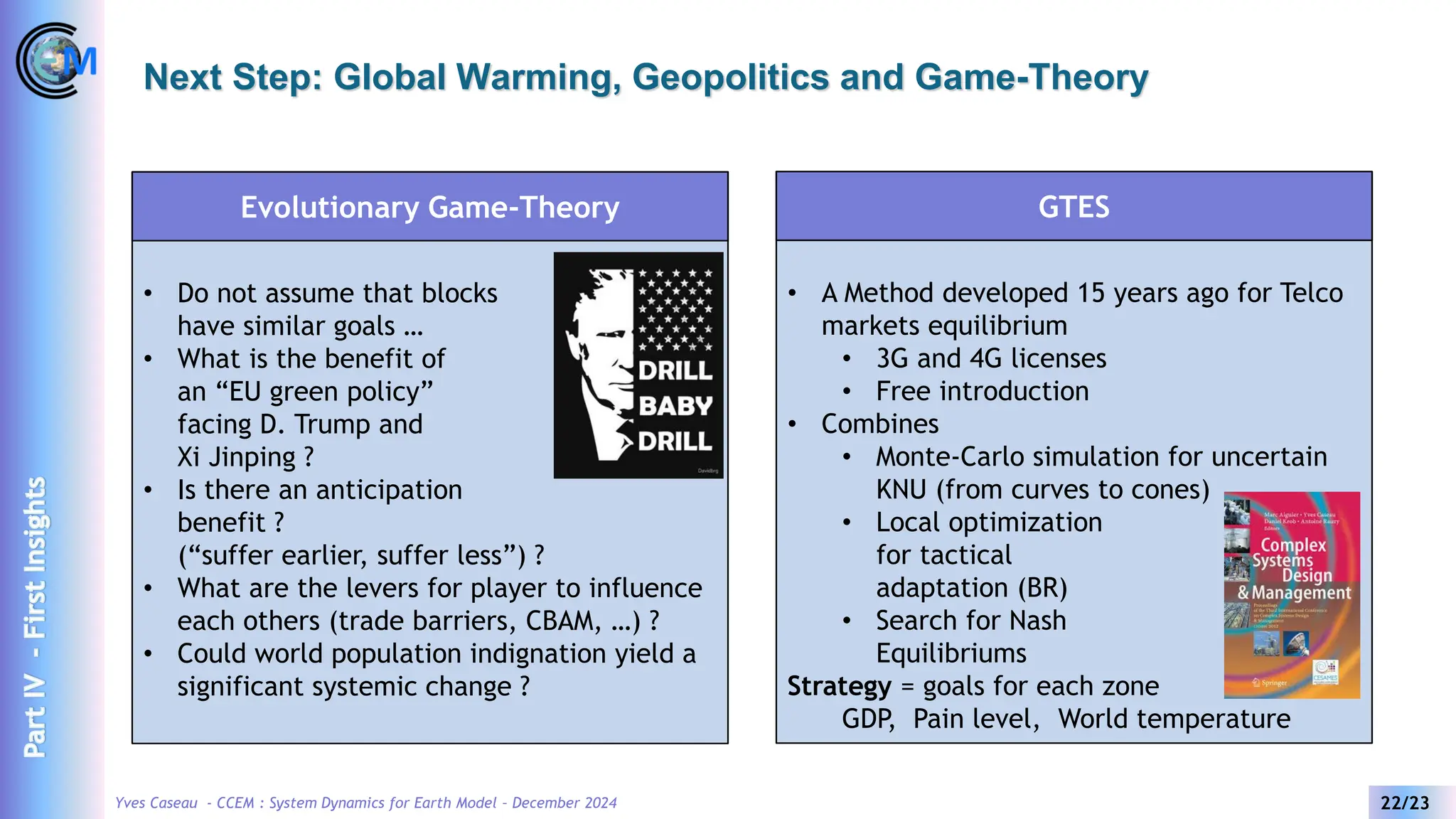
◼ Next Steps
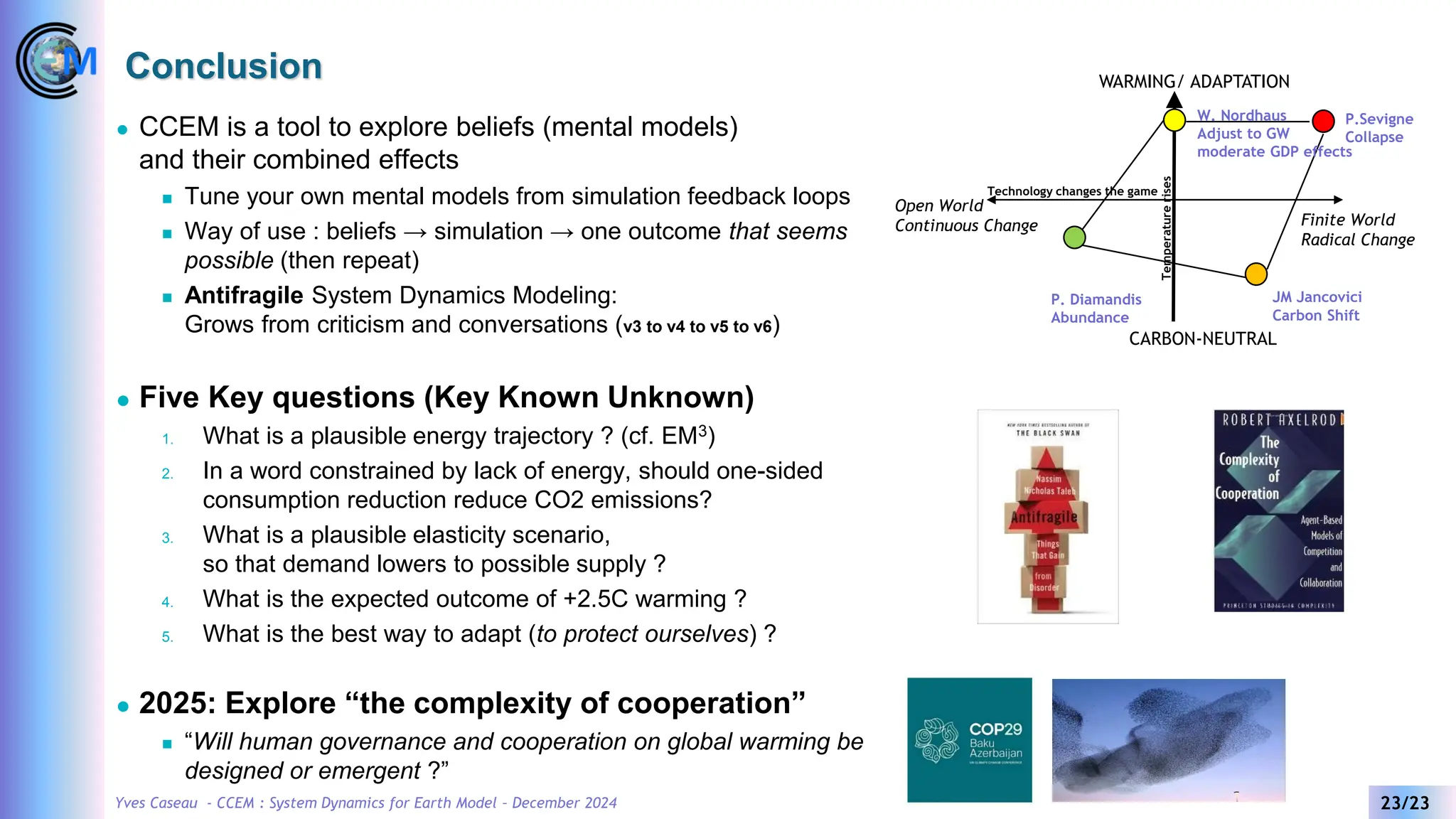
Yves Caseau - CCEM : System Dynamics for Earth Model – December 2024 3/23
Motivations for Yet Another Earth/Climate/Economy Model
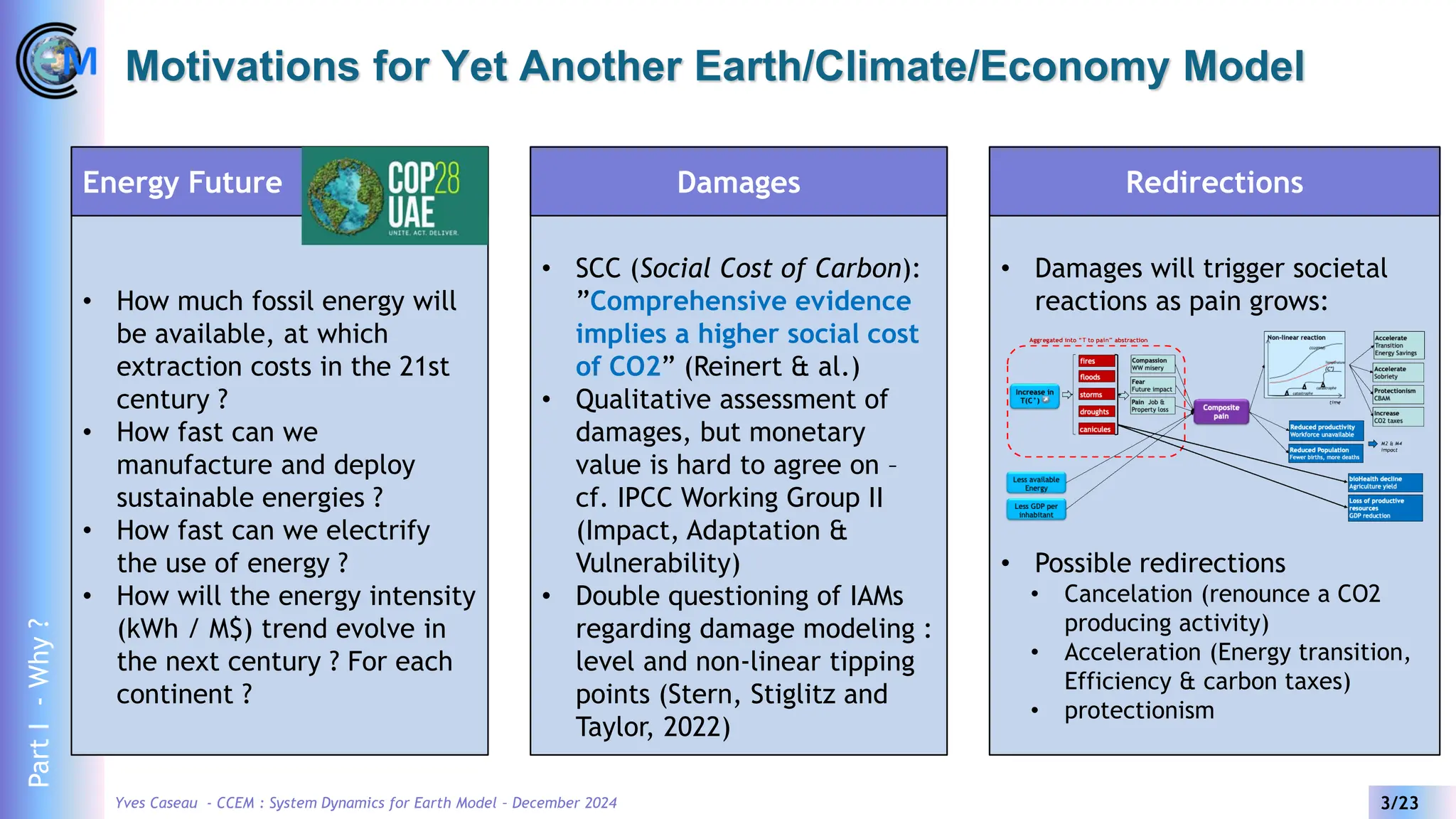
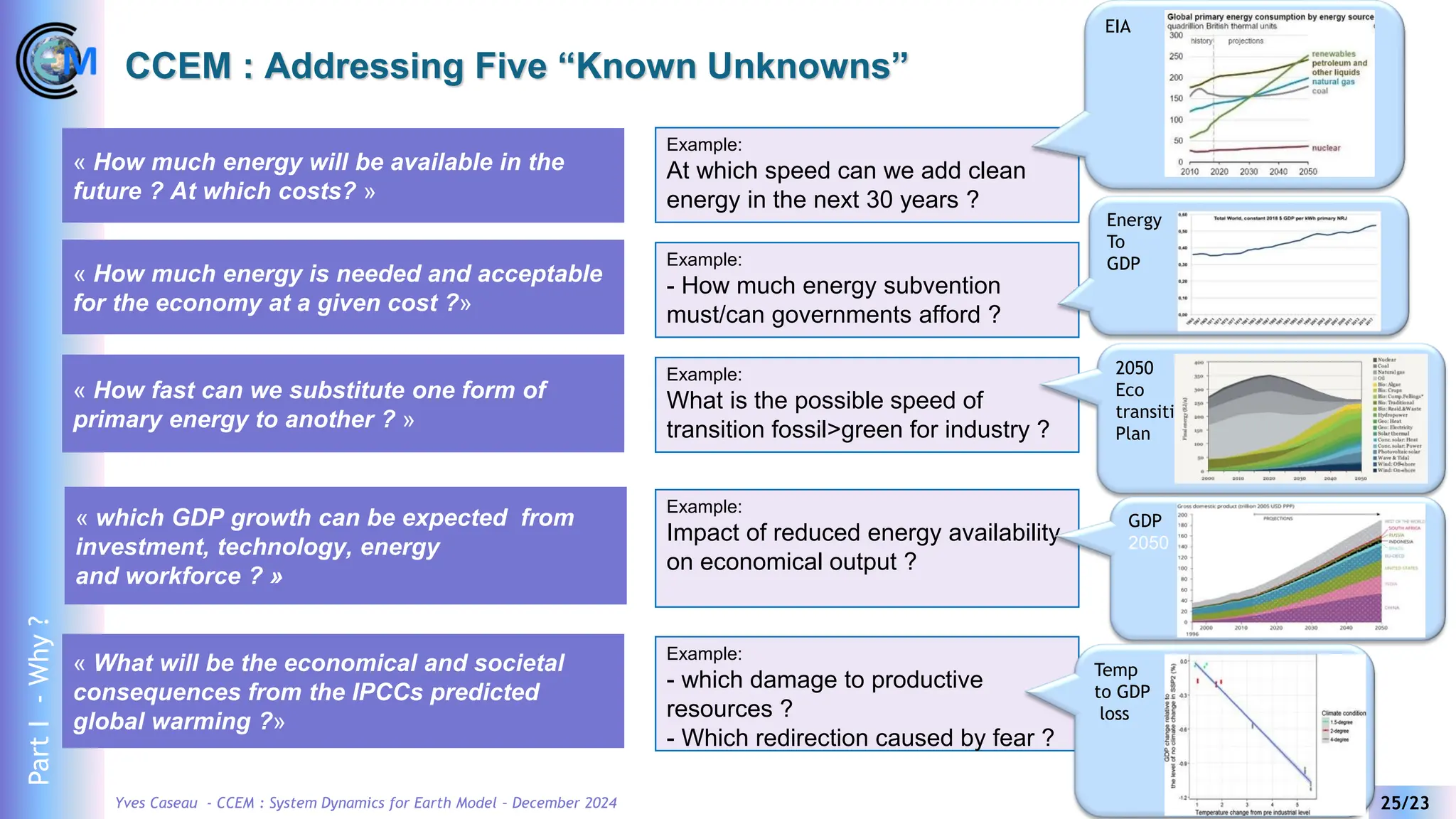
• SCC (Social Cost of Carbon):
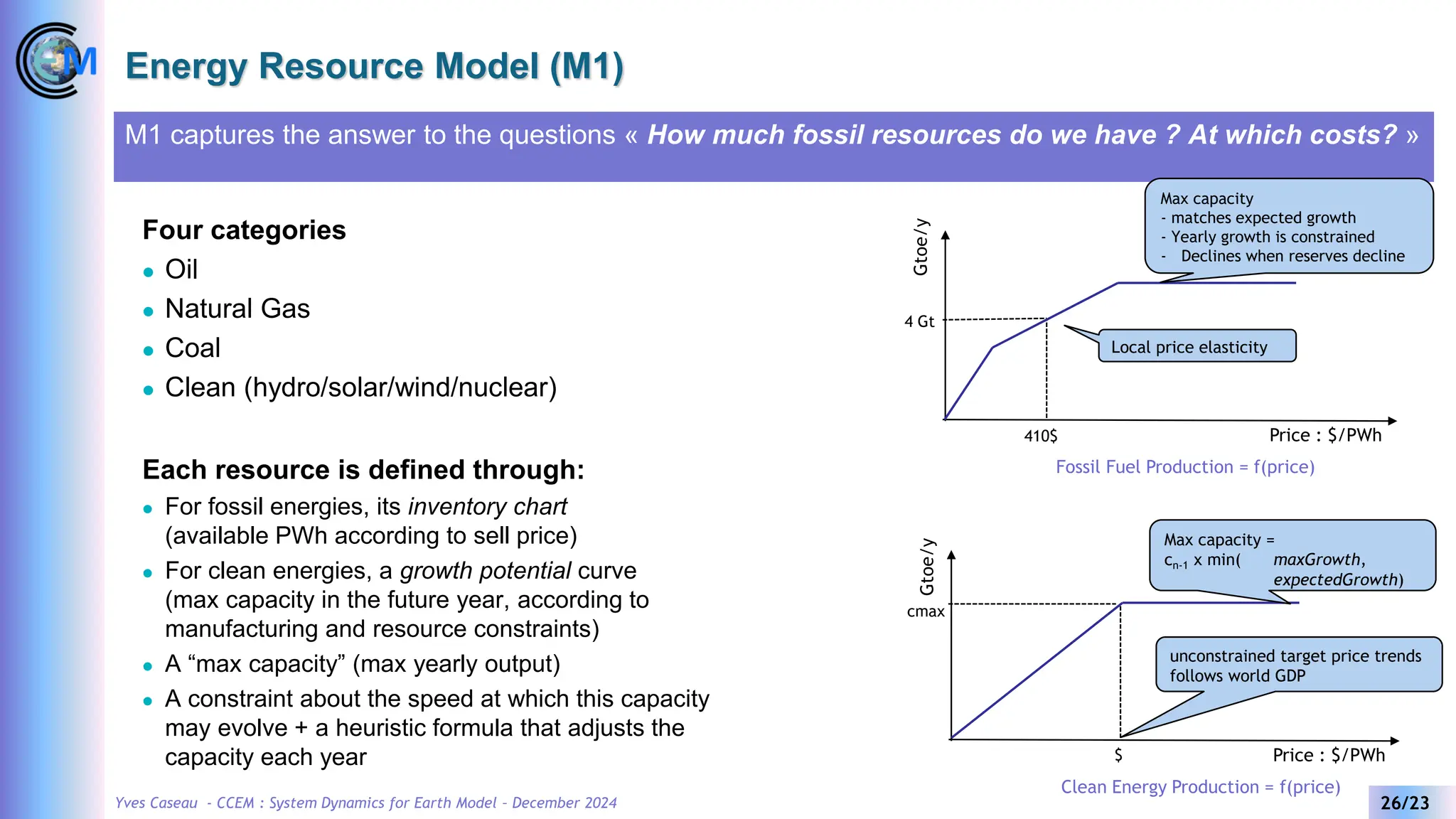
”Comprehensive evidence
implies a higher social cost
of CO2” (Reinert & al.)
• Qualitative assessment of
damages, but monetary
value is hard to agree on –
cf. IPCC Working Group II
(Impact, Adaptation &
Vulnerability)
• Double questioning of IAMs
regarding damage modeling :
level and non-linear tipping
points (Stern, Stiglitz and
Taylor, 2022)
Damages
• How much fossil energy will
be available, at which
extraction costs in the 21st
century ?
• How fast can we
manufacture and deploy
sustainable energies ?
• How fast can we electrify
the use of energy ?
• How will the energy intensity
(kWh / M$) trend evolve in
the next century ? For each
continent ?
Energy Future
• Damages will trigger societal
reactions as pain grows:
• Possible redirections
• Cancelation (renounce a CO2
producing activity)
• Acceleration (Energy transition,
Efficiency & carbon taxes)
• protectionism
Redirections
Part
I
-
Why
?
Yves Caseau - CCEM : System Dynamics for Earth Model – December 2024 4/23
EM3: “Energy Matters” Modeling Manifesto
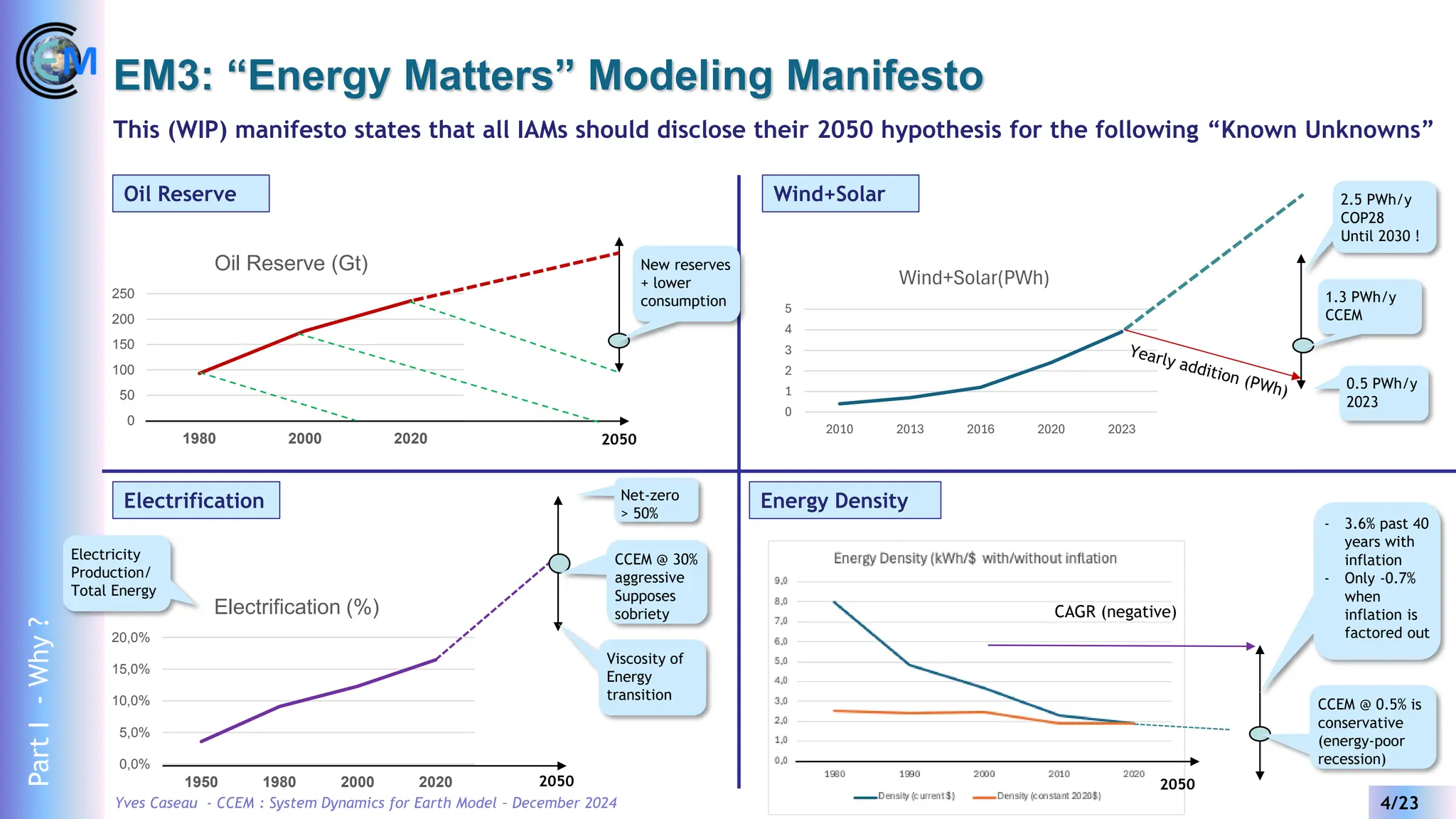
This (WIP) manifesto states that all IAMs should disclose their 2050 hypothesis for the following “Known Unknowns”
Oil Reserve Wind+Solar
Energy Density
Electrification
0
50
100
150
200
250
1980 2000 2020
Oil Reserve (Gt)
2050
New reserves
+ lower
consumption
0
1
2
3
4
5
2010 2013 2016 2020 2023
Wind+Solar(PWh)
1.3 PWh/y
CCEM
0.5 PWh/y
2023
2.5 PWh/y
COP28
Until 2030 !
0,0%
5,0%
10,0%
15,0%
20,0%
1950 1980 2000 2020
Electrification (%)
2050
Viscosity of
Energy
transition
Electricity
Production/
Total Energy
CCEM @ 30%
aggressive
Supposes
sobriety
2050
CAGR (negative)
- 3.6% past 40
years with
inflation
- Only -0.7%
when
inflation is
factored out
CCEM @ 0.5% is
conservative
(energy-poor
recession)
Net-zero
> 50%
Part
I
-
Why
?
Yves Caseau - CCEM : System Dynamics for Earth Model – December 2024 5/23
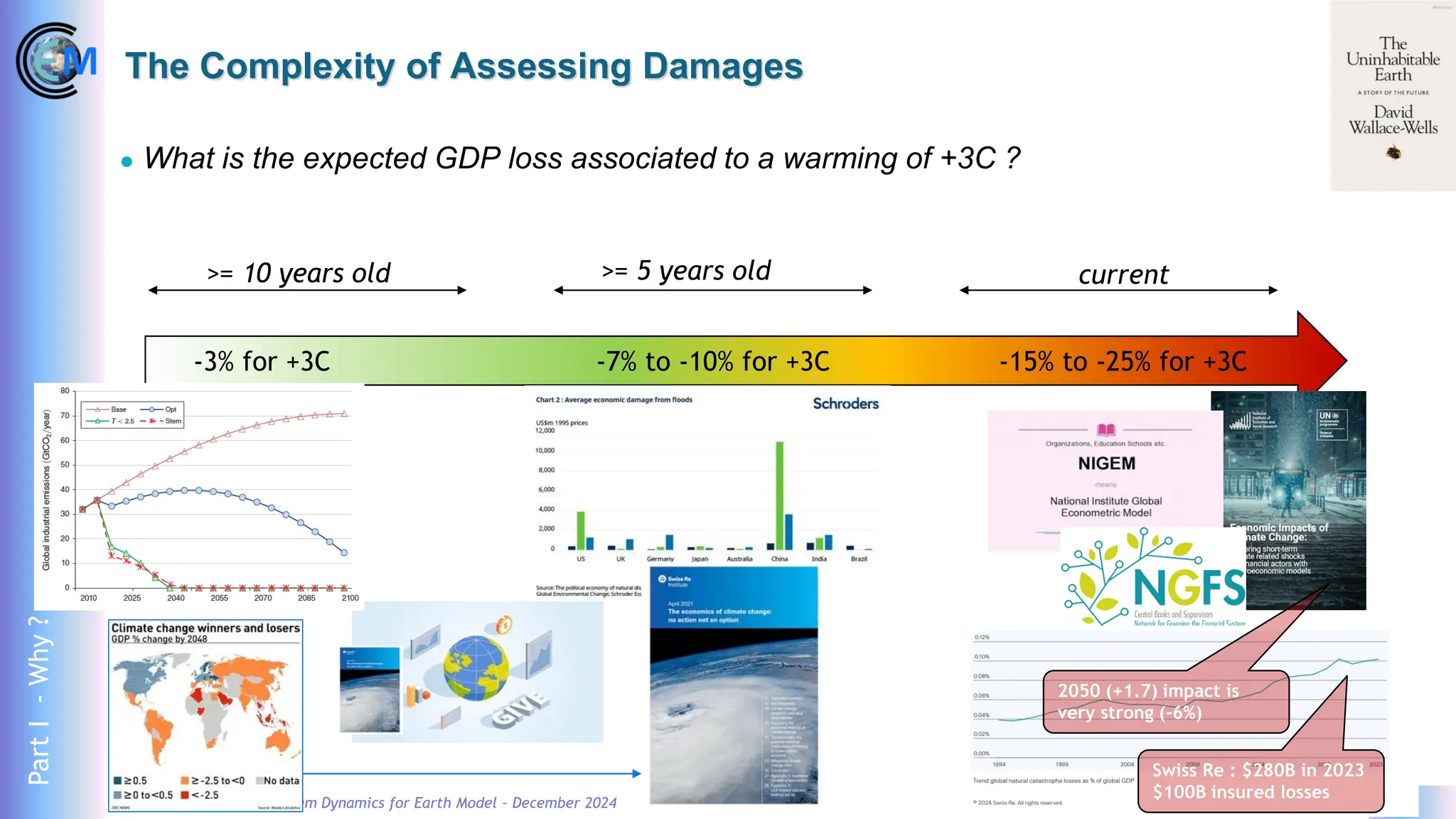
The Complexity of Assessing Damages
⚫ What is the expected GDP loss associated to a warming of +3C ?
-3% for +3C -7% to -10% for +3C -15% to -25% for +3C
>= 10 years old >= 5 years old current
Part
I
-
Why
?
2050 (+1.7) impact is
very strong (-6%)
Swiss Re : $280B in 2023
$100B insured losses
Yves Caseau - CCEM : System Dynamics for Earth Model – December 2024 6/23
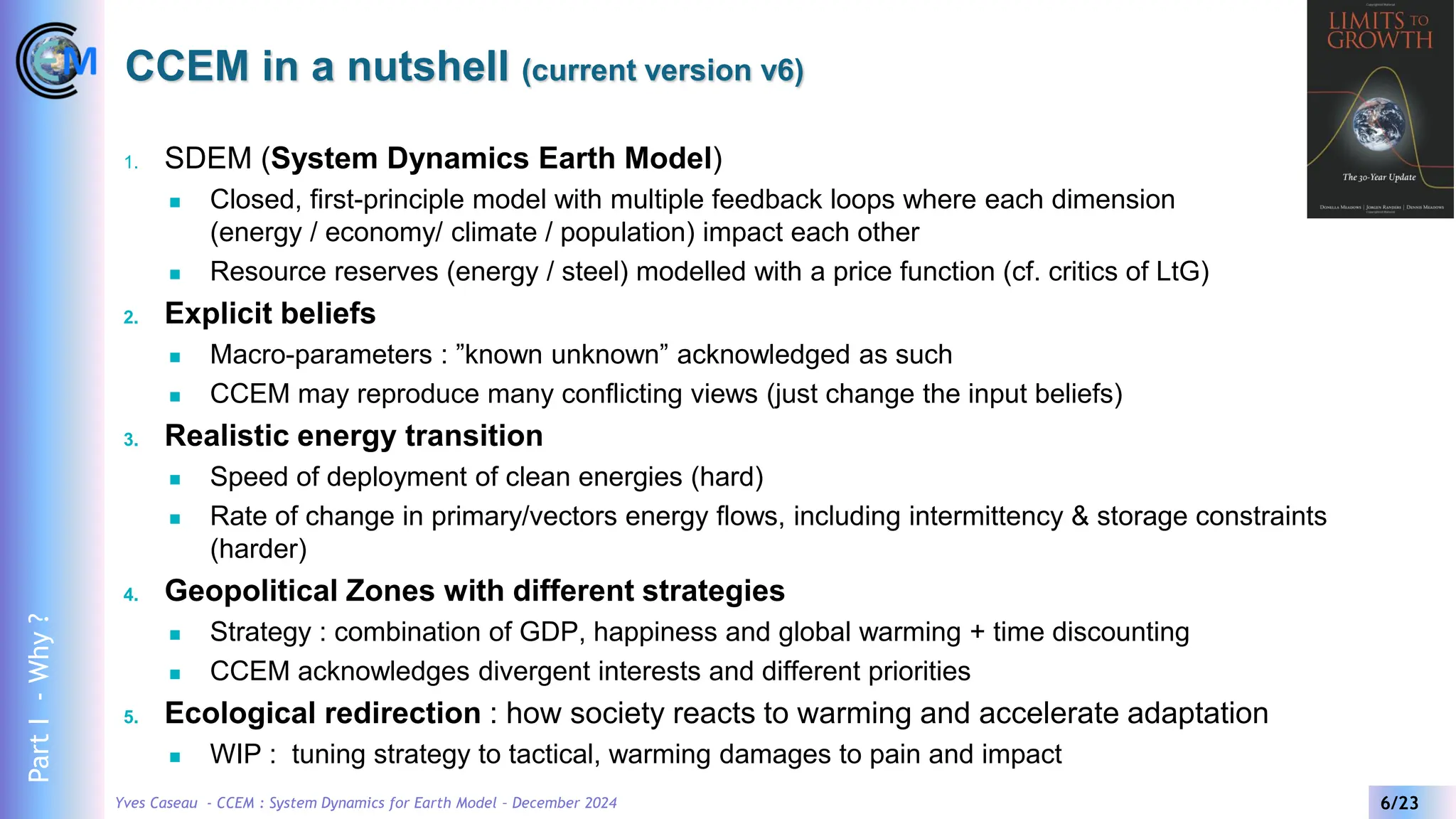
1. SDEM (System Dynamics Earth Model)
◼ Closed, first-principle model with multiple feedback loops where each dimension
(energy / economy/ climate / population) impact each other
◼ Resource reserves (energy / steel) modelled with a price function (cf. critics of LtG)
2. Explicit beliefs
◼ Macro-parameters : ”known unknown” acknowledged as such
◼ CCEM may reproduce many conflicting views (just change the input beliefs)
3. Realistic energy transition
◼ Speed of deployment of clean energies (hard)
◼ Rate of change in primary/vectors energy flows, including intermittency & storage constraints
(harder)
4. Geopolitical Zones with different strategies
◼ Strategy : combination of GDP, happiness and global warming + time discounting
◼ CCEM acknowledges divergent interests and different priorities
5. Ecological redirection : how society reacts to warming and accelerate adaptation
◼ WIP : tuning strategy to tactical, warming damages to pain and impact
CCEM in a nutshell (current version v6)
Part
I
-
Why
?
Yves Caseau - CCEM : System Dynamics for Earth Model – December 2024 7/23
Part II
1. Why : Yet Another Integrated Assessment Model ?
2. CCEM Model Overview
◼ Coupling of 5 “coarse” models
◼ M1 to M5 Overview
3. Computational Scenarios
4. So What : What are the first insights ?
Part
II
-
CCEM
Overview
Yves Caseau - CCEM : System Dynamics for Earth Model – December 2024 8/23
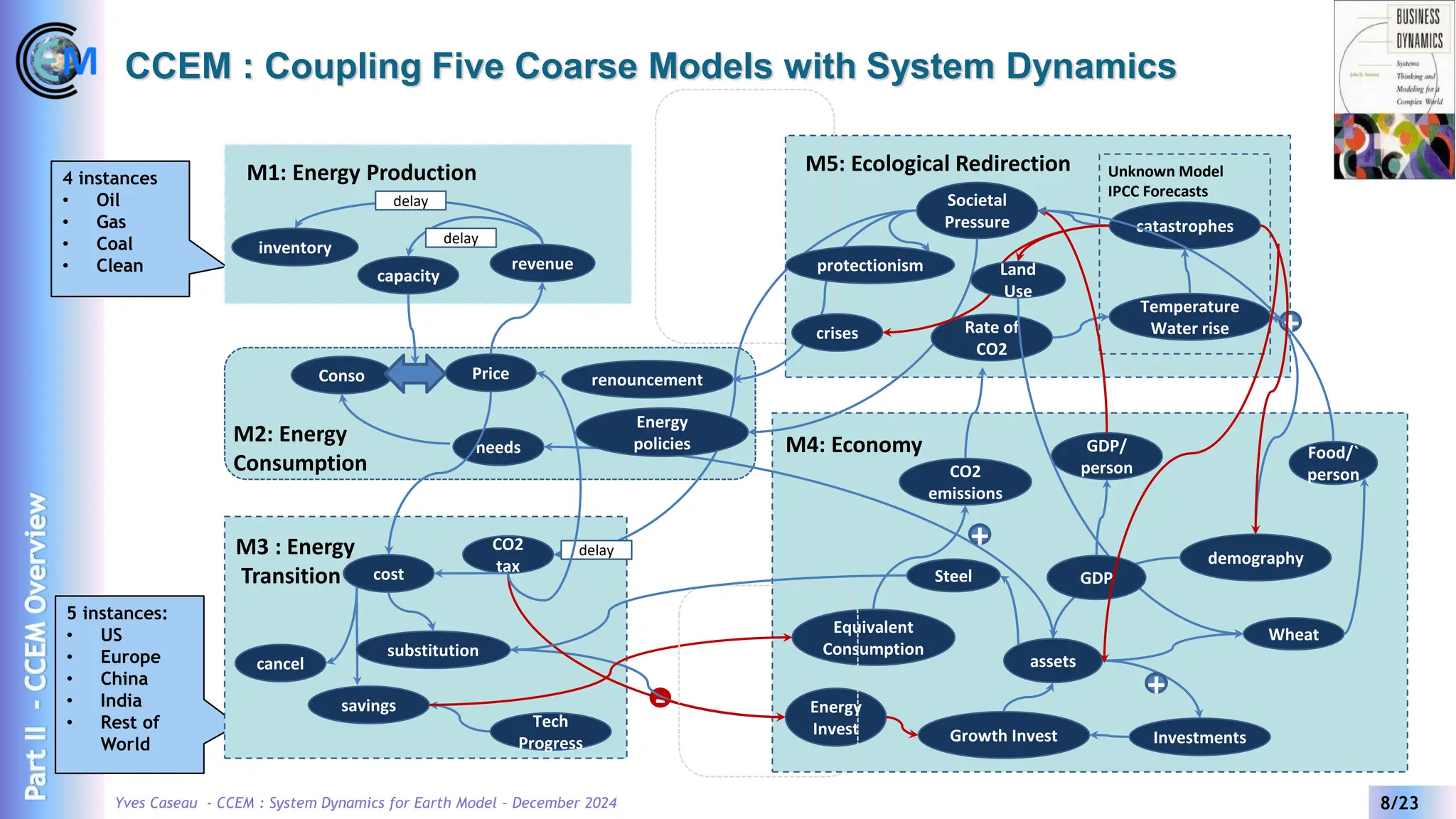
CCEM : Coupling Five Coarse Models with System Dynamics
4 instances
• Oil
• Gas
• Coal
• Clean
5 instances:
• US
• Europe
• China
• India
• Rest of
World
M3 : Energy
Transition
inventory
capacity
revenue
Conso
CO2
tax
Societal
Pressure
CO2
emissions
Unknown Model
IPCC Forecasts
Temperature
Water rise
GDP/
person
demography
+
+
-
Price
cost
needs
Equivalent
Consumption
Energy
Invest
assets
Investments
Growth Invest
delay
delay
delay
Energy
policies
renouncement
+
+
savings
cancel
Tech
Progress
substitution
Rate of
CO2
catastrophes
crises
Wheat
Steel
Food/`
person
Land
Use
protectionism
M2: Energy
Consumption
M1: Energy Production M5: Ecological Redirection
M4: Economy
Part
II
-
CCEM
Overview
GDP
Yves Caseau - CCEM : System Dynamics for Earth Model – December 2024 9/23
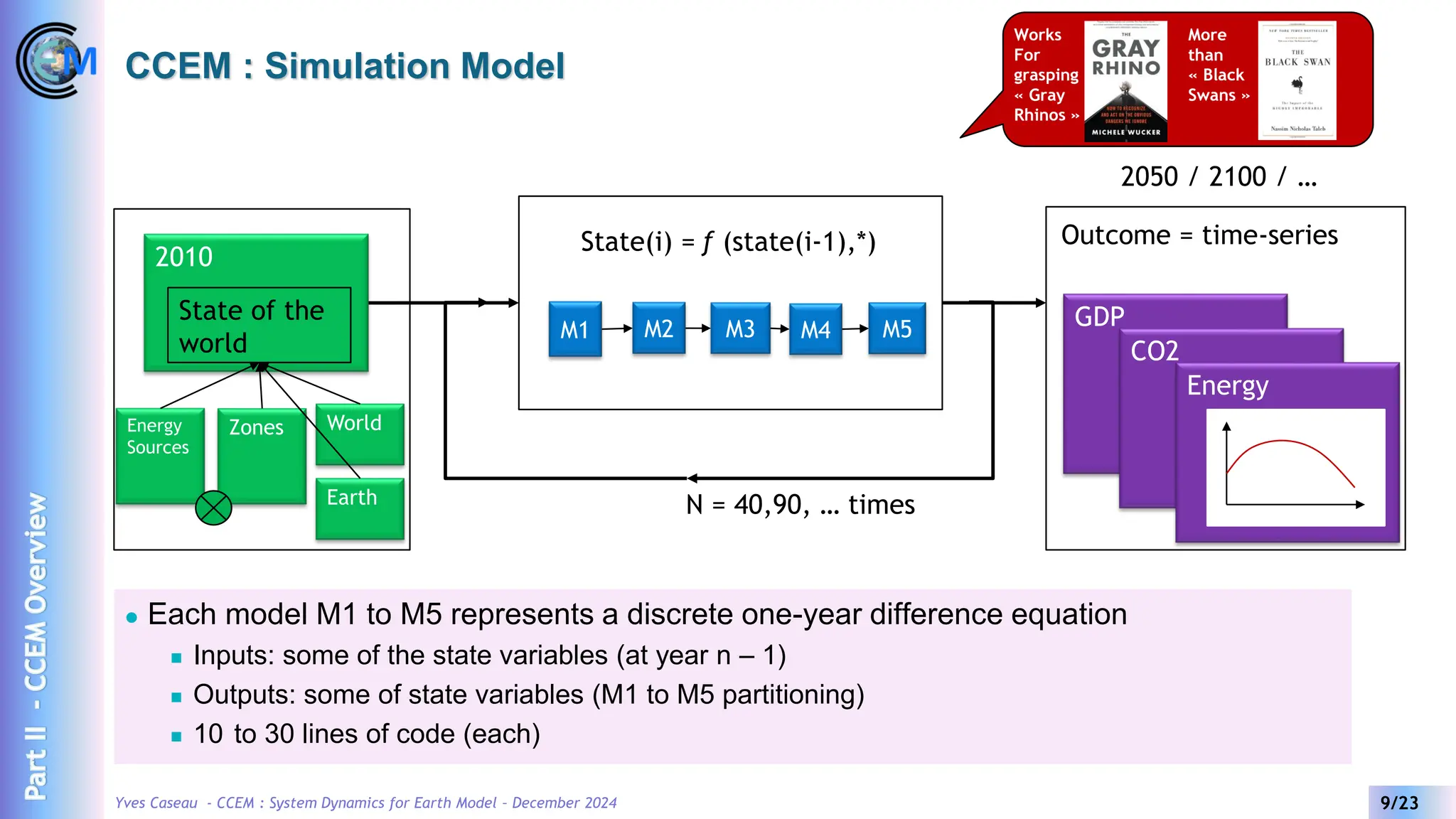
CCEM : Simulation Model
⚫ Each model M1 to M5 represents a discrete one-year difference equation
◼ Inputs: some of the state variables (at year n – 1)
◼ Outputs: some of state variables (M1 to M5 partitioning)
◼ 10 to 30 lines of code (each)
2010
State of the
world
Energy
Sources
Zones World
Earth N = 40,90, … times
2050 / 2100 / …
State(i) = ƒ (state(i-1),*)
M1 M2 M3 M4 M5
Outcome = time-series
GDP
CO2
Energy
Works
For
grasping
« Gray
Rhinos »
More
than
« Black
Swans »
Part
II
-
CCEM
Overview
Yves Caseau - CCEM : System Dynamics for Earth Model – December 2024 10/23
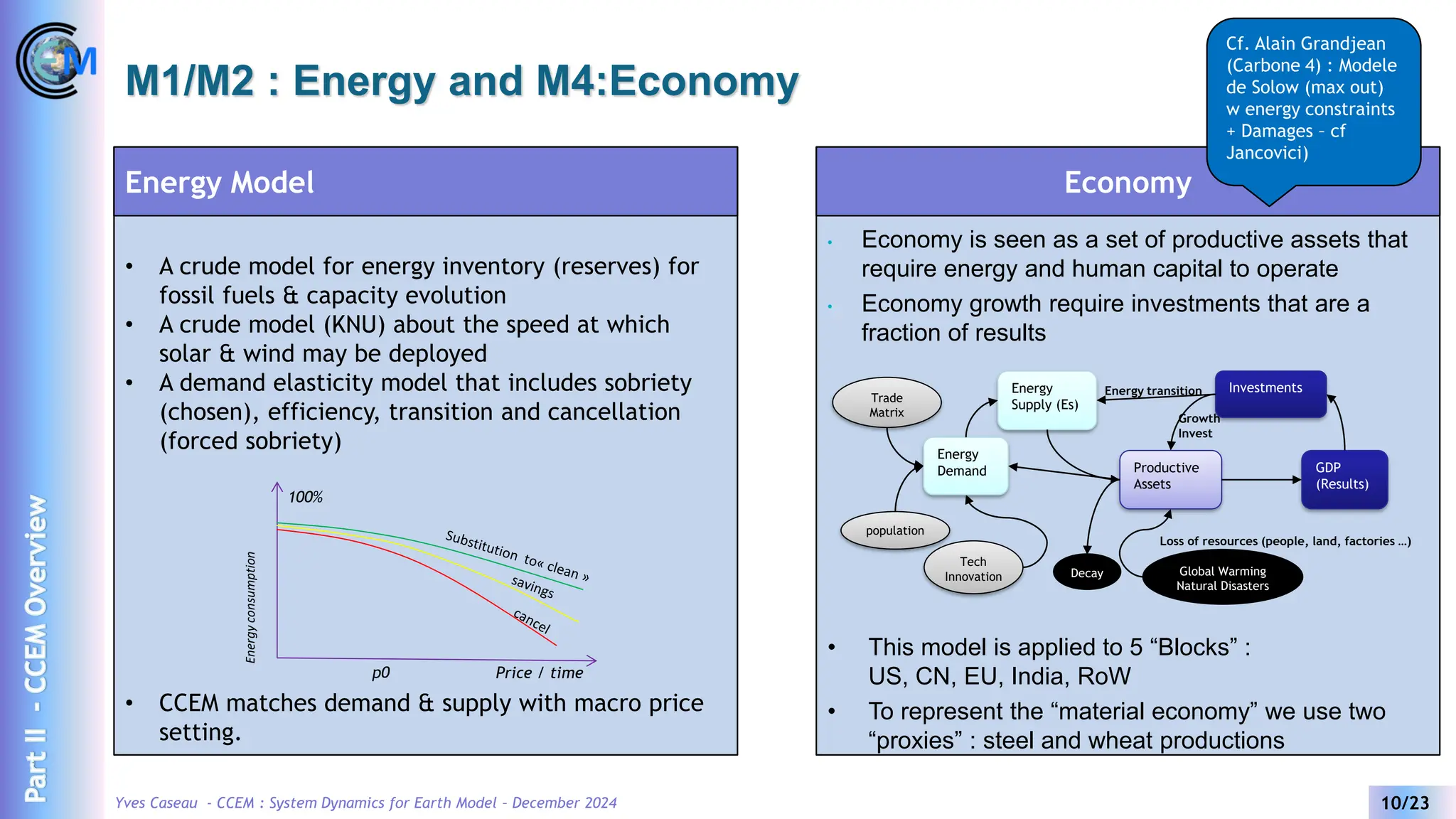
M1/M2 : Energy and M4:Economy
• Economy is seen as a set of productive assets that
require energy and human capital to operate
• Economy growth require investments that are a
fraction of results
• This model is applied to 5 “Blocks” :
US, CN, EU, India, RoW
• To represent the “material economy” we use two
“proxies” : steel and wheat productions
Economy
• A crude model for energy inventory (reserves) for
fossil fuels & capacity evolution
• A crude model (KNU) about the speed at which
solar & wind may be deployed
• A demand elasticity model that includes sobriety
(chosen), efficiency, transition and cancellation
(forced sobriety)
• CCEM matches demand & supply with macro price
setting.
Energy Model
Energy
consumption
Price / time
100%
p0
Part
II
-
CCEM
Overview Cf. Alain Grandjean
(Carbone 4) : Modele
de Solow (max out)
w energy constraints
+ Damages – cf
Jancovici)
Productive
Assets
GDP
(Results)
Investments
Energy
Supply (Es)
population
Tech
Innovation
Energy transition
Growth
Invest
Global Warming
Natural Disasters
Loss of resources (people, land, factories …)
Energy
Demand
Decay
Trade
Matrix
Yves Caseau - CCEM : System Dynamics for Earth Model – December 2024 11/23
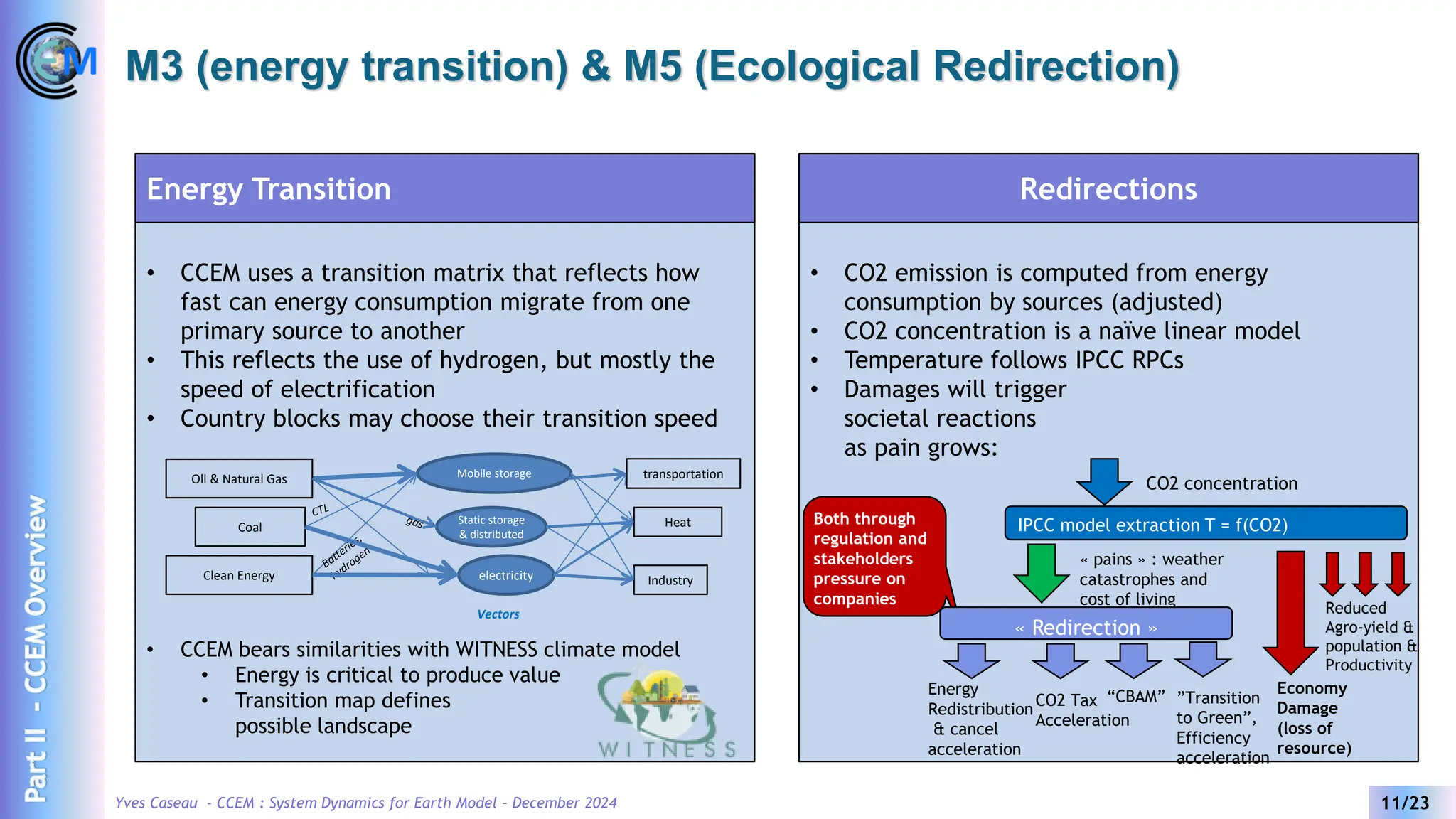
M3 (energy transition) & M5 (Ecological Redirection)
• CO2 emission is computed from energy
consumption by sources (adjusted)
• CO2 concentration is a naïve linear model
• Temperature follows IPCC RPCs
• Damages will trigger
societal reactions
as pain grows:
Redirections
• CCEM uses a transition matrix that reflects how
fast can energy consumption migrate from one
primary source to another
• This reflects the use of hydrogen, but mostly the
speed of electrification
• Country blocks may choose their transition speed
• CCEM bears similarities with WITNESS climate model
• Energy is critical to produce value
• Transition map defines
possible landscape
Energy Transition
Mobile storage
electricity Industry
transportation
Heat
Oll & Natural Gas
Coal
Clean Energy
Static storage
& distributed
Vectors
Part
II
-
CCEM
Overview
Both through
regulation and
stakeholders
pressure on
companies
IPCC model extraction T = f(CO2)
CO2 concentration
« pains » : weather
catastrophes and
cost of living
« Redirection »
Energy
Redistribution
& cancel
acceleration
Economy
Damage
(loss of
resource)
CO2 Tax
Acceleration
”Transition
to Green”,
Efficiency
acceleration
Reduced
Agro-yield &
population &
Productivity
“CBAM”
Yves Caseau - CCEM : System Dynamics for Earth Model – December 2024 12/23
Part III
1. Why : Yet Another Integrated Assessment Model ?
2. CCEM Model Overview
3. Computational Scenarios
◼ Preliminary results
◼ Sensitivity analysis
4. So What : What are the first insights ?
Part
III
-
Preliminary
Results
Yves Caseau - CCEM : System Dynamics for Earth Model – December 2024 13/23
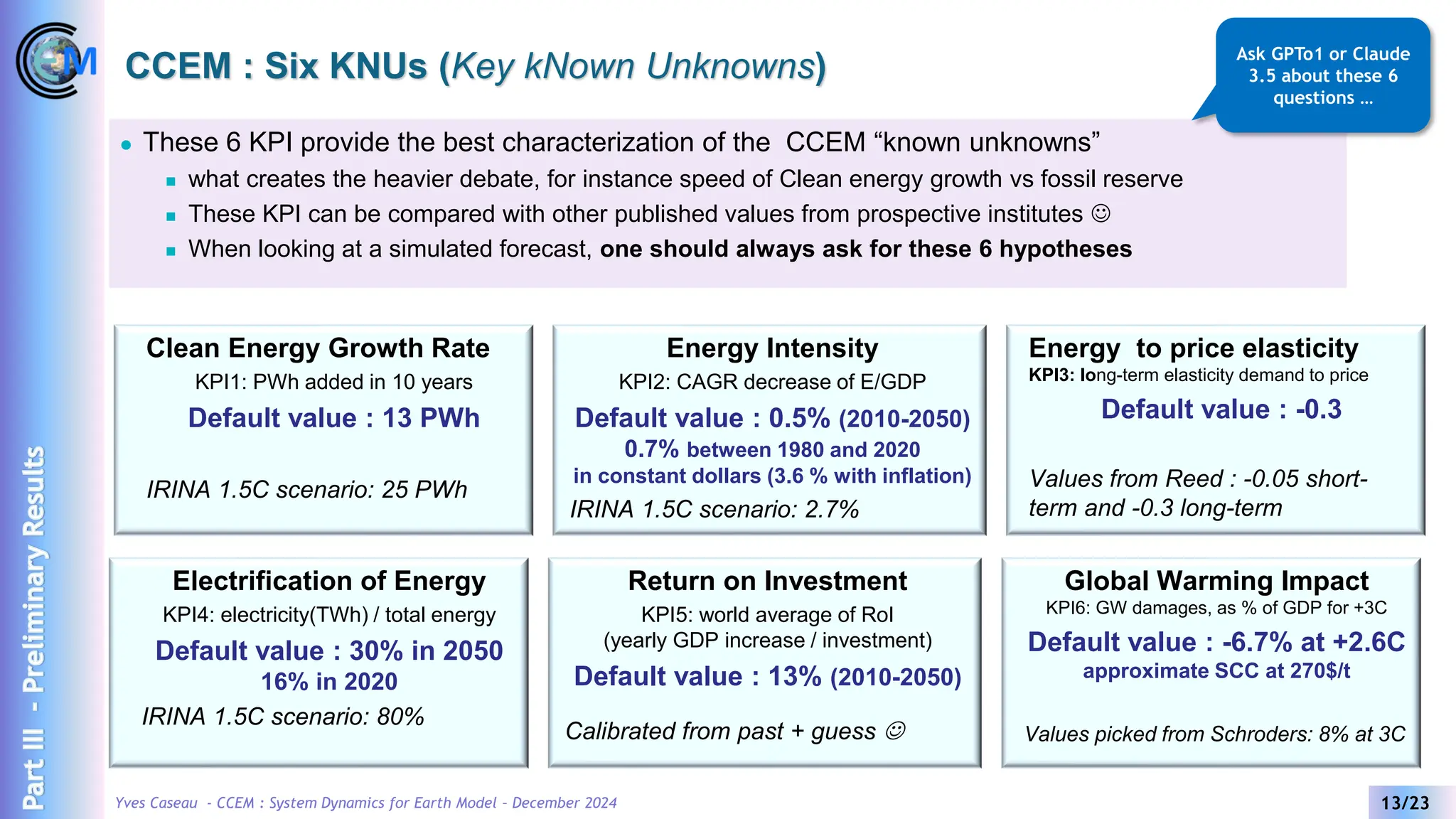
CCEM : Six KNUs (Key kNown Unknowns)
⚫ These 6 KPI provide the best characterization of the CCEM “known unknowns”
◼ what creates the heavier debate, for instance speed of Clean energy growth vs fossil reserve
◼ These KPI can be compared with other published values from prospective institutes ☺
◼ When looking at a simulated forecast, one should always ask for these 6 hypotheses
Clean Energy Growth Rate
KPI1: PWh added in 10 years
Default value : 13 PWh
IRINA 1.5C scenario: 25 PWh
Energy Intensity
KPI2: CAGR decrease of E/GDP
Default value : 0.5% (2010-2050)
0.7% between 1980 and 2020
in constant dollars (3.6 % with inflation)
IRINA 1.5C scenario: 2.7%
Energy to price elasticity
KPI3: long-term elasticity demand to price
Default value : -0.3
Values from Reed : -0.05 short-
term and -0.3 long-term
Electrification of Energy
KPI4: electricity(TWh) / total energy
Default value : 30% in 2050
16% in 2020
IRINA 1.5C scenario: 80%
Return on Investment
KPI5: world average of RoI
(yearly GDP increase / investment)
Default value : 13% (2010-2050)
Calibrated from past + guess ☺
Global Warming Impact
KPI6: GW damages, as % of GDP for +3C
Default value : -6.7% at +2.6C
approximate SCC at 270$/t
Values picked from Schroders: 8% at 3C
Ask GPTo1 or Claude
3.5 about these 6
questions …
Part
III
-
Preliminary
Results
Yves Caseau - CCEM : System Dynamics for Earth Model – December 2024 14/23
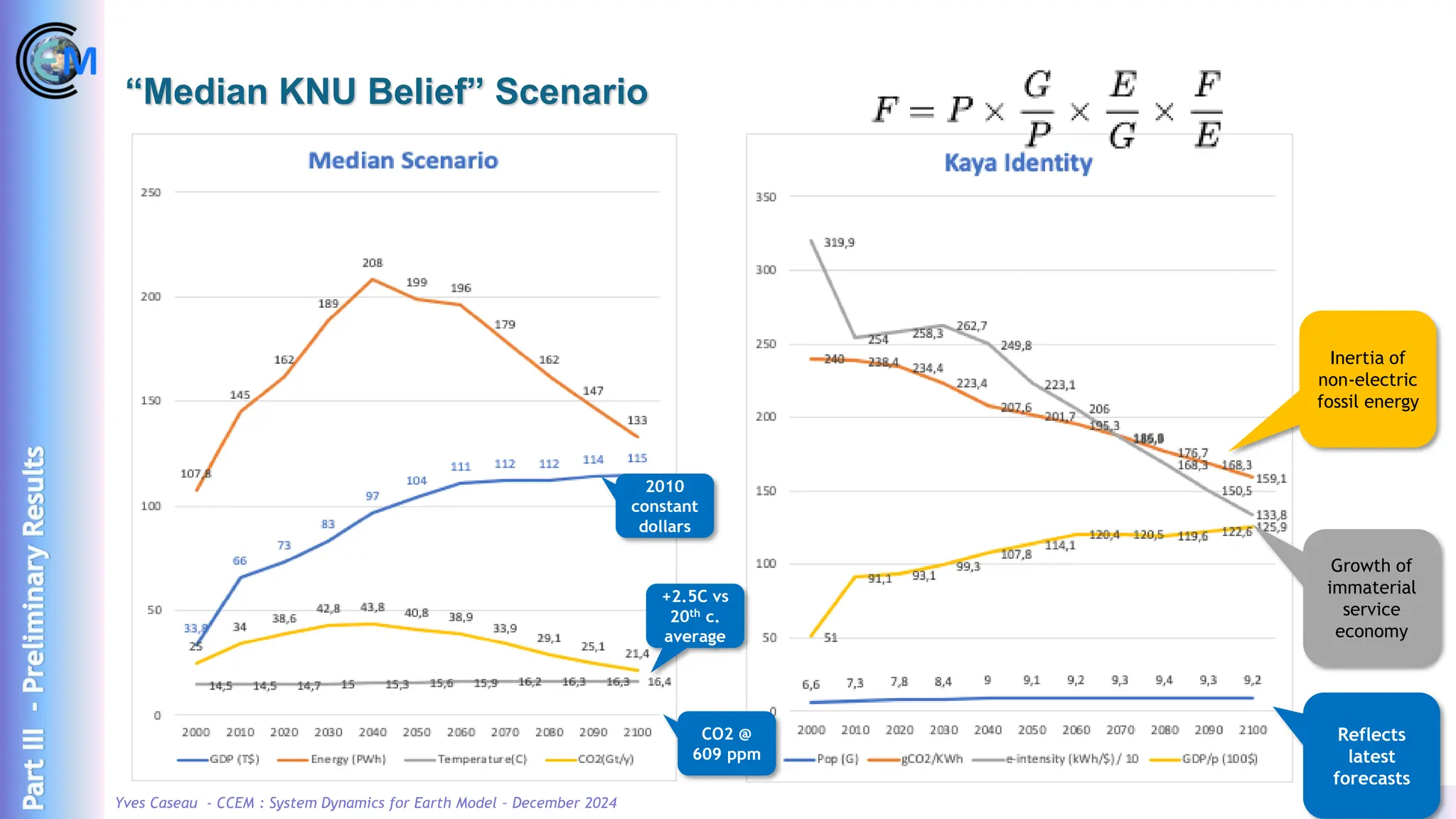
“Median KNU Belief” Scenario
Inertia of
non-electric
fossil energy
Growth of
immaterial
service
economy
Reflects
latest
forecasts
Part
III
-
Preliminary
Results
CO2 @
609 ppm
2010
constant
dollars
+2.5C vs
20th c.
average
Yves Caseau - CCEM : System Dynamics for Earth Model – December 2024 15/23
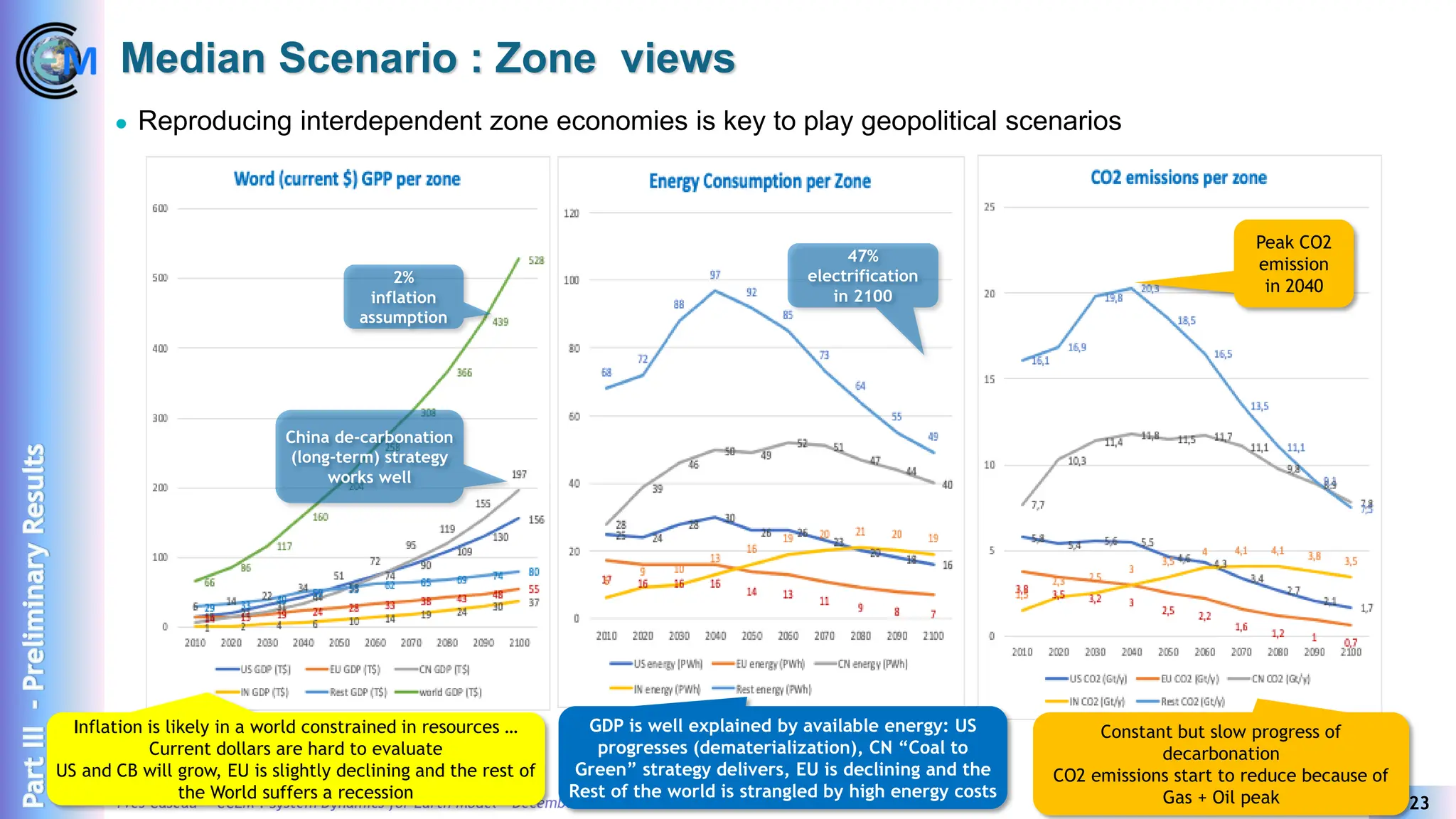
Median Scenario : Zone views
⚫ Reproducing interdependent zone economies is key to play geopolitical scenarios
Part
III
-
Preliminary
Results
Inflation is likely in a world constrained in resources …
Current dollars are hard to evaluate
US and CB will grow, EU is slightly declining and the rest of
the World suffers a recession
Constant but slow progress of
decarbonation
CO2 emissions start to reduce because of
Gas + Oil peak
GDP is well explained by available energy: US
progresses (dematerialization), CN “Coal to
Green” strategy delivers, EU is declining and the
Rest of the world is strangled by high energy costs
2%
inflation
assumption
47%
electrification
in 2100
Peak CO2
emission
in 2040
China de-carbonation
(long-term) strategy
works well
Yves Caseau - CCEM : System Dynamics for Earth Model – December 2024 16/23
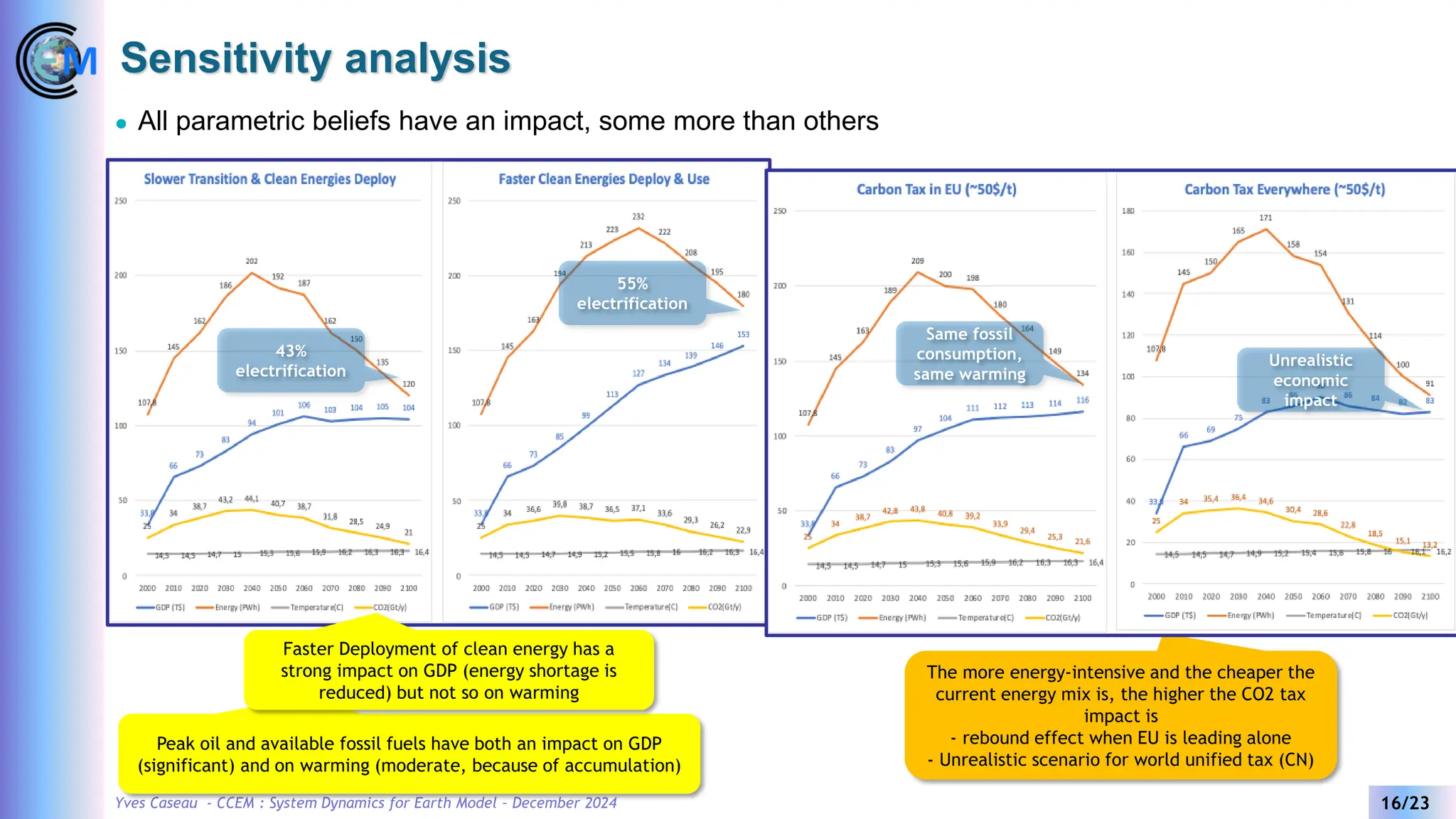
Sensitivity analysis
⚫ All parametric beliefs have an impact, some more than others
The more energy-intensive and the cheaper the
current energy mix is, the higher the CO2 tax
impact is
- rebound effect when EU is leading alone
- Unrealistic scenario for world unified tax (CN)
Peak oil and available fossil fuels have both an impact on GDP
(significant) and on warming (moderate, because of accumulation)
Faster Deployment of clean energy has a
strong impact on GDP (energy shortage is
reduced) but not so on warming
55%
electrification
43%
electrification
Same fossil
consumption,
same warming
Unrealistic
economic
impact
Yves Caseau - CCEM : System Dynamics for Earth Model – December 2024 17/23
Part IV
1. Why : Yet Another Integrated Assessment Model ?
2. CCEM Model Overview
3. Computational Scenarios
4. So What : What are the first insights ?
◼ A possible new narrative of global warming
◼ Next Steps
Part
IV
-
First
Insights
Yves Caseau - CCEM : System Dynamics for Earth Model – December 2024 18/23
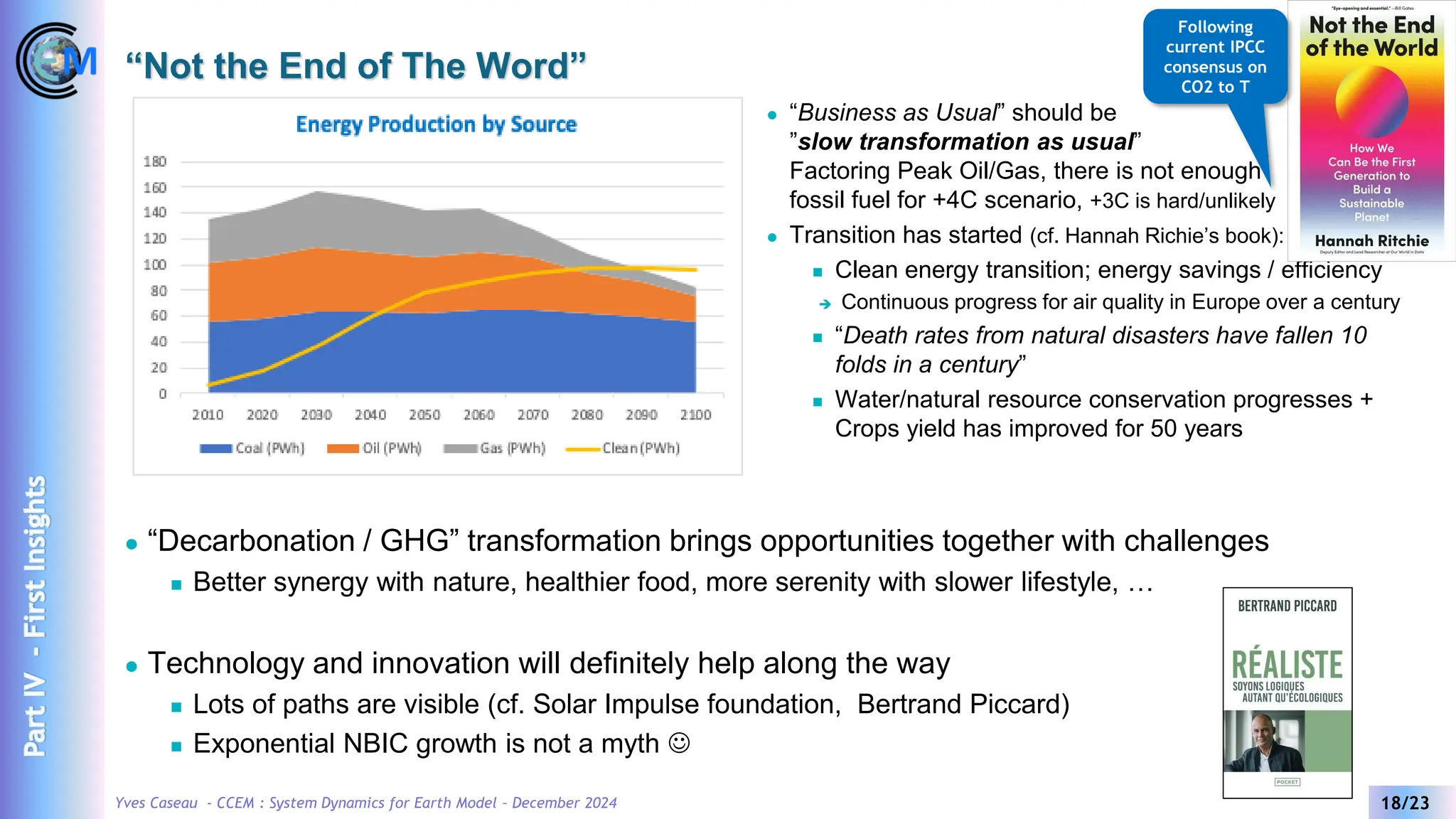
“Not the End of The Word”
⚫ “Business as Usual” should be
”slow transformation as usual”
Factoring Peak Oil/Gas, there is not enough
fossil fuel for +4C scenario, +3C is hard/unlikely
⚫ Transition has started (cf. Hannah Richie’s book):
◼ Clean energy transition; energy savings / efficiency
➔ Continuous progress for air quality in Europe over a century
◼ “Death rates from natural disasters have fallen 10
folds in a century”
◼ Water/natural resource conservation progresses +
Crops yield has improved for 50 years
⚫ “Decarbonation / GHG” transformation brings opportunities together with challenges
◼ Better synergy with nature, healthier food, more serenity with slower lifestyle, …
⚫ Technology and innovation will definitely help along the way
◼ Lots of paths are visible (cf. Solar Impulse foundation, Bertrand Piccard)
◼ Exponential NBIC growth is not a myth ☺
Following
current IPCC
consensus on
CO2 to T
Part
IV
-
First
Insights
Yves Caseau - CCEM : System Dynamics for Earth Model – December 2024 19/23
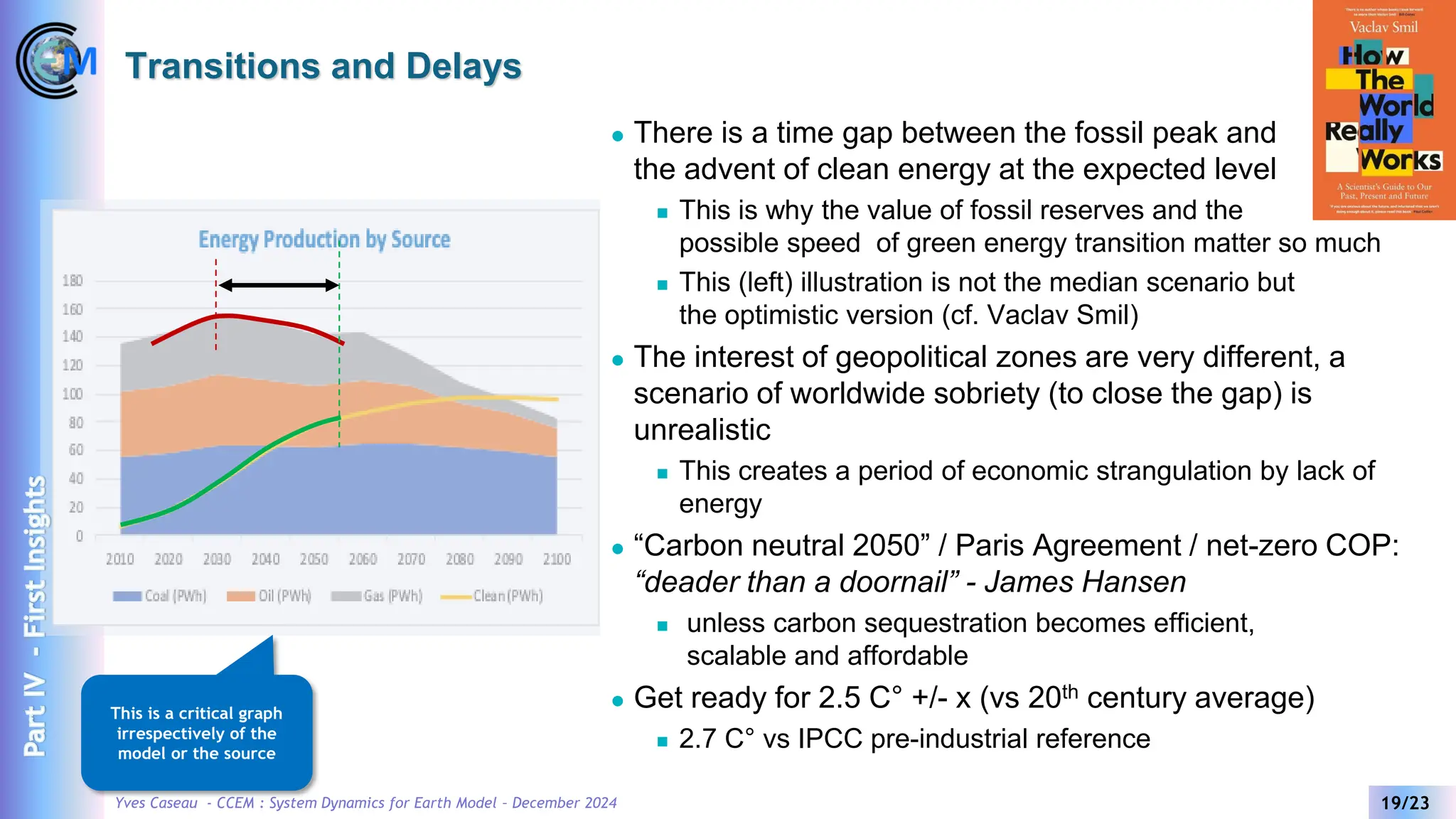
Transitions and Delays
⚫ There is a time gap between the fossil peak and
the advent of clean energy at the expected level
◼ This is why the value of fossil reserves and the
possible speed of green energy transition matter so much
◼ This (left) illustration is not the median scenario but
the optimistic version (cf. Vaclav Smil)
⚫ The interest of geopolitical zones are very different, a
scenario of worldwide sobriety (to close the gap) is
unrealistic
◼ This creates a period of economic strangulation by lack of
energy
⚫ “Carbon neutral 2050” / Paris Agreement / net-zero COP:
“deader than a doornail” - James Hansen
◼ unless carbon sequestration becomes efficient,
scalable and affordable
⚫ Get ready for 2.5 C° +/- x (vs 20th century average)
◼ 2.7 C° vs IPCC pre-industrial reference
This is a critical graph
irrespectively of the
model or the source
Part
IV
-
First
Insights
Yves Caseau - CCEM : System Dynamics for Earth Model – December 2024 20/23
“Not the End of the World” … but end of the 20th century World
1. Sustained Global Warming, severe impacts to be expected,
◼ Adaptation is mandatory
2. Cheap Energy is gone, busts of energy shortages
◼ No longer a free market, large zone discrepancies (already started, intensified with conflicts)
3. End of sustained worldwide growth
◼ Will reinforce the perception and the pains of inequality
4. Resource constraints will trigger aggressive competition
◼ Conflicts rise, probable wars
◼ Trade wars (protectionism, this is only the beginning)
◼ Cyber-espionage (cf. UK expert warning)
5. Prepare for surprises and redirection (political reactions pushed by societal fears)
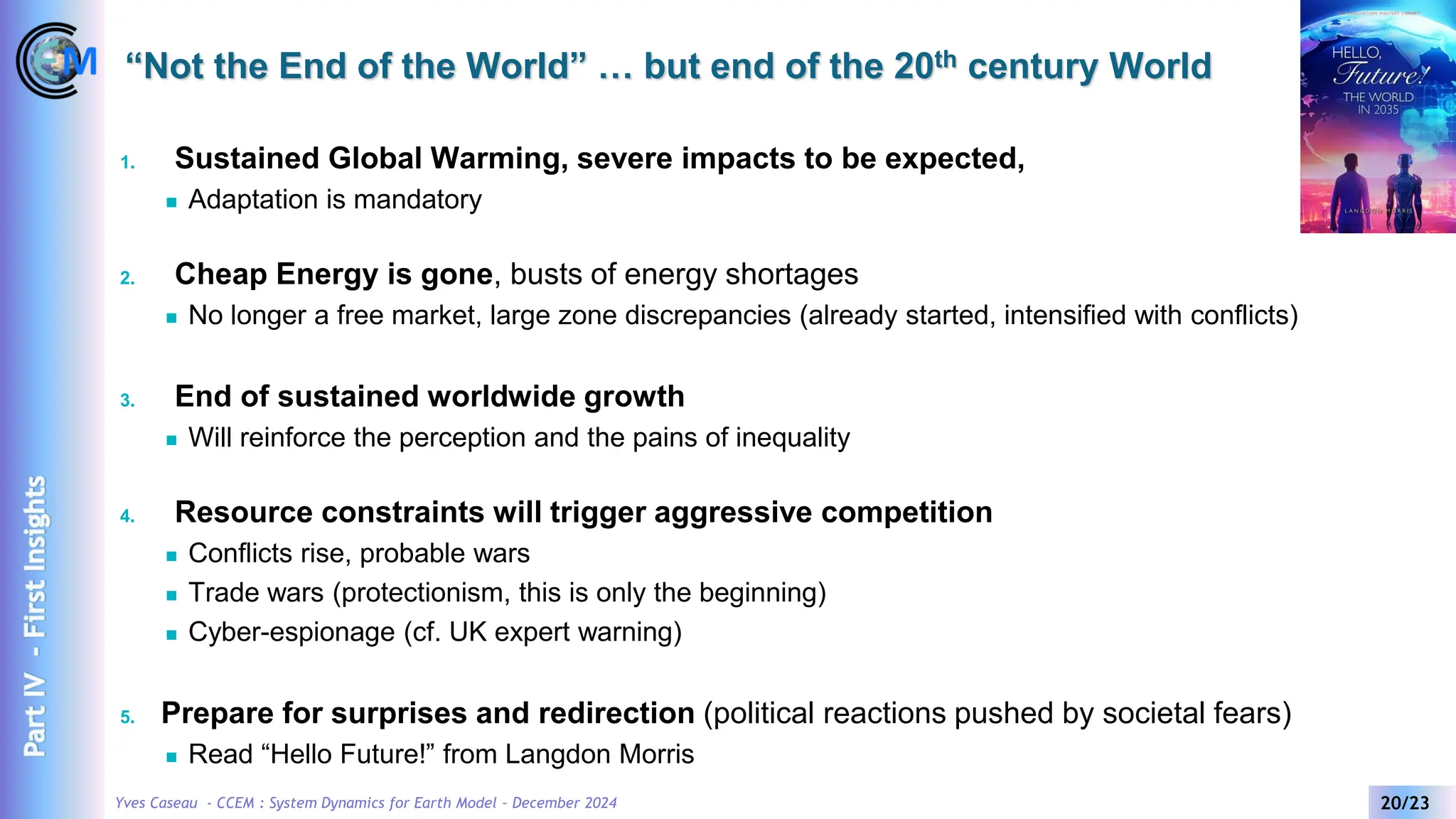
◼ Read “Hello Future!” from Langdon Morris
Part
IV
-
First
Insights
Yves Caseau - CCEM : System Dynamics for Earth Model – December 2024 21/23
A “new narrative”:
Avoiding stress as a motivator, Avoiding a promise that we may not keep
⚫ « The Future of European competitiveness» :
Very consistent with CCEM simulation ! “foundations of Europe competitiveness have
been shaken”
◼ “Even though energy prices have fallen considerably from their peaks,
EU companies still face electricity prices that are 2-3 times those of US”
◼ “To digitalise and decarbonize the economy and increase our defense capacity, the
investment share in Europe will have to rise by 5% of GDP” (back to 60-70s levels)
◼ “The productivity gar between the EU and the US is largely explained by the tech
sector”
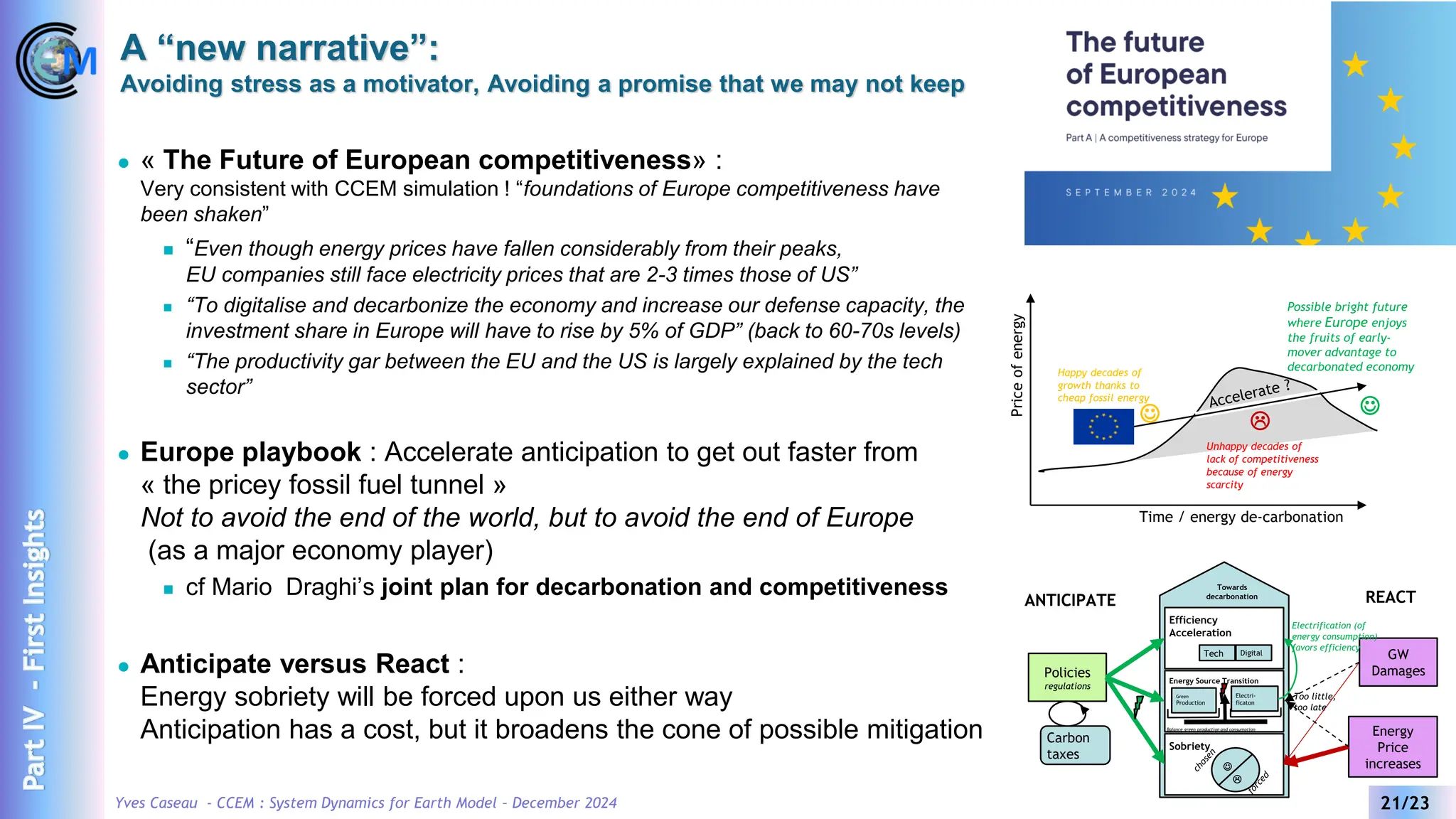
⚫ Europe playbook : Accelerate anticipation to get out faster from
« the pricey fossil fuel tunnel »
Not to avoid the end of the world, but to avoid the end of Europe
(as a major economy player)
◼ cf Mario Draghi’s joint plan for decarbonation and competitiveness
⚫ Anticipate versus React :
Energy sobriety will be forced upon us either way
Anticipation has a cost, but it broadens the cone of possible mitigation
Efficiency
Acceleration
Energy Source Transition
Sobriety
Policies
regulations
GW
Damages
Energy
Price
increases
Carbon
taxes
ANTICIPATE
Towards
decarbonation
Tech Digital
Too little,
too late
☺

Green
Production
Electri-
ficaton
REACT
Electrification (of
energy consumption)
favors efficiency
Balance green production and consumption
Time / energy de-carbonation
Price
of
energy
☺
☺ 
Happy decades of
growth thanks to
cheap fossil energy
Unhappy decades of
lack of competitiveness
because of energy
scarcity
Possible bright future
where Europe enjoys
the fruits of early-
mover advantage to
decarbonated economy
Part
IV
-
First
Insights
Yves Caseau - CCEM : System Dynamics for Earth Model – December 2024 22/23
Next Step: Global Warming, Geopolitics and Game-Theory
• Do not assume that blocks
have similar goals …
• What is the benefit of
an “EU green policy”
facing D. Trump and
Xi Jinping ?
• Is there an anticipation
benefit ?
(“suffer earlier, suffer less”) ?
• What are the levers for player to influence
each others (trade barriers, CBAM, …) ?
• Could world population indignation yield a
significant systemic change ?
Evolutionary Game-Theory
• A Method developed 15 years ago for Telco
markets equilibrium
• 3G and 4G licenses
• Free introduction
• Combines
• Monte-Carlo simulation for uncertain
KNU (from curves to cones)
• Local optimization
for tactical
adaptation (BR)
• Search for Nash
Equilibriums
Strategy = goals for each zone
GDP, Pain level, World temperature
GTES
Part
IV
-
First
Insights
Yves Caseau - CCEM : System Dynamics for Earth Model – December 2024 23/23
Conclusion
⚫ CCEM is a tool to explore beliefs (mental models)
and their combined effects
◼ Tune your own mental models from simulation feedback loops
◼ Way of use : beliefs → simulation → one outcome that seems
possible (then repeat)
◼ Antifragile System Dynamics Modeling:
Grows from criticism and conversations (v3 to v4 to v5 to v6)
⚫ Five Key questions (Key Known Unknown)
1. What is a plausible energy trajectory ? (cf. EM3)
2. In a word constrained by lack of energy, should one-sided
consumption reduction reduce CO2 emissions?
3. What is a plausible elasticity scenario,
so that demand lowers to possible supply ?
4. What is the expected outcome of +2.5C warming ?
5. What is the best way to adapt (to protect ourselves) ?
⚫ 2025: Explore “the complexity of cooperation”
◼ “Will human governance and cooperation on global warming be
designed or emergent ?”
WARMING/ ADAPTATION
CARBON-NEUTRAL
Finite World
Radical Change
Open World
Continuous Change
Temperature
rises
Technology changes the game
W. Nordhaus
Adjust to GW
moderate GDP effects
P. Diamandis
Abundance
JM Jancovici
Carbon Shift
P.Sevigne
Collapse
Yves Caseau - CCEM : System Dynamics for Earth Model – December 2024 24/23
Appendix
https://github.com/ycaseau/GWDG
Yves Caseau - CCEM : System Dynamics for Earth Model – December 2024 25/23
CCEM : Addressing Five “Known Unknowns”
« How much energy will be available in the
future ? At which costs? »
« How much energy is needed and acceptable
for the economy at a given cost ?»
Example:
At which speed can we add clean
energy in the next 30 years ?
EIA
« How fast can we substitute one form of
primary energy to another ? »
« What will be the economical and societal
consequences from the IPCCs predicted
global warming ?»
« which GDP growth can be expected from
investment, technology, energy
and workforce ? »
Example:
- How much energy subvention
must/can governments afford ?
Energy
To
GDP
Example:
What is the possible speed of
transition fossil>green for industry ?
2050
Eco
transition
Plan
Example:
Impact of reduced energy availability
on economical output ?
GDP
2050
Example:
- which damage to productive
resources ?
- Which redirection caused by fear ?
Temp
to GDP
loss
Part
I
-
Why
?
Yves Caseau - CCEM : System Dynamics for Earth Model – December 2024 26/23
Energy Resource Model (M1)
M1 captures the answer to the questions « How much fossil resources do we have ? At which costs? »
Four categories
⚫ Oil
⚫ Natural Gas
⚫ Coal
⚫ Clean (hydro/solar/wind/nuclear)
Each resource is defined through:
⚫ For fossil energies, its inventory chart
(available PWh according to sell price)
⚫ For clean energies, a growth potential curve
(max capacity in the future year, according to
manufacturing and resource constraints)
⚫ A “max capacity” (max yearly output)
⚫ A constraint about the speed at which this capacity
may evolve + a heuristic formula that adjusts the
capacity each year
Gtoe/y
Price : $/PWh
410$
Fossil Fuel Production = f(price)
Max capacity
- matches expected growth
- Yearly growth is constrained
- Declines when reserves decline
Local price elasticity
4 Gt
cmax
Gtoe/y
Price : $/PWh
$
Clean Energy Production = f(price)
Max capacity =
cn-1 x min( maxGrowth,
expectedGrowth)
unconstrained target price trends
follows world GDP
Yves Caseau - CCEM : System Dynamics for Earth Model – December 2024 27/23
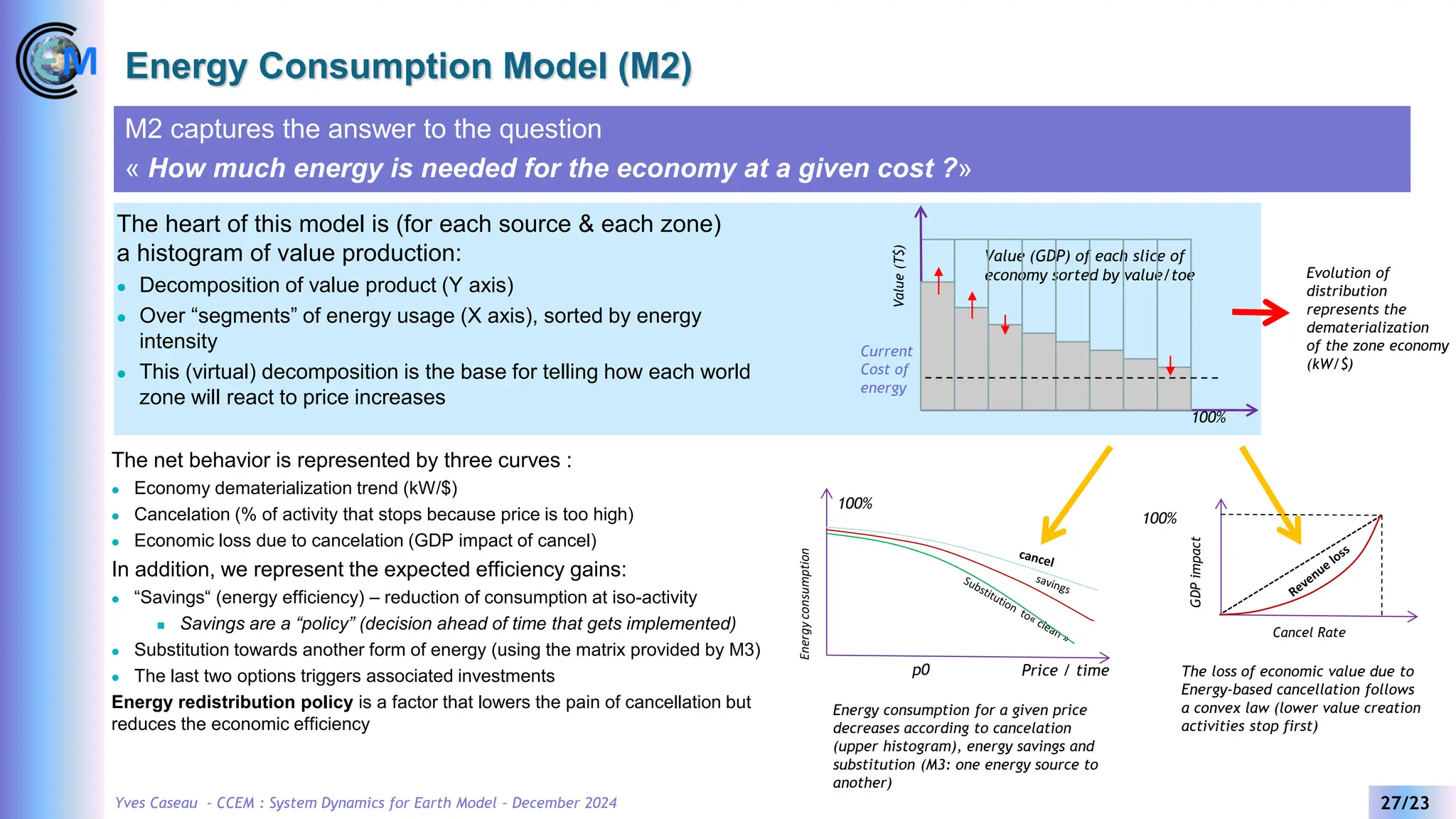
Energy Consumption Model (M2)
M2 captures the answer to the question
« How much energy is needed for the economy at a given cost ?»
The heart of this model is (for each source & each zone)
a histogram of value production:
⚫ Decomposition of value product (Y axis)
⚫ Over “segments” of energy usage (X axis), sorted by energy
intensity
⚫ This (virtual) decomposition is the base for telling how each world
zone will react to price increases
The net behavior is represented by three curves :
⚫ Economy dematerialization trend (kW/$)
⚫ Cancelation (% of activity that stops because price is too high)
⚫ Economic loss due to cancelation (GDP impact of cancel)
In addition, we represent the expected efficiency gains:
⚫ “Savings“ (energy efficiency) – reduction of consumption at iso-activity
◼ Savings are a “policy” (decision ahead of time that gets implemented)
⚫ Substitution towards another form of energy (using the matrix provided by M3)
⚫ The last two options triggers associated investments
Energy redistribution policy is a factor that lowers the pain of cancellation but
reduces the economic efficiency
Energy consumption for a given price
decreases according to cancelation
(upper histogram), energy savings and
substitution (M3: one energy source to
another)
Value (GDP) of each slice of
economy sorted by value/toe
Value
(T$)
100%
Current
Cost of
energy
Energy
consumption
Price / time
100%
p0 The loss of economic value due to
Energy-based cancellation follows
a convex law (lower value creation
activities stop first)
Evolution of
distribution
represents the
dematerialization
of the zone economy
(kW/$)
Cancel Rate
100%
GDP
impact
Yves Caseau - CCEM : System Dynamics for Earth Model – December 2024 28/23
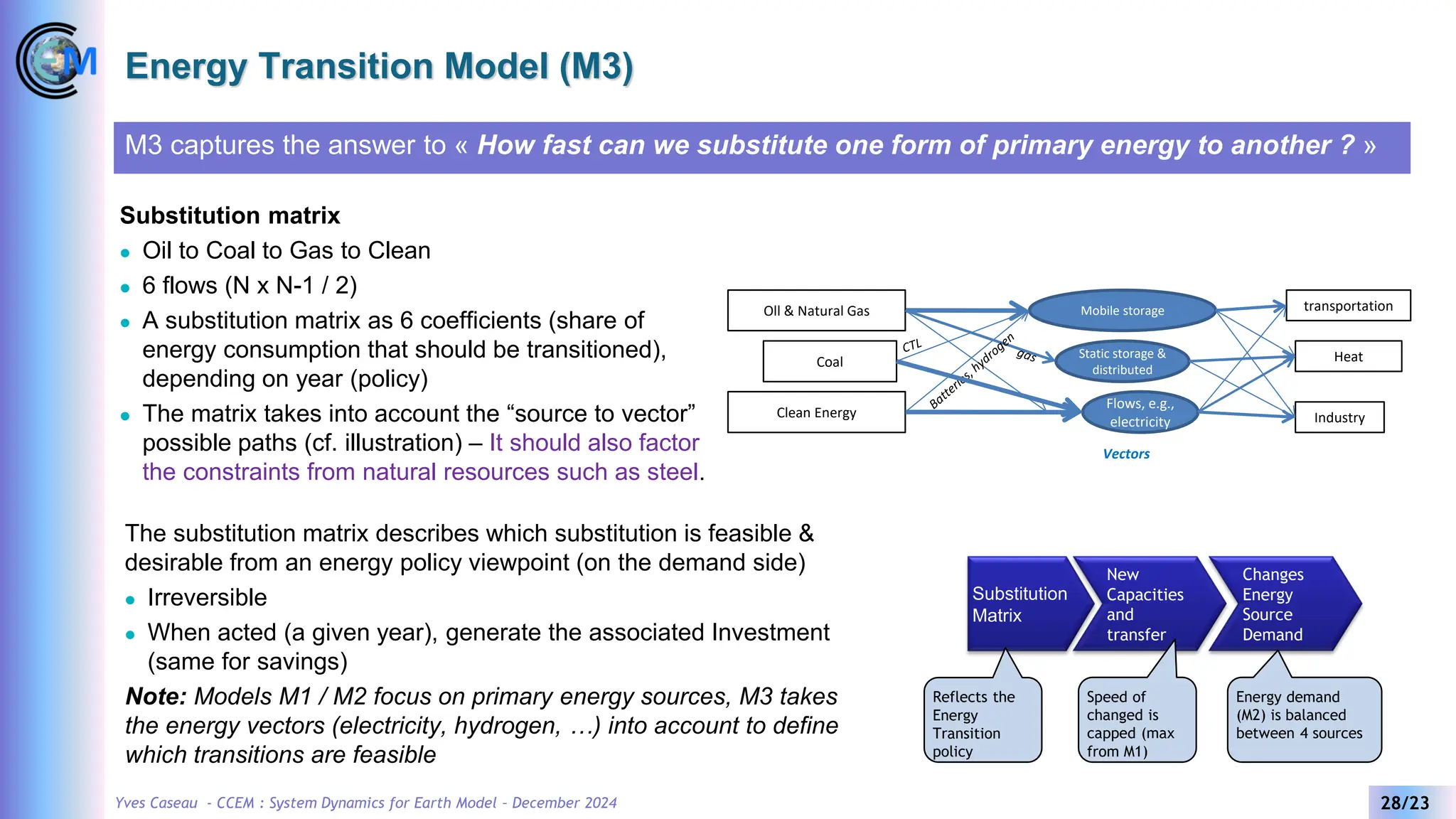
Energy Transition Model (M3)
M3 captures the answer to « How fast can we substitute one form of primary energy to another ? »
Substitution matrix
⚫ Oil to Coal to Gas to Clean
⚫ 6 flows (N x N-1 / 2)
⚫ A substitution matrix as 6 coefficients (share of
energy consumption that should be transitioned),
depending on year (policy)
⚫ The matrix takes into account the “source to vector”
possible paths (cf. illustration) – It should also factor
the constraints from natural resources such as steel.
Mobile storage
Flows, e.g.,
electricity Industry
transportation
Heat
Oll & Natural Gas
Coal
Clean Energy
Static storage &
distributed
Vectors
The substitution matrix describes which substitution is feasible &
desirable from an energy policy viewpoint (on the demand side)
⚫ Irreversible
⚫ When acted (a given year), generate the associated Investment
(same for savings)
Note: Models M1 / M2 focus on primary energy sources, M3 takes
the energy vectors (electricity, hydrogen, …) into account to define
which transitions are feasible
Substitution
Matrix
Changes
Energy
Source
Demand
New
Capacities
and
transfer
Reflects the
Energy
Transition
policy
Speed of
changed is
capped (max
from M1)
Energy demand
(M2) is balanced
between 4 sources
Yves Caseau - CCEM : System Dynamics for Earth Model – December 2024 29/23
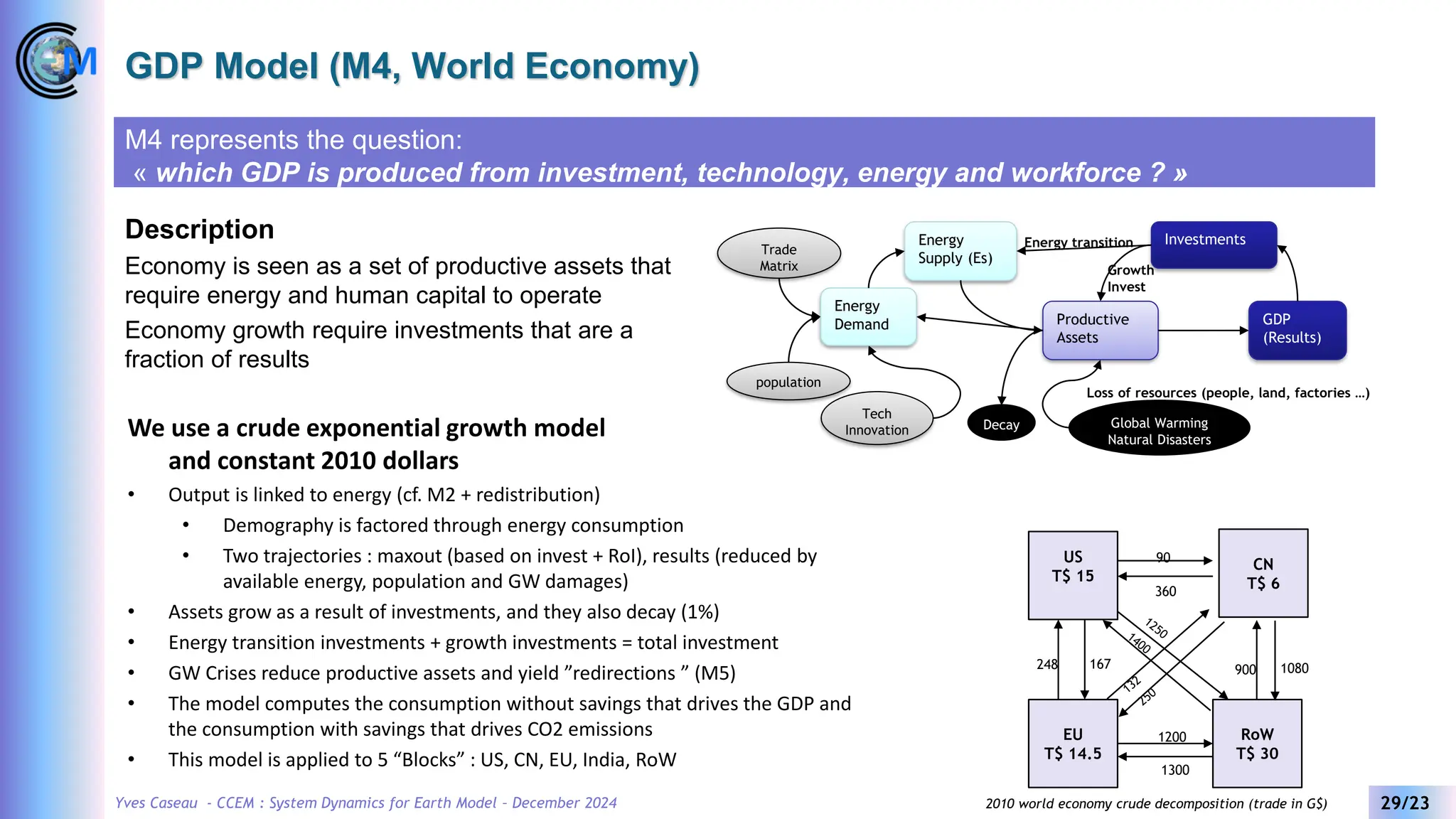
GDP Model (M4, World Economy)
M4 represents the question:
« which GDP is produced from investment, technology, energy and workforce ? »
Description
Economy is seen as a set of productive assets that
require energy and human capital to operate
Economy growth require investments that are a
fraction of results
We use a crude exponential growth model
and constant 2010 dollars
• Output is linked to energy (cf. M2 + redistribution)
• Demography is factored through energy consumption
• Two trajectories : maxout (based on invest + RoI), results (reduced by
available energy, population and GW damages)
• Assets grow as a result of investments, and they also decay (1%)
• Energy transition investments + growth investments = total investment
• GW Crises reduce productive assets and yield ”redirections ” (M5)
• The model computes the consumption without savings that drives the GDP and
the consumption with savings that drives CO2 emissions
• This model is applied to 5 “Blocks” : US, CN, EU, India, RoW
US
T$ 15
CN
T$ 6
EU
T$ 14.5
RoW
T$ 30
248
360
167 900 1080
1200
1300
90
2010 world economy crude decomposition (trade in G$)
Productive
Assets
GDP
(Results)
Investments
Energy
Supply (Es)
population
Tech
Innovation
Energy transition
Growth
Invest
Global Warming
Natural Disasters
Loss of resources (people, land, factories …)
Energy
Demand
Decay
Trade
Matrix
Yves Caseau - CCEM : System Dynamics for Earth Model – December 2024 30/23
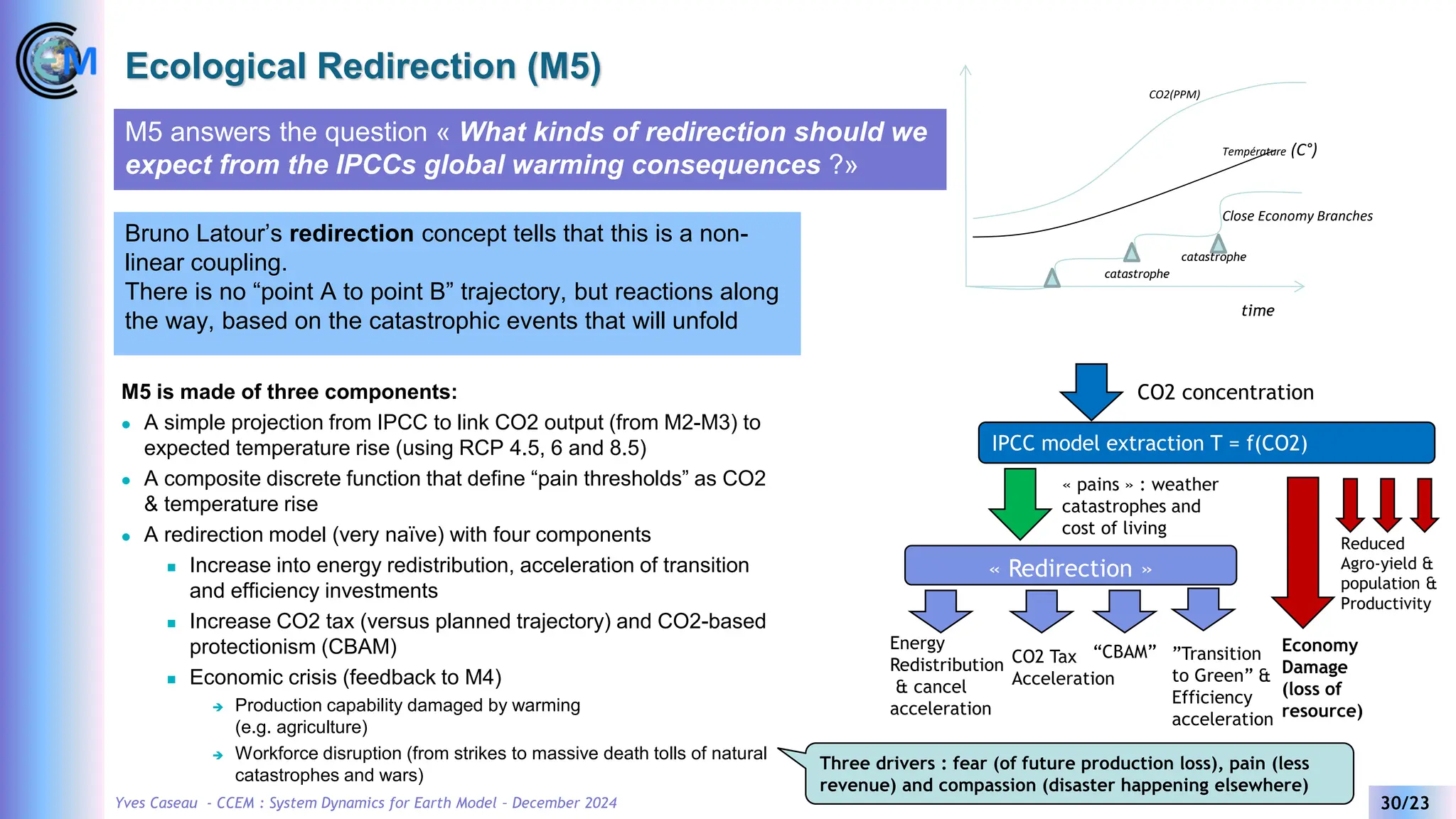
Ecological Redirection (M5)
M5 answers the question « What kinds of redirection should we
expect from the IPCCs global warming consequences ?»
Bruno Latour’s redirection concept tells that this is a non-
linear coupling.
There is no “point A to point B” trajectory, but reactions along
the way, based on the catastrophic events that will unfold
M5 is made of three components:
⚫ A simple projection from IPCC to link CO2 output (from M2-M3) to
expected temperature rise (using RCP 4.5, 6 and 8.5)
⚫ A composite discrete function that define “pain thresholds” as CO2
& temperature rise
⚫ A redirection model (very naïve) with four components
◼ Increase into energy redistribution, acceleration of transition
and efficiency investments
◼ Increase CO2 tax (versus planned trajectory) and CO2-based
protectionism (CBAM)
◼ Economic crisis (feedback to M4)
➔ Production capability damaged by warming
(e.g. agriculture)
➔ Workforce disruption (from strikes to massive death tolls of natural
catastrophes and wars)
IPCC model extraction T = f(CO2)
CO2 concentration
« pains » : weather
catastrophes and
cost of living
« Redirection »
Energy
Redistribution
& cancel
acceleration
Economy
Damage
(loss of
resource)
CO2 Tax
Acceleration
”Transition
to Green” &
Efficiency
acceleration
Reduced
Agro-yield &
population &
Productivity
“CBAM”
time
CO2(PPM)
Close Economy Branches
Température (C°)
catastrophe
catastrophe
Three drivers : fear (of future production loss), pain (less
revenue) and compassion (disaster happening elsewhere)
Yves Caseau - CCEM : System Dynamics for Earth Model – December 2024 31/23
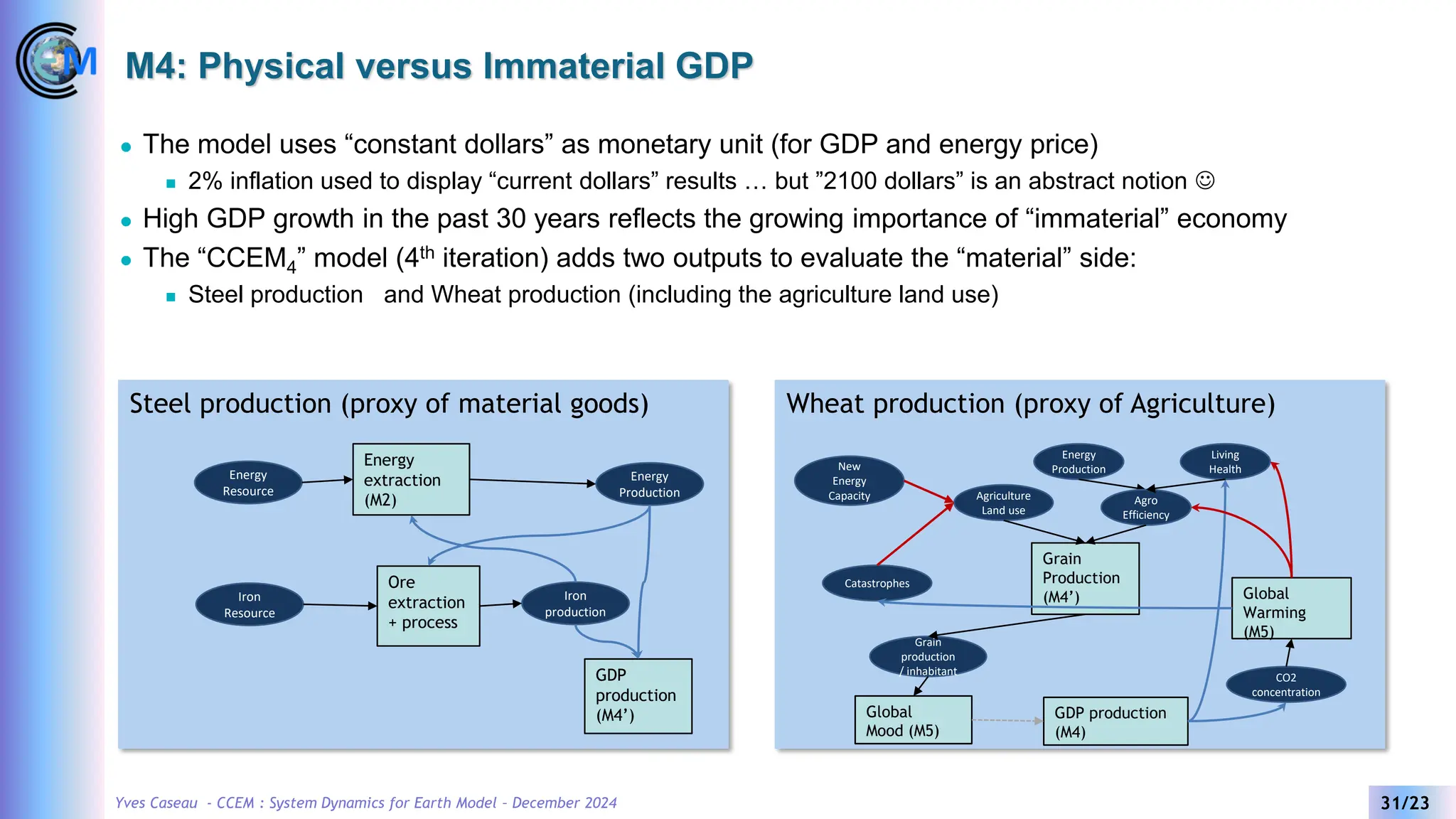
M4: Physical versus Immaterial GDP
⚫ The model uses “constant dollars” as monetary unit (for GDP and energy price)
◼ 2% inflation used to display “current dollars” results … but ”2100 dollars” is an abstract notion ☺
⚫ High GDP growth in the past 30 years reflects the growing importance of “immaterial” economy
⚫ The “CCEM4” model (4th iteration) adds two outputs to evaluate the “material” side:
◼ Steel production and Wheat production (including the agriculture land use)
Steel production (proxy of material goods) Wheat production (proxy of Agriculture)
Energy
Resource
Energy
extraction
(M2)
Energy
Production
Iron
Resource
Ore
extraction
+ process
Iron
production
GDP
production
(M4’)
New
Energy
Capacity
Grain
Production
(M4’)
Agriculture
Land use
Catastrophes
Global
Warming
(M5)
Grain
production
/ inhabitant
GDP production
(M4)
Living
Health
Energy
Production
Agro
Efficiency
CO2
concentration
Global
Mood (M5)
Yves Caseau - CCEM : System Dynamics for Earth Model – December 2024 32/23
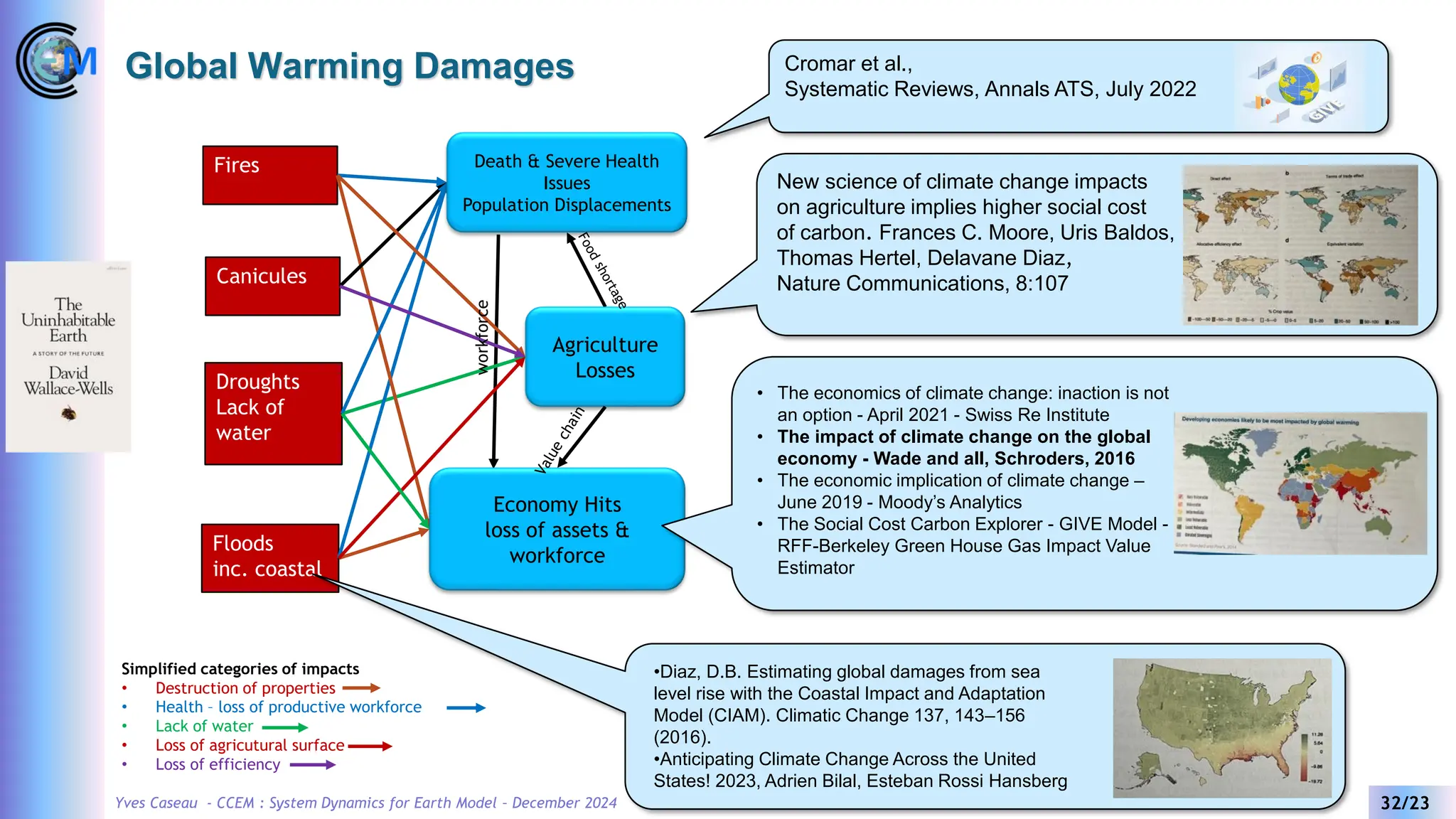
Global Warming Damages
Canicules
Droughts
Lack of
water
Floods
inc. coastal
Fires Death & Severe Health
Issues
Population Displacements
Agriculture
Losses
Economy Hits
loss of assets &
workforce
workforce
Simplified categories of impacts
• Destruction of properties
• Health – loss of productive workforce
• Lack of water
• Loss of agricutural surface
• Loss of efficiency
•Diaz, D.B. Estimating global damages from sea
level rise with the Coastal Impact and Adaptation
Model (CIAM). Climatic Change 137, 143–156
(2016).
•Anticipating Climate Change Across the United
States! 2023, Adrien Bilal, Esteban Rossi Hansberg
New science of climate change impacts
on agriculture implies higher social cost
of carbon. Frances C. Moore, Uris Baldos,
Thomas Hertel, Delavane Diaz,
Nature Communications, 8:107
• The economics of climate change: inaction is not
an option - April 2021 - Swiss Re Institute
• The impact of climate change on the global
economy - Wade and all, Schroders, 2016
• The economic implication of climate change –
June 2019 - Moody’s Analytics
• The Social Cost Carbon Explorer - GIVE Model -
RFF-Berkeley Green House Gas Impact Value
Estimator
Cromar et al.,
Systematic Reviews, Annals ATS, July 2022
Yves Caseau - CCEM : System Dynamics for Earth Model – December 2024 33/23
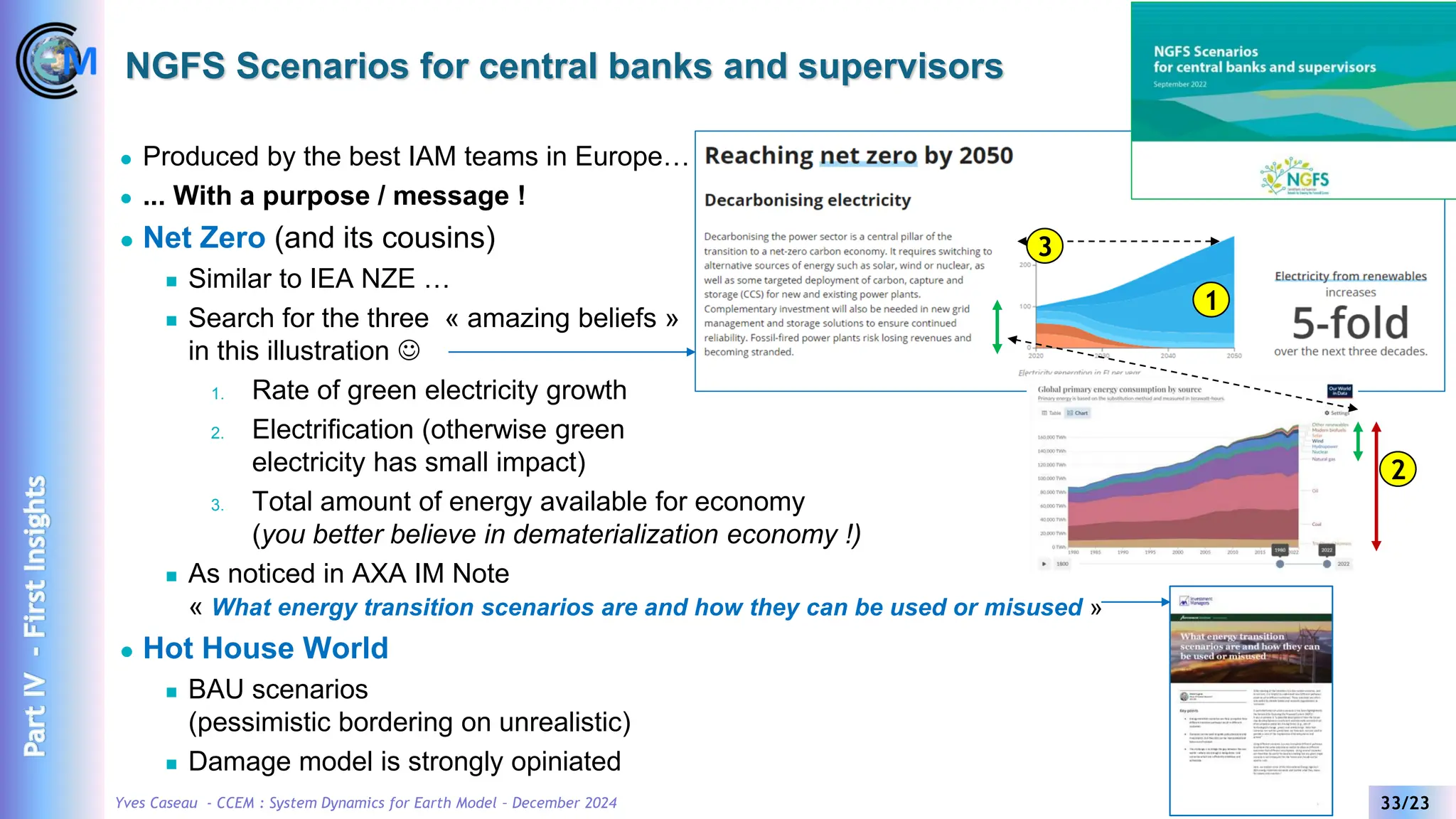
NGFS Scenarios for central banks and supervisors
⚫ Produced by the best IAM teams in Europe…
⚫ ... With a purpose / message !
⚫ Net Zero (and its cousins)
◼ Similar to IEA NZE …
◼ Search for the three « amazing beliefs »
in this illustration ☺
1. Rate of green electricity growth
2. Electrification (otherwise green
electricity has small impact)
3. Total amount of energy available for economy
(you better believe in dematerialization economy !)
◼ As noticed in AXA IM Note
« What energy transition scenarios are and how they can be used or misused »
⚫ Hot House World
◼ BAU scenarios
(pessimistic bordering on unrealistic)
◼ Damage model is strongly opiniated
1
3
2
Part
IV
-
First
Insights

A System Dynamics Model for Global Warming Impact, from Energy Transition to Ecological Redirection

  • 1.
    Yves Caseau -CCEM : System Dynamics for Earth Model – December 2024 1/23 A System Dynamics Model for Global Warming Impact, from Energy Transition to Ecological Redirection Yves Caseau National Academy of Technologies of France (NATF) December 4th, 2024 FormAction Presentation In Memoriam http://modelccem.eu
  • 2.
    Yves Caseau -CCEM : System Dynamics for Earth Model – December 2024 2/23 Outline 1. Why : Yet Another Integrated Assessment Model ? ◼ System Dynamics, Integrated Assessment Models ◼ Known Unknowns as Parameters 2. CCEM Model Overview ◼ Coupling of 5 “coarse” models ◼ M1 to M5 Overview 3. Computational Scenarios ◼ Preliminary results ◼ Sensitivity analysis 4. So What : What are the first insights ? ◼ A possible new narrative of global warming ◼ Next Steps
  • 3.
    Yves Caseau -CCEM : System Dynamics for Earth Model – December 2024 3/23 Motivations for Yet Another Earth/Climate/Economy Model • SCC (Social Cost of Carbon): ”Comprehensive evidence implies a higher social cost of CO2” (Reinert & al.) • Qualitative assessment of damages, but monetary value is hard to agree on – cf. IPCC Working Group II (Impact, Adaptation & Vulnerability) • Double questioning of IAMs regarding damage modeling : level and non-linear tipping points (Stern, Stiglitz and Taylor, 2022) Damages • How much fossil energy will be available, at which extraction costs in the 21st century ? • How fast can we manufacture and deploy sustainable energies ? • How fast can we electrify the use of energy ? • How will the energy intensity (kWh / M$) trend evolve in the next century ? For each continent ? Energy Future • Damages will trigger societal reactions as pain grows: • Possible redirections • Cancelation (renounce a CO2 producing activity) • Acceleration (Energy transition, Efficiency & carbon taxes) • protectionism Redirections Part I - Why ?
  • 4.
    Yves Caseau -CCEM : System Dynamics for Earth Model – December 2024 4/23 EM3: “Energy Matters” Modeling Manifesto This (WIP) manifesto states that all IAMs should disclose their 2050 hypothesis for the following “Known Unknowns” Oil Reserve Wind+Solar Energy Density Electrification 0 50 100 150 200 250 1980 2000 2020 Oil Reserve (Gt) 2050 New reserves + lower consumption 0 1 2 3 4 5 2010 2013 2016 2020 2023 Wind+Solar(PWh) 1.3 PWh/y CCEM 0.5 PWh/y 2023 2.5 PWh/y COP28 Until 2030 ! 0,0% 5,0% 10,0% 15,0% 20,0% 1950 1980 2000 2020 Electrification (%) 2050 Viscosity of Energy transition Electricity Production/ Total Energy CCEM @ 30% aggressive Supposes sobriety 2050 CAGR (negative) - 3.6% past 40 years with inflation - Only -0.7% when inflation is factored out CCEM @ 0.5% is conservative (energy-poor recession) Net-zero > 50% Part I - Why ?
  • 5.
    Yves Caseau -CCEM : System Dynamics for Earth Model – December 2024 5/23 The Complexity of Assessing Damages ⚫ What is the expected GDP loss associated to a warming of +3C ? -3% for +3C -7% to -10% for +3C -15% to -25% for +3C >= 10 years old >= 5 years old current Part I - Why ? 2050 (+1.7) impact is very strong (-6%) Swiss Re : $280B in 2023 $100B insured losses
  • 6.
    Yves Caseau -CCEM : System Dynamics for Earth Model – December 2024 6/23 1. SDEM (System Dynamics Earth Model) ◼ Closed, first-principle model with multiple feedback loops where each dimension (energy / economy/ climate / population) impact each other ◼ Resource reserves (energy / steel) modelled with a price function (cf. critics of LtG) 2. Explicit beliefs ◼ Macro-parameters : ”known unknown” acknowledged as such ◼ CCEM may reproduce many conflicting views (just change the input beliefs) 3. Realistic energy transition ◼ Speed of deployment of clean energies (hard) ◼ Rate of change in primary/vectors energy flows, including intermittency & storage constraints (harder) 4. Geopolitical Zones with different strategies ◼ Strategy : combination of GDP, happiness and global warming + time discounting ◼ CCEM acknowledges divergent interests and different priorities 5. Ecological redirection : how society reacts to warming and accelerate adaptation ◼ WIP : tuning strategy to tactical, warming damages to pain and impact CCEM in a nutshell (current version v6) Part I - Why ?
  • 7.
    Yves Caseau -CCEM : System Dynamics for Earth Model – December 2024 7/23 Part II 1. Why : Yet Another Integrated Assessment Model ? 2. CCEM Model Overview ◼ Coupling of 5 “coarse” models ◼ M1 to M5 Overview 3. Computational Scenarios 4. So What : What are the first insights ? Part II - CCEM Overview
  • 8.
    Yves Caseau -CCEM : System Dynamics for Earth Model – December 2024 8/23 CCEM : Coupling Five Coarse Models with System Dynamics 4 instances • Oil • Gas • Coal • Clean 5 instances: • US • Europe • China • India • Rest of World M3 : Energy Transition inventory capacity revenue Conso CO2 tax Societal Pressure CO2 emissions Unknown Model IPCC Forecasts Temperature Water rise GDP/ person demography + + - Price cost needs Equivalent Consumption Energy Invest assets Investments Growth Invest delay delay delay Energy policies renouncement + + savings cancel Tech Progress substitution Rate of CO2 catastrophes crises Wheat Steel Food/` person Land Use protectionism M2: Energy Consumption M1: Energy Production M5: Ecological Redirection M4: Economy Part II - CCEM Overview GDP
  • 9.
    Yves Caseau -CCEM : System Dynamics for Earth Model – December 2024 9/23 CCEM : Simulation Model ⚫ Each model M1 to M5 represents a discrete one-year difference equation ◼ Inputs: some of the state variables (at year n – 1) ◼ Outputs: some of state variables (M1 to M5 partitioning) ◼ 10 to 30 lines of code (each) 2010 State of the world Energy Sources Zones World Earth N = 40,90, … times 2050 / 2100 / … State(i) = ƒ (state(i-1),*) M1 M2 M3 M4 M5 Outcome = time-series GDP CO2 Energy Works For grasping « Gray Rhinos » More than « Black Swans » Part II - CCEM Overview
  • 10.
    Yves Caseau -CCEM : System Dynamics for Earth Model – December 2024 10/23 M1/M2 : Energy and M4:Economy • Economy is seen as a set of productive assets that require energy and human capital to operate • Economy growth require investments that are a fraction of results • This model is applied to 5 “Blocks” : US, CN, EU, India, RoW • To represent the “material economy” we use two “proxies” : steel and wheat productions Economy • A crude model for energy inventory (reserves) for fossil fuels & capacity evolution • A crude model (KNU) about the speed at which solar & wind may be deployed • A demand elasticity model that includes sobriety (chosen), efficiency, transition and cancellation (forced sobriety) • CCEM matches demand & supply with macro price setting. Energy Model Energy consumption Price / time 100% p0 Part II - CCEM Overview Cf. Alain Grandjean (Carbone 4) : Modele de Solow (max out) w energy constraints + Damages – cf Jancovici) Productive Assets GDP (Results) Investments Energy Supply (Es) population Tech Innovation Energy transition Growth Invest Global Warming Natural Disasters Loss of resources (people, land, factories …) Energy Demand Decay Trade Matrix
  • 11.
    Yves Caseau -CCEM : System Dynamics for Earth Model – December 2024 11/23 M3 (energy transition) & M5 (Ecological Redirection) • CO2 emission is computed from energy consumption by sources (adjusted) • CO2 concentration is a naïve linear model • Temperature follows IPCC RPCs • Damages will trigger societal reactions as pain grows: Redirections • CCEM uses a transition matrix that reflects how fast can energy consumption migrate from one primary source to another • This reflects the use of hydrogen, but mostly the speed of electrification • Country blocks may choose their transition speed • CCEM bears similarities with WITNESS climate model • Energy is critical to produce value • Transition map defines possible landscape Energy Transition Mobile storage electricity Industry transportation Heat Oll & Natural Gas Coal Clean Energy Static storage & distributed Vectors Part II - CCEM Overview Both through regulation and stakeholders pressure on companies IPCC model extraction T = f(CO2) CO2 concentration « pains » : weather catastrophes and cost of living « Redirection » Energy Redistribution & cancel acceleration Economy Damage (loss of resource) CO2 Tax Acceleration ”Transition to Green”, Efficiency acceleration Reduced Agro-yield & population & Productivity “CBAM”
  • 12.
    Yves Caseau -CCEM : System Dynamics for Earth Model – December 2024 12/23 Part III 1. Why : Yet Another Integrated Assessment Model ? 2. CCEM Model Overview 3. Computational Scenarios ◼ Preliminary results ◼ Sensitivity analysis 4. So What : What are the first insights ? Part III - Preliminary Results
  • 13.
    Yves Caseau -CCEM : System Dynamics for Earth Model – December 2024 13/23 CCEM : Six KNUs (Key kNown Unknowns) ⚫ These 6 KPI provide the best characterization of the CCEM “known unknowns” ◼ what creates the heavier debate, for instance speed of Clean energy growth vs fossil reserve ◼ These KPI can be compared with other published values from prospective institutes ☺ ◼ When looking at a simulated forecast, one should always ask for these 6 hypotheses Clean Energy Growth Rate KPI1: PWh added in 10 years Default value : 13 PWh IRINA 1.5C scenario: 25 PWh Energy Intensity KPI2: CAGR decrease of E/GDP Default value : 0.5% (2010-2050) 0.7% between 1980 and 2020 in constant dollars (3.6 % with inflation) IRINA 1.5C scenario: 2.7% Energy to price elasticity KPI3: long-term elasticity demand to price Default value : -0.3 Values from Reed : -0.05 short- term and -0.3 long-term Electrification of Energy KPI4: electricity(TWh) / total energy Default value : 30% in 2050 16% in 2020 IRINA 1.5C scenario: 80% Return on Investment KPI5: world average of RoI (yearly GDP increase / investment) Default value : 13% (2010-2050) Calibrated from past + guess ☺ Global Warming Impact KPI6: GW damages, as % of GDP for +3C Default value : -6.7% at +2.6C approximate SCC at 270$/t Values picked from Schroders: 8% at 3C Ask GPTo1 or Claude 3.5 about these 6 questions … Part III - Preliminary Results
  • 14.
    Yves Caseau -CCEM : System Dynamics for Earth Model – December 2024 14/23 “Median KNU Belief” Scenario Inertia of non-electric fossil energy Growth of immaterial service economy Reflects latest forecasts Part III - Preliminary Results CO2 @ 609 ppm 2010 constant dollars +2.5C vs 20th c. average
  • 15.
    Yves Caseau -CCEM : System Dynamics for Earth Model – December 2024 15/23 Median Scenario : Zone views ⚫ Reproducing interdependent zone economies is key to play geopolitical scenarios Part III - Preliminary Results Inflation is likely in a world constrained in resources … Current dollars are hard to evaluate US and CB will grow, EU is slightly declining and the rest of the World suffers a recession Constant but slow progress of decarbonation CO2 emissions start to reduce because of Gas + Oil peak GDP is well explained by available energy: US progresses (dematerialization), CN “Coal to Green” strategy delivers, EU is declining and the Rest of the world is strangled by high energy costs 2% inflation assumption 47% electrification in 2100 Peak CO2 emission in 2040 China de-carbonation (long-term) strategy works well
  • 16.
    Yves Caseau -CCEM : System Dynamics for Earth Model – December 2024 16/23 Sensitivity analysis ⚫ All parametric beliefs have an impact, some more than others The more energy-intensive and the cheaper the current energy mix is, the higher the CO2 tax impact is - rebound effect when EU is leading alone - Unrealistic scenario for world unified tax (CN) Peak oil and available fossil fuels have both an impact on GDP (significant) and on warming (moderate, because of accumulation) Faster Deployment of clean energy has a strong impact on GDP (energy shortage is reduced) but not so on warming 55% electrification 43% electrification Same fossil consumption, same warming Unrealistic economic impact
  • 17.
    Yves Caseau -CCEM : System Dynamics for Earth Model – December 2024 17/23 Part IV 1. Why : Yet Another Integrated Assessment Model ? 2. CCEM Model Overview 3. Computational Scenarios 4. So What : What are the first insights ? ◼ A possible new narrative of global warming ◼ Next Steps Part IV - First Insights
  • 18.
    Yves Caseau -CCEM : System Dynamics for Earth Model – December 2024 18/23 “Not the End of The Word” ⚫ “Business as Usual” should be ”slow transformation as usual” Factoring Peak Oil/Gas, there is not enough fossil fuel for +4C scenario, +3C is hard/unlikely ⚫ Transition has started (cf. Hannah Richie’s book): ◼ Clean energy transition; energy savings / efficiency ➔ Continuous progress for air quality in Europe over a century ◼ “Death rates from natural disasters have fallen 10 folds in a century” ◼ Water/natural resource conservation progresses + Crops yield has improved for 50 years ⚫ “Decarbonation / GHG” transformation brings opportunities together with challenges ◼ Better synergy with nature, healthier food, more serenity with slower lifestyle, … ⚫ Technology and innovation will definitely help along the way ◼ Lots of paths are visible (cf. Solar Impulse foundation, Bertrand Piccard) ◼ Exponential NBIC growth is not a myth ☺ Following current IPCC consensus on CO2 to T Part IV - First Insights
  • 19.
    Yves Caseau -CCEM : System Dynamics for Earth Model – December 2024 19/23 Transitions and Delays ⚫ There is a time gap between the fossil peak and the advent of clean energy at the expected level ◼ This is why the value of fossil reserves and the possible speed of green energy transition matter so much ◼ This (left) illustration is not the median scenario but the optimistic version (cf. Vaclav Smil) ⚫ The interest of geopolitical zones are very different, a scenario of worldwide sobriety (to close the gap) is unrealistic ◼ This creates a period of economic strangulation by lack of energy ⚫ “Carbon neutral 2050” / Paris Agreement / net-zero COP: “deader than a doornail” - James Hansen ◼ unless carbon sequestration becomes efficient, scalable and affordable ⚫ Get ready for 2.5 C° +/- x (vs 20th century average) ◼ 2.7 C° vs IPCC pre-industrial reference This is a critical graph irrespectively of the model or the source Part IV - First Insights
  • 20.
    Yves Caseau -CCEM : System Dynamics for Earth Model – December 2024 20/23 “Not the End of the World” … but end of the 20th century World 1. Sustained Global Warming, severe impacts to be expected, ◼ Adaptation is mandatory 2. Cheap Energy is gone, busts of energy shortages ◼ No longer a free market, large zone discrepancies (already started, intensified with conflicts) 3. End of sustained worldwide growth ◼ Will reinforce the perception and the pains of inequality 4. Resource constraints will trigger aggressive competition ◼ Conflicts rise, probable wars ◼ Trade wars (protectionism, this is only the beginning) ◼ Cyber-espionage (cf. UK expert warning) 5. Prepare for surprises and redirection (political reactions pushed by societal fears) ◼ Read “Hello Future!” from Langdon Morris Part IV - First Insights
  • 21.
    Yves Caseau -CCEM : System Dynamics for Earth Model – December 2024 21/23 A “new narrative”: Avoiding stress as a motivator, Avoiding a promise that we may not keep ⚫ « The Future of European competitiveness» : Very consistent with CCEM simulation ! “foundations of Europe competitiveness have been shaken” ◼ “Even though energy prices have fallen considerably from their peaks, EU companies still face electricity prices that are 2-3 times those of US” ◼ “To digitalise and decarbonize the economy and increase our defense capacity, the investment share in Europe will have to rise by 5% of GDP” (back to 60-70s levels) ◼ “The productivity gar between the EU and the US is largely explained by the tech sector” ⚫ Europe playbook : Accelerate anticipation to get out faster from « the pricey fossil fuel tunnel » Not to avoid the end of the world, but to avoid the end of Europe (as a major economy player) ◼ cf Mario Draghi’s joint plan for decarbonation and competitiveness ⚫ Anticipate versus React : Energy sobriety will be forced upon us either way Anticipation has a cost, but it broadens the cone of possible mitigation Efficiency Acceleration Energy Source Transition Sobriety Policies regulations GW Damages Energy Price increases Carbon taxes ANTICIPATE Towards decarbonation Tech Digital Too little, too late ☺  Green Production Electri- ficaton REACT Electrification (of energy consumption) favors efficiency Balance green production and consumption Time / energy de-carbonation Price of energy ☺ ☺  Happy decades of growth thanks to cheap fossil energy Unhappy decades of lack of competitiveness because of energy scarcity Possible bright future where Europe enjoys the fruits of early- mover advantage to decarbonated economy Part IV - First Insights
  • 22.
    Yves Caseau -CCEM : System Dynamics for Earth Model – December 2024 22/23 Next Step: Global Warming, Geopolitics and Game-Theory • Do not assume that blocks have similar goals … • What is the benefit of an “EU green policy” facing D. Trump and Xi Jinping ? • Is there an anticipation benefit ? (“suffer earlier, suffer less”) ? • What are the levers for player to influence each others (trade barriers, CBAM, …) ? • Could world population indignation yield a significant systemic change ? Evolutionary Game-Theory • A Method developed 15 years ago for Telco markets equilibrium • 3G and 4G licenses • Free introduction • Combines • Monte-Carlo simulation for uncertain KNU (from curves to cones) • Local optimization for tactical adaptation (BR) • Search for Nash Equilibriums Strategy = goals for each zone GDP, Pain level, World temperature GTES Part IV - First Insights
  • 23.
    Yves Caseau -CCEM : System Dynamics for Earth Model – December 2024 23/23 Conclusion ⚫ CCEM is a tool to explore beliefs (mental models) and their combined effects ◼ Tune your own mental models from simulation feedback loops ◼ Way of use : beliefs → simulation → one outcome that seems possible (then repeat) ◼ Antifragile System Dynamics Modeling: Grows from criticism and conversations (v3 to v4 to v5 to v6) ⚫ Five Key questions (Key Known Unknown) 1. What is a plausible energy trajectory ? (cf. EM3) 2. In a word constrained by lack of energy, should one-sided consumption reduction reduce CO2 emissions? 3. What is a plausible elasticity scenario, so that demand lowers to possible supply ? 4. What is the expected outcome of +2.5C warming ? 5. What is the best way to adapt (to protect ourselves) ? ⚫ 2025: Explore “the complexity of cooperation” ◼ “Will human governance and cooperation on global warming be designed or emergent ?” WARMING/ ADAPTATION CARBON-NEUTRAL Finite World Radical Change Open World Continuous Change Temperature rises Technology changes the game W. Nordhaus Adjust to GW moderate GDP effects P. Diamandis Abundance JM Jancovici Carbon Shift P.Sevigne Collapse
  • 24.
    Yves Caseau -CCEM : System Dynamics for Earth Model – December 2024 24/23 Appendix https://github.com/ycaseau/GWDG
  • 25.
    Yves Caseau -CCEM : System Dynamics for Earth Model – December 2024 25/23 CCEM : Addressing Five “Known Unknowns” « How much energy will be available in the future ? At which costs? » « How much energy is needed and acceptable for the economy at a given cost ?» Example: At which speed can we add clean energy in the next 30 years ? EIA « How fast can we substitute one form of primary energy to another ? » « What will be the economical and societal consequences from the IPCCs predicted global warming ?» « which GDP growth can be expected from investment, technology, energy and workforce ? » Example: - How much energy subvention must/can governments afford ? Energy To GDP Example: What is the possible speed of transition fossil>green for industry ? 2050 Eco transition Plan Example: Impact of reduced energy availability on economical output ? GDP 2050 Example: - which damage to productive resources ? - Which redirection caused by fear ? Temp to GDP loss Part I - Why ?
  • 26.
    Yves Caseau -CCEM : System Dynamics for Earth Model – December 2024 26/23 Energy Resource Model (M1) M1 captures the answer to the questions « How much fossil resources do we have ? At which costs? » Four categories ⚫ Oil ⚫ Natural Gas ⚫ Coal ⚫ Clean (hydro/solar/wind/nuclear) Each resource is defined through: ⚫ For fossil energies, its inventory chart (available PWh according to sell price) ⚫ For clean energies, a growth potential curve (max capacity in the future year, according to manufacturing and resource constraints) ⚫ A “max capacity” (max yearly output) ⚫ A constraint about the speed at which this capacity may evolve + a heuristic formula that adjusts the capacity each year Gtoe/y Price : $/PWh 410$ Fossil Fuel Production = f(price) Max capacity - matches expected growth - Yearly growth is constrained - Declines when reserves decline Local price elasticity 4 Gt cmax Gtoe/y Price : $/PWh $ Clean Energy Production = f(price) Max capacity = cn-1 x min( maxGrowth, expectedGrowth) unconstrained target price trends follows world GDP
  • 27.
    Yves Caseau -CCEM : System Dynamics for Earth Model – December 2024 27/23 Energy Consumption Model (M2) M2 captures the answer to the question « How much energy is needed for the economy at a given cost ?» The heart of this model is (for each source & each zone) a histogram of value production: ⚫ Decomposition of value product (Y axis) ⚫ Over “segments” of energy usage (X axis), sorted by energy intensity ⚫ This (virtual) decomposition is the base for telling how each world zone will react to price increases The net behavior is represented by three curves : ⚫ Economy dematerialization trend (kW/$) ⚫ Cancelation (% of activity that stops because price is too high) ⚫ Economic loss due to cancelation (GDP impact of cancel) In addition, we represent the expected efficiency gains: ⚫ “Savings“ (energy efficiency) – reduction of consumption at iso-activity ◼ Savings are a “policy” (decision ahead of time that gets implemented) ⚫ Substitution towards another form of energy (using the matrix provided by M3) ⚫ The last two options triggers associated investments Energy redistribution policy is a factor that lowers the pain of cancellation but reduces the economic efficiency Energy consumption for a given price decreases according to cancelation (upper histogram), energy savings and substitution (M3: one energy source to another) Value (GDP) of each slice of economy sorted by value/toe Value (T$) 100% Current Cost of energy Energy consumption Price / time 100% p0 The loss of economic value due to Energy-based cancellation follows a convex law (lower value creation activities stop first) Evolution of distribution represents the dematerialization of the zone economy (kW/$) Cancel Rate 100% GDP impact
  • 28.
    Yves Caseau -CCEM : System Dynamics for Earth Model – December 2024 28/23 Energy Transition Model (M3) M3 captures the answer to « How fast can we substitute one form of primary energy to another ? » Substitution matrix ⚫ Oil to Coal to Gas to Clean ⚫ 6 flows (N x N-1 / 2) ⚫ A substitution matrix as 6 coefficients (share of energy consumption that should be transitioned), depending on year (policy) ⚫ The matrix takes into account the “source to vector” possible paths (cf. illustration) – It should also factor the constraints from natural resources such as steel. Mobile storage Flows, e.g., electricity Industry transportation Heat Oll & Natural Gas Coal Clean Energy Static storage & distributed Vectors The substitution matrix describes which substitution is feasible & desirable from an energy policy viewpoint (on the demand side) ⚫ Irreversible ⚫ When acted (a given year), generate the associated Investment (same for savings) Note: Models M1 / M2 focus on primary energy sources, M3 takes the energy vectors (electricity, hydrogen, …) into account to define which transitions are feasible Substitution Matrix Changes Energy Source Demand New Capacities and transfer Reflects the Energy Transition policy Speed of changed is capped (max from M1) Energy demand (M2) is balanced between 4 sources
  • 29.
    Yves Caseau -CCEM : System Dynamics for Earth Model – December 2024 29/23 GDP Model (M4, World Economy) M4 represents the question: « which GDP is produced from investment, technology, energy and workforce ? » Description Economy is seen as a set of productive assets that require energy and human capital to operate Economy growth require investments that are a fraction of results We use a crude exponential growth model and constant 2010 dollars • Output is linked to energy (cf. M2 + redistribution) • Demography is factored through energy consumption • Two trajectories : maxout (based on invest + RoI), results (reduced by available energy, population and GW damages) • Assets grow as a result of investments, and they also decay (1%) • Energy transition investments + growth investments = total investment • GW Crises reduce productive assets and yield ”redirections ” (M5) • The model computes the consumption without savings that drives the GDP and the consumption with savings that drives CO2 emissions • This model is applied to 5 “Blocks” : US, CN, EU, India, RoW US T$ 15 CN T$ 6 EU T$ 14.5 RoW T$ 30 248 360 167 900 1080 1200 1300 90 2010 world economy crude decomposition (trade in G$) Productive Assets GDP (Results) Investments Energy Supply (Es) population Tech Innovation Energy transition Growth Invest Global Warming Natural Disasters Loss of resources (people, land, factories …) Energy Demand Decay Trade Matrix
  • 30.
    Yves Caseau -CCEM : System Dynamics for Earth Model – December 2024 30/23 Ecological Redirection (M5) M5 answers the question « What kinds of redirection should we expect from the IPCCs global warming consequences ?» Bruno Latour’s redirection concept tells that this is a non- linear coupling. There is no “point A to point B” trajectory, but reactions along the way, based on the catastrophic events that will unfold M5 is made of three components: ⚫ A simple projection from IPCC to link CO2 output (from M2-M3) to expected temperature rise (using RCP 4.5, 6 and 8.5) ⚫ A composite discrete function that define “pain thresholds” as CO2 & temperature rise ⚫ A redirection model (very naïve) with four components ◼ Increase into energy redistribution, acceleration of transition and efficiency investments ◼ Increase CO2 tax (versus planned trajectory) and CO2-based protectionism (CBAM) ◼ Economic crisis (feedback to M4) ➔ Production capability damaged by warming (e.g. agriculture) ➔ Workforce disruption (from strikes to massive death tolls of natural catastrophes and wars) IPCC model extraction T = f(CO2) CO2 concentration « pains » : weather catastrophes and cost of living « Redirection » Energy Redistribution & cancel acceleration Economy Damage (loss of resource) CO2 Tax Acceleration ”Transition to Green” & Efficiency acceleration Reduced Agro-yield & population & Productivity “CBAM” time CO2(PPM) Close Economy Branches Température (C°) catastrophe catastrophe Three drivers : fear (of future production loss), pain (less revenue) and compassion (disaster happening elsewhere)
  • 31.
    Yves Caseau -CCEM : System Dynamics for Earth Model – December 2024 31/23 M4: Physical versus Immaterial GDP ⚫ The model uses “constant dollars” as monetary unit (for GDP and energy price) ◼ 2% inflation used to display “current dollars” results … but ”2100 dollars” is an abstract notion ☺ ⚫ High GDP growth in the past 30 years reflects the growing importance of “immaterial” economy ⚫ The “CCEM4” model (4th iteration) adds two outputs to evaluate the “material” side: ◼ Steel production and Wheat production (including the agriculture land use) Steel production (proxy of material goods) Wheat production (proxy of Agriculture) Energy Resource Energy extraction (M2) Energy Production Iron Resource Ore extraction + process Iron production GDP production (M4’) New Energy Capacity Grain Production (M4’) Agriculture Land use Catastrophes Global Warming (M5) Grain production / inhabitant GDP production (M4) Living Health Energy Production Agro Efficiency CO2 concentration Global Mood (M5)
  • 32.
    Yves Caseau -CCEM : System Dynamics for Earth Model – December 2024 32/23 Global Warming Damages Canicules Droughts Lack of water Floods inc. coastal Fires Death & Severe Health Issues Population Displacements Agriculture Losses Economy Hits loss of assets & workforce workforce Simplified categories of impacts • Destruction of properties • Health – loss of productive workforce • Lack of water • Loss of agricutural surface • Loss of efficiency •Diaz, D.B. Estimating global damages from sea level rise with the Coastal Impact and Adaptation Model (CIAM). Climatic Change 137, 143–156 (2016). •Anticipating Climate Change Across the United States! 2023, Adrien Bilal, Esteban Rossi Hansberg New science of climate change impacts on agriculture implies higher social cost of carbon. Frances C. Moore, Uris Baldos, Thomas Hertel, Delavane Diaz, Nature Communications, 8:107 • The economics of climate change: inaction is not an option - April 2021 - Swiss Re Institute • The impact of climate change on the global economy - Wade and all, Schroders, 2016 • The economic implication of climate change – June 2019 - Moody’s Analytics • The Social Cost Carbon Explorer - GIVE Model - RFF-Berkeley Green House Gas Impact Value Estimator Cromar et al., Systematic Reviews, Annals ATS, July 2022
  • 33.
    Yves Caseau -CCEM : System Dynamics for Earth Model – December 2024 33/23 NGFS Scenarios for central banks and supervisors ⚫ Produced by the best IAM teams in Europe… ⚫ ... With a purpose / message ! ⚫ Net Zero (and its cousins) ◼ Similar to IEA NZE … ◼ Search for the three « amazing beliefs » in this illustration ☺ 1. Rate of green electricity growth 2. Electrification (otherwise green electricity has small impact) 3. Total amount of energy available for economy (you better believe in dematerialization economy !) ◼ As noticed in AXA IM Note « What energy transition scenarios are and how they can be used or misused » ⚫ Hot House World ◼ BAU scenarios (pessimistic bordering on unrealistic) ◼ Damage model is strongly opiniated 1 3 2 Part IV - First Insights