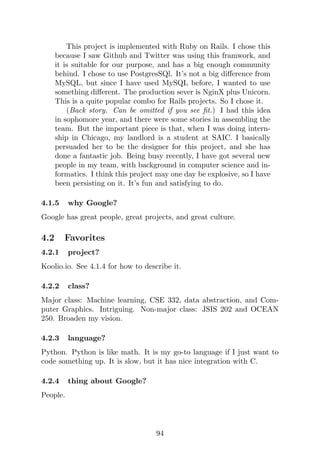
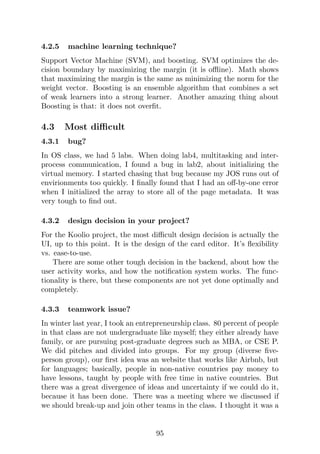
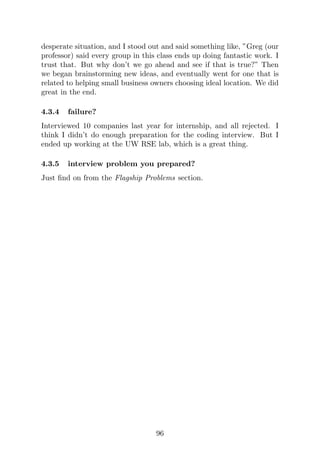
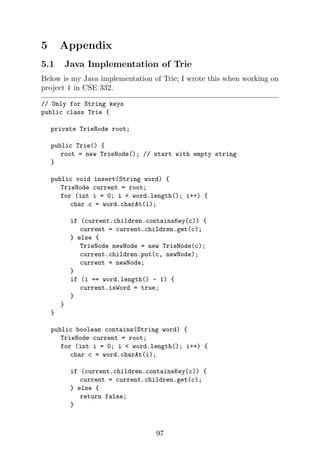
Coding Interview Preparation
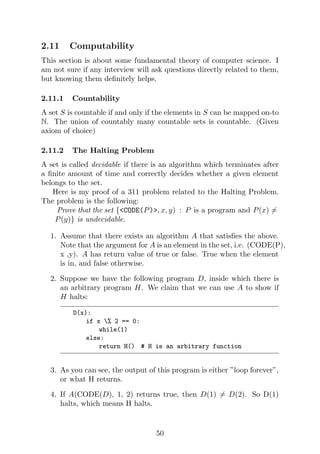
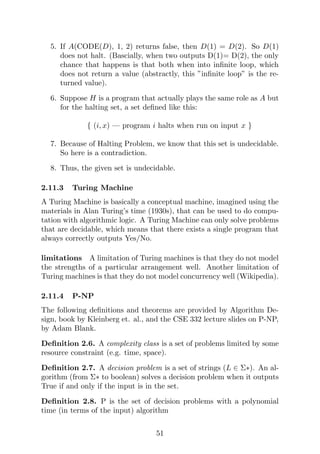
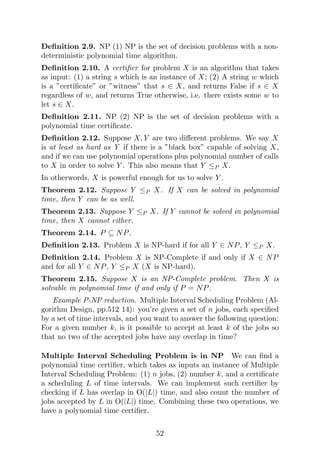
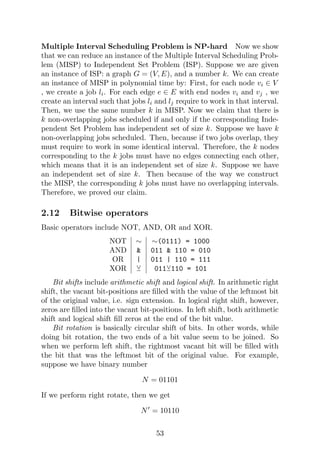
Kaiyu Zheng
January 2017
1 Ground
People say that interviews at Google will cover as much ground as pos-
sible. As a new college graduate, the ground that I must capture are
the following. Part of the list is borrowed from a reddit post: https://www.
reddit.com/r/cscareerquestions/comments/206ajq/my_onsite_interview_experience_at_google/
#bottom-comments.
1. Data structures
2. Trees and Graph algorithms
3. Dynamic Programming
4. Recursive algorithms
5. Scheduling algorithms (Greedy)
6. Caching
1
7. Sorting
8. Files
9. Computability
10. Bitwise operators
11. System design
As a anticipated Machine Learning TA, I would think that they might
ask me several questions about machine learning. I should also prepare
something about that. Operating systems is another area where you’ll
get asked, or you may answer questions from that aspect which can
potentially impress your interviewer.
Google likes to ask follow-up questions that scale up the size of input.
So it may be helpful to prepare some knowledge on Big Data, distributed
systems, and databases.
The context of any algorithm problems can involve sets, arrays,
hashtables, strings, etc. It will be useful to know several well-known
algorithms for those contexts, such the KMP algorithm for substrings.
In this document, I will also summarize my past projects, the most
difficult bugs, etc., things that might get asked. When I fly to Mountain
View, this is the only document I will bring with me. I believe that it is
powerful enough.
Contents
1 Ground 1
2 Knowledge Review 5
2.1 Data structures . . . . . . . . . . . . . . . . . . . . . . . . 5
2.1.1 Array . . . . . . . . . . . . . . . . . . . . . . . . . 5
2.1.2 Tuple . . . . . . . . . . . . . . . . . . . . . . . . . 6
2.1.3 Union . . . . . . . . . . . . . . . . . . . . . . . . . 6
2.1.4 Tagged union . . . . . . . . . . . . . . . . . . . . . 6
2.1.5 Dictionary . . . . . . . . . . . . . . . . . . . . . . . 7
2.1.6 Multimap . . . . . . . . . . . . . . . . . . . . . . . 9
2.1.7 Set . . . . . . . . . . . . . . . . . . . . . . . . . . . 9
2.1.8 Bag . . . . . . . . . . . . . . . . . . . . . . . . . . 9
2.1.9 Stack . . . . . . . . . . . . . . . . . . . . . . . . . 9
2.1.10 Queue . . . . . . . . . . . . . . . . . . . . . . . . . 9
2
2.1.11 Priority queue . . . . . . . . . . . . . . . . . . . . 9
2.1.12 List . . . . . . . . . . . . . . . . . . . . . . . . . . 10
2.1.13 Heap . . . . . . . . . . . . . . . . . . . . . . . . . . 13
2.1.14 Graph . . . . . . . . . . . . . . . . . . . . . . . . . 13
2.1.15 Tree . . . . . . . . . . . . . . . . . . . . . . . . . . 14
2.1.16 Union-Find . . . . . . . . . . . . . . . . . . . . . . 16
2.2 Trees and Graph algorithms . . . . . . . . . . . . . . . . . 17
2.2.1 BFS and DFS . . . . . . . . . . . . . . . . . . . . . 17
2.2.2 Topological Sort . . . . . . . . . . . . . . . . . . . 20
2.2.3 Paths . . . . . . . . . . . . . . . . . . . . . . . . . 21
2.2.4 Minimum Spanning Tree . . . . . . . . . . . . . . . 24
2.2.5 Max-flow Min-cut . . . . . . . . . . . . . . . . . . 25
2.3 Dynamic Programming . . . . . . . . . . . . . . . . . . . 25
2.3.1 One example problem involving 2-D table . . . . . 26
2.3.2 Well-known problems solved by DP . . . . . . . . 27
2.3.3 Top-down dynamic programming . . . . . . . . . . 29
2.4 Recursive algorithms . . . . . . . . . . . . . . . . . . . . . 30
2.4.1 Divide and Conquer . . . . . . . . . . . . . . . . . 30
2.4.2 Backtracking . . . . . . . . . . . . . . . . . . . . . 33
2.5 Greedy algorithms . . . . . . . . . . . . . . . . . . . . . . 34
2.6 Sorting . . . . . . . . . . . . . . . . . . . . . . . . . . . . . 36
2.6.1 Merge sort . . . . . . . . . . . . . . . . . . . . . . 36
2.6.2 Quicksort . . . . . . . . . . . . . . . . . . . . . . . 36
2.6.3 Bucket sort . . . . . . . . . . . . . . . . . . . . . . 37
2.6.4 Radix sort . . . . . . . . . . . . . . . . . . . . . . . 38
2.7 Searching . . . . . . . . . . . . . . . . . . . . . . . . . . . 38
2.7.1 Quickselect . . . . . . . . . . . . . . . . . . . . . . 38
2.8 String . . . . . . . . . . . . . . . . . . . . . . . . . . . . . 39
2.8.1 Regular expressions . . . . . . . . . . . . . . . . . 39
2.8.2 Knuth-Morris-Pratt (KMP) Algorithm . . . . . . . 40
2.8.3 Suffix/Prefix Tree . . . . . . . . . . . . . . . . . . 42
2.8.4 Permutation . . . . . . . . . . . . . . . . . . . . . 43
2.9 Caching . . . . . . . . . . . . . . . . . . . . . . . . . . . . 43
2.9.1 Cache Concepts Review . . . . . . . . . . . . . . . 43
2.9.2 LRU Cache . . . . . . . . . . . . . . . . . . . . . . 44
2.10 Game Theory . . . . . . . . . . . . . . . . . . . . . . . . . 45
2.10.1 Minimax and Alpha-beta . . . . . . . . . . . . . . 45
2.10.2 Markov Decision Process . . . . . . . . . . . . . . 46
2.10.3 Hidden Markov Models . . . . . . . . . . . . . . . 48
2.10.4 Baysian Models . . . . . . . . . . . . . . . . . . . . 49
3
2.11 Computability . . . . . . . . . . . . . . . . . . . . . . . . 50
2.11.1 Countability . . . . . . . . . . . . . . . . . . . . . 50
2.11.2 The Halting Problem . . . . . . . . . . . . . . . . . 50
2.11.3 Turing Machine . . . . . . . . . . . . . . . . . . . . 51
2.11.4 P-NP . . . . . . . . . . . . . . . . . . . . . . . . . 51
2.12 Bitwise operators . . . . . . . . . . . . . . . . . . . . . . . 53
2.12.1 Facts and Tricks . . . . . . . . . . . . . . . . . . . 54
2.13 Math . . . . . . . . . . . . . . . . . . . . . . . . . . . . . . 56
2.13.1 GCDs and Modulo . . . . . . . . . . . . . . . . . . 56
2.13.2 Prime numbers . . . . . . . . . . . . . . . . . . . . 57
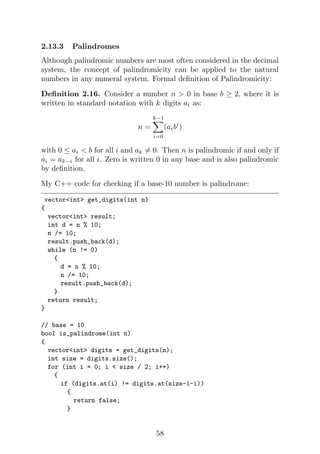
2.13.3 Palindromes . . . . . . . . . . . . . . . . . . . . . . 58
2.13.4 Combination and Permutation . . . . . . . . . . . 59
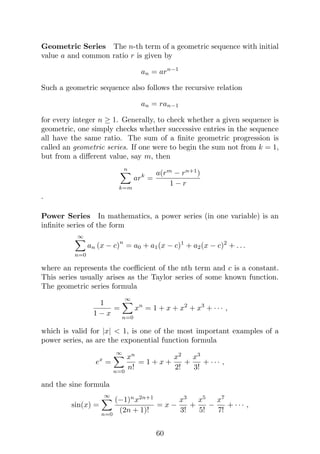
2.13.5 Series . . . . . . . . . . . . . . . . . . . . . . . . . 59
2.14 Concurrency . . . . . . . . . . . . . . . . . . . . . . . . . 61
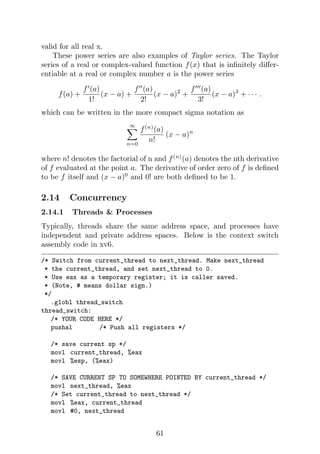
2.14.1 Threads & Processes . . . . . . . . . . . . . . . . . 61
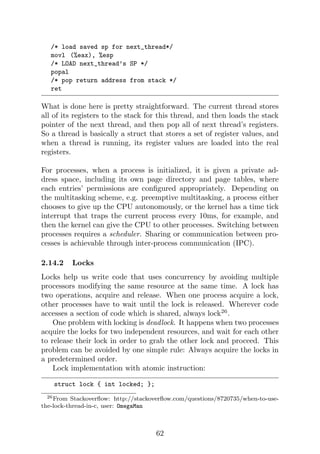
2.14.2 Locks . . . . . . . . . . . . . . . . . . . . . . . . . 62
2.15 System design . . . . . . . . . . . . . . . . . . . . . . . . . 63
2.15.1 Specification . . . . . . . . . . . . . . . . . . . . . 63
2.15.2 Subtyping and Subclasses . . . . . . . . . . . . . . 64
2.15.3 Design Patterns . . . . . . . . . . . . . . . . . . . . 66
2.15.4 Architecture . . . . . . . . . . . . . . . . . . . . . 69
2.15.5 Testing . . . . . . . . . . . . . . . . . . . . . . . . 69
3 Flagship Problems 72
3.1 Arrays . . . . . . . . . . . . . . . . . . . . . . . . . . . . . 72
3.2 Strings . . . . . . . . . . . . . . . . . . . . . . . . . . . . . 74
3.3 Permutation . . . . . . . . . . . . . . . . . . . . . . . . . . 78
3.4 Trees . . . . . . . . . . . . . . . . . . . . . . . . . . . . . . 81
3.5 Graphs . . . . . . . . . . . . . . . . . . . . . . . . . . . . . 82
3.6 Divide and Conquer . . . . . . . . . . . . . . . . . . . . . 83
3.7 Dynamic Programming . . . . . . . . . . . . . . . . . . . 84
3.8 Miscellaneous . . . . . . . . . . . . . . . . . . . . . . . . . 85
3.9 Unsolved . . . . . . . . . . . . . . . . . . . . . . . . . . . 87
4 Behavioral 92
4.1 Standard . . . . . . . . . . . . . . . . . . . . . . . . . . . 92
4.1.1 introduce yourself . . . . . . . . . . . . . . . . . . 92
4.1.2 talk about your last internship . . . . . . . . . . . 92
4.1.3 talk about your current research . . . . . . . . . . 93
4.1.4 talk about your projects . . . . . . . . . . . . . . . 93
4.1.5 why Google? . . . . . . . . . . . . . . . . . . . . . 94
4
4.2 Favorites . . . . . . . . . . . . . . . . . . . . . . . . . . . . 94
4.2.1 project? . . . . . . . . . . . . . . . . . . . . . . . . 94
4.2.2 class? . . . . . . . . . . . . . . . . . . . . . . . . . 94
4.2.3 language? . . . . . . . . . . . . . . . . . . . . . . . 94
4.2.4 thing about Google? . . . . . . . . . . . . . . . . . 94
4.2.5 machine learning technique? . . . . . . . . . . . . . 95
4.3 Most difficult . . . . . . . . . . . . . . . . . . . . . . . . . 95
4.3.1 bug? . . . . . . . . . . . . . . . . . . . . . . . . . . 95
4.3.2 design decision in your project? . . . . . . . . . . . 95
4.3.3 teamwork issue? . . . . . . . . . . . . . . . . . . . 95
4.3.4 failure? . . . . . . . . . . . . . . . . . . . . . . . . 96
4.3.5 interview problem you prepared? . . . . . . . . . . 96
5 Appendix 97
5.1 Java Implementation of Trie . . . . . . . . . . . . . . . . . 97
5.2 Python Implementation of the KMP algorithm . . . . . . 98
5.3 Python Implementation of Union-Find . . . . . . . . . . . 100
2 Knowledge Review
2.1 Data structures
2.1.1 Array
An array is used to describe a collection of elements, where each ele-
ment is identified by an index that can be computed at run time by the
program. I am familiar with this, so no need for more information.
Bit array A bit array is an array where each element is either 0 or
1. People use bit array to leverage parallelism in hardware. Implemen-
tation of bit array typically use an array of integers, where all the bits
of an integer are used to be elements in the bit array. With such imple-
mentation, if we want to retrieve bit with index k in the array, it is the
bit with index k%32 in the int with index k/32.
An interesting use case of bit array is the bitmap in the file system.
Each bit in the bitmap maps to a block. To retrieve the address of the
block, we just do BLKSTART+k/32/BLKSIZE.
5
Circular buffer A circular buffer is a single, fixed-size buffer used as
if it is connected end-to-end. It is useful as a FIFO buffer, because we
do not need to shift every element back when the first-inserted one is
consumed. Non-circular buffer is suited as a LIFO buffer.
2.1.2 Tuple
A tuple is a finite ordered list of elements. In mathematics, n-tuple is an
ordered list of n elements, where n is non-negative integer. A tuple may
contain multiple instances of the same element. Two tuples are equal
if and only if every element in one tuple equalst to the element at the
corresponding index in the other tuple.
2.1.3 Union
In computer science, a union is a value that may have any of several
representations or formats within the same position in memory; or it is
a data structure that consists of a variable that may hold such a value.
Think about the union data type in C, where essentially it allows you
to store different data types in the same memory location.
2.1.4 Tagged union
A tagged union, also called a disjoint union, is a data structure used
to hold a value that could take on several different, but fixed, types.
Only one of the types can be in use at any one time, and a tag field
explicitly indicates which one is in use. It can be thought of as a type
that has several ”cases,” each of which should be handled correctly when
that type is manipulated. Like ordinary unions, tagged unions can save
storage by overlapping storage areas for each type, since only one is in
use at a time.
Mathematically, tagged unions correspond to disjoint or discrimi-
nated unions, usually written using +. Given an element of a disjoint
union A + B, it is possible to determine whether it came from A or B.
If an element lies in both, there will be two effectively distinct copies of
the value in A + B, one from A and one from B.
This data structure is not even covered in my computer science edu-
cation. I don’t expect any problems about it. Good to know.
6
2.1.5 Dictionary
A dictionary, also called a map or associative array, is a collection of
key, value pairs, such that each possible key appears at most once in
the collection.
There are numerous ways to implement a dictionary. This is basically
a review of CSE 332.
Hash table At the bottom level, a hash table is a list T of buckets.
We want the size of this list, |T|, to be a prime number, to fix sparseness
of the list, which can lower the number of collisions.
In order to store a key-value pair into T, we need a hash function to
map the likely non-integer key to an integer. This hash function should
ideally have these properties:
1. Uniform distribution of outputs.
2. Low computational cost.
As more elements are inserted into the hash table, there will likely be
collisions. A collision is when two distinct keys map to the same bucket
in the list T. Here are several common collision resolution strategies:
1. Separate Chaining: If we hash multiple items to the same bucket,
store a LinkedList of those items at that bucket. Worst case insert
and delete is O(n). Average is O(1). Separate Chaining is easy
to understand and implement, but requires a lot more memory
allocation.
2. Open Addressing: Choose a different bucket when the natural
choice (one computed by hash function) is full. Techniques include
linear probing, quadratic probing, and double hashing. The opti-
mal open addressing technique allows (1) duplication of the path
we took, (2) coverage of all spaces in the table, (3) avoid putting
lots of keys close together. The reasons to use open addressing
could be less memory allocation and easier data representation.
I found that open addressing seems to be the preferred way, used by
major languages such as Python. So it is worthy to understand how
those probing techniques work.
Linear probing: This method is a naive one. It finds the very next
free bucket relative to the natural choice bucket. Formula: (h(key) +
i) % |T|, where h is the hash function. When we delete an element
7
from T, we must use lazy deletion, i.e., mark that element as deleted,
but not actually removing it. Otherwise, we won’t be able to retrace
the insertion path. Linear probing can cause primary clustering, which
happens when different keys collide to form one big group1
Quadratic probing: Similar to linear probing, except that we use a
different formula to deal with collision: (h(key) + i2
) % |T|. Theory
shows that if λ < 1/2, quadratic probing will find an empty slot in at
most |T|/2 probes (no failure of insertion)2
. Quadratic probing causes
secondary clustering, which happens when different keys hash to the
same place and follow the same probing sequence3
.
Double hashing: When there is a collision, simply apply a second,
independent hash function g to the key: (h(key) + i*g(key)) % |T|.
With careful choice of g, we can avoid the infinite loop problem similar
to quadratic probing. An example is h(key) = key % p, g(x) = q -
(key % p) for primes p, q with 2 < q < p.
It is also important to know how rehashing works. We need to maintain
λ to a reasonable level. Rehashing is done by iterating over old table
(O(n)), then do n inserts to the new table (O(n)). So rehashing is O(n),
but the amortized run time is O(1). Amortized analysis considers both
the costly and less costly operations together over the whole series of
operations of the algorithm (so you divide by the big-O of the number
of operations performed.)
Variations As we can see, the way keys are inserted into a hash table
is dependent on the hash function, which can compute in O(1) time.
We don’t have to use hashing to store these keys, because this way we
will not have any reasonable ordering of the keys in T. So we may
use a binary search tree to hold the keys if we want keys to be sorted
automatically.
In Java, besides HashMap and TreeMap, there is another popular im-
plementation – LinkedHashMap (so there’s even LinkedHashSet.)The Linked-
HashMap differs from the HashMap in that it maintains a separate
doubly-linked list running through all of its entries, which defines the
order of keys iteration. The order is normally insertion-order. Insertion
1See page 6 of https://courses.cs.washington.edu/courses/cse332/15au/
lectures/hashing-2/hashing-2.pdf.
2λ is the load factor, defined as λ = N/|T|, where N is the number of elements in
the hash table.
3See page 11 of https://courses.cs.washington.edu/courses/cse332/15au/
lectures/hashing-2/hashing-2.pdf.
8
order is not affected if a key is re-inserted into the map. This information
is from the Oracle Java Documentation. So essentially, LinkedHashMap
has no difference w.r.t. normal hash table at the data-storage level.
Bitmap Same structure as bit array. The only thing is that each bit
is mapped to some other stuff of meaning.
2.1.6 Multimap
A multimap is a generalization of a associative array in which more than
one value may be associated with and returned for a given key.
2.1.7 Set
A set is a collection of certain values without any particular order, and no
repeated values. It is basically a finite set in mathematics. Set Theory
is useful to understand what you can do with sets. The most basic
operations are union(S, T), intersection(S, T), difference(S, T),
subset(S, T),
2.1.8 Bag
A bag, also called a multiset, is a set that allows repeated values (dupli-
cates).
2.1.9 Stack
You should be pretty familar with this already. To implement stack, we
can use an array, and keep track of the top of the stack.
2.1.10 Queue
You should be pretty familar with this already. To implement queue,
we can use an array, and keep track of the front, rear element of the
queue. Or we can just remember the front element, and keep a count of
elements.
2.1.11 Priority queue
It has similar operations as stack or queue (remove, add, size), but each
element has a priority value associated with it. Standard priority queue
serves high priority value before one with low priority, and if two elements
have equal priority, they are served according to their order in the queue.
9
ADT Priority Queue ADT should at least support the following func-
tions. Some times we also like to have the decrease key(v, p) function.
insert(v, p) find min() delete min()
Implementation Common implementation of priority queue uses a
heap. Refer to the section for heap for more details.
We can also use doubly linked list.
2.1.12 List
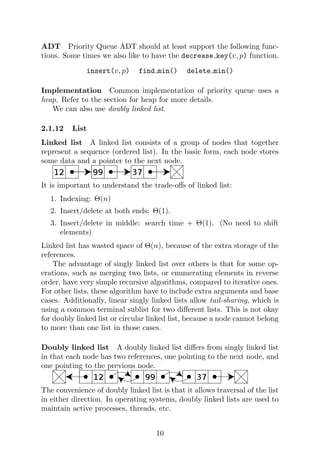
Linked list A linked list consists of a group of nodes that together
represent a sequence (ordered list). In the basic form, each node stores
some data and a pointer to the next node.
It is important to understand the trade-offs of linked list:
1. Indexing: Θ(n)
2. Insert/delete at both ends: Θ(1).
3. Insert/delete in middle: search time + Θ(1). (No need to shift
elements)
Linked list has wasted space of Θ(n), because of the extra storage of the
references.
The advantage of singly linked list over others is that for some op-
erations, such as merging two lists, or enumerating elements in reverse
order, have very simple recursive algorithms, compared to iterative ones.
For other lists, these algorithm have to include extra arguments and base
cases. Additionally, linear singly linked lists allow tail-sharing, which is
using a common terminal sublist for two different lists. This is not okay
for doubly linked list or circular linked list, because a node cannot belong
to more than one list in those cases.
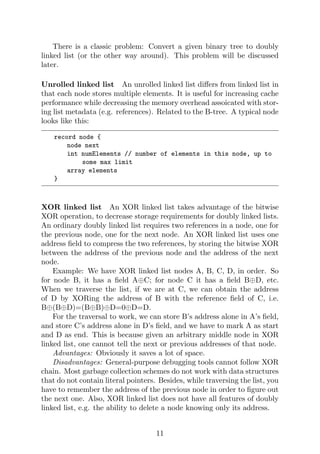
Doubly linked list A doubly linked list differs from singly linked list
in that each node has two references, one pointing to the next node, and
one pointing to the previous node.
The convenience of doubly linked list is that it allows traversal of the list
in either direction. In operating systems, doubly linked lists are used to
maintain active processes, threads, etc.
10
There is a classic problem: Convert a given binary tree to doubly
linked list (or the other way around). This problem will be discussed
later.
Unrolled linked list An unrolled linked list differs from linked list in
that each node stores multiple elements. It is useful for increasing cache
performance while decreasing the memory overhead assoicated with stor-
ing list metadata (e.g. references). Related to the B-tree. A typical node
looks like this:
record node {
node next
int numElements // number of elements in this node, up to
some max limit
array elements
}
XOR linked list An XOR linked list takes advantage of the bitwise
XOR operation, to decrease storage requirements for doubly linked lists.
An ordinary doubly linked list requires two references in a node, one for
the previous node, one for the next node. An XOR linked list uses one
address field to compress the two references, by storing the bitwise XOR
between the address of the previous node and the address of the next
node.
Example: We have XOR linked list nodes A, B, C, D, in order. So
for node B, it has a field A⊕C; for node C it has a field B⊕D, etc.
When we traverse the list, if we are at C, we can obtain the address
of D by XORing the address of B with the reference field of C, i.e.
B⊕(B⊕D)=(B⊕B)⊕D=0⊕D=D.
For the traversal to work, we can store B’s address alone in A’s field,
and store C’s address alone in D’s field, and we have to mark A as start
and D as end. This is because given an arbitrary middle node in XOR
linked list, one cannot tell the next or previous addresses of that node.
Advantages: Obviously it saves a lot of space.
Disadvantages: General-purpose debugging tools cannot follow XOR
chain. Most garbage collection schemes do not work with data structures
that do not contain literal pointers. Besides, while traversing the list, you
have to remember the address of the previous node in order to figure out
the next one. Also, XOR linked list does not have all features of doubly
linked list, e.g. the ability to delete a node knowing only its address.
11
Self-organizing list From Wikipedia:A self-organizing list is a list that
reorders its elements based on some self-organizing heuristic to improve
average access time. The aim of a self-organizing list is to improve effi-
ciency of linear search by moving more frequently accessed items towards
the head of the list. A self-organizing list achieves near constant time
for element access in the best case. A self-organizing list uses a reor-
ganizing algorithm to adapt to various query distributions at runtime.
Self-organizing list can be used in compilers (even for code on embed-
ded systems) to maintain symbol tables during compilation of program
source code. Some techniques for rearranging nodes:
Move to Front (MTF) Method: Moves the accessed element to the
front of the list. Pros: easy to implement, no extra memory. Cons: may
prioritize infrequently used nodes.
Count Method: Keep a count of the number of times each node is
accessed. Then, nodes are rearranged according to decreasing count.
Pros: realistic in representing the actual access pattern. Cons: extra
memory; unable to quickly adapt to rapid changes in access pattern.
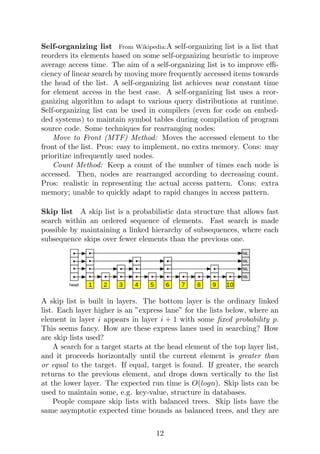
Skip list A skip list is a probabilistic data structure that allows fast
search within an ordered sequence of elements. Fast search is made
possible by maintaining a linked hierarchy of subsequences, where each
subsequence skips over fewer elements than the previous one.
A skip list is built in layers. The bottom layer is the ordinary linked
list. Each layer higher is an ”express lane” for the lists below, where an
element in layer i appears in layer i + 1 with some fixed probability p.
This seems fancy. How are these express lanes used in searching? How
are skip lists used?
A search for a target starts at the head element of the top layer list,
and it proceeds horizontally until the current element is greater than
or equal to the target. If equal, target is found. If greater, the search
returns to the previous element, and drops down vertically to the list
at the lower layer. The expected run time is O(logn). Skip lists can be
used to maintain some, e.g. key-value, structure in databases.
People compare skip lists with balanced trees. Skip lists have the
same asymptotic expected time bounds as balanced trees, and they are
12
simpler to implement, and use less space. The average time for search,
insert and delete are all O(logn). Worst case O(n).
2.1.13 Heap
Minimum-heap property: All children are larger.
Binary heap One more property of binary heap is that the tree has
no gaps. Implementation using an array: parent(n) = (n-1) / 2;
leftChild(n) = 2n + 1; rightChild(n) = 2n + 2. Floyd’s build heap
algorithm takes O(n). There are several variations of binary heap. In-
sert, deleteMin, decreaseKey operations take Θ(logn) time. Merge takes
Θ(n) time.
Fibonacci heap This kind of heap is not a single binary-tree shaped
structure for (conventional) binary heaps. Instead, it is a collection
of trees satisfying the minimum-heap property. This implies that the
minimum key is always at the root of one of the trees. The trees
structures can be more flexible - they can have gaps. Insert, decrease-
key, and merge all have amortized constant run time. Delete-min is
O(logn). Implementation is kind of complex. Visualization: https:
//www.cs.usfca.edu/~galles/visualization/FibonacciHeap.html
2.1.14 Graph
A graph consists of a set of vertices and a set of pairs of these vertices
as edges. If these pairs are unordered, then the graph is an undirected
graph. If these pairs are ordered pairs, then the graph is a directed
graph.
Paths A path is called simple if all its vertices are distinct from one
another. A cycle is a path {v1, v2, · · · , vk−1, vk} in which for k > 2, the
first k − 1 nodes are distinct, and v1 = vk. The distance between two
nodes u and v is the minimum number of edges in a u-v path.
Connectivity In an undirected graph, the graph is connected if. for
every pair of nodes u and v, there is a path from u to v.
In an directed graph, the graph is strongly connected if, for every two
nodes u and v, there is a path from u to v and a path from v to u.
13
ADT The following is the typical operations for a graph abstract data
type (ADT). During the interview, if you need to use a graph library,
you can expect it to have these functions. In Python, there are graph
libraries such as python-graph.
add vertex(G, v) add edge(G, u, v) neighbors(G, v)
remove vertex(G, v) remove edge(G, u, v) adjacent(G, v, w)
Common representations of a graph are adjacency list or adjacency
matrix. Wikipedia has a nice explanation and comparison of different
representations of a graph ADT. Check it out below.
Adjacency list: Vertices are stored as records or objects, and every
vertex stores a list of adjacent vertices. This data structure allows the
storage of additional data on the vertices. Additional data can be stored
if edges are also stored as objects, in which case each vertex stores its
incident edges and each edge stores its incident vertices.
Adjacency matrix: A two-dimensional matrix, in which the rows rep-
resent source vertices and columns represent destination vertices. Data
on edges and vertices must be stored externally. Only the cost for one
edge can be stored between each pair of vertices.
Adjacency list Adjacency matrix
Store graph O(|V | + |E|) O(|V |2
)
Add vertex O(1) O(|V |2
)
Add edge O(1) O(1)
Remove vertex O(|E|) O(|V |2
)
Remove edge O(|E|) O(1)
adjacent(G, v, w) O(|V |) O(1)
2.1.15 Tree
An undirected grah is a tree if it is connected and does not contain a
cycle (acyclic). Descendant & ancestor: We say that w is a descendent
of v if v lies on the path from root to w. In this case, v is an ancestor of
w. There are so many different kinds of trees. Won’t discuss them here.
Trie A trie is also called a prefix tree. Each edge in a trie represents
a character, and the value in each node represents the current prefix by
collecting all characters on the edges when traversing from the root (an
empty string) to that node. All the descendants of a node have the same
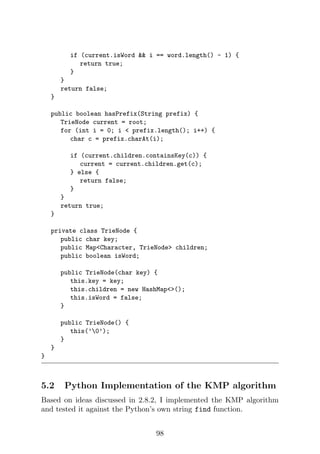
prefix as that node. See 5.1 for my Java implementation of Trie.
A compressed trie is a trie where non-branching paths are compressed
into a single edge. See the figure in 2.8.3 as an example.
14
B-Tree In computer science, a B-tree is a self-balancing tree data
structure that keeps data sorted and allows searches, sequential access,
insertions, and deletions in logarithmic time. The B-tree is a general-
ization of a binary search tree in that a node can have more than two
children (Comer 1979, p. 123). For an interview, I doubt that we need to
know implementation details for a B-Tree. Know its motivation through.
Motivation: Self-balanced binary search tree (e.g. AVL tree) is slow
when the height of the tree reaches a certain limit such that manipulating
nodes require disk access. In fact, for a large dictionary, most of the data
is stored on disk. So we want a self-balancing tree that is even shallower
than AVL tree, to minimize the number of disk accesses, and exploit
disk block size.
Binary Indexed Tree A binary indexed tree, also called a Fenwick
tree, is a data structure that can efficiently update elements and calculate
prefix sums in a table of numbers. I used it for the 2D Range sum
problem (3.8). See my implementation of 2D binary indexed tree there.
Motivation: Suppose we have an array arr with length n, we want
to (1) find the sum of first k elements, and (2) update the value of the
element arr[i], both in O(logn) time.
How it works4
: The core idea behind BIT is that every integer can
be written as the sum of power 2’s. Each node in a BIT stores the sum
of a range [i, j], and with all nodes combined, the BIT will cover the
entire range of the array. There needs to be a dummy root node, so the
size of BIT is n + 1. Here is how we build up the BIT for this array.
First, we initialize an array BIT with size n + 1 and all elements set
to 0. Then, we iterate through arr. For element i, we do an update for
the BIT array as follows:
1. We look at the node BIT[i+1]. We add arr[i] to it so
BIT[i+1]=BIT[i+1]+arr[i].
2. Now since we changed the range sum of a node, we have to update
the value of some other nodes. We can obtain the index n of the
next node with respect to node j for updating using the following
formula:
n=j+j&(-j).
4Watch YouTube video for decent explanation, by Tushar Roy: https://www.
youtube.com/watch?v=CWDQJGaN1gY&t=13s
15
We add the value arr[i] to each of the affected node, until the
computed index n is out of bound. The run time here is O(logn).
Here is how we use a BIT to compute the prefix sum of the first k
elements. Just like before, we find the BIT node with index k+1. We
add the value of that node to our sum. Then, traverse from the node
BIT[i+1] back to the root. Each time we go to the parent node of current
node, suppose BIT[j], we compute the index of that parent node p, by
p=j-j&(-j)
Then we add the value of the parent node to sum, until we reach the
root. Return sum as the result. This process is also O(logn) time. The
space of BIT is O(n).
2.1.16 Union-Find
A union-find data structure, also called a disjoin-set data structure, is a
data structure that maintains a set of disjoint subsets (e.g. components
of a graph). It supports two operations:
1. Find(u): Given element u, it will return the name of the set that
u is in. This can be used for checking if u and v are in the same
set. Optimal run time: O(logn).
2. Union(N1, N2): Given disjoint sets N1, N2, this operation will
merge the two components into one set. Optimal run time O(1) if
we use pointers; if not, it is O(logn).
First, we will discuss an implementation using implicit list. Assume
that all objects can be labeled by numbers 1, 2, 3, · · · . Suppose we have
three disjoint sets as shown in the upper part of the following image.
Notice that the above representation is called an explicit list, because it
explicitly connects objects within a set together.
16
As shown in the lower part of the image above, we can use a single
implicit list to represent the disjoint sets that can remember (1) pointers
to the canonical element (i.e. name) for a disjoint set, (2) the size of each
disjoint set. See appendix 5.3 for my Python implementation of Union-
Find, using implicit list.
When we union two sets, it is conceptually like joining two trees to-
gether, and the root of the tree is the canonical element of the set after
union. Path compression is basically the idea that we always join the
tree with smaller height into the one with greater height, i.e. the root of
the taller tree will be the root of the new tree after union. In my imple-
mentation, I used union-by-size instead of height, which can produce the
same result in run time analysis5
. The run time of union is determined
by the run time of find in this implementation. Analysis shows that
the upper bound of run time of find is the inverse Ackermann function,
which is even better than O(logn).
There is another implementation that uses tree that is also optimal
for union. In this case, the union-find data structure is a collection of
trees (forest), where each tree is a subset. The root of the tree is the
canonical element (i.e. name) of the disjoint set. It is essentially the
same idea as implicit list.
2.2 Trees and Graph algorithms
2.2.1 BFS and DFS
Pseudo-code BFS and DFS needs no introduction. Here is the pseudo-
code. The only difference here between BFS and DFS is that, for BFS,
we use queue as worklist, and for DFS, we use stack as worklist.
BFS/DFS(G=(V,E), s) {
worklist = [s]
seen = {s}
while worklist is not empty:
node = worklist.remove
{visit node}
for each neighbor u of node:
if u is not in visited:
queue.add(u)
seen.add(u)
}
5Discussed in CSE 332 slides, by Adam Blank: https://courses.cs.washington.
edu/courses/cse332/15au/lectures/union-find/union-find.pdf.
17
There is another way to implement DFS using recursion (From MIT
6.006 lecture):
DFS(V , Adj):
parent = {}
for s in V :
if s is not in parent:
parent[s] = None
DFS-Visit(Adj, s, parent)
DFS-Visit(Adj, s, parent):
for v in Adj[s]:
if v is not in parent:
parent[v] = s
DFS-Visit(Adj, v, parent)
Obtain BFS/DFS layers BFS/DFS results in BFS/DFS-tree, which
has layers L1, L2, · · · . Each layer is a set of vertices. BFS layers are really
useful for problems such as determining if the graph is two-colorable.
DFS layers are useful too (application?)
BFS/DFS(G=(V,E), s) {
worklist = [s]
seen = {s}
layers = {s:0}
while worklist is not empty:
node = worklist.remove
{visit node}
for each neighbor u of node:
if u is not in visited:
queue.add(u)
seen.add(u)
layers.put(u, layers[node]+1)
Go through keys in layers and obtain the set of nodes for
each layer.
}
Now we will look at some BFS/DFS Tree Theorems.
Theorem 2.1 (BFS). For each j ≥ 1, layer Lj produced by BFS starting
from node s consists of all nodes at distance exactly j from s.
Theorem 2.2 (BFS). There is a path from s to t if and only if t appears
18
in some BFS layer.
Theorem 2.3 (BFS). For BFS tree T, if there is an edge (x, y) in G
such that node x belongs to layer Li, and node y belongs to layer Lj,
then i and j differ at most 1.
Theorem 2.4 (DFS). Let T be a DFS tree. Let x, y be nodes in T. Let
(x, y) be an edge of G that is NOT an edge of T. Then, one of x or y is
an ancestor of the other.
Theorem 2.5 (DFS). For a given recursive call DFS(u), all nodes that
are marked visited (e.g. put into the parent map) between the invocation
and end of this recursive call are descendents of u in the DFS tree T.
Now, let us look at how BFS layers is used for the two-colorable graph
problem. A graph is two-colorable if and only if it is bipartite. A bipartite
graph is a graph whose vertices can be divided into disjoint sets U and
V (i.e. U and V are independent sets), such that every edge connects a
vertex in U to one in V .
Theorem 2.6 (No Odd Cycle). If a graph G is bipartite, then it cannot
contain an odd cycle, i.e. a cycle with odd number of edges (or nodes).
Theorem 2.7 (BFS and Bipartite). Let G be a connected graph. Let
L1, L2, · · · be the layers of teh BFS tree starting at node s. Then,
1. Either there exists an edge that joins two nodes of the same layer,
which implies that there exists odd cycle in G, so G isn’t bipartite.
2. Or, there is no edge that joins two nodes of the same layer. So G
is bipartite.
Edge classification for DFS tree We can classify edges in G after
DFS into four categories:
1. tree edge: We visit new vertex via such edge in DFS.
2. forward edge: edge from node to its descendant in DFS tree.
3. backward edge: edge from node to its ancestor in DFS tree.
4. cross edges: edges between two non-ancestor related subtrees.
Note that DFS tree for a directed graph can have all four types of edges,
but DFS tree for an undirected graph cannot have forward edges and
cross edges.
19
Cycle detection
Theorem 2.8. A graph G has a cycle if and only if the DFS has a
backward edge.
Besides using this theorem, Kahn’s algorithm (discussed in Topological
Sort section) can be used to detect if there is a cycle.
2.2.2 Topological Sort
For a directed graph G, we say that a topological ordering of G is an
ordering of its nodes as v1, v2, · · · , vn, such that for every edge (vi, vj),
we have i < j. (Edges point forward in the ordering.)
Theorem 2.9. G has a topological ordering if and only if G is a DAG
(directed acyclic graph).
Theorem 2.10. In every DAG G, there is a node v with no incoming
edges.
Here we discuss Kahn’s algorithm for topological sort; run time is O(|V |+
|E|). First, start with a list of nodes that have no incoming edges, and
insert them into a set S. Then, we remove all nodes from G in S. While
removing a node, we remove the outgoing edges of that node. We will
repeat these two steps until S is empty. The order that we remove nodes
from G is the topological order.
Kahn’s algorithm can be used to test if a graph is a DAG. After S is
empty, if the graph is a DAG, all edges should have been removed from
G. If there is still edges, then G is not a DAG.
Another, more gentle (no removal of nodes and edges) algorithm uses
DFS. The idea behind is that when we do DFS, we start visiting a
node before its descendants in the DFS tree, and finish visiting those
descendants before we actually finish visiting the node itself.
The topological sort thus can be obtained by doing DFS, and output
the reverse of the finishing times of verticies6
. So if node v is finished
visiting after node u, then v is topologically sorted before u; v must be
the ancestor of u in the tree. We must check if there is a back edge in
the graph, before we output the final topological order, because if so,
the graph has a cycle.
6From MIT 0.006 class, Fall 2011
20
2.2.3 Paths
Obtain BFS/DFS path from s to t When we have an unweighted
graph, we can find a path from s to t simply by BFS or DFS. BFS gives
the shortest path in this case. It is straightforward if we have a map
that can tell the parent of each node in the tree.
BFS/DFS(G=(V,E), s, t):
worklist = [s]
seen = {s}
parent = {s:None}
while worklist is not empty:
node = worklist.remove
if node == t:
return Get-Path(s, t, parent)
for each neighbor u of node:
if u is not in visited:
queue.add(u)
seen.add(u)
parent[u] = node
return NO PATH
Get-Path(s, t, parent):
v = t
path = {t}
while v != s:
v = parent[v]
path.add(v)
return path
Dijkstra’s Algorithm This algorithm is for finding the shortest path
from s to t on a graph with nonnegative weights. When choosing the
node v, if we use Fibonacci Heap to store the edges, then the run time
can be O(|E| + |V |log|V |).
Dijkstra’s-Algorithm(G=(V,E), s, t):
S = {}; d[s] = 0; d[v] = infinity for v != s
prev[s] = None
While S != V
Choose v in V-S with minimum d[v]
Add v to S
For each w in the neighborhood of v
if d[v] + c(v,w) < d[w]:
21
d[w] = d[v] + c(v,w)
prev[w] = v
return d, prev
This algorithm works by expanding a set S starting from s, within which
we have nodes such that the shortest paths from s to these nodes are
known. The step that chooses v from the set difference between V and
S with minumum d[v] is equivalent as choosing the edge with minimum
weight that goes from S to V − S.
Bellman-Ford Algorithm This algorithm works for graph that has
negative edge weights, but no negative cycles. Its run time is O(|V ||E|).
Bellman-Ford(G=(V,E), s, t):
d[s] = 0; d[v] = infinity for v != s
prev[s] = None
for i = 1 to |V|-1:
for each edge (u, v) with weight w in E:
if d[u] + w < d[v]:
d[v] = d[u] + w
prev[v] = u
return d, prev
A* Algorithm Proposed by P.Hart et. al., this algorithm is an ex-
tension of Dijkstra’s algorithm. It achieves better performance by using
heuristics to guide its search. A* algorithm finds the path that mini-
mizes
f(n) = g(n) + h(n)
where n is the last node on the path, g(n) is the cost of the path from
the start node to n, and h(n) is a heuristic that estimates the cost of
the cheapest path from n to the goal. The heuristic must be admissible,
i.e. it never overestimates the actual cost to get to the goal. Below is
my implementation with Python, when I took the CSE 473 (Artificial
Intelligence) class:
def aStarSearch(problem, heuristic=nullHeuristic):
"""Search the node that has the lowest combined cost and
heuristic first."""
startState = problem.getStartState()
visitedStates = set({})
worklist = util.PriorityQueue()
22
# First tuple means (state, path_to_state, cost_of_path)
worklist.push((startState, [], 0),
0 + heuristic(startState, problem))
while not worklist.isEmpty():
state, actions, pathCost = worklist.pop()
if state in visitedStates:
continue
if problem.isGoalState(state):
return actions
successors = problem.getSuccessors(state)
for stepInfo in successors:
sucState, action, stepCost = stepInfo
sucPathCost = pathCost + stepCost
worklist.push((sucState, actions + [action],
sucPathCost),
sucPathCost + heuristic(sucState,
problem))
# mark the current state as visited
visitedStates.add(state)
# Not able to get there
return None
All-pairs shortest paths This problem concerns finding all paths
between every pair of vertices. A well-known algorithm for this is the
Floyd-Warshall’s algorithm, which runs in O(|V |3
) time. It works for
graphs with positive or negative weights, with no negative cycles. Its
run time is impressive, considering the fact that there may be up to
Ω(|V |2
) edges in a graph. This is a dynamic programming algorithm.
The algorithm considers a function shortestPath(i, j, k) which
finds the shortest path from i to j with only vertices {v1, v2, · · · , vk} ⊂
V . Given that for every pair of nodes i and j, we know the output
of shortestPath(i, j, k), our goal is to figure out the output of
shortestPath(i, j, k+1) for every such pair. When we have a new
vertex, vk+1, either the path from vi to vj goes through vk+1, or not.
This brings us to the core of Floyd-Warshall’s algorithm:
shortestPath(i, j, k+1) = min(shortestPath(i, j, k),
shortestPath(i, k+1, k) + shortestPath(k+1, j, k))
23
Hamiltonian path In the mathematical field of graph theory, a Hamil-
tonian path (or traceable path) is a path in an undirected or directed
graph that visits each vertex exactly once. A Hamiltonian cycle (or
Hamiltonian circuit) is a Hamiltonian path that is a cycle. Determining
whether such paths and cycles exist in graphs is the Hamiltonian path
problem, which is NP-complete.
Dynamic Programming algorithm for finding a Hamiltonian path:
Bellman, Held, and Karp proposed an algorithm to find Hamiltonian
path in time O(n2
2n
). In this method, one determines, for each set S
of vertices and each vertex v in S, whether there is a path that covers
exactly the vertices in S and ends at v. For each choice of S andv, a
path exists for (S, v) if and only if v has a neighbor w such that a path
exists for (S − v, w), which can be looked up from already-computed
information in the dynamic program7
.
2.2.4 Minimum Spanning Tree
Kruskal’s Algorithm Builds a spanning tree by successively insert-
ing edges from E in order of increasing cost, using a union-find data
structure. Run time: O(|E|log|E|).
Prim’s Algorithm Start with a root node s and try to greedily grow
a tree from s outward. At each step, we simply add the node that can
be attached as cheaply as possible to the partial tree we already have.
If we use adjacency list to represent the graph, and use Fibonacci heap
to retrieve minimum cost edge, then the run time is O(|E| + |V |log|V |).
Reverse-Delete Algorithm We start with the full graph (V, E) and
begin deleting edges in order of decreasing cost. As we get to each e,
we would not delete it if doing so disconnects the graph we currently
have. To check if the graph is connected, we can do BFS or DFS, and
see if the reachable component has the same size as |V |. The run time
could be O(|E|log|V |(loglog|V |)3
), if we use Thorup’s algorithm to check
connectivity of a graph, which has run time O(log|V |(loglog|V |)3
)8
.
7These two paragraphs are from Wikipedia.
8http://www.cs.princeton.edu/courses/archive/spr10/cos423/handouts/
NearOpt.pdf
24
2.2.5 Max-flow Min-cut
Given a directed weighted graph, with one source node s and one sink
node t, we can find a partition of the nodes A, B such that the sum of the
cost of edges that go from component A to B is minimum, compared to
all other possible partition (Min-cut). This sum equals to the maximum
flow value from the s to t9
.
To find Max-flow, we can use the Ford-Fulkerson Algorithm. Pseudo-
code is as follows.
Ford-Fulkerson Max-Flow(G=(V, E), s, t):
Initially f(e) = 0 for all e in E
While there is an s-t path in the residual graph Gf :
Let P be a simple s-t path in Gf
f0
= augment(f, P)
update f to be f0
update the residual graph Gf to be Gf0 .
return f
augment(f, P):
b = bottleneck(f, P)
for e = (u, v) in P:
if e is forward edge, then
increase f(e) in G by b
else e is a backward edge
decrease f(e) in G by b
return f
2.3 Dynamic Programming
What kinds of problems can be solved using Dynamic Programming?
One property these problems have is that if the optimal solution in-
volves solving a subproblem, then it uses the optimal solution to that
subproblem. For instance, say we want to find the shortest path from A
to B in a graph, and say this shortest path goes through C. Then it must
be using the shortest path from C to B. Or, in the knapsack example, if
the optimal solution does not use item n, then it is the optimal solution
for the problem in which item n does not exist. The other key property is
that there should be only a polynomial number of different subproblems.
These two properties together allow us to build the optimal solution to
9Refer to resources for Network Flow for what this means.
25
the final problem from optimal solutions to subproblems10
.
2.3.1 One example problem involving 2-D table
Problem: Given a string x consisting of 0s and 1s, we write xk
to denote k
copies of x concatenated together. We say that a string x0
is a repetition
of x if it is a prefix of xk
for some number k. So x0
= 10110110110 is a
repetition of x = 101.
We say that a string s is an interleaving of x and y if its symbols
can be partitioned into two (not necessarily contiguous) subsequences s0
and s00
, so that s0
is a repetition of x, and s00
is a repitition of y. For
example, if x = 101, and y = 00, then s = 100010101 is an interleaving
of x and y, since characters 1,2,5,7,8,9 form 101101 – a repetition of x –
and the remaining characters 3,4,6 form 000, a repitition of y.
Give an efficient algorithm that takes strings s, x, y, and decide if s
is an interleaving of x and y11
.
My Solution Our Opt table will look like this.(Consider / as an empty
character, which means including / in a substring is as if we included
nothing). Assume that the length of string s is l.
/ x0
1 · · · x0
l
/ True
y0
1
· · ·
y0
l
The value of each cell is either True or False. Strictly,
Opt[xi, yj] = True if and only if
Opt[xi, yj−1] = True AND s[i + j] = y0
[j] OR,
Opt[xi−1, yj] = True AND s[i + j] = x0
[i].
(If x0
[i] = / or y0
[j] = /, then we treat s[i+j] = x0
[i and s[i+j] = y0
[j]
to be True.
We can think of a cell being True as there is an interleaving of i
characters of x0
and j characters of y0
that makes up the first i + j
characters of string s.
If we filled out this table, we can return True if for some i and j such
that i is a multiple of |x| AND j is a multiple of |j| AND i + j = l AND
10Cited from CMU class lecture note: https://www.cs.cmu.edu/~avrim/451f09/
lectures/lect1001.pdf
11This problem is from Algorithm Design, by Kleinberg, Tardos, pp.329 19.
26
Opt[i, j] = True. This is precisely saying that we return True if s can
be composed by interleaving some repetition of x and y.
So first, our job now is to fill up this table. We can traverse j from 1
to l (traverse each row). And inside each iteration, we traverse i from 1
to l. Inside each iteration of this nested loop, we set the value of Opt[i,
j] according to the rule described above.
Then, we can come up with i and j by fixing i and increment j by
|y| until i + j > l (*). Then, we increment i by |x|. Then, we repeat the
previous step (*), and stop when i + j > l. We check if i + j = l inside
each iteration, and if so, we check if Opt[i,j]=True. If yes, we return
True. If we don’t return True, we return False at the end.
2.3.2 Well-known problems solved by DP
Longest Common Subsequence Find the longest subsequence com-
mon to all sequences in a set S of sequences. Unlike substrings, sub-
sequences are not required to occupy consecutive positions within the
original sequences.
Let us look at the case where there are only two sequences x, y
in S. For example, x is 14426, and y is 2134. The longest common
subsequence of x and y is then 14. Define Opt[i, j] to be the longest
common subsequence for subsring x[0 : i] and y[0 : j]. We have the
following update formula:
Opt =





∅ if i = 0, j = 0
Opt[i − 1, j − 1] ∪ xi if x[i] = y[j]
max(Opt[i − 1, j], Opt[i, j − 1]) if x[i] 6= y[j]
Similar problems: longest common substring, longest increasing subsequence).
Now, let us discuss the Levenshtein distance problem. The Lev-
enshtein distance measures the difference between two sequences, i.e.
the fewest number of operations (edit, delete, add) to change from one
sequence to another. The definition of Levenshtein distance is itself a
dynamic programming solution to find the edit distance, as follows (from
Wikipedia):
Definition 2.1. The Levenshtein distance between two strings a, b (of
length |a| and |b| respectively) is given by leva,b(|a|, |b|) where
leva,b(i, j) =









max(i, j) if min(i, j) = 0,
min





leva,b(i − 1, j) + 1
leva,b(i, j − 1) + 1
leva,b(i − 1, j − 1) + 1(ai6=bj )
otherwise.
27
where 1(ai6=bj ) is the indicator function that equals to 1 if ai 6= bj, and
leva,b(i, j) is the distance between the first i characters of a and the first
j characters of b.
The Knapsack Problem Given a set of items S, with size n, each
item ai with a weight wi and a value vi, determine the number of each
item to include in a collection so that the total weight is less than or
equal to a given limit K and the total value is as large as possible.
Define Opt[i, k] to be the optimal subset of items from a1, · · · , ai such
that the total weight does not exceed k. Our final result will then be
given by Opt[n, K]. For an item ai, either it is included into the subset,
or not. If not, that means the total weight of the subset with ai added
exceeds k. Therefore we have:
Opt[i, k] =









∅ if k=0,
Opt[i − 1, k] if adding wi exceeds k,
max(Opt[i − 1, k],
Opt[i − 1, k − wi] + vi) otherwise
Similar problems: subset sum.
Matrix Chain Multiplication Given a sequence of matrices A1A2 · · · An,
the goal is to find the most efficient way to multiply these matrices. The
problem is not actually to perform the multiplications, but merely to
decide the sequence of the matrix multiplications involved.
Here are many options because matrix multiplication is associative.
In other words, no matter how the product is parenthesized, the result
obtained will remain the same. For example, for four matrices A, B, C,
and D, we would have:
((AB)C)D = ((A(BC))D) = (AB)(CD) = A((BC)D) = A(B(CD))
However, the order in which the product is parenthesized affects the
number of simple arithmetic operations needed to compute the product,
or the efficiency. For example, if A is a 10×30 matrix, B is a 30×5
matrix, and C is a 5 × 60 matrix, then computing (AB)C needs
(10 × 30 × 5) + (10 × 5 × 60) = 1500 + 3000 = 4500
operations, while computing A(BC) needs
(30 × 5 × 60) + (10 × 30 × 60) = 9000 + 18000 = 27000
28
operations. The first parenthesization is obviously more preferable.
Given n matrices, the total number of ways to parenthesize them is
P(n) = Ω(4n
/n3/2
), so brute force is impractical12
.
We use dynamic programming. First, we characterize the structure
of an optimal solution. We claim that one possible structure is the
following:
((A1:i)(Ai+1:n)) (1)
where Ai:j means matrix multiplication of AiAi+1 · · · Aj. In order for
the above to be optimal, the parenthesization for A1:i and Ai+1:n must
also be optimal. Therefore, we can recursively break down the problem,
till we only have one matrix. A subproblem is of the form Ai:j, with 1 ≤
i, j ≤ n, which means there are O(n2
) unique subproblems (counting).
Let Opt[i, j] be the cost of computing Ai:j. If the final multiplication
of Ai:j is Ai:j = Ai:kAk+1,j, assuming that Ai:k is pi−1 × pk, and Ak+1:j
is pk × pj, then for i < j,
Opt[i, j] = Opt[i, k] + Opt[k + 1, j] + pi−1pkpj
This is because by definition of Opt, we need Opt[i, k] to compute Ai:k,
and Opt[k + 1 : j] to compute Ak+1:j, and pi−1pkpj to compute the
multiplication of A1:k and Ak+1:j. For i = j, Opt[i, j] = 0. Since we
need to check all values of i, j pair, i.e. the parenthesization shown in
(1), the run time is O(n3
).
2.3.3 Top-down dynamic programming
So far, we are able to come up with an equation for the Opt table/array
in the example problems above. This is called bottom-up approach.
However, for some problems, it is not easy to determine such equation.
In this case, we can use memoization and top-down approach, usually
involving recursion. The top-down approach basically leads to the same
algorithm as bottom-up, but the perspective is different. According to
a lecture note of CMU algorithms class:
Basic Idea: Suppose you have a recursive algorithm for some
problem that gives you a really bad recurrence like T(n) =
2T(n − 1) + n. However, suppose that many of the subprob-
lems you reach as you go down the recursion tree are the same.
Then you can hope to get a big savings if you store your com-
putations so that you only compute each different subproblem
12Columbia class slides: http://www.columbia.edu/~cs2035/courses/csor4231.
F11/matrix-chain.pdf.
29
once. You can store these solutions in an array or hash table.
This view of Dynamic Programming is often called memoizing.
For example, the longest common subsequence (LCS) problem can be
solved with this top-down approach. Here is the pseudo-code, from the
CMU lecture note.
LCS(S,n,T,m)
{
if (n==0 || m==0)
return 0;
if (arr[n][m] != unknown)
return arr[n][m]; // memoization (use)
if (S[n] == T[m])
result = 1 + LCS(S,n-1,T,m-1);
else
result = max( LCS(S,n-1,T,m), LCS(S,n,T,m-1) );
arr[n][m] = result; // memoization (store)
return result;
}
If we compare the above code with the bottom-up formula for LCS, we
realize that they are just using the same algorithm, with same cases. The
idea that both approaches share is that, we only care about computing
the value for a particular subproblem.
2.4 Recursive algorithms
2.4.1 Divide and Conquer
The matrix chain multiplication problem discussed previously can be
solved, using top-down approach, with recursion, and the idea there
is basically divide and conquer – break up the big chain into smaller
chains, until i = j (Opt[i, j]=0). Divide and conquer (D&C) works by
recursively breaking down a problem into two or more sub-problems of
the same or related type, until these problems are simple enough to be
solved directly13
. For some problems, we can use memoization technique
to optimize the run time.
Now, let us look at two well-known problems solvable by divide-and-
conquer algorithms.
13From Wikipedia.
30
Binary Search This search algorithm runs in O(logn) time. It works
by comparing the target element with the middle element of the array,
and narrow the search to half of the array, until the middle element is
exactly the target element, or until the remaining array has only one
element. Binary search is naturally a divide-and-conquer algorithm.
Binary-Search-Recursive(arr, target, lo, hi):
# lo inclusive, hi exclusive.
if hi <= lo:
return NOT FOUND
mid = lo + (hi-lo)/2
if arr[mid] == target:
return mid
else if arr[mid] > target
return Binary-Search-Recursive(arr, target, mid+1, hi)
else:
return Binary-Search-Recursive(arr, target, lo, mid)
Binary-Search-Iterative(arr, target):
lo = 0
hi = arr.length
while lo < hi:
mid = lo + (hi-lo)/2
if arr[mid] == target:
return mid
else if arr[mid] > target:
lo = mid + 1
else:
hi = mid
return NOT FOUND
Implement the square root function: To implement the square root
function programmatically, with integer return value, we can use binary
search. Given number n, we know that the square root of n must lie
between 0 and n/2. Then, we can basically treat all integers in [0, n/2]
as an array, and do binary search. We terminate only when lo equals
to hi.
Closest Pair of Points Given n points in metric space, e.g. plane,
find a pair of points with the smallest distance between them. A divide-
and-conquer algorithm is as follows (from Wikipedia):
1. Sort points according to their x-coordinates.
31
2. Split the set of points into two equal-sized subsets by a vertical
line x = xsplit.
3. Solve the problem recursively in the left and right subsets. This
yields the left-side and right-side minimum distances dLmin and
dRmin, respectively.
4. Find the minimal distance dLRmin among the set of pairs of points
in which one point lies on the left of the dividing vertical and the
other point lies to the right.
5. The final answer is the minimum among dLmin, dRmin, and dLRmin.
The recurrence of this algorithm is T(n) = 2T(n/2) + O(n), where O(n)
is the time needed for step 4. This recurrence to O(nlogn). Why can
step 4 be completed in linear time? How? Suppose from step 3, we know
the current minimum distance is δ. For step 4, we first pick the points
with x-coordinates that are within [xsplit − δ, xsplit + δ], call this the
boundary zone. Suppose we have p1, · · · , pm inside the boundary zone.
Then, we have the following magical theorem.
Theorem 2.11. If dist(pi, pj) < δ, then j − i ≤ 15.
With this, we can write the pseudo-code for this algorithm14
:
Closest-Pair(P):
if |P| == 2:
return dist(P[0], P[1])
L, R = SplitPointsByHalf(P)
dL = Closest-Pair(L)
dR = Closest-Pair(R)
dLR = min(dL, dR)
S = BoundaryZonePoints(L, R, dLR)
for i = 1, ..., |S|:
for j = 1, ..., 15:
dLR = min(dist(S[i], S[j]), d)
return dLR
Obviously, there are other classic divide-and-conquer algorithms to solve
problems such as the convex hull (two-finger algorithm), and the median
of medians algorithm (groups of five). As the writer, I have read those
14Cited from CMU lecture slides, with modification https://www.cs.cmu.edu/
~ckingsf/bioinfo-lectures/closepoints.pdf
32
algorithms and understood them, but I will save my time and not discuss
them here.
2.4.2 Backtracking
Backtracking is a general algorithm for finding all (or some) solutions to
some computational problems, notably constraint satisfaction problems,
that incrementally builds candidates to the solutions, and abandons each
partial candidate c (”backtracks”) as soon as it determines that c cannot
possibly be completed to a valid solution15
.
Solving Sudoku Sudoku is a puzzle that is played on a grid of 9 by
9 cells, such that when all cells are filled up with numbers, each row
and column have an enumeration of 1, 2, · · · , 9, and so does each ”big
cell” (subregion). It needs no more introduction than that. Here are the
constraints for a Sudoku puzzle:
1. Each cell can contain one number in {1, 2, 3, 4, 5, 6, 7, 8, 9}
2. Each row, column, and subregion all have an enumeration of the
numbers 1 through 9, with no repeat.
Pseudo-code16
. The idea of backtracking is illustrated in the undo &
try again step.
bool SolveSudoku(Grid<int> &grid)
{
int row, col;
if (!FindUnassignedLocation(grid, row, col))
return true; // all locations successfully assigned!
for (int num = 1; num <= 9; num++) { // options are 1-9
if (NoConflicts(grid, row, col, num)) { // if # looks ok
grid(row, col) = num; // try assign #
if (SolveSudoku(grid))
return true; // recur if succeed stop
grid(row, col) = UNASSIGNED; // undo & try again
}
}
return false; // this triggers backtracking from early decisions
}
15Description of backtracking is from Wikipedia.
16From https://see.stanford.edu/materials/icspacs106b/Lecture11.pdf
33
Relation between backtracking and DFS: DFS is a specific form of back-
tracking related to searching tree structures. Backtracking is more broad
– it can be used for searching in non-tree structures, such as the Sudoku
board.
2.5 Greedy algorithms
A greedy algorithm is an algorithm that makes locally optimal decisions,
with the hope that these decisions would lead to globally optimal solu-
tion. It is easy to come up with these greedy rules, but most of them
are wrong, and the right ones are typically hard to justify. So nothing
is better than showing examples when discussing greedy algorithms.
Scheduling Problem 17
There is a computer system with numerous
processes, some of which is marked sensitive. Each sensitive process
has a designated start time and finish time, and it runs continuously
between these times.There is a list of the planned start and finish times
of all sensitive processes that will be run that day.
You are given a program called status check that, when invoked
records various pieces of logging information about all the sensitive
processes running on the system at that moment. You should run
status check as few times as possible during the day, but enough that
for each sensitive process P, status check is invoked at least once dur-
ing the execution of process P.
Give an efficient algorithm that, given the start and finish times of all
the sensitive processes, finds as small a set of times as possible at which
to invoke status check , subject to the requirement that status check
is invoked at least once during each sensitive process P.
Algorithm: We start by sorting the processes by descending start
time, using a heap (i.e. the process with highest start time will have the
minimum value in the heap). Then, we keep removing the root process
from the heap, and use the start time of this process as the time to call
status check. And we mark processes that are running at that time as
checked, and remove them from the heap as well. Here is a pseudo-code
to illustrate this algorithm
CountCall(processes):
Heap h = a heap of processes ordered by descending start time.
count_calls = 0
While h is not empty:
17This problem is from Kleinberg Algorithm Design, pp.194 14.
34
p = h.RemoveMin()
call_time = start time of p
count_calls += 1
For each process q in h:
If q is running at call_time:
h.Remove(q)
Return count_calls
Justification for correctness: The above algorithm will terminate
because there is finite number of sensitive processes, and thus the heap
will eventually be empty when all processes are checked.
We can use induction to show that the above algorithm produces
correct result. Suppose we have n sensitive processes in total. Processes
are labeled P0, P1, P2, ..., Pn. Let Wn be defined as the number of calls
to status check when there are n processes.
Proof. Base Case: The base case when n=0 is trivial. The al-
gorithm will simply return 0 since the heap is empty. This is a
correct behavior. So, the algorithm works for the base case.
Induction Hypothesis: Assume that for 0 <= j <= k, our
algorithm produces minimum possible value of Wj.
Inductive Step: Now show that for n = k +1, our algorithm
still produces minimum possible value for Wk+1. For Pk+1, there
are two cases to consider:
1. We need to call status check once more in order to check
Pk+1, because Pk+1 is not checked when we handle the other
P0, ..., Pk processes.
2. We do not need to call status check any more, because
Pk+1 is checked when we handle the other P0, ..., Pk pro-
cesses.
For case (a), since our algorithm will only terminate when the
heap is empty, so when Pk+1 is not checked, it is still in the
heap. Therefore, the algorithm will do one extra RemoveMin()
and remove Pk+1 from the heap. By the induction hypothesis, the
algorithm produces optimal result for 0 <= j <= k. Thus, the
result produced by the algorithm for n = k+1 matches the optimal
in case (a), which requires one extra call to the status check
function.
For case (b), since Pk+1 is checked when we handle P0, ..., Pk,
our algorithm will have already removed Pk+1 when it is done
dealing with P0, ..., Pk. By the induction hypothesis, the algo-
35
rithm produces optimal result for 0 <= j <= k. Thus, the result
produced by the algorithm for n = k + 1 matches the optimal in
case (b), which is to NOT call status check any more.
Conclusion From the above proof of base case and induction
step, by Strong Induction, we have shown that our algorithm
works for integer n >= 0.
Indeed, induction is how you formally prove that a greedy rule works
correctly.
Justification for run time: The above algorithm is efficient. We first
construct a heap of processes, which takes O(nlogn) time. Then we loop
until we remove all items inside the heap, which is O(nlogn) time. Since
we do not add any process back into the heap after we removed it, the
algorithm will terminate when the heap is empty. Besides, any other
operations in the algorithm is O(1). Therefore, combined, our algorithm
has an efficient runtime of O(nlogn) + O(nlogn) = O(nlogn).
2.6 Sorting
2.6.1 Merge sort
Merge sort is a divide-and-conquer, stable sorting algorithm. Worst case
O(nlogn); Worst space O(n). Here is a pseudo-code for non-in-place
merge sort. An in-place merge sort is possible.
Mergesort(arr):
if arr.length == 1:
return arr
l = Mergesort(arr[0:mid])
r = Mergesort(arr[mid:length])
return merge(l, r)
2.6.2 Quicksort
Quicksort is a divide-and-conquer, unstable sorting algorithm. Average
run time O(nlogn); Worst case run time O(n2
); Worst case auxiliary
space18
O(logn) with good implementation. (Naive implementation is
O(n) space still.) Quicksort is fast if all comparisons are done with
constant-time memory access (assumption). People have argued which
sort is the best. Here is an answer from Stackoverflow, by user11318:
18Auxiliary Space is the extra space or temporary space used by an algorithm.
From GeeksForGeeks.
36
... However if your data structure is big enough to live on disk,
then quicksort gets killed by the fact that your average disk does
something like 200 random seeks per second. But that same disk
has no trouble reading or writing megabytes per second of data
sequentially. Which is exactly what merge sort does.
Therefore if data has to be sorted on disk, you really,
really want to use some variation on merge sort. (Gen-
erally you quicksort sublists, then start merging them together
above some size threshold.) ...
Here is the pseudo-code:
Quicksort(arr, lo, hi):
# lo inclusive, hi exclusive
if hi <= lo:
return
pivot = ChoosePivot(arr, lo, hi)
p = Partition(arr, lo, hi, pivot)
Quicksort(arr, lo, p)
Quicksort(arr, p, hi)
Partition(arr, lo, hi, pivot):
# lo inclusive, hi exclusive
i = lo, j = hi
while i < j:
if arr[i] < pivot:
i += 1
else:
swap(arr, i, j-1)
j -= 1
return i # sorted position of pivot
A nice strategy for choosing pivot is to just choose randomly. Another
good way is to choose the median value from the first, last and middle
element of the array.
2.6.3 Bucket sort
Bucket sort in some cases can achieve O(n) run time. But it is unstable
(worst case O(n2
). It works by distributing the elements of an array
into a number of buckets. Each bucket is then sorted individually, either
using a different sorting algorithm, or by recursively applying the bucket
sorting algorithm.
37
2.6.4 Radix sort
Radix sort is a non-comparison sort, where the array must only contain
elements that are integers. Suppose the array arr has size n, and each
value arri ∈ {1, · · · , k}, k = nO(1)
and arri has base b. Then radix sort
can complete this sorting task in time O(cn), where c = lognk.
More specifically, radix sort basically sorts the array of integers by
by each digit, and uses counting sort for each digit sorting.
Counting sort works when the given array is of integers, and each
ranges from p to q; it creates an array, say M, of p − q elements,
counts the number of occurrence each element in the given array,
and records it into M, and then the sorted order can be produced
by traversing M and repeating each element19
with the occurrence
recorded. The run time of this sort is O(n + (p − q)).
Suppose the number in arr has base b. So the time needed to sort by
each digit is O(n + b) using counting sort. Then, the number of digits
of arri is maximum d = logbk. Thus, the run time of radix sort can be
derived:
O((n + b)d) = O((n + b)logbk) = O(nc) when we choose b = n
Implementation by Github user yeison: https://gist.github.com/
yeison/5606963. In this implementation, the coder assumes that each
integer fits in a word of size 32 bits.
2.7 Searching
Graph search algorithms have been discussed already. Binary search
has been discussed in the divide-and-conquer section. We will only look
at quickselect here. Searching is a topic where interviewers like to ask
questions, for example, search for an element in a sorted an rotated20
array.
2.7.1 Quickselect
Quickselect is a method to select the element with rank k in an unsorted
array. Here is the pseudocode:
Quickselect(arr, k, lo, hi):
19Need appropriate shifting (adding a), since we have p as lower bound.
20A sorted rotated array is one that has a pivot, and if we swap the whole region
of element on one side of the pivot with the other side, then we obtain a sorted array.
38
if hi <= lo:
return arr[lo]
pivot = ChoosePivot(arr, lo, hi)
p = Partition(arr, lo, hi, pivot)
if p == k:
return arr[k]
else if p > k:
return Quickselect(arr, k, lo, p)
else:
return Quickselect(arr, k-p, p, hi)
The (expected) recurrence for the above psuedo-code is T(n) = T(n/2)+
O(n). When solved, it gives O(n) run time. For the worst case, which
is also due to bad pivot selection, the run time is O(n2
).
2.8 String
2.8.1 Regular expressions
Regular expression needs no introduction. In interviews, the interviewer
may ask you to implement a regular expression matcher for a subset of
regular expression symbols. Similar problems could be asking you to
implement a program that can recognize a particular string pattern.
Here is a regex matcher written by Brian Kernighan and Rob Pike
in their book The Practice of Programming21
.
/* match: search for regexp anywhere in text */
int match(char *regexp, char *text)
{
if (regexp[0] == ’^’)
return matchhere(regexp+1, text);
do { /* must look even if string is empty */
if (matchhere(regexp, text))
return 1;
} while (*text++ != ’0’);
return 0;
}
/* matchhere: search for regexp at beginning of text */
int matchhere(char *regexp, char *text)
{
21Discussed here http://www.cs.princeton.edu/courses/archive/spr09/
cos333/beautiful.html
39
if (regexp[0] == ’0’)
return 1;
if (regexp[1] == ’*’)
return matchstar(regexp[0], regexp+2, text);
if (regexp[0] == ’#’ && regexp[1] == ’0’)
/* # means dollar sign here! */
return *text == ’0’;
if (*text!=’0’ && (regexp[0]==’.’ || regexp[0]==*text))
return matchhere(regexp+1, text+1);
return 0;
}
/* matchstar: search for c*regexp at beginning of text */
int matchstar(int c, char *regexp, char *text)
{
do { /* a * matches zero or more instances */
if (matchhere(regexp, text))
return 1;
} while (*text != ’0’ && (*text++ == c || c == ’.’));
return 0;
}
2.8.2 Knuth-Morris-Pratt (KMP) Algorithm
The KMP algorithm is used for the string matching problem.
Find the index that a pattern P with length m occurs (if ever) in
a string W with length n.
The naive algorithm to solve this problem takes O(nm) time, which does
not utilize any information when a matching failed. The key of KMP is
that it uses it and achieves run time of O(n + m). It is a complicated
algorithm, and let me explain it now. See the appendix 5.2 for my
Python implementation, based on the ideas below.
Building prefix table (π table) The first thing that KMP does is to
preprocess the pattern P and create a π table. π[i] is the largest integer
smaller than i such that P0 · · · Pπ[i] is a suffix of P0 · · · Pi. Consider the
following example:
i 0 1 2 3 4 5 6 7
Pi a b a b c a b a
π[i] -1 -1 0 1 -1 0 1 2
40
When we are filling π[i], we focus on the substring P0 · · · Pi, and see if
there is a prefix equal to the suffix in that substring. π[0], π[1], π[4] are
−1, meaning that there is no prefix equal to suffix in the corresponding
substring. For example, for π[4], the substring of concern is ababc, and
there is no valid index value for π[4] to be set. π[7] = 2, because the
substring P0 · · · P7 is ababcaba, and the prefix P0 · · · P2, aba, is a suffix
of that substring.
Below is a pseudo-code for constructing a π table. The idea behind
the pseudo-code is captured by two observations:
1. If P0 · · · Pπ[i] is a suffix for P0 · · · Pi, then P0 · · · Pπ[i]−1 is a suffix
for P0 · · · Pi−1 as well.
2. If P0 · · · Pπ[i] is a suffix for P0 · · · Pi, then so does P0 · · · Pπ[π[i]], and
so does P0 · · · Pπ[π[π[i]]], etc., a recursion of the π values.
So we can use two pointers i, j, and we are always looking at if the
prefix P0 · · · Pj−1 is a suffix for the substring P0 · · · Pi−1. So pointer i
moves quicker than pointer j. In fact i moves up by 1 every time we are
done with a comparison between Pi and Pj, and j moves up by 1 when
Pi = Pj (observation 1). At this time (Pi = Pj), we set π[i] = j. If
Pi 6= Pj, we will move j back to π[j − 1] + 1 (+1 because π[i] is -1 when
there is no matching prefix.) This guarantees that the prefix P0 · · · Pj−1
is the longest suffix for the substring P0 · · · Pi−1. We need to initialize
π[−1] = −1 and π[0] = −1.
Construct-π-Table(P):
j = 0, i = 1
while i < |P|:
if Pi = Pj:
π[i] = j
i += 1, j += 1
else:
if j > 0:
j = max(0, π[j-1]+1)
else:
π[i] = -1
i += 1
Pattern Matching Once we have the π table, we can skip characters
when comparing the pattern P and the string W. Consider P and W to
41
be the following, as an example. (P is the same as the above example.)
W = abccababababcaababcaba, P = ababcaba
Based on the way we construct the π table above, we have the following
rules when doing the matching. Assume the matched substring (i.e. the
substring of P before the first mismatch, starting at W[k], has length d.
1. If d = |P|, we found a match. Return k.
2. Else, if d > 0, and π[d − 1] = −1, then the next comparison starts
at W[k + d].
3. Else, if d > 0, and π[d − 1] 6= −1, then the next comparison starts
at. W[k + d − π[d − 1] − 1].Note: we don’t need the −1 here if π table is
1-based index. See Stanford slides.
4. Else, if the matched substring, starting at index k, has length 0,
then the next match starts at k + 1.
2.8.3 Suffix/Prefix Tree
See Trie 2.1.15. If we have a text of size T, and a small pattern of size
P, and we are interested to know if P occurs in T, then we can achieve
O(P) time and O(T) space by building a suffix tree of the text T. A
suffix tree is a compressed trie containing all the suffixes of the given text
as their keys and positions in the text as their values. Suffix trees allow
particularly fast implementations of many important string operations
(Wikipedia). The construction of such a tree for the string T takes time
and space linear in the length of T. Here is an example of a suffix tree,
for T = ”banana$”. (The $ sign is for marking the end of a string.)
42
2.8.4 Permutation
String permutation is another topic that interviewers may like to ask.
One generates permutations typically by depth-first search (i.e. a form
of backtracking); we can imagine that all possible permutations are the
leafs of a tree, and the paths from root to them represent the characters
chosen.
2.9 Caching
In general a cache is a location to store a small amount of data for more
convenient access. It is everywhere. Here are some common examples,
described at a high level.
CPU cache is used by the CPU to quickly access data in the main
memory. Depending on the type of memory data, e.g. regular data,
instruction, virtual address (translation lookaside buffer used by MMU),
etc., there may be different types of caches, such as data cache and
instruction cache.
Cache server (web cache) basically saves web data (e.g. web page,
requests) and serve them when the user request the same thing again,
in order to reduce the amount of data transmitted over the web.
2.9.1 Cache Concepts Review
Definition 2.2. Cache hit is when we request something that is in the
cache. Cache miss is when the requested item does not exist in the
cache.
Definition 2.3. A cache block, or cache line, is a section of continuous
bytes on a cache. It is the lowest I/O level for a cache.
Locality refers to the fact that programs tend to use data and in-
structions close to (spatial) some of those recently used (temporal).
Memory Cache Direct mapped cache is a cache where each memory
address can be mapped to exactly one block in the cache. Each block is
divided into three sections: tag, data, and valid bit. The tag stores the
first few bits of an address. The data stores the cached memory data,
which can consist of several blocks of typically 32 or 64 bytes. The valid
bit indicates whether the cached data can be trusted by the CPU for
computation. When CPU needs to refer to some data with an address,
43
it will figure out the tag on that address (e.g. by dividing page size),
and check if the mapped block in the cache has the same tag, and if the
valid bit is set. If so, then the cached data is usable.
Fully-Associative cache is one that allows any memory page to be
cached in any cache block, opposite to direct mapped cache. The advan-
tage is that it avoids the possibly constantly empty entries in a direct
mapped cache, so that the cache miss rate is reduced. The drawback
is that such cache requires hardware sophistication to support parallel
look-up of tags, because in this case, the only way to identify if an ad-
dress is cached is to compare the tag on that address with all tags in the
cache (in parallel).
In CSE 351, we adopted the set-associative cache as the reason-
able compromise between complicated hardware and the direct mapped
cache. Here, we divide the cache into sets, where each set contains sev-
eral entries. This way, we can reduce the cache miss rate compared to
direct mapped cache, but also check the tags efficiently enough in par-
allel, because there are only a few entries in a set. We say a cache is
n-way, if in each set there are n cache blocks.
For the sake of interviews, we will discuss LRU cache and LFU cache
(in software). Both of them fall under the topic of cache replacement
policies, which means that when a cache is full, how do we evict cached
data. There are numerous policies, including FIFO, LIFO, LRU (Least
Recently Used), LFU (Least Frequently Used), etc. In hardware, these
caches are usually implemented by manipulating some bits (e.g. LRU
counter for each cache block) in the block to keep track of some property
such as age. Concepts are similar.
2.9.2 LRU Cache
LRU cache policy is to evict the least recently used data first. In soft-
ware, we can use a doubly linked list plus a hash table to implement the
LRU cache. Each node in the list corresponds to a key-value pair22
in
the hash table. When we insert new key-value pair into the cache, we
also add a node to the front of the list. When the cache is full and we
still need to add data to it, we basically remove the last element in the
list, because it is least recently used. When we actually have a cache
hit, we can simply bring the corresponding node to the front of the list,
22In the context of a memory cache, we can think of the key as the address, and
the value as the cache block associated with the tag of that address.
44
by removing it (constant time for doubly linked list) then prepending it
to the list.
2.10 Game Theory
Game theory is basically the theory of modeling intelligent rational de-
cision making process in different kinds of situations. It is not just used
in computer science, but also in economics and political science. This is
not a very hot topic in coding interviews, but knowing these algorithms
may help in some cases – they are essentially various sorts of searching
algorithms with different model of the world.
Some concepts In economics, game theory, decision theory, and ar-
tificial intelligence, a rational agent is an agent that has clear prefer-
ences, models uncertainty via expected values of variables or functions
of variables, and always chooses to perform the action with the optimal
expected outcome for itself from among all feasible actions. A rational
agent can be anything that makes decisions, typically a person, firm,
machine, or software23
. A measure of preferences is called utility. A
game where agents have opposite utilities is a zero-sum game, e.g. chess;
agents go against each other in a adversarial, pure competition. A gen-
eral game is one where agents have independent utilities; Cooperation,
indifference, competition, etc. are all possible in this kind of game.
2.10.1 Minimax and Alpha-beta
Minimax is an intuitive adversarial search algorithm for deterministic
games. There is an agent A and an agent (opponent) Z. Minimax
follows the following two equations24
:
VA(sA) = max
sZ ∈successors(sA)
VA(sZ)
VZ(sZ) = min
sA∈successors(sZ )
VZ(sA)
where VK(s) means the utility function of agent K for a state s. The
parameter sK is the state that agent K takes control – agent K makes
the decision of how to change from sK to some successor state. So, agent
A tries to maximize the utility, and Z tries to minimize its utility.
23From Wikipedia
24Modified from CSE 473 lecture slides, 2016 spring, by Prof. L. Zettlemoyer.
45
Alpha-beta is a pruning method for Minimax tree. The output of
Alpha-beta is the same as the output of Minimax. The α value represents
the assured maximum score that the agent A can get, and the β value
is the assured minimum score that agent Z can get.
Below is my Python implementation of alpha-beta, when doing the
pacman assignment. Only the agent with index 0 is a maximizing agent.
def _alphabeta(self, gameState, agentIndex, depth, alpha, beta):
if gameState.isWin() or gameState.isLose() or depth == 0:
score = self.evaluationFunction(gameState)
return score
curAgent = agentIndex % gameState.getNumAgents()
legalActions = gameState.getLegalActions(curAgent)
score = -float("inf")
if agentIndex != 0:
score = -score
nextAgent = curAgent + 1
if nextAgent >= gameState.getNumAgents():
nextAgent = 0
depth -= 1
for action in legalActions:
successorState = gameState.generateSuccessor(curAgent,
action)
if curAgent == 0:
score = max(score, self._alphabeta(successorState,
nextAgent, depth, alpha, beta))
if score > beta:
return score
alpha = max(alpha, score)
else:
score = min(score, self._alphabeta(successorState,
nextAgent, depth, alpha, beta))
if score < alpha:
return score
beta = min(beta, score)
return score
2.10.2 Markov Decision Process
A Markov Decision Process (MDP) is defined by:
46
• A set of states s ∈ S,
• A set of actions a ∈ A,
• A transition function T(s, as0
) for the probability of transition from
s to s0
with action a,
• A reward function R(s, as0
),
• A start state,
• (maybe) a terminal state.
The world for MDP is usually a grid world, where some grids have pos-
itive reward, and some have negative reward. The goal of solving an
MDP is to figure out an optimal policy π∗
(s), the optimal action for
state s, so that the agent can take actions according to the policy in or-
der to gain the highest amount of reward possible. There are two ways to
solve MDP discussed in the undergraduate level AI class: value (utility)
iteration and policy iteration. I will just put some formulas here. For
most of the time, understanding them is straightforward and sufficient.
Definition 2.4. The utility of a state is V ∗
(s), the expected utility
starting in s and acting optimally.
Definition 2.5. The utility of a q-state25
is Q∗
(s, a), the expected util-
ity starting by taking action a in state s, and act optimally afterwards.
Using the above definition, we have the following recursive definition
of utilities. The γ value is a discount, from 0 to 1, which can let the
model prefer sooner reward, and help the algorithm converge. Note max
is different from argmax.
V ∗
(s) = max
a
Q∗
(s, a)
Q∗
(s, a) =
X
s0
T(s, a, s0
)[R(s, a, s0
) + γV ∗
(s0
)]
V ∗
(s) = max
a
X
s0
T(s, a, s0
)[R(s, a, s0
) + γV ∗
(s0
)]
Value Iteration: Start with V0(s) = 0 for all s ∈ S. Then, we update
Vk+1 iteratively using the following (almost trivial) update rule, until
convergence. Complexity of each iteration: O(S2
A).
Vk+1(s) ← max
a
X
s0
T(s, a, s0
)[R(s, a, s0
) + γVk(s0
)]
25The naming, q-state, from my understanding, means quasi-state, which is seem-
ingly a state, but not really.
47
Policy Iteration: Start with an arbitrary policy π0, then iteratively
evaluate and improve the current policy until policy converges. This is
better than value iteration in that policy usually converges long before
value converges, and the run time for value iteration is not desirable.
V πi
k+1 ←
X
s0
T(s, πi(s), s0
)[R(s, πi(s), s0
) + γVk(s0
)πi
]
πi+1(s) = argmax
a
X
s0
T(s, a, s0
)[R(s, a, s0
] + γV πi
(s0
)]
2.10.3 Hidden Markov Models
A Hidden Markov Model looks like this:
A state is a value of a variable Xi. For example, if Xi is a random
variable meaning ”it rains on day i”, then the value of Xi can be True
or False. If X1 = t, then we have a state X1 which means it rains on
day 1.
An HMM is defined by an initial distribution P(X1), transitions
P(Xt|Xt−1), and emissions P(Et|Xt). The value of an emission vari-
able represents an observation, e.g. sensor readings.
We are interested to know P(Xt|e1:t), which is the distribution of Xt
given all of the observations to date. We can obtain the joint distribution
of xt ∈ Xt and all current observations.
P(xt, e1, · · · , et) = P(et|xt)
X
xt−1
P(xt|xt−1)P(xt−1, e1, · · · , et−1)
Then, we normalize all entries in P(Xt, e1, · · · , et) to the desired current
belief, B(Xt), by the definition of conditional probability.
B(Xt) = P(Xt|e1:t) = P(Xt, e1, · · · , et)/
X
xt
P(xt, e1, · · · , et)
48
This is called the forward algorithm. From this, we can derive the formula
for the belief at the next time frame, given current evidence:
B0
(Xt+1) = P(Xt+1|e1:t) =
X
xt
P(Xt+1|xt)P(xt|e1:t)
=
X
xt
P(Xt+1|xt)B(xt)
The above equation allows us to perform online belief updates.
2.10.4 Baysian Models
Baysian Network is based on the familiar Bayes’s Theorem:
P(A|B) =
P(B|A)P(A)
P(B)
A Baysian Network can be represented by a DAG. A diagram of an
example network is as below.
C
A B
D E
Each node is a random variable. The edges encode conditional in-
dependence; nodes that are not connected represent variables that are
conditionally independent of each other. For example, in the diagram
below, A and B are conditionally independent given the other vari-
ables. Recall that if X, Y are conditionally independent given Z, then
P(XY |Z) = P(X|Z)P(Y |Z).
Besides, a Baysian Network implicitly encode a joint distribution.
For the above diagram, we have:
P(A, B, C, D, E) = P(E|C, D)P(C|A, B)P(D|C)P(A)P(B)
In general,
P(x1, x2, · · · , xn) =
n
Y
i=1
P(xi|parents(Xi))
49
2.11 Computability
This section is about some fundamental theory of computer science. I
am not sure if any interview will ask questions directly related to them,
but knowing them definitely helps.
2.11.1 Countability
A set S is countable if and only if the elements in S can be mapped on-to
N. The union of countably many countable sets is countable. (Given
axiom of choice)
2.11.2 The Halting Problem
A set is called decidable if there is an algorithm which terminates after
a finite amount of time and correctly decides whether a given element
belongs to the set.
Here is my proof of a 311 problem related to the Halting Problem.
The problem is the following:
Prove that the set {<CODE(P)>, x, y) : P is a program and P(x) 6=
P(y)} is undecidable.
1. Assume that there exists an algorithm A that satisfies the above.
Note that the argument for A is an element in the set, i.e. (CODE(P),
x ,y). A has return value of true or false. True when the element
is in, and false otherwise.
2. Suppose we have the following program D, inside which there is
an arbitrary program H. We claim that we can use A to show if
H halts:
D(x):
if x % 2 == 0:
while(1)
else:
return H() # H is an arbitrary function
3. As you can see, the output of this program is either ”loop forever”,
or what H returns.
4. If A(CODE(D), 1, 2) returns true, then D(1) 6= D(2). So D(1)
halts, which means H halts.
50
5. If A(CODE(D), 1, 2) returns false, then D(1) = D(2). So D(1)
does not halt. (Bascially, when two outputs D(1)= D(2), the only
chance that happens is that both when into infinite loop, which
does not return a value (abstractly, this ”infinite loop” is the re-
turned value).
6. Suppose H is a program that actually plays the same role as A but
for the halting set, a set defined like this:
{ (i, x) — program i halts when run on input x }
7. Because of Halting Problem, we know that this set is undecidable.
So here is a contradiction.
8. Thus, the given set is undecidable.
2.11.3 Turing Machine
A Turing Machine is basically a conceptual machine, imagined using the
materials in Alan Turing’s time (1930s), that can be used to do compu-
tation with algorithmic logic. A Turing Machine can only solve problems
that are decidable, which means that there exists a single program that
always correctly outputs Yes/No.
limitations A limitation of Turing machines is that they do not model
the strengths of a particular arrangement well. Another limitation of
Turing machines is that they do not model concurrency well (Wikipedia).
2.11.4 P-NP
The following definitions and theorems are provided by Algorithm De-
sign, book by Kleinberg et. al., and the CSE 332 lecture slides on P-NP,
by Adam Blank.
Definition 2.6. A complexity class is a set of problems limited by some
resource constraint (e.g. time, space).
Definition 2.7. A decision problem is a set of strings (L ∈ Σ∗). An al-
gorithm (from Σ∗ to boolean) solves a decision problem when it outputs
True if and only if the input is in the set.
Definition 2.8. P is the set of decision problems with a polynomial
time (in terms of the input) algorithm
51
Definition 2.9. NP (1) NP is the set of decision problems with a non-
deterministic polynomial time algorithm.
Definition 2.10. A certifier for problem X is an algorithm that takes
as input: (1) a string s which is an instance of X; (2) A string w which
is a ”certificate” or ”witness” that s ∈ X, and returns False if s ∈ X
regardless of w, and returns True otherwise, i.e. there exists some w to
let s ∈ X.
Definition 2.11. NP (2) NP is the set of decision problems with a
polynomial time certificate.
Definition 2.12. Suppose X, Y are two different problems. We say X
is at least as hard as Y if there is a ”black box” capable of solving X,
and if we can use polynomial operations plus polynomial number of calls
to X in order to solve Y . This also means that Y ≤P X.
In otherwords, X is powerful enough for us to solve Y .
Theorem 2.12. Suppose Y ≤P X. If X can be solved in polynomial
time, then Y can be as well.
Theorem 2.13. Suppose Y ≤P X. If Y cannot be solved in polynomial
time, then X cannot either.
Theorem 2.14. P ⊆ NP.
Definition 2.13. Problem X is NP-hard if for all Y ∈ NP, Y ≤P X.
Definition 2.14. Problem X is NP-Complete if and only if X ∈ NP
and for all Y ∈ NP, Y ≤P X (X is NP-hard).
Theorem 2.15. Suppose X is an NP-Complete problem. Then X is
solvable in polynomial time if and only if P = NP.
Example P-NP reduction. Multiple Interval Scheduling Problem (Al-
gorithm Design, pp.512 14): you’re given a set of n jobs, each specified
by a set of time intervals, and you want to answer the following question:
For a given number k, is it possible to accept at least k of the jobs so
that no two of the accepted jobs have any overlap in time?
Multiple Interval Scheduling Problem is in NP We can find a
polynomial time certifier, which takes as inputs an instance of Multiple
Interval Scheduling Problem: (1) n jobs, (2) number k, and a certificate
a scheduling L of time intervals. We can implement such certifier by
checking if L has overlap in O(|L|) time, and also count the number of
jobs accepted by L in O(|L|) time. Combining these two operations, we
have a polynomial time certifier.
52
Multiple Interval Scheduling Problem is NP-hard Now we show
that we can reduce an instance of the Multiple Interval Scheduling Prob-
lem (MISP) to Independent Set Problem (ISP). Suppose we are given
an instance of ISP: a graph G = (V, E), and a number k. We can create
an instance of MISP in polynomial time by: First, for each node vi ∈ V
, we create a job li. For each edge e ∈ E with end nodes vi and vj , we
create an interval such that jobs li and lj require to work in that interval.
Then, we use the same number k in MISP. Now we claim that there is
k non-overlapping jobs scheduled if and only if the corresponding Inde-
pendent Set Problem has independent set of size k. Suppose we have k
non-overlapping jobs scheduled. Then, because if two jobs overlap, they
must require to work in some identical interval. Therefore, the k nodes
corresponding to the k jobs must have no edges connecting each other,
which means that it is an independent set of size k. Suppose we have
an independent set of size k. Then because of the way we construct
the MISP, the corresponding k jobs must have no overlapping intervals.
Therefore, we proved our claim.
2.12 Bitwise operators
Basic operators include NOT, AND, OR and XOR.
NOT ∼ ∼(0111) = 1000
AND & 011 & 110 = 010
OR | 011 | 110 = 111
XOR Y 011Y110 = 101
Bit shifts include arithmetic shift and logical shift. In arithmetic right
shift, the vacant bit-positions are filled with the value of the leftmost bit
of the original value, i.e. sign extension. In logical right shift, however,
zeros are filled into the vacant bit-positions. In left shift, both arithmetic
shift and logical shift fill zeros at the end of the bit value.
Bit rotation is basically circular shift of bits. In other words, while
doing bit rotation, the two ends of a bit value seem to be joined. So
when we perform left shift, the rightmost vacant bit will be filled with
the bit that was the leftmost bit of the original value. For example,
suppose we have binary number
N = 01101
If we perform right rotate, then we get
N0
= 10110
53
because the rightmost 1 in N was dropped, and circulated onto the
leftmost bit of N0
. Left rotate works in similar way. Sometimes the
circulated bit is stored also stored in a carry flag (another single bit),
which is called rotate through carry.
2.12.1 Facts and Tricks
Properties of XOR Here are several properties of XOR that we
should all be familar with:
1. Identity: X Y 0 = X
2. Bit negation: X Y 1 = X
3. Self-zero: X Y X = 0
4. Associativity: (X Y Y ) Y Z = X Y (Y Y Z)
5. Communitivity: X Y Y =Y Y X
Swapping two numbers with XOR Usually when we swap two
items, we need to use a temporary variable. But if those two items are
integers, say x and y, you do not have to. You can use XOR as follows.
x = x ^ y
y = x ^ y
x = x ^ y
This is based on a simple fact:
(A Y B) Y A = (A Y A) Y B = 0 Y B = B
However, the compiler cannot tell what you are doing with these lines
of code. So sometimes it may be better to just leave the optimization
work to the compiler.
Find Odd in Evens Given a set of numbers where all elements occur
even number of times, except for one number, find that number that
only occur odd number of times.
Because of XOR’s properties, including communitivity, associativity
and self-zero, if we xor all numbers in the given set, the result will be
exactly the odd occuring number!
Power of 2 Left shift is equivalent as multiplying by 2, as long as your
number does not overflow. Right shift is equivalent as dividing by 2.
54
Max Without Comparison With bit operations, we can implement
the max operation between two integers a, b without comparisons.
int max(int x, int y)
{
int c = a - b;
int k = (c >> 31) & 0x1;
int max = a - k * c;
return max;
}
The purpose of k in the max function is to check if the difference is
negative. Run it manually to see how it works.
Other bit manipulation code snippets Some of these are from my
solutions to CSE 351 lab1.
/* invert - Return x with the n bits that begin at position p
inverted (i.e., turn 0 into 1 and vice versa) and the rest
left unchanged. Consider the indices of x to begin with the
low-order bit numbered as 0. Can assume that 0 <= n <= 31
and 0 <= p <= 31
* Example: invert(0x80000000, 0, 1) = 0x80000001,
* invert(0x0000008e, 3, 3) = 0x000000b6,
*/
int invert(int x, int p, int n) {
int mask = (1 << n) + ~0; // have n 1s at the end
mask <<= p;
return x ^ mask;
}
/*
* sign - return 1 if positive, 0 if zero, and -1 if negative
* Examples: sign(130) = 1
* sign(-23) = -1
*/
int sign(int x) {
// If x is negative, x >> 31 should give all 1s
// which is essentailly -1
int neg = x >> 31;
// need to make x ^ 0 only 0 or 1
int pos_or_zero = !(x >> 31) & !!(x ^ 0);
return neg + pos_or_zero;
}
55
Another way to compute sign:
int flip(int bits):
return 1 ^ bits
int sign(int a):
"""Return 1 if a is nonnegative, return 0 if otherwise.
return flip((a >> 31) & 0x1);
2.13 Math
2.13.1 GCDs and Modulo
Theorem 2.16. Euclid’s Algorithm To compute gcd(n1, n2), produce
a new pair of number that consists of min(n1, n2) and the difference
|n1 − n2|; Keep doing this until the numbers in the pair are the same.
My implementation of gcd:
int gcd(n1, n2):
if (n1 != n2):
int smaller = n1 < n2 ? n1 : n2
int diff = abs(n2 - n1)
return gcd(smaller, diff) # keep doing
else:
return n1
Modulo Arithmetic Let us look at some basic modulo arithmetic.
Definition 2.15 (Division Theorem). For a ∈ Z, d ∈ Z with d > 0,
there exist unique integers q, r with 0 ≤ r < d, such that a = dq +r. We
say q = a div d, and r = a mod d.
Theorem 2.17 (Modulo Congruence). For a, b, m ∈ Z with m > 0, we
have
a ≡ b (mod m) ↔ m | (a − b)
Theorem 2.18 (Modulo Congruence Properties). For a, b, c, dm ∈ Z
with m > 0, we have
a ≡ b (mod m) ↔ a mod m = b mod m
(a mod m)(b mod m) ≡ ab (mod m)
56
(a mod m) + (b mod m) ≡ a + b (mod m)
Modulo can be used to obtain the single digit of a number. My Python
code for solving a Google online assessment problem is as follows.
def nthdigit(n, x):
# We use zero-based index for digits, where 0 is the
# least significant digit of the given number x.
return x / 10**n % 10
def replace2for1(x, d, N, i):
# Replace the digit at i-th + (i+1)-th position in the number
x with
# the given digit d. N is the number of digits.
firstPart = 0
if i+2 < N:
firstPart = x / 10**(i+2)
secondPart = x % 10**(i)
return firstPart * 10**(i+1) + d * 10**i + secondPart
2.13.2 Prime numbers
My code for checking if a number is prime:
//1. Loop from 2 to sqrt(n)
//2. skip all numbers that are even, and
// numbers that are not multiples of
// 6+-1
bool isPrime(long n)
{
if (n < 2) return false;
if (n < 4) return true;
if (n % 2 == 0) return false;
if (n % 6 != 1 && n % 6 != 5) return false;
for (int i = 2; i <= sqrt(n); i++)
{
if (n % i == 0) return false;
}
return true;
}
57
2.13.3 Palindromes
Although palindromic numbers are most often considered in the decimal
system, the concept of palindromicity can be applied to the natural
numbers in any numeral system. Formal definition of Palindromicity:
Definition 2.16. Consider a number n > 0 in base b ≥ 2, where it is
written in standard notation with k digits ai as:
n =
k−1
X
i=0
(aibi
)
with 0 ≤ ai < b for all i and ak 6= 0. Then n is palindromic if and only if
ai = ak−i for all i. Zero is written 0 in any base and is also palindromic
by definition.
My C++ code for checking if a base-10 number is palindrome:
vector<int> get_digits(int n)
{
vector<int> result;
int d = n % 10;
n /= 10;
result.push_back(d);
while (n != 0)
{
d = n % 10;
n /= 10;
result.push_back(d);
}
return result;
}
// base = 10
bool is_palindrome(int n)
{
vector<int> digits = get_digits(n);
int size = digits.size();
for (int i = 0; i < size / 2; i++)
{
if (digits.at(i) != digits.at(size-1-i))
{
return false;
}
58
}
return true;
}
2.13.4 Combination and Permutation
Combination n choose k is defined as follows:
C(n, k) =

n
k

=
n(n − 1) · · · (n − k + 1)
k(k − 1) · · · 1
One property of combination:

n
k

=

n
n − k

Permutation n choose k where order matters can be expressed as
follows:
P(n, k) = n · (n − 1) · (n − 2) · · · (n − k + 1)
| {z }
k factors
=
n!
(n − k)!
C(n, k) =
P(n, k)
P(k, k)
=
P(n, k)
k!
=
n!
(n − k)!k!
2.13.5 Series
The following description is from Wikipedia.
Arithmetic Series If the initial term of an arithmetic progression is
a1 and the common difference of successive members is d, then the nth
term of the sequence an is given by:
an = a1 + (n − 1)d
and in general
an = am + (n − m)d
A finite portion of an arithmetic progression is called a finite arithmetic
progression and sometimes just called an arithmetic progression. The
sum of a finite arithmetic progression is called an arithmetic series,
Sn =
n(a1 + an)
2
=
n
2
[2a1 + (n − 1)d]
59
Geometric Series The n-th term of a geometric sequence with initial
value a and common ratio r is given by
an = arn−1
Such a geometric sequence also follows the recursive relation
an = ran−1
for every integer n ≥ 1. Generally, to check whether a given sequence is
geometric, one simply checks whether successive entries in the sequence
all have the same ratio. The sum of a finite geometric progression is
called an geometric series. If one were to begin the sum not from k = 1,
but from a different value, say m, then
n
X
k=m
ark
=
a(rm
− rn+1
)
1 − r
.
Power Series In mathematics, a power series (in one variable) is an
infinite series of the form
∞
X
n=0
an (x − c)
n
= a0 + a1(x − c)1
+ a2(x − c)2
+ . . .
where an represents the coefficient of the nth term and c is a constant.
This series usually arises as the Taylor series of some known function.
The geometric series formula
1
1 − x
=
∞
X
n=0
xn
= 1 + x + x2
+ x3
+ · · · ,
which is valid for |x|  1, is one of the most important examples of a
power series, as are the exponential function formula
ex
=
∞
X
n=0
xn
n!
= 1 + x +
x2
2!
+
x3
3!
+ · · · ,
and the sine formula
sin(x) =
∞
X
n=0
(−1)n
x2n+1
(2n + 1)!
= x −
x3
3!
+
x5
5!
−
x7
7!
+ · · · ,
60
valid for all real x.
These power series are also examples of Taylor series. The Taylor
series of a real or complex-valued function f(x) that is infinitely differ-
entiable at a real or complex number a is the power series
f(a) +
f0
(a)
1!
(x − a) +
f00
(a)
2!
(x − a)2
+
f000
(a)
3!
(x − a)3
+ · · · .
which can be written in the more compact sigma notation as
∞
X
n=0
f(n)
(a)
n!
(x − a)n
where n! denotes the factorial of n and f(n)
(a) denotes the nth derivative
of f evaluated at the point a. The derivative of order zero of f is defined
to be f itself and (x − a)0
and 0! are both defined to be 1.
2.14 Concurrency
2.14.1 Threads  Processes
Typically, threads share the same address space, and processes have
independent and private address spaces. Below is the context switch
assembly code in xv6.
/* Switch from current_thread to next_thread. Make next_thread
* the current_thread, and set next_thread to 0.
* Use eax as a temporary register; it is caller saved.
* (Note, # means dollar sign.)
*/
.globl thread_switch
thread_switch:
/* YOUR CODE HERE */
pushal /* Push all registers */
/* save current sp */
movl current_thread, %eax
movl %esp, (%eax)
/* SAVE CURRENT SP TO SOMEWHERE POINTED BY current_thread */
movl next_thread, %eax
/* Set current_thread to next_thread */
movl %eax, current_thread
movl #0, next_thread
61
/* load saved sp for next_thread*/
movl (%eax), %esp
/* LOAD next_thread’s SP */
popal
/* pop return address from stack */
ret
What is done here is pretty straightforward. The current thread stores
all of its registers to the stack for this thread, and then loads the stack
pointer of the next thread, and then pop all of next thread’s registers.
So a thread is basically a struct that stores a set of register values, and
when a thread is running, its register values are loaded into the real
registers.
For processes, when a process is initialized, it is given a private ad-
dress space, including its own page directory and page tables, where
each entries’ permissions are configured appropriately. Depending on
the multitasking scheme, e.g. preemptive multitasking, a process either
chooses to give up the CPU autonomously, or the kernel has a time tick
interrupt that traps the current process every 10ms, for example, and
then the kernel can give the CPU to other processes. Switching between
processes requires a scheduler. Sharing or communication between pro-
cesses is achievable through inter-process communication (IPC).
2.14.2 Locks
Locks help us write code that uses concurrency by avoiding multiple
processors modifying the same resource at the same time. A lock has
two operations, acquire and release. When one process acquire a lock,
other processes have to wait until the lock is released. Wherever code
accesses a section of code which is shared, always lock26
.
One problem with locking is deadlock. It happens when two processes
acquire the locks for two independent resources, and wait for each other
to release their lock in order to grab the other lock and proceed. This
problem can be avoided by one simple rule: Always acquire the locks in
a predetermined order.
Lock implementation with atomic instruction:
struct lock { int locked; };
26From Stackoverflow: http://stackoverflow.com/questions/8720735/when-to-use-
the-lock-thread-in-c, user: OmegaMan
62
void acquire(struct lock *l) {
for (;;) {
if (atomic_exchange(l-locked, 1) == 0)
return;
}
}
void release(struct lock *l) {
l-locked = 0;
}
2.15 System design
2.15.1 Specification
Abstraction Functions An abstraction function AF maps the con-
crete representation of an abstract data type to the abstract value that
the ADT represents. Formally,
AF : R ⇒ A
where R is the set of rep (representation) values, and A is the set of
abstract values.
Representation Invariant A representation invariant RI is a condi-
tion that must be true over all valid concrete representations of a class. It
maps the concrete representation to a Boolean (true or false). Formally,
RI : R ⇒ boolean
where R is the set of representation values. The representation invariant
describes whether a representation value is a well-formed instance of the
type.
Below is an example AF and RI that I wrote, from the RatTerm (rational
term in a polynomial) class in CSE 311.
// Abstraction Function:
For a given RatTerm t, coefficient of t is synonymous with
t.coeff, and, likewise, exponent of t is synonymous with
t.expt. All RatTerms with a zero coefficient are represented
by the zero RatTerm, z, which has zero for its coefficient
AND exponent.
63
// Representation Invariant:
coeff != null
coeff.equals(RatNum.ZERO) == expt == 0
Weak vs. Strong precondition Preconditions are properties that
must be true when the method is called. Postconditions are properties
that a method guarantees will hold when the method exits. If precondi-
tion P1 implies precondition P2, then:
• P1 is stronger than P2.
• P2 is weaker than P1.
This means: Whenever P1 (stronger) holds, P2 (weaker) must hold.
It is more difficult to satisfy the stronger precondition P1. A strong
precondition is a subset of the weak, i.e. P1 ⊆ P2.
The weakest precondition is the most lenient assumptions. For every
statement S and post-condition Q, there exists a unique weakest pre-
condition WP(S, Q). We can produce this weakest precondition using
backwards reasoning.
Weak vs. Strong specification Similar to weak/strong precondi-
tion, weak specification gives more freedom (requires less). If S1 is
weaker than S2, then for any implementation M,
M satisfies S2 ⇒ M satisfies S1
Some specifications may be incomparable.
2.15.2 Subtyping and Subclasses
Definition 2.17 (Subtyping). if B is a subtype of A, then the specifi-
cation of A works correctly even if given a B.
Subtypes are substitutable for supertypes. If B is a true subtype of A,
then B’s specification must not be weaker than A’s.
On the other hand, subclass is an implementation notion used for
eliminating repeated code (used in inheritance).
Python Class Inheritance According to Python Documentation27
:
27Found here https://docs.python.org/2/tutorial/classes.html
64
Python classes provide all the standard features of Object Ori-
ented Programming: the class inheritance mechanism allows mul-
tiple base classes, a derived class can override any methods of its
base class or classes, and a method can call the method of a base
class with the same name.
Python has several special methods that may be overrided (”customiz-
able”).
class MyClass:
def __init__(self):
# The instantiation operation
def __del__(self):
# Called when the instance is about to be destroyed
def __repr__(self):
# Called by repr() built-in function. Official string
representation.
def __str__(self):
# Called by str() built-in function and print(). Informal
string representation.
def __eq__(self, other)
def __ne__(self, other)
def __lt__(self, other)
def __le__(self, other)
def __gt__(self, other)
def __ge__(self, other)
# These are comparison methods, called for comparison
operators. Note: x==y is True does not imply that
x!=y is False (no dependence).
def __cmp__(self, other)
# Called by comparison operations. Returns a negative
integer if self  other, zero if self == other, and a
positive integer if self  other.
def __hash__(self, other)
# Called by comparison operations.
The way inheirtance works in Python is just like in Java. Subclasses can
override superclass methods and fields. In the override version, the sub-
class can call the superclass’s function by simply referring that function
as an attribute with a dot.
According to the documentation, Python supports class-private mem-
bers in a limited way, to avoid name clashes with subclasses’ names, by
using name mangling. Any identifier of the form spam (at least two
underscores, at most one trailing underscore) is textually replaced with
65
classname spam.
2.15.3 Design Patterns
Software design patterns are solutions to common problems in software
design, in the forma of a template. One who knows design patterns can
save more time, and be able to compare and contrast different design
options, and use the most suitable one.
Design patterns can be grouped into four categories, depending on
the kind of problems that they solve.
Creational Patterns These patterns deal with object creation in dif-
ferent situations.
Abstract factory: Provide an interface for creating families of related
or dependent objects without specifying their concrete classes.
Builder: Separate the construction of a complex object from its rep-
resentation, allowing the same construction process to create various
representations.
Factory method: Define an interface for creating a single object, but
let subclasses decide which class to instantiate. Factory Method lets a
class defer instantiation to subclasses
Lazy initialization: Tactic of delaying the creation of an object, the
calculation of a value, or some other expensive process until the first
time it is needed.
Object pool: Avoid expensive acquisition and release of resources
by recycling objects that are no longer in use. Can be considered a
generalisation of connection pool and thread pool patterns.
Prototype: Specify the kinds of objects to create using a prototyp-
ical instance, and create new objects from the ’skeleton’ of an existing
object, thus boosting performance and keeping memory footprints to a
minimum.
Singleton: Ensure a class has only one instance, and provide a global
point of access to it. In Python, since there is not really private construc-
tors, the role of modules can be considered to be similar as singleton.
Structural Patterns These patterns deal with realizing relationships
between entities.
Adapter/Wrapper: Convert the interface of a class into another inter-
face clients expect. An adapter lets classes work together that could not
otherwise because of incompatible interfaces. The enterprise integration
pattern equivalent is the translator.
66
Bridge: Decouple an abstraction from its implementation allowing
the two to vary independently.
Composite: Compose objects into tree structures to represent part-
whole hierarchies. Composite lets clients treat individual objects and
compositions of objects uniformly.
Decorator: Attach additional responsibilities to an object dynami-
cally keeping the same interface. Decorators provide a flexible alterna-
tive to subclassing for extending functionality.
Flyweight: Use sharing to support large numbers of similar objects
efficiently.
Behavioral Patterns These patterns deal with communication pat-
terns between objects.
Chain of responsibility: Avoid coupling the sender of a request to its
receiver by giving more than one object a chance to handle the request.
Chain the receiving objects and pass the request along the chain until
an object handles it.
Interpreter: Given a language, define a representation for its gram-
mar along with an interpreter that uses the representation to interpret
sentences in the language.
Command: Encapsulate a request as an object, thereby allowing for
the parameterization of clients with different requests, and the queu-
ing or logging of requests. It also allows for the support of undoable
operations.
Iterator: Provide a way to access the elements of an aggregate object
sequentially without exposing its underlying representation.
Observer or Publish/Subscribe: Define a one-to-many dependency
between objects where a state change in one object results in all its
dependents being notified and updated automatically.
Template method: Define the skeleton of an algorithm in an opera-
tion, deferring some steps to subclasses. Template method lets subclasses
redefine certain steps of an algorithm without changing the algorithm’s
structure.
Visitor: Represent an operation to be performed on the elements
of an object structure. Visitor lets a new operation be defined without
changing the classes of the elements on which it operates.
Concurrency Patterns These patterns deal with the multi-threaded
programming paradigm.
67
Active Object: Decouples method execution from method invocation
that reside in their own thread of control. The goal is to introduce
concurrency, by using asynchronous method invocation and a scheduler
for handling requests.
Balking: Only execute an action on an object when the object is in
a particular state.
Double-checked locking: Reduce the overhead of acquiring a lock by
first testing the locking criterion (the ’lock hint’) in an unsafe manner;
only if that succeeds does the actual locking logic proceed. Can be
unsafe when implemented in some language/hardware combinations. It
can therefore sometimes be considered an anti-pattern.
Monitor object: An object whose methods are subject to mutual
exclusion, thus preventing multiple objects from erroneously trying to
use it at the same time.
Reactor: A reactor object provides an asynchronous interface to re-
sources that must be handled synchronously.
Scheduler: Explicitly control when threads may execute single-threaded
code.
Thread-specific storage: Static or ”global” memory local to a thread.
Lock: One thread puts a ”lock” on a resource, preventing other
threads from accessing or modifying it.
Read-write lock: Allows concurrent read access to an object, but
requires exclusive access for write operations.
Other Patterns There are other useful patterns, such as the MVC
pattern.
Model-view-controller (MVC): Model–view–controller (MVC) is a soft-
ware design pattern for implementing user interfaces on computers. The
model directly manages the data, logic, and rules of the application. A
view can be any output representation of information, such as a chart
or a diagram. Multiple views of the same information are possible, such
as a bar chart for management and a tabular view for accountants. The
third part, the controller, accepts input and converts it to commands
for the model or view.
Active Record: The active record pattern is an approach to accessing
data in a database. A database table or view is wrapped into a class.
Thus, an object instance is tied to a single row in the table. After cre-
ation of an object, a new row is added to the table upon save. Any
object loaded gets its information from the database. When an object is
updated, the corresponding row in the table is also updated. The wrap-
68
per class implements accessor methods or properties for each column in
the table or view. Think about Rails.
Data access object: a data access object (DAO) is an object that pro-
vides an abstract interface to some type of database or other persistence
mechanism. By mapping application calls to the persistence layer, the
DAO provides some specific data operations without exposing details of
the database.
2.15.4 Architecture
Software architecture is the fundamental structures of a software system,
the discipline of creating such structures, and the documentation of these
structures28
.
Agile Development This is a architecture design method. Agile soft-
ware development describes a set of principles for software development
under which requirements and solutions evolve through the collabora-
tive effort of self-organizing cross-functional teams. It advocates adap-
tive planning, evolutionary development, early delivery, and continuous
improvement, and it encourages rapid and flexible response to change.
hese principles support the definition and continuing evolution of many
software development methods.
Most agile development methods break product development work
into small increments that minimize the amount of up-front planning
and design. Iterations are short time frames (timeboxes) that typically
last from one to four weeks. Each iteration involves a cross-functional
team working in all functions: planning, analysis, design, coding, unit
testing, and acceptance testing. At the end of the iteration a working
product is demonstrated to stakeholders. This minimizes overall risk
and allows the product to adapt to changes quickly.
2.15.5 Testing
Defects and Failures Software faults occur through the following
processes. A programmer makes an error (mistake), which results in a
defect (fault, bug) in the software source code. If this defect is executed,
in certain situations the system will produce wrong results, causing a
failure.
28From Wikipedia.
69
Testing Methods There are several well-known testing methods, as
discussed below.
• Static vs. Dynamic testing: There are many approaches available
in software testing. Reviews, walkthroughs, or inspections are re-
ferred to as static testing, whereas actually executing programmed
code with a given set of test cases is referred to as dynamic testing.
• Black-box testing  White-box testing Black-box testing treats
the software as a ”black box”, examining functionality without any
knowledge of internal implementation, without seeing the source
code. The testers are only aware of what the software is supposed
to do, not how it does it. White-box testing (also known as clear
box testing, glass box testing, transparent box testing and struc-
tural testing, by seeing the source code) tests internal structures
or workings of a program, as opposed to the functionality exposed
to the end-user.
Testing Levels There are generally four recognized levels of tests:
unit testing, integration testing, component interface testing, and system
testing. Tests are frequently grouped by where they are added in the
software development process, or by the level of specificity of the test.
• Unit testing: These types of tests are usually written by devel-
opers as they work on code (white-box style), to ensure that the
specific function is working as expected. One function might have
multiple tests, to catch corner cases or other branches in the code.
Unit testing alone cannot verify the functionality of a piece of soft-
ware, but rather is used to ensure that the building blocks of the
software work independently from each other.
• Integration testing: Integration testing is any type of software test-
ing that seeks to verify the interfaces between components against a
software design. Integration testing works to expose defects in the
interfaces and interaction between integrated components (mod-
ules). Progressively larger groups of tested software components
corresponding to elements of the architectural design are integrated
and tested until the software works as a system.
• Component interface testing: The practice of component interface
testing can be used to check the handling of data passed between
various units, or subsystem components, beyond full integration
testing between those units.
70
• System testing: System testing, or end-to-end testing, tests a com-
pletely integrated system to verify that the system meets its re-
quirements. For example, a system test might involve testing a
logon interface, then creating and editing an entry, plus sending
or printing results, followed by summary processing or deletion (or
archiving) of entries, then logoff.
Regression Testing A type of software testing that verifies that soft-
ware previously developed and tested still performs correctly even after
it was changed or interfaced with other software. Changes may include
software enhancements, patches, configuration changes, etc. During re-
gression testing, new software bugs or regressions may be uncovered.
Common methods of regression testing include re-running previously
completed tests and checking whether program behavior has changed
and whether previously fixed faults have re-emerged. Regression testing
can be performed to test a system efficiently by systematically select-
ing the appropriate minimum set of tests needed to adequately cover a
particular change.
Contrast with non-regression testing (usually validation-test for a
new issue), which aims to verify whether, after introducing or updating
a given software application, the change has had the intended effect.
71
3 Flagship Problems
It turns out that I do not have a lot of time to complete many problems
and record the solutions here. I will include the description several im-
portant problems, and solve them after I print this out. I will update the
solutions hopefully eventually. Refer to 3.9 for these unsolved problems.
3.1 Arrays
Missing Ranges (Source. Leetcode 163) Given a sorted integer array
where the range of elements are in the inclusive range [lower, upper],
return its missing ranges.
For example, given [0, 1, 3, 50, 75], lower = 0 and upper =
99, return [2, 4-49, 51-74, 76-99].
My code:
class Solution(object):
def __getRange(self, a, b):
if b - a  1:
if b - a == 2:
return str(a+1)
else:
return str(a+1) + - + str(b-1)
else:
return None
def findMissingRanges(self, nums, lower, upper):
result = []
upper += 1
lower -= 1
lastOne = lower
if len(nums)  0:
lastOne = nums[len(nums)-1]
for i, n in enumerate(nums):
rg = None
if i == 0:
# First number
rg = self.__getRange(lower, nums[0])
else:
rg = self.__getRange(nums[i-1], nums[i])
if rg is not None:
72
result.append(rg)
# Last number
rg = self.__getRange(lastOne, upper)
if rg is not None:
result.append(rg)
return result
Merge Intervals Given a collection of intervals, merge all overlapping
intervals.
For example,
Given [1,3],[2,6],[8,10],[15,18],
return [1,6],[8,10],[15,18].
My code:
class Solution(object):
def merge(self, intervals):
if len(intervals) = 1:
return intervals
intervals = sorted(intervals, key=lambda x: x.start)
result = [intervals[0]]
i = 0
j = 1
while j  len(intervals):
if result[i].start = intervals[j].start and
intervals[j].start = result[i].end:
result[i] = Interval(result[i].start,
max(result[i].end, intervals[j].end))
else:
result.append(intervals[j])
i += 1
j += 1
return result
Summary Ranges (Source. Leetcode 228) Given a sorted integer
array without duplicates, return the summary of its ranges. For example,
Given [0,1,2,4,5,7],
Return [0-2,4-5,7].
73
My code:
class Solution(object):
def summaryRanges(self, nums):
if len(nums) == 0:
return []
ranges = []
start = nums[0]
prev = start
j = 1
while j = len(nums):
cur = nums[-1] + 2
if j  len(nums):
cur = nums[j]
if cur - prev  1:
if start == prev:
ranges.append(str(start))
else:
ranges.append(str(start) + - + str(prev))
start = cur
prev = cur
j += 1
return ranges
3.2 Strings
Longest Absolute Image File Path (Source. Leetcode 388) Sup-
pose we abstract our file system by a string in the following manner.
The string
dirntsubdir1nttfile1.extnttsubsubdir1ntsubdir2nttsubsubdir2ntttfile2.ext
represents:
dir
subdir1
file1.ext
subsubdir1
subdir2
subsubdir2
file2.png
74
We are interested in finding the longest (number of characters) absolute
path to a file within our file system. For example, in the example above,
the longest absolute path to an image file is
dir/subdir2/subsubdir2/file2.png
and its length is 32 (not including the double quotes).
Given a string S representing the file system in the above format, re-
turn the length of the longest absolute path to file with image extension
(png, jpg, bmp) in the abstracted file system. If there is no file in the
system, return 0.
Idea: Use a hash table to keep track of each level and the most recent
absolute path size at this level, as well as the maximum absolute path
size at this level. See code next page.
75
def solution(S):
S += ’n’
# Key: level
# Value: a tuple (most recent absolute path size at this
level, maximum absolute path size at this level)
dict = {}
dict[-1] = (0,0)
curLevelCount = 0
curFname = 
for ch in S:
if ch != ’n’ and ch != ’ ’:
# Append new character if it is not a special character
curFname += ch
elif ch == ’n’:
curFnamePathSize = dict[curLevelCount-1][0] +
len(curFname)
if curLevelCount != 0:
# For the slash
curFnamePathSize += 1
pathSizeWeCare = curFnamePathSize - len(curFname)
if not (curFname.endswith(.jpeg) or
curFname.endswith(.png) or
curFname.endswith(.gif)):
pathSizeWeCare = 0
if curLevelCount in dict:
prevMax = dict[curLevelCount][1]
dict[curLevelCount] = (curFnamePathSize,
max(prevMax, pathSizeWeCare))
else:
dict[curLevelCount] = (curFnamePathSize,
pathSizeWeCare)
curFname = 
curLevelCount = 0
else:
curLevelCount +=1
maxPathSize = 0
for level in dict:
if level = 0:
maxPathSize = max(maxPathSize, dict[level][1])
return maxPathSize
76
Repeated Substring Pattern (Source. Leetcode 459) Given a non-
empty string check if it can be constructed by taking a substring of it and
appending multiple copies of the substring together. You may assume
the given string consists of lowercase English letters only and its length
will not exceed 10000. Difficulty: Easy. Examples:
Input: abab
Output: True
--
Input: abcabcabc
Output: False
Idea 1: There is a Greedy way to solve this by using the π table in the
KMP algorithm (refer to 2.8.2 for more description.) Once we have the
π table of the given string P, then P is a repetition of its substring if:
• π[|P|−1] ≥ (|P|−1)/2. Basically the longest prefix equal to suffix
must end beyond half of the string.
• The length of the given string, |P|, must be divisible by the pattern,
given by P0 · · · Pπ[|P| − 1]
class Solution(object):
def kmpTable(self, p):
... Check this code in appendix (5.2).
def repeatedSubstringPattern(self, s):
table = self.kmpTable(s)
if table[len(s)-1]  (len(s)-1)/2:
return False
pattern = s[table[len(s)-1]+1:]
if len(s) % len(pattern) != 0:
return False
return True
Idea 2: There is a trick. Make a new string Q equal to the concatenation
of two given string P, so Q = P +P. Then, check if P is a substring of the
substring of Q, removing the front and last character, i.e. Q1 · · · Q|Q|−1.
Code:
def repeatedSubstringPattern(s):
q = s + s
return q[1:len(q)-1].find(s) != -1
77
Valid Parenthesis Given a string containing just the characters ’(’,
’)’, ’’, ’’, ’[’ and ’]’, determine if the input string is valid.
The brackets must close in the correct order, ”()” and ”()[]” are all
valid but ”(]” and ”([)]” are not.
My code, using stack.
class Solution(object):
def isValid(self, s):

:type s: str
:rtype: bool

if len(s) % 2 != 0:
return False
pstart = {’(’: ’)’, ’{’: ’}’, ’[’: ’]’}
if s[0] not in pstart:
return False
recorder = []
for ch in s:
if ch in pstart:
recorder.append(ch)
else:
rch = recorder.pop()
if pstart[rch] != ch:
return False
return len(recorder) == 0
3.3 Permutation
There are several classic problems related to permutations. Some involve
strings, and some are just array of numbers.
Generate Parenthesis (Source. Leetcode 22) Given n pairs of paren-
theses, write a function to generate all combinations of well-formed
parentheses.
For example, given n = 3, a solution set is:
[
((())),
(()()),
78
(())(),
()(()),
()()()
]
A bit strangely, I used iterative method. It was more intuitive for me
when I was doing this problem. My code:
class Solution(object):
def generateParenthesis(self, n):
S = {}
solution = []
S[’(’] = (1,0)
while True:
if len(S.keys()) == 0:
break
str, tup = S.popitem()
o, c = tup
if o == n:
if c == n:
solution.append(str)
continue
else:
S[str+’)’] = (o, c+1)
elif o == c:
S[str+’(’] = (o+1, c)
else:
S[str+’(’] = (o+1, c)
S[str+’)’] = (o, c+1)
return solution
Palindrome Permutations Given a string, determine if a permuta-
tion of the string could form a palindrome. For example, code -
False, aab - True, carerac - True..
This problem is relatively easy. Count the frequency of each character.
My code:
class Solution(object):
def canPermutePalindrome(self, s):
freq = {}
for c in s:
79
if c in freq:
freq[c] += 1
else:
freq[c] = 1
if len(s) % 2 == 0:
for c in freq:
if freq[c] % 2 != 0:
return False
return True
else:
count = 0
for c in freq:
if freq[c] % 2 != 0:
count += 1
if count  1:
return False
return True
Next Permutation (Source. Leetcode 31) Implement next permuta-
tion, which rearranges numbers into the lexicographically next greater
permutation of numbers.
If such arrangement is not possible, it must rearrange it as the lowest
possible order (i.e., sorted in ascending order).
The replacement must be in-place, do not allocate extra memory.
Here are some examples. Inputs are in the left-hand column and its
corresponding outputs are in the right-hand column.
1,2,3 - 1,3,2
3,2,1 - 1,2,3
1,1,5 - 1,5,1
My code:
class Solution(object):
def _swap(self, p, a, b):
t = p[a]
p[a] = p[b]
p[b] = t
def nextPermutation(self, p):
if len(p)  2:
return
80
if len(p) == 2:
self._swap(p, 0, 1)
return
i = len(p)-1
while i  0 and p[i-1] = p[i]:
i -= 1
# Want to increase the number at p[i-1]. That number
# should be the smallest one (but = p[i] in the range
# i to len(p)-1
if i  0:
smallest = p[i]
smallestIndex = i
for j in range(i, len(p)):
if p[j]  p[i-1] and p[j] = smallest:
smallest = p[j]
smallestIndex = j
self._swap(p, i-1, smallestIndex)
# Reverse [i to len(p)-1)].
for j in range(i, i+(len(p)-i)/2):
self._swap(p, j, len(p)-1-(j-i))
3.4 Trees
Binary Tree Longest Consecutive Sequence (Source. Leetcode
298) Given a binary tree, find the length of the longest consecutive se-
quence path.
The path refers to any sequence of nodes from some starting node
to any node in the tree along the parent-child connections. The longest
consecutive path need to be from parent to child (cannot be the reverse).
Example:
1

3
/ 
2 4

5
Longest consecutive sequence path is 3-4-5, so return 3
81
My code:
# Definition for a binary tree node.
# class TreeNode(object):
# def __init__(self, x):
# self.val = x
# self.left = None
# self.right = None
class Solution(object):
def longestConsecutive(self, root):
if root is None:
return 0
return self.__longest(root, None, 0) + 1
def __longest(self, root, parent, count):
if parent is not None:
if root.val - parent.val == 1:
count += 1
else:
count = 0
countLeft = 0
countRight = 0
if root.left is not None:
countLeft = self.__longest(root.left, root, count)
if root.right is not None:
countRight = self.__longest(root.right, root, count)
return max(count, countLeft, countRight)
3.5 Graphs
Number of Islands (Source. 200) Given a 2d grid map of ’1’s (land)
and ’0’s (water), count the number of islands. An island is surrounded
by water and is formed by connecting adjacent lands horizontally or
vertically. You may assume all four edges of the grid are all surrounded
by water. Example:
11000
11000
00100
00011
Answer: 3
82
My code:
class Solution(object):
def __getRange(self, a, b):
if b - a  1:
if b - a == 2:
return str(a+1)
else:
return str(a+1) + - + str(b-1)
else:
return None
def findMissingRanges(self, nums, lower, upper):
result = []
upper += 1
lower -= 1
lastOne = lower
if len(nums)  0:
lastOne = nums[len(nums)-1]
for i, n in enumerate(nums):
rg = None
if i == 0:
# First number
rg = self.__getRange(lower, nums[0])
else:
rg = self.__getRange(nums[i-1], nums[i])
if rg is not None:
result.append(rg)
# Last number
rg = self.__getRange(lastOne, upper)
if rg is not None:
result.append(rg)
return result
3.6 Divide and Conquer
Median of Two Sorted Arrays (Source. Leetcode 4) There are two
sorted arrays nums1 and nums2 of size m and n respectively.
Find the median of the two sorted arrays. The overall run time com-
plexity should be O(log(m + n)).
83
This is a hard problem. I have two blog posts about two different ap-
proaches to find k-th smallest elements in two sorted arrays:
• Recursive O(log(mn)):
http://zkytony.blogspot.com/2016/09/find-kth-smallest-element-in-two-sorted.html
• Recursive O(logk)):
http://zkytony.blogspot.com/2016/09/find-kth-smallest-element-in-two-sorted_19.
html
My code:
class Solution(object):
def findMedianSortedArrays(self, nums1, nums2):
n = len(nums1)
m = len(nums2)
if (n+m) % 2 == 0:
m0 = self.kth(nums1, nums2, (n+m)/2-1)
m1 = self.kth(nums1, nums2, (n+m)/2)
return (m0 + m1) / 2.0
else:
return self.kth(nums1, nums2, (n+m)/2)
def kth(self, A, B, k):
if len(A)  len(B):
A, B = (B, A)
if not A:
return B[k]
if k == len(A) + len(B) - 1:
return max(A[-1], B[-1])
i = min(len(A)-1, k/2)
j = min(len(B)-1, k-i)
if A[i]  B[j]:
return self.kth(A[:i], B[j:], i)
else:
return self.kth(A[i:], B[:j], j)
3.7 Dynamic Programming
Paint Fence There is a fence with n posts, each post can be painted
with one of the k colors.
84
You have to paint all the posts such that no more than two adjacent
fence posts have the same color.
Return the total number of ways you can paint the fence. Note that
n and k are non-negative integers.
My code29
:
class Solution(object):
def numWays(self, n, k):
if n == 0:
return 0
if n == 1:
return k
# Now n = 2.
# Initialize same and diff as if n == 2
same = k
diff = k*(k-1)
for i in range(3,n+1):
r_prev = same + diff # r(i-1)
same = diff # same(i)=diff(i-1)
diff = r_prev*(k-1)
return same + diff
3.8 Miscellaneous
Range Sum Query 2D - Mutable (Source. Leetcode 308) Given
a 2D matrix matrix, find the sum of the elements inside the rectangle
defined by its upper left corner (row1, col1) and lower right corner (row2,
col2). Difficulty: Hard. Example:
Given matrix = [
[3, 0, 1, 4, 2],
[5, 6, 3, 2, 1],
[1, 2, 0, 1, 5],
[4, 1, 0, 1, 7],
[1, 0, 3, 0, 5]
]
sumRegion(2, 1, 4, 3) - 8
29I have a blog post about this problem: http://zkytony.blogspot.com/2016/09/
paint-fence.html
85
//The above rectangle (with the red border) is defined by (row1,
col1) = (2, 1) and (row2, col2) = (4, 3), which contains sum
= 8.
update(3, 2, 2)
sumRegion(2, 1, 4, 3) - 10
Idea: Use binary indexed tree. This kind of tree is built to solve problems
like this. See 2.1.15 for more detailed explanation of how it works. Code
is below. The formula to compute parent index of an index i, parent(i)
= i+i(-i), not only works for 1D array, but also for the row and
column index for 2D array.
class BinaryIndexTree():
def __init__(self, matrix):
if not matrix:
return
self.num_rows = len(matrix)+1
self.num_cols = len(matrix[0])+1 if len(matrix)  0 else 0
self.matrix = [[0 for x in range(self.num_cols-1)] for y
in range(self.num_rows-1)]
self.tree = [[0 for x in range(self.num_cols)] for y in
range(self.num_rows)]
for r in range(self.num_rows-1):
for c in range(self.num_cols-1):
self.update(r, c, matrix[r][c])
def update(self, row, col, val):
i = row + 1
while i  self.num_rows:
j = col + 1
while j  self.num_cols:
self.tree[i][j] += val - self.matrix[row][col]
j += ((~j+1)  j)
i += ((~i+1)  i)
self.matrix[row][col] = val
def sum(self, row, col):
result = 0
i = row + 1
while i  0:
j = col + 1
while j  0:
result += self.tree[i][j]
86
j -= ((~j+1)  j)
i -= ((~i+1)  i)
return result
class NumMatrix(object):
def __init__(self, matrix):
self.BIT = BinaryIndexTree(matrix)
def update(self, row, col, val):
self.BIT.update(row, col, val)
def sumRegion(self, row1, col1, row2, col2):
return self.BIT.sum(row2, col2) 
- self.BIT.sum(row2, col1-1) 
- self.BIT.sum(row1-1, col2) 
+ self.BIT.sum(row1-1, col1-1)
3.9 Unsolved
Longest Substring With At Most k Distinct Characters (Source.
Leetcode 340) Given a string, find the length of the longest substring T
that contains at most k distinct characters.
For example, given s = ’eceba’ and k = 2, T is ’ece’ which its
length is 3.
I solved this problem, but my code is very hard to understand. So not
included here. Treat this problem as unsolved.
Sentence Screen Fitting Given a rows x cols screen and a sen-
tence represented by a list of non-empty words, find how many times
the given sentence can be fitted on the screen. Rules:
1. A word cannot be split into two lines.
2. The order of words in the sentence must remain unchanged.
3. Two consecutive words in a line must be separated by a single
space.
4. Total words in the sentence won’t exceed 100.
5. Length of each word is greater than 0 and won’t exceed 10. 1 ≤
rows, cols ≤ 20,000.
Example:
87
Input:
rows = 3, cols = 6, sentence = [a, bcd, e]
Output:
2
Explanation:
a-bcd-
e-a---
bcd-e-
The character ’-’ signifies an empty space on the screen.
Trapping Rain Water (Source. Leetcode 42) Given n non-negative
integers representing an elevation map where the width of each bar is 1,
compute how much water it is able to trap after raining.
For example, Given [0,1,0,2,1,0,1,3,2,1,2,1], return 6. Visu-
alize it yourself.
Trapping Rain Water 2D (Source. Leetcode 407) Given an m x n
matrix of positive integers representing the height of each unit cell in a
2D elevation map, compute the volume of water it is able to trap after
raining. Example:
Given the following 3x6 height map:
[
[1,4,3,1,3,2],
[3,2,1,3,2,4],
[2,3,3,2,3,1]
]
Return 4.
Visualize this matrix by drawing a 3D image based off of a 2D grid base.
Each grid extends upwards by height specified in the corresponding cell
in the matrix.
Implement pow(x, n) Implement the power frunction.
88
Find Minimum in sorted rotated array Suppose an array sorted
in ascending order is rotated at some pivot unknown to you beforehand.
(i.e., 0 1 2 4 5 6 7 might become 4 5 6 7 0 1 2). Find the mini-
mum element. You may assume no duplicate exists in the array.
Follow-up: What if duplicates are allowed?
The Skyline Problem (Source. Leetcode 218) A city’s skyline is
the outer contour of the silhouette formed by all the buildings in that
city when viewed from a distance. Now suppose you are given the
locations and height of all the buildings as shown on a cityscape
photo (Figure A), write a program to output the skyline formed by
these buildings collectively (Figure B).
The geometric information of each building (input) is represented by
a triplet of integers [Li, Ri, Hi], where Li and Ri are the x coordinates
of the left and right edge of the ith building, respectively, and Hi is its
height.
For instance, the dimensions of all buildings in Figure A are recorded
as: [ [2 9 10], [3 7 15], [5 12 12], [15 20 10], [19 24 8] ]
.
The output is a list of ”key points” (red dots in Figure B) in the for-
mat of [ [x1,y1], [x2, y2], [x3, y3], ... ] that uniquely de-
fines a skyline. A key point is the left endpoint of a horizontal line
89
segment. Note that the last key point, where the rightmost building
ends, is merely used to mark the termination of the skyline, and always
has zero height. Also, the ground in between any two adjacent buildings
should be considered part of the skyline contour.
For instance, the skyline in Figure B should be represented as:[ [2
10], [3 15], [7 12], [12 0], [15 10], [20 8], [24, 0] ].
Notes:
1. The input list is already sorted in ascending order by the left x
position Li.
2. The output list must be sorted by the x position.
3. There must be no consecutive horizontal lines of equal height in the
output skyline. For instance, [...[2 3], [4 5], [7 5], [11
5], [12 7]...] is not acceptable; the three lines of height 5
should be merged into one in the final output as such: [...[2
3], [4 5], [12 7], ...]
Minimum Path Sum (Source. Leetcode 64) Given a m×n grid filled
with non-negative numbers, find a path from top left to bottom right
which minimizes the sum of all numbers along its path. Note: You can
only move either down or right at any point in time.
Minimum Height Trees (Source. Leetcode 310) For a undirected
graph with tree characteristics, we can choose any node as the root.
The result graph is then a rooted tree. Among all possible rooted trees,
those with minimum height are called minimum height trees (MHTs).
Given such a graph, write a function to find all the MHTs and return a
list of their root labels.
Format: The graph contains n nodes which are labeled from 0 to n -
1. You will be given the number n and a list of undirected edges (each
edge is a pair of labels).
You can assume that no duplicate edges will appear in edges. Since
all edges are undirected, [0, 1] is the same as [1, 0] and thus will not
appear together in edges.
Closest Binary Search Tree Value (Source. Leetcode 270) Given
a non-empty binary search tree and a target value, find the value in the
BST that is closest to the target.
90
Wiggle Sort (Source. Leetcode 324) Given an unsorted array nums,
reorder it in-place such that nums[0] = nums[1] = nums[2] = nums[3]....
For example, given nums = [3, 5, 2, 1, 6, 4], one possible an-
swer is [1, 6, 2, 5, 3, 4].
Wiggle Sort II (Source. Leetcode 324) Given an unsorted array
nums, reorder it such that nums[0]  nums[1]  nums[2]  nums[3]....
For example, given nums = [1, 3, 2, 2, 3, 1], one possible an-
swer is [2, 3, 1, 3, 1, 2].
Number of Islands II A 2d grid map of m rows and n columns
is initially filled with water. We may perform an addLand operation
which turns the water at position (row, col) into a land. Given a list
of positions to operate, count the number of islands after each addLand
operation. An island is surrounded by water and is formed by connecting
adjacent lands horizontally or vertically. You may assume all four edges
of the grid are all surrounded by water.
See 3.5 for the first version of Number of Islands problem.
Word Squares Given a set of words (without duplicates), find all
word squares you can build from them.
A sequence of words forms a valid word square if the kth row and col-
umn read the exact same string, where 0 ≤ k ≤ max(numRows, numColumns).
For example, the word sequence [ball,area,lead,lady]
forms a word square because each word reads the same both horizontally
and vertically.
b a l l
a r e a
l e a d
l a d y
All words will have the exact same length. Word length is at least 1 and
at most 5. Each word contains only lowercase English alphabet a-z.
Go to Leetcode for more questions.
91
4 Behavioral
4.1 Standard
4.1.1 introduce yourself
This question is an ice breaker. For this kind of question, the most
important points to hit are (1) What is your interest in software en-
gineering, (2 Very briefly say your background; don’t be too detailed
because that will take up too much time in the interview. Be yourself.
Be natural. I will probably say something as follows.
I major in Computer Science. I am expected to graduate in June,
2017. I am interested in backend or fullstack software develop-
ment. I also hope to do work that involves some flavor of research,
because I love doing research. I am also interested in using ma-
chine learning to solve some of problems I will work on. I am
currently working at the Robotics State-Estimation Lab at UW.
I can talk more about that project later. [(but) The big parts
that I’ve contributed is that I’ve improved the navigation system
for our robot, and also made a pipeline for data collection of the
deep learning model.]This part can be omitted Besides robotics, I am
also leading a group of 4 to work on the Koolio project, a web-
site for people to share flippable content. In the last summer, I
worked at CME Group for basically full stack development of a
web application for helping my PM creating JIRA subtickets for
the upcoming sprint (2 weeks). I think I am well prepared to be
able to work at Google.
4.1.2 talk about your last internship
Here is what I may say:
I interned at CME Group. The goal of the project that I worked
on, solo, was to develop a web app to help replace my project
manager’s heavy Excel sheet work flow. Part of the Excel work
flow involved creating ”work types” which are basically cartesian
product of several sets of short names such as ”Front”, ”Back”
as a set, ”Dev”, ”Test” as a set, etc. So part of the functionality
I implemented was to let the user configure the work types, save
them into a database, and then use those to assign people tasks
in another interface I made. This project used JavaScript, Java
and Groovy on Grails, which is a Spring MVC under the hood. I
also learned some knowledge in finance, and saw the closing of the
92
Chicago Mercantile Exchange physical place, and the transition
to high-frequency online trading.
4.1.3 talk about your current research
Here is what I may say. Depending on the level of detail expected, I will
vary my answer.
I started working at the lab in April, 2016, supervised by Post-
doc Andrzej Pronobis and Professor Rajesh Rao. The goal of
our project is to develop a novel probabilistic framework that en-
ables robots to learn a unified deep generative model that captures
multiple layers of abstraction, which is essentially one model that
does the job of several independent ones such as place recogni-
tion, object detection, or action modeling. The motivation is that
although those single models work well, they each require huge
computation power, and they exchange information in a limited
way.
The two main components that I have been in charge of are (1)
mobile robot navigation, (2) design and development of a pipeline
for representation learning of the deep learning model, which can
collect virtual scans of the environment from the robot’s sensor
readings. I worked on both components independently. I was
acknowledged for my help in collecting the data in the ICRA 2017
paper. I also have video demo of the navigation on the robot, and
also contributed a navigation tuning guide to ROS community.
I’m expected to work on simulated world generation soon.
4.1.4 talk about your projects
I will talk about Koolio, for sure.
The biggest side project I have been working on is the Koolio.io.
Koolio.io is a website where users can share and view two-sided
flippable cards. You may be tempted to know what’s on the other
side of a card, or you may just flip around as you enjoy. So the
central core of this site is entertainment, in a unique form. [A piece
of information has value as long as it is entertaining to people.]Can
be omitted
When creating a card, user can decide what type of content to
put on each side of it (we support text, image, and video for now).
A deck groups multiple cards together, indicating their topic.
93
This project is implemented with Ruby on Rails. I chose this
because I saw Github and Twitter was using this framwork, and
it is suitable for our purpose, and has a big enough community
behind. I chose to use PostgresSQl. It’s not a big difference from
MySQL, but since I have used MySQL before, I wanted to use
something different. The production sever is NginX plus Unicorn.
This is a quite popular combo for Rails projects. So I chose it.
(Back story. Can be omitted if you see fit.) I had this idea
in sophomore year, and there were some stories in assembling the
team. But the important piece is that, when I was doing intern-
ship in Chicago, my landlord is a student at SAIC. I basically
persuaded her to be the designer for this project, and she has
done a fantastic job. Being busy recently, I have got several new
people in my team, with background in computer science and in-
formatics. I think this project may one day be explosive, so I have
been persisting on it. It’s fun and satisfying to do.
4.1.5 why Google?
Google has great people, great projects, and great culture.
4.2 Favorites
4.2.1 project?
Koolio.io. See 4.1.4 for how to describe it.
4.2.2 class?
Major class: Machine learning, CSE 332, data abstraction, and Com-
puter Graphics. Intriguing. Non-major class: JSIS 202 and OCEAN
250. Broaden my vision.
4.2.3 language?
Python. Python is like math. It is my go-to language if I just want to
code something up. It is slow, but it has nice integration with C.
4.2.4 thing about Google?
People.
94
4.2.5 machine learning technique?
Support Vector Machine (SVM), and boosting. SVM optimizes the de-
cision boundary by maximizing the margin (it is offline). Math shows
that maximizing the margin is the same as minimizing the norm for the
weight vector. Boosting is an ensemble algorithm that combines a set
of weak learners into a strong learner. Another amazing thing about
Boosting is that: it does not overfit.
4.3 Most difficult
4.3.1 bug?
In OS class, we had 5 labs. When doing lab4, multitasking and inter-
process communication, I found a bug in lab2, about initializing the
virtual memory. I started chasing that bug because my JOS runs out of
envirionments too quickly. I finally found that I had an off-by-one error
when I initialized the array to store all of the page metadata. It was
very tough to find out.
4.3.2 design decision in your project?
For the Koolio project, the most difficult design decision is actually the
UI, up to this point. It is the design of the card editor. It’s flexibility
vs. ease-to-use.
There are some other tough decision in the backend, about how the
user activity works, and how the notification system works. The func-
tionality is there, but these components are not yet done optimally and
completely.
4.3.3 teamwork issue?
In winter last year, I took an entrepreneurship class. 80 percent of people
in that class are not undergraduate like myself; they either already have
family, or are pursuing post-graduate degrees such as MBA, or CSE P.
We did pitches and divided into groups. For my group (diverse five-
person group), our first idea was an website that works like Airbnb, but
for languages; basically, people in non-native countries pay money to
have lessons, taught by people with free time in native countries. But
there was a great divergence of ideas and uncertainty if we could do it,
because it has been done. There was a meeting where we discussed if
we should break-up and join other teams in the class. I thought it was a
95
desperate situation, and I stood out and said something like, ”Greg (our
professor) said every group in this class ends up doing fantastic work. I
trust that. But why don’t we go ahead and see if that is true?” Then
we began brainstorming new ideas, and eventually went for one that is
related to helping small business owners choosing ideal location. We did
great in the end.
4.3.4 failure?
Interviewed 10 companies last year for internship, and all rejected. I
think I didn’t do enough preparation for the coding interview. But I
ended up working at the UW RSE lab, which is a great thing.
4.3.5 interview problem you prepared?
Just find on from the Flagship Problems section.
96
5 Appendix
5.1 Java Implementation of Trie
Below is my Java implementation of Trie; I wrote this when working on
project 1 in CSE 332.
// Only for String keys
public class Trie {
private TrieNode root;
public Trie() {
root = new TrieNode(); // start with empty string
}
public void insert(String word) {
TrieNode current = root;
for (int i = 0; i  word.length(); i++) {
char c = word.charAt(i);
if (current.children.containsKey(c)) {
current = current.children.get(c);
} else {
TrieNode newNode = new TrieNode(c);
current.children.put(c, newNode);
current = newNode;
}
if (i == word.length() - 1) {
current.isWord = true;
}
}
}
public boolean contains(String word) {
TrieNode current = root;
for (int i = 0; i  word.length(); i++) {
char c = word.charAt(i);
if (current.children.containsKey(c)) {
current = current.children.get(c);
} else {
return false;
}
97
if (current.isWord  i == word.length() - 1) {
return true;
}
}
return false;
}
public boolean hasPrefix(String prefix) {
TrieNode current = root;
for (int i = 0; i  prefix.length(); i++) {
char c = prefix.charAt(i);
if (current.children.containsKey(c)) {
current = current.children.get(c);
} else {
return false;
}
}
return true;
}
private class TrieNode {
public char key;
public MapCharacter, TrieNode children;
public boolean isWord;
public TrieNode(char key) {
this.key = key;
this.children = new HashMap();
this.isWord = false;
}
public TrieNode() {
this(’0’);
}
}
}
5.2 Python Implementation of the KMP algorithm
Based on ideas discussed in 2.8.2, I implemented the KMP algorithm
and tested it against the Python’s own string find function.
98
def kmpTable(p):
i, j = 1, 0
table = {-1: -1, 0: -1}
while i  len(p):
if p[i] == p[j]:
table[i] = j
j += 1
i += 1
else:
if j  0:
j = max(0, table[j-1] + 1)
else:
table[i] = -1
i += 1
return table
def kmp(W, P):
table = kmpTable(P)
k = 0
while k  len(W):
d = 0
j = k
# Check if the remaining string is long enough
if len(W) - k  len(P):
return -1
for i in range(0, len(P)):
if P[i] == W[j]:
d += 1
j += 1
else:
break # mismatch
# KMP rules
if d == len(P):
return k
elif d  0 and table[d-1] == -1:
k = k + d
elif d  0 and table[d-1] != -1:
k = k + d - table[d-1] - 1
else: # d == 0
k = k + 1
return -1
99
5.3 Python Implementation of Union-Find
Based on details described in 2.1.16, I implemented the Union-Find data
structure in python as follows.
class UnionFind:
Caveat: This implementation does not support adding
additional elements other than ones given initially.
def __init__(self, elems):

Constructs a union find data structure. Assumes that all
elements in elems are hashable.

self.elems = list(elems)
self.idxmap = {}
self.impl = []
for i in range(len(elems)):
self.idxmap[self.elems[i]] = i
self.impl.append(-1)
def find(self, x):
return the canonical name of the set that element x
belongs to
if self.__implVal(x)  0:
return x
return self.find(self.elems[self.__implVal(x)])
def union(self, x, y):
union the two sets that each of x and y is in.
# We want |s(c1)| = |s(c2)|. Here, s(N) means the set
represented by the canonical element N.
c1, c2 = self.find(x), self.find(y)
if c1 == c2:
return c1 # already unioned
s1, s2 = abs(self.__implVal(c1)), abs(self.__implVal(c2))
if s1  s2:
c1, c2 = c2, c1
self.impl[self.idxmap[c1]] = self.idxmap[c2] # Connect.
self.impl[self.idxmap[c2]] = -(s1 + s2) # Update the size.
return c2 # Return the canonical element of the new set.
def __implVal(self, x):
return self.impl[self.idxmap[x]]
100

Coding interview preparation

  • 1.
    Coding Interview Preparation KaiyuZheng January 2017 1 Ground People say that interviews at Google will cover as much ground as pos- sible. As a new college graduate, the ground that I must capture are the following. Part of the list is borrowed from a reddit post: https://www. reddit.com/r/cscareerquestions/comments/206ajq/my_onsite_interview_experience_at_google/ #bottom-comments. 1. Data structures 2. Trees and Graph algorithms 3. Dynamic Programming 4. Recursive algorithms 5. Scheduling algorithms (Greedy) 6. Caching 1
  • 2.
    7. Sorting 8. Files 9.Computability 10. Bitwise operators 11. System design As a anticipated Machine Learning TA, I would think that they might ask me several questions about machine learning. I should also prepare something about that. Operating systems is another area where you’ll get asked, or you may answer questions from that aspect which can potentially impress your interviewer. Google likes to ask follow-up questions that scale up the size of input. So it may be helpful to prepare some knowledge on Big Data, distributed systems, and databases. The context of any algorithm problems can involve sets, arrays, hashtables, strings, etc. It will be useful to know several well-known algorithms for those contexts, such the KMP algorithm for substrings. In this document, I will also summarize my past projects, the most difficult bugs, etc., things that might get asked. When I fly to Mountain View, this is the only document I will bring with me. I believe that it is powerful enough. Contents 1 Ground 1 2 Knowledge Review 5 2.1 Data structures . . . . . . . . . . . . . . . . . . . . . . . . 5 2.1.1 Array . . . . . . . . . . . . . . . . . . . . . . . . . 5 2.1.2 Tuple . . . . . . . . . . . . . . . . . . . . . . . . . 6 2.1.3 Union . . . . . . . . . . . . . . . . . . . . . . . . . 6 2.1.4 Tagged union . . . . . . . . . . . . . . . . . . . . . 6 2.1.5 Dictionary . . . . . . . . . . . . . . . . . . . . . . . 7 2.1.6 Multimap . . . . . . . . . . . . . . . . . . . . . . . 9 2.1.7 Set . . . . . . . . . . . . . . . . . . . . . . . . . . . 9 2.1.8 Bag . . . . . . . . . . . . . . . . . . . . . . . . . . 9 2.1.9 Stack . . . . . . . . . . . . . . . . . . . . . . . . . 9 2.1.10 Queue . . . . . . . . . . . . . . . . . . . . . . . . . 9 2
  • 3.
    2.1.11 Priority queue. . . . . . . . . . . . . . . . . . . . 9 2.1.12 List . . . . . . . . . . . . . . . . . . . . . . . . . . 10 2.1.13 Heap . . . . . . . . . . . . . . . . . . . . . . . . . . 13 2.1.14 Graph . . . . . . . . . . . . . . . . . . . . . . . . . 13 2.1.15 Tree . . . . . . . . . . . . . . . . . . . . . . . . . . 14 2.1.16 Union-Find . . . . . . . . . . . . . . . . . . . . . . 16 2.2 Trees and Graph algorithms . . . . . . . . . . . . . . . . . 17 2.2.1 BFS and DFS . . . . . . . . . . . . . . . . . . . . . 17 2.2.2 Topological Sort . . . . . . . . . . . . . . . . . . . 20 2.2.3 Paths . . . . . . . . . . . . . . . . . . . . . . . . . 21 2.2.4 Minimum Spanning Tree . . . . . . . . . . . . . . . 24 2.2.5 Max-flow Min-cut . . . . . . . . . . . . . . . . . . 25 2.3 Dynamic Programming . . . . . . . . . . . . . . . . . . . 25 2.3.1 One example problem involving 2-D table . . . . . 26 2.3.2 Well-known problems solved by DP . . . . . . . . 27 2.3.3 Top-down dynamic programming . . . . . . . . . . 29 2.4 Recursive algorithms . . . . . . . . . . . . . . . . . . . . . 30 2.4.1 Divide and Conquer . . . . . . . . . . . . . . . . . 30 2.4.2 Backtracking . . . . . . . . . . . . . . . . . . . . . 33 2.5 Greedy algorithms . . . . . . . . . . . . . . . . . . . . . . 34 2.6 Sorting . . . . . . . . . . . . . . . . . . . . . . . . . . . . . 36 2.6.1 Merge sort . . . . . . . . . . . . . . . . . . . . . . 36 2.6.2 Quicksort . . . . . . . . . . . . . . . . . . . . . . . 36 2.6.3 Bucket sort . . . . . . . . . . . . . . . . . . . . . . 37 2.6.4 Radix sort . . . . . . . . . . . . . . . . . . . . . . . 38 2.7 Searching . . . . . . . . . . . . . . . . . . . . . . . . . . . 38 2.7.1 Quickselect . . . . . . . . . . . . . . . . . . . . . . 38 2.8 String . . . . . . . . . . . . . . . . . . . . . . . . . . . . . 39 2.8.1 Regular expressions . . . . . . . . . . . . . . . . . 39 2.8.2 Knuth-Morris-Pratt (KMP) Algorithm . . . . . . . 40 2.8.3 Suffix/Prefix Tree . . . . . . . . . . . . . . . . . . 42 2.8.4 Permutation . . . . . . . . . . . . . . . . . . . . . 43 2.9 Caching . . . . . . . . . . . . . . . . . . . . . . . . . . . . 43 2.9.1 Cache Concepts Review . . . . . . . . . . . . . . . 43 2.9.2 LRU Cache . . . . . . . . . . . . . . . . . . . . . . 44 2.10 Game Theory . . . . . . . . . . . . . . . . . . . . . . . . . 45 2.10.1 Minimax and Alpha-beta . . . . . . . . . . . . . . 45 2.10.2 Markov Decision Process . . . . . . . . . . . . . . 46 2.10.3 Hidden Markov Models . . . . . . . . . . . . . . . 48 2.10.4 Baysian Models . . . . . . . . . . . . . . . . . . . . 49 3
  • 4.
    2.11 Computability .. . . . . . . . . . . . . . . . . . . . . . . 50 2.11.1 Countability . . . . . . . . . . . . . . . . . . . . . 50 2.11.2 The Halting Problem . . . . . . . . . . . . . . . . . 50 2.11.3 Turing Machine . . . . . . . . . . . . . . . . . . . . 51 2.11.4 P-NP . . . . . . . . . . . . . . . . . . . . . . . . . 51 2.12 Bitwise operators . . . . . . . . . . . . . . . . . . . . . . . 53 2.12.1 Facts and Tricks . . . . . . . . . . . . . . . . . . . 54 2.13 Math . . . . . . . . . . . . . . . . . . . . . . . . . . . . . . 56 2.13.1 GCDs and Modulo . . . . . . . . . . . . . . . . . . 56 2.13.2 Prime numbers . . . . . . . . . . . . . . . . . . . . 57 2.13.3 Palindromes . . . . . . . . . . . . . . . . . . . . . . 58 2.13.4 Combination and Permutation . . . . . . . . . . . 59 2.13.5 Series . . . . . . . . . . . . . . . . . . . . . . . . . 59 2.14 Concurrency . . . . . . . . . . . . . . . . . . . . . . . . . 61 2.14.1 Threads & Processes . . . . . . . . . . . . . . . . . 61 2.14.2 Locks . . . . . . . . . . . . . . . . . . . . . . . . . 62 2.15 System design . . . . . . . . . . . . . . . . . . . . . . . . . 63 2.15.1 Specification . . . . . . . . . . . . . . . . . . . . . 63 2.15.2 Subtyping and Subclasses . . . . . . . . . . . . . . 64 2.15.3 Design Patterns . . . . . . . . . . . . . . . . . . . . 66 2.15.4 Architecture . . . . . . . . . . . . . . . . . . . . . 69 2.15.5 Testing . . . . . . . . . . . . . . . . . . . . . . . . 69 3 Flagship Problems 72 3.1 Arrays . . . . . . . . . . . . . . . . . . . . . . . . . . . . . 72 3.2 Strings . . . . . . . . . . . . . . . . . . . . . . . . . . . . . 74 3.3 Permutation . . . . . . . . . . . . . . . . . . . . . . . . . . 78 3.4 Trees . . . . . . . . . . . . . . . . . . . . . . . . . . . . . . 81 3.5 Graphs . . . . . . . . . . . . . . . . . . . . . . . . . . . . . 82 3.6 Divide and Conquer . . . . . . . . . . . . . . . . . . . . . 83 3.7 Dynamic Programming . . . . . . . . . . . . . . . . . . . 84 3.8 Miscellaneous . . . . . . . . . . . . . . . . . . . . . . . . . 85 3.9 Unsolved . . . . . . . . . . . . . . . . . . . . . . . . . . . 87 4 Behavioral 92 4.1 Standard . . . . . . . . . . . . . . . . . . . . . . . . . . . 92 4.1.1 introduce yourself . . . . . . . . . . . . . . . . . . 92 4.1.2 talk about your last internship . . . . . . . . . . . 92 4.1.3 talk about your current research . . . . . . . . . . 93 4.1.4 talk about your projects . . . . . . . . . . . . . . . 93 4.1.5 why Google? . . . . . . . . . . . . . . . . . . . . . 94 4
  • 5.
    4.2 Favorites .. . . . . . . . . . . . . . . . . . . . . . . . . . . 94 4.2.1 project? . . . . . . . . . . . . . . . . . . . . . . . . 94 4.2.2 class? . . . . . . . . . . . . . . . . . . . . . . . . . 94 4.2.3 language? . . . . . . . . . . . . . . . . . . . . . . . 94 4.2.4 thing about Google? . . . . . . . . . . . . . . . . . 94 4.2.5 machine learning technique? . . . . . . . . . . . . . 95 4.3 Most difficult . . . . . . . . . . . . . . . . . . . . . . . . . 95 4.3.1 bug? . . . . . . . . . . . . . . . . . . . . . . . . . . 95 4.3.2 design decision in your project? . . . . . . . . . . . 95 4.3.3 teamwork issue? . . . . . . . . . . . . . . . . . . . 95 4.3.4 failure? . . . . . . . . . . . . . . . . . . . . . . . . 96 4.3.5 interview problem you prepared? . . . . . . . . . . 96 5 Appendix 97 5.1 Java Implementation of Trie . . . . . . . . . . . . . . . . . 97 5.2 Python Implementation of the KMP algorithm . . . . . . 98 5.3 Python Implementation of Union-Find . . . . . . . . . . . 100 2 Knowledge Review 2.1 Data structures 2.1.1 Array An array is used to describe a collection of elements, where each ele- ment is identified by an index that can be computed at run time by the program. I am familiar with this, so no need for more information. Bit array A bit array is an array where each element is either 0 or 1. People use bit array to leverage parallelism in hardware. Implemen- tation of bit array typically use an array of integers, where all the bits of an integer are used to be elements in the bit array. With such imple- mentation, if we want to retrieve bit with index k in the array, it is the bit with index k%32 in the int with index k/32. An interesting use case of bit array is the bitmap in the file system. Each bit in the bitmap maps to a block. To retrieve the address of the block, we just do BLKSTART+k/32/BLKSIZE. 5
  • 6.
    Circular buffer Acircular buffer is a single, fixed-size buffer used as if it is connected end-to-end. It is useful as a FIFO buffer, because we do not need to shift every element back when the first-inserted one is consumed. Non-circular buffer is suited as a LIFO buffer. 2.1.2 Tuple A tuple is a finite ordered list of elements. In mathematics, n-tuple is an ordered list of n elements, where n is non-negative integer. A tuple may contain multiple instances of the same element. Two tuples are equal if and only if every element in one tuple equalst to the element at the corresponding index in the other tuple. 2.1.3 Union In computer science, a union is a value that may have any of several representations or formats within the same position in memory; or it is a data structure that consists of a variable that may hold such a value. Think about the union data type in C, where essentially it allows you to store different data types in the same memory location. 2.1.4 Tagged union A tagged union, also called a disjoint union, is a data structure used to hold a value that could take on several different, but fixed, types. Only one of the types can be in use at any one time, and a tag field explicitly indicates which one is in use. It can be thought of as a type that has several ”cases,” each of which should be handled correctly when that type is manipulated. Like ordinary unions, tagged unions can save storage by overlapping storage areas for each type, since only one is in use at a time. Mathematically, tagged unions correspond to disjoint or discrimi- nated unions, usually written using +. Given an element of a disjoint union A + B, it is possible to determine whether it came from A or B. If an element lies in both, there will be two effectively distinct copies of the value in A + B, one from A and one from B. This data structure is not even covered in my computer science edu- cation. I don’t expect any problems about it. Good to know. 6
  • 7.
    2.1.5 Dictionary A dictionary,also called a map or associative array, is a collection of key, value pairs, such that each possible key appears at most once in the collection. There are numerous ways to implement a dictionary. This is basically a review of CSE 332. Hash table At the bottom level, a hash table is a list T of buckets. We want the size of this list, |T|, to be a prime number, to fix sparseness of the list, which can lower the number of collisions. In order to store a key-value pair into T, we need a hash function to map the likely non-integer key to an integer. This hash function should ideally have these properties: 1. Uniform distribution of outputs. 2. Low computational cost. As more elements are inserted into the hash table, there will likely be collisions. A collision is when two distinct keys map to the same bucket in the list T. Here are several common collision resolution strategies: 1. Separate Chaining: If we hash multiple items to the same bucket, store a LinkedList of those items at that bucket. Worst case insert and delete is O(n). Average is O(1). Separate Chaining is easy to understand and implement, but requires a lot more memory allocation. 2. Open Addressing: Choose a different bucket when the natural choice (one computed by hash function) is full. Techniques include linear probing, quadratic probing, and double hashing. The opti- mal open addressing technique allows (1) duplication of the path we took, (2) coverage of all spaces in the table, (3) avoid putting lots of keys close together. The reasons to use open addressing could be less memory allocation and easier data representation. I found that open addressing seems to be the preferred way, used by major languages such as Python. So it is worthy to understand how those probing techniques work. Linear probing: This method is a naive one. It finds the very next free bucket relative to the natural choice bucket. Formula: (h(key) + i) % |T|, where h is the hash function. When we delete an element 7
  • 8.
    from T, wemust use lazy deletion, i.e., mark that element as deleted, but not actually removing it. Otherwise, we won’t be able to retrace the insertion path. Linear probing can cause primary clustering, which happens when different keys collide to form one big group1 Quadratic probing: Similar to linear probing, except that we use a different formula to deal with collision: (h(key) + i2 ) % |T|. Theory shows that if λ < 1/2, quadratic probing will find an empty slot in at most |T|/2 probes (no failure of insertion)2 . Quadratic probing causes secondary clustering, which happens when different keys hash to the same place and follow the same probing sequence3 . Double hashing: When there is a collision, simply apply a second, independent hash function g to the key: (h(key) + i*g(key)) % |T|. With careful choice of g, we can avoid the infinite loop problem similar to quadratic probing. An example is h(key) = key % p, g(x) = q - (key % p) for primes p, q with 2 < q < p. It is also important to know how rehashing works. We need to maintain λ to a reasonable level. Rehashing is done by iterating over old table (O(n)), then do n inserts to the new table (O(n)). So rehashing is O(n), but the amortized run time is O(1). Amortized analysis considers both the costly and less costly operations together over the whole series of operations of the algorithm (so you divide by the big-O of the number of operations performed.) Variations As we can see, the way keys are inserted into a hash table is dependent on the hash function, which can compute in O(1) time. We don’t have to use hashing to store these keys, because this way we will not have any reasonable ordering of the keys in T. So we may use a binary search tree to hold the keys if we want keys to be sorted automatically. In Java, besides HashMap and TreeMap, there is another popular im- plementation – LinkedHashMap (so there’s even LinkedHashSet.)The Linked- HashMap differs from the HashMap in that it maintains a separate doubly-linked list running through all of its entries, which defines the order of keys iteration. The order is normally insertion-order. Insertion 1See page 6 of https://courses.cs.washington.edu/courses/cse332/15au/ lectures/hashing-2/hashing-2.pdf. 2λ is the load factor, defined as λ = N/|T|, where N is the number of elements in the hash table. 3See page 11 of https://courses.cs.washington.edu/courses/cse332/15au/ lectures/hashing-2/hashing-2.pdf. 8
  • 9.
    order is notaffected if a key is re-inserted into the map. This information is from the Oracle Java Documentation. So essentially, LinkedHashMap has no difference w.r.t. normal hash table at the data-storage level. Bitmap Same structure as bit array. The only thing is that each bit is mapped to some other stuff of meaning. 2.1.6 Multimap A multimap is a generalization of a associative array in which more than one value may be associated with and returned for a given key. 2.1.7 Set A set is a collection of certain values without any particular order, and no repeated values. It is basically a finite set in mathematics. Set Theory is useful to understand what you can do with sets. The most basic operations are union(S, T), intersection(S, T), difference(S, T), subset(S, T), 2.1.8 Bag A bag, also called a multiset, is a set that allows repeated values (dupli- cates). 2.1.9 Stack You should be pretty familar with this already. To implement stack, we can use an array, and keep track of the top of the stack. 2.1.10 Queue You should be pretty familar with this already. To implement queue, we can use an array, and keep track of the front, rear element of the queue. Or we can just remember the front element, and keep a count of elements. 2.1.11 Priority queue It has similar operations as stack or queue (remove, add, size), but each element has a priority value associated with it. Standard priority queue serves high priority value before one with low priority, and if two elements have equal priority, they are served according to their order in the queue. 9
  • 10.
    ADT Priority QueueADT should at least support the following func- tions. Some times we also like to have the decrease key(v, p) function. insert(v, p) find min() delete min() Implementation Common implementation of priority queue uses a heap. Refer to the section for heap for more details. We can also use doubly linked list. 2.1.12 List Linked list A linked list consists of a group of nodes that together represent a sequence (ordered list). In the basic form, each node stores some data and a pointer to the next node. It is important to understand the trade-offs of linked list: 1. Indexing: Θ(n) 2. Insert/delete at both ends: Θ(1). 3. Insert/delete in middle: search time + Θ(1). (No need to shift elements) Linked list has wasted space of Θ(n), because of the extra storage of the references. The advantage of singly linked list over others is that for some op- erations, such as merging two lists, or enumerating elements in reverse order, have very simple recursive algorithms, compared to iterative ones. For other lists, these algorithm have to include extra arguments and base cases. Additionally, linear singly linked lists allow tail-sharing, which is using a common terminal sublist for two different lists. This is not okay for doubly linked list or circular linked list, because a node cannot belong to more than one list in those cases. Doubly linked list A doubly linked list differs from singly linked list in that each node has two references, one pointing to the next node, and one pointing to the previous node. The convenience of doubly linked list is that it allows traversal of the list in either direction. In operating systems, doubly linked lists are used to maintain active processes, threads, etc. 10
  • 11.
    There is aclassic problem: Convert a given binary tree to doubly linked list (or the other way around). This problem will be discussed later. Unrolled linked list An unrolled linked list differs from linked list in that each node stores multiple elements. It is useful for increasing cache performance while decreasing the memory overhead assoicated with stor- ing list metadata (e.g. references). Related to the B-tree. A typical node looks like this: record node { node next int numElements // number of elements in this node, up to some max limit array elements } XOR linked list An XOR linked list takes advantage of the bitwise XOR operation, to decrease storage requirements for doubly linked lists. An ordinary doubly linked list requires two references in a node, one for the previous node, one for the next node. An XOR linked list uses one address field to compress the two references, by storing the bitwise XOR between the address of the previous node and the address of the next node. Example: We have XOR linked list nodes A, B, C, D, in order. So for node B, it has a field A⊕C; for node C it has a field B⊕D, etc. When we traverse the list, if we are at C, we can obtain the address of D by XORing the address of B with the reference field of C, i.e. B⊕(B⊕D)=(B⊕B)⊕D=0⊕D=D. For the traversal to work, we can store B’s address alone in A’s field, and store C’s address alone in D’s field, and we have to mark A as start and D as end. This is because given an arbitrary middle node in XOR linked list, one cannot tell the next or previous addresses of that node. Advantages: Obviously it saves a lot of space. Disadvantages: General-purpose debugging tools cannot follow XOR chain. Most garbage collection schemes do not work with data structures that do not contain literal pointers. Besides, while traversing the list, you have to remember the address of the previous node in order to figure out the next one. Also, XOR linked list does not have all features of doubly linked list, e.g. the ability to delete a node knowing only its address. 11
  • 12.
    Self-organizing list FromWikipedia:A self-organizing list is a list that reorders its elements based on some self-organizing heuristic to improve average access time. The aim of a self-organizing list is to improve effi- ciency of linear search by moving more frequently accessed items towards the head of the list. A self-organizing list achieves near constant time for element access in the best case. A self-organizing list uses a reor- ganizing algorithm to adapt to various query distributions at runtime. Self-organizing list can be used in compilers (even for code on embed- ded systems) to maintain symbol tables during compilation of program source code. Some techniques for rearranging nodes: Move to Front (MTF) Method: Moves the accessed element to the front of the list. Pros: easy to implement, no extra memory. Cons: may prioritize infrequently used nodes. Count Method: Keep a count of the number of times each node is accessed. Then, nodes are rearranged according to decreasing count. Pros: realistic in representing the actual access pattern. Cons: extra memory; unable to quickly adapt to rapid changes in access pattern. Skip list A skip list is a probabilistic data structure that allows fast search within an ordered sequence of elements. Fast search is made possible by maintaining a linked hierarchy of subsequences, where each subsequence skips over fewer elements than the previous one. A skip list is built in layers. The bottom layer is the ordinary linked list. Each layer higher is an ”express lane” for the lists below, where an element in layer i appears in layer i + 1 with some fixed probability p. This seems fancy. How are these express lanes used in searching? How are skip lists used? A search for a target starts at the head element of the top layer list, and it proceeds horizontally until the current element is greater than or equal to the target. If equal, target is found. If greater, the search returns to the previous element, and drops down vertically to the list at the lower layer. The expected run time is O(logn). Skip lists can be used to maintain some, e.g. key-value, structure in databases. People compare skip lists with balanced trees. Skip lists have the same asymptotic expected time bounds as balanced trees, and they are 12
  • 13.
    simpler to implement,and use less space. The average time for search, insert and delete are all O(logn). Worst case O(n). 2.1.13 Heap Minimum-heap property: All children are larger. Binary heap One more property of binary heap is that the tree has no gaps. Implementation using an array: parent(n) = (n-1) / 2; leftChild(n) = 2n + 1; rightChild(n) = 2n + 2. Floyd’s build heap algorithm takes O(n). There are several variations of binary heap. In- sert, deleteMin, decreaseKey operations take Θ(logn) time. Merge takes Θ(n) time. Fibonacci heap This kind of heap is not a single binary-tree shaped structure for (conventional) binary heaps. Instead, it is a collection of trees satisfying the minimum-heap property. This implies that the minimum key is always at the root of one of the trees. The trees structures can be more flexible - they can have gaps. Insert, decrease- key, and merge all have amortized constant run time. Delete-min is O(logn). Implementation is kind of complex. Visualization: https: //www.cs.usfca.edu/~galles/visualization/FibonacciHeap.html 2.1.14 Graph A graph consists of a set of vertices and a set of pairs of these vertices as edges. If these pairs are unordered, then the graph is an undirected graph. If these pairs are ordered pairs, then the graph is a directed graph. Paths A path is called simple if all its vertices are distinct from one another. A cycle is a path {v1, v2, · · · , vk−1, vk} in which for k > 2, the first k − 1 nodes are distinct, and v1 = vk. The distance between two nodes u and v is the minimum number of edges in a u-v path. Connectivity In an undirected graph, the graph is connected if. for every pair of nodes u and v, there is a path from u to v. In an directed graph, the graph is strongly connected if, for every two nodes u and v, there is a path from u to v and a path from v to u. 13
  • 14.
    ADT The followingis the typical operations for a graph abstract data type (ADT). During the interview, if you need to use a graph library, you can expect it to have these functions. In Python, there are graph libraries such as python-graph. add vertex(G, v) add edge(G, u, v) neighbors(G, v) remove vertex(G, v) remove edge(G, u, v) adjacent(G, v, w) Common representations of a graph are adjacency list or adjacency matrix. Wikipedia has a nice explanation and comparison of different representations of a graph ADT. Check it out below. Adjacency list: Vertices are stored as records or objects, and every vertex stores a list of adjacent vertices. This data structure allows the storage of additional data on the vertices. Additional data can be stored if edges are also stored as objects, in which case each vertex stores its incident edges and each edge stores its incident vertices. Adjacency matrix: A two-dimensional matrix, in which the rows rep- resent source vertices and columns represent destination vertices. Data on edges and vertices must be stored externally. Only the cost for one edge can be stored between each pair of vertices. Adjacency list Adjacency matrix Store graph O(|V | + |E|) O(|V |2 ) Add vertex O(1) O(|V |2 ) Add edge O(1) O(1) Remove vertex O(|E|) O(|V |2 ) Remove edge O(|E|) O(1) adjacent(G, v, w) O(|V |) O(1) 2.1.15 Tree An undirected grah is a tree if it is connected and does not contain a cycle (acyclic). Descendant & ancestor: We say that w is a descendent of v if v lies on the path from root to w. In this case, v is an ancestor of w. There are so many different kinds of trees. Won’t discuss them here. Trie A trie is also called a prefix tree. Each edge in a trie represents a character, and the value in each node represents the current prefix by collecting all characters on the edges when traversing from the root (an empty string) to that node. All the descendants of a node have the same prefix as that node. See 5.1 for my Java implementation of Trie. A compressed trie is a trie where non-branching paths are compressed into a single edge. See the figure in 2.8.3 as an example. 14
  • 15.
    B-Tree In computerscience, a B-tree is a self-balancing tree data structure that keeps data sorted and allows searches, sequential access, insertions, and deletions in logarithmic time. The B-tree is a general- ization of a binary search tree in that a node can have more than two children (Comer 1979, p. 123). For an interview, I doubt that we need to know implementation details for a B-Tree. Know its motivation through. Motivation: Self-balanced binary search tree (e.g. AVL tree) is slow when the height of the tree reaches a certain limit such that manipulating nodes require disk access. In fact, for a large dictionary, most of the data is stored on disk. So we want a self-balancing tree that is even shallower than AVL tree, to minimize the number of disk accesses, and exploit disk block size. Binary Indexed Tree A binary indexed tree, also called a Fenwick tree, is a data structure that can efficiently update elements and calculate prefix sums in a table of numbers. I used it for the 2D Range sum problem (3.8). See my implementation of 2D binary indexed tree there. Motivation: Suppose we have an array arr with length n, we want to (1) find the sum of first k elements, and (2) update the value of the element arr[i], both in O(logn) time. How it works4 : The core idea behind BIT is that every integer can be written as the sum of power 2’s. Each node in a BIT stores the sum of a range [i, j], and with all nodes combined, the BIT will cover the entire range of the array. There needs to be a dummy root node, so the size of BIT is n + 1. Here is how we build up the BIT for this array. First, we initialize an array BIT with size n + 1 and all elements set to 0. Then, we iterate through arr. For element i, we do an update for the BIT array as follows: 1. We look at the node BIT[i+1]. We add arr[i] to it so BIT[i+1]=BIT[i+1]+arr[i]. 2. Now since we changed the range sum of a node, we have to update the value of some other nodes. We can obtain the index n of the next node with respect to node j for updating using the following formula: n=j+j&(-j). 4Watch YouTube video for decent explanation, by Tushar Roy: https://www. youtube.com/watch?v=CWDQJGaN1gY&t=13s 15
  • 16.
    We add thevalue arr[i] to each of the affected node, until the computed index n is out of bound. The run time here is O(logn). Here is how we use a BIT to compute the prefix sum of the first k elements. Just like before, we find the BIT node with index k+1. We add the value of that node to our sum. Then, traverse from the node BIT[i+1] back to the root. Each time we go to the parent node of current node, suppose BIT[j], we compute the index of that parent node p, by p=j-j&(-j) Then we add the value of the parent node to sum, until we reach the root. Return sum as the result. This process is also O(logn) time. The space of BIT is O(n). 2.1.16 Union-Find A union-find data structure, also called a disjoin-set data structure, is a data structure that maintains a set of disjoint subsets (e.g. components of a graph). It supports two operations: 1. Find(u): Given element u, it will return the name of the set that u is in. This can be used for checking if u and v are in the same set. Optimal run time: O(logn). 2. Union(N1, N2): Given disjoint sets N1, N2, this operation will merge the two components into one set. Optimal run time O(1) if we use pointers; if not, it is O(logn). First, we will discuss an implementation using implicit list. Assume that all objects can be labeled by numbers 1, 2, 3, · · · . Suppose we have three disjoint sets as shown in the upper part of the following image. Notice that the above representation is called an explicit list, because it explicitly connects objects within a set together. 16
  • 17.
    As shown inthe lower part of the image above, we can use a single implicit list to represent the disjoint sets that can remember (1) pointers to the canonical element (i.e. name) for a disjoint set, (2) the size of each disjoint set. See appendix 5.3 for my Python implementation of Union- Find, using implicit list. When we union two sets, it is conceptually like joining two trees to- gether, and the root of the tree is the canonical element of the set after union. Path compression is basically the idea that we always join the tree with smaller height into the one with greater height, i.e. the root of the taller tree will be the root of the new tree after union. In my imple- mentation, I used union-by-size instead of height, which can produce the same result in run time analysis5 . The run time of union is determined by the run time of find in this implementation. Analysis shows that the upper bound of run time of find is the inverse Ackermann function, which is even better than O(logn). There is another implementation that uses tree that is also optimal for union. In this case, the union-find data structure is a collection of trees (forest), where each tree is a subset. The root of the tree is the canonical element (i.e. name) of the disjoint set. It is essentially the same idea as implicit list. 2.2 Trees and Graph algorithms 2.2.1 BFS and DFS Pseudo-code BFS and DFS needs no introduction. Here is the pseudo- code. The only difference here between BFS and DFS is that, for BFS, we use queue as worklist, and for DFS, we use stack as worklist. BFS/DFS(G=(V,E), s) { worklist = [s] seen = {s} while worklist is not empty: node = worklist.remove {visit node} for each neighbor u of node: if u is not in visited: queue.add(u) seen.add(u) } 5Discussed in CSE 332 slides, by Adam Blank: https://courses.cs.washington. edu/courses/cse332/15au/lectures/union-find/union-find.pdf. 17
  • 18.
    There is anotherway to implement DFS using recursion (From MIT 6.006 lecture): DFS(V , Adj): parent = {} for s in V : if s is not in parent: parent[s] = None DFS-Visit(Adj, s, parent) DFS-Visit(Adj, s, parent): for v in Adj[s]: if v is not in parent: parent[v] = s DFS-Visit(Adj, v, parent) Obtain BFS/DFS layers BFS/DFS results in BFS/DFS-tree, which has layers L1, L2, · · · . Each layer is a set of vertices. BFS layers are really useful for problems such as determining if the graph is two-colorable. DFS layers are useful too (application?) BFS/DFS(G=(V,E), s) { worklist = [s] seen = {s} layers = {s:0} while worklist is not empty: node = worklist.remove {visit node} for each neighbor u of node: if u is not in visited: queue.add(u) seen.add(u) layers.put(u, layers[node]+1) Go through keys in layers and obtain the set of nodes for each layer. } Now we will look at some BFS/DFS Tree Theorems. Theorem 2.1 (BFS). For each j ≥ 1, layer Lj produced by BFS starting from node s consists of all nodes at distance exactly j from s. Theorem 2.2 (BFS). There is a path from s to t if and only if t appears 18
  • 19.
    in some BFSlayer. Theorem 2.3 (BFS). For BFS tree T, if there is an edge (x, y) in G such that node x belongs to layer Li, and node y belongs to layer Lj, then i and j differ at most 1. Theorem 2.4 (DFS). Let T be a DFS tree. Let x, y be nodes in T. Let (x, y) be an edge of G that is NOT an edge of T. Then, one of x or y is an ancestor of the other. Theorem 2.5 (DFS). For a given recursive call DFS(u), all nodes that are marked visited (e.g. put into the parent map) between the invocation and end of this recursive call are descendents of u in the DFS tree T. Now, let us look at how BFS layers is used for the two-colorable graph problem. A graph is two-colorable if and only if it is bipartite. A bipartite graph is a graph whose vertices can be divided into disjoint sets U and V (i.e. U and V are independent sets), such that every edge connects a vertex in U to one in V . Theorem 2.6 (No Odd Cycle). If a graph G is bipartite, then it cannot contain an odd cycle, i.e. a cycle with odd number of edges (or nodes). Theorem 2.7 (BFS and Bipartite). Let G be a connected graph. Let L1, L2, · · · be the layers of teh BFS tree starting at node s. Then, 1. Either there exists an edge that joins two nodes of the same layer, which implies that there exists odd cycle in G, so G isn’t bipartite. 2. Or, there is no edge that joins two nodes of the same layer. So G is bipartite. Edge classification for DFS tree We can classify edges in G after DFS into four categories: 1. tree edge: We visit new vertex via such edge in DFS. 2. forward edge: edge from node to its descendant in DFS tree. 3. backward edge: edge from node to its ancestor in DFS tree. 4. cross edges: edges between two non-ancestor related subtrees. Note that DFS tree for a directed graph can have all four types of edges, but DFS tree for an undirected graph cannot have forward edges and cross edges. 19
  • 20.
    Cycle detection Theorem 2.8.A graph G has a cycle if and only if the DFS has a backward edge. Besides using this theorem, Kahn’s algorithm (discussed in Topological Sort section) can be used to detect if there is a cycle. 2.2.2 Topological Sort For a directed graph G, we say that a topological ordering of G is an ordering of its nodes as v1, v2, · · · , vn, such that for every edge (vi, vj), we have i < j. (Edges point forward in the ordering.) Theorem 2.9. G has a topological ordering if and only if G is a DAG (directed acyclic graph). Theorem 2.10. In every DAG G, there is a node v with no incoming edges. Here we discuss Kahn’s algorithm for topological sort; run time is O(|V |+ |E|). First, start with a list of nodes that have no incoming edges, and insert them into a set S. Then, we remove all nodes from G in S. While removing a node, we remove the outgoing edges of that node. We will repeat these two steps until S is empty. The order that we remove nodes from G is the topological order. Kahn’s algorithm can be used to test if a graph is a DAG. After S is empty, if the graph is a DAG, all edges should have been removed from G. If there is still edges, then G is not a DAG. Another, more gentle (no removal of nodes and edges) algorithm uses DFS. The idea behind is that when we do DFS, we start visiting a node before its descendants in the DFS tree, and finish visiting those descendants before we actually finish visiting the node itself. The topological sort thus can be obtained by doing DFS, and output the reverse of the finishing times of verticies6 . So if node v is finished visiting after node u, then v is topologically sorted before u; v must be the ancestor of u in the tree. We must check if there is a back edge in the graph, before we output the final topological order, because if so, the graph has a cycle. 6From MIT 0.006 class, Fall 2011 20
  • 21.
    2.2.3 Paths Obtain BFS/DFSpath from s to t When we have an unweighted graph, we can find a path from s to t simply by BFS or DFS. BFS gives the shortest path in this case. It is straightforward if we have a map that can tell the parent of each node in the tree. BFS/DFS(G=(V,E), s, t): worklist = [s] seen = {s} parent = {s:None} while worklist is not empty: node = worklist.remove if node == t: return Get-Path(s, t, parent) for each neighbor u of node: if u is not in visited: queue.add(u) seen.add(u) parent[u] = node return NO PATH Get-Path(s, t, parent): v = t path = {t} while v != s: v = parent[v] path.add(v) return path Dijkstra’s Algorithm This algorithm is for finding the shortest path from s to t on a graph with nonnegative weights. When choosing the node v, if we use Fibonacci Heap to store the edges, then the run time can be O(|E| + |V |log|V |). Dijkstra’s-Algorithm(G=(V,E), s, t): S = {}; d[s] = 0; d[v] = infinity for v != s prev[s] = None While S != V Choose v in V-S with minimum d[v] Add v to S For each w in the neighborhood of v if d[v] + c(v,w) < d[w]: 21
  • 22.
    d[w] = d[v]+ c(v,w) prev[w] = v return d, prev This algorithm works by expanding a set S starting from s, within which we have nodes such that the shortest paths from s to these nodes are known. The step that chooses v from the set difference between V and S with minumum d[v] is equivalent as choosing the edge with minimum weight that goes from S to V − S. Bellman-Ford Algorithm This algorithm works for graph that has negative edge weights, but no negative cycles. Its run time is O(|V ||E|). Bellman-Ford(G=(V,E), s, t): d[s] = 0; d[v] = infinity for v != s prev[s] = None for i = 1 to |V|-1: for each edge (u, v) with weight w in E: if d[u] + w < d[v]: d[v] = d[u] + w prev[v] = u return d, prev A* Algorithm Proposed by P.Hart et. al., this algorithm is an ex- tension of Dijkstra’s algorithm. It achieves better performance by using heuristics to guide its search. A* algorithm finds the path that mini- mizes f(n) = g(n) + h(n) where n is the last node on the path, g(n) is the cost of the path from the start node to n, and h(n) is a heuristic that estimates the cost of the cheapest path from n to the goal. The heuristic must be admissible, i.e. it never overestimates the actual cost to get to the goal. Below is my implementation with Python, when I took the CSE 473 (Artificial Intelligence) class: def aStarSearch(problem, heuristic=nullHeuristic): """Search the node that has the lowest combined cost and heuristic first.""" startState = problem.getStartState() visitedStates = set({}) worklist = util.PriorityQueue() 22
  • 23.
    # First tuplemeans (state, path_to_state, cost_of_path) worklist.push((startState, [], 0), 0 + heuristic(startState, problem)) while not worklist.isEmpty(): state, actions, pathCost = worklist.pop() if state in visitedStates: continue if problem.isGoalState(state): return actions successors = problem.getSuccessors(state) for stepInfo in successors: sucState, action, stepCost = stepInfo sucPathCost = pathCost + stepCost worklist.push((sucState, actions + [action], sucPathCost), sucPathCost + heuristic(sucState, problem)) # mark the current state as visited visitedStates.add(state) # Not able to get there return None All-pairs shortest paths This problem concerns finding all paths between every pair of vertices. A well-known algorithm for this is the Floyd-Warshall’s algorithm, which runs in O(|V |3 ) time. It works for graphs with positive or negative weights, with no negative cycles. Its run time is impressive, considering the fact that there may be up to Ω(|V |2 ) edges in a graph. This is a dynamic programming algorithm. The algorithm considers a function shortestPath(i, j, k) which finds the shortest path from i to j with only vertices {v1, v2, · · · , vk} ⊂ V . Given that for every pair of nodes i and j, we know the output of shortestPath(i, j, k), our goal is to figure out the output of shortestPath(i, j, k+1) for every such pair. When we have a new vertex, vk+1, either the path from vi to vj goes through vk+1, or not. This brings us to the core of Floyd-Warshall’s algorithm: shortestPath(i, j, k+1) = min(shortestPath(i, j, k), shortestPath(i, k+1, k) + shortestPath(k+1, j, k)) 23
  • 24.
    Hamiltonian path Inthe mathematical field of graph theory, a Hamil- tonian path (or traceable path) is a path in an undirected or directed graph that visits each vertex exactly once. A Hamiltonian cycle (or Hamiltonian circuit) is a Hamiltonian path that is a cycle. Determining whether such paths and cycles exist in graphs is the Hamiltonian path problem, which is NP-complete. Dynamic Programming algorithm for finding a Hamiltonian path: Bellman, Held, and Karp proposed an algorithm to find Hamiltonian path in time O(n2 2n ). In this method, one determines, for each set S of vertices and each vertex v in S, whether there is a path that covers exactly the vertices in S and ends at v. For each choice of S andv, a path exists for (S, v) if and only if v has a neighbor w such that a path exists for (S − v, w), which can be looked up from already-computed information in the dynamic program7 . 2.2.4 Minimum Spanning Tree Kruskal’s Algorithm Builds a spanning tree by successively insert- ing edges from E in order of increasing cost, using a union-find data structure. Run time: O(|E|log|E|). Prim’s Algorithm Start with a root node s and try to greedily grow a tree from s outward. At each step, we simply add the node that can be attached as cheaply as possible to the partial tree we already have. If we use adjacency list to represent the graph, and use Fibonacci heap to retrieve minimum cost edge, then the run time is O(|E| + |V |log|V |). Reverse-Delete Algorithm We start with the full graph (V, E) and begin deleting edges in order of decreasing cost. As we get to each e, we would not delete it if doing so disconnects the graph we currently have. To check if the graph is connected, we can do BFS or DFS, and see if the reachable component has the same size as |V |. The run time could be O(|E|log|V |(loglog|V |)3 ), if we use Thorup’s algorithm to check connectivity of a graph, which has run time O(log|V |(loglog|V |)3 )8 . 7These two paragraphs are from Wikipedia. 8http://www.cs.princeton.edu/courses/archive/spr10/cos423/handouts/ NearOpt.pdf 24
  • 25.
    2.2.5 Max-flow Min-cut Givena directed weighted graph, with one source node s and one sink node t, we can find a partition of the nodes A, B such that the sum of the cost of edges that go from component A to B is minimum, compared to all other possible partition (Min-cut). This sum equals to the maximum flow value from the s to t9 . To find Max-flow, we can use the Ford-Fulkerson Algorithm. Pseudo- code is as follows. Ford-Fulkerson Max-Flow(G=(V, E), s, t): Initially f(e) = 0 for all e in E While there is an s-t path in the residual graph Gf : Let P be a simple s-t path in Gf f0 = augment(f, P) update f to be f0 update the residual graph Gf to be Gf0 . return f augment(f, P): b = bottleneck(f, P) for e = (u, v) in P: if e is forward edge, then increase f(e) in G by b else e is a backward edge decrease f(e) in G by b return f 2.3 Dynamic Programming What kinds of problems can be solved using Dynamic Programming? One property these problems have is that if the optimal solution in- volves solving a subproblem, then it uses the optimal solution to that subproblem. For instance, say we want to find the shortest path from A to B in a graph, and say this shortest path goes through C. Then it must be using the shortest path from C to B. Or, in the knapsack example, if the optimal solution does not use item n, then it is the optimal solution for the problem in which item n does not exist. The other key property is that there should be only a polynomial number of different subproblems. These two properties together allow us to build the optimal solution to 9Refer to resources for Network Flow for what this means. 25
  • 26.
    the final problemfrom optimal solutions to subproblems10 . 2.3.1 One example problem involving 2-D table Problem: Given a string x consisting of 0s and 1s, we write xk to denote k copies of x concatenated together. We say that a string x0 is a repetition of x if it is a prefix of xk for some number k. So x0 = 10110110110 is a repetition of x = 101. We say that a string s is an interleaving of x and y if its symbols can be partitioned into two (not necessarily contiguous) subsequences s0 and s00 , so that s0 is a repetition of x, and s00 is a repitition of y. For example, if x = 101, and y = 00, then s = 100010101 is an interleaving of x and y, since characters 1,2,5,7,8,9 form 101101 – a repetition of x – and the remaining characters 3,4,6 form 000, a repitition of y. Give an efficient algorithm that takes strings s, x, y, and decide if s is an interleaving of x and y11 . My Solution Our Opt table will look like this.(Consider / as an empty character, which means including / in a substring is as if we included nothing). Assume that the length of string s is l. / x0 1 · · · x0 l / True y0 1 · · · y0 l The value of each cell is either True or False. Strictly, Opt[xi, yj] = True if and only if Opt[xi, yj−1] = True AND s[i + j] = y0 [j] OR, Opt[xi−1, yj] = True AND s[i + j] = x0 [i]. (If x0 [i] = / or y0 [j] = /, then we treat s[i+j] = x0 [i and s[i+j] = y0 [j] to be True. We can think of a cell being True as there is an interleaving of i characters of x0 and j characters of y0 that makes up the first i + j characters of string s. If we filled out this table, we can return True if for some i and j such that i is a multiple of |x| AND j is a multiple of |j| AND i + j = l AND 10Cited from CMU class lecture note: https://www.cs.cmu.edu/~avrim/451f09/ lectures/lect1001.pdf 11This problem is from Algorithm Design, by Kleinberg, Tardos, pp.329 19. 26
  • 27.
    Opt[i, j] =True. This is precisely saying that we return True if s can be composed by interleaving some repetition of x and y. So first, our job now is to fill up this table. We can traverse j from 1 to l (traverse each row). And inside each iteration, we traverse i from 1 to l. Inside each iteration of this nested loop, we set the value of Opt[i, j] according to the rule described above. Then, we can come up with i and j by fixing i and increment j by |y| until i + j > l (*). Then, we increment i by |x|. Then, we repeat the previous step (*), and stop when i + j > l. We check if i + j = l inside each iteration, and if so, we check if Opt[i,j]=True. If yes, we return True. If we don’t return True, we return False at the end. 2.3.2 Well-known problems solved by DP Longest Common Subsequence Find the longest subsequence com- mon to all sequences in a set S of sequences. Unlike substrings, sub- sequences are not required to occupy consecutive positions within the original sequences. Let us look at the case where there are only two sequences x, y in S. For example, x is 14426, and y is 2134. The longest common subsequence of x and y is then 14. Define Opt[i, j] to be the longest common subsequence for subsring x[0 : i] and y[0 : j]. We have the following update formula: Opt =      ∅ if i = 0, j = 0 Opt[i − 1, j − 1] ∪ xi if x[i] = y[j] max(Opt[i − 1, j], Opt[i, j − 1]) if x[i] 6= y[j] Similar problems: longest common substring, longest increasing subsequence). Now, let us discuss the Levenshtein distance problem. The Lev- enshtein distance measures the difference between two sequences, i.e. the fewest number of operations (edit, delete, add) to change from one sequence to another. The definition of Levenshtein distance is itself a dynamic programming solution to find the edit distance, as follows (from Wikipedia): Definition 2.1. The Levenshtein distance between two strings a, b (of length |a| and |b| respectively) is given by leva,b(|a|, |b|) where leva,b(i, j) =          max(i, j) if min(i, j) = 0, min      leva,b(i − 1, j) + 1 leva,b(i, j − 1) + 1 leva,b(i − 1, j − 1) + 1(ai6=bj ) otherwise. 27
  • 28.
    where 1(ai6=bj )is the indicator function that equals to 1 if ai 6= bj, and leva,b(i, j) is the distance between the first i characters of a and the first j characters of b. The Knapsack Problem Given a set of items S, with size n, each item ai with a weight wi and a value vi, determine the number of each item to include in a collection so that the total weight is less than or equal to a given limit K and the total value is as large as possible. Define Opt[i, k] to be the optimal subset of items from a1, · · · , ai such that the total weight does not exceed k. Our final result will then be given by Opt[n, K]. For an item ai, either it is included into the subset, or not. If not, that means the total weight of the subset with ai added exceeds k. Therefore we have: Opt[i, k] =          ∅ if k=0, Opt[i − 1, k] if adding wi exceeds k, max(Opt[i − 1, k], Opt[i − 1, k − wi] + vi) otherwise Similar problems: subset sum. Matrix Chain Multiplication Given a sequence of matrices A1A2 · · · An, the goal is to find the most efficient way to multiply these matrices. The problem is not actually to perform the multiplications, but merely to decide the sequence of the matrix multiplications involved. Here are many options because matrix multiplication is associative. In other words, no matter how the product is parenthesized, the result obtained will remain the same. For example, for four matrices A, B, C, and D, we would have: ((AB)C)D = ((A(BC))D) = (AB)(CD) = A((BC)D) = A(B(CD)) However, the order in which the product is parenthesized affects the number of simple arithmetic operations needed to compute the product, or the efficiency. For example, if A is a 10×30 matrix, B is a 30×5 matrix, and C is a 5 × 60 matrix, then computing (AB)C needs (10 × 30 × 5) + (10 × 5 × 60) = 1500 + 3000 = 4500 operations, while computing A(BC) needs (30 × 5 × 60) + (10 × 30 × 60) = 9000 + 18000 = 27000 28
  • 29.
    operations. The firstparenthesization is obviously more preferable. Given n matrices, the total number of ways to parenthesize them is P(n) = Ω(4n /n3/2 ), so brute force is impractical12 . We use dynamic programming. First, we characterize the structure of an optimal solution. We claim that one possible structure is the following: ((A1:i)(Ai+1:n)) (1) where Ai:j means matrix multiplication of AiAi+1 · · · Aj. In order for the above to be optimal, the parenthesization for A1:i and Ai+1:n must also be optimal. Therefore, we can recursively break down the problem, till we only have one matrix. A subproblem is of the form Ai:j, with 1 ≤ i, j ≤ n, which means there are O(n2 ) unique subproblems (counting). Let Opt[i, j] be the cost of computing Ai:j. If the final multiplication of Ai:j is Ai:j = Ai:kAk+1,j, assuming that Ai:k is pi−1 × pk, and Ak+1:j is pk × pj, then for i < j, Opt[i, j] = Opt[i, k] + Opt[k + 1, j] + pi−1pkpj This is because by definition of Opt, we need Opt[i, k] to compute Ai:k, and Opt[k + 1 : j] to compute Ak+1:j, and pi−1pkpj to compute the multiplication of A1:k and Ak+1:j. For i = j, Opt[i, j] = 0. Since we need to check all values of i, j pair, i.e. the parenthesization shown in (1), the run time is O(n3 ). 2.3.3 Top-down dynamic programming So far, we are able to come up with an equation for the Opt table/array in the example problems above. This is called bottom-up approach. However, for some problems, it is not easy to determine such equation. In this case, we can use memoization and top-down approach, usually involving recursion. The top-down approach basically leads to the same algorithm as bottom-up, but the perspective is different. According to a lecture note of CMU algorithms class: Basic Idea: Suppose you have a recursive algorithm for some problem that gives you a really bad recurrence like T(n) = 2T(n − 1) + n. However, suppose that many of the subprob- lems you reach as you go down the recursion tree are the same. Then you can hope to get a big savings if you store your com- putations so that you only compute each different subproblem 12Columbia class slides: http://www.columbia.edu/~cs2035/courses/csor4231. F11/matrix-chain.pdf. 29
  • 30.
    once. You canstore these solutions in an array or hash table. This view of Dynamic Programming is often called memoizing. For example, the longest common subsequence (LCS) problem can be solved with this top-down approach. Here is the pseudo-code, from the CMU lecture note. LCS(S,n,T,m) { if (n==0 || m==0) return 0; if (arr[n][m] != unknown) return arr[n][m]; // memoization (use) if (S[n] == T[m]) result = 1 + LCS(S,n-1,T,m-1); else result = max( LCS(S,n-1,T,m), LCS(S,n,T,m-1) ); arr[n][m] = result; // memoization (store) return result; } If we compare the above code with the bottom-up formula for LCS, we realize that they are just using the same algorithm, with same cases. The idea that both approaches share is that, we only care about computing the value for a particular subproblem. 2.4 Recursive algorithms 2.4.1 Divide and Conquer The matrix chain multiplication problem discussed previously can be solved, using top-down approach, with recursion, and the idea there is basically divide and conquer – break up the big chain into smaller chains, until i = j (Opt[i, j]=0). Divide and conquer (D&C) works by recursively breaking down a problem into two or more sub-problems of the same or related type, until these problems are simple enough to be solved directly13 . For some problems, we can use memoization technique to optimize the run time. Now, let us look at two well-known problems solvable by divide-and- conquer algorithms. 13From Wikipedia. 30
  • 31.
    Binary Search Thissearch algorithm runs in O(logn) time. It works by comparing the target element with the middle element of the array, and narrow the search to half of the array, until the middle element is exactly the target element, or until the remaining array has only one element. Binary search is naturally a divide-and-conquer algorithm. Binary-Search-Recursive(arr, target, lo, hi): # lo inclusive, hi exclusive. if hi <= lo: return NOT FOUND mid = lo + (hi-lo)/2 if arr[mid] == target: return mid else if arr[mid] > target return Binary-Search-Recursive(arr, target, mid+1, hi) else: return Binary-Search-Recursive(arr, target, lo, mid) Binary-Search-Iterative(arr, target): lo = 0 hi = arr.length while lo < hi: mid = lo + (hi-lo)/2 if arr[mid] == target: return mid else if arr[mid] > target: lo = mid + 1 else: hi = mid return NOT FOUND Implement the square root function: To implement the square root function programmatically, with integer return value, we can use binary search. Given number n, we know that the square root of n must lie between 0 and n/2. Then, we can basically treat all integers in [0, n/2] as an array, and do binary search. We terminate only when lo equals to hi. Closest Pair of Points Given n points in metric space, e.g. plane, find a pair of points with the smallest distance between them. A divide- and-conquer algorithm is as follows (from Wikipedia): 1. Sort points according to their x-coordinates. 31
  • 32.
    2. Split theset of points into two equal-sized subsets by a vertical line x = xsplit. 3. Solve the problem recursively in the left and right subsets. This yields the left-side and right-side minimum distances dLmin and dRmin, respectively. 4. Find the minimal distance dLRmin among the set of pairs of points in which one point lies on the left of the dividing vertical and the other point lies to the right. 5. The final answer is the minimum among dLmin, dRmin, and dLRmin. The recurrence of this algorithm is T(n) = 2T(n/2) + O(n), where O(n) is the time needed for step 4. This recurrence to O(nlogn). Why can step 4 be completed in linear time? How? Suppose from step 3, we know the current minimum distance is δ. For step 4, we first pick the points with x-coordinates that are within [xsplit − δ, xsplit + δ], call this the boundary zone. Suppose we have p1, · · · , pm inside the boundary zone. Then, we have the following magical theorem. Theorem 2.11. If dist(pi, pj) < δ, then j − i ≤ 15. With this, we can write the pseudo-code for this algorithm14 : Closest-Pair(P): if |P| == 2: return dist(P[0], P[1]) L, R = SplitPointsByHalf(P) dL = Closest-Pair(L) dR = Closest-Pair(R) dLR = min(dL, dR) S = BoundaryZonePoints(L, R, dLR) for i = 1, ..., |S|: for j = 1, ..., 15: dLR = min(dist(S[i], S[j]), d) return dLR Obviously, there are other classic divide-and-conquer algorithms to solve problems such as the convex hull (two-finger algorithm), and the median of medians algorithm (groups of five). As the writer, I have read those 14Cited from CMU lecture slides, with modification https://www.cs.cmu.edu/ ~ckingsf/bioinfo-lectures/closepoints.pdf 32
  • 33.
    algorithms and understoodthem, but I will save my time and not discuss them here. 2.4.2 Backtracking Backtracking is a general algorithm for finding all (or some) solutions to some computational problems, notably constraint satisfaction problems, that incrementally builds candidates to the solutions, and abandons each partial candidate c (”backtracks”) as soon as it determines that c cannot possibly be completed to a valid solution15 . Solving Sudoku Sudoku is a puzzle that is played on a grid of 9 by 9 cells, such that when all cells are filled up with numbers, each row and column have an enumeration of 1, 2, · · · , 9, and so does each ”big cell” (subregion). It needs no more introduction than that. Here are the constraints for a Sudoku puzzle: 1. Each cell can contain one number in {1, 2, 3, 4, 5, 6, 7, 8, 9} 2. Each row, column, and subregion all have an enumeration of the numbers 1 through 9, with no repeat. Pseudo-code16 . The idea of backtracking is illustrated in the undo & try again step. bool SolveSudoku(Grid<int> &grid) { int row, col; if (!FindUnassignedLocation(grid, row, col)) return true; // all locations successfully assigned! for (int num = 1; num <= 9; num++) { // options are 1-9 if (NoConflicts(grid, row, col, num)) { // if # looks ok grid(row, col) = num; // try assign # if (SolveSudoku(grid)) return true; // recur if succeed stop grid(row, col) = UNASSIGNED; // undo & try again } } return false; // this triggers backtracking from early decisions } 15Description of backtracking is from Wikipedia. 16From https://see.stanford.edu/materials/icspacs106b/Lecture11.pdf 33
  • 34.
    Relation between backtrackingand DFS: DFS is a specific form of back- tracking related to searching tree structures. Backtracking is more broad – it can be used for searching in non-tree structures, such as the Sudoku board. 2.5 Greedy algorithms A greedy algorithm is an algorithm that makes locally optimal decisions, with the hope that these decisions would lead to globally optimal solu- tion. It is easy to come up with these greedy rules, but most of them are wrong, and the right ones are typically hard to justify. So nothing is better than showing examples when discussing greedy algorithms. Scheduling Problem 17 There is a computer system with numerous processes, some of which is marked sensitive. Each sensitive process has a designated start time and finish time, and it runs continuously between these times.There is a list of the planned start and finish times of all sensitive processes that will be run that day. You are given a program called status check that, when invoked records various pieces of logging information about all the sensitive processes running on the system at that moment. You should run status check as few times as possible during the day, but enough that for each sensitive process P, status check is invoked at least once dur- ing the execution of process P. Give an efficient algorithm that, given the start and finish times of all the sensitive processes, finds as small a set of times as possible at which to invoke status check , subject to the requirement that status check is invoked at least once during each sensitive process P. Algorithm: We start by sorting the processes by descending start time, using a heap (i.e. the process with highest start time will have the minimum value in the heap). Then, we keep removing the root process from the heap, and use the start time of this process as the time to call status check. And we mark processes that are running at that time as checked, and remove them from the heap as well. Here is a pseudo-code to illustrate this algorithm CountCall(processes): Heap h = a heap of processes ordered by descending start time. count_calls = 0 While h is not empty: 17This problem is from Kleinberg Algorithm Design, pp.194 14. 34
  • 35.
    p = h.RemoveMin() call_time= start time of p count_calls += 1 For each process q in h: If q is running at call_time: h.Remove(q) Return count_calls Justification for correctness: The above algorithm will terminate because there is finite number of sensitive processes, and thus the heap will eventually be empty when all processes are checked. We can use induction to show that the above algorithm produces correct result. Suppose we have n sensitive processes in total. Processes are labeled P0, P1, P2, ..., Pn. Let Wn be defined as the number of calls to status check when there are n processes. Proof. Base Case: The base case when n=0 is trivial. The al- gorithm will simply return 0 since the heap is empty. This is a correct behavior. So, the algorithm works for the base case. Induction Hypothesis: Assume that for 0 <= j <= k, our algorithm produces minimum possible value of Wj. Inductive Step: Now show that for n = k +1, our algorithm still produces minimum possible value for Wk+1. For Pk+1, there are two cases to consider: 1. We need to call status check once more in order to check Pk+1, because Pk+1 is not checked when we handle the other P0, ..., Pk processes. 2. We do not need to call status check any more, because Pk+1 is checked when we handle the other P0, ..., Pk pro- cesses. For case (a), since our algorithm will only terminate when the heap is empty, so when Pk+1 is not checked, it is still in the heap. Therefore, the algorithm will do one extra RemoveMin() and remove Pk+1 from the heap. By the induction hypothesis, the algorithm produces optimal result for 0 <= j <= k. Thus, the result produced by the algorithm for n = k+1 matches the optimal in case (a), which requires one extra call to the status check function. For case (b), since Pk+1 is checked when we handle P0, ..., Pk, our algorithm will have already removed Pk+1 when it is done dealing with P0, ..., Pk. By the induction hypothesis, the algo- 35
  • 36.
    rithm produces optimalresult for 0 <= j <= k. Thus, the result produced by the algorithm for n = k + 1 matches the optimal in case (b), which is to NOT call status check any more. Conclusion From the above proof of base case and induction step, by Strong Induction, we have shown that our algorithm works for integer n >= 0. Indeed, induction is how you formally prove that a greedy rule works correctly. Justification for run time: The above algorithm is efficient. We first construct a heap of processes, which takes O(nlogn) time. Then we loop until we remove all items inside the heap, which is O(nlogn) time. Since we do not add any process back into the heap after we removed it, the algorithm will terminate when the heap is empty. Besides, any other operations in the algorithm is O(1). Therefore, combined, our algorithm has an efficient runtime of O(nlogn) + O(nlogn) = O(nlogn). 2.6 Sorting 2.6.1 Merge sort Merge sort is a divide-and-conquer, stable sorting algorithm. Worst case O(nlogn); Worst space O(n). Here is a pseudo-code for non-in-place merge sort. An in-place merge sort is possible. Mergesort(arr): if arr.length == 1: return arr l = Mergesort(arr[0:mid]) r = Mergesort(arr[mid:length]) return merge(l, r) 2.6.2 Quicksort Quicksort is a divide-and-conquer, unstable sorting algorithm. Average run time O(nlogn); Worst case run time O(n2 ); Worst case auxiliary space18 O(logn) with good implementation. (Naive implementation is O(n) space still.) Quicksort is fast if all comparisons are done with constant-time memory access (assumption). People have argued which sort is the best. Here is an answer from Stackoverflow, by user11318: 18Auxiliary Space is the extra space or temporary space used by an algorithm. From GeeksForGeeks. 36
  • 37.
    ... However ifyour data structure is big enough to live on disk, then quicksort gets killed by the fact that your average disk does something like 200 random seeks per second. But that same disk has no trouble reading or writing megabytes per second of data sequentially. Which is exactly what merge sort does. Therefore if data has to be sorted on disk, you really, really want to use some variation on merge sort. (Gen- erally you quicksort sublists, then start merging them together above some size threshold.) ... Here is the pseudo-code: Quicksort(arr, lo, hi): # lo inclusive, hi exclusive if hi <= lo: return pivot = ChoosePivot(arr, lo, hi) p = Partition(arr, lo, hi, pivot) Quicksort(arr, lo, p) Quicksort(arr, p, hi) Partition(arr, lo, hi, pivot): # lo inclusive, hi exclusive i = lo, j = hi while i < j: if arr[i] < pivot: i += 1 else: swap(arr, i, j-1) j -= 1 return i # sorted position of pivot A nice strategy for choosing pivot is to just choose randomly. Another good way is to choose the median value from the first, last and middle element of the array. 2.6.3 Bucket sort Bucket sort in some cases can achieve O(n) run time. But it is unstable (worst case O(n2 ). It works by distributing the elements of an array into a number of buckets. Each bucket is then sorted individually, either using a different sorting algorithm, or by recursively applying the bucket sorting algorithm. 37
  • 38.
    2.6.4 Radix sort Radixsort is a non-comparison sort, where the array must only contain elements that are integers. Suppose the array arr has size n, and each value arri ∈ {1, · · · , k}, k = nO(1) and arri has base b. Then radix sort can complete this sorting task in time O(cn), where c = lognk. More specifically, radix sort basically sorts the array of integers by by each digit, and uses counting sort for each digit sorting. Counting sort works when the given array is of integers, and each ranges from p to q; it creates an array, say M, of p − q elements, counts the number of occurrence each element in the given array, and records it into M, and then the sorted order can be produced by traversing M and repeating each element19 with the occurrence recorded. The run time of this sort is O(n + (p − q)). Suppose the number in arr has base b. So the time needed to sort by each digit is O(n + b) using counting sort. Then, the number of digits of arri is maximum d = logbk. Thus, the run time of radix sort can be derived: O((n + b)d) = O((n + b)logbk) = O(nc) when we choose b = n Implementation by Github user yeison: https://gist.github.com/ yeison/5606963. In this implementation, the coder assumes that each integer fits in a word of size 32 bits. 2.7 Searching Graph search algorithms have been discussed already. Binary search has been discussed in the divide-and-conquer section. We will only look at quickselect here. Searching is a topic where interviewers like to ask questions, for example, search for an element in a sorted an rotated20 array. 2.7.1 Quickselect Quickselect is a method to select the element with rank k in an unsorted array. Here is the pseudocode: Quickselect(arr, k, lo, hi): 19Need appropriate shifting (adding a), since we have p as lower bound. 20A sorted rotated array is one that has a pivot, and if we swap the whole region of element on one side of the pivot with the other side, then we obtain a sorted array. 38
  • 39.
    if hi <=lo: return arr[lo] pivot = ChoosePivot(arr, lo, hi) p = Partition(arr, lo, hi, pivot) if p == k: return arr[k] else if p > k: return Quickselect(arr, k, lo, p) else: return Quickselect(arr, k-p, p, hi) The (expected) recurrence for the above psuedo-code is T(n) = T(n/2)+ O(n). When solved, it gives O(n) run time. For the worst case, which is also due to bad pivot selection, the run time is O(n2 ). 2.8 String 2.8.1 Regular expressions Regular expression needs no introduction. In interviews, the interviewer may ask you to implement a regular expression matcher for a subset of regular expression symbols. Similar problems could be asking you to implement a program that can recognize a particular string pattern. Here is a regex matcher written by Brian Kernighan and Rob Pike in their book The Practice of Programming21 . /* match: search for regexp anywhere in text */ int match(char *regexp, char *text) { if (regexp[0] == ’^’) return matchhere(regexp+1, text); do { /* must look even if string is empty */ if (matchhere(regexp, text)) return 1; } while (*text++ != ’0’); return 0; } /* matchhere: search for regexp at beginning of text */ int matchhere(char *regexp, char *text) { 21Discussed here http://www.cs.princeton.edu/courses/archive/spr09/ cos333/beautiful.html 39
  • 40.
    if (regexp[0] ==’0’) return 1; if (regexp[1] == ’*’) return matchstar(regexp[0], regexp+2, text); if (regexp[0] == ’#’ && regexp[1] == ’0’) /* # means dollar sign here! */ return *text == ’0’; if (*text!=’0’ && (regexp[0]==’.’ || regexp[0]==*text)) return matchhere(regexp+1, text+1); return 0; } /* matchstar: search for c*regexp at beginning of text */ int matchstar(int c, char *regexp, char *text) { do { /* a * matches zero or more instances */ if (matchhere(regexp, text)) return 1; } while (*text != ’0’ && (*text++ == c || c == ’.’)); return 0; } 2.8.2 Knuth-Morris-Pratt (KMP) Algorithm The KMP algorithm is used for the string matching problem. Find the index that a pattern P with length m occurs (if ever) in a string W with length n. The naive algorithm to solve this problem takes O(nm) time, which does not utilize any information when a matching failed. The key of KMP is that it uses it and achieves run time of O(n + m). It is a complicated algorithm, and let me explain it now. See the appendix 5.2 for my Python implementation, based on the ideas below. Building prefix table (π table) The first thing that KMP does is to preprocess the pattern P and create a π table. π[i] is the largest integer smaller than i such that P0 · · · Pπ[i] is a suffix of P0 · · · Pi. Consider the following example: i 0 1 2 3 4 5 6 7 Pi a b a b c a b a π[i] -1 -1 0 1 -1 0 1 2 40
  • 41.
    When we arefilling π[i], we focus on the substring P0 · · · Pi, and see if there is a prefix equal to the suffix in that substring. π[0], π[1], π[4] are −1, meaning that there is no prefix equal to suffix in the corresponding substring. For example, for π[4], the substring of concern is ababc, and there is no valid index value for π[4] to be set. π[7] = 2, because the substring P0 · · · P7 is ababcaba, and the prefix P0 · · · P2, aba, is a suffix of that substring. Below is a pseudo-code for constructing a π table. The idea behind the pseudo-code is captured by two observations: 1. If P0 · · · Pπ[i] is a suffix for P0 · · · Pi, then P0 · · · Pπ[i]−1 is a suffix for P0 · · · Pi−1 as well. 2. If P0 · · · Pπ[i] is a suffix for P0 · · · Pi, then so does P0 · · · Pπ[π[i]], and so does P0 · · · Pπ[π[π[i]]], etc., a recursion of the π values. So we can use two pointers i, j, and we are always looking at if the prefix P0 · · · Pj−1 is a suffix for the substring P0 · · · Pi−1. So pointer i moves quicker than pointer j. In fact i moves up by 1 every time we are done with a comparison between Pi and Pj, and j moves up by 1 when Pi = Pj (observation 1). At this time (Pi = Pj), we set π[i] = j. If Pi 6= Pj, we will move j back to π[j − 1] + 1 (+1 because π[i] is -1 when there is no matching prefix.) This guarantees that the prefix P0 · · · Pj−1 is the longest suffix for the substring P0 · · · Pi−1. We need to initialize π[−1] = −1 and π[0] = −1. Construct-π-Table(P): j = 0, i = 1 while i < |P|: if Pi = Pj: π[i] = j i += 1, j += 1 else: if j > 0: j = max(0, π[j-1]+1) else: π[i] = -1 i += 1 Pattern Matching Once we have the π table, we can skip characters when comparing the pattern P and the string W. Consider P and W to 41
  • 42.
    be the following,as an example. (P is the same as the above example.) W = abccababababcaababcaba, P = ababcaba Based on the way we construct the π table above, we have the following rules when doing the matching. Assume the matched substring (i.e. the substring of P before the first mismatch, starting at W[k], has length d. 1. If d = |P|, we found a match. Return k. 2. Else, if d > 0, and π[d − 1] = −1, then the next comparison starts at W[k + d]. 3. Else, if d > 0, and π[d − 1] 6= −1, then the next comparison starts at. W[k + d − π[d − 1] − 1].Note: we don’t need the −1 here if π table is 1-based index. See Stanford slides. 4. Else, if the matched substring, starting at index k, has length 0, then the next match starts at k + 1. 2.8.3 Suffix/Prefix Tree See Trie 2.1.15. If we have a text of size T, and a small pattern of size P, and we are interested to know if P occurs in T, then we can achieve O(P) time and O(T) space by building a suffix tree of the text T. A suffix tree is a compressed trie containing all the suffixes of the given text as their keys and positions in the text as their values. Suffix trees allow particularly fast implementations of many important string operations (Wikipedia). The construction of such a tree for the string T takes time and space linear in the length of T. Here is an example of a suffix tree, for T = ”banana$”. (The $ sign is for marking the end of a string.) 42
  • 43.
    2.8.4 Permutation String permutationis another topic that interviewers may like to ask. One generates permutations typically by depth-first search (i.e. a form of backtracking); we can imagine that all possible permutations are the leafs of a tree, and the paths from root to them represent the characters chosen. 2.9 Caching In general a cache is a location to store a small amount of data for more convenient access. It is everywhere. Here are some common examples, described at a high level. CPU cache is used by the CPU to quickly access data in the main memory. Depending on the type of memory data, e.g. regular data, instruction, virtual address (translation lookaside buffer used by MMU), etc., there may be different types of caches, such as data cache and instruction cache. Cache server (web cache) basically saves web data (e.g. web page, requests) and serve them when the user request the same thing again, in order to reduce the amount of data transmitted over the web. 2.9.1 Cache Concepts Review Definition 2.2. Cache hit is when we request something that is in the cache. Cache miss is when the requested item does not exist in the cache. Definition 2.3. A cache block, or cache line, is a section of continuous bytes on a cache. It is the lowest I/O level for a cache. Locality refers to the fact that programs tend to use data and in- structions close to (spatial) some of those recently used (temporal). Memory Cache Direct mapped cache is a cache where each memory address can be mapped to exactly one block in the cache. Each block is divided into three sections: tag, data, and valid bit. The tag stores the first few bits of an address. The data stores the cached memory data, which can consist of several blocks of typically 32 or 64 bytes. The valid bit indicates whether the cached data can be trusted by the CPU for computation. When CPU needs to refer to some data with an address, 43
  • 44.
    it will figureout the tag on that address (e.g. by dividing page size), and check if the mapped block in the cache has the same tag, and if the valid bit is set. If so, then the cached data is usable. Fully-Associative cache is one that allows any memory page to be cached in any cache block, opposite to direct mapped cache. The advan- tage is that it avoids the possibly constantly empty entries in a direct mapped cache, so that the cache miss rate is reduced. The drawback is that such cache requires hardware sophistication to support parallel look-up of tags, because in this case, the only way to identify if an ad- dress is cached is to compare the tag on that address with all tags in the cache (in parallel). In CSE 351, we adopted the set-associative cache as the reason- able compromise between complicated hardware and the direct mapped cache. Here, we divide the cache into sets, where each set contains sev- eral entries. This way, we can reduce the cache miss rate compared to direct mapped cache, but also check the tags efficiently enough in par- allel, because there are only a few entries in a set. We say a cache is n-way, if in each set there are n cache blocks. For the sake of interviews, we will discuss LRU cache and LFU cache (in software). Both of them fall under the topic of cache replacement policies, which means that when a cache is full, how do we evict cached data. There are numerous policies, including FIFO, LIFO, LRU (Least Recently Used), LFU (Least Frequently Used), etc. In hardware, these caches are usually implemented by manipulating some bits (e.g. LRU counter for each cache block) in the block to keep track of some property such as age. Concepts are similar. 2.9.2 LRU Cache LRU cache policy is to evict the least recently used data first. In soft- ware, we can use a doubly linked list plus a hash table to implement the LRU cache. Each node in the list corresponds to a key-value pair22 in the hash table. When we insert new key-value pair into the cache, we also add a node to the front of the list. When the cache is full and we still need to add data to it, we basically remove the last element in the list, because it is least recently used. When we actually have a cache hit, we can simply bring the corresponding node to the front of the list, 22In the context of a memory cache, we can think of the key as the address, and the value as the cache block associated with the tag of that address. 44
  • 45.
    by removing it(constant time for doubly linked list) then prepending it to the list. 2.10 Game Theory Game theory is basically the theory of modeling intelligent rational de- cision making process in different kinds of situations. It is not just used in computer science, but also in economics and political science. This is not a very hot topic in coding interviews, but knowing these algorithms may help in some cases – they are essentially various sorts of searching algorithms with different model of the world. Some concepts In economics, game theory, decision theory, and ar- tificial intelligence, a rational agent is an agent that has clear prefer- ences, models uncertainty via expected values of variables or functions of variables, and always chooses to perform the action with the optimal expected outcome for itself from among all feasible actions. A rational agent can be anything that makes decisions, typically a person, firm, machine, or software23 . A measure of preferences is called utility. A game where agents have opposite utilities is a zero-sum game, e.g. chess; agents go against each other in a adversarial, pure competition. A gen- eral game is one where agents have independent utilities; Cooperation, indifference, competition, etc. are all possible in this kind of game. 2.10.1 Minimax and Alpha-beta Minimax is an intuitive adversarial search algorithm for deterministic games. There is an agent A and an agent (opponent) Z. Minimax follows the following two equations24 : VA(sA) = max sZ ∈successors(sA) VA(sZ) VZ(sZ) = min sA∈successors(sZ ) VZ(sA) where VK(s) means the utility function of agent K for a state s. The parameter sK is the state that agent K takes control – agent K makes the decision of how to change from sK to some successor state. So, agent A tries to maximize the utility, and Z tries to minimize its utility. 23From Wikipedia 24Modified from CSE 473 lecture slides, 2016 spring, by Prof. L. Zettlemoyer. 45
  • 46.
    Alpha-beta is apruning method for Minimax tree. The output of Alpha-beta is the same as the output of Minimax. The α value represents the assured maximum score that the agent A can get, and the β value is the assured minimum score that agent Z can get. Below is my Python implementation of alpha-beta, when doing the pacman assignment. Only the agent with index 0 is a maximizing agent. def _alphabeta(self, gameState, agentIndex, depth, alpha, beta): if gameState.isWin() or gameState.isLose() or depth == 0: score = self.evaluationFunction(gameState) return score curAgent = agentIndex % gameState.getNumAgents() legalActions = gameState.getLegalActions(curAgent) score = -float("inf") if agentIndex != 0: score = -score nextAgent = curAgent + 1 if nextAgent >= gameState.getNumAgents(): nextAgent = 0 depth -= 1 for action in legalActions: successorState = gameState.generateSuccessor(curAgent, action) if curAgent == 0: score = max(score, self._alphabeta(successorState, nextAgent, depth, alpha, beta)) if score > beta: return score alpha = max(alpha, score) else: score = min(score, self._alphabeta(successorState, nextAgent, depth, alpha, beta)) if score < alpha: return score beta = min(beta, score) return score 2.10.2 Markov Decision Process A Markov Decision Process (MDP) is defined by: 46
  • 47.
    • A setof states s ∈ S, • A set of actions a ∈ A, • A transition function T(s, as0 ) for the probability of transition from s to s0 with action a, • A reward function R(s, as0 ), • A start state, • (maybe) a terminal state. The world for MDP is usually a grid world, where some grids have pos- itive reward, and some have negative reward. The goal of solving an MDP is to figure out an optimal policy π∗ (s), the optimal action for state s, so that the agent can take actions according to the policy in or- der to gain the highest amount of reward possible. There are two ways to solve MDP discussed in the undergraduate level AI class: value (utility) iteration and policy iteration. I will just put some formulas here. For most of the time, understanding them is straightforward and sufficient. Definition 2.4. The utility of a state is V ∗ (s), the expected utility starting in s and acting optimally. Definition 2.5. The utility of a q-state25 is Q∗ (s, a), the expected util- ity starting by taking action a in state s, and act optimally afterwards. Using the above definition, we have the following recursive definition of utilities. The γ value is a discount, from 0 to 1, which can let the model prefer sooner reward, and help the algorithm converge. Note max is different from argmax. V ∗ (s) = max a Q∗ (s, a) Q∗ (s, a) = X s0 T(s, a, s0 )[R(s, a, s0 ) + γV ∗ (s0 )] V ∗ (s) = max a X s0 T(s, a, s0 )[R(s, a, s0 ) + γV ∗ (s0 )] Value Iteration: Start with V0(s) = 0 for all s ∈ S. Then, we update Vk+1 iteratively using the following (almost trivial) update rule, until convergence. Complexity of each iteration: O(S2 A). Vk+1(s) ← max a X s0 T(s, a, s0 )[R(s, a, s0 ) + γVk(s0 )] 25The naming, q-state, from my understanding, means quasi-state, which is seem- ingly a state, but not really. 47
  • 48.
    Policy Iteration: Startwith an arbitrary policy π0, then iteratively evaluate and improve the current policy until policy converges. This is better than value iteration in that policy usually converges long before value converges, and the run time for value iteration is not desirable. V πi k+1 ← X s0 T(s, πi(s), s0 )[R(s, πi(s), s0 ) + γVk(s0 )πi ] πi+1(s) = argmax a X s0 T(s, a, s0 )[R(s, a, s0 ] + γV πi (s0 )] 2.10.3 Hidden Markov Models A Hidden Markov Model looks like this: A state is a value of a variable Xi. For example, if Xi is a random variable meaning ”it rains on day i”, then the value of Xi can be True or False. If X1 = t, then we have a state X1 which means it rains on day 1. An HMM is defined by an initial distribution P(X1), transitions P(Xt|Xt−1), and emissions P(Et|Xt). The value of an emission vari- able represents an observation, e.g. sensor readings. We are interested to know P(Xt|e1:t), which is the distribution of Xt given all of the observations to date. We can obtain the joint distribution of xt ∈ Xt and all current observations. P(xt, e1, · · · , et) = P(et|xt) X xt−1 P(xt|xt−1)P(xt−1, e1, · · · , et−1) Then, we normalize all entries in P(Xt, e1, · · · , et) to the desired current belief, B(Xt), by the definition of conditional probability. B(Xt) = P(Xt|e1:t) = P(Xt, e1, · · · , et)/ X xt P(xt, e1, · · · , et) 48
  • 49.
    This is calledthe forward algorithm. From this, we can derive the formula for the belief at the next time frame, given current evidence: B0 (Xt+1) = P(Xt+1|e1:t) = X xt P(Xt+1|xt)P(xt|e1:t) = X xt P(Xt+1|xt)B(xt) The above equation allows us to perform online belief updates. 2.10.4 Baysian Models Baysian Network is based on the familiar Bayes’s Theorem: P(A|B) = P(B|A)P(A) P(B) A Baysian Network can be represented by a DAG. A diagram of an example network is as below. C A B D E Each node is a random variable. The edges encode conditional in- dependence; nodes that are not connected represent variables that are conditionally independent of each other. For example, in the diagram below, A and B are conditionally independent given the other vari- ables. Recall that if X, Y are conditionally independent given Z, then P(XY |Z) = P(X|Z)P(Y |Z). Besides, a Baysian Network implicitly encode a joint distribution. For the above diagram, we have: P(A, B, C, D, E) = P(E|C, D)P(C|A, B)P(D|C)P(A)P(B) In general, P(x1, x2, · · · , xn) = n Y i=1 P(xi|parents(Xi)) 49
  • 50.
    2.11 Computability This sectionis about some fundamental theory of computer science. I am not sure if any interview will ask questions directly related to them, but knowing them definitely helps. 2.11.1 Countability A set S is countable if and only if the elements in S can be mapped on-to N. The union of countably many countable sets is countable. (Given axiom of choice) 2.11.2 The Halting Problem A set is called decidable if there is an algorithm which terminates after a finite amount of time and correctly decides whether a given element belongs to the set. Here is my proof of a 311 problem related to the Halting Problem. The problem is the following: Prove that the set {<CODE(P)>, x, y) : P is a program and P(x) 6= P(y)} is undecidable. 1. Assume that there exists an algorithm A that satisfies the above. Note that the argument for A is an element in the set, i.e. (CODE(P), x ,y). A has return value of true or false. True when the element is in, and false otherwise. 2. Suppose we have the following program D, inside which there is an arbitrary program H. We claim that we can use A to show if H halts: D(x): if x % 2 == 0: while(1) else: return H() # H is an arbitrary function 3. As you can see, the output of this program is either ”loop forever”, or what H returns. 4. If A(CODE(D), 1, 2) returns true, then D(1) 6= D(2). So D(1) halts, which means H halts. 50
  • 51.
    5. If A(CODE(D),1, 2) returns false, then D(1) = D(2). So D(1) does not halt. (Bascially, when two outputs D(1)= D(2), the only chance that happens is that both when into infinite loop, which does not return a value (abstractly, this ”infinite loop” is the re- turned value). 6. Suppose H is a program that actually plays the same role as A but for the halting set, a set defined like this: { (i, x) — program i halts when run on input x } 7. Because of Halting Problem, we know that this set is undecidable. So here is a contradiction. 8. Thus, the given set is undecidable. 2.11.3 Turing Machine A Turing Machine is basically a conceptual machine, imagined using the materials in Alan Turing’s time (1930s), that can be used to do compu- tation with algorithmic logic. A Turing Machine can only solve problems that are decidable, which means that there exists a single program that always correctly outputs Yes/No. limitations A limitation of Turing machines is that they do not model the strengths of a particular arrangement well. Another limitation of Turing machines is that they do not model concurrency well (Wikipedia). 2.11.4 P-NP The following definitions and theorems are provided by Algorithm De- sign, book by Kleinberg et. al., and the CSE 332 lecture slides on P-NP, by Adam Blank. Definition 2.6. A complexity class is a set of problems limited by some resource constraint (e.g. time, space). Definition 2.7. A decision problem is a set of strings (L ∈ Σ∗). An al- gorithm (from Σ∗ to boolean) solves a decision problem when it outputs True if and only if the input is in the set. Definition 2.8. P is the set of decision problems with a polynomial time (in terms of the input) algorithm 51
  • 52.
    Definition 2.9. NP(1) NP is the set of decision problems with a non- deterministic polynomial time algorithm. Definition 2.10. A certifier for problem X is an algorithm that takes as input: (1) a string s which is an instance of X; (2) A string w which is a ”certificate” or ”witness” that s ∈ X, and returns False if s ∈ X regardless of w, and returns True otherwise, i.e. there exists some w to let s ∈ X. Definition 2.11. NP (2) NP is the set of decision problems with a polynomial time certificate. Definition 2.12. Suppose X, Y are two different problems. We say X is at least as hard as Y if there is a ”black box” capable of solving X, and if we can use polynomial operations plus polynomial number of calls to X in order to solve Y . This also means that Y ≤P X. In otherwords, X is powerful enough for us to solve Y . Theorem 2.12. Suppose Y ≤P X. If X can be solved in polynomial time, then Y can be as well. Theorem 2.13. Suppose Y ≤P X. If Y cannot be solved in polynomial time, then X cannot either. Theorem 2.14. P ⊆ NP. Definition 2.13. Problem X is NP-hard if for all Y ∈ NP, Y ≤P X. Definition 2.14. Problem X is NP-Complete if and only if X ∈ NP and for all Y ∈ NP, Y ≤P X (X is NP-hard). Theorem 2.15. Suppose X is an NP-Complete problem. Then X is solvable in polynomial time if and only if P = NP. Example P-NP reduction. Multiple Interval Scheduling Problem (Al- gorithm Design, pp.512 14): you’re given a set of n jobs, each specified by a set of time intervals, and you want to answer the following question: For a given number k, is it possible to accept at least k of the jobs so that no two of the accepted jobs have any overlap in time? Multiple Interval Scheduling Problem is in NP We can find a polynomial time certifier, which takes as inputs an instance of Multiple Interval Scheduling Problem: (1) n jobs, (2) number k, and a certificate a scheduling L of time intervals. We can implement such certifier by checking if L has overlap in O(|L|) time, and also count the number of jobs accepted by L in O(|L|) time. Combining these two operations, we have a polynomial time certifier. 52
  • 53.
    Multiple Interval SchedulingProblem is NP-hard Now we show that we can reduce an instance of the Multiple Interval Scheduling Prob- lem (MISP) to Independent Set Problem (ISP). Suppose we are given an instance of ISP: a graph G = (V, E), and a number k. We can create an instance of MISP in polynomial time by: First, for each node vi ∈ V , we create a job li. For each edge e ∈ E with end nodes vi and vj , we create an interval such that jobs li and lj require to work in that interval. Then, we use the same number k in MISP. Now we claim that there is k non-overlapping jobs scheduled if and only if the corresponding Inde- pendent Set Problem has independent set of size k. Suppose we have k non-overlapping jobs scheduled. Then, because if two jobs overlap, they must require to work in some identical interval. Therefore, the k nodes corresponding to the k jobs must have no edges connecting each other, which means that it is an independent set of size k. Suppose we have an independent set of size k. Then because of the way we construct the MISP, the corresponding k jobs must have no overlapping intervals. Therefore, we proved our claim. 2.12 Bitwise operators Basic operators include NOT, AND, OR and XOR. NOT ∼ ∼(0111) = 1000 AND & 011 & 110 = 010 OR | 011 | 110 = 111 XOR Y 011Y110 = 101 Bit shifts include arithmetic shift and logical shift. In arithmetic right shift, the vacant bit-positions are filled with the value of the leftmost bit of the original value, i.e. sign extension. In logical right shift, however, zeros are filled into the vacant bit-positions. In left shift, both arithmetic shift and logical shift fill zeros at the end of the bit value. Bit rotation is basically circular shift of bits. In other words, while doing bit rotation, the two ends of a bit value seem to be joined. So when we perform left shift, the rightmost vacant bit will be filled with the bit that was the leftmost bit of the original value. For example, suppose we have binary number N = 01101 If we perform right rotate, then we get N0 = 10110 53
  • 54.
    because the rightmost1 in N was dropped, and circulated onto the leftmost bit of N0 . Left rotate works in similar way. Sometimes the circulated bit is stored also stored in a carry flag (another single bit), which is called rotate through carry. 2.12.1 Facts and Tricks Properties of XOR Here are several properties of XOR that we should all be familar with: 1. Identity: X Y 0 = X 2. Bit negation: X Y 1 = X 3. Self-zero: X Y X = 0 4. Associativity: (X Y Y ) Y Z = X Y (Y Y Z) 5. Communitivity: X Y Y =Y Y X Swapping two numbers with XOR Usually when we swap two items, we need to use a temporary variable. But if those two items are integers, say x and y, you do not have to. You can use XOR as follows. x = x ^ y y = x ^ y x = x ^ y This is based on a simple fact: (A Y B) Y A = (A Y A) Y B = 0 Y B = B However, the compiler cannot tell what you are doing with these lines of code. So sometimes it may be better to just leave the optimization work to the compiler. Find Odd in Evens Given a set of numbers where all elements occur even number of times, except for one number, find that number that only occur odd number of times. Because of XOR’s properties, including communitivity, associativity and self-zero, if we xor all numbers in the given set, the result will be exactly the odd occuring number! Power of 2 Left shift is equivalent as multiplying by 2, as long as your number does not overflow. Right shift is equivalent as dividing by 2. 54
  • 55.
    Max Without ComparisonWith bit operations, we can implement the max operation between two integers a, b without comparisons. int max(int x, int y) { int c = a - b; int k = (c >> 31) & 0x1; int max = a - k * c; return max; } The purpose of k in the max function is to check if the difference is negative. Run it manually to see how it works. Other bit manipulation code snippets Some of these are from my solutions to CSE 351 lab1. /* invert - Return x with the n bits that begin at position p inverted (i.e., turn 0 into 1 and vice versa) and the rest left unchanged. Consider the indices of x to begin with the low-order bit numbered as 0. Can assume that 0 <= n <= 31 and 0 <= p <= 31 * Example: invert(0x80000000, 0, 1) = 0x80000001, * invert(0x0000008e, 3, 3) = 0x000000b6, */ int invert(int x, int p, int n) { int mask = (1 << n) + ~0; // have n 1s at the end mask <<= p; return x ^ mask; } /* * sign - return 1 if positive, 0 if zero, and -1 if negative * Examples: sign(130) = 1 * sign(-23) = -1 */ int sign(int x) { // If x is negative, x >> 31 should give all 1s // which is essentailly -1 int neg = x >> 31; // need to make x ^ 0 only 0 or 1 int pos_or_zero = !(x >> 31) & !!(x ^ 0); return neg + pos_or_zero; } 55
  • 56.
    Another way tocompute sign: int flip(int bits): return 1 ^ bits int sign(int a): """Return 1 if a is nonnegative, return 0 if otherwise. return flip((a >> 31) & 0x1); 2.13 Math 2.13.1 GCDs and Modulo Theorem 2.16. Euclid’s Algorithm To compute gcd(n1, n2), produce a new pair of number that consists of min(n1, n2) and the difference |n1 − n2|; Keep doing this until the numbers in the pair are the same. My implementation of gcd: int gcd(n1, n2): if (n1 != n2): int smaller = n1 < n2 ? n1 : n2 int diff = abs(n2 - n1) return gcd(smaller, diff) # keep doing else: return n1 Modulo Arithmetic Let us look at some basic modulo arithmetic. Definition 2.15 (Division Theorem). For a ∈ Z, d ∈ Z with d > 0, there exist unique integers q, r with 0 ≤ r < d, such that a = dq +r. We say q = a div d, and r = a mod d. Theorem 2.17 (Modulo Congruence). For a, b, m ∈ Z with m > 0, we have a ≡ b (mod m) ↔ m | (a − b) Theorem 2.18 (Modulo Congruence Properties). For a, b, c, dm ∈ Z with m > 0, we have a ≡ b (mod m) ↔ a mod m = b mod m (a mod m)(b mod m) ≡ ab (mod m) 56
  • 57.
    (a mod m)+ (b mod m) ≡ a + b (mod m) Modulo can be used to obtain the single digit of a number. My Python code for solving a Google online assessment problem is as follows. def nthdigit(n, x): # We use zero-based index for digits, where 0 is the # least significant digit of the given number x. return x / 10**n % 10 def replace2for1(x, d, N, i): # Replace the digit at i-th + (i+1)-th position in the number x with # the given digit d. N is the number of digits. firstPart = 0 if i+2 < N: firstPart = x / 10**(i+2) secondPart = x % 10**(i) return firstPart * 10**(i+1) + d * 10**i + secondPart 2.13.2 Prime numbers My code for checking if a number is prime: //1. Loop from 2 to sqrt(n) //2. skip all numbers that are even, and // numbers that are not multiples of // 6+-1 bool isPrime(long n) { if (n < 2) return false; if (n < 4) return true; if (n % 2 == 0) return false; if (n % 6 != 1 && n % 6 != 5) return false; for (int i = 2; i <= sqrt(n); i++) { if (n % i == 0) return false; } return true; } 57
  • 58.
    2.13.3 Palindromes Although palindromicnumbers are most often considered in the decimal system, the concept of palindromicity can be applied to the natural numbers in any numeral system. Formal definition of Palindromicity: Definition 2.16. Consider a number n > 0 in base b ≥ 2, where it is written in standard notation with k digits ai as: n = k−1 X i=0 (aibi ) with 0 ≤ ai < b for all i and ak 6= 0. Then n is palindromic if and only if ai = ak−i for all i. Zero is written 0 in any base and is also palindromic by definition. My C++ code for checking if a base-10 number is palindrome: vector<int> get_digits(int n) { vector<int> result; int d = n % 10; n /= 10; result.push_back(d); while (n != 0) { d = n % 10; n /= 10; result.push_back(d); } return result; } // base = 10 bool is_palindrome(int n) { vector<int> digits = get_digits(n); int size = digits.size(); for (int i = 0; i < size / 2; i++) { if (digits.at(i) != digits.at(size-1-i)) { return false; } 58
  • 59.
    } return true; } 2.13.4 Combinationand Permutation Combination n choose k is defined as follows: C(n, k) = n k = n(n − 1) · · · (n − k + 1) k(k − 1) · · · 1 One property of combination: n k = n n − k Permutation n choose k where order matters can be expressed as follows: P(n, k) = n · (n − 1) · (n − 2) · · · (n − k + 1) | {z } k factors = n! (n − k)! C(n, k) = P(n, k) P(k, k) = P(n, k) k! = n! (n − k)!k! 2.13.5 Series The following description is from Wikipedia. Arithmetic Series If the initial term of an arithmetic progression is a1 and the common difference of successive members is d, then the nth term of the sequence an is given by: an = a1 + (n − 1)d and in general an = am + (n − m)d A finite portion of an arithmetic progression is called a finite arithmetic progression and sometimes just called an arithmetic progression. The sum of a finite arithmetic progression is called an arithmetic series, Sn = n(a1 + an) 2 = n 2 [2a1 + (n − 1)d] 59
  • 60.
    Geometric Series Then-th term of a geometric sequence with initial value a and common ratio r is given by an = arn−1 Such a geometric sequence also follows the recursive relation an = ran−1 for every integer n ≥ 1. Generally, to check whether a given sequence is geometric, one simply checks whether successive entries in the sequence all have the same ratio. The sum of a finite geometric progression is called an geometric series. If one were to begin the sum not from k = 1, but from a different value, say m, then n X k=m ark = a(rm − rn+1 ) 1 − r . Power Series In mathematics, a power series (in one variable) is an infinite series of the form ∞ X n=0 an (x − c) n = a0 + a1(x − c)1 + a2(x − c)2 + . . . where an represents the coefficient of the nth term and c is a constant. This series usually arises as the Taylor series of some known function. The geometric series formula 1 1 − x = ∞ X n=0 xn = 1 + x + x2 + x3 + · · · , which is valid for |x| 1, is one of the most important examples of a power series, as are the exponential function formula ex = ∞ X n=0 xn n! = 1 + x + x2 2! + x3 3! + · · · , and the sine formula sin(x) = ∞ X n=0 (−1)n x2n+1 (2n + 1)! = x − x3 3! + x5 5! − x7 7! + · · · , 60
  • 61.
    valid for allreal x. These power series are also examples of Taylor series. The Taylor series of a real or complex-valued function f(x) that is infinitely differ- entiable at a real or complex number a is the power series f(a) + f0 (a) 1! (x − a) + f00 (a) 2! (x − a)2 + f000 (a) 3! (x − a)3 + · · · . which can be written in the more compact sigma notation as ∞ X n=0 f(n) (a) n! (x − a)n where n! denotes the factorial of n and f(n) (a) denotes the nth derivative of f evaluated at the point a. The derivative of order zero of f is defined to be f itself and (x − a)0 and 0! are both defined to be 1. 2.14 Concurrency 2.14.1 Threads Processes Typically, threads share the same address space, and processes have independent and private address spaces. Below is the context switch assembly code in xv6. /* Switch from current_thread to next_thread. Make next_thread * the current_thread, and set next_thread to 0. * Use eax as a temporary register; it is caller saved. * (Note, # means dollar sign.) */ .globl thread_switch thread_switch: /* YOUR CODE HERE */ pushal /* Push all registers */ /* save current sp */ movl current_thread, %eax movl %esp, (%eax) /* SAVE CURRENT SP TO SOMEWHERE POINTED BY current_thread */ movl next_thread, %eax /* Set current_thread to next_thread */ movl %eax, current_thread movl #0, next_thread 61
  • 62.
    /* load savedsp for next_thread*/ movl (%eax), %esp /* LOAD next_thread’s SP */ popal /* pop return address from stack */ ret What is done here is pretty straightforward. The current thread stores all of its registers to the stack for this thread, and then loads the stack pointer of the next thread, and then pop all of next thread’s registers. So a thread is basically a struct that stores a set of register values, and when a thread is running, its register values are loaded into the real registers. For processes, when a process is initialized, it is given a private ad- dress space, including its own page directory and page tables, where each entries’ permissions are configured appropriately. Depending on the multitasking scheme, e.g. preemptive multitasking, a process either chooses to give up the CPU autonomously, or the kernel has a time tick interrupt that traps the current process every 10ms, for example, and then the kernel can give the CPU to other processes. Switching between processes requires a scheduler. Sharing or communication between pro- cesses is achievable through inter-process communication (IPC). 2.14.2 Locks Locks help us write code that uses concurrency by avoiding multiple processors modifying the same resource at the same time. A lock has two operations, acquire and release. When one process acquire a lock, other processes have to wait until the lock is released. Wherever code accesses a section of code which is shared, always lock26 . One problem with locking is deadlock. It happens when two processes acquire the locks for two independent resources, and wait for each other to release their lock in order to grab the other lock and proceed. This problem can be avoided by one simple rule: Always acquire the locks in a predetermined order. Lock implementation with atomic instruction: struct lock { int locked; }; 26From Stackoverflow: http://stackoverflow.com/questions/8720735/when-to-use- the-lock-thread-in-c, user: OmegaMan 62
  • 63.
    void acquire(struct lock*l) { for (;;) { if (atomic_exchange(l-locked, 1) == 0) return; } } void release(struct lock *l) { l-locked = 0; } 2.15 System design 2.15.1 Specification Abstraction Functions An abstraction function AF maps the con- crete representation of an abstract data type to the abstract value that the ADT represents. Formally, AF : R ⇒ A where R is the set of rep (representation) values, and A is the set of abstract values. Representation Invariant A representation invariant RI is a condi- tion that must be true over all valid concrete representations of a class. It maps the concrete representation to a Boolean (true or false). Formally, RI : R ⇒ boolean where R is the set of representation values. The representation invariant describes whether a representation value is a well-formed instance of the type. Below is an example AF and RI that I wrote, from the RatTerm (rational term in a polynomial) class in CSE 311. // Abstraction Function: For a given RatTerm t, coefficient of t is synonymous with t.coeff, and, likewise, exponent of t is synonymous with t.expt. All RatTerms with a zero coefficient are represented by the zero RatTerm, z, which has zero for its coefficient AND exponent. 63
  • 64.
    // Representation Invariant: coeff!= null coeff.equals(RatNum.ZERO) == expt == 0 Weak vs. Strong precondition Preconditions are properties that must be true when the method is called. Postconditions are properties that a method guarantees will hold when the method exits. If precondi- tion P1 implies precondition P2, then: • P1 is stronger than P2. • P2 is weaker than P1. This means: Whenever P1 (stronger) holds, P2 (weaker) must hold. It is more difficult to satisfy the stronger precondition P1. A strong precondition is a subset of the weak, i.e. P1 ⊆ P2. The weakest precondition is the most lenient assumptions. For every statement S and post-condition Q, there exists a unique weakest pre- condition WP(S, Q). We can produce this weakest precondition using backwards reasoning. Weak vs. Strong specification Similar to weak/strong precondi- tion, weak specification gives more freedom (requires less). If S1 is weaker than S2, then for any implementation M, M satisfies S2 ⇒ M satisfies S1 Some specifications may be incomparable. 2.15.2 Subtyping and Subclasses Definition 2.17 (Subtyping). if B is a subtype of A, then the specifi- cation of A works correctly even if given a B. Subtypes are substitutable for supertypes. If B is a true subtype of A, then B’s specification must not be weaker than A’s. On the other hand, subclass is an implementation notion used for eliminating repeated code (used in inheritance). Python Class Inheritance According to Python Documentation27 : 27Found here https://docs.python.org/2/tutorial/classes.html 64
  • 65.
    Python classes provideall the standard features of Object Ori- ented Programming: the class inheritance mechanism allows mul- tiple base classes, a derived class can override any methods of its base class or classes, and a method can call the method of a base class with the same name. Python has several special methods that may be overrided (”customiz- able”). class MyClass: def __init__(self): # The instantiation operation def __del__(self): # Called when the instance is about to be destroyed def __repr__(self): # Called by repr() built-in function. Official string representation. def __str__(self): # Called by str() built-in function and print(). Informal string representation. def __eq__(self, other) def __ne__(self, other) def __lt__(self, other) def __le__(self, other) def __gt__(self, other) def __ge__(self, other) # These are comparison methods, called for comparison operators. Note: x==y is True does not imply that x!=y is False (no dependence). def __cmp__(self, other) # Called by comparison operations. Returns a negative integer if self other, zero if self == other, and a positive integer if self other. def __hash__(self, other) # Called by comparison operations. The way inheirtance works in Python is just like in Java. Subclasses can override superclass methods and fields. In the override version, the sub- class can call the superclass’s function by simply referring that function as an attribute with a dot. According to the documentation, Python supports class-private mem- bers in a limited way, to avoid name clashes with subclasses’ names, by using name mangling. Any identifier of the form spam (at least two underscores, at most one trailing underscore) is textually replaced with 65
  • 66.
    classname spam. 2.15.3 DesignPatterns Software design patterns are solutions to common problems in software design, in the forma of a template. One who knows design patterns can save more time, and be able to compare and contrast different design options, and use the most suitable one. Design patterns can be grouped into four categories, depending on the kind of problems that they solve. Creational Patterns These patterns deal with object creation in dif- ferent situations. Abstract factory: Provide an interface for creating families of related or dependent objects without specifying their concrete classes. Builder: Separate the construction of a complex object from its rep- resentation, allowing the same construction process to create various representations. Factory method: Define an interface for creating a single object, but let subclasses decide which class to instantiate. Factory Method lets a class defer instantiation to subclasses Lazy initialization: Tactic of delaying the creation of an object, the calculation of a value, or some other expensive process until the first time it is needed. Object pool: Avoid expensive acquisition and release of resources by recycling objects that are no longer in use. Can be considered a generalisation of connection pool and thread pool patterns. Prototype: Specify the kinds of objects to create using a prototyp- ical instance, and create new objects from the ’skeleton’ of an existing object, thus boosting performance and keeping memory footprints to a minimum. Singleton: Ensure a class has only one instance, and provide a global point of access to it. In Python, since there is not really private construc- tors, the role of modules can be considered to be similar as singleton. Structural Patterns These patterns deal with realizing relationships between entities. Adapter/Wrapper: Convert the interface of a class into another inter- face clients expect. An adapter lets classes work together that could not otherwise because of incompatible interfaces. The enterprise integration pattern equivalent is the translator. 66
  • 67.
    Bridge: Decouple anabstraction from its implementation allowing the two to vary independently. Composite: Compose objects into tree structures to represent part- whole hierarchies. Composite lets clients treat individual objects and compositions of objects uniformly. Decorator: Attach additional responsibilities to an object dynami- cally keeping the same interface. Decorators provide a flexible alterna- tive to subclassing for extending functionality. Flyweight: Use sharing to support large numbers of similar objects efficiently. Behavioral Patterns These patterns deal with communication pat- terns between objects. Chain of responsibility: Avoid coupling the sender of a request to its receiver by giving more than one object a chance to handle the request. Chain the receiving objects and pass the request along the chain until an object handles it. Interpreter: Given a language, define a representation for its gram- mar along with an interpreter that uses the representation to interpret sentences in the language. Command: Encapsulate a request as an object, thereby allowing for the parameterization of clients with different requests, and the queu- ing or logging of requests. It also allows for the support of undoable operations. Iterator: Provide a way to access the elements of an aggregate object sequentially without exposing its underlying representation. Observer or Publish/Subscribe: Define a one-to-many dependency between objects where a state change in one object results in all its dependents being notified and updated automatically. Template method: Define the skeleton of an algorithm in an opera- tion, deferring some steps to subclasses. Template method lets subclasses redefine certain steps of an algorithm without changing the algorithm’s structure. Visitor: Represent an operation to be performed on the elements of an object structure. Visitor lets a new operation be defined without changing the classes of the elements on which it operates. Concurrency Patterns These patterns deal with the multi-threaded programming paradigm. 67
  • 68.
    Active Object: Decouplesmethod execution from method invocation that reside in their own thread of control. The goal is to introduce concurrency, by using asynchronous method invocation and a scheduler for handling requests. Balking: Only execute an action on an object when the object is in a particular state. Double-checked locking: Reduce the overhead of acquiring a lock by first testing the locking criterion (the ’lock hint’) in an unsafe manner; only if that succeeds does the actual locking logic proceed. Can be unsafe when implemented in some language/hardware combinations. It can therefore sometimes be considered an anti-pattern. Monitor object: An object whose methods are subject to mutual exclusion, thus preventing multiple objects from erroneously trying to use it at the same time. Reactor: A reactor object provides an asynchronous interface to re- sources that must be handled synchronously. Scheduler: Explicitly control when threads may execute single-threaded code. Thread-specific storage: Static or ”global” memory local to a thread. Lock: One thread puts a ”lock” on a resource, preventing other threads from accessing or modifying it. Read-write lock: Allows concurrent read access to an object, but requires exclusive access for write operations. Other Patterns There are other useful patterns, such as the MVC pattern. Model-view-controller (MVC): Model–view–controller (MVC) is a soft- ware design pattern for implementing user interfaces on computers. The model directly manages the data, logic, and rules of the application. A view can be any output representation of information, such as a chart or a diagram. Multiple views of the same information are possible, such as a bar chart for management and a tabular view for accountants. The third part, the controller, accepts input and converts it to commands for the model or view. Active Record: The active record pattern is an approach to accessing data in a database. A database table or view is wrapped into a class. Thus, an object instance is tied to a single row in the table. After cre- ation of an object, a new row is added to the table upon save. Any object loaded gets its information from the database. When an object is updated, the corresponding row in the table is also updated. The wrap- 68
  • 69.
    per class implementsaccessor methods or properties for each column in the table or view. Think about Rails. Data access object: a data access object (DAO) is an object that pro- vides an abstract interface to some type of database or other persistence mechanism. By mapping application calls to the persistence layer, the DAO provides some specific data operations without exposing details of the database. 2.15.4 Architecture Software architecture is the fundamental structures of a software system, the discipline of creating such structures, and the documentation of these structures28 . Agile Development This is a architecture design method. Agile soft- ware development describes a set of principles for software development under which requirements and solutions evolve through the collabora- tive effort of self-organizing cross-functional teams. It advocates adap- tive planning, evolutionary development, early delivery, and continuous improvement, and it encourages rapid and flexible response to change. hese principles support the definition and continuing evolution of many software development methods. Most agile development methods break product development work into small increments that minimize the amount of up-front planning and design. Iterations are short time frames (timeboxes) that typically last from one to four weeks. Each iteration involves a cross-functional team working in all functions: planning, analysis, design, coding, unit testing, and acceptance testing. At the end of the iteration a working product is demonstrated to stakeholders. This minimizes overall risk and allows the product to adapt to changes quickly. 2.15.5 Testing Defects and Failures Software faults occur through the following processes. A programmer makes an error (mistake), which results in a defect (fault, bug) in the software source code. If this defect is executed, in certain situations the system will produce wrong results, causing a failure. 28From Wikipedia. 69
  • 70.
    Testing Methods Thereare several well-known testing methods, as discussed below. • Static vs. Dynamic testing: There are many approaches available in software testing. Reviews, walkthroughs, or inspections are re- ferred to as static testing, whereas actually executing programmed code with a given set of test cases is referred to as dynamic testing. • Black-box testing White-box testing Black-box testing treats the software as a ”black box”, examining functionality without any knowledge of internal implementation, without seeing the source code. The testers are only aware of what the software is supposed to do, not how it does it. White-box testing (also known as clear box testing, glass box testing, transparent box testing and struc- tural testing, by seeing the source code) tests internal structures or workings of a program, as opposed to the functionality exposed to the end-user. Testing Levels There are generally four recognized levels of tests: unit testing, integration testing, component interface testing, and system testing. Tests are frequently grouped by where they are added in the software development process, or by the level of specificity of the test. • Unit testing: These types of tests are usually written by devel- opers as they work on code (white-box style), to ensure that the specific function is working as expected. One function might have multiple tests, to catch corner cases or other branches in the code. Unit testing alone cannot verify the functionality of a piece of soft- ware, but rather is used to ensure that the building blocks of the software work independently from each other. • Integration testing: Integration testing is any type of software test- ing that seeks to verify the interfaces between components against a software design. Integration testing works to expose defects in the interfaces and interaction between integrated components (mod- ules). Progressively larger groups of tested software components corresponding to elements of the architectural design are integrated and tested until the software works as a system. • Component interface testing: The practice of component interface testing can be used to check the handling of data passed between various units, or subsystem components, beyond full integration testing between those units. 70
  • 71.
    • System testing:System testing, or end-to-end testing, tests a com- pletely integrated system to verify that the system meets its re- quirements. For example, a system test might involve testing a logon interface, then creating and editing an entry, plus sending or printing results, followed by summary processing or deletion (or archiving) of entries, then logoff. Regression Testing A type of software testing that verifies that soft- ware previously developed and tested still performs correctly even after it was changed or interfaced with other software. Changes may include software enhancements, patches, configuration changes, etc. During re- gression testing, new software bugs or regressions may be uncovered. Common methods of regression testing include re-running previously completed tests and checking whether program behavior has changed and whether previously fixed faults have re-emerged. Regression testing can be performed to test a system efficiently by systematically select- ing the appropriate minimum set of tests needed to adequately cover a particular change. Contrast with non-regression testing (usually validation-test for a new issue), which aims to verify whether, after introducing or updating a given software application, the change has had the intended effect. 71
  • 72.
    3 Flagship Problems Itturns out that I do not have a lot of time to complete many problems and record the solutions here. I will include the description several im- portant problems, and solve them after I print this out. I will update the solutions hopefully eventually. Refer to 3.9 for these unsolved problems. 3.1 Arrays Missing Ranges (Source. Leetcode 163) Given a sorted integer array where the range of elements are in the inclusive range [lower, upper], return its missing ranges. For example, given [0, 1, 3, 50, 75], lower = 0 and upper = 99, return [2, 4-49, 51-74, 76-99]. My code: class Solution(object): def __getRange(self, a, b): if b - a 1: if b - a == 2: return str(a+1) else: return str(a+1) + - + str(b-1) else: return None def findMissingRanges(self, nums, lower, upper): result = [] upper += 1 lower -= 1 lastOne = lower if len(nums) 0: lastOne = nums[len(nums)-1] for i, n in enumerate(nums): rg = None if i == 0: # First number rg = self.__getRange(lower, nums[0]) else: rg = self.__getRange(nums[i-1], nums[i]) if rg is not None: 72
  • 73.
    result.append(rg) # Last number rg= self.__getRange(lastOne, upper) if rg is not None: result.append(rg) return result Merge Intervals Given a collection of intervals, merge all overlapping intervals. For example, Given [1,3],[2,6],[8,10],[15,18], return [1,6],[8,10],[15,18]. My code: class Solution(object): def merge(self, intervals): if len(intervals) = 1: return intervals intervals = sorted(intervals, key=lambda x: x.start) result = [intervals[0]] i = 0 j = 1 while j len(intervals): if result[i].start = intervals[j].start and intervals[j].start = result[i].end: result[i] = Interval(result[i].start, max(result[i].end, intervals[j].end)) else: result.append(intervals[j]) i += 1 j += 1 return result Summary Ranges (Source. Leetcode 228) Given a sorted integer array without duplicates, return the summary of its ranges. For example, Given [0,1,2,4,5,7], Return [0-2,4-5,7]. 73
  • 74.
    My code: class Solution(object): defsummaryRanges(self, nums): if len(nums) == 0: return [] ranges = [] start = nums[0] prev = start j = 1 while j = len(nums): cur = nums[-1] + 2 if j len(nums): cur = nums[j] if cur - prev 1: if start == prev: ranges.append(str(start)) else: ranges.append(str(start) + - + str(prev)) start = cur prev = cur j += 1 return ranges 3.2 Strings Longest Absolute Image File Path (Source. Leetcode 388) Sup- pose we abstract our file system by a string in the following manner. The string dirntsubdir1nttfile1.extnttsubsubdir1ntsubdir2nttsubsubdir2ntttfile2.ext represents: dir subdir1 file1.ext subsubdir1 subdir2 subsubdir2 file2.png 74
  • 75.
    We are interestedin finding the longest (number of characters) absolute path to a file within our file system. For example, in the example above, the longest absolute path to an image file is dir/subdir2/subsubdir2/file2.png and its length is 32 (not including the double quotes). Given a string S representing the file system in the above format, re- turn the length of the longest absolute path to file with image extension (png, jpg, bmp) in the abstracted file system. If there is no file in the system, return 0. Idea: Use a hash table to keep track of each level and the most recent absolute path size at this level, as well as the maximum absolute path size at this level. See code next page. 75
  • 76.
    def solution(S): S +=’n’ # Key: level # Value: a tuple (most recent absolute path size at this level, maximum absolute path size at this level) dict = {} dict[-1] = (0,0) curLevelCount = 0 curFname = for ch in S: if ch != ’n’ and ch != ’ ’: # Append new character if it is not a special character curFname += ch elif ch == ’n’: curFnamePathSize = dict[curLevelCount-1][0] + len(curFname) if curLevelCount != 0: # For the slash curFnamePathSize += 1 pathSizeWeCare = curFnamePathSize - len(curFname) if not (curFname.endswith(.jpeg) or curFname.endswith(.png) or curFname.endswith(.gif)): pathSizeWeCare = 0 if curLevelCount in dict: prevMax = dict[curLevelCount][1] dict[curLevelCount] = (curFnamePathSize, max(prevMax, pathSizeWeCare)) else: dict[curLevelCount] = (curFnamePathSize, pathSizeWeCare) curFname = curLevelCount = 0 else: curLevelCount +=1 maxPathSize = 0 for level in dict: if level = 0: maxPathSize = max(maxPathSize, dict[level][1]) return maxPathSize 76
  • 77.
    Repeated Substring Pattern(Source. Leetcode 459) Given a non- empty string check if it can be constructed by taking a substring of it and appending multiple copies of the substring together. You may assume the given string consists of lowercase English letters only and its length will not exceed 10000. Difficulty: Easy. Examples: Input: abab Output: True -- Input: abcabcabc Output: False Idea 1: There is a Greedy way to solve this by using the π table in the KMP algorithm (refer to 2.8.2 for more description.) Once we have the π table of the given string P, then P is a repetition of its substring if: • π[|P|−1] ≥ (|P|−1)/2. Basically the longest prefix equal to suffix must end beyond half of the string. • The length of the given string, |P|, must be divisible by the pattern, given by P0 · · · Pπ[|P| − 1] class Solution(object): def kmpTable(self, p): ... Check this code in appendix (5.2). def repeatedSubstringPattern(self, s): table = self.kmpTable(s) if table[len(s)-1] (len(s)-1)/2: return False pattern = s[table[len(s)-1]+1:] if len(s) % len(pattern) != 0: return False return True Idea 2: There is a trick. Make a new string Q equal to the concatenation of two given string P, so Q = P +P. Then, check if P is a substring of the substring of Q, removing the front and last character, i.e. Q1 · · · Q|Q|−1. Code: def repeatedSubstringPattern(s): q = s + s return q[1:len(q)-1].find(s) != -1 77
  • 78.
    Valid Parenthesis Givena string containing just the characters ’(’, ’)’, ’’, ’’, ’[’ and ’]’, determine if the input string is valid. The brackets must close in the correct order, ”()” and ”()[]” are all valid but ”(]” and ”([)]” are not. My code, using stack. class Solution(object): def isValid(self, s): :type s: str :rtype: bool if len(s) % 2 != 0: return False pstart = {’(’: ’)’, ’{’: ’}’, ’[’: ’]’} if s[0] not in pstart: return False recorder = [] for ch in s: if ch in pstart: recorder.append(ch) else: rch = recorder.pop() if pstart[rch] != ch: return False return len(recorder) == 0 3.3 Permutation There are several classic problems related to permutations. Some involve strings, and some are just array of numbers. Generate Parenthesis (Source. Leetcode 22) Given n pairs of paren- theses, write a function to generate all combinations of well-formed parentheses. For example, given n = 3, a solution set is: [ ((())), (()()), 78
  • 79.
    (())(), ()(()), ()()() ] A bit strangely,I used iterative method. It was more intuitive for me when I was doing this problem. My code: class Solution(object): def generateParenthesis(self, n): S = {} solution = [] S[’(’] = (1,0) while True: if len(S.keys()) == 0: break str, tup = S.popitem() o, c = tup if o == n: if c == n: solution.append(str) continue else: S[str+’)’] = (o, c+1) elif o == c: S[str+’(’] = (o+1, c) else: S[str+’(’] = (o+1, c) S[str+’)’] = (o, c+1) return solution Palindrome Permutations Given a string, determine if a permuta- tion of the string could form a palindrome. For example, code - False, aab - True, carerac - True.. This problem is relatively easy. Count the frequency of each character. My code: class Solution(object): def canPermutePalindrome(self, s): freq = {} for c in s: 79
  • 80.
    if c infreq: freq[c] += 1 else: freq[c] = 1 if len(s) % 2 == 0: for c in freq: if freq[c] % 2 != 0: return False return True else: count = 0 for c in freq: if freq[c] % 2 != 0: count += 1 if count 1: return False return True Next Permutation (Source. Leetcode 31) Implement next permuta- tion, which rearranges numbers into the lexicographically next greater permutation of numbers. If such arrangement is not possible, it must rearrange it as the lowest possible order (i.e., sorted in ascending order). The replacement must be in-place, do not allocate extra memory. Here are some examples. Inputs are in the left-hand column and its corresponding outputs are in the right-hand column. 1,2,3 - 1,3,2 3,2,1 - 1,2,3 1,1,5 - 1,5,1 My code: class Solution(object): def _swap(self, p, a, b): t = p[a] p[a] = p[b] p[b] = t def nextPermutation(self, p): if len(p) 2: return 80
  • 81.
    if len(p) ==2: self._swap(p, 0, 1) return i = len(p)-1 while i 0 and p[i-1] = p[i]: i -= 1 # Want to increase the number at p[i-1]. That number # should be the smallest one (but = p[i] in the range # i to len(p)-1 if i 0: smallest = p[i] smallestIndex = i for j in range(i, len(p)): if p[j] p[i-1] and p[j] = smallest: smallest = p[j] smallestIndex = j self._swap(p, i-1, smallestIndex) # Reverse [i to len(p)-1)]. for j in range(i, i+(len(p)-i)/2): self._swap(p, j, len(p)-1-(j-i)) 3.4 Trees Binary Tree Longest Consecutive Sequence (Source. Leetcode 298) Given a binary tree, find the length of the longest consecutive se- quence path. The path refers to any sequence of nodes from some starting node to any node in the tree along the parent-child connections. The longest consecutive path need to be from parent to child (cannot be the reverse). Example: 1 3 / 2 4 5 Longest consecutive sequence path is 3-4-5, so return 3 81
  • 82.
    My code: # Definitionfor a binary tree node. # class TreeNode(object): # def __init__(self, x): # self.val = x # self.left = None # self.right = None class Solution(object): def longestConsecutive(self, root): if root is None: return 0 return self.__longest(root, None, 0) + 1 def __longest(self, root, parent, count): if parent is not None: if root.val - parent.val == 1: count += 1 else: count = 0 countLeft = 0 countRight = 0 if root.left is not None: countLeft = self.__longest(root.left, root, count) if root.right is not None: countRight = self.__longest(root.right, root, count) return max(count, countLeft, countRight) 3.5 Graphs Number of Islands (Source. 200) Given a 2d grid map of ’1’s (land) and ’0’s (water), count the number of islands. An island is surrounded by water and is formed by connecting adjacent lands horizontally or vertically. You may assume all four edges of the grid are all surrounded by water. Example: 11000 11000 00100 00011 Answer: 3 82
  • 83.
    My code: class Solution(object): def__getRange(self, a, b): if b - a 1: if b - a == 2: return str(a+1) else: return str(a+1) + - + str(b-1) else: return None def findMissingRanges(self, nums, lower, upper): result = [] upper += 1 lower -= 1 lastOne = lower if len(nums) 0: lastOne = nums[len(nums)-1] for i, n in enumerate(nums): rg = None if i == 0: # First number rg = self.__getRange(lower, nums[0]) else: rg = self.__getRange(nums[i-1], nums[i]) if rg is not None: result.append(rg) # Last number rg = self.__getRange(lastOne, upper) if rg is not None: result.append(rg) return result 3.6 Divide and Conquer Median of Two Sorted Arrays (Source. Leetcode 4) There are two sorted arrays nums1 and nums2 of size m and n respectively. Find the median of the two sorted arrays. The overall run time com- plexity should be O(log(m + n)). 83
  • 84.
    This is ahard problem. I have two blog posts about two different ap- proaches to find k-th smallest elements in two sorted arrays: • Recursive O(log(mn)): http://zkytony.blogspot.com/2016/09/find-kth-smallest-element-in-two-sorted.html • Recursive O(logk)): http://zkytony.blogspot.com/2016/09/find-kth-smallest-element-in-two-sorted_19. html My code: class Solution(object): def findMedianSortedArrays(self, nums1, nums2): n = len(nums1) m = len(nums2) if (n+m) % 2 == 0: m0 = self.kth(nums1, nums2, (n+m)/2-1) m1 = self.kth(nums1, nums2, (n+m)/2) return (m0 + m1) / 2.0 else: return self.kth(nums1, nums2, (n+m)/2) def kth(self, A, B, k): if len(A) len(B): A, B = (B, A) if not A: return B[k] if k == len(A) + len(B) - 1: return max(A[-1], B[-1]) i = min(len(A)-1, k/2) j = min(len(B)-1, k-i) if A[i] B[j]: return self.kth(A[:i], B[j:], i) else: return self.kth(A[i:], B[:j], j) 3.7 Dynamic Programming Paint Fence There is a fence with n posts, each post can be painted with one of the k colors. 84
  • 85.
    You have topaint all the posts such that no more than two adjacent fence posts have the same color. Return the total number of ways you can paint the fence. Note that n and k are non-negative integers. My code29 : class Solution(object): def numWays(self, n, k): if n == 0: return 0 if n == 1: return k # Now n = 2. # Initialize same and diff as if n == 2 same = k diff = k*(k-1) for i in range(3,n+1): r_prev = same + diff # r(i-1) same = diff # same(i)=diff(i-1) diff = r_prev*(k-1) return same + diff 3.8 Miscellaneous Range Sum Query 2D - Mutable (Source. Leetcode 308) Given a 2D matrix matrix, find the sum of the elements inside the rectangle defined by its upper left corner (row1, col1) and lower right corner (row2, col2). Difficulty: Hard. Example: Given matrix = [ [3, 0, 1, 4, 2], [5, 6, 3, 2, 1], [1, 2, 0, 1, 5], [4, 1, 0, 1, 7], [1, 0, 3, 0, 5] ] sumRegion(2, 1, 4, 3) - 8 29I have a blog post about this problem: http://zkytony.blogspot.com/2016/09/ paint-fence.html 85
  • 86.
    //The above rectangle(with the red border) is defined by (row1, col1) = (2, 1) and (row2, col2) = (4, 3), which contains sum = 8. update(3, 2, 2) sumRegion(2, 1, 4, 3) - 10 Idea: Use binary indexed tree. This kind of tree is built to solve problems like this. See 2.1.15 for more detailed explanation of how it works. Code is below. The formula to compute parent index of an index i, parent(i) = i+i(-i), not only works for 1D array, but also for the row and column index for 2D array. class BinaryIndexTree(): def __init__(self, matrix): if not matrix: return self.num_rows = len(matrix)+1 self.num_cols = len(matrix[0])+1 if len(matrix) 0 else 0 self.matrix = [[0 for x in range(self.num_cols-1)] for y in range(self.num_rows-1)] self.tree = [[0 for x in range(self.num_cols)] for y in range(self.num_rows)] for r in range(self.num_rows-1): for c in range(self.num_cols-1): self.update(r, c, matrix[r][c]) def update(self, row, col, val): i = row + 1 while i self.num_rows: j = col + 1 while j self.num_cols: self.tree[i][j] += val - self.matrix[row][col] j += ((~j+1) j) i += ((~i+1) i) self.matrix[row][col] = val def sum(self, row, col): result = 0 i = row + 1 while i 0: j = col + 1 while j 0: result += self.tree[i][j] 86
  • 87.
    j -= ((~j+1) j) i -= ((~i+1) i) return result class NumMatrix(object): def __init__(self, matrix): self.BIT = BinaryIndexTree(matrix) def update(self, row, col, val): self.BIT.update(row, col, val) def sumRegion(self, row1, col1, row2, col2): return self.BIT.sum(row2, col2) - self.BIT.sum(row2, col1-1) - self.BIT.sum(row1-1, col2) + self.BIT.sum(row1-1, col1-1) 3.9 Unsolved Longest Substring With At Most k Distinct Characters (Source. Leetcode 340) Given a string, find the length of the longest substring T that contains at most k distinct characters. For example, given s = ’eceba’ and k = 2, T is ’ece’ which its length is 3. I solved this problem, but my code is very hard to understand. So not included here. Treat this problem as unsolved. Sentence Screen Fitting Given a rows x cols screen and a sen- tence represented by a list of non-empty words, find how many times the given sentence can be fitted on the screen. Rules: 1. A word cannot be split into two lines. 2. The order of words in the sentence must remain unchanged. 3. Two consecutive words in a line must be separated by a single space. 4. Total words in the sentence won’t exceed 100. 5. Length of each word is greater than 0 and won’t exceed 10. 1 ≤ rows, cols ≤ 20,000. Example: 87
  • 88.
    Input: rows = 3,cols = 6, sentence = [a, bcd, e] Output: 2 Explanation: a-bcd- e-a--- bcd-e- The character ’-’ signifies an empty space on the screen. Trapping Rain Water (Source. Leetcode 42) Given n non-negative integers representing an elevation map where the width of each bar is 1, compute how much water it is able to trap after raining. For example, Given [0,1,0,2,1,0,1,3,2,1,2,1], return 6. Visu- alize it yourself. Trapping Rain Water 2D (Source. Leetcode 407) Given an m x n matrix of positive integers representing the height of each unit cell in a 2D elevation map, compute the volume of water it is able to trap after raining. Example: Given the following 3x6 height map: [ [1,4,3,1,3,2], [3,2,1,3,2,4], [2,3,3,2,3,1] ] Return 4. Visualize this matrix by drawing a 3D image based off of a 2D grid base. Each grid extends upwards by height specified in the corresponding cell in the matrix. Implement pow(x, n) Implement the power frunction. 88
  • 89.
    Find Minimum insorted rotated array Suppose an array sorted in ascending order is rotated at some pivot unknown to you beforehand. (i.e., 0 1 2 4 5 6 7 might become 4 5 6 7 0 1 2). Find the mini- mum element. You may assume no duplicate exists in the array. Follow-up: What if duplicates are allowed? The Skyline Problem (Source. Leetcode 218) A city’s skyline is the outer contour of the silhouette formed by all the buildings in that city when viewed from a distance. Now suppose you are given the locations and height of all the buildings as shown on a cityscape photo (Figure A), write a program to output the skyline formed by these buildings collectively (Figure B). The geometric information of each building (input) is represented by a triplet of integers [Li, Ri, Hi], where Li and Ri are the x coordinates of the left and right edge of the ith building, respectively, and Hi is its height. For instance, the dimensions of all buildings in Figure A are recorded as: [ [2 9 10], [3 7 15], [5 12 12], [15 20 10], [19 24 8] ] . The output is a list of ”key points” (red dots in Figure B) in the for- mat of [ [x1,y1], [x2, y2], [x3, y3], ... ] that uniquely de- fines a skyline. A key point is the left endpoint of a horizontal line 89
  • 90.
    segment. Note thatthe last key point, where the rightmost building ends, is merely used to mark the termination of the skyline, and always has zero height. Also, the ground in between any two adjacent buildings should be considered part of the skyline contour. For instance, the skyline in Figure B should be represented as:[ [2 10], [3 15], [7 12], [12 0], [15 10], [20 8], [24, 0] ]. Notes: 1. The input list is already sorted in ascending order by the left x position Li. 2. The output list must be sorted by the x position. 3. There must be no consecutive horizontal lines of equal height in the output skyline. For instance, [...[2 3], [4 5], [7 5], [11 5], [12 7]...] is not acceptable; the three lines of height 5 should be merged into one in the final output as such: [...[2 3], [4 5], [12 7], ...] Minimum Path Sum (Source. Leetcode 64) Given a m×n grid filled with non-negative numbers, find a path from top left to bottom right which minimizes the sum of all numbers along its path. Note: You can only move either down or right at any point in time. Minimum Height Trees (Source. Leetcode 310) For a undirected graph with tree characteristics, we can choose any node as the root. The result graph is then a rooted tree. Among all possible rooted trees, those with minimum height are called minimum height trees (MHTs). Given such a graph, write a function to find all the MHTs and return a list of their root labels. Format: The graph contains n nodes which are labeled from 0 to n - 1. You will be given the number n and a list of undirected edges (each edge is a pair of labels). You can assume that no duplicate edges will appear in edges. Since all edges are undirected, [0, 1] is the same as [1, 0] and thus will not appear together in edges. Closest Binary Search Tree Value (Source. Leetcode 270) Given a non-empty binary search tree and a target value, find the value in the BST that is closest to the target. 90
  • 91.
    Wiggle Sort (Source.Leetcode 324) Given an unsorted array nums, reorder it in-place such that nums[0] = nums[1] = nums[2] = nums[3].... For example, given nums = [3, 5, 2, 1, 6, 4], one possible an- swer is [1, 6, 2, 5, 3, 4]. Wiggle Sort II (Source. Leetcode 324) Given an unsorted array nums, reorder it such that nums[0] nums[1] nums[2] nums[3].... For example, given nums = [1, 3, 2, 2, 3, 1], one possible an- swer is [2, 3, 1, 3, 1, 2]. Number of Islands II A 2d grid map of m rows and n columns is initially filled with water. We may perform an addLand operation which turns the water at position (row, col) into a land. Given a list of positions to operate, count the number of islands after each addLand operation. An island is surrounded by water and is formed by connecting adjacent lands horizontally or vertically. You may assume all four edges of the grid are all surrounded by water. See 3.5 for the first version of Number of Islands problem. Word Squares Given a set of words (without duplicates), find all word squares you can build from them. A sequence of words forms a valid word square if the kth row and col- umn read the exact same string, where 0 ≤ k ≤ max(numRows, numColumns). For example, the word sequence [ball,area,lead,lady] forms a word square because each word reads the same both horizontally and vertically. b a l l a r e a l e a d l a d y All words will have the exact same length. Word length is at least 1 and at most 5. Each word contains only lowercase English alphabet a-z. Go to Leetcode for more questions. 91
  • 92.
    4 Behavioral 4.1 Standard 4.1.1introduce yourself This question is an ice breaker. For this kind of question, the most important points to hit are (1) What is your interest in software en- gineering, (2 Very briefly say your background; don’t be too detailed because that will take up too much time in the interview. Be yourself. Be natural. I will probably say something as follows. I major in Computer Science. I am expected to graduate in June, 2017. I am interested in backend or fullstack software develop- ment. I also hope to do work that involves some flavor of research, because I love doing research. I am also interested in using ma- chine learning to solve some of problems I will work on. I am currently working at the Robotics State-Estimation Lab at UW. I can talk more about that project later. [(but) The big parts that I’ve contributed is that I’ve improved the navigation system for our robot, and also made a pipeline for data collection of the deep learning model.]This part can be omitted Besides robotics, I am also leading a group of 4 to work on the Koolio project, a web- site for people to share flippable content. In the last summer, I worked at CME Group for basically full stack development of a web application for helping my PM creating JIRA subtickets for the upcoming sprint (2 weeks). I think I am well prepared to be able to work at Google. 4.1.2 talk about your last internship Here is what I may say: I interned at CME Group. The goal of the project that I worked on, solo, was to develop a web app to help replace my project manager’s heavy Excel sheet work flow. Part of the Excel work flow involved creating ”work types” which are basically cartesian product of several sets of short names such as ”Front”, ”Back” as a set, ”Dev”, ”Test” as a set, etc. So part of the functionality I implemented was to let the user configure the work types, save them into a database, and then use those to assign people tasks in another interface I made. This project used JavaScript, Java and Groovy on Grails, which is a Spring MVC under the hood. I also learned some knowledge in finance, and saw the closing of the 92
  • 93.
    Chicago Mercantile Exchangephysical place, and the transition to high-frequency online trading. 4.1.3 talk about your current research Here is what I may say. Depending on the level of detail expected, I will vary my answer. I started working at the lab in April, 2016, supervised by Post- doc Andrzej Pronobis and Professor Rajesh Rao. The goal of our project is to develop a novel probabilistic framework that en- ables robots to learn a unified deep generative model that captures multiple layers of abstraction, which is essentially one model that does the job of several independent ones such as place recogni- tion, object detection, or action modeling. The motivation is that although those single models work well, they each require huge computation power, and they exchange information in a limited way. The two main components that I have been in charge of are (1) mobile robot navigation, (2) design and development of a pipeline for representation learning of the deep learning model, which can collect virtual scans of the environment from the robot’s sensor readings. I worked on both components independently. I was acknowledged for my help in collecting the data in the ICRA 2017 paper. I also have video demo of the navigation on the robot, and also contributed a navigation tuning guide to ROS community. I’m expected to work on simulated world generation soon. 4.1.4 talk about your projects I will talk about Koolio, for sure. The biggest side project I have been working on is the Koolio.io. Koolio.io is a website where users can share and view two-sided flippable cards. You may be tempted to know what’s on the other side of a card, or you may just flip around as you enjoy. So the central core of this site is entertainment, in a unique form. [A piece of information has value as long as it is entertaining to people.]Can be omitted When creating a card, user can decide what type of content to put on each side of it (we support text, image, and video for now). A deck groups multiple cards together, indicating their topic. 93
  • 94.
    This project isimplemented with Ruby on Rails. I chose this because I saw Github and Twitter was using this framwork, and it is suitable for our purpose, and has a big enough community behind. I chose to use PostgresSQl. It’s not a big difference from MySQL, but since I have used MySQL before, I wanted to use something different. The production sever is NginX plus Unicorn. This is a quite popular combo for Rails projects. So I chose it. (Back story. Can be omitted if you see fit.) I had this idea in sophomore year, and there were some stories in assembling the team. But the important piece is that, when I was doing intern- ship in Chicago, my landlord is a student at SAIC. I basically persuaded her to be the designer for this project, and she has done a fantastic job. Being busy recently, I have got several new people in my team, with background in computer science and in- formatics. I think this project may one day be explosive, so I have been persisting on it. It’s fun and satisfying to do. 4.1.5 why Google? Google has great people, great projects, and great culture. 4.2 Favorites 4.2.1 project? Koolio.io. See 4.1.4 for how to describe it. 4.2.2 class? Major class: Machine learning, CSE 332, data abstraction, and Com- puter Graphics. Intriguing. Non-major class: JSIS 202 and OCEAN 250. Broaden my vision. 4.2.3 language? Python. Python is like math. It is my go-to language if I just want to code something up. It is slow, but it has nice integration with C. 4.2.4 thing about Google? People. 94
  • 95.
    4.2.5 machine learningtechnique? Support Vector Machine (SVM), and boosting. SVM optimizes the de- cision boundary by maximizing the margin (it is offline). Math shows that maximizing the margin is the same as minimizing the norm for the weight vector. Boosting is an ensemble algorithm that combines a set of weak learners into a strong learner. Another amazing thing about Boosting is that: it does not overfit. 4.3 Most difficult 4.3.1 bug? In OS class, we had 5 labs. When doing lab4, multitasking and inter- process communication, I found a bug in lab2, about initializing the virtual memory. I started chasing that bug because my JOS runs out of envirionments too quickly. I finally found that I had an off-by-one error when I initialized the array to store all of the page metadata. It was very tough to find out. 4.3.2 design decision in your project? For the Koolio project, the most difficult design decision is actually the UI, up to this point. It is the design of the card editor. It’s flexibility vs. ease-to-use. There are some other tough decision in the backend, about how the user activity works, and how the notification system works. The func- tionality is there, but these components are not yet done optimally and completely. 4.3.3 teamwork issue? In winter last year, I took an entrepreneurship class. 80 percent of people in that class are not undergraduate like myself; they either already have family, or are pursuing post-graduate degrees such as MBA, or CSE P. We did pitches and divided into groups. For my group (diverse five- person group), our first idea was an website that works like Airbnb, but for languages; basically, people in non-native countries pay money to have lessons, taught by people with free time in native countries. But there was a great divergence of ideas and uncertainty if we could do it, because it has been done. There was a meeting where we discussed if we should break-up and join other teams in the class. I thought it was a 95
  • 96.
    desperate situation, andI stood out and said something like, ”Greg (our professor) said every group in this class ends up doing fantastic work. I trust that. But why don’t we go ahead and see if that is true?” Then we began brainstorming new ideas, and eventually went for one that is related to helping small business owners choosing ideal location. We did great in the end. 4.3.4 failure? Interviewed 10 companies last year for internship, and all rejected. I think I didn’t do enough preparation for the coding interview. But I ended up working at the UW RSE lab, which is a great thing. 4.3.5 interview problem you prepared? Just find on from the Flagship Problems section. 96
  • 97.
    5 Appendix 5.1 JavaImplementation of Trie Below is my Java implementation of Trie; I wrote this when working on project 1 in CSE 332. // Only for String keys public class Trie { private TrieNode root; public Trie() { root = new TrieNode(); // start with empty string } public void insert(String word) { TrieNode current = root; for (int i = 0; i word.length(); i++) { char c = word.charAt(i); if (current.children.containsKey(c)) { current = current.children.get(c); } else { TrieNode newNode = new TrieNode(c); current.children.put(c, newNode); current = newNode; } if (i == word.length() - 1) { current.isWord = true; } } } public boolean contains(String word) { TrieNode current = root; for (int i = 0; i word.length(); i++) { char c = word.charAt(i); if (current.children.containsKey(c)) { current = current.children.get(c); } else { return false; } 97
  • 98.
    if (current.isWord i == word.length() - 1) { return true; } } return false; } public boolean hasPrefix(String prefix) { TrieNode current = root; for (int i = 0; i prefix.length(); i++) { char c = prefix.charAt(i); if (current.children.containsKey(c)) { current = current.children.get(c); } else { return false; } } return true; } private class TrieNode { public char key; public MapCharacter, TrieNode children; public boolean isWord; public TrieNode(char key) { this.key = key; this.children = new HashMap(); this.isWord = false; } public TrieNode() { this(’0’); } } } 5.2 Python Implementation of the KMP algorithm Based on ideas discussed in 2.8.2, I implemented the KMP algorithm and tested it against the Python’s own string find function. 98
  • 99.
    def kmpTable(p): i, j= 1, 0 table = {-1: -1, 0: -1} while i len(p): if p[i] == p[j]: table[i] = j j += 1 i += 1 else: if j 0: j = max(0, table[j-1] + 1) else: table[i] = -1 i += 1 return table def kmp(W, P): table = kmpTable(P) k = 0 while k len(W): d = 0 j = k # Check if the remaining string is long enough if len(W) - k len(P): return -1 for i in range(0, len(P)): if P[i] == W[j]: d += 1 j += 1 else: break # mismatch # KMP rules if d == len(P): return k elif d 0 and table[d-1] == -1: k = k + d elif d 0 and table[d-1] != -1: k = k + d - table[d-1] - 1 else: # d == 0 k = k + 1 return -1 99
  • 100.
    5.3 Python Implementationof Union-Find Based on details described in 2.1.16, I implemented the Union-Find data structure in python as follows. class UnionFind: Caveat: This implementation does not support adding additional elements other than ones given initially. def __init__(self, elems): Constructs a union find data structure. Assumes that all elements in elems are hashable. self.elems = list(elems) self.idxmap = {} self.impl = [] for i in range(len(elems)): self.idxmap[self.elems[i]] = i self.impl.append(-1) def find(self, x): return the canonical name of the set that element x belongs to if self.__implVal(x) 0: return x return self.find(self.elems[self.__implVal(x)]) def union(self, x, y): union the two sets that each of x and y is in. # We want |s(c1)| = |s(c2)|. Here, s(N) means the set represented by the canonical element N. c1, c2 = self.find(x), self.find(y) if c1 == c2: return c1 # already unioned s1, s2 = abs(self.__implVal(c1)), abs(self.__implVal(c2)) if s1 s2: c1, c2 = c2, c1 self.impl[self.idxmap[c1]] = self.idxmap[c2] # Connect. self.impl[self.idxmap[c2]] = -(s1 + s2) # Update the size. return c2 # Return the canonical element of the new set. def __implVal(self, x): return self.impl[self.idxmap[x]] 100