Gentlest Intro to Tensorflow
Khor, @neth_6, re:Culture
In collaboration with (Sam & Edmund):
Goal
● Perform linear regression in its most basic form through simplest example
○ Predict house price with just single feature, i.e., house size
What We Will Learn Together
● 4 steps of Machine Learning:
○ Create model
○ Define cost function
○ Collect data
○ Train
● 2 parts of Tensorflow:
○ Model linear regression & cost function as Tensorflow graph
○ Train Tensorflow graph with dataset
Machine Learning
Machine Learning Purpose
Predict something given a set of features that influences prediction:
● Predict house price given its size, location, configuration (features)
Machine Learning Training
Before predicting, we have to:
● Choose/Create a model
● Train the model to learn prediction with data
Problem
Predict House Price Given House Size
y = house price
x = house size (feature)
Solve:
● Given a house size, what should be the house price?
Model
What is the House Price?
House Price, $
House Size, sqm
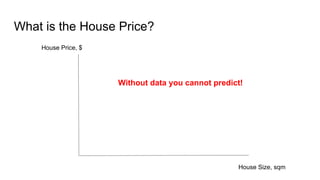
What is the House Price?
House Price, $
House Size, sqm
Without data you cannot predict!
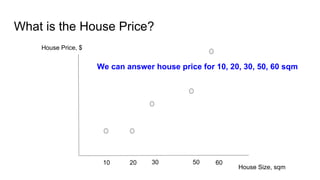
What is the House Price?
House Price, $
House Size, sqm
10 20 30 50 60
We can answer house price for 10, 20, 30, 50, 60 sqm
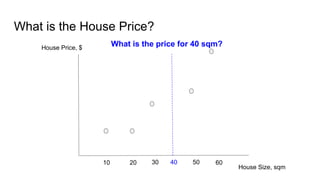
What is the House Price?
House Price, $
House Size, sqm
10 20 30 50 60
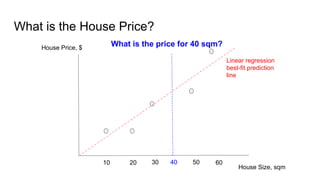
What is the price for 40 sqm?
40
What is the House Price?
House Price, $
House Size, sqm
10 20 30 50 60
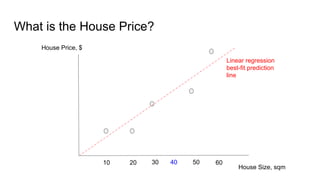
What is the price for 40 sqm?
40
Linear regression
best-fit prediction
line
What is the House Price?
House Price, $
House Size, sqm
10 20 30 50 60
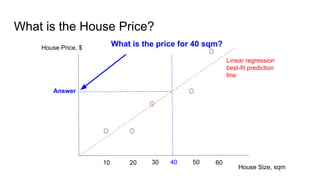
What is the price for 40 sqm?
40
Linear regression
best-fit prediction
line
Answer
What is the House Price?
House Price, $
House Size, sqm
10 20 30 50 60
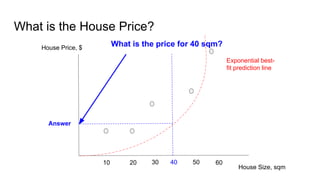
What is the price for 40 sqm?
40
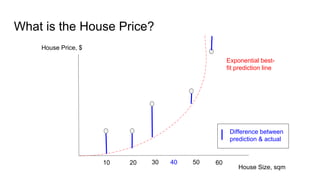
Exponential best-
fit prediction line
Answer
Cost Function: Best-fit Prediction
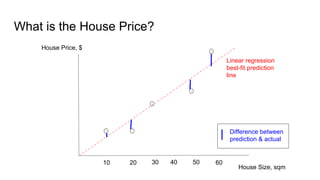
Minimize difference between predicted & actual values
What is the House Price?
House Price, $
House Size, sqm
10 20 30 50 6040
Linear regression
best-fit prediction
line
What is the House Price?
House Price, $
House Size, sqm
10 20 30 50 6040
Linear regression
best-fit prediction
line
Difference between
prediction & actual
What is the House Price?
House Price, $
House Size, sqm
10 20 30 50 6040
Exponential best-
fit prediction line
Difference between
prediction & actual
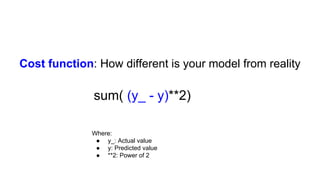
Cost function: How different is your model from reality
Where:
● y_: Actual value
● y: Predicted value
● **2: Power of 2
sum( (y_ - y)**2)
Linear Regression
Linear Regression
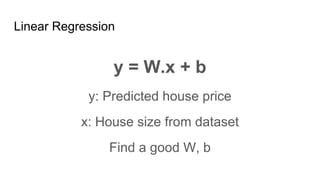
y = W.x + b
y: Predicted house price
x: House size from dataset
Find a good W, b
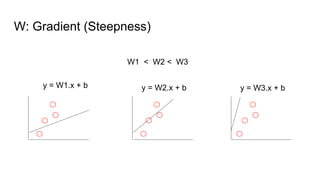
W: Gradient (Steepness)
y = W1.x + b y = W2.x + b y = W3.x + b
W1 < W2 < W3
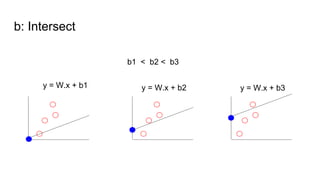
b: Intersect
y = W.x + b1 y = W.x + b2 y = W.x + b3
b1 < b2 < b3
Train
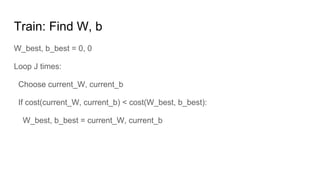
Train: Find W, b
W_best, b_best = 0, 0
Loop J times:
Choose current_W, current_b
If cost(current_W, current_b) < cost(W_best, b_best):
W_best, b_best = current_W, current_b
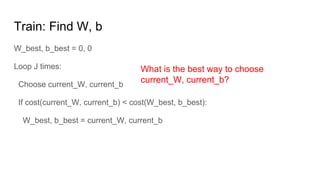
Train: Find W, b
W_best, b_best = 0, 0
Loop J times:
Choose current_W, current_b
If cost(current_W, current_b) < cost(W_best, b_best):
W_best, b_best = current_W, current_b
What is the best way to choose
current_W, current_b?
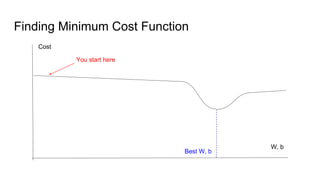
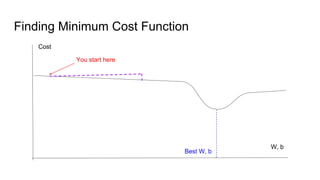
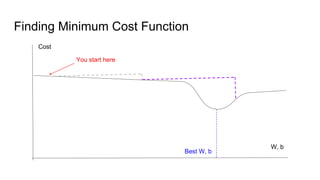
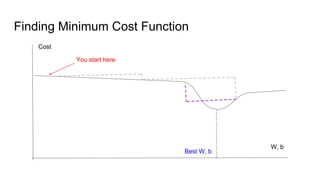
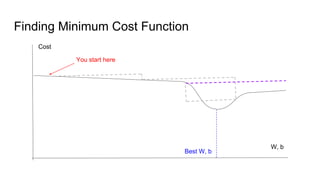
Finding Minimum Cost Function
Cost
W, b
You start here
Best W, b
How to Reach Minimum?
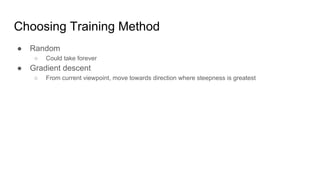
Choosing Training Method
● Random
○ Could take forever
● Gradient descent
○ From current viewpoint, move towards direction where steepness is greatest
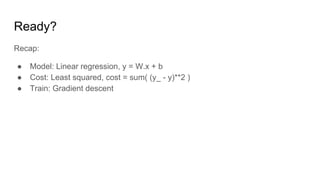
Ready?
Recap:
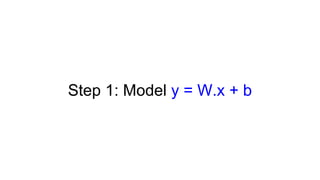
● Model: Linear regression, y = W.x + b
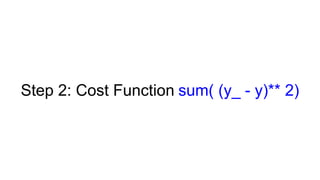
● Cost: Least squared, cost = sum( (y_ - y)**2 )
● Train: Gradient descent
Step 1: Model y = W.x + b
Tensorflow Model
tf.placeholder
● Hold data to be feed into the model
● x = tf.placeholder(tf.float32, [None, 1])
tf.Variable
● Hold variables to be trained
● W = tf.Variable(tf.zeros([1,1]))
● b = tf.Variable(tf.zeros([1]))
One feature, house sizeOne output, house price
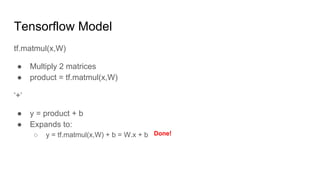
Tensorflow Model
tf.matmul(x,W)
● Multiply 2 matrices
● product = tf.matmul(x,W)
‘+’
● y = product + b
● Expands to:
○ y = tf.matmul(x,W) + b = W.x + b Done!
Step 2: Cost Function sum( (y_ - y)** 2)
Best-fit: Minimize Difference Prediction and Actual
Actual values:
● y_ = tf.placeholder(tf.float32, [None, 1])
Minimize difference between actual and prediction:
● cost = tf.reduce_sum(tf.pow((y_-y), 2))
One output, house price
Step 3: Data
Faking Data
for i in range(100):
// Create fake data for actual data
xs = np.array([[i]])
ys = np.array([[2*i]])
● xs = 0, 1, 2, …., 99
● ys = 0, 2, 4, …., 198
● ys is always twice of xs
● y = W.x + b where W = 2, b = 0 => Best fit: y = 2x
Step 4: Train
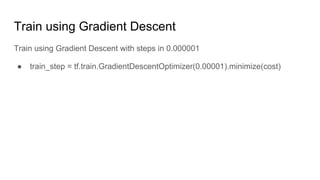
Train using Gradient Descent
Train using Gradient Descent with steps in 0.000001
● train_step = tf.train.GradientDescentOptimizer(0.00001).minimize(cost)
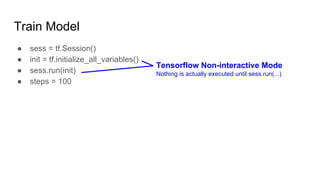
Train Model
● sess = tf.Session()
● init = tf.initialize_all_variables()
● sess.run(init)
● steps = 100
Tensorflow Non-interactive Mode
Nothing is actually executed until sess.run(...)
Go!!!!!
for i in range(steps):
# Create fake data for y = W.x + b where W = 2, b = 0
xs = np.array([[i]])
ys = np.array([[2*i]])
# Train
feed = { x: xs, y_: ys }
sess.run(train_step, feed_dict=feed)
print("After %d iteration:" % i)
print("W: %f" % sess.run(W))
print("b: %f" % sess.run(b))
Result
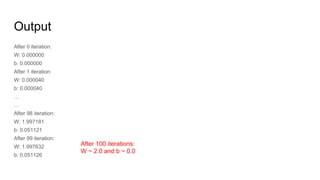
Output
After 0 iteration:
W: 0.000000
b: 0.000000
After 1 iteration:
W: 0.000040
b: 0.000040
…
…
After 98 iteration:
W: 1.997181
b: 0.051121
After 99 iteration:
W: 1.997632
b: 0.051126
After 100 iterations:
W ~ 2.0 and b ~ 0.0
Debugging
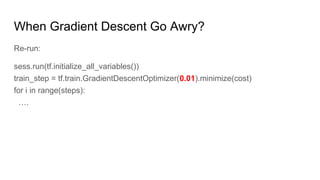
When Gradient Descent Go Awry?
Re-run:
sess.run(tf.initialize_all_variables())
train_step = tf.train.GradientDescentOptimizer(0.01).minimize(cost)
for i in range(steps):
….
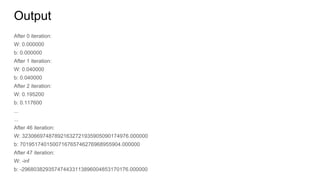
Output
After 0 iteration:
W: 0.000000
b: 0.000000
After 1 iteration:
W: 0.040000
b: 0.040000
After 2 iteration:
W: 0.195200
b: 0.117600
...
...
After 46 iteration:
W: 323066974878921632721935905090174976.000000
b: 7019517401500716765746276968955904.000000
After 47 iteration:
W: -inf
b: -296803829357474433113896004853170176.000000
Finding Minimum Cost Function
Cost
W, b
You start here
Best W, b
Finding Minimum Cost Function
Cost
W, b
You start here
Best W, b
Finding Minimum Cost Function
Cost
W, b
You start here
Best W, b
Finding Minimum Cost Function
Cost
W, b
You start here
Best W, b
Errors: Missing Placeholders
feed = { x: xs, y: ys }
sess.run(train_step, feed_dict=feed)
● y should be y_
W tensorflow/core/common_runtime/executor.cc:1076] 0x229e510 Compute
status: Invalid argument: You must feed a value for placeholder tensor
'Placeholder_1' with dtype float
[[Node: Placeholder_1 = Placeholder[dtype=DT_FLOAT, shape=[], _device="
/job:localhost/replica:0/task:0/cpu:0"]()]]
Placeholder Numbers
cost = tf.reduce_sum(tf.pow((y_-y), 2))
y = product + b
product = tf.matmul(x,W)
x = tf.placeholder(tf.float32, [None, 1])
y_ = tf.placeholder(tf.float32, [None, 1])
Placeholder_1
Placeholder_0
Assigning Names to Placeholders
cost = tf.reduce_sum(tf.pow((y_-y), 2))
y = product + b
product = tf.matmul(x,W)
x = tf.placeholder(tf.float32, [None, 1])
y_ = tf.placeholder(tf.float32, [None, 1],
name=‘y-input’)
Placeholder_1
Placeholder_0
Errors: Wrong Shape
for i in range(steps):
xs = np.array([i])
ys = np.array([[2*i]])
● xs should be np.array([[i]])
Traceback (most recent call last):
File "<stdin>", line 7, in <module>
File "/usr/local/lib/python2.7/dist-packages/tensorflow/python/client/session.py",
line 364, in run
tuple(subfeed_t.get_shape().dims)))
ValueError: Cannot feed value of shape (1,) for Tensor u'Placeholder:0', which has
shape (Dimension(None), Dimension(1))
Placeholder Numbers
cost = tf.reduce_sum(tf.pow((y_-y), 2))
y = product + b
product = tf.matmul(x,W)
x = tf.placeholder(tf.float32, [None, 1])
y_ = tf.placeholder(tf.float32, [None, 1])
Placeholder_1
Placeholder_0
Print: Simplest Debugger
print (sess.run(product), feed_dict={ x: np.array([1]) })
File "<stdin>", line 1
print (sess.run(product), feed_dict={ x: np.array([1]) })
^
SyntaxError: invalid syntax
>>> print (sess.run(product, feed_dict={ x: np.array([1]) }))
Traceback (most recent call last):
File "<stdin>", line 1, in <module>
File "/usr/local/lib/python2.7/dist-packages/tensorflow/python/client/session.py", line 364, in run
tuple(subfeed_t.get_shape().dims)))
ValueError: Cannot feed value of shape (1,) for Tensor u'Placeholder:0', which has shape (Dimension
(None), Dimension(1))
Same error so must be it!
Progressing to Tensorflow Tutorial
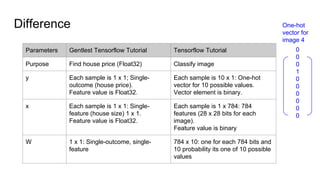
Difference
Parameters Gentlest Tensorflow Tutorial Tensorflow Tutorial
Purpose Find house price (Float32) Classify image
y Each sample is 1 x 1; Single-
outcome (house price).
Feature value is Float32.
Each sample is 10 x 1: One-hot
vector for 10 possible values.
Vector element is binary.
x Each sample is 1 x 1: Single-
feature (house size) 1 x 1.
Feature value is Float32.
Each sample is 1 x 784: 784
features (28 x 28 bits for each
image).
Feature value is binary
W 1 x 1: Single-outcome, single-
feature
784 x 10: one for each 784 bits and
10 probability its one of 10 possible
values
0
0
0
1
0
0
0
0
0
0
One-hot
vector for
image 4
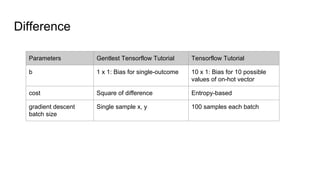
Difference
Parameters Gentlest Tensorflow Tutorial Tensorflow Tutorial
b 1 x 1: Bias for single-outcome 10 x 1: Bias for 10 possible
values of on-hot vector
cost Square of difference Entropy-based
gradient descent
batch size
Single sample x, y 100 samples each batch
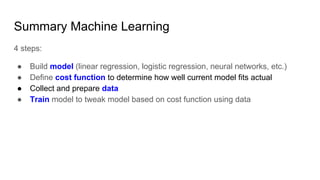
Summary Machine Learning
4 steps:
● Build model (linear regression, logistic regression, neural networks, etc.)
● Define cost function to determine how well current model fits actual
● Collect and prepare data
● Train model to tweak model based on cost function using data
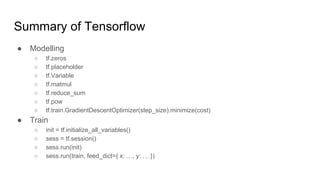
Summary of Tensorflow
● Modelling
○ tf.zeros
○ tf.placeholder
○ tf.Variable
○ tf.matmul
○ tf.reduce_sum
○ tf.pow
○ tf.train.GradientDescentOptimizer(step_size).minimize(cost)
● Train
○ init = tf.initialize_all_variables()
○ sess = tf.session()
○ sess.run(init)
○ sess.run(train, feed_dict={ x: …, y: … })
Questions
● Why not just use numpy.dot methods instead of tf.matmul?
○ tf.matmul is a Tensorflow Operation, and Tensorflow can easily assign each parallelizable
operation to an available nodes to speed up operations
References
Code: https://github.com/nethsix/gentle_tensorflow/blob/master/code/linear_regression_one_feature.py

Gentlest Introduction to Tensorflow

  • 1.
    Gentlest Intro toTensorflow Khor, @neth_6, re:Culture In collaboration with (Sam & Edmund):
  • 2.
    Goal ● Perform linearregression in its most basic form through simplest example ○ Predict house price with just single feature, i.e., house size
  • 3.
    What We WillLearn Together ● 4 steps of Machine Learning: ○ Create model ○ Define cost function ○ Collect data ○ Train ● 2 parts of Tensorflow: ○ Model linear regression & cost function as Tensorflow graph ○ Train Tensorflow graph with dataset
  • 4.
  • 5.
    Machine Learning Purpose Predictsomething given a set of features that influences prediction: ● Predict house price given its size, location, configuration (features)
  • 6.
    Machine Learning Training Beforepredicting, we have to: ● Choose/Create a model ● Train the model to learn prediction with data
  • 7.
  • 8.
    Predict House PriceGiven House Size y = house price x = house size (feature) Solve: ● Given a house size, what should be the house price?
  • 9.
  • 10.
    What is theHouse Price? House Price, $ House Size, sqm
  • 11.
    What is theHouse Price? House Price, $ House Size, sqm Without data you cannot predict!
  • 12.
    What is theHouse Price? House Price, $ House Size, sqm 10 20 30 50 60 We can answer house price for 10, 20, 30, 50, 60 sqm
  • 13.
    What is theHouse Price? House Price, $ House Size, sqm 10 20 30 50 60 What is the price for 40 sqm? 40
  • 14.
    What is theHouse Price? House Price, $ House Size, sqm 10 20 30 50 60 What is the price for 40 sqm? 40 Linear regression best-fit prediction line
  • 15.
    What is theHouse Price? House Price, $ House Size, sqm 10 20 30 50 60 What is the price for 40 sqm? 40 Linear regression best-fit prediction line Answer
  • 16.
    What is theHouse Price? House Price, $ House Size, sqm 10 20 30 50 60 What is the price for 40 sqm? 40 Exponential best- fit prediction line Answer
  • 17.
  • 18.
    Minimize difference betweenpredicted & actual values
  • 19.
    What is theHouse Price? House Price, $ House Size, sqm 10 20 30 50 6040 Linear regression best-fit prediction line
  • 20.
    What is theHouse Price? House Price, $ House Size, sqm 10 20 30 50 6040 Linear regression best-fit prediction line Difference between prediction & actual
  • 21.
    What is theHouse Price? House Price, $ House Size, sqm 10 20 30 50 6040 Exponential best- fit prediction line Difference between prediction & actual
  • 22.
    Cost function: Howdifferent is your model from reality Where: ● y_: Actual value ● y: Predicted value ● **2: Power of 2 sum( (y_ - y)**2)
  • 23.
  • 24.
    Linear Regression y =W.x + b y: Predicted house price x: House size from dataset Find a good W, b
  • 25.
    W: Gradient (Steepness) y= W1.x + b y = W2.x + b y = W3.x + b W1 < W2 < W3
  • 26.
    b: Intersect y =W.x + b1 y = W.x + b2 y = W.x + b3 b1 < b2 < b3
  • 27.
  • 28.
    Train: Find W,b W_best, b_best = 0, 0 Loop J times: Choose current_W, current_b If cost(current_W, current_b) < cost(W_best, b_best): W_best, b_best = current_W, current_b
  • 29.
    Train: Find W,b W_best, b_best = 0, 0 Loop J times: Choose current_W, current_b If cost(current_W, current_b) < cost(W_best, b_best): W_best, b_best = current_W, current_b What is the best way to choose current_W, current_b?
  • 30.
    Finding Minimum CostFunction Cost W, b You start here Best W, b
  • 31.
    How to ReachMinimum?
  • 32.
    Choosing Training Method ●Random ○ Could take forever ● Gradient descent ○ From current viewpoint, move towards direction where steepness is greatest
  • 33.
    Ready? Recap: ● Model: Linearregression, y = W.x + b ● Cost: Least squared, cost = sum( (y_ - y)**2 ) ● Train: Gradient descent
  • 34.
    Step 1: Modely = W.x + b
  • 35.
    Tensorflow Model tf.placeholder ● Holddata to be feed into the model ● x = tf.placeholder(tf.float32, [None, 1]) tf.Variable ● Hold variables to be trained ● W = tf.Variable(tf.zeros([1,1])) ● b = tf.Variable(tf.zeros([1])) One feature, house sizeOne output, house price
  • 36.
    Tensorflow Model tf.matmul(x,W) ● Multiply2 matrices ● product = tf.matmul(x,W) ‘+’ ● y = product + b ● Expands to: ○ y = tf.matmul(x,W) + b = W.x + b Done!
  • 37.
    Step 2: CostFunction sum( (y_ - y)** 2)
  • 38.
    Best-fit: Minimize DifferencePrediction and Actual Actual values: ● y_ = tf.placeholder(tf.float32, [None, 1]) Minimize difference between actual and prediction: ● cost = tf.reduce_sum(tf.pow((y_-y), 2)) One output, house price
  • 39.
  • 40.
    Faking Data for iin range(100): // Create fake data for actual data xs = np.array([[i]]) ys = np.array([[2*i]]) ● xs = 0, 1, 2, …., 99 ● ys = 0, 2, 4, …., 198 ● ys is always twice of xs ● y = W.x + b where W = 2, b = 0 => Best fit: y = 2x
  • 41.
  • 42.
    Train using GradientDescent Train using Gradient Descent with steps in 0.000001 ● train_step = tf.train.GradientDescentOptimizer(0.00001).minimize(cost)
  • 43.
    Train Model ● sess= tf.Session() ● init = tf.initialize_all_variables() ● sess.run(init) ● steps = 100 Tensorflow Non-interactive Mode Nothing is actually executed until sess.run(...)
  • 44.
    Go!!!!! for i inrange(steps): # Create fake data for y = W.x + b where W = 2, b = 0 xs = np.array([[i]]) ys = np.array([[2*i]]) # Train feed = { x: xs, y_: ys } sess.run(train_step, feed_dict=feed) print("After %d iteration:" % i) print("W: %f" % sess.run(W)) print("b: %f" % sess.run(b))
  • 45.
  • 46.
    Output After 0 iteration: W:0.000000 b: 0.000000 After 1 iteration: W: 0.000040 b: 0.000040 … … After 98 iteration: W: 1.997181 b: 0.051121 After 99 iteration: W: 1.997632 b: 0.051126 After 100 iterations: W ~ 2.0 and b ~ 0.0
  • 47.
  • 48.
    When Gradient DescentGo Awry? Re-run: sess.run(tf.initialize_all_variables()) train_step = tf.train.GradientDescentOptimizer(0.01).minimize(cost) for i in range(steps): ….
  • 49.
    Output After 0 iteration: W:0.000000 b: 0.000000 After 1 iteration: W: 0.040000 b: 0.040000 After 2 iteration: W: 0.195200 b: 0.117600 ... ... After 46 iteration: W: 323066974878921632721935905090174976.000000 b: 7019517401500716765746276968955904.000000 After 47 iteration: W: -inf b: -296803829357474433113896004853170176.000000
  • 50.
    Finding Minimum CostFunction Cost W, b You start here Best W, b
  • 51.
    Finding Minimum CostFunction Cost W, b You start here Best W, b
  • 52.
    Finding Minimum CostFunction Cost W, b You start here Best W, b
  • 53.
    Finding Minimum CostFunction Cost W, b You start here Best W, b
  • 54.
    Errors: Missing Placeholders feed= { x: xs, y: ys } sess.run(train_step, feed_dict=feed) ● y should be y_ W tensorflow/core/common_runtime/executor.cc:1076] 0x229e510 Compute status: Invalid argument: You must feed a value for placeholder tensor 'Placeholder_1' with dtype float [[Node: Placeholder_1 = Placeholder[dtype=DT_FLOAT, shape=[], _device=" /job:localhost/replica:0/task:0/cpu:0"]()]]
  • 55.
    Placeholder Numbers cost =tf.reduce_sum(tf.pow((y_-y), 2)) y = product + b product = tf.matmul(x,W) x = tf.placeholder(tf.float32, [None, 1]) y_ = tf.placeholder(tf.float32, [None, 1]) Placeholder_1 Placeholder_0
  • 56.
    Assigning Names toPlaceholders cost = tf.reduce_sum(tf.pow((y_-y), 2)) y = product + b product = tf.matmul(x,W) x = tf.placeholder(tf.float32, [None, 1]) y_ = tf.placeholder(tf.float32, [None, 1], name=‘y-input’) Placeholder_1 Placeholder_0
  • 57.
    Errors: Wrong Shape fori in range(steps): xs = np.array([i]) ys = np.array([[2*i]]) ● xs should be np.array([[i]]) Traceback (most recent call last): File "<stdin>", line 7, in <module> File "/usr/local/lib/python2.7/dist-packages/tensorflow/python/client/session.py", line 364, in run tuple(subfeed_t.get_shape().dims))) ValueError: Cannot feed value of shape (1,) for Tensor u'Placeholder:0', which has shape (Dimension(None), Dimension(1))
  • 58.
    Placeholder Numbers cost =tf.reduce_sum(tf.pow((y_-y), 2)) y = product + b product = tf.matmul(x,W) x = tf.placeholder(tf.float32, [None, 1]) y_ = tf.placeholder(tf.float32, [None, 1]) Placeholder_1 Placeholder_0
  • 59.
    Print: Simplest Debugger print(sess.run(product), feed_dict={ x: np.array([1]) }) File "<stdin>", line 1 print (sess.run(product), feed_dict={ x: np.array([1]) }) ^ SyntaxError: invalid syntax >>> print (sess.run(product, feed_dict={ x: np.array([1]) })) Traceback (most recent call last): File "<stdin>", line 1, in <module> File "/usr/local/lib/python2.7/dist-packages/tensorflow/python/client/session.py", line 364, in run tuple(subfeed_t.get_shape().dims))) ValueError: Cannot feed value of shape (1,) for Tensor u'Placeholder:0', which has shape (Dimension (None), Dimension(1)) Same error so must be it!
  • 60.
  • 61.
    Difference Parameters Gentlest TensorflowTutorial Tensorflow Tutorial Purpose Find house price (Float32) Classify image y Each sample is 1 x 1; Single- outcome (house price). Feature value is Float32. Each sample is 10 x 1: One-hot vector for 10 possible values. Vector element is binary. x Each sample is 1 x 1: Single- feature (house size) 1 x 1. Feature value is Float32. Each sample is 1 x 784: 784 features (28 x 28 bits for each image). Feature value is binary W 1 x 1: Single-outcome, single- feature 784 x 10: one for each 784 bits and 10 probability its one of 10 possible values 0 0 0 1 0 0 0 0 0 0 One-hot vector for image 4
  • 62.
    Difference Parameters Gentlest TensorflowTutorial Tensorflow Tutorial b 1 x 1: Bias for single-outcome 10 x 1: Bias for 10 possible values of on-hot vector cost Square of difference Entropy-based gradient descent batch size Single sample x, y 100 samples each batch
  • 63.
    Summary Machine Learning 4steps: ● Build model (linear regression, logistic regression, neural networks, etc.) ● Define cost function to determine how well current model fits actual ● Collect and prepare data ● Train model to tweak model based on cost function using data
  • 64.
    Summary of Tensorflow ●Modelling ○ tf.zeros ○ tf.placeholder ○ tf.Variable ○ tf.matmul ○ tf.reduce_sum ○ tf.pow ○ tf.train.GradientDescentOptimizer(step_size).minimize(cost) ● Train ○ init = tf.initialize_all_variables() ○ sess = tf.session() ○ sess.run(init) ○ sess.run(train, feed_dict={ x: …, y: … })
  • 65.
    Questions ● Why notjust use numpy.dot methods instead of tf.matmul? ○ tf.matmul is a Tensorflow Operation, and Tensorflow can easily assign each parallelizable operation to an available nodes to speed up operations
  • 66.