MEMS
MICRO ELECTRO MECHANICAL
SYSTEMS
- A way to miniaturize our life style
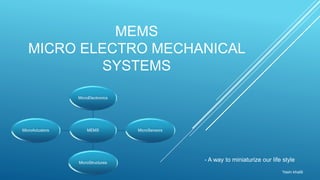
MEMS
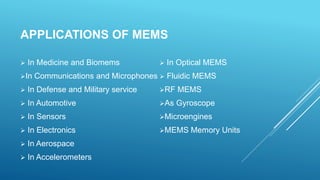
MicroElectronics
MicroSensors
MicroStructures
MicroActuators
Yasin khalili
WHAT IS MEMS ?
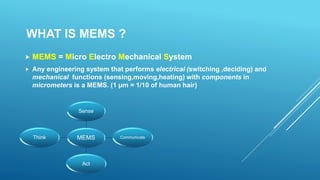
 MEMS = Micro Electro Mechanical System
 Any engineering system that performs electrical (switching ,deciding) and
mechanical functions (sensing,moving,heating) with components in
micrometers is a MEMS. (1 μm = 1/10 of human hair)
MEMS
Sense
Communicate
Act
Think
MATERIALS FOR MEMS :
 Silicon
 Polymers
 Metals
 Semiconductors
 Ceramic materials
 Composite materials
FABRICATION OF MEMS
 Deposition: The ability to deposit thin films of material on a
substrate.
 Lithography: To apply a patterned mask on top of the films
by photolithograpic imaging.
 Etching: To etch the films selectively to the mask
APPLICATIONS OF MEMS
 In Medicine and Biomems
In Communications and Microphones
 In Defense and Military service
 In Automotive
 In Sensors
 In Electronics
 In Aerospace
 In Accelerometers
 In Optical MEMS
 Fluidic MEMS
RF MEMS
As Gyroscope
Microengines
MEMS Memory Units
IN MEDICINE
 A MEMS is a device that can be implanted in the human body.
 MEMS surgical tools provide the flexibility and accuracy to perform surgery.
Blood pressure sensor
Muscle stimulators and drug delivery systems
Implanted pressure sensors
Miniature analytical instruments
Pacemakers
Microvalves
Micropumps
Food analysis
Biocavity Laser (for Cancer Cell Detection)
Study of biomolecules and their interaction
Drug development
Crime detection
Medical diagnosis
DNA sensors
Immune sensors
Bacteria sensors
Enzyme sensors
Smart Pill
IN AUTOMOTIVES
 Heavy use of mems is found in air bag systems, vehicle security system, inertial
brake lights, rollover detection, automatic door locks etc .
 Navigation assistance
 Anti-theft systems
 Telematics boxes (Black box)
 Infotainment
 Electronic stability control
Air bags
 Accelerometers
Engine control
Inertial sensors (accelerometers,
gyroscopes)
 Air conditional compressor sensor
 Brake force sensor and Suspension
control
Fuel level and Vapour pressure sensor
 Intelligent tyres
IN COMMUNICATIONS AND MICROPHONES
MEMS microphones in portable devices, e.g., mobile phones, head sets and laptops.
The market for smart microphones includes smartphones, wearable devices, smart home
and automotive applications.
The mems microphone also called as microphone Chip is widely used in the present day
communication world .
Variable optical attenuators
Optical switching
Tuneable filters
Tuneable capacitors and resonators for
mobile phones
Fibre-optic network components
RF relays , switches and filters
Projection displays in portable
communications devices and instrumentation
Voltage controlled oscillators (VCOs)
Splitters and couplers
Tuneable lasers
IN ELECTRONICS
Pedometer
Game control
Image stabilisation in video camera’s
(accelerometer)
Hard disk protection
Micro displays
Autofocus lenses
Mobile phones
Note books
Camcorder
 Inkjet heads
Hiking altimeters
Scuba gear
Cabin temperature control
 Crash prevention
Anti fog systems
Seat occupancy
Tire and break monitoring
Fingerprint sensors for authentication
Disk drive heads
Projection screen televisions
Earthquake sensor
Avionics pressure sensors
Mass data storage systems
IN DEFENSE AND MILITARY SERVICE
The Military uses MEMS for gathering information .
Information exploitation is accomplished through interconnecting data processing, displays,
batteries, mass storage, and input/output devices using advance telemetry interfaces. This class
of system represents a large fraction of future DoD and commercial products.
Missile guidance
Navigation
laser range finder
Switches and tuneable
capacitors for radar and
communications
Flight control systems
Cabin pressure
Hydraulic systems
Security monitoring
Fingerprint sensors for
authentication
Munitions guidance
Surveillance
Arming systems
Embedded sensors
Data storage
Aircraft control
OPTICS
The explosive growth of data traffic, such as the Internet, has produced a pressing need for
large-capacity optical networks.
To be widely deployed, such switches must be small, low cost, batch fabricated, and have a
high port count.
A MEMS-based optical switch is well suited to addressing these requirements.
Micromirror Device
Optical switch
Optical relays
DLP Pico Projector
Pill Camera
MicroDisplays
Autofocus lenses
Tuneable filters
Micromirrors in bar code readers and
projectors
Optical scanners
IN SENSORS
A major application for MEMS is as sensors .
Turn physical phenomena into measurable electrical signals .
A micro sensor reaches a significantly higher speed and sensitivity compared with
microscopic approaches.
Commonly sensed parameters are:
Pressure
 Temperature
 Flow rate
 Radiation
Chemicals
Pathogens
And Almost Everything!!!
IN SENSORS
Type of Sensors :
Mechanical Sensors
Optical Sensors
Thermal Sensors
Chemical & Biological Sensors
Strain Gauges
Accelerometers
Pressure Sensors
Microphones
Gyroscopes(Rotation Rate)
Biological Light Sensors
Thermo mechanical
(Dimension)
Thermo Resistive (Resistance)
Acoustic (Sound)
Biological
Electronic Nose
Electronic Tongue
Flow sensors
Fingerprint sensors for
authentication
Inertial Sensors in Automobiles
microfluidics and chemical
sensors
Velocity sensors
Radication sensors
Magnetic sensors
MEMS MEMORY UNITS
TB to PB device capacities
Massively parallel data transfer rates
Very fast file access times
Improved reliability
Smaller size and weight
Device costs less than today's devices
Excellent fit for applications to enterprise
RF MEMS
RF MEMS constitute one of the fastest growing areas in commercial MEMS technology.
RF MEMS are designed specifically for use within the electronics in mobile phones and other
wireless communication applications such as radar, global positioning satellite systems (GPS)
and steerable antennae.
These low-loss ultra-miniature and highly integrated RF functions can replace classical RF
elements and enable a new generation of RF devices and systems.
Impedance Matching Networks
Tunable Antennas Filtering
RF Circuits
Apart from these applications mems are also used in many fields in the present world.
Inkjet printer head
 Overhead projection display (Digital Light
Processor)
Lab-On-Chip (Biochips are biological
microchips)
IT Peripherals
Life Style Products
Household Applications (smart home)
IR sensors (infrared sensor)
Micromachined Probes
Medical diagnostic devices
Implantable pump
Liquid lenses
Microspectrometer
Capacitive micromachined ultrasonic
transducers
Nebulizers (Asthma inhalers )
Personal digital assistant
Smart munitions and decoys
Velocity sensors
Microactuators ( valves,pumps)
Micro fluidics
Linear and rotary motors
Microsurgical
Virosome
Drug delivery
Home security devices
Motion and shock detection
Micro Grippers or tweezers
ADVANTAGES AND DISADVANTAGES
Minimize energy and materials use in
manufacturing
Cost/performance advantages
Improved reproducibility
 Improved accuracy and reliability
 Increased selectivity and sensitivity
x Farm establishment requires huge
investments
x Micro-components are costly compare to
macro-components
x Design includes very much complex
procedures
x Prior knowledge is needed to integrate
MEMS devices
CONCLUSION
Enabling this technology promises to create entirely new categories of product.
MEMS will be the indispensable factor for advancing technology in the 21st century.
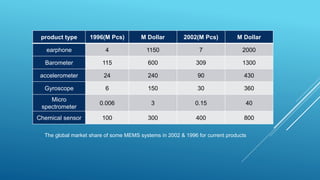
product type 1996(M Pcs) M Dollar 2002(M Pcs) M Dollar
earphone 4 1150 7 2000
Barometer 115 600 309 1300
accelerometer 24 240 90 430
Gyroscope 6 150 30 360
Micro
spectrometer
0.006 3 0.15 40
Chemical sensor 100 300 400 800
The global market share of some MEMS systems in 2002 & 1996 for current products
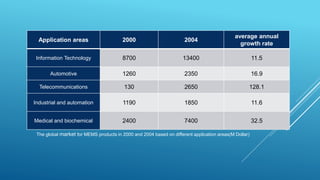
Application areas 2000 2004
average annual
growth rate
Information Technology 8700 13400 11.5
Automotive 1260 2350 16.9
Telecommunications 130 2650 128.1
Industrial and automation 1190 1850 11.6
Medical and biochemical 2400 7400 32.5
The global market for MEMS products in 2000 and 2004 based on different application areas(M Dollar)
REFERENCES
http://www.astf.or.jp/cluster/event/event/20121004/04_Arcamone-
MEMS_Devices_and_Applications.pdf
http://www.eeherald.com/section/design-guide/mems_application_introduction.html
https://www.mems-exchange.org/MEMS/applications.html
https://www.slideshare.net/navinec1/micro-electromechanical-system-mems
http://papers2.persiangig.com/Papers/ELC/ELC5-4.pdf/download?f8f4
http://www.ijeir.info/sadrnezh/283.pdf
https://www.slideshare.net/navinec1/micro-electromechanical-system-mems?from_action=save
https://www.slideshare.net/sapparao/mems-ppt-4763042
http://mmep.isme.ir/article_21344.html
http://dl.elearnica.ir/files/3799_a995c96f0007c994ca1e5d2fea14236e/3799447/-
636843991159547767-Request_-_3799447.pdf
https://www.slideshare.net/vinayak.nandi/mems-detail-presentation
https://www.slideshare.net/prasannanaik3/mems-technology-ppt
http://sao.aut.ac.ir/sao/nashriye/%D9%86%D8%B4%D8%B1%DB%8C%D9%87%20%D9%BE%D
8%B2%D8%B4%DA%A9%DB%8C%2027.pdf
https://www.slideshare.net/sreenavya9/micro-electro-mechanical-systems-17109941
https://www.slideshare.net/DhavalKaneria/mems-technology
https://www.slideshare.net/abdelrahmaneltamawy7/introduction-to-mems-and-mems-pro
https://www.slideshare.net/sushmitagupta7509/virosomes-44814265
https://www.innovationservices.philips.com/looking-expertise/mems-micro-devices/mems-
applications/mems-actuators/
http://home.eps.hw.ac.uk/~ryf1/MEMS%20Introduction.htm
Thank you

Mems application

  • 1.
    MEMS MICRO ELECTRO MECHANICAL SYSTEMS -A way to miniaturize our life style MEMS MicroElectronics MicroSensors MicroStructures MicroActuators Yasin khalili
  • 2.
    WHAT IS MEMS?  MEMS = Micro Electro Mechanical System  Any engineering system that performs electrical (switching ,deciding) and mechanical functions (sensing,moving,heating) with components in micrometers is a MEMS. (1 μm = 1/10 of human hair) MEMS Sense Communicate Act Think
  • 3.
    MATERIALS FOR MEMS:  Silicon  Polymers  Metals  Semiconductors  Ceramic materials  Composite materials
  • 4.
    FABRICATION OF MEMS Deposition: The ability to deposit thin films of material on a substrate.  Lithography: To apply a patterned mask on top of the films by photolithograpic imaging.  Etching: To etch the films selectively to the mask
  • 5.
    APPLICATIONS OF MEMS In Medicine and Biomems In Communications and Microphones  In Defense and Military service  In Automotive  In Sensors  In Electronics  In Aerospace  In Accelerometers  In Optical MEMS  Fluidic MEMS RF MEMS As Gyroscope Microengines MEMS Memory Units
  • 6.
    IN MEDICINE  AMEMS is a device that can be implanted in the human body.  MEMS surgical tools provide the flexibility and accuracy to perform surgery. Blood pressure sensor Muscle stimulators and drug delivery systems Implanted pressure sensors Miniature analytical instruments Pacemakers Microvalves Micropumps Food analysis Biocavity Laser (for Cancer Cell Detection) Study of biomolecules and their interaction Drug development Crime detection Medical diagnosis DNA sensors Immune sensors Bacteria sensors Enzyme sensors Smart Pill
  • 7.
    IN AUTOMOTIVES  Heavyuse of mems is found in air bag systems, vehicle security system, inertial brake lights, rollover detection, automatic door locks etc .  Navigation assistance  Anti-theft systems  Telematics boxes (Black box)  Infotainment  Electronic stability control Air bags  Accelerometers Engine control Inertial sensors (accelerometers, gyroscopes)  Air conditional compressor sensor  Brake force sensor and Suspension control Fuel level and Vapour pressure sensor  Intelligent tyres
  • 8.
    IN COMMUNICATIONS ANDMICROPHONES MEMS microphones in portable devices, e.g., mobile phones, head sets and laptops. The market for smart microphones includes smartphones, wearable devices, smart home and automotive applications. The mems microphone also called as microphone Chip is widely used in the present day communication world . Variable optical attenuators Optical switching Tuneable filters Tuneable capacitors and resonators for mobile phones Fibre-optic network components RF relays , switches and filters Projection displays in portable communications devices and instrumentation Voltage controlled oscillators (VCOs) Splitters and couplers Tuneable lasers
  • 9.
    IN ELECTRONICS Pedometer Game control Imagestabilisation in video camera’s (accelerometer) Hard disk protection Micro displays Autofocus lenses Mobile phones Note books Camcorder  Inkjet heads Hiking altimeters Scuba gear Cabin temperature control  Crash prevention Anti fog systems Seat occupancy Tire and break monitoring Fingerprint sensors for authentication Disk drive heads Projection screen televisions Earthquake sensor Avionics pressure sensors Mass data storage systems
  • 10.
    IN DEFENSE ANDMILITARY SERVICE The Military uses MEMS for gathering information . Information exploitation is accomplished through interconnecting data processing, displays, batteries, mass storage, and input/output devices using advance telemetry interfaces. This class of system represents a large fraction of future DoD and commercial products. Missile guidance Navigation laser range finder Switches and tuneable capacitors for radar and communications Flight control systems Cabin pressure Hydraulic systems Security monitoring Fingerprint sensors for authentication Munitions guidance Surveillance Arming systems Embedded sensors Data storage Aircraft control
  • 11.
    OPTICS The explosive growthof data traffic, such as the Internet, has produced a pressing need for large-capacity optical networks. To be widely deployed, such switches must be small, low cost, batch fabricated, and have a high port count. A MEMS-based optical switch is well suited to addressing these requirements. Micromirror Device Optical switch Optical relays DLP Pico Projector Pill Camera MicroDisplays Autofocus lenses Tuneable filters Micromirrors in bar code readers and projectors Optical scanners
  • 12.
    IN SENSORS A majorapplication for MEMS is as sensors . Turn physical phenomena into measurable electrical signals . A micro sensor reaches a significantly higher speed and sensitivity compared with microscopic approaches. Commonly sensed parameters are: Pressure  Temperature  Flow rate  Radiation Chemicals Pathogens And Almost Everything!!!
  • 13.
    IN SENSORS Type ofSensors : Mechanical Sensors Optical Sensors Thermal Sensors Chemical & Biological Sensors Strain Gauges Accelerometers Pressure Sensors Microphones Gyroscopes(Rotation Rate) Biological Light Sensors Thermo mechanical (Dimension) Thermo Resistive (Resistance) Acoustic (Sound) Biological Electronic Nose Electronic Tongue Flow sensors Fingerprint sensors for authentication Inertial Sensors in Automobiles microfluidics and chemical sensors Velocity sensors Radication sensors Magnetic sensors
  • 14.
    MEMS MEMORY UNITS TBto PB device capacities Massively parallel data transfer rates Very fast file access times Improved reliability Smaller size and weight Device costs less than today's devices Excellent fit for applications to enterprise
  • 15.
    RF MEMS RF MEMSconstitute one of the fastest growing areas in commercial MEMS technology. RF MEMS are designed specifically for use within the electronics in mobile phones and other wireless communication applications such as radar, global positioning satellite systems (GPS) and steerable antennae. These low-loss ultra-miniature and highly integrated RF functions can replace classical RF elements and enable a new generation of RF devices and systems. Impedance Matching Networks Tunable Antennas Filtering RF Circuits
  • 16.
    Apart from theseapplications mems are also used in many fields in the present world. Inkjet printer head  Overhead projection display (Digital Light Processor) Lab-On-Chip (Biochips are biological microchips) IT Peripherals Life Style Products Household Applications (smart home) IR sensors (infrared sensor) Micromachined Probes Medical diagnostic devices Implantable pump Liquid lenses Microspectrometer Capacitive micromachined ultrasonic transducers Nebulizers (Asthma inhalers ) Personal digital assistant Smart munitions and decoys Velocity sensors Microactuators ( valves,pumps) Micro fluidics Linear and rotary motors Microsurgical Virosome Drug delivery Home security devices Motion and shock detection Micro Grippers or tweezers
  • 17.
    ADVANTAGES AND DISADVANTAGES Minimizeenergy and materials use in manufacturing Cost/performance advantages Improved reproducibility  Improved accuracy and reliability  Increased selectivity and sensitivity x Farm establishment requires huge investments x Micro-components are costly compare to macro-components x Design includes very much complex procedures x Prior knowledge is needed to integrate MEMS devices
  • 18.
    CONCLUSION Enabling this technologypromises to create entirely new categories of product. MEMS will be the indispensable factor for advancing technology in the 21st century.
  • 19.
    product type 1996(MPcs) M Dollar 2002(M Pcs) M Dollar earphone 4 1150 7 2000 Barometer 115 600 309 1300 accelerometer 24 240 90 430 Gyroscope 6 150 30 360 Micro spectrometer 0.006 3 0.15 40 Chemical sensor 100 300 400 800 The global market share of some MEMS systems in 2002 & 1996 for current products
  • 20.
    Application areas 20002004 average annual growth rate Information Technology 8700 13400 11.5 Automotive 1260 2350 16.9 Telecommunications 130 2650 128.1 Industrial and automation 1190 1850 11.6 Medical and biochemical 2400 7400 32.5 The global market for MEMS products in 2000 and 2004 based on different application areas(M Dollar)
  • 21.
  • 22.
    http://dl.elearnica.ir/files/3799_a995c96f0007c994ca1e5d2fea14236e/3799447/- 636843991159547767-Request_-_3799447.pdf https://www.slideshare.net/vinayak.nandi/mems-detail-presentation https://www.slideshare.net/prasannanaik3/mems-technology-ppt http://sao.aut.ac.ir/sao/nashriye/%D9%86%D8%B4%D8%B1%DB%8C%D9%87%20%D9%BE%D 8%B2%D8%B4%DA%A9%DB%8C%2027.pdf https://www.slideshare.net/sreenavya9/micro-electro-mechanical-systems-17109941 https://www.slideshare.net/DhavalKaneria/mems-technology https://www.slideshare.net/abdelrahmaneltamawy7/introduction-to-mems-and-mems-pro https://www.slideshare.net/sushmitagupta7509/virosomes-44814265 https://www.innovationservices.philips.com/looking-expertise/mems-micro-devices/mems- applications/mems-actuators/ http://home.eps.hw.ac.uk/~ryf1/MEMS%20Introduction.htm
  • 23.

Editor's Notes

  • #9 Variable optical attenuators is a device used to reduce the power level of an optical signal, either in free space or in an optical fiber. The basic types of optical attenuators are fixed, step-wise variable, and continuously variable. A resonator is a device or system that exhibits resonance or resonant behavior, that is, it naturally oscillates at some frequencies, called its resonant frequencies, with greater amplitude than at others.
  • #11 Telemetry is an automated communications process by which measurements and other data are collected at remote or inaccessible points and transmitted to receiving equipment for monitoring
  • #12 Micromirror devices are devices based on microscopically small mirrors. The mirrors are Microelectromechanical systems (MEMS), which means that their states are controlled by applying a voltage between the two electrodes around the mirror arrays. Digital micromirror devices are used in video projectors and optics and micromirror devices for light deflection and control. Digital Light Processing (DLP) is a video technology created by Texas Instruments that is used for front and rear projection units. DLP technology is common for rear projection in TVs and it is also used in front projectors for units designed for businesses and classrooms.
  • #13 pathogen is anything that can produce disease.
  • #14 A strain gauge (sometimes referred to as a strain gage) is a sensor whose resistance varies with applied force; It converts force, pressure, tension, weight, etc., into a change in electrical resistance which can then be measured.