Authentic  Assessment Alex Dugan TESOL Adventist International Institute of Advanced Studies [email_address]
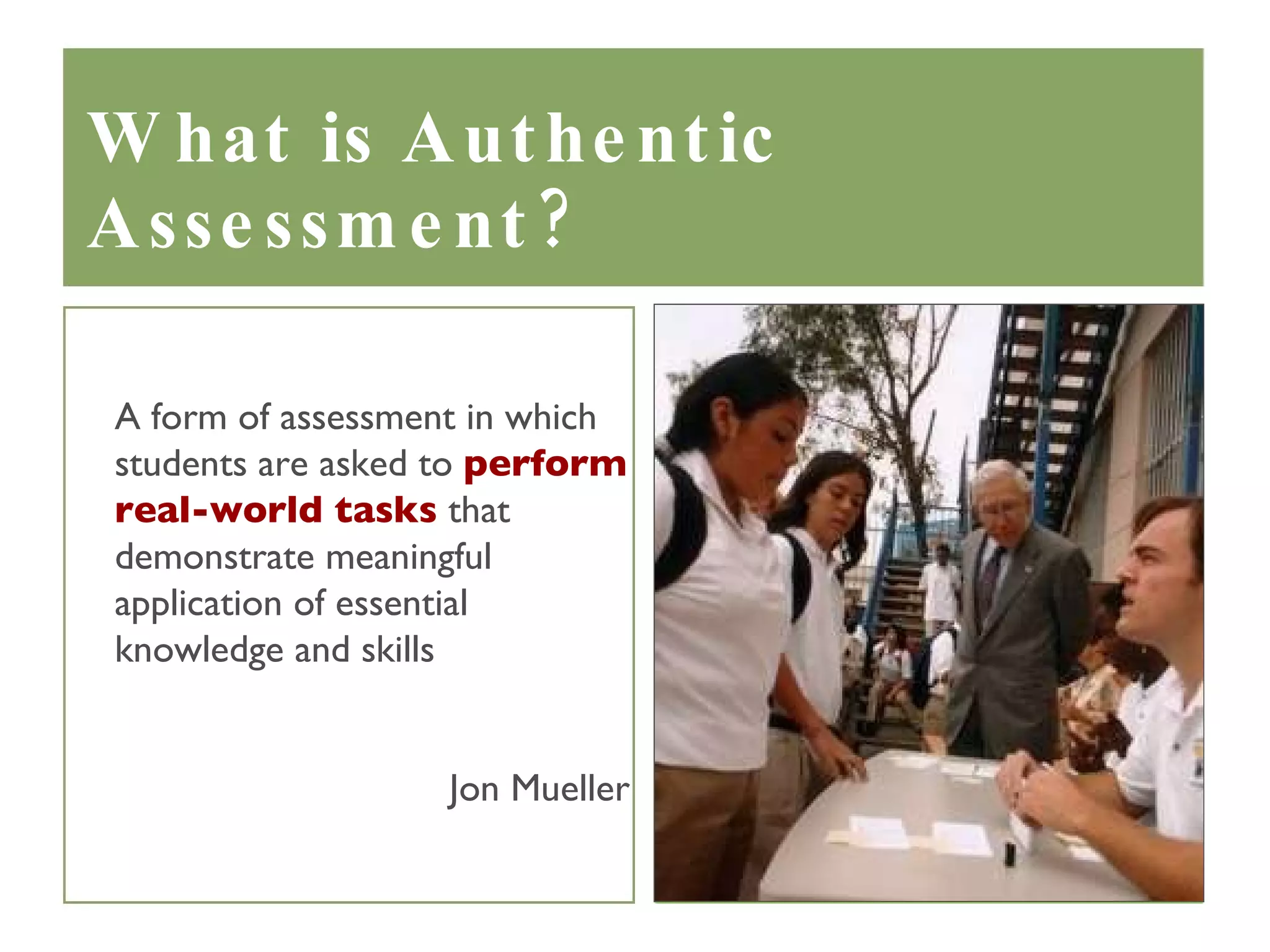
What is Authentic Assessment? A form of assessment in which students are asked to  perform real-world tasks  that demonstrate meaningful application of essential knowledge and skills Jon Mueller
What is Authentic Assessment? Performance assessments call upon the examinee to  demonstrate  specific skills and competencies, that is,  to  apply  the skills and knowledge they have mastered.  Richard J. Stiggins
What does Authentic Assessment look like? An authentic assessment usually includes a  task  for students to perform and a  rubric  by which their performance on the task will be evaluated.
Traditional Assessment vs. Authentic Assessment Traditional Assessment ( TA ) Multiple choice Gap fill True-false Matching
Traditional Assessment vs. Authentic Assessment Authentic Assessment ( AA ) Inventories Peer rating / Self rating Journals Portfolios Discussions Interviews
Traditional Assessment vs. Authentic Assessment Traditional ( TA )  To develop productive  citizens Must  possess  a body of  knowledge and skills Schools must  teach  this body of knowledge and skills Test  the students if they acquired the knowledge and skills Authentic ( AA ) To develop productive  citizens Must  be capable  of performing  real tasks Schools must  help  students become proficient at performing tasks Have the students  perform  meaningful tasks
Traditional Assessment vs. Authentic Assessment Traditional ( TA )  The curriculum drives assessment.     1. body of knowledge is determined first   2. design the curriculum 3. assess to determine if acquisition of the curriculum occurred. Authentic ( AA ) Assessment drives the curriculum.    1.  tasks are determined  first 2.  students perform to  demonstrate their  mastery 3.  design the curriculum
Traditional Assessment vs. Authentic Assessment Traditional ( TA )  Selecting a response Contrived Recall / Recognition Teacher-structured Indirect evidence Authentic ( AA ) Performing a task Real-life Construction / Application Student-structured Direct evidence
Alternative Names  for Authentic Assessment Performance Assessment Alternative Assessment Direct Assessment
Why Use Authentic Assessment Authentic Assessments are Direct Measures We do not just want students to  know   the content of the disciplines when they graduate. We, of course, want them to be able to  use   the acquired knowledge and skills in the real world. So, our assessments have to also tell us if students can apply what they have learned in authentic situations.
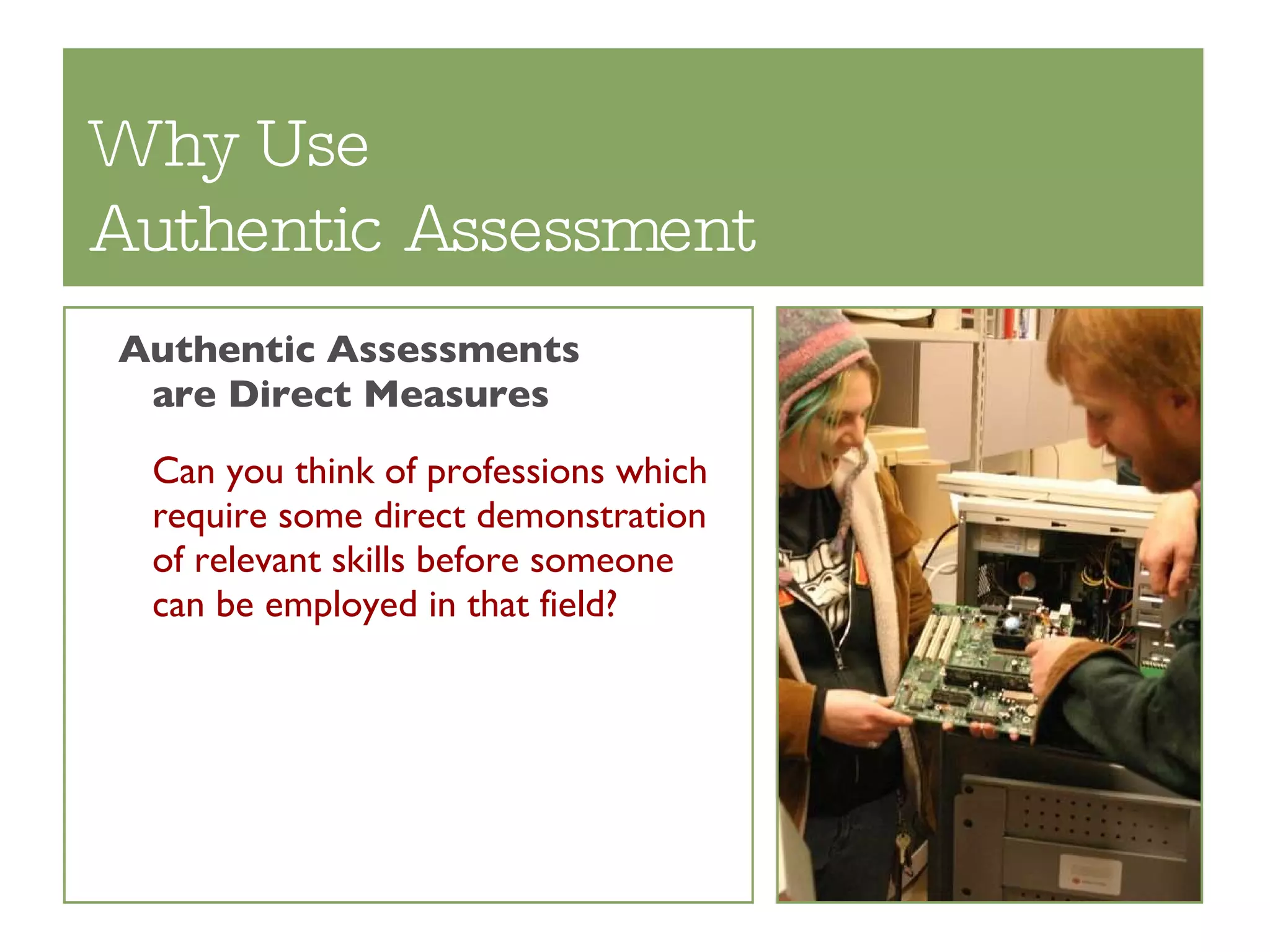
Why Use Authentic Assessment Authentic Assessments  are Direct Measures Can you think of professions which require some direct demonstration of relevant skills before someone can be employed in that field?
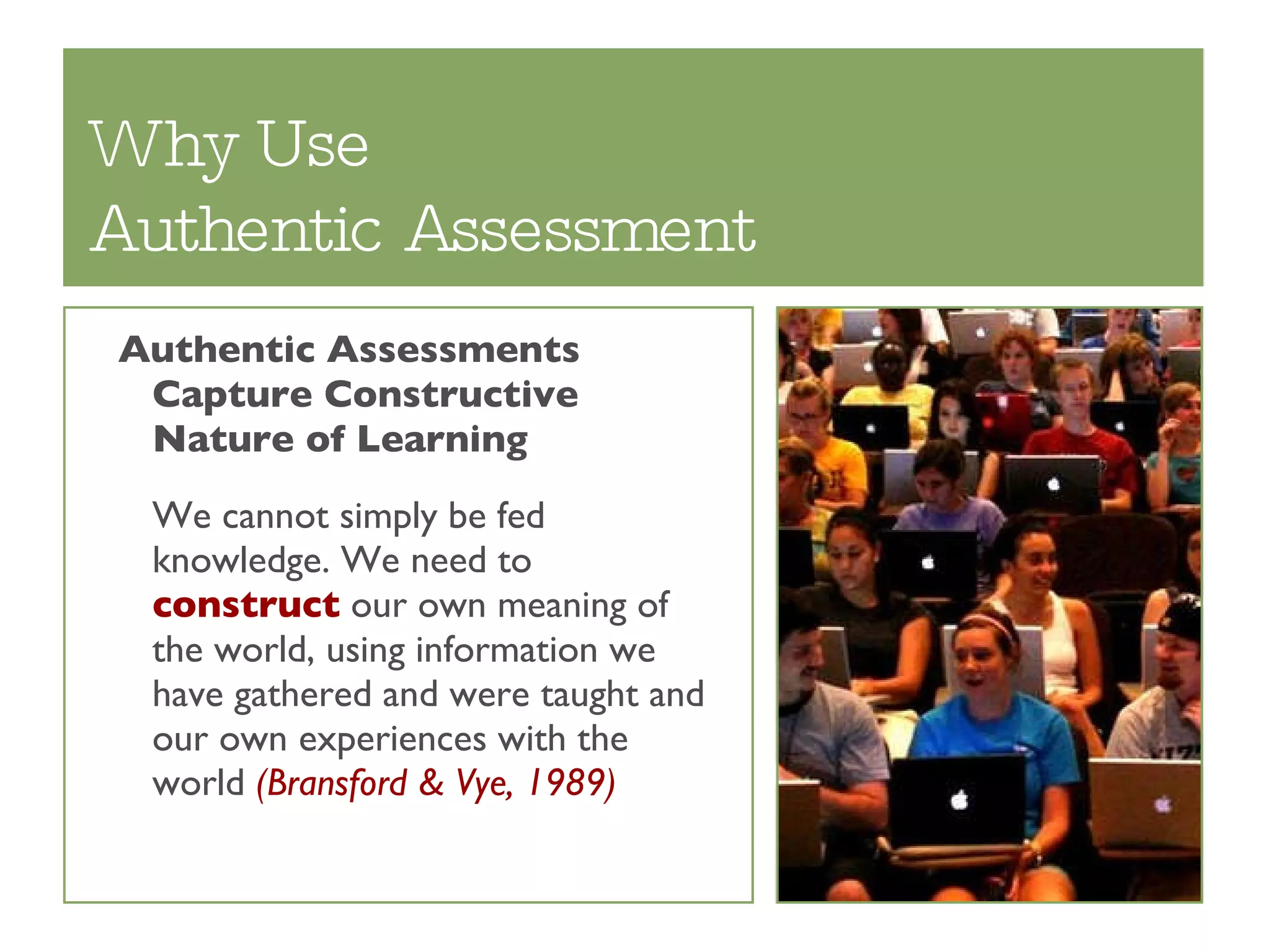
Why Use Authentic Assessment Authentic Assessments  Capture Constructive Nature of Learning   We cannot simply be fed knowledge. We need to  construct  our own meaning of the world, using information we have gathered and were taught and our own experiences with the world  (Bransford & Vye, 1989)
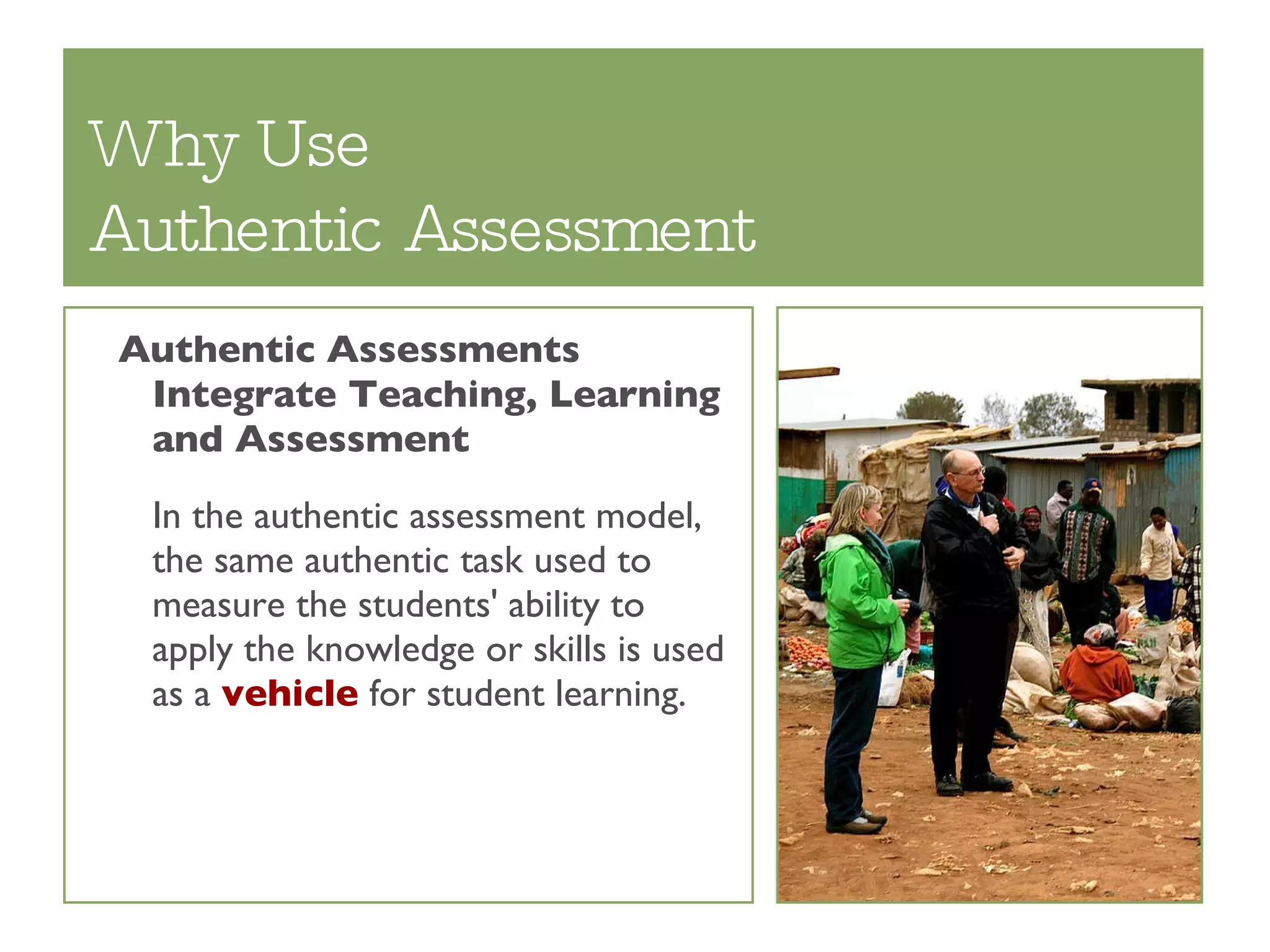
Why Use Authentic Assessment Authentic Assessments Integrate Teaching, Learning and Assessment In the authentic assessment model, the same authentic task used to measure the students' ability to apply the knowledge or skills is used as a  vehicle  for student learning.
Why Use Authentic Assessment Authentic Assessments Integrate Teaching, Learning and Assessment When presented with a real-world problem to solve, students are learning in the process of developing a solution, teachers are facilitating the process, and the students' solutions to the problem becomes an assessment of how well the students can meaningfully apply the concepts.
Why Use Authentic Assessment Authentic Assessments  Provide Multiple Paths  to Demonstration We all have different strengths and weaknesses in how we learn. Similarly, we are different in how we can best  demonstrate   what we have learned. T esting favors those who are better test-takers.
How to Create Authentic Assessments Step 1: Identify the  standards Step 2: Select an  authentic task Step 3: Identify the  criteria  for the task   Step 4: Create the  rubric  
STEP 1:  Identify the Standards Standards, like goals, are statements of what students should know and be able to do. However, standards are typically more narrow in scope and more amenable to assessment than goals.  Students will be able to add  two-digit numbers correctly.
STEP 2:  Select an Authentic Task Find a way students can demonstrate that they are fully capable of meeting the standard. The language of a well-written standard can spell out what a task should ask students to do to demonstrate their mastery of it. 
STEP 3:  Identify the Criteria for the Task Ask "What does good performance on this task look like?" or "How will I know they have done a good job on this task?"  Criteria:  Indicators of good performance on a task
STEP 3:  Identify the Criteria for the Task Characteristics  of a Good Criterion clearly stated brief observable statement of behavior written in a language students understand
STEP 3:  Identify the Criteria for the Task Standard The student will conduct banking transactions. Task make deposits, withdrawals or cash checks at a bank Criteria Selects needed form (deposit, withdrawal), Fills in form with necessary information, Endorses check, Locates open teller, States type of transaction
STEP 4:  Create the Rubric Once you have identified  the criteria you want to look for as indicators of good performance, you next decide whether to consider  the criteria analytically  or holistically.
Holistic Rubric (Accent) The student’s accent is very much affected by L1 intonation and it is difficult to understand.  1 The student’s accent is evidently very much affected by L1 intonation. However, it is fairly understandable.  2 The student’s accent is very understandable by a native American although some intonation can be inconsistent and can be traced back to L1 intonation.  3 The student’s accent has no trace of first language influence. Accent is fairly Standard American.  4 Criteria Score Level
Analytic Rubric (Composition Writing) x1 x1 x2 x2 Wt Work is Illegible.  Work has three or four areas that are sloppy.  Work has one or two areas that are sloppy.  Work is neatly done.  Neatness Words don’t fit the context; hard to understand Adequate but repetitive ; invented words Fairly broad vocabulary; some errors Few errors; precise and appropriate Vocabulary Student does not have grasp of information; student cannot answer questions about subject.  Student is uncomfortable with content and is able to demonstrate basic concepts.  Student is at ease with content, but fails to elaborate.  Student demonstrates full knowledge (more than required).  Content  Sequence of information is difficult to follow.  Reader has difficulty following work because student jumps around.  Student presents information in logical sequence which reader can follow.  Information in logical, interesting sequence which reader can follow.  Organization 1 2 3 4 Criteria
Designing a Rubric Wt No  Yes, but Yes Yes and more 1 2 3 4 Criteria
Experts Say… For many students, assessment is not an educational experience in itself, but a process of ‘guessing what the teacher wants.’ (McLaughlin & Simpson, 2004)
Thank You Best wishes  with your assessment practices!
Contact Information Alex Dugan TESOL Adventist International Institute  of Advanced Studies [email_address]

Authentic Assessment

  • 1.
    Authentic AssessmentAlex Dugan TESOL Adventist International Institute of Advanced Studies [email_address]
  • 2.
    What is AuthenticAssessment? A form of assessment in which students are asked to perform real-world tasks that demonstrate meaningful application of essential knowledge and skills Jon Mueller
  • 3.
    What is AuthenticAssessment? Performance assessments call upon the examinee to demonstrate specific skills and competencies, that is, to apply the skills and knowledge they have mastered. Richard J. Stiggins
  • 4.
    What does AuthenticAssessment look like? An authentic assessment usually includes a task for students to perform and a rubric by which their performance on the task will be evaluated.
  • 5.
    Traditional Assessment vs.Authentic Assessment Traditional Assessment ( TA ) Multiple choice Gap fill True-false Matching
  • 6.
    Traditional Assessment vs.Authentic Assessment Authentic Assessment ( AA ) Inventories Peer rating / Self rating Journals Portfolios Discussions Interviews
  • 7.
    Traditional Assessment vs.Authentic Assessment Traditional ( TA ) To develop productive citizens Must possess a body of knowledge and skills Schools must teach this body of knowledge and skills Test the students if they acquired the knowledge and skills Authentic ( AA ) To develop productive citizens Must be capable of performing real tasks Schools must help students become proficient at performing tasks Have the students perform meaningful tasks
  • 8.
    Traditional Assessment vs.Authentic Assessment Traditional ( TA ) The curriculum drives assessment.   1. body of knowledge is determined first  2. design the curriculum 3. assess to determine if acquisition of the curriculum occurred. Authentic ( AA ) Assessment drives the curriculum.  1. tasks are determined first 2. students perform to demonstrate their mastery 3. design the curriculum
  • 9.
    Traditional Assessment vs.Authentic Assessment Traditional ( TA ) Selecting a response Contrived Recall / Recognition Teacher-structured Indirect evidence Authentic ( AA ) Performing a task Real-life Construction / Application Student-structured Direct evidence
  • 10.
    Alternative Names for Authentic Assessment Performance Assessment Alternative Assessment Direct Assessment
  • 11.
    Why Use AuthenticAssessment Authentic Assessments are Direct Measures We do not just want students to  know   the content of the disciplines when they graduate. We, of course, want them to be able to  use   the acquired knowledge and skills in the real world. So, our assessments have to also tell us if students can apply what they have learned in authentic situations.
  • 12.
    Why Use AuthenticAssessment Authentic Assessments are Direct Measures Can you think of professions which require some direct demonstration of relevant skills before someone can be employed in that field?
  • 13.
    Why Use AuthenticAssessment Authentic Assessments Capture Constructive Nature of Learning We cannot simply be fed knowledge. We need to construct our own meaning of the world, using information we have gathered and were taught and our own experiences with the world (Bransford & Vye, 1989)
  • 14.
    Why Use AuthenticAssessment Authentic Assessments Integrate Teaching, Learning and Assessment In the authentic assessment model, the same authentic task used to measure the students' ability to apply the knowledge or skills is used as a vehicle for student learning.
  • 15.
    Why Use AuthenticAssessment Authentic Assessments Integrate Teaching, Learning and Assessment When presented with a real-world problem to solve, students are learning in the process of developing a solution, teachers are facilitating the process, and the students' solutions to the problem becomes an assessment of how well the students can meaningfully apply the concepts.
  • 16.
    Why Use AuthenticAssessment Authentic Assessments Provide Multiple Paths to Demonstration We all have different strengths and weaknesses in how we learn. Similarly, we are different in how we can best demonstrate   what we have learned. T esting favors those who are better test-takers.
  • 17.
    How to CreateAuthentic Assessments Step 1: Identify the standards Step 2: Select an authentic task Step 3: Identify the criteria for the task Step 4: Create the rubric  
  • 18.
    STEP 1: Identify the Standards Standards, like goals, are statements of what students should know and be able to do. However, standards are typically more narrow in scope and more amenable to assessment than goals.  Students will be able to add two-digit numbers correctly.
  • 19.
    STEP 2: Select an Authentic Task Find a way students can demonstrate that they are fully capable of meeting the standard. The language of a well-written standard can spell out what a task should ask students to do to demonstrate their mastery of it. 
  • 20.
    STEP 3: Identify the Criteria for the Task Ask "What does good performance on this task look like?" or "How will I know they have done a good job on this task?" Criteria:  Indicators of good performance on a task
  • 21.
    STEP 3: Identify the Criteria for the Task Characteristics of a Good Criterion clearly stated brief observable statement of behavior written in a language students understand
  • 22.
    STEP 3: Identify the Criteria for the Task Standard The student will conduct banking transactions. Task make deposits, withdrawals or cash checks at a bank Criteria Selects needed form (deposit, withdrawal), Fills in form with necessary information, Endorses check, Locates open teller, States type of transaction
  • 23.
    STEP 4: Create the Rubric Once you have identified the criteria you want to look for as indicators of good performance, you next decide whether to consider the criteria analytically or holistically.
  • 24.
    Holistic Rubric (Accent)The student’s accent is very much affected by L1 intonation and it is difficult to understand. 1 The student’s accent is evidently very much affected by L1 intonation. However, it is fairly understandable. 2 The student’s accent is very understandable by a native American although some intonation can be inconsistent and can be traced back to L1 intonation. 3 The student’s accent has no trace of first language influence. Accent is fairly Standard American. 4 Criteria Score Level
  • 25.
    Analytic Rubric (CompositionWriting) x1 x1 x2 x2 Wt Work is Illegible. Work has three or four areas that are sloppy. Work has one or two areas that are sloppy. Work is neatly done. Neatness Words don’t fit the context; hard to understand Adequate but repetitive ; invented words Fairly broad vocabulary; some errors Few errors; precise and appropriate Vocabulary Student does not have grasp of information; student cannot answer questions about subject. Student is uncomfortable with content and is able to demonstrate basic concepts. Student is at ease with content, but fails to elaborate. Student demonstrates full knowledge (more than required). Content Sequence of information is difficult to follow. Reader has difficulty following work because student jumps around. Student presents information in logical sequence which reader can follow. Information in logical, interesting sequence which reader can follow. Organization 1 2 3 4 Criteria
  • 26.
    Designing a RubricWt No Yes, but Yes Yes and more 1 2 3 4 Criteria
  • 27.
    Experts Say… Formany students, assessment is not an educational experience in itself, but a process of ‘guessing what the teacher wants.’ (McLaughlin & Simpson, 2004)
  • 28.
    Thank You Bestwishes with your assessment practices!
  • 29.
    Contact Information AlexDugan TESOL Adventist International Institute of Advanced Studies [email_address]

Editor's Notes

  • #3 mention download tech planning guide
  • #4 mention download tech planning guide
  • #5 mention download tech planning guide
  • #11 mention download tech planning guide
  • #12 mention download tech planning guide
  • #30 post it notes for handouts, real mailing address for sample student guide