Authentic Assessment:
Meaning, Characteristics
and Practices
Reporter: Ryan Chris C. Handugan
Assessment - refers to the process of
gathering data and information about
what students know and can do.
Evaluation - involves the task of
interpreting, forming conclusion and
making judgments about the
information which was gathered in the
process of assessment.
Testing is an instrument of assessment.
A test is an assessment tool that reflects
the records of the students’ learning
outcomes.
Marks are reports of the results of
evaluating information obtained in the
assessment process..
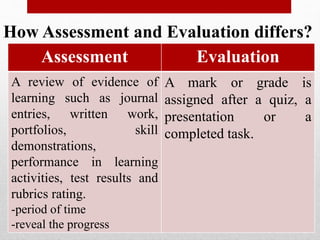
Assessment Evaluation
A review of evidence of
learning such as journal
entries, written work,
portfolios, skill
demonstrations,
performance in learning
activities, test results and
rubrics rating.
-period of time
-reveal the progress
A mark or grade is
assigned after a quiz, a
presentation or a
completed task.
How Assessment and Evaluation differs?
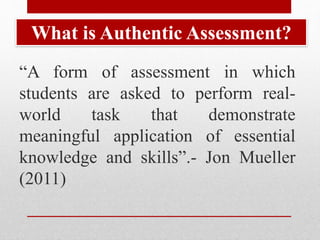
What is Authentic Assessment?
“A form of assessment in which
students are asked to perform real-
world task that demonstrate
meaningful application of essential
knowledge and skills”.- Jon Mueller
(2011)
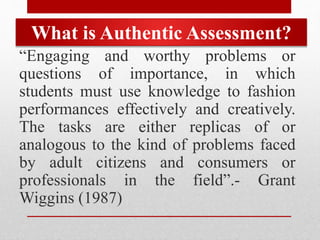
What is Authentic Assessment?
“Engaging and worthy problems or
questions of importance, in which
students must use knowledge to fashion
performances effectively and creatively.
The tasks are either replicas of or
analogous to the kind of problems faced
by adult citizens and consumers or
professionals in the field”.- Grant
Wiggins (1987)
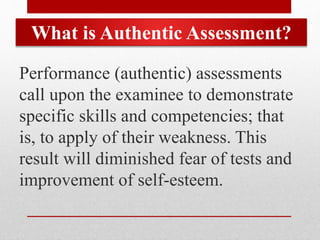
What is Authentic Assessment?
Performance (authentic) assessments
call upon the examinee to demonstrate
specific skills and competencies; that
is, to apply of their weakness. This
result will diminished fear of tests and
improvement of self-esteem.
What is Authentic Assessment?
Performance (authentic) assessments
call upon the examinee to demonstrate
specific skills and competencies; that
is, to apply of their weakness. This
result will diminished fear of tests and
improvement of self-esteem.
What is Authentic Assessment?
Other names for authentic assessment
are:
performance assessment,
alternative assessment, and
direct assessment
Why Authentic Assessment?
The common practice of using recall
and recognition objective the skills
and knowledge they have mastered.
(Stiggins, 1987)
Authentic assessments are products
and/or performances correlated with
real life experiences- Newton Public
Schools.
Characteristics of Authentic Assessment
1. AA starts with clear and definite criteria of performance
made known to the students.
2. AA is criterion-referenced rather than norm-referenced
and so it identifies strengths and weaknesses, but does not
compare students nor rank their levels of performance.
3. AA requires students to make their own answer to
questions rather than select from given options as multiple
choice items, and requires them to use a range of higher
order thinking skills.
Characteristics of Authentic Assessment
4. AA often emphasizes performance and
therefore students are required to demonstrate
their knowledge, skills or competencies in
appropriate situations. AA does not rely on ability
to recall facts or memorize details, instead
students are asked to demonstrate skills and
concepts they have learned.
5. AA encourages both teacher and students to
determine their rate of progress in cooperatively
attaining the desired student learning outcomes.
Characteristics of Authentic Assessment
6. AA does not encourage repetitive learning and
passive taking of tests; instead, students are
required to demonstrate analytical skills, ability
to integrate what they learn, creativity, and
ability to work in a group, skills in oral and
written communications.
Characteristics of Authentic Assessment
7. AA changes the role of students as passive test
takers into becoming active and involved
participants in assessment activities that
emphasize what are capable of doing instead
tests to measure students’ skill or retained facts
has come under scrutiny because if the limitation
encountered in determining the student’s
capability to utilize their knowledge and skills in
work and professional practice.
Final Thoughts:
From teacher-centered activities, AA encourages
a learner-centered class where teacher’s major
role is to help students accept responsibility for
their learning and becoming self-evaluators.
The teacher designs activities and evaluates
results which provide information needed for
monitoring students’ progress and evaluating the
teacher’s instructional strategies

Authentic Assessment

  • 1.
    Authentic Assessment: Meaning, Characteristics andPractices Reporter: Ryan Chris C. Handugan
  • 2.
    Assessment - refersto the process of gathering data and information about what students know and can do. Evaluation - involves the task of interpreting, forming conclusion and making judgments about the information which was gathered in the process of assessment.
  • 3.
    Testing is aninstrument of assessment. A test is an assessment tool that reflects the records of the students’ learning outcomes. Marks are reports of the results of evaluating information obtained in the assessment process..
  • 4.
    Assessment Evaluation A reviewof evidence of learning such as journal entries, written work, portfolios, skill demonstrations, performance in learning activities, test results and rubrics rating. -period of time -reveal the progress A mark or grade is assigned after a quiz, a presentation or a completed task. How Assessment and Evaluation differs?
  • 5.
    What is AuthenticAssessment? “A form of assessment in which students are asked to perform real- world task that demonstrate meaningful application of essential knowledge and skills”.- Jon Mueller (2011)
  • 6.
    What is AuthenticAssessment? “Engaging and worthy problems or questions of importance, in which students must use knowledge to fashion performances effectively and creatively. The tasks are either replicas of or analogous to the kind of problems faced by adult citizens and consumers or professionals in the field”.- Grant Wiggins (1987)
  • 7.
    What is AuthenticAssessment? Performance (authentic) assessments call upon the examinee to demonstrate specific skills and competencies; that is, to apply of their weakness. This result will diminished fear of tests and improvement of self-esteem.
  • 8.
    What is AuthenticAssessment? Performance (authentic) assessments call upon the examinee to demonstrate specific skills and competencies; that is, to apply of their weakness. This result will diminished fear of tests and improvement of self-esteem.
  • 9.
    What is AuthenticAssessment? Other names for authentic assessment are: performance assessment, alternative assessment, and direct assessment
  • 10.
    Why Authentic Assessment? Thecommon practice of using recall and recognition objective the skills and knowledge they have mastered. (Stiggins, 1987) Authentic assessments are products and/or performances correlated with real life experiences- Newton Public Schools.
  • 11.
    Characteristics of AuthenticAssessment 1. AA starts with clear and definite criteria of performance made known to the students. 2. AA is criterion-referenced rather than norm-referenced and so it identifies strengths and weaknesses, but does not compare students nor rank their levels of performance. 3. AA requires students to make their own answer to questions rather than select from given options as multiple choice items, and requires them to use a range of higher order thinking skills.
  • 12.
    Characteristics of AuthenticAssessment 4. AA often emphasizes performance and therefore students are required to demonstrate their knowledge, skills or competencies in appropriate situations. AA does not rely on ability to recall facts or memorize details, instead students are asked to demonstrate skills and concepts they have learned. 5. AA encourages both teacher and students to determine their rate of progress in cooperatively attaining the desired student learning outcomes.
  • 13.
    Characteristics of AuthenticAssessment 6. AA does not encourage repetitive learning and passive taking of tests; instead, students are required to demonstrate analytical skills, ability to integrate what they learn, creativity, and ability to work in a group, skills in oral and written communications.
  • 14.
    Characteristics of AuthenticAssessment 7. AA changes the role of students as passive test takers into becoming active and involved participants in assessment activities that emphasize what are capable of doing instead tests to measure students’ skill or retained facts has come under scrutiny because if the limitation encountered in determining the student’s capability to utilize their knowledge and skills in work and professional practice.
  • 15.
    Final Thoughts: From teacher-centeredactivities, AA encourages a learner-centered class where teacher’s major role is to help students accept responsibility for their learning and becoming self-evaluators. The teacher designs activities and evaluates results which provide information needed for monitoring students’ progress and evaluating the teacher’s instructional strategies