Theory of Experiential Learning Vida Williams Walden University Richard W. Riley School of Education and Leadership EdD Student EDUC 8101
Objectives To construct a definition of experiential learning. To identify individuals who use experiential learning. To identify the strengths of experiential learning.
Consider What is you definition of learning? What role does  experience play in the learning process? What are the different stages of experiential learning? How does experiential learning benefit us?
Definition of Learning. Learning is acquiring information or “knowing a lot” Learning is storing information that can be reproduced. Learning involves relating parts of the subject matter to each other and to the real world. Learning is interpreting and understanding reality in a different way.
David Kolb   Learning emphasizes the learner’s perspective. Learning is crucial to the experiential learning concept. Experiential means one learns and develops through his own personal experiences and involvements. Experiential learning  can be described as  “ hands on.”
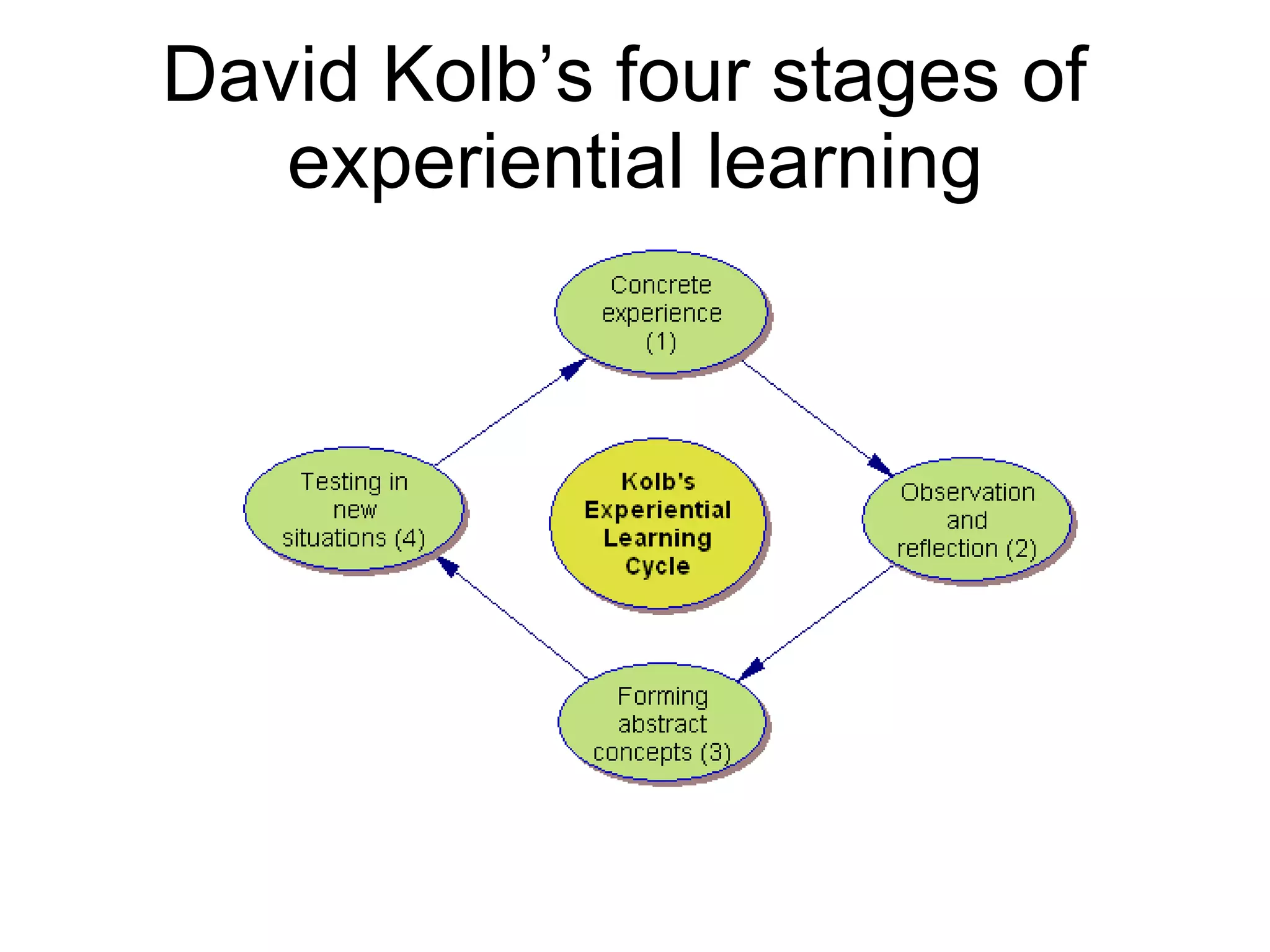
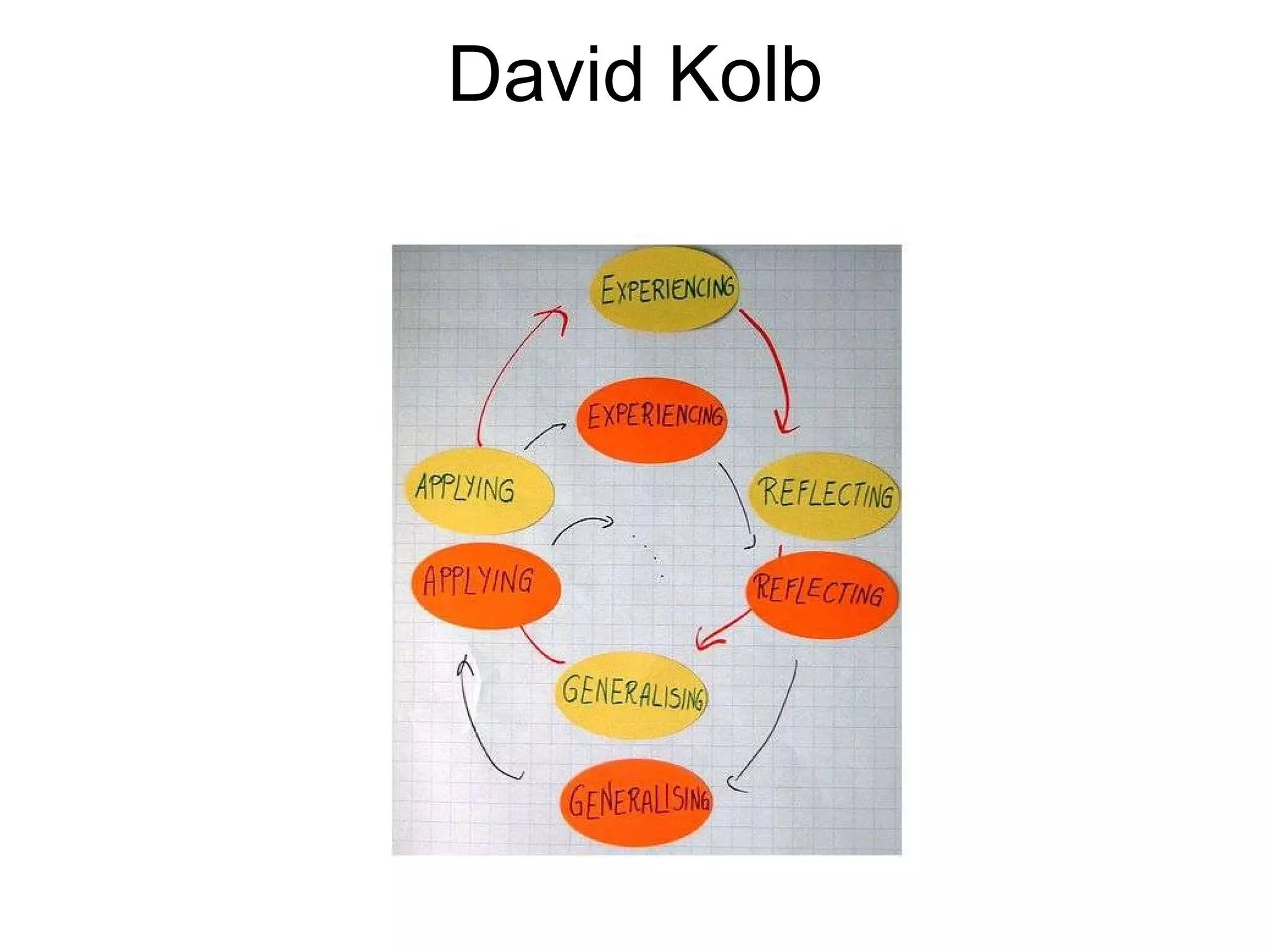
David Kolb’s four stages of  experiential learning
Four-stage cycle of learning Immediate or concrete experiences (CE) or feeling. Observation and reflecting (RO) or watching. Abstract concepts (AC) or thinking. Actively tested (Experimentation) (AE) or watching.
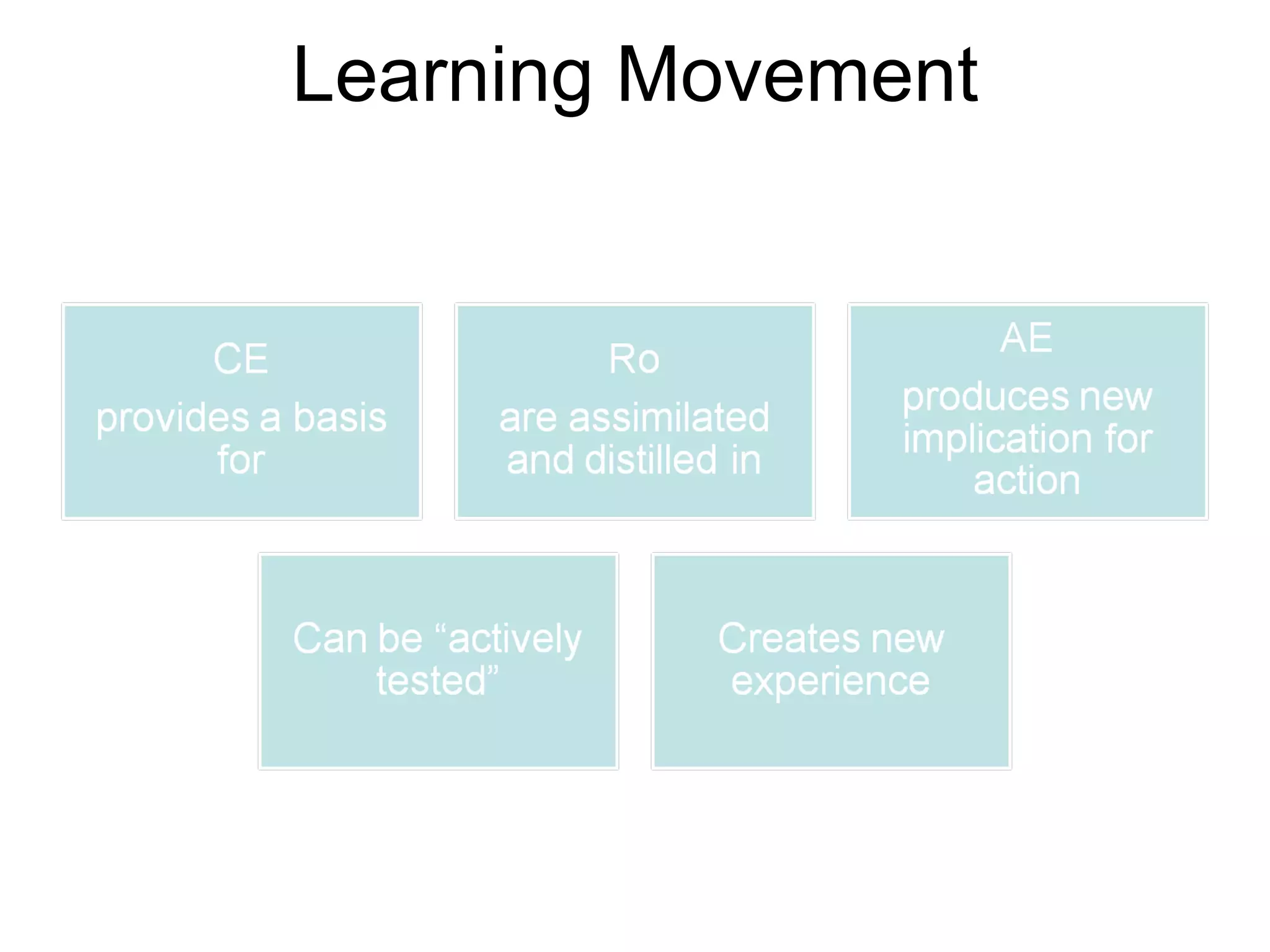
Learning Movement
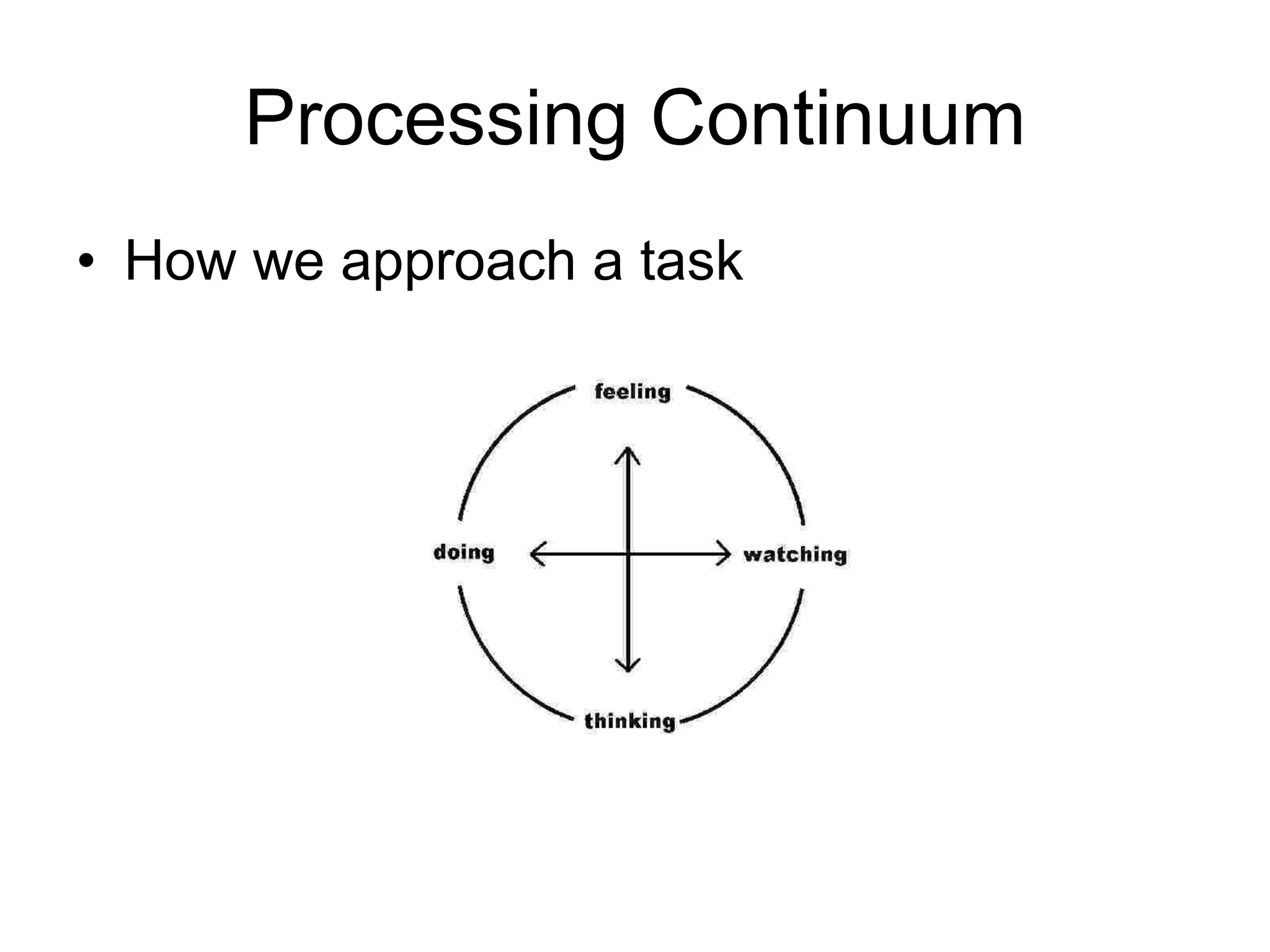
Processing Continuum How we approach a task
Processing continuum II East- West axis or  Processing Continuum   how we approach a task. Watch or do. . North-South axis or  Perception Continuum our emotional response or how we feel about it. Think or feel.
David Kolb
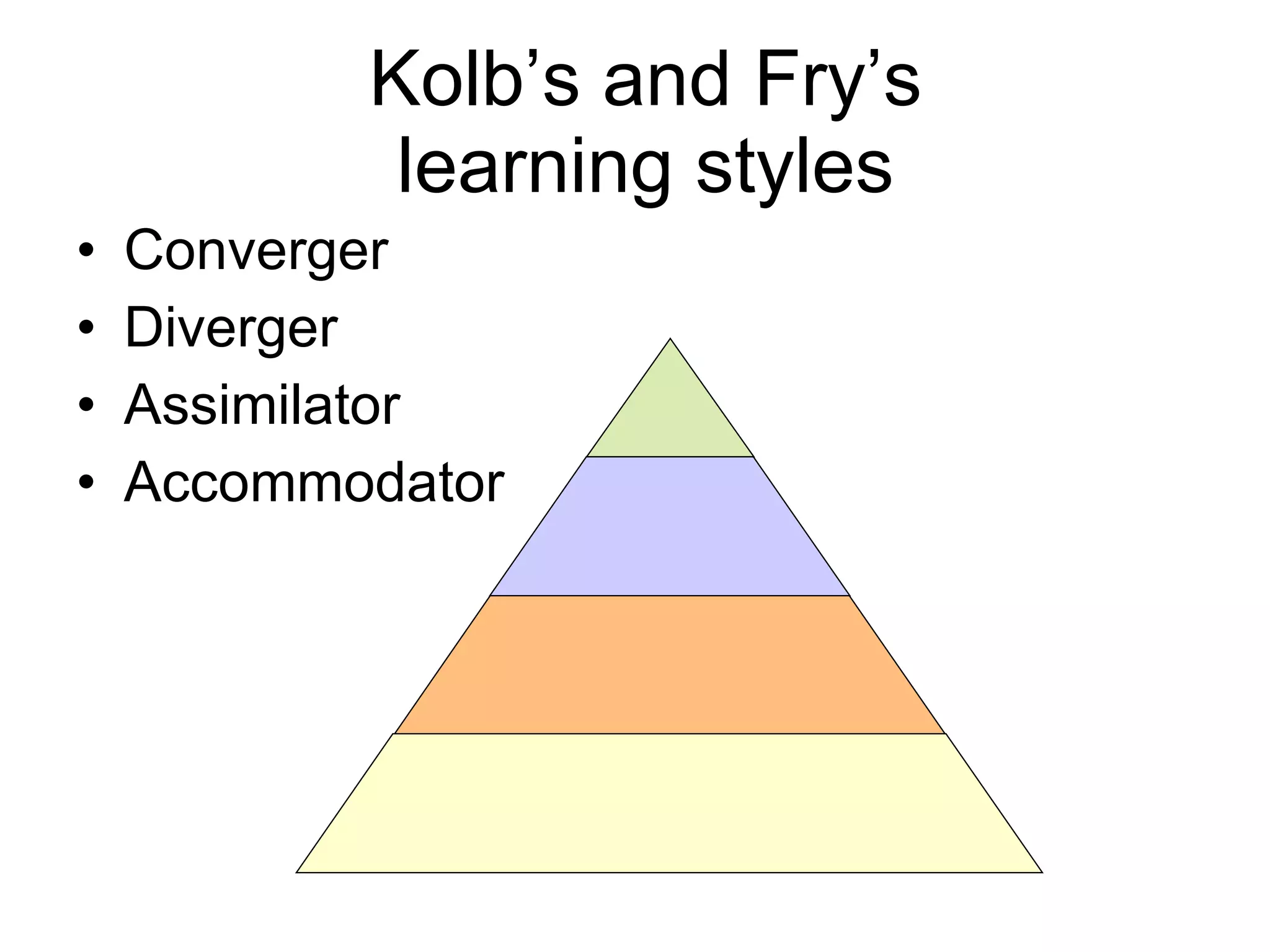
Kolb’s and Fry’s  learning styles Converger Diverger Assimilator Accommodator
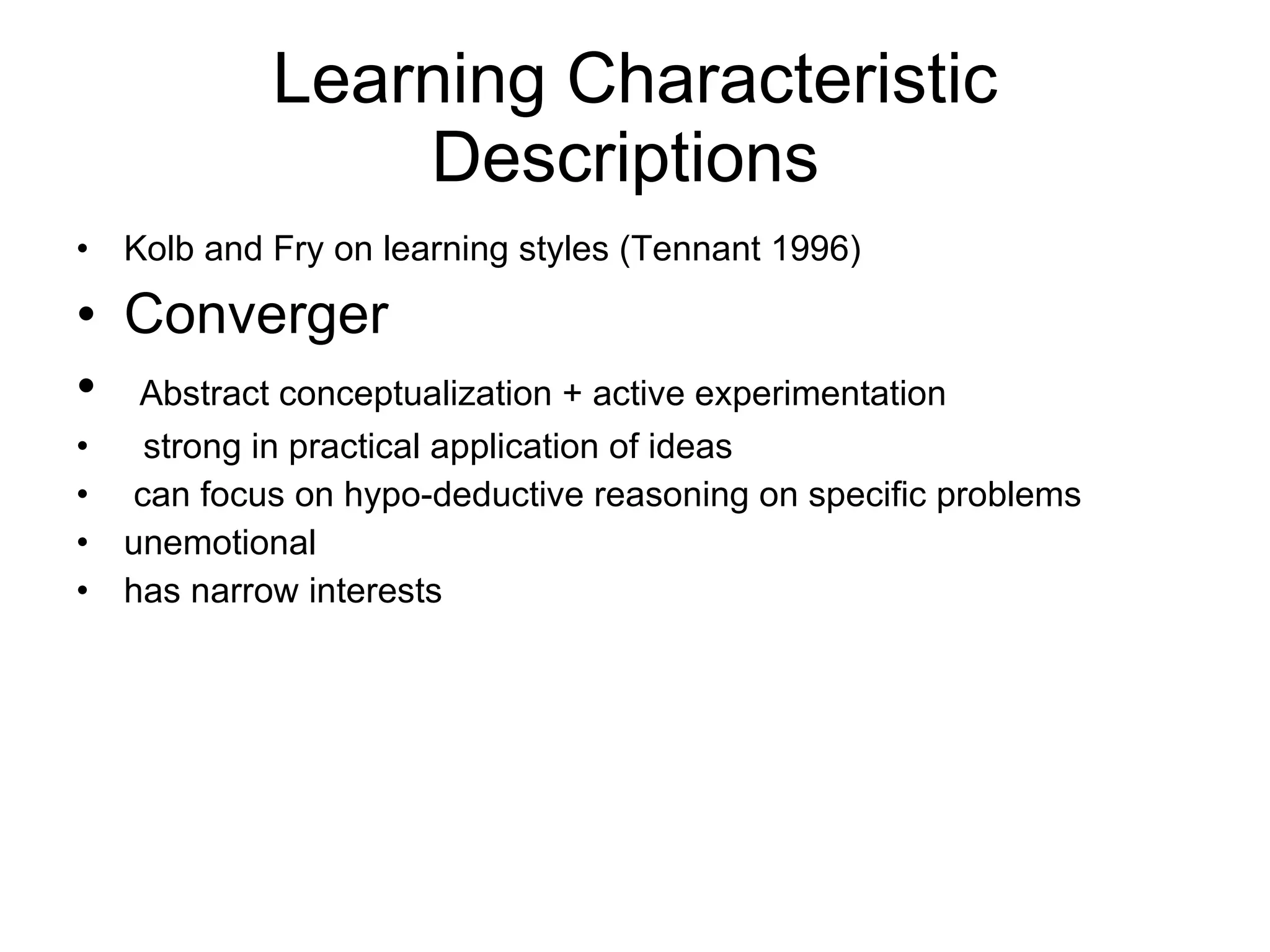
Learning Characteristic Descriptions  Kolb and Fry on learning styles (Tennant 1996) Converger Abstract conceptualization + active experimentation strong in practical application of ideas can focus on hypo-deductive reasoning on specific problems unemotional has narrow interests
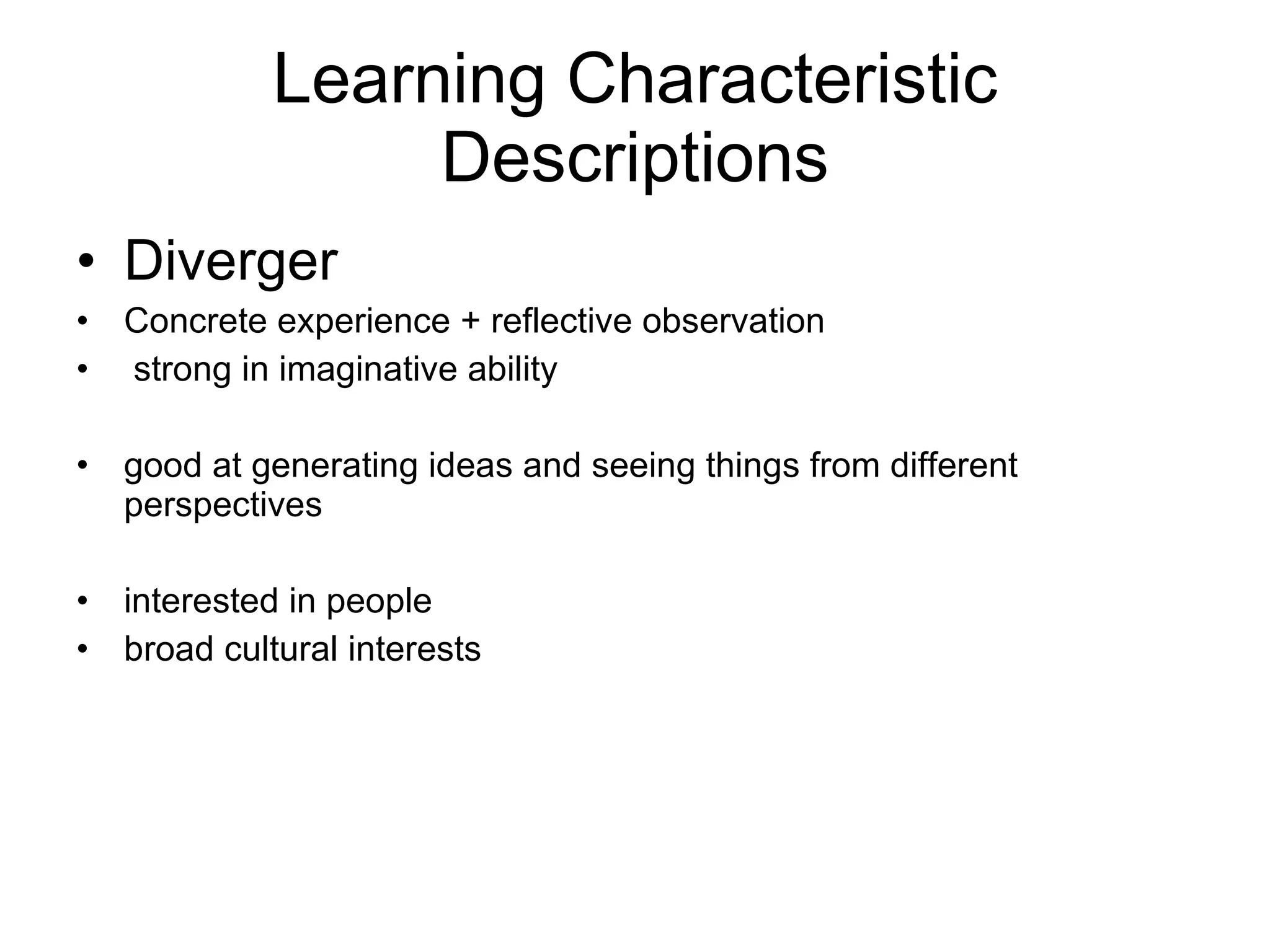
Learning Characteristic Descriptions Diverger Concrete experience + reflective observation strong in imaginative ability good at generating ideas and seeing things from different perspectives interested in people broad cultural interests
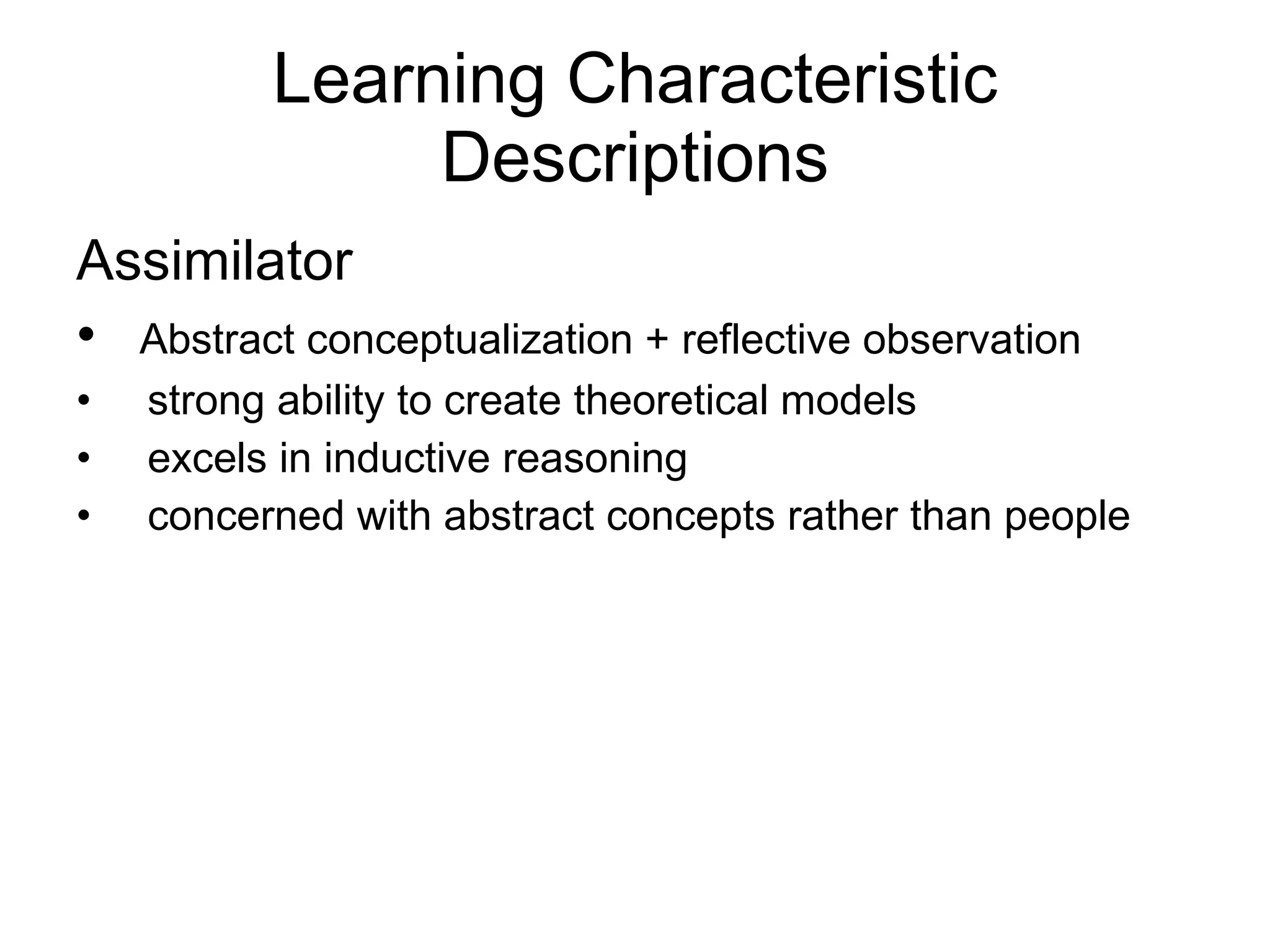
Learning Characteristic Descriptions Assimilator Abstract conceptualization + reflective observation strong ability to create theoretical models excels in inductive reasoning concerned with abstract concepts rather than people
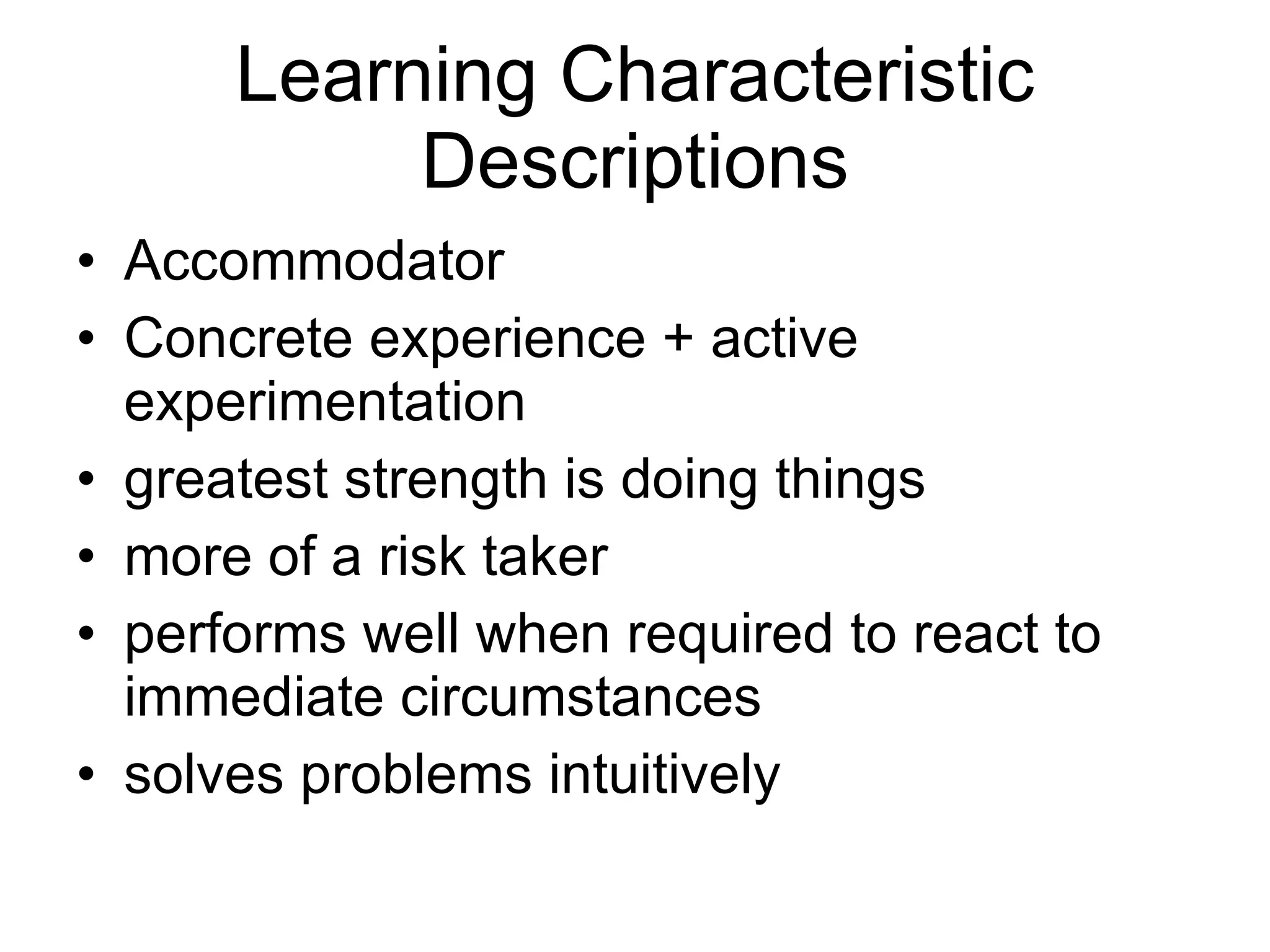
Learning Characteristic Descriptions Accommodator Concrete experience + active experimentation greatest strength is doing things more of a risk taker performs well when required to react to immediate circumstances solves problems intuitively
Carl Roger’s experiential learning Learning is easier if the personal self-esteem is not threatened External pressures must be dramatically decreased The knowledge acquired through a self-initiated learning is more durable. Experiential learning can be seen as a self-initiation personal development and growth
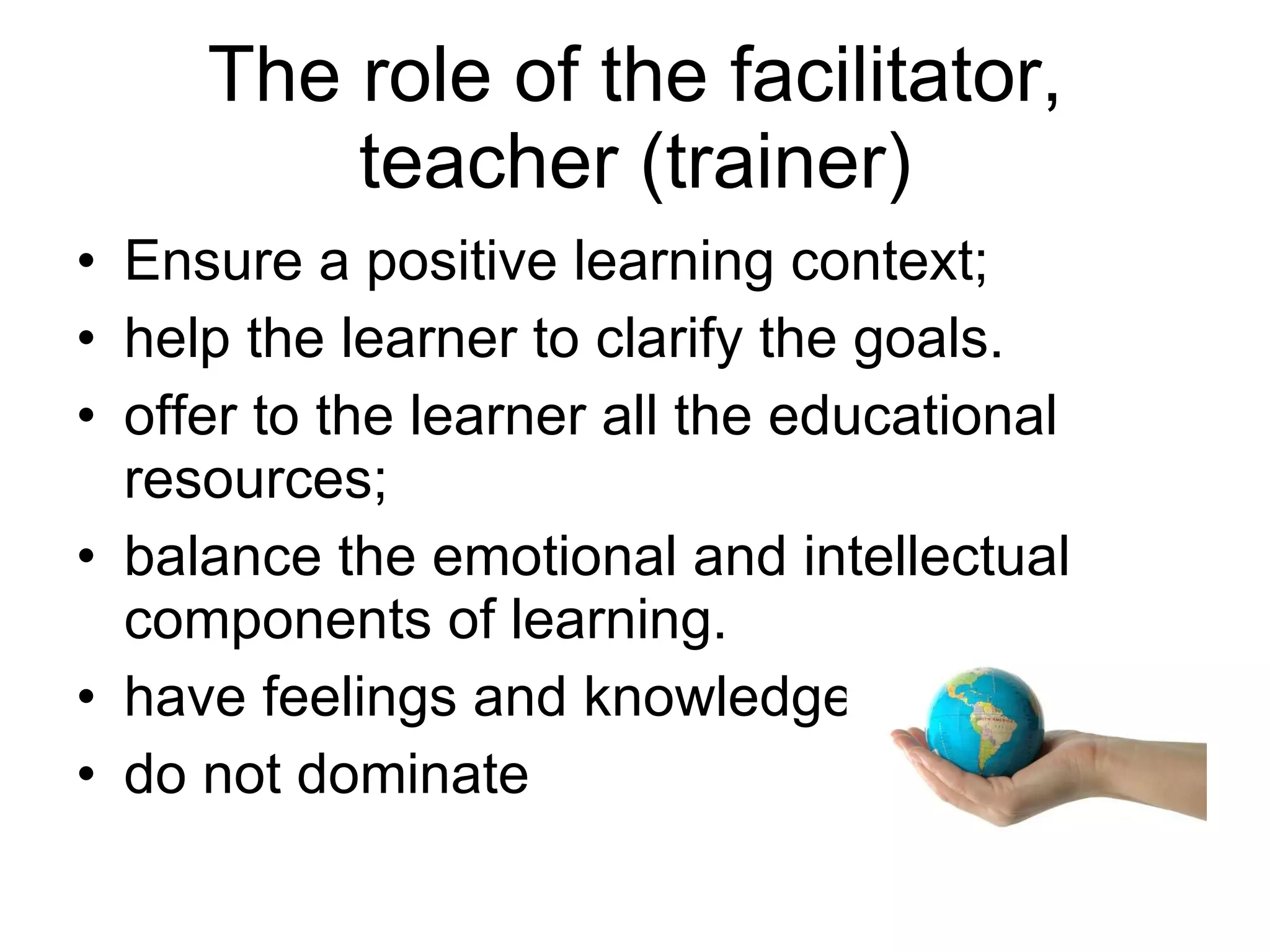
The role of the facilitator, teacher (trainer) Ensure a positive learning context; help the learner to clarify the goals. offer to the learner all the educational resources; balance the emotional and intellectual components of learning. have feelings and knowledge do not dominate
Examples of experiential learning Going to the zoo and learning through observation and interaction with the zoo environment , as opposed to reading about animals from a book. Playing simple games such as hopscotch. These games can teach many valuable academic and social skills.
An effective facilitator Is passionate about his or her work. Is able to immerse participants totally in the learning situation. Allows students to gain knowledge from their peers and the environment created.
Benefits of experiential learning Can help to provide a positive emotional platform for future learning. Keeps learner motivated. Provides a way to break out of the received conditioned training and teaching practices that constrain people’s development at school and work.
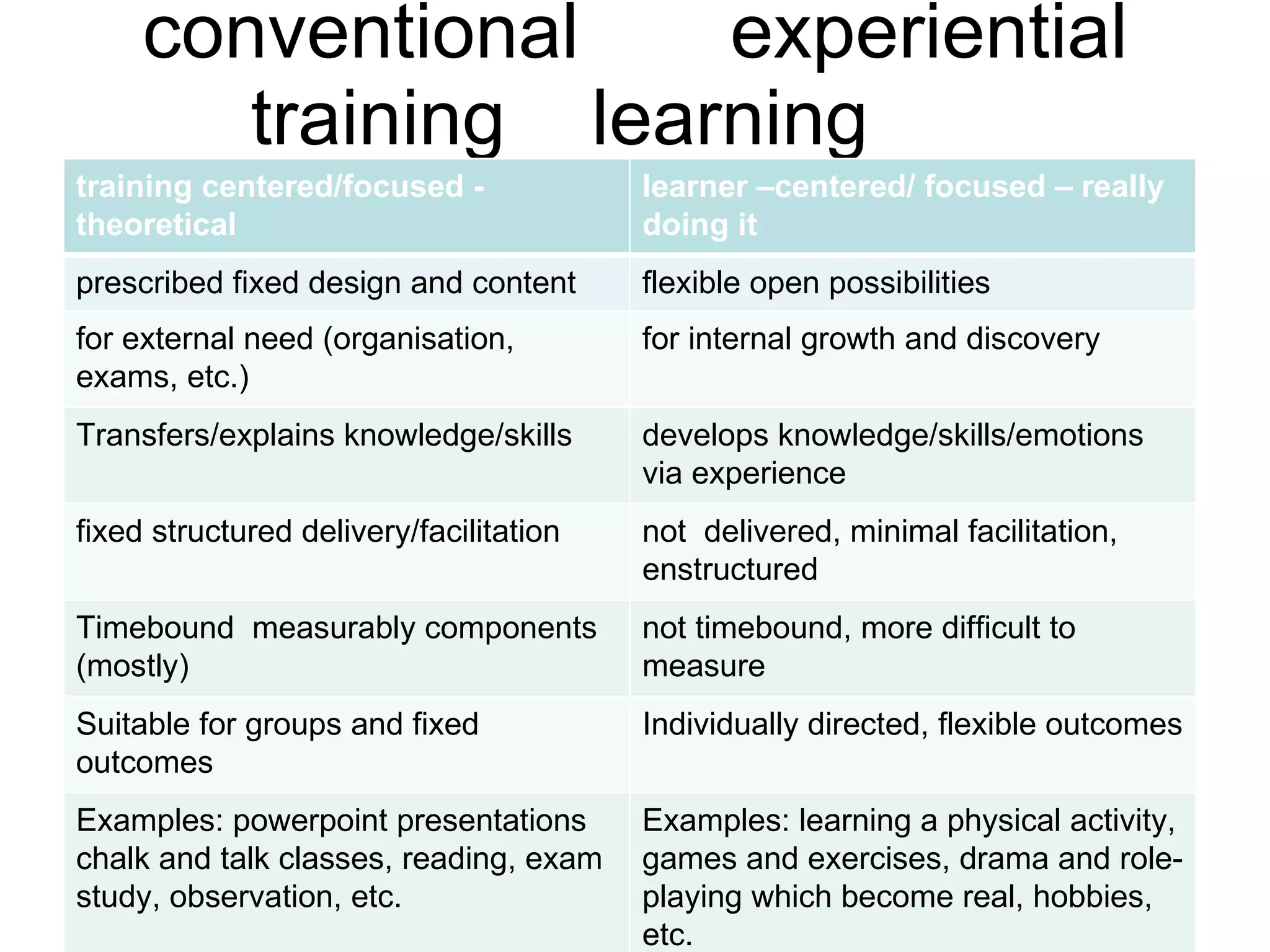
conventional  experiential training  learning  training centered/focused - theoretical learner –centered/ focused – really doing it prescribed fixed design and content flexible open possibilities for external need (organisation, exams, etc.) for internal growth and discovery Transfers/explains knowledge/skills develops knowledge/skills/emotions via experience fixed structured delivery/facilitation not  delivered, minimal facilitation, enstructured Timebound  measurably components (mostly) not timebound, more difficult to measure Suitable for groups and fixed outcomes Individually directed, flexible outcomes Examples: powerpoint presentations chalk and talk classes, reading, exam study, observation, etc. Examples: learning a physical activity, games and exercises, drama and role-playing which become real, hobbies, etc.


References Kolb, D. (1984). Experiential learning:  Experience as the source of learning and development. Englewood cliffs, N.J.: Prentice Hall Kolb D.A. and Fry, R. (1975) “Towards an applied theory of experiential learning., in C. Cooper (ed.) Theories of group Process, London
References Merriam, S. Caffarella, R, & Baumgartner, L. (2007) learning in adulthood:  A comprehensive guide, third edition. San Francisco, CA: Josey-Bass. Rogers, C.R. (1969) Freedom to learn. Columbus, OH: Merrill.
References Thompson, M., (2009), Beyond the Ropes’ Mta international learning


Theory Of Experiential Learning Fields[1]

  • 1.
    Theory of ExperientialLearning Vida Williams Walden University Richard W. Riley School of Education and Leadership EdD Student EDUC 8101
  • 2.
    Objectives To constructa definition of experiential learning. To identify individuals who use experiential learning. To identify the strengths of experiential learning.
  • 3.
    Consider What isyou definition of learning? What role does experience play in the learning process? What are the different stages of experiential learning? How does experiential learning benefit us?
  • 4.
    Definition of Learning.Learning is acquiring information or “knowing a lot” Learning is storing information that can be reproduced. Learning involves relating parts of the subject matter to each other and to the real world. Learning is interpreting and understanding reality in a different way.
  • 5.
    David Kolb Learning emphasizes the learner’s perspective. Learning is crucial to the experiential learning concept. Experiential means one learns and develops through his own personal experiences and involvements. Experiential learning can be described as “ hands on.”
  • 6.
    David Kolb’s fourstages of experiential learning
  • 7.
    Four-stage cycle oflearning Immediate or concrete experiences (CE) or feeling. Observation and reflecting (RO) or watching. Abstract concepts (AC) or thinking. Actively tested (Experimentation) (AE) or watching.
  • 8.
  • 9.
    Processing Continuum Howwe approach a task
  • 10.
    Processing continuum IIEast- West axis or Processing Continuum how we approach a task. Watch or do. . North-South axis or Perception Continuum our emotional response or how we feel about it. Think or feel.
  • 11.
  • 12.
    Kolb’s and Fry’s learning styles Converger Diverger Assimilator Accommodator
  • 13.
    Learning Characteristic Descriptions Kolb and Fry on learning styles (Tennant 1996) Converger Abstract conceptualization + active experimentation strong in practical application of ideas can focus on hypo-deductive reasoning on specific problems unemotional has narrow interests
  • 14.
    Learning Characteristic DescriptionsDiverger Concrete experience + reflective observation strong in imaginative ability good at generating ideas and seeing things from different perspectives interested in people broad cultural interests
  • 15.
    Learning Characteristic DescriptionsAssimilator Abstract conceptualization + reflective observation strong ability to create theoretical models excels in inductive reasoning concerned with abstract concepts rather than people
  • 16.
    Learning Characteristic DescriptionsAccommodator Concrete experience + active experimentation greatest strength is doing things more of a risk taker performs well when required to react to immediate circumstances solves problems intuitively
  • 17.
    Carl Roger’s experientiallearning Learning is easier if the personal self-esteem is not threatened External pressures must be dramatically decreased The knowledge acquired through a self-initiated learning is more durable. Experiential learning can be seen as a self-initiation personal development and growth
  • 18.
    The role ofthe facilitator, teacher (trainer) Ensure a positive learning context; help the learner to clarify the goals. offer to the learner all the educational resources; balance the emotional and intellectual components of learning. have feelings and knowledge do not dominate
  • 19.
    Examples of experientiallearning Going to the zoo and learning through observation and interaction with the zoo environment , as opposed to reading about animals from a book. Playing simple games such as hopscotch. These games can teach many valuable academic and social skills.
  • 20.
    An effective facilitatorIs passionate about his or her work. Is able to immerse participants totally in the learning situation. Allows students to gain knowledge from their peers and the environment created.
  • 21.
    Benefits of experientiallearning Can help to provide a positive emotional platform for future learning. Keeps learner motivated. Provides a way to break out of the received conditioned training and teaching practices that constrain people’s development at school and work.
  • 22.
    conventional experientialtraining learning training centered/focused - theoretical learner –centered/ focused – really doing it prescribed fixed design and content flexible open possibilities for external need (organisation, exams, etc.) for internal growth and discovery Transfers/explains knowledge/skills develops knowledge/skills/emotions via experience fixed structured delivery/facilitation not delivered, minimal facilitation, enstructured Timebound measurably components (mostly) not timebound, more difficult to measure Suitable for groups and fixed outcomes Individually directed, flexible outcomes Examples: powerpoint presentations chalk and talk classes, reading, exam study, observation, etc. Examples: learning a physical activity, games and exercises, drama and role-playing which become real, hobbies, etc.
  • 23.
  • 24.
  • 25.
  • 26.
    References Kolb, D.(1984). Experiential learning: Experience as the source of learning and development. Englewood cliffs, N.J.: Prentice Hall Kolb D.A. and Fry, R. (1975) “Towards an applied theory of experiential learning., in C. Cooper (ed.) Theories of group Process, London
  • 27.
    References Merriam, S.Caffarella, R, & Baumgartner, L. (2007) learning in adulthood: A comprehensive guide, third edition. San Francisco, CA: Josey-Bass. Rogers, C.R. (1969) Freedom to learn. Columbus, OH: Merrill.
  • 28.
    References Thompson, M.,(2009), Beyond the Ropes’ Mta international learning
  • 29.
  • 30.
  • 31.
  • 32.
  • 33.
  • 34.
  • 35.

Editor's Notes

  • #2 Good evening everyone before I start I would like to share one of my most memorable learning experience.