Walking the Talk of Ethics
CCVA 2014
1
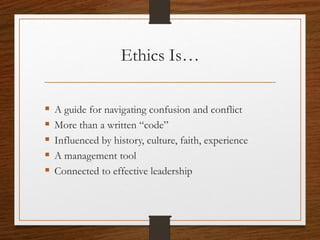
Ethics Is…
 A guide for navigating confusion and conflict
 More than a written “code”
 Influenced by history, culture, faith, experience
 A management tool
 Connected to effective leadership
CCVA 2014
2
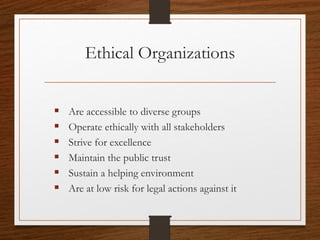
Ethical Organizations
 Are accessible to diverse groups
 Operate ethically with all stakeholders
 Strive for excellence
 Maintain the public trust
 Sustain a helping environment
 Are at low risk for legal actions against it
CCVA 2014
3
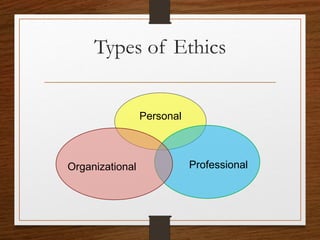
Types of Ethics
Personal
ProfessionalOrganizational
CCVA 2014
4
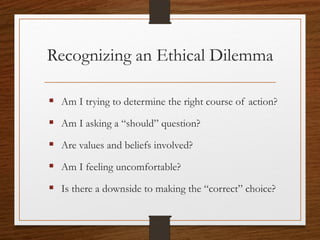
Recognizing an Ethical Dilemma
 Am I trying to determine the right course of action?
 Am I asking a “should” question?
 Are values and beliefs involved?
 Am I feeling uncomfortable?
 Is there a downside to making the “correct” choice?
CCVA 2014
5
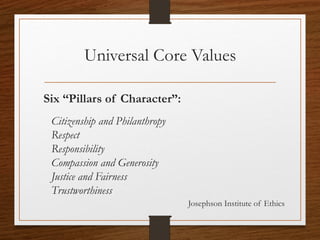
Universal Core Values
Six “Pillars of Character”:
Citizenship and Philanthropy
Respect
Responsibility
Compassion and Generosity
Justice and Fairness
Trustworthiness
Josephson Institute of Ethics
CCVA 2014
6
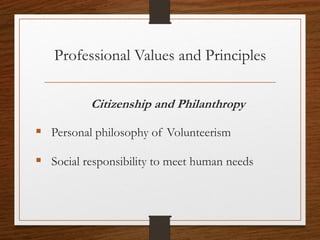
Professional Values and Principles
Citizenship and Philanthropy
 Personal philosophy of volunteerism
 Social responsibility to meet human needs
CCVA 2014
7
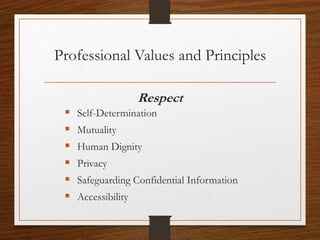
Professional Values and Principles
Respect
 Self-determination
 Mutuality
 Human dignity
 Privacy
 Safeguarding confidential information
 Accessibility
CCVA 2014
8
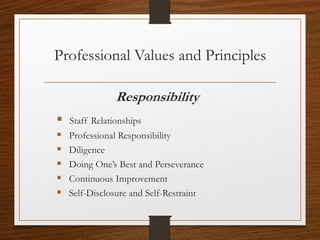
Professional Values and Principles
Responsibility
 Staff relationships
 Professional responsibility
 Diligence
 Doing one’s best and perseverance
 Continuous Improvement
 Self-disclosure and self-restraint
CCVA 2014
9
Professional Values and Principles
Compassion and Generosity
 Caring and kindness
 Minimal harm to others
CCVA 2014
10
Professional Values and Principles
Justice and Fairness
 Procedural fairness
 Impartiality
 Equity
CCVA 2014
11
Professional Values and Principles
Trustworthiness
 Truthfulness and candor
 Sincerity/Non-deception
 Principled and moral courage
 Reasonability & clarity of commitments
 Limitations to loyalty
 Addressing conflict of interests
CCVA 2014
12
Real-Life Scenario I
 You are Director of Volunteer Services at a residential facility for
seniors.
 An anonymous note was left on your desk, accusing a volunteer
named Ruth of downloading and sharing information about
residents.
 As far as you know, Ruth does not have access to any confidential
files and has very limited computer skills.
 However, you am aware that Ruth has a reputation among staff
and other volunteers for gossiping about community members
during her volunteer shift.
 How should you respond to the note?
CCVA 2014
13
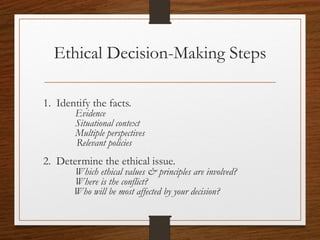
Ethical Decision-Making Steps
1. Identify the facts.
Evidence
Situational context
Multiple perspectives
Relevant policies
2. Determine the ethical issue.
Which ethical values & principles are involved?
Where is the conflict?
Who will be most affected by your decision?
CCVA 2014
14
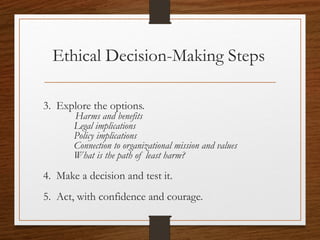
Ethical Decision-Making Steps
3. Explore the options.
Harms and benefits
Legal implications
Policy implications
Connection to organizational mission and values
What is the path of least harm?
4. Make a decision and test it.
5. Act, with confidence and courage.
CCVA 2014
15
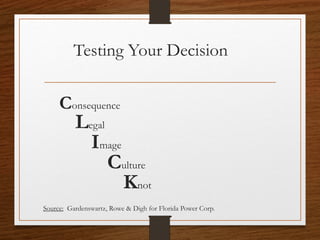
Testing Your Decision
Consequence
Legal
Image
Culture
Knot
Source: Gardenswartz, Rowe & Digh for Florida Power Corp.CCVA 2014
16
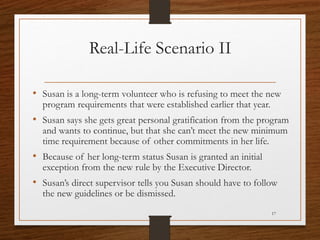
Real-Life Scenario II
 You manage a group of 20 volunteers doing trail construction in a
state forest.
 Volunteers must be housed in congregate living with no individual
rooms, shared sleeping and bathroom facilities, and limited privacy.
 Alex, a transgender volunteer, expresses concern to you about how
others will treat him and his potential exposure to fears,
discrimination or prejudice from other workers.
 Alex asks to be allowed to stay in a private hotel room nearby.
CCVA 2014
17
Real-Life Scenario II
 You manage a group of 20 volunteers doing trail construction in a
state forest.
 Volunteers must be housed in congregate living with no individual
rooms, shared sleeping and bathroom facilities, and limited privacy.
 Alex, a transgender volunteer, expresses concern to you about how
others will treat him and his potential exposure to fears, discrimination
or prejudice from other workers.
 Alex asks to be allowed to stay in a private hotel room nearby.
What else do I need to know before deciding what to do?
CCVA 2014
18
Real-Life Scenario II
 You manage a group of 20 volunteers doing trail construction in a
state forest.
 Volunteers must be housed in congregate living with no individual
rooms, shared sleeping and bathroom facilities, and limited privacy.
 Alex, a transgender volunteer, expresses concern to you about how
others will treat him and his potential exposure to fears,
discrimination or prejudice from other workers.
 Alex asks to be allowed to stay in a private hotel room nearby.
What are some possible courses of action I could take?
CCVA 2014
19
Real-Life Scenario II
 You manage a group of 20 volunteers doing trail construction in
a state forest.
 Volunteers must be housed in congregate living with no
individual rooms, shared sleeping and bathroom facilities, and
limited privacy.
 Alex, a transgender volunteer, expresses concern to you about
how others will treat him and his potential exposure to fears,
discrimination or prejudice from other workers.
 Alex asks to be allowed to stay in a private hotel room nearby.
What might I learn from this situation?
How could it be prevented in the future?CCVA 2014
20
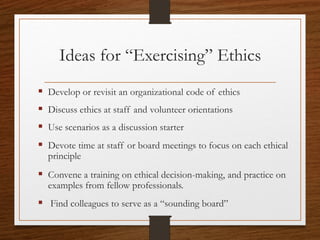
Ideas for “Exercising” Ethics
 Develop or revisit an organizational code of ethics
 Discuss ethics at staff and volunteer orientation
 Use scenarios as a discussion starter
 Focus on each core value at staff or board meetings
 Convene a training on ethical decision-making, and
practice on examples from fellow professionals
 Find colleagues to serve as a “sounding board”
CCVA 2014
21
Related Resources
Independent Sector (sample codes)
www.independentsector.org
Professional Ethics in Volunteer Administration
www.cvacert.org
How Good People Make Tough Choices: Resolving the
Dilemmas of Ethical Living, by Rushworth M. Kidder
Josephson Institute of Ethics www.josephsoninstitute.org
CCVA 2014
22
Comments from The Ethics of Volunteer Engagement Conversation with 
VolunteerMatch and Katie Campbell, CVA  
05/06/2014 
What else do I need to 
know?  
What are some possible 
courses of action? 
How could it be 
prevented in the future? 
has Alex experienced 
discrimination or negativity in 
the past? 
see if there are other ways 
for Alex to become involved 
very clearly outline 
expectations of housing 
 
does he have specific 
concerns about individuals? 
 
would try to keep the team 
together­ having one person 
in a hotel changes the team 
dynamic 
I have learned to provide 
details repeatedly ­ to 
communicate to all 
volunteers and to clarify 
issues.  
 
Would we be responsible for 
paying for the room? 
Talk with Alex and offer 
another volunteer activity that 
he may be more comfortable 
in 
frequent mentioning of 
policies/expectations to 
volunteers 
is there a group he would feel 
comfortable with ? 
Provide congregate living for 
all volunteers as an option, 
also give everyone the option 
to stay in a hotel on their 
expense. 
 
look into the facilities 
available to volunteers and 
the effectiveness of these 
facilities based on changes 
to our communities 
Will Alex be singled out as 
being provided special 
treatment 
i would opt to turn alex to 
another opportunity that does 
not require exceptions 
 
did the group sign some sort 
of code of respect as part of 
their intake/orientation 
process? 
   
Privacy, respect     


Ethics in Volunteer Engagement