1
Chapter 12
Ethics and Ethical Dilemmas
in Practice with Organizations and
Communities
Copyright © 2018 Cengage Learning.
All Rights Reserved.
Copyright © 2018 Cengage Learning.
All Rights Reserved. 2
NASW Code of Ethics (slide 1 of 12)
• Ethics consist of a set of principles that guide
professional behavior
• Social workers are expected to abide by the
NASW Code of Ethics, regardless of whether or
not they are members of NASW
• The NASW Code of Ethics can be accessed
online at
http://www.naswdc.org/pubs/code/default.asp
Copyright © 2018 Cengage Learning.
All Rights Reserved. 3
Professional Values and Ethics in Macro
Contexts: Ethical guidelines in six areas:
• Social Workers’ Ethical Responsibilities to
Clients
• 1.01 Commitment to Clients
• 1.02 Self-Determination
• 1.03 Informed Consent
Copyright © 2018 Cengage Learning.
All Rights Reserved. 4
The NASW Code of Ethics (slide 2 of 12)
• Social Workers’ Ethical Responsibilities to
Clients (continued)
• 1.04 Competence
• 1.05 Cultural Competence and Social
Diversity [Ethical Boundaries and Spirituality]
• 1.06 Conflicts of Interest
• 1.07 Privacy and Confidentiality
• 1.08 Access to Records
Copyright © 2018 Cengage Learning.
All Rights Reserved. 5
The NASW Code of Ethics (slide 3 of 12)
• Social Workers’ Ethical Responsibilities to
Clients (continued)
• 1.09 Sexual Relationships
• 1.10 Physical Contact
• 1.11 Sexual Harassment
• 1.12 Derogatory Language
Copyright © 2018 Cengage Learning.
All Rights Reserved. 6
The NASW Code of Ethics (slide 4 of 12)
• Social Workers’ Ethical Responsibilities to
Clients (continued)
• 1.13 Payment for Services
• 1.14 Clients Who Lack Decision-Making
Capacity
• 1.15 Interruption of Services
• 1.16 Termination of Services
Copyright © 2018 Cengage Learning.
All Rights Reserved. 7
The NASW Code of Ethics (slide 5 of 12)
• Social Workers’ Ethical Responsibilities to
Colleagues
• 2.01 Respect
• 2.02 Confidentiality (among colleagues)
• 2.03 Interdisciplinary Collaboration
• 2.04 Disputes Involving Colleagues
• 2.05 Consultation
Copyright © 2018 Cengage Learning.
All Rights Reserved. 8
The NASW Code of Ethics (slide 6 of 12)
• Social Workers’ Ethical Responsibilities to
Colleagues (continued)
• 2.06 Referral for Services
• 2.07 Sexual Relationships
• 2.08 Sexual Harassment
• 2.09 Impairment of Colleagues
• 2.10 Unethical Conduct of Colleagues
Copyright © 2018 Cengage Learning.
All Rights Reserved. 9
The NASW Code of Ethics (slide 7 of 12)
• Social Workers’ Ethical Responsibilities in
Practice Settings
• 3.01 Supervision and Consultation
• 3.02 Education and Training
• 3.03 Performance Evaluation
• 3.04 Client Records
• 3.05 Billing
• 3.06 Client Transfer
Copyright © 2018 Cengage Learning.
All Rights Reserved. 10
The NASW Code of Ethics (slide 8 of 12)
• Social Workers’ Ethical Responsibilities in
Practice Settings (continued)
• 3.07 Administration
• 3.08 Continuing Education and Staff
Development
• 3.09 Commitment to Employers
• 3.10 Labor-Management Disputes
Copyright © 2018 Cengage Learning.
All Rights Reserved. 11
The NASW Code of Ethics (slide 9 of 12)
• Social Workers’ Ethical Responsibilities as
Professionals
• 4.01 Competence
• 4.02 Discrimination [Combating your own
stereotypes and prejudices]
• 4.03 Private Conduct
• 4.04 Dishonesty, Fraud, and Deception
Copyright © 2018 Cengage Learning.
All Rights Reserved. 12
The NASW Code of Ethics (slide 10 of 12)
• Social Workers’ Ethical Responsibilities as
Professionals (continued)
• 4.05 Impairment
• 4.06 Misrepresentation
• 4.07 Solicitations
• 4.08 Acknowledging Credit
Copyright © 2018 Cengage Learning.
All Rights Reserved. 13
The NASW Code of Ethics (slide 11 of 12)
• Social Workers’ Ethical Responsibility to the
Social Work Profession
• 5.01 Integrity of the Profession
• 5.02 Evaluation and Research
Copyright © 2018 Cengage Learning.
All Rights Reserved. 14
The NASW Code of Ethics (slide 12 of 12)
• Social Workers’ Ethical Responsibilities to the
Broader Society
• 6.01 Social Welfare
• 6.02 Public Participation
• 6.03 Public Emergencies
• 6.04 Social and Political Action
Copyright © 2018 Cengage Learning.
All Rights Reserved. 15
Personal Stereotypes and Prejudices
Steps in beginning to deal with one’s own
prejudices:
1. Acknowledge that differences exist between
you and anyone you interact with who might
belong to a group with characteristics different
from your own
2. Identify how you treat this person differently
3. Change your behavior, bringing it more in line
with how you interact/behave with nondifferent
people
Copyright © 2018 Cengage Learning.
All Rights Reserved. 16
Dealing with personal prejudices, continued:
4. Monitor your progress in combating your
stereotypes and prejudices
5. Maintain a perspective that appreciates and
respects both individual and cultural differences
Copyright © 2018 Cengage Learning.
All Rights Reserved. 17
Ethical Boundaries and Spirituality
• Religion and spirituality reflect additional
aspects of human diversity
• Social workers need a greater awareness of
spiritual and religious issues for a number of
reasons
• Community tragedies may raise spiritual
questions
• In times of stress, an individual’s spirituality
may be a source of strength
Copyright © 2018 Cengage Learning.
All Rights Reserved. 18
International Social Work Ethical Principles
The International Federation of Social Workers
(IFSW) and the International Association of
Schools of Social Work (IASSW) developed the
Ethics in Social Work, Statement of Principles, in
2012
Two Primary and Related Principles of the
Statement:
Copyright © 2018 Cengage Learning.
All Rights Reserved. 19
International Ethical Principles
1. Human Rights
2. Social Justice
What Can You Do?
Copyright © 2018 Cengage Learning.
All Rights Reserved. 20
Manage Personal Values and Use
Professional Values to Guide Practice
Types of Ethical Issues Confronting Agency
Practitioners
Ethical Absolutism versus Ethical Relativism
Copyright © 2018 Cengage Learning.
All Rights Reserved. 21
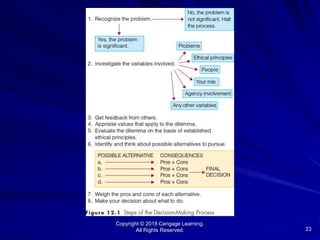
Facing an Ethical Dilemma: Decision-
Making Steps (slide 1 of 2)
• Step 1: Recognize the Problem
• Step 2: Investigate the Variables Involved
• Step 3: Get Feedback from Others
• Step 4: Appraise the Values That Apply to the
Dilemma
Copyright © 2018 Cengage Learning.
All Rights Reserved. 22
Facing an Ethical Dilemma: Decision-
Making Steps (slide 2 of 2)
• Step 5: Evaluate the Dilemma
• Step 6: Identify and Think about Possible
Alternatives
• Step 7: Weigh the Pros and Cons of Each
Alternative
• Step 8: Make Your Decision
Copyright © 2018 Cengage Learning.
All Rights Reserved. 23
Copyright © 2018 Cengage Learning.
All Rights Reserved. 24
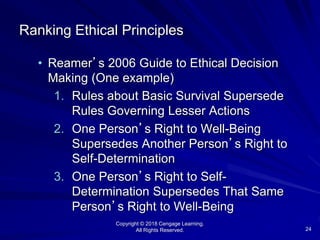
Ranking Ethical Principles
• Reamer’s 2006 Guide to Ethical Decision
Making (One example)
1. Rules about Basic Survival Supersede
Rules Governing Lesser Actions
2. One Person’s Right to Well-Being
Supersedes Another Person’s Right to
Self-Determination
3. One Person’s Right to Self-
Determination Supersedes That Same
Person’s Right to Well-Being
Copyright © 2018 Cengage Learning.
All Rights Reserved. 25
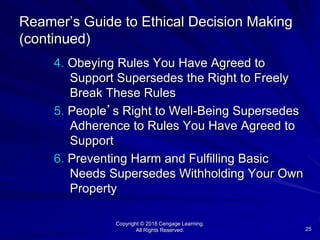
Reamer’s Guide to Ethical Decision Making
(continued)
4. Obeying Rules You Have Agreed to
Support Supersedes the Right to Freely
Break These Rules
5. People’s Right to Well-Being Supersedes
Adherence to Rules You Have Agreed to
Support
6. Preventing Harm and Fulfilling Basic
Needs Supersedes Withholding Your Own
Property
Copyright © 2018 Cengage Learning.
All Rights Reserved. 26
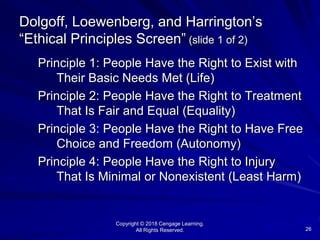
Dolgoff, Loewenberg, and Harrington’s
“Ethical Principles Screen” (slide 1 of 2)
Principle 1: People Have the Right to Exist with
Their Basic Needs Met (Life)
Principle 2: People Have the Right to Treatment
That Is Fair and Equal (Equality)
Principle 3: People Have the Right to Have Free
Choice and Freedom (Autonomy)
Principle 4: People Have the Right to Injury
That Is Minimal or Nonexistent (Least Harm)
Copyright © 2018 Cengage Learning.
All Rights Reserved. 27
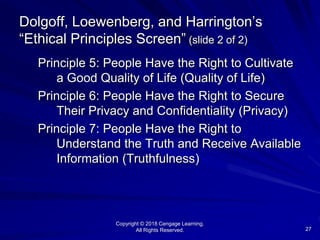
Dolgoff, Loewenberg, and Harrington’s
“Ethical Principles Screen” (slide 2 of 2)
Principle 5: People Have the Right to Cultivate
a Good Quality of Life (Quality of Life)
Principle 6: People Have the Right to Secure
Their Privacy and Confidentiality (Privacy)
Principle 7: People Have the Right to
Understand the Truth and Receive Available
Information (Truthfulness)
Copyright © 2018 Cengage Learning.
All Rights Reserved. 28
Copyright © 2018 Cengage Learning.
All Rights Reserved. 29
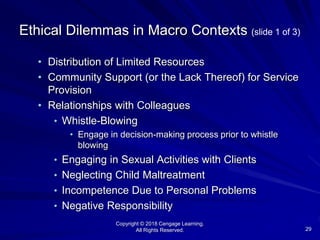
Ethical Dilemmas in Macro Contexts (slide 1 of 3)
• Distribution of Limited Resources
• Community Support (or the Lack Thereof) for Service
Provision
• Relationships with Colleagues
• Whistle-Blowing
• Engage in decision-making process prior to whistle
blowing
• Engaging in Sexual Activities with Clients
• Neglecting Child Maltreatment
• Incompetence Due to Personal Problems
• Negative Responsibility
Copyright © 2018 Cengage Learning.
All Rights Reserved. 30
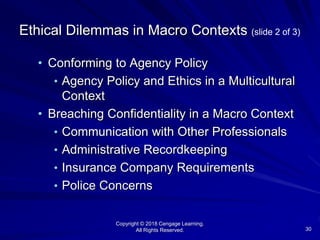
Ethical Dilemmas in Macro Contexts (slide 2 of 3)
• Conforming to Agency Policy
• Agency Policy and Ethics in a Multicultural
Context
• Breaching Confidentiality in a Macro Context
• Communication with Other Professionals
• Administrative Recordkeeping
• Insurance Company Requirements
• Police Concerns
Copyright © 2018 Cengage Learning.
All Rights Reserved. 31
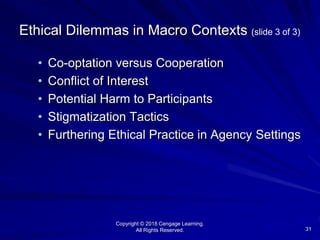
Ethical Dilemmas in Macro Contexts (slide 3 of 3)
• Co-optation versus Cooperation
• Conflict of Interest
• Potential Harm to Participants
• Stigmatization Tactics
• Furthering Ethical Practice in Agency Settings

Ppt ch12 gpoc

  • 1.
    1 Chapter 12 Ethics andEthical Dilemmas in Practice with Organizations and Communities Copyright © 2018 Cengage Learning. All Rights Reserved.
  • 2.
    Copyright © 2018Cengage Learning. All Rights Reserved. 2 NASW Code of Ethics (slide 1 of 12) • Ethics consist of a set of principles that guide professional behavior • Social workers are expected to abide by the NASW Code of Ethics, regardless of whether or not they are members of NASW • The NASW Code of Ethics can be accessed online at http://www.naswdc.org/pubs/code/default.asp
  • 3.
    Copyright © 2018Cengage Learning. All Rights Reserved. 3 Professional Values and Ethics in Macro Contexts: Ethical guidelines in six areas: • Social Workers’ Ethical Responsibilities to Clients • 1.01 Commitment to Clients • 1.02 Self-Determination • 1.03 Informed Consent
  • 4.
    Copyright © 2018Cengage Learning. All Rights Reserved. 4 The NASW Code of Ethics (slide 2 of 12) • Social Workers’ Ethical Responsibilities to Clients (continued) • 1.04 Competence • 1.05 Cultural Competence and Social Diversity [Ethical Boundaries and Spirituality] • 1.06 Conflicts of Interest • 1.07 Privacy and Confidentiality • 1.08 Access to Records
  • 5.
    Copyright © 2018Cengage Learning. All Rights Reserved. 5 The NASW Code of Ethics (slide 3 of 12) • Social Workers’ Ethical Responsibilities to Clients (continued) • 1.09 Sexual Relationships • 1.10 Physical Contact • 1.11 Sexual Harassment • 1.12 Derogatory Language
  • 6.
    Copyright © 2018Cengage Learning. All Rights Reserved. 6 The NASW Code of Ethics (slide 4 of 12) • Social Workers’ Ethical Responsibilities to Clients (continued) • 1.13 Payment for Services • 1.14 Clients Who Lack Decision-Making Capacity • 1.15 Interruption of Services • 1.16 Termination of Services
  • 7.
    Copyright © 2018Cengage Learning. All Rights Reserved. 7 The NASW Code of Ethics (slide 5 of 12) • Social Workers’ Ethical Responsibilities to Colleagues • 2.01 Respect • 2.02 Confidentiality (among colleagues) • 2.03 Interdisciplinary Collaboration • 2.04 Disputes Involving Colleagues • 2.05 Consultation
  • 8.
    Copyright © 2018Cengage Learning. All Rights Reserved. 8 The NASW Code of Ethics (slide 6 of 12) • Social Workers’ Ethical Responsibilities to Colleagues (continued) • 2.06 Referral for Services • 2.07 Sexual Relationships • 2.08 Sexual Harassment • 2.09 Impairment of Colleagues • 2.10 Unethical Conduct of Colleagues
  • 9.
    Copyright © 2018Cengage Learning. All Rights Reserved. 9 The NASW Code of Ethics (slide 7 of 12) • Social Workers’ Ethical Responsibilities in Practice Settings • 3.01 Supervision and Consultation • 3.02 Education and Training • 3.03 Performance Evaluation • 3.04 Client Records • 3.05 Billing • 3.06 Client Transfer
  • 10.
    Copyright © 2018Cengage Learning. All Rights Reserved. 10 The NASW Code of Ethics (slide 8 of 12) • Social Workers’ Ethical Responsibilities in Practice Settings (continued) • 3.07 Administration • 3.08 Continuing Education and Staff Development • 3.09 Commitment to Employers • 3.10 Labor-Management Disputes
  • 11.
    Copyright © 2018Cengage Learning. All Rights Reserved. 11 The NASW Code of Ethics (slide 9 of 12) • Social Workers’ Ethical Responsibilities as Professionals • 4.01 Competence • 4.02 Discrimination [Combating your own stereotypes and prejudices] • 4.03 Private Conduct • 4.04 Dishonesty, Fraud, and Deception
  • 12.
    Copyright © 2018Cengage Learning. All Rights Reserved. 12 The NASW Code of Ethics (slide 10 of 12) • Social Workers’ Ethical Responsibilities as Professionals (continued) • 4.05 Impairment • 4.06 Misrepresentation • 4.07 Solicitations • 4.08 Acknowledging Credit
  • 13.
    Copyright © 2018Cengage Learning. All Rights Reserved. 13 The NASW Code of Ethics (slide 11 of 12) • Social Workers’ Ethical Responsibility to the Social Work Profession • 5.01 Integrity of the Profession • 5.02 Evaluation and Research
  • 14.
    Copyright © 2018Cengage Learning. All Rights Reserved. 14 The NASW Code of Ethics (slide 12 of 12) • Social Workers’ Ethical Responsibilities to the Broader Society • 6.01 Social Welfare • 6.02 Public Participation • 6.03 Public Emergencies • 6.04 Social and Political Action
  • 15.
    Copyright © 2018Cengage Learning. All Rights Reserved. 15 Personal Stereotypes and Prejudices Steps in beginning to deal with one’s own prejudices: 1. Acknowledge that differences exist between you and anyone you interact with who might belong to a group with characteristics different from your own 2. Identify how you treat this person differently 3. Change your behavior, bringing it more in line with how you interact/behave with nondifferent people
  • 16.
    Copyright © 2018Cengage Learning. All Rights Reserved. 16 Dealing with personal prejudices, continued: 4. Monitor your progress in combating your stereotypes and prejudices 5. Maintain a perspective that appreciates and respects both individual and cultural differences
  • 17.
    Copyright © 2018Cengage Learning. All Rights Reserved. 17 Ethical Boundaries and Spirituality • Religion and spirituality reflect additional aspects of human diversity • Social workers need a greater awareness of spiritual and religious issues for a number of reasons • Community tragedies may raise spiritual questions • In times of stress, an individual’s spirituality may be a source of strength
  • 18.
    Copyright © 2018Cengage Learning. All Rights Reserved. 18 International Social Work Ethical Principles The International Federation of Social Workers (IFSW) and the International Association of Schools of Social Work (IASSW) developed the Ethics in Social Work, Statement of Principles, in 2012 Two Primary and Related Principles of the Statement:
  • 19.
    Copyright © 2018Cengage Learning. All Rights Reserved. 19 International Ethical Principles 1. Human Rights 2. Social Justice What Can You Do?
  • 20.
    Copyright © 2018Cengage Learning. All Rights Reserved. 20 Manage Personal Values and Use Professional Values to Guide Practice Types of Ethical Issues Confronting Agency Practitioners Ethical Absolutism versus Ethical Relativism
  • 21.
    Copyright © 2018Cengage Learning. All Rights Reserved. 21 Facing an Ethical Dilemma: Decision- Making Steps (slide 1 of 2) • Step 1: Recognize the Problem • Step 2: Investigate the Variables Involved • Step 3: Get Feedback from Others • Step 4: Appraise the Values That Apply to the Dilemma
  • 22.
    Copyright © 2018Cengage Learning. All Rights Reserved. 22 Facing an Ethical Dilemma: Decision- Making Steps (slide 2 of 2) • Step 5: Evaluate the Dilemma • Step 6: Identify and Think about Possible Alternatives • Step 7: Weigh the Pros and Cons of Each Alternative • Step 8: Make Your Decision
  • 23.
    Copyright © 2018Cengage Learning. All Rights Reserved. 23
  • 24.
    Copyright © 2018Cengage Learning. All Rights Reserved. 24 Ranking Ethical Principles • Reamer’s 2006 Guide to Ethical Decision Making (One example) 1. Rules about Basic Survival Supersede Rules Governing Lesser Actions 2. One Person’s Right to Well-Being Supersedes Another Person’s Right to Self-Determination 3. One Person’s Right to Self- Determination Supersedes That Same Person’s Right to Well-Being
  • 25.
    Copyright © 2018Cengage Learning. All Rights Reserved. 25 Reamer’s Guide to Ethical Decision Making (continued) 4. Obeying Rules You Have Agreed to Support Supersedes the Right to Freely Break These Rules 5. People’s Right to Well-Being Supersedes Adherence to Rules You Have Agreed to Support 6. Preventing Harm and Fulfilling Basic Needs Supersedes Withholding Your Own Property
  • 26.
    Copyright © 2018Cengage Learning. All Rights Reserved. 26 Dolgoff, Loewenberg, and Harrington’s “Ethical Principles Screen” (slide 1 of 2) Principle 1: People Have the Right to Exist with Their Basic Needs Met (Life) Principle 2: People Have the Right to Treatment That Is Fair and Equal (Equality) Principle 3: People Have the Right to Have Free Choice and Freedom (Autonomy) Principle 4: People Have the Right to Injury That Is Minimal or Nonexistent (Least Harm)
  • 27.
    Copyright © 2018Cengage Learning. All Rights Reserved. 27 Dolgoff, Loewenberg, and Harrington’s “Ethical Principles Screen” (slide 2 of 2) Principle 5: People Have the Right to Cultivate a Good Quality of Life (Quality of Life) Principle 6: People Have the Right to Secure Their Privacy and Confidentiality (Privacy) Principle 7: People Have the Right to Understand the Truth and Receive Available Information (Truthfulness)
  • 28.
    Copyright © 2018Cengage Learning. All Rights Reserved. 28
  • 29.
    Copyright © 2018Cengage Learning. All Rights Reserved. 29 Ethical Dilemmas in Macro Contexts (slide 1 of 3) • Distribution of Limited Resources • Community Support (or the Lack Thereof) for Service Provision • Relationships with Colleagues • Whistle-Blowing • Engage in decision-making process prior to whistle blowing • Engaging in Sexual Activities with Clients • Neglecting Child Maltreatment • Incompetence Due to Personal Problems • Negative Responsibility
  • 30.
    Copyright © 2018Cengage Learning. All Rights Reserved. 30 Ethical Dilemmas in Macro Contexts (slide 2 of 3) • Conforming to Agency Policy • Agency Policy and Ethics in a Multicultural Context • Breaching Confidentiality in a Macro Context • Communication with Other Professionals • Administrative Recordkeeping • Insurance Company Requirements • Police Concerns
  • 31.
    Copyright © 2018Cengage Learning. All Rights Reserved. 31 Ethical Dilemmas in Macro Contexts (slide 3 of 3) • Co-optation versus Cooperation • Conflict of Interest • Potential Harm to Participants • Stigmatization Tactics • Furthering Ethical Practice in Agency Settings