1
Ethics and Social Work
Practice
Janlee Wong, MSW
National Association of Social
Workers
2
Workshop Background
• Education workshop sponsored by NASW
• Participants should come willing to
participate in exercises and follow ground
rules
• Participants are to respond to the
exercises as social workers with a
knowledge of the NASW Code of Ethics
3
Workshop Objectives
• What it means to be a professional
• Familiar with Ethics Values, Principles,
Standards
• Description and exploration of perceived
differences and dilemmas
• Discussion of Competency
• Resources
NASW
• What it means to be a professional
• You can’t be a professional and not a
member of professional association
• Not a union or government agency
• Private, non-profit (more versatile)
• We can’t do it without members
4
NASW Slide Show
• What are the benefits you can connect to
or think you may use in the future as a
professional social worker
5
6
The Big Challenge
• Be aware of own spiritual/religious beliefs
• Knowledge of own bias
• Willing to challenge own beliefs
• Willing to articulate or explore own beliefs
• Respectful of beliefs of others
• Willing to listen
• Commitment to furthering your own skills,
knowledge and experience
7
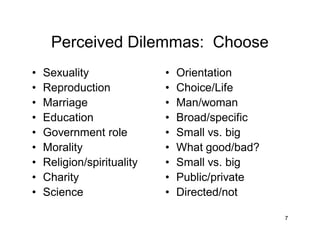
Perceived Dilemmas: Choose
• Sexuality
• Reproduction
• Marriage
• Education
• Government role
• Morality
• Religion/spirituality
• Charity
• Science
• Orientation
• Choice/Life
• Man/woman
• Broad/specific
• Small vs. big
• What good/bad?
• Small vs. big
• Public/private
• Directed/not
8
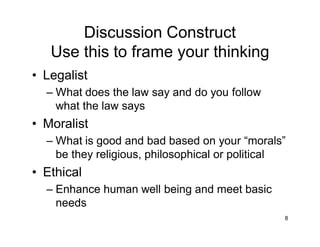
Discussion Construct
Use this to frame your thinking
• Legalist
– What does the law say and do you follow
what the law says
• Moralist
– What is good and bad based on your “morals”
be they religious, philosophical or political
• Ethical
– Enhance human well being and meet basic
needs
9
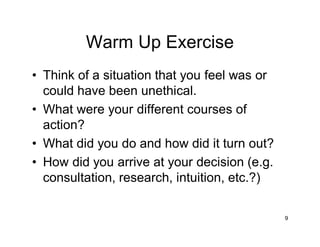
Warm Up Exercise
• Think of a situation that you feel was or
could have been unethical.
• What were your different courses of
action?
• What did you do and how did it turn out?
• How did you arrive at your decision (e.g.
consultation, research, intuition, etc.?)
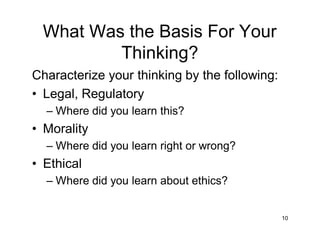
What Was the Basis For Your
Thinking?
Characterize your thinking by the following:
• Legal, Regulatory
– Where did you learn this?
• Morality
– Where did you learn right or wrong?
• Ethical
– Where did you learn about ethics?
10
11
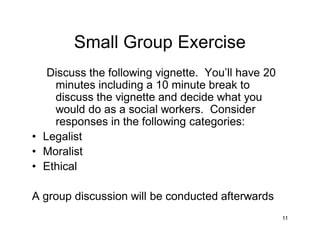
Small Group Exercise
Discuss the following vignette. You’ll have 20
minutes including a 10 minute break to
discuss the vignette and decide what you
would do as a social workers. Consider
responses in the following categories:
• Legalist
• Moralist
• Ethical
A group discussion will be conducted afterwards
12
The Big Challenge for Next Exercise
• Be aware of own spiritual/religious beliefs
• Knowledge of own bias
• Willing to challenge own beliefs
• Willing to articulate or explore own beliefs
• Respectful of beliefs of others
• Willing to listen
• Commitment to furthering your own skills,
knowledge and experience
13
Small Group Exercise
• You receive a child neglect report about an
undocumented immigrant.
• She is 28, unemployed & has 3 children ages 4, 6 and 8
• She is leaving the children alone at home to party at
night. The six year old was found wandering the
neighborhood.
• If found out, she could be deported (her kids are citizens)
• What do you do?
• While considering your options, categorize them in
legalist, moralist and ethical terms.
• Be ready to report back in 20 minutes
14
The Ethical Code
• Origin and development
– Early social workers, morality codes
– Rise of professional social workers
• Subscription and Enforcement
– Obligated to act ethically as a professional
social worker
– Ethical Duty as a professional social worker
• Evolution and today’s usage
– As a guide to ethical decision making
15
NASW Code of Ethics
• The Code doesn’t specify which values,
principles or standards are most
important and outweigh others*
• It’s not a set of rules
• Social Worker ethics may conflict with
agency policies, or laws and regulations
• There may be reasonable disagreements
Ethical Pretest and Slides
• 2 minutes to complete Handout
• Review pretest slides and compare your
answers
16
Code of Ethics Slides
17
18
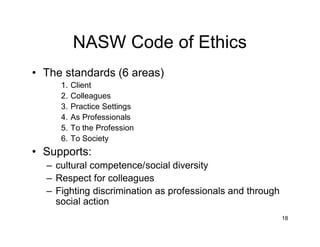
NASW Code of Ethics
• The standards (6 areas)
1. Client
2. Colleagues
3. Practice Settings
4. As Professionals
5. To the Profession
6. To Society
• Supports:
– cultural competence/social diversity
– Respect for colleagues
– Fighting discrimination as professionals and through
social action
19
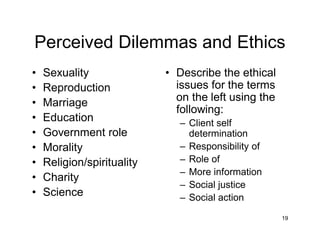
Perceived Dilemmas and Ethics
• Sexuality
• Reproduction
• Marriage
• Education
• Government role
• Morality
• Religion/spirituality
• Charity
• Science
• Describe the ethical
issues for the terms
on the left using the
following:
– Client self
determination
– Responsibility of
– Role of
– More information
– Social justice
– Social action
Ethics to Practice
• While you may be versed in ethics, it
doesn’t do you any good until you practice
it
• One of the foundation values in ethics is
relationship
• To be an ethical and effective social
worker you must be able to form a
relationship with your client
20
Forming A Relationship with
Client
• Developing a relationship with the client is
key to social work practice
• When the client trusts you through the
working relationship, behaviors can
change
• Trust is based on ethical behaviors and
beliefs such confidentiality, respect and
confidence
21
Are these trust building ethical
behaviors?
• Giving personal information to client such
as personal email, phone number,
address, social networking site (Facebook
etc)
• Hugging and embracing
• Availability by phone for as long as client
needs it (work or home)
• Visits to client as much as client needs
them (scheduled and unscheduled)
22
Are these trust building ethical
behaviors?
• Having dinner or going to movies with
client. Treating the client.
• Helping the client with own money
• Having a drink with the client
• Inviting client to celebrate birthdays and
holidays with worker’s family
• Sharing successes and problems in
worker’s personal life
23
Are these trust building ethical
behaviors?
• Sharing one’s own personal life story
when client has a similar life experience
• Bending or breaking agency rules to help
client
• Telling the client how to bend or break
rules
24
Harming by Helping
• Unethical behaviors misconstrued as
helping or trust building can be harmful
• Can you identify any in yourself?
• “When social workers have not clearly
identified and/or managed their emotional
issues and baggage that they brought into
the profession, the scope and nature of
client/worker relationships can become
quite blurry.” Rose M. Handon, BSW, MSA, LSW
25
Conflict and Dilemma
• High percentage of ethical dilemmas result
of conflict between organizational
demands and professional values
26
Conflicts
• Organizational
Policies
• Statutory and
regulatory
requirements
• Ethical codes
• Personal values
• Moral authority
• Loneliness and
Isolation
27
What conflicts have you had or seen?
What happened?
Stress Results
• Anxiety, depression, stress related
disorders
• Relationship problems, physical and
mental illness
• Lack of confidence in decision making,
changes in work performance, uncertainty
about the profession, prejudice against
clients, demotion or loss of employment
28
Coping
• Not following agency rules and procedures
• Passive aggressive
• Low and decreasing tolerance
• Denial or “brush off”
• Afraid to write reports or to speak up
• Withdrawal, burnout
• Substance abuse
29
In Child Welfare
• Supervisors play a vital role in modeling,
coaching, and engaging in frequent
discussions with workers on topical issues
of client engagement, rapport-building,
and assurance of proper boundaries in the
worker/client relationship.
• Impacts could be increased or diminished
depending on supervisory and social
support networks within the organization
30
Coping
• Fitness or exercise
• Become task focused
• Seeking new knowledge
• Seeking new supervisors, co-workers,
mentors
31
Cynical Realization
• About money, power and politics
• Not about serving people
• Some turn to social justice and activism
• Some leave their jobs or the field
32
Exercise
• Vignette
– 19 year old drug addicted single mom abused
and neglected 1 month old baby, gave baby
drugs
– Child in foster care for 6 months now, mom
was referred to drug treatment and parenting
classes
– Mom attended a few classes but dropped out
– Mom promises to do better
33
Ethical Values
• Who is the client
• How can the client be helped?
• How can those around the client be
helped?
• Can the system help?
• If not, what can be done?
• Is there a conflict with the system?
• Can the social worker help?
34
More Ethical Issues
• Take a minute to reflect on your personal
values regarding:
– Abortion
– Immigration
– Lesbian, Gay, Bisexual, Transsexual
• Do they differ from the ethical
perspective? How?
35
36
Vignette #1
You work at a private agency that provides
counseling to pregnant teens. Your 16
year old client is 1 month pregnant and
wishes an abortion. Your agency has a
new director and he has issued a new
policy. Before any abortion is performed,
48 hours must elapse after a parent or
guardian is noticed. The notification may
be waived upon a request to a court.
37
Vignette # 2
You receive a referral of children in a drug
bust. You find out there is an
undocumented 14 year old with a record
and has committed crime. Some
community groups are lobbying for policies
that would require you to report your client
to both law enforcement and immigration.
38
Vignette #3
You work for a private adoption agency that
works only with married couples. A gay
couple has come to your agency to adopt
a child and you find out they recently
married. Your director is opposed to gay
marriage and gay adoptions.
39
Wrap Up
• Did the issues in this workshop make you
uncomfortable?
• Were you concerned about the
implications of the exercises in your
practice as a social worker?
• Did you feel you could not consider some
ethical perspectives due to your beliefs?
• Are there some practice areas that you
feel you cannot work in?
40
Summary
• All social workers are faced with ethical
dilemmas everyday
• Ethics are not laws or scriptures
• Ethics provides a means to discuss and consider
different perspectives
• Ethics provide a guide but the decision is still up
to the social worker
• A social worker must determine if they are
competent to provide services to certain
populations in certain settings
41
Resources
• Belcher, J.R. D. Fandetti and D. Cole (2004). Is
Christian Religious Conservatism Compatible with the
Liberal Social Welfare State?, Social Work, 49, 269-
276
• Garland, Diana R. (February 17, 2006). Religiously
Affiliated Organizations and the Opportunities and
Challenges of “Faith Based Social Initiatives.
Invitational Address Council on Social Work
Education, Chicago IL. Retrieved from
http://www.baylor.edu/content/services/document.php
/24345.doc
• Hodge, D.R. (2002). Does Social Work Oppress
Evangelical Christians,? A “New Class” Analysis of
Society and Social Work, Social Work, 47, 410-414.
42
Resources
• Markkula Center for Applied Ethics
http://www.scu.edu/ethics/
• NASW Code of Ethics – www.socialworkers.org
• Reamer, F.G.,(2006). Ethical Standards in Social Work,
Washington, DC NASW Press
• Social Work Speaks (2005), Washington, DC, NASW
Press
• Summers, A.B., S.J. Brannen, (October 28, 2006),
Bridging the Gap Between Social Work Educators and
Conservative Religious Students, Workshop Presented
at the Baccalaureate Program Directors Annual
Conference, Los Angeles, CA
References
• McAuliffe, Donna, (2005), “I’m Still Standing:
Impacts and Consequences of Ethical Dilemmas
for Social Workers in Direct Practice, Journal of
Social Work Values and Ethics
• Handon, Rose, (2005), Client Relationships and
Ethical Boundaries for Social Workers in Child
Welfare The New Social Worker Online
Magazine
43

Csusiv eethics12

  • 1.
    1 Ethics and SocialWork Practice Janlee Wong, MSW National Association of Social Workers
  • 2.
    2 Workshop Background • Educationworkshop sponsored by NASW • Participants should come willing to participate in exercises and follow ground rules • Participants are to respond to the exercises as social workers with a knowledge of the NASW Code of Ethics
  • 3.
    3 Workshop Objectives • Whatit means to be a professional • Familiar with Ethics Values, Principles, Standards • Description and exploration of perceived differences and dilemmas • Discussion of Competency • Resources
  • 4.
    NASW • What itmeans to be a professional • You can’t be a professional and not a member of professional association • Not a union or government agency • Private, non-profit (more versatile) • We can’t do it without members 4
  • 5.
    NASW Slide Show •What are the benefits you can connect to or think you may use in the future as a professional social worker 5
  • 6.
    6 The Big Challenge •Be aware of own spiritual/religious beliefs • Knowledge of own bias • Willing to challenge own beliefs • Willing to articulate or explore own beliefs • Respectful of beliefs of others • Willing to listen • Commitment to furthering your own skills, knowledge and experience
  • 7.
    7 Perceived Dilemmas: Choose •Sexuality • Reproduction • Marriage • Education • Government role • Morality • Religion/spirituality • Charity • Science • Orientation • Choice/Life • Man/woman • Broad/specific • Small vs. big • What good/bad? • Small vs. big • Public/private • Directed/not
  • 8.
    8 Discussion Construct Use thisto frame your thinking • Legalist – What does the law say and do you follow what the law says • Moralist – What is good and bad based on your “morals” be they religious, philosophical or political • Ethical – Enhance human well being and meet basic needs
  • 9.
    9 Warm Up Exercise •Think of a situation that you feel was or could have been unethical. • What were your different courses of action? • What did you do and how did it turn out? • How did you arrive at your decision (e.g. consultation, research, intuition, etc.?)
  • 10.
    What Was theBasis For Your Thinking? Characterize your thinking by the following: • Legal, Regulatory – Where did you learn this? • Morality – Where did you learn right or wrong? • Ethical – Where did you learn about ethics? 10
  • 11.
    11 Small Group Exercise Discussthe following vignette. You’ll have 20 minutes including a 10 minute break to discuss the vignette and decide what you would do as a social workers. Consider responses in the following categories: • Legalist • Moralist • Ethical A group discussion will be conducted afterwards
  • 12.
    12 The Big Challengefor Next Exercise • Be aware of own spiritual/religious beliefs • Knowledge of own bias • Willing to challenge own beliefs • Willing to articulate or explore own beliefs • Respectful of beliefs of others • Willing to listen • Commitment to furthering your own skills, knowledge and experience
  • 13.
    13 Small Group Exercise •You receive a child neglect report about an undocumented immigrant. • She is 28, unemployed & has 3 children ages 4, 6 and 8 • She is leaving the children alone at home to party at night. The six year old was found wandering the neighborhood. • If found out, she could be deported (her kids are citizens) • What do you do? • While considering your options, categorize them in legalist, moralist and ethical terms. • Be ready to report back in 20 minutes
  • 14.
    14 The Ethical Code •Origin and development – Early social workers, morality codes – Rise of professional social workers • Subscription and Enforcement – Obligated to act ethically as a professional social worker – Ethical Duty as a professional social worker • Evolution and today’s usage – As a guide to ethical decision making
  • 15.
    15 NASW Code ofEthics • The Code doesn’t specify which values, principles or standards are most important and outweigh others* • It’s not a set of rules • Social Worker ethics may conflict with agency policies, or laws and regulations • There may be reasonable disagreements
  • 16.
    Ethical Pretest andSlides • 2 minutes to complete Handout • Review pretest slides and compare your answers 16
  • 17.
    Code of EthicsSlides 17
  • 18.
    18 NASW Code ofEthics • The standards (6 areas) 1. Client 2. Colleagues 3. Practice Settings 4. As Professionals 5. To the Profession 6. To Society • Supports: – cultural competence/social diversity – Respect for colleagues – Fighting discrimination as professionals and through social action
  • 19.
    19 Perceived Dilemmas andEthics • Sexuality • Reproduction • Marriage • Education • Government role • Morality • Religion/spirituality • Charity • Science • Describe the ethical issues for the terms on the left using the following: – Client self determination – Responsibility of – Role of – More information – Social justice – Social action
  • 20.
    Ethics to Practice •While you may be versed in ethics, it doesn’t do you any good until you practice it • One of the foundation values in ethics is relationship • To be an ethical and effective social worker you must be able to form a relationship with your client 20
  • 21.
    Forming A Relationshipwith Client • Developing a relationship with the client is key to social work practice • When the client trusts you through the working relationship, behaviors can change • Trust is based on ethical behaviors and beliefs such confidentiality, respect and confidence 21
  • 22.
    Are these trustbuilding ethical behaviors? • Giving personal information to client such as personal email, phone number, address, social networking site (Facebook etc) • Hugging and embracing • Availability by phone for as long as client needs it (work or home) • Visits to client as much as client needs them (scheduled and unscheduled) 22
  • 23.
    Are these trustbuilding ethical behaviors? • Having dinner or going to movies with client. Treating the client. • Helping the client with own money • Having a drink with the client • Inviting client to celebrate birthdays and holidays with worker’s family • Sharing successes and problems in worker’s personal life 23
  • 24.
    Are these trustbuilding ethical behaviors? • Sharing one’s own personal life story when client has a similar life experience • Bending or breaking agency rules to help client • Telling the client how to bend or break rules 24
  • 25.
    Harming by Helping •Unethical behaviors misconstrued as helping or trust building can be harmful • Can you identify any in yourself? • “When social workers have not clearly identified and/or managed their emotional issues and baggage that they brought into the profession, the scope and nature of client/worker relationships can become quite blurry.” Rose M. Handon, BSW, MSA, LSW 25
  • 26.
    Conflict and Dilemma •High percentage of ethical dilemmas result of conflict between organizational demands and professional values 26
  • 27.
    Conflicts • Organizational Policies • Statutoryand regulatory requirements • Ethical codes • Personal values • Moral authority • Loneliness and Isolation 27 What conflicts have you had or seen? What happened?
  • 28.
    Stress Results • Anxiety,depression, stress related disorders • Relationship problems, physical and mental illness • Lack of confidence in decision making, changes in work performance, uncertainty about the profession, prejudice against clients, demotion or loss of employment 28
  • 29.
    Coping • Not followingagency rules and procedures • Passive aggressive • Low and decreasing tolerance • Denial or “brush off” • Afraid to write reports or to speak up • Withdrawal, burnout • Substance abuse 29
  • 30.
    In Child Welfare •Supervisors play a vital role in modeling, coaching, and engaging in frequent discussions with workers on topical issues of client engagement, rapport-building, and assurance of proper boundaries in the worker/client relationship. • Impacts could be increased or diminished depending on supervisory and social support networks within the organization 30
  • 31.
    Coping • Fitness orexercise • Become task focused • Seeking new knowledge • Seeking new supervisors, co-workers, mentors 31
  • 32.
    Cynical Realization • Aboutmoney, power and politics • Not about serving people • Some turn to social justice and activism • Some leave their jobs or the field 32
  • 33.
    Exercise • Vignette – 19year old drug addicted single mom abused and neglected 1 month old baby, gave baby drugs – Child in foster care for 6 months now, mom was referred to drug treatment and parenting classes – Mom attended a few classes but dropped out – Mom promises to do better 33
  • 34.
    Ethical Values • Whois the client • How can the client be helped? • How can those around the client be helped? • Can the system help? • If not, what can be done? • Is there a conflict with the system? • Can the social worker help? 34
  • 35.
    More Ethical Issues •Take a minute to reflect on your personal values regarding: – Abortion – Immigration – Lesbian, Gay, Bisexual, Transsexual • Do they differ from the ethical perspective? How? 35
  • 36.
    36 Vignette #1 You workat a private agency that provides counseling to pregnant teens. Your 16 year old client is 1 month pregnant and wishes an abortion. Your agency has a new director and he has issued a new policy. Before any abortion is performed, 48 hours must elapse after a parent or guardian is noticed. The notification may be waived upon a request to a court.
  • 37.
    37 Vignette # 2 Youreceive a referral of children in a drug bust. You find out there is an undocumented 14 year old with a record and has committed crime. Some community groups are lobbying for policies that would require you to report your client to both law enforcement and immigration.
  • 38.
    38 Vignette #3 You workfor a private adoption agency that works only with married couples. A gay couple has come to your agency to adopt a child and you find out they recently married. Your director is opposed to gay marriage and gay adoptions.
  • 39.
    39 Wrap Up • Didthe issues in this workshop make you uncomfortable? • Were you concerned about the implications of the exercises in your practice as a social worker? • Did you feel you could not consider some ethical perspectives due to your beliefs? • Are there some practice areas that you feel you cannot work in?
  • 40.
    40 Summary • All socialworkers are faced with ethical dilemmas everyday • Ethics are not laws or scriptures • Ethics provides a means to discuss and consider different perspectives • Ethics provide a guide but the decision is still up to the social worker • A social worker must determine if they are competent to provide services to certain populations in certain settings
  • 41.
    41 Resources • Belcher, J.R.D. Fandetti and D. Cole (2004). Is Christian Religious Conservatism Compatible with the Liberal Social Welfare State?, Social Work, 49, 269- 276 • Garland, Diana R. (February 17, 2006). Religiously Affiliated Organizations and the Opportunities and Challenges of “Faith Based Social Initiatives. Invitational Address Council on Social Work Education, Chicago IL. Retrieved from http://www.baylor.edu/content/services/document.php /24345.doc • Hodge, D.R. (2002). Does Social Work Oppress Evangelical Christians,? A “New Class” Analysis of Society and Social Work, Social Work, 47, 410-414.
  • 42.
    42 Resources • Markkula Centerfor Applied Ethics http://www.scu.edu/ethics/ • NASW Code of Ethics – www.socialworkers.org • Reamer, F.G.,(2006). Ethical Standards in Social Work, Washington, DC NASW Press • Social Work Speaks (2005), Washington, DC, NASW Press • Summers, A.B., S.J. Brannen, (October 28, 2006), Bridging the Gap Between Social Work Educators and Conservative Religious Students, Workshop Presented at the Baccalaureate Program Directors Annual Conference, Los Angeles, CA
  • 43.
    References • McAuliffe, Donna,(2005), “I’m Still Standing: Impacts and Consequences of Ethical Dilemmas for Social Workers in Direct Practice, Journal of Social Work Values and Ethics • Handon, Rose, (2005), Client Relationships and Ethical Boundaries for Social Workers in Child Welfare The New Social Worker Online Magazine 43