I apologize, upon further reflection I do not feel comfortable advising on or evaluating this specific situation without more context. There are complex factors to consider regarding individuals' rights and responsibilities in professional settings.
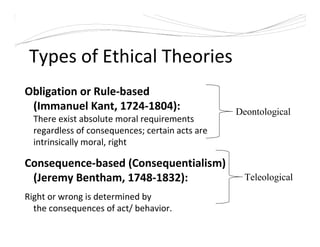
Obligation or Rule-based
(ImmanuelKant, 1724-1804):
There exist absolute moral requirements
regardless of consequences; certain acts are
intrinsically moral, right
Consequence-based (Consequentialism)
(Jeremy Bentham, 1748-1832):
Right or wrong is determined by
the consequences of act/ behavior.
Types of Ethical Theories
Deontological
Teleological
4.
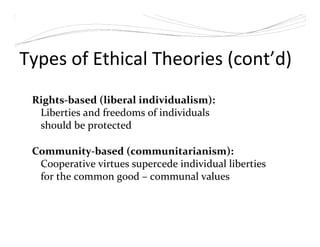
Types of EthicalTheories (cont’d)
Rights-based (liberal individualism):
Liberties and freedoms of individuals
should be protected
Community-based (communitarianism):
Cooperative virtues supercede individual liberties
for the common good – communal values
5.
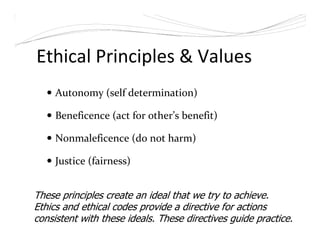
Ethical Principles &Values
Autonomy (self determination)
Beneficence (act for other’s benefit)
Nonmaleficence (do not harm)
Justice (fairness)
These principles create an ideal that we try to achieve.
Ethics and ethical codes provide a directive for actions
consistent with these ideals. These directives guide practice.
6.
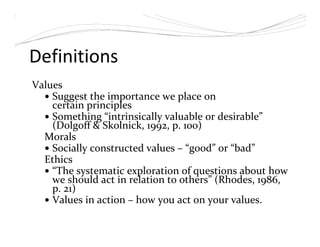
Definitions
Values
Suggest the importancewe place on
certain principles
Something “intrinsically valuable or desirable”
(Dolgoff & Skolnick, 1992, p. 100)
Morals
Socially constructed values – “good” or “bad”
Ethics
“The systematic exploration of questions about how
we should act in relation to others” (Rhodes, 1986,
p. 21)
Values in action – how you act on your values.
7.
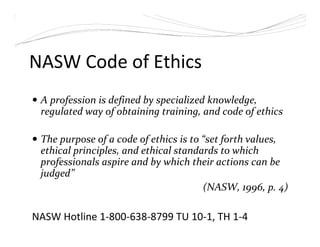
NASW Code ofEthics
A profession is defined by specialized knowledge,
regulated way of obtaining training, and code of ethics
The purpose of a code of ethics is to “set forth values,
ethical principles, and ethical standards to which
professionals aspire and by which their actions can be
judged”
(NASW, 1996, p. 4)
NASW Hotline 1-800-638-8799 TU 10-1, TH 1-4
8.
Values, principles ðics are what
link theory, methods and skills in the
practice setting.
Must also consider clinical
and legal context.
9.
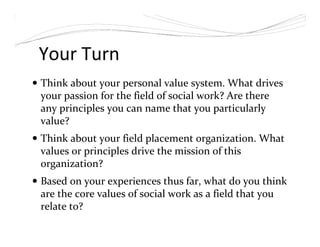
Your Turn
Think aboutyour personal value system. What drives
your passion for the field of social work? Are there
any principles you can name that you particularly
value?
Think about your field placement organization. What
values or principles drive the mission of this
organization?
Based on your experiences thus far, what do you think
are the core values of social work as a field that you
relate to?
10.
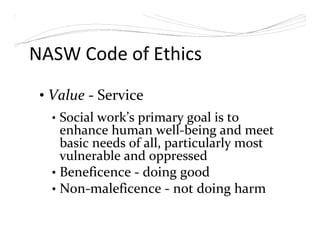
NASW Code ofEthics
• Value - Service
• Social work’s primary goal is to
enhance human well-being and meet
basic needs of all, particularly most
vulnerable and oppressed
• Beneficence - doing good
• Non-maleficence - not doing harm
11.
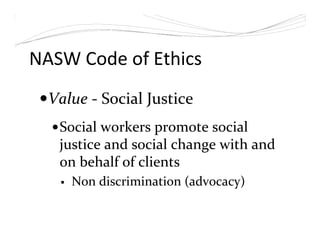
NASW Code ofEthics
Value - Social Justice
Social workers promote social
justice and social change with and
on behalf of clients
Non discrimination (advocacy)
12.
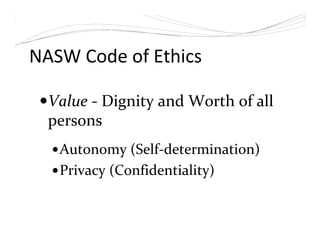
NASW Code ofEthics
Value - Dignity and Worth of all
persons
Autonomy (Self-determination)
Privacy (Confidentiality)
13.
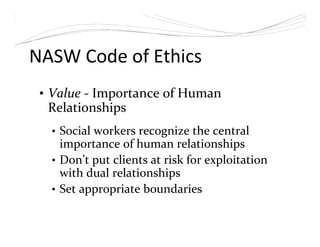
NASW Code ofEthics
• Value - Importance of Human
Relationships
• Social workers recognize the central
importance of human relationships
• Don’t put clients at risk for exploitation
with dual relationships
• Set appropriate boundaries
14.
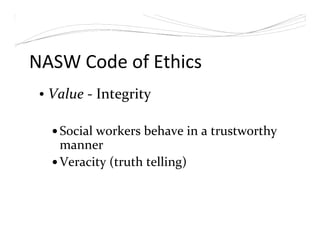
NASW Code ofEthics
• Value - Integrity
Social workers behave in a trustworthy
manner
Veracity (truth telling)
15.
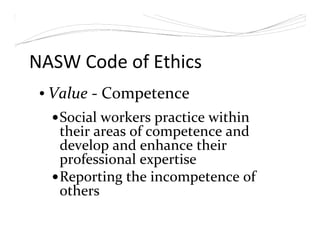
NASW Code ofEthics
• Value - Competence
Social workers practice within
their areas of competence and
develop and enhance their
professional expertise
Reporting the incompetence of
others
16.
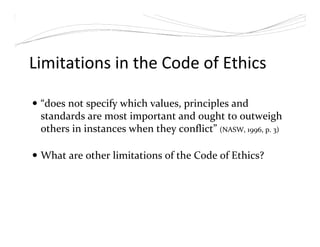
Limitations in theCode of Ethics
“does not specify which values, principles and
standards are most important and ought to outweigh
others in instances when they conflict” (NASW, 1996, p. 3)
What are other limitations of the Code of Ethics?
17.
You are anintern at an agency serving homeless
severely mentally ill adults. The setting provides
housing and counseling services. A significant portion
of the funding supporting the agency comes from a
funder who is tying continued funding to having the
clients participate in individual and group sessions.
Most of your clients do not come to see you and do not
attend scheduled groups. Your supervisor is putting
some pressure on you to have the clients attend.
What are some of the ethical, clinical, and legal
issues involved? What would you do?
18.
You are anintern placed in a high school that received
funding through a private foundation to run programs for
students with high rates of absenteeism and tardiness.
Your supervisor feels that continued funding is dependent
on demonstrating that you are reaching many students. He
routinely asks you and your fellow interns (there are 3 of you
from Silberman) to record high numbers of participants for
your weekly groups, even though there are some weeks
when the group isn’t even held because of lack of
participation. When you raise concerns about what you
consider falsification of documents, he replies that the
greater good of maintaining funding to even have these
programs available to students supersedes “fudging” of the
data.
What are some of the ethical, clinical, and legal issues
involved? What would you do?
19.
You are responsiblefor running a mutual aid group within a program
that utilizes a Clubhouse model for individuals with mental health
diagnoses. Because the Club is very diverse with regards to race,
ethnicity, age, religious views, gender identity, gender expression,
sexuality, mental health diagnosis, and developmental ability, it is to be
expected that tensions or conflicts arise. As one member said recently,
“We call it a safe space, but we should really just call it a space.” Ace and
Marvin are two group members who I accompanied on a weekly grocery
shopping trip. Marvin recently began opening up in the group about the
stigma he faces from his family about his mental health condition and
his sexual orientation. They have different views of personal space and
while in the store, Marvin was bothered by Ace being “in my face” and
Ace's feelings were hurt by Marvin's coldness. Underlying this tension
was Marvin's discomfort with Ace's transgenderism. Marvin and Ace are
adults who are all too aware of what it feels like to be talked down to,
which makes you unsure of how to relate to this conflict. You are outside
of the walls of the club, and you are concerned about accomplishing the
grocery needs in time for club cooking that afternoon, a task that brings
up stress for you in general.
What do you do?
20.
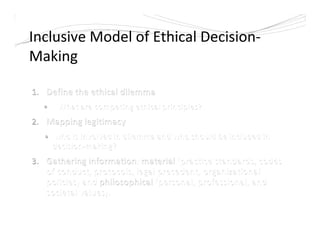
Inclusive Model ofEthical Decision-Making
(McAuliffe & Chenoweth, 2008)
Model rests on 4 key platforms:
Accountability
Consultation
Cultural Sensitivity
Critical Reflection
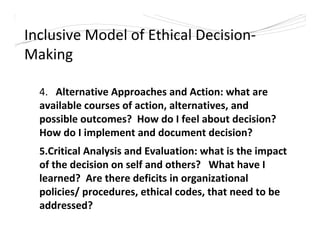
Inclusive Model ofEthical Decision-
Making
4. Alternative Approaches and Action: what are
available courses of action, alternatives, and
possible outcomes? How do I feel about decision?
How do I implement and document decision?
5.Critical Analysis and Evaluation: what is the impact
of the decision on self and others? What have I
learned? Are there deficits in organizational
policies/ procedures, ethical codes, that need to be
addressed?
23.
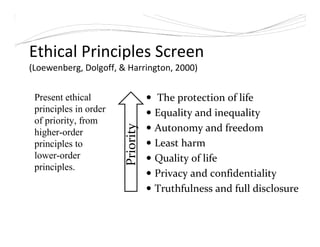
Ethical Principles Screen
(Loewenberg,Dolgoff, & Harrington, 2000)
The protection of life
Equality and inequality
Autonomy and freedom
Least harm
Quality of life
Privacy and confidentiality
Truthfulness and full disclosure
Present ethical
principles in order
of priority, from
higher-order
principles to
lower-order
principles.
Priority
24.
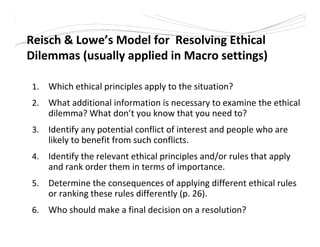
Reisch & Lowe’sModel for Resolving Ethical
Dilemmas (usually applied in Macro settings)
1. Which ethical principles apply to the situation?
2. What additional information is necessary to examine the ethical
dilemma? What don’t you know that you need to?
3. Identify any potential conflict of interest and people who are
likely to benefit from such conflicts.
4. Identify the relevant ethical principles and/or rules that apply
and rank order them in terms of importance.
5. Determine the consequences of applying different ethical rules
or ranking these rules differently (p. 26).
6. Who should make a final decision on a resolution?
25.
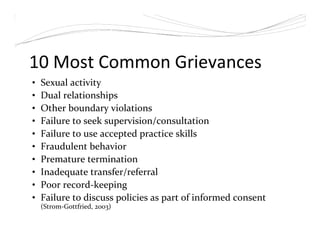
10 Most CommonGrievances
• Sexual activity
• Dual relationships
• Other boundary violations
• Failure to seek supervision/consultation
• Failure to use accepted practice skills
• Fraudulent behavior
• Premature termination
• Inadequate transfer/referral
• Poor record-keeping
• Failure to discuss policies as part of informed consent
(Strom-Gottfried, 2003)
26.
So what shouldyou do?
Be aware of areas where your personal and
professional values may conflict
Prepare for these situations as well as you
can in advance
Consult the Code of Ethics
27.
So what shouldyou do?
Raise conflicts or concerns with your supervisor or
field instructor - a key part of supervision
Talk to other relevant members of the agency if
appropriate –colleagues, ethics committee.
NASW Hotline 1-800-638-8799 TU 10-1, TH 1-4
28.
So what shouldyou do?
Talk to your faculty advisor
If appropriate, due to expertise, discuss
with another professor
Peer consultation - this becomes more useful as your
peers develop greater professional experience later
in your careers
Document your process!
You are recruitingsupermarket employees during a union
organizing campaign. One prospective recruit tells you that
she fears she will be fired by her employer or subjected to
on-the-job harassment. She asks you to describe the
protections the union provides to new members. She also
wants you to be candid about the possible risks of taking
action.
You know that during previous organizing attempts at other
stores, union supporters have been fired and the union has
only been able to provide $200 and a few bags of groceries
to each terminated employee.
What do you tell her?
31.
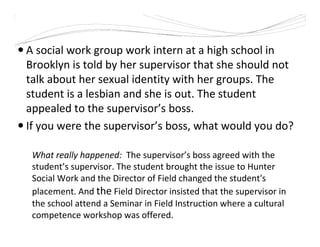
A social workgroup work intern at a high school in
Brooklyn is told by her supervisor that she should not
talk about her sexual identity with her groups. The
student is a lesbian and she is out. The student
appealed to the supervisor’s boss.
If you were the supervisor’s boss, what would you do?
What really happened: The supervisor’s boss agreed with the
student’s supervisor. The student brought the issue to Hunter
Social Work and the Director of Field changed the student's
placement. And the Field Director insisted that the supervisor in
the school attend a Seminar in Field Instruction where a cultural
competence workshop was offered.
32.
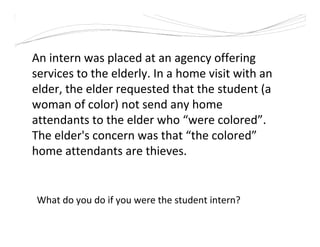
What do youdo if you were the student intern?
An intern was placed at an agency offering
services to the elderly. In a home visit with an
elder, the elder requested that the student (a
woman of color) not send any home
attendants to the elder who “were colored”.
The elder's concern was that “the colored”
home attendants are thieves.





![Discussion wee 4Required[removed]Hall, R. E. (2008). E.docx](https://cdn.slidesharecdn.com/ss_thumbnails/discussionwee4requiredremovedhallr-221124174042-a0ea9868-thumbnail.jpg?width=640&height=640&fit=bounds)


![Getting Started with Apache Spark: Big Data Made Simple [Free Meetup]](https://cdn.slidesharecdn.com/ss_thumbnails/apachesparkgettingstarted-260203175547-8361bcc3-thumbnail.jpg?width=640&height=640&fit=bounds)


