Aspire to become good, not great....
Greatness is like a passing cloud,
temporary.
- Sai Baba - Divine Discourse, July 16, 2001.
Pathology of
WBC disorders
Dr. Shashidhar Venkatesh Murthy
A/Prof. & Head of Pathology
2013: MB2-HRM-Week 7
HRM-Wk7: Fever, bleeding & Back pain
 Mr M.S. 45y, man. Presents to ED: “Very
bad lower back pain, nothing helping it”.
 History:
• Feels unwell? - Very
• Fever? Yes, I think so; intermittent
• Easy bruising -Yes, bruises last few weeks.
 Examination:
• Slim, unwell, pale, Multiple Bruises
• Liver & Spleen enlarged – mild.
• Lymph nodes enlarged neck & axilla.
Learning Objectives:
 WBC in health & disease - overview.
 Classification & Common WBC disorders.
 Congenital, Reactive & Cancer.
 Clinical features.
 Pathogenesis
 Laboratory diagnosis
 Blood morphology
• Features (3-4).
• Line diagram.
 Management - brief.
TOP 10 WBC Disorders:
• Leukopenia:
1. Neutropenia
2. Lymphopenia.
3. Pancytopenia
• Leucocytosis:
4. Neutrophilia
5. Eosinophilia
6. Lymphocytosis – IM
7. Lymphadenitis.
• Neoplastic disorders (cancer)
9. Lymphoma
10. Leukemia (AML/ALL,CML/CLL)
Teaching Plan & Staff:
 Introduction to WBC disorders:
• Shashidhar Venkatesh Murthy.
 Clinical Cases: GLS 1st hour.
• Ian Irving, Haematologist, TSVH.
 Microscopy Tutorial: GLS 2nd hour.
• Shashidhar Venkatesh Murthy.
 Synthesis Session: Keepad Q&A disc.
• Shashidhar Venkatesh Murthy.
Mon
9am
Tue
1pm
Tue
2pm
Thu
1pm
GLS SESSION
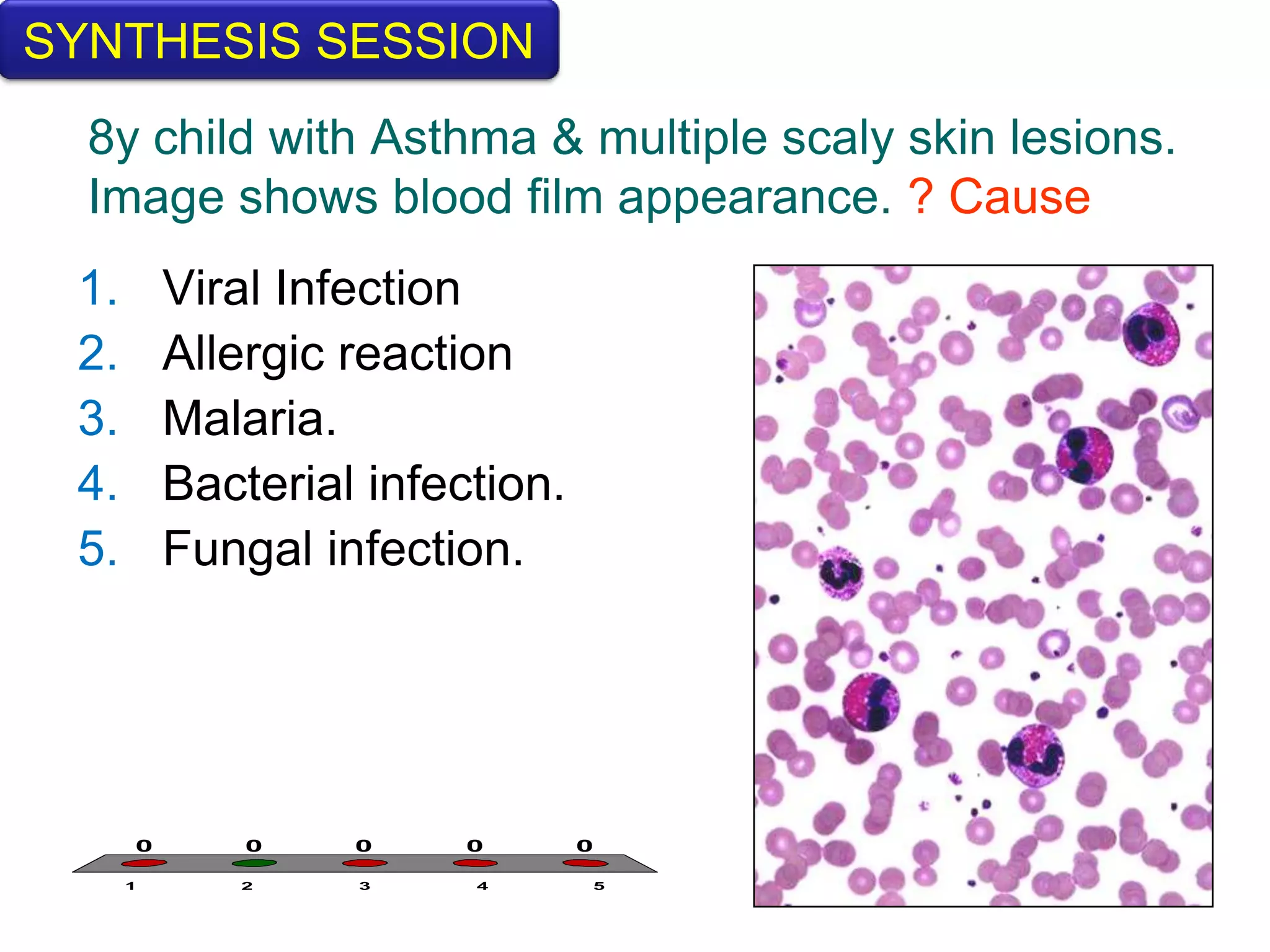
8y child with Asthma & multiple scaly skin lesions.
Image shows blood film appearance. ? Cause
1. Viral Infection
2. Allergic reaction
3. Malaria.
4. Bacterial infection.
5. Fungal infection.
1 2 3 4 5
0 0 000
SYNTHESIS SESSION
I am here for you….
Email: venkatesh.shashidhar@jcu.edu.au
vmshashi@gmail.com
Need personal guidance? Email me for an appointment.
Office Tel: 4781 4566
Office location – MS136
Emergency?(exam time) Mob: 0416 933 704
Small minds discuss people
Average minds discuss events
Great minds discuss solution
Genius silently acts!
10
Normal Blood Cells:
Neutrophil
Basophil
Eosinophil
Lymphocyte
Non granular, Mononuclears
Specific Immunity
Granulocytes, Polymorphs
Non-Specific Immunity
Normal WBC Production:
Normal Granulopoiesis: CSF
Stimulate
bone marrow
to produce
WBC.
What are the Clinical applications of G-CSF?
Lab: CBC - WBC Histogram:
Absolute
Count
% / Differential Count
WBC Absolute counts in disease:
Penia PhiliaNeutro
Penia PhiliaEosino
Penia cytosisMono
Penia cytosisLympho
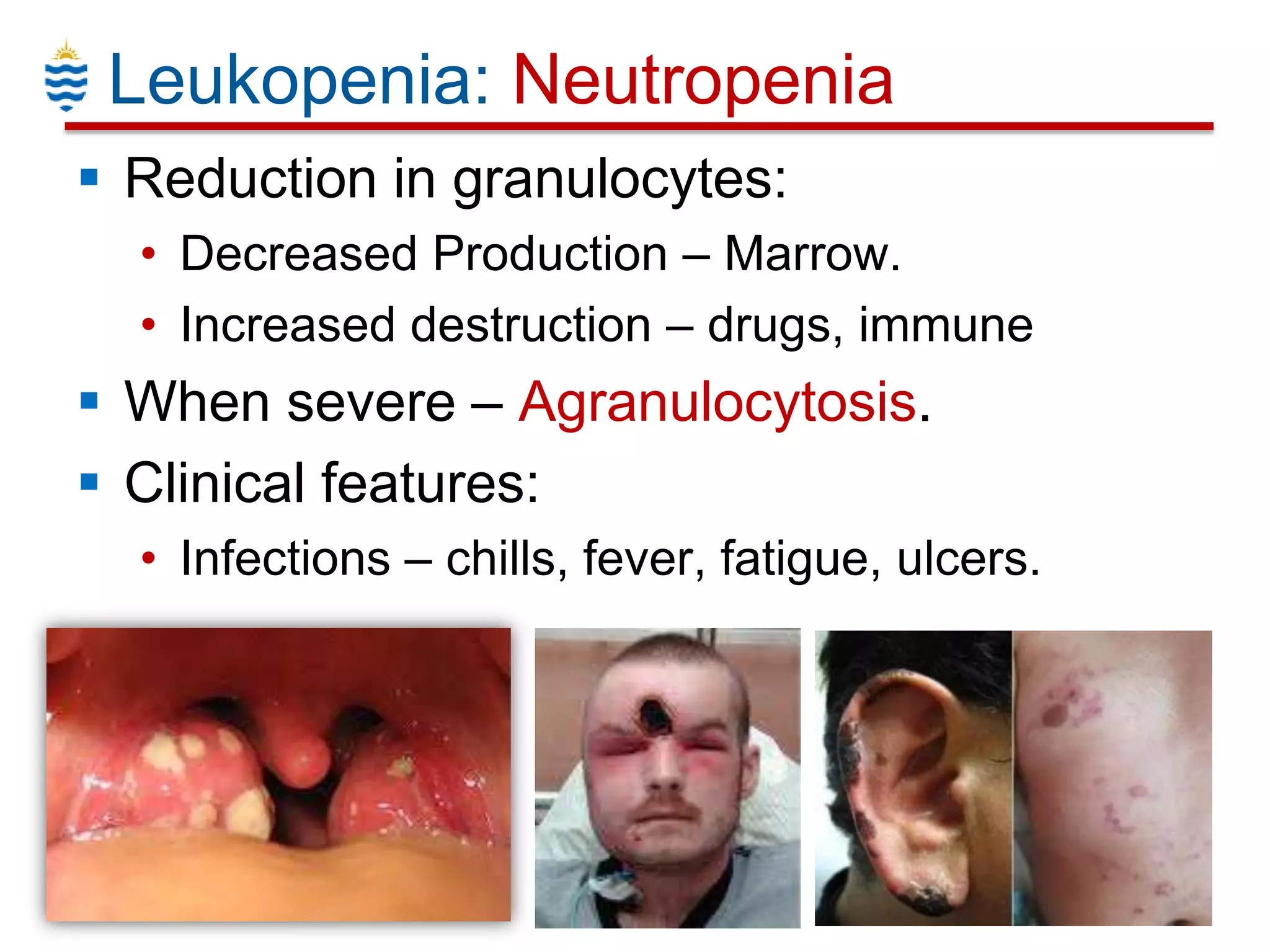
Leukopenia: Neutropenia
 Reduction in granulocytes:
• Decreased Production – Marrow.
• Increased destruction – drugs, immune
 When severe – Agranulocytosis.
 Clinical features:
• Infections – chills, fever, fatigue, ulcers.
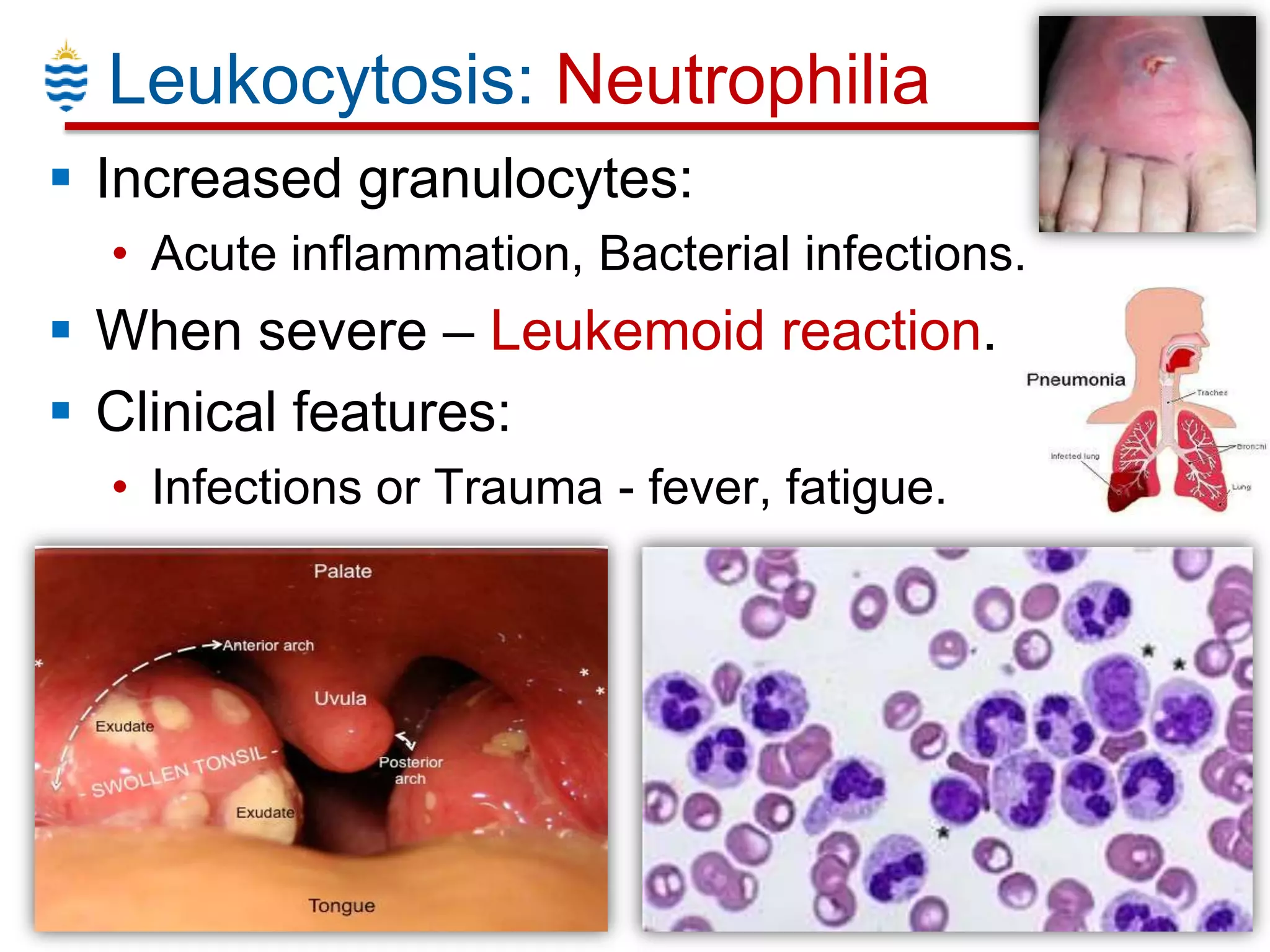
Leukocytosis: Neutrophilia
 Increased granulocytes:
• Acute inflammation, Bacterial infections.
 When severe – Leukemoid reaction.
 Clinical features:
• Infections or Trauma - fever, fatigue.
Lymphocytosis: Infectious Mononucleosis
 Increased Lymphocytes:
• Chronic Inflam, Viral, fungal, TB etc.
 Large lymphocytes, more cytoplasm. Irregular,
indented by RBC – also known as virocyte
 Clinical features: Chronic fever, lymphadenopathy.
Neutrophilia:
Acute inflammation (Bacterial, trauma, immune, etc)
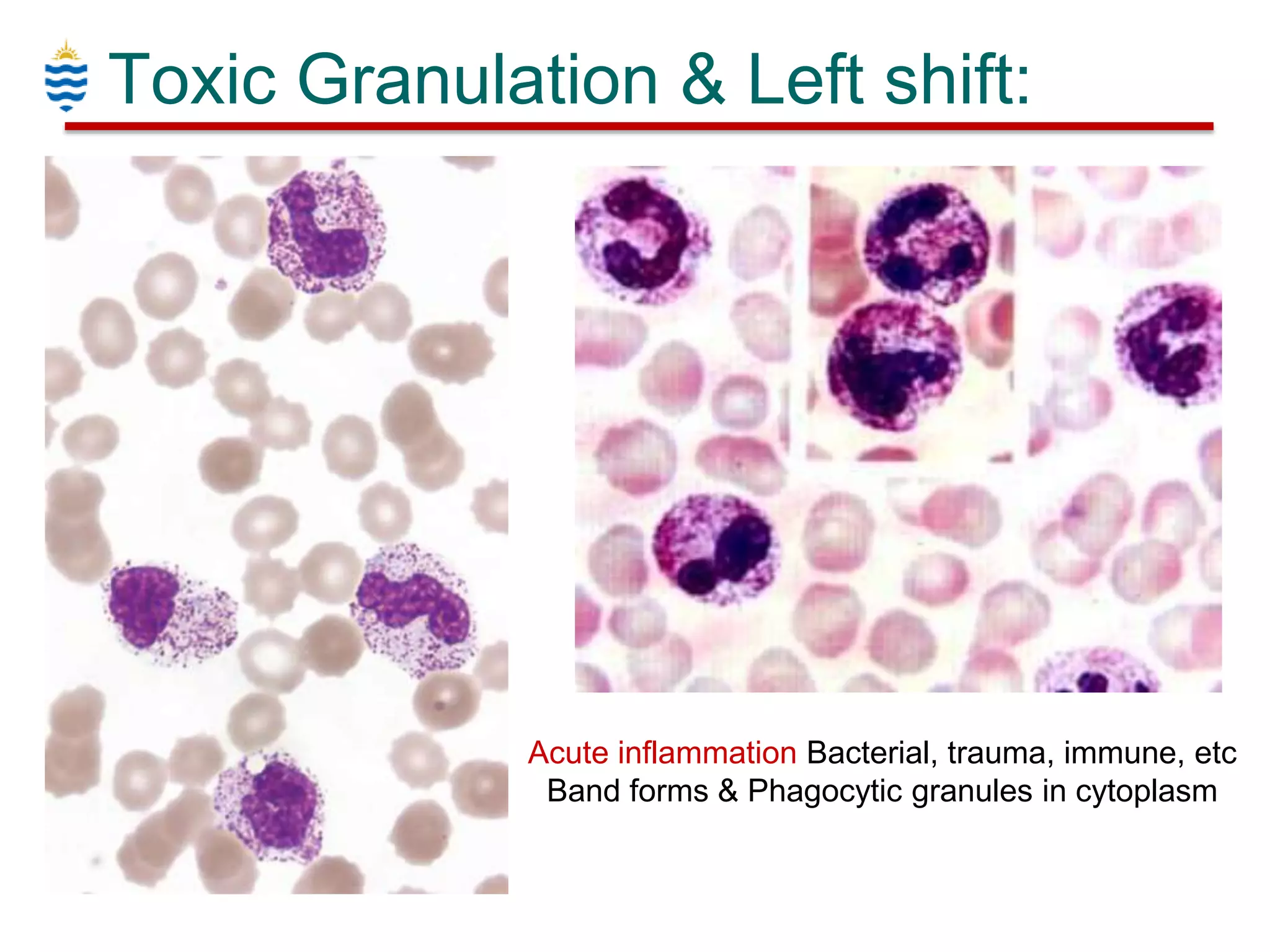
Toxic Granulation & Left shift:
Acute inflammation Bacterial, trauma, immune, etc
Band forms & Phagocytic granules in cytoplasm
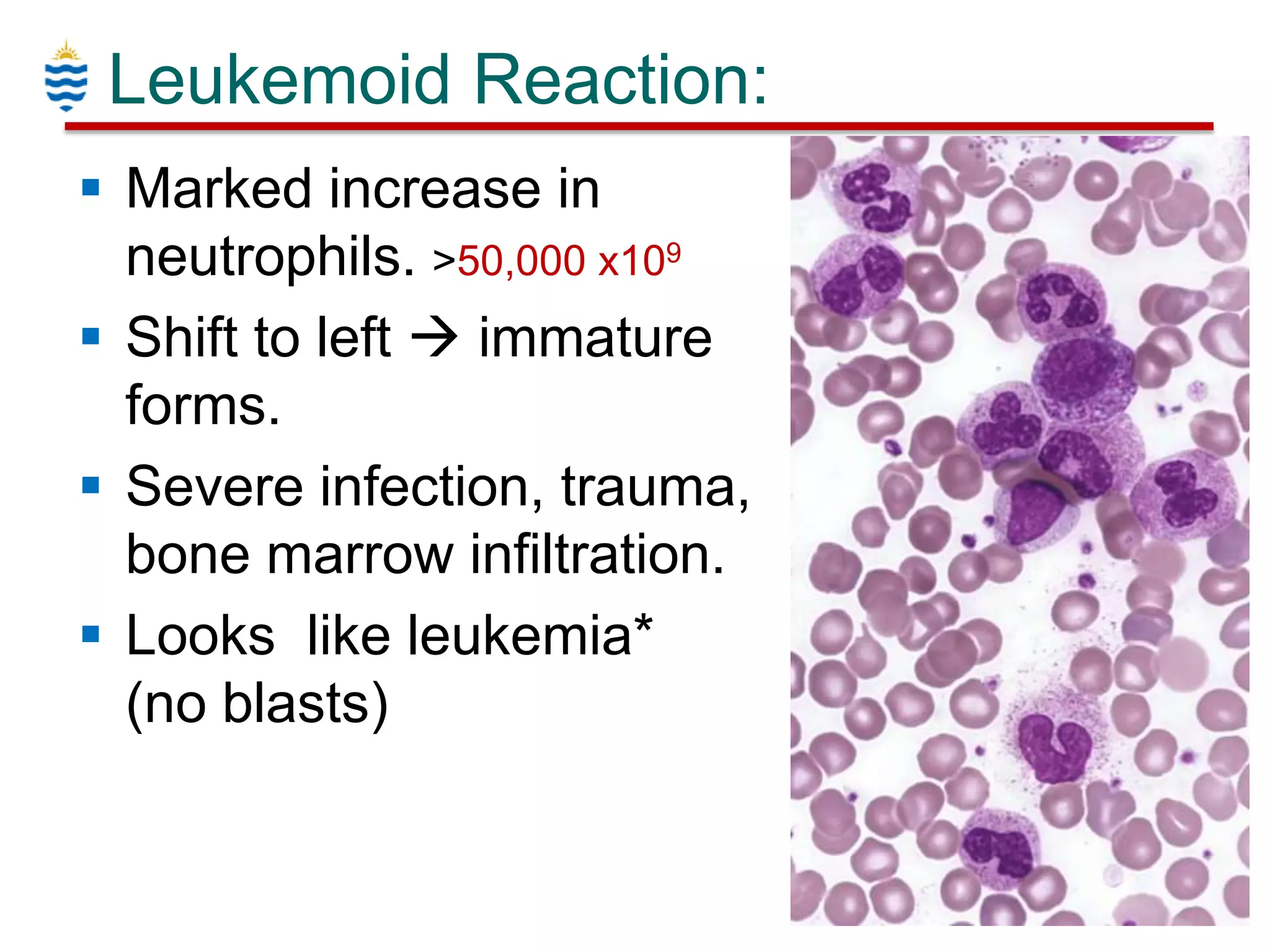
Leukemoid Reaction:
 Marked increase in
neutrophils. >50,000 x109
 Shift to left  immature
forms.
 Severe infection, trauma,
bone marrow infiltration.
 Looks like leukemia*
(no blasts)
Your failure may prove to be
an asset, provided you try to
know why you failed !
--Napoleon Hill
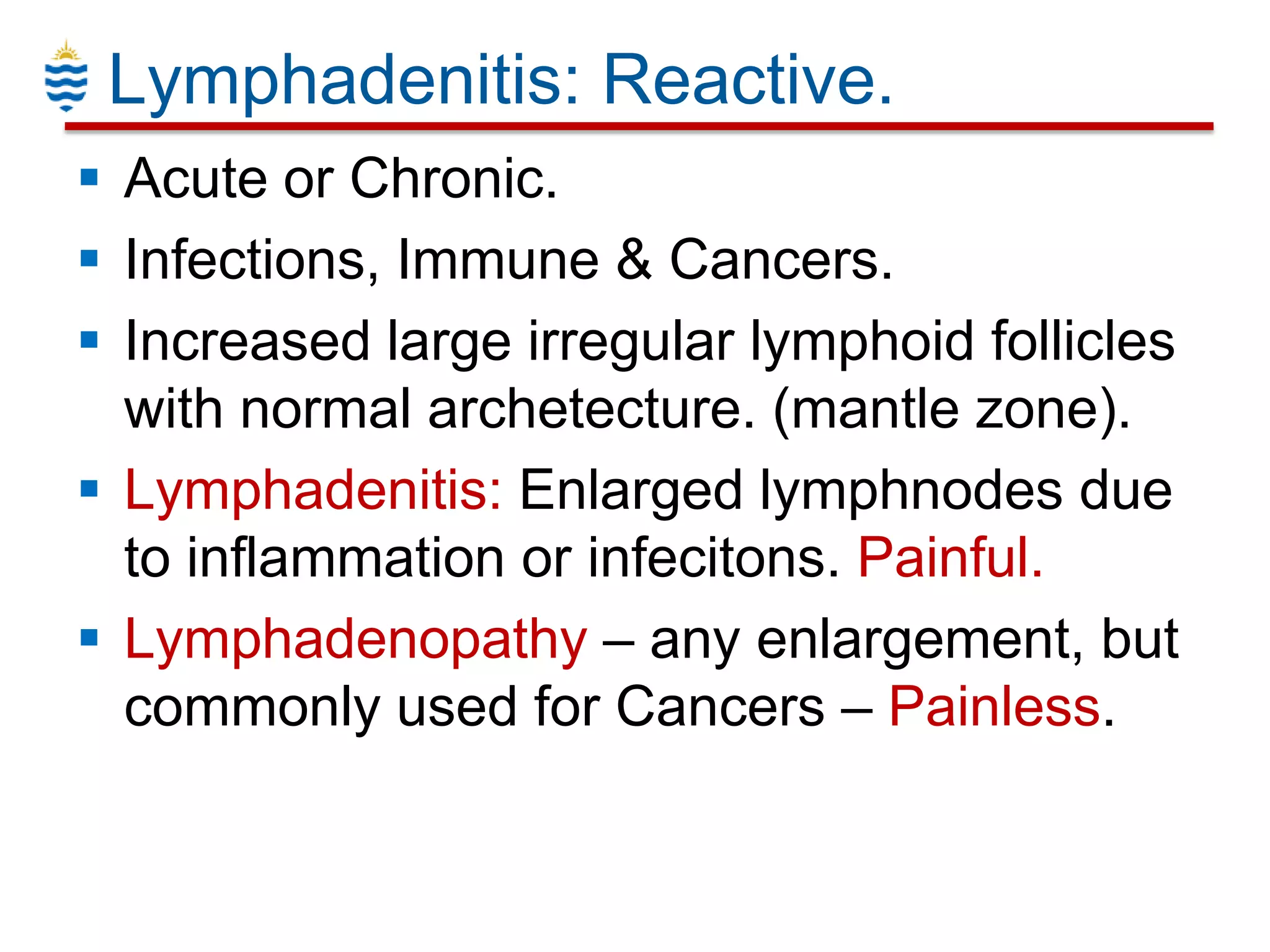
Lymphadenitis: Reactive.
 Acute or Chronic.
 Infections, Immune & Cancers.
 Increased large irregular lymphoid follicles
with normal archetecture. (mantle zone).
 Lymphadenitis: Enlarged lymphnodes due
to inflammation or infecitons. Painful.
 Lymphadenopathy – any enlargement, but
commonly used for Cancers – Painless.
Reactive lymphadenitis
Dark zone
Light zone
Mantle zone
Macrophage
Tingible body
Macrophage
Hemato-oncology: Blood Cancer
 Cancer of blood forming – stem cells (Blasts).
 Leukemia – ‘White’ ‘blood’ – excess WBC.
 Starts in bone marrow or lymphatic tissue.
 Spread to blood & other ‘RES’ tissues only.
(Liver, Spleen & lymphnodes)
 Two Major types: Myeloid & Lymphoid.
 Two clinical presentaiton: Acute / Chronic.
 Many subtypes* – due to several different
mutations – personalized medicine *
The goal of mankind is knowledge, which
is inherent in man. No knowledge comes
from outside: it is all inside. What man
'learns' is really what he “discovers” by
taking the cover off his own soul.
- - Swami Vivekananda
„Education‟… from Eduse (latin) to bring out..!
„Doctor‟ … from Dokere‟ (latin) to teach…!
Lymphoblast
Leukemia: Cancer of Blast cells.
Acute
Myeloid
Leukemia
Acute Lymphatic Leukemia
Chronic Leukemia
Chronic Leukemia
Normal – Acute - Chronic Leuk
Normal
Chronic Myeloid LeukemiaAcute Myeloid Leukemia
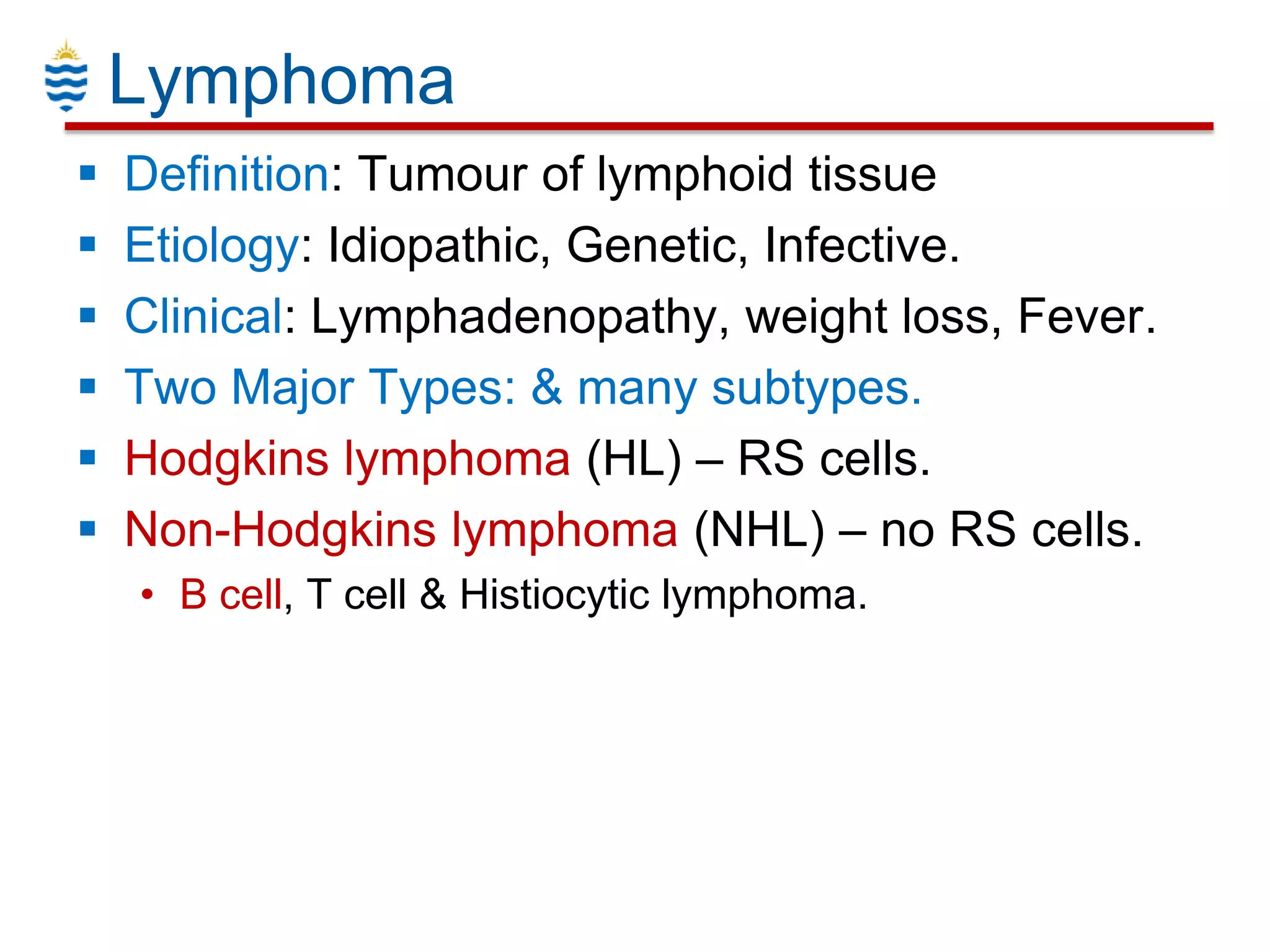
Hematologic Neoplasms: Classification
 Leukemias: Bone marrow, blood, Blasts
• Duration: Acute/Chronic
• Cell of Origin: Myeloid/Lymphoid
• AML / ALL & CML / CLL
 Lymphomas: – Lymph nodes, tumor
• Hodgkins & Non-Hodgkins.
 Premalignant conditions:
• Myeloproliferative syndromes (MPS)
• Myelodysplastic syndromes (MDS)
Leukemia: Clinical Features
 Cancer of Bone marrow – Excess blasts.
 Decreased Haemopoiesis:
• Erythropoiesis – Anemia - RBC
• Leukopoiesis – Infections - WBC
• Thrombopoiesis – Bleeding. PLT
 Bone marrow expansion/destruction:
• Bone pains.
 Extraneous hemopoiesis / spread:
• Splenomegaly
• Hepatomegaly
• Lymphadenopathy. (more in lymphatic malignancy)
Leukemia Clinical features:
Bleeding - Petechiae
Lymphadenopathy
Hepatosplenomegaly
Infections - Candidiasis
Leukemia Classification
 Acute Leukemias: weeks to months.
• Acute Myeloid Leukemia – AML - Adults
• Many Subtypes: M0, M1 to M7
• Acute Lymphoid Leukemia – ALL - Children
• Many Subtypes: L1, L2 & L3
 Chronic Leukemias: Years.
• Chronic Myeloid Leukemia- CML- Adults
• Chronic Lymphoid Leukemia - CLL –Old age
• Many subtypes:
ALL - AML
Acute Leukemia: AML/ALL - Blasts
Norm. Lymphocyte
Blast
Blast
Norm. RBC
Norm. Lymphocyte
Norm. RBC
Blast
Normal
Self-pity is an opiate!
--Napoleon Hill
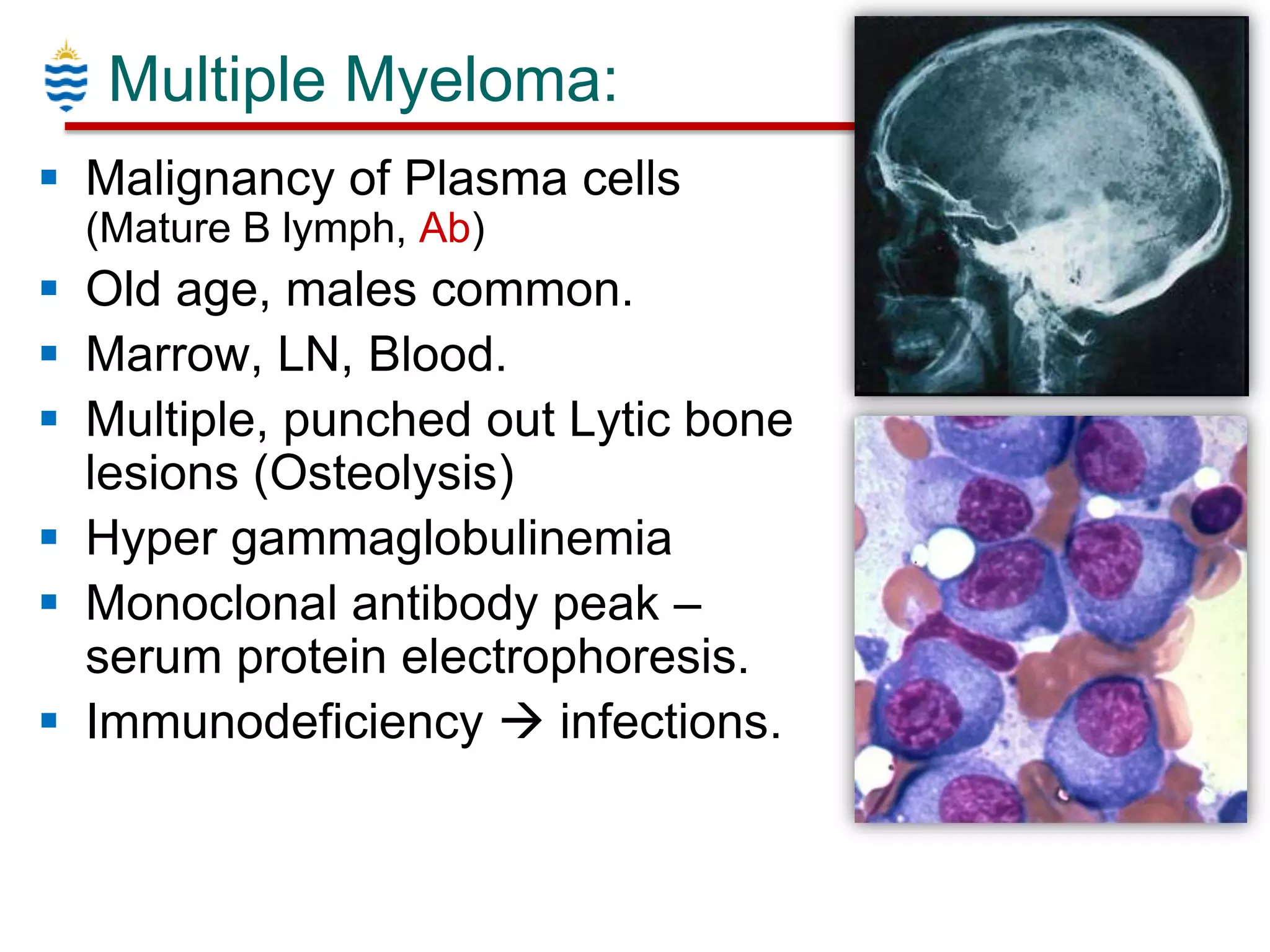
Lymphoma
 Definition: Tumour of lymphoid tissue
 Etiology: Idiopathic, Genetic, Infective.
 Clinical: Lymphadenopathy, weight loss, Fever.
 Two Major Types: & many subtypes.
 Hodgkins lymphoma (HL) – RS cells.
 Non-Hodgkins lymphoma (NHL) – no RS cells.
• B cell, T cell & Histiocytic lymphoma.
Lymphoma Row of enlarged lymph nodes
Hodgkins Lymphoma
Big binucleate cancer cells known as
Reed Sternberg Cells (RS cells)
Non-Hodgkins Lymphoma:
 Large group of lymphatic neoplasms.
 Clinical: Fever, anemia, infections,
Lymphadenopathy. Spleen+/-.
 No RS cells or eosinophilia
 Complex names and classification.
• Cell type – B, T & Histiocytic “B commonest”
• Clinical – low, intermediate & high grade.
• Histology – Follicular & diffuse.
• Special types: Burkitts lymphoma, Myeloma,
Waldenstroms macroglobulinemia, lennert‟s,
Non Hodgkins Lymphoma
Low, Intermediate & High grade.
Burkitt‟s lymphoma: large B cell NHL
 Endemic in Africa
 Epstein Barr Virus
(EBV)
 B Cell Lymphoma.
 Dark large B
lymphocytes (malignant)
with plenty of pale
macrophages. (Starry
sky pattern).
Multiple Myeloma:
 Malignancy of Plasma cells
(Mature B lymph, Ab)
 Old age, males common.
 Marrow, LN, Blood.
 Multiple, punched out Lytic bone
lesions (Osteolysis)
 Hyper gammaglobulinemia
 Monoclonal antibody peak –
serum protein electrophoresis.
 Immunodeficiency  infections.
"Creativity is inventing,
experimenting, growing, taking
risks, breaking rules, making
mistakes, and having fun.
-- Mary Lou Cook
Myeloproliferative Disorders.
Myelodysplastic Syndromes.
(Precanceraous stage of blood cancers)
Myelo Proliferative Disorders:
 Excess Proliferation, Neoplastic, Old age.
 Organomegaly – Liver & Spleen enlarged.
 Hypercellular BM & Leukocytosis.
 4 types:
• Excess RBC (polycythemia vera)
• Excess WBC (CML)
• Excess Plt (Essential Thrombocythemia)
• Excess Fibroblast (Myelofibrosis).
 Mixed types common, end in leukemia.
Polycythemia Rubra Vera (PV)
Hypercellular Marrow,
Red skin & Hepatosplenomegaly
ET - Blood Film & clinical.
Plenty of
Platelets
Megakaryocyte
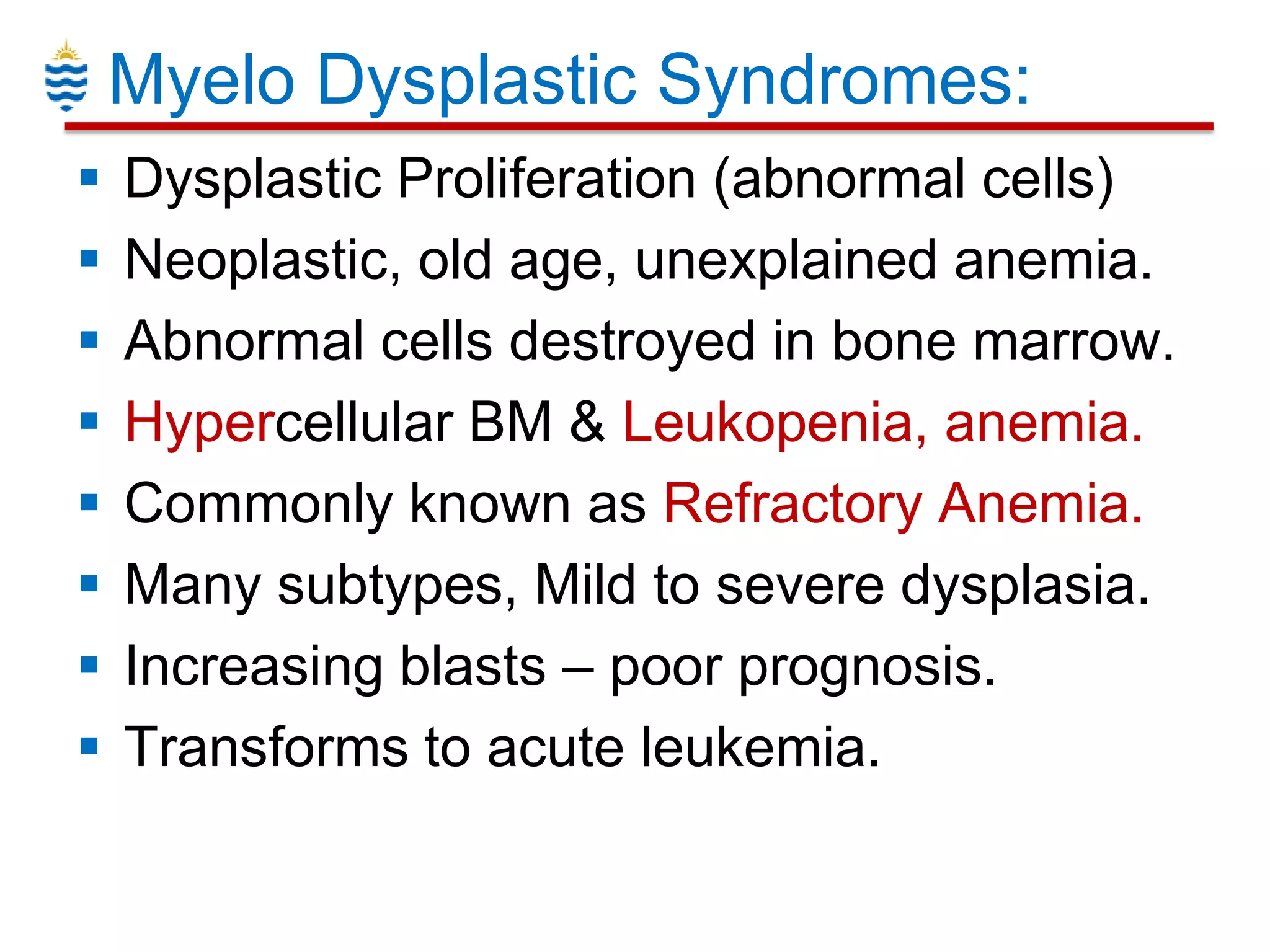
Myelo Dysplastic Syndromes:
 Dysplastic Proliferation (abnormal cells)
 Neoplastic, old age, unexplained anemia.
 Abnormal cells destroyed in bone marrow.
 Hypercellular BM & Leukopenia, anemia.
 Commonly known as Refractory Anemia.
 Many subtypes, Mild to severe dysplasia.
 Increasing blasts – poor prognosis.
 Transforms to acute leukemia.
Summary:
 Reactive Leukocytosis.
• Neutrophilia, Eosinophilia, Lymphocytosis.
 Reactive Leukopenia.
• Neutropenia, lymphopenia.
 Leukemias – Cancer of Blasts.
• AML/ALL, CML/CLL
 Lymphomas – Tumors of lymphoid tissue
• Hodgkins & Non- Hodgkins (HL, NHL)
 Premalignant conditions
• MPS & MDS:
3 R’s of success:
Respect for self,
Respect for others &
Responsibility for your actions.

Pathology of WBC Disorders

  • 1.
    Aspire to becomegood, not great.... Greatness is like a passing cloud, temporary. - Sai Baba - Divine Discourse, July 16, 2001.
  • 2.
    Pathology of WBC disorders Dr.Shashidhar Venkatesh Murthy A/Prof. & Head of Pathology 2013: MB2-HRM-Week 7
  • 3.
    HRM-Wk7: Fever, bleeding& Back pain  Mr M.S. 45y, man. Presents to ED: “Very bad lower back pain, nothing helping it”.  History: • Feels unwell? - Very • Fever? Yes, I think so; intermittent • Easy bruising -Yes, bruises last few weeks.  Examination: • Slim, unwell, pale, Multiple Bruises • Liver & Spleen enlarged – mild. • Lymph nodes enlarged neck & axilla.
  • 4.
    Learning Objectives:  WBCin health & disease - overview.  Classification & Common WBC disorders.  Congenital, Reactive & Cancer.  Clinical features.  Pathogenesis  Laboratory diagnosis  Blood morphology • Features (3-4). • Line diagram.  Management - brief. TOP 10 WBC Disorders: • Leukopenia: 1. Neutropenia 2. Lymphopenia. 3. Pancytopenia • Leucocytosis: 4. Neutrophilia 5. Eosinophilia 6. Lymphocytosis – IM 7. Lymphadenitis. • Neoplastic disorders (cancer) 9. Lymphoma 10. Leukemia (AML/ALL,CML/CLL)
  • 5.
    Teaching Plan &Staff:  Introduction to WBC disorders: • Shashidhar Venkatesh Murthy.  Clinical Cases: GLS 1st hour. • Ian Irving, Haematologist, TSVH.  Microscopy Tutorial: GLS 2nd hour. • Shashidhar Venkatesh Murthy.  Synthesis Session: Keepad Q&A disc. • Shashidhar Venkatesh Murthy. Mon 9am Tue 1pm Tue 2pm Thu 1pm
  • 6.
  • 7.
    8y child withAsthma & multiple scaly skin lesions. Image shows blood film appearance. ? Cause 1. Viral Infection 2. Allergic reaction 3. Malaria. 4. Bacterial infection. 5. Fungal infection. 1 2 3 4 5 0 0 000 SYNTHESIS SESSION
  • 8.
    I am herefor you…. Email: venkatesh.shashidhar@jcu.edu.au vmshashi@gmail.com Need personal guidance? Email me for an appointment. Office Tel: 4781 4566 Office location – MS136 Emergency?(exam time) Mob: 0416 933 704
  • 9.
    Small minds discusspeople Average minds discuss events Great minds discuss solution Genius silently acts!
  • 10.
    10 Normal Blood Cells: Neutrophil Basophil Eosinophil Lymphocyte Nongranular, Mononuclears Specific Immunity Granulocytes, Polymorphs Non-Specific Immunity
  • 11.
  • 12.
    Normal Granulopoiesis: CSF Stimulate bonemarrow to produce WBC. What are the Clinical applications of G-CSF?
  • 13.
    Lab: CBC -WBC Histogram: Absolute Count % / Differential Count
  • 14.
    WBC Absolute countsin disease: Penia PhiliaNeutro Penia PhiliaEosino Penia cytosisMono Penia cytosisLympho
  • 15.
    Leukopenia: Neutropenia  Reductionin granulocytes: • Decreased Production – Marrow. • Increased destruction – drugs, immune  When severe – Agranulocytosis.  Clinical features: • Infections – chills, fever, fatigue, ulcers.
  • 16.
    Leukocytosis: Neutrophilia  Increasedgranulocytes: • Acute inflammation, Bacterial infections.  When severe – Leukemoid reaction.  Clinical features: • Infections or Trauma - fever, fatigue.
  • 17.
    Lymphocytosis: Infectious Mononucleosis Increased Lymphocytes: • Chronic Inflam, Viral, fungal, TB etc.  Large lymphocytes, more cytoplasm. Irregular, indented by RBC – also known as virocyte  Clinical features: Chronic fever, lymphadenopathy.
  • 18.
  • 19.
    Toxic Granulation &Left shift: Acute inflammation Bacterial, trauma, immune, etc Band forms & Phagocytic granules in cytoplasm
  • 20.
    Leukemoid Reaction:  Markedincrease in neutrophils. >50,000 x109  Shift to left  immature forms.  Severe infection, trauma, bone marrow infiltration.  Looks like leukemia* (no blasts)
  • 21.
    Your failure mayprove to be an asset, provided you try to know why you failed ! --Napoleon Hill
  • 22.
    Lymphadenitis: Reactive.  Acuteor Chronic.  Infections, Immune & Cancers.  Increased large irregular lymphoid follicles with normal archetecture. (mantle zone).  Lymphadenitis: Enlarged lymphnodes due to inflammation or infecitons. Painful.  Lymphadenopathy – any enlargement, but commonly used for Cancers – Painless.
  • 23.
    Reactive lymphadenitis Dark zone Lightzone Mantle zone Macrophage Tingible body Macrophage
  • 24.
    Hemato-oncology: Blood Cancer Cancer of blood forming – stem cells (Blasts).  Leukemia – ‘White’ ‘blood’ – excess WBC.  Starts in bone marrow or lymphatic tissue.  Spread to blood & other ‘RES’ tissues only. (Liver, Spleen & lymphnodes)  Two Major types: Myeloid & Lymphoid.  Two clinical presentaiton: Acute / Chronic.  Many subtypes* – due to several different mutations – personalized medicine *
  • 25.
    The goal ofmankind is knowledge, which is inherent in man. No knowledge comes from outside: it is all inside. What man 'learns' is really what he “discovers” by taking the cover off his own soul. - - Swami Vivekananda „Education‟… from Eduse (latin) to bring out..! „Doctor‟ … from Dokere‟ (latin) to teach…!
  • 26.
    Lymphoblast Leukemia: Cancer ofBlast cells. Acute Myeloid Leukemia Acute Lymphatic Leukemia Chronic Leukemia Chronic Leukemia
  • 27.
    Normal – Acute- Chronic Leuk Normal Chronic Myeloid LeukemiaAcute Myeloid Leukemia
  • 28.
    Hematologic Neoplasms: Classification Leukemias: Bone marrow, blood, Blasts • Duration: Acute/Chronic • Cell of Origin: Myeloid/Lymphoid • AML / ALL & CML / CLL  Lymphomas: – Lymph nodes, tumor • Hodgkins & Non-Hodgkins.  Premalignant conditions: • Myeloproliferative syndromes (MPS) • Myelodysplastic syndromes (MDS)
  • 29.
    Leukemia: Clinical Features Cancer of Bone marrow – Excess blasts.  Decreased Haemopoiesis: • Erythropoiesis – Anemia - RBC • Leukopoiesis – Infections - WBC • Thrombopoiesis – Bleeding. PLT  Bone marrow expansion/destruction: • Bone pains.  Extraneous hemopoiesis / spread: • Splenomegaly • Hepatomegaly • Lymphadenopathy. (more in lymphatic malignancy)
  • 30.
    Leukemia Clinical features: Bleeding- Petechiae Lymphadenopathy Hepatosplenomegaly Infections - Candidiasis
  • 31.
    Leukemia Classification  AcuteLeukemias: weeks to months. • Acute Myeloid Leukemia – AML - Adults • Many Subtypes: M0, M1 to M7 • Acute Lymphoid Leukemia – ALL - Children • Many Subtypes: L1, L2 & L3  Chronic Leukemias: Years. • Chronic Myeloid Leukemia- CML- Adults • Chronic Lymphoid Leukemia - CLL –Old age • Many subtypes:
  • 32.
  • 33.
    Acute Leukemia: AML/ALL- Blasts Norm. Lymphocyte Blast Blast Norm. RBC Norm. Lymphocyte Norm. RBC Blast Normal
  • 34.
    Self-pity is anopiate! --Napoleon Hill
  • 35.
    Lymphoma  Definition: Tumourof lymphoid tissue  Etiology: Idiopathic, Genetic, Infective.  Clinical: Lymphadenopathy, weight loss, Fever.  Two Major Types: & many subtypes.  Hodgkins lymphoma (HL) – RS cells.  Non-Hodgkins lymphoma (NHL) – no RS cells. • B cell, T cell & Histiocytic lymphoma.
  • 36.
    Lymphoma Row ofenlarged lymph nodes
  • 37.
    Hodgkins Lymphoma Big binucleatecancer cells known as Reed Sternberg Cells (RS cells)
  • 38.
    Non-Hodgkins Lymphoma:  Largegroup of lymphatic neoplasms.  Clinical: Fever, anemia, infections, Lymphadenopathy. Spleen+/-.  No RS cells or eosinophilia  Complex names and classification. • Cell type – B, T & Histiocytic “B commonest” • Clinical – low, intermediate & high grade. • Histology – Follicular & diffuse. • Special types: Burkitts lymphoma, Myeloma, Waldenstroms macroglobulinemia, lennert‟s,
  • 39.
    Non Hodgkins Lymphoma Low,Intermediate & High grade.
  • 40.
    Burkitt‟s lymphoma: largeB cell NHL  Endemic in Africa  Epstein Barr Virus (EBV)  B Cell Lymphoma.  Dark large B lymphocytes (malignant) with plenty of pale macrophages. (Starry sky pattern).
  • 41.
    Multiple Myeloma:  Malignancyof Plasma cells (Mature B lymph, Ab)  Old age, males common.  Marrow, LN, Blood.  Multiple, punched out Lytic bone lesions (Osteolysis)  Hyper gammaglobulinemia  Monoclonal antibody peak – serum protein electrophoresis.  Immunodeficiency  infections.
  • 42.
    "Creativity is inventing, experimenting,growing, taking risks, breaking rules, making mistakes, and having fun. -- Mary Lou Cook
  • 43.
  • 44.
    Myelo Proliferative Disorders: Excess Proliferation, Neoplastic, Old age.  Organomegaly – Liver & Spleen enlarged.  Hypercellular BM & Leukocytosis.  4 types: • Excess RBC (polycythemia vera) • Excess WBC (CML) • Excess Plt (Essential Thrombocythemia) • Excess Fibroblast (Myelofibrosis).  Mixed types common, end in leukemia.
  • 45.
    Polycythemia Rubra Vera(PV) Hypercellular Marrow, Red skin & Hepatosplenomegaly
  • 46.
    ET - BloodFilm & clinical. Plenty of Platelets Megakaryocyte
  • 47.
    Myelo Dysplastic Syndromes: Dysplastic Proliferation (abnormal cells)  Neoplastic, old age, unexplained anemia.  Abnormal cells destroyed in bone marrow.  Hypercellular BM & Leukopenia, anemia.  Commonly known as Refractory Anemia.  Many subtypes, Mild to severe dysplasia.  Increasing blasts – poor prognosis.  Transforms to acute leukemia.
  • 48.
    Summary:  Reactive Leukocytosis. •Neutrophilia, Eosinophilia, Lymphocytosis.  Reactive Leukopenia. • Neutropenia, lymphopenia.  Leukemias – Cancer of Blasts. • AML/ALL, CML/CLL  Lymphomas – Tumors of lymphoid tissue • Hodgkins & Non- Hodgkins (HL, NHL)  Premalignant conditions • MPS & MDS:
  • 49.
    3 R’s ofsuccess: Respect for self, Respect for others & Responsibility for your actions.