Introduction to Research Methodology Sohail Bajammal, MBChB, MSc, FRCS(C), PhD(c) [email_address] Assistant Professor,  Faculty of Medicine Vice Dean Academic Development, Faculty of Dentistry Umm Al-Qura University
EBM is not new……. “ ثم نرقى في البحث والمقاييس على التدريج والترتيب مع انتقاد المقدمات والتحفظ في النتائج ونجعل غرضنا في جميع ما نستقرئه ونتصفحه استعمال العدل لا اتباع الهوى ونتحرى في سائر ما نميزه وننتقده طلب الحق لا الميل مع الآراء” الحسن بن الهيثم
Objectives What is research? Why do we need to do research? What is the difference between research methodology and EBM? What are the types of research? How to do research?
What is research? Systematic investigation towards increasing the sum of knowledge (Chambers 20th Century Dictionary)
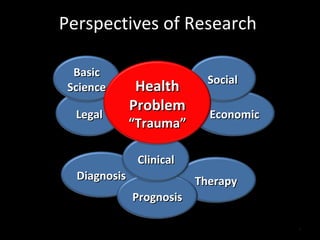
Perspectives of Research  Economic Legal Therapy Basic Science Social Diagnosis Prognosis Clinical Health Problem “ Trauma”
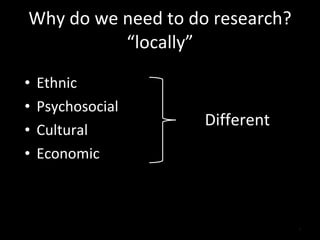
Why do we need to do research? “locally” Ethnic Psychosocial Cultural Economic Different
Research Methodology vs Evidence-Based Medicine
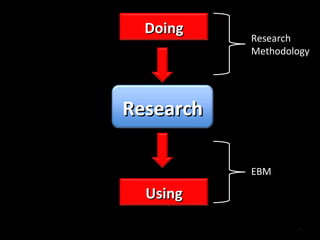
Research Methodology EBM Research Doing Using
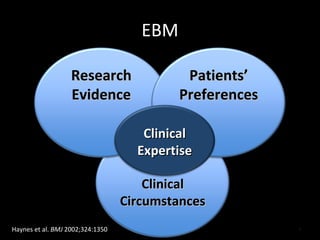
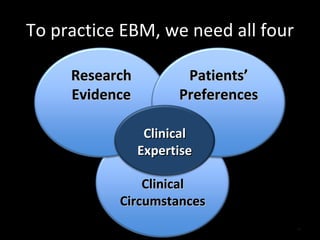
EBM Haynes et al.  BMJ  2002;324:1350 Clinical Circumstances Research Evidence Patients’ Preferences Clinical Expertise
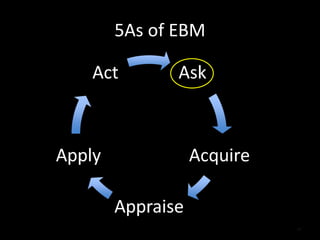
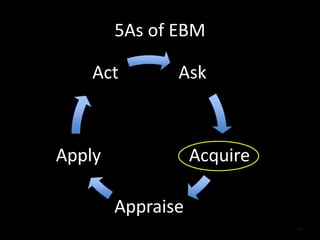
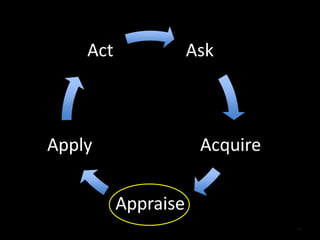
5As of EBM
Is this a good question? What is the best treatment of back pain?
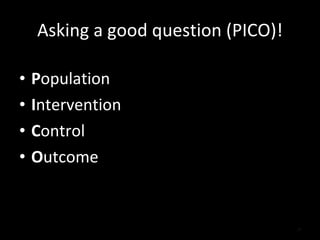
Asking a good question (PICO)! P opulation I ntervention C ontrol O utcome
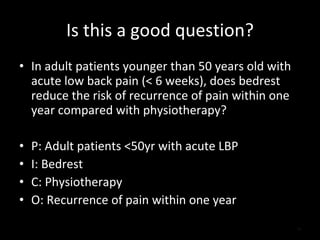
Is this a good question? In adult patients younger than 50 years old with acute low back pain (< 6 weeks), does bedrest reduce the risk of recurrence of pain within one year compared with physiotherapy? P: Adult patients <50yr with acute LBP I: Bedrest C: Physiotherapy O: Recurrence of pain within one year
5As of EBM
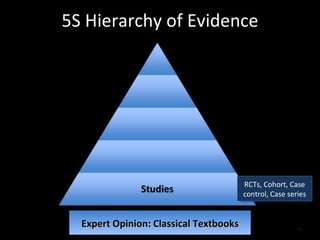
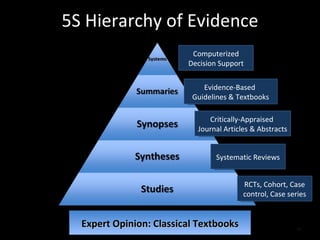
5S Hierarchy of Evidence RCTs, Cohort, Case control, Case series Expert Opinion: Classical Textbooks
Primary Sources Original articles Using: PubMed, OVID You have to retrieve and appraise the articles Levels (strength) of evidence
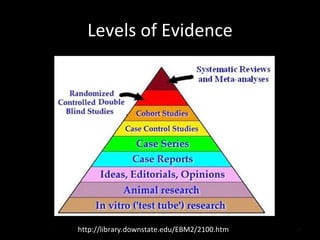
Levels of Evidence http://library.downstate.edu/EBM2/2100.htm 
It’s time consuming
5S Hierarchy of Evidence RCTs, Cohort, Case control, Case series Systematic Reviews Critically-Appraised  Journal Articles & Abstracts Evidence-Based  Guidelines & Textbooks Computerized Decision Support Expert Opinion: Classical Textbooks
To practice EBM, we need all four Clinical Circumstances Research Evidence Patients’ Preferences Clinical Expertise
Research Methodology
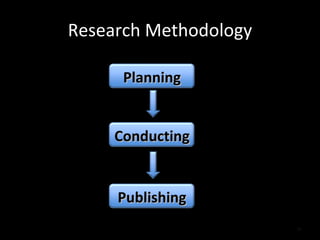
Research Methodology Planning Conducting Publishing
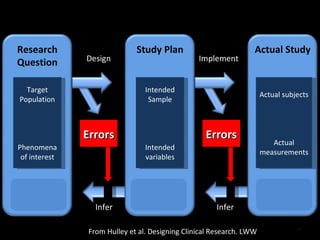
Target Population Phenomena of interest Intended Sample Intended variables Actual subjects Actual measurements From Hulley et al. Designing Clinical Research. LWW Design Implement Infer Infer Errors Errors Research Question Truth in the Universe Study Plan Truth in the Study Actual Study Findings in the Study
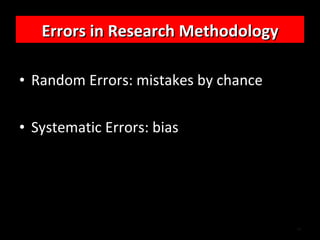
Random Errors: mistakes by chance Systematic Errors: bias Errors in Research Methodology
Assemble a research team Ask a good research question Do a literature search Choose the proper study design Determine the sampling design Get ethical approval Research Planning
Research Team Research is not a one man/woman show You need a team at every step Ask a research methodologist & a biostatistician EARLY
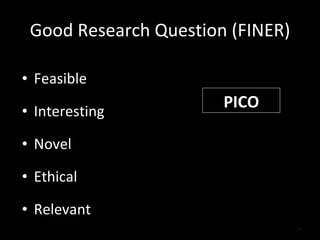
Good Research Question (FINER) Feasible Interesting Novel Ethical Relevant PICO
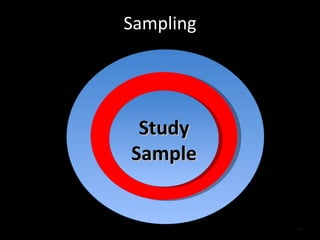
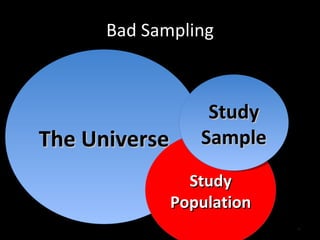
Sampling The Universe Study Population Study Sample
Bad Sampling The Universe Study Population Study Sample
Sample Size You need to have enough research participants (patients) to show a difference Depends on: The incidence of the outcomes you are assessing in each group The prevalence of the disease
Sample Size Compare applying pressure with no pressure to control active bleeding? Compare antibiotics with no antibiotics for bad open fractures to reduce the risk of infection? Compare antibiotics with no antibiotics for pneumonia to reduce septic shock? Compare LMWH with Unfractionated heparin to reduce the risk of DVT after TKA?
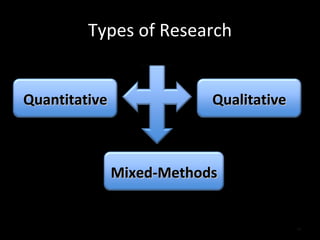
Types of Research Quantitative Qualitative Mixed-Methods
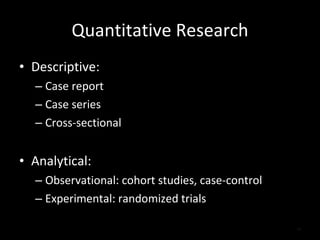
Quantitative Research Descriptive: Case report Case series Cross-sectional Analytical: Observational: cohort studies, case-control Experimental: randomized trials
Descriptive Studies
Case Report A descriptive study of one patient Detailed profile of a “rare” presentation or treatment Helpful in developing hypothesis to be tested later using analytic study
Case Series A descriptive study of multiple patients “ Rare” phenomenon occurring multiple times Detailed profile of patients’ presentation and outcome Helpful in developing hypothesis
Cross-Sectional Studies Descriptive “Survey” One to one questionnaire, mail, telephone, online Attention to details: Sampling Construction of the questions Construction of the responses
Analytical Studies
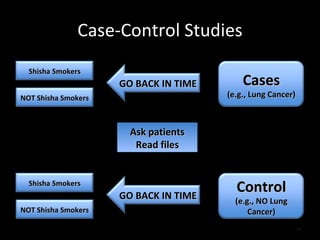
Case-Control Studies Ask patients Read files Cases (e.g., Lung Cancer) Control (e.g., NO Lung Cancer) GO BACK IN TIME GO BACK IN TIME Shisha Smokers NOT Shisha Smokers Shisha Smokers NOT Shisha Smokers
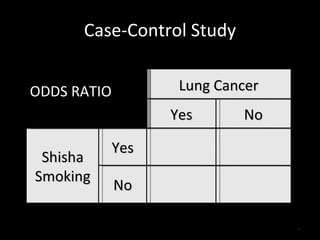
Case-Control Study ODDS RATIO Lung Cancer Yes No Shisha Smoking Yes No
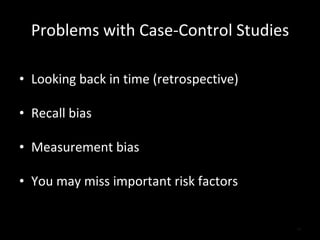
Problems with Case-Control Studies Looking back in time (retrospective) Recall bias Measurement bias You may miss important risk factors
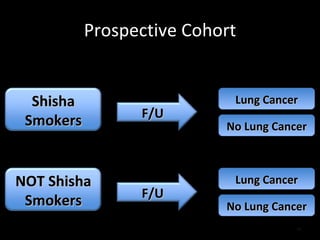
Prospective Cohort Lung Cancer No Lung Cancer Lung Cancer No Lung Cancer Shisha Smokers NOT Shisha Smokers F/U F/U
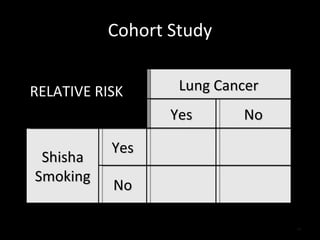
Cohort Study RELATIVE RISK Lung Cancer Yes No Shisha Smoking Yes No
Cohort Study Prospective or Retrospective Drawbacks: Large number of patients Follow them up for long time
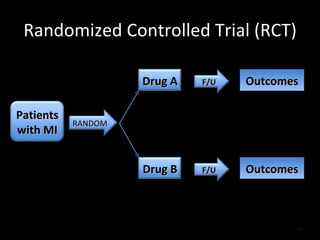
Randomized Controlled Trial (RCT) Outcomes Outcomes Patients with MI RANDOM Drug A Drug B F/U F/U
Why RCT is the highest level of evidence? Randomization: balance known and unknown prognostic factors Blinding: Patients Researchers Outcome assessors Aim for complete follow-up
Ask for help    Research assistants Monitor the conduct of the study No deviation Patients safety Complete data Conducting Research
During the planning phase: who will do what? Oral & written Pick your audience (pick a Journal) Write your paper with the Journal you picked in mind Don’t give up, you will get rejected Publishing Research
Take Home Messages Research is not a one man/woman show You need a team to do good research Research is a science You need to learn how to do it Research is like riding a bicycle You need to practice
Take Home Messages Research needs planning If you fail to plan, you plan to fail Not all of us need to do research But all of us should practice EBM Never ever give up You will get rejected
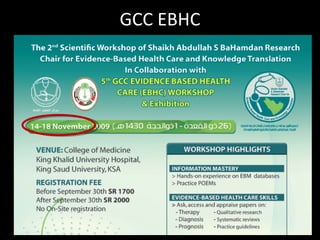
GCC EBHC
http://eapps.ngha.med.sa/ebm/
Objectives What is research? Why do we need to do research? What is the difference between research and EBM? What are the types of research? How to do research? [email_address]

Introduction to Research Methodology

  • 1.
    Introduction to ResearchMethodology Sohail Bajammal, MBChB, MSc, FRCS(C), PhD(c) [email_address] Assistant Professor, Faculty of Medicine Vice Dean Academic Development, Faculty of Dentistry Umm Al-Qura University
  • 2.
    EBM is notnew……. “ ثم نرقى في البحث والمقاييس على التدريج والترتيب مع انتقاد المقدمات والتحفظ في النتائج ونجعل غرضنا في جميع ما نستقرئه ونتصفحه استعمال العدل لا اتباع الهوى ونتحرى في سائر ما نميزه وننتقده طلب الحق لا الميل مع الآراء” الحسن بن الهيثم
  • 3.
    Objectives What isresearch? Why do we need to do research? What is the difference between research methodology and EBM? What are the types of research? How to do research?
  • 4.
    What is research?Systematic investigation towards increasing the sum of knowledge (Chambers 20th Century Dictionary)
  • 5.
    Perspectives of Research Economic Legal Therapy Basic Science Social Diagnosis Prognosis Clinical Health Problem “ Trauma”
  • 6.
    Why do weneed to do research? “locally” Ethnic Psychosocial Cultural Economic Different
  • 7.
    Research Methodology vsEvidence-Based Medicine
  • 8.
    Research Methodology EBMResearch Doing Using
  • 9.
    EBM Haynes etal. BMJ 2002;324:1350 Clinical Circumstances Research Evidence Patients’ Preferences Clinical Expertise
  • 10.
  • 11.
    Is this agood question? What is the best treatment of back pain?
  • 12.
    Asking a goodquestion (PICO)! P opulation I ntervention C ontrol O utcome
  • 13.
    Is this agood question? In adult patients younger than 50 years old with acute low back pain (< 6 weeks), does bedrest reduce the risk of recurrence of pain within one year compared with physiotherapy? P: Adult patients <50yr with acute LBP I: Bedrest C: Physiotherapy O: Recurrence of pain within one year
  • 14.
  • 15.
    5S Hierarchy ofEvidence RCTs, Cohort, Case control, Case series Expert Opinion: Classical Textbooks
  • 16.
    Primary Sources Originalarticles Using: PubMed, OVID You have to retrieve and appraise the articles Levels (strength) of evidence
  • 17.
    Levels of Evidencehttp://library.downstate.edu/EBM2/2100.htm 
  • 19.
  • 20.
    5S Hierarchy ofEvidence RCTs, Cohort, Case control, Case series Systematic Reviews Critically-Appraised Journal Articles & Abstracts Evidence-Based Guidelines & Textbooks Computerized Decision Support Expert Opinion: Classical Textbooks
  • 21.
    To practice EBM,we need all four Clinical Circumstances Research Evidence Patients’ Preferences Clinical Expertise
  • 22.
  • 23.
    Research Methodology PlanningConducting Publishing
  • 24.
    Target Population Phenomenaof interest Intended Sample Intended variables Actual subjects Actual measurements From Hulley et al. Designing Clinical Research. LWW Design Implement Infer Infer Errors Errors Research Question Truth in the Universe Study Plan Truth in the Study Actual Study Findings in the Study
  • 25.
    Random Errors: mistakesby chance Systematic Errors: bias Errors in Research Methodology
  • 26.
    Assemble a researchteam Ask a good research question Do a literature search Choose the proper study design Determine the sampling design Get ethical approval Research Planning
  • 27.
    Research Team Researchis not a one man/woman show You need a team at every step Ask a research methodologist & a biostatistician EARLY
  • 28.
    Good Research Question(FINER) Feasible Interesting Novel Ethical Relevant PICO
  • 29.
    Sampling The UniverseStudy Population Study Sample
  • 30.
    Bad Sampling TheUniverse Study Population Study Sample
  • 31.
    Sample Size Youneed to have enough research participants (patients) to show a difference Depends on: The incidence of the outcomes you are assessing in each group The prevalence of the disease
  • 32.
    Sample Size Compareapplying pressure with no pressure to control active bleeding? Compare antibiotics with no antibiotics for bad open fractures to reduce the risk of infection? Compare antibiotics with no antibiotics for pneumonia to reduce septic shock? Compare LMWH with Unfractionated heparin to reduce the risk of DVT after TKA?
  • 33.
    Types of ResearchQuantitative Qualitative Mixed-Methods
  • 34.
    Quantitative Research Descriptive:Case report Case series Cross-sectional Analytical: Observational: cohort studies, case-control Experimental: randomized trials
  • 35.
  • 36.
    Case Report Adescriptive study of one patient Detailed profile of a “rare” presentation or treatment Helpful in developing hypothesis to be tested later using analytic study
  • 37.
    Case Series Adescriptive study of multiple patients “ Rare” phenomenon occurring multiple times Detailed profile of patients’ presentation and outcome Helpful in developing hypothesis
  • 38.
    Cross-Sectional Studies Descriptive“Survey” One to one questionnaire, mail, telephone, online Attention to details: Sampling Construction of the questions Construction of the responses
  • 39.
  • 40.
    Case-Control Studies Askpatients Read files Cases (e.g., Lung Cancer) Control (e.g., NO Lung Cancer) GO BACK IN TIME GO BACK IN TIME Shisha Smokers NOT Shisha Smokers Shisha Smokers NOT Shisha Smokers
  • 41.
    Case-Control Study ODDSRATIO Lung Cancer Yes No Shisha Smoking Yes No
  • 42.
    Problems with Case-ControlStudies Looking back in time (retrospective) Recall bias Measurement bias You may miss important risk factors
  • 43.
    Prospective Cohort LungCancer No Lung Cancer Lung Cancer No Lung Cancer Shisha Smokers NOT Shisha Smokers F/U F/U
  • 44.
    Cohort Study RELATIVERISK Lung Cancer Yes No Shisha Smoking Yes No
  • 45.
    Cohort Study Prospectiveor Retrospective Drawbacks: Large number of patients Follow them up for long time
  • 46.
    Randomized Controlled Trial(RCT) Outcomes Outcomes Patients with MI RANDOM Drug A Drug B F/U F/U
  • 47.
    Why RCT isthe highest level of evidence? Randomization: balance known and unknown prognostic factors Blinding: Patients Researchers Outcome assessors Aim for complete follow-up
  • 48.
    Ask for help  Research assistants Monitor the conduct of the study No deviation Patients safety Complete data Conducting Research
  • 49.
    During the planningphase: who will do what? Oral & written Pick your audience (pick a Journal) Write your paper with the Journal you picked in mind Don’t give up, you will get rejected Publishing Research
  • 50.
    Take Home MessagesResearch is not a one man/woman show You need a team to do good research Research is a science You need to learn how to do it Research is like riding a bicycle You need to practice
  • 51.
    Take Home MessagesResearch needs planning If you fail to plan, you plan to fail Not all of us need to do research But all of us should practice EBM Never ever give up You will get rejected
  • 52.
  • 53.
  • 54.
    Objectives What isresearch? Why do we need to do research? What is the difference between research and EBM? What are the types of research? How to do research? [email_address]

Editor's Notes

  • #16 Problems with textbooks: Usually single authored chapters Likely biased, author’s opinion Not peer-reviewed Outdated (at least 4 years)
  • #21 Problems with textbooks: Usually single authored chapters Likely biased, author’s opinion Not peer-reviewed Outdated (at least 4 years)
  • #27 Research team:
  • #29 Feasible: adequate participants &amp; expertise affordable time &amp; money Interesting: to you Novel: Extends, confirms or refutes previous findings Provides new findings Ethical Relevant: To scientific knowledge To clinical and health policy To future research directions
  • #41 An observational study Compare two groups: CASES: a group with the outcome of interest (e.g., non-healed fractures) CONTROLS: a similar group without the outcome of interest (e.g., healed fractures) Determine how many patients within each group have the risk factor (e.g., smoking Shisha)
  • #44 An observational study You follow a group of people with certain risk factors and another group without these risk factors You follow them for a period of time and look for the outcome of interest