

Liposomal drug delivery system(LDDS)
Course Instructor
Dr. Sohel Rana
Professor
Dept. of Pharmacy, Jahangirnagar University
Submission Date: 28.08.2013
Submitted By:
Nazmul Islam
Ms in Pharm Tech,Dept of Pharmacy,UAP
Contact:(uap_nazmul2yahoo.com)
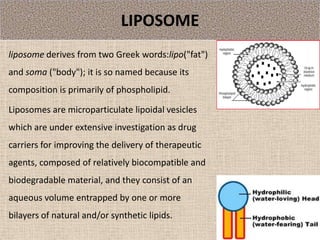
LIPOSOME
liposome derives from two Greek words:lipo("fat")
and soma ("body"); it is so named because its
composition is primarily of phospholipid.
Liposomes are microparticulate lipoidal vesicles
which are under extensive investigation as drug
carriers for improving the delivery of therapeutic
agents, composed of relatively biocompatible and
biodegradable material, and they consist of an
aqueous volume entrapped by one or more
bilayers of natural and/or synthetic lipids.
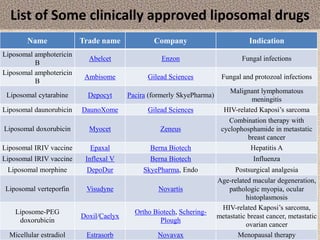
List of Some clinically approved liposomal drugs
Name Trade name Company Indication
Liposomal amphotericin
B
Abelcet Enzon Fungal infections
Liposomal amphotericin
B
Ambisome Gilead Sciences Fungal and protozoal infections
Liposomal cytarabine Depocyt Pacira (formerly SkyePharma)
Malignant lymphomatous
meningitis
Liposomal daunorubicin DaunoXome Gilead Sciences HIV-related Kaposi’s sarcoma
Liposomal doxorubicin Myocet Zeneus
Combination therapy with
cyclophosphamide in metastatic
breast cancer
Liposomal IRIV vaccine Epaxal Berna Biotech Hepatitis A
Liposomal IRIV vaccine Inflexal V Berna Biotech Influenza
Liposomal morphine DepoDur SkyePharma, Endo Postsurgical analgesia
Liposomal verteporfin Visudyne Novartis
Age-related macular degeneration,
pathologic myopia, ocular
histoplasmosis
Liposome-PEG
doxorubicin
Doxil/Caelyx
Ortho Biotech, Schering-
Plough
HIV-related Kaposi’s sarcoma,
metastatic breast cancer, metastatic
ovarian cancer
Micellular estradiol Estrasorb Novavax Menopausal therapy
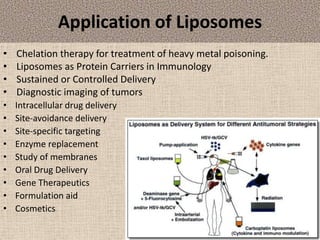
Application of Liposomes
• Intracellular drug delivery
• Site-avoidance delivery
• Site-specific targeting
• Enzyme replacement
• Study of membranes
• Oral Drug Delivery
• Gene Therapeutics
• Formulation aid
• Cosmetics
• Chelation therapy for treatment of heavy metal poisoning.
• Liposomes as Protein Carriers in Immunology
• Sustained or Controlled Delivery
• Diagnostic imaging of tumors
Advantages of LDDS
Advantage
 Suitable for delivery of hydrophobic, hydrophilic and amphipatic drugs and
agents
 Chemically and physically well characterized entities
 Biocompatible
 Use as carrier for suitable for controlled release drug delivery.
 Suitable to give localized action in particular tissues.
 Suitable to administer via various routes
 Increased efficacy and therapeutic index.
 Reduction on toxicity of the encapsulation agent.
 Improved pharmacokinetic properties.
 Can be made into Varity of drug.
 Minimum antigenicity.
Disadvantage of LDDS
Disadvantage
 their rapid clearance from circulation due to uptake,
 by the reticuloendothelial system(RES), primarily in the liver
 Leakage of encaptulation drug delivery during storage.
 Batch to batch variation.
 Once administered, can’t removed.
 Difficult in large scale manufacture and sterilization.
 Physical /chemical stabillity
 Very high production cost
 Possibility of dumping due to faulty administration.
Classification
based on the ability of liposomes to
interact with cells
• non-interactive sterically stabilized
(long-circulating) liposomes (LCL) and;
• highly interactive cationic liposomes.
Based on size and number of
bilayers
• multilamellar vesicles (MLV);
• large unilamellar vesicles (LUV);
• small unilamellar vesicles (SUV).
Based on composition and mechanism of intracellular delivery
• conventional liposomes (CL);
• pH-sensitive liposomes;
• cationic liposomes;
• immunoliposomes;
• long-circulating liposomes (LCL).
Mechanism of liposomal drug delivery
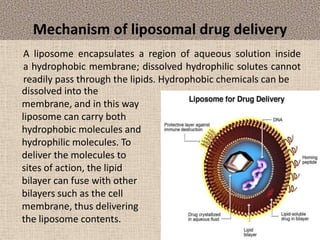
A liposome encapsulates a region of aqueous solution inside
a hydrophobic membrane; dissolved hydrophilic solutes cannot
readily pass through the lipids. Hydrophobic chemicals can be
dissolved into the
membrane, and in this way
liposome can carry both
hydrophobic molecules and
hydrophilic molecules. To
deliver the molecules to
sites of action, the lipid
bilayer can fuse with other
bilayers such as the cell
membrane, thus delivering
the liposome contents.
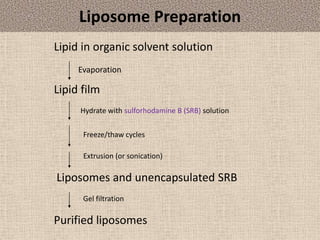
Liposome Preparation
Lipid in organic solvent solution
Evaporation
Extrusion (or sonication)
Liposomes and unencapsulated SRB
Lipid film
Freeze/thaw cycles
Gel filtration
Purified liposomes
Hydrate with sulforhodamine B (SRB) solution
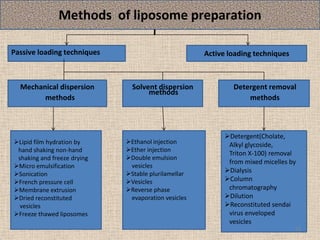
Methods of liposome preparation
Solvent dispersion
methods
Ethanol injection
Ether injection
Double emulsion
vesicles
Stable plurilamellar
Vesicles
Reverse phase
evaporation vesicles
Detergent removal
methods
Passive loading techniques
Detergent(Cholate,
Alkyl glycoside,
Triton X-100) removal
from mixed micelles by
Dialysis
Column
chromatography
Dilution
Reconstituted sendai
virus enveloped
vesicles
Active loading techniques
Lipid film hydration by
hand shaking non-hand
shaking and freeze drying
Micro emulsification
Sonication
French pressure cell
Membrane extrusion
Dried reconstituted
vesicles
Freeze thawed liposomes
Mechanical dispersion
methods
10
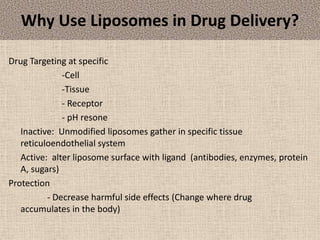
Why Use Liposomes in Drug Delivery?
Drug Targeting at specific
-Cell
-Tissue
- Receptor
- pH resone
Inactive: Unmodified liposomes gather in specific tissue
reticuloendothelial system
Active: alter liposome surface with ligand (antibodies, enzymes, protein
A, sugars)
Protection
- Decrease harmful side effects (Change where drug
accumulates in the body)
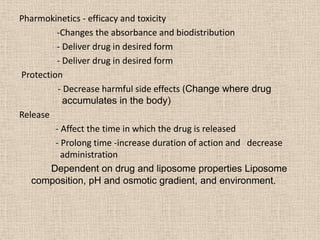
Pharmokinetics - efficacy and toxicity
-Changes the absorbance and biodistribution
- Deliver drug in desired form
Protection
- Decrease harmful side effects (Change where drug
accumulates in the body)
Release
- Affect the time in which the drug is released
- Prolong time -increase duration of action and decrease
administration
Dependent on drug and liposome properties Liposome
composition, pH and osmotic gradient, and environment.
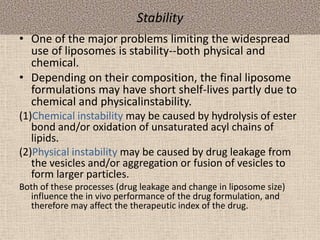
Stability
• One of the major problems limiting the widespread
use of liposomes is stability--both physical and
chemical.
• Depending on their composition, the final liposome
formulations may have short shelf-lives partly due to
chemical and physicalinstability.
(1)Chemical instability may be caused by hydrolysis of ester
bond and/or oxidation of unsaturated acyl chains of
lipids.
(2)Physical instability may be caused by drug leakage from
the vesicles and/or aggregation or fusion of vesicles to
form larger particles.
Both of these processes (drug leakage and change in liposome size)
influence the in vivo performance of the drug formulation, and
therefore may affect the therapeutic index of the drug.
All for your kind
attention
Liposomal drug delivery system

Liposomal drug delivery system

  • 1.
    Liposomal drug deliverysystem(LDDS) Course Instructor Dr. Sohel Rana Professor Dept. of Pharmacy, Jahangirnagar University Submission Date: 28.08.2013 Submitted By: Nazmul Islam Ms in Pharm Tech,Dept of Pharmacy,UAP Contact:(uap_nazmul2yahoo.com)
  • 2.
    LIPOSOME liposome derives fromtwo Greek words:lipo("fat") and soma ("body"); it is so named because its composition is primarily of phospholipid. Liposomes are microparticulate lipoidal vesicles which are under extensive investigation as drug carriers for improving the delivery of therapeutic agents, composed of relatively biocompatible and biodegradable material, and they consist of an aqueous volume entrapped by one or more bilayers of natural and/or synthetic lipids.
  • 3.
    List of Someclinically approved liposomal drugs Name Trade name Company Indication Liposomal amphotericin B Abelcet Enzon Fungal infections Liposomal amphotericin B Ambisome Gilead Sciences Fungal and protozoal infections Liposomal cytarabine Depocyt Pacira (formerly SkyePharma) Malignant lymphomatous meningitis Liposomal daunorubicin DaunoXome Gilead Sciences HIV-related Kaposi’s sarcoma Liposomal doxorubicin Myocet Zeneus Combination therapy with cyclophosphamide in metastatic breast cancer Liposomal IRIV vaccine Epaxal Berna Biotech Hepatitis A Liposomal IRIV vaccine Inflexal V Berna Biotech Influenza Liposomal morphine DepoDur SkyePharma, Endo Postsurgical analgesia Liposomal verteporfin Visudyne Novartis Age-related macular degeneration, pathologic myopia, ocular histoplasmosis Liposome-PEG doxorubicin Doxil/Caelyx Ortho Biotech, Schering- Plough HIV-related Kaposi’s sarcoma, metastatic breast cancer, metastatic ovarian cancer Micellular estradiol Estrasorb Novavax Menopausal therapy
  • 4.
    Application of Liposomes •Intracellular drug delivery • Site-avoidance delivery • Site-specific targeting • Enzyme replacement • Study of membranes • Oral Drug Delivery • Gene Therapeutics • Formulation aid • Cosmetics • Chelation therapy for treatment of heavy metal poisoning. • Liposomes as Protein Carriers in Immunology • Sustained or Controlled Delivery • Diagnostic imaging of tumors
  • 5.
    Advantages of LDDS Advantage Suitable for delivery of hydrophobic, hydrophilic and amphipatic drugs and agents  Chemically and physically well characterized entities  Biocompatible  Use as carrier for suitable for controlled release drug delivery.  Suitable to give localized action in particular tissues.  Suitable to administer via various routes  Increased efficacy and therapeutic index.  Reduction on toxicity of the encapsulation agent.  Improved pharmacokinetic properties.  Can be made into Varity of drug.  Minimum antigenicity.
  • 6.
    Disadvantage of LDDS Disadvantage their rapid clearance from circulation due to uptake,  by the reticuloendothelial system(RES), primarily in the liver  Leakage of encaptulation drug delivery during storage.  Batch to batch variation.  Once administered, can’t removed.  Difficult in large scale manufacture and sterilization.  Physical /chemical stabillity  Very high production cost  Possibility of dumping due to faulty administration.
  • 7.
    Classification based on theability of liposomes to interact with cells • non-interactive sterically stabilized (long-circulating) liposomes (LCL) and; • highly interactive cationic liposomes. Based on size and number of bilayers • multilamellar vesicles (MLV); • large unilamellar vesicles (LUV); • small unilamellar vesicles (SUV). Based on composition and mechanism of intracellular delivery • conventional liposomes (CL); • pH-sensitive liposomes; • cationic liposomes; • immunoliposomes; • long-circulating liposomes (LCL).
  • 8.
    Mechanism of liposomaldrug delivery A liposome encapsulates a region of aqueous solution inside a hydrophobic membrane; dissolved hydrophilic solutes cannot readily pass through the lipids. Hydrophobic chemicals can be dissolved into the membrane, and in this way liposome can carry both hydrophobic molecules and hydrophilic molecules. To deliver the molecules to sites of action, the lipid bilayer can fuse with other bilayers such as the cell membrane, thus delivering the liposome contents.
  • 9.
    Liposome Preparation Lipid inorganic solvent solution Evaporation Extrusion (or sonication) Liposomes and unencapsulated SRB Lipid film Freeze/thaw cycles Gel filtration Purified liposomes Hydrate with sulforhodamine B (SRB) solution
  • 10.
    Methods of liposomepreparation Solvent dispersion methods Ethanol injection Ether injection Double emulsion vesicles Stable plurilamellar Vesicles Reverse phase evaporation vesicles Detergent removal methods Passive loading techniques Detergent(Cholate, Alkyl glycoside, Triton X-100) removal from mixed micelles by Dialysis Column chromatography Dilution Reconstituted sendai virus enveloped vesicles Active loading techniques Lipid film hydration by hand shaking non-hand shaking and freeze drying Micro emulsification Sonication French pressure cell Membrane extrusion Dried reconstituted vesicles Freeze thawed liposomes Mechanical dispersion methods 10
  • 11.
    Why Use Liposomesin Drug Delivery? Drug Targeting at specific -Cell -Tissue - Receptor - pH resone Inactive: Unmodified liposomes gather in specific tissue reticuloendothelial system Active: alter liposome surface with ligand (antibodies, enzymes, protein A, sugars) Protection - Decrease harmful side effects (Change where drug accumulates in the body)
  • 12.
    Pharmokinetics - efficacyand toxicity -Changes the absorbance and biodistribution - Deliver drug in desired form - Deliver drug in desired form Protection - Decrease harmful side effects (Change where drug accumulates in the body) Release - Affect the time in which the drug is released - Prolong time -increase duration of action and decrease administration Dependent on drug and liposome properties Liposome composition, pH and osmotic gradient, and environment.
  • 13.
    Stability • One ofthe major problems limiting the widespread use of liposomes is stability--both physical and chemical. • Depending on their composition, the final liposome formulations may have short shelf-lives partly due to chemical and physicalinstability. (1)Chemical instability may be caused by hydrolysis of ester bond and/or oxidation of unsaturated acyl chains of lipids. (2)Physical instability may be caused by drug leakage from the vesicles and/or aggregation or fusion of vesicles to form larger particles. Both of these processes (drug leakage and change in liposome size) influence the in vivo performance of the drug formulation, and therefore may affect the therapeutic index of the drug.
  • 14.
    All for yourkind attention