

1Stewardship Design Principles:Learning From Living Systems toCo-Design Our Resilient FuturesDr. Anthony E. SmithCo-DirectorEastern Mennonite University (EMU)Steward-Leadership MBA Program© 2009
2“The nature of the organizational relationships that make the behavior of obviously living systems…give it a teleological quality not found elsewhere.” (Sommerhof, 1969, 147).“From the physical point of view, the characteristic state of the living organism is that of an open system.” (von Bertalanffy, 1950, 70).Biological Roots of Social Systems Theory“It was von Bertalanffy (1950) who…first fully disclosed the importance of openness or closedness to the environment as a means of distinguishing living organisms from inanimate objects.” (Emery and Trist, 1963, 21).
“In systems research we are interested only in those systems which can display activity - that is behavioral systems.” (Ackoff, 1960, 332)3Characteristics of Open (living) Systems1Learning, adaptive and purposeful
Self-regulation and variety-increasing behavior
System-environment transactions and transformations (metabolism)
Negentropic (moving towards higher states of order, in opposition to the 2nd law of thermodynamics)
Equifinality (achieving same end from different starting points)
Growth through internal elaboration
Constancy of direction with change of position
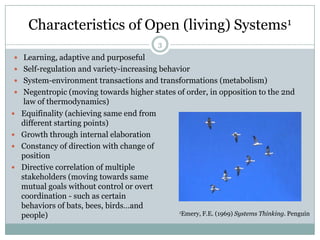
Directive correlation of multiple stakeholders (moving towards same mutual goals without control or overt coordination - such as certain behaviors of bats, bees, birds…and people)1Emery, F.E. (1969) Systems Thinking. Penguin
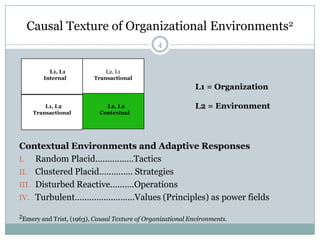
4Causal Texture of Organizational Environments2L1 = OrganizationL2 = EnvironmentContextual Environments and Adaptive ResponsesRandom Placid…………….TacticsClustered Placid………….. StrategiesDisturbed Reactive……….OperationsTurbulent…………………….Values (Principles) as power fields2Emery and Trist, (1963), Causal Texture of Organizational Environments.
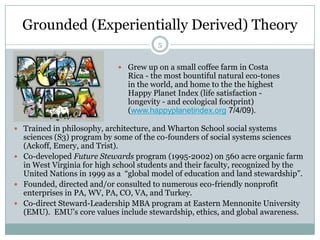
5Grounded (Experientially Derived) TheoryGrew up on a small coffee farm in Costa Rica - the most bountiful natural eco-tones in the world, and home to the the highest Happy Planet Index (life satisfaction - longevity - and ecological footprint) (www.happyplanetindex.org 7/4/09).Trained in philosophy, architecture, and Wharton School social systems sciences (S3) program by some of the co-founders of social systems sciences (Ackoff, Emery, and Trist).Co-developed Future Stewards program (1995-2002) on 560 acre organic farm in West Virginia for high school students and their faculty, recognized by the United Nations in 1999 as a  “global model of education and land stewardship”.Founded, directed and/or consulted to numerous eco-friendly nonprofit enterprises in PA, WV, PA, CO, VA, and Turkey.Co-direct Steward-Leadership MBA program at Eastern Mennonite University (EMU).  EMU’s core values include stewardship, ethics, and global awareness.
6A Walk in the Meadow (or the Woods)…The Stewardship Principles were co-discovered, over and over again, by students, faculty, farmers, foresters, and others through direct immersion in, and observations and reflections about, 	natural eco-systems,from wetlands to woodlands.
7For the BIRDS…Stewardship PrinciplesBalanceInterdependenceRegenerationDiversitySuccesion
8Balance
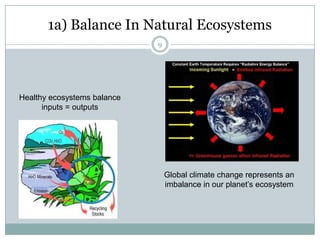
91a) Balance In Natural EcosystemsHealthy ecosystems balanceinputs = outputsGlobal climate change represents animbalance in our planet’s ecosystem
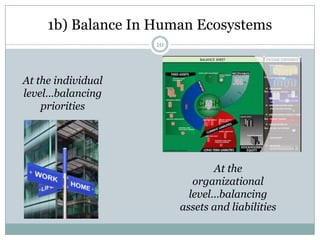
101b) Balance In Human EcosystemsAt the individual level…balancing prioritiesAt the organizational level…balancing assets and liabilities
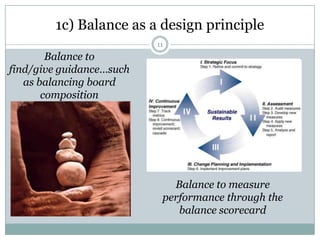
111c) Balance as a design principleBalance to find/give guidance…such as balancing board compositionBalance to measure performance through the balance scorecard
12Interdependence
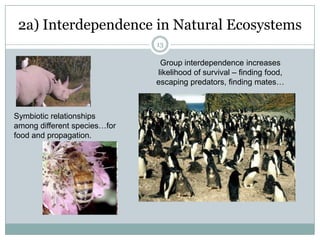
132a) Interdependence in Natural EcosystemsGroup interdependence increases likelihood of survival – finding food, escaping predators, finding mates…Symbiotic relationships among different species…for food and propagation.
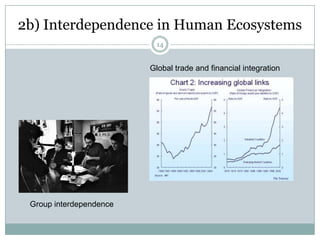
142b) Interdependence in Human EcosystemsGlobal trade and financial integrationGroup interdependence
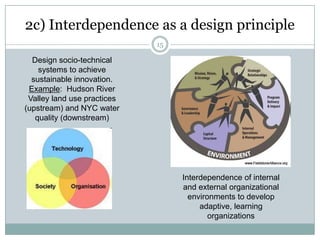
152c) Interdependence as a design principleDesign socio-technical systems to achieve sustainable innovation. Example:  Hudson River Valley land use practices (upstream) and NYC water quality (downstream)Interdependence of internal and external organizational environments to develop adaptive, learning organizations
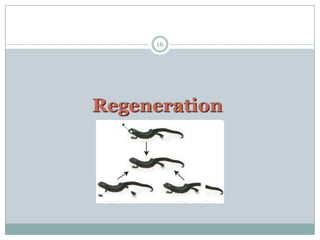
16Regeneration
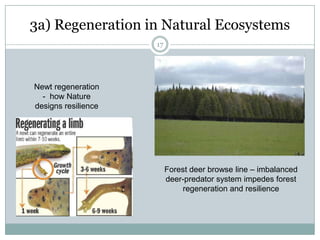
173a) Regeneration in Natural EcosystemsNewt regeneration -  how Nature designs resilienceForest deer browse line – imbalanced deer-predator system impedes forest regeneration and resilience
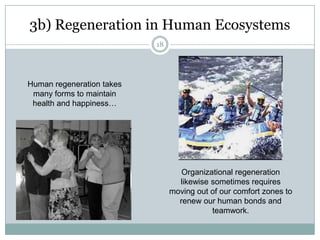
183b) Regeneration in Human EcosystemsHuman regeneration takes many forms to maintain health and happiness…Organizational regeneration likewise sometimes requires moving out of our comfort zones to renew our human bonds and teamwork.
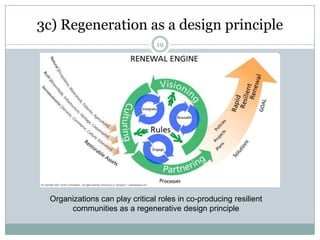
193c) Regeneration as a design principleOrganizations can play critical roles in co-producing resilient communities as a regenerative design principle
20Diversity
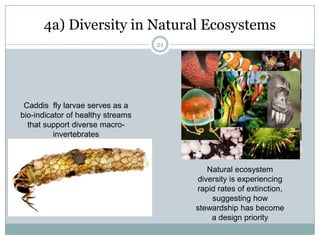
214a) Diversity in Natural EcosystemsCaddis  fly larvae serves as a bio-indicator of healthy streams that support diverse macro-invertebratesNatural ecosystem diversity is experiencing rapid rates of extinction, suggesting how stewardship has become a design priority
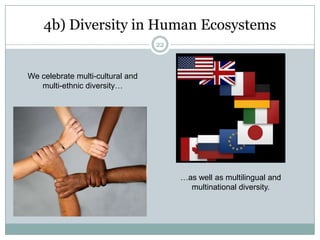
224b) Diversity in Human EcosystemsWe celebrate multi-cultural and multi-ethnic diversity……as well as multilingual and multinational diversity.
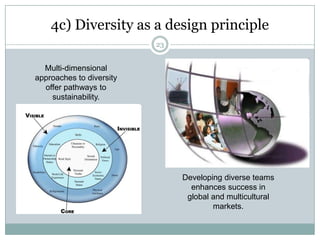
234c) Diversity as a design principleMulti-dimensional approaches to diversity offer pathways to sustainability.Developing diverse teams enhances success in global and multicultural markets.
24Succession
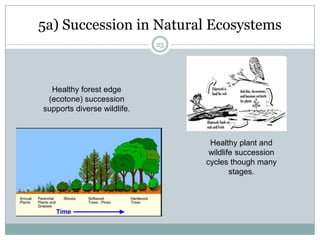
255a) Succession in Natural EcosystemsHealthy forest edge (ecotone) succession supports diverse wildlife.Healthy plant and wildlife succession cycles though many stages.
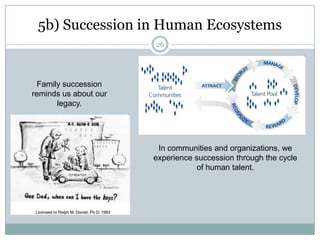
265b) Succession in Human EcosystemsFamily succession reminds us about our legacy.In communities and organizations, we experience succession through the cycle of human talent.
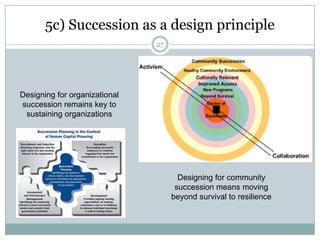
275c) Succession as a design principleDesigning for organizational succession remains key to sustaining organizationsDesigning for community succession means moving beyond survival to resilience
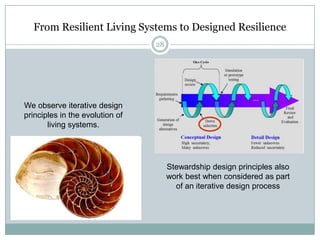
28From Resilient Living Systems to Designed ResilienceWe observe iterative design principles in the evolution of living systems.Stewardship design principles also work best when considered as part of an iterative design process
29Designing a Resilient FutureLiving systems co-create and co-contribute to their habitats as resilient eco-systems.Humans enjoy the capacity to design the future.
Stewardship, Spirit and Enlightened Shared InterestHow do stewardship design principles resonate with spiritual ideals of Creation Care, and the concepts of spiritual and appreciative intelligence?How might businesses and communities better exercise their stewardship responsibilities while achieving greater resilience and eco-advantage?How might we serve as stewards in co-designing a more resilient future as part of Nature, not apart from it?
31
32ReferencesAppleton, A. (2002) “How New York City used an ecosystem services strategy carried out through an urban-rural partnership to preserve the pristine quality of its drinking water and save billions of dollars.” A paper for Forest Trends, Tokyo. See http://ecosystemmarketplace.com/documents/cms_documents/NYC_H2O_Ecosystem_Services.pdfBenyus, J.M. (1997).  Biomimicry:  Innovation inspired by Nature.  New York: Morrow.Emery, F.E. (editor), (1969).  Systems Thinking. Penguin.Emery, F.E. (1977).  The Futures We Are In. Leiden: Martinus Nijhoff.Emery, F. and Trist, E., (1963). The Causal Texture of Organizational Environments in the XVII International Congress of Psychology, Washing, DC, 20-26 August.Esty, D. and Winston, A.  (2009).  Green to Gold: How smart companies use environmental strategy to innovate, create value, and build competitive advantage.  Hoboken: John Wiley.Glaser B.G. and Strauss A. (1967). The discovery of grounded theory: Strategies for qualitative research. New York: AldineLaszlo, C.  (2008).  Sustainable value: How the world’s leading companies are doing well by doing good.  Stanford: Stanford University PressSmith, A.E. (2009).  “Stewardship Design Principles”.  Submitted to the Global Forum 2009 Conference on Business as an Agent for World Benefit.  Cleveland: June 2-5, 2009Sommerhof, G.  (1969).  “The Abstract Characteristics of Living Systems”, in F. Emery, (ed), Systems Thinking, Penguin.Thatchenkery, T. and Metzker, C. (2006).   Appreciative Intelligence: Seeing the mighty oak in the acorn.  San Francisco: Berrett-Koehler.von Bertalanffy, L. (1950). “The Theory of Open Systems in Physics and Biology” in F. Emery (ed.), Systems Thinking, Penguin.Wilson, E.O. (1992).  The diversity of life.  Cambridge: Belknap Press.Zohar, D. and Marshall, I.  (2000).  Spiritual Intelligence: The ultimate intelligence.  London: Bloomsbury.

Stewardship Design Principles

  • 1.
    1Stewardship Design Principles:LearningFrom Living Systems toCo-Design Our Resilient FuturesDr. Anthony E. SmithCo-DirectorEastern Mennonite University (EMU)Steward-Leadership MBA Program© 2009
  • 2.
    2“The nature ofthe organizational relationships that make the behavior of obviously living systems…give it a teleological quality not found elsewhere.” (Sommerhof, 1969, 147).“From the physical point of view, the characteristic state of the living organism is that of an open system.” (von Bertalanffy, 1950, 70).Biological Roots of Social Systems Theory“It was von Bertalanffy (1950) who…first fully disclosed the importance of openness or closedness to the environment as a means of distinguishing living organisms from inanimate objects.” (Emery and Trist, 1963, 21).
  • 3.
    “In systems researchwe are interested only in those systems which can display activity - that is behavioral systems.” (Ackoff, 1960, 332)3Characteristics of Open (living) Systems1Learning, adaptive and purposeful
  • 4.
  • 5.
    System-environment transactions andtransformations (metabolism)
  • 6.
    Negentropic (moving towardshigher states of order, in opposition to the 2nd law of thermodynamics)
  • 7.
    Equifinality (achieving sameend from different starting points)
  • 8.
  • 9.
    Constancy of directionwith change of position
  • 10.
    Directive correlation ofmultiple stakeholders (moving towards same mutual goals without control or overt coordination - such as certain behaviors of bats, bees, birds…and people)1Emery, F.E. (1969) Systems Thinking. Penguin
  • 11.
    4Causal Texture ofOrganizational Environments2L1 = OrganizationL2 = EnvironmentContextual Environments and Adaptive ResponsesRandom Placid…………….TacticsClustered Placid………….. StrategiesDisturbed Reactive……….OperationsTurbulent…………………….Values (Principles) as power fields2Emery and Trist, (1963), Causal Texture of Organizational Environments.
  • 12.
    5Grounded (Experientially Derived)TheoryGrew up on a small coffee farm in Costa Rica - the most bountiful natural eco-tones in the world, and home to the the highest Happy Planet Index (life satisfaction - longevity - and ecological footprint) (www.happyplanetindex.org 7/4/09).Trained in philosophy, architecture, and Wharton School social systems sciences (S3) program by some of the co-founders of social systems sciences (Ackoff, Emery, and Trist).Co-developed Future Stewards program (1995-2002) on 560 acre organic farm in West Virginia for high school students and their faculty, recognized by the United Nations in 1999 as a “global model of education and land stewardship”.Founded, directed and/or consulted to numerous eco-friendly nonprofit enterprises in PA, WV, PA, CO, VA, and Turkey.Co-direct Steward-Leadership MBA program at Eastern Mennonite University (EMU). EMU’s core values include stewardship, ethics, and global awareness.
  • 13.
    6A Walk inthe Meadow (or the Woods)…The Stewardship Principles were co-discovered, over and over again, by students, faculty, farmers, foresters, and others through direct immersion in, and observations and reflections about, natural eco-systems,from wetlands to woodlands.
  • 14.
    7For the BIRDS…StewardshipPrinciplesBalanceInterdependenceRegenerationDiversitySuccesion
  • 15.
  • 16.
    91a) Balance InNatural EcosystemsHealthy ecosystems balanceinputs = outputsGlobal climate change represents animbalance in our planet’s ecosystem
  • 17.
    101b) Balance InHuman EcosystemsAt the individual level…balancing prioritiesAt the organizational level…balancing assets and liabilities
  • 18.
    111c) Balance asa design principleBalance to find/give guidance…such as balancing board compositionBalance to measure performance through the balance scorecard
  • 19.
  • 20.
    132a) Interdependence inNatural EcosystemsGroup interdependence increases likelihood of survival – finding food, escaping predators, finding mates…Symbiotic relationships among different species…for food and propagation.
  • 21.
    142b) Interdependence inHuman EcosystemsGlobal trade and financial integrationGroup interdependence
  • 22.
    152c) Interdependence asa design principleDesign socio-technical systems to achieve sustainable innovation. Example: Hudson River Valley land use practices (upstream) and NYC water quality (downstream)Interdependence of internal and external organizational environments to develop adaptive, learning organizations
  • 23.
  • 24.
    173a) Regeneration inNatural EcosystemsNewt regeneration - how Nature designs resilienceForest deer browse line – imbalanced deer-predator system impedes forest regeneration and resilience
  • 25.
    183b) Regeneration inHuman EcosystemsHuman regeneration takes many forms to maintain health and happiness…Organizational regeneration likewise sometimes requires moving out of our comfort zones to renew our human bonds and teamwork.
  • 26.
    193c) Regeneration asa design principleOrganizations can play critical roles in co-producing resilient communities as a regenerative design principle
  • 27.
  • 28.
    214a) Diversity inNatural EcosystemsCaddis fly larvae serves as a bio-indicator of healthy streams that support diverse macro-invertebratesNatural ecosystem diversity is experiencing rapid rates of extinction, suggesting how stewardship has become a design priority
  • 29.
    224b) Diversity inHuman EcosystemsWe celebrate multi-cultural and multi-ethnic diversity……as well as multilingual and multinational diversity.
  • 30.
    234c) Diversity asa design principleMulti-dimensional approaches to diversity offer pathways to sustainability.Developing diverse teams enhances success in global and multicultural markets.
  • 31.
  • 32.
    255a) Succession inNatural EcosystemsHealthy forest edge (ecotone) succession supports diverse wildlife.Healthy plant and wildlife succession cycles though many stages.
  • 33.
    265b) Succession inHuman EcosystemsFamily succession reminds us about our legacy.In communities and organizations, we experience succession through the cycle of human talent.
  • 34.
    275c) Succession asa design principleDesigning for organizational succession remains key to sustaining organizationsDesigning for community succession means moving beyond survival to resilience
  • 35.
    28From Resilient LivingSystems to Designed ResilienceWe observe iterative design principles in the evolution of living systems.Stewardship design principles also work best when considered as part of an iterative design process
  • 36.
    29Designing a ResilientFutureLiving systems co-create and co-contribute to their habitats as resilient eco-systems.Humans enjoy the capacity to design the future.
  • 37.
    Stewardship, Spirit andEnlightened Shared InterestHow do stewardship design principles resonate with spiritual ideals of Creation Care, and the concepts of spiritual and appreciative intelligence?How might businesses and communities better exercise their stewardship responsibilities while achieving greater resilience and eco-advantage?How might we serve as stewards in co-designing a more resilient future as part of Nature, not apart from it?
  • 38.
  • 39.
    32ReferencesAppleton, A. (2002)“How New York City used an ecosystem services strategy carried out through an urban-rural partnership to preserve the pristine quality of its drinking water and save billions of dollars.” A paper for Forest Trends, Tokyo. See http://ecosystemmarketplace.com/documents/cms_documents/NYC_H2O_Ecosystem_Services.pdfBenyus, J.M. (1997). Biomimicry: Innovation inspired by Nature. New York: Morrow.Emery, F.E. (editor), (1969). Systems Thinking. Penguin.Emery, F.E. (1977). The Futures We Are In. Leiden: Martinus Nijhoff.Emery, F. and Trist, E., (1963). The Causal Texture of Organizational Environments in the XVII International Congress of Psychology, Washing, DC, 20-26 August.Esty, D. and Winston, A. (2009). Green to Gold: How smart companies use environmental strategy to innovate, create value, and build competitive advantage. Hoboken: John Wiley.Glaser B.G. and Strauss A. (1967). The discovery of grounded theory: Strategies for qualitative research. New York: AldineLaszlo, C. (2008). Sustainable value: How the world’s leading companies are doing well by doing good. Stanford: Stanford University PressSmith, A.E. (2009). “Stewardship Design Principles”. Submitted to the Global Forum 2009 Conference on Business as an Agent for World Benefit. Cleveland: June 2-5, 2009Sommerhof, G. (1969). “The Abstract Characteristics of Living Systems”, in F. Emery, (ed), Systems Thinking, Penguin.Thatchenkery, T. and Metzker, C. (2006). Appreciative Intelligence: Seeing the mighty oak in the acorn. San Francisco: Berrett-Koehler.von Bertalanffy, L. (1950). “The Theory of Open Systems in Physics and Biology” in F. Emery (ed.), Systems Thinking, Penguin.Wilson, E.O. (1992). The diversity of life. Cambridge: Belknap Press.Zohar, D. and Marshall, I. (2000). Spiritual Intelligence: The ultimate intelligence. London: Bloomsbury.