What are the Living Principles
for Design?

www.livingprinciples.net
Kristin Rogers Brown, AIGA Portland
THE NEED


       While 87% of recently surveyed
       AIGA members view sustainability
       as a top priority, many of them
       confess they are ill-equipped to
       apply its principles effectively.
       www.livingprinciples.net
THE NEED

       “One serious problem for designers is that,
        even with a systems approach, there are few
        tools in existence that wrap these issues
        together. Instead, designers must learn
        to match together a series of disparate
        approaches, understandings, and frameworks
        in order to build a complete solution.”

       – Nathan Shedroff, “Design Is the Problem:
         The Future of Design Must be Sustainable”, 2009
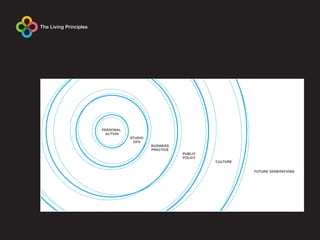
PERSONAL
 ACTION
           STUDIO
            OPS
                    BUSINESS
                    PRACTICE
                               PUBLIC
                               POLICY
                                        CULTURE

                                                  FUTURE GENERATIONS
weave sustainability into the
broader fabric of culture
shift consumption and
lifestyle aspirations
THE NEED


       Everybody wants to do the right
       thing, but how do we start?
       + complexity of issues
       + decentralized resources
       + lack of filtering for how resources
         relate to design
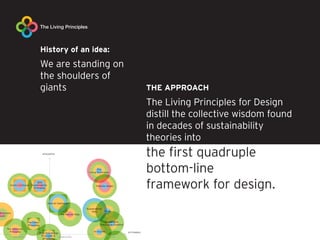
History of an idea:
                                     We are standing on
                                     the shoulders of
                                     giants                                                                             THE APPROACH
                                                                                                                        The Living Principles for Design
                                                                                                                        distill the collective wisdom found
                                                                                                                        in decades of sustainability
                                                                                                                        theories into
                                     INTEGRATED
                                                                                                                        the first quadruple
                                                                                  The
                                                                           Living Principles                            bottom-line
       Kyoto | Cumulus
                               GDC
                           Sustainability
                            Principles
                                                                                 Presidio Model
                                                                                                                        framework for design.
                                            Natural Capitalism

                                                                         Sustainability
                                                                             Helix        Okala
Economic
                                                      The Natural Step
orum

                        The Ceres                                                       Sustainable
                        Principles                                                   Packaging Coalition
     The Hannover
       Principles                                                              re-nourish                  ACTIONABLE
                                 IDSA Eco Design
           PRINCIPLES
                                   Principles & FRAMEWORKS                                   TOOLS
                                    Practices
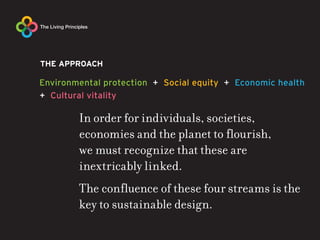
THE APPROACH


       In order for individuals, societies,
       economies and the planet to flourish,
       we must recognize that these are
       inextricably linked.
       The confluence of these four streams is the
       key to sustainable design.
THE APPROACH


       where all aspects of sustainability
       find their way into society
       where designers have the
       deepest impact
ENVIRONMENTAL PROTECTION


       Actions and issues that affect natural
       systems, including climate change,
       preservation, carbon footprint and
       restoration of natural resources.
DESIGN’S OPPORTUNITY

       Visualize complex information and make it
       comprehensible and relevant.
       Invent new systems, products and services
       to deliver more value for less material and
       energy used.
       Integrate environmental criteria
       at every step.
DESIGNERS’ ROADMAP

       Learn and inform about environmental impacts of choices.
       Consider the entire lifecycle of design solutions.
       Consider the entire supply chain: suppliers, production,
       shipping volumes and transportation distances.
       Eliminate waste. Plan for use of materials in continuous cycles.
       Avoid the use of any environmeltally damaging substances .
       Consider appropriate lifecycle and durability.
       Minimize energy use. Maximize use of clean energy.
SOCIAL EQUITY


        Actions and issues that affect all aspects
        of society, including poverty, violence,
        injustice, education, healthcare, safe
        housing, labor and human rights.
DESIGN’S OPPORTUNITY

       Base messages and designs on principles
       of inclusion, equality and empathy to shape
       harmonious and healthy conditions.
       Visualize acute needs, raise awareness,
       prompt response, and affect policy
       Help improve quality of life.
DESIGNERS’ ROADMAP

       Create messages, artifacts, services and experiences that
       respond to the needs of all people, and promote and enable
       joyful, healthy living.
       Consider consequences for individuals and communities over
       the entire lifecycle.
       Understand the ethical supply chain.
       Minimize environmental, health and safety risks to employees
       and communities throughout the entire life and disposal cycle.
ECONOMIC HEALTH

       Actions and issues that affect how people
       and organizations meet their basic needs,
       evolve and define economic success and
       growth.
DESIGN’S OPPORTUNITY

       Design’s approach to investigation,
       analysis, and visualization can help
       create opportunities and invent new
       economic and business models for 21st-
       century realities, to set the foundation
       for a more sustainable world.
DESIGNERS’ ROADMAP

       Understand financial parameters and design to performance
       and cost criteria.
       Communicate truthfully and with transparency.
       Understand and communicate sound business values and
       benefits of sustainable solutions (efficiency, profitability, brand
       equity, employee morale...)
       Consider and encourage business models that incorporate
       product takeback systems, end-of-life product collection,
       upgrading and recycling.
       Consider equitable systems of corporate ownership (co-ops).
CULTURAL VITALITY

        Actions and issues that affect how
        communities manifest identity, preserve
        and cultivate traditions, and develop
        belief systems and commonly accepted
        values.
DESIGN’S OPPORTUNITY

       Connect people with ideas, motivate
       behavior change, and shift mindsets.
       This transformative power can shape
       new values and provide a compelling
       understanding of sustainability that
       ensures its assimilation by a broad array
       of people, nations and cultures.
DESIGNERS’ ROADMAP

       Create messages, artifacts, services and experiences that
       provide people with choices that can change attitudes and
       redefine prosperity.
       Support/promote the uniqueness of different cultures and
       recognize that highly functional systems are resilient because
       of their diversity.
       Consider historical, place-based, social, cultural and economic
       contexts to make design and messaging culturally relevant.
       Make sustainability desirable.
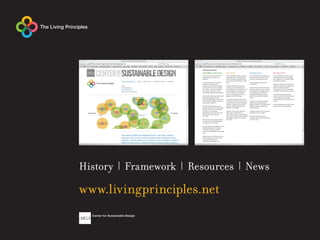
History | Framework | Resources | News

www.livingprinciples.net
These are ‘living’ principles and as such they
suggest a starting place. Your feedback is critical
to keeping them vital and relevant.
Use them. Test them. Adjust them. Teach them.
And tell us what you find.

We look forward to your contributions.

www.livingprinciples.net

AIGA Living Design Principles

  • 1.
    What are theLiving Principles for Design? www.livingprinciples.net Kristin Rogers Brown, AIGA Portland
  • 2.
    THE NEED While 87% of recently surveyed AIGA members view sustainability as a top priority, many of them confess they are ill-equipped to apply its principles effectively. www.livingprinciples.net
  • 3.
    THE NEED “One serious problem for designers is that, even with a systems approach, there are few tools in existence that wrap these issues together. Instead, designers must learn to match together a series of disparate approaches, understandings, and frameworks in order to build a complete solution.” – Nathan Shedroff, “Design Is the Problem: The Future of Design Must be Sustainable”, 2009
  • 4.
    PERSONAL ACTION STUDIO OPS BUSINESS PRACTICE PUBLIC POLICY CULTURE FUTURE GENERATIONS
  • 5.
    weave sustainability intothe broader fabric of culture shift consumption and lifestyle aspirations
  • 6.
    THE NEED Everybody wants to do the right thing, but how do we start? + complexity of issues + decentralized resources + lack of filtering for how resources relate to design
  • 7.
    History of anidea: We are standing on the shoulders of giants THE APPROACH The Living Principles for Design distill the collective wisdom found in decades of sustainability theories into INTEGRATED the first quadruple The Living Principles bottom-line Kyoto | Cumulus GDC Sustainability Principles Presidio Model framework for design. Natural Capitalism Sustainability Helix Okala Economic The Natural Step orum The Ceres Sustainable Principles Packaging Coalition The Hannover Principles re-nourish ACTIONABLE IDSA Eco Design PRINCIPLES Principles & FRAMEWORKS TOOLS Practices
  • 8.
    THE APPROACH In order for individuals, societies, economies and the planet to flourish, we must recognize that these are inextricably linked. The confluence of these four streams is the key to sustainable design.
  • 9.
    THE APPROACH where all aspects of sustainability find their way into society where designers have the deepest impact
  • 10.
    ENVIRONMENTAL PROTECTION Actions and issues that affect natural systems, including climate change, preservation, carbon footprint and restoration of natural resources.
  • 11.
    DESIGN’S OPPORTUNITY Visualize complex information and make it comprehensible and relevant. Invent new systems, products and services to deliver more value for less material and energy used. Integrate environmental criteria at every step.
  • 12.
    DESIGNERS’ ROADMAP Learn and inform about environmental impacts of choices. Consider the entire lifecycle of design solutions. Consider the entire supply chain: suppliers, production, shipping volumes and transportation distances. Eliminate waste. Plan for use of materials in continuous cycles. Avoid the use of any environmeltally damaging substances . Consider appropriate lifecycle and durability. Minimize energy use. Maximize use of clean energy.
  • 13.
    SOCIAL EQUITY Actions and issues that affect all aspects of society, including poverty, violence, injustice, education, healthcare, safe housing, labor and human rights.
  • 14.
    DESIGN’S OPPORTUNITY Base messages and designs on principles of inclusion, equality and empathy to shape harmonious and healthy conditions. Visualize acute needs, raise awareness, prompt response, and affect policy Help improve quality of life.
  • 15.
    DESIGNERS’ ROADMAP Create messages, artifacts, services and experiences that respond to the needs of all people, and promote and enable joyful, healthy living. Consider consequences for individuals and communities over the entire lifecycle. Understand the ethical supply chain. Minimize environmental, health and safety risks to employees and communities throughout the entire life and disposal cycle.
  • 16.
    ECONOMIC HEALTH Actions and issues that affect how people and organizations meet their basic needs, evolve and define economic success and growth.
  • 17.
    DESIGN’S OPPORTUNITY Design’s approach to investigation, analysis, and visualization can help create opportunities and invent new economic and business models for 21st- century realities, to set the foundation for a more sustainable world.
  • 18.
    DESIGNERS’ ROADMAP Understand financial parameters and design to performance and cost criteria. Communicate truthfully and with transparency. Understand and communicate sound business values and benefits of sustainable solutions (efficiency, profitability, brand equity, employee morale...) Consider and encourage business models that incorporate product takeback systems, end-of-life product collection, upgrading and recycling. Consider equitable systems of corporate ownership (co-ops).
  • 19.
    CULTURAL VITALITY Actions and issues that affect how communities manifest identity, preserve and cultivate traditions, and develop belief systems and commonly accepted values.
  • 20.
    DESIGN’S OPPORTUNITY Connect people with ideas, motivate behavior change, and shift mindsets. This transformative power can shape new values and provide a compelling understanding of sustainability that ensures its assimilation by a broad array of people, nations and cultures.
  • 21.
    DESIGNERS’ ROADMAP Create messages, artifacts, services and experiences that provide people with choices that can change attitudes and redefine prosperity. Support/promote the uniqueness of different cultures and recognize that highly functional systems are resilient because of their diversity. Consider historical, place-based, social, cultural and economic contexts to make design and messaging culturally relevant. Make sustainability desirable.
  • 22.
    History | Framework| Resources | News www.livingprinciples.net
  • 23.
    These are ‘living’principles and as such they suggest a starting place. Your feedback is critical to keeping them vital and relevant. Use them. Test them. Adjust them. Teach them. And tell us what you find. We look forward to your contributions. www.livingprinciples.net