Response to the Hughes Bill/IDEIA Regulations (Reauthorization),
Title 5, California Code of Regulations
Sections 3001 and 3052
BEHAVIOR/BEHAVIORAL
INTERVENTION MANUAL
GUIDELINES
Revised - June 2010
San Joaquin Special Education Local Plan Area
INTRODUCTION
The Behavior Intervention Manual (BIM) was developed over a one-year period by the
San Joaquin County Office of Education - Special Education Local Plan Area at the
direction of the special education Council of Directors (COD). COD is a consortium of
elevendistrictswithasharedfocusof promotingeffectiveeducationalapproachesfor
studentwithbehavioralchallenges.
The items in the BIM were derived from a variety of sources including Federal and State
lawandregulations,scientificevidence,andprofessionalexperience. TheBIMmaterials
weredevelopedfirstbyexaminingthesequentialorderspecifictomakingthemanual
"user-friendly"ineachoftheseareas. Informationfromtheadvisorygroupwascompiled
into a working draft of the BIM during the 2006-2007 school year. The comments of
the advisory group led to a significant re-focusing of the BIM on making it as behavior-
ally oriented as possible.Anumber of interim versions were shared with SJCOE staff,
whichincludedaBehavioralSpecialist,anAutismSpecialist,SchoolPsychologistswith
expertiseinemotionaldisturbance,autism,psycholinguistics,andjuveniledelinquency,
andProgramSpecialistswithexpertiseinpositivebehaviorsupport,managementof
assaultivebehaviorandnonpublicschoolprogramming. Theresultingdocumenthas
been strengthened considerably by the input of these many people.
The BIM was developed to apply to programs that serve children between the ages of 3
and21,onthefullrangeofthebehavioralcontinuumandabilitylevels,andinalleduca-
tional settings. Some items may, therefore, not apply to every program. The purpose of
the BIM is to provide a tool for schools or programs to evaluate behavioral services as a
wholeandtoevaluatebehavioralservicesprovidedtoanyspecificchild.
Theadvisorygroupfeelsstronglythatdistrictsshouldencouragemoreextensiveuseof
Positive Behavior Support Plans less complex that those generated through procedures
associatedwithcompletionofaformalFunctionalAnalysisAssessment(FAA). Wesee
PositiveBehavioralSupportPlansasmore"preventionoriented",startingearlierinthe
processandultimatelyreducingtheneedformoreExtensivePositiveBehaviorInterven-
tionPlansderivedfromFunctionalAnalysis Assessments.
You may duplicate any of the forms, and are encouraged to share information that may
be of value to other behavioral case managers and/or teachers.
COMMITTEE MEMBERS
CHAIRPERSONS
JoanJustice-Brown ProgramSpecialist San Joaquin County, SELPA
VincentHernandez LeadPsychologist San Joaquin County, SELPA
MEMBERS
TissaLopez/Jewart AutismSpecialist San Joaquin County, Sp.Ed.
ChristinePhillips BehaviorInterventionSpecialist San Joaquin County, Sp.Ed.
CLERICAL SUPPORT
Patti Farhat AdministrativeAssistant San Joaquin County, SELPA
TableofContents
SECTIONA-PHILOSOPHYANDDEFINITIONS
Philosophy ---------------------------------------------------------------------------------------------------------------------1
IDEIAConceptualUnderpinnings:ShiftingOurUnderstandingofBehavior --------------------------------------2
CommunicativeFunctionofBehavior ------------------------------------------------------------------------------------3
Addressing"BehaviorThatImpedesLearning"AsMandatedbyIDEAReauthorization ----------------------4-7
BestPracticesForWorkingWithIndividualsWithChallengingBehavior -----------------------------------------8-9
Definitions --------------------------------------------------------------------------------------------------------------------10
Title5,CaliforniaCodeOfRegulations/BehavioralInterventionsForSpecialEducationStudents -----------11-12
AddressingBehaviorinEducationSettingsinCalifornia -------------------------------------------------------------13
GuidetoBehaviorTerminology -------------------------------------------------------------------------------------------14-18
SECTIONB-SAFEANDHEALTHYSCHOOLS
PositiveBehavioralSupportsForSafeAndHealthySchools ---------------------------------------------------------1-3
ThreeTieredModelofSchoolSupports ---------------------------------------------------------------------------------4
NineTypesofCurriculumAdaptations -----------------------------------------------------------------------------------5-6
BehaviorSupportPlans-InclusionandSupporttoGeneralEducationTeachers ---------------------------------7
SECTIONC-BEHAVIORSUPPORTPLANS
WhatisaBehaviorSupportPlan(BSP)? -------------------------------------------------------------------------------1
BehaviorSupportPlan -----------------------------------------------------------------------------------------------------2-6
BehaviorSupportPlanQualityEvaluationScoringGuideII --------------------------------------------------------7-44
BehaviorSupportPlanConcepts ----------------------------------------------------------------------------------------45-47
StagesofDevelopment ---------------------------------------------------------------------------------------------------48-53
DesigningBehaviorInterventionstoAddresstheNeedsofStudentswithDisabilitiesorCharacteristics --54-58
BehaviorSupportPlansforNon-VerbalStudents --------------------------------------------------------------------59-61
SECTIOND- TEACHINGNEWBEHAVIORANDREINFORCEMENT
TeachingNewBehaviors --------------------------------------------------------------------------------------------------1
ReinforcementContinuum -------------------------------------------------------------------------------------------------2
IdentifyingReinforcers -----------------------------------------------------------------------------------------------------3-7
ChoosingWhatILike ------------------------------------------------------------------------------------------------------8-11
ReinforcementInventory --------------------------------------------------------------------------------------------------12
ParentalSurvey ------------------------------------------------------------------------------------------------------------13-14
ReinforcerSentenceCompletion ----------------------------------------------------------------------------------------15
SECTION E - ANTECEDENTS
DeterminingAntecedents ---------------------------------------------------------------------------------------------1
ManagementofAntecedentstoEscalatingBehaviors -----------------------------------------------------------2-4
SECTION F - CONTINUUM OF INTERVENTIONS
ContinuumOfInterventions ---------------------------------------------------------------------------------------------1-2
MildInterventions ---------------------------------------------------------------------------------------------------------3-4
ModerateInterventions/SevereTechniques --------------------------------------------------------------------------5
ProhibitedTechniques/EmergencyInterventions --------------------------------------------------------------------6
Timeout/Regulations -----------------------------------------------------------------------------------------------------7-11
SECTION G - MANIFESTATION DETERMINATION/SUSPENSION AND EXPULSION
ExpulsionofSpecialEducationandGeneralEducationFlowChart ---------------------------------------------1
SuspensionandExpulsion/DueProcess-StudentswithDisabilities ---------------------------------------------2
DisciplineChangeofPlacement-----------------------------------------------------------------------------------------3-7
SuspensionBeyond10CumulativeSchoolDaysinaSchoolYear -----------------------------------------------8
ServicesforSuspension-PastCumulative10SchoolDays -------------------------------------------------------9
IndividualEducationProgramManifestationDeterminationMeetingSummary -----------------------------10-12
MakingAManifestationDetermination -------------------------------------------------------------------------------13-17
FunctionalBehavioralAssessmentSummary ------------------------------------------------------------------------18
SECTION H - BEHAVIORAL EMERGENCIES
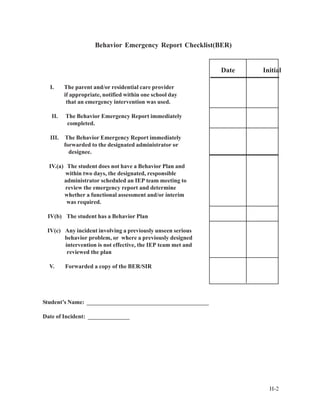
BehavioralEmergencyInterventions ----------------------------------------------------------------------------------1
BehavioralEmergencyReportChecklist(BER) ---------------------------------------------------------------------2
SpecialIncidentReport(SIR) -------------------------------------------------------------------------------------------3-4
SpecialIncidentReport(SIR)SAMPLE ------------------------------------------------------------------------------5-6
SECTION I - BICM REQUIREMENTS
BehavioralInterventionCaseManager --------------------------------------------------------------------------------1-2
TableofContents
TableofContents
SECTIONJ-FAA/PBIPs
FunctionalAnalysis ------------------------------------------------------------------------------------------------------------1
BehavioralInterventionsforSpecialEducationStudentsWhoExhibitSeriousBehaviorProblems ------------2-5
BehaviorInterventionPlan-Procedures -----------------------------------------------------------------------------------6
CoversheetforFAA&PBIPDevelopment -------------------------------------------------------------------------------7
FunctionalAnalysisAssessmentReport -----------------------------------------------------------------------------------8-9
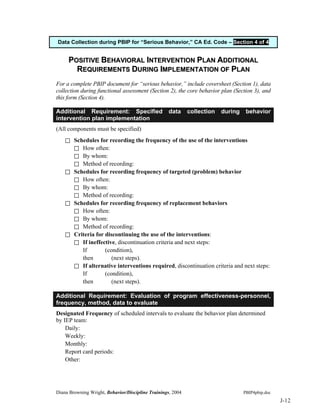
PositiveBehavioralInterventionPlan --------------------------------------------------------------------------------------10-11
PositiveBehavioralInterventionPlanAdditionalRequirementsDuringImplementationofPlan ----------------12-13
FunctionalAnalysisWorksheet ----------------------------------------------------------------------------------------------14-16
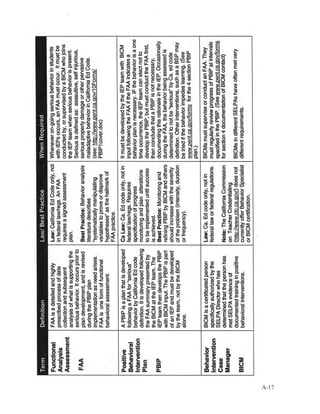
ComparisonofFederalandCaliforniaLaw -------------------------------------------------------------------------------17
SECTION K - BEHAVIOR AND INTERNAL STATES
WarningSignsofMentalIllnessinChildren ------------------------------------------------------------------------------1-2
ProtocolforAddressingProblemBehaviorResultingFromInternalStates -----------------------------------------3-15
TypicalSequenceforInternallySupportedBehavior -------------------------------------------------------------------16-27
CoordinationofPlans: BehaviorSupport,Accommodation,andMentalHealthTreatment ---------------------28-33
FocusedFeedback-BehaviorSupportPlans ----------------------------------------------------------------------------34-50
FederalLawonWhoisEmotionallyDisturbed -------------------------------------------------------------------------51
Top5ReasonstoRefertoMentalHealth --------------------------------------------------------------------------------52
MentalHealthFastFactsAboutAnxietyDisorder ---------------------------------------------------------------------53
BipolarDisorderinSchools ------------------------------------------------------------------------------------------------54-57
MentalHealthFastFactsAboutDepression ----------------------------------------------------------------------------58
MentalHealthFastFactsAboutObsessive-CompulsiveDisorder(OCD) -----------------------------------------59
MentalHealthFastFactsAboutOppositionalDefiantDisorder(ODD) --------------------------------------------60
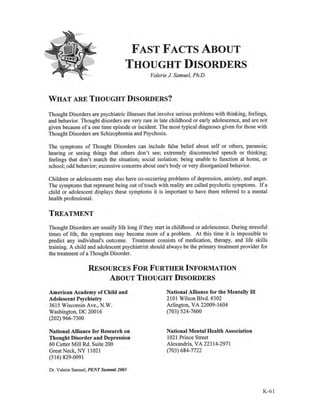
FastFactsAboutThoughtDisorders --------------------------------------------------------------------------------------61
MentalHealthBookReferences ------------------------------------------------------------------------------------------62-65
TreatmentofChildrenwithMentalIllness ------------------------------------------------------------------------------66-71
SECTIONL-OPTIONALSAMPLEFORMS
FunctionalAssessmentObservationForm ---------------------------------------------------------------------------------1-9
WeeklyScheduleforRecordingDatesofTargetedBehaviors ---------------------------------------------------------10
InteractionObservationForm--------------------------------------------------------------------------------------------------11
Positive/NegativeObservationSheet ----------------------------------------------------------------------------------------12
ChildBehaviorTrackingSheet -----------------------------------------------------------------------------------------------13
WorksheetDurationDataSheet ----------------------------------------------------------------------------------------------14
Worksheet-TimeSamplingRecordSheet-10MinuteIntervals ------------------------------------------------------15
Worksheet-IntervalDataSheet ---------------------------------------------------------------------------------------------16
Worksheet-EventFrequencyDataSheet ----------------------------------------------------------------------------------17
BehaviorProblemsIdentificationChecklist --------------------------------------------------------------------------------18-24
ClassroomBehaviorSupportSurvey ----------------------------------------------------------------------------------------25
ChallengingBehaviorsInterview --------------------------------------------------------------------------------------------26
ThinkingAboutMyBehavior ------------------------------------------------------------------------------------------------27
UnderstandingHowFeelingsAffectMyBehavior -----------------------------------------------------------------------28
Problem-SolvingSteps --------------------------------------------------------------------------------------------------------29
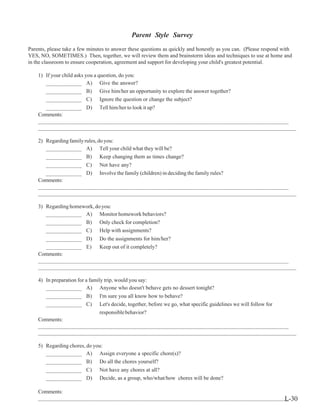
ParentStyleSurvey -----------------------------------------------------------------------------------------------------------30-31
ExampleofCopyrightedFormalBehaviorRatingScales --------------------------------------------------------------32
PHILOSOPHYAND DEFINITIONS
Philosophy
IDEIA Conceptural Underpinnings: Shifting Our Understanding
of Behavior
Communicative Function of Behavior
Addressing "Behavior That Impedes Learning" as Mandated by
IDEA Reauthorization
Best Practices ForWorking with Individuals with Challenging
Behavior
Definitions
Title 5, California Code of Regulations/Behavioral Interventions
for Special Education Students
Addressing Behavior in Education Settings in California
Guide to Behavior Terminology
PHILOSOPHYANDDEFINITIONS
SECTION A
PHILOSOPHY
CORE BELIEFS
We believe . . .
thatallstudentsareindividualswithuniqueneedswhoarecapableofgrowthandchange;
that all students must be treated with dignity and respect; and
that all students deserve a chance to succeed.
Assumptions
• Prior to consent for assessment, the school and parent/guardian will have discussed the
student’sneeds.
• Schoolexpectationswillhavebeenclearlycommunicatedtostudentandparent.
• Theteacherwillhaveawrittendescription of need and behavior in a variety of settings
(e.g.,anecdotalnotes)andwillhavereviewedthisinformationwiththeparentprior
to the request for assessment.
A-1
NOW
Students may require
"Behavior Support"
Behavior Plans should focus
on understanding "why" the
behavior occurred (i.e.,
the "function" or "commu-
nicative intent") then focus
on teaching/eliciting an
alternative behavior that
meets the student's needs
in alternative, more accept-
able ways
Antecedents (the immediate
and immediate past "trig-
gers" or "predictors" for
the behavior) are critical in
changing behavior
Focus: What we can ac-
tively do (e.g., teach, struc-
ture the environment) to
change the behavior
Philosophy: Behavior needs
to be taught: Modeled,
Shaped, Cued
IDEIA Conceptual Underpinnings:
Shifting Our Understanding of Behavior
Diana Browning Wright
PAST
Students may require "Be-
havior Management"
Behavior Plans should focus
on specifying the conse-
quences of misbehavior, and
to some extent, the conse-
quences of acceptable
behavior
Consequences can be made
compelling in order to
change behavior (i.e., either
so strongly aversive that the
student does not choose the
maladaptive behavior; or so
strongly positive that the
student wants the reinforcer
and avoids doing the mal-
adaptive behavior to get it)
Focus: What the student
must do to avoid or get
something we provide
DIFFERENCE
"Behavior Support" implies
looking at Environment,
Teaching Strategies, and
Positive Reinforcement
Strategies;
"Behavior Management"
implies focus on conse-
quences, whether positive or
negative
Pastpracticeneverattemptedto
understandthereasonsamaladap-
tivebehavioroccurred;oftenthe
consequences, whether positive or
negative did not change the
behavior;
Currentpractice,byunderstand-
ing the behavior and teaching
alternatives or changing environ-
mental conditions, seeks to
permanentlychangethewaya
student seeks to get a need met
Consequence-based Plans:
For many students, neither a
strong enough punishment,
nor a strong enough rein-
forcer can be found to
change the behavior;
Antecedent-based Plans:
Result in changing environ-
mental conditions (e.g., time,
space, materials, interac-
tions) and student skills so
that lasting change is pos-
sible
Controlling Behavior: Becoming
increasing more difficult
Teaching Behavior: Potential for
lasting change
Philosophy: Behavior
needs to be controlled
A-2
Communicative Function of Behavior
Diana Browning Wright
Assessment Goal: Identify a better way for the individual to get the same function met through
alternative acceptable methods, or : Identify methods of removing the need for student behavior
by environmental changes
Do not confuse the form of the behaviorwith the function of the behavior. The form of the
behaviorcanbeinfluencedbyculture/subculture,experience,disability,groupaffiliation,sensorysystem
(seekingandavoidingofinput). Regardlessofthetopography/formofthebehavior,whatitlookslike,
analyze the behavior for the functon it serves for the individual. Ask questons, observe, use data
collection/interviewforms. Considerantecedents,consequencesandenvironmentalfeaturesinyour
analysis.
Get/Obtain: Protest/Escape/Avoid:
Choice Tasks, a demand or request being made
Attentionintheformof: A specific person, a group of people
social status in a group
interactonwithpeer(s)
interactionwithadults
Objects,including$ Objects, undesired
Internalevents(e.g.,brainchemical Internalevents(e.g.,upcomingseizure/migraine)
release/on same occasions in self-
abusivebehavior)
Makeinstructionalmaterialmore Lackofmeaning/relevanceofinstructional
meaningful material
Self-stimulation Protest, a past action by a person (do not use "re-
venge,vengeance")
Play,fun Protest, a lack of choice (do not use "control")
Replicationofachainofbehavior Avoidance of step one in an anticipated chain
ofbehavior
Justiceorfairness Protest, a lack of fairness, justice (do not use
"revenge,vengeance")
Sensoryinput Sensory input
DO NOT USE: POWER-------REVENGE-------CONTROL--------VENGEANCE
Allbehaviorplansshouldsubsequentlybebasedonananalysisofthefunctionofthe
behavior. We do not want to write a plan to help a youngster get better "revenge" but
we can write a plan to help the student "protest the past action of others."
Diana Browning Wright, Behavior/Discipline Trainings, 2002
A-3
Diana Browning Wright, Behavior/Discipline Trainings, 2002 ZTp2.16-19
AAddddrreessssiinngg ““BBeehhaavviioorr TThhaatt IImmppeeddeess LLeeaarrnniinngg””
AAss MMaannddaatteedd bbyy IIDDEEAA RReeaauutthhoorriizzaattiioonn
Diana Browning Wright1
School psychologists are increasingly being called upon to “do something!” when disciplinary proceedings
are underway to assure legal compliance has occurred prior to a school district’s implementation of expulsion,
involuntary transfer and lengthy suspensions. That “something” so in demand now, gives us a long-awaited
opportunity to institute wide-sweeping changes in how school environments’ support our students with fragile
coping system. The reasoning goes like this:
IDEA requires the IEP team to address “behavior that impedes his or her learning or that of
others” (IDEA Section 614(d)(2)(B) ), and the Federal Regulations further point out that
“positive behavior interventions, strategies and supports” are to be considered supplementary
aids and supports. Therefore, if the student had these “impeding behaviors” clearly in
evidence, and yet no IEP team had developed a plan to address these behaviors, it can be
concluded during a “manifestation determination” meeting that must occur in a disciplinary
context, that the IEP did not have all necessary supplementary aids and supports in place.
Therefore, proceeding to expulsion or other further disciplinary action would not be
warranted. Rather, the IEP team will now need to develop the missing necessary
supplementary aids and supports and conduct a functional behavioral assessment of the
behavior that has resulted in the disciplinary action, (in addition to review of the
appropriateness of the rest of the IEP and the placement.) At the conclusion of the
“functional behavioral assessment,” a plan will undoubtedly need to be developed as well,
since the student clearly is exhibiting “behaviors impeding learning” because the school
system is considering its highest sanctions for the violation. The inescapable conclusion is
this: Whenever a student receiving special education services exhibits difficult behaviors,
whether early or late in an escalating behavior pattern, the IEP team must address the
situation in a behavior plan.
School psychologists around the nation often now find themselves in the position of explaining the logic
described above, to the consternation of the consultation-seeking educators charged with assuring “safe
schools” as well as the honoring of all “safeguards” for students with disabilities. The necessity to delicately
balance “Zero Tolerance” with “Zero Rejection” requires the entire education community to reexamine
district, schoolwide, classwide and individual behavior support systems to prevent difficult behaviors from
escalating.
IEP Content Shift
The primary content of IEP’s prior to IDEA Reauthorization has been student goals and objectives. With the
advent of behavior support planning, a revolutionary change has occurred in the IEP content of those students
with behaviors impeding learning. Their IEPs will now contain a behavior plan, and a well-designed behavior
support plan specifies not just what the student will do, but what educators will do to alter environments
and/or teach new behaviors necessary for that student’s success. Thus, higher accountability for success is
placed on implementors, because a behavior support plan is essentially a teaching plan.
1
The author is a practicing school psychologist/trainer and behavior analyst for the California Department of
Education’s Diagnostic Center and adjunct assistant professor, California State University, Long Beach. She also
conducts seminars for NASP affiliates and school district consortiums on a wide variety of topics related to behavior
interventions, positive school climate, preventative functional behavioral assessment and handicapping conditions. She
can be reached at dwright@dcs-cde.ca.gov
A-4
Diana Browning Wright, Behavior/Discipline Trainings, 2002 ZTp2.16-19
IDEA Conceptual Underpinnings Shift Our Understanding of Behavior
Does this situation mean that we should now develop lengthy behavior contracts with our students, specifying
exactly what punisher we will apply if the students violate the code of conduct again? The answer is an
emphatic “No!”. To understand what is now called for, consider the difference between the current
methodology, “behavior support” and the previous terminology, “behavior management”.2
(See chart)
“Behavior support” requires us to address antecedents, what we can do in terms of altering the environmental
conditions to support positive behavior, using more effective teaching strategies and if necessary, teaching the
student a replacement behavior that meets his/her needs. In contrast, “behavior management” as it came to be
practiced in most schools, focused on either elaborately specified punishers if the behavior occurred again, or
reinforcers if the student did NOT exhibit the problem behavior in the future. A behavior plan which grows
out of “behavior support” will attempt to understand “why” the behavior was occurring, i.e., what “function”
does it serve for the individual? It then will go on to identify how the environment be altered to eliminate the
student’s need to use that behavior, and how educators can support the student using an identified positive
replacement behavior that meets his/her need. A behavior plan which grew out of “behavior management”
typically ignored “why” the student used that behavior, and simply tried to select powerful, often
individualized, punishers to prevent behavior from reoccurring or, alternatively, powerful reinforcers the
student could earn for suppressing the problem behavior. Thus, the philosophical basis of the two approaches
differs dramatically:
Behavior Support Philosophy: Positive behaviors need to be taught: modeled, shaped, and cued in
conducive environments
Behavior Management Philosophy: Problem behaviors require suppressing/controlling; positive
behaviors are expected in all environments
In order to effectively eliminate a problem behavior, one must understand why it was occurring in the first
place. In order to determine this “function”, it is imperative that one consider various reasons the behavior
could be occurring. (See chart) Remember, the consultant is “assigning” communicative intent. The student
may or may not be aware of the “function” of the behavior.
First, gather data to determine whether it is believed that the student was trying to “get” something with
his/her behavior, or to “protest, escape or avoid” something with the behavior. This hypothesis is often easy
to arrive at based on a review of records, talking with the student and educators and examining the
environmental context. Consider these examples:
Case Studies of Two Students Whose Behavior Impedes Learning
Colin:
Colin has autism, is six years old and essentially nonverbal, using gestures and behavior to communicate
needs and wants. His mental age is estimated to be approximately age two. He becomes upset if routines are
changed, screaming and hiding under a chair to demonstrate his feelings. Currently, Colin is in an inclusion
setting and he follows the routines of the other Kindergartners. He has one-on-one aide support, services of
an inclusion specialist, and a teacher who is anxious to improve his skills.
2
The author wishes to acknowledge that although many educators implementing “behavior management” in
the past have focused on eliminating problem behaviors in the manner described, others, especially those with a
more thorough behavior analysis training, have attempted to identify replacement behaviors as a part of the
“behavior management”
Ralph:
A-5
Diana Browning Wright, Behavior/Discipline Trainings, 2002 ZTp2.16-19
Ralph is an 8th grader with a reading disability who has been in a pull-out special education program since
4th grade. His parents are non-English speaking immigrants. Ralph has had 17 office referrals in 2 years and
was suspended 10 times last year. Offenses have been task refusals, improper clothing, swearing at teachers,
failing to suit out for P.E., physical fighting (2x) and sexual harassment of a 6th grade girl. These offenses
have increased in intensity since entering middle school as a 6th grader. There were no offenses prior to
middle school and he has been in the same district since 2nd grade. His grades in elementary school were
“B”s and “C”s. In 6th and 7th grade, his grades averaged D+. There had been no behavior plan for Ralph,
though he did participate in a bi-weekly “motivation” group with the counselor.
Last week, Ralph made a physical threat to “have my homeboys kill you”. The police have become involved
due to the victim’s parents’ testimony. Expulsion was recommended, but the manifestation determination
concluded that no supplementary aids and services had been in place and that a behavior plan was warranted
due to “behaviors impeding learning” as well as from results of the functional behavioral assessment that
concluded Ralph’s behaviors were attempts to gain attention from his gang member peers. Ralph’s parents
were very upset because of the lack of school attention to his problems and the appointment of a probation
officer. They were pleased to note that the alternative setting they had adamantly requested in the past would
now be available as a setting in which to implement the behavior plan.
Student’s Problem Behavior If Trying to Get/Obtain
Something
If Trying to
Protest/Escape/Avoid
Something
Ralph has a learning disability,
belongs to a gang, is belligerent
to teachers, has a pattern of rule-
breaking behaviors culminating
in threatens to kill a peer
Ralph may be actively
attempting to gain gang
members’ attention in the form
of social status in the group for
his behavior
Ralph may have been threatened
for lack of “acting tough
enough” and may fear his peers
will harm him if he doesn’t
demonstrate his allegiance,
which he does reluctantly.
Colin has autism, is non-verbal
and often screams and hides
under tables when his routines
are disrupted
Colin may be seeking attention
from the teacher in the form of
interaction he remembers will
occur when he begins to scream
Colin may be “protesting” the
absence of an activity he
desires, or he may be trying to
“escape” the interaction with the
teacher he remembers will occur
in this new activity
In both cases, effective behavior support planning will require determination of what is supporting problem
behavior as well as what is present, or absent, in the environment that is preventing the student gaining
desired attention in positive ways, or protesting or escaping in
acceptable ways.
Ralph’s behavior support:
The attached plan for Ralph has hypothesized that Ralph engages in these behaviors to earn status (attention).
Ralph will receive instruction in conflict resolution skills to assure that he does possess alternative
replacement behaviors to use in the future. He also will receive support from former gang members through a
police “juvenile diversion” project. It is hoped that this intervention will allow him to gain the attention and
social status he so desperately desires from a different group of peers. The environment will be altered, in
terms of time, space, materials and interactions to support Ralph, and communication between all agencies
and parties
A-6
Diana Browning Wright, Behavior/Discipline Trainings, 2002 ZTp2.16-19
will be assured. Ralph will receive reinforcement for using replacement behaviors, as well as for a myriad of
behaviors identified by the former gang member mentor. If Ralph engages in minor behaviors, therapeutic de-
briefing will occur. If serious behavior occurs again, further police and district procedures, including more
restrictive settings will be utilized.
Colin’s behavior support:
The attached plan for Colin has hypothesized that he engages in these behaviors because his is protesting a
change in routine which he does not understand and for which he does not have verbal negotiation skills. An
underlying skill deficit, the lack of an effective communication system to use to “protest” has been identified.
Colin will receive training in “Picture Exchange Communication System” whereby he learns to exchange an
icon for a desired activity, and to protest using these symbols. Additionally, the environment will require
alterations to help him cope with frustration and to teach him to follow a picture sequence. The following of a
picture sequence thus becomes the “routine”, and the individual activities can more readily be shifted within
the routine, eliminating Colin’s need to protest. Effective methods of calming Colin are noted on the plan,
specifically, singing “Itsy, Bitsy Spider” and redirecting him. Communication between home and school is
specified to allow all parties a better understanding of Colin and his needs.
Establishing Behavior Support For Students
As school psychologists attempt to respond to increasing requests for our assistance in designing effective
interventions on our school sites, key concepts should be kept in mind:
& School psychologists need to assist the IEP teams in effective behavior support by training teachers
and other personnel. We CAN NOT write every behavior support plan
& A behavior support plan is a teaching plan. Behavior support plan forms should be very brief (or they
won’t be read!), collaboratively developed (or there will be no buy-in and no implementation), and
should lead those developing them to the paradigm of behavior support, not inadvertently to the
paradigm of behavior management. Beware the “blank forms” that do not lead the authors to focus
on antecedents, but rather allow the uninformed to write an elaborated “consequence-based” plan
(See attached blank form, “Support Plan for Behavior Interfering with Learning”)
& Behavior plans, whether in a disciplinary context in which a functional behavioral assessment is
mandated, or in initial stages, should be based on identifying the function of the behavior, then seek
to alter the environment and assure the student has an alternative replacement behavior to use (See
attached “Communicative Function of Behavior”)
& In looking at the environmental context in which a behavior is occurring, consider the teacher’s
current classroom management skills and the organizational structure in the classroom. Assisting
educators in altering the environment to support all learners is an integral part of behavior support
planning. (See attached, “What Every Teacher Should Know In Order To Positively Impact Student
Behavior” and “Classwide Systems That Help A Teacher Cue, Shape and Model Behavior”)
& Many school districts in California have begun utilizing the attached one page Behavior Support Plan
for all students at the student study team, pre-referral to special education stage. Additionally, many
districts have elected to institute a Behavior Support Plan whenever a student begins to approach ten
commutative suspension days in a school year. This proactive attempt to address all students’
support needs is a direct outcome of the shift in understanding behavior embodied in IDEA
Reauthorization. The wisdom of instituting a behavior support process prior to reaching a
disciplinary “crisis” whereby emergency, and often woefully late interventions are considered, can
not be over emphasized.
As our profession becomes more adept at designing effective behavior plans, our value to the education
community at large increases and our role as effective advocates for children with and without disabilities
becomes more readily apparent.
A-7
BEST PRACTICES FOR WORKING WITH
INDIVIDUALS WITH CHALLENGING BEHAVIORS
INDIVIDUALS WITH CHALLENGING BEHAVIORARE MOSTAT RISK FOR:
• Segregation/exclusion
• Interventions that are:
• Intrusive
• Stigmatizing
• Controlling
• Artificial/specialized
POSITIVE BEHAVIORAL SUPPORT (BestPractices)
A model of intervention that is:
• Proactive
• Comprehensive
• Educational
• Ongoing
• Based on functional assessments
• Function of behavior from student's perspective
• Relationship between behavior and environment
ACCEPTABLE OUTCOMES FOR POSITIVE BEHAVIORAL SUPPORTINTERVENTION
Improvements in quality of life
• inclusion
• social networks
• successful participation
Increased Skills
• communication
• replacement behaviors
• coping
• general
Improved basic health and safety
Decreased target behaviors
COMPREHENSIVE POSITIVE BEHAVIORALSUPPORT
1. Quality of life/lifestyle enhancements
Improved:
• integration • interactions
• interactions • social networks
• contribution • participation
• independence • choice
• variety • acceptance
• fun • success
A-8
Taken form J. Anderson-OSEP/RRC Institute 8/98
II. Comprehensive functional assessments
• Functional assessment of target behavior:
• Conditions under which target behavior is most and least likely to occur
• Outcomes of target behavior
• Function(s) of target behavior serves for the student and or message(s) student is communicating through
the target behavior
• other factors contributing to target behavior
• Person centered assessments
ROLE OF IEPTEAM IN PROVIDING POSITIVE BEHAVIORAL SUPPORTS (BEST PRACTICES)
I. Goal: Develop, implement and monitor behavioral supports that are:
• Effective
• Positive
• Respectful
• Good contextual fit
• Implemented consistently over time
• Infused throughout student's education (and IEP)
II. Requires: Capacity within the system, school and support team to design, implement and monitor
PBS plans
III. Recommendation: Establish expertise on IEP team:
• Identify existing expertise
• Provide training for team members
• Add members to team
IV. Actions:
• Develop functional assessment plan and implement
• Analyze results
• Design PBS plan, implement and monitor
• Scheduled review of impact of intervention and subsequent modifications
• Infuse Positive Behavioral Supports throughout the IEP
• Instruction of alternative behavior
• Adaptations
• Assistive technology (where needed)
Taken form J. Anderson-OSEP/RRC Institute 8/98
A-9
Definitions:
Serious Behavior Problem
To be defined as a serious behavior problem, a student’s behavior must meet any or all of the following criteria:
1. Thebehaviorisself-injurious,assaultive,and/orcausedpropertydamage,andcouldleadtosuspension
or expulsion (pursuant to the Education Code Section 48900(f));
2. Thebehaviorissopervasiveandmaladaptivethatitwouldwarrantasystematicandfrequentapplica-
tionofbehavioralinterventions;and
3. Thebehaviorsignificantlyinterfereswiththeimplementationofthegoalsandobjectivesofthepupil’s
IEP.
Behavioral Emergency
A behavioral emergency is defined as a serious behavior not previously observed and for which a behavioral
intervention plan has not been developed. To be defined as a behavioral emergency a behavior must pose a clear
and present danger of serious physical harm to the student or others, or it must pose the threat of serious property
destruction.Furthermore,anemergencyphysicalintervention(e.g.ManagementofAssaultiveBehavior)byquali-
fied personnel is necessary to control the behavior and to prevent further damage. The behavior cannot be
controlledbyaresponsemeasurelessintrusivethanthetemporaryapplicationofanemergencyinterventionorit
would not be considered an emergency.
Inassessingwhetherornotthestudent’sbehavioristrulyabehavioralemergency,thefollowingquestionsmustbe
asked:
1. Is there a threat of serious physical harm to the student himself, to another student, or to a staff
member?
2. Isthethreatimminent?
3. Is the situation so out of control at this point that no means but an emergency intervention could
effectivelybeused?
All of these questions must be answered in the affirmative for a situation to be deemed a behavioral emergency.
Further, in the case of a true behavioral emergency it must be remembered that the duration of the emergency
interventioncanbenolongerthanisnecessarytocontrolthesituationandtoensureeveryone’ssafety. Beyondthis
point,theemergencynatureoftheeventwouldceaseandfurtherapplicationoftheemergencyinterventionwould
exceed a reasonable limit and could constitute an abusive situation. In any situation requiring prolonged use of a
behavioral emergencyintervention,thestaffinvolvedmustseekassistanceoftheschoolsiteadministratorand/or
thelocallawenforcementagency.
Thetechniqueappliedtointervenewhenabehavioralemergencyoccursmusthavebeenspecificallydesignedfor
suchcontingencieswithafocusoncontainmentofthestudentwithoutaccompanyingharmorinjury. Additionally,
due to the specialized nature of technique, it should serve no other purpose in relation to the student than that for
which it was intended, i.e., containment. Such techniques are never to be used as a substitute for treatment. In
other words, emergency interventions are not to be used as punishment, for the convenience of the staff, or as a
substituteforadequateprogramming.
A-10
A-11
Title 5, California Code of Regulations
Behavioral Interventions For Special Education Students
"Behavioremergency"isthe demonstrationofaseriousbehaviorproblem: (1)whichhasnot
previouslybeenobservedandforwhichabehavioralinterventionplanhasnotbeen
developed;or(2)forwhichapreviouslydesignedbehavioralinterventionisnoteffective.
Approvedbehavioralemergencyproceduresmustbeoutlinedinthespecialeducationlocal
planningarea(SELPA)localplan.
"Behavioralintervention"meansthesystematicimplementationofproceduresthatresultin
lastingpositivechangesintheindividual'sbehavior. "Behavioralintervention"meansthe
design,implementation,andevaluationofindividualorgroupinstructionalandenvironment-
talmodifications,includingprogramsofbehavioralinstruction,toproducesignificant
improvementinhumanbehaviorthroughskillacquisitionandthereductionofproblematic
behavior. "Behavioralinterventions:aredesignedtoprovidetheindividualwithgreateraccess
to avarietyofcommunitysettings,socialcontactsandpublicevents;andensuretheindividual's
righttoplacementintheleastrestrictiveeducationalenvironmentasoutlinedintheindividual's
IEP. "Behavioralinterventions"donotincludeprocedureswhichcausepainortrauma.
"Behavioralinterventions"respecttheindividual'shumandignityandpersonalprivacy. Such
interventionsshallassuretheindividual'sphysicalfreedom,socialinteraction,andindividual
choice.
"Behavioralinterventioncasemanager"meansadesignatedcertificatedschool/district/county/
nonpublicschooloragencystaffmember(s)orotherqualified personnel pursuant to subsec-
tion (ac) contracted by the school district or county office or nonpublic school or agency who
hasbeentrainedinbehavioranalysiswithanemphasisonpositivebehavioralinterventions.
The"behavioralinterventioncasemanager"isnotintendedtobeanewstaffingrequirement
and does not create any new credentialing or degree requirements. The duties of the "behav-
ioralinterventioncasemanager"maybeperformedbyemphasisonpositivebehavioralinter-
ventions,including,butnotlimitedto,ateacher,resourcespecialist,schoolpsychologist,or
programspecialist.
"Behavioralinterventionplanisawrittendocumentwhichisdevelopedwhentheindividual
exhibitsaseriousbehaviorproblemthatsignificantlyinterfereswiththeimplementationof
thegoalsandobjectivesoftheindividual'sIEP. The"behavioralinterventionplan"shall
become part of the IEP. The plan shall describe the frequency of the consultation to be
provided by the behavioral intervention case manager to the staff members and parents who are
responsible for implementing the plan.Acopy of the plan shall be provided to the person or
agencyresponsibleforimplementationinnon-educationalsettings. Theplanshallincludethe
following:
• asummaryofrelevantanddeterminativeinformationgatheredfromafunctionalanaly-
sisassessment;
• an objective and measurable description of the targeted maladaptive behavior(s) and
replacementpositivebehavior(s);
• theindividual'sgoalsandobjectivesspecifictothebehavioralinterventionplan;
• a detailed description of the behavioral interventions to be used and the circumstances
fortheiruse;
• specificschedulesforrecordingthefrequencyoftheuseoftheinterventionsandthe
frequencyofthetargetedandreplacementbehaviors;includingspecificcriteriafor
discontinuingtheuseoftheinterventionforlackofeffectivenessorreplacingitwithan
identifiedandspecifiedalternative;
• criteria by which the procedure will be faded or phased-out, or less intense/frequent
restrictivebehavioralinterventionschedulesortechniqueswillbeused;thosebehav-
ioralinterventionswhichwillbeusedinthehome,residentialfacility,work
siteorothernoneducationalsettings;and
• specific dates for periodic review by the IEP team of the efficacy of the program.
A-12
Addressing Behavior in Education
Settings in California
Additional Expertise: is mandated to be
applied to refine FAA-based PBI Plans not yet
effective through previous efforts.
Functional Analysis-Based Positive
Behavior Intervention Plans: for serious
behavior not yet responsive to previous plans to
address "a behavior that impedes learning", more
comprehensive assessment (FunctionalAnalysis
Assessment) is mandated. Further behavioral inter-
vention design (Positive Behavior Intervention Plan),
for Individuals with Exceptional Needs (IWENS), is
mandated to follow this assessment if the IEP Team
deems necessary.
Individualized Behavior Support Planning:
developed by the IEP/504 team when "behavior is imped-
ing the learning of an individual student or peers". (Op-
tional: some schools elect to provide behavior support
planning as a prereferral intervention through the student
study team process, even though special educaton eligibil-
ity determination has not occurred
Strategies and Supports for at-risk students: class-
room strategies may be necessary to emphasize group problem-solving,
classroom structuring, small group reinforcement, and the teaching of
rule following behavior. For IWENS this may include assuring
the accomodation plans.
School Environment: emphasis on the positive shaping of ALL
STUDENTS' behavior, reinforcement of progress, family participation, and
extension of unconditional positive regard for each and every student.
IWEN
IWEN
ALL
ALL
A-13
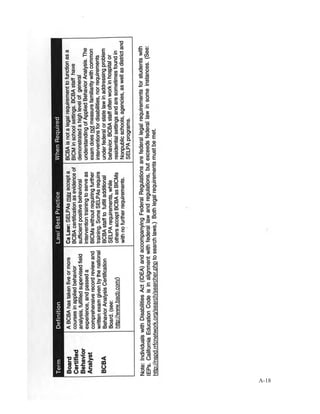
A-14
A-15
A-16
A-17
A-18
SAFE AND HEALTHY SCHOOLS
SAFEANDHEALTHYSCHOOLS
Positive Behavioral Supports For Safe and Healthy Schools
Three Tiered Model of School Supports
Nine Types of Curriculum Adaptations
Behavior Support Plans - Inclusion and Support to General
Education Teachers
SECTION B
POSITIVE BEHAVIORAL SUPPORTS FOR SAFE AND HEALTHY SCHOOLS
DEVELOPED BY
JEFFREY SPRAGUE,PH.D.
CO-DIRECTOR, INSTITUTE ON VIOLENCE AND DESTRUCTIVE BEHAVIOR
UNIVERSITY OF OREGON
AND CALIRORNIA DEPARTMENT OF EDUCATION, SPECIAL EDUCATION DIVISION
Core Messages
1. Sustained use of effective practices must be a priority to make schools safe, healthy
and effective places.
First, the groundwork must be prepared. School stakeholders need to (a) establish a need for
improveddisciplineandsafely,(b)securestaffandadministratorcommitmentandparticipa-
tion in the change process, (c) identify the change process as a top school improvement and,
(d) develop a two to three year action plan. Second, a school-wide leadership team must be
established to set goals and guide the change process. Third, the implementation of school-
wideandindividualstudentpositivebehaviorsupportmustbeinstitutionalizedby,(a)incorpo-
ratinganactionplanintotheschool improvementprocess,(b)usingmultipledatasourcesto
makedecisions;and(c)conducting on-goingandregularevaluationoftheprocess,including
student behavior,staffandfamilysatisfaction.
2. Positive behavioral supposrt systems need to be integrated with school
improvement plans.
Schools need to be accountable for improved student discipline in the same manner as they
areforstudentachievement. Safe,effectiveandhealthyschoolswillutilize
ongoing school improvement processes to set measurable goals and objectives and
integrateinterventionsintoschoolbuildinganddistrictaccountabilityandplanning
systems.
3. Schools that are safe, healthy, and effective have four well-organized, clearly
articulated systems of intervention They are as follows:
•Whole school: at the school-wide level, schools need to define and promote positive
behavioral expectations (e.g., safety, respect, responsibility), teach, practice and review
thoserulesregularly,recognizestudentsforfollowingtherules,anduseschool-wide
information campaigns to promote and sustain the intervention.
•Classroom: All teachers in the school need to be trained and supported to be effective
classroommanagersandsupportstudentacademicsuccess. Effectiveteachersestablishpre-
dictableandorderlyroutines,adaptinstructiontoensureacademicsuccessandminimizeproblem
behavior performance. In order for teachers to be effective, they need to be able to get help
withchronicallydisruptivestudentsquickly.
B-1
• Common areas: Common areas such as recess, cafeteria and hallways need to be well
supervisedandstudentsmustbetaughttofolloworderly,predictablerountines.
• Individual student level: Schools need to identify and assist students who display chronic
patterns of disruptive or dangerous behavior. Positive and effective plans will include in-
creasedacademicandpositivebehavioralsupports. Eachschoolbuildingmusthaveateamof
people who are well trained and prepared to support classroom teachers and build effective
plans.
4. Schools must adopt effective practices and implement them consistently.
Effective school prevention and intervention programs begin early in childhood, are compre
hensiveinnature(theyaddressmultipleriskandprotectivefactors),involveincreasinginterac-
tionbetweenadultsandchildren,directlyteachskills(provide
practice), and are offered continuously and consistently.
5. Schools need to offer comprehensive instructional programs that teach social
behavioral skills.
Important"higherorder"skillsinclude(a)impulsecontrol,(b)angermanagement,(c)conflict
resolution, (d) empathy, and (e) drug and alcohol use resistance and prevention.
6. Establishing, teaching and enforcing positive school behavioral expectations
is essential to an orderly and safe school.
Safe,effective,andhealthyschoolsprovideregularandconsistenttrainingandsupporttoclass-
roomteachersregardingclassroommanagement,effectiveacademic
instruction, and curriculum adaptation for diverse learners.
Academic failure is a major predictor of problem behavior and other adjustment
problems and needs to be explicitly and consistently addressed as part of an effective and
comprehensiveschoolprogram. Trainingandsupportwillensurethat,(a)staff
receive regular support, training and recognition regarding classroom management and aca-
demic support, (b) requests for behavior management assistance in the classroom receive
timely and effective response, and (b) students are ensured successful
learningexperienceswithhighlystructuredteachingandpracticeopportunitiesand
curriculum adaptation.
7. Intervention can change the lives of even the toughest kids.
Researchindicatesatypicalschoolwillhavethreerelativelydistinctpopulationsofstudents:
typically developing or non at-risk, mildly at-risk, and high-risk or antisocial. This model
affectsstudentswithandwithoutdisabilities. Schoolsshouldregularlyconductuniversalscreening
toidentifythesestudentsviateacherorparent/caregivernominationsormonitoringdiscipline
referral patterns. Acontinuum of supports should match the intensity of student need with
adequate services. Supports may be provided in the general education environment, or in
"schools within schools" to decrease stigma or stress for identified students. At risk children
and youthneedadditionalsupportssuchas(a)self-managementprograms,(b)positive rein-
forcement, (c) school-based mentors, (d) increased social skills training,(e) extra academic
support,(f)family
supportandinvolvementinintervention,(g)personalissuescounseling,and
(h) alternatives to out of school suspension and expulsion.
B-2
8. All students with chronic problem behavior, whetheror not they have been
identified as eligible for special education, can benefit from use of positive
behavioral interventions and supports.
Supportsmustbeguidedbyanunderstandingofwhythebehavior"works"forthestudentand
how adults and other students may promote and maintain it. The method and complexity of
assessments will vary depending on the complexity, severity, and frequency of the behavior.
Familymembers,studentsandschoolstaffneedstobeinvolvedaspartnersintheassessment
and plan development process. Positive behavior support plans should not be focused solely
on negative consequences which will occur if the behavior occurs again, but rather should
reduce problem behaviors, focus on developing alternative positive replacement behaviors,
andrecognizepositivebehaviors.
In California, is the student has an IEP, the behavior plan to specify positive behavioral inter-
ventions,strategies,andsupportsistermed,"BehaviorSupportPlan." Also,inCalifornia,ifthe
student has "behavioral/instructional approached specified in the IEP that have proven to be
ineffective,"thena"FunctionalAnalysisAssessment"mustbeconducted. Theresultingbehav-
ior plan must then be based on this more comprehensive assessment: a "Positive Behavioral
InterventionPlan"mustbedevelopedifneeded.
9. Children and youth behavior is influenced by factors in the school and by
powerful family and community influrences.
These"sourcesofvulnerability"needtobeaccountedforincarryingoutthewholeschoolplan.
Familymembersmustbeinvolvedinschoolimprovementplanninganindividualsupportplan.
Ongoingeffortstobuildacollaborativeschoolcommunitywillincluderegularopportunitiesto
gatherforsocialandinformationalevents. Effectiveparentingclassesshould beofferedregu-
larlyinamannerthatisinclusiveandrespectfultothoseparticipating. School personnelneed
toworkwithfamiliestodesignsupportsthataresensitivetothedailystressesandroutinesthat
affectsuccess.
Communityagencies(e.g.,police,mentalhealth,publichealth),localbusiness,andconcerned
citizenvolunteersshouldbeinvitedandgivensubstantiverolesintheoperationoftheschools.
Coordination with outside agencies will maximize use of additional resources and minimize
confusionorproblemsforfamiliesreceivingservices. Use of volunteers can increase
capacityintheschoolformentoring,tutoringorotheracademicor operationalsupportneeds
.
B-3
B-4
ThreeTieredModelofSchoolSupports
NineTypesofCurriculumAdaptations
QuantityTimeLevelofSupport
InputDifficultyOutput
ParticipationAlternateGoalsSubstituteCurriculum
DianaBrowningWright,Behavior/DisciplineTrainings,2001
AdaptedfromDeSchenes,C.,Ebeling,D.,&Sprague,J.(1994).AdaptingCurriculum&InstructioninInclusiveClassrooms:ATeachersDeskReference.ISDD-CSCIPublication.
B-5
SubstantiallyalteredbyDianaBrowningWrightwithpermissionfromJeffSprague,Ph.D.fromanoriginalbyDeSchenes,C.,Ebeling,D.,&Sprague,J.(1994).AdaptingCurriculum&InstructioninInclusiveClassrooms:ATeachersDeskReference.ISDD-
CSCIPublication.
DianaBrowningWright,Teaching&Learning2005NineTypes_inst05
NineTypesofCurriculumAdaptations
Quantity*
Adaptthenumberofitemsthatthelearneris
expectedtolearnornumberofactivitiesstudent
willcompletepriortoassessmentformastery.
Forexample:
Reducethenumberofsocialstudiestermsalearner
mustlearnatanyonetime.Addmorepractice
activitiesorworksheets.
Time*
Adaptthetimeallottedandallowedforlearning,task
completion,ortesting.
Forexample:
Individualizeatimelineforcompletingatask;pacelearning
differently(increaseordecrease)forsomelearners.
LevelofSupport*
Increasetheamountofpersonalassistancetokeep
thestudentontaskortoreinforceorpromptuseof
specificskills.Enhanceadult-studentrelationship;
usephysicalspaceandenvironmentalstructure.
Forexample:
Assignpeerbuddies,teachingassistants,peertutors,
orcross-agetutors.Specifyhowtointeractwiththe
studentorhowtostructuretheenvironment.
Input*
Adaptthewayinstructionisdeliveredtothe
learner.
Forexample:
Usedifferentvisualaids,enlargetext,planmore
concreteexamples,providehands-onactivities,
placestudentsincooperativegroups,pre-teachkey
conceptsortermsbeforethelesson.
Difficulty*
Adapttheskilllevel,problemtype,ortherulesonhowthe
learnermayapproachthework.
Forexample:
Allowtheuseofacalculatortofiguremathproblems;
simplifytaskdirections;changerulestoaccommodate
learnerneeds.
Output*
Adapthowthestudentcanrespondtoinstruction.
Forexample:
Insteadofansweringquestionsinwriting,allowa
verbalresponse,useacommunicationbookforsome
students,allowstudentstoshowknowledgewith
handsonmaterials.
Participation*
Adapttheextenttowhichalearnerisactively
involvedinthetask.
Forexample:
Ingeography,haveastudentholdtheglobe,while
otherspointoutlocations.Askthestudenttoleada
group.Havethestudentturnthepageswhilesitting
onyourlap(kindergarten).
AlternateGoals
Adaptthegoalsoroutcomeexpectationswhileusingthe
samematerials.Whenroutinelyutilized,thisisonlyfor
studentswithmoderatetoseveredisabilities.
Forexample:
Inasocialstudieslesson,expectastudenttobeableto
locatethecolorsofthestatesonamap,whileotherstudents
learntolocateeachstateandnamethecapital.
SubstituteCurriculum
Sometimescalled“functionalcurriculum”
Providedifferentinstructionandmaterialstomeeta
learner’sindividualgoals.Whenroutinelyutilized,
thisisonlyforstudentswithmoderatetosevere
disabilities.
Forexample:
Duringalanguagelessonastudentislearningtoileting
skillswithanaide.
*Thisadaptationisanaccommodationifthestudentcandemonstratemasteryofthestandardonanassessment.Thekeyconceptis:Willthestudentultimatelymasterthesamematerialbutdemonstrate
thatmasteryinalternatewaysorwithalternatesupports?Ifstandardsarenotfundamentallyorsubstantiallyaltered,thenthisadaptationisanaccommodationtoalearningorperformancedifference.
Thisadaptationisamodificationifthestudentwillnotdemonstratemasteryofthestandardonanassessment.Ifroutinelyutilized,theseadaptationsaremodificationsandrequireindividualized
goalsandassessment.
B-6
PENT Forum 2004 JJB
BBEEHHAAVVIIOORR SSUUPPPPOORRTT PPLLAANNSS
IINNCCLLUUSSIIOONN AANNDD SSUUPPPPOORRTT TTOO GGEENNEERRAALL
EEDDUUCCAATTIIOONN TTEEAACCHHEERRSS
General Ideas
We as a team support student’s positive behaviors.
Empower the teacher by facilitating discussion of supporting a student’s
behavior…. “What am I willing to do?”
You as a teacher can you can be a part of the step by step process of supporting
positive behaviors
As a consultant on a team, remember to acknowledge, teacher’s attempts to
implement plans.
Remember to model, shape and cue the teacher’s attempts to support positive
behaviors.
Create A “Fast Facts’’ Summary For The General Ed Teacher
It summarizes information on the student.
In a summary regarding a student with a behavior plan, state the diagnosis.
For example: John is a student with the diagnosis of Asperger’s syndrome.
Make a summary of strengths. For example: John is
friendly
an only child
enjoys large motor activities
enjoys trains, reading and videos, specifically “Veggie Tales”
Make a summary of weaknesses. For example: John
has difficulty moving on to a new topic
has difficulty requesting; often makes demands of others
uses verbal self-stimulatory behavior when attempting to engage others in a
topic of interest
stressed or anxious
protesting something in environment
Thoughts On Inclusion
By defining the problem positively, by providing classroom-based supports, by
maintaining ongoing communication, and by building peer-support networks, we
can create an educational setting that positively and successfully includes all of
our students.
Time is critical to the success of any inclusion program.
Teachers need time to communicate with each other and with other team teachers
involved in inclusion.
Toward Inclusive Classrooms
NEA Teacher to Teacher Books
B-7
BEHAVIOR SUPPORT PLANS
Behavior Support Plan
Behavior Support Plan Quality Evaluation Scoring Guide II
Behavior Support Plan Concepts
Stages of Development
Designing Behavior Interventions to Address the Needs of
Students with Disabilities or Characteristics
Behavior Support Plans for Non-Verbal Students
BEHAVIORSUPPORTPLANS
SECTION C
WHAT ISABEHAVIOR SUPPORT
PLAN (BSP)?
A BSP is a plan that is part of the IEP and
addresses specific behaviors that are interfering
with the student's learning or the learning of others.
C-1
Not for Display - For Teacher/Staff Use Only
B E H A V I O R S U P P O R T P L A N
For Behavior Interfering with Student’s Learning or the Learning of His/Her Peers
This BSP attaches to: IEP date: 504 plan date: Team meeting date:
Student Name Today’s Date Next Review Date
1. The behavior impeding learning is (describe what it looks like)
2. It impedes learning because
3. The need for a Behavior Support Plan early stage intervention moderate serious extreme
4. Frequency or intensity or duration of behavior
reported by and/or observed by
PREVENTION PART I: ENVIRONMENTAL FACTORS AND NECESSARY CHANGES
Observation&Analysis
What are the predictors for the behavior? (Situations in which the behavior is likely to occur: people, time, place, subject, etc.)
5.
What supports the student using the problem behavior? (What is missing in the environment/curriculum or what is in the
environment curriculum that needs changing?)
6.
Intervention
Remove student’s need to use the problem behavior-----
What environmental changes, structure and supports are needed to remove the student’s need to use this behavior?
(Changes in Time/Space/Materials/Interactions to remove likelihood of behavior)
7.
Who will establish? Who will monitor? Frequency?
(See http://www.pent.ca.gov/10Forms/BSPcolor_grid.doc for an online form that expands as you type.)
Note: Numbers correspond with the scoring system on the BSP Quality Evaluation Guide
Section 1
Page 8
Diana Browning Wright, Behavior/Discipline Trainings
C-2
ALTERNATIVES PART II: FUNCTIONAL FACTORS AND NEW BEHAVIORS TO TEACH AND SUPPORT
Observation&
Analysis
Team believes the behavior occurs because: (Function of behavior in terms of getting, protest, or avoiding something)
8.
Accept a replacement behavior that meets same need-----
What team believes the student should do INSTEAD of the problem behavior? (How should the student escape/protest/
avoid or get his/her need met in an acceptable way?)
9.
Intervention
What teaching Strategies/Necessary Curriculum/Materials are needed? (List successive teaching steps for student to learn
replacement behavior/s)
10.
Who will establish? Who will monitor? Frequency?
Intervention
What are reinforcement procedures to use for establishing, maintaining, and generalizing the replacement behavior(s)?
11.
Selection of reinforcer based on:
reinforcer for using replacement behavior reinforcer for general increase in positive behaviors
By whom? Frequency?
Section 1
Page 9
Diana Browning Wright, Behavior/Discipline Trainings
C-3
EFFECTIVE REACTION PART III: REACTIVE STRATEGIES
What strategies will be employed if the problem behavior occurs again?
12. 1.Prompt student to switch to the replacement behavior
2. Describe how staff should handle the problem behavior if it occurs again
3. Positive discussion with student after behavior ends
Optional:
4. Any necessary further classroom or school consequences
Personnel?
Section 1
Page 10
Diana Browning-Wright, Behavior/Discipline Trainings
C-4
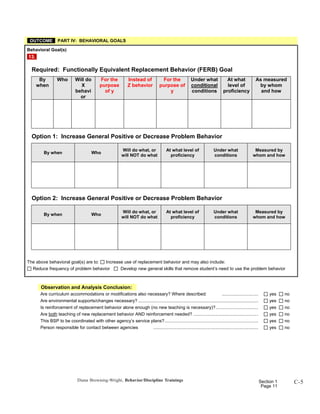
OUTCOME PART IV: BEHAVIORAL GOALS
Behavioral Goal(s)
13.
Required: Functionally Equivalent Replacement Behavior (FERB) Goal
By
when
Who Will do
X
behavi
or
For the
purpose
of y
Instead of
Z behavior
For the
purpose of
y
Under what
conditional
conditions
At what
level of
proficiency
As measured
by whom
and how
Option 1: Increase General Positive or Decrease Problem Behavior
By when Who
Will do what, or
will NOT do what
At what level of
proficiency
Under what
conditions
Measured by
whom and how
Option 2: Increase General Positive or Decrease Problem Behavior
By when Who
Will do what, or
will NOT do what
At what level of
proficiency
Under what
conditions
Measured by
whom and how
The above behavioral goal(s) are to: Increase use of replacement behavior and may also include:
Reduce frequency of problem behavior Develop new general skills that remove student’s need to use the problem behavior
Observation and Analysis Conclusion:
Are curriculum accommodations or modifications also necessary? Where described: ............................. yes no
Are environmental supports/changes necessary? ................................................................................................ yes no
Is reinforcement of replacement behavior alone enough (no new teaching is necessary)?.................................. yes no
Are both teaching of new replacement behavior AND reinforcement needed? .................................................... yes no
This BSP to be coordinated with other agency’s service plans?........................................................................... yes no
Person responsible for contact between agencies .................................................................................... yes no
Section 1
Page 11
Diana Browning-Wright, Behavior/Discipline Trainings
C-5
COMMUNICATION PART V: COMMUNICATION PROVISIONS
Manner and content of communication
14.
1. Who?
2. Under what
condition(s)
(Contingent?
Continuous?)
3.
Delivery
Manner
4. Expected
Frequency?
5. Content?
6. How will this be
two-way
communication
1. Who?
2. Under what
condition(s)
(Contingent?
Continuous?)
3.
Delivery
Manner
4. Expected
Frequency?
5. Content?
6. How will this be
two-way
communication
1. Who?
2. Under what
condition(s)
(Contingent?
Continuous?)
3.
Delivery
Manner
4. Expected
Frequency?
5. Content?
6. How will this be
two-way
communication
PARTICIPATION PART VI: PARTICIPANTS IN PLAN DEVELOPMENT
Student
Parent/Guardian
Parent/Guardian
Educator and Title
Educator and Title
Educator and Title
Administrator
Other
Other
Section 1
Page 12Diana Browning-Wright, Behavior Discipline Trainings C-6
BEHAVIOR SUPPORT PLAN QUALITY
EVALUATION SCORING GUIDE II
To Evaluate Behavior Support Plans (See www.pent.ca.gov)
Diana Browning Wright, M.S., G. Roy Mayer, Ed.D.,
Dru Saren, Ph.D.
With critical reviews from:
PENT Research Team
Diana Browning Wright, Clayton Cook, Dean Crews, Dr. Bruce Gale,
Dr. Bonnie Rawlings Kraemer, Dr. G. Roy Mayer
With further input from:
The Positive Environments, Network of Trainers Leadership Team
(Elena Alvarez, Gail Cafferata, Clinton Eatmon, Dr. Bruce Gale,
Diane Hannett, Joan Justice-Brown, Denise Keller, Toni Lien,
Hope Michel, Dr. Valerie Samuel, and Adam Stein)
and
The California Statewide PENT Cadre Member Network
(See www.pent.ca.gov)
and the 2006 CSULA PENT Data Analysis Research Associates
C-7
HOW THE BEHAVIOR SUPPORT
PLAN QUALITY EVALUATION
GUIDE CAME TO BE
This instrument was originally created by Diana Browning Wright, PENT Director
(Positive Environments, Network of Trainers) and Dru Saren of the California
Department of Education-Diagnostic Centers, with input from G. Roy Mayer, California
State University, Los Angeles. It was designed to address the needs of the field for an
instrument to evaluate the quality of behavior support planning across the state. Four
hundred “successful” behavior plans submitted by the statewide PENT Cadre were
analyzed by Wright and Saren in the development of this tool. It was then evaluated by
the nine member PENT leadership team prior to field-testing across California by the
PENT Cadre1
. Following PENT Cadre finalization, 40 graduate students in behavior
analysis and school psychology at California State University, Los Angeles under the
leadership of G. Roy Mayer, scored the behavior support plans to further establish
reliability and provide further insights in its use. This revised version has gone through a
similar process, with Diana Browning Wright and G. Roy Mayer integrating further
findings and comments from the field and 100 graduate student reviewers who have
subsequently scored hundreds of plans in the three years following the original edition.
ACKNOWLEDGEMENTS
The authors and entire Cadre wish to acknowledge the leadership and extend a warm
thank you to Deborah Holt, Director of Diagnostic Center, South in facilitating the
development of this instrument in all phases and ways, including access to the formatting
wizardry of Lizette Edrosa and additional clerical support from the clerical team:
Hortense Jurado, supervisor, and Elizabeth Valencia, La Paula Lofton, and Magda
Caban. To Mary Anne Nielson, Director of Diagnostic Center, North, thank you as well
for your gracious support and facilitating the meeting hours between Diana Browning
Wright, DCS and Dru Saren, DCN, often requiring meetings in either northern or
southern California. To the SELPA Directors who identified the candidates to become a
member of the PENT Cadre, thank you for your support.
1
PENT Cadre is the 250-member network of trainers and consultants across California who were
nominated by their SELPA directors. The Cadre attends annual advanced training and networking
sessions, the PENT Forums.
C-8
USING THE BEHAVIOR SUPPORT
PLAN QUALITY EVALUATION
Diana Browning Wright
WHAT THIS QUALITY EVALUATION MEASURES
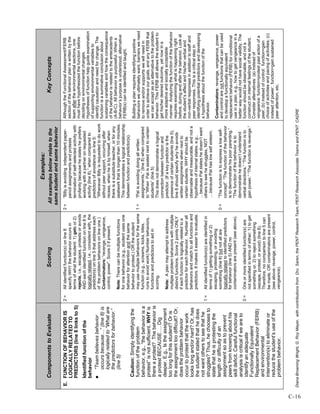
This scoring guide measures the extent to which the key concepts in behavior plan development
appear in the plan being evaluated with this instrument. The key concepts were determined
through a literature review of articles and texts on applied behavior analysis. Those concepts
that permeated the literature were included in this evaluation instrument. The lines mentioned in
this BSP-QE rubric relate to the Behavior Support Plan form downloadable at: www.pent.ca.gov
If a different form without these line references is being used, the evaluator using the BSP-QE
will need to determine which components of any alternate plan apply to the Areas A-L in this
instrument. If not all areas are represented, the evaluator should recognize that key components
identified in research are therefore missing. The authors would suggest revising the plan to
incorporate all key components identified and evaluated in the BSP-QE. The Behavior Support
Plan form(s) available at www.pent.ca.gov may be freely used provided author credit is
maintained.
WHAT THIS QUALITY EVALUATION DOES NOT MEASURE
1. Developmental Appropriateness
This scoring guide does not evaluate whether the interventions to teach a replacement behavior,
and the environmental changes to reduce likelihood of problem behavior are appropriate for the
developmental age of the student.
For example, the plan may beautifully specify how to teach a replacement behavior
(e.g., verbally asking for a break from a non-preferred task) for a student who does
not yet demonstrate the verbal ability to ask for a break when he is upset.
2. Accuracy of Identified Function of the Behavior
This scoring guide cannot evaluate whether the hypothesized function of the problem behavior
is accurate and therefore whether all subsequent plan development is valid. When the hypothesis
is made about the function of the behavior, the team is considering: the student’s affect and the
demonstrated behavior(s); everything that occurs as a consequence to the problem behavior; and
all environmental events occurring right before, immediately past, and during the behavior.
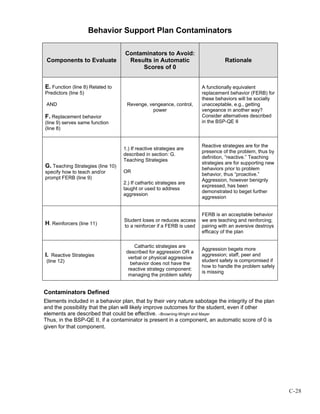
When a plan is unsuccessful, two possible reasons should be considered. First, there may be an
inaccurate hypothesis about the function of the behavior. This would therefore result in a
corresponding error in the identification of a Functionally Equivalent Replacement Behavior
(FERB). Further data collection, observations and problem solving is therefore necessary.
Second, although the function of the behavior may be accurate, if you have not identified a
FERB and systematically taught and reinforced its use, the student may continue to revert to the
problem behavior to meet his or her needs. Further plan revision would therefore be necessary
to incorporate and teach the FERB.
C-9
For example, escape was initially determined to be the function of the student’s
running out of the room and therefore a replacement behavior to allow an acceptable
escape was being taught to the student. However, further analysis may have
identified attention seeking as the true function of the running, rather than escaping
from the task. Therefore the plan requires revision to incorporate an appropriate
attention seeking skill to teach the student.
Alternatively, the plan may have accurately identify the problem behavior’s function
as escaping a task, yet no FERB (escaping in a manner that is acceptable) is being
taught to the student. The plan will require alteration to incorporate teaching of a
FERB.
3. Whether this Plan was Implemented Consistently, as Described, with Skill
No plan can be written with enough detail to completely describe the full nuance of adult
behavior to respond to problem behavior, every detail in teaching a new behavior, and the exact
specifics of environmental change. Further observation may be necessary to see that what the
team envisioned in their discussion is occurring as planned.
SIGNIFICANT CHANGES BETWEEN BSP-QE I AND THE REVISED BSP-QE II
Three years of collecting data and scoring plans from across California has yielded information
as to common errors in plan development. Therefore, as the authors revised the instrument,
additional explanations and hints were incorporated throughout the new rubric to address
common errors. These changes included how to:
Better describe the problem behavior
Better analyze the environment to identify necessary changes
Summarize necessary interventions more clearly
Understand the purpose and function of a behavior and avoid statements that can NOT
serve as functions, i.e., the contaminators: Revenge, Power, Vengeance, Control
Identify, teach, and reinforce true functionally equivalent replacement behavior (FERB)
that allows the student to gain the same outcome in a more socially acceptable manner
Substantially improve reinforcement provisions for new FERB behavior, as well as
general positive behavior, requiring it to be: specifically stated, contingently given, have
effectiveness evidence for that student, specify frequency, offer choice-within-variety,
determine immediacy requirements
Require specification of how to manage the problem safely for every problem behavior
Firmly require that no reactive strategy contaminators be present: catharsis for
aggression (encouraging aggression such as hitting the doll instead of the person
encourages all forms of aggression) or not having a strategy identified for managing
verbal/physical aggression safely, if identified as the problem behavior
How to effectively progress monitor response to intervention, clarifying three elements
- Goals that can be effectively progress monitored: 6 and 9 goal formats
- Team coordination: for implementers, monitors and information exchangers
- Communication during the plan: who, conditions, manner, content, frequency and
reciprocity—two way
C-10
SIX KEY CONCEPTS IN
BEHAVIOR SUPPORT PLANNING
Diana Browning Wright
Behavior serves a purpose for the student. All behaviors, including problem behavior, allow
the student to get a need met (i.e., behavior serves a function).
This behavior has worked in the past, or is currently working to get something the
student desires, or avoids/protests something the student wishes to remove.
- The Behavior Support Plan (BSP) must identify the function of the problem
behavior in order to develop a plan that teaches FERB.
Behavior is related to the context/environment in which it occurs.
Something is either in the environment, or NOT in the environment which increases
the likelihood the behavior will occur.
- The BSP must identify what environmental features support the problem
behavior in order to know what environmental changes will remove the need
to use the problem behavior.
There are two strands to a complete behavior plan. Changing behavior requires addressing
both the environmental features (removing the need for use of problem behavior to get needs
met) AND requires teaching a functionally-equivalent behavior that student can use to get
that same need met in an acceptable way.
- A complete BSP must address both strands: make environmental changes
that support acceptable behavior, AND specify how to teach or elicit
functionally equivalent acceptable behavior. When a plan is implemented
well and change is not occurring, evaluating whether both strands were
addressed is a first step.
New behavior must be reinforced to result in maintenance over time
- BSP must specify reinforcement for new functionally equivalent behavior. (BSP
may also wish to specify general reinforcement for positive behaviors.)
Implementers need to know how to handle problem behavior if it occurs again
- BSP must specify reactive strategies ranging from prompting the alternative
replacement behavior through distraction, redirection, progressive removals,
school and district disciplinary required actions.
Communication needs to be between all important stakeholders, frequently enough to result
in the continuous teaming necessary to achieve success
- BSP must specify who communicates with whom, how frequently and in what
manner.
C-11
DianaBrowningWright,G.RoyMayer,withcontributionsfromDruSaren,thePENTResearchTeam,PENTResearchAssociateTeamsandPENTCADRE
BEHAVIORSUPPORTPLANQUALITYEVALUATION
SCORINGGUIDEII
ByDianaBrowningWright,M.S.,G.RoyMayer,Ed.D.,withcontributionsfromDruSaren,Ph.D.
thePENTResearchAssociateTeam,PENTResearchTeam,PENTCadreand2006PENTResearchAssociatesTeam
ComponentstoEvaluateScoring
Examples:
Allexamplesbelowrelatetothe
samestudentandsamebehavior
KeyConcepts
A.PROBLEMBEHAVIOR(line1)
Problembehavior(s)in
observableandmeasurable
terms
“Behaviorimpedinglearning
is…”
NOTE:Itisbesttolimitabehavior
plantooneortwodistinct,
separately-occurringbehaviors
(Seebulletthreeinkeyconcepts
columnforclarification.)However,
ifmultiplebehaviorsoccurinrapid
sequence,allwiththesame
function,theycanbeadequately
addressedinoneplan.
Intheprocessofdevelopinga
behaviorplan,theteammay
decidetolistmultiplebehaviors,
butthenproceedtoaddressonly
oneorafew.Itcanbehelpful,
then,tobracketthebehaviorsnot
covered,withanotestating:
(Otherproblembehaviorsnot
addressedinthisplaninclude:
xxx,xxx)Forthepurposeof
scoring,itcanbehelpfultobracket
behaviorsidentifiedonline1that
arenotcoveredlaterintheplanif
thathasnotalreadybeendoneby
thewriters.
2=Allidentifiedproblembehavior(s)
areobservableandmeasurable.If
abehavioralcategoryislisted,
e.g.,aggression,itis
subsequentlydefinedin
observable,measurableterms.
1=Someoftheidentifiedproblem
behavior(s)arenotobservable
andmeasurable.
0=Noproblembehaviorisstatedin
observableand/measurable
terms,e.g.,Thestudent’sinner
attributesarehypothesized
insteadofadescriptionof
behavior.
2=“Defiance:Billyignoresteacher
requeststoindependentlycomplete
awrittenassignmentandcontinues
self-selectedactivity”(thisincludes
observable/measurableexamples)
Defiancesequence:Billycontinues
withaselfselectedactivity,ignoring
teacherrequeststocompletean
assignment;whenprompted,he
shrugshisshouldersanddoesnot
comply,ifpromptedagain,he
swearsandcontinueswithhis
activity.(Thissequenceisin
observable/measurableterms)
1=“Billyignoresteacherrequeststo
independentlycompleteawritten
assignmentandcontinueswithself-
selectedactivity”islisted,butan
additionalbehavior,“Aggressive
behavior”islisted(butnofurther
descriptionisgiven)
0=“Billyisdefiant”(butnofurther
description;thereforethisisnot
observableormeasurable);“Billy
hasalowselfconceptandhe
dislikesthesubject”(attributes
ratherthanbehaviorsaregiven).
Definetheproblembehavior
clearlysoyoucanmeasure
progress.
Ifyouusegeneralbehavioral
categorytermssuchas
“defiance”,giveexamplesof
whatthestudentactuallydoesso
everyoneunderstandswhatthe
problemlookslikewhenit
occurs.
Ifyouareaddressingmorethan
onebehavior,numbereach
behaviortocorrelatewith
matchedfunctions,matched
interventionsandreactive
strategieslaterintheplan.Itcan
bedifficulttoaddressmorethan
twobehaviorspereachBSP
formbecausetheplanwill
becomeconfusinganddifficultto
implement.However,ifthe
behaviorsformanescalation
patternthatoccursinsequence
(e.g.,studentswearsunder
his/herbreath,thenrocksin
chair,thentearspaper,then
pushesoverthechair)theycan
bereadilyaddressedintheplan.
C-12
DianaBrowningWright,G.RoyMayer,withcontributionsfromDruSaren,thePENTResearchTeam,PENTResearchAssociateTeamsandPENTCADRE
ComponentstoEvaluateScoring
Examples:
Allexamplesbelowrelatetothe
samestudentandsamebehavior
KeyConcepts
B.PREDICTORSOFBEHAVIOR
(line5)
“Whatarethepredictorsfor
thebehavior?”
Predictorsoccurinan
immediateenvironment,or
immediatepastenvironment.
Physicalsetting(i.e.,sensory
over/understimulation:noise,
crowding,temperature,etc.)
SocialSetting(i.e.,interaction
patternswithandaroundthe
student,peoplepresent/absent
InstructionalStrategies,
CurriculumandActivities(i.e.
amismatchbetweenlearner
accommodationneedsand
instructioncomponents).Thisis
oneofthemostcommon
predictors.Examinecarefully.
Schedulingfactors(e.g.,specific
times,withorwithoutsequencing
andtransitionsupports)
DegreeofIndependence(e.g.,
reinforcementand/orprompting
intervals-levelsandtypes
appropriatetofoster
independence;consider
functionalcommunication
availability,etc.)
DegreeofParticipation(e.g.,group
size,location,andfrequencyof
participation)
SocialInteraction(i.e.,social
communicationneedsofthe
studentmatchesparticipation
opportunitiesandprovisionof
necessarysupports)
DegreeofChoice(i.e.,amountof
choicemakingandnegotiation
presentintheenvironment)
2=Oneormorepredictorsfrom
immediateorimmediatepast
environmentsaredescribedwith
atleastonedetailaboutoneor
moreoftheenvironmental
variablesincolumnone
1=Oneormorepredictorsfromthe
environmentalvariablecategories
aregiven,butwithnodetail.
0=Nopredictorsofproblembehavior
fromanyofthecategoriesare
given,orpredictorsarefromother
environmentsandarenottriggers
inthecurrentenvironment,or
internalthoughtsor,presenceof
aninternalstateorbehavioral
historyordisabilityisdescribed.
Longrangetriggersarenot
specificallyaddressedinbehavior
supportplansandifpresent,
shouldbeaddressedthrough
interventionssuchascounseling,
mentalhealthtreatment,agency
interventions,andsoforth(see
keyconceptscolumn).
2=“WheneverBillyisrequestedtodo
workwithoutpeersupport,
occurringafterrecess,whenheis
byhimself,whenthereisa
substituteteacher,orforany
seatworkthatislongerthan10
minutes.”(Note:Oneormore
detailsweregivenandthisapplies
tocategories:socialinteraction
andschedulingfactors.)
1=“WheneverBillyisrequestedtodo
work”(Note:Thecategory
Instructionalstrategies,
curriculumandActivitiesis
mentioned,butwithnodetails
givenaboutwhattypeofwork,or
howappropriatelytheworkmatch
thelearnerskillsandsupport
needs.
0=“Anytime,”“BillyhasAD/HD”(no
predictorsfromcategoriesare
given)
“Billy’sparentswon’ttakehimto
counseling,”(Thisisnota
predictor/trigger)
“Billyrefusestodohomework
withoutanoldersiblingorparent
present”(notapredictorfor
problembehaviorinthecurrent
environment)
“Billyhaslowselfesteemabout
mathskills.”(Thisisahypothesis
aboutinternalthoughtsorstates)
Whenandwhere,andunderwhat
conditionscanyoumostexpectthe
behaviortooccur?Beasspecific
andthoroughinenvironmental
analysisandexamineall
categories.
Theinterventionsdescribedlaterin
theplanaddressalteringpredictor
variablestoeliminateorreducethe
student’sneedtousetheproblem
behavior.Assessment
thoroughnessisrequired.
Sometimesthepredictorswillbe
obvioustocasualobservationsand
interviews;othertimesformalon-
goingobservationaldatacollection
willbenecessary.
IfthebehaviordoesNOToccurin
someenvironments,andDOES
occurinothers,lookatdifferences
inthespecifiedenvironmental
variablesineachenvironmentto
identifywhatissupportingproblem
behavior.
IdentifyingWHYthebehavior
occursrequiresconsiderationof
whatthestudentgetsorwhatthe
studentrejects(avoids,protests)
bythebehavior(i.e.,the
behavior’sfunction)andwhatisin
ornotintheenvironmentthat
promptsorinhibitstheproblem
behavior’soccurrence.Start
formulatingthefunctional
hypothesisnow.
Considerhowtheidentified
environmentalpredictors
contributetothecontinuationof
theproblembehavior
(mismatchofacademicskills
andexpectationscontributesto
avoidanceofacademictasks.)
C-13
DianaBrowningWright,G.RoyMayer,withcontributionsfromDruSaren,thePENTResearchTeam,PENTResearchAssociateTeamsandPENTCADRE
ComponentstoEvaluateScoring
Examples:
Allexamplesbelowrelatetothe
samestudentandsamebehavior
KeyConcepts
C.ANALYSISOFWHAT
SUPPORTS(PROMPTS)THE
PROBLEMBEHAVIORIS
LOGICALLYRELATEDTO
PREDICTORSIDENTIFIEDFOR
CHANGE(line6linksto5)
Identifiedantecedent
environmentalvariables
influencingbehavior
Whydoesthepredictorpromptthe
problembehavior?Thislaysthe
groundworkforwhatwillbe
describedinline7,
environmentalchange.
Theanalysisofwhytheidentified
variable(s)aresupporting
(prompting)thestudent’suseof
theproblembehavioris
described.“Whatsupports
(prompts)thestudentusingthe
problembehavior:Whatisinor
missingintheenvironment
and/orintheinstruction”you
haveidentifiedforchange(line
6).Comparethisassessment
conclusiontothespecified
predictorsyouhaveobserved
(line5)i.e.,“Anycurrent
predictorsforbehavior?”(See
keyconceptscolumnfor
elaboration.)
2=Halformoreoftheenvironmental
featurestargetedforchange(line6)
arelogicallyrelated,i.e.,consistent
with,oneormoreoftheidentified
predictors(line5)Ifonlyone
feature(line6)isgiven,itmustbe
logicallyrelated.
"Logicallyrelated”meansidentifyinga
relationshipinwhichcertainevents
orlackofcertaineventsappearto
leadtoaparticularoutcome.
Forexample,aschedulingproblem
isidentifiedintheenvironmental
analysis:Jillisrequestedto
transitionwithouttransitional
supports.Theproblembehaviorthen
occurs(crawlsunderthetable).This
behavioroccursbecauseofthe
teacherhasnotyetimplementeda
pictureschedulespecifically
designedtomatchJill’s
comprehensionneedsLine6).A
logicalrelationshipbetween
predictors(line5)andanalysis(line
6)isapparent.
1=Lessthanhalfofthefeaturesofthe
environmenttargetedforchange
(line6)arelogicallyrelatedtooneor
moreoftheidentifiedpredictors(line
5).Ifonlyoneisgiven,anditisnot
logicallyrelated,score0.
0=Noneofthepredictors(line5)are
logicallyrelatedtothesummaryof
whytheproblembehavioris
occurringinthespecificsituation
(line6),ORifnoneofthePredictors
(line5),arerelatedtothe
environmentalfactors(seePhysical
Setting,SocialSetting,etc.)thenno
logicalrelationshipcanbe
determinedandtheenvironmental
assessmentanalysis(line6)is
inadequate.
2=Halformorearelogicallyrelated.Ifonly
oneisgiven(line6)anditislogically
relatedtoline5,score2.
Exampleofonelogicalrelationship:
MissinginEnvironment:
Somethingnotbeingdonethat
shouldbe—addsomething:
requestedtodoworkwithoutpeer
support,occurringafterrecess,whenhe
isbyhimself,whenthereisasubstitute
teacher,orforanyseatworkthatis
longerthan10minutes.”(line5)is
logicallyrelatedto(line6)Billyneedsto
beallowedtoworkwithapeerbuddy
undertheconditionsdescribedonline5.
(1environmentalfeatureislisted,andit
islogicallyrelated)
Exampleofanotherlogicalrelationship:
PresentinInstruction,Something
beingdonethatshouldnotbe—
removesomething:
Adifferentcase:“Jayexpressesthe
desiretoworkonhisownandincreased
independenceandreductioninprompt
dependenceshouldoccur”(line6)is
logicallyrelatedto“theproblem
behavioroccurswhenanadultclosely
monitorseachseatworktaskJayis
assigned”(line5)(Oneenvironmental
featureislisted,anditislogicallyrelated
tothepredictor.)
1=Example:Threevariablesaretargeted
forchange(line6)buttwoofthethree
arenotlogicallyrelatedtopredictors
(line5),butonevariableislogically
related.Score1,(i.e.,only1/3were
logicallyrelated).
0=Noenvironmentalchangeislogically
related.Examplesofnon-logical
relationships:“Theteacherdoesn’tuse
peerbuddies”(line6)doesnotlogically
relatetoanyvariableonline5(“after
recess,duringlongassignments,during
math”),i.e.,absenceofpeerbuddywas
notapredictorvariablelistedonline5.
ORtimeoutislisted(line6),butitisnot
logicallyrelatedtowhenaskedto
completeassignmentsindependently
(line5).
Itisnotenoughtodescribethesituationor
predictorsofproblembehavior.(line5)The
teammustanalyzewhatitisaboutthat
situationthatresultsinthelikelihoodof
problembehavior.Somethingisinthe
environmentthatneedstobeaddedor
increased,eliminatedorreduced.Line6is
thesummativestatementthatdrives
developmentofinterventionstoaddress
environmentalconditions.Teamsmay
identifymultiplepredictors(line5)but
ultimatelymustselectkeysupporting
predictors(line6)priortospecifying
environmentalchanges.
Thepurposeofenvironmentalchangesisto
removetheneedforthestudenttousethis
problembehavior.Indevelopingaplan,
hypothesizingthebehaviorfunctionbefore
decidingonenvironmentalchangeswillhelp
theteamidentifythemostcriticalvariables
tochange.Knowingwhattochangeinthe
environmentiscriticalandmustbebased
onanenvironmentalanalysisofthe
followingkeyvariables:
Physicalsetting
SocialSetting
InstructionalStrategies,
CurriculumandActivities
Ifinstructionalstrategies,curriculumand
activitiesdonotmatchlearnerneeds,the
studentwillrequireaccommodation
planningtosupportlearning.An
accommodationplanwillneedtobe
developedtosupportthisstudent.
Schedulingfactors
Studentswithsomedisabilitiesrequire
specificenvironmentalstructuresto
enhancecomprehensionofsequencesand
tolerationofnon-selfselectedactivities.
DegreeofIndependence
DegreeofParticipation
SocialInteraction
DegreeofChoice
C-14
DianaBrowningWright,G.RoyMayer,withcontributionsfromDruSaren,thePENTResearchTeam,PENTResearchAssociateTeamsandPENTCADRE
ComponentstoEvaluateScoring
Examples:
Allexamplesbelowrelatetothe
samestudentandsamebehavior
KeyConcepts
D.ENVIRONMENTALSTRUC-
TURE(FORPROBLEM
PREVENTIONANDPROMO-
TIONOFREPLACEMENT
BEHAVIOR)ISLOGICALLY
RELATEDTOWHAT
SUPPORTS(PROMPTS)THE
PROBLEMBEHAVIOR(line7
linksto6)
Specifiedenvironmental,
curriculumand/orinteraction
changestoremoveneedto
exhibittheproblembehavior
Theenvironmentalchange(s)to
bemadetoremovethestudent’s
needtousethisbehavior(line7)
islogicallyrelatedtopredictors
online6:“Whatsupports
(prompts)thestudentusingthe
problembehavior?”
Note:Sometimesthereisa
logicallyrelated,consistent
relationshipbetweenthe
identifiedpredictors(line5)and
thespecifiedpredictorsthatneed
tobealtered(line6)whichwas
analyzedinCabove.Butthe
teamfailstologicallyrelatethat
analysistotheinterventionsand
changesonline7.Therefore,in
analyzingthestrengthand
weaknessofaplan,bothare
consideredseparately,i.e.,C
andD.
2=Oneormoreenvironmental
changes,i.e.,changesintime,or
space,ormaterials,orpositive
interactionsarespecified(line7)
andarelogicallyrelated,i.e.,
consistentwith,whatwas
identifiedassupportingproblem
behavior(line6)
1=Oneormoreenvironmental
variablechanges(time,orspace,
ormaterials,orpositive
interactions)aredescribed(line
7)BUTtheyarenotlogically
relatedtowhatwasidentifiedas
supportingtheproblembehavior
(line6)
0=Nochangeinanyofthefollowing
fourenvironmentalvariableis
described.Nochangeintime,or
space,ormaterials,orpositive
interactionsaredescribed.
(line7)Reactivestrategiesor
interventionsunrelatedtothe
predictorsaredescribed.
2=“Billywillbeseatednexttoapeer
buddyandtheywillreceive
instructiononpeersupportsfor
activitiesoccurringafterrecess,
whenthereisasubstituteteacher,
orforanyseatworkthatislonger
than10minutes.””(line7)is
logicallyrelatedtopredictor
analysis:“Billyneedstoworkwith
apeerunderspecificconditions
andherepeatedlystateshe
dislikesworkingaloneandwants
toworkwithpeers.”(line6)
1=“Samwillbeseatednexttoapeer
buddy.”(Thisisachangein
positiveinteractionsandspace
specifiedonline7)BUT,thisis
notlogicallyrelatedtothe
environmentalanalysisgivenon
line6:“Samisgivenlong
assignmentsandneedsshorter
assignmentscapableofbeing
completedina30min.period”
(Sam’sneedforpeerinteractions
inthisexampleisnotlogically
relatedtotheidentifiedpredictor,
longassignments.)
0=“Teachershouldgive2warnings,
thensendthestudenttotheoffice
whenheisn’tontask.”(Line7did
notspecifyachangeintime,or
space,ormaterialsorpositive
interactions.)
Onestrandofpositive
behavioralsupportentails
alteringtheenvironmentto
reduceoreliminatethe
student’sneedtouseproblem
behavior.(line7)
Successfulsupportofpositive
behaviortypicallyentailsa
varietyofenvironmental
changesinhowtimeis
structured,spaceisorganized,
materialsareselectedand
positiveinteractionsare
increased.(line7)
Understandingthestudent’s
learningprofile,personality,
anddisability(ifany)willbe
helpfulindeterminingtypical
environmentalsupportsto
considertoeliminateorreduce
problembehavior.(line7)
Whenthereisalogical
relationshipbetween
environmentalchangestobe
made(line7)andthepredictor
summaryofwhatissupporting
problembehavior(line6)the
likelihoodofaddressingthe
correctvariablesisincreased.
Theteamcannowmoveonto
thestrand:specifyinghowto
teachFERB(s)Lines8and9.
C-15
DianaBrowningWright,G.RoyMayer,withcontributionsfromDruSaren,thePENTResearchTeam,PENTResearchAssociateTeamsandPENTCADRE
ComponentstoEvaluateScoring
Examples:
Allexamplesbelowrelatetothe
samestudentandsamebehavior
KeyConcepts
E.FUNCTIONOFBEHAVIORIS
LOGICALLYRELATEDTO
PREDICTORS(line8linksto5)
Identifiedfunctionofthe
behavior
“Teambelievesbehavior
occursbecause…”(line8)is
logicallyrelatedto“Whatare
thepredictorsforbehavior.”
(line5)
Caution:Simplyidentifyingthe
functionoftheproblem
behavior,e.g.,“thebehaviorisa
protest”isnotsufficient.WHYis
thereaprotest?Thebehavioris
aprotestBECAUSE….Dig
deeper.E.g.,Istheassignment
toolongforthisstudent?Oris
theassignmenttoodifficult?Or,
doestheproblembehavior
occurtoprotestthatthework
lookslongand/orhard?Or,has
thestudentstatedthathedoes
notwantotherstoseethathe
struggles?Thus,hechoosesto
statethatheisprotestingthe
lengthordifficultyofan
assignmentsoastoprevent
peersfromknowingabouthis
skilldeficit.Carefulfunctional
analysisiscriticalifweareto
identifyanadequate
FunctionallyEquivalent
ReplacementBehavior(FERB)
andenvironmental
intervention(s)toeliminateor
reducethestudent’suseofthe
problembehavior.
2=Allidentifiedfunction(s)online8
specifyWHYthebehavioroccursin
termsofwhatthestudent:1)getsor2)
rejects,i.e.,escapes,protestsoravoids
ANDeachidentifiedfunctiononline8is
logicallyrelated,i.e.,consistentwith,the
predictor(s)online5thataddresseach
oftheproblembehaviorsonlineone.)
Contaminators:“revenge,vengeance,
control,power”.Score0ifpresent.
Note:Therecanbemultiplefunctions
foronebehavior(e.g.,studentusesone
behaviorforattentionandthesame
behaviortoprotest.)ORthestudent
mayusemultiplebehaviorsforthesame
function(e.g.,screams,kicks,bites,
runstoavoidwork)Numberbehaviors,
functionsandpredictorstoaidin
scoring.
Note:Aplanmayattempttoaddress
multipleproblembehaviorswithmultiple
distinctfunctions.Score2pointsONLY
ifeachfunctionislogicallyrelatedtoa
predictorforeachbehavior.Numberall
behaviorsandmatchtoallfunctionsand
predictors.Itmakesiteasiertoevaluate.
1=Allidentifiedfunction(s)areidentifiedin
termsof1)gettingsomethingor2)
escaping,protesting,oravoiding
something(line8)butnotallare
logicallyrelatedtoidentifiedpredictors
forbehavior(line5)ANDno
contaminatorsarepresent(seeabove).
0=Oneormoreidentifiedfunction(s)are
notspecifiedintermsofeither:1)toget
somethingor,2)torejectsomething
(escape,protest,oravoid)(line8).
Therefore,nocomparisontoline5can
bemade,ORcontaminatorsarepresent
(seeabove:revenge,power,control,
vengeance).
2=“Billyisavoidingindependentpaper-
pencilassignmentsandprotests
terminationofself-selectedactivitywith
profanitybecausehestatesheprefers
workingwithapartneronrequested
activity(line8),”whencomparedto
predictorsofavoidanceonline5:
“WheneverBillyisrequestedtodowork
withoutpeersupport,occurringafter
recess,whenheisbyhimself,when
thereisasubstituteteacher,orforany
seatworkthatislongerthan10minutes.
Thisdemonstratesalogicalrelationship
betweenfunctionandpredictor(s).
1=“Patisavoidingdoingallwritten
assignments,”(line8)whencompared
to“WhenPatisseatednexttocertain
students”(line5)
Thisdoesnotdemonstratealogical
connectionbetweenfunctionand
predictor.(Ifakeypredictoristhe
presenceofcertainstudents(line5),
line8shouldspecifywhyheavoids
writtenassignmentswhennextto
certainstudents.WHYshouldbe
observableandmeasurable,andnota
hypothesisofinternalstates.e.g.,
…becausePatstateshedoesn’twant
otherstoseehestruggles,NOT
….becausePathaslowselfesteem.
0=“Thefunctionistoexpressalowself-
concept”“Thefunctionofthebehavior
istodemonstratehispoorparenting.”
“Thefunctionofthebehavioristo
demonstratehedoesn’tunderstand
verbaldirections.”“Thefunctionisto
gainpower.”“Thefunctionisrevenge.”
AlthoughtheFunctionalAssessment/FERB
sectionofthebehaviorplaniswrittenbythe
teamaftertheenvironmentalsections,one
musthavehypothesizedthefunctionbefore
decidingonenvironmentalchanges.
Hypothesesoffunctionhelpguideexamination
ofsupportingenvironmentalvariablesto
identifycausationandneedforchange.The
functionisasummativeconclusionabout
sustainingvariablesandhowtheconsequence
ofthebehaviorisrelatedtotheantecedents
(A-B-C).Allbehaviorispurposeful.Whena
behavior’spurposeisunderstood,alternative
FERB(s)canbeidentifiedandtaught.
Buildingaplanrequiresidentifyingpositive
behaviorsweultimatelywant,barriersweneed
toremoveand/orsupportswewillneedin
ordertoachieveourgoals,andanyFERBthat
wecanacceptasanalternativetotheproblem
behavior.ThisFERBstillallowsthestudentto
gethis/herdesiredoutcome,yetnowina
moreadaptiveandsociallyacceptable
manner.Analyzingthefunctionofthebehavior
requiresexaminingwhatishappeningright
before,duringandafterthebehavior.Lookat
thestudent’saffectandhis/herverbaland
non-verbalresponsesinadditiontostaffand
peerresponses.Thisisacriticalstepin
identifyingpotentialpredictorsanddeveloping
ahypothesisaboutthefunctionofthe
behavior.
Contaminators:revenge,vengeance,power
andcontrolarenotfunctionsthatcanbeused
todevelopafunctionallyequivalent
replacementbehavior(FERB)forconditional
useinaplan,e.g.,howtogetvengeanceina
betterwaywouldnothavesocialvalidity.The
functionshouldbeobservable,andnota
constructoninternalfeelingsofthestudent.
Consideralternatives:(a)insteadof
vengeance:function=protestpastactionofa
peer;(b)insteadofcontrol:function=gain
choiceofactivitiesandpacingofactivities;(c)
insteadofpower:function=gainsustained
peerattention,etc.
C-16
DianaBrowningWright,G.RoyMayer,withcontributionsfromDruSaren,thePENTResearchTeam,PENTResearchAssociateTeamsandPENTCADRE
ComponentstoEvaluateScoring
Examples:
Allexamplesbelowrelatetothe
samestudentandsamebehavior
KeyConcepts
F.REPLACEMENTBEHAVIOR(S)
(line9)SERVETHESAME
FUNCTION(line8)ASTHE
PROBLEMBEHAVIOR(S)
FunctionallyEquivalent
ReplacementBehavior(FERB)
mustbeidentified
thatwillbetaughtand
reinforcedtoallowthe
student’sneed(function)tobe
metinanacceptablemanner
2=AllspecifiedFERB(s)(line9)
servethesamefunctionasthe
problembehavior(line8)ANDno
functionalcontaminatorsare
present(e.g.,control,power,
vengeance,revenge).
FERB(s)(line9)mustservethe
samefunctionastheproblem
behavior(s)(line8).Thereisno
scoreof1onthiscomponent.
0=NoFERBisidentified,OR
Thefunctionwasnotaccurately
identifiedonline8intermsof1)to
getsomethingor,2)toreject
something(escape,protest,or
avoid)andthereforeline9cannot
beevaluated.OR
Thefunctionwasnotinbehavioral
terms(i.e.,operationalized)sono
FERBcanbeidentifiedtomatcha
non-behavioralfunctionORa
functionalcontaminatorispresent
(seeabove).
2=“Billywillverballyrequestworking
withapeerbuddywhenhewishes
toprotesttheteacher’s
requirementthathework
independentlyonseatwork”
(FERBforaprotestofworking
alone-line9)servesthesame
functionas“Billyisavoiding
independentpaper-pencil
assignmentsandprotests
terminationofself-selectedactivity
withprofanitybecausehestates
heprefersworkingwithapartner
onrequestedactivity”(profanity
usedtoprotest-line8)
Forthiscomponent,score2or0.
Thereisnoscoreof1.
0=“Studentwilldowhatstaff
requests.”(line9)(Thefunction
wasavoidingwork;thisisnota
replacementbehaviorallowingthe
avoidingofworkinanaccepted
form)OR
“Thefunctionofthebehavioris
lowself-concept”(line8)cannot
becomparedtoanyreplacement
behavior(line9)OR
“Hewillgetrevengeinan
appropriateway.”
TheFERBisapositivealternativethat
allowsthestudenttoobtainthefunction
thattheproblembehaviorprovided.I.e.,
He/sheeithergetssomethingorrejects
something(protest/avoid)inamanner
thatisacceptableintheenvironment.
TheFERBshouldmaximizethebenefits
(e.g.,morepositivefeedbackfromstaff
andpeers)andminimizethecoststothe
studentandothersintheenvironment
(e.g.,lostinstructionaltime,punishment
fromstaffandpeers).
Note:Thestudentmayeventuallynot
needtouseaFERBwhenotherchanges
areachieved.Forexample,shewillno
longerneedtoescapebecausewehave
madesignificantchangesinthe
environmentthatremovesherneedto
escape.Or,shehasimprovedher
generalskillacquisitionandnolonger
seekstoescape.
TheFERBmustservethesamefunction
astheproblembehaviorandatleastas
easilyperformedastheproblem
behavior.Afunctionmusthavebeen
operationalized,e.g.,putinbehaviorally
observableterms,andmusthave
avoidedcontaminators(revenge,power,
control,vengeance)ifanadequateFERB
forconditionaluseistobeidentified,
taughtandreinforcedasanalternativeto
theproblembehavior.
C-17
DianaBrowningWright,G.RoyMayer,withcontributionsfromDruSaren,thePENTResearchTeam,PENTResearchAssociateTeamsandPENTCADRE
ComponentstoEvaluateScoring
Examples:
Allexamplesbelowrelatetothe
samestudentandsamebehavior
KeyConcepts
G.TEACHINGSTRATEGIES(line
10)ADEQUATELYSPECIFY
HOWTOTEACHANDOR
PROMPTFERB(S)(line9)
SpecifyhowtheFERB,that
allowsthestudenttomeet
functionalneedinan
acceptableway,willbe
systematicallytaught.
2=Teachingstrategies(line10)for
allFERB(s)(line9)includeat
leastonedetailabouthowthiswill
bedone:forexample,materials
arelisted,astrategyisdescribed,
alistofproceduresorskillstepsis
referenced.(Thestatementcan
referthereadertoanattached
documentandneednotbefully
describedontheplanforascore
oftwo.)IfContaminatorsare
present,score0:(a)ifareactive
strategyfortheproblembehavior
isdescribedhere,(b)Ifcathartic
strategiesforaggressionare
described,e.g.,punchapillow,
notyourpeer.
1=Someteachingstrategieswithat
leastonedetailarespecifiedfor
oneormoregeneralpositive
behaviors
OR
Teachingstrategieswithatleast
onedetailforone,butnotall,
FERBlisted(line9)
AND
nocontaminatorsarepresent
0=Nostrategieswithatleastone
detailarespecifiedtoteacheither
aFERBORtoteachgeneral
positivebehaviors(line10)OR
contaminatorsarepresent(see
above).
2=“Teacherwillinstruct,providepractice
sessions,andcueBillytorequest
peerbuddyassignmentassistance
usingtheattachedrequestlanguage
andthespeech/languageteacherwill
practicetheserequestingskillsin
smallgroup.”(line10)Thisincludes
somedetailaboutrequestingapeer
buddyasanacceptableprotestofthe
requirementtoworkindependently
(line9).NootherFERBsarepresent
toevaluateandnocatharticstrategy
foraggressionisdescribed..
1=“TeacherwillinstructBillyonhowto
requestpeerassistance.”(This
directlyrelatestoprotestinglackof
assistanceonseatwork(line9)but
doesnothaveatleastonedetailon
howtoteachhimtorequest
assistance.
OR,
“Adamwillbetaughthowtofollowa
schedule,(seeattacheddocument:
TeachingofaScheduleRoutine,)in
ordertoincreasetolerancefornon-
desiredactivities.Adesiredactivity
willoccurperiodicallyintheschedule.
(approximatelyevery30min.”(No
strategyforteachingaFERBtoAdam
forappropriateprotestingisgiven,but
anadequatelywrittenteaching
strategytoincreasegeneralpositive
behaviorsisprovidedwithatleastone
detailandthereforescores1.)
0=“Studentsenttotheofficewhenhe
protestsinappropriately.”(Nota
teachingstrategyforeitherageneral
positivebehaviororforaFERB,OR
“Samwillgototheplayroomtostab
dolls,notpeers,withapencil.”
(catharticstrategyforaggression)
AplantoteachorprompttheFERB
mustbecarefullythoughtout,with
materialsorstrategiesgivenwith
enoughdetailsothatallteammembers
willrememberwhattheyhavedecided
todo.
Itisacceptabletominimallymention
theteachingstrategyandthenreferthe
readertoanattachedskillteaching
sequenceortoaspecificcurriculum
availableforplanimplementers.
Theteachingsectioncaninclude
identificationofstrategiesforincreasing
generalpositivebehaviorskills.Some
creditisgivenforthis,butfullcredit
requiresspecificstrategiesforteaching
FERB(s).FERBisacorecomponentof
anywelldesignedbehaviorplanand
thereforemethodsofteachingthis
shouldbespecifiedwithsomedetail.
Contaminators:Reactivestrategy
specificationisappropriatein
componentI,butshouldnotbe
consideredanenvironmentalchangeto
removetheneedforthestudenttouse
theproblembehaviorwhichissection
D.Catharticstrategiesforaggression
havebeenextensivelyresearchedand
areshowntofosterorpromotefurther
aggressionandthereforecontaminate
theplan.
C-18
DianaBrowningWright,G.RoyMayer,withcontributionsfromDruSaren,thePENTResearchTeam,PENTResearchAssociateTeamsandPENTCADRE
ComponentstoEvaluateScoring
Examples:
Allexamplesbelowrelatetothe
samestudentandsamebehavior
KeyConcepts
H.REINFORCERS(line11)
Specifiedreinforcersthe
studentisknowntoseek
Analysis:“Reinforcement
procedures”
Areinforcerisaconsequence
thatincreasesormaintainsa
behavior.It“reinforces”the
probabilityofthebehavior
beingrepeated.
Areinforcercanbeatangibleor
aneventdeliveredasa
conditionalconsequence:IfX
behavioroccurs,Yconsequence
willoccur;ANDforwhichyou
haveevidencethatthestudent
willuseXbehaviortogetY
consequence.
Arewardisatangibleoran
eventdeliveredconditionallyfor
whichyouhopethestudentwill
strivetoearnit,butforwhichyou
donotyethaveevidencethat
thishasworkedinthepastorfor
whichevidencedoesnot
currentlyexiststhats/hewill
strivetoattainthereinforcer.
2=ReinforcerforFERBiscompleteandany
otherreinforcerforpositivebehavioris
alsocomplete:(a)specificallystated,(b)
contingentlygiven,(c)effectivenessdata
(d)frequency,ANDoneadditional
variableislisted:(either(e)choice-within-
varietyor(f)immediacy),ANDthe
followingcontaminatorisnotpresent:
studentlosesorreducesaccesstosome
reinforceriftheFERBisusedinlieuofthe
problembehavior.
(a)Specificallystated:Whatthe
studentwillreceive,e.g.,verbalpraise,
NOTbepositiveduringinteractions.
(b)Contingentlygiven:IfXbehavior
occurs,thenYreinforcerortoken/point,
etc.isgiven
(c)EffectivenessEvidence:Thereis
evidencethatthisreinforcerhas
frequentlybeensoughtbythestudent,
orthereiscurrentevidencethats/he
willactivelyseekthispotential
reinforcer.(SeelineonBSP:reinforcer
basedon_______).
(d)Frequency:Howoftenareinforcer
ortokenistobegiven.
(e))Choice-within-Variety:twoormore
reinforcersforstudentselectionare
specified.
(f)Immediacy=reinforcer(s)ortoken
symbolizingareinforceraredelivered
immediatelyafterthedesired
behavior(s)
1=AthroughDisgiven(seeH.2point
scoringabove),butneitherEorFis
presentORnoFERBreinforceris
identifiedBUTnocontaminatoris
present:(seeH.2pointscoringabove)
0=ContaminatorispresentORA,B,C,D
(seeH.2scoringabove)ismissing
2=Specificandcontingent:“Billywill
earntimeonthenewcomputergame
forworkcompletionandrequesting
peerbuddywhenneeded.”(both
generalpositiveandFERBare
addressed.)
1)Effectiveness(Power):Selectionof
reinforcerbasedon:“Billyrequests
accesstothecomputertoplaygames
andexpressesinterestinthisspecific
newgame.”“Billyalsorequestspositive
communicationwithparentsand
permissiontositnexttocertainpeers.”
2)Frequency:“Billywillearncomputer
timeattheendofeachday”or
“Billywillreceiveacomputerticketfor
completing10minutesofseatwork.
Eachticketearnsoneminuteof
computertime.”
Exampleformoderatetosevere
disability:“Janwillearnapproximately
10minutesofinterspersedcomputer
timeineachteachingsessionforthree
20minuteoneononeteachingsessions
perday.”
3)Immediacy:“Immediatelyaftereach
episodeofpeerbuddyrequesting,Billy
willbegivenatokenorabonuspoint
onhistallysheet.”
4)ChoicewithinVariety:Billycan
selectfromthefollowingreinforcers:a
positivenotehomeorpermissiontosit
nearafriendorcomputertime.”
1=Specificity,Contingency,
EffectivenessandFrequency(see
above)butnoadditionalvariable.OR
reinforcementforaskingforapeer
buddyisabsent(theFERB)
0=SpecificityorEffectivenessor
ContingencyorFrequencyare
missing.(seeabove)
Studentswillnotlikelychangeormaintain
newbehaviorswithoutreinforcement.
Determineifatrue“reinforcer”hasbeen
selected,ratherthana“reward.”Fora
reinforcerthereisevidenceofthestudent
seekingthiseventortangible.Providing
somethingwethinkthestudentwillwant
withoutevidenceisa“reward.”Howdoyou
knowthestudentseeksorwillseekthis
reinforcer?
Considerations:
Canthestudentwaitforthis
reinforcer,evenifitisknowntobe
ahighlypowerfulone?Canless
powerfulreinforcersbedelivered
morefrequentlyorcanincreasing
varietymaintaineffort?
Doesthestudentgraspthe
connectionbetweenthereinforcer
andthebehavior?Ifindoubt,
increaseimmediacyandspecify
theconditionsforearningthe
reinforcer(contingency)tothe
studentmoreclearly.
Ifyouareusingatokensystem,
doesthestudentunderstandthe
tokensymbolizesprogresstoward
earningthereinforcer?Ifindoubt
teachtheassociationsystemically.
Ifs/hedoesnotgraspthe
connection,atokensystemwillnot
beeffective.Isthestudentgetting
tokensasfrequentlyasneededto
maintaineffort?Ifnot,increase
frequencyand/orimmediacyof
tokendelivery.
Whodeliversthereinforcercanbe
important.Fromwhomdoesthe
studentmostwanttoreceivethe
reinforcer?Chooseadult(teacher,
principal,parent,counselor,etc.),
orpeer(s)
C-19
DianaBrowningWright,G.RoyMayer,withcontributionsfromDruSaren,thePENTResearchTeam,PENTResearchAssociateTeamsandPENTCADRE
ComponentstoEvaluateScoring
Examples:
Allexamplesbelowrelatetothe
samestudentandsamebehavior
KeyConcepts
I.REACTIVESTRATEGIES
(line12)
Reactivestrategiesareclearly
communicatedand
understoodbyall
implementers
Analysis:“Reactivestrategy
toemploy/debriefing
procedurestouseifproblem
behavioroccursagain.”
Fourcomponentsare
considered:Prompting,
ManagingSafely,Debriefing,
andConsequences
TeachWhat
YouWant
ReactiveStrategies:
Supportandcorrect
skillfullyandsafely
A11
2Debriefing
and/or
practice
3
Managingthe
problemsafely
Prompt,
CueFERBConsequences
orpunishment
(ifneeded)
4
Allimplementersshouldbeconsistentin
theirapproachwhenproblembehavior
occurs.Allstakeholders,e.g.,parents,
teachers,therapists,specialists,should
approveofthereactivestrategies.Ifthe
studentcancomprehendtheplan,s/he
shouldbeawareofallpartsoftheplan,
includingwhatstrategieswillbeusedfor
problembehavioracrossallproblem
behaviorphases.
Note:Forscoringpurposesifmultiple
behaviorsareaddressed,findone
completereactivesequencefora
problembehaviorontheplantoscore.
2=AStrategyforManagingatleastone
ProblemSafelymustbepresent,AND
anytwoothercomponentsbeloware
presentforthatbehavior,ANDno
contaminatorsarepresent:(a)catharsis
foraggressionor(b)aggressiveverbalor
physicalbehaviorislisted(line5),butno
strategyformanagingsafelygiven.
1=AStrategyforManagingatleastone
ProblemSafelymustbepresent,buttwo
additionalreactivestrategycomponentsfor
thatbehaviorarenotgivenANDno
contaminatorisdescribedontheplan:
catharsisforaggression,ornomanaging
safelystrategygivenontheplanfor
aggressionlisted(line5).
0=AStrategyforManagingatleastone
ProblemSafelyisabsentORa
contaminatorispresentontheplan:(see
above)
ReactiveStrategyComponents
1)PromptingtotheFERB,orredirectingto
taskwithadditionalsupports:
Key:Whatstaffactionsarespecifiedto
(a)redirectstudenttothenewbehavior
beingtaughtandreinforced,or(b)staff
actionstoredirecttothetaskwith
additionalsupports(e.g.,reminderofnext
break,desiredactivityearned,praise)
2)AStrategyforManagingtheProblem
Safelywhenproblembehaviordoesnot
respondtoredirectionisdescribed.Safety
forthestudent,implementersandpeers
mustbemaintained.Caution:Neverforce
compliancethroughaphysicalmeans.
Approvedphysicalrestraintsareonlyused
tomaintainsafetyofstudent,peersor
adults,neverforanyotherreason.
3)Debriefingand/oradditionalpracticeof
theFERBaftertheproblemisover.
Key:Whatshouldstaffdoafterthe
problembehaviorepisodetoprocessor
practicewiththestudentwhathappened?
Informationonfurtherplanalterationsmay
begleanedinthisprocess.
4)Consequencesorpunishmentmayor
maynotberequiredordesired.
Key:Whatstaffactionswilloccurbecause
ofschooldisciplinepolicy,orateam’s
decisionaboutacontingentlogical
consequence’sinstructivevalue?
2=2)ManagingtheProblemSafely:
“DuringBilly’sproblembehaviorepisode
(taskrefusalandprofanity)theteacherwillsit
veryclosetohim,presenttwochoicesof
whichworkfoldertocompletewithapeer,
usinganon-emotionaltone,waitingfor
swearingtoendandBillytochooseatask.”
AND
Othercomponentsforthatproblem
behavioraredescribed(2ormorerequired):
1.a)PromptingFERB:
“Teacherwillnon-verballycueBillytoswitch
totheFERB,apeerassistancerequest,using
thefivehandsignalsof“stop,”“think,”“you
canmakeagoodchoice,”“youcanmakea
badchoice”“whatwillyoudo?”astaughtto
thestudentandpracticedpreviouslyand
followedbyhandsignals“patyourselfonthe
back”ifstudentsignals“goodchoice”and
switchesbehavior.
OR1.b)PromptingtoRedirect,e.g.,severe
disabilityexample:“IfMarybeginstorock,(a
weakprotest,typicallyoccurringpriorto
screamingandrunning,showherthe“what
I’mworkingforcard”,thenredirecther
gesturallytofinishonlytheimmediatetask
beforeterminatinginstructionalsessionand
providingdesiredactivity.”
3)Debriefingmethod(s):
“TeacherandBillywillanalyzetheproblem
behavioroccurrenceusingtheattached‘My
InappropriateBehaviorWorksheet.Process
willoccurafterstudentisobservedtobecalm
andreadytotalk.”
4)ConsequencesorPunishment:
“Billywillnotreceivetokensfortheperioddue
tolackofcompletingthetaskwhichwould
haveearnedapproximately5towardthe
computergame.”or,“IfBillyengagesin
dangerousbehavior,suchaspushing,hitting
orthrowingfurnitureduringtheprotest,hewill
bereferredforimmediateschooldisciplinary
response.”
1=Managingproblemsafelystrategyforat
leastoneproblembehaviorispresent,buttwo
additionalcomponentsforthatbehaviorare
notpresent.
0=Managingproblemsafelystrategyis
absent,e.g.,studentthreatensothersbutno
strategytohandlesafelyifobserved;student
hitspeers,nostrategytoaddress.
Welldesignedreactivestrategiesconsiderthe
progressionphasesinspecifyinghowto
respondtoaproblembehavior.
1.Prompting-Cancontinuationor
escalationofproblembeavertedbyusing
aprompt?Remindthestudentofhowto
getdesiredoutcomewiththeFERB?
2.Managingsafely-Howwillstaffmaintain
safetyofeveryoneduringescalated
behavior?Thisiscritical.
3.Debriefing-Whatprocedures,aftercalm
isrestored,helpidentifyhowtoprevent
furtheroccurrencesandrestorerapport
andrule-followingbehavior?
4.Consequences-mayormaynotbe
requiredorrecommended.Doschool
safetyrequirements,outsideagencyor
parentrequestsrequirespecific
consequences?Doestheteambelievea
consequencewillresultinthestudent
avoidingusingtheproblembehaviorinthe
future?
Debriefingcanbeadialogueorawritten
processorabehaviorpracticesession.For
youngerorlesscognitivelyablestudents,
whereverbalproblemsolvinghasnotyet
provensuccessful,“debriefing”canentaila
sessiontomodelreplacementbehavior,or
guidedpracticewiththestudentofhowtouse
theFERB,orareviewofapicturesequence
depictingalternativebehaviorstepsorother
teachingproceduresdesignedtoachieveskill
fluency,ifthatisinquestion,afterthebehavior
episode.
Punishmentisaconsequencethestudent
findsaversiveandresultsineliminationor
reductioninproblembehaviorbecausethe
studentismotivatedtoavoidthatconsequence
inthefuture.Caution:Avoidreinforcingthe
problembehavior.Sendingastudenttothe
officemaybethoughttobepunishment,but
thestudentmayactuallyfinditreinforcing!
Hint:Astudentscreams(functionofscream
determinedtobetoescapeatask).Ifstudent’s
taskisterminatedbythescream,thisbehavior
willbecomereinforced.Donotallowescape
followingthescream.Instead,requireaverybrief
compliancepriortotheescape(“Raiseyour
handtoleave,Peter.”)
C-20
DianaBrowningWright,G.RoyMayer,withcontributionsfromDruSaren,thePENTResearchTeam,PENTResearchAssociateTeamsandPENTCADRE
ComponentstoEvaluateScoring
Examples:
Allexamplesbelowrelatetothe
samestudentandsamebehavior
KeyConcepts
J.PROGRESSMONITORING,
ELEMENTONE:
GOALSANDOBJECTIVES(line13
comparedtoline1)
Everygoalrequiressixcomponentstoenable
adequateprogressmonitoring.Components
canbeinanyorder&grids&tablesare
acceptable.FERBgoalsminimallyhavesix
partsaswell.However,aFERBgoalmustalso
showaclearconnectiontohowthis
behavioralgoalachievessimilarfunctional
outcomestotheproblembehaviorunder
similarconditions.Aninecomponentformat
canbeusedtoclearlyidentifythattheFERBis
addressed.(Seeexample&keyconcepts
columns.)
Tobeobservable&measurable,thegoal
descriptionmustclearlystatewhatthe
behaviorlookslikewithnoambiguityon
whatistobemeasured.
Toeffectivelymeasureprogresson
improvingbehavior,inadditiontoaFERB
goal,oneormoreadditionalgoalsfor
eitherreductioninproblembehavior
and/orincreaseingeneralpositive
behaviorsshouldbedevelopedbythe
team.
IEP?504plan?
Goalsmaybelistedonlyonabehaviorplanif
thestudentdoesnothaveanIEP/504plan.
However,ifthestudenthasanIEP,goals
shouldbestatedonboththebehaviorplan
andtheIEP.AllIEPgoalsmustbemonitored
andreportedtofamilymembers“atleastas
oftenasisreportedforstudentswithout
disabilities”(i.e.,atreportcardperiods).
Behaviorplansshouldbeattachedtoany504
plan.
Caution:Ifthisbehaviorplanispartofan
IEP/504,planrevisionsrequirefollowing
IEP/504teamreportingandmonitoring
procedures.
2=OneFERBgoal,using6or9
componentformatthatclearly
representsaFERB,thatisnot
simplyageneralpositive
behavior.
KeyConcept:Progressmonitoringofthe
FERBiscriticalandrequiresallcomponents
tobeanexampleoffulladequacy.
1=Onecompletemonitoringgoal,
either“increasegeneralpositive
behavior”,or“decreaseproblem
behaviorgoal”ispresentANDa
FERBistargetedintheBSPtobe
specificallytaught,thoughno
completeFERBgoalispresent
formonitoring.
KeyConcept:Progressmonitoring
capabilityisessentialforatleastonegoal
andpresenceofFERBisminimallyrequired
tobeapartialexampleadequacy.
0=Nocompletegoalsofanytype.
KeyConcept:Progressmonitoring
capabilityisnotadequatelypresent.
Scoringformorethanone
behaviorontheplan?
Multiplebehaviors,different
functions:TheremustbeaFERBgoal
foreachbehaviorforascoreoftwo.
Multiplebehaviors,samefunction:
OnecompleteFERBgoalrequiredfora
scoreoftwo.
2=FERB:“By6/03,on3outof4weeks,Billy,
insteadofbeingdefiant(i.e.,ignoring
teacherrequesttocompleteawritten
assignmentindependentlyandcontinuinga
selfselectedactivityorusingprofanity--
wordsrelatedtotoileting,sexordiety)for
thepurposeofescapingwrittenwork
requiredtobeperformedindependentlywill
useaFERB.Hewillverballyrequestapeer
buddyforthepurposeofavoiding
independentwork.Thisbehaviorwilloccur
whenthereisasubstituteteacher,orfor
seatworklongerthan10minutes,orafter
recesswhenheisbyhimself.Event
behavioraldata,usingtheattachedform,
willbecollecteddailyduringthese
conditions,bytheteacheroraide,with
weeklysummarysheetsdistributedto
counselorandparent.
DECREASE:By6/03,on4outof5daily
behaviorreportcards,Billywillhave
exhibitednotaskrefusals,including
profanity(definedasaboveinFERB)under
conditions,measurementmethodand
personneldescribedinFERBgoalabove.
(Thesearenotrepeatedinthisexample
duetospacelimitations.)
INCREASE:“By6/03,asreportedon3
outof4weeklysummaries,Billywill
havedemonstratedcompletionof95%
ofallwrittenassignmentsforall
subjects,timesofdayandallteachers,
withorwithoutpeerassistance,with
nocueingordefiance…..(Seeabove
FERBfordefinitions,measurement
methods,andpersonnelwhicharenot
repeatedinthisexampleduetospace
limitations.)
1=Onecomplete6componentgoalis
relatedtoproblembehavior.(see
above)
0=“Billywillstopwastingtime.”
“Billywillfeellessfrustrated.”
(Analysis:Nogoalcontainsall6parts)
Sixrequiredcomponentsforgoals-in
anyorder:
1.Bywhen?(finaldatetoachievedesired
results)
2.Who?(thestudent)
3.Willdoornotdowhat?(mustbe
observable,measurable,specific
behaviorsdesired,ornotdesiredbyteam)
4.Underwhatconditions/situations?
(e.g.,location,circumstances,presenceor
absenceofcertainpeopleormaterials)
5.Atwhatlevelofproficiency?(e.g.,skill
accuracy,frequency-numberoftimesina
timeperiod,degreeofprompting,
duration-numberofminutes,intensity)
6.Howmeasuredandbywhom?(e.g.,
observation,datarecording:eventor
durationrecording,permanentproduct,
momentarytimesampling;measuredbya
specificperson)
ASampleFERBgoalformattomake
behavioralfunctionalequivalencyreadily
apparent(notecapitals):
1.Bywhen
2.Who?
3.INSTEADOFWHATPROBLEM
BEHAVIOR?
4.FORWHATHYPOTHESIZED
PURPOSEORFUNCTION?
5.WILLDOWHAT?(theFERB)
6.FORWHATHYPOTHESIZED
PURPOSEORFUNCTION?(Repeatthe
hypothesizedfunctionheretomakethe
functionalrelationshipclear.)
7.Underwhatconditions/situations?
8.Atwhatlevelofproficiency?
9.Howmeasuredandbywhom?
Note:AFERBmayhaveonly6partsif
analysisdemonstratesthedesiredbehavior
ISaFERB.
C-21
DianaBrowningWright,G.RoyMayer,withcontributionsfromDruSaren,thePENTResearchTeam,PENTResearchAssociateTeamsandPENTCADRE
ComponentstoEvaluateScoring
Examples:
Allexamplesbelowrelatetothe
samestudentandsamebehavior
KeyConcepts
K.PROGRESSMONITORING,
ELEMENTTWO:
EVIDENCEOFTEAM
COORDINATIONINSTRATEGY
IMPLEMENTATION,
MONITORINGSYTEM,
COMMUNICATION
PROVISIONS
(lines7,10,11,12,14)
Theplanidentifiesall
personneltoimplement,
monitorandexchange
information
(lines7,10,11,12,14)
2=Allimplementers(andthosewho
willbemonitoringandexchanging
information)areidentifiedAND
theirresponsibilitiesare
discernableineachsectionofthe
plan.
(Examinelines7,10,11,12,14)
1=Notallimplementers(andthose
whowillbeexchanging
information)areidentifiedornot
allresponsibilitiesarediscernable
ineachsectionoftheplan.
(Examinelines7,10,11,12,14)
0=Noteammemberresponsibilities
areidentifiedineachsectionOR
noteammembersareidentified.
(Examinelines7,10,11,12,14)
Examineforcompleteness:lines7,10,
11,12,14
Examinetodetermineifinterventionsor
dutiesaredescribedandallare
correlatedwithspecificassignedteam
members.
Forexample,line10,teaching
strategiesclearlystateswhois
responsibleforeachaction:
“Theteacherwillinstruct,provide
practicesessions,andcueBillytouse
peerassistancerequestsusingthe
languageshehastaught,andthe
requeststrategieswillalsobetaughtby
thespeech/languagespecialistwho
willpracticetheseskillsinaweekly
smallgroup.”(line10)
Allimplementersmustbeclearontheir
responsibilitieswhichareinfused
throughouttheplan
(lines7,10,11,12,14)
Foreachinterventionorduty,consider
addingteammember'sinitials,names
orpositionsthroughoutthedescription
soresponsibilitiescanbeclearly
determined.
Sampleresponsibilitydesignation
types:
1.Initials:DBW,GRM
2.Names:DianaBrowningWright,
RoyMayer
3.Roles:Teacher,Aide,Consultant
C-22
DianaBrowningWright,G.RoyMayer,withcontributionsfromDruSaren,thePENTResearchTeam,PENTResearchAssociateTeamsandPENTCADRE
ComponentstoEvaluateScoring
Examples:
Allexamplesbelowrelatetothe
samestudentandsamebehavior
KeyConcepts
L.PROGRESSMONITORING
ELEMENTTHREE:
Communication(line14)
Thecommunicationsegmentof
theBSPdetailsprogress
monitoringduringtheplan’s
implementation:
1.Whowillparticipateinexchanging
information?
2.Reciprocallyexchanginginformation
tomonitorprogress.Different
communicationpartners(exchange
dyads)mayrequiredifferent
communicationcontent.
3.Underwhatconditions?Conditional
orContinuous?Eachexchangedyad
canrequiredataaboutbehaviorunder
differentconditions,e.g.,Conditional-ifa
dangerousbehavioroccurs,wandx
communicate;Continuous-summariesof
dailyorweeklyon-taskbehavior,requires
yandztocommunicate,etc.
4.Mannerofexchangeofstudent
progressandstaffimplementationdata
(howwilldatagobackandforth?)
5.Contentofdatatoexchangeabout
studentprogressandstaff
implementation:Includewhatoutbound
datatoexchange,underwhich
conditions,andwhatinboundresponse
tothatdatashouldoccur.Twoway
communicationiscritical.Communication
sectionmustincludemonitoringof
studentmasteryoftheFERB.
6.Frequencyofexchange.Canbetime
referenced,e.g.,eachday,eachweek,or
canbeconditional,e.g.,ifXbehavior,Y
communicationexchangeoccurs.
2=FERBdataexchangewithall
componentsmustbepresent((a)
who,(b)conditions,(c)manner,(d)
content,(e)frequency,(f)reciprocal-
twoway—whichisnotsimplya
signatureofreceiptofinformation)
(seecolumnone)
KeyConcept:Two-wayexchanges
forallcommunicationspecifyboth
outbounddatatoexchangeand
expectedinboundresponsetothe
data.Itcannotbesimplyasignature
signifyingareceiptofdata.
KeyConcepttoassure
implementation:Welldesignedand
specificcommunicationexchanges
resultinmoreconsistent
implementationofabehaviorplanand
provideforenhancedon-going
progressmonitoringandadequate
determinationofresponsetothe
interventions.
1=Onedataexchangeforanyone
specifiedgoalincludesall
components(who,conditions,
manner,content,frequency,
reciprocity-twowaybeyondreceipt
signature)butacompleteexchange
foraFERBisabsent.
0=Nocompletedataexchange(who,
conditions,manner,content,
frequency,reciprocity-twoway,
beyondreceiptsignature)foranygoal
ispresent.
2=FERB:“Billy’shandwrittendailyreport
cardwillbereviewedbyparentand
studentnightlyandwillincludereport
onBilly’suseofprotestingsolo
writtenworkthroughpeerassistance
requesting(FERBforprotestingby
profanity).(seeattachedsamplecard)
Parentswillreturndailyreportwith
summaryofBilly’sresponseto
reinforcergivenforadequateprogress
totheteacherissuingthereport.
INCREASEGENERAL,Continuous:
Allwrittendailyreportcardcopieswill
bedistributedtothecounselorweekly
andcontaininformationontask
completionrate(seeIEPattachment).
Parentswillreportbacktoschoolon
Billy’sindependenthomework
completionandteacherwillreportto
parentsondailyreportthathomework
wasreceivedandevaluated;IEP
teamwillreviewalldataatnext
meetingin3months.”
DECREASE,Conditional:“IfBillyhas
oneepisodeofthrowingfurnitureor
continuesprofanitypasttwominutes
inrefusingtasks,principalandparent
willbenotifiedbyphonewithinone
dayandafacetofaceconference
heldbetweenteacher,principaland
parentstoanalyzeandproblem-solve
additionalorotherinterventions.”
1=“Studentwilltakehomeadailyreport
cardaboutFERBbehavior(see
attachedsamplecard).”
(Analysis:no2-waycommunication,
frequency,manner,andcontentis
specified)
0=“Teacherwillsendhomenotes.”(No
informationonFERB,noconditions,
nomanner,nocontentorfrequency
given)
Establishingeffectivecommunication
requiresateamapproachamongall
stakeholders,peoplewhodesireto
supportpositiveoutcomesforthestudent,
e.g.,schoolstaff,family,agenciesand
supportgroups,thestudentsthemselves,
andothers.Activeexchangesamongall
stakeholdersrequireeachpartnerto
provideinformationtooneanother,no
onemembersupplyinginformationtoa
passiverecipient.(line14).Exchanges
canoccurthroughphonecalls,email,
noteshome,datalogcopies,etc.
Behaviorplansfrequentlyfailwhen
ongoingcommunicationisnotwell
designed.Simplywaitingforaquarterly
reportoruntilanannualIEPmeetingis
notsufficienttoassuretheplanisbeing
completelyimplemented.
Continuous2waycommunicationongoal
progressisnecessarytoassureall
stakeholdershaveinputandcontinuous
teamingoccurs.Wheneverthereare
manystakeholders,orwhenthereis
doubtthatallimplementerswillcontinue
interventionsforthetimerequiredto
changethebehavior,itisespecially
necessarytofullydescribehowthe
communicationwilloccurandhoweach
playerwillrespondtothecommunication
whenreceived.Forexample,what
communicationwilltheparentsendback
totheteacherafterreviewingadaily
reportcard?Howwilltheadministrator
respondbacktothecounselorwhena
reportofproblembehaviorisreceived?
Thisrequiresconsideringthe
communicationdyads,method,
frequency,contentandmannerofthe
exchange.Thiswelldesignedsystem
providespromptingandreinforcementfor
continuedprogramimplementation.
C-23
BSP-QEIISCORINGGUIDEBRIEFSUMMARY(DonotusethisguidewithoutpriorextensivepracticeonthefullBSP-QEIIManual)
Componentsto
Evaluate
Line2Points1Point0Point
A.Problembehavior1Allidentifiedproblembehavior(s)areobservableandmeasurable.
Someoftheidentifiedproblem
behavior(s)arenotobservableand
measurable
Noproblembehaviorisstatedin
observableand/measurableterms
B.Predictors/triggersof
problembehavior(s):5
Oneormorepredictors,(fromimmediateorimmediatepast
environments),aredescribedwithatleastonedetailaboutone
ormoreoftheenvironmentalvariables:
(a)Physicalsetting,
(b)SocialSetting,
(c)InstructionalStrategies,
(d)CurriculumandActivities,
(e)Schedulingfactors,
(f)DegreeofIndependence,
(g)DegreeofParticipation,
(h)SocialInteraction,
(i)DegreeofChoice.
Oneormorepredictorsfrom
environmentalcategoriesaregiven,but
withnodetails.
Nopredictorsofproblembehaviorfrom
anyoftheenvironmentalcategoriesare
given,orpredictorsarefromother
environmentsandarenottriggersinthe
currentenvironment,orinternalthoughts
or,presenceofaninternalstateor
behavioralhistoryordisabilityis
described.
C.Analysisofwhat
supportstheproblem
behaviorislogically
relatedtopredictors
6to5
Halformorefeaturesoftheenvironmenttargetedforchange(line
6)arelogicallyrelatedtooneormoreidentifiedpredictors(line5)
Lessthanhalfofthefeaturesofthe
environmenttargetedforchange(line
6)arelogicallyrelatedtooneormore
identifiedpredictors(line5).
Noneofthepredictors(line5)are
logicallyrelatedto(line6)thesummary
astowhytheproblembehavioris
occurringinthespecificsituation.
D.Environmentalchange
islogicallyrelatedto
whatsupportsthe
problembehavior
7to6
Oneormoreenvironmentalchanges,i.e.,changesintime,or
space,ormaterials,orpositiveinteractionsarespecified(line7)
andarelogicallyrelatedtowhatwasidentifiedassupporting
problembehavior(line6)
Oneormoreenvironmentalvariable
changes(time,orspace,ormaterials,
orpositiveinteractions)aredescribed
(line7)BUTtheyarenotlogicallyrelated
towhatwasidentifiedassupportingthe
problembehavior(line6)
Nochangeinanyofthefollowingfour
environmentalvariablesisdescribed.in
time,orspace,ormaterials,orpositive
interactions
E.Predictorsrelatedto
functionofbehavior
8to5
Allidentifiedfunction(s)online8specifywhythebehavioroccursin
termsofeitherwhatthestudent:1)getsor2)rejects,i.e.,escapes,
protestsoravoidsANDeachidentifiedfunctiononline8islogically
relatedtothepredictor(s)online5thataddresseachoftheproblem
behaviorsonline1).Scorezeroifoneormorefunctional
contaminatorsarepresent
(a)revenge,
(b)vengeance,
(d)control,
(e)power
Allidentifiedfunction(s)areidentifiedin
termsof1)gettingsomethingor2)
rejecting:escaping,protesting,or
avoidingsomething(line8)
But
notallarelogicallyrelatedtoidentified
predictorsforbehavior(line5).
AND
Nofunctionalcontaminatorsarepresent.
Oneormoreidentifiedfunction(s)arenot
specifiedintermsofeither:1)toget
somethingor,2)torejectsomething
(escape,protest,oravoid)(line8).
Therefore,nocomparisontoline5can
bemade.
OR,
oneormorefunctionalcontaminators
present
F.Functionrelatedto
replacementbehavior
9to8
AllspecifiedFERB(line9)servethesamefunctionastheproblem
behavior(line8),
AND
nofunctionalcontaminatorsarepresent
(a)revenge,
(b)vengeance,
(d)control,
(e)power
NoscoreofOne
NoFERBidentified,
ORthefunctionwasnotaccurately
identifiedonline8intermsof1)toget
somethingor,2)torejectsomething
(escape,protest,oravoid)andtherefore
line9cannotbeevaluated,
ORfunctionwasnotinbehavioralterms,
ORfunctionalcontaminatorspresent
C-24
G.Teachingstrategies
specifyteachingof
FERB
10to9
Teachingstrategies(line10)forallFERB(s)(line9)includeatleast
onedetailabouthowthiswillbedone:forexample,materialsare
listed,astrategyisdescribed,alistofproceduresorskillstepsis
referenced.(Thestatementcanreferthereadertoanattached
documentandneednotbefullydescribedontheplanforascoreof
two.)
BUT
IfContaminatorsarepresent,score0:(a)ifareactivestrategyfor
theproblembehaviorisdescribedhere,(b)Ifcatharticstrategiesfor
aggressionaredescribed,e.g.,punchapillow,notyourpeer.
Someteachingstrategieswithatleast
onedetailarespecifiedforoneormore
generalpositivebehaviors
OR
Teachingstrategieswithatleastone
detailforone,butnotall,FERBlisted
(line9)
AND
nocontaminatorsarepresent
Nostrategieswithatleastonedetail
arespecifiedtoteacheitheraFERB
ORtoteachgeneralpositivebehaviors
(line10)
OR
contaminatorsarepresent
H.Reinforcers11
ReinforcerforFERBiscompleteANDifanyotherreinforcer(s)for
positivebehavior,mustalsobecomplete:
(a)specificallystated,
(b)contingentlygiven,
(c)effectivenessdata
(d)frequency,
AND
oneadditionalvariableislisted,either:
(e)choice-within-varietyor(f)immediacy),
AND
noreinforcementcontaminatorispresent:studentlosesorreduces
accesstosomereinforceriftheFERBisusedinlieuoftheproblem
behavior.(score0ifcontaminator)
A,B,C,D,completeforatleastone
desiredbehavior
AND
Nocontaminatorispresent
BUTnoadditionalvariablelisted
(e)choicewithinvarietyor(f)
immediacy),
OR
noFERBreinforcersareidentifiedatall.
A,B,C,orDcompletenessisnot
presentforatleastonedesiredbehavior
OR
Reinforcementcontaminatorispresent
I.Reactivestrategies12
StrategyforManagingatleastoneProblemSafelypresent,
ANDanytwoothercomponents(promptingFERBorredirecting,
debriefingorconsequences),
AND
Noreactivestrategycontaminatorsarepresent:(a)catharsisfor
aggressionor(b)aggressiveverbalorphysicalbehaviorislisted
(line5),butnostrategyformanagingsafelygiven.
StrategyforManagingatleastone
ProblemSafelypresent,buttwoother
componentsforthatbehaviorarenot
given
AND
Noreactivestrategycontaminatoris
describedontheplan:catharsisfor
aggression,ornomanagingsafely
strategygivenontheplanforaggressive
verbalorphysicalbehaviorlisted(line5).
Managingproblemsafelyforatleastone
behaviorisabsent,
OR
Reactivestrategycontaminatoris
present
J.Goalsandobjectives13
OnecompleteFERBgoal,usinga6or9componentformatthat
clearlyrepresentsaFERB,notsimplyageneralpositivebehavior.
Onecomplete6componentgoal,
either“increasegeneralpositive
behavior”,or“decreaseproblem
behaviorgoal”ispresentANDaFERB
istargetedintheBSPtobespecifically
taught,thoughnocompleteFERBgoal
ispresentformonitoring.
Nocompletegoalofanytype
K.Teamcoordinationin
implementation
7,10,11,
12,14
Allimplementersandinformationexchangersareidentifiedandall
responsibilitiesarespecified.
Notallimplementersorinformation
exchangersareidentifiedORnotall
responsibilitiesarenotedforeach.
Noteammembers’responsibilities
identifiedORnoteammembersare
identified.
L.Communication14
CompleteFERBexchangewithall6components(who,condition,
manner,frequency,content,reciprocal-2-waycommunication-
beyondsignatureofreceipt)forFERBispresent
Atleastoneexchangeforalistedgoalis
complete(who,conditions,manner,
content,frequency,reciprocal-twoway-
beyondsignatureofreceipt)buta
completeFERBexchangeisabsent.
Allexchangesforagoalareincomplete.
C-25
SSCCOORRIINNGGAAIIDDFFOORRCCOOMMPPLLEETTEEGGOOAALLSS
6Formatfor(a)IncreaseGeneralPositiveOR(b)Decrease,orStopProblemBehavior
1.Bywhen?
2.
Who?
3.Willdowhat?Orwill
stop/decreasedoingwhat?
4.UnderwhatCondition(s)?
5.Atwhatlevelof
proficiency?
6.Asmeasuredbywhom,
andhowmeasured?
Specifywhenfullmasteryofthe
goalisexpected
The
student’s
name
Specifyinobservable,measurable
terms,whatthebehaviorwilllooklike
(a)anincreaseindesired
(b)adecreaseorstopundesired
Donotuseself-esteemenhanced,
feelingsofangerreducedwhichare
difficult/impossibletoaccurately
measure.
Considerations:
Location(s):atdesk,during
assemblies
Person(s)presentorabsent:with
peers,withaide
Activityrequirement(s):givena
writtenassignment,whentoldtobegin
Promptinganddegreeofprompts:
withnoprompts/reminders,with
gesturalcue
Etc:
Considerations:
Howwellwillthe
behaviorbeperformed:
Using4/5stepstaught?
Withwhatdegreeof
success:4/5items?
Who:Teacher?Aide?
Considerations:
Datacollection:Recordingin
recordbook,teacher-made
ratingsheet,random/continuous
timesampling,?etc.
Observationtechniques:3/5
observationsin3weeksof
observations,
9FormatforaFunctionallyEquivalentReplacementBehavior
1.ByWhen?2.Who?
3.Instead
ofwhat
problem
behavior?
4.Forthe
purpose
or
functionof
what?
5.Willdo
what?
6.Forthe
purposeor
functionof
what
(repeat)
7.Underwhat
contingent
condition(s)?
8.Atwhatlevelof
proficiency?
9.Asmeasuredby
whom,andhow
measured
Specifywhenfullmasteryof
thegoalisexpected
The
student’s
name
Specifyin
observable,
measurable
terms,what
thenon-
desired
problem
behavior
lookslike
Specifythe
hypothesized
functionofthe
non-desired
problem
behaviorthis
FERBisin
lieuof:
1.togain
what?OR
2.toreject
(protest,
escape,
avoid)what?
Specifyin
observable,
measurable
terms,the
new,
socially
more
acceptable
behavior
that
achieves
thesame
outcome
forthe
studentas
the
problem
behavior
Repeatthe
hypothesized
function:
1.togain
what?OR
2.toreject
(protest,
escape,
avoid)what?
Specifythe
conditionswhen
thestudent
wouldlikelyusea
problem
behavior,butwill
nowselectthe
FERBtoachieve
thedesired
outcome.
Considerations:
Seeabove6
formatdescription
ofpossible
contingent
conditions
Considerations:
Howwellwillthe
behaviorbeperformed:
Using4/5stepstaught?
Withwhatdegreeof
success:4/5items?
Who:Teacher?Aide?
Considerations:
Datacollection:Recording
inrecordbook,teacher-
maderatingsheet,
random/continuoustime
sampling,?etc.
Observationtechniques:
3/5observationsin3
weeksofobservations,
C-26
SSCCOORRIINNGGAAIIDDFFOORRCCOOMMPPLLEETTEECCOOMMMMUUNNIICCAATTIIOONNSSIIXXCCOOMMPPOONNEENNTTSS
1.Who?
2.Underwhat
condition(s)
3.Manner?4.Expected
Frequency?
5.Content?6.Two-wayspecification
Specifyallpersonsforeachdata
exchange
(e.g.,BehaviorDataMonthly
Summary:psychologist/physician,
Dailyreportcard:teacher/parent;
Problemincidentreport:
principal/teacher/counselor;
Seriousthreatstoharmself:
Therapist/teacher/counselor/parent)
(a)Continuous?
Oftendailyreports,
weeklyormonthly
summaries
expectedfor
durationoftheplan
(b)Conditional?-if
Xbehavioroccurs?
Oftenifaproblemis
ataparticularlevel
ofseverity,ora
positivebehavioris
beyond
expectations
Transmittal
Considerations:
papertooffice
file,email,paper
studentcarries,
telephonedirect,
telephone
answering
machine
Hourly,
daily,bi-
weekly,
weekly,
monthly,
every
reportcard,
everyIEP
meeting
(frequency
and
conditions
canbe
mergedor
separate)
Conditionaluseof
aFERBwhena
problembehavior
mighthavebeen
used;General
positivebehavior
increaseor
problemdecrease;
Summariesofgoal
progressfromdata
reports(event,time
sampling,etc.);
Incidentreports;
Criticalstudent
information,e.g.,
potential
medication
reactionsor
changes;ifinjured
duringbehavior,
etc.
Exchangepartnersexpectations
onhoweachwillrespondBACKto
theotherasaresultofareport,
sendinginformationfacilitatingon-
goingprogressmonitoringand
teaming.Expectedresponsescan
vary,e.g.,reflectionsonprogress;
newmedicationdoctorwillnow
give/ornotgive;reportson
outcomeofadiscussionor
counselingsessiononthe
behavior;newideasrecipient
wishestoexpress;student’s
responsetoareinforcergiven
contingentlyinanother
environment;Asignatureof
receiptofinformationisNOTa
reciprocalexchange,noreffective
on-goingteaming.
C-27
Behavior Support Plan Contaminators
Components to Evaluate
Contaminators to Avoid:
Results in Automatic
Scores of 0
Rationale
E. Function (line 8) Related to
Predictors (line 5)
AND
F. Replacement behavior
(line 9) serves same function
(line 8)
Revenge, vengeance, control,
power
A functionally equivalent
replacement behavior (FERB) for
these behaviors will be socially
unacceptable, e.g., getting
vengeance in another way?
Consider alternatives described
in the BSP-QE II
G. Teaching Strategies (line 10)
specify how to teach and/or
prompt FERB (line 9)
1.) If reactive strategies are
described in section: G.
Teaching Strategies
OR
2.) If cathartic strategies are
taught or used to address
aggression
Reactive strategies are for the
presence of the problem, thus by
definition, “reactive.” Teaching
strategies are for supporting new
behaviors prior to problem
behavior, thus “proactive.”
Aggression, however benignly
expressed, has been
demonstrated to beget further
aggression
H. Reinforcers (line 11)
Student loses or reduces access
to a reinforcer if a FERB is used
FERB is an acceptable behavior
we are teaching and reinforcing;
pairing with an aversive destroys
efficacy of the plan
I. Reactive Strategies
(line 12)
Cathartic strategies are
described for aggression OR a
verbal or physical aggressive
behavior does not have the
reactive strategy component:
managing the problem safely
Aggression begets more
aggression; staff, peer and
student safety is compromised if
how to handle the problem safely
is missing
Contaminators Defined
Elements included in a behavior plan, that by their very nature sabotage the integrity of the plan
and the possibility that the plan will likely improve outcomes for the student, even if other
elements are described that could be effective. –Browning-Wright and Mayer
Thus, in the BSP-QE II, if a contaminator is present in a component, an automatic score of 0 is
given for that component.
C-28
SUMMARY OF BEHAVIOR SUPPORT PLAN
QUALITY EVALUATION
_____ A. Problem Behavior
_____ B. Predictors of Behavior
_____ C. Analyzing What is Supporting Problem Behavior
_____ D. Environmental Changes
_____ E. Predictors Related to Function
_____ F. Function Related to Replacement Behaviors
_____ G. Teaching Strategies
_____ H. Reinforcement
_____ I. Reactive Strategies
_____ J. Goals and Objectives
_____ K. Team Coordination
_____ L. Communication
_____ Total Score (X /24)
A well developed plan embodies best practice: a careful analysis of the problem,
comprehensive interventions and a team effort to teach new behavior and remove
elements in the environment associated with problem behavior.
Fewer than 12 points = Weak Plan
This plan may affect some change in problem behavior but the written plan only
weakly expresses the principles of behavior change. This plan should be
rewritten.
13 – 16 points = Underdeveloped Plan
This plan may affect some change in problem behavior but would require a
number of alterations for the written plan to clearly embody best practice.
Consider alterations.
17 – 21 points = Good Plan
This plan is likely to affect a change in problem behavior and elements of best
practice are present.
22 – 24 points = Superior Plan
This plan is likely to affect a change in problem behavior and embodies best
practice.
C-29
BSP QUALITY EVALUATION RECORD SHEET
Student: Date of Plan:
BSP-QE II Evaluator: Date of Evaluation:
_____ A. Line 1 ............................. Problem Behavior
_____ B. Line 5 ............................. Predictors of Behavior
_____ C. Line 6 links to 5 .............. Analyzing What is Supporting Problem Behavior
_____ D. Line 7 links to 6 .............. Environmental Changes
_____ E. Line 8 links to 5 .............. Predictors Related to Function
_____ F. Line 9 links to 8 .............. Function Related to Replacement Behaviors
_____ G. Line 10 links to 9 ............ Teaching Strategies
_____ H. Line 11 ........................... Reinforcement
_____ I. Line 12 ........................... Reactive Strategies
_____ J. Line 13 ........................... Goals and Objectives
_____ K. Lines 7, 10, 12, 14.......... Team Coordination
_____ L. Line 14 ........................... Communication
_____ Total Score (X /24)
Suggestions for improving this plan:
A well developed plan embodies best practice: a careful analysis of the problem, comprehensive
interventions and a team effort to teach new behavior and remove elements in the environment
associated with problem behavior.
Fewer than 12 points = Weak Plan
This plan may affect some change in problem behavior but the written plan only weakly expresses
the principles of behavior change. This plan should be rewritten.
13 – 16 points = Underdeveloped Plan
This plan may affect some change in problem behavior but would require a number of alterations
for the written plan to clearly embody best practice. Consider alterations.
17 – 21 points = Good Plan
This plan is likely to affect a change in problem behavior and elements of best practice are present.
22 – 24 points = Superior Plan
This plan is likely to affect a change in problem behavior and embodies best practice.
C-30
GUIDANCE FOR DEVELOPING A
BEHAVIOR SUPPORT PLAN
The following considerations are important to review after scoring the plan. The team may find
it helpful to use the BSP Quality Evaluation Scoring Guide during plan development. The
following additional points will enhance clarity and quality of the written product.
Does the plan score in the good or superior range, with evidence that the plan was
a team effort and consensus was achieved on plan contents?
Are all interventions developmentally appropriate for this student?
Has the plan been written with enough clarity and detail for any new staff to
understand and implement it?
Is the plan relatively free of extraneous details that hinder clarity?
If the team suggests many good environmental and teaching strategy
changes that will generally benefit the student, consider including these
in a separate accommodation plan or a separate list of derived
interventions.
If the behavior is complex, were strategies used to simplify a complexly written
plan?
Multiple Behaviors, Same Function
If the plan attempts to address multiple behaviors (e.g., pinch, elope, scream)
that have the same function (e.g., protest/escape) teaching strategies specific
to each behavior must be discernable but environmental changes may be the
same.
Consider numbering behaviors with corresponding interventions.
One Behavior, Multiple Functions
If the plan attempts to address one behavior (e.g., screaming) that serves
multiple functions, (e.g., attention and protest/escape) strategies specific to
each function must be discernable.
Consider numbering behaviors with corresponding interventions
Multiple Behaviors, Multiple Functions
If the plan attempts to address multiple behaviors with multiple functions,
writing the plan with clarity and achieving consistent staff implementation
becomes extremely difficult.
Consider identifying the behavior or behaviors that most interferes with
learning and have the same function. When successful, proceed to
develop plan(s) for remaining problem behaviors. Alternatively, consider
addressing each selected behavior with each function on separate plans.
C-31
BSP QUALITY EVALUATION
SCORING CONSIDERATIONS
Diana Browning Wright
What if the plan is NOT successful and scores in the “weak” range?
Success is not likely to be attained with a plan scoring in this range. All team members
should develop a new plan using the BSP quality evaluation as a guide for each section.
What if the plan was NOT successful and scores in the “underdeveloped” range?
The team should meet and review the plan to find which part(s) is not effective.
Underdeveloped plans often contain incomplete or vaguely described interventions
sometimes not consistent with the analysis of the problem.
Reexamine the function of the behavior
Reexamine the match between the developmental level of the student and the
interventions.
Consider insights from the student. When the student is capable of discussing on-
going problem behavior, a student’s perspective during debriefing may influence
future BSP changes. Debriefing includes getting the student’s perspective on the
behavior.
Be sure the team includes all future implementers
As you rewrite the plan, consider the quality evaluation guide so that all sections
earn the maximum points
What if the plan is successful, but scores in the “underdeveloped” range?
Other variables are likely to be responsible for the plan’s success, such as:
Team effort
Focused attention on replacement behavior
Reinforcement is increased in general
Environmental changes have been effective
Although all plans should incorporate a complete approach to solving the problem,
sometimes even a portion of the plan well implemented will result in some change.
For example, though a thorough plan includes both teaching a replacement
behavior and changing environmental variables, sometimes even partial planning
influences behavior.
Although the team evaluates the plan as “successful”, in the on-going review process
which occurs to monitor student achievement of the goals and objectives, the team
should determine if changes to the plan are needed to increase the likelihood of
maintaining the new replacement behavior or generalizing it to multiple environments as
well as decreasing environmental supports (if warranted) because the student has
developed new positive behaviors requiring less support.
C-32
What if the plan is NOT successful, but scores in the “good” or “superior”
range?
Other variables beyond the scope of a quality evaluation of the BSP key concepts are
likely to be responsible for the plan’s failure, such as:
Inconsistent use of interventions, or interventions delivered differently than
described
Interventions delivered with additional features not described (e.g., a scowling face
while delivering a reinforcer delivers both a reinforcer and a possible punisher)
The interventions may be impossible for the student for a variety of reasons, e.g.,
the developmental characteristics of the student mismatched with interventions; the
need for interventions and the frequency of reinforcement are higher than the plan
delivers; reinforcement changes needed (i.e., changes in power, frequency, variety,
immediacy); curriculum accommodations not in place
Function Strand Problem: The function of the behavior was not accurate, and
therefore the student’s reason for using the behavior continues because an
inaccurate replacement behavior was developed
Environment Strand Problem: Environmental changes that were made were not
substantive enough to remove the need for the student to use this behavior
What if the plan is PARTIALLY successful, or PARTIALLY unsuccessful,
regardless of the score?
Examine all of the points made above. One of these points may account for variability.
Also consider:
Typically, the BSP resulted in just enough change to reduce the problem
sometimes, but not enough change was made to sustain the use of a replacement
behavior or consistent environmental change.
Staff inconsistency in using interventions can also account for the variability of
outcomes.
Students with fluctuating states often require a fine-tuned plan with specific
environmental changes specified in the plan to match the student’s affect at a
particular time, increase or decrease task difficulty or access to reinforcers to
match state fluctuation.
C-33
SOLVING BSP QUALITY
EVALUATION SCORING PROBLEMS
General Purpose Of Scoring A Behavior Plan
This guide was created to improve the quality of behavior plans while they are
being written. Using the guide during the meeting allows anyone playing a
consultant or leadership role to focus the team on writing the best plan they can
without being the “expert” dictating what should be included. The consultant can
engage the entire team in “scoring” what they have written and facilitate a
collaborative attempt to rethink and rewrite when inadequacy is discovered.
Eventually, teams will be better able to write plans without leadership guidance if they
have initial successes and the guide as a reminder of what the plan should embody.
This guide can also be used when a plan is not successful. The team must meet to
reevaluate and strategize changes. This guide can help focus the team on what
areas to address.
A behavior plan will include positive behavioral supports (teaching a replacement
behavior, making environmental changes) and effective reactive strategies which
include consequences, including punishment and/or disciplinary actions when
necessary. By using the guide throughout plan development and review, the
appropriate balance between positive behavioral interventions and disciplinary
considerations can be achieved.
Sometimes the team may have written a lot of extraneous information,
making scoring difficult.
The team has identified general environmental changes that would benefit the child,
curriculum accommodations and remediation plans not relevant to the behavior in
question, etc.
Ignore extraneous information for the purpose of scoring and search for the
information that is to be scored. Use a highlighter to make the process easier.
Establishing the logical relationships between areas to be scored can be difficult,
yet this is key to establishing internal validity.
“Logically related” means you can either directly, or by inference, grasp the connection
between the items in question.
Do not be overly analytical. Not everything will be so clearly written that you can
immediately determine the score especially when interrelating items. Move on.
Proceed to the next item if you are unsure whether the item is a “0, 1 or 2”. Often
moving on allows the evaluator to determine overall consistency in addressing the
key concepts. Whether the item scores a “1”, a partial or incomplete attempt at the
key concept, or a “2” will not be as critical as whether the key concept has not been
addressed at all, a “0”. You can then return and more easily determine the score.
C-34
Scoring can be time consuming if you use a bottom-up method (looking at
“0” and “1” criteria first), and can take much less time with a top-down
method (looking at “2” criteria first).
During the field trial of this instrument, the 9 member PENT Cadre Leadership Team
and the 191 PENT Cadre members discovered that first examining the complete
exemplar (“2”) aided the evaluator by making the key concept clear and decreased
scoring time.
Proceed in sequence on each item. 1) Score “2” if the key concept was fully
present, 2) score “0” because it was clearly not present, or 3) analyze the difference
between a “2” (complete), or a “1” (partially complete) and match to the item you
are evaluating.
Is it better to score stringently or leniently?
If you can tell the key concept is there, even if it could be better phrased, award the
score. If you must really stretch to determine the key concept is present, look at the rest
of the plan to determine if, as a whole, this plan addresses the strands adequately. Then
go back and score with this in mind.
Sometimes the plan includes multiple behaviors. This makes scoring
difficult. How should this be addressed?
Same Function-Multiple Behaviors
If the plan attempts to address multiple behaviors (e.g., pinch, elope, scream) that have
the same function (e.g., protest/escape), strategies specific to each behavior must be
discernable (e.g., numbered and correlated).
Go through and number the behaviors, then search for the correlate intervention
and assign the same number as the behavior. In the future, do the numbering as you
develop the plan.
Different Functions-Multiple Behaviors
If the plan attempts to address multiple behaviors (e.g., hitting, refusing work, late for
school, profanity, etc.) with multiple functions (e.g., attention for some behaviors,
protesting/avoiding or escaping for other behaviors), writing the plan with clarity and
proceeding to achieve consistent staff implementation becomes extremely difficult. The
key question is: What method of writing what we intend to do will result in
implementers knowing exactly what to do for each behavior? The team may wish to
meet again and either:
Identify the behavior or behaviors that most interferes with learning and have the
same function. Write a plan to address this problem. When successful, proceed to
develop plan(s) for remaining problem behaviors.
Alternatively, consider addressing selected behavior(s) with each corresponding
function on separate plans. Although this results in more pages, it may be more
helpful for the implementers. Consult with the entire team on what would be most
beneficial.
C-35
Sometimes the plan is for a student who uses one behavior for multiple
functions. How should this be addressed?
If the plan attempts to address one behavior (e.g., screaming) that serves multiple
functions, (e.g., attention sometimes and protest/escape at other times) strategies specific
to each function must be discernable to the implementers (e.g., numbered and
correlated). Applying a strategy to reduce attention seeking or teach attention seeking in
an appropriate way does not address a behavior that is being used to protest or escape
something, and visa versa. Again, consult with the entire team on what would be most
beneficial.
C-36
Diana Browning Wright, Behavior/Discipline Trainings, 2006
PPOOSSIITTIIVVEE BBEEHHAAVVIIOORR SSUUPPPPOORRTT,, FFUUNNCCTTIIOONNAALL BBEEHHAAVVIIOORRAALL
AASSSSEESSSSMMEENNTT AANNDD BBEEHHAAVVIIOORR SSUUPPPPOORRTT PPLLAANNNNIINNGG::
KKEEYY CCOONNCCEEPPTTSS AANNDD RREEQQUUIIRREEMMEENNTTSS
Diana Browning Wright, M.S.
California Department of Education-Diagnostic Centers
“Positive Behavior Support” is a conceptual approach that is rapidly changing how we approach
problem behavior. By focusing on the following approaches and key concepts, even behaviors
that have been occurring for a long time can be changed. These concepts are radically different
from reduction approaches that simply try to either punish the student for the behavior, or reward
the student if s/he stops the problem behavior. The “Positive Behavior Support” approach is
data-driven, based on carefully looking at the context of the behavior to understand why the
behavior is occurring. This is followed by implementing an individualized behavior plan, not just
to eliminate problem behavior, but to teach the student new skills and change environments and
interactions to support a wide range of positive behaviors. The following outline describes what
needs to be considered, regardless of the behavior plan format, when developing a behavior plan
based on an understanding of the function of the behavior, i.e. a functional behavior assessment.
Positive Behavioral Support Principle: Behavior serves a purpose for the student. All
behaviors, including problem behavior, allow the student to get a need met (i.e., behavior
serves a function). Although all functions are legitimate and desirable, the method or
form of the behavior may require alteration.
Key Concept: This behavior has worked in the past, or is currently working to either,
1) get something the student desires, or 2) avoid or protest something the student
wishes to remove.
- Requirement: A behavior plan must identify the function of the problem
behavior in order to develop a plan that teaches an alternative replacement
behavior that serves the same function.
- Method: Observing the student in the problem situation and interviewing others
who are frequently present when the problem occurs is required. Focusing on the
student’s facial expression and the response of others often yields cues as to what
the function of the behavior may be.
- Examples of functions of behavior:
1. Billy throws his work on the floor because it is hard work for him and his face
shows anger and frustration. His actions are a protest.
2. Jane giggles and disrupts peers around her because she enjoys the attention
and reactions she gets and her face shows pleasure and excitement. Her
actions are to get social attention, even when that attention from peers is one
of displeasure and disapproval.
C-37
Diana Browning Wright, Behavior/Discipline Trainings, 2006
3. Renee uses profanity not related to what is going on around her. Her face
shows pleasure and excitement and she uses these words as a method of
starting a conversation, e.g., her peers immediately tell her not to use these
words and start conversing with her about the use of appropriate language.
Her actions are to get social interactions started.
Positive Behavioral Support Principle: Behavior is related to the context/environment in
which it occurs.
Key Concept: Something is either present in the environment, or NOT present in the
environment which increases the likelihood the problem behavior will occur.
- Requirement: The behavior plan must identify what environmental features
support the problem behavior in order to know what environmental changes will
remove the student’s need to use the problem behavior to achieve something
desired.
- Method: Observing the student in the problem situation and interviewing others
who are frequently present when the problem occurs is required. Focusing on
everything going on around the student, the nature of the instruction, interactions
with and around the student, and the work output required by the curriculum is
necessary to understand why the student uses this problem behavior.
- Examples of context/environment impact on problem behavior:
1. Billy has NOT YET received support to complete difficult work. He only
throws math or reading worksheets that appear long and hard to him.
2. Jane has NOT YET received direct instruction on how to appropriately make
and keep friends. Her peers reinforce her behavior inadvertently by their
strong responses. Her peers have neither learned how to reinforce her for
appropriate behavior, nor learned how to change their loud expressions of
disapproval in response to Jane’s behavior.
3. Renee has NOT YET received instruction on how to initiate social
conversation without the use of her attention-getting swear words. Her peers
have not learned how to direct Renee to use the alternative method of
attention-seeking rather than correcting her for attempting to get their
attention.
Positive Behavioral Support Principle: There are two strands to a complete behavior
plan.
Key Concept: Changing behavior requires addressing both the environmental features
(removing the need for use of problem behavior to get needs met) AND developing a
replacement behavior (teaching a functionally-equivalent behavior that student can
use to get that same need met in an acceptable way).
C-38
Diana Browning Wright, Behavior/Discipline Trainings, 2006
- Requirement: A complete behavior plan must address both strands: make
environmental changes that support acceptable behavior, AND specify how to
teach or elicit functionally equivalent acceptable behavior.
- Method: Writing an effective two strand plan requires a collaborative team that
includes plan implementers and other important, supportive people in the
student’s life such as family members, any agency personnel (e.g., social workers,
mental health providers, probation officers) and of course the student if his/her
participation is possible.
- Examples of two strand, complete approaches:
1. Billy’s teacher will alter his assignments so that hard work will not appear
overwhelming to him (remove need to protest). Billy will be taught an
acceptable protest for work that appears difficult, such as calling the teacher
over and telling her the work appears long and hard (functionally-equivalent
alternative behavior).
2. Jane will receive instruction on how to make and keep friends and her peers
will receive instruction in how to calmly redirect her to use appropriate
interactions to achieve their brief expressions of approval (remove need to get
social attention in maladaptive ways). Jane will learn brief interactions during
work periods that result in social approval from her peers, yet do not disrupt
others (get social attention with functionally-equivalent alternative behavior).
3. Renee’s teachers will provide collaborative learning opportunities that allow
Renee to be in sustained social interactions with her peers (removes need to
use swear words to start a social interaction). Renee will be taught specific
social interaction initiation techniques and her peers will be taught how to
prompt her to use these techniques (functionally equivalent ways of starting a
social dialogue).
Positive Behavioral Principle: New behavior must get a pay-off as big or bigger than the
problem behavior.
Key Concept: To achieve maintenance of a new behavior, it must be reinforced.
Reinforcement is actions we take, privileges or tangibles we give, that the student
really wants to get, and therefore he/she does the behavior again and again to get that
reinforcement.
- Requirement: The behavior plan must specify reinforcement for the new
functionally equivalent behavior. The behavior plan may also wish to specify
general reinforcement for positive behaviors as well. Often a general lack of
reinforcement available for following class rules will increase a wide range of
problem behaviors. When reinforcement is given to all students for a wide range
of positive behaviors dramatically decreases in problem behaviors occurs.
C-39
Diana Browning Wright, Behavior/Discipline Trainings, 2006
- Method: Find out what the student typically seeks in the environment. Ask the
student and observe him/her in the situation or have the student complete a
“reinforcement survey” of things s/he would want to earn. Does she like computer
games? Adults to praise her work? Opportunities to be first in line? Make access
to the reinforcer you discover contingent on performing the desired behavior.
- Examples of Reinforcement of Replacement Behavior:
1. Billy’s teacher will praise his use of the new form of protest behavior his
behavior plan suggests, i.e., calling her over to tell the teacher the work looks
hard. (Efficacy evidence: Billy’s classroom and home behavior shows he is
really pleased by any positive attention from adults.) She will also send home
daily report cards describing his use of the new behavior and Billy’s parents
will amply praise his new skill at home.
2. Jane’s circle of friends will meet daily for 5 minutes at recess to praise Jane
for her quiet, quick checking in with them during a work period that does not
disrupt work. Jane and her friends will all receive points toward lunch with the
teacher for their teamwork and support of each other. (Efficacy evidence:
Jane and her friends chose this reinforcer at the beginning of the intervention,
telling the teacher how much they wanted the opportunity to be in the “lunch
crew” they had observed other students earning).
3. Renee’s friends will award her “friendly talking” points and a “high five”
gestural acknowledgement each time she tries to start a conversation using the
language scripts she has been taught. The teacher will allow Renee to choose
from a menu of tangible and activity reinforcers for every 10 points earned.
(Efficacy evidence: Renee loves the high fives from adults and peers and says
she wants to earn the variety of reinforcers on the list).
Positive Behavioral Principle: Implementers need to know how to handle problem
behavior if it occurs again.
Key Concept: The behavior plan must specify reactive strategies ranging from:
1) Beginning stage: Prompting the alternative replacement behavior; 2) Mid-
behavior stage: The problem behavior is fully present and now requires staff to
handle the behavior safely through an individualized, careful deescalating of the
behavior. This might include specific techniques, calming words, presenting of
choices, distraction, and redirection. Each technique will likely be unique to the
student. What has worked in the past is important to discuss. Some staff deescalate
the student better than others and this should be considered. 3) Problem-
solving/Debriefing stage: Debriefing with the student is to review what happened,
practice the alternative behavior again, and plan what to do next. 4.) Required
consequences stage: Clearly written consequences or other team determined actions
because of the behavior are important, e.g., school and district disciplinary required
actions; calling parents; notifying probation department; attendance at special
seminars, detention, and so forth.
C-40
Diana Browning Wright, Behavior/Discipline Trainings, 2006
- Requirement: All implementers must be clear on specifically how to handle
behavior to assure safety of all and that the intervention matches the stage of
escalation.
- Method: The behavior team will need to discuss what has worked in the past to
alter the problem behavior, and what interventions are required at all four stages
of problem behavior.
- Example of reactive strategies:
Billy’s Behavior Support Plan includes the four stages of reactive strategies as
follows:
1. Beginning behavior Stage: Use gestures Billy has been taught that are cues
to Billy to use the alternative protest, i.e., call them over to protest hard work.
Follow the “Stop and Think” gestural system taught to teachers and students
at this school.
2. Mid-behavior Stage: Increase proximity to Billy, point to the work on the
floor, use calm voice requiring work to be replaced on desk, wait patiently for
compliance and praise in accordance with the teacher training on “One Minute
Skill Building.” If Billy is too agitated to work, invite him to take a “Time
Away” in a specified classroom area. Praise his return when he is ready to
work.
3. Debriefing Stage: Ask Billy why he chose the old form of protest rather than
his new alternative. Have Billy help fill out the daily report card
communicating the poor choice he made and what Billy and the teacher will
do next time to help assure the new behavior to protest is selected.
4. Consequences Stage: If the behavior escalates to loud swearing, Billy will
be sent to the counselor to complete a written process, “My Inappropriate
Behavior,” which may or may not result in a suspension or other school
disciplinary procedures given by the Vice Principal for the disruptive
behavior.
Positive Behavioral Principle: On-going communication needs to be between all
important stakeholders in the student’s life.
Key Concept: The behavior plan must specify who communicates with whom, how
frequently and in what manner. Two-way communication between message senders
and recipients is important.
- Requirement: The communication needs to be frequently enough to result in the
continuous teaming necessary to achieve success.
- Method: Communication can be sent home in writing, through messages on
email or voice mail, through posting (if information can be communicated in
codes to assure confidentiality) or face-to-face.
C-41
Diana Browning Wright, Behavior/Discipline Trainings, 2006
- Example of Communication between important stakeholders:
Billy’s team decided on the following communication provisions:
1. Communication between: parents, teacher, school counselor, therapist from
Department of Mental Health, school principal
2. Frequency:
a. Daily: Report card on use of replacement behavior will be sent home;
parents report back on praise or other reinforcers for accomplishment they
gave Billy each day.
b. Weekly: Teacher will send weekly summary of Billy’s behavior to
principal, school counselor, parents and therapist
c. Per Incident: Episodes of protest that include throwing furniture or loud
swearing will be reported to the school counselor, who will debrief and
send “My Inappropriate Behavior” analysis sheet to the principal,
therapist, family, teacher. Therapist and parents will communicate any
discussions with Billy about the incident which have yielded important
insights about future interventions to counselor, who will inform others as
needed.
3. Manner:
a. Daily: written report hand carried by Billy to parents
b. Weekly: email summaries using a report chart
c. Per Incident: paper copy to principal, teacher. Email copy to therapist,
family
C-42
BB SS PP -- QQ EE II II RR EE FF EE RR EE NN CC EE SS ::
Browning-Wright, D.B., Mayer, G.R., et al. (Manuscript in preparation). Effects of training on the use of
the behavior support plan quality evaluation guide © (BSP-QE) to improve positive behavioral
support plans.
Browning-Wright, D.B., & Gurman, H.G. (2001). Positive interventions for serious behavior problems,
2nd
Edition, updated. Sacramento, CA: California Department of Education Press.
Browning-Wright, D.B. (2001). Approaching behavior head-on; Individual behavior support planning
required by federal law; IDEA underpinnings for positive behavioral supports. The Special Edge,
(14) No.2.
Browning-Wright, D.B. (2001). Time away: A procedure to teach coping in the classroom, NASP
Communiqué, 29 No.5., p. 10-11.
Browning-Wright, D.B. (1999). Addressing ‘behavior that impedes learning’, NASP Communiqué, 27, 7.
Browning-Wright, D.B. (1999) Class wide systems to cue, shape, and model behavior: Strategies for
teachers, NASP Communiqué, (27), 7.
Conroy, M.A., Clark, D., Gable, R.A., & Fox, J.J. (1999). Building competence in the use of
functional behavioral assessment. Preventing School Failure, 43(4), 140-144.
Cook, C.R., Crews, S.D., Browning-Wright, D., Mayer, G.R., Gale, B., Kraemer, B., & Gresham,
F.M. (in press). Establishing and evaluating the substantive adequacy of positive behavior support
plans. Journal of Behavioral Education,
Cooper, J.O., Heron, T.E., & Heward, W.L. (1987). Applied behavior analysis. Upper Saddle
River, NJ: Prentice Hall.
Foster. S.L., Kemp, K.A. (1995). video: “Correcting social skill errors using the “one-minute skill
builder.” Longmont, CO: Sopris West.
Gable, R.A. (1999). Functional assessment in school settings. Behavioral Disorders, 24, 249-
252.
Gresham, F.M. (2003). Establishing the technical adequacy of functional behavioral assessment:
Conceptual and measurement challenges. Behavioral Disorders, 28, 282-298.
Gresham, F. M., Quinn, M. M., & Restori, A. (1999). Methodological issues in functional
analysis: Considerations in generality to other disability groups. Behavioral Disorders,
24(2), 180-182.
Horner, R.H., Sugai, G., Todd, A.W., & Lewis-Palmer, T. (1999-2000). Elements of behavior
support plans: A technical brief. Exceptionality, 8, 205-215.
Knoff, H. M. (2000). Stop and Think! Steps toward the systematic prevention of student violence.
Reaching Today's Youth: The Community Circle of Caring Journal, 5(1), 63-66.
C-43
Mayer, G. R. (1996). Why must behavior intervention plans be based on functional
assessments? California School Psychologist, 1, 29-34.
Mayer, G. R. (2000). Classroom management: A California resource guide. Downer, CA: Los
Angeles County Office of Education, Safe Schools Division.
O'Neill, R. E., Horner, R. H., Albin, R. W., Sprague, J. R, Storey, K, & Newton, J. S. (1997).
Functional assessment and program development for problem behavior: A practical
handbook (2nd ed.). Pacific Grove, CA: Brooks/Cole.
Scott, T.M., & Nelson, M.C. (1999). Functional behavioral assessment: Implications for training
and staff development. Behavioral Disorders, 24, 249-252.
Scott, T.M., & Nelson, M.C. (2002). Functional behavioral assessment: Implications for training
and staff development. Behavioral Disorders, 24(3), 249-252.
Scott, T.M., Nelson, M.C., & Zabala, J. (2003). Functional behavior assessment training in
public schools: Facilitating systemic change. Journal of Positive Behavior Interventions,
5(4), 216-224.
Smith, C.R. (2000). Behavioral and discipline provisions of IDEA ’97: Implicit competencies yet
to be confirmed. Exceptional Children, 66, 403-412.
Sulzer-Azaroff, B., & Mayer, G. R. (1991). Behavior analysis for lasting change. Belmont, CA:
Wadsworth/Thomson Learning.
C-44
Behavior Support Plan Concepts
Thinking About the "Why" of Behavior (Function of the Behavior)
Form vs. Function:
Do not confuse the form of the behavior with the function of the behavior. Regardless of the
form of the behavior (what it looks like)analyze the function of the behavior.
KEY CONCEPTS
Behaviorservesapurposeforthestudent. Allbehaviors,includingproblembehavior,allow
the student to get a need met (i.e., behavior serves a function).
Behaviorisrelatedtothecontext/environmentinwhichitoccurs.
Changingbehaviorrequiresaddressingboththeenvironmentalfeatures(removingtheneed
for use of problem behavior to get needs met)AND changing behavior requires teaching
afunctionally-equivalentbehaviorthatstudentcanusetogetthatsameneedmetinan
acceptable way.
Newbehaviormustbereinforcedtoresultinmaintenanceovertime.
Implementers need to know how to handle problem behavior if it occurs again.
Communicationneedstobebetweenallimportantstakeholders,frequentlyenough
to result in the continuous teaming necessary to achieve success.
NOW
Studentmayrequire"BehaviorSupport"
PAST
Studentsmayrequire"BehaviorManagement"
DIFFERENCE
"BehaviorSupport"implieslookingatEnvironmentTeachingStrategies,andPositive
Reinforcement.
Strategies:
"BehaviorManagement"impliesfocusonconsequences,whether positiveornegative.
C-45
NOW
Behavior Plans should focus on understanding "why" the behavior occurred (i.e., the
"function"or"communicativeintent")thenfocusonteaching/elicitinganalternative
behavior that meets the student's needs in alternative, more acceptable ways.
PAST
Behavior Plans should focus on specifying the consequences of misbehavior, and to some
extent, the consequences of acceptable behavior.
DIFFERENCE
Past practice never attempted to understand the reason a maladaptive behavior occurred;
often the consequences, whether positive or negative did not change the behavior.
Currentpractice,byunderstandingthebehaviorandteachingalternativesorchanging
environmental conditions, seeks to permanently change the way a student seeks to get a need
met.
NOW
Antecedents(theimmediateandimmediatepast"triggers"or"predictors"forthebehavior)
arecriticalinchangingbehavior.
Focus: What we can actively do (e.g., teach, structure the environment) to change the
behavior.
PAST
Consequences can be made compelling in order to change behavior (i.e., either so strongly
adversive that the student does not choose the maladaptive behavior; or so strongly positive
that the student wants the reinforcer and avoids doing the maladaptive behavior to get it)
Focus: What the student must do to avoid or get something we provide.
DIFFERENCE
Consequence-based Plans: For many students, neither a strong enough punishment, nor a
strong enough reinforcer can be found to change the behavior.
Antecedent-basedPlans: Resultinchangingenvironmentalconditions(e.g.,time,space,
materials,interactions)andstudentskillssothatlastingchangeispossible.
NOW
Philosophy: Behavior needs to be taught: Modeled, Shaped, Cued.
PAST
Philosophy: Behavior needs to be controlled
DIFFERENCE
ControllingBehavior: Becomingincreasinglymoredifficult
TeachingBehavior: Potentialforlastingchange
C-46
REINFORCEMENT CONTINUUM
Intrinsic
"HowIfeelaboutmyselfforearningthecertificateIamawarded."
Examples: self-praise,self-satisfaction
Praise
"What my teacher says, what my peers say, when I get a certificate"
Examples: from adults, parents, teachers, staff, peers
Social Status and Recognition
"I get out of class earlier than my peers to get the certificate; I am recognized as a
certificateearner."
Examples: Peers orAdults
Privileges
"Whoeverhasearnedacertificategetsfirstchoiceoffreetimeactivities."
Examples: choice-making,senseof"power"
ContingentAccess
"First I earn the certificate, then I can use the new computer program I want."
Examples: PremackPrinciple:(If-Then,1st___),activitiesfreetime
Closure
"Thecertificateisearnedaftercompletingthe10stepsonmychart. Ilikefinishing
thechart."
Examples: completingaset,finishingalisthascompulsivefeatures
Tangibles
"I get to choose from the tangible awards box when I get a certificate."
Examples: money, stickers, camera, etc.
Primary --edibles, physiological responses
"Goingonstagetogetthecertificateisextremelyexcitingbecauseoftheelevator
ride to the award room"
Examples: food,natural/syntheticstimulants,repetitivebehaviors,massage,pacing,
rocking,nail-biting,self-stimulation
C-47
C-48
C-49
C-50
C-51
C-52
C-53
Diana Browning Wright, Behavior/Discipline Behaviors, 2002 designbehinterv
Designing Behavior Interventions to Address the Needs
of Students with Disabilities or Characteristics
Diana Browning Wright
Consider these Factors1
:
· How the current environment supports the problem behavior, does not yet support alternative
behavior(s)
· Purpose and function of problem behavior for the student
· Reason problem behavior continues
· Is there an alternative behavior to replace the problem behavior, meeting the same function;
can the student do this yet?
· Are there skill deficits? Methods of teaching what is missing?
· Strategies and curricular components for teaching any new behaviors?
· Strategies for maintaining new behavior?
· Environmental changes necessary to remove students’ need to use this behavior?
AD/HD
Behavior Support for Individuals with AD/HD
· often need strategies to maintain attention to task, inhibit impulsive responding, organize
time, space, and materials
· often need environmental structuring to aid poor goal setting and flexible problem solving
· often missing necessary social skills, need instruction
· often punished by peers, need adult structuring to elicit on-going, appropriate peer
reinforcement
· often need frequent reinforcement for rule following
· often need active, hands-on learning opportunities with tasks structured into small units to
aid sense of accomplishment
AD/HD Potential Behaviors Impeding Learning to Consider in Support
Planning
· Impulsivity
- not raising hand
- rushing through work
- responding inappropriately to adult correction
· Distractibility/low “focused attending” skills
- difficulty staying on task
- low work completion rates
- planning deficits
- disturbing others
1
Alhough all behavior support must be individualized, experience has shown that certain features are especially important to
consider when specific characteristics or disabilities are present
C-54
Diana Browning Wright, Behavior/Discipline Behaviors, 2002 designbehinterv
· Poor modulation of arousal system
- falls asleep
- struggles to maintain focus
· Poor strategy formation to complete complex tasks
- poor ability to break up tasks in chunks
- poor sequencing of actions to meet goal
- poor selection of behavior alternatives/low flexibility
· Hyperactivity
- difficulty staying in seat
- bounces from task to task
- body movements disturb others
· Feedback deficits
- failure to take corrective actions/based on input from peers and adults
- active resistance to rules/changing rules to fit personal desires rather than to enhance
group cohesion
· Low frustration tolerance
· Difficulty with delaying gratification
· Low understanding of elapsed time
TOURETTE SYNDROME
Behavior Support for Individuals with Tourette Syndrome,
Obsessive/Compulsive Disorders
· often need accommodations similar to AD/HD above
· often need opportunity for “time away” (student initiated) when in a disruptive, repetitive
cycle
· often need output accommodations for frequently occurring written language difficulties
(oral/projects, etc.)
· often need desensitization techniques to overcome fears, interventions for anxiety control and
obsessive compulsive thinking and behavior
· often responds to “shared controls” and negotiations to obtain preferred activities in
exchange for completing non-preferred activities.
Tourette Syndrome Potential Behaviors Impeding Learning
· All of AD/HD behaviors potentially present
· Exhibits cycles of repetitive, disruptive behaviors
- sounds, words, body actions
· Written language task refusals/“Developmental Output Failure”
· Difficulty with “divided attention”/shifting attention
- can’t stop task to get initial or further teacher direction
- can’t attend to two things simultaneously
· Cycles of irrational fears
· Cycles of obsessive or compulsive behaviors
- perseverates on topic/theme
· Resistance to non-preferred tasks
C-55
Diana Browning Wright, Behavior/Discipline Behaviors, 2002 designbehinterv
INDIVIDUALS SOCIALIZED TO GROUPS WHO VALUE
AGGRESSION
Can include students with or without eligibility as emotionally disturbed
Behavior Support for Individuals Socialized to Groups Who Value Aggression
· often respond well to mentoring, unconditional positive regard
· need to achieve acclaim through alternative methods; alliances with teacher & successful,
positive model peers (if available and highly regarded) to protect from humiliation and to
offer an alternative world view and hope for the future
· need to be educated by authoritative teachers (not authoritarian, laissez faire or democratic)
· need “time away” options when frustration tolerance is low
· often need highly structured environments with contingent access to reinforcement for
exhibiting social skills which are specifically taught
Potential Behaviors Impeding Learning for Individuals Socialized to Groups
Who Value Aggression
· Dresses and acts like idealized group leader(s)
· Uses belligerent language or swearing in low-stress situations to communicate lack of
commitment to school tasks/school personnel
· Fails to believe a teacher “likes me ok,” assumes teacher lack of commitment
· Failure to complete assignments or strive for success
· Overreacts to peers
· Strives to achieve social dominance or higher rungs in social ladder via “acting tough” to all
· Breaks rules to achieve peer group status
- truancy, property destruction, aggression
· Breaks social mores to achieve status: unprovoked “meanness” toward younger, smaller, less
dominant peers
· Fear of humiliation
· Low frustration tolerance/low coping skills
AUTISM
Behavior Support for Individuals with Autism
· need a functional communication system appropriate to developmental level (consider use of a
picture exchange for desired objects and activities if non-verbal and developmentally 2 years or
older)
· often need task (pacing), time (schedule instruction) space, interaction structuring
· often need adults to structure environments to modulate sensory arousal systems and alter
conditions depending on the arousal level of the child at a specific time
· often need physical activity interspersed with other activity
· often requires “functional” curriculum, functional application of learned academic material
· often need help understanding social world
- social story instruction
- social script instruction
· often need “time away”, access to preferred activity interspersed throughout the day
· often need direct one-on-one instruction for a new skill, then carefully structured follow-through
throughout activities of the day to assist with generalization
· often learns rules through visual prompts (icons, words) better than through verbal instruction
· often copies inappropriate behavior readily; needs access to good models
C-56
Diana Browning Wright, Behavior/Discipline Behaviors, 2002 designbehinterv
Potential Behaviors Impeding Learning in Individuals with Autism
· Difficulty shifting attention/shifting tasks
· Low understanding of elapsed time
· Resistance to non-preferred tasks
· Poor modulation of sensory input
- under or over-responds to sight/smell/movement/sounds
· Communicates via behavior--uses no or few words functionally to express needs and words to
negotiate
· Restricted range of interests/restricted behavior repertoire
· Upset over changes in environment
- scheduling changes
- the way other people act/speak
- materials
- changes of routines for performing familiar tasks
· Overlaps with Tourette’s Syndrome:
- fears, cycles, resistance
LEARNING DISABILITIES
Behavior Support for Individuals with Learning Disabilities
· often need protection from humiliation
· often need self-advocacy training
· often need supportive, rich, frequent reinforcement for real accomplishments
· often need instruction on what is/is NOT impeding academic progress (e.g., You are not
“stupid.”)
· often need extensive curriculum accommodations to facilitate “success”
· often respond well to mentoring, unconditional positive regard
· sometimes need social skill instruction
Potential Behaviors Impeding Learning in Individuals with Learning Disabilities
· “Global Deficits” belief system
· Low understanding of specific disability
· Low skills in explaining disability to others
· Low self-advocacy skills
- resists asking for needed accommodations
· Gives up easily, fails to anticipate success
· Fails to organize materials and time
· Fear of humiliation
· Low time management skills
C-57
Diana Browning Wright, Behavior/Discipline Behaviors, 2002 designbehinterv
LOW SOCIAL COMPETENCE
Behavior Support for Individuals with “Low Social Competence”
(LD/ADHD/ED, etc)
· often benefit from specific social skills instruction to address the exact missing skill
· often benefit from peer “coaches” of high status who mentor the student through difficulties in
work groups in class, in structured sports at recess
· often benefit from classroom meeting model in which difficulties are addresses in a manner that
allows peer support to be evident
· often benefit from teacher helping peers understand the student and provide support through
‘circle of friends’, ‘pit crews’ who mentor the student
· often benefit from structured classrooms with specific posted rules on how to share materials
· often benefit from therapeutic debriefing using strategies such as “My Inappropriate Behavior”
· often benefit from techniques such as “Social Stories” (explaining others’ perspectives) and
“Social Scripting” (what to say or do in specific situations)
Potential Behaviors Impeding Learning in Individuals with “Low Social
Competence” (LD/ADHD/ED, etc)
· Uses inappropriate social interaction initiations
· Isolates self
· Fear of failure and/or peer feedback
· Withdraws from interactions
· Difficulty sharing materials
· Approaches socially distant groups for interaction resulting in rejection
· Fails to make validating comments to others or to take actions that support viewpoints of others
· Fails to negotiate for group consensus
· Failure to understand another’s perspective
C-58
PENT Forum 2004 TL1
BBEEHHAAVVIIOORR SSUUPPPPOORRTT PPLLAANNSS FFOORR
NNOONN--VVEERRBBAALL SSTTUUDDEENNTTSS
Toni Lien, M.S., N.C.S.P.
There are certain items to be considered when developing a Behavior Support Plan for
a non-verbal student, which you may not need to consider for a normally-developing
verbal student. The following is a list of discussion items to use as a guide when your
team meets to develop the BSP. You may use these as a checklist as you go through the
process.
Important information to consider before beginning the intervention plan:
1) Cognitive ability of student
2) Language: expressive and receptive developmental level
3) Mode of communication: ASL, gestures, vocalizations, PECS, augmentative
communication device
4) Awareness of social situations, cues, facial expression, etc.
5) What reinforcers student likes– primary and secondary
6) What has worked, not worked in the past?
7) Does student understand “rules”? Do rules and rituals dictate actions?
8) What are special interests, obsessions, comforts?
9) Sensory issues: Sensitivity to touch, noises, movement, proximity.
10) Does student seek sensory input? In what way?
Important information to consider when determining the area of focus for
the BSP:
1) Identify the behavior that is of most concern regarding the student’s ability to
learn and /or be safe (student and others). Make a note of other behaviors that
you will highlight once the most severe behavior is extinguished.
2) As a team, develop a consensus regarding the behavior that most impedes the
student’s progress.
Important information to consider regarding the predictors of the behavior:
1) In what setting do the behaviors occur? What are the student’s
communication needs in that setting?
2) With whom are these behaviors most likely to occur? What are the means of
communication with that person/ those persons?
3) Does the student understand the task at hand? Directions or instructions?
4) Can the student anticipate the transition from one task to another?
5) Are the adults in the setting aware of the students communication needs?
C-59
PENT Forum 2004 TL2
Important information to consider regarding the function of the behavior:
1) As a team, discuss your hypothesis regarding the purpose this behavior serves
using data collected as well as observations by team. Be sure to include the
Speech/Language Pathologist in these discussions.
2) Look carefully at the need to communicate a protest or desire.
3) Is the student able to get his/her need communicated through the behavior?
4) Do not overlook the sensation, physical or emotional, provided to the student
by exhibiting the behavior.
Important information to consider regarding the environmental factors:
1) Are necessary tools available in all environments, including mainstream
environments, for student to be able to communicate? Tools might include
voice output device, PECS book, PECS schedule, switches.
2) Are all staff members responsible for the student trained in the use of
communication devices? Can they “read” the student’s vocalizations, body
movements, gestures?
3) Are specific areas designated where the student performs certain activities in a
routine manner so that the student can anticipate what is expected of him/her?
4) Is information given in a clear manner, using the mode of communication the
student understands? Requests, directions, and instructions should be given
using differing modes until it is clear that the student understands what is
expected of him/her.
Consensus by team members for what you want the student to do instead of
displaying the problem behavior(s):
1) Does the student have the ability to learn to do this replacement behavior?
Look at developmental levels. Is student at the pre-symbolic or symbolic
stage? Can student understand the use of pictures or symbols to portray real
items, activities, or actions?
2) Are the tools available for the student to learn the new skill?
3) Will the behavior be decreased as the student learns to use the new skill?
4) Will the student get what he/she wants or is trying to avoid by using the new
skill?
5) How soon can the student move toward the goal? What will success look
like?
6) Is the student expected to learn to use the new skill at home? Who will teach
parents and siblings to use the communication methods? Will the same
materials be available to the parents for home use? (PECS, voice output, etc.)
C-60
PENT Forum 2004 TL3
Important information to consider regarding materials needed to meet the
goal:
1) Who will be responsible for providing the materials? Speech/Language
Therapist, teacher, parent.
2) Who will modify the materials as the student progresses toward the goal, or
does not progress.
3) Will there be support from Special Ed Department regarding the cost of the
materials needed, and the home use of a communication device, if needed?
Important information to consider regarding reinforcement procedures:
1) What level of approximations will be rewarded? Student makes partial
gesture, begins a vocalization, chooses a PEC.
2) What actions, items, and/or interventions are particularly reinforcing to the
student? Will they be readily available in all environments including the bus?
3) Will all staff be advised of how and when they are to be used?
4) Who will monitor the continued effectiveness of the reinforcers?
Important information to consider regarding reactive strategies to use if the
behavior occurs:
1) What reactive strategy will reduce the need to use the behavior? Withholding
of reinforcer? Ignoring? Verbal or gestural command? Physical prompt?
Time away?
2) Does entire team agree with, and are they willing to consistently use, the exact
same reactive strategy when the behavior occurs?
3) Who will monitor the effectiveness of the reactive strategy?
Important information to consider regarding provisions for communication
between staff and home:
1) Staff will need to stay in close communication regarding the success of the
plan and/ or problems with the plan.
2) Staff will need to monitor the consistency of the use of the plan. Are
adjustments being made as needed? Are all providers using the same methods
to cue the student?
3) Parents will need to be informed at least weekly regarding the use of the plan
at home and at school. What are the successes or road-blocks in using the
plan? Are the materials being used consistently so that the student becomes
used to communicating through this mode?
After completing the Behavior Support Plan, distribute copies to all service providers
as well as the student’s parents. Plan to meet again in six weeks to review plan and
check for understanding and consensus among providers.
C-61
TEACHINGNEW BEHAVIORAND
REINFORCEMENT
Teaching New Behaviors
Reinforcement Continuum
Identifying Reinforcers
Choosing What I Like
Reinforcement Inventory
Parental Survey
Reinforcer Sentence Completion
TEACHINGNEWBEHAVIORAND
REINFORCEMENT
SECTION D
TEACHING NEW BEHAVIORS
Social Skills, Classroom or Playground Desirable Behavior, Conflict Resolution, etc.
There are four basic steps to follow when teaching any new behaviors:
1. Modeling:
Students are shown examples of competent use of the behavior;
2. Role-Playing:
Students are requested to practice the behavior;
3. Performance Feedback:
Students are provided with constructive feedback regarding the adequacy of their performance;
4. GeneralizationandMaintenance:
Students are encouraged to use their newly learned behaviors in many settings. Support in the
classroom, at home, and in peer groups optimizes outcomes.
Each step is discussed below:
Modeling "learningbyimitation"
Characteristics of the selected models:
a. Skilled at the behavior
b. High status with peers
c. Same sex, approximate age, social status
d. Friendly and helpful
e. Rewarded for modeling (*very important)
Modeled behavior:
a. Keep simple - one skill at a time
b. Minimize irrelevant details
c. Use repetition
d. Use several different models
At least two examples should be modeled for each behavior so that the students are exposed to examples in different
situations
Role Playing Students need to learn to only what to do, but how to do it.
Works best when student:
a. Chooses to participate
b. Has commitment to behavior role playing
Feedback
Positivereinforcementforenactingrole-playingbehavior. Forcingrole-playingisnotrecommended.
Generalization
Training sessions should be conducted in settings that most closely resemble the application setting. For social
skills, assign "homework" in which students try out the social skills they have role-played, in real life situations and
report back on success. Sometimes pairs of students can agree to observe each other trying it out in other settings.
Encourage staff, relatives, and friends to provide verbal praise to students. Train students to reinforce themselves
when practicing a new skill as well.
AD/HD Workshop, Diana Browning Wright, Caroline Zuk Not to be reproduced for commercial purposes
D-1
D-2
IDENTIFYINGREINFORCERS
POTENTIALREINFORCERSBYAGEAPPROPRIATENESS
1. ElementarySchoolChildren
a) Edible reinforcers of all types including:
penny candy lemon drops jujy fruits
jawbreakers smarties orange sections
ice cream marshmallows apple slices
M & M’s milk cake
chocolate apples raisins
sips of fruit juice/soda popcorn candy canes
lollipops gum crackers
dates candy kisses doughnuts
watermelon balls sugar cane pineapple chunks
animal crackers candy corn cereals (natural)
jelly beans crackerjacks sugar-coated cereals
pretzels candied apples candy bars
lemonade
b) Material reinforcers (students may either earn the right to use them without owning them or may receive
the item to keep):
jump ropes hairbrushes address books
silly putty bookmarkers jacks
playground equipment stuffed animals ribbons
story books pencils w/names coloring books
pictures from magazines snakes comics
toy musical instruments pennies/foreign coins toy watches
miniature cars cards birthday hats
combs pick-up sticks collage materials
commercial games class pictures beanbags
games counting pads paintbrushes or paints
toy guns yo-yo’s subject matter accessories
grab bag gifts cowboy hats pins
bats whistles toys
headdress book covers perfume
pencils/pens crayons marbles
key chains fans badges
flowers dolls boats
money (play, real, pencil holder stationery
exchangeable) classroom equipment seasonal cards
make-up kits blocks toy jewelry
chalk dollhouses compasses
play dough puzzles calendars
kaleidoscopes purses buttons
flashlights beads plastic toys (animals,
household items (pots, paper-mache Indians, soldiers)
pans, spoons, etc.) jumping beans bubble blowing kit
stamps model kits wax lips/teeth
balls elastic bands striped straws
good citizenship award rings scarves
or certificate cars balloons
magnifying glasses pets masks
flash cards eraser banks
kickball old road maps colored paper
posters puppets key chains
D-3
sewing cards pencil sharpener old discarded textbooks
crossword puzzle books hair barrettes dress-up clothes
commercial games class pictures beanbags
games counting pads paintbrushes or paints
c) Activity reinforcers:
freetime show and tell group leader
extra turn in game extra lunch time line leader
carry library books messenger being excused from test
throw a beanbag or ball helping clean up getting to choose where to
walk around in high heels mark papers sit
paint at easel roll wheeled toys help collect displays
read to the principal run errands use extra art materials
extra swim period read to class help the custodian
build up or knock down carry teacher’s purse listen to own voice on
blocks or briefcase tape recorder
pop a balloon, paper bag, blow out a match read library books in
or mild carton chew gum during class class
special library time to be turned around help secretary get mild
first up to bat at recess in swivel chair for other classes
be pulled in a wagon write on blackboard use playground equipment
play with a magnet ten minutes for game look in mirror
water classroom plants at milk break pull another person in
feed classroom animals listen to short a wagon
for a week recording watch toy train go around
lead the pledge pull down film screen track
play with a squirt gun or wall maps 15 minutes in library
wear funny hats help withA-V equipment take care of calendar
look out the window sit at teacher’s desk by the week
be a team captain operate jack-in-the-box pass out papers
sing a song paint with water on select seat or desk by
read a comic book blackboard friend
get swung around string beads extra time at recess
listen to song comb and brush own or (for self/friend/class)
push adult around in adult’s hair be tickled
a swivel chair go on field trip play instrument (piano,
be pushed on swing, tell joke to class drum, whistle)
merry-go-round do an extra clay project run in hall for 2 min.
be a student teacher write on blackboard buy extra straws
solve codes and puzzles with colored chalk study with a friend
sharpen pencils draw color pictures perform for P.T.A.
perform before group prepare for holidays file cards
(do a trick, talent shows) pass out scissors
make a game of subject turn off lights outdoor lesson
matter play with typewriter cut with scissors
skip a test play with adding machine blow up balloon, let it go
turn on a filmstrip help other children assist teach teach
projector dance extra recess/play periods
have a party climb ladder be a line monitor
pick a story for teach early dismissal for blow bubbles with
to read to class whole class soapsuds
answer telephone for day movies blow bubbles with gum
outside supervising clean erasers put away material
(patrols, ushering) erase/clean chalkboard construct school materials
play musical chairs decorate classroom get an extra cookie at
display student’s work have “good day” off break
straighten up room present a skit work problems on board
watch or perform puppet ride the elevator do crafts
shows lead discussions special time in science
D-4
answer questions get milk at break library
sit on adult’s lap talk period model with clay
dusting, erasing, cleaning go to museums, fire be in spelling quiz
go home 5 minutes early station, picnics be a pen pal
omit a specific assignment jump down from high place talking with friend
pour water through funnel put blinds up or down working on mechanical
take a class pet home classroom supervision apparatus
on weekend empty wastebaskets raise or lower flag
give message over plan daily schedule run ditto machine
intercom TV in student lounge extra 5 min. at lunch
participate in group free discussion manager of the windows
organization compete with another class pickup litter on
give book report taking naps playground
correcting papers writing notes go home after school with
playing in gym (after handing out snacks teacher, secretary
school, free period) feed fish for week visit a relative or friend
bringing games from record progress on chart go to work with father
home: chess, cards play short game free time with teacher
checkers decorate bulletin board helping in cafeteria
making/flying kites help father build clubhouse have friend come
doing special science free choice of TV programs overnight
experiment for one hour arm wrestling with teacher
having coffee/cocoa with help mother bake and
favorite person at decorate surprise cake
school (secretary, principal,
speech lady)
d) Social/Personal reinforcers (verbal and non-verbal):
hugging smiling applause
congratulating shaking hands touching or patting
praising kissing tickling
self-motivation winking nodding
peer attention recognition awards
paying special charts notes
attention to graphs “wow”
2. Junior High School Students
a) Edible reinforcers of all types including:
cokes other soft drinks candy
coffee popcorn ice cream
pizza pretzels apples
gum cookies doughnuts
milk
b) Material reinforcers:
flashlights records comic books
stamps (foreign for cassette tapes magazines
collections) perfume jewelry
make-up items book covers pocket books
pens stationery decals
games posters bicycle accessories
tickets to game tokens for large backup reinforcer (bicycle, etc.)
D-5
c) Activity reinforcers:
teaching younger children exemption from quiz carrying messages
seeing a movie holding class outside helping after school
music listening forming a sports club take a nap
having a class party watch TV in lounge a visiting speaker
being a teacher aide free reading time participating in an
free time with a friend field trips academic contest with
telephone call to parents films other classes
on progress free discussion going to and participating
going home early give book report in assemblies, pep
extra lunch time choice of sequencing rallies, skits
telling joke in class school work leaving class/school early
being excused from test using a chaise lounge or dancing
team captain swivel chair smoking
playing in gym (after correcting papers going to library
school, free period) acting as class monitor doing crossword puzzles
listening to radio/phono talking with friend or manipulative puzzles
with earphones reading newspaper opening teacher’s mail
eating snacks invite friends overnight helping librarian
outside supervising out of school activities, run ditto machine
rearrange desks athletic contests, etc. time to play drums
time with favorite teacher
d) Social/Personal reinforcers (verbal and non-verbal)
congratulating smiling recognition
praising shaking hands winking
paying special attention to good natured slap on back applause
peer attention
3. Senior High School Students
a) Edible reinforcers:
cokes other soft drinks candy
coffee popcorn doughnuts
cocoa pretzels apples
pizza cookies ice cream
hamburgers milk gum
b) Material reinforcers:
records make-up tokens for backup
cassette tapes jewelry reinforcer from home
perfume decals (phonograph, car, TV,
posters magazines private phone)
tickets to games comic books sports equipment
pictures of friends bicycle accessories
D-6
c) Activity reinforcers:
teaching younger children exemption from quiz take a nap
seeing a movie exemption from homework going to and participating
listening to radio/phono assignment in assemblies, pep
with earphones free reading time rallies, skits, rock
eating snacks free time to watch TV concerts)
playing in gym in lounge doing puzzles of all types
being excused from test holding class outside helping in office, answer
extra lunch time taking field trip phone, running errands
going home early using chaise lounge or having a class party
being a teacher aide swivel chair dancing
free time with a friend correcting papers smoking
d) Social/Personal reinforcers (verbal and non-verbal)
congratulating smiling recognition
praising shaking hands winking
paying attention to good natured slap on back applause
peer attention
D-7
Name:_____________________________________
Choosing What I Like
It is important for your teachers to know what you really like to receive as a reward for doing
your best. “Doing your best” means your actions are safe, respectful and responsible. When your
actions are SAFE, RESPECTFUL and RESPONSIBLE, school becomes a great place to be for
everyone. Sometimes rewards are given to students who make school a great place to be. This
survey helps your teachers understand what types of rewards you like best. There are no “right”
or “wrong” answers. (You will note that statements repeat. We want to know not just what you
like, but what you like comparing two different types of outcomes.)
Please tell us what you like best. Choose only one for each number. Thank you!
1. Your teacher puts an “A” or 100% on your paper (A)
OR
You are the first to finish your seatwork. (CM)
2. You get a bag of chips (CN)
OR
Your classmates ask you to be on their team (P)
3. You are free to do what you like in the classroom. (I)
OR
You get a bag of chips. (CN)
4. Your classmates ask you to be on their team (P)
OR
You are the first to finish your seatwork. (CM)
5. You are free to do what you like in the classroom. (I)
OR
You get a bag of chips. (CN)
6. Your teacher puts an “A” or 100% on your paper (A)
OR
Your classmates ask you to be on their team (P)
7. You are the first to finish your seatwork. (CM)
OR
You are free to do what you like in the classroom. (I)
8. You get a bag of chips. (CN)
OR
Your teacher puts an “A” or 100% on your paper (A)
9. Your classmates ask you to be on their team (P)
OR
You are free to do what you like in the classroom. (I)
10. You are the first to finish your seatwork. (CM)
OR
You get a bag of chips. (CN)
D-8
Thank you for taking the time to complete this survey.
11. Your teacher puts an “A” or 100% on your paper (A)
OR
Be the only one that can answer a question (CM)
12. You get a candy bar. (CN)
OR
Friends ask you to sit with them. (P)
13. You are free to go outside (I)
OR
Your teacher puts an “A” or 100% on your paper (A)
14. Friends ask you to sit with them. (P)
OR
You are the only one that can answer a question in class. (CM)
15. You are free to go outside. (I)
OR
You get a candy bar. (CN)
16. Your teacher puts an “A” or 100% on your paper (A)
OR
Friends ask you to sit with them. (P)
17. You are the only one that can answer a question in class. (CM)
OR
You are free to go outside. (I)
18. You get a candy bar. (CN)
OR
Your teacher puts an “A” or 100% on your paper (A)
19. Friends ask you to sit with them (P)
OR
You are free to go outside. (I)
20. You are the only one that can answer a question in class. (CM)
OR
You get a candy bar. (CN)
21. Your teacher writes “perfect!” on your paper. (A)
OR
Your paper is the only one shown to the class as a good example. (CM)
22. You get a can of soda. (CN)
OR
Classmates ask you to be the class leader. (P)
23. You are free to go outside. (I)
OR
Your teacher writes “perfect!” on your paper. (A)
24. Classmates ask you to be the class leader. (P)
OR
Your paper is the only one shown to the class as a good example. (CM)
D-9
·
·
25. You are free to go outside. (I)
OR
You get a can of soda. (CN)
26. Your teacher writes “perfect!” on your paper. (A)
OR
Classmates ask you to be the class leader. (P)
27. Have only your paper shown to the class. (CM)
OR
Be free to play outside. (I)
28. A can of soda. (CN)
OR
Teacher writes “Perfect” on your paper. (A)
29. Classmates ask you to be class leader. (P)
OR
Be free to play outside. (I)
30. Have only your paper shown to class. (CM)
OR
A can of soda. (CN)
31. Teacher writes “Excellent” on your paper. (A)
OR
Have your paper put on the bulletin board. (CM)
32. A pack of gum. (CN)
OR
Friends ask you to work with them. (P)
33. Be free to work on something you like. (I)
OR
Teacher writes “Excellent” on your paper. (A)
34. Friends ask you to work with them. (P)
OR
Have your paper put on the bulletin board. (CM)
35. Be free to work on something you like. (I)
OR
A pack of gum. (CN)
36. Teacher writes “Excellent” on your paper. (A)
OR
Friends ask you to work with them. (P)
37. Have your paper put on the bulletin board. (CM)
OR
Be free to work on something you like. (I)
D-10
·
§
D-11
38. A pack of gum. (CN)
OR
Teacher writes “Excellent” on your paper. (A)
39. Friends ask you to work with them. (P)
OR
Be free to work on something you like. (I)
40. Have your paper put on the bulletin board. (CM)
OR
A pack of gum. (CN)
Other suggestions about classroom rewards:
Thank you for taking the time to complete this survey.
D-11
D-11
Reinforcement Inventory
Scoring Key
______ Adult Approval (A)
______ Competitive Approval (CM)
______ Peer Approval (P)
______ Independent Rewards (I)
______ Consumable Rewards (CN)
Step One: Determine the students preferred category or categories of reinforcement.
Step Two: Consider least intrusive reinforcers which can be delivered with enough frequency
and variety to support the desired behavior.
Step Three: Consider whether this student re quires a high degree of immediacy so that he/she
understands that a specific behavior is earning the reinforcer.
Step Four: Consider how powerful the reinforcer will need to be to support the desired behavior.
Remember a very powerful behavior that cannot be delivered frequently may not be sufficient to
support the desired behavior.
Step Five: Remember to vary your reinforcers and involve the student in reinforcer selection.
Also observe what the student frequently seeks. Your direct observations will often lead to more
effective selection of reinforcers.
Note: This reinforcer survey has been used for many years and been modified multiple times by
educator to better understand student behavior. The origin of this survey is:
Cartwright, C. A., & Cartwright, G. P. (1970). Determining the motivational systems of individual
children. TEACHING Exceptional Children, 2:3, 143-149
D-12
·
·
·
§
PARENTAL SURVEY
This questionnaire is designed to help us find some specific individuals, objects, events, or activities that can be used as
reinforcers in a behavior intervention plan.
A. Consumable Reinforcers: What does your child like to ear or drink?
1. What things does this person like to eat most?
a. Regular meal type foods:
b. Health foods (dried fruits, nuts, cereals, etc.)
c. Junk foods (popcorn, potato chips, etc)
d. Sweets (candies, ice cream, cookies, etc.)
2. What things does this person like to drink most?
a._________________________________ c._________________________________
b._________________________________ d._________________________________
B. Activity Reinforcers: What things does your child like to do?
1. Activities in the home or residence:
a. Hobbies
b. Crafts
c. Redecorating
d. Preparing food or drinks
e. Housework
f. Odd jobs
g. Other
2. Activities in the yard or courtyard:
a. Sports
b. Gardening activities
c. Barbecue
d. Yard work
e. Other
3. Free activities in the neighborhood (window shopping, walking, jogging, cycling, driving, swinging, teeter-
tottering, etc.)
D-13
4. Free activities further away from the home (hiking, swimming, camping, going to the beach, etc.)
5. Activities you pay to do (films, plays, sports events, bowling, dining out)
6. Passive activities (watching TV, listening to the radio, records, or tapes, sitting, talking, bathing, etc.)
C. Manipulative Reinforcers: What kinds of games does your child like to play with?
1. Toy cars and trucks
2. Dolls
3. Wind-up toys
4. Balloons
5. Whistle
6. Jump rope
7. Coloring books and crayons
8. Painting kit
9. Puzzles
10. Other
D. Professional Reinforcers: What kinds of things does your child like to possess?
1. Brush__________________________ _______ 2. Nail clipper____ ________________
3. Hair clips/Hats____________________ ______ 4. Comb_______ ______________________
5. Perfume/Cologne/After shave____ _________ 6. Belt/Fanny pack__ ___________________
7. Shoelaces/String___________ ____________ 8. Loose change_ ______________________
9. Other
E. Social Reinforcers: What kinds of verbal or physical stimulation does your child like to receive from others (specify
from whom).
1. Verbal:
a. “Good girl/boy”
b. “Good work”
c. “Good job”
d. “That’s fine”
e. “Keep up the good work”
f. Other
2. Physical Contact:
a. Hugging
b. Kissing
c. Tickling
d. Patty-cake
e. Wrestling
f. Bouncing on knee
g. Other
D-14
Reinforcer Sentence Completion
Student: __________________________________ Date: __________________
If I had ten dollars I would
I am really good at
My best friends are
My favorite music is
My favorite subject at school is
I really want to go to
When I grow up I want to be a
I want to be just like
My favorite movie is
I really want to learn about
Two of my favorite foods are:
1)
2)
The three things I like to do most are:
1)
2)
3)
The best thing about me is
This form may be filled out by a student or with the assistance of an adult.
D-15
ANTECEDENTS
DeterminingAntecedents
Management ofAntecedents to Escalating Behaviors
ANTECEDENTS
SECTION E
Determining Antecedents
Antecedents
An antecedent stimulus is a stimulus (person, environment, etc.) immediately proceeding a problem behavior that
may be exerting control or influence over that behavior.
Questions to ask when determining the antecedent:
Is the behavior:
1. Due to inability to appropriately communicate wants or needs
2. Time specific (after lunch)
3. Person specific (student/staff)
4. Environment specific (on playground)
5. Task/activity specific (during P.E.)
6. Physical/Medical/Emotional specific (sick)
7. Due to unreasonable instructor expectations (students expected to perform tasks that student is not
capable of)
8. Combinations of the above
Examples ofAntecedents
1. Requests for water, toilet, or help may not have been recognized by staff due to unintelligible speech or
lack of spontaneous speech.
2. Criticism to student received before behavioral outburst. This can be verbal, gestural, visual or
postural.
3. Delays, waiting or changes in daily programming.
4. Denial or loss of reinforcers.
5. Interruption to compulsive/self-stimulatory behaviors.
6. Frustration over task.
7. Delayed anger over a previous incident either at school or home.
8. Jealousy over attention paid to another student.
9. Inability to handle criticism given to another student; words such as, “no”, “stop that”, “be quiet”, etc.
10. Implied criticism, “offer of help”, “doing for the student”.
11. Fears (animals, strangers, crowds, failure, touch, activities, balance beams, etc.)
12. Boredom with task, situation or routine.
13. Inability to deal with talking about future activities, i.e. “movies on Friday”, “dances”, etc.
14. Inability to end activities.
15. Dislike of certain tasks or environments.
16. Inability to deal with free time.
17. Episodes of negative attention seeking not recognized, and lead to behavior outbursts.
18. Performance anxiety; fear of failure.
19. Lack of control over choices in environment.
E-1
Management of Antecedents to Escalating Behaviors
Manyinappropriateantecedentbehaviorscanberedirectedintheirbeginningstagesbynaturallyoccurring
socialinteractionsbetweenstaffandstudents. Thefollowingtechniquesandstrategiesaresuggestedfor
useinredirectingthestudenttomoreappropriatebehaviors. Itisimportanttorememberthatallinterven-
tionsmustbetailoredtothedevelopmentallevelofthestudent. Thefollowingsuggestionsarenotintended
tobetheonlymeansofmodifyinginappropriatebehaviors.
1. Planned Ignoring - This is more successful if planned prior to the behavior occurring. It is most
effectivewhenastudentistryingforattentionortryingtoprovokestaff,aslongasotherstudents
are not involved. Not calling on the student to run an errand or ignoring the student while telling
several other students what a good job they are doing are examples. It is important to provide a
positive reinforcer as soon as a correct behavior is exhibited. Caution: Be ready to reinforce the
correct behavior the moment it appears. Do not use for severe behavior problems when the
maladaptivebehaviorhasbegun.
2. SignalInterference-Thesesignalsarenon-verbalcuestothestudentwhenbehaviorisbeginning
to be inappropriate; for example: snapping fingers, furrowed eyebrows, hand held up to show
“stop.” This is most useful for behaviors which are mild in nature and which have just begun to
escalate.
3. Proximity Control - When a student’s behavior begins to be disruptive or distracting, the staff
member moves close to the student while carrying on the activity with the whole group. No
punishment or undue attention need to be given the student at the time. Generally the adult’s
presence at close range is enough to subdue mild inappropriate behaviors.
4. InterestBoosting-Whenastudent’sbehaviorindicatesthatheisdriftingawayfromattendingto
the task or activity, some additional information related to the student’s interest or experiences is
helpful to pique the student’s attention and interest in the activity. For example, when leading a
discussion about music, the staff member might ask the student about his/her personal stereo
equipmenttoboostthechild’sinterestinthediscussion.
5. TensionReductionThroughHumor-Frequentlyaproblemorpotentialproblemmaybedefused
withajoke,atease,oralightheartedcomment. Manytimesanxiety,fear,orachallengewillmake
thestudentfeelobligatedorforcedtoreactnegatively. Humorcanactasapressure-releasevalve
toallowthestudenttolaugh itoffwithoutanegativeresponse. Thisworkswellwhenthestudent
has responded instinctively in a negative fashion or appears to be wanting to retaliate but is
indecisive on whether or how to do so. Caution: Satire and ridicule are not appropriate at
anytime. The child must correctly read the affectionate aspect of the interaction. Beware of the
unintentionalreadingofanattemptathumoras“ridicule,”andplanyourhumorattemptsaccord-
ingly.
6. Hurdle Help - The staff must provide immediate instruction at the very moment the student gets
into trouble, to help him/her over the hurdle of dealing appropriately with others. Atimely com-
ment at the onset of the problem helps the student to follow the correct course of action. For
example,astudentwhohasjustbunchedupapieceofpaperandraisedhisarmtothrowitisseen
bythestaffmember,whoremindsthestudenttowalktothetrashcantothrowitaway. Timingis
essentialtointervenebeforethemisbehavioroccurs.
Adapted from Diagnostic Center, Los Angeles E-2
California Department of Education
7. Restructuring Routine-Routinehasastabilizingeffectoneveryone. Itisimportanttohaveaclear
understanding of all that we are expected to do in order to feel secure that our schedule or routine
will allow it. Young people depend on a routine so they can plan their day in their own minds.
However, sometimes it becomes clear that the students tire of the routine. To adjust to energy
level,avarianceintheroutineprovidesan opportunityforthestudenttoberefreshed. Thisshould
be an occasional shift in routine so as not to disrupt the orderliness of a planned, sequenced
routine. For example, reschedule TV time to allow students to watch a special program after the
group has done chores. Caution: Many children with severe behavior problems require visual
remindersofroutinessuchaspersonalschedulesoftheiractivitiesontheirdesks. Changesshould
beexplainedandintegratedtoanyvisualtrackingsystemthechildisusing.
8. DirectAppealtoValues-Thestudentisencouragedtomakeadecisionastowhetherhisbehavior
ishelpingthesituation. (One-on-oneconferencingtoelicitanunderstandingofhowthisbehavior
may be making matters worse and to discover alternate behaviors that can help allow the student
to focus attention on the problem at hand and his part in it.) Aquestioning format is most helpful
here, beginning with questions that require a “yes” answer (to develop a positive attitude) and
phasing in questions that require a more involved answer (Where did this happen? What did you
do then? How do you feel about that?Why do you think he responded that way? etc.). Finally,
seek some sort of commitment for continuing a behavior or stopping a behavior next time the
problem occurs.
9. TheAntisepticBounce-Whenastudent’sbehaviorindicatesabuildupofstressorrestlessness,it
is a good idea to remove the student in such a way that attention is not focused on the negative
behavior. Apass to the office to run an errand is often enough to defuse a potential problem and
allowthestudenttoreturnfreshtotheactivity. Thisallowsafewminutesawayfromtheproblem
withoutconfrontationaboutbehaviorandprovidesenoughofareleaseandadistractiontoenable
the student to return to the program in a new frame of mind.
10. Distraction - When a confrontation or a negative behavior is creating a disturbance, focusing the
group’sattentionand/ortheindividual’sattentiononsomethingdifferentcanreduceoreliminate
theproblem. Astudentwhoisscreamingmaystoptolistenifthestaffbeginsdiscussingatopicof
interest to the student (what’s for lunch, special events coming up, etc.) or if the staff begins an
activitywiththeotherstudentsthatthemisbehavingstudentwouldenjoy. Thishelpsthestudentto
give up the negative behavior by masking his own choice to do so, and prevents the staff from
havingtousemorerestrictiveinterventionmodels.
11. InfusionwithAffection-Oftenaverypositive,supportive,andappreciativeapproachmayhelpa
student respond more appropriately. Awarm, open, caring response from staff may assist the
studenttotalkabouttheproblemheisexperiencingbeforehebuildsitintoasignificantincident.
Anexamplemightbeasfollows:“Ithinkyouprobablyfeelverysadnowandthatmakesmefeel
badly, too. Do you think we might walk and be able to talk about what happened?”
12. Interpretation as Interference -Astudent may not understand or be aware of a behavior that is
occurring. Sometimesitishelpfultodescribetohimwhatheisdoingbycommentingon
observable behavior. This serves as a reminder and as a warning that the behavior is unwanted.
Example: “WhenyoutalkwhileIamtalkingnotonlyisithardforyoutolisten,butyoumakeit
hard for others to listen, too.”
Adapted from Diagnostic Center, Los Angeles E-3
California Department of Education
13. Regrouping-Whenastudentishavingtroublewithinthegroup,itisoftenadvantageoustomove
himtoanothergrouporspace(classroom,livingunit,orsubgroupwithintheunit)toavoidcontinu-
ingproblems. Thisisnotapunishing“kickout”butanattempttoofferthestudentan environment
thatwillhelphimmaintaincontrolofhisownbehavior. “Ithinkthisnewlocationwillbebetterfor
you and allow you to be in control of yourself better. I can see you’re trying.”
14. Limitation of Supplies andTools -When a student begins to misuse, abuse, or otherwise cause a
problemwithtoolsorsupplies,itisadvisabletolimitaccesstothematerial. Thisrequiresacalm
voice and a supportive stance if de-escalation is desired.
15. RoleModeling-Themostsignificantmanagementtoolavailabletostaffisconductingthemselves
in the manner in which the students are expected to behave. Staff who maintain self control,
respect for others, good manners and courtesy, honesty, fairness, and good judgement, teach by
example. Studentslooktoadultsformodelsandforguidanceandtheylearneverydaybywatch-
ing and listening to every word. Clear, calm, words are often modeled by other students and
immediatelydiffuseatensesituation,e.g.,“Mrs.Walshsaysit’snotmyjobtoworryaboutJohnny.
My job is_____________right now.”
16. Pacing Indicator - Some students, especially severely handicapped students, lose ability to use
languagewhenprotestinganactivitychoice. Shiftingthestudentto“breaktime”andaskinghimto
rejointheinstructionalactivitywhenreadycandiffuseescalatingbehaviors. Givingthestudentan
objectthatsignifiesbreaktimetothatindividualandaskingfortheobject(e.g.afeltheart,puppet,
small stuffed animal, magazine) to be returned when the student is “ready” can be useful to de-
escalatebehaviorandprovideforchoice-making.
17. RelaxationActivity - Sometimes severe behaviors can be avoided by training the individual to
chooseanotherbehaviortoaccomplishthesamepurposeasthemaladaptivebehavior(e.g.stating
“I need to lie down” rather than screaming in protest). At first the student may need modeling,
prompting or guidance to select the alternate relaxing activity. The student should return to the
regular routine when he determines readiness. Examples: music, rhythmic movement such as
rockingchair,coveringupwithablanket,flippingthroughamagazine,etc.
Adapted from Diagnostic Center, Los Angeles
California Department of Education E-4
CONTINUUMOFINTERVENTIONS
Continuum Of Interventions
Mild Interventions
Moderate Interventions/Severe Techniques
Prohibited Techniques/Emergency Interventions
Timeout/Regulations
CONTINUUMOFINTERVENTIONS
SECTION F
CONTINUUM OF INTERVENTIONS
Systematicpositivebehaviorsupportstrategiesaretheonlyinterventionstobeusedintheeducational
setting. Astudent'seducationalteamshouldconsiderthefunctionality,meaningfulness,andaccessibilityof
skillacquisitionforthestudentwheneverbehaviorsupportsareneeded. Thegoalshouldalwaysbetouse
strategiesthatenhanceastudent'slifeintheleastintrusiveandmostnaturalway.
Supportsandstrategiesthatareneededforaparticularstudentinaclassroomareconsideredinherentlymore
restrictiveandtherefore,requireanIndividualAssessmentPlan(IAP)tobesignedbyaparentbeforethey
maybeimplemented. Positiveclass-widesupportsshouldbeattemptedfirst,sothatnostudentissingled
outunnecessarily.
Studentswhoexhibitmaladaptiveorpervasivebehaviorproblemsmayrequiremorethanclass-wide
supports. Thebehaviorsupportsdesignedtomodifymaladaptivebehaviorsmustemphasizethedevelop-
ment of pre-social replacement behaviors that serve the same function for the student as the problem
behaviors,ratherthanmerelytheeliminationorsuppressionoftheproblembehaviors.
Goalsrelatedtopro-socialskilldevelopment,likeotheraspectsofapupil'sIndividualizedEducational
Program(IEP), mustbedevelopedbytheIEPteam. Methodsutilizedinbehaviorsupportmustbedesigned
sothattheleastrestrictivemeansofinterventionisemployed.
Behaviorsupportsrespectthepupil'shumandignityandpersonalprivacy. Suchinterventionsshallassure
thestudent'sphysicalfreedom,socialinteractions,andindividualchoice. Specialattentionmustbegivento
assureprotectionoftherightsofthestudent.
INTERVENTION
A. BEHAVIORCHANGESTRATEGIES
1. determinethefunctionofabehavior;
2. teachanewbehaviororclassof behaviorsthatservethesamefunctionasthetarget
behavior;
3. replacethemaladaptivebehaviorswithmorepro-socialbehaviors;and
4. enhancepositiveself-image/self-esteem.
B. GENERALCONSIDERATIONS
1. Interventionproceduresshouldbeimplementedto:
a. minimizethereinforcementofmaladaptivebehaviors;
b. minimize, preventorteachthestudenttocopewithantecedentstomaladaptive
behaviors(i.e.,behaviorchains);
c. interveneatantecedentlevelinordertoteachalternativeresponses;
d. minimizeor preventincidentsofmaladaptivebehaviors;
e. allowforreinforcementofpro-socialbehaviors(particularlyforhigh-rate
maladaptivebehaviors);
Adapted from Special Education Administrators of County Offices (SEACO)
& San Joaquin County Special Education Programs 11/98
Revised 2010 /PF
F-1
f.. teachnaturalconsequencesoftakingresponsibilitybyrestitution;and
g. teachmethodsorplacestogotoself-calm.
2. Allproceduresshouldbeimplementedinacalmandconsistentmanner.
3. Ifextinctionproceduresareused,thepupilshouldbereturnedtotheoriginal
activityimmediatelyandreinforcedassoonaspossibleforpro-socialbehavior.
4. Thefollowingshouldbeconsideredwhenselectingaproceduretobeused:
a. Individuallearningstyle
b. Age/developmentallevel
c. Effectonpupilwithinpeergroup
d. Effectonpeers
e. Communitystandards
C. MEDICALCONSIDERATIONS
Priortotheconsiderationorimplementationofanyrestrictiveprocedure,medicalproblemsmust
bereviewedasapossiblecauseofthebehaviorproblem. Anypotentialharmfromaproceduremust
beconsidered. Theschoolnursemustbeconsultedregardinganyofthefollowing:
1. Medication
2. Recentphysicalexamination
3. Allergies
4. Seizures
5. Shunts
6. Wetting,soiling,vomiting,spitting,biting
7. Controlofcommunicablediseases(disinfecting,useofgloves,etc.)
Adapted from Special Education Administrators of County Offices (SEACO)
& San Joaquin County Special Education Programs 11/98
Revised2010/PF
F-2
LeastRestrictiveContinuum
AFormalBehaviorPlandevelopsasmovementgoesfrommildtosevere.
<—————————————————————————————————————————————>
MILD INTERVENTIONS
PositiveReinforcement
Anything presented following a desired behavior that increases the likelihood of the behavior's frequency. It
may be tangible item, an activity, or social interaction.
Prompting
An extra stimulus is presented to bring about a desired response, which is then positively reinforced.
Fading
This procedure gradually decreases the prompts or reinforcers.
Shaping
This systematic technique is based on reinforcing successive approximations to the desired behavior.
PremackPrinciple
Abehaviorthepupilperformsfrequentlyisusedtoreinforceabehaviorthepupilinfrequentlyperforms.
(Grandma’s rule: First you work, then you play.)
VoiceControl
Astern,flat,firmcommandisused,i.e.,“No”. Averbalreprimandisnotyellingorridicule. Thepurpose
is to interrupt the behavior. Use only on occasion.
DifferentialReinforcementofOtherBehaviors-DRO
Reinforcement is given on a regular schedule providing the undesired behavior has not occurred.
DifferentialReinforcementofLowRatesofBehavior-DRL
Reinforcement is given on a regular schedule or when the undesired behavior occurs at or less than
the target number.
DifferentialReinforcementofAlternativeResponses-ALT-R
Reinforcement is given for specific desired behaviors or specific behaviors incompatible with the
undesired behavior (also referred to as DRI or DRA).
ContingencyContracting
A mutually agreeable arrangement is established between parties that is based on expectations and
outcome. If expectations are met the outcome is delivered.
- Desired behavior is in observable terms.
- Frequency or duration of behavior provides baseline.
- Contract is fair and clear to both parties.
- Contract has reasonable chance for success.
Courtesy of San Joaquin County Special Education Programs 11/98
Revised2010/PF
F-3
Selfrelaxation
A student is directed without physical prompts to an area where he is to be quiet and relax. The student is allowed to
return when he feels ready to resume participation in the activity.
SelfCorrection
The pupil cleans up “mess” after throwing or spilling items or after incidents of willfully wetting or
soiling pants or vomiting. The pupil does this after being directed by staff. No more than intermittent,
brief physical prompting is to be used, not "forced compliance". The purpose is to teach that this is
a natural consequence to clean up a mess that has been made intentionally.
If wetting/soiling pants or vomiting is the targeted behavior, site committee should first consult the
school nurse to rule out possibility of any medical problems and to discuss health and safety issues
for pupil and others. Also, the pupil should wear gloves while cleaning and should wash hands
afterwards.
ResponseCost-Shouldbeusedwithcaution,andonlyaspartofanoverall,systematicpositive
support plan
The pupil earns tokens throughout the day or activity. The tokens are withdrawn contingent upon a
specificinappropriatebehavior. Oneormoretimesaday,thepupilcashesinanyremainingtokensfor
a predetermined set of reinforcers. The dual purposes are to provide a concrete, visual representation
tothepupilthatinappropriatebehaviorslimitreinforcementandtoallowthepupiltoself-monitorown
behavior.
Extinction
The pupil is no longer reinforced for behavior which has been reinforced in the past. This procedure
is often used to eliminate undesirable attention-getting behaviors. For example, extinction might be
used with a pupil who constantly disrupts class activities with loud noises and grabbing at items. By
ignoring this behavior, the desired reinforcement of attention is withheld. Extinction must be paired
withsystematicpositivereinforcementforspecificalternativebehavior. Extinctionisnotappropriate
if the behaviors are potentially harmful because the danger of someone being hurt outweighs the
usefulness of the procedure. Also, extinction can only be used when the adult has control over the
stimulus that is reinforcing the undesirable behavior.
Timeout(T.O.)fromPositiveReinforcement-non-isolated: (seeT.O.moderate&severe)
a. Same place (at or near table observing peers)
b. Same area (further away from table observing peers)
c. Same room (even further away, but in same room observing peers)
d. Head down on table without prompt
e. Student turned away from the activity
f. Removed from the activity in the same room i.e. chair facing corner of room.
Courtesy of San Joaquin County Special Education Programs 11/98
Revised2010/PF
LeastRestrictiveContinuum
AFormalBehaviorPlandevelopsasmovementgoesfrommildtosevere.
<—————————————————————————————————————————————————>
F-4
LeastRestrictiveContinuum
AFormalBehaviorPlandevelopsasmovementgoesfrommildtosevere.
<———————————————————————————————————>
MODERATE INTERVENTIONS
A Behavior Support Plan should be developed by the IEP team that emphasizes positive reinforce-
mentforfunctionallyequivalentreplacementbehaviorpriortouseoftheseinterventions
Loss/RemovalofPrivilege-Removalofprivilegecontingentuponaspecificinappropriatebehavior. Theplanmustincludeamethod
for the student to get this privilege back within a reasonable amount of time. Must not include loss of basic rights, such as
food,drink,personalpossessions,anduseofbathroom. Schoolmustpayfortheprivilegesothatitisnotthepersonalproperty
of the students.
Changeintimeoflunch-Astudent’slunchcanbegivenuptoonehourearlier(asanecologicalchangetoprevent
behavior problems at the regularly scheduled lunch) or up to one hour later than the regularly scheduled
lunch time. If the lunch is delayed, the delay must be contingent upon a specific targeted inappropriate
behavior which has occurred within a 15 minute period prior to lunch, in order to avoid reinforcing
inappropriate behavior. The lunch can then be delayed up to an hour. The lunch must be served at the
appropriate temperature and the student must be given a reasonable amount of time to eat. The health
specialist is to be consulted prior to implementing this program.
Contingent Mini-Meal - Use only as part of a written, agreed-upon plan - A shaping procedure in which the
individual’s meal is divided into smaller units which are presented following specific adaptive behaviors.
By the end of the mini-meal session, the individual will have obtained the entire meal and no denial of the
meal shall have occurred. The health specialist is to be consulted prior to implementing this program.
EnvironmentalRestrictions-Minormodificationsoftheenvironmenttoassistapupilwhowouldotherwisebe
unavailabletolearn. Thisallowsthepupilto participateintheactivity. Thisdoesnotincluderestraintsand
shouldallowformovement.Forexample,standingtowork,usingaalternativeseatingsuchasatherapyball,,
or visually designating the work area.
Time Out from Positive Reinforcement - Contingent upon a specific inappropriate behavior, this procedure
involvesremovingapupilfromtheactivityareaandseparatingthepupilfromactivity. Thepupilisnotbeing
positivelyreinforcedduringthistime. Thepurposeistoremovethepupilfromthereinforcingsituationand
from attention of staff and peers. The pupil must be continually monitored visually by staff, through open
door, windows, or over/around barrier. The IEP team needs to determine whether this procedure is
appropriate for a pupil who is self-abusive, engages in self-stimulatory behaviors, or has health/medical or
physicalproblems.Useof"timeout"requiresthatpositivereinforcementforpro-socialbehaviorisalready
available to the student.
a. Same place of activity with a barrier
b. Same area of activity with a barrier
c. In another connecting room with consistent staff sight of supervision
d. Outside with continuous visible staff supervision
SEVERE TECHNIQUES
Time Out from Positive Reinforcement - (Currently under review to meet the positive intervention regula-
tions, Sections 3001 and 3052 of Title 5 of the California Code of Regulations)
Timeoutatthislevelisusedasatechniqueforsafelymanagingdangerousbehavior..Timeoutispotentiallyahighlyaversive
procedure. There are specific issues that must be addressed prior to instituting time out procedures because inappropriate
usage could be considered abusive or ethnically questionable. Time out must be paired with a plan to provide positive
reinforcement and increased positive interaction between the students and teaching staff.
UnlockedTimeOut -Placinganindividualinadesignatedunlockedtimeoutroomuntilaspecifiedbehavioralcriterionismet,but
foramaximumof30minutesperepisode. Theindividualmustcomprehendthathecould,andis,physicallycapableofegress
from the time out room or area. Must meet all procedural safeguards.
Courtesy of San Joaquin County Special Education Programs 11/98
Revised2010/PF F-5
PROHIBITED TECHNIQUES
1. Any intervention that is likely to cause physical pain (corporal punishment etc.).
2. Releasing noxious, toxic or otherwise unpleasant sprays, mists or substances in proximity to the pupil’s face.
3. An intervention which is designed to subject, used to subject, or likely to subject the individual to verbal abuse,
ridicule or humiliation, or which can be expected to cause excessive emotional trauma.
4. Physical intimidation or threats given verbally, physically, or through body language.
5. Restrictiveinterventionswhichemployadeviceormaterialorobjectsthatsimultaneouslyimmobilizeallfour
extremities, including the procedure known as prone containment, except that prone containment may be
used by trained personnel as a limited emergency intervention when a student's behavior poses a danger
to self or others..
6. Locked seclusion: The isolation of an individual in a locked room as an emergency procedure. Egress is
prevented and the intervention is not under observation as part of a systematic time-out program meeting
all applicablecriteria.
7. Locked Time Out: Involves requiring an individual to remain in a time out room from which he cannot exit
untilaspecifiedbehavioralcriterionismet,butforamaximumnumberofminutes. Theroommustmeetsafety
standards. Placement in an unlocked room in which the individual does not comprehend that he could or
physically cannot egress in locked time out. Must meet all procedural safeguards. (Defined as equivalent
to locked seclusion by the State Department).
8. Face-in-lap: This procedure, or similar positions in which the neck is forced beyond its normal struc-
tural limitations, should never be used due to the high risk of neck and spinal injuries. This is especially
critical in students with Down’s Syndrome who may have a congenital abnormality in the neck which
predisposes them to becoming more easily injured.
9. Any intervention that precludes adequate supervision of the individual.
10. Any intervention which deprives the individual of one or more of his senses (facial screening, blind-
folds, helmet not medically related, talkback or delayed auditory feedback devices etc.).
11. Use of positioning equipment, such as "Rifton" chairs with seat belts, harnesses and adductors to keep
a child seated in a chair except for student's who need postural support due to their physical needs.
EMERGENCY INTERVENTIONS
Approved emergency interventions included in “Management of Assaultive Behavior” training can be utilized
bytrainedstaffwhenabehavioremergencyarises. Theremustexistaclearandpresentdangerofseriousphysical
harm to the student or others or serious property destruction. The behavior cannot be prevented by a response
measure less restrictive than the temporary application of a technique specifically designed to contain such
behavior.
TechniquesInclude a. Controlling self defense
b. Escort
c. Two to five member team containment (prone and upright)
Courtesy of San Joaquin County Special Education Programs 11/98
Revised2010/PF
LeastRestrictiveContinuum
AFormalBehaviorPlandevelopsasmovementgoesfrommildtosevere.
<——————————————————————————————————>
F-6
Timeout/Regulations
In most cases, timeout is a procedure that does not effectively suppress problem behavior in the long run.
Additionally, it does not teach a positive alternative behavior and therefore is not a valid component of a
positive behavior plan unless used as a time away procedure, as described below.1
The education community in general has long recognized the need for more effective techniques to suppress
maladaptive behaviors. The new regulations are now helping to more universally disseminate the idea that
suppression isn’t enough, that it isn’t even the correct focus. The legitimate role of education is teaching, and
that includes the teaching of adaptive, functional behaviors. Although the regulations recognize the need for
emergency procedures in some specific cases to protect the student and others, the clear emphasis of the
regulations is not on managing emergencies. Rather, it is in teaching functional alternatives and managing
emergencies safely for all.
It seems reasonable that the same principles that govern behavior intervention plans and emergency inter-
ventions also may be applied to the use of timeout procedures .2
These principles are helpful when consider-
ing the appropriateness of time away methods as a teaching tool or as one, among many, available emergency
procedures. 3
Timeout from positive reinforcement can be a procedure within the context of a positive environment, but it
is not universally effective and requires knowledgeable implementers. The following interpretative analysis is
not meant to substitute for necessary grounding in behavior theory; rather, it is an interpretation of the
information related to timeout as found in the new regulations.
Timeout Defined
Timeout is a procedure in which access to positive reinforcement is removed for a specified time period
contingent on a response. Either the student is removed from the reinforcing environment, or the reinforcing
environment is removed for a designated time period.
The following are disadvantages of timeout:
• It interferes with the learning opportunity.
• It frequently fails to change behavior because of a variety of interfering variables.
• The stimuli paired with time-out, from the person administering the procedure to the environ
ment itself, may become aversive to the student.
• No positive alternative replacement behavior is being taught; it is not a legitimate positive
behavior intervention when used as an aversive consequence.
• There is a strong potential for abuse in that caregivers sometimes apply it more often or more
restrictively than necessary. (It is reinforcing to the caregiver to have the aversive behavior
removed from the environment.)
F-7
Levels of Restrictiveness
Use of timeout with students who exhibit serious behavior problems requires careful consideration4
as de-
scribed in Sulzer-Azaroff & Mayer (1991).
There are various levels of restrictiveness: nonexclusionary timeout, exclusionary timeout, seclusion (or iso-
lation), and locked timeout. Seclusion or isolation is a prohibited procedure and by definition, is not time out.
Nonexclusionary timeouts include planned ignoring, contingent observation, and use of a timeout ribbon.
During planned ignoring (Nelson & Rutherford, 1983), the usual attention, physical contact, and verbal inter-
actions are removed for a short period of time contingent on the occurrence of unwanted behavior. During
contingent observation (Porterfield et al., 1976) the student is removed from the group and relocated nearby
where he or she can observe but not participate in the activity.
Exclusionary timeout involves moving the student to another part of the room or area.
Locked timeout is an expressly forbidden procedure for agencies without a specific permit to use it. Educa-
tion settings, public and nonpublic alike, do not have these permits.
Three General Principles
1. Timeout, as an emergency procedure for use in addressing a behavior problem demonstrated by a
student with a disability, must not be the sole intervention in use to address the problem behavior.
That is, there must be a positive behavior plan that is being implemented systematically. Timeout may
be designated as a technique to use when less intense methods of intervention have failed to de-
escalate an emergency.
2. Timeout, as a component of the positive behavior intervention plan, needs to:
• be a part of a larger program that teaches increasingly adaptive behaviors for problem behav-
iors;
• aim toward increasing the student’s independent ability to choose timeout for self-control pur-
poses; and
• lead to increased independence and access to reinforcers for the student. To be considered part
of the positive behavior intervention plan, timeout must not be employed primarily as a method of
containing or extinguishing the problem behavior. The guiding principle is that positive behavior
plans are instructive and focus on developing new and appropriate behaviors. Designing pro-
grams to teach new adaptive behaviors requires identifying the communicative intent of the
problem behavior. That is, it is necessary to determine what the student is seeking or avoiding
and then to select and “teach” individually reinforcing and appropriate replacement behaviors
rather than focusing exclusively on eradicating problem behavior.
3. Timeout for behaviors that are not serious and/or timeout for students not enrolled in special educa-
tion, are not addressed by the regulations. Therefore, existing Education Code and special education
local plan area/local education agency (SELPA/LEA) practices govern these conditions.
F-8
Timeout as an Emergency Intervention
Timeout may meet the definition of an emergency intervention when used in response to a serious behavior
problem exhibited by a special education student in which less intensive interventions have not diffused a
dangerous situation at that specific moment. “Serious behavior problems are defined as . . .” those that are “.
. . self-injurious, assaultive, or cause serious property damage and other severe behavior problems that are
pervasive and maladaptive for which instructional/behavioral approaches specified in the student’s IEP are
found to be ineffective.” [§3001 (y)].
An emergency intervention may be used only if the following provisions are met:
• The timeout is administered only after it is determined that no lesser intervention would serve to
safely manage the dangerous behavior.
• The behavior plan implementer follows SELPAprocedures in documenting the application of the
emergency procedure and the SELPA has approved the method of using timeout, as it does all
emergency procedures.
• The timeout lasts only as long as is necessary to curtail the behavior.
• The parent is notified within 24 hours.
• No locked, secluded timeout procedure is used.
• A Behavior Emergency Report must be written “immediately,” documenting the emergency.
In situations where no positive behavior intervention plan is in place, whenever there is a Behavioral Emer-
gency Report written, an IEP meeting must be scheduled within two days. The IEP team must review the
Behavior Emergency Report and determine whether a functional analysis assessment and/or an interim
positive behavior plan are needed. For further details regarding the application of the Hughes Bill and its
regulations pertaining to behavioral emergencies, the reader is referred to Chapter 6, “Emergency Proce-
dures.”
MICHAELMIMCHAEL MU MICHAEL
Michael at chronological age 11 is a student with a severe emotional disturbance in nonpublic school
placement (the regulations apply to nonpublic as well as public school placements). Michael would occa-
sionally become aggressive towards classmates, throwing books and screaming. This has been occurring
about three times per month over the last four months, since the behavior plan was developed. Prior to the
intervention, Michael had been doing this on the average of four times per week. The positive behavior plan
documented steady progress in Michael’s ability to verbally, nonaggressively state his needs, an alternate
functional equivalent to the maladaptive behavior of screaming and throwing. Michael received additional
tokens for the alternative behavior, exchangeable for reinforcers daily as well as aggression replacement
therapy in a group setting.
In each situation where it was observed that aggression was forthcoming, the team:
1) attempted to use verbal de-escalation strategies to prevent the increase in aggression;
2) filed a written report;
3) contacted the parent within 24 hours if escalation was not stoppable;
4) provided a safe timeout area where Michael could not hurt himself or others; and
5) provided a team member in visual contact with Michael the entire time.
Throwing books ended as soon as he went into timeout. As soon as the screaming ended, the discussion
phase and readiness for return procedures began. Michael returned to the group when he exhibited a
normal pulse rate and had calmly discussed the incident and his intent to return to safe behavior. Loss of
points towards a reinforcer occurred as a natural consequence because the classwide program called for
the teacher to give points for appropriate behavior to each individual at 15-minute intervals. The explosive
behavior episode yielded zero points in every interval in which it occurred. The IEP team had set criteria
that would require refining the behavior plan if these outbursts were more frequent than two times per
week or if the behavior had not been significantly reduced after six months of intervention (significant
reduction defined as less than once per month).
F-9
Time Away as Part of a Positive Behavior Intervention Plan
In some cases, a pupil with an individualized education program (IEP) and a positive behavior intervention
plan may have a form of "timeaway" in his or her plan as a positive procedure, rather than as an emergency
procedure. In this case, the plan implementers may choose to designate the area with different terminology,
such as, "time away", to clearly differentiate the procedure from a timeout emergency procedure. This
terminology change is not contained in the regulations, but rather is a suggestion.
The purpose and method of implementing this time away intervention are different from those of timeout, as
described above. The pupil will have a goal of self-regulation in choosing to cope by taking a" break". At
times in the learning process, the teacher may actively encourage the pupil to choose to take a break instead
of the problem behavior in order to self-regulate. An observer might see the student making this choice, with
the teacher prompting in initial instruction periods, just before an expected exhibition of the problem behavior,
based on baseline analysis on the problem behavior. The teacher anticipates the problem behavior (as the
end point in an escalating behavior chain) and helps the student develop a more adaptive coping strategy.
Good practice suggests that when the time away is ended, either by teacher or pupil, the re-entry into the
group will not have punitive aspects, such as loss of points or taking away of privileges. In fact, the student's
choice of time away to take a break should be positively reinforced. Furthermore, there may be observable
positive aspects, such as verbal praise for the choice and points gained. This form of time away will appear
fully described in the positive behavior intervention plan to delineate the exact purpose and form of this
procedure. The time away procedure described here is most likely to be in response to the student's need for
coping and tolerance instruction and choice-making needs. Thus, the time away can be the actual positive
replacement behavior we seek to increase as an alternate to the serious behavior. The time away goal is for
the student to choose an acceptable escape or an alternative to nonacceptable escape or protest behavior
until he or she can regain the ability to participate in the group. The student retains control of the length of his
or her time away.
JOEYJOEY
Joey at age 16 is an individual with autism. Joey was biting his hand, apparently when the environment
was self-perceived as stressful from either lengthy periods of sitting in one position, excitement, boredom,
or anxiety during transitions. This information was gained through the functional analysis assessment. As
part of his plan, he was taught to say "lie down:" and then go to a designated safe area at the back of the
room. Joey re-entered the group when he was prepared to participate appropriately again. The length of
self-absenting has grown progressively shorter and the teacher noted that even initially "time away" never
exceeded 10 to 15 minutes. At the beginning of the plan's implementation, Joey was assisted/escorted to
his safe area when biting occurred and was prompted through some relaxation procedures. Now, Joey is
self-initiating leaving stressful situations approximately 80% of the time.
Regular progress has been reported to Joey's parents through the daily logbook, but not each occurrence
of the behavior as would be required in an emergency procedure. Joey still chooses to express his anxiety
through unacceptable behavior, however the number of times in which he chooses "time away" is increas-
ing. Therefore, the IEP team believes this plan is currently meeting its objectives. Information on Joey's
autism proved helpful in designing effective teaching techniques, but functional analysis was still required
to understand the behavior and determine the functional alternative.
F-10
Timeout for Problems other Than Serious Behavior Problems
The regulations do not change existing SELPA or school policy on the use of timeout procedures for behav-
iors that are not defined as serious behavior problems. Good practice suggest that one not continue to use a
procedure that has not contributed to positive change.
CRAIG
CRAIG
Craig at age 10 is a student with a learning handicapped. Craig is required to sit on the bench for the
remainder of recess due to his breaking of a rule about where his class should play on the playground and
calling classmates names. The behavior does not meet the criteria of being a serious behavior problem
(i.e., not leading to suspension or expulsion, not pervasive and maladaptive), and is expressly discussed in
the schoolwide behavior plan.
1. If used as a valid component of an emergency procedure applied in the presence of a serious behavior problem, SELPA-approved
forms documenting each occurrence will be necessary.
2. Refer to Chapter 1 on ethical principles for elaboration.
3. The reader must recognize that “timeout” is a term often used in classrooms of the past where behavior plans were often written
in terms of what the student would -not do, then went on to specify what would happen to the student if the behavior continued.
4 The reader is cautioned to consider: Is this procedure definable as a positive behavioral technique? Is it a technique that can be
effective in containing an emergency serious behavior problem? For a particular student, is the technique a viable reactive strategy
to consider? Refer to Chapter 5 for further information on positive programming and reactive strategies, respectively.
F-11
MANIFESTATIONDETERMINATION
SUSPENSION AND EXPULSION
Expulsion of Special Education and General Education Flow
Chart
Suspension and Expulsion/Due Process - Students with
Disabilities
Discipline Change of Placement
Suspension Beyond 10 Cumulative School Days in a School
Year
Services for Suspension - Past Cumulative 10 School Days
Individual Education Program Manifestation Determination
Meeting Summary
Making a Manifestation Determination
Functional BehavioralAssessment Summary
MANIFESTATIONDETERMINATION
SUSPENSIONANDEXPULSION
SECTION G
Expulsion of Special Education and General Education
Developedby: PalmSpringsUnifiedSchoolDistrict
Cooperation with: Atkinson,Andelson, Loya, Ruud & Romo
FLOW CHART
Special Education Students GeneralEducationStudentsDetermination of Conduct in
Violation of EC 48900
48900.2,.3,.4,.7
Day One
Suspension limited to 10 consecutive
school days or less, e.g.,5 days
suspension + 5 days Extension of
Suspension (EC 48911(a) and (g))
Not Expellable Expellable
Assessment Plan for Possible
Disciplinary Change in Placement
Evaluation sent to Parent, if necessary
Possible Disciplinary Change
in placement Assessment
Conducted, if necessary
Notification of Manifestation Determination
IEP Team Meeting
Manifestation Determination IEP Team Meeting
Review new Assessment, if conducted, existing
evaluation and diagnostic results, observations, IEP
and Placement; discipline records, existing BIP.
If no BIP, develop assessment plan for functional
behavior analysis and develop behavior plan
-IEP needs to be modified
- Behavior is related to disability
- Placement and services
inappropriate
- IEP not implemented
- Behavior is not related
to disability
- Placement & Services
appropriate
- IEP is appropriate
No Expulsion
Address Placement
Services and BIP
Forward to Expulsion
10SchoolDays
SUSPENSION
Not more than 5 school days. (EC 48911)
Not Expellable Expellable
RECOMMENDATION FOR EXPULSION
EXTENSION OF SUSPENSION
(EC 49815) additional 5 school days [spec. ed./504 studenet];
extensiion of suspension pending decision on expulsion
(gen. ed. student). (EC 48911(g)
NOTICE OF HEARING
At least 10 calendar days
prior to hearing.
(EC 48918 (b)
PUPILREQUESTFOR
OPENHEARING
Within 5 calendar days preceding
hearing. (EC 48818(c)
DISTRICT EXTENSION OF
HEARINGDATE
Up to 5 school days
“for good cause.”
(ec 48918(A)
PUPIL POSTPONEMENT
Entitled to not more than one
postponement - not to exceed
30 calendar days
..additional days at
Board’s discretion.
(EC 48919 (a)
HEARING
To be conducted within 30
school days of determination
of pupil violation EC 48918(a)
NOTE: Special Hearing
Procedures EC 48918.5
ADMINISTRATIVE
PANELORHEARING
OFFICER
RECOMMENDATION
Within 3 school days or
by 33rd school day without
postponements.
(EC 48918(e)
Setting date for review for
re-admission and
recommendation of
rehabilitation plan.
(EC 48916)
Post expulsion education
program. (EC 48916.1)
DECISION OF
GOVERNING BOARD
Within 10 school days; or 40th
school day without pupil
requested hearing
postponement. (EC 48918(l)
APPEAL TO COUNTY
BOARD
Within 30 calendar days
following local board
decision. (EC 48919)
DECISION OF THE
COUNTY BOARD
Within 3 school days of hearing,
absent pupil
request for postponement
(EC 48919)
APPELLATEHEARING
Within 20 school days
following filing of
formal request. (EC 48919)
----
-------------------------------------------------------------------
---------
-----
April 2007
Arrange for Special
Ed Services
------
G-1
SUSPENSION AND EXPULSION / DUE PROCESS - STUDENTS WITH DISABILITIES
AstudentidentifiedasanindividualwithdisabilitiespursuanttotheIndividualswith
DisabilitiesEducationImprovementACT(IDEA2004)issubjecttothesamegroundsforsuspension
and expulsionthatapplytostudentswithoutdisabilities.
Procedures for Students NotYet Eligible for Special Education Services
AstudentwhohasbeenidentifiedasanindividualwithdisabilitiespursuanttoIDEAandwhohas
violatedthedistrict’sdisciplinaryproceduresmayasserttheproceduralsafeguardsgrantedunderthis
administrativeregulationonlyifthedistricthadknowledgethatthestudentwasdisabledbeforethe
behavior occurred.
The district shall be deemed to have knowledge that the student had a disability if one of the
followingconditionsexists:
1. The parent / guardian has expressed concern in writing, to supervisory or
administrative personnel, or to a teacher of the student is in need of special education
or related services; or
2. The parent / guardian has requested an initial evaluation of the student for special
education pursuant to federal law; or
3. The teacher of the student or other district personnel has expressed specific concern
about a pattern of behavior demonstrated by the student to the district’s Director of
Special Education or to other supervisory personnel.
The district would be deemed to not have knowledge as specified in items # 1-3 above if the parent /
guardianhasnotallowedaninitialevaluationofthestudentorhasrefusedservices,orifthestudent
has been evaluated and it was determined that the student was not a child with a disability.
If it is determined that the district did not have knowledge that the student was disabled prior to
takingdisciplinaryactionagainstthestudent,thenthestudentshallbedisciplinedinaccordancewith
proceduresestablishedforstudentswithoutdisabilities.
If a request is made for an evaluation of a student during the time period in which the student is
subjecttodisciplinarymeasures,theevaluationshallbeconductedinaexpeditedmanner. Untilthe
evaluationiscompleted,thestudentshallremainintheeducationalplacement.
G-2
Discipline Change of Placement.
A disciplinary change of placement always includes a recommendation for expulsion and an
extension of a student's suspension pending an expulsion decision, if the extension of suspension
exceeds a total of ten (10) school days of suspension. A disciplinary change in placement may
also include suspensions during the school year in excess of ten (10) school days, as determined
at the discretion of the school or district personnel. If a student with a disability is recommended
for a disciplinary change of placement such as expulsion, the District must take the following
steps before making a final decision:
A. ManifestationDetermination.
1. Amanifestationdeterminationmustbemadeifschoolpersonnelseektoimposea
suspension beyond ten (10) school days in a school year that will change the student's
placement,orifschoolpersonnelhaverecommendedanexpulsion.
2. Within ten (10) school days of the decision to change the placement of a student with
adisabilityfordisciplinaryreasons,theDistrict,theparent,andrelevantmembersof
the student's IEPTeam (as determined by the District and parent) shall review all
relevantinformationinthestudent'sfile,including:
a. the student's IEP
b. anyteacherobservations
c. anyrelevantinformationprovidedbytheparents
3. Duringthereviewofallrelevantinformation,theDistrict,theparent,andrelevant
membersofthestudent'sIEPTeammustdetermine:
a. if the conduct in question was caused by, or had a direct and substantial
relationshipto,thestudent'sdisability;or
b. iftheconductinquestionwasthedirectresultoftheDistrict'sfailureto
imple-ment the IEP.
4. Not a Manifestation of the Student's Disability. If it is determined that the conduct in
questionwasnotamanifestationofthestudent'sdisability,theactiondescribedin
A.1., above, may proceed following the same process used for general education
students. In the case of a recommendation for expulsion, see paragraph C.5., below,
regardingplacementduringthependencyofanexpulsionproceeding.
5. Is a Manifestation of the Student'sDisability. Ifitisdeterminedthattheconductin
questionwasamanifestation ofthestudent'sdisability,theactiondescribedin
A1., above, may not proceed. Instead, the student's IEPTeam shall do one of the
following:
a. If the student didnot have a behavior intervention plan in place prior to the
misconduct:
i. conductafunctionalbehavioralassessmentofthestudent;
ii. implementabehavioralinterventionplanforthestudent;and
iii. return the student to the placement from which the student was removed
(except as provided in paragraph B, below), or obtain agreement from the
parent to change the student's placement as part of the behavior intervention
plan.
G-3
b. If the student did have a behavior intervention plan in place prior to the mis-
conduct:
i. reviewthebehaviorinterventionplan;and
ii. modify the plan, as necessary, to address the behavior; and
iii. return the student to the placement from which the student was removed
(except as provided in paragraph B, below), or obtain agreement from the
parent and the District to change the student's placement as part of the
modificationofthebehaviorinterventionplan.
B. InterimAlternativeEducationalSetting.
1. Schoolpersonnelmayremoveastudenttoaninterimalternativeeducationalsetting
determined by the student's IEPTeam for not more than 45 school days regardless
of whether the behavior is determined to be a manifestation of the student's disabil-
ityifthestudentcommitsoneormoreofthefollowingoffenses:
a. carries or possesses a weapon to or at school, on school premises, or to or at a
schoolfunctionunderthejurisdictionoranyStateorlocaleducationalagency
Weapon is defined as:
Aweapon,device,instrument,material,orsubstance,animateorinani-
mate, that is used for, or is readily capable of, causing death or serious
bodilyinjury,butnotincludingapocketknifewithabladeoflessthan
21/2inchesinlength.
b. knowinglypossessesorusesillegaldrugsorsellsacontrolledsubstancewhile
at school, on school premises, or at a school function under the jurisdiction of
a State or local educational agency
IllegalDrugisdefinedas:
A controlled substance but does not include a controlled substance that is
legally possessed or used under the supervision of a licensed health-care
professional or that is legally possessed or used under any other authority of
the Controlled SubstancesAct or any other provision of Federal law.
ControlledSubstanceisdefinedas:
Adrug or other substance identified under scheduled I, II, III, IV, orVin
section 202(c) of the Controlled SubstancesAct (21 U.S.C. 812(c)).
c. inflictsseriousbodilyinjuryuponanotherpersonwhileatschool,onschool
premises, or at at school function under the jurisdiction of a State or local
agency.
SeriousBodilyInjuryisdefinedas:
Bodilyinjurywhichinvolvesasubstantialriskofdeath,extremephysical
pain, protracted and obvious disfigurement, or protracted loss or impair
mentofthefunctionofabodilymember,organ,ormentalfaculty.
G-4
C. ExtensionofSuspension. Whenastudentwithadisabilityisrecommendedfor
expulsion,thestudent'sinitialsuspensionmaybeextendedinthefollowing
manner.
1. The Superintendent or designee may extend the student's suspension so that the
total number of days suspended does not exceed 10 consecutive school days. For
example, if the student is initially suspended for 5 school days, the student's suspen-
sion typically may be extended for up to an additional 5 school days for a total
suspension of 10 school days.
2. TheextensionofsuspensionmayonlybeimposediftheSuperintendentordesignee
hasdetermined,followingameetingtowhichthestudentandthestudent'sparent
are invited to participate, that the presence of the student at the school or in an
alternative school placement would cause a danger to persons or property or a threat
ofdisruptingtheinstructionalprocess.
3. If a student or the student's parent requests a meeting to discuss the original
suspension,theSuperintendentmaydetermineatthatmeetingwhethertoextend
thesuspension.
4. If it is determined that the student's misconduct wasnotamanifestation ofhisor
herdisability,andifthestudent'ssuspensionwasextended,thestudentshall:
a. beplacedin,orcontinuein,aninterimalternativeeducationalplacementasset
forth in B., above, for not more than 45 school days;or
b. beplacedinaninterimalternativeeducationalsettingdeterminedbythe
student's IEPTeam pending the Governing Board's decision on the
recommendationforexpulsion.
D. Free,Appropriate Public Education. If a student with a disability is removed from
the current placement or suspended for more than ten days in a school year, the
student shall continue to receive a free and appropriate public education as deter-
mined by the IEP team so as to enable the student to continue to participate in the
generaleducationcurriculuminanothersettingandtoprogresstowardmeetingthe
student's IEP goals. The student shall also receive, as appropriate, a functional
behaviorassessment,behavioralinterventionservicesandmodifications,thatare
designed to address the misconduct so that it does not recur.
E. Appeal. Iftheparentofastudentwithadisabilitydisagreeswiththemanifestation
determinationorwithadecisionregardingthestudent'splacement,theparentmay
requestanexpediteddueprocesshearing. IftheDistrictbelievesthatmaintaininga
student'scurrentplacementissubstantiallylikelytoresultininjurytothestudentor
others, the District may request an expedited due process hearing. While the parent
or the District's due process hearing request is pending resolution, the student shall
remaininhisorherinterimalternativeeducationalplacementuntiladecisionby
theadministrativelawjudgeoruntiltheexpirationofthedisciplinaryplacement,
whicheveroccursfirst,unlesstheparentandtheDistrictagreeotherwise.
G-5
F. Notification. Not later than the date on which the decision to take disciplinary
actionthatwillresultinachangeinplacementismade,theDistrictshallnotifythe
parents of that decision, and notify the parents of their special education procedural
safe-guards.
G. Student with a Disability Defined. For purposes of these regulations, the use of the
term"studentwithadisability"referstoastudentwithexceptionalneedswhois
eligibleforspecialeducationservicespursuanttotheIndividualswithDisabilities
Education ImprovementAct (IDEA2004) (20 U.S.C. § 1415 and following).
NotificationtoLawEnforcementAuthorities
Priortothesuspensionorexpulsionofanystudent,theprincipalordesigneeshallnotifyappropriatecityor
county law enforcement authorities of any student acts of assault which may have violated Penal Code
245.
The principal or designee also shall notify appropriate city or county law enforcement authorities of any
student acts which may involve the possession or sale of narcotics or of a controlled substance or posses-
sion of weapons or firearms in violation of Penal Code 626.10.
Within one school day after a student's suspension or expulsion, the principal or designee shall notify
appropriate city or county law enforcement authorities, by telephone or other appropriate means, of any
studentactswhichmayviolateEducationCode48900(c)or(d),relatingtothepossession,use,offeringor
saleofcontrolledsubstances,alcoholorintoxicantsofanykind.
G-6
EDUCATION CODE
35146 Closed sessions (re suspensions)
35291 Rules (of governing board)
48900 Suspension and expulsion
56000 Special education; legislative findings and declarations
56320 Educational needs; requirements
56321 Development or revision of individualized education program
56329 Independent educational evaluations
56340-56347 Individual education program teams
56505 State hearing
PENALCODE
245 Assault with deadly weapon
626.2 Entry upon campus after written notice of suspension or dismissal without permission
626.9 Gun-Free School Zone Act
626.10 Dirks, daggers, knives, razors or stun guns
UNITED STATES CODE, TITLE 18
930 Weapons
UNITED STATES CODE, TITLE 20
1412 State eligibility
1415 Procedural safeguards
UNITED STATES CODE, TITLE 21
812 ©Controlled substances
CODE OFFEDERALREGULATION, TITLE 34
104.35 Evaluation and placement
104.36 Procedural safeguards
300.1-300.756 Assistance to states for the education of students with disabilities
COURT DECISIONS
Parents of Student W. v Puyallup School District, (1994 9th cir.) 31 F. 3d 1489
M.P. v Governing Board of Grossmont Union High School District (1994 S.D.Cal)858 F. Supp.
1044
Honig v Doe, (1988) 484 U.S. 305
Doe v. Maher, (1986) 793 F.2d 1470
FEDERAL REGISTER
34 CFR 300.a Appendix A to Part 300 - Questions and Answers
34 CFR 300al Attachment 1: Analysis of Comments and Changes
G-7
SUSPENSION BEYOND 10 CUMULATIVE SCHOOL DAYS
IN A SCHOOL YEAR
Date:_________________________
Student: _______________________________ DOB _________________
Current Code of Conduct violation: ________________________________________________
______________________________________________________________________________
_____________________________________________________________________________
Number of proposed suspension days for this offense: _________________________________
Total cumulative suspension days this school year (including current suspension) ___________
Extent of services necessary during suspension to enable student to continue to appropriately progress
in general curriculum and appropriately advance toward the goals in the IEP: ________
_____________________________________________________________________________________
______________________________________________________________________________
________________________________________________________________________________
DETERMINATION OFEXTENT OFSERVICE NEEDS
1. School personnel under authority to remove (for not more than 5 school days at a time)
determiningextentofservicestooccurduringsuspension:
___________________________ title ______________________________________
2. Specialeducationteacheralsoinvolvedindeterminingextentofserviceduringsuspension:
________________________________________________________________________
SUSPENSION HISTORYREVIEW
In considering this suspension, school personnel, _____________________________________
title _______________________________ reviewed the proposed suspension and history of suspen-
sions and determined this suspension does not constitute a pattern of suspensions equivalent to a change
inplacement. Thefollowingfactorswereconsidered:
lengthofremovalofcurrentsuspension
total amount of time the student has been removed this school year
proximityofremovals
SCHEDULED IEP date: ___________________
(Scheduled<5businessdaysfromthisremoval)
to develop a functional behavior assessment, or
to reviewexistingbehaviorsupportplancontents,
implementationofexistingplanandpotential
modificationsofplan
Diana Browning Wright, Behavior/Discipline Trainings, 2002 G-8
Teacher
SERVICES FOR SUSPENSION
Past Cumulative 10 School Days
Student will be suspended (date/s)
Due to this student’s total number of suspensions this school year, a determination of extent of services necessary
to progress in general education curriculum as well as to progress toward meeting IEP goals and objectives for the
days of suspension is being made.
Toassist , Title: Principal or Designee
and , Title: Special Education Teacher
inthisdetermination,pleaseanswerthefollowingby (time/date)andreturnwithany
needed work to (location)
Impact of Suspension on Curriculum Mastery or IEP Goal Mastery
Yes No This absence will result in adverse effects on mastery of content material or the mastery of IEP
goals by end of grading period (e.g., due to: work, test, quiz, review for test, introduction of new
materials, etc.)
Duringthisabsence,thestudentwillmiss( allthatapply):
study for test collaborative project work independent work
test or quiz new concept introduction class discussion
other _______________
Work to be Completed DuringAbsence
Yes No During this suspension, there are assignment that can be completed to ameliorate adverse effects
of this absence.
Assignmenttobecompletedduringabsence:
Other Make-Up to be Completed Upon Return
Describeanyplanforcompletionofclassworkortomakeupanymissingactivitylistedabove,which
will not be done during the suspension day(s). (This work or make-up is necessary for appropriate
curriculumprogressorIEPgoalmastery.)
TeacherSignature Class/Period Date
There are work assignments attached.
No work is necessary.
No assignments are attached; student will make up work as described above.
Diana Browning Wright, Behavior/Discipline Trainings, 2002 G-9
MAKING A MANIFESTATION DETERMINATION
Rule #1
All students, disabled and nondisabled, are entitled to certain rights before they can be
excludedfrompublicschoolforanyperiodoftimefordisciplinaryreasons.
For exclusion for 10 days or less:
• oral or written notice of charges.
• chance to present side of story.
For exclusion for more than 10 days:
• opportunitytosecurecounsel.
• confrontandcross-examinewitnesses.
• opportunityforamoreformalhearingprocess.
Rule #2
School personnel may consider any unique circumstance on a case-by-case basis when
determiningwhethertoorderachangeofplacementforastudentwithadisabilitywho
violates a code of student conduct.
2004IDEA: Authorityofschoolpersonnel
School personnel "may consider any unique circumstances on a case-by-case basis when
determiningwhethertoorderachangeinplacementforachildwithadisbilitywho
violates a code of student conduct." §615(k)(1)(A).
What is that supposed to mean?
Rule #3
School personnel may remove a student with a disability who violates the code of
conductfromthecurrentplacementtoanappropriateinterimalternativeeductional
setting, another setting, or suspension, for not more than 10 school days (to the extent
such alternatives are applied to nondisabled children). §615(k)(1)(B)
________________________________________________________________________
Excerpt from Julie Weatherly presentation “Discipline of Students with Disabilities: What are the Rules and the Practical
Implications?” April 16, 2007
G-13
2004 IDEA:
Schoolpersonnelunderthissubsectionmayremoveachildwithadisabilitywhoviolates
a code of student conduct from their current placement to an appropriate interim alterna-
tive educational setting, another setting, or suspension, for not more than 10 school days
(to the extent such alternatives are applied to nondisabled children). §615(k)(1)(B).
Is that 10 school days at a time, per incident, or per school year?
Rule #4
Anydisciplinaryremovalofastudentwithadisabilityfromthecurrentplacementfor
more than 10 consecutive school days is a "Change of Placement" for the student.
2006IDEAregulatory"clarification"
Forpurposesofremovalsofachildwithadisabilityfromthechild'scurrenteducational
placement, a change of placement occurs if the removal is for more than 10 consecutive
school days. 34 C.F.R. §300.536(a)(1)
Rule #5
Disciplinary removals of a student with a disability for more than 10 total days in a
school year might be a "Change of Placement" for the student, depending on the pattern
ofremovals.
2006 IDEAregulatory"clarification"
Forpurposesofremovalsofachildwithadisabilityfromthechild'scurrenteducational
placement, a change of placement occurs if the child has been subjected to a series of
removals that constitute a pattern because the series of removals total more than 10
schooldaysinashcoolyear;becausethechild'sbehaviorissubstantiallysimilartothe
child'sbehaviorinpreviousincidentsthatresultedintheseriesofremovals;andbecause
ofsuchadditionalfactorsasthelengthofeachremoval,thetotalamountoftimethechild
has been removed, and the proximity of the removals to one another. 34 C.F.R.
§300.536(2).
________________________________________________________________________
Excerpt from Julie Weatherly presentation “Discipline of Students with Disabilities: What are the Rules and the Practical
Implications?” April 16, 2007
G-14
Rule #6
Disciplinaryremovalsofastudentwithadisabilitythatarenotnecessarilycalled"Sus-
pension"maylikelybecountedas"Changeofplacement"daysforthestudent.
"Constructiveeviction"suspensions
This is not a suspension but.......
1. "please keep Susie home for five days for a "cool-off period"
2. "don't come back without mom and dad for a conference"
3. "don'tcomebackwithoutyourRitatlin"
4. "you need to come up here and get him everyday at noon...we just can't handle
him"
5. "don'tcomebackwithoutapsychiatricevaluation"
Rule #7
Schoolpersonnelhavetheauthoritytoremoveastudentwithadisabilityfromthecurrent
placement for up to ten school days and for additional days for subsequent incidents, as
long as a change of placement does not occur.
2006IDEAregulatory"clarification"
School personnel may remove a child with a disability who violates a code of student
conduct from his or her current placement to an appropriate interim alternative educa-
tionalsetting,anothersetting,orsuspension,fornotmorethan10consecutiveschool
days(totheextentthosealternativesareappliedtochildrenwithoutdisabilities),andfor
additional removals of not more than 10 consecutive school days in that same school
year for separate incidents of misconduct (as long as those removals do not constitute a
change of placement). 34 C.F.R. §300.530(b)
________________________________________________________________________
Excerpt from Julie Weatherly presentation “Discipline of Students with Disabilities: What are the Rules and the Practical
Implications?” April 16, 2007
G-15
Rule #8
Within10daysofadecisiontomakeadisciplinarychangeofplacement,amanifestation
determinationmustbemade.
What does the IEPTeam ask to determine manifestation?
Afterreviewingallrelevantinformationinthestudent'sfile,includingtheIEP,anyteacher
observations,andanyrelevantinformationprovidedbytheparents:
• Was the conduct in question caused by or did it have a direct and substantial
relationshiptothechild'sdisability?
• Was the conduct in question the direct result of the school system's failure to
implementtheIEP?
Note: If the answer to either question is "yes," the conduct is a manifestation and if the
answer to the second question is "yes," the school system must take immediate steps to
remedythosedeficiencies.
We made our manifestation determination, what difference does it make?
Rule #9
Where the student's behavior is found to be a manifestation, the IEPTeam shall ensure
that an FBA and BIP are done and return the student to the placement from which the
student was removed, unless the parent and the school system agree to a change of
placement.
What if a FUBA and BIP have already been done?
Then the IEPTeam needs to meet only once to review and revise the BIPto address the
behavior.
Rule #10
Evenwherenomanifestationisfoundandplacementischanged,thestudentstillmust
continue to receive "FAPE" and, if appropriate, an FBAand BIPmust be done.
Excerpt from Julie Weatherly presentation "Discipline of Students with Disabilities: What are the
Rules and the Practical Implications?"April 16, 2007.
G-16
Rule #11
After a student with a disability has been removed for 10 school days in the same
schoolyear,thestudentmustreceive"FAPE"duringsubsequentremovals.
So, what is "FAPE" during removals for more than 10 days in a school year?
Services must be provided to the extent necessary to enable the student to continue to
participateinthegeneralcurriculum,althoughinanothersetting,andtoprogresstoward
meeting the goals set out in the IEP.
Excerpt from Julie Weatherly presentation "Discipline of Students with Disabilities: What are the
Rules and the Practical Implications?"April 16, 2007.
G-17
FBA-Disciplinary Context, Summary Report Diana Browning Wright, with input from Teri Ede, PENT CADRE member, 2006 FBAform
Functional Behavioral Assessment Summary*
*A FBA Analysis is required for suspension past 10 days in a school year or when expulsion is being considered.
(An additional Manifestation Determination is required if expulsion is considered)
Student Date(s) of FBA data collection Date of Incident
Staff conducting FBA
Behavior resulting in this FBA
Date of Manifestation Determination IEP meeting (required in addition to FBA if expulsion is considered):
Behavior frequency: behavior has occurred only one time behavior has occurred on multiple occasions
This behavior has now resulted in: Cumulative suspension beyond 10 days in a school year
Recommendation for an involuntary placement change
Recommendation for expulsion
Analysis of this behavior was based on:
interviews with
observations on at
review of records, consisting of: health discipline other:
Hypothesis of function of this behavior for this student:
Analysis of why this is the probable function:
If unclear, state why:
FBA has identified these current predictors or triggers for this behavior and these consequences the student achieves by
this behavior (antecedent and consequence analysis):
Estimate of need for behavior support: extreme serious moderate needing attention, early stage intervention
monitoring of behavior needed only; no formal behavior plan is deemed necessary at this time.
Rationale:
What factors in the school environment and/or instruction and/or interactions should be altered to prevent the behavior from
reoccurring (which will be presented to IEP team for inclusion in a behavior plan)
Any other recommended additional services to address the problem behavior?
goals & objectives to be developed in IEP (next IEP meeting date and goal area(s))
in-school services for inclusion in IEP: (next IEP date and recommended services)
off-campus agencies and providers to be specified in IEP (next IEP meeting date and agencies/providers to discuss)
services for parents to be discussed at IEP meeting ((recommended services) and IEP meeting date)
other service or communication provision (recommended services or communication exchanges and IEP meeting date)
Recommended environments where a behavior plan should be used (to be presented to IEP team):
1.
Results of FBA
See IEP date for the Behavior Support Plan which will be developed to address behavior analyzed in this Functional
Behavioral Assessment. This plan describes what staff will do to support alternative behavior. If this behavior required an FAA
(California Education Code for serious behavior: assaultive, self-injurious, severe property damage or other pervasive
maladaptive behavior) and a Positive Behavioral Intervention Plan is recommended, see IEP dated for full data analysis
and PBIP or: if no plan is to be developed as established by the IEP team on: (date) , complete the following:
If a behavior support plan is NOT to be developed as a result of this assessment, the IEP team’s final rationale
The IEP team has determined that if a behavior plan is NOT to be developed as a result of this assessment, a
formal behavior support plan will be developed if:
Problem behavior continues or escalates
Date of IEP in which behavioral goals to monitor future behavior will be (or have been) developed:
G-18
BEHAVIORALEMERGENCIES
Behavioral Emergency Interventions
Behavioral Emergency Report Checklist (BER)
Special Incident Report (SIR)
Special Incident Report (SIR) SAMPLE
BEHAVIORALEMERGENCIES
SECTION H
BEHAVIORAL EMERGENCY INTERVENTIONS
Limitations
1. Behavioral emergency interventions shall not be used as a substitute for systematic behavioral intervention
plans that are designed to change, replace, modify, or eliminate a targeted behavior.
2. Whenever a behavioral emergency occurs, only behavioral emergency interventions which have been ap-
proved by the SELPAmay be used.
a. Management ofAssaultive Behavior is approved by San Joaquin and SUSD SELPAs.
3. Nobehavioralemergencyinterventionshallbeemployedforlongerthanisnecessarytocontainthebehavior.
Anysituationwhichrequiresprolongeduseofanemergencyinterventionshallrequirestafftoseekassistance
of the school site administrator or law enforcement agency, as applicable to the situation.
4. Behavioralemergencyinterventionsmaynotincludethefollowing:
a. Lockedseclusion/lockedtime-out;
b. Useofadevice,materialsorobjectswhichsimultaneouslyimmobilizesallfour extremities
(“pronecontainment”maybeusedasanemergencyinterventionbystafftrainedintheprocedure);
c. An amount of force that exceeds that which is reasonable and necessary under the circumstances.
5. Topreventemergencyinterventionsfrombeingusedinlieuofplanned,systematicbehavioralinterventions,the
parent, and residential care provider, if appropriate, shall be notified within one school day whenever an
emergencyinterventionisused. A“BehavioralEmergencyReport”shallimmediatelybecompletedandmain-
tained in the pupil’s file. (See Emergency Report Form)
r All“BehavioralEmergencyReports”shallimmediatelybeforwardedto,andreviewedby,a
designatedresponsibleadministrator.
r If a “Behavioral Emergency Report” is written regarding a pupil who does not have a
behavioralinterventionplan,theadministratormust,withintwodays,scheduleafunctionalanalysis
assessment.
r “BehavioralEmergencyReports”shouldbereferredtotheIEPteamtoconsidermodificationsof
the student's program.
H-1
Behavior Emergency Report Checklist(BER)
Date Initial
I. The parent and/or residential care provider
if appropriate, notified within one school day
that an emergency intervention was used.
II. The Behavior Emergency Report immediately
completed.
III. The Behavior Emergency Report immediately
forwarded to the designated administrator or
designee.
IV.(a) The student does not have a Behavior Plan and
within two days, the designated, responsible
administrator scheduled an IEP team meeting to
review the emergency report and determine
whether a functional assessment and/or interim
was required.
IV(b) The student has a Behavior Plan
IV(c) Any incident involving a previously unseen serious
behavior problem, or where a previously designed
intervention is not effective, the IEP team met and
reviewed the plan
V. Forwarded a copy of the BER/SIR
Student’s Name: _________________________________________
Date of Incident: ______________
H-2
H-3
H-3
H-4
H-4
H-5
H-6
BICM REQUIREMENTS
Behavioral Intervention Case Manager
BICMREQUIREMENTS
SECTION I
Behavioral Intervention Case Manager
“BehavioralInterventionCaseManager”meansadesignatedcertificatedschool/district/countystaffmember(s)or
other qualified personnel ... contracted by the school district or county office who has been trained in behavioral
analysiswithanemphasisonpositivebehavioralinterventions.
The“BehavioralInterventionCaseManager”isnotintendedtobeanewstaffingrequirementanddoesnotcreate
anynewcredentialingordegreerequirements.
Thedutiesofthe“BehavioralInterventionCaseManager”maybeperformedbyanyexistingstaffmembertrained
inbehavioralanalysiswithanemphasisonpositivebehavioralinterventions,including,butnotlimitedto,ateacher,
resourcespecialist,schoolpsychologist,orprogramspecialist.
Duties:
TheSpecialEducationBehavioralInterventionCaseManagerisresponsibleforallofthefollowing:
1. screeningreferralsforpossiblebehavioralassessmentandintervention;
2. providingconsultation,uponrequest,tostaffonpossiblereferralsforbehavioralassessmentandinter-
vention;
3. trainingorassistinginthetrainingofstaffindatacollectionprocedures,functionalanalysis,andbehav-
ioralinterventionstrategies;
4. delegatingandoverseeingdatacollection,functionalanalysis,behavioralassessment,andintervention;
5. monitoringthetimelinesestablishedforpreparationofthepreliminarybehavioralinterventionplanand
fortheIEPatwhichthebehavioralinterventionplanispresented;
6. monitoringtheimplementationoftheinterventionstrategiesandmonitoringthefollow-upmeetingsof
thebehavioralassessmentandinterventionteam;
7. meetingwithothercasemanagersonaregularlyscheduledbasis;and
8. developingorassistinginthepaperworkdocumentationoftheinterventionprocess.
Qualifications:
TheSpecialEducationBehavioralInterventionCaseManagershallparticipateandpassexamsduringfourdaysof
training and be recertified every two years. To be such a case manager, an individual must meet the following
criteria:
1. He/Sheisaqualifiedschool/district/countystaffmember.
2. He/Shehashadtraininginthefollowingareas:
a. behavioralanalysis
b. functionalanalysisassessment
c. data analysis procedures
d. positivebehavioralinterventions
e. ManagementofAssaultiveBehavior(MAB)
f. Alternativeplansforachievingbehaviorsupportinlieuoffullbehavioranalyses.
3. FunctionalAssessment, Observation of Behavior for a PBIP.
4. Casesnapshotdevelopment,functionallyequivalentreplacementbehaviorincontext.
I-1
5. EnvironmentalAssessmentdata.
6. Four segment PBIP.
7. Passing score of your PBIP and receiving a good or superior score according to the PENT
rubric.
8. Passinganexaminationintheareasof:
a. IDEAReauthorization
b. EcologicalAnalysis
c. AssessingBehavior
d. DevelopingAPositiveBehavioralIntervention
e. DevelopingAlternateBehaviorPlans
f. BehavioralEmergencies
I-2
FAA/PBIPs
FAA/PBIPs
FunctionalAnalysis
Behavorial Interventions For Special Education Students Who
Exhibit Serious Behavior Problems
Behavior Intervention Plan - Procedures
Coversheet for FAA & PBIP Development
Functional Analysis Assessment Report
Positive Behavioral Intervention Plan
Positive Behavioral Intervention PlanAdditional Requirements
During Implementation of Plan
FunctionalAnalysisWorksheet
Comparison of Federal and California Law
SECTION J
Functional Analysis
Assessment Report Checklist 4
(All of the components listed must be included as part of the functional analysis report.)
Introduction:
Behaviormanagementisnowfocusingonintegratingstrategiesforteachingandmaintainingadaptivebehaviorand
reducingoreliminatingproblembehaviors. Suchintegrationfocusesonpreventingandminimizinginappropriate
behaviors before they become major problems.
This type of approach emphasizes the manipulation of a broader variety of variables in attempting to bring about
positivebehaviorchange. Manyoftheseapproachesaredependentoninformationfromthefunctionalanalysis.
Functional analysis procedures and their results are not an end goal. Rather, they are only one step in the process
ofprovidingeffectivebehavioralsupport. Behavioralsupportprogrammingcanbemaximallyeffectiveonlywhen
itisbasedonadetailedanalysisofcurrentenvironmentalfeaturesandthewaypersonsinteractwiththosefeatures.
Thisanalysisprovidestheinformationnecessarytoguidedecisionsaboutthetypesofenvironmentalmodifications
andsupportfeatures,aswellasskillenhancementandinstruction,thatmustbeputintoplacetoprovideeffective
support.
The FunctionalAnalysis Report is a summary of all pertinent data collected as indicated in
theFunctionalAnalysisComponentlist.
The FunctionalAnalysis report must be provided in writing to the parents and IEPteam. This is a man-
datoryrequirement.
When completing your report, you must include a description of the nature and severity of the target
behavior in objective and measurable terms. What happens? When does it happen? Where does it
happen?
Indicatethetargetbehavior
Nature of behavior
Severityoftargetedbehavior
Baselinedata
Analysisofantecedentsandconsequencesthatmaintainthetargetbehavior
Analysisacrosssettings(e.g.,classroom,lunchroom,playground,home,
community,etc.)
Describe the rate of the alternative behaviors, their antecedents and consequences.
Descriptionofalternativebehaviors,theirantecedentsandconsequences
Rateofalternativebehaviors
Antecedents and consequences
Finally,basedonthedatafromyourFunctionalAnalysis,proposeabehavioral interventionplanforcon-
sideration by the IEP team. Include all of the required components for the Behavioral Intervention Plan,
includingreplacementbehavior/s.
Copy ofwrittenfunctionalanalysisreportgiventoparents.
J-1
Behavioral Interventions For Special Education
Students Who Exhibit Serious Behavior Problems
• Allassessment,interventionandevaluationactivitiesrelatedtoaspecialeducationstudent's
behavioralinterventionplanshallbeauthorized,facilitatedandsupervisedbytheIEPteam.
Qualifiedstaff,trainedinbehavioranalysiswithanemphasisonpositivebehavioral
interventions,shallparticipateindevelopingandimplementingtheplan.
Team 1: Definitions
• Seriousbehavioralproblemsareself-injuriousorassaultiveorcausepropertydamage,which
could lead to suspension or expulsion, or are other pervasive and maladaptive severe
behavior problems requiring frequent and systematic use of behavioral interventions. (Code
of Regulations,Title 5, Section 3001)
• Behavioralinterventionisasystematicuseofproceduresthatresultinlastingpositive
changesintheindividual'sbehavior. Behavioralinterventionsshouldbedesignedtoprovide
greater access to community settings, social contacts and public events and ensure placement
in the least restrictive environment, pursuant to the student's IEP. The use of behavioral
interventionsshallnotcausepainortrauma,shallrespecttheindividual'shumandignityand
personalprivacy,andshallassurehis/herphysicalfreedom,socialinteraction,andindividual
choice. (Code of Regulations, Title 5, Section 2001)
• Behavioralinterventioncasemanagerisadesignatedcertificatedschool/district/countystaff
member or other qualified personnel contracted by the district or county office, and trained
inbehavioranalysiswithemphasisonpositivebehavioralinterventions. (Codeof
Regulations, Title 5, Section 3001)
• Behavioralemergencyisthedemonstrationofaseriousbehaviorproblemwhichhasnot
previouslybeenobservedandforwhichabehavioralinterventionplanhasnotbeen
developed, or for which a previously designed behavioral intervention is not effective.
(Code of Regulations, Title 5, Section 3001)
Team 2: Functional Analysis Assessment
• Beforeassessmentforabehavioralinterventionplanbegins,parent/guardiansshallbe
notified and consent obtained pursuant to Education Code 56321. (Code of Regulations,
Title 5, Section 3052)
• Qualifiedassessmentstaffshall:
1. Observethetargetedinappropriatebehavior,itsfrequency,durationandintensity.
2. Observeeventimmediatelyprecedingthebehavior.
3. Observe the consequences of the behavior to determine the purpose it serves for the
individual.
4. Analyzetheenvironmentinwhichthebehaviormostfrequentlyoccurs.
5. Analyzerecordsformedicalandhealthfactorswhichmayinfluencebehavior.
6. Reviewthehistoryofthebehavior,includingtheeffectivenessofinterventionsusedin
the past.
J-2
Theparent/guardianshallreceiveacompletewrittenreportoftheassessmentincluding
a description of the nature and severity of the targeted behavior(s) in objective and
measurableterms,withbaselinedataandananalysisofthe
antecedentsandconsequencesthatmaintainthebehavior;afunctionalanalysisofthe
behavior across all appropriate settings in which it occurs; a description of the rate of
alternative behaviors, their antecedents and consequences, and
recommendationsfortheIEPTeamwhichmayincludeaproposedbehavioralinterven-
tion plan. (Code of Regulations, Title 5, Section 3052)
Team 3: Behavioral Intervention Plan
• Basedonthefunctionalassessment,theIEPteamshallmeettodetermine
whetherabehavioralinterventionplanisneeded. Ifabehavioral
interventionplanisneeded,theIEPteam,includingabehavioral
intervention case manager, shall develop a written behavioral intervention
plan which includes:
1. Asummaryofinformationgatheredfromthefunctionalanalysis
assessment.
2. An objective description of the targeted maladaptive behavior(s) and
replacementpositivebehavior(s).
3. Thestudent'sgoalsandobjectivesspecifictothebehavioralintervention
plan.
4. A detailed description of interventions to be used and the circumstances
fortheiruse.
5. Specificschedulesforrecordingthefrequencyofinterventionuseandthe
frequencyofthetargetedandplacementbehaviors,includingspecific
criteriafordiscontinuinganineffectiveinterventionorreplacingitwitha
specifiedalternative.
6. Criteriabywhichtheprocedurewillbediminishedorlessrestrictive
interventionschedulesortechniquesused.
7. Theextenttowhichthebehavioralinterventionswillbeusedinthe
home,residentialfacility,worksiteorothersetting.
8. SpecificdateswhentheIEPteamwillperiodicallyreviewtheefficacyof
theprogram.
• The behavioral intervention plan shall become a part of the student's IEP and
shallbesufficientlydetailedsoastodirecttheplan'simplementationby,or
underthesupervisionof,staffwithdocumentedtrainingandqualifications
in behavioralmanagementtechniques. (CodeofRegulations,Title5,
Section 3052).
J-3
Team 4: Based on the results of the functional analysis assessment,
interventions may include:
1. Alteringtheidentifiedantecedenteventtopreventthebehaviorfromoccurring.
2. Teaching the student alternative behaviors that produce the same consequences as the
inappropriatebehavior.
3. Teachingthestudentadaptivebehaviors,or
4. Manipulatingtheconsequencesorbehaviorssothatthealternativebehaviorsmore
effectively produce desired outcomes. (Code of Regulations,Title 5, Section 3052)
• Acceptable responses to targeted behavior may include, but are not limited to one or more of
thefollowing:
1. Ignoringthebehaviorbutnotthestudent.
2. Redirectingthestudenttoanactivity.
3. Providingverbalfeedback.
4. Acknowledgingthemessageofthebehavior,or
5. Providing a brief physical prompt to interrupt or prevent aggression, self-abuse or
property destruction. (Code of Regulations, Title 5, Section 3052)
Team 5: The law prohibits:
1. Anyinterventiondesignedorlikelytocausephysicalpain.
2. Releasing harmful or unpleasant sprays or substances near the student's face.
3. Interventions that deny adequate sleep, food, water, shelter, bedding, physical comfort or
access to the bathroom.
4. Interventionsthatsubjectthestudenttoverbalabuse,ridicule,humiliationorexcessive
emotionaltrauma.
5. Usinganymaterialorobjectswhichsimultaneouslyimmobilizehandsandfeet,
includingpronecontainment.
6. Locked seclusion, unless otherwise licensed or permitted by law.
7. Interventionthatprecludesadequatesupervisionofthestudent.
8. Intervention that deprives the student of one or more of his/her senses (Code of
Regulations,Title5,Section3052)
• AtintervalsscheduledbytheIEPteam,thebehavioralinterventioncasemanager,parent/
guardianandothersasappropriateshallevaluatetheeffectivenessofthebehavioral
intervention plan in accordance with law. (Code of Regulations,Title 5, Section 3052)
• IftheIEPteamdeterminesthatmajorchangesinthebehavioralinterventionplanare
necessary, the teacher and behavioral intervention case manager shall conduct additional
functionalanalysisassessmentandproposechanges. Theparent/guardianandthebehavioral
interventioncasemanagerorqualifieddesigneemaymakeminormodificationsin
accordancewithlawwithoutanIEPteammeeting. TheIEPteamalsomayincludeinthe
plancontingencyschedulesforalteringspecifiedprocedures,theirfrequencyortheir
duration, without reconvening the IEPteam. (Code of Regulations,Title 5, Section 3052)
J-4
Team 6: Emergency Interventions
• Emergencyinterventionsnotspecifiedinastudent'sbehaviorinterventionplanshallbeused
only as long as necessary to control unpredictable, spontaneous behavior
which poses clear and present danger of serious physical harm and which
cannot be prevented by a less restrictive response. Emergency
interventions shall not be used as a substitute for systematic behavioral
intervention plans. (Code of Regulations, Title 5, Section 3052)
• Emergencyinterventionsmaynotinclude:
1. Locked seclusion, unless otherwise licensed or permitted by law.
2. Useofanymaterialorobjectswhichsimultaneouslyimmobilizeallhandsandfeet.
3. Force exceeding what is reasonable and necessary under the circumstances. (Code of
Regulations,Title5,Section3052).
Team 7: Reporting Emergencies
Parents/guardians shall be notified within one school day whenever
emergency intervention is used. A behavior emergency report shall
immediately be completed, kept in the student's file, and forwarded to
theSuperintendent or designee for review. This report shall include:
1. The name and age of the student.
2. Thesettingandlocationoftheincident.
3. The name of the staff or other persons involved.
4. Adescriptionoftheincidentandtheemergencyinterventionused.
5. Astatementofwhetherthestudentiscurrentlyengagedinasystematicbehavioral
interventionplan; and
6. Detailsofanyinjuriessustainedbythestudentsorothers,includingstaff,asaresultof
the incident. (Code of Regulations,Title 5, Section 3052)
• If the behavioral emergency report deals with a student who does not have a behavioral
interventionplan,theSuperintendentordesigneeshallscheduleanIEPTeammeetingto
review the emergency report to determine the necessity for an FAAand determine the
necessityforaninterimbehaviorinterventionplan. (CodeofRegulations,Title5,
Section 3052)
• Ifthebehavioralemergencyreportdealswithastudentwhohasabehavioralintervention
plan,theIEPteamshallreviewtheincidentanddeterminewhetherthestudent'splanneeds
to be modified. (Code of Regulations, Title 5, Section 3052).
• Two (2) days to schedule an IEP.
.
J-5
Behavioral Intervention Plan
Procedures
• Written document is part of the IEPprocess.
• It must describe the frequency of the consultation to be provided by the behavioral case manager.
• It must consider primary language needs and cultural factors.
The plan shall include:
Asummaryofinformationgatheredfromafunctionalanalysisassessment;
An objective and measurable description of the targeted maladaptive behavior(s) and replacement positive
behavior(s);
Goalsandobjectivesspecifictothebehavioralinterventionplan;
Detailed description of intervention to be used and the circumstances for its use;
Scheduleforrecordingfrequencyoftheuseoftheinterventionandfrequencyoftargetreplacementbehavior;
Specificschedulesforrecordingthefrequencyoftheuseoftheinterventionsandthe frequencyofthe
targetedandreplacementbehaviors(includingspecificcriteriafor discontinuingtheuseoftheintervention
forlackofeffectivenessorreplacingitwithanidentifiedandspecifiedalternative);
Criteria by which the procedure will be faded or phased out or by which less intense/frequentrestric-
tivebehavioralinterventionschedulesortechniqueswillbeused;
Theextenttowhichtheinterventionswillbeusedinthehome,residentialfacility,worksite,orothersetting;
and
Specific dates for periodic IEP team review of the efficacy of the program.
Frequency of the consultation to be provided by the Behavior Intervention Case Manager:
Considerationofprimarylanguageneedsandculturalfactors:
J-6
J-7
J-8
J-9
Diana Browning Wright, Behavior/Discipline Trainings, 2004 PBIP3core.doc
Not For Display - For Teacher/Staff Use Only
Positive Behavioral Intervention Plan – Section 3 of 4
For Behavior Defined as “Serious” in California Ed Code; Requires all four sections.
This PBIP is a part of this student’s IEP. The IEP team developed it based on data conducted or supervised by a BICM (see Section 2).
Student Name Today’s Date Next Review Date
1. The behavior impeding learning is (describe what it looks like)
2. It impedes learning because
3. History of PBIPs first PBIP revision of first PBIP number of previous PBIPs
4. Frequency or intensity or duration of behavior
reported by and/or observed by
PREVENTION PART I: ENVIRONMENTAL FACTORS AND NECESSARY CHANGES
Observation&
Analysis
What are the predictors for the behavior? (Situations in which the behavior is likely to occur: people, time, place, subject, etc.)
5.
What supports the student using the problem behavior? (What is missing in the environment/curriculum or what is in the
environment curriculum that needs changing?) 6.
Intervention
Remove student’s need to use the problem behavior
What environmental changes, structure and supports are needed to remove the student’s need to use this behavior?
(Changes in Time/Space/Materials/Interactions to remove likelihood of behavior) 7.
Who will establish? Who will monitor? Frequency
ALTERNATIVES PART II: FUNCTIONAL FACTORS AND NEW BEHAVIORS TO TEACH AND SUPPORT
Observation&
Analysis
Team believes the behavior occurs because: (Function of behavior in terms of getting, protest, or avoiding something)
8.
Accept a replacement behavior that meets same need
What team believes the student should do INSTEAD of the problem behavior? (How should the student escape/protest/avoid
or get his/her need met in an acceptable way?) 9.
What teaching Strategies/Necessary Curriculum/Materials are needed? (List successive teaching steps for student to learn
replacement behavior/s) 10.
Who will establish? Who will monitor? Frequency
Intervention
What are reinforcement procedures to use for establishing, maintaining, and generalizing the replacement behavior(s)?
11.
Selection of reinforcer based on:
reinforcer for using replacement behavior reinforcer for general increase in positive behaviors
By whom? Frequency?
Note: Numbers correspond with the scoring system on the BSP Quality Evaluation Guide
J-10
Diana Browning Wright, Behavior/Discipline Trainings, 2004 PBIP3core.doc
EFFECTIVE REACTION PART III: REACTIVE STRATEGIES
What strategies will be employed if the problem behavior occurs again? (1.Prompt student to switch to the replacement behavior,
2. Describe how staff should handle the problem behavior if it occurs again, 3. Positive discussion with student after behavior ends, 4.
Any necessary further classroom or school consequences) 12.
Personnel?
OUTCOME PART IV: BEHAVIORAL GOALS
Behavioral Goal(s) 13.
The above behavioral goal(s) are to: Increase use of replacement behavior and may also include:
Reduce frequency of problem behavior Develop new general skills that remove student’s need to use the problem behavior
Observation and analysis conclusion:
Are curriculum accommodations or modifications also necessary? Where described: ...................................... yes no
Are environmental supports/changes necessary?........................................................................................................ yes no
Is reinforcement of replacement behavior alone enough (no new teaching is necessary)?.......................................... yes no
Are both teaching of new replacement behavior AND reinforcement needed? ............................................................ yes no
This PBIP to be coordinated with other agency’s service plans?.................................................................................. yes no
Person responsible for contact between agencies
COMMUNICATION PART V: COMMUNICATION PROVISIONS
Manner and content of communication 14.
Between? Frequency?
PARTICIPATION PART VI: PARTICIPANTS IN PLAN DEVELOPMENT
Student
Parent/Guardian
Educator and Title
Educator and Title
Educator and Title
Administrator
Administrator
BICM
Other
Other
J-11
Diana Browning Wright, Behavior/Discipline Trainings, 2004 PBIP4pbip.doc
PPOOSSIITTIIVVEE BBEEHHAAVVIIOORRAALL IINNTTEERRVVEENNTTIIOONN PPLLAANN AADDDDIITTIIOONNAALL
RREEQQUUIIRREEMMEENNTTSS DDUURRIINNGG IIMMPPLLEEMMEENNTTAATTIIOONN OOFF PPLLAANN
For a complete PBIP document for “serious behavior,” include coversheet (Section 1), data
collection during functional assessment (Section 2), the core behavior plan (Section 3), and
this form (Section 4).
Additional Requirement: Specified data collection during behavior
intervention plan implementation
(All components must be specified)
Schedules for recording the frequency of the use of the interventions
How often:
By whom:
Method of recording:
Schedules for recording frequency of targeted (problem) behavior
How often:
By whom:
Method of recording:
Schedules for recording frequency of replacement behaviors
How often:
By whom:
Method of recording:
Criteria for discontinuing the use of the interventions:
If ineffective, discontinuation criteria and next steps:
If (condition),
then (next steps).
If alternative interventions required, discontinuation criteria and next steps:
If (condition),
then (next steps).
Additional Requirement: Evaluation of program effectiveness-personnel,
frequency, method, data to evaluate
Designated Frequency of scheduled intervals to evaluate the behavior plan determined
by IEP team:
Daily:
Weekly:
Monthly:
Report card periods:
Other:
Data Collection during PBIP for “Serious Behavior,” CA Ed. Code – Section 4 of 4
J-12
Diana Browning Wright, Behavior/Discipline Trainings, 2004 PBIP4pbip.doc
Program Effectiveness Conducted between/by: (teacher, BICM, parent(s), other(s):
(Specify)
Designated Method of conducting program effectiveness review:
Meetings at (location/times):
Telephone conferences (times):
Email (time sent):
Other:
Data to Evaluate: measures of frequency, duration and intensity of targeted behavior to
be evaluated by comparison with baseline
Modifications without IEP Team meeting
Minor modifications may be made by BICM or qualified designee if parent is notified of
the need and reviews evaluation data prior to changes.
Parent notified of right to question any modification through IEP procedures
Anticipated changes include increasing and decreasing (Check all that apply)
Frequency of reinforcement
Prompting of alternative behavior
Frequency of teaching of new behavior
Environmental structure
Other settings receiving copies of this plan
Notification only. Setting(s):
Implement across setting(s):
Personnel responsible for implementing in other sites include:
J-13
Functional Analysis Worksheet
(Allofthecomponentslistedmustbecompletedaspartofthefunctionalanalysisandincludedinthe
report.)
Student: Teacher:
Birthdate: ChronologicalAge:
Case Manager: School:
33333333333333333333333333333333333333333333333333333333333333333333333333333333333333333333333
• PARENT NOTICEAND CONSENT FORASSESSMENT
Date consent papers signed: _______________________________________
• SPECIFIC BEHAVIOR/S FORANALYSIS:________________________________
________________________________________________________________________
• GATHER INFORMATION FROM THREE SOURCES
Date Person/Source
DirectObservation
Interviewswithsignificantothers
Reviewofhealthandmedicalfactors
(e.g., diet, sleep patterns, medications)
Reviewofbehavioralhistory
(e.g.,effectiveness of previous interventions)
• SYSTEMATIC OBSERVATION
Frequency of the target behavior:
Duration:
Intensity:
J-14
___________________________________________________________________________
Antecedent events : (To determine the function that the behavior serves, environmental, physiological or
communicative intent)
___________________________________________________________________________
___________________________________________________________________________
___________________________________________________________________________
Consequences: ____________________________________________________________
___________________________________________________________________________
___________________________________________________________________________
• ECOLOGICALANALYSIS
Physical setting/s (Where are the behaviors most likely to occur?):
___________________________________________________________________________
___________________________________________________________________________
___________________________________________________________________________
(Where is the behavior least likely to occur?)
___________________________________________________________________________
___________________________________________________________________________
___________________________________________________________________________
Social setting (With whom are the behaviors most likely/least likely to occur with?)
___________________________________________________________________________
___________________________________________________________________________
___________________________________________________________________________
Activities and the nature of instruction (What is most likely to trigger the behavior/s? Least likely?):
___________________________________________________________________________
___________________________________________________________________________
___________________________________________________________________________
Scheduling (What time of day is the behavior most likely/least likely to occur?):
___________________________________________________________________________
___________________________________________________________________________
___________________________________________________________________________
Qualityofcommunicationwithpeersandadults:
___________________________________________________________________________
___________________________________________________________________________
___________________________________________________________________________
Degreeofindependence:
___________________________________________________________________________
___________________________________________________________________________
___________________________________________________________________________
J-15
Degreeofparticipation:
___________________________________________________________________________
___________________________________________________________________________
___________________________________________________________________________
Amountandqualityofsocialinteraction:
___________________________________________________________________________
___________________________________________________________________________
___________________________________________________________________________
Degreeofchoice(e.g.,food,clothing,socialcompanions,leisureactivities):
___________________________________________________________________________
___________________________________________________________________________
___________________________________________________________________________
Varietyofactivities(typicalday,i.e.exercise,communityvisits,schoolroutine):
___________________________________________________________________________
___________________________________________________________________________
___________________________________________________________________________
• NOTES
___________________________________________________________________________
___________________________________________________________________________
___________________________________________________________________________
___________________________________________________________________________
___________________________________________________________________________
___________________________________________________________________________
___________________________________________________________________________
___________________________________________________________________________
___________________________________________________________________________
___________________________________________________________________________
___________________________________________________________________________
___________________________________________________________________________
___________________________________________________________________________
___________________________________________________________________________
___________________________________________________________________________
J-16
J-17
BEHAVIORAND INTERNALSTATES
Warning Signs of Mental Illness in Children
Protocol for Addressing Problem Behavior Resulting From
Internal States
Typical Sequence for Internally Supported Behavior
Coordination of Plans: Behavior Support, Accommodation,
and Mental HealthTreatment
Focused Feedback - Behavior Support Plans
Federal Law on Who is Emotionally Disturbed
Top 5 Reasons to Refer to Mental Health
Mental Health Fast Facts About Anxiety Disorder
Bipolar Disorder in Schools
Mental Health Fast Facts About Depression
Mental Health Fast Facts About Obsessive-Compulsive
Disorder (OCD)
Mental Health Fast Facts About Oppositional Defiant
Disorder (ODD)
Fast Facts About Thought Disorders
Mental Health Book References
Treatment of Children with Mental Illness
BEHAVIORANDINTERNALSTATES
SECTION K
K-1
K-2
K-3
K-4
K-5
K-6
K-7
K-8
K-9
K-10
K-11
K-12
K-13
K-14
K-15
K-16
K-17
K-18
K-19
K-20
K-21
K-22
K-23
K-24
K-25
K-26
K-27
K-28
K-29
K-30
K-31
K-32
K-33
K-34
K-35
K-36
K-37
K-38
K-39
K-40
K-41
K-42
K-43
K-44
K-45
K-46
K-47
K-48
K-49
K-50
K-51
K-51
K-52
K-53
K-54
K-56
K-57
K-58
K-59
K-60
K-61
K-62
K-63
K-64
K-65
K-66
K-67
K-68
K-69
K-70
K-71
OPTIONAL SAMPLE FORMS
Functional Assessment Observation Form
Weekly Schedule for Recording Dates of Targeted Behaviors
Interaction Observation Form
Positive/Negative Observation Sheet
Child Behavior Tracking Sheet
Worksheet Duration Data Sheet
Worksheet - Time Sampling Record Sheet - 10 Minute Intervals
Worksheet - Interval Data Sheet
Worksheet - Event Frequency Data Sheet
Behavior Problems Identification Checklist
Classroom Behavior Support Survey
Challenging Behaviors Interview
ThinkingAbout My Behavior
Understanding How FeelingsAffect My Behavior
Problem-Solving Steps
Parent Style Survey
Example of Copyrighted Formal Behavior Rating Scales
OPTIONALSAMPLEFORMS
SECTION L
1
J:HANDOUTFUNCTOBSERV.DOC (4) 11/24/04
CALIFORNIA DEPARTMENT OF EDUCATION
DIAGNOSTIC CENTER, SOUTHERN CALIFORNIA
Functional Assessment Observation Form
The Content of the Functional Assessment Observation Form
This Functional Assessment Observation Form has eight major sections (see next page). A
blank copy of the form is included on page 9. Each labeled section is described below. This
form combines an event-recording system with hypothesis generation. Once learned, it can
provide a streamlined data collection system that implementers value and use consistently.1
Section A: Identification/Dates
In Section A, you show who is being observed and the dates on which the data are being
collected. Note that a single page can be used across multiple days.
Section B: Time Intervals
Section B is separated into blocks that can be used to designate specific intervals (1 hour,
a half-hour, 15 minutes). List here the periods and settings/activities in which observation is
taking place. These can be arranged in a variety of ways, depending on a person’s daily
schedule. For a school student you might list class period times and content (for example, 8:30-
9:00, Homeroom; 9:05-9:50, Language Arts; 9:55 - 10:40, Computer; 11:45-12:30, Lunch; 1:25-
3:00, Job Training). For an adult in a less structured home setting, you might simply list time
periods (3:00-4:00; 4:00-5:00; 5:00-6:00). Depending on a person’s typical pattern of behavior
or typical schedule, you may want to use unequal interval periods within the blocks, such as 15-
minute intervals during busy morning routines and two-hour intervals during the evening when
problem behaviors are much less frequent. If targeted behaviors are very frequent during a
particular time period or activity, multiple blocks can be used to record data for that period. A
row for summarizing total frequencies of behaviors or incidents is labeled at the bottom of the
form.
Section C: Behaviors
In Section C, list the individual behaviors you have identified for monitoring during the
observations. These targeted behaviors should be the ones identified during your interviews
with relevant people. You may also decide to list positive behaviors such as appropriate
communication responses or attempts that seem important to document or are of interest. The
form allows flexibility in monitoring behaviors. For example, if a particular behavior (eye-poking
or aggression) occurs in both low-intensity and high-intensity forms, you can list each form as a
separate behavior to identify differences or similarities in their patterns of occurrence. When
several behaviors occur regularly in combinations, you may monitor them all within a single
behavior notation (dropping to the floor, screaming, kicking feet and flailing arms to pound the
floor may all be recorded under tantrum). However, be cautious about grouping behaviors
together for coding. One of the more useful pieces of information obtained through the FAO is
the individual behaviors that tend to occur together and those that do not. Initial perceptions
that certain behaviors always go together may not always be supported by direct observation
data.
1
Text and forms adapted from Functional Assessment and Program Development for Problem Behavior (second edition), by
Robert E. O’Neill, Robert H. Horner, Richard W. Albin, Jeffrey R. Sprague, Keith Storey, and J. Stephen Newton (Belmont,
Calif.: Wadsworth Publishing Co., 1997, pp. 37-44), by permission of the publisher.
L-1
3
J:HANDOUTFUNCTOBSERV.DOC(4)3/17/05
L-2
4
J:HANDOUTFUNCTOBSERV.DOC (4) 3/17/05
Section D: Predictors
In Section D, list important events or stimuli identified in your interviews as potential predictors
for the occurrence of problem behaviors. Such events typically are present or occur just before
or at the same time as the problem behaviors. The FAO form already lists several potential
predictors that have often been found in the research literature and in the authors’ clinical
experiences to be related to the occurrence of problem behaviors. These are
Demands/Requests, Difficult Tasks, Transitions (place to place or activity to activity),
Interruptions, and being left Alone (no attention). Additional empty slots are provided for you to
list potential predictors specific to the person being observed. These might include the names
of different support persons present; particular activities or tasks; conditions such as noise,
schedule changes, or confusion; and the presence of particular classmates, housemates, or co-
workers. You might also label a column “Don’t Know” or “Unclear” to be used when the person
recording data cannot identify particular setting events or antecedent stimuli that may be related
to the occurrence of problem behaviors.
Section E: Perceived Functions
In Section E, we ask observers to make their “best guess” regarding what they perceive as the
apparent function of behaviors that occur during an incident. In other words, note why you think
the person did what he or she did. This section has two major areas: obtaining desired things
and escaping/avoiding undesired things. The specific “things” that would be designated on the
form would depend on information gathered during the interview process. However, as in the
Predictors section, the form lists several outcomes that individuals have been interested in
obtaining or escaping through problem behavior. These outcomes include obtaining attention,
specific items or activities (you might list specific items or activities), and self-stimulation; and
escaping or avoiding demands/requests, specific activities, or people. A column for “Don’t
Know” is included for situations in which observers are unsure of possible functions of the
behavior observed.
Focusing on the particular outcome of a behavior and judging its function may be somewhat
new ideas for many observers. People are often more accustomed to attributing the occurrence
of problem behaviors to a person’s “personality traits” or disability labels (for example, “she likes
to hurt people because she is mean,” “he does that because he is angry,” “he does that
because he has autism”). Because of this tendency, some observers may need repeated
explanations and extra help to understand the important purpose of this section. We believe it
is more respectful of a person’s dignity to assume that functional reasons exist for problems
behaviors rather than to think that such behaviors occur because of some personal trait or
characteristic that is unchangeable.
Section F: Actual Consequences
In Section F, you record data on the actual consequences that follow problem behaviors–for
example, the person was told “no,” was ignored, was redirected. This information gives you
some idea of the consistency with which certain consequences are being provided. It also
provides further clues to the potential functions of problem behaviors. For instance, if time away
to a quiet place is used with problem behaviors that appear to be escape motivated, then
putting the student in such an area may actually be reinforcing the behaviors.
Section G: Comments
Observers can write brief comments here regarding behaviors that occurred during the
corresponding block of time. We also recommend that observers use this space to write their
initials for a block of time in which no targeted behaviors were observed. This practice verifies
that observation was occurring and that no problem behaviors were observed. As we noted
L-3
5
J:HANDOUTFUNCTOBSERV.DOC (4) 3/17/05
earlier, knowing when and under what circumstances problem behaviors do not occur can be
very informative.
Section H: Event and Date Record
The rows of numbers in Section H are designed to help the observer keep track of the number
of problem behavior events that have occurred and the days across which these events were
observed. The numbers are used to show each event with one or more problem behaviors.
Box 2.2
Step for Setting Up a Functional Assessment
Observation Form for Collecting Data
1. Write basic identifying information and dates of observations.
2. List the time intervals and settings/activities down the left side of the form.
3. List the behaviors to be monitored.
4. List potentially relevant setting events and/or more immediate antecedent
events in the Predictors section.
5. List any additional possible functions of behaviors, if necessary, in the
Perceived Functions section.
6. List the actual consequences that are typically delivered when behaviors
occur.
The first time a behavior or incident occurs, the data recorder should mark the appropriate
boxes on the form with the number 1 to identify the first recorded event of the behavior. The
number 1 in the Events row of Section H would then be crossed off. The next occurrence of
problem behaviors and the relevant boxes in each section of the form would be recorded by
using the next number in the row (2 indicates the second occurrence, 3 indicates the third, and
so on). Each time a number is used, it is crossed off. When recording is finished on a particular
day, a slash can be drawn after the last number and the day’s date recorded in the Date row
below to indicate the date on which those incidents occurred. During the next day’s data
collection, the first incident would be recorded using the next unused number in the row (such
as 5 or 6) and would then continue with the following numbers (7, 8, 9, 10). Using numbers in
this way for each incident or occurrence of targeted behaviors enables you to link specific
predictors, functions, and consequences with behaviors. If the same data sheet is used across
multiple days, notations in the Date row help you see which incidents occurred on which days.
Such information can be helpful as you look for patterns across time or try to validate what
people tell you about the way a person’s behaviors may vary on particular days (for example,
“Her behavior is always worst on Mondays”). The steps for setting up the FAO to collect data
are summarized in Box 2.2. The next page shows a form on which behaviors, predictors,
perceived functions, and actual consequences are filled in and ready for use.
A quick analysis and interpretation of the data presented in the completed FAO reveal several
pieces of important information. Joe was observed for 2 days (3/16 and 3/17) during which a
total of 17 events of problem behavior were coded (see Events row at bottom). Three problem
behaviors were observed: slapping others, spitting on the desk, and screaming. Predictors
added to the form for monitoring were the three classroom assistants who work with Joe:
Marsha, Bill, and John. Actual consequences to Joe were blocking and redirection or having
the behavior ignored. The Time column shows the school periods and times during which data
were collected.
L-4
6
J:HANDOUTFUNCTOBSERV.DOC(4)3/17/05
L-5
7
J:HANDOUTFUNCTOBSERV.DOC (4) 11/24/04
The observation data shows clear patterns in the occurrence of problem behaviors. Look at the
very first event involving problem behaviors. It is coded with a 1. This first event included both
slapping others and screaming (a 1 in both columns). It occurred when a demand/request was
made during the reading period (1's are in the row for 8:50 to 9:35). Marsha was working with
Joe (see a 1 under Marsha for the period) and she implemented a block/redirect procedure.
The perceived function was escape from the demand/request.
In looking for overall patterns, we see that slapping others (which occurred 12 times in the two
days) and screaming (9 occurrences) frequently occurred together–but not always (see events
3, 4, and 5). This finding suggests that these two behaviors are members of the same
response class and are used for the same function. The perceived function for both behaviors
is escape from demands/requests. Note that screaming did occur once by itself during Science
on 3/17 (see the event coded with 16). The predictor was a difficult task and the perceived
function was escape from the task. This particular screaming incident was ignored. Blocking
and redirection were used in the other slapping and screaming events. Spitting on the desk,
which was observed four times, was seen as serving an attention-getting function. The
predictor noted was that Joe was working alone (no attention). The Comments column provides
even further information for events 2, 10 and 14. Despite the perceived function, the spitting
was ignored by school staff, at least during the observation period presented here.
Using the Functional Assessment Observation Form
Recording
The basic use of the FAO form is straightforward. Recording is event driven, occurring
whenever a problem behavior or a behavioral episode or incident involving problem behaviors
occurs. When problem behaviors occur during a time interval, place the appropriate number
from Section H (1 for the first occurrence or episode, 2 for the second, 3 for the third, and so on)
in the appropriate box or boxes in the Behaviors section. Then move horizontally across the
rest of the form and place the same number in the appropriate boxes in the other sections,
thereby recording the Predictors (setting events and antecedent stimuli) that were present when
the behaviors occurred, the Perceived Functions of the behaviors, and the Actual
Consequences that followed the occurrence of the behaviors. Finally, cross off the number
used in Section H so you can easily see which number will be used next. If a comment is
needed or desired, write it in the corresponding Comments box. Also, to facilitate follow-up on
observations, observers could write their initials in the Comments box at the end of a time
period, particularly if there is no other way to identify who was observing during a period. The
example (on the previous page) illustrates how several occurrences of problem behaviors might
be recorded.
When problem behaviors occur relatively infrequently, information may be recorded for each
occurrence of the behaviors. In such a case, an actual frequency count of the behavior can be
obtained from the form. However, sometimes problem behaviors will occur in high-frequency
bursts (such as several head hits or face slaps in rapid succession), or in episodes that include
multiple occurrences of one or more problem behaviors (such as a 5-minute tantrum that
involves dropping to the floor, kicking feet, screaming, several hits, and attempted bites). In
such cases observers should code the entire burst or episode with a single entry on the form–
that is, one number representing the entire episode or burst. Using this method, the frequency
of bursts or episodes can be determined but not the actual frequency of each problem behavior.
L-6
8
J:HANDOUTFUNCTOBSERV.DOC (4) 11/24/04
Finally, for behaviors that occur with high frequency, the form should be used for brief time
sample periods in which only a few, or even just one, occurrence or incident is recorded. This
approach greatly reduces demands related to data collection but may also result in information
being missed. The hope in such a case would be that high frequency behaviors occur so often
that a clear picture will emerge even if all occurrences are not recorded.
No matter the recording approach used, support personnel and observers should ensure that
the health, safety, and support needs of a person engaging in problem behaviors are met before
they shift their attention to recording information on the observation form. Data collection
should not interfere with the delivery of needed support or intervention. However, the person
responsible for collecting data should record information when possible following the occurrence
of problem behaviors to ensure accuracy and guard against the loss of information. The copy of
the FAO form that is being used for data collection should be located in a convenient, central
place where those responsible for observation have ready access for recording, such as on a
clipboard or in a file on the teacher’s desk.
As noted earlier, knowing where and when problem behaviors are not occurring can be very
useful. If no problem behaviors occur during a time period, we recommend that the observer
write his or her initials in the appropriate Comments column box to indicate that observation was
occurring during this period. This eliminates the question of whether the absence of data during
a period means that no problem behavior occurred or nobody was observing at that time.
Having observers include their initials also allows you to know who was observing during a
given time period in case you want to follow up on what was happening during the period. Box
2.3 summarizes the basic steps in the recording process.
Box 2.3
Basic Steps for Recording Data on the Functional
Assessment Observation Form
1. If problem behaviors occur during a recording interval:
a. Recorder puts first unused number (from bottom list, Section H) in
appropriate box or boxes in Behaviors section.
b. Recorder uses the same number to mark appropriate boxes in the
Predictors, Perceived Functions, and Actual Consequences
sections.
c. Recorder crosses out just-used number in the list at the bottom of
the form.
d. Recorder writes any desired comments in the Comments column.
e. At the end of the time period the recorder puts his or her initials in
the Comments box.
2. If problem behaviors do not occur during a recording interval:
a. Recorder puts his or her initials in the Comments box for that interval
and writes any desired comments.
L-7
9
J:HANDOUTFUNCTOBSERV.DOC (4) 11/24/04
Initial Training
People who will be using the FAO form need to be trained before using the form independently.
Training should involve describing the different sections of the form and how they are used,
and providing practice on recording on the form before actual observation begins. Training also
should include specific information on the logistics of the observation and recording processes
to be used. This includes writing on the form the actual time intervals to be employed,
identifying the persons responsible for recording data, specifying where the form will be located
and stored, and determining the planned schedule for observations. Once actual observation
has begun, someone in a supervisory or monitoring capacity should discuss with the observers
any issues or problems that arise. It is not unusual to need to revise the observation form or
procedures after a day or two of actual recording. For example, behaviors or predictors may
occur that were overlooked in the initial interviews and form setup and will need to be added to
the form. Behaviors or predictors (difficult tasks, transitions) may need to be more clearly
defined for consistent recording. Procedures (such as where the form is kept) may need to be
modified.
L-8
FUNCTIONALASSESSMENTOBSERVATIONFORM1
Name:
StartingDate:EndingDate:
PerceivedFunctions
BehaviorsPredictorsGet/ObtainEscape/Avoid
Actual
Consequences
Time(s)
Demand/Request
DifficultTask
Transitions
Interruption
Alone(noattention)
Attention
DesiredItem/Activity
Self-Stimulation
Demand/Request
Activity()
Person
Other/Don’tKnow
COMMENTS:(Ifnothing
happenedinperiod.)Write
initials.
Total(s)
Event(s)12345678910111213141516171819202122232425
Date(s)
---------------------------------------------------------------------------------------------------------
1
AdaptedbypermissionofDr.JeffSprague,from:
O’Neill,R.E.,Horner,R.H.,Albin,R.,Storey,K.&Sprague,J.R.(1990).Functionalanalysisofproblembehavior:Apracticalassessmentandinterventionstrategies.Baltimore,MD:PaulH.BrookesPublisher.
L-9
_____________________________________________________________________________________________________________
_____________________________________________________________________________________________________________
_____________________________________________________________________________________________________________
_____________________________________________________________________________________________________________
_____________________________________________________________________________________________________________
_____________________________________________________________________________________________________________
_____________________________________________________________________________________________________________
_____________________________________________________________________________________________________________
_____________________________________________________________________________________________________________
_____________________________________________________________________________________________________________
_____________________________________________________________________________________________________________
_____________________________________________________________________________________________________________
_____________________________________________________________________________________________________________
WeeklyScheduleforRecordingDatesWeekof________________________
TargetBehaviorsMondayTuesdayWednesdayThursdayFriday
1.HittingSelfandothers.
a.Duration.
b.Intensity.
2.Screaming.
a.Duration.
b.Intensity.
3.ToiletingAccidents.
InterventionUsed.
1.Ignoring.
2.Redirectionto
structuredactivities.
3.Otherredirection.
4.Reinforcersused
a.Tangible,e.g.
food,etc.
b.Intangible,e.g.
praise,etc.
*Intensityisrankedfrom1-5with5beingmostintense,1beingleastintense.
OfTargetedBehaviors
L-10
Interaction Observation Form
Target Person(s):___________________________________________ Observer:
__________________________________
Date: ____________________________________________________ ObservationNumber:
________________________
Setting: __________________________________________________ Activity:
__________________________________
Staff Present:
_______________________________________________________________________________________________
Inappropriate Behavior: _____________________________________ AppropriateBehavior:
_______________________
Environment Activity: Low Medium High Demands on staff: Low Medium High
Target Person Mood: - - 0 + + Target Person Arousal: Low Medium High
Time Staff Requests/ Positive Interaction Negative Interactions Inappropriate Appropriate
Period Instructions (e.g., praise, tangible reward) (e.g. correction, reprimand) Behavior Behavior
- +
Comments:
__________________________________________________________________________________________________________________________________________
___________________________________________________________________________________________________________________________________
________________________________________________________________________________________________________________________________
_________________________________________________________________________________________________________________________________________
_______________________________________________________________________________________________________________________
____________________________________________________________________________________________________
_______________________________________________________________________________________________________________________
____________________________________________________________________________________________________
_______________________________________________________________________________________________________________________
____________________________________________________________________________________________________
_______________________________________________________________________________________________________________________
____________________________________________________________________________________________________
_______________________________________________________________________________________________________________________
____________________________________________________________________________________________________
_______________________________________________________________________________________________________________________
____________________________________________________________________________________________________
_______________________________________________________________________________________________________________________
____________________________________________________________________________________________________
_______________________________________________________________________________________________________________________
____________________________________________________________________________________________________
_______________________________________________________________________________________________________________________
____________________________________________________________________________________________________
_______________________________________________________________________________________________________________________
____________________________________________________________________________________________________
L-11
POSITIVE/NEGATIVEOBSERVATIONSHEET
TEACHINGRESEARCH
Name______________________________________Observer
________________________________Area_______________________________________
Time____________________________________________________________________________________________________________________________________________________________
_______________________________________________________________________________________________________________________
_______________________________________________________________________________________________________________________
_______________________________________________________________________________________________________________________
_______________________________________________________________________________________________________________________
_______________________________________________________________________________________________________________________
_______________________________________________________________________________________________________________________
_______________________________________________________________________________________________________________________
_______________________________________________________________________________________________________________________
_____________________________________________________________________________________________________________________________________________________________________________________________________________________________________________________________
____________________________________________________________________________________________________________________________________________________________________________________________________________________________________
INDIVIDUALS+-RATIOCOMMENTS
Total#Positive
PERCENTAGE=Total#PositiveandNegative=__________%
L-12
Interval · 1 2 3 4 5 6 7 8 9 10 11 12 13 14 15
Target Behavior __________________________________________________________________________________________________
_____________________________________________________________________________________________________________________________________________________________________________________________________________________________________________________________
_____________________________________________________________________________________________________________________________________________________________________________________________________________________________________________________________
_____________________________________________________________________________________________________________________________________________________________________________________________________________________________________________________________
_____________________________________________________________________________________________________________________________________________________________________________________________________________________________________________________________
_____________________________________________________________________________________________________________________________________________________________________________________________________________________________________________________________
__________________________________________________________________________________________________
_____________________________________________________________________________________________________________________________________________________________________________________________________________________________________________________________
_____________________________________________________________________________________________________________________________________________________________________________________________________________________________________________________________
_____________________________________________________________________________________________________________________________________________________________________________________________________________________________________________________________
_____________________________________________________________________________________________________________________________________________________________________________________________________________________________________________________________
________________________________________________________________________________________________________________________________________________________________________________________________________________________________________________________
Interval 1 2 3 4 5 6 7 8 9 10 11 12 13 14 15
__________________________________________________________________________________________________
_____________________________________________________________________________________________________________________________________________________________________________________________________________________________________________________________
_____________________________________________________________________________________________________________________________________________________________________________________________________________________________________________________________
_____________________________________________________________________________________________________________________________________________________________________________________________________________________________________________________________
_____________________________________________________________________________________________________________________________________________________________________________________________________________________________________________________________
________________________________________________________________________________________________________________________________________________________________________________________________________________________________________________________
Interval 1 2 3 4 5 6 7 8 9 10 11 12 13 14 15
__________________________________________________________________________________________________
_____________________________________________________________________________________________________________________________________________________________________________________________________________________________________________________________
_____________________________________________________________________________________________________________________________________________________________________________________________________________________________________________________________
_____________________________________________________________________________________________________________________________________________________________________________________________________________________________________________________________
_____________________________________________________________________________________________________________________________________________________________________________________________________________________________________________________________
________________________________________________________________________________________________________________________________________________________________________________________________________________________________________________________
Interval 1 2 3 4 5 6 7 8 9 10 11 12 13 14 15
__________________________________________________________________________________________________
_____________________________________________________________________________________________________________________________________________________________________________________________________________________________________________________________
_____________________________________________________________________________________________________________________________________________________________________________________________________________________________________________________________
_____________________________________________________________________________________________________________________________________________________________________________________________________________________________________________________________
_____________________________________________________________________________________________________________________________________________________________________________________________________________________________________________________________
________________________________________________________________________________________________________________________________________________________________________________________________________________________________________________________
Interval 1 2 3 4 5 6 7 8 9 10 11 12 13 14 15
M
O
N
D
A
Y
T
U
E
S
D
A
Y
W
E
D
N
E
S
D
A
Y
T
H
U
R
S
D
A
Y
F
R
I
D
A
Y
TargetBehavior
TargetBehavior
TargetBehavior
TargetBehavior
Child Behavior Tracking Sheet
Week of:_________________________________ + = Behavior Observed
Teacher: _________________________________ o = Behavior Not Observed
Child'sName:____________________________
15 Minute Intervals
L-13
PositiveInterventionforBehavioralProblems-Worksheet
WORKSHEET
DURATION DATA SHEET
STUDENT: ___________________________________________________________________________
BEHAVIOR:_________________________________________________________________________
DATE _________ DATE _________ DATE _________ DATE _________ DATE _________
Start __________ Start __________ Start __________ Start __________ Start __________
End __________ End __________ End __________ End __________ End __________
stop ___________ stop __________ stop __________ stop ___________ stop___________
start ___________ start __________ start __________ start __________ start __________
duration ________ duration _______ duration _______ duration _______ duration _______
stop ___________ stop __________ stop __________ stop ___________ stop___________
start ___________ start __________ start __________ start __________ start __________
duration ________ duration _______ duration _______ duration _______ duration _______
stop ___________ stop __________ stop __________ stop ___________ stop___________
start ___________ start __________ start __________ start __________ start __________
duration ________ duration _______ duration _______ duration _______ duration _______
stop ___________ stop __________ stop __________ stop ___________ stop___________
start ___________ start __________ start __________ start __________ start __________
duration ________ duration _______ duration _______ duration _______ duration _______
TOTAL
MINUTES
DURATION
TOTAL
MINUTES
OBSERVED
PERCENT
L-14
_____________________________________________________________________________________________________________
___________________________________________________________________________________________________
_____________________________________________________________________________________________________________
___________________________________________________________________________________________________
_____________________________________________________________________________________________________________
___________________________________________________________________________________________________
_____________________________________________________________________________________________________________
___________________________________________________________________________________________________
_____________________________________________________________________________________________________________
__________________________________________________________________________________________________
_____________________________________________________________________________________________________________
___________________________________________________________________________________________________
_____________________________________________________________________________________________________________
___________________________________________________________________________________________________
_____________________________________________________________________________________________________________
___________________________________________________________________________________________________
_____________________________________________________________________________________________________________
___________________________________________________________________________________________________
PositiveInterventionforBehavioralProblems-Worksheet
WORKSHEET
TIME SAMPLING RECORD SHEET - 10 Minute intervals
STUDENT: _____________________________________________ DATE: _____________________
BEHAVIOR:_________________________________________________________________________
TYPE: 1.WholeInterval 2. Partial Interval 3. Momentary
(Circle 1, 2, or 3) + = behavior is + = single instance + = record
Record + or - continuous in is observed in only if behavior
interval interval present at end of
interval
+ or - Comments* + or - Comments + or - Comments
8:00-8:09 11:10-11:19 2:20-2:29
8:10-8:19 11:20-11:29 2:30-2:39
8:20-8:29 11:30-11:39 2:40-2:49
8:30-8:39 11:40-11:49 2:50-2:59
8:40-8:49 11:50-11:59 3:00-3:09
8:50-8:59 12:00-12:09 3:10-3:19
9:00-9:09 12:10-12:19 3:20-3:29
9:10-9:19 12:20-12:29 3:30-3:39
9:20-9:29 12:30-12:39 3:40-3:49
9:30-9:39 12:40-12:49 3:50-3:59
9:40-9:49 12:50-11:59 4:00-4:09
9:50-9:59 1:00-1:09 4:10-4:19
10:00-10:09 1:10-1:19 4:20-4:29
10:10-10:19 1:20-1:29 4:30-4:39
10:20-10:29 1:30-1:39 4:40-4:49
10:30-10:39 1:40-1:49 4:50-4:59
10:40-10:49 1:50-1:59 5:00-5:09
10:50-10:59 2:00-2:09
11:00-11:09 2:10-2:19
Comments:
L-15
Positive Intervention for Behavioral Problems -Worksheet
WORKSHEET
INTERVAL DATA SHEET
STUDENT: _______________________________________ CHART STARTED: _____________________
BEHAVIOR:_________________________________________________________________________
_____________________________________________________________________________________________________________________________________________________________________________________________________________________________________________________________
_____________________________________________________________________________________________________________________________________________________________________________________________________________________________________________________________
_______________________________________________________________________________________________________
_______________________________________________________________________________________
_______________________________________________________________________________________
_______________________________________________________________________________________
_______________________________________________________________________________________
_______________________________________________________________________________________
_______________________________________________________________________________________
_______________________________________________________________________________________
______________________________________________________________________________________________________________________________________________________________________________
_______________________________________________________________________________________
_______________________________________________________________________________________
_____________________________________________________________________________________________________________________________________________________________________________________________________________________________________________________________
______________________________________________________________________________________________________________________________________________________________________________________
_______________________________________________________________________________________
_______________________________________________________________________________________
_______________________________________________________________________________________
_____________________________________________________________________________________________________________________________________________________________________________________________________________________________________________________________
______________________________________________________________________________________________________________________________________________________________________________________
_______________________________________________________________________________________
_____________________________________________________________________________________________________________________________________________________________________________________________________________________________________________________________
_____________________________________________________________________________________________________________________________________________________________________________________________________________________________________________________________
_______________________________________________________________________________________________________
_______________________________________________________________________________________
_______________________________________________________________________________________
_______________________________________________________________________________________
_______________________________________________________________________________________
_______________________________________________________________________________________
_______________________________________________________________________________________
_______________________________________________________________________________________
_____________________________________________________________________________________________________________________________________________________________________________________________________________________________________________________________
______________________________________________________________________________________________________________________________________________________________________________________________________________________________________________________________
________________________________________________________________________________________________________________________________________
_____________________________________________________________________________________________________
_______________________________________________________________________________________
_______________________________________________________________________________________
_______________________________________________________________________________________
_______________________________________________________________________________________
_______________________________________________________________________________________
_______________________________________________________________________________________
__________________________________________________________________________________________________________________________________________________________________________________________________________
_______________________________________________________________________________________
_______________________________________________________________________________________
_____________________________________________________________________________________________________________________________________________________________________________________________________________________________________________________________
__________________________________________________________________________________________________________________________________________________________________________________________________________________
_______________________________________________________________________________________
_______________________________________________________________________________________
_______________________________________________________________________________________
_____________________________________________________________________________________________________________________________________________________________________________________________________________________________________________________________
____________________________________________________________________________________________________________________________________________________________________________________________________
_______________________________________________________________________________________
_______________________________________________________________________________________
1 2 3 4 5 6 7 8 9 10 11 12 13 14 15 16 17 18 19 20 21 22 23 24 25 26 27 28 29 30 31
6:30am
7:00am
7:30am
8:00am
8:30am
9:00am
9:30am
10:00am
10:30am
11:00am
11:30am
12:00pm
12:30pm
1:00pm
1:30pm
2:00pm
2:30pm
3:00pm
3:30pm
4:00pm
Total
Intervals
Observed
Percent
NOTES:
Day/Month/Year
Days of the month [ ] Behavior did NOT occur [ X ] Behavior DID occur
L-16
PositiveInterventionforBehavioralProblems-Worksheet
WORKSHEET
EVENT FREQUENCY DATA SHEET
STUDENT: _____________________________________________ DATES: _____________________
BEHAVIOR:__________________________________________________________________________
ACTIVITYOBSERVED: _______________________________________________________________
(Use tally marks to note number of occurrences)
MONDAY TUESDAY WEDNESDAY THURSDAY FRIDAY
8:00-8:30
8:30-9:00
9:30-10:00
10:00-10:30
10:30-11:00
11:30-12:00
12:00-12:30
12:30-1:00
1:00-1:30
1:30-2:00
2:00-2:30
2:30-3:00
3:00-3:30
_____________________________________________________________________________________________________
_____________________________________________________________________________________________________
_____________________________________________________________________________________________________
_____________________________________________________________________________________________________
_____________________________________________________________________________________________________
_____________________________________________________________________________________________________
_____________________________________________________________________________________________________
_____________________________________________________________________________________________________
_____________________________________________________________________________________________________
_____________________________________________________________________________________________________
_____________________________________________________________________________________________________
_____________________________________________________________________________________________________
_____________________________________________________________________________________________________
_____________________________________________________________________________________________________
TOTAL
INCIDENTS
TOTALTIME
min/hour/day
Time Interval
(Circle one)
RATEPER
min/hour/day
Time Interval
(Circle one)
L-17
Behavior Problems Identification Checklist
StudentName:_____________________________________ School:_____________________________
Birthdate:_________________________________________ ResidentialUnit:_____________________
Teacher:__________________________________________ Date: ______________________________
InitialRating:________ InterimRating:_________ InterimRating:_________
Date: _________________ Date: _________________
Durationstudenthasbeenobserved: ________________________________________
(1) AttentionToTask
1. Highlydistractible.
2. Hasproblemsfocusing,attentionwandersfrequently.
3. Attentionadequatetobeabletoperformimportantaspectsoftask.
4. Usuallyattendstotask.
5. Isabletoattendtotaskforlongperiodsoftimewithoutdistraction.
(2) SelfControl
1. Demonstratesexplosiveunpredictablebehavior.
2. Demonstratesexplosivebehaviorbutpatternispredictable.
3. Isfrustratedeasilyandmaylosecontrol.
4. Occasionallydemonstratesoutofcontrolbehavior.
5. Rarely/neverdemonstratesexplosivebehavior.
(3) SocialAcceptance
1. Istheobjectofteasingandridiculebyotherstudents.
2. Isavoidedbyotherstudents.
3. Associatesonlywithstudentsoutsidemainstream.
4. Ispopularamongotherstudents.
5. Islookedtoforleadershipbyotherstudents.
(4) AdjustmentToChange
1. Resistschangebydenial,aggressiveorotheractingoutbehaviors.
2. Acceptschangebutslowlyandwithgreatdifficulty.
3. Acceptschangebutonlywithadulthelp.
4. Canadjusttomanynewsituations.
5. Readilyacceptschangeandenjoysnewdemands.
(5) ConformitytoAdultRequests
1. Refusestocomplyonaconsistentbasis,ishostiletoanycooperation.
2. Refusesbutcanbepersuaded.
3. Refusesbutonlywhenupsetand/orcircumstancesarethreatening.
4. Rarelyrefusestoconform,isusuallyhelpful.
5. Consistentlycompliesandoftenishelpfulwithoutbeingasked. L-18
(6) CooperationWithPeers
1. Provokesothersandisinconstantphysicalconflictwithpeers.
2. Hasconflictwithothersbutusuallyonlywhenprovoked.
3. Attemptstocontrolconflictinspecificsituations.
4. Usuallycontrolsconflictwell.
5. Haslittle/noconflictwithpeers. Usesgoodselfcontrol.
(7) ParticipationInGroupActivities
1. Loner,unawareofothersinhis/herenvironment.
2. Isawareofothersbutindifferenttothem.
3. Willparticipateinalimitednumberofactivities.
4. Selectivelyparticipatesdependingonactivityand/orthoseinvolved.
5. Enjoysgroupactivitiesanddemonstrateshighlevelofinvolvement
(8) AcceptanceOfFailure
1. Isa"poorsport",constantlymakesexcusesforshortcomings.
2. Oftenapoorsport. Willmakeexcusesonlywhenfeelingsoffailurearestrong.
3. Usuallyacceptsfailurebutmayreactpoorlyattimes.
4. Tolerateslossesandshortcomingswell.
5. Isabletoacceptfailureandisopentocorrectionofshortcomings.
(9) UseOfUnstructuredTimeForConstructiveActivity
1. Evenwithadultsuggestioncannotchooseconstructiveactivity,maybedisruptive.
2. Musthaveadultassistancetochooseconstructiveactivityandcompleteit.
3. Needshelptochooseactivitybutcancompleteitonhisown.
4. Caninitiateownactivityandcompleteit. Willaskforhelpwhenneeded.
5. Enjoysinitiatingownactivitiesandfollowingthemthrough.
(10) TolerationOfFrustration
1. Adamantlyrefusesanyactivitythatmaybefrustrating.
2. Haslittlepatienceandcanbeeasilyfrustratedwithsmallprovocation.
3. Maybefrustratedbutwithencouragementoradjustmentofactivitymayrelax.
4. Showsfrustrationbutonlyinrealisticsituationsandattemptstocontrolfrustrationlevel.
5. Rarelyshowsfrustration,acceptsdifficultiespatiently.
(11) CareOfSchoolPropertyAndPersonalPropertyAndPropertyOfOthers.
1. Oftendestructive,doessowillfullyandwithoutremorse.
2. Occasionallydestructivebutmorethroughaccidentand/orcarelessness.
3. Isindifferenttowardsproperty.
4. Canusuallybedependedupontocareforproperty.
5. Takesexcellentcareofproperty.
L-19
(12) Sensitivity To Needs Of Others
1. Oftenintentionallyrude,inconsiderateofothersfeelings.
2. Ignoresfeelingsandneedsofothers.
3. Selectivelysensitivetofeelingsandneedsofothers,sometimesmaybeinsincere.
4. Usuallydemonstratessensitivitytoothersifsituationismadeclear.
5. Isveryawareofothersfeelingsandtriestoaccommodatethem.
(13) SelfConfidence
1. Hasamarkedlackofselfconfidence.
2. Hasasmalldegreeofselfconfidence.
3. Levelofselfconfidencevariableandinconsistent.
4. Hasfairlevelofselfconfidence.
5. Maintainsgoodlevelofselfconfidence.
(14) AcceptanceOfResponsibility
1. Isunabletoactinresponsibleways.
2. Willdemonstrateresponsibilityinselectiveorunpredictableways.
3. Willdemonstrateresponsibilityinstructuredsituation.
4. Givenchoicewill usuallychooseresponsibleaction.
5. Consistentlydemonstratesresponsibility.
(15) DependencyOnAdultAssistanceAnd/OrAttention
1. Isunabletofunctionadequatelywithoutadulthelp;adultmustbeincloseproximity.
2. Oftenseeksadultattention.
3. Asksforadultattentiononlyinanxietyprovokingsituations.
4. Rarelyneedsadultassistance;isusuallyindependent.
5. Actsindependently;usesownresources.
(16) Organization
1. Seemsverydisorganized,sloppy.
2. Oftencareless.
3. Alternatelycarefulandsloppy.
4. Usuallyorganized.
5. Highlyorganized;consistentlycareful.
(17) Awareness Of Self/Behavior
1. Seemsunawareofownactionsandcannotreflectonownbehaviorpatterns.
2. Isawareofownbehaviorbutwillcommentonitonlywhenconfronted.
3. Isawareofownbehaviorandcanreportit.
4. Isconsciousofownactionsbutcanreflectuponthemonlywithadultassistance.
5. Isawareofownbehavior;canreflectuponitandevaluateit.
L-20
(18) AppropriateLanguage(ExcludingSpeechHandicaps)
1. Usesprofanityextensively.
2. Usesprofanityonlywhenincompanyofpeers.
3. Usesprofanityonlyunderstressfulsituations.
4. Onlyoccasionallyusesprofanity.
5. Rarelyorneverusesprofanity.
(19) MoralDevelopment(BasedonKohlbergHierarchy)
1. Obeysrulesonlytoavoidpunishmentortoobtainrewards.
2. Conformstoavoidpeerdisapproval.
3. Conformstoavoidlegalactionandguiltassociatedwiththatcensurebyauthority.
4. Conformsforthegoodofcommunitywhetherornotitresultsinbenefitstoself.
5. Conformstoownmoralvalueseventhoughtheremaybeapenaltyfordoingso.
L-21
________________________________________________________________________________________________________________
________________________________________________________________________________________________________________
________________________________________________________________________________________________________________
________________________________________________________________________________________________________________
________________________________________________________________________________________________________________
________________________________________________________________________________________________________________
________________________________________________________________________________________________________________
________________________________________________________________________________________________________________
________________________________________________________________________________________________________________
________________________________________________________________________________________________________________
______________________________________________________________________________________________________________________________________________________________________________________________________________________________________
________________________________________________________________________________________________________________
________________________________________________________________________________________________________________
________________________________________________________________________________________________________________
________________________________________________________________________________________________________________
__________________________________________________________________________________________________________________________________________________________________________________________________________________________________
__________________________________________________________________________________________________________________
__________________________________________________________________________________________________________________
_________________________________________________________________________________________________________________
________________________________________________________________________________________________________________________________________________________________________________________________________________________________
________________________________________________________________________________________________________________
________________________________________________________________________________________________________________
________________________________________________________________________________________________________________
________________________________________________________________________________________________________________
________________________________________________________________________________________________________________
_________________________________________________________________________________________________________________________
___________________________________________________________________________________________________________________________
___________________________________________________________________________________________________________________________
___________________________________________________________________________________________________________________________
___________________________________________________________________________________________________________________________
___________________________________________________________________________________________________________________________
___________________________________________________________________________________________________________________________
__________________________________________________________________________________________________________________________
___________________________________________________________________________________________________________________________
__________________________________________________________________________________________________________________________
____________________________________________________________________________________________________________________________
___________________________________________________________________________________________________________________________
___________________________________________________________________________________________________________________________
___________________________________________________________________________________________________________________________
________________________________________________________________________________________________________________________________________________________________________________________________________________________________________________
_________________________________________________________________________________________________________________________
_________________________________________________________________________________________________________________________
a.adulttositnear?
b.peertositnear?
c.adulttolookathim?
d.adulttoticklehim?
e.tocuddle/embrace?
f.other:
g.other:
h.other:
RequestsforAdultAction
Whatifstudentwants:
a.helpwithdressing?
b.toreadabook?
c.toplayball/agame?
d.togooutside/tostore?
e.other:
f.other:
Crying
Aggression
Tantrums/Self-Injury
Shakes "no" / nods "yes"
Facial Expression
Passive Glaze
Gaze Shift
Proximity
Gestures/Pointing
Gives Object
Pulling Other's Hands
Touching/Moving Other's Face/
Body
Grabs/Reaches
Enactment
Removes Self/Walks Away
Vocalization/Noise
Intonation
Inappropriate Echolalla
Appropriate Echolalla
One-Word Speech
One-Word Signs
Complex Speech
Combined Signs
Total
Student:
Person Interviewed:
Date:
Requests for Attention/Interaction
What if student wants:
L-22
________________________________________________________________________________________________________________
_____________________________________________________________________________________________________________________
________________________________________________________________________________________________________________
________________________________________________________________________________________________________________
________________________________________________________________________________________________________________
________________________________________________________________________________________________________________
________________________________________________________________________________________________________________
________________________________________________________________________________________________________________
________________________________________________________________________________________________________________
________________________________________________________________________________________________________________
______________________________________________________________________________________________________________________________________________________________________________________________________________________________________
________________________________________________________________________________________________________________
________________________________________________________________________________________________________________
________________________________________________________________________________________________________________
________________________________________________________________________________________________________________
__________________________________________________________________________________________________________________________________________________________________________________________________________________________________
__________________________________________________________________________________________________________________
__________________________________________________________________________________________________________________
_________________________________________________________________________________________________________________
________________________________________________________________________________________________________________________________________________________________________________________________________________________________
________________________________________________________________________________________________________________
________________________________________________________________________________________________________________
________________________________________________________________________________________________________________
________________________________________________________________________________________________________________
_____________________________________________________________________________________________
Crying
Aggression
Tantrums/Self-Injury
Shakes "no" / nods "yes"
Facial Expression
Passive Glaze
Gaze Shift
Proximity
Gestures/Pointing
Gives Object
Pulling Other's Hands
Touching/Moving Other's Face/Body
Grabs/Reaches
Enactment
Removes Self/Walks Away
Vocalization/Noise
Intonation
Inappropriate Echolalla
Appropriate Echolalla
One-Word Speech
One-Word Signs
Complex Speech
Combined Signs
Total
a.anobjectoutofreach?
b.adoor/containeropened?
c.afavoritefood?
d.music/radio/T.V.?
e.keys/toy/book?
f.other:
g.other.
Protest-WhatIf:
a.commonroutineisdropped?
b.favoritetoy/foodtakenaway?
c.wantsadulttoleave
d.wantspeertoleave
e.adultterminatesinteraction?
f.req'dtodoathingdoesn'twanttodo?
g.other.
h.other.
Declaration/Comment-WhatifSwants:
a.toshowyousomething?
b.youtolookatsomething?
c.other.
d.other.
Totals
Student:
Person Interviewed:
Date:
RequestsObject,Food,orThings
WhatifSwants:
_________________________________________________________________________________________________________________________
___________________________________________________________________________________________________________________________
___________________________________________________________________________________________________________________________
___________________________________________________________________________________________________________________________
___________________________________________________________________________________________________________________________
___________________________________________________________________________________________________________________________
___________________________________________________________________________________________________________________________
__________________________________________________________________________________________________________________________
___________________________________________________________________________________________________________________________
__________________________________________________________________________________________________________________________
____________________________________________________________________________________________________________________________
___________________________________________________________________________________________________________________________
___________________________________________________________________________________________________________________________
___________________________________________________________________________________________________________________________
_______________________________________________________________________________________________________________________________________________________________________________________________________________________________________
___________________________________________________________________________________________________________________________
__________________________________________________________________________________________________________________________
_________________________________________________________________________________________________________________________
___________________________________________________________________________________________________________________________
___________________________________________________________________________________________________________________________
___________________________________________________________________________________________________________________________
___________________________________________________________________________________________________________________________
___________________________________________________________________________________________________________________________
L-23
List 5 Categories of Behavior Which Represent:
I. This student's greatest behavioral assets in order of their strength.
1. ______________________________________________________________________________
2. ______________________________________________________________________________
3. ______________________________________________________________________________
4. ______________________________________________________________________________
5. ______________________________________________________________________________
II. Thisstudent'smostcriticalbehavioralproblemsinorderoftheirmostimmediateneedforremediation.
1. ______________________________________________________________________________
2. ______________________________________________________________________________
3. ______________________________________________________________________________
4. ______________________________________________________________________________
5. ______________________________________________________________________________
III. Now restate the first two categories as behavioral objectives or target behaviors.
1. ______________________________________________________________________________
2. ______________________________________________________________________________
L-24
District:_____________________________________ GradeLevel:___________________________
School:_____________________________________ Date:_________________________________
CLASSROOMBEHAVIORSUPPORTSURVEY
Foreachstatement,circlethenumberyoubelievemostaccuratelyreflectstheextenttowhichthatstatementisdescrip-
tiveofyourclassroom.
0 = Not Descriptive 1 = Moderately Descriptive
2 = Descriptive 3 = Strongly Descriptive
Therearerulesthatareclearlystatedandposted. 0 1 2 3
Studentsarerequiredtohaveacoolingoffperiodifthey 0 1 2 3
haveinappropriatelydemonstratedanger.
Thereistimespent"teaching"appropriatebehavior. 0 1 2 3
Ihaveasocialskillsprogramthatisincorporatedintomycurriculum. 0 1 2 3
Theconsequencesofmisbehavioraredirectlyrelatedtotherules. 0 1 2 3
Icommunicatewithparentsconcerningbehavioratleastthreetimesaweek. 0 1 2 3
ThereisastudentinmyclassroomwhoIsendtotheofficetwoormoretimes 0 1 2 3
a week.
TheStudentStudyTeamhasbeenaneffectivewayforhelpingmedeal 0 1 2 3
withbehaviorproblems.
Studentshaveoptionsconcerninghowtheydemonstrateknowledge 0 1 2 3
theyhavelearned.
Ihave"privatesignals"withsomestudentstoremindthemaboutbehaviors 0 1 2 3
Iamtryingtoextinguish.
Thereareextrinsicreinforcersbuiltintomyclassroommanagementsystem. 0 1 2 3
Ihavegoodparentalsupportandfollowupforbehaviorissues. 0 1 2 3
Myclassroommanagementsystemtiesintoaschool-widesystem. 0 1 2 3
Thereisahierarchyofconsequencessetupformisbehavior. 0 1 2 3
L-25
CHALLENGING BEHAVIORS INTERVIEW
Respondent: _________________________ Date of Interview____________________
Interviewer: _________________________________
How long has respondent known _________________________________________?
Approximate hours with __________________ Per week _________________________.
1. Whatdoyouseeas________________majorproblems? Prioritizethemfrommosttoleastsevere?
1. ____________________________________ 4. ____________________________________
2. ____________________________________ 5. ____________________________________
3. ____________________________________ 6. ____________________________________
2. Inwhatsituationsdotheseoccur?____________________________________________________
______________________________________________________________________________
3. Inwhatsituationsarethebehaviorsmostappropriate?____________________________________
______________________________________________________________________________
4. Whatdoyouseeas___________________ greateststrengths?____________________________
______________________________________________________________________________
5. Whatdoyouseeas___________________ greatestweaknesses?__________________________
_____________________________________________________________________________
6. Whydoyouthinkthat__________________isthewayhe/sheis?__________________________
______________________________________________________________________________
7. Whatdoyouthinkneedstobedonetohelp? How?_____________________________________
______________________________________________________________________________
8. Whatdoes___________________likethe most?______________________________________
_____________________________________________________________________________
9. Whatdoes____________________liketheleast?______________________________________
______________________________________________________________________________
10. Whatthingsseemtotriggeranoutburstduring:
- ateachingsession? _______________________________________________________________
- unstructuredtime? _______________________________________________________________
- lunch? _________________________________________________________________________
11. Whatthingscanbedonetoimprovethelikelihoodofcomplianceduring:
- ateachingsession? _______________________________________________________________
- unstructuredtime? _______________________________________________________________
- lunch? _______________________________________________________________________
L-26
L-27
L-28
L-29
Parent Style Survey
Parents, please take a few minutes to answer these questions as quickly and honestly as you can. (Please respond with
YES, NO, SOMETIMES.) Then, together, we will review them and brainstorm ideas and techniques to use at home and
in the classroom to ensure cooperation, agreement and support for developing your child's greatest potential.
1) If your child asks you a question, do you:
____________ A) Give the answer?
____________ B) Give him/her an opportunity to explore the answer together?
____________ C) Ignore the question or change the subject?
____________ D) Tell him/her to look it up?
Comments:
____________________________________________________________________________________
_________________________________________________________________________________________________
2) Regardingfamilyrules,doyou:
____________ A) Tell your child what they will be?
____________ B) Keep changing them as times change?
____________ C) Not have any?
____________ D) Involve the family (children) in deciding the family rules?
Comments:
____________________________________________________________________________________
_________________________________________________________________________________________________
3) Regarding homework, do you:
____________ A) Monitor homework behaviors?
____________ B) Only check for completion?
____________ C) Help with assignments?
____________ D) Do the assignments for him/her?
____________ E) Keep out of it completely?
Comments:
____________________________________________________________________________________
_________________________________________________________________________________________________
4) In preparation for a family trip, would you say:
____________ A) Anyone who doesn't behave gets no dessert tonight?
____________ B) I'm sure you all know how to behave?
____________ C) Let's decide, together, before we go, what specific guidelines we will follow for
responsiblebehavior?
Comments:
____________________________________________________________________________________
_________________________________________________________________________________________________
5) Regarding chores, do you:
____________ A) Assign everyone a specific chore(s)?
____________ B) Do all the chores yourself?
____________ C) Not have any chores at all?
____________ D) Decide, as a group, who/what/how chores will be done?
Comments:
____________________________________________________________________________________L-30
6) Regardingfamilyconflicts,doyou:
____________ A) Decide all consequences?
____________ B) Refuse to hear any explanations?
____________ C) Take time to listen to and resolve conflicts together?
____________ D) Let others resolve their own conflicts?
Comments:
____________________________________________________________________________________
_________________________________________________________________________________________________
7) When your child makes a mistake, do you:
____________ A) Point it out in front of others?
____________ B) Punish him/her on the spot?
____________ C) Ignore it completely?
____________ D) Through questioning, assist the child to understand what happened, what caused it and
what he/she can do to make it different next time?
Comments:
____________________________________________________________________________________
_________________________________________________________________________________________________
8) When you make a mistake, do you:
____________ A) Cover for it and move on?
____________ B) Admit the mistake and move on?
____________ C) Put the blame somewhere else?
____________ D) Use it as an opportunity to learn and teach?
Comments:
____________________________________________________________________________________
_________________________________________________________________________________________________
9) When a child needs correction, do you:
____________ A) Make him/her feel worse in order to do better?
____________ B) Do it for him/her?
____________ C) Ignore it completely?
____________ D) Talk him/her through the incident with the WHAT, WHY, HOW questions?
Comments:
____________________________________________________________________________________
_________________________________________________________________________________________________
10) Regarding homework, do you:
____________ A) Stop what you're doing and look at your child when he/she is talking?
____________ B) Continue working and nod your head or verbally add to the conversation?
____________ C) Ask him/her to wait or come back in a few minutes when you can give him/her your full
attention.
____________ D) Cut him/her off and tell him/her you're too tired or too busy?
____________ E) Interject your own opinions and feelings through body language?
Comments:
____________________________________________________________________________________
L-31
EXAMPLE OF COPYRIGHTED FORMAL BEHAVIOR RATING SCALES
1. BASCbyDrs.CecilReynoldsandRandyKamphaus. Acomprehensivesetofratingscalesand
formsincludingtheTeacherRatingScales(TRS),ParentRatingScales(PRS),Self-Reportof
Personality(SRP),StudentObservationSystem(SOS),andStructuredDevelopmentalHistory
(SDH).Together,theyhelpyouunderstandthebehaviorsandemotionsofchildrenandadoles-
cents. Usesamultidimensionalapproachforcomprehensivediagnosis. Strongbaseoftheory
andresearchgivesyouhighlyinterpretablescales. Differentiatesbetweenhyperactivityand
attentionproblemswithoneefficientomnibusinstrument. Ideallysuitedforuseinidentifying
behaviorproblemsasrequiredbyIDEA2004,andfordevelopingFBAs,BIPs,andIEPs.
2. CHILD BEHAVIOR CHECKLIST by Thomas M. Achenbach and Craig Edelrock. Behavior
checklistthatprovidesaprofileofbehavioraldeviancy(eightorninescales)andsocialcompetence
(threescales). Providesstandardscores. Forages2to3and4to16. Takesapproximately30-40
minutestoadminister. Normgroup,reliabilityandvalidityaresatisfactory. CanbeorderedfromT.M.
Achenbach,UniversityAssociatesinPsychiatry,OneSouthProspectStreet,Burkington,VT05401-
3456.
3. CONNORSPARENTRATINGSCALEbyC.KeithConnors,Ph.D.Behaviorchecklistwith48
itemsthathasfivefactorscoveringbehaviorproblems. ProvidesTscores. Forages3-17. Takes
approximately20minutestoadminister. CanbeobtainedfromMulti-HealthSystems,908NiagraFalls
Blvd.,NorthTonawands,NY14120-2060.
4. CONNORSTEACHERRATINGSCALEbyC.KeithConnors,Ph.D., Behaviorchecklistwith
39itemsthathassixfactorscoveringbehaviorproblems. ProvidesTscores. Forages4-12. Takes
approximately10-15minutestoadminister. Toobtainseeabove.
5. DEVEREUXCHILDBEHAVIORRATINGSCALE(SpivackandSpotts). Behaviorchecklistwith
97 items. Provides a profile of behavior competencies (10 factors) and behavior control (seven
factors). Provides standard scores for each scale. For ages 8-0 to 12-0. Takes approximately 15
to20minutestoadminister. ObtainedfromtheDevereuxFoundation.
6. PERSONALITYINVENTORYFORCHILDREN(Wirt,Lachar,Klinedinst,&Seat). Provides
comprehensiveandclinicallyrelevantpersonalitydescriptionsofchildren6-16yearsofage. Consists
of 420 parent-answered statements. Provides standard scores. Can be computer scored in 30
minutes. ObtainedfromWesternPsychologicalServices.
6. REVISEDHOMESITUATIONSQUESTIONNAIRE. (G.J.DuPaul)Parentcompletes14items.
Yieldsstandardscoresintwofactors,ComplianceSituationsandLeisureSituations. Obtainedfrom
theGuildfordPressinAttention-DeficitHyperactivityDisorder,AClinicalWorkbookbyRussellA.
Barkley.
7. REVISESCHOOLSITUATIONSQUESTIONNAIRE. (G.J.DuPaul) Teachercompletes8items.
Yieldsstandardscoresregardingnumberofproblemsettingsandmeanseverity. ObtainedfromThe
GuilfordPress(seeabove).
8. ADHDRATINGSCALE. (G.J.DuPaulandR.Barkley) Fourteenitemscompletedeitherbyparent
orteacher. Yieldsstandardscoresintwofactors,Inattentive-HyperactiveandImpulsive-Hyperactive.
ObtainedfromTheGuilfordPress(seeabove).
L-32

Behavior interventionmanual