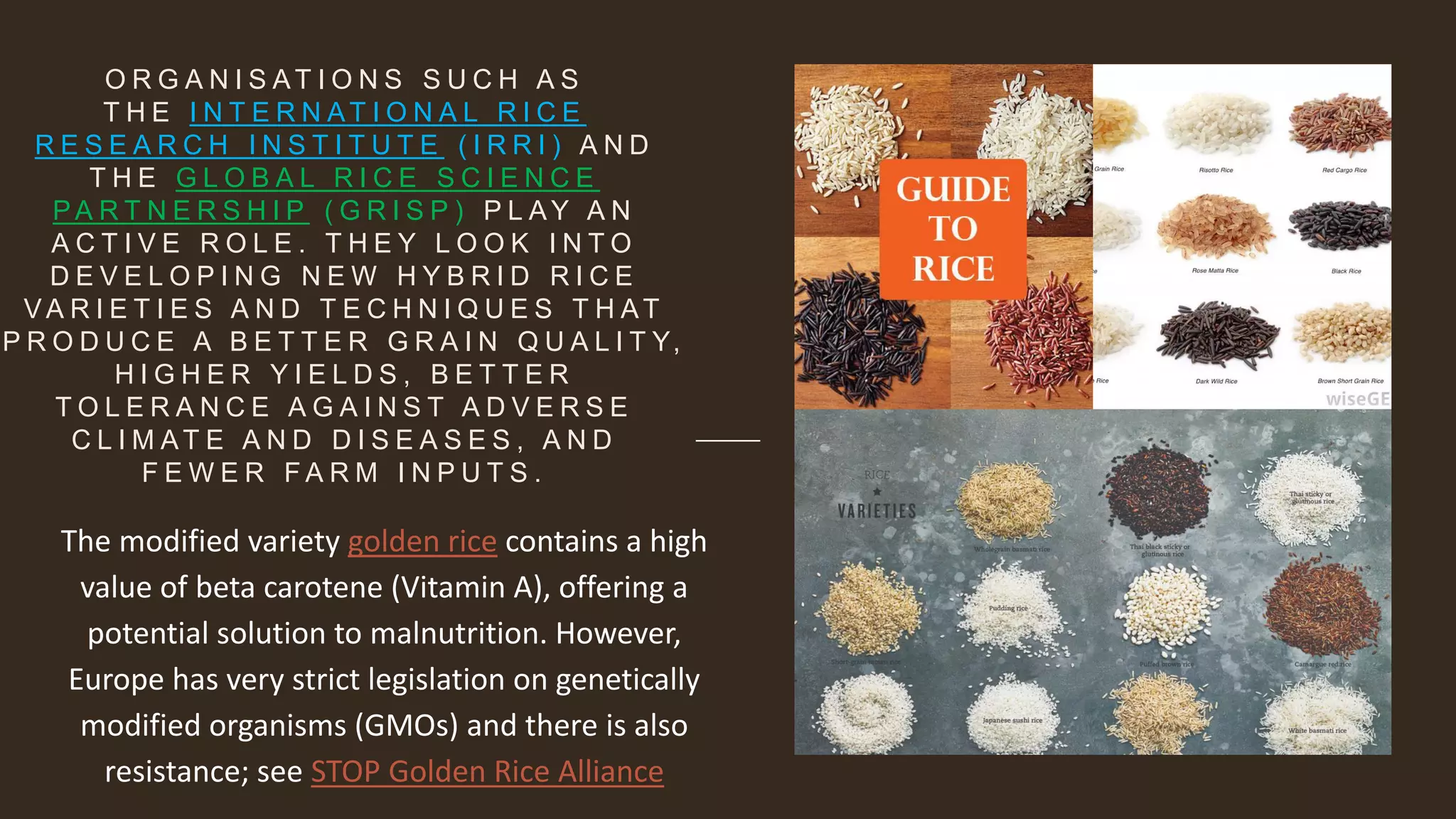
RICE
VARIETIES
www.primaryinfo.com
mailto:primaryinfo@gmail.com
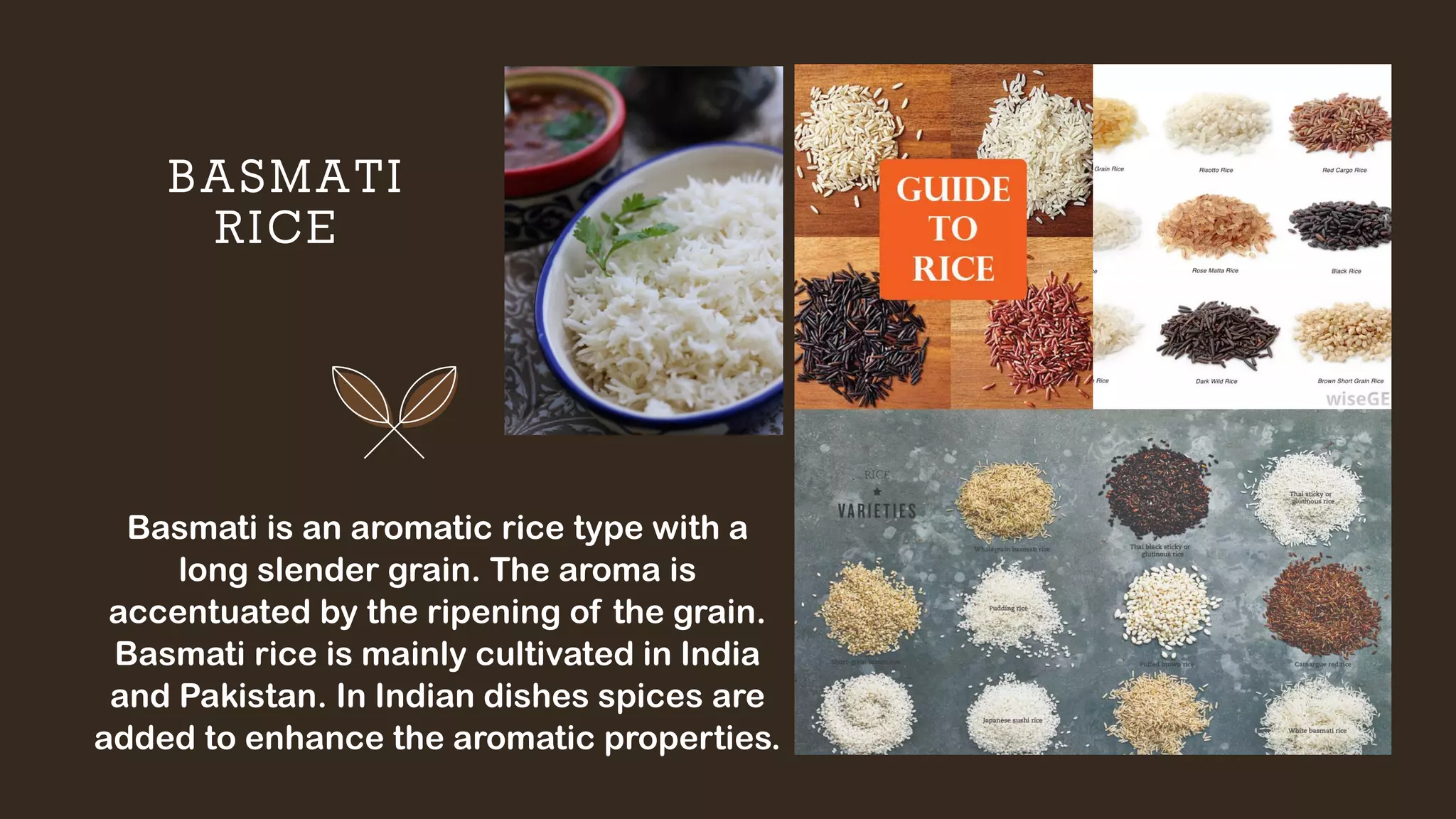
BASMATI
RICE
Basmati is an aromatic rice type with a
long slender grain. The aroma is
accentuated by the ripening of the grain.
Basmati rice is mainly cultivated in India
and Pakistan. In Indian dishes spices are
added to enhance the aromatic properties.
JASMINE RICE
Jasmine is also a long-grain aromatic rice
variety. Compared to basmati, jasmine rice has
a less pronounced fragrance. The grains are
slightly sticky after cooking. Jasmine rice is
cultivated in Southeast Asia (Thailand,
Vietnam, Cambodia, Laos). Most of Europe’s
import is Thai jasmine rice..
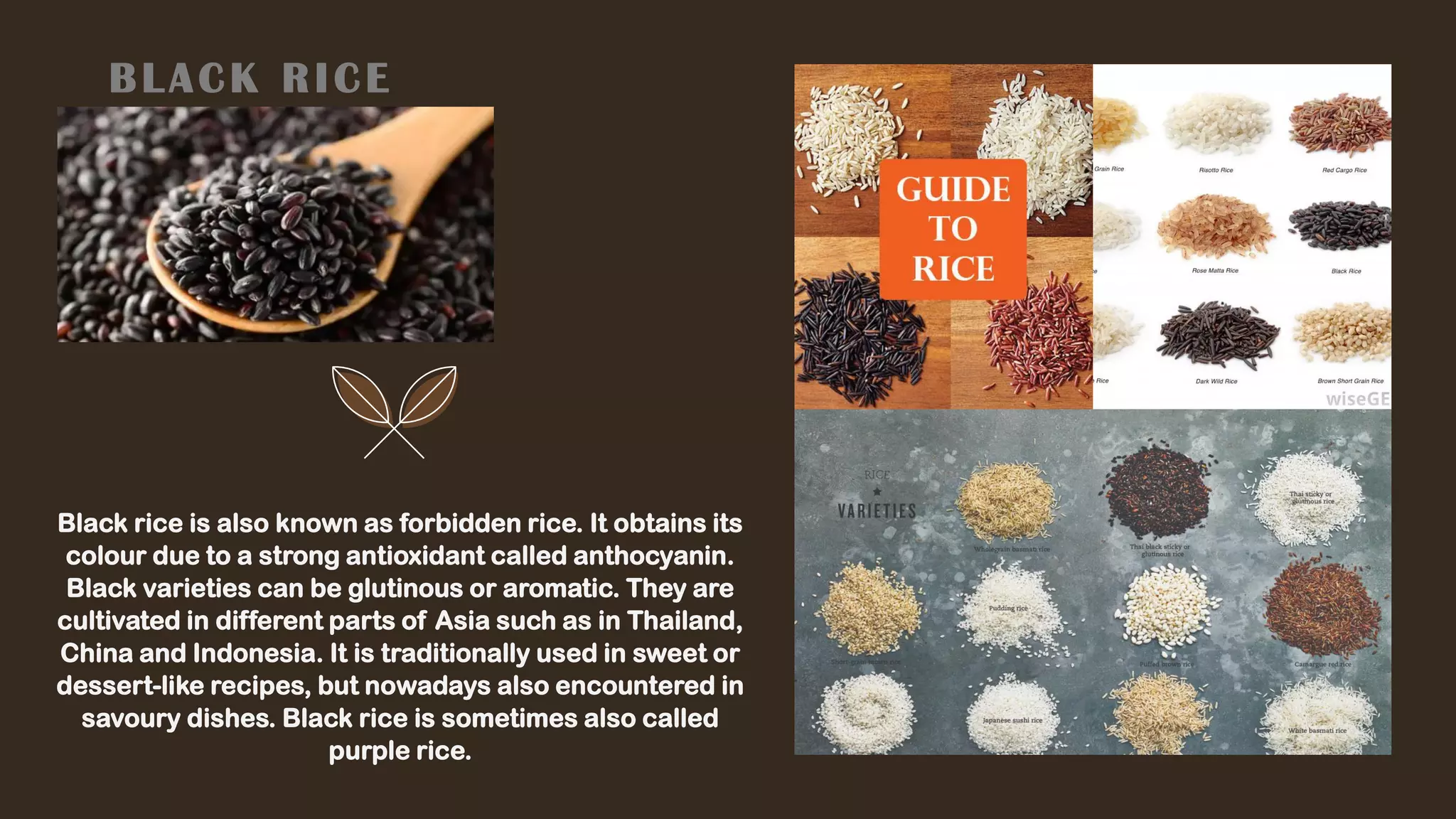
BLACK RICE
Black rice is also known as forbidden rice. It obtains its
colour due to a strong antioxidant called anthocyanin.
Black varieties can be glutinous or aromatic. They are
cultivated in different parts of Asia such as in Thailand,
China and Indonesia. It is traditionally used in sweet or
dessert-like recipes, but nowadays also encountered in
savoury dishes. Black rice is sometimes also called
purple rice.
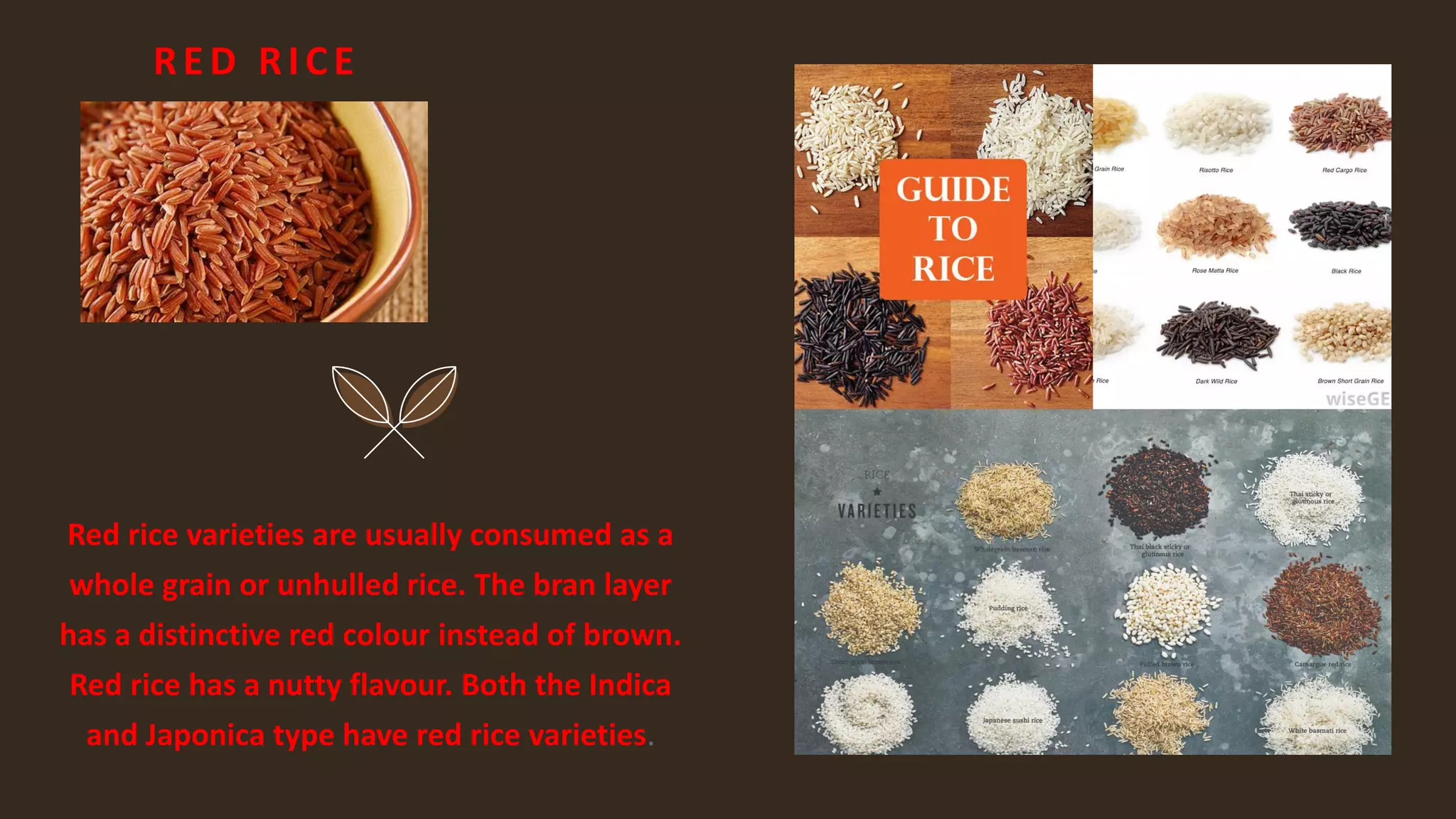
RED RICE
Red rice varieties are usually consumed as a
whole grain or unhulled rice. The bran layer
has a distinctive red colour instead of brown.
Red rice has a nutty flavour. Both the Indica
and Japonica type have red rice varieties.
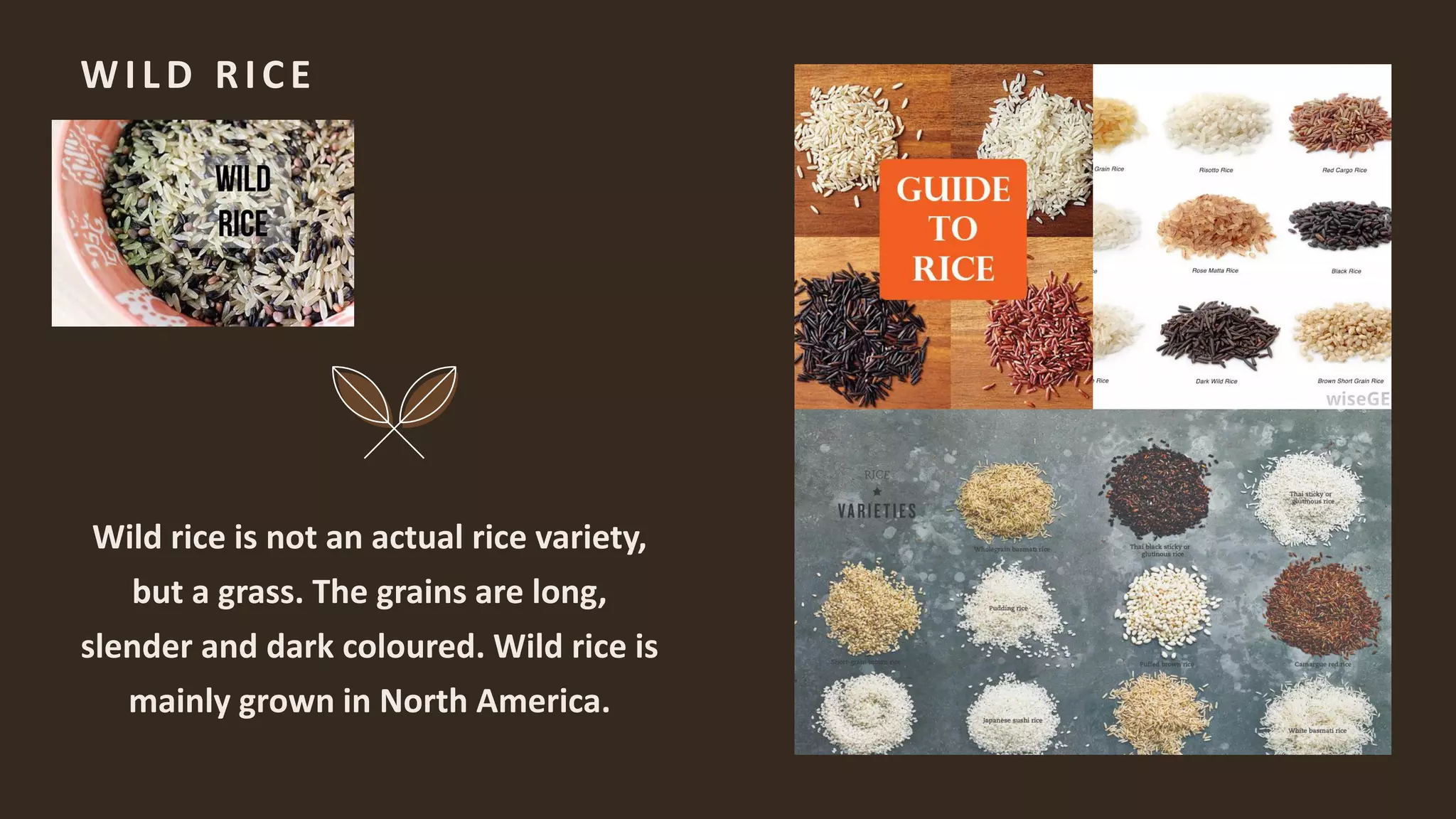
WILD RICE
Wild rice is not an actual rice variety,
but a grass. The grains are long,
slender and dark coloured. Wild rice is
mainly grown in North America.
GLUTINOUS RICE
Glutinous rice is also known as sticky rice. It is
popular in sweet dishes, desserts and snacks.
Because of its stickiness, the rice is normally
steamed instead of cooked. After steaming the
white grains become translucent (see-through),
which is the reverse effect of other rice varieties
that turn from translucent to white when cooked.
‘SUSHI’ RICE
For sushi Japanese or Japonica
rice is used. This rice is
called uruchimai in Japan. It is a
short-grain rice that has a sticky
texture when cooked. It should
not to be confused with glutinous
rice. It is a staple food in Japan,
while in Europe it is often referred
to as ‘sushi rice’.
‘RISOT TO ’ RICE
The traditional rice for risotto is Arborio
rice. This is a Japonica variety produced in
the Po valley in Italy. When cooked the
grains become creamy and chewy. Arborio
rice is sometimes replaced by cheaper
Asian alternatives of short to medium rice
with high starch content.
‘PAELLA’ RICE
The traditional Spanish dish paella uses locally
cultivated short-grain rice varieties, such as
Bomba rice or Bahia rice. These Spanish
varieties that are cultivated in Calasparra and
Valencia region are known to absorb liquid
very well.
FLOATING RICE
Floating rice is a very specific type of rice
from Vietnam. Our study on specialty rice
from Vietnam describes the opportunities
for this type of rice in Europe.
W H I C H T R E N D S O F F E R
O P P O R T U N I T I E S O N T H E
W O R L D M A R K E T F O R
S P E C I A LT Y R I C E
VA R I E T I E S ?
The International Rice Research
Institute suggests that the
demand for speciality rice
products is increasing, along with
the need to improve rice varieties.
B L AC K R I C E , F O R E X A M P L E , I S B E I N G
I M P O R T E D F R O M T H A I L A N D . H O W E V E R , G R O W E R S
I N I T A L Y H A V E A L S O T A K E N C H I N E S E B L A C K R I C E
I N T O P R O D U C T I O N . I N T H E S O U T H O F F R A N C E , A
R E D R I C E V A R I E T Y I S B E I N G P R O D U C E D .
C O N S U M E R S A R E A T T R A C T E D T O T H E S E R I C E
V A R I E T I E S , B E C A U S E T H E Y P R O V I D E A
G O U R M E T E X P E R I E N C E A N D A R E O F T E N
P R O M O T E D F O R T H E I R H E A L T H Y N A T U R E .
Many rice varieties are available as organic
products. Producing and exporting organic
rice can be an opportunity, because the
availability is often not sufficient for the
growing demand.
O R G A N I S AT I O N S S U C H A S
T H E I N T E R N AT I O N A L R I C E
R E S E A R C H I N S T I T U T E ( I R R I ) A N D
T H E G L O B A L R I C E S C I E N C E
PA R T N E R S H I P ( G R I S P ) P L AY A N
A C T I V E R O L E . T H E Y L O O K I N T O
D E V E L O P I N G N E W H Y B R I D R I C E
VA R I E T I E S A N D T E C H N I Q U E S T H AT
P R O D U C E A B E T T E R G R A I N Q U A L I T Y,
H I G H E R Y I E L D S , B E T T E R
T O L E R A N C E A G A I N S T A D V E R S E
C L I M AT E A N D D I S E A S E S , A N D
F E W E R F A R M I N P U T S .
The modified variety golden rice contains a high
value of beta carotene (Vitamin A), offering a
potential solution to malnutrition. However,
Europe has very strict legislation on genetically
modified organisms (GMOs) and there is also
resistance; see STOP Golden Rice Alliance
P R I M A RY I N F O R M AT I O N
S E RV I C E S
W W W . P R I M A R Y I N F O . C O M
M A I L T O : P R I M A R Y I N F O @ G M A I L . C O M

Rice varieties

  • 1.
  • 2.
    BASMATI RICE Basmati is anaromatic rice type with a long slender grain. The aroma is accentuated by the ripening of the grain. Basmati rice is mainly cultivated in India and Pakistan. In Indian dishes spices are added to enhance the aromatic properties.
  • 3.
    JASMINE RICE Jasmine isalso a long-grain aromatic rice variety. Compared to basmati, jasmine rice has a less pronounced fragrance. The grains are slightly sticky after cooking. Jasmine rice is cultivated in Southeast Asia (Thailand, Vietnam, Cambodia, Laos). Most of Europe’s import is Thai jasmine rice..
  • 4.
    BLACK RICE Black riceis also known as forbidden rice. It obtains its colour due to a strong antioxidant called anthocyanin. Black varieties can be glutinous or aromatic. They are cultivated in different parts of Asia such as in Thailand, China and Indonesia. It is traditionally used in sweet or dessert-like recipes, but nowadays also encountered in savoury dishes. Black rice is sometimes also called purple rice.
  • 5.
    RED RICE Red ricevarieties are usually consumed as a whole grain or unhulled rice. The bran layer has a distinctive red colour instead of brown. Red rice has a nutty flavour. Both the Indica and Japonica type have red rice varieties.
  • 6.
    WILD RICE Wild riceis not an actual rice variety, but a grass. The grains are long, slender and dark coloured. Wild rice is mainly grown in North America.
  • 7.
    GLUTINOUS RICE Glutinous riceis also known as sticky rice. It is popular in sweet dishes, desserts and snacks. Because of its stickiness, the rice is normally steamed instead of cooked. After steaming the white grains become translucent (see-through), which is the reverse effect of other rice varieties that turn from translucent to white when cooked.
  • 8.
    ‘SUSHI’ RICE For sushiJapanese or Japonica rice is used. This rice is called uruchimai in Japan. It is a short-grain rice that has a sticky texture when cooked. It should not to be confused with glutinous rice. It is a staple food in Japan, while in Europe it is often referred to as ‘sushi rice’.
  • 9.
    ‘RISOT TO ’RICE The traditional rice for risotto is Arborio rice. This is a Japonica variety produced in the Po valley in Italy. When cooked the grains become creamy and chewy. Arborio rice is sometimes replaced by cheaper Asian alternatives of short to medium rice with high starch content.
  • 10.
    ‘PAELLA’ RICE The traditionalSpanish dish paella uses locally cultivated short-grain rice varieties, such as Bomba rice or Bahia rice. These Spanish varieties that are cultivated in Calasparra and Valencia region are known to absorb liquid very well.
  • 11.
    FLOATING RICE Floating riceis a very specific type of rice from Vietnam. Our study on specialty rice from Vietnam describes the opportunities for this type of rice in Europe.
  • 12.
    W H IC H T R E N D S O F F E R O P P O R T U N I T I E S O N T H E W O R L D M A R K E T F O R S P E C I A LT Y R I C E VA R I E T I E S ? The International Rice Research Institute suggests that the demand for speciality rice products is increasing, along with the need to improve rice varieties.
  • 13.
    B L ACK R I C E , F O R E X A M P L E , I S B E I N G I M P O R T E D F R O M T H A I L A N D . H O W E V E R , G R O W E R S I N I T A L Y H A V E A L S O T A K E N C H I N E S E B L A C K R I C E I N T O P R O D U C T I O N . I N T H E S O U T H O F F R A N C E , A R E D R I C E V A R I E T Y I S B E I N G P R O D U C E D . C O N S U M E R S A R E A T T R A C T E D T O T H E S E R I C E V A R I E T I E S , B E C A U S E T H E Y P R O V I D E A G O U R M E T E X P E R I E N C E A N D A R E O F T E N P R O M O T E D F O R T H E I R H E A L T H Y N A T U R E . Many rice varieties are available as organic products. Producing and exporting organic rice can be an opportunity, because the availability is often not sufficient for the growing demand.
  • 14.
    O R GA N I S AT I O N S S U C H A S T H E I N T E R N AT I O N A L R I C E R E S E A R C H I N S T I T U T E ( I R R I ) A N D T H E G L O B A L R I C E S C I E N C E PA R T N E R S H I P ( G R I S P ) P L AY A N A C T I V E R O L E . T H E Y L O O K I N T O D E V E L O P I N G N E W H Y B R I D R I C E VA R I E T I E S A N D T E C H N I Q U E S T H AT P R O D U C E A B E T T E R G R A I N Q U A L I T Y, H I G H E R Y I E L D S , B E T T E R T O L E R A N C E A G A I N S T A D V E R S E C L I M AT E A N D D I S E A S E S , A N D F E W E R F A R M I N P U T S . The modified variety golden rice contains a high value of beta carotene (Vitamin A), offering a potential solution to malnutrition. However, Europe has very strict legislation on genetically modified organisms (GMOs) and there is also resistance; see STOP Golden Rice Alliance
  • 15.
    P R IM A RY I N F O R M AT I O N S E RV I C E S W W W . P R I M A R Y I N F O . C O M M A I L T O : P R I M A R Y I N F O @ G M A I L . C O M