Types of Rice
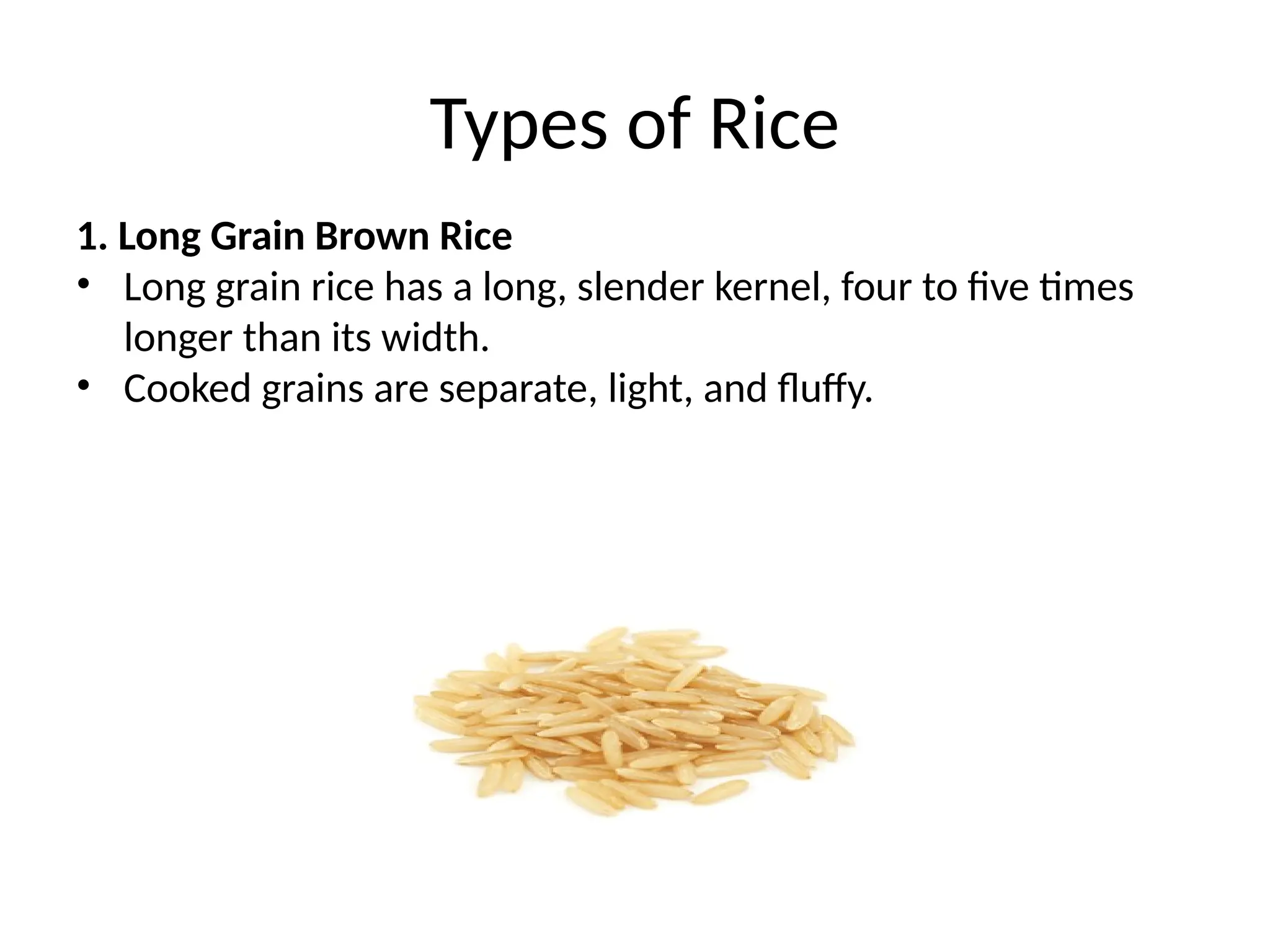
1. Long Grain Brown Rice
• Long grain rice has a long, slender kernel, four to five times
longer than its width.
• Cooked grains are separate, light, and fluffy.
Contd….
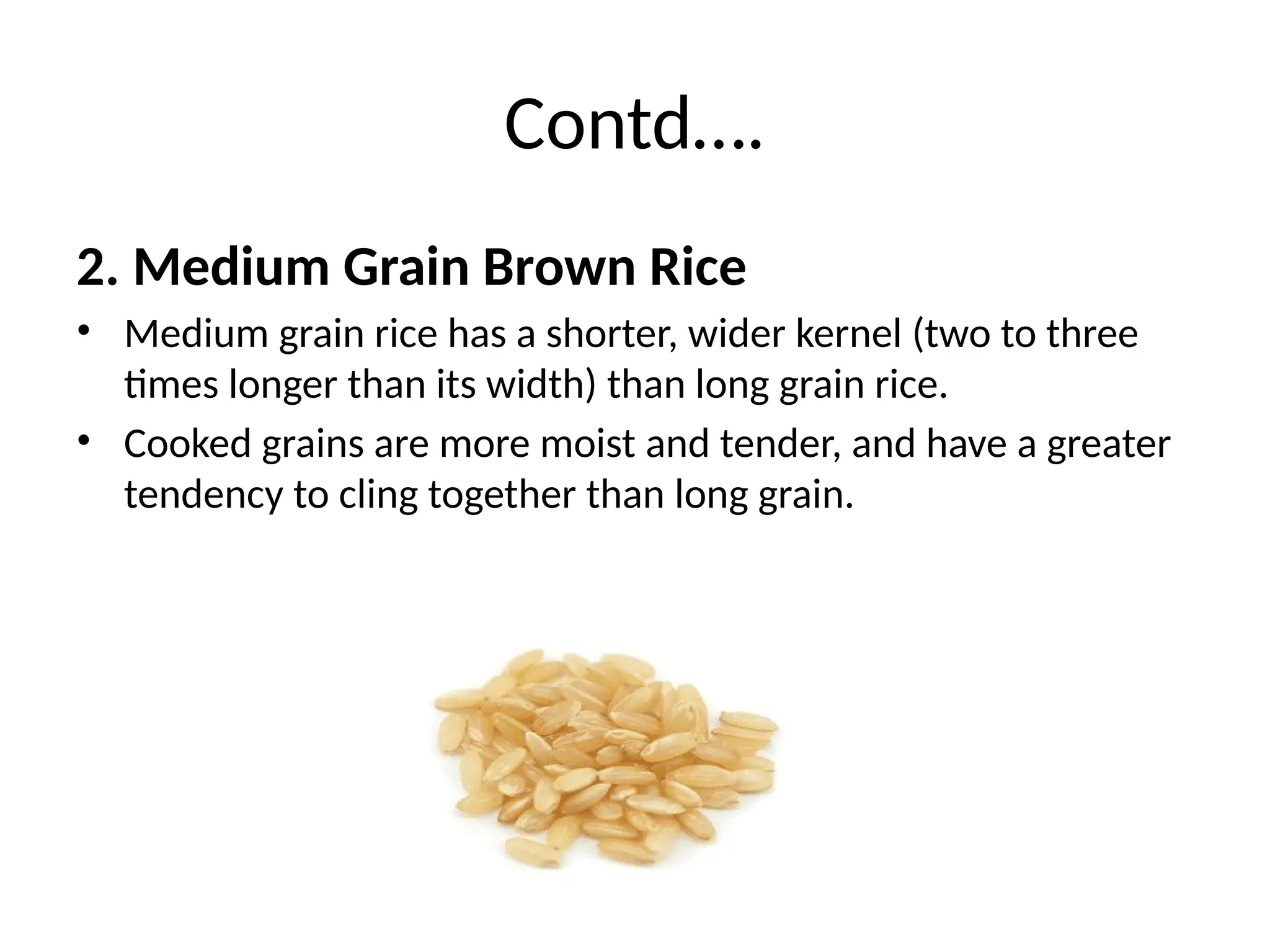
2. Medium Grain Brown Rice
• Medium grain rice has a shorter, wider kernel (two to three
times longer than its width) than long grain rice.
• Cooked grains are more moist and tender, and have a greater
tendency to cling together than long grain.
Contd….
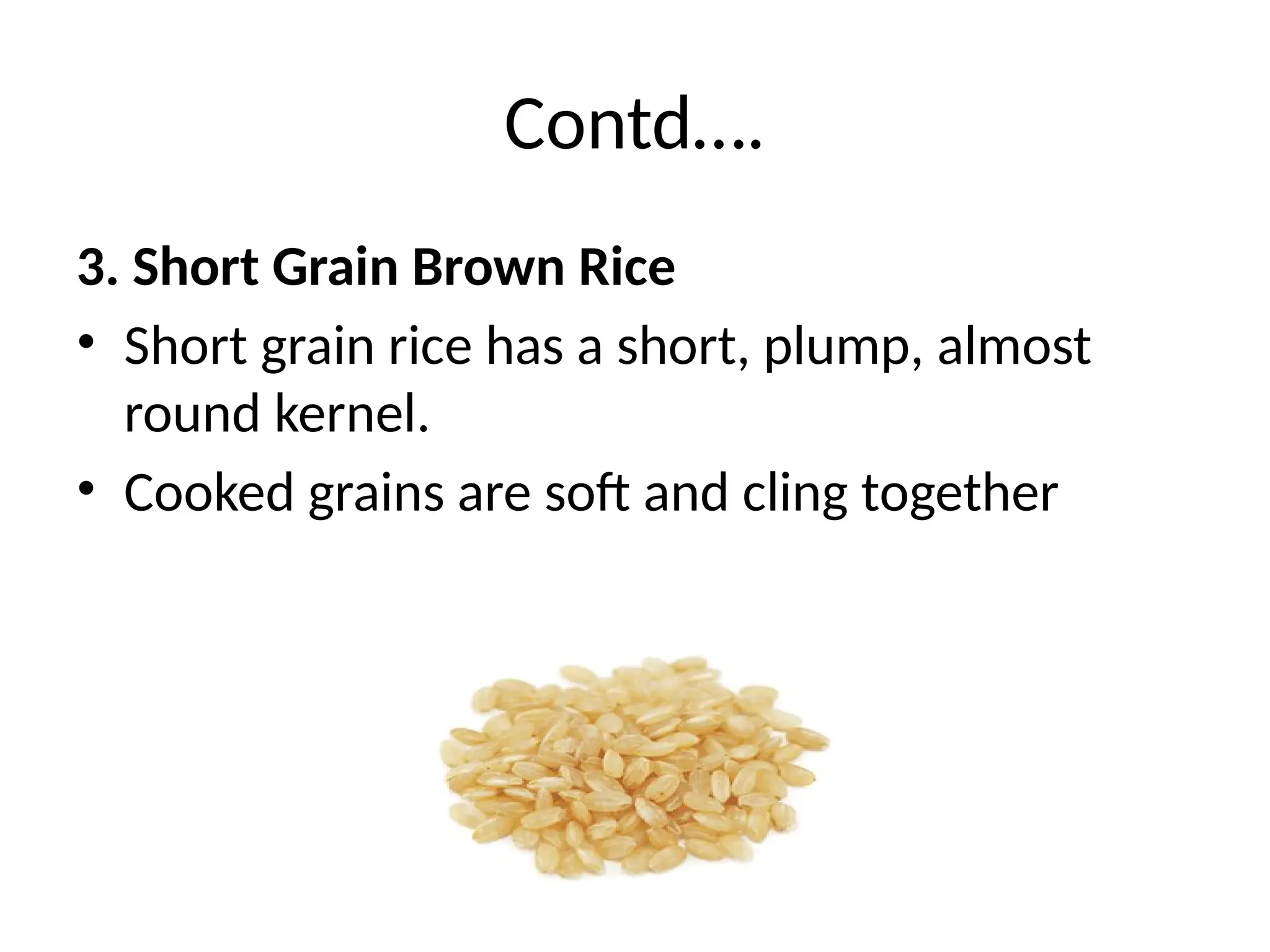
3. Short Grain Brown Rice
• Short grain rice has a short, plump, almost
round kernel.
• Cooked grains are soft and cling together
Contd…
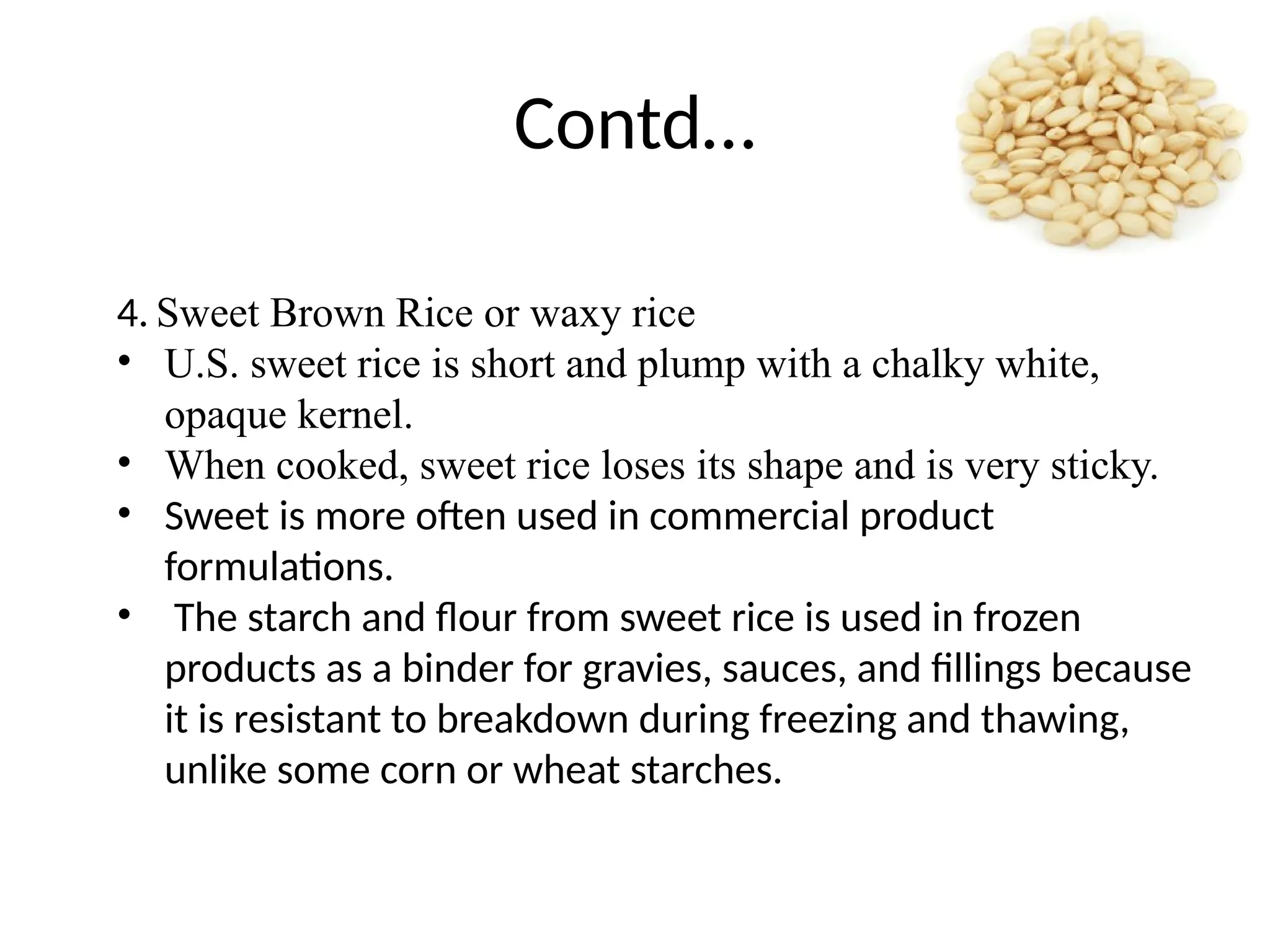
4. Sweet Brown Rice or waxy rice
• U.S. sweet rice is short and plump with a chalky white,
opaque kernel.
• When cooked, sweet rice loses its shape and is very sticky.
• Sweet is more often used in commercial product
formulations.
• The starch and flour from sweet rice is used in frozen
products as a binder for gravies, sauces, and fillings because
it is resistant to breakdown during freezing and thawing,
unlike some corn or wheat starches.
Contd…
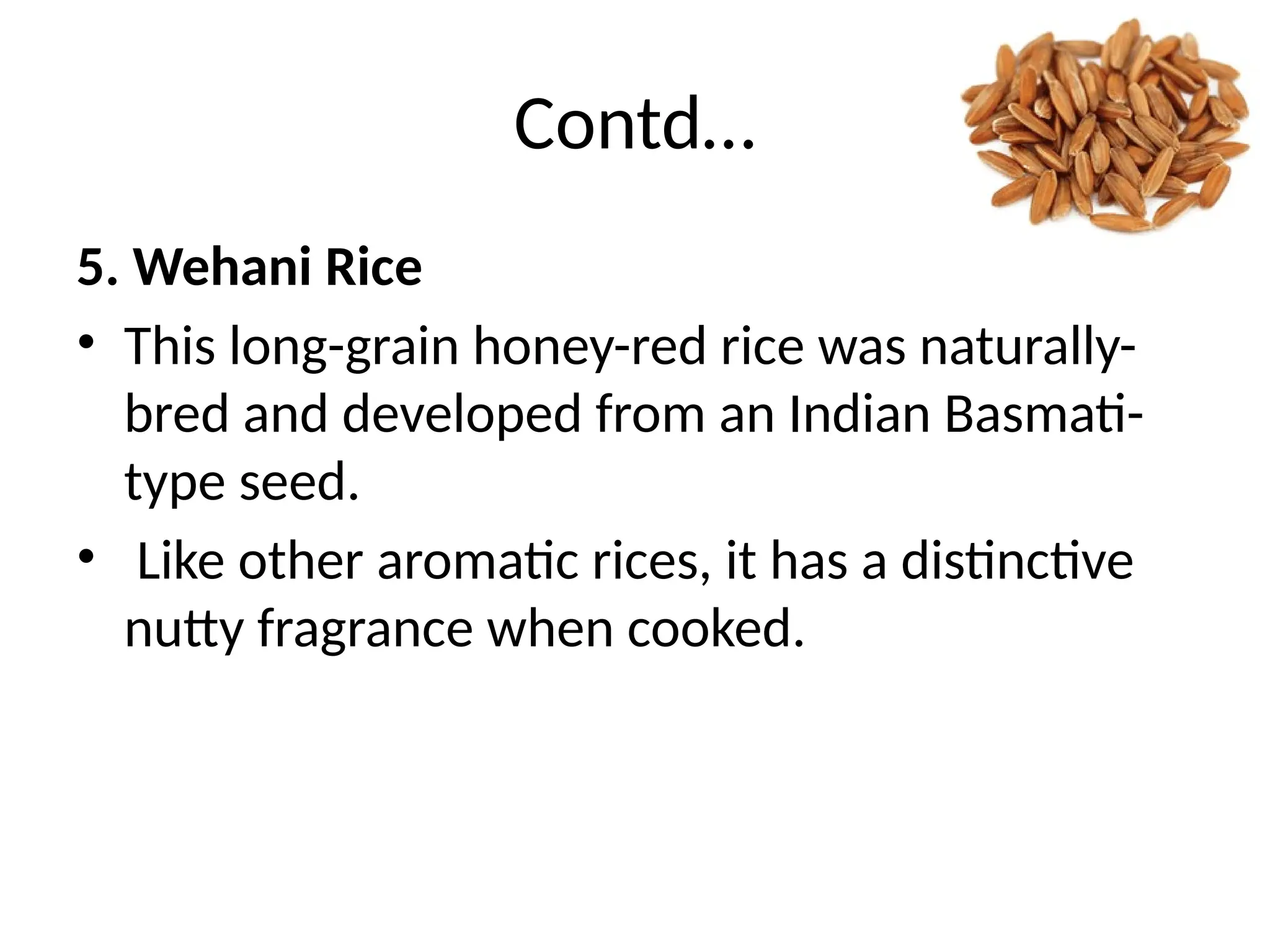
5. Wehani Rice
• This long-grain honey-red rice was naturally-
bred and developed from an Indian Basmati-
type seed.
• Like other aromatic rices, it has a distinctive
nutty fragrance when cooked.
Contd…
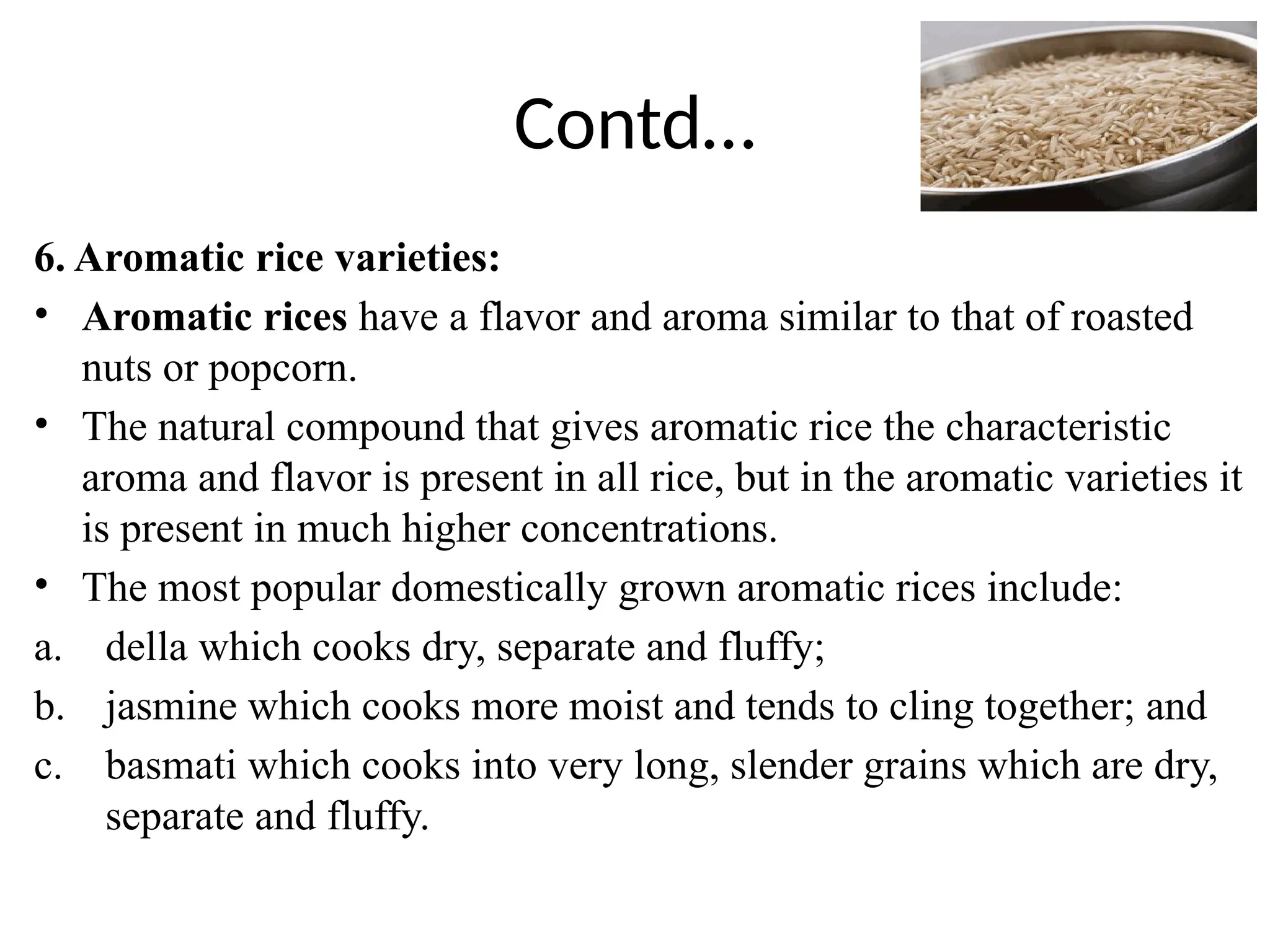
6. Aromatic rice varieties:
• Aromatic rices have a flavor and aroma similar to that of roasted
nuts or popcorn.
• The natural compound that gives aromatic rice the characteristic
aroma and flavor is present in all rice, but in the aromatic varieties it
is present in much higher concentrations.
• The most popular domestically grown aromatic rices include:
a. della which cooks dry, separate and fluffy;
b. jasmine which cooks more moist and tends to cling together; and
c. basmati which cooks into very long, slender grains which are dry,
separate and fluffy.
Polling question
• Aromatic rice have a flavor and aroma similar to that of
roasted nuts or popcorn. State True or False
Contd….
U.S. aromatic red rice has a deep, honey-red bran.
• Like brown rice, it is minimally processed to retain its bran
layers and takes 45 to 50 minutes to prepare.
• Cooked grains have a savory, nutty flavor and are slightly
chewy.
• Basmati Rice: a long grain fragrant rice, aged to enhance
aroma and reduce moisture content. Grown in India and
Pakistan.
• U.S. basmati rice is an aromatic long grain rice that has a
distinctive aroma and flavor similar to that of popcorn or
roasted nuts.
• When cooked, it swells only lengthwise, resulting in long
slender grains that are dry, separate and fluffy.
• Texmati is a cross between basmati rice and American long
Contd…
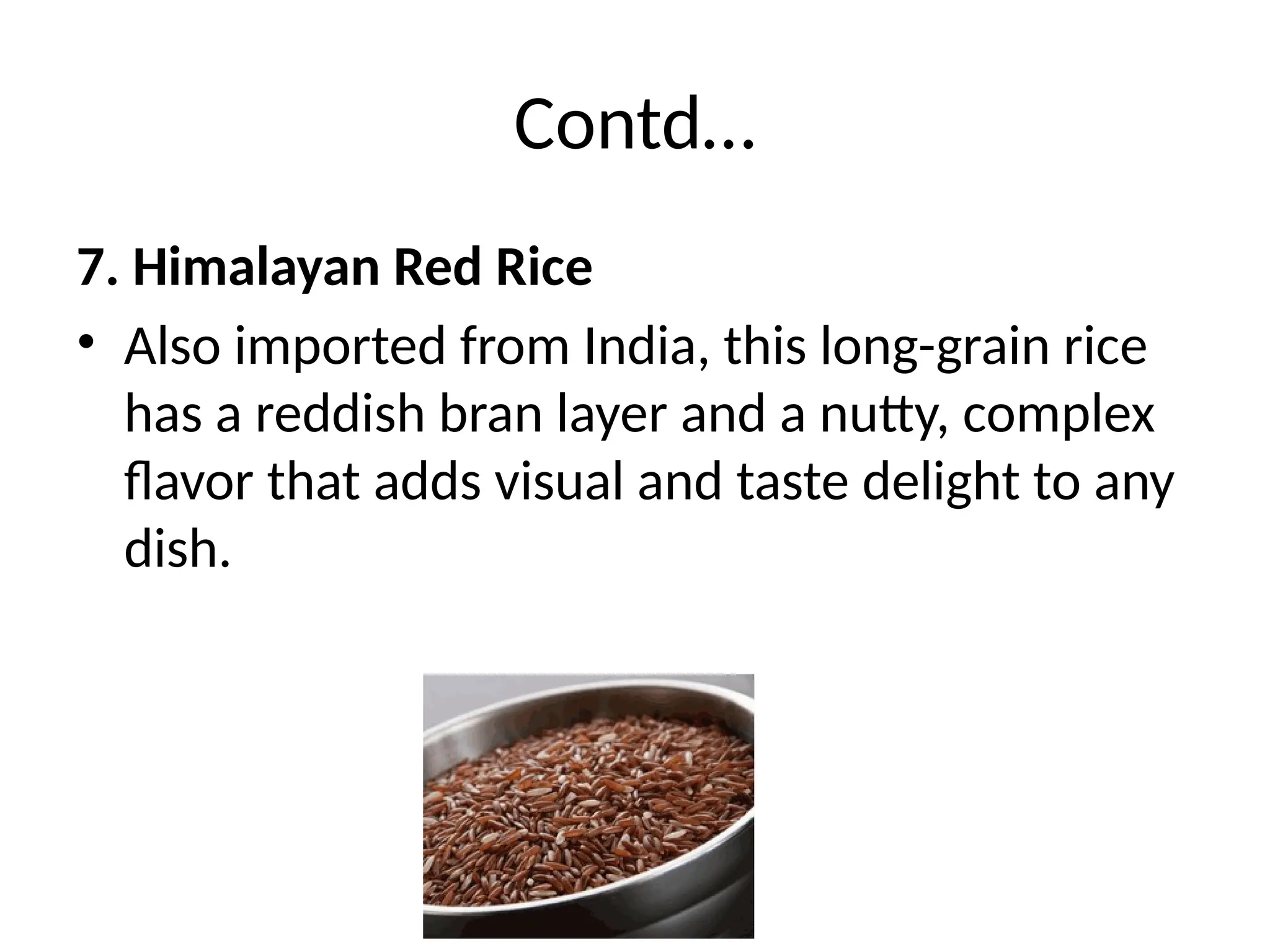
7. Himalayan Red Rice
• Also imported from India, this long-grain rice
has a reddish bran layer and a nutty, complex
flavor that adds visual and taste delight to any
dish.
Contd….
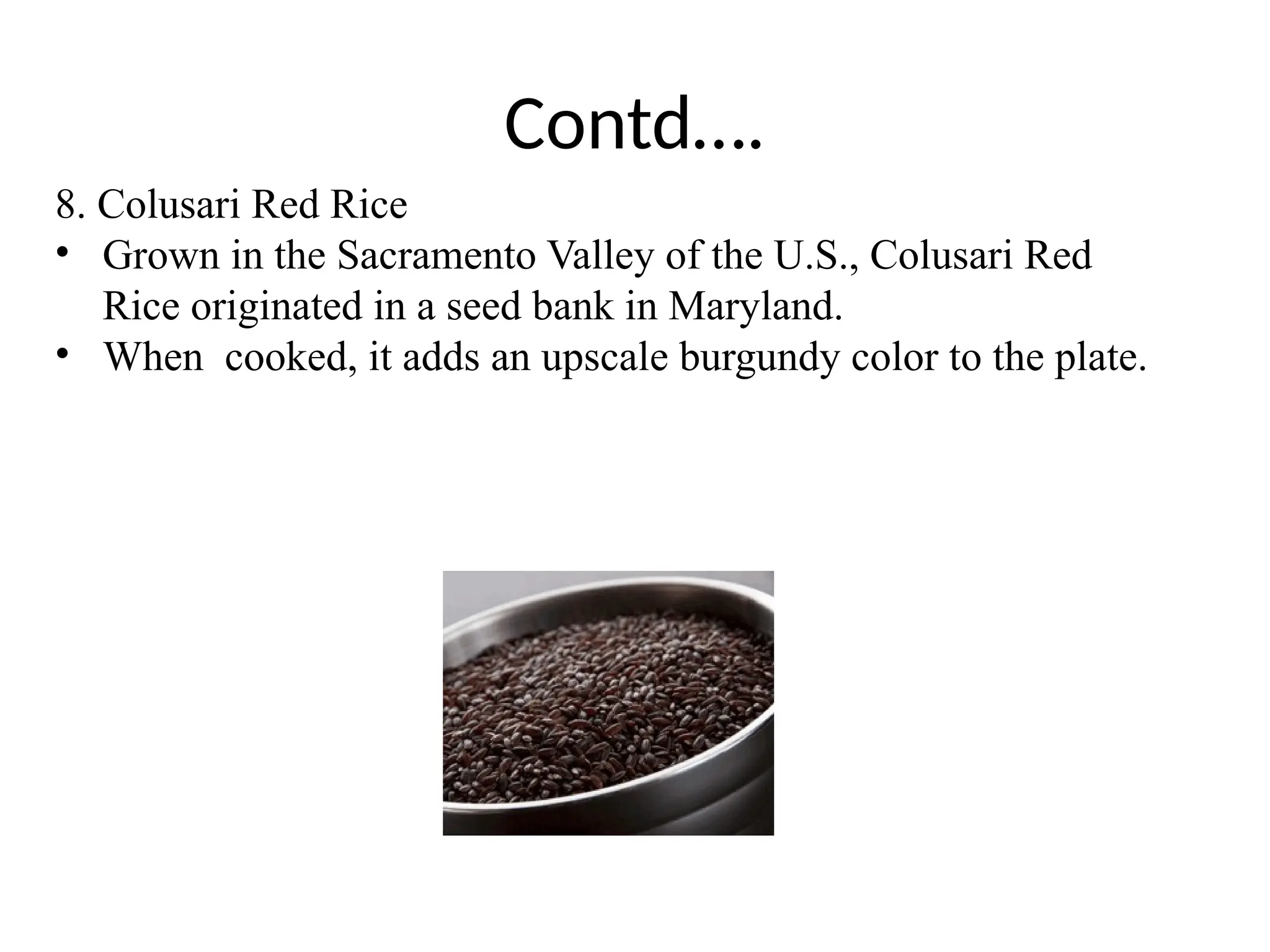
8. Colusari Red Rice
• Grown in the Sacramento Valley of the U.S., Colusari Red
Rice originated in a seed bank in Maryland.
• When cooked, it adds an upscale burgundy color to the plate.
Contd…
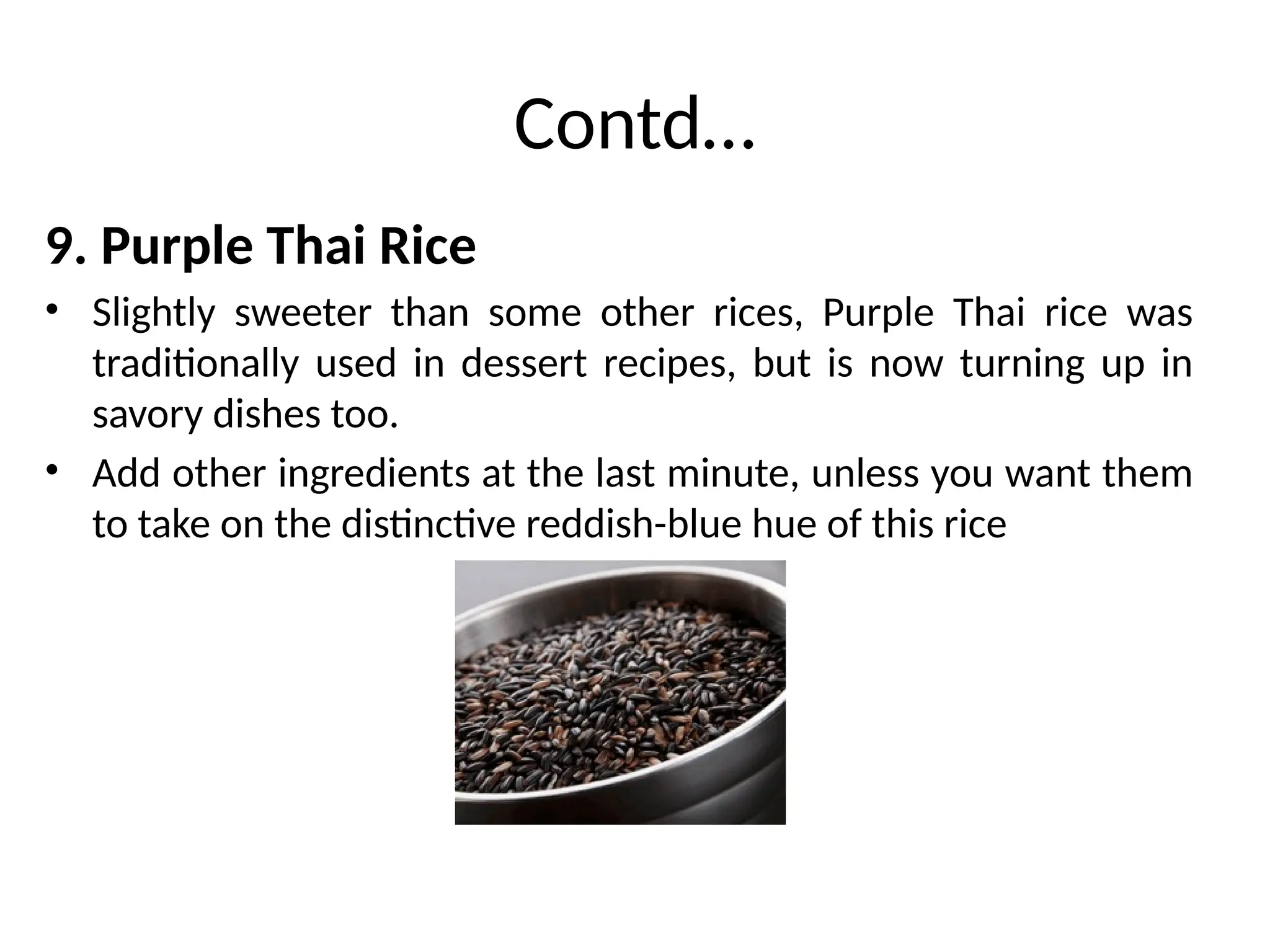
9. Purple Thai Rice
• Slightly sweeter than some other rices, Purple Thai rice was
traditionally used in dessert recipes, but is now turning up in
savory dishes too.
• Add other ingredients at the last minute, unless you want them
to take on the distinctive reddish-blue hue of this rice
Contd….
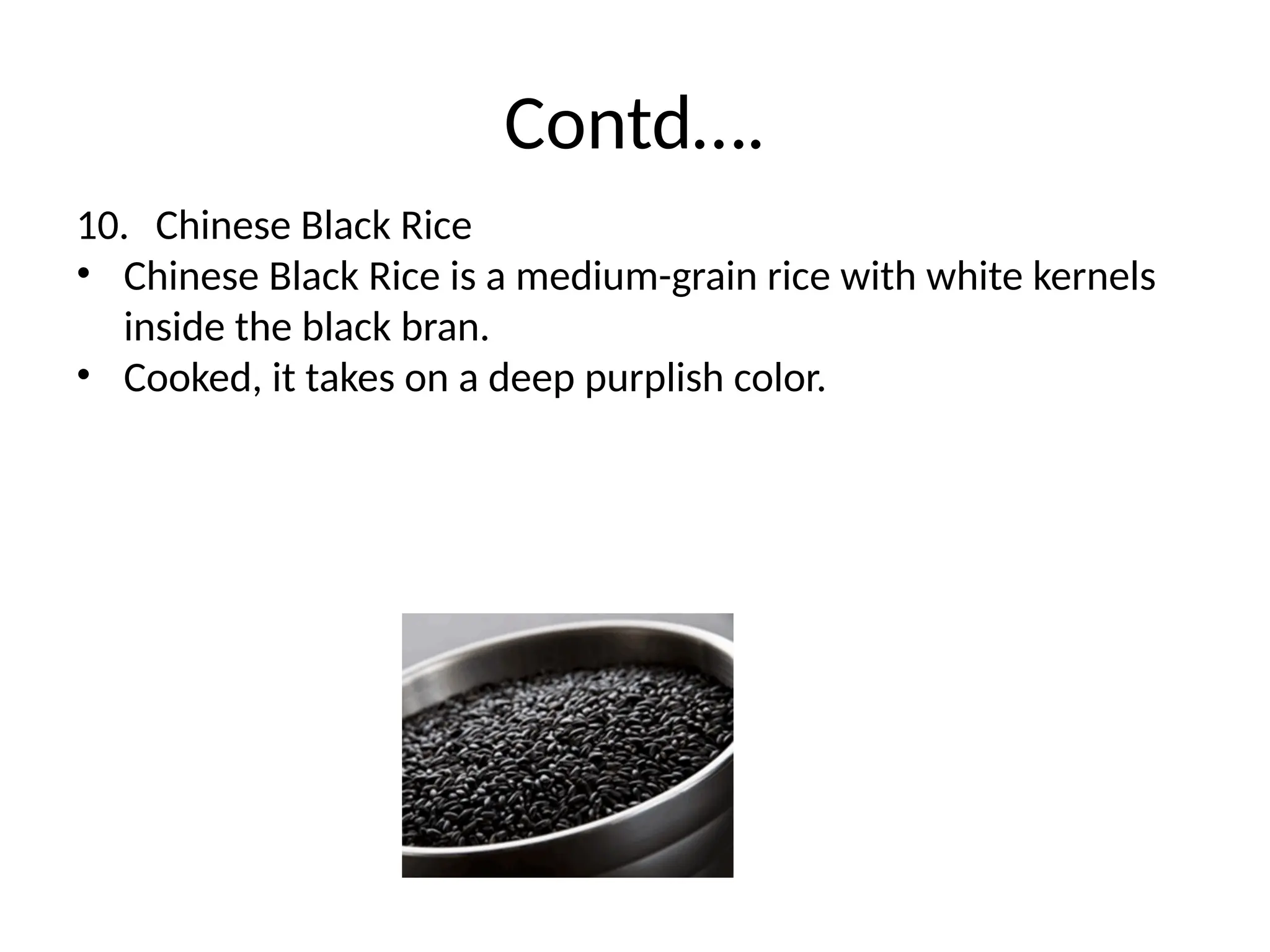
10. Chinese Black Rice
• Chinese Black Rice is a medium-grain rice with white kernels
inside the black bran.
• Cooked, it takes on a deep purplish color.
Contd…
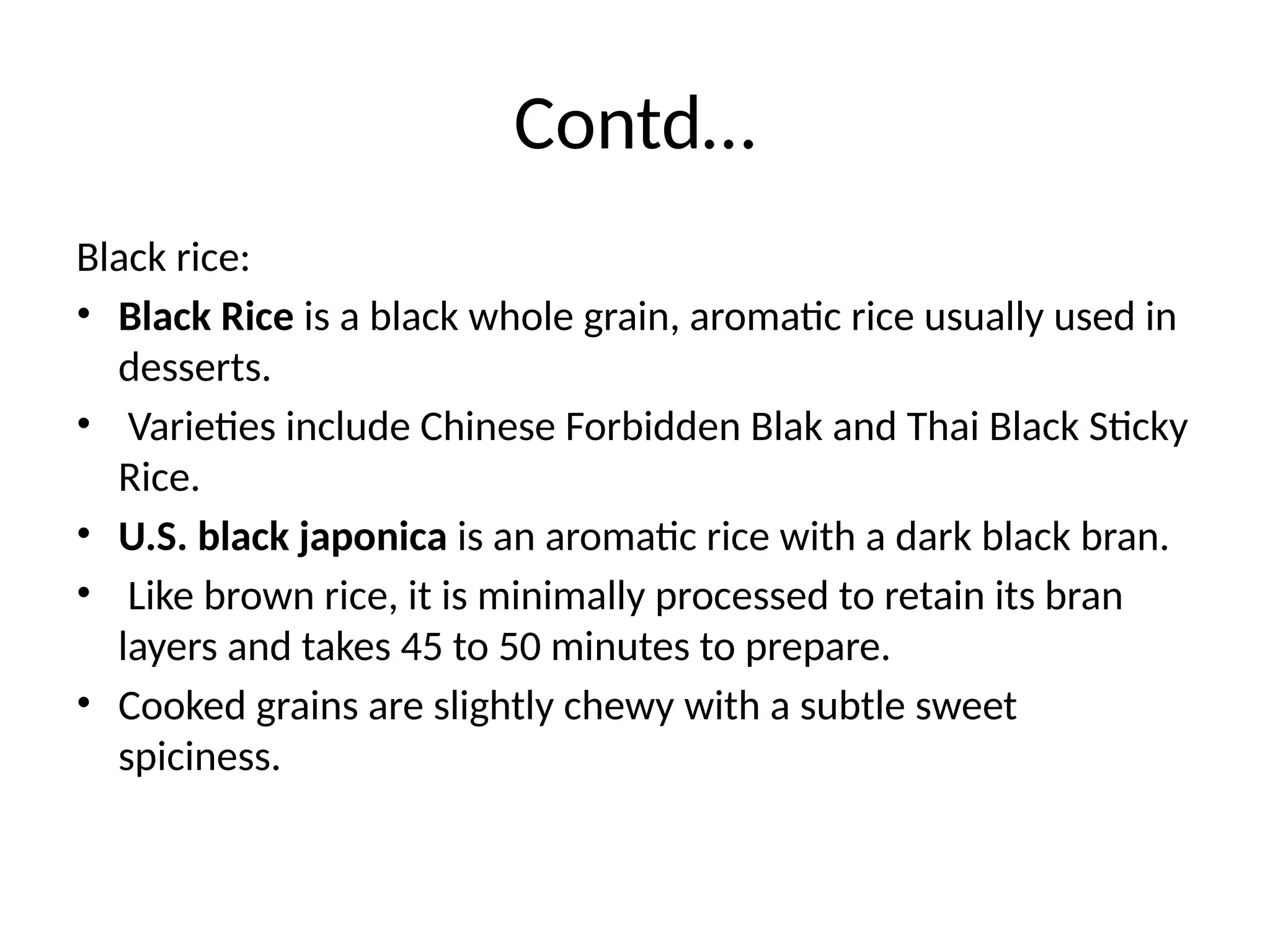
Black rice:
• Black Rice is a black whole grain, aromatic rice usually used in
desserts.
• Varieties include Chinese Forbidden Blak and Thai Black Sticky
Rice.
• U.S. black japonica is an aromatic rice with a dark black bran.
• Like brown rice, it is minimally processed to retain its bran
layers and takes 45 to 50 minutes to prepare.
• Cooked grains are slightly chewy with a subtle sweet
spiciness.
Contd….
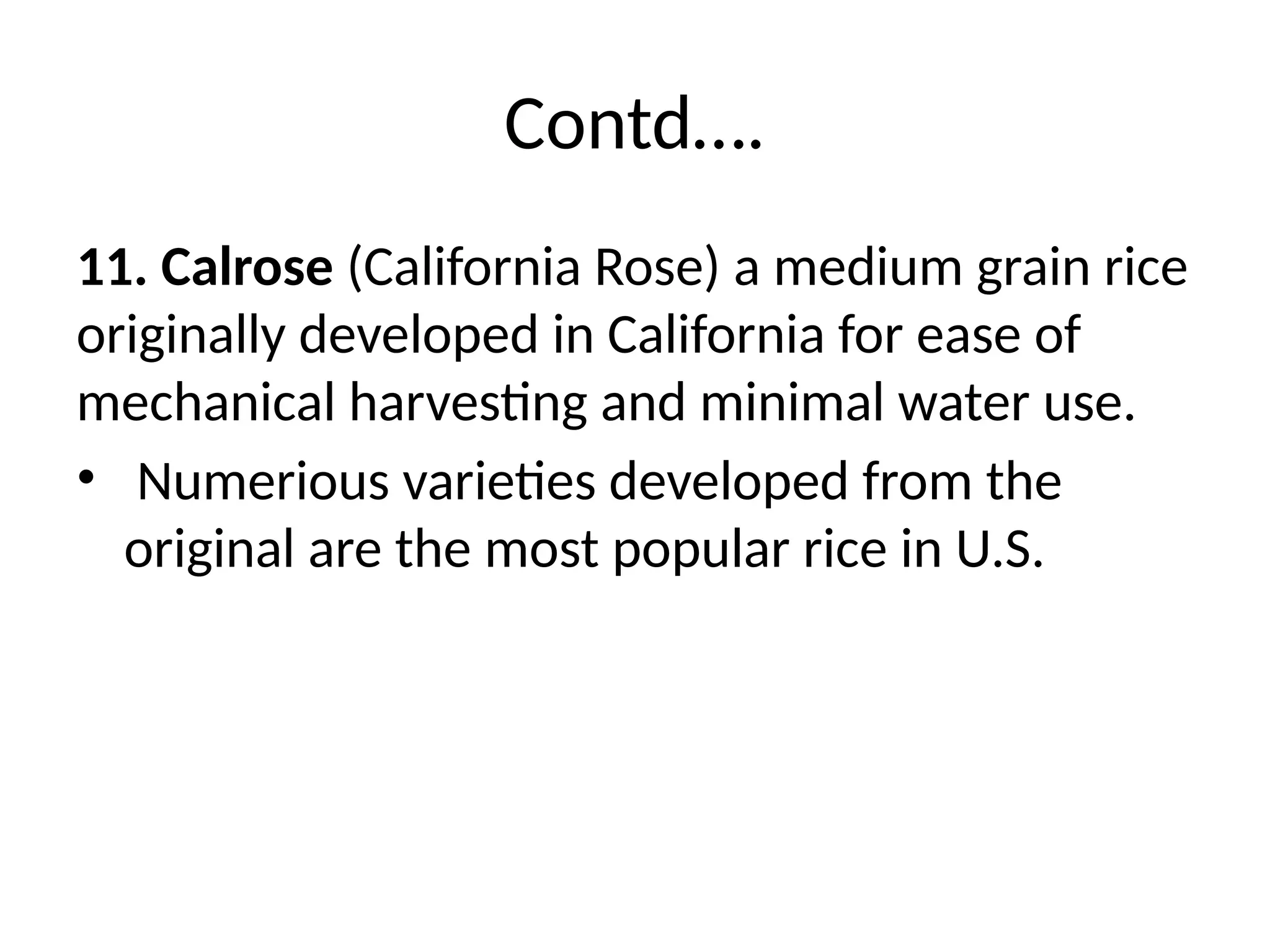
11. Calrose (California Rose) a medium grain rice
originally developed in California for ease of
mechanical harvesting and minimal water use.
• Numerious varieties developed from the
original are the most popular rice in U.S.
Contd….
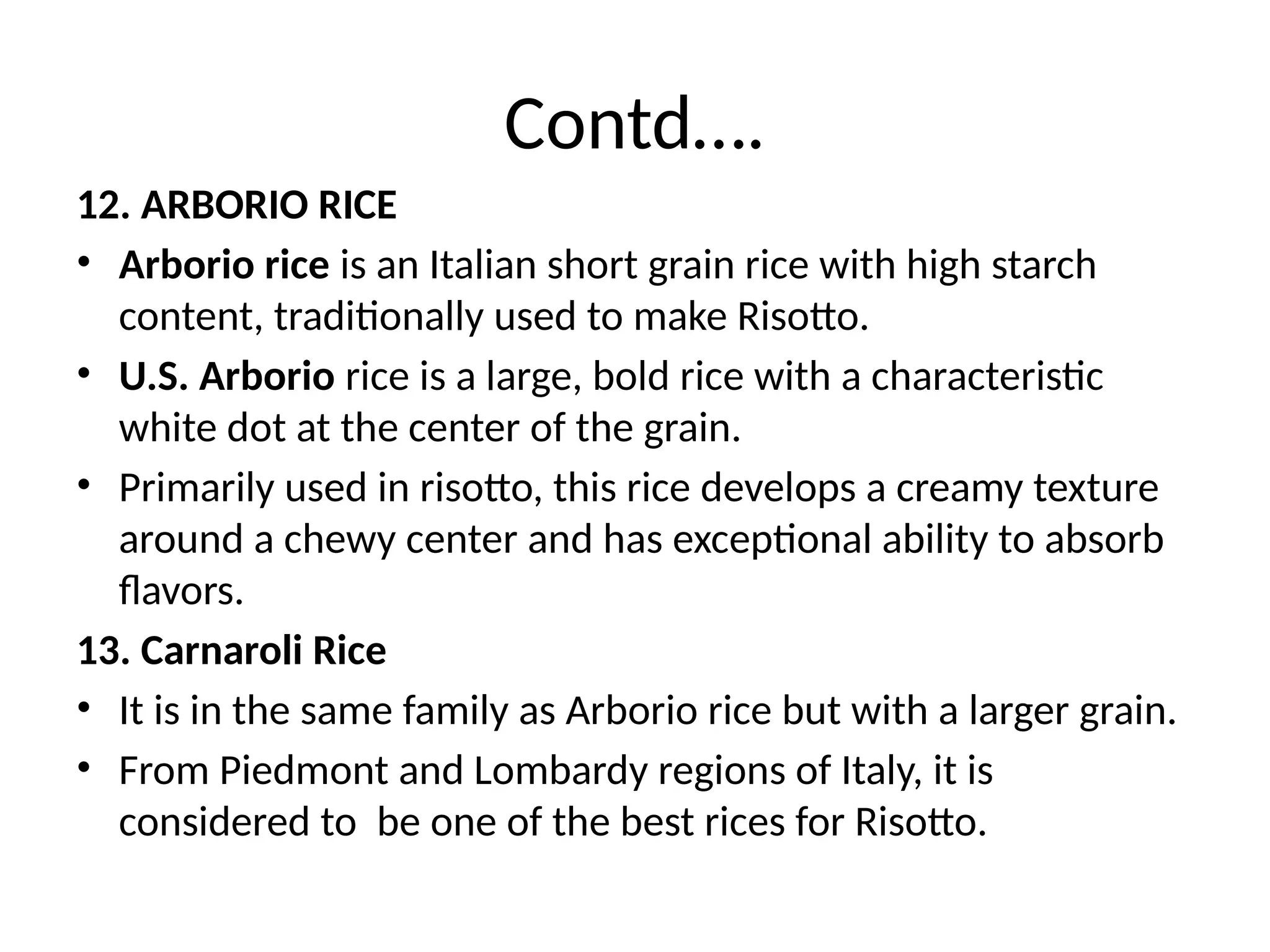
12. ARBORIO RICE
• Arborio rice is an Italian short grain rice with high starch
content, traditionally used to make Risotto.
• U.S. Arborio rice is a large, bold rice with a characteristic
white dot at the center of the grain.
• Primarily used in risotto, this rice develops a creamy texture
around a chewy center and has exceptional ability to absorb
flavors.
13. Carnaroli Rice
• It is in the same family as Arborio rice but with a larger grain.
• From Piedmont and Lombardy regions of Italy, it is
considered to be one of the best rices for Risotto.
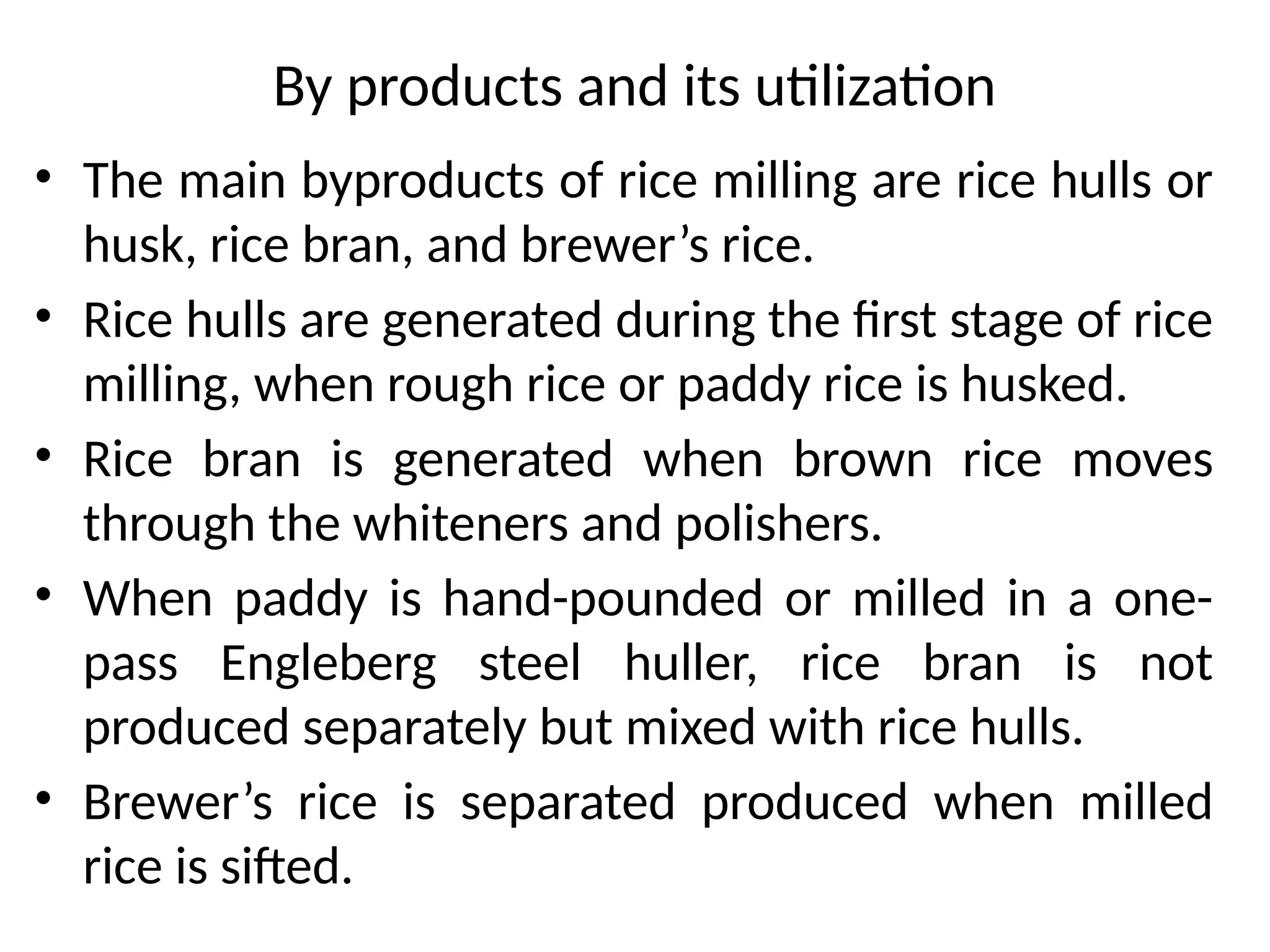
By products and its utilization
• The main byproducts of rice milling are rice hulls or
husk, rice bran, and brewer’s rice.
• Rice hulls are generated during the first stage of rice
milling, when rough rice or paddy rice is husked.
• Rice bran is generated when brown rice moves
through the whiteners and polishers.
• When paddy is hand-pounded or milled in a one-
pass Engleberg steel huller, rice bran is not
produced separately but mixed with rice hulls.
• Brewer’s rice is separated produced when milled
rice is sifted.
Rice husk
• 100 kg of paddy rice will generate approx. 20 kg of husk.
• The bulk density is 100 to 150 kg/m3
. Rice husk contains 16 to 22% ash,
which is high in silica.
• The ash composition and structure give rice hulls an abrasive character.
• Metal surfaces in frequent contact with rice hulls will wear out and
eventually puncture.
• Common use of rice husks are as bedding materials, and as source of
energy.
• In the modern rice milling industry, rice husks are increasingly being used
as a fuel source for grain drying and parboiling, and for electricity
generation.
Contd….
• In Bangladesh, rice hulls are the preferred fuel for parboiling, and
rice hulls are widely used for grain drying in the larger rice mills in
Northern India.
• Rice hulls, once ground, are also used as ingredient in animal
feeds.
• Using rice husk in gasifyers or furnaces that are used in small and
medium size plants Asia produces black ash which still contains
around 20% carbon.
• This so called carbonated rice husk is often used as soil conditioner
for poor soils, as an ingredient for bio fertilizers
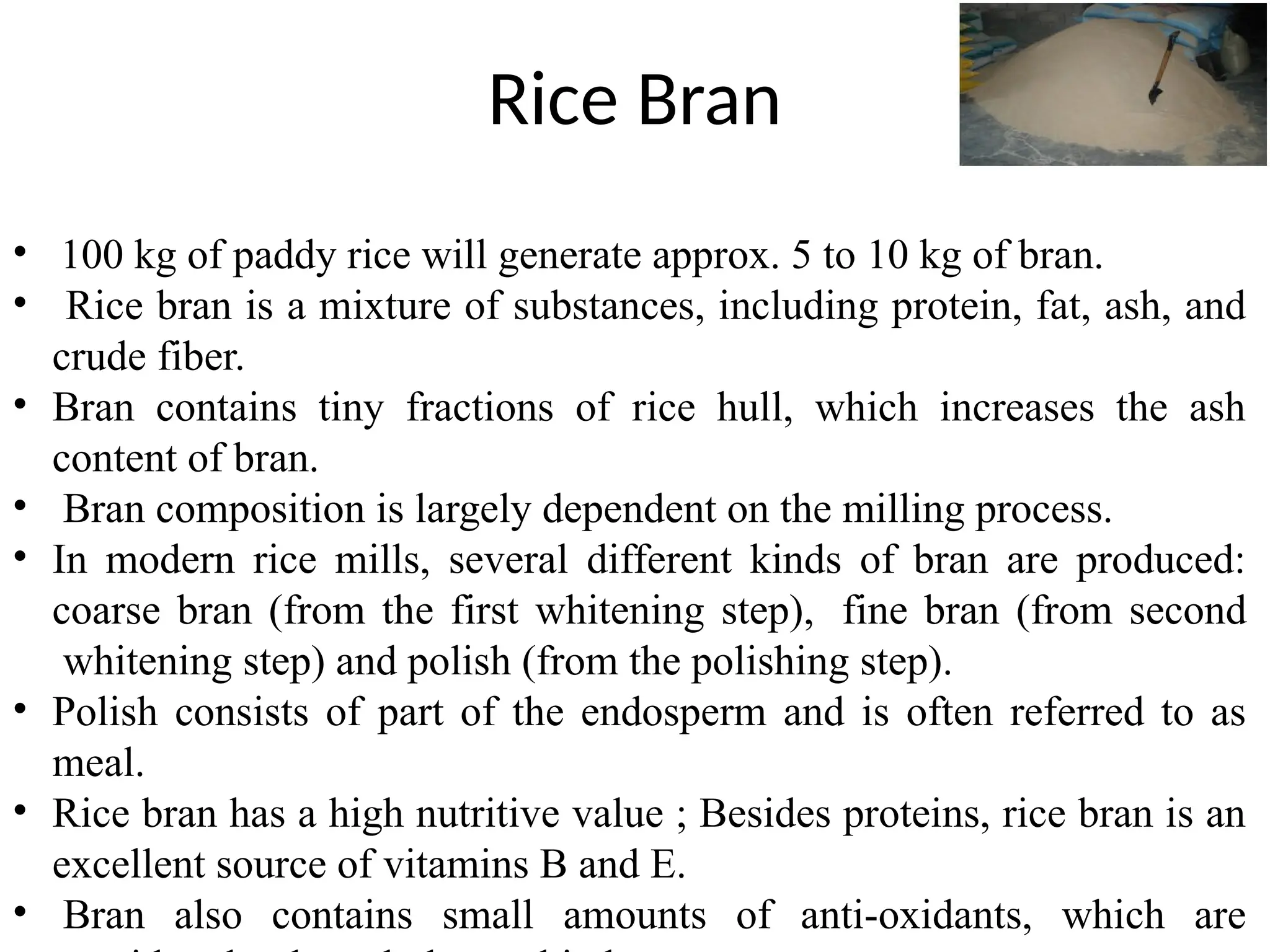
Rice Bran
• 100 kg of paddy rice will generate approx. 5 to 10 kg of bran.
• Rice bran is a mixture of substances, including protein, fat, ash, and
crude fiber.
• Bran contains tiny fractions of rice hull, which increases the ash
content of bran.
• Bran composition is largely dependent on the milling process.
• In modern rice mills, several different kinds of bran are produced:
coarse bran (from the first whitening step), fine bran (from second
whitening step) and polish (from the polishing step).
• Polish consists of part of the endosperm and is often referred to as
meal.
• Rice bran has a high nutritive value ; Besides proteins, rice bran is an
excellent source of vitamins B and E.
• Bran also contains small amounts of anti-oxidants, which are
Contd…
• Rice bran contains 10-23% bran oil.
• The oily nature makes bran an excellent binder for animal feeds.
• Bran oil, once stabilized and extracted, is a high quality vegetable oil
for cooking or eating.
• The conventional use of rice bran is as ingredient for animal feeds, in
particular ruminants and poultry.
• In recent years however, advances in stabilization techniques have been
made which has led to new uses for bran and its derivatives, most
notably bran oil for cooking and waxes for cosmetic products.
• In the developing countries, rice bran is underutilized due to a lack of
suitable stabilization techniques
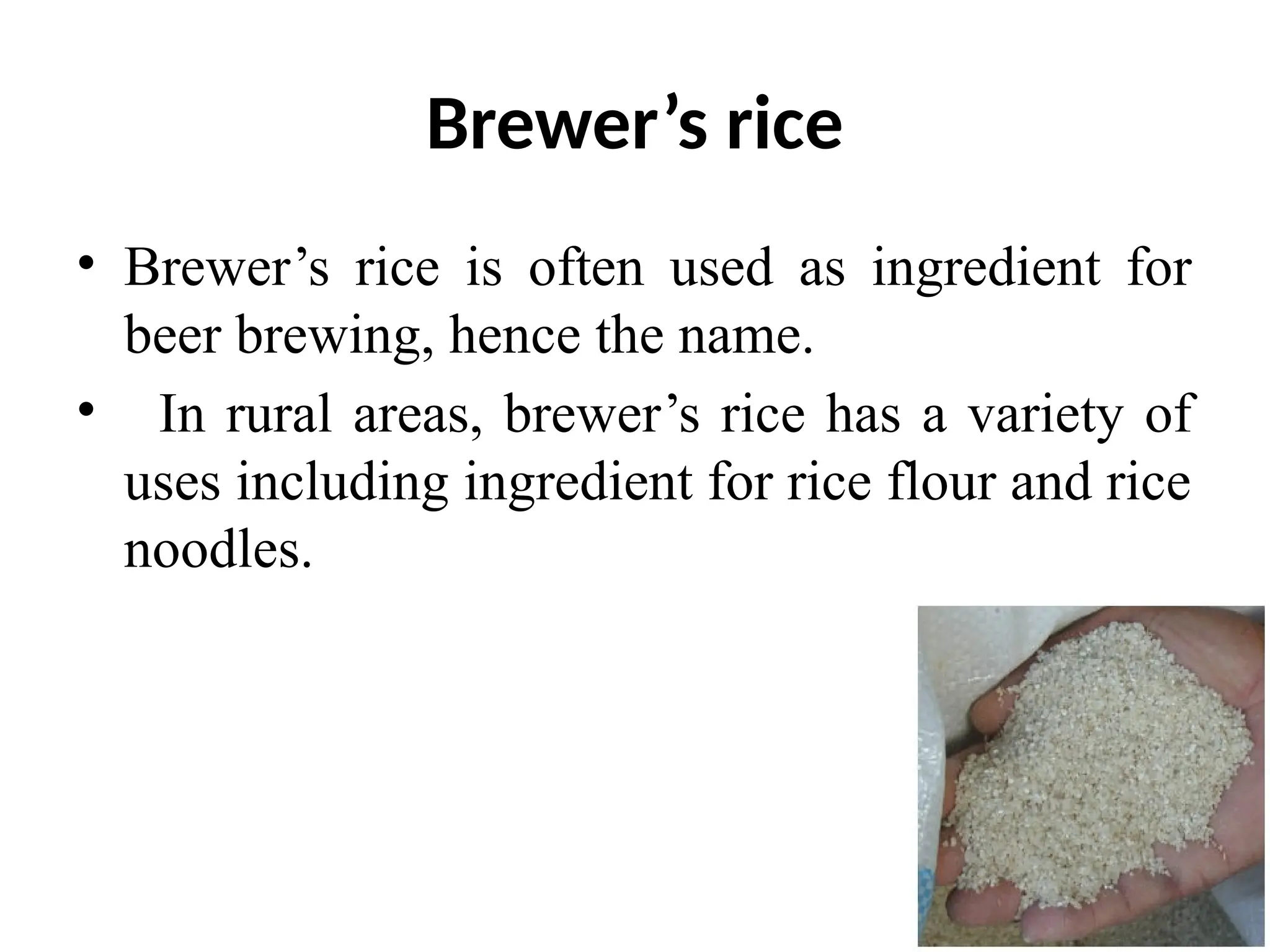
Brewer’s rice
• Brewer’s rice is often used as ingredient for
beer brewing, hence the name.
• In rural areas, brewer’s rice has a variety of
uses including ingredient for rice flour and rice
noodles.
Cooking of rice
• Freshly harvested rice has poor cooking quality
when compared to rice from paddy stored for few
months after harvest
• Rice from freshly harvested paddy cooks to
glutinous mass, has low swelling capacity and
causes digestive disorders
• Well stored rice grains swell on cooking to about 4
times their original volume while freshly harvested
rice scarcely swells to double its size when cooked
contd….
• Washing of rice before cooking results in loss of B-vit..
• Over 60% thiamine of milled rice is lost during washing
• Depletion of nutrients during washing is more serious
than cooking
• Cooking time of rice, particularly brown rice is of the
order 35-45 min.
• It is reduced to 2-15 min. in case of quick cooking rice
• Quick cooking rice is good in texture and nutritional
value as original rice
Rice ageing
• Rice ageing is a complicated process, which involves
changes in physical and chemical properties of the rice
grain.
• Starch, protein and lipids are the main rice grain
components which affect cooking and eating quality.
• While the overall starch, protein and lipid contents in
the rice grain remain essentially unchanged during
storage, structural changes do occur.
• These changes affect the pasting and gel properties,
flavour and texture of cooked rice
Polling question
• Rice bran contains 10-23% bran oil. State true
or False.

Types of rice and its storage. Varieties of rice

  • 1.
    Types of Rice 1.Long Grain Brown Rice • Long grain rice has a long, slender kernel, four to five times longer than its width. • Cooked grains are separate, light, and fluffy.
  • 2.
    Contd…. 2. Medium GrainBrown Rice • Medium grain rice has a shorter, wider kernel (two to three times longer than its width) than long grain rice. • Cooked grains are more moist and tender, and have a greater tendency to cling together than long grain.
  • 3.
    Contd…. 3. Short GrainBrown Rice • Short grain rice has a short, plump, almost round kernel. • Cooked grains are soft and cling together
  • 4.
    Contd… 4. Sweet BrownRice or waxy rice • U.S. sweet rice is short and plump with a chalky white, opaque kernel. • When cooked, sweet rice loses its shape and is very sticky. • Sweet is more often used in commercial product formulations. • The starch and flour from sweet rice is used in frozen products as a binder for gravies, sauces, and fillings because it is resistant to breakdown during freezing and thawing, unlike some corn or wheat starches.
  • 5.
    Contd… 5. Wehani Rice •This long-grain honey-red rice was naturally- bred and developed from an Indian Basmati- type seed. • Like other aromatic rices, it has a distinctive nutty fragrance when cooked.
  • 6.
    Contd… 6. Aromatic ricevarieties: • Aromatic rices have a flavor and aroma similar to that of roasted nuts or popcorn. • The natural compound that gives aromatic rice the characteristic aroma and flavor is present in all rice, but in the aromatic varieties it is present in much higher concentrations. • The most popular domestically grown aromatic rices include: a. della which cooks dry, separate and fluffy; b. jasmine which cooks more moist and tends to cling together; and c. basmati which cooks into very long, slender grains which are dry, separate and fluffy.
  • 7.
    Polling question • Aromaticrice have a flavor and aroma similar to that of roasted nuts or popcorn. State True or False
  • 8.
    Contd…. U.S. aromatic redrice has a deep, honey-red bran. • Like brown rice, it is minimally processed to retain its bran layers and takes 45 to 50 minutes to prepare. • Cooked grains have a savory, nutty flavor and are slightly chewy. • Basmati Rice: a long grain fragrant rice, aged to enhance aroma and reduce moisture content. Grown in India and Pakistan. • U.S. basmati rice is an aromatic long grain rice that has a distinctive aroma and flavor similar to that of popcorn or roasted nuts. • When cooked, it swells only lengthwise, resulting in long slender grains that are dry, separate and fluffy. • Texmati is a cross between basmati rice and American long
  • 9.
    Contd… 7. Himalayan RedRice • Also imported from India, this long-grain rice has a reddish bran layer and a nutty, complex flavor that adds visual and taste delight to any dish.
  • 10.
    Contd…. 8. Colusari RedRice • Grown in the Sacramento Valley of the U.S., Colusari Red Rice originated in a seed bank in Maryland. • When cooked, it adds an upscale burgundy color to the plate.
  • 11.
    Contd… 9. Purple ThaiRice • Slightly sweeter than some other rices, Purple Thai rice was traditionally used in dessert recipes, but is now turning up in savory dishes too. • Add other ingredients at the last minute, unless you want them to take on the distinctive reddish-blue hue of this rice
  • 12.
    Contd…. 10. Chinese BlackRice • Chinese Black Rice is a medium-grain rice with white kernels inside the black bran. • Cooked, it takes on a deep purplish color.
  • 13.
    Contd… Black rice: • BlackRice is a black whole grain, aromatic rice usually used in desserts. • Varieties include Chinese Forbidden Blak and Thai Black Sticky Rice. • U.S. black japonica is an aromatic rice with a dark black bran. • Like brown rice, it is minimally processed to retain its bran layers and takes 45 to 50 minutes to prepare. • Cooked grains are slightly chewy with a subtle sweet spiciness.
  • 14.
    Contd…. 11. Calrose (CaliforniaRose) a medium grain rice originally developed in California for ease of mechanical harvesting and minimal water use. • Numerious varieties developed from the original are the most popular rice in U.S.
  • 15.
    Contd…. 12. ARBORIO RICE •Arborio rice is an Italian short grain rice with high starch content, traditionally used to make Risotto. • U.S. Arborio rice is a large, bold rice with a characteristic white dot at the center of the grain. • Primarily used in risotto, this rice develops a creamy texture around a chewy center and has exceptional ability to absorb flavors. 13. Carnaroli Rice • It is in the same family as Arborio rice but with a larger grain. • From Piedmont and Lombardy regions of Italy, it is considered to be one of the best rices for Risotto.
  • 16.
    By products andits utilization • The main byproducts of rice milling are rice hulls or husk, rice bran, and brewer’s rice. • Rice hulls are generated during the first stage of rice milling, when rough rice or paddy rice is husked. • Rice bran is generated when brown rice moves through the whiteners and polishers. • When paddy is hand-pounded or milled in a one- pass Engleberg steel huller, rice bran is not produced separately but mixed with rice hulls. • Brewer’s rice is separated produced when milled rice is sifted.
  • 17.
    Rice husk • 100kg of paddy rice will generate approx. 20 kg of husk. • The bulk density is 100 to 150 kg/m3 . Rice husk contains 16 to 22% ash, which is high in silica. • The ash composition and structure give rice hulls an abrasive character. • Metal surfaces in frequent contact with rice hulls will wear out and eventually puncture. • Common use of rice husks are as bedding materials, and as source of energy. • In the modern rice milling industry, rice husks are increasingly being used as a fuel source for grain drying and parboiling, and for electricity generation.
  • 18.
    Contd…. • In Bangladesh,rice hulls are the preferred fuel for parboiling, and rice hulls are widely used for grain drying in the larger rice mills in Northern India. • Rice hulls, once ground, are also used as ingredient in animal feeds. • Using rice husk in gasifyers or furnaces that are used in small and medium size plants Asia produces black ash which still contains around 20% carbon. • This so called carbonated rice husk is often used as soil conditioner for poor soils, as an ingredient for bio fertilizers
  • 19.
    Rice Bran • 100kg of paddy rice will generate approx. 5 to 10 kg of bran. • Rice bran is a mixture of substances, including protein, fat, ash, and crude fiber. • Bran contains tiny fractions of rice hull, which increases the ash content of bran. • Bran composition is largely dependent on the milling process. • In modern rice mills, several different kinds of bran are produced: coarse bran (from the first whitening step), fine bran (from second whitening step) and polish (from the polishing step). • Polish consists of part of the endosperm and is often referred to as meal. • Rice bran has a high nutritive value ; Besides proteins, rice bran is an excellent source of vitamins B and E. • Bran also contains small amounts of anti-oxidants, which are
  • 20.
    Contd… • Rice brancontains 10-23% bran oil. • The oily nature makes bran an excellent binder for animal feeds. • Bran oil, once stabilized and extracted, is a high quality vegetable oil for cooking or eating. • The conventional use of rice bran is as ingredient for animal feeds, in particular ruminants and poultry. • In recent years however, advances in stabilization techniques have been made which has led to new uses for bran and its derivatives, most notably bran oil for cooking and waxes for cosmetic products. • In the developing countries, rice bran is underutilized due to a lack of suitable stabilization techniques
  • 21.
    Brewer’s rice • Brewer’srice is often used as ingredient for beer brewing, hence the name. • In rural areas, brewer’s rice has a variety of uses including ingredient for rice flour and rice noodles.
  • 22.
    Cooking of rice •Freshly harvested rice has poor cooking quality when compared to rice from paddy stored for few months after harvest • Rice from freshly harvested paddy cooks to glutinous mass, has low swelling capacity and causes digestive disorders • Well stored rice grains swell on cooking to about 4 times their original volume while freshly harvested rice scarcely swells to double its size when cooked
  • 23.
    contd…. • Washing ofrice before cooking results in loss of B-vit.. • Over 60% thiamine of milled rice is lost during washing • Depletion of nutrients during washing is more serious than cooking • Cooking time of rice, particularly brown rice is of the order 35-45 min. • It is reduced to 2-15 min. in case of quick cooking rice • Quick cooking rice is good in texture and nutritional value as original rice
  • 24.
    Rice ageing • Riceageing is a complicated process, which involves changes in physical and chemical properties of the rice grain. • Starch, protein and lipids are the main rice grain components which affect cooking and eating quality. • While the overall starch, protein and lipid contents in the rice grain remain essentially unchanged during storage, structural changes do occur. • These changes affect the pasting and gel properties, flavour and texture of cooked rice
  • 25.
    Polling question • Ricebran contains 10-23% bran oil. State true or False.