Industrial Power Control Systems : Motor Overload Protection Theewin Jidsathaporn IC/SSC Business 080-069-1222
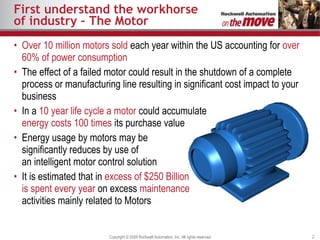
First understand the workhorse of industry – The Motor Over 10 million motors sold  each year within the US accounting for  over 60% of power consumption The effect   of a failed motor could result in the shutdown of a complete process or manufacturing line resulting in significant cost impact to your business In a  10 year life cycle a motor  could accumulate energy costs 100 times  its purchase value Energy usage by motors may be significantly reduces by use of an intelligent motor control solution It is estimated that in  excess of $250 Billion is spent every year  on excess  maintenance  activities mainly related to Motors
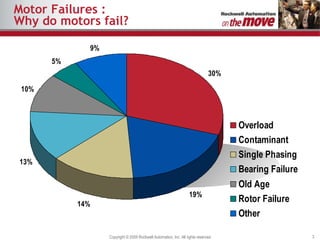
Motor Failures : Why do motors fail?
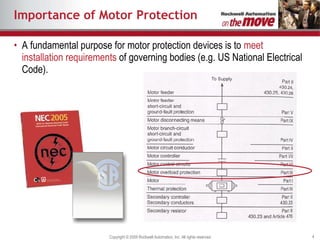
Importance of Motor Protection A fundamental purpose for motor protection devices is to  meet installation requirements  of governing bodies (e.g. US National Electrical Code).
Importance of Motor Protection Another primary purpose is to  protect investment of motor purchase cost . Traditional overload relays allow production personnel to be  reactive-only  when a condition occurs that results in the overload relay tripping.  An overload trip means that  the motor is stopped and production along with it –  DOWNTIME! Many production facilities have quantified in monetary terms what downtime costs them.  They are analyzing the manufacturing process and are developing strategies where incremental improvements can be made to maximize productivity. What tripped? How did it trip? Was it preventable? Is anything else going to trip…when?
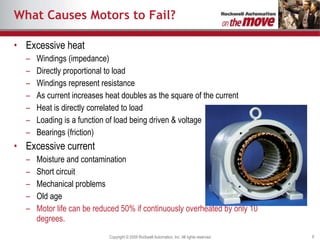
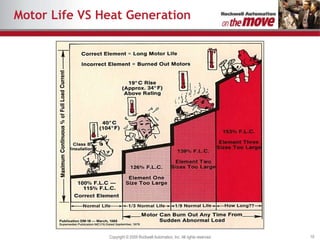
What Causes Motors to Fail? Excessive heat Windings (impedance) Directly proportional to load Windings represent resistance  As current increases heat doubles as the square of the current Heat is directly correlated to load Loading is a function of load being driven & voltage Bearings (friction) Excessive current Moisture and contamination Short circuit Mechanical problems Old age Motor life can be reduced 50% if continuously overheated by only 10 degrees.
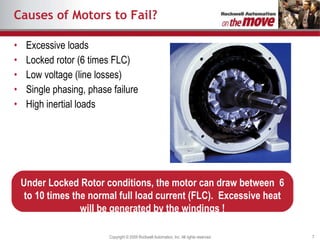
Causes of Motors to Fail? Excessive loads Locked rotor (6 times FLC) Low voltage (line losses) Single phasing, phase failure High inertial loads Under Locked Rotor conditions, the motor can draw between  6 to 10 times the normal full load current (FLC).  Excessive heat will be generated by the windings !
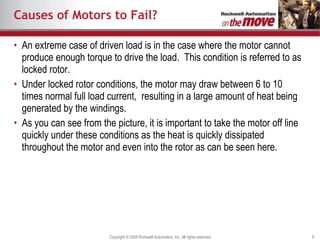
Causes of Motors to Fail? An extreme case of driven load is in the case where the motor cannot produce enough torque to drive the load.  This condition is referred to as locked rotor.  Under locked rotor conditions, the motor may draw between 6 to 10 times normal full load current,  resulting in a large amount of heat being generated by the windings.  As you can see from the picture, it is important to take the motor off line quickly under these conditions as the heat is quickly dissipated throughout the motor and even into the rotor as can be seen here.
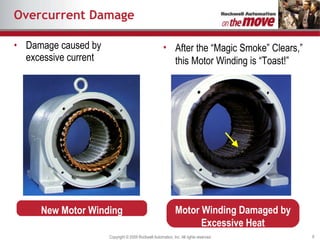
Overcurrent Damage Damage caused by  excessive current After the “Magic Smoke” Clears,” this Motor Winding is “Toast!” New Motor Winding Motor Winding Damaged by Excessive Heat
Motor Life VS Heat Generation
Functions of an Overload Relay Protect against  heating due to overcurrents  while running Protect against  heating caused by locked rotor Allows time to accelerate the load without nuisance tripping All of the above over a range of ambient temperatures
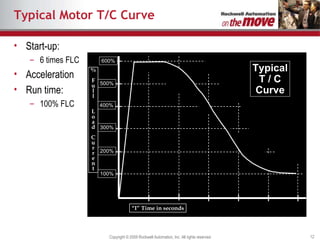
Typical Motor T/C Curve Start-up:  6 times FLC Acceleration Run time: 100% FLC 100% 200% 300% 400% 500% 600% Typical T / C Curve “ I” Time in seconds % F u l l L o a d C u r r e n t
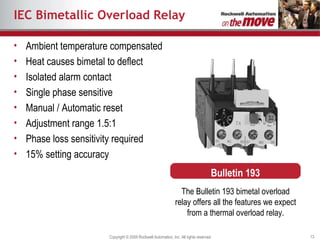
IEC Bimetallic Overload Relay Ambient temperature compensated Heat causes bimetal to deflect  Isolated alarm contact Single phase sensitive Manual / Automatic reset Adjustment range 1.5:1 Phase loss sensitivity required 15% setting accuracy The Bulletin 193 bimetal overload relay offers all the features we expect from a thermal overload relay. Bulletin 193
Bimetal Operation In the bimetal overload the 3 bimetallic strips push against the trip bar as shown in the diagram.  If the overload relay did not offer a differential mechanism (which all Bulletin 193 overload relays have) the overload relay could not generate enough tripping force to cause the overload relay to trip. Balanced Overload Unbalanced Overload POWER CIRCUIT HEATER & BIMETAL STRIP DIFFERENTIAL MECHANISM BOTH TRIP BARS MOVE TO STARTER COIL CONTROL CIRCUIT POWER CIRCUIT DIFFERENTIAL  MECHANISM MOVING TRIP BAR TO STARTER COIL CONTROL CIRCUIT
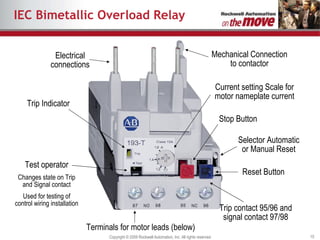
IEC Bimetallic Overload Relay Trip Indicator Stop Button Reset Button Mechanical Connection to contactor Electrical connections Current setting Scale for motor nameplate current Selector Automatic or Manual Reset Trip contact 95/96 and signal contact 97/98 Terminals for motor leads (below) Test operator Changes state on Trip and Signal contact Used for testing of control wiring installation
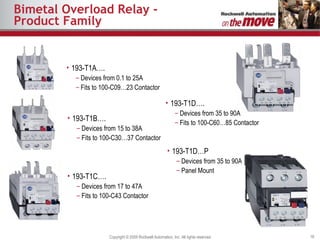
Bimetal Overload Relay - Product Family 193-T1A…. Devices from 0.1 to 25A Fits to 100-C09…23 Contactor 193-T1B…. Devices from 15 to 38A Fits to 100-C30…37 Contactor 193-T1C…. Devices from 17 to 47A Fits to 100-C43 Contactor 193-T1D…P Devices from 35 to 90A Panel Mount 193-T1D…. Devices from 35 to 90A Fits to 100-C60…85 Contactor
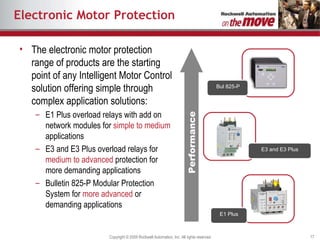
Electronic Motor Protection The electronic motor protection range of products are the starting point of any Intelligent Motor Control solution offering simple through complex application solutions: E1 Plus overload relays with add on network modules for  simple to medium  applications  E3 and E3 Plus overload relays for  medium to advanced  protection for more demanding applications Bulletin 825-P Modular Protection System for  more advanced  or demanding applications Performance Bul 825-P E3 and E3 Plus E1 Plus
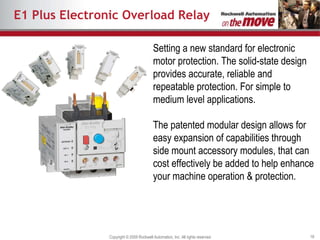
E1 Plus Electronic Overload Relay Setting a new standard for electronic motor protection. The solid-state design provides accurate, reliable and repeatable protection. For simple to medium level applications. The patented modular design allows for easy expansion of capabilities through side mount accessory modules, that can cost effectively be added to help enhance your machine operation & protection.
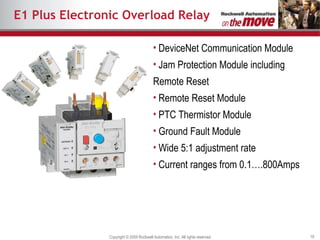
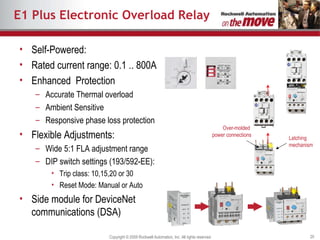
E1 Plus Electronic Overload Relay DeviceNet Communication Module Jam Protection Module including Remote Reset  Remote Reset Module PTC Thermistor Module Ground Fault Module Wide 5:1 adjustment rate Current ranges from 0.1….800Amps
E1 Plus Electronic Overload Relay Self-Powered : Rated current range: 0.1 .. 800A Enhanced  Protection Accurate Thermal overload  Ambient Sensitive Responsive phase loss protection Flexible Adjustments : Wide 5:1 FLA adjustment range DIP switch settings (193/592-EE): Trip class: 10,15,20 or 30 Reset Mode: Manual or Auto Side module for DeviceNet communications (DSA) Over-molded  power connections Latching mechanism
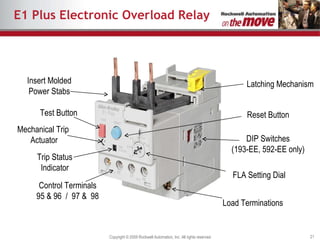
E1 Plus Electronic Overload Relay Latching Mechanism Insert Molded Power Stabs Reset Button Test Button DIP Switches (193-EE, 592-EE only) FLA Setting Dial Mechanical Trip  Actuator Trip Status Indicator Control Terminals 95 & 96  /  97 &  98 Load Terminations
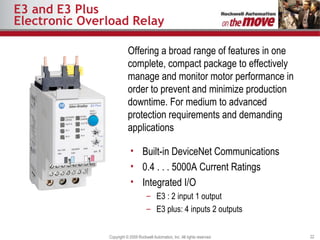
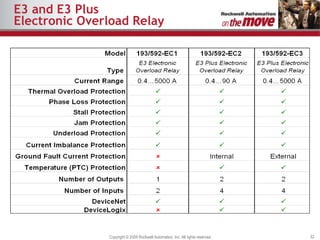
E3 and E3 Plus Electronic Overload Relay Offering a broad range of features in one complete, compact package to effectively manage and monitor motor performance in order to prevent and minimize production downtime.  For medium to advanced protection requirements and demanding applications Built-in DeviceNet Communications 0.4 . . . 5000A Current Ratings Integrated I/O E3 : 2 input 1 output E3 plus: 4 inputs 2 outputs
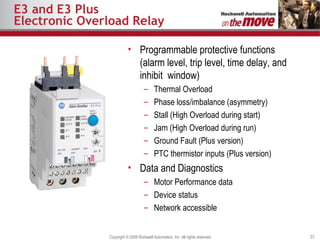
E3 and E3 Plus Electronic Overload Relay Programmable protective functions (alarm level, trip level, time delay, and inhibit  window) Thermal Overload Phase loss/imbalance (asymmetry) Stall (High Overload during start) Jam (High Overload during run) Ground Fault (Plus version) PTC thermistor inputs (Plus version) Data and Diagnostics Motor Performance data Device status Network accessible
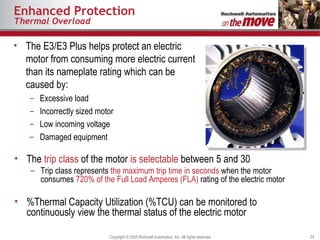
Enhanced Protection Thermal Overload The E3/E3 Plus helps protect an electric motor from consuming more electric current than its nameplate rating which can be caused by: Excessive load Incorrectly sized motor Low incoming voltage Damaged equipment The  trip class  of the motor  is selectable  between 5 and 30 Trip class represents  the maximum trip time in seconds  when the motor consumes  720% of the Full Load Amperes (FLA)  rating of the electric motor %Thermal Capacity Utilization (%TCU) can be monitored to continuously view the thermal status of the electric motor
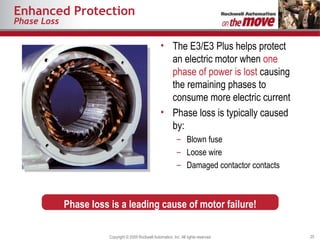
Enhanced Protection Phase Loss The E3/E3 Plus helps protect an electric motor when  one phase of power is lost  causing the remaining phases to consume more electric current Phase loss is typically caused by: Blown fuse Loose wire Damaged contactor contacts Phase loss is a leading cause of motor failure!
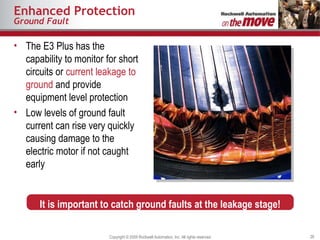
Enhanced Protection Ground Fault The E3 Plus has the capability to monitor for short circuits or  current leakage to ground  and provide equipment level protection Low levels of ground fault current can rise very quickly causing damage to the electric motor if not caught early It is important to catch ground faults at the leakage stage!
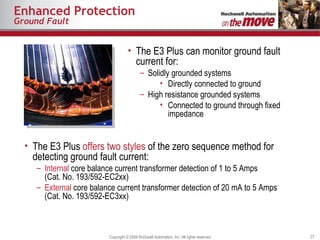
Enhanced Protection Ground Fault The E3 Plus can monitor ground fault current for: Solidly grounded systems Directly connected to ground High resistance grounded systems Connected to ground through fixed impedance The E3 Plus  offers two styles  of the zero sequence method for detecting ground fault current: Internal  core balance current transformer detection of 1 to 5 Amps (Cat. No. 193/592-EC2xx) External  core balance current transformer detection of 20 mA to 5 Amps (Cat. No. 193/592-EC3xx)
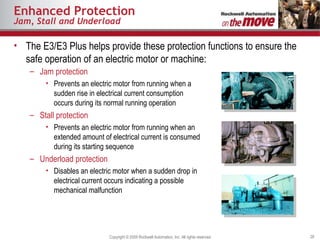
Enhanced Protection Jam, Stall and Underload The E3/E3 Plus helps provide these protection functions to ensure the safe operation of an electric motor or machine:  Jam protection Prevents an electric motor from running when a sudden rise in electrical current consumption occurs during its normal running operation Stall protection Prevents an electric motor from running when an extended amount of electrical current is consumed during its starting sequence Underload protection Disables an electric motor when a sudden drop in electrical current occurs indicating a possible mechanical malfunction
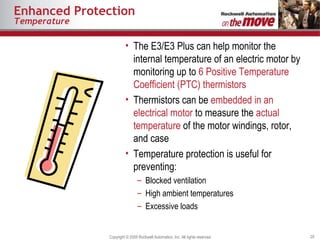
Enhanced Protection Temperature The E3/E3 Plus can help monitor the internal temperature of an electric motor by monitoring up to  6 Positive Temperature Coefficient (PTC) thermistors Thermistors can be  embedded in an electrical motor  to measure the  actual temperature  of the motor windings, rotor, and case Temperature protection is useful for preventing: Blocked ventilation High ambient temperatures Excessive loads
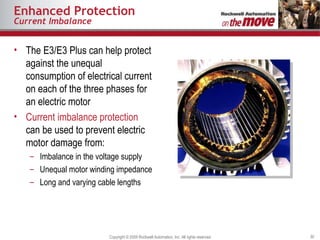
Enhanced Protection Current Imbalance The E3/E3 Plus can help protect against the unequal consumption of electrical current on each of the three phases for an electric motor Current imbalance protection  can be used to prevent electric motor damage from:  Imbalance in the voltage supply Unequal motor winding impedance Long and varying cable lengths
Motor Diagnostics The E3/E3 Plus Electronic Overload Relay not only helps protect your electric motor investment, but it can proactively  assist in maintaining the electric motor by limiting : Number of starts Operating hours The E3/E3 Plus Electronic Overload Relay can also help provide diagnostic and metering information to help you understand the consumption patterns for the motor or process by providing:  RMS current Percentage of full load current (%FLA) Current imbalance Thermal Capacity Utilization (%TCU) Trip log Warning log
E3 and E3 Plus Electronic Overload Relay
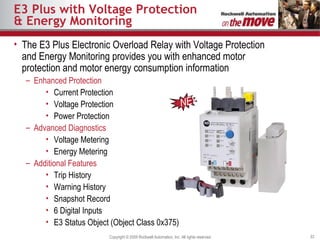
E3 Plus with Voltage Protection & Energy Monitoring The E3 Plus Electronic Overload Relay with Voltage Protection and Energy Monitoring provides you with enhanced motor protection and motor energy consumption information Enhanced Protection Current Protection Voltage Protection Power Protection Advanced Diagnostics Voltage Metering Energy Metering Additional Features Trip History Warning History Snapshot Record 6 Digital Inputs E3 Status Object (Object Class 0x375) NEW
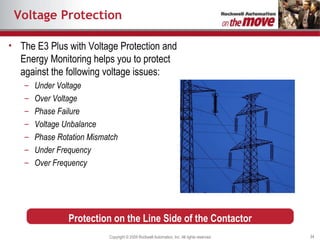
Voltage Protection The E3 Plus with Voltage Protection and Energy Monitoring helps you to protect against the following voltage issues: Under Voltage Over Voltage Phase Failure Voltage Unbalance Phase Rotation Mismatch Under Frequency Over Frequency Protection on the Line Side of the Contactor
Power Protection To address power quality issues that could occur due to a specific application, the E3 Plus Electronic Overload Relay with Voltage Protection and Energy Monitoring also provides you with the following power based protection : Real Power (kW)  Reactive Power (kVAR)  Apparent Power (kVA)  Power Factor (PF) Leading Lagging
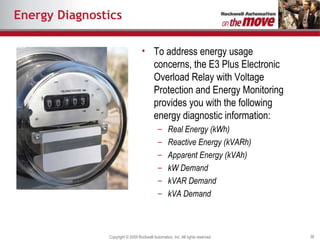
Energy Diagnostics To address energy usage concerns, the E3 Plus Electronic Overload Relay with Voltage Protection and Energy Monitoring provides you with the following energy diagnostic information: Real Energy (kWh) Reactive Energy (kVARh)  Apparent Energy (kVAh) kW Demand kVAR Demand kVA Demand
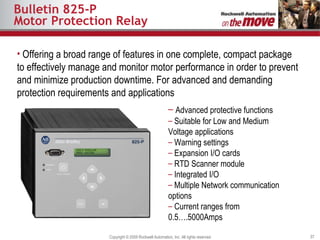
Bulletin 825-P Motor Protection Relay Offering a broad range of features in one complete, compact package to effectively manage and monitor motor performance in order to prevent and minimize production downtime. For  advanced and demanding protection requirements and applications  Advanced protective functions Suitable for Low and Medium Voltage applications Warning settings  Expansion I/O cards RTD Scanner module Integrated I/O  Multiple Network communication options Current ranges from 0.5….5000Amps
Bulletin 825-P Motor Protection Relay A-B Motor Protection Relay (MPR) with DeviceNet capability Modular design User programmable functions Overload Underload Thermal utilization Ground Fault Phase unbalance Motor and ambient temperature Start time monitor Starts per hour limitations Metering (V, I, Power, kWH) RTD monitoring RTD
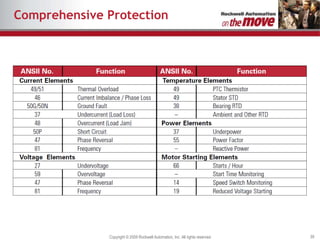
Comprehensive Protection
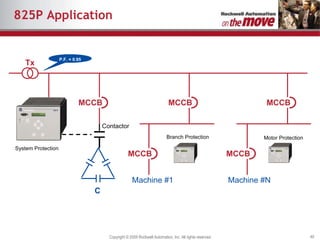
825P Application Machine #1 Machine #N P.F. = 0.95 Tx Contactor Branch Protection System Protection Motor Protection C MCCB MCCB MCCB MCCB MCCB
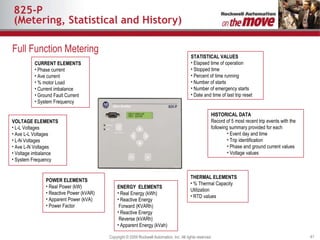
825-P (Metering, Statistical and History) Full Function Metering STATISTICAL VALUES Elapsed time of operation Stopped time Percent of time running Number of starts Number of emergency starts Date and time of last trip reset VOLTAGE ELEMENTS L-L Voltages Ave L-L Voltages L-N Voltages Ave L-N Voltages Voltage imbalance System Frequency CURRENT ELEMENTS Phase current Ave current % motor Load Current imbalance Ground Fault Current System Frequency THERMAL ELEMENTS % Thermal Capacity  Utilization RTD values POWER ELEMENTS Real Power (kW) Reactive Power (kVAR) Apparent Power (kVA) Power Factor ENERGY  ELEMENTS Real Energy (kWh) Reactive Energy  Forward (KVARh) Reactive Energy  Reverse (kVARh) Apparent Energy (kVah) HISTORICAL DATA Record of 5 most recent trip events with the following summary provided for each Event day and time Trip identification Phase and ground current values Voltage values
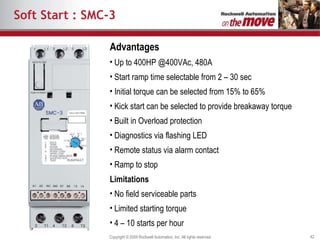
Soft Start : SMC-3 Advantages Up to 400HP @400VAc, 480A Start ramp time selectable from 2 – 30 sec Initial torque can be selected from 15% to 65% Kick start can be selected to provide breakaway torque Built in Overload protection Diagnostics via flashing LED Remote status via alarm contact Ramp to stop Limitations No field serviceable parts Limited starting torque 4 – 10 starts per hour
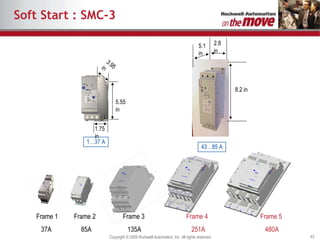
Soft Start : SMC-3 Frame 1  Frame 2  Frame 3   Frame 4   Frame 5 37A   85A  135A     251A   480A 3.95 in 5.55 in 1.75 in 1…37 A 5.1 in 8.2 in 2.8 in 43…85 A
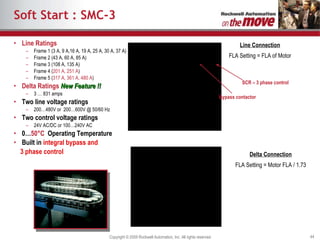
Soft Start : SMC-3 Line Ratings Frame 1 (3 A, 9 A,16 A, 19 A, 25 A, 30 A, 37 A) Frame 2 (43 A, 60 A, 85 A) Frame 3 (108 A, 135 A) Frame 4 ( 201 A, 251 A ) Frame 5 ( 317 A, 361 A, 480 A )  Delta Ratings   New Feature !! 3 … 831 amps Two line voltage ratings 200…480V or  200…600V @ 50/60 Hz Two control voltage ratings 24V AC/DC or 100…240V AC 0… 50°C   Operating Temperature Built in  integral bypass and  3 phase control Bypass contactor SCR – 3 phase control Line Connection FLA Setting = FLA of Motor Delta Connection FLA Setting = Motor FLA / 1.73
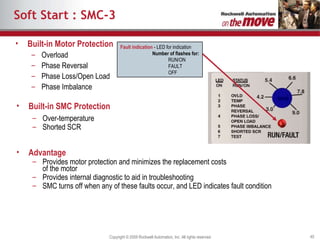
Soft Start : SMC-3 Built-in Motor Protection Overload Phase Reversal Phase Loss/Open Load Phase Imbalance Built-in SMC Protection Over-temperature Shorted SCR Advantage Provides motor protection and minimizes the replacement costs  of the motor Provides internal diagnostic to aid in troubleshooting SMC turns off when any of these faults occur, and LED indicates fault condition Fault indication  - LED for indication Number of flashes for: RUN/ON FAULT  OFF
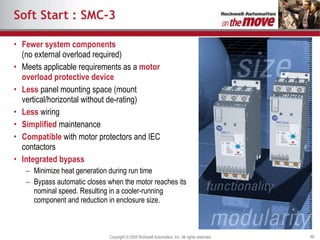
Soft Start : SMC-3 Fewer system components   (no external overload required) Meets applicable requirements as a  motor overload   protective device Less  panel mounting space (mount vertical/horizontal without de-rating) Less  wiring  Simplified  maintenance Compatible  with motor protectors and IEC contactors Integrated bypass Minimize heat generation during run time Bypass automatic closes when the motor reaches its nominal speed. Resulting in a cooler-running component and reduction in enclosure size.
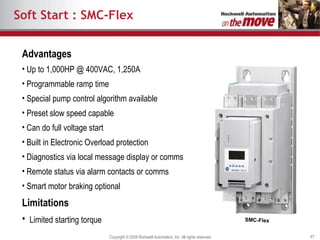
Soft Start : SMC-Flex Advantages Up to 1,000HP @ 400VAC, 1,250A Programmable ramp time Special pump control algorithm available Preset slow speed capable Can do full voltage start Built in Electronic Overload protection Diagnostics via local message display or comms Remote status via alarm contacts or comms Smart motor braking optional Limitations Limited starting torque SMC-Flex
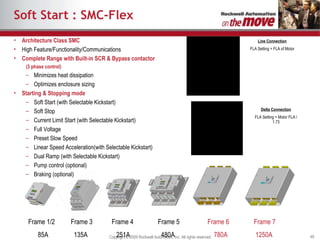
Soft Start : SMC-Flex Architecture Class SMC High Feature/Functionality/Communications Complete Range with Built-in SCR & Bypass contactor  (3 phase control) Minimizes heat dissipation Optimizes enclosure sizing Starting & Stopping mode Soft Start (with Selectable Kickstart) Soft Stop Current Limit Start (with Selectable Kickstart) Full Voltage Preset Slow Speed  Linear Speed Acceleration(with Selectable Kickstart) Dual Ramp (with Selectable Kickstart) Pump control (optional) Braking (optional) Line Connection FLA Setting = FLA of Motor Delta Connection FLA Setting = Motor FLA / 1.73 Frame 1/2  Frame 3   Frame 4   Frame 5   Frame 6   Frame 7 85A  135A  251A   480A 780A   1250A
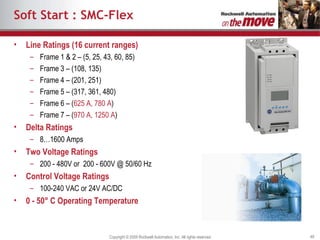
Soft Start : SMC-Flex Line Ratings (16 current ranges) Frame 1 & 2 – (5, 25, 43, 60, 85) Frame 3 – (108, 135) Frame 4 – (201, 251) Frame 5 – (317, 361, 480) Frame 6 – ( 625 A, 780 A ) Frame 7 – ( 970 A, 1250 A ) Delta Ratings 8…1600 Amps Two Voltage Ratings 200 - 480V or  200 - 600V @ 50/60 Hz Control Voltage Ratings 100-240 VAC or 24V AC/DC 0 - 50° C Operating Temperature
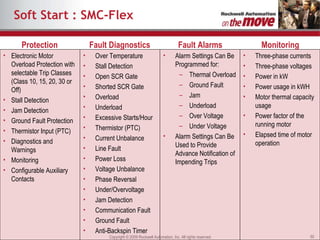
Soft Start : SMC-Flex Electronic Motor Overload Protection with selectable Trip Classes (Class 10, 15, 20, 30 or Off) Stall Detection Jam Detection  Ground Fault Protection Thermistor Input (PTC) Diagnostics and Warnings  Monitoring Configurable Auxiliary Contacts Over Temperature Stall Detection Open SCR Gate Shorted SCR Gate Overload  Underload Excessive Starts/Hour Thermistor (PTC) Current Unbalance Line Fault Power Loss Voltage Unbalance Phase Reversal Under/Overvoltage Jam Detection Communication Fault Ground Fault Anti-Backspin Timer Alarm Settings Can Be Programmed for: Thermal Overload Ground Fault Jam  Underload Over Voltage Under Voltage Alarm Settings Can Be Used to Provide Advance Notification of Impending Trips Three-phase currents Three-phase voltages Power in kW Power usage in kWH Motor thermal capacity usage Power factor of the running motor Elapsed time of motor operation Protection Fault Diagnostics Fault Alarms Monitoring
Soft Start : SMC-Flex Interfaces to DPI communication modules Remote I/O RS 485-DF1  DeviceNet™ ControlNet EtherNet ProfiBUS Lonworks Interbus Using the SMC-Flex controller, you can access Parameter settings Fault Diagnostics Metering Remote start-stop control Consistency in Communications – SMC & Drives ControlNet DeviceNet Remote I/O Module Installation Installation Complete
THANK YOU Theewin Jidsathaporn IC/SSC Business 080-069-1222 www.ab.com www.rockwellautomation.com

Industrial control motor overload protection

  • 1.
    Industrial Power ControlSystems : Motor Overload Protection Theewin Jidsathaporn IC/SSC Business 080-069-1222
  • 2.
    First understand theworkhorse of industry – The Motor Over 10 million motors sold each year within the US accounting for over 60% of power consumption The effect of a failed motor could result in the shutdown of a complete process or manufacturing line resulting in significant cost impact to your business In a 10 year life cycle a motor could accumulate energy costs 100 times its purchase value Energy usage by motors may be significantly reduces by use of an intelligent motor control solution It is estimated that in excess of $250 Billion is spent every year on excess maintenance activities mainly related to Motors
  • 3.
    Motor Failures :Why do motors fail?
  • 4.
    Importance of MotorProtection A fundamental purpose for motor protection devices is to meet installation requirements of governing bodies (e.g. US National Electrical Code).
  • 5.
    Importance of MotorProtection Another primary purpose is to protect investment of motor purchase cost . Traditional overload relays allow production personnel to be reactive-only when a condition occurs that results in the overload relay tripping. An overload trip means that the motor is stopped and production along with it – DOWNTIME! Many production facilities have quantified in monetary terms what downtime costs them. They are analyzing the manufacturing process and are developing strategies where incremental improvements can be made to maximize productivity. What tripped? How did it trip? Was it preventable? Is anything else going to trip…when?
  • 6.
    What Causes Motorsto Fail? Excessive heat Windings (impedance) Directly proportional to load Windings represent resistance As current increases heat doubles as the square of the current Heat is directly correlated to load Loading is a function of load being driven & voltage Bearings (friction) Excessive current Moisture and contamination Short circuit Mechanical problems Old age Motor life can be reduced 50% if continuously overheated by only 10 degrees.
  • 7.
    Causes of Motorsto Fail? Excessive loads Locked rotor (6 times FLC) Low voltage (line losses) Single phasing, phase failure High inertial loads Under Locked Rotor conditions, the motor can draw between 6 to 10 times the normal full load current (FLC). Excessive heat will be generated by the windings !
  • 8.
    Causes of Motorsto Fail? An extreme case of driven load is in the case where the motor cannot produce enough torque to drive the load. This condition is referred to as locked rotor. Under locked rotor conditions, the motor may draw between 6 to 10 times normal full load current, resulting in a large amount of heat being generated by the windings. As you can see from the picture, it is important to take the motor off line quickly under these conditions as the heat is quickly dissipated throughout the motor and even into the rotor as can be seen here.
  • 9.
    Overcurrent Damage Damagecaused by excessive current After the “Magic Smoke” Clears,” this Motor Winding is “Toast!” New Motor Winding Motor Winding Damaged by Excessive Heat
  • 10.
    Motor Life VSHeat Generation
  • 11.
    Functions of anOverload Relay Protect against heating due to overcurrents while running Protect against heating caused by locked rotor Allows time to accelerate the load without nuisance tripping All of the above over a range of ambient temperatures
  • 12.
    Typical Motor T/CCurve Start-up: 6 times FLC Acceleration Run time: 100% FLC 100% 200% 300% 400% 500% 600% Typical T / C Curve “ I” Time in seconds % F u l l L o a d C u r r e n t
  • 13.
    IEC Bimetallic OverloadRelay Ambient temperature compensated Heat causes bimetal to deflect Isolated alarm contact Single phase sensitive Manual / Automatic reset Adjustment range 1.5:1 Phase loss sensitivity required 15% setting accuracy The Bulletin 193 bimetal overload relay offers all the features we expect from a thermal overload relay. Bulletin 193
  • 14.
    Bimetal Operation Inthe bimetal overload the 3 bimetallic strips push against the trip bar as shown in the diagram. If the overload relay did not offer a differential mechanism (which all Bulletin 193 overload relays have) the overload relay could not generate enough tripping force to cause the overload relay to trip. Balanced Overload Unbalanced Overload POWER CIRCUIT HEATER & BIMETAL STRIP DIFFERENTIAL MECHANISM BOTH TRIP BARS MOVE TO STARTER COIL CONTROL CIRCUIT POWER CIRCUIT DIFFERENTIAL MECHANISM MOVING TRIP BAR TO STARTER COIL CONTROL CIRCUIT
  • 15.
    IEC Bimetallic OverloadRelay Trip Indicator Stop Button Reset Button Mechanical Connection to contactor Electrical connections Current setting Scale for motor nameplate current Selector Automatic or Manual Reset Trip contact 95/96 and signal contact 97/98 Terminals for motor leads (below) Test operator Changes state on Trip and Signal contact Used for testing of control wiring installation
  • 16.
    Bimetal Overload Relay- Product Family 193-T1A…. Devices from 0.1 to 25A Fits to 100-C09…23 Contactor 193-T1B…. Devices from 15 to 38A Fits to 100-C30…37 Contactor 193-T1C…. Devices from 17 to 47A Fits to 100-C43 Contactor 193-T1D…P Devices from 35 to 90A Panel Mount 193-T1D…. Devices from 35 to 90A Fits to 100-C60…85 Contactor
  • 17.
    Electronic Motor ProtectionThe electronic motor protection range of products are the starting point of any Intelligent Motor Control solution offering simple through complex application solutions: E1 Plus overload relays with add on network modules for simple to medium applications E3 and E3 Plus overload relays for medium to advanced protection for more demanding applications Bulletin 825-P Modular Protection System for more advanced or demanding applications Performance Bul 825-P E3 and E3 Plus E1 Plus
  • 18.
    E1 Plus ElectronicOverload Relay Setting a new standard for electronic motor protection. The solid-state design provides accurate, reliable and repeatable protection. For simple to medium level applications. The patented modular design allows for easy expansion of capabilities through side mount accessory modules, that can cost effectively be added to help enhance your machine operation & protection.
  • 19.
    E1 Plus ElectronicOverload Relay DeviceNet Communication Module Jam Protection Module including Remote Reset Remote Reset Module PTC Thermistor Module Ground Fault Module Wide 5:1 adjustment rate Current ranges from 0.1….800Amps
  • 20.
    E1 Plus ElectronicOverload Relay Self-Powered : Rated current range: 0.1 .. 800A Enhanced Protection Accurate Thermal overload Ambient Sensitive Responsive phase loss protection Flexible Adjustments : Wide 5:1 FLA adjustment range DIP switch settings (193/592-EE): Trip class: 10,15,20 or 30 Reset Mode: Manual or Auto Side module for DeviceNet communications (DSA) Over-molded power connections Latching mechanism
  • 21.
    E1 Plus ElectronicOverload Relay Latching Mechanism Insert Molded Power Stabs Reset Button Test Button DIP Switches (193-EE, 592-EE only) FLA Setting Dial Mechanical Trip Actuator Trip Status Indicator Control Terminals 95 & 96 / 97 & 98 Load Terminations
  • 22.
    E3 and E3Plus Electronic Overload Relay Offering a broad range of features in one complete, compact package to effectively manage and monitor motor performance in order to prevent and minimize production downtime. For medium to advanced protection requirements and demanding applications Built-in DeviceNet Communications 0.4 . . . 5000A Current Ratings Integrated I/O E3 : 2 input 1 output E3 plus: 4 inputs 2 outputs
  • 23.
    E3 and E3Plus Electronic Overload Relay Programmable protective functions (alarm level, trip level, time delay, and inhibit window) Thermal Overload Phase loss/imbalance (asymmetry) Stall (High Overload during start) Jam (High Overload during run) Ground Fault (Plus version) PTC thermistor inputs (Plus version) Data and Diagnostics Motor Performance data Device status Network accessible
  • 24.
    Enhanced Protection ThermalOverload The E3/E3 Plus helps protect an electric motor from consuming more electric current than its nameplate rating which can be caused by: Excessive load Incorrectly sized motor Low incoming voltage Damaged equipment The trip class of the motor is selectable between 5 and 30 Trip class represents the maximum trip time in seconds when the motor consumes 720% of the Full Load Amperes (FLA) rating of the electric motor %Thermal Capacity Utilization (%TCU) can be monitored to continuously view the thermal status of the electric motor
  • 25.
    Enhanced Protection PhaseLoss The E3/E3 Plus helps protect an electric motor when one phase of power is lost causing the remaining phases to consume more electric current Phase loss is typically caused by: Blown fuse Loose wire Damaged contactor contacts Phase loss is a leading cause of motor failure!
  • 26.
    Enhanced Protection GroundFault The E3 Plus has the capability to monitor for short circuits or current leakage to ground and provide equipment level protection Low levels of ground fault current can rise very quickly causing damage to the electric motor if not caught early It is important to catch ground faults at the leakage stage!
  • 27.
    Enhanced Protection GroundFault The E3 Plus can monitor ground fault current for: Solidly grounded systems Directly connected to ground High resistance grounded systems Connected to ground through fixed impedance The E3 Plus offers two styles of the zero sequence method for detecting ground fault current: Internal core balance current transformer detection of 1 to 5 Amps (Cat. No. 193/592-EC2xx) External core balance current transformer detection of 20 mA to 5 Amps (Cat. No. 193/592-EC3xx)
  • 28.
    Enhanced Protection Jam,Stall and Underload The E3/E3 Plus helps provide these protection functions to ensure the safe operation of an electric motor or machine: Jam protection Prevents an electric motor from running when a sudden rise in electrical current consumption occurs during its normal running operation Stall protection Prevents an electric motor from running when an extended amount of electrical current is consumed during its starting sequence Underload protection Disables an electric motor when a sudden drop in electrical current occurs indicating a possible mechanical malfunction
  • 29.
    Enhanced Protection TemperatureThe E3/E3 Plus can help monitor the internal temperature of an electric motor by monitoring up to 6 Positive Temperature Coefficient (PTC) thermistors Thermistors can be embedded in an electrical motor to measure the actual temperature of the motor windings, rotor, and case Temperature protection is useful for preventing: Blocked ventilation High ambient temperatures Excessive loads
  • 30.
    Enhanced Protection CurrentImbalance The E3/E3 Plus can help protect against the unequal consumption of electrical current on each of the three phases for an electric motor Current imbalance protection can be used to prevent electric motor damage from: Imbalance in the voltage supply Unequal motor winding impedance Long and varying cable lengths
  • 31.
    Motor Diagnostics TheE3/E3 Plus Electronic Overload Relay not only helps protect your electric motor investment, but it can proactively assist in maintaining the electric motor by limiting : Number of starts Operating hours The E3/E3 Plus Electronic Overload Relay can also help provide diagnostic and metering information to help you understand the consumption patterns for the motor or process by providing: RMS current Percentage of full load current (%FLA) Current imbalance Thermal Capacity Utilization (%TCU) Trip log Warning log
  • 32.
    E3 and E3Plus Electronic Overload Relay
  • 33.
    E3 Plus withVoltage Protection & Energy Monitoring The E3 Plus Electronic Overload Relay with Voltage Protection and Energy Monitoring provides you with enhanced motor protection and motor energy consumption information Enhanced Protection Current Protection Voltage Protection Power Protection Advanced Diagnostics Voltage Metering Energy Metering Additional Features Trip History Warning History Snapshot Record 6 Digital Inputs E3 Status Object (Object Class 0x375) NEW
  • 34.
    Voltage Protection TheE3 Plus with Voltage Protection and Energy Monitoring helps you to protect against the following voltage issues: Under Voltage Over Voltage Phase Failure Voltage Unbalance Phase Rotation Mismatch Under Frequency Over Frequency Protection on the Line Side of the Contactor
  • 35.
    Power Protection Toaddress power quality issues that could occur due to a specific application, the E3 Plus Electronic Overload Relay with Voltage Protection and Energy Monitoring also provides you with the following power based protection : Real Power (kW) Reactive Power (kVAR) Apparent Power (kVA) Power Factor (PF) Leading Lagging
  • 36.
    Energy Diagnostics Toaddress energy usage concerns, the E3 Plus Electronic Overload Relay with Voltage Protection and Energy Monitoring provides you with the following energy diagnostic information: Real Energy (kWh) Reactive Energy (kVARh) Apparent Energy (kVAh) kW Demand kVAR Demand kVA Demand
  • 37.
    Bulletin 825-P MotorProtection Relay Offering a broad range of features in one complete, compact package to effectively manage and monitor motor performance in order to prevent and minimize production downtime. For advanced and demanding protection requirements and applications Advanced protective functions Suitable for Low and Medium Voltage applications Warning settings Expansion I/O cards RTD Scanner module Integrated I/O Multiple Network communication options Current ranges from 0.5….5000Amps
  • 38.
    Bulletin 825-P MotorProtection Relay A-B Motor Protection Relay (MPR) with DeviceNet capability Modular design User programmable functions Overload Underload Thermal utilization Ground Fault Phase unbalance Motor and ambient temperature Start time monitor Starts per hour limitations Metering (V, I, Power, kWH) RTD monitoring RTD
  • 39.
  • 40.
    825P Application Machine#1 Machine #N P.F. = 0.95 Tx Contactor Branch Protection System Protection Motor Protection C MCCB MCCB MCCB MCCB MCCB
  • 41.
    825-P (Metering, Statisticaland History) Full Function Metering STATISTICAL VALUES Elapsed time of operation Stopped time Percent of time running Number of starts Number of emergency starts Date and time of last trip reset VOLTAGE ELEMENTS L-L Voltages Ave L-L Voltages L-N Voltages Ave L-N Voltages Voltage imbalance System Frequency CURRENT ELEMENTS Phase current Ave current % motor Load Current imbalance Ground Fault Current System Frequency THERMAL ELEMENTS % Thermal Capacity Utilization RTD values POWER ELEMENTS Real Power (kW) Reactive Power (kVAR) Apparent Power (kVA) Power Factor ENERGY ELEMENTS Real Energy (kWh) Reactive Energy Forward (KVARh) Reactive Energy Reverse (kVARh) Apparent Energy (kVah) HISTORICAL DATA Record of 5 most recent trip events with the following summary provided for each Event day and time Trip identification Phase and ground current values Voltage values
  • 42.
    Soft Start :SMC-3 Advantages Up to 400HP @400VAc, 480A Start ramp time selectable from 2 – 30 sec Initial torque can be selected from 15% to 65% Kick start can be selected to provide breakaway torque Built in Overload protection Diagnostics via flashing LED Remote status via alarm contact Ramp to stop Limitations No field serviceable parts Limited starting torque 4 – 10 starts per hour
  • 43.
    Soft Start :SMC-3 Frame 1 Frame 2 Frame 3 Frame 4 Frame 5 37A 85A 135A 251A 480A 3.95 in 5.55 in 1.75 in 1…37 A 5.1 in 8.2 in 2.8 in 43…85 A
  • 44.
    Soft Start :SMC-3 Line Ratings Frame 1 (3 A, 9 A,16 A, 19 A, 25 A, 30 A, 37 A) Frame 2 (43 A, 60 A, 85 A) Frame 3 (108 A, 135 A) Frame 4 ( 201 A, 251 A ) Frame 5 ( 317 A, 361 A, 480 A ) Delta Ratings New Feature !! 3 … 831 amps Two line voltage ratings 200…480V or 200…600V @ 50/60 Hz Two control voltage ratings 24V AC/DC or 100…240V AC 0… 50°C Operating Temperature Built in integral bypass and 3 phase control Bypass contactor SCR – 3 phase control Line Connection FLA Setting = FLA of Motor Delta Connection FLA Setting = Motor FLA / 1.73
  • 45.
    Soft Start :SMC-3 Built-in Motor Protection Overload Phase Reversal Phase Loss/Open Load Phase Imbalance Built-in SMC Protection Over-temperature Shorted SCR Advantage Provides motor protection and minimizes the replacement costs of the motor Provides internal diagnostic to aid in troubleshooting SMC turns off when any of these faults occur, and LED indicates fault condition Fault indication - LED for indication Number of flashes for: RUN/ON FAULT OFF
  • 46.
    Soft Start :SMC-3 Fewer system components (no external overload required) Meets applicable requirements as a motor overload protective device Less panel mounting space (mount vertical/horizontal without de-rating) Less wiring Simplified maintenance Compatible with motor protectors and IEC contactors Integrated bypass Minimize heat generation during run time Bypass automatic closes when the motor reaches its nominal speed. Resulting in a cooler-running component and reduction in enclosure size.
  • 47.
    Soft Start :SMC-Flex Advantages Up to 1,000HP @ 400VAC, 1,250A Programmable ramp time Special pump control algorithm available Preset slow speed capable Can do full voltage start Built in Electronic Overload protection Diagnostics via local message display or comms Remote status via alarm contacts or comms Smart motor braking optional Limitations Limited starting torque SMC-Flex
  • 48.
    Soft Start :SMC-Flex Architecture Class SMC High Feature/Functionality/Communications Complete Range with Built-in SCR & Bypass contactor (3 phase control) Minimizes heat dissipation Optimizes enclosure sizing Starting & Stopping mode Soft Start (with Selectable Kickstart) Soft Stop Current Limit Start (with Selectable Kickstart) Full Voltage Preset Slow Speed Linear Speed Acceleration(with Selectable Kickstart) Dual Ramp (with Selectable Kickstart) Pump control (optional) Braking (optional) Line Connection FLA Setting = FLA of Motor Delta Connection FLA Setting = Motor FLA / 1.73 Frame 1/2 Frame 3 Frame 4 Frame 5 Frame 6 Frame 7 85A 135A 251A 480A 780A 1250A
  • 49.
    Soft Start :SMC-Flex Line Ratings (16 current ranges) Frame 1 & 2 – (5, 25, 43, 60, 85) Frame 3 – (108, 135) Frame 4 – (201, 251) Frame 5 – (317, 361, 480) Frame 6 – ( 625 A, 780 A ) Frame 7 – ( 970 A, 1250 A ) Delta Ratings 8…1600 Amps Two Voltage Ratings 200 - 480V or 200 - 600V @ 50/60 Hz Control Voltage Ratings 100-240 VAC or 24V AC/DC 0 - 50° C Operating Temperature
  • 50.
    Soft Start :SMC-Flex Electronic Motor Overload Protection with selectable Trip Classes (Class 10, 15, 20, 30 or Off) Stall Detection Jam Detection Ground Fault Protection Thermistor Input (PTC) Diagnostics and Warnings Monitoring Configurable Auxiliary Contacts Over Temperature Stall Detection Open SCR Gate Shorted SCR Gate Overload Underload Excessive Starts/Hour Thermistor (PTC) Current Unbalance Line Fault Power Loss Voltage Unbalance Phase Reversal Under/Overvoltage Jam Detection Communication Fault Ground Fault Anti-Backspin Timer Alarm Settings Can Be Programmed for: Thermal Overload Ground Fault Jam Underload Over Voltage Under Voltage Alarm Settings Can Be Used to Provide Advance Notification of Impending Trips Three-phase currents Three-phase voltages Power in kW Power usage in kWH Motor thermal capacity usage Power factor of the running motor Elapsed time of motor operation Protection Fault Diagnostics Fault Alarms Monitoring
  • 51.
    Soft Start :SMC-Flex Interfaces to DPI communication modules Remote I/O RS 485-DF1 DeviceNet™ ControlNet EtherNet ProfiBUS Lonworks Interbus Using the SMC-Flex controller, you can access Parameter settings Fault Diagnostics Metering Remote start-stop control Consistency in Communications – SMC & Drives ControlNet DeviceNet Remote I/O Module Installation Installation Complete
  • 52.
    THANK YOU TheewinJidsathaporn IC/SSC Business 080-069-1222 www.ab.com www.rockwellautomation.com