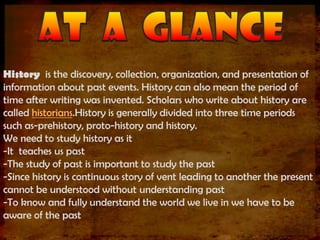
History is the discovery, collection, organization, and presentation of
information about past events. History can also mean the period of
time after writing was invented. Scholars who write about history are
called historians.History is generally divided into three time periods
such as-prehistory, proto-history and history.
We need to study history as it
-It teaches us past
-The study of past is important to study the past
-Since history is continuous story of vent leading to another the present
cannot be understood without understanding past
-To know and fully understand the world we live in we have to be
aware of the past
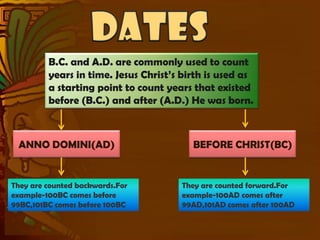
B.C. and A.D. are commonly used to count
         years in time. Jesus Christ’s birth is used as
         a starting point to count years that existed
         before (B.C.) and after (A.D.) He was born.


 ANNO DOMINI(AD)                         BEFORE CHRIST(BC)


They are counted backwards.For        They are counted forward.For
example-100BC comes before            example-100AD comes after
99BC,101BC comes before 100BC         99AD,101AD comes after 100AD
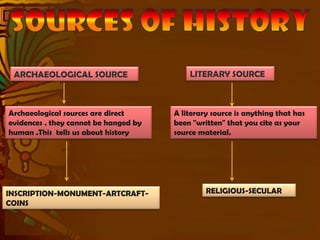
ARCHAEOLOGICAL SOURCE                     LITERARY SOURCE


Archaeological sources are direct      A literary source is anything that has
evidences . they cannot be hanged by   been "written" that you cite as your
human .This tells us about history     source material.


INSCRIPTION-MONUMENT-ARTCRAFT-                  RELIGIOUS-SECULAR
COINS
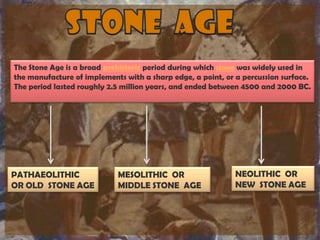
The Stone Age is a broad prehistoric period during which stone was widely used in
the manufacture of implements with a sharp edge, a point, or a percussion surface.
The period lasted roughly 2.5 million years, and ended between 4500 and 2000 BC.


PATHAEOLITHIC               MESOLITHIC OR                    NEOLITHIC OR
OR OLD STONE AGE            MIDDLE STONE AGE                 NEW STONE AGE
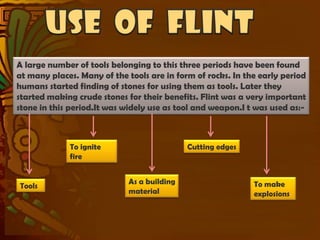
A large number of tools belonging to this three periods have been found
at many places. Many of the tools are in form of rocks. In the early period
humans started finding of stones for using them as tools. Later they
started making crude stones for their benefits. Flint was a very important
stone in this period.It was widely use as tool and weapon.I t was used as:-


             To ignite                       Cutting edges
             fire


                             As a building                   To make
Tools
                             material                        explosions
At some unknown time, before the beginning of settled life in the Neolithic
Revolution, humans learn how to make fire. No doubt the discovery
happens at many different times in many different places over a very long
period. The knowledge of how to create a spark, and to nurture it until it
develops into a flame, is an intrinsic skill of human society.

Almost without exception Stone Age tribes, surviving into modern times,
have evolved in isolation their own methods of making fire. It is likely that
the same was true when all humanity lived in the Stone Age.

The most common way of making fire is by friction, using a fire drill. This
consists of a stick of hard wood, pointed at one end, and a slab of softer
wood with a hole in it. If the point is placed in the cavity and rapidly
twirled (by rubbing between the palms, or by means of a bow string
looped round and pulled back and forth), the softer wood begins to
smoulder. Shreds of dry tinder, placed in the smouldering cavity, can be
carefully blown into a flame.
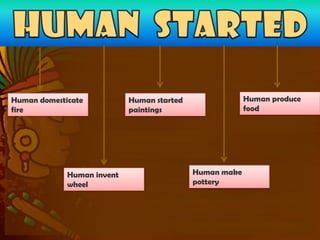
Human domesticate           Human started                Human produce
fire                        paintings                    food


             Human invent                   Human make
             wheel                          pottery
The Neolithic or New Stone Age lasted until around 4000 BC During this
period, remarkable progress has been made by human beings in the field
of science, technology and culture in general. The Neolithic village has its
social unit, so it is a rural civilization. He was replaced by the Chalcolithic
or Metal Age, which marked the inauguration of a civilization or an urban
civilization itself. She added to the self-reliance of farmers in the villages
of the New Stone Age. Therefore, the revolution brought by the man at the
age Chalcolithic is called the urban revolution. The first phase of the Metal
Age, which is call between 4000 BC and 1000 BC During this period,
urban centers or cities actually emerged. The second phase is called the
Bronze from the Bronze Age through a gap of time which is characterized
as a dark period. During these dark periods some Bronze Age civilization
disappeared or suffered from severe slump. It was during the Iron Age,
which began at the beginning of the previous period milllemium BC urban
civilization which came to be firmly established and consolidated.
History

History

  • 2.
    History is thediscovery, collection, organization, and presentation of information about past events. History can also mean the period of time after writing was invented. Scholars who write about history are called historians.History is generally divided into three time periods such as-prehistory, proto-history and history. We need to study history as it -It teaches us past -The study of past is important to study the past -Since history is continuous story of vent leading to another the present cannot be understood without understanding past -To know and fully understand the world we live in we have to be aware of the past
  • 3.
    B.C. and A.D.are commonly used to count years in time. Jesus Christ’s birth is used as a starting point to count years that existed before (B.C.) and after (A.D.) He was born. ANNO DOMINI(AD) BEFORE CHRIST(BC) They are counted backwards.For They are counted forward.For example-100BC comes before example-100AD comes after 99BC,101BC comes before 100BC 99AD,101AD comes after 100AD
  • 4.
    ARCHAEOLOGICAL SOURCE LITERARY SOURCE Archaeological sources are direct A literary source is anything that has evidences . they cannot be hanged by been "written" that you cite as your human .This tells us about history source material. INSCRIPTION-MONUMENT-ARTCRAFT- RELIGIOUS-SECULAR COINS
  • 5.
    The Stone Ageis a broad prehistoric period during which stone was widely used in the manufacture of implements with a sharp edge, a point, or a percussion surface. The period lasted roughly 2.5 million years, and ended between 4500 and 2000 BC. PATHAEOLITHIC MESOLITHIC OR NEOLITHIC OR OR OLD STONE AGE MIDDLE STONE AGE NEW STONE AGE
  • 6.
    A large numberof tools belonging to this three periods have been found at many places. Many of the tools are in form of rocks. In the early period humans started finding of stones for using them as tools. Later they started making crude stones for their benefits. Flint was a very important stone in this period.It was widely use as tool and weapon.I t was used as:- To ignite Cutting edges fire As a building To make Tools material explosions
  • 7.
    At some unknowntime, before the beginning of settled life in the Neolithic Revolution, humans learn how to make fire. No doubt the discovery happens at many different times in many different places over a very long period. The knowledge of how to create a spark, and to nurture it until it develops into a flame, is an intrinsic skill of human society. Almost without exception Stone Age tribes, surviving into modern times, have evolved in isolation their own methods of making fire. It is likely that the same was true when all humanity lived in the Stone Age. The most common way of making fire is by friction, using a fire drill. This consists of a stick of hard wood, pointed at one end, and a slab of softer wood with a hole in it. If the point is placed in the cavity and rapidly twirled (by rubbing between the palms, or by means of a bow string looped round and pulled back and forth), the softer wood begins to smoulder. Shreds of dry tinder, placed in the smouldering cavity, can be carefully blown into a flame.
  • 8.
    Human domesticate Human started Human produce fire paintings food Human invent Human make wheel pottery
  • 9.
    The Neolithic orNew Stone Age lasted until around 4000 BC During this period, remarkable progress has been made by human beings in the field of science, technology and culture in general. The Neolithic village has its social unit, so it is a rural civilization. He was replaced by the Chalcolithic or Metal Age, which marked the inauguration of a civilization or an urban civilization itself. She added to the self-reliance of farmers in the villages of the New Stone Age. Therefore, the revolution brought by the man at the age Chalcolithic is called the urban revolution. The first phase of the Metal Age, which is call between 4000 BC and 1000 BC During this period, urban centers or cities actually emerged. The second phase is called the Bronze from the Bronze Age through a gap of time which is characterized as a dark period. During these dark periods some Bronze Age civilization disappeared or suffered from severe slump. It was during the Iron Age, which began at the beginning of the previous period milllemium BC urban civilization which came to be firmly established and consolidated.