



CRICOSNo.00213J
Populism and Globalization: Towards a Post-
Global Era?
Presentation to School of Media and Public Affairs, George Washington
University, Washington, DC, 22 January 2019
Professor Terry Flew, Creative Industries Faculty, Queensland University of
Technology
CRICOSNo.00213J
CRICOSNo.00213J
CRICOSNo.00213J
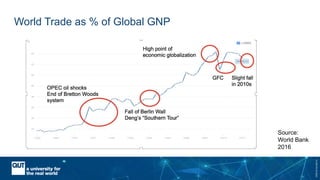
World Trade as % of Global GNP
Source:
World Bank
2016
CRICOSNo.00213J
Definitions of globalization
• Globalization ‘refers both to the compression of the world and the intensification
of consciousness of the world as a whole’ (Robertson, 1992, p. 8);
• involves ‘the intensification of worldwide social relations which link distant
localities’ (Giddens, 1990, p. 64);
• ‘denotes the expanding scale, growing magnitude, speeding up and deepening
impact of transcontinental flows and patterns of social interaction’ (Held &
McGrew, 2002, p. 1);
• ‘refers to the expansion and intensification of social relations and consciousness
across world-time and world-space’ (Steger, 2009, p. 15).
CRICOSNo.00213J
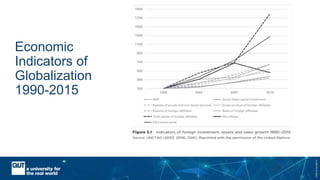
Economic
Indicators of
Globalization
1990-2015
CRICOSNo.00213J
Globalization: more than economics
• ‘Globalization as a discourse gave birth to a new pensee unique, a TINA (There
Is No Alternative) logic of political economy for which adaptation to the
“demands” of “international markets” is both good for everybody and the only
possible policy anyway.’ (Wolfgang Streeck, 2017)
• ‘Globalization is … a shift in our very life circumstances. It is the way we now
live’ (Giddens, 2002)
• ‘Globality is an unavoidable condition of human intercourse at the close of the
twentieth century’ (Beck, 2000)
• ‘I hear people say we have to stop and debate globalization. You might as well
debate whether autumn should follow summer.’ (Tony Blair, keynote speech to
British Labour Party Conference, 2005)
CRICOSNo.00213J
Communication and culture
• Internet and digital networks at core of globalization, but this is not synonymous
with cultural imperialism since:
• Alternative production centres are emerging that challenge ‘Global
Hollywood’
• Glocalization is a necessary response to operating in multiple markets
• Globalization is associated with a proliferation of cultural identities
• Global media and communication flows promote both cultural hybridity and
cosmopolitan, non-territorial forms of collective identity
CRICOSNo.00213J
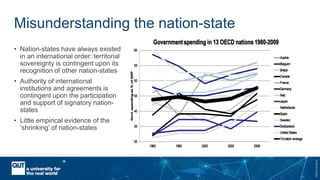
Misunderstanding the nation-state
• Nation-states have always existed
in an international order: territorial
sovereignty is contingent upon its
recognition of other nation-states
• Authority of international
institutions and agreements is
contingent upon the participation
and support of signatory nation-
states
• Little empirical evidence of the
‘shrinking’ of nation-states
CRICOSNo.00213J
Fallacy of linearity
• Globalization points to a relativization of spatial scales, rather than displacement
of the national by the global
• Globalization has typically been driven by active promotion by nation-states (e.g.
Chinese accession to WTO in 2001 enabled internal restructuring of Chinese
economy)
• Globalization has enabling as well as constraining dimensions for nation-states
e.g. industrial policy, R&D spending, cultural and media ‘soft power’ initiatives
CRICOSNo.00213J
Migration and identity
• Risk of overstating actual levels of international migration: about 2-3 per cent of
global population, which has been consistent over 50 years
• Cultural hybridity paradigm suggests ‘cultural supermarket’ notion of identity
(Gordon Mathews)
• Role of the state in investing in, institutionalizing and ‘refurbishing’ national
identities – by no means a static concept
• Cosmopolitanism can be seen as the preserve of transnational elites: ‘elites are
cosmopolitan; people are local’ (Castells, 1996)
CRICOSNo.00213J
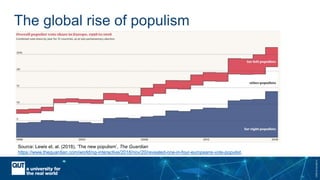
The global rise of populism
Source: Lewis et. al. (2018), ‘The new populism’, The Guardian
https://www.theguardian.com/world/ng-interactive/2018/nov/20/revealed-one-in-four-europeans-vote-populist.
CRICOSNo.00213J
The ‘Four D’s’ of national populism
1. Distrust of political elites, anger at
corruption, and perceived exclusion from the
institutions of liberal democracy;
2. Deprivation, in the face of rising economic
inequalities, stagnant real wages, job
insecurity and declining social provision;
3. Destruction – real or perceived – of
national cultures and traditions, value
systems and authority structures, and
historically embedded ‘ways of life’;
4. Dealignment of citizens as voters from the
major political parties, and from the class
and other societal cleavages associated with
those parties.
Roger Eatwell & Matthew Goodwin (2018),
National Populism: the revolt against liberal
democracy
• Each national populist party has its own local
particularities but there are common themes.
In the aggregate, national populists oppose
or reject liberal globalization, mass
immigration and the consensus politics of
recent times. They promise instead to give
voice to those who feel that they have been
neglected, if not held in contempt, by
increasingly distant elites. (This is distinct
from left-wing populism, which typically
prioritises class allegiance over national
attachment.)
Matthew Goodwin (2018), ‘Why national
populism is here to stay’, New Statesman,
https://www.newstatesman.com/2018/10/why-
national-populism-here-stay.
CRICOSNo.00213J
Ambiguities of nationalism
• Nationalism ‘is not only not a spent force; it isn’t necessarily a reactionary or
progressive force, politically’ (Stuart Hall (1993), ‘Culture, community, nation’,
Cultural Studies, p. 355).
• ‘Attachments to nation, like those to tribe, region, place, religion, were thought to
be archaic particularisms which capitalist modernity would, gradually or violently,
dissolve or supercede. Socialism, the 'counter-culture of modernity' in Zygmunt
Bauman's phrase, was equally predicated on the subsumption of these
particularisms into a more cosmopolitan or internationalist consciousness’
(Stuart Hall (1993), ‘Culture, community, nation’, Cultural Studies, p. 353).
CRICOSNo.00213J
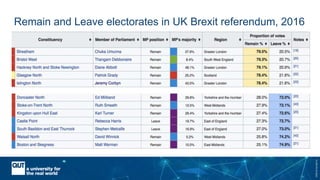
Remain and Leave electorates in UK Brexit referendum, 2016
CRICOSNo.00213J
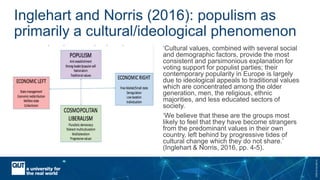
Inglehart and Norris (2016): populism as
primarily a cultural/ideological phenomenon
‘Cultural values, combined with several social
and demographic factors, provide the most
consistent and parsimonious explanation for
voting support for populist parties; their
contemporary popularity in Europe is largely
due to ideological appeals to traditional values
which are concentrated among the older
generation, men, the religious, ethnic
majorities, and less educated sectors of
society.
‘We believe that these are the groups most
likely to feel that they have become strangers
from the predominant values in their own
country, left behind by progressive tides of
cultural change which they do not share.’
(Inglehart & Norris, 2016, pp. 4-5).
CRICOSNo.00213J
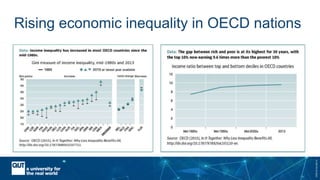
Rising economic inequality in OECD nations
CRICOSNo.00213J
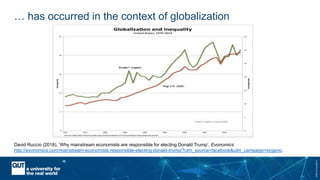
… has occurred in the context of globalization
David Ruccio (2018), ‘Why mainstream economists are responsible for electing Donald Trump’, Evonomics
http://evonomics.com/mainstream-economists-responsible-electing-donald-trump/?utm_source=facebook&utm_campaign=organic.
CRICOSNo.00213J
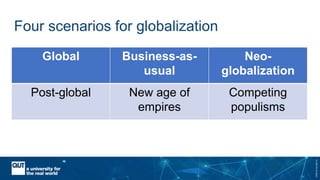
Four scenarios for globalization
Global Business-as-
usual
Neo-
globalization
Post-global New age of
empires
Competing
populisms
CRICOSNo.00213J
1: Business-as-usual (sort of)
• Rise of populist parties and leaders proves to be short-lived, as they prove
unable to move from protest to government (Muller, 2016)
• Insofar as they become parties of government, they do so by moderating their
populist program (e.g. SYRIZA in Greece, Workers’ Party in Brazil, Socialist
Party in Chile)
• Reasons why it would not be business-as-usual:
• Nation-states will be under far more pressure to be open and transparent
about trade agreements
• Parties of the centre-left are under considerable pressure to be more radical
if they are to survive
CRICOSNo.00213J
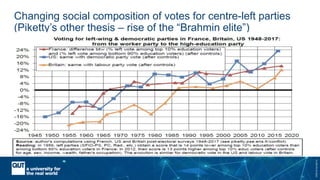
Changing social composition of votes for centre-left parties
(Piketty’s other thesis – rise of the “Brahmin elite”)
CRICOSNo.00213J
2: The new age of empires?
• ‘Clash of civilizations’ (Samuel Huntington) vs. ‘Davos Man’
• ’Anglosphere’/’Empire 2.0’
• Dugin – ‘Eurasia Union’ – influential with Putin
• Unlikely to get significant influence, but two possible areas of influence:
• Renewed tensions with China
• Tensions within the European Union
• Poor scenario for independent journalism and minority populations –
‘enemies of the people’
CRICOSNo.00213J
3. Era of competing populisms
• Populism becoming influential on the left as well as the right (Chantal Mouffe,
Towards a Left Populism)
• ‘Overton Window’ – opportunity to shift the centre of political gravity
• Populist economic programs quite popular with voters
• Likely to lead to stronger regulation of corporations
• Shifts in the internet age:
• Decline in mainstream media and rise of social news
• Capacity to crowdsource political funding on a large scale
CRICOSNo.00213J
4. Neo-globalization
• Global challenges remain, and there is the scope to balance the positives of
globalization while addressing the negatives
• Challenge is democratizing multilateral institutions and frameworks
• World Social Forum – risk of overstating degree to which it is ‘globalization from
below’
• Difficulties in developing global civil society
• Nation-states demanding reform of multilateral institutions
CRICOSNo.00213J
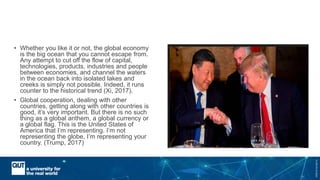
• Whether you like it or not, the global economy
is the big ocean that you cannot escape from.
Any attempt to cut off the flow of capital,
technologies, products, industries and people
between economies, and channel the waters
in the ocean back into isolated lakes and
creeks is simply not possible. Indeed, it runs
counter to the historical trend (Xi, 2017).
• Global cooperation, dealing with other
countries, getting along with other countries is
good, it’s very important. But there is no such
thing as a global anthem, a global currency or
a global flag. This is the United States of
America that I’m representing. I’m not
representing the globe, I’m representing your
country. (Trump, 2017)
CRICOSNo.00213J
CRICOSNo.00213J
CRICOSNo.00213J

Populism and globalization gwu

  • 1.
    CRICOSNo.00213J Populism and Globalization:Towards a Post- Global Era? Presentation to School of Media and Public Affairs, George Washington University, Washington, DC, 22 January 2019 Professor Terry Flew, Creative Industries Faculty, Queensland University of Technology
  • 2.
  • 3.
  • 4.
    CRICOSNo.00213J World Trade as% of Global GNP Source: World Bank 2016
  • 5.
    CRICOSNo.00213J Definitions of globalization •Globalization ‘refers both to the compression of the world and the intensification of consciousness of the world as a whole’ (Robertson, 1992, p. 8); • involves ‘the intensification of worldwide social relations which link distant localities’ (Giddens, 1990, p. 64); • ‘denotes the expanding scale, growing magnitude, speeding up and deepening impact of transcontinental flows and patterns of social interaction’ (Held & McGrew, 2002, p. 1); • ‘refers to the expansion and intensification of social relations and consciousness across world-time and world-space’ (Steger, 2009, p. 15).
  • 6.
  • 7.
    CRICOSNo.00213J Globalization: more thaneconomics • ‘Globalization as a discourse gave birth to a new pensee unique, a TINA (There Is No Alternative) logic of political economy for which adaptation to the “demands” of “international markets” is both good for everybody and the only possible policy anyway.’ (Wolfgang Streeck, 2017) • ‘Globalization is … a shift in our very life circumstances. It is the way we now live’ (Giddens, 2002) • ‘Globality is an unavoidable condition of human intercourse at the close of the twentieth century’ (Beck, 2000) • ‘I hear people say we have to stop and debate globalization. You might as well debate whether autumn should follow summer.’ (Tony Blair, keynote speech to British Labour Party Conference, 2005)
  • 8.
    CRICOSNo.00213J Communication and culture •Internet and digital networks at core of globalization, but this is not synonymous with cultural imperialism since: • Alternative production centres are emerging that challenge ‘Global Hollywood’ • Glocalization is a necessary response to operating in multiple markets • Globalization is associated with a proliferation of cultural identities • Global media and communication flows promote both cultural hybridity and cosmopolitan, non-territorial forms of collective identity
  • 9.
    CRICOSNo.00213J Misunderstanding the nation-state •Nation-states have always existed in an international order: territorial sovereignty is contingent upon its recognition of other nation-states • Authority of international institutions and agreements is contingent upon the participation and support of signatory nation- states • Little empirical evidence of the ‘shrinking’ of nation-states
  • 10.
    CRICOSNo.00213J Fallacy of linearity •Globalization points to a relativization of spatial scales, rather than displacement of the national by the global • Globalization has typically been driven by active promotion by nation-states (e.g. Chinese accession to WTO in 2001 enabled internal restructuring of Chinese economy) • Globalization has enabling as well as constraining dimensions for nation-states e.g. industrial policy, R&D spending, cultural and media ‘soft power’ initiatives
  • 11.
    CRICOSNo.00213J Migration and identity •Risk of overstating actual levels of international migration: about 2-3 per cent of global population, which has been consistent over 50 years • Cultural hybridity paradigm suggests ‘cultural supermarket’ notion of identity (Gordon Mathews) • Role of the state in investing in, institutionalizing and ‘refurbishing’ national identities – by no means a static concept • Cosmopolitanism can be seen as the preserve of transnational elites: ‘elites are cosmopolitan; people are local’ (Castells, 1996)
  • 12.
    CRICOSNo.00213J The global riseof populism Source: Lewis et. al. (2018), ‘The new populism’, The Guardian https://www.theguardian.com/world/ng-interactive/2018/nov/20/revealed-one-in-four-europeans-vote-populist.
  • 13.
    CRICOSNo.00213J The ‘Four D’s’of national populism 1. Distrust of political elites, anger at corruption, and perceived exclusion from the institutions of liberal democracy; 2. Deprivation, in the face of rising economic inequalities, stagnant real wages, job insecurity and declining social provision; 3. Destruction – real or perceived – of national cultures and traditions, value systems and authority structures, and historically embedded ‘ways of life’; 4. Dealignment of citizens as voters from the major political parties, and from the class and other societal cleavages associated with those parties. Roger Eatwell & Matthew Goodwin (2018), National Populism: the revolt against liberal democracy • Each national populist party has its own local particularities but there are common themes. In the aggregate, national populists oppose or reject liberal globalization, mass immigration and the consensus politics of recent times. They promise instead to give voice to those who feel that they have been neglected, if not held in contempt, by increasingly distant elites. (This is distinct from left-wing populism, which typically prioritises class allegiance over national attachment.) Matthew Goodwin (2018), ‘Why national populism is here to stay’, New Statesman, https://www.newstatesman.com/2018/10/why- national-populism-here-stay.
  • 14.
    CRICOSNo.00213J Ambiguities of nationalism •Nationalism ‘is not only not a spent force; it isn’t necessarily a reactionary or progressive force, politically’ (Stuart Hall (1993), ‘Culture, community, nation’, Cultural Studies, p. 355). • ‘Attachments to nation, like those to tribe, region, place, religion, were thought to be archaic particularisms which capitalist modernity would, gradually or violently, dissolve or supercede. Socialism, the 'counter-culture of modernity' in Zygmunt Bauman's phrase, was equally predicated on the subsumption of these particularisms into a more cosmopolitan or internationalist consciousness’ (Stuart Hall (1993), ‘Culture, community, nation’, Cultural Studies, p. 353).
  • 15.
    CRICOSNo.00213J Remain and Leaveelectorates in UK Brexit referendum, 2016
  • 16.
    CRICOSNo.00213J Inglehart and Norris(2016): populism as primarily a cultural/ideological phenomenon ‘Cultural values, combined with several social and demographic factors, provide the most consistent and parsimonious explanation for voting support for populist parties; their contemporary popularity in Europe is largely due to ideological appeals to traditional values which are concentrated among the older generation, men, the religious, ethnic majorities, and less educated sectors of society. ‘We believe that these are the groups most likely to feel that they have become strangers from the predominant values in their own country, left behind by progressive tides of cultural change which they do not share.’ (Inglehart & Norris, 2016, pp. 4-5).
  • 17.
  • 18.
    CRICOSNo.00213J … has occurredin the context of globalization David Ruccio (2018), ‘Why mainstream economists are responsible for electing Donald Trump’, Evonomics http://evonomics.com/mainstream-economists-responsible-electing-donald-trump/?utm_source=facebook&utm_campaign=organic.
  • 19.
    CRICOSNo.00213J Four scenarios forglobalization Global Business-as- usual Neo- globalization Post-global New age of empires Competing populisms
  • 20.
    CRICOSNo.00213J 1: Business-as-usual (sortof) • Rise of populist parties and leaders proves to be short-lived, as they prove unable to move from protest to government (Muller, 2016) • Insofar as they become parties of government, they do so by moderating their populist program (e.g. SYRIZA in Greece, Workers’ Party in Brazil, Socialist Party in Chile) • Reasons why it would not be business-as-usual: • Nation-states will be under far more pressure to be open and transparent about trade agreements • Parties of the centre-left are under considerable pressure to be more radical if they are to survive
  • 21.
    CRICOSNo.00213J Changing social compositionof votes for centre-left parties (Piketty’s other thesis – rise of the “Brahmin elite”)
  • 22.
    CRICOSNo.00213J 2: The newage of empires? • ‘Clash of civilizations’ (Samuel Huntington) vs. ‘Davos Man’ • ’Anglosphere’/’Empire 2.0’ • Dugin – ‘Eurasia Union’ – influential with Putin • Unlikely to get significant influence, but two possible areas of influence: • Renewed tensions with China • Tensions within the European Union • Poor scenario for independent journalism and minority populations – ‘enemies of the people’
  • 23.
    CRICOSNo.00213J 3. Era ofcompeting populisms • Populism becoming influential on the left as well as the right (Chantal Mouffe, Towards a Left Populism) • ‘Overton Window’ – opportunity to shift the centre of political gravity • Populist economic programs quite popular with voters • Likely to lead to stronger regulation of corporations • Shifts in the internet age: • Decline in mainstream media and rise of social news • Capacity to crowdsource political funding on a large scale
  • 24.
    CRICOSNo.00213J 4. Neo-globalization • Globalchallenges remain, and there is the scope to balance the positives of globalization while addressing the negatives • Challenge is democratizing multilateral institutions and frameworks • World Social Forum – risk of overstating degree to which it is ‘globalization from below’ • Difficulties in developing global civil society • Nation-states demanding reform of multilateral institutions
  • 25.
    CRICOSNo.00213J • Whether youlike it or not, the global economy is the big ocean that you cannot escape from. Any attempt to cut off the flow of capital, technologies, products, industries and people between economies, and channel the waters in the ocean back into isolated lakes and creeks is simply not possible. Indeed, it runs counter to the historical trend (Xi, 2017). • Global cooperation, dealing with other countries, getting along with other countries is good, it’s very important. But there is no such thing as a global anthem, a global currency or a global flag. This is the United States of America that I’m representing. I’m not representing the globe, I’m representing your country. (Trump, 2017)
  • 26.
  • 27.
  • 28.