
NUCLEATE BOILINGNUCLEATE BOILING
PREPARED BY- TARUN B PATELPREPARED BY- TARUN B PATEL
ME I ENERGY ENGME I ENERGY ENG
GEC VALSADGEC VALSAD
140190739009140190739009
GUIDEDBY-PROF K V MODIGUIDEDBY-PROF K V MODI
PROF R S ENGINEERPROF R S ENGINEER
BOILINGBOILING
BOILING…BOILING…
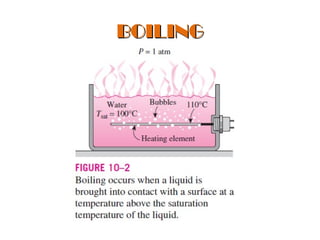
 Boiling is associated with transformation of liquid to vapor at a
solid/liquid interface due to convection heat transfer from the solid.
 Agitation of fluid by vapor bubbles provides for large convection
coefficients and hence large heat fluxes at low-to-moderate surface-
to-fluid temperature differences
 Boiling process is characterized by formation of vapor bubbles,
which grow and subsequently detach from the surface
 Bubble growth and dynamics depend on several factors such as
excess temp., nature of surface, thermo physical properties of fluid
(e.g. surface tension, liquid density, vapor density, etc.). Hence,
heat transfer coefficient also depends on those factors.
re)temperatu(excesswhere
)(:rateferHeat trans
satwe
esatws
TTT
ThTThq
−=∆
∆=−=′′
ITS IMPORTANTANCEITS IMPORTANTANCE
• Production of steam
• Absorption of heat in refrigeration and air
conditioning system
• Concentration,dehydration and drying of
food and materials
• Distillation and refining of liquids
• Development in nuclear reactor,space
craft and rocket.
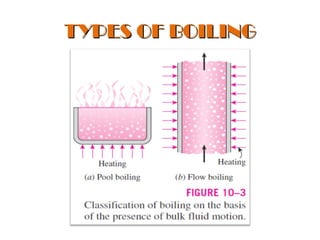
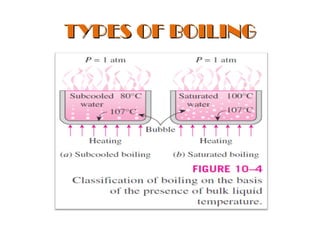
TYPES OF BOILINGTYPES OF BOILING
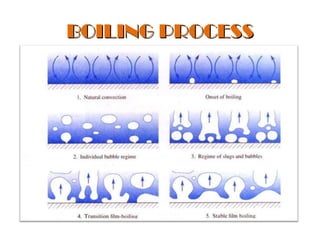
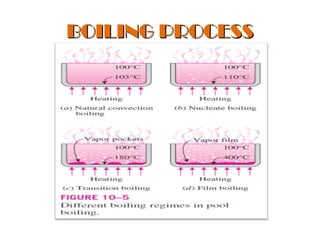
BOILING PROCESSBOILING PROCESS
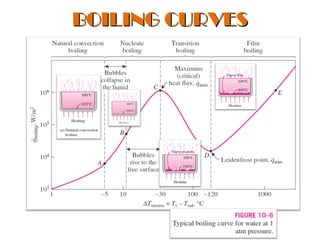
BOILING CURVESBOILING CURVES
10
Natural ConvectionNatural Convection BoilingBoiling
(to Point A on the Boiling Curve)
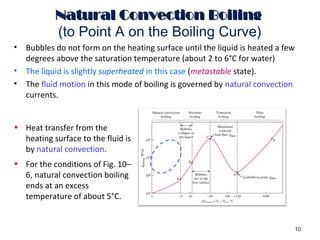
• Bubbles do not form on the heating surface until the liquid is heated a few
degrees above the saturation temperature (about 2 to 6°C for water)
• The liquid is slightly superheated in this case (metastable state).
• The fluid motion in this mode of boiling is governed by natural convection
currents.
• Heat transfer from the
heating surface to the fluid is
by natural convection.
• For the conditions of Fig. 10–
6, natural convection boiling
ends at an excess
temperature of about 5°C.
11
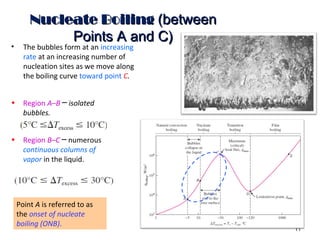
• The bubbles form at an increasing
rate at an increasing number of
nucleation sites as we move along
the boiling curve toward point C.
Nucleate BoilingNucleate Boiling (between(between
Points A and C)Points A and C)
• Region A–B ─ isolated
bubbles.
• Region B–C numerous─
continuous columns of
vapor in the liquid.
Point A is referred to as
the onset of nucleate
boiling (ONB).
12
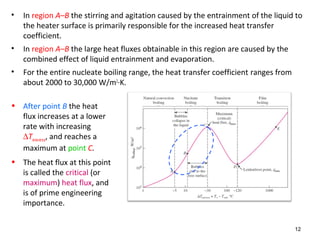
• In region A–B the stirring and agitation caused by the entrainment of the liquid to
the heater surface is primarily responsible for the increased heat transfer
coefficient.
• In region A–B the large heat fluxes obtainable in this region are caused by the
combined effect of liquid entrainment and evaporation.
• For the entire nucleate boiling range, the heat transfer coefficient ranges from
about 2000 to 30,000 W/m2
·K.
• After point B the heat
flux increases at a lower
rate with increasing
∆Texcess, and reaches a
maximum at point C.
• The heat flux at this point
is called the critical (or
maximum) heat flux, and
is of prime engineering
importance.
13
Heat Transfer Correlations inHeat Transfer Correlations in
Pool BoilingPool Boiling
• Boiling regimes differ considerably in their character.
• Different heat transfer relations need to be used for different boiling regimes.
• In the natural convection boiling regime heat transfer rates can be accurately
determined using natural convection relations.
• No general theoretical relations for heat
transfer in the nucleate boiling regime is
available.
• Experimental based correlations are used.
• The rate of heat transfer strongly depends
on the nature of nucleation and the type
and the condition of the heated surface.
Nucleate Boiling
14
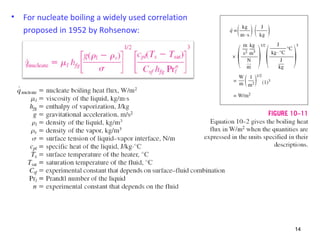
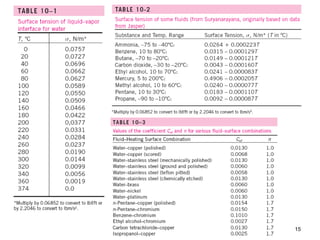
• For nucleate boiling a widely used correlation
proposed in 1952 by Rohsenow:
15
16
PeakPeak Heat FluxHeat Flux
• The maximum (or critical) heat flux (CHF) in nucleate pool boiling:
Ccr is a constant whose value depends on the heater geometry, but generally is about
0.15.
• The CHF is independent of the fluid–heating surface combination, as well as the
viscosity, thermal conductivity, and the specific heat of the liquid.
• The CHF increases with pressure up to about one-third of the critical pressure, and
then starts to decrease and becomes zero at the critical pressure.
• The CHF is proportional to hfg, and large maximum heat fluxes can be obtained using
fluids with a large enthalpy of vaporization, such as water.
NUCLEATE BOILINGNUCLEATE BOILING
EXAMPLEEXAMPLE
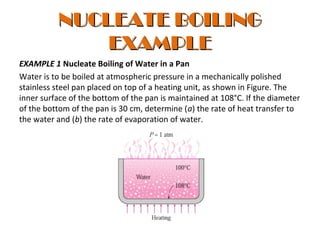
EXAMPLE 1 Nucleate Boiling of Water in a Pan
Water is to be boiled at atmospheric pressure in a mechanically polished
stainless steel pan placed on top of a heating unit, as shown in Figure. The
inner surface of the bottom of the pan is maintained at 108°C. If the diameter
of the bottom of the pan is 30 cm, determine (a) the rate of heat transfer to
the water and (b) the rate of evaporation of water.
CONTI….CONTI….
EXAMPLE 2 Peak Heat Flux in Nucleate Boiling
Water in a tank is to be boiled at sea level by a 1-cm-diameter nickel plated
steel heating element equipped with electrical resistance wires inside, as
shown in Figure. Determine the maximum heat flux that can be attained in
the nucleate boiling regime and the surface temperature of the heater
Surface in that case.
THANK YOUTHANK YOU

nucleate boiling

  • 1.
    NUCLEATE BOILINGNUCLEATE BOILING PREPAREDBY- TARUN B PATELPREPARED BY- TARUN B PATEL ME I ENERGY ENGME I ENERGY ENG GEC VALSADGEC VALSAD 140190739009140190739009 GUIDEDBY-PROF K V MODIGUIDEDBY-PROF K V MODI PROF R S ENGINEERPROF R S ENGINEER
  • 2.
  • 3.
    BOILING…BOILING…  Boiling isassociated with transformation of liquid to vapor at a solid/liquid interface due to convection heat transfer from the solid.  Agitation of fluid by vapor bubbles provides for large convection coefficients and hence large heat fluxes at low-to-moderate surface- to-fluid temperature differences  Boiling process is characterized by formation of vapor bubbles, which grow and subsequently detach from the surface  Bubble growth and dynamics depend on several factors such as excess temp., nature of surface, thermo physical properties of fluid (e.g. surface tension, liquid density, vapor density, etc.). Hence, heat transfer coefficient also depends on those factors. re)temperatu(excesswhere )(:rateferHeat trans satwe esatws TTT ThTThq −=∆ ∆=−=′′
  • 4.
    ITS IMPORTANTANCEITS IMPORTANTANCE •Production of steam • Absorption of heat in refrigeration and air conditioning system • Concentration,dehydration and drying of food and materials • Distillation and refining of liquids • Development in nuclear reactor,space craft and rocket.
  • 5.
  • 6.
  • 7.
  • 8.
  • 9.
  • 10.
    10 Natural ConvectionNatural ConvectionBoilingBoiling (to Point A on the Boiling Curve) • Bubbles do not form on the heating surface until the liquid is heated a few degrees above the saturation temperature (about 2 to 6°C for water) • The liquid is slightly superheated in this case (metastable state). • The fluid motion in this mode of boiling is governed by natural convection currents. • Heat transfer from the heating surface to the fluid is by natural convection. • For the conditions of Fig. 10– 6, natural convection boiling ends at an excess temperature of about 5°C.
  • 11.
    11 • The bubblesform at an increasing rate at an increasing number of nucleation sites as we move along the boiling curve toward point C. Nucleate BoilingNucleate Boiling (between(between Points A and C)Points A and C) • Region A–B ─ isolated bubbles. • Region B–C numerous─ continuous columns of vapor in the liquid. Point A is referred to as the onset of nucleate boiling (ONB).
  • 12.
    12 • In regionA–B the stirring and agitation caused by the entrainment of the liquid to the heater surface is primarily responsible for the increased heat transfer coefficient. • In region A–B the large heat fluxes obtainable in this region are caused by the combined effect of liquid entrainment and evaporation. • For the entire nucleate boiling range, the heat transfer coefficient ranges from about 2000 to 30,000 W/m2 ·K. • After point B the heat flux increases at a lower rate with increasing ∆Texcess, and reaches a maximum at point C. • The heat flux at this point is called the critical (or maximum) heat flux, and is of prime engineering importance.
  • 13.
    13 Heat Transfer CorrelationsinHeat Transfer Correlations in Pool BoilingPool Boiling • Boiling regimes differ considerably in their character. • Different heat transfer relations need to be used for different boiling regimes. • In the natural convection boiling regime heat transfer rates can be accurately determined using natural convection relations. • No general theoretical relations for heat transfer in the nucleate boiling regime is available. • Experimental based correlations are used. • The rate of heat transfer strongly depends on the nature of nucleation and the type and the condition of the heated surface. Nucleate Boiling
  • 14.
    14 • For nucleateboiling a widely used correlation proposed in 1952 by Rohsenow:
  • 15.
  • 16.
    16 PeakPeak Heat FluxHeatFlux • The maximum (or critical) heat flux (CHF) in nucleate pool boiling: Ccr is a constant whose value depends on the heater geometry, but generally is about 0.15. • The CHF is independent of the fluid–heating surface combination, as well as the viscosity, thermal conductivity, and the specific heat of the liquid. • The CHF increases with pressure up to about one-third of the critical pressure, and then starts to decrease and becomes zero at the critical pressure. • The CHF is proportional to hfg, and large maximum heat fluxes can be obtained using fluids with a large enthalpy of vaporization, such as water.
  • 17.
    NUCLEATE BOILINGNUCLEATE BOILING EXAMPLEEXAMPLE EXAMPLE1 Nucleate Boiling of Water in a Pan Water is to be boiled at atmospheric pressure in a mechanically polished stainless steel pan placed on top of a heating unit, as shown in Figure. The inner surface of the bottom of the pan is maintained at 108°C. If the diameter of the bottom of the pan is 30 cm, determine (a) the rate of heat transfer to the water and (b) the rate of evaporation of water.
  • 19.
    CONTI….CONTI…. EXAMPLE 2 PeakHeat Flux in Nucleate Boiling Water in a tank is to be boiled at sea level by a 1-cm-diameter nickel plated steel heating element equipped with electrical resistance wires inside, as shown in Figure. Determine the maximum heat flux that can be attained in the nucleate boiling regime and the surface temperature of the heater Surface in that case.
  • 21.