A SHORT INTRODUCTION TO
TWO-PHASE FLOWS
Condensation and boiling heat transfer
Hervé Lemonnier
DM2S/STMF/LIEFT, CEA/Grenoble, 38054 Grenoble Cedex 9
Ph. +33(0)4 38 78 45 40, herve.lemonnier@cea.fr
herve.lemonnier.sci.free.fr/TPF/TPF.htm
ECP, 2011-2012
HEAT TRANSFER MECHANISMS
• Condensation heat transfer:
– drop condensation
– film condensation
• Boiling heat transfer:
– Pool boiling, natural convection, ébullition en vase
– Convective boiling, forced convection,
• Only for pure fluids. For mixtures see specific studies. Usually in a
mixture, h ⩽
P
xihi and possibly  hi.
• Many definitions of heat transfer coefficient,
h[W/m2
/K] =
q
∆T
, Nu =
hL
k
, k(T?)
Condensation and boiling heat transfer 1/42
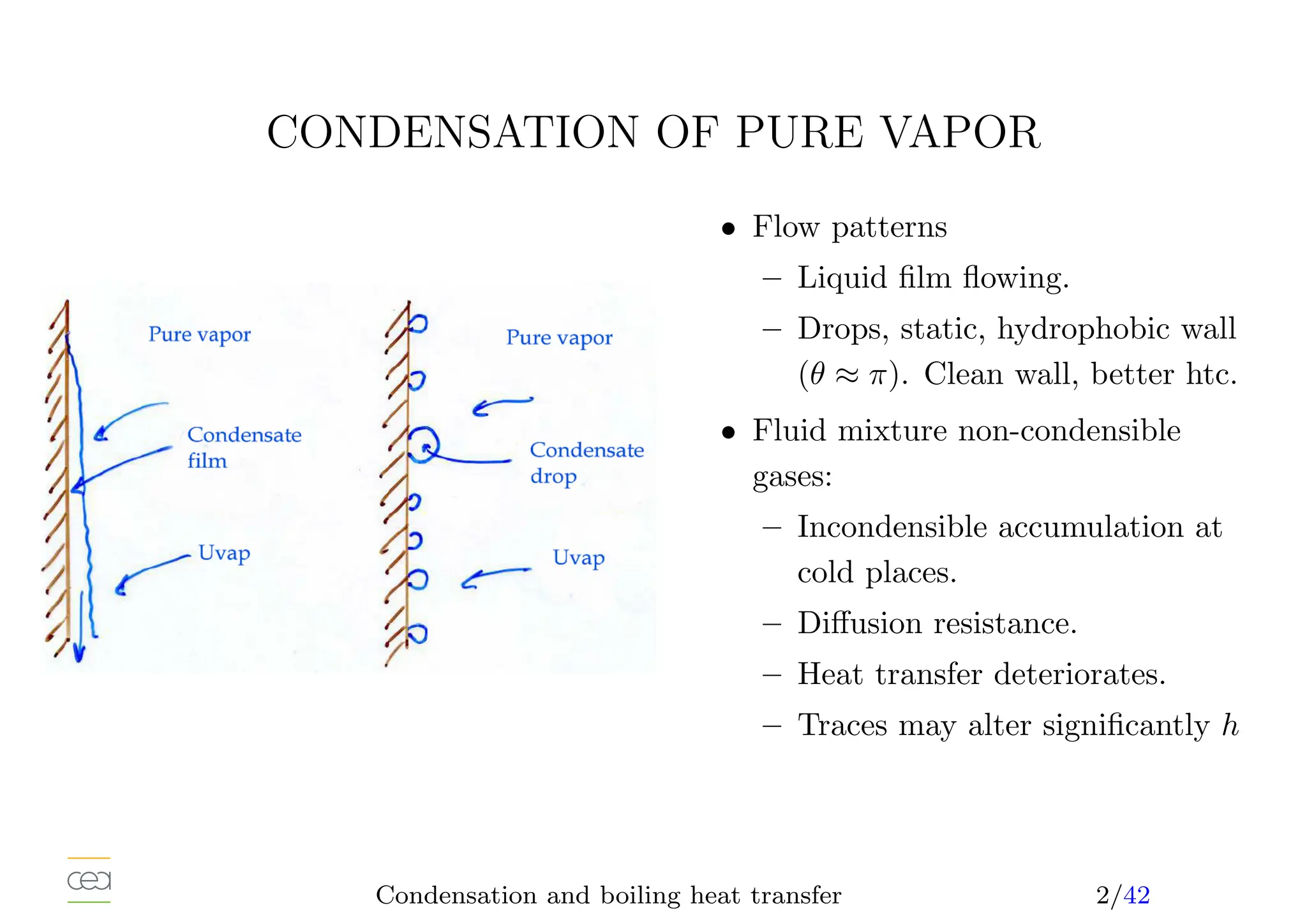
CONDENSATION OF PURE VAPOR
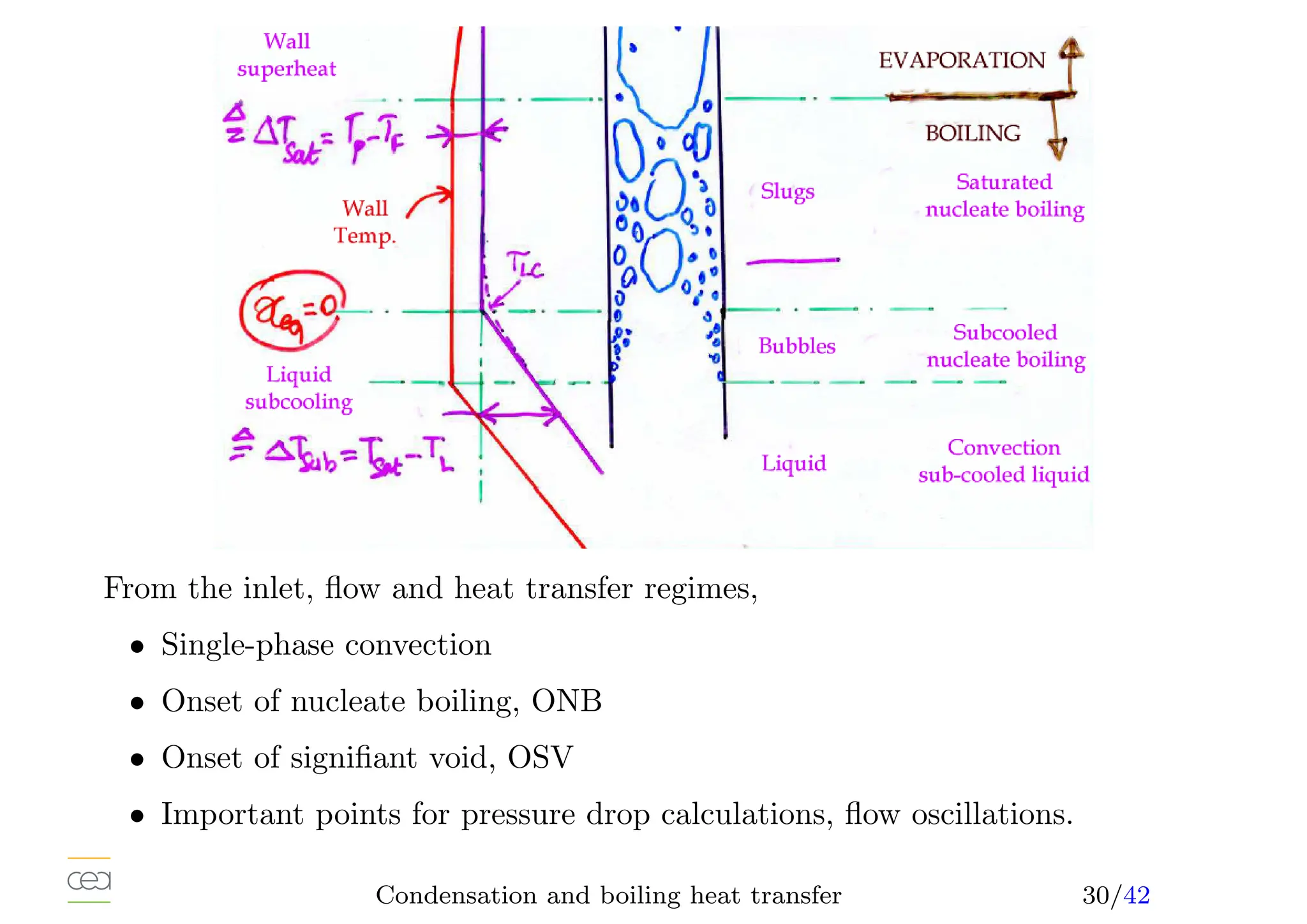
• Flow patterns
– Liquid film flowing.
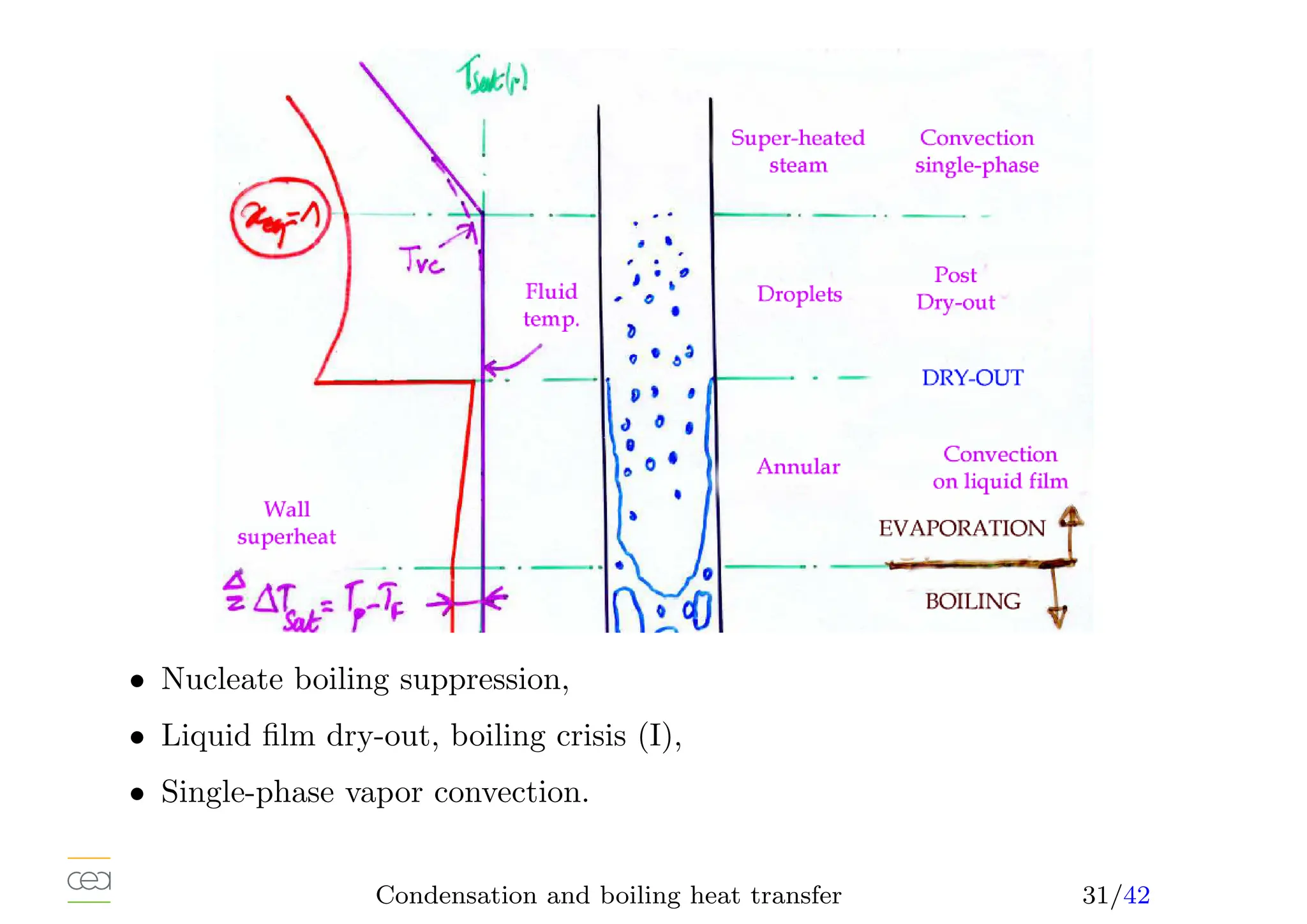
– Drops, static, hydrophobic wall
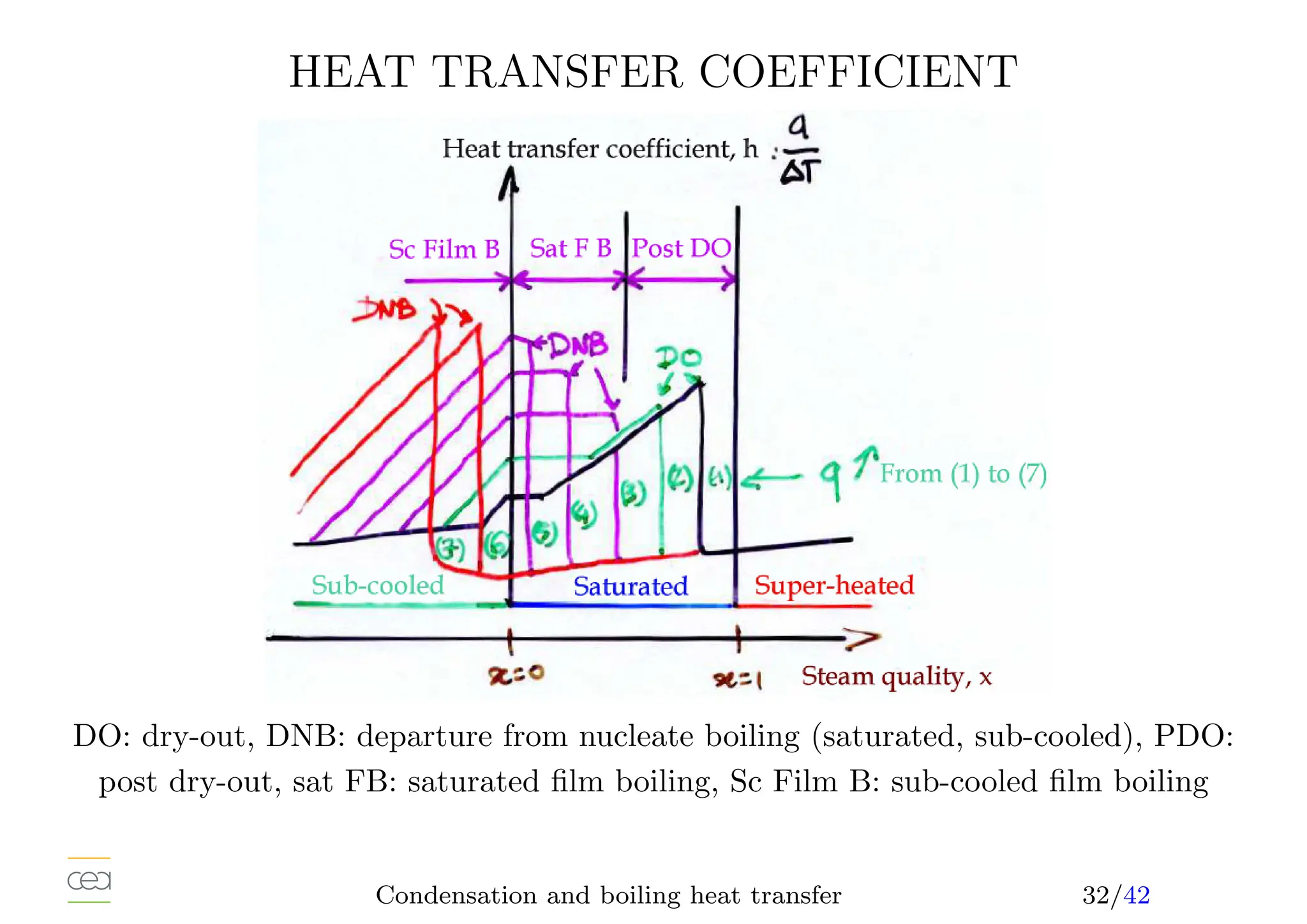
(θ ≈ π). Clean wall, better htc.
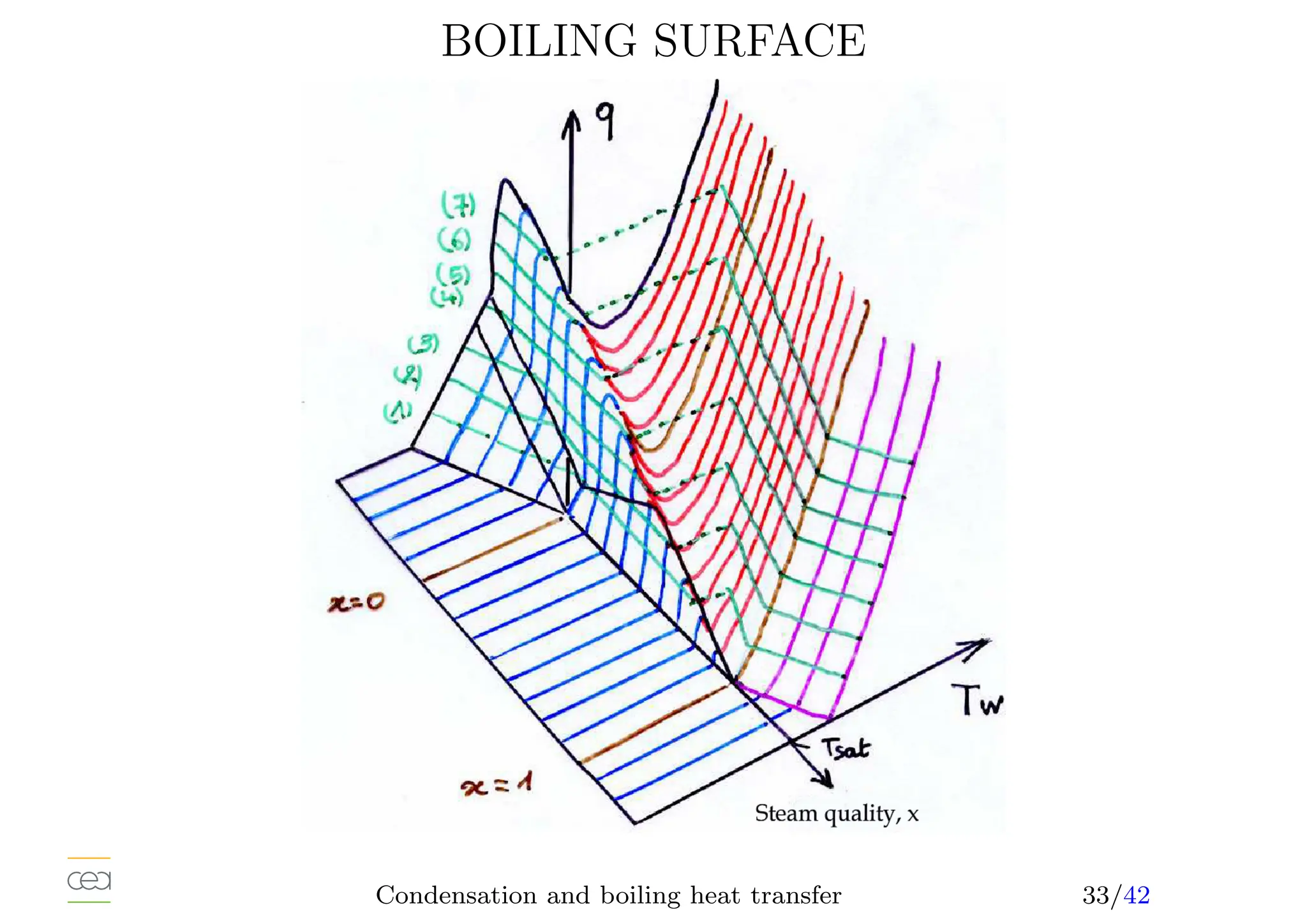
• Fluid mixture non-condensible
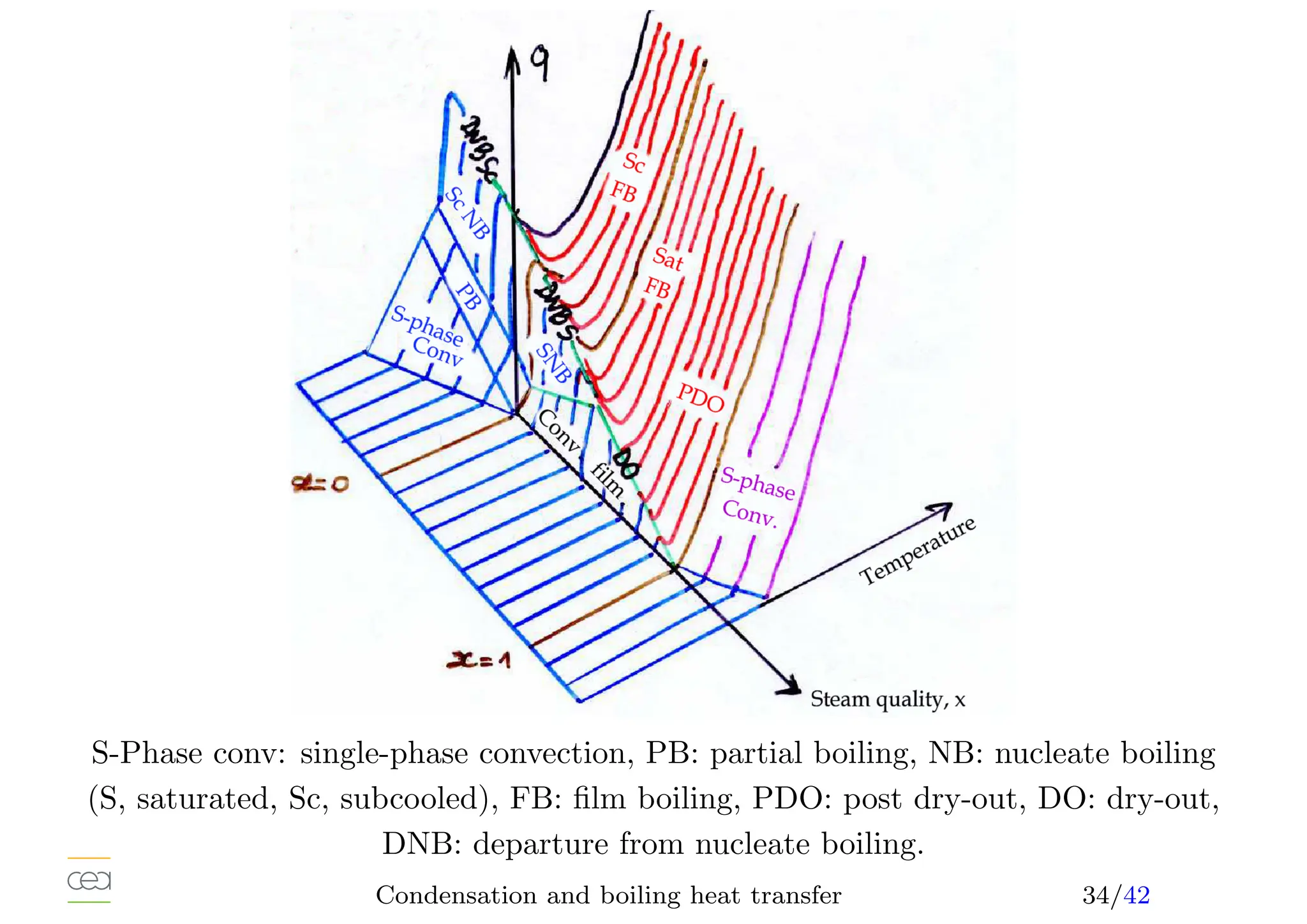
gases:
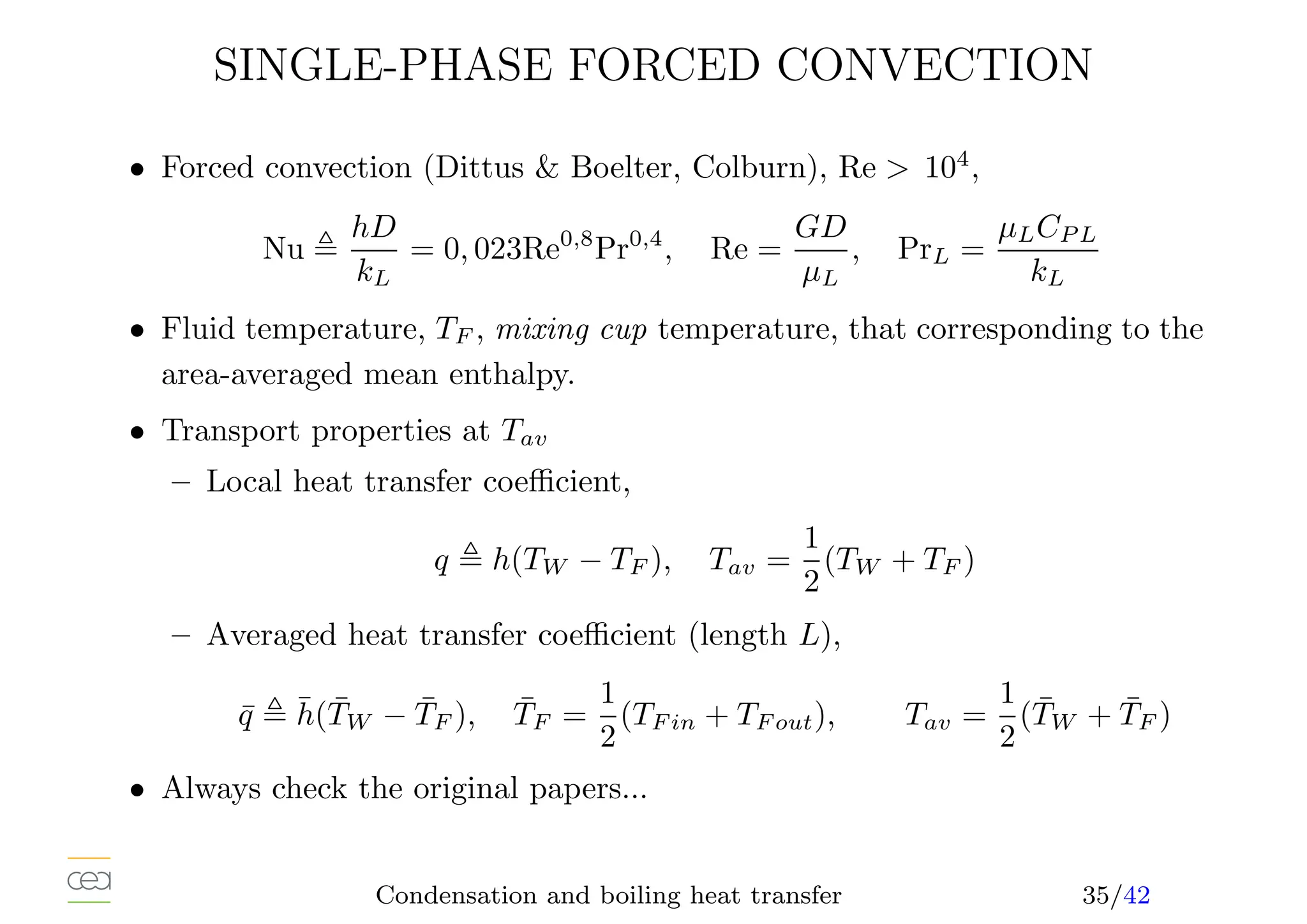
– Incondensible accumulation at
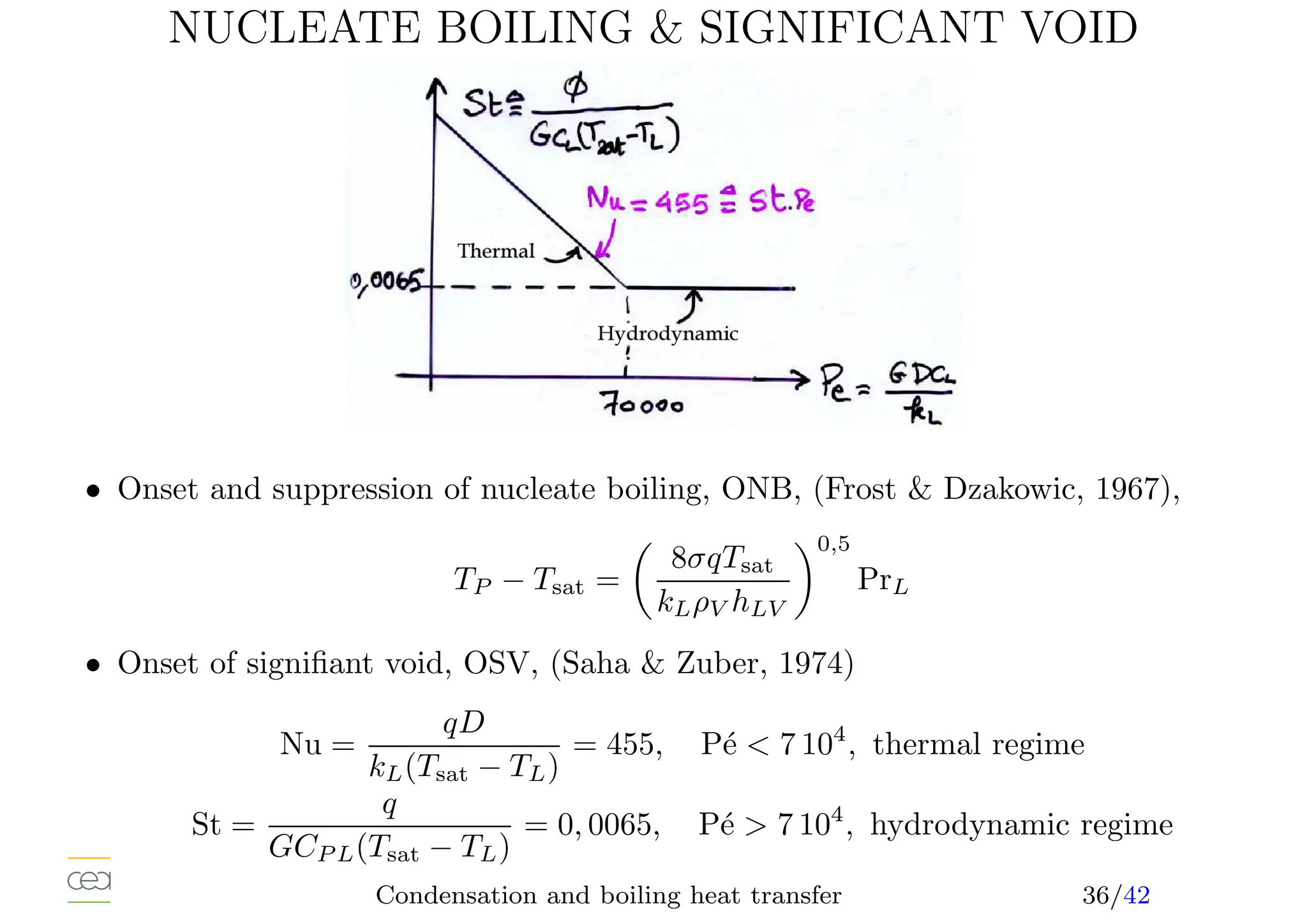
cold places.
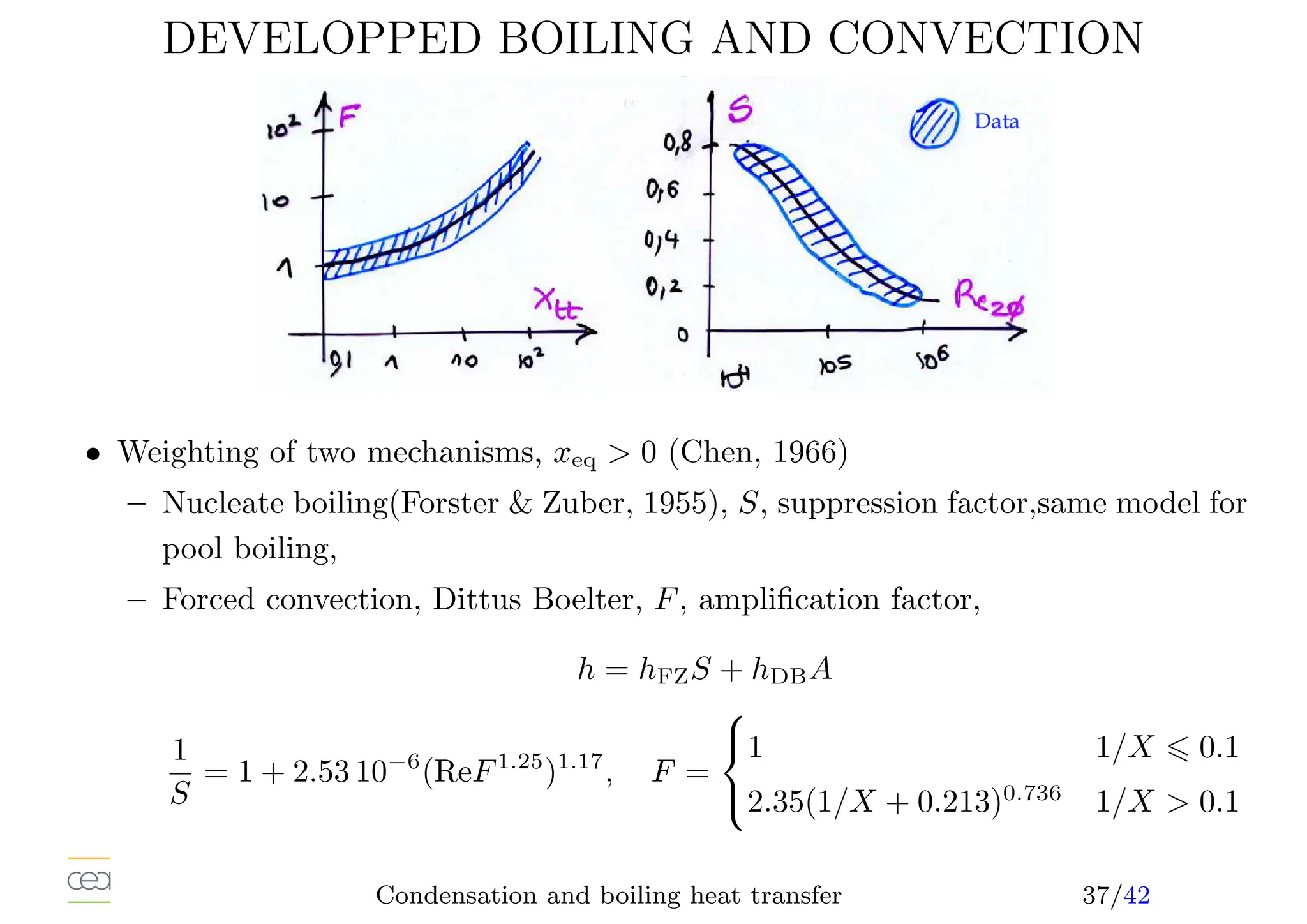
– Diffusion resistance.
– Heat transfer deteriorates.
– Traces may alter significantly h
Condensation and boiling heat transfer 2/42
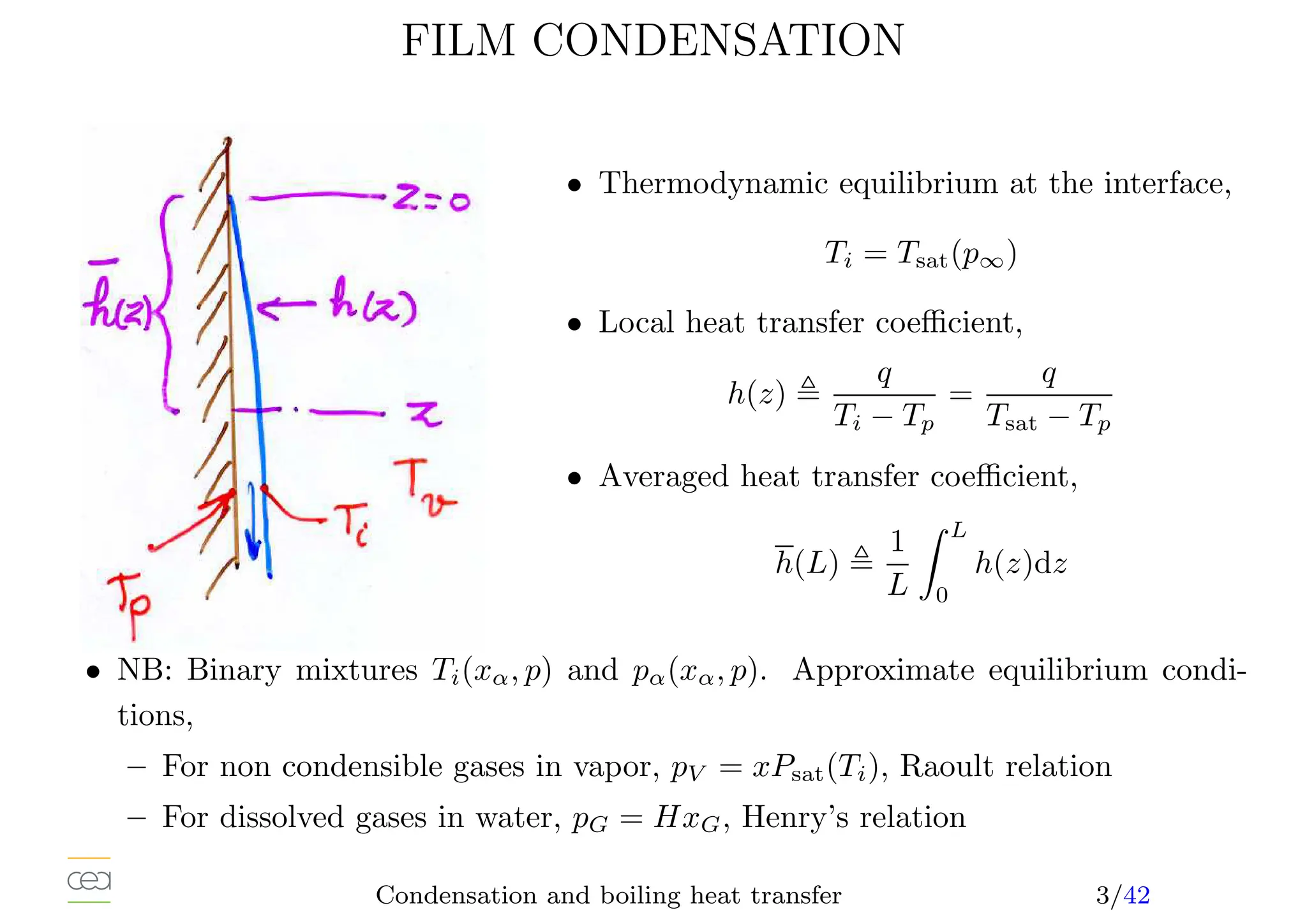
FILM CONDENSATION
• Thermodynamic equilibrium at the interface,
Ti = Tsat(p∞)
• Local heat transfer coefficient,
h(z) ,
q
Ti − Tp
=
q
Tsat − Tp
• Averaged heat transfer coefficient,
h(L) ,
1
L
Z L
0
h(z)dz
• NB: Binary mixtures Ti(xα, p) and pα(xα, p). Approximate equilibrium condi-
tions,
– For non condensible gases in vapor, pV = xPsat(Ti), Raoult relation
– For dissolved gases in water, pG = HxG, Henry’s relation
Condensation and boiling heat transfer 3/42
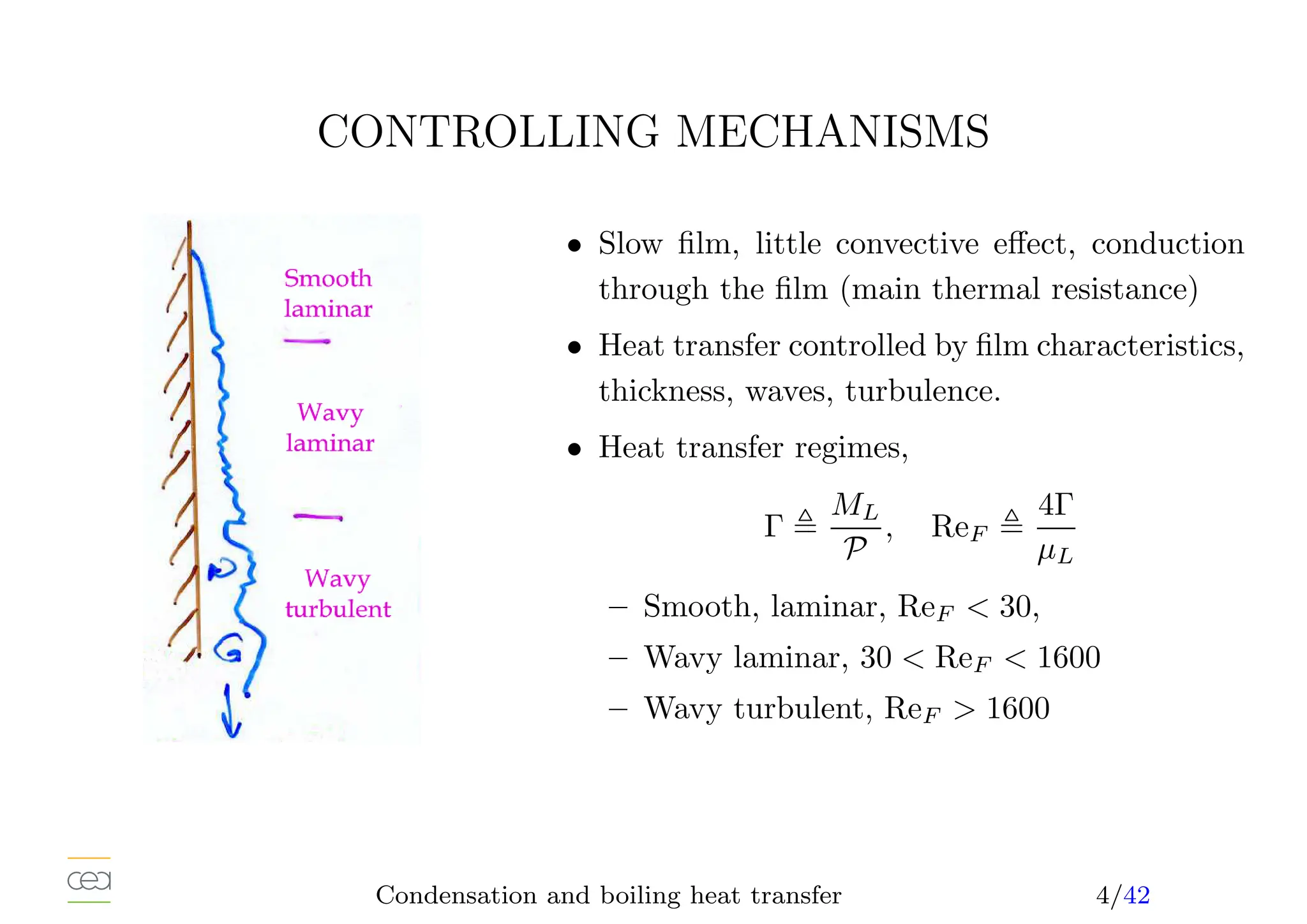
CONTROLLING MECHANISMS
• Slow film, little convective effect, conduction
through the film (main thermal resistance)
• Heat transfer controlled by film characteristics,
thickness, waves, turbulence.
• Heat transfer regimes,
Γ ,
ML
P
, ReF ,
4Γ
µL
– Smooth, laminar, ReF  30,
– Wavy laminar, 30  ReF  1600
– Wavy turbulent, ReF  1600
Condensation and boiling heat transfer 4/42
CONDENSATION OF SATURATED STEAM
• Simplest situation, only a single heat source: interface, stagnant vapor,
• Laminar film (Nusselt, 1916, Rohsenow, 1956), correction 10 to 15%,
h(z) =

k3
LρLg(ρL − ρV )(hLV +0, 68CP L[Tsat − TP ])
4µL(Tsat − TP )z
1
4
• Averaged heat transfer coefficient (TW = cst) : h(z) ∝ z− 1
4 , h(L) = 4
3 h(L)
• Condensate film flow rate, energy balance at the interface,
Γ(L) =
h(L)(Tsat − TP )L
hLV
• Heat transfer coefficient-flow rate relation,
h̄(L)
kL

µ2
L
ρL(ρL − ρV )
1
3
= 1, 47 Re
− 1
3
F
• hLV and ρV at saturation. kL, ρL at the film temperature TF , 1
2 (TW +Ti),
• µ = 1
4 (3µL(TP ) + µL(Ti)), exact when 1/µL linear with T.
Condensation and boiling heat transfer 5/42
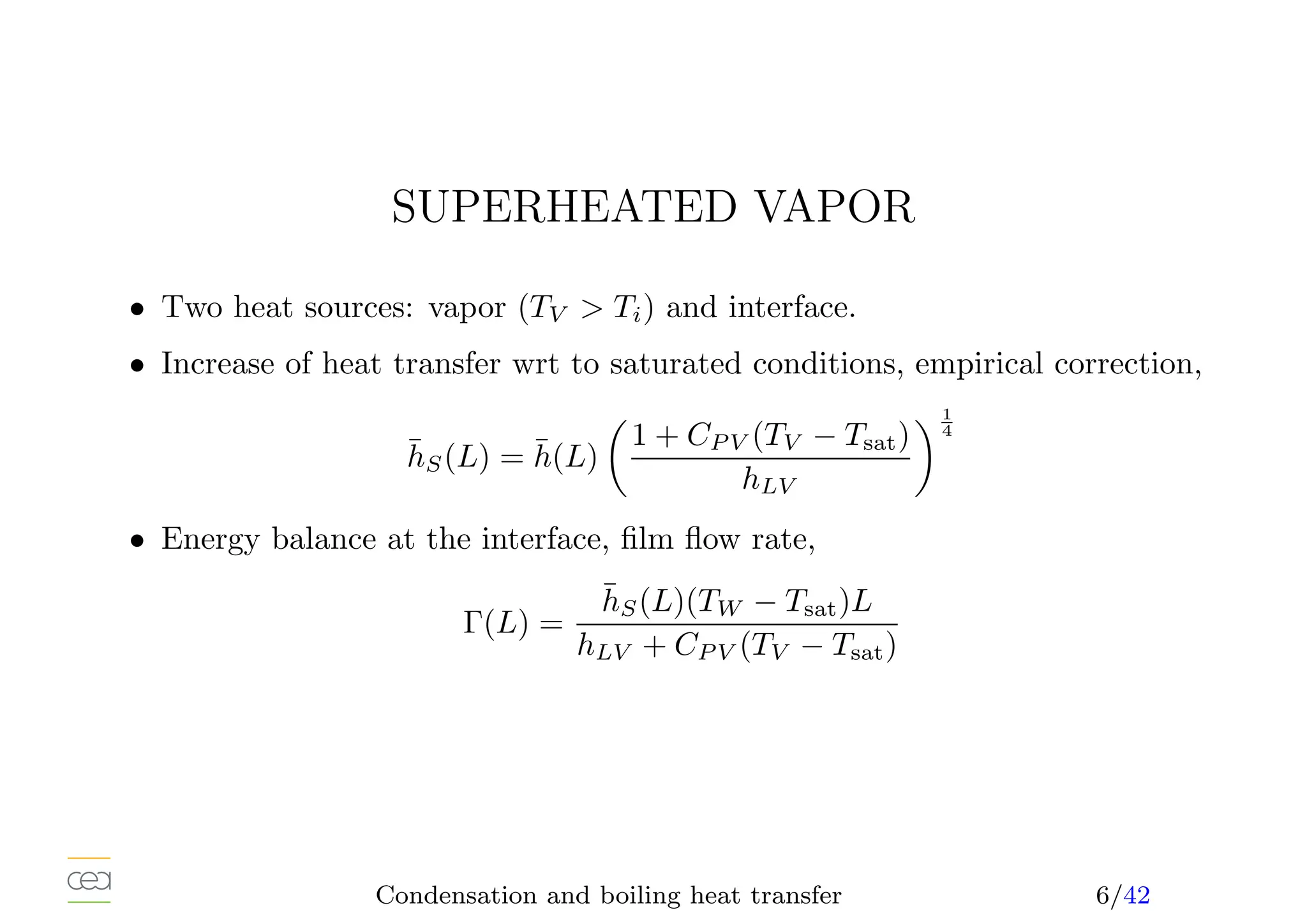
SUPERHEATED VAPOR
• Two heat sources: vapor (TV  Ti) and interface.
• Increase of heat transfer wrt to saturated conditions, empirical correction,
h̄S(L) = h̄(L)

1 + CP V (TV − Tsat)
hLV
1
4
• Energy balance at the interface, film flow rate,
Γ(L) =
h̄S(L)(TW − Tsat)L
hLV + CP V (TV − Tsat)
Condensation and boiling heat transfer 6/42
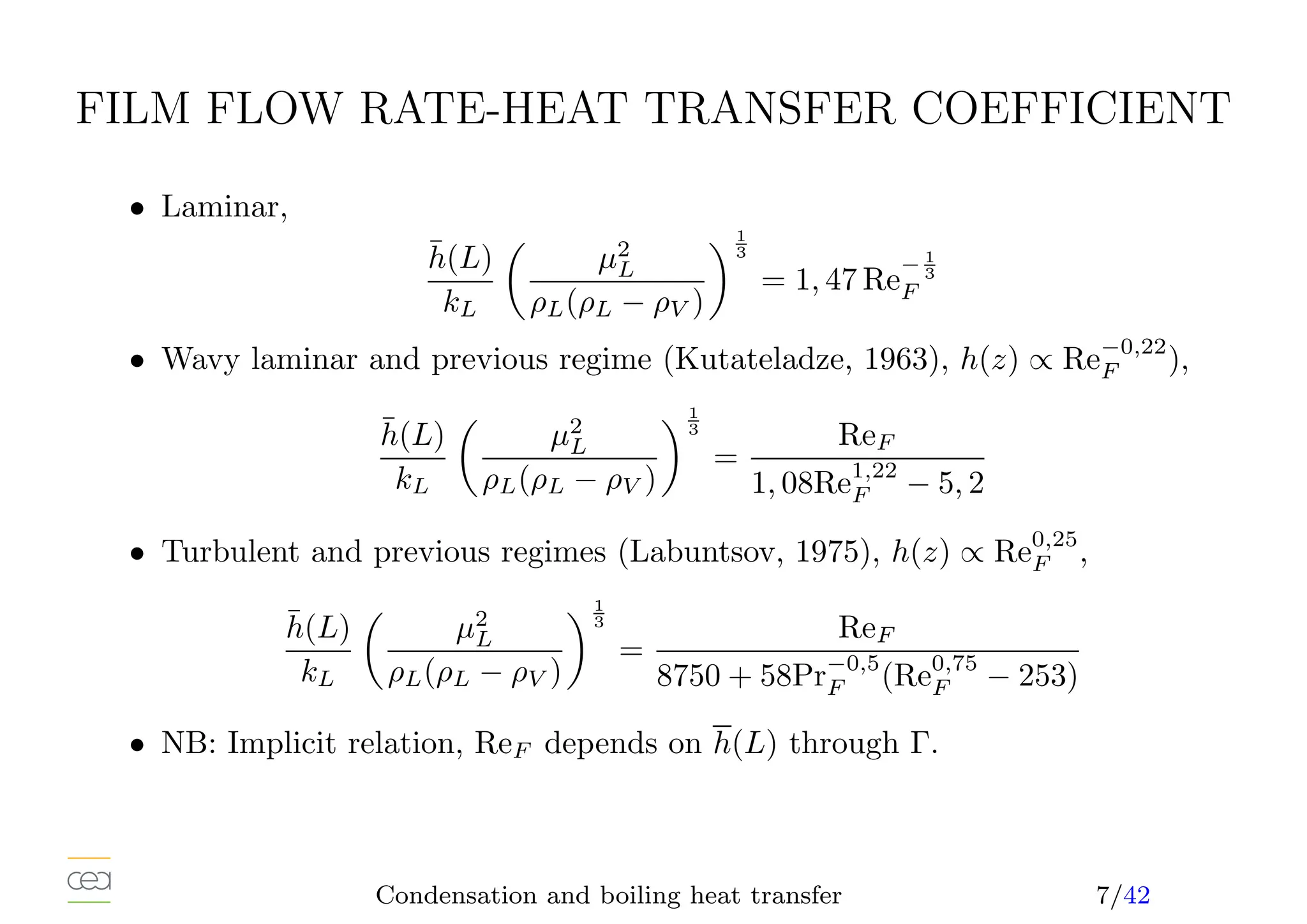
FILM FLOW RATE-HEAT TRANSFER COEFFICIENT
• Laminar,
h̄(L)
kL

µ2
L
ρL(ρL − ρV )
1
3
= 1, 47 Re
− 1
3
F
• Wavy laminar and previous regime (Kutateladze, 1963), h(z) ∝ Re−0,22
F ),
h̄(L)
kL

µ2
L
ρL(ρL − ρV )
1
3
=
ReF
1, 08Re1,22
F − 5, 2
• Turbulent and previous regimes (Labuntsov, 1975), h(z) ∝ Re0,25
F ,
h̄(L)
kL

µ2
L
ρL(ρL − ρV )
1
3
=
ReF
8750 + 58Pr−0,5
F (Re0,75
F − 253)
• NB: Implicit relation, ReF depends on h(L) through Γ.
Condensation and boiling heat transfer 7/42
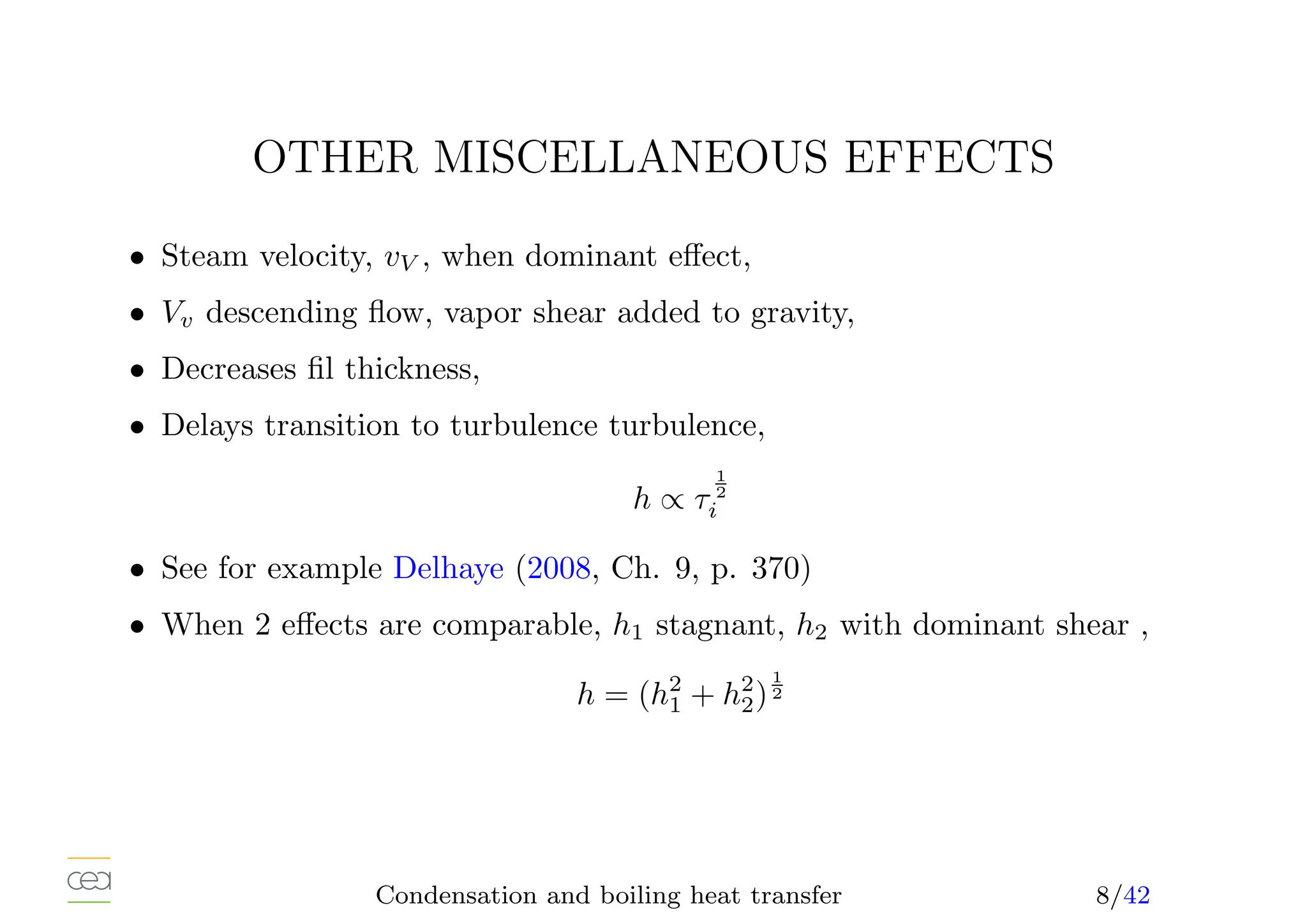
OTHER MISCELLANEOUS EFFECTS
• Steam velocity, vV , when dominant effect,
• Vv descending flow, vapor shear added to gravity,
• Decreases fil thickness,
• Delays transition to turbulence turbulence,
h ∝ τ
1
2
i
• See for example Delhaye (2008, Ch. 9, p. 370)
• When 2 effects are comparable, h1 stagnant, h2 with dominant shear ,
h = (h2
1 + h2
2)
1
2
Condensation and boiling heat transfer 8/42
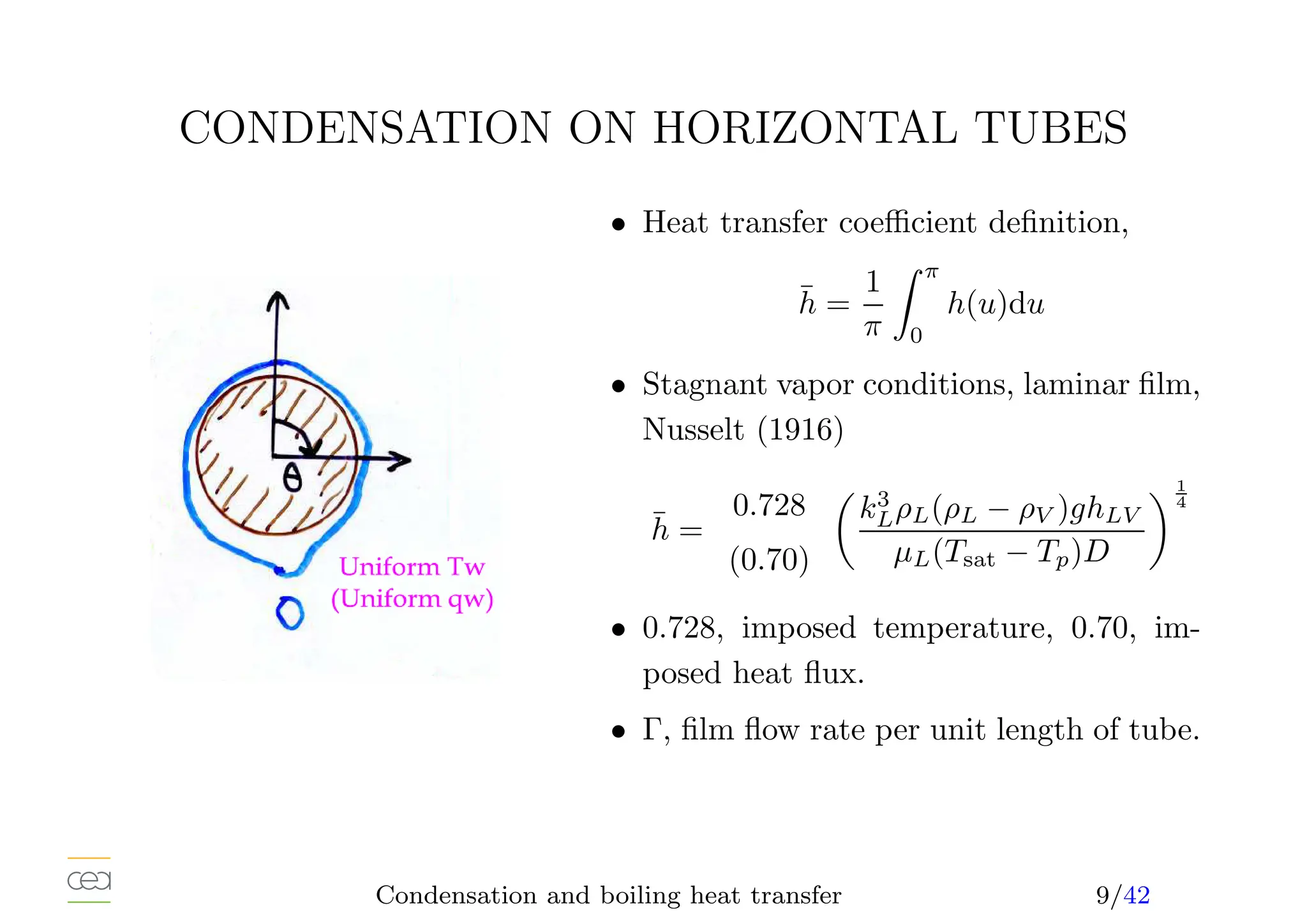
CONDENSATION ON HORIZONTAL TUBES
• Heat transfer coefficient definition,
h̄ =
1
π
Z π
0
h(u)du
• Stagnant vapor conditions, laminar film,
Nusselt (1916)
h̄ =
0.728
(0.70)

k3
LρL(ρL − ρV )ghLV
µL(Tsat − Tp)D
1
4
• 0.728, imposed temperature, 0.70, im-
posed heat flux.
• Γ, film flow rate per unit length of tube.
Condensation and boiling heat transfer 9/42
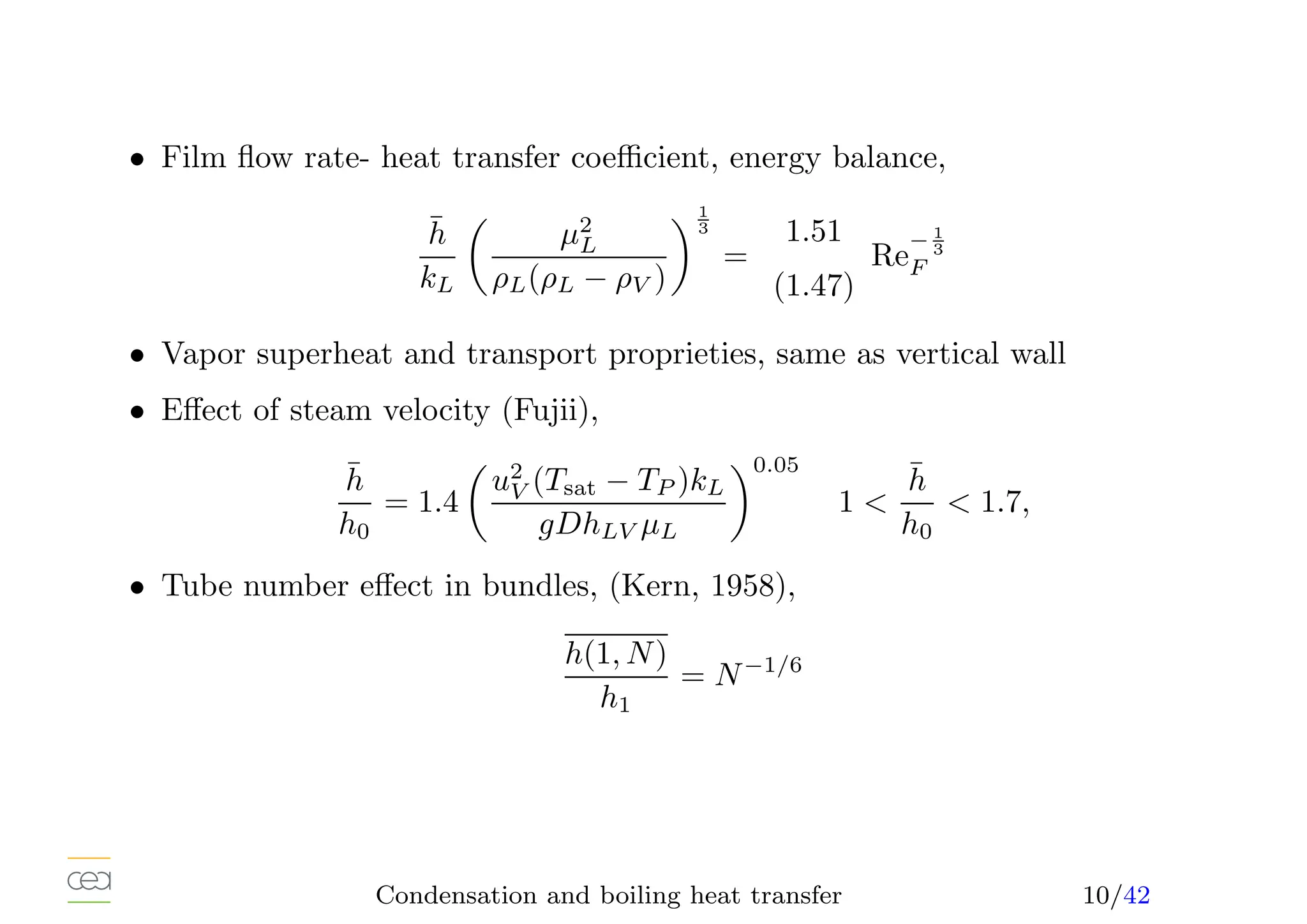
• Film flow rate- heat transfer coefficient, energy balance,
h̄
kL

µ2
L
ρL(ρL − ρV )
1
3
=
1.51
(1.47)
Re
− 1
3
F
• Vapor superheat and transport proprieties, same as vertical wall
• Effect of steam velocity (Fujii),
h̄
h0
= 1.4

u2
V (Tsat − TP )kL
gDhLV µL
0.05
1 
h̄
h0
 1.7,
• Tube number effect in bundles, (Kern, 1958),
h(1, N)
h1
= N−1/6
Condensation and boiling heat transfer 10/42
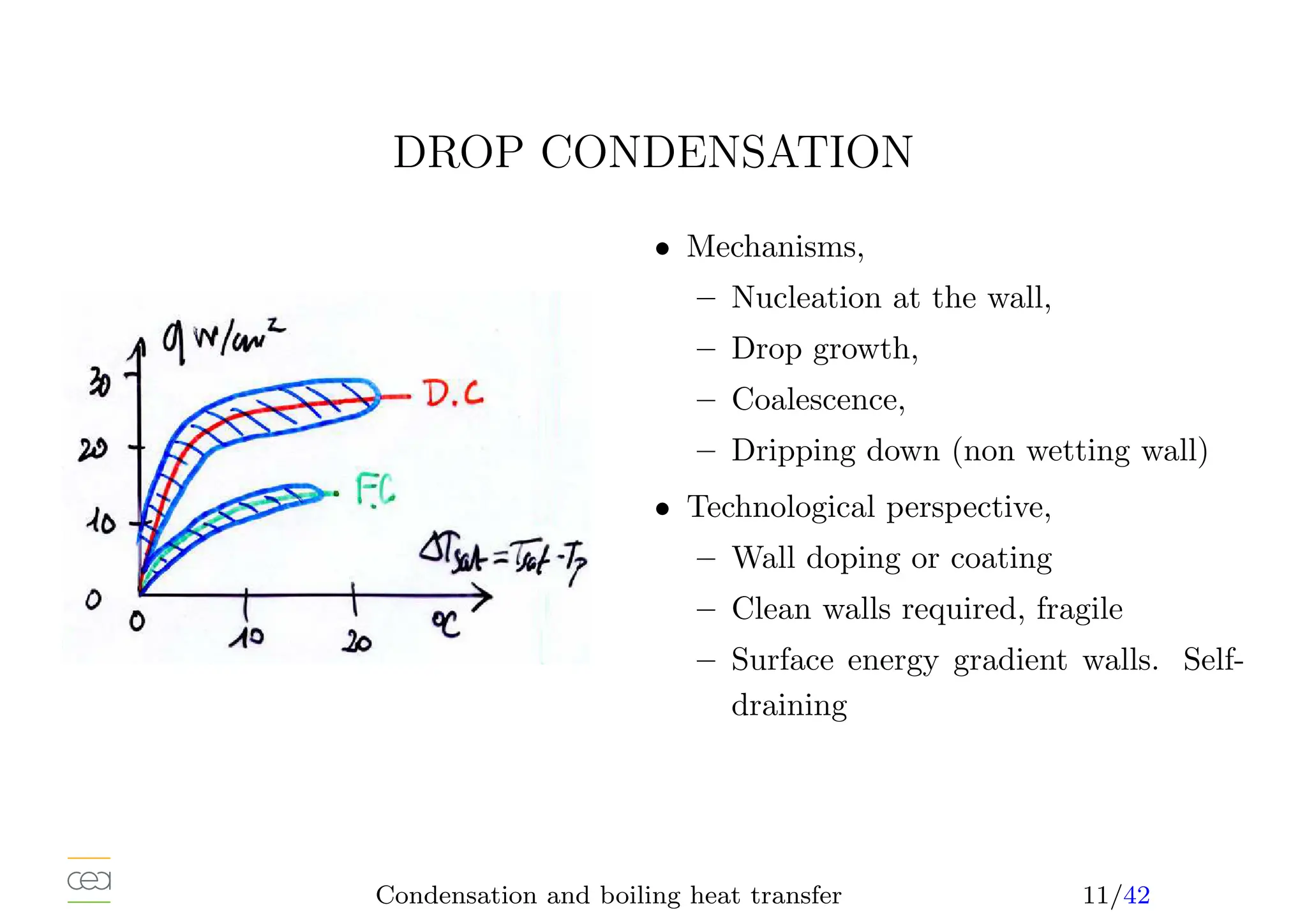
DROP CONDENSATION
• Mechanisms,
– Nucleation at the wall,
– Drop growth,
– Coalescence,
– Dripping down (non wetting wall)
• Technological perspective,
– Wall doping or coating
– Clean walls required, fragile
– Surface energy gradient walls. Self-
draining
Condensation and boiling heat transfer 11/42
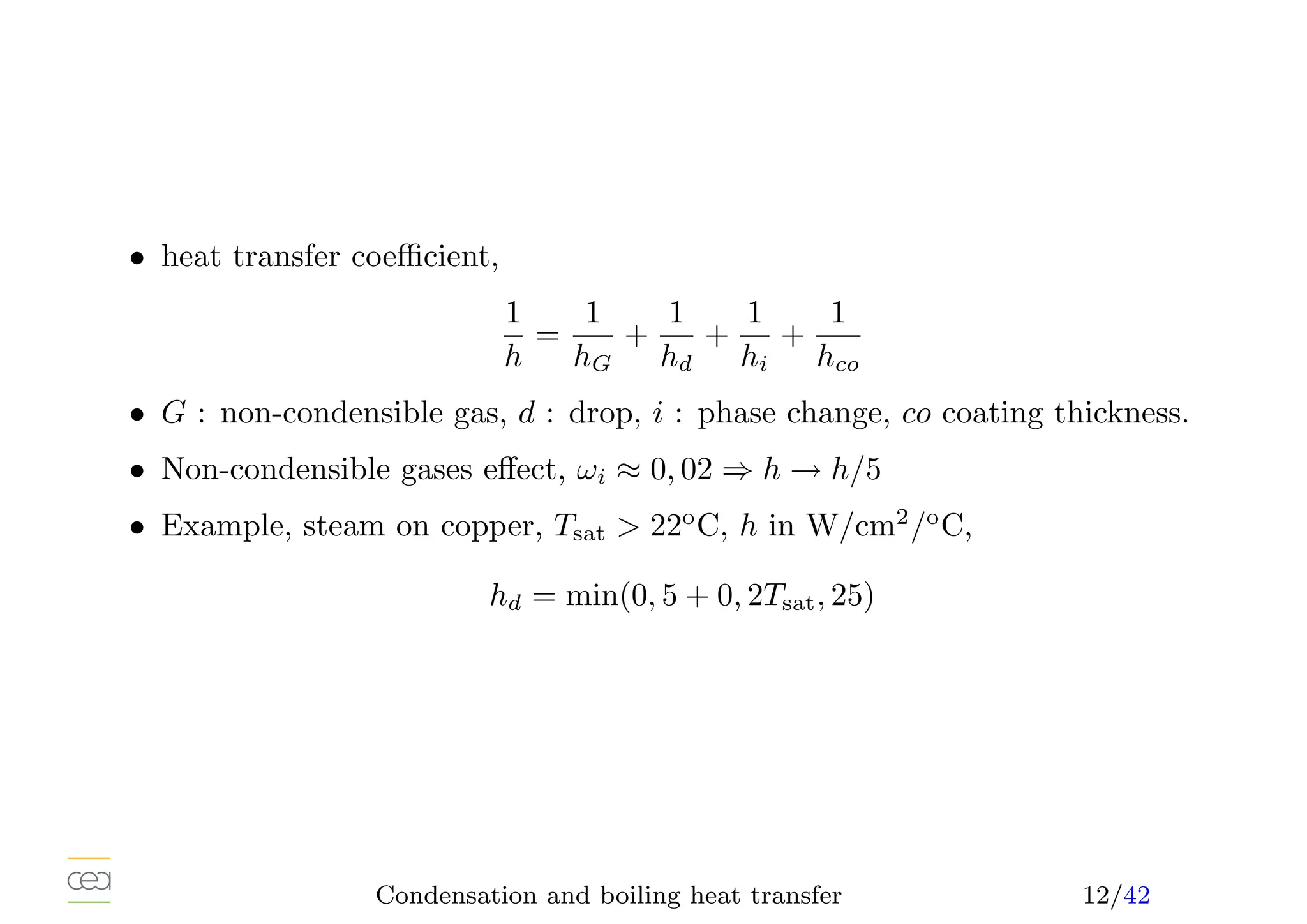
• heat transfer coefficient,
1
h
=
1
hG
+
1
hd
+
1
hi
+
1
hco
• G : non-condensible gas, d : drop, i : phase change, co coating thickness.
• Non-condensible gases effect, ωi ≈ 0, 02 ⇒ h → h/5
• Example, steam on copper, Tsat  22o
C, h in W/cm2
/o
C,
hd = min(0, 5 + 0, 2Tsat, 25)
Condensation and boiling heat transfer 12/42
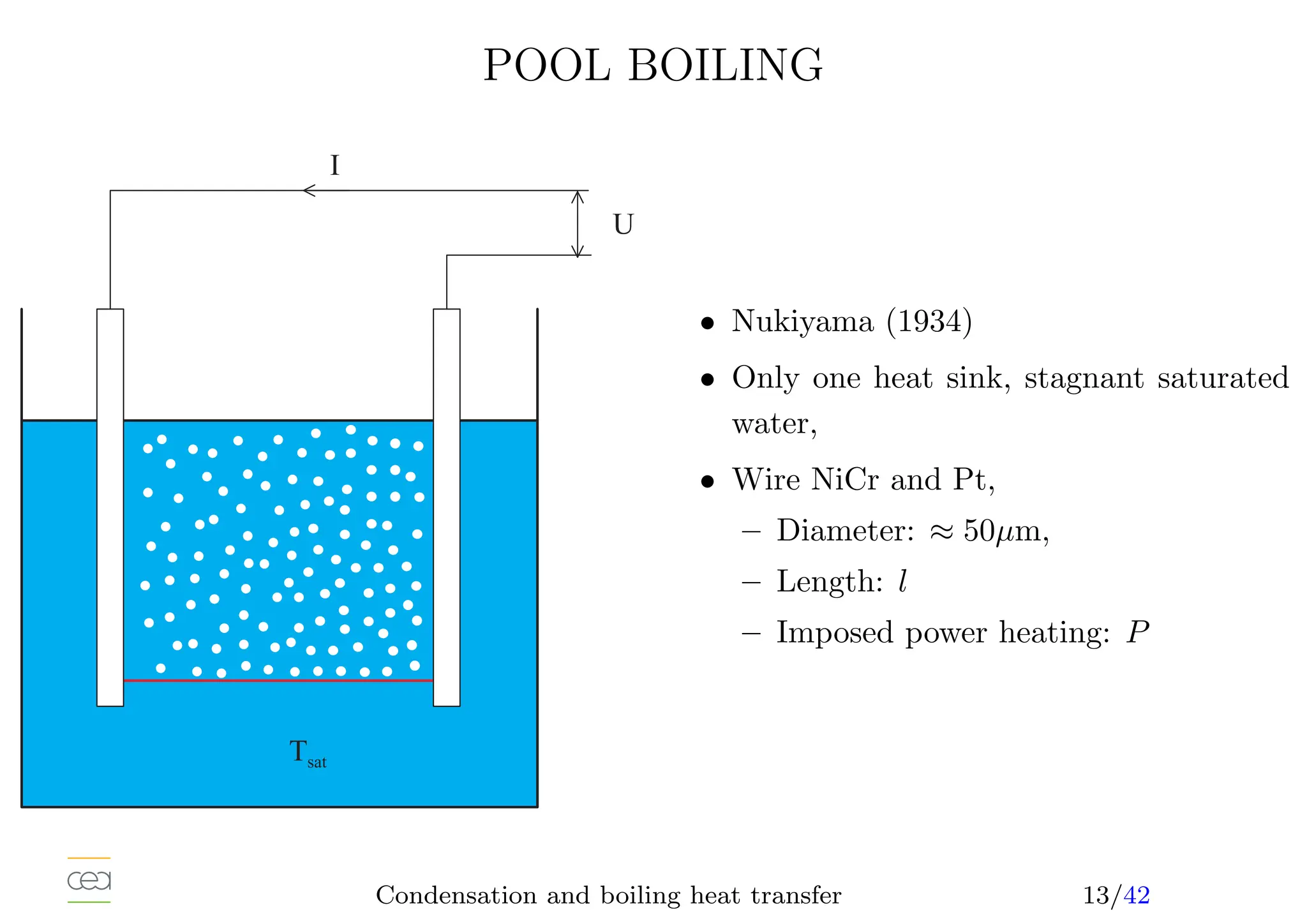
POOL BOILING
6 I = J
7
1
• Nukiyama (1934)
• Only one heat sink, stagnant saturated
water,
• Wire NiCr and Pt,
– Diameter: ≈ 50µm,
– Length: l
– Imposed power heating: P
Condensation and boiling heat transfer 13/42
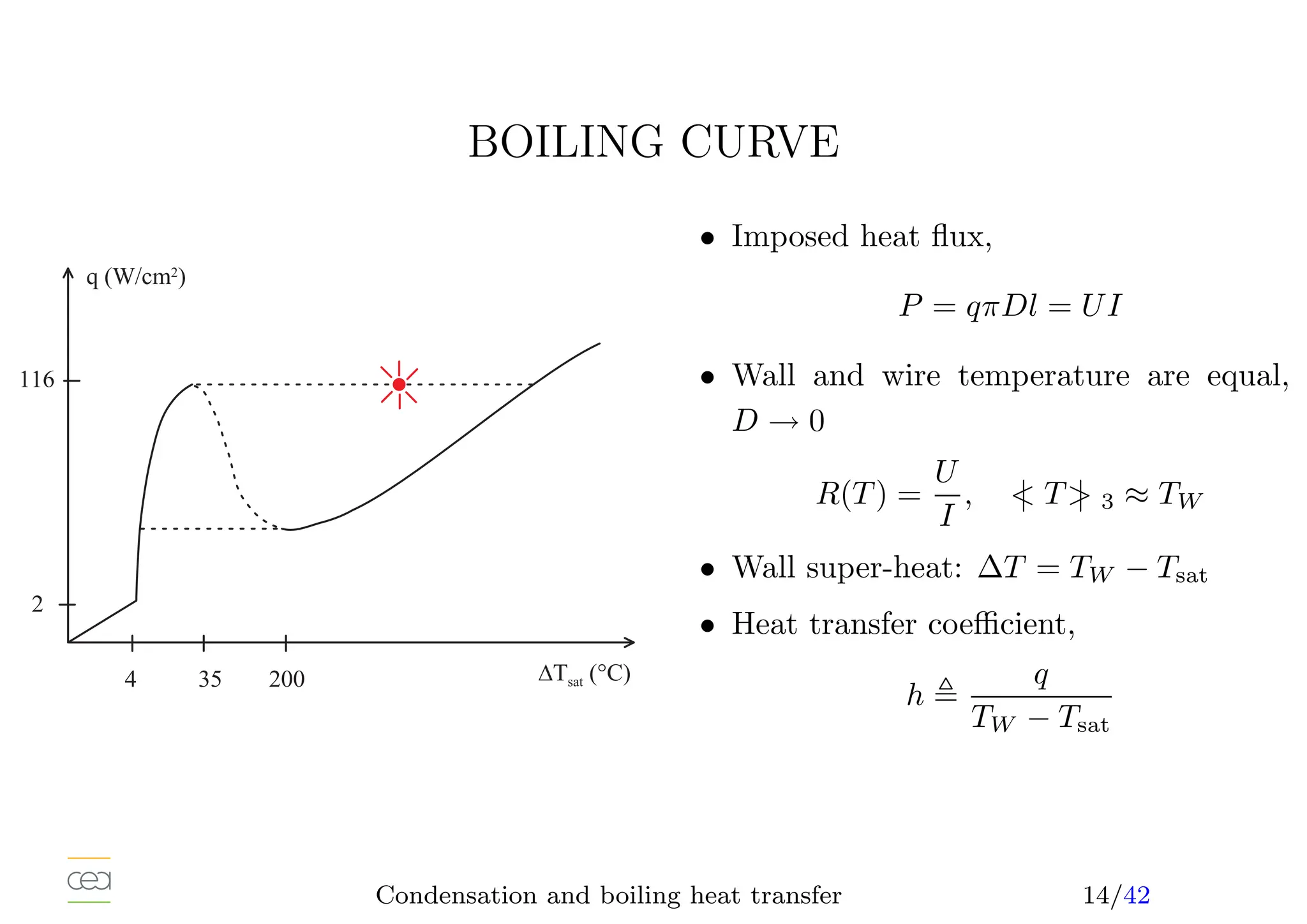
BOILING CURVE
4 3 5 2 0 0 , T s a t ( ° C )
q ( W / c m 2 )
2
1 1 6
• Imposed heat flux,
P = qπDl = UI
• Wall and wire temperature are equal,
D → 0
R(T) =
U
I
, 
| T
| 3 ≈ TW
• Wall super-heat: ∆T = TW − Tsat
• Heat transfer coefficient,
h ,
q
TW − Tsat
Condensation and boiling heat transfer 14/42
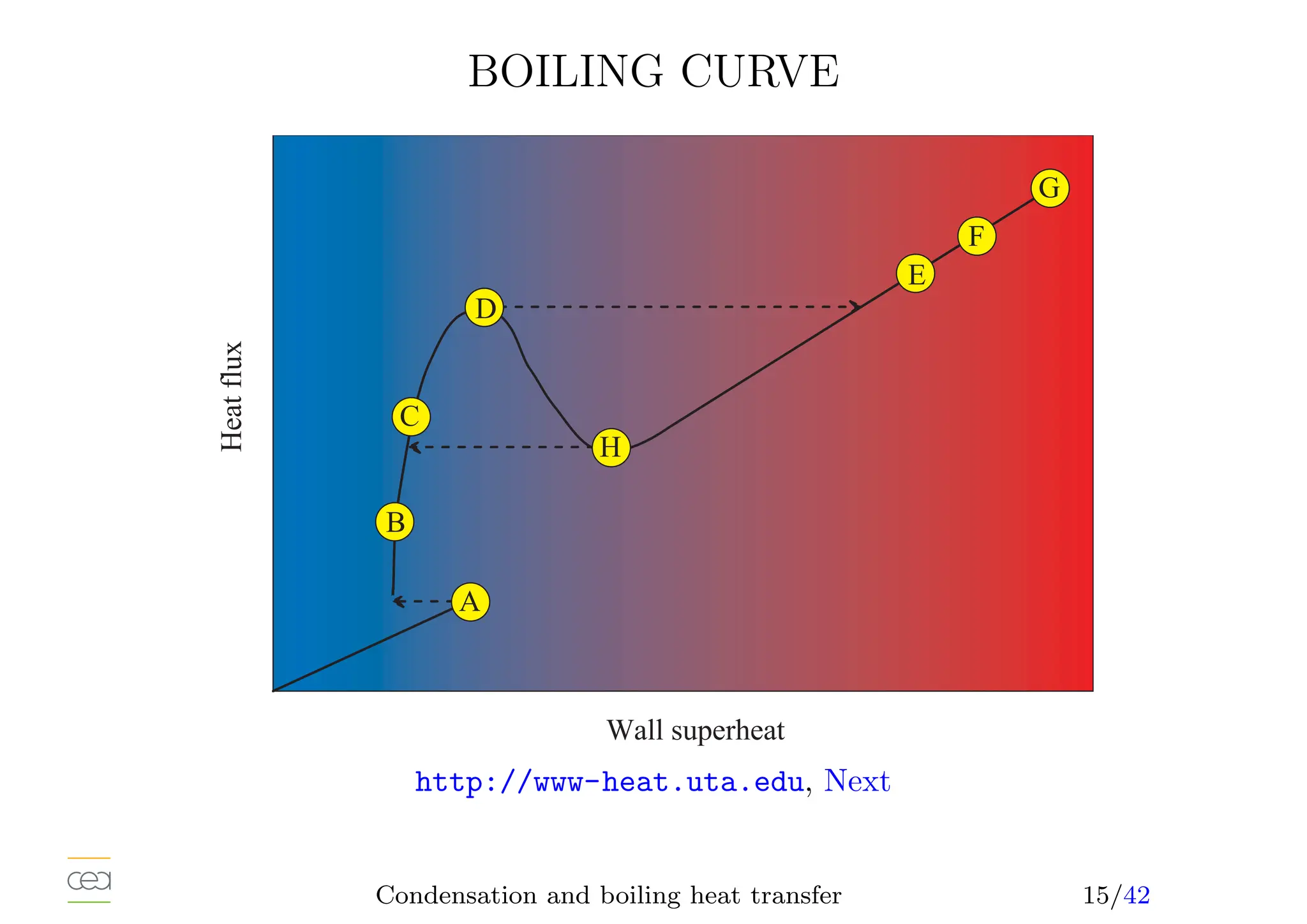
BOILING CURVE
B
H
e
a
t
f
l
u
x
W a l l s u p e r h e a t
C
E
F
G
AD
H
A
http://www-heat.uta.edu, Next
Condensation and boiling heat transfer 15/42
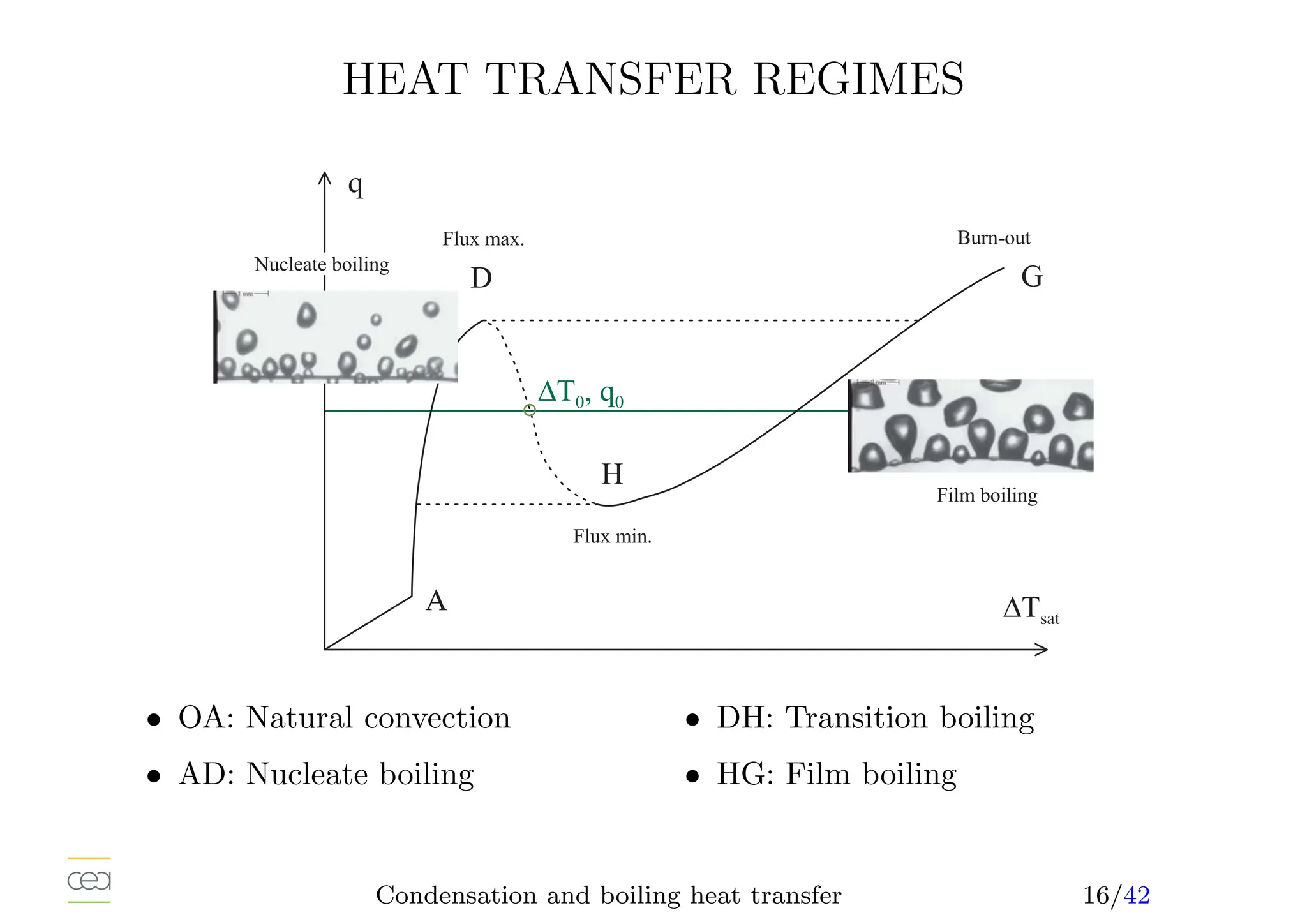
HEAT TRANSFER REGIMES
, T 0 , q 0
q
A
D
H
G
N u c l e a t e b o i l i n g
F i l m b o i l i n g
F l u x m a x .
F l u x m i n .
B u r n - o u t
, T s a t
• OA: Natural convection
• AD: Nucleate boiling
• DH: Transition boiling
• HG: Film boiling
Condensation and boiling heat transfer 16/42
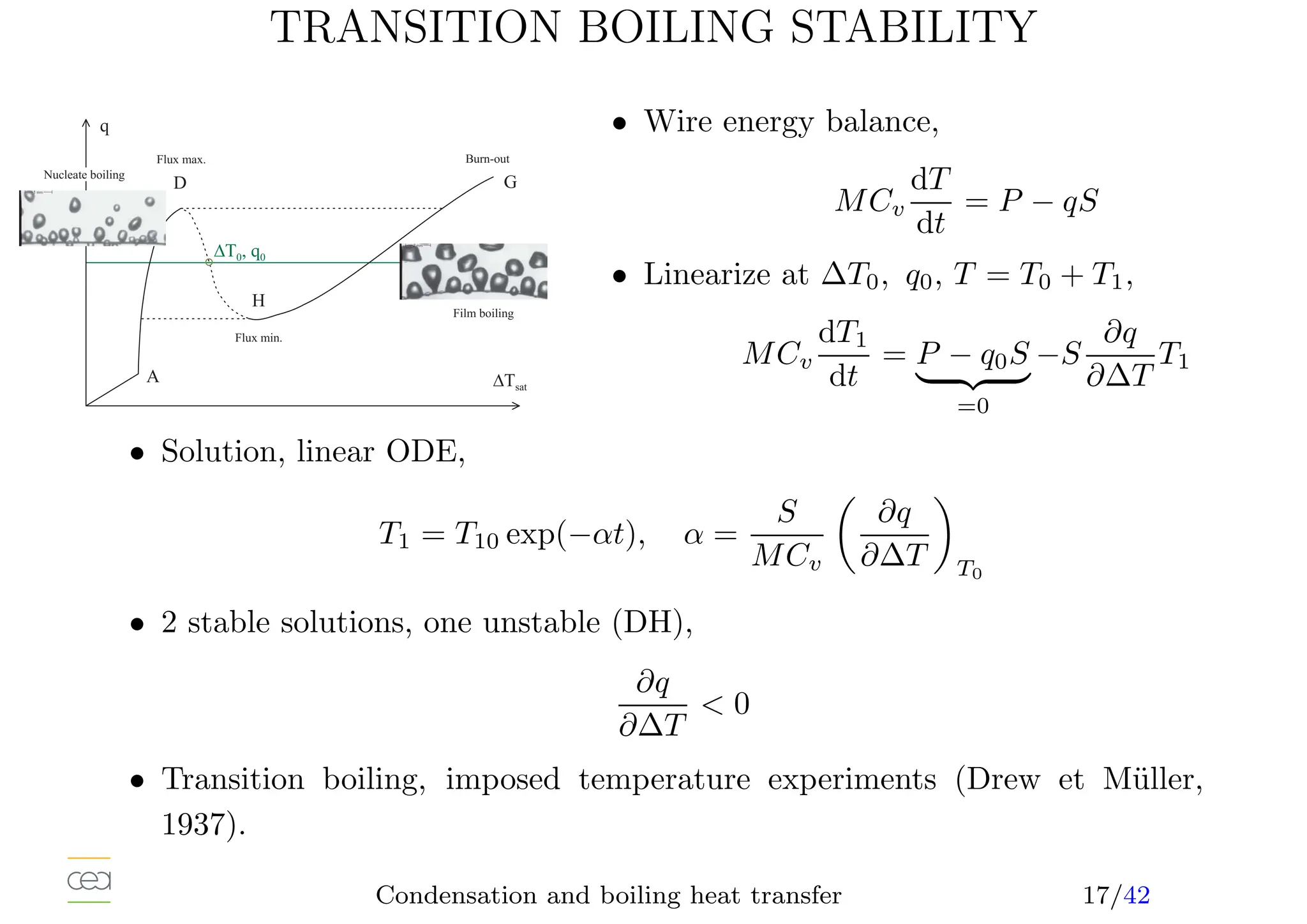
TRANSITION BOILING STABILITY
, T 0 , q 0
q
A
D
H
G
N u c l e a t e b o i l i n g
F i l m b o i l i n g
F l u x m a x .
F l u x m i n .
B u r n - o u t
, T s a t
• Wire energy balance,
MCv
dT
dt
= P − qS
• Linearize at ∆T0, q0, T = T0 + T1,
MCv
dT1
dt
= P − q0S
| {z }
=0
−S
∂q
∂∆T
T1
• Solution, linear ODE,
T1 = T10 exp(−αt), α =
S
MCv

∂q
∂∆T

T0
• 2 stable solutions, one unstable (DH),
∂q
∂∆T
 0
• Transition boiling, imposed temperature experiments (Drew et Müller,
1937).
Condensation and boiling heat transfer 17/42
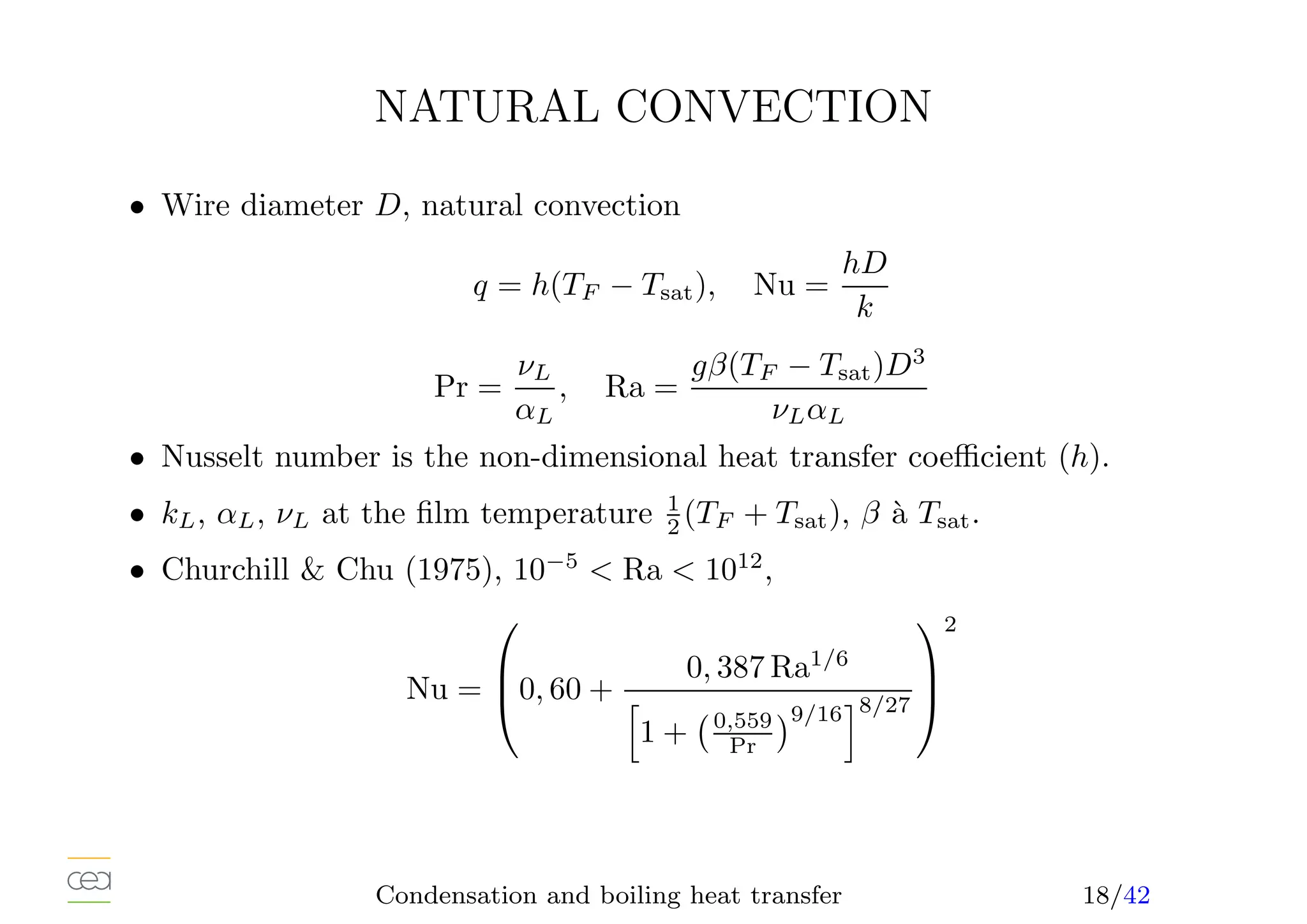
NATURAL CONVECTION
• Wire diameter D, natural convection
q = h(TF − Tsat), Nu =
hD
k
Pr =
νL
αL
, Ra =
gβ(TF − Tsat)D3
νLαL
• Nusselt number is the non-dimensional heat transfer coefficient (h).
• kL, αL, νL at the film temperature 1
2 (TF + Tsat), β à Tsat.
• Churchill  Chu (1975), 10−5
 Ra  1012
,
Nu =


0, 60 +
0, 387 Ra1/6
h
1 + 0,559
Pr
9/16
i8/27



2
Condensation and boiling heat transfer 18/42
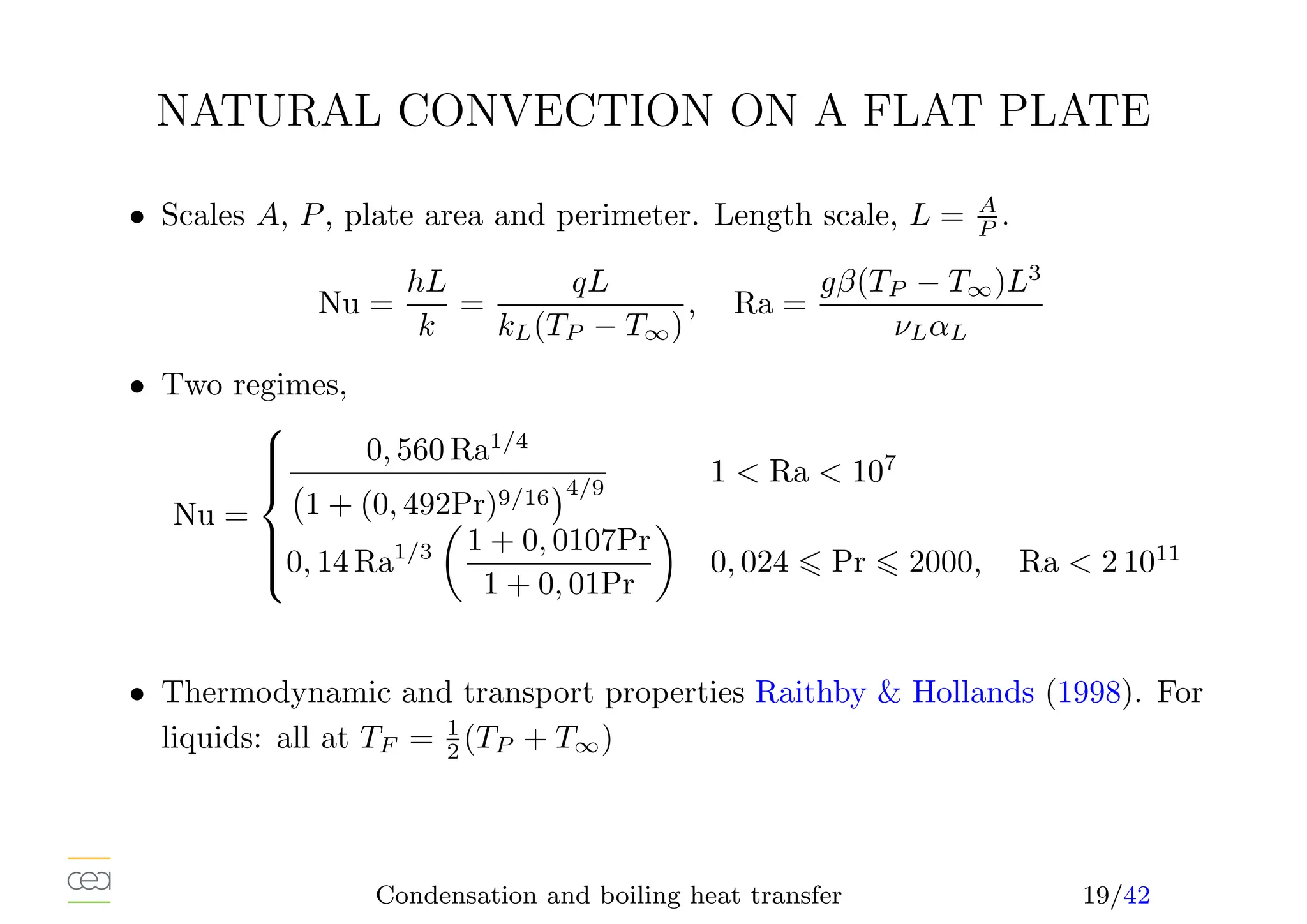
NATURAL CONVECTION ON A FLAT PLATE
• Scales A, P, plate area and perimeter. Length scale, L = A
P .
Nu =
hL
k
=
qL
kL(TP − T∞)
, Ra =
gβ(TP − T∞)L3
νLαL
• Two regimes,
Nu =









0, 560 Ra1/4
1 + (0, 492Pr)9/16
4/9
1  Ra  107
0, 14 Ra1/3

1 + 0, 0107Pr
1 + 0, 01Pr

0, 024 ⩽ Pr ⩽ 2000, Ra  2 1011
• Thermodynamic and transport properties Raithby  Hollands (1998). For
liquids: all at TF = 1
2 (TP + T∞)
Condensation and boiling heat transfer 19/42
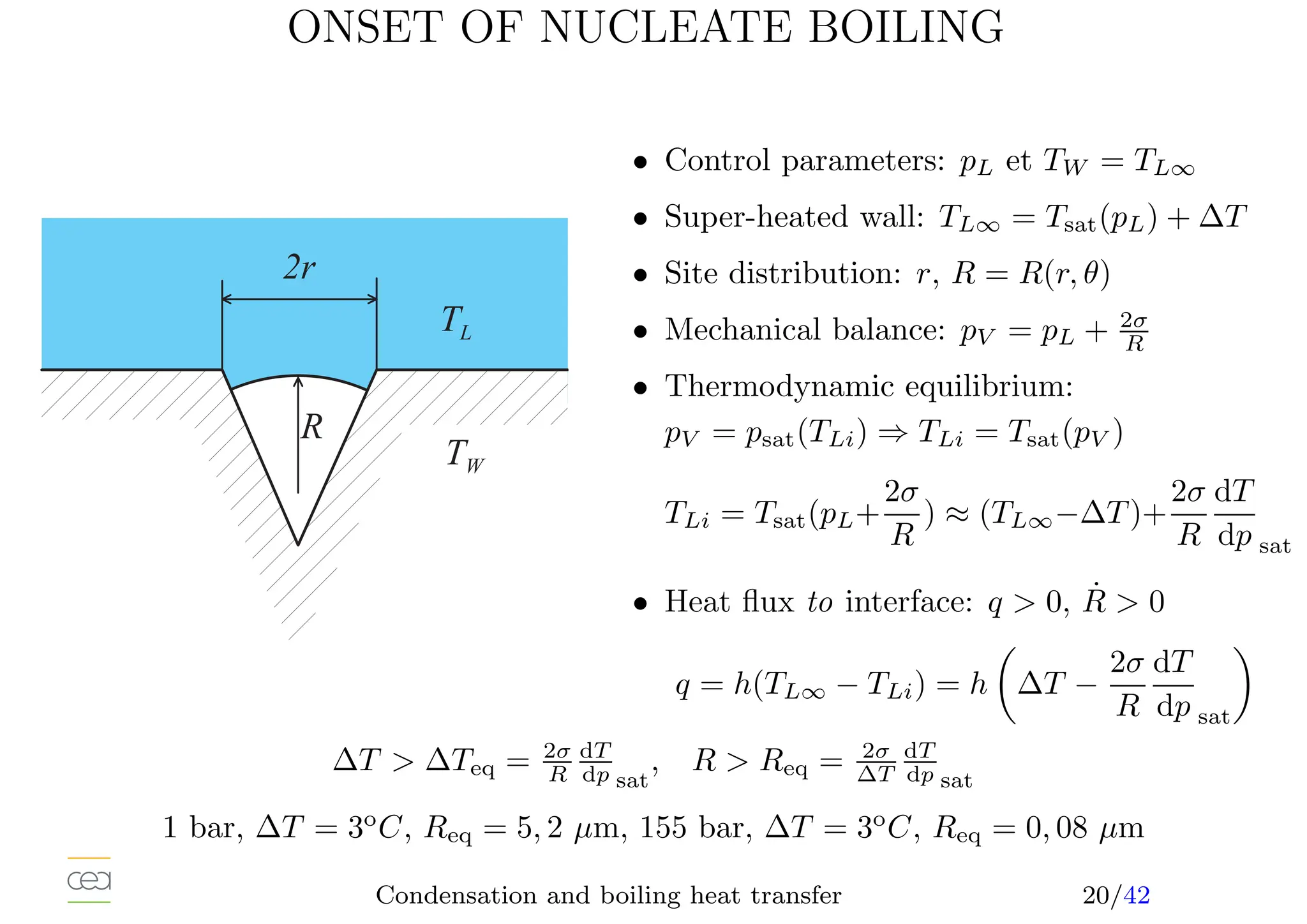
ONSET OF NUCLEATE BOILING
R
2 r
T W
T L
• Control parameters: pL et TW = TL∞
• Super-heated wall: TL∞ = Tsat(pL) + ∆T
• Site distribution: r, R = R(r, θ)
• Mechanical balance: pV = pL + 2σ
R
• Thermodynamic equilibrium:
pV = psat(TLi) ⇒ TLi = Tsat(pV )
TLi = Tsat(pL+
2σ
R
) ≈ (TL∞−∆T)+
2σ
R
dT
dp sat
• Heat flux to interface: q  0, Ṙ  0
q = h(TL∞ − TLi) = h

∆T −
2σ
R
dT
dp sat

∆T  ∆Teq = 2σ
R
dT
dp sat
, R  Req = 2σ
∆T
dT
dp sat
1 bar, ∆T = 3o
C, Req = 5, 2 µm, 155 bar, ∆T = 3o
C, Req = 0, 08 µm
Condensation and boiling heat transfer 20/42
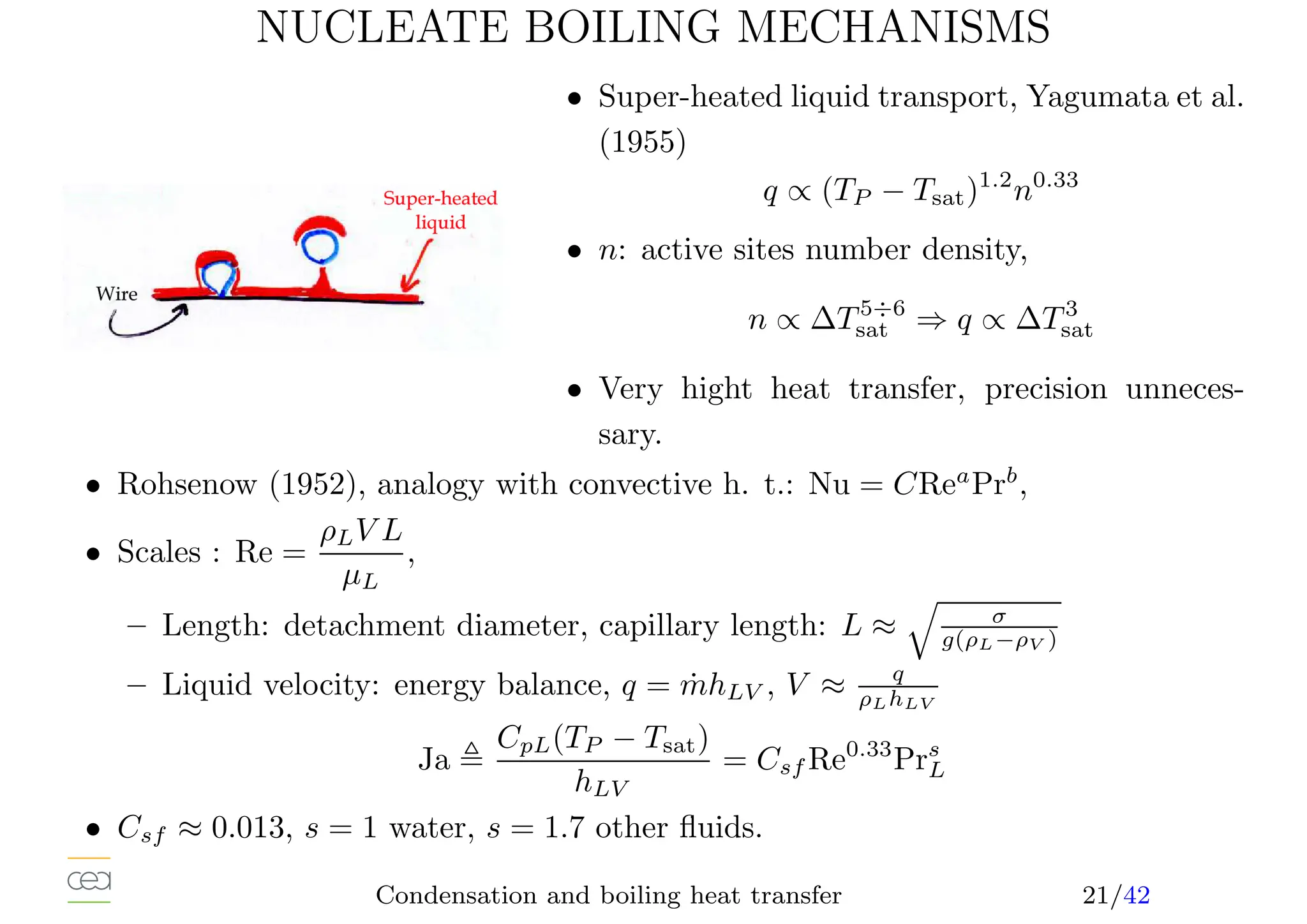
NUCLEATE BOILING MECHANISMS
• Super-heated liquid transport, Yagumata et al.
(1955)
q ∝ (TP − Tsat)1.2
n0.33
• n: active sites number density,
n ∝ ∆T5÷6
sat ⇒ q ∝ ∆T3
sat
• Very hight heat transfer, precision unneces-
sary.
• Rohsenow (1952), analogy with convective h. t.: Nu = CRea
Prb
,
• Scales : Re =
ρLV L
µL
,
– Length: detachment diameter, capillary length: L ≈
q
σ
g(ρL−ρV )
– Liquid velocity: energy balance, q = ṁhLV , V ≈ q
ρLhLV
Ja ,
CpL(TP − Tsat)
hLV
= Csf Re0.33
Prs
L
• Csf ≈ 0.013, s = 1 water, s = 1.7 other fluids.
Condensation and boiling heat transfer 21/42
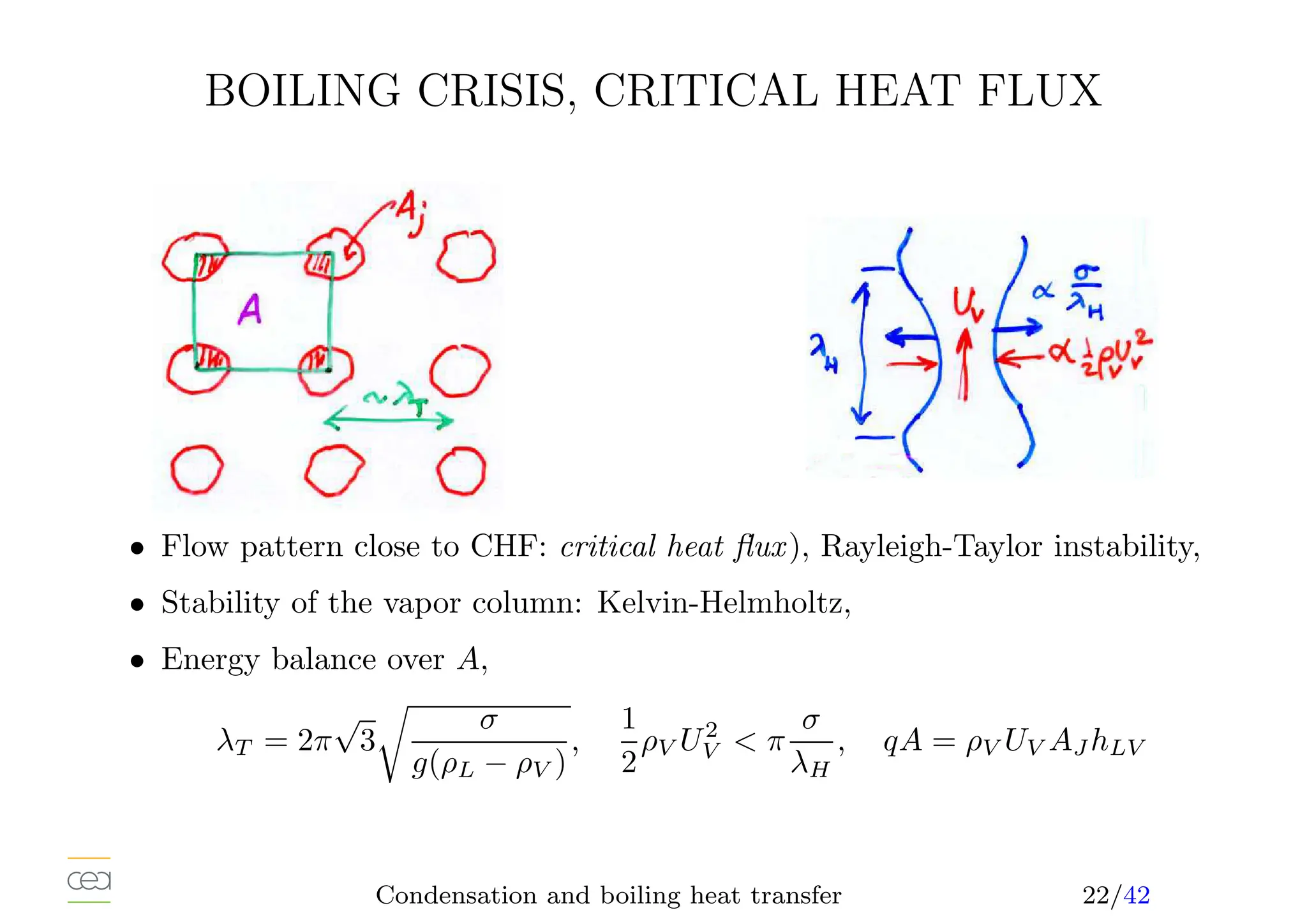
BOILING CRISIS, CRITICAL HEAT FLUX
• Flow pattern close to CHF: critical heat flux), Rayleigh-Taylor instability,
• Stability of the vapor column: Kelvin-Helmholtz,
• Energy balance over A,
λT = 2π
√
3
r
σ
g(ρL − ρV )
,
1
2
ρV U2
V  π
σ
λH
, qA = ρV UV AJ hLV
Condensation and boiling heat transfer 22/42
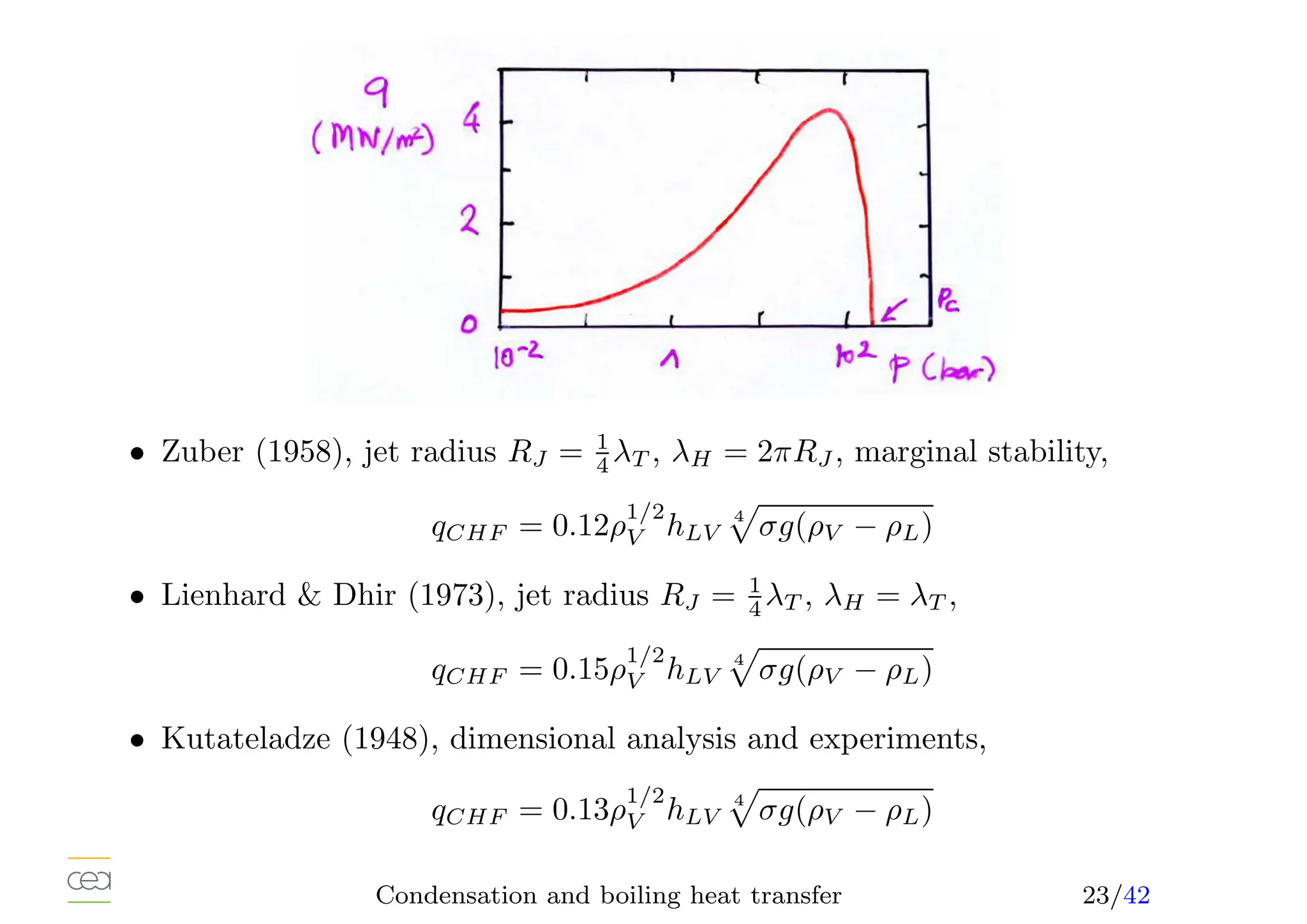
• Zuber (1958), jet radius RJ = 1
4 λT , λH = 2πRJ , marginal stability,
qCHF = 0.12ρ
1/2
V hLV
4
p
σg(ρV − ρL)
• Lienhard  Dhir (1973), jet radius RJ = 1
4 λT , λH = λT ,
qCHF = 0.15ρ
1/2
V hLV
4
p
σg(ρV − ρL)
• Kutateladze (1948), dimensional analysis and experiments,
qCHF = 0.13ρ
1/2
V hLV
4
p
σg(ρV − ρL)
Condensation and boiling heat transfer 23/42
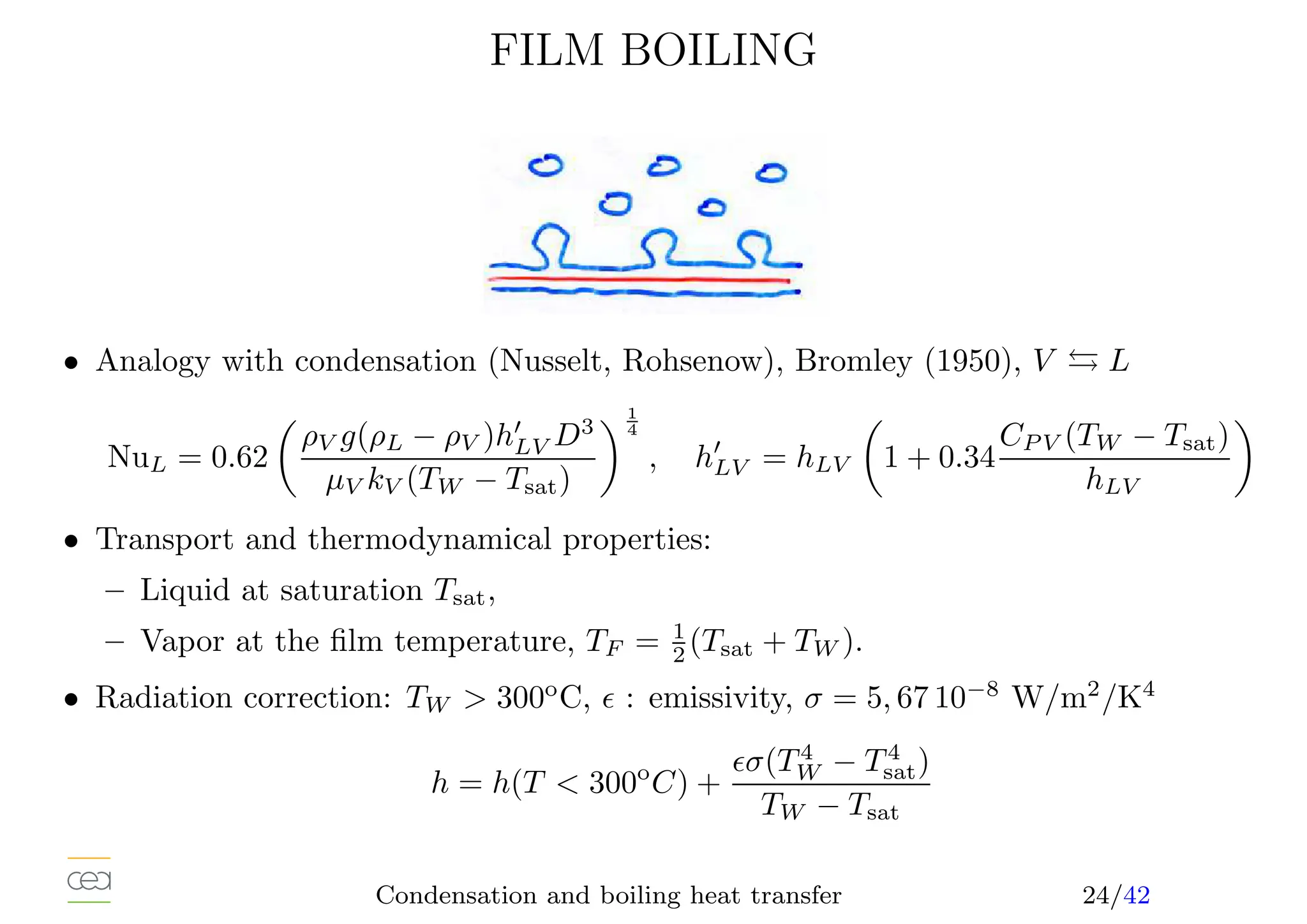
FILM BOILING
• Analogy with condensation (Nusselt, Rohsenow), Bromley (1950), V  L
NuL = 0.62

ρV g(ρL − ρV )h0
LV D3
µV kV (TW − Tsat)
1
4
, h0
LV = hLV

1 + 0.34
CP V (TW − Tsat)
hLV

• Transport and thermodynamical properties:
– Liquid at saturation Tsat,
– Vapor at the film temperature, TF = 1
2 (Tsat + TW ).
• Radiation correction: TW  300o
C,  : emissivity, σ = 5, 67 10−8
W/m2
/K4
h = h(T  300o
C) +
σ(T4
W − T4
sat)
TW − Tsat
Condensation and boiling heat transfer 24/42
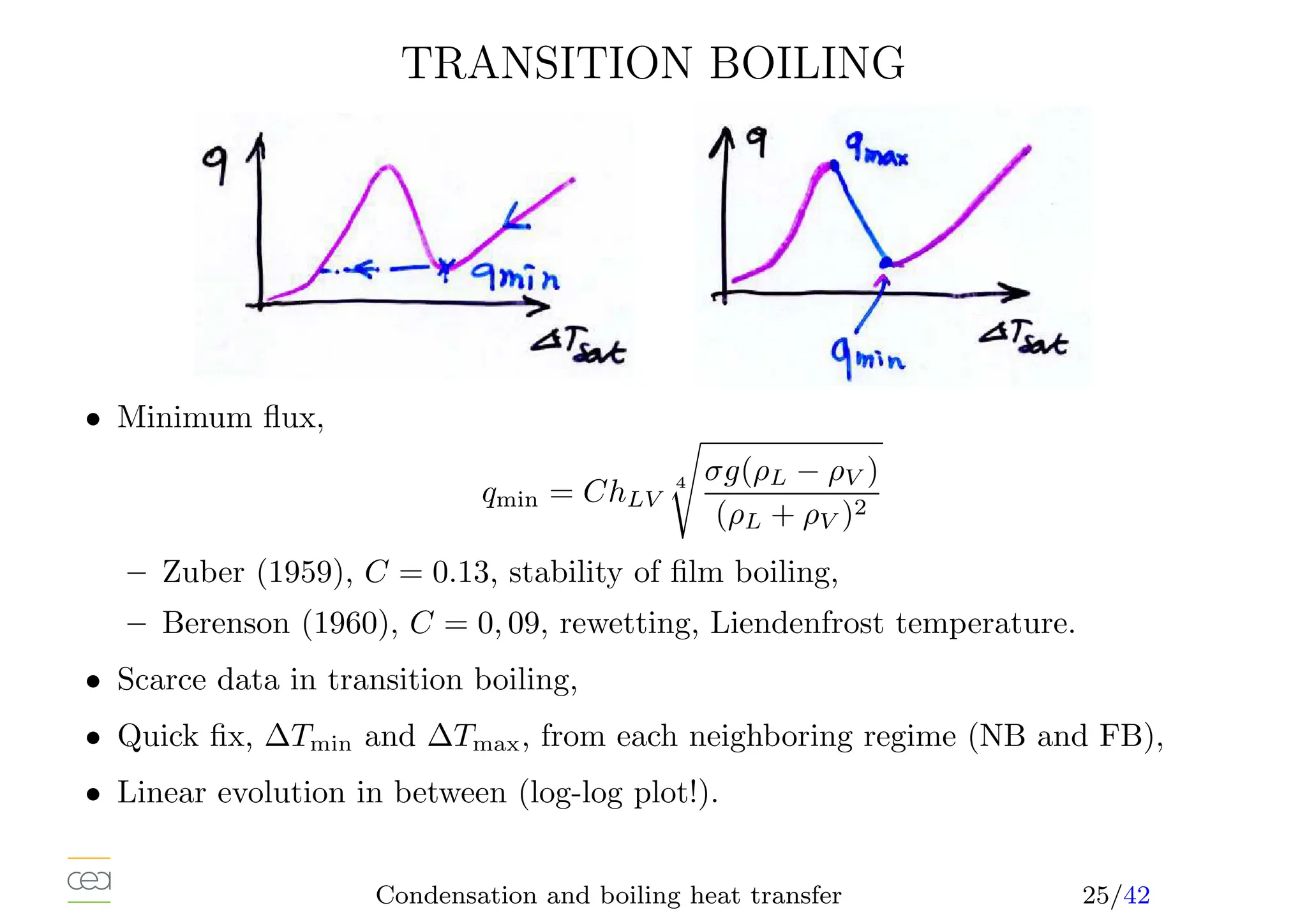
TRANSITION BOILING
• Minimum flux,
qmin = ChLV
4
s
σg(ρL − ρV )
(ρL + ρV )2
– Zuber (1959), C = 0.13, stability of film boiling,
– Berenson (1960), C = 0, 09, rewetting, Liendenfrost temperature.
• Scarce data in transition boiling,
• Quick fix, ∆Tmin and ∆Tmax, from each neighboring regime (NB and FB),
• Linear evolution in between (log-log plot!).
Condensation and boiling heat transfer 25/42
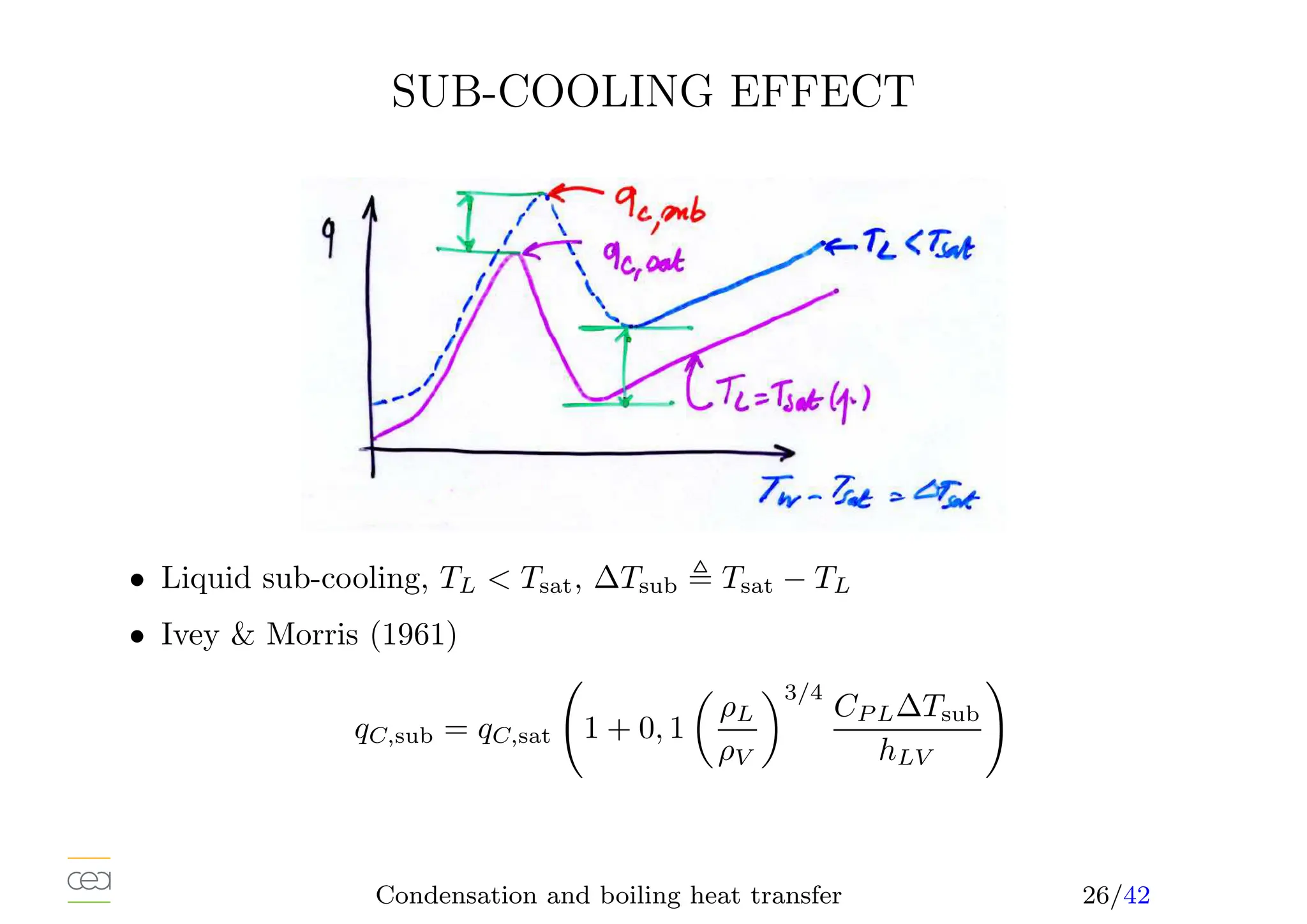
SUB-COOLING EFFECT
• Liquid sub-cooling, TL  Tsat, ∆Tsub , Tsat − TL
• Ivey  Morris (1961)
qC,sub = qC,sat 1 + 0, 1

ρL
ρV
3/4
CP L∆Tsub
hLV
!
Condensation and boiling heat transfer 26/42
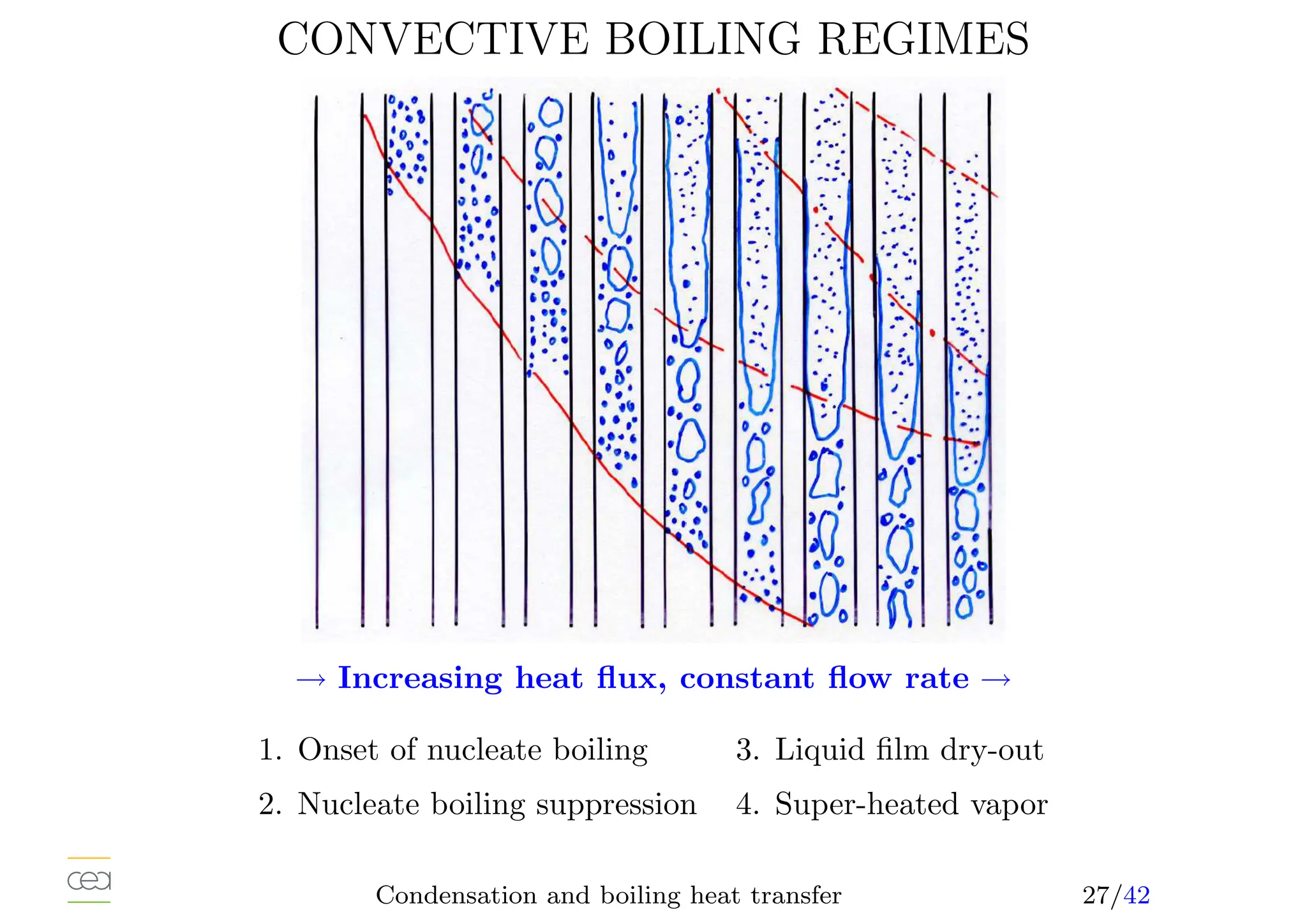
CONVECTIVE BOILING REGIMES
→ Increasing heat flux, constant flow rate →
1. Onset of nucleate boiling 3. Liquid film dry-out
2. Nucleate boiling suppression 4. Super-heated vapor
Condensation and boiling heat transfer 27/42
BACK TO THE EQUILIBRIUM (STEAM) QUALITY
• Regime boundaries depend very much on z. Change of variable, xeq
• Equilibrium quality, non dimensional mixture enthalpy,
xeq ,
h − hLsat
hLV
• Energy balance, low velocity, stationary flows,
M
dh
dz
= MhLV
dxeq
dz
= qP
• Uniform heat flux, xeq linear in z. Close to equilibrium, xeq ≈ x
• According to the assumptions of the HEM,
0  xeq single-phase liquid (sub-cooled)
0  xeq  1 two-phase, saturated
1  xeq single-phase vapor (super-heated)
Condensation and boiling heat transfer 28/42
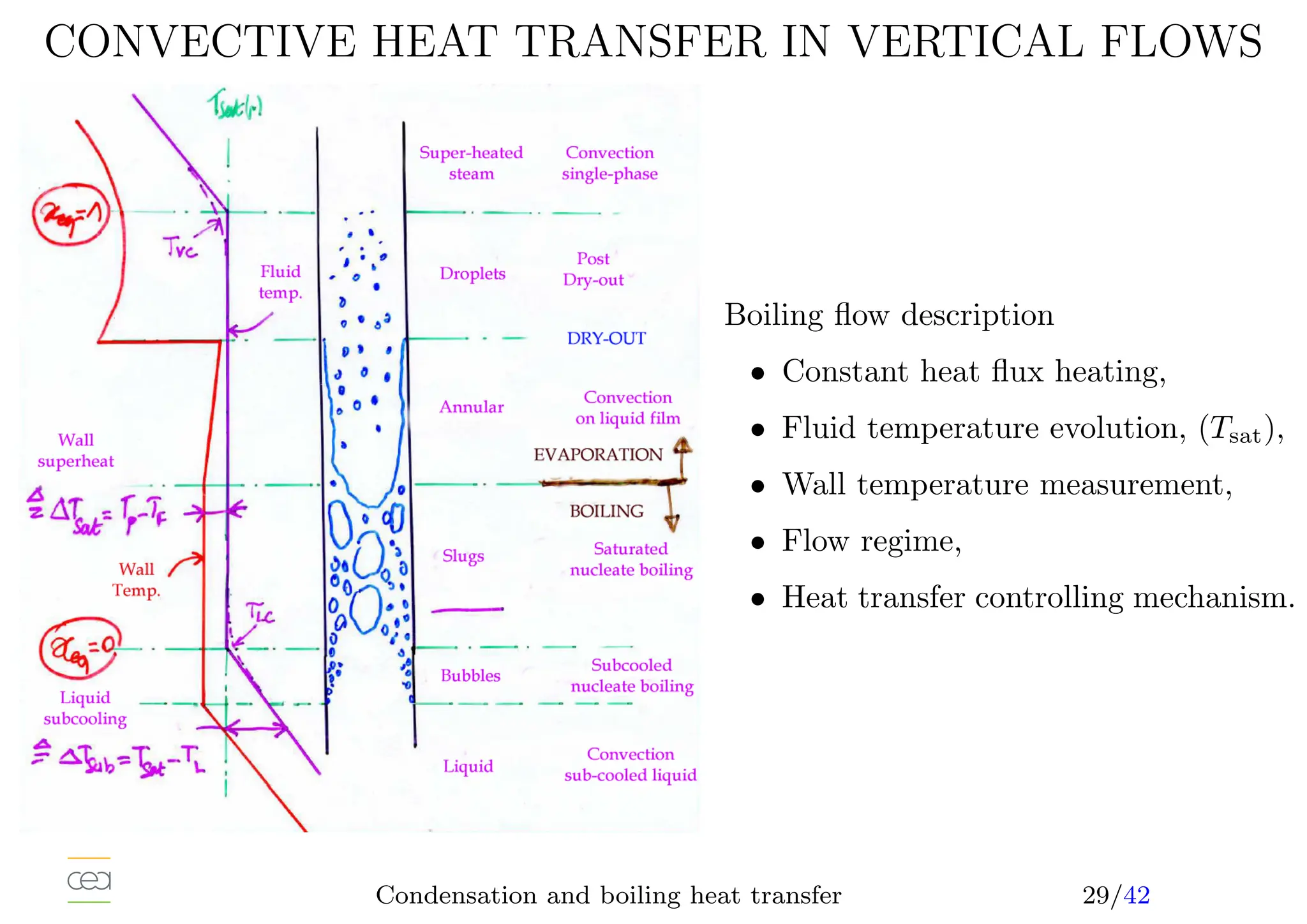
CONVECTIVE HEAT TRANSFER IN VERTICAL FLOWS
Boiling flow description
• Constant heat flux heating,
• Fluid temperature evolution, (Tsat),
• Wall temperature measurement,
• Flow regime,
• Heat transfer controlling mechanism.
Condensation and boiling heat transfer 29/42
From the inlet, flow and heat transfer regimes,
• Single-phase convection
• Onset of nucleate boiling, ONB
• Onset of signifiant void, OSV
• Important points for pressure drop calculations, flow oscillations.
Condensation and boiling heat transfer 30/42
• Nucleate boiling suppression,
• Liquid film dry-out, boiling crisis (I),
• Single-phase vapor convection.
Condensation and boiling heat transfer 31/42
HEAT TRANSFER COEFFICIENT
DO: dry-out, DNB: departure from nucleate boiling (saturated, sub-cooled), PDO:
post dry-out, sat FB: saturated film boiling, Sc Film B: sub-cooled film boiling
Condensation and boiling heat transfer 32/42
BOILING SURFACE
Condensation and boiling heat transfer 33/42
S-Phase conv: single-phase convection, PB: partial boiling, NB: nucleate boiling
(S, saturated, Sc, subcooled), FB: film boiling, PDO: post dry-out, DO: dry-out,
DNB: departure from nucleate boiling.
Condensation and boiling heat transfer 34/42
SINGLE-PHASE FORCED CONVECTION
• Forced convection (Dittus  Boelter, Colburn), Re  104
,
Nu ,
hD
kL
= 0, 023Re0,8
Pr0,4
, Re =
GD
µL
, PrL =
µLCP L
kL
• Fluid temperature, TF , mixing cup temperature, that corresponding to the
area-averaged mean enthalpy.
• Transport properties at Tav
– Local heat transfer coefficient,
q , h(TW − TF ), Tav =
1
2
(TW + TF )
– Averaged heat transfer coefficient (length L),
q̄ , h̄(T̄W − T̄F ), T̄F =
1
2
(TF in + TF out), Tav =
1
2
(T̄W + T̄F )
• Always check the original papers...
Condensation and boiling heat transfer 35/42
NUCLEATE BOILING  SIGNIFICANT VOID
• Onset and suppression of nucleate boiling, ONB, (Frost  Dzakowic, 1967),
TP − Tsat =

8σqTsat
kLρV hLV
0,5
PrL
• Onset of signifiant void, OSV, (Saha  Zuber, 1974)
Nu =
qD
kL(Tsat − TL)
= 455, Pé  7 104
, thermal regime
St =
q
GCP L(Tsat − TL)
= 0, 0065, Pé  7 104
, hydrodynamic regime
Condensation and boiling heat transfer 36/42
DEVELOPPED BOILING AND CONVECTION
• Weighting of two mechanisms, xeq  0 (Chen, 1966)
– Nucleate boiling(Forster  Zuber, 1955), S, suppression factor,same model for
pool boiling,
– Forced convection, Dittus Boelter, F, amplification factor,
h = hFZS + hDBA
1
S
= 1 + 2.53 10−6
(ReF1.25
)1.17
, F =



1 1/X ⩽ 0.1
2.35(1/X + 0.213)0.736
1/X  0.1
Condensation and boiling heat transfer 37/42
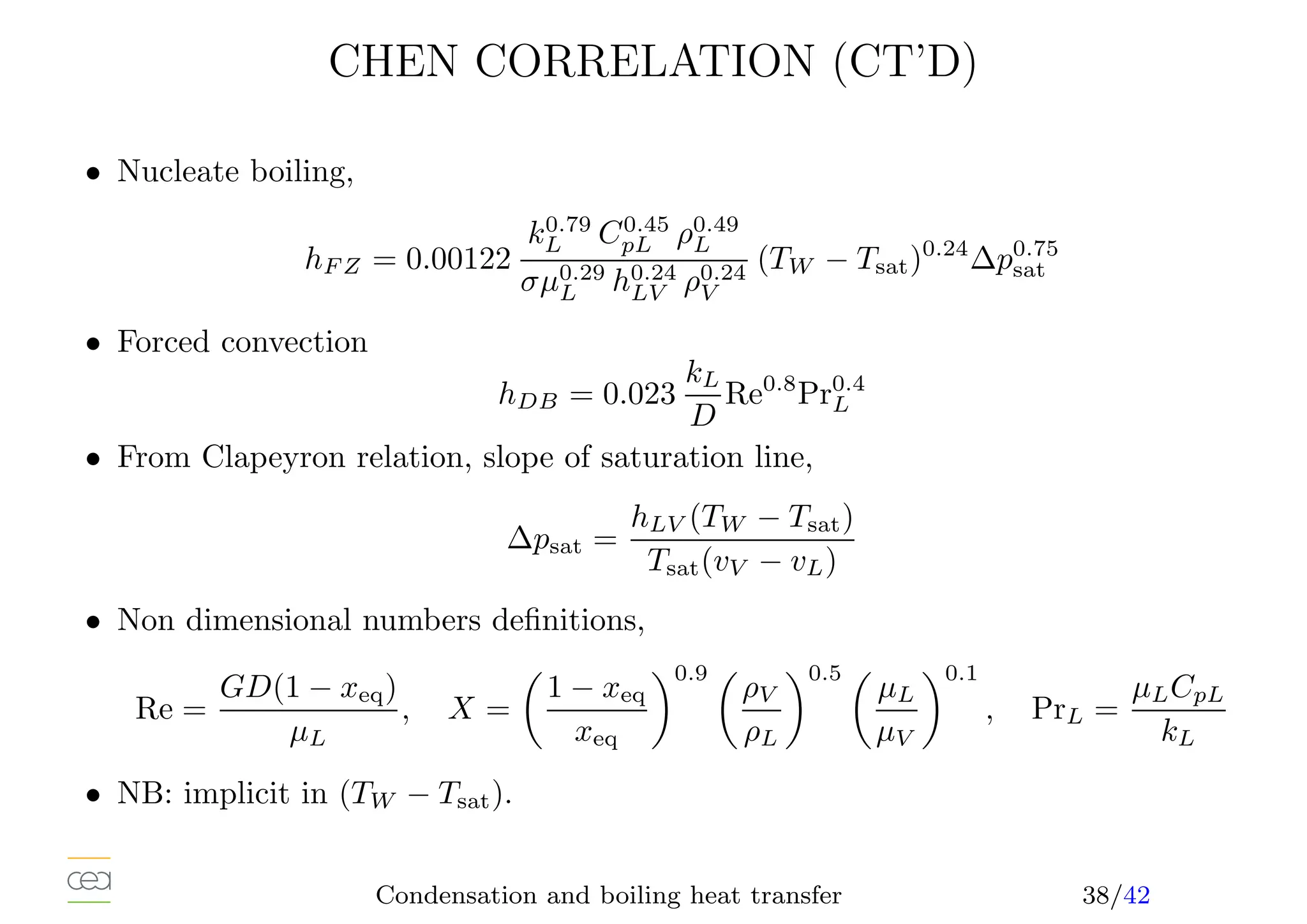
CHEN CORRELATION (CT’D)
• Nucleate boiling,
hF Z = 0.00122
k0.79
L C0.45
pL ρ0.49
L
σµ0.29
L h0.24
LV ρ0.24
V
(TW − Tsat)0.24
∆p0.75
sat
• Forced convection
hDB = 0.023
kL
D
Re0.8
Pr0.4
L
• From Clapeyron relation, slope of saturation line,
∆psat =
hLV (TW − Tsat)
Tsat(vV − vL)
• Non dimensional numbers definitions,
Re =
GD(1 − xeq)
µL
, X =

1 − xeq
xeq
0.9 
ρV
ρL
0.5 
µL
µV
0.1
, PrL =
µLCpL
kL
• NB: implicit in (TW − Tsat).
Condensation and boiling heat transfer 38/42
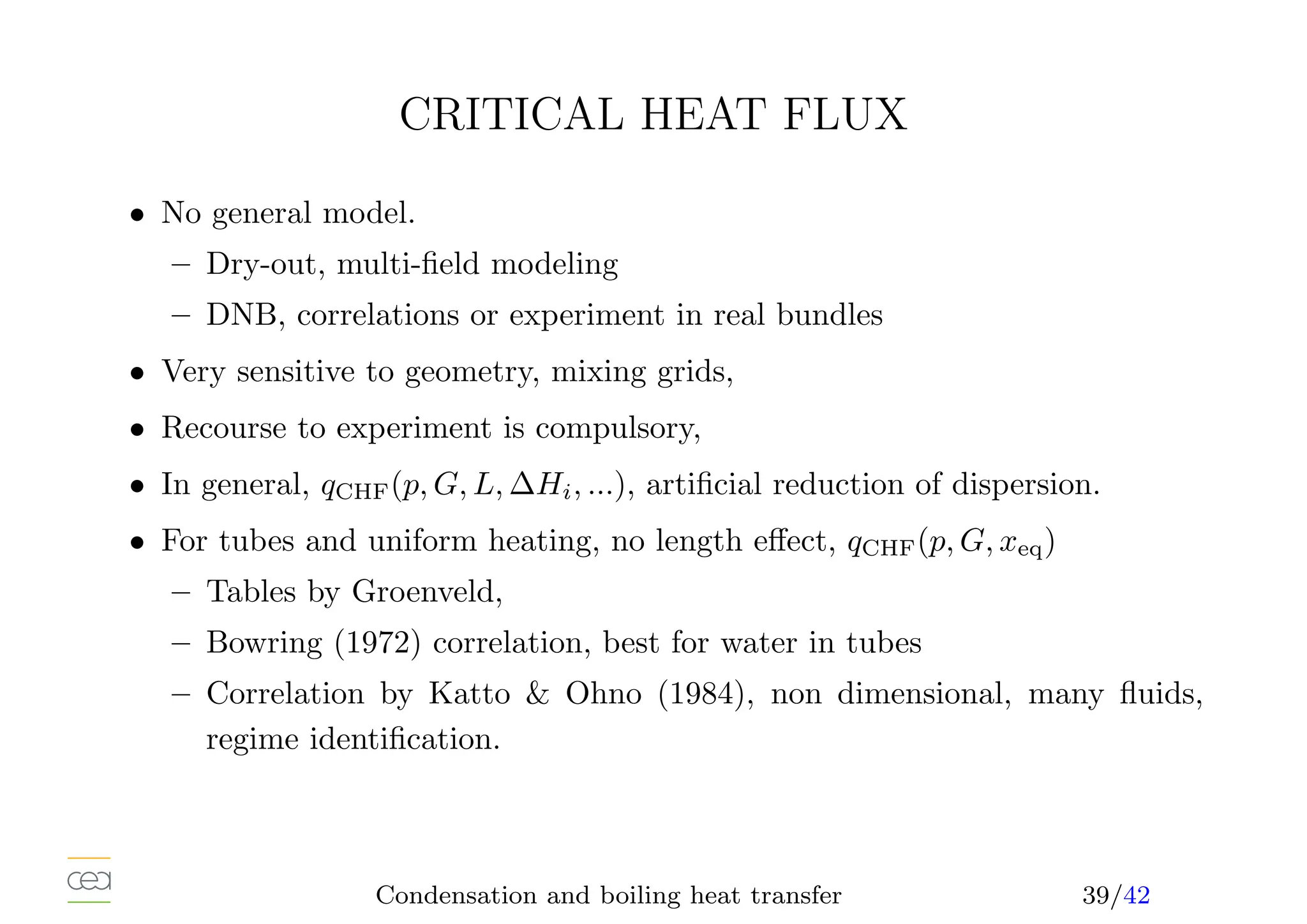
CRITICAL HEAT FLUX
• No general model.
– Dry-out, multi-field modeling
– DNB, correlations or experiment in real bundles
• Very sensitive to geometry, mixing grids,
• Recourse to experiment is compulsory,
• In general, qCHF(p, G, L, ∆Hi, ...), artificial reduction of dispersion.
• For tubes and uniform heating, no length effect, qCHF(p, G, xeq)
– Tables by Groenveld,
– Bowring (1972) correlation, best for water in tubes
– Correlation by Katto  Ohno (1984), non dimensional, many fluids,
regime identification.
Condensation and boiling heat transfer 39/42
MAIN PARAMETERS EFFECT ON CHF
After Groeneveld  Snoek (1986), tube diameter, D = 8 mm.
0
1000
2000
3000
4000
5000
6000
7000
8000
9000
10000
−20 0 20 40 60 80 100
CHF[kW/m
2
]
exit quality [%]
G=1000 kg/s/m2
P= 10 bar
P= 30 bar
P= 45 bar
P= 70 bar
P= 100 bar
P= 150 bar
P= 200 bar
0
1000
2000
3000
4000
5000
6000
−20 0 20 40 60 80 100
CHF[kW/m
2
]
exit quality [%]
p=150 bar
G= 0 kg/s/m2
G=1000 kg/s/m2
G=5000 kg/s/m2
G=7500 kg/s/m2
• Generally decreases with the increase of the exit quality. qCHF → 0, xeq → 1.
• Generally increases with the increase of the mass flux,
• CHF is non monotonic with pressure.
Condensation and boiling heat transfer 40/42
MORE ON HEAT TRANSFER
• Boiling and condensation,
– Delhaye (1990)
– Delhaye (2008)
– Roshenow et al. (1998)
– Collier  Thome (1994)
– Groeneveld  Snoek (1986)
• Single-phase,
– Bird et al. (2007)
– Bejan (1993)
Condensation and boiling heat transfer 41/42
REFERENCES
Bejan, A. (ed). 1993. Heat transfer. John Wiley  Sons.
Bird, R. B., Stewart, W. E.,  Lightfoot, E. N. 2007. Transport phenomena. Revised
second edn. John Wiley  Sons.
Collier, J. G.,  Thome, J. R. 1994. Convective boiling and condensation. third edn.
Oxford: Clarendon Press.
Delhaye, J. M. 1990. Transferts de chaleur : ebullition ou condensation des corps purs.
Techniques de l’ingénieur.
Delhaye, J.-M. 2008. Thermohydraulique des réacteurs nucléaires. Collection génie atom-
ique. EDP Sciences.
Groeneveld, D. C.,  Snoek, C. V. 1986. Multiphase Science and Technology. Vol. 2.
Hemisphere. G. F. Hewitt, J.-M. Delhaye, N. Zuber, Eds. Chap. 3: a comprehensive
examination of heat transfer correlations suitable for reactor safety analysis, pages
181–274.
Raithby, G. D.,  Hollands, K. G. 1998. Handbook of heat transfer. 3rd edn. McGraw-
Hill. W. M. Roshenow, J. P. Hartnett and Y. I Cho, Eds. Chap. 4-Natural convection,
pages 4.1–4.99.
Roshenow, W. M., Hartnett, J. P.,  Cho, Y. I. 1998. Handbook of heat transfer. 3rd
edn. McGraw-Hill.
Condensation and boiling heat transfer 42/42

Introduction to Two phase flow heat transfer

  • 1.
    A SHORT INTRODUCTIONTO TWO-PHASE FLOWS Condensation and boiling heat transfer Hervé Lemonnier DM2S/STMF/LIEFT, CEA/Grenoble, 38054 Grenoble Cedex 9 Ph. +33(0)4 38 78 45 40, herve.lemonnier@cea.fr herve.lemonnier.sci.free.fr/TPF/TPF.htm ECP, 2011-2012
  • 2.
    HEAT TRANSFER MECHANISMS •Condensation heat transfer: – drop condensation – film condensation • Boiling heat transfer: – Pool boiling, natural convection, ébullition en vase – Convective boiling, forced convection, • Only for pure fluids. For mixtures see specific studies. Usually in a mixture, h ⩽ P xihi and possibly hi. • Many definitions of heat transfer coefficient, h[W/m2 /K] = q ∆T , Nu = hL k , k(T?) Condensation and boiling heat transfer 1/42
  • 3.
    CONDENSATION OF PUREVAPOR • Flow patterns – Liquid film flowing. – Drops, static, hydrophobic wall (θ ≈ π). Clean wall, better htc. • Fluid mixture non-condensible gases: – Incondensible accumulation at cold places. – Diffusion resistance. – Heat transfer deteriorates. – Traces may alter significantly h Condensation and boiling heat transfer 2/42
  • 4.
    FILM CONDENSATION • Thermodynamicequilibrium at the interface, Ti = Tsat(p∞) • Local heat transfer coefficient, h(z) , q Ti − Tp = q Tsat − Tp • Averaged heat transfer coefficient, h(L) , 1 L Z L 0 h(z)dz • NB: Binary mixtures Ti(xα, p) and pα(xα, p). Approximate equilibrium condi- tions, – For non condensible gases in vapor, pV = xPsat(Ti), Raoult relation – For dissolved gases in water, pG = HxG, Henry’s relation Condensation and boiling heat transfer 3/42
  • 5.
    CONTROLLING MECHANISMS • Slowfilm, little convective effect, conduction through the film (main thermal resistance) • Heat transfer controlled by film characteristics, thickness, waves, turbulence. • Heat transfer regimes, Γ , ML P , ReF , 4Γ µL – Smooth, laminar, ReF 30, – Wavy laminar, 30 ReF 1600 – Wavy turbulent, ReF 1600 Condensation and boiling heat transfer 4/42
  • 6.
    CONDENSATION OF SATURATEDSTEAM • Simplest situation, only a single heat source: interface, stagnant vapor, • Laminar film (Nusselt, 1916, Rohsenow, 1956), correction 10 to 15%, h(z) = k3 LρLg(ρL − ρV )(hLV +0, 68CP L[Tsat − TP ]) 4µL(Tsat − TP )z 1 4 • Averaged heat transfer coefficient (TW = cst) : h(z) ∝ z− 1 4 , h(L) = 4 3 h(L) • Condensate film flow rate, energy balance at the interface, Γ(L) = h(L)(Tsat − TP )L hLV • Heat transfer coefficient-flow rate relation, h̄(L) kL µ2 L ρL(ρL − ρV ) 1 3 = 1, 47 Re − 1 3 F • hLV and ρV at saturation. kL, ρL at the film temperature TF , 1 2 (TW +Ti), • µ = 1 4 (3µL(TP ) + µL(Ti)), exact when 1/µL linear with T. Condensation and boiling heat transfer 5/42
  • 7.
    SUPERHEATED VAPOR • Twoheat sources: vapor (TV Ti) and interface. • Increase of heat transfer wrt to saturated conditions, empirical correction, h̄S(L) = h̄(L) 1 + CP V (TV − Tsat) hLV 1 4 • Energy balance at the interface, film flow rate, Γ(L) = h̄S(L)(TW − Tsat)L hLV + CP V (TV − Tsat) Condensation and boiling heat transfer 6/42
  • 8.
    FILM FLOW RATE-HEATTRANSFER COEFFICIENT • Laminar, h̄(L) kL µ2 L ρL(ρL − ρV ) 1 3 = 1, 47 Re − 1 3 F • Wavy laminar and previous regime (Kutateladze, 1963), h(z) ∝ Re−0,22 F ), h̄(L) kL µ2 L ρL(ρL − ρV ) 1 3 = ReF 1, 08Re1,22 F − 5, 2 • Turbulent and previous regimes (Labuntsov, 1975), h(z) ∝ Re0,25 F , h̄(L) kL µ2 L ρL(ρL − ρV ) 1 3 = ReF 8750 + 58Pr−0,5 F (Re0,75 F − 253) • NB: Implicit relation, ReF depends on h(L) through Γ. Condensation and boiling heat transfer 7/42
  • 9.
    OTHER MISCELLANEOUS EFFECTS •Steam velocity, vV , when dominant effect, • Vv descending flow, vapor shear added to gravity, • Decreases fil thickness, • Delays transition to turbulence turbulence, h ∝ τ 1 2 i • See for example Delhaye (2008, Ch. 9, p. 370) • When 2 effects are comparable, h1 stagnant, h2 with dominant shear , h = (h2 1 + h2 2) 1 2 Condensation and boiling heat transfer 8/42
  • 10.
    CONDENSATION ON HORIZONTALTUBES • Heat transfer coefficient definition, h̄ = 1 π Z π 0 h(u)du • Stagnant vapor conditions, laminar film, Nusselt (1916) h̄ = 0.728 (0.70) k3 LρL(ρL − ρV )ghLV µL(Tsat − Tp)D 1 4 • 0.728, imposed temperature, 0.70, im- posed heat flux. • Γ, film flow rate per unit length of tube. Condensation and boiling heat transfer 9/42
  • 11.
    • Film flowrate- heat transfer coefficient, energy balance, h̄ kL µ2 L ρL(ρL − ρV ) 1 3 = 1.51 (1.47) Re − 1 3 F • Vapor superheat and transport proprieties, same as vertical wall • Effect of steam velocity (Fujii), h̄ h0 = 1.4 u2 V (Tsat − TP )kL gDhLV µL 0.05 1 h̄ h0 1.7, • Tube number effect in bundles, (Kern, 1958), h(1, N) h1 = N−1/6 Condensation and boiling heat transfer 10/42
  • 12.
    DROP CONDENSATION • Mechanisms, –Nucleation at the wall, – Drop growth, – Coalescence, – Dripping down (non wetting wall) • Technological perspective, – Wall doping or coating – Clean walls required, fragile – Surface energy gradient walls. Self- draining Condensation and boiling heat transfer 11/42
  • 13.
    • heat transfercoefficient, 1 h = 1 hG + 1 hd + 1 hi + 1 hco • G : non-condensible gas, d : drop, i : phase change, co coating thickness. • Non-condensible gases effect, ωi ≈ 0, 02 ⇒ h → h/5 • Example, steam on copper, Tsat 22o C, h in W/cm2 /o C, hd = min(0, 5 + 0, 2Tsat, 25) Condensation and boiling heat transfer 12/42
  • 14.
    POOL BOILING 6 I= J 7 1 • Nukiyama (1934) • Only one heat sink, stagnant saturated water, • Wire NiCr and Pt, – Diameter: ≈ 50µm, – Length: l – Imposed power heating: P Condensation and boiling heat transfer 13/42
  • 15.
    BOILING CURVE 4 35 2 0 0 , T s a t ( ° C ) q ( W / c m 2 ) 2 1 1 6 • Imposed heat flux, P = qπDl = UI • Wall and wire temperature are equal, D → 0 R(T) = U I , | T | 3 ≈ TW • Wall super-heat: ∆T = TW − Tsat • Heat transfer coefficient, h , q TW − Tsat Condensation and boiling heat transfer 14/42
  • 16.
    BOILING CURVE B H e a t f l u x W al l s u p e r h e a t C E F G AD H A http://www-heat.uta.edu, Next Condensation and boiling heat transfer 15/42
  • 17.
    HEAT TRANSFER REGIMES ,T 0 , q 0 q A D H G N u c l e a t e b o i l i n g F i l m b o i l i n g F l u x m a x . F l u x m i n . B u r n - o u t , T s a t • OA: Natural convection • AD: Nucleate boiling • DH: Transition boiling • HG: Film boiling Condensation and boiling heat transfer 16/42
  • 18.
    TRANSITION BOILING STABILITY ,T 0 , q 0 q A D H G N u c l e a t e b o i l i n g F i l m b o i l i n g F l u x m a x . F l u x m i n . B u r n - o u t , T s a t • Wire energy balance, MCv dT dt = P − qS • Linearize at ∆T0, q0, T = T0 + T1, MCv dT1 dt = P − q0S | {z } =0 −S ∂q ∂∆T T1 • Solution, linear ODE, T1 = T10 exp(−αt), α = S MCv ∂q ∂∆T T0 • 2 stable solutions, one unstable (DH), ∂q ∂∆T 0 • Transition boiling, imposed temperature experiments (Drew et Müller, 1937). Condensation and boiling heat transfer 17/42
  • 19.
    NATURAL CONVECTION • Wirediameter D, natural convection q = h(TF − Tsat), Nu = hD k Pr = νL αL , Ra = gβ(TF − Tsat)D3 νLαL • Nusselt number is the non-dimensional heat transfer coefficient (h). • kL, αL, νL at the film temperature 1 2 (TF + Tsat), β à Tsat. • Churchill Chu (1975), 10−5 Ra 1012 , Nu =   0, 60 + 0, 387 Ra1/6 h 1 + 0,559 Pr 9/16 i8/27    2 Condensation and boiling heat transfer 18/42
  • 20.
    NATURAL CONVECTION ONA FLAT PLATE • Scales A, P, plate area and perimeter. Length scale, L = A P . Nu = hL k = qL kL(TP − T∞) , Ra = gβ(TP − T∞)L3 νLαL • Two regimes, Nu =          0, 560 Ra1/4 1 + (0, 492Pr)9/16 4/9 1 Ra 107 0, 14 Ra1/3 1 + 0, 0107Pr 1 + 0, 01Pr 0, 024 ⩽ Pr ⩽ 2000, Ra 2 1011 • Thermodynamic and transport properties Raithby Hollands (1998). For liquids: all at TF = 1 2 (TP + T∞) Condensation and boiling heat transfer 19/42
  • 21.
    ONSET OF NUCLEATEBOILING R 2 r T W T L • Control parameters: pL et TW = TL∞ • Super-heated wall: TL∞ = Tsat(pL) + ∆T • Site distribution: r, R = R(r, θ) • Mechanical balance: pV = pL + 2σ R • Thermodynamic equilibrium: pV = psat(TLi) ⇒ TLi = Tsat(pV ) TLi = Tsat(pL+ 2σ R ) ≈ (TL∞−∆T)+ 2σ R dT dp sat • Heat flux to interface: q 0, Ṙ 0 q = h(TL∞ − TLi) = h ∆T − 2σ R dT dp sat ∆T ∆Teq = 2σ R dT dp sat , R Req = 2σ ∆T dT dp sat 1 bar, ∆T = 3o C, Req = 5, 2 µm, 155 bar, ∆T = 3o C, Req = 0, 08 µm Condensation and boiling heat transfer 20/42
  • 22.
    NUCLEATE BOILING MECHANISMS •Super-heated liquid transport, Yagumata et al. (1955) q ∝ (TP − Tsat)1.2 n0.33 • n: active sites number density, n ∝ ∆T5÷6 sat ⇒ q ∝ ∆T3 sat • Very hight heat transfer, precision unneces- sary. • Rohsenow (1952), analogy with convective h. t.: Nu = CRea Prb , • Scales : Re = ρLV L µL , – Length: detachment diameter, capillary length: L ≈ q σ g(ρL−ρV ) – Liquid velocity: energy balance, q = ṁhLV , V ≈ q ρLhLV Ja , CpL(TP − Tsat) hLV = Csf Re0.33 Prs L • Csf ≈ 0.013, s = 1 water, s = 1.7 other fluids. Condensation and boiling heat transfer 21/42
  • 23.
    BOILING CRISIS, CRITICALHEAT FLUX • Flow pattern close to CHF: critical heat flux), Rayleigh-Taylor instability, • Stability of the vapor column: Kelvin-Helmholtz, • Energy balance over A, λT = 2π √ 3 r σ g(ρL − ρV ) , 1 2 ρV U2 V π σ λH , qA = ρV UV AJ hLV Condensation and boiling heat transfer 22/42
  • 24.
    • Zuber (1958),jet radius RJ = 1 4 λT , λH = 2πRJ , marginal stability, qCHF = 0.12ρ 1/2 V hLV 4 p σg(ρV − ρL) • Lienhard Dhir (1973), jet radius RJ = 1 4 λT , λH = λT , qCHF = 0.15ρ 1/2 V hLV 4 p σg(ρV − ρL) • Kutateladze (1948), dimensional analysis and experiments, qCHF = 0.13ρ 1/2 V hLV 4 p σg(ρV − ρL) Condensation and boiling heat transfer 23/42
  • 25.
    FILM BOILING • Analogywith condensation (Nusselt, Rohsenow), Bromley (1950), V L NuL = 0.62 ρV g(ρL − ρV )h0 LV D3 µV kV (TW − Tsat) 1 4 , h0 LV = hLV 1 + 0.34 CP V (TW − Tsat) hLV • Transport and thermodynamical properties: – Liquid at saturation Tsat, – Vapor at the film temperature, TF = 1 2 (Tsat + TW ). • Radiation correction: TW 300o C, : emissivity, σ = 5, 67 10−8 W/m2 /K4 h = h(T 300o C) + σ(T4 W − T4 sat) TW − Tsat Condensation and boiling heat transfer 24/42
  • 26.
    TRANSITION BOILING • Minimumflux, qmin = ChLV 4 s σg(ρL − ρV ) (ρL + ρV )2 – Zuber (1959), C = 0.13, stability of film boiling, – Berenson (1960), C = 0, 09, rewetting, Liendenfrost temperature. • Scarce data in transition boiling, • Quick fix, ∆Tmin and ∆Tmax, from each neighboring regime (NB and FB), • Linear evolution in between (log-log plot!). Condensation and boiling heat transfer 25/42
  • 27.
    SUB-COOLING EFFECT • Liquidsub-cooling, TL Tsat, ∆Tsub , Tsat − TL • Ivey Morris (1961) qC,sub = qC,sat 1 + 0, 1 ρL ρV 3/4 CP L∆Tsub hLV ! Condensation and boiling heat transfer 26/42
  • 28.
    CONVECTIVE BOILING REGIMES →Increasing heat flux, constant flow rate → 1. Onset of nucleate boiling 3. Liquid film dry-out 2. Nucleate boiling suppression 4. Super-heated vapor Condensation and boiling heat transfer 27/42
  • 29.
    BACK TO THEEQUILIBRIUM (STEAM) QUALITY • Regime boundaries depend very much on z. Change of variable, xeq • Equilibrium quality, non dimensional mixture enthalpy, xeq , h − hLsat hLV • Energy balance, low velocity, stationary flows, M dh dz = MhLV dxeq dz = qP • Uniform heat flux, xeq linear in z. Close to equilibrium, xeq ≈ x • According to the assumptions of the HEM, 0 xeq single-phase liquid (sub-cooled) 0 xeq 1 two-phase, saturated 1 xeq single-phase vapor (super-heated) Condensation and boiling heat transfer 28/42
  • 30.
    CONVECTIVE HEAT TRANSFERIN VERTICAL FLOWS Boiling flow description • Constant heat flux heating, • Fluid temperature evolution, (Tsat), • Wall temperature measurement, • Flow regime, • Heat transfer controlling mechanism. Condensation and boiling heat transfer 29/42
  • 31.
    From the inlet,flow and heat transfer regimes, • Single-phase convection • Onset of nucleate boiling, ONB • Onset of signifiant void, OSV • Important points for pressure drop calculations, flow oscillations. Condensation and boiling heat transfer 30/42
  • 32.
    • Nucleate boilingsuppression, • Liquid film dry-out, boiling crisis (I), • Single-phase vapor convection. Condensation and boiling heat transfer 31/42
  • 33.
    HEAT TRANSFER COEFFICIENT DO:dry-out, DNB: departure from nucleate boiling (saturated, sub-cooled), PDO: post dry-out, sat FB: saturated film boiling, Sc Film B: sub-cooled film boiling Condensation and boiling heat transfer 32/42
  • 34.
    BOILING SURFACE Condensation andboiling heat transfer 33/42
  • 35.
    S-Phase conv: single-phaseconvection, PB: partial boiling, NB: nucleate boiling (S, saturated, Sc, subcooled), FB: film boiling, PDO: post dry-out, DO: dry-out, DNB: departure from nucleate boiling. Condensation and boiling heat transfer 34/42
  • 36.
    SINGLE-PHASE FORCED CONVECTION •Forced convection (Dittus Boelter, Colburn), Re 104 , Nu , hD kL = 0, 023Re0,8 Pr0,4 , Re = GD µL , PrL = µLCP L kL • Fluid temperature, TF , mixing cup temperature, that corresponding to the area-averaged mean enthalpy. • Transport properties at Tav – Local heat transfer coefficient, q , h(TW − TF ), Tav = 1 2 (TW + TF ) – Averaged heat transfer coefficient (length L), q̄ , h̄(T̄W − T̄F ), T̄F = 1 2 (TF in + TF out), Tav = 1 2 (T̄W + T̄F ) • Always check the original papers... Condensation and boiling heat transfer 35/42
  • 37.
    NUCLEATE BOILING SIGNIFICANT VOID • Onset and suppression of nucleate boiling, ONB, (Frost Dzakowic, 1967), TP − Tsat = 8σqTsat kLρV hLV 0,5 PrL • Onset of signifiant void, OSV, (Saha Zuber, 1974) Nu = qD kL(Tsat − TL) = 455, Pé 7 104 , thermal regime St = q GCP L(Tsat − TL) = 0, 0065, Pé 7 104 , hydrodynamic regime Condensation and boiling heat transfer 36/42
  • 38.
    DEVELOPPED BOILING ANDCONVECTION • Weighting of two mechanisms, xeq 0 (Chen, 1966) – Nucleate boiling(Forster Zuber, 1955), S, suppression factor,same model for pool boiling, – Forced convection, Dittus Boelter, F, amplification factor, h = hFZS + hDBA 1 S = 1 + 2.53 10−6 (ReF1.25 )1.17 , F =    1 1/X ⩽ 0.1 2.35(1/X + 0.213)0.736 1/X 0.1 Condensation and boiling heat transfer 37/42
  • 39.
    CHEN CORRELATION (CT’D) •Nucleate boiling, hF Z = 0.00122 k0.79 L C0.45 pL ρ0.49 L σµ0.29 L h0.24 LV ρ0.24 V (TW − Tsat)0.24 ∆p0.75 sat • Forced convection hDB = 0.023 kL D Re0.8 Pr0.4 L • From Clapeyron relation, slope of saturation line, ∆psat = hLV (TW − Tsat) Tsat(vV − vL) • Non dimensional numbers definitions, Re = GD(1 − xeq) µL , X = 1 − xeq xeq 0.9 ρV ρL 0.5 µL µV 0.1 , PrL = µLCpL kL • NB: implicit in (TW − Tsat). Condensation and boiling heat transfer 38/42
  • 40.
    CRITICAL HEAT FLUX •No general model. – Dry-out, multi-field modeling – DNB, correlations or experiment in real bundles • Very sensitive to geometry, mixing grids, • Recourse to experiment is compulsory, • In general, qCHF(p, G, L, ∆Hi, ...), artificial reduction of dispersion. • For tubes and uniform heating, no length effect, qCHF(p, G, xeq) – Tables by Groenveld, – Bowring (1972) correlation, best for water in tubes – Correlation by Katto Ohno (1984), non dimensional, many fluids, regime identification. Condensation and boiling heat transfer 39/42
  • 41.
    MAIN PARAMETERS EFFECTON CHF After Groeneveld Snoek (1986), tube diameter, D = 8 mm. 0 1000 2000 3000 4000 5000 6000 7000 8000 9000 10000 −20 0 20 40 60 80 100 CHF[kW/m 2 ] exit quality [%] G=1000 kg/s/m2 P= 10 bar P= 30 bar P= 45 bar P= 70 bar P= 100 bar P= 150 bar P= 200 bar 0 1000 2000 3000 4000 5000 6000 −20 0 20 40 60 80 100 CHF[kW/m 2 ] exit quality [%] p=150 bar G= 0 kg/s/m2 G=1000 kg/s/m2 G=5000 kg/s/m2 G=7500 kg/s/m2 • Generally decreases with the increase of the exit quality. qCHF → 0, xeq → 1. • Generally increases with the increase of the mass flux, • CHF is non monotonic with pressure. Condensation and boiling heat transfer 40/42
  • 42.
    MORE ON HEATTRANSFER • Boiling and condensation, – Delhaye (1990) – Delhaye (2008) – Roshenow et al. (1998) – Collier Thome (1994) – Groeneveld Snoek (1986) • Single-phase, – Bird et al. (2007) – Bejan (1993) Condensation and boiling heat transfer 41/42
  • 43.
    REFERENCES Bejan, A. (ed).1993. Heat transfer. John Wiley Sons. Bird, R. B., Stewart, W. E., Lightfoot, E. N. 2007. Transport phenomena. Revised second edn. John Wiley Sons. Collier, J. G., Thome, J. R. 1994. Convective boiling and condensation. third edn. Oxford: Clarendon Press. Delhaye, J. M. 1990. Transferts de chaleur : ebullition ou condensation des corps purs. Techniques de l’ingénieur. Delhaye, J.-M. 2008. Thermohydraulique des réacteurs nucléaires. Collection génie atom- ique. EDP Sciences. Groeneveld, D. C., Snoek, C. V. 1986. Multiphase Science and Technology. Vol. 2. Hemisphere. G. F. Hewitt, J.-M. Delhaye, N. Zuber, Eds. Chap. 3: a comprehensive examination of heat transfer correlations suitable for reactor safety analysis, pages 181–274. Raithby, G. D., Hollands, K. G. 1998. Handbook of heat transfer. 3rd edn. McGraw- Hill. W. M. Roshenow, J. P. Hartnett and Y. I Cho, Eds. Chap. 4-Natural convection, pages 4.1–4.99. Roshenow, W. M., Hartnett, J. P., Cho, Y. I. 1998. Handbook of heat transfer. 3rd edn. McGraw-Hill. Condensation and boiling heat transfer 42/42