5. functions of communication and speaker's purpose
The document discusses the functions of communication, including information sharing, motivation, regulation, emotional expression, and social interaction, with examples and explanations for each. It emphasizes the importance of understanding communication's role in fostering self-confidence and guidelines in various contexts. Additionally, it identifies the speaker's purposes in classroom and social scenarios, along with a group activity centered on songwriting related to these functions.
Learning Competencies
The learners…
•Discuss the functions of communication –
EN11/12OC-Ibe-8
• Identify the speaker’s purpose(s). –
EN11/12OC-Ibe-9
2 days
3.
Review
• What isthe importance of knowing and
understanding the cultures of other places
or countries?
• Why is facial expression generally
considered the only universal nonverbal
language? Elaborate.
4.
Interactive Discussion Rules:
PLEASELISTEN ATTENTIVELY DURING:
-Teacher’s discussion
-When your classmate talk, and when
someone ask questions and the teachers
answered it.
-When the group perform.
5.
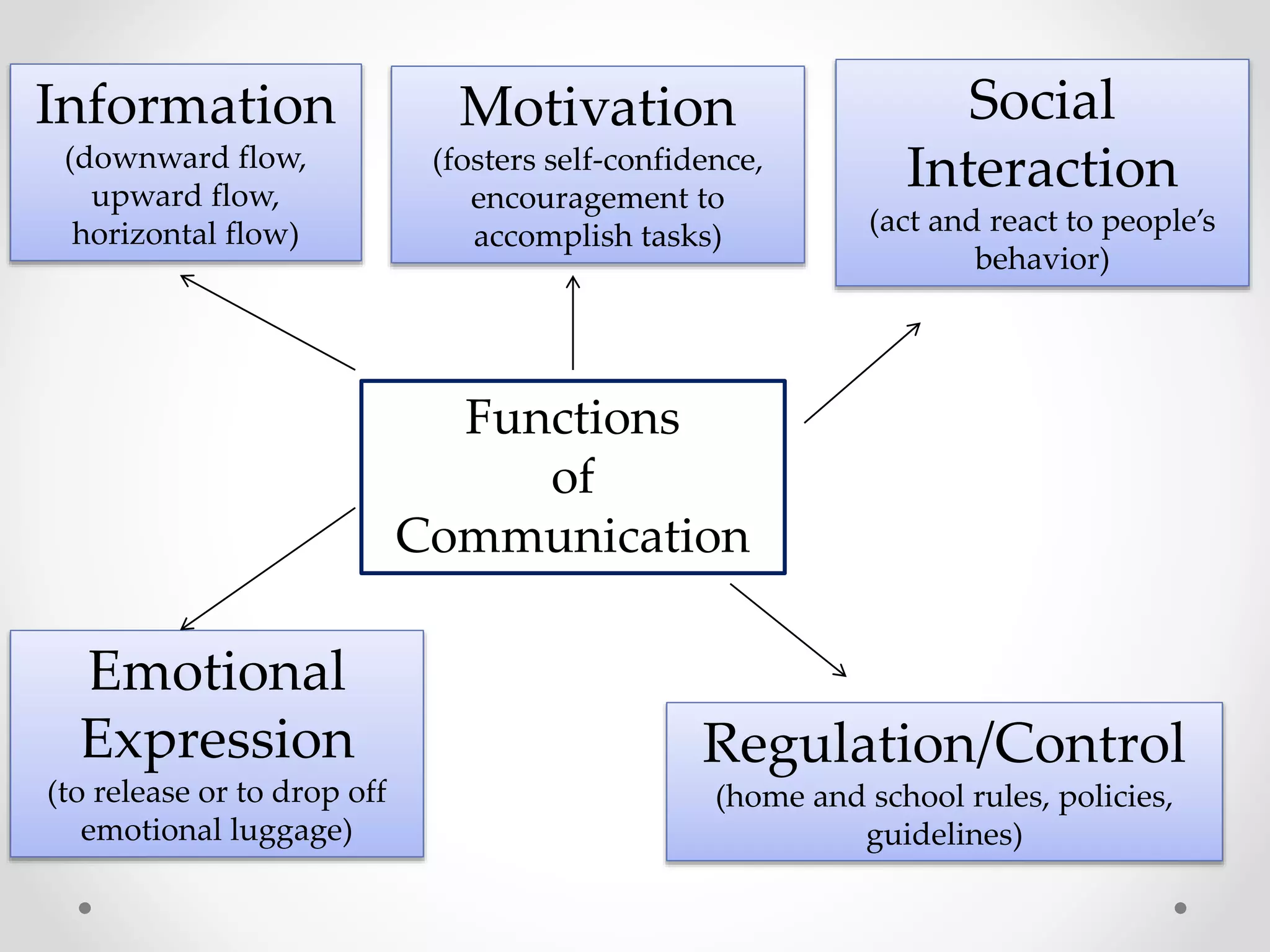
Information
(downward flow,
upward flow,
horizontalflow)
Motivation
(fosters self-confidence,
encouragement to
accomplish tasks)
Regulation/Control
(home and school rules, policies,
guidelines)
Emotional
Expression
(to release or to drop off
emotional luggage)
Social
Interaction
(act and react to people’s
behavior)
Functions
of
Communication
6.
Function refers tothe particular
purpose for which a thing is used,
something exists, or a person is
fitted to meet his or somebody
else’s needs or desires
7.
Whenever we communicate
•Have a definite purpose:
intentional, perceptible or
recognizable, and functional or
designed to achieve something
positive.
8.
A. Information
• Toprovide information
This is the most basic function of
communication.
1. Communication provides data and
information for effective completion of tasks,
solution of problems, and elimination of
uncertainty. The three flows of informations.
9.
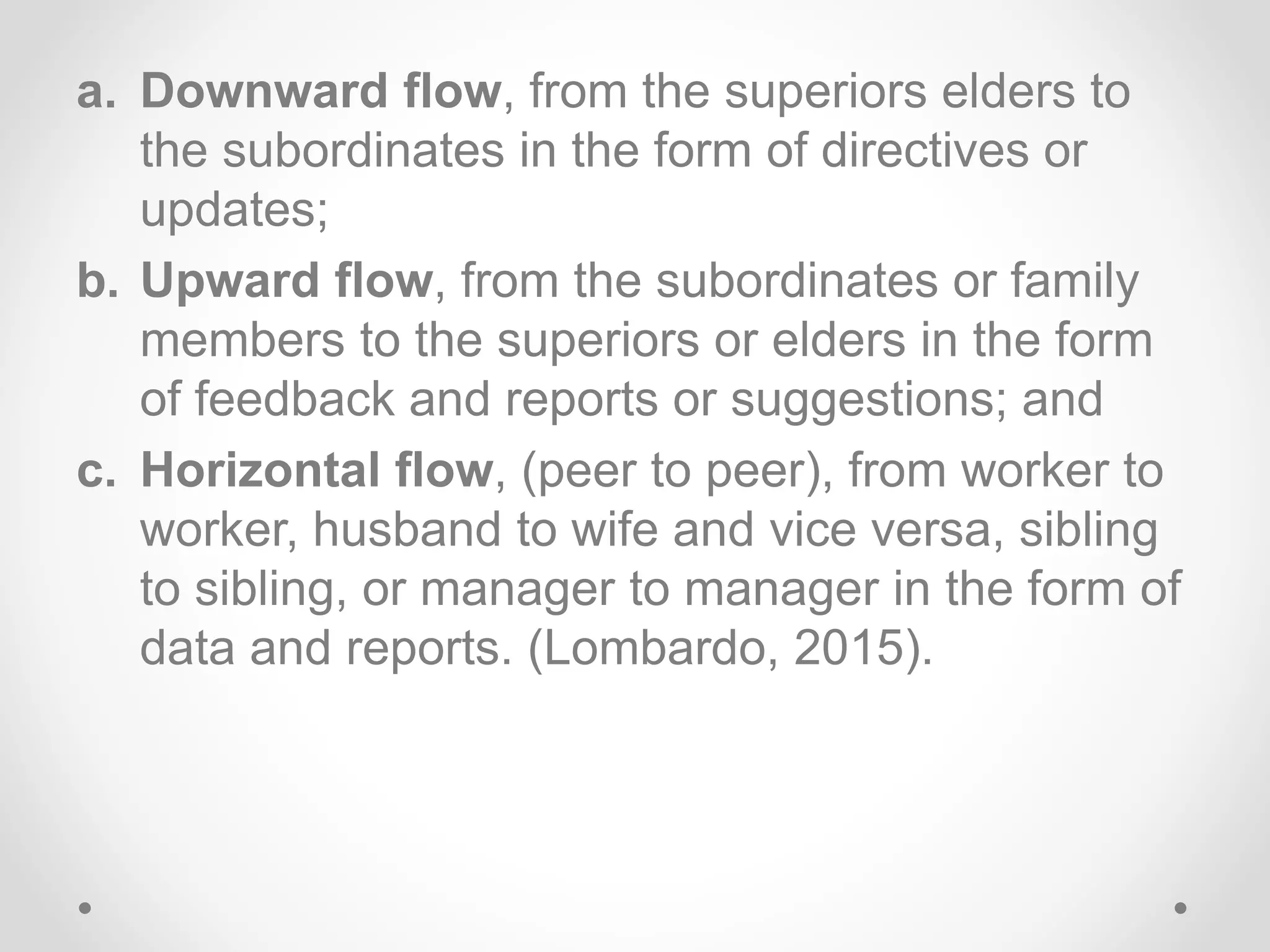
a. Downward flow,from the superiors elders to
the subordinates in the form of directives or
updates;
b. Upward flow, from the subordinates or family
members to the superiors or elders in the form
of feedback and reports or suggestions; and
c. Horizontal flow, (peer to peer), from worker to
worker, husband to wife and vice versa, sibling
to sibling, or manager to manager in the form of
data and reports. (Lombardo, 2015).
10.
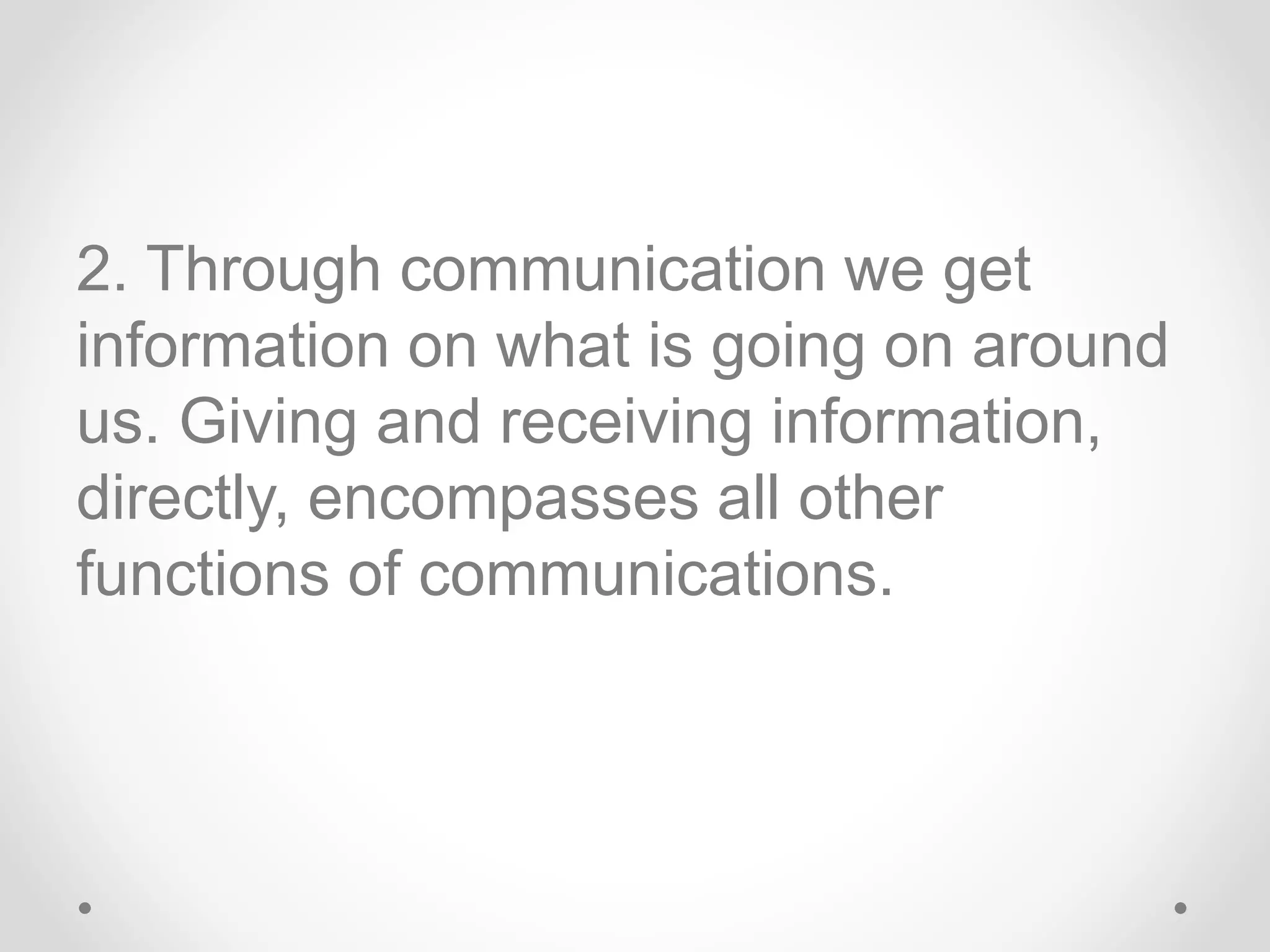
2. Through communicationwe get
information on what is going on around
us. Giving and receiving information,
directly, encompasses all other
functions of communications.
11.
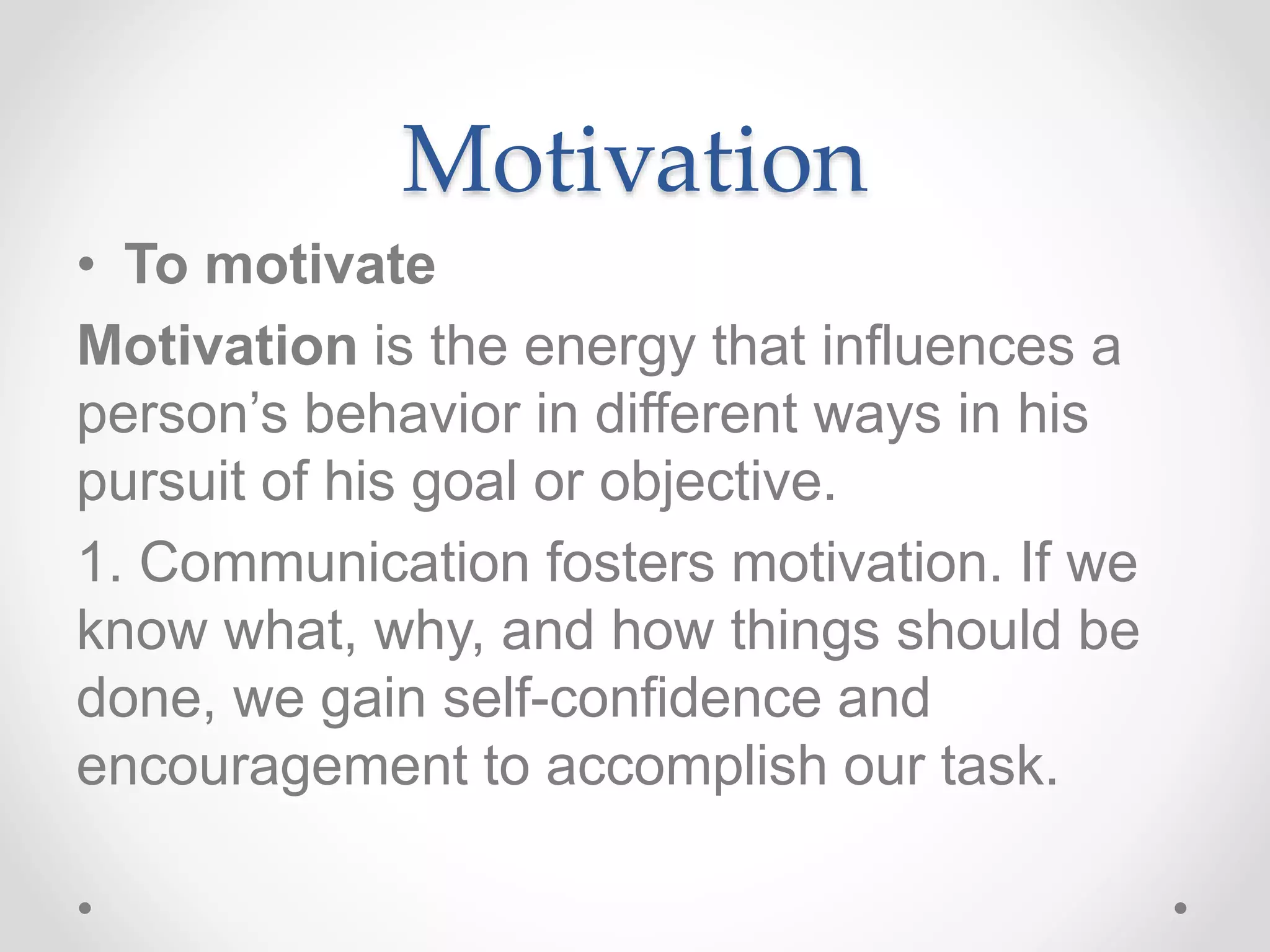
Motivation
• To motivate
Motivationis the energy that influences a
person’s behavior in different ways in his
pursuit of his goal or objective.
1. Communication fosters motivation. If we
know what, why, and how things should be
done, we gain self-confidence and
encouragement to accomplish our task.
12.
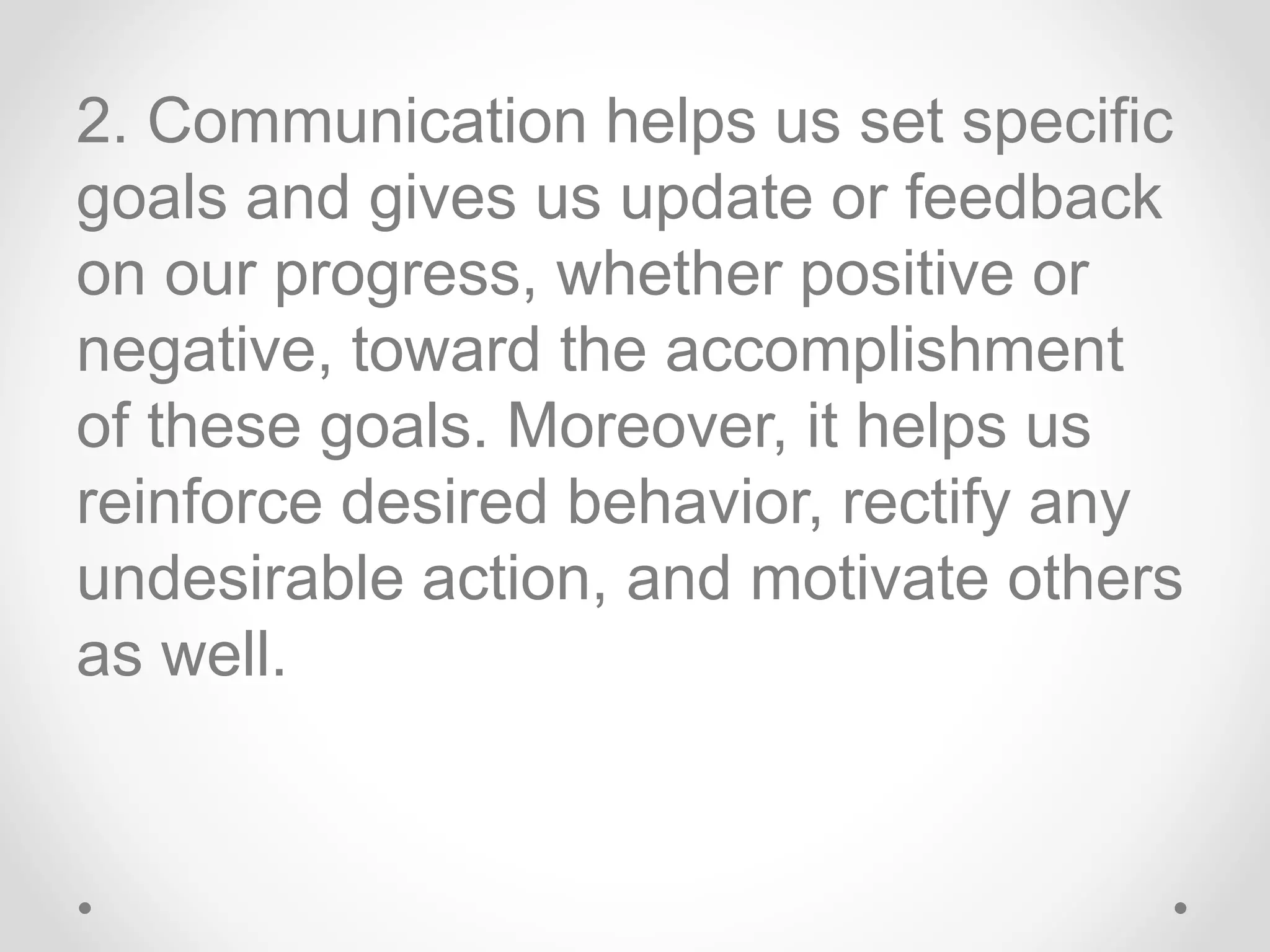
2. Communication helpsus set specific
goals and gives us update or feedback
on our progress, whether positive or
negative, toward the accomplishment
of these goals. Moreover, it helps us
reinforce desired behavior, rectify any
undesirable action, and motivate others
as well.
13.
Examples:
• The priestor the leader of a religious
organization preaches to his parish to motivate
them to live a Christian way of life.
• The teacher updates his students on their school
performance to encourage them to do better.
• The coach boosts his players’ morale by building
their self-esteem through pep talks and team-
building sessions.
14.
Regulation
• To controlor regulate
Is to exercise restraint or direction formally
or informally. The expression of needs and
want is a way to regulate the behavior of
another person to obtain, something done
(Murphy, 2014). This happens particularly
among family members or acquaintances.
15.
Examples:
• School rulesand policies on attendance,
grading, dress codes are prescribed.
• Employees are urged to follow authority
hierarchies and some formal guidelines.
• The public is enjoined to follow the laws of the
country.
• Believers are encouraged to take heart the
precepts of the bible, and the Roman Catholics
are obliged to follow the Ten Commandments.
16.
Emotional Expression
• Tofacilitate emotional expression
Communication makes possible the release or
unloading of emotions, resulting in catharsis.
Communicating your emotions verbally or
nonverbally (being angry, sad, or afraid) will
alleviate your anxiety and help you get out of
your emotional blocking. In times like this, you
need someone “to talk to” or “ shoulder to cry on”.
17.
Social Interaction
• Toeffect social interaction
Communication allows us to act and react to
the behavior of people around us. By
revealing our thoughts and feelings, we elicit
reactions from other
18.
1. Communication facilitatessocial
closeness to establish, maintain, and enjoy
relationships with other. Small talk, which
Locked (1998) calls “social closeness and
engagement,” is one of the most important
purposes of human communication (as cited
in Murphy, 2014).
19.
2. Communication alsofulfills our ego need–
the need for pride and self-esteem, and our
social needs– the need to belong and to be
accepted, especially by our significant
others (Lombardo, 2015). Having social
cliques or barkadas is a proof of this need.
The saying that “no man is an island”.
20.
Let us Summarize
Discussthe following Function of
Communication and cite one example.
1. Emotional Expression
2. Social Interaction
3. Information
4. Regulation
5. Motivation
21.
Identify the speakers
purpose
•The teacher informs the students of the
their midterm examination.
• A student council member distributes
handouts and explains to students events
and activities for the whole semester.
22.
• On thefirst day of classes, the adviser
reminds students about the policies of the
school.
• Mary confides in her best friend her
problems at home.
• The leader of a group of students shares
her thoughts and aspirations with her
close friends.
23.
Identify who controlsthe
conversations
• Doctor and patient in a clinic or hospital.
• Boss and employee in an office.
• Driver and passenger inside a public utility
vehicle
• Mother and child at home
• Leader of an activist group and his
audience in an rally.
24.
Explain how thefollowing
can motivate you
• Your best friend
• Your parents
• Guidance counselors
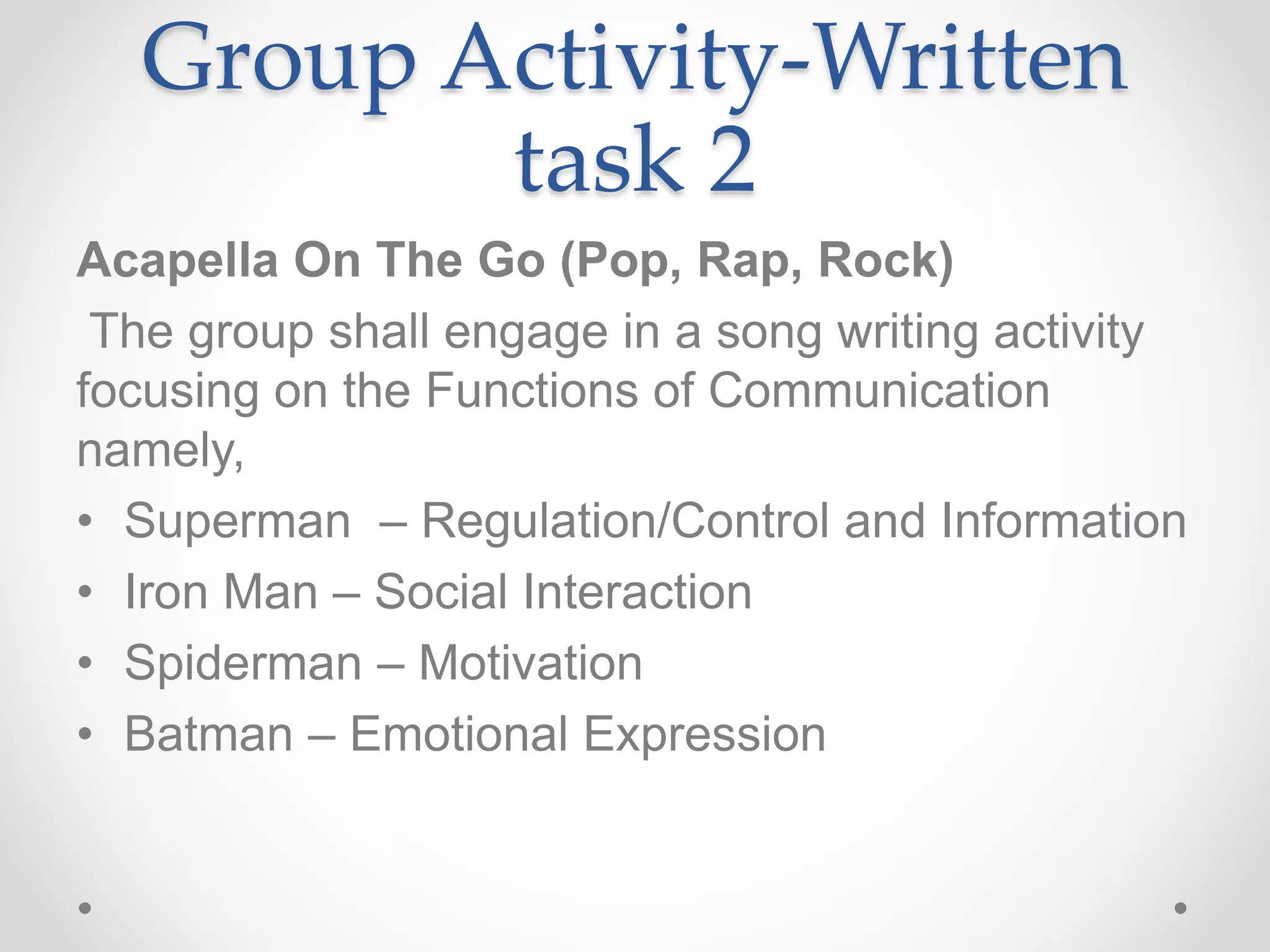
Group Activity-Written
task 2
AcapellaOn The Go (Pop, Rap, Rock)
The group shall engage in a song writing activity
focusing on the Functions of Communication
namely,
• Superman – Regulation/Control and Information
• Iron Man – Social Interaction
• Spiderman – Motivation
• Batman – Emotional Expression
27.
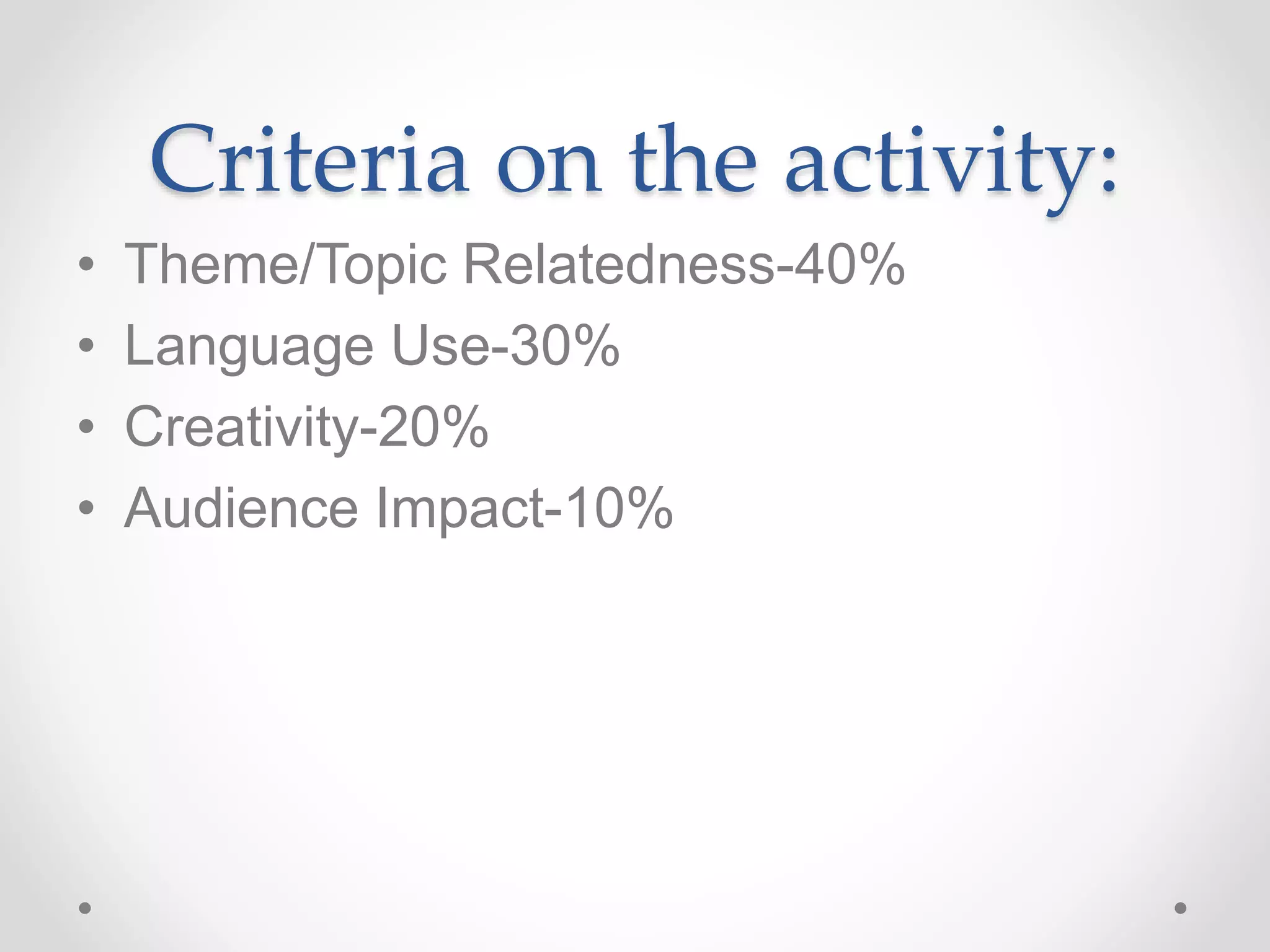
Criteria on theactivity:
• Theme/Topic Relatedness-40%
• Language Use-30%
• Creativity-20%
• Audience Impact-10%
28.
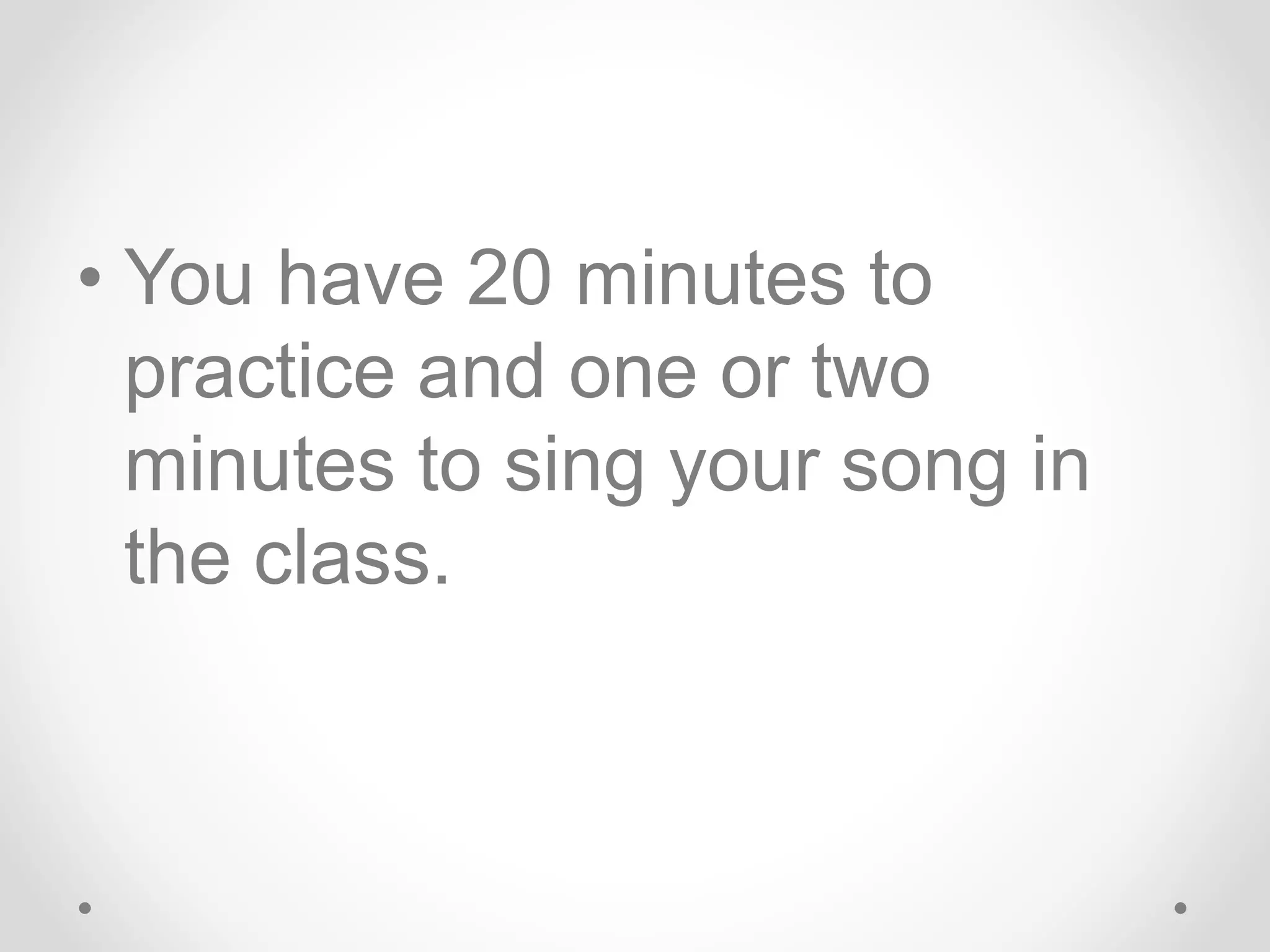
• You have20 minutes to
practice and one or two
minutes to sing your song in
the class.