Functions of
Communication
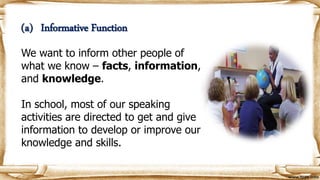
We want to inform other people of
what we know – facts, information,
and knowledge.
In school, most of our speaking
activities are directed to get and give
information to develop or improve our
knowledge and skills.
(a) Informative Function
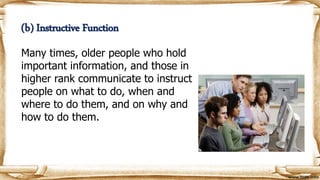
Many times, older people who hold
important information, and those in
higher rank communicate to instruct
people on what to do, when and
where to do them, and on why and
how to do them.
(b) Instructive Function
You may find yourself wanting to
influence the opinion of others to
believe and accept your stand or
claim on an issue or problem; so
you think of strategies on how to
persuade them to change their
perspectives or opinion.
(c) Persuasive Function
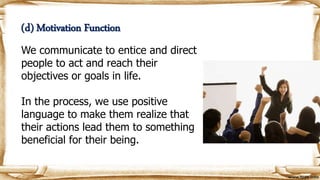
We communicate to entice and direct
people to act and reach their
objectives or goals in life.
In the process, we use positive
language to make them realize that
their actions lead them to something
beneficial for their being.
(d) Motivation Function
We use communication for
pleasure and enjoyment.
(e) Aesthetic Function
Communication is curative and serves
to maintain good health.
Sometimes, talking to a person does
not mean asking for his help; we talk
to another person merely to vent our
feelings. After we talk we find
ourselves in a much better condition.
(f) Therapeutic Function or Emotional Expression
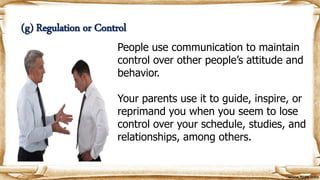
People use communication to maintain
control over other people’s attitude and
behavior.
Your parents use it to guide, inspire, or
reprimand you when you seem to lose
control over your schedule, studies, and
relationships, among others.
(g) Regulation or Control
https://www.facebook.com/CASTIorcashs/
Communication helps us start,
maintain, regulate, or even end
relationships with other people.
We usually establish a positive
climate at home, in school, and in
the workplace by greeting the
people around us and by
exchanging pleasantries with them.
(h) Social Interaction

Functions-of-Communication.pptx

  • 1.
  • 2.
    We want toinform other people of what we know – facts, information, and knowledge. In school, most of our speaking activities are directed to get and give information to develop or improve our knowledge and skills. (a) Informative Function
  • 3.
    Many times, olderpeople who hold important information, and those in higher rank communicate to instruct people on what to do, when and where to do them, and on why and how to do them. (b) Instructive Function
  • 4.
    You may findyourself wanting to influence the opinion of others to believe and accept your stand or claim on an issue or problem; so you think of strategies on how to persuade them to change their perspectives or opinion. (c) Persuasive Function
  • 5.
    We communicate toentice and direct people to act and reach their objectives or goals in life. In the process, we use positive language to make them realize that their actions lead them to something beneficial for their being. (d) Motivation Function
  • 6.
    We use communicationfor pleasure and enjoyment. (e) Aesthetic Function
  • 7.
    Communication is curativeand serves to maintain good health. Sometimes, talking to a person does not mean asking for his help; we talk to another person merely to vent our feelings. After we talk we find ourselves in a much better condition. (f) Therapeutic Function or Emotional Expression
  • 8.
    People use communicationto maintain control over other people’s attitude and behavior. Your parents use it to guide, inspire, or reprimand you when you seem to lose control over your schedule, studies, and relationships, among others. (g) Regulation or Control
  • 9.
    https://www.facebook.com/CASTIorcashs/ Communication helps usstart, maintain, regulate, or even end relationships with other people. We usually establish a positive climate at home, in school, and in the workplace by greeting the people around us and by exchanging pleasantries with them. (h) Social Interaction