FEMTOCELL 
BY: Susmita Roy (M.Tech 1stSem)
OUTLINE 
 INTRODUCTION 
 PROBLEMS OF EXISTING MOBILE 
TECHNOLOGIES 
 WHAT IS FEMTOCELL 
 COMPONENTS 
 WORKING 
 ARCHITECTURE 
 BENEFITS 
 CHALLENGES 
 CONCLUSION 
 REFERENCE
INTRODUCTION 
 Wireless world 
 Doubled wireless capacity 
Evolutionary Cellular Phone Service 
• 25 * wider spectrum 
• 5 * modulation schemes 
 More Preference to mobile handset 
VoIP
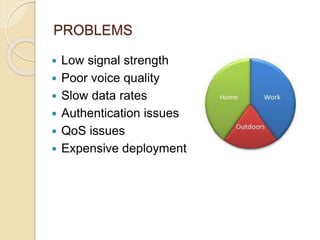
PROBLEMS 
 Low signal strength 
 Poor voice quality 
 Slow data rates 
 Authentication issues 
 QoS issues 
 Expensive deployment
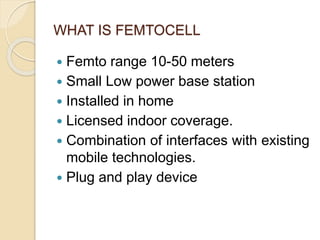
WHAT IS FEMTOCELL 
 Femto range 10-50 meters 
 Small Low power base station 
 Installed in home 
 Licensed indoor coverage. 
 Combination of interfaces with existing 
mobile technologies. 
 Plug and play device
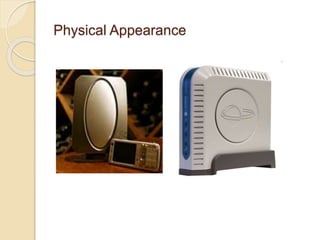
Physical Appearance
Interfaces 
 DSL/CABLE 
 UMTS 
 CDMA2000 
 WiMax 
 LTE (Long Term Evolution based on 3GPP)
REQUIREMENTS OF FEMTOCELL 
 Femtocell 
 Broadband Connection 
 Internet service provider 
 GPS
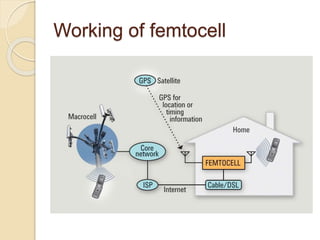
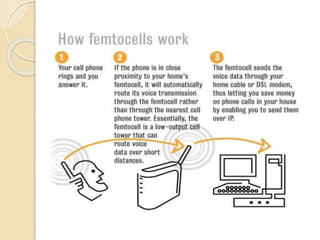
Working of femtocell
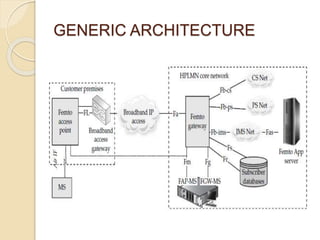
GENERIC ARCHITECTURE
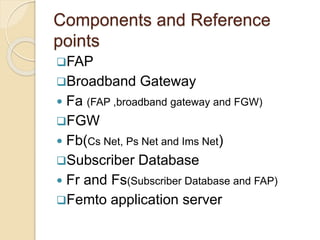
Components and Reference 
points 
FAP 
Broadband Gateway 
 Fa (FAP ,broadband gateway and FGW) 
FGW 
 Fb(Cs Net, Ps Net and Ims Net) 
Subscriber Database 
 Fr and Fs(Subscriber Database and FAP) 
Femto application server
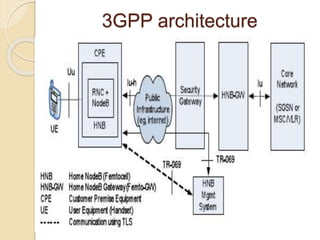
3GPP architecture
SERVICES and 
APPLICATION 
 Home security 
 Multimedia 
 Video door bell 
 Gaming 
 Shopping 
 Child monitor
ADVANTAGES 
Cellular Users 
 Simple deployment 
 Increased user throughput 
 Lower transmit power 
 Prolong handset battery life 
 Improved indoor coverage 
 New applications 
 Security
Network Providers 
 Enhanced services 
 Increased revenue 
 Offload data traffic 
 Increased area spectral efficiency 
 Improved customer satisfaction
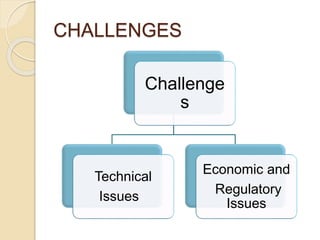
CHALLENGES 
Challenge 
s 
Technical 
Issues 
Economic and 
Regulatory 
Issues
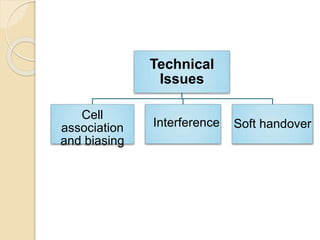
Technical 
Issues 
Cell 
association 
and biasing 
Interference Soft handover
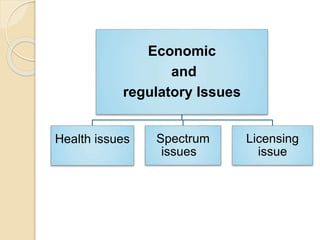
Economic 
and 
regulatory Issues 
Health issues Spectrum 
issues 
Licensing 
issue
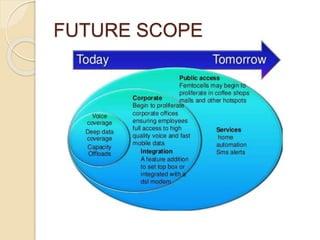
FUTURE SCOPE
CONCLUSION 
 Extensive testing in progression 
 Issues to be resolved 
 Fault free target 
 Alleviates pressure on macrocell 
 Immense help to rural areas 
 Potential to Speed up existing mobile 
technologies
REFERENCE 
 Jen Chen, Peter Rauber, Damanjit Singh, Chandru Sundarraman, 
Peerapol Tinnakornsrisuphap, Mehmet Yavuz, “Femtocells – 
Architecture & Network Aspects,” IEEE Communications 
Magazine, vol. Jan 28, 2010 
 V. Chandrasekhar, J. G. Andrews, and A. Gatherer, “Femtocell 
networks survey,” IEEE Communications Magazine, vol. 46, no. 
9, pp.59–67, September 2008. 
 Debjani De, Ravi Raj Bhat and V. Srinivasa Rao, “Iuh: A 
Protocol Solution for Scaling Femtocells,” Radisys whitepaper, 
vol. 9, no. 10, pp. 3798 – 3809, Dec. 2010 
 Informa Telecoms & Media, “Femtocell Market Status,” 
Femtoforum whitepaper, 2011. 25 October 2013 25 
 Khaled Elleithy and Varun Rao, “Femto Cells: Current Status 
and Future Directions,” International Journal of Next- 
Generation Networks (IJNGN) Vol.3, No.1, March 2011
THANK YOU

Femtocell

  • 1.
    FEMTOCELL BY: SusmitaRoy (M.Tech 1stSem)
  • 2.
    OUTLINE  INTRODUCTION  PROBLEMS OF EXISTING MOBILE TECHNOLOGIES  WHAT IS FEMTOCELL  COMPONENTS  WORKING  ARCHITECTURE  BENEFITS  CHALLENGES  CONCLUSION  REFERENCE
  • 3.
    INTRODUCTION  Wirelessworld  Doubled wireless capacity Evolutionary Cellular Phone Service • 25 * wider spectrum • 5 * modulation schemes  More Preference to mobile handset VoIP
  • 4.
    PROBLEMS  Lowsignal strength  Poor voice quality  Slow data rates  Authentication issues  QoS issues  Expensive deployment
  • 5.
    WHAT IS FEMTOCELL  Femto range 10-50 meters  Small Low power base station  Installed in home  Licensed indoor coverage.  Combination of interfaces with existing mobile technologies.  Plug and play device
  • 6.
  • 8.
    Interfaces  DSL/CABLE  UMTS  CDMA2000  WiMax  LTE (Long Term Evolution based on 3GPP)
  • 9.
    REQUIREMENTS OF FEMTOCELL  Femtocell  Broadband Connection  Internet service provider  GPS
  • 10.
  • 12.
  • 13.
    Components and Reference points FAP Broadband Gateway  Fa (FAP ,broadband gateway and FGW) FGW  Fb(Cs Net, Ps Net and Ims Net) Subscriber Database  Fr and Fs(Subscriber Database and FAP) Femto application server
  • 14.
  • 15.
    SERVICES and APPLICATION  Home security  Multimedia  Video door bell  Gaming  Shopping  Child monitor
  • 16.
    ADVANTAGES Cellular Users  Simple deployment  Increased user throughput  Lower transmit power  Prolong handset battery life  Improved indoor coverage  New applications  Security
  • 17.
    Network Providers Enhanced services  Increased revenue  Offload data traffic  Increased area spectral efficiency  Improved customer satisfaction
  • 18.
    CHALLENGES Challenge s Technical Issues Economic and Regulatory Issues
  • 19.
    Technical Issues Cell association and biasing Interference Soft handover
  • 20.
    Economic and regulatoryIssues Health issues Spectrum issues Licensing issue
  • 21.
  • 23.
    CONCLUSION  Extensivetesting in progression  Issues to be resolved  Fault free target  Alleviates pressure on macrocell  Immense help to rural areas  Potential to Speed up existing mobile technologies
  • 24.
    REFERENCE  JenChen, Peter Rauber, Damanjit Singh, Chandru Sundarraman, Peerapol Tinnakornsrisuphap, Mehmet Yavuz, “Femtocells – Architecture & Network Aspects,” IEEE Communications Magazine, vol. Jan 28, 2010  V. Chandrasekhar, J. G. Andrews, and A. Gatherer, “Femtocell networks survey,” IEEE Communications Magazine, vol. 46, no. 9, pp.59–67, September 2008.  Debjani De, Ravi Raj Bhat and V. Srinivasa Rao, “Iuh: A Protocol Solution for Scaling Femtocells,” Radisys whitepaper, vol. 9, no. 10, pp. 3798 – 3809, Dec. 2010  Informa Telecoms & Media, “Femtocell Market Status,” Femtoforum whitepaper, 2011. 25 October 2013 25  Khaled Elleithy and Varun Rao, “Femto Cells: Current Status and Future Directions,” International Journal of Next- Generation Networks (IJNGN) Vol.3, No.1, March 2011
  • 25.