01 
CONTROLLED RELEASE 
DDS 
Project date 20/09/2013 
Al Ameen College of 
Pharmacy 
BY: 
SURAJ CHOUDHARY 
M.PHARM (PHARMACEUTICS) 
DEPT. OF PHARMACEUTICS 
Factors & Types
Ppt. package 
2 
RECAP 
FACTORS (Listed) 
Dissolution Controlled DDS 
Diffusion Controlled DDS 
References 
Recent Trends
RECAP 
3 
THEME QUESTION -1 
THEME QUESTION -2 
FLASHBACK 
COMPARISON - 1 
COMPARISON - 2 
MOVEMENT RESTRICTIONS 
CRDDS DESIGN CONSIDERATIONS 
PRE-REQUISITES 
CLASSIFICATION 
CONCEPT-BASED ON CLASSES 
RECENT INNOVATIONS
FACTORS 
AFFECTING THE DESING OF CRDDS 
4
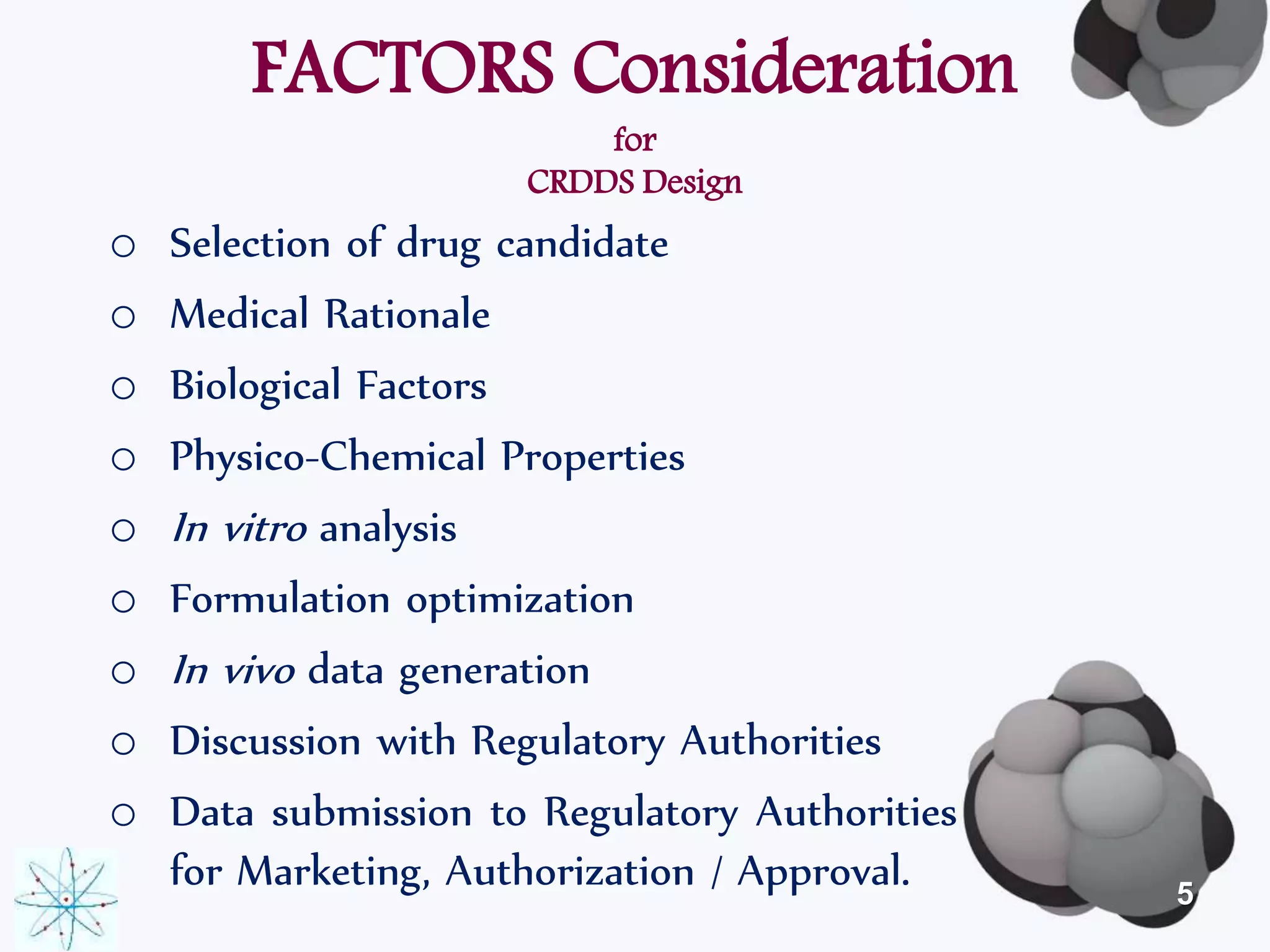
FACTORS Consideration 
for 
CRDDS Design 
o Selection of drug candidate 
o Medical Rationale 
o Biological Factors 
o Physico-Chemical Properties 
o In vitro analysis 
o Formulation optimization 
o In vivo data generation 
o Discussion with Regulatory Authorities 
o Data submission to Regulatory Authorities 
for Marketing, Authorization / Approval. 
5
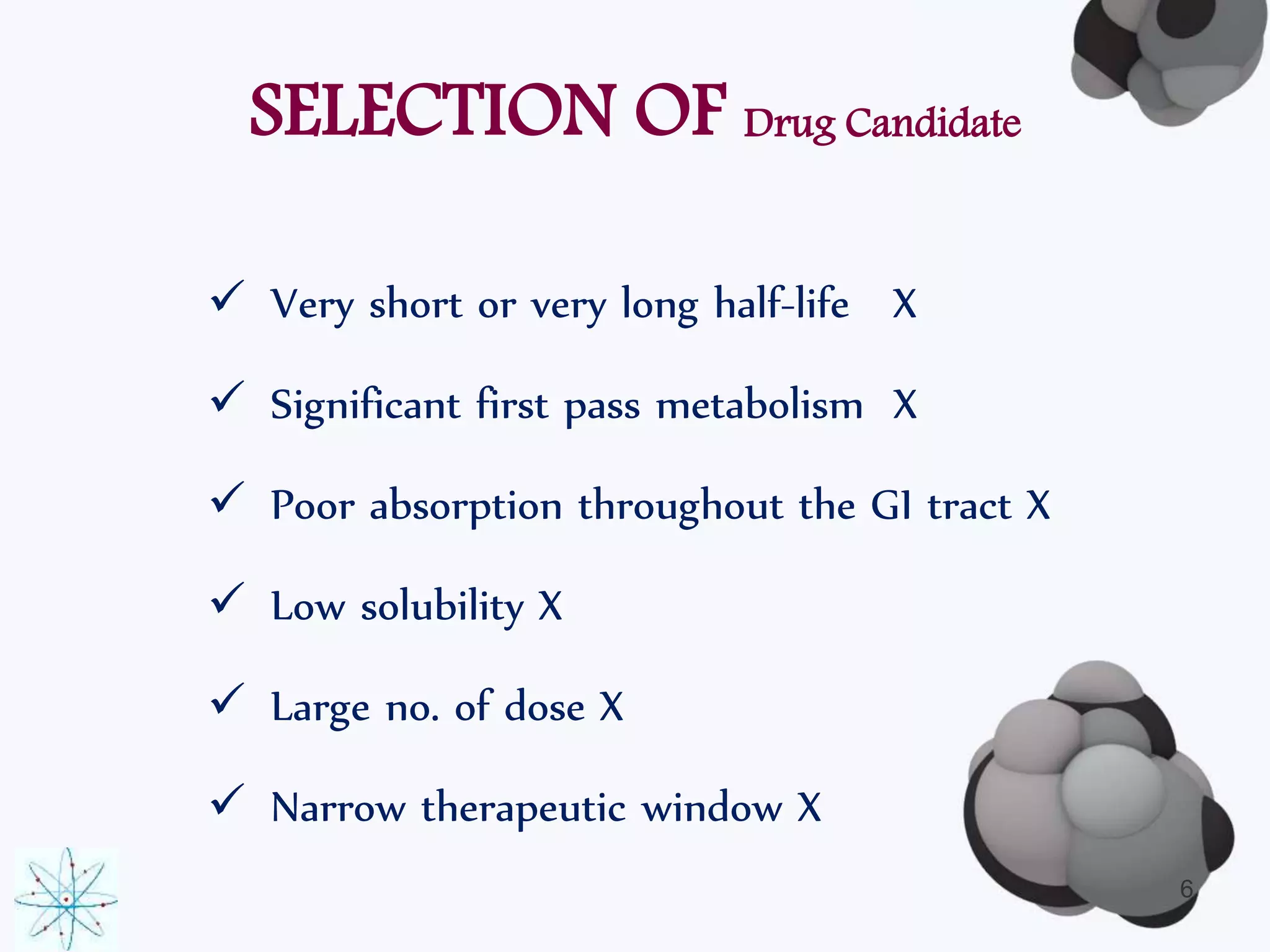
SELECTION OF Drug Candidate 
 Very short or very long half-life X 
 Significant first pass metabolism X 
 Poor absorption throughout the GI tract X 
 Low solubility X 
 Large no. of dose X 
 Narrow therapeutic window X 
6
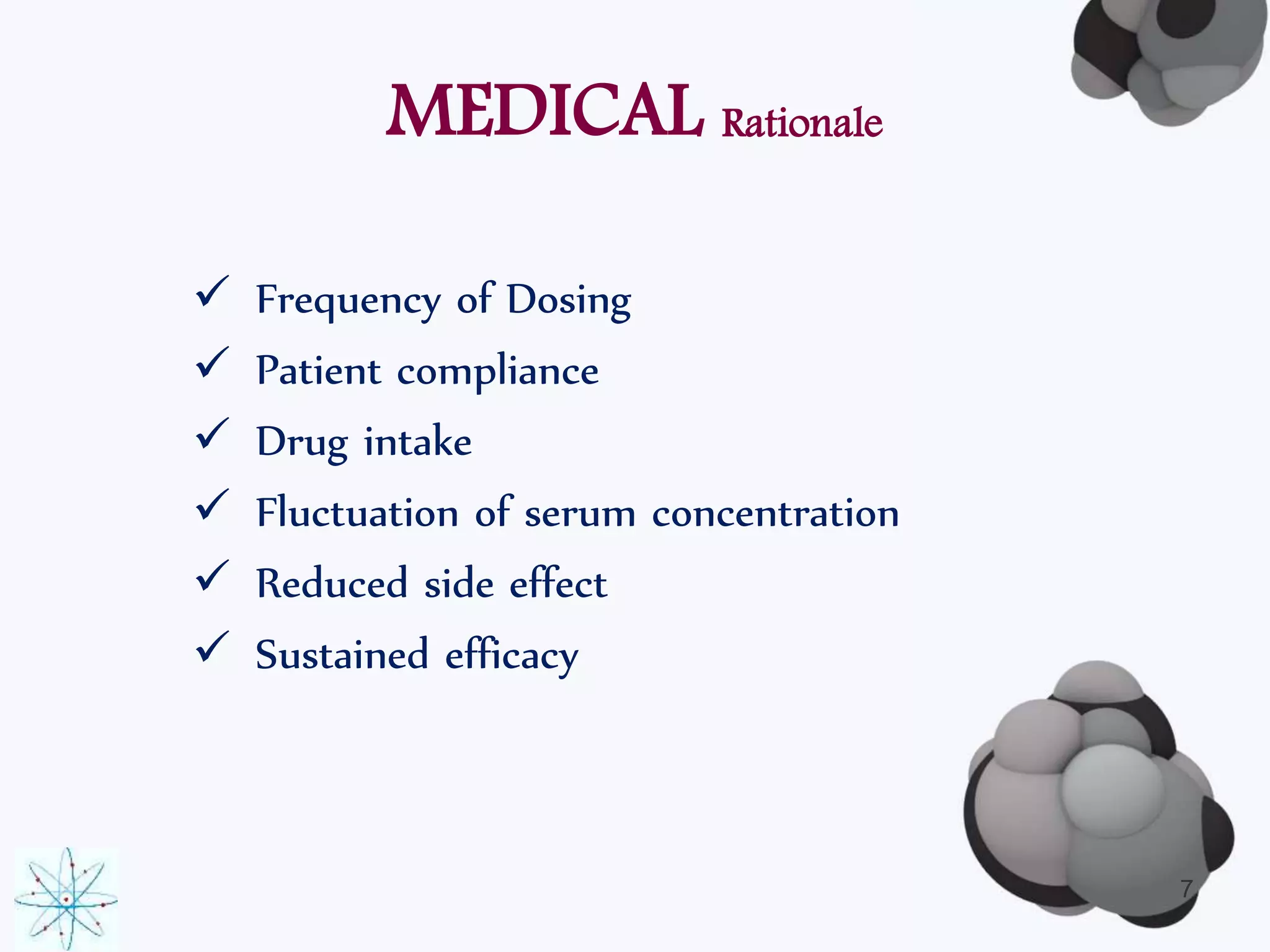
MEDICAL Rationale 
 Frequency of Dosing 
 Patient compliance 
 Drug intake 
 Fluctuation of serum concentration 
 Reduced side effect 
 Sustained efficacy 
7
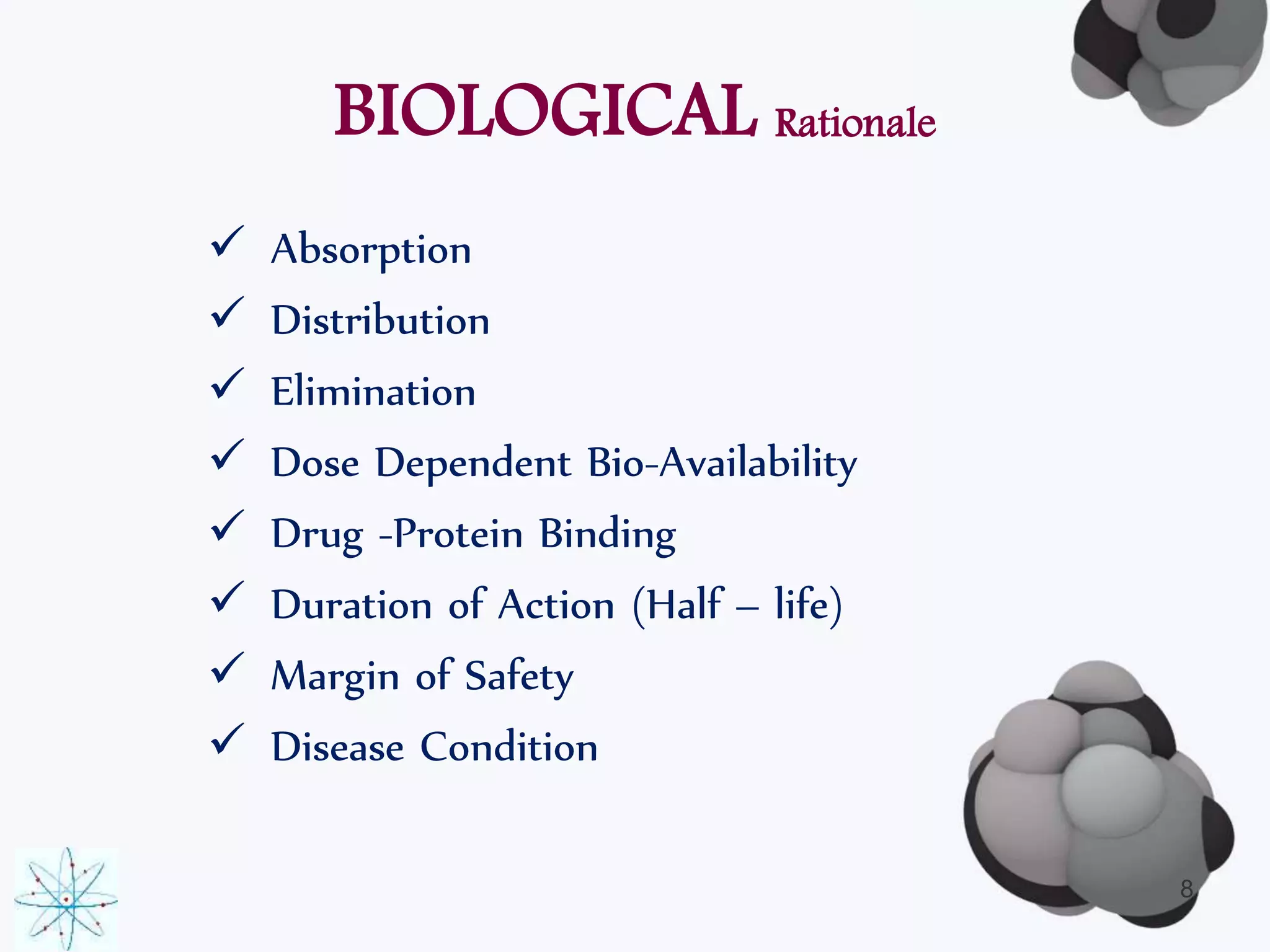
BIOLOGICAL Rationale 
 Absorption 
 Distribution 
 Elimination 
 Dose Dependent Bio-Availability 
 Drug -Protein Binding 
 Duration of Action (Half – life) 
 Margin of Safety 
 Disease Condition 
8
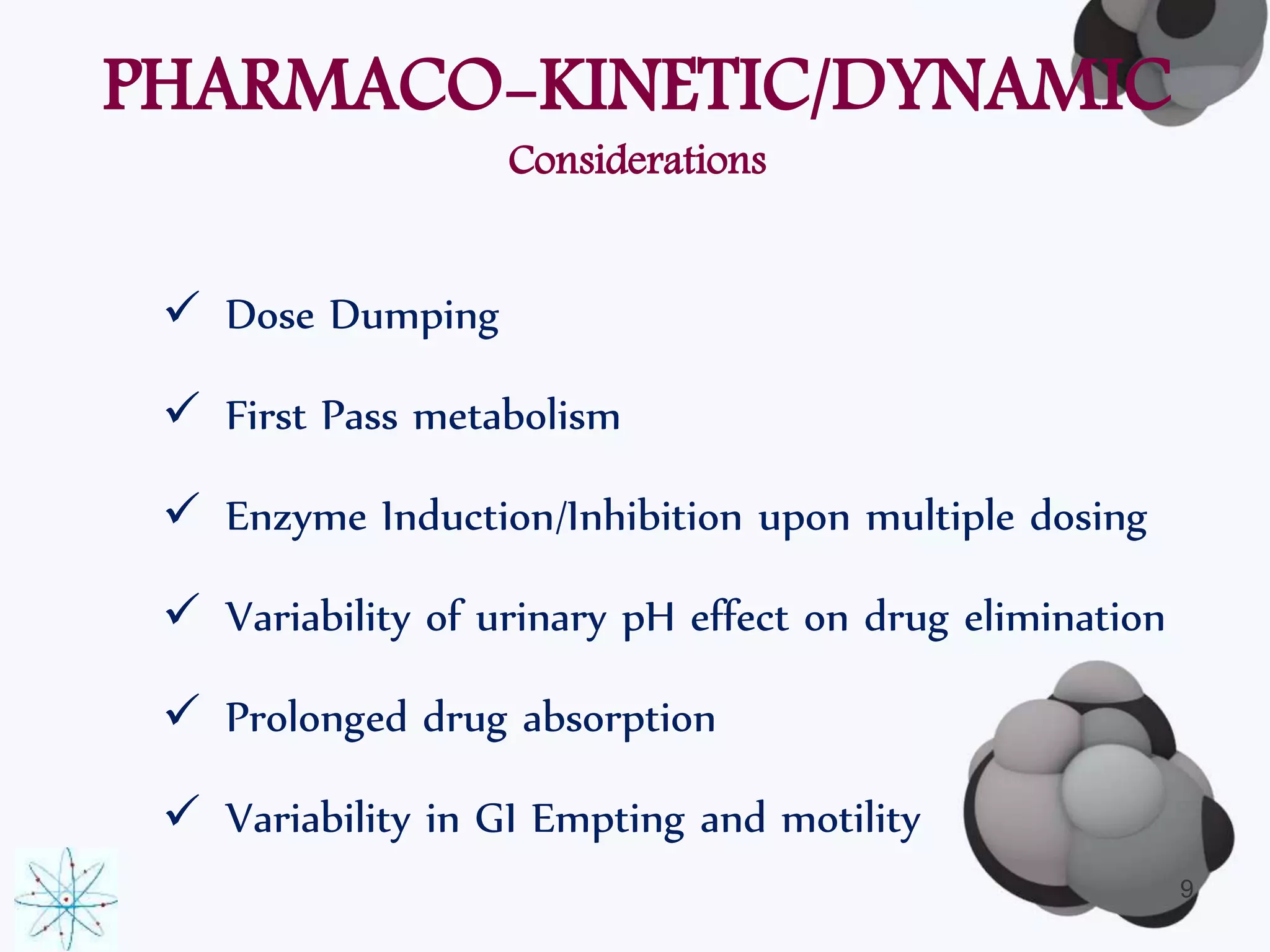
PHARMACO-KINETIC/DYNAMIC 
Considerations 
 Dose Dumping 
 First Pass metabolism 
 Enzyme Induction/Inhibition upon multiple dosing 
 Variability of urinary pH effect on drug elimination 
 Prolonged drug absorption 
 Variability in GI Empting and motility 
9
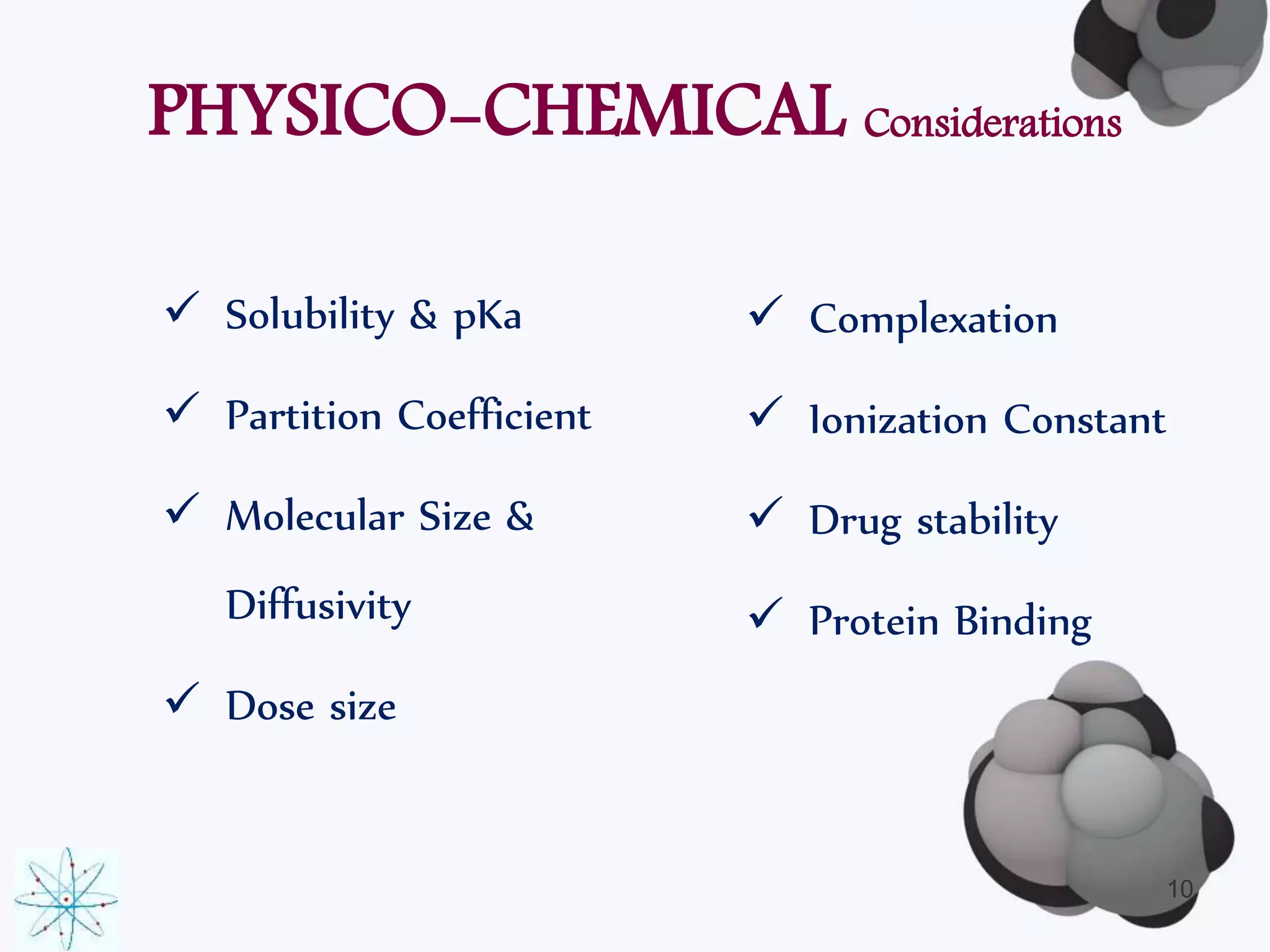
PHYSICO-CHEMICAL Considerations 
 Solubility & pKa 
 Partition Coefficient 
 Molecular Size & 
Diffusivity 
 Dose size 
10 
 Complexation 
 Ionization Constant 
 Drug stability 
 Protein Binding
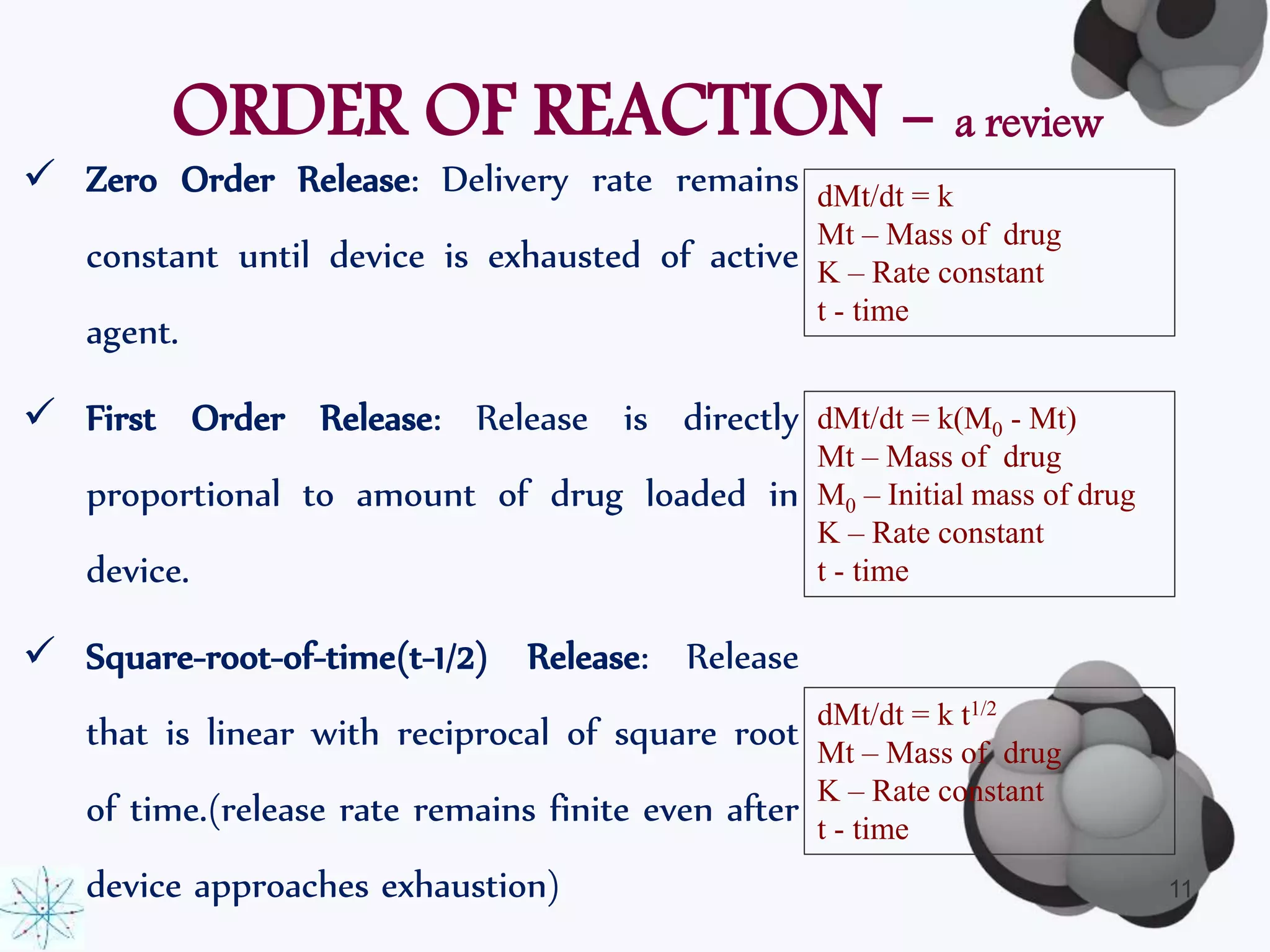
ORDER OF REACTION - a review 
 Zero Order Release: Delivery rate remains 
constant until device is exhausted of active 
agent. 
 First Order Release: Release is directly 
proportional to amount of drug loaded in 
device. 
 Square-root-of-time(t-1/2) Release: Release 
that is linear with reciprocal of square root 
of time.(release rate remains finite even after 
device approaches exhaustion) 
dMt/dt = k 
Mt – Mass of drug 
K – Rate constant 
t - time 
dMt/dt = k(M0 - Mt) 
Mt – Mass of drug 
M0 – Initial mass of drug 
K – Rate constant 
t - time 
dMt/dt = k t1/2 
Mt – Mass of drug 
K – Rate constant 
t - time 
11
PHYSICO-CHEMICAL 
FACTORS 
AFFECTING THE DESING OF CRDDS 
12
SOLUBILITY 
& 
pKa 
13
SOLUBILITY & pKa 
• The solubility of a solid substance is defined as……. 
“ the concentration at which the solution phase is in equilibrium 
with a given solid phase at a stated temperature & pressure.” 
• To improve solubility: 
Solvation Complexation 
Hydration Recrystallization 
Co-solvation Use of surface active agents 
• NOTE: A classification is given as per the permeability & solubility 
profile, known as BCS Classification. 
14
SOLUBILITY & pKa 
• Determination of solubility: 
1. Semi-quantitative method 
2. Accurate-quantitative method 
3. pH-change method 
15
SOLUBILITY & pKa 
• Absorption of poorly soluble drugs is often dissolution rate-limited. 
• Such drugs do not require any further control over their dissolution 
rate and thus may not seem to be good candidates for oral controlled 
release formulations. 
• Controlled release formulations of such drugs may be aimed at making 
their dissolution more uniform rather than reducing it. 
16
PARTITION 
COEFFICIENT 
17
PARTITION COEFFICIENT 
• The partition coefficient is defined as……. 
“ the concentration ratio of unionized drug distributed between 
two phases at equilibrium.” 
• Given by the Noyes-Whitney’s Equation: 
P = [퐴]표/([퐴]∞) 
• The logarithm (base 10) of the partition coefficient (log10P) is often 
used. 
18
PARTITION COEFFICIENT 
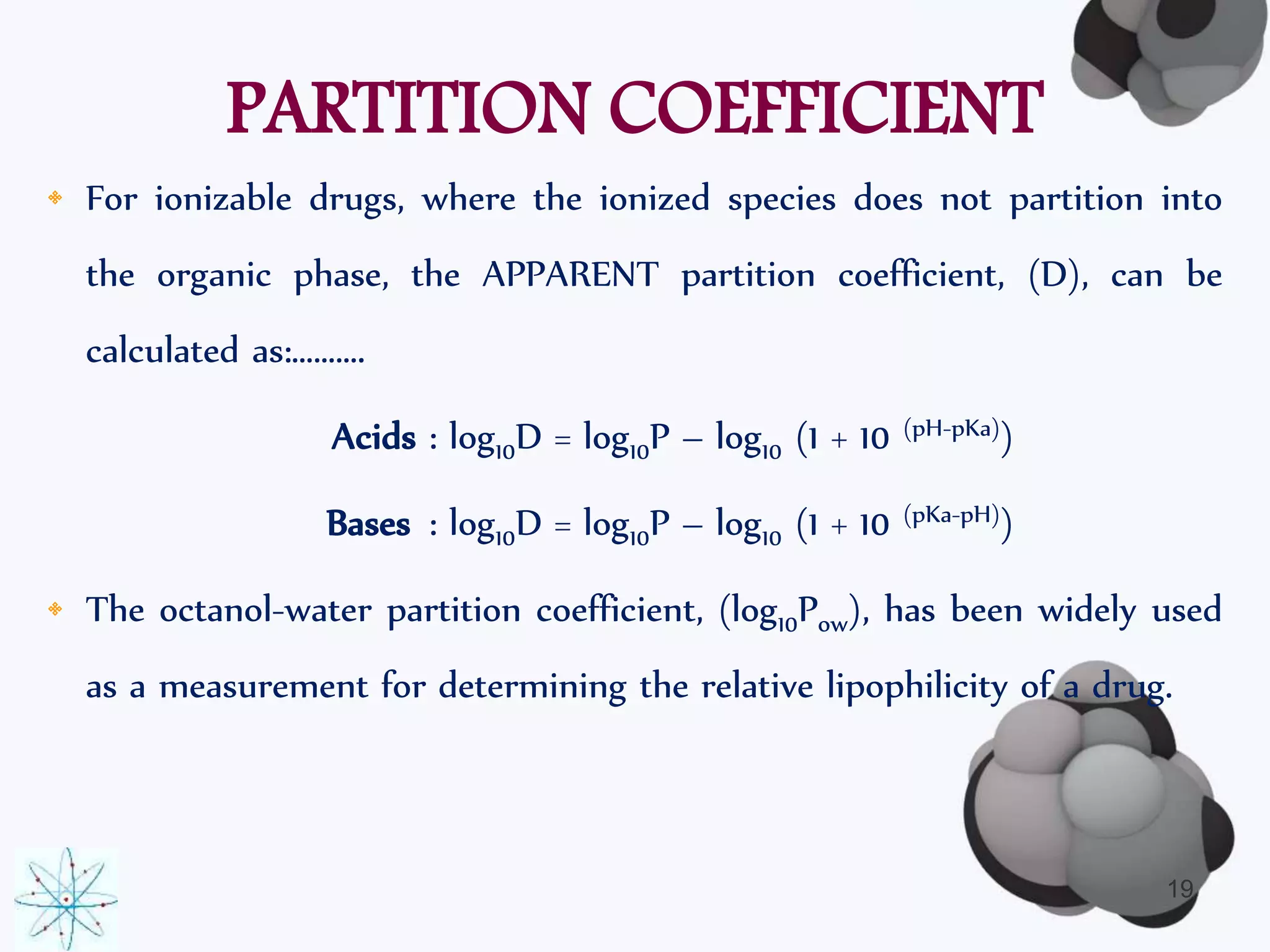
• For ionizable drugs, where the ionized species does not partition into 
the organic phase, the APPARENT partition coefficient, (D), can be 
calculated as:………. 
Acids : log10D = log10P – log10 (1 + 10 (pH-pKa)) 
Bases : log10D = log10P – log10 (1 + 10 (pKa-pH)) 
• The octanol-water partition coefficient, (log10Pow), has been widely used 
as a measurement for determining the relative lipophilicity of a drug. 
19
PARTITION COEFFICIENT 
• Drugs that are very lipid soluble or very water-soluble i.e., extremes in 
partition coefficient, will demonstrate 
 either low flux into the tissues or 
 rapid flux followed by accumulation in tissues. 
• Both cases are undesirable for controlled release system. 
20
MOLECULAR SIZE 
& 
DIFFUSIVITY 
21
MOL. SIZE & DIFFUSIVITY 
• In addition to diffusion through a variety of biological membranes, 
drugs in many CRDDS must diffuse through a rate controlling 
membrane or matrix. 
• The ability of drug to pass through membranes, its so called diffusivity, 
is a function of its molecular size (or molecular weight). 
• An important influence upon the value of diffusivity, D, in polymers is 
the molecular size of the diffusing species. 
• The value of D thus is related to the size and shape of the cavities as 
well as size and shape of the drugs. 
22
MOL. SIZE & DIFFUSIVITY 
• Molecular size of the drug plays a major role when it comes to 
diffusion of the drug through a biological membrane. 
1. Mass spectroscopy (MS or LC-MS) are generally used as the 
most common methods to determine the molecular size of the 
drug. 
2. Fourier Transform IR- spectroscopy (FTIR) is also used to 
determine the molecular structure. 
• Diffusion of the drug from the matrix or encapsulated form determines 
the release rate of the drug from the polymer. 
• Diffusivity is the rate determining step in CRDDS. 23
DOSE 
SIZE 
24
DOSE SIZE 
• Size of the drug plays a major role in determining the size of the final 
finished product. 
• In case, the dose already high, then formulating the same into 
controlled release will further increase the overall dosage size & thereby 
reduced patient compliance. 
• For drugs with an elimination half-life of less than 2 hours as well as 
those administered in large doses, a controlled release dosage form may 
need to carry a prohibitively large quantity of drug. 
25
COMPLEX 
FORMATION 
26
COMPLEXATION 
• Complexation is one of the well known method to entrap the drug 
within a complexing agent like β-cyclodextrin complex. 
• These complexes could be helpful in entrapping drugs of very high 
molecular weight which have low diffusivity through the membrane. 
• From formulation point of view, this property also facilitates in 
increasing the solubility of the drug in the required solvent. 
27
IONIZATION 
CONSTANT 
28
IONIZATION CONSTANT 
• This factor have important effects on a wide range of issues including, 
Dissolution, Membrane partition, Complexation, Chemical stability & 
drug absorption. 
• From the site of release of the drug, it’s absorption depends upon its 
ionization constant. 
• And, it has been depicted that drugs in unionized form are absorbed 
faster than the ionized species. 
29
IONIZATION CONSTANT 
• The Henderson-Hasselbalch eq. provides an estimate of ionized & 
unionized drug conc, by function of pH………… 
Acidic drugs: pKa = - log10(Ka) = pH + log10([HA]/[A-]) 
Basic drugs : pKa = - log10(Kb) = pH + log10([HB+]/[B-]) 
• Where: 
Ka or Kb = ionization constant for acid/basic drugs 
[HA] = conc. of unionized acid 
[A-] = conc. of ionized acid 
[HB+] = conc. of the unionized base 
[B] = conc. of the ionized base 
30
STABILITY 
OF DRUG 
31
DRUG STABILITY 
• Since most oral controlled release systems are designed to release their 
contents over much of the length of GI tract, 
 drugs that are unstable in the environment of the intestine 
 drugs that are unstable in the environment of the stomach 
• might be difficult to formulate into prolonged release system. 
• In order to counter-act such problems, several modified-release 
methods have been adopted that restricts the release at the required 
site of the GIT. 
32
PROTEIN 
BINDING 
33
PROTEIN BINDING 
• It refers to the formation of complex with the blood proteins (like 
albumin) with the absorbed drug. 
• This complex leads to…. 
 Inhibition of therapeutic effect of such amount 
 Half-life is increased (compared to invitro studies) 
 Toxicity profiles elevated 
• Thus, in most of the cases, protein binding is undesirable. 
• Many drugs are highly protein binding (may be 95%), thus the need of 
formulating a modified drug or drug delivery system starts. 
34
NOTE- 1 & 2 
35
NOTE – 1 
• Generally, the values of diffusion coefficient for intermediate molecular 
weight drugs i.e., 150-400 Dalton, through flexible polymers range from 
10-6 to 10-9 cm2/sec, with values on the order of 10-8 being most 
common. 
36
NOTE – 2 
• For drugs with molecular weight greater than 500 Dalton, the diffusion 
coefficients in many polymers frequently are so small that they are 
difficult to quantify, i.e., less than 10-12 cm2/sec. 
• Thus, high molecular weight of drug should be expected to display very 
slow release kinetics in sustained release devices where diffusion 
through polymeric membrane or matrix is the release mechanism. 
37
Approaches in Design Considerations 
 Chemical approach 
 Biological approach 
 Pharmaceutical approach 
38
PHARMACEUTICAL Approaches 
C. Dissolution-Diffusion Controlled 
(Combination) 
A. Dissolution controlled Release 
 Encapsulation dissolution control 
 Matrix dissolution control 
B. Diffusion Controlled Release 
 Membrane material 
 Solution-diffusion membrane 
 Rate of permeation 
• Drug diffusion coefficient in the 
polymer 
• Polymer/solution partition 
coefficient 
39
PHARMACEUTICAL Approaches 
A. Dissolution controlled Release 
 Encapsulation dissolution control 
 Matrix dissolution control 
B. Diffusion Controlled Release 
 Reservoir devices 
 Matrix devices 
40
DISSOLUTION CONTROLLED
INTRODUCTION 
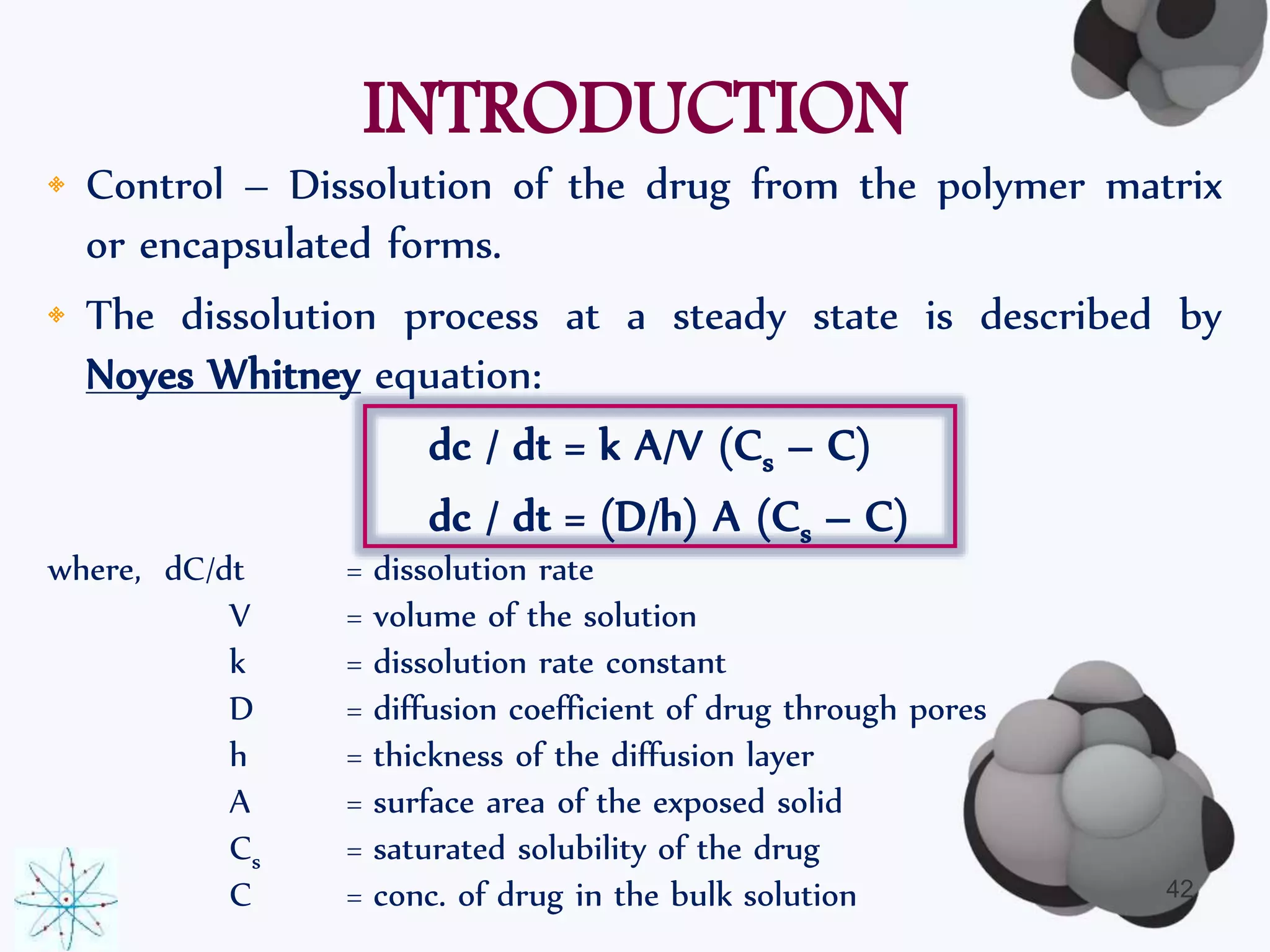
• Control – Dissolution of the drug from the polymer matrix 
or encapsulated forms. 
• The dissolution process at a steady state is described by 
Noyes Whitney equation: 
dc / dt = k A/V (Cs – C) 
dc / dt = (D/h) A (Cs – C) 
where, dC/dt = dissolution rate 
V = volume of the solution 
k = dissolution rate constant 
D = diffusion coefficient of drug through pores 
h = thickness of the diffusion layer 
A = surface area of the exposed solid 
Cs = saturated solubility of the drug 
C = conc. of drug in the bulk solution 42
TYPES 
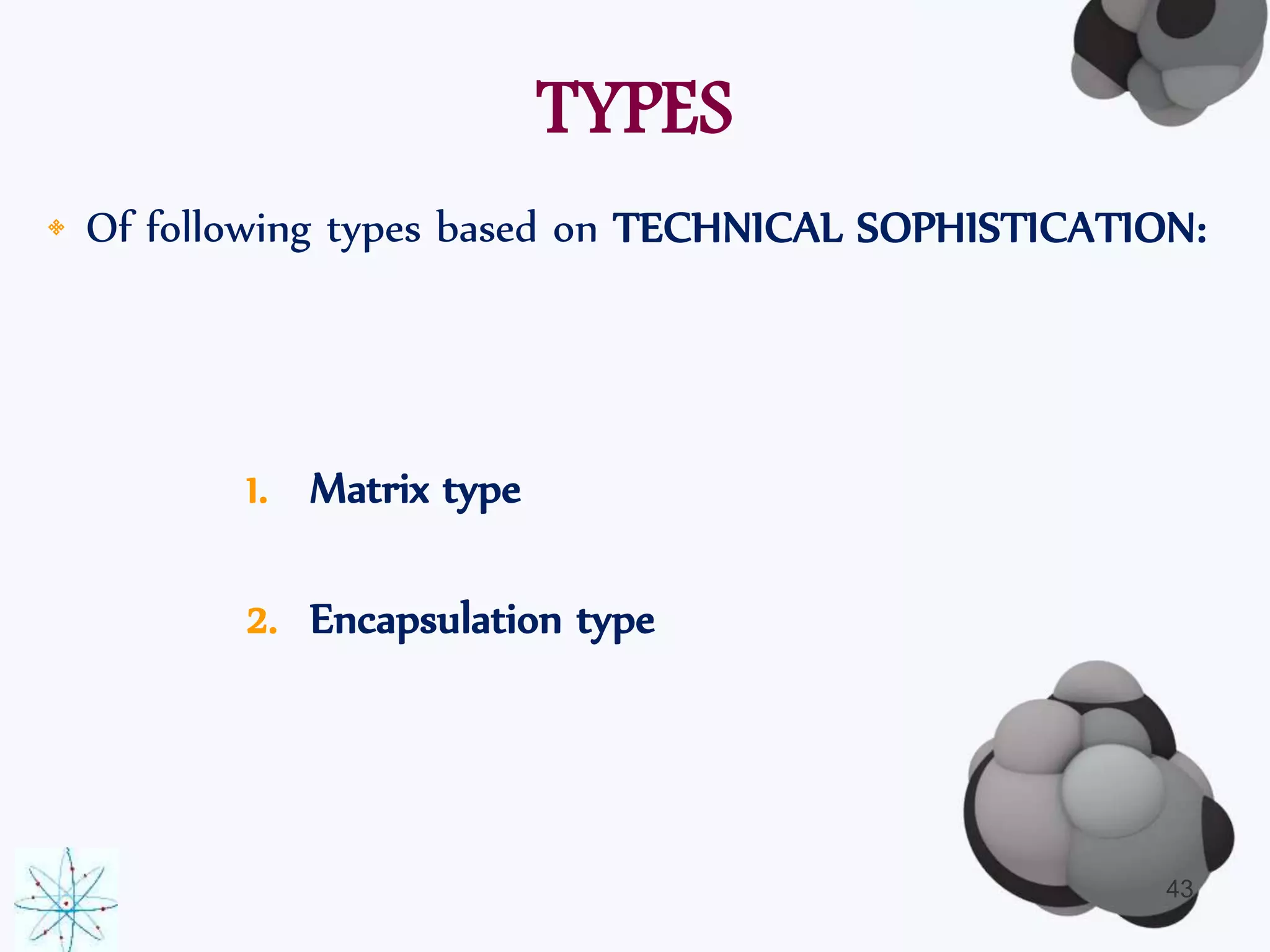
• Of following types based on TECHNICAL SOPHISTICATION: 
1. Matrix type 
2. Encapsulation type 
43
MATRIX type 
(Dissolution-Controlled) 
44
MATRIX type 
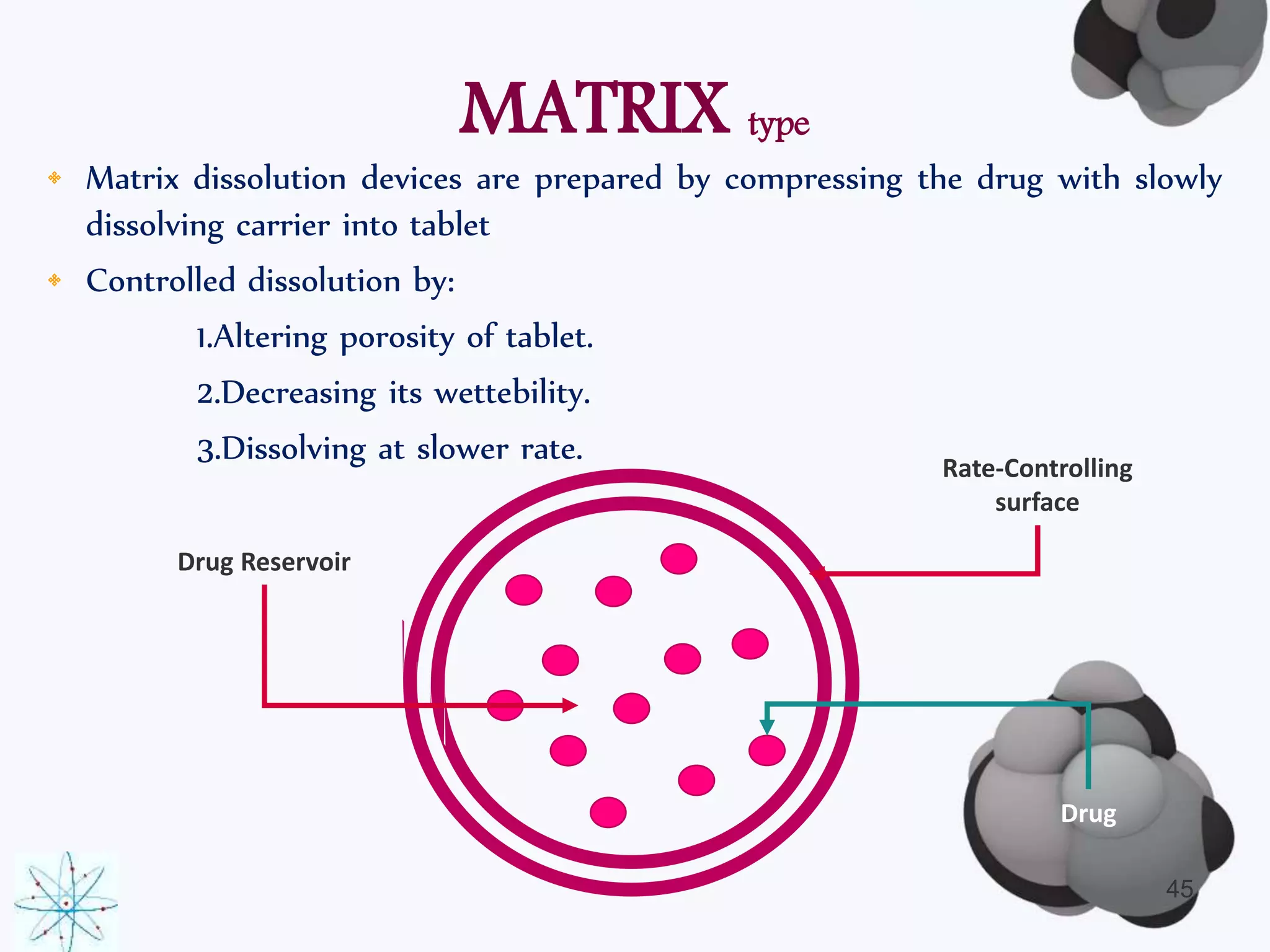
• Matrix dissolution devices are prepared by compressing the drug with slowly 
dissolving carrier into tablet 
• Controlled dissolution by: 
1.Altering porosity of tablet. 
2.Decreasing its wettebility. 
3.Dissolving at slower rate. 
Drug Reservoir 
Rate-Controlling 
surface 
Drug 
45
MATRIX type 
• First order drug release. 
• There are 2 methods: 
1. Congealing & 
2. Aqueous dispersion method 
• The drug release is determined by dissolution rate of the polymer. 
• Examples: 
1. Dimetane extencaps, 
2. Dimetapp extentabs. 
46
ENCAPSULATED type 
(Dissolution-Controlled) 
47
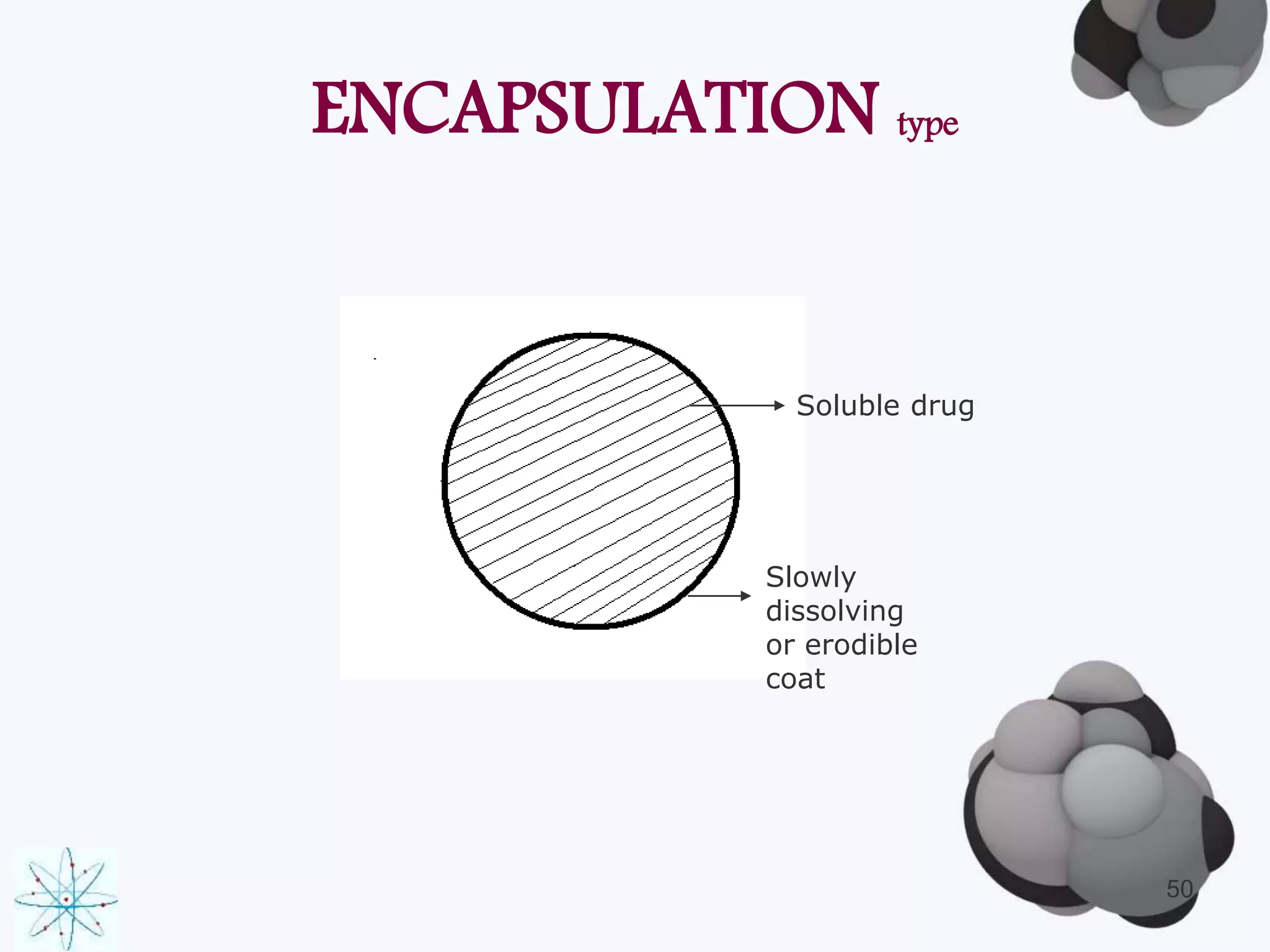
ENCAPSULATION type 
• The drug particle are coated or encapsulated by microencapsulation 
technique 
• The pellets are filled in hard gelatin capsule, popularly called as 
‘spansules’. 
• Once the coating material dissolves the entire drug inside the 
microcapsule is immediately available for dissolution and absorption. 
• Here the drug release is determined by dissolution rate and thickness of 
polymer membrane which may range from 1 to 200μ 
48
ENCAPSULATION type 
• Called as Coating dissolution controlled system. 
• Dissolution rate of coat depends upon stability & thickness of coating. 
• One of the microencapsulation method is used. 
• Examples: 
1. Ornade spansules, 
2. Chlortrimeton Repetabs 
49
ENCAPSULATION type 
50 
Soluble drug 
Slowly 
dissolving 
or erodible 
coat
DIFFUSION CONTROLLED
INTRODUCTION 
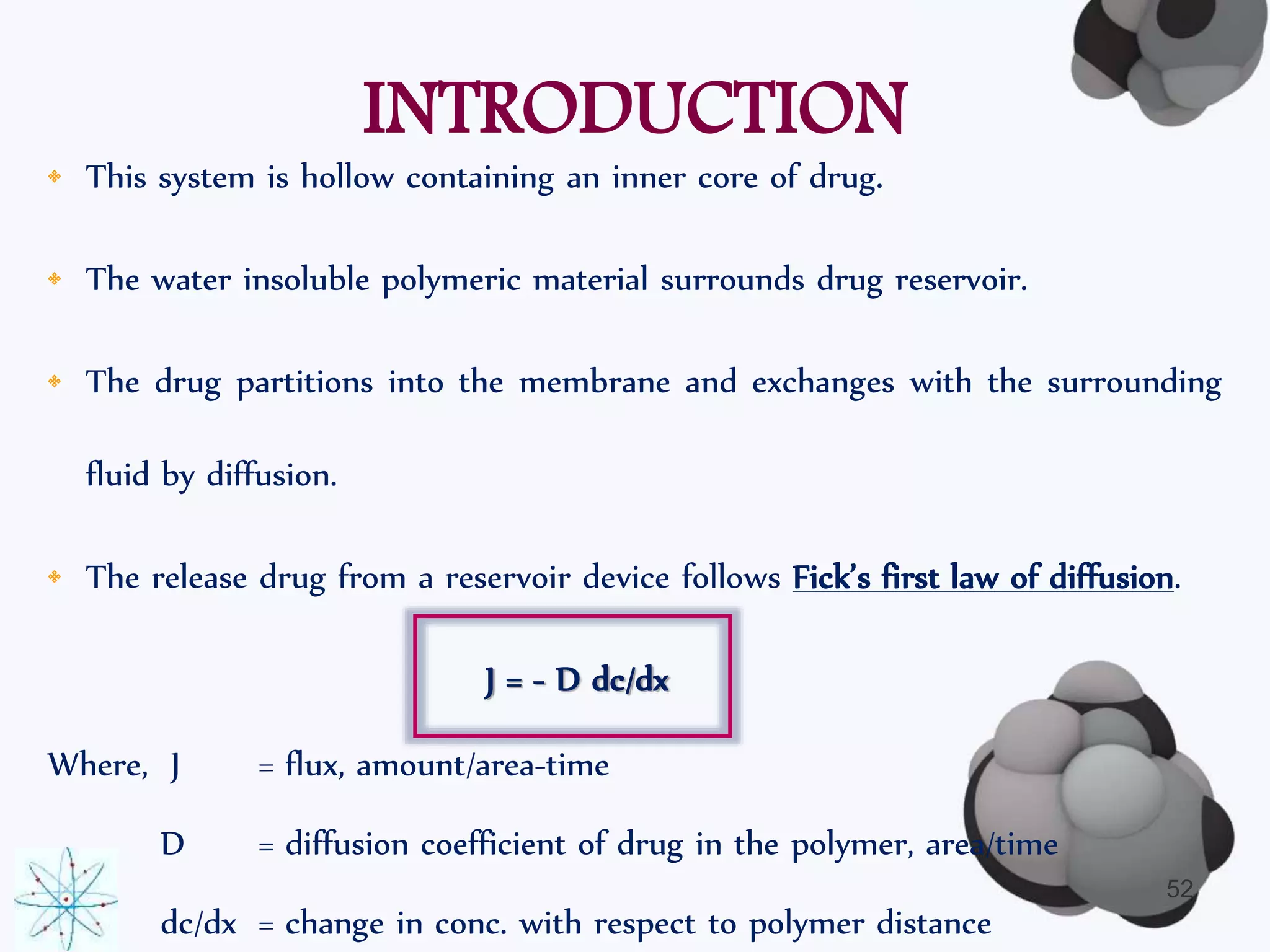
• This system is hollow containing an inner core of drug. 
• The water insoluble polymeric material surrounds drug reservoir. 
• The drug partitions into the membrane and exchanges with the surrounding 
fluid by diffusion. 
• The release drug from a reservoir device follows Fick’s first law of diffusion. 
J = - D dc/dx 
Where, J = flux, amount/area-time 
D = diffusion coefficient of drug in the polymer, area/time 
dc/dx = change in conc. with respect to polymer distance 
52
TYPES 
• Of following types based on TECHNICAL SOPHISTICATION: 
1. Reservoir Devices 
2. Matrix Devices 
53
RESERVOIR Devices 
(Diffusion-Controlled) 
54
Reservoir device 
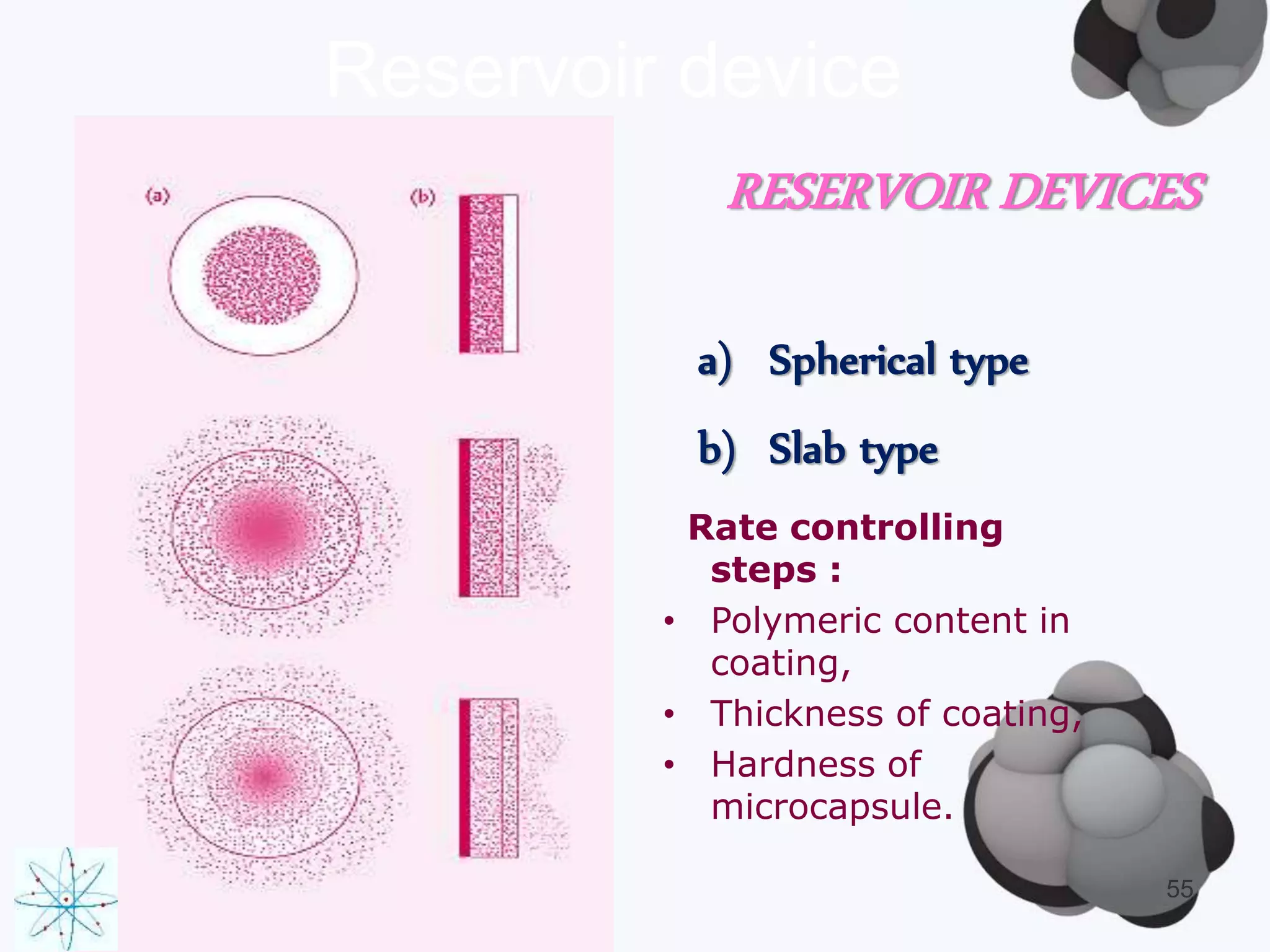
RESERVOIR DEVICES 
a) Spherical type 
b) Slab type 
55 
Rate controlling 
steps : 
• Polymeric content in 
coating, 
• Thickness of coating, 
• Hardness of 
microcapsule.
RESERVOIR Devices 
• The drug core is encased by a water-insoluble polymeric materials. 
• The mesh (i.e., the space between macromolecular chains) of these polymers, 
through which drug penetrates or diffuses after partitioning, is of 
MOLECULAR LEVEL. 
• The rate of drug release is dependent on the rate of drug diffusion but not on 
the rate of dissolution. 
• In short, mass transport phenomena at molecular level occurs. 
• Examples: Nico-400, Nitro-Bid 
56
Methods of Prep. (RESERVOIR Devices) 
• Mostly it involves : 
o Coated Beads/Pellets 
o Microencapsulation 
57
Coated Beads/Pellets (RESERVOIR Devices) 
• BEADS/PELLETS 
Coating of drug solution onto preformed cores. 
Covering of core by an insoluble (but permeable coat). 
NOTE: Pan coating or air-suspension technique is generally used for 
coating. 
NOTE: Pore forming additives may be added to the coating solution. 
58
Microencapsulation (RESERVOIR Devices) 
• This technique used to encapsulate small particles of drug, solution of 
drug, or even gases in a coat (usually a polymer coat). 
• Generally, any method that can induce a polymer barrier to deposit on 
the surface of a liquid droplet or a solid surface can be used to form 
microcapsules. 
59
Microencapsulation (RESERVOIR Devices) 
• Techniques: 
1. Coacervation (Polymers: gelatin, acacia, PA, EC, etc.) 
2. Interfacial polymerization (Polymers: polyurethanes, 
polyamides, polysulfonamides, polyphtalamides, etc.) 
3. Solvent evaporation 
4. Others (thermal denaturation, hot melt, spray-drying, 
salting out, etc.) 
60
MATRIX Devices 
(Diffusion-Controlled) 
61
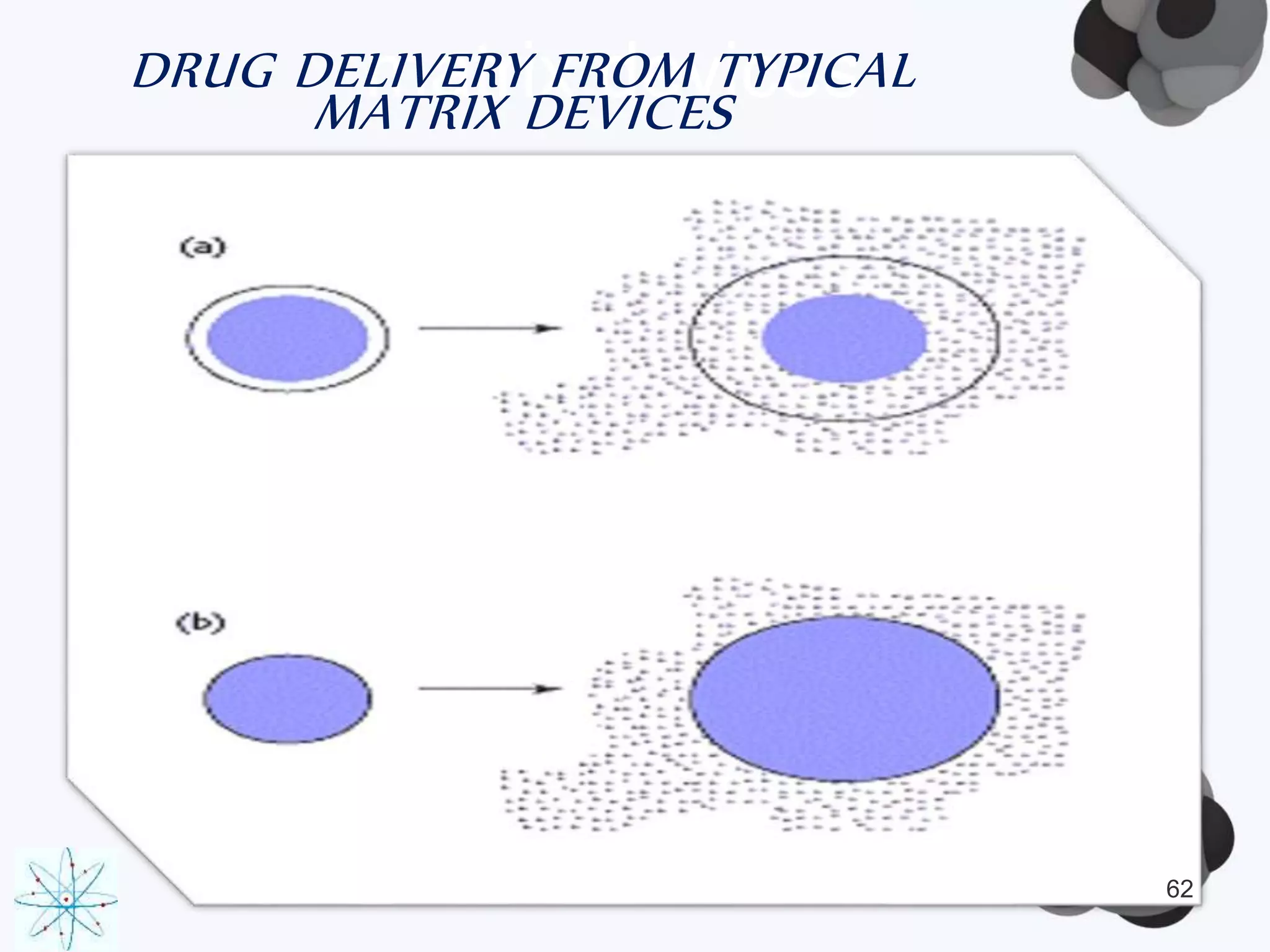
DRUG DELmIVaERtrYi xFR dOeMv TicYPeICsAL 
MATRIX DEVICES 
62
MATRIX Devices 
• A matrix or monolithic device consists of an inert polymeric matrix in 
which a drug is uniformly distributed. 
• Drugs can be dissolved in the matrix or the drugs can be present as a 
dispersion. 
NOTE : Matrix may be HOMOGENEOUS or POROUS with water filled 
pores. 
63
MATRIX Devices 
• State of presentation of this form affects the various release patterns: 
1. Dissolved drug (Fick’s Second law) 
2. Dispersed drug (Fick’s First law) 
3. Porous matrix (Higuchi’s theory for porous form) 
4. Hydrophilic matrix (gelation & diffusion) 
64
MATRIX Devices 
• Rigid Matrix Diffusion 
 Materials used are insoluble plastics such as PVP & fatty acids. 
• Swellable Matrix Diffusion 
1. Also called as Glassy hydrogels.Popular for sustaining the release of 
highly water soluble drugs. 
2. Materials used are hydrophilic gums. 
Examples : Natural- Guar gum, Tragacanth. 
Semisynthetic -HPMC, CMC, Xanthum gum. 
Synthetic -Polyacrilamides. 
• Examples: Glucotrol XL, Procardia XL 65
RECENT Trends 
(Marketed Products) 
66
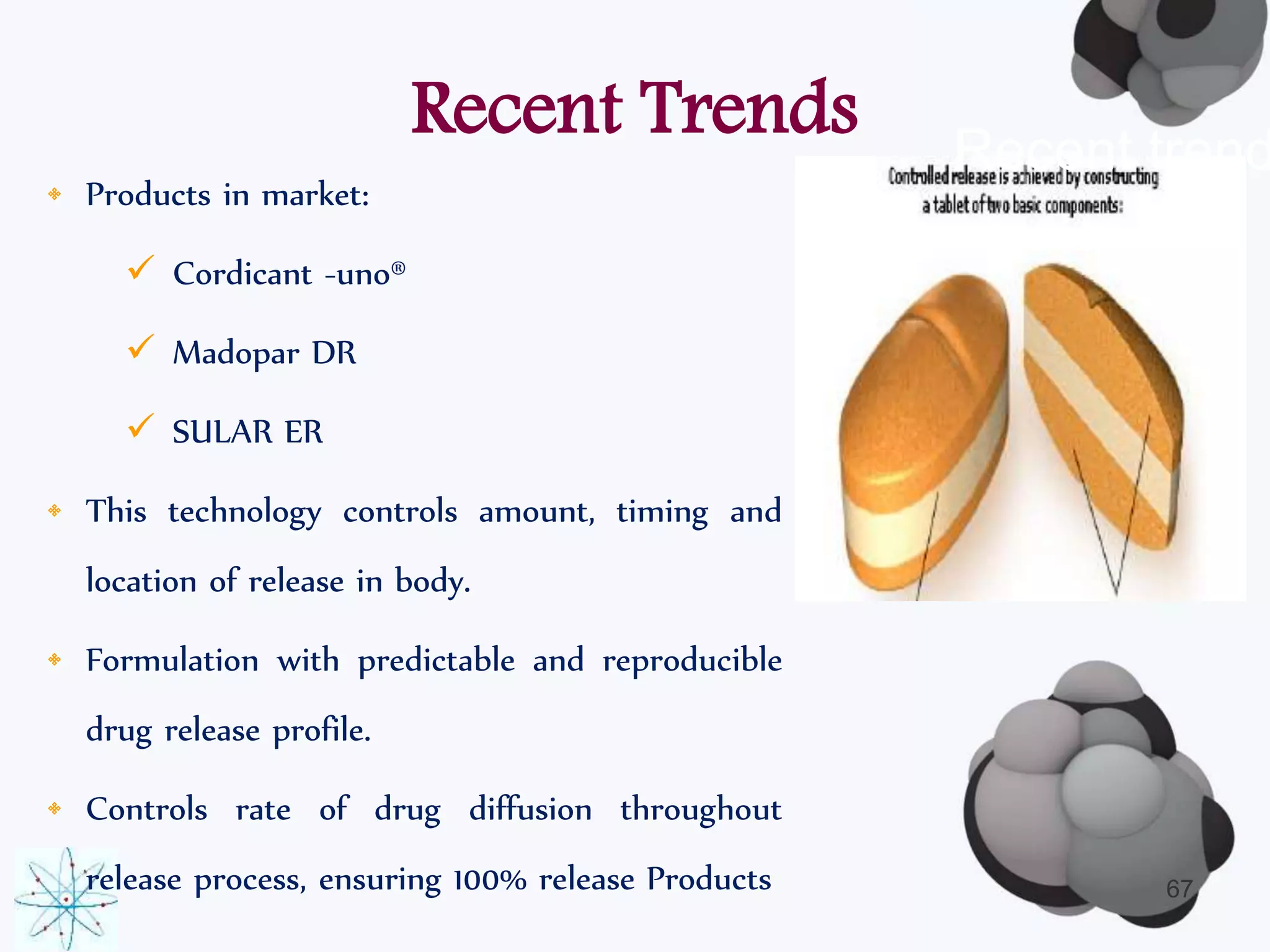
Recent Trends 
• Products in market: 
 Cordicant -uno® 
 Madopar DR 
 SULAR ER 
• This technology controls amount, timing and 
location of release in body. 
• Formulation with predictable and reproducible 
drug release profile. 
• Controls rate of drug diffusion throughout 
Recent trends: release process, ensuring 100% release Products 67
references 
1. Chien Y W; Novel Drug Delivery Systems; Informa Healthcare, 2nd 
68 
Edition, 2009. 
2. Siegel R A and Rathbone M J; Overview of Controlled Release 
Mechanisms; Advances in Delivery Science and Technology, 2012. 
3. Bhowmik D, et.al; Recent trends in scope and opportunities of control 
release oral drug delivery systems; Critical review in pharmaceutical 
sciences, (1): 2012. 
4. Ummadi S, Shravani B; Overview on Controlled Release Dosage Form; 
International Journal of Pharma Sciences, 3(4); 2013.
03 
THANK YOU. 
69 
For Attention!!!!

Controlled Release Drug Delivery Systems - Types, Methods and Applications

  • 1.
    01 CONTROLLED RELEASE DDS Project date 20/09/2013 Al Ameen College of Pharmacy BY: SURAJ CHOUDHARY M.PHARM (PHARMACEUTICS) DEPT. OF PHARMACEUTICS Factors & Types
  • 2.
    Ppt. package 2 RECAP FACTORS (Listed) Dissolution Controlled DDS Diffusion Controlled DDS References Recent Trends
  • 3.
    RECAP 3 THEMEQUESTION -1 THEME QUESTION -2 FLASHBACK COMPARISON - 1 COMPARISON - 2 MOVEMENT RESTRICTIONS CRDDS DESIGN CONSIDERATIONS PRE-REQUISITES CLASSIFICATION CONCEPT-BASED ON CLASSES RECENT INNOVATIONS
  • 4.
    FACTORS AFFECTING THEDESING OF CRDDS 4
  • 5.
    FACTORS Consideration for CRDDS Design o Selection of drug candidate o Medical Rationale o Biological Factors o Physico-Chemical Properties o In vitro analysis o Formulation optimization o In vivo data generation o Discussion with Regulatory Authorities o Data submission to Regulatory Authorities for Marketing, Authorization / Approval. 5
  • 6.
    SELECTION OF DrugCandidate  Very short or very long half-life X  Significant first pass metabolism X  Poor absorption throughout the GI tract X  Low solubility X  Large no. of dose X  Narrow therapeutic window X 6
  • 7.
    MEDICAL Rationale Frequency of Dosing  Patient compliance  Drug intake  Fluctuation of serum concentration  Reduced side effect  Sustained efficacy 7
  • 8.
    BIOLOGICAL Rationale Absorption  Distribution  Elimination  Dose Dependent Bio-Availability  Drug -Protein Binding  Duration of Action (Half – life)  Margin of Safety  Disease Condition 8
  • 9.
    PHARMACO-KINETIC/DYNAMIC Considerations Dose Dumping  First Pass metabolism  Enzyme Induction/Inhibition upon multiple dosing  Variability of urinary pH effect on drug elimination  Prolonged drug absorption  Variability in GI Empting and motility 9
  • 10.
    PHYSICO-CHEMICAL Considerations Solubility & pKa  Partition Coefficient  Molecular Size & Diffusivity  Dose size 10  Complexation  Ionization Constant  Drug stability  Protein Binding
  • 11.
    ORDER OF REACTION- a review  Zero Order Release: Delivery rate remains constant until device is exhausted of active agent.  First Order Release: Release is directly proportional to amount of drug loaded in device.  Square-root-of-time(t-1/2) Release: Release that is linear with reciprocal of square root of time.(release rate remains finite even after device approaches exhaustion) dMt/dt = k Mt – Mass of drug K – Rate constant t - time dMt/dt = k(M0 - Mt) Mt – Mass of drug M0 – Initial mass of drug K – Rate constant t - time dMt/dt = k t1/2 Mt – Mass of drug K – Rate constant t - time 11
  • 12.
    PHYSICO-CHEMICAL FACTORS AFFECTINGTHE DESING OF CRDDS 12
  • 13.
  • 14.
    SOLUBILITY & pKa • The solubility of a solid substance is defined as……. “ the concentration at which the solution phase is in equilibrium with a given solid phase at a stated temperature & pressure.” • To improve solubility: Solvation Complexation Hydration Recrystallization Co-solvation Use of surface active agents • NOTE: A classification is given as per the permeability & solubility profile, known as BCS Classification. 14
  • 15.
    SOLUBILITY & pKa • Determination of solubility: 1. Semi-quantitative method 2. Accurate-quantitative method 3. pH-change method 15
  • 16.
    SOLUBILITY & pKa • Absorption of poorly soluble drugs is often dissolution rate-limited. • Such drugs do not require any further control over their dissolution rate and thus may not seem to be good candidates for oral controlled release formulations. • Controlled release formulations of such drugs may be aimed at making their dissolution more uniform rather than reducing it. 16
  • 17.
  • 18.
    PARTITION COEFFICIENT •The partition coefficient is defined as……. “ the concentration ratio of unionized drug distributed between two phases at equilibrium.” • Given by the Noyes-Whitney’s Equation: P = [퐴]표/([퐴]∞) • The logarithm (base 10) of the partition coefficient (log10P) is often used. 18
  • 19.
    PARTITION COEFFICIENT •For ionizable drugs, where the ionized species does not partition into the organic phase, the APPARENT partition coefficient, (D), can be calculated as:………. Acids : log10D = log10P – log10 (1 + 10 (pH-pKa)) Bases : log10D = log10P – log10 (1 + 10 (pKa-pH)) • The octanol-water partition coefficient, (log10Pow), has been widely used as a measurement for determining the relative lipophilicity of a drug. 19
  • 20.
    PARTITION COEFFICIENT •Drugs that are very lipid soluble or very water-soluble i.e., extremes in partition coefficient, will demonstrate  either low flux into the tissues or  rapid flux followed by accumulation in tissues. • Both cases are undesirable for controlled release system. 20
  • 21.
    MOLECULAR SIZE & DIFFUSIVITY 21
  • 22.
    MOL. SIZE &DIFFUSIVITY • In addition to diffusion through a variety of biological membranes, drugs in many CRDDS must diffuse through a rate controlling membrane or matrix. • The ability of drug to pass through membranes, its so called diffusivity, is a function of its molecular size (or molecular weight). • An important influence upon the value of diffusivity, D, in polymers is the molecular size of the diffusing species. • The value of D thus is related to the size and shape of the cavities as well as size and shape of the drugs. 22
  • 23.
    MOL. SIZE &DIFFUSIVITY • Molecular size of the drug plays a major role when it comes to diffusion of the drug through a biological membrane. 1. Mass spectroscopy (MS or LC-MS) are generally used as the most common methods to determine the molecular size of the drug. 2. Fourier Transform IR- spectroscopy (FTIR) is also used to determine the molecular structure. • Diffusion of the drug from the matrix or encapsulated form determines the release rate of the drug from the polymer. • Diffusivity is the rate determining step in CRDDS. 23
  • 24.
  • 25.
    DOSE SIZE •Size of the drug plays a major role in determining the size of the final finished product. • In case, the dose already high, then formulating the same into controlled release will further increase the overall dosage size & thereby reduced patient compliance. • For drugs with an elimination half-life of less than 2 hours as well as those administered in large doses, a controlled release dosage form may need to carry a prohibitively large quantity of drug. 25
  • 26.
  • 27.
    COMPLEXATION • Complexationis one of the well known method to entrap the drug within a complexing agent like β-cyclodextrin complex. • These complexes could be helpful in entrapping drugs of very high molecular weight which have low diffusivity through the membrane. • From formulation point of view, this property also facilitates in increasing the solubility of the drug in the required solvent. 27
  • 28.
  • 29.
    IONIZATION CONSTANT •This factor have important effects on a wide range of issues including, Dissolution, Membrane partition, Complexation, Chemical stability & drug absorption. • From the site of release of the drug, it’s absorption depends upon its ionization constant. • And, it has been depicted that drugs in unionized form are absorbed faster than the ionized species. 29
  • 30.
    IONIZATION CONSTANT •The Henderson-Hasselbalch eq. provides an estimate of ionized & unionized drug conc, by function of pH………… Acidic drugs: pKa = - log10(Ka) = pH + log10([HA]/[A-]) Basic drugs : pKa = - log10(Kb) = pH + log10([HB+]/[B-]) • Where: Ka or Kb = ionization constant for acid/basic drugs [HA] = conc. of unionized acid [A-] = conc. of ionized acid [HB+] = conc. of the unionized base [B] = conc. of the ionized base 30
  • 31.
  • 32.
    DRUG STABILITY •Since most oral controlled release systems are designed to release their contents over much of the length of GI tract,  drugs that are unstable in the environment of the intestine  drugs that are unstable in the environment of the stomach • might be difficult to formulate into prolonged release system. • In order to counter-act such problems, several modified-release methods have been adopted that restricts the release at the required site of the GIT. 32
  • 33.
  • 34.
    PROTEIN BINDING •It refers to the formation of complex with the blood proteins (like albumin) with the absorbed drug. • This complex leads to….  Inhibition of therapeutic effect of such amount  Half-life is increased (compared to invitro studies)  Toxicity profiles elevated • Thus, in most of the cases, protein binding is undesirable. • Many drugs are highly protein binding (may be 95%), thus the need of formulating a modified drug or drug delivery system starts. 34
  • 35.
  • 36.
    NOTE – 1 • Generally, the values of diffusion coefficient for intermediate molecular weight drugs i.e., 150-400 Dalton, through flexible polymers range from 10-6 to 10-9 cm2/sec, with values on the order of 10-8 being most common. 36
  • 37.
    NOTE – 2 • For drugs with molecular weight greater than 500 Dalton, the diffusion coefficients in many polymers frequently are so small that they are difficult to quantify, i.e., less than 10-12 cm2/sec. • Thus, high molecular weight of drug should be expected to display very slow release kinetics in sustained release devices where diffusion through polymeric membrane or matrix is the release mechanism. 37
  • 38.
    Approaches in DesignConsiderations  Chemical approach  Biological approach  Pharmaceutical approach 38
  • 39.
    PHARMACEUTICAL Approaches C.Dissolution-Diffusion Controlled (Combination) A. Dissolution controlled Release  Encapsulation dissolution control  Matrix dissolution control B. Diffusion Controlled Release  Membrane material  Solution-diffusion membrane  Rate of permeation • Drug diffusion coefficient in the polymer • Polymer/solution partition coefficient 39
  • 40.
    PHARMACEUTICAL Approaches A.Dissolution controlled Release  Encapsulation dissolution control  Matrix dissolution control B. Diffusion Controlled Release  Reservoir devices  Matrix devices 40
  • 41.
  • 42.
    INTRODUCTION • Control– Dissolution of the drug from the polymer matrix or encapsulated forms. • The dissolution process at a steady state is described by Noyes Whitney equation: dc / dt = k A/V (Cs – C) dc / dt = (D/h) A (Cs – C) where, dC/dt = dissolution rate V = volume of the solution k = dissolution rate constant D = diffusion coefficient of drug through pores h = thickness of the diffusion layer A = surface area of the exposed solid Cs = saturated solubility of the drug C = conc. of drug in the bulk solution 42
  • 43.
    TYPES • Offollowing types based on TECHNICAL SOPHISTICATION: 1. Matrix type 2. Encapsulation type 43
  • 44.
  • 45.
    MATRIX type •Matrix dissolution devices are prepared by compressing the drug with slowly dissolving carrier into tablet • Controlled dissolution by: 1.Altering porosity of tablet. 2.Decreasing its wettebility. 3.Dissolving at slower rate. Drug Reservoir Rate-Controlling surface Drug 45
  • 46.
    MATRIX type •First order drug release. • There are 2 methods: 1. Congealing & 2. Aqueous dispersion method • The drug release is determined by dissolution rate of the polymer. • Examples: 1. Dimetane extencaps, 2. Dimetapp extentabs. 46
  • 47.
  • 48.
    ENCAPSULATION type •The drug particle are coated or encapsulated by microencapsulation technique • The pellets are filled in hard gelatin capsule, popularly called as ‘spansules’. • Once the coating material dissolves the entire drug inside the microcapsule is immediately available for dissolution and absorption. • Here the drug release is determined by dissolution rate and thickness of polymer membrane which may range from 1 to 200μ 48
  • 49.
    ENCAPSULATION type •Called as Coating dissolution controlled system. • Dissolution rate of coat depends upon stability & thickness of coating. • One of the microencapsulation method is used. • Examples: 1. Ornade spansules, 2. Chlortrimeton Repetabs 49
  • 50.
    ENCAPSULATION type 50 Soluble drug Slowly dissolving or erodible coat
  • 51.
  • 52.
    INTRODUCTION • Thissystem is hollow containing an inner core of drug. • The water insoluble polymeric material surrounds drug reservoir. • The drug partitions into the membrane and exchanges with the surrounding fluid by diffusion. • The release drug from a reservoir device follows Fick’s first law of diffusion. J = - D dc/dx Where, J = flux, amount/area-time D = diffusion coefficient of drug in the polymer, area/time dc/dx = change in conc. with respect to polymer distance 52
  • 53.
    TYPES • Offollowing types based on TECHNICAL SOPHISTICATION: 1. Reservoir Devices 2. Matrix Devices 53
  • 54.
  • 55.
    Reservoir device RESERVOIRDEVICES a) Spherical type b) Slab type 55 Rate controlling steps : • Polymeric content in coating, • Thickness of coating, • Hardness of microcapsule.
  • 56.
    RESERVOIR Devices •The drug core is encased by a water-insoluble polymeric materials. • The mesh (i.e., the space between macromolecular chains) of these polymers, through which drug penetrates or diffuses after partitioning, is of MOLECULAR LEVEL. • The rate of drug release is dependent on the rate of drug diffusion but not on the rate of dissolution. • In short, mass transport phenomena at molecular level occurs. • Examples: Nico-400, Nitro-Bid 56
  • 57.
    Methods of Prep.(RESERVOIR Devices) • Mostly it involves : o Coated Beads/Pellets o Microencapsulation 57
  • 58.
    Coated Beads/Pellets (RESERVOIRDevices) • BEADS/PELLETS Coating of drug solution onto preformed cores. Covering of core by an insoluble (but permeable coat). NOTE: Pan coating or air-suspension technique is generally used for coating. NOTE: Pore forming additives may be added to the coating solution. 58
  • 59.
    Microencapsulation (RESERVOIR Devices) • This technique used to encapsulate small particles of drug, solution of drug, or even gases in a coat (usually a polymer coat). • Generally, any method that can induce a polymer barrier to deposit on the surface of a liquid droplet or a solid surface can be used to form microcapsules. 59
  • 60.
    Microencapsulation (RESERVOIR Devices) • Techniques: 1. Coacervation (Polymers: gelatin, acacia, PA, EC, etc.) 2. Interfacial polymerization (Polymers: polyurethanes, polyamides, polysulfonamides, polyphtalamides, etc.) 3. Solvent evaporation 4. Others (thermal denaturation, hot melt, spray-drying, salting out, etc.) 60
  • 61.
  • 62.
    DRUG DELmIVaERtrYi xFRdOeMv TicYPeICsAL MATRIX DEVICES 62
  • 63.
    MATRIX Devices •A matrix or monolithic device consists of an inert polymeric matrix in which a drug is uniformly distributed. • Drugs can be dissolved in the matrix or the drugs can be present as a dispersion. NOTE : Matrix may be HOMOGENEOUS or POROUS with water filled pores. 63
  • 64.
    MATRIX Devices •State of presentation of this form affects the various release patterns: 1. Dissolved drug (Fick’s Second law) 2. Dispersed drug (Fick’s First law) 3. Porous matrix (Higuchi’s theory for porous form) 4. Hydrophilic matrix (gelation & diffusion) 64
  • 65.
    MATRIX Devices •Rigid Matrix Diffusion  Materials used are insoluble plastics such as PVP & fatty acids. • Swellable Matrix Diffusion 1. Also called as Glassy hydrogels.Popular for sustaining the release of highly water soluble drugs. 2. Materials used are hydrophilic gums. Examples : Natural- Guar gum, Tragacanth. Semisynthetic -HPMC, CMC, Xanthum gum. Synthetic -Polyacrilamides. • Examples: Glucotrol XL, Procardia XL 65
  • 66.
  • 67.
    Recent Trends •Products in market:  Cordicant -uno®  Madopar DR  SULAR ER • This technology controls amount, timing and location of release in body. • Formulation with predictable and reproducible drug release profile. • Controls rate of drug diffusion throughout Recent trends: release process, ensuring 100% release Products 67
  • 68.
    references 1. ChienY W; Novel Drug Delivery Systems; Informa Healthcare, 2nd 68 Edition, 2009. 2. Siegel R A and Rathbone M J; Overview of Controlled Release Mechanisms; Advances in Delivery Science and Technology, 2012. 3. Bhowmik D, et.al; Recent trends in scope and opportunities of control release oral drug delivery systems; Critical review in pharmaceutical sciences, (1): 2012. 4. Ummadi S, Shravani B; Overview on Controlled Release Dosage Form; International Journal of Pharma Sciences, 3(4); 2013.
  • 69.
    03 THANK YOU. 69 For Attention!!!!