Surviving Sepsis
Campaign
International
Guidelines for
Management of
Severe Sepsis and
Septic Shock: 2016
Intensive Care Medicine
doi: 10.1007/s00134-017-4683-6
Published online: 18 Jan 2017
MANAGEMENT OF SEVERE SEPSIS
Management of Severe Sepsis
Initial
Resuscitation Diagnosis Antibiotic
Therapy
Source
Control
Fluid Therapy Vasopressors
Corticosteroids Blood Product
Glucose
Control
Bicarbonate
Therapy
Initial
Resuscitation
Initial Resuscitation
Sepsis and septic shock are medical
emergencies, and we recommend that
treatment and resuscitation begin immediately
(best practice statements, BPS).
In the resuscitation from sepsis-induced
hypoperfusion, at least 30 mL/kg of IV
crystalloid fluid be given within the first 3 h
(strong recommendation, low quality of
evidence).
Initial Resuscitation
Following initial fluid resuscitation, additional
fluids be guided by frequent reassessment of
hemodynamic status (BPS).
Remarks Reassessment should include a thorough
clinical examination and evaluation of available
physiologic variables (heart rate, blood pressure,
arterial oxygen saturation, respiratory rate,
temperature, urine output, and others, as available)
as well as other noninvasive or invasive monitoring,
as available.
Initial Resuscitation
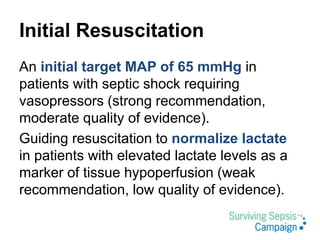
An initial target MAP of 65 mmHg in
patients with septic shock requiring
vasopressors (strong recommendation,
moderate quality of evidence).
Guiding resuscitation to normalize lactate
in patients with elevated lactate levels as a
marker of tissue hypoperfusion (weak
recommendation, low quality of evidence).
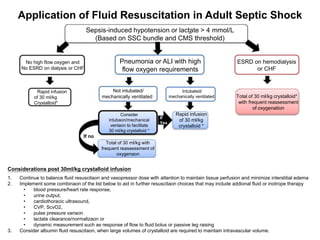
Application of Fluid Resuscitation in Adult Septic Shock
Considerations post 30ml/kg crystalloid infusion
1. Continue to balance fluid resuscitaon and vasopressor dose with attention to maintain tissue perfusion and minimize interstitial edema
2. Implement some combinaon of the list below to aid in further resuscitaon choices that may include addional fluid or inotrope therapy
• blood pressure/heart rate response,
• urine output,
• cardiothoracic ultrasound,
• CVP, ScvO2,
• pulse pressure variaon
• lactate clearance/normalizaon or
• dynamic measurement such as response of flow to fluid bolus or passive leg raising
3. Consider albumin fluid resuscitaon, when large volumes of crystalloid are required to maintain intravascular volume.
Sepsis-induced hypotension or lactate > 4 mmol/L
(Based on SSC bundle and CMS threshold)
No high flow oxygen and
No ESRD on dialysis or CHF
Pneumonia or ALI with high
flow oxygen requirements
ESRD on hemodialysis
or CHF
Rapid infusion
of 30 ml/kg
Crystalloid*
Not intubated/
mechanically ventilated
Intubated/
mechanically ventilated Total of 30 ml/kg crystalloid*
with frequent reassessment
of oxygenation
If no
If
Yes
Consider
intubaon/mechanical
venlaon to facilitate
30 ml/kg crystalloid *
Rapid infusion
of 30 ml/kg
crystalloid *
Total of 30 ml/kg with
frequent reassessment of
oxygenaon
Diagnosis
Diagnosis
Appropriate routine microbiologic cultures
(including blood) be obtained before
starting antimicrobial therapy in patients
with suspected sepsis or septic shock if
doing so results in no substantial delay in
the start of antimicrobials (BPS).
Remarks Appropriate routine microbiologic
cultures always include at least two sets of blood
cultures (aerobic and anaerobic).
Antimicrobial
Therapy
Antimicrobial Therapy
Administration of IV anti-microbials be
initiated as soon as possible after
recognition and within 1 h for both sepsis
and septic shock (strong recommendation,
moderate quality of evidence; grade
applies to both conditions).
Antimicrobial Therapy
Empiric broad-spectrum therapy with one or
more antimicrobials for patients presenting
with sepsis or septic shock to cover all likely
pathogens (including bacterial and potentially
fungal or viral coverage) (strong
recommendation, moderate quality of
evidence).
Empiric antimicrobial therapy be narrowed once
pathogen identification and sensitivities are
established and/or adequate clinical
improvement is noted (BPS).
Antimicrobial Therapy
Antimicrobial treatment duration of 7–10
days is adequate for most serious
infections associated with sepsis and
septic shock (weak recommendation, low
quality of evidence).
Antimicrobial Therapy
Measurement of procalcitonin levels can be
used to support shortening the duration of
antimicrobial therapy in sepsis patients (weak
recommendation, low quality of evidence).
Procalcitonin levels can be used to support
the discontinuation of empiric antibiotics in
patients who initially appeared to have sepsis,
but subsequently have limited clinical
evidence of infection (weak recommendation,
low quality of evidence).
Source
Control
Source Control
A specific anatomic diagnosis of infection
requiring emergent source control be
identified or excluded as rapidly as
possible in patients with sepsis or septic
shock, and that any required source
control intervention be implemented as
soon as medically and logistically practical
after the diagnosis is made (BPS).
Source Control
Prompt removal of intravascular access
devices that are a possible source of
sepsis or septic shock after other vascular
access has been established (BPS).
Fluid Therapy
Crystalloids as the fluid of choice for initial
resuscitation and subsequent intravascular
volume replacement in patients with sepsis
and septic shock (strong recommendation,
moderate quality of evidence).
Against using hydroxyethyl starches (HESs)
for intravascular volume replacement in
patients with sepsis or septic shock (strong
recommendation, high quality of evidence).
Fluid Therapy
Using albumin in addition to crystalloids for
initial resuscitation and subsequent
intravascular volume replacement in
patients with sepsis and septic shock
when patients require substantial amounts
of crystalloids (weak recommendation, low
quality of evidence).
Vasopressors
Norepinephrine as the first choice
vasopressor (strong recommendation,
moderate quality of evidence).
Adding either vasopressin (up to 0.03 U/min)
(weak recommendation, moderate quality of
evidence) or epinephrine (weak
recommendation, low quality of evidence) to
norepinephrine with the intent of raising MAP
to target, or adding vasopressin (up to 0.03
U/min) (weak recommendation, moderate
quality of evidence) to decrease
norepinephrine dosage.
Vasopressors
Using dopamine as an alternative
vasopressor agent to norepinephrine only
in highly selected patients (e.g., patients
with low risk of tachyarrhythmias and
absolute or relative bradycardia) (weak
recommendation, low quality of evidence).
Against using low-dose dopamine for renal
protection (strong recommendation, high
quality of evidence).
Vasopressors
Using dobutamine in patients who show
evidence of persistent hypoperfusion
despite adequate fluid loading and the use
of vasopressor agents (weak
recommendation, low quality of evidence).
Vasopressors
All patients requiring vasopressors have an
arterial catheter placed as soon as
practical if resources are available (weak
recommendation, very low quality of
evidence).
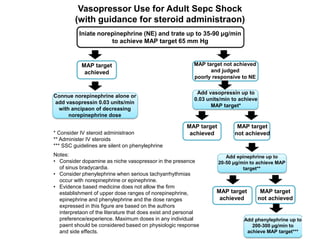
Vasopressor Use for Adult Sepc Shock
(with guidance for steroid administraon)
Iniate norepinephrine (NE) and trate up to 35-90 μg/min
to achieve MAP target 65 mm Hg
MAP target
achieved
Connue norepinephrine alone or
add vasopressin 0.03 units/min
with ancipaon of decreasing
norepinephrine dose
MAP target not achieved
and judged
poorly responsive to NE
Add vasopressin up to
0.03 units/min to achieve
MAP target*
MAP target
achieved
MAP target
not achieved
Add epinephrine up to
20-50 μg/min to achieve MAP
target**
MAP target
achieved
MAP target
not achieved
Add phenylephrine up to
200-300 μg/min to
achieve MAP target***
* Consider IV steroid administraon
** Administer IV steroids
*** SSC guidelines are silent on phenylephrine
Notes:
• Consider dopamine as niche vasopressor in the presence
of sinus bradycardia.
• Consider phenylephrine when serious tachyarrhythmias
occur with norepinephrine or epinephrine.
• Evidence based medicine does not allow the firm
establishment of upper dose ranges of norepinephrine,
epinephrine and phenylephrine and the dose ranges
expressed in this figure are based on the authors
interpretaon of the literature that does exist and personal
preference/experience. Maximum doses in any individual
paent should be considered based on physiologic response
and side effects.
Corticosteroids
Corticosteroids
Against using IV hydrocortisone to treat
septic shock patients if adequate fluid
resuscitation and vasopressor therapy are
able to restore hemodynamic stability. If
this is not achievable, we suggest IV
hydrocortisone at a dose of 200 mg per
day (weak recommendation, low quality of
evidence).
Blood Products
Blood Product Administration
RBC transfusion occur only when
hemoglobin concentration decreases to
<7.0 g/dL in adults in the absence of
extenuating circumstances, such as
myocardial ischemia, severe hypoxemia,
or acute hemorrhage (strong
recommendation, high quality of evidence).
Blood Product Administration
Prophylactic platelet transfusion
when counts are <10,000/mm3 in the
absence of apparent bleeding and
when counts are <20,000/mm3 if the
patient has a significant risk of bleeding.
Higher platelet counts (≥50,000/mm3) are
advised for active bleeding, surgery, or
invasive procedures (weak
recommendation, very low quality of
evidence).
Glucose Control
Glucose Control
A protocolized approach to blood glucose
management in ICU patients with severe
sepsis commencing insulin dosing when 2
consecutive blood glucose levels are >180
mg/dL. This protocolized approach should
target an upper blood glucose ≤180
mg/dL rather than an upper target blood
glucose ≤ 110 mg/dL (strong
recommendation, high quality of evidence).
Glucose Control
Blood glucose values be monitored every
1–2 hrs until glucose values and insulin
infusion rates are stable and then every
4 hrs thereafter in patients receiving
insulin infusions (BPS).
Bicarbonate
Therapy
Bicarbonate Therapy
Against the use of sodium bicarbonate
therapy to improve hemodynamics or to
reduce vasopressor requirements in
patients with hypoperfusion-induced lactic
acidemia with pH ≥ 7.15 (weak
recommendation, moderate quality of
evidence).
西暦 2017年1月17日
輸液
☐ Crystalloids ± albumin
☒ HESs
昇圧剤
☑ Norepinephrine ± vasopressin or epinephrine
☐ Dopamine for bradycardia only
類固醇
☐ Hydrocortisone 200 mg/day for refractory shock
輸血
☑ pRBC: Hb < 7
☐ platelet: 10K, 20K, 50K
血糖制御 < 180 mg/dl
重炭酸塩 pH < 7.15
Intensive Care Medicine
doi: 10.1007/s00134-017-4683-6
症、襲来
敗
血
症 SSC Guidelines 2016
蘇生補完計画
☑ Crystalloid ≥ 30 ml/kg within 3 hrs
☐ Target MAP ≥ 65 mmHg
☐ Normalize lactate
☒ EGDT, CVP, ScvO2
抗生物質
☑ Empiric broad-spectrum ABx within
1 hr
☐ Procalcitonin to support the
discontinuation of ABx
感染源制御
☐ as soon as possible

Surviving Sepsis Guidelines 2016

  • 1.
    Surviving Sepsis Campaign International Guidelines for Managementof Severe Sepsis and Septic Shock: 2016 Intensive Care Medicine doi: 10.1007/s00134-017-4683-6 Published online: 18 Jan 2017
  • 2.
    MANAGEMENT OF SEVERESEPSIS Management of Severe Sepsis Initial Resuscitation Diagnosis Antibiotic Therapy Source Control Fluid Therapy Vasopressors Corticosteroids Blood Product Glucose Control Bicarbonate Therapy
  • 3.
  • 4.
    Initial Resuscitation Sepsis andseptic shock are medical emergencies, and we recommend that treatment and resuscitation begin immediately (best practice statements, BPS). In the resuscitation from sepsis-induced hypoperfusion, at least 30 mL/kg of IV crystalloid fluid be given within the first 3 h (strong recommendation, low quality of evidence).
  • 5.
    Initial Resuscitation Following initialfluid resuscitation, additional fluids be guided by frequent reassessment of hemodynamic status (BPS). Remarks Reassessment should include a thorough clinical examination and evaluation of available physiologic variables (heart rate, blood pressure, arterial oxygen saturation, respiratory rate, temperature, urine output, and others, as available) as well as other noninvasive or invasive monitoring, as available.
  • 6.
    Initial Resuscitation An initialtarget MAP of 65 mmHg in patients with septic shock requiring vasopressors (strong recommendation, moderate quality of evidence). Guiding resuscitation to normalize lactate in patients with elevated lactate levels as a marker of tissue hypoperfusion (weak recommendation, low quality of evidence).
  • 7.
    Application of FluidResuscitation in Adult Septic Shock Considerations post 30ml/kg crystalloid infusion 1. Continue to balance fluid resuscitaon and vasopressor dose with attention to maintain tissue perfusion and minimize interstitial edema 2. Implement some combinaon of the list below to aid in further resuscitaon choices that may include addional fluid or inotrope therapy • blood pressure/heart rate response, • urine output, • cardiothoracic ultrasound, • CVP, ScvO2, • pulse pressure variaon • lactate clearance/normalizaon or • dynamic measurement such as response of flow to fluid bolus or passive leg raising 3. Consider albumin fluid resuscitaon, when large volumes of crystalloid are required to maintain intravascular volume. Sepsis-induced hypotension or lactate > 4 mmol/L (Based on SSC bundle and CMS threshold) No high flow oxygen and No ESRD on dialysis or CHF Pneumonia or ALI with high flow oxygen requirements ESRD on hemodialysis or CHF Rapid infusion of 30 ml/kg Crystalloid* Not intubated/ mechanically ventilated Intubated/ mechanically ventilated Total of 30 ml/kg crystalloid* with frequent reassessment of oxygenation If no If Yes Consider intubaon/mechanical venlaon to facilitate 30 ml/kg crystalloid * Rapid infusion of 30 ml/kg crystalloid * Total of 30 ml/kg with frequent reassessment of oxygenaon
  • 8.
  • 9.
    Diagnosis Appropriate routine microbiologiccultures (including blood) be obtained before starting antimicrobial therapy in patients with suspected sepsis or septic shock if doing so results in no substantial delay in the start of antimicrobials (BPS). Remarks Appropriate routine microbiologic cultures always include at least two sets of blood cultures (aerobic and anaerobic).
  • 10.
  • 11.
    Antimicrobial Therapy Administration ofIV anti-microbials be initiated as soon as possible after recognition and within 1 h for both sepsis and septic shock (strong recommendation, moderate quality of evidence; grade applies to both conditions).
  • 12.
    Antimicrobial Therapy Empiric broad-spectrumtherapy with one or more antimicrobials for patients presenting with sepsis or septic shock to cover all likely pathogens (including bacterial and potentially fungal or viral coverage) (strong recommendation, moderate quality of evidence). Empiric antimicrobial therapy be narrowed once pathogen identification and sensitivities are established and/or adequate clinical improvement is noted (BPS).
  • 13.
    Antimicrobial Therapy Antimicrobial treatmentduration of 7–10 days is adequate for most serious infections associated with sepsis and septic shock (weak recommendation, low quality of evidence).
  • 14.
    Antimicrobial Therapy Measurement ofprocalcitonin levels can be used to support shortening the duration of antimicrobial therapy in sepsis patients (weak recommendation, low quality of evidence). Procalcitonin levels can be used to support the discontinuation of empiric antibiotics in patients who initially appeared to have sepsis, but subsequently have limited clinical evidence of infection (weak recommendation, low quality of evidence).
  • 15.
  • 16.
    Source Control A specificanatomic diagnosis of infection requiring emergent source control be identified or excluded as rapidly as possible in patients with sepsis or septic shock, and that any required source control intervention be implemented as soon as medically and logistically practical after the diagnosis is made (BPS).
  • 17.
    Source Control Prompt removalof intravascular access devices that are a possible source of sepsis or septic shock after other vascular access has been established (BPS).
  • 19.
    Fluid Therapy Crystalloids asthe fluid of choice for initial resuscitation and subsequent intravascular volume replacement in patients with sepsis and septic shock (strong recommendation, moderate quality of evidence). Against using hydroxyethyl starches (HESs) for intravascular volume replacement in patients with sepsis or septic shock (strong recommendation, high quality of evidence).
  • 20.
    Fluid Therapy Using albuminin addition to crystalloids for initial resuscitation and subsequent intravascular volume replacement in patients with sepsis and septic shock when patients require substantial amounts of crystalloids (weak recommendation, low quality of evidence).
  • 22.
    Vasopressors Norepinephrine as thefirst choice vasopressor (strong recommendation, moderate quality of evidence). Adding either vasopressin (up to 0.03 U/min) (weak recommendation, moderate quality of evidence) or epinephrine (weak recommendation, low quality of evidence) to norepinephrine with the intent of raising MAP to target, or adding vasopressin (up to 0.03 U/min) (weak recommendation, moderate quality of evidence) to decrease norepinephrine dosage.
  • 23.
    Vasopressors Using dopamine asan alternative vasopressor agent to norepinephrine only in highly selected patients (e.g., patients with low risk of tachyarrhythmias and absolute or relative bradycardia) (weak recommendation, low quality of evidence). Against using low-dose dopamine for renal protection (strong recommendation, high quality of evidence).
  • 24.
    Vasopressors Using dobutamine inpatients who show evidence of persistent hypoperfusion despite adequate fluid loading and the use of vasopressor agents (weak recommendation, low quality of evidence).
  • 25.
    Vasopressors All patients requiringvasopressors have an arterial catheter placed as soon as practical if resources are available (weak recommendation, very low quality of evidence).
  • 26.
    Vasopressor Use forAdult Sepc Shock (with guidance for steroid administraon) Iniate norepinephrine (NE) and trate up to 35-90 μg/min to achieve MAP target 65 mm Hg MAP target achieved Connue norepinephrine alone or add vasopressin 0.03 units/min with ancipaon of decreasing norepinephrine dose MAP target not achieved and judged poorly responsive to NE Add vasopressin up to 0.03 units/min to achieve MAP target* MAP target achieved MAP target not achieved Add epinephrine up to 20-50 μg/min to achieve MAP target** MAP target achieved MAP target not achieved Add phenylephrine up to 200-300 μg/min to achieve MAP target*** * Consider IV steroid administraon ** Administer IV steroids *** SSC guidelines are silent on phenylephrine Notes: • Consider dopamine as niche vasopressor in the presence of sinus bradycardia. • Consider phenylephrine when serious tachyarrhythmias occur with norepinephrine or epinephrine. • Evidence based medicine does not allow the firm establishment of upper dose ranges of norepinephrine, epinephrine and phenylephrine and the dose ranges expressed in this figure are based on the authors interpretaon of the literature that does exist and personal preference/experience. Maximum doses in any individual paent should be considered based on physiologic response and side effects.
  • 27.
  • 28.
    Corticosteroids Against using IVhydrocortisone to treat septic shock patients if adequate fluid resuscitation and vasopressor therapy are able to restore hemodynamic stability. If this is not achievable, we suggest IV hydrocortisone at a dose of 200 mg per day (weak recommendation, low quality of evidence).
  • 29.
  • 30.
    Blood Product Administration RBCtransfusion occur only when hemoglobin concentration decreases to <7.0 g/dL in adults in the absence of extenuating circumstances, such as myocardial ischemia, severe hypoxemia, or acute hemorrhage (strong recommendation, high quality of evidence).
  • 31.
    Blood Product Administration Prophylacticplatelet transfusion when counts are <10,000/mm3 in the absence of apparent bleeding and when counts are <20,000/mm3 if the patient has a significant risk of bleeding. Higher platelet counts (≥50,000/mm3) are advised for active bleeding, surgery, or invasive procedures (weak recommendation, very low quality of evidence).
  • 32.
  • 33.
    Glucose Control A protocolizedapproach to blood glucose management in ICU patients with severe sepsis commencing insulin dosing when 2 consecutive blood glucose levels are >180 mg/dL. This protocolized approach should target an upper blood glucose ≤180 mg/dL rather than an upper target blood glucose ≤ 110 mg/dL (strong recommendation, high quality of evidence).
  • 34.
    Glucose Control Blood glucosevalues be monitored every 1–2 hrs until glucose values and insulin infusion rates are stable and then every 4 hrs thereafter in patients receiving insulin infusions (BPS).
  • 35.
  • 36.
    Bicarbonate Therapy Against theuse of sodium bicarbonate therapy to improve hemodynamics or to reduce vasopressor requirements in patients with hypoperfusion-induced lactic acidemia with pH ≥ 7.15 (weak recommendation, moderate quality of evidence).
  • 37.
    西暦 2017年1月17日 輸液 ☐ Crystalloids± albumin ☒ HESs 昇圧剤 ☑ Norepinephrine ± vasopressin or epinephrine ☐ Dopamine for bradycardia only 類固醇 ☐ Hydrocortisone 200 mg/day for refractory shock 輸血 ☑ pRBC: Hb < 7 ☐ platelet: 10K, 20K, 50K 血糖制御 < 180 mg/dl 重炭酸塩 pH < 7.15 Intensive Care Medicine doi: 10.1007/s00134-017-4683-6 症、襲来 敗 血 症 SSC Guidelines 2016 蘇生補完計画 ☑ Crystalloid ≥ 30 ml/kg within 3 hrs ☐ Target MAP ≥ 65 mmHg ☐ Normalize lactate ☒ EGDT, CVP, ScvO2 抗生物質 ☑ Empiric broad-spectrum ABx within 1 hr ☐ Procalcitonin to support the discontinuation of ABx 感染源制御 ☐ as soon as possible