Compiled and shared by Suman Poudel 1
ORGANIZATIONAL BEHAVIOR AND LEADERSHIP SKILLS
AREA OF STUDY: CORE
Course Objective:
The course aims to make students well equipped with knowledge and skills in understanding and investigating
the impact of individual, group and structure on the behavior of people at work. It will enable them to apply
such knowledge and skills to adopt appropriate managerial policies and leadership styles to improve
organizational performance and effectiveness in dynamic environment.
Course Details:
Unit I: Introduction to Organizational Behaviour LH 12 hrs. Meaning and Importance of Organizational
Behaviour, Contributing discipline to OB, Three levels of analysis in OB (Individual Level, Group Level, and
System Level), Challenges and Opportunities for OB, Developing an OB Model
Unit II: Foundations of Individual Behaviour LH 10 hrs. Biographical Characteristics and ability, Learning,
Attitudes and Job Satisfaction, Personality, Perception and Individual Decision Making, Motivation
Unit III: Foundations of Group Behaviour LH 8 hrs. Group development and structure, Understanding Work
Teams, Communication, Power and Politics, Conflict and Negotiation
Unit IV: Leadership and Change in Organizations LH 10 hrs. Leadership in Organization (Discuss both
traditional and contemporary leadership theories), Organizational Change (Focus on the behavioural aspect of
change), Role of Leaders in the Change Processes (Focus on leaders as change agents)
Unit V: Structural Perspective of Behaviour LH 8 hrs. Foundations of Organization Structure,
Organizational Designs and behaviour, Work design and technology, Organizational Culture
References:
Luthans, Fred, Organizational Behavior, McGraw Hill, New York
Newsrom J.W. and Davis Keith, Organizational Behavior: Human Behavior at Work, Tata McGraw-Hill
Publishing Company Limited, New Delhi.
Pareek, Udai, Understanding Organizational Behavior, Oxford University Press, New Delhi.
Robbins, S.P., Organizational Behavior, Prentice Hall of India, N. Delhi
Compiled and shared by Suman Poudel 2
“if you dig very deeply into any problem you will get to people.” -- J. Watson Wilson
A Review of Manager’s Job
One common thread runs through the functions, roles, skills, activities, and approaches to management:
Each recognizes the paramount importance of managing people. Regardless of whether it is called “the
leading function,” interpersonal roles,” “human skills,” or “human resource management,
communication and networking activities,” it’s clear that managers need to develop their people skills
if they are going to be effective and successful.
INTRODUCTION TO ORGANIZATIONAL BEHAVIOUR
Behaviour is a way of action. It is basically goal oriented. Human behaviour is generally motivated by
a desire to attain a goal. The specific goal is not always consciously known by the individual. Many
times we wonder “why did I do that”? The reason for our action is not always apparent to the conscious
mind. The knowledge and information explosion, global competition, total quality and diversity are
some of the bitter realities that the managers are facing today. Yet the simple but most profound key to
successful organizations and management is human resources and its behaviour.
The basic unit of behaviour is an activity. In fact, all behaviour is a series of There are many solutions
being offered to deal with these complex challenges. Activities. As a human being, we always do
something; walking, talking, sleeping etc. and sometimes we do more than one activity at a time.
Sometimes we decide to change from one activity to another. Why do we do so? Or why do people
engage in one activity and not another? A manager must understand, predict and control the activities
of a person at a given moment. To predict behaviour, manager must know which motives or needs of
people evoke a certain action at a particular time.
Organization Behavior
Organizational Behavior (OB) is a field of study that investigates the impact that individuals, groups,
and structure have on behavior within organizations, for the purpose of applying such knowledge
toward improving an organization’s effectiveness.
Organization Behavior is concerned with the study of what people do in an organization and how that
behavior affects the performance of the organization.—Stephen P Robbins
Organization Behavior tends to be more theoretically oriented and at the micro level of analysis.
Specifically, OB draws from many theoretical frameworks of behavior sciences that are focused on
understanding and explaining individual and group behavior in organizations.
To sum up, organizational behavior can be defined as the understanding, prediction and management of
human behavior in organization. – Fred Luthans
Organizational behavior can then be defined as: "The study of human behavior in organizational
settings, the interface between human behavior and the organizational context, and the organization
itself."
Compiled and shared by Suman Poudel 3
Organizational behavior (OB) is the study of the many factors that have an impact on how people
and groups act, think, feel, and respond to work and organizations, and how organizations respond to
their environments.
Understanding how people behave in an organization is important because most people work for an
organization at some point in their lives and are affected—both positively and negatively—by their
experiences in it (Jermanwings plane crash).
An understanding of OB can help people to enhance the positive, while reducing the negative, effects
of working in organizations.
Most of us think we have a basic, intuitive, commonsense understanding of human behavior in
organizations because we all are human and have been exposed to different work experiences.
Often, however, our intuition and common sense are wrong, and we do not really understand why
people act and react the way they do.
For example, many people assume that happy employees are productive employees—that is, that high
job satisfaction causes high job performance—or that punishing someone who performs consistently at
a low level is a good way to increase performance or that it is best to keep pay levels secret.
As we will see in later chapters, all of these beliefs are either false or are true only under very specific
conditions, and applying these principles can have negative consequences for employees and
organizations.
The study of OB provides guidelines that help people at work to understand and appreciate the many
forces that affect behavior in organizations.
It allows employees at all levels in an organization to make the right decisions about how to behave
and work with other people in order to achieve organizational goals.
OB replaces intuition and gut-feeling with a well-researched body of theories and systematic guidelines
for managing behavior in organizations.
The study of OB provides a set of tools—concepts and theories—that help people to understand,
analyze, and describe what goes on in organizations and why.
OB helps people understand, for example, why they and others are motivated to join an organization;
why they feel good or bad about their jobs or about being part of the organization; why some people do
a good job and others don’t; why some people stay with the same organization for 30 years and others
seem to be constantly dissatisfied and change jobs every 2 years. In essence, OB concepts and theories
allow people to correctly understand, describe, and analyze how the characteristics of individuals,
groups, work situations, and the organization itself affect how members feel about and act within their
organization.
Although there will probably never be total agreement on the exact meaning of organizational
behavior—which is not necessarily bad, because it makes the field more dynamic and exciting—there
is little doubt that organizational behavior has come into its own field of study, research and
application.
Compiled and shared by Suman Poudel 4
Organisational behaviour is concerned with the characteristics and behaviours of employees in
isolation; the characteristics and processes that are part of the organisation itself; 'and the
characteristics and behaviours directly resulting from people with their individual needs and
motivations working within the structure of the organisation. One cannot understand an individual’s
behaviour completely without learning something about that individual's organisation. Similarly, he
cannot understand how the organisation operates without; studying the people who-make it up. Thus,
the organisation influences and is influenced by individuals. Organizational behaviour integrates the
relevant contents of these disciplines to make them applicable for organizational analysis. e.g. it
addresses issues, which may be relevant to the case, such as the following:
 What facilitates accurate perception and attribution?
 What influences individual, group and organizational learning and the development of
individual attitudes toward work?
 How do individual differences in personality, personal development, and career development
affect individual's behaviours and attitudes?
 What motivates people to work, and how. Does the organizational reward system influence
worker's behaviour and attitudes?
 How do managers build effective teams?
 What contributes to effective decision-making?
 What are the constituents of effective communication?
 What are the characteristics of effective communication?
 How can power be secured and used productively?
 What factors contribute to effective negotiations?
 How can conflict (between groups or between a manager and subordinates) be resolved or
managed?
 How can jobs and organizations be effectively designed?
 How can managers help workers deal effectively with change?
Compiled and shared by Suman Poudel 5
Nature of OB
Organization Behaviour has emerged as a separate field of study. The nature it has acquired by now is
identified as follows:
1. A separate field of study and not a discipline only: OB has a multidisciplinary orientation and
is thus, not based on a specific theoretical background.
2. An inter disciplinary approach: OB is essentially an interdisciplinary approach to study
human behaviour at work. It tries to integrate the relevant knowledge drawn from related
disciplines like psychology, sociology, anthropology etc. ,to make them applicable for studying
and analyzing OB
3. An Applied Science: OB basically does the application of various researches to solve the
organizational problems related to human behaviour.
4. A Normative Science: while the positive science discusses only cause and effect relationship,
OB prescribes how the findings of applied researches can be applied to socially accept
organizational goals.
5. A Humanistic and Optimistic Approach: it applies humanistic approach towards people
working in the organization. It treats people as thinking, feeling human being.
6. Total system approach; The system approach is one that integrates all the variables affecting
organizational functioning. Man’s socio –psychological framework is complex one and the
system approach of OB tries to study this complexity and to find solution to it.
Importance and scope of organizational behaviour
Organisational behaviour offers several ideas to management as to how human factor should be
properly emphasized to achieve organisational objectives. Barnard has observed that an organisation is
a conscious interaction of two or more people. Organisational behaviour provides opportunity to
management to analyse human behaviour and prescribe means for shaping it to a particular direction.
Organisational behaviour helps to analyse 'why' and 'how' an individual behaves in a particular way.
Understanding Human Behaviour Organisational behaviour provides understanding the human
behaviour in all directions in which the human beings interact. Thus, organisational behaviour can be
understood at the individual level, interpersonal level, group level and inter-group level.
Organization Behavior
It studies the three determinants of behavior in the organization:
1. Individuals
2. Groups and
3. Structure
Compiled and shared by Suman Poudel 6
OB applies the knowledge gained about individuals, groups, and the effect of structure on behavior in
order to make organizations work more effectively.
Levels of OB (also called as)
Individual Level
Analyzes how an individual interacts with organizational goals, policies, and practices.
Group Level
Studies about group dynamics, group cohesiveness, leadership.
Organizational Level
Adaptation and interaction with organizational environment.
• Interpersonal Level: Human behaviour can be understood at the level of interpersonal
interaction. Organisational behaviour provides • means for understanding the interpersonal
relationships in an organisation. Analysis of reciprocal relationships, role analysis and transactional
analysis are some of the common methods, which provide such understanding.
• Group Level: Though people interpret anything at their individual level, they are often
modified by group pressures, which then become a force in shaping human behaviour, Thus,
individuals should be studied in groups also.. Research in group dynamics has contributed vitally to
organisational behaviour and shows how a group behaves in its norms, cohesion, goals, procedures,
communication pattern and leadership. These research results are advancing managerial knowledge of
understanding group behaviour, which is very important for organisational morale and productivity.
• Inter-group Level: The organisation is made up of many groups that develop complex
relationships to build their process and substance. Understanding the effect of group relationships is
important for managers in today's organisation. Inter-group relationship may be in the form of co-
operation or competition.
Importance of OB
Why should we study OB?
In our organization there is no title as “Deputy Director of OB” or “Manager of OB”.
Then, aside from fulfilling the requirements of MBA, why the study of OB is essential in our career
and in organization?
It is essential for all of us if we are concerned with what people think, feel, and do in and around
organizations.
Compiled and shared by Suman Poudel 7
More specifically, the importance of the study is to:
1. Satisfy our needs to understand and predict:
 The interactions between working environment and individuals create complex situations in the
organization.
 When we study OB, it helps to understand both work environment and individuals’ behavior and
predict the consequences of their interactions.
 An understanding of OB helps managers handle the situation more practically.
2. Influence organizational events:
 Whether one is a marketing manager or an operational manager, one can influence the
environment of the work place with an understanding of OB.
 This is because the manager knows how to communicate to individuals or groups and to decide
on leadership style to get the work done by the people.
3. Emphasize both research and practice at work:
 OB emphasize scientific study of individuals, groups, in the context of organization.
 Thus, the findings of research are useful to satisfy people in the organization and at the same
time, to help managers to understand its human resources for their effective utilization.
4. It helps to understand organization and employee in better way
5. Motivate Employee: OB helps managers apply appropriate motivational tools and techniques in
accordance with the nature of individual employee. OB considers individual differences in a proper
way.
6. Prediction and control of human behavior:
7. Effective utilization of human resources: OB disciplines helps managers to manage people behavior
in appropriate way in order to improve the performance so as to achieve organizational goal.
Contributing Disciplines to the OB Field
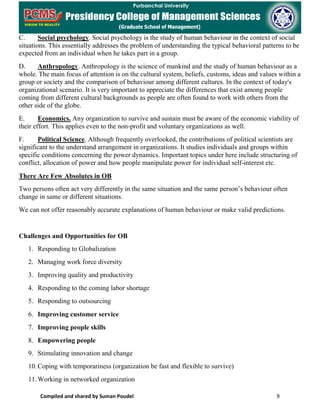
OB is an applied behavioral science that is built on contribution from a number of behavioral
disciplines.
The predominant areas are:
 Psychology
 Social psychology
 Sociology
 Anthropology
 Economics
 Political science
Compiled and shared by Suman Poudel 8
OB –as an interdisciplinary approach
Organizational behavior is an applied behavioral science that is built on contributions from a number of
behavioral disciplines such as psychology, sociology, social psychology, anthropology and economics.
Let’s see how these disciplines are related to organizational behavior,
A. Psychology. Psychology is the study of human behavior which tries to identify the
characteristics of individuals and provides an understanding why an individual behaves in a particular
way. This thus provides us with useful insight into areas such as human motivation, perceptual
processes or personality characteristics.
B. Sociology. Sociology is the study of social behavior, relationships among social groups and
societies, and the maintenance of social order. The main focus of attention is on the social system. This
helps us to appreciate the functioning of individuals within the organization which is essentially a
socio-technical entity.
Compiled and shared by Suman Poudel 9
C. Social psychology. Social psychology is the study of human behaviour in the context of social
situations. This essentially addresses the problem of understanding the typical behavioral patterns to be
expected from an individual when he takes part in a group.
D. Anthropology. Anthropology is the science of mankind and the study of human behaviour as a
whole. The main focus of attention is on the cultural system, beliefs, customs, ideas and values within a
group or society and the comparison of behaviour among different cultures. In the context of today's
organizational scenario. It is very important to appreciate the differences that exist among people
coming from different cultural backgrounds as people are often found to work with others from the
other side of the globe.
E. Economics. Any organization to survive and sustain must be aware of the economic viability of
their effort. This applies even to the non-profit and voluntary organizations as well.
F. Political Science. Although frequently overlooked, the contributions of political scientists are
significant to the understand arrangement in organizations. It studies individuals and groups within
specific conditions concerning the power dynamics. Important topics under here include structuring of
conflict, allocation of power and how people manipulate power for individual self-interest etc.
There Are Few Absolutes in OB
Two persons often act very differently in the same situation and the same person’s behaviour often
change in same or different situations.
We can not offer reasonably accurate explanations of human behaviour or make valid predictions.
Challenges and Opportunities for OB
1. Responding to Globalization
2. Managing work force diversity
3. Improving quality and productivity
4. Responding to the coming labor shortage
5. Responding to outsourcing
6. Improving customer service
7. Improving people skills
8. Empowering people
9. Stimulating innovation and change
10.Coping with temporariness (organization be fast and flexible to survive)
11.Working in networked organization
Compiled and shared by Suman Poudel 10
12.Helping employees work balance life
13.Improving ethical behavior
Globalization
When organization extends its activities to other parts of the world, actively participates in other
markets and competes against organizations located in other countries.
Important considerations from OB perspective:
Understanding Global Differences
Companies must learn about many different kinds of factors when they operate globally.
First, there are the considerable problems of understanding OB in different global settings. Evidence
suggests that people in different countries have different values, beliefs, and attitudes about the value of
the jobs they perform and the organizations they work for. For example, U.S. employees have an
individualistic orientation toward work while Japanese employees have a collectivist orientation and
this cultural difference affects employees’ personal work behavior, their behavior in groups, and their
commitment and loyalty to an organization.
OB becomes especially complex at a global level because the attitudes, aspirations, and values of the
workforce differ by country. For example, most U.S. employees are astonished to learn that in Europe
the average employee receives from 4 to 6 weeks paid vacation a year. In the United States, a
comparable employee receives only 1 or 2 weeks. Similarly, in some countries, promotion by seniority
is the norm, but in others, level of performance is the main determinant of promotion and reward.
Understanding the differences between national cultures is important in any attempt to manage
behavior in a global organization.
Second, problems of coordinating the activities of an organization to match its environment become
much more complex as an organization’s activities expand across the globe.
Third, in many cases global organizations locate in a particular country abroad because this allows
them to reduce operating costs
Companies like Levi Strauss, which made all their clothing in the United States 20 years ago, now
outsource virtually all their clothing to companies abroad in order to reduce costs and remain
competitive.
GLOBAL LEARNING: The process of acquiring and learning the skills, knowledge, and
organizational behaviors and procedures that have helped companies abroad become major global
competitors.
To respond to the global challenge, more and more companies are rotating their employees and moving
them to their overseas operations so they can learn firsthand the problems and opportunities that arise
when working in countries overseas. Expatriate managers are those who live and work for
companies in countries abroad. There are many ways they can help their companies develop improved
OBs and procedures.
Compiled and shared by Suman Poudel 11
First, expatriate managers can learn about the sources of low-cost inputs and the best places to
assemble their products throughout the world.
Second, expatriate managers in functions such as research and development, manufacturing, and sales
can take advantage of their presence in a foreign country to learn the skills and techniques used by that
country’s companies.
(EXPATRIATE MANAGERS The people who work for a company overseas and are responsible for
developing relationships with organizations in countries around the globe.)
Many companies also use global virtual teams to increase global learning
Global Crisis Management
Extensive global learning allows for more effective responses to the increasing number of crises or
disasters that are occurring from natural or manmade causes or because of international terrorism and
geopolitical conflicts.
Crises that arise because of natural causes include the wave of hurricanes, tsunamis, earthquakes,
famines, and diseases that could devastated.
Manmade crises, such as those that are the result of global warming, pollution, and the destruction of
the natural habitat or environment, also seem to be increasing.
Finally, increasing geopolitical tensions that are the result of the speed of the process of globalization
have upset the global balance of power as different countries or world regions try to protect their own
economic and political interests.
OB has an important role to play in helping people and organizations respond to such crises, for it
provides lessons as to how to manage and organize the resources needed to respond to a crisis. As we
discuss in later chapters, crisis management involves important decisions such as:
(1) creating teams to facilitate rapid decision making and communication,
(2) establishing the organizational chain of command and reporting relationships necessary to
mobilize a fast response,
(3) recruiting and selecting the right people to lead and work in such teams, and
(4) developing bargaining and negotiating strategies to manage the conflicts that arise whenever
people and groups have different interests and objectives. How well managers make these
decisions determines how quickly an effective response to a crisis can be implemented and
sometimes can prevent or reduce the severity of the crisis itself.
Dealing with a Diverse Workforce
A second social and cultural challenge is to understand how the diversity of a workforce affects OB.
Diversity results from differences in age, gender, race, ethnicity, religion, sexual orientation,
socioeconomic background, and capabilities or disabilities.
Compiled and shared by Suman Poudel 12
If an organization or group is composed of people who are all of the same gender, ethnicity, age,
religion, and so on, the attitudes and behavior of its members are likely to be very similar.
Members are likely to share the same attitudes or values and will tend to respond to work situations
(projects, conflicts, new tasks) in similar ways.
By contrast, if the members of a group differ in age, ethnicity, and other characteristics, their attitudes,
behavior, and responses are likely to differ as well.
The increasing diversity of the workforce presents three challenges for organizations and their
managers: a fairness and justice challenge, a decision-making and performance challenge, and a
flexibility challenge.
a fairness and justice challenge
Managers are challenged to allocate jobs, promotions, and rewards in a fair and equitable manner.
Increasing diversity can strain an organization’s ability to satisfy the aspirations of all the diverse
groups in its workforce—and this can create problems that, in turn, affect the well-being of employees
and organizational performance.
Deciding how to promote diversity to increase employee well-being and organizational performance
poses difficult ethical problems for managers.
DECISION-MAKING AND PERFORMANCE CHALLENGE
Another important challenge posed by a diverse workforce is how to take advantage of differences in
the attitudes and perspectives of people of different ages, genders, or races, in order to improve
decision making and raise organizational performance.
Many organizations have found that tapping into diversity and taking advantage of the potential of
diverse employees, leads to new and improved OBs and procedures.
FLEXIBILITY CHALLENGE
A third diversity challenge is to be sensitive to the needs of different kinds of employees and to try
to develop flexible employment approaches that increase employee well-being. Examples of some of
these approaches include the following:
● New benefits packages customized to the needs of different groups of employees such as single
employees with no children and families, gays and lesbians in long-term committed relationships, and
employees caring for aged parents or disabled children
● Flexible employment conditions (such as flextime or working from home) that give employees input
into the length and scheduling of their workweek
● Arrangements that allow for job sharing so that two or more employees can share the same job (to
take care of children or aged parents, for example)
● Designing jobs and the buildings that house organizations to be sensitive to the special needs of
handicapped employees (and customers)
Compiled and shared by Suman Poudel 13
● Creating management programs designed to provide constructive feedback to employees about their
personal styles of dealing with minority employees
● Establishing mentoring relationships to support minority employees
● Establishing informal networks among minority employees to provide social support
Improving People Skill
Previously, world economy was based in agriculture and then moved towards industry based.
Today most of the developed country’s economy is based on knowledge and service sector.
This trend has cut backs managerial ranks, decentralized decision making, increased responsibilities to
employees, participation, team work, increased automation and so on.
Increased competition and quality awareness have demanded high level skills and knowledge.
Employees must trained and re-educated.
More importantly, managers must become more responsive to the needs of their skilled employees to
keep them from going to work for the competitor.
Empowerment of Employees
Previously, people worked under the tight control of their bosses, supervisors, or managers.
Today managers are encouraged to work as coaches, advisors, facilitators, team leaders so as to
compte in the market place and to satisfy employee demands.
(give a person a fish, and you feed that person for a day; Teach the person to fish, and you feed that
person for life)
The trend is towards the use of self managed work teams, quality circles, self appraisal, MBO etcs.
Managing Organizational Change
Managers must be prepared to introduce organizational change—a compulsion not a choice.
This has always been concern, but the rapid, constant environmental change faced by businesses today
has made change management even more critical.
Organizations have adopted many different programs like re-organization of departments, disposal of
poor performing units, downsizing, employee outsourcing etcs.
Managers and employees must prepare themselves flexible enough to cope with the change.
The study of OB can provide important insights into helping us better understand a work-world of
continual change, how to overcome resistance to change, how best to create organizational culture that
thrives on change.
Compiled and shared by Suman Poudel 14
Improving Ethical Behavior
It is the individual personal belief regarding what is right and wrong or good and bad.
Members of organizations are increasingly finding themselves facing ethical dilemmas, situation in
which they are required to define right and wrong conduct.
What is ethical in one organization time or place, may not be so in another organization, time or place.
What constitutes a good ethical behavior has never been clearly defined.
To solve this problem, managers are writing and distributing codes of ethics to guide employees
through ethical dilemmas.
They are offering seminars, workshops, and similar training programs to try to improve ethical
behaviors.
 Responding to Globalization
 Increased foreign assignments
 Working with people from different cultures
 Coping with anti-capitalism backlash
 Overseeing movement of jobs to countries with low-cost labor
 Managing people during the war on terror.
 Managing Workforce Diversity
 Embracing diversity
 Changing U.S. demographics
 Implications for managers
 Recognizing and responding to differences
Challenges and Opportunities for OB (cont’d)
 Improving Quality and Productivity
 Quality management (QM)
 Process reengineering
 Responding to the Labor Shortage
 Changing work force demographics
 Fewer skilled laborers
 Early retirements and older workers
Compiled and shared by Suman Poudel 15
 Improving Customer Service
 Increased expectation of service quality
 Customer-responsive cultures
Major Workforce Diversity Categories
What Is Quality Management?
1. Intense focus on the customer.
2. Concern for continuous improvement.
3. Improvement in the quality of everything the organization does.
4. Accurate measurement.
5. Empowerment of employees.
Challenges and Opportunity for OB (cont’d)
 Improving People Skills
 Empowering People
 Stimulating Innovation and Change
 Coping with “Temporariness”
 Working in Networked Organizations
 Helping Employees Balance Work/Life Conflicts
 Improving Ethical Behavior
 Managing People during the War on Terrorism
Developing an OB Model
A model is an abstraction of reality, a simplified representation of some real world phenomenon. E.g.
A/c formula.
The skeleton on which we will construct our OB model.
Developing an OB Model
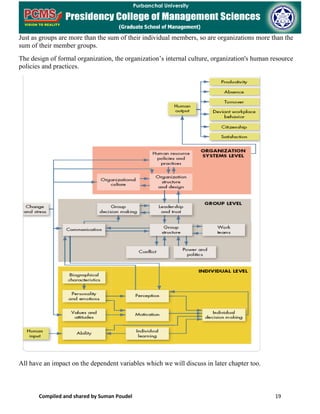
This proposed that there are three level of analysis in OB and that, as we move from the individual
level to the organization system level.
We add systematically to our understanding of behavior in organizations.
Three basic levels are analogous to building blocks, each level is constructed on the previous level.
Compiled and shared by Suman Poudel 16
Group Concepts grow out of the foundation laid in the individual section.
We overlay structural constraints on the individual and group in order to arrive at OB.
The Dependent Variables
It is the key factor that you want to explain or predict and that is affected by some other factor.
The primary dependent variables of OB?
1. Productivity
2. Absenteeism
3. Turnover
4. Job satisfaction
5. Deviant work place behavior
6. Organizational citizenship behavior.
The Dependent Variables
Productivity: An organization is productive if it achieves its goals and does so by transferring inputs
to outputs at the lowest cost.
Productivity implies a concern for both effectiveness and efficiency.
So, one of the major concern in OB is productivity.
We want to know what factors will influence the effectiveness and efficiency of individuals, groups
and the overall organization.
Efficiency vs. effectiveness
Efficiency
Doing things right
Getting the most output from the least amount of input.
Means (resource uses)
Effectiveness
Doing right things
Completing activities so that organizational goals are attained.
Ends (goal attainment)
Absenteeism: It is defined as the failure to report to work resulting huge cost and disruption on
employers.
Compiled and shared by Suman Poudel 17
It is obviously difficult for an organization to operate smoothly and to attain its objectives if employees
fail to report to their job.
The work flow is disrupted and often important decisions must be delayed.
Are all absences bad????? Probably not…(jobs on which employees needs to be alert)
For the most part, we can assume that organizations benefit when employee absenteeism is low.
Turnover: It is the voluntary and involuntary permanent withdrawal from an organization.
A high turnover rate results in increased recruiting, selection and training costs.
if the right people are leaving the organization, this turnover can actually be positive because it can
create the opportunity to replace underperforming individuals with someone who has higher skills,
motivation and add new and fresh ideas to the organization.
But turnover often involves the cost of people the organization doesn’t want to loose.
When turnover is excessive or when it involves valuable performers, it can be disruptive factor,
hindering the organization’s effectiveness.
Deviant workplace behavior: voluntary behavior that violates significant organizational norms and, in
doing so, threatens the wellbeing of the organization or its members.
Also called antisocial behavior or workplace incivility.
For e.g. playing loud music, insulting others, steal, gossip excessively, engage in sabotage etc.
Deviant workplace behavior is an important concept because it’s a response to dissatisfaction, and
employee express this in many ways.
Controlling one behavior may be ineffective unless one gets to the root cause.
The manager will deal with root causes of problems that may result in deviance rather than solving
surface problem.
Organizational Citizenship Behavior (OCB): it is discretionary behavior that is not part of an
employee’s formal job requirements, but that nevertheless promotes the effective functioning of the
organization.
Successful organization need employees who will provide performance that is beyond expectations.
OCB for e.g: helping others on their team, volunteering for extra work, avoiding unnecessary conflicts,
respecting sprit, following rules and regulation, gracefully tolerating the occasional work-related
impositions.
As a result OB is concerned with OCB as a dependent variable.
Job Satisfaction: Positive feeling about job resulting from an evaluation of its characteristics.
It represents attitude rather than a behavior.
Compiled and shared by Suman Poudel 18
Two reasons behind taking it as dependent variable:
1. Its demonstrated relationship to performance factors.
2. Value preferences held by many OB researchers.
Although, job satisfaction represents an attitude rather than a behavior, OB researchers typically
consider it an important dependent variable.
The Independent Variables
The major determinants of productivity, absenteeism, turnover, deviant workplace behavior, OCB, and
job satisfaction is undoubtedly Independent Variables.
Independent variable is the presumed cause of some change in dependent variable.
OB can be best understood when viewed essentially as a set of increasingly complex building blocks,
the base, or first level , of our model lies in understanding individual behavior, then group and finally
organization system level.
The Independent Variables
Individual Level Variables: it has been said that managers, unlike parents, must work with used, not
new, human beings.
When individuals enter in organization, they are a bit like used cars(having different mileage).
This means people enter organizations with certain intact characteristics that will influence their
behavior at work.
These are: - personal or biographical characteristics such as age, gender, marital status, personality
characteristics, emotion, values & attitudes, basic ability levels, perception, individual decision making,
learning and motivation.(we will discuss these as independent variables in later chapter)
The Group Level Variables: the behavior of people in group is more than the sum total of all the
individuals acting in their own way.
The complexity of our model is increased when we acknowledge that people behavior when they are in
group.
We discuss, how individuals in groups are influenced by the patterns of behavior they are expected to
exhibit, what the group considers to be acceptable standards of behavior, the degree to which group
members are attracted to each other, communication patterns, leadership, power and politics and level
of conflict affect group behavior.
Organizational System Level Variables: OB reaches its highest level of sophistication when we add
formal structure to our previous knowledge of individual and group behavior.
Compiled and shared by Suman Poudel 19
Just as groups are more than the sum of their individual members, so are organizations more than the
sum of their member groups.
The design of formal organization, the organization’s internal culture, organization's human resource
policies and practices.
All have an impact on the dependent variables which we will discuss in later chapter too.
Compiled and shared by Suman Poudel 20
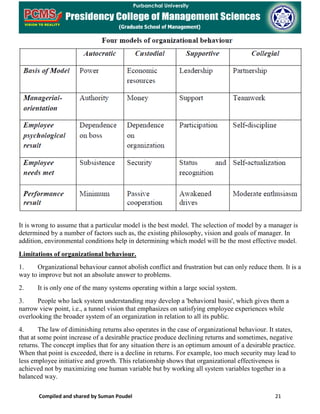
MODELS OF ORGANISATION BEHAVIOUR
Organizations differ in the quality of organizational behaviour that they develop. These differences are
substantially caused by different models of organizational behaviour that dominant management's
thought in each organization. The model that a manager holds usually begins with certain assumptions
about people and thereby leads to certain interpretations of organizational events.
The following four models of organizational behaviour are as follows:
A. Autocratic model
B. Custodial model
C. Supportive model
D. Collegial model
Autocratic Model
In an autocratic model', the manager has the power to command his subordinates to do a specific job.
Management believes that it knows what is best for an organization and therefore, employees are
required to follow their orders. The psychological result of this model on employees is their increasing
dependence on their boss. Its main weakness is its high human cost.
Custodial Model
This model focuses better employee satisfaction and security. Under this model organizations satisfy
the security and welfare needs of employees. Hence, it is known as custodian model. This model leads
to employee dependence on an organization rather than on boss. As a result of economic rewards and
benefits, employees are happy and contented but they are not strongly motivated.
Supportive Model
The supportive model depends on 'leadership' instead of power or money. Through leadership,
management provides a climate to help employees grow and accomplish in the interest of an
organization. This model assumes that employees will take responsibility, develop a drive to contribute
and improve them if management will give them a chance. Therefore, management's direction is to
'Support' the employee's job performance rather than to 'support' employee benefit payments, as in the
custodial approach. Since management supports employees in their work, the psychological result is a
feeling of participation and task involvement in an, organization.
Collegial Model
The term 'collegial' relates to a body of persons having a common purpose. It is a team concept.
Management is the coach that builds a better team. The management is seen as joint contributor rather
than as a boss. The employee response to this situation is responsibility. The psychological result of the
collegial approach for the employee is 'self-discipline'. In this kind of environment employees normally
feel some degree of fulfillment and worthwhile contribution towards their work. This results in
enthusiasm in employees' performance.
Compiled and shared by Suman Poudel 21
It is wrong to assume that a particular model is the best model. The selection of model by a manager is
determined by a number of factors such as, the existing philosophy, vision and goals of manager. In
addition, environmental conditions help in determining which model will be the most effective model.
Limitations of organizational behaviour.
1. Organizational behaviour cannot abolish conflict and frustration but can only reduce them. It is a
way to improve but not an absolute answer to problems.
2. It is only one of the many systems operating within a large social system.
3. People who lack system understanding may develop a 'behavioral basis', which gives them a
narrow view point, i.e., a tunnel vision that emphasizes on satisfying employee experiences while
overlooking the broader system of an organization in relation to all its public.
4. The law of diminishing returns also operates in the case of organizational behaviour. It states,
that at some point increase of a desirable practice produce declining returns and sometimes, negative
returns. The concept implies that for any situation there is an optimum amount of a desirable practice.
When that point is exceeded, there is a decline in returns. For example, too much security may lead to
less employee initiative and growth. This relationship shows that organizational effectiveness is
achieved not by maximizing one human variable but by working all system variables together in a
balanced way.
Compiled and shared by Suman Poudel 22
UNIT-2: Foundation of Individual Behavior
All organizations are composed of individuals. No organization can exist without individuals. Human
behavior, which is; considered a complex phenomenon, is very difficult to define in absolute terms. It
is primarily a combination of responses to external and internal stimuli. These responses would reflect
psychological structure of the person and may be results' of the combination of biological and
psychological processes, which interpret them, respond to them in an appropriate manner and learn
from the result of these responses.
Psychologist Kurt Levin has conducted considerable research into the human behavior and its causes.
He believes that people are influenced by a number of diversified factors, which can be both genetic
and environmental. The influence of these factors determines the pattern of human behavior.
An individual makes a variety of contributions to an organization in the form of—efforts, skills, ability,
time, loyalty and so forth. These contributions presumably satisfy various needs and requirements of
the organization. In return for contributions, the organization provides incentives such as pay,
promotion, and job security to the employee. Just as the contributions available from the individual
must satisfy the organization's needs, the incentives must serve the employees' needs in return.
If both the individual and the organization consider the psychological contract fair and equitable, they
will be satisfied with the relationship and are likely to continue it. If either party perceives an
imbalance or iniquity in the contract, it may initiate a change. A major challenge faced by an
organization, thus, is to manage the psychological contracts.
One specific aspect of managing psychological contracts is managing the person-job fit. The 'person-
job fit' is the extent to which the contributions made by the individual match the incentives offered by
the organization. The behavior of individuals in organization is the primary concern of management
and it is essential that the managers should have an understanding of the factors influencing the
behavior of the employees they manage. The figure 5.1 identifies five sets of factors that have an
impact upon individual behavior in organizations.
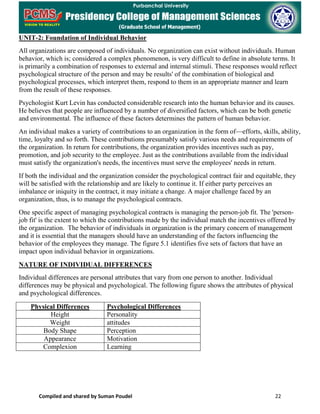
NATURE OF INDIVIDUAL DIFFERENCES
Individual differences are personal attributes that vary from one person to another. Individual
differences may be physical and psychological. The following figure shows the attributes of physical
and psychological differences.
Physical Differences Psychological Differences
Height Personality
Weight attitudes
Body Shape Perception
Appearance Motivation
Complexion Learning
Compiled and shared by Suman Poudel 23
Foundation of Individual Behavior
• People of course differ in many ways, so those differences results varying degree of individual
behaviors.
• Ability, Personal or biographical characteristics such as age, gender, tenure, personality
characteristics, emotion, values & attitudes, basic ability levels, perception, individual
decision making, learning and motivation.
Ability: an individual’s capacity to perform the various tasks in a job.
• An individual’s overall abilities are essentially made up of two sets of factors: intellectual and
physical
Intellectual abilities: the capacity to do mental activities– thinking, reasoning and problem solving.
• People in most societies place a high value on intelligence.
• Generally smart people earn more money and attain higher level of education and also emerge
as a leader.
• the more complex a job is in terms of information processing demands the more intelligence will
be necessary to perform a job.
Why intellectual people are better performer?
• They are more creative,
• They learn jobs more quickly,
• They are more adaptable to changing circumstances
• They are better at inventing solutions that improve performance
(you can teach smart or intelligent people anything)
• The seven most frequently cited dimensions making up intellectual abilities are :
• Explanation
Intellectual abilities:
Interestingly, while intelligence is a big help in performing a job well, it doesn’t make people happier
or more satisfied with their jobs.
• The correlation between intelligence and job satisfaction is almost about zero.
• Research suggests that although intelligent people perform better and tend to have more
interesting job.
• Thus smart people have it better, but they also expect more.
Compiled and shared by Suman Poudel 24
Some researchers believe that intelligence can be better understood by breaking it down into
four sub parts.
i. Cognitive intelligence: the psychological result of perception and learning and reasoning–
classical based.
ii. Social intelligence: person’s ability to relate effectively to others.
iii. Emotional intelligence: the ability to identify, understand, and manage emotion.
iv. Cultural intelligence: awareness of cross cultural differences and ability to function successfully
in cross-cultural situations.
Physical Abilities: the capacity to do tasks demanding stamina, dexterity(skill of using one’s hands),
strength and similar characteristics.
• Specific physical abilities gain importance for successfully doing less-skilled jobs.
• Research on the requirements needed in hundreds of jobs has identified, nine basic abilities
involved in the performance of physical tasks are:
• Nine Physical Abilities
• Explanation
• The Ability-Job Fit
Ability--Job Fit
• Our concern is with explaining and predicting the behavior of people at work.
• Employee performance is enhanced when there is a high ability-job fit.
• The specific intellectual or physical abilities required for adequate job performance depend on
the ability requirements of the job.
Ability--Job Fit (e.g.)
• Airline pilot need strong spatial visualization abilities,
• Beach lifeguards need both strong spatial visualization and body coordination
• Senior executive need verbal abilities
• Journalist need strong reasoning abilities
Compiled and shared by Suman Poudel 25
Factors Influencing Individual Behaviour
1. Personality-personality traits
2. Economic factors-wage rate, technological change, the job, economic outlook, employment
opportunity etc.
3. Socio-cultural factors-social environment consist of relation with friends, relatives, co-workers,
superiors, subordinates etc.
4. Cultural factors- basic values, perceptions, work ethics, preferences etc.
5. Organizational factors- structure, hierarchy, resources, leadership, support etc, from organization
6. Motivation- internal motivation (individual skill, ability, intelligence etc.) external
(incentives, training etc.)
7. Attitudes- perception favorably or unfavorably.
8. Values- personally or socially preferable.
9. Abilities- actual skills and capabilities of a person and physical-mental ability
10. Perception- is the viewpoint which one interpret a situation.
11. Personal factors- age, sex, education, intelligence, marital status, religion etc.
Foundation of Individual Behavior
Biographical Characteristics/Personal Characteristics
• Biographical characteristics would be an employee’s age, gender, race and length of service
with an organization.
• Fortunately, there is a sizable amount of research that has specifically analyzed many of these
biographical characteristics.
Age
• The relationship between age and performance is likely to be an issue of increasing importance
because:
i. There is widespread belief that job performance declines with the increasing age.
ii. The workforce is young or aging.
What is the perception of older workers?
Compiled and shared by Suman Poudel 26
Employers hold mixed feelings
• They see a number of positive qualities that older workers bring to their job:
• Specifically, experience, judgment, a strong work ethic, and commitment to quality.
• But older workers are also perceived as lacking flexibility and as being resistant to new
technology.
What effect does age actually have on turnover, absenteeism, productivity, and satisfaction?
Age-turnover relationship
• The older you get, the less likely you are to quit your job.
• As the worker gets older, they have fewer alternative job opportunities because their long tenure
tends to provide them with higher wage rates, longer paid vacations, and more attractive pension
benefits.
Age-absenteeism relationship
• If older workers are less likely to quit, won’t they also demonstrate higher stability by coming to
work more regularly? Probably not..
• In general, older employees have lower rates of avoidable absence than do younger employees.
• They have higher rates of unavoidable absence, probably due to the poorer health associated
with aging and the longer recovery period that older workers need when injured.
Age-productivity relationship
• There is widespread belief that productivity declines with age.
• It is often assumed that an individual’s skills– particularly speed, agility, strength, and
coordination– decay(a gradual decrease) over the time.
 But other reviews of research find that age and job performance are unrelated.
 Their conclusion is that if there is some decay due to age, it is offset by gains due to experience.
Age- job satisfaction relationship
• Most studies indicate a positive association between age and satisfaction at least up to 60.
• Other studies have found a U-shaped relationship.
• When two types(professional and nonprofessional) are separated, satisfaction tends to
continually increase among professional as their age, where as it falls among nonprofessionals
during middle age then rises again in the later years.
Compiled and shared by Suman Poudel 27
Gender
• The research on working women in general tells us that there are very few differences between
men and women that affect job performance.
• Thus, men and women show no consistent differences in their problem-solving abilities,
analytical skills, competitive drive, motivation, learning ability, or sociability.
• However, women are reported to have lower expectations of success than men do.
• And, women’s absenteeism rates tend to be higher than those of men.
• One issue that does seem to differ between genders, especially when the employee has preschool
age children, is preference for work schedules.
• Working mothers are more likely to prefer part-time work, flexible work schedules, and
telecommuting in order to accommodate their family responsibilities.
TIPS IN DEALING WITH MALE AND FEMALE MANAGERS
• Do not assume that male and female managers differ in personal qualities.
• Make sure that policies, practices, and programs minimize gender differences in managers’ job
experiences.
• Do not assume that management success is more likely for either females or males.
• Recognize that there will be excellent, good, and poor managers within each gender.
• Understand that success requires the best use of human talent, regardless of gender.
Race: biological heritage people identify themselves.
• Race has been studied quite a bit in OB, particularly as it relates to employment outcomes such
as personal selection decisions, performance evaluation, pay and workplace discrimination.
• Doing justice to all of this research is not possible.
• In employment settings, there is a tendency for individuals to favor colleagues for their won race
in performance evaluation, promotion decisions and pay, and workplace discrimination.
• There are substantial racial differences in attitude toward affirmative action.
• The major dilemma faced by employers who use mental ability tests for selection, promotion,
training, and similar personnel decision is concern that they may have a negative impact on
racial and ethnic group.
• E.g. African American generally face worse than the Whites in employment decisions– African
American receive lower ratings in employment interviews, are paid less, and are promoted less
frequently.
• However, the issue of racial differences in performance ability continue to be hotly debated.
Compiled and shared by Suman Poudel 28
Tenure
• The last biographical characteristic we will look at is tenure.
Impact of seniority on job performance
• If we define seniority as time on a particular job, we can say that a positive relationship between
seniority and job productivity.
• So tenure, expressed as work experience, appears to be a good predictor of employee
productivity.
• The research relating tenure to absence is negatively related.
• Turnover– the longer a person is in a job, the less likely he or she is to quit.
• Job satisfaction– tenure and job satisfaction are positively related.
THEORIES OF LEARNING
Learning is an important psychological process that-determines human behavior. Simple way,
“learning is something we did when we went to school “it is permanent changing behavior through
education and training, practice and experience. Learning can be defined as “relatively permanent
change in behavior that occurs as a result of experience or reinforced practice". There are four
important points in the definition of learning:
1. Learning involves a change in behavior, though this change is not necessarily an improvement
over previous behavior. Learning generally has the connotation of improved behavior, but bad
habits, prejudices, stereotypes, and work restrictions are also learned.
2. The, behavioral change must be relatively permanent. Any temporary change in behavior is not
a part of learning.
3. The behavioral change must be based on some form of practice or experience.
4. The practice or experience must be reinforced in order so as to facilitate learning to occur.
Any relatively permanent change in behavior that occurs as a result of practice and experience.
• If we want to explain and predict behavior, we need to understand how people learn.
• We infer that learning has taken place if an individual behaves, reacts, responds as a result of
experience (Observation, Practice or reading) in a manner different from the way he/she
formerly behaved.
• In this section, we define learning, present three different popular learning theories, and describe
how managers can facilitate employee learning.
Definition of Learning
Generally accepted definition of learning: Any relatively permanent change in behavior that occurs as
a result of experience.
Compiled and shared by Suman Poudel 29
Kingley and Garry:- learning is the process by which behavior (in the broad sense) is originated or
changes through practice or training
Kingley and Garry:- learning is the process by which behavior (in the broad sense) is originated or
changes through practice or training.
Henry p. smith: - learning is the acquisition of new behavior or strengthening or weakening of old
behavior as the result of experience.
To Learn - to gain knowledge or skill by studying, practicing, being taught, or experiencing
something.
To Study - to read, memorize facts, attend school, etc., in order to learn about a subject.
It seems that studying is the action to reach the goal of learning.
Learning
• In order to cope with changing environment and new technology, employers have to be prepared
by making employee more competitive.
• Learning is directly related to the development, maintenance and change of employee work
behaviors to achieve the goal of the organization.
• When desired behavior deviates from the desired goals of the organization, it is necessary to
control such behavior with the help of training and development– a learning process.
• However, learning is more than training and development, the powerful learning comes from
direct experience.
Factors Influencing Learning
1. Distribution of knowledge and information: senior managers have more access to knowledge and
information about the organization and its resources.
• Attitude of senior managers largely determines individual learning in organization.
2. Reward for learning: employees’ learning should be rewarded giving opportunity to work in
challenging jobs, by promoting upward position and personality development.
• The role of manager is important to reward learning in a job.
3. Support for learning: organizational climate influences job-related attitudes and behavior.
• Employees working in organization respond with proper job attitude when organizational
climate is favorable and thus it helps to individual learning.
• In an organizational culture learning is to lead to innovation and long term performance
improvement.
4. Motivation and prior experience:
Compiled and shared by Suman Poudel 30
• An individual’s motivation to learn and his experience on the job determine learning
willingness.
• Individual motivation to engage in the process of learning is also determined by available of
information of information and supportive learning environment.
5. Opportunities to practice:
• to achieve a higher level of skill, there is a need for workers to acquire knowledge and have
opportunities to practice
Significance of Learning for People
• For people, learning changes the behavioral orientation such as knowledge, skills, values,
personality and competency etc.
• Through learning individual re-create himself.
• Through learning individual able to do something he/she never was able to do.
1. To understand and predict behavior of the people at work
2. To manage and work in diversity
3. To adapt to the changing technology
4. Total quality management
5. To facilitate organizational change and development
Learning Theories
How do we learn? Three theories have been offered to explain the process by which we acquire
patterns of behavior. These are:
1. Classical Conditioning
2. Operant conditioning
3. Social learning
4. Cognitive Learning
Classical Conditioning
• Experiment done by the Russian Physiologist Ivan Pavlov in early 1900s.
• Experiment was interlinked with the salivation of dog with the conditional stimulus(bell) and
unconditional stimulus (Meat).
•
Compiled and shared by Suman Poudel 31
Key Concepts
 Unconditioned stimulus e.g. Meat
 Unconditioned response e.g. Salivation
 Conditioned stimulus e.g. bell, artificial stimulus
 Conditioned response e.g. salivation after bell rang
Explanation
• When Pavlov presented the dog with a piece of meat, the dog exhibited a noticeable increase in
salivation.
• When he withheld the presentation of and merely rang a bell, the dog did not salivate.
• Then Pavlov proceeded to link the meat and the ringing of the bell.
• After repeatedly hearing the bell before getting the food, the dog began to salivate as soon as the
bell rang.
• After a while, the dog would salivate merely at the sound of the bell even if no food was offered.
• In effect, the dog had learned to respond – i.e., to salivate – to the bell.
Examples in OB (Classical Conditioning)
• At one manufacturing plant, every time the top executives from the head office were scheduled
to make a visit, the plant management would clean up the administrative offices and wash the
windows. This went for years. Eventually, employees would turn on their best behavior and look
prim and proper whenever the windows were cleaned – even in those occasional instances when
the cleaning was not paired with the visit from the top brass. People had leaned to associate the
cleaning of the windows with a visit for the head office.
• Classical conditioning is passive. Something happens and we react in a specific way (stimulus
then only response).
• It is elicited in response to a specific, identifiable event.
• As such, it can explain simple behaviors. But most behavior – particularly the complex behavior
of individuals in organizations – is ignored rather than elicited.
• That’s why classical conditioning is also called as SR(stimulus– response) model
• It is voluntary rather than reflexive.
• The learning of those behaviors is better understood by looking at operant conditioning (R-S).
Compiled and shared by Suman Poudel 32
Operant Conditioning (R-S)
A type of conditioning in which desired voluntary behavior leads to a reward or prevents a punishment.
• Developed by Harvard psychologist B.F. Skinner
• It argues that behavior is a function of its consequences.
• People learn to behave to get something they want or to avoid something they don’t want.
• Operant behavior means voluntary or learned behavior in contrast to reflexive or unlearned
behavior as in S-R.
• This learning model assumes that individuals engage in certain behavior repeatedly when
behavior is reinforced from time to time.
• People will most likely engage in desired behaviors if they are positively reinforced for doing
so.
• Rewards are most effective if they immediately follow the desired response.
• In addition, behavior that is not rewarded, or is punished, isles likely to be repeated.
Example:
• Assume that your boss tells you that if you will work overtime during the next three-week busy
season, you will be compensated for it at the next performance appraisal.
• However, when performance appraisal time comes, you find that you are given no positive
reinforcement for your overtime work.
• The next time your boss asks you to work overtime, what will you do? You’ll probably decline!
Your behavior can be explained by operant conditioning:
If a behavior fails to be positively reinforced, the probability that the behavior will be repeated
declines.
Behavior which is reinforced tends to be repeated (i.e. strengthened); behavior which is not reinforced
tends to die out-or be extinguished (i.e. weakened).
• Skinner’s Box
Learning: Social Learning Theory
Social Learning Theory: the view that people can learn through observation and direct experience.
• Individuals also can learn by observing what happens to other people and just by being told
about something, as well as by direct experiences.
Compiled and shared by Suman Poudel 33
• For e.g., much of what we have learned comes from watching models—parents, teachers, peers,
motion picture and television performers etc.
• This view that we can learn through both observation and direct experience is called social
learning theory.
The influence of models is central to the social-learning viewpoint.
Four processes have been found to determine the influence that model will have on an individual.
1. Attention process: People learn from a model only when they recognize and pay attention to its
critical features.
• We tend to be most influenced by models that are attractive, repeatedly available, important to
us or similar to us in our estimation.
2. Retention process: a model’s influence will depend on how well the individual remembers the
model’s action after the model is no longer readily available.
3. Motor reproduction process: after a person have seen a new behavior by observing the model, the
watching must be converted to doing.
• This process then demonstrates that the individual can perform the modeled activities.
4. Reinforcement process: individuals will be motivated to exhibit the modeled behavior if positive
incentives or rewards are provided.
• Behavior that are positively reinforced will be given more attention, learned better, and
performed more often.
REINFORCEMENT: The process by which the probability that a desired behavior will occur is
increased by applying consequences that depend on the behavior.
Cognitive Learning
Here the primary emphasis is on knowing how events and objects are related to each other. Most of the
learning that takes place in the classroom is cognitive learning. Cognitive learning is important because
it increases the change that the learner will do the right thing first, without going through a lengthy
operant conditioning process.
Learning: Shaping, A Managerial Tool
Shaping, A Managerial Tool
Because learning takes place on the job as well as prior to it, managers will be concerned with how
they can teach employees to behave in ways that most benefit the organization.
• We shape behavior by systematically reinforcing each successive step that moves the individual
closer to the desired response.
• Reinforcement would increase as responses more closely approximated the desired behavior.
Compiled and shared by Suman Poudel 34
Methods of Shaping Behavior (four ways)
• Positive reinforcement (Employee is praised for cleaning up work station)-increases the
probability of desired behavior
– Providing a reward for a desired behavior.
• Negative reinforcement (Supervisor complains about messy work station and stops only when
worker cleans it)- increases the probability of desired behavior
– Removing an unpleasant consequence when the desired behavior occurs.
• Punishment (Manager criticizes subordinate for telling disruptive jokes when the two have
important matters to discuss)- decreases the probability of undesired behavior
– Applying an undesirable condition to eliminate an undesirable behavior.
• Extinction (Manager refrains from laughing at a subordinate’s disruptive jokes when the two
have important matters to discuss)- decreases the probability of undesired behavior
– Withholding reinforcement of a behavior to cause its cessation.
When behavior is not reinforced it tends to be gradually extinguished.
Schedules of Reinforcement
1. Fixed-interval: when rewards are spaced at uniform time intervals.
• The critical variable is time, and it is held constant.
E.g. compliments by boss.
2. Variable interval type: if rewards are distributed in time so that reinforcements are unpredictable.
• E.g. a series of randomly timed unannounced visits to a company office by the corporate audit
staff.
3. Fixed-ratio: after a fixed or constant number of responses are given, a reward is initiated.
e.g. a piece rate incentive plan.
4. Variable-ratio: when the reward varies relative to the behavior of the individual.
e.g. salespeople on commission, i.e. number of successful call.
Compiled and shared by Suman Poudel 35
Behavior modification in organization (OB Mod)
• Learning theory alone has important implications for managers, but organizational behavior
modification has even more practical applications.
• Organizational behavior modification is an important application of reinforcement theory some
managers use to enhance motivation and performance.
• OB Mod in organizations is the application of reinforcement theory to people in organizational
settings.
• Reinforcement theory says that we can increase the frequency of desirable behaviors by linking
those behaviors with positive consequences.
• OB mod characteristically uses positive reinforcement to encourage desirable behaviors in
employees.
• Implementing an OBM program, steps
– Step 1: Identify desired performance behaviors
– Step 2: Determine the base rate of performance
– Step 3: Identify existing contingencies
– Step 4: Select an intervention strategy
– Step 5: Evaluate
1. Identify performance related behavioral events: i.e. desirable and undesirable behaviors.
2. The manager measures baseline performance:
3. Identify the existing behavioral contingencies: if an employee works hard, does he/she get a reward
or just get tired?
4. Manager develops and applies an appropriate intervention strategy: some elements of
performance—reward linkage to make high level of performance more rewarding. Various kinds of
positive reinforcement are used.
5. The manager again measures performance to determine whether the desired effect has been
achieved. If not, the manager must redesign the intervention strategy. if performance has increased, the
manager must try to maintain the desirable behavior through some schedule of positive reinforcement.
6. Finally, the manager looks for improvements in individual employees’ behavior. Here the emphasis
is an offering significant longer term rewards, such as promotions and salary adjustments, to sustain
ongoing efforts to improve performance.
Compiled and shared by Suman Poudel 36
ATTITUDE AND PERCEPTION
In simple words, an "attitude" is an individual's point of view or an individual's way of looking at
something. To be more explicit, an "attitude" may be explained as the mental state of an individual,
which prepares him to react or make him behave in a particular pre-determined way. it is actually
acquired feeling.
An attitude is defined as, "a learned pre-disposition to respond in a consistently favourable or
unfavorable manner with respect to a given object".(Katz and Scotland)
Attitude is the combination of beliefs and feelings that people have about specific ideas, situations or
other people. Attitude is important because it is the mechanism through which most people express
their feelings.
COMPONENTS OF ATTITUDE
• Affective component
• Cognitive component
• Intentional component
The affective component of an attitude reflects 'feelings and emotions' that an individual has towards a
situation. The cognitive component of an attitude is derived from 'knowledge' that an individual has
about a situation. Finally, the intentional component of an attitude reflects how an individual 'expects to
behave' towards or in the situation. For example, the different components of an attitude held towards a
firm, which supplies inferior products and that too irregularly could be described as follows:
 I don't like that company"—Affective component.
 "They are the worst supply firm I have ever dealt with"—Cognitive component.
 "I will never do business with them again"'—Intentional component.
People try to maintain consistency among the three components of their attitudes. However,
conflicting circumstances often arise. The conflict that individuals may experience among their own
attitudes is called 'cognitive dissonance.
Attitude has three components, which are as follows:
Attitudes are evaluative statements –either favorable or unfavorable concerning objects, people or
events.
• Attitudes are complex. If you ask people about their attitude toward ….you may get a simple
response, but the reasons underlying the response are probably complex.
• In order to fully understand attitude, we need to consider their fundamental properties.
• Attitude
Compiled and shared by Suman Poudel 37
We will discuss six questions about attitude that will help us to understand better.
1. What are the main components of attitude?
2. How consistent are attitude?
3. What are the major job attitude?
4. How are employee attitude measured?
5. What is the importance of attitudes to workplace diversity?
What are the main components of attitude?
• Typically, researchers have assumed that attitudes have three components
1. Cognitive component
2. Affective component
3. Behavioral component
Cognitive component: (evaluation)
• It refers that's part of attitude which is related in general know how of a person,
• for example, he says smoking is injurious to health, the belief that discrimination is wrong
• Such type of idea of a person is called cognitive component of attitude.
(my supervisor gave a promotion to a coworker who deserved it less than me. My supervisor is unfair.)
Affective component: (feeling)
• This part of attitude is related to the statement which affects another person.
• For example, in an organization a personal report is given to the general manager. In report he
point out that the sale staff is not performing their due responsibilities.
• It is emotional or feeling segment of an attitude and is reflected in the statement “I don’t like
HIM” because he discriminates against minorities.
• This can lead to behavioral outcomes.
(I dislike my supervisor!)
The behavioral component: (action)
• It refers to an intention to behave in a certain way toward someone or something.
• I might choose to avoid HIM because of my feeling about him.
(I’m looking for another work, I’ve complained about my supervisor to anyone who would listen.)
Compiled and shared by Suman Poudel 38
• Viewing attitudes as made up of three components –cognition, affect, and behavior—is helpful
in understanding their complexity and potential relationship between attitude and behavior.
• In organizations, attitudes are important because of their behavioral component.
• If workers believe for e.g. that supervisors, auditors, bosses etc are all in conspiracy to make
employees work harder for the same or less money, it makes sense to try to understand how they
might be changed.
ATTITUDE FORMATION AND CHANGE
Individual attitude are formed over time as a result of repeated personal experiences with
ideas, situations or people. One of the very important ways to understand individual behaviour
in an organization is that of studying attitude, which is situational specific and learned.
An attitude may change as a result of new information. A manager may have a negative attitude
about a new employee because of his lack of job-related experience. After working with a new
person, a manager may come to realize that he is actually very talented and subsequently may
develop a more positive attitude toward him.
Work-Related Attitudes
People in an organization form attitude about many things such as about their salary, promotion
possibilities, superiors, fringe benefits, food in the canteen, uniform etc. Especially some
important attitudes are job satisfaction or dissatisfaction, organizational commitment and job
involvement.
Job Satisfaction
Job satisfaction is an attitude reflects the extent to which an individual is gratified or fulfilled .by
his or her work. Extensive research conducted on job satisfaction has indicated that personal
.factors such as an individual's needs and aspirations determine this attitude, along with group
and organizational factors such as relationships with co-workers and supervisors, working
conditions, work policies and compensation.
A satisfied employee also tends to be absent less often, makes positive contributions, and stays
with the organization. In contrast, a dissatisfied employee may be absent more often may
experience stress that disrupts co-workers, and may keep continually look for another job.
Organizational factors that influence employee satisfaction include pay, promotion, policies and
procedures of the organizations and working conditions. Group factors such as relationship with
co-workers and supervisors also influence job- satisfaction. Similarly, satisfaction depends on
individual factors like individual's needs and aspirations. If employees are satisfied with their
job, it may lead to low employee turnover and less absenteeism and vice-versa.
Organizational Commitment and Involvement
Two other important work-related attitudes arc organizational commitment and involvement.
Organizational commitment is the individual's feeling of identification with and attachment to an
organization. Involvement refers to a person's willingness to be a team member and work beyond the
Compiled and shared by Suman Poudel 39
usual standards of the job. An employee with little involvement is motivated by extrinsic motivational
factor and an employee with strong involvement is motivated by intrinsic motivational factors.
There are a number of factors that lead to commitment and involvement. Both may increase with an
employee's age and years with the organization, with his sense of job security and participation in
decision-making. If the organization treats its employees fairly and provides reasonable rewards and
job security, employees are more likely to be satisfied and committed. Involving employees in
decision-making can also help to increase commitment. In particular, designing jobs, which are
interesting and stimulating, can enhance job involvement.
Sources of attitude
1. Direct personal experience
2. Association
3. Family and per groups
4. Neighborhood
5. Economic status and occupation
6. Mass communication
Attitude: Consistency
How consistent are attitudes?
Did you ever notice how people change what they say so it doesn’t contradict what they do?
• Research has generally concluded that people seek consistency between their attitude and their
behavior.
• Can we also assume from this consistency principle that an individual’s behavior can always be
predicted if we know their attitude on a subject?
• E.g. if an employee views the company’s pay level as too low, will the substantial increase in
his pay change his behavior, that is, make him work harder?
The answer to this question is, unfortunately, more complex than merely a YES or NO.
• In the late 1950s, Leon Festinger proposed the theory of cognitive dissonance (inconsistency).
• This theory explains the linkage between attitude and behavior.
Cognitive dissonance: any incompatibility between two or more attitudes or between behavior and
attitude.
• He argued that any form of inconsistency is uncomfortable and that individuals will attempt to
reduce the dissonance i.e. discomfort.
• Therefore individual will seek a stable state in which there is a minimum of dissonance.
Compiled and shared by Suman Poudel 40
No individual of course can completely avoid dissonance.
The desire to reduce dissonance is determined by :
1. The importance of the elements creating dissonance (attitude on pollution may result loss to the
company)
2. The degree of influence the individual believes he/she has over the elements, and
(because of no choice)
3. The rewards that may be involved in dissonance.
Organizational implications of the theory of cognitive dissonance
• It can help to predict the propensity to engage in attitude and behavioral change.
• E.g., if individuals are required by the demands of their job to say or do things that contradict
their personal attitude, they will tend to modify their attitude in order to make it compatible with
the cognition of what they have said or done.
• In addition, the greater the dissonance –after it has been moderated by importance, choice, and
reward factors—the greater the pressures to reduce it.
Attitudes: Behavior
Does Behavior Always Follow from Attitudes?
• More recent research has demonstrated that attitudes significantly predict future behavior and
confirmed that the relationship can be enhanced by taking moderating variables.
Moderating variables
• The most powerful moderators of the attitudes-behavior relationship are
i. Importance of the attitude: important attitudes are ones that reflect fundamental values, self-
interest or identification with individuals or groups that a person values.
• Attitudes that individuals consider important tend to show a strong relationship to behavior.
ii. Its specificity: the more specific the attitude and the more specific the behavior, the strong
relationship between the two.
e.g. asking someone specifically about her intention to stay with the organization for the next 6 months
is likely to better predict turnover for that person than if you asked her how satisfied she was with her
pay.
iii. Its accessibility: attitudes are easily remembered are more likely to predict behavior than
attitudes that are not accessible in memory.
• You are much likely to remember attitudes that are frequently expressed.
Compiled and shared by Suman Poudel 41
iv. Social pressures: discrepancies between attitudes and behavior are more likely to occur when
social pressures to behave in a certain ways hold exceptional power.
v. Direct experience: the attitude—behavior relationship is likely to be much stronger if an attitude
comes from direct personal experience.
What are the Major Job Attitude?
• A person can have thousands of attitudes, but OB focuses our attention on a very limited number
of work related attitudes.
• Most of the research in OB has been concerned with three attitudes;
i. Job satisfaction.
ii. Job involvement.
iii. Organizational commitment.
iv. Perceived organizational support.
v. Employee engagement.
Job Satisfaction: a positive feeling about one’s job resulting from an evaluation of its characteristics.
• A person with high level of job satisfaction holds positive feelings about the job, while a person
who is dissatisfied holds negative feelings about the job.
Job Involvement: the degree to which a person identifies with a job, actively participates in it, and
considers performance importance to self—worth.
• It measures the degree to which people identify psychologically with their job.
• Employees with high level of job involvement strongly identify with and really care about the
kind of work they do.
(involving in decision, making them feel their work is important, and giving them discretion)
Attitudes: Major Job Attitudes
Organizational Commitment: the degree to which an employee identifies with a particular organization
and its goals and wishes to maintain membership in the organization.
Three separate dimensions to organizational commitment
1. Affective Commitment: an emotional attachment to the organization and a belief in its value.
2. Continuance Commitment: the perceived economic value of remaining with an organization
compare to leaving it.
3. Normative Commitment: an obligation to remain with the organization for moral or ethical
reasons. E.g. new initiative may remain with employer.
Compiled and shared by Suman Poudel 42
Perceived Organizational Support(POS): the degree to which employees believe the organization
values their contribution and cares about their well being.
Employee Engagement: an individual’s involvement with, satisfaction with, and enthusiasm for the
work they do.
Attitudes: Attitude Measurement
How Are Employee Attitude Measured?
• As we have seen, knowledge of employee attitudes can be helpful to managers in attempting to
predict employee behavior.
• How does management get information about employee attitudes?
• The most popular method is through the use of attitude surveys.(as in the case of VSP)
Attitude Survey: eliciting responses from employees through questionnaires on how they feel about
their jobs, work, groups, work groups, supervisors and organization.
A typical attitude survey presents the employee with a set of statements or questions with a rating scale
indication the degree of agreement.
e.g.
1. This organization’s wage rates are competitive with those of other organization.
2. My job makes the best use of my abilities.
3. I know what my boss expects of me.
• Using attitude surveys on a regular basis provides managers with valuable feedback on how
employees perceive their working conditions.
Job Satisfaction
Job Satisfaction: The term job satisfaction refers to an individual’s general attitude toward his or her
job.
• Different People have different attitudes towards different things.
• They will have different attitudes about current salary and rewards, promotion, behavior of
supervisor, working conditions and performance evaluation system of the organization.
• Some employees are really gratified with company’s policies and practices while some are not.
• A person with a high level of job satisfaction holds positive attitudes toward the job, while a
person who is dissatisfied with his or her job holds negative attitudes toward the job.
In this section we will discuss:
i. How to measure job satisfaction?
Compiled and shared by Suman Poudel 43
ii. How satisfied are employees in their job?
iii. What causes an employee to have a high level of job satisfaction?
iv. How do dissatisfied and satisfied employees affect an organization?
Measuring Job Satisfaction
The two most widely used approaches are:
i. Single global rating
ii. A summation score made up of a number of job facets.
Single Global Rating
• Asking individuals to respond to one question, such as “All things considered, how satisfied are
you with your job?”
• Respondents then reply by circling a number between 1 and 5 that corresponds to answer from
“Highly satisfied” to “Highly dissatisfied”.
A summation of Job Facets:
• It identifies key elements in a job and asks for the employee’s feelings about each.
• Typical factors that would be included are: nature of work, supervision, present pay, promotion
opportunities, relation with co-workers.
• These factors are rated on a standardized scale and then added up to create an overall job
satisfaction score.
How Satisfied are People in Their Jobs?
• Research shows that satisfaction levels vary a lot depending on which facets of satisfaction we
talking about.
• Those facets may be: nature of work, supervision, present pay, promotion opportunities, relation
with co-workers.
• Independent studies, conducted among US workers over the past 30 years, indicates that
majority of workers are satisfied with their job.
What Causes Job Satisfaction?
• Out of the major job satisfaction facets (work itself, pay, advancement opportunities,
supervision, coworkers), enjoying the work itself is almost always the facet most strongly
correlated with high level of overall job satisfaction.
• Interesting jobs that provide training variety, independence, and control satisfy most employees.
Compiled and shared by Suman Poudel 44
• Most people prefer work that is challenging and stimulation over work that is predictable and
routine.
• This findings does not applicable in poor countries and people with under the line of poverty
where pay matters a lot.
The impact of Dissatisfied and Satisfied Employees on the Workplace.
How Employees Can Express Dissatisfaction
Four types of behavior result:
• Exit. Actively attempting to leave the organization, including looking for a new position as well as
resigning. This is a destructive action from the point of view of the organization.
• Voice. Actively and constructively trying to improve conditions, including suggesting improvements,
discussing problems with superiors, and some forms of union activity.
• Loyalty. Passively but optimistically waiting for conditions to improve, including speaking up for the
organization in the face of external criticism and trusting the organization and its management to do the
right thing.
• Neglect. Passively allowing conditions to worsen, including chronic absenteeism or lateness, reduced
effort, and increased error rate.
Job Satisfaction and Job Performance
• Job Satisfaction and OCB
• Job satisfaction and customer satisfaction
• Job satisfaction and absenteeism
• Job satisfaction and turnover
• Job satisfaction and workplace deviance
Motivation
• How to make people work more or work better? This is an issue that requires an understanding
of what motivates people to work.
• Literally motivation means inducement to act or move. It is an inner impulse that induces a
person to act in a certain way.
• In an organizational setting, motivation means to make an employee act in a desired manner.
• It implies not only that the employees should act in a disciplined manner, but also that should
act in an efficient and productive manner.
Compiled and shared by Suman Poudel 45
Types of Motivation
Intrinsic Motivation: related to job one is doing.
• When a skilled operative performs a job well, he or she derives a sense of satisfaction. Intrinsic
motivation satisfies the creative instinct in an individual.
Extrinsic Motivation: this motivation is external to the job or task.
• Financial incentives for doing a job well may motivate the employee. Other: praise, recognition,
admiration, working conditions, other facilities.
Indicators of Motivation
• One who want to come to work willingly.
• When at work, he or she gives his or her best.
• He or she has a definite sense of belonging and pride in the organization.
Indicators of Demotivation:
• Increased absenteeism
• Excessive turnover
• Low output and productivity
• An increasing rate of wastage of raw materials
• Frustration and unrest in the workplace.
• Violent behavior of the employees– strikes etc.
•
What is Motivation?
Importance of Motivation
1. Understand the employee behavior
2. Productivity improvement
3. Quality improvement
4. Employee retention
5. Creativity promotion
6. Low employee turnover
7. Better employee discipline
8. Reduced employee grievances
Compiled and shared by Suman Poudel 46
(self motivation is the best motivation)
Theories of Motivation
Early Theory of Motivation
i. Hierarchy of Needs Theory
ii. Theory X and Theory Y
iii. Two—Factor Theory
Contemporary Theory of Motivation
i. McCelland’s Theory of Needs
ii. Cognitive Evaluation Theory
iii. Goal—Setting Theory
iv. Self-Efficacy Theory
v. Reinforcement Theory
vi. Equity Theory
vii. Expectancy Theory
Hierarchy of Needs Theory
• Physiological: Includes hunger, thirst, shelter, sex, and other bodily needs
• Safety: Includes security and protection from physical and emotional harm
• Social: Includes affection, belongingness, acceptance, and friendship
• Self-Esteem: Includes internal esteem factors such as self-respect, autonomy, and
achievement; and external esteem factors such as status, recognition, and attention
• Self-actualization: The drive to become what one is capable of becoming; includes
growth, achieving one’s potential, and self-fulfilment
Maslow’s Hierarchy of Needs
Compiled and shared by Suman Poudel 47
Implications of Maslow’s theory
• Higher and lower order needs
• Lower order needs can be satisfied by offering higher salary and wages, pleasant working
conditions, medical insurance and retirement benefits.
• Higher order needs can be satisfied by participation in decision making and providing
challenging and meaningful jobs.
• Satisfaction progression process
Theory X and Theory Y
• Douglas McGregor, an American social psychologist, proposed in 1960 "McGregor's XY
Theory". This theory still remains central to organizational development, and to improving
organizational culture.
• This theory is a useful and simple reminder of the natural rules for managing people, which
under the pressure of day-to-day business are all too easily forgotten.
Douglas McGregor said that managers hold one of two sets of assumptions about human nature: either
Theory X or Theory Y. Seeing people as irresponsible and lazy, managers who follow Theory X
assume the following:
1. Employees inherently dislike work and will try to avoid it.
2. Since employees dislike work, they must be coerced, controlled, or threatened to achieve goals.
Compiled and shared by Suman Poudel 48
3. Employees avoid responsibilities and seek formal direction, if possible.
4. Most workers place security above all other work-related factors and will display little ambition.
Since they see people as responsible and conscientious, managers who follow Theory Y assume the
following:
1. Employees can view work as being as natural as rest or play.
2. When committed to their objectives, people will exercise self-direction and self-control
3. The average person can learn to accept, even seek responsibility.
4. Many workers besides managers have innovative decision-making skills.
No hard evidence confirms that either set of assumptions is universally true. It is more likely that the
assumptions of Theory X or Theory Y may or may not be appropriate, depending on the situation at
hand.
Difference between these theory
• Theory X
o Most people dislike work inherently
o Not ambitious, little desire for responsibility & prefer to be directed
o Little capacity for solving organizational problem
o Motivation occurs only at the physiological and safety level
o People to closely monitored and even coerced.
• Theory Y
o Work is like a play if condition is favorable
o Exercise self direction and self control
o Imaginative and original
o Motivation occurs at the social, self esteem and self actualization level
o Self directed and creative at work.
• IMPLICATIONS FOR MANAGERS:
• Theory X assumes that lower-level needs dominate individuals.
• Theory Y assumes that higher-level needs dominate individuals.
• McGregor himself held to the belief that Theory Y assumptions were more valid than Theory X.
• There is no evidence to confirm that either set of assumptions is valid.
Compiled and shared by Suman Poudel 49
Either theory X or theory Y assumptions may be appropriate in a particular situation.
Herzberg's Motivator - Hygiene (Two-factor) Theory
• Frederick Herzberg and his associates developed the dual-structure theory in the late 1950s and
early1960s.
• He began by interviewing approximately two hundred accountants and engineers in Pittsburgh.
He asked them to recall time when they felt especially satisfied and motivated by their job and
times when they felt particularly dissatisfied and unmotivated. The responses to the questions
were recorded and later subjected to the content analysis.
• Intrinsic factors are related to job satisfaction, while extrinsic factors are associated with
dissatisfaction.
• Herzberg’s Motivation-Hygiene Theory
• Motivators
 Achievement
 Recognition
 Work itself
 Responsibility
 Advancement & Growth
Created condition of satisfaction or no satisfaction
• Hygiene Factors
 Supervision
 Working conditions
 Interpersonal relations
 Pay and security
 Company policy and administration
Creates conditions of dissatisfaction or no dissatisfaction
• Herzberg’s Motivation-Hygiene Theory
Events that led to extreme dissatisfaction
Events that led to extreme satisfaction
• Contrasting Views of Satisfaction and Dissatisfaction
Compiled and shared by Suman Poudel 50
• Herzberg concluded:
– The opposite of satisfaction is not dissatisfaction.
– Removing dissatisfying characteristics from a job does not necessarily make the job
satisfying.
• CRITICISMS OF THE THEORY:
– The procedure that Herzberg used is limited by its methodology (content analysis).
– The reliability of Herzberg’s methodology is questioned.
– No overall measure of satisfaction was utilized.
– Herzberg assumed a relationship between satisfaction and productivity, but the research
methodology he used looked only at satisfaction, not at productivity.
– Original sample of accountants and engineers may not represent the general working
population.
– The theory fails to account for individual differences.
– The theory varies across cultures.
ERG Theory
• The theory was developed in the 1969 by a psychologist Clayton Alderfer. It is an extension of
Maslow's theory.
• Existence Needs
– Provides our basic material existence requirements
– They include Maslow’s physiological and safety needs.
• Relatedness Needs
– The desire we have for maintaining important interpersonal relationships
– These social and status desires require interaction with others.
– They align with Maslow’s social need and the external component.
• Growth Needs
– An intrinsic desire for personal development
– These include the intrinsic component from Maslow’s esteem category and the
characteristics included under self-actualization.
• Alderfer’s ERG theory also differs from Maslow’s in that:
Compiled and shared by Suman Poudel 51
– More than one need may be operative at the same time.
– A lower motivator need not be substantially satisfied before one can move onto higher
motivators.
– ERG theory does not assume that there exists a rigid hierarchy. A person can be working
on growth even though existence or relatedness needs are unsatisfied, or all three need
categories could be operating at the same time.
• ERG theory also contains a "frustration-regression" dimension. It notes that when a higher-order
need level is frustrated, the individual’s desire to increase a lower-level need takes place.
• In contrast, Maslow's theory includes a satisfaction-progression component. It suggests that after
satisfying one category of needs, a person progresses to the next level.
David McClelland’s Theory of Needs
• David McClelland’s Theory of Needs
1. Need for Achievement (nAch)
– The drive to excel, to achieve in relation to a set of standards, to strive to succeed. They
have the desire to do something better or more efficiently than it has been done before.
Characteristics of high-need achievers:
– They have a strong desire to assume personal responsibility for performing a task for
finding a solution to a problem.
– They differentiate themselves from others by their desire to do things better and more
efficiently.
– They tend to set moderately difficult goals and take calculated risks.
– They have a strong desire for performance feedback.
– High achievers perform best when they perceive their probability of success as 50-50.
They dislike succeeding by chance.
2. Need for Power (nPow)
– A desire to control and influence others’ behaviours.
The high need for power is characterized by:
– A desire to influence and direct somebody else.
– A desire to exercise control over others.
– A concern for maintaining leader-follower relations.
Compiled and shared by Suman Poudel 52
– They prefer to be placed into competitive and status-oriented situation.
3. Need for Affiliation (nAff)
– The desire for friendly, co-operative and close personal relationships.
– They receive inner satisfaction from being with friends, and they want the job freedom to
develop these relationships.
– Managers with strong Need for Affiliation may have difficulty being effective managers.
• In Summary,
• Matching High Achievers and Jobs
Goal-Setting Theory (Edwin Locke)
• Specific goals produce a higher level of output than does the generalized goal.
• Specific goal itself seems to act as an internal stimulus.
• People will do better when they get feedback on how well they are progressing toward their
goals, because feedback helps to identify discrepancies between what they have done and what
they want to do.
• Feedback works as to guide behavior.
Factors influencing the goals–performance relationship:
i. Goal commitment
ii. Task characteristics
iii. National culture
Goal commitment : this means that an individual a. believes he or she can achieve the goal and b.
wants to achieve it.
Task characteristics: goals seem to have a more substantial effect on performance when tasks are
simple rather than complex, well learned rather than novel, independent rather than dependent.
• On interdependent groups goals are preferable.
National culture: it is well adapted to countries like the US, UK and Canada but not in countries like
Portugal, Chile etc.
• Management by Objectives(MBO)
• Putting Goal Setting Theory into Practice
• There are four ingredients common to MBO programs.
Compiled and shared by Suman Poudel 53
• These are goal specificity, participation in decision making (participation in the setting of goals
or objectives), an explicit time period and performance feedback.
• Many of the elements in MBO programs match goal setting theory.
• Having an explicit time period to accomplish matches emphasis on goal specificity.
• Feedback about goal progress is a critical element of goal setting theory.
• The only area of possible disagreement between MBO and goal setting theory is participation.
• Cascading of Objectives
Equity Theory
• Equity Theory
• Employees make comparisons of their job inputs(i.e. effort, experience, education, competence)
and outcomes(i.e. salary levels, raises, recognition etc) relative to those of others.
• We perceive what we get from a job situation in relation to what we put into it.
• And then we compare our outcome-input ratio with the outcome-input ratio relevant others.
• If we perceive our ratio to be equal to that of the relevant others with whom we compare
ourselves, a state of equity is said to be exist.
• When we see the ratio as unequal, we experience equity tension.
• When we see the ratio as under rewarded, the tension creates anger; when over rewarded, the
tension creates guilt.
• J. Stacy Adams has proposed that this negative state of tension provides the motivation to do
something to correct it.
Based on this theory when employee perceive inequity, they can be predicted to make one of the six
choices.
1. Change inputs (don’t put much effort)
2. Change outcomes (increase output)
3. Change perceptions of self
4. Change perceptions of others
5. Choose a different referent person
6. Leave the field (quit the job)
• Expectancy Theory
• Three Key Relationships
Compiled and shared by Suman Poudel 54
1. Effort-performance relationship
The probability perceived by the individual that exerting a given amount of effort would lead to
performance.
2. Performance-reward relationship
The degree to which the individual believes that performing at a particular level will lead to the
attainment of a desired outcome
3. Rewards-personal goals relationship
The degree to which organizational rewards satisfy an individual’s personal goals or needs and the
attractiveness of those potential rewards for the individual
• Expectancy theory helps explain why a lot of workers merely do the minimum necessary to get
by. For example:
– If I give a maximum effort, will it be recognized in my performance appraisal?
(Expectancy)
• No, if the organization’s performance appraisal assesses non-performance
factors. The employee, rightly or wrongly, perceives that his/her boss does
not like him/her.
– If I get a good performance appraisal, will it lead to organizational rewards?
• Typically many employees see the performance-reward relationship in their
job as weak.
– If I am rewarded, are the rewards ones that I find personally attractive?
• It is important the rewards being tailored to individual employee needs.
• The key to expectancy theory is the understanding of an individual’s goals and the linkage
between effort and performance, between performance and rewards, and finally, between
the rewards and individual goal satisfaction.
• Performance Dimensions
• Integrating Contemporary Theories of Motivation
Personality
Personality : The stable patterns of behavior and consistent internal states that determine how an
individual reacts to and interacts with others.--Gordon Allport
The sum total of ways in which an individual reacts and interacts with others.—Robbins, 1998, p.50
The relatively stable pattern of behaviors and consistent internal states that explain a person’s
behavioral tendencies.—McShane,2001,p.174
Compiled and shared by Suman Poudel 55
• These definitions present different dimensions of personality.
• First, personality comprises different physical and mental characteristics that reflect how a
person looks, feels, decides, acts and reacts. In other words it has both external and internal
traits.
• Internal trait; comprise a person’s values, thoughts, and other genetic characteristics.
• External trait; visible states such as sociable, cheerful and comfortable characteristics.
• Second, personality refers to the stable patterns of behavioral characteristics of and individual at
different time periods.
• In other words, when a person reacts and acts in different situations and times, the behavioral
tendency will remain more or less similar.
• Third, one of the important aspects of behavior is commonalities and differences.
• There are three behavioral options of an individual’s personality.
--every person is like other people, every person is like some other people, and every person is like no
other people.
• But our concern is to study of personality in an organizational setting, we are mainly concerned
with the factors that influence people at work in a certain way rather than in other ways.
• Therefore, an understanding of the concept of personality will contribute to the prediction of
individual behavioral tendencies at work.
• E.g. it helps to explain the reason why an individual behaves in one way and not in other ways.
Personality Determinants
• An early argument in personality research centered on whether an individual’s personality was
predetermined at birth, or the result of the individual’s interaction with his or her environment.
• Clearly, there is no simple answer. Personality appears to be a result of both influences.
• In addition, today we recognize a third factor—the situation.
• Thus, an adult’s personality is now generally considered to be made up of both hereditary and
environmental factors, moderated by situational conditions.
Heredity: Physical stature, facial attractiveness, gender, temperament, muscle composition and
reflexes, energy level, and biological rhythms are characteristics that are generally considered to be
either completely or largely influenced by your parents’ biological, physiological, and inherent
psychological makeup.
• If personality characteristics were completely dictated by heredity, they would be fixed at birth
and no amount of experience could alter them.
• But personality characteristics are not completely dictated by heredity.
Compiled and shared by Suman Poudel 56
Environmental Factors
• Among the factors that exert pressures on our personality formation are:
i. culture in which we are raised;
ii. the norms among our family, friends, and social groups; and
iii. other influences that we experience. The environment we are exposed to plays a substantial role
in shaping our personalities.
Situational Conditions
• A third factor, the situation, influences the effects of heredity and environment on personality.
• An individual’s personality, although generally stable and consistent, does change in different
situations.
• More specifically, the demands of different situations call different aspects of an individual’s
personality.
We should not, therefore, look at personality patterns in isolation.
Personality Traits
Trait: distinguish feature of personal nature.
Personality traits: Enduring characteristics that describe an individual’s behavior. e.g. Shy,
Submissive (Obedient), lazy, smart, ambitious and loyal etc.
• Those characteristics, when they are exhibited in a large number of situations, are called
personality traits.
• The more consistent the characteristic and the more often it occurs in different situations, the
more important that trait is in describing the individual.
Two methods that have been used to determine personality traits:
i. “Myers-Briggs Type Indicator” (MBTI) and
ii. “The Big Five Model,”
The Myers-Briggs Type Indicator (MBTI)
The MBTI classifies people based on how
i. they prefer to focus their attention,
ii. collect information,
iii. process and evaluate information, and
Compiled and shared by Suman Poudel 57
iv. orient themselves to the outer world.
These classifications are then combined into 16 personality types.
• MBTI
1. Extroverted (E) vs. Introverted (I) – Preference to focus their attention(outgoing,
sociable and assertive vs quiet and shy)
2. Sensing (S) vs. Intuitive (N) – Collect information (practical, prefer routing and
order vs rely on unconscious process and look at big picture)
3. Thinking (T) vs. Feeling (F) – Process and evaluate (reasons and logic to handle
problems vs personal values and emotion)
4. Judging (J) vs. Perceiving (P)- orienting themselves to the outer world. (want
control and prefer their world to be ordered and structured vs flexible and
spontaneous)
 INTJs are visionaries. They usually have original minds and great drive for their own ideas and
purposes.
 ESTJs are organizers. They are realistic, logical, analytical, decisive, and have a natural head
for business or mechanics.
 ENTP type conceptualizes. He or she is innovative, individualistic, versatile, and attracted to
entrepreneurial ideas.
• Extraversion/Introversion (E or I). This dimension refers to how people focus themselves:
inside (introversion) or outside (extraversion).
• Sensing/Intuiting (S or N). This dimension refers to how people gather information: very
systematically (sensing) or relying on intuition (intuiting).
• Thinking/Feeling (T or F). This dimension refers to how people prefer to make decisions:
objectively (thinking) or subjectively(feeling).
• Judging/Perceiving (J or P). This dimension refers to how people order their daily lives: being
decisive and planned (judging) or spontaneous and flexible(perceiving).
• Characteristics Associated with Myers-Briggs Types
• Myers-Briggs Type Indicator (MBTI)
• Official Myers-Briggs tests can be administered only by trained professionals.
• if you are interested in learning about your personality type, you can get some understanding
through the short test at the Personality Pathways website. Personality Pathways: Online
Personality Test www.personalitypathways.com/type_inventory.html
Compiled and shared by Suman Poudel 58
• One of the benefits of thinking about individuals by type is that it will give you some insight
into how a particular person might react in a situation.
• If you browse in a library or bookstore, you will find a number of popular books designed to
help you identify both your own and your colleagues’ “personality types.” However, as we
noted above in our discussion of stereotyping, relying solely on personality measures to judge
people can have its problems.
• Ironically, there is no hard evidence that the MBTI is a valid measure of personality.
• But lack of evidence does not seem to deter its use in a wide range of organizations.
• What Is Emotional Intelligence (EI)?
The Big Five Model
• The most widely accepted model of personality is the five-factor model of personality—more
typically called the “Big Five.”
• An impressive body of research supports the notion that five basic personality dimensions
underlie all others and include most of the significant variations in human personality
• The Big Five personality factors are as follows:
• Extraversion. This dimension captures a person’s comfort level with relationships. Extraverted
individuals are sociable, talkative, and assertive.
• Agreeableness. This dimension refers to how readily a person will go along with others. Highly
agreeable people are good-natured, cooperative, warm, and trusting.
• Conscientiousness. This dimension is a measure of a person’s reliability. People who score high
on conscientiousness are responsible, dependable, persistent, and achievement-oriented.
• Emotional stability. This dimension taps a person’s ability to withstand stress. People high on
emotional stability are calm, self-confident, and secure.
• Openness to experience. The final dimension addresses a person’s range of interests and
fascination with novelty. People high on openness to experience are imaginative, artistically sensitive,
and intellectual.
The Big Personality Five Model (EACEO)
• Personality Testing at Work (please study slides as taught in class)
Advantages of psychological testing are:
1. Tests provide numeric information
2. Trace person’s development over time
3. Tests provide explicit and implicit results on temperament and ability of the candidate
Compiled and shared by Suman Poudel 59
4. Tests are fair because they eliminate corruption and favoritism.
5. Tests are comprehensive
6. Tests are scientific in that they empirically based on theoretical foundations.
Major Personality Attributes Influencing OB
• Locus of control
• Machiavellianism
• Self-esteem
• Self-monitoring
• Propensity for risk taking
• Type A and Type B personality
• Proactive personality
• High flyers
• Locus of Control
Locus of Control
• Individuals with an internal locus of control are more likely to problem solve when they
encounter an obstacle while trying to achieve a goal.
• Individuals with an external locus of control are more likely to see the obstacle as caused by
outside forces, and they will not necessarily know what to do in the face of that obstacle.
• Managers thus need to be more aware of obstacles facing employees who have an external locus
of control, and do what they can to remove those obstacles.
• A large amount of research has compared internals with externals. Internals report greater well-
being, and this finding appears to be universal.
• Internals show greater motivation, believe that their efforts will result in good performance, and
get higher salaries and greater salary increases than externals.
• Externals are less satisfied with their jobs, have higher absenteeism rates, are more alienated
from the work setting, and are less involved in their jobs than are internals, likely because they
feel they have little control over organizational outcomes.
Machiavellianism
• The personality characteristic of Machiavellianism (Mach) is named after Niccolò
Machiavelli, who wrote in the sixteenth century on how to gain and use power.
Compiled and shared by Suman Poudel 60
• An individual high in machiavellianism is highly practical, maintains emotional distance, and
believes that ends can justify means. “If it works, use it” is consistent with a high-Mach
perspective.
• Self-Esteem and Self-Monitoring
• Self-esteem
• People differ in the degree to which they like or dislike themselves. This trait is called
selfesteem.
• The research on self-esteem (SE) offers interesting insights into OB. For example, self-esteem is
directly related to expectations for success.
• High SEs believe that they have the ability to succeed at work. Individuals with high self-esteem
will take more risks in job selection and are more likely to choose unconventional jobs than are
people with low self-esteem.
• High SEs also tend to emphasize the positive when confronted with failure.
Self Monitoring
• Some people are better able to pay attention to the external environment and respond
accordingly, a characteristic known as self-monitoring.
• Individuals high in self-monitoring show considerable ability to adjust and adapt their
behavior to the situations they are in.
• They are highly sensitive to external cues and can behave differently in different situations.
• High self-monitors are capable of presenting striking contradictions between their public
personality and their private selves.
Risk-Taking
• High Risk-taking Managers
– Make quicker decisions.
– Use less information to make decisions.
– Operate in smaller and more entrepreneurial organizations.
• For instance, 79 managers worked on simulated exercises that required them to make hiring
decisions.
• High risk-taking managers made more rapid decisions and used less information in making
their choices than did the low risk-taking managers.
• Interestingly, the decision accuracy was the same for both groups.
• Low Risk-taking Managers
Compiled and shared by Suman Poudel 61
– Are slower to make decisions.
– Require more information before making decisions.
– Exist in larger organizations with stable environments.
• Risk Propensity
– Aligning managers’ risk-taking propensity to job requirements should be beneficial to
organizations.
Personality Types
Type B Personality
Never suffer from a sense of time urgency with its accompanying impatience and feel no need to
display or discuss either their achievements or accomplishments unless such exposure is demanded by
the situation.
• Personality Types
• Personality Types
• Are Type As or Type Bs more successful in organizations?
• Despite the hard work of Type As, Type Bs are the ones who appear to make it to the top.
• Great salespeople are usually Type As; senior executives are usually Type Bs. Why?
• The answer lies in the tendency of Type As to trade off quality of effort for quantity.
• Promotions in corporate and professional organizations “usually go to those who are wise rather
than to those who are merely hasty, to those who are tactful rather than to those who are
aggressive, and to those who are creative rather than to those who are merely agile in
competitive trouble.
• Type A personality
• Type As always suffered negative health consequences. Type B individuals did not suffer
negative health consequences from jobs with psychological complexity.
• Type A workers who faced high job complexity had higher death rates from heart-related
disorders than Type Bs who faced lower job complexity.
• These findings suggest that, health-wise, Type B workers suffer less when handling more
complex jobs than do Type As.
Proactive Personality
 People actively take the initiative to improve their current circumstances or create new ones
Compiled and shared by Suman Poudel 62
 They identify opportunities, show initiative, take action, and persist until meaningful change
occurs.
 Create positive change in their environment regardless or even in spite of constraints and
obstacles.
• Proactive have many desirable behaviors that organizations look for. For instance, the evidence
indicates that proactive are more likely to be seen as leaders and are more likely to act as change
agents within the organization.
• As individuals, proactive are more likely to achieve career success.
• This is because they select, create, and influence work situations in their favor.
• Proactives are more likely to seek out job and organizational information, develop contacts in
high places, engage in career planning, and demonstrate persistence in the face of career
obstacles.
High Flyers
They are people with executive potential who may excite
Areas of selecting high-flyers:
1. Is sensitive to cultural differences
2. Has business knowledge
3. Courage to take stand
4. Brings best out of people
5. Acts with integrity
6. Is insightful
7. Committed to success
Achieving Personality-Job Fit
• Holland’s Typology of Personality
and
Congruent Occupations
• Relationships among Occupational Personality Types
Compiled and shared by Suman Poudel 63
Perception and Individual Decision Making
• What is Perception?
• A process by which individuals organize and interpret their sensory impressions in order to give
meaning to their environment.
• People’s behavior is based on their perception of what reality is, not on reality itself.
• Perceptual information is gathered from: Sight, Hearing, Touch, Taste and Smell.
• If we discuss about certain situation, topic, event for instance we come to the conclusion that
every individual lives in his/her perceptual world.
• In fact, perception is completely individual process so that different individuals perceive the
same situation differently.
• Such differences arise due to differences in the process of perception.
• The reasons for such perceptual differences include different ways of sensing, collecting,
organizing and interpretation information by individuals differently.
• What one perceives, may/can be substantially different from objective reality.
• Why is perception important in the study of OB?
• Simply because people’s behavior is based on their perception of what reality is, not on reality
itself.
The perceptual process
• The perceptual process
External Stimuli
• The environmental forces that are continuously bombarding our five senses—feeling, hearing,
seeing, smelling and tasting.
• E.g. of external stimuli are lights, sounds, management style, values etc.
• If we do not perceive stimulus, it has not effect on our behavior.
Selective attention
• It is not possible for an individual to give attention to a large volume of information and thus he
or she just goes for selective attention or selective perception.
• Perceive only the information matching to the perceiver’s support or satisfaction.
• This is what is called the process of filtering information that is received by our five senses.
• Normally, an individual accepts information which is consistent with his or her attitude and
ignores information that is inconsistent.
Compiled and shared by Suman Poudel 64
• It normally happens that if an instructor has a positive feeling towards one of his hardworking
students, he tends to screen out negative feelings about him
Perceptual Organization & Interpretation
• The perceiver attempts to interpret the information in order to give it a certain meaning.
• An individual makes perceptual grouping of information based on three basic principles.
• Closure –filling about missing information.
• Identifying trends
• Proximity e.g. an employee can’t work properly where other peoples could not.
Factors that Influence Perception
• When managers evaluate performance of their subordinates, they do it differently because of
differences in their attitudes, capability to understand, analysis and collection of information
about their subordinate.
• This is because two managers have different types of perception of the same individual whom
they evaluate.
• There are three important factors that greatly influence our perception in organization settings.
Factors that Influence Perception
Factors in the perceiver
• Attitudes
• Motives
• Interests
• Experience
• Expectations
Factors in the situation
• Time
• Work setting
• Social setting
Factors in the target
• Novelty
• Motion
• Sounds
• Size
• Background
• Proximity
• Similarity
Compiled and shared by Suman Poudel 65
Selective Perception
• People selectively interpret what they see on the basis of their interests, background, experience,
and attitudes.
Attribution Theory: Judging Others
• It refers simply to how people explain the cause of another’s or their own behaviour.
• It is the cognitive process by which people draw conclusions about the factors that influence, or
make sense of one another’s behaviour.
• This theory suggests that when we observe an individual’s behavior, we attempt to determine
whether it was internally or externally caused.
• Internal causes are under that person’s control
• External causes are not – person forced to act in that way
That determination depends on three factors.
1. Distinctiveness
2. Consensus, and
3. Consistency
Compiled and shared by Suman Poudel 66
Kelley’s (1967) co variation model is the best known attribution theory.
Consensus: the extent to which other people behave in the same way in a similar situation.
• E.g. Alison smokes a cigarette when she goes out for a meal with her friend. If her friend
smokes, her behavior is high in consensus (External). If only Alison smokes it is low (Internal).
• Everybody in the audience is laughing. Consensus is high (External). If only Tom is laughing
consensus is low (Internal).
Distinctiveness: the extent to which the person behaves in the same way in similar situations.
• If Alison only smokes when she is out with friends, her behavior is high in distinctiveness
(External). If she smokes at any time or place, distinctiveness is low (Internal).
• Tom only laughs at this comedian. Distinctiveness is high (External). If Tom laughs at
everything distinctiveness is low (Internal).
Consistency: the extent to which the person behaves like this every time the situation occurs.
• If Alison only smokes when she is out with friends, consistency is high (Internal). If she only
smoke on one special occasion, consistency is low (External).
• Tom always laughs at this comedian. Consistency is high (Internal). Tom rarely laughs at this
comedian consistency is low (External).
• Causation judged through:
– Distinctiveness
• Shows different behaviors in different situations.
– Consensus
• Response is the same as others to same situation.
– Consistency
• Responds in the same way over time.
Elements of Attribution Theory
• Errors and Biases in Attributions
• Fundamental Attribution Error
– The tendency to underestimate the influence of external factors and overestimate the
influence of internal factors when making judgments about the behavior of others
– We blame people first, not the situation
Compiled and shared by Suman Poudel 67
– e.g.: if a person is late at work, observers are more likely to conclude that the person is
lazy than to think that external factors may have caused the behaviour. We do not give
equal weight to both the person and the environment in judging others.
• Self-Serving Bias
– The tendency for individuals to attribute their own successes to internal factors while
putting the blame for failures on external factors
– It is “our” success but “their” failure
e.g.:
If explaining their victories, athletes commonly credit themselves but they are more likely to attribute
losses to something else.
When an organization attempts to explain its success, it tries to attribute these to management strategy,
HR quality & Research and development but when there is failure, it attributes to external factors such
as political situation, extreme competition, inflationary pressure, bad weather etc.
Perceptual Errors ( Shortcuts)
1. Selective Perception
– People selectively interpret what they see on the basis of their interests, background,
experience, and attitudes
2. Halo Effect
– Drawing a general impression about an individual on the basis of a single characteristic
e.g.
An excellent attendance record may produce judgments of high productivity, quality work
whether they are accurate or not.
3. Contrast Effects
– Evaluation of a person’s characteristics that are affected by comparisons with other
people recently encountered who rank higher or lower on the same characteristics.
– We don’t evaluate a person in isolation.
4. Stereotyping
– Judging someone on the basis of one’s perception of the group to which that person
belongs. We develop social categories and assign traits that are difficult to observe. Then
they assign people to one or more social categories on the basis of easily observable
information about them and lastly assign the cluster of traits linked to the social category
of people identified as member of that group.
Compiled and shared by Suman Poudel 68
e.g.: a number of male managers think that women are not interested in overseas assignment or jobs
and won’t be effective in their work.
5. Projection
• Perceptual distortion when we believe that other people have the same beliefs and behaviours
that we do.
• Projection distorts perception about others by assuming that other are alike in feelings, attitudes,
honesty and trustworthy etc.
• e.g. If we make a mistake, we might tend to justify stating that others are also doing the same. –
not submission of assignment because others have not submitted.
• Perceptual bias
6. Self-fulfilling prophecy
This is the tendency to expect certain things to happen that shapes the behaviour of the perceiver
accordingly so that the expected things is likely to happen.
7. Primacy and Regency effects
Primacy – tendency to make a rapid impression of a person, first impression is the last impression
Regency effect – Selection of most recent information
Perceptions and Individual Decision Making
• Problem
 A perceived discrepancy between the current state of affairs and a desired state
• Decisions
 Choices made from among alternatives developed from data
• Perception Linkage:
 All elements of problem identification and the decision making process are influenced by
perception.
• Problems must be recognized
• Data must be selected and evaluated
• Decision-Making Models in Organizations
• Rational Decision-Making
 The “perfect world” model: assumes complete information, all options known, and
maximum payoff.
Compiled and shared by Suman Poudel 69
 Six step decision-making process
• Bounded Reality
 The “real world” model: seeks satisfactory and sufficient solutions from limited data and
alternatives
• Intuition
 A non-conscious process created from distilled experience that results in quick decisions
• Relies on holistic associations
• Affectively charged – engaging the emotions
• Common Biases and Errors in Decision-Making
• Overconfidence Bias
 Believing too much in our own ability to make good decisions – especially when outside
of own expertise
• Anchoring Bias
 Using early, first received information as the basis for making subsequent judgments
• Confirmation Bias
 Selecting and using only facts that support our decision
• Availability Bias
 Emphasizing information that is most readily at hand
• Recent
• Vivid
Improving Creativity in Decision Making
• Creativity
 The ability to produce novel and useful ideas
• Who has the greatest creative potential?
 Those who score high in Openness to Experience
 People who are intelligent, independent, self-confident, risk-taking, have an internal
locus-of-control, tolerant of ambiguity, low need for structure, and who persevere in the
face of frustration
 The Three Component Model of Creativity
Compiled and shared by Suman Poudel 70
Proposition that individual creativity results from a mixture of three components
– Expertise is the foundation
– Creative-Thinking Skills are the personality characteristics associated with creativity
– Intrinsic Task Motivation is the desire to do the job because of its characteristics
• Global Implications
• Attributions
– There are cultural differences in the ways people attribute cause to observed behavior
• Decision-Making
– No research on the topic: assumption of “no difference”
– Based on our awareness of cultural differences in traits that affect decision making, this
assumption is suspect
• Ethics
– No global ethical standards exist
– Asian countries tend not to see ethical issues in “black and white” but as shades of gray
– Global companies need global standards for managers
• Summary and Managerial Implications
• Perception:
– People act based on how they view their world
– What exists is not as important as what is believed
– Managers must also manage perception
• Individual Decision Making
– Most use bounded rationality: they satisfice
– Combine traditional methods with intuition and creativity for better decisions
• Analyze the situation and adjust to culture and organizational reward criteria
• Be aware of, and minimize, biases
Compiled and shared by Suman Poudel 71
UNIT-3
Unit 3: Foundation of Group Behavior
A group consists of a number of individuals working together for a common objective. Groups have
significant influence on an organization and are inseparable from an organization. They are useful for
the organization as they form foundation of human resources.
The study of group behavior is essential for an organization to achieve its goals. Individual and group
behavior varies from each other. In 1920, Elton Mayo and his associates conducted the Hawthorne
experiments and came to know that the group behavior has great impact on productivity. The
importance of group behavior has been realized from time to time.
Human behavior consists of individuals, who move in groups. The knowledge of group behavior as
well as individual behavior is necessary for a manager. He must understand group psychology and
should also understand individual behavior in the context of group behavior. The group in which he
moves influences individual work, job satisfaction and effective performance.
Definition of a group
A group is a two or more individual who interact regularly with each other to accomplish a common
purpose or goal.
According to Marvin Shaw, "a group comprises, of two or more persons who interact with one another
in such a manner that each person influences and is influenced by each other person'.
The key parts of this definition are the concepts of interaction and influence, which also limit the size
of the group. It is difficult for members to interact sufficiently in a large group.
Groups or work teams are the primary tools used by managers. Managers need groups to co-ordinate
individual behavior in order to reach the organizational goals. Groups can make a manager's job easier
because by forming a group, he need not explain the task to each and every individual. A manager can
easily coordinate with the work of an individual by giving the group a task and allow them to co-
ordinate with each other. But for a group to work effectively, the interactions between its members
should be productive. Therefore, managers must pay attention to the needs of individuals.
Need and importance for a Group
The reasons for the need, of groups are as follows:
 Management of modern organizations makes mutual efforts to introduce industrial democracy at
workplace. They use project teams and work committees where workers get due recognition.
They willingly participate in decision-making.
 The tasks in modern industries are becoming more complex, tedious arid of repetitive nature.
Work committees, work groups and teams are formed to monitor the work. They also make the
environment at workplace livelier.
 Groups help in making participative management more effective.
 Groups of all kinds and types help by cooperating in all the matters related to production and
human relations to work effectively in the organization.
Compiled and shared by Suman Poudel 72
Foundation of Group Behavior
In this section we will discuss:
i. Group Development and Structure
ii. Understanding Work Teams
iii. Communication
iv. Power and Politics
v. Conflict and Negotiation
Introduction to Groups
Is any gathering of individuals a group? If not, what distinguishes a group from a mere collection of
individuals?
Two basic attributes define a group:
1. Members of a group interact with each other: what one person does affects everyone else and
vice versa.
2. Members of a group believe there is the potential for mutual goal accomplishment—that is,
group members perceive that by belonging to the group, they will be able to accomplish certain
goals or meet certain needs
Defining Group
A group may be defined as a collection of two or more people who work with one another
regularly to achieve common goals.
• In a true group, members are mutually dependent on one another to achieve common goals, and
they interact with one another regularly to pursue those goals over a sustained period of time.
• Groups are good for both organizations and their members, helping to accomplish important
tasks and to maintain a high-quality workforce.
Group: Classification
Groups can be either formal or informal
Formal Group: A designated work group defined by the organization’s structure in order to control
activities of their members in a coordinated way.
Informal Group: A group that is neither formally structured nor organizationally determined; This
groups are natural formations in the work environment that appears in response to the need for social
contact.
Compiled and shared by Suman Poudel 73
Its possible to further sub classify groups as command, task, interest and friendship.
Formal Group
i. Command Group
ii. Task Group
Informal Group
i. Interest Group
ii. Friendship Group
Command Group: it is determined by organizational chart.
• It is composed of the individuals who report directly to a given manager.
• An elementary school principal and her teachers working under her is the form of the command
group.
Task Group: it is also organizationally determined, represent those working together to complete a job
task.
• A task group’s boundaries are not limited to its immediate hierarchical superior.
• It can cross command relationships.
e.g. if a college student is accused of a campus crime, it may require communication and coordination
among the dean of academic affairs, the dean of students, the registrar, the director of security etc.
Interest Group: employees who band together to have their vacation schedules altered, to support a
peer who has been fired, to seek improved working condition represent the formation of a united body
to further their common interest.
Friendship Group: groups often develop because the individual members have one or more common
characteristics.
• It can be based on similar age, ethnic heritage, support for same sports team, holding similar
political views etc.
Why informal groups exist?
1. Relatedness need – Satisfaction of our affiliation needs and want to recognize as a group
member
2. Accomplish tasks – In case the tasks cannot be performed alone.
3. In stressful situation – We feel comforted in the presence of other people.
• Why Groups for organization?
Compiled and shared by Suman Poudel 74
Groups are means for performing tasks in a coordinated fashion. They offer potential for synergy.
Organizations get success because of groups.
Groups-
- Good for people
- Can improve creativity
- Can make better decision
- Can increase commitment
- Can improve productivity
Why People Join Groups?
• Security - Feel stronger and more resistant to threats
• Status – Important felt team members get recognition and prestige from others.
• Self-esteem – Membership can provide self worth to the person.
• Affiliation – Social need, People enjoy with the interaction
• Power – Which cannot be done alone can be completed with group efforts.
• Goal Achievement – Needs to pool talents, knowledge or power to complete a job.
Management use a formal group to accomplish a task.
The Five-Stage Model of Group Development
1. Forming
2. Storming
3. Norming
4. Performing
5. Adjourning
Forming stage: Members join the group and try to be clear about their roles and relationships,
Procedures to work and try to be familiarize among the members.
- Keep feeling to themselves
- Try to work in a more secure manner
- Experience about the uncertainty and confusion about the expectations
- Try to be nice and polite
- Try to get more benefits
Compiled and shared by Suman Poudel 75
Storming stage: Members feel responsible and show some strain and hostile behaviour for leadership
- Members have competition for shared resources and in playing different roles
- Some member want to leave the group and present only physically.
- Role of facilitator is vital to make others fully participate and try to resolve any issues.
Norming stage: Members starts to understand and to minimize dysfunctional behaviours.
- Members become familiar to each other
- Formulation of the group norms and rules to guide the group members
- Members get concerned with other member’s problems and show kindness to difficulties of
colleagues.
- Group cohesiveness enhanced
- Resources are shared equally and problems are solved collectively.
Performing stage:
- Show real, effective and efficient performance by the group members
- Roles and responsibilities are clear to achieve targets
- Members perform interdependently as well as independently
- Some may cheats in their works as well
Adjourning stage: For task group, it is the final stage.
- Members now adjourn once given tasks completed and problems solved
- In plant, conditions of adjourning,
 Resignation
 Organizational restructuring
 Plant shut down
Some are upbeat , basking about the groups accomplishments while others are stressed about loss of
camaraderie and friendship gained during workgroup’s life.
Compiled and shared by Suman Poudel 76
Group Properties
• Norms
• Roles
• Status
• Size
• Authority
• Cohesiveness
Group Properties—Norms
• It is the standards against which appropriateness of behaviors are judged.
• It is the implicit rules developed by group members to guide their behavior at work.
• Example of group norms: The time for coming to work, manners with which to deal with friends
in a group, willingness to work hard.
Purpose of Group Norms
• To help group to survive
• To simplify and predict behaviours of the group members
• To avoid embarrassing (uncomfortable) situation.
• To identify with other groups.
• Types of Group Norms
• Performance norms e.g. how hard they should perform, how to get the job done, what is the
level of output, tardiness in the work etc.
• Appearance norms; dress codes, unspoken rules to be busy in the task, presenting appearance
of loyalty.
• Social arrangement norms; friendship formation, going for lunch etc. these norms come from
informal group.
• Resource allocation norms; Assignments of difficult jobs, distribution of pay and equipment.
Group Norms and the Hawthorne Studies
• A series of studies undertaken by Elton Mayo at Western Electric Company’s Hawthorne Works
in Chicago between 1924 and 1932
• Research Conclusions
Compiled and shared by Suman Poudel 77
– Worker behavior and sentiments were closely related.
– Group influences (norms) were significant in affecting individual behavior.
– Group standards (norms) were highly effective in establishing individual worker output.
– Money was less a factor in determining worker output than were group standards,
sentiments, and security.
• Group Properties—Norms (cont’d)
Conformity;
• There is a considerable evidence that groups can place strong pressures on individual members
to change their attitudes and behaviors to conform to the group’s standard.
• Do individuals conform to the pressures of all the groups to which they belong?
• Obviously not, because people belong to many groups and their norms vary.
• In some cases, they may even have contradictory norms.
• They conform to the important groups to which they belong or hope to belong.
• The important groups have been called reference groups.
Reference Group: important groups to which individuals belong or hope to belong and with those
norms individuals are likely to conform.
• They are characterized as ones in which a person is aware of other members
• Defines himself or herself as a member, or would like to be a member.
• Feels that the group members are significant to him or her.
• Deviant work place behavior is likely to flourish where its supported by group norms.
• What this means for manager is that when deviant workplace norms surface, employee
cooperation, commitment, and motivation are likely to suffer.
• This can lead to reduced employee productivity, and job satisfaction and increase turnover.
• A recent study suggest that, compared to individuals working alone, those working in a group
were more likely to lie, cheat, and steal.
Deviant Workplace Behavior
• As shown in exhibit 9-6 (please go through slides as taught in class) in this study no individual
working alone lied, but 22% of those working in groups did.
• Moreover, individuals working in groups also were more likely to cheat (55% of individuals
working in a group cheated on a task versus 23 percent of individuals working alone) and steal
Compiled and shared by Suman Poudel 78
(29 percent of individuals working in a group stole, compared to only 10 percent working
alone.)
• Someone who ordinarily might be afraid of doing deviant behavior may feel secure in a group.
How group norms develop?
 When outsider or insider explicitly says something
 When a critical event occurs in the history of a group
 When a new group is formed and develops a habit of regular meeting, talks and present
problems.
 When a value or belief systems is introduced by a member to guide behaviour in certain ways
e.g. union leader.
• Troubleshooting dysfunctional group norms
 Introduce desirable norms for group success and minimize the value of unwanted behaviour.
 Adopt norms that are highly performance-oriented
 Selection of the new group members with positive norms
 Discussing about the counterproductive norms via interactive communication for minimization
of dysfunctional behaviour and maximize group performance effectiveness.
Group Properties—Status
Power over others: people who control the outcomes of a group through their power tend to be
perceived as high status.
• This is largely due to their ability to control the group’s resources.
• So a group’s formal leader or manager is likely to be perceived as high status when he or she
can allocate resources like preferred assignments, desirable schedules, and pay increases.
Ability to contribute: people whose contribution are critical to the group’s success also tend to have
high status.
• The outstanding performers on sports teams typically have greater status on the team than do
average players.
Personal Characteristics: someone who has personal characteristics that are positively valued by the
group – such as good looks, intelligence, money or friendly personality– will typically have higher
status than someone who has fewer valued attributes.
Group Properties—Roles
• Roles
Compiled and shared by Suman Poudel 79
 Roles conflict – Competing demand from their superiors that are not compatible with their
personal values or families’ demand.
 Role Overload – Excess role demand but inability to meet these role demand.
• Types of Roles
• Task oriented roles – For enhancing their effectiveness
 Focus on its objectives
 Exchange information among the members
 Discussion on different ideas
 Coordination of activities
Types of Roles
Relationship orienter roles – For increasing operational relationships among group members. It ties
the group members with the group objectives.
 Reduces individual ego
Harmonizer – Mediates intragroup conflicts
Gatekeeper – Encourage and facilitates participation of all team members
Encourager – Praises and supports the ideas of other team members.
Roles in a group
• Troubles in Group’s roles
 Different tasks can be done easily in an individual than in the groups.
 A lot of time and energy is needed to make group members clear about their roles.
Group Properties—Size
• Authority
• The rights inherent in a managerial position to give orders and expect the orders to be obeyed.
• Managers have authority to use resources to accomplish goals.
• Authority gives the managers way to delegate responsibility.
Group Properties- Cohesiveness
Factors contributing the Group cohesiveness
Compiled and shared by Suman Poudel 80
 Members similarity
 Group Size
 Member interaction
 Difficulty in entry
 Group success
 External competition and challenges
How to increase group cohesiveness?
Increasing Group Cohesiveness
1. Make the group smaller.
2. Encourage agreement with group goals.
3. Increase time members spend together.
4. Increase group status and admission difficultly.
5. Stimulate competition with other groups.
6. Give rewards to the group, not individual.
Power
 It is the force to structure a group and to assure group success.
 It can influence others persons, team or an organization.
 Not only the managers or high positioned employee have power but work teams also have
decentralization assignments, authority and power.
 Power holder should have something of value for others.
Sources of power
1. Legitimate power: Granted by virtue of being in a position. It comes from the Job description
and informal rule of conduct.
2. Reward power: Comes from possession of rewards that are valued by others.
3. Coercive power: Ability to punish or harm others
4. Expert power: Control over information required and valued by others.
5. Referent power: Role model, liked and respected by others.
Compiled and shared by Suman Poudel 81
Group Decision Making
Decision Making
– Selecting among the alternative courses of actions with the intention of moving towards
some desired state of affairs.
– Most creative idea come from interaction and the participatory efforts of individuals in a
group.
– In a group, members effectively identify problems, choose alternatives and evaluate
decisions so these are unbiased and perfect decisions.
• Group Decision Making
– Large groups facilitate the pooling of information about complex tasks.
– Smaller groups are better suited to coordinating and facilitating the implementation of
complex tasks.
– Simple, routine standardized tasks reduce the requirement that group processes be
effective in order for the group to perform well.
• Group Decision Making (cont’d)
Strengths
– More complete information
– Increased diversity of views
– Higher quality of decisions (more accuracy)
– Increased acceptance of solutions
Weaknesses
– More time consuming (slower)
– Increased pressure to conform
– Domination by one or a few members
– Ambiguous responsibility
Group decision making methods – Edgar Schein
1. Decision by lack of response
2. Decision by authority rules
Compiled and shared by Suman Poudel 82
3. Decision by minority rules
4. Decision by majority rules
5. Decision by consensus (agreement)
6. Decision by unanimity – Ideal situation where all members (unanimously)collectively agree the
decision
Groupthink and Groupshift;
• The first phenomenon, called groupthink is related to norms.
• It describes situations in which group pressures for conformity discourage the group from
critically appraising unusual, minority, or unpopular views.
• Group think is disease that attacks many groups and can dramatically hinder their performance.
• Symptoms of the Groupthink Phenomenon
• Group members rationalize any resistance to the assumptions they have made.
• Members apply direct pressures on those who express doubts about shared views or who
question the alternative favored by the majority.
• Members who have doubts or differing points of view keep silent about misgivings.
• There appears to be an illusion of unanimity.
The second phenomenon is called groupshift.
• It indicates that in discussing a given set of alternatives and arriving at a solution, group
members tend to exaggerate the initial positions that they hold.
• in comparing group decisions with the individual decisions of members within the group,
evidence suggests that there are differences.
• In some cases, the group decisions are more conservative than the individual decisions. More
often the shift is toward greater risk.
• Greater risk can be taken because even the decision fails, no one member can be held wholly
responsible.
Group Decision-making Techniques
NGT (Nominal Group Technique)
Specifically, a problem is presented and then the following steps takes place:
1. Members meet as a group but before any discussion takes place, each member independently
writes down ideas on the problem.
Compiled and shared by Suman Poudel 83
2. After this silent period, each member presents one idea to the group. Each member takes a turn,
presenting a single idea until all ideas have been present and recorded. No discussion takes place
until all ideas have been recorded.
3. The group now discusses the ideas for clarity and evaluates them.
4. Each group member silently and independently rank-orders the ideas.
5. The idea with the highest aggregate ranking determines the final decision.
Brain Storming
In a typical brainstorming session, a half dozen to a dozen people sit around a table.
• The group leader states a problem in a clear manner so that it is understood by all participants.
• Members then freewheel as many alternatives as they can in a given length of time.
• No criticism is allowed, and all the alternatives are recorded for later discussion an analysis.
• That one idea stimulates others and that judgments of even the most strange suggestion are
withheld until later encourage group members to think the unusual.
Electronic Meeting
A meeting in which members interact on computers, allowing for anonymity of comments and
aggregation of votes.
• The most recent approach to group decision making blends the nominal group technique with
sophisticated computer technology.
• Once the technology is in place, the concept is simple.
Up to 50 people sit around a horseshoe shaped table, empty except for a series of computer terminals.
Issues are presented to participants and they type their responses onto their computer screen.
Individual comments, as well as aggregate votes, are displayed on a projection screen.
The proposed advantages of electronic meetings are honesty, anonymity and speed.
Evaluating Group Effectiveness
• Introduction to Team Work
Introduction to Team Work
How do we explain the current popularity of teams?
• The evidence suggests that teams typically outperform individuals when the tasks being done
require multiple skills, judgment, and experience.
Compiled and shared by Suman Poudel 84
• As organization have restructured themselves to compete more effectively and efficiently , they
have turned to teams as a better way to use employee talents.
• Management has found that teams are more flexible and responsive to changing events than are
traditional departments or other forms of permanent groupings.
• Teams have the capability to quickly assemble, organize, change, and disband.
Work team: a group whose individual efforts result in a performance that is greater than the sum of
individual inputs.
Work group: a group that interacts primarily to share information and make decisions to help each
group member perform within is or her area of responsibility.
• Difference Between Groups and Teams
Work Group
• Share information
• Neutral (sometimes negative)
• Individual
• Random and varied
Work Teams
• Collective performance
• Positive
• Individual and mutual
• Complementary
 A work team generates positive synergy through coordinated effort.
 Their individual efforts result in a level of performance that is greater than the sum of those
individual inputs.
 These definitions help clarify why so many organizations have recently restructured work
processes around teams.
 Management is looking for that positive synergy that will allow their organizations to increase
performance.
Types of Teams
1. Problem solving team
2. Self-managed team
Compiled and shared by Suman Poudel 85
3. Cross functional teams
4. Virtual teams
Problem Solving Team: in problem solving teams, members share ideas or offer suggestions on how
work processes and methods can be improved.
Self Managed Work Teams: are group of employees (typically 10 to 15) who perform highly related
or interdependent jobs and take on many of the responsibilities of their former supervisors.
• This includes planning and scheduling of work, assigning tasks to members, collective control
over the pace of work, taking action on problems, and working with suppliers and customers.
• Fully self managed work teams even select their own members and have the members evaluate
each other’s performance.
Cross Functional Teams: these teams are an effective means for allowing people from diverse areas
within an organization (or even between organization) to exchange information, develop new ideas and
solve problems, and coordinate complex project.
• Their early stages of development are often very time consuming as members learn to work with
diversity and complexity.
• It takes time to build trust and teamwork, especially among people from different backgrounds
with different experiences and perspective.
Virtual Teams: the previous types of teams do their work face to face. Virtual teams use computer
technology to tie together physically dispersed members in order to achieve a common goal.
• They allow to people to collaborate online—using communication links like WAN, video
conferencing, or e-mail—whether they are only a room away or continents apart.
• Virtual teams can do all the things that other teams do—share information, make decisions,
complete tasks.
Creating Effective Teams
The key components making up effective teams can be subsumed into four general categories.
1. The resources and other contextual influences that make teams effective.
2. Team’s composition.
3. Work design
4. Process variables
Compiled and shared by Suman Poudel 86
Context
i. Adequate Resources : budget, policies, information, proper equipment, adequate staffing,
encouragement, administrative assistance.
ii. Leadership and Structure:
iii. Climate of Trust: trust among members and leader
iv. Performance Evaluation and Reward Systems: in addition to evaluating and rewarding
employees for their individual contribution, management should consider group based
appraisals, profit sharing, other reward systems that reinforce team effort.
Composition
i. Abilities of Members: technical expertise, problem solving, decision making, interpersonal
skills, knowledge
ii. Personality: specifically, teams that rate higher levels of extroversion, agreeableness,
conscientiousness, openness to experience, and emotional stability tend to receive higher
managerial ratings for team performance.
iii. Allocating Roles: members in a team should be selected to ensure that all various roles are
filled. We can identify nine potential team roles: -
On group roles (nine potential team roles)
• Linker: coordinates and integrates
• Creator: initiates creative ideas
• Promoter: champions ideas after they are initiated
• Assessor: offers insightful analysis of options
• Organizer: provides structure
• Producer: provides direction
• Controller: examines details and enforces rules
• Maintainer: fights external battles
• Adviser: encourages to search more information.
Some people have a strong preference for a particular role, while others are more versatile, capable of
filling a number of alternative roles depending upon the situation.
iv. Diversity: most team activities require a variety of skills and knowledge.
• Generally diversity promotes conflict, which stimulates creativity and improved decision
making.
Compiled and shared by Suman Poudel 87
V. Size of Teams: when teams have excessive numbers cohesiveness and mutual accountability
declines, social loafing increases.
• Generally speaking, the most effective teams have fewer than 10 members.
• Where minimum of 4 or 5 may be necessary to develop diversity views and skills.
• Creating Effective Teams
VI. Member Flexibility: teams made up of flexible individuals have members who can complete
each other’s tasks.
VII. Member Preference: when selecting team members, individual preferences should be considered
as well as abilities, personalities, and skill.
• High performing teams are likely to be composed of people who prefer working as part of team.
Work Design
i. Autonomy : freedom
ii. Skill Variety : the opportunity to use different skills and talents
iii. Task Identity: the ability to complete a whole and identifiable task
iv. Task Significance: working on a task or project that has a substantial impact on others.
The evidence indicates that these characteristics enhance member motivation and increase team
effectiveness.
Process
i. Common purpose: member commitment to a common purpose,
• This purpose is vision, its broader than specific goals.
• Members of successful teams put a tremendous amount of time and effort into discussing,
shaping, and agreeing on a purpose that belongs to them both collectively and individually.
ii. Specific goals: successful teams translate their common purpose into specific, measurable and
realistic performance goals.
• These specific goals facilitate clear communication. They also help teams maintain their focus
on getting results.
iii. Team efficacy: effective teams have confidence in themselves. They believe they can succeed.
We call this team efficacy.
• Teams that have been successful raise their beliefs about future success, which in turn motivates
them to work harder.
Compiled and shared by Suman Poudel 88
iv. Conflict levels: conflict on a team isn’t necessarily bad. Conflict can actually improve team
effectiveness.
• But there has to be managed level of conflict which should be constructive not destructive.
V. Social Loafing: individuals can hide inside a group because individuals contribution can not be
identified.
• Successful teams make members individually and jointly accountable at both the individual and
team level.
• Therefore, members should be clear on what they are individually responsible for and what they
are jointly responsible for to minimize social loafing.
Organizational Communication: Flows and Barriers
• Forms of Communication in Organization
Managers need to understand several kinds of communication that are common in organization today.
These include:
1. Interpersonal communication
2. Communication in networks and teams
3. Organizational communication and
4. Electronic communication.
• 1. Interpersonal Communication
Interpersonal communication generally takes one of two forms:
i. Oral Communication: Face-to-face conversation, group discussions, telephone calls, and other
circumstances in which the spoken word is used to transmit meaning.
ii. Written communication: Memos, letters, reports, notes, and other circumstances in which the
written word is used to transmit meaning.
The best medium will be determined by the situation.
• 2. Communication in Networks and Work Teams
Communication network is the pattern through which the members of a group communicate.
Researchers studying group dynamics have discovered several typical networks in and teams consisting
of three, four, and five members.
Representative networks among members of five-member teams are: Wheel, Y, Chain, Circle, All
channel.
• 3. Organizational Communication
Compiled and shared by Suman Poudel 89
Flow of communication among and between the organizational units or groups.
Involves oral or written communication.
Two forms of organizational communications are:
i. Vertical communication: Communication that flows up and down the organization, usually
among formal reporting lines; takes place between managers and their superiors and
subordinates and may involve several different levels of the organization.
ii. Horizontal communication: Communication that flows laterally within the organization
involves colleagues and peers at the same level of the organization and may involve individuals from
several different organizational units.
4. Electronic Communication
Finally, as already noted, electronic communication has taken on much greater importance for
managers in recent times.
Both formal information system and personal information technology have reshaped how managers
communicate with one another.
Formal Information System: most larger businesses manage at least a portion of their organizational
communication through information systems.
• Some firms go so far as to create a position for a chief information officer, or CIO who is
responsible to facilitate smooth and efficient organizational communication.
Personal information technology: in recent years, the nature of organizational communication has
changed dramatically, mainly because of breakthrough in personal electronic communication
technology.
• Personal computers, e-mail networks, the internet, and corporate intranets are carrying
communication technology.
Managing Organizational Communication
Management should understand how to maximize the potential benefits of communication and
minimize the potential problems.
Barriers to Communication
Barriers to communication may be divided into two classes:
1. Individual Barrier
• Conflicting or inconsistent signals
• Credibility about the subject
Compiled and shared by Suman Poudel 90
• Reluctance to communicate
• Poor listening skills
• Predispositions about the subject
2. Organizational Barrier
• Semantics
• Status or power differences
• Different perceptions
• Noise
• Overload
• Language differences
Improving Communication Effectiveness
Considering how many factors can disrupt communication, it is fortunate that managers can resort to
several techniques for improving communication effectiveness.
These includes two skills:
1. Individual skills
2. Organizational skills
Because communication is so important, managers have developed several methods of overcoming
barriers to effective communication.
• Overcoming Barriers to Communication
Individual Skills
• Develop good listening skills
• Encourage two-way communication
• Be aware of language and meaning
• Maintain credibility
• Be sensitive to receiver’s perspective
• Be sensitive to senders perspectives
Organizational Skills
• Follow up
Compiled and shared by Suman Poudel 91
• Regulate information flows
• Understand the richness of media.
Power and Politics
Power
A major theme of this chapter is that power is a natural process in any group or organization.
Power is the capacity or ability to direct or influence the behavior of others or the course of events.
• As such, we need to know how it’s acquired and exercised if we are going to fully understand
organizational behavior.
• Power is the reality of the organizational life and its not going to go away.
• Moreover, by learning how power works in organizations, you will be better able to use your
knowledge to help you be a more effective manager.
• Power refers to capacity that A has to influence the behavior of B so that B acts in accordance
with A’s wishes.
• This definition implies a potential that need not be actualized to be effective and dependency
relationship.
• Power may exist but not be used. It is therefore, a capacity or potential.
• One can have power but not impose it.
• Probably the most important aspect of power is that it is a function of dependency.
• The greater B’s dependence on A, the greater A’s power in the relationship.
• Dependence, in turn, is based on alternatives that B perceives and the importance that B places
on the alternatives that A controls.
• A person can have power over you only if he or she controls something you desire.
Contrasting Leadership and Power
• Leadership
• It requires some congruence between the goals of the leader and those being led.
• Leadership focuses on the downward influence on one’s followers.
Power
• It does not require goal compatibility, merely dependence.
• Power does not. It focuses on upward influence.
Compiled and shared by Suman Poudel 92
Leadership and Power
Legitimate Power: power granted through the organizational hierarchy; the power defined by the
organization to be accorded to people occupying particular position.
• A manager can assign tasks to a subordinate, and a subordinate who refuses to do them can be
even fired.
• Legitimate power is thus authority or positional power.
• All managers have legitimate power over their subordinates.
• The mere possession of legitimate power, however, does not by itself make someone a leader.
Reward Power: the power to give or withhold rewards such as salary increases, bonuses, promotions,
praise, recognition, and interesting job assignments.
• The greater the number of rewards a manager controls and the more important the rewards are to
subordinates, the greater is the manager’s reward power.
• If subordinate sees as valuable only the formal organizational rewards provided by the manager,
then he or she is not a leader.
• If the subordinates also wants and appreciates the manager’s informal rewards, such as praise,
gratitude and recognition, however, then the manager is also exercising leadership.
Coercive Power: the power to force compliance by means of psychological, emotional, or physical
threat.
• Some managers occasionally go so far as to use verbal abuse, humiliation, and psychological
coercion in an attempt to manipulate subordinates.
• Of course, most people would agree that these are not appropriate managerial behaviors.
• The more punitive the elements under a manager’s control and the more important they are to
subordinate, the more coercive power the manager possesses.
• The more a manager uses coercive power, the more likely he is to provoke resentment and
hostility and the less likely he is to be seen as a leader.
Referent Power: the personal power that accrues to someone base on identification, imitation, loyalty
or charisma(A personal attractiveness or interestingness that enables you to influence others).
• Followers may react favorably because they identity in some way with a leader, who may be
like them in personality, background, or attitudes.
• Referent power may also take the form of charisma, an intangible attribute of the leader that
inspires loyalty and enthusiasm.
• Thus a manager might have referent power, but it is more likely to be associated with leadership.
Compiled and shared by Suman Poudel 93
Expert Power: the personal power that accrues to someone based on the information or expertise that
they possess.
• It is derived from information or expertise.
• E.g. A manager who knows how to interact with an eccentric but important customer, a scientist
how is capable of achieving an important technical breakthrough that no other company has
dreamed of etc. all have expert power over anyone who needs that information.
• The more important the information and the fewer the people who have accesses to it, the
greater is the degree of expert power possessed by anyone individual.
• People who are both leaders and managers tend to have a lot of expert power.
Which Bases of Power are Most Effective?
Bases of power
i. Formal power (coercive, reward, legitimate)
ii. Personal power (expert, referent)
• Interestingly research suggests pretty clearly that the personal sources of power are most
effective.
• Both expert and referent power are positively related to employees’ satisfaction, organizational
commitment, and their performance.
• Where as reward and legitimate power seem to be unrelated to these outcomes.
• Coercive power actually can backfire in that it is negatively related to employee satisfaction and
commitment.
Dependency: The Key to Power
The General Dependency Postulate
• Generally, the greater B’s dependency on A, the greater the power A has over B.
• When you possess anything that others require but that you alone control, you make them
dependent on you and, therefore, you gain power over them.
• Dependency, then, is inversely proportional to the alternative sources of supply. (if everyone is
intelligent, intelligence gives no special advantage)
• If you can create a monopoly by controlling information, prestige, or anything that other crave
they become dependent on you.
• So, the more that you can expand your options, the less power you place you place in the hands
of others.
What creates dependency?
Compiled and shared by Suman Poudel 94
Dependency is increased when the resource you control is important, scare, and nonsubstitutable.
Importance: if nobody wants what you have got, it’s not going to create dependency.
• To create dependency, therefore the things you control must be perceived as being important.
Scarcity: if something is plentiful, possession of it will not increase your power.
• A resource needs to be perceived as scare to create dependency.
• When IT sector was booming in India, software developers were offered high salary packages.
Nonsubstitutability: the fewer viable substitutes for a resource, the more power the control over that
resource provides.
• The more recognition the faculty member receives, the more mobile he or she is.
• The faculty members who have few recognition have the least mobility and are subject to the
greatest influence from their superior.
Politics: Power in Action
 When people get together in groups, power will be exerted.
 People want to crave out a position from which to exert influence, to earn rewards, and to
advance their careers.
 When employees in organizations convert their power into action, we describe them as being
engaged in politics.
 Those with good political skills have the ability to use their bases of power effectively.
• We shall define political behavior in organization as activities that are not required as part of
one’s formal role in the organization, but that influence, or attempt to influence, the distribution
of advantage or disadvantage within the organization.
• Political behavior is outside one’s specified job requirements.
• In addition, our definition encompasses efforts to influence the goals, criteria, or processes used
for decision making.
• Our definition is broad enough to include varied political behaviors such as: withholding key
information from decision makers, joining a coalition, spreading rumors, leaking confidential
information about organizational activities to the media, exchanging favors with others in the
organization for mutual benefit, and lobbying on behalf of or against a particular individual or
decisions alternative.
Compiled and shared by Suman Poudel 95
The reality of politics
• Whether true or not gains by one individual or group are often perceived as being the expense of
others within the organization.
• Politics is a fact of life in organization.
• Its not possible for an organization to be politics free.
• Organizations are made up of individuals and groups with different values, goals, and interests.
• This sets up the potential for conflict over resources.
• Departmental budgets, space allocations, project responsibilities, and salary adjustments are just
a few examples of resources about whose allocation organizational members will disagree.
• Another reason behind organization cant remain politics free is that, most decisions have to be
made in a climate of ambiguity –where facts rarely objective, and thus are open to
interpretation—people within organizations will use whatever influence they can to spoil the fats
to support their goals and interests.. That of course, creates activities we call politicking.
• Therefore, to answer the earlier question of whether it is possible for an organization to be
politics-free, we can say. :Yes”,
• if all members that organization hold the same goals and interests,
• if organizational resources are not scare, and
• if performance outcomes are completely clear and objective.
• But that does not describe the organizational world that most of us live in.
Legitimate-illegitimate dimension in political behavior
Legitimate political behavior: normal everyday politics—complaining to your supervisor, bypassing
the chain of command, forming coalitions etc.
Illegitimate political behavior: sabotage, protest etc which are extreme behavior.
Factors Contributing to Political Behavior
• Not all groups or organizations are equally political.
• In some organizations, for instance, politicking is overt and uncontrolled, while in others,
politics plays a small role in influencing outcomes.
• Why is there this variation?
• Recent research and observation have identifies a number of factors that appear to encourage
political behavior.
Compiled and shared by Suman Poudel 96
• Some are individual characteristics. Derived from the unique qualities of the people
organization employs, others are a result of organizational culture or internal environment.
Individual Factors
• High self-monitors: is more sensitive to social cues, exhibits higher levels of social conformity,
and is more likely to be skilled in political behavior than the low self-monitor.
• Internal locus of control: individuals with an internal locus of control, because they believe they
can control their environment, are more prone to take a proactive stance and attempt to
manipulate situations in their favor.
• High Match personality: the Machiavellian personality—which is characterized by the will
manipulate and the desire for power—is comfortable using politics as a means to further his of
her self-interest.
• Organizational investment: the more a person has invested in the organization in terms of
expectations of increased future benefits, the more he or she is likely to involve in political
behavior but legitimate only.
• Perceived job alternatives: the more alternative job opportunities an individual has—due to
favorable job market or the possession of scare skills or knowledge, a prominent reputation, or
influential contacts outside the organization –the more likely that individual is to risk
illegitimate political actions.
• Expectations of success: finally, if an individual has a low expectation of success in using
illegitimate means, it is unlikely that he or she will attempt to do so.
Organizational Factors
• Reallocation of resources: when organization downsize to improve efficiency, reductions in
resources have to be made. Threatened with the loss of resource, people may engage in political
actions to safeguard what they have. But any changes, especially those that imply significant
reallocation of resources within the organization, are likely to stimulate conflict and increase
politicking.
• Factors Contributing to Political Behavior
• Low trust: the less trust there is within the organization, the higher the level of political behavior
in the organization.
• Role ambiguity: role ambiguity means that the prescribed behaviors of the employee are not
clear. Because political activities is defined as those not required as part of one’s formal role, the
greater the role ambiguity the more one can engage in political activity with little chance of it
being visible.
• Unclear performance evaluation system: the more performance evaluation system is unclear the
more political behavior is likely to occur.
Compiled and shared by Suman Poudel 97
• Democratic decision making: the more democratic decision making (involving employees in
decision making process) the less likely to engage in political behavior.
• High performance pressures: the more pressure that employees feel to perform well, the more
likely they are to engage in politicking. When people are held strictly accountable for outcomes,
this puts great pressure on them to look good. If a person perceives that his or her entire career is
tiding on next quarter’s sales figures or next month’s plants productivity report, there is
motivation to do whatever is necessary to make sure the numbers come out favorably.
• Self-serving senior managers: when employees see the people on top engaging in political
behavior, especially when they do so successfully and are rewarded for it, a climate is created
that supports politicking. Politicking by top management, in a sense, gives permission to those
lower in the organization to play politics by implying that such behavior is acceptable.
Organizational politics may threaten employees:
• Decreased job satisfaction
• Increased anxiety and stress
• Increased turnover
• Reduced performance
Conflict and Negotiation
• Conflict
Conflict is common to all social life.
• It is an inevitable part of living because it is related to situations of scarce resources, division of
functions, power relations and role-differentiation.
• The three-dimensional conception of conflict emphasizes the need to consider the situation in
which parties (individuals, groups or organizations) come to possess incompatible goals, their
structure of interaction and the nature of their goals.
• It is natural and inevitable and, properly managed; it is productive, relevant and creative.
Conflict: a process that begins when one party perceives that another party has negatively affected, or
is about to negatively affect, something that the first party cares about.
• It encompasses the wide range of conflicts that people experience in organizations—
incompatibility of goals, difference over interpretation of facts, disagreements based on
behavioral expectations etc.
• Our definition is flexible enough to cover the full range of conflict levels—from overt and
violent to subtle forms of disagreements.
Compiled and shared by Suman Poudel 98
Transitions in Conflict Thought
The Traditional View of Conflict (1930-1940)
• The belief that all conflict is harmful and must be avoided.
• Poor communication, lack of openness, failure to respond to employee needs is the causes of
such conflicts.
The Human Relations View (1940-1970)
• The belief that conflict is a natural and inevitable outcome in any group.
• It cannot be eliminated, it may benefit group performance.
• Transitions in Conflict Thought
The Interactionist View of Conflict
• The belief that is only a positive force in a group but that it is also absolute necessity for a group
to perform effectively.
• While the humans view accepted conflict, the interactionist view encourages conflict on the
grounds that a harmonious, peaceful, tranquil, and cooperative group is prone to becoming
static, apathetic, and nonresponsive to needs for change and innovation.
• The major contribution of the interactionist view therefore, is encouraging group leaders to
maintain an ongoing minimum level of conflict—enough to keep the group viable, self critical,
and creative.
• The interactionist view does not propose that all conflicts are good.
• Rather, some conflicts support the goals of the group and improve its performance, these are
functional, constructive forms of conflict.
• In addition, there are conflicts that hinder group performance, these are dysfunctional or
destructive forms of conflict.
Types of conflict
1. Task conflict: relates to the content and goals of the work.
2. Relationship conflict: focuses on the interpersonal relationship.
3. Process conflict: relates to how the works gets done.
Studies suggests that relationship conflict are almost always dysfunctional.
Compiled and shared by Suman Poudel 99
The Conflict Process
The conflict process can be seen as comprising five stages:
1. Potential opposition or incompatibility
2. Cognition and personalization
3. Intentions
4. Behavior
5. Outcomes
Stage I: Potential Opposition or Incompatibility
• The first step is the presence of conditions that create conflict to arise.
• They need not lead directly to conflict, but one of these conditions is necessary if conflict is to
surface.
• For simplicity’s sake, these conditions (causes or sources of conflict) have been condensed into
three general categories: communication, structure, and personal variables.
• The Conflict Process
Communication
• It represents the opposing forces that arise from semantic difficulties, misunderstandings, and
“noise” in the communication channels.
• Differing word connotations, jargon (technical language), insufficient exchange of information,
and noise in the communication channel are all barriers to communication and potential
antecedent conditions to conflict.
• Semantic difficulties arise as a result of differences in training, selective perception, and
inadequate information about others.
• The potential for conflict increases when either too little or too much communication takes
place.
• Too much information as well as too little can lay the foundation for conflict
• The Conflict Process
Structure
• The structural variables such as size, degree of specialization in the tasks assigned to group
members, jurisdictional clarity, member-goal compatibility, leadership styles, reward systems,
and the degree or dependence between groups can be the major sources of conflict.
Compiled and shared by Suman Poudel 100
Personal Variables
• Did you ever meet someone to whom you took an immediate dislike?
• Most of the opinions they expressed, you disagreed with.
• Even insignificant characteristics – the sound of their voice, the smirk when they smiled, their
personality – annoyed you.
• We’ve all met people like that. When you have to work with such individuals, there is often the
potential for conflict.
• Personal variables include the individual value systems that each person has and the personality
characteristics that account for individual idiosyncrasy and differences.
Stage II: Cognition and Personalization
• A conflict is perceived does not mean that it is personalized.
• “A may be aware that B and A are in serious disagreement…but B may not make A tense or
anxious, and it may have no effect whatsoever on A’s affection toward B.”
• It is at the felt level that individuals become emotionally involved, that parties experience
anxiety, tension, frustration, or hostility.
Keep in mind two points.
• First, Stage II is important because it’s where conflict issues tend to be defined.
• This is the point in the process at which the parties decide what the conflict is about.
• And, in turn, this “sense making” is critical because the way a conflict is defined goes a long
way toward establishing the sort of outcomes.
• Second, emotions play a major role in shaping perceptions.
• For example, negative emotions have been found to produce generalization of issues, reductions
in trust, and negative interpretations of the other party’s behavior.
• In contrast, positive feelings have been found to increase the tendency to see potential
relationships among the elements of a problem, to take a broader view of the situation, and to
develop more innovative solutions.
Perceived conflict
• Awareness by one or more parties of the existence of conditions that create opportunities for
conflict to arise.
Felt Conflict
• Emotional involvement in a conflict creating anxiety, tenseness, frustration, or hostility
Compiled and shared by Suman Poudel 101
• The Conflict Process
Stage III: Intentions
• Intentions intervene between people’s perceptions and emotions and their overt behavior. These
intentions are decision to act in a given way.
• A lot of conflicts are escalated merely by one party attributing the wrong intentions to the other
party.
• Behavior does not always accurately reflect a person’s intentions.
Dimensions of Conflict-Handling Intentions
• Using two dimensions – cooperativeness (the degree to which one party attempts to satisfy the
other party’s concerns) and assertiveness (the degree to which one party attempts to satisfy his
or her own concerns) – five conflict-handling intentions can be identified:
• competing (assertive and uncooperative); collaborating (assertive and cooperative); avoiding
(unassertive and uncooperative); accommodating (unassertive and cooperative); and
compromising (midrange on both assertiveness and cooperativeness).
• The Conflict Process
Competing (assertive and uncooperative);
• When one person seeks to satisfy his or her own interests, regardless of the impact on the other
parties to the conflict, he or she is competing.
• Examples include intending to achieve your goal at the sacrifice of the other’s goal, attempting
to convince another that your conclusion is correct and that his or hers is mistaken, and trying to
make someone else accept blame for a problem.
• The Conflict Process
Collaborating (assertive and cooperative);
• When the parties to conflict each desire to fully satisfy the concerns of all parties, we have
cooperation and the search for a mutually beneficial outcome.
• In collaborating, the intention of the parties is to solve the problem by clarifying differences
rather than by accommodating various points of view.
• Examples include attempting to find a win-win solution that allows both parties’ goal to be
completely achieved and seeking a conclusion that incorporates the valid insights of both
parties.
Avoiding (unassertive and uncooperative)
• A person may recognize that a conflict exists and want to withdraw from it.
Compiled and shared by Suman Poudel 102
• Examples of avoiding include trying to just ignore a conflict and avoiding people with whom
you disagree.
Accommodating (unassertive and cooperative)
• When one party seeks to appease an opponent, that party may be willing to place the opponent’s
interests above his or her.
• In other words, in order for the relationship to be maintained, one party is willing to be self-
sacrificing. This intention is known as accommodating.
• Examples are a willingness to sacrifice your goal so that the other party’s goal can be attained,
supporting someone else’s opinion despite your reservations about it, and forgiving someone for
an violation and following subsequent ones.
Compromising (midrange on both assertiveness and cooperativeness).
• When each party to the conflict seeks to give up something, sharing occurs, resulting in a
compromised outcome.
• In compromising, there is no clear winner or loser. Rather there is a willingness to compromise
the object of the conflict and accept a solution that provides incomplete satisfaction of both
parties’ conflict.
• The distinguishing characteristic of compromising, therefore, is that each party intends to give
up something.
• Examples might be willingness to accept a raise of $2 an hour rather than $3, to acknowledge
partial agreement with a specific viewpoint, and to take partial blame for an infraction.
• Intentions provide general guidelines for parties in a conflict situation.
• They define each party’s purpose. Yet, people’s intentions are not fixed. During the course of a
conflict, they might change because of reconceptualization or because of an emotional reaction
to the behavior of the other party.
• The five conflict-handling intentions are relatively fixed rather than as a set of options from
which individuals choose to fit an appropriate situation.
That is, when confronting a conflict situation, some people want to win it all at any cost, some
want to find an optimal solution, some want to run away, others want to be obliging, and still
other want to “split the difference.”
Stage IV: Behavior
• When most people think of conflict situations, they tend to focus on behavior. Why? Because
this is where conflicts become visible. The behavior stage includes the statements, actions, and
reactions made by the conflicting parties.
• For example, you make a demand on me; I respond by arguing; you threaten me; I threaten you
back; and so on. All conflicts exist somewhere along this continuum.
Compiled and shared by Suman Poudel 103
Stage V: Outcomes
Functional Outcomes
• Conflict is constructive when it improves the quality of decision, stimulates creativity and
innovation, encourages interest and curiosity among group members, provides the medium
through which problems can be aired and tensions released, and fosters an environment of self-
evaluation and change.
Dysfunctional Outcomes
• Uncontrolled opposition breeds dissatisfaction, which acts to dissolve common ties, and
eventually leads to the destruction of the group.
• And, of course, there is a substantial body of literature to document how conflict – the
dysfunctional varieties – can reduce group effectiveness.
• Among the more undesirable consequences are a retarding of communication, reductions in
group cohesiveness, and subordination of group goals to the primacy of infighting between
members.
• At the extreme, conflict can bring group functioning to a halt and potentially threaten the
group’s survival
Creating Functional Conflict
• Some approaches organizations are using to encourage their people to challenge the system and
develop fresh ideas:
• The Walt Disney Company purposely encourages big, unruly, and disruptive meetings to create
friction and stimulate creative ideas.
• Herman Miller Inc., an office-furniture manufacturer, has a formal system in which employees
evaluate and criticize their bosses.
Types of conflict on different levels
1. Conflict within an individual
2. Interpersonal conflict
3. Conflict between the individual
4. Inter-group conflict
Sources of conflict
1. Communication problems
2. Incompatible goals
3. Different values and beliefs
Compiled and shared by Suman Poudel 104
4. Task interdependence
5. Scare resources
6. Ambiguous rules
Negotiation
Negotiation: it refers to the process by which two conflicting parties attempt to resolve their divergent
goals by redefining the terms of their independence.
• While negotiating, two conflicting parties will make a joint decision to agree, even though they
still different preferences
• We will also define negotiation as a process in which two or more parties exchange goods or
services and agree on exchange rate for them.
There are two types of Negotiation/Bargaining strategies.
1. Distributive Bargaining: negotiation that seeks to divide up a fixed amount of resources , a win-
lose situation.
• U see a used car advertised for sale in the newspaper. It appears to be just what you have been
looking for. You go out to see the car. It great and you want it. The owner tells you the asking
price. You don’t want to pay that much. The two of you then negotiate over the price. The
negotiating strategy you are engaging is called distributive bargaining.
• Most identifying feature : zero sum condition i.e. any gain I make is at your cost and vv.
Integrative Bargaining: negotiation that seeks or more settlements that can create a win-win solution.
• Using this strategy, parties in conflict will try to find a solution of problems that will benefit
both.
• This strategy is useful to use the resources for the benefit of all involved in the conflict process.
• Each party involved in conflict tries to identify issues, assess alternatives, openly expresses
preferences and they jointly reach a mutually acceptable solution.
• The Negotiation Process
Negotiation as made up five steps:
1. Preparation and planning
2. Definition of ground rules
3. Clarification and justification
4. Bargaining and problem solving
Compiled and shared by Suman Poudel 105
5. Closure and implementation
The Negotiation Process
Preparation and Planning
• Before you start negotiating, you need to do your homework.
• What’s the nature of conflict , history leading up to this negotiation, who’s involved and their
perceptions of conflict, What do you want from the negotiation, your goals?
• You also want to prepare an assessment of what you think the other party’s goals are.
• When you can anticipate your opponent’s position, you are better equipped to counter arguments
with the fact and figures that support your position.
• Once you’ve gathered your information, you can use it to develop a strategy.
• The Negotiation Process
Definition of Ground Rules
• Once you have done your planning and developed a strategy, you are ready to begin defining the
ground rules and procedures with other party over the negotiation itself.
• Who will do the negotiating, place, time constraints, issues negotiation will be limited,
negotiation procedure if applied?
• During this phase, the parties will also exchange their initial proposals or demand.
Clarification and Justification
• In this stage, both the parties will explain, amplify, clarify, strengthen and justify their original
demands.
• Its an opportunity for educating and informing each other on the issues, why they are important,
and how each arrived at their initial demands.
• This is the point at which you might want to provide the other party with any documentation that
helps support your position.
Bargaining and Problem Solving
• The essence of the negotiation process is the actual give and take in trying to come up an
agreement.
• It is here where concessions will undoubtedly need to be made by both parties.
Closure and Implementation
• Formalizing the agreement that has been worked out and developing any procedures that are
necessary for implementation and monitoring.
Compiled and shared by Suman Poudel 106
Third-Party Negotiation
• To this point, we’ve discussed bargaining in terms of direct negotiations.
• There are four basic third-party roles: mediator, arbitrator, conciliator, and consultant.
Mediator: a neutral third party who facilitates a negotiated solution by using reasoning and persuasion,
suggesting alternatives, and the like.
• The overall effectiveness of mediated negotiation is fairly impressive.
Arbitrator: a third party with the authority to dictate an agreement.
• This can be voluntary (requested) or compulsory (forced on the parties by law or contract).
Conciliator: a trusted third party who provides an informal communication link between the negotiator
and opponent.
Consultant: a skilled and impartial third party who attempts to facilitate problem solving through
communication and analysis, aided by a knowledge of conflict management.
Compiled and shared by Suman Poudel 107
UNIT-4
Unit 4: Leadership and Change in Organizations
I am more afraid of an army of 100 sheep led by a lion than an army of 100 lions led by a sheep.
--Telleyrand
Leadership is an integral part of management and plays a vital role in managerial operations. It
provides direction, guidance, and confidence to the employees and helps in the attainment of goals in
much easier way. In business and industrial organizations, managers play the role of leader and acquire
leadership of subordinates, their efforts towards the achievement of organizational goals and activate
the individuals of an organization to make them work. Leadership influences behavior of the
individuals. It has an ability to attract others and potential to make them follow the instructions.
Individuals can be induced to contribute their optimum towards the attainment of organizational goals
through effective leadership. Leadership acquires dominance and the followers accept the directives
and control of a leader. Leadership provides direction and vision for future to an organization.
Definition
Leadership is the art of influencing and inspiring subordinates to perform their duties willingly,
competently and enthusiastically for achievement of group’s objectives.
According to Keith Davis, “Leadership is the process of encouraging and helping others to work
enthusiastically towards objectives”.
Thus, leaders are people who are able to influence the behavior of others without recourse to threats or
other forms of force towards the individuals. Leaders are the people who are accepted by the other
individuals, as a superior person to them.
Features of leadership
The features of leadership are as follows:
 Leadership is the process of influencing behavior of individuals of an organization.
 Leadership uses non-coercive methods to direct and coordinate the activities of the
individuals of an organization.
 Leadership directs the individuals to attain the tasks assigned to them by following the
instructions of their leaders.
 A leader possesses qualities to influence others.
 Leadership gives the individuals, a vision for future.
 Leadership is a group activity. Leader influences his followers and followers also exercise
influence over his leader.
In this chapter we will discuss:
Leadership in Organization (Discuss both traditional and contemporary leadership theories),
Organizational Change (Focus on the behavioral aspect of change),
Role of Leaders in the Change Processes (Focus on leaders as change agents)
Compiled and shared by Suman Poudel 108
Meaning and Definition of Leadership
Leadership is one of the crucial elements of management.
It is an art of influencing and inspiring the behavior of others.
A person is said to be a leader when his group members are willing to accept his instructions, guidance
and suggestions.
It is the personal quality of an individual who organizes the effort of individuals and directs them to
achieve common objectives.
A successful manager must have leadership quality to influence upon the behavior of his subordinates.
He has to lead his subordinates in such a manner that organizational and individual objectives can be
achieved.
manager must have complete vision about how to operate resources and achieve organizational
objectives.
He must have capability to stimulate and inspire his subordinates to do their works willingly according
to his instruction.
George R. Terry “Leadership is the activity of influencing people to strive willingly for mutual
objectives.”
Stephen P. Robbins “Leadership is the ability to influence a group toward achievement of goals.”
Nature/Characteristics of Leadership
The followings are the major characteristics of leadership:
1. Interpersonal Influence :Leadership is a process of interpersonal influence.
It is the ability of leader influencing the performance and behavior of subordinate.
A manager is said to be a leader when he is able to influence his subordinates in accordance with
organizational requirement.
2. Leaders and Followers: There should be mutual relation between leader and followers.
No one can be a leader without having followers.
The leader has to take active part in the regular activities of the followers.
Thus, there is a close relationship between leader and his followers to fulfill mutual interest.
3. Common Goals: A leader and followers must have common objectives.
Leader directs and guides the followers to gain planned objectives.
Compiled and shared by Suman Poudel 109
Followers also perform their activities in accordance with direction provided by the leader.
The leadership may not be effective if objectives of leader and followers are different.
4. Continuous Process : Leadership is a continuous managerial process.
Manager has to influence on the behavior and performance of subordinates in regular basis.
whenever leadership becomes poor, the performance of people turns into a mere routine function and
organizational effectiveness might be decreased.
Thus, it is the continuous and ongoing process up to the existence of organization.
5. Situational: Leadership is related to particular situation.
A particular style of leadership may be successful in one situation but may fail in another situation.
Leader must be innovative and creative to handle difficult and unexpected situation.
The style of leadership may differ in different situations. Thus, leader should be situational.
6. Combination of Traits: Leadership is the combination of traits in which personal quality and
managerial qualities are essential.
There must be certain essential leadership qualities to the manager to produce positive impact on
subordinates performance and behavior.
7. Exemplary Conduct: A leader should show exemplary conduct to the followers.
In another words, a leader should create an environment of influencing to the subordinates by
presenting exemplary conduct like honesty, moral character, sense of responsibility etc.
Leadership is both a process and a property.
Leadership as a process: the use of noncoercive influence to shape the group’s or organization’s goals,
motivate behavior toward the achievement of those goals, and help define group or organizational
culture.
Leadership as a property: leadership is a set of characteristics attributed to individuals who are
perceived to be leaders.
Thus, leaders are people who can influence the behaviors of others without having to rely on force or
people whom others accept as leaders.
Leadership and Management
From all the definitions, it should be clear that leadership and management are related, but they are not
the same.
For e.g. when executing plans, managers focus on monitoring results, comparing them with goals and
correcting deviations.
Compiled and shared by Suman Poudel 110
But the leader focuses on energizing people to reach goals.
Organization need both management and leadership if they are to be effective.
Leadership is necessary to create change, and management is necessary to achieve orderly results.
Functions /Roles of Managerial Leader
1. Goal Determination: Goal determination is an intellectual task for which creative thinking,
qualification, experiences and farsightedness is essential.
He determines both short term and long term goals of the organization.
2. To Coordinate Organizational Activities: Organizational activities are divided into different
groups on the basis of nature.
A separate department is created for each work and handed over to a responsible person.
It is the responsibility of the manager to maintain coordination among all the departments and their
activities.
3. Integrate Objectives: Manager plays important role to integrate both individual and organizational
objectives.
A leader should create such environment that helps to motivate employees for the organizational
interest.
The workers might see their best performance when they feel that their personal objectives will be
fulfilled after the attainment of organizational objectives.
4. To Encourage the Team Works: The feeling of team work among all the authorities of the
organization is essential to gain common objectives.
Team work plays significant role to achieve organizational goal.
It is the responsibility of manager to encourage all the subordinates to work as group.
The leadership can’t be effective and success without team work.
5. To Represent the Organization: The manager or leader works as representatives of his/her team or
organization.
He makes agreement and contract with outside organization and authorities on behalf of the
organization.
He also represents the organization while taking participation in meeting, conference, seminars and in
other program of organizational interest.
6. To Guide the Organization: A leader guides the subordinates towards the achievement of
organizational objectives.
Compiled and shared by Suman Poudel 111
Leader provides frequent guidance and suggestions to the subordinates for the efficient and effective
performance of the organization.
Thus, leader facilitates for the attainment of predetermined goal of the organization.
7. To Direct and Motivate: Leader should provide direction and create motivation to employees to
perform organizational work.
Direction brings change in employee’s behavior and makes them dedicate themselves to perform their
task. Besides this, various incentives should be given to them to motivate for effective jobs.
Leadership Qualities
The success and failure of every organization largely depends upon the ability of manager or leader.
Leadership plays a vital role in management.
There must be leadership qualities in the manager to produce tremendous impact on subordinates’
performance and behavior.
Generally, leadership qualities may broadly divide into two categories.
1. Personal Qualities
2. Managerial Qualities
Leadership Qualities
A. Personal Qualities
1. Physical Fitness
A leader should be a physically sound person.
He should have strong and sound health.
He should be impressive in outlook.
Only a healthy person can perform the assigned job with full energy and efforts.
Physical fitness is an ordinary and natural requirement to the leader.
2. Intelligence
It is mental quality of the leader.
A leader must have ability to deal with complex and difficult types of problems and situation in
confident manner.
He has to solve any kind of problem through logical analysis and study.
3. Vision and Foresight
Compiled and shared by Suman Poudel 112
A leader must have vision and foresight about how to begin the work and how to achieve
organizational goal.
He should be able to anticipate or visualize the potential trends and develop his policies and program
with foresight.
4. Self Confidence
A leader must have confidence for any kind of work he is doing.
He should have knowledge about the outcome of decision and activities which are done in
organization.
5. Sense of Responsibility
A leader should have sense of responsibility and must be in a position to bear the burden of all his
decisions upon himself.
He must feel morally responsible for each and every activity.
The sense of responsibility of the leader is essential for successful operation of the organization.
6. Flexible Attitude
A leader must be flexible or dynamic in attitude.
A successful leader has to adjust him with the changing environment of the society.
He has to modify himself according to time and situation.
B. Managerial Qualities
1. Technical Knowledge
A manager must have basic technical knowledge on all the activities done in the organization.
Technical knowledge helps to provide effective guideline and instruments to the subordinates.
Technical knowledge enables leader for making rational decision on different matters related to the
organization.
2. Organizing Capability
A leader must have organizing ability.
He must have ability to make appropriate division of works among subordinates.
He should bring together men, machine, materials and money in the best possible manner and use these
resources in the most profitable way.
3. Motivating Skills
A successful leader must possess motivating skill.
Compiled and shared by Suman Poudel 113
He must have ability to encourage the subordinates to gain maximum effort from them.
He should apply different tools of motivation to achieve desired result from the subordinates.
4. Communicating Skills
A leader must have communication skill to maintain up to date relation with subordinate and with other
authorities.
He must ensure the maintenance of open and two way communicative system within the organization.
Thus, a leader must be an effective communicator.
5. Human Relation Expert
A successful leader is one who is expert in human relation.
He has to deal with various interested authorities of the organization like customers, visitors,
subordinates, suppliers, shareholders etc.
He has to deal in polite and friendship way to win the confidence and loyalty of people.
Leadership Styles
A. Autocratic Leadership Style
Leader makes all the decisions himself without consulting to subordinates.
Leader issues order and instructions to subordinates and expects total obedience from them.
There is a system of one way communication and the leader controls all the information.
There is the provision of strict supervision and control.
Leaders give reward and punishment as they like.
Leader describes each job in details and assigns it to the subordinates to complete according to his
defined standard.
Advantages of Autocratic Leadership Style
 It provides strong motivation and reward to the management.
 Autocratic leadership can take quick decisions because he does not take any suggestion and
guidance of subordinate while taking decision.
 It increases working efficiency and productivity.
 There is provision of strict discipline among the subordinates.
 In emergency situation, autocratic leadership is better than other styles.
Disadvantages of Autocratic Leadership Style
 It lacks feedback mechanism due to one sided communication.
 Quick decision in the lack of sufficient knowledge and intelligence may be dangerous.
Compiled and shared by Suman Poudel 114
 As the employees are treated like machines, they don’t become enthusiastic and dedicated to
work.
 Productivity decreases in the long run.
 It brings instability in organizational performance.
B. Democratic Leadership Style
Leader emphasizes participation in decision making process.
There are two way communication system and interchanges of ideas and experiences.
Leader recognizes human values of subordinates and behaves with them as members of the
organization.
This leadership provides more scope for use of human creativity and initiative.
It provides importance for team spirit and group efforts to gain common objectives.
Authority is delegated to subordinates.
Performances are based on reward and punishment.
Advantages of Democratic Leadership Style
 Democratic leadership style brings satisfaction in subordinates and increases productivity and
profitability.
 There is possibility of better and wise decision in democratic leadership style.
 The democratic leadership style gets advice, help and confidence from employees and
subordinates.
 Democratic leadership encourages for mutual cooperation among all the authorities of the
organization.
 Communication system and feedback mechanism becomes effective by which corrective action
can be taken easily.
Disadvantages of Democratic Leadership Style
 There is delay in decision making process because it needs more time to come to final decision.
 The democratic leadership is not useful and suitable for inefficient and incomplete employees.
 There is more possibility of arising disciplinary problems in democratic leadership.
 The participation of lower level employees may not be effective because they don’t understand
the complex nature of organization.
C. Laissez Faire/Free Rein Leadership
There is high degree of freedom in operation to the subordinates.
The leader is a passive observer and they intervene only during crisis period.
Subordinates are self-motivated, self-directed, self-controlled, highly trained and qualified in this
leadership style.
Compiled and shared by Suman Poudel 115
The role of leader is to provide advice, information, materials and facilities to the subordinates.
This type of leadership style is suitable for highly trained and professional staff.
Advantages of Laissez-Faire Leadership
 This leadership style provides higher morale and job satisfaction to the subordinates.
 There is no interference to the subordinates and they feel full freedom in operation.
 This style of leadership is highly suitable when subordinates are qualified, intelligent, motivated
and farsighted.
 It provides an opportunity of utilizing creativity and innovative ideas to the subordinates.
 It develops better working environment in the organization.
Disadvantages of Laissez-Faire Leadership
 The subordinates may give high priority to personal interest rather than organizational interest
due to over freedom.
 Subordinates are less guided and supported by the leader because leader plays passive role in
this leadership style.
 There is possibility of decreasing efficiency of subordinates due to excessive freedom.
 It ignores the contributions of leaders.
 This type of leadership style may not be effective if subordinates are not self-motivated self
directed, self-controlled, trained and capable.
ARE MANAGERS AND LEADERS THE SAME?
John Kotter of the Harvard Business School argues that “managers promote stability while leaders
press for change and only organizations that embrace both sides of the contradiction can survive in
turbulent times.
Leaders provide vision and strategy; managers implement that vision and strategy, coordinate and staff
the organization, and handle day-to-day problems.
In our discussion of leadership, we will focus on two major tasks of those who lead in organizations:
managing those around them to get the day-to-day tasks done (leadership as supervision) and inspiring
others to do the extraordinary (leadership as vision).
Management Vs Leadership
Management
 Engages in day to day caretaker activities: maintains and allocate resources
 Maintain standard job behavior
 Administer subsystems within orgnization
 Acts how and when to engage in standard practice
 Relies on control strategies to get things done
 Status quo supporter
Compiled and shared by Suman Poudel 116
Leadership
 Formulates long term objectives for reforming the system: plans strategy
 Acts to bring about change in others match with long term
 Innovates for the entire organization
 Creates vision and meaning for the organization
 Uses empowering strategies to make followers internalize values
 Status quo challenger and change creator.
Theories of Leadership
Traditional Theories
1. Trait Theories
2. Behavioral Theories
 Ohio State Studies
 University of Michigan Studies
 The Managerial Grid
3. Contingency Theories
 Fiedler Model
 Hersey and Blanchard’s Situational Theory
 Leader-Member Exchange Theory
 Leader-Participation Model
Contemporary Theories of Leadership
 Transactional Theory
 Transformational Theory
 Charismatic Theory of Leadership
Trait Theory
Trait Theory of Leadership: theories that consider personal qualities and characteristics that
differentiate leaders from non leaders.
Individuals like Gandhi, Margret Thacher, Nelson Mandela, Steve Jobs, Mao, Buddha etc are
recognized as charismatic, enthusiastic, and courageous.
The search of personality, social, physical, or intellectual attributes that would describe leaders that
would differentiate them from non leaders.
Research efforts at isolating leadership traits resulted in number of qualities.
Compiled and shared by Suman Poudel 117
A review in the late 1960s, of 20 different studies identified nearly 80 different traits.
By the 1990s, after numerous studies and analysis, about the best thing that could be said was that
leaders are not like other people, but the particular traits that were isolated varied a great deal from
review to review.
It was pretty confusing state of affairs.
A breakthrough, of sorts, came when researchers began organizing traits around the Big Five
personality framework.
They found that most of the dozens of traits that emerged in various leadership reviews fall under one
of the Big Five personality traits (extraversion, agreeableness, conscientiousness, emotional stability,
and openness to experience).
This approach resulted in consistent and strong support for traits as predictors of leadership.
Among five, extraversion is the most important trait of effective leaders.
But results show that extraversion is more strongly related to leader emergence than to leader
effectiveness.
This is not totally surprising since sociable and dominant people are more likely to assert themselves in
group situations.
Conscientiousness and openness to experience also showed strong and consistent relationships to
leadership, but not as strong as extraversion.
The traits of agreeableness and emotional stability do not appear to offer much help in predicting
leadership.
Recent studies indicate that emotional intelligence (EI) is an additional factor to consider in the
emergence of a leader.
The work on EI suggests that leaders need more than the basic traits of intelligence and job-relevant
knowledge.
It is the possession of the five components of EI—self-awareness, self-management, self motivation,
empathy, and social skills—that allows an individual to become a star performer.
Behavioral Theories: Do Leaders Behave in Particular Ways?
Limited success in the study of traits led researchers to look at the behaviors that specific leaders
exhibit.
They wondered if there was something unique in the way that effective leaders behave.
They also wondered if it was possible to train people to be leaders.
Behavioral theories of leadership: Theories that propose that specific behaviors differentiate leaders
from nonreaders.
Compiled and shared by Suman Poudel 118
Behavioral Theories
The three most best-known behavioral theories of leadership are:
1. The Ohio State University studies that were conducted starting in the late 1940s,
2. the University of Michigan studies conducted at about the same time, and
3. Blake and Mouton’s Leadership Grid, which reflects the behavioral definitions of both the Ohio
and Michigan studies.
All three approaches consider two main dimensions by which managers can be characterized:
Attention to production and Attention to people.
The Ohio State Studies
In the Ohio State studies, these two dimensions are known as initiating structure and consideration.
Initiating structure refers to the extent to which a leader is likely to define and structure his or her role
and the roles of employees in order to attain goals; it includes behavior that tries to organize work,
work relationships, and goals.
For instance, leaders using this style may develop specific output goals or deadlines for employees.
Leaders scoring high initiating structure could achieve high productivity and performance.
Consideration is defined as the extent to which a leader is likely to have job relationships
characterized by mutual trust, respect for employees’ ideas, and regard for their feelings.
A leader who is high in consideration shows concern for followers’ comfort, well-being, status, and
satisfaction.
For instance, leaders using this style may create more flexible hours, or flextime, to make it easier for
employees to manage family issues during work hours.
Leaders scoring high in consideration results more employee satisfaction.
The two leadership orientations discussed above are independent of each other.
i.e. a leader may be high in both, high in one and low in other, and low in both.
However the study concluded that the combination of high consideration and high initiating structure in
leader behavior were likely to result in high productivity and satisfaction at the same time.
The Michigan Studies
Researchers at the University of Michigan, whose work is referred to as “the Michigan studies,” also
developed two dimensions of leadership behavior that they labelled employee-oriented and production-
oriented.
Compiled and shared by Suman Poudel 119
Employee-oriented leaders emphasize interpersonal relations. They take a personal interest in the
needs of their subordinates and accept individual differences among members.
Production-oriented leaders, in contrast, tend to emphasize the technical or task aspects of the job.
They are mainly concerned with making sure the group accomplishes its tasks, and the group members
are simply a means to that end.
The Leadership Grid
Blake and Mouton developed a graphic portrayal of a two-dimensional view of leadership style.
They proposed a Leadership Grid based on the styles of “concern for people” and “concern for
production,” which essentially represent the Ohio State dimensions of consideration and initiating
structure, or the Michigan dimensions of employee orientation and production orientation.
The grid, shown in next slide (please look at slide as taught in class), has 9 possible positions along
each axis, creating 81 different positions in which the leader’s style may fall, but emphasis has been
placed on 5: impoverished management (1,1); authority-obedience management (9,1); middle-of-the-
road management (5,5); country club management (1,9); and team management (9,9).
The grid shows the dominating factors in a leader’s thinking with respect to how to get results from
people, without focusing on what the specific results are.
Compiled and shared by Suman Poudel 120
Based on the findings of Blake and Mouton, managers ere found to perform best under a 9,9 style, as
contrasted, for example, with a 9,1 (authority type) or 1,9 (laissez-faire type) style.
Unfortunately, the grid offers a better framework for conceptualizing leadership style than for
presenting any tangible new information in clarifying the leadership dilemma, because it doesn’t really
convey any new information in addition to the Ohio State and University of Michigan research.
Contingency Theories: Does the Situation Matter?
Have you ever wondered if there was one right way to lead?
Situational, or contingency, theories; theories that propose that leadership effectiveness depends on
the situation.
This research pointed out that not all leaders can lead in every situation.
We discuss four situational theories below: the Fiedler contingency model, Hersey and Blanchard’s
situational leadership theory, path-goal theory, and substitutes for leadership.
Fiedler Contingency Model
The first comprehensive contingency model for leadership was developed by Fred Fiedler.
This model proposes that effective group performance depends on the proper match between the
leader’s style and the degree to which the situation gives control to the leader.
Fiedler created the least preferred co-worker (LPC) questionnaire to determine whether individuals
were mainly interested in good personal relations with co-workers, and thus relationship-oriented, or
mainly interested in productivity, and thus task-oriented.
Fiedler assumed that an individual’s leadership style is fixed.
Therefore, if a situation requires a task-oriented leader and the person in that leadership position is
relationship oriented, either the situation has to be modified or the leader must be removed and
replaced for optimum effectiveness to be achieved.
Fiedler identified three contingency dimensions that together define the situation a leader faces:
• Leader-member relations. The degree of confidence, trust, and respect members have in their leader.
• Task structure. The degree to which the job assignments are procedurized (that is, structured or
unstructured).
• Position power. The degree of influence a leader has over power variables such as hiring, firing,
discipline, promotions, and salary increases.
Fiedler stated that the better the leader-member relations, the more highly structured the job, and the
stronger the position power, the more control the leader has.
He suggested that task-oriented leaders perform best in situations of high and low control, while
relationship-oriented leaders perform best in moderate control situations.
Compiled and shared by Suman Poudel 121
In a high-control situation, a leader can “get away” with task orientation, because the relationships are
good and followers are easily influenced.
In a low-control situation (which is marked by poor relations, ill-defined task, and low influence), task
orientation may be the only thing that makes it possible to get something done.
In a moderate-control situation, the leader’s relationship orientation may smooth the way to getting
things done.
Hersey and Blanchard’s Situational Leadership Theory
Paul Hersey and Ken Blanchard have developed a leadership model that has gained a strong following
among management development specialists.
This model—called situational leadership theory (SLT)—has been included in leadership training
programs at more than 400 of the Fortune 500 companies; and more than one million managers a year
from a wide variety of organizations are taught its basic elements.
SLT views the leader-follower relationship as similar to that of a parent and child.
Just as a parent needs to give up control as a child becomes more mature and responsible, so too should
leaders.
Hersey and Blanchard identify four specific leader behaviors—from highly directive to highly
laissez-faire. The most effective behavior depends on a follower’s ability and motivation.
SLT says that if a follower is unable and unwilling to do a task, the leader needs to give clear and
specific directions (in other words, be highly directive).
If a follower is unable and willing, the leader needs to display high task orientation to compensate for
the follower’s lack of ability, and high relationship orientation to get the follower to “buy into” the
leader’s desires (in other words, “sell” the task).
If the follower is able and unwilling, the leader needs to adopt a supportive and participative style.
Finally, if the employee is both able and willing, the leader does not need to do much (in other words,
a laissez-faire approach will work).
Path-goal theory:
a theory that says it’s the leader’s job to assist followers in attaining their goals and to provide the
necessary direction and/or support to ensure that their individual goals are compatible with the overall
goals.
Path-goal theory is a contingency model of leadership that extracts key elements from the Ohio State
leadership research on initiating structure and consideration and from the expectancy theory of
motivation.
According to this theory, leaders should follow three guidelines to be effective:
Compiled and shared by Suman Poudel 122
• Determine the outcomes subordinates want. These might include good pay, job security, interesting
work, and the autonomy to do one’s job.
• Reward individuals with their desired outcomes when they perform well.
• Let individuals know what they need to do to receive rewards (that is, the path to the goal), remove
any barriers that would prevent high performance, and express confidence that individuals have the
ability to perform well.
Path-goal theory identifies four leadership behaviors that might be used in different situations to
motivate individuals:
• The directive leader lets followers know what is expected of them, schedules work to be done, and
gives specific guidance as to how to accomplish tasks.
• The supportive leader is friendly and shows concern for the needs of followers. This is essentially
synonymous with the Ohio State dimension of consideration.
• The participative leader consults with followers and uses their suggestions before making a decision
• The achievement-oriented leader sets challenging goals and expects followers to perform at their
highest level. This behavior works well with individuals who like challenges and are highly motivated.
It would be less effective with less capable individuals or those who are highly stressed from overwork.
Leader Member Exchange Theory
The creation by leaders of in-groups and out-groups; subordinates with in-group status will have higher
performance ratings, less turnover, and greater job satisfaction.
This theory (LMX) argues that because of time pressures, leaders establish a special relationship with a
small group of their followers.
These individuals make up the in-group –they are trusted, get disproportionate amount of the leader’s
attention, and are more likely to receive special privileges.
Other followers fall into the out-group –they get less time, fewer of the preferred rewards that the
leader controls, and have leader-follower relation based on formal authority interactions.
Just precisely the leader chooses who falls into each category is unclear, but there is evidence that
leaders tend to choose in-group members because they have attitude and personality characteristics that
are similar to the leader’s.
However communicating frequently with a supervisor appears to be helpful only for high LMX
employees, probably because supervisors perceive frequent communication from low LMX employees
as employees as annoying and a waste of their time.
The key point to note here is that even though it is the leader who is doing the choosing, it is the
follower’s characteristics that are driving the leader’s categorizing the decision.
Compiled and shared by Suman Poudel 123
Contemporary Theories
Today, leadership theories also try to explain how certain leaders can achieve extraordinary levels of
performance from their followers, and they stress symbolic and emotionally appealing leadership
behaviors.
In what follows we consider transactional leadership, transformational leadership, and charismatic
leadership.
Transactional Leaders
Transactional leaders: Leaders who guide or motivate their followers in the direction of established
goals by clarifying role and task requirements.
In some styles of transactional leadership, the leader uses rewarding and recognizing behaviors.
This approach results in performance that meets expectations, though rarely does one see results that
exceed expectations.
In other styles of transactional leadership, the leader emphasizes correction and possible punishment
rather than rewards and recognition.
This style “results in performance below expectations, and discourages innovation and initiative in the
workplace.”
Of course, leaders should not ignore poor performance, but effective leaders emphasize how to achieve
expectations rather than dwell on mistakes.
Transformational leaders
Transformational leaders: Leaders who inspire followers to go beyond their own self-interests for the
good of the organization and have a profound and extraordinary effect on their followers.
Transformational leaders can change the organization and organizational teams by creating,
communicating and modeling a vision for the organizations or work units and inspiring employees to
strive for that vision.
They pay attention to the concerns and developmental needs of individual followers; they change
followers’ awareness of issues by helping them to look at old problems in new ways; and they are able
to excite, arouse, and inspire followers to put out extra effort to achieve group goals.
A study of five corporate leaders highlighted the role of a transformational leader as a father figure.
These leaders were known for growth in their organization, bringing about acquisition, diversifications,
takeovers, mergers etc.
Seven characteristics were found to be common in all five leaders:
1. Sincerity of the leader
2. Bonding—effort to develop organization as family
Compiled and shared by Suman Poudel 124
3. Consultation and participation
4. Team work
5. Empowerment and support
6. Serving as role model
7. Bringing in changes continuously and being innovative.
How transformational leadership works
Transformational leaders encourage their followers to be more innovative and creative.
Followers of transformational leaders are more likely to pursue ambitious goals, be familiar with and
agree on the strategic goals of the organization, and believe that the goals they are pursuing are
personally important.
Followers have a greater sense of trust in the leader.
Characteristics of Transactional and Transformational Leaders
Transactional Leader
Contingent rewards: Contracts exchange of rewards for effort, promises rewards for good
performance, recognizes accomplishments.
Management by exception (active): Watches and searches for deviations from rules and standards,
takes corrective action.
Management by exception (passive): Intervenes only if standards are not met.
Laissez-faire: no control over follower.
Transformational Leader
Charisma: Provides vision and sense of mission, instills pride, gains respect and trust.
Inspiration: Communicates high expectations, uses symbols to focus efforts, expresses important
purposes in simple ways.
Intellectual stimulation: Promotes intelligence, rationality, and careful problem solving.
Individualized consideration: Gives personal attention, treats each employee individually, coaches,
advises.
Charismatic leadership
Charismatic leadership: Leadership that critically examines the status quo with a view to developing
and articulating future strategic goals or vision for the organization, and then leading organizational
members to achieve these goals through empowering strategies.
Charisma means gift in the Greek language.
Compiled and shared by Suman Poudel 125
A charismatic leader possesses attractive personality traits and interpersonal skills.
Leaders like Marthin Luther King Jr. and John F. Kennedy are rated as highly charismatic leaders.
Key characteristics of Charismatic Leaders
1. Vision and articulation: has a vision –expressed as an idealized goal –that proposes a future
better than the status quo; and is able to clarify the importance of vision in terms that are
understandable to others.
2. Personal risk: willing to take on high personal risk, incur high costs and engage in self sacrifice
to achieve the vision.
3. Sensitivity to follower needs: perceptive of others’ abilities and responsive to their needs and
feelings.
4. Unconventional behavior: engages in behaviors that are perceived as novel and counter to norms
(behavior that are out of ordinary).
Through his charismatic leadership, Steve Jobs achieved unwavering loyalty and commitment from the
technical staff he oversaw at Apple Computer during the late 1970s and early 1980s. However, as the
company grew, this style was less effective, and he was forced out of Apple in 1985. In 1996, with
Apple doing poorly, Jobs was brought back to lead the company once again with his vision and
charisma. With such innovations as the iPod and the iPod shuffle, Jobs’ visionary leadership continues
to make Apple successful.
How Charismatic Leaders Influence Followers?
The evidence suggests a four step process
1. It begins by the leader articulating an appealing vision.
2. The leader then communicates high performance expectations and express confidence that
followers can attain them.
3. The leader conveys, through words and actions, a new set of values and, by his or her behavior,
sets an example for followers to imitate.
4. Finally, the charismatic leader engages in emotion-including and often unconventional behavior
to demonstrate courage and convictions about the vision.
(see Martin Luther King’s “I have a dream” speech, focus on the reaction of crowd, and it will bring to
light how a charismatic leader can spread his emotion to his followers.)
Contemporary Issues in Leadership
1. Gender Issues in Leadership: recent studies reveals that the leadership and management styles of
male manager differ significantly from his female counterpart.
Where as women follow participative and interactive approach, men depend less on such an approach.
Compiled and shared by Suman Poudel 126
The debate regarding who is the best in the leadership style is not yet over.
2. Training for leadership: Researchers are still working on the issue “can people be trained in new
leadership?”
Some researchers reveal that leadership can be taught.
People can learn communicating, empowering and visioning skills with the help of a trainer.
What is important is supportive of the management to provide such opportunities.
3. Is leadership always good: it is difficult to say that leadership or a new leadership is always good for
all.
There are many examples of leaders who have been jailed for misusing their power.
Organizational Change
Organizational change is any substantive modification to some part of the organization.
Any alteration in people, structure, or technology.
If it weren’t for organizational change – that is, any alterations in people, structure, or technology –
the manager’s job would be relatively easy.
o Planning would be simple because tomorrow would be no different from today.
o The issue of effective organizational design would also be solved
because the environment would be free from uncertainty and there would be no need to adapt.
o Decision making would be dramatically streamlined
because the outcome of each alternative could be predicted with almost certain accuracy.
• It would, indeed, simplify the manager’s job, if, for example,
competitors did not introduce new products or services,
customers didn’t demand new and improved products,
governmental regulations were never modified,
employees’ needs never changed.
================================
But that’s not the way it is.
Change is an organizational reality.
And managing change is an integral part of every manager’s job.
Compiled and shared by Suman Poudel 127
Organizational Change
Alteration in people, structure and technology
Forces for change
1. External Forces
• Govt. laws and regulations
• Technology
• Labor market: Must change HRM activities to attract needed employee
• Economic change: Global recession forced to be more cost effective
2. Internal Forces:
• Strategy
• Work force: Composition changes in terms of age, education, ethnic background, sex etc.
• Equipment: Need to train the employees, job redesign etc.
• Employee attitude: Dissatisfaction may lead to increase absenteeism, resignation, strikes which
lead to change in mgmt. policies and practices.
Internal Forces
Internal forces tend to originate primarily from the internal operations of the organization or from the
impact of external changes.
A redefinition or modification of an organization’s strategy.
An organization’s workforce is rarely static. Its composition changes in terms of age, education, ethnic
background, sex, and so forth.
The introduction of new equipment.
Employee attitudes such as job dissatisfaction may lead to increased absenteeism, more voluntary
resignations, and even labor strikes.
External Forces
The marketplace has affected firms such as Yahoo! As competition from Google, AltaVista etc.
Governmental laws and regulations are a frequent impetus (force) for change.
Technology. Example - technological improvements in diagnostic equipment.
The fluctuation of labor markets. Example - organizations that need certain kinds of employees must
change their human resource management activities to attract and retain skilled employees in the areas
of greatest need.
Compiled and shared by Suman Poudel 128
Economic changes affect almost all organizations. Examples - uncertainties about interest rates,
budget deficits, and currency exchange rates.
Types of Change
1. Structure: Work specialization, departmentalization, chain of command, span of control,
centralization, job design
2. Technology: Work process, methods and equipments
3. People: Attitudes, expectations, perceptions and behaviors
Three Categories of Change - First
Organizational Change
Work processes, methods, and equipment.
Organizational Change
Attitudes, expectations, perceptions, and behavior. (Organizational Development)
Approaches to Change
Lewin’s Three-Step Model
Assuming that an organization has uncovered a need for change, how does it engage in the change
process?
Kurt Lewin argued that successful change in organizations should follow three steps.
1. unfreezing the status quo,
2. moving to a new state, and
3. refreezing the new change to make it permanent.
Unfreezing Change efforts to overcome the pressures of both individual resistance and group
conformity.
Moving Efforts to get employees involved in the change process.
Refreezing Stabilizing a change intervention by balancing driving and restraining forces.
Kotter’s Eight-Step Plan for Implementing Change
John Kotter, professor of leadership at Harvard Business School, built on Lewin’s three step model to
create a more detailed approach for implementing change.
Kotter began by listing common failures that occur when managers try to initiate change.
These include the inability to create a sense of urgency about the need for change; failure to create a
coalition for managing the change process; the absence of a vision for change and to effectively
Compiled and shared by Suman Poudel 129
communicate that vision; not removing obstacles that could impede the achievement of the vision;
failure to provide short-term and achievable goals; the tendency to declare victory too soon; and not
anchoring the changes in the organization’s culture.
Kotter then established eight sequential steps to overcome these problems. These steps are listed in
next slide.
Kotter’s Eight-Step Plan for Implementing Change
1. Establish a sense of urgency by creating a compelling reason for why change is needed.
2. Form a coalition with enough power to lead the change.
3. Create a new vision to direct the change and strategies for achieving the vision.
4. Communicate the vision throughout the organization.
5. Empower others to act on the vision by removing barriers to change and encouraging risk-taking and
creative problem solving.
6. Plan for, create, and reward short-term “wins” that move the organization toward the new vision.
7. Consolidate improvements, reassess changes, and make necessary adjustments in the new programs.
8. Reinforce the changes by demonstrating the relationship between new behaviors and organizational
success.
Why do people and organizations resist change?
RESISTANCE TO CHANGE
One of the most well-documented findings from studies of individual and organizational behavior is
that organizations and their members resist change.
Let’s look at the sources of resistance. For analytical purposes, it has been categorized as individual
and organizational sources.
Individual Resistance
1. Habit. To cope with life’s complexities, we rely on habits or programmed responses. But when
confronted with change, this tendency to respond in our accustomed ways becomes a source of
resistance.
2. Security. People with a high need for security are likely to resist change because it threatens
their feelings of safety.
3. Economic factors. Changes in job tasks or established work routines can arouse economic fears
if people are concerned that they will not be able to perform the new tasks or routines to their
previous standards, especially when pay is closely tied to productivity.
Compiled and shared by Suman Poudel 130
4. Fear of the unknown. Change substitutes ambiguity and uncertainty for the known. This is also
referred to as the “status quo bias,” in which individuals assume that their current state is better than
whatever the changed state might be.
5. Selective information processing. Individuals are guilty of selectively processing information in
order to keep their perceptions intact. They hear what they want to hear, and they ignore
information that challenges the world they have created.
6. Cynicism
Feeling uninformed about what was happening
Lack of communication and respect from one’s manager
Organizational Resistance
1. Structural inertia. Organizations have built-in mechanisms—such as their selection processes
and formal regulations—to produce stability. When an organization is confronted with change,
this structural inertia acts as a counterbalance to sustain stability.
2. Limited focus of change. Organizations are made up of a number of interdependent subsystems.
One cannot be changed without affecting the others. So limited changes in subsystems tend to be
nullified by the larger system.
3. Group inertia. Even if individuals want to change their behavior, group norms may act as a
constraint.
4. Threat to expertise. Changes in organizational patterns may threaten the expertise of
specialized groups.
5. Threat to established power relationships. Any redistribution of decision-making authority can
threaten long-established power relationships within the organization.
6. Threat to established resource allocations. Groups in the organization that control sizable
resources often see change as a threat. They tend to be content with the way things are.
Managing Resistance to Change
Managerial Actions to Reduce Resistance to Change
Techniques for Reducing Resistance
Education and Communication
Communication with employees to help them see the logic of change.
Educate employees through one-on-one discussion, memos, group meetings, or reports.
Appropriate if source of resistance is either poor communication or misinformation.
Must be mutual trust and credibility between managers and employees.
Compiled and shared by Suman Poudel 131
Participation
Allows those who oppose a change to participate in the decision.
Assumes that they have expertise to make meaningful contributions.
Involvement can reduce resistance, obtain commitment to seeing change succeed, and increase quality
of change decision.
Facilitation and Support
Provide supportive efforts such as employee counseling, new skills training, paid leave of absence.
Can be time-consuming and expensive.
Negotiation
Exchange something of value to reduce resistance.
May be necessary when resistance comes from a powerful source..
Potentially high costs and likelihood of having to negotiate with other resisters.
Manipulation and Co-optation
Manipulation is convert attempts to influence such as twisting or distorting (Make false by mutilation
or addition) facts, withholding damaging information, or creating false rumors..
Co-optation is a form of manipulation and participation.
Inexpensive and easy ways to gain support of resisters.
It seeks to “buy off” the leaders of a resistance group by giving them a key role in the change decision.
Can fail miserably if targets feel they’ve been tricked.
Explicit and implicit coercion.
Coercion is the application of direct threats or force upon the resisters.
Examples of coercion are threats of transfer, loss of promotions, negative performance evaluations, and
poor letters of recommendation.
Action Research: Action research refers to a change process based on the systematic collection of
data and then selection of a change action based on what the analyzed data indicate.
The importance of this approach is that it provides a scientific method for managing planned change.
The process of action research, carried out by a change agent, consists of five steps:
1. Diagnosis. The change agent gathers information about problems, concerns, and needed changes
from members of the organization by asking questions, reviewing records, and listening to the concerns
of employees.
Compiled and shared by Suman Poudel 132
2. Analysis. The change agent organizes the information gathered into primary concerns, problem
areas, and possible actions.
3. Feedback. The change agent shares with employees what has been found during diagnosis and
analysis. The employees, with the help of the change agent, develop action plans for bringing about any
needed change.
4. Action. The employees and the change agent carry out the specific actions to correct the problems
that have been identified.
5. Evaluation. The change agent evaluates the action plan’s effectiveness, using the data gathered
initially as a benchmark.
Managing Organizational Change
Process for Change
1. Recognition of the need for the change- Potential of new market
2. Establishment of goals for change.- To increase market share , to restore employee morale.
3. Diagnosis of the relevant variables- Go through turn over, absenteeism, working condition etc.
4. Selection of appropriate change technique: If absenteeism is due to low pay , new pay scheme
is needed.
5. Planning for implementation of change- cost, additional manpower requirement.
6. Actual implementation
7. Evaluation and follow – up.
Managing Organizational Change
TWO VIEWS (Change Process)
Two different metaphors:
One envisions the organization as a large ship crossing a calm sea
Changes come in the form of an occasional storm a brief distraction in an otherwise calm predictable
trip
============
Other one - the organization is seen as a small raft navigating a raging river with uninterrupted
white-water rapids.
Change is an expected and natural state and Managing (change) is a continual process.
The Calm Waters Metaphor
Up until the late 1980s, it was pretty descriptive of the situation that managers faced.
Compiled and shared by Suman Poudel 133
Kurt Lewins three-step description of the change process
Successful change can be planned and requires
1. unfreezing the status quo
2. changing to a new state
3. refreezing to make the change permanent.
The status quo has been disturbed and change is necessary to establish a new equilibrium state.
However, a calm waters environment isn’t what most managers face today.
The White-Water Rapids Metaphor
Consider attending a college that had the following rules:
Courses vary in length.
Unfortunately, when you sign up, you don’t know how long a course will run.
It might go for two weeks or 30 weeks.
The instructor can end a course any time he or she wants, with no prior warning.
If that isn’t bad enough, the length of the class changes each time it meets:
Sometimes the class lasts for 20 minutes;
Other times it runs for three hours
The time of the next class meeting is set by the instructor during this class.
All exams are unannounced, so you have to be ready for a test at any time.
The White-Water Rapids Metaphor (contd.)
To succeed in this type of environment, you’d have to be incredibly flexible and able to respond
quickly to changing conditions.
Students who are overly structured, “slow” to respond, or uncomfortable with change would not
survive.
Managers’ job is much like what a student would face in such a college.
Many managers never get out of the rapids. They face constant change, bordering on chaos.
Managers must be ready to efficiently and effectively manage the change facing their organizations or
their work areas.
Compiled and shared by Suman Poudel 134
Organizational Development: OD is the term used to describe change methods that focus on people
and the nature and quality of interpersonal work relationships.
the most popular OD techniques are described in next slide.
Each seeks to bring about changes in the organization’s people and make them work together better.
Managers used different OD techniques during the strategic change, including team building, survey
feed back, and intergroup development.
Managing Change
Contemporary Issues in Managing Change
1. Changing Organizational Culture
The Road to Cultural Change
Conduct a cultural analysis to identify cultural elements needing change.
Make it clear to employees that the organization’s survival is legitimately threatened if change is not
forthcoming.
Appoint new leadership with a new vision.
Initiate a reorganization.
Introduce new stories and rituals to convey the new vision.
Change the selection and socialization processes and the evaluation and reward systems to support the
new values.
2. Handling Employee Stress
Stress –
The physical and psychological tension an individual feels when he or she is facing or experiencing
extraordinary demands, constraints, or opportunities and for which the outcome is perceived to be both
uncertain and important.
Causes of Stress
1. Job Related
2. Personal Related
Contemporary Issues in Managing Change
Handling Employee Stress
Symptoms of Stress
Compiled and shared by Suman Poudel 135
2. Handling Employee Stress
Reducing Stress
Match the job requirements with the employee’s abilities
Do a realistic job preview
Improve organizational communication
Clarify job responsibilities with a performance planning program such as MBO
Provide clear performance goals
Reduce ambiguity through feedback
Redesign the job to increase the challenge or to reduce the workload
Handling Employee Stress
Reducing Stress (contd.)
Redesign the job that increases opportunities for employees to participate in decisions and to gain
social support
Provide employee counseling
Introduce a time management program
Run organizationally sponsored wellness programs such as fitness facilities, massage therapy, nutrition
and fitness programs
Especially designate a room to take naps for busy or stressed executives
3. Making Change Happen Successfully
Characteristics of Change-Capable Organizations
Link the present and the future. Think of work as more than an extension of the past; think about future
opportunities and issues and factor them into today’s decision.
Make learning a way of life. Change-friendly organizations excel at knowledge sharing and
management.
Actively support and encourage day-to-day improvements and changes. Successful change can come
from the small changes as well as the big ones.
Ensure diverse teams. Diversity ensures that things won’t be done like they’re always done.
3. Making Change Happen Successfully
Characteristics of Change-Capable Organizations (contd.)
Compiled and shared by Suman Poudel 136
Encourage mavericks (individualism). Since their ideas and approaches are outside the mainstream,
maverick can help bring about radical change.
Shelter breakthroughs. Change-friendly organizations have found ways to protect those breakthrough
ideas.
Integrate technology. Use technology to implement changes.
Build and deepen trust. People are more likely to support changes when the organization’s culture is
trusting and managers have credibility and integrity .
Role of Leaders in the Change Processes
Leadership is a key factor in a succession of development in which establishing vision, implementing
change and guiding staff members are linked in a continuous process.
Sustaining a culture of change requires the type of constant effort and commitment that only leaders
can properly direct.
Especially in times of uncertainty and change, employees look to the leader figures in the organization.
Leaders are key to casting the vision for change, directing it and reinforcing it at all levels.
Without the vision and guidance of leadership, productive change is not possible.
Another reason leadership is so important to the process of transformation is related to the external
environment.
Leaders serve as a go-between between the internal and external environment. Just as leaders do not
exist in isolation, neither do their organizations.
Leaders must be in tune with the external environment in which their organization functions as well as
the organization’s own internal environment.
During times of change, leaders mediate between the two in order to maintain balance by making sure
neither clashes with its counterpart.
The successful transformation of any organization is reliant on the leadership's proper handling of these
environments and ability to adapt the direction to changing circumstances.
Role of Leaders in the Change Processes
The distinction must be made between leaders of change and change agents.
While the former typically hold senior and top management positions, the latter can be found at all
levels within the organization.
Successful implementation of change depends on the premise that strong leaders will cultivate and
support change agents through training and development, and equally important - listening.
The focus on developing and strengthening change agents is a crucial part of the change process which
only leadership can complete.
Compiled and shared by Suman Poudel 137
Leadership Roles
When an organization places trust in leadership, employees look to those leaders to direct the
upcoming change. Dr. Carter McNamara from Authenticity Consulting defines leadership as “someone
who sets direction in an effort and influences people to follow that direction.”
Change without leadership can cause chaos or distrust from employees or investors, and the vision of
the change could be lost.
Poor leadership results in negative responses from employees and instability within the organization.
Leaders are responsible for demonstrating the need for change, establishing common goals, and
appearing as a noticeable and convincing leader during the change process.
Communication
One of the hallmarks of successful leadership is communicating with others openly and building trust
among employees.
Listen to concerns, and take accountability for the change that will occur.
Communication builds relationships with stakeholders such as customers, peers and the community.
When solid relationships are established, the change process is met with less resistance.
Managing Fears
At times, resistance to change is unavoidable. Competent leaders will attempt to understand their peers'
emotions by communicating about possible fears or anxieties regarding the change.
The transition is confusing for many and is often accompanied by fear.
Adopt a role model mentality and acknowledge all parts of the change process and make yourself
accessible and approachable for employees to discuss any reservations, ideas and thoughts about the
impending change.
Jill Geyser, head of the Poynter Institute’s Leadership and Management Group, notes that “Leaders
should be role models for learning,” especially if employees are nervous about new technology or
changing expectations and roles in the workplace.
Collaboration
Effective leadership will oversee collaboration between departments, ensuring that processes, proper
training and preparation are aligned with the overall goal and mission of the change.
Leaders work to reduce conflict between departments and other employees that results from uncertainty
about the change.
Outwardly support the change by becoming passionate about the process, the change itself, and the
positive outcomes.
Compiled and shared by Suman Poudel 138
Response
While it is important to understand your employees' response to change, your own response to change
cannot be forgotten in the process.
When you are open to learning, you will build better relationships among your employees, which will
enable you to respond to challenges along the way.
Unplanned situations, unexpected responses and dealing with ambiguity is part of the leadership role
while managing change.
Your positive response to change will serve as a guideline for others to imitate.
End of chapter IV
Martin Luther King did not say, “I have a very good plan,” he shouted, “I have a dream!” You
must provide passion and a strong sense of purpose of the change.
Compiled and shared by Suman Poudel 139
UNIT-5
Unit 5: Structural Perspective of Behavior
 In This Chapter We Will Study
 Foundations of Organization Structure,
 Organizational Designs and behavior,
 Work design and technology,
 Organizational Culture
Organizing
Organizing is defined as the process of creating an organization’s structure.
Deciding how best to group organizational activities and resources.
The challenge for managers is to design an organizational structure that allows employees to
effectively and efficiently do their work.
Organization structure is the set of elements that can be used to configure an organization.
PURPOSE
 Divides work to be done into specific jobs and departments.
 Assigns tasks and responsibilities associated with individual jobs.
 Coordinates diverse organizational tasks.
 Clusters jobs into units.
 Establishes relationships among individuals, groups, and departments.
 Establishes formal lines of authority.
 Allocates and deploys organizational resources.
Organizational Structure
Organizational structure is the formal arrangement of jobs within an organization.
How job tasks are formally divided, grouped and coordinated.
This structure, which can be shown visually in an organizational chart.
When managers develop or change the structure, they’re engaged in organizational design, a process
that involves decisions about six key elements (Basic Fundamentals of Orgnization Structure)
1. Work specialization
2. Departmentalization
3. Chain of command
4. Span of control
5. Centralization and decentralization
6. Formalization
Compiled and shared by Suman Poudel 140
Foundations of Organization Structure
1. Work Specialization
Adam Smith – division of labor that contributes to increased employee productivity.
The degree to which activities in an organization are divided into separate jobs.
The essence is that an entire job is not done by one individual but instead is broken down into steps,
and each step is completed by different person.
An important organizing mechanism but not a source of ever-increasing productivity.(however, when
it’s carried to extremes, work specialization can lead to problems, including boredom, fatigue, stress,
poor quality, increased absenteeism, reduced performance, and increased turnover )
Example – McDonald’s uses high work specialization to efficiently make and sell its products, and
most employees in health care organizations are specialized.
2. Departmentalization
Grouped back together so that common tasks can be coordinated.
The basis by which jobs are grouped together is called departmentalization.
Five common forms of departmentalization:
1. Functional departmentalization
 groups jobs by functions performed.
 can be used in all types of organizations, although the functions change to reflect the
organization’s purpose and work.
2. Product departmentalization
 groups jobs by product line.
 Each major product area is placed under the authority of a manager who’s responsible for
everything having to do with that product line.
3. Geographical departmentalization
• groups jobs on the basis of territory or geography such as southern, Midwestern, or
northwestern regions or maybe European, Latin American, Asia-Pacific regions.
4. Process departmentalization
groups jobs on the basis of product or customer flow.
Work activities follow a natural processing flow of products or even of customers.
5. Customer departmentalization
Compiled and shared by Suman Poudel 141
groups jobs on the basis of customer who have common needs or problems that can best be met by
having specialists for each.
Large organizations often combine most or all of these forms of departmentalization
3. Chain of Command
The chain of command is the line of authority extending from upper organizational level to lower level,
which clarifies who reports to whom.
It helps employees answer questions such as
“Whom do I go if I have a problem?”
“To whom am I responsible?”
3. Chain of Command
Three concepts, the main components of commands – authority, responsibility, and unity of command.
Authority
the rights inherent in a managerial position to tell people what to do and to expect them to do it.
To facilitate decision making and coordination
A certain degree of authority to meet responsibilities.
Responsibility
Employees assume an obligation to perform any assigned duties. This obligation or expectation to
perform is known as responsibility.
Unity of command
A person should report to only one manager.
The idea that a subordinate should have only one superior to whom he or she directly responsible.
Without unity of command, conflicting demands and priorities from multiple bosses can create
problems.
4. Span of Control
Span of control is the number of employees a manager can efficiently and effectively manage.
Many factors influence the appropriate number of employees that a manager can efficiently and
effectively manage.
These factors include
the skills and abilities of the manager and the employees, and
Compiled and shared by Suman Poudel 142
characteristics of the work being done.
For instance, the more training and experience employees have, the less direct supervision they’ll need.
All things being equal, the wider or larger the span, the more efficient the organization (Assume span
of 4 and 8)
4. Span of Control
Other contingency variables that determine the appropriate span include:
similarity of employee tasks
the complexity of those tasks
the physical proximity of subordinates
the degree to which standardized procedures are in place
the sophistication of the organization’s information system
the strength of the organization’s culture,
the preferred style of the manager
5. Centralization and Decentralization
Centralization describes the degree to which decision making is concentrated at a single point in the
organization – the top-level managers.
If top managers make key decisions with little input from below, then the organization is more
centralized.
Decentralization is the degree to which lower-level employees provide input or actually make
decisions.
Concept of centralization-decentralization is relative, not absolute – that is, an organization is never
completely centralized or decentralized.
Why Decentralization?
Lower-level managers are “closer to the action” and typically have more detailed knowledge about
problems and how best to solve them than do top managers.
6. Formalization
The degree to which jobs within the organization are standardized, and
The extent to which employee behavior is guided by rules and procedures.
In organizations with high formalization,
there are explicit job descriptions,
Compiled and shared by Suman Poudel 143
numerous organizational rules, and
clearly defined procedures covering work processes.
Employees have little discretion over what’s done, when it’s done, and how it’s done.
Where formalization is low,
job behaviors are relatively unstructured
Employees have more discretion in how they do their work.
employees have a great deal of freedom in how they do their work.
Organizational Design (model of OD)
Two generic model of Organizational Design (OD)
Mechanic Organization
A rigid and tightly controlled structure characterized by high specialization, rigid departmentalization,
narrow span of control, high formalization, a limited information network (mostly downward
communication), and little participation in decision making by lower level employees.
Mechanic organizational structures strive for efficiency and rely heavily on rules, regulations,
standardized tasks, and similar controls.
This design tries to minimize the impact of differing personalities, judgments, and ambiguity because
these human traits are seen as inefficient and inconsistent.
(almost all large organization have some of these characteristics )
Organic Organization
The other organization design model is an organic organization, which is a structure that’s highly
adaptive and flexible.
Organic organization may have specialized jobs, but those jobs are not standardized and can change as
needs require.
Work is frequently organized around employee teams.
Employees are highly trained and empowered to handle diverse activities and problems, and they
require minima, formal rules and little direct supervision.
Organizational Design
The contingency factors that influence the decision, when is a mechanistic structure preferable
and when is an organic one more appropriate:
1. Strategy and Structure
Compiled and shared by Suman Poudel 144
Structure should follow strategy.
Most current strategy frameworks tend to focus on three dimensions:
innovation; cost minimization; and imitation, (seeking to minimize risk and maximize profit
opportunities by copying the market leaders).
Changes in corporate strategy led to change in an organization’s structure that support the strategy.
(the flexibility and free-flowing information of the organic structure works well when an organization
is pursuing meaningful and unique innovations.)
(the mechanic organization, with its efficiency, stability, and tight controls, works best for companies
that want to tightly control costs.)
2. Size and Structure
Large organizations- typically considered to be those with more then 2000 employees, tend to have
more specialization, departmentalization, centralization, and rules and regulations than do small
organizations.
3. Technology and Structure
The processes or methods that transform an organization’s inputs into outputs differ by their degree of
routineness or standardization.
In general, the more routine the technology, the more mechanistic the structure can be.
Organizations with more non-routine technology are more likely to have organic structures.
3. Environmental Uncertainty and Structure
Stable and simple environments Vs Dynamic and complex environments.
Global competition, accelerated product innovation by competitors, and increased demands from
customers for high quality and faster deliveries are examples of dynamic environmental forces.
Mechanistic organizations are not equipped to respond to rapid environmental change and
environmental uncertainty.
As a result, we’re seeing organizations designed to be more organic.
Common Organizational Designs
Two types
1. Traditional Organizational Designs, and
2. Contemporary Organizational Designs
1. Traditional Organizational Designs
The designs –
Compiled and shared by Suman Poudel 145
the simple structure,
functional structure, and
divisional structure
1. Traditional Organizational Designs
a. Simple Structure
 Most organizations start - owners and employees.
 Low departmentalization, wide spans of control, authority centralized in a single person,
and little formalization.
 As the number of employees rises, the structure tends to become more specialized and
formalized:
 rules and regulations are introduced,
 work becomes specialized,
 departments are created,
 levels of management are added, and
At this point, a manager might choose to organize around a functional structure or a divisional
structure.
Most widely practiced in small business in which the manager and the owner are one and the same.
But large companies, in times of crisis, can become simple structures for shot periods.
For instance, IBM became a simple structure for more than a year back in the early 1990s. When Louis
Gerstner was hired as CEO in 1993, he immediately put the company into what he called “survival
mode.” “We had to cut $9 billion a year in expenses. We had to bring the company back, literally from
the brink of death.” So Gerstner implemented a highly centralized, personalized leadership and
organizational style.
b. Functional Structure
An organizational design that groups similar or related occupational specialties together.
It’s the functional approach to departmentalization applied to the entire organization.
b. Divisional Structure
An organizational structure made up of separate business units or divisions.
Each unit or division has relatively limited autonomy, with a division manager responsible for
performance and who has strategic and operational authority over his or her unit.
Contemporary Organizational Designs
Compiled and shared by Suman Poudel 146
Newest Concepts in Organizational Design.
a. Team Structure
A structure in which the entire organization is made up of work groups of teams that do organization’s
work.
In this structure, employee empowerment is crucial because there is no line of managerial authority
from top to bottom.
Employee teams design and do work in the way they think is best, but they are also held responsible for
all work performance results in their respective areas.
This allows the organization to have the efficiency of a bureaucracy while providing the
flexibility that teams provide. (e.g. Amazon, Google, Boeing, Motorola, Xerox extensively use
teams to improve productivity)
Advantages:
 Employees are more involved and empowered.
 Reduced barriers among functional areas.
Disadvantages:
 No clear chain of command.
 Pressure on teams to perform.
Common Organizational Designs
b. Matrix Structure
In the matrix structure, specialists from different functional departments work on projects that are led
by a project manager.
One unique aspect of this design is that it creates a dual chain of command in which employees have
two managers.(their functional area manager and project or product manager)
The project manager has authority over the functional members who are part of his or her project team
in areas related to project’s goal.
However any decision about promotion, salary recommendations, and annual reviews typically remain
the functional manager’s responsibility.
Matrix Structure
Advantages:
Fluid and flexible design that can respond to environmental changes.
Faster decision making.
Disadvantages:
Compiled and shared by Suman Poudel 147
Complexity of assigning people to projects.
Task and personality conflicts.
Matrix Structure
 Being used in
 advertising agencies,
 research and development laboratories,
 construction companies,
 hospitals,
 government agencies,
 universities,
 management consulting firms, and
 entertainment companies.
 The matrix combines two forms of departmentalization:
 functional and product.
Academic departments are functional units and specific programs are the product units.
Members in a matrix structure have a dual assignment – to their functional department and
to their product groups.
For instance,
a professor of accounting who is teaching an undergraduate course reports to the director of
undergraduate programs as well as to the chairperson of the accounting department.
c. Boundary less Structure
A structure that is not defined by or limited to artificial horizontal, vertical, or external boundaries
imposed by a predefined structure.
Two types of boundaries:
1. Internal: the horizontal boundaries imposed by work specialization and departmentalization and
the vertical ones that separate employees into organizational levels and hierarchies.
2. External: the boundaries that separate the organization from its customers, suppliers, and other
stakeholders.
Advantages:
Compiled and shared by Suman Poudel 148
 Highly flexible and responsive.
 Draws on talent wherever it’s found.
Disadvantages:
 Lack of control.
 Communication difficulties.
To minimize or eliminate these boundaries managers might use virtual or network structural designs.
Today’s organizational designs and challenges
Today’s challenges of organizational designs includes:
1. Keeping employees connected
2. Building a learning organization
3. Managing global structural issues
A final thought: No matters what structural design managers choose for their organizations, the design
should help employees do their work in the best- most efficient and effective- the way they can.
The structure should support and facilitate organizational members as they carry out the organization’s
work.
After all the structure is simply a means to an end.
Organizational Design and Employee Behavior
A review of the evidence linking organizational structures to employee performance and satisfaction
leads to pretty clear conclusions—you cannot generalize!
Not every employee prefers the freedom and flexibility of organic structures.
Some people are most productive and satisfied when work tasks are standardized and ambiguity is
minimized—i.e. mechanistic structure.
So any discussion of the effect of organizational design on employee behavior has to address individual
differences.
To illustrate this point, lets consider employee preferences for work specialization, span of control, and
centralization.
work specialization
The evidence generally indicates that work specialization contributes to higher employee productivity,
but at the price of reduced job satisfaction. However this statement ignores individual differences and
the type of job tasks people do.
As workforce has become more highly educated and desirous of jobs that intrinsically rewarding, the
point at which productivity begins to decline seems to be reached more quickly then in decades past.
Compiled and shared by Suman Poudel 149
Although more people today are undoubtedly turned off by overly specialized jobs than were their
parents or grandparents, it would be naïve to ignore the reality that there is still a segment to the
workforce that prefers the routine and repetitiveness of highly specialized jobs.
Some individuals want work hat makes minimal intellectual demands and provides the security of
routine. For these people, high work specialization is a source of job satisfaction.
The empirical question of course, is whether this represents 2 percent of the workforce or 52 percent.
Given that there is some self-selection operating in the choice of careers, we might conclude that
negative behavioral outcomes from high specialization are most likely to surface in professional jobs
occupied by individuals with high needs for personal growth and diversity
The evidence generally indicates that work specialization contributes to higher employee productivity,
but at the price of reduced satisfaction.
This statement ignores individual differences and the type of job tasks people do.
Span of control
A review of the research indicates that it is probably safe to say there is no evidence to support a
relationship between span of control and employee performance.
Although it is intuitively attractive to argue that large spans might lead to higher employee
performance because they provide more distant supervision and more opportunity for personal
initiative the research fails to support this notion.
At this point its impossible to state that any particular span of control is best for producing high
performance or high satisfaction among employees.
Again, the reason is probably individual differences. That is, some people like to be left alone, while
others prefer the security of a boss who is quickly available at all times.
Consistent with the several of contingencies theories of leadership, we would expect factors such as
employees’ experiences and abilities and the degree of structure in their tasks to explain when wide or
narrow spans of control are likely to contribute to their performance and job satisfaction.
However, there is some evidence indicating that a manager’s job satisfaction increases as the number
of employees supervised increases.
Centralization
We find fairly strong evidence linking centralization and job satisfaction.
In general, organizations that are less centralized have a greater amount of participative decision
making.
And the evidence suggests that participative decision making is positively related to job satisfaction.
But, again, individual differences surface.
Compiled and shared by Suman Poudel 150
Our conclusion: to maximize employee performance and satisfaction, individual differences, such as
experience, personality, and the work task, should be taken into account.
WORK DESIGN AND TECHNOLOGY
To increase employees' job satisfaction and productivity technology is used by organizations to
redesign jobs and work schedules.
Technology changes the organization's work style and employees' performance analysis process.
Technology is not just an instrument which transfers input to output. This term is used as such a
machinery and instrument which is sophisticated in natures and develop output through computers and
other electronic instruments.
This technology looms the industrial sectors and now products can be produced much quicker and
faster than before.
By introducing new technology in workplace, job rules and interpersonal relationships are also being
changed.
For analyzing work tasks its characteristics need to be understand first.
These task attributes, collectively affect different jobs and determine employees' performance,
motivations and relationships.
Tasks attributes mainly include expertise variety, task identity and its significance, independence
provided and feedback.
By keeping in mind these tasks characteristics employees' development need strength can be evaluated
for specific job; on the basis of core job dimensions, critical psychological state and personal and work
outcomes.
Technology is also facilitated in establishing an ideal work design to enhance overall performance.
Organizations are looking towards offering alternative work schedules options for employees.
Employees need flexibility in a changing work place and work schedules options as in organizations
they act as a strategic tool.
Organizational Culture
When Henry Mintzberg, professor at McGill University and one of the world’s leading management
experts, was asked to compare organizational structure and corporate culture, he said,
----“Culture is the soul of the organization—the beliefs and values, and how they are manifested. I
think of the structure as the skeleton, and as the flesh and blood. And culture is the soul that holds
the thing together and gives it life force.”-----
Compiled and shared by Suman Poudel 151
The values and behaviors that contribute to the unique social and psychological environment of an
organization.
Organizational culture includes an organization's expectations, experiences, philosophy, and values that
hold it together, and is expressed in its self-image, inner workings, interactions with the outside world,
and future expectations. It is based on shared attitudes, beliefs, customs, and written and
unwritten rules that have been developed over time and are considered valid. Also called corporate
culture, it's shown in
(1) the ways the organization conducts its business, treats its employees, customers, and the
wider community,
(2) the extent to which freedom is allowed in decision making, developing new ideas, and personal
expression,
(3) how power and information flow through its hierarchy, and
(4) how committed employees are towards collective objectives.
It affects the organization's productivity and performance, and provides guidelines on
customer care and service, product quality and safety, attendance and punctuality, and concern for the
environment. It also extends to production-methods, marketing and advertising practices, and to new
product creation. Organizational culture is unique for every organization and one of the hardest things
to change.
Organizational culture is the pattern of shared values, beliefs, and assumptions considered to be
the appropriate way to think and act within an organization.
The key features of culture are as follows:
• Culture is shared by the members of the organization.
• Culture helps members of the organization solve and understand the things that the organization
encounters, both internally and externally.
• Because the assumptions, beliefs, and expectations that make up culture have worked over time,
members of the organization believe they are valid. Therefore, they are taught to people who join the
organization.
• These assumptions, beliefs, and expectations strongly influence how people perceive, think, feel, and
behave within the organization
Levels of Culture
Artifacts:
Culture is very visible at the level of artifacts. These are what you see, hear, and feel when you
encounter an organization’s culture.
You may notice, for instance, that employees in two offices have very different dress policies, or one
office displays great works of art while another posts company mottos on the wall.
Beliefs:
Compiled and shared by Suman Poudel 152
Beliefs are the understandings of how objects and ideas relate to each other.
Values:
Values are the stable, long-lasting beliefs about what is important.
Characteristics of Culture
Research suggests that seven primary characteristics capture the essence of an organization’s culture.
Innovation and risk-taking. The degree to which employees are encouraged to be innovative and take
risks.
Attention to detail. The degree to which employees are expected to work with precision, analysis, and
attention to detail.
• Outcome orientation. The degree to which management focuses on results, or outcomes, rather than
on the techniques and processes used to achieve these outcomes.
• People orientation. The degree to which management decisions take into consideration the effect of
outcomes on people within the organization.
• Team orientation. The degree to which work activities are organized around teams rather than
individuals.
• Aggressiveness. The degree to which people are aggressive and competitive rather than easygoing and
supportive.
• Stability. The degree to which organizational activities emphasize maintaining the status quo in
contrast to growth.
Culture’s Functions
Culture performs a number of functions within an organization:
• It has a boundary-defining role because it creates distinction between one organization and others.
• It conveys a sense of identity to organization members.
• It helps create commitment to something larger than an individual’s self-interest.
• It enhances stability; it is the social glue that helps hold the organization together by providing
appropriate standards for what employees should say and do.
• It serves as a control mechanism that guides and shapes the attitudes and behavior of employees, and
helps them make sense of the organization
Compiled and shared by Suman Poudel 153
Contrasting Organizational Cultures
Organization A
• Managers must fully document all decisions.
• Creative decisions, change, and risks are not encouraged.
• Extensive rules and regulations exist for all employees.
• Productivity is valued over employee morale.
• Employees are encouraged to stay within their own departments.
• Individual effort is encouraged
Organization B
• Management encourages and rewards risk-taking and change.
• Employees are encouraged to run with ” ideas, and failures are treated as “learning experiences.”
• Employees have few rules and regulations to follow.
• Productivity is balanced with treating its people right.
• Team members are encouraged to interact with people at all levels and functions.
• Many rewards are team-based.
Do Organizations Have Uniform Cultures?
Organizational culture represents a common perception held by the organization’s members.
This was made explicit when we defined culture as a system of shared meaning.
We should expect, therefore, that individuals with different backgrounds or at different levels in the
organization will tend to describe the organization’s culture in similar terms.
However, the fact that organizational culture has common properties does not mean that there cannot
be subcultures within it.
Most large organizations have a dominant culture and numerous sets of subcultures.
A dominant culture expresses the core values that are shared by a majority of the organization’s
members.
When we talk about an organization’s culture, we are referring to its dominant culture.
It is this macro view of culture that gives an organization its distinct personality.
Subcultures tend to develop in large organizations to reflect common problems, situations, or
experiences that members face.
Compiled and shared by Suman Poudel 154
These subcultures are likely to be defined by department designations and geographical separation.
An organization’s purchasing department, for example, can have a subculture that is unique to the
members of that department.
It will include the core values—the primary, or dominant, values in the organization—plus additional
values unique to members of the purchasing department.
Similarly, an office or unit of the organization that is physically separated from the organization’s main
operations may take on a different personality.
Again, the core values are basically retained but modified to reflect the distinct situation of the
separated unit.
If organizations had no dominant culture and were composed only of numerous subcultures, the value
of organizational culture as an independent variable would be significantly lessened.
This is because there would be no uniform interpretation of what represented appropriate and
inappropriate behavior.
It is the “shared meaning” aspect of culture that makes it such a potent device for guiding and shaping
behavior.
That is what allows us to say that Microsoft’s culture values aggressiveness and risk-taking, and then to
use that information to better understand the behavior of Microsoft executives and employees.
But we cannot ignore the reality that as well as a dominant culture, many organizations have
subcultures that can influence the behavior of members.
Some strong subcultures can even make it difficult for managers to introduce organizational change.
This sometimes happens in unionized environments, and can occur in nonunionized environments as
well
An organization’s current customs, traditions, and general way of doing things largely owe to what it
has done before and how successful those previous endeavors have been.
This leads us to the ultimate source of an organization’s culture: its founders.
The founders traditionally have a major impact on that organization’s early culture.
They have a vision of what the organization should be.
They are not constrained by previous customs or ideologies.
Because new organizations are typically small, it is possible for the founders to impose their vision on
all organizational members.
A culture can be created in three ways.
First, founders hire and keep only employees who think and feel the way they do.
Second, they indoctrinate and socialize these employees to their way of thinking and feeling.
Compiled and shared by Suman Poudel 155
Finally, the founders’ behavior acts as a role model, encouraging employees to identify with the
founders and internalize those beliefs, values, and assumptions. When the organization succeeds, the
founders’ vision is seen as a primary determinant of that success.
At that point, the founders’ entire personality becomes embedded in the culture of the organization.
For example, Microsoft’s culture is largely a reflection of its co-founder, chair, and chief software
architect (and former CEO), Bill Gates.
Gates is personally aggressive, competitive, and highly disciplined. Those are the same characteristics
often used to describe the software giant he founded.
How Employees Learn Culture?
Culture is transmitted to employees in a number of forms, the most potent being stories, rituals,
material symbols, and language.
1. Stories: stories circulate through many organizations. They typically contain a narrative of
events about the organization’s founders, rule breaking, rags-to-riches success, reductions in
workforce, relocation of employees, reactions to past mistakes ets.
These stories anchor the present in the past and provide explanations and legitimacy for current
practices.
2. Rituals: rituals are repetitive sequences of activities that express and reinforce the key values of the
organization—what goals are most important, which people are important, and which people are
expendable.
One of the better-known corporate rituals is Wal-Mart’s company chant. Began by the company’s
founder, Sam Walton, as a way to motivate and unite his workforce, “Gimne a W, gimne an A, gimne
an L, gimne a squiggle, give me an M,A,R,T!” has become a company ritual that bonds Wal-Mart
workers and reinforces Sam Walton’s belief in the importance of his employees to the company’s
success.
Similar corporate chants are used by IBM, Ericsson, Novell, Deutsche Bank, and PWC etc.
3. Material Symbols: the layout of corporate headquarters, the types of automobiles top executives are
given, and presence or absence of corporate aircraft are few examples of material symbols.
Other include the size of offices, the elegance of furnishings, executive perks, and attire.
These material symbols convey to employees who is important, the degree of egalitarianism desired by
top management, and the kinds of behavior (e.g. risk taking, conservative, authoritarian, participative,
individualistic, social) that are appropriate.
4. Language: many organizations and units within organizations use language as a way to identify
members of a culture or subculture.
By learning this this language, members attest to their acceptance of the culture and, in so doing, help
to preserve it.
Compiled and shared by Suman Poudel 156
Keeping a Culture Alive
Once a culture is in place, human resource practices within the organization act to maintain it by giving
employees a set of similar experiences.
For example, the selection process, performance evaluation criteria, training and career development
activities, and promotion procedures ensure that new employees fit in with the culture, rewarding those
who support it and penalizing (even expelling) those who challenge it.
Three forces play a particularly important part in sustaining a culture: selection practices, the actions
of top management, and socialization methods.
Let’s take a closer look at each.
Selection
The explicit goal of the selection process is to identify and hire individuals who have the knowledge,
skills, and abilities to perform the jobs within the organization successfully.
Typically, more than one candidate will meet any given job’s requirements.
The final decision as to who is hired is significantly influenced by the decision maker’s judgment of
how well each candidate will fit into the organization.
This attempt to ensure a proper match, either deliberately or inadvertently, results in the hiring of
people who have values consistent with those of the organization, or at least a good portion of those
values.
Selection Contd..
At the same time, the selection process provides information about the organization to applicants.
If they perceive a conflict between their values and those of the organization, they can remove
themselves from the applicant pool.
Selection, therefore, becomes a two-way street, allowing the employer or applicant to look elsewhere if
there appears to be a mismatch.
In this way, the selection process sustains an organization’s culture by selecting out those individuals
who might attack or undermine its core values.
OB in the Workplace shows how one company’s use of multiple interviews ensures that applicants are
right for the job.
Top Management
The actions of top management also have a major impact on the organization’s culture.
Through what they say and how they behave, senior executives establish norms that filter down
through the organization.
Compiled and shared by Suman Poudel 157
These norms establish whether risk-taking is desirable; how much freedom managers should give their
employees; what is appropriate dress; what actions will pay off in terms of pay raises, promotions, and
other rewards; and the like.
Socialization
No matter how effectively the organization recruits and selects new employees, they are not fully
trained in the organization’s culture when they start their jobs.
Because they are unfamiliar with the organization’s culture, new employees may disturb the beliefs and
customs that are in place.
The organization will, therefore, want to help new employees adapt to its culture.
This adaptation process is called socialization.

MBA 1s sem Organisational Behaviour Notes

  • 1.
    Compiled and sharedby Suman Poudel 1 ORGANIZATIONAL BEHAVIOR AND LEADERSHIP SKILLS AREA OF STUDY: CORE Course Objective: The course aims to make students well equipped with knowledge and skills in understanding and investigating the impact of individual, group and structure on the behavior of people at work. It will enable them to apply such knowledge and skills to adopt appropriate managerial policies and leadership styles to improve organizational performance and effectiveness in dynamic environment. Course Details: Unit I: Introduction to Organizational Behaviour LH 12 hrs. Meaning and Importance of Organizational Behaviour, Contributing discipline to OB, Three levels of analysis in OB (Individual Level, Group Level, and System Level), Challenges and Opportunities for OB, Developing an OB Model Unit II: Foundations of Individual Behaviour LH 10 hrs. Biographical Characteristics and ability, Learning, Attitudes and Job Satisfaction, Personality, Perception and Individual Decision Making, Motivation Unit III: Foundations of Group Behaviour LH 8 hrs. Group development and structure, Understanding Work Teams, Communication, Power and Politics, Conflict and Negotiation Unit IV: Leadership and Change in Organizations LH 10 hrs. Leadership in Organization (Discuss both traditional and contemporary leadership theories), Organizational Change (Focus on the behavioural aspect of change), Role of Leaders in the Change Processes (Focus on leaders as change agents) Unit V: Structural Perspective of Behaviour LH 8 hrs. Foundations of Organization Structure, Organizational Designs and behaviour, Work design and technology, Organizational Culture References: Luthans, Fred, Organizational Behavior, McGraw Hill, New York Newsrom J.W. and Davis Keith, Organizational Behavior: Human Behavior at Work, Tata McGraw-Hill Publishing Company Limited, New Delhi. Pareek, Udai, Understanding Organizational Behavior, Oxford University Press, New Delhi. Robbins, S.P., Organizational Behavior, Prentice Hall of India, N. Delhi
  • 2.
    Compiled and sharedby Suman Poudel 2 “if you dig very deeply into any problem you will get to people.” -- J. Watson Wilson A Review of Manager’s Job One common thread runs through the functions, roles, skills, activities, and approaches to management: Each recognizes the paramount importance of managing people. Regardless of whether it is called “the leading function,” interpersonal roles,” “human skills,” or “human resource management, communication and networking activities,” it’s clear that managers need to develop their people skills if they are going to be effective and successful. INTRODUCTION TO ORGANIZATIONAL BEHAVIOUR Behaviour is a way of action. It is basically goal oriented. Human behaviour is generally motivated by a desire to attain a goal. The specific goal is not always consciously known by the individual. Many times we wonder “why did I do that”? The reason for our action is not always apparent to the conscious mind. The knowledge and information explosion, global competition, total quality and diversity are some of the bitter realities that the managers are facing today. Yet the simple but most profound key to successful organizations and management is human resources and its behaviour. The basic unit of behaviour is an activity. In fact, all behaviour is a series of There are many solutions being offered to deal with these complex challenges. Activities. As a human being, we always do something; walking, talking, sleeping etc. and sometimes we do more than one activity at a time. Sometimes we decide to change from one activity to another. Why do we do so? Or why do people engage in one activity and not another? A manager must understand, predict and control the activities of a person at a given moment. To predict behaviour, manager must know which motives or needs of people evoke a certain action at a particular time. Organization Behavior Organizational Behavior (OB) is a field of study that investigates the impact that individuals, groups, and structure have on behavior within organizations, for the purpose of applying such knowledge toward improving an organization’s effectiveness. Organization Behavior is concerned with the study of what people do in an organization and how that behavior affects the performance of the organization.—Stephen P Robbins Organization Behavior tends to be more theoretically oriented and at the micro level of analysis. Specifically, OB draws from many theoretical frameworks of behavior sciences that are focused on understanding and explaining individual and group behavior in organizations. To sum up, organizational behavior can be defined as the understanding, prediction and management of human behavior in organization. – Fred Luthans Organizational behavior can then be defined as: "The study of human behavior in organizational settings, the interface between human behavior and the organizational context, and the organization itself."
  • 3.
    Compiled and sharedby Suman Poudel 3 Organizational behavior (OB) is the study of the many factors that have an impact on how people and groups act, think, feel, and respond to work and organizations, and how organizations respond to their environments. Understanding how people behave in an organization is important because most people work for an organization at some point in their lives and are affected—both positively and negatively—by their experiences in it (Jermanwings plane crash). An understanding of OB can help people to enhance the positive, while reducing the negative, effects of working in organizations. Most of us think we have a basic, intuitive, commonsense understanding of human behavior in organizations because we all are human and have been exposed to different work experiences. Often, however, our intuition and common sense are wrong, and we do not really understand why people act and react the way they do. For example, many people assume that happy employees are productive employees—that is, that high job satisfaction causes high job performance—or that punishing someone who performs consistently at a low level is a good way to increase performance or that it is best to keep pay levels secret. As we will see in later chapters, all of these beliefs are either false or are true only under very specific conditions, and applying these principles can have negative consequences for employees and organizations. The study of OB provides guidelines that help people at work to understand and appreciate the many forces that affect behavior in organizations. It allows employees at all levels in an organization to make the right decisions about how to behave and work with other people in order to achieve organizational goals. OB replaces intuition and gut-feeling with a well-researched body of theories and systematic guidelines for managing behavior in organizations. The study of OB provides a set of tools—concepts and theories—that help people to understand, analyze, and describe what goes on in organizations and why. OB helps people understand, for example, why they and others are motivated to join an organization; why they feel good or bad about their jobs or about being part of the organization; why some people do a good job and others don’t; why some people stay with the same organization for 30 years and others seem to be constantly dissatisfied and change jobs every 2 years. In essence, OB concepts and theories allow people to correctly understand, describe, and analyze how the characteristics of individuals, groups, work situations, and the organization itself affect how members feel about and act within their organization. Although there will probably never be total agreement on the exact meaning of organizational behavior—which is not necessarily bad, because it makes the field more dynamic and exciting—there is little doubt that organizational behavior has come into its own field of study, research and application.
  • 4.
    Compiled and sharedby Suman Poudel 4 Organisational behaviour is concerned with the characteristics and behaviours of employees in isolation; the characteristics and processes that are part of the organisation itself; 'and the characteristics and behaviours directly resulting from people with their individual needs and motivations working within the structure of the organisation. One cannot understand an individual’s behaviour completely without learning something about that individual's organisation. Similarly, he cannot understand how the organisation operates without; studying the people who-make it up. Thus, the organisation influences and is influenced by individuals. Organizational behaviour integrates the relevant contents of these disciplines to make them applicable for organizational analysis. e.g. it addresses issues, which may be relevant to the case, such as the following:  What facilitates accurate perception and attribution?  What influences individual, group and organizational learning and the development of individual attitudes toward work?  How do individual differences in personality, personal development, and career development affect individual's behaviours and attitudes?  What motivates people to work, and how. Does the organizational reward system influence worker's behaviour and attitudes?  How do managers build effective teams?  What contributes to effective decision-making?  What are the constituents of effective communication?  What are the characteristics of effective communication?  How can power be secured and used productively?  What factors contribute to effective negotiations?  How can conflict (between groups or between a manager and subordinates) be resolved or managed?  How can jobs and organizations be effectively designed?  How can managers help workers deal effectively with change?
  • 5.
    Compiled and sharedby Suman Poudel 5 Nature of OB Organization Behaviour has emerged as a separate field of study. The nature it has acquired by now is identified as follows: 1. A separate field of study and not a discipline only: OB has a multidisciplinary orientation and is thus, not based on a specific theoretical background. 2. An inter disciplinary approach: OB is essentially an interdisciplinary approach to study human behaviour at work. It tries to integrate the relevant knowledge drawn from related disciplines like psychology, sociology, anthropology etc. ,to make them applicable for studying and analyzing OB 3. An Applied Science: OB basically does the application of various researches to solve the organizational problems related to human behaviour. 4. A Normative Science: while the positive science discusses only cause and effect relationship, OB prescribes how the findings of applied researches can be applied to socially accept organizational goals. 5. A Humanistic and Optimistic Approach: it applies humanistic approach towards people working in the organization. It treats people as thinking, feeling human being. 6. Total system approach; The system approach is one that integrates all the variables affecting organizational functioning. Man’s socio –psychological framework is complex one and the system approach of OB tries to study this complexity and to find solution to it. Importance and scope of organizational behaviour Organisational behaviour offers several ideas to management as to how human factor should be properly emphasized to achieve organisational objectives. Barnard has observed that an organisation is a conscious interaction of two or more people. Organisational behaviour provides opportunity to management to analyse human behaviour and prescribe means for shaping it to a particular direction. Organisational behaviour helps to analyse 'why' and 'how' an individual behaves in a particular way. Understanding Human Behaviour Organisational behaviour provides understanding the human behaviour in all directions in which the human beings interact. Thus, organisational behaviour can be understood at the individual level, interpersonal level, group level and inter-group level. Organization Behavior It studies the three determinants of behavior in the organization: 1. Individuals 2. Groups and 3. Structure
  • 6.
    Compiled and sharedby Suman Poudel 6 OB applies the knowledge gained about individuals, groups, and the effect of structure on behavior in order to make organizations work more effectively. Levels of OB (also called as) Individual Level Analyzes how an individual interacts with organizational goals, policies, and practices. Group Level Studies about group dynamics, group cohesiveness, leadership. Organizational Level Adaptation and interaction with organizational environment. • Interpersonal Level: Human behaviour can be understood at the level of interpersonal interaction. Organisational behaviour provides • means for understanding the interpersonal relationships in an organisation. Analysis of reciprocal relationships, role analysis and transactional analysis are some of the common methods, which provide such understanding. • Group Level: Though people interpret anything at their individual level, they are often modified by group pressures, which then become a force in shaping human behaviour, Thus, individuals should be studied in groups also.. Research in group dynamics has contributed vitally to organisational behaviour and shows how a group behaves in its norms, cohesion, goals, procedures, communication pattern and leadership. These research results are advancing managerial knowledge of understanding group behaviour, which is very important for organisational morale and productivity. • Inter-group Level: The organisation is made up of many groups that develop complex relationships to build their process and substance. Understanding the effect of group relationships is important for managers in today's organisation. Inter-group relationship may be in the form of co- operation or competition. Importance of OB Why should we study OB? In our organization there is no title as “Deputy Director of OB” or “Manager of OB”. Then, aside from fulfilling the requirements of MBA, why the study of OB is essential in our career and in organization? It is essential for all of us if we are concerned with what people think, feel, and do in and around organizations.
  • 7.
    Compiled and sharedby Suman Poudel 7 More specifically, the importance of the study is to: 1. Satisfy our needs to understand and predict:  The interactions between working environment and individuals create complex situations in the organization.  When we study OB, it helps to understand both work environment and individuals’ behavior and predict the consequences of their interactions.  An understanding of OB helps managers handle the situation more practically. 2. Influence organizational events:  Whether one is a marketing manager or an operational manager, one can influence the environment of the work place with an understanding of OB.  This is because the manager knows how to communicate to individuals or groups and to decide on leadership style to get the work done by the people. 3. Emphasize both research and practice at work:  OB emphasize scientific study of individuals, groups, in the context of organization.  Thus, the findings of research are useful to satisfy people in the organization and at the same time, to help managers to understand its human resources for their effective utilization. 4. It helps to understand organization and employee in better way 5. Motivate Employee: OB helps managers apply appropriate motivational tools and techniques in accordance with the nature of individual employee. OB considers individual differences in a proper way. 6. Prediction and control of human behavior: 7. Effective utilization of human resources: OB disciplines helps managers to manage people behavior in appropriate way in order to improve the performance so as to achieve organizational goal. Contributing Disciplines to the OB Field OB is an applied behavioral science that is built on contribution from a number of behavioral disciplines. The predominant areas are:  Psychology  Social psychology  Sociology  Anthropology  Economics  Political science
  • 8.
    Compiled and sharedby Suman Poudel 8 OB –as an interdisciplinary approach Organizational behavior is an applied behavioral science that is built on contributions from a number of behavioral disciplines such as psychology, sociology, social psychology, anthropology and economics. Let’s see how these disciplines are related to organizational behavior, A. Psychology. Psychology is the study of human behavior which tries to identify the characteristics of individuals and provides an understanding why an individual behaves in a particular way. This thus provides us with useful insight into areas such as human motivation, perceptual processes or personality characteristics. B. Sociology. Sociology is the study of social behavior, relationships among social groups and societies, and the maintenance of social order. The main focus of attention is on the social system. This helps us to appreciate the functioning of individuals within the organization which is essentially a socio-technical entity.
  • 9.
    Compiled and sharedby Suman Poudel 9 C. Social psychology. Social psychology is the study of human behaviour in the context of social situations. This essentially addresses the problem of understanding the typical behavioral patterns to be expected from an individual when he takes part in a group. D. Anthropology. Anthropology is the science of mankind and the study of human behaviour as a whole. The main focus of attention is on the cultural system, beliefs, customs, ideas and values within a group or society and the comparison of behaviour among different cultures. In the context of today's organizational scenario. It is very important to appreciate the differences that exist among people coming from different cultural backgrounds as people are often found to work with others from the other side of the globe. E. Economics. Any organization to survive and sustain must be aware of the economic viability of their effort. This applies even to the non-profit and voluntary organizations as well. F. Political Science. Although frequently overlooked, the contributions of political scientists are significant to the understand arrangement in organizations. It studies individuals and groups within specific conditions concerning the power dynamics. Important topics under here include structuring of conflict, allocation of power and how people manipulate power for individual self-interest etc. There Are Few Absolutes in OB Two persons often act very differently in the same situation and the same person’s behaviour often change in same or different situations. We can not offer reasonably accurate explanations of human behaviour or make valid predictions. Challenges and Opportunities for OB 1. Responding to Globalization 2. Managing work force diversity 3. Improving quality and productivity 4. Responding to the coming labor shortage 5. Responding to outsourcing 6. Improving customer service 7. Improving people skills 8. Empowering people 9. Stimulating innovation and change 10.Coping with temporariness (organization be fast and flexible to survive) 11.Working in networked organization
  • 10.
    Compiled and sharedby Suman Poudel 10 12.Helping employees work balance life 13.Improving ethical behavior Globalization When organization extends its activities to other parts of the world, actively participates in other markets and competes against organizations located in other countries. Important considerations from OB perspective: Understanding Global Differences Companies must learn about many different kinds of factors when they operate globally. First, there are the considerable problems of understanding OB in different global settings. Evidence suggests that people in different countries have different values, beliefs, and attitudes about the value of the jobs they perform and the organizations they work for. For example, U.S. employees have an individualistic orientation toward work while Japanese employees have a collectivist orientation and this cultural difference affects employees’ personal work behavior, their behavior in groups, and their commitment and loyalty to an organization. OB becomes especially complex at a global level because the attitudes, aspirations, and values of the workforce differ by country. For example, most U.S. employees are astonished to learn that in Europe the average employee receives from 4 to 6 weeks paid vacation a year. In the United States, a comparable employee receives only 1 or 2 weeks. Similarly, in some countries, promotion by seniority is the norm, but in others, level of performance is the main determinant of promotion and reward. Understanding the differences between national cultures is important in any attempt to manage behavior in a global organization. Second, problems of coordinating the activities of an organization to match its environment become much more complex as an organization’s activities expand across the globe. Third, in many cases global organizations locate in a particular country abroad because this allows them to reduce operating costs Companies like Levi Strauss, which made all their clothing in the United States 20 years ago, now outsource virtually all their clothing to companies abroad in order to reduce costs and remain competitive. GLOBAL LEARNING: The process of acquiring and learning the skills, knowledge, and organizational behaviors and procedures that have helped companies abroad become major global competitors. To respond to the global challenge, more and more companies are rotating their employees and moving them to their overseas operations so they can learn firsthand the problems and opportunities that arise when working in countries overseas. Expatriate managers are those who live and work for companies in countries abroad. There are many ways they can help their companies develop improved OBs and procedures.
  • 11.
    Compiled and sharedby Suman Poudel 11 First, expatriate managers can learn about the sources of low-cost inputs and the best places to assemble their products throughout the world. Second, expatriate managers in functions such as research and development, manufacturing, and sales can take advantage of their presence in a foreign country to learn the skills and techniques used by that country’s companies. (EXPATRIATE MANAGERS The people who work for a company overseas and are responsible for developing relationships with organizations in countries around the globe.) Many companies also use global virtual teams to increase global learning Global Crisis Management Extensive global learning allows for more effective responses to the increasing number of crises or disasters that are occurring from natural or manmade causes or because of international terrorism and geopolitical conflicts. Crises that arise because of natural causes include the wave of hurricanes, tsunamis, earthquakes, famines, and diseases that could devastated. Manmade crises, such as those that are the result of global warming, pollution, and the destruction of the natural habitat or environment, also seem to be increasing. Finally, increasing geopolitical tensions that are the result of the speed of the process of globalization have upset the global balance of power as different countries or world regions try to protect their own economic and political interests. OB has an important role to play in helping people and organizations respond to such crises, for it provides lessons as to how to manage and organize the resources needed to respond to a crisis. As we discuss in later chapters, crisis management involves important decisions such as: (1) creating teams to facilitate rapid decision making and communication, (2) establishing the organizational chain of command and reporting relationships necessary to mobilize a fast response, (3) recruiting and selecting the right people to lead and work in such teams, and (4) developing bargaining and negotiating strategies to manage the conflicts that arise whenever people and groups have different interests and objectives. How well managers make these decisions determines how quickly an effective response to a crisis can be implemented and sometimes can prevent or reduce the severity of the crisis itself. Dealing with a Diverse Workforce A second social and cultural challenge is to understand how the diversity of a workforce affects OB. Diversity results from differences in age, gender, race, ethnicity, religion, sexual orientation, socioeconomic background, and capabilities or disabilities.
  • 12.
    Compiled and sharedby Suman Poudel 12 If an organization or group is composed of people who are all of the same gender, ethnicity, age, religion, and so on, the attitudes and behavior of its members are likely to be very similar. Members are likely to share the same attitudes or values and will tend to respond to work situations (projects, conflicts, new tasks) in similar ways. By contrast, if the members of a group differ in age, ethnicity, and other characteristics, their attitudes, behavior, and responses are likely to differ as well. The increasing diversity of the workforce presents three challenges for organizations and their managers: a fairness and justice challenge, a decision-making and performance challenge, and a flexibility challenge. a fairness and justice challenge Managers are challenged to allocate jobs, promotions, and rewards in a fair and equitable manner. Increasing diversity can strain an organization’s ability to satisfy the aspirations of all the diverse groups in its workforce—and this can create problems that, in turn, affect the well-being of employees and organizational performance. Deciding how to promote diversity to increase employee well-being and organizational performance poses difficult ethical problems for managers. DECISION-MAKING AND PERFORMANCE CHALLENGE Another important challenge posed by a diverse workforce is how to take advantage of differences in the attitudes and perspectives of people of different ages, genders, or races, in order to improve decision making and raise organizational performance. Many organizations have found that tapping into diversity and taking advantage of the potential of diverse employees, leads to new and improved OBs and procedures. FLEXIBILITY CHALLENGE A third diversity challenge is to be sensitive to the needs of different kinds of employees and to try to develop flexible employment approaches that increase employee well-being. Examples of some of these approaches include the following: ● New benefits packages customized to the needs of different groups of employees such as single employees with no children and families, gays and lesbians in long-term committed relationships, and employees caring for aged parents or disabled children ● Flexible employment conditions (such as flextime or working from home) that give employees input into the length and scheduling of their workweek ● Arrangements that allow for job sharing so that two or more employees can share the same job (to take care of children or aged parents, for example) ● Designing jobs and the buildings that house organizations to be sensitive to the special needs of handicapped employees (and customers)
  • 13.
    Compiled and sharedby Suman Poudel 13 ● Creating management programs designed to provide constructive feedback to employees about their personal styles of dealing with minority employees ● Establishing mentoring relationships to support minority employees ● Establishing informal networks among minority employees to provide social support Improving People Skill Previously, world economy was based in agriculture and then moved towards industry based. Today most of the developed country’s economy is based on knowledge and service sector. This trend has cut backs managerial ranks, decentralized decision making, increased responsibilities to employees, participation, team work, increased automation and so on. Increased competition and quality awareness have demanded high level skills and knowledge. Employees must trained and re-educated. More importantly, managers must become more responsive to the needs of their skilled employees to keep them from going to work for the competitor. Empowerment of Employees Previously, people worked under the tight control of their bosses, supervisors, or managers. Today managers are encouraged to work as coaches, advisors, facilitators, team leaders so as to compte in the market place and to satisfy employee demands. (give a person a fish, and you feed that person for a day; Teach the person to fish, and you feed that person for life) The trend is towards the use of self managed work teams, quality circles, self appraisal, MBO etcs. Managing Organizational Change Managers must be prepared to introduce organizational change—a compulsion not a choice. This has always been concern, but the rapid, constant environmental change faced by businesses today has made change management even more critical. Organizations have adopted many different programs like re-organization of departments, disposal of poor performing units, downsizing, employee outsourcing etcs. Managers and employees must prepare themselves flexible enough to cope with the change. The study of OB can provide important insights into helping us better understand a work-world of continual change, how to overcome resistance to change, how best to create organizational culture that thrives on change.
  • 14.
    Compiled and sharedby Suman Poudel 14 Improving Ethical Behavior It is the individual personal belief regarding what is right and wrong or good and bad. Members of organizations are increasingly finding themselves facing ethical dilemmas, situation in which they are required to define right and wrong conduct. What is ethical in one organization time or place, may not be so in another organization, time or place. What constitutes a good ethical behavior has never been clearly defined. To solve this problem, managers are writing and distributing codes of ethics to guide employees through ethical dilemmas. They are offering seminars, workshops, and similar training programs to try to improve ethical behaviors.  Responding to Globalization  Increased foreign assignments  Working with people from different cultures  Coping with anti-capitalism backlash  Overseeing movement of jobs to countries with low-cost labor  Managing people during the war on terror.  Managing Workforce Diversity  Embracing diversity  Changing U.S. demographics  Implications for managers  Recognizing and responding to differences Challenges and Opportunities for OB (cont’d)  Improving Quality and Productivity  Quality management (QM)  Process reengineering  Responding to the Labor Shortage  Changing work force demographics  Fewer skilled laborers  Early retirements and older workers
  • 15.
    Compiled and sharedby Suman Poudel 15  Improving Customer Service  Increased expectation of service quality  Customer-responsive cultures Major Workforce Diversity Categories What Is Quality Management? 1. Intense focus on the customer. 2. Concern for continuous improvement. 3. Improvement in the quality of everything the organization does. 4. Accurate measurement. 5. Empowerment of employees. Challenges and Opportunity for OB (cont’d)  Improving People Skills  Empowering People  Stimulating Innovation and Change  Coping with “Temporariness”  Working in Networked Organizations  Helping Employees Balance Work/Life Conflicts  Improving Ethical Behavior  Managing People during the War on Terrorism Developing an OB Model A model is an abstraction of reality, a simplified representation of some real world phenomenon. E.g. A/c formula. The skeleton on which we will construct our OB model. Developing an OB Model This proposed that there are three level of analysis in OB and that, as we move from the individual level to the organization system level. We add systematically to our understanding of behavior in organizations. Three basic levels are analogous to building blocks, each level is constructed on the previous level.
  • 16.
    Compiled and sharedby Suman Poudel 16 Group Concepts grow out of the foundation laid in the individual section. We overlay structural constraints on the individual and group in order to arrive at OB. The Dependent Variables It is the key factor that you want to explain or predict and that is affected by some other factor. The primary dependent variables of OB? 1. Productivity 2. Absenteeism 3. Turnover 4. Job satisfaction 5. Deviant work place behavior 6. Organizational citizenship behavior. The Dependent Variables Productivity: An organization is productive if it achieves its goals and does so by transferring inputs to outputs at the lowest cost. Productivity implies a concern for both effectiveness and efficiency. So, one of the major concern in OB is productivity. We want to know what factors will influence the effectiveness and efficiency of individuals, groups and the overall organization. Efficiency vs. effectiveness Efficiency Doing things right Getting the most output from the least amount of input. Means (resource uses) Effectiveness Doing right things Completing activities so that organizational goals are attained. Ends (goal attainment) Absenteeism: It is defined as the failure to report to work resulting huge cost and disruption on employers.
  • 17.
    Compiled and sharedby Suman Poudel 17 It is obviously difficult for an organization to operate smoothly and to attain its objectives if employees fail to report to their job. The work flow is disrupted and often important decisions must be delayed. Are all absences bad????? Probably not…(jobs on which employees needs to be alert) For the most part, we can assume that organizations benefit when employee absenteeism is low. Turnover: It is the voluntary and involuntary permanent withdrawal from an organization. A high turnover rate results in increased recruiting, selection and training costs. if the right people are leaving the organization, this turnover can actually be positive because it can create the opportunity to replace underperforming individuals with someone who has higher skills, motivation and add new and fresh ideas to the organization. But turnover often involves the cost of people the organization doesn’t want to loose. When turnover is excessive or when it involves valuable performers, it can be disruptive factor, hindering the organization’s effectiveness. Deviant workplace behavior: voluntary behavior that violates significant organizational norms and, in doing so, threatens the wellbeing of the organization or its members. Also called antisocial behavior or workplace incivility. For e.g. playing loud music, insulting others, steal, gossip excessively, engage in sabotage etc. Deviant workplace behavior is an important concept because it’s a response to dissatisfaction, and employee express this in many ways. Controlling one behavior may be ineffective unless one gets to the root cause. The manager will deal with root causes of problems that may result in deviance rather than solving surface problem. Organizational Citizenship Behavior (OCB): it is discretionary behavior that is not part of an employee’s formal job requirements, but that nevertheless promotes the effective functioning of the organization. Successful organization need employees who will provide performance that is beyond expectations. OCB for e.g: helping others on their team, volunteering for extra work, avoiding unnecessary conflicts, respecting sprit, following rules and regulation, gracefully tolerating the occasional work-related impositions. As a result OB is concerned with OCB as a dependent variable. Job Satisfaction: Positive feeling about job resulting from an evaluation of its characteristics. It represents attitude rather than a behavior.
  • 18.
    Compiled and sharedby Suman Poudel 18 Two reasons behind taking it as dependent variable: 1. Its demonstrated relationship to performance factors. 2. Value preferences held by many OB researchers. Although, job satisfaction represents an attitude rather than a behavior, OB researchers typically consider it an important dependent variable. The Independent Variables The Independent Variables The major determinants of productivity, absenteeism, turnover, deviant workplace behavior, OCB, and job satisfaction is undoubtedly Independent Variables. Independent variable is the presumed cause of some change in dependent variable. OB can be best understood when viewed essentially as a set of increasingly complex building blocks, the base, or first level , of our model lies in understanding individual behavior, then group and finally organization system level. The Independent Variables Individual Level Variables: it has been said that managers, unlike parents, must work with used, not new, human beings. When individuals enter in organization, they are a bit like used cars(having different mileage). This means people enter organizations with certain intact characteristics that will influence their behavior at work. These are: - personal or biographical characteristics such as age, gender, marital status, personality characteristics, emotion, values & attitudes, basic ability levels, perception, individual decision making, learning and motivation.(we will discuss these as independent variables in later chapter) The Group Level Variables: the behavior of people in group is more than the sum total of all the individuals acting in their own way. The complexity of our model is increased when we acknowledge that people behavior when they are in group. We discuss, how individuals in groups are influenced by the patterns of behavior they are expected to exhibit, what the group considers to be acceptable standards of behavior, the degree to which group members are attracted to each other, communication patterns, leadership, power and politics and level of conflict affect group behavior. Organizational System Level Variables: OB reaches its highest level of sophistication when we add formal structure to our previous knowledge of individual and group behavior.
  • 19.
    Compiled and sharedby Suman Poudel 19 Just as groups are more than the sum of their individual members, so are organizations more than the sum of their member groups. The design of formal organization, the organization’s internal culture, organization's human resource policies and practices. All have an impact on the dependent variables which we will discuss in later chapter too.
  • 20.
    Compiled and sharedby Suman Poudel 20 MODELS OF ORGANISATION BEHAVIOUR Organizations differ in the quality of organizational behaviour that they develop. These differences are substantially caused by different models of organizational behaviour that dominant management's thought in each organization. The model that a manager holds usually begins with certain assumptions about people and thereby leads to certain interpretations of organizational events. The following four models of organizational behaviour are as follows: A. Autocratic model B. Custodial model C. Supportive model D. Collegial model Autocratic Model In an autocratic model', the manager has the power to command his subordinates to do a specific job. Management believes that it knows what is best for an organization and therefore, employees are required to follow their orders. The psychological result of this model on employees is their increasing dependence on their boss. Its main weakness is its high human cost. Custodial Model This model focuses better employee satisfaction and security. Under this model organizations satisfy the security and welfare needs of employees. Hence, it is known as custodian model. This model leads to employee dependence on an organization rather than on boss. As a result of economic rewards and benefits, employees are happy and contented but they are not strongly motivated. Supportive Model The supportive model depends on 'leadership' instead of power or money. Through leadership, management provides a climate to help employees grow and accomplish in the interest of an organization. This model assumes that employees will take responsibility, develop a drive to contribute and improve them if management will give them a chance. Therefore, management's direction is to 'Support' the employee's job performance rather than to 'support' employee benefit payments, as in the custodial approach. Since management supports employees in their work, the psychological result is a feeling of participation and task involvement in an, organization. Collegial Model The term 'collegial' relates to a body of persons having a common purpose. It is a team concept. Management is the coach that builds a better team. The management is seen as joint contributor rather than as a boss. The employee response to this situation is responsibility. The psychological result of the collegial approach for the employee is 'self-discipline'. In this kind of environment employees normally feel some degree of fulfillment and worthwhile contribution towards their work. This results in enthusiasm in employees' performance.
  • 21.
    Compiled and sharedby Suman Poudel 21 It is wrong to assume that a particular model is the best model. The selection of model by a manager is determined by a number of factors such as, the existing philosophy, vision and goals of manager. In addition, environmental conditions help in determining which model will be the most effective model. Limitations of organizational behaviour. 1. Organizational behaviour cannot abolish conflict and frustration but can only reduce them. It is a way to improve but not an absolute answer to problems. 2. It is only one of the many systems operating within a large social system. 3. People who lack system understanding may develop a 'behavioral basis', which gives them a narrow view point, i.e., a tunnel vision that emphasizes on satisfying employee experiences while overlooking the broader system of an organization in relation to all its public. 4. The law of diminishing returns also operates in the case of organizational behaviour. It states, that at some point increase of a desirable practice produce declining returns and sometimes, negative returns. The concept implies that for any situation there is an optimum amount of a desirable practice. When that point is exceeded, there is a decline in returns. For example, too much security may lead to less employee initiative and growth. This relationship shows that organizational effectiveness is achieved not by maximizing one human variable but by working all system variables together in a balanced way.
  • 22.
    Compiled and sharedby Suman Poudel 22 UNIT-2: Foundation of Individual Behavior All organizations are composed of individuals. No organization can exist without individuals. Human behavior, which is; considered a complex phenomenon, is very difficult to define in absolute terms. It is primarily a combination of responses to external and internal stimuli. These responses would reflect psychological structure of the person and may be results' of the combination of biological and psychological processes, which interpret them, respond to them in an appropriate manner and learn from the result of these responses. Psychologist Kurt Levin has conducted considerable research into the human behavior and its causes. He believes that people are influenced by a number of diversified factors, which can be both genetic and environmental. The influence of these factors determines the pattern of human behavior. An individual makes a variety of contributions to an organization in the form of—efforts, skills, ability, time, loyalty and so forth. These contributions presumably satisfy various needs and requirements of the organization. In return for contributions, the organization provides incentives such as pay, promotion, and job security to the employee. Just as the contributions available from the individual must satisfy the organization's needs, the incentives must serve the employees' needs in return. If both the individual and the organization consider the psychological contract fair and equitable, they will be satisfied with the relationship and are likely to continue it. If either party perceives an imbalance or iniquity in the contract, it may initiate a change. A major challenge faced by an organization, thus, is to manage the psychological contracts. One specific aspect of managing psychological contracts is managing the person-job fit. The 'person- job fit' is the extent to which the contributions made by the individual match the incentives offered by the organization. The behavior of individuals in organization is the primary concern of management and it is essential that the managers should have an understanding of the factors influencing the behavior of the employees they manage. The figure 5.1 identifies five sets of factors that have an impact upon individual behavior in organizations. NATURE OF INDIVIDUAL DIFFERENCES Individual differences are personal attributes that vary from one person to another. Individual differences may be physical and psychological. The following figure shows the attributes of physical and psychological differences. Physical Differences Psychological Differences Height Personality Weight attitudes Body Shape Perception Appearance Motivation Complexion Learning
  • 23.
    Compiled and sharedby Suman Poudel 23 Foundation of Individual Behavior • People of course differ in many ways, so those differences results varying degree of individual behaviors. • Ability, Personal or biographical characteristics such as age, gender, tenure, personality characteristics, emotion, values & attitudes, basic ability levels, perception, individual decision making, learning and motivation. Ability: an individual’s capacity to perform the various tasks in a job. • An individual’s overall abilities are essentially made up of two sets of factors: intellectual and physical Intellectual abilities: the capacity to do mental activities– thinking, reasoning and problem solving. • People in most societies place a high value on intelligence. • Generally smart people earn more money and attain higher level of education and also emerge as a leader. • the more complex a job is in terms of information processing demands the more intelligence will be necessary to perform a job. Why intellectual people are better performer? • They are more creative, • They learn jobs more quickly, • They are more adaptable to changing circumstances • They are better at inventing solutions that improve performance (you can teach smart or intelligent people anything) • The seven most frequently cited dimensions making up intellectual abilities are : • Explanation Intellectual abilities: Interestingly, while intelligence is a big help in performing a job well, it doesn’t make people happier or more satisfied with their jobs. • The correlation between intelligence and job satisfaction is almost about zero. • Research suggests that although intelligent people perform better and tend to have more interesting job. • Thus smart people have it better, but they also expect more.
  • 24.
    Compiled and sharedby Suman Poudel 24 Some researchers believe that intelligence can be better understood by breaking it down into four sub parts. i. Cognitive intelligence: the psychological result of perception and learning and reasoning– classical based. ii. Social intelligence: person’s ability to relate effectively to others. iii. Emotional intelligence: the ability to identify, understand, and manage emotion. iv. Cultural intelligence: awareness of cross cultural differences and ability to function successfully in cross-cultural situations. Physical Abilities: the capacity to do tasks demanding stamina, dexterity(skill of using one’s hands), strength and similar characteristics. • Specific physical abilities gain importance for successfully doing less-skilled jobs. • Research on the requirements needed in hundreds of jobs has identified, nine basic abilities involved in the performance of physical tasks are: • Nine Physical Abilities • Explanation • The Ability-Job Fit Ability--Job Fit • Our concern is with explaining and predicting the behavior of people at work. • Employee performance is enhanced when there is a high ability-job fit. • The specific intellectual or physical abilities required for adequate job performance depend on the ability requirements of the job. Ability--Job Fit (e.g.) • Airline pilot need strong spatial visualization abilities, • Beach lifeguards need both strong spatial visualization and body coordination • Senior executive need verbal abilities • Journalist need strong reasoning abilities
  • 25.
    Compiled and sharedby Suman Poudel 25 Factors Influencing Individual Behaviour 1. Personality-personality traits 2. Economic factors-wage rate, technological change, the job, economic outlook, employment opportunity etc. 3. Socio-cultural factors-social environment consist of relation with friends, relatives, co-workers, superiors, subordinates etc. 4. Cultural factors- basic values, perceptions, work ethics, preferences etc. 5. Organizational factors- structure, hierarchy, resources, leadership, support etc, from organization 6. Motivation- internal motivation (individual skill, ability, intelligence etc.) external (incentives, training etc.) 7. Attitudes- perception favorably or unfavorably. 8. Values- personally or socially preferable. 9. Abilities- actual skills and capabilities of a person and physical-mental ability 10. Perception- is the viewpoint which one interpret a situation. 11. Personal factors- age, sex, education, intelligence, marital status, religion etc. Foundation of Individual Behavior Biographical Characteristics/Personal Characteristics • Biographical characteristics would be an employee’s age, gender, race and length of service with an organization. • Fortunately, there is a sizable amount of research that has specifically analyzed many of these biographical characteristics. Age • The relationship between age and performance is likely to be an issue of increasing importance because: i. There is widespread belief that job performance declines with the increasing age. ii. The workforce is young or aging. What is the perception of older workers?
  • 26.
    Compiled and sharedby Suman Poudel 26 Employers hold mixed feelings • They see a number of positive qualities that older workers bring to their job: • Specifically, experience, judgment, a strong work ethic, and commitment to quality. • But older workers are also perceived as lacking flexibility and as being resistant to new technology. What effect does age actually have on turnover, absenteeism, productivity, and satisfaction? Age-turnover relationship • The older you get, the less likely you are to quit your job. • As the worker gets older, they have fewer alternative job opportunities because their long tenure tends to provide them with higher wage rates, longer paid vacations, and more attractive pension benefits. Age-absenteeism relationship • If older workers are less likely to quit, won’t they also demonstrate higher stability by coming to work more regularly? Probably not.. • In general, older employees have lower rates of avoidable absence than do younger employees. • They have higher rates of unavoidable absence, probably due to the poorer health associated with aging and the longer recovery period that older workers need when injured. Age-productivity relationship • There is widespread belief that productivity declines with age. • It is often assumed that an individual’s skills– particularly speed, agility, strength, and coordination– decay(a gradual decrease) over the time.  But other reviews of research find that age and job performance are unrelated.  Their conclusion is that if there is some decay due to age, it is offset by gains due to experience. Age- job satisfaction relationship • Most studies indicate a positive association between age and satisfaction at least up to 60. • Other studies have found a U-shaped relationship. • When two types(professional and nonprofessional) are separated, satisfaction tends to continually increase among professional as their age, where as it falls among nonprofessionals during middle age then rises again in the later years.
  • 27.
    Compiled and sharedby Suman Poudel 27 Gender • The research on working women in general tells us that there are very few differences between men and women that affect job performance. • Thus, men and women show no consistent differences in their problem-solving abilities, analytical skills, competitive drive, motivation, learning ability, or sociability. • However, women are reported to have lower expectations of success than men do. • And, women’s absenteeism rates tend to be higher than those of men. • One issue that does seem to differ between genders, especially when the employee has preschool age children, is preference for work schedules. • Working mothers are more likely to prefer part-time work, flexible work schedules, and telecommuting in order to accommodate their family responsibilities. TIPS IN DEALING WITH MALE AND FEMALE MANAGERS • Do not assume that male and female managers differ in personal qualities. • Make sure that policies, practices, and programs minimize gender differences in managers’ job experiences. • Do not assume that management success is more likely for either females or males. • Recognize that there will be excellent, good, and poor managers within each gender. • Understand that success requires the best use of human talent, regardless of gender. Race: biological heritage people identify themselves. • Race has been studied quite a bit in OB, particularly as it relates to employment outcomes such as personal selection decisions, performance evaluation, pay and workplace discrimination. • Doing justice to all of this research is not possible. • In employment settings, there is a tendency for individuals to favor colleagues for their won race in performance evaluation, promotion decisions and pay, and workplace discrimination. • There are substantial racial differences in attitude toward affirmative action. • The major dilemma faced by employers who use mental ability tests for selection, promotion, training, and similar personnel decision is concern that they may have a negative impact on racial and ethnic group. • E.g. African American generally face worse than the Whites in employment decisions– African American receive lower ratings in employment interviews, are paid less, and are promoted less frequently. • However, the issue of racial differences in performance ability continue to be hotly debated.
  • 28.
    Compiled and sharedby Suman Poudel 28 Tenure • The last biographical characteristic we will look at is tenure. Impact of seniority on job performance • If we define seniority as time on a particular job, we can say that a positive relationship between seniority and job productivity. • So tenure, expressed as work experience, appears to be a good predictor of employee productivity. • The research relating tenure to absence is negatively related. • Turnover– the longer a person is in a job, the less likely he or she is to quit. • Job satisfaction– tenure and job satisfaction are positively related. THEORIES OF LEARNING Learning is an important psychological process that-determines human behavior. Simple way, “learning is something we did when we went to school “it is permanent changing behavior through education and training, practice and experience. Learning can be defined as “relatively permanent change in behavior that occurs as a result of experience or reinforced practice". There are four important points in the definition of learning: 1. Learning involves a change in behavior, though this change is not necessarily an improvement over previous behavior. Learning generally has the connotation of improved behavior, but bad habits, prejudices, stereotypes, and work restrictions are also learned. 2. The, behavioral change must be relatively permanent. Any temporary change in behavior is not a part of learning. 3. The behavioral change must be based on some form of practice or experience. 4. The practice or experience must be reinforced in order so as to facilitate learning to occur. Any relatively permanent change in behavior that occurs as a result of practice and experience. • If we want to explain and predict behavior, we need to understand how people learn. • We infer that learning has taken place if an individual behaves, reacts, responds as a result of experience (Observation, Practice or reading) in a manner different from the way he/she formerly behaved. • In this section, we define learning, present three different popular learning theories, and describe how managers can facilitate employee learning. Definition of Learning Generally accepted definition of learning: Any relatively permanent change in behavior that occurs as a result of experience.
  • 29.
    Compiled and sharedby Suman Poudel 29 Kingley and Garry:- learning is the process by which behavior (in the broad sense) is originated or changes through practice or training Kingley and Garry:- learning is the process by which behavior (in the broad sense) is originated or changes through practice or training. Henry p. smith: - learning is the acquisition of new behavior or strengthening or weakening of old behavior as the result of experience. To Learn - to gain knowledge or skill by studying, practicing, being taught, or experiencing something. To Study - to read, memorize facts, attend school, etc., in order to learn about a subject. It seems that studying is the action to reach the goal of learning. Learning • In order to cope with changing environment and new technology, employers have to be prepared by making employee more competitive. • Learning is directly related to the development, maintenance and change of employee work behaviors to achieve the goal of the organization. • When desired behavior deviates from the desired goals of the organization, it is necessary to control such behavior with the help of training and development– a learning process. • However, learning is more than training and development, the powerful learning comes from direct experience. Factors Influencing Learning 1. Distribution of knowledge and information: senior managers have more access to knowledge and information about the organization and its resources. • Attitude of senior managers largely determines individual learning in organization. 2. Reward for learning: employees’ learning should be rewarded giving opportunity to work in challenging jobs, by promoting upward position and personality development. • The role of manager is important to reward learning in a job. 3. Support for learning: organizational climate influences job-related attitudes and behavior. • Employees working in organization respond with proper job attitude when organizational climate is favorable and thus it helps to individual learning. • In an organizational culture learning is to lead to innovation and long term performance improvement. 4. Motivation and prior experience:
  • 30.
    Compiled and sharedby Suman Poudel 30 • An individual’s motivation to learn and his experience on the job determine learning willingness. • Individual motivation to engage in the process of learning is also determined by available of information of information and supportive learning environment. 5. Opportunities to practice: • to achieve a higher level of skill, there is a need for workers to acquire knowledge and have opportunities to practice Significance of Learning for People • For people, learning changes the behavioral orientation such as knowledge, skills, values, personality and competency etc. • Through learning individual re-create himself. • Through learning individual able to do something he/she never was able to do. 1. To understand and predict behavior of the people at work 2. To manage and work in diversity 3. To adapt to the changing technology 4. Total quality management 5. To facilitate organizational change and development Learning Theories How do we learn? Three theories have been offered to explain the process by which we acquire patterns of behavior. These are: 1. Classical Conditioning 2. Operant conditioning 3. Social learning 4. Cognitive Learning Classical Conditioning • Experiment done by the Russian Physiologist Ivan Pavlov in early 1900s. • Experiment was interlinked with the salivation of dog with the conditional stimulus(bell) and unconditional stimulus (Meat). •
  • 31.
    Compiled and sharedby Suman Poudel 31 Key Concepts  Unconditioned stimulus e.g. Meat  Unconditioned response e.g. Salivation  Conditioned stimulus e.g. bell, artificial stimulus  Conditioned response e.g. salivation after bell rang Explanation • When Pavlov presented the dog with a piece of meat, the dog exhibited a noticeable increase in salivation. • When he withheld the presentation of and merely rang a bell, the dog did not salivate. • Then Pavlov proceeded to link the meat and the ringing of the bell. • After repeatedly hearing the bell before getting the food, the dog began to salivate as soon as the bell rang. • After a while, the dog would salivate merely at the sound of the bell even if no food was offered. • In effect, the dog had learned to respond – i.e., to salivate – to the bell. Examples in OB (Classical Conditioning) • At one manufacturing plant, every time the top executives from the head office were scheduled to make a visit, the plant management would clean up the administrative offices and wash the windows. This went for years. Eventually, employees would turn on their best behavior and look prim and proper whenever the windows were cleaned – even in those occasional instances when the cleaning was not paired with the visit from the top brass. People had leaned to associate the cleaning of the windows with a visit for the head office. • Classical conditioning is passive. Something happens and we react in a specific way (stimulus then only response). • It is elicited in response to a specific, identifiable event. • As such, it can explain simple behaviors. But most behavior – particularly the complex behavior of individuals in organizations – is ignored rather than elicited. • That’s why classical conditioning is also called as SR(stimulus– response) model • It is voluntary rather than reflexive. • The learning of those behaviors is better understood by looking at operant conditioning (R-S).
  • 32.
    Compiled and sharedby Suman Poudel 32 Operant Conditioning (R-S) A type of conditioning in which desired voluntary behavior leads to a reward or prevents a punishment. • Developed by Harvard psychologist B.F. Skinner • It argues that behavior is a function of its consequences. • People learn to behave to get something they want or to avoid something they don’t want. • Operant behavior means voluntary or learned behavior in contrast to reflexive or unlearned behavior as in S-R. • This learning model assumes that individuals engage in certain behavior repeatedly when behavior is reinforced from time to time. • People will most likely engage in desired behaviors if they are positively reinforced for doing so. • Rewards are most effective if they immediately follow the desired response. • In addition, behavior that is not rewarded, or is punished, isles likely to be repeated. Example: • Assume that your boss tells you that if you will work overtime during the next three-week busy season, you will be compensated for it at the next performance appraisal. • However, when performance appraisal time comes, you find that you are given no positive reinforcement for your overtime work. • The next time your boss asks you to work overtime, what will you do? You’ll probably decline! Your behavior can be explained by operant conditioning: If a behavior fails to be positively reinforced, the probability that the behavior will be repeated declines. Behavior which is reinforced tends to be repeated (i.e. strengthened); behavior which is not reinforced tends to die out-or be extinguished (i.e. weakened). • Skinner’s Box Learning: Social Learning Theory Social Learning Theory: the view that people can learn through observation and direct experience. • Individuals also can learn by observing what happens to other people and just by being told about something, as well as by direct experiences.
  • 33.
    Compiled and sharedby Suman Poudel 33 • For e.g., much of what we have learned comes from watching models—parents, teachers, peers, motion picture and television performers etc. • This view that we can learn through both observation and direct experience is called social learning theory. The influence of models is central to the social-learning viewpoint. Four processes have been found to determine the influence that model will have on an individual. 1. Attention process: People learn from a model only when they recognize and pay attention to its critical features. • We tend to be most influenced by models that are attractive, repeatedly available, important to us or similar to us in our estimation. 2. Retention process: a model’s influence will depend on how well the individual remembers the model’s action after the model is no longer readily available. 3. Motor reproduction process: after a person have seen a new behavior by observing the model, the watching must be converted to doing. • This process then demonstrates that the individual can perform the modeled activities. 4. Reinforcement process: individuals will be motivated to exhibit the modeled behavior if positive incentives or rewards are provided. • Behavior that are positively reinforced will be given more attention, learned better, and performed more often. REINFORCEMENT: The process by which the probability that a desired behavior will occur is increased by applying consequences that depend on the behavior. Cognitive Learning Here the primary emphasis is on knowing how events and objects are related to each other. Most of the learning that takes place in the classroom is cognitive learning. Cognitive learning is important because it increases the change that the learner will do the right thing first, without going through a lengthy operant conditioning process. Learning: Shaping, A Managerial Tool Shaping, A Managerial Tool Because learning takes place on the job as well as prior to it, managers will be concerned with how they can teach employees to behave in ways that most benefit the organization. • We shape behavior by systematically reinforcing each successive step that moves the individual closer to the desired response. • Reinforcement would increase as responses more closely approximated the desired behavior.
  • 34.
    Compiled and sharedby Suman Poudel 34 Methods of Shaping Behavior (four ways) • Positive reinforcement (Employee is praised for cleaning up work station)-increases the probability of desired behavior – Providing a reward for a desired behavior. • Negative reinforcement (Supervisor complains about messy work station and stops only when worker cleans it)- increases the probability of desired behavior – Removing an unpleasant consequence when the desired behavior occurs. • Punishment (Manager criticizes subordinate for telling disruptive jokes when the two have important matters to discuss)- decreases the probability of undesired behavior – Applying an undesirable condition to eliminate an undesirable behavior. • Extinction (Manager refrains from laughing at a subordinate’s disruptive jokes when the two have important matters to discuss)- decreases the probability of undesired behavior – Withholding reinforcement of a behavior to cause its cessation. When behavior is not reinforced it tends to be gradually extinguished. Schedules of Reinforcement 1. Fixed-interval: when rewards are spaced at uniform time intervals. • The critical variable is time, and it is held constant. E.g. compliments by boss. 2. Variable interval type: if rewards are distributed in time so that reinforcements are unpredictable. • E.g. a series of randomly timed unannounced visits to a company office by the corporate audit staff. 3. Fixed-ratio: after a fixed or constant number of responses are given, a reward is initiated. e.g. a piece rate incentive plan. 4. Variable-ratio: when the reward varies relative to the behavior of the individual. e.g. salespeople on commission, i.e. number of successful call.
  • 35.
    Compiled and sharedby Suman Poudel 35 Behavior modification in organization (OB Mod) • Learning theory alone has important implications for managers, but organizational behavior modification has even more practical applications. • Organizational behavior modification is an important application of reinforcement theory some managers use to enhance motivation and performance. • OB Mod in organizations is the application of reinforcement theory to people in organizational settings. • Reinforcement theory says that we can increase the frequency of desirable behaviors by linking those behaviors with positive consequences. • OB mod characteristically uses positive reinforcement to encourage desirable behaviors in employees. • Implementing an OBM program, steps – Step 1: Identify desired performance behaviors – Step 2: Determine the base rate of performance – Step 3: Identify existing contingencies – Step 4: Select an intervention strategy – Step 5: Evaluate 1. Identify performance related behavioral events: i.e. desirable and undesirable behaviors. 2. The manager measures baseline performance: 3. Identify the existing behavioral contingencies: if an employee works hard, does he/she get a reward or just get tired? 4. Manager develops and applies an appropriate intervention strategy: some elements of performance—reward linkage to make high level of performance more rewarding. Various kinds of positive reinforcement are used. 5. The manager again measures performance to determine whether the desired effect has been achieved. If not, the manager must redesign the intervention strategy. if performance has increased, the manager must try to maintain the desirable behavior through some schedule of positive reinforcement. 6. Finally, the manager looks for improvements in individual employees’ behavior. Here the emphasis is an offering significant longer term rewards, such as promotions and salary adjustments, to sustain ongoing efforts to improve performance.
  • 36.
    Compiled and sharedby Suman Poudel 36 ATTITUDE AND PERCEPTION In simple words, an "attitude" is an individual's point of view or an individual's way of looking at something. To be more explicit, an "attitude" may be explained as the mental state of an individual, which prepares him to react or make him behave in a particular pre-determined way. it is actually acquired feeling. An attitude is defined as, "a learned pre-disposition to respond in a consistently favourable or unfavorable manner with respect to a given object".(Katz and Scotland) Attitude is the combination of beliefs and feelings that people have about specific ideas, situations or other people. Attitude is important because it is the mechanism through which most people express their feelings. COMPONENTS OF ATTITUDE • Affective component • Cognitive component • Intentional component The affective component of an attitude reflects 'feelings and emotions' that an individual has towards a situation. The cognitive component of an attitude is derived from 'knowledge' that an individual has about a situation. Finally, the intentional component of an attitude reflects how an individual 'expects to behave' towards or in the situation. For example, the different components of an attitude held towards a firm, which supplies inferior products and that too irregularly could be described as follows:  I don't like that company"—Affective component.  "They are the worst supply firm I have ever dealt with"—Cognitive component.  "I will never do business with them again"'—Intentional component. People try to maintain consistency among the three components of their attitudes. However, conflicting circumstances often arise. The conflict that individuals may experience among their own attitudes is called 'cognitive dissonance. Attitude has three components, which are as follows: Attitudes are evaluative statements –either favorable or unfavorable concerning objects, people or events. • Attitudes are complex. If you ask people about their attitude toward ….you may get a simple response, but the reasons underlying the response are probably complex. • In order to fully understand attitude, we need to consider their fundamental properties. • Attitude
  • 37.
    Compiled and sharedby Suman Poudel 37 We will discuss six questions about attitude that will help us to understand better. 1. What are the main components of attitude? 2. How consistent are attitude? 3. What are the major job attitude? 4. How are employee attitude measured? 5. What is the importance of attitudes to workplace diversity? What are the main components of attitude? • Typically, researchers have assumed that attitudes have three components 1. Cognitive component 2. Affective component 3. Behavioral component Cognitive component: (evaluation) • It refers that's part of attitude which is related in general know how of a person, • for example, he says smoking is injurious to health, the belief that discrimination is wrong • Such type of idea of a person is called cognitive component of attitude. (my supervisor gave a promotion to a coworker who deserved it less than me. My supervisor is unfair.) Affective component: (feeling) • This part of attitude is related to the statement which affects another person. • For example, in an organization a personal report is given to the general manager. In report he point out that the sale staff is not performing their due responsibilities. • It is emotional or feeling segment of an attitude and is reflected in the statement “I don’t like HIM” because he discriminates against minorities. • This can lead to behavioral outcomes. (I dislike my supervisor!) The behavioral component: (action) • It refers to an intention to behave in a certain way toward someone or something. • I might choose to avoid HIM because of my feeling about him. (I’m looking for another work, I’ve complained about my supervisor to anyone who would listen.)
  • 38.
    Compiled and sharedby Suman Poudel 38 • Viewing attitudes as made up of three components –cognition, affect, and behavior—is helpful in understanding their complexity and potential relationship between attitude and behavior. • In organizations, attitudes are important because of their behavioral component. • If workers believe for e.g. that supervisors, auditors, bosses etc are all in conspiracy to make employees work harder for the same or less money, it makes sense to try to understand how they might be changed. ATTITUDE FORMATION AND CHANGE Individual attitude are formed over time as a result of repeated personal experiences with ideas, situations or people. One of the very important ways to understand individual behaviour in an organization is that of studying attitude, which is situational specific and learned. An attitude may change as a result of new information. A manager may have a negative attitude about a new employee because of his lack of job-related experience. After working with a new person, a manager may come to realize that he is actually very talented and subsequently may develop a more positive attitude toward him. Work-Related Attitudes People in an organization form attitude about many things such as about their salary, promotion possibilities, superiors, fringe benefits, food in the canteen, uniform etc. Especially some important attitudes are job satisfaction or dissatisfaction, organizational commitment and job involvement. Job Satisfaction Job satisfaction is an attitude reflects the extent to which an individual is gratified or fulfilled .by his or her work. Extensive research conducted on job satisfaction has indicated that personal .factors such as an individual's needs and aspirations determine this attitude, along with group and organizational factors such as relationships with co-workers and supervisors, working conditions, work policies and compensation. A satisfied employee also tends to be absent less often, makes positive contributions, and stays with the organization. In contrast, a dissatisfied employee may be absent more often may experience stress that disrupts co-workers, and may keep continually look for another job. Organizational factors that influence employee satisfaction include pay, promotion, policies and procedures of the organizations and working conditions. Group factors such as relationship with co-workers and supervisors also influence job- satisfaction. Similarly, satisfaction depends on individual factors like individual's needs and aspirations. If employees are satisfied with their job, it may lead to low employee turnover and less absenteeism and vice-versa. Organizational Commitment and Involvement Two other important work-related attitudes arc organizational commitment and involvement. Organizational commitment is the individual's feeling of identification with and attachment to an organization. Involvement refers to a person's willingness to be a team member and work beyond the
  • 39.
    Compiled and sharedby Suman Poudel 39 usual standards of the job. An employee with little involvement is motivated by extrinsic motivational factor and an employee with strong involvement is motivated by intrinsic motivational factors. There are a number of factors that lead to commitment and involvement. Both may increase with an employee's age and years with the organization, with his sense of job security and participation in decision-making. If the organization treats its employees fairly and provides reasonable rewards and job security, employees are more likely to be satisfied and committed. Involving employees in decision-making can also help to increase commitment. In particular, designing jobs, which are interesting and stimulating, can enhance job involvement. Sources of attitude 1. Direct personal experience 2. Association 3. Family and per groups 4. Neighborhood 5. Economic status and occupation 6. Mass communication Attitude: Consistency How consistent are attitudes? Did you ever notice how people change what they say so it doesn’t contradict what they do? • Research has generally concluded that people seek consistency between their attitude and their behavior. • Can we also assume from this consistency principle that an individual’s behavior can always be predicted if we know their attitude on a subject? • E.g. if an employee views the company’s pay level as too low, will the substantial increase in his pay change his behavior, that is, make him work harder? The answer to this question is, unfortunately, more complex than merely a YES or NO. • In the late 1950s, Leon Festinger proposed the theory of cognitive dissonance (inconsistency). • This theory explains the linkage between attitude and behavior. Cognitive dissonance: any incompatibility between two or more attitudes or between behavior and attitude. • He argued that any form of inconsistency is uncomfortable and that individuals will attempt to reduce the dissonance i.e. discomfort. • Therefore individual will seek a stable state in which there is a minimum of dissonance.
  • 40.
    Compiled and sharedby Suman Poudel 40 No individual of course can completely avoid dissonance. The desire to reduce dissonance is determined by : 1. The importance of the elements creating dissonance (attitude on pollution may result loss to the company) 2. The degree of influence the individual believes he/she has over the elements, and (because of no choice) 3. The rewards that may be involved in dissonance. Organizational implications of the theory of cognitive dissonance • It can help to predict the propensity to engage in attitude and behavioral change. • E.g., if individuals are required by the demands of their job to say or do things that contradict their personal attitude, they will tend to modify their attitude in order to make it compatible with the cognition of what they have said or done. • In addition, the greater the dissonance –after it has been moderated by importance, choice, and reward factors—the greater the pressures to reduce it. Attitudes: Behavior Does Behavior Always Follow from Attitudes? • More recent research has demonstrated that attitudes significantly predict future behavior and confirmed that the relationship can be enhanced by taking moderating variables. Moderating variables • The most powerful moderators of the attitudes-behavior relationship are i. Importance of the attitude: important attitudes are ones that reflect fundamental values, self- interest or identification with individuals or groups that a person values. • Attitudes that individuals consider important tend to show a strong relationship to behavior. ii. Its specificity: the more specific the attitude and the more specific the behavior, the strong relationship between the two. e.g. asking someone specifically about her intention to stay with the organization for the next 6 months is likely to better predict turnover for that person than if you asked her how satisfied she was with her pay. iii. Its accessibility: attitudes are easily remembered are more likely to predict behavior than attitudes that are not accessible in memory. • You are much likely to remember attitudes that are frequently expressed.
  • 41.
    Compiled and sharedby Suman Poudel 41 iv. Social pressures: discrepancies between attitudes and behavior are more likely to occur when social pressures to behave in a certain ways hold exceptional power. v. Direct experience: the attitude—behavior relationship is likely to be much stronger if an attitude comes from direct personal experience. What are the Major Job Attitude? • A person can have thousands of attitudes, but OB focuses our attention on a very limited number of work related attitudes. • Most of the research in OB has been concerned with three attitudes; i. Job satisfaction. ii. Job involvement. iii. Organizational commitment. iv. Perceived organizational support. v. Employee engagement. Job Satisfaction: a positive feeling about one’s job resulting from an evaluation of its characteristics. • A person with high level of job satisfaction holds positive feelings about the job, while a person who is dissatisfied holds negative feelings about the job. Job Involvement: the degree to which a person identifies with a job, actively participates in it, and considers performance importance to self—worth. • It measures the degree to which people identify psychologically with their job. • Employees with high level of job involvement strongly identify with and really care about the kind of work they do. (involving in decision, making them feel their work is important, and giving them discretion) Attitudes: Major Job Attitudes Organizational Commitment: the degree to which an employee identifies with a particular organization and its goals and wishes to maintain membership in the organization. Three separate dimensions to organizational commitment 1. Affective Commitment: an emotional attachment to the organization and a belief in its value. 2. Continuance Commitment: the perceived economic value of remaining with an organization compare to leaving it. 3. Normative Commitment: an obligation to remain with the organization for moral or ethical reasons. E.g. new initiative may remain with employer.
  • 42.
    Compiled and sharedby Suman Poudel 42 Perceived Organizational Support(POS): the degree to which employees believe the organization values their contribution and cares about their well being. Employee Engagement: an individual’s involvement with, satisfaction with, and enthusiasm for the work they do. Attitudes: Attitude Measurement How Are Employee Attitude Measured? • As we have seen, knowledge of employee attitudes can be helpful to managers in attempting to predict employee behavior. • How does management get information about employee attitudes? • The most popular method is through the use of attitude surveys.(as in the case of VSP) Attitude Survey: eliciting responses from employees through questionnaires on how they feel about their jobs, work, groups, work groups, supervisors and organization. A typical attitude survey presents the employee with a set of statements or questions with a rating scale indication the degree of agreement. e.g. 1. This organization’s wage rates are competitive with those of other organization. 2. My job makes the best use of my abilities. 3. I know what my boss expects of me. • Using attitude surveys on a regular basis provides managers with valuable feedback on how employees perceive their working conditions. Job Satisfaction Job Satisfaction: The term job satisfaction refers to an individual’s general attitude toward his or her job. • Different People have different attitudes towards different things. • They will have different attitudes about current salary and rewards, promotion, behavior of supervisor, working conditions and performance evaluation system of the organization. • Some employees are really gratified with company’s policies and practices while some are not. • A person with a high level of job satisfaction holds positive attitudes toward the job, while a person who is dissatisfied with his or her job holds negative attitudes toward the job. In this section we will discuss: i. How to measure job satisfaction?
  • 43.
    Compiled and sharedby Suman Poudel 43 ii. How satisfied are employees in their job? iii. What causes an employee to have a high level of job satisfaction? iv. How do dissatisfied and satisfied employees affect an organization? Measuring Job Satisfaction The two most widely used approaches are: i. Single global rating ii. A summation score made up of a number of job facets. Single Global Rating • Asking individuals to respond to one question, such as “All things considered, how satisfied are you with your job?” • Respondents then reply by circling a number between 1 and 5 that corresponds to answer from “Highly satisfied” to “Highly dissatisfied”. A summation of Job Facets: • It identifies key elements in a job and asks for the employee’s feelings about each. • Typical factors that would be included are: nature of work, supervision, present pay, promotion opportunities, relation with co-workers. • These factors are rated on a standardized scale and then added up to create an overall job satisfaction score. How Satisfied are People in Their Jobs? • Research shows that satisfaction levels vary a lot depending on which facets of satisfaction we talking about. • Those facets may be: nature of work, supervision, present pay, promotion opportunities, relation with co-workers. • Independent studies, conducted among US workers over the past 30 years, indicates that majority of workers are satisfied with their job. What Causes Job Satisfaction? • Out of the major job satisfaction facets (work itself, pay, advancement opportunities, supervision, coworkers), enjoying the work itself is almost always the facet most strongly correlated with high level of overall job satisfaction. • Interesting jobs that provide training variety, independence, and control satisfy most employees.
  • 44.
    Compiled and sharedby Suman Poudel 44 • Most people prefer work that is challenging and stimulation over work that is predictable and routine. • This findings does not applicable in poor countries and people with under the line of poverty where pay matters a lot. The impact of Dissatisfied and Satisfied Employees on the Workplace. How Employees Can Express Dissatisfaction Four types of behavior result: • Exit. Actively attempting to leave the organization, including looking for a new position as well as resigning. This is a destructive action from the point of view of the organization. • Voice. Actively and constructively trying to improve conditions, including suggesting improvements, discussing problems with superiors, and some forms of union activity. • Loyalty. Passively but optimistically waiting for conditions to improve, including speaking up for the organization in the face of external criticism and trusting the organization and its management to do the right thing. • Neglect. Passively allowing conditions to worsen, including chronic absenteeism or lateness, reduced effort, and increased error rate. Job Satisfaction and Job Performance • Job Satisfaction and OCB • Job satisfaction and customer satisfaction • Job satisfaction and absenteeism • Job satisfaction and turnover • Job satisfaction and workplace deviance Motivation • How to make people work more or work better? This is an issue that requires an understanding of what motivates people to work. • Literally motivation means inducement to act or move. It is an inner impulse that induces a person to act in a certain way. • In an organizational setting, motivation means to make an employee act in a desired manner. • It implies not only that the employees should act in a disciplined manner, but also that should act in an efficient and productive manner.
  • 45.
    Compiled and sharedby Suman Poudel 45 Types of Motivation Intrinsic Motivation: related to job one is doing. • When a skilled operative performs a job well, he or she derives a sense of satisfaction. Intrinsic motivation satisfies the creative instinct in an individual. Extrinsic Motivation: this motivation is external to the job or task. • Financial incentives for doing a job well may motivate the employee. Other: praise, recognition, admiration, working conditions, other facilities. Indicators of Motivation • One who want to come to work willingly. • When at work, he or she gives his or her best. • He or she has a definite sense of belonging and pride in the organization. Indicators of Demotivation: • Increased absenteeism • Excessive turnover • Low output and productivity • An increasing rate of wastage of raw materials • Frustration and unrest in the workplace. • Violent behavior of the employees– strikes etc. • What is Motivation? Importance of Motivation 1. Understand the employee behavior 2. Productivity improvement 3. Quality improvement 4. Employee retention 5. Creativity promotion 6. Low employee turnover 7. Better employee discipline 8. Reduced employee grievances
  • 46.
    Compiled and sharedby Suman Poudel 46 (self motivation is the best motivation) Theories of Motivation Early Theory of Motivation i. Hierarchy of Needs Theory ii. Theory X and Theory Y iii. Two—Factor Theory Contemporary Theory of Motivation i. McCelland’s Theory of Needs ii. Cognitive Evaluation Theory iii. Goal—Setting Theory iv. Self-Efficacy Theory v. Reinforcement Theory vi. Equity Theory vii. Expectancy Theory Hierarchy of Needs Theory • Physiological: Includes hunger, thirst, shelter, sex, and other bodily needs • Safety: Includes security and protection from physical and emotional harm • Social: Includes affection, belongingness, acceptance, and friendship • Self-Esteem: Includes internal esteem factors such as self-respect, autonomy, and achievement; and external esteem factors such as status, recognition, and attention • Self-actualization: The drive to become what one is capable of becoming; includes growth, achieving one’s potential, and self-fulfilment Maslow’s Hierarchy of Needs
  • 47.
    Compiled and sharedby Suman Poudel 47 Implications of Maslow’s theory • Higher and lower order needs • Lower order needs can be satisfied by offering higher salary and wages, pleasant working conditions, medical insurance and retirement benefits. • Higher order needs can be satisfied by participation in decision making and providing challenging and meaningful jobs. • Satisfaction progression process Theory X and Theory Y • Douglas McGregor, an American social psychologist, proposed in 1960 "McGregor's XY Theory". This theory still remains central to organizational development, and to improving organizational culture. • This theory is a useful and simple reminder of the natural rules for managing people, which under the pressure of day-to-day business are all too easily forgotten. Douglas McGregor said that managers hold one of two sets of assumptions about human nature: either Theory X or Theory Y. Seeing people as irresponsible and lazy, managers who follow Theory X assume the following: 1. Employees inherently dislike work and will try to avoid it. 2. Since employees dislike work, they must be coerced, controlled, or threatened to achieve goals.
  • 48.
    Compiled and sharedby Suman Poudel 48 3. Employees avoid responsibilities and seek formal direction, if possible. 4. Most workers place security above all other work-related factors and will display little ambition. Since they see people as responsible and conscientious, managers who follow Theory Y assume the following: 1. Employees can view work as being as natural as rest or play. 2. When committed to their objectives, people will exercise self-direction and self-control 3. The average person can learn to accept, even seek responsibility. 4. Many workers besides managers have innovative decision-making skills. No hard evidence confirms that either set of assumptions is universally true. It is more likely that the assumptions of Theory X or Theory Y may or may not be appropriate, depending on the situation at hand. Difference between these theory • Theory X o Most people dislike work inherently o Not ambitious, little desire for responsibility & prefer to be directed o Little capacity for solving organizational problem o Motivation occurs only at the physiological and safety level o People to closely monitored and even coerced. • Theory Y o Work is like a play if condition is favorable o Exercise self direction and self control o Imaginative and original o Motivation occurs at the social, self esteem and self actualization level o Self directed and creative at work. • IMPLICATIONS FOR MANAGERS: • Theory X assumes that lower-level needs dominate individuals. • Theory Y assumes that higher-level needs dominate individuals. • McGregor himself held to the belief that Theory Y assumptions were more valid than Theory X. • There is no evidence to confirm that either set of assumptions is valid.
  • 49.
    Compiled and sharedby Suman Poudel 49 Either theory X or theory Y assumptions may be appropriate in a particular situation. Herzberg's Motivator - Hygiene (Two-factor) Theory • Frederick Herzberg and his associates developed the dual-structure theory in the late 1950s and early1960s. • He began by interviewing approximately two hundred accountants and engineers in Pittsburgh. He asked them to recall time when they felt especially satisfied and motivated by their job and times when they felt particularly dissatisfied and unmotivated. The responses to the questions were recorded and later subjected to the content analysis. • Intrinsic factors are related to job satisfaction, while extrinsic factors are associated with dissatisfaction. • Herzberg’s Motivation-Hygiene Theory • Motivators  Achievement  Recognition  Work itself  Responsibility  Advancement & Growth Created condition of satisfaction or no satisfaction • Hygiene Factors  Supervision  Working conditions  Interpersonal relations  Pay and security  Company policy and administration Creates conditions of dissatisfaction or no dissatisfaction • Herzberg’s Motivation-Hygiene Theory Events that led to extreme dissatisfaction Events that led to extreme satisfaction • Contrasting Views of Satisfaction and Dissatisfaction
  • 50.
    Compiled and sharedby Suman Poudel 50 • Herzberg concluded: – The opposite of satisfaction is not dissatisfaction. – Removing dissatisfying characteristics from a job does not necessarily make the job satisfying. • CRITICISMS OF THE THEORY: – The procedure that Herzberg used is limited by its methodology (content analysis). – The reliability of Herzberg’s methodology is questioned. – No overall measure of satisfaction was utilized. – Herzberg assumed a relationship between satisfaction and productivity, but the research methodology he used looked only at satisfaction, not at productivity. – Original sample of accountants and engineers may not represent the general working population. – The theory fails to account for individual differences. – The theory varies across cultures. ERG Theory • The theory was developed in the 1969 by a psychologist Clayton Alderfer. It is an extension of Maslow's theory. • Existence Needs – Provides our basic material existence requirements – They include Maslow’s physiological and safety needs. • Relatedness Needs – The desire we have for maintaining important interpersonal relationships – These social and status desires require interaction with others. – They align with Maslow’s social need and the external component. • Growth Needs – An intrinsic desire for personal development – These include the intrinsic component from Maslow’s esteem category and the characteristics included under self-actualization. • Alderfer’s ERG theory also differs from Maslow’s in that:
  • 51.
    Compiled and sharedby Suman Poudel 51 – More than one need may be operative at the same time. – A lower motivator need not be substantially satisfied before one can move onto higher motivators. – ERG theory does not assume that there exists a rigid hierarchy. A person can be working on growth even though existence or relatedness needs are unsatisfied, or all three need categories could be operating at the same time. • ERG theory also contains a "frustration-regression" dimension. It notes that when a higher-order need level is frustrated, the individual’s desire to increase a lower-level need takes place. • In contrast, Maslow's theory includes a satisfaction-progression component. It suggests that after satisfying one category of needs, a person progresses to the next level. David McClelland’s Theory of Needs • David McClelland’s Theory of Needs 1. Need for Achievement (nAch) – The drive to excel, to achieve in relation to a set of standards, to strive to succeed. They have the desire to do something better or more efficiently than it has been done before. Characteristics of high-need achievers: – They have a strong desire to assume personal responsibility for performing a task for finding a solution to a problem. – They differentiate themselves from others by their desire to do things better and more efficiently. – They tend to set moderately difficult goals and take calculated risks. – They have a strong desire for performance feedback. – High achievers perform best when they perceive their probability of success as 50-50. They dislike succeeding by chance. 2. Need for Power (nPow) – A desire to control and influence others’ behaviours. The high need for power is characterized by: – A desire to influence and direct somebody else. – A desire to exercise control over others. – A concern for maintaining leader-follower relations.
  • 52.
    Compiled and sharedby Suman Poudel 52 – They prefer to be placed into competitive and status-oriented situation. 3. Need for Affiliation (nAff) – The desire for friendly, co-operative and close personal relationships. – They receive inner satisfaction from being with friends, and they want the job freedom to develop these relationships. – Managers with strong Need for Affiliation may have difficulty being effective managers. • In Summary, • Matching High Achievers and Jobs Goal-Setting Theory (Edwin Locke) • Specific goals produce a higher level of output than does the generalized goal. • Specific goal itself seems to act as an internal stimulus. • People will do better when they get feedback on how well they are progressing toward their goals, because feedback helps to identify discrepancies between what they have done and what they want to do. • Feedback works as to guide behavior. Factors influencing the goals–performance relationship: i. Goal commitment ii. Task characteristics iii. National culture Goal commitment : this means that an individual a. believes he or she can achieve the goal and b. wants to achieve it. Task characteristics: goals seem to have a more substantial effect on performance when tasks are simple rather than complex, well learned rather than novel, independent rather than dependent. • On interdependent groups goals are preferable. National culture: it is well adapted to countries like the US, UK and Canada but not in countries like Portugal, Chile etc. • Management by Objectives(MBO) • Putting Goal Setting Theory into Practice • There are four ingredients common to MBO programs.
  • 53.
    Compiled and sharedby Suman Poudel 53 • These are goal specificity, participation in decision making (participation in the setting of goals or objectives), an explicit time period and performance feedback. • Many of the elements in MBO programs match goal setting theory. • Having an explicit time period to accomplish matches emphasis on goal specificity. • Feedback about goal progress is a critical element of goal setting theory. • The only area of possible disagreement between MBO and goal setting theory is participation. • Cascading of Objectives Equity Theory • Equity Theory • Employees make comparisons of their job inputs(i.e. effort, experience, education, competence) and outcomes(i.e. salary levels, raises, recognition etc) relative to those of others. • We perceive what we get from a job situation in relation to what we put into it. • And then we compare our outcome-input ratio with the outcome-input ratio relevant others. • If we perceive our ratio to be equal to that of the relevant others with whom we compare ourselves, a state of equity is said to be exist. • When we see the ratio as unequal, we experience equity tension. • When we see the ratio as under rewarded, the tension creates anger; when over rewarded, the tension creates guilt. • J. Stacy Adams has proposed that this negative state of tension provides the motivation to do something to correct it. Based on this theory when employee perceive inequity, they can be predicted to make one of the six choices. 1. Change inputs (don’t put much effort) 2. Change outcomes (increase output) 3. Change perceptions of self 4. Change perceptions of others 5. Choose a different referent person 6. Leave the field (quit the job) • Expectancy Theory • Three Key Relationships
  • 54.
    Compiled and sharedby Suman Poudel 54 1. Effort-performance relationship The probability perceived by the individual that exerting a given amount of effort would lead to performance. 2. Performance-reward relationship The degree to which the individual believes that performing at a particular level will lead to the attainment of a desired outcome 3. Rewards-personal goals relationship The degree to which organizational rewards satisfy an individual’s personal goals or needs and the attractiveness of those potential rewards for the individual • Expectancy theory helps explain why a lot of workers merely do the minimum necessary to get by. For example: – If I give a maximum effort, will it be recognized in my performance appraisal? (Expectancy) • No, if the organization’s performance appraisal assesses non-performance factors. The employee, rightly or wrongly, perceives that his/her boss does not like him/her. – If I get a good performance appraisal, will it lead to organizational rewards? • Typically many employees see the performance-reward relationship in their job as weak. – If I am rewarded, are the rewards ones that I find personally attractive? • It is important the rewards being tailored to individual employee needs. • The key to expectancy theory is the understanding of an individual’s goals and the linkage between effort and performance, between performance and rewards, and finally, between the rewards and individual goal satisfaction. • Performance Dimensions • Integrating Contemporary Theories of Motivation Personality Personality : The stable patterns of behavior and consistent internal states that determine how an individual reacts to and interacts with others.--Gordon Allport The sum total of ways in which an individual reacts and interacts with others.—Robbins, 1998, p.50 The relatively stable pattern of behaviors and consistent internal states that explain a person’s behavioral tendencies.—McShane,2001,p.174
  • 55.
    Compiled and sharedby Suman Poudel 55 • These definitions present different dimensions of personality. • First, personality comprises different physical and mental characteristics that reflect how a person looks, feels, decides, acts and reacts. In other words it has both external and internal traits. • Internal trait; comprise a person’s values, thoughts, and other genetic characteristics. • External trait; visible states such as sociable, cheerful and comfortable characteristics. • Second, personality refers to the stable patterns of behavioral characteristics of and individual at different time periods. • In other words, when a person reacts and acts in different situations and times, the behavioral tendency will remain more or less similar. • Third, one of the important aspects of behavior is commonalities and differences. • There are three behavioral options of an individual’s personality. --every person is like other people, every person is like some other people, and every person is like no other people. • But our concern is to study of personality in an organizational setting, we are mainly concerned with the factors that influence people at work in a certain way rather than in other ways. • Therefore, an understanding of the concept of personality will contribute to the prediction of individual behavioral tendencies at work. • E.g. it helps to explain the reason why an individual behaves in one way and not in other ways. Personality Determinants • An early argument in personality research centered on whether an individual’s personality was predetermined at birth, or the result of the individual’s interaction with his or her environment. • Clearly, there is no simple answer. Personality appears to be a result of both influences. • In addition, today we recognize a third factor—the situation. • Thus, an adult’s personality is now generally considered to be made up of both hereditary and environmental factors, moderated by situational conditions. Heredity: Physical stature, facial attractiveness, gender, temperament, muscle composition and reflexes, energy level, and biological rhythms are characteristics that are generally considered to be either completely or largely influenced by your parents’ biological, physiological, and inherent psychological makeup. • If personality characteristics were completely dictated by heredity, they would be fixed at birth and no amount of experience could alter them. • But personality characteristics are not completely dictated by heredity.
  • 56.
    Compiled and sharedby Suman Poudel 56 Environmental Factors • Among the factors that exert pressures on our personality formation are: i. culture in which we are raised; ii. the norms among our family, friends, and social groups; and iii. other influences that we experience. The environment we are exposed to plays a substantial role in shaping our personalities. Situational Conditions • A third factor, the situation, influences the effects of heredity and environment on personality. • An individual’s personality, although generally stable and consistent, does change in different situations. • More specifically, the demands of different situations call different aspects of an individual’s personality. We should not, therefore, look at personality patterns in isolation. Personality Traits Trait: distinguish feature of personal nature. Personality traits: Enduring characteristics that describe an individual’s behavior. e.g. Shy, Submissive (Obedient), lazy, smart, ambitious and loyal etc. • Those characteristics, when they are exhibited in a large number of situations, are called personality traits. • The more consistent the characteristic and the more often it occurs in different situations, the more important that trait is in describing the individual. Two methods that have been used to determine personality traits: i. “Myers-Briggs Type Indicator” (MBTI) and ii. “The Big Five Model,” The Myers-Briggs Type Indicator (MBTI) The MBTI classifies people based on how i. they prefer to focus their attention, ii. collect information, iii. process and evaluate information, and
  • 57.
    Compiled and sharedby Suman Poudel 57 iv. orient themselves to the outer world. These classifications are then combined into 16 personality types. • MBTI 1. Extroverted (E) vs. Introverted (I) – Preference to focus their attention(outgoing, sociable and assertive vs quiet and shy) 2. Sensing (S) vs. Intuitive (N) – Collect information (practical, prefer routing and order vs rely on unconscious process and look at big picture) 3. Thinking (T) vs. Feeling (F) – Process and evaluate (reasons and logic to handle problems vs personal values and emotion) 4. Judging (J) vs. Perceiving (P)- orienting themselves to the outer world. (want control and prefer their world to be ordered and structured vs flexible and spontaneous)  INTJs are visionaries. They usually have original minds and great drive for their own ideas and purposes.  ESTJs are organizers. They are realistic, logical, analytical, decisive, and have a natural head for business or mechanics.  ENTP type conceptualizes. He or she is innovative, individualistic, versatile, and attracted to entrepreneurial ideas. • Extraversion/Introversion (E or I). This dimension refers to how people focus themselves: inside (introversion) or outside (extraversion). • Sensing/Intuiting (S or N). This dimension refers to how people gather information: very systematically (sensing) or relying on intuition (intuiting). • Thinking/Feeling (T or F). This dimension refers to how people prefer to make decisions: objectively (thinking) or subjectively(feeling). • Judging/Perceiving (J or P). This dimension refers to how people order their daily lives: being decisive and planned (judging) or spontaneous and flexible(perceiving). • Characteristics Associated with Myers-Briggs Types • Myers-Briggs Type Indicator (MBTI) • Official Myers-Briggs tests can be administered only by trained professionals. • if you are interested in learning about your personality type, you can get some understanding through the short test at the Personality Pathways website. Personality Pathways: Online Personality Test www.personalitypathways.com/type_inventory.html
  • 58.
    Compiled and sharedby Suman Poudel 58 • One of the benefits of thinking about individuals by type is that it will give you some insight into how a particular person might react in a situation. • If you browse in a library or bookstore, you will find a number of popular books designed to help you identify both your own and your colleagues’ “personality types.” However, as we noted above in our discussion of stereotyping, relying solely on personality measures to judge people can have its problems. • Ironically, there is no hard evidence that the MBTI is a valid measure of personality. • But lack of evidence does not seem to deter its use in a wide range of organizations. • What Is Emotional Intelligence (EI)? The Big Five Model • The most widely accepted model of personality is the five-factor model of personality—more typically called the “Big Five.” • An impressive body of research supports the notion that five basic personality dimensions underlie all others and include most of the significant variations in human personality • The Big Five personality factors are as follows: • Extraversion. This dimension captures a person’s comfort level with relationships. Extraverted individuals are sociable, talkative, and assertive. • Agreeableness. This dimension refers to how readily a person will go along with others. Highly agreeable people are good-natured, cooperative, warm, and trusting. • Conscientiousness. This dimension is a measure of a person’s reliability. People who score high on conscientiousness are responsible, dependable, persistent, and achievement-oriented. • Emotional stability. This dimension taps a person’s ability to withstand stress. People high on emotional stability are calm, self-confident, and secure. • Openness to experience. The final dimension addresses a person’s range of interests and fascination with novelty. People high on openness to experience are imaginative, artistically sensitive, and intellectual. The Big Personality Five Model (EACEO) • Personality Testing at Work (please study slides as taught in class) Advantages of psychological testing are: 1. Tests provide numeric information 2. Trace person’s development over time 3. Tests provide explicit and implicit results on temperament and ability of the candidate
  • 59.
    Compiled and sharedby Suman Poudel 59 4. Tests are fair because they eliminate corruption and favoritism. 5. Tests are comprehensive 6. Tests are scientific in that they empirically based on theoretical foundations. Major Personality Attributes Influencing OB • Locus of control • Machiavellianism • Self-esteem • Self-monitoring • Propensity for risk taking • Type A and Type B personality • Proactive personality • High flyers • Locus of Control Locus of Control • Individuals with an internal locus of control are more likely to problem solve when they encounter an obstacle while trying to achieve a goal. • Individuals with an external locus of control are more likely to see the obstacle as caused by outside forces, and they will not necessarily know what to do in the face of that obstacle. • Managers thus need to be more aware of obstacles facing employees who have an external locus of control, and do what they can to remove those obstacles. • A large amount of research has compared internals with externals. Internals report greater well- being, and this finding appears to be universal. • Internals show greater motivation, believe that their efforts will result in good performance, and get higher salaries and greater salary increases than externals. • Externals are less satisfied with their jobs, have higher absenteeism rates, are more alienated from the work setting, and are less involved in their jobs than are internals, likely because they feel they have little control over organizational outcomes. Machiavellianism • The personality characteristic of Machiavellianism (Mach) is named after Niccolò Machiavelli, who wrote in the sixteenth century on how to gain and use power.
  • 60.
    Compiled and sharedby Suman Poudel 60 • An individual high in machiavellianism is highly practical, maintains emotional distance, and believes that ends can justify means. “If it works, use it” is consistent with a high-Mach perspective. • Self-Esteem and Self-Monitoring • Self-esteem • People differ in the degree to which they like or dislike themselves. This trait is called selfesteem. • The research on self-esteem (SE) offers interesting insights into OB. For example, self-esteem is directly related to expectations for success. • High SEs believe that they have the ability to succeed at work. Individuals with high self-esteem will take more risks in job selection and are more likely to choose unconventional jobs than are people with low self-esteem. • High SEs also tend to emphasize the positive when confronted with failure. Self Monitoring • Some people are better able to pay attention to the external environment and respond accordingly, a characteristic known as self-monitoring. • Individuals high in self-monitoring show considerable ability to adjust and adapt their behavior to the situations they are in. • They are highly sensitive to external cues and can behave differently in different situations. • High self-monitors are capable of presenting striking contradictions between their public personality and their private selves. Risk-Taking • High Risk-taking Managers – Make quicker decisions. – Use less information to make decisions. – Operate in smaller and more entrepreneurial organizations. • For instance, 79 managers worked on simulated exercises that required them to make hiring decisions. • High risk-taking managers made more rapid decisions and used less information in making their choices than did the low risk-taking managers. • Interestingly, the decision accuracy was the same for both groups. • Low Risk-taking Managers
  • 61.
    Compiled and sharedby Suman Poudel 61 – Are slower to make decisions. – Require more information before making decisions. – Exist in larger organizations with stable environments. • Risk Propensity – Aligning managers’ risk-taking propensity to job requirements should be beneficial to organizations. Personality Types Type B Personality Never suffer from a sense of time urgency with its accompanying impatience and feel no need to display or discuss either their achievements or accomplishments unless such exposure is demanded by the situation. • Personality Types • Personality Types • Are Type As or Type Bs more successful in organizations? • Despite the hard work of Type As, Type Bs are the ones who appear to make it to the top. • Great salespeople are usually Type As; senior executives are usually Type Bs. Why? • The answer lies in the tendency of Type As to trade off quality of effort for quantity. • Promotions in corporate and professional organizations “usually go to those who are wise rather than to those who are merely hasty, to those who are tactful rather than to those who are aggressive, and to those who are creative rather than to those who are merely agile in competitive trouble. • Type A personality • Type As always suffered negative health consequences. Type B individuals did not suffer negative health consequences from jobs with psychological complexity. • Type A workers who faced high job complexity had higher death rates from heart-related disorders than Type Bs who faced lower job complexity. • These findings suggest that, health-wise, Type B workers suffer less when handling more complex jobs than do Type As. Proactive Personality  People actively take the initiative to improve their current circumstances or create new ones
  • 62.
    Compiled and sharedby Suman Poudel 62  They identify opportunities, show initiative, take action, and persist until meaningful change occurs.  Create positive change in their environment regardless or even in spite of constraints and obstacles. • Proactive have many desirable behaviors that organizations look for. For instance, the evidence indicates that proactive are more likely to be seen as leaders and are more likely to act as change agents within the organization. • As individuals, proactive are more likely to achieve career success. • This is because they select, create, and influence work situations in their favor. • Proactives are more likely to seek out job and organizational information, develop contacts in high places, engage in career planning, and demonstrate persistence in the face of career obstacles. High Flyers They are people with executive potential who may excite Areas of selecting high-flyers: 1. Is sensitive to cultural differences 2. Has business knowledge 3. Courage to take stand 4. Brings best out of people 5. Acts with integrity 6. Is insightful 7. Committed to success Achieving Personality-Job Fit • Holland’s Typology of Personality and Congruent Occupations • Relationships among Occupational Personality Types
  • 63.
    Compiled and sharedby Suman Poudel 63 Perception and Individual Decision Making • What is Perception? • A process by which individuals organize and interpret their sensory impressions in order to give meaning to their environment. • People’s behavior is based on their perception of what reality is, not on reality itself. • Perceptual information is gathered from: Sight, Hearing, Touch, Taste and Smell. • If we discuss about certain situation, topic, event for instance we come to the conclusion that every individual lives in his/her perceptual world. • In fact, perception is completely individual process so that different individuals perceive the same situation differently. • Such differences arise due to differences in the process of perception. • The reasons for such perceptual differences include different ways of sensing, collecting, organizing and interpretation information by individuals differently. • What one perceives, may/can be substantially different from objective reality. • Why is perception important in the study of OB? • Simply because people’s behavior is based on their perception of what reality is, not on reality itself. The perceptual process • The perceptual process External Stimuli • The environmental forces that are continuously bombarding our five senses—feeling, hearing, seeing, smelling and tasting. • E.g. of external stimuli are lights, sounds, management style, values etc. • If we do not perceive stimulus, it has not effect on our behavior. Selective attention • It is not possible for an individual to give attention to a large volume of information and thus he or she just goes for selective attention or selective perception. • Perceive only the information matching to the perceiver’s support or satisfaction. • This is what is called the process of filtering information that is received by our five senses. • Normally, an individual accepts information which is consistent with his or her attitude and ignores information that is inconsistent.
  • 64.
    Compiled and sharedby Suman Poudel 64 • It normally happens that if an instructor has a positive feeling towards one of his hardworking students, he tends to screen out negative feelings about him Perceptual Organization & Interpretation • The perceiver attempts to interpret the information in order to give it a certain meaning. • An individual makes perceptual grouping of information based on three basic principles. • Closure –filling about missing information. • Identifying trends • Proximity e.g. an employee can’t work properly where other peoples could not. Factors that Influence Perception • When managers evaluate performance of their subordinates, they do it differently because of differences in their attitudes, capability to understand, analysis and collection of information about their subordinate. • This is because two managers have different types of perception of the same individual whom they evaluate. • There are three important factors that greatly influence our perception in organization settings. Factors that Influence Perception Factors in the perceiver • Attitudes • Motives • Interests • Experience • Expectations Factors in the situation • Time • Work setting • Social setting Factors in the target • Novelty • Motion • Sounds • Size • Background • Proximity • Similarity
  • 65.
    Compiled and sharedby Suman Poudel 65 Selective Perception • People selectively interpret what they see on the basis of their interests, background, experience, and attitudes. Attribution Theory: Judging Others • It refers simply to how people explain the cause of another’s or their own behaviour. • It is the cognitive process by which people draw conclusions about the factors that influence, or make sense of one another’s behaviour. • This theory suggests that when we observe an individual’s behavior, we attempt to determine whether it was internally or externally caused. • Internal causes are under that person’s control • External causes are not – person forced to act in that way That determination depends on three factors. 1. Distinctiveness 2. Consensus, and 3. Consistency
  • 66.
    Compiled and sharedby Suman Poudel 66 Kelley’s (1967) co variation model is the best known attribution theory. Consensus: the extent to which other people behave in the same way in a similar situation. • E.g. Alison smokes a cigarette when she goes out for a meal with her friend. If her friend smokes, her behavior is high in consensus (External). If only Alison smokes it is low (Internal). • Everybody in the audience is laughing. Consensus is high (External). If only Tom is laughing consensus is low (Internal). Distinctiveness: the extent to which the person behaves in the same way in similar situations. • If Alison only smokes when she is out with friends, her behavior is high in distinctiveness (External). If she smokes at any time or place, distinctiveness is low (Internal). • Tom only laughs at this comedian. Distinctiveness is high (External). If Tom laughs at everything distinctiveness is low (Internal). Consistency: the extent to which the person behaves like this every time the situation occurs. • If Alison only smokes when she is out with friends, consistency is high (Internal). If she only smoke on one special occasion, consistency is low (External). • Tom always laughs at this comedian. Consistency is high (Internal). Tom rarely laughs at this comedian consistency is low (External). • Causation judged through: – Distinctiveness • Shows different behaviors in different situations. – Consensus • Response is the same as others to same situation. – Consistency • Responds in the same way over time. Elements of Attribution Theory • Errors and Biases in Attributions • Fundamental Attribution Error – The tendency to underestimate the influence of external factors and overestimate the influence of internal factors when making judgments about the behavior of others – We blame people first, not the situation
  • 67.
    Compiled and sharedby Suman Poudel 67 – e.g.: if a person is late at work, observers are more likely to conclude that the person is lazy than to think that external factors may have caused the behaviour. We do not give equal weight to both the person and the environment in judging others. • Self-Serving Bias – The tendency for individuals to attribute their own successes to internal factors while putting the blame for failures on external factors – It is “our” success but “their” failure e.g.: If explaining their victories, athletes commonly credit themselves but they are more likely to attribute losses to something else. When an organization attempts to explain its success, it tries to attribute these to management strategy, HR quality & Research and development but when there is failure, it attributes to external factors such as political situation, extreme competition, inflationary pressure, bad weather etc. Perceptual Errors ( Shortcuts) 1. Selective Perception – People selectively interpret what they see on the basis of their interests, background, experience, and attitudes 2. Halo Effect – Drawing a general impression about an individual on the basis of a single characteristic e.g. An excellent attendance record may produce judgments of high productivity, quality work whether they are accurate or not. 3. Contrast Effects – Evaluation of a person’s characteristics that are affected by comparisons with other people recently encountered who rank higher or lower on the same characteristics. – We don’t evaluate a person in isolation. 4. Stereotyping – Judging someone on the basis of one’s perception of the group to which that person belongs. We develop social categories and assign traits that are difficult to observe. Then they assign people to one or more social categories on the basis of easily observable information about them and lastly assign the cluster of traits linked to the social category of people identified as member of that group.
  • 68.
    Compiled and sharedby Suman Poudel 68 e.g.: a number of male managers think that women are not interested in overseas assignment or jobs and won’t be effective in their work. 5. Projection • Perceptual distortion when we believe that other people have the same beliefs and behaviours that we do. • Projection distorts perception about others by assuming that other are alike in feelings, attitudes, honesty and trustworthy etc. • e.g. If we make a mistake, we might tend to justify stating that others are also doing the same. – not submission of assignment because others have not submitted. • Perceptual bias 6. Self-fulfilling prophecy This is the tendency to expect certain things to happen that shapes the behaviour of the perceiver accordingly so that the expected things is likely to happen. 7. Primacy and Regency effects Primacy – tendency to make a rapid impression of a person, first impression is the last impression Regency effect – Selection of most recent information Perceptions and Individual Decision Making • Problem  A perceived discrepancy between the current state of affairs and a desired state • Decisions  Choices made from among alternatives developed from data • Perception Linkage:  All elements of problem identification and the decision making process are influenced by perception. • Problems must be recognized • Data must be selected and evaluated • Decision-Making Models in Organizations • Rational Decision-Making  The “perfect world” model: assumes complete information, all options known, and maximum payoff.
  • 69.
    Compiled and sharedby Suman Poudel 69  Six step decision-making process • Bounded Reality  The “real world” model: seeks satisfactory and sufficient solutions from limited data and alternatives • Intuition  A non-conscious process created from distilled experience that results in quick decisions • Relies on holistic associations • Affectively charged – engaging the emotions • Common Biases and Errors in Decision-Making • Overconfidence Bias  Believing too much in our own ability to make good decisions – especially when outside of own expertise • Anchoring Bias  Using early, first received information as the basis for making subsequent judgments • Confirmation Bias  Selecting and using only facts that support our decision • Availability Bias  Emphasizing information that is most readily at hand • Recent • Vivid Improving Creativity in Decision Making • Creativity  The ability to produce novel and useful ideas • Who has the greatest creative potential?  Those who score high in Openness to Experience  People who are intelligent, independent, self-confident, risk-taking, have an internal locus-of-control, tolerant of ambiguity, low need for structure, and who persevere in the face of frustration  The Three Component Model of Creativity
  • 70.
    Compiled and sharedby Suman Poudel 70 Proposition that individual creativity results from a mixture of three components – Expertise is the foundation – Creative-Thinking Skills are the personality characteristics associated with creativity – Intrinsic Task Motivation is the desire to do the job because of its characteristics • Global Implications • Attributions – There are cultural differences in the ways people attribute cause to observed behavior • Decision-Making – No research on the topic: assumption of “no difference” – Based on our awareness of cultural differences in traits that affect decision making, this assumption is suspect • Ethics – No global ethical standards exist – Asian countries tend not to see ethical issues in “black and white” but as shades of gray – Global companies need global standards for managers • Summary and Managerial Implications • Perception: – People act based on how they view their world – What exists is not as important as what is believed – Managers must also manage perception • Individual Decision Making – Most use bounded rationality: they satisfice – Combine traditional methods with intuition and creativity for better decisions • Analyze the situation and adjust to culture and organizational reward criteria • Be aware of, and minimize, biases
  • 71.
    Compiled and sharedby Suman Poudel 71 UNIT-3 Unit 3: Foundation of Group Behavior A group consists of a number of individuals working together for a common objective. Groups have significant influence on an organization and are inseparable from an organization. They are useful for the organization as they form foundation of human resources. The study of group behavior is essential for an organization to achieve its goals. Individual and group behavior varies from each other. In 1920, Elton Mayo and his associates conducted the Hawthorne experiments and came to know that the group behavior has great impact on productivity. The importance of group behavior has been realized from time to time. Human behavior consists of individuals, who move in groups. The knowledge of group behavior as well as individual behavior is necessary for a manager. He must understand group psychology and should also understand individual behavior in the context of group behavior. The group in which he moves influences individual work, job satisfaction and effective performance. Definition of a group A group is a two or more individual who interact regularly with each other to accomplish a common purpose or goal. According to Marvin Shaw, "a group comprises, of two or more persons who interact with one another in such a manner that each person influences and is influenced by each other person'. The key parts of this definition are the concepts of interaction and influence, which also limit the size of the group. It is difficult for members to interact sufficiently in a large group. Groups or work teams are the primary tools used by managers. Managers need groups to co-ordinate individual behavior in order to reach the organizational goals. Groups can make a manager's job easier because by forming a group, he need not explain the task to each and every individual. A manager can easily coordinate with the work of an individual by giving the group a task and allow them to co- ordinate with each other. But for a group to work effectively, the interactions between its members should be productive. Therefore, managers must pay attention to the needs of individuals. Need and importance for a Group The reasons for the need, of groups are as follows:  Management of modern organizations makes mutual efforts to introduce industrial democracy at workplace. They use project teams and work committees where workers get due recognition. They willingly participate in decision-making.  The tasks in modern industries are becoming more complex, tedious arid of repetitive nature. Work committees, work groups and teams are formed to monitor the work. They also make the environment at workplace livelier.  Groups help in making participative management more effective.  Groups of all kinds and types help by cooperating in all the matters related to production and human relations to work effectively in the organization.
  • 72.
    Compiled and sharedby Suman Poudel 72 Foundation of Group Behavior In this section we will discuss: i. Group Development and Structure ii. Understanding Work Teams iii. Communication iv. Power and Politics v. Conflict and Negotiation Introduction to Groups Is any gathering of individuals a group? If not, what distinguishes a group from a mere collection of individuals? Two basic attributes define a group: 1. Members of a group interact with each other: what one person does affects everyone else and vice versa. 2. Members of a group believe there is the potential for mutual goal accomplishment—that is, group members perceive that by belonging to the group, they will be able to accomplish certain goals or meet certain needs Defining Group A group may be defined as a collection of two or more people who work with one another regularly to achieve common goals. • In a true group, members are mutually dependent on one another to achieve common goals, and they interact with one another regularly to pursue those goals over a sustained period of time. • Groups are good for both organizations and their members, helping to accomplish important tasks and to maintain a high-quality workforce. Group: Classification Groups can be either formal or informal Formal Group: A designated work group defined by the organization’s structure in order to control activities of their members in a coordinated way. Informal Group: A group that is neither formally structured nor organizationally determined; This groups are natural formations in the work environment that appears in response to the need for social contact.
  • 73.
    Compiled and sharedby Suman Poudel 73 Its possible to further sub classify groups as command, task, interest and friendship. Formal Group i. Command Group ii. Task Group Informal Group i. Interest Group ii. Friendship Group Command Group: it is determined by organizational chart. • It is composed of the individuals who report directly to a given manager. • An elementary school principal and her teachers working under her is the form of the command group. Task Group: it is also organizationally determined, represent those working together to complete a job task. • A task group’s boundaries are not limited to its immediate hierarchical superior. • It can cross command relationships. e.g. if a college student is accused of a campus crime, it may require communication and coordination among the dean of academic affairs, the dean of students, the registrar, the director of security etc. Interest Group: employees who band together to have their vacation schedules altered, to support a peer who has been fired, to seek improved working condition represent the formation of a united body to further their common interest. Friendship Group: groups often develop because the individual members have one or more common characteristics. • It can be based on similar age, ethnic heritage, support for same sports team, holding similar political views etc. Why informal groups exist? 1. Relatedness need – Satisfaction of our affiliation needs and want to recognize as a group member 2. Accomplish tasks – In case the tasks cannot be performed alone. 3. In stressful situation – We feel comforted in the presence of other people. • Why Groups for organization?
  • 74.
    Compiled and sharedby Suman Poudel 74 Groups are means for performing tasks in a coordinated fashion. They offer potential for synergy. Organizations get success because of groups. Groups- - Good for people - Can improve creativity - Can make better decision - Can increase commitment - Can improve productivity Why People Join Groups? • Security - Feel stronger and more resistant to threats • Status – Important felt team members get recognition and prestige from others. • Self-esteem – Membership can provide self worth to the person. • Affiliation – Social need, People enjoy with the interaction • Power – Which cannot be done alone can be completed with group efforts. • Goal Achievement – Needs to pool talents, knowledge or power to complete a job. Management use a formal group to accomplish a task. The Five-Stage Model of Group Development 1. Forming 2. Storming 3. Norming 4. Performing 5. Adjourning Forming stage: Members join the group and try to be clear about their roles and relationships, Procedures to work and try to be familiarize among the members. - Keep feeling to themselves - Try to work in a more secure manner - Experience about the uncertainty and confusion about the expectations - Try to be nice and polite - Try to get more benefits
  • 75.
    Compiled and sharedby Suman Poudel 75 Storming stage: Members feel responsible and show some strain and hostile behaviour for leadership - Members have competition for shared resources and in playing different roles - Some member want to leave the group and present only physically. - Role of facilitator is vital to make others fully participate and try to resolve any issues. Norming stage: Members starts to understand and to minimize dysfunctional behaviours. - Members become familiar to each other - Formulation of the group norms and rules to guide the group members - Members get concerned with other member’s problems and show kindness to difficulties of colleagues. - Group cohesiveness enhanced - Resources are shared equally and problems are solved collectively. Performing stage: - Show real, effective and efficient performance by the group members - Roles and responsibilities are clear to achieve targets - Members perform interdependently as well as independently - Some may cheats in their works as well Adjourning stage: For task group, it is the final stage. - Members now adjourn once given tasks completed and problems solved - In plant, conditions of adjourning,  Resignation  Organizational restructuring  Plant shut down Some are upbeat , basking about the groups accomplishments while others are stressed about loss of camaraderie and friendship gained during workgroup’s life.
  • 76.
    Compiled and sharedby Suman Poudel 76 Group Properties • Norms • Roles • Status • Size • Authority • Cohesiveness Group Properties—Norms • It is the standards against which appropriateness of behaviors are judged. • It is the implicit rules developed by group members to guide their behavior at work. • Example of group norms: The time for coming to work, manners with which to deal with friends in a group, willingness to work hard. Purpose of Group Norms • To help group to survive • To simplify and predict behaviours of the group members • To avoid embarrassing (uncomfortable) situation. • To identify with other groups. • Types of Group Norms • Performance norms e.g. how hard they should perform, how to get the job done, what is the level of output, tardiness in the work etc. • Appearance norms; dress codes, unspoken rules to be busy in the task, presenting appearance of loyalty. • Social arrangement norms; friendship formation, going for lunch etc. these norms come from informal group. • Resource allocation norms; Assignments of difficult jobs, distribution of pay and equipment. Group Norms and the Hawthorne Studies • A series of studies undertaken by Elton Mayo at Western Electric Company’s Hawthorne Works in Chicago between 1924 and 1932 • Research Conclusions
  • 77.
    Compiled and sharedby Suman Poudel 77 – Worker behavior and sentiments were closely related. – Group influences (norms) were significant in affecting individual behavior. – Group standards (norms) were highly effective in establishing individual worker output. – Money was less a factor in determining worker output than were group standards, sentiments, and security. • Group Properties—Norms (cont’d) Conformity; • There is a considerable evidence that groups can place strong pressures on individual members to change their attitudes and behaviors to conform to the group’s standard. • Do individuals conform to the pressures of all the groups to which they belong? • Obviously not, because people belong to many groups and their norms vary. • In some cases, they may even have contradictory norms. • They conform to the important groups to which they belong or hope to belong. • The important groups have been called reference groups. Reference Group: important groups to which individuals belong or hope to belong and with those norms individuals are likely to conform. • They are characterized as ones in which a person is aware of other members • Defines himself or herself as a member, or would like to be a member. • Feels that the group members are significant to him or her. • Deviant work place behavior is likely to flourish where its supported by group norms. • What this means for manager is that when deviant workplace norms surface, employee cooperation, commitment, and motivation are likely to suffer. • This can lead to reduced employee productivity, and job satisfaction and increase turnover. • A recent study suggest that, compared to individuals working alone, those working in a group were more likely to lie, cheat, and steal. Deviant Workplace Behavior • As shown in exhibit 9-6 (please go through slides as taught in class) in this study no individual working alone lied, but 22% of those working in groups did. • Moreover, individuals working in groups also were more likely to cheat (55% of individuals working in a group cheated on a task versus 23 percent of individuals working alone) and steal
  • 78.
    Compiled and sharedby Suman Poudel 78 (29 percent of individuals working in a group stole, compared to only 10 percent working alone.) • Someone who ordinarily might be afraid of doing deviant behavior may feel secure in a group. How group norms develop?  When outsider or insider explicitly says something  When a critical event occurs in the history of a group  When a new group is formed and develops a habit of regular meeting, talks and present problems.  When a value or belief systems is introduced by a member to guide behaviour in certain ways e.g. union leader. • Troubleshooting dysfunctional group norms  Introduce desirable norms for group success and minimize the value of unwanted behaviour.  Adopt norms that are highly performance-oriented  Selection of the new group members with positive norms  Discussing about the counterproductive norms via interactive communication for minimization of dysfunctional behaviour and maximize group performance effectiveness. Group Properties—Status Power over others: people who control the outcomes of a group through their power tend to be perceived as high status. • This is largely due to their ability to control the group’s resources. • So a group’s formal leader or manager is likely to be perceived as high status when he or she can allocate resources like preferred assignments, desirable schedules, and pay increases. Ability to contribute: people whose contribution are critical to the group’s success also tend to have high status. • The outstanding performers on sports teams typically have greater status on the team than do average players. Personal Characteristics: someone who has personal characteristics that are positively valued by the group – such as good looks, intelligence, money or friendly personality– will typically have higher status than someone who has fewer valued attributes. Group Properties—Roles • Roles
  • 79.
    Compiled and sharedby Suman Poudel 79  Roles conflict – Competing demand from their superiors that are not compatible with their personal values or families’ demand.  Role Overload – Excess role demand but inability to meet these role demand. • Types of Roles • Task oriented roles – For enhancing their effectiveness  Focus on its objectives  Exchange information among the members  Discussion on different ideas  Coordination of activities Types of Roles Relationship orienter roles – For increasing operational relationships among group members. It ties the group members with the group objectives.  Reduces individual ego Harmonizer – Mediates intragroup conflicts Gatekeeper – Encourage and facilitates participation of all team members Encourager – Praises and supports the ideas of other team members. Roles in a group • Troubles in Group’s roles  Different tasks can be done easily in an individual than in the groups.  A lot of time and energy is needed to make group members clear about their roles. Group Properties—Size • Authority • The rights inherent in a managerial position to give orders and expect the orders to be obeyed. • Managers have authority to use resources to accomplish goals. • Authority gives the managers way to delegate responsibility. Group Properties- Cohesiveness Factors contributing the Group cohesiveness
  • 80.
    Compiled and sharedby Suman Poudel 80  Members similarity  Group Size  Member interaction  Difficulty in entry  Group success  External competition and challenges How to increase group cohesiveness? Increasing Group Cohesiveness 1. Make the group smaller. 2. Encourage agreement with group goals. 3. Increase time members spend together. 4. Increase group status and admission difficultly. 5. Stimulate competition with other groups. 6. Give rewards to the group, not individual. Power  It is the force to structure a group and to assure group success.  It can influence others persons, team or an organization.  Not only the managers or high positioned employee have power but work teams also have decentralization assignments, authority and power.  Power holder should have something of value for others. Sources of power 1. Legitimate power: Granted by virtue of being in a position. It comes from the Job description and informal rule of conduct. 2. Reward power: Comes from possession of rewards that are valued by others. 3. Coercive power: Ability to punish or harm others 4. Expert power: Control over information required and valued by others. 5. Referent power: Role model, liked and respected by others.
  • 81.
    Compiled and sharedby Suman Poudel 81 Group Decision Making Decision Making – Selecting among the alternative courses of actions with the intention of moving towards some desired state of affairs. – Most creative idea come from interaction and the participatory efforts of individuals in a group. – In a group, members effectively identify problems, choose alternatives and evaluate decisions so these are unbiased and perfect decisions. • Group Decision Making – Large groups facilitate the pooling of information about complex tasks. – Smaller groups are better suited to coordinating and facilitating the implementation of complex tasks. – Simple, routine standardized tasks reduce the requirement that group processes be effective in order for the group to perform well. • Group Decision Making (cont’d) Strengths – More complete information – Increased diversity of views – Higher quality of decisions (more accuracy) – Increased acceptance of solutions Weaknesses – More time consuming (slower) – Increased pressure to conform – Domination by one or a few members – Ambiguous responsibility Group decision making methods – Edgar Schein 1. Decision by lack of response 2. Decision by authority rules
  • 82.
    Compiled and sharedby Suman Poudel 82 3. Decision by minority rules 4. Decision by majority rules 5. Decision by consensus (agreement) 6. Decision by unanimity – Ideal situation where all members (unanimously)collectively agree the decision Groupthink and Groupshift; • The first phenomenon, called groupthink is related to norms. • It describes situations in which group pressures for conformity discourage the group from critically appraising unusual, minority, or unpopular views. • Group think is disease that attacks many groups and can dramatically hinder their performance. • Symptoms of the Groupthink Phenomenon • Group members rationalize any resistance to the assumptions they have made. • Members apply direct pressures on those who express doubts about shared views or who question the alternative favored by the majority. • Members who have doubts or differing points of view keep silent about misgivings. • There appears to be an illusion of unanimity. The second phenomenon is called groupshift. • It indicates that in discussing a given set of alternatives and arriving at a solution, group members tend to exaggerate the initial positions that they hold. • in comparing group decisions with the individual decisions of members within the group, evidence suggests that there are differences. • In some cases, the group decisions are more conservative than the individual decisions. More often the shift is toward greater risk. • Greater risk can be taken because even the decision fails, no one member can be held wholly responsible. Group Decision-making Techniques NGT (Nominal Group Technique) Specifically, a problem is presented and then the following steps takes place: 1. Members meet as a group but before any discussion takes place, each member independently writes down ideas on the problem.
  • 83.
    Compiled and sharedby Suman Poudel 83 2. After this silent period, each member presents one idea to the group. Each member takes a turn, presenting a single idea until all ideas have been present and recorded. No discussion takes place until all ideas have been recorded. 3. The group now discusses the ideas for clarity and evaluates them. 4. Each group member silently and independently rank-orders the ideas. 5. The idea with the highest aggregate ranking determines the final decision. Brain Storming In a typical brainstorming session, a half dozen to a dozen people sit around a table. • The group leader states a problem in a clear manner so that it is understood by all participants. • Members then freewheel as many alternatives as they can in a given length of time. • No criticism is allowed, and all the alternatives are recorded for later discussion an analysis. • That one idea stimulates others and that judgments of even the most strange suggestion are withheld until later encourage group members to think the unusual. Electronic Meeting A meeting in which members interact on computers, allowing for anonymity of comments and aggregation of votes. • The most recent approach to group decision making blends the nominal group technique with sophisticated computer technology. • Once the technology is in place, the concept is simple. Up to 50 people sit around a horseshoe shaped table, empty except for a series of computer terminals. Issues are presented to participants and they type their responses onto their computer screen. Individual comments, as well as aggregate votes, are displayed on a projection screen. The proposed advantages of electronic meetings are honesty, anonymity and speed. Evaluating Group Effectiveness • Introduction to Team Work Introduction to Team Work How do we explain the current popularity of teams? • The evidence suggests that teams typically outperform individuals when the tasks being done require multiple skills, judgment, and experience.
  • 84.
    Compiled and sharedby Suman Poudel 84 • As organization have restructured themselves to compete more effectively and efficiently , they have turned to teams as a better way to use employee talents. • Management has found that teams are more flexible and responsive to changing events than are traditional departments or other forms of permanent groupings. • Teams have the capability to quickly assemble, organize, change, and disband. Work team: a group whose individual efforts result in a performance that is greater than the sum of individual inputs. Work group: a group that interacts primarily to share information and make decisions to help each group member perform within is or her area of responsibility. • Difference Between Groups and Teams Work Group • Share information • Neutral (sometimes negative) • Individual • Random and varied Work Teams • Collective performance • Positive • Individual and mutual • Complementary  A work team generates positive synergy through coordinated effort.  Their individual efforts result in a level of performance that is greater than the sum of those individual inputs.  These definitions help clarify why so many organizations have recently restructured work processes around teams.  Management is looking for that positive synergy that will allow their organizations to increase performance. Types of Teams 1. Problem solving team 2. Self-managed team
  • 85.
    Compiled and sharedby Suman Poudel 85 3. Cross functional teams 4. Virtual teams Problem Solving Team: in problem solving teams, members share ideas or offer suggestions on how work processes and methods can be improved. Self Managed Work Teams: are group of employees (typically 10 to 15) who perform highly related or interdependent jobs and take on many of the responsibilities of their former supervisors. • This includes planning and scheduling of work, assigning tasks to members, collective control over the pace of work, taking action on problems, and working with suppliers and customers. • Fully self managed work teams even select their own members and have the members evaluate each other’s performance. Cross Functional Teams: these teams are an effective means for allowing people from diverse areas within an organization (or even between organization) to exchange information, develop new ideas and solve problems, and coordinate complex project. • Their early stages of development are often very time consuming as members learn to work with diversity and complexity. • It takes time to build trust and teamwork, especially among people from different backgrounds with different experiences and perspective. Virtual Teams: the previous types of teams do their work face to face. Virtual teams use computer technology to tie together physically dispersed members in order to achieve a common goal. • They allow to people to collaborate online—using communication links like WAN, video conferencing, or e-mail—whether they are only a room away or continents apart. • Virtual teams can do all the things that other teams do—share information, make decisions, complete tasks. Creating Effective Teams The key components making up effective teams can be subsumed into four general categories. 1. The resources and other contextual influences that make teams effective. 2. Team’s composition. 3. Work design 4. Process variables
  • 86.
    Compiled and sharedby Suman Poudel 86 Context i. Adequate Resources : budget, policies, information, proper equipment, adequate staffing, encouragement, administrative assistance. ii. Leadership and Structure: iii. Climate of Trust: trust among members and leader iv. Performance Evaluation and Reward Systems: in addition to evaluating and rewarding employees for their individual contribution, management should consider group based appraisals, profit sharing, other reward systems that reinforce team effort. Composition i. Abilities of Members: technical expertise, problem solving, decision making, interpersonal skills, knowledge ii. Personality: specifically, teams that rate higher levels of extroversion, agreeableness, conscientiousness, openness to experience, and emotional stability tend to receive higher managerial ratings for team performance. iii. Allocating Roles: members in a team should be selected to ensure that all various roles are filled. We can identify nine potential team roles: - On group roles (nine potential team roles) • Linker: coordinates and integrates • Creator: initiates creative ideas • Promoter: champions ideas after they are initiated • Assessor: offers insightful analysis of options • Organizer: provides structure • Producer: provides direction • Controller: examines details and enforces rules • Maintainer: fights external battles • Adviser: encourages to search more information. Some people have a strong preference for a particular role, while others are more versatile, capable of filling a number of alternative roles depending upon the situation. iv. Diversity: most team activities require a variety of skills and knowledge. • Generally diversity promotes conflict, which stimulates creativity and improved decision making.
  • 87.
    Compiled and sharedby Suman Poudel 87 V. Size of Teams: when teams have excessive numbers cohesiveness and mutual accountability declines, social loafing increases. • Generally speaking, the most effective teams have fewer than 10 members. • Where minimum of 4 or 5 may be necessary to develop diversity views and skills. • Creating Effective Teams VI. Member Flexibility: teams made up of flexible individuals have members who can complete each other’s tasks. VII. Member Preference: when selecting team members, individual preferences should be considered as well as abilities, personalities, and skill. • High performing teams are likely to be composed of people who prefer working as part of team. Work Design i. Autonomy : freedom ii. Skill Variety : the opportunity to use different skills and talents iii. Task Identity: the ability to complete a whole and identifiable task iv. Task Significance: working on a task or project that has a substantial impact on others. The evidence indicates that these characteristics enhance member motivation and increase team effectiveness. Process i. Common purpose: member commitment to a common purpose, • This purpose is vision, its broader than specific goals. • Members of successful teams put a tremendous amount of time and effort into discussing, shaping, and agreeing on a purpose that belongs to them both collectively and individually. ii. Specific goals: successful teams translate their common purpose into specific, measurable and realistic performance goals. • These specific goals facilitate clear communication. They also help teams maintain their focus on getting results. iii. Team efficacy: effective teams have confidence in themselves. They believe they can succeed. We call this team efficacy. • Teams that have been successful raise their beliefs about future success, which in turn motivates them to work harder.
  • 88.
    Compiled and sharedby Suman Poudel 88 iv. Conflict levels: conflict on a team isn’t necessarily bad. Conflict can actually improve team effectiveness. • But there has to be managed level of conflict which should be constructive not destructive. V. Social Loafing: individuals can hide inside a group because individuals contribution can not be identified. • Successful teams make members individually and jointly accountable at both the individual and team level. • Therefore, members should be clear on what they are individually responsible for and what they are jointly responsible for to minimize social loafing. Organizational Communication: Flows and Barriers • Forms of Communication in Organization Managers need to understand several kinds of communication that are common in organization today. These include: 1. Interpersonal communication 2. Communication in networks and teams 3. Organizational communication and 4. Electronic communication. • 1. Interpersonal Communication Interpersonal communication generally takes one of two forms: i. Oral Communication: Face-to-face conversation, group discussions, telephone calls, and other circumstances in which the spoken word is used to transmit meaning. ii. Written communication: Memos, letters, reports, notes, and other circumstances in which the written word is used to transmit meaning. The best medium will be determined by the situation. • 2. Communication in Networks and Work Teams Communication network is the pattern through which the members of a group communicate. Researchers studying group dynamics have discovered several typical networks in and teams consisting of three, four, and five members. Representative networks among members of five-member teams are: Wheel, Y, Chain, Circle, All channel. • 3. Organizational Communication
  • 89.
    Compiled and sharedby Suman Poudel 89 Flow of communication among and between the organizational units or groups. Involves oral or written communication. Two forms of organizational communications are: i. Vertical communication: Communication that flows up and down the organization, usually among formal reporting lines; takes place between managers and their superiors and subordinates and may involve several different levels of the organization. ii. Horizontal communication: Communication that flows laterally within the organization involves colleagues and peers at the same level of the organization and may involve individuals from several different organizational units. 4. Electronic Communication Finally, as already noted, electronic communication has taken on much greater importance for managers in recent times. Both formal information system and personal information technology have reshaped how managers communicate with one another. Formal Information System: most larger businesses manage at least a portion of their organizational communication through information systems. • Some firms go so far as to create a position for a chief information officer, or CIO who is responsible to facilitate smooth and efficient organizational communication. Personal information technology: in recent years, the nature of organizational communication has changed dramatically, mainly because of breakthrough in personal electronic communication technology. • Personal computers, e-mail networks, the internet, and corporate intranets are carrying communication technology. Managing Organizational Communication Management should understand how to maximize the potential benefits of communication and minimize the potential problems. Barriers to Communication Barriers to communication may be divided into two classes: 1. Individual Barrier • Conflicting or inconsistent signals • Credibility about the subject
  • 90.
    Compiled and sharedby Suman Poudel 90 • Reluctance to communicate • Poor listening skills • Predispositions about the subject 2. Organizational Barrier • Semantics • Status or power differences • Different perceptions • Noise • Overload • Language differences Improving Communication Effectiveness Considering how many factors can disrupt communication, it is fortunate that managers can resort to several techniques for improving communication effectiveness. These includes two skills: 1. Individual skills 2. Organizational skills Because communication is so important, managers have developed several methods of overcoming barriers to effective communication. • Overcoming Barriers to Communication Individual Skills • Develop good listening skills • Encourage two-way communication • Be aware of language and meaning • Maintain credibility • Be sensitive to receiver’s perspective • Be sensitive to senders perspectives Organizational Skills • Follow up
  • 91.
    Compiled and sharedby Suman Poudel 91 • Regulate information flows • Understand the richness of media. Power and Politics Power A major theme of this chapter is that power is a natural process in any group or organization. Power is the capacity or ability to direct or influence the behavior of others or the course of events. • As such, we need to know how it’s acquired and exercised if we are going to fully understand organizational behavior. • Power is the reality of the organizational life and its not going to go away. • Moreover, by learning how power works in organizations, you will be better able to use your knowledge to help you be a more effective manager. • Power refers to capacity that A has to influence the behavior of B so that B acts in accordance with A’s wishes. • This definition implies a potential that need not be actualized to be effective and dependency relationship. • Power may exist but not be used. It is therefore, a capacity or potential. • One can have power but not impose it. • Probably the most important aspect of power is that it is a function of dependency. • The greater B’s dependence on A, the greater A’s power in the relationship. • Dependence, in turn, is based on alternatives that B perceives and the importance that B places on the alternatives that A controls. • A person can have power over you only if he or she controls something you desire. Contrasting Leadership and Power • Leadership • It requires some congruence between the goals of the leader and those being led. • Leadership focuses on the downward influence on one’s followers. Power • It does not require goal compatibility, merely dependence. • Power does not. It focuses on upward influence.
  • 92.
    Compiled and sharedby Suman Poudel 92 Leadership and Power Legitimate Power: power granted through the organizational hierarchy; the power defined by the organization to be accorded to people occupying particular position. • A manager can assign tasks to a subordinate, and a subordinate who refuses to do them can be even fired. • Legitimate power is thus authority or positional power. • All managers have legitimate power over their subordinates. • The mere possession of legitimate power, however, does not by itself make someone a leader. Reward Power: the power to give or withhold rewards such as salary increases, bonuses, promotions, praise, recognition, and interesting job assignments. • The greater the number of rewards a manager controls and the more important the rewards are to subordinates, the greater is the manager’s reward power. • If subordinate sees as valuable only the formal organizational rewards provided by the manager, then he or she is not a leader. • If the subordinates also wants and appreciates the manager’s informal rewards, such as praise, gratitude and recognition, however, then the manager is also exercising leadership. Coercive Power: the power to force compliance by means of psychological, emotional, or physical threat. • Some managers occasionally go so far as to use verbal abuse, humiliation, and psychological coercion in an attempt to manipulate subordinates. • Of course, most people would agree that these are not appropriate managerial behaviors. • The more punitive the elements under a manager’s control and the more important they are to subordinate, the more coercive power the manager possesses. • The more a manager uses coercive power, the more likely he is to provoke resentment and hostility and the less likely he is to be seen as a leader. Referent Power: the personal power that accrues to someone base on identification, imitation, loyalty or charisma(A personal attractiveness or interestingness that enables you to influence others). • Followers may react favorably because they identity in some way with a leader, who may be like them in personality, background, or attitudes. • Referent power may also take the form of charisma, an intangible attribute of the leader that inspires loyalty and enthusiasm. • Thus a manager might have referent power, but it is more likely to be associated with leadership.
  • 93.
    Compiled and sharedby Suman Poudel 93 Expert Power: the personal power that accrues to someone based on the information or expertise that they possess. • It is derived from information or expertise. • E.g. A manager who knows how to interact with an eccentric but important customer, a scientist how is capable of achieving an important technical breakthrough that no other company has dreamed of etc. all have expert power over anyone who needs that information. • The more important the information and the fewer the people who have accesses to it, the greater is the degree of expert power possessed by anyone individual. • People who are both leaders and managers tend to have a lot of expert power. Which Bases of Power are Most Effective? Bases of power i. Formal power (coercive, reward, legitimate) ii. Personal power (expert, referent) • Interestingly research suggests pretty clearly that the personal sources of power are most effective. • Both expert and referent power are positively related to employees’ satisfaction, organizational commitment, and their performance. • Where as reward and legitimate power seem to be unrelated to these outcomes. • Coercive power actually can backfire in that it is negatively related to employee satisfaction and commitment. Dependency: The Key to Power The General Dependency Postulate • Generally, the greater B’s dependency on A, the greater the power A has over B. • When you possess anything that others require but that you alone control, you make them dependent on you and, therefore, you gain power over them. • Dependency, then, is inversely proportional to the alternative sources of supply. (if everyone is intelligent, intelligence gives no special advantage) • If you can create a monopoly by controlling information, prestige, or anything that other crave they become dependent on you. • So, the more that you can expand your options, the less power you place you place in the hands of others. What creates dependency?
  • 94.
    Compiled and sharedby Suman Poudel 94 Dependency is increased when the resource you control is important, scare, and nonsubstitutable. Importance: if nobody wants what you have got, it’s not going to create dependency. • To create dependency, therefore the things you control must be perceived as being important. Scarcity: if something is plentiful, possession of it will not increase your power. • A resource needs to be perceived as scare to create dependency. • When IT sector was booming in India, software developers were offered high salary packages. Nonsubstitutability: the fewer viable substitutes for a resource, the more power the control over that resource provides. • The more recognition the faculty member receives, the more mobile he or she is. • The faculty members who have few recognition have the least mobility and are subject to the greatest influence from their superior. Politics: Power in Action  When people get together in groups, power will be exerted.  People want to crave out a position from which to exert influence, to earn rewards, and to advance their careers.  When employees in organizations convert their power into action, we describe them as being engaged in politics.  Those with good political skills have the ability to use their bases of power effectively. • We shall define political behavior in organization as activities that are not required as part of one’s formal role in the organization, but that influence, or attempt to influence, the distribution of advantage or disadvantage within the organization. • Political behavior is outside one’s specified job requirements. • In addition, our definition encompasses efforts to influence the goals, criteria, or processes used for decision making. • Our definition is broad enough to include varied political behaviors such as: withholding key information from decision makers, joining a coalition, spreading rumors, leaking confidential information about organizational activities to the media, exchanging favors with others in the organization for mutual benefit, and lobbying on behalf of or against a particular individual or decisions alternative.
  • 95.
    Compiled and sharedby Suman Poudel 95 The reality of politics • Whether true or not gains by one individual or group are often perceived as being the expense of others within the organization. • Politics is a fact of life in organization. • Its not possible for an organization to be politics free. • Organizations are made up of individuals and groups with different values, goals, and interests. • This sets up the potential for conflict over resources. • Departmental budgets, space allocations, project responsibilities, and salary adjustments are just a few examples of resources about whose allocation organizational members will disagree. • Another reason behind organization cant remain politics free is that, most decisions have to be made in a climate of ambiguity –where facts rarely objective, and thus are open to interpretation—people within organizations will use whatever influence they can to spoil the fats to support their goals and interests.. That of course, creates activities we call politicking. • Therefore, to answer the earlier question of whether it is possible for an organization to be politics-free, we can say. :Yes”, • if all members that organization hold the same goals and interests, • if organizational resources are not scare, and • if performance outcomes are completely clear and objective. • But that does not describe the organizational world that most of us live in. Legitimate-illegitimate dimension in political behavior Legitimate political behavior: normal everyday politics—complaining to your supervisor, bypassing the chain of command, forming coalitions etc. Illegitimate political behavior: sabotage, protest etc which are extreme behavior. Factors Contributing to Political Behavior • Not all groups or organizations are equally political. • In some organizations, for instance, politicking is overt and uncontrolled, while in others, politics plays a small role in influencing outcomes. • Why is there this variation? • Recent research and observation have identifies a number of factors that appear to encourage political behavior.
  • 96.
    Compiled and sharedby Suman Poudel 96 • Some are individual characteristics. Derived from the unique qualities of the people organization employs, others are a result of organizational culture or internal environment. Individual Factors • High self-monitors: is more sensitive to social cues, exhibits higher levels of social conformity, and is more likely to be skilled in political behavior than the low self-monitor. • Internal locus of control: individuals with an internal locus of control, because they believe they can control their environment, are more prone to take a proactive stance and attempt to manipulate situations in their favor. • High Match personality: the Machiavellian personality—which is characterized by the will manipulate and the desire for power—is comfortable using politics as a means to further his of her self-interest. • Organizational investment: the more a person has invested in the organization in terms of expectations of increased future benefits, the more he or she is likely to involve in political behavior but legitimate only. • Perceived job alternatives: the more alternative job opportunities an individual has—due to favorable job market or the possession of scare skills or knowledge, a prominent reputation, or influential contacts outside the organization –the more likely that individual is to risk illegitimate political actions. • Expectations of success: finally, if an individual has a low expectation of success in using illegitimate means, it is unlikely that he or she will attempt to do so. Organizational Factors • Reallocation of resources: when organization downsize to improve efficiency, reductions in resources have to be made. Threatened with the loss of resource, people may engage in political actions to safeguard what they have. But any changes, especially those that imply significant reallocation of resources within the organization, are likely to stimulate conflict and increase politicking. • Factors Contributing to Political Behavior • Low trust: the less trust there is within the organization, the higher the level of political behavior in the organization. • Role ambiguity: role ambiguity means that the prescribed behaviors of the employee are not clear. Because political activities is defined as those not required as part of one’s formal role, the greater the role ambiguity the more one can engage in political activity with little chance of it being visible. • Unclear performance evaluation system: the more performance evaluation system is unclear the more political behavior is likely to occur.
  • 97.
    Compiled and sharedby Suman Poudel 97 • Democratic decision making: the more democratic decision making (involving employees in decision making process) the less likely to engage in political behavior. • High performance pressures: the more pressure that employees feel to perform well, the more likely they are to engage in politicking. When people are held strictly accountable for outcomes, this puts great pressure on them to look good. If a person perceives that his or her entire career is tiding on next quarter’s sales figures or next month’s plants productivity report, there is motivation to do whatever is necessary to make sure the numbers come out favorably. • Self-serving senior managers: when employees see the people on top engaging in political behavior, especially when they do so successfully and are rewarded for it, a climate is created that supports politicking. Politicking by top management, in a sense, gives permission to those lower in the organization to play politics by implying that such behavior is acceptable. Organizational politics may threaten employees: • Decreased job satisfaction • Increased anxiety and stress • Increased turnover • Reduced performance Conflict and Negotiation • Conflict Conflict is common to all social life. • It is an inevitable part of living because it is related to situations of scarce resources, division of functions, power relations and role-differentiation. • The three-dimensional conception of conflict emphasizes the need to consider the situation in which parties (individuals, groups or organizations) come to possess incompatible goals, their structure of interaction and the nature of their goals. • It is natural and inevitable and, properly managed; it is productive, relevant and creative. Conflict: a process that begins when one party perceives that another party has negatively affected, or is about to negatively affect, something that the first party cares about. • It encompasses the wide range of conflicts that people experience in organizations— incompatibility of goals, difference over interpretation of facts, disagreements based on behavioral expectations etc. • Our definition is flexible enough to cover the full range of conflict levels—from overt and violent to subtle forms of disagreements.
  • 98.
    Compiled and sharedby Suman Poudel 98 Transitions in Conflict Thought The Traditional View of Conflict (1930-1940) • The belief that all conflict is harmful and must be avoided. • Poor communication, lack of openness, failure to respond to employee needs is the causes of such conflicts. The Human Relations View (1940-1970) • The belief that conflict is a natural and inevitable outcome in any group. • It cannot be eliminated, it may benefit group performance. • Transitions in Conflict Thought The Interactionist View of Conflict • The belief that is only a positive force in a group but that it is also absolute necessity for a group to perform effectively. • While the humans view accepted conflict, the interactionist view encourages conflict on the grounds that a harmonious, peaceful, tranquil, and cooperative group is prone to becoming static, apathetic, and nonresponsive to needs for change and innovation. • The major contribution of the interactionist view therefore, is encouraging group leaders to maintain an ongoing minimum level of conflict—enough to keep the group viable, self critical, and creative. • The interactionist view does not propose that all conflicts are good. • Rather, some conflicts support the goals of the group and improve its performance, these are functional, constructive forms of conflict. • In addition, there are conflicts that hinder group performance, these are dysfunctional or destructive forms of conflict. Types of conflict 1. Task conflict: relates to the content and goals of the work. 2. Relationship conflict: focuses on the interpersonal relationship. 3. Process conflict: relates to how the works gets done. Studies suggests that relationship conflict are almost always dysfunctional.
  • 99.
    Compiled and sharedby Suman Poudel 99 The Conflict Process The conflict process can be seen as comprising five stages: 1. Potential opposition or incompatibility 2. Cognition and personalization 3. Intentions 4. Behavior 5. Outcomes Stage I: Potential Opposition or Incompatibility • The first step is the presence of conditions that create conflict to arise. • They need not lead directly to conflict, but one of these conditions is necessary if conflict is to surface. • For simplicity’s sake, these conditions (causes or sources of conflict) have been condensed into three general categories: communication, structure, and personal variables. • The Conflict Process Communication • It represents the opposing forces that arise from semantic difficulties, misunderstandings, and “noise” in the communication channels. • Differing word connotations, jargon (technical language), insufficient exchange of information, and noise in the communication channel are all barriers to communication and potential antecedent conditions to conflict. • Semantic difficulties arise as a result of differences in training, selective perception, and inadequate information about others. • The potential for conflict increases when either too little or too much communication takes place. • Too much information as well as too little can lay the foundation for conflict • The Conflict Process Structure • The structural variables such as size, degree of specialization in the tasks assigned to group members, jurisdictional clarity, member-goal compatibility, leadership styles, reward systems, and the degree or dependence between groups can be the major sources of conflict.
  • 100.
    Compiled and sharedby Suman Poudel 100 Personal Variables • Did you ever meet someone to whom you took an immediate dislike? • Most of the opinions they expressed, you disagreed with. • Even insignificant characteristics – the sound of their voice, the smirk when they smiled, their personality – annoyed you. • We’ve all met people like that. When you have to work with such individuals, there is often the potential for conflict. • Personal variables include the individual value systems that each person has and the personality characteristics that account for individual idiosyncrasy and differences. Stage II: Cognition and Personalization • A conflict is perceived does not mean that it is personalized. • “A may be aware that B and A are in serious disagreement…but B may not make A tense or anxious, and it may have no effect whatsoever on A’s affection toward B.” • It is at the felt level that individuals become emotionally involved, that parties experience anxiety, tension, frustration, or hostility. Keep in mind two points. • First, Stage II is important because it’s where conflict issues tend to be defined. • This is the point in the process at which the parties decide what the conflict is about. • And, in turn, this “sense making” is critical because the way a conflict is defined goes a long way toward establishing the sort of outcomes. • Second, emotions play a major role in shaping perceptions. • For example, negative emotions have been found to produce generalization of issues, reductions in trust, and negative interpretations of the other party’s behavior. • In contrast, positive feelings have been found to increase the tendency to see potential relationships among the elements of a problem, to take a broader view of the situation, and to develop more innovative solutions. Perceived conflict • Awareness by one or more parties of the existence of conditions that create opportunities for conflict to arise. Felt Conflict • Emotional involvement in a conflict creating anxiety, tenseness, frustration, or hostility
  • 101.
    Compiled and sharedby Suman Poudel 101 • The Conflict Process Stage III: Intentions • Intentions intervene between people’s perceptions and emotions and their overt behavior. These intentions are decision to act in a given way. • A lot of conflicts are escalated merely by one party attributing the wrong intentions to the other party. • Behavior does not always accurately reflect a person’s intentions. Dimensions of Conflict-Handling Intentions • Using two dimensions – cooperativeness (the degree to which one party attempts to satisfy the other party’s concerns) and assertiveness (the degree to which one party attempts to satisfy his or her own concerns) – five conflict-handling intentions can be identified: • competing (assertive and uncooperative); collaborating (assertive and cooperative); avoiding (unassertive and uncooperative); accommodating (unassertive and cooperative); and compromising (midrange on both assertiveness and cooperativeness). • The Conflict Process Competing (assertive and uncooperative); • When one person seeks to satisfy his or her own interests, regardless of the impact on the other parties to the conflict, he or she is competing. • Examples include intending to achieve your goal at the sacrifice of the other’s goal, attempting to convince another that your conclusion is correct and that his or hers is mistaken, and trying to make someone else accept blame for a problem. • The Conflict Process Collaborating (assertive and cooperative); • When the parties to conflict each desire to fully satisfy the concerns of all parties, we have cooperation and the search for a mutually beneficial outcome. • In collaborating, the intention of the parties is to solve the problem by clarifying differences rather than by accommodating various points of view. • Examples include attempting to find a win-win solution that allows both parties’ goal to be completely achieved and seeking a conclusion that incorporates the valid insights of both parties. Avoiding (unassertive and uncooperative) • A person may recognize that a conflict exists and want to withdraw from it.
  • 102.
    Compiled and sharedby Suman Poudel 102 • Examples of avoiding include trying to just ignore a conflict and avoiding people with whom you disagree. Accommodating (unassertive and cooperative) • When one party seeks to appease an opponent, that party may be willing to place the opponent’s interests above his or her. • In other words, in order for the relationship to be maintained, one party is willing to be self- sacrificing. This intention is known as accommodating. • Examples are a willingness to sacrifice your goal so that the other party’s goal can be attained, supporting someone else’s opinion despite your reservations about it, and forgiving someone for an violation and following subsequent ones. Compromising (midrange on both assertiveness and cooperativeness). • When each party to the conflict seeks to give up something, sharing occurs, resulting in a compromised outcome. • In compromising, there is no clear winner or loser. Rather there is a willingness to compromise the object of the conflict and accept a solution that provides incomplete satisfaction of both parties’ conflict. • The distinguishing characteristic of compromising, therefore, is that each party intends to give up something. • Examples might be willingness to accept a raise of $2 an hour rather than $3, to acknowledge partial agreement with a specific viewpoint, and to take partial blame for an infraction. • Intentions provide general guidelines for parties in a conflict situation. • They define each party’s purpose. Yet, people’s intentions are not fixed. During the course of a conflict, they might change because of reconceptualization or because of an emotional reaction to the behavior of the other party. • The five conflict-handling intentions are relatively fixed rather than as a set of options from which individuals choose to fit an appropriate situation. That is, when confronting a conflict situation, some people want to win it all at any cost, some want to find an optimal solution, some want to run away, others want to be obliging, and still other want to “split the difference.” Stage IV: Behavior • When most people think of conflict situations, they tend to focus on behavior. Why? Because this is where conflicts become visible. The behavior stage includes the statements, actions, and reactions made by the conflicting parties. • For example, you make a demand on me; I respond by arguing; you threaten me; I threaten you back; and so on. All conflicts exist somewhere along this continuum.
  • 103.
    Compiled and sharedby Suman Poudel 103 Stage V: Outcomes Functional Outcomes • Conflict is constructive when it improves the quality of decision, stimulates creativity and innovation, encourages interest and curiosity among group members, provides the medium through which problems can be aired and tensions released, and fosters an environment of self- evaluation and change. Dysfunctional Outcomes • Uncontrolled opposition breeds dissatisfaction, which acts to dissolve common ties, and eventually leads to the destruction of the group. • And, of course, there is a substantial body of literature to document how conflict – the dysfunctional varieties – can reduce group effectiveness. • Among the more undesirable consequences are a retarding of communication, reductions in group cohesiveness, and subordination of group goals to the primacy of infighting between members. • At the extreme, conflict can bring group functioning to a halt and potentially threaten the group’s survival Creating Functional Conflict • Some approaches organizations are using to encourage their people to challenge the system and develop fresh ideas: • The Walt Disney Company purposely encourages big, unruly, and disruptive meetings to create friction and stimulate creative ideas. • Herman Miller Inc., an office-furniture manufacturer, has a formal system in which employees evaluate and criticize their bosses. Types of conflict on different levels 1. Conflict within an individual 2. Interpersonal conflict 3. Conflict between the individual 4. Inter-group conflict Sources of conflict 1. Communication problems 2. Incompatible goals 3. Different values and beliefs
  • 104.
    Compiled and sharedby Suman Poudel 104 4. Task interdependence 5. Scare resources 6. Ambiguous rules Negotiation Negotiation: it refers to the process by which two conflicting parties attempt to resolve their divergent goals by redefining the terms of their independence. • While negotiating, two conflicting parties will make a joint decision to agree, even though they still different preferences • We will also define negotiation as a process in which two or more parties exchange goods or services and agree on exchange rate for them. There are two types of Negotiation/Bargaining strategies. 1. Distributive Bargaining: negotiation that seeks to divide up a fixed amount of resources , a win- lose situation. • U see a used car advertised for sale in the newspaper. It appears to be just what you have been looking for. You go out to see the car. It great and you want it. The owner tells you the asking price. You don’t want to pay that much. The two of you then negotiate over the price. The negotiating strategy you are engaging is called distributive bargaining. • Most identifying feature : zero sum condition i.e. any gain I make is at your cost and vv. Integrative Bargaining: negotiation that seeks or more settlements that can create a win-win solution. • Using this strategy, parties in conflict will try to find a solution of problems that will benefit both. • This strategy is useful to use the resources for the benefit of all involved in the conflict process. • Each party involved in conflict tries to identify issues, assess alternatives, openly expresses preferences and they jointly reach a mutually acceptable solution. • The Negotiation Process Negotiation as made up five steps: 1. Preparation and planning 2. Definition of ground rules 3. Clarification and justification 4. Bargaining and problem solving
  • 105.
    Compiled and sharedby Suman Poudel 105 5. Closure and implementation The Negotiation Process Preparation and Planning • Before you start negotiating, you need to do your homework. • What’s the nature of conflict , history leading up to this negotiation, who’s involved and their perceptions of conflict, What do you want from the negotiation, your goals? • You also want to prepare an assessment of what you think the other party’s goals are. • When you can anticipate your opponent’s position, you are better equipped to counter arguments with the fact and figures that support your position. • Once you’ve gathered your information, you can use it to develop a strategy. • The Negotiation Process Definition of Ground Rules • Once you have done your planning and developed a strategy, you are ready to begin defining the ground rules and procedures with other party over the negotiation itself. • Who will do the negotiating, place, time constraints, issues negotiation will be limited, negotiation procedure if applied? • During this phase, the parties will also exchange their initial proposals or demand. Clarification and Justification • In this stage, both the parties will explain, amplify, clarify, strengthen and justify their original demands. • Its an opportunity for educating and informing each other on the issues, why they are important, and how each arrived at their initial demands. • This is the point at which you might want to provide the other party with any documentation that helps support your position. Bargaining and Problem Solving • The essence of the negotiation process is the actual give and take in trying to come up an agreement. • It is here where concessions will undoubtedly need to be made by both parties. Closure and Implementation • Formalizing the agreement that has been worked out and developing any procedures that are necessary for implementation and monitoring.
  • 106.
    Compiled and sharedby Suman Poudel 106 Third-Party Negotiation • To this point, we’ve discussed bargaining in terms of direct negotiations. • There are four basic third-party roles: mediator, arbitrator, conciliator, and consultant. Mediator: a neutral third party who facilitates a negotiated solution by using reasoning and persuasion, suggesting alternatives, and the like. • The overall effectiveness of mediated negotiation is fairly impressive. Arbitrator: a third party with the authority to dictate an agreement. • This can be voluntary (requested) or compulsory (forced on the parties by law or contract). Conciliator: a trusted third party who provides an informal communication link between the negotiator and opponent. Consultant: a skilled and impartial third party who attempts to facilitate problem solving through communication and analysis, aided by a knowledge of conflict management.
  • 107.
    Compiled and sharedby Suman Poudel 107 UNIT-4 Unit 4: Leadership and Change in Organizations I am more afraid of an army of 100 sheep led by a lion than an army of 100 lions led by a sheep. --Telleyrand Leadership is an integral part of management and plays a vital role in managerial operations. It provides direction, guidance, and confidence to the employees and helps in the attainment of goals in much easier way. In business and industrial organizations, managers play the role of leader and acquire leadership of subordinates, their efforts towards the achievement of organizational goals and activate the individuals of an organization to make them work. Leadership influences behavior of the individuals. It has an ability to attract others and potential to make them follow the instructions. Individuals can be induced to contribute their optimum towards the attainment of organizational goals through effective leadership. Leadership acquires dominance and the followers accept the directives and control of a leader. Leadership provides direction and vision for future to an organization. Definition Leadership is the art of influencing and inspiring subordinates to perform their duties willingly, competently and enthusiastically for achievement of group’s objectives. According to Keith Davis, “Leadership is the process of encouraging and helping others to work enthusiastically towards objectives”. Thus, leaders are people who are able to influence the behavior of others without recourse to threats or other forms of force towards the individuals. Leaders are the people who are accepted by the other individuals, as a superior person to them. Features of leadership The features of leadership are as follows:  Leadership is the process of influencing behavior of individuals of an organization.  Leadership uses non-coercive methods to direct and coordinate the activities of the individuals of an organization.  Leadership directs the individuals to attain the tasks assigned to them by following the instructions of their leaders.  A leader possesses qualities to influence others.  Leadership gives the individuals, a vision for future.  Leadership is a group activity. Leader influences his followers and followers also exercise influence over his leader. In this chapter we will discuss: Leadership in Organization (Discuss both traditional and contemporary leadership theories), Organizational Change (Focus on the behavioral aspect of change), Role of Leaders in the Change Processes (Focus on leaders as change agents)
  • 108.
    Compiled and sharedby Suman Poudel 108 Meaning and Definition of Leadership Leadership is one of the crucial elements of management. It is an art of influencing and inspiring the behavior of others. A person is said to be a leader when his group members are willing to accept his instructions, guidance and suggestions. It is the personal quality of an individual who organizes the effort of individuals and directs them to achieve common objectives. A successful manager must have leadership quality to influence upon the behavior of his subordinates. He has to lead his subordinates in such a manner that organizational and individual objectives can be achieved. manager must have complete vision about how to operate resources and achieve organizational objectives. He must have capability to stimulate and inspire his subordinates to do their works willingly according to his instruction. George R. Terry “Leadership is the activity of influencing people to strive willingly for mutual objectives.” Stephen P. Robbins “Leadership is the ability to influence a group toward achievement of goals.” Nature/Characteristics of Leadership The followings are the major characteristics of leadership: 1. Interpersonal Influence :Leadership is a process of interpersonal influence. It is the ability of leader influencing the performance and behavior of subordinate. A manager is said to be a leader when he is able to influence his subordinates in accordance with organizational requirement. 2. Leaders and Followers: There should be mutual relation between leader and followers. No one can be a leader without having followers. The leader has to take active part in the regular activities of the followers. Thus, there is a close relationship between leader and his followers to fulfill mutual interest. 3. Common Goals: A leader and followers must have common objectives. Leader directs and guides the followers to gain planned objectives.
  • 109.
    Compiled and sharedby Suman Poudel 109 Followers also perform their activities in accordance with direction provided by the leader. The leadership may not be effective if objectives of leader and followers are different. 4. Continuous Process : Leadership is a continuous managerial process. Manager has to influence on the behavior and performance of subordinates in regular basis. whenever leadership becomes poor, the performance of people turns into a mere routine function and organizational effectiveness might be decreased. Thus, it is the continuous and ongoing process up to the existence of organization. 5. Situational: Leadership is related to particular situation. A particular style of leadership may be successful in one situation but may fail in another situation. Leader must be innovative and creative to handle difficult and unexpected situation. The style of leadership may differ in different situations. Thus, leader should be situational. 6. Combination of Traits: Leadership is the combination of traits in which personal quality and managerial qualities are essential. There must be certain essential leadership qualities to the manager to produce positive impact on subordinates performance and behavior. 7. Exemplary Conduct: A leader should show exemplary conduct to the followers. In another words, a leader should create an environment of influencing to the subordinates by presenting exemplary conduct like honesty, moral character, sense of responsibility etc. Leadership is both a process and a property. Leadership as a process: the use of noncoercive influence to shape the group’s or organization’s goals, motivate behavior toward the achievement of those goals, and help define group or organizational culture. Leadership as a property: leadership is a set of characteristics attributed to individuals who are perceived to be leaders. Thus, leaders are people who can influence the behaviors of others without having to rely on force or people whom others accept as leaders. Leadership and Management From all the definitions, it should be clear that leadership and management are related, but they are not the same. For e.g. when executing plans, managers focus on monitoring results, comparing them with goals and correcting deviations.
  • 110.
    Compiled and sharedby Suman Poudel 110 But the leader focuses on energizing people to reach goals. Organization need both management and leadership if they are to be effective. Leadership is necessary to create change, and management is necessary to achieve orderly results. Functions /Roles of Managerial Leader 1. Goal Determination: Goal determination is an intellectual task for which creative thinking, qualification, experiences and farsightedness is essential. He determines both short term and long term goals of the organization. 2. To Coordinate Organizational Activities: Organizational activities are divided into different groups on the basis of nature. A separate department is created for each work and handed over to a responsible person. It is the responsibility of the manager to maintain coordination among all the departments and their activities. 3. Integrate Objectives: Manager plays important role to integrate both individual and organizational objectives. A leader should create such environment that helps to motivate employees for the organizational interest. The workers might see their best performance when they feel that their personal objectives will be fulfilled after the attainment of organizational objectives. 4. To Encourage the Team Works: The feeling of team work among all the authorities of the organization is essential to gain common objectives. Team work plays significant role to achieve organizational goal. It is the responsibility of manager to encourage all the subordinates to work as group. The leadership can’t be effective and success without team work. 5. To Represent the Organization: The manager or leader works as representatives of his/her team or organization. He makes agreement and contract with outside organization and authorities on behalf of the organization. He also represents the organization while taking participation in meeting, conference, seminars and in other program of organizational interest. 6. To Guide the Organization: A leader guides the subordinates towards the achievement of organizational objectives.
  • 111.
    Compiled and sharedby Suman Poudel 111 Leader provides frequent guidance and suggestions to the subordinates for the efficient and effective performance of the organization. Thus, leader facilitates for the attainment of predetermined goal of the organization. 7. To Direct and Motivate: Leader should provide direction and create motivation to employees to perform organizational work. Direction brings change in employee’s behavior and makes them dedicate themselves to perform their task. Besides this, various incentives should be given to them to motivate for effective jobs. Leadership Qualities The success and failure of every organization largely depends upon the ability of manager or leader. Leadership plays a vital role in management. There must be leadership qualities in the manager to produce tremendous impact on subordinates’ performance and behavior. Generally, leadership qualities may broadly divide into two categories. 1. Personal Qualities 2. Managerial Qualities Leadership Qualities A. Personal Qualities 1. Physical Fitness A leader should be a physically sound person. He should have strong and sound health. He should be impressive in outlook. Only a healthy person can perform the assigned job with full energy and efforts. Physical fitness is an ordinary and natural requirement to the leader. 2. Intelligence It is mental quality of the leader. A leader must have ability to deal with complex and difficult types of problems and situation in confident manner. He has to solve any kind of problem through logical analysis and study. 3. Vision and Foresight
  • 112.
    Compiled and sharedby Suman Poudel 112 A leader must have vision and foresight about how to begin the work and how to achieve organizational goal. He should be able to anticipate or visualize the potential trends and develop his policies and program with foresight. 4. Self Confidence A leader must have confidence for any kind of work he is doing. He should have knowledge about the outcome of decision and activities which are done in organization. 5. Sense of Responsibility A leader should have sense of responsibility and must be in a position to bear the burden of all his decisions upon himself. He must feel morally responsible for each and every activity. The sense of responsibility of the leader is essential for successful operation of the organization. 6. Flexible Attitude A leader must be flexible or dynamic in attitude. A successful leader has to adjust him with the changing environment of the society. He has to modify himself according to time and situation. B. Managerial Qualities 1. Technical Knowledge A manager must have basic technical knowledge on all the activities done in the organization. Technical knowledge helps to provide effective guideline and instruments to the subordinates. Technical knowledge enables leader for making rational decision on different matters related to the organization. 2. Organizing Capability A leader must have organizing ability. He must have ability to make appropriate division of works among subordinates. He should bring together men, machine, materials and money in the best possible manner and use these resources in the most profitable way. 3. Motivating Skills A successful leader must possess motivating skill.
  • 113.
    Compiled and sharedby Suman Poudel 113 He must have ability to encourage the subordinates to gain maximum effort from them. He should apply different tools of motivation to achieve desired result from the subordinates. 4. Communicating Skills A leader must have communication skill to maintain up to date relation with subordinate and with other authorities. He must ensure the maintenance of open and two way communicative system within the organization. Thus, a leader must be an effective communicator. 5. Human Relation Expert A successful leader is one who is expert in human relation. He has to deal with various interested authorities of the organization like customers, visitors, subordinates, suppliers, shareholders etc. He has to deal in polite and friendship way to win the confidence and loyalty of people. Leadership Styles A. Autocratic Leadership Style Leader makes all the decisions himself without consulting to subordinates. Leader issues order and instructions to subordinates and expects total obedience from them. There is a system of one way communication and the leader controls all the information. There is the provision of strict supervision and control. Leaders give reward and punishment as they like. Leader describes each job in details and assigns it to the subordinates to complete according to his defined standard. Advantages of Autocratic Leadership Style  It provides strong motivation and reward to the management.  Autocratic leadership can take quick decisions because he does not take any suggestion and guidance of subordinate while taking decision.  It increases working efficiency and productivity.  There is provision of strict discipline among the subordinates.  In emergency situation, autocratic leadership is better than other styles. Disadvantages of Autocratic Leadership Style  It lacks feedback mechanism due to one sided communication.  Quick decision in the lack of sufficient knowledge and intelligence may be dangerous.
  • 114.
    Compiled and sharedby Suman Poudel 114  As the employees are treated like machines, they don’t become enthusiastic and dedicated to work.  Productivity decreases in the long run.  It brings instability in organizational performance. B. Democratic Leadership Style Leader emphasizes participation in decision making process. There are two way communication system and interchanges of ideas and experiences. Leader recognizes human values of subordinates and behaves with them as members of the organization. This leadership provides more scope for use of human creativity and initiative. It provides importance for team spirit and group efforts to gain common objectives. Authority is delegated to subordinates. Performances are based on reward and punishment. Advantages of Democratic Leadership Style  Democratic leadership style brings satisfaction in subordinates and increases productivity and profitability.  There is possibility of better and wise decision in democratic leadership style.  The democratic leadership style gets advice, help and confidence from employees and subordinates.  Democratic leadership encourages for mutual cooperation among all the authorities of the organization.  Communication system and feedback mechanism becomes effective by which corrective action can be taken easily. Disadvantages of Democratic Leadership Style  There is delay in decision making process because it needs more time to come to final decision.  The democratic leadership is not useful and suitable for inefficient and incomplete employees.  There is more possibility of arising disciplinary problems in democratic leadership.  The participation of lower level employees may not be effective because they don’t understand the complex nature of organization. C. Laissez Faire/Free Rein Leadership There is high degree of freedom in operation to the subordinates. The leader is a passive observer and they intervene only during crisis period. Subordinates are self-motivated, self-directed, self-controlled, highly trained and qualified in this leadership style.
  • 115.
    Compiled and sharedby Suman Poudel 115 The role of leader is to provide advice, information, materials and facilities to the subordinates. This type of leadership style is suitable for highly trained and professional staff. Advantages of Laissez-Faire Leadership  This leadership style provides higher morale and job satisfaction to the subordinates.  There is no interference to the subordinates and they feel full freedom in operation.  This style of leadership is highly suitable when subordinates are qualified, intelligent, motivated and farsighted.  It provides an opportunity of utilizing creativity and innovative ideas to the subordinates.  It develops better working environment in the organization. Disadvantages of Laissez-Faire Leadership  The subordinates may give high priority to personal interest rather than organizational interest due to over freedom.  Subordinates are less guided and supported by the leader because leader plays passive role in this leadership style.  There is possibility of decreasing efficiency of subordinates due to excessive freedom.  It ignores the contributions of leaders.  This type of leadership style may not be effective if subordinates are not self-motivated self directed, self-controlled, trained and capable. ARE MANAGERS AND LEADERS THE SAME? John Kotter of the Harvard Business School argues that “managers promote stability while leaders press for change and only organizations that embrace both sides of the contradiction can survive in turbulent times. Leaders provide vision and strategy; managers implement that vision and strategy, coordinate and staff the organization, and handle day-to-day problems. In our discussion of leadership, we will focus on two major tasks of those who lead in organizations: managing those around them to get the day-to-day tasks done (leadership as supervision) and inspiring others to do the extraordinary (leadership as vision). Management Vs Leadership Management  Engages in day to day caretaker activities: maintains and allocate resources  Maintain standard job behavior  Administer subsystems within orgnization  Acts how and when to engage in standard practice  Relies on control strategies to get things done  Status quo supporter
  • 116.
    Compiled and sharedby Suman Poudel 116 Leadership  Formulates long term objectives for reforming the system: plans strategy  Acts to bring about change in others match with long term  Innovates for the entire organization  Creates vision and meaning for the organization  Uses empowering strategies to make followers internalize values  Status quo challenger and change creator. Theories of Leadership Traditional Theories 1. Trait Theories 2. Behavioral Theories  Ohio State Studies  University of Michigan Studies  The Managerial Grid 3. Contingency Theories  Fiedler Model  Hersey and Blanchard’s Situational Theory  Leader-Member Exchange Theory  Leader-Participation Model Contemporary Theories of Leadership  Transactional Theory  Transformational Theory  Charismatic Theory of Leadership Trait Theory Trait Theory of Leadership: theories that consider personal qualities and characteristics that differentiate leaders from non leaders. Individuals like Gandhi, Margret Thacher, Nelson Mandela, Steve Jobs, Mao, Buddha etc are recognized as charismatic, enthusiastic, and courageous. The search of personality, social, physical, or intellectual attributes that would describe leaders that would differentiate them from non leaders. Research efforts at isolating leadership traits resulted in number of qualities.
  • 117.
    Compiled and sharedby Suman Poudel 117 A review in the late 1960s, of 20 different studies identified nearly 80 different traits. By the 1990s, after numerous studies and analysis, about the best thing that could be said was that leaders are not like other people, but the particular traits that were isolated varied a great deal from review to review. It was pretty confusing state of affairs. A breakthrough, of sorts, came when researchers began organizing traits around the Big Five personality framework. They found that most of the dozens of traits that emerged in various leadership reviews fall under one of the Big Five personality traits (extraversion, agreeableness, conscientiousness, emotional stability, and openness to experience). This approach resulted in consistent and strong support for traits as predictors of leadership. Among five, extraversion is the most important trait of effective leaders. But results show that extraversion is more strongly related to leader emergence than to leader effectiveness. This is not totally surprising since sociable and dominant people are more likely to assert themselves in group situations. Conscientiousness and openness to experience also showed strong and consistent relationships to leadership, but not as strong as extraversion. The traits of agreeableness and emotional stability do not appear to offer much help in predicting leadership. Recent studies indicate that emotional intelligence (EI) is an additional factor to consider in the emergence of a leader. The work on EI suggests that leaders need more than the basic traits of intelligence and job-relevant knowledge. It is the possession of the five components of EI—self-awareness, self-management, self motivation, empathy, and social skills—that allows an individual to become a star performer. Behavioral Theories: Do Leaders Behave in Particular Ways? Limited success in the study of traits led researchers to look at the behaviors that specific leaders exhibit. They wondered if there was something unique in the way that effective leaders behave. They also wondered if it was possible to train people to be leaders. Behavioral theories of leadership: Theories that propose that specific behaviors differentiate leaders from nonreaders.
  • 118.
    Compiled and sharedby Suman Poudel 118 Behavioral Theories The three most best-known behavioral theories of leadership are: 1. The Ohio State University studies that were conducted starting in the late 1940s, 2. the University of Michigan studies conducted at about the same time, and 3. Blake and Mouton’s Leadership Grid, which reflects the behavioral definitions of both the Ohio and Michigan studies. All three approaches consider two main dimensions by which managers can be characterized: Attention to production and Attention to people. The Ohio State Studies In the Ohio State studies, these two dimensions are known as initiating structure and consideration. Initiating structure refers to the extent to which a leader is likely to define and structure his or her role and the roles of employees in order to attain goals; it includes behavior that tries to organize work, work relationships, and goals. For instance, leaders using this style may develop specific output goals or deadlines for employees. Leaders scoring high initiating structure could achieve high productivity and performance. Consideration is defined as the extent to which a leader is likely to have job relationships characterized by mutual trust, respect for employees’ ideas, and regard for their feelings. A leader who is high in consideration shows concern for followers’ comfort, well-being, status, and satisfaction. For instance, leaders using this style may create more flexible hours, or flextime, to make it easier for employees to manage family issues during work hours. Leaders scoring high in consideration results more employee satisfaction. The two leadership orientations discussed above are independent of each other. i.e. a leader may be high in both, high in one and low in other, and low in both. However the study concluded that the combination of high consideration and high initiating structure in leader behavior were likely to result in high productivity and satisfaction at the same time. The Michigan Studies Researchers at the University of Michigan, whose work is referred to as “the Michigan studies,” also developed two dimensions of leadership behavior that they labelled employee-oriented and production- oriented.
  • 119.
    Compiled and sharedby Suman Poudel 119 Employee-oriented leaders emphasize interpersonal relations. They take a personal interest in the needs of their subordinates and accept individual differences among members. Production-oriented leaders, in contrast, tend to emphasize the technical or task aspects of the job. They are mainly concerned with making sure the group accomplishes its tasks, and the group members are simply a means to that end. The Leadership Grid Blake and Mouton developed a graphic portrayal of a two-dimensional view of leadership style. They proposed a Leadership Grid based on the styles of “concern for people” and “concern for production,” which essentially represent the Ohio State dimensions of consideration and initiating structure, or the Michigan dimensions of employee orientation and production orientation. The grid, shown in next slide (please look at slide as taught in class), has 9 possible positions along each axis, creating 81 different positions in which the leader’s style may fall, but emphasis has been placed on 5: impoverished management (1,1); authority-obedience management (9,1); middle-of-the- road management (5,5); country club management (1,9); and team management (9,9). The grid shows the dominating factors in a leader’s thinking with respect to how to get results from people, without focusing on what the specific results are.
  • 120.
    Compiled and sharedby Suman Poudel 120 Based on the findings of Blake and Mouton, managers ere found to perform best under a 9,9 style, as contrasted, for example, with a 9,1 (authority type) or 1,9 (laissez-faire type) style. Unfortunately, the grid offers a better framework for conceptualizing leadership style than for presenting any tangible new information in clarifying the leadership dilemma, because it doesn’t really convey any new information in addition to the Ohio State and University of Michigan research. Contingency Theories: Does the Situation Matter? Have you ever wondered if there was one right way to lead? Situational, or contingency, theories; theories that propose that leadership effectiveness depends on the situation. This research pointed out that not all leaders can lead in every situation. We discuss four situational theories below: the Fiedler contingency model, Hersey and Blanchard’s situational leadership theory, path-goal theory, and substitutes for leadership. Fiedler Contingency Model The first comprehensive contingency model for leadership was developed by Fred Fiedler. This model proposes that effective group performance depends on the proper match between the leader’s style and the degree to which the situation gives control to the leader. Fiedler created the least preferred co-worker (LPC) questionnaire to determine whether individuals were mainly interested in good personal relations with co-workers, and thus relationship-oriented, or mainly interested in productivity, and thus task-oriented. Fiedler assumed that an individual’s leadership style is fixed. Therefore, if a situation requires a task-oriented leader and the person in that leadership position is relationship oriented, either the situation has to be modified or the leader must be removed and replaced for optimum effectiveness to be achieved. Fiedler identified three contingency dimensions that together define the situation a leader faces: • Leader-member relations. The degree of confidence, trust, and respect members have in their leader. • Task structure. The degree to which the job assignments are procedurized (that is, structured or unstructured). • Position power. The degree of influence a leader has over power variables such as hiring, firing, discipline, promotions, and salary increases. Fiedler stated that the better the leader-member relations, the more highly structured the job, and the stronger the position power, the more control the leader has. He suggested that task-oriented leaders perform best in situations of high and low control, while relationship-oriented leaders perform best in moderate control situations.
  • 121.
    Compiled and sharedby Suman Poudel 121 In a high-control situation, a leader can “get away” with task orientation, because the relationships are good and followers are easily influenced. In a low-control situation (which is marked by poor relations, ill-defined task, and low influence), task orientation may be the only thing that makes it possible to get something done. In a moderate-control situation, the leader’s relationship orientation may smooth the way to getting things done. Hersey and Blanchard’s Situational Leadership Theory Paul Hersey and Ken Blanchard have developed a leadership model that has gained a strong following among management development specialists. This model—called situational leadership theory (SLT)—has been included in leadership training programs at more than 400 of the Fortune 500 companies; and more than one million managers a year from a wide variety of organizations are taught its basic elements. SLT views the leader-follower relationship as similar to that of a parent and child. Just as a parent needs to give up control as a child becomes more mature and responsible, so too should leaders. Hersey and Blanchard identify four specific leader behaviors—from highly directive to highly laissez-faire. The most effective behavior depends on a follower’s ability and motivation. SLT says that if a follower is unable and unwilling to do a task, the leader needs to give clear and specific directions (in other words, be highly directive). If a follower is unable and willing, the leader needs to display high task orientation to compensate for the follower’s lack of ability, and high relationship orientation to get the follower to “buy into” the leader’s desires (in other words, “sell” the task). If the follower is able and unwilling, the leader needs to adopt a supportive and participative style. Finally, if the employee is both able and willing, the leader does not need to do much (in other words, a laissez-faire approach will work). Path-goal theory: a theory that says it’s the leader’s job to assist followers in attaining their goals and to provide the necessary direction and/or support to ensure that their individual goals are compatible with the overall goals. Path-goal theory is a contingency model of leadership that extracts key elements from the Ohio State leadership research on initiating structure and consideration and from the expectancy theory of motivation. According to this theory, leaders should follow three guidelines to be effective:
  • 122.
    Compiled and sharedby Suman Poudel 122 • Determine the outcomes subordinates want. These might include good pay, job security, interesting work, and the autonomy to do one’s job. • Reward individuals with their desired outcomes when they perform well. • Let individuals know what they need to do to receive rewards (that is, the path to the goal), remove any barriers that would prevent high performance, and express confidence that individuals have the ability to perform well. Path-goal theory identifies four leadership behaviors that might be used in different situations to motivate individuals: • The directive leader lets followers know what is expected of them, schedules work to be done, and gives specific guidance as to how to accomplish tasks. • The supportive leader is friendly and shows concern for the needs of followers. This is essentially synonymous with the Ohio State dimension of consideration. • The participative leader consults with followers and uses their suggestions before making a decision • The achievement-oriented leader sets challenging goals and expects followers to perform at their highest level. This behavior works well with individuals who like challenges and are highly motivated. It would be less effective with less capable individuals or those who are highly stressed from overwork. Leader Member Exchange Theory The creation by leaders of in-groups and out-groups; subordinates with in-group status will have higher performance ratings, less turnover, and greater job satisfaction. This theory (LMX) argues that because of time pressures, leaders establish a special relationship with a small group of their followers. These individuals make up the in-group –they are trusted, get disproportionate amount of the leader’s attention, and are more likely to receive special privileges. Other followers fall into the out-group –they get less time, fewer of the preferred rewards that the leader controls, and have leader-follower relation based on formal authority interactions. Just precisely the leader chooses who falls into each category is unclear, but there is evidence that leaders tend to choose in-group members because they have attitude and personality characteristics that are similar to the leader’s. However communicating frequently with a supervisor appears to be helpful only for high LMX employees, probably because supervisors perceive frequent communication from low LMX employees as employees as annoying and a waste of their time. The key point to note here is that even though it is the leader who is doing the choosing, it is the follower’s characteristics that are driving the leader’s categorizing the decision.
  • 123.
    Compiled and sharedby Suman Poudel 123 Contemporary Theories Today, leadership theories also try to explain how certain leaders can achieve extraordinary levels of performance from their followers, and they stress symbolic and emotionally appealing leadership behaviors. In what follows we consider transactional leadership, transformational leadership, and charismatic leadership. Transactional Leaders Transactional leaders: Leaders who guide or motivate their followers in the direction of established goals by clarifying role and task requirements. In some styles of transactional leadership, the leader uses rewarding and recognizing behaviors. This approach results in performance that meets expectations, though rarely does one see results that exceed expectations. In other styles of transactional leadership, the leader emphasizes correction and possible punishment rather than rewards and recognition. This style “results in performance below expectations, and discourages innovation and initiative in the workplace.” Of course, leaders should not ignore poor performance, but effective leaders emphasize how to achieve expectations rather than dwell on mistakes. Transformational leaders Transformational leaders: Leaders who inspire followers to go beyond their own self-interests for the good of the organization and have a profound and extraordinary effect on their followers. Transformational leaders can change the organization and organizational teams by creating, communicating and modeling a vision for the organizations or work units and inspiring employees to strive for that vision. They pay attention to the concerns and developmental needs of individual followers; they change followers’ awareness of issues by helping them to look at old problems in new ways; and they are able to excite, arouse, and inspire followers to put out extra effort to achieve group goals. A study of five corporate leaders highlighted the role of a transformational leader as a father figure. These leaders were known for growth in their organization, bringing about acquisition, diversifications, takeovers, mergers etc. Seven characteristics were found to be common in all five leaders: 1. Sincerity of the leader 2. Bonding—effort to develop organization as family
  • 124.
    Compiled and sharedby Suman Poudel 124 3. Consultation and participation 4. Team work 5. Empowerment and support 6. Serving as role model 7. Bringing in changes continuously and being innovative. How transformational leadership works Transformational leaders encourage their followers to be more innovative and creative. Followers of transformational leaders are more likely to pursue ambitious goals, be familiar with and agree on the strategic goals of the organization, and believe that the goals they are pursuing are personally important. Followers have a greater sense of trust in the leader. Characteristics of Transactional and Transformational Leaders Transactional Leader Contingent rewards: Contracts exchange of rewards for effort, promises rewards for good performance, recognizes accomplishments. Management by exception (active): Watches and searches for deviations from rules and standards, takes corrective action. Management by exception (passive): Intervenes only if standards are not met. Laissez-faire: no control over follower. Transformational Leader Charisma: Provides vision and sense of mission, instills pride, gains respect and trust. Inspiration: Communicates high expectations, uses symbols to focus efforts, expresses important purposes in simple ways. Intellectual stimulation: Promotes intelligence, rationality, and careful problem solving. Individualized consideration: Gives personal attention, treats each employee individually, coaches, advises. Charismatic leadership Charismatic leadership: Leadership that critically examines the status quo with a view to developing and articulating future strategic goals or vision for the organization, and then leading organizational members to achieve these goals through empowering strategies. Charisma means gift in the Greek language.
  • 125.
    Compiled and sharedby Suman Poudel 125 A charismatic leader possesses attractive personality traits and interpersonal skills. Leaders like Marthin Luther King Jr. and John F. Kennedy are rated as highly charismatic leaders. Key characteristics of Charismatic Leaders 1. Vision and articulation: has a vision –expressed as an idealized goal –that proposes a future better than the status quo; and is able to clarify the importance of vision in terms that are understandable to others. 2. Personal risk: willing to take on high personal risk, incur high costs and engage in self sacrifice to achieve the vision. 3. Sensitivity to follower needs: perceptive of others’ abilities and responsive to their needs and feelings. 4. Unconventional behavior: engages in behaviors that are perceived as novel and counter to norms (behavior that are out of ordinary). Through his charismatic leadership, Steve Jobs achieved unwavering loyalty and commitment from the technical staff he oversaw at Apple Computer during the late 1970s and early 1980s. However, as the company grew, this style was less effective, and he was forced out of Apple in 1985. In 1996, with Apple doing poorly, Jobs was brought back to lead the company once again with his vision and charisma. With such innovations as the iPod and the iPod shuffle, Jobs’ visionary leadership continues to make Apple successful. How Charismatic Leaders Influence Followers? The evidence suggests a four step process 1. It begins by the leader articulating an appealing vision. 2. The leader then communicates high performance expectations and express confidence that followers can attain them. 3. The leader conveys, through words and actions, a new set of values and, by his or her behavior, sets an example for followers to imitate. 4. Finally, the charismatic leader engages in emotion-including and often unconventional behavior to demonstrate courage and convictions about the vision. (see Martin Luther King’s “I have a dream” speech, focus on the reaction of crowd, and it will bring to light how a charismatic leader can spread his emotion to his followers.) Contemporary Issues in Leadership 1. Gender Issues in Leadership: recent studies reveals that the leadership and management styles of male manager differ significantly from his female counterpart. Where as women follow participative and interactive approach, men depend less on such an approach.
  • 126.
    Compiled and sharedby Suman Poudel 126 The debate regarding who is the best in the leadership style is not yet over. 2. Training for leadership: Researchers are still working on the issue “can people be trained in new leadership?” Some researchers reveal that leadership can be taught. People can learn communicating, empowering and visioning skills with the help of a trainer. What is important is supportive of the management to provide such opportunities. 3. Is leadership always good: it is difficult to say that leadership or a new leadership is always good for all. There are many examples of leaders who have been jailed for misusing their power. Organizational Change Organizational change is any substantive modification to some part of the organization. Any alteration in people, structure, or technology. If it weren’t for organizational change – that is, any alterations in people, structure, or technology – the manager’s job would be relatively easy. o Planning would be simple because tomorrow would be no different from today. o The issue of effective organizational design would also be solved because the environment would be free from uncertainty and there would be no need to adapt. o Decision making would be dramatically streamlined because the outcome of each alternative could be predicted with almost certain accuracy. • It would, indeed, simplify the manager’s job, if, for example, competitors did not introduce new products or services, customers didn’t demand new and improved products, governmental regulations were never modified, employees’ needs never changed. ================================ But that’s not the way it is. Change is an organizational reality. And managing change is an integral part of every manager’s job.
  • 127.
    Compiled and sharedby Suman Poudel 127 Organizational Change Alteration in people, structure and technology Forces for change 1. External Forces • Govt. laws and regulations • Technology • Labor market: Must change HRM activities to attract needed employee • Economic change: Global recession forced to be more cost effective 2. Internal Forces: • Strategy • Work force: Composition changes in terms of age, education, ethnic background, sex etc. • Equipment: Need to train the employees, job redesign etc. • Employee attitude: Dissatisfaction may lead to increase absenteeism, resignation, strikes which lead to change in mgmt. policies and practices. Internal Forces Internal forces tend to originate primarily from the internal operations of the organization or from the impact of external changes. A redefinition or modification of an organization’s strategy. An organization’s workforce is rarely static. Its composition changes in terms of age, education, ethnic background, sex, and so forth. The introduction of new equipment. Employee attitudes such as job dissatisfaction may lead to increased absenteeism, more voluntary resignations, and even labor strikes. External Forces The marketplace has affected firms such as Yahoo! As competition from Google, AltaVista etc. Governmental laws and regulations are a frequent impetus (force) for change. Technology. Example - technological improvements in diagnostic equipment. The fluctuation of labor markets. Example - organizations that need certain kinds of employees must change their human resource management activities to attract and retain skilled employees in the areas of greatest need.
  • 128.
    Compiled and sharedby Suman Poudel 128 Economic changes affect almost all organizations. Examples - uncertainties about interest rates, budget deficits, and currency exchange rates. Types of Change 1. Structure: Work specialization, departmentalization, chain of command, span of control, centralization, job design 2. Technology: Work process, methods and equipments 3. People: Attitudes, expectations, perceptions and behaviors Three Categories of Change - First Organizational Change Work processes, methods, and equipment. Organizational Change Attitudes, expectations, perceptions, and behavior. (Organizational Development) Approaches to Change Lewin’s Three-Step Model Assuming that an organization has uncovered a need for change, how does it engage in the change process? Kurt Lewin argued that successful change in organizations should follow three steps. 1. unfreezing the status quo, 2. moving to a new state, and 3. refreezing the new change to make it permanent. Unfreezing Change efforts to overcome the pressures of both individual resistance and group conformity. Moving Efforts to get employees involved in the change process. Refreezing Stabilizing a change intervention by balancing driving and restraining forces. Kotter’s Eight-Step Plan for Implementing Change John Kotter, professor of leadership at Harvard Business School, built on Lewin’s three step model to create a more detailed approach for implementing change. Kotter began by listing common failures that occur when managers try to initiate change. These include the inability to create a sense of urgency about the need for change; failure to create a coalition for managing the change process; the absence of a vision for change and to effectively
  • 129.
    Compiled and sharedby Suman Poudel 129 communicate that vision; not removing obstacles that could impede the achievement of the vision; failure to provide short-term and achievable goals; the tendency to declare victory too soon; and not anchoring the changes in the organization’s culture. Kotter then established eight sequential steps to overcome these problems. These steps are listed in next slide. Kotter’s Eight-Step Plan for Implementing Change 1. Establish a sense of urgency by creating a compelling reason for why change is needed. 2. Form a coalition with enough power to lead the change. 3. Create a new vision to direct the change and strategies for achieving the vision. 4. Communicate the vision throughout the organization. 5. Empower others to act on the vision by removing barriers to change and encouraging risk-taking and creative problem solving. 6. Plan for, create, and reward short-term “wins” that move the organization toward the new vision. 7. Consolidate improvements, reassess changes, and make necessary adjustments in the new programs. 8. Reinforce the changes by demonstrating the relationship between new behaviors and organizational success. Why do people and organizations resist change? RESISTANCE TO CHANGE One of the most well-documented findings from studies of individual and organizational behavior is that organizations and their members resist change. Let’s look at the sources of resistance. For analytical purposes, it has been categorized as individual and organizational sources. Individual Resistance 1. Habit. To cope with life’s complexities, we rely on habits or programmed responses. But when confronted with change, this tendency to respond in our accustomed ways becomes a source of resistance. 2. Security. People with a high need for security are likely to resist change because it threatens their feelings of safety. 3. Economic factors. Changes in job tasks or established work routines can arouse economic fears if people are concerned that they will not be able to perform the new tasks or routines to their previous standards, especially when pay is closely tied to productivity.
  • 130.
    Compiled and sharedby Suman Poudel 130 4. Fear of the unknown. Change substitutes ambiguity and uncertainty for the known. This is also referred to as the “status quo bias,” in which individuals assume that their current state is better than whatever the changed state might be. 5. Selective information processing. Individuals are guilty of selectively processing information in order to keep their perceptions intact. They hear what they want to hear, and they ignore information that challenges the world they have created. 6. Cynicism Feeling uninformed about what was happening Lack of communication and respect from one’s manager Organizational Resistance 1. Structural inertia. Organizations have built-in mechanisms—such as their selection processes and formal regulations—to produce stability. When an organization is confronted with change, this structural inertia acts as a counterbalance to sustain stability. 2. Limited focus of change. Organizations are made up of a number of interdependent subsystems. One cannot be changed without affecting the others. So limited changes in subsystems tend to be nullified by the larger system. 3. Group inertia. Even if individuals want to change their behavior, group norms may act as a constraint. 4. Threat to expertise. Changes in organizational patterns may threaten the expertise of specialized groups. 5. Threat to established power relationships. Any redistribution of decision-making authority can threaten long-established power relationships within the organization. 6. Threat to established resource allocations. Groups in the organization that control sizable resources often see change as a threat. They tend to be content with the way things are. Managing Resistance to Change Managerial Actions to Reduce Resistance to Change Techniques for Reducing Resistance Education and Communication Communication with employees to help them see the logic of change. Educate employees through one-on-one discussion, memos, group meetings, or reports. Appropriate if source of resistance is either poor communication or misinformation. Must be mutual trust and credibility between managers and employees.
  • 131.
    Compiled and sharedby Suman Poudel 131 Participation Allows those who oppose a change to participate in the decision. Assumes that they have expertise to make meaningful contributions. Involvement can reduce resistance, obtain commitment to seeing change succeed, and increase quality of change decision. Facilitation and Support Provide supportive efforts such as employee counseling, new skills training, paid leave of absence. Can be time-consuming and expensive. Negotiation Exchange something of value to reduce resistance. May be necessary when resistance comes from a powerful source.. Potentially high costs and likelihood of having to negotiate with other resisters. Manipulation and Co-optation Manipulation is convert attempts to influence such as twisting or distorting (Make false by mutilation or addition) facts, withholding damaging information, or creating false rumors.. Co-optation is a form of manipulation and participation. Inexpensive and easy ways to gain support of resisters. It seeks to “buy off” the leaders of a resistance group by giving them a key role in the change decision. Can fail miserably if targets feel they’ve been tricked. Explicit and implicit coercion. Coercion is the application of direct threats or force upon the resisters. Examples of coercion are threats of transfer, loss of promotions, negative performance evaluations, and poor letters of recommendation. Action Research: Action research refers to a change process based on the systematic collection of data and then selection of a change action based on what the analyzed data indicate. The importance of this approach is that it provides a scientific method for managing planned change. The process of action research, carried out by a change agent, consists of five steps: 1. Diagnosis. The change agent gathers information about problems, concerns, and needed changes from members of the organization by asking questions, reviewing records, and listening to the concerns of employees.
  • 132.
    Compiled and sharedby Suman Poudel 132 2. Analysis. The change agent organizes the information gathered into primary concerns, problem areas, and possible actions. 3. Feedback. The change agent shares with employees what has been found during diagnosis and analysis. The employees, with the help of the change agent, develop action plans for bringing about any needed change. 4. Action. The employees and the change agent carry out the specific actions to correct the problems that have been identified. 5. Evaluation. The change agent evaluates the action plan’s effectiveness, using the data gathered initially as a benchmark. Managing Organizational Change Process for Change 1. Recognition of the need for the change- Potential of new market 2. Establishment of goals for change.- To increase market share , to restore employee morale. 3. Diagnosis of the relevant variables- Go through turn over, absenteeism, working condition etc. 4. Selection of appropriate change technique: If absenteeism is due to low pay , new pay scheme is needed. 5. Planning for implementation of change- cost, additional manpower requirement. 6. Actual implementation 7. Evaluation and follow – up. Managing Organizational Change TWO VIEWS (Change Process) Two different metaphors: One envisions the organization as a large ship crossing a calm sea Changes come in the form of an occasional storm a brief distraction in an otherwise calm predictable trip ============ Other one - the organization is seen as a small raft navigating a raging river with uninterrupted white-water rapids. Change is an expected and natural state and Managing (change) is a continual process. The Calm Waters Metaphor Up until the late 1980s, it was pretty descriptive of the situation that managers faced.
  • 133.
    Compiled and sharedby Suman Poudel 133 Kurt Lewins three-step description of the change process Successful change can be planned and requires 1. unfreezing the status quo 2. changing to a new state 3. refreezing to make the change permanent. The status quo has been disturbed and change is necessary to establish a new equilibrium state. However, a calm waters environment isn’t what most managers face today. The White-Water Rapids Metaphor Consider attending a college that had the following rules: Courses vary in length. Unfortunately, when you sign up, you don’t know how long a course will run. It might go for two weeks or 30 weeks. The instructor can end a course any time he or she wants, with no prior warning. If that isn’t bad enough, the length of the class changes each time it meets: Sometimes the class lasts for 20 minutes; Other times it runs for three hours The time of the next class meeting is set by the instructor during this class. All exams are unannounced, so you have to be ready for a test at any time. The White-Water Rapids Metaphor (contd.) To succeed in this type of environment, you’d have to be incredibly flexible and able to respond quickly to changing conditions. Students who are overly structured, “slow” to respond, or uncomfortable with change would not survive. Managers’ job is much like what a student would face in such a college. Many managers never get out of the rapids. They face constant change, bordering on chaos. Managers must be ready to efficiently and effectively manage the change facing their organizations or their work areas.
  • 134.
    Compiled and sharedby Suman Poudel 134 Organizational Development: OD is the term used to describe change methods that focus on people and the nature and quality of interpersonal work relationships. the most popular OD techniques are described in next slide. Each seeks to bring about changes in the organization’s people and make them work together better. Managers used different OD techniques during the strategic change, including team building, survey feed back, and intergroup development. Managing Change Contemporary Issues in Managing Change 1. Changing Organizational Culture The Road to Cultural Change Conduct a cultural analysis to identify cultural elements needing change. Make it clear to employees that the organization’s survival is legitimately threatened if change is not forthcoming. Appoint new leadership with a new vision. Initiate a reorganization. Introduce new stories and rituals to convey the new vision. Change the selection and socialization processes and the evaluation and reward systems to support the new values. 2. Handling Employee Stress Stress – The physical and psychological tension an individual feels when he or she is facing or experiencing extraordinary demands, constraints, or opportunities and for which the outcome is perceived to be both uncertain and important. Causes of Stress 1. Job Related 2. Personal Related Contemporary Issues in Managing Change Handling Employee Stress Symptoms of Stress
  • 135.
    Compiled and sharedby Suman Poudel 135 2. Handling Employee Stress Reducing Stress Match the job requirements with the employee’s abilities Do a realistic job preview Improve organizational communication Clarify job responsibilities with a performance planning program such as MBO Provide clear performance goals Reduce ambiguity through feedback Redesign the job to increase the challenge or to reduce the workload Handling Employee Stress Reducing Stress (contd.) Redesign the job that increases opportunities for employees to participate in decisions and to gain social support Provide employee counseling Introduce a time management program Run organizationally sponsored wellness programs such as fitness facilities, massage therapy, nutrition and fitness programs Especially designate a room to take naps for busy or stressed executives 3. Making Change Happen Successfully Characteristics of Change-Capable Organizations Link the present and the future. Think of work as more than an extension of the past; think about future opportunities and issues and factor them into today’s decision. Make learning a way of life. Change-friendly organizations excel at knowledge sharing and management. Actively support and encourage day-to-day improvements and changes. Successful change can come from the small changes as well as the big ones. Ensure diverse teams. Diversity ensures that things won’t be done like they’re always done. 3. Making Change Happen Successfully Characteristics of Change-Capable Organizations (contd.)
  • 136.
    Compiled and sharedby Suman Poudel 136 Encourage mavericks (individualism). Since their ideas and approaches are outside the mainstream, maverick can help bring about radical change. Shelter breakthroughs. Change-friendly organizations have found ways to protect those breakthrough ideas. Integrate technology. Use technology to implement changes. Build and deepen trust. People are more likely to support changes when the organization’s culture is trusting and managers have credibility and integrity . Role of Leaders in the Change Processes Leadership is a key factor in a succession of development in which establishing vision, implementing change and guiding staff members are linked in a continuous process. Sustaining a culture of change requires the type of constant effort and commitment that only leaders can properly direct. Especially in times of uncertainty and change, employees look to the leader figures in the organization. Leaders are key to casting the vision for change, directing it and reinforcing it at all levels. Without the vision and guidance of leadership, productive change is not possible. Another reason leadership is so important to the process of transformation is related to the external environment. Leaders serve as a go-between between the internal and external environment. Just as leaders do not exist in isolation, neither do their organizations. Leaders must be in tune with the external environment in which their organization functions as well as the organization’s own internal environment. During times of change, leaders mediate between the two in order to maintain balance by making sure neither clashes with its counterpart. The successful transformation of any organization is reliant on the leadership's proper handling of these environments and ability to adapt the direction to changing circumstances. Role of Leaders in the Change Processes The distinction must be made between leaders of change and change agents. While the former typically hold senior and top management positions, the latter can be found at all levels within the organization. Successful implementation of change depends on the premise that strong leaders will cultivate and support change agents through training and development, and equally important - listening. The focus on developing and strengthening change agents is a crucial part of the change process which only leadership can complete.
  • 137.
    Compiled and sharedby Suman Poudel 137 Leadership Roles When an organization places trust in leadership, employees look to those leaders to direct the upcoming change. Dr. Carter McNamara from Authenticity Consulting defines leadership as “someone who sets direction in an effort and influences people to follow that direction.” Change without leadership can cause chaos or distrust from employees or investors, and the vision of the change could be lost. Poor leadership results in negative responses from employees and instability within the organization. Leaders are responsible for demonstrating the need for change, establishing common goals, and appearing as a noticeable and convincing leader during the change process. Communication One of the hallmarks of successful leadership is communicating with others openly and building trust among employees. Listen to concerns, and take accountability for the change that will occur. Communication builds relationships with stakeholders such as customers, peers and the community. When solid relationships are established, the change process is met with less resistance. Managing Fears At times, resistance to change is unavoidable. Competent leaders will attempt to understand their peers' emotions by communicating about possible fears or anxieties regarding the change. The transition is confusing for many and is often accompanied by fear. Adopt a role model mentality and acknowledge all parts of the change process and make yourself accessible and approachable for employees to discuss any reservations, ideas and thoughts about the impending change. Jill Geyser, head of the Poynter Institute’s Leadership and Management Group, notes that “Leaders should be role models for learning,” especially if employees are nervous about new technology or changing expectations and roles in the workplace. Collaboration Effective leadership will oversee collaboration between departments, ensuring that processes, proper training and preparation are aligned with the overall goal and mission of the change. Leaders work to reduce conflict between departments and other employees that results from uncertainty about the change. Outwardly support the change by becoming passionate about the process, the change itself, and the positive outcomes.
  • 138.
    Compiled and sharedby Suman Poudel 138 Response While it is important to understand your employees' response to change, your own response to change cannot be forgotten in the process. When you are open to learning, you will build better relationships among your employees, which will enable you to respond to challenges along the way. Unplanned situations, unexpected responses and dealing with ambiguity is part of the leadership role while managing change. Your positive response to change will serve as a guideline for others to imitate. End of chapter IV Martin Luther King did not say, “I have a very good plan,” he shouted, “I have a dream!” You must provide passion and a strong sense of purpose of the change.
  • 139.
    Compiled and sharedby Suman Poudel 139 UNIT-5 Unit 5: Structural Perspective of Behavior  In This Chapter We Will Study  Foundations of Organization Structure,  Organizational Designs and behavior,  Work design and technology,  Organizational Culture Organizing Organizing is defined as the process of creating an organization’s structure. Deciding how best to group organizational activities and resources. The challenge for managers is to design an organizational structure that allows employees to effectively and efficiently do their work. Organization structure is the set of elements that can be used to configure an organization. PURPOSE  Divides work to be done into specific jobs and departments.  Assigns tasks and responsibilities associated with individual jobs.  Coordinates diverse organizational tasks.  Clusters jobs into units.  Establishes relationships among individuals, groups, and departments.  Establishes formal lines of authority.  Allocates and deploys organizational resources. Organizational Structure Organizational structure is the formal arrangement of jobs within an organization. How job tasks are formally divided, grouped and coordinated. This structure, which can be shown visually in an organizational chart. When managers develop or change the structure, they’re engaged in organizational design, a process that involves decisions about six key elements (Basic Fundamentals of Orgnization Structure) 1. Work specialization 2. Departmentalization 3. Chain of command 4. Span of control 5. Centralization and decentralization 6. Formalization
  • 140.
    Compiled and sharedby Suman Poudel 140 Foundations of Organization Structure 1. Work Specialization Adam Smith – division of labor that contributes to increased employee productivity. The degree to which activities in an organization are divided into separate jobs. The essence is that an entire job is not done by one individual but instead is broken down into steps, and each step is completed by different person. An important organizing mechanism but not a source of ever-increasing productivity.(however, when it’s carried to extremes, work specialization can lead to problems, including boredom, fatigue, stress, poor quality, increased absenteeism, reduced performance, and increased turnover ) Example – McDonald’s uses high work specialization to efficiently make and sell its products, and most employees in health care organizations are specialized. 2. Departmentalization Grouped back together so that common tasks can be coordinated. The basis by which jobs are grouped together is called departmentalization. Five common forms of departmentalization: 1. Functional departmentalization  groups jobs by functions performed.  can be used in all types of organizations, although the functions change to reflect the organization’s purpose and work. 2. Product departmentalization  groups jobs by product line.  Each major product area is placed under the authority of a manager who’s responsible for everything having to do with that product line. 3. Geographical departmentalization • groups jobs on the basis of territory or geography such as southern, Midwestern, or northwestern regions or maybe European, Latin American, Asia-Pacific regions. 4. Process departmentalization groups jobs on the basis of product or customer flow. Work activities follow a natural processing flow of products or even of customers. 5. Customer departmentalization
  • 141.
    Compiled and sharedby Suman Poudel 141 groups jobs on the basis of customer who have common needs or problems that can best be met by having specialists for each. Large organizations often combine most or all of these forms of departmentalization 3. Chain of Command The chain of command is the line of authority extending from upper organizational level to lower level, which clarifies who reports to whom. It helps employees answer questions such as “Whom do I go if I have a problem?” “To whom am I responsible?” 3. Chain of Command Three concepts, the main components of commands – authority, responsibility, and unity of command. Authority the rights inherent in a managerial position to tell people what to do and to expect them to do it. To facilitate decision making and coordination A certain degree of authority to meet responsibilities. Responsibility Employees assume an obligation to perform any assigned duties. This obligation or expectation to perform is known as responsibility. Unity of command A person should report to only one manager. The idea that a subordinate should have only one superior to whom he or she directly responsible. Without unity of command, conflicting demands and priorities from multiple bosses can create problems. 4. Span of Control Span of control is the number of employees a manager can efficiently and effectively manage. Many factors influence the appropriate number of employees that a manager can efficiently and effectively manage. These factors include the skills and abilities of the manager and the employees, and
  • 142.
    Compiled and sharedby Suman Poudel 142 characteristics of the work being done. For instance, the more training and experience employees have, the less direct supervision they’ll need. All things being equal, the wider or larger the span, the more efficient the organization (Assume span of 4 and 8) 4. Span of Control Other contingency variables that determine the appropriate span include: similarity of employee tasks the complexity of those tasks the physical proximity of subordinates the degree to which standardized procedures are in place the sophistication of the organization’s information system the strength of the organization’s culture, the preferred style of the manager 5. Centralization and Decentralization Centralization describes the degree to which decision making is concentrated at a single point in the organization – the top-level managers. If top managers make key decisions with little input from below, then the organization is more centralized. Decentralization is the degree to which lower-level employees provide input or actually make decisions. Concept of centralization-decentralization is relative, not absolute – that is, an organization is never completely centralized or decentralized. Why Decentralization? Lower-level managers are “closer to the action” and typically have more detailed knowledge about problems and how best to solve them than do top managers. 6. Formalization The degree to which jobs within the organization are standardized, and The extent to which employee behavior is guided by rules and procedures. In organizations with high formalization, there are explicit job descriptions,
  • 143.
    Compiled and sharedby Suman Poudel 143 numerous organizational rules, and clearly defined procedures covering work processes. Employees have little discretion over what’s done, when it’s done, and how it’s done. Where formalization is low, job behaviors are relatively unstructured Employees have more discretion in how they do their work. employees have a great deal of freedom in how they do their work. Organizational Design (model of OD) Two generic model of Organizational Design (OD) Mechanic Organization A rigid and tightly controlled structure characterized by high specialization, rigid departmentalization, narrow span of control, high formalization, a limited information network (mostly downward communication), and little participation in decision making by lower level employees. Mechanic organizational structures strive for efficiency and rely heavily on rules, regulations, standardized tasks, and similar controls. This design tries to minimize the impact of differing personalities, judgments, and ambiguity because these human traits are seen as inefficient and inconsistent. (almost all large organization have some of these characteristics ) Organic Organization The other organization design model is an organic organization, which is a structure that’s highly adaptive and flexible. Organic organization may have specialized jobs, but those jobs are not standardized and can change as needs require. Work is frequently organized around employee teams. Employees are highly trained and empowered to handle diverse activities and problems, and they require minima, formal rules and little direct supervision. Organizational Design The contingency factors that influence the decision, when is a mechanistic structure preferable and when is an organic one more appropriate: 1. Strategy and Structure
  • 144.
    Compiled and sharedby Suman Poudel 144 Structure should follow strategy. Most current strategy frameworks tend to focus on three dimensions: innovation; cost minimization; and imitation, (seeking to minimize risk and maximize profit opportunities by copying the market leaders). Changes in corporate strategy led to change in an organization’s structure that support the strategy. (the flexibility and free-flowing information of the organic structure works well when an organization is pursuing meaningful and unique innovations.) (the mechanic organization, with its efficiency, stability, and tight controls, works best for companies that want to tightly control costs.) 2. Size and Structure Large organizations- typically considered to be those with more then 2000 employees, tend to have more specialization, departmentalization, centralization, and rules and regulations than do small organizations. 3. Technology and Structure The processes or methods that transform an organization’s inputs into outputs differ by their degree of routineness or standardization. In general, the more routine the technology, the more mechanistic the structure can be. Organizations with more non-routine technology are more likely to have organic structures. 3. Environmental Uncertainty and Structure Stable and simple environments Vs Dynamic and complex environments. Global competition, accelerated product innovation by competitors, and increased demands from customers for high quality and faster deliveries are examples of dynamic environmental forces. Mechanistic organizations are not equipped to respond to rapid environmental change and environmental uncertainty. As a result, we’re seeing organizations designed to be more organic. Common Organizational Designs Two types 1. Traditional Organizational Designs, and 2. Contemporary Organizational Designs 1. Traditional Organizational Designs The designs –
  • 145.
    Compiled and sharedby Suman Poudel 145 the simple structure, functional structure, and divisional structure 1. Traditional Organizational Designs a. Simple Structure  Most organizations start - owners and employees.  Low departmentalization, wide spans of control, authority centralized in a single person, and little formalization.  As the number of employees rises, the structure tends to become more specialized and formalized:  rules and regulations are introduced,  work becomes specialized,  departments are created,  levels of management are added, and At this point, a manager might choose to organize around a functional structure or a divisional structure. Most widely practiced in small business in which the manager and the owner are one and the same. But large companies, in times of crisis, can become simple structures for shot periods. For instance, IBM became a simple structure for more than a year back in the early 1990s. When Louis Gerstner was hired as CEO in 1993, he immediately put the company into what he called “survival mode.” “We had to cut $9 billion a year in expenses. We had to bring the company back, literally from the brink of death.” So Gerstner implemented a highly centralized, personalized leadership and organizational style. b. Functional Structure An organizational design that groups similar or related occupational specialties together. It’s the functional approach to departmentalization applied to the entire organization. b. Divisional Structure An organizational structure made up of separate business units or divisions. Each unit or division has relatively limited autonomy, with a division manager responsible for performance and who has strategic and operational authority over his or her unit. Contemporary Organizational Designs
  • 146.
    Compiled and sharedby Suman Poudel 146 Newest Concepts in Organizational Design. a. Team Structure A structure in which the entire organization is made up of work groups of teams that do organization’s work. In this structure, employee empowerment is crucial because there is no line of managerial authority from top to bottom. Employee teams design and do work in the way they think is best, but they are also held responsible for all work performance results in their respective areas. This allows the organization to have the efficiency of a bureaucracy while providing the flexibility that teams provide. (e.g. Amazon, Google, Boeing, Motorola, Xerox extensively use teams to improve productivity) Advantages:  Employees are more involved and empowered.  Reduced barriers among functional areas. Disadvantages:  No clear chain of command.  Pressure on teams to perform. Common Organizational Designs b. Matrix Structure In the matrix structure, specialists from different functional departments work on projects that are led by a project manager. One unique aspect of this design is that it creates a dual chain of command in which employees have two managers.(their functional area manager and project or product manager) The project manager has authority over the functional members who are part of his or her project team in areas related to project’s goal. However any decision about promotion, salary recommendations, and annual reviews typically remain the functional manager’s responsibility. Matrix Structure Advantages: Fluid and flexible design that can respond to environmental changes. Faster decision making. Disadvantages:
  • 147.
    Compiled and sharedby Suman Poudel 147 Complexity of assigning people to projects. Task and personality conflicts. Matrix Structure  Being used in  advertising agencies,  research and development laboratories,  construction companies,  hospitals,  government agencies,  universities,  management consulting firms, and  entertainment companies.  The matrix combines two forms of departmentalization:  functional and product. Academic departments are functional units and specific programs are the product units. Members in a matrix structure have a dual assignment – to their functional department and to their product groups. For instance, a professor of accounting who is teaching an undergraduate course reports to the director of undergraduate programs as well as to the chairperson of the accounting department. c. Boundary less Structure A structure that is not defined by or limited to artificial horizontal, vertical, or external boundaries imposed by a predefined structure. Two types of boundaries: 1. Internal: the horizontal boundaries imposed by work specialization and departmentalization and the vertical ones that separate employees into organizational levels and hierarchies. 2. External: the boundaries that separate the organization from its customers, suppliers, and other stakeholders. Advantages:
  • 148.
    Compiled and sharedby Suman Poudel 148  Highly flexible and responsive.  Draws on talent wherever it’s found. Disadvantages:  Lack of control.  Communication difficulties. To minimize or eliminate these boundaries managers might use virtual or network structural designs. Today’s organizational designs and challenges Today’s challenges of organizational designs includes: 1. Keeping employees connected 2. Building a learning organization 3. Managing global structural issues A final thought: No matters what structural design managers choose for their organizations, the design should help employees do their work in the best- most efficient and effective- the way they can. The structure should support and facilitate organizational members as they carry out the organization’s work. After all the structure is simply a means to an end. Organizational Design and Employee Behavior A review of the evidence linking organizational structures to employee performance and satisfaction leads to pretty clear conclusions—you cannot generalize! Not every employee prefers the freedom and flexibility of organic structures. Some people are most productive and satisfied when work tasks are standardized and ambiguity is minimized—i.e. mechanistic structure. So any discussion of the effect of organizational design on employee behavior has to address individual differences. To illustrate this point, lets consider employee preferences for work specialization, span of control, and centralization. work specialization The evidence generally indicates that work specialization contributes to higher employee productivity, but at the price of reduced job satisfaction. However this statement ignores individual differences and the type of job tasks people do. As workforce has become more highly educated and desirous of jobs that intrinsically rewarding, the point at which productivity begins to decline seems to be reached more quickly then in decades past.
  • 149.
    Compiled and sharedby Suman Poudel 149 Although more people today are undoubtedly turned off by overly specialized jobs than were their parents or grandparents, it would be naïve to ignore the reality that there is still a segment to the workforce that prefers the routine and repetitiveness of highly specialized jobs. Some individuals want work hat makes minimal intellectual demands and provides the security of routine. For these people, high work specialization is a source of job satisfaction. The empirical question of course, is whether this represents 2 percent of the workforce or 52 percent. Given that there is some self-selection operating in the choice of careers, we might conclude that negative behavioral outcomes from high specialization are most likely to surface in professional jobs occupied by individuals with high needs for personal growth and diversity The evidence generally indicates that work specialization contributes to higher employee productivity, but at the price of reduced satisfaction. This statement ignores individual differences and the type of job tasks people do. Span of control A review of the research indicates that it is probably safe to say there is no evidence to support a relationship between span of control and employee performance. Although it is intuitively attractive to argue that large spans might lead to higher employee performance because they provide more distant supervision and more opportunity for personal initiative the research fails to support this notion. At this point its impossible to state that any particular span of control is best for producing high performance or high satisfaction among employees. Again, the reason is probably individual differences. That is, some people like to be left alone, while others prefer the security of a boss who is quickly available at all times. Consistent with the several of contingencies theories of leadership, we would expect factors such as employees’ experiences and abilities and the degree of structure in their tasks to explain when wide or narrow spans of control are likely to contribute to their performance and job satisfaction. However, there is some evidence indicating that a manager’s job satisfaction increases as the number of employees supervised increases. Centralization We find fairly strong evidence linking centralization and job satisfaction. In general, organizations that are less centralized have a greater amount of participative decision making. And the evidence suggests that participative decision making is positively related to job satisfaction. But, again, individual differences surface.
  • 150.
    Compiled and sharedby Suman Poudel 150 Our conclusion: to maximize employee performance and satisfaction, individual differences, such as experience, personality, and the work task, should be taken into account. WORK DESIGN AND TECHNOLOGY To increase employees' job satisfaction and productivity technology is used by organizations to redesign jobs and work schedules. Technology changes the organization's work style and employees' performance analysis process. Technology is not just an instrument which transfers input to output. This term is used as such a machinery and instrument which is sophisticated in natures and develop output through computers and other electronic instruments. This technology looms the industrial sectors and now products can be produced much quicker and faster than before. By introducing new technology in workplace, job rules and interpersonal relationships are also being changed. For analyzing work tasks its characteristics need to be understand first. These task attributes, collectively affect different jobs and determine employees' performance, motivations and relationships. Tasks attributes mainly include expertise variety, task identity and its significance, independence provided and feedback. By keeping in mind these tasks characteristics employees' development need strength can be evaluated for specific job; on the basis of core job dimensions, critical psychological state and personal and work outcomes. Technology is also facilitated in establishing an ideal work design to enhance overall performance. Organizations are looking towards offering alternative work schedules options for employees. Employees need flexibility in a changing work place and work schedules options as in organizations they act as a strategic tool. Organizational Culture When Henry Mintzberg, professor at McGill University and one of the world’s leading management experts, was asked to compare organizational structure and corporate culture, he said, ----“Culture is the soul of the organization—the beliefs and values, and how they are manifested. I think of the structure as the skeleton, and as the flesh and blood. And culture is the soul that holds the thing together and gives it life force.”-----
  • 151.
    Compiled and sharedby Suman Poudel 151 The values and behaviors that contribute to the unique social and psychological environment of an organization. Organizational culture includes an organization's expectations, experiences, philosophy, and values that hold it together, and is expressed in its self-image, inner workings, interactions with the outside world, and future expectations. It is based on shared attitudes, beliefs, customs, and written and unwritten rules that have been developed over time and are considered valid. Also called corporate culture, it's shown in (1) the ways the organization conducts its business, treats its employees, customers, and the wider community, (2) the extent to which freedom is allowed in decision making, developing new ideas, and personal expression, (3) how power and information flow through its hierarchy, and (4) how committed employees are towards collective objectives. It affects the organization's productivity and performance, and provides guidelines on customer care and service, product quality and safety, attendance and punctuality, and concern for the environment. It also extends to production-methods, marketing and advertising practices, and to new product creation. Organizational culture is unique for every organization and one of the hardest things to change. Organizational culture is the pattern of shared values, beliefs, and assumptions considered to be the appropriate way to think and act within an organization. The key features of culture are as follows: • Culture is shared by the members of the organization. • Culture helps members of the organization solve and understand the things that the organization encounters, both internally and externally. • Because the assumptions, beliefs, and expectations that make up culture have worked over time, members of the organization believe they are valid. Therefore, they are taught to people who join the organization. • These assumptions, beliefs, and expectations strongly influence how people perceive, think, feel, and behave within the organization Levels of Culture Artifacts: Culture is very visible at the level of artifacts. These are what you see, hear, and feel when you encounter an organization’s culture. You may notice, for instance, that employees in two offices have very different dress policies, or one office displays great works of art while another posts company mottos on the wall. Beliefs:
  • 152.
    Compiled and sharedby Suman Poudel 152 Beliefs are the understandings of how objects and ideas relate to each other. Values: Values are the stable, long-lasting beliefs about what is important. Characteristics of Culture Research suggests that seven primary characteristics capture the essence of an organization’s culture. Innovation and risk-taking. The degree to which employees are encouraged to be innovative and take risks. Attention to detail. The degree to which employees are expected to work with precision, analysis, and attention to detail. • Outcome orientation. The degree to which management focuses on results, or outcomes, rather than on the techniques and processes used to achieve these outcomes. • People orientation. The degree to which management decisions take into consideration the effect of outcomes on people within the organization. • Team orientation. The degree to which work activities are organized around teams rather than individuals. • Aggressiveness. The degree to which people are aggressive and competitive rather than easygoing and supportive. • Stability. The degree to which organizational activities emphasize maintaining the status quo in contrast to growth. Culture’s Functions Culture performs a number of functions within an organization: • It has a boundary-defining role because it creates distinction between one organization and others. • It conveys a sense of identity to organization members. • It helps create commitment to something larger than an individual’s self-interest. • It enhances stability; it is the social glue that helps hold the organization together by providing appropriate standards for what employees should say and do. • It serves as a control mechanism that guides and shapes the attitudes and behavior of employees, and helps them make sense of the organization
  • 153.
    Compiled and sharedby Suman Poudel 153 Contrasting Organizational Cultures Organization A • Managers must fully document all decisions. • Creative decisions, change, and risks are not encouraged. • Extensive rules and regulations exist for all employees. • Productivity is valued over employee morale. • Employees are encouraged to stay within their own departments. • Individual effort is encouraged Organization B • Management encourages and rewards risk-taking and change. • Employees are encouraged to run with ” ideas, and failures are treated as “learning experiences.” • Employees have few rules and regulations to follow. • Productivity is balanced with treating its people right. • Team members are encouraged to interact with people at all levels and functions. • Many rewards are team-based. Do Organizations Have Uniform Cultures? Organizational culture represents a common perception held by the organization’s members. This was made explicit when we defined culture as a system of shared meaning. We should expect, therefore, that individuals with different backgrounds or at different levels in the organization will tend to describe the organization’s culture in similar terms. However, the fact that organizational culture has common properties does not mean that there cannot be subcultures within it. Most large organizations have a dominant culture and numerous sets of subcultures. A dominant culture expresses the core values that are shared by a majority of the organization’s members. When we talk about an organization’s culture, we are referring to its dominant culture. It is this macro view of culture that gives an organization its distinct personality. Subcultures tend to develop in large organizations to reflect common problems, situations, or experiences that members face.
  • 154.
    Compiled and sharedby Suman Poudel 154 These subcultures are likely to be defined by department designations and geographical separation. An organization’s purchasing department, for example, can have a subculture that is unique to the members of that department. It will include the core values—the primary, or dominant, values in the organization—plus additional values unique to members of the purchasing department. Similarly, an office or unit of the organization that is physically separated from the organization’s main operations may take on a different personality. Again, the core values are basically retained but modified to reflect the distinct situation of the separated unit. If organizations had no dominant culture and were composed only of numerous subcultures, the value of organizational culture as an independent variable would be significantly lessened. This is because there would be no uniform interpretation of what represented appropriate and inappropriate behavior. It is the “shared meaning” aspect of culture that makes it such a potent device for guiding and shaping behavior. That is what allows us to say that Microsoft’s culture values aggressiveness and risk-taking, and then to use that information to better understand the behavior of Microsoft executives and employees. But we cannot ignore the reality that as well as a dominant culture, many organizations have subcultures that can influence the behavior of members. Some strong subcultures can even make it difficult for managers to introduce organizational change. This sometimes happens in unionized environments, and can occur in nonunionized environments as well An organization’s current customs, traditions, and general way of doing things largely owe to what it has done before and how successful those previous endeavors have been. This leads us to the ultimate source of an organization’s culture: its founders. The founders traditionally have a major impact on that organization’s early culture. They have a vision of what the organization should be. They are not constrained by previous customs or ideologies. Because new organizations are typically small, it is possible for the founders to impose their vision on all organizational members. A culture can be created in three ways. First, founders hire and keep only employees who think and feel the way they do. Second, they indoctrinate and socialize these employees to their way of thinking and feeling.
  • 155.
    Compiled and sharedby Suman Poudel 155 Finally, the founders’ behavior acts as a role model, encouraging employees to identify with the founders and internalize those beliefs, values, and assumptions. When the organization succeeds, the founders’ vision is seen as a primary determinant of that success. At that point, the founders’ entire personality becomes embedded in the culture of the organization. For example, Microsoft’s culture is largely a reflection of its co-founder, chair, and chief software architect (and former CEO), Bill Gates. Gates is personally aggressive, competitive, and highly disciplined. Those are the same characteristics often used to describe the software giant he founded. How Employees Learn Culture? Culture is transmitted to employees in a number of forms, the most potent being stories, rituals, material symbols, and language. 1. Stories: stories circulate through many organizations. They typically contain a narrative of events about the organization’s founders, rule breaking, rags-to-riches success, reductions in workforce, relocation of employees, reactions to past mistakes ets. These stories anchor the present in the past and provide explanations and legitimacy for current practices. 2. Rituals: rituals are repetitive sequences of activities that express and reinforce the key values of the organization—what goals are most important, which people are important, and which people are expendable. One of the better-known corporate rituals is Wal-Mart’s company chant. Began by the company’s founder, Sam Walton, as a way to motivate and unite his workforce, “Gimne a W, gimne an A, gimne an L, gimne a squiggle, give me an M,A,R,T!” has become a company ritual that bonds Wal-Mart workers and reinforces Sam Walton’s belief in the importance of his employees to the company’s success. Similar corporate chants are used by IBM, Ericsson, Novell, Deutsche Bank, and PWC etc. 3. Material Symbols: the layout of corporate headquarters, the types of automobiles top executives are given, and presence or absence of corporate aircraft are few examples of material symbols. Other include the size of offices, the elegance of furnishings, executive perks, and attire. These material symbols convey to employees who is important, the degree of egalitarianism desired by top management, and the kinds of behavior (e.g. risk taking, conservative, authoritarian, participative, individualistic, social) that are appropriate. 4. Language: many organizations and units within organizations use language as a way to identify members of a culture or subculture. By learning this this language, members attest to their acceptance of the culture and, in so doing, help to preserve it.
  • 156.
    Compiled and sharedby Suman Poudel 156 Keeping a Culture Alive Once a culture is in place, human resource practices within the organization act to maintain it by giving employees a set of similar experiences. For example, the selection process, performance evaluation criteria, training and career development activities, and promotion procedures ensure that new employees fit in with the culture, rewarding those who support it and penalizing (even expelling) those who challenge it. Three forces play a particularly important part in sustaining a culture: selection practices, the actions of top management, and socialization methods. Let’s take a closer look at each. Selection The explicit goal of the selection process is to identify and hire individuals who have the knowledge, skills, and abilities to perform the jobs within the organization successfully. Typically, more than one candidate will meet any given job’s requirements. The final decision as to who is hired is significantly influenced by the decision maker’s judgment of how well each candidate will fit into the organization. This attempt to ensure a proper match, either deliberately or inadvertently, results in the hiring of people who have values consistent with those of the organization, or at least a good portion of those values. Selection Contd.. At the same time, the selection process provides information about the organization to applicants. If they perceive a conflict between their values and those of the organization, they can remove themselves from the applicant pool. Selection, therefore, becomes a two-way street, allowing the employer or applicant to look elsewhere if there appears to be a mismatch. In this way, the selection process sustains an organization’s culture by selecting out those individuals who might attack or undermine its core values. OB in the Workplace shows how one company’s use of multiple interviews ensures that applicants are right for the job. Top Management The actions of top management also have a major impact on the organization’s culture. Through what they say and how they behave, senior executives establish norms that filter down through the organization.
  • 157.
    Compiled and sharedby Suman Poudel 157 These norms establish whether risk-taking is desirable; how much freedom managers should give their employees; what is appropriate dress; what actions will pay off in terms of pay raises, promotions, and other rewards; and the like. Socialization No matter how effectively the organization recruits and selects new employees, they are not fully trained in the organization’s culture when they start their jobs. Because they are unfamiliar with the organization’s culture, new employees may disturb the beliefs and customs that are in place. The organization will, therefore, want to help new employees adapt to its culture. This adaptation process is called socialization.