Convolution
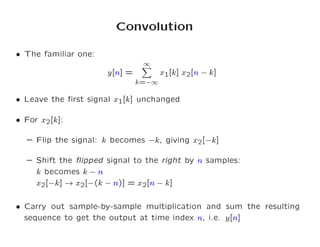
 The familiar one:
y[n℄ =
1
X
k= 1
x1[k℄ x2[n k℄
 Leave the rst signal x1[k℄ un hanged
 For x2[k℄:
{ Flip the signal: k be omes k, giving x2[ k℄
{ Shift the ipped signal to the right by n samples:
k be omes k n
x2[ k℄ ! x2[ (k n)℄ = x2[n k℄
 Carry out sample-by-sample multipli ation and sum the resulting
sequen e to get the output at time index n, i.e. y[n℄
What happens to periodi signals?
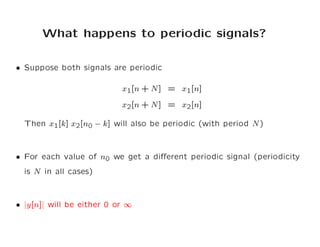
 Suppose both signals are periodi
x1[n + N℄ = x1[n℄
x2[n + N℄ = x2[n℄
Then x1[k℄ x2[n0 k℄ will also be periodi (with period N)
 For ea h value of n0 we get a di erent periodi signal (periodi ity
is N in all ases)
 jy[n℄j will be either 0 or 1
Cir ular Convolution
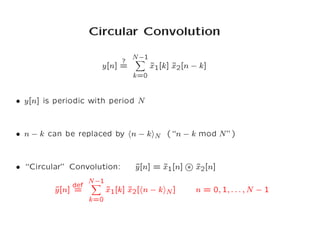
y[n℄ ?
=
N 1
X
k=0
~
x1[k℄ ~
x2[n k℄
 y[n℄ is periodi with period N
 n k an be repla ed by hn kiN (n k mod N)
 Cir ular Convolution: ~
y[n℄ = ~
x1[n℄  ~
x2[n℄
~
y[n℄ def
=
N 1
X
k=0
~
x1[k℄ ~
x2[hn kiN℄ n = 0; 1; : : : ; N 1
Examples
0
1
0
1
=
4
0
6 6
*
0 3
0 5
4
1
0 8
=
1
1
3
6
Linear
Circular
*
Relationship Between Linear and Cir ular
Convolution
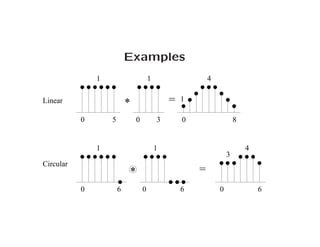
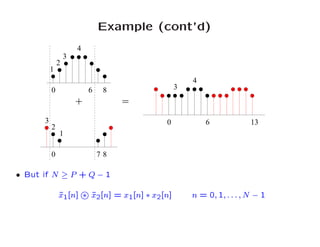
 If x1[n℄ has length P and x2[n℄ has length Q, then x1[n℄  x2[n℄ is
P + Q 1 long (e.g., 6 + 4 1 = 9)
 N  max (P; Q). In general
~
x1[n℄  ~
x2[n℄ 6= x1[n℄ x2[n℄ n = 0; 1; : : : ; N 1
 Cir ular onvolution an be thought of as repeating the result of
linear onvolution every N samples and adding the results (over one
period)
Example ( ont'd)
=
0 8
4
0 8
6
1
2
2
1
+
3
4
0
3
6
7
3
13
 But if N  P + Q 1
~
x1[n℄  ~
x2[n℄ = x1[n℄ x2[n℄ n = 0; 1; : : : ; N 1
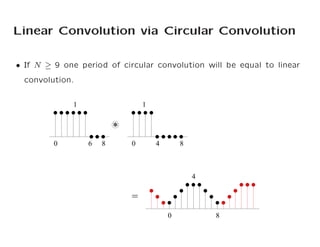
Linear Convolution via Cir ular Convolution
 If N  9 one period of ir ular onvolution will be equal to linear
onvolution.
0 8
6
1
*
=
4
0 8
0 8
4
1
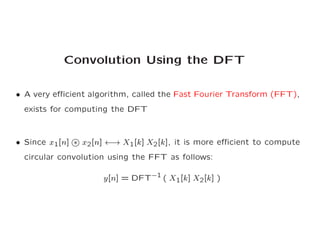
Convolution Using the DFT
 A very eÆ ient algorithm, alled the Fast Fourier Transform (FFT),
exists for omputing the DFT
 Sin e x1[n℄  x2[n℄ ! X1[k℄ X2[k℄, it is more eÆ ient to ompute
ir ular onvolution using the FFT as follows:
y[n℄ = DFT 1
( X1[k℄ X2[k℄ )

Circular convolution

  • 1.
    Convolution The familiarone: y[n℄ = 1 X k= 1 x1[k℄ x2[n k℄ Leave the rst signal x1[k℄ un hanged For x2[k℄: { Flip the signal: k be omes k, giving x2[ k℄ { Shift the ipped signal to the right by n samples: k be omes k n x2[ k℄ ! x2[ (k n)℄ = x2[n k℄ Carry out sample-by-sample multipli ation and sum the resulting sequen e to get the output at time index n, i.e. y[n℄
  • 2.
    What happens toperiodi signals? Suppose both signals are periodi x1[n + N℄ = x1[n℄ x2[n + N℄ = x2[n℄ Then x1[k℄ x2[n0 k℄ will also be periodi (with period N) For ea h value of n0 we get a di erent periodi signal (periodi ity is N in all ases) jy[n℄j will be either 0 or 1
  • 3.
    Cir ular Convolution y[n℄? = N 1 X k=0 ~ x1[k℄ ~ x2[n k℄ y[n℄ is periodi with period N n k an be repla ed by hn kiN (n k mod N) Cir ular Convolution: ~ y[n℄ = ~ x1[n℄ ~ x2[n℄ ~ y[n℄ def = N 1 X k=0 ~ x1[k℄ ~ x2[hn kiN℄ n = 0; 1; : : : ; N 1
  • 4.
    Examples 0 1 0 1 = 4 0 6 6 * 0 3 05 4 1 0 8 = 1 1 3 6 Linear Circular *
  • 5.
    Relationship Between Linearand Cir ular Convolution If x1[n℄ has length P and x2[n℄ has length Q, then x1[n℄ x2[n℄ is P + Q 1 long (e.g., 6 + 4 1 = 9) N max (P; Q). In general ~ x1[n℄ ~ x2[n℄ 6= x1[n℄ x2[n℄ n = 0; 1; : : : ; N 1 Cir ular onvolution an be thought of as repeating the result of linear onvolution every N samples and adding the results (over one period)
  • 6.
    Example ( ont'd) = 08 4 0 8 6 1 2 2 1 + 3 4 0 3 6 7 3 13 But if N P + Q 1 ~ x1[n℄ ~ x2[n℄ = x1[n℄ x2[n℄ n = 0; 1; : : : ; N 1
  • 7.
    Linear Convolution viaCir ular Convolution If N 9 one period of ir ular onvolution will be equal to linear onvolution. 0 8 6 1 * = 4 0 8 0 8 4 1
  • 8.
    Convolution Using theDFT A very eÆ ient algorithm, alled the Fast Fourier Transform (FFT), exists for omputing the DFT Sin e x1[n℄ x2[n℄ ! X1[k℄ X2[k℄, it is more eÆ ient to ompute ir ular onvolution using the FFT as follows: y[n℄ = DFT 1 ( X1[k℄ X2[k℄ )