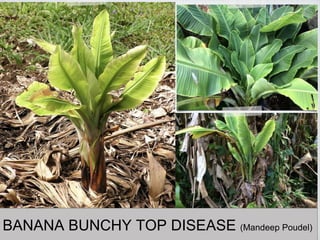
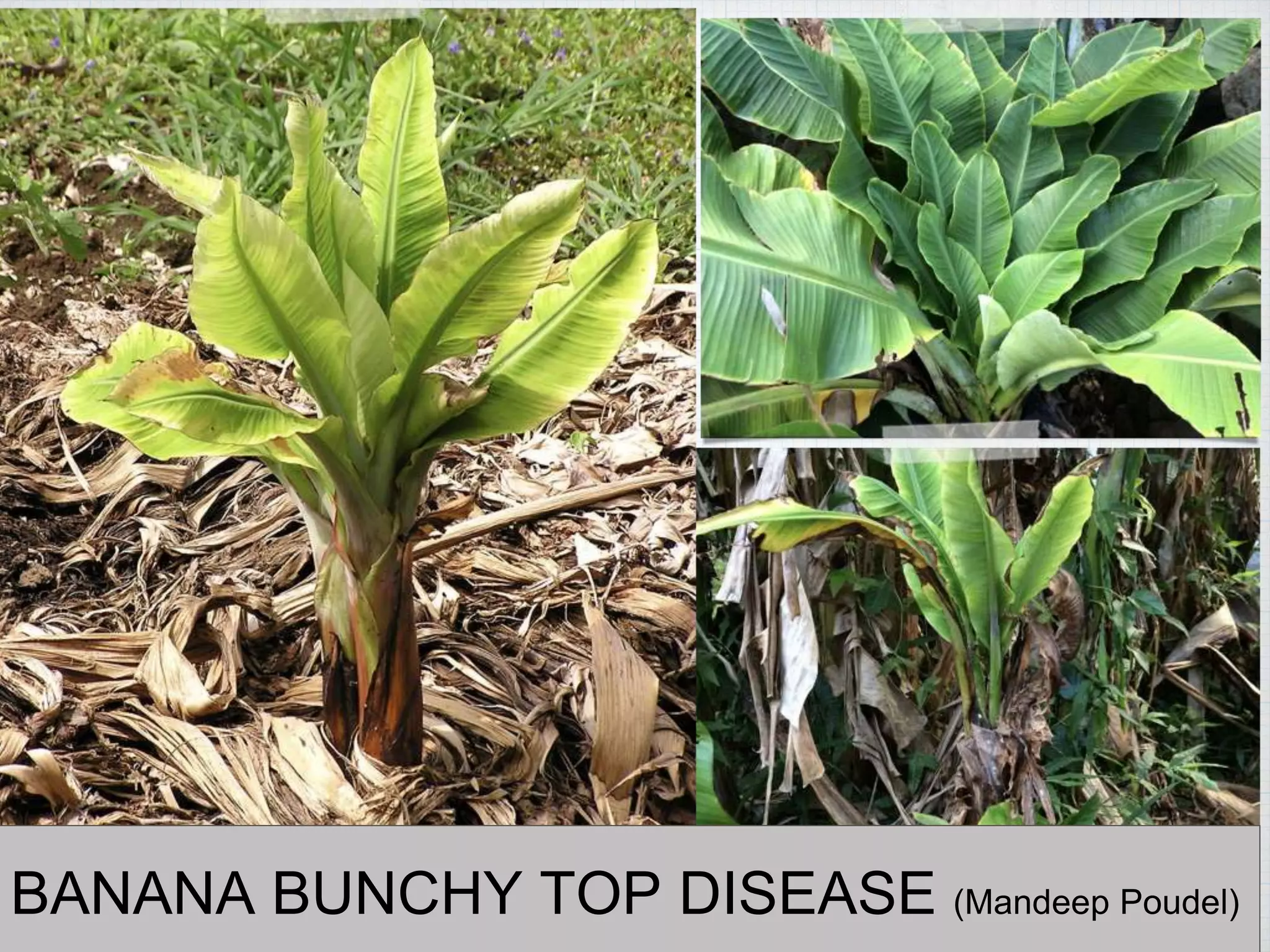
BANANA BUNCHY TOP DISEASE (Mandeep Poudel)
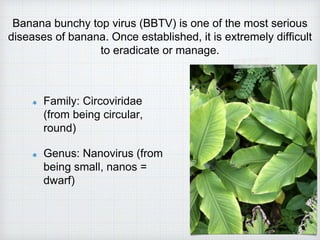
Banana bunchy top virus (BBTV) is one of the most serious
diseases of banana. Once established, it is extremely difficult
to eradicate or manage.
Family: Circoviridae
(from being circular,
round)
Genus: Nanovirus (from
being small, nanos =
dwarf)
Symptoms
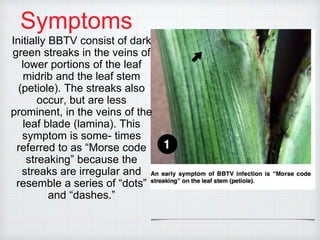
Initially BBTV consist of dark
green streaks in the veins of
lower portions of the leaf
midrib and the leaf stem
(petiole). The streaks also
occur, but are less
prominent, in the veins of the
leaf blade (lamina). This
symptom is some- times
referred to as “Morse code
streaking” because the
streaks are irregular and
resemble a series of “dots”
and “dashes.”
:
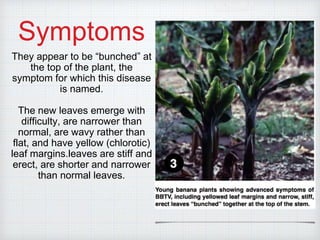
The hook-like extensions
of the leaf lamina veins
can be seen in the
narrow, light-green zone
between the midrib and
the lamina, hooks point
down along the midrib
toward the petiole. They
can best be seen by
back-lighting the leaf
against the sky.
Symptoms
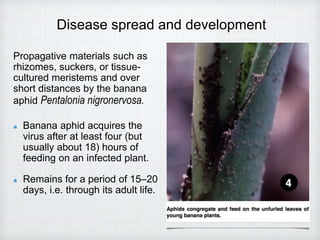
They appear to be “bunched” at
the top of the plant, the
symptom for which this disease
is named.
The new leaves emerge with
difficulty, are narrower than
normal, are wavy rather than
flat, and have yellow (chlorotic)
leaf margins.leaves are stiff and
erect, are shorter and narrower
than normal leaves.
Disease spread and development
Propagative materials such as
rhizomes, suckers, or tissue-
cultured meristems and over
short distances by the banana
aphid Pentalonia nigronervosa.
Banana aphid acquires the
virus after at least four (but
usually about 18) hours of
feeding on an infected plant.
Remains for a period of 15–20
days, i.e. through its adult life.
Nature of Damage:
Disease symptoms usually appear about a month after
infection.
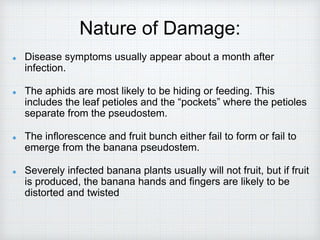
The aphids are most likely to be hiding or feeding. This
includes the leaf petioles and the “pockets” where the petioles
separate from the pseudostem.
The inflorescence and fruit bunch either fail to form or fail to
emerge from the banana pseudostem.
Severely infected banana plants usually will not fruit, but if fruit
is produced, the banana hands and fingers are likely to be
distorted and twisted
Control Measures:
Minimise virus infection: Quarantine measures, the use of
virus-free propagating material, locating new plantations
away from older infected ones, and destroying all
volunteer banana plants.
Reduction in spread: Roguing of infected and
nearby plants seems to reduce the rate of virus spread.
Spraying with Insecticidal soaps.
Attempts to control the aphid vector with insecticides
have little effect on the spread of this virus.

Banana Bunchy Top Disease

  • 1.
    BANANA BUNCHY TOPDISEASE (Mandeep Poudel)
  • 2.
    Banana bunchy topvirus (BBTV) is one of the most serious diseases of banana. Once established, it is extremely difficult to eradicate or manage. Family: Circoviridae (from being circular, round) Genus: Nanovirus (from being small, nanos = dwarf)
  • 3.
    Symptoms Initially BBTV consistof dark green streaks in the veins of lower portions of the leaf midrib and the leaf stem (petiole). The streaks also occur, but are less prominent, in the veins of the leaf blade (lamina). This symptom is some- times referred to as “Morse code streaking” because the streaks are irregular and resemble a series of “dots” and “dashes.”
  • 4.
    : The hook-like extensions ofthe leaf lamina veins can be seen in the narrow, light-green zone between the midrib and the lamina, hooks point down along the midrib toward the petiole. They can best be seen by back-lighting the leaf against the sky.
  • 5.
    Symptoms They appear tobe “bunched” at the top of the plant, the symptom for which this disease is named. The new leaves emerge with difficulty, are narrower than normal, are wavy rather than flat, and have yellow (chlorotic) leaf margins.leaves are stiff and erect, are shorter and narrower than normal leaves.
  • 6.
    Disease spread anddevelopment Propagative materials such as rhizomes, suckers, or tissue- cultured meristems and over short distances by the banana aphid Pentalonia nigronervosa. Banana aphid acquires the virus after at least four (but usually about 18) hours of feeding on an infected plant. Remains for a period of 15–20 days, i.e. through its adult life.
  • 7.
    Nature of Damage: Diseasesymptoms usually appear about a month after infection. The aphids are most likely to be hiding or feeding. This includes the leaf petioles and the “pockets” where the petioles separate from the pseudostem. The inflorescence and fruit bunch either fail to form or fail to emerge from the banana pseudostem. Severely infected banana plants usually will not fruit, but if fruit is produced, the banana hands and fingers are likely to be distorted and twisted
  • 8.
    Control Measures: Minimise virusinfection: Quarantine measures, the use of virus-free propagating material, locating new plantations away from older infected ones, and destroying all volunteer banana plants. Reduction in spread: Roguing of infected and nearby plants seems to reduce the rate of virus spread. Spraying with Insecticidal soaps. Attempts to control the aphid vector with insecticides have little effect on the spread of this virus.